EP2824138A1 - Solar Energy Funneling Using Thermoplastics for Agricultural Applications - Google Patents
Solar Energy Funneling Using Thermoplastics for Agricultural Applications Download PDFInfo
- Publication number
- EP2824138A1 EP2824138A1 EP14171006.1A EP14171006A EP2824138A1 EP 2824138 A1 EP2824138 A1 EP 2824138A1 EP 14171006 A EP14171006 A EP 14171006A EP 2824138 A1 EP2824138 A1 EP 2824138A1
- Authority
- EP
- European Patent Office
- Prior art keywords
- wavelength
- light
- conversion material
- dye
- polymeric matrix
- Prior art date
- Legal status (The legal status is an assumption and is not a legal conclusion. Google has not performed a legal analysis and makes no representation as to the accuracy of the status listed.)
- Granted
Links
- 229920001169 thermoplastic Polymers 0.000 title 1
- 239000004416 thermosoftening plastic Substances 0.000 title 1
- 239000000463 material Substances 0.000 claims abstract description 129
- 238000006243 chemical reaction Methods 0.000 claims abstract description 109
- 239000011159 matrix material Substances 0.000 claims abstract description 68
- 239000007850 fluorescent dye Substances 0.000 claims abstract description 49
- 238000000034 method Methods 0.000 claims abstract description 40
- 239000000975 dye Substances 0.000 claims description 58
- 150000001875 compounds Chemical class 0.000 claims description 51
- -1 polyethylene Polymers 0.000 claims description 37
- 229920000642 polymer Polymers 0.000 claims description 31
- 125000002080 perylenyl group Chemical group C1(=CC=C2C=CC=C3C4=CC=CC5=CC=CC(C1=C23)=C45)* 0.000 claims description 23
- 239000004417 polycarbonate Substances 0.000 claims description 23
- 125000000217 alkyl group Chemical group 0.000 claims description 22
- 229920000515 polycarbonate Polymers 0.000 claims description 21
- FYNROBRQIVCIQF-UHFFFAOYSA-N pyrrolo[3,2-b]pyrrole-5,6-dione Chemical compound C1=CN=C2C(=O)C(=O)N=C21 FYNROBRQIVCIQF-UHFFFAOYSA-N 0.000 claims description 21
- 239000000654 additive Substances 0.000 claims description 20
- CSHWQDPOILHKBI-UHFFFAOYSA-N peryrene Natural products C1=CC(C2=CC=CC=3C2=C2C=CC=3)=C3C2=CC=CC3=C1 CSHWQDPOILHKBI-UHFFFAOYSA-N 0.000 claims description 20
- 125000003545 alkoxy group Chemical group 0.000 claims description 15
- 239000001257 hydrogen Substances 0.000 claims description 15
- 229910052739 hydrogen Inorganic materials 0.000 claims description 15
- 229910052736 halogen Inorganic materials 0.000 claims description 14
- 150000002367 halogens Chemical class 0.000 claims description 14
- 229920000098 polyolefin Polymers 0.000 claims description 13
- KJOLVZJFMDVPGB-UHFFFAOYSA-N perylenediimide Chemical compound C=12C3=CC=C(C(NC4=O)=O)C2=C4C=CC=1C1=CC=C2C(=O)NC(=O)C4=CC=C3C1=C42 KJOLVZJFMDVPGB-UHFFFAOYSA-N 0.000 claims description 11
- 125000001424 substituent group Chemical group 0.000 claims description 11
- 230000000996 additive effect Effects 0.000 claims description 10
- 125000004400 (C1-C12) alkyl group Chemical group 0.000 claims description 8
- 150000001412 amines Chemical class 0.000 claims description 8
- 239000003795 chemical substances by application Substances 0.000 claims description 8
- ZYGHJZDHTFUPRJ-UHFFFAOYSA-N coumarin Chemical compound C1=CC=C2OC(=O)C=CC2=C1 ZYGHJZDHTFUPRJ-UHFFFAOYSA-N 0.000 claims description 8
- 125000000951 phenoxy group Chemical group [H]C1=C([H])C([H])=C(O*)C([H])=C1[H] 0.000 claims description 8
- 125000001997 phenyl group Chemical group [H]C1=C([H])C([H])=C(*)C([H])=C1[H] 0.000 claims description 8
- 239000004698 Polyethylene Substances 0.000 claims description 7
- 239000000203 mixture Substances 0.000 claims description 7
- 229920000573 polyethylene Polymers 0.000 claims description 7
- 239000003963 antioxidant agent Substances 0.000 claims description 6
- 125000003785 benzimidazolyl group Chemical group N1=C(NC2=C1C=CC=C2)* 0.000 claims description 6
- 230000003287 optical effect Effects 0.000 claims description 6
- 230000003078 antioxidant effect Effects 0.000 claims description 5
- DGBWPZSGHAXYGK-UHFFFAOYSA-N perinone Chemical compound C12=NC3=CC=CC=C3N2C(=O)C2=CC=C3C4=C2C1=CC=C4C(=O)N1C2=CC=CC=C2N=C13 DGBWPZSGHAXYGK-UHFFFAOYSA-N 0.000 claims description 5
- 125000006527 (C1-C5) alkyl group Chemical group 0.000 claims description 4
- PHBSPYGHSRVOHY-UHFFFAOYSA-N 2-[2-(1,3-benzoxazol-2-yl)thiophen-3-yl]-1,3-benzoxazole Chemical compound C1=CC=C2OC(C3=C(C=4OC5=CC=CC=C5N=4)C=CS3)=NC2=C1 PHBSPYGHSRVOHY-UHFFFAOYSA-N 0.000 claims description 4
- BCHZICNRHXRCHY-UHFFFAOYSA-N 2h-oxazine Chemical compound N1OC=CC=C1 BCHZICNRHXRCHY-UHFFFAOYSA-N 0.000 claims description 4
- MYMOFIZGZYHOMD-UHFFFAOYSA-N Dioxygen Chemical compound O=O MYMOFIZGZYHOMD-UHFFFAOYSA-N 0.000 claims description 4
- 239000006057 Non-nutritive feed additive Substances 0.000 claims description 4
- 239000004793 Polystyrene Substances 0.000 claims description 4
- 239000004372 Polyvinyl alcohol Substances 0.000 claims description 4
- 239000000999 acridine dye Substances 0.000 claims description 4
- 239000001000 anthraquinone dye Substances 0.000 claims description 4
- 239000002216 antistatic agent Substances 0.000 claims description 4
- 239000001001 arylmethane dye Substances 0.000 claims description 4
- 239000000298 carbocyanine Substances 0.000 claims description 4
- 125000005606 carbostyryl group Chemical group 0.000 claims description 4
- 229960000956 coumarin Drugs 0.000 claims description 4
- 235000001671 coumarin Nutrition 0.000 claims description 4
- 229920001971 elastomer Polymers 0.000 claims description 4
- 239000000806 elastomer Substances 0.000 claims description 4
- 239000000945 filler Substances 0.000 claims description 4
- 239000012760 heat stabilizer Substances 0.000 claims description 4
- 125000004435 hydrogen atom Chemical class [H]* 0.000 claims description 4
- 239000004611 light stabiliser Substances 0.000 claims description 4
- 229920000092 linear low density polyethylene Polymers 0.000 claims description 4
- 239000004707 linear low-density polyethylene Substances 0.000 claims description 4
- 239000002667 nucleating agent Substances 0.000 claims description 4
- XRBCRPZXSCBRTK-UHFFFAOYSA-N phosphonous acid Chemical compound OPO XRBCRPZXSCBRTK-UHFFFAOYSA-N 0.000 claims description 4
- 239000001007 phthalocyanine dye Substances 0.000 claims description 4
- 229920003229 poly(methyl methacrylate) Polymers 0.000 claims description 4
- 229920002037 poly(vinyl butyral) polymer Polymers 0.000 claims description 4
- 229920000728 polyester Polymers 0.000 claims description 4
- 229920002223 polystyrene Polymers 0.000 claims description 4
- 229920002689 polyvinyl acetate Polymers 0.000 claims description 4
- 239000011118 polyvinyl acetate Substances 0.000 claims description 4
- 229920002451 polyvinyl alcohol Polymers 0.000 claims description 4
- 150000004032 porphyrins Chemical class 0.000 claims description 4
- 239000001008 quinone-imine dye Substances 0.000 claims description 4
- 239000012779 reinforcing material Substances 0.000 claims description 4
- 239000001017 thiazole dye Substances 0.000 claims description 4
- 239000000326 ultraviolet stabilizing agent Substances 0.000 claims description 4
- 239000001018 xanthene dye Substances 0.000 claims description 4
- AIXZBGVLNVRQSS-UHFFFAOYSA-N 5-tert-butyl-2-[5-(5-tert-butyl-1,3-benzoxazol-2-yl)thiophen-2-yl]-1,3-benzoxazole Chemical compound CC(C)(C)C1=CC=C2OC(C3=CC=C(S3)C=3OC4=CC=C(C=C4N=3)C(C)(C)C)=NC2=C1 AIXZBGVLNVRQSS-UHFFFAOYSA-N 0.000 claims description 3
- 239000004743 Polypropylene Substances 0.000 claims description 3
- RTAQQCXQSZGOHL-UHFFFAOYSA-N Titanium Chemical compound [Ti] RTAQQCXQSZGOHL-UHFFFAOYSA-N 0.000 claims description 3
- HCHKCACWOHOZIP-UHFFFAOYSA-N Zinc Chemical compound [Zn] HCHKCACWOHOZIP-UHFFFAOYSA-N 0.000 claims description 3
- 229910052787 antimony Inorganic materials 0.000 claims description 3
- WATWJIUSRGPENY-UHFFFAOYSA-N antimony atom Chemical compound [Sb] WATWJIUSRGPENY-UHFFFAOYSA-N 0.000 claims description 3
- 229910052788 barium Inorganic materials 0.000 claims description 3
- DSAJWYNOEDNPEQ-UHFFFAOYSA-N barium atom Chemical compound [Ba] DSAJWYNOEDNPEQ-UHFFFAOYSA-N 0.000 claims description 3
- 229920001903 high density polyethylene Polymers 0.000 claims description 3
- 239000004700 high-density polyethylene Substances 0.000 claims description 3
- 229910010272 inorganic material Inorganic materials 0.000 claims description 3
- 239000011147 inorganic material Substances 0.000 claims description 3
- 229920001684 low density polyethylene Polymers 0.000 claims description 3
- 239000004702 low-density polyethylene Substances 0.000 claims description 3
- OJMIONKXNSYLSR-UHFFFAOYSA-N phosphorous acid Chemical compound OP(O)O OJMIONKXNSYLSR-UHFFFAOYSA-N 0.000 claims description 3
- 229920001155 polypropylene Polymers 0.000 claims description 3
- 229910052719 titanium Inorganic materials 0.000 claims description 3
- 239000010936 titanium Substances 0.000 claims description 3
- 239000011701 zinc Substances 0.000 claims description 3
- 229910052725 zinc Inorganic materials 0.000 claims description 3
- 241000196324 Embryophyta Species 0.000 description 51
- ZMXDDKWLCZADIW-UHFFFAOYSA-N N,N-Dimethylformamide Chemical compound CN(C)C=O ZMXDDKWLCZADIW-UHFFFAOYSA-N 0.000 description 15
- 239000000049 pigment Substances 0.000 description 13
- 239000013067 intermediate product Substances 0.000 description 12
- ATNHDLDRLWWWCB-AENOIHSZSA-M chlorophyll a Chemical compound C1([C@@H](C(=O)OC)C(=O)C2=C3C)=C2N2C3=CC(C(CC)=C3C)=[N+]4C3=CC3=C(C=C)C(C)=C5N3[Mg-2]42[N+]2=C1[C@@H](CCC(=O)OC\C=C(/C)CCC[C@H](C)CCC[C@H](C)CCCC(C)C)[C@H](C)C2=C5 ATNHDLDRLWWWCB-AENOIHSZSA-M 0.000 description 11
- ISWSIDIOOBJBQZ-UHFFFAOYSA-N phenol group Chemical group C1(=CC=CC=C1)O ISWSIDIOOBJBQZ-UHFFFAOYSA-N 0.000 description 11
- 229930002868 chlorophyll a Natural products 0.000 description 10
- 229930002869 chlorophyll b Natural products 0.000 description 10
- NSMUHPMZFPKNMZ-VBYMZDBQSA-M chlorophyll b Chemical compound C1([C@@H](C(=O)OC)C(=O)C2=C3C)=C2N2C3=CC(C(CC)=C3C=O)=[N+]4C3=CC3=C(C=C)C(C)=C5N3[Mg-2]42[N+]2=C1[C@@H](CCC(=O)OC\C=C(/C)CCC[C@H](C)CCC[C@H](C)CCCC(C)C)[C@H](C)C2=C5 NSMUHPMZFPKNMZ-VBYMZDBQSA-M 0.000 description 10
- 239000002904 solvent Substances 0.000 description 10
- 125000004429 atom Chemical group 0.000 description 9
- 230000000670 limiting effect Effects 0.000 description 9
- RFFLAFLAYFXFSW-UHFFFAOYSA-N 1,2-dichlorobenzene Chemical compound ClC1=CC=CC=C1Cl RFFLAFLAYFXFSW-UHFFFAOYSA-N 0.000 description 8
- IAZDPXIOMUYVGZ-UHFFFAOYSA-N Dimethylsulphoxide Chemical compound CS(C)=O IAZDPXIOMUYVGZ-UHFFFAOYSA-N 0.000 description 8
- 125000003118 aryl group Chemical group 0.000 description 8
- 229910052799 carbon Inorganic materials 0.000 description 8
- OKTJSMMVPCPJKN-UHFFFAOYSA-N Carbon Chemical compound [C] OKTJSMMVPCPJKN-UHFFFAOYSA-N 0.000 description 7
- UFHFLCQGNIYNRP-UHFFFAOYSA-N Hydrogen Chemical compound [H][H] UFHFLCQGNIYNRP-UHFFFAOYSA-N 0.000 description 7
- YXFVVABEGXRONW-UHFFFAOYSA-N Toluene Chemical compound CC1=CC=CC=C1 YXFVVABEGXRONW-UHFFFAOYSA-N 0.000 description 7
- 238000010521 absorption reaction Methods 0.000 description 7
- IJGRMHOSHXDMSA-UHFFFAOYSA-N nitrogen Substances N#N IJGRMHOSHXDMSA-UHFFFAOYSA-N 0.000 description 7
- 230000008635 plant growth Effects 0.000 description 7
- GEYOCULIXLDCMW-UHFFFAOYSA-N 1,2-phenylenediamine Chemical compound NC1=CC=CC=C1N GEYOCULIXLDCMW-UHFFFAOYSA-N 0.000 description 6
- ALYNCZNDIQEVRV-UHFFFAOYSA-N 4-aminobenzoic acid Chemical compound NC1=CC=C(C(O)=O)C=C1 ALYNCZNDIQEVRV-UHFFFAOYSA-N 0.000 description 6
- YMWUJEATGCHHMB-UHFFFAOYSA-N Dichloromethane Chemical compound ClCCl YMWUJEATGCHHMB-UHFFFAOYSA-N 0.000 description 6
- 238000002835 absorbance Methods 0.000 description 6
- 230000012010 growth Effects 0.000 description 6
- 150000002431 hydrogen Chemical class 0.000 description 6
- 229920000139 polyethylene terephthalate Polymers 0.000 description 6
- 239000005020 polyethylene terephthalate Substances 0.000 description 6
- SECXISVLQFMRJM-UHFFFAOYSA-N N-Methylpyrrolidone Chemical compound CN1CCCC1=O SECXISVLQFMRJM-UHFFFAOYSA-N 0.000 description 5
- 238000000862 absorption spectrum Methods 0.000 description 5
- 230000005284 excitation Effects 0.000 description 5
- 229910052757 nitrogen Inorganic materials 0.000 description 5
- 239000008188 pellet Substances 0.000 description 5
- 230000029553 photosynthesis Effects 0.000 description 5
- 238000010672 photosynthesis Methods 0.000 description 5
- 229920003023 plastic Polymers 0.000 description 5
- 239000004033 plastic Substances 0.000 description 5
- HEOCBCNFKCOKBX-RELGSGGGSA-N (1s,2e,4r)-4,7,7-trimethyl-2-[(4-methylphenyl)methylidene]bicyclo[2.2.1]heptan-3-one Chemical compound C1=CC(C)=CC=C1\C=C/1C(=O)[C@]2(C)CC[C@H]\1C2(C)C HEOCBCNFKCOKBX-RELGSGGGSA-N 0.000 description 4
- 125000006702 (C1-C18) alkyl group Chemical group 0.000 description 4
- JGUMTYWKIBJSTN-UHFFFAOYSA-N 2-ethylhexyl 4-[[4,6-bis[4-(2-ethylhexoxycarbonyl)anilino]-1,3,5-triazin-2-yl]amino]benzoate Chemical compound C1=CC(C(=O)OCC(CC)CCCC)=CC=C1NC1=NC(NC=2C=CC(=CC=2)C(=O)OCC(CC)CCCC)=NC(NC=2C=CC(=CC=2)C(=O)OCC(CC)CCCC)=N1 JGUMTYWKIBJSTN-UHFFFAOYSA-N 0.000 description 4
- OSCJHTSDLYVCQC-UHFFFAOYSA-N 2-ethylhexyl 4-[[4-[4-(tert-butylcarbamoyl)anilino]-6-[4-(2-ethylhexoxycarbonyl)anilino]-1,3,5-triazin-2-yl]amino]benzoate Chemical compound C1=CC(C(=O)OCC(CC)CCCC)=CC=C1NC1=NC(NC=2C=CC(=CC=2)C(=O)NC(C)(C)C)=NC(NC=2C=CC(=CC=2)C(=O)OCC(CC)CCCC)=N1 OSCJHTSDLYVCQC-UHFFFAOYSA-N 0.000 description 4
- XKRFYHLGVUSROY-UHFFFAOYSA-N Argon Chemical compound [Ar] XKRFYHLGVUSROY-UHFFFAOYSA-N 0.000 description 4
- HEDRZPFGACZZDS-UHFFFAOYSA-N Chloroform Chemical compound ClC(Cl)Cl HEDRZPFGACZZDS-UHFFFAOYSA-N 0.000 description 4
- YBGZDTIWKVFICR-JLHYYAGUSA-N Octyl 4-methoxycinnamic acid Chemical compound CCCCC(CC)COC(=O)\C=C\C1=CC=C(OC)C=C1 YBGZDTIWKVFICR-JLHYYAGUSA-N 0.000 description 4
- CDBYLPFSWZWCQE-UHFFFAOYSA-L Sodium Carbonate Chemical compound [Na+].[Na+].[O-]C([O-])=O CDBYLPFSWZWCQE-UHFFFAOYSA-L 0.000 description 4
- HEAHZSUCFKFERC-LRVMPXQBSA-N [(2e)-2-[[4-[(z)-[7,7-dimethyl-3-oxo-4-(sulfomethyl)-2-bicyclo[2.2.1]heptanylidene]methyl]phenyl]methylidene]-7,7-dimethyl-3-oxo-4-bicyclo[2.2.1]heptanyl]methanesulfonic acid Chemical compound CC1(C)C2CCC1(CS(O)(=O)=O)C(=O)\C2=C/C(C=C1)=CC=C1\C=C/1C(=O)C2(CS(O)(=O)=O)CCC\1C2(C)C HEAHZSUCFKFERC-LRVMPXQBSA-N 0.000 description 4
- 125000001931 aliphatic group Chemical group 0.000 description 4
- XVAMCHGMPYWHNL-UHFFFAOYSA-N bemotrizinol Chemical compound OC1=CC(OCC(CC)CCCC)=CC=C1C1=NC(C=2C=CC(OC)=CC=2)=NC(C=2C(=CC(OCC(CC)CCCC)=CC=2)O)=N1 XVAMCHGMPYWHNL-UHFFFAOYSA-N 0.000 description 4
- 229960004101 bemotrizinol Drugs 0.000 description 4
- MVPPADPHJFYWMZ-UHFFFAOYSA-N chlorobenzene Chemical compound ClC1=CC=CC=C1 MVPPADPHJFYWMZ-UHFFFAOYSA-N 0.000 description 4
- FDATWRLUYRHCJE-UHFFFAOYSA-N diethylamino hydroxybenzoyl hexyl benzoate Chemical compound CCCCCCOC(=O)C1=CC=CC=C1C(=O)C1=CC=C(N(CC)CC)C=C1O FDATWRLUYRHCJE-UHFFFAOYSA-N 0.000 description 4
- GLCJMPWWQKKJQZ-UHFFFAOYSA-L disodium;2-[4-(4,6-disulfonato-1h-benzimidazol-2-yl)phenyl]-1h-benzimidazole-4,6-disulfonate;hydron Chemical compound [Na+].[Na+].C1=C(S(O)(=O)=O)C=C2NC(C3=CC=C(C=C3)C3=NC4=C(C=C(C=C4N3)S(=O)(=O)O)S([O-])(=O)=O)=NC2=C1S([O-])(=O)=O GLCJMPWWQKKJQZ-UHFFFAOYSA-L 0.000 description 4
- HUVYTMDMDZRHBN-UHFFFAOYSA-N drometrizole trisiloxane Chemical compound C[Si](C)(C)O[Si](C)(O[Si](C)(C)C)CC(C)CC1=CC(C)=CC(N2N=C3C=CC=CC3=N2)=C1O HUVYTMDMDZRHBN-UHFFFAOYSA-N 0.000 description 4
- 229960003747 ecamsule Drugs 0.000 description 4
- UVCJGUGAGLDPAA-UHFFFAOYSA-N ensulizole Chemical compound N1C2=CC(S(=O)(=O)O)=CC=C2N=C1C1=CC=CC=C1 UVCJGUGAGLDPAA-UHFFFAOYSA-N 0.000 description 4
- 229960000655 ensulizole Drugs 0.000 description 4
- 230000035784 germination Effects 0.000 description 4
- VAMXMNNIEUEQDV-UHFFFAOYSA-N methyl anthranilate Chemical compound COC(=O)C1=CC=CC=C1N VAMXMNNIEUEQDV-UHFFFAOYSA-N 0.000 description 4
- 125000002496 methyl group Chemical group [H]C([H])([H])* 0.000 description 4
- 229960001679 octinoxate Drugs 0.000 description 4
- 229960003921 octisalate Drugs 0.000 description 4
- DXGLGDHPHMLXJC-UHFFFAOYSA-N oxybenzone Chemical compound OC1=CC(OC)=CC=C1C(=O)C1=CC=CC=C1 DXGLGDHPHMLXJC-UHFFFAOYSA-N 0.000 description 4
- 150000002989 phenols Chemical class 0.000 description 4
- 239000002798 polar solvent Substances 0.000 description 4
- 229920002282 polysilicones-15 Polymers 0.000 description 4
- QTBSBXVTEAMEQO-UHFFFAOYSA-N Acetic acid Chemical compound CC(O)=O QTBSBXVTEAMEQO-UHFFFAOYSA-N 0.000 description 3
- 229920004142 LEXAN™ Polymers 0.000 description 3
- BUGBHKTXTAQXES-UHFFFAOYSA-N Selenium Chemical group [Se] BUGBHKTXTAQXES-UHFFFAOYSA-N 0.000 description 3
- XUIMIQQOPSSXEZ-UHFFFAOYSA-N Silicon Chemical group [Si] XUIMIQQOPSSXEZ-UHFFFAOYSA-N 0.000 description 3
- NINIDFKCEFEMDL-UHFFFAOYSA-N Sulfur Chemical group [S] NINIDFKCEFEMDL-UHFFFAOYSA-N 0.000 description 3
- QVGXLLKOCUKJST-UHFFFAOYSA-N atomic oxygen Chemical group [O] QVGXLLKOCUKJST-UHFFFAOYSA-N 0.000 description 3
- 230000008901 benefit Effects 0.000 description 3
- 125000004122 cyclic group Chemical group 0.000 description 3
- 238000000295 emission spectrum Methods 0.000 description 3
- 238000002474 experimental method Methods 0.000 description 3
- 125000005842 heteroatom Chemical group 0.000 description 3
- RAXXELZNTBOGNW-UHFFFAOYSA-N imidazole Natural products C1=CNC=N1 RAXXELZNTBOGNW-UHFFFAOYSA-N 0.000 description 3
- 239000004615 ingredient Substances 0.000 description 3
- 238000002347 injection Methods 0.000 description 3
- 239000007924 injection Substances 0.000 description 3
- QJGQUHMNIGDVPM-UHFFFAOYSA-N nitrogen group Chemical group [N] QJGQUHMNIGDVPM-UHFFFAOYSA-N 0.000 description 3
- 229910052760 oxygen Chemical group 0.000 description 3
- 239000001301 oxygen Chemical group 0.000 description 3
- 125000004430 oxygen atom Chemical group O* 0.000 description 3
- 239000013500 performance material Substances 0.000 description 3
- 229910052711 selenium Inorganic materials 0.000 description 3
- 239000011669 selenium Chemical group 0.000 description 3
- 239000010703 silicon Chemical group 0.000 description 3
- 229910052710 silicon Inorganic materials 0.000 description 3
- 238000001228 spectrum Methods 0.000 description 3
- 239000000126 substance Substances 0.000 description 3
- 239000000758 substrate Substances 0.000 description 3
- 239000011593 sulfur Chemical group 0.000 description 3
- 229910052717 sulfur Inorganic materials 0.000 description 3
- XLYOFNOQVPJJNP-UHFFFAOYSA-N water Substances O XLYOFNOQVPJJNP-UHFFFAOYSA-N 0.000 description 3
- OCJBOOLMMGQPQU-UHFFFAOYSA-N 1,4-dichlorobenzene Chemical compound ClC1=CC=C(Cl)C=C1 OCJBOOLMMGQPQU-UHFFFAOYSA-N 0.000 description 2
- MEZZCSHVIGVWFI-UHFFFAOYSA-N 2,2'-Dihydroxy-4-methoxybenzophenone Chemical compound OC1=CC(OC)=CC=C1C(=O)C1=CC=CC=C1O MEZZCSHVIGVWFI-UHFFFAOYSA-N 0.000 description 2
- WSSJONWNBBTCMG-UHFFFAOYSA-N 2-hydroxybenzoic acid (3,3,5-trimethylcyclohexyl) ester Chemical compound C1C(C)(C)CC(C)CC1OC(=O)C1=CC=CC=C1O WSSJONWNBBTCMG-UHFFFAOYSA-N 0.000 description 2
- ISAVYTVYFVQUDY-UHFFFAOYSA-N 4-tert-Octylphenol Chemical compound CC(C)(C)CC(C)(C)C1=CC=C(O)C=C1 ISAVYTVYFVQUDY-UHFFFAOYSA-N 0.000 description 2
- FMRHJJZUHUTGKE-UHFFFAOYSA-N Ethylhexyl salicylate Chemical compound CCCCC(CC)COC(=O)C1=CC=CC=C1O FMRHJJZUHUTGKE-UHFFFAOYSA-N 0.000 description 2
- DGAQECJNVWCQMB-PUAWFVPOSA-M Ilexoside XXIX Chemical compound C[C@@H]1CC[C@@]2(CC[C@@]3(C(=CC[C@H]4[C@]3(CC[C@@H]5[C@@]4(CC[C@@H](C5(C)C)OS(=O)(=O)[O-])C)C)[C@@H]2[C@]1(C)O)C)C(=O)O[C@H]6[C@@H]([C@H]([C@@H]([C@H](O6)CO)O)O)O.[Na+] DGAQECJNVWCQMB-PUAWFVPOSA-M 0.000 description 2
- FXHOOIRPVKKKFG-UHFFFAOYSA-N N,N-Dimethylacetamide Chemical compound CN(C)C(C)=O FXHOOIRPVKKKFG-UHFFFAOYSA-N 0.000 description 2
- IGFHQQFPSIBGKE-UHFFFAOYSA-N Nonylphenol Natural products CCCCCCCCCC1=CC=C(O)C=C1 IGFHQQFPSIBGKE-UHFFFAOYSA-N 0.000 description 2
- WYWZRNAHINYAEF-UHFFFAOYSA-N Padimate O Chemical compound CCCCC(CC)COC(=O)C1=CC=C(N(C)C)C=C1 WYWZRNAHINYAEF-UHFFFAOYSA-N 0.000 description 2
- ZLMJMSJWJFRBEC-UHFFFAOYSA-N Potassium Chemical compound [K] ZLMJMSJWJFRBEC-UHFFFAOYSA-N 0.000 description 2
- SMWDFEZZVXVKRB-UHFFFAOYSA-N Quinoline Chemical compound N1=CC=CC2=CC=CC=C21 SMWDFEZZVXVKRB-UHFFFAOYSA-N 0.000 description 2
- VYPSYNLAJGMNEJ-UHFFFAOYSA-N Silicium dioxide Chemical compound O=[Si]=O VYPSYNLAJGMNEJ-UHFFFAOYSA-N 0.000 description 2
- WYWZRNAHINYAEF-AWEZNQCLSA-N [(2s)-2-ethylhexyl] 4-(dimethylamino)benzoate Chemical compound CCCC[C@H](CC)COC(=O)C1=CC=C(N(C)C)C=C1 WYWZRNAHINYAEF-AWEZNQCLSA-N 0.000 description 2
- 229960004050 aminobenzoic acid Drugs 0.000 description 2
- 229910052786 argon Inorganic materials 0.000 description 2
- 239000012298 atmosphere Substances 0.000 description 2
- XNEFYCZVKIDDMS-UHFFFAOYSA-N avobenzone Chemical compound C1=CC(OC)=CC=C1C(=O)CC(=O)C1=CC=C(C(C)(C)C)C=C1 XNEFYCZVKIDDMS-UHFFFAOYSA-N 0.000 description 2
- 239000012965 benzophenone Substances 0.000 description 2
- 150000008366 benzophenones Chemical class 0.000 description 2
- CMDKPGRTAQVGFQ-RMKNXTFCSA-N cinoxate Chemical compound CCOCCOC(=O)\C=C\C1=CC=C(OC)C=C1 CMDKPGRTAQVGFQ-RMKNXTFCSA-N 0.000 description 2
- 229960001063 cinoxate Drugs 0.000 description 2
- 238000004440 column chromatography Methods 0.000 description 2
- 125000000753 cycloalkyl group Chemical group 0.000 description 2
- 229940117389 dichlorobenzene Drugs 0.000 description 2
- 229960001630 diethylamino hydroxybenzoyl hexyl benzoate Drugs 0.000 description 2
- XBDQKXXYIPTUBI-UHFFFAOYSA-N dimethylselenoniopropionate Natural products CCC(O)=O XBDQKXXYIPTUBI-UHFFFAOYSA-N 0.000 description 2
- 229960004960 dioxybenzone Drugs 0.000 description 2
- ZUOUZKKEUPVFJK-UHFFFAOYSA-N diphenyl Chemical compound C1=CC=CC=C1C1=CC=CC=C1 ZUOUZKKEUPVFJK-UHFFFAOYSA-N 0.000 description 2
- 238000009826 distribution Methods 0.000 description 2
- 238000001035 drying Methods 0.000 description 2
- 235000013399 edible fruits Nutrition 0.000 description 2
- 229960004697 enzacamene Drugs 0.000 description 2
- 125000001495 ethyl group Chemical group [H]C([H])([H])C([H])([H])* 0.000 description 2
- 238000001125 extrusion Methods 0.000 description 2
- 239000007789 gas Substances 0.000 description 2
- 235000008216 herbs Nutrition 0.000 description 2
- 229960004881 homosalate Drugs 0.000 description 2
- 230000002401 inhibitory effect Effects 0.000 description 2
- 125000001449 isopropyl group Chemical group [H]C([H])([H])C([H])(*)C([H])([H])[H] 0.000 description 2
- AWJUIBRHMBBTKR-UHFFFAOYSA-N isoquinoline Chemical compound C1=NC=CC2=CC=CC=C21 AWJUIBRHMBBTKR-UHFFFAOYSA-N 0.000 description 2
- 235000021374 legumes Nutrition 0.000 description 2
- 229940102398 methyl anthranilate Drugs 0.000 description 2
- 125000001570 methylene group Chemical group [H]C([H])([*:1])[*:2] 0.000 description 2
- 238000000465 moulding Methods 0.000 description 2
- VLKZOEOYAKHREP-UHFFFAOYSA-N n-Hexane Chemical compound CCCCCC VLKZOEOYAKHREP-UHFFFAOYSA-N 0.000 description 2
- SNQQPOLDUKLAAF-UHFFFAOYSA-N nonylphenol Chemical compound CCCCCCCCCC1=CC=CC=C1O SNQQPOLDUKLAAF-UHFFFAOYSA-N 0.000 description 2
- 150000004987 o-phenylenediamines Chemical class 0.000 description 2
- FMJSMJQBSVNSBF-UHFFFAOYSA-N octocrylene Chemical group C=1C=CC=CC=1C(=C(C#N)C(=O)OCC(CC)CCCC)C1=CC=CC=C1 FMJSMJQBSVNSBF-UHFFFAOYSA-N 0.000 description 2
- 229960000601 octocrylene Drugs 0.000 description 2
- WCJLCOAEJIHPCW-UHFFFAOYSA-N octyl 2-hydroxybenzoate Chemical compound CCCCCCCCOC(=O)C1=CC=CC=C1O WCJLCOAEJIHPCW-UHFFFAOYSA-N 0.000 description 2
- 229960001173 oxybenzone Drugs 0.000 description 2
- 229960002638 padimate o Drugs 0.000 description 2
- 229940100498 polysilicone-15 Drugs 0.000 description 2
- 229920001296 polysiloxane Polymers 0.000 description 2
- 239000011591 potassium Substances 0.000 description 2
- 229910052700 potassium Inorganic materials 0.000 description 2
- BWHMMNNQKKPAPP-UHFFFAOYSA-L potassium carbonate Chemical compound [K+].[K+].[O-]C([O-])=O BWHMMNNQKKPAPP-UHFFFAOYSA-L 0.000 description 2
- 238000012545 processing Methods 0.000 description 2
- 238000000746 purification Methods 0.000 description 2
- 230000005855 radiation Effects 0.000 description 2
- 238000000926 separation method Methods 0.000 description 2
- 239000011734 sodium Substances 0.000 description 2
- 229910052708 sodium Inorganic materials 0.000 description 2
- 229910000029 sodium carbonate Inorganic materials 0.000 description 2
- 239000000243 solution Substances 0.000 description 2
- 239000003381 stabilizer Substances 0.000 description 2
- CXVGEDCSTKKODG-UHFFFAOYSA-N sulisobenzone Chemical compound C1=C(S(O)(=O)=O)C(OC)=CC(O)=C1C(=O)C1=CC=CC=C1 CXVGEDCSTKKODG-UHFFFAOYSA-N 0.000 description 2
- 229960000368 sulisobenzone Drugs 0.000 description 2
- UEVAMYPIMMOEFW-UHFFFAOYSA-N trolamine salicylate Chemical compound OCCN(CCO)CCO.OC(=O)C1=CC=CC=C1O UEVAMYPIMMOEFW-UHFFFAOYSA-N 0.000 description 2
- 229940030300 trolamine salicylate Drugs 0.000 description 2
- 235000013311 vegetables Nutrition 0.000 description 2
- QHPQWRBYOIRBIT-UHFFFAOYSA-N 4-tert-butylphenol Chemical compound CC(C)(C)C1=CC=C(O)C=C1 QHPQWRBYOIRBIT-UHFFFAOYSA-N 0.000 description 1
- 125000004199 4-trifluoromethylphenyl group Chemical group [H]C1=C([H])C(=C([H])C([H])=C1*)C(F)(F)F 0.000 description 1
- XDTMQSROBMDMFD-UHFFFAOYSA-N Cyclohexane Chemical compound C1CCCCC1 XDTMQSROBMDMFD-UHFFFAOYSA-N 0.000 description 1
- 229920010126 Linear Low Density Polyethylene (LLDPE) Polymers 0.000 description 1
- 239000004594 Masterbatch (MB) Substances 0.000 description 1
- GTDPSWPPOUPBNX-UHFFFAOYSA-N ac1mqpva Chemical compound CC12C(=O)OC(=O)C1(C)C1(C)C2(C)C(=O)OC1=O GTDPSWPPOUPBNX-UHFFFAOYSA-N 0.000 description 1
- 230000002411 adverse Effects 0.000 description 1
- 125000003172 aldehyde group Chemical group 0.000 description 1
- 150000001335 aliphatic alkanes Chemical class 0.000 description 1
- 150000001336 alkenes Chemical class 0.000 description 1
- 150000001345 alkine derivatives Chemical class 0.000 description 1
- 125000001797 benzyl group Chemical group [H]C1=C([H])C([H])=C(C([H])=C1[H])C([H])([H])* 0.000 description 1
- 239000004305 biphenyl Substances 0.000 description 1
- 235000010290 biphenyl Nutrition 0.000 description 1
- 238000000071 blow moulding Methods 0.000 description 1
- 150000001721 carbon Chemical group 0.000 description 1
- 125000002915 carbonyl group Chemical group [*:2]C([*:1])=O 0.000 description 1
- 125000004218 chloromethyl group Chemical group [H]C([H])(Cl)* 0.000 description 1
- 229930002875 chlorophyll Natural products 0.000 description 1
- 235000019804 chlorophyll Nutrition 0.000 description 1
- 239000008395 clarifying agent Substances 0.000 description 1
- 230000000052 comparative effect Effects 0.000 description 1
- 239000000306 component Substances 0.000 description 1
- 238000009833 condensation Methods 0.000 description 1
- 230000005494 condensation Effects 0.000 description 1
- 238000001816 cooling Methods 0.000 description 1
- 238000005520 cutting process Methods 0.000 description 1
- 125000001995 cyclobutyl group Chemical group [H]C1([H])C([H])([H])C([H])(*)C1([H])[H] 0.000 description 1
- 125000000113 cyclohexyl group Chemical group [H]C1([H])C([H])([H])C([H])([H])C([H])(*)C([H])([H])C1([H])[H] 0.000 description 1
- 125000004210 cyclohexylmethyl group Chemical group [H]C([H])(*)C1([H])C([H])([H])C([H])([H])C([H])([H])C([H])([H])C1([H])[H] 0.000 description 1
- 125000001559 cyclopropyl group Chemical group [H]C1([H])C([H])([H])C1([H])* 0.000 description 1
- 230000003247 decreasing effect Effects 0.000 description 1
- 238000001514 detection method Methods 0.000 description 1
- 239000006185 dispersion Substances 0.000 description 1
- 125000001301 ethoxy group Chemical group [H]C([H])([H])C([H])([H])O* 0.000 description 1
- 238000000695 excitation spectrum Methods 0.000 description 1
- 238000002189 fluorescence spectrum Methods 0.000 description 1
- 125000002541 furyl group Chemical group 0.000 description 1
- 239000011521 glass Substances 0.000 description 1
- 125000002887 hydroxy group Chemical group [H]O* 0.000 description 1
- 125000004029 hydroxymethyl group Chemical group [H]OC([H])([H])* 0.000 description 1
- 238000005286 illumination Methods 0.000 description 1
- 238000001746 injection moulding Methods 0.000 description 1
- 125000000959 isobutyl group Chemical group [H]C([H])([H])C([H])(C([H])([H])[H])C([H])([H])* 0.000 description 1
- 238000004519 manufacturing process Methods 0.000 description 1
- 238000005259 measurement Methods 0.000 description 1
- 238000002156 mixing Methods 0.000 description 1
- 238000012986 modification Methods 0.000 description 1
- 230000004048 modification Effects 0.000 description 1
- 238000009740 moulding (composite fabrication) Methods 0.000 description 1
- 125000001624 naphthyl group Chemical group 0.000 description 1
- 125000001400 nonyl group Chemical group [H]C([*])([H])C([H])([H])C([H])([H])C([H])([H])C([H])([H])C([H])([H])C([H])([H])C([H])([H])C([H])([H])[H] 0.000 description 1
- QBDSZLJBMIMQRS-UHFFFAOYSA-N p-Cumylphenol Chemical compound C=1C=C(O)C=CC=1C(C)(C)C1=CC=CC=C1 QBDSZLJBMIMQRS-UHFFFAOYSA-N 0.000 description 1
- NKTOLZVEWDHZMU-UHFFFAOYSA-N p-cumyl phenol Natural products CC1=CC=C(C)C(O)=C1 NKTOLZVEWDHZMU-UHFFFAOYSA-N 0.000 description 1
- 239000002245 particle Substances 0.000 description 1
- AQSJGOWTSHOLKH-UHFFFAOYSA-N phosphite(3-) Chemical class [O-]P([O-])[O-] AQSJGOWTSHOLKH-UHFFFAOYSA-N 0.000 description 1
- 125000003386 piperidinyl group Chemical group 0.000 description 1
- 239000002952 polymeric resin Substances 0.000 description 1
- 239000000843 powder Substances 0.000 description 1
- 230000002035 prolonged effect Effects 0.000 description 1
- 235000019260 propionic acid Nutrition 0.000 description 1
- 125000004076 pyridyl group Chemical group 0.000 description 1
- IUVKMZGDUIUOCP-BTNSXGMBSA-N quinbolone Chemical compound O([C@H]1CC[C@H]2[C@H]3[C@@H]([C@]4(C=CC(=O)C=C4CC3)C)CC[C@@]21C)C1=CCCC1 IUVKMZGDUIUOCP-BTNSXGMBSA-N 0.000 description 1
- 238000001175 rotational moulding Methods 0.000 description 1
- 150000003839 salts Chemical class 0.000 description 1
- 238000007493 shaping process Methods 0.000 description 1
- 239000000377 silicon dioxide Substances 0.000 description 1
- 229920003002 synthetic resin Polymers 0.000 description 1
- 238000003856 thermoforming Methods 0.000 description 1
- 125000001544 thienyl group Chemical group 0.000 description 1
- 125000002813 thiocarbonyl group Chemical group *C(*)=S 0.000 description 1
- 238000002834 transmittance Methods 0.000 description 1
Images


Classifications
-
- C—CHEMISTRY; METALLURGY
- C08—ORGANIC MACROMOLECULAR COMPOUNDS; THEIR PREPARATION OR CHEMICAL WORKING-UP; COMPOSITIONS BASED THEREON
- C08K—Use of inorganic or non-macromolecular organic substances as compounding ingredients
- C08K5/00—Use of organic ingredients
- C08K5/0008—Organic ingredients according to more than one of the "one dot" groups of C08K5/01 - C08K5/59
- C08K5/0041—Optical brightening agents, organic pigments
-
- C—CHEMISTRY; METALLURGY
- C08—ORGANIC MACROMOLECULAR COMPOUNDS; THEIR PREPARATION OR CHEMICAL WORKING-UP; COMPOSITIONS BASED THEREON
- C08L—COMPOSITIONS OF MACROMOLECULAR COMPOUNDS
- C08L69/00—Compositions of polycarbonates; Compositions of derivatives of polycarbonates
-
- A—HUMAN NECESSITIES
- A01—AGRICULTURE; FORESTRY; ANIMAL HUSBANDRY; HUNTING; TRAPPING; FISHING
- A01G—HORTICULTURE; CULTIVATION OF VEGETABLES, FLOWERS, RICE, FRUIT, VINES, HOPS OR SEAWEED; FORESTRY; WATERING
- A01G7/00—Botany in general
- A01G7/06—Treatment of growing trees or plants, e.g. for preventing decay of wood, for tingeing flowers or wood, for prolonging the life of plants
-
- A—HUMAN NECESSITIES
- A01—AGRICULTURE; FORESTRY; ANIMAL HUSBANDRY; HUNTING; TRAPPING; FISHING
- A01G—HORTICULTURE; CULTIVATION OF VEGETABLES, FLOWERS, RICE, FRUIT, VINES, HOPS OR SEAWEED; FORESTRY; WATERING
- A01G9/00—Cultivation in receptacles, forcing-frames or greenhouses; Edging for beds, lawn or the like
- A01G9/14—Greenhouses
- A01G9/1438—Covering materials therefor; Materials for protective coverings used for soil and plants, e.g. films, canopies, tunnels or cloches
-
- C—CHEMISTRY; METALLURGY
- C08—ORGANIC MACROMOLECULAR COMPOUNDS; THEIR PREPARATION OR CHEMICAL WORKING-UP; COMPOSITIONS BASED THEREON
- C08L—COMPOSITIONS OF MACROMOLECULAR COMPOUNDS
- C08L23/00—Compositions of homopolymers or copolymers of unsaturated aliphatic hydrocarbons having only one carbon-to-carbon double bond; Compositions of derivatives of such polymers
- C08L23/02—Compositions of homopolymers or copolymers of unsaturated aliphatic hydrocarbons having only one carbon-to-carbon double bond; Compositions of derivatives of such polymers not modified by chemical after-treatment
- C08L23/04—Homopolymers or copolymers of ethene
- C08L23/08—Copolymers of ethene
-
- Y—GENERAL TAGGING OF NEW TECHNOLOGICAL DEVELOPMENTS; GENERAL TAGGING OF CROSS-SECTIONAL TECHNOLOGIES SPANNING OVER SEVERAL SECTIONS OF THE IPC; TECHNICAL SUBJECTS COVERED BY FORMER USPC CROSS-REFERENCE ART COLLECTIONS [XRACs] AND DIGESTS
- Y02—TECHNOLOGIES OR APPLICATIONS FOR MITIGATION OR ADAPTATION AGAINST CLIMATE CHANGE
- Y02A—TECHNOLOGIES FOR ADAPTATION TO CLIMATE CHANGE
- Y02A40/00—Adaptation technologies in agriculture, forestry, livestock or agroalimentary production
- Y02A40/10—Adaptation technologies in agriculture, forestry, livestock or agroalimentary production in agriculture
- Y02A40/25—Greenhouse technology, e.g. cooling systems therefor
-
- Y—GENERAL TAGGING OF NEW TECHNOLOGICAL DEVELOPMENTS; GENERAL TAGGING OF CROSS-SECTIONAL TECHNOLOGIES SPANNING OVER SEVERAL SECTIONS OF THE IPC; TECHNICAL SUBJECTS COVERED BY FORMER USPC CROSS-REFERENCE ART COLLECTIONS [XRACs] AND DIGESTS
- Y02—TECHNOLOGIES OR APPLICATIONS FOR MITIGATION OR ADAPTATION AGAINST CLIMATE CHANGE
- Y02P—CLIMATE CHANGE MITIGATION TECHNOLOGIES IN THE PRODUCTION OR PROCESSING OF GOODS
- Y02P60/00—Technologies relating to agriculture, livestock or agroalimentary industries
- Y02P60/12—Technologies relating to agriculture, livestock or agroalimentary industries using renewable energies, e.g. solar water pumping
Definitions
- the invention generally concerns the use of materials such as greenhouse films or sheets that are capable converting light into a more acceptable form for agricultural and plant growing purposes.
- the materials include organic fluorescent dyes or combinations of such dyes (e.g., perylene and/or perinone compounds) that are solubilized within a polymeric matrix, where the polymeric matrix is capable of absorbing light comprising a wavelength of 500 to 700 nm and emitting the absorbed light at a wavelength of greater than 550 to 800 nm.
- the PAR region is typical referred to as light or radiation having a wavelength between 400 to 700 nanometers.
- light having a wavelength of about 400 to 500 nanometers (or blue light) and 600 to 700 nanometers (or red light) are more efficiently used by plants in the photosynthesis process.
- Red light is also known to promote plant germination and rooting.
- light having a wavelength between about 500 to 600 nanometers (or green/yellow light) is not efficiently used by plants.
- light having a wavelength of about 700 to 800 nanometers (or far-red light) promotes petiole elongation while inhibiting germination and rooting in plants.
- R:FR red to Far-Red Ratio
- Increasing the R:FR can increase plant growth and quality, whereas decreasing the R:FR ratio can decrease plant growth and quality.
- R:FR red to Far-Red Ratio
- One of the more prevalent strategies is to selectively absorb light in one of the two red regions with pigments-pigments can absorb certain light and reflect others but are inefficient at converting light from one wavelength to another. For example, absorbing far-red light more than red-light leads to an increase in the Red/Far-Red ratio.
- the dyes can be solubilized into a polymeric matrix, which increases the amount of the dyes present within a given matrix and evenly disperses the dyes throughout the matrix. This increased solubility ensures that the resulting polymeric matrix or material provides consistent light converting properties across the entire surface of the material.
- a wavelength-conversion material comprising an organic fluorescent dye and a polymeric matrix, wherein the organic fluorescent dye is solubilized in the polymeric matrix, and wherein the polymeric matrix is capable of absorbing light comprising a wavelength of 500 to 700 nm and emitting the absorbed light at a wavelength of greater than 550 to 800 nm.
- the polymeric matrix is capable of absorbing light comprising a wavelength of 500 to 600 nm and emitting the absorbed light at a wavelength of greater than 600 to 700 nm or 600 to 800 nm.
- the wavelength-conversion material can be transparent, translucent, or opaque. In particular aspects, it is either transparent or translucent.
- the polymeric matrix can be formed into a film or a sheet.
- the film or sheet can be a single-layered or multi-layered film.
- the film or sheet can be adhered to another surface (e.g., a window).
- the film or sheet can have a thickness of 10 to 300 ⁇ m or from 0.5 to 3mm.
- the polymeric matrix can be embedded into another material (e.g., a window, windshield, etc.).
- the polymeric matrix or wavelength-conversion material can be comprised in a structure such as one used to grow plants (e.g., a greenhouse, a terrarium, a conservatory, a herbarium, an arboretum, a nursery, or a bioreactor).
- the organic fluorescent dyes, polymeric matrix, and/or wavelength-conversion material can have a stoke shift of 60 to 120 nanometers.
- the polymeric matrix or wavelength-conversion material is thermally stable at a temperature from 200 to 350°C.
- the organic fluorescent dye can be a perylene containing compound, non-limiting examples of which are provided throughout this specification and incorporated into this section by reference.
- the perylene containing compound can be a perylene diimide.
- the perylene diimide can have a structure of: wherein R 1 and R 2 are each independently selected from branched C 6 -C 18 alkyl and phenyl which is disubstituted by C 1 -C 5 alkyl; and G is independently selected from wherein R 3 is independently selected from hydrogen, C 8 -C 12 alkyl and halogen; m represents the number of substituents and is an integer from 0 to 5; R 4 is independently selected from hydrogen, C 1 -C 12 alkyl, C 6 -C 20 aromatic, and C 6 -C 20 cycloalkyl; n represents the number of substituents and is an integer from 0 to 5; and A is selected from a bond, C 1 -C 12 alkyl, C 6 -C 20 aromatic, and C 6 -C 20 cycloalkyl.
- the perylene containing compound can have a structure of: wherein R and R' are each independently selected from C 8 -C 18 alkyl, substituted C 8 -C 18 alkyl, C 8 -C 18 alkoxy, substituted C 8 -C 18 alkoxy, and halogen; m represents the number of R substitutents on each phenoxy ring, wherein each m is independently an integer from 0 to 5; and k represents the number of R' substitutents on each benzimidazole group, wherein each k is independently an integer from 0 to 4.
- the polymeric matrices of the present invention can include a combination of various perylene compounds.
- the organic fluorescent dye can be a coumarin dye, a carbocyanine dye, a phthalocyanine dye, an oxazine dye, a carbostyryl dye, a porphyrin dye, an acridine dye, an anthraquinone dye, an arylmethane dye, a quinone imine dye, a thiazole dye, a bis-benzoxazolylthiophene (BBOT)dye, a perinone dye, or a xanthene dye, or any combination of dyes thereof.
- BBOT bis-benzoxazolylthiophene
- the polymeric matrix can include at least two, three, four, five, six, seven, eight, nine, or ten or more different dyes. In instances where a first and second dye is present in the matrix, the ratio of the first organic fluorescent dye to the second organic fluorescent dye can be from 1:50 to 1:1 to 50:1.
- the polymeric matrix can include a polycarbonate, a polyolefin, a polymethyl (meth)acrylate, a polyester, an elastomer, a polyvinyl alcohol, a polyvinyl butyral, polystyrene, or a polyvinyl acetate, or any combination thereof. In particular embodiments, the polymeric matrix comprises a polycarbonate or a polyolefin or a combination thereof.
- polyolefin polymers examples include polyethylene or polypropylene polymer.
- polyethylene polymers examples include low-density polyethylene polymers, linear low-density polyethylene polymers, or high-density polyethylene polymers.
- the polymeric matrix can include an additive. Such additives can be used in a variety of ways (e.g., to increase the structural integrity of the matrix or material, to increase the absorption efficiency of the matrix or material, to aid in dispersing the dyes throughout the matrix, to block ultraviolet rays, infrared rays, etc. ).
- the additive can be an ultraviolet absorbing compound, an optical brightener, an ultraviolet stabilizing agent, a heat stabilizer, a diffuser, a mold releasing agent, an antioxidant, an antifogging agent, a clarifier, a nucleating agent, a phosphite or a phosphonite or both, a light stabilizer, a singlet oxygen quencher, a processing aid, an antistatic agent, a filler or a reinforcing material, or any combination thereof.
- An example of an optical brightener is 2,2'-(2,5-thiophenediyl)bis(5-tert-butylbenzoxazole).
- the additive can be a diketopyrrolo-pyrrole (DPP) containing compound.
- DPP compounds include those having the following structure: wherein R 1 and R 2 can each individually be H, CH 3 , CH 2 H 5 , 2-ethylhexyl, an amine, or a halogen (e.g., Cl).
- R 1 and R 2 are each hydrogen.
- R 1 can be hydrogen and R 2 can be a halogen such as Cl.
- Other derivatives of DPP can also be used in the context of the present invention such that the R 1 and R 2 groups can be C 1 to C 8 linear and branched alkyl groups, phenol groups, etc.
- the additive can be a pigment.
- the polymeric matrix or wavelength conversion material does not include a pigment or does not include a perylene-based pigment.
- the polymeric matrix or wavelength converting material can be designed such that it is also capable of absorbing ultraviolet light comprising a wavelength of 280 to 400 nm.
- the polymer matrix can further include an ultraviolet light absorbing compound that is capable of absorbing ultraviolet light comprising a wavelength 280 to 400 nm.
- the ultraviolet light absorbing compound is capable of emitting said absorbed light in the range of 400 to 800 nm or 400 to 500 nm, or 600 to 700 nm, or 600 to 800 nm.
- the ultraviolet light absorbing compound can be capable of absorbing ultraviolet A light comprising a wavelength of 315 to 400 nm, wherein said compound can be avobenzone (Parsol 1789), Bisdisulizole disodium (Neo Heliopan AP), Diethylamino hydroxybenzoyl hexyl benzoate (Uvinul A Plus), Ecamsule (Mexoryl SX), or Methyl anthranilate, or any combination thereof.
- avobenzone Parsol 1789
- Bisdisulizole disodium Naeo Heliopan AP
- Diethylamino hydroxybenzoyl hexyl benzoate Uvinul A Plus
- Ecamsule Methyl anthranilate
- the ultraviolet light absorbing compound can be capable of absorbing ultraviolet B light comprising a wavelength of 280 to 315 nm, wherein said compound can be 4-Aminobenzoic acid (PABA), Cinoxate, Ethylhexyl triazone (Uvinul T 150), Homosalate, 4-Methylbenzylidene camphor (Parsol 5000), Octyl methoxycinnamate (Octinoxate), Octyl salicylate (Octisalate), Padimate O (Escalol 507), Phenylbenzimidazole sulfonic acid (Ensulizole), Polysilicone-15 (Parsol SLX), Trolamine salicylate.
- PABA 4-Aminobenzoic acid
- Cinoxate Cinoxate
- Ethylhexyl triazone Uvinul T 150
- Homosalate 4-Methylbenzylidene camphor
- Octyl methoxycinnamate Octinoxate
- the ultraviolet light absorbing compound can be capable of absorbing ultraviolet A and B light comprising a wavelength of 280 to 400 nm, wherein said compound can be Bemotrizinol (Tinosorb S), Benzophenones 1 through 12, Dioxybenzone, Drometrizole trisiloxane (Mexoryl XL), Iscotrizinol (Uvasorb HEB), Octocrylene, Oxybenzone (Eusolex 4360), or Sulisobenzone.
- the polymeric matrix or wavelength conversion material is capable of emitting more of the absorbed light at a wavelength of 600 to 700 nm than at a wavelength of 700 to 800 nm, thereby increasing the red to far red ratio of the emitted light.
- the polymeric matrix can further include a diffuser, non-limiting examples of which include the Tospearl® series diffusers that are commercially available from Momentive Performance Materials, Inc. (e.g., Tospearl® 120, Tospearl® 130, Tospearl® 240, Tospearl® 3120, or Tospearl® 2000.).
- the diffuser can be an inorganic material comprising antimony, titanium, barium, or zinc, or oxides thereof, and mixtures thereof.
- the organic fluorescent dye is not present on, attached to, or incorporated in silicone flakes or wherein the matrix is not present on, attached to, or incorporated in silicone flakes.
- a method of increasing the red to far red (R:FR) ratio of red light that a plant receives comprising converting light comprising a wavelength of 500 to 700 nm into light comprising a wavelength of greater than 550 to 800 nm with any one of the wavelength-conversion materials or matrixes discussed above and throughout this specification.
- the method can further include subjecting the plant to the converted light, wherein the R:FR ratio of red light that a plant receives is increased by at least 5, 10, 15, 20, 30, 40, or 50% or more in the presence of the converted light when compared with the R:FR ratio of red light that a plant receives in the absence of said converted light.
- the majority of the converted light can include a wavelength of 600 to 700 nm.
- the R:FR ratio can be measured by using specific absorbances for red and far-red light such as 660 nm for red and 730 nm for far-red.
- the 660/730 Sensor (Red/Far Red) commercially available from Skye Instruments Ltd. (United Kingdom) can be used.
- the light source can be natural sunlight or can be non-natural light produced from a light source such as a lamp.
- the wavelength-conversion material can be a film or sheet. The material can be comprised in a greenhouse, a terrarium, a conservatory, a herbarium, an arboretum, a nursery, or a bioreactor or other type of facility that can grow plants.
- Another embodiment of the present invention includes a method for growing a plant (e.g., vegetables, herbs, flowers, legumes, fruits, vines, succulents, bushes, trees, etc. ) comprising converting light comprising a wavelength of 500 to 700 nm into light comprising a wavelength of greater than 550 to 800 nm with any one of the wavelength-conversion materials or matrices discussed above or throughout the specification.
- the method can further include subjecting the plant to the converted light.
- the light source can be natural sunlight or can be non-natural light produced from a light source such as a lamp.
- the wavelength-conversion material can be a film or sheet.
- the material can be comprised in a greenhouse, a terrarium, a conservatory, a herbarium, an arboretum, a nursery, or a bioreactor or other type of facility that can grow plants.
- the rate of growth of the plant can be increased when compared with the rate of growth of a plant that is not subjected to the converted light.
- the wavelength-conversion material or matrices can be used to increase the R:FR ratio that a plant receives.
- a method of converting light comprising subjecting light comprising a wavelength of 500 to 700 nm with any one of the wavelength-conversion materials or matrices of the present invention, wherein said light is converted into light comprising a wavelength of greater than 550 to 800 nm.
- the converted light can have a R:FR ratio of at least 0.5:1 to 10:1, or from at least 1:1 to 10:1, or at least greater than 1:1.
- the converted light can comprise a wavelength of 600 to 700 nm.
- the light source can be natural sunlight or can be non-natural light produced from a light source such as a lamp.
- the wavelength-conversion material can be a film or sheet or can be a window or other transparent object.
- the wavelength-conversion material can be a film or sheet.
- the material can be comprised in a greenhouse, a terrarium, a conservatory, a herbarium, an arboretum, a nursery, or a bioreactor or other type of facility that can grow plants.
- Greenhouse refers to a structure used to grow plants including vegetables, herbs, flowers, legumes, fruits, vines, succulents, trees, etc. In a typical greenhouse, enclosures allow for control of lighting, moisture and humidity for any given plant. "Greenhouse” includes a terrarium, a conservatory, herbarium, arboretum, or nursery.
- integer means a whole number and includes zero.
- n is an integer from 0 to 4" means n may be any whole number from 0 to 4, including 0.
- any position not substituted by any indicated group is understood to have its valency filled by a bond as indicated, or a hydrogen atom.
- a dash (“-") that is not between two letters or symbols is used to indicate a point of attachment for a substituent.
- the aldehyde group -CHO is attached through the carbon of the carbonyl group.
- aliphatic refers to a linear or branched array of atoms that is not cyclic and has a valence of at least one. Aliphatic groups are defined to comprise at least one carbon atom. The array of atoms may include heteroatoms such as nitrogen, sulfur, silicon, selenium and oxygen or may be composed exclusively of carbon and hydrogen ("Alkyl"). Aliphatic groups may be substituted or unsubstituted.
- aliphatic groups include, but are not limited to, methyl, ethyl, isopropyl, isobutyl, chloromethyl, hydroxymethyl (-CH 2 OH), mercaptomethyl (-CH 2 SH), methoxy, methoxycarbonyl (CH 3 OCO-), nitromethyl (-CH 2 NO 2 ), and thiocarbonyl.
- alkyl refers to a linear or branched array of atoms that is composed exclusively of carbon and hydrogen.
- the array of atoms may include single bonds, double bonds, or triple bonds (typically referred to as alkane, alkene, or alkyne).
- Alkyl groups may be substituted or unsubstituted. Examples of alkyl groups include, but are not limited to, methyl, ethyl, and isopropyl.
- aromatic refers to an array of atoms having a valence of at least one and comprising at least one aromatic group.
- the array of atoms may include heteroatoms such as nitrogen, sulfur, selenium, silicon and oxygen, or may be composed exclusively of carbon and hydrogen.
- the aromatic group may also include nonaromatic components.
- a benzyl group is an aromatic group that comprises a phenyl ring (the aromatic component) and a methylene group (the nonaromatic component).
- aromatic groups include, but are not limited to, phenyl, pyridyl, furanyl, thienyl, naphthyl, biphenyl, 4-trifluoromethylphenyl, 4-chloromethylphen-1-yl, and 3-trichloromethylphen-1-yl(3-CCl 3 Ph-).
- cycloaliphatic and cycloalkyl refer to an array of atoms which is cyclic but which is not aromatic.
- the cycloaliphatic group may include heteroatoms such as nitrogen, sulfur, selenium, silicon and oxygen, or may be composed exclusively of carbon and hydrogen.
- a cycloalkyl group is composed exclusively of carbon and hydrogen.
- a cycloaliphatic group may comprise one or more noncyclic components.
- a cyclohexylmethyl group (C 6 H 11 CH 2 ) is a cycloaliphatic functionality, which comprises a cyclohexyl ring (the array of atoms which is cyclic but which is not aromatic) and a methylene group (the noncyclic component).
- cycloaliphatic groups include, but are not limited to, cyclopropyl, cyclobutyl, 1,1,4,4-tetramethylcyclobutyl, piperidinyl, and 2,2,6,6-tetramethylpiperydinyl.
- alkoxy refers to an array of atoms containing an alkyl group and an oxygen atom at one end. Alkyl groups may be substituted or unsubstituted. Examples of alkoxy groups include methoxy(-OCH 3 ) and ethoxy(-OCH 2 CH 3 ).
- a related group is "phenoxy,” which refers to a phenyl group having an oxygen atom attached to one carbon. The phenoxy group may also be substituted or unsubstituted.
- wavelength-conversion materials, organic fluorescent dyes, and/or polymeric matrices of the present invention can "comprise,” “consist essentially of,” or “consist of” particular ingredients, components, compositions, etc. disclosed throughout the specification.
- a basic and novel characteristic of the wavelength-conversion materials, organic fluorescent dyes, and/or polymeric matrices of the present invention are their ability to efficiently absorb light comprising a wavelength of 500 to 700 nm and emitting the absorbed light at a wavelength of greater than 550 to 800 nm.
- Chlorophyll A and B absorb energy from sunlight, thereby starting the photosynthesis process.
- the problem is that sunlight has a relatively high intensity between 450 to 600 nm.
- chlorophyll A and B are very inefficient at absorbing light within this range (see FIG. 1 ).
- certain materials have been developed to increase the amount of useable sunlight that a plant receives (e .g., converting harmful ultraviolet light to blue or red light; reflecting ultraviolet light, green light, yellow light, and infrared light, etc. ), such materials tend to be unstable, limited in their application, or fail to leverage the most intense form of light that sunlight has to offer, green and yellow light.
- organic fluorescent dyes can be solubilized in a polymer matrix and used in wavelength-conversion materials to aid plant growth. These materials work by absorbing light that plants are inefficient at absorbing and converting said light to light that plants can efficiently absorb. In particular, the materials can absorb the unusable green and yellow light and subsequently emit the absorbed light into more useable red light. As illustrated in FIG. 1 , chlorophyll A and B both are efficient at absorbing red light (around 600 to 700 nm). Therefore, the materials of the present invention can increase the efficiency of the photosynthesis process. Further, red light is known to promote plant germination and rooting.
- far-red light (around 700 to 800 nm) promotes petiole elongation while inhibiting germination and rooting in plants.
- the materials of the present invention also increase the Red/Far-Red (R:FR) ratio of light that a plant receives. Increasing this ratio positively affects the growth and quality of the plant.
- organic fluorescent dyes can be used in the context of the present invention.
- perylene-based dyes can be used in the wavelength-conversion material of the present invention.
- the dyes are capable of absorbing light comprising a wavelength of 500 to 700 nm or 500 to 600 nm and emitting the absorbed light at a wavelength of greater than 550 to 800 nm or 600 to 800 nm or 600 to 700 nm.
- Perylene-based organic fluorescent dyes are derived from perylene, which has the following chemical structure: Non-limiting examples of perylene-based dyes that can be used are described in U.S. Patents 8,299,354 , 8,304,645 , and 8,304,647 , the disclosures of which are incorporated by reference.
- the structure of the perylene-based organic fluorescent dye can be a perylene diimide of Formula (I): wherein R 1 and R 2 are each independently selected from branched C 6 -C 18 alkyl and phenyl which is disubstituted by C 1 -C 5 alkyl; and G is independently selected from Formulas (Ia) and (Ib): wherein R 3 is independently selected from hydrogen, C 8 -C 12 alkyl and halogen; m represents the number of substituents and is an integer from 0 to 5; R 4 is independently selected from hydrogen, C 1 -C 12 alkyl, C 6 -C 20 aromatic, and C 6 -C 20 cycloalkyl; n represents the number of substituents and is an integer from 0 to 5; and A is selected from a bond, C 1 -C 12 alkyl, C 6 -C 20 aromatic, and C 6 -C 20 cycloalkyl.
- R 1 and R 2 are each independently selected from branched C 6
- R 1 and R 2 are independently selected from branched C 6 -C 18 alkyl; each R 3 is independently selected from C 8 -C 12 alkyl; and m is an integer from 1 to 5.
- the four G groups can be the same or different.
- the G group can be or In particular embodiments, the G group is Formula (Ib).
- the perylene diimide fluorescent dye has a structure of Formulas (II), (III), (IV), (V), or (VI):
- the perylene diimide fluorescent dyes can be based on the Lumogen® series of dyes, which are commercially available from BASF.
- the following Lumogen® F Red 305 dye can be used:
- the method of making a compound of Formula (I) can include condensing a tetrachloroperylene dianhydride 1 with an amine of the formula H 2 N-R 1 2 and an amine of the formula H 2 N-R 2 3 in o-dichlorobenzene 4. If R 1 and R 2 are identical, then the dianhydride is condensed with only one amine.
- the intermediate product 5 formed from the reaction of the tetrachloroperylene dianhydride and amine(s) can be used without purification or separation if desired.
- the intermediate product is then reacted with a base 6 and a phenol 7 in an aprotic polar solvent 8 to obtain the dye compound 9 of Formula (I).
- the phenol reacts with the base to form a phenol salt that more easily reacts with the intermediate product.
- the base is a potassium or sodium base.
- bases include potassium carbonate (K 2 CO 3 ), sodium carbonate, and similar bases. Especially desirable are bases having a pKa of 10 or less.
- the phenol used to react with the intermediate product generally has the structure of Formula (Ic) or (Id): where R 3 , m, R 4 , n, and A are as described above.
- Exemplary phenols include nonyl phenol, p-cumyl phenol, and p-tert-octyl phenol.
- Suitable aprotic polar solvents include dimethylformamide (DMF); n-methyl pyrrolidone (NMP); dimethyl sulfoxide (DMSO); dimethylacetamide, and halogenated solvents like o-dichlorobenzene.
- the condensing reaction of the tetrachloroperylene dianhydride and amine(s) can be performed at temperatures of from about 80° C to about 200° C.
- the condensing reaction may take place over a time period of from about 2 hours to about 10 hours, including from about 4 hours to about 8 hours.
- the reaction of the intermediate product with the salt and the phenol can be performed at temperatures of from about 80° C to about 220° C. In more specific embodiments, the temperature is from about 160° C to about 200° C.
- the condensing reaction may take place over a time period of from about 30 minutes to about 36 hours. In more specific embodiments, the time period is from about 1 hour to about 28 hours.
- the reaction of the intermediate product with the base and the phenol may also take place in an inert atmosphere, such as under nitrogen or argon gas.
- the solvent is "dry", i.e. contains as little water as possible.
- the dye compound of Formula (I) may be purified by column chromatography.
- the dye compounds are soluble in common solvents like chlorobenzene, dichlorobenzene, toluene, chloroform, dichloromethane, cyclohexane, and n-hexane.
- the perylene-based organic fluorescent dye can have a structure of Formula (VII) and (VIII): wherein each R and R' is independently selected from C 1 -C 18 alkyl, substituted C 1 -C 18 alkyl, C 1 -C 18 alkoxy, substituted C 1 -C 18 alkoxy, and halogen; m represents the number of R substituents on each phenoxy ring, wherein each m is independently an integer from 0 to 5; and k represents the number of R' substitutents on each benzimidazole group, wherein each k is independently an integer from 0 to 4.
- the compounds can be considered as having a perylene core, two benzimidazole end groups (trans and cis isomers), and four phenoxy side groups.
- the hydrogen atoms of the alkyl and alkoxy groups may be substituted with, for example, hydroxyl and phenyl groups.
- the four R groups in the para position are the same.
- each k is zero.
- each R and R' is independently selected from C 8 -C 18 alkyl, substituted C 8 -C 18 alkyl, C 8 -C 18 alkoxy, substituted C 8 -C 18 alkoxy, and halogen; each m is independently an integer from 0 to 5; and each k is independently an integer from 0 to 4.
- the intermediate product is then reacted with a base 5 and a phenol 6 in an aprotic polar solvent 7 to obtain the dye compound 8 of Formula (VII) or (VIII) (here, only Formula (VII) is shown).
- the o-phenylene diamine also known as diaminobenzene
- substituted o-phenylene diamines may also be used.
- the o-phenylene diamines may be substituted with C 1 -C 18 alkyl, substituted C 1 -C 18 alkyl, C 1 -C 18 alkoxy, substituted C 1 -C 18 alkoxy, and halogen.
- Appropriate solvents for the condensation of the tetrachloroperylene dianhydride and o-phenylene diamine include propionic acid, acetic acid, imidazole, quinoline, isoquinoline, N-methylpyrrolidone, dimethylformamide, and halogenated solvents like o-dichlorobenzene.
- the phenol reacts with the base to form a phenol salt that more easily reacts with the intermediate product.
- the base is a potassium or sodium base.
- Exemplary bases include potassium carbonate (K 2 CO 3 ), sodium carbonate, and similar bases. Especially desirable are bases having a pKa of 10 or less.
- the phenol used to react with the intermediate product generally has the structure of Formula (XV): where R and m are as described above.
- phenols include nonyl phenol; p-tert-butyl phenol; and p-tert-octyl phenol.
- Suitable aprotic polar solvents include dimethylformamide (DMF); n-methyl pyrrolidone (NMP); dimethyl sulfoxide (DMSO); dimethylacetamide; and halogenated solvents like o-dichlorobenzene.
- the condensing reaction of the tetrachloroperylene dianhydride and o-phenylene diamine can be performed at temperatures of from about 80° C to about 200° C.
- the condensing reaction may take place over a time period of from about 3 hours to about 12 hours, including from about 4 hours to about 8 hours.
- the reaction of the intermediate product with the base and the phenol can be performed at temperatures of from about 80° C to about 200° C. In more specific embodiments, the temperature is from about 130° C to about 160° C.
- the condensing reaction may take place over a time period of from about 4 hours to about 36 hours. In more specific embodiments, the time period is from about 4 hours to about 28 hours.
- the reaction of the intermediate product with the base and the phenol may also take place in an inert atmosphere, such as under nitrogen or argon gas. Desirably, the solvent is "dry", i.e. contains as little water as possible.
- the dye compound of Formula (VII) or (VIII) may be purified by column chromatography.
- the dye compounds are soluble in common solvents like chlorobenzene, dichlorobenzene, toluene, chloroform, and dichloromethane.
- Non-limiting examples of such other dyes include coumarin dyes, carbocyanine dyes, phthalocyanine dyes, oxazine dyes, carbostyryl dyes, porphyrin dyes, acridine dyes, perinone dyes, anthraquinone dyes, arylmethane dyes, quinone imine dyes, thiazole dyes, bis-benzoxazolylthiophene (BBOT) dyes, or xanthene dyes, or any combination of such dyes.
- coumarin dyes include coumarin dyes, carbocyanine dyes, phthalocyanine dyes, oxazine dyes, carbostyryl dyes, porphyrin dyes, acridine dyes, perinone dyes, anthraquinone dyes, arylmethane dyes, quinone imine dyes, thiazole dyes, bis-benzoxazolylthiophene (BBOT)
- the organic fluorescent dyes can be incorporated into a polymeric matrix.
- One of the advantages of using these dyes is that they can be solubilized within said matrix, thereby providing for a more even distribution of the dyes throughout the matrix when compared with pigments.
- the polymer matrix/dye combination can be manufactured by methods generally available in the art.
- the dye compounds of the present invention can be easily incorporated into a wide range of polymers that are used in greenhouse or agricultural films or sheets to grow plants.
- Non-limiting examples of such polymers include a polycarbonate, a polyolefin, a polymethyl (meth)acrylate, a polyester, an elastomer, a polyvinyl alcohol, a polyvinyl butyral, polystyrene, or a polyvinyl acetate, or any combination thereof.
- the polymeric matrix includes a polycarbonate or a polyolefin or a combination thereof.
- the fluorescent dyes of the present invention can be added either as a powder or as a solution in a suitable solvent to the polymeric matrix.
- the dyes can be distributed within the polymer (e.g., polycarbonate, polyolefin, etc.) by using any means which accomplish the purpose, such as by dispersion.
- Additives may also be compounded into a masterbatch with a desired polymeric resin and fed into the extruder.
- the extruder is generally operated at a temperature higher than that necessary to cause the composition to flow. That is, during extrusion the polymer will melt and the dye will solubilize in the polymer composition.
- the extrudate is immediately quenched in a water bath and pelletized.
- the pellets, so prepared, when cutting the extrudate may be one-fourth inch long or less as desired. Such pellets may be used for subsequent molding, shaping, or forming.
- the polymeric matrices may be molded into films, sheets, and other wavelength conversion materials by a variety of means such as injection molding, extrusion, rotational molding, blow molding and thermoforming.
- additives can also be added to the polymeric matrices by the same processes as described above, with a proviso that the additives are selected so as not to adversely affect the desired wavelength conversion properties of the matrices and materials of the present invention. Either a single additive or multiple additives can be used. Such additives may be mixed at a suitable time during the mixing of the components for forming the polymeric matrices of the present invention. Non-limiting examples of additives that may be included in the matrices or materials of the present invention are provided below. The additives can help strengthen the matrices and materials of the present invention, further aid in plant growth, etc.
- Such additives include, but are not limited to, ultraviolet absorbing compounds, optical brighteners, ultraviolet stabilizing agents, heat stabilizers, diffusers, mold releasing agents, antioxidants, antifogging agents, clarifying agents, nucleating agents, phosphites or phosphonites or both, light stabilizers, singlet oxygen quenchers, processing aids, antistatic agents, fillers or reinforcing materials, or any combination thereof.
- ultraviolet absorbing compounds include, but are not limited to, ultraviolet absorbing compounds, optical brighteners, ultraviolet stabilizing agents, heat stabilizers, diffusers, mold releasing agents, antioxidants, antifogging agents, clarifying agents, nucleating agents, phosphites or phosphonites or both, light stabilizers, singlet oxygen quenchers, processing aids, antistatic agents, fillers or reinforcing materials, or any combination thereof.
- ultraviolet absorbing compounds include, but are not limited to, ultraviolet absorbing compounds, optical brighteners, ultraviolet stabilizing agents, heat stabilizers, diffusers, mold
- the polymeric matrices can be used as materials for greenhouses to grow plants in a more efficient and robust manner.
- the matrices can be formed into films or sheets to convert unusable light in the context of plant growth (e.g., green or yellow light) into more useable red light. This can result in an increase in the R:FR ratio of light that a plant receives.
- FIGS. 2 and 3 Non-limiting examples of this are provided in FIGS. 2 and 3 .
- FIG. 2 represents a greenhouse structure (10).
- the polymeric matrix (11) is in the form of a transparent film or sheet that is capable of converting light that is typically unusable by plants (13) (e.g., green and yellow light) into light that is more usable by plants (13) (e.g., red and far-red light).
- the film or sheet (11) can absorb light at a wavelength of 500 to 700 nm and emit the absorbed light at a wavelength of greater than 550 to 800 nm towards plants (13).
- the film or sheet (11) can absorb light at a wavelength of 500 to 600 nm and emit the absorbed light at a plant (13) at a wavelength of greater than 600 to 800 nm. While the film or sheet (11) is represented as being transparent in FIG.
- the greenhouse structure (10) includes a frame (14), which can be used to support the film or sheet (11).
- the film or sheet (11) can be applied to a transparent or translucent substrate (e.g., glass, window).
- the transparent or translucent substrate can be incorporated into the greenhouse structure (10).
- FIG. 3 provides such a non-limiting embodiment, wherein a transparent or translucent substrate (20) has at least a portion of its surface (21) coated with a film, sheet, or polymeric matrix of the present invention (22).
- a support or frame (14) does not have to be used.
- the film or sheet (11) can simply be used as a cover for plants.
- Table 1 provides the compositional characteristics of various types of prepared polymeric matrices: Table 1 * Plaque # PC 1 LLDPE 2 PET 3 Irgafos® 168 4 NLR 5 DPP 6 Diffused 7 1 1000 2.6 0.6 0.035 0.5 2 1000 2.6 0.6 0.07 0.5 3 1000 2.6 0.6 0.14 0.5 4 1000 2.6 0.6 0.07 0.02 0.5 5 1000 2.6 0.6 0.07 0.04 0.5 6 1000 2.6 0.6 0.035 7 1000 2.6 0.6 0.07 8 1000 2.6 0.6 0.14 9 1000 2.6 0.6 0.07 0.02 10 1000 2.6 0.6 0.07 0.04 * All units in grams 1 Polycarbonate (PC) is Lexan® 105 PC from SABIC Innovative Plastics.
- PC Polycarbonate
- LLDPE Linear low density polyethylene
- PET Polyethylene Terephthalate
- Irgafos® 168 is a trisarylphosphite processing stabilizer/antioxidant that is commercially available from CIBA Specialty Chemicals Inc. (Switzerland).
- 5 NLR is the perylene diimide fluorescent dye of Formulas (II) noted above in the specification.
- DPP Diketopyrrolopyrrole (DPP) used had the following structure: 7 Diffuser is MomentiveTM TospearlTM 120 from Momentive Performance Materials Inc.
- FIG. 4 provides comparative data on the emission profiles of the matrices from Table 1 at wavelengths of 660 nm (indication of red light) and 730 nm (indication of far-red light).
- the blank PC does not have any emission and hence the value is taken as unity.
- the presence of the dye increases the R:FR ratio.
- Plaque 8 at 2 mm thickness from Table 1 provided the largest R:FR ratio (about 8.5). A larger R:FR ratio correlates to more productive plant growth and quality.
- Table 4 provides the compositional characteristics of these matrices/plaques.
- Table 5 provides further characteristics and data for the matrices/plaques described in Table 4
- Table 4 Plaque # PC 1 PET 3 Irgafos® 168 4 NLR 5 Nonyl Perinone DPP 6 Diffuser 7 1 1000 2.6 0.6 2 1000 2.6 0.6 0.2 3 1000 2.6 0.6 0.2 1 4 1000 2.6 0.6 0.2 0.5 5 1000 2.6 0.6 0.2 .05 6 1000 2.6 0.6 0.2 .05 1 7 1000 2.6 0.6 0.2 8 1000 2.6 0.6 0.2 1 All units in grams 1 Polycarbonate (PC) is Lexan® 105 PC from SABIC Innovative Plastics.
- NLR is the perylene diimide fluorescent dye of Formulas (II) noted above in the specification.
- Nonyl Perinone is perylene perinone of Formula (IX/X) noted above in specification
- DPP Diketopyrrolopyrrole
- UV-VIS ultraviolet-visible
- the absorption in the green region can be improved by addition of DPP.
- the addition of DPP increases the absorption range in the green region.
- Comparison of plaque 2 with plaques 5 and 6 in Table 1 indicates an increase in R:FR ratio on addition of DPP.
- Overlapping the absorbance profiles of chlorophyll A and B with the absorbance and emission profiles of NLR and DPP indicate that DPP helps in improved absorption of Green region and emission to red region ( FIG. 7 ). This observation was validated by a separate experiment (see Table 4, plaques 3 and 6).
Landscapes
- Chemical & Material Sciences (AREA)
- Life Sciences & Earth Sciences (AREA)
- Polymers & Plastics (AREA)
- Organic Chemistry (AREA)
- Health & Medical Sciences (AREA)
- Chemical Kinetics & Catalysis (AREA)
- Medicinal Chemistry (AREA)
- Engineering & Computer Science (AREA)
- Biodiversity & Conservation Biology (AREA)
- Ecology (AREA)
- Forests & Forestry (AREA)
- Environmental Sciences (AREA)
- Wood Science & Technology (AREA)
- Botany (AREA)
- Materials Engineering (AREA)
- Soil Sciences (AREA)
- Cultivation Of Plants (AREA)
- Compositions Of Macromolecular Compounds (AREA)
- Photovoltaic Devices (AREA)
- Protection Of Plants (AREA)
Abstract
Description
- The invention generally concerns the use of materials such as greenhouse films or sheets that are capable converting light into a more acceptable form for agricultural and plant growing purposes. In particular, the materials include organic fluorescent dyes or combinations of such dyes (e.g., perylene and/or perinone compounds) that are solubilized within a polymeric matrix, where the polymeric matrix is capable of absorbing light comprising a wavelength of 500 to 700 nm and emitting the absorbed light at a wavelength of greater than 550 to 800 nm.
- Plants rely on light within the Photosynthetically Active Radiation (PAR) region as a source of energy for photosynthesis. The PAR region is typical referred to as light or radiation having a wavelength between 400 to 700 nanometers. Of this, light having a wavelength of about 400 to 500 nanometers (or blue light) and 600 to 700 nanometers (or red light) are more efficiently used by plants in the photosynthesis process. Red light is also known to promote plant germination and rooting. By comparison, light having a wavelength between about 500 to 600 nanometers (or green/yellow light) is not efficiently used by plants. Further, light having a wavelength of about 700 to 800 nanometers (or far-red light) promotes petiole elongation while inhibiting germination and rooting in plants.
- There have been several attempts to positively impact plant growth by manipulating the amount of red to far-red light ("Red to Far-Red Ratio" or "R:FR") that a plant receives. Increasing the R:FR can increase plant growth and quality, whereas decreasing the R:FR ratio can decrease plant growth and quality. These attempts typically involve the use of greenhouse materials that are designed to manipulate natural sunlight passing through the materials. One of the more prevalent strategies is to selectively absorb light in one of the two red regions with pigments-pigments can absorb certain light and reflect others but are inefficient at converting light from one wavelength to another. For example, absorbing far-red light more than red-light leads to an increase in the Red/Far-Red ratio.
- Other strategies attempt to increase the transmittance of the more important light ranges from 400 to 500 nm or 600 to 700 nm, while simultaneously reflecting the least important range of 500 to 600 nm (see
U.S. Patent 4,529,269 ). The goal of such a strategy is to simply focus on the growth important light and ignore the remaining "unimportant light." - Problems associated with the current greenhouse materials are at least three-fold. First, several of the compounds and pigments used are not sufficiently stable from either a photo or thermal stability perspective. This is problematic given that greenhouse materials are typically subjected to prolonged outdoor use. Second, pigments are insoluble particles and have a tendency to coalesce together, which can create uneven distribution into a given material, thereby negatively affecting the efficacy of the material (e.g., some portions of the material may not have pigments or an insufficient amount to perform the desired result). Further, their insolubility limits the amount that can be used in a given material. Third, current strategies do not efficiently modify the R:FR ratio. Either several different types of ingredients are typically used to achieve an acceptable ratio or the strategies appear to be limited to the amount of red/far red light present in natural sunlight.
- It has been discovered that certain organic fluorescent dyes can be used to convert green/yellow light to more useable red light in plant growing applications (e.g., greenhouse materials such as films or sheets). This discovery provides several solutions to the problems existing with the current state of the art in this field. For one, instead of discarding or ignoring the undesirable green/yellow light, it actually converts such light to a more useable red-light. This has the benefit of directly increasing the R:FR ratio without the need for other ingredients. It creates a new source of the desirable red light. Also, the fluorescent dyes have photo and thermal stability and can be used in plant growing applications. Further, and unlike pigments, the dyes can be solubilized into a polymeric matrix, which increases the amount of the dyes present within a given matrix and evenly disperses the dyes throughout the matrix. This increased solubility ensures that the resulting polymeric matrix or material provides consistent light converting properties across the entire surface of the material.
- In one aspect of the present invention, there is disclosed a wavelength-conversion material comprising an organic fluorescent dye and a polymeric matrix, wherein the organic fluorescent dye is solubilized in the polymeric matrix, and wherein the polymeric matrix is capable of absorbing light comprising a wavelength of 500 to 700 nm and emitting the absorbed light at a wavelength of greater than 550 to 800 nm. In some aspects, the polymeric matrix is capable of absorbing light comprising a wavelength of 500 to 600 nm and emitting the absorbed light at a wavelength of greater than 600 to 700 nm or 600 to 800 nm. The wavelength-conversion material can be transparent, translucent, or opaque. In particular aspects, it is either transparent or translucent. The polymeric matrix can be formed into a film or a sheet. The film or sheet can be a single-layered or multi-layered film. The film or sheet can be adhered to another surface (e.g., a window). The film or sheet can have a thickness of 10 to 300 µm or from 0.5 to 3mm. The polymeric matrix can be embedded into another material (e.g., a window, windshield, etc.). The polymeric matrix or wavelength-conversion material can be comprised in a structure such as one used to grow plants (e.g., a greenhouse, a terrarium, a conservatory, a herbarium, an arboretum, a nursery, or a bioreactor). The organic fluorescent dyes, polymeric matrix, and/or wavelength-conversion material can have a stoke shift of 60 to 120 nanometers. The polymeric matrix or wavelength-conversion material is thermally stable at a temperature from 200 to 350°C. In particular embodiments, the organic fluorescent dye can be a perylene containing compound, non-limiting examples of which are provided throughout this specification and incorporated into this section by reference. The perylene containing compound can be a perylene diimide. The perylene diimide can have a structure of:


Benzophenones 1 through 12, Dioxybenzone, Drometrizole trisiloxane (Mexoryl XL), Iscotrizinol (Uvasorb HEB), Octocrylene, Oxybenzone (Eusolex 4360), or Sulisobenzone. The polymeric matrix or wavelength conversion material is capable of emitting more of the absorbed light at a wavelength of 600 to 700 nm than at a wavelength of 700 to 800 nm, thereby increasing the red to far red ratio of the emitted light. In some instances, the polymeric matrix can further include a diffuser, non-limiting examples of which include the Tospearl® series diffusers that are commercially available from Momentive Performance Materials, Inc. (e.g., Tospearl® 120, Tospearl® 130, Tospearl® 240, Tospearl® 3120, or Tospearl® 2000.). The diffuser can be an inorganic material comprising antimony, titanium, barium, or zinc, or oxides thereof, and mixtures thereof. In some instances, the organic fluorescent dye is not present on, attached to, or incorporated in silicone flakes or wherein the matrix is not present on, attached to, or incorporated in silicone flakes. - In a further aspect of the invention there is disclosed a method of increasing the red to far red (R:FR) ratio of red light that a plant receives comprising converting light comprising a wavelength of 500 to 700 nm into light comprising a wavelength of greater than 550 to 800 nm with any one of the wavelength-conversion materials or matrixes discussed above and throughout this specification. The method can further include subjecting the plant to the converted light, wherein the R:FR ratio of red light that a plant receives is increased by at least 5, 10, 15, 20, 30, 40, or 50% or more in the presence of the converted light when compared with the R:FR ratio of red light that a plant receives in the absence of said converted light. The majority of the converted light can include a wavelength of 600 to 700 nm. In some instances, the R:FR ratio can be measured by using specific absorbances for red and far-red light such as 660 nm for red and 730 nm for far-red. The 660/730 Sensor (Red/Far Red) commercially available from Skye Instruments Ltd. (United Kingdom) can be used. The light source can be natural sunlight or can be non-natural light produced from a light source such as a lamp. As noted above, the wavelength-conversion material can be a film or sheet. The material can be comprised in a greenhouse, a terrarium, a conservatory, a herbarium, an arboretum, a nursery, or a bioreactor or other type of facility that can grow plants.
- Another embodiment of the present invention includes a method for growing a plant (e.g., vegetables, herbs, flowers, legumes, fruits, vines, succulents, bushes, trees, etc.) comprising converting light comprising a wavelength of 500 to 700 nm into light comprising a wavelength of greater than 550 to 800 nm with any one of the wavelength-conversion materials or matrices discussed above or throughout the specification. The method can further include subjecting the plant to the converted light. Again, the light source can be natural sunlight or can be non-natural light produced from a light source such as a lamp. As noted above, the wavelength-conversion material can be a film or sheet. The material can be comprised in a greenhouse, a terrarium, a conservatory, a herbarium, an arboretum, a nursery, or a bioreactor or other type of facility that can grow plants. The rate of growth of the plant can be increased when compared with the rate of growth of a plant that is not subjected to the converted light. The wavelength-conversion material or matrices can be used to increase the R:FR ratio that a plant receives.
- In another aspect of the present invention there is disclosed a method of converting light comprising subjecting light comprising a wavelength of 500 to 700 nm with any one of the wavelength-conversion materials or matrices of the present invention, wherein said light is converted into light comprising a wavelength of greater than 550 to 800 nm. The converted light can have a R:FR ratio of at least 0.5:1 to 10:1, or from at least 1:1 to 10:1, or at least greater than 1:1. The converted light can comprise a wavelength of 600 to 700 nm. The light source can be natural sunlight or can be non-natural light produced from a light source such as a lamp. As noted above, the wavelength-conversion material can be a film or sheet or can be a window or other transparent object. Plants of all types can be subjected to the converted light. As noted above, the wavelength-conversion material can be a film or sheet. The material can be comprised in a greenhouse, a terrarium, a conservatory, a herbarium, an arboretum, a nursery, or a bioreactor or other type of facility that can grow plants.
- The term "greenhouse" refers to a structure used to grow plants including vegetables, herbs, flowers, legumes, fruits, vines, succulents, trees, etc. In a typical greenhouse, enclosures allow for control of lighting, moisture and humidity for any given plant. "Greenhouse" includes a terrarium, a conservatory, herbarium, arboretum, or nursery.
- The term "integer" means a whole number and includes zero. For example, the expression "n is an integer from 0 to 4" means n may be any whole number from 0 to 4, including 0.
- Compounds are described using standard nomenclature. For example, any position not substituted by any indicated group is understood to have its valency filled by a bond as indicated, or a hydrogen atom. A dash ("-") that is not between two letters or symbols is used to indicate a point of attachment for a substituent. For example, the aldehyde group -CHO is attached through the carbon of the carbonyl group.
- The term "aliphatic" refers to a linear or branched array of atoms that is not cyclic and has a valence of at least one. Aliphatic groups are defined to comprise at least one carbon atom. The array of atoms may include heteroatoms such as nitrogen, sulfur, silicon, selenium and oxygen or may be composed exclusively of carbon and hydrogen ("Alkyl"). Aliphatic groups may be substituted or unsubstituted. Examples of aliphatic groups include, but are not limited to, methyl, ethyl, isopropyl, isobutyl, chloromethyl, hydroxymethyl (-CH2OH), mercaptomethyl (-CH2SH), methoxy, methoxycarbonyl (CH3OCO-), nitromethyl (-CH2NO2), and thiocarbonyl.
- The term "alkyl" refers to a linear or branched array of atoms that is composed exclusively of carbon and hydrogen. The array of atoms may include single bonds, double bonds, or triple bonds (typically referred to as alkane, alkene, or alkyne). Alkyl groups may be substituted or unsubstituted. Examples of alkyl groups include, but are not limited to, methyl, ethyl, and isopropyl.
- The term "aromatic" refers to an array of atoms having a valence of at least one and comprising at least one aromatic group. The array of atoms may include heteroatoms such as nitrogen, sulfur, selenium, silicon and oxygen, or may be composed exclusively of carbon and hydrogen. The aromatic group may also include nonaromatic components. For example, a benzyl group is an aromatic group that comprises a phenyl ring (the aromatic component) and a methylene group (the nonaromatic component). Examples of aromatic groups include, but are not limited to, phenyl, pyridyl, furanyl, thienyl, naphthyl, biphenyl, 4-trifluoromethylphenyl, 4-chloromethylphen-1-yl, and 3-trichloromethylphen-1-yl(3-CCl3Ph-).
- The terms "cycloaliphatic" and "cycloalkyl" refer to an array of atoms which is cyclic but which is not aromatic. The cycloaliphatic group may include heteroatoms such as nitrogen, sulfur, selenium, silicon and oxygen, or may be composed exclusively of carbon and hydrogen. A cycloalkyl group is composed exclusively of carbon and hydrogen. A cycloaliphatic group may comprise one or more noncyclic components. For example, a cyclohexylmethyl group (C6H11CH2) is a cycloaliphatic functionality, which comprises a cyclohexyl ring (the array of atoms which is cyclic but which is not aromatic) and a methylene group (the noncyclic component). Exemplary cycloaliphatic groups include, but are not limited to, cyclopropyl, cyclobutyl, 1,1,4,4-tetramethylcyclobutyl, piperidinyl, and 2,2,6,6-tetramethylpiperydinyl.
- The term "alkoxy" refers to an array of atoms containing an alkyl group and an oxygen atom at one end. Alkyl groups may be substituted or unsubstituted. Examples of alkoxy groups include methoxy(-OCH3) and ethoxy(-OCH2CH3). A related group is "phenoxy," which refers to a phenyl group having an oxygen atom attached to one carbon. The phenoxy group may also be substituted or unsubstituted.
- The term "about" or "approximately" are defined as being close to as understood by one of ordinary skill in the art, and in one non-limiting embodiment the terms are defined to be within 10%, preferably within 5%, more preferably within 1%, and most preferably within 0.5%.
- The use of the word "a" or "an" when used in conjunction with the term "comprising" in the clauses or the specification may mean "one," but it is also consistent with the meaning of "one or more," "at least one," and "one or more than one."
- The words "comprising" (and any form of comprising, such as "comprise" and "comprises"), "having" (and any form of having, such as "have" and "has"), "including" (and any form of including, such as "includes" and "include") or "containing" (and any form of containing, such as "contains" and "contain") are inclusive or open-ended and do not exclude additional, unrecited elements or method steps.
- The wavelength-conversion materials, organic fluorescent dyes, and/or polymeric matrices of the present invention can "comprise," "consist essentially of," or "consist of" particular ingredients, components, compositions, etc. disclosed throughout the specification. With respect to the transitional phase "consisting essentially of," in one non-limiting aspect, a basic and novel characteristic of the wavelength-conversion materials, organic fluorescent dyes, and/or polymeric matrices of the present invention are their ability to efficiently absorb light comprising a wavelength of 500 to 700 nm and emitting the absorbed light at a wavelength of greater than 550 to 800 nm.
- Other objects, features and advantages of the present invention will become apparent from the following figures, detailed description, and examples. It should be understood, however, that the figures, detailed description, and examples, while indicating specific embodiments of the invention, are given by way of illustration only and are not meant to be limiting. Additionally, it is contemplated that changes and modifications within the spirit and scope of the invention will become apparent to those skilled in the art from this detailed description.
-
-
FIG. 1 : Absorption spectrum of a) Chlorophyll A; and b) Chlorophyll B. -
FIG. 2 : Illustration of a greenhouse having a transparent wavelength conversion material of the present invention. -
FIG. 3 : Cross-sectional view of a window having a portion of its surface covered with a wavelength conversion material of the present invention. -
FIG. 4 : Light intensity at 660nm divided by light intensity 730nm for dye containing plaques based on the DoE sheet. -
FIG. 5 : Emission spectrum of Formula II in 3 mm polycarbonate plaques a) with diffuser and b) without diffuser. -
FIG. 6 : Absorption spectrum of Chlorophyll A and Chlorophyll B overlapped with absorption and emission of NLR without DPP: a) Chlorophyll A; b) Chlorophyll B; c) Absorption spectrum of NLR; d) Emission spectrum of NLR. -
FIG. 7 : Absorption spectrum of Chlorophyll A and Chlorophyll B overlapped with absorption and emission of NLR with the addition of DPP: a) Chlorophyll A; b) Chlorophyll B; c) Absorption spectrum of NLR + DPP; d) Emission spectrum of NLR + DPP. - Plant photosynthesis is a relatively inefficient process. Chlorophyll A and B absorb energy from sunlight, thereby starting the photosynthesis process. The problem, however, is that sunlight has a relatively high intensity between 450 to 600 nm. By comparison, chlorophyll A and B are very inefficient at absorbing light within this range (see
FIG. 1 ). While certain materials have been developed to increase the amount of useable sunlight that a plant receives ( e.g., converting harmful ultraviolet light to blue or red light; reflecting ultraviolet light, green light, yellow light, and infrared light, etc.), such materials tend to be unstable, limited in their application, or fail to leverage the most intense form of light that sunlight has to offer, green and yellow light. - It was discovered that certain organic fluorescent dyes can be solubilized in a polymer matrix and used in wavelength-conversion materials to aid plant growth. These materials work by absorbing light that plants are inefficient at absorbing and converting said light to light that plants can efficiently absorb. In particular, the materials can absorb the unusable green and yellow light and subsequently emit the absorbed light into more useable red light. As illustrated in
FIG. 1 , chlorophyll A and B both are efficient at absorbing red light (around 600 to 700 nm). Therefore, the materials of the present invention can increase the efficiency of the photosynthesis process. Further, red light is known to promote plant germination and rooting. By comparison, far-red light (around 700 to 800 nm) promotes petiole elongation while inhibiting germination and rooting in plants. By emitting more red light, the materials of the present invention also increase the Red/Far-Red (R:FR) ratio of light that a plant receives. Increasing this ratio positively affects the growth and quality of the plant. - These and other non-limiting aspects of the present invention are discussed in further detail in the following sections.
- A variety of organic fluorescent dyes can be used in the context of the present invention. In particular embodiments, perylene-based dyes can be used in the wavelength-conversion material of the present invention. The dyes are capable of absorbing light comprising a wavelength of 500 to 700 nm or 500 to 600 nm and emitting the absorbed light at a wavelength of greater than 550 to 800 nm or 600 to 800 nm or 600 to 700 nm.
- Perylene-based organic fluorescent dyes are derived from perylene, which has the following chemical structure:

U.S. Patents 8,299,354 ,8,304,645 , and8,304,647 , the disclosures of which are incorporated by reference. - In one particular instance, the structure of the perylene-based organic fluorescent dye can be a perylene diimide of Formula (I):


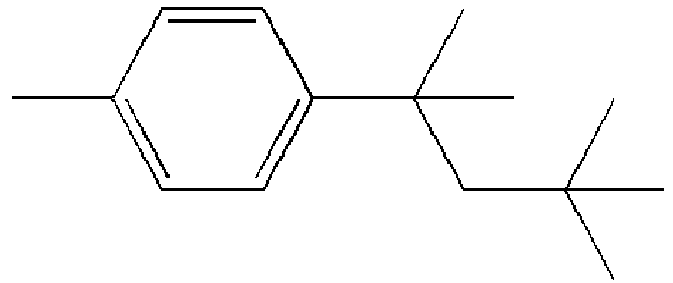
- In one aspect, the perylene diimide fluorescent dye has a structure of Formulas (II), (III), (IV), (V), or (VI):


- In another aspect, the perylene diimide fluorescent dyes can be based on the Lumogen® series of dyes, which are commercially available from BASF. In one particular instance, the following Lumogen® F Red 305 dye can be used:

- A method for making the above-noted compounds is provided in
U.S. Patent 8,304,647 , which again is incorporated by reference. In general, the following reaction scheme can be used:
tetrachloroperylene dianhydride 1 with an amine of the formula H2N-R1 2 and an amine of the formula H2N-R2 3 in o-dichlorobenzene 4. If R1 and R2 are identical, then the dianhydride is condensed with only one amine. Theintermediate product 5 formed from the reaction of the tetrachloroperylene dianhydride and amine(s) can be used without purification or separation if desired. The intermediate product is then reacted with abase 6 and aphenol 7 in an aprotic polar solvent 8 to obtain thedye compound 9 of Formula (I). The phenol reacts with the base to form a phenol salt that more easily reacts with the intermediate product. In specific embodiments, the base is a potassium or sodium base. Examples of bases include potassium carbonate (K2CO3), sodium carbonate, and similar bases. Especially desirable are bases having a pKa of 10 or less. The phenol used to react with the intermediate product generally has the structure of Formula (Ic) or (Id):

- In another particular instance, the perylene-based organic fluorescent dye can have a structure of Formula (VII) and (VIII):

- In some specific embodiments, each phenoxy group is substituted in only the para position with an R group independently selected from C8-C18 alkyl (with respect to the oxygen atom) (i.e. m=1). In more specific embodiments, the four R groups in the para position are the same. In other specific embodiments, each k is zero.
- In particular embodiments, each R and R' is independently selected from C8-C18 alkyl, substituted C8-C18 alkyl, C8-C18 alkoxy, substituted C8-C18 alkoxy, and halogen; each m is independently an integer from 0 to 5; and each k is independently an integer from 0 to 4.
- Non-limiting examples of compounds of Formulas (VII) and (VIII) are provided below in Formulas (IX), (X), (XI), (XII), (XIII), (IVX):


- A method for making the above-noted compounds is provided in
U.S. Patent 8,299,354 , which again is incorporated by reference. In general, the following reaction scheme can be used:
tetrachloroperylene dianhydride 1 with an o-phenylene diamine 2 in anappropriate solvent 3. Theintermediate product 4 formed from the reaction of the tetrachloroperylene dianhydride and o-phenylene diamine can be used without purification or separation. The intermediate product is then reacted with abase 5 and aphenol 6 in an aprotic polar solvent 7 to obtain thedye compound 8 of Formula (VII) or (VIII) (here, only Formula (VII) is shown). The o-phenylene diamine (also known as diaminobenzene) is used to form the benzimidazole end groups of the dye compound. If desired, substituted o-phenylene diamines may also be used. The o-phenylene diamines may be substituted with C1-C18 alkyl, substituted C1-C18 alkyl, C1-C18 alkoxy, substituted C1-C18 alkoxy, and halogen. Appropriate solvents for the condensation of the tetrachloroperylene dianhydride and o-phenylene diamine include propionic acid, acetic acid, imidazole, quinoline, isoquinoline, N-methylpyrrolidone, dimethylformamide, and halogenated solvents like o-dichlorobenzene. The phenol reacts with the base to form a phenol salt that more easily reacts with the intermediate product. In specific embodiments, the base is a potassium or sodium base. Exemplary bases include potassium carbonate (K2CO3), sodium carbonate, and similar bases. Especially desirable are bases having a pKa of 10 or less. The phenol used to react with the intermediate product generally has the structure of Formula (XV):
- In addition to the above-discussed perylene-based dyes, it is also contemplated that other dyes can be used in the context of the present invention. Non-limiting examples of such other dyes include coumarin dyes, carbocyanine dyes, phthalocyanine dyes, oxazine dyes, carbostyryl dyes, porphyrin dyes, acridine dyes, perinone dyes, anthraquinone dyes, arylmethane dyes, quinone imine dyes, thiazole dyes, bis-benzoxazolylthiophene (BBOT) dyes, or xanthene dyes, or any combination of such dyes.
- The organic fluorescent dyes can be incorporated into a polymeric matrix. One of the advantages of using these dyes is that they can be solubilized within said matrix, thereby providing for a more even distribution of the dyes throughout the matrix when compared with pigments. The polymer matrix/dye combination can be manufactured by methods generally available in the art. For example, the dye compounds of the present invention can be easily incorporated into a wide range of polymers that are used in greenhouse or agricultural films or sheets to grow plants. Non-limiting examples of such polymers include a polycarbonate, a polyolefin, a polymethyl (meth)acrylate, a polyester, an elastomer, a polyvinyl alcohol, a polyvinyl butyral, polystyrene, or a polyvinyl acetate, or any combination thereof. In particular aspects, the polymeric matrix includes a polycarbonate or a polyolefin or a combination thereof.
- The fluorescent dyes of the present invention can be added either as a powder or as a solution in a suitable solvent to the polymeric matrix. Generally, the dyes can be distributed within the polymer (e.g., polycarbonate, polyolefin, etc.) by using any means which accomplish the purpose, such as by dispersion. Additives may also be compounded into a masterbatch with a desired polymeric resin and fed into the extruder. The extruder is generally operated at a temperature higher than that necessary to cause the composition to flow. That is, during extrusion the polymer will melt and the dye will solubilize in the polymer composition. The extrudate is immediately quenched in a water bath and pelletized. The pellets, so prepared, when cutting the extrudate may be one-fourth inch long or less as desired. Such pellets may be used for subsequent molding, shaping, or forming. The polymeric matrices may be molded into films, sheets, and other wavelength conversion materials by a variety of means such as injection molding, extrusion, rotational molding, blow molding and thermoforming.
- In addition to the organic fluorescent dyes, additives can also be added to the polymeric matrices by the same processes as described above, with a proviso that the additives are selected so as not to adversely affect the desired wavelength conversion properties of the matrices and materials of the present invention. Either a single additive or multiple additives can be used. Such additives may be mixed at a suitable time during the mixing of the components for forming the polymeric matrices of the present invention. Non-limiting examples of additives that may be included in the matrices or materials of the present invention are provided below. The additives can help strengthen the matrices and materials of the present invention, further aid in plant growth, etc. Such additives include, but are not limited to, ultraviolet absorbing compounds, optical brighteners, ultraviolet stabilizing agents, heat stabilizers, diffusers, mold releasing agents, antioxidants, antifogging agents, clarifying agents, nucleating agents, phosphites or phosphonites or both, light stabilizers, singlet oxygen quenchers, processing aids, antistatic agents, fillers or reinforcing materials, or any combination thereof. Each of these additives can be present in amounts of from about 0.0001 to about 10 weight percent, based on the total weight of the polymeric matrix or materials of the present invention.
- A unique aspect of the present invention is that the polymeric matrices can be used as materials for greenhouses to grow plants in a more efficient and robust manner. In particular aspects, the matrices can be formed into films or sheets to convert unusable light in the context of plant growth (e.g., green or yellow light) into more useable red light. This can result in an increase in the R:FR ratio of light that a plant receives. Non-limiting examples of this are provided in
FIGS. 2 and3 .FIG. 2 represents a greenhouse structure (10). The polymeric matrix (11) is in the form of a transparent film or sheet that is capable of converting light that is typically unusable by plants (13) (e.g., green and yellow light) into light that is more usable by plants (13) (e.g., red and far-red light). As explained above, the film or sheet (11) can absorb light at a wavelength of 500 to 700 nm and emit the absorbed light at a wavelength of greater than 550 to 800 nm towards plants (13). In particular embodiments, the film or sheet (11) can absorb light at a wavelength of 500 to 600 nm and emit the absorbed light at a plant (13) at a wavelength of greater than 600 to 800 nm. While the film or sheet (11) is represented as being transparent inFIG. 2 , it can also be translucent or opaque in other instances. Further, the greenhouse structure (10) includes a frame (14), which can be used to support the film or sheet (11). Alternatively, the film or sheet (11) can be applied to a transparent or translucent substrate (e.g., glass, window). The transparent or translucent substrate can be incorporated into the greenhouse structure (10). For instance,FIG. 3 provides such a non-limiting embodiment, wherein a transparent or translucent substrate (20) has at least a portion of its surface (21) coated with a film, sheet, or polymeric matrix of the present invention (22). In alternative embodiments, a support or frame (14) does not have to be used. For instance, the film or sheet (11) can simply be used as a cover for plants. - The present invention will be described in greater detail by way of specific examples. The following examples are offered for illustrative purposes only, and are not intended to limit the invention in any manner. Those of skill in the art will readily recognize a variety of noncritical parameters which can be changed or modified to yield essentially the same results.
- Table 1 provides the compositional characteristics of various types of prepared polymeric matrices:
Table 1* Plaque # PC1 LLDPE2 PET3 Irgafos® 1684 NLR5 DPP6 Diffused7 1 1000 2.6 0.6 0.035 0.5 2 1000 2.6 0.6 0.07 0.5 3 1000 2.6 0.6 0.14 0.5 4 1000 2.6 0.6 0.07 0.02 0.5 5 1000 2.6 0.6 0.07 0.04 0.5 6 1000 2.6 0.6 0.035 7 1000 2.6 0.6 0.07 8 1000 2.6 0.6 0.14 9 1000 2.6 0.6 0.07 0.02 10 1000 2.6 0.6 0.07 0.04 * All units in grams
1 Polycarbonate (PC) is Lexan® 105 PC from SABIC Innovative Plastics.
2 Linear low density polyethylene (LLDPE) from SABIC.
3 Polyethylene Terephthalate (PET) from SABIC Innovative Plastics.
4 Irgafos® 168 is a trisarylphosphite processing stabilizer/antioxidant that is commercially available from CIBA Specialty Chemicals Inc. (Switzerland).
5 NLR is the perylene diimide fluorescent dye of Formulas (II) noted above in the specification.
6 Diketopyrrolopyrrole (DPP) used had the following structure:
-
FIG. 4 provides comparative data on the emission profiles of the matrices from Table 1 at wavelengths of 660 nm (indication of red light) and 730 nm (indication of far-red light). The blank PC does not have any emission and hence the value is taken as unity. As it is observed from the data, when it is compared with blank the presence of the dye increases the R:FR ratio.Plaque 8 at 2 mm thickness from Table 1 provided the largest R:FR ratio (about 8.5). A larger R:FR ratio correlates to more productive plant growth and quality. - The following process was used to prepare the polymeric matrices of Table 1: Mixed polymer with organic fluorescent dye in a zip-lock polyethylene bag and shake vigorously for about 3-4 minutes. Extruded mixture with a Coperion ZSK25 twin screw extruder under the following conditions in Table 2 to produce polymer pellets in polycarbonate:
Table 2 Feed Zone Temp. (128°C) Zone 1 Temp. (280°C)Throat/Die Temp. (290°C) Zone 2 Temp. (285°C)Screw Speed (rpm of 300) Zone 3 Temp. (285°C)Temp. of Melt (300°C) Zone 4 Temp. (290°C)Torque (Nm) (58-62) - The produced polymer pellets were then dried in an oven at a constant temperature of about 120 °C for about six (6) hours. Subsequently, the dried pellets were subjected to molding using an LTM-Demag from L&T Plastics Machinery Ltd. under the following conditions in Table 3:
Table 3 Feed Zone Temp. (110°C) Cycle Time (125 seconds) Zone 1 Temp. (300°C)Injection Time (1.2 seconds) Zone 2 Temp. (290°C)Injection Speed (25 mm) Zone 3 Temp. (280°C)Injection Pressure (50 bar) Nozzle Temp. (295°C) Screw Speed (300 rpm) Temp. of Melt (300°C) Holding Pressure (45 bar) Mold Temp. (95°C) Holding Time (12 seconds) Sample Drying Time (4 hours) Cooling Time (15 seconds) Sample Drying Temp. (120°C) Thickness of Single Insert (2.54 mm) - Additional polymeric matrices were prepared in accordance with the process described in Example 2. Table 4 provides the compositional characteristics of these matrices/plaques. Table 5 provides further characteristics and data for the matrices/plaques described in Table 4
Table 4 Plaque # PC1 PET3 Irgafos® 1684 NLR5 Nonyl Perinone DPP6 Diffuser7 1 1000 2.6 0.6 2 1000 2.6 0.6 0.2 3 1000 2.6 0.6 0.2 1 4 1000 2.6 0.6 0.2 0.5 5 1000 2.6 0.6 0.2 .05 6 1000 2.6 0.6 0.2 .05 1 7 1000 2.6 0.6 0.2 8 1000 2.6 0.6 0.2 1 All units in grams
1 Polycarbonate (PC) is Lexan® 105 PC from SABIC Innovative Plastics.
2 Polyethylene Terephthalate (PET) from SABIC Innovative Plastics.
3 Irgafos® 168 is a trisarylphosphite processing stabilizer/antioxidant that is commercially available from CIBA Specialty Chemicals Inc. (Switzerland).
4 NLR is the perylene diimide fluorescent dye of Formulas (II) noted above in the specification.
5Nonyl Perinone is perylene perinone of Formula (IX/X) noted above in specification 6 Diketopyrrolopyrrole (DPP) used had the following structure:
Table 5 Plaque # Plaque Description Thickness (mm) Units (mV)1 1 Lexan® 105 PC 3 6.6 2 NLR 3 6.59 3 NLR + D 3 12.34 3 NLR + D 2 11.95 4 NLR + D500 2 13.1 5 NLR + DPP 2 7.6 6 NLR + DPP + D 2 12.3 7 Nonyl Perinone 2 6.39 8 Nonyl Perinone + D 3 10.35 1 The illumination source was a D65 Lighting of Macbeth Color Booth. The spectrum of the D65 lamp is closely related to the spectrum of sunlight. Voltage measurements were carried out on a source meter. These data confirm a two-fold increase in efficiency when compared with the blank polycarbonate plaque. - Absorbance and emission profiles of two 3mm thick plaques one with a diffuser (Tables 4 and 5, plaque 3) and one without a diffuser (Tables 4 and 5, plaque 2) were obtained by using the following process: The ultraviolet-visible (UV-VIS) spectra were recorded on a double beam Perkin-Elmer Lambda 900 UV-VIS-near-infrared (NIR) spectrophotometer. All fluorescence emission and excitation spectra were taken on a SPEX fluorolog 3 (Jobin Yvon, Edison, N.Y.) using double monochromators with 1200 grooves=/mm grating blazed at 330 and 500 nm for excitation and emission selection, respectively, a Hamamatsu R928-P photon counting photomultiplier tube (PMT) for emission detection (referred to as the signal or S channel), and a 450 W continuous Xe lamp as an excitation source. A small fraction of the excitation beam is diverted to a "reference" photodiode just before the sample (referred to as reference or R channel) to monitor the relative excitation intensity as a function of time and excitation wavelength. The voltage of S channel PMT was set to 950 V for all experiments. The emission profiles for
plaques FIG. 5 . The addition of the silica-based diffuser improved the surface emission of the plaque (seeFIG. 5 ). - Overlapping the absorbance profiles of chlorophyll A and B with the absorbance and emission profiles of NLR (
FIG. 6 ) indicated that the unused light in the green region can be absorbed by NLR and can be emitted to red region where chlorophyll can efficiently absorb the light, there by managing the red/far red ratio. This has also been shown in the data in Table 1. Since the blank PC does not have any emission the R:FR ratio is assumed to be unity. As the amount of NLR is increased from plaques 1-3 in Table 1, the R:FR ratio is also increased when compared to blank PC. This observation was further validated by a separate experiment (see Table 4,plaques 1 and 3). - The absorption in the green region can be improved by addition of DPP. The addition of DPP increases the absorption range in the green region. Comparison of
plaque 2 withplaques FIG. 7 ). This observation was validated by a separate experiment (see Table 4,plaques 3 and 6). - Further embodiments of the present invention are described in the following clauses, which clauses are numbered clause No. 1 to clause No. 56.
- 1. A wavelength-conversion material comprising:
- (a) an organic fluorescent dye; and
- (b) a polymeric matrix,
wherein the polymeric matrix is capable of absorbing light comprising a wavelength of 500 to 700 nm and emitting the absorbed light at a wavelength of greater than 550 to 800 nm. - 2. The wavelength-conversion material of
clause 1, wherein the material is transparent or translucent. - 3. The wavelength-conversion material of any one of
clauses 1 to 2, wherein the material is a film or sheet. - 4. The wavelength-conversion material of
clause 3, wherein the film is a single-layered or multi-layered film. - 5. The wavelength-conversion material of any one of
clauses 3 to 4, wherein the film has a thickness of 10 to 300µm. - 6. The wavelength-conversion material of any one of
clauses 3 to 4, wherein the film has a thickness of 0.5 to 3mm. - 7. The wavelength-conversion material of any one of
clauses 1 to 6, wherein the material is comprised in a greenhouse, a terrarium, a conservatory, a herbarium, an arboretum, a nursery, or a bioreactor. - 8. The wavelength-conversion material of any one of
clauses 1 to 7, wherein the organic fluorescent dye or the wavelength-conversion material has a stoke shift of 60 to 120 nm. - 9. The wavelength-conversion material of any one of
clauses 1 to 8, wherein the organic fluorescent dye is thermally stable at a temperature from 200 to 350°C. - 10. The wavelength-conversion material of any one of
clauses 1 to 9, wherein the organic fluorescent dye is capable of absorbing light comprising a wavelength of 500 to 600 nm and emitting the absorbed light at a wavelength of greater than 600 to 800 nm. - 11. The wavelength-conversion material of any one of
clauses 1 to 10, wherein the organic fluorescent dye is a perylene containing compound. - 12. The wavelength-conversion material of
clause 11, wherein the perylene containing compound is a perylene diimide. - 13. The wavelength-conversion material of
clause 12, wherein the perylene diimide has a structure of: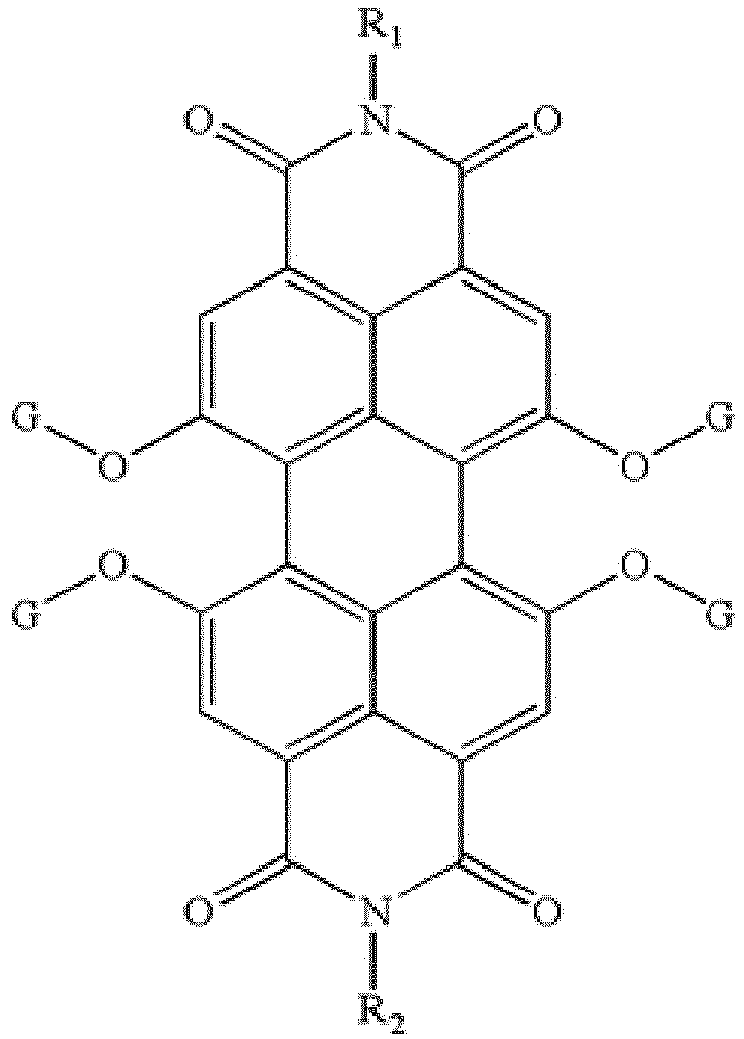
R1 and R2 are each independently selected from branched C6-C18 alkyl and phenyl which is disubstituted by C1-C5 alkyl; and
G is independently selected from
R3 is independently selected from hydrogen, C8-C12 alkyl and halogen;
m represents the number of substituents and is an integer from 0 to 5;
R4 is independently selected from hydrogen, C1-C12 alkyl, C6-C20 aromatic, and C6-C20 cycloalkyl;
n represents the number of substituents and is an integer from 0 to 5; and
A is selected from a bond, C1-C12 alkyl, C6-C20 aromatic, and C6-C20 cycloalkyl. - 14. The wavelength-conversion material of
clause 11, wherein the perylene containing compound has a structure of:
R and R' are each independently selected from C8-C18 alkyl, substituted C8-C18 alkyl, C8-C18 alkoxy, substituted C8-C18 alkoxy, and halogen;
m represents the number of R substitutents on each phenoxy ring, wherein each m is independently an integer from 0 to 5; and
k represents the number of R' substitutents on each benzimidazole group, wherein each k is independently an integer from 0 to 4. - 15. The wavelength-conversion material of any one of
clauses 1 to 10, wherein the organic fluorescent dye is a perinone containing compound. - 16. The wavelength-conversion material of any one of
clauses 1 to 10, wherein the organic fluorescent dye is a coumarin dye, a carbocyanine dye, a phthalocyanine dye, an oxazine dye, a carbostyryl dye, a porphyrin dye, an acridine dye, an anthraquinone dye, an arylmethane dye, a quinone imine dye, a thiazole dye, a bis-benzoxazolylthiophene (BBOT)dye , or a xanthene dye, or any combination of dyes thereof. - 17. The wavelength-conversion material of any one of
clauses 1 to 16, wherein the polymeric matrix comprises a polycarbonate, a polyolefin, a polymethyl (meth)acrylate, a polyester, an elastomer, a polyvinyl alcohol, a polyvinyl butyral, polystyrene, or a polyvinyl acetate, or any combination thereof. - 18. The wavelength-conversion material of clause 17, wherein the polymeric matrix comprises a polycarbonate or a polyolefin or a combination thereof.
- 19. The wavelength-conversion material of clause 18, wherein the polymeric matrix comprises a polyolefin and wherein the polyolefin is a polyethylene or polypropylene polymer.
- 20. The wavelength-conversion material of clause 19, wherein the polyethylene polymer is a low-density polyethylene polymer, a linear low-density polyethylene polymer, or a high-density polyethylene polymer.
- 21. The wavelength-conversion material of any one of clauses 1-20, wherein the polymeric matrix further comprises an additive.
- 22. The wavelength-conversion material of
clause 21, wherein the additive is an ultraviolet absorbing compound, an optical brightener, an ultraviolet stabilizing agent, a heat stabilizer, a diffuser, a mold releasing agent, an antioxidant, an antifogging agent, a clarifier, a nucleating agent, a phosphite or a phosphonite or both, a light stabilizer, a singlet oxygen quencher, a processing aid, an antistatic agent, a filler or a reinforcing material, or any combination thereof. - 23. The wavelength-conversion material of
clause 22, wherein the optical brightener is 2,2'-(2,5-thiophenediyl)bis(5-tert-butylbenzoxazole). - 24. The wavelength-conversion material of
clause 21, wherein the additive is a diketopyrrolo-pyrrole containing compound having a structure of:
- 25. The wavelength-conversion material of any one of clauses 1-24, wherein the polymeric matrix comprises a second, third, fourth, or fifth organic fluorescent dye.
- 26. The wavelength-conversion material of clause 25, wherein the ratio of the organic fluorescent dye to the second organic fluorescent dye is 1:50 to 1:1 to 50:1.
- 27. The wavelength-conversion material of any one of clauses 1-26, wherein the polymeric matrix comprises a pigment or wherein the polymeric matrix comprises a pigment that is dispersed within said polymeric matrix.
- 28. The wavelength-conversion material of any one of clauses 1-27, wherein the polymeric matrix does not include a pigment or a perylene-based pigment.
- 29. The wavelength-conversion material of any one of clauses 1-28, wherein the polymeric matrix is capable of absorbing ultraviolet light comprising a wavelength of 280 to 400 nm.
- 30. The wavelength conversion material of clause 29, wherein the polymer matrix further comprises an ultraviolet light absorbing compound that is capable of absorbing ultraviolet light comprising a wavelength of 280 to 400 nm.
- 31. The wavelength conversion material of clause 30, wherein the ultraviolet light absorbing compound is capable of emitting said absorbed light in the range of 400 to 800 nm.
- 32. The wavelength-conversion material of any one of clauses 30 to 31, wherein the ultraviolet light absorbing compound is capable of absorbing ultraviolet A light comprising a wavelength of 315 to 400 nm, wherein said compound is avobenzone (Parsol 1789), Bisdisulizole disodium (Neo Heliopan AP), Diethylamino hydroxybenzoyl hexyl benzoate (Uvinul A Plus), Ecamsule (Mexoryl SX), or Methyl anthranilate, or any combination thereof.
- 33. The wavelength-conversion material of any one of clauses 30 to 31, wherein the ultraviolet light absorbing compound is capable of absorbing ultraviolet B light comprising a wavelength of 280 to 315 nm, wherein said compound is 4-Aminobenzoic acid (PABA), Cinoxate, Ethylhexyl triazone (Uvinul T 150), Homosalate, 4-Methylbenzylidene camphor (Parsol 5000), Octyl methoxycinnamate (Octinoxate), Octyl salicylate (Octisalate), Padimate O (Escalol 507), Phenylbenzimidazole sulfonic acid (Ensulizole), Polysilicone-15 (Parsol SLX), Trolamine salicylate.
- 34. The wavelength-conversion material of any one of clauses 30 to 31, wherein the ultraviolet light absorbing compound is capable of absorbing ultraviolet A and B light comprising a wavelength of 280 to 400 nm, wherein said compound is Bemotrizinol (Tinosorb S),
Benzophenones 1 through 12, Dioxybenzone, Drometrizole trisiloxane (Mexoryl XL), Iscotrizinol (Uvasorb HEB), Octocrylene, Oxybenzone (Eusolex 4360), or Sulisobenzone. - 35. The wavelength-conversion material of any one of
clauses 1 to 34, wherein the polymeric matrix is capable of emitting more of the absorbed light at a wavelength of 600 to 700 nm than at a wavelength of 700 to 800 nm, thereby increasing the red to far red ratio of the emitted light. - 36. The wavelength-conversion material of any one of
clauses 1 to 35, wherein the polymeric matrix further comprises a diffuser. - 37. The wavelength-conversion material of clause 36, wherein the diffuser is a Tospearl® series diffuser such as Tospearl® 120, Tospearl® 130, Tospearl® 240, Tospearl® 3120, or Tospearl® 2000.
- 38. The wavelength-conversion material of clause 36, wherein the diffuser is an inorganic material comprising antimony, titanium, barium, or zinc, or oxides thereof, and mixtures thereof.
- 39. A method of increasing the red to far red (R:FR) ratio of red light that a plant receives comprising:
- (a) converting light comprising a wavelength of 500 to 700 nm into light comprising a wavelength of greater than 550 to 800 nm with any one of the wavelength-conversion materials of
clauses 1 to 38; and - (b) subjecting the plant to the converted light,
- (a) converting light comprising a wavelength of 500 to 700 nm into light comprising a wavelength of greater than 550 to 800 nm with any one of the wavelength-conversion materials of
- 40. The method of clause 39, wherein the majority of the converted light comprises a wavelength of 600 to 700 nm.
- 41. The method of any one of clauses 39 to 40, wherein the light source is from the sun.
- 42. The method of any one of clauses 39 to 41, wherein the wavelength-conversion material is a film or sheet.
- 43. The method of clause 42, wherein the film or sheet is comprised in a greenhouse, a terrarium, a conservatory, a herbarium, an arboretum, a nursery, or a bioreactor.
- 44. A method of growing a plant comprising:
- (a) converting light comprising a wavelength of 500 to 700 nm into light comprising a wavelength of greater than 550 to 800 nm with any one of the wavelength-conversion materials of
clauses 1 to 38; and - (b) subjecting the plant to the converted light.
- (a) converting light comprising a wavelength of 500 to 700 nm into light comprising a wavelength of greater than 550 to 800 nm with any one of the wavelength-conversion materials of
- 45. The method of clause 44, wherein the light source is from the sun.
- 46. The method of any one of clauses 44 to 45, wherein the wavelength-conversion material is a film or sheet.
- 47. The method of clause 46, wherein the film or sheet is comprised in a greenhouse, a terrarium, a conservatory, a herbarium, an arboretum, a nursery, or a bioreactor.
- 48. The method of any one of clauses 44 to 47, wherein the rate of growth of the plant is increased when compared with the rate of growth of a plant that is not subjected to the converted light.
- 49. A method of converting light comprising subjecting light comprising a wavelength of 500 to 700 nm with any one of the wavelength-conversion materials of
clauses 1 to 38, wherein said light is converted into light comprising a wavelength of greater than 550 to 800 nm. - 50. The method of clause 49, wherein said converted light has a R:FR ratio of at least 0.5:1 to 10:1, or from at least 1:1 to 10:1, or at least greater than 1:1.
- 51. The method of clause 49, wherein the majority of the converted light comprises a wavelength of 600 to 700 nm.
- 52. The method of any one of clauses 49 to 51, wherein the light source is from the sun.
- 53. The method of any one of clauses 49 to 52, wherein a plant is subjected to the converted light.
- 54. The method of any one of clauses 49 to 53, wherein the wavelength-conversion material is a film or sheet, and wherein the film or sheet is comprised in a structure.
- 55. The method of clause 54, wherein the structure is a greenhouse, a terrarium, a conservatory, a herbarium, an arboretum, a nursery, or a bioreactor.
- 56. The method of any one of clauses 49 to 55, wherein a plant is comprised in the structure.
Claims (23)
- A wavelength-conversion material comprising:(a) an organic fluorescent dye; and(b) a polymeric matrix,wherein the organic fluorescent dye is solubilized in the polymeric matrix, and
wherein the polymeric matrix is capable of absorbing light comprising a wavelength of 500 to 700 nm and emitting the absorbed light at a wavelength of greater than 550 to 800 nm. - The wavelength-conversion material of claim 1, wherein the material is transparent or translucent.
- The wavelength-conversion material of any one of claims 1 to 2, wherein the material is a film or sheet, in particular a single-layered or multi-layered film.
- The wavelength-conversion material of any one of claims 3 to 4, wherein the film has a thickness of 10 to 300µm or 0.5 to 3mm.
- The wavelength-conversion material of any one of claims 1 to 4, wherein the material is comprised in a greenhouse, a terrarium, a conservatory, a herbarium, an arboretum, a nursery, or a bioreactor.
- The wavelength-conversion material of any one of claims 1 to 5, wherein the organic fluorescent dye or the wavelength-conversion material has a stoke shift of 60 to 120 nm.
- The wavelength-conversion material of any one of claims 1 to 6, wherein the organic fluorescent dye is thermally stable at a temperature from 200 to 350°C.
- The wavelength-conversion material of any one of claims 1 to 7, wherein the organic fluorescent dye is capable of absorbing light comprising a wavelength of 500 to 600 nm and emitting the absorbed light at a wavelength of greater than 600 to 800 nm.
- The wavelength-conversion material of any one of claims 1 to 8, wherein the organic fluorescent dye is selected from the group consisting of a perylene containing compound, such as in particular a perylene diimide, a perinone containing compound, a coumarin dye, a carbocyanine dye, a phthalocyanine dye, an oxazine dye, a carbostyryl dye, a porphyrin dye, an acridine dye, an anthraquinone dye, an arylmethane dye, a quinone imine dye, a thiazole dye, a bis-benzoxazolylthiophene (BBOT)dye , or a xanthene dye, or any combination of dyes thereof.
- The wavelength-conversion material of claim 9, wherein the perylene diimide has a structure of:

R1 and R2 are each independently selected from branched C6-C18 alkyl and phenyl which is disubstituted by C1-C5 alkyl; and
G is independently selected from
R3 is independently selected from hydrogen, C8-C12 alkyl and halogen;
m represents the number of substituents and is an integer from 0 to 5;
R4 is independently selected from hydrogen, C1-C12 alkyl, C6-C20 aromatic, and C6-C20 cycloalkyl;
n represents the number of substituents and is an integer from 0 to 5; and
A is selected from a bond, C1-C12 alkyl, C6-C20 aromatic, and C6-C20 cycloalkyl. - The wavelength-conversion material of claim 9, wherein the perylene containing compound has a structure of:
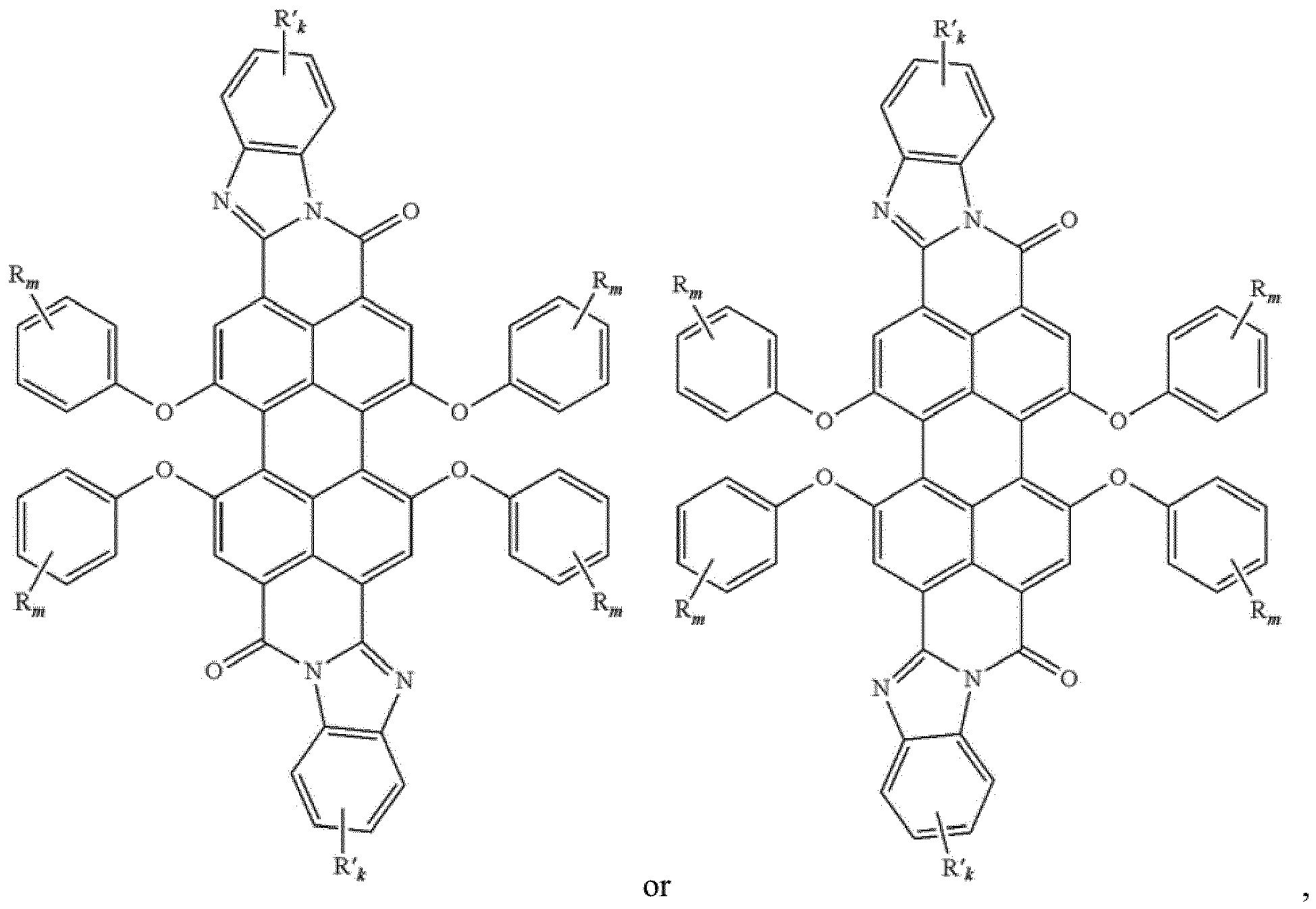
R and R' are each independently selected from C8-C18 alkyl, substituted C8-C18 alkyl, C8-C18 alkoxy, substituted C8-C18 alkoxy, and halogen;
m represents the number of R substitutents on each phenoxy ring, wherein each m is independently an integer from 0 to 5; and
k represents the number of R' substituents on each benzimidazole group, wherein each k is independently an integer from 0 to 4. - The wavelength-conversion material of any one of claims 1 to 11, wherein the polymeric matrix comprises a polycarbonate, a polyolefin, a polymethyl (meth)acrylate, a polyester, an elastomer, a polyvinyl alcohol, a polyvinyl butyral, polystyrene, or a polyvinyl acetate, or any combination thereof, in particular a polycarbonate or a polyolefin or a combination thereof, wherein the polyolefin is preferably a polyethylene or polypropylene polymer, wherein the polyethylene polymer is preferably a low-density polyethylene polymer, a linear low-density polyethylene polymer, or a high-density polyethylene polymer.
- The wavelength-conversion material of claim 12, wherein the polymeric matrix comprises a polycarbonate.
- The wavelength-conversion material of any one of claims 1-13, wherein the polymeric matrix further comprises an additive, in particular an ultraviolet absorbing compound, an optical brightener, an ultraviolet stabilizing agent, a heat stabilizer, a diffuser, a mold releasing agent, an antioxidant, an antifogging agent, a clarifier, a nucleating agent, a phosphite or a phosphonite or both, a light stabilizer, a singlet oxygen quencher, a processing aid, an antistatic agent, a filler or a reinforcing material, or any combination thereof.
- The wavelength-conversion material of claim 14, wherein the additive is a diketopyrrolo-pyrrole containing compound having a structure of:

- The wavelength-conversion material of any one of claims 1-15, wherein the polymeric matrix comprises a second, third, fourth, or fifth organic fluorescent dye.
- The wavelength-conversion material of claim 16, wherein the ratio of the organic fluorescent dye to the second organic fluorescent dye is 1:50 to 1:1 to 50:1.
- The wavelength conversion material of any one of claims 1 to 17, wherein the polymer matrix further comprises an ultraviolet light absorbing compound that is capable of absorbing ultraviolet light comprising a wavelength of 280 to 400 nm, wherein the ultraviolet light absorbing compound is preferably capable of emitting said absorbed light in the range of 400 to 800 nm.
- The wavelength-conversion material of any one of claims 1 to 18, wherein the polymeric matrix is capable of emitting more of the absorbed light at a wavelength of 600 to 700 nm than at a wavelength of 700 to 800 nm, thereby increasing the red to far red ratio of the emitted light.
- The wavelength-conversion material of any one of claims 1 to 19, wherein the polymeric matrix further comprises a diffuser, in particular a Tospearl® series diffuser such as Tospearl® 120, Tospearl® 130, Tospearl® 240, Tospearl® 3120, or Tospearl® 2000 or an inorganic material comprising antimony, titanium, barium, or zinc, or oxides thereof, and mixtures thereof.
- A method of increasing the red to far red (R:FR) ratio of red light that a plant receives comprising:(a) converting light comprising a wavelength of 500 to 700 nm into light comprising a wavelength of greater than 550 to 800 mm with any one of the wavelength-conversion materials of claims 1 to 20; and(b) subjecting the plant to the converted light,wherein the R:FR ratio of red light that a plant receives is increased by at least 5, 10, 15, 20, 30, 40, or 50% or more in the presence of the converted light when compared with the R:FR ratio of red light that a plant receives in the absence of said converted light.
- A method of growing a plant comprising:(a) converting light comprising a wavelength of 500 to 700 nm into light comprising a wavelength of greater than 550 to 800 nm with any one of the wavelength-conversion materials of claims 1 to 20; and(b) subjecting the plant to the converted light.
- A method of converting light comprising subjecting light comprising a wavelength of 500 to 700 nm with any one of the wavelength-conversion materials of claims 1 to 20, wherein said light is converted into light comprising a wavelength of greater than 550 to 800 nm.
Applications Claiming Priority (1)
| Application Number | Priority Date | Filing Date | Title |
|---|---|---|---|
| US13/937,963 US9204598B2 (en) | 2013-05-27 | 2013-07-09 | Solar energy funneling using thermoplastics for agricultural applications |
Publications (2)
| Publication Number | Publication Date |
|---|---|
| EP2824138A1 true EP2824138A1 (en) | 2015-01-14 |
| EP2824138B1 EP2824138B1 (en) | 2017-08-16 |
Family
ID=51211503
Family Applications (1)
| Application Number | Title | Priority Date | Filing Date |
|---|---|---|---|
| EP14171006.1A Not-in-force EP2824138B1 (en) | 2013-07-09 | 2014-06-03 | Solar Energy Funneling Using Thermoplastics for Agricultural Applications |
Country Status (3)
| Country | Link |
|---|---|
| EP (1) | EP2824138B1 (en) |
| CN (1) | CN104277441A (en) |
| MA (1) | MA37097B1 (en) |
Cited By (3)
| Publication number | Priority date | Publication date | Assignee | Title |
|---|---|---|---|---|
| WO2016174567A1 (en) * | 2015-04-29 | 2016-11-03 | Sabic Global Technologies, B.V. | Light-inducible promoters and methods of using same |
| EP3665172A4 (en) * | 2017-08-08 | 2020-12-23 | Lleaf Pty Ltd | COMPOUNDS AS POTENTIAL COLORANT MOLECULES |
| CN120863176A (en) * | 2025-09-24 | 2025-10-31 | 山东清田塑工有限公司 | Aquaculture greenhouse film based on light conversion regulation and control and preparation method thereof |
Families Citing this family (3)
| Publication number | Priority date | Publication date | Assignee | Title |
|---|---|---|---|---|
| CN105838006B (en) * | 2015-07-29 | 2020-06-19 | 广东宝德利新材料科技股份有限公司 | Method for preparing light conversion master batch for PVA agricultural film |
| CN106750778A (en) * | 2016-12-08 | 2017-05-31 | 苏州纳贝通环境科技有限公司 | A kind of ageing-resistant Plastic Drum of shock resistance and preparation method thereof |
| CN107337826A (en) * | 2017-07-27 | 2017-11-10 | 河北卫华电工机械有限公司 | A kind of vistanex sunlight board and preparation method thereof |
Citations (9)
| Publication number | Priority date | Publication date | Assignee | Title |
|---|---|---|---|---|
| US4189866A (en) * | 1976-01-30 | 1980-02-26 | The British Petroleum Company Limited | Polymer-optical brightener combinations in transparent film form useful as glazing materials capable of modifying plant growth rate |
| US4529269A (en) | 1982-06-23 | 1985-07-16 | Mutzhas Maximilian F | Radiation protection filter for plants |
| DE3818986A1 (en) * | 1987-06-05 | 1988-12-22 | Ciba Geigy Ag | Transparent sheet |
| EP0792907A2 (en) * | 1996-02-29 | 1997-09-03 | Sumitomo Chemical Company Limited | Polyolefin resin composition and laminated film comprising the same |
| JP2007135583A (en) * | 2005-10-19 | 2007-06-07 | Tokyo Univ Of Science | Crop cultivation material and crop cultivation method using the same |
| KR20090085941A (en) * | 2008-02-05 | 2009-08-10 | 욱성화학주식회사 | Functional Agricultural Film with Light Selective Transmittance |
| US8299354B2 (en) | 2008-08-19 | 2012-10-30 | Sabic Innovative Plastics Ip B.V. | Luminescent solar collector |
| US8304647B2 (en) | 2008-08-19 | 2012-11-06 | Sabic Innovative Plastics Ip B.V. | Luminescent solar collector |
| US8304645B2 (en) | 2008-08-19 | 2012-11-06 | Sabic Innovative Plastics Ip B.V. | Luminescent solar collector |
Family Cites Families (2)
| Publication number | Priority date | Publication date | Assignee | Title |
|---|---|---|---|---|
| US8314325B2 (en) * | 2008-08-19 | 2012-11-20 | Sabic Innovative Plastics Ip B.V. | Luminescent solar collector |
| EP2578075A4 (en) * | 2010-05-28 | 2013-12-04 | Asahi Glass Co Ltd | WAVE LENGTH CONVERSION FILM |
-
2014
- 2014-06-03 EP EP14171006.1A patent/EP2824138B1/en not_active Not-in-force
- 2014-06-03 MA MA37097A patent/MA37097B1/en unknown
- 2014-06-03 CN CN201410242758.6A patent/CN104277441A/en active Pending
Patent Citations (9)
| Publication number | Priority date | Publication date | Assignee | Title |
|---|---|---|---|---|
| US4189866A (en) * | 1976-01-30 | 1980-02-26 | The British Petroleum Company Limited | Polymer-optical brightener combinations in transparent film form useful as glazing materials capable of modifying plant growth rate |
| US4529269A (en) | 1982-06-23 | 1985-07-16 | Mutzhas Maximilian F | Radiation protection filter for plants |
| DE3818986A1 (en) * | 1987-06-05 | 1988-12-22 | Ciba Geigy Ag | Transparent sheet |
| EP0792907A2 (en) * | 1996-02-29 | 1997-09-03 | Sumitomo Chemical Company Limited | Polyolefin resin composition and laminated film comprising the same |
| JP2007135583A (en) * | 2005-10-19 | 2007-06-07 | Tokyo Univ Of Science | Crop cultivation material and crop cultivation method using the same |
| KR20090085941A (en) * | 2008-02-05 | 2009-08-10 | 욱성화학주식회사 | Functional Agricultural Film with Light Selective Transmittance |
| US8299354B2 (en) | 2008-08-19 | 2012-10-30 | Sabic Innovative Plastics Ip B.V. | Luminescent solar collector |
| US8304647B2 (en) | 2008-08-19 | 2012-11-06 | Sabic Innovative Plastics Ip B.V. | Luminescent solar collector |
| US8304645B2 (en) | 2008-08-19 | 2012-11-06 | Sabic Innovative Plastics Ip B.V. | Luminescent solar collector |
Cited By (5)
| Publication number | Priority date | Publication date | Assignee | Title |
|---|---|---|---|---|
| WO2016174567A1 (en) * | 2015-04-29 | 2016-11-03 | Sabic Global Technologies, B.V. | Light-inducible promoters and methods of using same |
| EP3665172A4 (en) * | 2017-08-08 | 2020-12-23 | Lleaf Pty Ltd | COMPOUNDS AS POTENTIAL COLORANT MOLECULES |
| US10995217B2 (en) | 2017-08-08 | 2021-05-04 | Lleaf Pty Ltd | Compounds as potential dye molecules |
| AU2018315623B2 (en) * | 2017-08-08 | 2022-03-24 | Lleaf Pty Ltd | "Compounds as potential dye molecules" |
| CN120863176A (en) * | 2025-09-24 | 2025-10-31 | 山东清田塑工有限公司 | Aquaculture greenhouse film based on light conversion regulation and control and preparation method thereof |
Also Published As
| Publication number | Publication date |
|---|---|
| EP2824138B1 (en) | 2017-08-16 |
| MA37097A1 (en) | 2016-02-29 |
| MA37097B1 (en) | 2017-04-28 |
| CN104277441A (en) | 2015-01-14 |
Similar Documents
| Publication | Publication Date | Title |
|---|---|---|
| US9204598B2 (en) | Solar energy funneling using thermoplastics for agricultural applications | |
| EP2824138B1 (en) | Solar Energy Funneling Using Thermoplastics for Agricultural Applications | |
| BE1014316A5 (en) | Articles polymers transparent thin. | |
| JP5122561B2 (en) | How to increase plant growth | |
| KR100963983B1 (en) | Compositions and Methods for Improving Biomass Production in Greenhouses | |
| US20160319231A1 (en) | Solar energy funneling using thermoplastics for algae and cyanobacteria growth | |
| US8304647B2 (en) | Luminescent solar collector | |
| JP4239170B2 (en) | Highly compatible hydroxyphenyltriazine UV absorber | |
| CN106279924A (en) | A kind of sulfur indium compound system quantum dot light conversion film and preparation method thereof | |
| CN1238413C (en) | Sunlight film and its making process | |
| KR20070116841A (en) | Additive mixtures for agricultural products | |
| CN114369300A (en) | Low-mobility ultraviolet absorption small-molecule light conversion film and preparation method thereof | |
| CN111621077A (en) | Light conversion master batch, preparation method thereof and light conversion agricultural film prepared from light conversion master batch | |
| JPH07170865A (en) | Wavelength conversion material | |
| KR20210077821A (en) | Light conversion material, resin composition for light conversion film and light conversion film comprising the same | |
| CN113529198A (en) | Photochromic polypropylene fiber and preparation method thereof | |
| TW202102117A (en) | Plant cultivation method | |
| JPH08252882A (en) | Wavelength conversion material | |
| JP2009542876A (en) | How to protect organic materials from light | |
| KR101481705B1 (en) | Functional film for agricultural | |
| CN111944221B (en) | Low-waveband ultraviolet absorption antibacterial light conversion film and preparation method thereof | |
| WO2010095602A1 (en) | Heterocyclic compound | |
| EP4603548A1 (en) | Fluorescent materials | |
| JPH11196685A (en) | Agricultural materials | |
| US12543660B2 (en) | Polymeric film |
Legal Events
| Date | Code | Title | Description |
|---|---|---|---|
| 17P | Request for examination filed |
Effective date: 20140603 |
|
| AK | Designated contracting states |
Kind code of ref document: A1 Designated state(s): AL AT BE BG CH CY CZ DE DK EE ES FI FR GB GR HR HU IE IS IT LI LT LU LV MC MK MT NL NO PL PT RO RS SE SI SK SM TR |
|
| AX | Request for extension of the european patent |
Extension state: BA ME |
|
| PUAI | Public reference made under article 153(3) epc to a published international application that has entered the european phase |
Free format text: ORIGINAL CODE: 0009012 |
|
| R17P | Request for examination filed (corrected) |
Effective date: 20150710 |
|
| RBV | Designated contracting states (corrected) |
Designated state(s): AL AT BE BG CH CY CZ DE DK EE ES FI FR GB GR HR HU IE IS IT LI LT LU LV MC MK MT NL NO PL PT RO RS SE SI SK SM TR |
|
| 17Q | First examination report despatched |
Effective date: 20160210 |
|
| GRAP | Despatch of communication of intention to grant a patent |
Free format text: ORIGINAL CODE: EPIDOSNIGR1 |
|
| INTG | Intention to grant announced |
Effective date: 20170310 |
|
| GRAS | Grant fee paid |
Free format text: ORIGINAL CODE: EPIDOSNIGR3 |
|
| GRAA | (expected) grant |
Free format text: ORIGINAL CODE: 0009210 |
|
| AK | Designated contracting states |
Kind code of ref document: B1 Designated state(s): AL AT BE BG CH CY CZ DE DK EE ES FI FR GB GR HR HU IE IS IT LI LT LU LV MC MK MT NL NO PL PT RO RS SE SI SK SM TR |
|
| REG | Reference to a national code |
Ref country code: GB Ref legal event code: FG4D |
|
| REG | Reference to a national code |
Ref country code: CH Ref legal event code: EP |
|
| REG | Reference to a national code |
Ref country code: IE Ref legal event code: FG4D |
|
| REG | Reference to a national code |
Ref country code: AT Ref legal event code: REF Ref document number: 918975 Country of ref document: AT Kind code of ref document: T Effective date: 20170915 |
|
| REG | Reference to a national code |
Ref country code: DE Ref legal event code: R096 Ref document number: 602014013107 Country of ref document: DE |
|
| REG | Reference to a national code |
Ref country code: NL Ref legal event code: MP Effective date: 20170816 |
|
| REG | Reference to a national code |
Ref country code: LT Ref legal event code: MG4D |
|
| REG | Reference to a national code |
Ref country code: AT Ref legal event code: MK05 Ref document number: 918975 Country of ref document: AT Kind code of ref document: T Effective date: 20170816 |
|
| PG25 | Lapsed in a contracting state [announced via postgrant information from national office to epo] |
Ref country code: FI Free format text: LAPSE BECAUSE OF FAILURE TO SUBMIT A TRANSLATION OF THE DESCRIPTION OR TO PAY THE FEE WITHIN THE PRESCRIBED TIME-LIMIT Effective date: 20170816 Ref country code: NO Free format text: LAPSE BECAUSE OF FAILURE TO SUBMIT A TRANSLATION OF THE DESCRIPTION OR TO PAY THE FEE WITHIN THE PRESCRIBED TIME-LIMIT Effective date: 20171116 Ref country code: NL Free format text: LAPSE BECAUSE OF FAILURE TO SUBMIT A TRANSLATION OF THE DESCRIPTION OR TO PAY THE FEE WITHIN THE PRESCRIBED TIME-LIMIT Effective date: 20170816 Ref country code: SE Free format text: LAPSE BECAUSE OF FAILURE TO SUBMIT A TRANSLATION OF THE DESCRIPTION OR TO PAY THE FEE WITHIN THE PRESCRIBED TIME-LIMIT Effective date: 20170816 Ref country code: AT Free format text: LAPSE BECAUSE OF FAILURE TO SUBMIT A TRANSLATION OF THE DESCRIPTION OR TO PAY THE FEE WITHIN THE PRESCRIBED TIME-LIMIT Effective date: 20170816 Ref country code: LT Free format text: LAPSE BECAUSE OF FAILURE TO SUBMIT A TRANSLATION OF THE DESCRIPTION OR TO PAY THE FEE WITHIN THE PRESCRIBED TIME-LIMIT Effective date: 20170816 |
|
| PG25 | Lapsed in a contracting state [announced via postgrant information from national office to epo] |
Ref country code: LV Free format text: LAPSE BECAUSE OF FAILURE TO SUBMIT A TRANSLATION OF THE DESCRIPTION OR TO PAY THE FEE WITHIN THE PRESCRIBED TIME-LIMIT Effective date: 20170816 Ref country code: GR Free format text: LAPSE BECAUSE OF FAILURE TO SUBMIT A TRANSLATION OF THE DESCRIPTION OR TO PAY THE FEE WITHIN THE PRESCRIBED TIME-LIMIT Effective date: 20171117 Ref country code: PL Free format text: LAPSE BECAUSE OF FAILURE TO SUBMIT A TRANSLATION OF THE DESCRIPTION OR TO PAY THE FEE WITHIN THE PRESCRIBED TIME-LIMIT Effective date: 20170816 Ref country code: IS Free format text: LAPSE BECAUSE OF FAILURE TO SUBMIT A TRANSLATION OF THE DESCRIPTION OR TO PAY THE FEE WITHIN THE PRESCRIBED TIME-LIMIT Effective date: 20171216 Ref country code: RS Free format text: LAPSE BECAUSE OF FAILURE TO SUBMIT A TRANSLATION OF THE DESCRIPTION OR TO PAY THE FEE WITHIN THE PRESCRIBED TIME-LIMIT Effective date: 20170816 Ref country code: ES Free format text: LAPSE BECAUSE OF FAILURE TO SUBMIT A TRANSLATION OF THE DESCRIPTION OR TO PAY THE FEE WITHIN THE PRESCRIBED TIME-LIMIT Effective date: 20170816 Ref country code: BG Free format text: LAPSE BECAUSE OF FAILURE TO SUBMIT A TRANSLATION OF THE DESCRIPTION OR TO PAY THE FEE WITHIN THE PRESCRIBED TIME-LIMIT Effective date: 20171116 |
|
| PG25 | Lapsed in a contracting state [announced via postgrant information from national office to epo] |
Ref country code: DK Free format text: LAPSE BECAUSE OF FAILURE TO SUBMIT A TRANSLATION OF THE DESCRIPTION OR TO PAY THE FEE WITHIN THE PRESCRIBED TIME-LIMIT Effective date: 20170816 Ref country code: CZ Free format text: LAPSE BECAUSE OF FAILURE TO SUBMIT A TRANSLATION OF THE DESCRIPTION OR TO PAY THE FEE WITHIN THE PRESCRIBED TIME-LIMIT Effective date: 20170816 Ref country code: RO Free format text: LAPSE BECAUSE OF FAILURE TO SUBMIT A TRANSLATION OF THE DESCRIPTION OR TO PAY THE FEE WITHIN THE PRESCRIBED TIME-LIMIT Effective date: 20170816 |
|
| REG | Reference to a national code |
Ref country code: DE Ref legal event code: R097 Ref document number: 602014013107 Country of ref document: DE |
|
| PG25 | Lapsed in a contracting state [announced via postgrant information from national office to epo] |
Ref country code: IT Free format text: LAPSE BECAUSE OF FAILURE TO SUBMIT A TRANSLATION OF THE DESCRIPTION OR TO PAY THE FEE WITHIN THE PRESCRIBED TIME-LIMIT Effective date: 20170816 Ref country code: SK Free format text: LAPSE BECAUSE OF FAILURE TO SUBMIT A TRANSLATION OF THE DESCRIPTION OR TO PAY THE FEE WITHIN THE PRESCRIBED TIME-LIMIT Effective date: 20170816 Ref country code: EE Free format text: LAPSE BECAUSE OF FAILURE TO SUBMIT A TRANSLATION OF THE DESCRIPTION OR TO PAY THE FEE WITHIN THE PRESCRIBED TIME-LIMIT Effective date: 20170816 Ref country code: SM Free format text: LAPSE BECAUSE OF FAILURE TO SUBMIT A TRANSLATION OF THE DESCRIPTION OR TO PAY THE FEE WITHIN THE PRESCRIBED TIME-LIMIT Effective date: 20170816 |
|
| PLBE | No opposition filed within time limit |
Free format text: ORIGINAL CODE: 0009261 |
|
| STAA | Information on the status of an ep patent application or granted ep patent |
Free format text: STATUS: NO OPPOSITION FILED WITHIN TIME LIMIT |
|
| 26N | No opposition filed |
Effective date: 20180517 |
|
| PG25 | Lapsed in a contracting state [announced via postgrant information from national office to epo] |
Ref country code: SI Free format text: LAPSE BECAUSE OF FAILURE TO SUBMIT A TRANSLATION OF THE DESCRIPTION OR TO PAY THE FEE WITHIN THE PRESCRIBED TIME-LIMIT Effective date: 20170816 |
|
| REG | Reference to a national code |
Ref country code: DE Ref legal event code: R119 Ref document number: 602014013107 Country of ref document: DE |
|
| REG | Reference to a national code |
Ref country code: CH Ref legal event code: PL |
|
| GBPC | Gb: european patent ceased through non-payment of renewal fee |
Effective date: 20180603 |
|
| REG | Reference to a national code |
Ref country code: BE Ref legal event code: MM Effective date: 20180630 |
|
| REG | Reference to a national code |
Ref country code: IE Ref legal event code: MM4A |
|
| PG25 | Lapsed in a contracting state [announced via postgrant information from national office to epo] |
Ref country code: MC Free format text: LAPSE BECAUSE OF FAILURE TO SUBMIT A TRANSLATION OF THE DESCRIPTION OR TO PAY THE FEE WITHIN THE PRESCRIBED TIME-LIMIT Effective date: 20170816 Ref country code: LU Free format text: LAPSE BECAUSE OF NON-PAYMENT OF DUE FEES Effective date: 20180603 |
|
| PG25 | Lapsed in a contracting state [announced via postgrant information from national office to epo] |
Ref country code: FR Free format text: LAPSE BECAUSE OF NON-PAYMENT OF DUE FEES Effective date: 20180630 Ref country code: DE Free format text: LAPSE BECAUSE OF NON-PAYMENT OF DUE FEES Effective date: 20190101 Ref country code: IE Free format text: LAPSE BECAUSE OF NON-PAYMENT OF DUE FEES Effective date: 20180603 Ref country code: LI Free format text: LAPSE BECAUSE OF NON-PAYMENT OF DUE FEES Effective date: 20180630 Ref country code: CH Free format text: LAPSE BECAUSE OF NON-PAYMENT OF DUE FEES Effective date: 20180630 Ref country code: GB Free format text: LAPSE BECAUSE OF NON-PAYMENT OF DUE FEES Effective date: 20180603 |
|
| PG25 | Lapsed in a contracting state [announced via postgrant information from national office to epo] |
Ref country code: BE Free format text: LAPSE BECAUSE OF NON-PAYMENT OF DUE FEES Effective date: 20180630 |
|
| PG25 | Lapsed in a contracting state [announced via postgrant information from national office to epo] |
Ref country code: MT Free format text: LAPSE BECAUSE OF NON-PAYMENT OF DUE FEES Effective date: 20180603 |
|
| PG25 | Lapsed in a contracting state [announced via postgrant information from national office to epo] |
Ref country code: TR Free format text: LAPSE BECAUSE OF FAILURE TO SUBMIT A TRANSLATION OF THE DESCRIPTION OR TO PAY THE FEE WITHIN THE PRESCRIBED TIME-LIMIT Effective date: 20170816 |
|
| PG25 | Lapsed in a contracting state [announced via postgrant information from national office to epo] |
Ref country code: PT Free format text: LAPSE BECAUSE OF FAILURE TO SUBMIT A TRANSLATION OF THE DESCRIPTION OR TO PAY THE FEE WITHIN THE PRESCRIBED TIME-LIMIT Effective date: 20170816 Ref country code: HU Free format text: LAPSE BECAUSE OF FAILURE TO SUBMIT A TRANSLATION OF THE DESCRIPTION OR TO PAY THE FEE WITHIN THE PRESCRIBED TIME-LIMIT; INVALID AB INITIO Effective date: 20140603 |
|
| PG25 | Lapsed in a contracting state [announced via postgrant information from national office to epo] |
Ref country code: MK Free format text: LAPSE BECAUSE OF NON-PAYMENT OF DUE FEES Effective date: 20170816 Ref country code: CY Free format text: LAPSE BECAUSE OF FAILURE TO SUBMIT A TRANSLATION OF THE DESCRIPTION OR TO PAY THE FEE WITHIN THE PRESCRIBED TIME-LIMIT Effective date: 20170816 Ref country code: HR Free format text: LAPSE BECAUSE OF FAILURE TO SUBMIT A TRANSLATION OF THE DESCRIPTION OR TO PAY THE FEE WITHIN THE PRESCRIBED TIME-LIMIT Effective date: 20170816 |
|
| PG25 | Lapsed in a contracting state [announced via postgrant information from national office to epo] |
Ref country code: AL Free format text: LAPSE BECAUSE OF FAILURE TO SUBMIT A TRANSLATION OF THE DESCRIPTION OR TO PAY THE FEE WITHIN THE PRESCRIBED TIME-LIMIT Effective date: 20170816 |