EP2821626A1 - Piston assembly - Google Patents
Piston assembly Download PDFInfo
- Publication number
- EP2821626A1 EP2821626A1 EP14175043.0A EP14175043A EP2821626A1 EP 2821626 A1 EP2821626 A1 EP 2821626A1 EP 14175043 A EP14175043 A EP 14175043A EP 2821626 A1 EP2821626 A1 EP 2821626A1
- Authority
- EP
- European Patent Office
- Prior art keywords
- piston
- upper wall
- ribs
- annular part
- piston crown
- Prior art date
- Legal status (The legal status is an assumption and is not a legal conclusion. Google has not performed a legal analysis and makes no representation as to the accuracy of the status listed.)
- Granted
Links
- 238000001816 cooling Methods 0.000 claims abstract description 15
- 238000000034 method Methods 0.000 claims abstract description 11
- 238000005266 casting Methods 0.000 claims abstract description 10
- 230000008878 coupling Effects 0.000 claims description 11
- 238000010168 coupling process Methods 0.000 claims description 11
- 238000005859 coupling reaction Methods 0.000 claims description 11
- 238000005461 lubrication Methods 0.000 claims description 8
- 230000003247 decreasing effect Effects 0.000 claims description 7
- 238000002485 combustion reaction Methods 0.000 description 9
- 229910001018 Cast iron Inorganic materials 0.000 description 6
- 239000000463 material Substances 0.000 description 4
- 238000005242 forging Methods 0.000 description 3
- 238000004519 manufacturing process Methods 0.000 description 3
- OKTJSMMVPCPJKN-UHFFFAOYSA-N Carbon Chemical compound [C] OKTJSMMVPCPJKN-UHFFFAOYSA-N 0.000 description 2
- 239000003344 environmental pollutant Substances 0.000 description 2
- 229910002804 graphite Inorganic materials 0.000 description 2
- 239000010439 graphite Substances 0.000 description 2
- 238000003754 machining Methods 0.000 description 2
- 231100000719 pollutant Toxicity 0.000 description 2
- 230000002787 reinforcement Effects 0.000 description 2
- 229910001208 Crucible steel Inorganic materials 0.000 description 1
- 229910000831 Steel Inorganic materials 0.000 description 1
- 230000000712 assembly Effects 0.000 description 1
- 238000000429 assembly Methods 0.000 description 1
- 239000000567 combustion gas Substances 0.000 description 1
- 230000000694 effects Effects 0.000 description 1
- 239000003517 fume Substances 0.000 description 1
- 239000010959 steel Substances 0.000 description 1
- 230000008646 thermal stress Effects 0.000 description 1
Images


Classifications
-
- F—MECHANICAL ENGINEERING; LIGHTING; HEATING; WEAPONS; BLASTING
- F01—MACHINES OR ENGINES IN GENERAL; ENGINE PLANTS IN GENERAL; STEAM ENGINES
- F01P—COOLING OF MACHINES OR ENGINES IN GENERAL; COOLING OF INTERNAL-COMBUSTION ENGINES
- F01P3/00—Liquid cooling
- F01P3/06—Arrangements for cooling pistons
- F01P3/10—Cooling by flow of coolant through pistons
-
- F—MECHANICAL ENGINEERING; LIGHTING; HEATING; WEAPONS; BLASTING
- F02—COMBUSTION ENGINES; HOT-GAS OR COMBUSTION-PRODUCT ENGINE PLANTS
- F02F—CYLINDERS, PISTONS OR CASINGS, FOR COMBUSTION ENGINES; ARRANGEMENTS OF SEALINGS IN COMBUSTION ENGINES
- F02F3/00—Pistons
- F02F3/0015—Multi-part pistons
- F02F3/0023—Multi-part pistons the parts being bolted or screwed together
-
- F—MECHANICAL ENGINEERING; LIGHTING; HEATING; WEAPONS; BLASTING
- F16—ENGINEERING ELEMENTS AND UNITS; GENERAL MEASURES FOR PRODUCING AND MAINTAINING EFFECTIVE FUNCTIONING OF MACHINES OR INSTALLATIONS; THERMAL INSULATION IN GENERAL
- F16J—PISTONS; CYLINDERS; SEALINGS
- F16J1/00—Pistons; Trunk pistons; Plungers
- F16J1/09—Pistons; Trunk pistons; Plungers with means for guiding fluids
-
- F—MECHANICAL ENGINEERING; LIGHTING; HEATING; WEAPONS; BLASTING
- F02—COMBUSTION ENGINES; HOT-GAS OR COMBUSTION-PRODUCT ENGINE PLANTS
- F02F—CYLINDERS, PISTONS OR CASINGS, FOR COMBUSTION ENGINES; ARRANGEMENTS OF SEALINGS IN COMBUSTION ENGINES
- F02F3/00—Pistons
- F02F3/0015—Multi-part pistons
-
- F—MECHANICAL ENGINEERING; LIGHTING; HEATING; WEAPONS; BLASTING
- F02—COMBUSTION ENGINES; HOT-GAS OR COMBUSTION-PRODUCT ENGINE PLANTS
- F02F—CYLINDERS, PISTONS OR CASINGS, FOR COMBUSTION ENGINES; ARRANGEMENTS OF SEALINGS IN COMBUSTION ENGINES
- F02F3/00—Pistons
- F02F3/0076—Pistons the inside of the pistons being provided with ribs or fins
-
- F—MECHANICAL ENGINEERING; LIGHTING; HEATING; WEAPONS; BLASTING
- F02—COMBUSTION ENGINES; HOT-GAS OR COMBUSTION-PRODUCT ENGINE PLANTS
- F02F—CYLINDERS, PISTONS OR CASINGS, FOR COMBUSTION ENGINES; ARRANGEMENTS OF SEALINGS IN COMBUSTION ENGINES
- F02F3/00—Pistons
- F02F3/16—Pistons having cooling means
- F02F3/20—Pistons having cooling means the means being a fluid flowing through or along piston
- F02F3/22—Pistons having cooling means the means being a fluid flowing through or along piston the fluid being liquid
-
- F—MECHANICAL ENGINEERING; LIGHTING; HEATING; WEAPONS; BLASTING
- F16—ENGINEERING ELEMENTS AND UNITS; GENERAL MEASURES FOR PRODUCING AND MAINTAINING EFFECTIVE FUNCTIONING OF MACHINES OR INSTALLATIONS; THERMAL INSULATION IN GENERAL
- F16J—PISTONS; CYLINDERS; SEALINGS
- F16J1/00—Pistons; Trunk pistons; Plungers
- F16J1/10—Connection to driving members
-
- F—MECHANICAL ENGINEERING; LIGHTING; HEATING; WEAPONS; BLASTING
- F16—ENGINEERING ELEMENTS AND UNITS; GENERAL MEASURES FOR PRODUCING AND MAINTAINING EFFECTIVE FUNCTIONING OF MACHINES OR INSTALLATIONS; THERMAL INSULATION IN GENERAL
- F16J—PISTONS; CYLINDERS; SEALINGS
- F16J10/00—Engine or like cylinders; Features of hollow, e.g. cylindrical, bodies in general
-
- F—MECHANICAL ENGINEERING; LIGHTING; HEATING; WEAPONS; BLASTING
- F01—MACHINES OR ENGINES IN GENERAL; ENGINE PLANTS IN GENERAL; STEAM ENGINES
- F01M—LUBRICATING OF MACHINES OR ENGINES IN GENERAL; LUBRICATING INTERNAL COMBUSTION ENGINES; CRANKCASE VENTILATING
- F01M1/00—Pressure lubrication
- F01M1/08—Lubricating systems characterised by the provision therein of lubricant jetting means
-
- F—MECHANICAL ENGINEERING; LIGHTING; HEATING; WEAPONS; BLASTING
- F01—MACHINES OR ENGINES IN GENERAL; ENGINE PLANTS IN GENERAL; STEAM ENGINES
- F01P—COOLING OF MACHINES OR ENGINES IN GENERAL; COOLING OF INTERNAL-COMBUSTION ENGINES
- F01P3/00—Liquid cooling
- F01P3/06—Arrangements for cooling pistons
- F01P3/08—Cooling of piston exterior only, e.g. by jets
-
- F—MECHANICAL ENGINEERING; LIGHTING; HEATING; WEAPONS; BLASTING
- F02—COMBUSTION ENGINES; HOT-GAS OR COMBUSTION-PRODUCT ENGINE PLANTS
- F02B—INTERNAL-COMBUSTION PISTON ENGINES; COMBUSTION ENGINES IN GENERAL
- F02B3/00—Engines characterised by air compression and subsequent fuel addition
- F02B3/06—Engines characterised by air compression and subsequent fuel addition with compression ignition
-
- F—MECHANICAL ENGINEERING; LIGHTING; HEATING; WEAPONS; BLASTING
- F05—INDEXING SCHEMES RELATING TO ENGINES OR PUMPS IN VARIOUS SUBCLASSES OF CLASSES F01-F04
- F05C—INDEXING SCHEME RELATING TO MATERIALS, MATERIAL PROPERTIES OR MATERIAL CHARACTERISTICS FOR MACHINES, ENGINES OR PUMPS OTHER THAN NON-POSITIVE-DISPLACEMENT MACHINES OR ENGINES
- F05C2201/00—Metals
- F05C2201/02—Light metals
- F05C2201/021—Aluminium
Definitions
- One or more embodiments of the present invention relate to a piston assembly of a diesel engine, and more particularly, to a piston assembly including a piston crown formed of nodular graphite cast iron and having ribs therein.
- a piston transmits power to a connecting rod while vertically reciprocating along an inner wall of a cylinder during the intake-compression-combustion-exhaust cycle.
- an upper structure (called a piston crown) of a piston including an combustion side and piston ring grooves is exposed to high-temperature, high-pressure combustion conditions during engine operation and is thus manufactured by a forging method for obtaining high-quality mechanical characteristics, and the rest of the piston (called a piston skirt) exposed to relatively less severe conditions is formed of a material such as cast iron.
- piston crowns are manufactured by a forging method, a relatively expensive material is used, and it is difficult to perform a machining process on the piston crowns. Therefore, the productivity of manufacturing is lowered, and the prices of pistons are increased.
- the outer diameter of the piston crown may become larger than the inner diameter of a cylinder liner due to thermal expansion during engine operation, and in this case, the piston crown may melt and stick to the cylinder liner.
- the piston crown and the cylinder liner may be fitted with a large clearance therebetween.
- a large clearance lowers combustion efficiency and thus increases the generation of environmentally harmful pollutants such as fumes or NOx.
- one-piece pistons are formed by casting a piston crown and a piston skirt with the same material such as cast iron, and some of such one-piece pistons have ribs formed therein.
- such one-piece pistons have low degrees of structural strength and are thus not suitable for high-power engines having high combustion pressure.
- a method of forming ribs on a piston crown is disclosed in Korean Patent Laid-open Publication No. 2010-0127449 .
- the method is for a structure in which a piston assembly is rotated and this application is to enhance the strength of a piston crown in a non-rotating structure is required.
- One or more embodiments of the present invention include a piston assembly in which a forged piston crown used for the cooling performance and structural strength problems, is replaced with a piston crown formed by casting.
- a piston assembly includes: a piston skirt; and a piston crown formed by a casting method and coupled to an upper portion of the piston skirt by using a stud bolt, wherein oil galleries are formed between an upper wall of the piston skirt and an upper wall of the piston crown, wherein an annular part having a circular ring shape and a plurality of ribs having a linear shape and radially arranged to form oil channels for flowing cooling oil are formed on the upper wall of the piston crown, and the plurality of ribs are divided into outer ribs and inner ribs by the annular part.
- the outer ribs may be higher than the inner ribs
- a lubrication passage may be formed in a center region of the upper wall of the piston skirt.
- An annular part corresponding to the annular part formed on the upper wall of the piston crown may be formed on the upper wall of the piston skirt.
- the annular part formed on the upper wall of the piston skirt and the annular part formed on the upper wall of the piston crown may be coupled together using the stud bolt.
- An oil passage may be formed in the annular part formed on the upper wall of the piston crown or the annular part formed on the upper wall of the piston skirt.
- Heights of the outer ribs and the inner ribs may be decreased in directions from a sidewall to a center region of the piston crown.
- a piston assembly includes: a piston skirt; and a piston crown formed by a casting method and coupled to an upper portion of the piston skirt by using a stud bolt, wherein oil galleries are formed between an upper wall of the piston skirt and an upper wall of the piston crown, wherein a partial annular part having a partial circular ring shape and a plurality of ribs having a linear shape and radially arranged to form oil channels for flowing cooling oil are formed on the upper wall of the piston crown, and the plurality of ribs are divided into outer ribs and inner ribs by the partial annular part.
- Coupling parts may be formed in a center region of the piston crown and a center region of the piston skirt, and the coupling parts may be coupled by using the stud bolt.
- some of the plurality of ribs which extend to the coupling part formed in the center region of the piston crown and remaining ones of the plurality of ribs which do not extend to the coupling part formed in the center region of the piston crown may be alternately arranged.
- a lubrication passage may be formed in the upper wall of the piston skirt at a position apart form the center region of the piston skirt.
- a partial annular part corresponding to the partial annular part formed on the upper wall of the piston crown may be formed on the upper wall of the piston skirt.
- An oil passage may be formed in the annular part formed on the upper wall of the piston crown or the annular part formed on the upper wall of the piston skirt.
- Heights of the plurality of ribs may be decreased in directions from a sidewall to the center region of the piston crown.
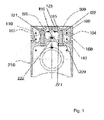
- FIG. 1 illustrates a piston assembly according to an embodiment of the present invention.
- an upper piston crown 100 and a lower piston skirt 200 are coupled together using stud bolts 300.
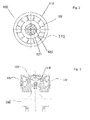
- FIG. 2 is a bottom view illustrating the piston crown 100 of the piston assembly illustrated in FIG. 1 .
- the piston skirt 200 is disposed in an inner wall of a cylinder liner and is configured to move while making frictional contact with the inner wall of the cylinder liner.
- the piston crown 100 is assembled on top of the piston skirt 200 so as to be directly exposed to heat and pressure of combustion gas. The piston skirt 200 and the piston crown 100 are coupled together by using the stud bolts 300.
- the piston skirt 200 includes a cylindrical sidewall 210 and an upper wall 220, and a circular annular part 221 and a central lubrication passage 222 are formed on the upper wall 220.
- the annular part 221 makes contact with an annular part 121 of an upper wall 120 of the piston crown 100.
- the piston crown 100 includes a sidewall 110 and the upper wall 120, and downwardly-extending ribs 122 and 123 and the annular part 121 are formed on the upper wall 120.
- the annular part 121 has a circular ring shape and makes contact with the annular part 221 of the piston skirt 200.
- the piston crown 100 and the annular part 221 of the piston skirt 200 are coupled together by using the stud bolts 300.
- the ribs 122 and 123 of the piston crown 100 extend linearly in radial directions and are divided into outer ribs 122 and inner ribs 123 by the annular part 121.
- the ribs 122 and 123 form oil channels 130 (refer to FIG. 3 ) for oil supplied to the inside of the piston assembly.
- oil supply passages are denoted by arrows.
- Oil is supplied to an outer oil gallery 140 of the piston crown 100 through a portion of the upper wall 220 adjacent to the sidewall 210 of the piston skirt 200.
- the oil is supplied to a central oil gallery 150 through oil passage(s) such as oil hole(s) or slot(s) 223 or 124 (refer to FIGS. 3 and 4 ) formed in the annular part 221 or 121 of the piston skirt 200 or the piston crown 100.
- the oil is returned to the piston skirt 200 through the central lubrication passage 222 of the piston skirt 200.
- oil may be supplied through the oil supply passages in a direction opposite the above-described direction.
- FIG. 3 illustrates oil holes 124 formed in the annular part 121 of the upper wall 120 of the piston crown 100
- FIG. 4 illustrates an oil hole 223 formed in the annular part 221 of the upper wall 220 of the piston skirt 200.
- the ribs 122 and 123 of the piston crown 100 are divided into the outer ribs 122 and the inner ribs 123 by the annular part 121 having a circular ring shape and extending downward from the upper wall 120.
- the heights of the ribs 122 and 123 are decreased in directions from the outer ribs 122 to the inner ribs 123 (refer to a portion denoted by reference numeral 160 in FIG. 1 ).
- reference numeral 160 refers to a line connecting lower ends of the inner ribs 123 and the outer ribs 122, and the heights of the ribs 122 and 123 are decreased in a direction along a line 160 toward a center region from the sidewall 110.
- the annular part 221 of the piston skirt 200 supports the annular part 121 of the piston crown 100, and the ribs 122 and 123 of the piston crown 100 support the upper wall 120 of the piston crown 100 as reinforcement structures. Therefore, the piston assembly may be more durable against combustion pressure applied to the piston crown 100.
- the ribs 122 and 123 increase the area of the piston crown 100 making contact with cooling oil and function as guides for the cooling oil. That is, the ribs 122 and 123 form the oil channels 130 for smoothly circulating the cooling oil and improving the effect of cooling.
- the piston assembly has improved structural strength and resistance to thermal stress. Therefore, the piston crown 100 of the piston assembly may be manufactured through a casting process using cast steel, cast iron, or nodular graphite cast iron, and thus the productivity of a manufacturing process and the processability of the piston crown 100 may be markedly improved.
- the oil galleries 140 and 150 and the ribs 122 and 123 may be generated from a material state without having to perform an additional machining process.
- FIG. 5 is a cross-sectional view illustrating a piston assembly according to another embodiment of the present invention
- FIG. 6 is a bottom view illustrating a piston crown 400 of the piston assembly illustrated in FIG. 5 .
- the piston assembly illustrated in FIG. 5 is different from the piston assembly illustrated in FIG. 1 , in that coupling parts 460 and 560 are formed in center regions of the piston crown 400 and a piston skirt 500 for a stud bolt 300, and lubrication passages 522 are formed in the piston skirt 500 at positions apart from the center of the piston skirt 500.
- ribs 422 extending to the coupling part 460 formed in the center region of the piston crown 400 and ribs 423 not extending to the coupling part 460 are alternately formed.
- the ribs 422 and 423 Since the distances between the ribs 422 and 423 are decreased in a direction toward the center region, the ribs 422 and 423 respectively having relatively long lengths and short lengths are alternately formed.
- the ribs 422 and 423 are divided into inner and outer ribs by a partial annular part 421 extending from an upper wall 420 of the piston crown 400.
- the partial annular part 421 has a partial circular ring shape instead of a complete circular ring shape.
- cooling oil may be supplied to an oil gallery 440 through a portion of an upper wall 520 of the piston skirt 500 adjacent to a sidewall 510 of the piston skirt 500, and then may flow along oil channels 430 formed by the ribs 422 and 423 to a center region. Thereafter, the cooling oil may return to the piston skirt 500 through the lubrication passages 522. Alternatively, the cooling oil may be circulated in a direction opposite the above-described direction.
- cooling oil may make contact with a larger area of the piston assembly and may be smoothly circulated in the piston assembly owing to the oil channels, and thus the piston assembly may be cooled more efficiently.
- the radially-arranged ribs function as reinforcement structures for supporting an combustion side (that is, the upper wall) of the piston crown to which combustion pressure is directly applied, the piston crown may become more resistant to combustion pressure.
- the piston assembly of the embodiments of the present invention may have improved quality, reliability, and a long lifespan as compared with piston assemblies of the related art, and may be applied to high-power engines.
- the piston crown may be formed by a casting method instead of a forging method.
- productivity of a manufacturing process of the piston crown may be improved, and the piston crown may be machined more easily.
Landscapes
- Engineering & Computer Science (AREA)
- General Engineering & Computer Science (AREA)
- Chemical & Material Sciences (AREA)
- Combustion & Propulsion (AREA)
- Mechanical Engineering (AREA)
- Physics & Mathematics (AREA)
- Fluid Mechanics (AREA)
- Pistons, Piston Rings, And Cylinders (AREA)
Abstract
Description
- This application claims the benefit of Korean Patent Application No.
10-2013-0076354, filed on July 1, 2013 - One or more embodiments of the present invention relate to a piston assembly of a diesel engine, and more particularly, to a piston assembly including a piston crown formed of nodular graphite cast iron and having ribs therein.
- In a general internal combustion engine, a piston transmits power to a connecting rod while vertically reciprocating along an inner wall of a cylinder during the intake-compression-combustion-exhaust cycle.
- In the case of a high-performance engine, an upper structure (called a piston crown) of a piston including an combustion side and piston ring grooves is exposed to high-temperature, high-pressure combustion conditions during engine operation and is thus manufactured by a forging method for obtaining high-quality mechanical characteristics, and the rest of the piston (called a piston skirt) exposed to relatively less severe conditions is formed of a material such as cast iron. However, if piston crowns are manufactured by a forging method, a relatively expensive material is used, and it is difficult to perform a machining process on the piston crowns. Therefore, the productivity of manufacturing is lowered, and the prices of pistons are increased.
- In addition, since such a piston crown is inefficiently cooled, the outer diameter of the piston crown may become larger than the inner diameter of a cylinder liner due to thermal expansion during engine operation, and in this case, the piston crown may melt and stick to the cylinder liner. To prevent this, the piston crown and the cylinder liner may be fitted with a large clearance therebetween. However, a large clearance lowers combustion efficiency and thus increases the generation of environmentally harmful pollutants such as fumes or NOx.
- In the related art, one-piece pistons are formed by casting a piston crown and a piston skirt with the same material such as cast iron, and some of such one-piece pistons have ribs formed therein. However, it is difficult to form oil galleries for storing oil in such one-piece pistons due to limitations of casting, and thus the one-piece pistons have low cooling efficiency, thereby generating large amounts of environmentally harmful pollutants like in the case of assembly type pistons formed of forged steel and cast iron. In addition, such one-piece pistons have low degrees of structural strength and are thus not suitable for high-power engines having high combustion pressure.
- A method of forming ribs on a piston crown is disclosed in Korean Patent Laid-open Publication No.
2010-0127449 - One or more embodiments of the present invention include a piston assembly in which a forged piston crown used for the cooling performance and structural strength problems, is replaced with a piston crown formed by casting.
- Additional aspects will be set forth in part in the description which follows and, in part, will be apparent from the description, or may be learned by practice of the presented embodiments.
- According to one or more embodiments of the present invention, a piston assembly includes: a piston skirt; and a piston crown formed by a casting method and coupled to an upper portion of the piston skirt by using a stud bolt, wherein oil galleries are formed between an upper wall of the piston skirt and an upper wall of the piston crown, wherein an annular part having a circular ring shape and a plurality of ribs having a linear shape and radially arranged to form oil channels for flowing cooling oil are formed on the upper wall of the piston crown, and the plurality of ribs are divided into outer ribs and inner ribs by the annular part.
- The outer ribs may be higher than the inner ribs,
- A lubrication passage may be formed in a center region of the upper wall of the piston skirt.
- An annular part corresponding to the annular part formed on the upper wall of the piston crown may be formed on the upper wall of the piston skirt.
- The annular part formed on the upper wall of the piston skirt and the annular part formed on the upper wall of the piston crown may be coupled together using the stud bolt.
- An oil passage may be formed in the annular part formed on the upper wall of the piston crown or the annular part formed on the upper wall of the piston skirt.
- Heights of the outer ribs and the inner ribs may be decreased in directions from a sidewall to a center region of the piston crown.
- According to one or more embodiments of the present invention, a piston assembly includes: a piston skirt; and a piston crown formed by a casting method and coupled to an upper portion of the piston skirt by using a stud bolt, wherein oil galleries are formed between an upper wall of the piston skirt and an upper wall of the piston crown, wherein a partial annular part having a partial circular ring shape and a plurality of ribs having a linear shape and radially arranged to form oil channels for flowing cooling oil are formed on the upper wall of the piston crown, and the plurality of ribs are divided into outer ribs and inner ribs by the partial annular part.
- Coupling parts may be formed in a center region of the piston crown and a center region of the piston skirt, and the coupling parts may be coupled by using the stud bolt. In addition, some of the plurality of ribs which extend to the coupling part formed in the center region of the piston crown and remaining ones of the plurality of ribs which do not extend to the coupling part formed in the center region of the piston crown may be alternately arranged.
- A lubrication passage may be formed in the upper wall of the piston skirt at a position apart form the center region of the piston skirt.
- A partial annular part corresponding to the partial annular part formed on the upper wall of the piston crown may be formed on the upper wall of the piston skirt.
- An oil passage may be formed in the annular part formed on the upper wall of the piston crown or the annular part formed on the upper wall of the piston skirt.
- Heights of the plurality of ribs may be decreased in directions from a sidewall to the center region of the piston crown.
- These and/or other aspects will become apparent and more readily appreciated from the following description of the embodiments, taken in conjunction with the accompanying drawings in which:
-
FIG. 1 is a cross-sectional view illustrating a piston assembly according to an embodiment of the present invention; -
FIG. 2 is a bottom view illustrating a piston crown of the piston assembly illustrated inFIG. 1 ; -
FIG. 3 is a cross-sectional view illustrating oil passages in the piston crown of the piston assembly illustrated inFIG. 1 ; -
FIG. 4 is a cross-sectional view illustrating oil passages in a piston skirt of the piston assembly illustrated inFIG. 1 ; -
FIG. 5 is a cross-sectional view illustrating a piston assembly according to another embodiment of the present invention; and -
FIG. 6 is a bottom view illustrating a piston crown of the piston assembly illustrated inFIG. 5 . - Reference will now be made in detail to embodiments, examples of which are illustrated in the accompanying drawings. In this regard, the present embodiments may have different forms and should not be construed as being limited to the descriptions set forth herein. Accordingly, the embodiments are merely described below, by referring to the figures, to explain aspects of the present description. As used herein, the term "and/or" includes any and all combinations of one or more of the associated listed items.
- Hereinafter, exemplary embodiments of the present invention will be described in detail with reference to the accompanying drawings. In the drawings, reference numerals are consistently used, and like reference numeral denote like elements.
-
FIG. 1 illustrates a piston assembly according to an embodiment of the present invention. In the piston assembly, anupper piston crown 100 and a lower piston skirt 200 (refer toFig. 3 ) are coupled together usingstud bolts 300. -
FIG. 2 is a bottom view illustrating thepiston crown 100 of the piston assembly illustrated inFIG. 1 . - In the embodiment of the present invention, the
piston skirt 200 is disposed in an inner wall of a cylinder liner and is configured to move while making frictional contact with the inner wall of the cylinder liner. In addition, thepiston crown 100 is assembled on top of thepiston skirt 200 so as to be directly exposed to heat and pressure of combustion gas. Thepiston skirt 200 and thepiston crown 100 are coupled together by using thestud bolts 300. - The
piston skirt 200 includes acylindrical sidewall 210 and anupper wall 220, and a circularannular part 221 and acentral lubrication passage 222 are formed on theupper wall 220. Theannular part 221 makes contact with anannular part 121 of anupper wall 120 of thepiston crown 100. - Similarly, the
piston crown 100 includes asidewall 110 and theupper wall 120, and downwardly-extendingribs annular part 121 are formed on theupper wall 120. Theannular part 121 has a circular ring shape and makes contact with theannular part 221 of thepiston skirt 200. - The
piston crown 100 and theannular part 221 of thepiston skirt 200 are coupled together by using thestud bolts 300. - In the embodiment of the present invention, the
ribs piston crown 100 extend linearly in radial directions and are divided intoouter ribs 122 andinner ribs 123 by theannular part 121. - The
ribs FIG. 3 ) for oil supplied to the inside of the piston assembly. - In
FIG. 1 , oil supply passages are denoted by arrows. Oil is supplied to anouter oil gallery 140 of thepiston crown 100 through a portion of theupper wall 220 adjacent to thesidewall 210 of thepiston skirt 200. Then, the oil is supplied to acentral oil gallery 150 through oil passage(s) such as oil hole(s) or slot(s) 223 or 124 (refer toFIGS. 3 and4 ) formed in theannular part piston skirt 200 or thepiston crown 100. Thereafter, the oil is returned to thepiston skirt 200 through thecentral lubrication passage 222 of thepiston skirt 200. - Alternatively, oil may be supplied through the oil supply passages in a direction opposite the above-described direction.
-
FIG. 3 illustrates oil holes 124 formed in theannular part 121 of theupper wall 120 of thepiston crown 100, andFIG. 4 illustrates anoil hole 223 formed in theannular part 221 of theupper wall 220 of thepiston skirt 200. - As described above, the
ribs piston crown 100 are divided into theouter ribs 122 and theinner ribs 123 by theannular part 121 having a circular ring shape and extending downward from theupper wall 120. The heights of theribs outer ribs 122 to the inner ribs 123 (refer to a portion denoted byreference numeral 160 inFIG. 1 ). - Referring to
FIG. 1 ,reference numeral 160 refers to a line connecting lower ends of theinner ribs 123 and theouter ribs 122, and the heights of theribs line 160 toward a center region from thesidewall 110. - In the embodiment of the present invention, as described above, the
annular part 221 of thepiston skirt 200 supports theannular part 121 of thepiston crown 100, and theribs piston crown 100 support theupper wall 120 of thepiston crown 100 as reinforcement structures. Therefore, the piston assembly may be more durable against combustion pressure applied to thepiston crown 100. - Furthermore, in the embodiment of the present invention, the
ribs piston crown 100 making contact with cooling oil and function as guides for the cooling oil. That is, theribs oil channels 130 for smoothly circulating the cooling oil and improving the effect of cooling. - As described above, according to the embodiment of the present invention, the piston assembly has improved structural strength and resistance to thermal stress. Therefore, the
piston crown 100 of the piston assembly may be manufactured through a casting process using cast steel, cast iron, or nodular graphite cast iron, and thus the productivity of a manufacturing process and the processability of thepiston crown 100 may be markedly improved. - Furthermore, in this case, the
oil galleries ribs -
FIG. 5 is a cross-sectional view illustrating a piston assembly according to another embodiment of the present invention, andFIG. 6 is a bottom view illustrating apiston crown 400 of the piston assembly illustrated inFIG. 5 . - The piston assembly illustrated in
FIG. 5 is different from the piston assembly illustrated inFIG. 1 , in thatcoupling parts piston crown 400 and apiston skirt 500 for astud bolt 300, andlubrication passages 522 are formed in thepiston skirt 500 at positions apart from the center of thepiston skirt 500. - In addition, as shown in the bottom view of
FIG. 6 ,ribs 422 extending to thecoupling part 460 formed in the center region of thepiston crown 400 andribs 423 not extending to thecoupling part 460 are alternately formed. - Since the distances between the
ribs ribs - In addition, as shown in
FIG. 6 , theribs annular part 421 extending from anupper wall 420 of thepiston crown 400. The partialannular part 421 has a partial circular ring shape instead of a complete circular ring shape. - In the piston assembly illustrated in
FIGS. 5 and6 , cooling oil may be supplied to anoil gallery 440 through a portion of anupper wall 520 of thepiston skirt 500 adjacent to asidewall 510 of thepiston skirt 500, and then may flow alongoil channels 430 formed by theribs piston skirt 500 through thelubrication passages 522. Alternatively, the cooling oil may be circulated in a direction opposite the above-described direction. - In
FIGS. 5 and6 , like reference numerals denote like elements. - As described above, according to the one or more of the above embodiments of the present invention, cooling oil may make contact with a larger area of the piston assembly and may be smoothly circulated in the piston assembly owing to the oil channels, and thus the piston assembly may be cooled more efficiently. In addition, since the radially-arranged ribs function as reinforcement structures for supporting an combustion side (that is, the upper wall) of the piston crown to which combustion pressure is directly applied, the piston crown may become more resistant to combustion pressure.
- Therefore, the piston assembly of the embodiments of the present invention may have improved quality, reliability, and a long lifespan as compared with piston assemblies of the related art, and may be applied to high-power engines.
- Furthermore, owing to the improved characteristics of the piston assembly, the piston crown may be formed by a casting method instead of a forging method. Thus, the productivity of a manufacturing process of the piston crown may be improved, and the piston crown may be machined more easily.
- It should be understood that the exemplary embodiments described herein should be considered in a descriptive sense only and not for purposes of limitation. Descriptions of features or aspects within each embodiment should typically be considered as available for other similar features or aspects in other embodiments.
- While one or more embodiments of the present invention have been described with reference to the figures, it will be understood by those of ordinary skill in the art that various changes in form and details may be made therein without departing from the spirit and scope of the present invention as defined by the following claims.
Claims (5)
- A piston assembly comprising:a piston skirt; anda piston crown formed by a casting method and coupled to an upper portion of the piston skirt by using a stud bolt,wherein oil galleries are formed between an upper wall of the piston skirt and an upper wall of the piston crown,an annular part having a circular ring shape and a plurality of ribs having a linear shape and radially arranged to form oil channels for flowing cooling oil are formed on the upper wall of the piston crown, the plurality of ribs are divided into outer ribs and inner ribs by the annular part, and the outer ribs are higher than the inner ribs, andan annular part corresponding to the annular part formed on the upper wall of the piston crown is formed on the upper wall of the piston skirt, the annular part formed on the upper wall of the piston skirt and the annular part formed on the upper wall of the piston crown are coupled together using the stud bolt, and an oil passage is formed in the annular part formed on the upper wall of the piston skirt or the annular part formed on the upper wall of the piston crown.
- The piston assembly of claim 1, wherein a lubrication passage is formed in a center region of the upper wall of the piston skirt, and heights of the outer ribs and the inner ribs are decreased in directions from a sidewall to a center region of the piston crown.
- A piston assembly comprising:a piston skirt; anda piston crown formed by a casting method and coupled to an upper portion of the piston skirt by using a stud bolt,wherein oil galleries are formed between an upper wall of the piston skirt and an upper wall of the piston crown,a partial annular part having a partial circular ring shape and a plurality of ribs having a linear shape and radially arranged to form oil channels for flowing cooling oil are formed on the upper wall of the piston crown, and the plurality of ribs are divided into outer ribs and inner ribs by the partial annular part,coupling parts are formed in a center region of the piston crown and a center region of the piston skirt, and the coupling parts are coupled by using the stud bolt, andsome of the plurality of ribs which extend to the coupling part formed in the center region of the piston crown and remaining ones of the plurality of ribs which do not extend to the coupling part formed in the center region of the piston crown are alternately arranged,wherein a lubrication passage is formed in the upper wall of the piston skirt at a position apart form the center region of the piston skirt.
- The piston assembly of claim 3, wherein a partial annular part corresponding to the partial annular part formed on the upper wall of the piston crown is formed on the upper wall of the piston skirt, and
an oil passage is formed in the partial annular part formed on the upper wall of the piston crown or the partial annular part formed on the upper wall of the piston skirt. - The piston assembly of claim 4, wherein heights of the plurality of ribs are decreased in directions from a sidewall to the center region of the piston crown.
Applications Claiming Priority (1)
| Application Number | Priority Date | Filing Date | Title |
|---|---|---|---|
| KR1020130076354A KR101383121B1 (en) | 2013-07-01 | 2013-07-01 | A piston assembly |
Publications (2)
| Publication Number | Publication Date |
|---|---|
| EP2821626A1 true EP2821626A1 (en) | 2015-01-07 |
| EP2821626B1 EP2821626B1 (en) | 2016-03-02 |
Family
ID=50657069
Family Applications (1)
| Application Number | Title | Priority Date | Filing Date |
|---|---|---|---|
| EP14175043.0A Not-in-force EP2821626B1 (en) | 2013-07-01 | 2014-06-30 | Piston assembly |
Country Status (5)
| Country | Link |
|---|---|
| US (1) | US9291088B2 (en) |
| EP (1) | EP2821626B1 (en) |
| KR (1) | KR101383121B1 (en) |
| CN (1) | CN104074624A (en) |
| DK (1) | DK2821626T3 (en) |
Cited By (2)
| Publication number | Priority date | Publication date | Assignee | Title |
|---|---|---|---|---|
| EP3301285A1 (en) * | 2016-09-30 | 2018-04-04 | Samyoung Machinery Co., Ltd. | High pressure piston crown |
| WO2021122967A1 (en) * | 2019-12-19 | 2021-06-24 | Ks Kolbenschmidt Gmbh | Oil-cooled piston for internal combustion engines |
Families Citing this family (4)
| Publication number | Priority date | Publication date | Assignee | Title |
|---|---|---|---|---|
| US10294887B2 (en) | 2015-11-18 | 2019-05-21 | Tenneco Inc. | Piston providing for reduced heat loss using cooling media |
| DE102016204830A1 (en) * | 2016-03-23 | 2017-09-28 | Federal-Mogul Nürnberg GmbH | Piston for an internal combustion engine |
| US11067033B2 (en) * | 2017-05-17 | 2021-07-20 | Tenneco Inc. | Dual gallery steel piston |
| CN107387253A (en) * | 2017-09-05 | 2017-11-24 | 湖南江滨机器(集团)有限责任公司 | A kind of piston and its manufacture method |
Citations (5)
| Publication number | Priority date | Publication date | Assignee | Title |
|---|---|---|---|---|
| CH326687A (en) * | 1953-06-16 | 1957-12-31 | Maybach Motorenbau Gmbh | Multi-part, oil-cooled piston for an internal combustion engine |
| GB1230535A (en) * | 1968-09-20 | 1971-05-05 | ||
| WO2005121537A1 (en) * | 2004-06-08 | 2005-12-22 | Mahle Gmbh | Constructed piston and method for preventing damage to abutting surfaces of the upper and lower sections of said piston |
| DE102006055251A1 (en) * | 2006-11-23 | 2008-05-29 | Mahle International Gmbh | Two-piece piston for an internal combustion engine |
| KR20100127449A (en) | 2009-05-26 | 2010-12-06 | 삼영기계(주) | Piston assembly |
Family Cites Families (8)
| Publication number | Priority date | Publication date | Assignee | Title |
|---|---|---|---|---|
| CH473981A (en) * | 1967-04-28 | 1969-06-15 | Sulzer Ag | Liquid-cooled piston of a reciprocating internal combustion engine |
| GB2366607B (en) * | 2000-09-06 | 2004-06-09 | Federal Mogul Bradford Ltd | Piston for internal combustion engine |
| DE102004029877A1 (en) * | 2004-06-19 | 2006-01-05 | Mahle Gmbh | Built piston for an internal combustion engine |
| DE102004030218A1 (en) * | 2004-06-22 | 2006-01-19 | Mahle Gmbh | Built piston for an internal combustion engine |
| US7406941B2 (en) * | 2004-07-21 | 2008-08-05 | Federal - Mogul World Wide, Inc. | One piece cast steel monobloc piston |
| ES2355935T3 (en) * | 2005-12-17 | 2011-04-01 | Mahle International Gmbh | PISTON IN TWO PARTS FOR AN INTERNAL CONBUSTION ENGINE. |
| DE102006027354A1 (en) * | 2006-06-13 | 2007-12-20 | Mahle International Gmbh | Multi-piece cooled piston for an internal combustion engine |
| DE102007050213A1 (en) * | 2007-10-20 | 2009-04-23 | Mahle International Gmbh | Piston for an internal combustion engine |
-
2013
- 2013-07-01 KR KR1020130076354A patent/KR101383121B1/en active Active
-
2014
- 2014-06-23 US US14/311,611 patent/US9291088B2/en not_active Expired - Fee Related
- 2014-06-24 CN CN201410287449.0A patent/CN104074624A/en active Pending
- 2014-06-30 DK DK14175043.0T patent/DK2821626T3/en active
- 2014-06-30 EP EP14175043.0A patent/EP2821626B1/en not_active Not-in-force
Patent Citations (5)
| Publication number | Priority date | Publication date | Assignee | Title |
|---|---|---|---|---|
| CH326687A (en) * | 1953-06-16 | 1957-12-31 | Maybach Motorenbau Gmbh | Multi-part, oil-cooled piston for an internal combustion engine |
| GB1230535A (en) * | 1968-09-20 | 1971-05-05 | ||
| WO2005121537A1 (en) * | 2004-06-08 | 2005-12-22 | Mahle Gmbh | Constructed piston and method for preventing damage to abutting surfaces of the upper and lower sections of said piston |
| DE102006055251A1 (en) * | 2006-11-23 | 2008-05-29 | Mahle International Gmbh | Two-piece piston for an internal combustion engine |
| KR20100127449A (en) | 2009-05-26 | 2010-12-06 | 삼영기계(주) | Piston assembly |
Cited By (3)
| Publication number | Priority date | Publication date | Assignee | Title |
|---|---|---|---|---|
| EP3301285A1 (en) * | 2016-09-30 | 2018-04-04 | Samyoung Machinery Co., Ltd. | High pressure piston crown |
| US10393062B2 (en) | 2016-09-30 | 2019-08-27 | Samyoung Machinery Co., Ltd. | High pressure piston crown |
| WO2021122967A1 (en) * | 2019-12-19 | 2021-06-24 | Ks Kolbenschmidt Gmbh | Oil-cooled piston for internal combustion engines |
Also Published As
| Publication number | Publication date |
|---|---|
| CN104074624A (en) | 2014-10-01 |
| EP2821626B1 (en) | 2016-03-02 |
| US20150000618A1 (en) | 2015-01-01 |
| US9291088B2 (en) | 2016-03-22 |
| KR101383121B1 (en) | 2014-04-09 |
| DK2821626T3 (en) | 2016-06-06 |
Similar Documents
| Publication | Publication Date | Title |
|---|---|---|
| KR102068372B1 (en) | Engine piston | |
| US10450999B2 (en) | Reduced compression height dual gallery piston, piston assembly therewith and methods of construction thereof | |
| EP2821626A1 (en) | Piston assembly | |
| US8807109B2 (en) | Steel piston with cooling gallery and method of construction thereof | |
| CN104641095B (en) | Piston with oil cooling passage and method of construction thereof | |
| US9109530B2 (en) | Piston for an internal combustion engine | |
| KR101283956B1 (en) | Piston having improved cooling characteristics | |
| US20180066601A1 (en) | Internal combustion engine cylinder liner flange with non-circular profile | |
| JP2016537551A (en) | Integrated galleryless piston and its construction method | |
| KR20170012320A (en) | Piston with keystone second ring groove for high temperature internal combustion engines | |
| CN103764983B (en) | Engine unit for enhanced cooling | |
| JP2017198174A (en) | Internal combustion engine | |
| CN105209736A (en) | Piston and method of construction thereof | |
| US9624869B2 (en) | Cooling moat for upper cylinder liner seal | |
| US9551291B2 (en) | Steel piston with fourth land guidance and improved friction characteristics | |
| JP6574990B2 (en) | Piston with reduced topland height and closely topland piston shape | |
| JP2019509425A (en) | Cavityless piston with oil discharge mechanism | |
| JP2019065973A (en) | Internal combustion engine | |
| JP2019502856A (en) | Integrated galleryless piston and its construction method | |
| JP2017089409A (en) | Piston for internal combustion engine |
Legal Events
| Date | Code | Title | Description |
|---|---|---|---|
| PUAI | Public reference made under article 153(3) epc to a published international application that has entered the european phase |
Free format text: ORIGINAL CODE: 0009012 |
|
| 17P | Request for examination filed |
Effective date: 20140630 |
|
| AK | Designated contracting states |
Kind code of ref document: A1 Designated state(s): AL AT BE BG CH CY CZ DE DK EE ES FI FR GB GR HR HU IE IS IT LI LT LU LV MC MK MT NL NO PL PT RO RS SE SI SK SM TR |
|
| AX | Request for extension of the european patent |
Extension state: BA ME |
|
| R17P | Request for examination filed (corrected) |
Effective date: 20150519 |
|
| RBV | Designated contracting states (corrected) |
Designated state(s): AL AT BE BG CH CY CZ DE DK EE ES FI FR GB GR HR HU IE IS IT LI LT LU LV MC MK MT NL NO PL PT RO RS SE SI SK SM TR |
|
| GRAP | Despatch of communication of intention to grant a patent |
Free format text: ORIGINAL CODE: EPIDOSNIGR1 |
|
| INTG | Intention to grant announced |
Effective date: 20150929 |
|
| GRAS | Grant fee paid |
Free format text: ORIGINAL CODE: EPIDOSNIGR3 |
|
| GRAA | (expected) grant |
Free format text: ORIGINAL CODE: 0009210 |
|
| AK | Designated contracting states |
Kind code of ref document: B1 Designated state(s): AL AT BE BG CH CY CZ DE DK EE ES FI FR GB GR HR HU IE IS IT LI LT LU LV MC MK MT NL NO PL PT RO RS SE SI SK SM TR |
|
| REG | Reference to a national code |
Ref country code: GB Ref legal event code: FG4D |
|
| REG | Reference to a national code |
Ref country code: AT Ref legal event code: REF Ref document number: 778232 Country of ref document: AT Kind code of ref document: T Effective date: 20160315 Ref country code: CH Ref legal event code: EP |
|
| REG | Reference to a national code |
Ref country code: IE Ref legal event code: FG4D |
|
| REG | Reference to a national code |
Ref country code: DE Ref legal event code: R096 Ref document number: 602014001000 Country of ref document: DE |
|
| REG | Reference to a national code |
Ref country code: CH Ref legal event code: NV Representative=s name: ING. MARCO ZARDI C/O M. ZARDI AND CO. S.A., CH |
|
| REG | Reference to a national code |
Ref country code: FR Ref legal event code: PLFP Year of fee payment: 3 |
|
| REG | Reference to a national code |
Ref country code: DK Ref legal event code: T3 Effective date: 20160530 |
|
| REG | Reference to a national code |
Ref country code: NL Ref legal event code: MP Effective date: 20160302 |
|
| REG | Reference to a national code |
Ref country code: LT Ref legal event code: MG4D |
|
| REG | Reference to a national code |
Ref country code: AT Ref legal event code: MK05 Ref document number: 778232 Country of ref document: AT Kind code of ref document: T Effective date: 20160302 |
|
| PG25 | Lapsed in a contracting state [announced via postgrant information from national office to epo] |
Ref country code: ES Free format text: LAPSE BECAUSE OF FAILURE TO SUBMIT A TRANSLATION OF THE DESCRIPTION OR TO PAY THE FEE WITHIN THE PRESCRIBED TIME-LIMIT Effective date: 20160302 Ref country code: GR Free format text: LAPSE BECAUSE OF FAILURE TO SUBMIT A TRANSLATION OF THE DESCRIPTION OR TO PAY THE FEE WITHIN THE PRESCRIBED TIME-LIMIT Effective date: 20160603 Ref country code: HR Free format text: LAPSE BECAUSE OF FAILURE TO SUBMIT A TRANSLATION OF THE DESCRIPTION OR TO PAY THE FEE WITHIN THE PRESCRIBED TIME-LIMIT Effective date: 20160302 Ref country code: NO Free format text: LAPSE BECAUSE OF FAILURE TO SUBMIT A TRANSLATION OF THE DESCRIPTION OR TO PAY THE FEE WITHIN THE PRESCRIBED TIME-LIMIT Effective date: 20160602 |
|
| PG25 | Lapsed in a contracting state [announced via postgrant information from national office to epo] |
Ref country code: NL Free format text: LAPSE BECAUSE OF FAILURE TO SUBMIT A TRANSLATION OF THE DESCRIPTION OR TO PAY THE FEE WITHIN THE PRESCRIBED TIME-LIMIT Effective date: 20160302 Ref country code: SE Free format text: LAPSE BECAUSE OF FAILURE TO SUBMIT A TRANSLATION OF THE DESCRIPTION OR TO PAY THE FEE WITHIN THE PRESCRIBED TIME-LIMIT Effective date: 20160302 Ref country code: PL Free format text: LAPSE BECAUSE OF FAILURE TO SUBMIT A TRANSLATION OF THE DESCRIPTION OR TO PAY THE FEE WITHIN THE PRESCRIBED TIME-LIMIT Effective date: 20160302 Ref country code: AT Free format text: LAPSE BECAUSE OF FAILURE TO SUBMIT A TRANSLATION OF THE DESCRIPTION OR TO PAY THE FEE WITHIN THE PRESCRIBED TIME-LIMIT Effective date: 20160302 Ref country code: RS Free format text: LAPSE BECAUSE OF FAILURE TO SUBMIT A TRANSLATION OF THE DESCRIPTION OR TO PAY THE FEE WITHIN THE PRESCRIBED TIME-LIMIT Effective date: 20160302 Ref country code: LT Free format text: LAPSE BECAUSE OF FAILURE TO SUBMIT A TRANSLATION OF THE DESCRIPTION OR TO PAY THE FEE WITHIN THE PRESCRIBED TIME-LIMIT Effective date: 20160302 Ref country code: LV Free format text: LAPSE BECAUSE OF FAILURE TO SUBMIT A TRANSLATION OF THE DESCRIPTION OR TO PAY THE FEE WITHIN THE PRESCRIBED TIME-LIMIT Effective date: 20160302 |
|
| PG25 | Lapsed in a contracting state [announced via postgrant information from national office to epo] |
Ref country code: IS Free format text: LAPSE BECAUSE OF FAILURE TO SUBMIT A TRANSLATION OF THE DESCRIPTION OR TO PAY THE FEE WITHIN THE PRESCRIBED TIME-LIMIT Effective date: 20160702 Ref country code: EE Free format text: LAPSE BECAUSE OF FAILURE TO SUBMIT A TRANSLATION OF THE DESCRIPTION OR TO PAY THE FEE WITHIN THE PRESCRIBED TIME-LIMIT Effective date: 20160302 |
|
| PG25 | Lapsed in a contracting state [announced via postgrant information from national office to epo] |
Ref country code: SM Free format text: LAPSE BECAUSE OF FAILURE TO SUBMIT A TRANSLATION OF THE DESCRIPTION OR TO PAY THE FEE WITHIN THE PRESCRIBED TIME-LIMIT Effective date: 20160302 Ref country code: SK Free format text: LAPSE BECAUSE OF FAILURE TO SUBMIT A TRANSLATION OF THE DESCRIPTION OR TO PAY THE FEE WITHIN THE PRESCRIBED TIME-LIMIT Effective date: 20160302 Ref country code: PT Free format text: LAPSE BECAUSE OF FAILURE TO SUBMIT A TRANSLATION OF THE DESCRIPTION OR TO PAY THE FEE WITHIN THE PRESCRIBED TIME-LIMIT Effective date: 20160704 Ref country code: CZ Free format text: LAPSE BECAUSE OF FAILURE TO SUBMIT A TRANSLATION OF THE DESCRIPTION OR TO PAY THE FEE WITHIN THE PRESCRIBED TIME-LIMIT Effective date: 20160302 Ref country code: RO Free format text: LAPSE BECAUSE OF FAILURE TO SUBMIT A TRANSLATION OF THE DESCRIPTION OR TO PAY THE FEE WITHIN THE PRESCRIBED TIME-LIMIT Effective date: 20160302 |
|
| REG | Reference to a national code |
Ref country code: DE Ref legal event code: R097 Ref document number: 602014001000 Country of ref document: DE |
|
| PG25 | Lapsed in a contracting state [announced via postgrant information from national office to epo] |
Ref country code: IT Free format text: LAPSE BECAUSE OF FAILURE TO SUBMIT A TRANSLATION OF THE DESCRIPTION OR TO PAY THE FEE WITHIN THE PRESCRIBED TIME-LIMIT Effective date: 20160302 Ref country code: BE Free format text: LAPSE BECAUSE OF FAILURE TO SUBMIT A TRANSLATION OF THE DESCRIPTION OR TO PAY THE FEE WITHIN THE PRESCRIBED TIME-LIMIT Effective date: 20160302 |
|
| PLBE | No opposition filed within time limit |
Free format text: ORIGINAL CODE: 0009261 |
|
| STAA | Information on the status of an ep patent application or granted ep patent |
Free format text: STATUS: NO OPPOSITION FILED WITHIN TIME LIMIT |
|
| PG25 | Lapsed in a contracting state [announced via postgrant information from national office to epo] |
Ref country code: MC Free format text: LAPSE BECAUSE OF FAILURE TO SUBMIT A TRANSLATION OF THE DESCRIPTION OR TO PAY THE FEE WITHIN THE PRESCRIBED TIME-LIMIT Effective date: 20160302 |
|
| 26N | No opposition filed |
Effective date: 20161205 |
|
| PG25 | Lapsed in a contracting state [announced via postgrant information from national office to epo] |
Ref country code: BG Free format text: LAPSE BECAUSE OF FAILURE TO SUBMIT A TRANSLATION OF THE DESCRIPTION OR TO PAY THE FEE WITHIN THE PRESCRIBED TIME-LIMIT Effective date: 20160602 Ref country code: SI Free format text: LAPSE BECAUSE OF FAILURE TO SUBMIT A TRANSLATION OF THE DESCRIPTION OR TO PAY THE FEE WITHIN THE PRESCRIBED TIME-LIMIT Effective date: 20160302 |
|
| REG | Reference to a national code |
Ref country code: IE Ref legal event code: MM4A |
|
| PG25 | Lapsed in a contracting state [announced via postgrant information from national office to epo] |
Ref country code: IE Free format text: LAPSE BECAUSE OF NON-PAYMENT OF DUE FEES Effective date: 20160630 |
|
| REG | Reference to a national code |
Ref country code: FR Ref legal event code: PLFP Year of fee payment: 4 |
|
| REG | Reference to a national code |
Ref country code: FR Ref legal event code: PLFP Year of fee payment: 5 |
|
| PG25 | Lapsed in a contracting state [announced via postgrant information from national office to epo] |
Ref country code: HU Free format text: LAPSE BECAUSE OF FAILURE TO SUBMIT A TRANSLATION OF THE DESCRIPTION OR TO PAY THE FEE WITHIN THE PRESCRIBED TIME-LIMIT; INVALID AB INITIO Effective date: 20140630 |
|
| PG25 | Lapsed in a contracting state [announced via postgrant information from national office to epo] |
Ref country code: MT Free format text: LAPSE BECAUSE OF NON-PAYMENT OF DUE FEES Effective date: 20160630 Ref country code: CY Free format text: LAPSE BECAUSE OF FAILURE TO SUBMIT A TRANSLATION OF THE DESCRIPTION OR TO PAY THE FEE WITHIN THE PRESCRIBED TIME-LIMIT Effective date: 20160302 Ref country code: LU Free format text: LAPSE BECAUSE OF NON-PAYMENT OF DUE FEES Effective date: 20160630 Ref country code: MK Free format text: LAPSE BECAUSE OF FAILURE TO SUBMIT A TRANSLATION OF THE DESCRIPTION OR TO PAY THE FEE WITHIN THE PRESCRIBED TIME-LIMIT Effective date: 20160302 |
|
| PGFP | Annual fee paid to national office [announced via postgrant information from national office to epo] |
Ref country code: DK Payment date: 20180522 Year of fee payment: 5 Ref country code: DE Payment date: 20180522 Year of fee payment: 5 Ref country code: CH Payment date: 20180528 Year of fee payment: 5 Ref country code: FI Payment date: 20180524 Year of fee payment: 5 |
|
| PGFP | Annual fee paid to national office [announced via postgrant information from national office to epo] |
Ref country code: FR Payment date: 20180525 Year of fee payment: 5 |
|
| PG25 | Lapsed in a contracting state [announced via postgrant information from national office to epo] |
Ref country code: TR Free format text: LAPSE BECAUSE OF FAILURE TO SUBMIT A TRANSLATION OF THE DESCRIPTION OR TO PAY THE FEE WITHIN THE PRESCRIBED TIME-LIMIT Effective date: 20160302 Ref country code: AL Free format text: LAPSE BECAUSE OF FAILURE TO SUBMIT A TRANSLATION OF THE DESCRIPTION OR TO PAY THE FEE WITHIN THE PRESCRIBED TIME-LIMIT Effective date: 20160302 |
|
| PGFP | Annual fee paid to national office [announced via postgrant information from national office to epo] |
Ref country code: GB Payment date: 20180522 Year of fee payment: 5 |
|
| REG | Reference to a national code |
Ref country code: DE Ref legal event code: R119 Ref document number: 602014001000 Country of ref document: DE |
|
| REG | Reference to a national code |
Ref country code: FI Ref legal event code: MAE |
|
| REG | Reference to a national code |
Ref country code: DK Ref legal event code: EBP Effective date: 20190630 |
|
| PG25 | Lapsed in a contracting state [announced via postgrant information from national office to epo] |
Ref country code: FI Free format text: LAPSE BECAUSE OF NON-PAYMENT OF DUE FEES Effective date: 20190630 |
|
| REG | Reference to a national code |
Ref country code: CH Ref legal event code: PL |
|
| GBPC | Gb: european patent ceased through non-payment of renewal fee |
Effective date: 20190630 |
|
| PG25 | Lapsed in a contracting state [announced via postgrant information from national office to epo] |
Ref country code: DE Free format text: LAPSE BECAUSE OF NON-PAYMENT OF DUE FEES Effective date: 20200101 Ref country code: GB Free format text: LAPSE BECAUSE OF NON-PAYMENT OF DUE FEES Effective date: 20190630 |
|
| PG25 | Lapsed in a contracting state [announced via postgrant information from national office to epo] |
Ref country code: LI Free format text: LAPSE BECAUSE OF NON-PAYMENT OF DUE FEES Effective date: 20190630 Ref country code: CH Free format text: LAPSE BECAUSE OF NON-PAYMENT OF DUE FEES Effective date: 20190630 |
|
| PG25 | Lapsed in a contracting state [announced via postgrant information from national office to epo] |
Ref country code: FR Free format text: LAPSE BECAUSE OF NON-PAYMENT OF DUE FEES Effective date: 20190630 |
|
| PG25 | Lapsed in a contracting state [announced via postgrant information from national office to epo] |
Ref country code: DK Free format text: LAPSE BECAUSE OF NON-PAYMENT OF DUE FEES Effective date: 20190630 |