EP2821412A1 - Organometallic 2-cyano-2-aminobenzoate-propyl derivates and their use as anthelmintics - Google Patents
Organometallic 2-cyano-2-aminobenzoate-propyl derivates and their use as anthelmintics Download PDFInfo
- Publication number
- EP2821412A1 EP2821412A1 EP13174551.5A EP13174551A EP2821412A1 EP 2821412 A1 EP2821412 A1 EP 2821412A1 EP 13174551 A EP13174551 A EP 13174551A EP 2821412 A1 EP2821412 A1 EP 2821412A1
- Authority
- EP
- European Patent Office
- Prior art keywords
- alkyl
- unsubstituted
- substituted
- compound
- scf
- Prior art date
- Legal status (The legal status is an assumption and is not a legal conclusion. Google has not performed a legal analysis and makes no representation as to the accuracy of the status listed.)
- Withdrawn
Links
- VVVFSDUXSVTCDT-UHFFFAOYSA-N CC(CO)(C#N)NC(c1ccccc1)=O Chemical compound CC(CO)(C#N)NC(c1ccccc1)=O VVVFSDUXSVTCDT-UHFFFAOYSA-N 0.000 description 1
- XQNQNSFSVDKOTP-UHFFFAOYSA-N CC(CO)(C#N)NCc(cc1)ccc1SC(F)(F)F Chemical compound CC(CO)(C#N)NCc(cc1)ccc1SC(F)(F)F XQNQNSFSVDKOTP-UHFFFAOYSA-N 0.000 description 1
- VFOMOBWBMLZVSA-UHFFFAOYSA-N CC(COCC1=CCC=C1)(C#N)NC(C(C=C1)=CCC1SC(F)(F)F)=O Chemical compound CC(COCC1=CCC=C1)(C#N)NC(C(C=C1)=CCC1SC(F)(F)F)=O VFOMOBWBMLZVSA-UHFFFAOYSA-N 0.000 description 1
- WTERNLDOAPYGJD-SFHVURJKSA-N C[C@@](COc1c(C(F)(F)F)ccc(C#N)c1)(C#N)NC(c(cc1)ccc1SC(F)(F)F)=O Chemical compound C[C@@](COc1c(C(F)(F)F)ccc(C#N)c1)(C#N)NC(c(cc1)ccc1SC(F)(F)F)=O WTERNLDOAPYGJD-SFHVURJKSA-N 0.000 description 1
Images


Classifications
-
- C—CHEMISTRY; METALLURGY
- C07—ORGANIC CHEMISTRY
- C07F—ACYCLIC, CARBOCYCLIC OR HETEROCYCLIC COMPOUNDS CONTAINING ELEMENTS OTHER THAN CARBON, HYDROGEN, HALOGEN, OXYGEN, NITROGEN, SULFUR, SELENIUM OR TELLURIUM
- C07F15/00—Compounds containing elements of Groups 8, 9, 10 or 18 of the Periodic Table
- C07F15/02—Iron compounds
-
- A—HUMAN NECESSITIES
- A01—AGRICULTURE; FORESTRY; ANIMAL HUSBANDRY; HUNTING; TRAPPING; FISHING
- A01N—PRESERVATION OF BODIES OF HUMANS OR ANIMALS OR PLANTS OR PARTS THEREOF; BIOCIDES, e.g. AS DISINFECTANTS, AS PESTICIDES OR AS HERBICIDES; PEST REPELLANTS OR ATTRACTANTS; PLANT GROWTH REGULATORS
- A01N55/00—Biocides, pest repellants or attractants, or plant growth regulators, containing organic compounds containing elements other than carbon, hydrogen, halogen, oxygen, nitrogen and sulfur
- A01N55/02—Biocides, pest repellants or attractants, or plant growth regulators, containing organic compounds containing elements other than carbon, hydrogen, halogen, oxygen, nitrogen and sulfur containing metal atoms
-
- A—HUMAN NECESSITIES
- A61—MEDICAL OR VETERINARY SCIENCE; HYGIENE
- A61P—SPECIFIC THERAPEUTIC ACTIVITY OF CHEMICAL COMPOUNDS OR MEDICINAL PREPARATIONS
- A61P33/00—Antiparasitic agents
- A61P33/10—Anthelmintics
-
- C—CHEMISTRY; METALLURGY
- C07—ORGANIC CHEMISTRY
- C07F—ACYCLIC, CARBOCYCLIC OR HETEROCYCLIC COMPOUNDS CONTAINING ELEMENTS OTHER THAN CARBON, HYDROGEN, HALOGEN, OXYGEN, NITROGEN, SULFUR, SELENIUM OR TELLURIUM
- C07F13/00—Compounds containing elements of Groups 7 or 17 of the Periodic Table
-
- C—CHEMISTRY; METALLURGY
- C07—ORGANIC CHEMISTRY
- C07F—ACYCLIC, CARBOCYCLIC OR HETEROCYCLIC COMPOUNDS CONTAINING ELEMENTS OTHER THAN CARBON, HYDROGEN, HALOGEN, OXYGEN, NITROGEN, SULFUR, SELENIUM OR TELLURIUM
- C07F15/00—Compounds containing elements of Groups 8, 9, 10 or 18 of the Periodic Table
- C07F15/0006—Compounds containing elements of Groups 8, 9, 10 or 18 of the Periodic Table compounds of the platinum group
- C07F15/0046—Ruthenium compounds
-
- C—CHEMISTRY; METALLURGY
- C07—ORGANIC CHEMISTRY
- C07F—ACYCLIC, CARBOCYCLIC OR HETEROCYCLIC COMPOUNDS CONTAINING ELEMENTS OTHER THAN CARBON, HYDROGEN, HALOGEN, OXYGEN, NITROGEN, SULFUR, SELENIUM OR TELLURIUM
- C07F15/00—Compounds containing elements of Groups 8, 9, 10 or 18 of the Periodic Table
- C07F15/06—Cobalt compounds
-
- C—CHEMISTRY; METALLURGY
- C07—ORGANIC CHEMISTRY
- C07F—ACYCLIC, CARBOCYCLIC OR HETEROCYCLIC COMPOUNDS CONTAINING ELEMENTS OTHER THAN CARBON, HYDROGEN, HALOGEN, OXYGEN, NITROGEN, SULFUR, SELENIUM OR TELLURIUM
- C07F17/00—Metallocenes
- C07F17/02—Metallocenes of metals of Groups 8, 9 or 10 of the Periodic Table
Definitions
- the present invention relates to organometallic 2-cyano-2-aminobenzoate-propyl derivatives and their use as anthelmintics.
- One sixth of the human population in earth is affected chronically by at least one parasitic helminth, and the socioeconomic burden (in DALYs) is greater than that of cancer and diabetes.
- Some helminths such as Schistosoma haematobium, Opisthorchis viverrini and Clonorchis sinensis induce malignant cancers in humans.
- OM is an organometallic compound selected from the group of an unsubstituted or substituted metal sandwich compound, an unsubstituted or substituted half metal sandwich compound or a metal carbonyl compound.
- alkyl refers to a saturated straight or branched hydrocarbon moiety containing up to 10, particularly up to 4 carbon atoms.
- alkyl groups include, without limitation, methyl, ethyl, propyl, butyl, isopropyl, n-hexyl, octyl, decyl and the like.
- Alkyl groups typically include from 1 to about 10 carbon atoms (C 1 -C 10 alkyl), particularly with from 1 to about 4 carbon atoms (C 1 -C 4 alkyl).
- cycloalkyl refers to an interconnected alkyl group forming a ring structure. Alkyl or cycloalkyl groups as used herein may optionally include further substituent groups.
- alkynyl refers to a straight or branched hydrocarbon moiety containing up to 10 carbon atoms and having at least one carbon-carbon triple bond.
- alkynyl groups include, without limitation, ethynyl, 1-propynyl, 1-butynyl, and the like.
- Alkynyl groups typically include from 2 to about 10 carbon atoms, more typically from 2 to about 4 carbon atoms. Alkynyl groups as used herein may optionally include further substituent groups.
- alkoxy refers to an oxygen-alkyl moiety, wherein the oxygen atom is used to attach the alkoxy group to a parent molecule.
- alkoxy groups include without limitation, methoxy, ethoxy, propoxy, isopropoxy, n-butoxy, sec-butoxy, tert -butoxy, n-pentoxy, neopentoxy, n-hexoxy and the like.
- cycloalkoxy refers to an interconnected alkoxy group forming a ring structure. Alkoxy or cycloalkoxy groups as used herein may optionally include further substituent groups.
- metal carbonyl compound refers to a coordination complex of at least one transition metal with a carbon monoxide (CO) ligand. It may comprise a neutral, anionic or cationic complex.
- the carbon monoxide ligand may be bond terminally to a single metal atom or may be bridging to two or more metal atoms.
- the complex may be homoeleptic (containing only carbon monoxide ligands) or heteroeleptic.
- n of R 1 n is 2 and each R 1 independently from any other R 1 is -CN, -CF 3 , -OCF 3 , -F, -Cl, -Br or -I. In some embodiments, n of R 1 n is 2 and each R 1 independently from any other R 1 is -CN or -CF 3 .
- n of R 1 n is 1 and R 1 is -CN, -CF 3 , -OCF 3 , -SCF 3 , -SOCF 3 , -SO 2 CF 3 , -F, -Cl, -Br or -I.
- n of R 1 n is 1 and R 1 is -SCF 3 , -SOCF 3 or -SO 2 CF 3 , in particular R 1 is -SCF 3 .
- n of R 1 n is 1 and R 1 is in para position to the attachment position of the benzene moiety.
- n of R 1 n is 1, R 1 is -CN, -CF 3 , -OCF 3 , -SCF 3 , -SOCF 3 , -SO 2 CF 3 , -F, -Cl, -Br or -I, in particular R 1 is -SCF 3 , -SOCF 3 , -SO 2 CF 3 , -F, -Cl or -Br, and R 1 is in para position to the attachment position of the benzene moiety.
- I of F l is 0, wherein q of K q and p of K p are 0.
- l of F l is 0, q of K q is 0 and Kp is C 1 -alkyl.
- I of F l is 0, q of K q is 0, p of K p is 0 and n of R 1 n is 2. In some embodiments, I of F l is 0, q of Kq is 0, p of K p is 0, n of R 1 n is 2 and one of the two R 1 is in ortho and the other R 1 is in meta position to the attachment position of the benzene moiety. In some embodiments, I of F l is 0, q of Kq is 0, p of Kp is 0, n of R 1 n is 2 and one of the two R 1 is -CF 3 in ortho and the other R 1 is -CN in meta position to the attachment position of the benzene moiety.
- I of F l is 0, q of K q is 0, K p is C 1 - or C 2 -alkyl, n of R 1 n is 2 and one of the two R 1 is in ortho and the other R 1 is in meta position to the attachment position of the benzene moiety.
- I of F l is 0, q of K q is 0, K p is C 1 - or C 2 -alkyl, n of R 1 n is 2 and one of the two R 1 is -CF 3 in ortho and the other R 1 is -CN in meta position to the attachment position of the benzene moiety.
- I of F l is 0, q of K q is 0, p of K p is 0 and n of R 1 n is 1. In some embodiments, I of F l is 0, q of Kq is 0, p of K p is 0, n of R 1 n is 1 and R 1 is in para position to the attachment position of the benzene moiety. In some embodiments, I of F l is 0, q of K q is 0, p of K p is 0, n of R 1 n is 1 and R 1 is -SCF 3 , -SOCF 3 or -SO 2 CF 3 in para position to the attachment position of the benzene moiety.
- I of F l is 0, q of K q is 0, p of K p is 0, n of R 1 n is 1 and R 1 is -SCF 3 in para position to the attachment position of the benzene moiety.
- I of F l is 0, q of K q is 0, K p is C 1 - or C 2 -alkyl, n of R 1 n is 1 and R 1 is in para position to the attachment position of the benzene moiety.
- I of F l is 0, q of Kq is 0, K p is C 1 - or C 2 -alkyl, n of R 1 n is 1 and R 1 is -SCF 3 , -SOCF 3 or -SO 2 CF 3 in para position to the attachment position of the benzene moiety.
- I of F l is 0, q of K q is 0, K p is C 1 - or C 2 -alkyl, n of R 1 n is 1 and R 1 is -SCF 3 in para position to the attachment position of the benzene moiety.
- OM is a metal sandwich complex, wherein each of the two sandwich ligands is selected independently from a five-membered or six-membered aryl group or a five-membered or six-membered heteroaryl group. In some embodiments, OM is a metal sandwich complex, wherein both sandwich ligands are the same and are selected from a five-membered or six-membered aryl group or a five-membered or six-membered heteroaryl group.
- OM is a metal sandwich complex, wherein at least one of the two ligands is selected from a five-membered or six-membered aryl group, wherein the other is selected from a five-membered or six-membered heteroaryl group.
- OM is a substituted or unsubstituted metallocene, wherein each of two ligands is selected independently from a five-membered aryl group (cp-ligand) or a five-membered heteroaryl group (hetero cp-ligand).
- the metal sandwich complex may be connected to the parent molecule by any atom of one of the two sandwich ligands.
- OM is a metal sandwich complex of the general formula (2a), wherein M is a metal selected from the group of Fe, Ru, Co, Ni, Cr, Os or Mn, and Y is C or N, and z of R z u is 0, 1, 2, 3 or 4, and y of R y L is 0, 1, 2, 3, 4 or 5 and each R L and each R U are independently from any other R L and R U selected from
- z of R z u is 0, 1, 2, 3 or 4
- y of R y L is 0, 1, 2, 3, 4 or 5
- each R L and each R U are independently from any other R L and R U selected from -OR 3 , -SR 3 , -C(O)R 3 , -C(S)R 3 , -C(O)OR 3 , -C(S)OR 3 , -C(O)SR 3 , -C(O)NR 3 R 4 , -NR 3 R 4 , -S(O) 2 R 3 , -S(O) 2 OR 3 and -S(O) 2 NR 3 R 4 , wherein R 3 and R 4 are independently selected from the group consisting of hydrogen, unsubstituted C 1 -C 4 alkyl, and C 1 -C 4 alkyl substituted with C 1 -C 4 alkoxy.
- M of the general formula 2a is Fe, Ru or Co.
- M of the general formula 2a is Fe.
- Y is C.
- M of the general formula 2a is Fe and Y is C.
- Y is C
- z of R z u is 0, 1, 2, 3 or 4
- y of R y L is 0, 1, 2, 3, 4 or 5
- each R L and each R U are independently from any other R L and R U selected from -OR 3 , -SR 3 , -C(O)R 3 , -C(S)R 3 , -C(O)OR 3 , -C(S)OR 3 , -C(O)SR 3 , -C(O)NR 3 R 4 , -NR 3 R 4 , -S(O) 2 R 3 , -S(O) 2 OR 3 and -S(O) 2 NR 3 R 4 , wherein R 3 and R 4 are independently selected from the group consisting of hydrogen, unsubstituted C 1 -C 4 alkyl, and C 1 -C 4 alkyl substituted with C 1 -C 4 alkoxy.
- M of the general formula 2a is a metal selected from the group of Fe, Ru, Co, Ni, Cr, Os or Mn, in particular M is Fe, Y is C or N, and z of R z u is 0, y of R y L is 1, and wherein R L is selected from -OR 3 , -SR 3 , -C(O)R 3 , -C(S)R 3 -C(O)OR 3 ,-C(S)OR 3 , -C(O)SR 3 -C(O)NR 3 R 4 , -NR 3 R 4 , -S(O) 2 R 3 , -S(O) 2 OR 3 and -S(O) 2 NR 3 R 4 , wherein R 3 and R 4 are independently selected from the group consisting of hydrogen, unsubstituted C 1 -C 4 alkyl, and C 1 -C 4 alkyl substituted with C 1 -C 4 alkoxy.
- Y is N, z of R z u is 0 and y of R y L is 0. In some embodiments, Y is N, z of R z u is 0, y of R y L is 0, and M of the general formula 2a is selected from the group of Fe, Ru or Co.
- Y is C, z of R z u is 0 and y of R y L is 0. In some embodiments, Y is C, z of R z u is 0, y of R y L is 0, and M of the general formula 2a is selected from the group of Fe, Ru or Co.
- l of F l is 0, q of Kq is 0, p of Kp is 0, Y is C, z of R z u is 0, y of R y L is 0, and M of the general formula 2a is selected from the group of Fe, Ru, Co, Ni, Cr, Os or Mn.
- M of the general formula 2a is selected from the group of Fe, Ru, Co, Ni, Cr, Os or Mn, in particular M is selected from Fe, Ru or Co, Y is C, z of R z u is 0, y of R y L is 0 and
- OM is a half metal sandwich complex of the general formula (2b), wherein M is a metal selected from the group of Mn, Re or Tc, and z of R z U is 0, 1, 2, 3 or 4, and each R U is independently from any other R U selected from
- z of R z u of the general formula 2b is 0, 1, 2, 3 or 4, and each R u is independently from any other R u selected from -OR 3 , -SR 3 , -C(O)R 3 , -C(S)R 3 , -C(O)OR 3 , -C(S)OR 3 , -C(O)SR 3 , -C(O)NR 3 R 4 , -NR 3 R 4 , -S(O) 2 R 3 , -S(O) 2 OR 3 , and -S(O) 2 NR 3 R 4 , wherein R 3 and R 4 are independently selected from the group consisting of hydrogen, unsubstituted C 1 -C 4 alkyl, and C 1 -C 4 alkyl substituted with C 1 -C 4 alkoxy.
- z of R z u of the general formula 2b is 1, and R u is selected from -OR 3 , -SR 3 , -C(O)R 3 , -C(S)R 3 -C(O)OR 3 ,-C(S)OR 3 , -C(O)SR 3 -C(O)NR 3 R 4 , -NR 3 R 4 , -S(O) 2 R 3 , -S(O) 2 OR 3 and -S(O) 2 NR 3 R 4 , wherein R 3 and R 4 are independently selected from the group consisting of hydrogen, unsubstituted C 1 -C 4 alkyl, and C 1 -C 4 alkyl substituted with C 1 -C 4 alkoxy.
- z of R z u of the general formula 2b is 0
- M of the general formula 2b is Mn, Re or Tc, z of R z U is 0, and
- R c of the general formula 2c is selected from -OR 3 , -SR 3 , -C(O)R 3 , -C(S)R 3 , -C(O)OR 3 , -C(S)OR 3 , -C(O)SR 3 , -C(O)NR 3 R 4 , -NR 3 R 4 , -S(O) 2 R 3 , -S(O) 2 OR 3 , and -S(O) 2 NR 3 R 4 , wherein R 3 and R 4 are independently selected from the group consisting of hydrogen, unsubstituted C 1 -C 4 alkyl, and C 1 -C 4 alkyl substituted with C 1 -C 4 alkoxy.
- R c of the general formula 2c is hydrogen.
- R c of the general formula 2c is an unsubstituted or substituted C 1 -C 10 alkyl, an unsubstituted or substituted C 1 -C 10 alkenyl, an unsubstituted or substituted C 1 -C 10 alkynyl, an unsubstituted or substituted C 3 -C 8 cycloalkyl, an unsubstituted or substituted C 1 -C 10 alkoxy, an unsubstituted or substituted C 3 -C 8 cycloalkoxy
- the preparation comprises a compound described by the general formula (4) which is synthesised by an adapted synthesis according to Gauvry et al. (WO2005/044784 A1 ).
- the reaction pathway is depicted in scheme 1.
- the organometallic moity OM of compound 7 (comparable to the general formula 2a) is the same as the organometallic moiety of compound 5 and 5', as described above. Reference is made to the above cited conditions, references and reaction pathways.
- Compound 7, which comprises the substituents R y L , R z u , Y as defined above, is a known compound, which can be purchased or may be synthesized by known procedures or may be prepared analogously to known compounds starting from the organometallic moity OM of compound 7, as defined above (see for example Patra, M.; Ingram, K.; Pierroz, V.; Ferrari, S.; Spingler, B.; Keiser, J.; Gasser, G., J. Med. Chem. 2012, 55, 8790-8798 and reference therein).
- Reaction pathways for compounds comprising the half metal sandwich complexes OM of the general formula 2b follow a similar pathway as the above mentioned reactions, in particular a similar pathway as depicted in scheme 2 and scheme 4, which are easily adaptable for a person skilled in the art. Reference is made to the above cited conditions, references and reactions pathways.
- the compounds defined as the first aspect of the invention are provided for use in a method for treatment of disease.
- a pharmaceutical composition for preventing or treating helminth infection particularly infection by tapeworms (cestodes), flukes (trematodes) and roundworms (nematodes), in particular species of Haemonchus, Trichstrongylus, Teladorsagia, Cooperia, Oesophagostomum and/or Chabertia, tapeworm infection, schistosomiasis, ascariasis, dracunculiasis, elephantiasis, enterobiasis, filariasis, hookworm infection, onchocerciasis, trichinosis and/or trichuriasis is provided, comprising a compound according to the above aspect or embodiments of the invention.
- a method for manufacture of a medicament for preventing or treating helminth infection particularly infection by particularly tapeworms (cestodes), flukes (trematodes) and roundworms (nematodes), tapeworm infection, schistosomiasis, ascariasis, dracunculiasis, elephantiasis, enterobiasis, filariasis, hookworm infection, onchocerciasis, trichinosis and/or trichuriasisis provided, comprising the use of a compound according to the above aspect or embodiments of the invention.
- Medicaments according to the invention are manufactured by methods known in the art, especially by conventional mixing, coating, granulating, dissolving or lyophilizing.
- every embodiment that defines OM may be combined with every embodiment that defines R 1 , F l or Kp, to characterize a group of compounds of the invention or a single compound of the invention with different properties.
- ESI mass spectra were recorded on a Bruker Esquire 6000 or on a Bruker maxis QTOF-MS instrument (Bruker Daltonics GmbH, Bremen, Germany).
- the LC-MS spectra were measured on an Acquity TM from Waters system equipped with a PDA detector and an auto sampler using an Agilent Zorbax 300SB-C18 analytical column (5.0 ⁇ m particle size, 100 A pore size, 150 ⁇ 3.0 mm) or an Macherey - Nagel 100 - 5 C18 (3.5 ⁇ m particle size, 300 A pore size, 150 ⁇ 3.0 mm).
- This LC was coupled to an Esquire HCT from Bruker (Bremen, Germany) for the MS measurements.
- High-resolution ESI mass spectra were recorded on a Bruker maxis QTOF-MS instrument (Bruker Daltonics GmbH, Bremen, Germany).
- HeLa Human cervical carcinoma cells
- DMEM Gibco
- FCS fetal calf serum
- Gibco fetal calf serum
- the normal human fetal lung fibroblast MRC-5 cell line was maintained in F-10 medium (Gibco) supplemented with 10% FCS (Gibco), 200mmol/l L-Glutamine, 100 U/ml penicillin, and 100 ⁇ g/ml streptomycin at 37°C and 5% CO2.
- C. elegans movement inhibition assay Asynchronous N2 C. elegans worms (Bristol) were maintained on nematode growth medium (NGM) agar, seeded with a lawn on OP50 E coli as a food-source, according to standard protocol ( Maintenance of C. elegans; Stiernagle, T., Ed.; WormBook, 2006 .). Worms were harvested from NGM plates by washing with M9 buffer (42 mmol/l Na 2 HPO 4 , 22 mmol/l KH 2 PO 4 , 86 mmol/l NaCl and 1 mmol/l MgSO 4 ), aspiration and collection in a 10 mL tube (Falcon).
- M9 buffer 42 mmol/l Na 2 HPO 4 , 22 mmol/l KH 2 PO 4 , 86 mmol/l NaCl and 1 mmol/l MgSO 4
- the average number of worms in 5 ⁇ L of this suspension was calculated by transferring 4 x 5 ⁇ L aliquots to a glass slide (Menzel Glaser), and worms were enumerated under a compound microscope (Olympus CH30). To adjust the suspension to contain 1 worm per ⁇ L, M9 buffer was either added or removed after pelleting worms at 600 xg for 30 sec.
- Dilution of test compounds, Zolvix (monepantel) and DMSO for working stock solutions and 96 well plate set-up for liquid screen A volume of 70 ⁇ L of M9 buffer was added to each well in a 96-well plate, using a multichannel pipettor. A volume of 20 ⁇ L of worm suspension was added to each well using a single-channel pipettor, with a trimmed pipette tip (increased aperture to minimize damage to worms). The worm suspension was resuspended by flicking after every three wells to maintain consistency. GG compounds were stored at 4°C, and diluted in dimethyl sulfoxide (DMSO) to achieve a 100 mmol/l concentration 1 hr prior to addition to assay.
- DMSO dimethyl sulfoxide
- a Zolvix (monepantel) dilution series was simultaneously created following the same dilution schema, and used as a positive control; 10 ⁇ L of 10 % DMSO was added to achieve 1 % DMSO vehicle control. 10 ⁇ L M9 was added to negative control wells (see Figure 1 ). Plates were incubated at room temperature (22-24 °C) overnight at 20°C.
- Quantitative worm mobility scoring Immobile worms were counted as a percentage of total worms in each well using an Olympus SZ30 dissecting microscope. The immobile fraction was subtracted from the total, and this remainder was divided by the total to give a percentage of live worms per well. Descriptive and inferential statistics were deferred until further replicates are performed.
- the plastic is left for at least 45 minutes to allow the eggs to stick and then removed carefully.
- the eggs are collected by washing them from the plastic film, with water, into a 50 ml centrifuge tube.
- the water containing egg suspension eggs is put through a 40 mm sieve to remove further plant material and then centrifuged at 1,000 x g for 10 minutes.
- the supernatant is checked for eggs and then discarded as the majority of eggs are at the bottom of the tube.
- These eggs are collected in 1 ml of water and diluted to -200 eggs/20 ml.
- Ferrocene carboxylchloride 7a was treated with triethylamine and N -(2-cyano-1-hydroxypropan-2-yl)-4-((trifluoromethyl)thio)benzamide 4a in dichloromethane to afford 2-cyano-2-(4-((trifluoromethyl)thio)benzamido)propyl ferrocenoate 8a in 73% yield.
- the mixture was warmed to room temperature overnight and extracted with an aqueous solution of sodium hydroxide (0.75 N, 4 x 250 mL).
- the combined aqueous layers were neutralized with hydrochloric acid (pH > 4) and the resulting orange solid was extracted with Et 2 O (4 x 250 mL) until the organic layer remained colourless.
- the combined organic layers were filtered to remove traces of ferrocenedicarboxylic acid, dried over MgSO 4 , filtered and the solvent was evaporated under reduced pressure to give ferrocenecarboxylic acidas an orange solid in 35% yield.
- C . elegans is widely used as a tool in the pharmaceutical and biotechnology industry to test the efficacy of compounds against nematodes and other organisms (cf. Divergence, Inc. - now aquired from the Montsanto Company), which has the major advantage that the modes/mechanisms of action and associated phenotypes can be fully characterised as well as resistance development assessed.
- C . elegans and socioeconomic strongylid nematodes belong to clade V of the phylum Nematoda ( Blaxter et al., 1998 - Nature ), there is a high likelihood that drug action will be effective/effected in strongylid nematodes.
- Table 1 shows the toxicity towards human cervical cancer HeLa and towards the human lung fibroblasts MRC-5 using the fluorometric cell viability assay.
Landscapes
- Organic Chemistry (AREA)
- Chemical & Material Sciences (AREA)
- Life Sciences & Earth Sciences (AREA)
- Health & Medical Sciences (AREA)
- General Health & Medical Sciences (AREA)
- Veterinary Medicine (AREA)
- Environmental Sciences (AREA)
- Agronomy & Crop Science (AREA)
- Dentistry (AREA)
- Plant Pathology (AREA)
- Wood Science & Technology (AREA)
- Zoology (AREA)
- Pest Control & Pesticides (AREA)
- Engineering & Computer Science (AREA)
- Chemical Kinetics & Catalysis (AREA)
- Tropical Medicine & Parasitology (AREA)
- General Chemical & Material Sciences (AREA)
- Medicinal Chemistry (AREA)
- Nuclear Medicine, Radiotherapy & Molecular Imaging (AREA)
- Pharmacology & Pharmacy (AREA)
- Animal Behavior & Ethology (AREA)
- Public Health (AREA)
- Pharmaceuticals Containing Other Organic And Inorganic Compounds (AREA)
- Organic Low-Molecular-Weight Compounds And Preparation Thereof (AREA)
Abstract
The invention relates to compounds characterized by a general formula (1),

wherein X is a group described by a general formula -Kp-Fl- Kq-, wherein
- Fl is -C(=O)-,-C(=S)-, with I being 0 or 1,
- Kp is a Cp-alkyl with p being 0, 1, 2, 3 or 4,
- Kq is a Cq-alkyl with q being 0, 1, 2, 3 or 4, and wherein n of R1 n is 0, 1, 2, 3, 4 or 5, and
each R1 independently from any other R1 is -C(=O)OR2, -C(=O)NR2 2, -C(=O)SR2, -C(=S)OR2, -C(NH)NR2 2, CN4H2, -NR2 2, -C(=O)R2, -C(=S)R2, -OR2, -SR2, -CF3, -OCF3, -SCF3, -SOCF3, -SO2CF3, -CN, -NO2, -F, -Cl, -Br or -I,
with each R2 independently from any other R2 being a hydrogen or C1-C4 alkyl, and wherein
- Fl is -C(=O)-,-C(=S)-, with I being 0 or 1,
- Kp is a Cp-alkyl with p being 0, 1, 2, 3 or 4,
- Kq is a Cq-alkyl with q being 0, 1, 2, 3 or 4, and wherein n of R1 n is 0, 1, 2, 3, 4 or 5, and
each R1 independently from any other R1 is -C(=O)OR2, -C(=O)NR2 2, -C(=O)SR2, -C(=S)OR2, -C(NH)NR2 2, CN4H2, -NR2 2, -C(=O)R2, -C(=S)R2, -OR2, -SR2, -CF3, -OCF3, -SCF3, -SOCF3, -SO2CF3, -CN, -NO2, -F, -Cl, -Br or -I,
with each R2 independently from any other R2 being a hydrogen or C1-C4 alkyl, and wherein
OM is an organometallic compound independently selected from the group of an unsubstituted or substituted metal sandwich compound, an unsubstituted or substituted half metal sandwich compound or a metal carbonyl compound and their use in a method for treatment of infections by helminths.
Description
- The present invention relates to organometallic 2-cyano-2-aminobenzoate-propyl derivatives and their use as anthelmintics.
- Parasites cause significant economic losses to agriculture worldwide due to poor productivity, limited growth rates and death. According to some estimates, the financial damage caused by parasites to the livestock industry is in the order of tens of billions of dollars per annum. Decreased productivity influences not only the livestock industry but also substantially affects global food production. Moreover, in spite of the anthelmintic drugs discovered and marketed in the last decades, problems of parasitic worms persist and multidrug resistance to most classes of anthelmintics is widespread. The development of new classes of anthelmintics is a major priority. Any anthelmintic developed for parasites of livestock would also have application to parasites of humans and other animals, including companion animals, such as dogs, cats and equids. One sixth of the human population in earth is affected chronically by at least one parasitic helminth, and the socioeconomic burden (in DALYs) is greater than that of cancer and diabetes. Some helminths, such as Schistosoma haematobium, Opisthorchis viverrini and Clonorchis sinensis induce malignant cancers in humans.
- Recently, a new class of synthetic anthelmintics referred to as Amino-Acetonitrile Derivatives (AADs, see
WO2005/044784A1 ), has been commercially developed under the trade name Zolvix® for the treatment of infected sheep. -

- The precise mode of action of monepantel is not yet elucidated, although an interaction of AADs with a specific acetylcholine receptor (nAChR) subunit has been proposed. This target is only present in nematodes but not in mammals, making it relevant for the development of a new class of anthelmintic drugs. Of high importance, a mutant of Haemonchus contortus with a reduced sensitivity to monepantel was recently identified using a novel in vitro selection procedure (L. Rufener, R. Baur, R. Kaminsky, P. Maeser and E. Sigel, Mol. Pharmacol., 2010, 78, 895-902), indicating that resistance will develop in gastrointestinal nematodes of livestock. This observation has been noticed for all current anthelmintics on the market. In light of the above referenced state of the art, the objective of the present invention is to provide novel compounds to control parasites of human beings and livestock.
- This objective is attained by the subject-matter of the independent claims.
- According to a first aspect of the invention provided herein are organometallic compounds characterized by a general formula (1),

- Fl is -C(=O)-,-C(=S)-, with l being 0 or 1,
- Kp is a Cp-alkyl with p being 0, 1, 2, 3 or 4,
- Kq is a Cq-alkyl with q being 0, 1, 2, 3 or 4, and wherein
n of R1 n is 0, 1, 2, 3, 4 or 5, and
each R1 independently from any other R1 is -C(=O)OR2, -C(=O)NR2 2, -C(=O)SR2, -C(=S)OR2 -C(NH)NR2 2, CN4H2, -NR2 2,-C(=O)R2, -C(=S)R2,-OR2, -SR2, -CF3, -OCF3, -SCF3, -SOCF3, -SO2CF3, -CN, -NO2, -F, -Cl, -Br, or -l,
with each R2 independently from any other R2 being hydrogen or C1-C4 alkyl, and wherein - OM is an organometallic compound selected from the group of an unsubstituted or substituted metal sandwich compound, an unsubstituted or substituted half metal sandwich compound or a metal carbonyl compound.
- The term "substituted" refers to the addition of a substituent group to a parent compound.
- "Substituent groups" can be protected or unprotected and can be added to one available site or to many available sites in a parent compound. Substituent groups may also be further substituted with other substituent groups and may be attached directly or by a linking group such as an alkyl or hydrocarbyl group to a parent compound. "Substituent groups" amenable herein include, without limitation, halogen, oxygen, nitrogen, sulphur, hydroxyl, alkyl, alkenyl, alkynyl, acyl (-C(O)Ra), carboxyl (-C(O)ORa), aliphatic groups, alicyclic groups, alkoxy, substituted oxy (-ORa), aryl, aralkyl, heterocyclic radical, heteroaryl, heteroarylalkyl, amino (-N(Rb)(Rc)), imino (=NRb), amido (-C(O)N(Rb)(Rc) or -N(Rb)C(O)Ra), hydrazine derivates (-C(NH)NRaRb), tetrazole (CN4H2), azido (-N3), nitro (-NO2), cyano (-CN), isocyano (-NC), cyanato (-OCN), isocyanato (-NCO), thiocyanato (-SCN); isothiocyanato (-NCS); carbamido (-OC(O)N(Rb)(Rc) or -N(Rb)C(O)ORa), thiol (-SRb), sulfinyl (-S(O)Rb), sulfonyl (-S(O)2Rb), sulfonamidyl (-S(O)2N(Rb)(Rc)or -N(Rb)S(O)2Rb) and fluorinated compounds -CF3, -OCF3, -SCF3, -SOCF3 or -SO2CF3. Wherein each Ra, Rb and Rc is, independently, H or a further substituent group with a preferred list including without limitation, H, alkyl, alkenyl, alkynyl, aliphatic, alkoxy, acyl, aryl, heteroaryl, alicyclic, heterocyclic and heteroarylalkyl.
- As used herein the term "alkyl," refers to a saturated straight or branched hydrocarbon moiety containing up to 10, particularly up to 4 carbon atoms. Examples of alkyl groups include, without limitation, methyl, ethyl, propyl, butyl, isopropyl, n-hexyl, octyl, decyl and the like. Alkyl groups typically include from 1 to about 10 carbon atoms (C1-C10 alkyl), particularly with from 1 to about 4 carbon atoms (C1-C4 alkyl). The term "cycloalkyl" refers to an interconnected alkyl group forming a ring structure. Alkyl or cycloalkyl groups as used herein may optionally include further substituent groups.
- As used herein the term "alkenyl," refers to a straight or branched hydrocarbon chain moiety containing up to 10 carbon atoms and having at least one carbon-carbon double bond. Examples of alkenyl groups include, without limitation, ethenyl, propenyl, butenyl, 1-methyl-2-buten-1-yl, dienes such as 1,3-butadiene and the like. Alkenyl groups typically include from 2 to about 10 carbon atoms, more typically from 2 to about 4 carbon atoms. Alkenyl groups as used herein may optionally include further substituent groups.
- As used herein the term "alkynyl," refers to a straight or branched hydrocarbon moiety containing up to 10 carbon atoms and having at least one carbon-carbon triple bond. Examples of alkynyl groups include, without limitation, ethynyl, 1-propynyl, 1-butynyl, and the like. Alkynyl groups typically include from 2 to about 10 carbon atoms, more typically from 2 to about 4 carbon atoms. Alkynyl groups as used herein may optionally include further substituent groups.
- As used herein the term "alkoxy," refers to an oxygen-alkyl moiety, wherein the oxygen atom is used to attach the alkoxy group to a parent molecule. Examples of alkoxy groups include without limitation, methoxy, ethoxy, propoxy, isopropoxy, n-butoxy, sec-butoxy, tert-butoxy, n-pentoxy, neopentoxy, n-hexoxy and the like. The term "cycloalkoxy" refers to an interconnected alkoxy group forming a ring structure. Alkoxy or cycloalkoxy groups as used herein may optionally include further substituent groups.
- As used herein the term "aryl" refers to a hydrocarbon with alternating double and single bonds between the carbon atoms forming a ring structure (in the following an "aromatic hydrocarbon"). The term "heteroaryl" refers to aryl compounds in which at least one carbon atom is replaced with an oxygen, a nitrogen or a sulphur atom. The aromatic hydrocarbon may be neutral or charged. Examples of aryl or hetero aryl groups are benzene, pyridine, pyrrole or cyclopenta-1,3-diene-anion. Aryl or hetero aryl groups as used herein may optionally include further substituent groups.
- As used herein the term "organometallic compound" refers to a compound comprising a metal, in particular a transition metal (a metal selected from the group 3 to group 12 metals of the periodic table), as well as a metal-carbon bond.
- As used herein the term "metal sandwich compound" refers to a compound comprising a metal, in particular a transition metal, bound to two aryl or heteroaryl ligands (in the following "sandwich ligands") by a haptic covalent bound. The aryl or heteroaryl ligands may be unsubstituted or substituted.
- As used herein the term "half metal sandwich compound" refers to a compound comprising a metal, in particular a transition metal, bound to just one aryl or heteroaryl ligand (sandwich ligand). The other ligand may comprise - without being limited to - alkyl, allyl, CN or CO, in particular CO.
- As used herein the term "metal carbonyl compound" refers to a coordination complex of at least one transition metal with a carbon monoxide (CO) ligand. It may comprise a neutral, anionic or cationic complex. The carbon monoxide ligand may be bond terminally to a single metal atom or may be bridging to two or more metal atoms. The complex may be homoeleptic (containing only carbon monoxide ligands) or heteroeleptic.
- As used herein the term "metallocene" refers to a metal sandwich compound comprising an aryl or heteroaryl five ring ligand (in the following "cp-ligand" or "hetero cp-ligand").
- In some embodiments, the organometallic compound may be attached directly to the -O-C- moiety of the parent compound with l, q and p being 0. In some embodiments, the organometallic compound may be connected by a C1- to C4- alkyl to the -O-C- moiety of the parent compound with l and q being 0 and p being an integer of 1 to 4, in particular p being 1. In some embodiments, the organometallic compound may be connected to the -O-C- moiety of the parent compound by a -C(=O)- or -C(=S)- group, in particular by a -C(=O)- group, with l being 1, q and p being 0. In some embodiments, the organometallic compound may be connected to the -O-C- moiety of the parent compound by a -C(=O)- or -C(=S)- group, in particular by a -C(=O)- group, with I being 1, q being 0 and p being an integer of 1 to 4, in particular p being 1. In some embodiments, the organometallic compound may be connected to the -O-C- moiety of the parent compound by a -C(=O)- or -C(=S)- group, in particular by a -C(=O)- group, with I being 1, p being 0 and q being an integer of 1 to 4, in particular q being 1.
- In some embodiments, n of R1 n is 1 or 2, and each R1 independently from any other R1 is -C(=O)OR2, -C(=O)NR2 2, -C(=O)SR2, -C(=S)OR2 -C(NH)NR2 2, CN4H2, -NR2 2, -C(=O)R2, -C(=S)R2, -OR2, -SR2, -CF3, -OCF3, -SCF3, -SOCF3, -SO2CF3, -CN, -NO2, -F, -Cl, -Br or -I, with each R2 independently from any other R2 being hydrogen, CH3, C2H5, C3H7 or C4H9, in particular with each R2 being hydrogen.
- In some embodiments, n of R1 n is 1 or 2 and each R1 independently from any other R1 is -CN, -CF3, -OCF3, -SCF3, -SOCF3, -SO2CF3, -F, -Cl, -Br or -I. In some embodiments, n of R1 n is 1 or 2 and each R1 independently from any other R1 is -CN, -CF3, -SCF3, -SOCF3 or -SO2CF3. In some embodiments, n of R1 n is 1 or 2 and each R1 independently from any other R1 is -F, -Cl, -Br or -I.
- In some embodiments, n of R1 n is 2 and each R1 independently from any other R1 is -CN, -CF3, -OCF3, -F, -Cl, -Br or -I. In some embodiments, n of R1 n is 2 and each R1 independently from any other R1 is -CN or -CF3.
- In some embodiments, n of R1 n is 2 and one of the two R1 is in ortho and the other R1 is in meta position to the attachment position of the benzene moiety. In some embodiments, n of R1 n is 2, each R1 independently from any other R1 is -CN, -CF3, -OCF3, -SCF3, -SOCF3, -SO2CF3, -F, -Cl, -Br or -I, in particular each R1 independently from any other R1 is -CN, -CF3, -OCF3, -F, -Cl or -Br, and one of the two R1 is in ortho and the other R1 is in meta position to the attachment position of the benzene moiety.
- In some embodiments, n of R1 n is 2, each R1 independently from any other R1 is -CN or -CF3 and one of the two R1 is in ortho and the other R1 is in meta position to the attachment position of the benzene moiety. In some embodiments, n of R1 n is 2 and one of the two R1 is -CF3 in ortho and the other R1 is -CN in meta position to the attachment position of the benzene moiety.
- In some embodiments, n of R1 n is 1 and R1 is -CN, -CF3, -OCF3, -SCF3, -SOCF3, -SO2CF3, -F, -Cl, -Br or -I. In some embodiments, n of R1 n is 1 and R1 is -SCF3, -SOCF3 or -SO2CF3, in particular R1 is -SCF3.
- In some embodiments, n of R1 n is 1 and R1 is in para position to the attachment position of the benzene moiety. In some embodiments, n of R1 n is 1, R1 is -CN, -CF3, -OCF3, -SCF3, -SOCF3, -SO2CF3, -F, -Cl, -Br or -I, in particular R1 is -SCF3, -SOCF3, -SO2CF3, -F, -Cl or -Br, and R1 is in para position to the attachment position of the benzene moiety.
- In some embodiments, n of R1 n is 1 and R1 is -SCF3, -SOCF3, -SO2CF3 and R1 is in para position to the attachment position of the benzene moiety. In some embodiments, n of R1 n is 1, R1 is -SCF3 and R1 is in para position to the attachment position of the benzene moiety.
- In some embodiments, I of Fl is 0, wherein q of Kq and p of Kp are 0.
- In some embodiments, Fl is -C(=O)- or -C(=S), with l being 1, wherein q of Kq and p of Kp are 0. In some embodiments, Fl is -C(=O)-, with I being 1, wherein q of Kq and p of Kp are 0. In some embodiments, Fl is -C(=O)-, with I being 1, q of Kq is 0 and Kp is C1-alkyl. In some embodiments, Fl is -C(=O)-, with l being 1, q of Kq is 0 and Kp is C2-alkyl.
- In some embodiments, l of Fl is 0, q of Kq is 0 and Kp is C1-alkyl.
- In some embodiments, l of Fl is 0, q of Kq is 0 and Kp is C2-alkyl.
- In some embodiments, Fl is -C(=O)-, with I being 1, p of Kp is 0 and Kq is C1-alkyl. In some embodiments, Fl is -C(=O)-, with I being 1, p of Kp is 0 and Kq is C2-alkyl.
- In some embodiments, Fl is -C(=O)-, with I being 1, Kp is C1-alkyl and Kq is C1-alkyl or C2-alkyl. In some embodiments, Fl is -C(=O)-, with I being 1, Kp is C2-alkyl and Kq is C1-alkyl or C2-alkyl.
- In some embodiments, I of Fl is 0, q of Kq is 0, p of Kp is 0 and n of R1 n is 2. In some embodiments, I of Fl is 0, q of Kq is 0, p of Kp is 0, n of R1 n is 2 and one of the two R1 is in ortho and the other R1 is in meta position to the attachment position of the benzene moiety. In some embodiments, I of Fl is 0, q of Kq is 0, p of Kp is 0, n of R1 n is 2 and one of the two R1 is -CF3 in ortho and the other R1 is -CN in meta position to the attachment position of the benzene moiety. In some embodiments, I of Fl is 0, q of Kq is 0, Kp is C1- or C2-alkyl, n of R1 n is 2 and one of the two R1 is in ortho and the other R1 is in meta position to the attachment position of the benzene moiety. In some embodiments, I of Fl is 0, q of Kq is 0, Kp is C1- or C2-alkyl, n of R1 n is 2 and one of the two R1 is -CF3 in ortho and the other R1 is -CN in meta position to the attachment position of the benzene moiety.
- In some embodiments, I of Fl is 0, q of Kq is 0, p of Kp is 0 and n of R1 n is 1. In some embodiments, I of Fl is 0, q of Kq is 0, p of Kp is 0, n of R1 n is 1 and R1 is in para position to the attachment position of the benzene moiety. In some embodiments, I of Fl is 0, q of Kq is 0, p of Kp is 0, n of R1 n is 1 and R1 is -SCF3, -SOCF3 or -SO2CF3 in para position to the attachment position of the benzene moiety. In some embodiments, I of Fl is 0, q of Kq is 0, p of Kp is 0, n of R1 n is 1 and R1 is -SCF3 in para position to the attachment position of the benzene moiety. In some embodiments, I of Fl is 0, q of Kq is 0, Kp is C1- or C2-alkyl, n of R1 n is 1 and R1 is in para position to the attachment position of the benzene moiety. In some embodiments, I of Fl is 0, q of Kq is 0, Kp is C1- or C2-alkyl, n of R1 n is 1 and R1 is -SCF3, -SOCF3 or -SO2CF3 in para position to the attachment position of the benzene moiety. In some embodiments, I of Fl is 0, q of Kq is 0, Kp is C1- or C2-alkyl, n of R1 n is 1 and R1 is -SCF3 in para position to the attachment position of the benzene moiety.
- In some embodiments Fl is -C(=O)- or-C(=S)-, with l being 1, q of Kq is 0, p of Kp is 0 and n of R1 n is 2. In some embodiments Fl is -C(=O)-, with I being 1, q of Kq is 0, p of Kp is 0 and n of R1 n is 2. In some embodiments, Fl is -C(=O)-, with l being 1, q of Kq is 0, p of Kp is 0, n of R1 n is 2 and one of the two R1 is in ortho and the other R1 is in meta position to the attachment position of the benzene moiety. In some embodiments, Fl is -C(=O)-, with I being 1, q of Kq is 0, p of Kp is 0, n of R1 n is 2 and one of the two R1 is -CF3 in ortho and the other R1 is -CN in meta position to the attachment position of the benzene moiety.
- In some embodiments, Fl is -C(=O)- or -C(=S)-, with l being 1, q of Kq is 0, p of Kp is 0 and n of R1 n is 1. In some embodiments, Fl is -C(=O)-, with l being 1, q of Kq is 0, p of Kp is 0 and n of R1 n is 1. In some embodiments, Fl is -C(=O)-, with l being 1, q of Kq is 0, p of Kp is 0, n of R1 n is 1 and R1 is in para position to the attachment position of the benzene moiety. In some embodiments, Fl is -C(=O)-, with l being 1, q of Kq is 0, p of Kp is 0, n of R1 n is 1 and R1 is -SCF3, -SOCF3 or -SO2CF3 in para position to the attachment position of the benzene moiety. In some embodiments, Fl is -C(=O)-, with l being 1, q of Kq is 0, p of Kp is 0 and n of R1 n is 1 and R1 is -SCF3 in para position to the attachment position of the benzene moiety.
- In some embodiments, Fl is -C(=O)-, with l being 1, q of Kq is 0, Kp is C1- or C2-alkyl, n of R1 n is 2. In some embodiments, Fl is -C(=O)-, with l being 1, q of Kq is 0, Kp is C1- or C2-alkyl, n of R1 n is 2 and one of the two R1 is in ortho and the other R1 is in meta position to the attachment position of the benzene moiety. In some embodiments, Fl is -C(=O)-, with I being 1, q of Kq is 0, Kp is C1- or C2-alkyl, n of R1 n is 2 and one of the two R1 is -CF3 in ortho and the other R1 is -CN in meta position to the attachment position of the benzene moiety.
- In some embodiments, Fl is -C(=O)-, with l being 1, q of Kq is 0, Kp is C1- or C2-alkyl, n of R1 n is 1. In some embodiments, Fl is -C(=O)-, with l being 1, q of Kq is 0, Kp is C1- or C2-alkyl, n of R1 n is 1 and R1 is in para position to the attachment position of the benzene moiety. In some embodiments, Fl is -C(=O)-, with l being 1, q of Kq is 0, Kp is C1-alkyl, n of R1 n is 1 and R1 is -SCF3, -SOCF3 or -SO2CF3 in para position to the attachment position of the benzene moiety. In some embodiments, Fl is -C(=O)-, with l being 1, q of Kq is 0, Kp is C1-alkyl, n of R1 n is 1 and R1 is -SCF3 in para position to the attachment position of the benzene moiety. In some embodiments, Fl is -C(=O)-, with l being 1, q of Kq is 0, Kp is C2-alkyl, n of R1 n is 1 and R1 is -SCF3, -SOCF3 or -SO2CF3 in para position to the attachment position of the benzene moiety. In some embodiments, Fl is -C(=O)-, with l being 1, q of Kq is 0, Kp is C2-alkyl, n of R1 n is 1 and R1 is -SCF3 in para position to the attachment position of the benzene moiety.
- In some embodiments, OM is a metal sandwich complex, wherein each of the two sandwich ligands is selected independently from a five-membered or six-membered aryl group or a five-membered or six-membered heteroaryl group. In some embodiments, OM is a metal sandwich complex, wherein both sandwich ligands are the same and are selected from a five-membered or six-membered aryl group or a five-membered or six-membered heteroaryl group. In some embodiments, OM is a metal sandwich complex, wherein at least one of the two ligands is selected from a five-membered or six-membered aryl group, wherein the other is selected from a five-membered or six-membered heteroaryl group. In some embodiments, OM is a substituted or unsubstituted metallocene, wherein each of two ligands is selected independently from a five-membered aryl group (cp-ligand) or a five-membered heteroaryl group (hetero cp-ligand). The metal sandwich complex may be connected to the parent molecule by any atom of one of the two sandwich ligands.
- In some embodiments, OM is a metal sandwich complex of the general formula (2a),

- an unsubstituted or substituted C1-C10 alkyl, an unsubstituted or substituted C1-C10 alkenyl, an unsubstituted or substituted C1-C10 alkynyl, an unsubstituted or substituted C3-C8 cycloalkyl, an unsubstituted or substituted C1-C10 alkoxy, an unsubstituted or substituted C3-C8 cycloalkoxy,
- an unsubstituted or substituted C6-C14 aryl,
- an unsubstituted or substituted 5- to 10-membered heteroaryl, wherein 1 to 4 ring atoms are independently selected from nitrogen, oxygen or sulfur,
- an unsubstituted or substituted 5- to 10-membered heteroalicyclic ring, wherein 1 to 3 ring atoms are independently selected from nitrogen, oxygen or sulfur,
- -OR3, -SR3, -C(O)R3, -C(S)R3, -C(O)OR3, -C(S)OR3, -C(O)SR3, -C(O)NR3R4, -NR3R4, -S(O)2R3, -S(O)2OR3 and -S(O)2NR3R4,
- In some embodiments, z of Rz u is 0, 1, 2, 3 or 4, and y of Ry L is 0, 1, 2, 3, 4 or 5, and each RL and each RU are independently from any other RL and RU selected from -OR3, -SR3, -C(O)R3, -C(S)R3, -C(O)OR3, -C(S)OR3, -C(O)SR3, -C(O)NR3R4, -NR3R4, -S(O)2R3, -S(O)2OR3 and -S(O)2NR3R4, wherein R3 and R4 are independently selected from the group consisting of hydrogen, unsubstituted C1-C4 alkyl, and C1-C4 alkyl substituted with C1-C4 alkoxy.
- In some embodiments, M of the general formula 2a is Fe, Ru or Co.
- In some embodiments, M of the general formula 2a is Fe.
- In some embodiments, Y is C.
- In some embodiments, M of the general formula 2a is Fe and Y is C.
- In some embodiments, Y is C, and z of Rz u is 0, 1, 2, 3 or 4, y of Ry L is 0, 1, 2, 3, 4 or 5, and each RL and each RU are independently from any other RL and RU selected from -OR3, -SR3, -C(O)R3, -C(S)R3, -C(O)OR3, -C(S)OR3, -C(O)SR3, -C(O)NR3R4, -NR3R4, -S(O)2R3, -S(O)2OR3 and -S(O)2NR3R4, wherein R3 and R4 are independently selected from the group consisting of hydrogen, unsubstituted C1-C4 alkyl, and C1-C4 alkyl substituted with C1-C4 alkoxy.
- In some embodiments, M of the general formula 2a is a metal selected from the group of Fe, Ru, Co, Ni, Cr, Os or Mn, in particular M is Fe, Y is C or N, z of Rz u is 1, y of Ry L is 1, and wherein RU and RL are selected independently from any other RU and RL from -OR3, -SR3, -C(O)R3, -C(S)R3 -C(O)OR3 ,-C(S)OR3, -C(O)SR3 -C(O)NR3R4, -NR3R4, -S(O)2R3, -S(O)2OR3 and -S(O)2NR3R4, wherein R3 and R4 are independently selected from the group consisting of hydrogen, unsubstituted C1-C4 alkyl, and C1-C4 alkyl substituted with C1-C4 alkoxy.
In some embodiments, M of the general formula 2a is a metal selected from the group of Fe, Ru, Co, Ni, Cr, Os or Mn, in particular M is Fe, Y is C or N, and z of Rz u is 0, y of Ry L is 1, and wherein RL is selected from -OR3, -SR3, -C(O)R3, -C(S)R3 -C(O)OR3 ,-C(S)OR3, -C(O)SR3 -C(O)NR3R4, -NR3R4, -S(O)2R3, -S(O)2OR3 and -S(O)2NR3R4, wherein R3 and R4 are independently selected from the group consisting of hydrogen, unsubstituted C1-C4 alkyl, and C1-C4 alkyl substituted with C1-C4 alkoxy. - In some embodiments, Y is N, z of Rz u is 0 and y of Ry L is 0. In some embodiments, Y is N, z of Rz u is 0, y of Ry L is 0, and M of the general formula 2a is selected from the group of Fe, Ru or Co.
- In some embodiments, Y is C, z of Rz u is 0 and y of Ry L is 0. In some embodiments, Y is C, z of Rz u is 0, y of Ry L is 0, and M of the general formula 2a is selected from the group of Fe, Ru or Co.
- In some embodiments, l of Fl is 0, q of Kq is 0, p of Kp is 0, Y is C, z of Rz u is 0, y of Ry L is 0, and M of the general formula 2a is selected from the group of Fe, Ru, Co, Ni, Cr, Os or Mn. In some embodiments, M of the general formula 2a is selected from the group of Fe, Ru, Co, Ni, Cr, Os or Mn, in particular M is selected from Fe, Ru or Co, Y is C, z of Rz u is 0, y of Ry L is 0 and
- Fl is -C(=O)- or -C(=S), with l being 1, q of Kq is 0, p of Kp is 0;
- Fl is -C(=O)-, with l being 1, q of Kq is 0, p of Kp is 0;
- Fl is -C(=O)- or -C(=S), with l being 1, q of Kq is 0, Kp is C1- or C2 -alkyl;
- Fl is -C(=O)-, with l being 1, q of Kq is 0, Kp is C1- or C2 -alkyl;
- Fl is -C(=O)-, with l being 1, p of Kp is 0, Kq is C1- or C2 -alkyl;
- Fl is -C(=O)-, with l being 1, p of Kp is C1- or C2 -alkyl, Kq is C1- or C2 -alkyl;
- Fl is -C(=O)- with l being 1, q of Kq is 0, p of Kp is 0, n of R1 n is 2;
- Fl is -C(=O)-, with l being 1, q of Kq is 0, p of Kp is 0, n of R1 n is 2, one of the two R1 is in ortho and the other R1 is in meta position to the attachment position of the benzene moiety
- Fl is -C(=O)-, with l being 1, q of Kq is 0, p of Kp is 0, n of R1 n is 2, one of the two R1 is -CF3 in ortho and the other R1 is -CN in meta position to the attachment position of the benzene moiety;
- Fl is -C(=O)-, with l being 1, q of Kq is 0, p of Kp is 0, n of R1 n is 1;
- Fl is -C(=O)-, with l being 1, q of Kq is 0, p of Kp is 0, n of R1 n is 1; R1 is in para position to the attachment position of the benzene moiety;
- Fl is -C(=O)-, with l being 1, q of Kq is 0, p of Kp is 0, n of R1 n is 1; R1 is -SCF3, -SOCF3, -SO2CF3 in para position to the attachment position of the benzene moiety;
- Fl is -C(=O)-, with l being 1, q of Kq is 0, p of Kp is 0, n of R1 n is 1 and R1 is -SCF3 in para position to the attachment position of the benzene moiety;
- Fl is -C(=O)-, with l being 1, q of Kq is 0, Kp is C1- or C2-alkyl, n of R1 n is 2, one of the two R1 is -CF3 in ortho and the other R1 is -CN in meta position to the attachment position of the benzene moiety;
- Fl is -C(=O)-, with l being 1, q of Kq is 0, Kp is C1-alkyl, n of R1 n is 1, R1 is -SCF3, -SOCF3, -SO2CF3 in para position to the attachment position of the benzene moiety;
- Fl is -C(=O)-, with l being 1, q of Kq is 0, Kp is C1-alkyl, n of R1 n is 1, R1 is -SCF3 in para position to the attachment position of the benzene moiety;
- Fl is -C(=O)-, with
l eing 1, q of Kq is 0, Kp is C2-alkyl, n of R1 n is 1, R1 is -SCF3, -SOCF3, -SO2CF3 in para position to the attachment position of the benzene moiety; - Fl is -C(=O)-, with l being 1, q of Kq is 0, Kp is C2-alkyl, n of R1 n is 1 and R1 is -SCF3 in para position to the attachment position of the benzene moiety;
- l of Fl is 0, q of Kq is 0, p of Kp is 0;
- l of Fl is 0, q of Kq is 0, p of Kp is 0, n of R1 n is 2;
- l of Fl is 0, q of Kq is 0, p of Kp is 0, n of R1 n is 2, one of the two R1 is in ortho and the other R1 is in meta position to the attachment position of the benzene moiety;
- l of Fl is 0, q of Kq is 0, p of Kp is 0, n of R1 n is 2, one of the two R1 is -CF3 in ortho and the other R1 is -CN in meta position to the attachment position of the benzene moiety;
- l of Fl is 0, q of Kq is 0, p of Kp is 0, n of R1 n is 1;
- l of Fl is 0, q of Kq is 0, p of Kp is 0, n of R1 n is 1 and R1 is in para position to the attachment position of the benzene moiety;
- l of Fl is 0, q of Kq is 0, p of Kp is 0, n of R1 n is 1 and R1 is -SCF3, -SOCF3, -SO2CF3 in para position to the attachment position of the benzene moiety;
- l of Fl is 0, q of Kq is 0, p of Kp is 0, n of R1 n is 1 and R1 is -SCF3 in para position to the attachment position of the benzene moiety;
- l of Fl is 0, q of Kq is 0, Kp is C1- or C2 -alkyl;
- l of Fl is 0, p of Kp is 0, Kq is C1- or C2 -alkyl;
- l of Fl is 0, p of Kp is 0, Kq is C1- or C2 -alkyl, n of R1 n is 1 or 2;
- Fl is 0, q of Kq is 0, Kp is C1- or C2 -alkyl, n of R1 n is 2;
- Fl is 0, q of Kq is 0, Kp is C1- or C2 -alkyl, n of R1 n is 2, one of the two R1 is in ortho and the other R1 is in meta position to the attachment position of the benzene moiety;
- Fl is 0, q of Kq is 0, Kp is C1- or C2 -alkyl, n of R1 n is 2, one of the two R1 is -CF3 in ortho and the other R1 is -CN in meta position to the attachment position of the benzene moiety;
- Fl is 0, q of Kq is 0, Kp is C1- or C2 -alkyl, n of R1 n is 1;
- Fl is 0, q of Kq is 0, Kp is C1- or C2 -alkyl, n of R1 n is 1 and R1 in para position to the attachment position of the benzene moiety;
- Fl is 0, q of Kq is 0, Kp is C1- or C2 -alkyl, n of R1 n is 1 and R1 is -SCF3, -SOCF3, -SO2CF3 in para position to the attachment position of the benzene moiety;
- l of Fl is 0, q of Kq is 0, Kp is C1- or C2 -alkyl, n of R1 n is 1 and R1 is -SCF3 in para
position to the attachment position of the benzene moiety; - In some embodiments, M of the general formula 2a is Fe, Y is C, z of Rz u is 0, y of Ry L is 0, and
- Fl is -C(=O)- or -C(=S), with l being 1, q of Kq is 0, p of Kp is 0;
- Fl is -C(=O)-, with l being 1, q of Kq is 0, p of Kp is 0;
- Fl is -C(=O)- or -C(=S), with l being 1, q of Kq is 0, Kp is C1- or C2 -alkyl;
- Fl is -C(=O)-, with l being 1, q of Kq is 0, Kp is C1- or C2 -alkyl;
- Fl is -C(=O)-, with l being 1, p of Kp is 0, Kq is C1- or C2 -alkyl;
- Fl is -C(=O)-, with l being 1, p of Kp is C1- or C2 -alkyl, Kq is C1- or C2 -alkyl;
- Fl is -C(=O)- with l being 1, q of Kq is 0, p of Kp is 0, n of R1 n is 2;
- Fl is -C(=O)-, with l being 1, q of Kq is 0, p of Kp is 0, n of R1 n is 2, one of the two R1 is in ortho and the other R1 is in meta position to the attachment position of the benzene moiety
- Fl is -C(=O)-, with l being 1, q of Kq is 0, p of Kp is 0, n of R1 n is 2, one of the two R1 is -CF3 in ortho and the other R1 is -CN in meta position to the attachment position of the benzene moiety;
- Fl is -C(=O)-, with l being 1, q of Kq is 0, p of Kp is 0, n of R1 n is 1;
- Fl is -C(=O)-, with l being 1, q of Kq is 0, p of Kp is 0, n of R1 n is 1; R1 is in para position to the attachment position of the benzene moiety;
- Fl is -C(=O)-, with l being 1, q of Kq is 0, p of Kp is 0, n of R1 n is 1; R1 is -SCF3, -SOCF3, -SO2CF3 in para position to the attachment position of the benzene moiety;
- Fl is -C(=O)-, with l being 1, q of Kq is 0, p of Kp is 0, n of R1 n is 1 and R1 is -SCF3 in para position to the attachment position of the benzene moiety;
- Fl is -C(=O)-, with l being 1, q of Kq is 0, Kp is C1 or C2-alkyl, n of R1 n is 2, one of the two R1 is -CF3 in ortho and the other R1 is -CN in meta position to the attachment position of the benzene moiety;
- Fl is -C(=O)-, with l being 1, q of Kq is 0, Kp is C1-alkyl, n of R1 n is 1, R1 is -SCF3, -SOCF3, -SO2CF3 in para position to the attachment position of the benzene moiety;
- Fl is -C(=O)-, with l being 1, q of Kq is 0, Kp is C1-alkyl, n of R1 n is 1, R1 is -SCF3 in para position to the attachment position of the benzene moiety;
- Fl is -C(=O)-, with l being 1, q of Kq is 0, Kp is C2-alkyl, n of R1 n is 1, R1 is -SCF3, -SOCF3, -SO2CF3 in para position to the attachment position of the benzene moiety;
- Fl is -C(=O)-, with l being 1, q of Kq is 0, Kp is C2-alkyl, n of R1 n is 1 and R1 is -SCF3 in para position to the attachment position of the benzene moiety;
- l of Fl is 0, q of Kq is 0, p of Kp is 0;
- l of Fl is 0, q of Kq is 0, p of Kp is 0, n of R1 n is 2;
- l of Fl is 0, q of Kq is 0, p of Kp is 0, n of R1 n is 2, one of the two R1 is in ortho and the other R1 is in meta position to the attachment position of the benzene moiety;
- l of Fl is 0, q of Kq is 0, p of Kp is 0, n of R1 n is 2, one of the two R1 is -CF3 in ortho and the other R1 is -CN in meta position to the attachment position of the benzene moiety;
- l of Fl is 0, q of Kq is 0, p of Kp is 0, n of R1 n is 1;
- l of Fl is 0, q of Kq is 0, p of Kp is 0, n of R1 n is 1 and R1 is in para position to the attachment position of the benzene moiety;
- l of Fl is 0, q of Kq is 0, p of Kp is 0, n of R1 n is 1 and R1 is -SCF3, -SOCF3, -SO2CF3 in para position to the attachment position of the benzene moiety;
- l of Fl is 0, q of Kq is 0, p of Kp is 0, n of R1 n is 1 and R1 is -SCF3 in para position to the attachment position of the benzene moiety;
- l of Fl is 0, q of Kq is 0, Kp is C1- or C2 -alkyl;
- l of Fl is 0, p of Kp is 0, Kq is C1- or C2 -alkyl;
- l of Fl is 0, p of Kp is 0, Kq is C1- or C2 -alkyl, n of R1 n is 1 or 2;
- Fl is 0, q of Kq is 0, Kp is C1- or C2 -alkyl, n of R1 n is 2;
- Fl is 0, q of Kq is 0, Kp is C1- or C2 -alkyl, n of R1 n is 2, one of the two R1 is in ortho and the other R1 is in meta position to the attachment position of the benzene moiety;
- FI is 0, q of Kq is 0, Kp is C1- or C2 -alkyl, n of R1 n is 2, one of the two R1 is -CF3 in ortho and the other R1 is -CN in meta position to the attachment position of the benzene moiety;
- FI is 0, q of Kq is 0, Kp is C1- or C2 -alkyl, n of R1 n is 1;
- FI is 0, q of Kq is 0, Kp is C1- or C2 -alkyl, n of R1 n is 1 and R1 in para position to the attachment position of the benzene moiety;
- FI is 0, q of Kq is 0, Kp is C1- or C2 -alkyl, n of R1 n is 1 and R1 is -SCF3, -SOCF3, -SO2CF3 in para position to the attachment position of the benzene moiety;
- l of Fl is 0, q of Kq is 0, Kp is C1- or C2 -alkyl, n of R1 n is 1 and R1 is -SCF3 in para
position to the attachment position of the benzene moiety; - In some embodiments, OM is a half metal sandwich complex of the general formula (2b),

z of Rz U is 0, 1, 2, 3 or 4, and
each RU is independently from any other RU selected from - an unsubstituted or substituted C1-C10 alkyl, an unsubstituted or substituted C1-C10 alkenyl, an unsubstituted or substituted C1-C10 alkynyl, an unsubstituted or substituted C3-C8 cycloalkyl, an unsubstituted or substituted C1-C10 alkoxy, an unsubstituted or substituted C3-C8 cycloalkoxy,
- an unsubstituted or substituted C6-C14 aryl,
- an unsubstituted or substituted 5- to 10-membered heteroaryl, wherein 1 to 4 ring atoms are independently selected from nitrogen, oxygen or sulfur,
- an unsubstituted or substituted 5- to 10-membered heteroalicyclic ring, wherein 1 to 3 ring atoms are independently nitrogen, oxygen or sulfur,
- -OR3, -SR3, -C(O)R3, -C(S)R3, -C(O)OR3, -C(S)OR3, -C(O)SR3, -C(O)NR3R4, -NR3R4, -S(O)2R3, -S(O)2OR3, and -S(O)2NR3R4,
- In some embodiments, z of Rz u of the general formula 2b is 0, 1, 2, 3 or 4, and each Ru is independently from any other Ru selected from -OR3, -SR3, -C(O)R3, -C(S)R3, -C(O)OR3, -C(S)OR3, -C(O)SR3, -C(O)NR3R4, -NR3R4, -S(O)2R3, -S(O)2OR3, and -S(O)2NR3R4, wherein R3 and R4 are independently selected from the group consisting of hydrogen, unsubstituted C1-C4 alkyl, and C1-C4 alkyl substituted with C1-C4 alkoxy. In some embodiments, z of Rz u of the general formula 2b is 1, and Ru is selected from -OR3, -SR3, -C(O)R3, -C(S)R3 -C(O)OR3 ,-C(S)OR3, -C(O)SR3 -C(O)NR3R4, -NR3R4, -S(O)2R3, -S(O)2OR3 and -S(O)2NR3R4, wherein R3 and R4 are independently selected from the group consisting of hydrogen, unsubstituted C1-C4 alkyl, and C1-C4 alkyl substituted with C1-C4 alkoxy.
- In some embodiments, z of Rz u of the general formula 2b is 0
- In some embodiments, M of the general formula 2b is Mn, Re or Tc, z of Rz U is 0, and
- Fl is -C(=O)- or -C(=S), with l being 1, q of Kq is 0, p of Kp is 0;
- Fl is -C(=O)-, with l being 1, q of Kq is 0, p of Kp is 0;
- Fl is -C(=O)- or -C(=S), with l being 1, q of Kq is 0, Kp is C1- or C2 -alkyl;
- Fl is -C(=O)-, with l being 1, q of Kq is 0, Kp is C1- or C2 -alkyl;
- Fl is -C(=O)-, with l being 1, p of Kp is 0, Kq is C1- or C2 -alkyl;
- Fl is -C(=O)-, with l being 1, p of Kp is C1- or C2 -alkyl, Kq is C1- or C2 -alkyl;
- Fl is -C(=O)- with l being 1, q of Kq is 0, p of Kp is 0, n of R1 n is 2;
- Fl is -C(=O)-, with l being 1, q of Kq is 0, p of Kp is 0, n of R1 n is 2, one of the two R1 is in ortho and the other R1 is in meta position to the attachment position of the benzene moiety
- Fl is -C(=O)-, with l being 1, q of Kq is 0, p of Kp is 0, n of R1 n is 2, one of the two R1 is -CF3 in ortho and the other R1 is -CN in meta position to the attachment position of the benzene moiety;
- Fl is -C(=O)-, with l being 1, q of Kq is 0, p of Kp is 0, n of R1 n is 1;
- Fl is -C(=O)-, with l being 1, q of Kq is 0, p of Kp is 0, n of R1 n is 1; R1 is in para position to the attachment position of the benzene moiety;
- Fl is -C(=O)-, with l being 1, q of Kq is 0, p of Kp is 0, n of R1 n is 1; R1 is -SCF3, -SOCF3, -SO2CF3 in para position to the attachment position of the benzene moiety;
- Fl is -C(=O)-, with l being 1, q of Kq is 0, p of Kp is 0, n of R1 n is 1 and R1 is -SCF3 in para position to the attachment position of the benzene moiety;
- Fl is -C(=O)-, with l being 1, q of Kq is 0, Kp is C1- or C2-alkyl, n of R1 n is 2, one of the two R1 is -CF3 in ortho and the other R1 is -CN in meta position to the attachment position of the benzene moiety;
- Fl is -C(=O)-, with l being 1, q of Kq is 0, Kp is C1-alkyl, n of R1 n is 1, R1 is -SCF3, -SOCF3, -SO2CF3 in para position to the attachment position of the benzene moiety;
- Fl is -C(=O)-, with l being 1, q of Kq is 0, Kp is C1-alkyl, n of R1 n is 1, R1 is -SCF3 in para position to the attachment position of the benzene moiety;
- Fl is -C(=O)-, with l being 1, q of Kq is 0, Kp is C2-alkyl, n of R1 n is 1, R1 is -SCF3, -SOCF3, -SO2CF3 in para position to the attachment position of the benzene moiety;
- Fl is -C(=O)-, with l being 1, q of Kq is 0, Kp is C2-alkyl, n of R1 n is 1 and R1 is -SCF3 in para position to the attachment position of the benzene moiety;
- l of Fl is 0, q of Kq is 0, p of Kp is 0;
- l of Fl is 0, q of Kq is 0, p of Kp is 0, n of R1 n is 2;
- l of Fl is 0, q of Kq is 0, p of Kp is 0, n of R1 n is 2, one of the two R1 is in ortho and the other R1 is in meta position to the attachment position of the benzene moiety;
- l of Fl is 0, q of Kq is 0, p of Kp is 0, n of R1 n is 2, one of the two R1 is -CF3 in ortho and the other R1 is -CN in meta position to the attachment position of the benzene moiety;
- l of Fl is 0, q of Kq is 0, P of Kp is 0, n of R1 n is 1;
- l of Fl is 0, q of Kq is 0, p of Kp is 0, n of R1 n is 1 and R1 is in para position to the attachment position of the benzene moiety;
- l of Fl is 0, q of Kq is 0, p of Kp is 0, n of R1 n is 1 and R1 is -SCF3, -SOCF3, -SO2CF3 in para position to the attachment position of the benzene moiety;
- l of Fl is 0, q of Kq is 0, p of Kp is 0, n of R1 n is 1 and R1 is -SCF3 in para position to the attachment position of the benzene moiety;
- l of Fl is 0, q of Kq is 0, Kp is C1- or C2 -alkyl;
- l of Fl is 0, p of Kp is 0, Kq is C1- or C2 -alkyl;
- l of Fl is 0, p of Kp is 0, Kq is C1- or C2 -alkyl, n of R1 n is 1 or 2;
- Fl is 0, q of Kq is 0, Kp is C1- or C2 -alkyl, n of R1 n is 2;
- Fl is 0, q of Kq is 0, Kp is C1- or C2 -alkyl, n of R1 n is 2, one of the two R1 is in ortho and the other R1 is in meta position to the attachment position of the benzene moiety;
- Fl is 0, q of Kq is 0, Kp is C1- or C2 -alkyl, n of R1 n is 2, one of the two R1 is -CF3 in ortho and the other R1 is -CN in meta position to the attachment position of the benzene moiety;
- FI is 0, q of Kq is 0, Kp is C1- or C2 -alkyl, n of R1 n is 1;
- FI is 0, q of Kq is 0, Kp is C1- or C2 -alkyl, n of R1 n is 1 and R1 in para position to the attachment position of the benzene moiety;
- Fl is 0, q of Kq is 0, Kp is C1- or C2 -alkyl, n of R1 n is 1 and R1 is -SCF3, -SOCF3, -SO2CF3 in para position to the attachment position of the benzene moiety;
- l of Fl is 0, q of Kq is 0, Kp is C1- or C2 -alkyl, n of R1 n is 1 and R1 is -SCF3 in para
position to the attachment position of the benzene moiety; - In some embodiments, OM is a metal sandwich complex of the general formula (2c),

- hydrogen,
- an unsubstituted or substituted C1-C10 alkyl, an unsubstituted or substituted C1-C10 alkenyl, an unsubstituted or substituted C1-C10 alkynyl, an unsubstituted or substituted C3-C8 cycloalkyl, an unsubstituted or substituted C1-C10 alkoxy, an unsubstituted or substituted C3-C8 cycloalkoxy,
- an unsubstituted or substituted C6-C14 aryl,
- an unsubstituted or substituted 5- to 10-membered heteroaryl, wherein 1 to 4 ring atoms are independently selected from nitrogen, oxygen or sulfur,
- an unsubstituted or substituted 5- to 10-membered heteroalicyclic ring, wherein 1 to 3 ring atoms are independently nitrogen, oxygen or sulfur,
- -OR3, -SR3, -C(O)R3, -C(S)R3, -C(O)OR3, -C(S)OR3, -C(O)SR3, -C(O)NR3R4, -NR3R4, -S(O)2R3, -S(O)2OR3, and -S(O)2NR3R4,
wherein
R3 and R4 are independently selected from the group consisting of hydrogen, unsubstituted C1-C4 alkyl, and C1-C4 alkyl substituted with C1-C4 alkoxy. - In some embodiments, Rc of the general formula 2c is selected from -OR3, -SR3, -C(O)R3, -C(S)R3, -C(O)OR3, -C(S)OR3, -C(O)SR3, -C(O)NR3R4, -NR3R4, -S(O)2R3, -S(O)2OR3, and -S(O)2NR3R4, wherein R3 and R4 are independently selected from the group consisting of hydrogen, unsubstituted C1-C4 alkyl, and C1-C4 alkyl substituted with C1-C4 alkoxy.
- In some embodiments, Rc of the general formula 2c is hydrogen.
- In some embodiments, Rc of the general formula 2c is an unsubstituted or substituted C1-C10 alkyl, an unsubstituted or substituted C1-C10 alkenyl, an unsubstituted or substituted C1-C10 alkynyl, an unsubstituted or substituted C3-C8 cycloalkyl, an unsubstituted or substituted C1-C10 alkoxy, an unsubstituted or substituted C3-C8 cycloalkoxy
- In some embodiments, Rc of the general formula 2c is a group as defined above, and
- Fl is -C(=O)- or -C(=S), with l being 1, q of Kq is 0, p of Kp is 0;
- Fl is -C(=O)-, with l being 1, q of Kq is 0, p of Kp is 0;
- Fl is -C(=O)- or -C(=S), with l being 1, q of Kq is 0, Kp is C1- or C2 -alkyl;
- Fl is -C(=O)-, with l being 1, q of Kq is 0, Kp is C1- or C2 -alkyl;
- Fl is -C(=O)-, with l being 1, p of Kp is 0, Kq is C1- or C2 -alkyl;
- Fl is -C(=O)-, with l being 1, p of Kp is C1- or C2 -alkyl, Kq is C1- or C2 -alkyl;
- Fl is -C(=O)- with l being 1, q of Kq is 0, p of Kp is 0, n of R1 n is 2;
- Fl is -C(=O)-, with l being 1, q of Kq is 0, p of Kp is 0, n of R1 n is 2, one of the two R1 is in ortho and the other R1 is in meta position to the attachment position of the benzene moiety
- Fl is -C(=O)-, with l being 1, q of Kq is 0, p of Kp is 0, n of R1 n is 2, one of the two R1 is -CF3 in ortho and the other R1 is -CN in meta position to the attachment position of the benzene moiety;
- Fl is -C(=O)-, with I being 1, q of Kq is 0, p of Kp is 0, n of R1 n is 1;
- Fl is -C(=O)-, with I being 1, q of Kq is 0, p of Kp is 0, n of R1 n is 1; R1 is in para position to the attachment position of the benzene moiety;
- FI is -C(=O)-, with I being 1, q of Kq is 0, p of Kp is 0, n of R1 n is 1; R1 is -SCF3, -SOCF3, -SO2CF3 in para position to the attachment position of the benzene moiety;
- Fl is -C(=O)-, with l being 1, q of Kq is 0, p of Kp is 0, n of R1 n is 1 and R1 is -SCF3 in para position to the attachment position of the benzene moiety;
- Fl is -C(=O)-, with l being 1, q of Kq is 0, Kp is C1- or C2-alkyl, n of R1 n is 2, one of the two R1 is -CF3 in ortho and the other R1 is -CN in meta position to the attachment position of the benzene moiety;
- Fl is -C(=O)-, with l being 1, q of Kq is 0, Kp is C1-alkyl, n of R1 n is 1, R1 is -SCF3, -SOCF3, -SO2CF3 in para position to the attachment position of the benzene moiety;
- Fl is -C(=O)-, with l being 1, q of Kq is 0, Kp is C1-alkyl, n of R1 n is 1, R1 is -SCF3 in para position to the attachment position of the benzene moiety;
- Fl is -C(=O)-, with l being 1, q of Kq is 0, Kp is C2-alkyl, n of R1 n is 1, R1 is -SCF3, -SOCF3, -SO2CF3 in para position to the attachment position of the benzene moiety;
- Fl is -C(=O)-, with l being 1, q of Kq is 0, Kp is C2-alkyl, n of R1 n is 1 and R1 is -SCF3 in para position to the attachment position of the benzene moiety;
- l of Fl is 0, q of Kq is 0, p of Kp is 0;
- l of Fl is 0, q of Kq is 0, p of Kp is 0, n of R1 n is 2;
- l of Fl is 0, q of Kq is 0, p of Kp is 0, n of R1 n is 2, one of the two R1 is in ortho and the other R1 is in meta position to the attachment position of the benzene moiety;
- l of Fl is 0, q of Kq is 0, p of Kp is 0, n of R1 n is 2, one of the two R1 is -CF3 in ortho and the other R1 is -CN in meta position to the attachment position of the benzene moiety;
- l of Fl is 0, q of Kq is 0, p of Kp is 0, n of R1 n is 1;
- l of Fl is 0, q of Kq is 0, p of Kp is 0, n of R1 n is 1 and R1 is in para position to the attachment position of the benzene moiety;
- l of Fl is 0, q of Kq is 0, p of Kp is 0, n of R1 n is 1 and R1 is -SCF3, -SOCF3, -SO2CF3 in para position to the attachment position of the benzene moiety;
- l of Fl is 0, q of Kq is 0, p of Kp is 0, n of R1 n is 1 and R1 is -SCF3 in para position to the attachment position of the benzene moiety;
- l of Fl is 0, q of Kq is 0, Kp is C1- or C2 -alkyl;
- l of Fl is 0, p of Kp is 0, Kq is C1- or C2 -alkyl;
- l of Fl is 0, p of Kp is 0, Kq is C1- or C2 -alkyl, n of R1 n is 1 or 2;
- Fl is 0, q of Kq is 0, Kp is C1- or C2 -alkyl, n of R1 n is 2;
- Fl is 0, q of Kq is 0, Kp is C1- or C2 -alkyl, n of R1 n is 2, one of the two R1 is in ortho and the other R1 is in meta position to the attachment position of the benzene moiety;
- Fl is 0, q of Kq is 0, Kp is C1- or C2 -alkyl, n of R1 n is 2, one of the two R1 is -CF3 in ortho and the other R1 is -CN in meta position to the attachment position of the benzene moiety;
- Fl is 0, q of Kq is 0, Kp is C1- or C2 -alkyl, n of R1 n is 1;
- Fl is 0, q of Kq is 0, Kp is C1- or C2 -alkyl, n of R1 n is 1 and R1 in para position to the attachment position of the benzene moiety;
- Fl is 0, q of Kq is 0, Kp is C1- or C2 -alkyl, n of R1 n is 1 and R1 is -SCF3, -SOCF3, -SO2CF3 in para position to the attachment position of the benzene moiety;
- l of Fl is 0, q of Kq is 0, Kp is C1- or C2 -alkyl, n of R1 n is 1 and R1 is -SCF3 in para
position to the attachment position of the benzene moiety; - Particular embodiments of this aspect of the invention are:
- a. N-(1-(ferrocenyloxy)-2-cyanopropan-2-yl)-4-((trifluoromethyl)thio)benzamide

- b. 2-cyano-2-(4-((trifluoromethyl)thio)benzamido)propyl ferrocenoate

- The compounds of the general formula (1) can also be obtained in the form of their hydrates and/or also can include other solvents used for example for the crystallization of compounds present in the solid form. Depending on the method and/or the reaction conditions, compounds of the general formula (1) can be obtained in the free form or in the form of salts.
- The compounds of the general formula (1) may be present as optical isomers or as mixtures thereof. The invention relates both to the pure isomers and all possible isomeric mixtures and is hereinafter understood as doing so, even if stereochemical details are not specifically mentioned in every case. Diastereoisomeric mixtures of compounds of the general formula (1), which are obtainable by the process or any other way, may be separated in known manner - on the basis of the physical-chemical differences of their components - into pure diastereoisomers, for example by fractional crystallisation, distillation and/or chromatography, in particular by preparative HPLC using a chiral HPLC column.
- According to the invention, apart from separation of corresponding isomer mixtures, generally known methods of diastereoselective or enantioselective synthesis can also be applied to obtain pure diastereoisomers or enantiomers, e.g. by carrying out the method described hereinafter and using educts with correspondingly suitable stereochemistry.
- It is advantageous to isolate or synthesise the biologically more active isomer, provided that the individual compounds have different biological activities.
- A further object of the invention is the process for the preparation of the compounds described by the general formula (1).
- The preparation comprises a compound described by the general formula (4)

Gauvry et al. (WO2005/044784 A1 ). The reaction pathway is depicted inscheme 1.
- Scheme 1: The 2-amino-2-hydroxymethylproprionitrile 3a was produced according to
Gauvry et al. (WO2005/044784 A1 ). Rn 1 of compound 3b has the meaning as defined above and Q of compound 3b is a leaving group, for example a leaving group as described inWO2005/044784 A1 . Compounds 3a and 3b are known compounds, commercially available or may be produced analogously to known compounds. Compound 3a was reacted with one equivalent of 3b according to an adapted procedure of Gauvry et al. (WO2005/044784 A1 ), yielding compound 4. - In one embodiment, compound 4 was treated with compound 5, according to an adapted procedure of Gasser et al. (G. Gasser, A. J. Fischmann, C. M. Forsyth and L. Spiccia, J. Organomet. Chem., 2007, 692, 3835-3840), yielding compound 6. The reaction pathway is depicted in
scheme 2.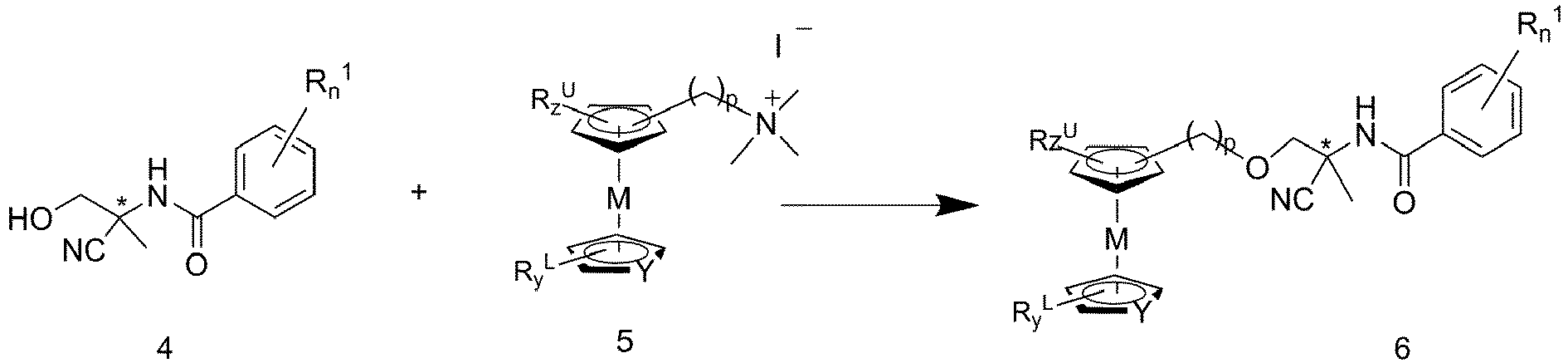
- Scheme 2: Compound 4 was reacted with compound 5, according to an adapted procedure of Gasser et al. (J. Organomet. Chem. 2007, 692, 3835-3840) and Gasser et al. (J. Med. Chem. 2012, 55, 8790-8798). Rn 1, Ry L, Rz U, Y and p of Kp have the same meaning as defined above. Compound 5 (see scheme 3) is formed by a reaction of the organometallic moity OM of the formula 2a according to a synthetic method similar to the method employed by Gasser et al. (J. Organomet. Chem. 2007, 692, 3835-3840).

- Scheme 3: Formation of compound 5 from compound 5' according to a synthetic method similar to the method employed by Gasser et al. (J. Organomet. Chem. 2007, 692, 3835-3840). Compound 5' comprising the substituents Ry L, Rz U, Y, as defined above, is a known compound, which can be purchased or may be synthesized by known procedures or may be prepared analogously to known compounds. Such procedures are described by, without being limited to it, Patra et al. (J. Med. Chem. 2012, 55, 8790-8798; Apreutesei et al. (Appl. Organomet. Chem. 2005, 19, 1022-1037), Bonini et al. (Eur. J. Org. Chem. 2002, 543-550); Routaboul et al. (J. Organomet. Chem. 2001, 637, 364-371).
- In one embodiment, compound 4 was reacted with compound 7, according to an adapted procedure of Gasser et al. (J. Med. Chem. 2012, 55, 8790-8798), yielding compound 8. The reaction pathway is depicted in scheme 4.

- Scheme 4: Compound 4 was reacted with compound 7, according to an adapted procedure of Gasser et al. (J. Med. Chem. 2012, 2012, 55, 8790 - 8798). Rn 1, Ry L, Rz U, Y and p of Kp have the meaning as defined above. W is O or S and Q is a leaving group. In some embodiments, W is O and Q is Cl and the reaction takes place in the presence of NEt3 In some embodiments, W is O and Q is OH and the reaction takes place in the presence of HATU (O-(7- azabenzotriazol - 1 - yl) - N,N,N',N' - tetramethyluronium-hexafluorophosphate), DIPEA (N,N-Diisopropylethylamine) in N,N-dimethylformamid (comparable to the procedure of Patra et al. (Organometallics, 2010, 29, 4312-4319)). Optionally, an alkyl group Kq (with the meaning as defined above) may be introduced between then -C=W moiety (with W being O or S) and the leaving group Q. The organometallic moity OM of compound 7 (comparable to the general formula 2a) is the same as the organometallic moiety of compound 5 and 5', as described above. Reference is made to the above cited conditions, references and reaction pathways. Compound 7, which comprises the substituents Ry L, Rz u, Y as defined above, is a known compound, which can be purchased or may be synthesized by known procedures or may be prepared analogously to known compounds starting from the organometallic moity OM of compound 7, as defined above (see for example Patra, M.; Ingram, K.; Pierroz, V.; Ferrari, S.; Spingler, B.; Keiser, J.; Gasser, G., J. Med. Chem. 2012, 55, 8790-8798 and reference therein).
- Reaction pathways for compounds comprising the half metal sandwich complexes OM of the general formula 2b follow a similar pathway as the above mentioned reactions, in particular a similar pathway as depicted in
scheme 2 and scheme 4, which are easily adaptable for a person skilled in the art. Reference is made to the above cited conditions, references and reactions pathways. - A reaction pathway for compounds comprising carbonyl complexes OM of the general formula 2c is depicted in scheme 5.

- Scheme 5: Compound 4 was reacted with compound 9 in the presence of NaH in THF, yielding
compound 10. X is a group described by a general formula -Kp-Fl- Kq-. Furthermore, Rn 1, Ry L, Rz U, Y, p, Kp, l, Fl, q, Kq have the same meaning as defined above. Compound 9 is a known compound, which can be purchased or may be synthesized by known procedures or may be prepared analogously to known compounds.Compound 10 is then reacted with Co2(CO)8 according to a synthetic method employed by Gasser et al. (Inorg. Chem. 2009, 48, 3157-3166), yielding compound 11. - According to a third aspect of the invention, the compounds defined as the first aspect of the invention are provided for use in a method for treatment of disease.
- Pharmaceutically acceptable salts of the compounds provided herein are deemed to be encompassed by the scope of the present invention.
- According to one aspect of the invention, a pharmaceutical composition for preventing or treating helminth infection, particularly infection by tapeworms (cestodes), flukes (trematodes) and roundworms (nematodes), in particular species of Haemonchus, Trichstrongylus, Teladorsagia, Cooperia, Oesophagostomum and/or Chabertia, tapeworm infection, schistosomiasis, ascariasis, dracunculiasis, elephantiasis, enterobiasis, filariasis, hookworm infection, onchocerciasis, trichinosis and/or trichuriasis is provided, comprising a compound according to the above aspect or embodiments of the invention.
- Pharmaceutical compositions for enteral administration, such as nasal, buccal, rectal or, especially, oral administration, and for parenteral administration, such as dermal (spot-on), intradermal, subcutaneous, intravenous, intrahepatic or intramuscular administration, may be used. The pharmaceutical compositions comprise approximately 1% to approximately 95% active ingredient, preferably from approximately 20% to approximately 90% active ingredient.
- According to one aspect of the invention, a dosage form for preventing or treating helminth infection, particularly infection by particularly tapeworms (cestodes), flukes (trematodes) and roundworms (nematodes), tapeworm infection, schistosomiasis, ascariasis, dracunculiasis, elephantiasis, enterobiasis, filariasis, hookworm infection, onchocerciasis, trichinosis and/or trichuriasis is provided, comprising a compound according to the above aspect or embodiments of the invention. Dosage forms may be for administration via various routes, including nasal, buccal, rectal, transdermal or oral administration, or as an inhalation formulation or suppository. Alternatively, dosage forms may be for parenteral administration, such as intravenous, intrahepatic, or especially subcutaneous, or intramuscular injection forms. Optionally, a pharmaceutically acceptable carrier and/or excipient may be present.
- According to one aspect of the invention, a method for manufacture of a medicament for preventing or treating helminth infection, particularly infection by particularly tapeworms (cestodes), flukes (trematodes) and roundworms (nematodes), tapeworm infection, schistosomiasis, ascariasis, dracunculiasis, elephantiasis, enterobiasis, filariasis, hookworm infection, onchocerciasis, trichinosis and/or trichuriasisis provided, comprising the use of a compound according to the above aspect or embodiments of the invention. Medicaments according to the invention are manufactured by methods known in the art, especially by conventional mixing, coating, granulating, dissolving or lyophilizing.
- According to one aspect of the invention, a method for preventing or treating helminth infection, particularly the indications mentioned previously, is provided, comprising the administration of a compound according to the above aspects or embodiments of the invention to a patient in need thereof.
- The treatment may be for prophylactic or therapeutic purposes. For administration, a compound according to the above aspect of the invention is preferably provided in the form of a pharmaceutical preparation comprising the compound in chemically pure form and optionally a pharmaceutically acceptable carrier and optionally adjuvants. The compound is used in an amount effective against helminth infection. The dosage of the compound depends upon the species, the patient age, weight, and individual condition, the individual pharmacokinetic data, mode of administration, and whether the administration is for prophylactic or therapeutic purposes. The daily dose administered ranges from approximately 1 µg/kg to approximately 1000 mg/kg, preferably from approximately 1 µg to approximately 100 µg, of the active agent according to the invention.
- Wherever reference is made herein to an embodiment of the invention, and such embodiment only refers to one feature of the invention, it is intended that such embodiment may be combined with any other embodiment referring to a different feature. For example, every embodiment that defines OM may be combined with every embodiment that defines R1, Fl or Kp, to characterize a group of compounds of the invention or a single compound of the invention with different properties.
- The invention is further characterized, without limitations, by the following examples and figure, from with further features, advantages or embodiments can be derived. The examples and figures do not limit but illustrate the invention.
-
- Fig.1
- shows the effect of
compound 8a on a C. elegans worm suspension. The number of dead or immobile worms after an incubation of 24 h is displayed; - Fig. 2
- shows the behaviour of
compound 8a under physiological conditions, whereby the stability was assessed in sheep plasma.Compound 8a and diazepam (internal standard) were incubated at 37°C for different time intervals and their stability was checked using an LC-MS technique. The peak at 13.41 min, which is corresponding to 8a, is decreasing within 24 hours while a new peak is arising at 5.64 min, which is corresponding to the hydrolysed product of 8a; - Fig. 3:
- shows an isotopic distribution pattern of integrated peaks at a retention time of 17.4min (a) and a simulated isotopic distribution pattern of compound 6a (b).
- Materials: All chemicals were of reagent grade quality or better, obtained from commercial suppliers and used without further purification. Solvents were used as received or dried over 4 A and 3A molecular sieves. THF and Et2O were freshly distilled under N2 by employing standard procedures. 57 All syntheses were carried out using standard Schlenk techniques.
- Instrumentation and methods: 1H- and 13C-NMR spectra were recorded in deuterated solvents on a Bruker DRX 400 or
AV2 500 at 30°C. The chemical shifts δ, are reported in ppm. The residual solvent peaks have been used as internal reference. The abbreviations for the peak multiplicities are as follows: s (singlet), d (doublet), dd (doublet of doublet), t (triplet), q (quartet), m (multiplet) and br (broad). Infrared spectra were recorded on a PerkinElmer spectrum BX TF-IR spectrometer and KBr presslings were used for solids. Signal intensities are abbreviated w (weak), m (medium), s (strong) and br (broad). ESI mass spectra were recorded on a Bruker Esquire 6000 or on a Bruker maxis QTOF-MS instrument (Bruker Daltonics GmbH, Bremen, Germany). The LC-MS spectra were measured on an Acquity™ from Waters system equipped with a PDA detector and an auto sampler using an Agilent Zorbax 300SB-C18 analytical column (5.0 µm particle size, 100 A pore size, 150 × 3.0 mm) or an Macherey - Nagel 100 - 5 C18 (3.5 µm particle size, 300 A pore size, 150 × 3.0 mm). This LC was coupled to an Esquire HCT from Bruker (Bremen, Germany) for the MS measurements. The LC run (flow rate: 0.3 mL min-1) was performed with a linear gradient of A (distilled water containing 0.1% v/v formic acid) and B (acetonitrile (Sigma-Aldrich HPLC-grade), t = 0 min, 5% B; t = 3 min, 5% B; t = 17 min, 100% B; t = 20 min, 100% B; t = 25 min, 5% B. High-resolution ESI mass spectra were recorded on a Bruker maxis QTOF-MS instrument (Bruker Daltonics GmbH, Bremen, Germany). The samples (around 0.5 mg) were dissolved in 0.5 mL of MeCN/H2O 1:1 + 0.1% HCOOH. The solution was then diluted 10:1 and analysed via continuous flow injection at 3 µl min-1. The mass spectrometer was operated in the positive electrospray ionization mode at 4000 V capillary voltage, -500 V endplate offset, with a N2 nebulizer pressure of 0.4 bar and dry gas flow of 4.0 l/min at 180°C. MS acquisitions were performed in the full scan mode in the mass range from m/z 100 to 2000 at 20'000 resolution and 1 scan per second. Masses were calibrated with a 2 mmol/l solution of sodium formate over m/z 158 to 1450 mass range with an accuracy below 2 ppm. - Cell Culture: Human cervical carcinoma cells (HeLa) were cultured in DMEM (Gibco) supplemented with 5% fetal calf serum (FCS, Gibco), 100 U/ml penicillin, 100 µg/ml streptomycin at 37°C and 5% CO2. The normal human fetal lung fibroblast MRC-5 cell line was maintained in F-10 medium (Gibco) supplemented with 10% FCS (Gibco), 200mmol/l L-Glutamine, 100 U/ml penicillin, and 100 µg/ml streptomycin at 37°C and 5% CO2. Toestablish the anticancer potential of the compounds they were tested in one cell line, namely HeLa by a fluorometric cell viability assay using Resazurin (Promocell GmbH). Compounds showing cytotoxicity were then tested on normal MRC-5 cells. 1 day before treatment, cells were plated in triplicates in 96-well plates at a density of 4 x 10³ cells/well in 100µl for HeLa and 7x10³ cells/well for MRC-5 cells. Cells were treated with increasing concentrations of the compounds for 2 days. After 2 days, medium and drug were removed and 100 ml fresh medium containing Resazurin (0.2 mg/ml final concentration) were added. After 4h of incubation at 37°C, the highly red fluorescent dye resorufin's fluorescence was quantified at 590nm emission with 540nm excitation wavelength in the SpectraMax M5 microplate Reader.
- C. elegans movement inhibition assay: Asynchronous N2 C. elegans worms (Bristol) were maintained on nematode growth medium (NGM) agar, seeded with a lawn on OP50 E coli as a food-source, according to standard protocol (Maintenance of C. elegans; Stiernagle, T., Ed.; WormBook, 2006.). Worms were harvested from NGM plates by washing with M9 buffer (42 mmol/l Na2HPO4, 22 mmol/l KH2PO4, 86 mmol/l NaCl and 1 mmol/l MgSO4), aspiration and collection in a 10 mL tube (Falcon). The average number of worms in 5 µL of this suspension was calculated by transferring 4 x 5 µL aliquots to a glass slide (Menzel Glaser), and worms were enumerated under a compound microscope (Olympus CH30). To adjust the suspension to contain 1 worm per µL, M9 buffer was either added or removed after pelleting worms at 600 xg for 30 sec.
- Dilution of test compounds, Zolvix (monepantel) and DMSO for working stock solutions and 96 well plate set-up for liquid screen: A volume of 70 µL of M9 buffer was added to each well in a 96-well plate, using a multichannel pipettor. A volume of 20 µL of worm suspension was added to each well using a single-channel pipettor, with a trimmed pipette tip (increased aperture to minimize damage to worms). The worm suspension was resuspended by flicking after every three wells to maintain consistency. GG compounds were stored at 4°C, and diluted in dimethyl sulfoxide (DMSO) to achieve a 100 mmol/
l concentration 1 hr prior to addition to assay. These stock solutions were diluted further in DMSO to create a series of 20 mmol/l, 2 mmol/l, 0.02 mmol/l and 0.002 mmol/l which were subsequently diluted 1:20 in M9 buffer to create 1 mmol/l, 0.1 mmol/l, 1 µmol/l and 0.1 µmol/l (all 5% (v/v) DMSO). 10 µL of each concentration was added to wells in duplicate to achieve final concentrations of 100 µmol/l, 10 µmol/l, 100 nmol/l and 10 nmol/l in 100 µL (0.5% DMSO). A Zolvix (monepantel) dilution series was simultaneously created following the same dilution schema, and used as a positive control; 10 µL of 10 % DMSO was added to achieve 1 % DMSO vehicle control. 10 µL M9 was added to negative control wells (seeFigure 1 ). Plates were incubated at room temperature (22-24 °C) overnight at 20°C. - Quantitative worm mobility scoring: Immobile worms were counted as a percentage of total worms in each well using an Olympus SZ30 dissecting microscope. The immobile fraction was subtracted from the total, and this remainder was divided by the total to give a percentage of live worms per well. Descriptive and inferential statistics were deferred until further replicates are performed.
- X-ray crystallography: Crystallographic data for all compounds were collected at 183(2) K with Mo Kα radiation (λ = 0.7107 A) that was graphite- monochromated on a Stoe IPDS diffractometer. Suitable crystals were covered with oil (Infineum V8512, formerly known as Paratone N), mounted on top of a glass fibre or a CryoLoopTM (Hampton Research) and immediately transferred to the diffractometer. In the case of the IPDS, a maximum of eight thousand reflections distributed over the whole limiting sphere were selected by the program SELECT and used for unit cell parameter refinement with the program CELL (STOE & Cie, GmbH: Darmstadt, Germany, 199). Data were corrected for Lorentz and polarisation effects as well as for absorption (numerical). Structures were solved with direct methods using SIR97 (Altomare, A.; Burla, M. C.; Camalli, M.; Cascarano, G. L.; Giacovazzo, C.; Guagliardi, A.; Moliterni, A. G. G.; Polidori, G.; Spagna, R. J. Appl. Cryst. 1999, 32, 115-119) and were refined by full-matrix least- squares methods on F2 with SHELXL-97 (Sheldrick, G. M. Acta Cryst. 2008, A64, 112-122).The hydrogen atoms of the NH2 units were localized and their positions freely refined. All other hydrogen atoms were placed on calculated positions. The structures were checked for higher symmetry with help of the program Platon (Spek, A. L. J. Appl. Cryst. 2003, 36, 7-139.
- In vitro experiments can be conducted by testing compounds in a larval development assay. To do this, sheep are infected with infective third-stage larvae (L3) of species of Haemonchus, Trichstrongylus, Teladorsagia, Cooperia, Oesophagostomum or Chabertia. Faeces from these sheep are collected and used for experiments; -100 g of faeces are crushed homogenized and suspended in ~1000 ml of sugar solution (specific gravity 1.2), put through a 'tea strainer' sieve, and the large undigested food material in the sieve discarded. The sugar solution is then placed into a flat dish and strips of plastic overhead transparency film placed on the surface. The plastic is left for at least 45 minutes to allow the eggs to stick and then removed carefully. The eggs are collected by washing them from the plastic film, with water, into a 50 ml centrifuge tube. The water containing egg suspension eggs is put through a 40 mm sieve to remove further plant material and then centrifuged at 1,000 x g for 10 minutes. The supernatant is checked for eggs and then discarded as the majority of eggs are at the bottom of the tube. These eggs are collected in 1 ml of water and diluted to -200 eggs/20 ml.
- 1. Each compound is tested at five concentrations: 100, 50, 25, 12.5 and 6.25 mmol/l (i.e.
serial 2-fold dilutions starting from 100 mmol/l). Dilutions of each compound (10 ml in total) are performed in 1.5 ml microcentrifuge tubes, 1ml of molten agar added, the tube vortexed and the agar aliquoted (150 ml) into the wells of a 96-well microtitre plate. - 2. DMSO is used in a number of wells as solvent-only controls (negative controls) whilst cydectinis used as a positive control. Concentrations of cydectin used for positive controls for the compound re-testing are: 6.25, 12.5, 25, 50 and 100 mmol/l.
- 3. ~100 eggs (20 ml) are then added to each well.
- 4. Plates are then incubated overnight at 27° C.
- 5. Plates are checked the following morning and afternoon to ensure that most eggs had hatched. Any compounds that appeared to have an ovicidal effect are noted.
- 6. Following hatching of most eggs, 15 ml of nutritive medium is added to feed the larvae.
Nutritive medium is prepared as follows: 1 g of yeast extract is added to 90 ml of 0.85% physiological saline and autoclaved for 20 mins at 121° C. Three millilitres of 10 x Earle's balanced salt solution is added to 27 ml of yeast extract solution and the pH of the solution adjusted to 5.4-5.6 by the addition of bicarbonate. - 7. Following 7 days additional incubation, the numbers of L3 larvae that had developed in each well is determined.
- In vivo experiments can be conducted in sheep monospecifically infected with these parasites (i.e. species of Haemonchus, Trichstrongylus, Teladorsagia, Cooperia, Oesophagostomum or Chabertia)
- The proposed synthetic pathway is depicted in Scheme 6.

- Scheme 6: Acetonitrile, (ferrocenylmethyl)trimethylammonium iodide, K2CO3, 18-crown-6, reflux, overnight.
- The 2-amino-2-hydroxymethylproprionitrile 3a, produced according to Gauvry et al.(
WO2005/044784 A1 ), was treated with one equivalent of 4-(trifluoromethylthio)benzoyl chloride in the presence of triethylamine to obtain N-(2-cyano-1-hydroxypropan-2-yl)-4-((trifluoromethyl)thio)benzamide 4a in 32% yield. Subsequently 4a was treated with (ferrocenylmethyl)trimethylammonium iodide 5a, according to Lindsay et al (Lindsay, J. K.; Hauser, C. R. J. Org. Chem. 1957, 22, 355-358), K2CO3 and 18-crown-6 in acetonitrile. N-(1-(ferrocenyloxy)-2-cyanopropan-2-yl)-4-((trifluoromethyl)thio)benzamide 6a was isolated in a low yield by preparative HPLC. - The proposed synthetic pathway is depicted in Scheme 7.

- Scheme 7: NEt3, dichloromethane, overnigth, r.t., 73 %.
- Ferrocene carboxylchloride 7a was treated with triethylamine and N-(2-cyano-1-hydroxypropan-2-yl)-4-((trifluoromethyl)thio)benzamide 4a in dichloromethane to afford 2-cyano-2-(4-((trifluoromethyl)thio)benzamido)propyl
ferrocenoate 8a in 73% yield. - 2-Amino-2-hydroxymethylproprionitrile 3a was prepared following the procedure published by
Gauvry et al (WO2005/044784 A1 ). - IR (KBr, cm-1): 3329s, 3286s, 3205s, 2985s, 2935s, 2858s, 2756w, 2229m, 1625s, 1476m, 1457m, 1383m, 1368w, 1348w, 1269m, 1178s, 1093s, 1065s, 1044s, 963m, 934s, 888m, 785m, 626w, 465m.
- 1H NMR (400 MHz, MeOD):δ/ppm = 3.51 (dd, 2 J = 11.2 Hz, 2 J = 10.8 Hz, 2H, CH 2), 1.40 (s, 3H, CH3 ).
- 13C NMR (400 MHz, CDCl3):δ/ppm = 124.4, 69.8, 53.1, 23.9.
- ESI-MS: m/z (%) = 101.07 ([M+H]+, 100), 83.06 ([M-H2O]+, 64).
- HR ESI-MS: calc. for C4H9N2O ([M+H]+) m/z (%) = 101.07088, found m/z (%) = 101.07094.
- After dissolving 2-amino-2-hydroxymethylproprionitrile 1a (0.05 g, 0.50 mmol) in dry dichloromethane (5 mL), NEt3 (70 µl, 0.5 mmol) and 4-(trifluoromethylthio)benzoyl chloride (84 µl, 0.5 mmol) were added and the reaction mixture was stirred for 2 h at room temperature. The solution was extracted with a 1 M aqueous solution of hydrochloric acid (2 x 5 mL). The organic layer was dried over MgSO4, filtered and the solvent was evaporated under reduced pressure. The residue was suspended in a 1 M aqueous solution of NaOH (10 mL) and stirred for 1.5 h at room temperature before THF (10 mL) was added. The solution was stirred for an additional hour. The solvent was evaporated under reduced pressure and the residue was extracted with CH2Cl2 (3x10 mL). The combined organic layers were dried over MgSO4, filtered and the solvent was evaporated under reduced pressure to give N-(2-cyano-1-hydroxypropan-2-yl)-4-((trifluoromethyl)thio)benzamide 1b as colourless solid. Yield: 32%.
- IR (KBr, cm-1): 3418s, 3288w, 3053w, 2935w, 2845w, 1658m, 1616w, 1591w, 1542m, 1482w, 1456w, 1395w, 1317w, 1135m, 1115m, 1081m, 1012w, 925w, 844w, 763w, 623w.
- 1H NMR (500 MHz, MeOD):δ/ppm = 7.98 (d, 3 J = 7 Hz, 2H, arom. H), 7.84 (d, 3 J = 7 Hz, 2H, arom. H), 3.97 (dd, 2 J = 11 Hz, 2 J = 10.5 Hz, 2H, CH 2), 1.8 (s, 3H, CH 3).
- 13C NMR (500 MHz, MeOD):δ/ppm = 167.2, 136.0, 134.9, 129.4, 129.3, 128.5, 119.7, 66.6, 52.8, 21.7.19F NMR(500 MHz, CDCl3):δ/ppm = -39.0.
- ESI-MS: m/z (%) = 327.04 ([M+Na]+, 100), 305.06 ([M+H]+, 21).
- HR ESI-MS: calc. for C12H12F3N2O2S ([M+H]+) m/z (%) = 305.05626, found m/z (%) = 305.05661.
- (Ferrocenylmethyl)trimethylammonium iodide 1 c was prepared according to Lindsay et al (Lindsay, J. K.; Hauser, C. R. J. Org. Chem. 1957, 22, 355-358).
- The synthesis of chlorocarbonyl ferrocene was adapted from a procedure of Witte et al. and Cormode et al. (Witte, P.; Lal, T. K.; Waymouth, R. M. Organometallics 1999, 18, 4147-4155 and Cormode, D. P.; Evans, A. J.; Davis, J. J.; Beer, P. D. Dalton Trans. 2010, 39, 6532-6541).
- Ferrocene (6.0 g, 32 mmol) and potassium tert-butoxide (0.46 g, 4.08 mmol) were completely dissolved in dry THF (300 mL). The orange solution was cooled to -78°C when tert-butyllithium (34.0 mL, 64.5 mmol, 1.9 M in pentane) was added dropwise over a period of 15 min, with the temperature maintained below -70°C. The reaction mixture was stirred at -78°C for 1 h and then poured on a slurry of dry ice (excess) and diethyl ether. The mixture was warmed to room temperature overnight and extracted with an aqueous solution of sodium hydroxide (0.75 N, 4 x 250 mL). The combined aqueous layers were neutralized with hydrochloric acid (pH > 4) and the resulting orange solid was extracted with Et2O (4 x 250 mL) until the organic layer remained colourless. The combined organic layers were filtered to remove traces of ferrocenedicarboxylic acid, dried over MgSO4, filtered and the solvent was evaporated under reduced pressure to give ferrocenecarboxylic acidas an orange solid in 35% yield. After suspending the ferrocenecarboxylic acid (462 mg, 2.01 mmol) in dry CH2Cl2 (23 mL), oxalyl chloride (1100 µL, 13.64 mmol) in dry CH2Cl2 (10 mL) was added dropwise to the reaction mixture whereby the orange suspension turned dark red. The reaction mixture was refluxed for 2 h and then stirred overnight at room temperature. The solvent was then removed under vacuum. The product was not purified and used immediately for the next synthetic step.
- Cytotoxicity and Nematocidal Studies:
- The toxicity towards human cervical cancer HeLa was investigated using the fluorometric cell viability assay (Resazurin) (Ahmed, S. A.; Gogal, R. M. J.; Walsh, J. E. J. Immunol. Methods 1994, 170, 211-224). For compounds which were found to be toxic towards HeLa cells, their cytotoxicity towards the human lung fibroblasts MRC-5 was also tested (see table 1).
- C. elegans is widely used as a tool in the pharmaceutical and biotechnology industry to test the efficacy of compounds against nematodes and other organisms (cf. Divergence, Inc. - now aquired from the Montsanto Company), which has the major advantage that the modes/mechanisms of action and associated phenotypes can be fully characterised as well as resistance development assessed. Given that C. elegans and socioeconomic strongylid nematodes belong to clade V of the phylum Nematoda (Blaxter et al., 1998 - Nature), there is a high likelihood that drug action will be effective/effected in strongylid nematodes.
Table 1:shows the toxicity towards human cervical cancer HeLa and towards the human lung fibroblasts MRC-5 using the fluorometric cell viability assay. Compound IC50 in HeLa / µmol/l IC 50 in MRC-5 / µmol/l 
32.89 23.87
R3 and R4 are independently selected from the group consisting of hydrogen, unsubstituted C1-C4 alkyl, and C1-C4 alkyl substituted with C1-C4 alkoxy.
R3 and R4 are independently selected from the group consisting of hydrogen, unsubstituted C1-C4 alkyl, and C1-C4 alkyl substituted with C1-C4 alkoxy.
Claims (15)
- A compound characterized by a general formula (1),
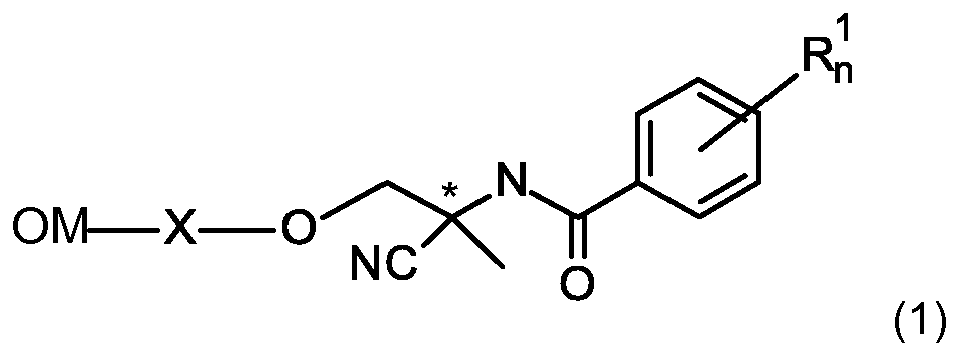 - Fl is -C(=O)-,-C(=S)-, with l being 0 or 1,- Kp is a Cp-alkyl with p being 0, 1, 2, 3 or 4,- Kq is a Cq-alkyl with q being 0, 1, 2, 3 or 4, and whereinn of R1 n is 0, 1, 2, 3, 4 or 5, and
each R1 independently from any other R1 is -C(=O)OR, -C(=O)NR2 2, -C(=O)SR2, -C(=S)OR2, -C(NH)NR2 2, CN4H2, -NR2 2, -C(=O)R2, -C(=S)R2, -OR2, -SR2, -CF3, -OCF3, -SCF3, -SOCF3, -SO2CF3, -CN, -NO2, -F, -Cl, -Br or -I,
with each R2 independently from any other R2 being a hydrogen or C1-C4 alkyl, and wherein
OM is an organometallic compound independently selected from the group of an unsubstituted or substituted metal sandwich compound, an unsubstituted or substituted half metal sandwich compound or a metal carbonyl compound. - The compound according to claim 1, wherein n of R1 n is 1 or 2 and each R1 independently from any other R1 is -CN, -CF3, -OCF3, -SCF3, -SOCF3, -SO2CF3, -F, -Cl, -Br or -I, and wherein in particular each R1 independently from any other R1 is -CN, -CF3, -SCF3, -SOCF3 or - SO2CF3.
- The compound according to any of the preceding claims, wherein n of R1 n is 1 or 2 and each R1 independently from any other R1 is -F, -Cl, -Br or -I.
- The compound according to any of the claims 1 or 2, wherein n of R1 n is 2 and each R1 independently from any other R1 is -CN, -CF3, -OCF3, -F, -Cl, -Br or -l and wherein in particular each R1 independently from any other R1 is -CN or -CF3.
- The compound according to any of the claims 1 or 2, wherein n of R1 n is 1 and R1 is -CN, -CF3, -OCF3, -SCF3, -SOCF3, -SO2CF3, -F, -Cl, -Br or -I, and wherein in particular R1 is -SCF3, -SOCF3 or -SO2CF3.
- The compound according to any of the claims 1 to 4, wherein n is 2 and one of the two R1 is in ortho and the other R1 is in meta position to the attachment position of the benzene moiety, and wherein in particular one of the two R1 is -CF3 in ortho and the other R1 is -CN in meta position to the attachment position of the benzene moiety.
- The compound according to any of the claims 1, 2, 3 or 5, wherein n is 1 and R1 is in para position to the attachment position of the benzene moiety, and wherein in particular R1 is -SCF3, -SOCF3 or SO2CF3 in para position to the attachment position of the benzene moiety.
- The compound according to any of the preceding claims, wherein- l of Fl is 0, q of Kq and p of Kp is 0 or- l of Fl is 0, q of Kq is 0 and Kp is C1-alkyl or- Fl is -C(=O)- with l being 1, q of Kq and p of Kp are 0 or- Fl is -C(=O)- with l being 1, q of Kq is 0 and Kp is C1-alkyl.
- The compound according claim 1, wherein OM is an organometallic compound
according to the general formula (2a),
z of Rz U is 0, 1, 2, 3 or 4, and y of Ry L is 0, 1, 2, 3, 4 or 5 and
each RL and each RU are independently from any other RL and RU selected from- an unsubstituted or substituted C1-C10 alkyl, an unsubstituted or substituted C1-C10 alkenyl, an unsubstituted or substituted C1-C10 alkynyl, an unsubstituted or substituted C3-C8 cycloalkyl, an unsubstituted or substituted C1-C10 alkoxy, an unsubstituted or substituted C3-C8 cycloalkoxy,- an unsubstituted or substituted C6-C14 aryl,- an unsubstituted or substituted 5- to 10-membered heteroaryl, wherein 1 to 4 ring atoms are independently selected from nitrogen, oxygen or sulfur,- an unsubstituted or substituted 5- to 10-membered heteroalicyclic ring, wherein 1 to 3 ring atoms are independently nitrogen, oxygen or sulfur,- -OR3, -SR3, -C(O)R3, -C(S)R3 -C(O)OR3, -C(S)OR3, -C(O)SR3, -C(O)NR3R4, -NR3R4, S(O)2R3, -S(O)2OR3 and -S(O)2NR3R4,
wherein
R3 and R4 are independently selected from the group consisting of hydrogen, unsubstituted C1-C4 alkyl, and C1-C4 alkyl substituted with C1-C4 alkoxy. - The compound according to claim 9, wherein each RL and each Ru are independently from any other RL and RU selected from- -OR3, -SR3,-C(O)R3,-C(S)R3 -C(O)OR3,-C(S)OR3-C(O)SR3-C(O)NR3R4,-NR3R4,- S(O)2R3, -S(O)2OR3, and -S(O)2NR3R4,
wherein
R3 and R4 are independently selected from the group consisting of hydrogen, unsubstituted C1-C4 alkyl, and C1-C4 alkyl substituted with C1-C4 alkoxy. - The compound according to claim 9, wherein M is selected from the group of Fe, Ru or Co, wherein in particular M is Fe.
- The compound according to claim 9, wherein Y is C.
- The compound according to claim 9, wherein y and z are 0.
- A compound according to any of the claims 1 to 13 for use in a method of treatment of disease.
- A compound according to any of the claims 1 to 13 for use in a method for treatment of infections by helminths,
or for use in a method to suppress plant helminths.
Priority Applications (10)
| Application Number | Priority Date | Filing Date | Title |
|---|---|---|---|
| EP13174551.5A EP2821412A1 (en) | 2013-07-01 | 2013-07-01 | Organometallic 2-cyano-2-aminobenzoate-propyl derivates and their use as anthelmintics |
| JP2016522586A JP2016523280A (en) | 2013-07-01 | 2014-07-01 | 2-Cyano-2-aminobenzoate-propyl organometallic derivatives and their use as anthelmintics |
| AU2014286220A AU2014286220A1 (en) | 2013-07-01 | 2014-07-01 | Organometallic 2-cyano-2-aminobenzoate-propyl derivates and their use as anthelmintics |
| EP14742159.8A EP3016962B1 (en) | 2013-07-01 | 2014-07-01 | Organometallic 2-cyano-2-aminobenzoate-propyl derivates and their use as anthelmintics |
| CA2916804A CA2916804A1 (en) | 2013-07-01 | 2014-07-01 | Organometallic 2-cyano-2-aminobenzoate-propyl derivates and their use as anthelmintics |
| CN201480048148.0A CN105492452A (en) | 2013-07-01 | 2014-07-01 | Organometallic 2-cyano-2-aminobenzoate-propyl derivates and their use as anthelmintics |
| US14/902,004 US9663545B2 (en) | 2013-07-01 | 2014-07-01 | Organometallic 2-cyano-2-aminobenzoate-propyl derivates and their use as anthelmintics |
| PCT/EP2014/064005 WO2015000928A1 (en) | 2013-07-01 | 2014-07-01 | Organometallic 2-cyano-2-aminobenzoate-propyl derivates and their use as anthelmintics |
| MX2016000057A MX2016000057A (en) | 2013-07-01 | 2014-07-01 | Organometallic 2-cyano-2-aminobenzoate-propyl derivates and their use as anthelmintics. |
| ZA2016/00037A ZA201600037B (en) | 2013-07-01 | 2016-01-04 | Organometallic 2-cyano-2-aminobenzoate-propyl derivates and their use as anthelmintics |
Applications Claiming Priority (1)
| Application Number | Priority Date | Filing Date | Title |
|---|---|---|---|
| EP13174551.5A EP2821412A1 (en) | 2013-07-01 | 2013-07-01 | Organometallic 2-cyano-2-aminobenzoate-propyl derivates and their use as anthelmintics |
Publications (1)
| Publication Number | Publication Date |
|---|---|
| EP2821412A1 true EP2821412A1 (en) | 2015-01-07 |
Family
ID=48698964
Family Applications (2)
| Application Number | Title | Priority Date | Filing Date |
|---|---|---|---|
| EP13174551.5A Withdrawn EP2821412A1 (en) | 2013-07-01 | 2013-07-01 | Organometallic 2-cyano-2-aminobenzoate-propyl derivates and their use as anthelmintics |
| EP14742159.8A Not-in-force EP3016962B1 (en) | 2013-07-01 | 2014-07-01 | Organometallic 2-cyano-2-aminobenzoate-propyl derivates and their use as anthelmintics |
Family Applications After (1)
| Application Number | Title | Priority Date | Filing Date |
|---|---|---|---|
| EP14742159.8A Not-in-force EP3016962B1 (en) | 2013-07-01 | 2014-07-01 | Organometallic 2-cyano-2-aminobenzoate-propyl derivates and their use as anthelmintics |
Country Status (9)
| Country | Link |
|---|---|
| US (1) | US9663545B2 (en) |
| EP (2) | EP2821412A1 (en) |
| JP (1) | JP2016523280A (en) |
| CN (1) | CN105492452A (en) |
| AU (1) | AU2014286220A1 (en) |
| CA (1) | CA2916804A1 (en) |
| MX (1) | MX2016000057A (en) |
| WO (1) | WO2015000928A1 (en) |
| ZA (1) | ZA201600037B (en) |
Families Citing this family (1)
| Publication number | Priority date | Publication date | Assignee | Title |
|---|---|---|---|---|
| AU2014286221B2 (en) * | 2013-07-01 | 2018-05-31 | The University Of Melbourne | N-(1-cyano-2-hydroxy-1-methyl-ethyl)-4-(trifluoromethylsulfanyl)benzamide derivatives for use as nematocidal drugs |
Citations (1)
| Publication number | Priority date | Publication date | Assignee | Title |
|---|---|---|---|---|
| WO2005044784A1 (en) | 2003-11-06 | 2005-05-19 | Novartis Ag | Amidoacetonitrile derivatives |
Family Cites Families (7)
| Publication number | Priority date | Publication date | Assignee | Title |
|---|---|---|---|---|
| US6239077B1 (en) * | 1998-05-01 | 2001-05-29 | Nihon Nohyaku Co., Ltd. | Aminoacetonitrile derivative agricultural and horticultural insecticide containing the same and use thereof |
| AR035523A1 (en) * | 2000-12-20 | 2004-06-02 | Novartis Ag | USE OF AMINOACETONITRILE COMPOUNDS TO COMBAT ENDOPARASITAN DANIN ANIMALS IN USEFUL AND DOMESTIC ANIMALS OF HOT BLOOD |
| WO2008062005A1 (en) * | 2006-11-24 | 2008-05-29 | Novartis Ag | The use of aminoacetonitril compounds in the control of endoparasites in warm- blood animals. |
| MX2010002868A (en) * | 2010-03-16 | 2011-09-21 | Norma Del Carmen Galindo Sevilla | N6-(ferrocene methyl) quinazolin-2,4,6-triamine (h2) and the derivatives and prodrugs thereof as antimicrobial, antiparasitic, antiprotozoal and antileishmania agents. |
| UY33282A (en) * | 2010-03-25 | 2011-09-30 | Novartis Ag | ENDOPARASITICIDE COMPOSITIONS |
| FR2961209B1 (en) * | 2010-06-11 | 2013-03-01 | Sanofi Aventis | PROCESS FOR THE SYNTHESIS OF FERROQUIN BY CONVERGENT REDUCING AMINATION |
| US20130123367A1 (en) * | 2010-07-28 | 2013-05-16 | Medizinische Universitat Wien | Vinylogous chalcone derivatives and their medical use |
-
2013
- 2013-07-01 EP EP13174551.5A patent/EP2821412A1/en not_active Withdrawn
-
2014
- 2014-07-01 AU AU2014286220A patent/AU2014286220A1/en not_active Abandoned
- 2014-07-01 US US14/902,004 patent/US9663545B2/en not_active Expired - Fee Related
- 2014-07-01 JP JP2016522586A patent/JP2016523280A/en active Pending
- 2014-07-01 CN CN201480048148.0A patent/CN105492452A/en active Pending
- 2014-07-01 WO PCT/EP2014/064005 patent/WO2015000928A1/en not_active Ceased
- 2014-07-01 MX MX2016000057A patent/MX2016000057A/en unknown
- 2014-07-01 EP EP14742159.8A patent/EP3016962B1/en not_active Not-in-force
- 2014-07-01 CA CA2916804A patent/CA2916804A1/en not_active Abandoned
-
2016
- 2016-01-04 ZA ZA2016/00037A patent/ZA201600037B/en unknown
Patent Citations (1)
| Publication number | Priority date | Publication date | Assignee | Title |
|---|---|---|---|---|
| WO2005044784A1 (en) | 2003-11-06 | 2005-05-19 | Novartis Ag | Amidoacetonitrile derivatives |
Non-Patent Citations (21)
| Title |
|---|
| "Maintenance of C. elegans", 2006, WORMBOOK |
| AHMED, S. A.; GOGAL, R. M. J.; WALSH, J. E. J, IMMUNOL. METHODS, vol. 170, 1994, pages 211 - 224 |
| ALTOMARE, A.; BURLA, M. C.; CAMALLI, M.; CASCARANO, G. L.; GIACOVAZZO, C.; GUAGLIARDI, A.; MOLITERNI, A. G. G.; POLIDORI, G.; SPAG, APPL. CRYST., vol. 32, 1999, pages 115 - 119 |
| APREUTESEI ET AL., APPL. ORGANOMET. CHEM., vol. 19, 2005, pages 1022 - 1037 |
| BLAXTER ET AL., NATURE, 1998 |
| BONINI ET AL., EUR. J. ORG. CHEM., 2002, pages 543 - 550 |
| CORMODE, D. P.; EVANS, A. J.; DAVIS, J. J.; BEER, P. D, DALTON TRANS., vol. 39, 2010, pages 6532 - 6541 |
| G. GASSER; A. J. FISCHMANN; C. M. FORSYTH; L. SPICCIA, J. ORGANOMET. CHEM., vol. 692, 2007, pages 3835 - 3840 |
| GASSER ET AL., INORG. CHEM, vol. 48, 2009, pages 3157 - 3166 |
| GASSER ET AL., J. MED. CHEM., vol. 2012, no. 55, 2012, pages 8790 - 8798 |
| GASSER ET AL., J. MED. CHEM., vol. 55, 2012, pages 8790 - 8798 |
| GASSER ET AL., J. ORGANOMET. CHEM., vol. 692, 2007, pages 3835 - 3840 |
| L. RUFENER; R. BAUR; R. KAMINSKY; P. MAESER; E. SIGEL, MOL. PHARMACOL., vol. 78, 2010, pages 895 - 902 |
| LINDSAY, J. K.; HAUSER, C. R, J. ORG. CHEM., vol. 22, 1957, pages 355 - 358 |
| PATRA ET AL., J. MED. CHEM., vol. 55, 2012, pages 8790 - 8798 |
| PATRA ET AL., ORGANOMETALLICS, vol. 29, 2010, pages 4312 - 4319 |
| PATRA, M.; INGRAM, K.; PIERROZ, V.; FERRARI, S.; SPINGLER, B.; KEISER, J.; GASSER, G., J. MED. CHEM., vol. 55, 2012, pages 8790 - 8798 |
| ROUTABOUL ET AL., J. ORGANOMET. CHEM., vol. 637, 2001, pages 364 - 371 |
| SHELDRICK, G. M, ACTA CRYST., vol. A64, 2008, pages 112 - 122 |
| SPEK, A. L. J, APPL. CRYST., vol. 36, 2003, pages 7 - 139 |
| WITTE, P.; LAL, T. K.; WAYMOUTH, R. M, ORGANOMETALLICS, vol. 18, 1999, pages 4147 - 4155 |
Also Published As
| Publication number | Publication date |
|---|---|
| AU2014286220A1 (en) | 2016-01-28 |
| WO2015000928A1 (en) | 2015-01-08 |
| ZA201600037B (en) | 2017-02-22 |
| CA2916804A1 (en) | 2015-01-08 |
| EP3016962B1 (en) | 2018-02-28 |
| US9663545B2 (en) | 2017-05-30 |
| EP3016962A1 (en) | 2016-05-11 |
| MX2016000057A (en) | 2016-08-18 |
| US20160368939A1 (en) | 2016-12-22 |
| CN105492452A (en) | 2016-04-13 |
| JP2016523280A (en) | 2016-08-08 |
Similar Documents
| Publication | Publication Date | Title |
|---|---|---|
| EP4112606A1 (en) | Aromatic compound and use thereof in preparing antineoplastic drugs | |
| Pucci et al. | Improving the bioactivity of Zn (II)-curcumin based complexes | |
| KR20240040742A (en) | Compounds as KIF18A inhibitors | |
| Çiftçi et al. | Synthesis and characterization of new cyclotriphosphazene compounds | |
| EP3283170A1 (en) | An antimicrobial compound | |
| WO2013093615A1 (en) | Tricyclic boron compounds for antimicrobial therapy | |
| DE69715010T2 (en) | SELECTED K-252A DERIVATIVES | |
| Gajera et al. | Half-sandwich iridium III complexes with pyrazole-substituted heterocyclic frameworks and their biological applications | |
| EP3016962B1 (en) | Organometallic 2-cyano-2-aminobenzoate-propyl derivates and their use as anthelmintics | |
| AU618536B2 (en) | Novel 3',4'-dinitrogen substituted epipodophyllotoxin glucoside derivatives | |
| Guo et al. | Synthesis of mono-and di-[12] aneN 3 ligands and study on the catalytic cleavage of RNA model 2-hydroxypropyl-p-nitrophenyl phosphate with their metal complexes | |
| Chopin et al. | ClickEnam. 1. Synthesis of novel 1, 4-disubsituted-[1, 2, 3]-triazole-derived β-aminovinyl trifluoromethylated ketones and their copper (II) complexes | |
| AU2004234110A1 (en) | Heterocyclic compounds for use in the treatment of viral infections | |
| US9598451B2 (en) | Bis-organometallic 2-amino-3-hydroxy-2-methylpropanenitrile derivatives for use as anthelmintics | |
| US20160207950A1 (en) | Organometallic n-2-cyano-1-hydroxypropan-2-yl for use as anthelmintics | |
| EP3049424A1 (en) | Organometallic compounds for use as anthelmintics | |
| IE904162A1 (en) | Alkoxymethylidene epipodophyllotoxin glucosides | |
| Tewari et al. | Conformational Tuning of Molecular Network Stabilized via C–H· π and π–π interaction in 2-[2-(3-cyano-4, 6-dimethyl-2-oxo-2H-pyridin1-yl-methyl)-benzyloxyl]-4, 6-demethylnicotinonitrile | |
| KR100673280B1 (en) | 1,2,3,4-tetrahydroisoquinoline derivatives, preparation method thereof and pharmaceutical composition | |
| CN119504824A (en) | A spatiotemporally controllable PROTAC based on photoinduced in situ generation and its application | |
| Reddy et al. | Synthesis, spectral characterization and anti-microbial activity of 6-Substituted [(2-aminoethyl) amino]-6 [lambda] 5-dibenzo [d, h][1, 3, 6, 2] oxathiaza-phosphonin-6-ones |
Legal Events
| Date | Code | Title | Description |
|---|---|---|---|
| PUAI | Public reference made under article 153(3) epc to a published international application that has entered the european phase |
Free format text: ORIGINAL CODE: 0009012 |
|
| 17P | Request for examination filed |
Effective date: 20130701 |
|
| AK | Designated contracting states |
Kind code of ref document: A1 Designated state(s): AL AT BE BG CH CY CZ DE DK EE ES FI FR GB GR HR HU IE IS IT LI LT LU LV MC MK MT NL NO PL PT RO RS SE SI SK SM TR |
|
| AX | Request for extension of the european patent |
Extension state: BA ME |
|
| STAA | Information on the status of an ep patent application or granted ep patent |
Free format text: STATUS: THE APPLICATION IS DEEMED TO BE WITHDRAWN |
|
| 18D | Application deemed to be withdrawn |
Effective date: 20150708 |