EP2821408A1 - Bis(hydroxyacetato)borate as electrolytes for lithium secondary batteries - Google Patents
Bis(hydroxyacetato)borate as electrolytes for lithium secondary batteries Download PDFInfo
- Publication number
- EP2821408A1 EP2821408A1 EP14162380.1A EP14162380A EP2821408A1 EP 2821408 A1 EP2821408 A1 EP 2821408A1 EP 14162380 A EP14162380 A EP 14162380A EP 2821408 A1 EP2821408 A1 EP 2821408A1
- Authority
- EP
- European Patent Office
- Prior art keywords
- electrolyte
- compound
- group
- lithium secondary
- secondary battery
- Prior art date
- Legal status (The legal status is an assumption and is not a legal conclusion. Google has not performed a legal analysis and makes no representation as to the accuracy of the status listed.)
- Granted
Links
Images





Classifications
-
- H—ELECTRICITY
- H01—ELECTRIC ELEMENTS
- H01M—PROCESSES OR MEANS, e.g. BATTERIES, FOR THE DIRECT CONVERSION OF CHEMICAL ENERGY INTO ELECTRICAL ENERGY
- H01M10/00—Secondary cells; Manufacture thereof
- H01M10/05—Accumulators with non-aqueous electrolyte
- H01M10/056—Accumulators with non-aqueous electrolyte characterised by the materials used as electrolytes, e.g. mixed inorganic/organic electrolytes
- H01M10/0564—Accumulators with non-aqueous electrolyte characterised by the materials used as electrolytes, e.g. mixed inorganic/organic electrolytes the electrolyte being constituted of organic materials only
- H01M10/0566—Liquid materials
- H01M10/0567—Liquid materials characterised by the additives
-
- C—CHEMISTRY; METALLURGY
- C07—ORGANIC CHEMISTRY
- C07F—ACYCLIC, CARBOCYCLIC OR HETEROCYCLIC COMPOUNDS CONTAINING ELEMENTS OTHER THAN CARBON, HYDROGEN, HALOGEN, OXYGEN, NITROGEN, SULFUR, SELENIUM OR TELLURIUM
- C07F5/00—Compounds containing elements of Groups 3 or 13 of the Periodic Table
- C07F5/02—Boron compounds
- C07F5/022—Boron compounds without C-boron linkages
-
- H—ELECTRICITY
- H01—ELECTRIC ELEMENTS
- H01M—PROCESSES OR MEANS, e.g. BATTERIES, FOR THE DIRECT CONVERSION OF CHEMICAL ENERGY INTO ELECTRICAL ENERGY
- H01M10/00—Secondary cells; Manufacture thereof
- H01M10/05—Accumulators with non-aqueous electrolyte
- H01M10/052—Li-accumulators
-
- H—ELECTRICITY
- H01—ELECTRIC ELEMENTS
- H01M—PROCESSES OR MEANS, e.g. BATTERIES, FOR THE DIRECT CONVERSION OF CHEMICAL ENERGY INTO ELECTRICAL ENERGY
- H01M10/00—Secondary cells; Manufacture thereof
- H01M10/05—Accumulators with non-aqueous electrolyte
- H01M10/052—Li-accumulators
- H01M10/0525—Rocking-chair batteries, i.e. batteries with lithium insertion or intercalation in both electrodes; Lithium-ion batteries
-
- H—ELECTRICITY
- H01—ELECTRIC ELEMENTS
- H01M—PROCESSES OR MEANS, e.g. BATTERIES, FOR THE DIRECT CONVERSION OF CHEMICAL ENERGY INTO ELECTRICAL ENERGY
- H01M10/00—Secondary cells; Manufacture thereof
- H01M10/36—Accumulators not provided for in groups H01M10/05-H01M10/34
-
- H—ELECTRICITY
- H01—ELECTRIC ELEMENTS
- H01M—PROCESSES OR MEANS, e.g. BATTERIES, FOR THE DIRECT CONVERSION OF CHEMICAL ENERGY INTO ELECTRICAL ENERGY
- H01M10/00—Secondary cells; Manufacture thereof
- H01M10/36—Accumulators not provided for in groups H01M10/05-H01M10/34
- H01M10/39—Accumulators not provided for in groups H01M10/05-H01M10/34 working at high temperature
-
- Y—GENERAL TAGGING OF NEW TECHNOLOGICAL DEVELOPMENTS; GENERAL TAGGING OF CROSS-SECTIONAL TECHNOLOGIES SPANNING OVER SEVERAL SECTIONS OF THE IPC; TECHNICAL SUBJECTS COVERED BY FORMER USPC CROSS-REFERENCE ART COLLECTIONS [XRACs] AND DIGESTS
- Y02—TECHNOLOGIES OR APPLICATIONS FOR MITIGATION OR ADAPTATION AGAINST CLIMATE CHANGE
- Y02E—REDUCTION OF GREENHOUSE GAS [GHG] EMISSIONS, RELATED TO ENERGY GENERATION, TRANSMISSION OR DISTRIBUTION
- Y02E60/00—Enabling technologies; Technologies with a potential or indirect contribution to GHG emissions mitigation
- Y02E60/10—Energy storage using batteries
Definitions
- the present invention refers to a compound for an electrolyte of a lithium secondary battery.
- the invention further concerns about an electrolyte including the compound as well as a lithium secondary battery including the electrolyte.
- Such batteries are divided into a primary battery, which should be disposed after the energy of the battery is all consumed, and a rechargeable battery, which can be recharged many times.
- the rechargeable battery can be charged/discharged many times based on the reversible transformation between chemical energy and electrical energy.
- the lithium secondary battery is fabricated by an injecting electrolyte into a battery cell, which includes a positive electrode including a positive active material capable of intercalating/deintercalating lithium and a negative electrode including a negative active material capable of intercalating/deintercalating lithium.
- An electrolyte includes an organic solvent in which a lithium salt is dissolved, and may include an additive for an electrolyte in order to improve electrolyte performance.
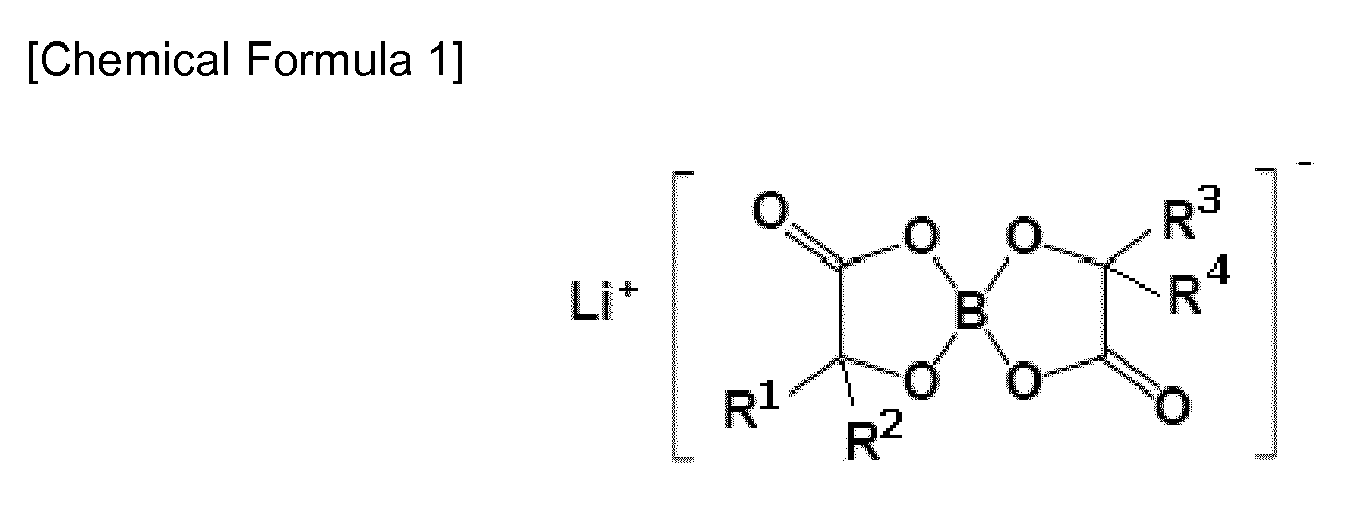
- a compound (an additive) for an electrolyte of a lithium secondary battery represented by the following Chemical Formula 1 is provided.
- the non-polar hydrocarbon group may be a C1 to C10 alkyl group, a C3 to C12 cycloalkyl group, a C6 to C20 aryl group, or a combination thereof.
- the R 1 to R 4 of the Chemical Formula 1 may be each independently hydrogen, a methyl group, an ethyl group, a propyl group, a butyl group, an isopropyl group, or an isobutyl group.
- R 1 may be equal to R 3 and R 2 may be equal to R 4 .
- At least R 1 and R 3 may be hydrogen.
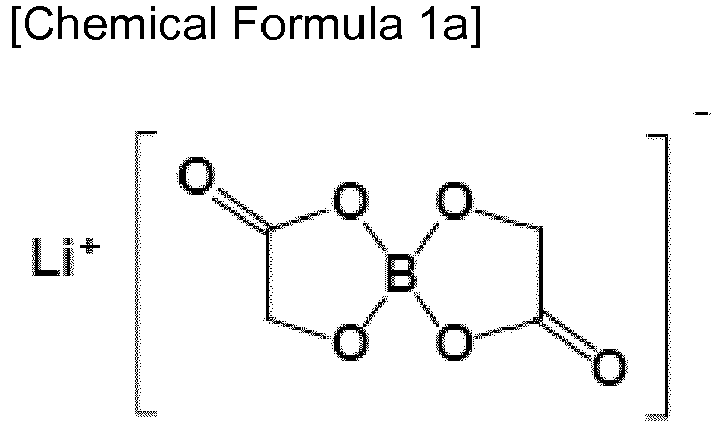
- the compound for an electrolyte may be represented by one of the following Chemical Formulae 1 a to 1 c:
- an electrolyte for a lithium secondary battery including the above mentioned compound for an electrolyte represented by the Chemical Formula 1, a non-aqueous organic solvent, and a lithium salt is provided.
- the compound may be included in an amount of 0.001 to 10 wt%, especially 0.1 to 5 wt% based on the total amount of the electrolyte.
- a lithium secondary battery including a positive electrode including a positive active material, a negative electrode including a negative active material, and the above mentioned electrolyte for a lithium secondary battery.
- Another aspect of the invention refers to the use of the above mentioned compound as an additive for an electrolyte of a lithium secondary battery.
- the compound is represented by the following Chemical Formula 1:
- the non-polar hydrocarbon group may be, for example a C1 to C10 alkyl group, a C3 to C12 cycloalkyl group, a C6 to C20 aryl group or a combination thereof.
- the R 1 to R 4 are each independently, for example hydrogen, a methyl group, an ethyl group, a propyl group, a butyl group, an isopropyl group, or an isobutyl group.
- R 1 and R 3 may be each independently hydrogen
- R 2 and R 4 may be each independently hydrogen, a methyl group, an ethyl group, a propyl group, a butyl group, an isopropyl group, or an isobutyl group.
- R 1 may be equal to R 3 and R 2 may be equal to R 4 . At least R 1 and R 3 may be hydrogen.
- the compound represented by above Chemical Formula 1 is an organoborate and improves electrochemical characteristics of an electrolyte for a lithium secondary battery, when added to the electrolyte.
- the compound represented by the Chemical Formula 1 includes a non-polar group (hydrogen or unsubstituted hydrocarbon group) and may form a non-polar part on the surface of the passivation film.
- the passivation film decreases a reaction with the electrolyte and thus may effectively decrease or prevent the electrolyte from being permeated through the passivation film.
- the passivation film has less reactivity with lithium ions and may prevent movement deterioration of the lithium ions.
- the additive for an electrolyte may be, for example a compound represented by one of the following Chemical Formulae 1 a to 1 c.
- An electrolyte for a lithium secondary battery includes the compound (additive) represented by the Chemical Formula 1, a non-aqueous organic solvent, and a lithium salt.
- the additive represented by the above Chemical Formula 1 may be included in an amount of 0.001 to 10 wt% based on the total amount of the electrolyte.
- solubility in an electrolyte as well as the aforementioned effect may be secured.
- the additive may be included in an amount of 0.1 to 5 wt% within the range.
- the non-aqueous organic solvent serves as a medium for transmitting ions taking part in the electrochemical reaction of a battery.
- the non-aqueous organic solvent may include a carbonate-based, ester-based, ether-based, ketone-based, alcohol-based, or aprotic solvent.
- the carbonate-based solvent may include dimethyl carbonate (DMC), diethyl carbonate (DEC), dipropyl carbonate (DPC), methylpropyl carbonate (MPC), ethylpropyl carbonate (EPC), methylethyl carbonate (MEC), ethylene carbonate (EC), propylene carbonate (PC), butylene carbonate (BC), and the like
- the ester-based solvent may include methyl acetate, ethyl acetate, n-propyl acetate, dimethylacetate, methylpropionate, ethylpropionate, gamma-butyrolactone, decanolide, gamma-valerolactone, mevalonolactone, caprolactone, and the like.
- the ether-based solvent may include dibutyl ether, tetraglyme, diglyme, dimethoxyethane, 2-methyltetrahydrofuran, tetrahydrofuran, and the like, and the ketone-based solvent may include cyclohexanone, and the like.
- the alcohol-based solvent may include ethanol, isopropyl alcohol, and the like
- the aprotic solvent may include nitriles such as R-CN (wherein R is a C2 to C20 linear, branched, or cyclic hydrocarbon group, and may include a double bond, an aromatic ring, or an ether bond), amides such as dimethylformamide, dimethylacetamide, dioxolanes such as 1,3-dioxolane, sulfolanes, and the like.
- the non-aqueous organic solvent may be used singularly or in a mixture, when the organic solvent is used in a mixture, the mixture ratio may be controlled in accordance with a desirable battery performance.
- the carbonate-based solvent is prepared by mixing a cyclic carbonate and a linear carbonate.
- the cyclic carbonate and the linear carbonate are mixed together in the volume ratio of 1:1 to 1:9. Within this range, performance of electrolyte may be improved.
- the non-aqueous organic solvent may further include an aromatic hydrocarbon-based organic solvent as well as the carbonate based solvent.
- the carbonate-based solvent and the aromatic hydrocarbon-based organic solvent are mixed together in a volume ratio of 1 : 1 to 30 : 1.
- aromatic hydrocarbon-based organic solvent may be selected from benzene, fluorobenzene, 1,2-difluorobenzene, 1,3-difluorobenzene, 1,4-difluorobenzene, 1,2,3-trifluorobenzene, 1,2,4-trifluorobenzene, chlorobenzene, 1,2-dichlorobenzene, 1,3-dichlorobenzene, 1,4-dichlorobenzene, 1,2,3-trichlorobenzene, 1,2,4-trichlorobenzene, iodobenzene, 1,2-diiodobenzene, 1,3-diiodobenzene, 1,4-diiodobenzene, 1,2,3-triiodobenzene, 1,2,4-triiodobenzene, toluene, fluorotoluene, 2,3-difluorotoluene, 2,4-di
- the lithium salt is dissolved in an organic solvent, supplies lithium ions in a battery, operates a basic operation of the lithium secondary battery, and improves lithium ion transportation between positive and negative electrodes therein.
- Such a lithium salt includes one or more of LiPF 6 , LiBF 4 , LiSbF 6 , LiAsF 6 , LiN(SO 2 C 2 F 5 ) 2 , Li(CF 3 SO 2 ) 2 N, LiN(SO 3 C 2 F 5 ) 2 , LiC 4 F 9 SO 3 , LiClO 4 , LiAlO 2 , LiAlCl 4 , LiN(C x F 2x+1 SO 2 ), wherein, x and y are natural numbers, LiCl, and Lil.
- the lithium salt may be preferably used at a concentration of 0.1 to 2.0 M.
- the lithium salt When the lithium salt is included within the above concentration range, it may electrolyte performance and lithium ion mobility due to optimal electrolyte conductivity and viscosity.
- FIG. 1 a lithium secondary battery according to another embodiment is described referring to FIG. 1 .
- FIG. 1 is a schematic view of a lithium secondary battery according to one embodiment.
- a lithium secondary battery 100 includes a battery cell including a positive electrode 114, a negative electrode 112 facing the positive electrode 114, a separator 113 interposed between the positive electrode 114 and negative electrode 112, and an electrolyte (not shown) for a lithium secondary battery impregnating the positive electrode 114, negative electrode 112, and separator 113, a battery case 120 including the battery cell, and a sealing member 140 sealing the battery case 120.
- the positive electrode 114 includes a current collector and a positive active material layer disposed on the current collector.
- the current collector may include an aluminum foil.
- the positive active material layer includes a positive active material, a binder, and a conductive material.
- the positive active material includes compounds (lithiated intercalation compounds) that reversibly intercalate and deintercalate lithium ions.
- A is selected from Ni, Co, Mn, and a combination thereof;
- X is selected from Al, Ni, Co, Mn, Cr, Fe, Mg, Sr, V, a rare earth element, and a combination thereof;
- D is selected from O, F, S, P, and a combination thereof;
- E is selected from Co, Mn, and a combination thereof;
- T is selected from F, S, P, and a combination thereof;
- G is selected from Al, Cr, Mn, Fe, Mg, La, Ce, Sr, V, and a combination thereof;
- Q is selected from Ti, Mo, Mn, and a combination thereof;
- the positive active material may be a compound with the coating layer on the surface or a mixture of the active material and a compound with the coating layer thereon.
- the coating layer may include at least one coating element compound selected from the group consisting of an oxide and a hydroxide of the coating element, an oxyhydroxide of the coating element, an oxycarbonate of the coating element, and a hydroxycarbonate of the coating element.
- the compound for the coating layer may be either amorphous or crystalline.
- the coating element included in the coating layer may be Mg, Al, Co, K, Na, Ca, Si, Ti, V, Sn, Ge, Ga, B, As, Zr, or a mixture thereof.
- the coating process may include any conventional processes unless it causes any side effects on the properties of the positive active material (e.g., spray coating, immersing), which is well known to those who have ordinary skill in this art and will not be illustrated in detail.
- the positive active material may be included in an amount of 90 wt% to 98 wt% based on the total amount of the positive active material layer.
- the binder improves binding properties of the positive active material particles to one another and to a current collector.
- the binder include polyvinyl alcohol, carboxylmethylcellulose, hydroxypropylcellulose, diacetylcellulose, polyvinylchloride, carboxylated polyvinylchloride, polyvinylfluoride, an ethylene oxide-containing polymer, polyvinylpyrrolidone, polyurethane, polytetrafluoroethylene, polyvinylidene fluoride, polyethylene, polypropylene, a styrene-butadiene rubber, an acrylated styrene-butadiene rubber, an epoxy resin, nylon, and the like.
- the conductive material improves electrical conductivity of a positive electrode.
- Any electrically conductive material may be used as a conductive agent unless it causes a chemical change.
- the conductive material include a carbon-based material such as natural graphite, artificial graphite, carbon black, acetylene black, ketjen black, a carbon fiber, and the like; a metal-based material of a metal powder or a metal fiber, and the like such as copper, nickel, aluminum, silver, and the like; a conductive polymer material such as a polyphenylene derivative and the like; or a mixture thereof.
- the binder and conductive material may be included in each amount of 1 wt% to 5 wt% based on the total amount of the positive active material layer.
- the positive electrode 114 may be manufactured in a method of preparing a positive active material slurry by mixing the positive active material, the binder, and the conductive material in a solvent, and coating the positive active material slurry on a current collector.
- the solvent may include N-methylpyrrolidone.
- the positive electrode manufacturing method is well known and thus, is not described in detail in the present specification.
- the negative electrode 112 may include a current collector and a negative active material layer disposed on at least one side of the current collector.
- the current collector may include a copper foil, a nickel foil, a stainless steel foil, a titanium foil, a nickel foam, a copper foam, a polymer substrate coated with a conductive metal, or a combination thereof.
- the negative active material may include a material that reversibly intercalates/deintercalates lithium ions, a lithium metal, a lithium metal alloy, a material being capable of doping and dedoping lithium, or transition metal oxide.
- the material that reversibly intercalates/deintercalates lithium ions includes a carbon material
- the carbon material may be any generally-used carbon-based negative active material in a lithium ion rechargeable battery
- examples of the carbon material include crystalline carbon, amorphous carbon, and a mixture thereof.
- the crystalline carbon may be non-shaped or sheet, flake, spherical, or fiber shaped natural graphite or artificial graphite, and the amorphous carbon may be a soft carbon (carbon obtained by sintering at a low temperature), a hard carbon, mesophase pitch carbonization products, fired coke, and the like.
- lithium metal alloy examples include lithium and a metal of Na, K, Rb, Cs, Fr, Be, Mg, Ca, Sr, Si, Sb, Pb, In, Zn, Ba, Ra, Ge, Al, or Sn.
- the material being capable of doping and dedoping lithium may include Si, SiO x (0 ⁇ x ⁇ 2), a Si-C composite, a Si-Q alloy (wherein Q is an alkali metal, an alkaline-earth metal, Group 13 to Group 16 elements, a transition element, a rare earth element, or a combination thereof, and is not Si), Sn, SnO 2 , a Sn-C composite, Sn-R (wherein R is an alkali metal, an alkaline-earth metal, Group 13 to Group 16 elements, a transition element, a rare earth element, or a combination thereof, and not Sn), and the like, and at least one thereof may be used as a mixture with SiO 2 .
- the elements Q and R may include Mg, Ca, Sr, Ba, Ra, Sc, Y, Ti, Zr, Hf, Rf, V, Nb, Ta, Db, Cr, Mo, W, Sg, Tc, Re, Bh, Fe, Pb, Ru, Os, Hs, Rh, Ir, Pd, Pt, Cu, Ag, Au, Zn, Cd, B, Al, Ga, Sn, In, Ti, Ge, P, As, Sb, Bi, S, Se, Te, Po, or a combination thereof.
- the transition metal oxide may include vanadium oxide, lithium vanadium oxide, and the like.
- the binder improves properties of binding active material particles with one another and a negative active material with a current collector.
- the binder may be a non-water-soluble binder, a water-soluble binder, or a combination thereof.
- the non-water-soluble binder may be polyvinylchloride, carboxylated polyvinylchloride, polyvinylfluoride, an ethylene oxide-containing polymer, polyvinylpyrrolidone, polyurethane, polytetrafluoroethylene, polyvinylidene fluoride, polyethylene, polypropylene, polyamideimide, polyimide, or a combination thereof.
- the water-soluble binder may be a styrene-butadiene rubber, an acrylated styrene-butadiene rubber, polyvinyl alcohol, sodium polyacrylate, a copolymer of propylene and C2 to C8 olefin, a copolymer of (meth)acrylic acid and (meth)acrylic acid alkyl ester, or a combination thereof.
- a cellulose-based compound may be further used to provide viscosity.
- the cellulose-based compound includes one or more of carboxylmethyl cellulose, hydroxypropylmethyl cellulose, methyl cellulose, or alkali metal salts thereof.
- the alkali metal may be Na, K, or Li.
- the thickener may be included in an amount of 0.1 to 3 parts by weight based on 100 parts by weight of the binder.
- the conductive material is included to provide electrode conductivity, any electrically conductive material may be used as a conductive material unless it causes a chemical change, and examples of the conductive material include a carbon-based material such as natural graphite, artificial graphite, carbon black, acetylene black, ketjen black, a carbon fiber and the like; a metal-based material of metal powder or metal fiber including copper, nickel, aluminum, silver, and the like; a conductive polymer such as a polyphenylene derivative; or a mixture thereof.
- a carbon-based material such as natural graphite, artificial graphite, carbon black, acetylene black, ketjen black, a carbon fiber and the like
- a metal-based material of metal powder or metal fiber including copper, nickel, aluminum, silver, and the like
- a conductive polymer such as a polyphenylene derivative
- the negative electrode may be manufactured by a general process including preparing a negative active material slurry by mixing a negative active material, a binder, and optionally a conductive agent in a solvent, coating the negative active material slurry on a current collector followed by drying and compressing.
- Examples of the solvent may be N-methylpyrrolidone or water.
- the negative electrode manufacturing method is well known and thus, is not described in detail in the present specification.
- the separator 113 separates the positive electrode 114 and negative electrode 112 and provides a path for transferring lithium ions and may be any separator that is generally used in a lithium ion battery.
- the separator may have low resistance against electrolyte ions and excellent moisturizing capability of an electrolyte.
- the separator may be selected from a glass fiber, polyester, TEFLON (tetrafluoroethylene), polyethylene, polypropylene, polytetrafluoroethylene (PTFE), or a combination thereof and may have a non-woven fabric type or a fabric type.
- a polyolefin-based polymer separator such as polyethylene, polypropylene, and the like is used for a lithium ion battery
- a separator coated with a ceramic component or a polymer material may be used to secure heat resistance or mechanical strength, and the separator may have a singular layer or multi-layers.
- Rechargeable lithium batteries may be classified as lithium ion batteries, lithium ion polymer batteries, and lithium polymer batteries according to the presence of a separator and the kind of electrolyte used in the battery, and the rechargeable lithium batteries may also be classified as cylindrical, prismatic, coin-type, or pouch-type batteries according to shapes, and may be classified as thin film or bulk batteries.
- the electrolyte is the same as described above.
- Lactic acid (85% in water), lithium hydroxide, and boronic acid in a mole ratio of 2:1:1 were mixed in an aqueous solution, and the mixture was agitated at a temperature ranging from 180°C to 200°C for 12 hours.
- An electrolyte for a lithium secondary battery was prepared by adding 1.3M LiPF 6 lithium salt to a mixed solvent prepared by mixing ethylene carbonate (EC), ethylmethyl carbonate (EMC), and dimethyl carbonate (DMC) in a ratio of 3/5/2 (v/v/v) and then, 1 wt% of the compound according to Synthesis Example 1 to the mixture.
- EC ethylene carbonate
- EMC ethylmethyl carbonate
- DMC dimethyl carbonate
- An electrolyte for a lithium secondary battery was prepared according to the same method as Example 1 except for using the compound according to Synthesis Example 2 instead of the compound according to Synthesis Example 1.
- An electrolyte for a lithium secondary battery was prepared according to the same method as Example 1 except for using the compound according to Synthesis Example 3 instead of the compound according to Synthesis Example 1.
- An electrolyte for a lithium secondary battery was prepared according to the same method as Example 1 except for using no compound according to Synthesis Example 1.
- the electrolytes according to Examples 1 to 3 and Comparative Example 1 were respectively used to manufacture lithium secondary battery cells.
- a positive electrode was manufactured by mixing 97.4 wt% of LiCoO 2 , 1.3wt% of polyvinylidene fluoride (PVdF), and 1.3wt% of acetyleneblack in NMP to prepare a positive active material slurry and coating the positive active material slurry on an aluminum current collector.
- PVdF polyvinylidene fluoride
- a negative electrode was manufactured by mixing 98.0 wt% of artificial graphite, 1.0 wt% of a styrenebutadiene rubber (SBR), and 1.0 wt% of carboxylmethylcellulose (CMC) in water to prepare a negative active material slurry and coating the negative active material slurry on a copper current collector.
- SBR styrenebutadiene rubber
- CMC carboxylmethylcellulose
- the lithium secondary battery cells including the electrolytes according to Examples 1 to 3 and Comparative Example 1 were 100 times charged and discharged with 1C at 25 °C, and discharge capacity of the lithium secondary battery cells was measured at each cycle.
- FIG. 2 is a graph showing discharge capacity of the lithium secondary battery cells including the electrolytes according to Examples 1 to 3 and Comparative Example 1 depending on a cycle.
- the lithium secondary battery cells including the electrolytes according to Examples 1 to 3 had higher discharge capacity retention after 100 cycles than the lithium secondary battery cells including the electrolytes according to Comparative Example 1.
- Coin-type half-cells 1 and 2 respectively including the electrolytes according to Examples 2 and 3 and Comparative Example 1 were manufactured to evaluate self-discharge at a high temperature.
- Each coin-type half-cell 1 respectively including the electrolytes according to Examples 2 and 3 and Comparative Example 1 used the above-described LiCoO 2 positive electrode and a lithium metal as a counter electrode.
- Each coin-type half-cell 2 respectively including the electrolytes according to Examples 2 and 3 and Comparative Example 1 used the above-described artificial graphite as a negative electrode and a lithium metal as a counter electrode.
- the coin-type half-cells 1 and 2 were charged up to 4.2V, allowed to stand at 60 °C for 22 days, and their self-discharge degrees were evaluated.
- the self-discharge indicates potential decrease of a battery when no current flows in an external circuit and may be used to evaluate high temperature stability of lithium secondary battery cells.
- FIG. 3 is a graph showing potential changes of the coin-type half-cells 1 including the electrolytes according to Example 2 and Comparative Example 1 when being allowed to stand at 60 °C for 22 days
- FIG. 4 is a graph showing potential changes of the coin-type half-cells 2 including the electrolytes according to Example 2 and Comparative Example 1 when being allowed to stand at 60°C for 22 days
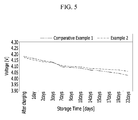
- FIG. 5 a graph showing potential changes of the lithium secondary battery cells including the electrolytes according to Example 2 and Comparative Example 1
- FIG. 6 is a graph showing potential change of the coin-type half-cells 1 including the electrolytes according to Example 3 and Comparative Example 1 when being allowed to stand at 60 °C for 22 days
- FIG. 4 is a graph showing potential changes of the coin-type half-cells 2 including the electrolytes according to Example 2 and Comparative Example 1 when being allowed to stand at 60°C for 22 days
- FIG. 5 a graph showing potential changes of the lithium secondary battery cells including the electrolytes according to Example 2 and Comparative Example 1
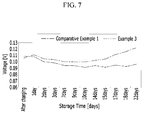
- FIG. 7 is a graph showing potential change of the coin-type half-cells 2 including the electrolytes according to Example 3 and Comparative Example 1 when being allowed to stand at 60 °C for 22 days
- FIG. 8 is a graph showing potential change of the lithium secondary battery cells including the electrolytes according to Example 3 and Comparative Example 1.
- the coin-type half-cells 1 including the electrolyte according to Example 2 and Comparative Example 1 showed few potential change, while the coin-type half-cell 2 including the electrolyte according to Example 2 showed a small potential change compared with the coin-type half-cell 2 including the electrolyte according to Comparative Example 1.
- the coin-type half-cell 2 including the electrolyte according to Example 2 turned out to decrease self-discharge at a high temperature by forming a stable solid electrolyte film on the surface of a negative electrode.
- the lithium secondary battery cell including the electrolyte according to Example 2 showed smaller self-discharge than that of the lithium secondary battery cell including the electrolyte according to Comparative Example 1 and thus, had high stability at a high temperature.
- the coin-type half-cells 1 including the electrolyte according to Example 3 and Comparative Example 1 showed a few potential change, while the coin-type half-cell 2 including the electrolyte according to Example 3 showed a smaller potential change depending on a storage day the coin-type half-cell 2 including the electrolyte according to Comparative Example 1.
- the coin-type half-cell 2 including the electrolyte according to Example 3 turned out to decrease self-discharge at a high temperature by forming a stable solid electrolyte film on the surface of a negative electrode.
- the lithium secondary battery cell including the electrolyte according to Example 3 had a smaller self-discharge than that of the lithium secondary battery including the electrolyte according to Comparative Example 1 and thus, high temperature stability.
- FIG. 9 is a graph showing potential decrease degree of the lithium secondary battery cells including the electrolytes according to Examples 2 and 3 and Comparative Example 1 when being allowed to stand at 60 °C for 22 days.
- the lithium secondary battery cells including the electrolytes according to Examples 2 and 3 showed a smaller potential decrease degree and accordingly, a smaller self-discharge than the lithium secondary battery cell including the electrolyte according to Comparative Example 1.
Landscapes
- Chemical & Material Sciences (AREA)
- Engineering & Computer Science (AREA)
- Organic Chemistry (AREA)
- Manufacturing & Machinery (AREA)
- Chemical Kinetics & Catalysis (AREA)
- Electrochemistry (AREA)
- General Chemical & Material Sciences (AREA)
- Inorganic Chemistry (AREA)
- General Physics & Mathematics (AREA)
- Physics & Mathematics (AREA)
- Condensed Matter Physics & Semiconductors (AREA)
- Materials Engineering (AREA)
- Secondary Cells (AREA)
Abstract
Specific disclosures according to the Markush formula are: Formulae 1a to 1c:

Description
- The present invention refers to a compound for an electrolyte of a lithium secondary battery. The invention further concerns about an electrolyte including the compound as well as a lithium secondary battery including the electrolyte.
- Batteries transform chemical energy generated from an electrochemical redox reaction of a chemical material in the battery into electrical energy. Such batteries are divided into a primary battery, which should be disposed after the energy of the battery is all consumed, and a rechargeable battery, which can be recharged many times.
- The rechargeable battery can be charged/discharged many times based on the reversible transformation between chemical energy and electrical energy.
- Recent developments in high-tech electronics have allowed electronic devices to become small and light in weight, which leads to an increase in portable electronic devices.
- As a power source for such portable electronic devices, the demands for batteries with high energy density are increasing and researches on lithium rechargeable battery are briskly under progress.
- The lithium secondary battery is fabricated by an injecting electrolyte into a battery cell, which includes a positive electrode including a positive active material capable of intercalating/deintercalating lithium and a negative electrode including a negative active material capable of intercalating/deintercalating lithium.
- An electrolyte includes an organic solvent in which a lithium salt is dissolved, and may include an additive for an electrolyte in order to improve electrolyte performance.
- According to one aspect of the present invention, a compound (an additive) for an electrolyte of a lithium secondary battery represented by the following Chemical Formula 1 is provided.

- In the above Chemical Formula 1,
- R1 to R4 are each independently hydrogen or a unsubstituted hydrocarbon group.
- The non-polar hydrocarbon group may be a C1 to C10 alkyl group, a C3 to C12 cycloalkyl group, a C6 to C20 aryl group, or a combination thereof.
- The R1 to R4 of the
Chemical Formula 1 may be each independently hydrogen, a methyl group, an ethyl group, a propyl group, a butyl group, an isopropyl group, or an isobutyl group. - Further, R1 may be equal to R3 and R2 may be equal to R4.
- At least R1 and R3 may be hydrogen.
- The compound for an electrolyte may be represented by one of the following Chemical Formulae 1 a to 1 c:


- According to another aspect of the invention, an electrolyte for a lithium secondary battery including the above mentioned compound for an electrolyte represented by the Chemical Formula 1, a non-aqueous organic solvent, and a lithium salt is provided.
- The compound may be included in an amount of 0.001 to 10 wt%, especially 0.1 to 5 wt% based on the total amount of the electrolyte.
- According to another aspect of the invention, provided is a lithium secondary battery including a positive electrode including a positive active material, a negative electrode including a negative active material, and the above mentioned electrolyte for a lithium secondary battery.
- Another aspect of the invention refers to the use of the above mentioned compound as an additive for an electrolyte of a lithium secondary battery.
- Further aspects of the invention could be learned from the following description.
-
-
FIG. 1 is a schematic view showing a lithium secondary battery according to one embodiment, -
FIG. 2 is a graph showing discharge capacity of lithium secondary batteries respectively including electrolytes according to Examples 1 to 3 and Comparative Example 1 depending on a cycle, -
FIG. 3 is a graph showing potential change of the coin-type half-cells 1 including the electrolytes according to Example 2 and Comparative Example 1 when being allowed to stand at 60 °C for 22 days, -
FIG. 4 is a graph showing potential change of the coin-type half-cells 2 including the electrolytes according to Example 2 and Comparative Example 1 when being allowed to stand at 60 °C for 22 days, -
FIG. 5 is a graph showing potential change of lithium secondary battery cells including the electrolytes according to Example 2 and Comparative Example 1, -
FIG. 6 is a graph showing potential change of the coin-type half-cells 1 including the electrolytes according to Example 3 and Comparative Example 1 when being allowed to stand at 60 °C for 22 days, -
FIG. 7 is a graph showing potential change of the coin-type half-cells 2 including the electrolytes according to Example 3 and Comparative Example 1 when being allowed to stand at 60 °C for 22 days, -
FIG. 8 is a graph showing potential changes of lithium secondary battery cells including the electrolytes according to Example 3 and Comparative Example 1, and -
FIG. 9 is a graph showing potential decreases of the lithium secondary battery cells including the electrolytes according to Examples 2 and 3 and Comparative Example 1 when being allowed to stand at 60 °C for 22 days. - Hereinafter, exemplary embodiments of the present invention will be described in detail so that a person skilled in the art would understand.
- Hereinafter, the inventive compound (additive) for an electrolyte of a lithium secondary battery is described.
- The compound is represented by the following Chemical Formula 1:

- In the Chemical Formula 1,
- R1 to R4 are each independently hydrogen or an unsubstituted hydrocarbon group. The term 'unsubstituted' means that no substituents are bonded to the hydrocarbon group other than hydrogen or carbon. Substituents R1 to R4 do have non polar characteristics.
- The non-polar hydrocarbon group may be, for example a C1 to C10 alkyl group, a C3 to C12 cycloalkyl group, a C6 to C20 aryl group or a combination thereof.
- The R1 to R4 are each independently, for example hydrogen, a methyl group, an ethyl group, a propyl group, a butyl group, an isopropyl group, or an isobutyl group.
- For example R1 and R3 may be each independently hydrogen, and R2 and R4 may be each independently hydrogen, a methyl group, an ethyl group, a propyl group, a butyl group, an isopropyl group, or an isobutyl group.
- Further, R1 may be equal to R3 and R2 may be equal to R4. At least R1 and R3 may be hydrogen.
- The compound represented by above Chemical Formula 1 is an organoborate and improves electrochemical characteristics of an electrolyte for a lithium secondary battery, when added to the electrolyte.
- When an electrolyte including a lithium salt is reduced during the charge and discharge of a battery and forms a passivation film called to be a solid electrolyte interface (SEI) film on the surface of positive and/or negative electrode, the compound represented by the Chemical Formula 1 includes a non-polar group (hydrogen or unsubstituted hydrocarbon group) and may form a non-polar part on the surface of the passivation film.
- Accordingly, the passivation film decreases a reaction with the electrolyte and thus may effectively decrease or prevent the electrolyte from being permeated through the passivation film.
- In addition, the passivation film has less reactivity with lithium ions and may prevent movement deterioration of the lithium ions.
- The additive for an electrolyte may be, for example a compound represented by one of the following Chemical Formulae 1 a to 1 c.


- An electrolyte for a lithium secondary battery includes the compound (additive) represented by the Chemical Formula 1, a non-aqueous organic solvent, and a lithium salt.
- The additive represented by the above Chemical Formula 1 may be included in an amount of 0.001 to 10 wt% based on the total amount of the electrolyte.
- When the additive is included within the range, solubility in an electrolyte as well as the aforementioned effect may be secured.
- Specifically, the additive may be included in an amount of 0.1 to 5 wt% within the range.
- The non-aqueous organic solvent serves as a medium for transmitting ions taking part in the electrochemical reaction of a battery.
- The non-aqueous organic solvent may include a carbonate-based, ester-based, ether-based, ketone-based, alcohol-based, or aprotic solvent.
- The carbonate-based solvent may include dimethyl carbonate (DMC), diethyl carbonate (DEC), dipropyl carbonate (DPC), methylpropyl carbonate (MPC), ethylpropyl carbonate (EPC), methylethyl carbonate (MEC), ethylene carbonate (EC), propylene carbonate (PC), butylene carbonate (BC), and the like, and the ester-based solvent may include methyl acetate, ethyl acetate, n-propyl acetate, dimethylacetate, methylpropionate, ethylpropionate, gamma-butyrolactone, decanolide, gamma-valerolactone, mevalonolactone, caprolactone, and the like.
- The ether-based solvent may include dibutyl ether, tetraglyme, diglyme, dimethoxyethane, 2-methyltetrahydrofuran, tetrahydrofuran, and the like, and the ketone-based solvent may include cyclohexanone, and the like.
- The alcohol-based solvent may include ethanol, isopropyl alcohol, and the like, and the aprotic solvent may include nitriles such as R-CN (wherein R is a C2 to C20 linear, branched, or cyclic hydrocarbon group, and may include a double bond, an aromatic ring, or an ether bond), amides such as dimethylformamide, dimethylacetamide, dioxolanes such as 1,3-dioxolane, sulfolanes, and the like.
- The non-aqueous organic solvent may be used singularly or in a mixture, when the organic solvent is used in a mixture, the mixture ratio may be controlled in accordance with a desirable battery performance.
- The carbonate-based solvent is prepared by mixing a cyclic carbonate and a linear carbonate.
- The cyclic carbonate and the linear carbonate are mixed together in the volume ratio of 1:1 to 1:9. Within this range, performance of electrolyte may be improved.
- The non-aqueous organic solvent may further include an aromatic hydrocarbon-based organic solvent as well as the carbonate based solvent.
- The carbonate-based solvent and the aromatic hydrocarbon-based organic solvent are mixed together in a volume ratio of 1 : 1 to 30 : 1.
- Specific examples of the aromatic hydrocarbon-based organic solvent may be selected from benzene, fluorobenzene, 1,2-difluorobenzene, 1,3-difluorobenzene, 1,4-difluorobenzene, 1,2,3-trifluorobenzene, 1,2,4-trifluorobenzene, chlorobenzene, 1,2-dichlorobenzene, 1,3-dichlorobenzene, 1,4-dichlorobenzene, 1,2,3-trichlorobenzene, 1,2,4-trichlorobenzene, iodobenzene, 1,2-diiodobenzene, 1,3-diiodobenzene, 1,4-diiodobenzene, 1,2,3-triiodobenzene, 1,2,4-triiodobenzene, toluene, fluorotoluene, 2,3-difluorotoluene, 2,4-difluorotoluene, 2,5-difluorotoluene, 2,3,4-trifluorotoluene, 2,3,5-trifluorotoluene, chlorotoluene, 2,3-dichlorotoluene, 2,4-dichlorotoluene, 2,5-dichlorotoluene, 2,3,4-trichlorotoluene, 2,3,5-trichlorotoluene, iodotoluene, 2,3-diiodotoluene, 2,4-diiodotoluene, 2,5-diiodotoluene, 2,3,4-triiodotoluene, 2,3,5-triiodotoluene, xylene, and a combination thereof.
- The lithium salt is dissolved in an organic solvent, supplies lithium ions in a battery, operates a basic operation of the lithium secondary battery, and improves lithium ion transportation between positive and negative electrodes therein.
- Such a lithium salt includes one or more of LiPF6, LiBF4, LiSbF6, LiAsF6, LiN(SO2C2F5)2, Li(CF3SO2)2N, LiN(SO3C2F5)2, LiC4F9SO3, LiClO4, LiAlO2, LiAlCl4, LiN(CxF2x+1SO2), wherein, x and y are natural numbers, LiCl, and Lil.
- The lithium salt may be preferably used at a concentration of 0.1 to 2.0 M.
- When the lithium salt is included within the above concentration range, it may electrolyte performance and lithium ion mobility due to optimal electrolyte conductivity and viscosity.
- Hereinafter, a lithium secondary battery according to another embodiment is described referring to
FIG. 1 . -
FIG. 1 is a schematic view of a lithium secondary battery according to one embodiment. - Referring to
FIG. 1 , a lithiumsecondary battery 100 includes a battery cell including apositive electrode 114, anegative electrode 112 facing thepositive electrode 114, aseparator 113 interposed between thepositive electrode 114 andnegative electrode 112, and an electrolyte (not shown) for a lithium secondary battery impregnating thepositive electrode 114,negative electrode 112, andseparator 113, abattery case 120 including the battery cell, and a sealingmember 140 sealing thebattery case 120. - The
positive electrode 114 includes a current collector and a positive active material layer disposed on the current collector. - The current collector may include an aluminum foil.
- The positive active material layer includes a positive active material, a binder, and a conductive material.
- The positive active material includes compounds (lithiated intercalation compounds) that reversibly intercalate and deintercalate lithium ions.
- Specific examples may be the compounds represented by the following chemical formulae:
- LiaA1-bXbD2 (0.90 ≤ a ≤ 1.8, 0 ≤ b ≤ 0.5); LiaA1-bXbO2-cDc (0.90 ≤ a ≤ 1.8, 0 ≤ b ≤ 0.5, 0 ≤ c ≤ 0.05); LiaE1-bXbO2-cDc (0.90 ≤ a ≤ 1.8, 0 ≤ b ≤ 0.5, 0 ≤ c ≤ 0.05); LiaE2-bXbO4-cDc (0.90 ≤ a ≤ 1.8, 0 ≤ b ≤ 0.5, 0 ≤ c ≤ 0.05); LiaNi1-b-cCobXcDα (0.90 ≤ a ≤ 1.8, 0 ≤ b ≤ 0.5, 0 ≤ c ≤ 0.5, 0 < α ≤ 2); LiaNi1-b-cCobXcO2-αTα (0.90 ≤ a ≤ 1.8, 0 ≤ b ≤ 0.5, 0 ≤ c ≤ 0.05, 0 < α < 2); LiaNi1-b-cCobXcO2-αT2 (0.90 ≤ a ≤ 1.8, 0 ≤ b ≤ 0.5, 0 ≤ c ≤ 0.05, 0 < α < 2); LiaNi1-b-cMnbXcDα (0.90 ≤ a ≤ 1.8, 0 ≤ b ≤ 0.5, 0 ≤ c ≤ 0.05, 0 < α ≤ 2); LiaNi1b-cMnbXcO2-αTα (0.90 ≤ a ≤ 1.8, 0 ≤ b ≤ 0.5, 0 ≤ c ≤ 0.05, 0 < α < 2); LiaNi1-bcMnbXcO2-α T2 (0.90 ≤ a ≤ 1.8, 0 ≤ b ≤ 0.5, 0 ≤ c ≤ 0.05, 0 < α < 2); LiaNibEcGdO2 (0.90 ≤ a ≤ 1.8, 0 ≤ b ≤ 0.9, 0 ≤ c ≤ 0.5, 0.001 ≤ d ≤ 0.1); LiaNibCocMndGeO2 (0.90 ≤ a ≤ 1.8, 0 ≤ b ≤ 0.9, 0 ≤ c ≤ 0.5, 0 ≤ d ≤0.5, 0.001 ≤ e ≤ 0.1); LiaNiGbO2 (0.90 ≤ a ≤ 1.8, 0.001 ≤ b ≤ 0.1); LiaCoGbO2 (0.90 ≤ a ≤ 1.8, 0.001 ≤ b ≤ 0.1); LiaMn1-bGbO2 (0.90 ≤ a ≤ 1.8, 0.001 ≤ b ≤ 0.1); LiaMn2GbO4 (0.90 ≤ a ≤ 1.8, 0.001 ≤ b ≤ 0.1); LiaMn1-gGgPO4 (0.90 ≤ a ≤ 1.8, 0 ≤ g ≤ 0.5); QO2; QS2; LiQS2; V2O5; LiV2O5; LiZO2; LiNiVO4; Li(3f)J2(PO4)3 (0 ≤ f ≤ 2); Li(3-f)Fe2(PO4)3(0 ≤ f ≤ 2); and LiaFePO4(0.90 ≤ a ≤ 1.8)
- In the above chemical formulae, A is selected from Ni, Co, Mn, and a combination thereof; X is selected from Al, Ni, Co, Mn, Cr, Fe, Mg, Sr, V, a rare earth element, and a combination thereof; D is selected from O, F, S, P, and a combination thereof; E is selected from Co, Mn, and a combination thereof; T is selected from F, S, P, and a combination thereof; G is selected from Al, Cr, Mn, Fe, Mg, La, Ce, Sr, V, and a combination thereof; Q is selected from Ti, Mo, Mn, and a combination thereof; Z is selected from Cr, V, Fe, Sc, Y, and a combination thereof; and J is selected from V, Cr, Mn, Co, Ni, Cu, and a combination thereof.
- The positive active material may be a compound with the coating layer on the surface or a mixture of the active material and a compound with the coating layer thereon.
- The coating layer may include at least one coating element compound selected from the group consisting of an oxide and a hydroxide of the coating element, an oxyhydroxide of the coating element, an oxycarbonate of the coating element, and a hydroxycarbonate of the coating element.
- The compound for the coating layer may be either amorphous or crystalline.
- The coating element included in the coating layer may be Mg, Al, Co, K, Na, Ca, Si, Ti, V, Sn, Ge, Ga, B, As, Zr, or a mixture thereof.
- The coating process may include any conventional processes unless it causes any side effects on the properties of the positive active material (e.g., spray coating, immersing), which is well known to those who have ordinary skill in this art and will not be illustrated in detail.
- The positive active material may be included in an amount of 90 wt% to 98 wt% based on the total amount of the positive active material layer.
- The binder improves binding properties of the positive active material particles to one another and to a current collector. Examples of the binder include polyvinyl alcohol, carboxylmethylcellulose, hydroxypropylcellulose, diacetylcellulose, polyvinylchloride, carboxylated polyvinylchloride, polyvinylfluoride, an ethylene oxide-containing polymer, polyvinylpyrrolidone, polyurethane, polytetrafluoroethylene, polyvinylidene fluoride, polyethylene, polypropylene, a styrene-butadiene rubber, an acrylated styrene-butadiene rubber, an epoxy resin, nylon, and the like.
- The conductive material improves electrical conductivity of a positive electrode. Any electrically conductive material may be used as a conductive agent unless it causes a chemical change. Examples of the conductive material include a carbon-based material such as natural graphite, artificial graphite, carbon black, acetylene black, ketjen black, a carbon fiber, and the like; a metal-based material of a metal powder or a metal fiber, and the like such as copper, nickel, aluminum, silver, and the like; a conductive polymer material such as a polyphenylene derivative and the like; or a mixture thereof.
- The binder and conductive material may be included in each amount of 1 wt% to 5 wt% based on the total amount of the positive active material layer.
- The
positive electrode 114 may be manufactured in a method of preparing a positive active material slurry by mixing the positive active material, the binder, and the conductive material in a solvent, and coating the positive active material slurry on a current collector. - The solvent may include N-methylpyrrolidone.
- The positive electrode manufacturing method is well known and thus, is not described in detail in the present specification.
- The
negative electrode 112 may include a current collector and a negative active material layer disposed on at least one side of the current collector. - The current collector may include a copper foil, a nickel foil, a stainless steel foil, a titanium foil, a nickel foam, a copper foam, a polymer substrate coated with a conductive metal, or a combination thereof.
- The negative active material may include a material that reversibly intercalates/deintercalates lithium ions, a lithium metal, a lithium metal alloy, a material being capable of doping and dedoping lithium, or transition metal oxide.
- The material that reversibly intercalates/deintercalates lithium ions includes a carbon material, the carbon material may be any generally-used carbon-based negative active material in a lithium ion rechargeable battery, and examples of the carbon material include crystalline carbon, amorphous carbon, and a mixture thereof.
- The crystalline carbon may be non-shaped or sheet, flake, spherical, or fiber shaped natural graphite or artificial graphite, and the amorphous carbon may be a soft carbon (carbon obtained by sintering at a low temperature), a hard carbon, mesophase pitch carbonization products, fired coke, and the like.
- Examples of the lithium metal alloy include lithium and a metal of Na, K, Rb, Cs, Fr, Be, Mg, Ca, Sr, Si, Sb, Pb, In, Zn, Ba, Ra, Ge, Al, or Sn.
- The material being capable of doping and dedoping lithium may include Si, SiOx (0 < x < 2), a Si-C composite, a Si-Q alloy (wherein Q is an alkali metal, an alkaline-earth metal, Group 13 to Group 16 elements, a transition element, a rare earth element, or a combination thereof, and is not Si), Sn, SnO2, a Sn-C composite, Sn-R (wherein R is an alkali metal, an alkaline-earth metal, Group 13 to Group 16 elements, a transition element, a rare earth element, or a combination thereof, and not Sn), and the like, and at least one thereof may be used as a mixture with SiO2.
- The elements Q and R may include Mg, Ca, Sr, Ba, Ra, Sc, Y, Ti, Zr, Hf, Rf, V, Nb, Ta, Db, Cr, Mo, W, Sg, Tc, Re, Bh, Fe, Pb, Ru, Os, Hs, Rh, Ir, Pd, Pt, Cu, Ag, Au, Zn, Cd, B, Al, Ga, Sn, In, Ti, Ge, P, As, Sb, Bi, S, Se, Te, Po, or a combination thereof.
- The transition metal oxide may include vanadium oxide, lithium vanadium oxide, and the like.
- The binder improves properties of binding active material particles with one another and a negative active material with a current collector.
- The binder may be a non-water-soluble binder, a water-soluble binder, or a combination thereof.
- The non-water-soluble binder may be polyvinylchloride, carboxylated polyvinylchloride, polyvinylfluoride, an ethylene oxide-containing polymer, polyvinylpyrrolidone, polyurethane, polytetrafluoroethylene, polyvinylidene fluoride, polyethylene, polypropylene, polyamideimide, polyimide, or a combination thereof.
- The water-soluble binder may be a styrene-butadiene rubber, an acrylated styrene-butadiene rubber, polyvinyl alcohol, sodium polyacrylate, a copolymer of propylene and C2 to C8 olefin, a copolymer of (meth)acrylic acid and (meth)acrylic acid alkyl ester, or a combination thereof.
- When the water-soluble binder is used as a negative electrode binder, a cellulose-based compound may be further used to provide viscosity.
- The cellulose-based compound includes one or more of carboxylmethyl cellulose, hydroxypropylmethyl cellulose, methyl cellulose, or alkali metal salts thereof.
- The alkali metal may be Na, K, or Li.
- The thickener may be included in an amount of 0.1 to 3 parts by weight based on 100 parts by weight of the binder.
- The conductive material is included to provide electrode conductivity, any electrically conductive material may be used as a conductive material unless it causes a chemical change, and examples of the conductive material include a carbon-based material such as natural graphite, artificial graphite, carbon black, acetylene black, ketjen black, a carbon fiber and the like; a metal-based material of metal powder or metal fiber including copper, nickel, aluminum, silver, and the like; a conductive polymer such as a polyphenylene derivative; or a mixture thereof.
- The negative electrode may be manufactured by a general process including preparing a negative active material slurry by mixing a negative active material, a binder, and optionally a conductive agent in a solvent, coating the negative active material slurry on a current collector followed by drying and compressing.
- Examples of the solvent may be N-methylpyrrolidone or water.
- The negative electrode manufacturing method is well known and thus, is not described in detail in the present specification.
- The
separator 113 separates thepositive electrode 114 andnegative electrode 112 and provides a path for transferring lithium ions and may be any separator that is generally used in a lithium ion battery. - In other words, the separator may have low resistance against electrolyte ions and excellent moisturizing capability of an electrolyte.
- For example, the separator may be selected from a glass fiber, polyester, TEFLON (tetrafluoroethylene), polyethylene, polypropylene, polytetrafluoroethylene (PTFE), or a combination thereof and may have a non-woven fabric type or a fabric type.
- For example, a polyolefin-based polymer separator such as polyethylene, polypropylene, and the like is used for a lithium ion battery, a separator coated with a ceramic component or a polymer material may be used to secure heat resistance or mechanical strength, and the separator may have a singular layer or multi-layers.
- Rechargeable lithium batteries may be classified as lithium ion batteries, lithium ion polymer batteries, and lithium polymer batteries according to the presence of a separator and the kind of electrolyte used in the battery, and the rechargeable lithium batteries may also be classified as cylindrical, prismatic, coin-type, or pouch-type batteries according to shapes, and may be classified as thin film or bulk batteries.
- Structures and manufacturing methods for lithium ion batteries pertaining to this disclosure are well known in the art.
- The electrolyte is the same as described above.
- Hereinafter, the above-described aspects of the present disclosure are illustrated in more detail with reference to examples.
- 6.0g (78 mmol) of glycolic acid, 1.7g (39 mmol) of lithium hydroxide, and 2.4g (39 mmol) of boronic acid were mixed in an aqueous solution, and the mixture was agitated at a temperature ranging from 180°C to 200°C for 12 hours.
- Subsequently, after removing the aqueous solution, the resultant was dried at 80°C for 48 hours and washed with diethylether, obtaining a compound represented by the following Chemical Formula 1a.

- 1H NMR (DMSO-d6, 400 MHz): δ 3.92 (2H)
- Lactic acid (85% in water), lithium hydroxide, and boronic acid in a mole ratio of 2:1:1 were mixed in an aqueous solution, and the mixture was agitated at a temperature ranging from 180°C to 200°C for 12 hours.
- Subsequently, after removing the aqueous solution, the resultant was dried at 80°C for 48 hours and washed with diethylether, obtaining a compound represented by the following Chemical Formula 1b.

- 1H NMR (DMSO-d6, 400 MHz): δ 3.89 (1H), 1.12 (3H)
- 8.0g (60 mmol) of leucic acid, 1.3g (30 mmol) of lithium hydroxide, and 1.9g (30 mmol) of boronic acid were mixed in an aqueous solution, and the mixture was agitated at a temperature ranging from 18°C to 200°C for 12 hours.
- Subsequently, after removing the aqueous solution, the resultant was dried at 80°C for 48 hours and washed with diethylether, obtaining a compound represented by the following Chemical Formula 1c.

- 1H NMR (DMSO-d6, 400 MHz): δ 3.82 (1H), 1.81 (1H), 1.61 (2H), 0.92 (6H)
- An electrolyte for a lithium secondary battery was prepared by adding 1.3M LiPF6 lithium salt to a mixed solvent prepared by mixing ethylene carbonate (EC), ethylmethyl carbonate (EMC), and dimethyl carbonate (DMC) in a ratio of 3/5/2 (v/v/v) and then, 1 wt% of the compound according to Synthesis Example 1 to the mixture.
- An electrolyte for a lithium secondary battery was prepared according to the same method as Example 1 except for using the compound according to Synthesis Example 2 instead of the compound according to Synthesis Example 1.
- An electrolyte for a lithium secondary battery was prepared according to the same method as Example 1 except for using the compound according to Synthesis Example 3 instead of the compound according to Synthesis Example 1.
- An electrolyte for a lithium secondary battery was prepared according to the same method as Example 1 except for using no compound according to Synthesis Example 1.
- The electrolytes according to Examples 1 to 3 and Comparative Example 1 were respectively used to manufacture lithium secondary battery cells.
- Herein, a positive electrode was manufactured by mixing 97.4 wt% of LiCoO2, 1.3wt% of polyvinylidene fluoride (PVdF), and 1.3wt% of acetyleneblack in NMP to prepare a positive active material slurry and coating the positive active material slurry on an aluminum current collector.
- A negative electrode was manufactured by mixing 98.0 wt% of artificial graphite, 1.0 wt% of a styrenebutadiene rubber (SBR), and 1.0 wt% of carboxylmethylcellulose (CMC) in water to prepare a negative active material slurry and coating the negative active material slurry on a copper current collector.
- The lithium secondary battery cells including the electrolytes according to Examples 1 to 3 and Comparative Example 1 were 100 times charged and discharged with 1C at 25 °C, and discharge capacity of the lithium secondary battery cells was measured at each cycle.
-
FIG. 2 is a graph showing discharge capacity of the lithium secondary battery cells including the electrolytes according to Examples 1 to 3 and Comparative Example 1 depending on a cycle. - Referring to
FIG. 2 , the lithium secondary battery cells including the electrolytes according to Examples 1 to 3 had higher discharge capacity retention after 100 cycles than the lithium secondary battery cells including the electrolytes according to Comparative Example 1. - Coin-type half-
cells - Each coin-type half-
cell 1 respectively including the electrolytes according to Examples 2 and 3 and Comparative Example 1 used the above-described LiCoO2 positive electrode and a lithium metal as a counter electrode. - Each coin-type half-
cell 2 respectively including the electrolytes according to Examples 2 and 3 and Comparative Example 1 used the above-described artificial graphite as a negative electrode and a lithium metal as a counter electrode. - The coin-type half-
cells - Herein, the self-discharge indicates potential decrease of a battery when no current flows in an external circuit and may be used to evaluate high temperature stability of lithium secondary battery cells.
- The results are provided in
FIGS. 3 to 8 . -
FIG. 3 is a graph showing potential changes of the coin-type half-cells 1 including the electrolytes according to Example 2 and Comparative Example 1 when being allowed to stand at 60 °C for 22 days,FIG. 4 is a graph showing potential changes of the coin-type half-cells 2 including the electrolytes according to Example 2 and Comparative Example 1 when being allowed to stand at 60°C for 22 days,FIG. 5 a graph showing potential changes of the lithium secondary battery cells including the electrolytes according to Example 2 and Comparative Example 1,FIG. 6 is a graph showing potential change of the coin-type half-cells 1 including the electrolytes according to Example 3 and Comparative Example 1 when being allowed to stand at 60 °C for 22 days,FIG. 7 is a graph showing potential change of the coin-type half-cells 2 including the electrolytes according to Example 3 and Comparative Example 1 when being allowed to stand at 60 °C for 22 days, andFIG. 8 is a graph showing potential change of the lithium secondary battery cells including the electrolytes according to Example 3 and Comparative Example 1. - In general, when a lithium secondary battery cell is self-discharged, potential of a lithium secondary battery is decreased as lithium ions are discharged from a negative electrode, while potential of the charged positive electrode increases.
- Referring to
FIGS. 3 to 5 , the coin-type half-cells 1 including the electrolyte according to Example 2 and Comparative Example 1 showed few potential change, while the coin-type half-cell 2 including the electrolyte according to Example 2 showed a small potential change compared with the coin-type half-cell 2 including the electrolyte according to Comparative Example 1. - Accordingly, the coin-type half-
cell 2 including the electrolyte according to Example 2 turned out to decrease self-discharge at a high temperature by forming a stable solid electrolyte film on the surface of a negative electrode. - Since the potential difference of the lithium secondary battery cells including the electrolytes according to Example 2 and Comparative Example 1 were evaluated by a potential difference between coin-type half-
cells - Likewise, referring to
FIGS. 6 to 8 , the coin-type half-cells 1 including the electrolyte according to Example 3 and Comparative Example 1 showed a few potential change, while the coin-type half-cell 2 including the electrolyte according to Example 3 showed a smaller potential change depending on a storage day the coin-type half-cell 2 including the electrolyte according to Comparative Example 1. - Accordingly, the coin-type half-
cell 2 including the electrolyte according to Example 3 turned out to decrease self-discharge at a high temperature by forming a stable solid electrolyte film on the surface of a negative electrode. - Since the potential difference of the lithium secondary battery cells including the electrolytes according to Example 3 and Comparative Example 1 were evaluated by a potential difference between coin-type half-
cells -
FIG. 9 is a graph showing potential decrease degree of the lithium secondary battery cells including the electrolytes according to Examples 2 and 3 and Comparative Example 1 when being allowed to stand at 60 °C for 22 days. - Referring to
FIG. 9 , the lithium secondary battery cells including the electrolytes according to Examples 2 and 3 showed a smaller potential decrease degree and accordingly, a smaller self-discharge than the lithium secondary battery cell including the electrolyte according to Comparative Example 1.
Claims (11)
- A compound for an electrolyte of a lithium secondary battery represented by the following Chemical Formula 1:
 wherein R1 to R4 are each independently hydrogen or an unsubstituted hydrocarbon group.
 - The compound of claim 1, wherein the unsubstituted hydrocarbon group is selected from the group consisting of a C1 to C10 alkyl group, a C3 to C12 cycloalkyl group and a C6 to C20 aryl group.
- The compound of claim 1, wherein R1 to R4 of Chemical Formula 1 is each independently selected from the group consisting of hydrogen, a methyl group, an ethyl group, a propyl group, a butyl group, an isopropyl group, and an isobutyl group.
- The compound according to one of the preceding claims, wherein R1 is equal to R3 and R2 is equal to R4.
- The compound according to one of the preceding claims, wherein at least R1 and R3 are hydrogen.
- The compound of claim 1, wherein the compound is represented by one of the following Chemical Formulae 1a to 1c:


- An electrolyte for a lithium secondary battery including the compound of any of the preceding claims, a non-aqueous organic solvent, and a lithium salt.
- The electrolyte of claim 7, wherein the compound is included in an amount of 0.001 to 10 wt% based on the total amount of the electrolyte.
- The electrolyte of claim 8, wherein the compound is included in an amount of 0.1 to 5 wt% based on the total amount of the electrolyte.
- A lithium secondary battery including a positive electrode including a positive active material, a negative electrode including a negative active material, and an electrolyte according to one of claims 7 through 9.
- Use of a compound as defined in any of claims 1 through 6 as an additive for an electrolyte of a lithium secondary battery.
Applications Claiming Priority (1)
| Application Number | Priority Date | Filing Date | Title |
|---|---|---|---|
| US201361842250P | 2013-07-02 | 2013-07-02 |
Publications (2)
| Publication Number | Publication Date |
|---|---|
| EP2821408A1 true EP2821408A1 (en) | 2015-01-07 |
| EP2821408B1 EP2821408B1 (en) | 2018-02-21 |
Family
ID=50433964
Family Applications (1)
| Application Number | Title | Priority Date | Filing Date |
|---|---|---|---|
| EP14162380.1A Active EP2821408B1 (en) | 2013-07-02 | 2014-03-28 | Bis(hydroxyacetato)borate as electrolytes for Lithium secondary batteries |
Country Status (5)
| Country | Link |
|---|---|
| US (1) | US9583787B2 (en) |
| EP (1) | EP2821408B1 (en) |
| JP (1) | JP6470510B2 (en) |
| KR (1) | KR102211175B1 (en) |
| CN (1) | CN104282943B (en) |
Families Citing this family (7)
| Publication number | Priority date | Publication date | Assignee | Title |
|---|---|---|---|---|
| US11101465B2 (en) | 2017-03-28 | 2021-08-24 | Enevate Corporation | Reaction barrier between electrode active material and current collector |
| JP6767117B2 (en) | 2015-02-04 | 2020-10-14 | ステラケミファ株式会社 | Non-aqueous electrolyte for secondary batteries and secondary batteries equipped with it |
| KR20170116604A (en) * | 2015-02-06 | 2017-10-19 | 스텔라 케미파 코포레이션 | Non-aqueous electrolyte for secondary battery and secondary battery having same |
| KR101798110B1 (en) * | 2016-04-12 | 2017-11-15 | 한전원자력연료 주식회사 | Method for monitoring of resistance welding quality of a nuclear fuel rod |
| KR102397859B1 (en) * | 2017-04-25 | 2022-05-12 | 삼성에스디아이 주식회사 | Electrolyte of rechargeable lithium battery and rechargeable lithium battery including same |
| KR102431845B1 (en) * | 2017-04-28 | 2022-08-10 | 삼성에스디아이 주식회사 | Electrolyte of rechargeable lithium battery and rechargeable lithium battery including same |
| CN116648003A (en) * | 2022-02-15 | 2023-08-25 | 科炭(厦门)新材料有限公司 | A kind of pore metallization solution and its preparation method and application |
Citations (1)
| Publication number | Priority date | Publication date | Assignee | Title |
|---|---|---|---|---|
| JP2009266644A (en) * | 2008-04-25 | 2009-11-12 | Toyota Central R&D Labs Inc | Nonaqueous electrolytic solution and lithium-ion secondary battery having the same |
Family Cites Families (9)
| Publication number | Priority date | Publication date | Assignee | Title |
|---|---|---|---|---|
| DE19633027A1 (en) | 1996-08-16 | 1998-02-19 | Merck Patent Gmbh | Process for the production of new lithium borate complexes |
| JP2000173343A (en) * | 1998-12-02 | 2000-06-23 | Japan Carlit Co Ltd:The | Ion conductive polymer electrolyte |
| DE19910968A1 (en) | 1999-03-12 | 2000-11-09 | Merck Patent Gmbh | Use of additives in electrolytes for electrochemical cells |
| DE10108592C1 (en) | 2001-02-22 | 2002-08-14 | Chemetall Gmbh | Borchelate complexes, processes for their preparation and their use |
| US7498102B2 (en) * | 2002-03-22 | 2009-03-03 | Bookeun Oh | Nonaqueous liquid electrolyte |
| JP4706528B2 (en) | 2006-03-22 | 2011-06-22 | ソニー株式会社 | Electrolyte for lithium ion secondary battery and lithium ion secondary battery |
| JP2009176719A (en) * | 2007-12-26 | 2009-08-06 | Sony Corp | Electrolyte, secondary battery and sulfone compound |
| US8283074B2 (en) * | 2008-08-15 | 2012-10-09 | Uchicago Argonne, Llc | Electrolyte salts for nonaqueous electrolytes |
| US20130078532A1 (en) * | 2011-09-27 | 2013-03-28 | Zonghai Chen | Non-aqueous electrolytes for lithium ion batteries |
-
2014
- 2014-03-28 EP EP14162380.1A patent/EP2821408B1/en active Active
- 2014-05-19 US US14/281,731 patent/US9583787B2/en active Active
- 2014-06-02 KR KR1020140067245A patent/KR102211175B1/en active Active
- 2014-06-24 JP JP2014129302A patent/JP6470510B2/en active Active
- 2014-07-02 CN CN201410312040.XA patent/CN104282943B/en active Active
Patent Citations (1)
| Publication number | Priority date | Publication date | Assignee | Title |
|---|---|---|---|---|
| JP2009266644A (en) * | 2008-04-25 | 2009-11-12 | Toyota Central R&D Labs Inc | Nonaqueous electrolytic solution and lithium-ion secondary battery having the same |
Non-Patent Citations (3)
| Title |
|---|
| DISSERTATION ET AL: "Die Synthese und elektrochemische Charakterisierung von neuen stabilen Lithiumsalzen mit organischen Anionen und Untersuchungen an Polymer-Gelelektrolyten", 2003, XP055147562, Retrieved from the Internet <URL:http://epub.uni-regensburg.de/10204/1/Dissertation%20Michael%20Eberwein.pdf> [retrieved on 20141020] * |
| JOSHUA L. ALLEN ET AL: "Lithium bis(2-methyllactato)borate monohydrate", ACTA CRYSTALLOGRAPHICA SECTION E STRUCTURE REPORTS ONLINE, vol. 68, no. 6, 15 June 2012 (2012-06-15), pages m749 - m749, XP055147472, DOI: 10.1107/S1600536812017540 * |
| WU XU ET AL: "Ionic Liquids of Chelated Orthoborates as Model Ionic Glassformers", THE JOURNAL OF PHYSICAL CHEMISTRY B, vol. 107, no. 42, 27 September 2003 (2003-09-27), pages 11749 - 11756, XP055147463, ISSN: 1520-6106, DOI: 10.1021/jp034548e * |
Also Published As
| Publication number | Publication date |
|---|---|
| KR102211175B1 (en) | 2021-02-01 |
| CN104282943B (en) | 2018-11-16 |
| EP2821408B1 (en) | 2018-02-21 |
| KR20150004261A (en) | 2015-01-12 |
| US20150010810A1 (en) | 2015-01-08 |
| CN104282943A (en) | 2015-01-14 |
| JP2015011991A (en) | 2015-01-19 |
| US9583787B2 (en) | 2017-02-28 |
| JP6470510B2 (en) | 2019-02-13 |
Similar Documents
| Publication | Publication Date | Title |
|---|---|---|
| EP3591737A1 (en) | Rechargeable lithium battery | |
| EP2503633B1 (en) | Electrolyte for rechargeable lithium battery and rechargeable lithium battery including the same | |
| EP2698850B1 (en) | Positive active material for rechargeable lithium battery, method for preparing same and rechargeable lithium battery including same | |
| EP3709399A1 (en) | Negative electrode for lithium secondary battery and lithium secondary battery comprising same | |
| US9293761B2 (en) | Positive active material layer composition for rechargeable lithium battery and rechargeable lithium battery using the same | |
| US20140178748A1 (en) | Electrolyte additive and electrolyte including same and lithium rechargeable battery including electrolyte | |
| US20120045693A1 (en) | Negative active material for rechargeable lithium battery, method of preparing same, and rechargeable lithium battery including same | |
| EP3249721A1 (en) | Positive electrode for rechargeable lithium battery and rechargeable lithium battery including same | |
| EP2821408B1 (en) | Bis(hydroxyacetato)borate as electrolytes for Lithium secondary batteries | |
| US11784347B2 (en) | Electrolyte for rechargeable lithium battery and rechargeable lithium battery including same | |
| US20140212745A1 (en) | Positive active material for lithium secondary battery and lithium secondary battery | |
| US9590267B2 (en) | Electrolyte for rechargeable lithium battery and rechargeable lithium battery including same | |
| US10193140B2 (en) | Positive active material for rechargeable lithium battery and rechargeable lithium battery | |
| EP3163654A1 (en) | Rechargeable lithium battery | |
| EP2728651B1 (en) | Positive electrode for rechargeable lithium battery and rechargeable lithium battery including same | |
| US20150207174A1 (en) | Electrolyte and rechargeable lithium battery including same | |
| US9437901B2 (en) | Additive for electrolyte and electrolyte and rechargeable lithium battery | |
| US10581079B2 (en) | Positive active material composition for rechargeable lithium battery and rechargeable lithium battery | |
| US10236532B2 (en) | Additive for electrolyte and electrolyte and rechargeable lithium battery | |
| CN109314279B (en) | Lithium secondary battery electrolyte and lithium secondary battery comprising same | |
| KR101287102B1 (en) | Electrolyte for rechargeable lithium battery and rechargeable lithium battery including the same | |
| US9935334B2 (en) | Electrolyte and rechargeable lithium battery including same | |
| US20140205914A1 (en) | Electrolyte for lithium rechargeable battery and lithium rechargeable battery including the electrolyte | |
| CN114930598A (en) | Lithium secondary battery | |
| US9127023B2 (en) | Electrolyte additive and electrolyte including same and rechargeable lithium battery including electrolyte |
Legal Events
| Date | Code | Title | Description |
|---|---|---|---|
| PUAI | Public reference made under article 153(3) epc to a published international application that has entered the european phase |
Free format text: ORIGINAL CODE: 0009012 |
|
| 17P | Request for examination filed |
Effective date: 20140328 |
|
| AK | Designated contracting states |
Kind code of ref document: A1 Designated state(s): AL AT BE BG CH CY CZ DE DK EE ES FI FR GB GR HR HU IE IS IT LI LT LU LV MC MK MT NL NO PL PT RO RS SE SI SK SM TR |
|
| AX | Request for extension of the european patent |
Extension state: BA ME |
|
| R17P | Request for examination filed (corrected) |
Effective date: 20150706 |
|
| RBV | Designated contracting states (corrected) |
Designated state(s): AL AT BE BG CH CY CZ DE DK EE ES FI FR GB GR HR HU IE IS IT LI LT LU LV MC MK MT NL NO PL PT RO RS SE SI SK SM TR |
|
| STAA | Information on the status of an ep patent application or granted ep patent |
Free format text: STATUS: EXAMINATION IS IN PROGRESS |
|
| 17Q | First examination report despatched |
Effective date: 20170404 |
|
| REG | Reference to a national code |
Ref country code: DE Ref legal event code: R079 Ref document number: 602014021104 Country of ref document: DE Free format text: PREVIOUS MAIN CLASS: C07F0005020000 Ipc: H01M0010056700 |
|
| GRAP | Despatch of communication of intention to grant a patent |
Free format text: ORIGINAL CODE: EPIDOSNIGR1 |
|
| STAA | Information on the status of an ep patent application or granted ep patent |
Free format text: STATUS: GRANT OF PATENT IS INTENDED |
|
| RIC1 | Information provided on ipc code assigned before grant |
Ipc: C07F 5/02 20060101ALI20170814BHEP Ipc: H01M 10/0567 20100101AFI20170814BHEP Ipc: H01M 10/39 20060101ALI20170814BHEP Ipc: H01M 10/052 20100101ALI20170814BHEP Ipc: H01M 10/36 20100101ALI20170814BHEP |
|
| INTG | Intention to grant announced |
Effective date: 20170919 |
|
| GRAS | Grant fee paid |
Free format text: ORIGINAL CODE: EPIDOSNIGR3 |
|
| GRAA | (expected) grant |
Free format text: ORIGINAL CODE: 0009210 |
|
| STAA | Information on the status of an ep patent application or granted ep patent |
Free format text: STATUS: THE PATENT HAS BEEN GRANTED |
|
| AK | Designated contracting states |
Kind code of ref document: B1 Designated state(s): AL AT BE BG CH CY CZ DE DK EE ES FI FR GB GR HR HU IE IS IT LI LT LU LV MC MK MT NL NO PL PT RO RS SE SI SK SM TR |
|
| REG | Reference to a national code |
Ref country code: GB Ref legal event code: FG4D |
|
| REG | Reference to a national code |
Ref country code: CH Ref legal event code: EP |
|
| REG | Reference to a national code |
Ref country code: AT Ref legal event code: REF Ref document number: 972651 Country of ref document: AT Kind code of ref document: T Effective date: 20180315 |
|
| REG | Reference to a national code |
Ref country code: IE Ref legal event code: FG4D |
|
| REG | Reference to a national code |
Ref country code: DE Ref legal event code: R096 Ref document number: 602014021104 Country of ref document: DE |
|
| REG | Reference to a national code |
Ref country code: FR Ref legal event code: PLFP Year of fee payment: 5 |
|
| REG | Reference to a national code |
Ref country code: NL Ref legal event code: MP Effective date: 20180221 |
|
| REG | Reference to a national code |
Ref country code: LT Ref legal event code: MG4D |
|
| REG | Reference to a national code |
Ref country code: AT Ref legal event code: MK05 Ref document number: 972651 Country of ref document: AT Kind code of ref document: T Effective date: 20180221 |
|
| PG25 | Lapsed in a contracting state [announced via postgrant information from national office to epo] |
Ref country code: LT Free format text: LAPSE BECAUSE OF FAILURE TO SUBMIT A TRANSLATION OF THE DESCRIPTION OR TO PAY THE FEE WITHIN THE PRESCRIBED TIME-LIMIT Effective date: 20180221 Ref country code: HR Free format text: LAPSE BECAUSE OF FAILURE TO SUBMIT A TRANSLATION OF THE DESCRIPTION OR TO PAY THE FEE WITHIN THE PRESCRIBED TIME-LIMIT Effective date: 20180221 Ref country code: NL Free format text: LAPSE BECAUSE OF FAILURE TO SUBMIT A TRANSLATION OF THE DESCRIPTION OR TO PAY THE FEE WITHIN THE PRESCRIBED TIME-LIMIT Effective date: 20180221 Ref country code: ES Free format text: LAPSE BECAUSE OF FAILURE TO SUBMIT A TRANSLATION OF THE DESCRIPTION OR TO PAY THE FEE WITHIN THE PRESCRIBED TIME-LIMIT Effective date: 20180221 Ref country code: FI Free format text: LAPSE BECAUSE OF FAILURE TO SUBMIT A TRANSLATION OF THE DESCRIPTION OR TO PAY THE FEE WITHIN THE PRESCRIBED TIME-LIMIT Effective date: 20180221 Ref country code: NO Free format text: LAPSE BECAUSE OF FAILURE TO SUBMIT A TRANSLATION OF THE DESCRIPTION OR TO PAY THE FEE WITHIN THE PRESCRIBED TIME-LIMIT Effective date: 20180521 Ref country code: CY Free format text: LAPSE BECAUSE OF FAILURE TO SUBMIT A TRANSLATION OF THE DESCRIPTION OR TO PAY THE FEE WITHIN THE PRESCRIBED TIME-LIMIT Effective date: 20180221 |
|
| PG25 | Lapsed in a contracting state [announced via postgrant information from national office to epo] |
Ref country code: SE Free format text: LAPSE BECAUSE OF FAILURE TO SUBMIT A TRANSLATION OF THE DESCRIPTION OR TO PAY THE FEE WITHIN THE PRESCRIBED TIME-LIMIT Effective date: 20180221 Ref country code: LV Free format text: LAPSE BECAUSE OF FAILURE TO SUBMIT A TRANSLATION OF THE DESCRIPTION OR TO PAY THE FEE WITHIN THE PRESCRIBED TIME-LIMIT Effective date: 20180221 Ref country code: GR Free format text: LAPSE BECAUSE OF FAILURE TO SUBMIT A TRANSLATION OF THE DESCRIPTION OR TO PAY THE FEE WITHIN THE PRESCRIBED TIME-LIMIT Effective date: 20180522 Ref country code: AT Free format text: LAPSE BECAUSE OF FAILURE TO SUBMIT A TRANSLATION OF THE DESCRIPTION OR TO PAY THE FEE WITHIN THE PRESCRIBED TIME-LIMIT Effective date: 20180221 Ref country code: BG Free format text: LAPSE BECAUSE OF FAILURE TO SUBMIT A TRANSLATION OF THE DESCRIPTION OR TO PAY THE FEE WITHIN THE PRESCRIBED TIME-LIMIT Effective date: 20180521 Ref country code: RS Free format text: LAPSE BECAUSE OF FAILURE TO SUBMIT A TRANSLATION OF THE DESCRIPTION OR TO PAY THE FEE WITHIN THE PRESCRIBED TIME-LIMIT Effective date: 20180221 |
|
| PG25 | Lapsed in a contracting state [announced via postgrant information from national office to epo] |
Ref country code: IT Free format text: LAPSE BECAUSE OF FAILURE TO SUBMIT A TRANSLATION OF THE DESCRIPTION OR TO PAY THE FEE WITHIN THE PRESCRIBED TIME-LIMIT Effective date: 20180221 Ref country code: AL Free format text: LAPSE BECAUSE OF FAILURE TO SUBMIT A TRANSLATION OF THE DESCRIPTION OR TO PAY THE FEE WITHIN THE PRESCRIBED TIME-LIMIT Effective date: 20180221 Ref country code: PL Free format text: LAPSE BECAUSE OF FAILURE TO SUBMIT A TRANSLATION OF THE DESCRIPTION OR TO PAY THE FEE WITHIN THE PRESCRIBED TIME-LIMIT Effective date: 20180221 Ref country code: EE Free format text: LAPSE BECAUSE OF FAILURE TO SUBMIT A TRANSLATION OF THE DESCRIPTION OR TO PAY THE FEE WITHIN THE PRESCRIBED TIME-LIMIT Effective date: 20180221 Ref country code: RO Free format text: LAPSE BECAUSE OF FAILURE TO SUBMIT A TRANSLATION OF THE DESCRIPTION OR TO PAY THE FEE WITHIN THE PRESCRIBED TIME-LIMIT Effective date: 20180221 |
|
| REG | Reference to a national code |
Ref country code: CH Ref legal event code: PL |
|
| REG | Reference to a national code |
Ref country code: DE Ref legal event code: R097 Ref document number: 602014021104 Country of ref document: DE |
|
| PG25 | Lapsed in a contracting state [announced via postgrant information from national office to epo] |
Ref country code: DK Free format text: LAPSE BECAUSE OF FAILURE TO SUBMIT A TRANSLATION OF THE DESCRIPTION OR TO PAY THE FEE WITHIN THE PRESCRIBED TIME-LIMIT Effective date: 20180221 Ref country code: SM Free format text: LAPSE BECAUSE OF FAILURE TO SUBMIT A TRANSLATION OF THE DESCRIPTION OR TO PAY THE FEE WITHIN THE PRESCRIBED TIME-LIMIT Effective date: 20180221 Ref country code: CZ Free format text: LAPSE BECAUSE OF FAILURE TO SUBMIT A TRANSLATION OF THE DESCRIPTION OR TO PAY THE FEE WITHIN THE PRESCRIBED TIME-LIMIT Effective date: 20180221 Ref country code: MC Free format text: LAPSE BECAUSE OF FAILURE TO SUBMIT A TRANSLATION OF THE DESCRIPTION OR TO PAY THE FEE WITHIN THE PRESCRIBED TIME-LIMIT Effective date: 20180221 Ref country code: SK Free format text: LAPSE BECAUSE OF FAILURE TO SUBMIT A TRANSLATION OF THE DESCRIPTION OR TO PAY THE FEE WITHIN THE PRESCRIBED TIME-LIMIT Effective date: 20180221 |
|
| REG | Reference to a national code |
Ref country code: BE Ref legal event code: MM Effective date: 20180331 |
|
| REG | Reference to a national code |
Ref country code: IE Ref legal event code: MM4A |
|
| PLBE | No opposition filed within time limit |
Free format text: ORIGINAL CODE: 0009261 |
|
| STAA | Information on the status of an ep patent application or granted ep patent |
Free format text: STATUS: NO OPPOSITION FILED WITHIN TIME LIMIT |
|
| PG25 | Lapsed in a contracting state [announced via postgrant information from national office to epo] |
Ref country code: LU Free format text: LAPSE BECAUSE OF NON-PAYMENT OF DUE FEES Effective date: 20180328 |
|
| 26N | No opposition filed |
Effective date: 20181122 |
|
| PG25 | Lapsed in a contracting state [announced via postgrant information from national office to epo] |
Ref country code: IE Free format text: LAPSE BECAUSE OF NON-PAYMENT OF DUE FEES Effective date: 20180328 |
|
| PG25 | Lapsed in a contracting state [announced via postgrant information from national office to epo] |
Ref country code: CH Free format text: LAPSE BECAUSE OF NON-PAYMENT OF DUE FEES Effective date: 20180331 Ref country code: BE Free format text: LAPSE BECAUSE OF NON-PAYMENT OF DUE FEES Effective date: 20180331 Ref country code: SI Free format text: LAPSE BECAUSE OF FAILURE TO SUBMIT A TRANSLATION OF THE DESCRIPTION OR TO PAY THE FEE WITHIN THE PRESCRIBED TIME-LIMIT Effective date: 20180221 Ref country code: LI Free format text: LAPSE BECAUSE OF NON-PAYMENT OF DUE FEES Effective date: 20180331 |
|
| PG25 | Lapsed in a contracting state [announced via postgrant information from national office to epo] |
Ref country code: MT Free format text: LAPSE BECAUSE OF NON-PAYMENT OF DUE FEES Effective date: 20180328 |
|
| PG25 | Lapsed in a contracting state [announced via postgrant information from national office to epo] |
Ref country code: TR Free format text: LAPSE BECAUSE OF FAILURE TO SUBMIT A TRANSLATION OF THE DESCRIPTION OR TO PAY THE FEE WITHIN THE PRESCRIBED TIME-LIMIT Effective date: 20180221 |
|
| PG25 | Lapsed in a contracting state [announced via postgrant information from national office to epo] |
Ref country code: HU Free format text: LAPSE BECAUSE OF FAILURE TO SUBMIT A TRANSLATION OF THE DESCRIPTION OR TO PAY THE FEE WITHIN THE PRESCRIBED TIME-LIMIT; INVALID AB INITIO Effective date: 20140328 Ref country code: PT Free format text: LAPSE BECAUSE OF FAILURE TO SUBMIT A TRANSLATION OF THE DESCRIPTION OR TO PAY THE FEE WITHIN THE PRESCRIBED TIME-LIMIT Effective date: 20180221 |
|
| PG25 | Lapsed in a contracting state [announced via postgrant information from national office to epo] |
Ref country code: MK Free format text: LAPSE BECAUSE OF NON-PAYMENT OF DUE FEES Effective date: 20180221 |
|
| PG25 | Lapsed in a contracting state [announced via postgrant information from national office to epo] |
Ref country code: IS Free format text: LAPSE BECAUSE OF FAILURE TO SUBMIT A TRANSLATION OF THE DESCRIPTION OR TO PAY THE FEE WITHIN THE PRESCRIBED TIME-LIMIT Effective date: 20180621 |
|
| P01 | Opt-out of the competence of the unified patent court (upc) registered |
Effective date: 20230528 |
|
| PGFP | Annual fee paid to national office [announced via postgrant information from national office to epo] |
Ref country code: GB Payment date: 20260303 Year of fee payment: 13 |
|
| PGFP | Annual fee paid to national office [announced via postgrant information from national office to epo] |
Ref country code: DE Payment date: 20260305 Year of fee payment: 13 |
|
| PGFP | Annual fee paid to national office [announced via postgrant information from national office to epo] |
Ref country code: FR Payment date: 20260309 Year of fee payment: 13 |