EP2821402B1 - Nitrogen-containing aromatic heterocyclic compound - Google Patents
Nitrogen-containing aromatic heterocyclic compound Download PDFInfo
- Publication number
- EP2821402B1 EP2821402B1 EP13754501.8A EP13754501A EP2821402B1 EP 2821402 B1 EP2821402 B1 EP 2821402B1 EP 13754501 A EP13754501 A EP 13754501A EP 2821402 B1 EP2821402 B1 EP 2821402B1
- Authority
- EP
- European Patent Office
- Prior art keywords
- esi
- fgfr3
- pyrimidin
- oxy
- difluoro
- Prior art date
- Legal status (The legal status is an assumption and is not a legal conclusion. Google has not performed a legal analysis and makes no representation as to the accuracy of the status listed.)
- Active
Links
- 0 C*Nc1ncc(C)cn1 Chemical compound C*Nc1ncc(C)cn1 0.000 description 26
- LAYXVTAFPHYODR-DFPJYSEASA-N C/N=C\C(\OCc1cc(OC)cc(OC)c1)=C/N Chemical compound C/N=C\C(\OCc1cc(OC)cc(OC)c1)=C/N LAYXVTAFPHYODR-DFPJYSEASA-N 0.000 description 1
- BMQAOICZUKJIBA-OHUIHDMLSA-N CC(C)(C)OC(N(CC1)CCC1N/N=C\C(Nc(nc1)ncc1OCc(c(F)c(cc1F)F)c1F)=O)=O Chemical compound CC(C)(C)OC(N(CC1)CCC1N/N=C\C(Nc(nc1)ncc1OCc(c(F)c(cc1F)F)c1F)=O)=O BMQAOICZUKJIBA-OHUIHDMLSA-N 0.000 description 1
- RCZNUDIRQUEJSE-UHFFFAOYSA-N CC(C)(C)OC(N1CCC(CCOc(c(OC)c2)ccc2N)CC1)=O Chemical compound CC(C)(C)OC(N1CCC(CCOc(c(OC)c2)ccc2N)CC1)=O RCZNUDIRQUEJSE-UHFFFAOYSA-N 0.000 description 1
- POMWMEZRAFLSAL-OAHLLOKOSA-N CC(C)([C@H](N)NC(CC1)CCN1c(c(OC)c1)ccc1N)O Chemical compound CC(C)([C@H](N)NC(CC1)CCN1c(c(OC)c1)ccc1N)O POMWMEZRAFLSAL-OAHLLOKOSA-N 0.000 description 1
- IXNUHNVMPBEHQM-UHFFFAOYSA-N CC(C[n]1ncc(Nc(cn2)ncc2OCc(c(F)c(cc2OC)OC)c2F)c1)CO Chemical compound CC(C[n]1ncc(Nc(cn2)ncc2OCc(c(F)c(cc2OC)OC)c2F)c1)CO IXNUHNVMPBEHQM-UHFFFAOYSA-N 0.000 description 1
- SJSLLEGUBSHFCA-KUUKNKSQSA-N CC/C=C(\C=C(/C(N1CCNCC1)=C)\OC)/NC(N=C1)=NCC1OCc1c(C)c(F)cc(F)c1F Chemical compound CC/C=C(\C=C(/C(N1CCNCC1)=C)\OC)/NC(N=C1)=NCC1OCc1c(C)c(F)cc(F)c1F SJSLLEGUBSHFCA-KUUKNKSQSA-N 0.000 description 1
- AGUGILPVWOBZEV-UHFFFAOYSA-N CC1(C)OC(COc(ccc([N+]([O-])=O)c2)c2F)CO1 Chemical compound CC1(C)OC(COc(ccc([N+]([O-])=O)c2)c2F)CO1 AGUGILPVWOBZEV-UHFFFAOYSA-N 0.000 description 1
- HFBJGSBSMIRIBD-UHFFFAOYSA-N CCN(CCC(C)N1CCN(C)CC1)c(cc1)cc(OC)c1Nc(nc1)ncc1C#Cc(c(F)c(cc1OC)OC)c1F Chemical compound CCN(CCC(C)N1CCN(C)CC1)c(cc1)cc(OC)c1Nc(nc1)ncc1C#Cc(c(F)c(cc1OC)OC)c1F HFBJGSBSMIRIBD-UHFFFAOYSA-N 0.000 description 1
- NPACDUZPKMDDPF-DHDCSXOGSA-N CN(C)/C(/CN(CC1)CCC1O)=C\C(Nc(nc1)ncc1OCc(c(F)c(cc1OC)OC)c1F)=N Chemical compound CN(C)/C(/CN(CC1)CCC1O)=C\C(Nc(nc1)ncc1OCc(c(F)c(cc1OC)OC)c1F)=N NPACDUZPKMDDPF-DHDCSXOGSA-N 0.000 description 1
- MLVDBTVESWYEBW-UHFFFAOYSA-N CN(CC1)CCC1Oc(cc1)ccc1Nc(nc1)ncc1OCc(c(F)c(cc1OC)OC)c1F Chemical compound CN(CC1)CCC1Oc(cc1)ccc1Nc(nc1)ncc1OCc(c(F)c(cc1OC)OC)c1F MLVDBTVESWYEBW-UHFFFAOYSA-N 0.000 description 1
- JHPDGTZPYTWLTG-UHFFFAOYSA-N CN(CC1)CCN1C(CC1)CCN1c(c(OC)c1)ccc1N Chemical compound CN(CC1)CCN1C(CC1)CCN1c(c(OC)c1)ccc1N JHPDGTZPYTWLTG-UHFFFAOYSA-N 0.000 description 1
- GKAOGYXTXKRECM-UHFFFAOYSA-N CN(CC1)CCN1C(CC1)CCN1c(c(OC)c1)ccc1Nc(nc1)ccc1OCc(c(Cl)c(cc1OC)OC)c1Cl Chemical compound CN(CC1)CCN1C(CC1)CCN1c(c(OC)c1)ccc1Nc(nc1)ccc1OCc(c(Cl)c(cc1OC)OC)c1Cl GKAOGYXTXKRECM-UHFFFAOYSA-N 0.000 description 1
- DPMOFWOHFSDXFI-UHFFFAOYSA-N CN(CC1)CCN1C(CC1)CCN1c(c(OC)c1)ccc1Nc(nc1)ncc1Br Chemical compound CN(CC1)CCN1C(CC1)CCN1c(c(OC)c1)ccc1Nc(nc1)ncc1Br DPMOFWOHFSDXFI-UHFFFAOYSA-N 0.000 description 1
- UWEZORRVSJMUNR-UHFFFAOYSA-N CN(CC1)CCN1C(CC1)CCN1c(cc1)cc(OC)c1Nc(nc1)ncc1I Chemical compound CN(CC1)CCN1C(CC1)CCN1c(cc1)cc(OC)c1Nc(nc1)ncc1I UWEZORRVSJMUNR-UHFFFAOYSA-N 0.000 description 1
- GFBXJBWAMGBORC-UHFFFAOYSA-N CN(CC1)CCN1C(CC1)CCN1c(ccc(N)c1)c1C#N Chemical compound CN(CC1)CCN1C(CC1)CCN1c(ccc(N)c1)c1C#N GFBXJBWAMGBORC-UHFFFAOYSA-N 0.000 description 1
- WLPQFPAHRPDMDD-UHFFFAOYSA-N CN(CC1)CCN1C(CC1)CCN1c1ccc(Nc(nc2)ncc2OCc(c(F)c(cc2OC)OC)c2F)nc1 Chemical compound CN(CC1)CCN1C(CC1)CCN1c1ccc(Nc(nc2)ncc2OCc(c(F)c(cc2OC)OC)c2F)nc1 WLPQFPAHRPDMDD-UHFFFAOYSA-N 0.000 description 1
- ZWGUWNDYOSPRQJ-UHFFFAOYSA-N CN1CCN(CCNc(c(OC)c2)ccc2N)CC1 Chemical compound CN1CCN(CCNc(c(OC)c2)ccc2N)CC1 ZWGUWNDYOSPRQJ-UHFFFAOYSA-N 0.000 description 1
- UYZVWXAGMVMEKB-UHFFFAOYSA-N COc(c(F)c1COc(nc2)cnc2Cl)cc(OC)c1F Chemical compound COc(c(F)c1COc(nc2)cnc2Cl)cc(OC)c1F UYZVWXAGMVMEKB-UHFFFAOYSA-N 0.000 description 1
- PEPBGNKSEFXHSB-UHFFFAOYSA-N COc(c(F)c1COc2cnc(NC(C=C3)=CN(CCO)C3=O)nc2)cc(OC)c1F Chemical compound COc(c(F)c1COc2cnc(NC(C=C3)=CN(CCO)C3=O)nc2)cc(OC)c1F PEPBGNKSEFXHSB-UHFFFAOYSA-N 0.000 description 1
- AZGPRVPGASDTHH-UHFFFAOYSA-N COc(c(F)c1COc2cnc(Nc3c[n](CCC(O)=O)nc3)nc2)cc(OC)c1F Chemical compound COc(c(F)c1COc2cnc(Nc3c[n](CCC(O)=O)nc3)nc2)cc(OC)c1F AZGPRVPGASDTHH-UHFFFAOYSA-N 0.000 description 1
- ADKAHEXYCUQNIU-UHFFFAOYSA-N COc(c(F)c1COc2cnc(Nc3cccc(OC4CCNCC4)c3)nc2)cc(OC)c1F Chemical compound COc(c(F)c1COc2cnc(Nc3cccc(OC4CCNCC4)c3)nc2)cc(OC)c1F ADKAHEXYCUQNIU-UHFFFAOYSA-N 0.000 description 1
- ZGXDEQGKNWQYAD-UHFFFAOYSA-N COc(cc(c(Cl)c1C#C)OC)c1Cl Chemical compound COc(cc(c(Cl)c1C#C)OC)c1Cl ZGXDEQGKNWQYAD-UHFFFAOYSA-N 0.000 description 1
- FXPCHADDVFPRAO-UHFFFAOYSA-N COc(cc(c(Cl)c1COc(cn2)cnc2Cl)OC)c1Cl Chemical compound COc(cc(c(Cl)c1COc(cn2)cnc2Cl)OC)c1Cl FXPCHADDVFPRAO-UHFFFAOYSA-N 0.000 description 1
- LOXCJAHBBBPLNQ-UHFFFAOYSA-O COc(cc(c(Cl)c1COc2cnc(NC(C=N)=C[NH2+]C3CCNCC3)nc2)OC)c1Cl Chemical compound COc(cc(c(Cl)c1COc2cnc(NC(C=N)=C[NH2+]C3CCNCC3)nc2)OC)c1Cl LOXCJAHBBBPLNQ-UHFFFAOYSA-O 0.000 description 1
- CCOFIVNKBQOENO-VHPXNBEVSA-N COc(cc(c(F)c1COc2cnc(N/C(/N)=C/C(C=O)=N)nc2)OC)c1F Chemical compound COc(cc(c(F)c1COc2cnc(N/C(/N)=C/C(C=O)=N)nc2)OC)c1F CCOFIVNKBQOENO-VHPXNBEVSA-N 0.000 description 1
- SMFFJXNMLSOTJN-CYBMUJFWSA-N COc(cc(c(F)c1COc2cnc(Nc(cn3)ccc3OC[C@@H](CO)O)nc2)OC)c1F Chemical compound COc(cc(c(F)c1COc2cnc(Nc(cn3)ccc3OC[C@@H](CO)O)nc2)OC)c1F SMFFJXNMLSOTJN-CYBMUJFWSA-N 0.000 description 1
- PDRGNDUGXZVDQV-UHFFFAOYSA-N COc(cc(c(F)c1COc2cnc(Nc3c[n](C4CCNCC4)nc3)nc2)OC)c1F Chemical compound COc(cc(c(F)c1COc2cnc(Nc3c[n](C4CCNCC4)nc3)nc2)OC)c1F PDRGNDUGXZVDQV-UHFFFAOYSA-N 0.000 description 1
- YTRHMGCOVGRCCU-UHFFFAOYSA-N COc(cc(c(F)c1COc2cnc(Nc3c[n](CC(N(C4)CC4O)=O)nc3)nc2)OC)c1F Chemical compound COc(cc(c(F)c1COc2cnc(Nc3c[n](CC(N(C4)CC4O)=O)nc3)nc2)OC)c1F YTRHMGCOVGRCCU-UHFFFAOYSA-N 0.000 description 1
- GUWUYHHBJQJBLJ-UHFFFAOYSA-N COc(cc(c(F)c1COc2cnc(Nc3ccc(CN4CCOCC4)cc3)nc2)OC)c1F Chemical compound COc(cc(c(F)c1COc2cnc(Nc3ccc(CN4CCOCC4)cc3)nc2)OC)c1F GUWUYHHBJQJBLJ-UHFFFAOYSA-N 0.000 description 1
- YSKZAXZLIYFMIR-UHFFFAOYSA-N COc1cc(Nc(nc2)ncc2OCc(c(F)c(cc2F)F)c2F)ccc1N1CCNCC1 Chemical compound COc1cc(Nc(nc2)ncc2OCc(c(F)c(cc2F)F)c2F)ccc1N1CCNCC1 YSKZAXZLIYFMIR-UHFFFAOYSA-N 0.000 description 1
- GYTWICNGHPJNRR-UHFFFAOYSA-N COc1cc(Nc(nc2)ncc2OCc(c(F)c(cc2OC)OC)c2F)ccc1-[n]1cncc1 Chemical compound COc1cc(Nc(nc2)ncc2OCc(c(F)c(cc2OC)OC)c2F)ccc1-[n]1cncc1 GYTWICNGHPJNRR-UHFFFAOYSA-N 0.000 description 1
- CYXBDFXIVAUHID-ZDUSSCGKSA-N C[C@@H](CN(C1)c(ccc(N)c2)c2OC)N(C(OC(C)(C)C)=O)C1=C Chemical compound C[C@@H](CN(C1)c(ccc(N)c2)c2OC)N(C(OC(C)(C)C)=O)C1=C CYXBDFXIVAUHID-ZDUSSCGKSA-N 0.000 description 1
- XPTYDYBXRGANHI-PSWAGMNNSA-N C[C@H](CN(C[C@@H]1C)c(ccc(Nc(nc2)ncc2OCc(c(F)c(cc2OC)OC)c2F)c2)c2OCCN(C=CC=C2)C2=O)N1C(OC(C)(C)C)=O Chemical compound C[C@H](CN(C[C@@H]1C)c(ccc(Nc(nc2)ncc2OCc(c(F)c(cc2OC)OC)c2F)c2)c2OCCN(C=CC=C2)C2=O)N1C(OC(C)(C)C)=O XPTYDYBXRGANHI-PSWAGMNNSA-N 0.000 description 1
- LBIQZYSUPKMCHW-UHFFFAOYSA-N C[N+](CC1)(CCN1c(c(OC)c1)ccc1Nc(nc1)ncc1OCc(c(F)c(cc1F)F)c1F)O Chemical compound C[N+](CC1)(CCN1c(c(OC)c1)ccc1Nc(nc1)ncc1OCc(c(F)c(cc1F)F)c1F)O LBIQZYSUPKMCHW-UHFFFAOYSA-N 0.000 description 1
- DEXBYAGQSIMJAG-UHFFFAOYSA-N C[n](c(COS(C)(=O)=O)c1)nc1Nc(nc1)ncc1OCc(c(F)c(cc1OC)OC)c1F Chemical compound C[n](c(COS(C)(=O)=O)c1)nc1Nc(nc1)ncc1OCc(c(F)c(cc1OC)OC)c1F DEXBYAGQSIMJAG-UHFFFAOYSA-N 0.000 description 1
- MNZHGTNLKUITFU-UHFFFAOYSA-N Cc(c(OC)c1)c(COC(C=N2)=CNC2Cl)c(Cl)c1OC Chemical compound Cc(c(OC)c1)c(COC(C=N2)=CNC2Cl)c(Cl)c1OC MNZHGTNLKUITFU-UHFFFAOYSA-N 0.000 description 1
- CHPINAZPEONSQU-UHFFFAOYSA-N Cc1cc(Nc(nc2)ncc2OCc(c(F)c(cc2OC)OC)c2F)ccc1N(CC1)CCC1N1CCN(C)CC1 Chemical compound Cc1cc(Nc(nc2)ncc2OCc(c(F)c(cc2OC)OC)c2F)ccc1N(CC1)CCC1N1CCN(C)CC1 CHPINAZPEONSQU-UHFFFAOYSA-N 0.000 description 1
- NBJYNPZVTRUDRG-UHFFFAOYSA-N Cc1ccc(C)[n]1-c1n[n](C)c(CCOCc2ccccc2)c1 Chemical compound Cc1ccc(C)[n]1-c1n[n](C)c(CCOCc2ccccc2)c1 NBJYNPZVTRUDRG-UHFFFAOYSA-N 0.000 description 1
- YDOLTXNOVDTXTO-UHFFFAOYSA-N Nc1c[n](C2C(CC3)CCN3C2)nc1 Chemical compound Nc1c[n](C2C(CC3)CCN3C2)nc1 YDOLTXNOVDTXTO-UHFFFAOYSA-N 0.000 description 1
- NXIDIPGUWMPIBC-UHFFFAOYSA-N Nc1c[n](CC(N(C2)CC2O)=O)nc1 Chemical compound Nc1c[n](CC(N(C2)CC2O)=O)nc1 NXIDIPGUWMPIBC-UHFFFAOYSA-N 0.000 description 1
- QUKDVRCUOIZDIW-UHFFFAOYSA-N [O-][N+](c1cc(COC2OCCCC2)n[n]1C1OCCCC1)=O Chemical compound [O-][N+](c1cc(COC2OCCCC2)n[n]1C1OCCCC1)=O QUKDVRCUOIZDIW-UHFFFAOYSA-N 0.000 description 1
Classifications
-
- A—HUMAN NECESSITIES
- A61—MEDICAL OR VETERINARY SCIENCE; HYGIENE
- A61P—SPECIFIC THERAPEUTIC ACTIVITY OF CHEMICAL COMPOUNDS OR MEDICINAL PREPARATIONS
- A61P35/00—Antineoplastic agents
-
- A—HUMAN NECESSITIES
- A61—MEDICAL OR VETERINARY SCIENCE; HYGIENE
- A61P—SPECIFIC THERAPEUTIC ACTIVITY OF CHEMICAL COMPOUNDS OR MEDICINAL PREPARATIONS
- A61P43/00—Drugs for specific purposes, not provided for in groups A61P1/00-A61P41/00
-
- C—CHEMISTRY; METALLURGY
- C07—ORGANIC CHEMISTRY
- C07D—HETEROCYCLIC COMPOUNDS
- C07D239/00—Heterocyclic compounds containing 1,3-diazine or hydrogenated 1,3-diazine rings
- C07D239/02—Heterocyclic compounds containing 1,3-diazine or hydrogenated 1,3-diazine rings not condensed with other rings
- C07D239/24—Heterocyclic compounds containing 1,3-diazine or hydrogenated 1,3-diazine rings not condensed with other rings having three or more double bonds between ring members or between ring members and non-ring members
- C07D239/28—Heterocyclic compounds containing 1,3-diazine or hydrogenated 1,3-diazine rings not condensed with other rings having three or more double bonds between ring members or between ring members and non-ring members with hetero atoms or with carbon atoms having three bonds to hetero atoms with at the most one bond to halogen, directly attached to ring carbon atoms
- C07D239/32—One oxygen, sulfur or nitrogen atom
- C07D239/42—One nitrogen atom
-
- C—CHEMISTRY; METALLURGY
- C07—ORGANIC CHEMISTRY
- C07D—HETEROCYCLIC COMPOUNDS
- C07D239/00—Heterocyclic compounds containing 1,3-diazine or hydrogenated 1,3-diazine rings
- C07D239/02—Heterocyclic compounds containing 1,3-diazine or hydrogenated 1,3-diazine rings not condensed with other rings
- C07D239/24—Heterocyclic compounds containing 1,3-diazine or hydrogenated 1,3-diazine rings not condensed with other rings having three or more double bonds between ring members or between ring members and non-ring members
- C07D239/28—Heterocyclic compounds containing 1,3-diazine or hydrogenated 1,3-diazine rings not condensed with other rings having three or more double bonds between ring members or between ring members and non-ring members with hetero atoms or with carbon atoms having three bonds to hetero atoms with at the most one bond to halogen, directly attached to ring carbon atoms
- C07D239/46—Two or more oxygen, sulphur or nitrogen atoms
- C07D239/47—One nitrogen atom and one oxygen or sulfur atom, e.g. cytosine
-
- C—CHEMISTRY; METALLURGY
- C07—ORGANIC CHEMISTRY
- C07D—HETEROCYCLIC COMPOUNDS
- C07D401/00—Heterocyclic compounds containing two or more hetero rings, having nitrogen atoms as the only ring hetero atoms, at least one ring being a six-membered ring with only one nitrogen atom
- C07D401/02—Heterocyclic compounds containing two or more hetero rings, having nitrogen atoms as the only ring hetero atoms, at least one ring being a six-membered ring with only one nitrogen atom containing two hetero rings
- C07D401/12—Heterocyclic compounds containing two or more hetero rings, having nitrogen atoms as the only ring hetero atoms, at least one ring being a six-membered ring with only one nitrogen atom containing two hetero rings linked by a chain containing hetero atoms as chain links
-
- C—CHEMISTRY; METALLURGY
- C07—ORGANIC CHEMISTRY
- C07D—HETEROCYCLIC COMPOUNDS
- C07D401/00—Heterocyclic compounds containing two or more hetero rings, having nitrogen atoms as the only ring hetero atoms, at least one ring being a six-membered ring with only one nitrogen atom
- C07D401/14—Heterocyclic compounds containing two or more hetero rings, having nitrogen atoms as the only ring hetero atoms, at least one ring being a six-membered ring with only one nitrogen atom containing three or more hetero rings
-
- C—CHEMISTRY; METALLURGY
- C07—ORGANIC CHEMISTRY
- C07D—HETEROCYCLIC COMPOUNDS
- C07D403/00—Heterocyclic compounds containing two or more hetero rings, having nitrogen atoms as the only ring hetero atoms, not provided for by group C07D401/00
- C07D403/02—Heterocyclic compounds containing two or more hetero rings, having nitrogen atoms as the only ring hetero atoms, not provided for by group C07D401/00 containing two hetero rings
- C07D403/12—Heterocyclic compounds containing two or more hetero rings, having nitrogen atoms as the only ring hetero atoms, not provided for by group C07D401/00 containing two hetero rings linked by a chain containing hetero atoms as chain links
-
- C—CHEMISTRY; METALLURGY
- C07—ORGANIC CHEMISTRY
- C07D—HETEROCYCLIC COMPOUNDS
- C07D403/00—Heterocyclic compounds containing two or more hetero rings, having nitrogen atoms as the only ring hetero atoms, not provided for by group C07D401/00
- C07D403/14—Heterocyclic compounds containing two or more hetero rings, having nitrogen atoms as the only ring hetero atoms, not provided for by group C07D401/00 containing three or more hetero rings
-
- C—CHEMISTRY; METALLURGY
- C07—ORGANIC CHEMISTRY
- C07D—HETEROCYCLIC COMPOUNDS
- C07D405/00—Heterocyclic compounds containing both one or more hetero rings having oxygen atoms as the only ring hetero atoms, and one or more rings having nitrogen as the only ring hetero atom
- C07D405/02—Heterocyclic compounds containing both one or more hetero rings having oxygen atoms as the only ring hetero atoms, and one or more rings having nitrogen as the only ring hetero atom containing two hetero rings
- C07D405/12—Heterocyclic compounds containing both one or more hetero rings having oxygen atoms as the only ring hetero atoms, and one or more rings having nitrogen as the only ring hetero atom containing two hetero rings linked by a chain containing hetero atoms as chain links
-
- C—CHEMISTRY; METALLURGY
- C07—ORGANIC CHEMISTRY
- C07D—HETEROCYCLIC COMPOUNDS
- C07D405/00—Heterocyclic compounds containing both one or more hetero rings having oxygen atoms as the only ring hetero atoms, and one or more rings having nitrogen as the only ring hetero atom
- C07D405/14—Heterocyclic compounds containing both one or more hetero rings having oxygen atoms as the only ring hetero atoms, and one or more rings having nitrogen as the only ring hetero atom containing three or more hetero rings
-
- C—CHEMISTRY; METALLURGY
- C07—ORGANIC CHEMISTRY
- C07D—HETEROCYCLIC COMPOUNDS
- C07D413/00—Heterocyclic compounds containing two or more hetero rings, at least one ring having nitrogen and oxygen atoms as the only ring hetero atoms
- C07D413/02—Heterocyclic compounds containing two or more hetero rings, at least one ring having nitrogen and oxygen atoms as the only ring hetero atoms containing two hetero rings
- C07D413/12—Heterocyclic compounds containing two or more hetero rings, at least one ring having nitrogen and oxygen atoms as the only ring hetero atoms containing two hetero rings linked by a chain containing hetero atoms as chain links
-
- C—CHEMISTRY; METALLURGY
- C07—ORGANIC CHEMISTRY
- C07D—HETEROCYCLIC COMPOUNDS
- C07D417/00—Heterocyclic compounds containing two or more hetero rings, at least one ring having nitrogen and sulfur atoms as the only ring hetero atoms, not provided for by group C07D415/00
- C07D417/02—Heterocyclic compounds containing two or more hetero rings, at least one ring having nitrogen and sulfur atoms as the only ring hetero atoms, not provided for by group C07D415/00 containing two hetero rings
- C07D417/12—Heterocyclic compounds containing two or more hetero rings, at least one ring having nitrogen and sulfur atoms as the only ring hetero atoms, not provided for by group C07D415/00 containing two hetero rings linked by a chain containing hetero atoms as chain links
-
- C—CHEMISTRY; METALLURGY
- C07—ORGANIC CHEMISTRY
- C07D—HETEROCYCLIC COMPOUNDS
- C07D417/00—Heterocyclic compounds containing two or more hetero rings, at least one ring having nitrogen and sulfur atoms as the only ring hetero atoms, not provided for by group C07D415/00
- C07D417/14—Heterocyclic compounds containing two or more hetero rings, at least one ring having nitrogen and sulfur atoms as the only ring hetero atoms, not provided for by group C07D415/00 containing three or more hetero rings
-
- C—CHEMISTRY; METALLURGY
- C07—ORGANIC CHEMISTRY
- C07D—HETEROCYCLIC COMPOUNDS
- C07D451/00—Heterocyclic compounds containing 8-azabicyclo [3.2.1] octane, 9-azabicyclo [3.3.1] nonane, or 3-oxa-9-azatricyclo [3.3.1.0<2,4>] nonane ring systems, e.g. tropane or granatane alkaloids, scopolamine; Cyclic acetals thereof
- C07D451/02—Heterocyclic compounds containing 8-azabicyclo [3.2.1] octane, 9-azabicyclo [3.3.1] nonane, or 3-oxa-9-azatricyclo [3.3.1.0<2,4>] nonane ring systems, e.g. tropane or granatane alkaloids, scopolamine; Cyclic acetals thereof containing not further condensed 8-azabicyclo [3.2.1] octane or 3-oxa-9-azatricyclo [3.3.1.0<2,4>] nonane ring systems, e.g. tropane; Cyclic acetals thereof
-
- C—CHEMISTRY; METALLURGY
- C07—ORGANIC CHEMISTRY
- C07D—HETEROCYCLIC COMPOUNDS
- C07D451/00—Heterocyclic compounds containing 8-azabicyclo [3.2.1] octane, 9-azabicyclo [3.3.1] nonane, or 3-oxa-9-azatricyclo [3.3.1.0<2,4>] nonane ring systems, e.g. tropane or granatane alkaloids, scopolamine; Cyclic acetals thereof
- C07D451/02—Heterocyclic compounds containing 8-azabicyclo [3.2.1] octane, 9-azabicyclo [3.3.1] nonane, or 3-oxa-9-azatricyclo [3.3.1.0<2,4>] nonane ring systems, e.g. tropane or granatane alkaloids, scopolamine; Cyclic acetals thereof containing not further condensed 8-azabicyclo [3.2.1] octane or 3-oxa-9-azatricyclo [3.3.1.0<2,4>] nonane ring systems, e.g. tropane; Cyclic acetals thereof
- C07D451/04—Heterocyclic compounds containing 8-azabicyclo [3.2.1] octane, 9-azabicyclo [3.3.1] nonane, or 3-oxa-9-azatricyclo [3.3.1.0<2,4>] nonane ring systems, e.g. tropane or granatane alkaloids, scopolamine; Cyclic acetals thereof containing not further condensed 8-azabicyclo [3.2.1] octane or 3-oxa-9-azatricyclo [3.3.1.0<2,4>] nonane ring systems, e.g. tropane; Cyclic acetals thereof with hetero atoms directly attached in position 3 of the 8-azabicyclo [3.2.1] octane or in position 7 of the 3-oxa-9-azatricyclo [3.3.1.0<2,4>] nonane ring system
-
- C—CHEMISTRY; METALLURGY
- C07—ORGANIC CHEMISTRY
- C07D—HETEROCYCLIC COMPOUNDS
- C07D453/00—Heterocyclic compounds containing quinuclidine or iso-quinuclidine ring systems, e.g. quinine alkaloids
- C07D453/02—Heterocyclic compounds containing quinuclidine or iso-quinuclidine ring systems, e.g. quinine alkaloids containing not further condensed quinuclidine ring systems
-
- C—CHEMISTRY; METALLURGY
- C07—ORGANIC CHEMISTRY
- C07D—HETEROCYCLIC COMPOUNDS
- C07D471/00—Heterocyclic compounds containing nitrogen atoms as the only ring hetero atoms in the condensed system, at least one ring being a six-membered ring with one nitrogen atom, not provided for by groups C07D451/00 - C07D463/00
- C07D471/02—Heterocyclic compounds containing nitrogen atoms as the only ring hetero atoms in the condensed system, at least one ring being a six-membered ring with one nitrogen atom, not provided for by groups C07D451/00 - C07D463/00 in which the condensed system contains two hetero rings
- C07D471/08—Bridged systems
-
- C—CHEMISTRY; METALLURGY
- C07—ORGANIC CHEMISTRY
- C07D—HETEROCYCLIC COMPOUNDS
- C07D471/00—Heterocyclic compounds containing nitrogen atoms as the only ring hetero atoms in the condensed system, at least one ring being a six-membered ring with one nitrogen atom, not provided for by groups C07D451/00 - C07D463/00
- C07D471/02—Heterocyclic compounds containing nitrogen atoms as the only ring hetero atoms in the condensed system, at least one ring being a six-membered ring with one nitrogen atom, not provided for by groups C07D451/00 - C07D463/00 in which the condensed system contains two hetero rings
- C07D471/10—Spiro-condensed systems
-
- C—CHEMISTRY; METALLURGY
- C07—ORGANIC CHEMISTRY
- C07D—HETEROCYCLIC COMPOUNDS
- C07D487/00—Heterocyclic compounds containing nitrogen atoms as the only ring hetero atoms in the condensed system, not provided for by groups C07D451/00 - C07D477/00
- C07D487/02—Heterocyclic compounds containing nitrogen atoms as the only ring hetero atoms in the condensed system, not provided for by groups C07D451/00 - C07D477/00 in which the condensed system contains two hetero rings
- C07D487/10—Spiro-condensed systems
-
- C—CHEMISTRY; METALLURGY
- C07—ORGANIC CHEMISTRY
- C07D—HETEROCYCLIC COMPOUNDS
- C07D491/00—Heterocyclic compounds containing in the condensed ring system both one or more rings having oxygen atoms as the only ring hetero atoms and one or more rings having nitrogen atoms as the only ring hetero atoms, not provided for by groups C07D451/00 - C07D459/00, C07D463/00, C07D477/00 or C07D489/00
- C07D491/02—Heterocyclic compounds containing in the condensed ring system both one or more rings having oxygen atoms as the only ring hetero atoms and one or more rings having nitrogen atoms as the only ring hetero atoms, not provided for by groups C07D451/00 - C07D459/00, C07D463/00, C07D477/00 or C07D489/00 in which the condensed system contains two hetero rings
- C07D491/10—Spiro-condensed systems
- C07D491/107—Spiro-condensed systems with only one oxygen atom as ring hetero atom in the oxygen-containing ring
Definitions
- the present invention relates to compounds useful as active ingredients in pharmaceutical compositions, particularly in pharmaceutical compositions for the treatment of mutant FGFR3-positive bladder cancer.
- FGFs fibroblast growth factors
- FGFRs fibroblast growth factor receptors
- FGFR1 gene is amplified in lung cancer (in particular, squamous cell cancer) and hormone therapy-resistant breast cancer, and it is also reported that these cell lines exhibit FGFR1-dependent cell growth ( Sci. Transl. Med. 2010; 2(62): 62ra93 , Breast Cancer Res. 2007; 9(2): R23 , Cancer Res. 2010, 70 (5), 2085-2094 ).
- FGFR3 exhibits activating gene mutation in about 50% of cases of bladder cancer.
- Bladder cancer is largely divided into three types: non-invasive, invasive, and metastatic types. There have been issues on them that although non-invasive bladder cancer has a high 5-year survival rate of 70% or above, it frequently recurs or partly progresses to invasive cancer, and that invasive or metastatic bladder cancer has a low 5-year survival rate of 50% or below.
- Current therapies for non-invasive bladder cancer with FGFR3 mutation are transurethral resection of bladder tumor (TUR-BT) and postoperative BCG therapy or intravesical instillation of chemotherapeutic agents.
- Bladder cancer is known to be characterized in that part of the cancer cells sloughs off from bladder tissues into urine, and, based on this characteristic, urine cytology is used for the diagnostic of bladder cancer. It was recently reported that FGFR3 mutation can be detected using the sediments in urine ( Biochem. Biophys. Res. Commun. Nov 3, 2007; 362(4): 865-71 ). Based on the presence or absence of this FGFR3 mutation, patients with FGFR3 mutation-positive bladder cancer can be selected, and the creation of an FGFR3 selective inhibitor has been demanded.
- FGFR3-TACC3 and FGFR1-TACC1 fusion genes combining FGFR genes and TACC (Transforming Acidic Coiled-coil) genes
- FGFR3-TACC3 and FGFR1-TACC1 are expressed in the tumor of some glioblastoma patients ( Science, Sep 7, 2012; 337(6099): 1231-5 ).
- the forced expression of FGFR3-TACC3 and FGFR1-TACC1 in astrocytes led to transformation and this result showed the oncogenicity of these fusion genes.
- FGFR3-TACC3 is localized in mitotic spindle poles and induces kinase activity-dependent chromosomal aneuploidy.
- FGFR inhibitors might be effective for the treatment of glioblastoma patients with FGFR-TACC fusion genes.
- human bladder cancer cell lines RT112, RT4, and LUCC2 express FGFR3-TACC3 fusion gene and that human bladder cancer cell line SW780 also expresses FGFR3-BAIAP2L1 fusion gene ( Hum Mol Genet., 2013 Feb 15, 22(4), 795-803 ).
- the anchorage-independent growth of these fusion genes has been confirmed as a result of their introduction into NIH3T3 cells.
- the detection of the presence of the fusion genes can be useful to select patients who can be treated effectively with FGFR inhibitors.
- Patent Document 1 discloses the test results of inhibition of kinases Yes, VEGFR, EphB4, PDGFR ⁇ , and FGFR1 by some of the compounds, which discloses that IC 50 values for the FGFR1 inhibitory activity were higher than 1000 nM, showing that the activity was also lower than in the case of inhibition of the activity of the other kinases. Further, in the document, there is no specific disclosure about the compounds of formula (I) of the present invention described below.
- R e and R f is H, C 1 -C 6 alkyl, hydroxyalkyl, or the like.
- G 1 is aryl optionally having a substituent, heteroaryl optionally having a substituent, or the like; L 1 is O, SO, SO 2 , optionally substituted alkyl, or the like; L 2 is optionally substituted alkyl, heterocyclic ring, or the like; A 1 is a bond, O, C(R a ) 2 , or the like; and A 2 is NR a , O, or the like.
- the compounds of formula (D) shown below have TIE-2 and/or VEGFR-2 kinase inhibitory action and are useful in treatment of angiogenesis-related diseases including cancer (Patent Document 4). However, there is no specific description about FGFR inhibition in the document. Further, the compounds of formula (I) of the present invention described below differ in structure from the compounds of formula (D) in that the compounds of formula (I) have a group L 1 having no amino group and that the compounds also have two bonds positioned para to each other on a ring comprising X and Y. (In this formula, W is N or CR; R is H or the like. For the other symbols, refer to the publication.)
- the compounds of formula (E) shown below exhibit inhibitory action on the activity of many receptor protein tyrosine kinases, particularly, FGFRs, and can be used for the treatment of various diseases related to aberrant or excessive activity of these enzymes (Patent Document 5).
- the compounds of formula (I) of the present invention described below differ in structure from the compounds of formula (E) in that the compounds of formula (I) have a group L 1 which does not reprsesent a N atom and that the compounds also have two bonds positioned para to each other on a ring comprising X and Y. (In this formula, two of X, Y, and Z are N and the third is CH or N. For the other symbols, refer to the publication.)
- the compounds of formula (I) of the present invention described below differ in structure from the compounds of formula (F) in that the compounds of formula (I) have a group L 1 which is not amide and that the compounds also have two bonds positioned para to each other on a ring comprising X and Y.
- L 1 which is not amide
- a 4 are CR 4 , CR 5 , CR 6 , and CR 7 , respectively, or are N
- L is -C(O)NR 7 -, -NR 7 C(O)-, or the like.
- the present invention provides compounds useful as active ingredients in pharmaceutical compositions, particularly in pharmaceutical compositions for the treatment of mutant FGFR3-positive bladder cancer.
- the nitrogen-containing aromatic heterocyclic compound of the present invention has inhibitory action on FGFR1, FGFR2, and FGFR3, particularly, good inhibitory action on mutant FGFR3.
- the present invention has been thus accomplished.
- the present invention relates to a compound of formula (I) or a salt thereof as well as to a pharmaceutical composition comprising a compound of formula (I) or a salt thereof and a pharmaceutically acceptable excipient.
- the present invention also relates to a pharmaceutical composition that comprises a compound of formula (I) or a salt thereof and a pharmaceutically acceptable excipient.
- a preferred embodiment is a pharmaceutical composition for use in the treatment of FGFR3-related bladder cancer, which comprises a compound of formula (I) or a salt thereof and a pharmaceutically acceptable excipient.
- Another preferred embodiment is a pharmaceutical composition for the treatment of mutant FGFR3-positive bladder cancer, which comprises a compound of formula (I) or a salt thereof and a pharmaceutically acceptable excipient.
- “mutant” includes point mutation, fusion mutation, deletion mutation and insertion mutation, and in an embodiment, “mutant” means general idea including point mutation and fusion mutation. In another embodiment, “mutant” means point mutation, and in yet another embodiment, “mutant” means fusion mutation.
- the present invention also relates to a compound of formula (I) or a salt thereof for use in a method for the treatment for mutant FGFR3-positive cancer and preferably a compound of formula (I) or a salt thereof, for use in a method for the treatment of mutant FGFR3-positive bladder cancer.
- the "subject" to be treated is a human or another animal and preferably is a human.
- a compound of formula (I) or a salt thereof has inhibitory action on FGFR1, FGFR2, and/or FGFR3, particularly, mutant FGFR3, and can be used as a therapeutic agent for various cancers related to FGFR1, FGFR2, and/or FGFR3, such as lung cancer and hormone therapy-resistant breast cancer, stomach cancer, triple negative breast cancer, endometrial cancer, bladder cancer, and globlastoma, particularly as a therapeutic agent for mutant FGFR3-positive bladder cancer.
- lower alkyl refers to linear or branched alkyl having 1 to 8 carbon atoms (hereinafter abbreviated as C 1-8 ) including methyl, ethyl, n-propyl, isopropyl, n-butyl, isobutyl, sec-butyl, tert-butyl, n-pentyl, n-hexyl, n-heptyl, n-octyl, and the like.
- C 1-4 alkyl is C 1-4 alkyl
- Yet another embodiment is methyl.
- ethyl is ethyl.
- lower alkylene refers to linear or branched C 1-8 alkylene including methylene, ethylene, trimethylene, tetramethylene, pentamethylene, hexamethylene, heptamethylene, octamethylene, propylene, methylmethylene, ethylethylene, 1,2-dimethylethylene, 1,1,2,2-tetramethylethylene, and the like.
- Another embodiment is C 1-4 alkylene, and yet another embodiment is methylene.
- Yet another embodiment is ethylene.
- lower alkynylene refers to linear or branched C 2-6 alkynylene including ethynylene, propynylene, butynylene, pentinylene, hexynylene, 1,3-butadiynylene, 1,3-pentadiynylene, and the like.
- Another embodiment is C 2-4 alkynylene, and yet another embodiment is ethynylene.
- cycloalkyl refers to a C 3-10 saturated hydrocarbon ring group and it may be bridged. Examples include cyclopropyl, cyclobutyl, cyclopentyl, cyclohexyl, cycloheptyl, cyclooctyl, adamantyl, and the like. Another embodiment is C 3-8 cycloalkyl, and yet another embodiment is C 3-6 cycloalkyl. Yet another embodiment is cyclopropyl.
- aromatic carbocyclic ring refers to a C 6-14 monocyclic to tricyclic aromatic hydrocarbon ring. Examples include benzene, naphthalene, and anthracene, and another embodiment is benzene.
- aromatic heterocyclic ring refers to a 5- to 10-membered aromatic heterocyclic ring which has 1 to 4 heteroatoms selected from the group consisting of nitrogen, oxygen, and sulfur.
- aromatic heterocyclic ring refers to a 5- to 10-membered aromatic heterocyclic ring which has 1 to 4 heteroatoms selected from the group consisting of nitrogen, oxygen, and sulfur. Examples include pyridine, pyrrole, pyrazine, pyrimidine, pyridazine, imidazole, pyrazole, thiazole, oxazole, isoxazole, thiophene, isothiazole, furan, oxadiazole, thiadiazole, indole, isoindole, indazole, benzofuran, benzothiophene, benzimidazole, benzoxazole, benzothiazole, quinoline, isoquinoline, cinnoline, phthalazine, quinazoline, quinox
- Another embodiment is pyridine, pyrrole, pyrazine, pyrimidine, pyridazine, imidazole, pyrazole, thiazole, oxazole, thiophene, furan, oxadiazole, and indazole. Yet another embodiment is pyridine, pyrimidine, imidazole, pyrazole, thiazole, and indazole. Yet another embodiment is pyridine, imidazole, and pyrazole. Yet another embodiment is pyridine. Yet another embodiment is pyrazole. Yet another embodiment is imidazole.
- aromatic heterocyclic group refers to a monovalent group of the "aromatic heterocyclic ring" described above. Examples include pyridyl, pyrrolyl, pyrazinyl, pyrimidinyl, pyridazinyl, imidazolyl, pyrazolyl, thiazolyl, oxazolyl, thienyl, furyl, 1,2,4-oxadiazolyl, and the like. Another embodiment is a 5- or 6-membered aromatic heterocyclic group which has 1 or 2 nitrogen atoms, and yet another embodiment is pyridyl.
- non-aromatic heterocyclic ring refers to a 3- to 10-membered non-aromatic heterocyclic ring (or a 4- to 8-membered non-aromatic heterocyclic ring in one embodiment) having 1 to 4 heteroatoms which are selected from the group consisting of nitrogen, oxygen, and sulfur and which are the same or different.
- the non-aromatic heterocyclic ring may be fused to a benzene ring or a thiophene ring, be bridged by lower alkylene, be combined with another non-aromatic heterocyclic ring to form a spiro ring, or have an unsaturated bond on part of the own ring.
- the sulfur atom or nitrogen atom which is a ring-forming atom may be oxidized.
- examples include aziridine, oxetane, azetidine, pyrrolidine, piperidine, azepane, diazepane, azocane, piperazine, 4-oxidopiperazine, homopiperazine, morpholine, oxazepane, thiomorpholine, 1,1-dioxidothiomorpholine, 1,1-dioxidotetrahydrothiopyran, 1,1-dioxidothiazolidine, thiazepane, 1-azabicyclo[2,2,2]octane, 7-oxabicyclo[2.2.1]heptane, 2,5-diazabicyclo[2.2.1]heptane, 3-azabicyclo[3.2.1]octane, 8-azabicyclo[3.2.1]octane, 9-azabicyclo[3.3.1]nonane, 3,
- Another embodiment is a 5- to 7-membered non-aromatic heterocyclic ring having 1 or 2 heteroatoms which are selected from the group consisting of nitrogen, oxygen, and sulfur and which are the same or different.
- a 5- to 7-membered nitrogen-containing non-aromatic heterocyclic ring which may have at least one nitrogen atom and have one additional heteroatom selected from the group consisting of nitrogen, oxygen, and sulfur.
- a 6-membered nitrogen-containing non-aromatic heterocyclic ring examples include piperazine, piperidine, morpholine, thiomorpholine, 1,1-dioxidothiomorpholine, and the like.
- Yet another embodiment is oxetane, piperidine, piperazine, morpholine, thiomorpholine, 4-oxidopiperazine, 1,1-dioxidothiomorpholine, tetrahydropyran, tetrahydrofuran, tetrahydrothiophene, tetrahydropyridine, 1-azabicyclo[2.2.2]octane, 8-azabicyclo[3.2.1]octane, 3,9-diazaspiro[5.5]undecane, 2,6-diazaspiro[3.3]heptane, 2-oxa-6-azaspiro[3.3]heptane, or 2-oxa-7-azaspiro[3.5]nonane.
- Yet another embodiment is morpholine, piperidine, piperazine, 4-oxidopiperazine, 3,9-diazaspiro[5.5]undecane, or 2,6-diazaspiro[3.3]heptane. Yet another embodiment is piperidine. Yet another embodiment is piperazine.
- non-aromatic heterocyclic group refers to a monovalent group of a non-aromatic heterocyclic ring.
- the non-aromatic heterocyclic group is a 3- to 10-membered non-aromatic heterocyclic group having 1 to 4 heteroatoms which are selected from the group consisting of nitrogen, oxygen, and sulfur and which are the same or different.
- the non-aromatic heterocyclic group may be bridged by lower alkylene, have an unsaturated bond on part of the ring, or be combined with another non-aromatic heterocyclic ring to form a spiro ring.
- the sulfur atom or nitrogen atom which is a ring-forming atom may be oxidized.
- Examples include aziridinyl, azetidinyl, oxetanyl, pyrrolidinyl, piperidinyl, azepanyl, diazepanyl, azocanyl, piperazinyl, homopiperazinyl, morpholinyl, oxazepanyl, thiomorpholinyl, 1,1-dioxidothiomorpholinyl, thiazepanyl, tetrahydropyranyl, tetrahydrofuryl, dioxanyl, dioxolanyl, tetrahydrothienyl, tetrahydrothiopyranyl, 7-oxabicyclo[2.2.1]heptyl, 2,5-diazabicyclo[2.2.1]heptyl, 3-azabicyclo[3.2.1]octyl, 8-azabicyclo[3.2.1]octyl, 9-azabicyclo[3.3.1]nonyl, 3,
- Another embodiment is a 5- to 7-membered non-aromatic heterocyclic group having 1 or 2 heteroatoms which are selected from the group consisting of nitrogen, oxygen, and sulfur and which are the same or different. Yet another embodiment is a 5- to 7-membered non-aromatic heterocyclic group having at least one nitrogen atom. Yet another embodiment is a 6-membered nitrogen-containing non-aromatic heterocyclic group. Examples include piperazinyl, piperidinyl, morpholinyl, thiomorpholinyl, 1,1-dioxidothiomorpholinyl, and the like.
- Yet another embodiment is oxetanyl, piperidinyl, piperazinyl, morpholinyl, thiomorpholinyl, 4-oxidopiperazinyl, 1,1-dioxidothiomorpholinyl, tetrahydropyranyl, tetrahydrofuryl, tetrahydrothienyl, tetrahydropyridyl, 1-azabicyclo[2.2.2]octyl, 8-azabicyclo[3.2.1]octyl, 3,9-diazaspiro[5.5]undec-3-yl, 2,6-diazaspiro[3.3]hept-2-yl, or 2-oxa-6-azaspiro[3.3]hept-6-yl.
- Yet another embodiment is piperidinyl or piperazinyl.
- Yet another embodiment is piperidinyl.
- Yet another embodiment is piperazinyl.
- halogen refers to -F, -Cl, -Br, or -I. Another embodiment is -F, and yet another embodiment is -Cl.
- L 4 represents lower alkylene. The same applies hereinafter.
- R 1 in (R 1 ) p may be the same or different from one another.
- a substituent in an optionally substituted pyrazole as ring W in formula (I) is, for example, a group shown in group D1 described below.
- Group D1 is a group consisting of:
- group D1 is a group consisting of:
- group D1 is a group consisting of:
- group D1 is a group consisting of lower alkyl optionally substituted with halogen; -O-(lower alkyl optionally substituted with one or more substituents selected from the group consisting of a non-aromatic heterocyclic group optionally substituted with oxo, an aromatic heterocyclic group optionally substituted with -OH, and halogens), halogens, cyano, and oxo.
- a substituent acceptable in "an optionally substituted non-aromatic heterocyclic group" referred to in R 3 in formula (I) is, for example, a substituent selected from group D2.
- Group D2 is a group consisting of:
- group D2 is a group consisting of:
- examples of specific compounds falling within the scope of the compound of formula (I) include the following compounds:
- the compounds of formula (I) may have tautomers and/or geometrical isomers, depending on the type of substituents. Even when the compound of formula (I) appear herein only in one isomer form, the present invention encompasses the other isomers, and also encompasses separated isomers or mixtures thereof.
- optical isomers based on this asymmetry may also exist.
- the present invention also encompasses separated optical isomers of the compounds of formula (I) or mixtures thereof.
- salts of the compounds of formula (I) are pharmaceutically acceptable salts of the compounds of formula (I).
- the compounds of formula (I) may form acid addition salts or salts with bases, depending on the type of substituents. Specific examples include acid addition salts with inorganic acids (e.g., hydrochloric acid, hydrobromic acid, hydroiodic acid, sulfuric acid, nitric acid, phosphoric acid) or with organic acids (e.g., formic acid, acetic acid, propionic acid, oxalic acid, malonic acid, succinic acid, fumaric acid, maleic acid, lactic acid, malic acid, mandelic acid, tartaric acid, dibenzoyltartaric acid, ditoluoyltartaric acid, citric acid, methanesulfonic acid, ethanesulfonic acid, benzenesulfonic acid, p-toluenesulfonic acid, aspartic acid, glutamic acid), salts with in
- the present invention encompasses the compounds of formula (I) and salts thereof in the form of various hydrates, solvates, and crystalline polymorphic substances.
- the present invention also encompasses the compounds labeled with various radioactive or non-radioactive isotopes.
- the compounds of formula (I) and salts thereof can be prepared by applying various known synthesis methods on the basis of characteristics derived from their basic structure or the type of their substituents.
- an appropriate protecting group a group that can be easily converted into the original functional group
- the protecting group include those described in Wuts (P. G. M. Wuts) and Greene (T. W. Greene), "Greene's Protective Groups in Organic Synthesis (fourth edition, 2006 )", and the like, which may be selected and used as appropriate, depending on reaction conditions.
- the protecting group may be removed, if needed, to obtain a desired compound.
- L 5 represents halogen, methylsulfinyl, or methylsulfonyl. The same applies hereinafter.
- the compound (I) of the present invention can be obtained by coupling reaction of compound (1a) and compound (2a).
- compounds (1a) and (2a) are used in equal amounts or one of them is used in an excessive amount.
- a mixture of these compounds is stirred in the presence of a predetermined catalyst, in a solvent inert to the reaction or in the absence of a solvent, generally for 0.1 hour to 5 days under conditions between room temperature and heating to reflux.
- This reaction is preferably performed under an inert gas atmosphere.
- solvent used in this process examples include, but are not particularly limited to, aromatic hydrocarbons (e.g., benzene, toluene, xylene), ethers (e.g., diethyl ether, tetrahydrofuran, dioxane, dimethoxyethane), halogenated hydrocarbons (e.g., dichloromethane, 1,2-dichloroethane, chloroform), N-methylpyrrolidone, N,N-dimethylformamide, N,N-dimethylacetamide, dimethyl sulfoxide, ethyl acetate, acetonitrile, tert-butanol, and mixtures thereof.
- aromatic hydrocarbons e.g., benzene, toluene, xylene
- ethers e.g., diethyl ether, tetrahydrofuran, dioxane, dimethoxyethane
- the predetermined catalyst examples include palladium acetate, tris(dibenzylideneacetone)dipalladium, and the like.
- a ligand used for the catalyst may be triphenylphosphine, 1,1'-binaphthalene-2,2'-diylbis(diphenylphosphine), 2-(dicyclohexylphosphino)-2',4',6'-triisopropyl-1,1'-biphenyl, or 4,5-bis(diphenylphosphino)-9,9-dimethylxanthene.
- the reaction may be performed in the presence of an organic base (e.g., triethylamine, N,N-diisopropylethylamine, or N-methylmorpholine) or an inorganic base (e.g., sodium tert-butoxide, potassium carbonate, sodium carbonate, cesium carbonate, or potassium hydroxide), because it is advantageous for smooth reaction in some cases. Heating the reaction mixture by microwave irradiation is advantageous for smooth reaction in some cases.
- an organic base e.g., triethylamine, N,N-diisopropylethylamine, or N-methylmorpholine
- an inorganic base e.g., sodium tert-butoxide, potassium carbonate, sodium carbonate, cesium carbonate, or potassium hydroxide
- L 6 represents lower alkynylene. The same applies hereinafter.
- This process is intended to prepare compound (I-1) of the present invention by Sonogashira coupling reaction of compound (1b) and a terminal alkyne derivative.
- compound (1b) and a terminal alkyne derivative are used in equal amounts or one of them is used in an excessive amount.
- a mixture of these is stirred in the presence of a base, a palladium catalyst, and copper iodide, in a solvent inert to the reaction, generally for 0.1 hour to 5 days under conditions between room temperature and heating to reflux. This reaction is preferably performed under an inert gas atmosphere.
- solvent used in this process examples include, but are not particularly limited to, aromatic hydrocarbons (e.g., benzene, toluene, xylene), ethers (e.g., diethyl ether, tetrahydrofuran, dioxane, dimethoxyethane), halogenated hydrocarbons (e.g., dichloromethane, 1,2-dichloroethane, or chloroform), alcohols (e.g., methanol, ethanol, 2-propanol, butanol), N,N-dimethylformamide, dimethyl sulfoxide, and mixtures thereof.
- aromatic hydrocarbons e.g., benzene, toluene, xylene
- ethers e.g., diethyl ether, tetrahydrofuran, dioxane, dimethoxyethane
- halogenated hydrocarbons e.g., dichloromethane, 1,2-d
- the base is preferably an organic base (e.g., triethylamine, N,N-diisopropylethylamine, or N-methylmorpholine) or an inorganic base (e.g., potassium carbonate, sodium carbonate, cesium carbonate, or potassium hydroxide).
- the palladium catalyst is preferably tetrakis(triphenylphosphine)palladium, dichlorobis(triphenylphosphine)palladium, palladium chloride-1,1'-bis(diphenylphosphino)ferrocene, or the like. Heating the reaction mixture by microwave irradiation is advantageous for smooth reaction in some cases.
- This process is intended to prepare compound (I-2) of the present invention by reducing the alkyne moiety of compound (I-1) of the present invention to alkylene by hydrogenation or diimide reduction.
- compound (I-1) of the present invention and palladium carbon are used in equal amounts or one of them is used in an excessive amount.
- a mixture of these is stirred in a solvent inert to the reaction, under a hydrogen atmosphere, generally for 0.1 hour to 5 days under conditions between room temperature and heating to reflux.
- the solvent used in this process include, but are not particularly limited to, ethers (e.g., diethyl ether, tetrahydrofuran, dioxane, dimethoxyethane), alcohols (e.g., methanol, ethanol, 2-propanol, butanol), and mixtures thereof.
- compound (I-1) of the present invention and predetermined diimide are used in equal amounts or one of them is used in an excessive amount.
- a mixture of these is stirred in a solvent inert to the reaction, generally for 0.1 hour to 5 days under conditions between room temperature and heating to reflux. Examples of the solvent used in this process are the same as shown above.
- the predetermined diimide is, for example, 4-methylbenzenesulfonyl hydrazide.
- the substituent(s) on ring W in the compound of formula (I) can be easily converted into other functional groups by the reaction described below in the Examples, reaction obvious to those skilled in the art, or a modified process thereof, using a compound of formula (I) as a starting material.
- the conversion can be achieved by combining any processes that can be applied generally by those skilled in the art, such as reduction, halogenation, deprotection, hydrolysis, amidation, amination, oxidation, reductive amination, acylation, O-alkylation, N-alkylation, reductive alkylation, and epoxidation.
- the starting compound used in the preparation process described above can be prepared, for example, by a process described below, the process in the Preparation Examples described later, a known process, or a modified process thereof.
- R 4 represents -OH or -lower alkylene-OH
- L 7 represents halogen,-OH, -lower alkylene-OH, -lower alkylene-OMs, -lower alkylene-OTs, -lower alkylene-OTf, or -lower alkylene-halogen
- L 8 represents -lower alkylene-O- or -O-lower alkylene-. The same applies hereinafter.
- This preparation process is intended to prepare compound (3c) which is starting compound (1a) of the Preparation Process 1 wherein L 1 is -O-lower alkylene- or -lower alkylene-O-.
- compounds (3a) and (3b) are used in equal amounts or one of them is used in an excessive amount.
- a mixture of these is stirred in the presence of a base in a solvent inert to the reaction, generally for 0.1 hour to 5 days under conditions between room temperature and heating to reflux.
- the solvent used in this process include, but are not particularly limited to, N-methylpyrrolidone, N,N-dimethylformamide, dimethyl sulfoxide, and the like.
- the base is preferably an inorganic base such as potassium carbonate, sodium carbonate, cesium carbonate, or potassium hydroxide.
- compounds (3a) and (3b) are used in equal amounts or one of them is used in an excessive amount.
- a mixture of these is stirred in the presence of a predetermined phosphine reagent and a predetermined condensing agent in a solvent inert to the reaction, generally for 0.1 hour to 5 days under conditions between room temperature and heating to reflux.
- the solvent used in this process include, but are not particularly limited to, ethers such as diethyl ether, tetrahydrofuran, dioxane, and dimethoxyethane.
- Examples of the predetermined phosphine reagent include tributylphosphine, triphenylphosphine, and the like.
- Examples of the predetermined condensing agent include diethyl azodicarboxylate, 1,1'-(azodicarbonyl)dipiperidine, and the like.
- Use of (cyanomethylene)trimethylphosphorane, instead of the predetermined phosphine and the predetermined condensing agent, is advantageous for smooth reaction in some cases.
- This preparation process is intended to prepare compound (4d) which is starting compound (1a) of the Preparation Process 1 wherein L 1 is lower alkylene.
- This process is intended to prepare compound (4b) by Sonogashira coupling reaction of compound (4a) and a terminal alkyne derivative.
- reaction conditions are the same as in Step 1 of the Preparation Process 2.
- This process is intended to prepare compound (4c) by reducing the alkyne moiety of compound (4b) to lower alkylene by hydrogenation.
- reaction conditions are the same as in Step 2 of the Preparation Process 2.
- This process is intended to prepare compound (4d) by converting the amino group of compound (4c) into halogen.
- compound (4c) and a combination of copper chloride (II) and n-pentyl nitrite are used in equal amounts or one of them is used in an excessive amount.
- a mixture of these is stirred in a solvent inert to the reaction, generally for 0.1 hour to 5 days under conditions between ice cooling and heating to reflux.
- the solvent used in this process include, but are not particularly limited to, halogenated hydrocarbons such as dichloromethane, 1,2-dichloroethane, and chloroform.
- This preparation process is intended to prepare compound (5c) which is starting compound (1b) of the Preparation Process 2 wherein X is N.
- This reaction is intended to prepare compound (5c) by ipso-substitution reaction of compounds (5a) and (5b).
- Compounds (5a) and (5b) are used in equal amounts or one of them is used in an excessive amount.
- a mixture of these is stirred in a solvent inert to the reaction under a hydrogen atmosphere, generally for 0.1 hour to 5 days under conditions between ice cooling and heating to reflux.
- the solvent used in this process include, but are not particularly limited to, alcohols (e.g., methanol, ethanol, 2-propanol, butanol), N-methylpyrrolidone, N,N-dimethylformamide, dimethyl sulfoxide, and mixtures thereof.
- Use of an acid such as methanesulfonic acid, acetic acid, trifluoroacetic acid, hydrogen chloride, or sulfuric acid is advantageous for smooth reaction in some cases.
- Test Example 1 FGFR1, FGFR2, and FGFR3 enzyme assay
- the compound was diluted with a solution of dimethyl sulfoxide (DMSO) (10-fold common ratio, 4 portions) before dilution with a reaction buffer (100 mM HEPES (pH7.5), 0.003% Brij-35, 0.004% Tween 20, 0.5 mM DTT, and 10 mM MgCl 2 ) so that the final DMSO concentration was 2%.
- a reaction buffer 100 mM HEPES (pH7.5), 0.003% Brij-35, 0.004% Tween 20, 0.5 mM DTT, and 10 mM MgCl 2
- To 4 ⁇ L of the compound solution in a 384-well plate 2 ⁇ L each of FGFR1 enzyme (2 or 3 ng/ ⁇ L), FGFR2 enzyme (2 ng/ ⁇ L), or FGFR3 enzyme (6 ng/ ⁇ L) which were diluted with the reaction buffer was added.
- Test Example 2 Growth assay of cells with forced expression of mutant FGFR3 (FGFR3_S249C/NIH3T3)
- FGFR3_S249C/NIH3T3 cells were added to a 96-well spheroid plate (U bottom) at a concentration of 3000 cells/well/90 ⁇ L, and the compound solution (10 ⁇ L) was added thereto on the next day (final DMSO concentration: 0.1%).
- the compound solution was prepared by serially diluting the compound with DMSO at a 3-fold common ratio (9 portions and DMSO only) from the maximum concentration of 10 mM and then diluted 100-fold with a culture medium (D-MEM, 10% FBS). 5 days after the addition of the compound, the growth inhibition caused by the compound was evaluated by Promega (G7573) CellTiter-GloTM Luminescent Cell Viability Assay.
- IC 50 value was calculated by non-linear regression, using DMSO-added wells as control and assuming count 0 to be 100% inhibition. The results of some compounds are shown in Table 2. [Table 2] Ex IC 50 (nM) 7 # 18 11 13 27 # 13 33 # 26 56 13 57 # 5 71 # 10 72 # 24 84 # 16 87 # 20 92 # 7 95 # 57 113 11 114 7 115 36 116 8 122 # 7 248 50 299 10 # Reference Example
- Test Example 3 Antitumor test on UM-UC-14 (FGFR3_S249C-positive cells, bladder cancer)
- MC methyl cellulose
- the test described above confirmed that the plural compounds of the Examples included in formula (I) of the present invention had inhibitory action on FGFR1, FGFR 2, and/or FGFR3. It was also confirmed that the plural compounds of the Examples included in formula (I) inhibited the growth of the cells with forced expression of mutant FGFR3 and that the compounds also inhibited the growth of bladder cancer or made bladder cancer itself regress, in the animal model bearing mutant FGFR3-positive bladder cancer.
- the compound of formula (I) or a salt thereof can be used as a therapeutic agent for various cancers related to FGFR1, FGFR 2, and/or FGFR3, particularly, mutant FGFR3-positive bladder cancer.
- Test Example 4 Isolation of FGFR3-TACC3_v1
- cDNA was synthesized by reverse transcription reaction in 200 clinical specimens of lung cancer (Asterand plc.; US) using reverse transciptase (SuperScriptIII, Life Technologies, Corp.) and random primers (random primers, Life Technologies Corp.) in accordance with the protocol of the kit.
- PCR (30 cycles of 98°C for 10 seconds, 55°C for 15 seconds, 68°C for 1.5 minutes) was carried out using primers FGFR3_TACC3_RT_F represented by SEQ ID No: 1 and FGFR3_TACC3_RT_R represented by SEQ ID No: 2, the cDNA obtained above as a template, and DNA polymerase (TaKaRa Ex Taq; Takara Bio Inc.).
- Additional PCR (30 cycles of 98°C for 15 seconds, 55°C for 15 seconds, 68°C for 1 minute) was carried out using the PCR product described above which was diluted 10-fold as a template, primers FGFR3_TACC3_nested_F represented by SEQ ID No: 3 and FGFR3_TACC3_nested_R represented by SEQ ID No: 4, and the same DNA polymerase as shown above. Electrophoresis performed after the PCR reaction showed that a PCR product of about 500 bases was obtained from only sample Lg344 specimen.
- the PCR product was sequenced by dideoxy sequencing (BigDye Terminator v3.1 Cycle Sequencing Kit; Life Technologies Corp.). As a result, the PCR product of about 500 bases was found to be a sequence obtained by fusion of the 3' end of exon 18 in the coding sequence (hereinafter, CDS) of FGFR3 (NM_001163213.1) registered in the NCBI to the 5' end of exon 11 in the CDS of TACC3 (NM_006342.1).
- CDS coding sequence
- cDNA was synthesized by reverse transcription reaction in the Lg344 specimen RNA which is the lung cancer tissue-derived RNA of a squamous cell lung cancer patient (Asterand plc.; US) using reverse transciptase (SuperScriptIII, Life Technologies, Corp.) and oligo(dT) primers (oligo(dT)20 primers, Life Technologies, Corp.) in accordance with the protocol of the kit.
- Lg344 specimen RNA is the lung cancer tissue-derived RNA of a squamous cell lung cancer patient (Asterand plc.; US) using reverse transciptase (SuperScriptIII, Life Technologies, Corp.) and oligo(dT) primers (oligo(dT)20 primers, Life Technologies, Corp.) in accordance with the protocol of the kit.
- PCR 25 cycles of 98°C for 15 seconds, 60°C for 15 seconds, 68°C for 3.5 minutes
- the insert was sequenced by dideoxy sequencing (BigDye Terminator v3.1 Cycle Sequencing Kit; Life Technologies, Corp.). As a result, it was found in the PCR product of about 2.9 k bases that there was a transcript obtained by fusion of the region between the 5'-terminus of the CDS of FGFR3 (NM_001163213.1) registered in the NCBI and the 3' end of exon 18 to the region between the 5' end of exon 11 in the CDS of TACC3 (NM_006342.1) and the 3'-terminus of the CDS (FGFR3-TACC3_v1) (SEQ ID No: 9).
- the polypeptide coded by SEQ ID No: 9 (FGFR3-TACC3_v1 fusion polypeptide) is shown in SEQ ID No: 10.
- Test Example 5 Isolation of FGFR3-TACC3_v2
- cDNA was synthesized by reverse transcription reaction in 59 specimens of bladder cancer (Asterand plc.; US) using reverse transciptase (SuperScriptIII, Life Technologies, Corp.) and random primers (random primers, Life Technologies Corp.) in accordance with the protocol of the kit.
- PCR (30 cycles of 98°C for 10 seconds, 55°C for 15 seconds, 68°C for 1.5 minutes) was carried out using primers FGFR3_TACC3_RT_F represented by SEQ ID No: 1 and FGFR3_TACC3_RT_R represented by SEQ ID No: 2, the cDNA obtained above as a template, and DNA polymerase (TaKaRa Ex Taq; Takara Bio Inc.).
- Additional PCR (30 cycles of 98°C for 15 seconds, 55°C for 15 seconds, 68°C for 1 minute) was carried out using the PCR product described above which was diluted 10-fold as a template, primers FGFR3_TACC3_nested_F represented by SEQ ID No: 3 and FGFR3_TACC3_nested_R represented by SEQ ID No: 4, and the same DNA polymerase as shown above. Electrophoresis performed after the PCR reaction showed that a PCR product of about 600 bases was obtained from sample Bd106 specimen.
- the PCR product was sequenced by dideoxy sequencing (BigDye Terminator v3.1 Cycle Sequencing Kit; Life Technologies Corp.). As a result, the PCR product of about 600 bases was found to be a sequence obtained by fusion of the 3' end of exon 18 in the CDS of FGFR3 (NM_001163213.1) registered in the NCBI to the 5' end of exon 10 in the CDS of TACC3 (NM_006342.1).
- cDNA was synthesized by reverse transcription reaction in the Bd106 specimen RNA which is the bladder cancer tissue-derived RNA of a bladder cancer patient (Asterand plc.; US) using reverse transciptase (SuperScriptIII, Life Technologies, Corp.) and oligo(dT) primers (oligo(dT)20 primers, Life Technologies, Corp.) in accordance with the protocol of the kit.
- Bd106 specimen RNA which is the bladder cancer tissue-derived RNA of a bladder cancer patient (Asterand plc.; US) using reverse transciptase (SuperScriptIII, Life Technologies, Corp.) and oligo(dT) primers (oligo(dT)20 primers, Life Technologies, Corp.) in accordance with the protocol of the kit.
- PCR 25 cycles of 98°C for 15 seconds, 60°C for 15 seconds, 68°C for 3.5 minutes
- Additional PCR (25 cycles of 98°C for 15 seconds, 55°C for 15 seconds, 68°C for 3.5 minutes) was carried out using the PCR product described above which was diluted 10-fold as a template, primers FGFR3_TACC3_cloning_BamHI_F represented by SEQ ID No: 7 and FGFR3_TACC3_cloning_EcoRI_R represented by SEQ ID No: 8, and the same DNA polymerase as shown above. Electrophoresis performed after the PCR reaction showed that a PCR product of about 3.0 k bases was obtained. The PCR product was cloned into a cloning vector (TOPO XL PCR Cloning Kit; Life Technologies, Corp.).
- a cloning vector TOPO XL PCR Cloning Kit
- the insert was sequenced by dideoxy sequencing (BigDye Terminator v3.1 Cycle Sequencing Kit; Life Technologies, Corp.). As a result, it was found in the PCR product of about 3.0 k bases that there was a transcript obtained by fusion of the region between the 5'-terminus of the CDS of FGFR3 (NM_001163213.1) registered in the NCBI and the 3' end of exon 18 to the region between the 5' end of exon 10 in the CDS of TACC3 (NM_006342.1) and the 3'-terminus of the CDS (FGFR3-TACC3_v2) (SEQ ID No: 11).
- the polypeptide coded by SEQ ID No: 11 (FGFR3-TACC3_v2 fusion polypeptide) is shown in SEQ ID No: 12.
- cDNA was synthesized by reverse transcription reaction in 59 specimens of bladder cancer (Asterand plc.; US) using reverse transciptase (SuperScriptIII, Life Technologies, Corp.) and random primers (random primers, Life Technologies Corp.) in accordance with the protocol of the kit.
- PCR (30 cycles of 98°C for 10 seconds, 55°C for 15 seconds, 68°C for 1.5 minutes) was carried out using primers FGFR3_TACC3_RT_F represented by SEQ ID No: 1 and FGFR3_TACC3_RT_R represented by SEQ ID No: 2, the cDNA obtained above as a template, and DNA polymerase (TaKaRa Ex Taq; Takara Bio Inc.).
- Additional PCR (30 cycles of 98°C for 15 seconds, 55°C for 15 seconds, 68°C for 1 minute) was carried out using the PCR product described above which was diluted 10-fold as a template, primers FGFR3_TACC3_nested_F represented by SEQ ID No: 3 and FGFR3_TACC3_nested_R represented by SEQ ID No: 4, and the same DNA polymerase as shown above. Electrophoresis performed after the PCR reaction showed that a PCR product of about 650 bases was obtained from sample Bd021 specimen.
- the PCR product was sequenced by dideoxy sequencing (BigDye Terminator v3.1 Cycle Sequencing Kit; Life Technologies Corp.).
- the PCR product of about 650 bases was found to be a sequence obtained by fusion of a certain sequence of exon 19 in the CDS of FGFR3 (NM_001163213.1) registered in the NCBI to a part of intron 10-11 of TACC3 (NM_006342.1) and to the 5' end of exon 11 in the CDS of TACC3.
- cDNA was synthesized by reverse transcription reaction in the Bd021 specimen RNA which is the bladder cancer tissue-derived RNA of a bladder cancer patient (Asterand plc.; US) using reverse transciptase (SuperScriptIII, Life Technologies, Corp.) and oligo(dT) primers (oligo(dT)20 primers, Life Technologies, Corp.) in accordance with the protocol of the kit.
- Bd021 specimen RNA which is the bladder cancer tissue-derived RNA of a bladder cancer patient (Asterand plc.; US) using reverse transciptase (SuperScriptIII, Life Technologies, Corp.) and oligo(dT) primers (oligo(dT)20 primers, Life Technologies, Corp.) in accordance with the protocol of the kit.
- PCR 25 cycles of 98°C for 15 seconds, 60°C for 15 seconds, 68°C for 3.5 minutes
- Additional PCR (25 cycles of 98°C for 15 seconds, 55°C for 15 seconds, 68°C for 3.5 minutes) was carried out using the PCR product described above which was diluted 10-fold as a template, primers FGFR3_TACC3_cloning_BamHI_F represented by SEQ ID No: 7 and FGFR3_TACC3_cloning_EcoRI_R represented by SEQ ID No: 8, and the same DNA polymerase as shown above. Electrophoresis performed after the PCR reaction showed that a PCR product of about 3.0 k bases was obtained. The PCR product was cloned into a cloning vector (TOPO XL PCR Cloning Kit; Life Technologies, Corp.).
- a cloning vector TOPO XL PCR Cloning Kit
- the insert was sequenced by dideoxy sequencing (BigDye Terminator v3.1 Cycle Sequencing Kit; Life Technologies, Corp.). As a result, it was found in the PCR product of about 3.0 k bases that there was a transcript obtained by fusion of the region between the 5'-terminus of the CDS of FGFR3 (NM_001163213.1) registered in the NCBI and a certain sequence of exon 19 to part of intron 10-11 of TACC3 (NM_006342.1) and further to the region between the 5' end of exon 11 in the CDS of TACC3 and the 3'-terminus of the CDS (FGFR3-TACC3_v3) (SEQ ID No: 13).
- the polypeptide coded by SEQ ID No: 13 (FGFR3-TACC3_v3 fusion polypeptide) is shown in SEQ ID No: 14.
- Test Example 7 Isolation of FGFR3-TACC3_v1 from bladder cancer patient-derived cell line RT-112
- cDNA was synthesized by reverse transcription reaction in RNA purified from bladder cancer patient-derived cell line RT-112 (purchased from Leibniz-Institut DSMZ-Deutsche Sammlung von Mikroorganismen und Zellkulturen GmbH) using reverse transciptase (SuperScriptIII, Life Technologies, Corp.) and oligo(dT) primers (oligo(dT)20 primers, Life Technologies, Corp.) in accordance with the protocol of the kit.
- PCR 25 cycles of 98°C for 15 seconds, 60°C for 15 seconds, 68°C for 3.5 minutes
- Additional PCR (25 cycles of 98°C for 15 seconds, 55°C for 15 seconds, 68°C for 3.5 minutes) was carried out using the PCR product described above which was diluted 10-fold as a template, primers FGFR3_TACC3_cloning_BamHI_F represented by SEQ ID No: 7 and FGFR3__TACC3_cloning_EcoRI_R represented by SEQ ID No: 8, and the same DNA polymerase as shown above. Electrophoresis performed after the PCR reaction showed that a PCR product of about 2.9 k bases was obtained.
- the PCR product was cloned into a cloning vector (TOPO XL PCR Cloning Kit; Life Technologies, Corp.), and the insert was sequenced by dideoxy sequencing (BigDye Terminator v3.1 Cycle Sequencing Kit; Life Technologies, Corp.).
- a transcript obtained was the same as the transcript obtained by fusion of the region between the N-terminus of the CDS of FGFR3 (NM_001163213.1) registered in the NCBI and the 3' end of exon 18 to the region between the 5' end of exon 11 in the CDS of TACC3 (NM_006342.1) and the C-terminus of the CDS (FGFR3-TACC3_v1) (SEQ ID No: 9).
- Test Example 8 Isolation of FGFR3-TACC3_v4 from bladder cancer patient-derived cell line RT4
- cDNA was synthesized by reverse transcription reaction in RNA purified from bladder cancer patient-derived cell line RT4 (purchased from ECACC (European Collection of Cell Cultures)) using reverse transciptase (SuperScriptIII, Life Technologies, Corp.) and oligo(dT) primers (oligo(dT)20 primers, Life Technologies, Corp.) in accordance with the protocol of the kit.
- PCR (30 cycles of 98°C for 15 seconds, 60°C for 15 seconds, 68°C for 5.5 minutes) was carried out using primers FGFR3-TACC3_cloning_F represented by SEQ ID No: 5 and FGFR3-TACC3_cloning_R represented by SEQ ID No: 6, the cDNA obtained above as a template, and DNA polymerase (KOD -plus- Ver. 2; Toyobo Co., Ltd.).
- Additional PCR (30 cycles of 98°C for 15 seconds, 55°C for 15 seconds, 68°C for 5 minutes) was carried out using the PCR product described above which was diluted 10-fold as a template, primers FGFR3_TACC3_cloning_BamHI_F represented by SEQ ID No: 7 and FGFR3_TACC3_cloning_EcoRI_R represented by SEQ ID No: 8, and the same DNA polymerase as shown above. Electrophoresis performed after the PCR reaction showed that a PCR product of about 4.5 k bases was obtained.
- the PCR product was cloned into a cloning vector (TOPO XL PCR Cloning Kit; Life Technologies, Corp.), and the insert was sequenced by dideoxy sequencing (BigDye Terminator v3.1 Cycle Sequencing Kit; Life Technologies, Corp.).
- Test Example 9 Preparation of retrovirus solutions of FGFR3 -TACC3_v1, FGFR3-TACC3_v2, FGFR3-TACC3_v3, and FGFR3-TACC3_v4
- the ORF-containing DNA fragments were cloned into BamHI and EcoRI sites in the multicloning site of an expression vector (pMXs-puro; Cosmo Bio) to construct expression plasmids (FGFR3-TACC3_v1/pMXs-puro, FGFR3-TACC3_v2/pMXs-puro, FGFR3-TACC3_v3/pMXs-puro, and FGFR3-TACC3_v4/pMXs-puro).
- Test Example 10 Investigation of anchorage-independent growth-promoting action of FGFR3-TACC3_v1, FGFR3-TACC3_v2, FGFR3-TACC3_v3, and FGFR3-TACC3_v4
- the media used were replaced by D-MEM media containing 10% bovine serum (Nichirei Biosciences), and, on the day after the infection, the media were replaced by D-MEM media (Invitrogen) containing 10% bovine serum (Nichirei Biosciences) and 1 ⁇ g/mL of puromycin (Sigma).
- NIH3T3 cells stably expressing each of FGFR3-TACC3_v1, FGFR3-TACC3_v2, FGFR3-TACC3_v3, and FGFR3-TACC3_v4 (these cells were designated as FGFR3-TACC3_v1-expressiong NIH3T3 cells, FGFR3-TACC3_v2-expressing NIH3T3 cells, FGFR3-TACC3_v3-expressing NIH3T3 cells, and FGFR3-TACC3_v4-expressing NIH3T3 cells, respectively.)
- the cells were cultured in the presence of 5% CO 2 at 37°C and were counted on the next day (Day 1) and 4 days later (Day 4), using a cell counting reagent (CELLTITER-GloTM Luminescent Cell Viability Assay; Promega) in accordance with the method described in the manual. A luminometer was used for detection.
- FGFR3-TACC3_v1-expressiong NIH3T3 cells FGFR3-TACC3_v2-expressing NIH3T3 cells, FGFR3-TACC3_v3-expressing NIH3T3 cells, and FGFR3-TACC3_v4-expressing NIH3T3 cells exhibit anchorage-independent cell growth.
- Test Example 11 Anchorage-independent cell growth-inhibitory activity of compounds on FGFR3-TACC3_v1-expressing NIH3T3 cells, FGFR3-TACC3_v2-expressing NIH3T3 cells, FGFR3-TACC3_v3-expressing NIH3T3 cells, FGFR3-TACC3_v4-expressing NIH3T3 cells, and bladder cancer patient-derived cell lines RT-112 and RT4
- Measurement for anchorage-independent cell growth is known to be a system for investigating the anticancer action (pharmacological effect) of compounds ( Clinical Oncology, second edition, Cancer and Chemotherapy Publishers Inc. ).
- a method for measuring the non-adhesive growth of cells there is the following method using a spheroid plate as referred to above in place of the colony method.
- FGFR3-TACC3_v1-expressing NIH3T3 cells In a 96-well spheroid plate (Sumilon Celltight Spheroid 96U; Sumitomo Bakelite), FGFR3-TACC3_v1-expressing NIH3T3 cells, FGFR3-TACC3_v2-expressing NIH3T3 cells, FGFR3-TACC3_v3-expressing NIH3T3 cells, and FGFR3-TACC3_v4-expressing NIH3T3 cells were each seeded at 1 ⁇ 10 3 cells per well in D-MEM media (Invitrogen) containing 10% fetal bovine serum.
- D-MEM media Invitrogen
- bladder cancer patient-derived cell line RT-112 was seeded at 1 ⁇ 10 3 cells per well in RPMI1640 medium containing 10% fetal bovine serum and 2 mM L-glutamine
- bladder cancer patient-derived cell line RT4 was seeded at 1 ⁇ 10 3 cells per well in RPMI1640 medium containing 10% fetal bovine serum.
- a well supplemented with only medium was also prepared for a positive control. Culturing was performed overnight in the presence of 5% CO 2 at 37°C followed by addition of test compounds (final concentrations: 100 nM, 10 nM, and 1 nM).
- test compounds final concentrations: 100 nM, 10 nM, and 1 nM.
- DMSO used as a solvent for the compounds was added at the same concentration (0.1%) as in the case of addition of the compounds.
- Test Example 12 Inhibitory activity of compounds on the in vitro kinase activity of FGFR3-TACC3 fusion polypeptide
- PCR was carried out for 5'-terminal FLAG tagging using the vectors cloned in Test Examples 4, 5, and 6 as templates. PCR (12 cycles of 98°C for 15 seconds, 55°C for 15 seconds, 68°C for 3.5 minutes) was carried out using primers FGFR3_N_FLAG_BamHI represented by SEQ ID No: 17 and FGFR3_TACC3_cloning_EcoRI_R represented by SEQ ID No: 8 and DNA polymerase (KOD -plus- Ver. 2; Toyobo Co., Ltd.).
- PCR products obtained were cloned into cloning vectors (TOPO XL PCR Cloning Kit; Life Technologies, Corp.). The inserts were sequenced by dideoxy sequencing (BigDye Terminator v3.1 Cycle Sequencing Kit; Life Technologies, Corp.). As a result, it was confirmed that the PCR products were nucleic acid sequences of SEQ ID Nos: 9, 11, and 13 in which the three bases coding for the first methionine (ATG) were deleted and start codon and a nucleic acid sequence coding for FLAG tag (SEQ ID No: 24) were added to the 5'-terminus.
- Polypeptides coded by the above are referred to FGFR3-TACC3_v1 (N-FLAG) fusion polypeptide, FGFR3-TACC3_v2 (N-FLAG) fusion polypeptide and FGFR3-TACC3_v3 (N-FLAG) fusion polypeptide, respectively, and these polypeptides are collectively referred to FGFR3-TACC3 (N-FLAG) fusion polypeptide.
- enzyme reaction was performed at 37°C for 3 hours using the cloning vectors described above and restriction enzyme BamHI, and restriction enzyme digested DNA fragments were obtained and purified. Further, enzyme reaction was performed at 37°C for 3 hours using EcoRI and the DNA fragments, and restriction enzyme digested DNA fragments were obtained and purified.
- ORF-containing DNA fragments were cloned into BamHI and EcoRI sites in the multicloning site of an expression vector (pcDNA3.1/Zeo(+); Life Technologies, Corp.) to construct expression plasmids (FGFR3-TACC3_v1 (N-FLAG)/pcDNA3.1/Zeo(+), FGFR3-TACC3_v2 (N-FLAG)/pcDNA3.1/Zeo(+), and FGFR3-TACC3_v3 (N-FLAG)/pcDNA3.1/Zeo(+)).
- the media were removed, and after washing three times with PBS, 1 mL of PBS was added.
- the cells were scraped with a cell scraper (Corning Inc.) and then recovered in polypropylene tubes. After centrifugation at 1200 rpm for 5 minutes, the supernatant was removed, 150 ⁇ L of a cell lysate (50 mM Tris-HCl (pH8.0), 150 mM NaCl, 1% NP-40, 1 mM EDTA, and protease inhibitor cocktail complete) was added, and the cells were incubated on ice for 30 minutes and lysed.
- a cell lysate 50 mM Tris-HCl (pH8.0), 150 mM NaCl, 1% NP-40, 1 mM EDTA, and protease inhibitor cocktail complete
- FGFR3-TACC3_v1 (N-FLAG) fusion polypeptide FGFR3-TACC3_v2 (N-FLAG) fusion polypeptide
- FGFR3-TACC3_v3 (N-FLAG) fusion polypeptide which were present in the supernatant obtained after the centrifugation was purified using M2 antibody affinity gel (ANTI-FLAG M2 Affinity Gel; Sigma-Aldrich) in accordance with the method described in the product information document.
- a wash liquid 50 mM Tris-HCl (pH8.0), 150 mM NaCl, 1% NP-40, 1 mM EDTA, and protease inhibitor cocktail complete
- an eluate 20 mM Tris-HCl (pH7.4), 10 mM MgCl 2 , 10 mM MnCl 2 , and 0.5mg/mL of FLAG peptide
- 10 mM MgCl 2 10 mM MnCl 2
- 0.5mg/mL of FLAG peptide were used for washing and elution, respectively, to give 100 ⁇ L of eluates.
- the eluates were subjected to immunoblotting using an anti-FGFR3 antibody (Cell Signaling Technology) and an anti-FLAG M2 antiboty (Sigma-Aldrich) and silver staining, and then confirmed that FGFR3-TACC3_v1 (N-FLAG) fusion polypeptide, FGFR3-TACC3_v2 (N-FLAG) fusion polypeptide, and FGFR3-TACC3_v3 (N-FLAG) fusion polypeptide were obtained.
- an anti-FGFR3 antibody Cell Signaling Technology
- an anti-FLAG M2 antiboty Sigma-Aldrich
- FGFR3-TACC3_v1 (N-FLAG) fusion polypeptide, FGFR3-TACC3_v2 (N-FLAG) fusion polypeptide, and FGFR3-TACC3_v3 (N-FLAG) fusion polypeptide, which were purified as described above were used to investigate their phosphorylating activity against a peptide substrate by using a kinase activity detection kit (HTRF KinEASE-TK; Cisbio).
- HTRF KinEASE-TK Cisbio
- the reaction buffer was prepared by adding 1 mM (final concentration) of DTT and 5 mM (final concentration) of Mg to 5x kinase buffer enclosed in the kit using 1 ⁇ L of 1-fold, 3-fold and 10-fold diluted solutions of the above prepared elutates as enzyme solutions, respectively, in 384-well, low-volume black plate (Corning). Using 2.0 ⁇ M (final concentration) of TK Substrate enclosed in the kit as a substrate, the reaction was performed in a final volume of 5.0 ⁇ L at room temperature for 1 hour in each case of adding no ATP and adding 100 ⁇ M ATP (final concentration).
- the HTRF counts in ATP-added ones had increased about 38-fold, about 40-fold, and about 38-fold, respectively, in the case of adding 1 ⁇ L of 1-fold diluted solutions of the eluates described above including FGFR3-TACC3_vl (N-FLAG) fusion polypeptide, FGFR3-TACC3_v2 (N-FLAG) fusion polypeptide, and FGFR3-TACC3_v3 (N-FLAG) fusion polypeptide, had increased about 27-fold, 34-fold, and 31-fold, respectively, in the case of adding 1 ⁇ L of 3-fold diluted solutions of the eluates, and had increased 5-fold, 18-fold, and 11-fold, respectively, in the case of adding 1 ⁇ L of 10-fold diluted solutions of the eluates.
- the in vitro kinase activity of the respective fusion polypeptides could be detected by use of a kinase activity detection kit.
- the inhibitory activity of the test compounds on the in vitro kinase activity of FGFR3-TACC3_v1 (N-FLAG) fusion polypeptide, FGFR3-TACC3_v2 (N-FLAG) fusion polypeptide, and FGFR3-TACC3_v3 (N-FLAG) fusion polypeptide was investigated using the kinase activity detection kit described above and 384-well plate of the same sort. The compounds were added so that the final concentrations were 100 nM, 10 nM, and 1 nM, and DMSO was added as a control so that the concentration was 0.1%.
- FGFR3-TACC3_v1 (N-FLAG) fusion polypeptide 1 ⁇ L of a 2-fold diluted solution of the eluate described above was added; for FGFR3-TACC3_v2 (N-FLAG) fusion polypeptide, 1 ⁇ L of a 3-fold diluted solution of the eluate described above was added; and for FGFR3-TACC3_v3 (N-FLAG) fusion polypeptide, 1 ⁇ L of a 3-fold diluted solution of the eluate described above was added.
- TK Substrate enclosed in the kit as a substrate was added in a final concentration of 2.0 ⁇ M, the reaction was performed at room temperature for 15 minutes.
- the reaction was performed in a final volume of 5.0 ⁇ L at room temperature for 60 minutes in each case of adding no ATP and adding 100 ⁇ M ATP (final concentration).
- the other processes were performed by addition of each of 2.5 ⁇ L of Sa-XL665 solution and TK Antibody-Eu(K) solution prepared by using similar method to that described in (3) above, and the reaction was performed at room temperature for 1 hour, the HTRF counts were detected.
- Test Example 13 Isolation of FGFR3-BAIAP2L1 from bladder cancer patient-derived cell line SW780
- cDNA was synthesized by reverse transcription reaction in RNA purified from bladder cancer patient-derived cell line SW780 (purchased from ATCC) using reverse transciptase (SuperScriptIII, Life Technologies, Corp.) and oligo(dT) primers (oligo(dT)20 primers, Life Technologies, Corp.) in accordance with the protocol of the kit.
- reverse transciptase SuperScriptIII, Life Technologies, Corp.
- oligo(dT) primers oligo(dT)20 primers, Life Technologies, Corp.
- PCR (30 cycles of 98°C for 15 seconds, 60°C for 15 seconds, 68°C for 5 minutes) was carried out using primers FGFR3-BAIAP2L1_cloning_F represented by SEQ ID No: 18 and FGFR3-BAIAP2L1_cloning_R represented by SEQ ID No: 19, the cDNA obtained above as a template, and DNA polymerase (KOD -plus- Ver. 2; Toyobo Co., Ltd.).
- Additional PCR (30 cycles of 98°C for 15 seconds, 55°C for 15 seconds, 68°C for 4 minutes) was carried out using the PCR product described above which was diluted 10-fold as a template, primers FGFR3_BAIAP2L1_cloning_BamHI_F represented by SEQ ID No: 20 and FGFR3_BAIAP2L1_cloning_NotI_R represented by SEQ ID No: 21, and the same DNA polymerase as shown above. Electrophoresis performed after the PCR reaction showed that a PCR product of about 3.8 k bases was obtained.
- the PCR product was cloned into a cloning vector (TOPO XL PCR Cloning Kit; Life Technologies, Corp.), and the insert was sequenced by dideoxy sequencing (BigDye Terminator v3.1 Cycle Sequencing Kit; Life Technologies, Corp.).
- the product was found to be a transcript obtained by fusion of the region between the 5'-terminus of the CDS of FGFR3 (NM_001163213.1) registered in the NCBI and the 3' end of exon 18 to the region between the 5' end of exon 2 in the CDS of BAIAP2L1 (NM_018842.4) and the 3'-terminus of the CDS (FGFR3-BAIAP2L1).
- G at base position 3558 was replaced by A (SNPs registration No.: rs1045916), C at base position 3723 by T, and G at base position 3747 by A (SEQ ID No: 22).
- the polypeptide coded by SEQ ID No: 22 is shown in SEQ ID No: 23.
- Test Example 14 Preparation of retrovirus solution of FGFR3-BAIAP2L1
- an expression plasmid expressing, as a protein, the ORF full length of FGFR3-BAIAP2L1 enzyme reaction was performed at 37°C for 3 hours using the cloning vector described above and restriction enzyme BamHI, and restriction enzyme digested DNA fragments were obtained and purified. Further, enzyme reaction was performed at 37°C for 3 hours using NotI and the DNA fragments, and restriction enzyme digested DNA fragments were obtained and purified.
- This ORF-containing DNA fragment was cloned into BamHI and NotI sites in the multicloning site of an expression vector (pMXs-puro; Cosmo Bio) to construct an expression plasmid (FGFR3-BAIAP2L1/pMXs-puro).
- the prepared FGFR3-BAIAP2L1/pMXs-puro was used to prepare a retrovirus solution in accordance with the method used in Test Example 9.
- Test Example 15 Investigation of anchorage-independent growth of FGFR3-BAIAP2L1
- the virus solution prepared using FGFR3-BAIAP2L1/pMXs-puro in Test Example 14 was used to obtain NIH3T3 cells expressing FGFR3-BAIAP2L1 stably in accordance with the method used in Test Example 10 (designated as FGFR3-BAIAP2L1-expressing NIH3T3 cells).
- Test Example 16 Inhibitory activity on anchorage-independent cell growth of FGFR3-BAIAP2L1-expressing NIH3T3 cells
- FGFR3-BAIAP2L1-expressing NIH3T3 cells were seeded at 1 ⁇ 10 3 cells per well in D-MEM medium containing 10% fetal bovine serum. A well supplemented with only medium was also prepared for a positive control. Culturing was performed overnight in the presence of 5% CO 2 at 37°C followed by addition of test compounds (final concentrations: 100 nM, 10 nM, and 1 nM). As a negative control, DMSO used as a solvent for the compounds was added at the same concentration (0.1%) as in the case of addition of the compounds.
- a pharmaceutical composition which comprises one or more of the compounds of formula (I) or salts thereof, as active ingredient, can be prepared in a conventional manner by using an excipient commonly used in the art, more specifically, a pharmaceutical excipient, pharmaceutical carrier, or another additive.
- Any mode of administration may be used: namely, either oral administration in the form of tablets, pills, capsules, granules, powders, solutions or the like, or parenteral administration in the form of injections (e.g., intraarticular, intravenous, or intramuscular injection), suppositories, eye drops, eye ointments, percutaneous solutions, ointments, percutaneous patches, transmucosal solutions, transmucosal patches, inhalants, intravesical instillation or the like.
- injections e.g., intraarticular, intravenous, or intramuscular injection
- parenteral administration in the form of injections (e.g., intraarticular, intravenous, or intramuscular injection), suppositories, eye drops, eye ointments, percutaneous solutions, ointments, percutaneous patches, transmucosal solutions, transmucosal patches, inhalants, intravesical instillation or the like.
- Solid compositions used for oral administration include tablets, powders, granules, and the like.
- one or more active ingredients are mixed with at least one inert excipient.
- the compositions may also comprise inert additives such as lubricants, disintegrating agents, stabilizers, and/or solubilizers, as in usual cases. Tablets or pills may be coated with sugar or a gastrosoluble or enteric film, if needed.
- Liquid compositions for oral administration include pharmaceutically acceptable emulsions, solutions, suspensions, syrups, elixirs, and the like, and comprise a commonly-used inert diluent such as purified water or ethanol.
- These liquid compositions may comprise auxiliaries (e.g., solubilizers, wetting agents, suspending agents), sweeteners, flavors, aromatics, and/or antiseptics, in addition to such an inert diluent.
- Injections for parenteral administration include sterile aqueous or non-aqueous solutions, suspensions, or emulsions.
- aqueous solvents include injectable distilled water and physiological saline.
- non-aqueous solvents include alcohols such as ethanol.
- These compositions may further comprise isotonizing agents, antiseptics, wetting agents, emulsifiers, dispersants, stabilizers or solubilizers. They are sterilized, for example, by filtration through a bacteria-retaining filter, by incorporation of disinfectants, or by irradiation. Alternatively, they may be formulated into a sterile solid composition and reconstituted for use by being dissolved or suspended in sterile water or a sterile injectable solvent before use.
- Formulations for external use include ointments, plasters, creams, jellies, cataplasms, sprays, lotions, eye drops, eye ointments, and the like. They include commonly-used ointment bases, lotion bases, aqueous or non-aqueous solutions, suspensions, emulsions, or the like.
- Transmucosal formulations such as inhalants or transnasal formulations are used in solid, liquid, or semi-solid form and can be prepared in a conventionally known manner.
- such formulations may be supplemented as appropriate with known excipients, and further with pH adjusters, antiseptics, surfactants, lubricants, stabilizers, thickeners, or the like.
- an appropriate device for inhalation or insufflation may be used.
- a known device e.g., a metered-dose inhalation device
- a nebulizer the compound(s) may be administered alone or as a powder of a formulated mixture or as a solution or suspension in combination with a pharmaceutically acceptable carrier.
- Dry powder inhalators and the like may be for single or multiple administration use, and dry powders or powder-containing capsules may be used in such devices. Alternatively, they may be in the form of pressurized aerosol sprays or the like which use an appropriate propellant, for example, a preferred gas such as chlorofluoroalkane or carbon dioxide.
- the daily dosage is desirably about 0.001 to 100 mg/kg body weight, preferably 0.1 to 30 mg/kg body weight, more preferably 0.1 to 10 mg/kg body weight, given as a single dose or in 2 to 4 divided doses.
- the daily dosage is desirably about 0.0001 to 10 mg/kg body weight, given in one or several doses per day.
- the daily dosage is about 0.001 to 100 mg/kg body weight, given in one or several doses per day. The dosage may be determined as appropriate for each case in consideration of symptom, age, sex, and the like.
- the pharmaceutical composition of the present invention comprises one or more of the compounds of formula (I) or salts thereof, as active ingredients in an amount of 0.01 to 100 wt. % (0.01 to 50 wt. % in one embodiment), which varies depending on administration route, dosage form, administration site, or the types of excipients and additives.
- the compounds of formula (I) can be used in combination with various therapeutic or prophylactic agents for diseases against which the compounds of formula (I) would be effective.
- drugs may be administered simultaneously or separately in succession or at desired time intervals.
- Formulations for simultaneous administration may be in either mixed form or separate form.
- HCl in a structural formula indicates hydrochloride and the number in front of the term “HCl” indicates molar ratio.
- 2HCl means a dihydrochloride salt.
- the symbol "*" in the tables in Preparation Examples and Examples indicates that the compounds given the symbol are optically active substances.
- 1,1'-carbonyldiimidazole (297 mg) was added thereto followed by stirring at room temperature for 1 hour.
- the reaction mixture was ice cooled and sodium borohydride (230 mg) was added thereto followed by stirring at room temperature for 12 hours.
- Water was added to the reaction mixture and extraction with ethyl acetate was performed. An organic layer obtained was washed with saturated brine, dried over anhydrous sodium sulfate, and then filtered.
- Tables 7 to 62 The compounds shown in Tables 7 to 62 below were prepared in the same manner as in the preparation examples described above. Tables 7 to 62 also show the processes for preparing the compounds of the preparation examples and the structures and physical and chemical data of the compounds.
- reaction mixture was diluted with ethyl acetate, and insoluble materials were removed by filtration through celite.
- a saturated aqueous sodium hydrogen carbonate solution was added followed by extraction with ethyl acetate.
- An organic layer obtained was washed with brine, dried over anhydrous sodium sulfate, and then filtered.
- reaction mixture was concentrated under reduced pressure, and the resulting residue was purified by silica gel column chromatography (chloroform/methanol) and then solidified with ethyl acetate/diisopropyl ether to give 5-[2-(2,6-difluoro-3,5-dimethoxyphenyl)ethyl]-N-[3-methoxy-4-(4-methylpiperazin-1-yl)phenyl]pyrimidin-2-amine (29 mg).
- Tables 63 to 137 show the structures of the compounds of the examples and reference examples
- Tables 138 to 156 show the preparation processes and physical and chemical data of the compounds of the examples and reference examples.
- the compound of formula (I) or a salt thereof according to the present invention has inhibitory action on FGFRI, FGFR2, and/or FGFR3, particularly, mutant FGFR3, and can be used as a therapeutic agent for various cancers related to FGFR1, FGFR2, and/or FGFR3, such as lung cancer and hormone therapy-resistant breast cancer, stomach cancer, triple negative breast cancer, endometrial cancer, and bladder cancer, particularly as a therapeutic agent for mutant FGFR3-positive bladder cancer.
- the numerical heading ⁇ 223> in the Sequence Listing shown below contains an explanation of "Artificial Sequence". More specifically, the base sequences represented by SEQ ID NOs: 7, 8, 17, 20, and 21 in the Sequence Listing are artificially synthesized primer sequences. The base sequence represented by SEQ ID NO: 24 in the Sequence Listing is an artificially synthesized FLAG tag sequence.
Landscapes
- Organic Chemistry (AREA)
- Chemical & Material Sciences (AREA)
- Health & Medical Sciences (AREA)
- Life Sciences & Earth Sciences (AREA)
- General Health & Medical Sciences (AREA)
- Nuclear Medicine, Radiotherapy & Molecular Imaging (AREA)
- General Chemical & Material Sciences (AREA)
- Pharmacology & Pharmacy (AREA)
- Chemical Kinetics & Catalysis (AREA)
- Animal Behavior & Ethology (AREA)
- Medicinal Chemistry (AREA)
- Public Health (AREA)
- Veterinary Medicine (AREA)
- Engineering & Computer Science (AREA)
- Bioinformatics & Cheminformatics (AREA)
- Pharmaceuticals Containing Other Organic And Inorganic Compounds (AREA)
- Plural Heterocyclic Compounds (AREA)
- Nitrogen Condensed Heterocyclic Rings (AREA)
- Measuring Or Testing Involving Enzymes Or Micro-Organisms (AREA)
Description
- The present invention relates to compounds useful as active ingredients in pharmaceutical compositions, particularly in pharmaceutical compositions for the treatment of mutant FGFR3-positive bladder cancer.
- The signaling pathway induced by fibroblast growth factors (FGFs) and their receptors, fibroblast growth factor receptors (FGFRs), is one of signaling pathways having the most important functions in the course of development from early embryogenesis to the formation of various organs. There are 18 genes of FGF ligands and four FGFR genes (FGFR1 to FGFR4), which are expressed in various cells and involved in cell growth, differentiation, and survival. In recent years, the importance of FGF signaling in the pathogenesis of diverse tumor types has been reported, and clinical reagents that specifically target the FGFs or FGF receptors are being developed (Nature Reviews Cancer 2010; 10, 116-129, J. Med. Chem. 2011; 54, 7066-7083, AACR 2011, No. 1643 AstraZeneca).
- As for FGFR1, it is reported that FGFR1 gene is amplified in lung cancer (in particular, squamous cell cancer) and hormone therapy-resistant breast cancer, and it is also reported that these cell lines exhibit FGFR1-dependent cell growth (Sci. Transl. Med. 2010; 2(62): 62ra93, Breast Cancer Res. 2007; 9(2): R23, Cancer Res. 2010, 70 (5), 2085-2094).
- As for FGFR2, the gene amplification in stomach cancer and triple negative breast cancer and the activating mutation in endometrial cancer are reported (Laboratory Investigation 1998, 78(9); 1143-1153, Virchows Arch. 1997, 431; 383-389, J. Cancer Res. Clin. Oncol., 1993, 119, 265-272, AACR 2011, No. 1643 AstraZeneca, Oncogene 2010; 29, 2013-2023). These cancer cells have been also confirmed to exhibit FGFR2-dependent growth.
- Further, FGFR3 exhibits activating gene mutation in about 50% of cases of bladder cancer. Bladder cancer is largely divided into three types: non-invasive, invasive, and metastatic types. There have been issues on them that although non-invasive bladder cancer has a high 5-year survival rate of 70% or above, it frequently recurs or partly progresses to invasive cancer, and that invasive or metastatic bladder cancer has a low 5-year survival rate of 50% or below. Current therapies for non-invasive bladder cancer with FGFR3 mutation are transurethral resection of bladder tumor (TUR-BT) and postoperative BCG therapy or intravesical instillation of chemotherapeutic agents. However, their recurrence-preventing effect remains unsatisfactory, and their adverse effects such as hematuria and irritable bladder have been at issue. Meanwhile, total cystectomy and the systemic administration of chemotherapeutic agents have been used for the treatment of invasive or metastatic bladder cancer. However, there are issues on their effectiveness, and adverse effects. Bladder cancer is known to be characterized in that part of the cancer cells sloughs off from bladder tissues into urine, and, based on this characteristic, urine cytology is used for the diagnostic of bladder cancer. It was recently reported that FGFR3 mutation can be detected using the sediments in urine (Biochem. Biophys. Res. Commun. Nov 3, 2007; 362(4): 865-71). Based on the presence or absence of this FGFR3 mutation, patients with FGFR3 mutation-positive bladder cancer can be selected, and the creation of an FGFR3 selective inhibitor has been demanded.
- It is also reported that fusion genes combining FGFR genes and TACC (Transforming Acidic Coiled-coil) genes (FGFR3-TACC3 and FGFR1-TACC1) are expressed in the tumor of some glioblastoma patients (Science, Sep 7, 2012; 337(6099): 1231-5). According to this report, the forced expression of FGFR3-TACC3 and FGFR1-TACC1 in astrocytes led to transformation and this result showed the oncogenicity of these fusion genes. It was also shown that FGFR3-TACC3 is localized in mitotic spindle poles and induces kinase activity-dependent chromosomal aneuploidy. Further, treatment of FGFR3-TACC3-expressing cells with an FGFR inhibitor suppressed chromosomal aneuploidy, thereby suppressing the growth of the cells. Thus, it is suggested that FGFR inhibitors might be effective for the treatment of glioblastoma patients with FGFR-TACC fusion genes.
- It is also reported that human bladder cancer cell lines RT112, RT4, and LUCC2 express FGFR3-TACC3 fusion gene and that human bladder cancer cell line SW780 also expresses FGFR3-BAIAP2L1 fusion gene (Hum Mol Genet., 2013 Feb 15, 22(4), 795-803). According to this report, the anchorage-independent growth of these fusion genes has been confirmed as a result of their introduction into NIH3T3 cells. Given that the growth of the foregoing bladder cancer cell lines expressing these FGFR3 fusion genes is inhibited by FGFR inhibitors, the detection of the presence of the fusion genes can be useful to select patients who can be treated effectively with FGFR inhibitors.
- It is reported that the compounds of formula (A) shown below exhibit inhibition of various kinases and are useful as therapeutic agents for cancer and vascular disorders including myocardial infarction (Patent Document 1). Table 2 of the document discloses the test results of inhibition of kinases Yes, VEGFR, EphB4, PDGFRβ, and FGFR1 by some of the compounds, which discloses that IC50 values for the FGFR1 inhibitory activity were higher than 1000 nM, showing that the activity was also lower than in the case of inhibition of the activity of the other kinases. Further, in the document, there is no specific disclosure about the compounds of formula (I) of the present invention described below.

- It is reported that the compounds of formula (B) shown below exhibit Abl inhibitory action and are useful against various cancers (Patent Document 2). However, in the document, there is no specific description about FGFR inhibitory action. Further, the compounds of formula (I) of the present invention described below have group (R1)p which differentiate the compounds in structure from the compounds of formula (B).

- It is reported that the compounds of formula (C) shown below have inhibitory action on various kinases including Src, VEGFR2, Yes, Fyn, Lck, Abl, PDGFR, EGFR, and RET and are usable for the treatment of cancer, vascular disorders, and the like (Patent Document 3). However, there is no disclosure about FGFR inhibitory action in the document. In the document, there is also no specific disclosure about the compounds of formula (I) of the present invention described below.

- It is reported that the compounds of formula (D) shown below have TIE-2 and/or VEGFR-2 kinase inhibitory action and are useful in treatment of angiogenesis-related diseases including cancer (Patent Document 4). However, there is no specific description about FGFR inhibition in the document. Further, the compounds of formula (I) of the present invention described below differ in structure from the compounds of formula (D) in that the compounds of formula (I) have a group L1 having no amino group and that the compounds also have two bonds positioned para to each other on a ring comprising X and Y.

- It is reported that the compounds of formula (E) shown below exhibit inhibitory action on the activity of many receptor protein tyrosine kinases, particularly, FGFRs, and can be used for the treatment of various diseases related to aberrant or excessive activity of these enzymes (Patent Document 5). However, the compounds of formula (I) of the present invention described below differ in structure from the compounds of formula (E) in that the compounds of formula (I) have a group L1 which does not reprsesent a N atom and that the compounds also have two bonds positioned para to each other on a ring comprising X and Y.

- It is reported that the compounds of formula (F) shown below exhibit inhibitory action on various kinases and are useful against inflammation and autoimmune diseases (Patent Document 6). On the other hand, the compounds of formula (I) of the present invention described below differ in structure from the compounds of formula (F) in that the compounds of formula (I) have a group L1 which is not amide and that the compounds also have two bonds positioned para to each other on a ring comprising X and Y.

- It is reported that the compounds of formula (G) and those of formula (H) shown below exhibit FGFR inhibitory action and can be used for the treatment of various cancers (Patent Documents 7 and 8).

- It is reported that the compounds of formula (J) shown below exhibit glucokinase activating effects and can be used for the treatment of diseases related to diabetes mellitus (Patent Document 9), and the structural feature is substitution with amino at the 2 position of the pyridine.

- Also, the known compounds having the structures shown below are registered on the database as 1371065-79-0 and 1317903-92-6 in CAS registry number, respectively.

-
- Patent Document 1: International Publication No.
WO 2006/101977 - Patent Document 2: International Publication No.
WO 2007/056075 - Patent Document 3: International Publication No.
WO 2008/008234 - Patent Document 4: International Publication No.
WO 2003/066601 - Patent Document 5: International Publication No.
WO 2007/071752 - Patent Document 6: International Publication No.
WO 2007/022380 - Patent Document 7: International Publication No.
WO 2008/075068 - Patent Document 8: International Publication No.
WO 2009/153592 - Patent Document 9: International Publication No.
WO 2009/046784 - The present invention provides compounds useful as active ingredients in pharmaceutical compositions, particularly in pharmaceutical compositions for the treatment of mutant FGFR3-positive bladder cancer.
- As a result of intensive and extensive studies on compounds having FGFR inhibitory action, the present inventors have found that the nitrogen-containing aromatic heterocyclic compound of the present invention has inhibitory action on FGFR1, FGFR2, and FGFR3, particularly, good inhibitory action on mutant FGFR3. The present invention has been thus accomplished.
- More specifically, the present invention relates to a compound of formula (I) or a salt thereof as well as to a pharmaceutical composition comprising a compound of formula (I) or a salt thereof and a pharmaceutically acceptable excipient.
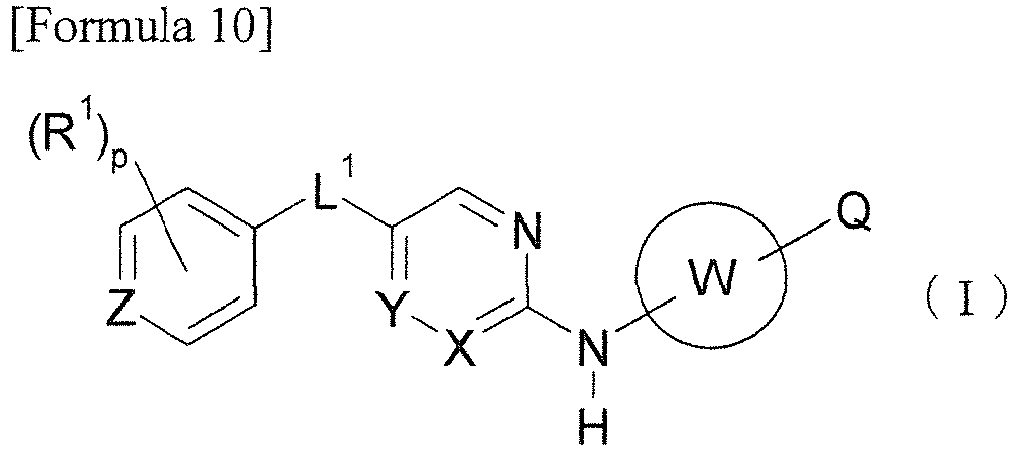
- X is N;
- Y is CH;
- L1 is ethylene or -methylene-O-;
- Z is CH;
- R1, the same or different from one another, are -O-C1-8 alkyl or halogen;
- p is 4;
- ring W is an optionally substituted pyrazole;
- Q is R3;
- R0 is C1-8 alkyl optionally substituted with -OH; and
- R3 is C1-8 alkyl substituted with one or more groups selected from the group consisting of -C(O)OH, carbamoyl optionally substituted with one or two R0, -OH, an optionally substituted non-aromatic heterocyclic group, and -C(O)-(an optionally substituted non-aromatic heterocyclic group); or wherein
- X is N;
- Y is CH;
- L1 is -methylene-O-;
- Z is CH;
- R1, the same or different from one another, are -O-methyl or F;
- p is 4;
- ring W is a benzene ring optionally substituted with -O-methyl;
- Q is -L2-R2;
- L2 is piperidine or 4-methylpiperazine; and
- R2 is 4-methylpiperazine or 2-hydroxyethylamino.
- Unless otherwise specified, when symbols used in one chemical formula herein are also used in another chemical formula, the same symbols have identical meanings.
- The present invention also relates to a pharmaceutical composition that comprises a compound of formula (I) or a salt thereof and a pharmaceutically acceptable excipient.
- A preferred embodiment is a pharmaceutical composition for use in the treatment of FGFR3-related bladder cancer, which comprises a compound of formula (I) or a salt thereof and a pharmaceutically acceptable excipient. Another preferred embodiment is a pharmaceutical composition for the treatment of mutant FGFR3-positive bladder cancer, which comprises a compound of formula (I) or a salt thereof and a pharmaceutically acceptable excipient. In the present specification, "mutant" includes point mutation, fusion mutation, deletion mutation and insertion mutation, and in an embodiment, "mutant" means general idea including point mutation and fusion mutation. In another embodiment, "mutant" means point mutation, and in yet another embodiment, "mutant" means fusion mutation.
- The present invention also relates to a compound
of formula (I) or a salt thereof for use in a method for the treatment for mutant FGFR3-positive cancer and preferably a compound of formula (I) or a salt thereof, for use in a method for the treatment of mutant FGFR3-positive bladder cancer.
The "subject" to be treated is a human or another animal and preferably is a human. - A compound of formula (I) or a salt thereof has inhibitory action on FGFR1, FGFR2, and/or FGFR3, particularly, mutant FGFR3, and can be used as a therapeutic agent for various cancers related to FGFR1, FGFR2, and/or FGFR3, such as lung cancer and hormone therapy-resistant breast cancer, stomach cancer, triple negative breast cancer, endometrial cancer, bladder cancer, and globlastoma, particularly as a therapeutic agent for mutant FGFR3-positive bladder cancer.
- The present invention is described in detail below.
- As used herein, the term "lower alkyl" refers to linear or branched alkyl having 1 to 8 carbon atoms (hereinafter abbreviated as C1-8) including methyl, ethyl, n-propyl, isopropyl, n-butyl, isobutyl, sec-butyl, tert-butyl, n-pentyl, n-hexyl, n-heptyl, n-octyl, and the like. Another embodiment is C1-4 alkyl, and yet another embodiment is methyl. Yet another embodiment is ethyl.
- The term "lower alkylene" refers to linear or branched C1-8 alkylene including methylene, ethylene, trimethylene, tetramethylene, pentamethylene, hexamethylene, heptamethylene, octamethylene, propylene, methylmethylene, ethylethylene, 1,2-dimethylethylene, 1,1,2,2-tetramethylethylene, and the like. Another embodiment is C1-4 alkylene, and yet another embodiment is methylene. Yet another embodiment is ethylene.
- The term "lower alkynylene" refers to linear or branched C2-6 alkynylene including ethynylene, propynylene, butynylene, pentinylene, hexynylene, 1,3-butadiynylene, 1,3-pentadiynylene, and the like. Another embodiment is C2-4 alkynylene, and yet another embodiment is ethynylene.
- The term "cycloalkyl" refers to a C3-10 saturated hydrocarbon ring group and it may be bridged. Examples include cyclopropyl, cyclobutyl, cyclopentyl, cyclohexyl, cycloheptyl, cyclooctyl, adamantyl, and the like. Another embodiment is C3-8 cycloalkyl, and yet another embodiment is C3-6 cycloalkyl. Yet another embodiment is cyclopropyl.
- The term "aromatic carbocyclic ring" refers to a C6-14 monocyclic to tricyclic aromatic hydrocarbon ring. Examples include benzene, naphthalene, and anthracene, and another embodiment is benzene.
- The term "aromatic heterocyclic ring" refers to a 5- to 10-membered aromatic heterocyclic ring which has 1 to 4 heteroatoms selected from the group consisting of nitrogen, oxygen, and sulfur. Examples include pyridine, pyrrole, pyrazine, pyrimidine, pyridazine, imidazole, pyrazole, thiazole, oxazole, isoxazole, thiophene, isothiazole, furan, oxadiazole, thiadiazole, indole, isoindole, indazole, benzofuran, benzothiophene, benzimidazole, benzoxazole, benzothiazole, quinoline, isoquinoline, cinnoline, phthalazine, quinazoline, quinoxaline, thienopyridine, thienopyrimidine, thienopyrazine, and the like. Another embodiment is pyridine, pyrrole, pyrazine, pyrimidine, pyridazine, imidazole, pyrazole, thiazole, oxazole, thiophene, furan, oxadiazole, and indazole. Yet another embodiment is pyridine, pyrimidine, imidazole, pyrazole, thiazole, and indazole. Yet another embodiment is pyridine, imidazole, and pyrazole. Yet another embodiment is pyridine. Yet another embodiment is pyrazole. Yet another embodiment is imidazole.
- The term "aromatic heterocyclic group" refers to a monovalent group of the "aromatic heterocyclic ring" described above. Examples include pyridyl, pyrrolyl, pyrazinyl, pyrimidinyl, pyridazinyl, imidazolyl, pyrazolyl, thiazolyl, oxazolyl, thienyl, furyl, 1,2,4-oxadiazolyl, and the like. Another embodiment is a 5- or 6-membered aromatic heterocyclic group which has 1 or 2 nitrogen atoms, and yet another embodiment is pyridyl.
- The term "non-aromatic heterocyclic ring" refers to a 3- to 10-membered non-aromatic heterocyclic ring (or a 4- to 8-membered non-aromatic heterocyclic ring in one embodiment) having 1 to 4 heteroatoms which are selected from the group consisting of nitrogen, oxygen, and sulfur and which are the same or different. The non-aromatic heterocyclic ring may be fused to a benzene ring or a thiophene ring, be bridged by lower alkylene, be combined with another non-aromatic heterocyclic ring to form a spiro ring, or have an unsaturated bond on part of the own ring. The sulfur atom or nitrogen atom which is a ring-forming atom may be oxidized. Examples include aziridine, oxetane, azetidine, pyrrolidine, piperidine, azepane, diazepane, azocane, piperazine, 4-oxidopiperazine, homopiperazine, morpholine, oxazepane, thiomorpholine, 1,1-dioxidothiomorpholine, 1,1-dioxidotetrahydrothiopyran, 1,1-dioxidothiazolidine, thiazepane, 1-azabicyclo[2,2,2]octane, 7-oxabicyclo[2.2.1]heptane, 2,5-diazabicyclo[2.2.1]heptane, 3-azabicyclo[3.2.1]octane, 8-azabicyclo[3.2.1]octane, 9-azabicyclo[3.3.1]nonane, 3,9-diazabicyclo[3.3.1]nonane, 3,9-diazaspiro[5.5]undecane, 2,6-diazaspiro[3.3]heptane, 2-oxa-6-azaspiro[3.3]heptane, 2-oxa-7-azaspiro[3.5]nonane, tetrahydropyran, tetrahydrofuran, dioxane, dioxolan, tetrahydrothiophene, tetrahydrothiopyran, tetrahydrothienopyridine, tetrahydrobenzoazepine, tetrahydrobenzodiazepine, dihydrobenzofuran, dihydrobenzothiophene, dihydrobenzopyran, dihydrobenzodioxane, benzodioxane, dihydropyran, dihydropyrrole, dihydropyridine, tetrahydropyridine, tetrahydropyrazine, and the like. Another embodiment is a 5- to 7-membered non-aromatic heterocyclic ring having 1 or 2 heteroatoms which are selected from the group consisting of nitrogen, oxygen, and sulfur and which are the same or different. Yet another embodiment is a 5- to 7-membered nitrogen-containing non-aromatic heterocyclic ring which may have at least one nitrogen atom and have one additional heteroatom selected from the group consisting of nitrogen, oxygen, and sulfur. Yet another embodiment is a 6-membered nitrogen-containing non-aromatic heterocyclic ring. Examples include piperazine, piperidine, morpholine, thiomorpholine, 1,1-dioxidothiomorpholine, and the like. Yet another embodiment is oxetane, piperidine, piperazine, morpholine, thiomorpholine, 4-oxidopiperazine, 1,1-dioxidothiomorpholine, tetrahydropyran, tetrahydrofuran, tetrahydrothiophene, tetrahydropyridine, 1-azabicyclo[2.2.2]octane, 8-azabicyclo[3.2.1]octane, 3,9-diazaspiro[5.5]undecane, 2,6-diazaspiro[3.3]heptane, 2-oxa-6-azaspiro[3.3]heptane, or 2-oxa-7-azaspiro[3.5]nonane. Yet another embodiment is morpholine, piperidine, piperazine, 4-oxidopiperazine, 3,9-diazaspiro[5.5]undecane, or 2,6-diazaspiro[3.3]heptane. Yet another embodiment is piperidine. Yet another embodiment is piperazine.
- The term "non-aromatic heterocyclic group" refers to a monovalent group of a non-aromatic heterocyclic ring. The non-aromatic heterocyclic group is a 3- to 10-membered non-aromatic heterocyclic group having 1 to 4 heteroatoms which are selected from the group consisting of nitrogen, oxygen, and sulfur and which are the same or different. The non-aromatic heterocyclic group may be bridged by lower alkylene, have an unsaturated bond on part of the ring, or be combined with another non-aromatic heterocyclic ring to form a spiro ring. The sulfur atom or nitrogen atom which is a ring-forming atom may be oxidized. Examples include aziridinyl, azetidinyl, oxetanyl, pyrrolidinyl, piperidinyl, azepanyl, diazepanyl, azocanyl, piperazinyl, homopiperazinyl, morpholinyl, oxazepanyl, thiomorpholinyl, 1,1-dioxidothiomorpholinyl, thiazepanyl, tetrahydropyranyl, tetrahydrofuryl, dioxanyl, dioxolanyl, tetrahydrothienyl, tetrahydrothiopyranyl, 7-oxabicyclo[2.2.1]heptyl, 2,5-diazabicyclo[2.2.1]heptyl, 3-azabicyclo[3.2.1]octyl, 8-azabicyclo[3.2.1]octyl, 9-azabicyclo[3.3.1]nonyl, 3,9-diazabicyclo[3.3.1]nonyl, dihydropyranyl, dihydropyrrolyl, dihydropyridyl, tetrahydropyridyl, tetrahydropyrazyl, 9-diazaspiro[5.5]undec-3-yl, 1,9-diazaspiro[5.5]undec-9-yl, 2,8-diazaspiro[4.5]dec-8-yl, 1,4-dioxa-8-azaspiro[4.5]dec-8-yl, and the like. Another embodiment is a 5- to 7-membered non-aromatic heterocyclic group having 1 or 2 heteroatoms which are selected from the group consisting of nitrogen, oxygen, and sulfur and which are the same or different. Yet another embodiment is a 5- to 7-membered non-aromatic heterocyclic group having at least one nitrogen atom. Yet another embodiment is a 6-membered nitrogen-containing non-aromatic heterocyclic group. Examples include piperazinyl, piperidinyl, morpholinyl, thiomorpholinyl, 1,1-dioxidothiomorpholinyl, and the like. Yet another embodiment is oxetanyl, piperidinyl, piperazinyl, morpholinyl, thiomorpholinyl, 4-oxidopiperazinyl, 1,1-dioxidothiomorpholinyl, tetrahydropyranyl, tetrahydrofuryl, tetrahydrothienyl, tetrahydropyridyl, 1-azabicyclo[2.2.2]octyl, 8-azabicyclo[3.2.1]octyl, 3,9-diazaspiro[5.5]undec-3-yl, 2,6-diazaspiro[3.3]hept-2-yl, or 2-oxa-6-azaspiro[3.3]hept-6-yl. Yet another embodiment is piperidinyl or piperazinyl. Yet another embodiment is piperidinyl. Yet another embodiment is piperazinyl.
- The term "halogen" refers to -F, -Cl, -Br, or -I. Another embodiment is -F, and yet another embodiment is -Cl.
- A compound of formula (I) or a salt thereof, wherein L1 in formula (I) is -lower alkylene-O-, means a compound of formula (II) or a salt thereof.

- Further, four R1 in (R1)p may be the same or different from one another.
- The phrase "optionally substituted" as used herein means "unsubstituted" or "having 1 to 5 substituents". When a plurality of substituents are contained, these substituents may be the same or different from one another. Further, for example, two R0 on the nitrogen in the "carbamoyl optionally substituted with one or two R0" may be the same lower alkyl or different lower alkyl from each other. Each R0 may be substituted with -OH, or alternatively, either one may be substituted or neither one may be substituted.
- As referred to herein, a substituent in
an optionally substituted pyrazole as ring W in formula (I) is, for example, a group shown in group D1 described below. - Group D1 is a group consisting of:
- (1) an aromatic heterocyclic group optionally substituted with one or more substituents selected from -OH and lower alkyl;
- (2) a non-aromatic heterocyclic group optionally substituted with one or more substituents selected from -OH and lower alkyl;
- (3) halogens;
- (4) -O-lower alkyl, -S-lower alkyl, -OH, and -SH;
- (5) -CN and -NO2;
- (6) -CO2H and -CO2-lower alkyl; and
- (7) lower alkyl or -O-lower alkyl, each of which is optionally substituted with one or more groups selected from the group consisting of the groups shown in (1) to (6) above.
- Another embodiment of group D1 is a group consisting of:
- (1) an aromatic heterocyclic group optionally substituted with -OH;
- (2) halogens;
- (3) -OH;
- (4) -CN;
- (5) -CO2H; and
- (6) lower alkyl or -O-lower alkyl, each of which is optionally substituted with one or more substituents selected from the group consisting of the substituents shown in (1) to (5) above.
- Yet another embodiment of group D1 is a group consisting of:
- (1) lower alkyl optionally substituted with halogen;
- (2) -O-lower alkyl optionally substituted with an aromatic heterocyclic group optionally substituted with -OH;
- (3) halogens; and
- (4) -CN
- Yet another embodiment of group D1 is a group consisting of lower alkyl optionally substituted with halogen; -O-(lower alkyl optionally substituted with one or more substituents selected from the group consisting of a non-aromatic heterocyclic group optionally substituted with oxo, an aromatic heterocyclic group optionally substituted with -OH, and halogens), halogens, cyano, and oxo.
- A substituent acceptable in
"an optionally substituted non-aromatic heterocyclic group" referred to in R3 in formula (I) is, for example, a substituent selected from group D2. - Group D2 is a group consisting of:
- (1) halogens;
- (2) -OH and -SH;
- (3) -CN; and
- (4) lower alkyl optionally substituted with one or more substituents selected from the group consisting of the substituents shown in (1) to (3) above.
- Another embodiment of group D2 is a group consisting of:
- (1) lower alkyl optionally substituted with -OH; and
- (2) -OH
- Some embodiments of the compounds of formula (I) or salts thereof are given below.
- (1) A compound or a salt thereof, wherein X is N and Y is CH.
- (2) A compound or a salt thereof, wherein
L1 is ethylene or -methylene-O-. Yet another embodiment is a compound or a salt thereof, wherein L1 is ethylene. Yet another embodiment is a compound or a salt thereof, wherein L1 is -methylene-O-. - (3) A compound or a salt thereof, wherein Z is CH.
- (4-1) A compound or a salt thereof, wherein p is 4.
- (4-2) A compound or a salt thereof, wherein R1, the same or different from one another, are -O-lower alkyl or halogen. Another embodiment is a compound or a salt thereof, wherein R1, the same or different from one another, are -O-lower alkyl. Yet another embodiment is a compound or a salt thereof, wherein R1, the same or different from one another, are halogen. Yet another embodiment is a compound or a salt thereof, wherein R1, the same or different from one another, are -O-methyl or F. Yet another embodiment is a compound or a salt thereof, wherein R1, the same or different from one another, are -O-methyl or Cl. Yet another embodiment is a compound or a salt thereof, wherein all of R1 are F.
- (5) A compound or a salt thereof, wherein the 6-membered aromatic ring in formula (I) which is substituted with (R1)p and which has Z as a ring-forming atom is 2,6-dichloro-3,5-dimethoxyphenyl or 2,6-difluoro-3,5-dimethoxyphenyl. Another embodiment is a compound or a salt thereof, wherein the 6-membered aromatic ring in formula (I) which is substituted with (R1)p and which has Z as a ring-forming atom is 2,6-dichloro-3,5-dimethoxyphenyl. Another embodiment is a compound or a salt thereof, wherein the 6-membered aromatic ring in formula (I) which is substituted with (R1)p and which has Z as a ring-forming atom is 2,6-difluoro-3,5-dimethoxyphenyl.
- (6) A compound or a salt thereof,
wherein ring W is a benzene ring optionally substituted with -O-methyl. Yet another embodiment is a compound or a salt thereof, wherein ring W is pyrazole optionally substituted with one or more substituents selected from group D1. Yet another embodiment is a compound or a salt thereof, wherein ring W is pyrazole optionally substituted with lower alkyl. Yet another embodiment is a compound or a salt thereof, wherein ring W is pyrazole optionally substituted with methyl. Yet another embodiment is a compound or a salt thereof, wherein ring W is pyrazole substituted with methyl. Yet another embodiment is a compound or a salt thereof, wherein ring W is pyrazole. - (7) A compound or a salt thereof, wherein Q is -L2-R2. Another embodiment is a compound or a salt thereof, wherein Q is R3.
- (8) A compound or a salt thereof,
wherein L2 is piperidine or 4-methylpyperazine. - (9) A compound or a salt thereof,
wherein R2 is 4-methylpiperazine. - (10) A compound or a salt thereof,
wherein R3 is lower alkyl substituted with one or more groups selected from the group consisting of -C(O)OH, carbamoyl optionally substituted with one or two R0, -OH, a non-aromatic heterocyclic group optionally substituted with one or more substituents selected from group D2, and -C(O)-(a non-aromatic heterocylic group optionally substituted with one or more substituents selected from group D2). Yet another embodiment is a compound or a salt thereof, wherein R3 is lower alkyl substituted with one or more substituents selected from the group consisting of -OH, a non-aromatic heterocyclic group optionally substituted with one or more substituents selected from -OH and lower alkyl, and -C(O)-(a non-aromatic heterocyclic group optionally substituted with one or more substituents selected from the group consisting of -OH and lower alkyl). Yet another embodiment is a compound or a salt thereof, wherein R3 is lower alkyl substituted with one or more substituents selected from the group consisting of -OH, a non-aromatic heterocyclic group optionally substituted with lower alkyl, and -C(O)-(a non-aromatic heterocyclic group optionally substituted with -OH). Yet another embodiment is a compound or a salt thereof, wherein R3 is lower alkyl substituted with one or more groups selected from the group consisting of -OH, piperazinyl optionally substituted with methyl, and -C(O)-(azetidinyl optionally substituted with -OH). Yet another embodiment is a compound or a salt thereof, wherein R3 is 2-hydroxyethyl, 2,3-dihydroxypropyl, or 4-methylpiperazin-1-ylmethyl. Yet another embodiment is a compound or a salt thereof, wherein R3 is 4-methylpiperazin-1-ylmethyl. Yet another embodiment is a compound or a salt thereof, wherein R3 is lower alkyl optionally substituted with one or more -OH. Yet another embodiment is a compound or a salt thereof, wherein R3 is 2-hydroxyethyl or 2,3-dihydroxypropyl. - (11) A compound or a salt thereof, which is a consistent combination of any two or more of the embodiments described in (1) to (10) above.
- Examples of specific compounds falling within the scope of the compound of formula (I) include the following compounds:
- (2S)-3-[4-({5-[(2,6-difluoro-3,5-dimethoxybenzyl)oxy]pyrimidin-2-yl}amino)-1H-pyrazol-1-yl]propane-1,2-diol,
- 5-[(2,6-difluoro-3,5-dimethoxybenzyl)oxy]-N-{3-methoxy-4-[4-(4-methylpiperazin-1-yl)piperidin-1-yl]phenyl}pyrimidin-2-amine,
- 2-[4-({5-[(2,6-difluoro-3,5-dimethoxybenzyl)oxy]pyrimidin-2-yl}amino)-1H-pyrazol-1-yl]ethanol,
- 5-[(2,6-difluoro-3,5-dimethoxybenzyl)oxy]-N-{1-[2-(4-methylpiperazin-1-yl)ethyl]-1H-pyrazol-4-yl}pyrimidin-2-amine,
- 2-[4-({5-[(2,6-difluoro-3,5-dimethoxybenzyl)oxy]pyrimidin-2-yl}amino)-1H-pyrazol-1-yl]-1-(3-hydroxyazetidin-1-yl)ethanone,
- (2R)-3-[4-({5-[(2,6-difluoro-3,5-dimethoxybenzyl)oxy]pyrimidin-2-yl}amino)-1H-pyrazol-1-yl]propane-1,2-diol, and
- 5-[(2,6-difluoro-3,5-dimethoxybenzyl)oxy]-N-{1-methyl-5-[(4-methylpiperazin-1-yl)methyl]-1H-pyrazol-3-yl}pyrimidin-2-amine,
and salts thereof. - In yet another embodiment, examples of specific compounds falling within the scope of the compound of formula (I) include the following compounds:
- 5-[(2,6-difluoro-3,5-dimethoxybenzyl)oxy]-N-{3-methoxy-4-[4-(4-methylpiperazin-1-yl)piperidin-1-yl]phenyl}pyrimidin-2-amine,
- 2-[4-({5-[(2,6-difluoro-3,5-dimethoxybenzyl)oxy]pyrimidin-2-yl}amino)-1H-pyrazol-1-yl]ethanol,
- (2R)-3-[4-({5-[(2,6-difluoro-3,5-dimethoxybenzyl)oxy]pyrimidin-2-yl}amino)-1H-pyrazol-1-yl]propane-1,2-diol,
- 5-[(2,6-difluoro-3,5-dimethoxybenzyl)oxy]-N-{1-methyl-5-[(4-methylpiperazin-1-yl)methyl]-1H-pyrazol-3-yl}pyrimidin-2-amine, and salts thereof.
- The compounds of formula (I) may have tautomers and/or geometrical isomers, depending on the type of substituents. Even when the compound of formula (I) appear herein only in one isomer form, the present invention encompasses the other isomers, and also encompasses separated isomers or mixtures thereof.
- Further, since some compounds of formula (I) have an asymmetric carbon atom or axial asymmetry, optical isomers based on this asymmetry may also exist. The present invention also encompasses separated optical isomers of the compounds of formula (I) or mixtures thereof.
- Likewise, salts of the compounds of formula (I) are pharmaceutically acceptable salts of the compounds of formula (I). The compounds of formula (I) may form acid addition salts or salts with bases, depending on the type of substituents. Specific examples include acid addition salts with inorganic acids (e.g., hydrochloric acid, hydrobromic acid, hydroiodic acid, sulfuric acid, nitric acid, phosphoric acid) or with organic acids (e.g., formic acid, acetic acid, propionic acid, oxalic acid, malonic acid, succinic acid, fumaric acid, maleic acid, lactic acid, malic acid, mandelic acid, tartaric acid, dibenzoyltartaric acid, ditoluoyltartaric acid, citric acid, methanesulfonic acid, ethanesulfonic acid, benzenesulfonic acid, p-toluenesulfonic acid, aspartic acid, glutamic acid), salts with inorganic bases (e.g., sodium, potassium, magnesium, calcium, aluminum) or with organic bases (e.g., methylamine, ethylamine, ethanolamine, lysine, ornithine), salts with various amino acids and amino acid derivatives (e.g., acetylleucine), ammonium salts, and the like.
- Moreover, the present invention encompasses the compounds of formula (I) and salts thereof in the form of various hydrates, solvates, and crystalline polymorphic substances. The present invention also encompasses the compounds labeled with various radioactive or non-radioactive isotopes.
- The compounds of formula (I) and salts thereof can be prepared by applying various known synthesis methods on the basis of characteristics derived from their basic structure or the type of their substituents. In some cases, depending on the type of functional group, it is technically effective to replace such a functional group with an appropriate protecting group (a group that can be easily converted into the original functional group) between the starting material stage and the intermediate stage. Examples of the protecting group include those described in Wuts (P. G. M. Wuts) and Greene (T. W. Greene), "Greene's Protective Groups in Organic Synthesis (fourth edition, 2006)", and the like, which may be selected and used as appropriate, depending on reaction conditions. In such a method, after introduction of the protecting group and subsequent reaction, the protecting group may be removed, if needed, to obtain a desired compound.
- Described below are typical processes for preparing the compounds of formula (I). Each process may also be accomplished by reference to the documents cited in this description. It should be noted that the preparation processes of the present invention are not limited to the examples illustrated below.
-

- The compound (I) of the present invention can be obtained by coupling reaction of compound (1a) and compound (2a).
- In this reaction, compounds (1a) and (2a) are used in equal amounts or one of them is used in an excessive amount. A mixture of these compounds is stirred in the presence of a predetermined catalyst, in a solvent inert to the reaction or in the absence of a solvent, generally for 0.1 hour to 5 days under conditions between room temperature and heating to reflux. This reaction is preferably performed under an inert gas atmosphere. Examples of the solvent used in this process include, but are not particularly limited to, aromatic hydrocarbons (e.g., benzene, toluene, xylene), ethers (e.g., diethyl ether, tetrahydrofuran, dioxane, dimethoxyethane), halogenated hydrocarbons (e.g., dichloromethane, 1,2-dichloroethane, chloroform), N-methylpyrrolidone, N,N-dimethylformamide, N,N-dimethylacetamide, dimethyl sulfoxide, ethyl acetate, acetonitrile, tert-butanol, and mixtures thereof. Examples of the predetermined catalyst include palladium acetate, tris(dibenzylideneacetone)dipalladium, and the like. Further, when a palladium catalyst is used, a ligand used for the catalyst may be triphenylphosphine, 1,1'-binaphthalene-2,2'-diylbis(diphenylphosphine), 2-(dicyclohexylphosphino)-2',4',6'-triisopropyl-1,1'-biphenyl, or 4,5-bis(diphenylphosphino)-9,9-dimethylxanthene. The reaction may be performed in the presence of an organic base (e.g., triethylamine, N,N-diisopropylethylamine, or N-methylmorpholine) or an inorganic base (e.g., sodium tert-butoxide, potassium carbonate, sodium carbonate, cesium carbonate, or potassium hydroxide), because it is advantageous for smooth reaction in some cases. Heating the reaction mixture by microwave irradiation is advantageous for smooth reaction in some cases.
- S. R. Sandler and W. Karo, "Organic Functional Group Preparations", second edition, vol. 1, Academic Press Inc., 1991
The Chemical Society of Japan (ed.), "The Fifth Series of Experimental Chemistry", vol. 14, MARUZEN Co., Ltd., 2005 -

- This process is intended to prepare compound (I-1) of the present invention by Sonogashira coupling reaction of compound (1b) and a terminal alkyne derivative.
- In this process, compound (1b) and a terminal alkyne derivative are used in equal amounts or one of them is used in an excessive amount. A mixture of these is stirred in the presence of a base, a palladium catalyst, and copper iodide, in a solvent inert to the reaction, generally for 0.1 hour to 5 days under conditions between room temperature and heating to reflux. This reaction is preferably performed under an inert gas atmosphere. Examples of the solvent used in this process include, but are not particularly limited to, aromatic hydrocarbons (e.g., benzene, toluene, xylene), ethers (e.g., diethyl ether, tetrahydrofuran, dioxane, dimethoxyethane), halogenated hydrocarbons (e.g., dichloromethane, 1,2-dichloroethane, or chloroform), alcohols (e.g., methanol, ethanol, 2-propanol, butanol), N,N-dimethylformamide, dimethyl sulfoxide, and mixtures thereof. The base is preferably an organic base (e.g., triethylamine, N,N-diisopropylethylamine, or N-methylmorpholine) or an inorganic base (e.g., potassium carbonate, sodium carbonate, cesium carbonate, or potassium hydroxide). The palladium catalyst is preferably tetrakis(triphenylphosphine)palladium, dichlorobis(triphenylphosphine)palladium, palladium chloride-1,1'-bis(diphenylphosphino)ferrocene, or the like. Heating the reaction mixture by microwave irradiation is advantageous for smooth reaction in some cases.
- A. d. Meijere and F. Diederich (ed.), "Metal-Catalyzed Cross-Coupling Reactions", first edition, VCH Publishers Inc., 1997
The Chemical Society of Japan (ed.), "The Fifth Series of Experimental Chemistry", vol. 13, MARUZEN Co., Ltd., 2005 - This process is intended to prepare compound (I-2) of the present invention by reducing the alkyne moiety of compound (I-1) of the present invention to alkylene by hydrogenation or diimide reduction.
- In this process, compound (I-1) of the present invention and palladium carbon are used in equal amounts or one of them is used in an excessive amount. A mixture of these is stirred in a solvent inert to the reaction, under a hydrogen atmosphere, generally for 0.1 hour to 5 days under conditions between room temperature and heating to reflux. Examples of the solvent used in this process include, but are not particularly limited to, ethers (e.g., diethyl ether, tetrahydrofuran, dioxane, dimethoxyethane), alcohols (e.g., methanol, ethanol, 2-propanol, butanol), and mixtures thereof.
- Other than the hydrogenation reaction, compound (I-1) of the present invention and predetermined diimide are used in equal amounts or one of them is used in an excessive amount. A mixture of these is stirred in a solvent inert to the reaction, generally for 0.1 hour to 5 days under conditions between room temperature and heating to reflux. Examples of the solvent used in this process are the same as shown above. The predetermined diimide is, for example, 4-methylbenzenesulfonyl hydrazide.
- The substituent(s) on ring W in the compound of formula (I) can be easily converted into other functional groups by the reaction described below in the Examples, reaction obvious to those skilled in the art, or a modified process thereof, using a compound of formula (I) as a starting material. For example, the conversion can be achieved by combining any processes that can be applied generally by those skilled in the art, such as reduction, halogenation, deprotection, hydrolysis, amidation, amination, oxidation, reductive amination, acylation, O-alkylation, N-alkylation, reductive alkylation, and epoxidation.
- The starting compound used in the preparation process described above can be prepared, for example, by a process described below, the process in the Preparation Examples described later, a known process, or a modified process thereof.
-

- This preparation process is intended to prepare compound (3c) which is starting compound (1a) of the Preparation Process 1 wherein L1 is -O-lower alkylene- or -lower alkylene-O-.
- In the case of compound (3a) wherein L7 is halogen, -lower alkylene-OMs, -lower alkylene-OTs, -lower alkylene-OTf, or -lower alkylene-halogen, compounds (3a) and (3b) are used in equal amounts or one of them is used in an excessive amount. A mixture of these is stirred in the presence of a base in a solvent inert to the reaction, generally for 0.1 hour to 5 days under conditions between room temperature and heating to reflux. Examples of the solvent used in this process include, but are not particularly limited to, N-methylpyrrolidone, N,N-dimethylformamide, dimethyl sulfoxide, and the like. The base is preferably an inorganic base such as potassium carbonate, sodium carbonate, cesium carbonate, or potassium hydroxide.
- In the case of compound (3a) wherein L7 is -OH or -lower alkylene-OH, compounds (3a) and (3b) are used in equal amounts or one of them is used in an excessive amount. A mixture of these is stirred in the presence of a predetermined phosphine reagent and a predetermined condensing agent in a solvent inert to the reaction, generally for 0.1 hour to 5 days under conditions between room temperature and heating to reflux. Examples of the solvent used in this process include, but are not particularly limited to, ethers such as diethyl ether, tetrahydrofuran, dioxane, and dimethoxyethane. Examples of the predetermined phosphine reagent include tributylphosphine, triphenylphosphine, and the like. Examples of the predetermined condensing agent include diethyl azodicarboxylate, 1,1'-(azodicarbonyl)dipiperidine, and the like. Use of (cyanomethylene)trimethylphosphorane, instead of the predetermined phosphine and the predetermined condensing agent, is advantageous for smooth reaction in some cases.
-

- This preparation process is intended to prepare compound (4d) which is starting compound (1a) of the Preparation Process 1 wherein L1 is lower alkylene.
- This process is intended to prepare compound (4b) by Sonogashira coupling reaction of compound (4a) and a terminal alkyne derivative.
- The reaction conditions are the same as in Step 1 of the Preparation Process 2.
- This process is intended to prepare compound (4c) by reducing the alkyne moiety of compound (4b) to lower alkylene by hydrogenation.
- The reaction conditions are the same as in Step 2 of the Preparation Process 2.
- This process is intended to prepare compound (4d) by converting the amino group of compound (4c) into halogen.
- In this process, compound (4c) and a combination of copper chloride (II) and n-pentyl nitrite are used in equal amounts or one of them is used in an excessive amount. A mixture of these is stirred in a solvent inert to the reaction, generally for 0.1 hour to 5 days under conditions between ice cooling and heating to reflux. Examples of the solvent used in this process include, but are not particularly limited to, halogenated hydrocarbons such as dichloromethane, 1,2-dichloroethane, and chloroform.
-

- This preparation process is intended to prepare compound (5c) which is starting compound (1b) of the Preparation Process 2 wherein X is N.
- This reaction is intended to prepare compound (5c) by ipso-substitution reaction of compounds (5a) and (5b).
- Compounds (5a) and (5b) are used in equal amounts or one of them is used in an excessive amount. A mixture of these is stirred in a solvent inert to the reaction under a hydrogen atmosphere, generally for 0.1 hour to 5 days under conditions between ice cooling and heating to reflux. Examples of the solvent used in this process include, but are not particularly limited to, alcohols (e.g., methanol, ethanol, 2-propanol, butanol), N-methylpyrrolidone, N,N-dimethylformamide, dimethyl sulfoxide, and mixtures thereof. Use of an acid such as methanesulfonic acid, acetic acid, trifluoroacetic acid, hydrogen chloride, or sulfuric acid is advantageous for smooth reaction in some cases.
- The pharmacological activity of the compounds of formula (I) was confirmed in the tests described below.
- In the enzyme assay, human recombinant FGFR1, FGFR2, and FGFR3 (Carna Biosciences; Catalog Nos. 08-133, 08-134, and 08-135) were used, and reactions were performed at room temperature (FGFR1 and FGFR2) or 30°C (FGFR3). The measurement method is outlined below.
- The compound was diluted with a solution of dimethyl sulfoxide (DMSO) (10-fold common ratio, 4 portions) before dilution with a reaction buffer (100 mM HEPES (pH7.5), 0.003% Brij-35, 0.004% Tween 20, 0.5 mM DTT, and 10 mM MgCl2) so that the final DMSO concentration was 2%. To 4 µL of the compound solution in a 384-well plate, 2 µL each of FGFR1 enzyme (2 or 3 ng/µL), FGFR2 enzyme (2 ng/µL), or FGFR3 enzyme (6 ng/µL) which were diluted with the reaction buffer was added. In 20 minutes, 4 µL of a substrate-ATP solution (100 mM HEPES (pH7.5), 0.003% Brij-35, 0.004% Tween 20, 0.5 mM DTT, 10 mM MgCl2, 3.75 µM substrate-FL-peptide 22+ 500 µM (FGFR1) ATP, 188 µM (FGFR2) ATP, or 250 µM (FGFR3) ATP) was added before subsequent 30-minute reaction. After the reaction was stopped, the reaction mixture was measured with a LabChip EZ Reader. The IC50 values were calculated by non-linear regression based on the inhibition rates obtained. The results of some compounds are shown in Table 1. The term "Ex" in the table denotes compound No. in the Examples described later.
[Table 1] Ex FGFR1 IC50 (nM) FGFR2 IC50 (nM) FGFR3 IC50 (nM) 7 # 2 3 1 11 1 - 2 27 # 2 1 <1 33 # 2 3 2 56 2 2 1 57 # 1 2 2 71 # 2 3 2 72 # - 2 2 84 # 2 2 1 87 # - 3 2 92 # - 2 1 95 # - 3 2 113 1 - 2 114 2 - 1 115 2 - 2 116 1 - 2 122 # - 2 2 248 4 - 5 299 <1 - 2 # Reference Example - FGFR3_S249C/NIH3T3 cells were added to a 96-well spheroid plate (U bottom) at a concentration of 3000 cells/well/90 µL, and the compound solution (10 µL) was added thereto on the next day (final DMSO concentration: 0.1%). The compound solution was prepared by serially diluting the compound with DMSO at a 3-fold common ratio (9 portions and DMSO only) from the maximum concentration of 10 mM and then diluted 100-fold with a culture medium (D-MEM, 10% FBS). 5 days after the addition of the compound, the growth inhibition caused by the compound was evaluated by Promega (G7573) CellTiter-Glo™ Luminescent Cell Viability Assay. The IC50 value was calculated by non-linear regression, using DMSO-added wells as control and assuming count 0 to be 100% inhibition. The results of some compounds are shown in Table 2.
[Table 2] Ex IC50 (nM) 7 # 18 11 13 27 # 13 33 # 26 56 13 57 # 5 71 # 10 72 # 24 84 # 16 87 # 20 92 # 7 95 # 57 113 11 114 7 115 36 116 8 122 # 7 248 50 299 10 # Reference Example - 3×10⁶ UM-UC-14 cells per 0.1 mL (PBS+matrigel, 1:1) were inoculated subcutaneously into the right flank of nude mice (CAnN, Cg-Foxn1nu/CrlCrlj (nu/nu), male, 4- to 5-week-old), and when their tumor size reached about 250 mm3, drug administration was started (Day 1). The drug was administered once a day and the tumor size was measured with a caliper and the body weight was also measured every two or three days. The antitumor effect was finally determined based on the tumor volume (mm3; minor axis (mm) × minor axis (mm) × major axis (mm)/2) at Day 11 (n=3-5). To the control group, 0.5% MC (methyl cellulose) was administered. For "% inhibition" in the table, for example, 100% inhibition indicates that the tumor growth of the control was inhibited to the level of the tumor volume at Day 1. "% regression" indicates what percentage of regression could be achieved compared with the tumor volume at Day 1. Here, the tumor volume at Day 1 means tumor volume immediately before drug administration. The results of some compounds administered orally (1 mg/kg/day for other than Ex 95 and 3 mg/kg/day for Ex 95) are shown in Table 3.
[Table 3] Ex Antitumor Activity 7 # 33% inhibition 11 # 53% regression 27 # 62% inhibition 33 # 70% inhibition 56 4% regression 57 # 77% inhibition 71 # 50% inhibition 72 # 30% inhibition 84 # 34% regression 87 # 72% inhibition 92 # 49% inhibition 95 # 97% inhibition 113 4% regression 114 33% regression 115 70% inhibition 116 54% regression 122 # 15% regression 248 95% inhibition 299 15% regression # Reference Example - The test described above confirmed that the plural compounds of the Examples included in formula (I) of the present invention had inhibitory action on FGFR1, FGFR 2, and/or FGFR3. It was also confirmed that the plural compounds of the Examples included in formula (I) inhibited the growth of the cells with forced expression of mutant FGFR3 and that the compounds also inhibited the growth of bladder cancer or made bladder cancer itself regress, in the animal model bearing mutant FGFR3-positive bladder cancer. In light of the foregoing, the compound of formula (I) or a salt thereof can be used as a therapeutic agent for various cancers related to FGFR1, FGFR 2, and/or FGFR3, particularly, mutant FGFR3-positive bladder cancer.
- cDNA was synthesized by reverse transcription reaction in 200 clinical specimens of lung cancer (Asterand plc.; US) using reverse transciptase (SuperScriptIII, Life Technologies, Corp.) and random primers (random primers, Life Technologies Corp.) in accordance with the protocol of the kit.
- Next, PCR (30 cycles of 98°C for 10 seconds, 55°C for 15 seconds, 68°C for 1.5 minutes) was carried out using primers FGFR3_TACC3_RT_F represented by SEQ ID No: 1 and FGFR3_TACC3_RT_R represented by SEQ ID No: 2, the cDNA obtained above as a template, and DNA polymerase (TaKaRa Ex Taq; Takara Bio Inc.). Additional PCR (30 cycles of 98°C for 15 seconds, 55°C for 15 seconds, 68°C for 1 minute) was carried out using the PCR product described above which was diluted 10-fold as a template, primers FGFR3_TACC3_nested_F represented by SEQ ID No: 3 and FGFR3_TACC3_nested_R represented by SEQ ID No: 4, and the same DNA polymerase as shown above. Electrophoresis performed after the PCR reaction showed that a PCR product of about 500 bases was obtained from only sample Lg344 specimen.
- After that, the PCR product was sequenced by dideoxy sequencing (BigDye Terminator v3.1 Cycle Sequencing Kit; Life Technologies Corp.). As a result, the PCR product of about 500 bases was found to be a sequence obtained by fusion of the 3' end of exon 18 in the coding sequence (hereinafter, CDS) of FGFR3 (NM_001163213.1) registered in the NCBI to the 5' end of exon 11 in the CDS of TACC3 (NM_006342.1).
- cDNA was synthesized by reverse transcription reaction in the Lg344 specimen RNA which is the lung cancer tissue-derived RNA of a squamous cell lung cancer patient (Asterand plc.; US) using reverse transciptase (SuperScriptIII, Life Technologies, Corp.) and oligo(dT) primers (oligo(dT)20 primers, Life Technologies, Corp.) in accordance with the protocol of the kit.
- Next, PCR (25 cycles of 98°C for 15 seconds, 60°C for 15 seconds, 68°C for 3.5 minutes) was carried out using primers FGFR3-TACC3_cloning_F represented by SEQ ID No: 5 and FGFR3-TACC3_cloning_R represented by SEQ ID No: 6, the cDNA obtained above as a template, and DNA polymerase (KOD -plus- Ver. 2; Toyobo Co., Ltd.). Additional PCR (25 cycles of 98°C for 15 seconds, 55°C for 15 seconds, 68°C for 3.5 minutes) was carried out using the PCR product described above which was diluted 10-fold as a template, primers FGFR3_TACC3_cloning_BamHI_F represented by SEQ ID No: 7 and FGFR3_TACC3_cloning_EcoRI_R represented by SEQ ID No: 8, and the same DNA polymerase as shown above. Electrophoresis performed after the PCR reaction showed that a PCR product of about 2.9 k bases was obtained. The PCR product was cloned into a cloning vector (TOPO XL PCR Cloning Kit; Life Technologies, Corp.). The insert was sequenced by dideoxy sequencing (BigDye Terminator v3.1 Cycle Sequencing Kit; Life Technologies, Corp.). As a result, it was found in the PCR product of about 2.9 k bases that there was a transcript obtained by fusion of the region between the 5'-terminus of the CDS of FGFR3 (NM_001163213.1) registered in the NCBI and the 3' end of exon 18 to the region between the 5' end of exon 11 in the CDS of TACC3 (NM_006342.1) and the 3'-terminus of the CDS (FGFR3-TACC3_v1) (SEQ ID No: 9). The polypeptide coded by SEQ ID No: 9 (FGFR3-TACC3_v1 fusion polypeptide) is shown in SEQ ID No: 10.
- cDNA was synthesized by reverse transcription reaction in 59 specimens of bladder cancer (Asterand plc.; US) using reverse transciptase (SuperScriptIII, Life Technologies, Corp.) and random primers (random primers, Life Technologies Corp.) in accordance with the protocol of the kit.
- Next, PCR (30 cycles of 98°C for 10 seconds, 55°C for 15 seconds, 68°C for 1.5 minutes) was carried out using primers FGFR3_TACC3_RT_F represented by SEQ ID No: 1 and FGFR3_TACC3_RT_R represented by SEQ ID No: 2, the cDNA obtained above as a template, and DNA polymerase (TaKaRa Ex Taq; Takara Bio Inc.). Additional PCR (30 cycles of 98°C for 15 seconds, 55°C for 15 seconds, 68°C for 1 minute) was carried out using the PCR product described above which was diluted 10-fold as a template, primers FGFR3_TACC3_nested_F represented by SEQ ID No: 3 and FGFR3_TACC3_nested_R represented by SEQ ID No: 4, and the same DNA polymerase as shown above. Electrophoresis performed after the PCR reaction showed that a PCR product of about 600 bases was obtained from sample Bd106 specimen.
- After that, the PCR product was sequenced by dideoxy sequencing (BigDye Terminator v3.1 Cycle Sequencing Kit; Life Technologies Corp.). As a result, the PCR product of about 600 bases was found to be a sequence obtained by fusion of the 3' end of exon 18 in the CDS of FGFR3 (NM_001163213.1) registered in the NCBI to the 5' end of exon 10 in the CDS of TACC3 (NM_006342.1). cDNA was synthesized by reverse transcription reaction in the Bd106 specimen RNA which is the bladder cancer tissue-derived RNA of a bladder cancer patient (Asterand plc.; US) using reverse transciptase (SuperScriptIII, Life Technologies, Corp.) and oligo(dT) primers (oligo(dT)20 primers, Life Technologies, Corp.) in accordance with the protocol of the kit.
- Next, PCR (25 cycles of 98°C for 15 seconds, 60°C for 15 seconds, 68°C for 3.5 minutes) was carried out using primers FGFR3-TACC3_cloning_F represented by SEQ ID No: 5 and FGFR3-TACC3_cloning_R represented by SEQ ID No: 6, the cDNA obtained above as a template, and DNA polymerase (KOD -plus- Ver. 2; Toyobo Co., Ltd.). Additional PCR (25 cycles of 98°C for 15 seconds, 55°C for 15 seconds, 68°C for 3.5 minutes) was carried out using the PCR product described above which was diluted 10-fold as a template, primers FGFR3_TACC3_cloning_BamHI_F represented by SEQ ID No: 7 and FGFR3_TACC3_cloning_EcoRI_R represented by SEQ ID No: 8, and the same DNA polymerase as shown above. Electrophoresis performed after the PCR reaction showed that a PCR product of about 3.0 k bases was obtained. The PCR product was cloned into a cloning vector (TOPO XL PCR Cloning Kit; Life Technologies, Corp.). The insert was sequenced by dideoxy sequencing (BigDye Terminator v3.1 Cycle Sequencing Kit; Life Technologies, Corp.). As a result, it was found in the PCR product of about 3.0 k bases that there was a transcript obtained by fusion of the region between the 5'-terminus of the CDS of FGFR3 (NM_001163213.1) registered in the NCBI and the 3' end of exon 18 to the region between the 5' end of exon 10 in the CDS of TACC3 (NM_006342.1) and the 3'-terminus of the CDS (FGFR3-TACC3_v2) (SEQ ID No: 11). The polypeptide coded by SEQ ID No: 11 (FGFR3-TACC3_v2 fusion polypeptide) is shown in SEQ ID No: 12.
- cDNA was synthesized by reverse transcription reaction in 59 specimens of bladder cancer (Asterand plc.; US) using reverse transciptase (SuperScriptIII, Life Technologies, Corp.) and random primers (random primers, Life Technologies Corp.) in accordance with the protocol of the kit.
- Next, PCR (30 cycles of 98°C for 10 seconds, 55°C for 15 seconds, 68°C for 1.5 minutes) was carried out using primers FGFR3_TACC3_RT_F represented by SEQ ID No: 1 and FGFR3_TACC3_RT_R represented by SEQ ID No: 2, the cDNA obtained above as a template, and DNA polymerase (TaKaRa Ex Taq; Takara Bio Inc.). Additional PCR (30 cycles of 98°C for 15 seconds, 55°C for 15 seconds, 68°C for 1 minute) was carried out using the PCR product described above which was diluted 10-fold as a template, primers FGFR3_TACC3_nested_F represented by SEQ ID No: 3 and FGFR3_TACC3_nested_R represented by SEQ ID No: 4, and the same DNA polymerase as shown above. Electrophoresis performed after the PCR reaction showed that a PCR product of about 650 bases was obtained from sample Bd021 specimen.
- After that, the PCR product was sequenced by dideoxy sequencing (BigDye Terminator v3.1 Cycle Sequencing Kit; Life Technologies Corp.). As a result, the PCR product of about 650 bases was found to be a sequence obtained by fusion of a certain sequence of exon 19 in the CDS of FGFR3 (NM_001163213.1) registered in the NCBI to a part of intron 10-11 of TACC3 (NM_006342.1) and to the 5' end of exon 11 in the CDS of TACC3.
- cDNA was synthesized by reverse transcription reaction in the Bd021 specimen RNA which is the bladder cancer tissue-derived RNA of a bladder cancer patient (Asterand plc.; US) using reverse transciptase (SuperScriptIII, Life Technologies, Corp.) and oligo(dT) primers (oligo(dT)20 primers, Life Technologies, Corp.) in accordance with the protocol of the kit.
- Next, PCR (25 cycles of 98°C for 15 seconds, 60°C for 15 seconds, 68°C for 3.5 minutes) was carried out using primers FGFR3-TACC3_cloning_F represented by SEQ ID No: 5 and FGFR3-TACC3_cloning_R represented by SEQ ID No: 6, the cDNA obtained above as a template, and DNA polymerase (KOD -plus- Ver. 2; Toyobo Co., Ltd.). Additional PCR (25 cycles of 98°C for 15 seconds, 55°C for 15 seconds, 68°C for 3.5 minutes) was carried out using the PCR product described above which was diluted 10-fold as a template, primers FGFR3_TACC3_cloning_BamHI_F represented by SEQ ID No: 7 and FGFR3_TACC3_cloning_EcoRI_R represented by SEQ ID No: 8, and the same DNA polymerase as shown above. Electrophoresis performed after the PCR reaction showed that a PCR product of about 3.0 k bases was obtained. The PCR product was cloned into a cloning vector (TOPO XL PCR Cloning Kit; Life Technologies, Corp.). The insert was sequenced by dideoxy sequencing (BigDye Terminator v3.1 Cycle Sequencing Kit; Life Technologies, Corp.). As a result, it was found in the PCR product of about 3.0 k bases that there was a transcript obtained by fusion of the region between the 5'-terminus of the CDS of FGFR3 (NM_001163213.1) registered in the NCBI and a certain sequence of exon 19 to part of intron 10-11 of TACC3 (NM_006342.1) and further to the region between the 5' end of exon 11 in the CDS of TACC3 and the 3'-terminus of the CDS (FGFR3-TACC3_v3) (SEQ ID No: 13). The polypeptide coded by SEQ ID No: 13 (FGFR3-TACC3_v3 fusion polypeptide) is shown in SEQ ID No: 14.
- cDNA was synthesized by reverse transcription reaction in RNA purified from bladder cancer patient-derived cell line RT-112 (purchased from Leibniz-Institut DSMZ-Deutsche Sammlung von Mikroorganismen und Zellkulturen GmbH) using reverse transciptase (SuperScriptIII, Life Technologies, Corp.) and oligo(dT) primers (oligo(dT)20 primers, Life Technologies, Corp.) in accordance with the protocol of the kit.
- Next, PCR (25 cycles of 98°C for 15 seconds, 60°C for 15 seconds, 68°C for 3.5 minutes) was carried out using primers FGFR3-TACC3_cloning_F represented by SEQ ID No: 5 and FGFR3-TACC3_cloning_R represented by SEQ ID No: 6, the cDNA obtained above as a template, and DNA polymerase (KOD -plus- Ver. 2; Toyobo Co., Ltd.). Additional PCR (25 cycles of 98°C for 15 seconds, 55°C for 15 seconds, 68°C for 3.5 minutes) was carried out using the PCR product described above which was diluted 10-fold as a template, primers FGFR3_TACC3_cloning_BamHI_F represented by SEQ ID No: 7 and FGFR3__TACC3_cloning_EcoRI_R represented by SEQ ID No: 8, and the same DNA polymerase as shown above. Electrophoresis performed after the PCR reaction showed that a PCR product of about 2.9 k bases was obtained. The PCR product was cloned into a cloning vector (TOPO XL PCR Cloning Kit; Life Technologies, Corp.), and the insert was sequenced by dideoxy sequencing (BigDye Terminator v3.1 Cycle Sequencing Kit; Life Technologies, Corp.). As a result, it was found that a transcript obtained was the same as the transcript obtained by fusion of the region between the N-terminus of the CDS of FGFR3 (NM_001163213.1) registered in the NCBI and the 3' end of exon 18 to the region between the 5' end of exon 11 in the CDS of TACC3 (NM_006342.1) and the C-terminus of the CDS (FGFR3-TACC3_v1) (SEQ ID No: 9).
- cDNA was synthesized by reverse transcription reaction in RNA purified from bladder cancer patient-derived cell line RT4 (purchased from ECACC (European Collection of Cell Cultures)) using reverse transciptase (SuperScriptIII, Life Technologies, Corp.) and oligo(dT) primers (oligo(dT)20 primers, Life Technologies, Corp.) in accordance with the protocol of the kit. Next, PCR (30 cycles of 98°C for 15 seconds, 60°C for 15 seconds, 68°C for 5.5 minutes) was carried out using primers FGFR3-TACC3_cloning_F represented by SEQ ID No: 5 and FGFR3-TACC3_cloning_R represented by SEQ ID No: 6, the cDNA obtained above as a template, and DNA polymerase (KOD -plus- Ver. 2; Toyobo Co., Ltd.). Additional PCR (30 cycles of 98°C for 15 seconds, 55°C for 15 seconds, 68°C for 5 minutes) was carried out using the PCR product described above which was diluted 10-fold as a template, primers FGFR3_TACC3_cloning_BamHI_F represented by SEQ ID No: 7 and FGFR3_TACC3_cloning_EcoRI_R represented by SEQ ID No: 8, and the same DNA polymerase as shown above. Electrophoresis performed after the PCR reaction showed that a PCR product of about 4.5 k bases was obtained. The PCR product was cloned into a cloning vector (TOPO XL PCR Cloning Kit; Life Technologies, Corp.), and the insert was sequenced by dideoxy sequencing (BigDye Terminator v3.1 Cycle Sequencing Kit; Life Technologies, Corp.). As a result, it was found that there was a transcript obtained by fusion of part of intron 18-19 sequence of FGFR3 (NM_001163213.1) registered in the NCBI to the region between the 5'-terminus of the CDS of the FGFR3 and the 3' end of exon 18 and further to the region between a certain sequence of exon 4 of TACC3 (NM_006342.1) and the 3'-terminus of the CDS of the TACC3 (FGFR3-TACC3_v4). In the confirmed sequence, T at base position 882 was replaced by C (SNPs registration No.; rs2234909), C at base position 2484 by T, and G at base position 2663 by A (SEQ ID No: 15). The polypeptide coded by SEQ ID No: 15 (FGFR3-TACC3_v4 fusion polypeptide) is shown in SEQ ID No: 16.
- To express, as proteins, the ORF full lengths of FGFR3-TACC3_v1, FGFR3-TACC3_v2, FGFR3-TACC3_v3, and FGFR3-TACC3_v4, enzyme reaction was performed at 37°C for 3 hours using the cloning vectors prepared in Test Examples 4, 5, 6, and 8 and restriction enzyme BamHI, and restriction enzyme digested DNA fragments were obtained and purified. Another enzyme reaction was performed at 37°C for 3 hours using EcoRI and the DNA fragments, and restriction enzyme digested DNA fragments were obtained and purified. The ORF-containing DNA fragments were cloned into BamHI and EcoRI sites in the multicloning site of an expression vector (pMXs-puro; Cosmo Bio) to construct expression plasmids (FGFR3-TACC3_v1/pMXs-puro, FGFR3-TACC3_v2/pMXs-puro, FGFR3-TACC3_v3/pMXs-puro, and FGFR3-TACC3_v4/pMXs-puro).
- 9 µg each of FGFR3-TACC3_v1/pMXs-puro, FGFR3-TACC3_v2/pMXs-puro, FGFR3-TACC3_v3/pMXs-puro, and FGFR3-TACC3_v4/pMXs-puro was transfected into Platinum-E cells, using a transfection reagent (FUGENE(R) HD, Roche). At 24 hours after the transfection, D-MEM media (Dulbecco's Modified Eagle Medium; Invitrogen) containing 10% bovine serum (Nichirei Biosciences) were replaced, and the culture supernatants were collected after 24 hours to prepare retrovirus solutions.
- To the virus solutions prepared using FGFR3-TACC3_v1/pMXs-puro, FGFR3-TACC3_v2/pMXs-puro, FGFR3-TACC3_v3/pMXs-puro, and FGFR3-TACC3_v4/pMXs-puro in Test Example 9, 4 µg/mL of polybrene (Polybrene; Sigma) was added followed by addition of the resulting mixtures to NIH3T3 cells for infection. At 6 hours after the addition, the media used were replaced by D-MEM media containing 10% bovine serum (Nichirei Biosciences), and, on the day after the infection, the media were replaced by D-MEM media (Invitrogen) containing 10% bovine serum (Nichirei Biosciences) and 1 µg/mL of puromycin (Sigma). The culture was continued in the presence of 5% CO2 at 37°C for 4 weeks to obtain NIH3T3 cells stably expressing each of FGFR3-TACC3_v1, FGFR3-TACC3_v2, FGFR3-TACC3_v3, and FGFR3-TACC3_v4 (these cells were designated as FGFR3-TACC3_v1-expressiong NIH3T3 cells, FGFR3-TACC3_v2-expressing NIH3T3 cells, FGFR3-TACC3_v3-expressing NIH3T3 cells, and FGFR3-TACC3_v4-expressing NIH3T3 cells, respectively.)
- To investigate the anchorage-independent growth-promoting ability of FGFR3-TACC3_v1-expressing NIH3T3 cells, FGFR3-TACC3_v2-expressing NIH3T3 cells, FGFR3-TACC3_v3-expressing NIH3T3 cells, and FGFR3-TACC3_v4-expressing NIH3T3 cells, these cells and NIH3T3 cells infected with a blank vector pMXs-puro (Mock/NIH3T3 cells) were each seeded at 1x10³ cells per well in D-MEM media (Invitrogen) containing 10% bovine serum (Nichirei Biosciences) in a 96-well spheroid plate (Sumilon Celltight Spheroid 96U; Sumitomo Bakelite). The cells were cultured in the presence of 5% CO2 at 37°C and were counted on the next day (Day 1) and 4 days later (Day 4), using a cell counting reagent (CELLTITER-Glo™ Luminescent Cell Viability Assay; Promega) in accordance with the method described in the manual. A luminometer was used for detection. It was confirmed that the count of Mock/NIH3T3 cells did not increase between Day 1 and Day 4, while the counts of FGFR3-TACC3_v1-expressing NIH3T3 cells, FGFR3-TACC3_v2-expressing NIH3T3 cells, FGFR3-TACC3_v3-expressing NIH3T3 cells, and FGFR3-TACC3_v4-expressing NIH3T3 cells increased about 3.1-fold, about 2.8-fold, about 2.3-fold, and about 2.5-fold, respectively, between Day 1 and Day 4.
- In light of the foregoing, it was found that FGFR3-TACC3_v1-expressiong NIH3T3 cells, FGFR3-TACC3_v2-expressing NIH3T3 cells, FGFR3-TACC3_v3-expressing NIH3T3 cells, and FGFR3-TACC3_v4-expressing NIH3T3 cells exhibit anchorage-independent cell growth.
- Measurement for anchorage-independent cell growth (colony method, etc.) is known to be a system for investigating the anticancer action (pharmacological effect) of compounds (Clinical Oncology, second edition, Cancer and Chemotherapy Publishers Inc.). As a method for measuring the non-adhesive growth of cells, there is the following method using a spheroid plate as referred to above in place of the colony method.
- In a 96-well spheroid plate (Sumilon Celltight Spheroid 96U; Sumitomo Bakelite), FGFR3-TACC3_v1-expressing NIH3T3 cells, FGFR3-TACC3_v2-expressing NIH3T3 cells, FGFR3-TACC3_v3-expressing NIH3T3 cells, and FGFR3-TACC3_v4-expressing NIH3T3 cells were each seeded at 1×10³ cells per well in D-MEM media (Invitrogen) containing 10% fetal bovine serum. Likewise, bladder cancer patient-derived cell line RT-112 was seeded at 1×10³ cells per well in RPMI1640 medium containing 10% fetal bovine serum and 2 mM L-glutamine, and bladder cancer patient-derived cell line RT4 was seeded at 1×10³ cells per well in RPMI1640 medium containing 10% fetal bovine serum. A well supplemented with only medium was also prepared for a positive control. Culturing was performed overnight in the presence of 5% CO2 at 37°C followed by addition of test compounds (final concentrations: 100 nM, 10 nM, and 1 nM). As a negative control, DMSO used as a solvent for the compounds was added at the same concentration (0.1%) as in the case of addition of the compounds. Then, culturing was performed in the presence of 5% CO2 at 37°C for 4 days, and a cell counting reagent (CellTiter-Glo™ Luminescent Cell Viability Assay; Promega) was added and the resulting mixture was stirred for 20 minutes followed by measurement with a luminometer. Assuming that the values of the positive control and the negative control were 100% inhibition and 0% inhibition, respectively, the growth inhibition rate (%) was calculated for each compound. As shown in Table 4, it was found out that some compounds of the present invention inhibited the anchorage-independent growth of FGFR3-TACC3_v1-expressing NIH3T3 cells, FGFR3-TACC3_v2-expressing NIH3T3 cells, FGFR3-TACC3_v3-expressing NIH3T3 cells, FGFR3-TACC3_v4-expressing NIH3T3 cells, and bladder cancer patient-derived cell lines RT-112 and RT4.
- The results described above showed that the growth of cancer cells and tumors that express FGFR3-TACC3_v1, FGFR3-TACC3_v2, FGFR3-TACC3_v3, and FGFR3-TACC3_v4 can be inhibited by the compounds of the present invention.
[Table 4] Ex v1 v2 v3 v4 RT-112 RT4 56 100 nM 92 91 91 90 90 64 10 nM 84 79 78 82 83 42 1 nM 22 21 20 22 29 5 113 100 nM 91 91 87 88 89 64 10 nM 53 42 32 73 77 39 1 nM 4 2 3 13 23 8 116 100 nM 91 90 86 89 89 63 10 nM 44 31 24 70 72 39 1 nM 5 0 3 11 21 8 122 # 100 nM 90 88 89 89 89 63 10 nM 84 79 79 82 80 43 1 nM 26 23 25 19 23 6 248 100 nM 84 79 81 83 81 43 10 nM 28 29 20 26 33 10 1 nM 7 11 6 -5 5 3 299 100 nM 92 91 89 90 89 63 10 nM 77 63 51 82 84 45 1 nM 9 4 5 16 31 8 # Reference Example - To obtain 5'-terminally FLAG-tagged FGFR3-TACC3 fusion polynucleotide, PCR was carried out for 5'-terminal FLAG tagging using the vectors cloned in Test Examples 4, 5, and 6 as templates. PCR (12 cycles of 98°C for 15 seconds, 55°C for 15 seconds, 68°C for 3.5 minutes) was carried out using primers FGFR3_N_FLAG_BamHI represented by SEQ ID No: 17 and FGFR3_TACC3_cloning_EcoRI_R represented by SEQ ID No: 8 and DNA polymerase (KOD -plus- Ver. 2; Toyobo Co., Ltd.). PCR products obtained were cloned into cloning vectors (TOPO XL PCR Cloning Kit; Life Technologies, Corp.). The inserts were sequenced by dideoxy sequencing (BigDye Terminator v3.1 Cycle Sequencing Kit; Life Technologies, Corp.). As a result, it was confirmed that the PCR products were nucleic acid sequences of SEQ ID Nos: 9, 11, and 13 in which the three bases coding for the first methionine (ATG) were deleted and start codon and a nucleic acid sequence coding for FLAG tag (SEQ ID No: 24) were added to the 5'-terminus. Polypeptides coded by the above are referred to FGFR3-TACC3_v1 (N-FLAG) fusion polypeptide, FGFR3-TACC3_v2 (N-FLAG) fusion polypeptide and FGFR3-TACC3_v3 (N-FLAG) fusion polypeptide, respectively, and these polypeptides are collectively referred to FGFR3-TACC3 (N-FLAG) fusion polypeptide. Further, to construct an expression vector expressing, as a protein, each of the ORF full lengths of FGFR3-TACC3_v1 (N-FLAG), FGFR3-TACC3_v2 (N-FLAG), and FGFR3-TACC3_v3 (N-FLAG) which contained these FLAG sequences added, enzyme reaction was performed at 37°C for 3 hours using the cloning vectors described above and restriction enzyme BamHI, and restriction enzyme digested DNA fragments were obtained and purified. Further, enzyme reaction was performed at 37°C for 3 hours using EcoRI and the DNA fragments, and restriction enzyme digested DNA fragments were obtained and purified. These ORF-containing DNA fragments were cloned into BamHI and EcoRI sites in the multicloning site of an expression vector (pcDNA3.1/Zeo(+); Life Technologies, Corp.) to construct expression plasmids (FGFR3-TACC3_v1 (N-FLAG)/pcDNA3.1/Zeo(+), FGFR3-TACC3_v2 (N-FLAG)/pcDNA3.1/Zeo(+), and FGFR3-TACC3_v3 (N-FLAG)/pcDNA3.1/Zeo(+)).
- On the day before transfection, 0.5×10⁷ HEK293 cells per collagen-coated 15-cm dish were cultured in D-MEM medium containing 10% fetal bovine serum to prepare 10 dishes. On the day of transfection, 27 µg each of FGFR3-TACC3_v1 (N-FLAG)/pcDNA3.1/Zeo(+), FGFR3-TACC3_v2 (N-FLAG)/pcDNA3.1/Zeo(+), and FGFR3-TACC3_v3 (N-FLAG)/pcDNA3.1/Zeo(+) (Test Example 12) per dish was transfected into HEK293 cells, using 81 µL of a transfection reagent (FUGENE(R) HD, Roche). At 24 hours after the transfection, the media were removed, and after washing three times with PBS, 1 mL of PBS was added. The cells were scraped with a cell scraper (Corning Inc.) and then recovered in polypropylene tubes. After centrifugation at 1200 rpm for 5 minutes, the supernatant was removed, 150 µL of a cell lysate (50 mM Tris-HCl (pH8.0), 150 mM NaCl, 1% NP-40, 1 mM EDTA, and protease inhibitor cocktail complete) was added, and the cells were incubated on ice for 30 minutes and lysed. Each of the FGFR3-TACC3_v1 (N-FLAG) fusion polypeptide, FGFR3-TACC3_v2 (N-FLAG) fusion polypeptide, and FGFR3-TACC3_v3 (N-FLAG) fusion polypeptide which were present in the supernatant obtained after the centrifugation was purified using M2 antibody affinity gel (ANTI-FLAG M2 Affinity Gel; Sigma-Aldrich) in accordance with the method described in the product information document. A wash liquid (50 mM Tris-HCl (pH8.0), 150 mM NaCl, 1% NP-40, 1 mM EDTA, and protease inhibitor cocktail complete) and an eluate (20 mM Tris-HCl (pH7.4), 10 mM MgCl2, 10 mM MnCl2, and 0.5mg/mL of FLAG peptide) were used for washing and elution, respectively, to give 100 µL of eluates. The eluates were subjected to immunoblotting using an anti-FGFR3 antibody (Cell Signaling Technology) and an anti-FLAG M2 antiboty (Sigma-Aldrich) and silver staining, and then confirmed that FGFR3-TACC3_v1 (N-FLAG) fusion polypeptide, FGFR3-TACC3_v2 (N-FLAG) fusion polypeptide, and FGFR3-TACC3_v3 (N-FLAG) fusion polypeptide were obtained.
- FGFR3-TACC3_v1 (N-FLAG) fusion polypeptide, FGFR3-TACC3_v2 (N-FLAG) fusion polypeptide, and FGFR3-TACC3_v3 (N-FLAG) fusion polypeptide, which were purified as described above were used to investigate their phosphorylating activity against a peptide substrate by using a kinase activity detection kit (HTRF KinEASE-TK; Cisbio). The reaction buffer was prepared by adding 1 mM (final concentration) of DTT and 5 mM (final concentration) of Mg to 5x kinase buffer enclosed in the kit using 1 µL of 1-fold, 3-fold and 10-fold diluted solutions of the above prepared elutates as enzyme solutions, respectively, in 384-well, low-volume black plate (Corning). Using 2.0 µM (final concentration) of TK Substrate enclosed in the kit as a substrate, the reaction was performed in a final volume of 5.0 µL at room temperature for 1 hour in each case of adding no ATP and adding 100 µM ATP (final concentration). After the reaction, Sa-XL665 solution and TK Antibldy-Eu(K) solution were prepared in accordance with kit-recommended method and added each of 2.5 µL of the solutions. After the reaction was performed at room temperature for 1 hour, the HTRF counts (i.e., phosphorylation of the peptide substrate) were detected. As the results, it was showed that compared with ATP-free ones, the HTRF counts in ATP-added ones had increased about 38-fold, about 40-fold, and about 38-fold, respectively, in the case of adding 1 µL of 1-fold diluted solutions of the eluates described above including FGFR3-TACC3_vl (N-FLAG) fusion polypeptide, FGFR3-TACC3_v2 (N-FLAG) fusion polypeptide, and FGFR3-TACC3_v3 (N-FLAG) fusion polypeptide, had increased about 27-fold, 34-fold, and 31-fold, respectively, in the case of adding 1 µL of 3-fold diluted solutions of the eluates, and had increased 5-fold, 18-fold, and 11-fold, respectively, in the case of adding 1 µL of 10-fold diluted solutions of the eluates.
- As described above, the in vitro kinase activity of the respective fusion polypeptides could be detected by use of a kinase activity detection kit.
- The inhibitory activity of the test compounds on the in vitro kinase activity of FGFR3-TACC3_v1 (N-FLAG) fusion polypeptide, FGFR3-TACC3_v2 (N-FLAG) fusion polypeptide, and FGFR3-TACC3_v3 (N-FLAG) fusion polypeptide was investigated using the kinase activity detection kit described above and 384-well plate of the same sort. The compounds were added so that the final concentrations were 100 nM, 10 nM, and 1 nM, and DMSO was added as a control so that the concentration was 0.1%. For FGFR3-TACC3_v1 (N-FLAG) fusion polypeptide, 1 µL of a 2-fold diluted solution of the eluate described above was added; for FGFR3-TACC3_v2 (N-FLAG) fusion polypeptide, 1 µL of a 3-fold diluted solution of the eluate described above was added; and for FGFR3-TACC3_v3 (N-FLAG) fusion polypeptide, 1 µL of a 3-fold diluted solution of the eluate described above was added. TK Substrate enclosed in the kit as a substrate was added in a final concentration of 2.0 µM, the reaction was performed at room temperature for 15 minutes. Then the reaction was performed in a final volume of 5.0 µL at room temperature for 60 minutes in each case of adding no ATP and adding 100 µM ATP (final concentration). After the other processes were performed by addition of each of 2.5 µL of Sa-XL665 solution and TK Antibody-Eu(K) solution prepared by using similar method to that described in (3) above, and the reaction was performed at room temperature for 1 hour, the HTRF counts were detected. Assuming that the phosphorylation counts with adding no ATP and adding ATP in the absence of the compounds (DMSO was added in a concentration of 0.1%, the concentration equal to the compounds) were 100% inhibition and 0% inhibition, respectively, the inhibition rates (%) of the kinase activity of FGFR3-TACC3_v1 (N-FLAG) fusion polypeptide, FGFR3-TACC3_v2 (N-FLAG) fusion polypeptide, and FGFR3-TACC3_v3 (N-FLAG) fusion polypeptide were calculated for the compounds, using the following formula:

- As a result, as shown in Table 5, it was found out that some compounds of the present invention inhibit the phosphorylating activity of purified FGFR3-TACC3_v1 (N-FLAG) fusion polypeptide, purified FGFR3-TACC3_v2 (N-FLAG) fusion polypeptide, and purified FGFR3-TACC3_v3 (N-FLAG) fusion polypeptide against the peptide substrate.
[Table 5] Ex v1 v2 v3 56 100 nM 92 94 93 10 nM 77 86 85 1 nM 49 33 47 113 100 nM 92 94 96 10 nM 79 74 81 1 nM 28 24 35 116 100 nM 95 95 96 10 nM 79 73 86 1 nM 31 22 41 122 # 100 nM 94 95 97 10 nM 80 80 85 1 nM 34 27 45 248 100 nM 86 78 91 10 nM 40 25 55 1 nM 7 6 30 299 100 nM 94 95 96 10 nM 84 77 88 1 nM 35 20 47 # Reference Example - cDNA was synthesized by reverse transcription reaction in RNA purified from bladder cancer patient-derived cell line SW780 (purchased from ATCC) using reverse transciptase (SuperScriptIII, Life Technologies, Corp.) and oligo(dT) primers (oligo(dT)20 primers, Life Technologies, Corp.) in accordance with the protocol of the kit.
- Next, PCR (30 cycles of 98°C for 15 seconds, 60°C for 15 seconds, 68°C for 5 minutes) was carried out using primers FGFR3-BAIAP2L1_cloning_F represented by SEQ ID No: 18 and FGFR3-BAIAP2L1_cloning_R represented by SEQ ID No: 19, the cDNA obtained above as a template, and DNA polymerase (KOD -plus- Ver. 2; Toyobo Co., Ltd.). Additional PCR (30 cycles of 98°C for 15 seconds, 55°C for 15 seconds, 68°C for 4 minutes) was carried out using the PCR product described above which was diluted 10-fold as a template, primers FGFR3_BAIAP2L1_cloning_BamHI_F represented by SEQ ID No: 20 and FGFR3_BAIAP2L1_cloning_NotI_R represented by SEQ ID No: 21, and the same DNA polymerase as shown above. Electrophoresis performed after the PCR reaction showed that a PCR product of about 3.8 k bases was obtained. The PCR product was cloned into a cloning vector (TOPO XL PCR Cloning Kit; Life Technologies, Corp.), and the insert was sequenced by dideoxy sequencing (BigDye Terminator v3.1 Cycle Sequencing Kit; Life Technologies, Corp.). As a result, the product was found to be a transcript obtained by fusion of the region between the 5'-terminus of the CDS of FGFR3 (NM_001163213.1) registered in the NCBI and the 3' end of exon 18 to the region between the 5' end of exon 2 in the CDS of BAIAP2L1 (NM_018842.4) and the 3'-terminus of the CDS (FGFR3-BAIAP2L1). In the confirmed sequence, G at base position 3558 was replaced by A (SNPs registration No.: rs1045916), C at base position 3723 by T, and G at base position 3747 by A (SEQ ID No: 22). The polypeptide coded by SEQ ID No: 22 is shown in SEQ ID No: 23.
- To construct an expression plasmid expressing, as a protein, the ORF full length of FGFR3-BAIAP2L1, enzyme reaction was performed at 37°C for 3 hours using the cloning vector described above and restriction enzyme BamHI, and restriction enzyme digested DNA fragments were obtained and purified. Further, enzyme reaction was performed at 37°C for 3 hours using NotI and the DNA fragments, and restriction enzyme digested DNA fragments were obtained and purified. This ORF-containing DNA fragment was cloned into BamHI and NotI sites in the multicloning site of an expression vector (pMXs-puro; Cosmo Bio) to construct an expression plasmid (FGFR3-BAIAP2L1/pMXs-puro). The prepared FGFR3-BAIAP2L1/pMXs-puro was used to prepare a retrovirus solution in accordance with the method used in Test Example 9.
- The virus solution prepared using FGFR3-BAIAP2L1/pMXs-puro in Test Example 14 was used to obtain NIH3T3 cells expressing FGFR3-BAIAP2L1 stably in accordance with the method used in Test Example 10 (designated as FGFR3-BAIAP2L1-expressing NIH3T3 cells).
- To investigate the anchorage-independent growth-promoting ability of FGFR3-BAIAP2L1-expressing NIH3T3 cells, the same method as in Test Example 10 was applied. It was confirmed that the count of Mock/NIH3T3 cells did not increase between Day 1 and Day 4, while the count of FGFR3-BAIAP2L1-expressing NIH3T3 cells increased about 2.5-fold between Day 1 and Day 4. In light of the foregoing, it was shown that FGFR3-BAIAP2L1-expressing NIH3T3 cells exhibit anchorage-independent cell growth.
- In a 96-well spheroid plate (Sumilon Celltight Spheroid 96U; Sumitomo Bakelite), FGFR3-BAIAP2L1-expressing NIH3T3 cells were seeded at 1×10³ cells per well in D-MEM medium containing 10% fetal bovine serum. A well supplemented with only medium was also prepared for a positive control. Culturing was performed overnight in the presence of 5% CO2 at 37°C followed by addition of test compounds (final concentrations: 100 nM, 10 nM, and 1 nM). As a negative control, DMSO used as a solvent for the compounds was added at the same concentration (0.1%) as in the case of addition of the compounds. Then, culturing was performed in the presence of 5% CO2 at 37°C for 4 days, and a cell counting reagent (CellTiter-Glo™ Luminescent Cell Viability Assay; Promega) was added and the resulting mixture was stirred for 20 minutes followed by measurement with a luminometer. Assuming that the values of the positive control and the negative control were 100% inhibition and 0% inhibition, respectively, the growth inhibition rate (%) was calculated for each compound. As shown in Table 6, it was found out that some compounds of the present invention inhibit the anchorage-independent growth of FGFR3-BAIAP2L1-expressing NIH3T3 cells.
- The results described above showed that the growth of cancer cells and tumors that express FGFR3-BAIAP2L1 can be inhibited by the compounds of the present invention.
[Table 6] Ex FGFR3-BAIAP2L1-expressing NIH3T3 Cells 56 100 nM 90 10 nM 80 1 nM 24 113 100 nM 89 10 nM 70 1 nM 14 116 100 nM 87 10 nM 74 1 nM 15 122 # 100 nM 90 10 nM 83 1 nM 17 248 100 nM 82 10 nM 19 1 nM -3 299 100 nM 91 10 nM 81 1 nM 15 # Reference Example - A pharmaceutical composition which comprises one or more of the compounds of formula (I) or salts thereof, as active ingredient, can be prepared in a conventional manner by using an excipient commonly used in the art, more specifically, a pharmaceutical excipient, pharmaceutical carrier, or another additive.
- Any mode of administration may be used: namely, either oral administration in the form of tablets, pills, capsules, granules, powders, solutions or the like, or parenteral administration in the form of injections (e.g., intraarticular, intravenous, or intramuscular injection), suppositories, eye drops, eye ointments, percutaneous solutions, ointments, percutaneous patches, transmucosal solutions, transmucosal patches, inhalants, intravesical instillation or the like.
- Solid compositions used for oral administration include tablets, powders, granules, and the like. In these solid compositions, one or more active ingredients are mixed with at least one inert excipient. The compositions may also comprise inert additives such as lubricants, disintegrating agents, stabilizers, and/or solubilizers, as in usual cases. Tablets or pills may be coated with sugar or a gastrosoluble or enteric film, if needed.
- Liquid compositions for oral administration include pharmaceutically acceptable emulsions, solutions, suspensions, syrups, elixirs, and the like, and comprise a commonly-used inert diluent such as purified water or ethanol. These liquid compositions may comprise auxiliaries (e.g., solubilizers, wetting agents, suspending agents), sweeteners, flavors, aromatics, and/or antiseptics, in addition to such an inert diluent.
- Injections for parenteral administration include sterile aqueous or non-aqueous solutions, suspensions, or emulsions. Examples of aqueous solvents include injectable distilled water and physiological saline. Examples of non-aqueous solvents include alcohols such as ethanol. These compositions may further comprise isotonizing agents, antiseptics, wetting agents, emulsifiers, dispersants, stabilizers or solubilizers. They are sterilized, for example, by filtration through a bacteria-retaining filter, by incorporation of disinfectants, or by irradiation. Alternatively, they may be formulated into a sterile solid composition and reconstituted for use by being dissolved or suspended in sterile water or a sterile injectable solvent before use.
- Formulations for external use include ointments, plasters, creams, jellies, cataplasms, sprays, lotions, eye drops, eye ointments, and the like. They include commonly-used ointment bases, lotion bases, aqueous or non-aqueous solutions, suspensions, emulsions, or the like.
- Transmucosal formulations such as inhalants or transnasal formulations are used in solid, liquid, or semi-solid form and can be prepared in a conventionally known manner. For example, such formulations may be supplemented as appropriate with known excipients, and further with pH adjusters, antiseptics, surfactants, lubricants, stabilizers, thickeners, or the like. For their administration, an appropriate device for inhalation or insufflation may be used. For example, using a known device (e.g., a metered-dose inhalation device) or a nebulizer, the compound(s) may be administered alone or as a powder of a formulated mixture or as a solution or suspension in combination with a pharmaceutically acceptable carrier. Dry powder inhalators and the like may be for single or multiple administration use, and dry powders or powder-containing capsules may be used in such devices. Alternatively, they may be in the form of pressurized aerosol sprays or the like which use an appropriate propellant, for example, a preferred gas such as chlorofluoroalkane or carbon dioxide.
- In general, for oral administration, the daily dosage is desirably about 0.001 to 100 mg/kg body weight, preferably 0.1 to 30 mg/kg body weight, more preferably 0.1 to 10 mg/kg body weight, given as a single dose or in 2 to 4 divided doses. For intravenous administration, the daily dosage is desirably about 0.0001 to 10 mg/kg body weight, given in one or several doses per day. Likewise, for transmucosal formulations, the daily dosage is about 0.001 to 100 mg/kg body weight, given in one or several doses per day. The dosage may be determined as appropriate for each case in consideration of symptom, age, sex, and the like.
- The pharmaceutical composition of the present invention comprises one or more of the compounds of formula (I) or salts thereof, as active ingredients in an amount of 0.01 to 100 wt. % (0.01 to 50 wt. % in one embodiment), which varies depending on administration route, dosage form, administration site, or the types of excipients and additives.
- The compounds of formula (I) can be used in combination with various therapeutic or prophylactic agents for diseases against which the compounds of formula (I) would be effective. In such combination therapy, drugs may be administered simultaneously or separately in succession or at desired time intervals. Formulations for simultaneous administration may be in either mixed form or separate form.
- The processes for preparing the compounds of formula (I) are described in more detail with reference to the examples shown below. It should be noted that the present invention is not limited to the compounds described in the examples shown below. In addition, the processes for preparing the starting compounds are shown in preparation examples. Processes for preparing the compounds of formula (I) are not limited only to those actually described in the examples shown below, and the compounds of formula (I) may also be prepared by any combination of these processes or by any processes obvious to those skilled in the art.
- In the examples, preparation examples and tables shown below, the following abbreviations are used as needed.
- PEx: Preparation Example No., Ex: Example No., PSyn: Preparation Example No. of compound prepared in the same manner, Syn: Example No. of compound prepared in the same manner, Str: chemical structural formula (Me: methyl, Et: ethyl, iPr: isopropyl, tBu: tert-butyl, Boc: tert-butoxycarbonyl, Bn: benzyl, THP: tetrahydropyranyl), DAT: physical and chemical data, ESI+: m/z value in mass analysis (ionization method ESI, (M+H)+ unless otherwise specified), ESI-: m/z value (ionization method ESI, (M-H)' unless otherwise specified), EI: m/z value in mass analysis (ionization method EI, (M)+ unless otherwise specified), APCI/ESI+: m/z value in mass analysis (simultaneous measurement by ionization methods APCI and ESI, (M+H)+ unless otherwise specified), NMR1: δ (ppm) in 1H-NMR in dimethyl sulfoxide -d6, NMR2: δ (ppm) in 1H-NMR in CDCl3, NMR3: δ (ppm) in 1H-NMR in CD3OD, "M" in Preparation Example and Example: which indicates mol/L. "HCl" in a structural formula indicates hydrochloride and the number in front of the term "HCl" indicates molar ratio. For example, 2HCl means a dihydrochloride salt. The symbol "*" in the tables in Preparation Examples and Examples indicates that the compounds given the symbol are optically active substances.
- Under an argon atmosphere, to a mixture of 3-methoxy-4-[4-(4-methylpiperazin-1-yl)piperidin-1-yl]aniline (300 mg) and ethanol (6 mL), methanesulfonic acid (128 µL) was added followed by stirring at room temperature for 30 minutes. Subsequently, 5-bromo-2-chloropyrimidine (229 mg) was added thereto and the resulting mixture was stirred at 100°C for 4 hours. Additional 5-bromo-2-chloropyrimidine (95 mg) was added thereto and the resulting mixture was stirred at 100°C for 12 hours. To the reaction mixture, a saturated aqueous sodium hydrogen carbonate solution was added followed by extraction with chloroform. An organic layer obtained was dried over anhydrous sodium sulfate and then filtered. After the filtrate was concentrated under reduced pressure, the resulting residue was purified by basic silica gel column chromatography (ethyl acetate/methanol) to give 5-bromo-N-{3-methoxy-4-[4-(4-methylpiperazin-1-yl)piperidin-1-yl]phenyl}pyrimidin-2-amine (352 mg).
- To a mixture of 3-methoxy-4-[4-(4-methylpiperazin-1-yl)piperidin-1-yl]aniline (253 mg) and isopropanol (6 mL), methanesulfonic acid (162 µL) was added followed by stirring at room temperature for 30 minutes. After that, 2-chloro-5-iodopyrimidine (200 mg) was added thereto, and the resulting mixture was stirred at 90°C for 12 hours and further stirred at 130°C for 2 hours under microwave irradiation. To the reaction mixture, a saturated aqueous sodium hydrogen carbonate solution was added followed by extraction with chloroform. An organic layer obtained was dried over anhydrous sodium sulfate and then filtered. After the filtrate was concentrated under reduced pressure, the resulting residue was purified by silica gel column chromatography (chloroform/methanol) to give 5-iodo-N-{3-methoxy-4-[4-(4-methylpiperazin-1-yl)piperidin-1-yl]phenyl}pyrimidin-2-amine (282 mg).
- Under an argon atmosphere, a mixture of 1-ethynyl-3,5-dimethoxybenzene (3 g) and acetonitrile (30 mL) was ice cooled, and then sulfuryl chloride (3.15 mL) was added thereto followed by stirring at room temperature for 4 hours. Additional sulfuryl chloride (449 µL) was added thereto followed by stirring at room temperature for 12 hours. After the reaction mixture was concentrated under reduced pressure, ethyl acetate and a saturated aqueous sodium hydrogen carbonate solution were added to the resulting residue followed by stirring at room temperature for 30 minutes. The resulting solid was collected by filtration, washed with ethyl acetate, and then dried under reduced pressure to give 2,4-dichloro-3-ethynyl-1,5-dimethoxybenzene (1.99 g).
- A mixture of 1-ethynyl-3,5-dimethoxybenzene (4 g) and acetonitrile (80 mL) was ice cooled, and N-fluoro-N'-(chloromethyl)triethylenediamine bis(tetrafluoroborate) (19.4 g) was added thereto. The resulting mixture was gradually warmed and stirred at room temperature for 12 hours. To the reaction mixture, a saturated aqueous sodium hydrogen carbonate solution was added followed by extraction with ethyl acetate. An organic layer obtained was washed with saturated brine, and then dried over anhydrous sodium sulfate and filtered. After the filtrate was concentrated under reduced pressure, the resulting residue was purified by silica gel column chromatography (ethyl acetate/hexane) and subsequently purified by silica gel column chromatography (chloroform/hexane) to give 3-ethynyl-2,4-difluoro-1,5-dimethoxybenzene (798 mg, Preparation Example No. PEx. 4-1, which is described later) and 1-ethynyl-2-fluoro-3,5-dimethoxybenzene (375 mg, Preparation Example No. PEx. 4-2, which is described later).
- Under an argon atmosphere, a mixture of 1-ethynyl-2-fluoro-3,5-dimethoxybenzene (800 mg) and acetonitrile (8 mL) was ice cooled, and sulfuryl chloride (378 µL) was added thereto followed by stirring at room temperature for 12 hours. To the reaction mixture, ethyl acetate and a saturated aqueous sodium hydrogen carbonate solution were added followed by extraction with ethyl acetate. An organic layer obtained was washed with saturated brine, dried over anhydrous sodium sulfate, and then filtered. After the filtrate was concentrated under reduced pressure, the resulting residue was solidified with ethyl acetate/diisopropyl ether to give 2-chloro-3-ethynyl-4-fluoro-1,5-dimethoxybenzene (787 mg).
- To a mixture of 2,6-difluoro-3-methoxybenzaldehyde (500 mg), potassium carbonate (803 mg), and methanol (10 mL), dimethyl (1-diazo-2-oxopropyl)phosphonate (523 µL) was added at room temperature under an argon atmosphere followed by stirring for 5 hours. To the reaction mixture, water was added followed by extraction with ethyl acetate. An organic layer obtained was washed with saturated brine, dried over anhydrous sodium sulfate, and then filtered. After the filtrate was concentrated under reduced pressure, the resulting residue was purified by silica gel column chromatography (ethyl acetate/hexane) to give 2-ethynyl-1,3-difluoro-4-methoxybenzene (452 mg).
- To a mixture of 2-amino-5-iodopyrimidine (1 g), 3-ethynyl-2,4-difluoro-1,5-dimethoxybenzene (897 mg), tetrakistriphenylphosphine palladium (261 mg), copper iodide (43 mg), and N,N-dimethylformamide (20 mL), N,N-diisopropylethylamine (1.55 mL) was added under an argon atmosphere followed by stirring at 80°C for 1 hour. The reaction mixture was concentrated under reduced pressure, and to the obtained residue were added chloroform and water, and insoluble materials were removed by filtration through celite. After the filtrate was extracted with chloroform, the organic layer was washed with saturated brine, dried over anhydrous sodium sulfate, and then filtered. After the filtrate was concentrated under reduced pressure, the resulting residue was purified by silica gel column chromatography (chloroform/methanol) to give 5-[(2,6-difluoro-3,5-dimethoxyphenyl)ethynyl]pyrimidin-2-amine (1.07 g).
- To a mixture of 5-[(2,6-difluoro-3,5-dimethoxyphenyl)ethynyl]pyrimidin-2-amine (400 mg), methanol (4 mL), and tetrahydrofuran (4 mL), 10% palladium-carbon (73 mg) was added under an argon atmosphere. After the resulting mixture was stirred at 60°C for 8 hours under a hydrogen atmosphere, insoluble materials were removed by filtration through celite. The filtrate was concentrated under reduced pressure to give 5-[(2,6-difluoro-3,5-dimethoxyphenyl)ethyl]pyrimidin-2-amine (402 mg).
- To a mixture of 5-[(2,6-difluoro-3,5-dimethoxyphenyl)ethyl]pyrimidin-2-amine (100 mg) and acetonitrile (2 mL) under an argon atmosphere were added copper chloride (II) (68 mg) and n-pentyl nitrite (69 µL), followed by stirring at 60°C for 4 hours. To the reaction mixture, ethyl acetate was added and insoluble materias were removed by fitration. After the filtrate was concentrated under reduced pressure, the resulting residue was purified by silica gel column chromatography (ethyl acetate/hexane) to give 2-chloro-5-[2-(2,6-difluoro-3,5-dimethoxyphenyl)ethyl]pyrimidine (20 mg).
- A mixture of (2-chloropyrimidin-5-yl)methanol (120 mg), 3,5-dimethoxyphenol (186 mg), tributylphosphine (297 µL), and tetrahydrofuran (2.4 mL) was ice cooled, and 1,1'-(azodicarbonyl)dipiperidine (305 mg) was added thereto followed by stirring at room temperature for 12 hours. Insoluble materials were removed by filtration and the filtrate was concentrated under reduced pressure. The resulting residue was purified by silica gel column chromatography (ethyl acetate/hexane) to give 2-chloro-5-[(3,5-dimethoxyphenoxy)methyl]pyrimidine (119 mg).
- A mixture of 2-chloro-5-hydroxypyrimidine (278 mg), potassium carbonate (453 mg), and N,N-dimethylformamide (3 mL) was ice cooled, and 3,5-dimethoxybenzyl bromide (541 mg) was added thereto followed by stirring at room temperature for 7 hours. To the reaction mixture, water was added followed by extraction with ethyl acetate. An organic layer obtained was washed with saturated brine, dried over anhydrous magnesium sulfate, and then filtered. The resulting residue was purified by silica gel column chromatography (ethyl acetate/hexane) to give 2-chloro-5-[(3,5-dimethoxybenzyl)oxy]pyrimidine (360 mg).
- To a mixture of 2-chloro-5-[(3,5-dimethoxybenzyl)oxy]pyrimidine (4.17 g) and N,N-dimethylformamide (40 mL), N-chlorosuccinimide (4.05 g) was added followed by stirring at room temperature for 2 hours and stirring at 60°C for 2 hours. To the reaction mixture, water was added, and the resulting solid was collected by filtration, washed with water, and then dried under reduced pressure. The obtained solid was suspended in ethyl acetate (40 mL) and heated to 80°C. The solid was collected by filtration, and then dried under reduced pressure to give 2-chloro-5-[(2,6-dichloro-3,5-dimethoxybenzyl)oxy]pyrimidine (3.99 g).
- A mixture of 2-chloro-5-hydroxypyrimidine (487 mg) and 1-(3,5-dimethoxyphenyl)ethanol (680 mg), tributylphosphine (1.37 mL), and tetrahydrofuran (14 mL) was ice cooled, and 1,1'-(azodicarbonyl)dipiperidine (1.4 g) was added thereto followed by stirring at room temperature for 12 hours and stirring at 50°C for 3 hours. Insoluble materials were removed by filtration and the filtrate was concentrated under reduced pressure. The resulting residue was purified by silica gel column chromatography (ethyl acetate/hexane) to give 2-chloro-5-[1-(3,5-dimethoxyphenyl)ethoxy]pyrimidine (415 mg).
- A mixture of methyl 3,5-dimethoxybenzoate (1 g) and acetonitrile (20 mL) was ice cooled, and N-fluoro-N'-(chloromethyl)triethylenediamine bis(tetrafluoroborate) (4.09 g) was added thereto followed by stirring at room temperature overnight. To the reaction mixture, a saturated aqueous sodium hydrogen carbonate solution was added followed by extraction with ethyl acetate. An organic layer obtained was washed with saturated brine, added anhydrous sodium sulfate and basic silica gel followed by stirring for 30 minutes, and then filtered. After the filtrate was concentrated under reduced pressure, the resulting residue was purified by silica gel column chromatography (ethyl acetate/hexane) to give methyl 2,6-difluoro-3,5-dimethoxybenzoate (292 mg: Preparation Example 16-1) and methyl 2-fluoro-3,5-dimethoxybenzoate (232 mg: Preparation Example 16-2).
- A mixture of methyl 2,6-difluoro-3,5-dimethoxybenzoate (10 g) and tetrahydrofuran (50 mL) was ice cooled, and lithium borohydride (3.0M tetrahydrofuran solution, 43 mL) was added thereto followed by stirring at room temperature for 65 hours. The reaction mixture was ice cooled again, and additional lithium borohydride (3.0M tetrahydrofuran solution, 14 mL) was added thereto followed by stirring at room temperature for 22 hours. The reaction mixture was ice cooled and slowly added into ice water (300 mL). Further, concentrated hydrochloric acid (25 mL) was slowly added thereto, and the resulting mixture was stirred at room temperature for 1 hour and extracted with toluene/ethyl acetate (1:1). An organic layer obtained was washed with a saturated aqueous sodium hydrogen carbonate solution and saturated brine, dried over anhydrous sodium sulfate, and then filtered. The filtrate was concentrated under reduced pressure to give (2,6-difluoro-3,5-dimethoxyphenyl)methanol (8.67 g).
- A mixture of (2,6-difluoro-3,5-dimethoxyphenyl)methanol (1.71 g), triethylamine (2.57 mL), and tetrahydrofuran (34 mL) was ice cooled, and methanesulfonyl chloride (716 µL) was added thereto followed by stirring for 1 hour. To the reaction mixture, water was added followed by extraction with ethyl acetate. An organic layer obtained was washed with saturated brine, dried over anhydrous sodium sulfate, and then filtered. The filtrate was concentrated under reduced pressure to give 2,6-difluoro-3,5-dimethoxybenzyl methanesulfonate (2.32 g).
- To a mixture of 2-chloro-5-hydroxypyrimidine (4.38 g), potassium carbonate (9.27 g), and N,N-dimethylformamide (79 mL), 2,6-difluoro-3,5-dimethoxybenzyl methanesulfonate (7.89 g) was added followed by stirring at 60°C for 1 hour. To the reaction mixture, water was added, and the resulting solid was collected by filtration, washed with water, and then dried under reduced pressure to give 2-chloro-5-[(2,6-difluoro-3,5-dimethoxybenzyl)oxy]pyrimidine (8.53 g).
- A mixture of 2,3,5,6-tetrafluoropyridine (1.5 g) and methanol (15 mL) was ice cooled, and sodium methoxide (4.03 g) was added thereto followed by stirring at room temperature for 2 hours and stirring at 50°C overnight. To the reaction mixture, water was added followed by extraction with diethyl ether. An organic layer obtained was washed with saturated brine, dried over anhydrous sodium sulfate, and then filtered. The filtrate was concentrated under reduced pressure to give 3,5-difluoro-2,6-dimethoxypyridine (1.47 g).
- A mixture of diisopropylamine (745 µL) and tetrahydrofuran (5 mL) was cooled to -78°C, and n-butyl lithium (1.6M hexane solution, 3.02 mL) was added thereto followed by stirring at 0°C for 30 minutes. The reaction mixture was cooled to -78°C, and a mixture of 3,5-difluoro-2,6-dimethoxypyridine (770 mg) and tetrahydrofuran (5 mL) was added thereto dropwise followed by stirring for 1 hour. After N,N-dimethylformamide (440 µL) was added thereto, the resulting mixture was warmed to room temperature and stirred for 1 hour. To the reaction mixture, water was added followed by extraction with ethyl acetate. An organic layer obtained was washed with saturated brine, dried over anhydrous sodium sulfate, and then filtered. The resulting residue was purified by silica gel column chromatography (ethyl acetate/hexane) to give 3,5-difluoro-2,6-dimethoxyisonicotinaldehyde (406 mg).
- A mixture of 3,5-difluoro-2,6-dimethoxyisonicotinaldehyde (400 mg) and methanol (4 mL) was ice cooled, and sodium borohydride (82 mg) was added thereto followed by stirring for 1 hour. To the reaction mixture, 1M hydrochloric acid was added followed by extraction with ethyl acetate. An organic layer obtained was washed with saturated brine, dried over anhydrous sodium sulfate, and then filtered. The filtrate was concentrated to give (3,5-difluoro-2,6-dimethoxypyridin-4-yl)methanol (403 mg).
- To a mixture of 2-chloro-5-[(2,6-dichloro-3,5-dimethoxybenzyl)oxy]pyrimidine (235 mg), tert-butyl 4-(4-amino-3-methoxyphenyl)piperidine-1-carboxylate (306 mg), 1,1'-binaphthalene-2,2'-diylbis(diphenylphosphine) (138 mg), cesium carbonate (660 mg), and dioxane (10 mL), palladium acetate (30 mg) was added at room temperature under an argon atmosphere. The resulting mixture was stirred at 100°C for 3 hours. To the reaction mixture, water was added followed by extraction with ethyl acetate. An organic layer obtained was washed with saturated brine, dried over anhydrous magnesium sulfate, and then filtered. After the filtrate was concentrated under reduced pressure, the resulting residue was purified by silica gel column chromatography (ethyl acetate/hexane) to give tert-butyl 4-[4-({5-[(2,6-dichloro-3,5-dimethoxybenzyl)oxy]pyrimidin-2-yl}amino)-3-methoxyphenyl]piperidine-1-carboxylate (298 mg).
- To a mixture of 2-fluoro-5-nitrotoluene (500 mg), potassium carbonate (2.0 g), and N,N-dimethylformamide (15 mL), 4-piperidin-4-ylthiomorpholine 1,1-dioxide bistrifluoroacetate (2.16 g) was added followed by stirring at 80°C for 20 hours. To the reaction mixture, water was added followed by extraction with ethyl acetate. An organic layer obtained was washed with saturated brine, dried over anhydrous magnesium sulfate, and then filtered. After the filtrate was concentrated under reduced pressure, the resulting residue was purified by silica gel column chromatography (chloroform/methanol) to give 4-[1-(2-methyl-4-nitrophenyl)piperidin-4-yl]thiomorpholine 1,1-dioxide (870 mg).
- To a mixture of 4-[1-(2-methyl-4-nitrophenyl)piperidin-4-yl]thiomorpholine 1,1-dioxide (1.5 g) and acetic acid (30 mL), 10% palladium-carbon (452 mg) was added under an argon atmosphere. After stirring for 13 hours under a hydrogen atmosphere, insoluble materials were removed by filtration through celite. The filtrate was concentrated under reduced pressure, and then a saturated aqueous sodium hydrogen carbonate solution was added to the resulting residue. The resulted solid was collected by filtration, washed with water, and then dried under reduced pressure to give 4-[4-(1,1-dioxidothiomorpholin-4-yl)piperidin-1-yl]-3-methylaniline (1.26 g).
- To a mixture of 1-chloro-2-(difluoromethoxy)-4-nitrobenzene (920 mg), potassium carbonate (1.7 g), and N,N-dimethylformamide (10 mL), 1-methyl-4-piperidin-4-ylpiperazine (1.13 g) was added followed by stirring at 100°C overnight. The reaction mixture was concentrated under reduced pressure, and water was added to the resulting residue followed by extraction with ethyl acetate. An organic layer obtained was washed with saturated brine, dried over anhydrous magnesium sulfate, and then filtered. After the filtrate was concentrated under reduced pressure, the resulting residue was purified by silica gel column chromatography (chloroform/methanol/conc. aqueous ammonia solution) to give 1-{1-[2-(difluoromethoxy)-4-nitrophenyl]piperidin-4-yl}-4-methylpiperazine (1.38 g).
- To a mixture of 1-{1-[2-(difluoromethoxy)-4-nitrophenyl]piperidin-4-yl}-4-methylpiperazine (1.38 g) and ethanol (54 mL), 10% palladium-carbon (397 mg) was added under an argon atmosphere. After stirring for 1 hour under a hydrogen atmosphere, insoluble materials were removed by filtration through celite. The filtrate was concentrated under reduced pressure to give 3-(difluoromethoxy)-4-[4-(4-methylpiperazin-1-yl)piperidin-1-yl]aniline (1.25 g).
- A mixture of benzyl piperazine-1-carboxylate (10 g), 2,2,6,6-tetramethylpiperidin-4-one (7.05 g), and dichloromethane (100 mL) was ice cooled, and sodium triacetoxy borohydride (11.5 g) was added thereto followed by stirring at room temperature overnight. To the reaction mixture, a saturated aqueous sodium hydrogen carbonate solution was added followed by extraction with chloroform. An organic layer obtained was washed with saturated brine, dried over anhydrous sodium sulfate, and then filtered. After the filtrate was concentrated under reduced pressure, the resulting residue was purified by basic silica gel column chromatography (ethyl acetate/hexane) to give benzyl 4-(2,2,6,6-tetramethylpiperidin-4-yl)piperazine-1-carboxylate (7.18 g).
- To a mixture of benzyl 4-(2,2,6,6-tetramethylpiperidin-4-yl)piperazine-1-carboxylate (7.18 g) and ethanol (60 mL), 10% palladium-carbon (2.0 g) was added under an argon atmosphere. After stirring for 7 hours under a hydrogen atmosphere, insoluble materials were removed by filtration through celite. The filtrate was concentrated under reduced pressure to give 1-(2,2,6,6-tetramethylpiperidin-4-yl)piperazine (4.35 g).
- To a mixture of 2-chloro-5-[(2,3,5,6-tetrafluorobenzyl)oxy]pyrimidine (202 mg), tert-butyl 9-(4-amino-2-methoxyphenyl)-3,9-diazaspiro[5,5]undecane-3-carboxylate (311 mg), 2-(dicyclohexylphosphino)-2',4',6'-triisopropyl-1,1'-biphenyl (30 mg), potassium carbonate (134 mg), and tert-butanol (10 mL), tris(dibenzylideneacetone)dipalladium (19 mg) was added at room temperature under an argon atmosphere. The resulting mixture was stirred at 100°C for 4 hours. Insoluble materials were removed by filtration and washed with ethyl acetate. The filtrate was concentrated under reduced pressure and the resulting residue was purified by silica gel column chromatography (ethyl acetate/hexane) to give tert-butyl 4-[4-({5-[(2,3,5,6-tetrafluorobenzyl)oxy]pyrimidin-2-yl}amino)-2-methoxyphenyl]-3,9-diazaspiro[5,5]undecane-3-carboxylate (259 mg).
- To a mixture of N-[3-(1,4-dioxa-8-azaspiro[4,5]dec-8-yl)phenyl]-5-[(2,3,5,6-tetrafluorobenzyl)oxy]pyrimidin-2-amine (596 mg), acetic acid (9 mL), and water (9 mL), concentrated hydrochloric acid (0.5 mL) was added followed by stirring at 80°C for 7 hours. The reaction mixture was ice cooled, and a 1M aqueous sodium hydroxide solution (155 mL) and a saturated aqueous sodium hydrogen carbonate solution were added thereto, and then the resulting solid was collected by filtration. Chloroform was added thereto, and the resulting mixture was dried over anhydrous sodium sulfate and then filtered. The filtrate was concentrated under reduced pressure to give 1-[3-({5-[(2,3,5,6-tetrafluorobenzyl)oxy]pyrimidin-2-yl}amino)phenyl]piperidin-4-one (512 mg).
- A mixture of 2-[3-({5-[(2,3,5,6-tetrafluorobenzyl)oxy]pyrimidin-2-yl}amino)-1H-pyrazol-1-yl]ethanol (116 mg), triethylamine (84 µL), and tetrahydrofuran (4 mL) was ice cooled, and methanesulfonyl chloride (47 µL) was added thereto followed by stirring for 3 hours. To the reaction mixture, water was added followed by extraction with ethyl acetate. An organic layer obtained was washed with saturated brine, dried over anhydrous magnesium sulfate, and then filtered. The filtrate was concentrated under reduced pressure to give 2-[3-({5-[(2,3,5,6-tetrafluorobenzyl)oxy]pyrimidin-2-yl}amino)-1H-pyrazol-1-yl]ethyl methanesulfonate (129 mg).
- A mixture of 4-(4-nitro-1H-pyrazol-1-yl)piperidine (250 mg), 1-methylpiperidin-4-one (220 µL), and dichloromethane (5 mL) was ice cooled, and sodium triacetoxy borohydride (810 mg) was added thereto followed by stirring at room temperature for 4 hours. To the reaction mixture, a saturated aqueous sodium hydrogen carbonate solution was added followed by extraction with chloroform. An organic layer obtained was washed with saturated brine, dried over anhydrous magnesium sulfate, and then filtered. After the filtrate was concentrated under reduced pressure, the resulting residue was purified by silica gel column chromatography (chloroform/methanol/conc. aqueous ammonia solution) to give 1'-methyl-4-(4-nitro-1H-pyrazol-1-yl)-1,4'-bipiperidine (342 mg).
- To a mixture of 1-(2-chloro-4-nitrophenyl)-4-(1-methylpiperidin-4-yl)piperazine (3.7 g), ammonium chloride (352 mg), ethanol (94 mL), tetrahydrofuran (47 mL), and water (47 mL), iron powder (3.06 g) was added followed by stirring at 70°C for 4 hours. After insoluble materials were removed by filtration, the filtrate was concentrated under reduced pressure. To the resulting residue, a saturated aqueous sodium hydrogen carbonate solution was added followed by extraction with ethyl acetate. An organic layer obtained was dried over anhydrous magnesium sulfate and then filtered. The filtrate was concentrated under reduced pressure to give 3-chloro-4-[4-(1-methylpiperidin-4-yl)piperazin-1-yl]aniline (1.03 g).
- To a mixture of (3R,5S)-1-(2-methoxy-4-nitrophenyl)-3,5,-dimethylpiperazine (3.0 g), N,N-diisopropylethylamine (2.32 mL), di-tert-butyldicarbonate (2.71 g), and dioxane (20 mL), 4-dimethylaminopyridine (69 mg) was added followed by stirring at 80°C overnight. To the reaction mixture, a saturated aqueous sodium hydrogen carbonate solution was added followed by extraction with ethyl acetate. An organic layer obtained was washed with saturated brine, dried over anhydrous sodium sulfate, and then filtered. After the filtrate was concentrated under reduced pressure, the resulting residue was purified by silica gel column chromatography (ethyl acetate/hexane) to give tert-butyl (2R,6S)-4-(2-methoxy-4-nitrophenyl)-2,6-dimethylpiperazine-1-carboxylate (1.73 g).
- To a mixture of 2-(2-bromoethoxy)-1-chloro-4-nitrobenzene (3.0 g), cesium carbonate (5.23 g), N-methylpyrrolidone (30 mL), 1H-pyrazole (874 mg) was added followed by stirring at 60°C for 6 hours. To the reaction mixture, water was added, and the resulting solid was collected by filtration. The solid was washed with water and dried under reduced pressure to give 1-[2-(2-chloro-5-nitrophenoxy)ethyl]-1H-pyrazole (2.57 g).
- To a mixture of 1-[2-(2-chloro-5-nitrophenoxy)ethyl]-1H-pyrazole (1.3 g), cesium carbonate (1.0 g), N-methylpyrrolidone (8 mL), cis-2,6-dimethylpiperazine (832 mg) was added followed by stirring at 130°C overnight. To the reaction mixture, water was added, and the resulting solid was collected by filtration. The solid was washed with water and dried under reduced pressure to give (3R,5S)-3,5-dimethyl-1-{4-nitro-2-[2-(1H-pyrazol-1-yl)ethoxy]phenyl}piperazine (1.15 g).
- A mixture of 2-chloro-5-[(3,5-dimethoxybenzyl)oxy]pyridine (500 mg) and acetonitrile (10 mL) was ice cooled, and sulfuryl chloride (297 µL) was added thereto followed by stirring at room temperature for three days. After the reaction mixture was concentrated under reduced pressure, a saturated aqueous sodium hydrogen carbonate solution was added to the residue obtained. The resulting solid was collected by filtration, washed with water, and then dried under reduced pressure to give 2-chloro-5-[(2,6-dichloro-3,5-dimethoxybenzyl)oxy]pyridine (596 mg).
- To a mixture of 5-[(2,6-difluoro-3,5-dimethoxybenzyl)oxy]-N-[1-(tetrahydro-2H-pyran-2-yl)-1H-pyrazol-4-yl]pyrimidin-2-amine (3.6 g) and metanol (20 mL), a 4M hydrogen chloride/dioxane solution (40 mL) was added followed by stirring at room temperature for 6 hours. After the reaction mixture was concentrated under reduced pressure, a saturated aqueous sodium hydrogen carbonate solution was added to the residue obtained. The resulting solid was collected by filtration, washed with diethyl ether, and then dried under reduced pressure to give 5-[(2,6-difluoro-3,5-dimethoxybenzyl)oxy]-N-(1H-pyrazol-4-yl)pyrimidin-2-amine (2.9 g).
- To a mixture of 5-[(2,6-difluoro-3,5-dimethoxybenzyl)oxy]-N-(1H-pyrazol-4-yl)pyrimidin-2-amine (4.0 g), potassium carbonate (4.6 g), and N,N-dimethylformamide (80 mL), ethyl bromoacetate (2.4 mL) was added followed by stirring at 80°C for 3 hours. To the reaction mixture, water was added followed by extraction with ethyl acetate. An organic layer obtained was washed with saturated brine, dried over anhydrous sodium sulfate, and then filtered. After the filtrate was concentrated under reduced pressure, the resulting residue was purified by silica gel column chromatography (ethyl acetate/hexane) to give ethyl [4-({5-[(2,6-difluoro-3,5-dimethoxybenzyl)oxy]pyrimidin-2-yl}amino)-1H-pyrazol-1-yl]acetate (4.2 g).
- To a mixture of 5-[(2,6-difluoro-3,5-dimethoxybenzyl)oxy]-N-(1H-pyrazol-4-yl)pyrimidin-2-amine (50 mg), potassium carbonate (57 mg), and N,N-dimethylformamide (1 mL), [(4R)-2,2-dimethyl-1,3-dioxolan-4-yl]methyl 4-methylbenzenesulfonate (98 µL) was added followed by stirring at 60°C for 1 hour and stirring at 110°C for 4 days. To the reaction mixture, water was added followed by extraction with ethyl acetate. An organic layer obtained was washed with saturated brine, dried over anhydrous sodium sulfate, and then filtered. After the filtrate was concentrated under reduced pressure, the resulting residue was purified by silica gel column chromatography (ethyl acetate/hexane) to give 5-[(2,6-difluoro-3,5-dimethoxybenzyl)oxy]-N-(1-{[(4S)-2,2-dimethyl-1,3-dioxolan-4-yl]methyl}-1H-pyrazol-4-yl)pyrimidin-2-amine (45 mg).
- To a mixture of 4-nitro-1H-pyrazole (500 mg), tert-butyl (3-endo)-3-[(methylsulfonyl)oxy]-8-azabicyclo[3,2,1]octane-8-carboxylate (1.35 g) and N-methylpyrrolidone (6 mL), cesium carbonate (2.16 g) was added followed by stirring at 100°C for 6 hours. To the reaction mixture, water was added, and the resulting solid was collected by filtration, washed with water, and then dried under reduced pressure to give tert-butyl (3-exo)-3-(4-nitro-1H-pyrazol-1-yl)-8-azabicyclo[3,2,1]octane-8-carboxylate (1.07 g).
- A mixture of 4-nitro-1H-pyrazol (3 g), quinuclidin-3-ol (4.05 g), triphenylphosphine (9.05 g), and tetrahydrofuran (60 mL) was ice cooled, and diisopropyl azodicarboxylate (6.84 mL) was added thereto followed by stirring at room temperature overnight. After the reaction mixture was concentrated under reduced pressure, 1M hydrochloric acid (50 mL) was added to the resulting residue. The aqueous layer obtained was washed with ethyl acetate, and then a 1M aqueous sodium hydroxide solution (60 mL) was added for basification. After extraction with chloroform, an organic layer obtained was dried over anhydrous sodium sulfate and then filtered. The filtrate was concentrated under reduced pressure and then the resulting residue was purified by basic silica gel column chromatography (ethyl acetate) to give 3-(4-nitro-1H-pyrazol-1-yl)quinuclidine (5.15 g).
- A mixture of tert-butyl (4-amino-2-methoxyphenyl) [2-(4-methylpiperazin-1-yl)ethyl]carbamate (1.21 g) and tetrahydrofuran (24 mL) was ice cooled, and lithium aluminum hydride (629 mg) was added thereto followed by stirring for 1 hour under heating to reflux. To the reaction mixture, water (0.63 mL), a 1M aqueous sodium hydroxide solution (0.63 mL), and water (1.89 mL) in that order were added. After insoluble materials were removed by filtration through celite, the filtrate was extracted with ethyl acetate. An organic layer obtained was washed with saturated brine, dried over anhydrous magnesium sulfate, and then filtered. After the filtrate was concentrated under reduced pressure, the resulting residue was purified by basic silica gel column chromatography (chloroform/methanol) to give 2-methoxy-N1-methyl-N1-[2-(4-methylpiperazin-1-yl)ethyl]benzene-1,4-diamine (922 mg).
- To a mixture of 2-chloro-5-nitropyrimidine (798 mg), potassium carbonate (1.04 g), and N,N-dimethylformamide (16 mL), 1-methyl-4-(piperidin-4-yl)piperazine (1.1 g) was added followed by stirring at room temperature for 3 hours. To the reaction mixture, water was added followed by extraction with ethyl acetate. An organic layer obtained was washed with saturated brine, dried over anhydrous magnesium sulfate, and then filtered. After the filtrate was concentrated under reduced pressure, the resulting residue was purified by silica gel column chromatography (chloroform/methanol) to give 2-[4-(4-methylpiperazin-1-yl)piperidin-1-yl]-5-nitropyrimidine (542 mg).
- To a mixture of tert-butyl 4-(2-amino-1,3-thiazol-5-yl)piperidine-1-carboxylate (1.13 g) and ethyl acetate (8 mL), 4M hydrogen chloride/ethyl acetate solution (8 mL) was added followed by stirring at room temperature for 3 hours. The solvent was concentrated under reduced pressure to give 5-(piperidin-4-yl)-1,3-thiazol-2-amine hydrochloride (877 mg).
- To a mixture of 5-(piperidin-4-yl)-1,3-thiazol-2-amine hydrochloride (519 mg), dichloromethane (5 mL), and methanol (5 mL), 1H-benzotriazol-1-ylmethanol (423 mg), sodium acetate (388 mg), and sodium triacetoxy borohydride (1.0 g) in that order were added followed by stirring at room temperature for 2 hours. To the reaction mixture, a saturated aqueous sodium hydrogen carbonate solution and basic silica gel were added followed by concentration of the solvent under reduced pressure. The resulting residue was purified by basic silica gel column chromatography (chloroform/methanol) to give 5-(1-methylpiperidin-4-yl)-1,3-thiazol-2-amine (411 mg).
- A mixture of 5-nitropyridin-2(1H)-one (700 mg), (R)-2,2-dimethyl-1,3-dioxolane-4-methanol (661 mg), triphenylphosphine (1.97 g), and tetrahydrofuran (20 mL) was ice cooled, diisopropyl azodicarboxylate (1.49 mL) was added followed by stirring at room temperature for 5 hours. To the reaction mixture, water was added followed by extraction with ethyl acetate. An organic layer obtained was washed with saturated brine, dried over anhydrous sodium sulfate, and then filtered. After the filtrate was concentrated under reduced pressure, the resulting residue was purified by silica gel column chromatography (hexane/ethyl acetate) to give (R)-2-[(2,2-dimethyl-1,3-dioxolan-4-yl)methoxy]-5-nitropyridine (541 mg).
- To a mixture of (S)-2,2-dimethyl-1,3-dioxolane-4-methanol (661 mg) and N,N-dimethylformamide (23 mL), sodium hydride (218 mg) was added followed by stirring at room temperature for 10 minutes. To the reaction mixture, 2-chloro-5-nitropyridine (793 mg) was added followed by stirring at room temperature for 2 hours. After water was added to the reaction mixture, extraction with ethyl acetate was performed. An organic layer obtained was washed with saturated brine, dried over anhydrous sodium sulfate, and then filtered. After the filtrate was concentrated under reduced pressure, the resulting residue was purified by silica gel column chromatography (hexane/ethyl acetate) to give (S)-2-[(2,2-dimethyl-1,3-dioxolan-4-yl)methoxy]-5-nitropyridine (810 mg).
- To a mixture of 2-[4-({5-[(2,6-difluoro-3,5-dimethoxybenzyl)oxy]pyrimidin-2-yl}amino)-1H-pyrazol-1-yl]ethyl methanesulfonate (320 mg) and N-methylpyrrolidone (6 mL), tert-butyl piperazine-1-carboxylate (1.31 g) was added followed by stirring at 80°C overnight and additional stirring at 120°C overnight. To the reaction mixture, water and a saturated aqueous sodium hydrogen carbonate solution were added followed by extraction with ethyl acetate. An organic layer obtained was washed with saturated brine, dried over anhydrous magnesium sulfate, and then filtered. After the filtrate was concentrated under reduced pressure, the resulting residue was purified by silica gel column chromatography (chloroform/methanol) and then solidified with ethyl acetate/diisopropyl ether to give tert-butyl 4-{2-[4-({5-[(2,6-difluoro-3,5-dimethoxybenzyl)oxy]pyrimidin-2-yl}amino)-1H-pyrazol-1-yl]ethyl}piperazine-1-carboxylate (202 mg).
- A mixture of 5-methyl-1H-pyrazol-3-amine (522 mg) and N,N-dimethylformamide (10 mL) was ice cooled, and sodium hydride (473 mg) was added thereto followed by stirring for 30 minutes. To the reaction mixture, 2-(2-bromoethoxy)tetrahydro-2H-pyran (893 µL) was added followed by stirring at room temperature for 12 hours. After saturated aqueous ammonium chloride solution was added to the reaction mixture, extraction with ethyl acetate was performed. An organic layer obtained was washed with saturated brine, dried over anhydrous sodium sulfate, and then filtered. After the filtrate was concentrated under reduced pressure, the resulting residue was purified by silica gel column chromatography (hexane/ethyl acetate) to give 5-methyl-1-[2-(tetrahydro-2H-pyran-2-yloxy)ethyl]-1H-pyrazol-3-amine (427 mg: Preparation Example 175-1) and 3-methyl-1-[2-(tetrahydro-2H-pyran-2-yloxy)ethyl]-1H-pyrazol-5-amine (199 mg: Preparation Example 175-2).
- To a mixture of 5-[2-(benzyloxy)ethyl]-3-(2,5-dimethyl-1H-pyrrol-1-yl)-1-methyl-1H-pyrazole (640 mg) and ethanol (9.7 mL), hydroxylamine (1.37 mL) and p-toluenesulfonic acid monohydrate (1.95 g) in that order were added followed by stirring at 95°C overnight. The reaction mixture was concentrated under reduced pressure, and then water was added to the resulting residue followed by extraction with chloroform. An organic layer obtained was washed with saturated brine, dried over anhydrous magnesium sulfate, and then filtered. After the filtrate was concentrated under reduced pressure, the resulting residue was purified by silica gel column chromatography (chloroform/methanol) to give 5-[2-(benzyloxy)ethyl]-1-methyl-1H-pyrazol-3-amine (470 mg).
- To a mixture of (1-methyl-3-nitro-1H-pyrazol-5-yl)methanol (398 mg), 3,4-dihydro-2H-pyrari (459 µL), and ethyl acetate (8 mL), p-toluenesulfonic acid monohydrate (96 mg) was added followed by stirring at room temperature for 1.5 hours. Additional 3,4-dihydro-2H-pyran (459 µL) and p-toluenesulfonic acid monohydrate (96 mg) were added thereto followed by stirring at room temperature for 1.5 hours. After water was added to the reaction mixture, extraction with ethyl acetate was performed. An organic layer obtained was washed with saturated brine, dried over anhydrous sodium sulfate, and then filtered. After the filtrate was concentrated under reduced pressure, the resulting residue was purified by silica gel column chromatography (hexane/ethyl acetate) to give 1-methyl-3-nitro-5-[(tetrahydro-2H-pyran-2-yloxy)methyl]-1H-pyrazole (487 mg).
- A mixture of 4-nitro-1H-pyrazole (300 mg), 2-phenyl-1,3-dioxan-5-ol (717 mg), triphenylphosphine (1.11 g) and tetrahydrofuran (4.5 mL) was ice cooled, and then diisopropyl azodicarboxylate (842 µL) was added thereto followed by stirring at room temperature for 12 hours. After the reaction mixture was concentrated under reduced pressure, the resulting residue was purified by silica gel chromatography (ethyl acetate/hexane) to give 4-nitro-1-(2-phenyl-1,3-dioxan-5-yl)-1H-pyrazol (121 mg).
- To a mixture of 5-nitropyridine-2-carbaldehyde (761 mg), 2-(piperazin-1-yl)ethanol (1.23 mL), acetic acid (570 µL), and dichloromethane (20 mL), sodium triacetoxy borohydride (2.23 g) was added followed by stirring at room temperature for 16 hours. To the reaction mixture, a saturated aqueous sodium hydrogen carbonate solution was added followed by extraction with chloroform/2-propanol. An organic layer obtained was washed with saturated brine, dried over anhydrous sodium sulfate, and then filtered. After the filtrate was concentrated under reduced pressure, the resulting residue was purified by silica gel column chromatography (chloroform/methanol) to give 2-{4-[(5-nitropyridin-2-yl)methyl]piperazin-1-yl}ethanol (726 mg).
- To a mixture of methyl 5-({5-[(2,6-difluoro-3,5-dimethoxybenzyl)oxy]pyrimidin-2-yl}amino)-1-(tetrahydro-2H-pyran-2-yl)-1H-pyrazole-3-carboxylate (871 mg), ethanol (8.7 mL), and tetrahydrofuran (8.7 mL), a 1M aqueous sodium hydroxide solution (3.45 mL) was added followed by stirring at 60°C for 2 hours. To the reaction mixture, 1M hydrochloric acid was added, and the resulting solid was collected by filtration, washed with water, and then dried under reduced pressure to give 5-({5-[(2,6-difluoro-3,5-dimethoxybenzyl)oxy]pyrimidin-2-yl}amino)-1-(tetrahydro-2H-pyran-2-yl)-1H-pyrazole-3-carboxylic acid (846 mg).
- A mixture of 5-({5-[(2,6-difluoro-3,5-dimethoxybenzyl)oxy]pyrimidin-2-yl}amino)-1-(tetrahydro-2H-pyran-2-yl)-1H-pyrazole-3-carboxylic acid (300 mg) and dioxane (8.5 mL) was ice cooled, and 1,1'-carbonyldiimidazole (99 mg) was added thereto followed by stirring at room temperature for 2 hours and stirring at 60°C for 2 hours. Additional 1,1'-carbonyldiimidazole (99 mg) was added thereto followed by stirring at 60°C for 2 hours. Further, 1,1'-carbonyldiimidazole (297 mg) was added thereto followed by stirring at room temperature for 1 hour. The reaction mixture was ice cooled and sodium borohydride (230 mg) was added thereto followed by stirring at room temperature for 12 hours. Water was added to the reaction mixture and extraction with ethyl acetate was performed. An organic layer obtained was washed with saturated brine, dried over anhydrous sodium sulfate, and then filtered. After the filtrate was concentrated under reduced pressure, the resulting residue was purified by silica gel column chromatography (hexane/ethyl acetate) to give [5-({5-[(2,6-difluoro-3,5-dimethoxybenzyl)oxy]pyrimidin-2-yl}amino)-1-(tetrahydro-2H-pyran-2-yl)-1H-pyrazol-3-yl]methanol (126 mg).
- To a mixture of 1-methyl-3-nitro-1H-pyrazole-5-carbaldehyde (850 mg) and tetrahydrofuran (50 mL), methyl (triphenylphosphoranylidene)acetate (3.66 g) was added followed by stirring at 60°C for 3 hours. After the reaction mixture was concentrated under reduced pressure, water was added to the resulting residue followed by extraction with chloroform. An organic layer obtained was washed with saturated brine, dried over anhydrous magnesium sulfate, and then filtered. After the filtrate was concentrated under reduced pressure, the residue obtained was washed with chloroform and the resulting solid was collected by filtration. The filtrate was concentrated under reduced pressure, and the resulting residue was purified by silica gel column chromatography (chloroform/methanol) and then combined with the solid obtained earlier to give methyl (E)-3-(1-methyl-3-nitro-1H-pyrazol-5-yl)acrylate (1.15 g).
- Under an argon atmosphere, to a mixture of methyl (E)-3-(1-methyl-3-nitro-1H-pyrazol-5-yl)acrylate (1.15 g) and ethanol (50 mL) was added 10% palladium-carbon (580 mg). After stirring under a hydrogen atmosphere in 1 atm for 12 hours and in 2.7 atm for 4 hours, insoluble materials were removed by filtration through celite. The resulting filtrate was concentrated under reduced pressure to give methyl 3-(3-amino-1-methyl-1H-pyrazol-5-yl)propanoate (955 mg).
- To a mixture of 2-[(tert-butoxycarybonyl)amino]-1,3-thiazole-5-carboxylic acid (500 mg), N-[3-(diethylamino)propyl]-N'-ethylcarbodiimide hydrochloride (589 mg), 1H-benzotriazol-1-ol (415 mg), and N,N-dimethylformamide (10 mL), 1-methylpiperazine (451 µL) was added followed by stirring at room temperature for 3 days. To the reaction mixture, water was added followed by extraction with ethyl acetate. An organic layer obtained was washed with saturated brine, dried over anhydrous sodium sulfate, and then filtered. After the filtrate was concentrated under reduced pressure, the resulting residue was purified by silica gel column chromatography (chloroform/methanol) to give tert-butyl {5-[(4-niethylpiperazin-1-yl)carbonyl]-1,3-thiazol-2-yl}carbamate (560 mg).
- A mixture of 4-aminopyridin-2(1H)-one (400 mg) and N-methylpyrrolidone (15 mL) was ice cooled, and sodium hydride (218 mg) was added thereto followed by stirring at room temperature for 30 minutes. To the reaction mixture, (S)-2,2-dimethyl-1,3-dioxolan-4-ylmethyl p-toluenesulfonate (1.14 g) and sodium iodide (109 mg) in that order were added followed by stirring at room temperature for 4 hours. After sodium hydride (218 mg) was added to the reaction mixture followed by stirring at 80°C overnight. To the reaction mixture, a saturated aqueous ammonium chloride solution was added, and then the resulting mixture was saturated with sodium chloride, and extraction with methanol/chloroform was performed. An organic layer obtained was dried over anhydrous sodium sulfate and then filtered. The filtrate was concentrated under reduced pressure, and the resulting residue was purified by basic silica gel column chromatography (ethyl acetate/methanol) to give (R)-4-amino-1-[(2,2-dimethyl-1,3-dioxolan-4-yl)methyl]pyridin-2(1H)-one (136 mg).
- A mixure of [5-({5-[(2,6-difluoro-3,5-dimethoxybenzyl)oxy]pyrimidin-2-yl}amino)-1-(tetrahydro-2H-pyran-2-yl)-1H-pyrazol-3-yl]methanol (126 mg), triethylamine (147 µL), dichloromethane (6 mL), and tetrahydrofuran (6 mL) was ice cooled, and then methanesulfonyl chloride (82 µL) was added thereto followed by stirring at room temperature for 3 hours. To the reaction mixture, N,N-dimethylformamide (6 mL) was added followed by stirring at room temperature for 12 hours. Water was added to the reaction mixture and extraction with chloroform was performed. An organic layer obtained was washed with saturated brine, dried over anhydrous sodium sulfate, and then filtered. The filtrate was concentrated under reduced pressure to give N-[3-(chloromethyl)-1H-pyrazol-5-yl]-5-[(2,6-difluoro-3,5-dimethoxybenzyl)oxy]pyrimidin-2-amine (109 mg).
- To a mixture of tert-butyl {5-[(4-methylpiperazin-1-yl)carbonyl]-1,3-thiazol-2-yl}carbamate (560 mg) and ethyl acetate (8 mL) was added 4M hydrogen chloride/ethyl acetate solution (8 mL) followed by stirring at room temperature for 3 hours. After the reaction mixture was concentrated under reduced pressure, the resulted residue was purified by basic silica gel chromatography (methanol/chloroform) to give (2-amino-1,3-thiazol-5-yl)(4-methylpiperazin-1-yl)methanone (357 mg).
- To a mixture of (5-nitro-1H-pyrazol-3-yl)methanol (1.86 g), 3,4-dihydro-2H-pyran (4.7 mL), and acetonitrile (28 mL), trifluoroacetic acid (40 µL) was added followed by stirring at 70°C for 3 hours. To the reaction mixture, a saturated aqueous sodium hydrogen carbonate solution was added followed by extraction with ethyl acetate. An organic layer obtained was washed with saturated brine, dried over anhydrous sodium sulfate, and then filtered. After the filtrate was concentrated under reduced pressure, the resulting residue was purified by silica gel column chromatography (hexane/ethyl acetate) to give 5-nitro-1-(tetrahydro-2H-pyran-2-yl)-3-[(tetrahydro-2H-pyran-2-yloxy)methyl]-1H-pyrazole (3.98 g).
- A mixture of [5-({5-[(2,6-difluoro-3,5-dimethoxybenzyl)oxy]pyrimidin-2-yl}amino)-1H-pyrazol-3-yl]methanol (200 mg) and 1,2-dichloroethane (12 mL) was ice cooled, and manganese dioxide (442 mg) was added thereto followed by stirring at room temperature for 30 minutes and then stirring at 90°C for 2 hours. After insoluble materials were removed by filtration, the filtrate was concentrated under reduced pressure to give 5-({5-[(2,6-difluoro-3,5-dimethoxybenzyl)oxy]pyrimidin-2-yl}amino)-1H-pyrazole-3-carbaldehyde (142 mg).
- A mixture of methyl 2-chloro-6-fluoro-3,5-dimethoxybenzoate (682 mg) and tetrahydrofuran (25 mL) was ice cooled, and lithium aluminum hydride (104 mg) was added thereto followed by stirring at room temperature for 3 hours. To the reaction mixture, diethylether was added for dilution under ice cooling, and then a saturated aqueous sodium sulfate solution was added thereto. Insoluble materials were separated by filtration and the filtrate was concentrated under reduced pressure. The resulting residue was purified by silica gel column chromatography (hexane/ethyl acetate) to give (2-chloro-6-fluoro-3,5-dimethoxyphenyl)methanol (363 mg).
- To a mixture of 2-bromo-5-nitroanisole (3.15 g), tert-butyl 3-(4,4,5,5-tetramethyl-1,3,2-dioxaborolan-2-yl)-8-azabicyclo[3.2.1]oct-2-ene-8-carboxylate (5.00 g), and dioxane (40 mL), [1,1'-bis(diphenylphosphino)ferrocene]palladium dichloride dichloromethane complex (554 mg) and potassium carbonate (2.81 g) in that order were added under an argon atmosphere followed by stirring at 80°C for 21 hours. To the reaction mixture, water was added followed by extraction with ethyl acetate. An organic layer obtained was washed with saturated brine, dried over anhydrous sodium sulfate, and then filtered. After the filtrate was concentrated under reduced pressure, the resulting residue was purified by silica gel column chromatography (hexane/ethyl acetate) to give tert-butyl 3-(2-methoxy-4-nitrophenyl)-8-azabicyclo[3.2.1]oct-2-ene-8-carboxylate (2.78 g).
- A mixture of tert-butyl 4,4-bis(acetoxymethyl)-1,4'-bipiperidin-1'-carboxylate (712 mg) and dichloromethane (6 mL) was ice cooled, and then trifluoroacetic acid (3 mL) was added thereto followed by stirring at room temperature for 3 hours. To the reaction mixture, a saturated aqueous sodium hydrogen carbonate solution was added followed by extraction with dichloromethane. An organic layer obtained was washed with brine, dried over anhydrous sodium sulfate, and then filtered. The filtrate was concentrated under reduced pressure to give 1,4-bipiperidin-4,4-diylbis(methylene) diacetate (529 mg).
- A mixture of tert-butyl 4,4-bis(hydroxymethyl)piperidine-1-carboxylate (1.01 g), triethylamine (861 µL), and dichloromethane (10 mL) was ice cooled, and acetic anhydride (950 µL) was added thereto followed by stirring for 2 hours. To the reaction mixture, water was added followed by extraction with dichloromethane. An organic layer obtained was washed with saturated brine, dried over anhydrous sodium sulfate, and then filtered. After the filtrate was concentrated under reduced pressure, the resulting residue was purified by silica gel column chromatography (hexane/ethyl acetate) to give tert-butyl 4,4-bis(acetoxymethyl)piperidine-1-carboxylate (1.38 g).
- After a mixture of 2-[3-(2,5-dimethyl-1H-pyrrol-1-yl)-1-methyl-1H-pyrazol-5-yl]ethanol (630 mg), benzyl bromide (376 µL), and tetrahydrofuran (8 mL) was ice cooled, sodium hydride (173 mg) was added thereto followed by stirring at room temperature for 6 hours. To the reaction mixture, water was added followed by extraction with ethyl acetate. An organic layer obtained was washed with saturated brine, dried over anhydrous sodium sulfate, and then filtered. After the filtrate was concentrated under reduced pressure, the resulting residue was purified by silica gel column chromatography (ethyl acetate/hexane) to give 5-[2-(benzyloxy)ethyl]-3-(2,5-dimethyl-1H-pyrrol-1-yl)-1-methyl-1H-pyrazole (640 mg).
- After a mixture of 3-(2,5-dimethyl-1H-pyrrol-1-yl)-1-methyl-1H-pyrazole (2 g) and tetrahydrofuran (60 mL) was cooled to -78°C, n-butyl lithium (1.6M hexane solution, 8.56 mL) was added thereto followed by stirring for 2 hours. To the reaction mixture, oxirane (1.1M tetrahydrofuran solution, 15.6 mL) and borontrifluoride tetrahydrofuran complex (1.51 mL) were added followed by stirring for 30 minutes. After that, the mixture obtained was warmed to room temperature and stirred for 6 hours. To the reaction mixture, a saturated aqueous ammonium chloride solution was added followed by extraction with ethyl acetate. An organic layer obtained was washed with saturated brine, dried over anhydrous sodium sulfate, and then filtered. After the filtrate was concentrated under reduced pressure, the resulting residue was purified by silica gel column chromatography (ethyl acetate/hexane) to give 2-[3-(2,5-dimethyl-1H-pyrrol-1-yl)-1-methyl-1H-pyrazol-5-yl]ethanol (630 mg).
- The compounds shown in Tables 7 to 62 below were prepared in the same manner as in the preparation examples described above. Tables 7 to 62 also show the processes for preparing the compounds of the preparation examples and the structures and physical and chemical data of the compounds.
- To a mixture of 5-bromo-N-{3-methoxy-4-[4-(4-methylpiperazin-1-yl)piperidin-1-yl]phenyl}pyrimidin-2-amine (104 mg), 1-ethynyl-3,5-dimethoxybenzene (37 mg), tetrakistriphenylphosphine palladium (13 mg), copper iodide (4 mg), and N,N-dimethylformamide (2 mL), triethylamine (157 µL) was added under an argon atmosphere followed by stirring at 120°C for 30 minutes. Further, a mixture of 1-ethynyl-3,5-dimethoxybenzene (146 mg) and N,N-dimethylformamide (1 mL) was added thereto followed by stirring at 120°C for 2 hours. The reaction mixture was diluted with ethyl acetate, and insoluble materials were removed by filtration through celite. After the filtrate was concentrated under reduced pressure, the resulting residue was purified by silica gel column chromatography (chloroform/methanol) and subsequently purified by basic silica gel column chromatography (ethyl acetate/methanol), and then solidified with ethyl acetate to give 5-[(3,5-dimethoxyphenyl)ethynyl]-N-{3-methoxy-4-[4-(4-methylpiperazin-1-yl)piperidin-1-yl]phenyl}pyrimidin-2-amine (23 mg).
- To a mixture of 5-[(3,5-dimethoxyphenyl)ethynyl]-N-{3-methoxy-4-[4-(4-methylpiperazin-1-yl)piperidin-1-yl]phenyl}pyrimidin-2-amine (72 mg), methanol (2 mL), and tetrahydrofuran (2 mL), 10% palladium-carbon (25 mg) was added under an argon atmosphere. After stirring for 4 hours under a hydrogen atmosphere (3 atm), insoluble materials were removed by filtration through celite. After the filtrate was concentrated under reduced pressure, the resulting residue was purified by silica gel column chromatography (chloroform/methanol) and then solidified with diethyl ether to give 5-[2-(3,5-dimethoxyphenyl)ethyl]-N-{3-methoxy-4-[4-(4-methylpiperazin-1-yl)piperidin-1-yl]phenyl}pyrimidin-2-amine (17 mg).
- To a mixture of 5-iodo-N-{3-methoxy-4-[4-(4-methylpiperazin-1-yl)piperidin-1-yl]phenyl}pyrimidin-2-amine (100 mg), 2,4-dichloro-3-ethynyl-1,5-dimethoxybenzene (55 mg), tetrakistriphenylphosphine palladium (23 mg), copper iodide (2 mg), and N,N-dimethylformamide (2 mL), N,N-diisopropylethylamine (67 µL) was added under an argon atmosphere followed by stirring at 100°C for 4 hours. The reaction mixture was diluted with ethyl acetate, and insoluble materials were removed by filtration through celite. To the filtrate, a saturated aqueous sodium hydrogen carbonate solution was added followed by extraction with ethyl acetate. An organic layer obtained was washed with brine, dried over anhydrous sodium sulfate, and then filtered. After the filtrate was concentrated under reduced pressure, the resulting residue was purified by silica gel column chromatography (chloroform/methanol) and subsequently purified by basic silica gel column chromatography (ethyl acetate/methanol), and then solidified with ethyl acetate to give 5-[(2,6-dichloro-3,5-dimethoxyphenyl)ethynyl]-N-{3-methoxy-4-[4-(4-methylpiperazin-1-yl)piperidin-1-yl]phenyl}pyrimidin-2-amine (56 mg).
- To a mixture of 5-[(2,6-dichloro-3,5-dimethoxyphenyl)ethynyl]-N-{3-methoxy-4-[4-(4-methylpiperazin-1-yl)piperidin-1-yl]phenyl}pyrimidin-2-amine (92 mg) and ethyl acetate (6 mL), a 4M hydrogen chloride/ethyl acetate solution (1 mL) was added followed by stirring at room temperature for 4 hours. The resulting solid was collected by filtration and dried under reduced pressure to give 5-[(2,6-dichloro-3,5-dimethoxyphenyl)ethynyl]-N-{3-methoxy-4-[4-(4-methylpiperazin-1-yl)piperidin-1-yl]phenyl}pyrimidin-2-amine trihydrochloride (101 mg).
- A mixture of 5-[2-(3,5-dimethoxyphenyl)ethyl]-N-{3-methoxy-4-[4-(4-methylpiperazin-1-yl)piperidin-1-yl]phenyl}pyrimidin-2-amine (131 mg) and acetonitrile (1.3 mL) was ice cooled, and then sulfuryl chloride (41 µL) was added thereto followed by stirring at room temperature for 12 hours. After the reaction mixture was concentrated under reduced pressure, the resulting residue was purified by silica gel column chromatography (chloroform/methanol) and then washed with diisopropyl ether to give N-{2-chloro-5-methoxy-4-[4-(4-methylpiperazin-1-yl)piperidin-1-yl]phenyl}-5-[2-(2,6-dichloro-3,5-dimethoxyphenyl)ethyl]pyrimidin-2-amine (29 mg).
- Under an argon atmosphere, a mixture of 5-[(2,6-difluoro-3,5-dimethoxyphenyl)ethynyl]-N-{3-methoxy-4-[4-(1-methylpiperidin-4-yl)piperazin-1-yl]phenyl}pyrimidin-2-amine (164 mg), 4-methylbenzenesulfonyl hydrazide (2.63 g), and 1,2-dimethoxyethane (3 mL) was stirred at 110°C, and a mixture of sodium acetate (1.16 g) and water (1 mL) was added thereto. After 2 hours, 4-methylbenzenesulfonyl hydrazide (1.32 g) was added thereto, and then an additional mixture of sodium acetate (581 mg) and water (1 mL) was added thereto followed by stirring at 110°C for 2 hours. To the reaction mixture, a saturated aqueous sodium hydrogen carbonate solution was added followed by extraction with chloroform. An organic layer obtained was dried over anhydrous magnesium sulfate and then filtered. The filtrate was concentrated under reduced pressure, and the resulting residue was purified by basic silica gel column chromatography (ethyl acetate/methanol/conc. aqueous ammonia solution) and then solidified with ethyl acetate/diisopropyl ether to give 5-[2-(2,6-difluoro-3,5-dimethoxyphenyl)ethyl]-N-{3-methoxy-4-[4-(1-methylpiperidin-4-yl)piperazin-1-yl]phenyl}pyrimidin-2-amine (114 mg).
- A mixture of 5-[(2,6-difluoro-3,5-dimethoxyphenyl)ethynyl]-N-[3-methoxy-4-(4-methylpiperazin-1-yl)phenyl]pyrimidin-2-amine (100 mg), tetrahydrofuran (5 mL), and methanol (5 mL) was reacted using H-Cube (trademark) (10% palladium-carbon, 0.5 mL/min, 50°C, 1 atm). The reaction mixture was concentrated under reduced pressure, and the resulting residue was purified by silica gel column chromatography (chloroform/methanol) and then solidified with ethyl acetate/diisopropyl ether to give 5-[2-(2,6-difluoro-3,5-dimethoxyphenyl)ethyl]-N-[3-methoxy-4-(4-methylpiperazin-1-yl)phenyl]pyrimidin-2-amine (29 mg).
- To a mixture of ethyl [4-({5-[(2,6-difluoro-3,5-dimethoxybenzyl)oxy]pyrimidin-2-yl}amino)-1H-pyrazol-1-yl]acetate (292 mg), tetrahydrofuran (6 mL), and ethanol (6 mL), a 1M aqueous sodium hydroxide solution (1.3 mL) was added at room temperature followed by stirring for 5 hours. The reaction mixture was neutralized with 1M hydrochloric acid and the resulting solid was collected by filtration. The solid was washed with water and dried under reduced pressure to give [4-({5-[(2,6-difluoro-3,5-dimethoxybenzyl)oxy]pyrimidin-2-yl}amino)-1H-pyrazol-1-yl]acetic acid (267 mg).
- To a mixure of 2-chloro-5-[2-(2,6-difluoro-3,5-dimethoxyphenyl)ethyl]pyrimidine (56 mg), 1-(1-methylpiperidin-4-yl)-1H-pyrazol-4-amine (48 mg), 1,1'-binaphthalene-2,2'-diylbis(diphenylphosphine) (33 mg), cesium carbonate (174 mg), and dioxane (2.2 mL), palladium acetate (8 mg) was added at room temperature under an argon atmosphere followed by stirring at 100°C for 4 hours. To the reaction mixture, water was added followed by extraction with ethyl acetate. An organic layer obtained was washed with saturated brine, dried over anhydrous sodium sulfate, and then filtered. After the filtrate was concentrated under reduced pressure, the resulting residue was purified by silica gel column chromatography (chloroform/methanol) and then solidified with ethyl acetate/diisopropyl ether to give 5-[2-(2,6-difluoro-3,5-dimethoxyphenyl)ethyl]-N-[1-(1-methylpiperidin-4-yl)-1H-pyrazol-4-yl]pyrimidin-2-amine (43 mg).
- To a mixture of 1-(bromomethyl)-2,6-difluorobenzene (14 mg), 2-chloro-5-hydroxypyrimidine (9.1 mg), and N,N-dimethylformamide (1 mL), potassium carbonate (16 mg) was added followed by stirring at room temperature overnight. To the reaction mixture, water was added followed by extraction with chloroform. An organic layer obtained was concentrated under reduced pressure. To the resulting residue, a mixture of 3-methoxy-4-[4-(4-methylpiperazin-1-yl)piperidin-1-yl]aniline (30 mg), cesium carbonate (65 mg), palladium acetate-X-Phos (Pd:P = 1:2) ChemDose (trademark) tablet, and tert-butyl alcohol (0.5 mL) was added followed by stirring at 120°C overnight under a nitrogen atmosphere. To the reaction mixture, water was added followed by extraction with chloroform. An organic layer obtained was concentrated under reduced pressure. The resulting residue was purified by HPLC (0.1% aqueous formic acid solution/methanol) to give 5-[(2,6-difluorobenzyl)oxy]-N-{3-methoxy-4-[4-(4-methylpiperazin-1-yl)piperidin-1-yl]phenyl}pyrimidin-2-amine (17 mg).
- To a mixture of 5-[(2,6-difluoro-3,5-dimethoxybenzyl)oxy]-N-(1-{[(4S)-2,2-dimethyl-1,3-dioxolan-4-yl]methyl}-1H-pyrazol-4-yl)pyrimidin-2-amine (45 mg) and tetrahydrofuran (2 mL), 1M hydrochloric acid (1 mL) was added followed by stirring at 50°C for 3 hours. To the reaction mixture, a saturated aqueous sodium hydrogen carbonate solution was added followed by extraction with chloroform. An organic layer obtained was washed with saturated brine, dried over anhydrous sodium sulfate, and then filtered. The filtrate was concentrated under reduced pressure, and the resulting residue was purified by silica gel column chromatography (chloroform/methanol) and then solidified with ethyl acetate to give (2S)-3-[4-({5-[(2,6-difluoro-3,5-dimethoxybenzyl)oxy]pyrimidin-2-yl}amino)-1H-pyrazol-1-yl]propane-1,2-diol (27 mg).
- A mixture of tert-butyl 4-[4-({5-[(2,6-dichloro-3,5-dimethoxybenzyl)oxy]pyrimidin-2-yl}amino)-3-methoxyphenyl]piperidin-1-carboxylate (298 mg) and chloroform (6 mL) was ice cooled, and trifluoroacetic acid (1 mL) was added thereto followed by stirring at room temperature for 4 hours. After the reaction mixture was ice cooled, a 1M aqueous sodium hydroxide solution (10 mL) and a saturated aqueous sodium hydrogen carbonate solution were added thereto for basification followed by extraction with chloroform. An organic layer obtained was washed with saturated brine, dried over anhydrous magnisium sulfate, and then filtered. The filtrate was concentrated under reduced pressure to give a crude product (273 mg). Further, the crude product (60 mg) was purified by silica gel chromatography (chloroform/methanol/conc. aqueous ammonia solution), and then solidified with ethyl acetate/diisopropyl ether to give 5-[(2,6-dichloro-3,5-dimethoxybenzyl)oxy]-N-[2-methoxy-4-(piperidin-4-yl)phenyl]pyrimidin-2-amine (23 mg).
- To a mixture of 5-[(2,6-dichloro-3,5-dimethoxybenzyl)oxy]-N-[2-methoxy-4-(piperidin-4-yl)phenyl]pyrimidin-2-amine (63 mg), dichloromethane (2 mL), and methanol (1 mL), 1H-benzotriazol-1-ylmethanol (20 mg) was added followed by stirring at room temperature for 1 hour. Subsequently, sodium triacetoxy borohydride (51 mg) was added thereto followed by stirring at room temperature for 2 hours. To the reaction mixture, a saturated aqueous sodium hydrogen carbonate solution was added and extraction with chloroform was performed. An organic layer obtained was washed with saturated brine, dried over anhydrous magnesium sulfate, and then filtered. The filtrate was concentrated under reduced pressure, and the resulting residue was purified by silica gel column chromatography (chloroform/methanol/conc. aqueous ammonia solution) and then solidified with ethyl acetate/diisopropyl ether to give 5-[(2,6-dichloro-3,5-dimethoxybenzyl)oxy]-N-[2-methoxy-4-(1-methylpiperidin-4-yl)phenyl]pyrimidin-2-amine (28 mg).
- To a mixture of 5-[(2,6-dichloro-3,5-dimethoxybenzyl)oxy]-N-[1-(piperidin-4-yl)-1H-pyrazol-4-yl]pyrimidin-2-amine (200 mg), ethanol (3 mL), and N,N-dimethylformamide (3 mL), 2,2-dimethyloxyrane (112 µL) was added followed by stirring at room temperature overnight. To the reaction mixture, a saturated aqueous sodium hydrogen carbonate solution was added followed by extraction with ethyl acetate. An organic layer obtained was washed with saturated brine, dried over anhydrous sodium sulfate, and then filtered. The filtrate was concentrated under reduced pressure, and the resulting residue was purified by basic silica gel column chromatography (ethyl acetate) and then solidified with ethyl acetate to give 1-{4-[4-({5-[(2,6-dichloro-3,5-dimethoxybenzyl)oxy]pyrimidin-2-yl}amino)-1H-pyrazol-1-yl]piperidin-1-yl}-2-methylpropan-2-ol (93 mg).
- A mixture of 5-[(2,6-dichloro-3,5-dimethoxybenzyl)oxy]-N-[1-(piperidin-4-yl)-1H-pyrazol-4-yl]pyrimidin-2-amine (150 mg), triethylamine (131 µL), and dichloromethane (4 mL) was ice cooled, and cyclopropanecarbonyl chloride (29 µL) was added thereto followed by stirring at room temperature overnight. To the reaction mixture, a saturated aqueous sodium hydrogen carbonate solution was added followed by extraction with chloroform. An organic layer obtained was washed with saturated brine, dried over anhydrous sodium sulfate, and then filtered. The filtrate was concentrated under reduced pressure, and the resulting residue was solidified with ethyl acetate to give cyclopropyl{4-[4-({5-[(2,6-dichloro-3,5-dimethoxybenzyl)oxy]pyrimidin-2-yl}amino)-1H-pyrazol-1-yl]piperidin-1-yl}methanone (159 mg).
- To a mixture of 5-[(2,6-dichloro-3,5-dimethoxybenzyl)oxy]-N-[1-(piperidin-4-yl)-1H-pyrazol-4-yl]pyrimidin-2-amine (150 mg), potassium carbonate (130 mg), and N,N-dimethylformamide (4 mL), 2-bromoethyl methyl ether (32 µL) was added followed by stirring at room temperature overnight and stirring at 60°C for 3 hours. Additional 2-bromoethyl methyl ether (12 µL) was added thereto followed by stirring at 60°C for 4 hours. To the reaction mixture, water was added followed by extraction with ethyl acetate. An organic layer obtained was washed with saturated brine, dried over anhydrous sodium sulfate, and then filtered. The filtrate was concentrated under reduced pressure, and the resulting residue was purified by basic silica gel column chromatography (ethyl acetate/hexane) and then solidified with ethyl acetate to give 5-[(2,6-dichloro-3,5-dimethoxybenzyl)oxy]-N-{1-[1-(2-methoxyethyl)piperidin-4-yl]-1H-pyrazol-4-yl}pyrimidin-2-amine (41 mg).
- To a mixture of ethyl 1-methyl-5-({5-[(2,3,5,6-tetrafluorobenzyl)oxy]pyrimidin-2-yl}amino)-1H-pyrazol-3-carboxylate (663 mg), ethanol (6.6 mL), and tetrahydrofuran (6.6 mL), a 1M aqueous sodium hydroxide solution (3.2 mL) was added followed by stirring at room temperature for 4 hours. To the raction mixture, 1M hydrochloric acid (3.2 mL) was added, and the resulting solid was collected by filtration, washed with water, and dried under reduced pressure to give 1-methyl-5-({5-[(2,3,5,6-tetrafluorobenzyl)oxy]pyrimidin-2-yl}amino)-1H-pyrazol-3-carboxylic acid (464 mg).
- To a mixure of 1-methyl-5-({5-[(2,3,5,6-tetrafluorobenzyl)oxy]pyrimidin-2-yl}amino)-1H-pyrazol-3-carboxylic acid (100 mg), 1-methylpiperazine (83 µL), 1H-benzotriazol-1-ol (68 mg), and N,N-dimethylformamide (2 mL), N-[3-(diethylamino)propyl]-N'-ethylcarbodiimide hydrochloride (97 mg) was added followed by stirring at room temperature overnight. To the reaction mixture, a saturated aqueous sodium hydrogen carbonate solution was addd followed by extraction with ethyl acetate. An organic layer obtained was washed with saturated brine, dried over anhydrous magnesium sulfate, and then filtered. The filtrate was concentrated under reduced pressure and the resulting residue was purified by silica gel column chromatography (chloroform/methanol/conc. aqueous ammonia solution) to give (4-methylpiperazin-1-yl)[1-methyl-5-({5-[(2,3,5,6-tetrafluorobenzyl)oxy]pyrimidin-2-yl}amino)-1H-pyrazol-3-yl]methanone (79 mg).
- A mixture of tert-butyl 4-[4-({5-[(2,3,5,6-tetrafluorobenzyl)oxy]pyrimidin-2-yl}amino)-2-methoxyphenyl]-3,9-diazaspiro[5,5]undecane-3-carboxylate (232 mg) and dichloromethane (3 mL) was ice cooled, and trifluoroacetic acid (0.5 mL) was added thereto followed by stirring at room temperature for 1 hour. After the reaction mixture was concentrated under reduced pressure, ethyl acetate and a saturated aqueous sodium hydrogen carbonate solution were added to the resulting residue. The resulting solid was collected by filtration, washed with ethyl acetate, and then dried under reduced pressure to give N-[4-(3,9-diazaspiro[5,5]undec-3-yl)-3-methoxyphenyl]-5-[(2,3,5,6-tetrafluorobenzyl)oxy]pyrimidin-2-amine (167 mg).
- To a mixture of 2-[3-({5-[(2,3,5,6-tetrafluorobenzyl)oxy]pyrimidin-2-yl}amino)-1H-pyrazol-1-yl]ethyl methanesulfonate (160 mg) and N-methylpyrrolidone (6 mL), 1-methylpiperazine (382 µL) was added followed by stirring at 80°C for 2 hours. To the reaction mixture, water and a saturated aqueous sodium hydrogen carbonate solution were added followed by extraction with ethyl acetate. An organic layer obtained was washed with saturated brine, dried over anhydrous sodium sulfate, and then filtered. The filtrate was concentrated under reduced pressure, and the resulting residue was purified by silica gel column chromatography (chloroform/methanol/conc. aqueous ammonia solution) and then solidified with ethyl acetate/diisopropyl ether to give N-{1-[2-(4-methylpiperazin-1-yl)ethyl]-1H-pyrazol-3-yl}-5-[(2,3,5,6-tetrafluorobenzyl)oxy]pyrimidin-2-amine (64 mg).
- A mixture of N-[3-methoxy-4-(4-methylpiperazin-1-yl)phenyl]-5-[(2,3,5,6-tetrafluorobenzyl)oxy]pyrimidin-2-amine (100 mg) and chloroform (4 mL) was ice cooled, and m-chloroperbenzoic acid (43 mg) was added thereto followed by stirring at 4 to 10°C for 3 hours and stirring at room temperature for 2 hours. To the reaction mixture, an aqueous sodium thiosulfate solution was added, and the resulting mixture was stirred at room temperature for 1 hour followed by extraction with chloroform. An organic layer obtained was washed with saturated brine, dried over anhydrous magnesium sulfate, and then filtered. The filtrate was concentrated under reduced pressure, and the resulting residue was purified by basic silica gel column chromatography (chloroform/methanol) and then solidified with ethyl acetate/diisopropyl ether to give N-[3-methoxy-4-(4-methyl-4-oxidopiperazin-1-yl)phenyl]-5-[(2,3,5,6-tetrafluorobenzyl)oxy]pyrimidin-2-amine (16 mg).
- To a mixture of 2-chloro-5-[(2,6-dichloro-3,5-dimethoxybenzyl)oxy]pyridine (100 mg), 3-methoxy-4-[4-(4-methylpiperazin-1-yl)piperidin-1-yl]aniline (87 mg), 2-(dicyclohexylphosphino)-2',4',6'-triisopropyl-1,1'-biphenyl (27 mg), sodium tert-butoxide (41 mg), and N-methylpyrrolidone (3 mL), palladium acetate (6.4 mg) was added under an argon atmosphere followed by stirring at 160°C for 2 hours under microwave irradiation. To the reaction mixture, water was added followed by extraction with ethyl acetate. An organic layer obtained was washed with saturated brine, dried over anhydrous sodium sulfate, and then filtered. The filtrate was concentrated under reduced pressure, and the resulting residue was purified by basic silica gel column chromatography (chloroform/methanol) to give 5-[(2,6-dichloro-3,5-dimethoxybenzyl)oxy]-N-{3-methoxy-4-[4-(4-methylpiperazin-1-yl)piperidin-1-yl]phenyl}pyridin-2-amine (27 mg).
- A mixture of 5-[(2,6-difluoro-3,5-dimethoxybenzyl)oxy]-N-(1H-pyrazol-4-yl)pyrimidin-2-amine (200 mg), cesium carbonate (215 mg), (2S)-2-methyloxylane (128 mg), and N-methylpyrrolidone (4 mL) was stirred at 130°C for 30 minutes under microwave irradiation. To the reaction mixture, a saturated aqueous sodium hydrogen carbonate solution was added followed by extraction with ethyl acetate. An organic layer obtained was washed with saturated brine, dried over anhydrous magnisium sulfate, and then filtered. The filtrate was concentrated under reduced pressure, and the resulting residue was purified by silica gel column chromatography (ethyl acetate/hexane) and then washed with ethyl acetate/diisopropyl ether to give (2S)-1-[4-({5-[(2,6-difluoro-3,5-dimethoxybenzyl)oxy]pyrimidin-2-yl}amino)-1H-pyrazol-1-yl]propan-2-ol (171 mg).
- To a mixture of [4-({5-[(2,6-difluoro-3,5-dimethoxybenzyl)oxy]pyrimidin-2-yl}amino)-1H-pyrazol-1-yl]acetic acid (50 mg), ammonium chloride (25 mg), triethylamine (66 µL), 1H-benzotriazol-1-ol (32 mg) and N,N-dimethylformamide (1 mL) was added N-[3-(diethylamino)propyl]-N'-ethylcarbodiimide hydrochloride (45 mg) followed by stirring at room temperature for 12 hours. To the reaction mixture, water was added followed by extraction with ethyl acetate. An organic layer obtained was concentrated under redued pressure, and the resulted residue was solidified with diisopropyl ether to give 2-[4-({5-[(2,6-difluoro-3,5-dimethoxybenzyl)oxy]pyrimidin-2-yl}amino)-1H-pyrazol-1-yl]acetamide (48 mg).
- To a mixture of 5-[(2,6-dichloro-3,5-dimethoxybenzyl)oxy]-N-[2-methoxy-4-(piperidin-4-yl)phenyl]pyrimidin-2-amine (62 mg), acetone (118 µL), and dichloromethane (3 mL), sodium triacetoxy borohydride (51 mg) was added followed by stirring at room temperature overnight. To the reaction mixture, a saturated aqueous sodium hydrogen carbonate solution was added followed by extraction with chloroform. An organic layer obtained was washed with saturated brine, dried over anhydrous magnesium sulfate, and then filtered. After the filtrate was concentrated under reduced pressure, the resulting residue was purified by silica gel column chromatography (chloroform/methanol/conc. aqueous ammonia solution) and then solidified with ethyl acetate/diisopropyl ether to give 5-[(2,6-dichloro-3,5-dimethoxybenzyl)oxy]-N-[4-(1-isopropylpiperidin-4-yl)-2-methoxyphenyl]pyrimidin-2-amine (14 mg).
- To a mixture of 5-[(2,6-difluoro-3,5-dimethoxybenzyl)oxy]-N-{4-(piperazin-1-yl)-3-[2-(1H-pyrazol-1-yl)ethoxy]phenyl}pyrimidin-2-amine (229 mg), formaldehyde (37% aqueous solution, 164 µL), acetic acid (231 µL), and dichloromethane (6 mL), sodium triacetoxy borohydride (257 mg) was added followed by stirring at room temperature overnight. To the reaction mixture, a saturated aqueous sodium hydrogen carbonate solution was added followed by extraction with chloroform. An organic layer obtained was washed with saturated brine, dried over anhydrous sodium sulfate, and then filtered. After the filtrate was concentrated under reduced pressure, the resulting residue was purified by basic silica gel column chromatography (ethyl acetate/methanol) and then solidified with ethyl acetate/diisopropyl ether to give 5-[(2,6-difluoro-3,5-dimethoxybenzyl)oxy]-N-{4-(4-methylpiperazin-1-yl)-3-[2-(1H-pyrazol-1-yl)ethoxy]phenyl}pyrimidin-2-amine (72 mg).
- To a mixture of 1-[3-({5-[(2,3,5,6-tetrafluorobenzyl)oxy]pyrimidin-2-yl}amino)phenyl]piperidin-4-one (209 mg), 1-methylpiperazine (103 µL), and dichloromethane (4 mL), sodium triacetoxy borohydride (298 mg) was added followed by stirring at room temperature overnight. To the reaction mixture, a saturated aqueous sodium hydrogen carbonate solution was added followed by extraction with chloroform. An organic layer obtained was washed with saturated brine, dried over anhydrous sodium sulfate, and then filtered. After the filtrate was concentrated under reduced pressure, the resulting residue was purified by silica gel column chromatography (chloroform/methanol/conc. aqueous ammonia solution) and then solidified with ethyl acetate/diisopropyl ether to give N-{ 3 - [4-(4-methylpiperazin-1-yl)piperidin-1-yl]phenyl}-5-[(2,3,5,6-tetrafluorobenzyl)oxy]pyrimidin-2-amine (98 mg).
- To a mixture of 5-[(2,6-difluoro-3,5-dimethoxybenzyl)oxy]-N-[4-(piperidin-4-yl)phenyl]pyrimidin-2-amine (52 mg), glycolic acid (26 mg), 1H-benzotriazol-1-ol (31 mg), and N,N-dimethylformamide (1 mL), N-[3-(diethylamino)propyl]-N'-ethylcarbodiimide hydrochloride (44 mg) was added followed by stirring at room temperature for 2 days. To the reaction mixture, a saturated aqueous sodium hydrogen carbonate solution was added followed by extraction with ethyl acetate. An organic layer obtained was washed with saturated brine, dried over anhydrous magnesium sulfate, and then filtered. After the filtrate was concentrated under reduced pressure, the resulting residue was purified by silica gel column chromatography (chloroform/methanol) and then solidified with ethyl acetate/diisopropyl ether to give 1-{4-[4-({5-[(2,6-difluoro-3,5-dimethoxybenzyl)oxy]pyrimidin-2-yl}amino)phenyl]piperidin-1-yl}-2-hydroxyethanone (10 mg).
- To a mixture of 5-[(2,6-difluoro-3,5-dimethoxybenzyl)oxy]-N-{3-[4-(4-methylpiperazin-1-yl)piperidin-1-yl]phenyl}pyrimidin-2-amine (123 mg) and ethanol (3 ml), fumaric acid (26 mg) was added followed by heating to reflux. To the reaction mixture, water was added followed by stirring at room temperature overnight, and the resulting solid was collected by filtration. The solid was washed with ethanol and then dried under reduced pressure to give 5-[(2,6-difluoro-3,5-dimethoxybenzyl)oxy]-N-{3-[4-(4-methylpiperazin-1-yl)piperidin-1-yl]phenyl}pyrimidin-2-amine hemifumarate (82 mg).
- To a mixture of tert-butyl 4-[4-({5-[2-(2,6-difluoro-3,5-dimethoxyphenyl)ethyl]pyrimidin-2-yl} amino)-1H-pyrazol-1-yl]piperidine-1-carboxylate (276 mg) and ethyl acetate (2 mL), a 4M hydrogen chloride/ethyl acetate solution (2 mL) was added followed by stirring at room temperature for 3 hours. After the reaction mixture was concentrated under reduced pressure, a saturated aqueous sodium hydrogen carbonate solution was added to the resulting residue followed by extraction with ethyl acetate. An organic layer obtained was washed with saturated brine, dried over anhydrous sodium sulfate, and then filtered. After the filtrate was concentrated under reduced pressure, the resulting residue was purified by basic silica gel column chromatography (chloroform/methanol) and then solidified with ethyl acetate/diisopropyl ether to give 5-[2-(2,6-difluoro-3,5-dimethoxyphenyl)ethyl]-N-[1-(piperidin-4-yl)-1H-pyrazol-4-yl]pyrimidin-2-amine (119 mg).
- To a mixture of tert-butyl {2-[4-({5-[(2,6-difluoro-3,5-dimethoxybenzyl)oxy]pyrimidin-2-yl}amino)-1H-pyrazol-1-yl]ethyl}carbamate (101 mg) and ethyl acetate (2 mL), a 4M hydrogen chloride/ethyl acetate solution (2 mL) was added followed by stirring at room temperature for 3 hours. The resulting solid was collected by filtration and then dried under reduced pressure to give N-[1-(2-aminoethyl)-1H-pyrazol-4-yl]-5-[(2,6-difluoro-3,5-dimethoxybenzyl)oxy]pyrimidin-2-amine trihydrochloride (100 mg).
- To a mixture of 5-[(2,6-difluoro-3,5-dimethoxybenzyl)oxy]-N-{1-[3-(tetrahydro-2H-pyran-2-yloxy)propyl]-1H-pyrazol-4-yl}pyrimidin-2-amine (1.6 g), tetrahydrofuran (6.9 mL), and water (3.4 mL), acetic acid (13.8 mL) was added followed by stirring at 70°C for 2 days. After the reaction mixture was concentrated under reduced pressure, a saturated aqueous sodium hydrogen carbonate solution was added to the resulting residue followed by extraction with chloroform. An organic layer obtained was dried over anhydrous magnesium sulfate and then filtered. The filtrate was concentrated under reduced pressure, and the resulting residue was dissolved in methanol (30 mL). Pottassium carbonate (656 mg) was added thereto followed by stirring at 60°C for 5 hours. To the reation mixture, water was added and extraction with chloroform was performed. An organic layer obtained was dried over anhydrous magnesium sulfate and then filtered. The filtrate was concentrated under reduced pressure to give 3-[4-({5-[(2,6-difluoro-3,5-dimethoxybenzyl)oxy]pyrimidin-2-yl}amino)-1H-pyrazol-1-yl]propan-1-ol (510 mg).
- To a mixture of 5-[(2,6-difluoro-3,5-dimethoxybenzyl)oxy]-N-{6-[(2-phenyl-1,3-dioxan-5-yl)oxy]pyridin-3-yl}pyrimidin-2-amine (335 mg) and acetic acid (10 mL), water (2 mL) was added followed by stirring at 60°C for 16 hours. After the solvent was concentrated under reduced pressure, a saturated aqueous sodium hydrogen carbonate solution was added to the resulting residue followed by extraction with chloroform. An organic layer obtained was washed with saturated brine, dried over anhydrous sodium sulfate, and then filtered. After the filtrate was concentrated under reduced pressure, the resulting residue was purified by silica gel column chromatography (chloroform/methanol) and then solidified with ethyl acetate to give 2-{[5-({5-[(2,6-difluoro-3,5-dimethoxybenzyl)oxy]pyrimidin-2-yl}amino)pyridin-2-yl]oxy}propane-1,3-diol (92 mg).
- To a mixture of 5-[(2,6-difluoro-3,5-dimethoxybenzyl)oxy]-N-{6-[2-(tetrahydro-2H-pyran-2-yloxy)ethoxy]pyridin-3-yl}pyrimidin-2-amine (1.49 g) and methanol (5 mL), a 4M hydrogen chloride/dioxane solution (5 mL) was added followed by stirring at room temperature for 2 hours. After the reaction mixture was concentrated under reduced pressure, a saturated aqueous sodium hydrogen carbonate solution was added to the resulting residue followed by extraction with chloroform. An organic layer obtained was washed with saturated brine, dried over anhydrous sodium sulfate, and then filtered. The filtrate was concentrated under reduced pressure, and the resulted residue was solidified with ethyl acetate. The solid was collected by filtration to give 2-{[5-({5-[(2,6-difluoro-3,5-dimethoxybenzyl)oxy]pyrimidin-2-yl}amino)pyridin-2-yl]oxy}ethanol (452 mg). Further the filtrate was purified by silica gel column chromatography (chloroform/methanol) to give the product (701 mg).
- To a mixture of 1-[5-({5-[(2,6-difluoro-3,5-dimethoxybenzyl)oxy]pyrimidin-2-yl}amino)pyridin-2-yl]piperidin-4-one (256 mg), 2-aminoethanol (131 µL), acetic acid (200 µL), and dichloromethane (9.3 mL), sodium triacetoxy borohydride (243 mg) was added followed by stirring at room temperature overnight. To the reaction mixture, a saturated aqueous sodium hydrogen carbonate solution was added followed by extraction with chloroform/2-propanol. An organic layer obtained was washed with saturated brine, dried over anhydrous sodium sulfate, and then filtered. After the filtrate was concentrated under reduced pressure, the resulting residue was purified by basic silica gel column chromatography (chloroform/methanol) and then solidified with ethyl acetate to give 2-({1-[5-({5-[(2,6-difluoro-3,5-dimethoxybenzyl)oxy]pyrimidin-2-yl} amino)pyridin-2-yl]piperidin-4-yl}amino)ethanol (137 mg).
- A mixture of N-{5-[2-(benzyloxy)ethyl]-1-methyl-1H-pyrazol-3-yl}-5-[(2,6-difluoro-3,5-dimethoxybenzyl)oxy]pyrimidin-2-amine (283 mg) and dichloromethane (47 mL) was cooled to -78°C, and boron tribromide (1.0M dichloromethane solution, 830 µL) was added thereto followed by stirring at -78°C for 1 hour and stirring at 0°C for 1 hour. To the reaction mixture, a saturated aqueous sodium hydrogen carbonate solution was added followed by extraction with chloroform. An organic layer obtained was washed with saturated brine, dried over anhydrous magnesium sulfate, and then filtered. After the filtrate was concentrated under reduced pressure, the resulting residue was purified by silica gel column chromatography (chloroform/methanol) to give 2-[3-({5-[(2,6-difluoro-3,5-dimethoxybenzyl)oxy]pyrimidin-2-yl}amino)-1-methyl-1H-pyrazol-5-yl]ethanol (38 mg).
- A mixture of 5-({5-[(2,6-difluoro-3,5-dimethoxybenzyl)oxy]pyrimidin-2-yl}amino)-1-methyl-1H-pyrazol-3-carboxylic acid (320 mg) and dioxane (6 mL) was ice cooled, and 1,1 '-carbonyldiimidazole (616 mg) was added thereto followed by stirring at room temperature for 2 hours. To the reaction mixture, sodium borohydride (287 mg) was added followed by stirring at room temperature for 12 hours. To the reaction mixture, water and chloroform were added, and insoluble materials were removed by filtration through celite, and then the filtrate was extracted with chloroform. An organic layer obtained was washed with saturated brine, dried over anhydrous sodium sulfate, and then filtered. After the filtrate was concentrated under reduced pressure, the resulting residue was purified by silica gel column chromatography (hexane/ethyl acetate) to give [5-({5-[(2,6-difluoro-3,5-dimethoxybenzyl)oxy]pyrimidin-2-yl} amino)-1 -methyl-1 H-pyrazol-3-yl]methanol (125 mg).
- To a mixture of 5-({5-[(2,6-difluoro-3,5-dimethoxybenzyl)oxy]pyrimidin-2-yl}amino)-1-(2-hydroxyethyl)pyridin-2(1H)-one (90 mg), triethylamine (50 µL), and dichloromethane (3 mL), methanesulfonyl chloride (20 µL) was added followed by stirring at room temperature for 1 hour. To the reaction mixture, 1-methylpiperazine (50 µL) and N,N-dimethylformamide (3 mL) were added followed by stirring at 50°C for 20 hours. To the reaction mixture, water was added and extraction with ethyl acetate was performed. An organic layer obtained was washed with saturated brine, dried over anhydrous sodium sulfate, and then filtered. After the filtrate was concentrated under reduced pressure, the resulting residue was purified by basic silica gel column chromatography (ethyl acetate/chloroform) and then solidified with diethyl ether to give 5-({5-[(2,6-difluoro-3,5-dimethoxybenzyl)oxy]pyrimidin-2-yl}amino)-1-[2-(4-methylpiperazin-1-yl)ethyl]pyridin-2(1H)-one (28 mg).
- To a mixture of 2-chloro-5-[(2,6-difluoro-3,5-dimethoxybenzyl)oxy]pyrimidine (270 mg), 1-(1-methylpiperidin-4-yl)-1H-imidazol-4-amine (231 mg), 1,1'-binaphthalene-2,2'-diylbis(diphenylphosphine) (80 mg), cesium carbonate (556 mg), and dioxane (5.4 mL), palladium acetate (19 mg) was added under an argon atmosphere followed by stirring at 150°C for 30 minutes under microwave irradiation. To the reaction mixture, water was added followed by extraction with chloroform. An organic layer obtained was washed with saturated brine, dried over anhydrous sodium sulfate, and then filtered. After the filtrate was concentrated under reduced pressure, the resulting residue was purified by silica gel column chromatography (chloroform/methanol) and then solidified with ethanol/diethyl ether to give 5-[(2,6-difluoro-3,5-dimethoxybenzyl)oxy]-N-[1-(1-methylpiperidin-4-yl)-1H-imidazol-4-yl]pyrimidin-2-amine (241 mg).
- To a mixture of 2-chloro-5-[(2-fluoro-3,5-dimethoxybenzyl)oxy]pyrimidine (200 mg), 2-(4-amino-1H-pyrazol-1-yl)ethanol (170 mg), 4,5-bis(diphenylphosphino)-9,9-dimethylxanthene (39 mg), cesium carbonate (655 mg), and dioxane (4 mL), tris(dibenzylideneacetone)dipalladium (31 mg) was added under an argon atmosphere followed by stirring at 80°C overnight. To the reaction mixture, water was added followed by extraction with ethyl acetate. An organic layer obtained was washed with saturated brine, dried over anhydrous sodium sulfate, and then filtered. After the filtrate was concentrated under reduced pressure, the resulting residue was purified by basic silica gel column chromatography (ethyl acetate/methanol) and then solidified with ethanol to give 2-[4-({5-[(2-fluoro-3,5-dimethoxybenzyl)oxy]pyrimidin-2-yl}amino)-1H-pyrazol-1-yl]ethanol (58 mg).
- To a mixture of 5-({5-[(2,6-difluoro-3,5-dimethoxybenzyl)oxy]pyrimidin-2-yl}amino)-1H-pyrazol-3-carbaldehyde (100 mg), morpholine (67 µL), and N,N-dimethylformamide (2 mL), sodium triacetoxy borohydride (243 mg) was added followed by stirring at room temperature for 12 hours. To the reaction mixture, a saturated aqueous sodium hydrogen carbonate solution was added followed by extraction with chloroform. An organic layer obtained was washed with saturated brine, dried over anhydrous sodium sulfate, and then filtered. After the filtrate was concentrated under reduced pressure, the resulting residue was purified by basic silica gel column chromatography (chloroform/methanol) and purified by silica gel column chromatography (chloroform/methanol) and then solidified with ethanol/diisopropyl ether to give 5-[(2,6-difluoro-3,5-dimethoxybenzyl)oxy]-N-[3-(morpholin-4-ylmethyl)-1H-pyrazol-5-yl]pyrimidin-2-amine (42 mg).
- To a mixture of 2-chloro-5-[(2,6-dichloro-3,5-dimethoxybenzyl)oxy]pyrimidine (159 mg), 3-methoxy-4-(1-methylpiperidin-4-yl)aniline (100 mg), and tert-butanol (5 mL), tris(dibenzylideneacetone)dipalladium (13 mg), 2-(dicyclohexylphosphino)-2',4',6'-triisopropyl-1,1'-biphenyl (20 mg), and potassium carbonate (88 mg) were added under an argon atmosphere followed by stirring at 100°C for 8 hours. Insoluble materials were removed by filtration, washed with ethyl acetate, and then the filtrate was concentrated under reduced pressure. The resulting residue was purified by silica gel column chromatography (chloroform/methanol) to give 5-[(2,6-dichloro-3,5-dimethoxybenzyl)oxy]-N-[3-methoxy-4-(1-methylpiperidin-4-yl)phenyl]pyrimidin-2-amine (35 mg).
- To a mixture of 2-{4-[4-({5-[(2,6-difluoro-3,5-dimethoxybenzyl)oxy]pyrimidin-2-yl}amino)phenyl]piperazin-1-yl} ethyl methanesulfonate (100 mg) and methanol (3 mL), sodium methoxide (25% methanol solution, 3 mL) was added followed by stirring at 90°C for 15 minutes under microwave irradiation. After the reaction mixture was concentrated under reduced pressure, water was added to the resulting residue followed by extraction with ethyl acetate. An organic layer obtained was washed with saturated brine, dried over anhydrous sodium sulfate, and then filtered. After the filtrate was concentrated under reduced pressure, the resulting residue was purified by silica gel column chromatography (chloroform/methanol) to give 5-[(2,6-difluoro-3,5-dimethoxybenzyl)oxy]-N-{4-[4-(2-methoxyethyl)piperazin-1-yl]phenyl}pyrimidin-2-amine (46 mg).
- To a mixture of {1'-[4-({5-[(2,6-difluoro-3,5-dimethoxybenzyl)oxy]pyrimidin-2-yl}amino)-2-methoxyphenyl]-1,4'-bipiperidine-4,4-diyl}bis(methylene)diacetate (46 mg) and methanol (3 mL), sodium methoxide (25% methanol solution, 0.2 mL) was added followed by stirring at room temperature for 14 hours. The reaction mixture was concentrated under reduced pressure, and the resulting residue was purified by silica gel column chromatography (chloroform/methanol) to give {1'-[4-({5-[(2,6-difluoro-3,5-dimethoxybenzyl)oxy]pyrimidin-2-yl } amino)-2-methoxyphenyl]-1,4' -bipiperidine-4,4-diyl}dimethanol (34 mg).
- A mixture of ethyl 4-[4-({5-[(2,6-difluoro-3,5-dimethoxybenzyl)oxy]pyrimidin-2-yl}amino)-2-fluorophenyl]butanoate (150 mg) and tetrahydrofuran (3 mL) was ice cooled, and lithium aluminum hydride (11 mg) was added thereto followed by stirring at room temperature for 3 hours. The reaction mixture was diluted with diethyl ether under ice cooling and then a saturated aqueous sodium sulfate solution was added thereto. Insoluble materials were separated by filtration and the filtrate was concentrated under reduced pressure. The resulting residue was purified by silica gel column chromatography (chloroform/methanol) to give 4-[4-({5-[(2,6-difluoro-3,5-dimethoxybenzyl)oxy]pyrimidin-2-yl}amino)-2-fluorophenyl]butan-1-ol (70 mg).
- A mixture of ethyl 4-[4-({5-[(2,6-difluoro-3,5-dimethoxybenzyl)oxy]pyrimidin-2-yl}amino)-2-fluorophenyl]butanoate (150 mg) and tetrahydrofuran (3 mL) was ice cooled, and then methyl magnesium bromide (1.0M tetrahydrofuran solution, 1.2 mL) was added thereto followed by stirring for 3 hours. To the reaction mixture, a saturated aqueous ammonium chloride solution was added followed by extraction with ethyl acetate. An organic layer obtained was washed with saturated brine, dried over anhydrous sodium sulfate, and then filtered. After the filtrate was concentrated under reduced pressure, the resulting residue was purified by silica gel column chromatography (chloroform/methanol) to give 5-[4-({5-[(2,6-difluoro-3,5-dimethoxybenzyl)oxy]pyrimidin-2-yl}amino)-2-fluorophenoxy]-2-methylpentan-2-ol (104 mg).
- To a mixture of 2-(4-aminophenoxy)-2-methylpropionic acid (14.6 mg), cesium carbonate (49 mg), 2-chloro-5-[(2,6-difluoro-3,5-dimethoxybenzyl)oxy]pyrimidine (15.8 mg) and tert-butanol (0.5 mL) was added palladium(II) acetate-2-(dicyclohexylphosphino)-2',4',6'-triisopropyl-1,1'-biphenyl (Pd:P 1:2) ChemDose (trademark) tablet under a nitrogen atmosphere followed by stirring at 120°C overnight. To the reaction mixture, water was added followed by extraction with chloroform (2 mL), and then the solvent was concentrated under reduced pressure. The resulting residue was purified by HPLC (0.1% aqueous formic acid solution/methanol) to give 2-[4-({5-[(2,6-difluoro-3,5-dimethoxybenzyl)oxy]pyrimidin-2-yl}amino)phenoxy]-2-methylpropionic acid (0.7 mg).
- To a mixture of 4-amino-1-(1-tert-butoxycarbonyl-azetidin-3-yl)-1H-pyrazole (17.9 mg), cesium carbonate (49 mg), 2-chloro-5-[(2,6-difluoro-3,5-dimethoxybenzyl)oxy]pyrimidine (15.8 mg), tert-butanol (0.34 mL) and N,N-dimethylformamide (0.16 mL) was added palladium(II) acetate-2-(dicyclohexylphosphino)-2',4',6'-triisopropyl-1,1'-biphenyl (Pd:P 1:2) ChemDose (trademark) tablet under a nitrogen atmosphere followed by stirring at 120°C overnight. To the reaction mixture, water was added followed by extraction with chloroform (2 mL), and then the solvent was concentrated under reduced pressure. To the resulting residue, ethanol (1 mL) and a 4M hydrogen chloride/ethyl acetate solution (0.5 mL) were added followed by stirring at room temperature overnight. After that, the solvent was concentrated under reduced pressure. The resulting residue was purified by HPLC (0.1% aqueous formic acid solution/methanol) to give N-[1-(azetidin-3-yl)-1H-pyrazol-4-yl]-5-[(2,6-difluoro-3,5-dimethoxybenzyl)oxy]pyrimidin-2-amine (1.7 mg).
- In the same manner as in the examples and reference examples shown above, the compounds shown in Tables 63 to 137 below were prepared. Tables 63 to 137 show the structures of the compounds of the examples and reference examples, and Tables 138 to 156 show the preparation processes and physical and chemical data of the compounds of the examples and reference examples.
[Table 7] PEx PSyn Str DAT 1 1 
APCI/ESI+:461,463 2 2 
APCI/ESI+:509 3 3 
NMR2:3.68(1H,s),3.92(6H,s),6.58(1H,s) 4-1 4 
APCI/ESI+:199 4-2 4 
APCI/ESI+:181 5 5 
NMR2:3.60(1H,S),3.89(3H,S),3.91(3H,S),6.61(1H,d,J=7.5Hz) [Table 8] PEx PSyn Str DAT 6 6 
EI:168 7 7 
APCI/ESI+:292 8 8 
APCI/ESI+:296 9 9 
APCI/ESI+:315 10 10 
APCI/ESI+:281 [Table 9] PEx PSyn Str DAT 13 13 
APCI/ESI+:281 14 14 
APCI/ESI+:349 15 15 
ESI+:295 16-1 16 
ESI+:233 16-2 16 
ESI+:215 [Table 10] PEx PSyn Str DAT 17 17 
ESI+:205 18 18 
NMR2:3.04(3H,s),3.88(6H,s),5.34(2H,s),6.72(1H,t,J=8.2Hz) 19 19 
APCI/ESI+:317 20 20 
APCI/ESI+:176 21 21 
NMR2:4.03(6H,s),10.3(1H,s) 22 22 
APCI/ESI+:206 23 23 
APCI/ESI+:619 [Table 11] PEx PSyn Str DAT 24 24 
ESI+:354 25 25 
ESI+:324 26 26 
ESI+:371 27 27 
APCI/ESI+:341 28 28 
NMR2:1.10-1.19(2H,m),1.12(6H,s),1.19(6H,s),1.69-1.76(2H,m),2.27(1H,brs),2.55-2.59(4H,m),2.76-2.87(1H,m),3.48-3.55(4H,m),5.13(2H,s),7.23-7.40(5H,m) 29 29 
APCI/ESI+:226 [Table 12] PEx PSyn Str DAT 30 30 
ESI+:632 31 31 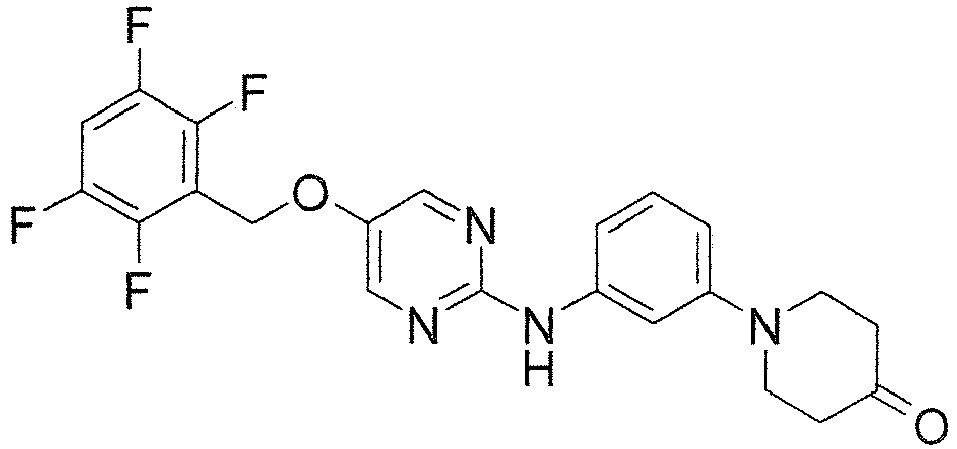
ESI+:447 32 32 
APCI/ESI+:462 33 33 
APCI/ESI+:294 34 34 
ESI+:309 35 35 
APCI/ESI+:366 [Table 13] PEx PSyn Str DAT 36 36 
APCI/ESI+:268 37 37 
APCI/ESI+:346 38 38 
APCI/ESI+:348 39 39 
APCI/ESI+:364 40 40 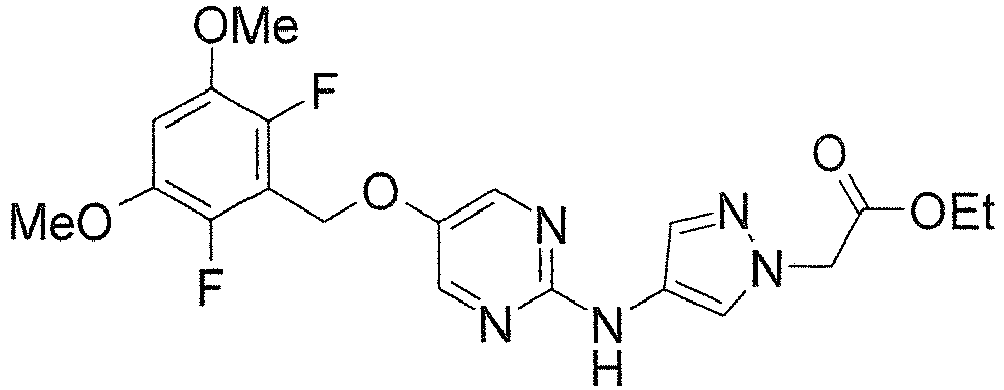
APCI/ESI+:450 41 41 
APCI/ESI+:478 [Table 14] PEx PSyn Str DAT 42 2 
APCI/ESI+:497 43 2 
APCI/ESI+:509 44 6 
EI:138 45 6 
EI:174 46 14 
APCI/ESI+:363 47 18 
APCI/ESI+:284 [Table 15] PEx PSyn Str DAT 48 19 
APCI/ESI+:318 49 13 
APCI/ESI+:293 50 24 
NMR2:1.06-1.26(14H,m),1.77-1.84(2H,m),2.74-2.91 (6H,m),3.22-3.31(4H,m),3.95(3H,s),6.88(1H,d,J=8.8Hz),7.70(1H,s),7.86(1H,d,J=8.8Hz) 51 27 
APCI/ESI+:347 52 23 
APCI/ESI+:579 53 23 
APCI/ESI+:426 [Table 16] PEx PSyn Str DAT 54 24 
NMR2:1.47-1.71(17H,m),3.17-3.20(4H,m),3.40-3.43(4H,m),3.95(3H,s),6.89(1H,d,J=8.8Hz),7.69(1H,d,J=2.7Hz),7.85(1H,dd,J=8.8,2.4Hz) 55 27 
NMR2:1.46-1.87(13H,m),2.88-2.90(4H,m),3.38-3.41(4H,m),3.73-3.81(6H,m),6.23-6.26(2H,m),6.78(1H,d,J=8.1Hz) 56 24 
ESI+:320 57 27 
ESI+:290 58 23 
ESI+:491 [Table 17] PEx PSyn Str DAT 59 23 
ESI+:549 60 24 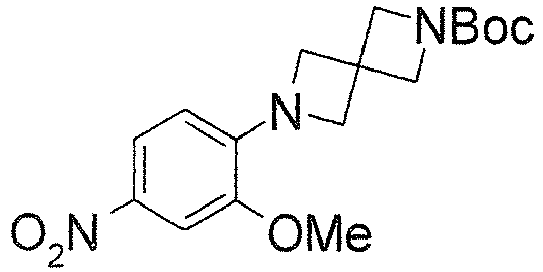
NMR2:1.45(9H,s),3.84(3H,s),4.10(4H,s),4.26(4H,s),6.22(1H,d,J=9.0Hz),7.60(1H,d,J=2.4Hz),7.82(1H,dd,J=8.8,2.4Hz) 61 27 
NMR2:1.44(9H,s),3.40(2H,brs),3.74(3H,s),3.87(4H,s),4.05(4H,s),6.21-6.31(3H,m) 62 30 
ESI+:576 63 27 
APCI/ESI+:264 64 33 
APCI/ESI+:281 65 27 
ESI+:251 [Table 18] PEx PSyn Str DAT 66 24 
ESI+:330 67 27 
ESI+:300 68 27 
ESI+:311 69 24 
ESI+:339 70 24 
APCI/ESI+:266 71 27 
APCI/ESI+:336 [Table 19] PEx PSyn Str DAT 72 23 
APCI/ESI+:616 73 28 
APCI/ESI+:332 74 35 
APCI/ESI+:432 75 29 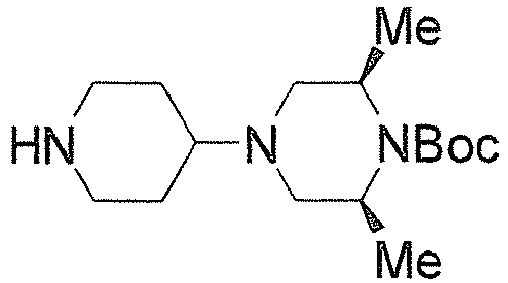
APCI/ESI+:298 76 24 
APCI/ESI+:449 77 27 
APCI/ESI+:419 [Table 20] PEx PSyn Str DAT 78 23 
APCI/ESI+:6 99 79 24 
NMR2:1.23(6H,d,J=6.3Hz),2.44-2.50(2H,m),3.50-3.52(2H,m),3.85-3.90(2H,m),3.95(3H,s),6.85(1H,d,J=9.0Hz),7.71(1H,d,J=2.4Hz),7.85(1H,dd,J=8.8,2.7Hz) 80 27 
NMR2:1.20(6H,d,J=6.3Hz),2.27-2.32(2H,m),3.15-3.18(2H,m),3.49(2H,brs),3.82-3.93(5H,m),6.23-6.27(2H,m),6.74(1H,d,J=8.1Hz) 81 30 
ESI+:656 82 30 
ESI+:600 [Table 21] PEx PSyn Str DAT 83 24 
ESI+:349 84 27 
ESI+:319 85 28 
ESI+:338 86 27 
ESI+:308 87 35 
APCI/ESI+:446 88 27 
APCI/ESI+:416 [Table 22] PEx PSyn Str DAT 89 23 
APCI/ESI+:696 90 37 
APCI/ESI+:418 91 27 
APCI/ESI+:388 92 23 
APCI/ESI+:668 93 36 
APCI/ESI+:295 [Table 23] PEx PSyn Str DAT 94 37 
APCI/ESI+:373 95 35 
APCI/ESI+:473 96 27 
APCI/ESI+:443 97 23 
ESI+:723 [Table 24] PEx PSyn Str DAT 98 30 
ESI+:688 99 30 
ESI+:632 100 13 
APCI/ESI+:280 101 2 
APCI/ESI+:509 102 2 
APCI/ESI+:426 103 2 
APCI/ESI+:456 [Table 25] PEx PSyn Str DAT 104 32 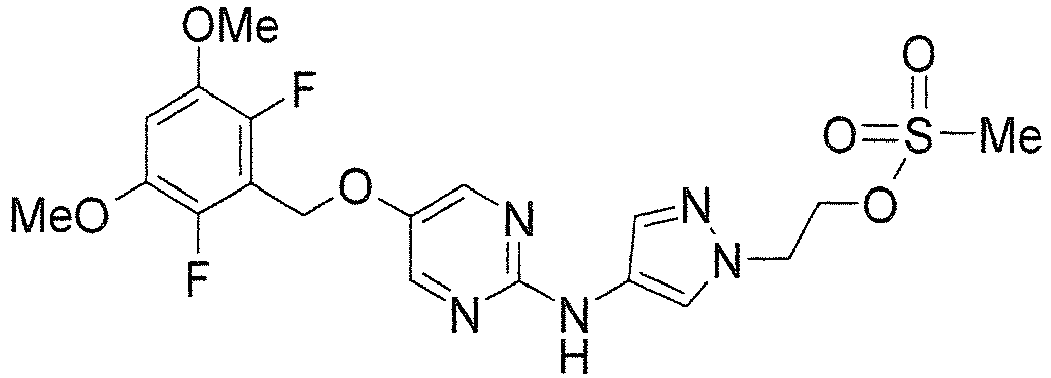
APCI/ESI+:486 105 23 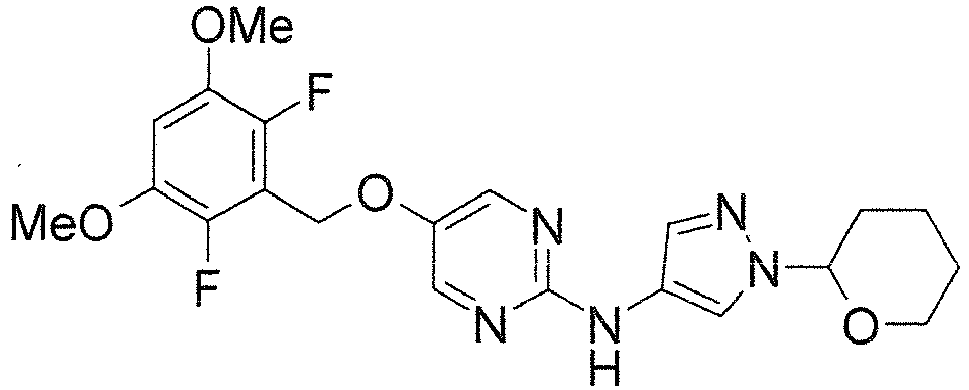
APCI/ESI+:448 106 41 
APCI/ESI+:478 107 19 
ESI+:317 108 32 
APCI/ESI+:462 [Table 26] PEx PSyn Str DAT 109 23 
APCI/ESI+:545 110 31 
APCI/ESI+:501 111 111 
NMR2:1.50(9H,s),1.72-1.81(2H,m),1.95-2.24(6H,m),4.32-4.49(2H,m),4.61-4.72(1H,m),8.06(1H,s),8.12(1H,s) 112 27 
NMR2:1.49(9H,s),1.71-1.81(2H,m),1.90-2.12(6H,m),2.87(2H,brs),4.20-4.45(2H,m),4.50-4.61(1H,m),6.98(1H,s),7.12(1H,s) [Table 27] PEx PSyn Str DAT 113 23 
APCI/ESI+:605 114 23 
APCI/ESI+:523 115 23 
APCI/ESI+:547 116 23 
ESI+:557 117 23 
APCI/ESI+:515 [Table 28] PEx PSyn Str DAT 118 118 
APCI/ESI+:223 119 27 
APCI/ESI+:193 120 23 
APCI/ESI+:558 121 23 
APCI/ESI+:576 122 23 
APCI/ESI+:614 123 23 
APCI/ESI+:543 [Table 29] PEx PSyn Str DAT 124 31 
APCI/ESI+:499 125 24 
APCI/ESI+:295 126 17 
NMR2:1.74-1.80(1H,m),3.79(3H,s),3.86(3H,s),4.74(2H,dd,J=6.2,1.2Hz),6.47(1H,dd,J=7.0,3.0Hz),6.51(1H,dd,J=4.8,3.0Hz) 127 23 
APCI/ESI+:586 128 35 
APCI/ESI+:395 129 27 
APCI/ESI+:365 [Table 30] PEx PSyn Str DAT 130 27 
APCI/ESI+:265 131 18 
NMR2:3.01(3H,s),3.79(3H,s),3.87(3H,s),5.26(2H,d,J=1.6Hz),6.47(1H,dd,J=4.7,3.0Hz),6.57(1H,dd,J=7.0,3.0Hz) 132 19 
APCI/ESI+:299 133 133 
APCI/ESI+:279 134 31 
APCI/ESI+:471 [Table 31] PEx PSyn Str DAT 135 23 
APCI/ESI+:450 136 23 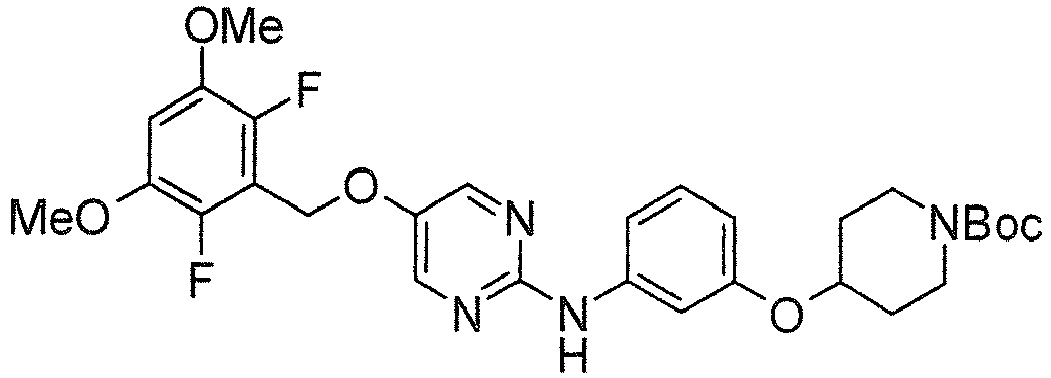
APCI/ESI+:573 137 23 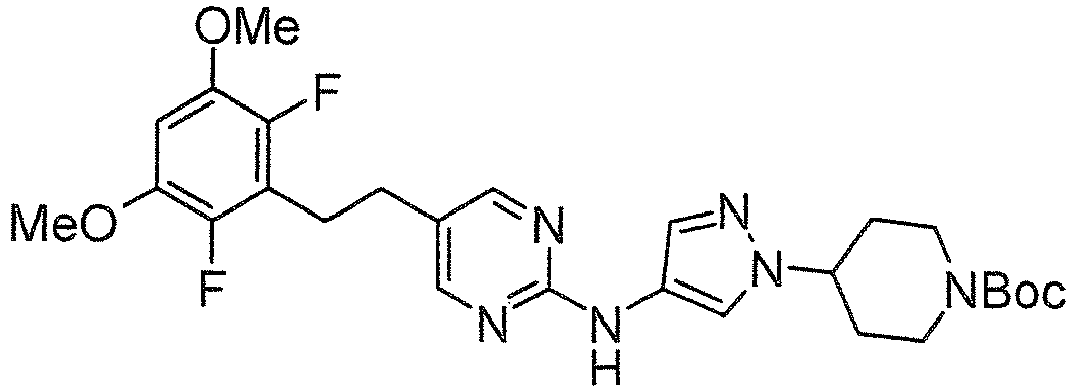
APCI/ESI+:545 138 138 
APCI/ESI+:307 139 27 
APCI/ESI+:277 140 27 
APCI/ESI+:208 [Table 32] PEx PSyn Str DAT 141 24 
APCI/ESI+:320 142 27 
APCI/ESI+:290 143 143 
ESI+:184 144 144 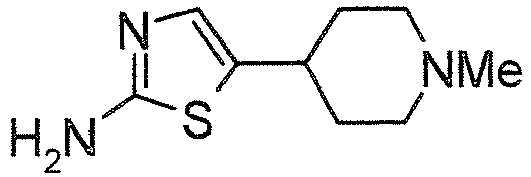
ESI+:198 145 145 
ESI+:255 146 189 
ESI+:671 147 40 
APCI/ESI+:507 [Table 33] PEx PSyn Str DAT 148 27 
APCI/ESI+:225 149 143 
APCI/ESI+:197 150 23 
APCI/ESI+:505 151 40 
ESI+:575 152 152 
ESI+:255 153 27 
ESI+:225 154 152 
ESI+:303 [Table 34] PEx PSyn Str DAT 155 27 
ESI+:273 156 24 
APCI/ESI+:336 157 27 
APCI/ESI+:306 158 40 
APCI/ESI+:464 159 40 
APCI/ESI+:464 160 40 
APCI/ESI+:478 [Table 35] PEx PSyn Str DAT 161 40 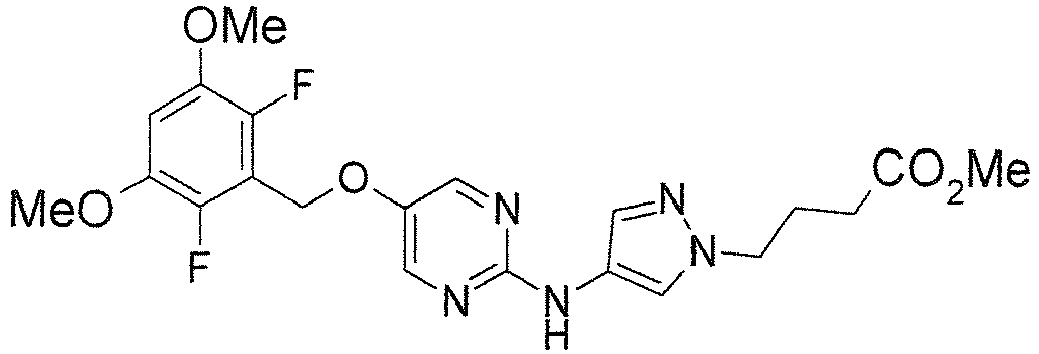
APCI/ESI+:464 162 162 
ESI+:576 163 23 
APCI/ESI+:505 164 111 
ESI+:256 165 152 
ESI+:269 166 27 
ESI+:226 [Table 36] PEx PSyn Str DAT 167 27 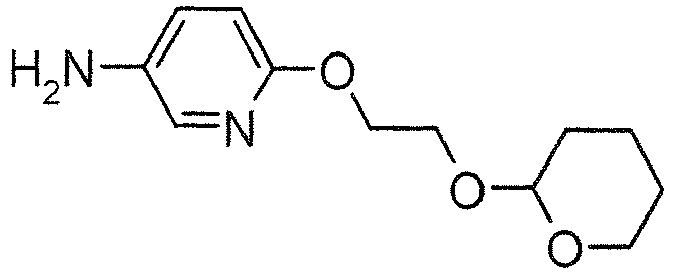
APCI/ESI+:155(-THP) 168 23 
APCI/ESI+:519 169 23 
ESI+:506 170 23 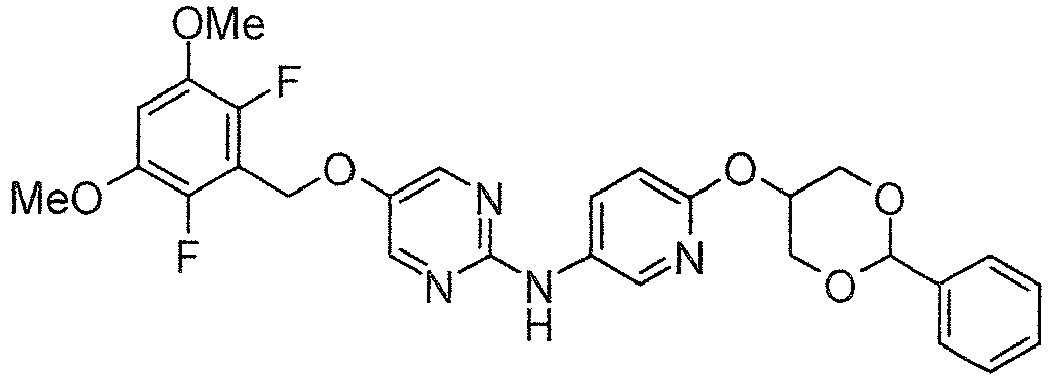
APCI/ESI+:553 171 23 
APCI/ESI+:516 [Table 37] PEx PSyn Str DAT 172 32 
ESI+:500 173 31 
APCI/ESI+:472 174 40 
ESI+:561 175-1 175 
APCI/ESI+:226 175-2 175 
APCI/ESI+:226 176 176 
ESI+:232 [Table 38] PEx PSyn Str DAT 177 23 
ESI+:512 178 23 
APCI/ESI+:506 179 23 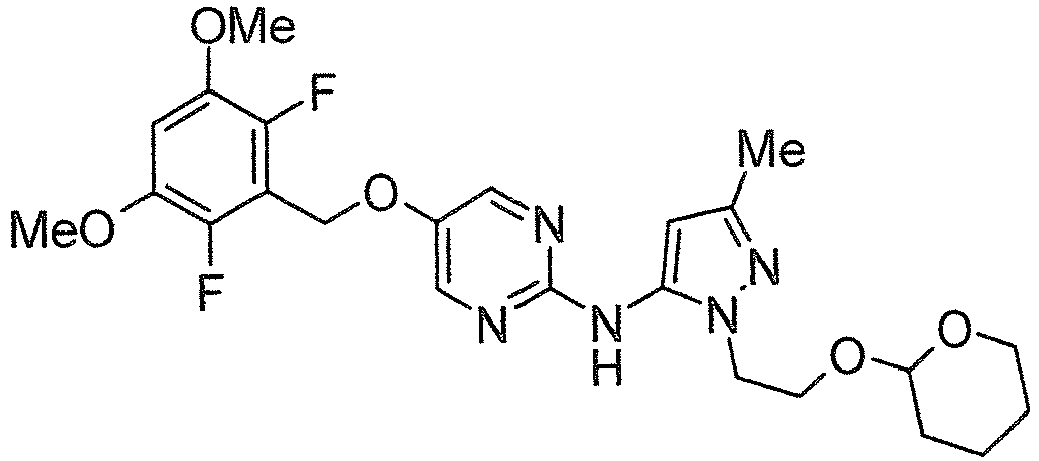
APCI/ESI+:506 180 23 
APCI/ESI+:506 [Table 39] PEx PSyn Str DAT 181 23 
APCI/ESI+:450 182 27 
ESI+:226 183 183 
APCI/ESI+:242 184 27 
APCI/ESI+:212 185 23 
APCI/ESI+:492 186 186 
APCI/ESI+:276 187 27 
APCI/ESI+:246 [Table 40] PEx PSyn Str DAT 188 23 
APCI/ESI+:526 189 189 
APCI/ESI+:267 190 27 
APCI/ESI+:237 191 191 
APCI/ESI-:490 192 27+23 
APCI/ESI+:435(-THP) [Table 41] PEx PSyn Str DAT 193 193 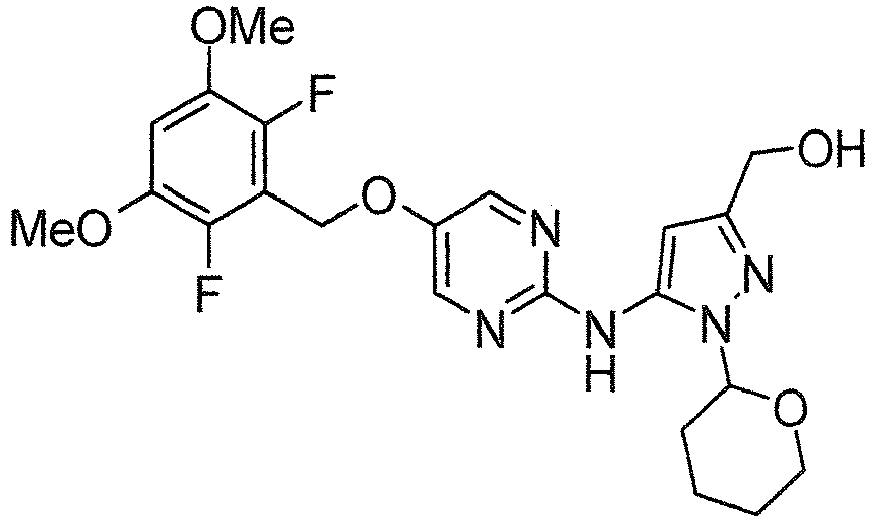
APCI/ESI+:478 194 175 
APCI/ESI+:239 195 32 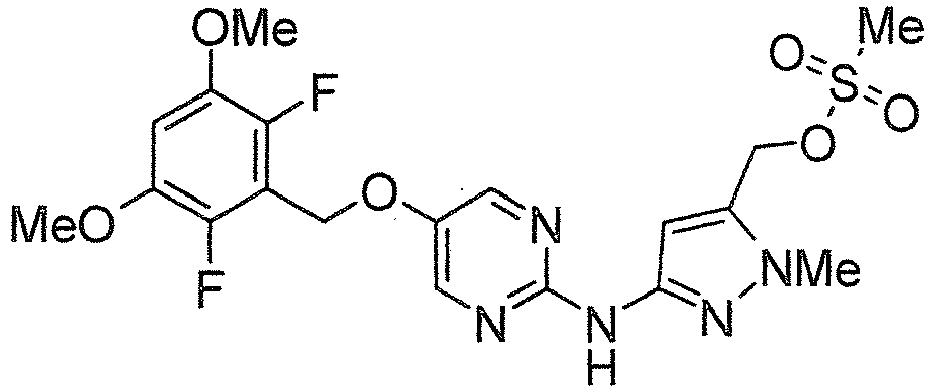
NMR2:2.96(3H,s),3.85(3H,s),3.89(6H,s),5.16(2H,s),5.25(2H,s),6.68(1H,t,J=8.0Hz),6.91)1H,s),7.63(1H,brs),8.24(2H,s) 196 193 
APCI/ESI+:158 197 214 
NMR1:4.22(3H,s),7.77(1H,s),9.91(1H,s) 198 144 
APCI/ESI+:211 [Table 42] PEx PSyn Str DAT 199 27 
APCI/ESI+:181 200 23 
ESI+:519 201 201 
ESI+:212 202 202 
ESI+:184 203 23 
ESI+:464 204 204 
APCI/ESI+:327 205 205 
ESI+:225 [Table 43] PEx PSyn Str DAT 206 205 
ESI+:225 207 23 
ESI+:505 208 23 
ESI+:505 209 209 
APCI/ESI+:412 210 210 
APCI/ESI+:227 [Table 44] PEx PSyn Str DAT 211 211 
NMR2:1.36-1.94(9H,m),1.99-2.07(1H,m),2.09-2.20(1H,m),2.35-2.54(1H,m),3.44-3.75(2H,m),3.78-4.04(2H,m),4.51-4.72(2H,m),4.78-4.90(1H,m),5.52-5.65(1H,m),6.87-6.94(1H,m) 212 27 
NMR2:1.31-1.94(10H,m),2.00-2.11(1H,m),2.29-2.44(1H,m),3.27-3.77(4H,m),3.81-3.97(1H,m),4.00-4.11(1H,m),4.47-4.59(1H,m),4.61-4.73(2H,m),5.20-5.33(1H,m),5.66(1H,s) 213 23 
APCI/ESI+:562 214 214 
APCI/ESI+:392 [Table 45] PEx PSyn Str DAT 215 214 
APCI/ESI+:406 216 204 
APCI/ESI+:324 217 27 
APCI/ESI+:294 218 23 
APCI/ESI+:574 [Table 46] PEx PSyn Str DAT 219 32 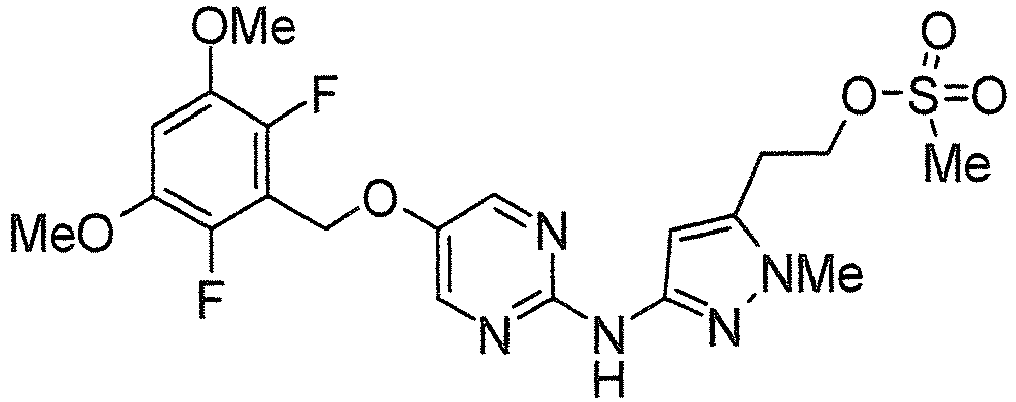
ESI+:500 220 27 
ESI+:221 221 24 
ESI+:251 222 27 
ESI+:294 223 28 
ESI+:324 224 24 
NMR2:2.64(4H,t,J=6.0Hz),3.54(4H,t,J=6.0Hz),3.99(3H,s),6.93(1H,d,J=8.8Hz),7.75(1H,d,J=2.4Hz),7.88(1H,dd,J=8.8,2.4Hz) [Table 47] PEx PSyn Str DAT 225 27 
ESI+:322 226 28 
ESI+:352 227 13 
EI:332 228 18 
EI:298 229 229 
EI:220 230 30 
ESI+:613 [Table 48] PEx PSyn Str DAT 231 27 
ESI+:333 232 232 
ESI+:361 233 27 
ESI+:294 234 28 
ESI+:324 235 30 
ESI+:616 236 27 
ESI+:294 237 28 
ESI+:324 [Table 49] PEx PSyn Str DAT 238 32 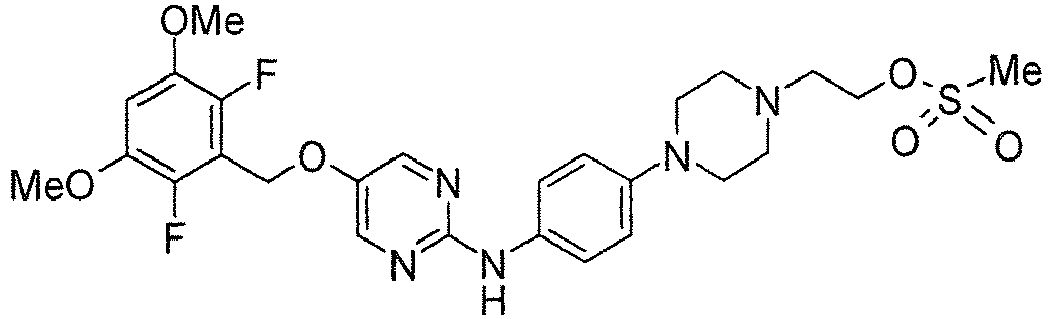
ESI+:580 239 27 
ESI+:336 240 28 
ESI+:366 241 27 
EI:248 242 24 
ESI+:279 243 30 
ESI+:588 [Table 50] PEx PSyn Str DAT 244 19 
NMR2:3.94(6H,s),5.35(2H,s),6.62(1H,s),7.24(1H,d,J=8.8Hz),7.31(1H,dd,J=8.8,3.2Hz),8.16(1H,d,J=3.2Hz) 245 30 
ESI+:680 246 27 
ESI+:400 247 30 
ESI+:430 248 19 
NMR2:3.94(6H,s),5.63(2H,s),6.63(1H,s),8.02(1H,s),8.15(1H,s) [Table 51] PEx PSyn Str DAT 249 30 
ESI+:714 250 27 
NMR2:1.93-1.96(6H,m),2.06-2.09(2H,m),2.08(6H,s),2.54-2.60(3H,m),2.95-2.97(4H,m),3.42-3.45(2H,m),3.81(3H,s),4.06(4H,s),6.22-6.26(2H,m),6.74(1H,dJ=8.0Hz) 251 24 
ESI+:464 252 252 
ESI+:313 [Table 52] PEx PSyn Str DAT 253 28 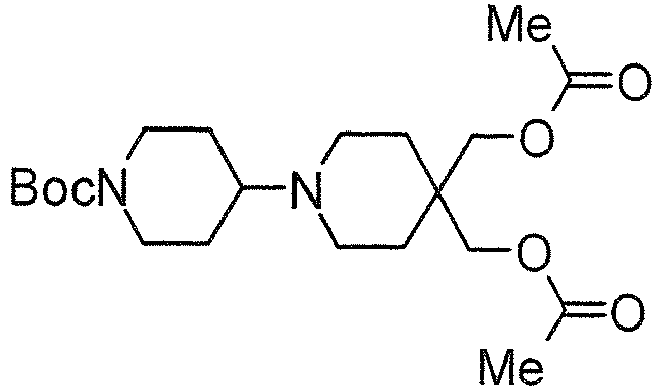
ESI+:413 254 252 
ESI+:230 255 255 
NMR2:1.46-1.52(13H,m),2.07(6H,s),3.40-3.43(4H,m),4.03(4H,s) 256 27 
NMR3:3.97(2H,t,J=5.2Hz),4.42(2H,t,J=5.2Hz),6.85(1H,dd,J=2.0,0.8Hz),6.92(1H,dd,J=8.8,2.0Hz),7.41(1H,dd,J=8.8,0.8Hz),7.89(1H,d,J=0.8Hz) [Table 53] PEx PSyn Str DAT 257 40 
NMR2:2.91(1H,t,J=6.0Hz),4.15-4.19(2H,m),4.61(2H,t,J=4.8Hz),7.74(1H,d,J=9.2Hz),8.11(1H,dd,J=9.2,2.0Hz),8.29(1H,s),8.73(1H,d,J=2.4Hz) 258 27 
NMR3:3.95(2H,t,J=5.6Hz),4.37(2H,t,J=5.6Hz),6.65(1H,dd,J=8.8,2.0Hz),6.72(1H,m),7.44(1H,dd,J=8.8,0.8Hz),7.99(1H,s) 259 40 
NMR2:2.87(1H,t,J=6.0Hz),4.17-4.20(2H,m),4.62(2H,t,J=4.8Hz),7.77(1H,dd,J=9.2,0.8Hz),7.91(1H,dd,J=9.2,2.0Hz),8.13(1H,s),8.67-8.68(1H,m) [Table 54] PEx PSyn Str DAT 260 30 
ESI+:631 261 27 
ESI+:351 262 24 
ESI+:381 263 30 
ESI+:482 [Table 55] PEx PSyn Str DAT 264 30 
ESI+:522 265 27 
ESI+:264[M+Na]+ 266 19 
EI:271 267 30 
ESI+:522 268 27 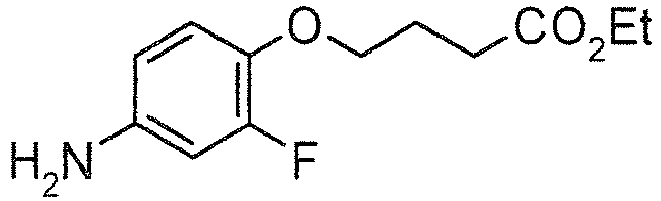
ESI+:242 269 30 
ESI+:490 [Table 56] PEx PSyn Str DAT 270 27 
NMR2:2.09(3H,s),2.29(3H,s),2.48-2.65(8H,m),2.83(2H,t,J=5.6Hz),3.54(2H,brs),4.06(2H,t,J=5.6Hz),6.20-6.22(2H,m),6.88(1H,d,J=8.4Hz) 271 36 
NMR2:2.30-2.66(14H,m),2.89(2H,t,J=5.4Hz),4.19(2H,t,J=5.6Hz),7.24(1H,d,J=8.0Hz),7.66(1H,d,J=2.0Hz),7.75(1H,dd,J=8.0,2.0Hz) 272 30 
ESI+:490 [Table 57] PEx PSyn Str DAT 273 27 
NMR3:1.75-1.83(2H,m),1.95-2.01(6H,m),2.53-2.59(2H,m),2.86-2.99(7H,m),3.81(3H,s),4.45(4H,s),6.27(1H,dd,J=8.4,2.4Hz),6.42(1H,d,J=2.4Hz),6.78(1H,d,J=8.0Hz) 274 24 
NMR2:1.69-1.79(2H,m),1.85-1.90(6H,m),2.43-2.49(5H,m),2.67 -2.73(2H,m),3.73-3.76(2H,m),3.94(3H,s),4.41(4H,s),6.87(1H,d,J=8.8Hz),7.69(1H,d,J=2.4Hz),7.84(1H,dd,J=8.8,2.4Hz). 275 252 
ESI+:211 276 28 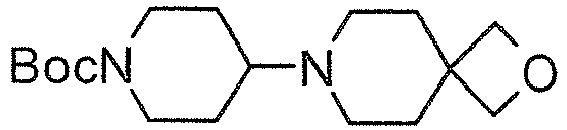
ESI+:311 [Table 58] PEx PSyn Str DAT 277 30 
EI:497 278 27 
EI:217 279 36 
ESI+:648 280 27 
ESI+:250 281 28 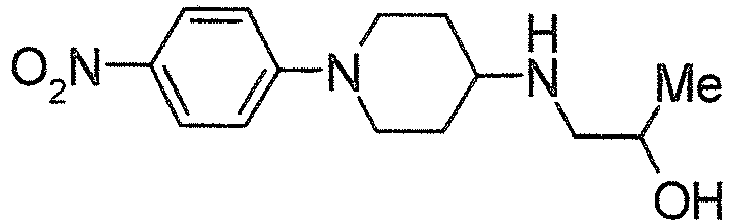
ESI+:280 282 30 
ESI+:518 [Table 59] PEx PSyn Str DAT 283 27 
ESI+:238 284 19 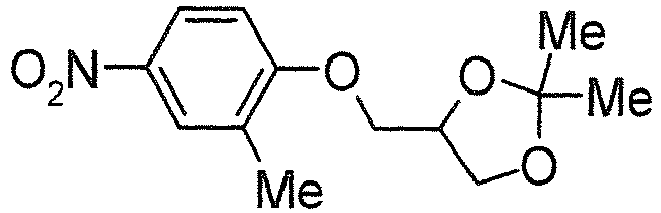
EI:267 285 27 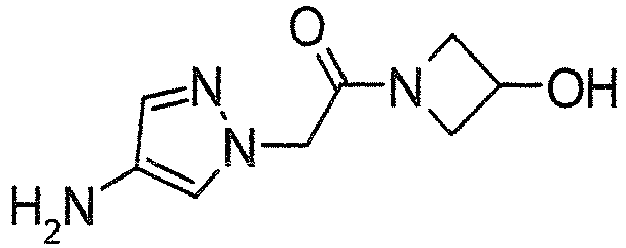
ESI+:197 286 30 
ESI+:506 287 27 
ESI+:264 288 28 
ESI+:294 289 30 
ESI+:631 [Table 60] PEx PSyn Str DAT 290 27 
NMR2:1.14-1.16(2H,m), 1.45(9H,s),1.63-1.87(5H,m),2.70-2.71(2H,m),3.48-3.49(2H,m),3.81(3H,s),3.95-4.07(4H,m),6.21(1H,dd,J=8.0,2.4Hz),6.30(1H,d,J=2.4Hz),6.71(1H,d,J=8.4Hz) 291 13 
NMR2:1.18-1.22(2H,m),1.48(9H,s),1.59(2H,br-s),1.69-1.75(3H,m),1.82-1.87(2H,m),2.71-2.73(2H,m),3.95(3H,s),4.16(2H,t,J=6.4Hz),6.89(1H,d,J=8.8Hz),7.74(1H,d,J=2.4Hz), 7.89(1H,dd,J=8.8,2.4Hz) 292 19 
NMR2:2.22(3H,s),3.89(3H,s),3.93(3H,s),5.33(2H,s),6.57(1H,s),8.37(2H,s) 293 18 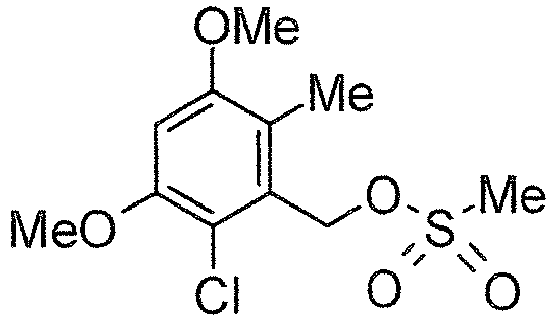
EI:294 [Table 61] PEx PSyn Str DAT 294 229 
NMR2:1.85(1H,t,J=6.4Hz),2.26(3H,s),3.84(3H,s),3.90(3H,s),4.86(2H,d,J=6.4Hz),6.49(1H,s) 295 295 
ESI+:310 296 296 
ESI+:220 297 27 
ESI+:336 298 35 
ESI+:366 [Table 62] PEx PSyn Str DAT 299 28 
ESI+:266 300 23 
APCI/ESI+:558 301 175 
APCI/ESI-:268 302 23 
ESI+:476 303 24 
ESI+:267 304 27 
ESI+:237 [Table 63] Ex Str 1 # 
2 # 
3 # 
4 # 
5 # 
# Reference Example [Table 64] Ex Str 6 # 
7 # 
8 
9 # 
10 # 
11 
# Reference Example [Table 65] Ex Str 12 # 
13 # 
14 # 
15 # 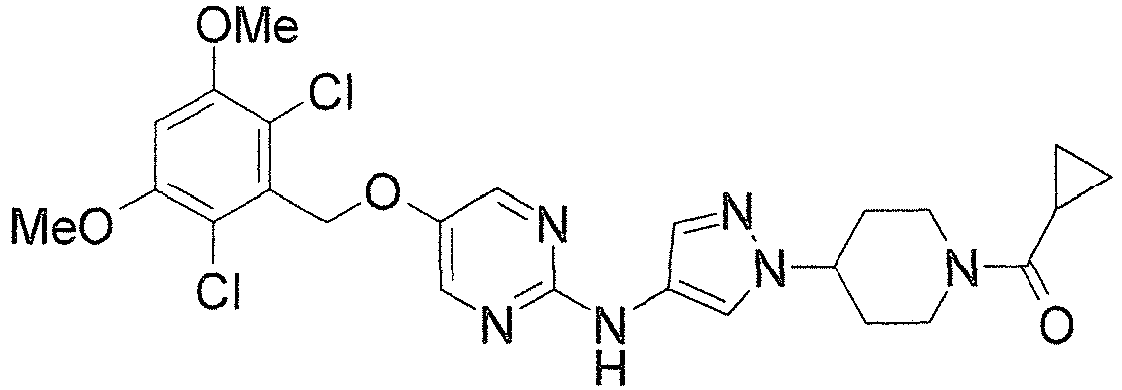
16 # 
# Reference Example [Table 66] Ex Str 17 # 
18 # 
19 # 
20 
21 # 
# Reference Example [Table 67] Ex Str 22 # 
23 
24 
25 # 
26 # 
# Reference Example [Table 68] Ex Str 27 # 
28 # 
29 # 
30 # 
31 # 
# Reference Example [Table 69] Ex Str 32 # 
33 # 
34 # 
35 # 
36 # 
# Reference Example [Table 70] Ex Str 37 # 
38 # 
39 # 
40 # 
41 # 
# Reference Example [Table 71] Ex Str 42 # 
43# 
44# 
45 # 
46 # 
# Reference Example [Table 72] Ex Str 47 # 
48 # 
49 # 
50 # 
51 # 
# Reference Example [Table 73] Ex Str 52 
53 # 
54 # 
55 # 
56 
# Reference Example [Table 74] Ex Str 57 # 
58 
59 # 
60 # 
61 # 
# Reference Example [Table 75] Ex Str 62 # 
63 # 
64 # 
65 # 
66 # 
# Reference Example [Table 76] Ex Str 67 # 
68 # 
69 # 
70 # 
71 # 
# Reference Example [Table 77] Ex Str 72 # 
73 # 
74 # 
75 # 
76 # 
# Reference Example [Table 78] Ex Str 77# 
78 # 
79 # 
80 # 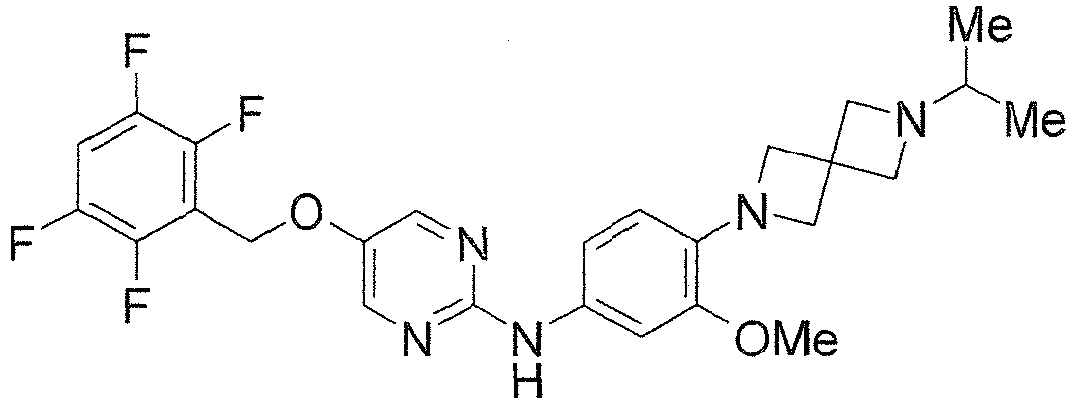
81 # 
# Reference Example [Table 79] Ex Str 82 # 
83 # 
84 # 
85 # 
# Reference Example [Table 80] Ex Str 86 
87 # 
88 # 
89 # 
90# 
# Reference Example [Table 81] Ex Str 91# 
92 # 
93 # 
94 # 
95 # 
# Reference Example [Table 82] Ex Str 96 # 
97 # 
98 # 
99 # 
100# 
# Reference Example [Table 83] Ex Str 101# 
102# 
103# 
104# 
105# 
# Reference Example [Table 84] Ex Str 106# 
107# 
108# 
109# 
110# 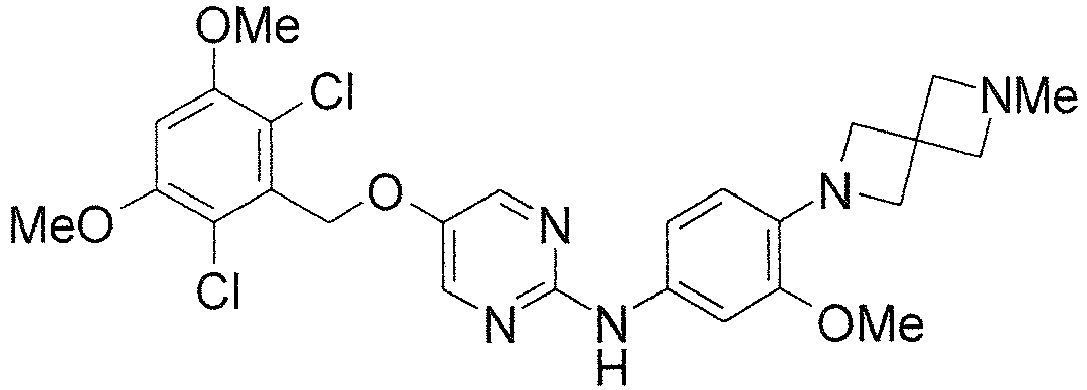
# Reference Example [Table 85] Ex Str 111# 
112# 
113 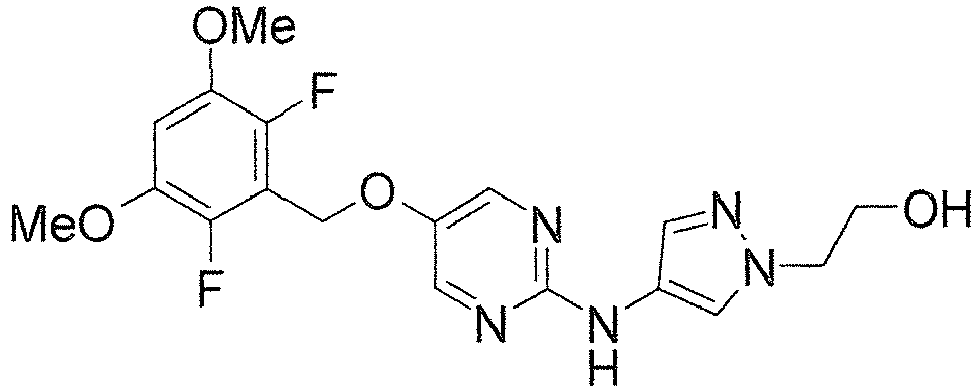
114 
115 
# Reference Example [Table 86] Ex Str 116 
117# 
118# 
119# 
120 
# Reference Example [Table 87] Ex Str 121# 
122# 
123 
124 
125 
# Reference Example [Table 88] Ex Str 126 
127 
128 
129# 
130# 
# Reference Example [Table 89] Ex Str 131# 
132# 
133# 
134# 
135# 
# Reference Example [Table 90] Ex Str 136 # 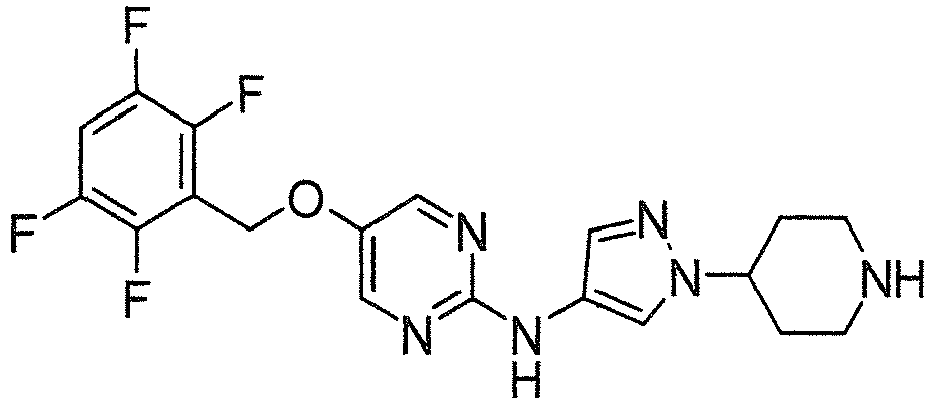
137# 
138# 
139# 
140# 
# Reference Example [Table 91] Ex Str 141# 
142# 
143# 
144# 
145# 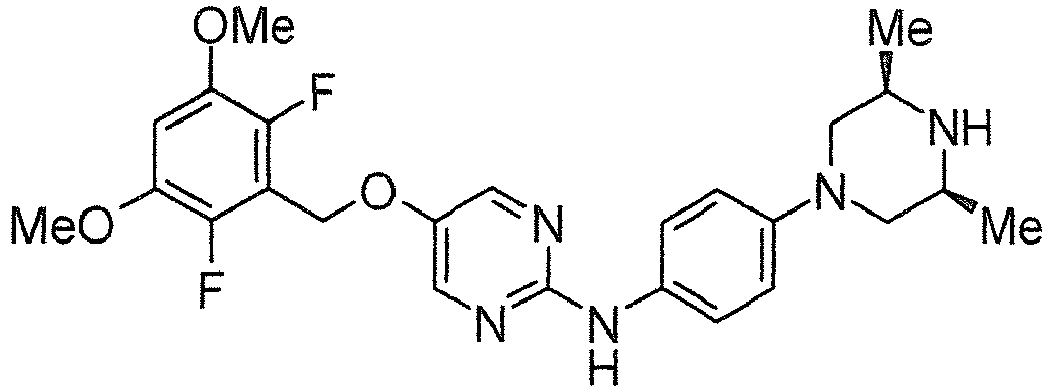
# Reference Example [Table 92] Ex Str 146# 
147# 
148# 
149# 
150# 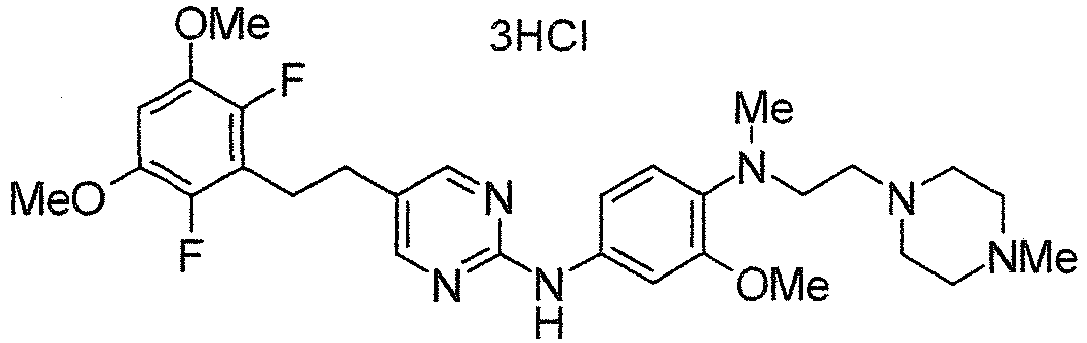
151# 
# Reference Example [Table 93] Ex Str 152# 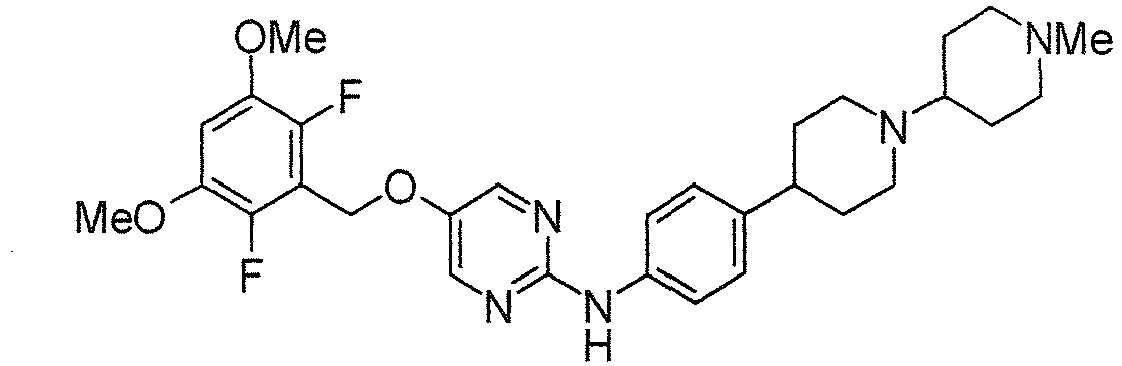
153# 
154# 
155# 
157# 
# Reference Example [Table 94] Ex Str 158 # 
159# 
160# 
161# 
162 
# Reference Example [Table 95] Ex Str 165# 
166# 
167# 
168# 
169# 
# Reference Example [Table 96] Ex Str 170# 
171# 
172# 
173 
174 
# Reference Example [Table 97] Ex Str 175 
176# 
177# 
178# 
179# 
# Reference Example [Table 98] Ex Str 180 
181 
182# 
183# 
184 
# Reference Example [Table 99] Ex Str 185# 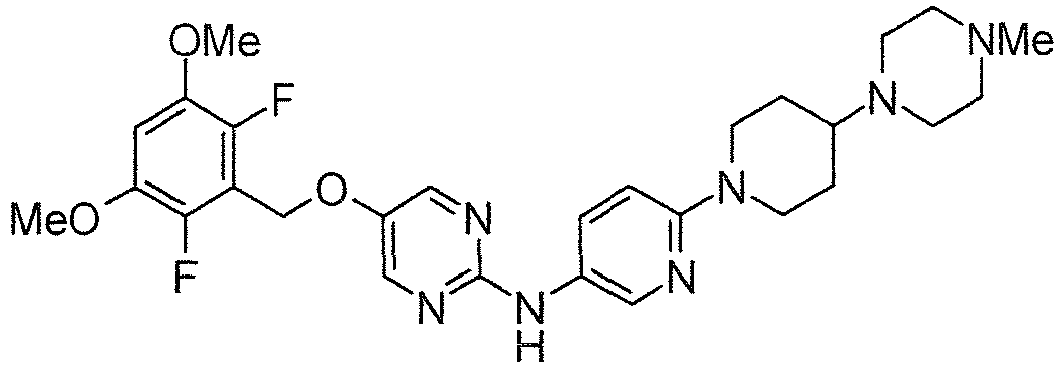
186# 
187# 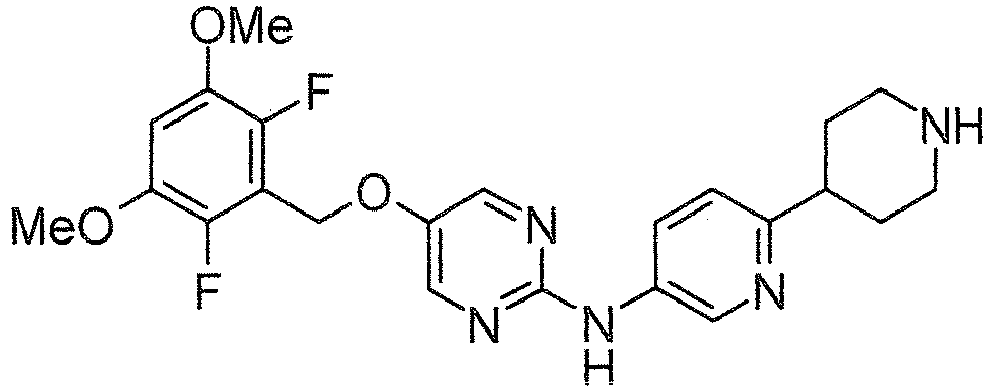
188# 
189 
# Reference Example [Table 100] Ex Str 190# 
191# 
192# 
193# 
194 
# Reference Example [Table 101] Ex Str 195# 
196 
197 
198 
199 
# Reference Example [Table 102] Ex Str 200 
201 # 
202 
203 
204# 
# Reference Example [Table 103] Ex Str 205 # 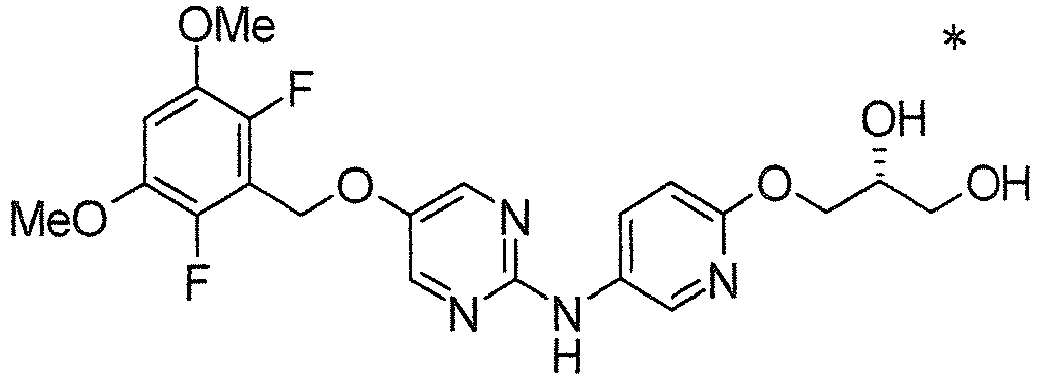
206 
207 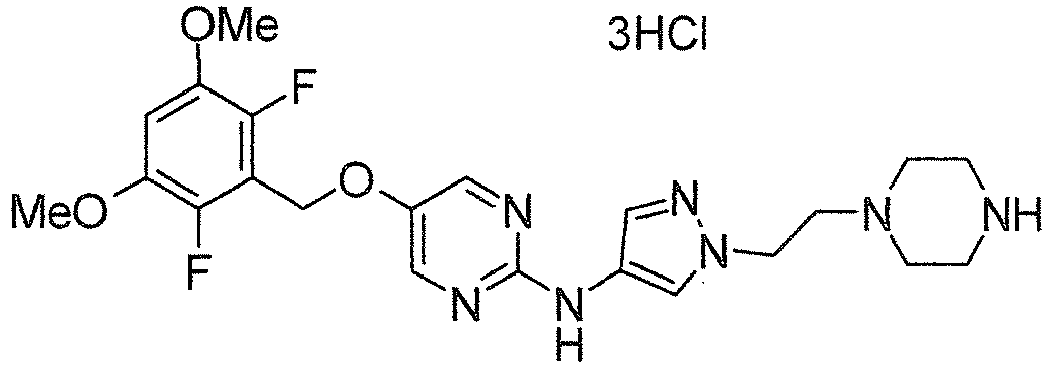
208# 
209 
# Reference Example [Table 104] Ex Str 210 
211 # 
212 
213 # 
214# 
# Reference Example [Table 105] Ex Str 215 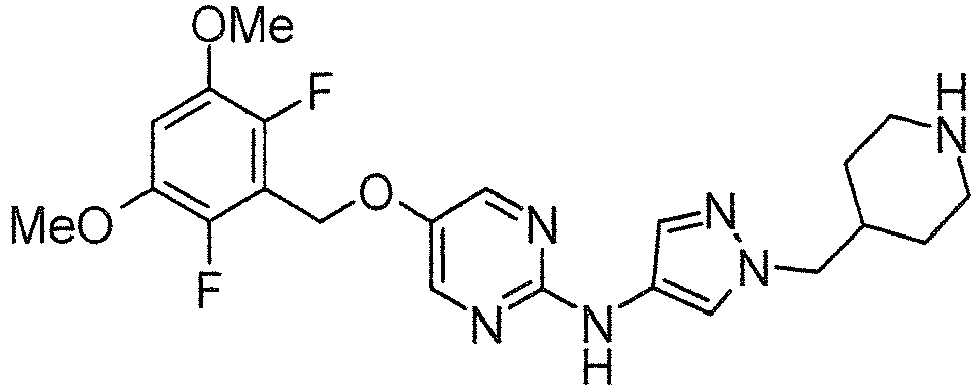
216# 
217# 
218 
219 
# Reference Example [Table 106] Ex Str 220 
221 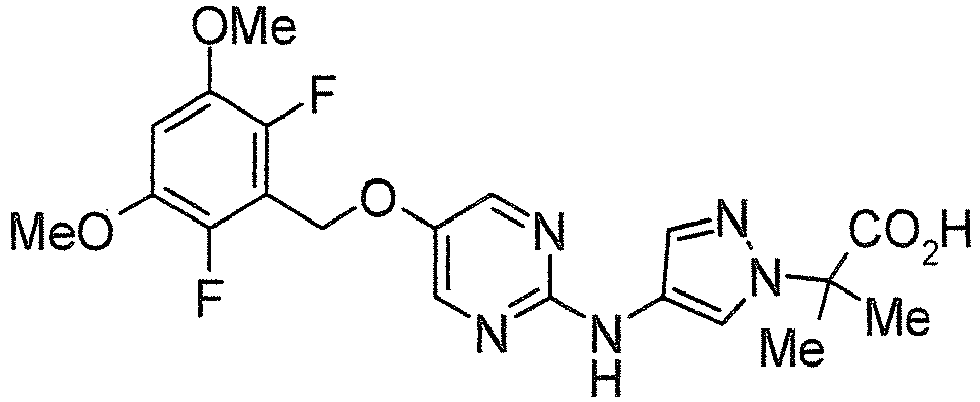
222 
223 
224 
[Table 107] Ex Str 225 
226 
227 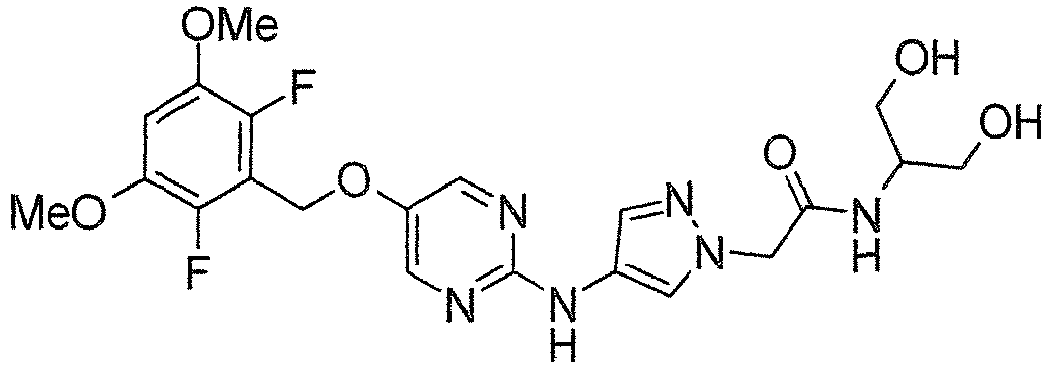
228 
229# 
# Reference Example [Table 108] Ex Str 230 
231 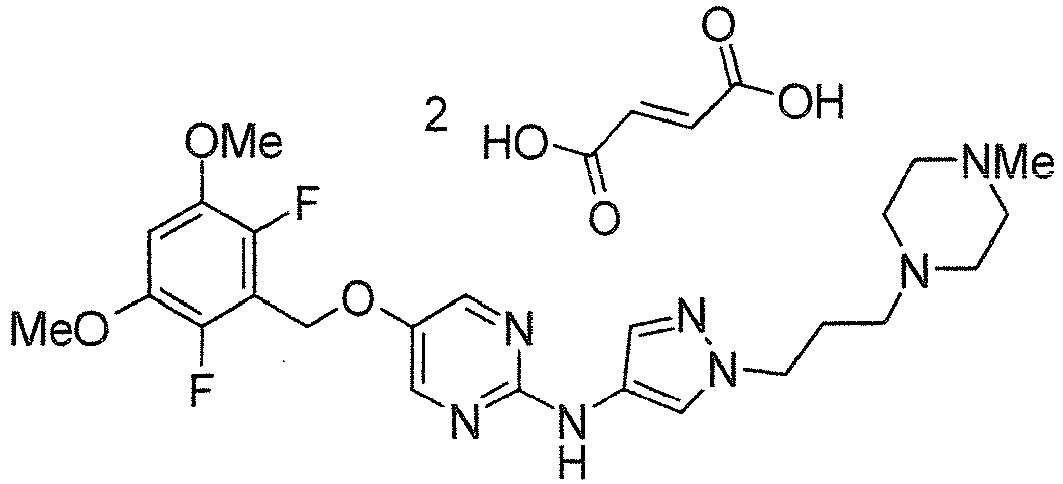
232# 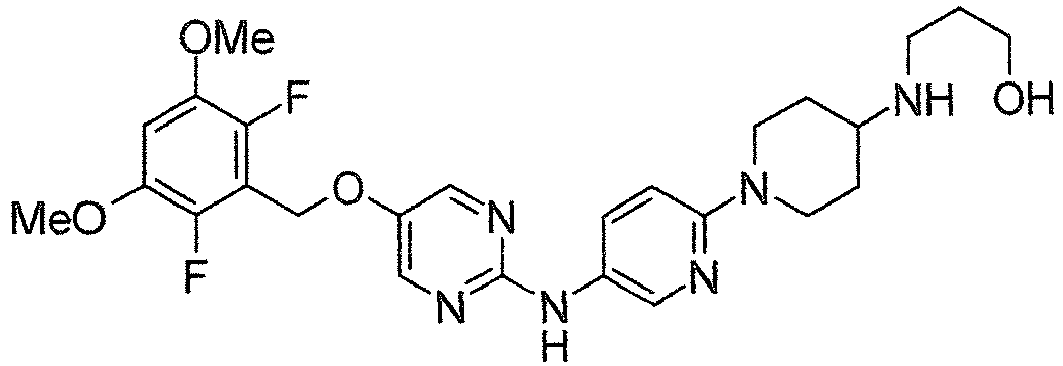
233 
234 # 
# Reference Example [Table 109] Ex Str 235 
236# 
237# 
238 
239 
# Reference Example [Table 110] Ex Str 240 
241 
242 # 
243 # 
244 # 
# Reference Example [Table 111] Ex Str 245# 
246 
247# 
248 
249 
# Reference Example [Table 112] Ex Str 250# 
251# 
252# 
253# 
254# 
# Reference Example [Table 113] Ex Str 255# 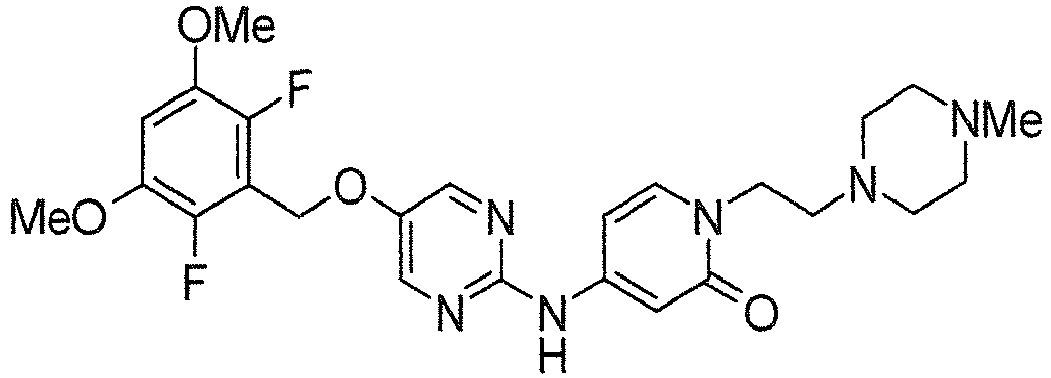
256 
257 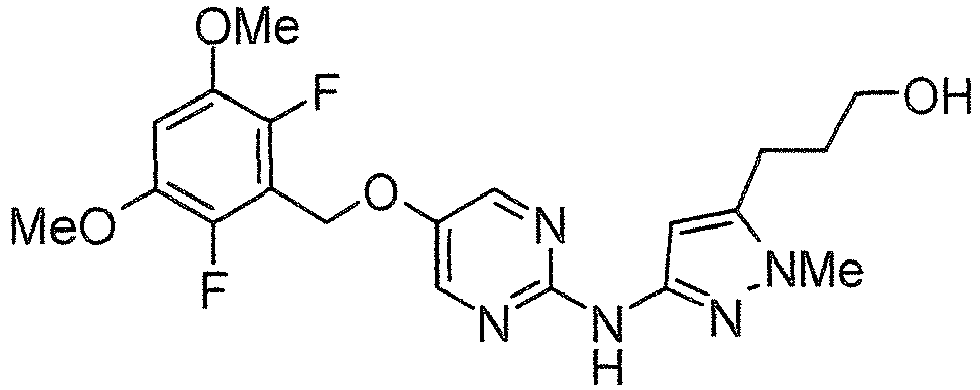
258 
259# 
# Reference Example [Table 114] Ex Str 260 # 
261 
262 
263 
264 # 
# Reference Example [Table 115] Ex Str 265# 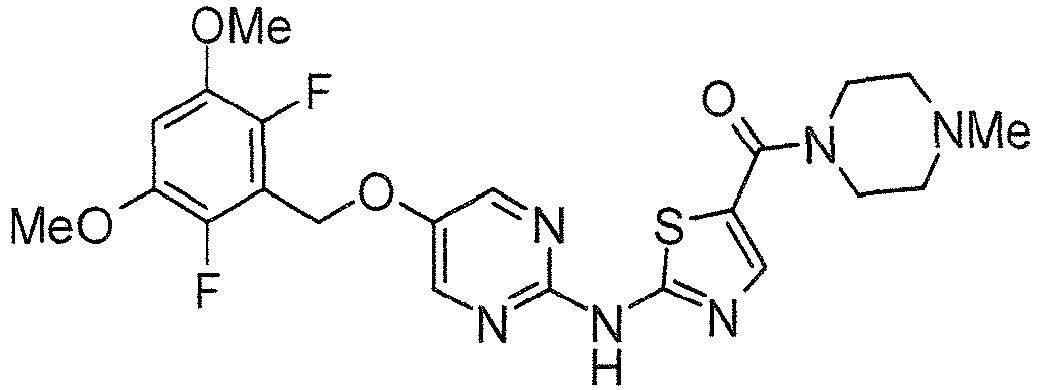
266# 
267 # 
268# 
269 # 
# Reference Example [Table 116] Ex Str 270 
271 
272 
273 
274 
[Table 117] Ex Str 275 
276 
277 
278 
279 
[Table 118] Ex Str 280 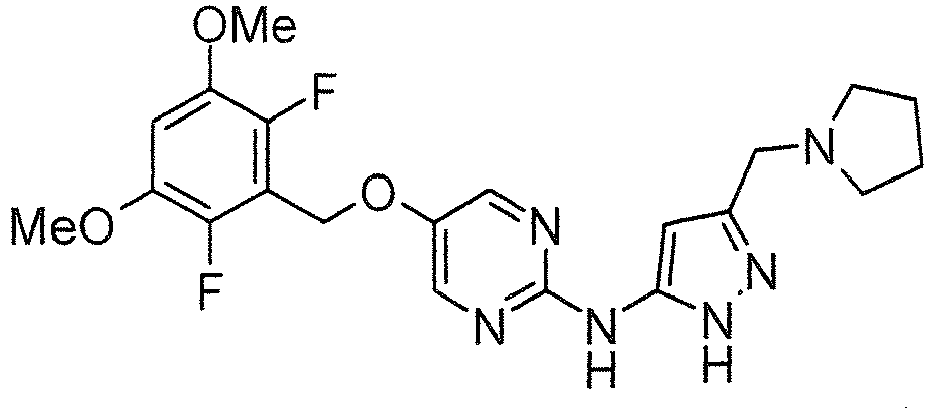
281 
282 
283 
284 
[Table 119] Ex Str 285 # 
286# 
287 # 
288 # 
289 # 
# Reference Example [Table 120] Ex Str 290# 
291 
292# 
293# 
294# 
# Reference Example [Table 121] Ex Str 295# 
296# 
297# 
298# 
299 
300# 
# Reference Example [Table 122] Ex Str 301# 
302# 
303# 
304# 
305# 
# Reference Example [Table 123] Ex Str 306# 
307# 
308# 
309# 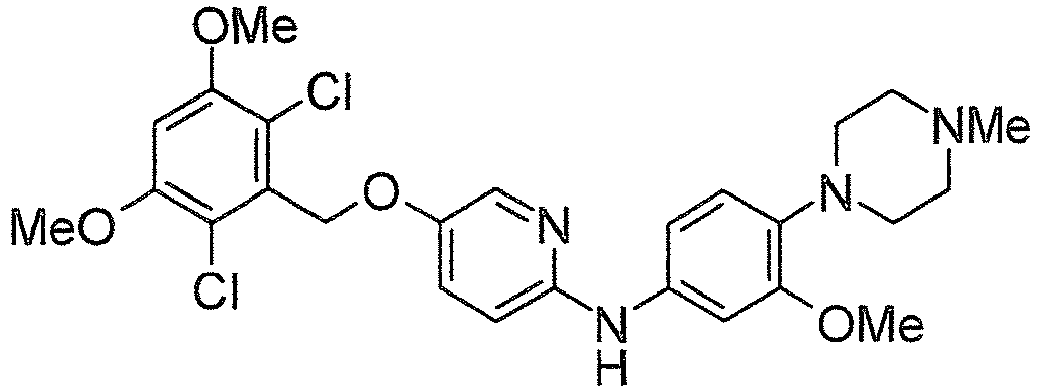
310# 
# Reference Example [Table 124] Ex Str 311# 
312# 
313# 
314# 
315# 
# Reference Example [Table 125] Ex Str 316# 
317# 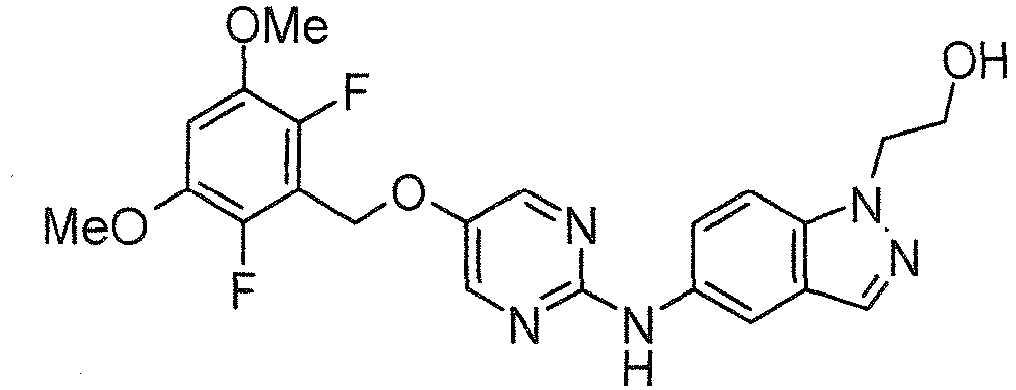
318# 
319# 
320# 
# Reference Example [Table 126] Ex Str 321# 
322# 
323# 
324# 
325# 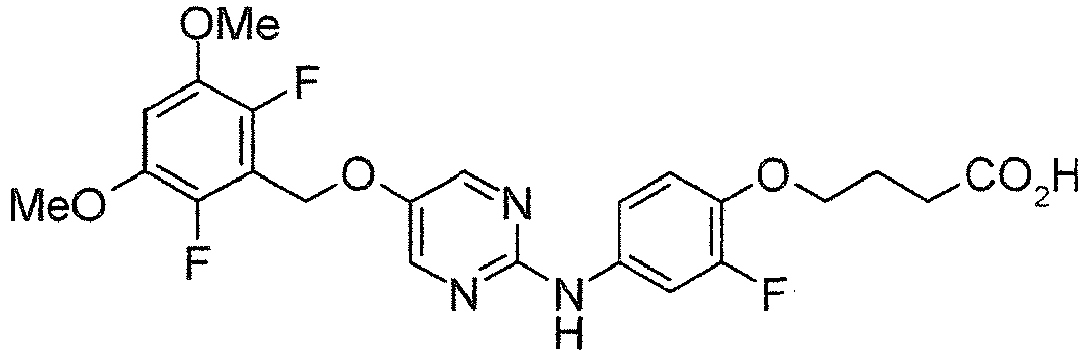
# Reference Example [Table 127] Ex Str 326# 
327# 
328# 
329# 
330# 
# Reference Example [Table 128] Ex Str 331# 
332# 
333# 
334# 
335# 
336# 
# Reference Example [Table 129] Ex Str 337 # 
338 # 
339 # 
340 # 
341 # 
342 # 
# Reference Example [Table 130] Ex Str 343# 
344# 
345# 
346# 
347# 
348# 
# Reference Example [Table 131] Ex Str 349# 
350# 
351# 
352# 
353# 
# Reference Example [Table 132] Ex Str 354# 
355# 
356# 
357# 
358# 
359# 
# Reference Example [Table 133] Ex Str 360# 
361# 
362# 
363# 
364# 
365# 
# Reference Example [Table 134] Ex Str 366# 
367 # 
368 # 
369 # 
370 
371# 
# Reference Example [Table 135] Ex Str 372 # 
373# 
374# 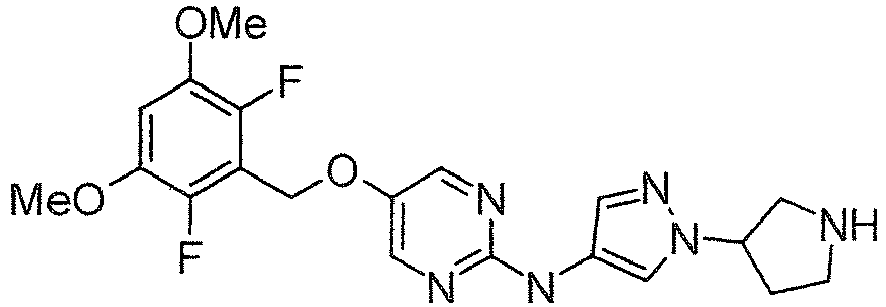
375# 
376# 
377 # 
# Reference Example [Table 136] Ex Str 378# 
379# 
380# 
381# 
382# 
383# 
# Reference Example [Table 137] Ex Str 384# 
385# 
386# 
387# 
388# 
# Reference Example [Table 138] Ex Syn DAT 1 # 1 ESI+:543 NMR1:1.49-1.61(2H,m),1.77-1.85(2H,m),2.19(3H,s),2.22-2.71(11H,m),3.28-3.43(2H,m),3.76(3H,s),3.77(6H,s),6.55(1H,t,J=2.3Hz),6.69(2H,d,J=2.3Hz),6.83(1H,d,J=8.6Hz),7.27(1H,dd,J=8.6,2.3Hz),7.31(1H,d,J=2.3Hz),8.61(2H,s),9.79(1H,s) 2 # 2 ESI+:547 NMR1:1.46-1.59(2H,m),1.74-1.83(2H,m),2.14(3H,s),2.19-2.54(11H,m),2.71-2.82(4H,m),3.26-3.36(2H,m),3.70(6H,s),3.74(3H,s),6.30(1H,t,J=2.3Hz),6.38(2H,d,J=2.3Hz),6.79(1H,d,J=8.6Hz),7.24(1H,dd,J=8.6,2.3Hz),7.35(1H,dJ=2.3Hz),8.26(2H,s),9.22(1H,s) 3 # 3 ESI+:611 4 # 4 ESI+:611 5 # 5 ESI+:649,651 6 # 6 ESI+:583 7 # 7 ESI+:500 NMR1:2.21(3H,s),2.35-2.59(4H,m),2.66-2.76(2H,m),2.81-3.00(6H,m),3.74(3H,s),3.81(6H,s),6.78(1H,d,J=8.4Hz),6.85(1H,t,J=8.4Hz),7.24(1H,dd,J=8.4,2.4Hz),7.36(1H,d,J=2.4Hz),8.18(2H,s),9.26(1H,s) 8 8 APCI/ESI+:422 9 # 9 APCI/ESI+:459 10 # 10 ESI+:525 11 11 ESI+:438 NMR1:3.28-3.37(2H,m),3.72-3.80(1H,m),3.83-3.91(7H,m),4.15(1H,dd,J=13.8,4.1Hz),4.67(1H,t,J=5.6Hz),4.91(1H,d,J=5.3Hz),5.14(2H,s),7.06(1H,t,J=8.4Hz),7.45(1H,d,J=0.6Hz),7.87(1Hd,J=0.6Hz),8.26(2H,s),9.21(1H,s) 12 # 12 ESI+:519 # Reference Example [Table 139] Ex Syn DAT 13 # 13 ESI+:533 14 # 14 ESI+:551 15 # 15 ESI+:547 16 # 16 ESI+:537 17 # 17 APCI/ESI+:398 18 # 18 ESI+:480 19 # 19 ESI+:532 NMR1:1.59-1.61(8H,m),2.84-2.86(4H,m),3.04-3.05(4H,m),3.74(3H,s),5.26(2H,s),6.82(1H,d,J=8.4Hz),7.24(1H,d,J=8.4Hz),7.32(1H,s),7.97-8.03(1H,m),8.34(2H,s),8.53(1H,brs),9.27(1H,s) 20 20 ESI+:466 21 # 21 ESI+:494 22 # 22 ESI+:616 23 23 ESI+:422 NMR1:0.97-1.05(3H,m),3.87(6H,s),3.92-3.96(3H,m),4.82-4.86(1H,m),5.14(2H,s),7.06(1H,t,J=8.4Hz),7.44(1H,d,J=0.6Hz),7.86(1H,d,J=0.6Hz),8.26(2H,s),9.21(1H,s) 24 24 ESI+:421 NMR1:3.87(6H,s),4.69(2H,s),5.15(2H,s),7.06(1H,t,J=8.4Hz),7.19(1H,brs),7.34(1H,brs),7.46(1H,s),7.89(1H,s),8.26(2H,s),9.26(1H,s) 25 # 3 ESI+:579 26 # 4 ESI+:579 # Reference Example [Table 140] Ex Syn DAT 27 # 2 ESI+:583 NMR1:1.46-1.59(2H,m),1.74-1.82(2H,m),2.14(3H,s),2.18-2.58(11H,m),2.65-2.75(2H,m),2.84-2.93(2H,m),3.24-3.38(2H,m),3.74(3H,s),3.81(6H,s),6.79(1H,d,J=8.8Hz),6.85(1H,t,J=8.4Hz),7.23(1H,dd,J=8.8,2.4Hz),7.34(1H,d,J=2.4Hz),8.17(2H,s),9.25(1H,s) 28 # 7+4 ESI+:530 29 # 3 ESI+:579 30 # 3 ESI+:496 31 # 3 ESI+:526 32 # 3 ESI+:567 33 # 6 APCI/ESI+:571 NMR1:1.48-1.61(2H,m),1.77-1,87(2H,m),2.13(3H,s),2.20-2.64(11H,m),2.69-2.76(2H,m),2.85-2.93(2H,m),3.22-3.34(2H,m),3.81(6H,s),6.85(1H,t,J=8.4Hz),6.95(1H,dd,J=9.9,9.0Hz),7.32(1H,dd,J=8.8,1.8Hz),7.65(1H,dd,J=15.2,2.4Hz),8.21(2H,s),9.50(1H,s) 34# 3 ESI+:579 35 # 4 ESI+:579 36 # 7 ESI+:583 37 # 3 ESI+:561 38 # 6 ESI+:565 # Reference Example [Table 141] Ex Syn DAT 39 # 3 ESI+:595 40 # 4 ESI+:595 41 # 6 ESI+:599 42 # 6 ESI+:615 43 # 3 ESI+:549 44 # 6 ESI+:553 45 # 3 ESI+:519 46 # 6 ESI+:523 47 # 3 ESI+:555 48 # 6 ESI+:559 49 # 9 ESI+:549 50 # 9 ESI+:549 NMR1:1.43-1.62(2H,m), 1.68-1.87(2H,m),2.14(3H,s),2.17-2.70(11H,m),3.23-3.35(2H,m),3.74(6H,s),3.74(3H,s),5.07(2H,s),6.46(1H,t,J=2.4Hz),6.60(2H,d,J=2.4Hz),6.78(1H,d,J=8.6Hz),7.23(1H,dd,J=8.6,2.2Hz),7.32(1H,d,J=2.2Hz),8.29(2H,s),9.15(1H,s) 51 # 9 ESI+:466 52 9 ESI+:617 NMR1:1.40-1.60(2H,m),1.73-1.84(2H,m),2.14(3H,s),2.17-2.70(11H,m),3.24-3.36(2H,m),3.75(3H,s),3.94(6H,s),5.29(2H,s),6.79(1H,d,J=8.6Hz),7.00(1H,s),7.24(1H,dd,J=8.6,2.3Hz),7.33(1H,d,J=2.3Hz),8.32(2H,s),9.21(1H,s) 53 # 9 ESI+:534 # Reference Example [Table 142] Ex Syn DAT 54 # 9 ESI+:631 55 # 9 ESI+:548 56 9 ESI+:585 NMR1:1.45-1.60(2H,m),1.73-1.84(2H,m),2.14(3H,s),2.17-2.58(11H,m),3.24-3.36(2H,m),3.75(3H,s),3.87(6H,s),5.16(2H,s),6.79(1H,d,J=8.8Hz),7.07(1H,t,J=8.4Hz),7.24(1H,dd,J=8.8,2.4Hz),7.32(1H,d,J=2.4Hz),8.29(2H,s),9.21(1H,s) 57 # 9 ESI+:502 NMR1:2.21(3H,s),2.37-2.53(4H,m),2.83-2.94(4H,m),3.75(3H,s),3.87(6H,s),5.16(2H,s),6.79(1H,d,J=8.4Hz),7.07(1H,t,J=8.4Hz),7.25(1H,dd,J=8.4,2.4Hz),7.34(1H,d,J=2.4Hz),8.30(2H,s),9.23(1H,s) 58 9 ESI+:561 59 # 9 ESI+:478 60 # 9 ESI+:586 61 # 9 ESI+:522 62 # 9 ESI+:601 63 # 9 ESI+:601 64 # 64 ESI+:561 65 # 64 ESI+:616 66 # 9 ESI+:572 # Reference Example [Table 143] Ex Syn DAT 67 # 9 ESI+:636 68 # 9 ESI+:653 69 # 9 ESI+:605 70 # 9 APCI/ESI+:659 71 # 9 ESI+:493 NMR1:1.80-2.12(6H,m),2.19(3H,s),2.77-2.89(2H,m),3.94(6H,s),3.98-4.10(1H,m),5.27(2H,s),7.00(1H,s),7.46(1H,s),7.88(1H,s),8.28(2H,s),9.19(1H,s) 72 # 12 ESI+:479 NMR1:1.66-1.78(2H,m),1.85-1.95(2H,m),2.50-2.61(2H,m),2.98-3.06(2H,m),3.94(6H,s),4.06-4.16(1H,m),5.27(2H,s),7.00(1H,s),7.45(1H,s),7.87(1H,s),8.29(2H,s),9.19(1H,s) 73 # 64 ESI+:535 74 # 9 ESI+:437 75 # 9 ESI+:549 76 # 64 ESI+:546 77 # 64 ESI+:574 NMR2:1.07(6H,d,J=6.8Hz),1.51-1.72(8H,m),2.51(4H,t,J=5.2Hz),2.69-2.73(1H,m),2.95(4H,t,J=5.2Hz),3.87(3H,s),5.14(2H,d,J=1.2Hz),6.91-7.03(3H,m),7.10-7.15(1H,m),7.20(1H,d,J=2.4Hz),8.20(2H,s) 78 # 286 ESI+:546 NMR2:1.67-1.71(4H,m),1.76-1.78(4H,m),2.31(3H,s),2.54(2H,s),2.71-2.72(4H,m),2.85-3.00(4H,m),5.14(2H,s),6.84(1H,s),7.05-7.15(2H,m),7.30(1H,brs),7.34-7.60(1H,m),8.19(2H,s) 79 # 64 ESI+:490 NMR2:2.43(3H,s),3.56(4H,brs),3.81(3H,s),3.96(4H,s),5.14(2H,s),6.41(1H,d,J=8.3Hz),6.81(1H,brs),6.93(1H,dd,J=8.3,2.4Hz),7.10-7.12(2H,m),8.17(2H,s) 80 # 64 ESI+:518 NMR2:0.95(6H,d,J=5.4Hz),2.30(1H,brs),3.37(4H,brs),3.80-3.94(7H,m),5.14(2H,s),6.41(1H,d,J=8.1Hz),6.81(1H,brs),6.93(1H,d,J=8.5Hz),7.11-7.14(2H,m),8.17(2H,s). 81 # 9 ESI+:461 NMR1:1.83-2.07(6H,m),2.19(3H,s),2.78-2.88(2H,m),3.87(6H,s),3.98-4.09(1H,m),5.14(2H,s),7.07(1H,t,J=8.4Hz),7.45(1H,s),7.88(1H,s),8.25(2H,s),9.19(1H,s) # Reference Example [Table 144] Ex Syn DAT 82 # 9 ESI+:544 83 # 9 ESI+:531 84 # 9 ESI+:585 NMR1:1.34-1,50(2H,m),1.68-1.89(4H,m),2.07-2.19(4H,m),2.4 7-2.64(4H,m),2.73-2.95(6H,m),3.74(3H,s),3.87(6H,s),5.16(2H, s),6.78(1H,d,J=8.6Hz),7.07(1H,t,J=8.4Hz),7.25(1H,dd,J=8.6,2. 2Hz),7.33(1H,d,J=2.2Hz),8.29(2H,s),9.22(1H,s) 85 # 19 ESI+:476 86 9 ESI+:384 87 # 9 ESI+:569 NMR1:1.45-1.63(2H,m),1.75-1.88(2H,m),2.14(3H,s),2.16-2.70(14H,m),2.92-3.08(2H,m),3.87(6H,s),5.16(2H,s),6.92(1H,d ,J=8.4Hz),7.07(1H,t,J=8.4Hz),7.40-7.50(2H,m),8.28(2H,s),9.19 (1H,s) 88 # 9 ESI+:501 89 # 9 ESI+:580 90 # 9 ESI+:591 91 # 9 ESI+:589 92 # 12 ESI+:516 NMR1:0.96(6H,d,J=6.4Hz),1.98-2.10(2H,m),2.82-2.95(2H,m), 3.06-3.15(2H,m),3.74(3H,s),3.87(6H,s),5.16(2H,s),6.76(1H,d,J =8.8Hz),7.07(1H,t,J=8.4Hz),7.24(1H,dd,J=8.8,2.4Hz),7.32(1H, d,J=2.4Hz),8.29(2H,s),9.21(1H,s) # Reference Example [Table 145] Ex Syn DAT 93 # 12 ESI+:599 94 # 286 ESI+:517 95 # 12 ESI+:556 NMR2:1.76-1.81(8H,m),2.97(4H,brs),3.15(4H,brs),3.88(9H,s), 5.14(2H,s),6.67(1H,t,J=8.2Hz),6.88-6.90(2H,m),7.01(1H,dd,J= 8.4,2.4Hz),8.20(2H,s),9.26(1H,brs) 96 # 64 ESI+:570 NMR2:1.62-1.68(8H,m),2.32(3H,s),2.43-2.45(4H,m),2.94-2.97(4H,m),3.88(9H,s),5.14(2H,s),6.67(1H,t,J=8.2Hz),6.88-7.00(3H,m),7.21-7.22(1H,m),8.19(2H,t,J=2.2Hz) 97 # 12 ESI+:500 NMR2:3.81-4.01(17H,m),5.13(2H,s),6.40(1H,d,J=8.3Hz),6.64-6.68(1H,m),6.77(1H,d,J=7.1Hz),6.92(1H,d,J-8.5Hz),7.12(1H,br s),8.17(2H,s) 98 # 64 ESI+:514 NMR2:2.38(3H,s),3.47-3.58(4H,m),3.81-3.94(13H,m),5.13(2H, s),6.40(1H,d,J=8.5Hz),6.64-6.68(1H,m),6.78(1H,brs),6.92(1H,d d,J=8.5,2.0Hz),7.12(1H,d,J=2.7Hz),8.17(2H,s) 99 # 64 ESI+:542 NMR2:0.90-0.94(6H,m),2.10(1H,brs),3.40-3.96(17H,m),5.13(2 H,s),6.41(1H,d,J=8.3Hz),6.66(1H,d,J=8.0Hz),6.76(1H,brs),6.91 -6.93(1H,m),7.13(1H,s),8.17(2H,s) 100 # 286 ESI+:599 NMR2:1.66-1.69(4H,m),2.29(3H,s),2.30(2H,s),2.40(3H,s),2.45(4H,brs),2.70 (4H,brs),2.84-2.87(2H,m),2.96-3.01(2H,m),3.88(6H,s),5.13(2H, s),6.67(1H,t,J=8.2Hz),6.87(1H,s),7.04(1H,d,J=8.8Hz),7.29(1H, d,J=2.8Hz),7.34(1H,d,J=8.4Hz),8.18(2H,s) 101 # 286 ESI+:588 NMR3:1.08(3H,d,J=6.4Hz),1.12(3H,s),1.20(3H,s),1.49-1.52(1 H,m),1.64-1.66(1H,m),1.94-1.96(1H,m),2.03-2.04(1H,m),2.59-2.68(4H,m),3.29-3.34(2H,m),3.87(9H,s),5.15(2H,d,J=2.0Hz),6. 89-6.93(2H,m),7.10-7.13(1H,m),7.37(1H,d,J=2.0Hz),8.19(2H,d ,J=2.0Hz) # Reference Example [Table 146] Ex Syn DAT 102 # 286 ESI+:470 103 # 9 ESI+:502 104 # 19 ESI+:596 105 # 12 ESI+:568 106 # 106 ESI+:582 107 # 12 ESI+:623 108 # 19 ESI+:588 NMR2:1.76-1.81(8H,m),2.96-2.97(4H,m),3.15-3.16(4H,m),3.8 8(3H,s),3.94(6H,s),5.33(2H,s),6.61(1H,s),6.89-6.91(2H,m),7.01 (1H,dd,J=8.0,2.4Hz),7.22-7.26(1H,m),8.23(2H,s) 109 # 19 ESI+:532 # Reference Example [Table 147] Ex Syn DAT 110 # 64 ESI+:546 NMR2:2.36(3H,brs),3.45-3.50(4H,m),3.81(3H,s),3.93(10H,s),5. 32(2H,s),6.40(1H,d,J=8.5Hz),6.60(1H,s),6.76(1H,brs),6.92-6.95(1H,m),7.14(1H,s),8.20(2H,s) 111 # 4 ESI+:649 112 # 10 ESI+:543 113 9 ESI+:408 NMR1:3.69(2H,dd,J=11.0,5.6Hz),3.87(6H,s),4.07(2H,t,J=5.6H z),4.83(1H,t,J=5.4Hz),5.14(2H,s),7.07(1H,t,J=8.4Hz),7.45(1H,d ,J=0.6Hz),7.88(1H,d,J=0.6Hz),8.26(2H s),9.20(1H,s) 114 20 ESI+:490 NMR1:2.13(3H,s),2.17-2.54(8H,m),2.66(2H,t,J=6.8Hz),3.87(6 H,s),4.14(2H,t,J=6.8Hz),5.14(2H,s),7.06(1H,t,J=8.4Hz),7.43(1 H,d,J=0.6Hz),7.89(1H,d,J=0.6Hz),8.25(2H,s),9.20(1H,s) 115 18 ESI+:477 NMR1:3.58-3.65(1H,m),3.75-3.84(1H,m),3.87(6H,s),4.04-4.10 (1H,m),4.17-4.24(1H,m),4.41-4.49(1H,m),4.78(2H,s),5.15(2H,s ),5.72(1H,s),7.07(1H,t,J=8.4Hz),7.46(1H,d,J=0.4Hz),7.88(1H,d, J=0.4Hz),8.26(2H,s),9.27(1H,s) 116 11 ESI+:438 NMR1:3.23-3.38(2H,m),3.72-3.80(1H,m),3.84-3.96(7H,m), 4.15(1H,dd,J=13.8,4.1Hz),4.67(1H,t,J=5.6Hz),4.91(1H,d,J=5.3 Hz),5.14(2H,s),7.06(1H,t,J=8.4Hz),7.45(1H,d,J=0.6Hz),7.87(1 H,d,J=0.6Hz),8.26(2H,s),9.21(1H,s) 117 # 286 ESI+:502 118 # 9 ESI+:463 119 # 12 APCI/ESI+:449 120 120 ESI+:531 121 # 13 ESI+:463 122 # 9 ESI+:472 NMR1:2.21(3H,s),2.41-2.48(4H,m),2.98-3.08(4H,m),3.87(6H,s ),5.15(2H,s),6.81-6.90(2H,m),7.07(1H,t,J=8.4Hz),7.47-7.55(2H ,m),8.26(2H,s),9.15(1H,s) # Reference Example [Table 148] Ex Syn DAT 123 9 ESI+:555 124 9 ESI+:531 125 20 ESI+:466 126 20 ESI+:453 127 9 APCI/ESI+:384 128 20 ESI+:453 129 # 9 ESI+:599 130 # 9 ESI+:603 131 # 120 ESI+:599 132 # 120 ESI+:613 133 # 120 ESI+:572 134 # 12 ESI+:505 135 # 9 ESI+:499 136# 12 ESI+:423 137 # 12 ESI+:447 138 # 9 ESI+:573 139 # 9 ESI+:470 140 # 9 ESI+:505 141 # 120 ESI+:597 142 # 12 ESI+:458 143 # 12 ESI+:476 144 # 166+4 ESI+:514 145 # 12 ESI+:486 146 # 12 ESI+:457 147 # 13+4 ESI+:611 148 # 9+4 ESI+:583 149 # 9+4 ESI+:543 150 # 9+4 ESI+:557 151 # 13 ESI+:471 152 # 64 ESI+:554 153 # 9 ESI+:567 # Reference Example [Table 149] Ex Syn DAT 154 # 9 ESI+:474 155 # 9 ESI+:487 157 # 15 ESI+:499 158 # 16 ESI+:501 159 # 64 ESI+:541 160 17 ESI+:422 161 # 161 ESI+:515 162 120+162 ESI+:555 165 # 9 ESI+:487 166 # 166 ESI+:445 167 # 18 ESI+:504 168 # 12+162 ESI+:473 169 # 18 ESI+:465 170 # 13+162 ESI+:487 171 # 9 ESI+:557 172 # 18 ESI+:491 173 20 ESI+:477 174 20 ESI+:504 175 23 ESI+:436 176 # 9 ESI+:461 177 # 9 ESI+:556 178 # 9 ESI+:488 # Reference Example [Table 150] Ex Syn DAT 179 # 9 APCI/ESI+:487 180 18 ESI+:465 181 18 ESI+:509 182 # 9 ESI+:483 183 # 9 ESI+:570 184 23 ESI+:422 185 # 9 ESI+:556 186 # 17 ESI+:448 187 # 166 ESI+:458 188 # 16 ESI+:422 189 16 ESI+:378 190 # 190 APCI/ESI+:407 191 # 64 ESI+:555 192 # 106 ESI+:502 193 # 19 ESI+:571 194 12 ESI+:475 195 # 9 ESI+:586 196 18 ESI+:491 197 18 ESI+:491 198 18 ESI+:505 # Reference Example [Table 151] Ex Syn DAT 199 18 ESI+:504 200 18 ESI+:518 201 # 11 ESI+:465 202 13 ESI+:489 203 20 ESI+:504 204 # 20 ESI+:435 205 # 11 ESI+:465 206 20+4 ESI+:463 207 12+4 ESI+:476 208 # 9 ESI+:461 209 20 ESI+:504 210 20+162 ESI+:518 211 # 9 ESI+:448 212 212 ESI+:422 213 # 213 ESI+:465 214 # 214 ESI+:435 215 12 ESI+:461 216 # 120 ESI+:531 217 # 217 ESI+:517 218 17 ESI+:436 219 17 ESI+:450 220 17 ESI+:436 221 17 ESI+:450 222 18 ESI+:491 223 18 ESI+:505 224 18 ESI+:491 225 18 ESI+:505 226 13 ESI+:475 # Reference Example [Table 152] Ex Syn DAT 227 18 ESI+:495 228 18 ESI+:479 229 # 9 ESI+:503 230 214 ESI+:422 231 20+162 ESI+:504 232 # 217 ESI+:531 233 214 ESI+:422 234 # 217 ESI+:547 235 213 ESI+:438 236 # 9+4 ESI+:517 237 # 9 ESI+:517 238 17 APCI/ESI+:422 239 239 ESI+:422 240 214 ESI+:408 241 20+162 ESI+:504 242 # 18 ESI+:504 243 # 18 ESI+:505 244 # 24 ESI+:421 245 # 214 ESI+:408 246 246 APCI/ESI+:408 247 # 214 ESI+:435 248 20 ESI+:490 NMR1:2.14(3H,s),2.18-2.53(8H,m),3.45(2H,s),3.67(3H,s),3.87( 6H,s),5.15(2H,s),6.46(1H,s),7.06(1H,t,J=8.4Hz),8.26(2H,s),9.4 2(1H,s) 249 20+4 ESI+:491 250 # 64 ESI+:514 251 # 214 ESI+:435 252 # 9 ESI+:478 253 # 253 ESI+:517 254 # 254 ESI+:461 255 # 253 ESI+:517 256 17 ESI+:450 # Reference Example [Table 153] Ex Syn DAT 257 246 ESI+:436 258 24 ESI+:449 259 # 11 ESI+:465 260 # 11 ESI+:465 261 18 ESI+:505 262 18 ESI+:532 263 20 ESI+:476 264 # 254 ESI+:507 265 # 254 ESI+:507 266 # 18 ESI+:491 267 # 18 ESI+:463 268 # 18 ESI+:504 269 # 24 ESI+:407 270 214 APCI/ESI+:394 271 20 ESI+:504 272 20 ESI+:477 273 20 ESI+:461 274 20 ESI+:504 275 20 ESI+:504 276 20 ESI+:520 277 20 ESI+:477 278 278 ESI+:390 279 20 ESI+:490 280 282 ESI+:447 281 282+4 ESI+:490 282 282 ESI+:463 283 282 ESI+:490 284 282 ESI+:506 285 # 214 ESI+:490 286 # 286 ESI+:533 # Reference Example [Table 154] Ex Syn DAT 287 # 286 ESI+:501 288 # 286 ESI+:530 289 # 286 ESI+:574 290 # 286 ESI+:602 291 286 ESI+:601 292 # 12 ESI+:513 293 # 64 ESI+:527 294 # 64 ESI+:555 295 # 286 ESI+:574 NMR3:1.23(6H,s),1.61-1.64(2H,m),1.97-1.99(2H,m),2.57-2.62(5H,m),3.31-3.34(2H,m),3.87(9H,s),5.16(2H,t,J=1.6Hz),6.8 9-6.94(2H,m),7.11(1H,dd,J=8.8,2.4Hz),7.36(1H,d,J=2.4Hz),8.2 0(2H,s) 296 # 16 ESI+:544 297 # 286 ESI+:532 298 # 286 ESI+:502 NMR2:2.61(2H,t,J=5.6Hz),2.69(4H,t,J=4.8Hz),3.16(4H,t,J=4.8 Hz),3.66(2H,t,J=5.6Hz),3.88(6H,s),5.13(2H,s),6.66(1H,t,J=8.0 Hz),6.80(1H,br-s),6.92(2H,d,J=9.2Hz),7.43(2H,d,J=9.2Hz),8.18 (2H,s) 299 12 ESI+:516 NMR2:1.67-1.69(2H,m),2.06-2.09(2H,m),2.70-2.81 (3H,m),2.9 8(2H,t,J=5.2Hz),3.60(2H,d,J=12.4Hz),3.76-3.77(2H,m),3.88(6 H,s),5.13(2H,s),6.66(1H,t,J=8.0Hz),6.82(1H,s),6.92(2H,d,J=8.8 Hz),7.41(2H,d,J=8.8Hz),8.18(2H,s) 300 # 286 ESI+:574 301 # 16 ESI+:571 302 # 302 ESI+:516 303 # 64 ESI+:540 304 # 286 ESI+:616 305 # 4 ESI+:529 306 # 286 ESI+:529 307 # 16 ESI+:546 308 # 12 ESI+:488 309 # 286 ESI+:533 310 # 336 ESI+:560 311 # 12 ESI+:580 312 # 64 ESI+:594 313 # 64 ESI+:622 314 # 286 ESI+:534 # Reference Example [Table 155] Ex Syn DAT 315 # 315 ESI+:630 316 # 286 ESI+:585 317 # 286 ESI+:458 318 # 286 ESI+:458 319 # 286 ESI+:458 320 # 286 ESI+:458 321 # 315 ESI+:547 322 # 16 ESI+:533 323 # 16 ESI+:546 324 # 11 ESI+:482 325 # 17 ESI+:494 326 # 17 ESI-:460 327 # 286 ESI+:448 328 # 18 ESI+:531 329 # 286 ESI+:530 330 # 286 ESI+:517 331 # 17 ESI-:460 332 # 18 ESI+:544 333 # 286 ESI+:516 334 # 286 ESI+:612 335 # 16 ESI+:549 336 # 336 ESI+:480 337 # 12 ESI+:548 338 # 286 ESI+:530 339 # 11 ESI+:478 340 # 286 ESI+:408 341 # 286 ESI+:490 342 # 286 ESI+:477 343 # 17 ESI-:476 344 # 286 ESI+:438 NMR1:3.26-3.40(2H,m),3.76-3.78(1H,m),3.87(6H,s),3.89-3.94(1H,m),4.15(1H,dd,J=14.0,4.0Hz),4.71(1H,t,J=5.6Hz),4.95 (1H,d,J=5.2Hz),5.27(2H,s),7.05(1H,t,J=8.4Hz),7.41(1H,s),7.74( 1H,d,J=1.6Hz),7.84(1H,d,J=1.6Hz),7.88(1H,s),8.95(1H,brs) 345 # 64 ESI+:562 346 # 286 ESI+:544 347 # 18 ESI+:563 348 # 18 ESI+:521 349 # 349 ESI+:508 # Reference Example [Table 156] Ex Syn DAT 350 # 18 ESI+:576 351 # 286 ESI+:473 352 # 286 ESI+:422 353 # 12 ESI+:531 354 # 64 ESI+:545 355 # 286 ESI+:597 356 # 356 ESI+:476 357 # 356 ESI+:446 358 # 356 ESI+:446 359 # 356 ESI+:460 360 # 356 ESI+:473 361 # 356 ESI+:486 362 # 356 ESI+:432 363 # 356 ESI+:418 364 # 356 ESI+:432 365 # 356 ESI+:418 366 # 356 ESI+:466 367 # 356 ESI+:478 368 # 356 ESI+:460 369 # 356 ESI+:466 370 356 ESI+:378 371 # 356 ESI+:444 372 # 356 ESI+:473 373 # 375 ESI+:459 374 # 375 ESI+:433 375 # 375 ESI+:419 376 # 356 ESI+:458 377 # 356 ESI+:447 378 # 356 ESI+:471 379 # 356 ESI+:490 380 # 356 ESI+:417 381 # 375 ESI+:403 382 # 356 ESI+:459 383 # 356 ESI+:501 384 # 356 ESI+:519 385 # 356 ESI+:477 386 # 356 ESI+:459 387 # 356 ESI+:476 388 # 286 ESI+:517 # Reference Example - The compound of formula (I) or a salt thereof according to the present invention has inhibitory action on FGFRI, FGFR2, and/or FGFR3, particularly, mutant FGFR3, and can be used as a therapeutic agent for various cancers related to FGFR1, FGFR2, and/or FGFR3, such as lung cancer and hormone therapy-resistant breast cancer, stomach cancer, triple negative breast cancer, endometrial cancer, and bladder cancer, particularly as a therapeutic agent for mutant FGFR3-positive bladder cancer.
- The numerical heading <223> in the Sequence Listing shown below contains an explanation of "Artificial Sequence". More specifically, the base sequences represented by SEQ ID NOs: 7, 8, 17, 20, and 21 in the Sequence Listing are artificially synthesized primer sequences. The base sequence represented by SEQ ID NO: 24 in the Sequence Listing is an artificially synthesized FLAG tag sequence.
-
- <110> Astellas Pharma Inc.
Kotobuki Pharmaceutical Co., Ltd. - <120> Nitrogen-contained Aromatic Heterocyclic Compound
- <130> FA1535-12129
- <150>
JP 2012-42065
<151> 2012-02-28 - <160> 24
- <170> PatentIn version 3.1
- <210> 1
<211> 20
<212> DNA
<213> Homo sapiens - <400> 1
cctggactac tccttcgaca 20 - <210> 2
<211> 23
<212> DNA
<213> Homo sapiens - <400> 2
tcttctccat cttggagatg agg 23 - <210> 3
<211> 23
<212> DNA
<213> Homo sapiens - <400> 3
tgtttgaccg agtctacact cac 23 - <210> 4
<211> 24
<212> DNA
<213> Homo sapiens - <400> 4
ttctccatgg agttcagatc tgtg 24 - <210> 5
<211> 20
<212> DNA
<213> Homo sapiens - <400> 5
tcctgctctg ccggtcgcac 20 - <210> 6
<211> 20
<212> DNA
<213> Homo sapiens - <400> 6
cagcggctcc gtggaggtca 20 - <210> 7
<211> 27
<212> DNA
<213> Artificial - <220>
<223> Description of Artificial Sequence: an artificially synthesized p rimer sequence - <400> 7
ggatccgcca ccatgggcgc ccctgcc 27 - <210> 8
<211> 26
<212> DNA
<213> Artificial - <220>
<223> Description of Artificial Sequence: an artificially synthesized p rimer sequence - <400> 8
gaattctcag atcttctcca tcttgg 26 - <210> 9
<211> 2856
<212> DNA
<213> Homo sapiens - <220>
<221> CDS
<222> (1)..(2856) - <400> 9

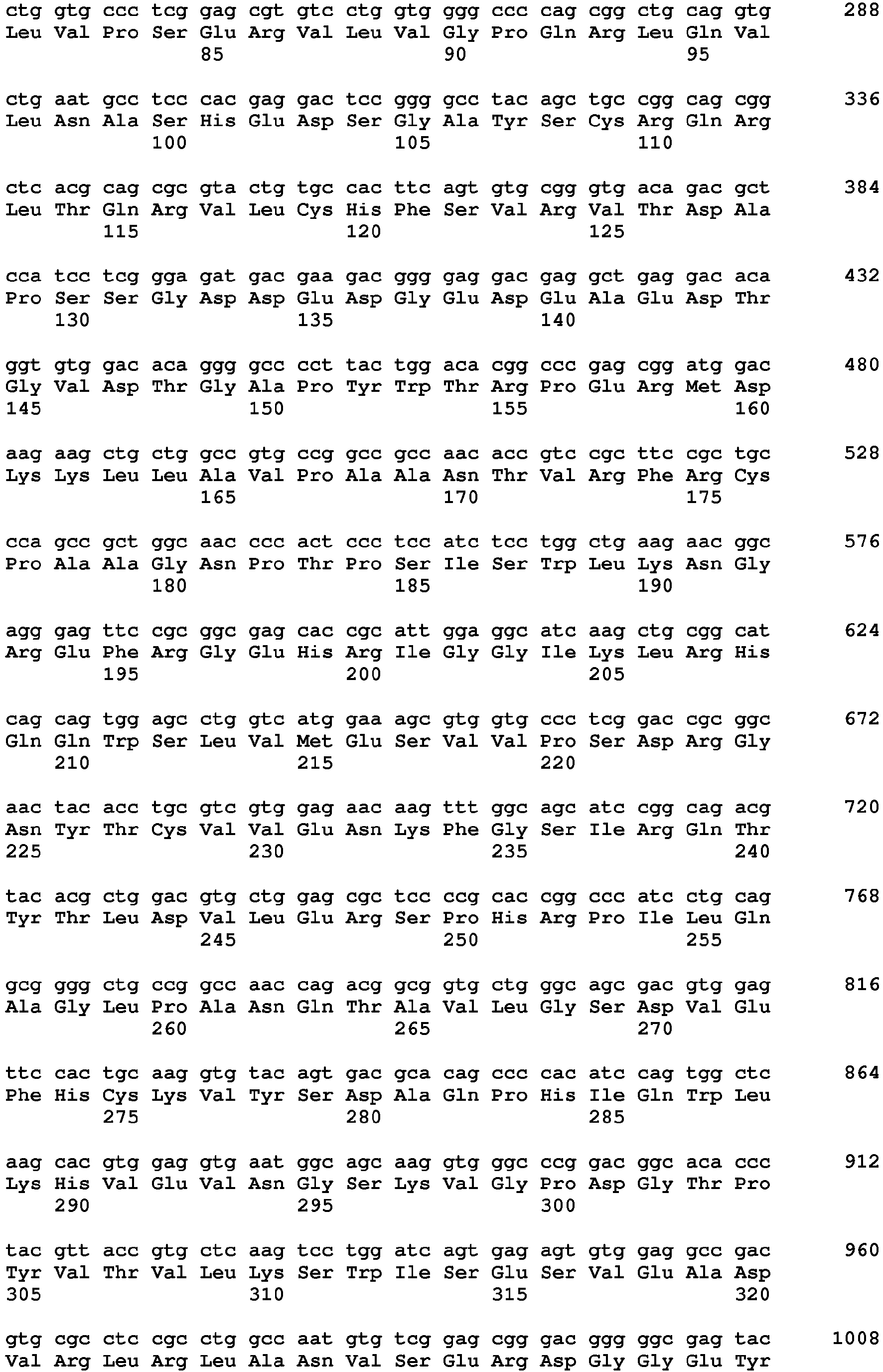
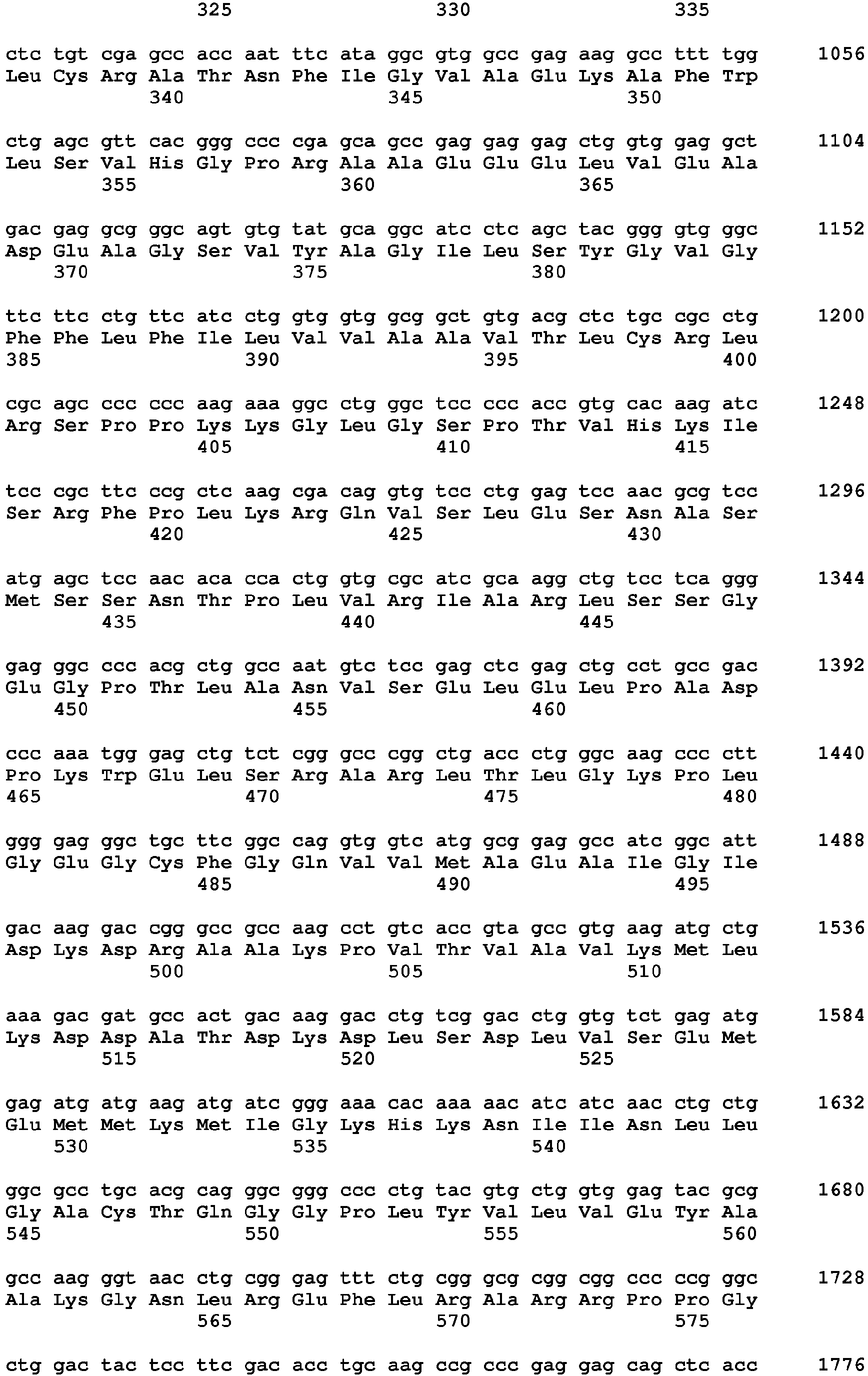
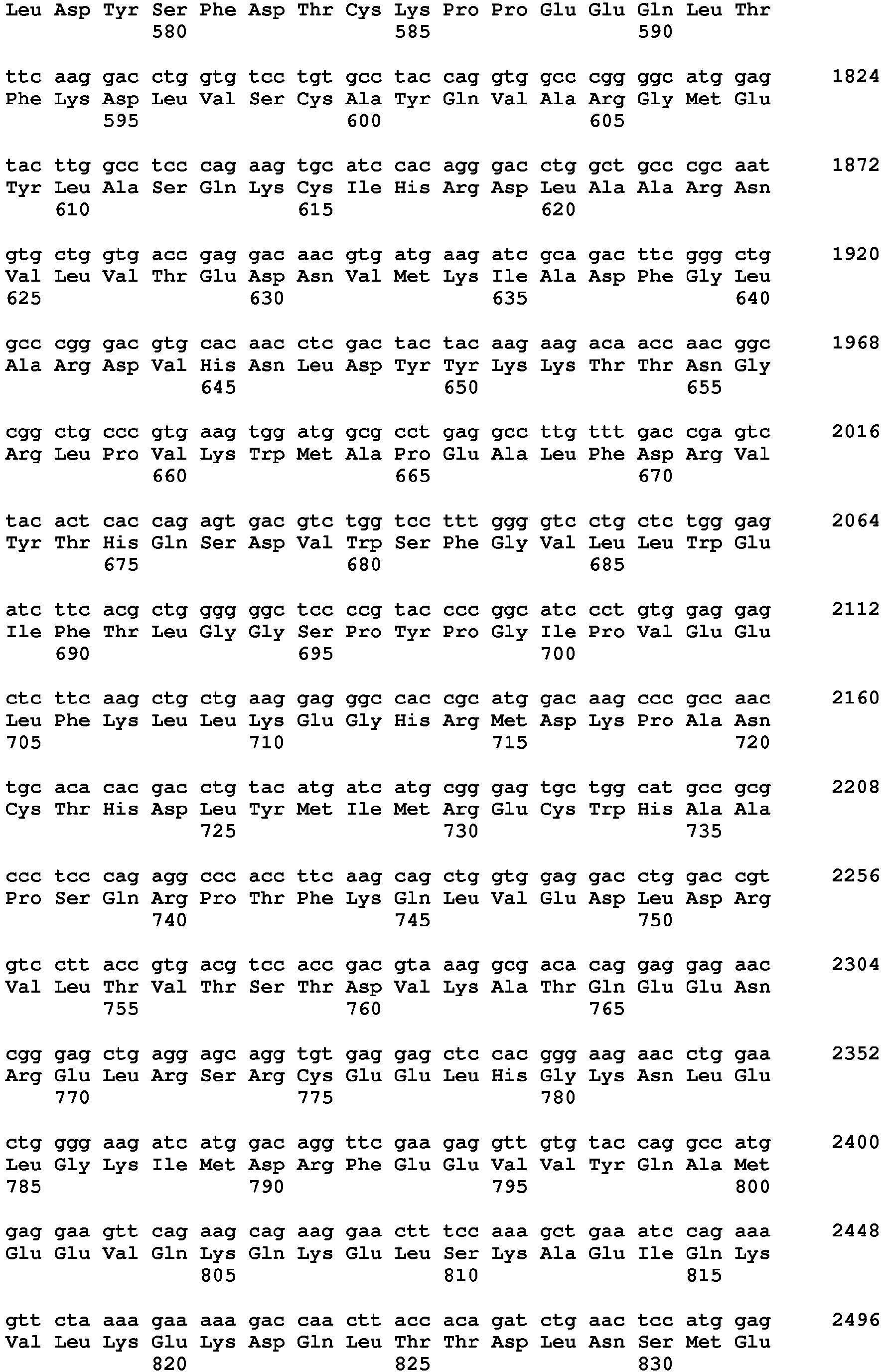

- <210> 10
<211> 951
<212> PRT
<213> Homo sapiens - <400> 10


- <210> 11
<211> 2961
<212> DNA
<213> Homo sapiens - <220>
<221> CDS
<222> (1)..(2961) - <400> 11


- <210> 12
<211> 986
<212> PRT
<213> Homo sapiens - <400> 12


- <210> 13
<211> 3003
<212> DNA
<213> Homo sapiens - <220>
<221> CDS
<222> (1)..(3003) - <400> 13
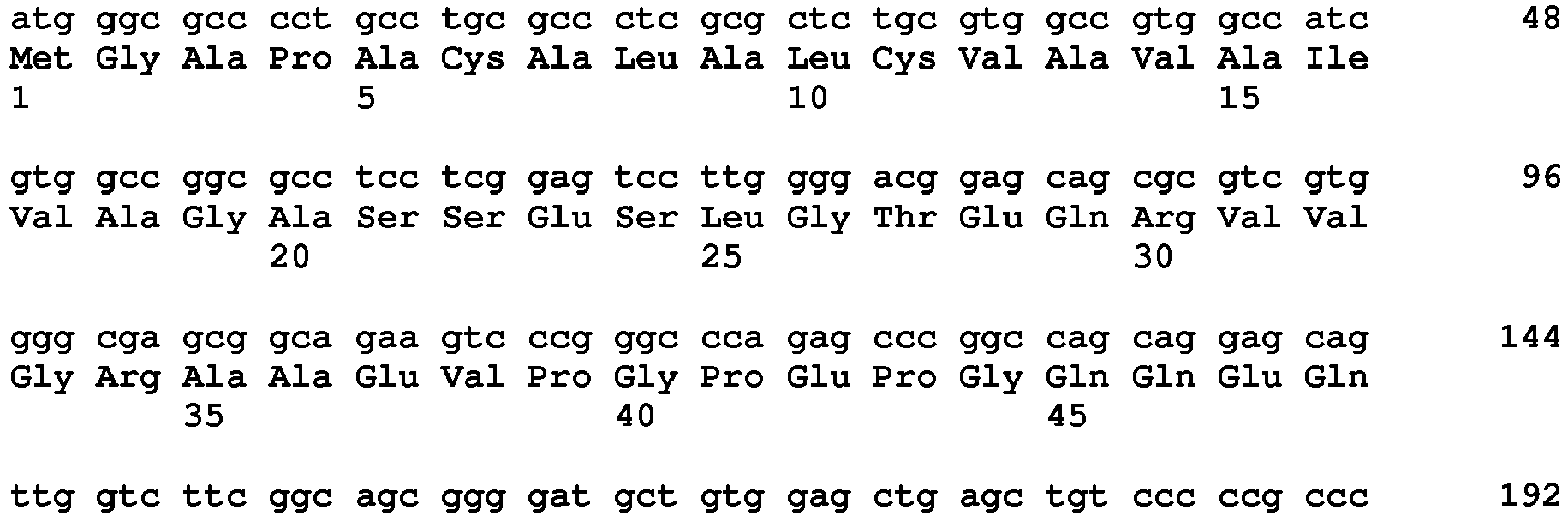


- <210> 14
<211> 1000
<212> PRT
<213> Homo sapiens - <400> 14



- <210> 15
<211> 4467
<212> DNA
<213> Homo sapiens - <220>
<221> CDS
<222> (1)..(4467) - <400> 15


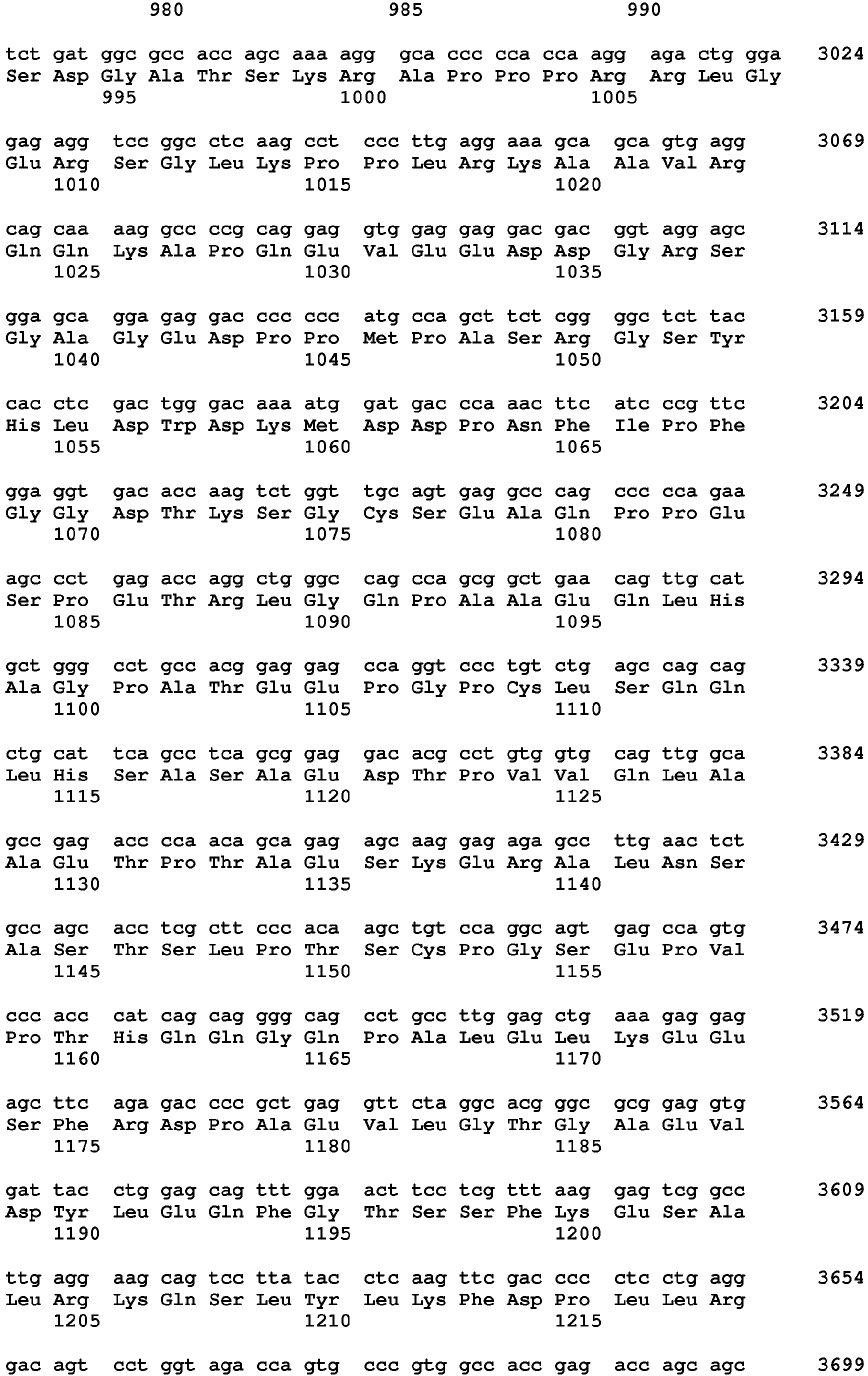


- <210> 16
<211> 1488
<212> PRT
<213> Homo sapiens - <400> 16
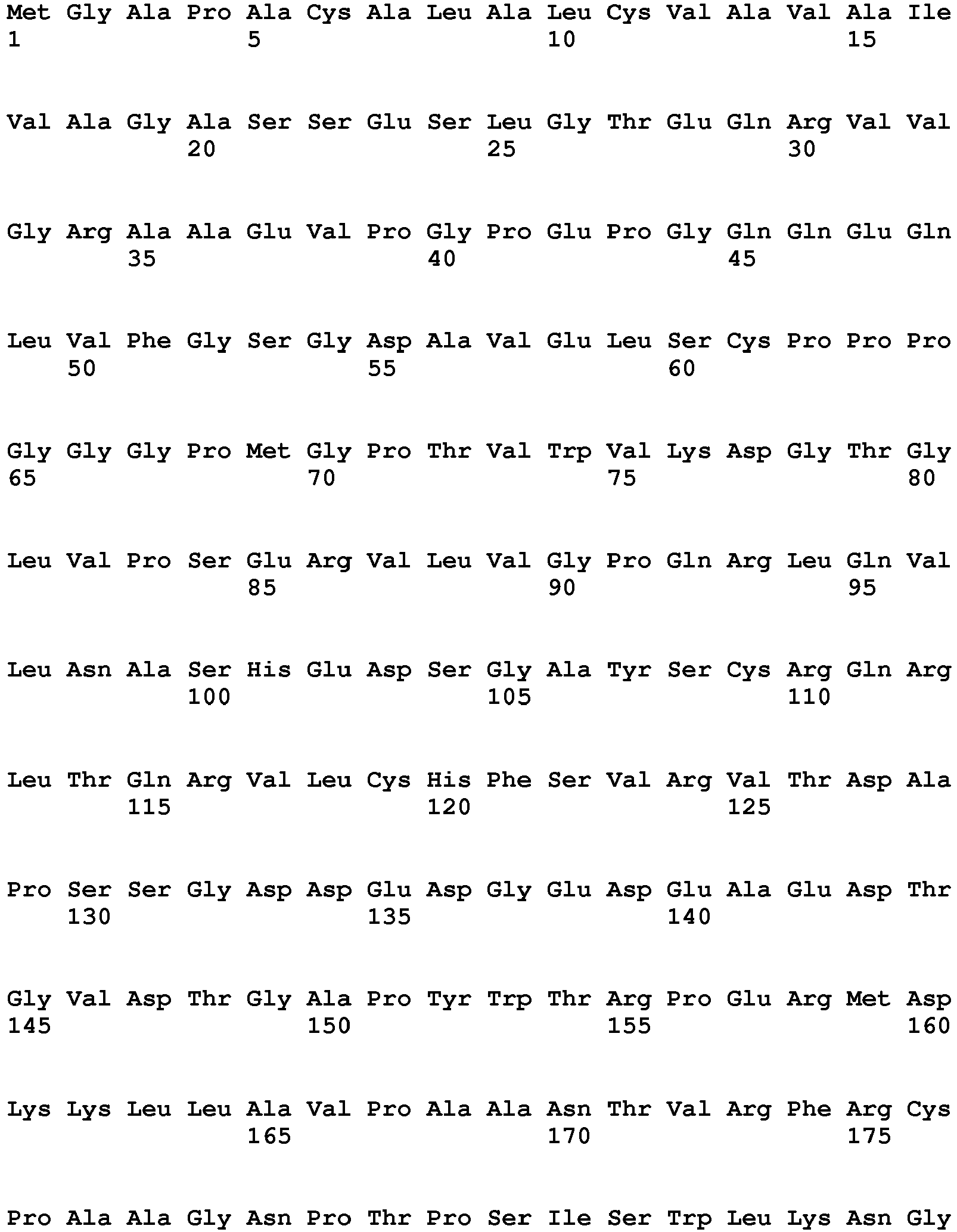


- <210> 17
<211> 60
<212> DNA
<213> Artificial - <220>
<223> Description of Artificial Sequence: an artificially synthesized p rimer sequence - <400> 17
ggatccgcca ccatggacta caaggacgac gatgacaagg gcgcccctgc ctgcgccctc 60 - <210> 18
<211> 20
<212> DNA
<213> Homo sapiens - <400> 18
tcctgctctg ccggtcgcac 20 - <210> 19
<211> 22
<212> DNA
<213> Homo sapiens - <400> 19
aggatgcgcc catcattccg ca 22 - <210> 20
<211> 29
<212> DNA
<213> Artificial - <220>
<223> Description of Artificial Sequence: an artificially synthesized p rimer sequence - <400> 20
ggatccgcca ccatgggcgc ccctgcctg 29 - <210> 21
<211> 28
<212> DNA
<213> Artificial - <220>
<223> Description of Artificial Sequence: an artificially synthesized p rimer sequence - <400> 21
gcggccgctc atcgaatgat gggtgccg 28 - <210> 22
<211> 3765
<212> DNA
<213> Homo sapiens - <220>
<221> CDS
<222> (1)..(3765) - <400> 22


- <210> 23
<211> 1254
<212> PRT
<213> Homo sapiens - <400> 23


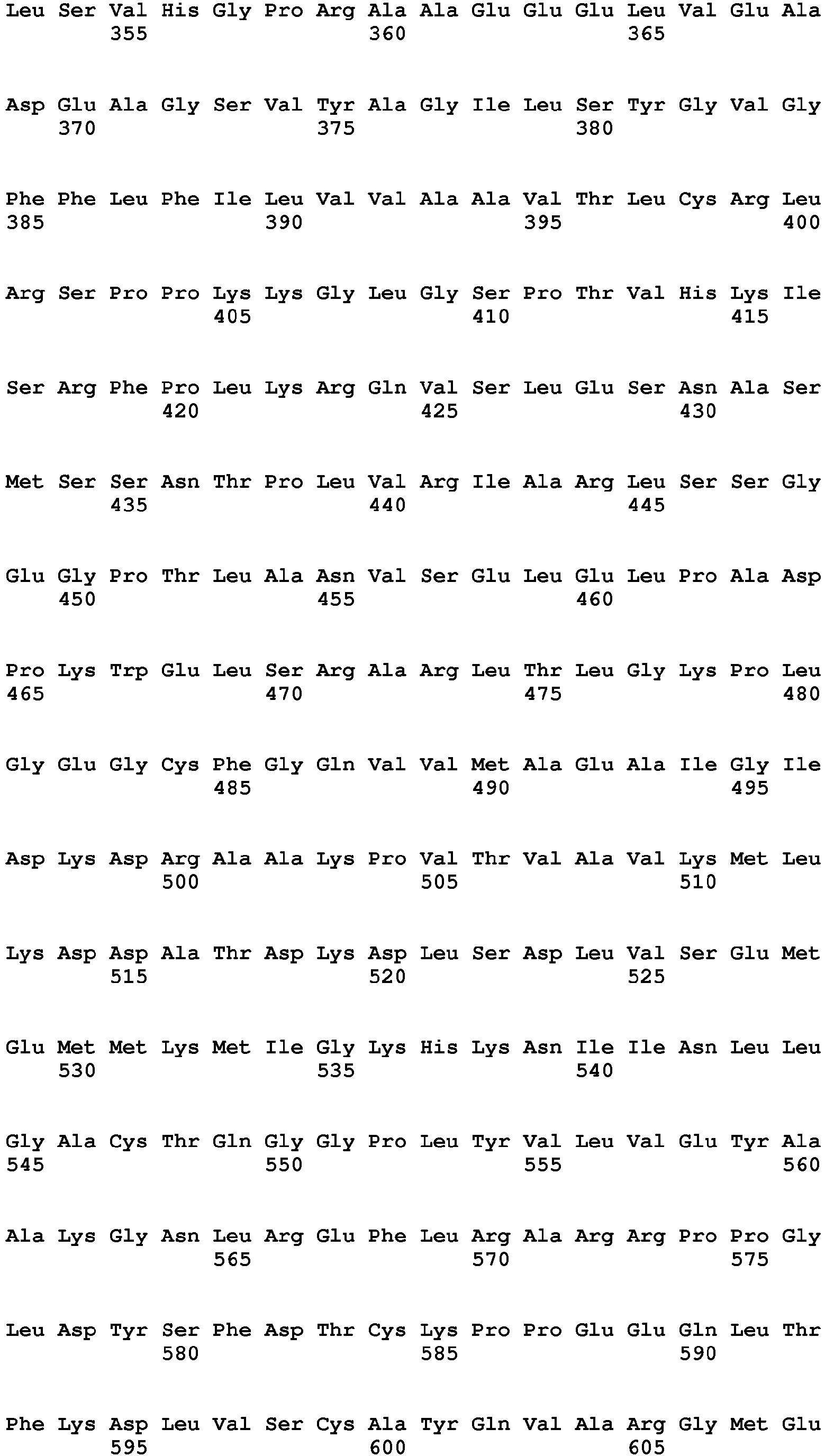
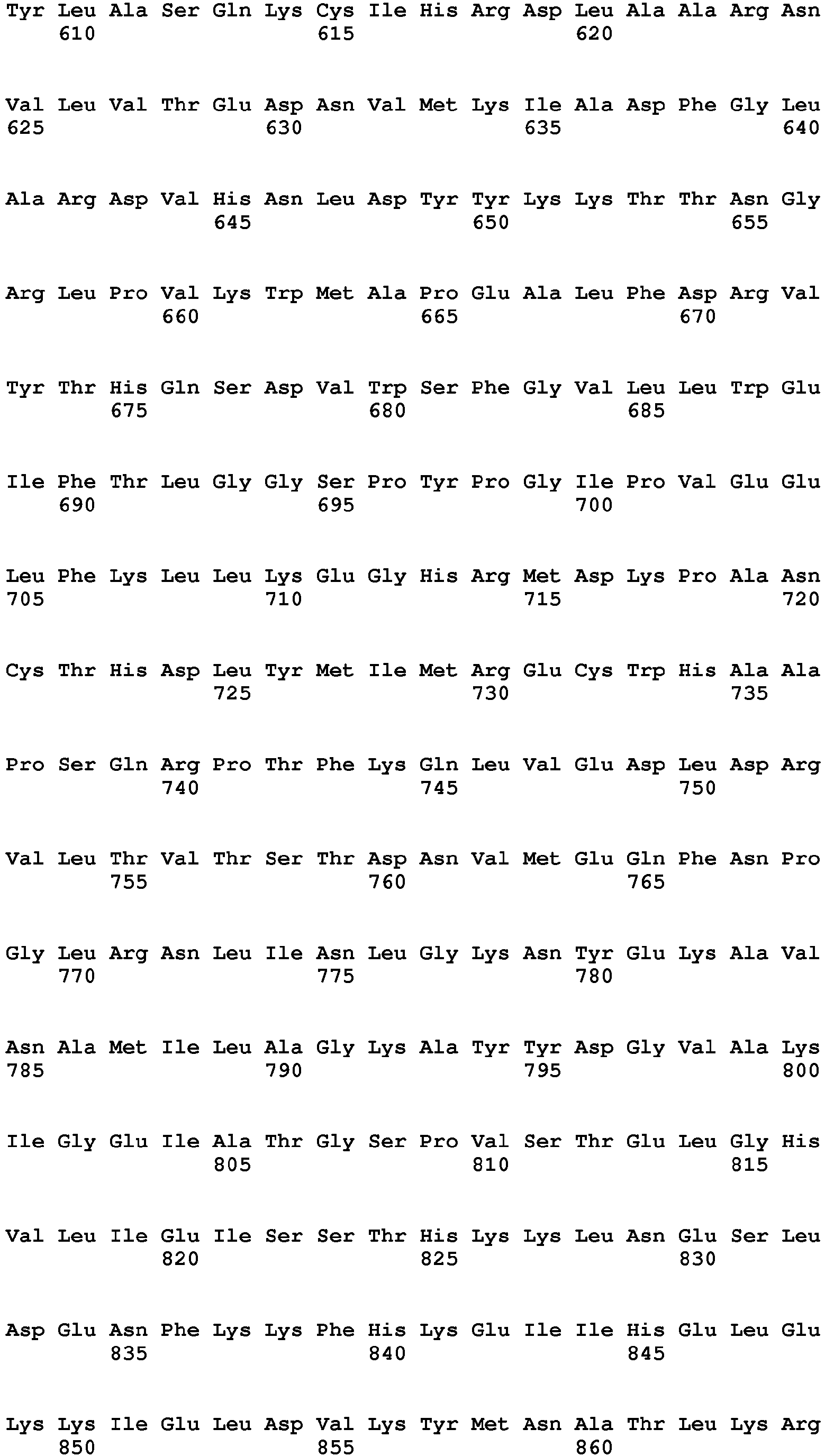


- <210> 24
<211> 27
<212> DNA
<213> Artificial - <220>
<223> Description of Artificial Sequence: an artificially synthesized F LAG tag sequence - <400> 24
atggactaca aggacgacga tgacaag 27
Claims (14)
- A compound of formula (I) or a salt thereof:
 X is N;Y is CH;L1 is ethylene or -methylene-O-;Z is CH;R1, the same or different from one another, are -O-C1-8 alkyl or halogen;p is 4;ring W is an optionally substituted pyrazole;Q is R3;R0 is C1-8 alkyl optionally substituted with -OH; andR3 is C1-8 alkyl substituted with one or more groups selected from the group consisting of -C(O)OH, carbamoyl optionally substituted with one or two R0, -OH, an optionally substituted non-aromatic heterocyclic group, and -C(O)-(an optionally substituted non-aromatic heterocyclic group);or whereinX is N;Y is CH;L1 is -methylene-O-;Z is CH;R1, the same or different from one another, are -O-methyl or F;p is 4;ring W is a benzene ring optionally substituted with -O-methyl;Q is -L2-R2;L2 is piperidine or 4-methylpiperazine; andR2 is 4-methylpiperazine or 2-hydroxyethylamino.
 - The compound according to Claim 1 or a salt thereof, wherein:X is N;Y is CH;L1 is ethylene or -methylene-O-;Z is CH;R1, the same or different from one another, are -O-C1-8 alkyl or halogen;p is 4;ring W is an optionally substituted pyrazole;Q is R3;R0 is C1-8 alkyl optionally substituted with -OH; andR3 is C1-8 alkyl substituted with one or more groups selected from the group consisting of -C(O)OH, carbamoyl optionally substituted with one or two R0, -OH, an optionally substituted non-aromatic heterocyclic group, and -C(O)-(an optionally substituted non-aromatic heterocyclic group);
- The compound according to Claim 1 or a salt thereof, wherein:X is N;Y is CH;L1 is -methylene-O-;Z is CH;R1, the same or different from one another, are -O-methyl or F;p is 4;ring W is a benzene ring optionally substituted with -O-methyl;Q is -L2-R2;L2 is piperidine or 4-methylpiperazine; andR2 is 4-methylpiperazine or 2-hydroxyethylamino.
- The compound according to Claim 2 or a salt thereof, wherein R3 is C1-8 alkyl substituted with one or more substituents selected from the group consisting of -OH, a non-aromatic heterocyclic group optionally substituted with C1-8 alkyl, and -C(O)-(a non-aromatic heterocyclic group optionally substituted with -OH).
- The compound according to Claim 4 or a salt thereof, wherein R1, the same or different from one another, are -O-methyl or F; L1 is -methylene-O-; ring W is pyrazole optionally substituted with methyl; and R3 is 2-hydroxyethyl, 2,3-dihydroxypropyl, or 4-methylpiperazin-1-ylmethyl.
- The compound according to Claim 1-3 or a salt thereof, wherein the compound is selected from the group consisting of:(2S)-3-[4-({5-[(2,6-difluoro-3,5-dimethoxybenzyl)oxy]pyrimidin-2-yl}amino)-1H-pyrazol-1-yl]propane-1,2-diol,5-[(2,6-difluoro-3,5-dimethoxybenzyl)oxy]-N-{3-methoxy-4-[4-(4-methylpiperazin-1-yl)piperidin-1-yl]phenyl}pyrimidin-2-amine,2-[4-({5-[(2,6-difluoro-3,5-dimethoxybenzyl)oxy]pyrimidin-2-yl}amino)-1H-pyrazol-1-yl]ethanol,5-[(2,6-difluoro-3,5-dimethoxybenzyl)oxy]-N-{1-[2-(4-methylpiperazin-1-yl)ethyl]-1H-pyrazol-4-yl}pyrimidin-2-amine,2-[4-({5-[(2,6-difluoro-3,5-dimethoxybenzyl)oxy]pyrimidin-2-yl}amino)-1H-pyrazol-1-yl]-1-(3-hydroxyazetidin-1-yl)ethanone,(2R)-3-[4-({5-[(2,6-difluoro-3,5-dimethoxybenzyl)oxy]pyrimidin-2-yl}amino)-1H-pyrazol-1-yl]propane-1,2-diol, and5-[(2,6-difluoro-3,5-dimethoxybenzyl)oxy]-N-{1-methyl-5-[(4-methylpiperazin-1-yl)methyl]-1H-pyrazo1-3-yl}pyrimidin-2-amine.
- The compound according to Claim 6 or a salt thereof, wherein the compound is 5-[(2,6-difluoro-3,5-dimethoxybenzyl)oxy]-N-{3-methoxy-4-[4-(4-methylpiperazin-1-yl)piperidin-1-yl]phenyl}pyrimidin-2-amine.
- The compound according to Claim 6 or a salt thereof, wherein the compound is 2-[4-({5-[(2,6-difluoro-3,5-dimethoxybenzyl)oxy]pyrimidin-2-yl}amino)-1H-pyrazol-1-yl]ethanol.
- The compound according to Claim 6 or a salt thereof, wherein the compound is (2R)-3-[4-({5-[(2,6-difluoro-3,5-dimethoxybenzyl)oxy]pyrimidin-2-yl}amino)-1H-pyrazol-1-yl]propane-1,2-diol.
- The compound according to Claim 6 or a salt thereof, wherein the compound is 5-[(2,6-difluoro-3,5-dimethoxybenzyl)oxy]-N-{1-methyl-5-[(4-methylpiperazin-1-yl)methyl]-1H-pyrazol-3-yl}pyrimidin-2-amine.
- A pharmaceutical composition comprising the compound according to Claims 1-10 or a salt thereof and a pharmaceutically acceptable excipient.
- The pharmaceutical composition according to Claim 11, which is used for treatment of mutant FGFR3-positive cancer.
- The compound according to Claims 1-10 or a salt thereof for use in a method for the treatment of mutant FGFR3-positive cancer.
- The compound for use according to Claim 13, wherein the cancer is mutant FGFR3-positive bladder cancer.
Priority Applications (1)
| Application Number | Priority Date | Filing Date | Title |
|---|---|---|---|
| PL13754501T PL2821402T3 (en) | 2012-02-28 | 2013-02-26 | Nitrogen-containing aromatic heterocyclic compound |
Applications Claiming Priority (2)
| Application Number | Priority Date | Filing Date | Title |
|---|---|---|---|
| JP2012042065 | 2012-02-28 | ||
| PCT/JP2013/054878 WO2013129369A1 (en) | 2012-02-28 | 2013-02-26 | Nitrogen-containing aromatic heterocyclic compound |
Publications (3)
| Publication Number | Publication Date |
|---|---|
| EP2821402A1 EP2821402A1 (en) | 2015-01-07 |
| EP2821402A4 EP2821402A4 (en) | 2015-08-19 |
| EP2821402B1 true EP2821402B1 (en) | 2019-08-21 |
Family
ID=49082566
Family Applications (1)
| Application Number | Title | Priority Date | Filing Date |
|---|---|---|---|
| EP13754501.8A Active EP2821402B1 (en) | 2012-02-28 | 2013-02-26 | Nitrogen-containing aromatic heterocyclic compound |
Country Status (20)
| Country | Link |
|---|---|
| US (2) | US9464077B2 (en) |
| EP (1) | EP2821402B1 (en) |
| JP (1) | JP5343177B1 (en) |
| KR (1) | KR102032007B1 (en) |
| CN (1) | CN104144915B (en) |
| AR (1) | AR090161A1 (en) |
| AU (2) | AU2013227139B2 (en) |
| BR (1) | BR112014018868B1 (en) |
| CA (1) | CA2866611C (en) |
| EA (1) | EA026953B1 (en) |
| ES (1) | ES2746288T3 (en) |
| IL (1) | IL234313A (en) |
| MX (1) | MX349120B (en) |
| PH (1) | PH12014501925A1 (en) |
| PL (1) | PL2821402T3 (en) |
| PT (1) | PT2821402T (en) |
| TW (1) | TWI542581B (en) |
| UA (1) | UA114501C2 (en) |
| WO (1) | WO2013129369A1 (en) |
| ZA (1) | ZA201406201B (en) |
Families Citing this family (25)
| Publication number | Priority date | Publication date | Assignee | Title |
|---|---|---|---|---|
| BR112014021897B1 (en) | 2012-03-08 | 2022-06-14 | Astellas Pharma Inc | METHOD, KIT, PRIMER SET AND PROBE SETS TO DETECT A FUSION GENE COMPOSED OF AN FGFR3 GENE AND A TACC3 GENE |
| ES2932954T5 (en) * | 2012-07-24 | 2025-10-28 | Univ Columbia | Fgfr-tacc fusion proteins and methods thereof |
| US20150203589A1 (en) | 2012-07-24 | 2015-07-23 | The Trustees Of Columbia University In The City Of New York | Fusion proteins and methods thereof |
| CA2886002C (en) * | 2012-09-27 | 2020-06-09 | Chugai Seiyaku Kabushiki Kaisha | Fgfr3 fusion gene and pharmaceutical drug targeting same |
| AR094812A1 (en) | 2013-02-20 | 2015-08-26 | Eisai R&D Man Co Ltd | DERIVED FROM MONOCYCLIC PYRIDINE AS AN FGFR INHIBITOR |
| US20160052926A1 (en) * | 2013-03-15 | 2016-02-25 | Hutchison Medipharma Limited | Novel pyrimidine and pyridine compounds and usage thereof |
| AR097455A1 (en) | 2013-08-28 | 2016-03-16 | Astellas Pharma Inc | PHARMACEUTICAL COMPOSITION CONTAINING PYRIMIDINE COMPOSITE AS AN ACTIVE INGREDIENT |
| SMT201800379T1 (en) | 2013-10-18 | 2018-09-13 | Eisai R&D Man Co Ltd | Pyrimidine fgfr4 inhibitors |
| EA028614B1 (en) * | 2014-05-22 | 2017-12-29 | Общество С Ограниченной Ответственностью "Русские Фармацевтические Технологии" | Selective inhibitors interfering with fibroblast growth factor receptor and frs2 interaction for the prevention and treatment of cancer |
| MX369646B (en) | 2014-08-18 | 2019-11-15 | Eisai R&D Man Co Ltd | Salt of monocyclic pyridine derivative and crystal thereof. |
| CR20170104A (en) * | 2014-09-26 | 2017-05-31 | Janssen Pharmaceutica Nv | Use of fgfr mutant gene panels in identifying cancer patients that will be responsive to treatment with an fgfr inhibitor |
| AU2016237222B2 (en) | 2015-03-25 | 2021-04-29 | Eisai R&D Management Co., Ltd. | Therapeutic agent for bile duct cancer |
| CN107660200B (en) | 2015-04-14 | 2022-01-11 | 卫材R&D管理有限公司 | Crystalline FGFR4 inhibitor compounds and uses thereof |
| CN104940748A (en) * | 2015-06-09 | 2015-09-30 | 林正兴 | Medicine composition for treating gastric cancer |
| CA3001969C (en) | 2015-12-17 | 2023-10-03 | Eisai R&D Management Co., Ltd. | Therapeutic agent for breast cancer |
| CN106928275B (en) * | 2015-12-29 | 2020-10-02 | 齐鲁制药有限公司 | Preparation method of spiro amine aryl phosphorus oxide compound and intermediate and crystal form thereof |
| EP3454898B1 (en) | 2016-05-10 | 2021-11-10 | Eisai R&D Management Co., Ltd. | Drug combinations for reducing cell viability and/or cell proliferation |
| US10654836B2 (en) * | 2016-05-20 | 2020-05-19 | Zhejiang Hisun Pharmaceutical Co., Ltd. | Pyrimidine derivative, method for preparing same and use thereof in medicine |
| RU2771311C2 (en) | 2017-08-15 | 2022-04-29 | Сиэсписи Чжунци Фармасьютикал Текнолоджи (Шишцзяжуан) Ко., Лтд. | Fgfr inhibitor and its medical use |
| JPWO2019189241A1 (en) | 2018-03-28 | 2021-03-18 | エーザイ・アール・アンド・ディー・マネジメント株式会社 | Hepatocellular carcinoma therapeutic agent |
| EP3942045A1 (en) | 2019-03-21 | 2022-01-26 | Onxeo | A dbait molecule in combination with kinase inhibitor for the treatment of cancer |
| EP4054579A1 (en) | 2019-11-08 | 2022-09-14 | Institut National de la Santé et de la Recherche Médicale (INSERM) | Methods for the treatment of cancers that have acquired resistance to kinase inhibitors |
| WO2021148581A1 (en) | 2020-01-22 | 2021-07-29 | Onxeo | Novel dbait molecule and its use |
| AU2021416682B2 (en) * | 2021-01-11 | 2024-01-11 | Guangzhou Salustier Biosciences Co., Ltd. | 2-aminopyrimidine compound and pharmaceutical composition thereof and application thereof |
| CN112851587A (en) * | 2021-01-21 | 2021-05-28 | 药雅科技(上海)有限公司 | Alkyne heterocyclic compound for treating cancer and preparation method and application thereof |
Family Cites Families (12)
| Publication number | Priority date | Publication date | Assignee | Title |
|---|---|---|---|---|
| WO2003066601A1 (en) | 2002-02-08 | 2003-08-14 | Smithkline Beecham Corporation | Pyrimidine compounds |
| WO2005002673A1 (en) * | 2003-07-03 | 2005-01-13 | Astex Therapeutics Limited | Raf kinase inhibitors |
| US20060247250A1 (en) | 2005-03-16 | 2006-11-02 | Targegen, Inc. | Pyrimidine inhibitors of kinases |
| US7754717B2 (en) | 2005-08-15 | 2010-07-13 | Amgen Inc. | Bis-aryl amide compounds and methods of use |
| US20070161645A1 (en) * | 2005-11-02 | 2007-07-12 | Targegen, Inc. | Thiazole inhibitors targeting resistant kinase mutations |
| WO2007071752A2 (en) | 2005-12-21 | 2007-06-28 | Novartis Ag | Pyrimidinyl aryl urea derivatives being fgf inhibitors |
| US8030487B2 (en) | 2006-07-07 | 2011-10-04 | Targegen, Inc. | 2-amino—5-substituted pyrimidine inhibitors |
| US7737149B2 (en) | 2006-12-21 | 2010-06-15 | Astrazeneca Ab | N-[5-[2-(3,5-dimethoxyphenyl)ethyl]-2H-pyrazol-3-yl]-4-(3,5-dimethylpiperazin-1-yl)benzamide and salts thereof |
| CN101611014B (en) * | 2006-12-21 | 2012-05-30 | 阿斯利康(瑞典)有限公司 | Amidopyrazoles as FGFR inhibitors |
| EA201000561A1 (en) | 2007-10-09 | 2010-10-29 | Мерк Патент Гмбх | PYRIDINE DERIVATIVES, SUITABLE AS GLUKOKINASE ACTIVATORS |
| WO2009056886A1 (en) * | 2007-11-01 | 2009-05-07 | Astrazeneca Ab | Pyrimidine derivatives and their use as modulators of fgfr activity |
| WO2009153592A1 (en) | 2008-06-19 | 2009-12-23 | Astrazeneca Ab | Pyrazole compounds 436 |
-
2013
- 2013-02-26 UA UAA201410524A patent/UA114501C2/en unknown
- 2013-02-26 BR BR112014018868-8A patent/BR112014018868B1/en not_active IP Right Cessation
- 2013-02-26 AR ARP130100588A patent/AR090161A1/en unknown
- 2013-02-26 US US13/979,327 patent/US9464077B2/en not_active Expired - Fee Related
- 2013-02-26 EA EA201491595A patent/EA026953B1/en not_active IP Right Cessation
- 2013-02-26 KR KR1020147024294A patent/KR102032007B1/en not_active Expired - Fee Related
- 2013-02-26 WO PCT/JP2013/054878 patent/WO2013129369A1/en not_active Ceased
- 2013-02-26 PL PL13754501T patent/PL2821402T3/en unknown
- 2013-02-26 CN CN201380011423.7A patent/CN104144915B/en not_active Expired - Fee Related
- 2013-02-26 JP JP2013520310A patent/JP5343177B1/en not_active Expired - Fee Related
- 2013-02-26 MX MX2014010327A patent/MX349120B/en active IP Right Grant
- 2013-02-26 CA CA2866611A patent/CA2866611C/en active Active
- 2013-02-26 AU AU2013227139A patent/AU2013227139B2/en not_active Ceased
- 2013-02-26 ES ES13754501T patent/ES2746288T3/en active Active
- 2013-02-26 EP EP13754501.8A patent/EP2821402B1/en active Active
- 2013-02-26 TW TW102106727A patent/TWI542581B/en not_active IP Right Cessation
- 2013-02-26 PT PT137545018T patent/PT2821402T/en unknown
-
2014
- 2014-08-22 ZA ZA2014/06201A patent/ZA201406201B/en unknown
- 2014-08-26 IL IL234313A patent/IL234313A/en not_active IP Right Cessation
- 2014-08-27 PH PH12014501925A patent/PH12014501925A1/en unknown
-
2016
- 2016-09-27 US US15/277,484 patent/US20170152232A1/en not_active Abandoned
-
2017
- 2017-04-27 AU AU2017202759A patent/AU2017202759A1/en not_active Abandoned
Non-Patent Citations (1)
| Title |
|---|
| None * |
Also Published As
Similar Documents
| Publication | Publication Date | Title |
|---|---|---|
| US9464077B2 (en) | Nitrogen-containing aromatic heterocyclic compound | |
| EP2655357B1 (en) | Indazolyl triazole derivatives as irak inhibitors | |
| EP2552905B1 (en) | B-Raf kinase inhibitors | |
| EP2920175B1 (en) | Triazolopyridazine derivatives as bromodomain inhibitors | |
| TWI823932B (en) | Triazolopyrimidine compounds and their use in treating cancer | |
| JP2018158942A (en) | Aminotriazine derivatives useful as tank-binding kinase inhibitor compounds | |
| AU2014235280A1 (en) | Histone demethylase inhibitors | |
| JP2014005206A (en) | Arylamino heterocyclic carboxamide compound | |
| JP2015522045A (en) | Pyrimidine pyrazolyl derivatives | |
| US20130225562A1 (en) | Pyridyltriazoles | |
| CN121013856A (en) | EGFR degrading agents, their pharmaceutical compositions and their uses | |
| US20260077051A1 (en) | Compounds for the degradation of egfr kinase | |
| CN115667259A (en) | Condensed ring compounds for inhibiting H-PGDS | |
| US20250084056A1 (en) | Substituted oxoisoindolinyl piperidine-2,6-dione compounds | |
| US20260098025A1 (en) | Dimeric compounds as inhibitors of glycogen synthase 1 (gys1) and methods of use thereof | |
| HK1203201B (en) | Nitrogen-containing aromatic heterocyclic compound | |
| HK1191938B (en) | Indazolyl triazole derivatives as irak inhibitors |
Legal Events
| Date | Code | Title | Description |
|---|---|---|---|
| PUAI | Public reference made under article 153(3) epc to a published international application that has entered the european phase |
Free format text: ORIGINAL CODE: 0009012 |
|
| 17P | Request for examination filed |
Effective date: 20140821 |
|
| AK | Designated contracting states |
Kind code of ref document: A1 Designated state(s): AL AT BE BG CH CY CZ DE DK EE ES FI FR GB GR HR HU IE IS IT LI LT LU LV MC MK MT NL NO PL PT RO RS SE SI SK SM TR |
|
| AX | Request for extension of the european patent |
Extension state: BA ME |
|
| RA4 | Supplementary search report drawn up and despatched (corrected) |
Effective date: 20150722 |
|
| RIC1 | Information provided on ipc code assigned before grant |
Ipc: A61K 31/4545 20060101ALI20150716BHEP Ipc: C07D 239/42 20060101AFI20150716BHEP Ipc: C07D 471/10 20060101ALI20150716BHEP Ipc: A61K 31/506 20060101ALI20150716BHEP Ipc: C07D 405/14 20060101ALI20150716BHEP Ipc: C07D 403/12 20060101ALI20150716BHEP Ipc: C07D 413/12 20060101ALI20150716BHEP Ipc: A61P 35/00 20060101ALI20150716BHEP Ipc: C07D 401/12 20060101ALI20150716BHEP Ipc: C07D 401/14 20060101ALI20150716BHEP Ipc: C07D 487/20 20060101ALI20150716BHEP Ipc: A61P 43/00 20060101ALI20150716BHEP Ipc: C07D 239/47 20060101ALI20150716BHEP |
|
| 17Q | First examination report despatched |
Effective date: 20160804 |
|
| STAA | Information on the status of an ep patent application or granted ep patent |
Free format text: STATUS: EXAMINATION IS IN PROGRESS |
|
| RIC1 | Information provided on ipc code assigned before grant |
Ipc: C07D 401/14 20060101ALI20181204BHEP Ipc: C07D 401/12 20060101ALI20181204BHEP Ipc: C07D 405/14 20060101ALI20181204BHEP Ipc: C07D 239/47 20060101ALI20181204BHEP Ipc: C07D 413/12 20060101ALI20181204BHEP Ipc: C07D 471/10 20060101ALI20181204BHEP Ipc: C07D 403/12 20060101ALI20181204BHEP Ipc: C07D 239/42 20060101AFI20181204BHEP Ipc: A61P 43/00 20060101ALI20181204BHEP Ipc: A61K 31/4545 20060101ALI20181204BHEP Ipc: A61P 35/00 20060101ALI20181204BHEP Ipc: A61K 31/506 20060101ALI20181204BHEP Ipc: C07D 487/20 20060101ALI20181204BHEP |
|
| GRAP | Despatch of communication of intention to grant a patent |
Free format text: ORIGINAL CODE: EPIDOSNIGR1 |
|
| STAA | Information on the status of an ep patent application or granted ep patent |
Free format text: STATUS: GRANT OF PATENT IS INTENDED |
|
| RIN1 | Information on inventor provided before grant (corrected) |
Inventor name: MIYASAKA, KOZO Inventor name: MORITOMO, HIROYUKI Inventor name: FUTAMI, TAKASHI Inventor name: TOKUZAKI, KAZUO Inventor name: SUZUKI, TOMOYUKI Inventor name: NODA, ATSUSHI Inventor name: ASAUMI, MAKOTO Inventor name: IIKUBO, KAZUHIKO Inventor name: TOMIYAMA, HIROSHI Inventor name: KAMEDA, MINORU Inventor name: OKADA, HARUKI Inventor name: IWAI, YOSHINORI Inventor name: KAWAMOTO, YUICHIRO Inventor name: HISAMICHI, HIROYUKI Inventor name: TSUNOYAMA, KAZUHISA Inventor name: KURIWAKI, IKUMI Inventor name: SUZUKI, ATSUSHI |
|
| INTG | Intention to grant announced |
Effective date: 20190115 |
|
| GRAJ | Information related to disapproval of communication of intention to grant by the applicant or resumption of examination proceedings by the epo deleted |
Free format text: ORIGINAL CODE: EPIDOSDIGR1 |
|
| STAA | Information on the status of an ep patent application or granted ep patent |
Free format text: STATUS: EXAMINATION IS IN PROGRESS |
|
| GRAP | Despatch of communication of intention to grant a patent |
Free format text: ORIGINAL CODE: EPIDOSNIGR1 |
|
| STAA | Information on the status of an ep patent application or granted ep patent |
Free format text: STATUS: GRANT OF PATENT IS INTENDED |
|
| INTC | Intention to grant announced (deleted) | ||
| INTG | Intention to grant announced |
Effective date: 20190307 |
|
| GRAS | Grant fee paid |
Free format text: ORIGINAL CODE: EPIDOSNIGR3 |
|
| GRAA | (expected) grant |
Free format text: ORIGINAL CODE: 0009210 |
|
| STAA | Information on the status of an ep patent application or granted ep patent |
Free format text: STATUS: THE PATENT HAS BEEN GRANTED |
|
| AK | Designated contracting states |
Kind code of ref document: B1 Designated state(s): AL AT BE BG CH CY CZ DE DK EE ES FI FR GB GR HR HU IE IS IT LI LT LU LV MC MK MT NL NO PL PT RO RS SE SI SK SM TR |
|
| AX | Request for extension of the european patent |
Extension state: BA ME |
|
| RAP1 | Party data changed (applicant data changed or rights of an application transferred) |
Owner name: KOTOBUKI PHARMACEUTICAL CO., LTD. Owner name: ASTELLAS PHARMA INC. |
|
| REG | Reference to a national code |
Ref country code: GB Ref legal event code: FG4D |
|
| REG | Reference to a national code |
Ref country code: CH Ref legal event code: EP |
|
| REG | Reference to a national code |
Ref country code: DE Ref legal event code: R096 Ref document number: 602013059469 Country of ref document: DE |
|
| REG | Reference to a national code |
Ref country code: AT Ref legal event code: REF Ref document number: 1169601 Country of ref document: AT Kind code of ref document: T Effective date: 20190915 |
|
| REG | Reference to a national code |
Ref country code: IE Ref legal event code: FG4D |
|
| REG | Reference to a national code |
Ref country code: NL Ref legal event code: FP |
|
| REG | Reference to a national code |
Ref country code: PT Ref legal event code: SC4A Ref document number: 2821402 Country of ref document: PT Date of ref document: 20191002 Kind code of ref document: T Free format text: AVAILABILITY OF NATIONAL TRANSLATION Effective date: 20190917 |
|
| REG | Reference to a national code |
Ref country code: SE Ref legal event code: TRGR |
|
| REG | Reference to a national code |
Ref country code: LT Ref legal event code: MG4D |
|
| PG25 | Lapsed in a contracting state [announced via postgrant information from national office to epo] |
Ref country code: FI Free format text: LAPSE BECAUSE OF FAILURE TO SUBMIT A TRANSLATION OF THE DESCRIPTION OR TO PAY THE FEE WITHIN THE PRESCRIBED TIME-LIMIT Effective date: 20190821 Ref country code: NO Free format text: LAPSE BECAUSE OF FAILURE TO SUBMIT A TRANSLATION OF THE DESCRIPTION OR TO PAY THE FEE WITHIN THE PRESCRIBED TIME-LIMIT Effective date: 20191121 Ref country code: BG Free format text: LAPSE BECAUSE OF FAILURE TO SUBMIT A TRANSLATION OF THE DESCRIPTION OR TO PAY THE FEE WITHIN THE PRESCRIBED TIME-LIMIT Effective date: 20191121 Ref country code: HR Free format text: LAPSE BECAUSE OF FAILURE TO SUBMIT A TRANSLATION OF THE DESCRIPTION OR TO PAY THE FEE WITHIN THE PRESCRIBED TIME-LIMIT Effective date: 20190821 Ref country code: LT Free format text: LAPSE BECAUSE OF FAILURE TO SUBMIT A TRANSLATION OF THE DESCRIPTION OR TO PAY THE FEE WITHIN THE PRESCRIBED TIME-LIMIT Effective date: 20190821 |
|
| PG25 | Lapsed in a contracting state [announced via postgrant information from national office to epo] |
Ref country code: AL Free format text: LAPSE BECAUSE OF FAILURE TO SUBMIT A TRANSLATION OF THE DESCRIPTION OR TO PAY THE FEE WITHIN THE PRESCRIBED TIME-LIMIT Effective date: 20190821 Ref country code: LV Free format text: LAPSE BECAUSE OF FAILURE TO SUBMIT A TRANSLATION OF THE DESCRIPTION OR TO PAY THE FEE WITHIN THE PRESCRIBED TIME-LIMIT Effective date: 20190821 Ref country code: RS Free format text: LAPSE BECAUSE OF FAILURE TO SUBMIT A TRANSLATION OF THE DESCRIPTION OR TO PAY THE FEE WITHIN THE PRESCRIBED TIME-LIMIT Effective date: 20190821 Ref country code: IS Free format text: LAPSE BECAUSE OF FAILURE TO SUBMIT A TRANSLATION OF THE DESCRIPTION OR TO PAY THE FEE WITHIN THE PRESCRIBED TIME-LIMIT Effective date: 20191221 |
|
| REG | Reference to a national code |
Ref country code: GR Ref legal event code: EP Ref document number: 20190403492 Country of ref document: GR Effective date: 20200213 Ref country code: CH Ref legal event code: NV Representative=s name: VALIPAT S.A. C/O BOVARD SA NEUCHATEL, CH |
|
| REG | Reference to a national code |
Ref country code: ES Ref legal event code: FG2A Ref document number: 2746288 Country of ref document: ES Kind code of ref document: T3 Effective date: 20200305 |
|
| PG25 | Lapsed in a contracting state [announced via postgrant information from national office to epo] |
Ref country code: RO Free format text: LAPSE BECAUSE OF FAILURE TO SUBMIT A TRANSLATION OF THE DESCRIPTION OR TO PAY THE FEE WITHIN THE PRESCRIBED TIME-LIMIT Effective date: 20190821 Ref country code: DK Free format text: LAPSE BECAUSE OF FAILURE TO SUBMIT A TRANSLATION OF THE DESCRIPTION OR TO PAY THE FEE WITHIN THE PRESCRIBED TIME-LIMIT Effective date: 20190821 Ref country code: EE Free format text: LAPSE BECAUSE OF FAILURE TO SUBMIT A TRANSLATION OF THE DESCRIPTION OR TO PAY THE FEE WITHIN THE PRESCRIBED TIME-LIMIT Effective date: 20190821 |
|
| PG25 | Lapsed in a contracting state [announced via postgrant information from national office to epo] |
Ref country code: SK Free format text: LAPSE BECAUSE OF FAILURE TO SUBMIT A TRANSLATION OF THE DESCRIPTION OR TO PAY THE FEE WITHIN THE PRESCRIBED TIME-LIMIT Effective date: 20190821 Ref country code: SM Free format text: LAPSE BECAUSE OF FAILURE TO SUBMIT A TRANSLATION OF THE DESCRIPTION OR TO PAY THE FEE WITHIN THE PRESCRIBED TIME-LIMIT Effective date: 20190821 Ref country code: CZ Free format text: LAPSE BECAUSE OF FAILURE TO SUBMIT A TRANSLATION OF THE DESCRIPTION OR TO PAY THE FEE WITHIN THE PRESCRIBED TIME-LIMIT Effective date: 20190821 Ref country code: IS Free format text: LAPSE BECAUSE OF FAILURE TO SUBMIT A TRANSLATION OF THE DESCRIPTION OR TO PAY THE FEE WITHIN THE PRESCRIBED TIME-LIMIT Effective date: 20200224 |
|
| REG | Reference to a national code |
Ref country code: DE Ref legal event code: R097 Ref document number: 602013059469 Country of ref document: DE |
|
| PLBE | No opposition filed within time limit |
Free format text: ORIGINAL CODE: 0009261 |
|
| STAA | Information on the status of an ep patent application or granted ep patent |
Free format text: STATUS: NO OPPOSITION FILED WITHIN TIME LIMIT |
|
| PG2D | Information on lapse in contracting state deleted |
Ref country code: IS |
|
| 26N | No opposition filed |
Effective date: 20200603 |
|
| PG25 | Lapsed in a contracting state [announced via postgrant information from national office to epo] |
Ref country code: SI Free format text: LAPSE BECAUSE OF FAILURE TO SUBMIT A TRANSLATION OF THE DESCRIPTION OR TO PAY THE FEE WITHIN THE PRESCRIBED TIME-LIMIT Effective date: 20190821 |
|
| PG25 | Lapsed in a contracting state [announced via postgrant information from national office to epo] |
Ref country code: LU Free format text: LAPSE BECAUSE OF NON-PAYMENT OF DUE FEES Effective date: 20200226 Ref country code: MC Free format text: LAPSE BECAUSE OF FAILURE TO SUBMIT A TRANSLATION OF THE DESCRIPTION OR TO PAY THE FEE WITHIN THE PRESCRIBED TIME-LIMIT Effective date: 20190821 |
|
| REG | Reference to a national code |
Ref country code: AT Ref legal event code: UEP Ref document number: 1169601 Country of ref document: AT Kind code of ref document: T Effective date: 20190821 |
|
| PGFP | Annual fee paid to national office [announced via postgrant information from national office to epo] |
Ref country code: IE Payment date: 20220225 Year of fee payment: 10 Ref country code: GB Payment date: 20220218 Year of fee payment: 10 Ref country code: CH Payment date: 20220216 Year of fee payment: 10 Ref country code: AT Payment date: 20220218 Year of fee payment: 10 |
|
| PG25 | Lapsed in a contracting state [announced via postgrant information from national office to epo] |
Ref country code: MT Free format text: LAPSE BECAUSE OF FAILURE TO SUBMIT A TRANSLATION OF THE DESCRIPTION OR TO PAY THE FEE WITHIN THE PRESCRIBED TIME-LIMIT Effective date: 20190821 Ref country code: CY Free format text: LAPSE BECAUSE OF FAILURE TO SUBMIT A TRANSLATION OF THE DESCRIPTION OR TO PAY THE FEE WITHIN THE PRESCRIBED TIME-LIMIT Effective date: 20190821 |
|
| PGFP | Annual fee paid to national office [announced via postgrant information from national office to epo] |
Ref country code: TR Payment date: 20220114 Year of fee payment: 10 Ref country code: SE Payment date: 20220117 Year of fee payment: 10 Ref country code: PT Payment date: 20220214 Year of fee payment: 10 Ref country code: PL Payment date: 20220201 Year of fee payment: 10 Ref country code: NL Payment date: 20220222 Year of fee payment: 10 Ref country code: IT Payment date: 20220222 Year of fee payment: 10 Ref country code: GR Payment date: 20220114 Year of fee payment: 10 Ref country code: FR Payment date: 20220222 Year of fee payment: 10 Ref country code: ES Payment date: 20220301 Year of fee payment: 10 Ref country code: BE Payment date: 20220222 Year of fee payment: 10 |
|
| PG25 | Lapsed in a contracting state [announced via postgrant information from national office to epo] |
Ref country code: MK Free format text: LAPSE BECAUSE OF FAILURE TO SUBMIT A TRANSLATION OF THE DESCRIPTION OR TO PAY THE FEE WITHIN THE PRESCRIBED TIME-LIMIT Effective date: 20190821 |
|
| PGFP | Annual fee paid to national office [announced via postgrant information from national office to epo] |
Ref country code: DE Payment date: 20220615 Year of fee payment: 11 |
|
| REG | Reference to a national code |
Ref country code: CH Ref legal event code: PL |
|
| REG | Reference to a national code |
Ref country code: SE Ref legal event code: EUG |
|
| REG | Reference to a national code |
Ref country code: NL Ref legal event code: MM Effective date: 20230301 |
|
| REG | Reference to a national code |
Ref country code: AT Ref legal event code: MM01 Ref document number: 1169601 Country of ref document: AT Kind code of ref document: T Effective date: 20230226 |
|
| REG | Reference to a national code |
Ref country code: BE Ref legal event code: MM Effective date: 20230228 |
|
| GBPC | Gb: european patent ceased through non-payment of renewal fee |
Effective date: 20230226 |
|
| PG25 | Lapsed in a contracting state [announced via postgrant information from national office to epo] |
Ref country code: SE Free format text: LAPSE BECAUSE OF NON-PAYMENT OF DUE FEES Effective date: 20230227 Ref country code: PT Free format text: LAPSE BECAUSE OF NON-PAYMENT OF DUE FEES Effective date: 20230828 Ref country code: LI Free format text: LAPSE BECAUSE OF NON-PAYMENT OF DUE FEES Effective date: 20230228 Ref country code: CH Free format text: LAPSE BECAUSE OF NON-PAYMENT OF DUE FEES Effective date: 20230228 Ref country code: AT Free format text: LAPSE BECAUSE OF NON-PAYMENT OF DUE FEES Effective date: 20230226 |
|
| PG25 | Lapsed in a contracting state [announced via postgrant information from national office to epo] |
Ref country code: NL Free format text: LAPSE BECAUSE OF NON-PAYMENT OF DUE FEES Effective date: 20230301 Ref country code: GR Free format text: LAPSE BECAUSE OF NON-PAYMENT OF DUE FEES Effective date: 20230906 |
|
| REG | Reference to a national code |
Ref country code: IE Ref legal event code: MM4A |
|
| PG25 | Lapsed in a contracting state [announced via postgrant information from national office to epo] |
Ref country code: GB Free format text: LAPSE BECAUSE OF NON-PAYMENT OF DUE FEES Effective date: 20230226 |
|
| PG25 | Lapsed in a contracting state [announced via postgrant information from national office to epo] |
Ref country code: IT Free format text: LAPSE BECAUSE OF NON-PAYMENT OF DUE FEES Effective date: 20230226 Ref country code: IE Free format text: LAPSE BECAUSE OF NON-PAYMENT OF DUE FEES Effective date: 20230226 Ref country code: GB Free format text: LAPSE BECAUSE OF NON-PAYMENT OF DUE FEES Effective date: 20230226 Ref country code: FR Free format text: LAPSE BECAUSE OF NON-PAYMENT OF DUE FEES Effective date: 20230228 |
|
| PG25 | Lapsed in a contracting state [announced via postgrant information from national office to epo] |
Ref country code: BE Free format text: LAPSE BECAUSE OF NON-PAYMENT OF DUE FEES Effective date: 20230228 |
|
| PG25 | Lapsed in a contracting state [announced via postgrant information from national office to epo] |
Ref country code: ES Free format text: LAPSE BECAUSE OF NON-PAYMENT OF DUE FEES Effective date: 20230227 |
|
| REG | Reference to a national code |
Ref country code: ES Ref legal event code: FD2A Effective date: 20240426 |
|
| PG25 | Lapsed in a contracting state [announced via postgrant information from national office to epo] |
Ref country code: ES Free format text: LAPSE BECAUSE OF NON-PAYMENT OF DUE FEES Effective date: 20230227 |
|
| PG25 | Lapsed in a contracting state [announced via postgrant information from national office to epo] |
Ref country code: PL Free format text: LAPSE BECAUSE OF NON-PAYMENT OF DUE FEES Effective date: 20230226 |
|
| PG25 | Lapsed in a contracting state [announced via postgrant information from national office to epo] |
Ref country code: PL Free format text: LAPSE BECAUSE OF NON-PAYMENT OF DUE FEES Effective date: 20230226 |
|
| REG | Reference to a national code |
Ref country code: DE Ref legal event code: R119 Ref document number: 602013059469 Country of ref document: DE |
|
| PG25 | Lapsed in a contracting state [announced via postgrant information from national office to epo] |
Ref country code: DE Free format text: LAPSE BECAUSE OF NON-PAYMENT OF DUE FEES Effective date: 20240903 |
|
| PG25 | Lapsed in a contracting state [announced via postgrant information from national office to epo] |
Ref country code: DE Free format text: LAPSE BECAUSE OF NON-PAYMENT OF DUE FEES Effective date: 20240903 |