EP2821398A1 - Method for preparation of 6-trifluoromethylpyridine-3-carboxylic acid derivatives from 4,4,4-trifluoro-3-aminobutanoates - Google Patents
Method for preparation of 6-trifluoromethylpyridine-3-carboxylic acid derivatives from 4,4,4-trifluoro-3-aminobutanoates Download PDFInfo
- Publication number
- EP2821398A1 EP2821398A1 EP13174887.3A EP13174887A EP2821398A1 EP 2821398 A1 EP2821398 A1 EP 2821398A1 EP 13174887 A EP13174887 A EP 13174887A EP 2821398 A1 EP2821398 A1 EP 2821398A1
- Authority
- EP
- European Patent Office
- Prior art keywords
- compound
- formula
- alkyl
- group
- reaction
- Prior art date
- Legal status (The legal status is an assumption and is not a legal conclusion. Google has not performed a legal analysis and makes no representation as to the accuracy of the status listed.)
- Withdrawn
Links
- 238000000034 method Methods 0.000 title claims abstract description 29
- 238000002360 preparation method Methods 0.000 title claims abstract description 11
- JNYLMODTPLSLIF-UHFFFAOYSA-N 6-(trifluoromethyl)pyridine-3-carboxylic acid Chemical class OC(=O)C1=CC=C(C(F)(F)F)N=C1 JNYLMODTPLSLIF-UHFFFAOYSA-N 0.000 title abstract description 7
- XRXQOEWWPPJVII-UHFFFAOYSA-N 3-azaniumyl-4,4,4-trifluorobutanoate Chemical class FC(F)(F)C(N)CC(O)=O XRXQOEWWPPJVII-UHFFFAOYSA-N 0.000 title abstract description 3
- 150000001875 compounds Chemical class 0.000 claims description 111
- 238000006243 chemical reaction Methods 0.000 claims description 54
- 239000000203 mixture Substances 0.000 claims description 53
- KDLHZDBZIXYQEI-UHFFFAOYSA-N Palladium Chemical compound [Pd] KDLHZDBZIXYQEI-UHFFFAOYSA-N 0.000 claims description 41
- WEVYAHXRMPXWCK-UHFFFAOYSA-N Acetonitrile Chemical compound CC#N WEVYAHXRMPXWCK-UHFFFAOYSA-N 0.000 claims description 39
- YXFVVABEGXRONW-UHFFFAOYSA-N Toluene Chemical compound CC1=CC=CC=C1 YXFVVABEGXRONW-UHFFFAOYSA-N 0.000 claims description 39
- 239000002904 solvent Substances 0.000 claims description 38
- JUJWROOIHBZHMG-UHFFFAOYSA-N Pyridine Chemical compound C1=CC=NC=C1 JUJWROOIHBZHMG-UHFFFAOYSA-N 0.000 claims description 36
- YMWUJEATGCHHMB-UHFFFAOYSA-N Dichloromethane Chemical compound ClCCl YMWUJEATGCHHMB-UHFFFAOYSA-N 0.000 claims description 30
- 239000003054 catalyst Substances 0.000 claims description 28
- 125000001997 phenyl group Chemical group [H]C1=C([H])C([H])=C(*)C([H])=C1[H] 0.000 claims description 24
- 125000002496 methyl group Chemical group [H]C([H])([H])* 0.000 claims description 20
- UMJSCPRVCHMLSP-UHFFFAOYSA-N pyridine Natural products COC1=CC=CN=C1 UMJSCPRVCHMLSP-UHFFFAOYSA-N 0.000 claims description 19
- UHOVQNZJYSORNB-UHFFFAOYSA-N Benzene Chemical compound C1=CC=CC=C1 UHOVQNZJYSORNB-UHFFFAOYSA-N 0.000 claims description 18
- 125000004169 (C1-C6) alkyl group Chemical group 0.000 claims description 14
- WXHIJDCHNDBCNY-UHFFFAOYSA-N palladium dihydride Chemical compound [PdH2] WXHIJDCHNDBCNY-UHFFFAOYSA-N 0.000 claims description 14
- HEDRZPFGACZZDS-UHFFFAOYSA-N Chloroform Chemical compound ClC(Cl)Cl HEDRZPFGACZZDS-UHFFFAOYSA-N 0.000 claims description 12
- PCLIMKBDDGJMGD-UHFFFAOYSA-N N-bromosuccinimide Chemical compound BrN1C(=O)CCC1=O PCLIMKBDDGJMGD-UHFFFAOYSA-N 0.000 claims description 12
- 125000000217 alkyl group Chemical group 0.000 claims description 12
- 125000001424 substituent group Chemical group 0.000 claims description 12
- 229910002666 PdCl2 Inorganic materials 0.000 claims description 11
- PIBWKRNGBLPSSY-UHFFFAOYSA-L palladium(II) chloride Chemical compound Cl[Pd]Cl PIBWKRNGBLPSSY-UHFFFAOYSA-L 0.000 claims description 11
- 125000006527 (C1-C5) alkyl group Chemical group 0.000 claims description 10
- 125000003545 alkoxy group Chemical group 0.000 claims description 9
- 229910052736 halogen Inorganic materials 0.000 claims description 9
- YJVFFLUZDVXJQI-UHFFFAOYSA-L palladium(ii) acetate Chemical compound [Pd+2].CC([O-])=O.CC([O-])=O YJVFFLUZDVXJQI-UHFFFAOYSA-L 0.000 claims description 9
- -1 -C1-4 alkyl aniline Chemical compound 0.000 claims description 8
- JRNVZBWKYDBUCA-UHFFFAOYSA-N N-chlorosuccinimide Chemical compound ClN1C(=O)CCC1=O JRNVZBWKYDBUCA-UHFFFAOYSA-N 0.000 claims description 8
- 125000001797 benzyl group Chemical group [H]C1=C([H])C([H])=C(C([H])=C1[H])C([H])([H])* 0.000 claims description 8
- VZGDMQKNWNREIO-UHFFFAOYSA-N tetrachloromethane Chemical compound ClC(Cl)(Cl)Cl VZGDMQKNWNREIO-UHFFFAOYSA-N 0.000 claims description 8
- 125000004178 (C1-C4) alkyl group Chemical group 0.000 claims description 7
- 125000004191 (C1-C6) alkoxy group Chemical group 0.000 claims description 6
- NFHFRUOZVGFOOS-UHFFFAOYSA-N Pd(PPh3)4 Substances [Pd].C1=CC=CC=C1P(C=1C=CC=CC=1)C1=CC=CC=C1.C1=CC=CC=C1P(C=1C=CC=CC=1)C1=CC=CC=C1.C1=CC=CC=C1P(C=1C=CC=CC=1)C1=CC=CC=C1.C1=CC=CC=C1P(C=1C=CC=CC=1)C1=CC=CC=C1 NFHFRUOZVGFOOS-UHFFFAOYSA-N 0.000 claims description 6
- WQDUMFSSJAZKTM-UHFFFAOYSA-N Sodium methoxide Chemical compound [Na+].[O-]C WQDUMFSSJAZKTM-UHFFFAOYSA-N 0.000 claims description 6
- VRLDVERQJMEPIF-UHFFFAOYSA-N dbdmh Chemical compound CC1(C)N(Br)C(=O)N(Br)C1=O VRLDVERQJMEPIF-UHFFFAOYSA-N 0.000 claims description 6
- 125000001495 ethyl group Chemical group [H]C([H])([H])C([H])([H])* 0.000 claims description 6
- 125000005913 (C3-C6) cycloalkyl group Chemical group 0.000 claims description 5
- KZPYGQFFRCFCPP-UHFFFAOYSA-N 1,1'-bis(diphenylphosphino)ferrocene Chemical compound [Fe+2].C1=CC=C[C-]1P(C=1C=CC=CC=1)C1=CC=CC=C1.C1=CC=C[C-]1P(C=1C=CC=CC=1)C1=CC=CC=C1 KZPYGQFFRCFCPP-UHFFFAOYSA-N 0.000 claims description 5
- 125000000325 methylidene group Chemical group [H]C([H])=* 0.000 claims description 5
- HJUGFYREWKUQJT-UHFFFAOYSA-N tetrabromomethane Chemical compound BrC(Br)(Br)Br HJUGFYREWKUQJT-UHFFFAOYSA-N 0.000 claims description 5
- 125000000008 (C1-C10) alkyl group Chemical group 0.000 claims description 4
- 125000000229 (C1-C4)alkoxy group Chemical group 0.000 claims description 4
- 125000006552 (C3-C8) cycloalkyl group Chemical group 0.000 claims description 4
- 125000001376 1,2,4-triazolyl group Chemical group N1N=C(N=C1)* 0.000 claims description 4
- YRIZYWQGELRKNT-UHFFFAOYSA-N 1,3,5-trichloro-1,3,5-triazinane-2,4,6-trione Chemical compound ClN1C(=O)N(Cl)C(=O)N(Cl)C1=O YRIZYWQGELRKNT-UHFFFAOYSA-N 0.000 claims description 4
- KEQGZUUPPQEDPF-UHFFFAOYSA-N 1,3-dichloro-5,5-dimethylimidazolidine-2,4-dione Chemical compound CC1(C)N(Cl)C(=O)N(Cl)C1=O KEQGZUUPPQEDPF-UHFFFAOYSA-N 0.000 claims description 4
- 239000004156 Azodicarbonamide Substances 0.000 claims description 4
- 101100294115 Caenorhabditis elegans nhr-4 gene Proteins 0.000 claims description 4
- XOZUGNYVDXMRKW-AATRIKPKSA-N azodicarbonamide Chemical compound NC(=O)\N=N\C(N)=O XOZUGNYVDXMRKW-AATRIKPKSA-N 0.000 claims description 4
- 235000019399 azodicarbonamide Nutrition 0.000 claims description 4
- 125000001624 naphthyl group Chemical group 0.000 claims description 4
- 229910052763 palladium Inorganic materials 0.000 claims description 4
- 125000004817 pentamethylene group Chemical group [H]C([H])([*:2])C([H])([H])C([H])([H])C([H])([H])C([H])([H])[*:1] 0.000 claims description 4
- MFRIHAYPQRLWNB-UHFFFAOYSA-N sodium tert-butoxide Chemical compound [Na+].CC(C)(C)[O-] MFRIHAYPQRLWNB-UHFFFAOYSA-N 0.000 claims description 4
- 125000000383 tetramethylene group Chemical group [H]C([H])([*:1])C([H])([H])C([H])([H])C([H])([H])[*:2] 0.000 claims description 4
- YNHIGQDRGKUECZ-UHFFFAOYSA-L PdCl2(PPh3)2 Substances [Cl-].[Cl-].[Pd+2].C1=CC=CC=C1P(C=1C=CC=CC=1)C1=CC=CC=C1.C1=CC=CC=C1P(C=1C=CC=CC=1)C1=CC=CC=C1 YNHIGQDRGKUECZ-UHFFFAOYSA-L 0.000 claims description 3
- RBYGDVHOECIAFC-UHFFFAOYSA-L acetonitrile;palladium(2+);dichloride Chemical compound [Cl-].[Cl-].[Pd+2].CC#N.CC#N RBYGDVHOECIAFC-UHFFFAOYSA-L 0.000 claims description 3
- 239000003905 agrochemical Substances 0.000 claims description 3
- WXNOJTUTEXAZLD-UHFFFAOYSA-L benzonitrile;dichloropalladium Chemical compound Cl[Pd]Cl.N#CC1=CC=CC=C1.N#CC1=CC=CC=C1 WXNOJTUTEXAZLD-UHFFFAOYSA-L 0.000 claims description 3
- 238000004519 manufacturing process Methods 0.000 claims description 3
- LPNYRYFBWFDTMA-UHFFFAOYSA-N potassium tert-butoxide Chemical compound [K+].CC(C)(C)[O-] LPNYRYFBWFDTMA-UHFFFAOYSA-N 0.000 claims description 3
- 150000003222 pyridines Chemical group 0.000 claims description 3
- QDRKDTQENPPHOJ-UHFFFAOYSA-N sodium ethoxide Chemical compound [Na+].CC[O-] QDRKDTQENPPHOJ-UHFFFAOYSA-N 0.000 claims description 3
- 239000000126 substance Substances 0.000 claims description 3
- 125000004209 (C1-C8) alkyl group Chemical group 0.000 claims description 2
- 125000006376 (C3-C10) cycloalkyl group Chemical group 0.000 claims description 2
- 125000006272 (C3-C7) cycloalkyl group Chemical group 0.000 claims description 2
- MARXMDRWROUXMD-UHFFFAOYSA-N 2-bromoisoindole-1,3-dione Chemical compound C1=CC=C2C(=O)N(Br)C(=O)C2=C1 MARXMDRWROUXMD-UHFFFAOYSA-N 0.000 claims description 2
- WDRFYIPWHMGQPN-UHFFFAOYSA-N 2-chloroisoindole-1,3-dione Chemical compound C1=CC=C2C(=O)N(Cl)C(=O)C2=C1 WDRFYIPWHMGQPN-UHFFFAOYSA-N 0.000 claims description 2
- 229910014265 BrCl Inorganic materials 0.000 claims description 2
- YNAVUWVOSKDBBP-UHFFFAOYSA-N Morpholine Natural products C1COCCN1 YNAVUWVOSKDBBP-UHFFFAOYSA-N 0.000 claims description 2
- PAYRUJLWNCNPSJ-UHFFFAOYSA-N N-phenyl amine Natural products NC1=CC=CC=C1 PAYRUJLWNCNPSJ-UHFFFAOYSA-N 0.000 claims description 2
- JCXJVPUVTGWSNB-UHFFFAOYSA-N Nitrogen dioxide Chemical group O=[N]=O JCXJVPUVTGWSNB-UHFFFAOYSA-N 0.000 claims description 2
- CODNYICXDISAEA-UHFFFAOYSA-N bromine monochloride Chemical compound BrCl CODNYICXDISAEA-UHFFFAOYSA-N 0.000 claims description 2
- FAMRKDQNMBBFBR-BQYQJAHWSA-N diethyl azodicarboxylate Substances CCOC(=O)\N=N\C(=O)OCC FAMRKDQNMBBFBR-BQYQJAHWSA-N 0.000 claims description 2
- FAMRKDQNMBBFBR-UHFFFAOYSA-N ethyl n-ethoxycarbonyliminocarbamate Chemical compound CCOC(=O)N=NC(=O)OCC FAMRKDQNMBBFBR-UHFFFAOYSA-N 0.000 claims description 2
- VHHHONWQHHHLTI-UHFFFAOYSA-N hexachloroethane Chemical compound ClC(Cl)(Cl)C(Cl)(Cl)Cl VHHHONWQHHHLTI-UHFFFAOYSA-N 0.000 claims description 2
- OQJBFFCUFALWQL-UHFFFAOYSA-N n-(piperidine-1-carbonylimino)piperidine-1-carboxamide Chemical compound C1CCCCN1C(=O)N=NC(=O)N1CCCCC1 OQJBFFCUFALWQL-UHFFFAOYSA-N 0.000 claims description 2
- MXQOYLRVSVOCQT-UHFFFAOYSA-N palladium;tritert-butylphosphane Chemical compound [Pd].CC(C)(C)P(C(C)(C)C)C(C)(C)C.CC(C)(C)P(C(C)(C)C)C(C)(C)C MXQOYLRVSVOCQT-UHFFFAOYSA-N 0.000 claims description 2
- 125000000951 phenoxy group Chemical group [H]C1=C([H])C([H])=C(O*)C([H])=C1[H] 0.000 claims description 2
- VVWRJUBEIPHGQF-UHFFFAOYSA-N propan-2-yl n-propan-2-yloxycarbonyliminocarbamate Chemical compound CC(C)OC(=O)N=NC(=O)OC(C)C VVWRJUBEIPHGQF-UHFFFAOYSA-N 0.000 claims description 2
- WBQTXTBONIWRGK-UHFFFAOYSA-N sodium;propan-2-olate Chemical compound [Na+].CC(C)[O-] WBQTXTBONIWRGK-UHFFFAOYSA-N 0.000 claims description 2
- BWHDROKFUHTORW-UHFFFAOYSA-N tritert-butylphosphane Chemical compound CC(C)(C)P(C(C)(C)C)C(C)(C)C BWHDROKFUHTORW-UHFFFAOYSA-N 0.000 claims description 2
- 125000005843 halogen group Chemical group 0.000 claims 4
- 150000002081 enamines Chemical class 0.000 abstract description 6
- WYURNTSHIVDZCO-UHFFFAOYSA-N Tetrahydrofuran Chemical compound C1CCOC1 WYURNTSHIVDZCO-UHFFFAOYSA-N 0.000 description 22
- SJRJJKPEHAURKC-UHFFFAOYSA-N N-Methylmorpholine Chemical compound CN1CCOCC1 SJRJJKPEHAURKC-UHFFFAOYSA-N 0.000 description 21
- ITQTTZVARXURQS-UHFFFAOYSA-N 3-methylpyridine Chemical compound CC1=CC=CN=C1 ITQTTZVARXURQS-UHFFFAOYSA-N 0.000 description 18
- XTHFKEDIFFGKHM-UHFFFAOYSA-N Dimethoxyethane Chemical compound COCCOC XTHFKEDIFFGKHM-UHFFFAOYSA-N 0.000 description 16
- VEXZGXHMUGYJMC-UHFFFAOYSA-N Hydrochloric acid Chemical compound Cl VEXZGXHMUGYJMC-UHFFFAOYSA-N 0.000 description 12
- MVPPADPHJFYWMZ-UHFFFAOYSA-N chlorobenzene Chemical compound ClC1=CC=CC=C1 MVPPADPHJFYWMZ-UHFFFAOYSA-N 0.000 description 12
- XEKOWRVHYACXOJ-UHFFFAOYSA-N Ethyl acetate Chemical compound CCOC(C)=O XEKOWRVHYACXOJ-UHFFFAOYSA-N 0.000 description 10
- RIOQSEWOXXDEQQ-UHFFFAOYSA-N triphenylphosphine Chemical compound C1=CC=CC=C1P(C=1C=CC=CC=1)C1=CC=CC=C1 RIOQSEWOXXDEQQ-UHFFFAOYSA-N 0.000 description 10
- 239000000243 solution Substances 0.000 description 9
- GDTBXPJZTBHREO-UHFFFAOYSA-N bromine Chemical compound BrBr GDTBXPJZTBHREO-UHFFFAOYSA-N 0.000 description 7
- 238000005160 1H NMR spectroscopy Methods 0.000 description 6
- HVCNXQOWACZAFN-UHFFFAOYSA-N 4-ethylmorpholine Chemical compound CCN1CCOCC1 HVCNXQOWACZAFN-UHFFFAOYSA-N 0.000 description 6
- NTSLROIKFLNUIJ-UHFFFAOYSA-N 5-Ethyl-2-methylpyridine Chemical compound CCC1=CC=C(C)N=C1 NTSLROIKFLNUIJ-UHFFFAOYSA-N 0.000 description 6
- OKKJLVBELUTLKV-UHFFFAOYSA-N Methanol Chemical compound OC OKKJLVBELUTLKV-UHFFFAOYSA-N 0.000 description 6
- ZMXDDKWLCZADIW-UHFFFAOYSA-N N,N-Dimethylformamide Chemical compound CN(C)C=O ZMXDDKWLCZADIW-UHFFFAOYSA-N 0.000 description 6
- HEMHJVSKTPXQMS-UHFFFAOYSA-M Sodium hydroxide Chemical compound [OH-].[Na+] HEMHJVSKTPXQMS-UHFFFAOYSA-M 0.000 description 6
- RDOXTESZEPMUJZ-UHFFFAOYSA-N anisole Chemical compound COC1=CC=CC=C1 RDOXTESZEPMUJZ-UHFFFAOYSA-N 0.000 description 6
- 238000000746 purification Methods 0.000 description 6
- ATRQECRSCHYSNP-UHFFFAOYSA-N 2-(trifluoromethyl)pyridine Chemical class FC(F)(F)C1=CC=CC=N1 ATRQECRSCHYSNP-UHFFFAOYSA-N 0.000 description 5
- CTQNGGLPUBDAKN-UHFFFAOYSA-N O-Xylene Chemical compound CC1=CC=CC=C1C CTQNGGLPUBDAKN-UHFFFAOYSA-N 0.000 description 5
- 229910052794 bromium Inorganic materials 0.000 description 5
- 238000004821 distillation Methods 0.000 description 5
- 239000000543 intermediate Substances 0.000 description 5
- 239000011541 reaction mixture Substances 0.000 description 5
- XLYOFNOQVPJJNP-UHFFFAOYSA-N water Substances O XLYOFNOQVPJJNP-UHFFFAOYSA-N 0.000 description 5
- GQHTUMJGOHRCHB-UHFFFAOYSA-N 2,3,4,6,7,8,9,10-octahydropyrimido[1,2-a]azepine Chemical compound C1CCCCN2CCCN=C21 GQHTUMJGOHRCHB-UHFFFAOYSA-N 0.000 description 4
- BWZVCCNYKMEVEX-UHFFFAOYSA-N 2,4,6-Trimethylpyridine Chemical compound CC1=CC(C)=NC(C)=C1 BWZVCCNYKMEVEX-UHFFFAOYSA-N 0.000 description 4
- BSKHPKMHTQYZBB-UHFFFAOYSA-N 2-methylpyridine Chemical compound CC1=CC=CC=N1 BSKHPKMHTQYZBB-UHFFFAOYSA-N 0.000 description 4
- FKNQCJSGGFJEIZ-UHFFFAOYSA-N 4-methylpyridine Chemical compound CC1=CC=NC=C1 FKNQCJSGGFJEIZ-UHFFFAOYSA-N 0.000 description 4
- IAZDPXIOMUYVGZ-WFGJKAKNSA-N Dimethyl sulfoxide Chemical compound [2H]C([2H])([2H])S(=O)C([2H])([2H])[2H] IAZDPXIOMUYVGZ-WFGJKAKNSA-N 0.000 description 4
- CSNNHWWHGAXBCP-UHFFFAOYSA-L Magnesium sulfate Chemical compound [Mg+2].[O-][S+2]([O-])([O-])[O-] CSNNHWWHGAXBCP-UHFFFAOYSA-L 0.000 description 4
- QAOWNCQODCNURD-UHFFFAOYSA-N Sulfuric acid Chemical compound OS(O)(=O)=O QAOWNCQODCNURD-UHFFFAOYSA-N 0.000 description 4
- 239000000284 extract Substances 0.000 description 4
- 238000000605 extraction Methods 0.000 description 4
- 229910052731 fluorine Inorganic materials 0.000 description 4
- 150000002367 halogens Chemical group 0.000 description 4
- VLKZOEOYAKHREP-UHFFFAOYSA-N n-Hexane Chemical class CCCCCC VLKZOEOYAKHREP-UHFFFAOYSA-N 0.000 description 4
- 230000020477 pH reduction Effects 0.000 description 4
- 239000000047 product Substances 0.000 description 4
- FVSKHRXBFJPNKK-UHFFFAOYSA-N propionitrile Chemical compound CCC#N FVSKHRXBFJPNKK-UHFFFAOYSA-N 0.000 description 4
- WKBOTKDWSSQWDR-UHFFFAOYSA-N Bromine atom Chemical compound [Br] WKBOTKDWSSQWDR-UHFFFAOYSA-N 0.000 description 3
- IAZDPXIOMUYVGZ-UHFFFAOYSA-N Dimethylsulphoxide Chemical compound CS(C)=O IAZDPXIOMUYVGZ-UHFFFAOYSA-N 0.000 description 3
- LFQSCWFLJHTTHZ-UHFFFAOYSA-N Ethanol Chemical compound CCO LFQSCWFLJHTTHZ-UHFFFAOYSA-N 0.000 description 3
- FXHOOIRPVKKKFG-UHFFFAOYSA-N N,N-Dimethylacetamide Chemical compound CN(C)C(C)=O FXHOOIRPVKKKFG-UHFFFAOYSA-N 0.000 description 3
- ZMANZCXQSJIPKH-UHFFFAOYSA-N Triethylamine Chemical compound CCN(CC)CC ZMANZCXQSJIPKH-UHFFFAOYSA-N 0.000 description 3
- 125000001931 aliphatic group Chemical group 0.000 description 3
- 125000004218 chloromethyl group Chemical group [H]C([H])(Cl)* 0.000 description 3
- 238000007796 conventional method Methods 0.000 description 3
- 125000001559 cyclopropyl group Chemical group [H]C1([H])C([H])([H])C1([H])* 0.000 description 3
- SBZXBUIDTXKZTM-UHFFFAOYSA-N diglyme Chemical compound COCCOCCOC SBZXBUIDTXKZTM-UHFFFAOYSA-N 0.000 description 3
- 150000002084 enol ethers Chemical class 0.000 description 3
- 150000002373 hemiacetals Chemical class 0.000 description 3
- 230000007062 hydrolysis Effects 0.000 description 3
- 238000006460 hydrolysis reaction Methods 0.000 description 3
- 125000000956 methoxy group Chemical group [H]C([H])([H])O* 0.000 description 3
- UZKWTJUDCOPSNM-UHFFFAOYSA-N methoxybenzene Substances CCCCOC=C UZKWTJUDCOPSNM-UHFFFAOYSA-N 0.000 description 3
- 230000035484 reaction time Effects 0.000 description 3
- 238000010992 reflux Methods 0.000 description 3
- 238000007127 saponification reaction Methods 0.000 description 3
- 125000000999 tert-butyl group Chemical group [H]C([H])([H])C(*)(C([H])([H])[H])C([H])([H])[H] 0.000 description 3
- YLQBMQCUIZJEEH-UHFFFAOYSA-N tetrahydrofuran Natural products C=1C=COC=1 YLQBMQCUIZJEEH-UHFFFAOYSA-N 0.000 description 3
- 125000002023 trifluoromethyl group Chemical group FC(F)(F)* 0.000 description 3
- 239000008096 xylene Substances 0.000 description 3
- FHUDAMLDXFJHJE-UHFFFAOYSA-N 1,1,1-trifluoropropan-2-one Chemical compound CC(=O)C(F)(F)F FHUDAMLDXFJHJE-UHFFFAOYSA-N 0.000 description 2
- PLYNVXKJUKCUOF-UHFFFAOYSA-N 2,3-dihydro-1h-pyridin-4-one Chemical class O=C1CCNC=C1 PLYNVXKJUKCUOF-UHFFFAOYSA-N 0.000 description 2
- JWUJQDFVADABEY-UHFFFAOYSA-N 2-methyltetrahydrofuran Chemical compound CC1CCCO1 JWUJQDFVADABEY-UHFFFAOYSA-N 0.000 description 2
- LJPCNSSTRWGCMZ-UHFFFAOYSA-N 3-methyloxolane Chemical compound CC1CCOC1 LJPCNSSTRWGCMZ-UHFFFAOYSA-N 0.000 description 2
- DKPFZGUDAPQIHT-UHFFFAOYSA-N Butyl acetate Natural products CCCCOC(C)=O DKPFZGUDAPQIHT-UHFFFAOYSA-N 0.000 description 2
- YCKRFDGAMUMZLT-UHFFFAOYSA-N Fluorine atom Chemical compound [F] YCKRFDGAMUMZLT-UHFFFAOYSA-N 0.000 description 2
- JGFZNNIVVJXRND-UHFFFAOYSA-N N,N-Diisopropylethylamine (DIPEA) Chemical compound CCN(C(C)C)C(C)C JGFZNNIVVJXRND-UHFFFAOYSA-N 0.000 description 2
- JLTDJTHDQAWBAV-UHFFFAOYSA-N N,N-dimethylaniline Chemical compound CN(C)C1=CC=CC=C1 JLTDJTHDQAWBAV-UHFFFAOYSA-N 0.000 description 2
- URLKBWYHVLBVBO-UHFFFAOYSA-N Para-Xylene Chemical compound CC1=CC=C(C)C=C1 URLKBWYHVLBVBO-UHFFFAOYSA-N 0.000 description 2
- FAPWRFPIFSIZLT-UHFFFAOYSA-M Sodium chloride Chemical compound [Na+].[Cl-] FAPWRFPIFSIZLT-UHFFFAOYSA-M 0.000 description 2
- QYKIQEUNHZKYBP-UHFFFAOYSA-N Vinyl ether Chemical class C=COC=C QYKIQEUNHZKYBP-UHFFFAOYSA-N 0.000 description 2
- 125000005997 bromomethyl group Chemical group 0.000 description 2
- 125000000484 butyl group Chemical group [H]C([*])([H])C([H])([H])C([H])([H])C([H])([H])[H] 0.000 description 2
- 239000003153 chemical reaction reagent Substances 0.000 description 2
- 229910052801 chlorine Inorganic materials 0.000 description 2
- 239000012043 crude product Substances 0.000 description 2
- 125000000753 cycloalkyl group Chemical group 0.000 description 2
- 125000000113 cyclohexyl group Chemical group [H]C1([H])C([H])([H])C([H])([H])C([H])(*)C([H])([H])C1([H])[H] 0.000 description 2
- 230000008030 elimination Effects 0.000 description 2
- 238000003379 elimination reaction Methods 0.000 description 2
- 150000002148 esters Chemical class 0.000 description 2
- FJKIXWOMBXYWOQ-UHFFFAOYSA-N ethenoxyethane Chemical compound CCOC=C FJKIXWOMBXYWOQ-UHFFFAOYSA-N 0.000 description 2
- 125000001301 ethoxy group Chemical group [H]C([H])([H])C([H])([H])O* 0.000 description 2
- 239000011737 fluorine Substances 0.000 description 2
- 125000002485 formyl group Chemical class [H]C(*)=O 0.000 description 2
- FUZZWVXGSFPDMH-UHFFFAOYSA-M hexanoate Chemical compound CCCCCC([O-])=O FUZZWVXGSFPDMH-UHFFFAOYSA-M 0.000 description 2
- JMMWKPVZQRWMSS-UHFFFAOYSA-N isopropanol acetate Natural products CC(C)OC(C)=O JMMWKPVZQRWMSS-UHFFFAOYSA-N 0.000 description 2
- 229940011051 isopropyl acetate Drugs 0.000 description 2
- 125000001449 isopropyl group Chemical group [H]C([H])([H])C([H])(*)C([H])([H])[H] 0.000 description 2
- GWYFCOCPABKNJV-UHFFFAOYSA-M isovalerate Chemical compound CC(C)CC([O-])=O GWYFCOCPABKNJV-UHFFFAOYSA-M 0.000 description 2
- 150000002576 ketones Chemical class 0.000 description 2
- IVSZLXZYQVIEFR-UHFFFAOYSA-N m-xylene Chemical compound CC1=CC=CC(C)=C1 IVSZLXZYQVIEFR-UHFFFAOYSA-N 0.000 description 2
- 229910052943 magnesium sulfate Inorganic materials 0.000 description 2
- SKTCDJAMAYNROS-UHFFFAOYSA-N methoxycyclopentane Chemical compound COC1CCCC1 SKTCDJAMAYNROS-UHFFFAOYSA-N 0.000 description 2
- 229910052760 oxygen Inorganic materials 0.000 description 2
- 239000007858 starting material Substances 0.000 description 2
- IMNIMPAHZVJRPE-UHFFFAOYSA-N triethylenediamine Chemical compound C1CN2CCN1CC2 IMNIMPAHZVJRPE-UHFFFAOYSA-N 0.000 description 2
- FIQMHBFVRAXMOP-UHFFFAOYSA-N triphenylphosphane oxide Chemical compound C=1C=CC=CC=1P(C=1C=CC=CC=1)(=O)C1=CC=CC=C1 FIQMHBFVRAXMOP-UHFFFAOYSA-N 0.000 description 2
- DNIAPMSPPWPWGF-GSVOUGTGSA-N (R)-(-)-Propylene glycol Chemical compound C[C@@H](O)CO DNIAPMSPPWPWGF-GSVOUGTGSA-N 0.000 description 1
- WMKGGPCROCCUDY-UHFFFAOYSA-N 1,5-diphenylpenta-1,4-dien-3-one Chemical compound C=1C=CC=CC=1C=CC(=O)C=CC1=CC=CC=C1 WMKGGPCROCCUDY-UHFFFAOYSA-N 0.000 description 1
- RRQYJINTUHWNHW-UHFFFAOYSA-N 1-ethoxy-2-(2-ethoxyethoxy)ethane Chemical compound CCOCCOCCOCC RRQYJINTUHWNHW-UHFFFAOYSA-N 0.000 description 1
- 125000004200 2-methoxyethyl group Chemical group [H]C([H])([H])OC([H])([H])C([H])([H])* 0.000 description 1
- RNPUKIBQXKMPSG-UHFFFAOYSA-N CC(=O)C(F)(F)F.CC(=O)C(F)(F)F Chemical compound CC(=O)C(F)(F)F.CC(=O)C(F)(F)F RNPUKIBQXKMPSG-UHFFFAOYSA-N 0.000 description 1
- 229940127291 Calcium channel antagonist Drugs 0.000 description 1
- GSNUFIFRDBKVIE-UHFFFAOYSA-N DMF Natural products CC1=CC=C(C)O1 GSNUFIFRDBKVIE-UHFFFAOYSA-N 0.000 description 1
- UFHFLCQGNIYNRP-UHFFFAOYSA-N Hydrogen Chemical compound [H][H] UFHFLCQGNIYNRP-UHFFFAOYSA-N 0.000 description 1
- WRQNANDWMGAFTP-UHFFFAOYSA-N Methylacetoacetic acid Chemical compound COC(=O)CC(C)=O WRQNANDWMGAFTP-UHFFFAOYSA-N 0.000 description 1
- ZKGNPQKYVKXMGJ-UHFFFAOYSA-N N,N-dimethylacetamide Chemical compound CN(C)C(C)=O.CN(C)C(C)=O ZKGNPQKYVKXMGJ-UHFFFAOYSA-N 0.000 description 1
- 238000005481 NMR spectroscopy Methods 0.000 description 1
- SPEUIVXLLWOEMJ-UHFFFAOYSA-N acetaldehyde dimethyl acetal Natural products COC(C)OC SPEUIVXLLWOEMJ-UHFFFAOYSA-N 0.000 description 1
- 125000002777 acetyl group Chemical group [H]C([H])([H])C(*)=O 0.000 description 1
- 125000005073 adamantyl group Chemical group C12(CC3CC(CC(C1)C3)C2)* 0.000 description 1
- 239000011260 aqueous acid Substances 0.000 description 1
- 239000008346 aqueous phase Substances 0.000 description 1
- 239000007864 aqueous solution Substances 0.000 description 1
- QVGXLLKOCUKJST-UHFFFAOYSA-N atomic oxygen Chemical compound [O] QVGXLLKOCUKJST-UHFFFAOYSA-N 0.000 description 1
- 230000015572 biosynthetic process Effects 0.000 description 1
- 239000012267 brine Substances 0.000 description 1
- 239000011575 calcium Substances 0.000 description 1
- 239000000480 calcium channel blocker Substances 0.000 description 1
- MGNCLNQXLYJVJD-UHFFFAOYSA-N cyanuric chloride Chemical group ClC1=NC(Cl)=NC(Cl)=N1 MGNCLNQXLYJVJD-UHFFFAOYSA-N 0.000 description 1
- 125000001995 cyclobutyl group Chemical group [H]C1([H])C([H])([H])C([H])(*)C1([H])[H] 0.000 description 1
- 125000000582 cycloheptyl group Chemical group [H]C1([H])C([H])([H])C([H])([H])C([H])([H])C([H])(*)C([H])([H])C1([H])[H] 0.000 description 1
- 125000001511 cyclopentyl group Chemical group [H]C1([H])C([H])([H])C([H])([H])C([H])(*)C1([H])[H] 0.000 description 1
- 238000005796 dehydrofluorination reaction Methods 0.000 description 1
- 239000012973 diazabicyclooctane Substances 0.000 description 1
- 229940019778 diethylene glycol diethyl ether Drugs 0.000 description 1
- 125000001028 difluoromethyl group Chemical group [H]C(F)(F)* 0.000 description 1
- JMRYOSQOYJBDOI-UHFFFAOYSA-N dilithium;di(propan-2-yl)azanide Chemical compound [Li+].CC(C)[N-]C(C)C.CC(C)N([Li])C(C)C JMRYOSQOYJBDOI-UHFFFAOYSA-N 0.000 description 1
- UXGNZZKBCMGWAZ-UHFFFAOYSA-N dimethylformamide dmf Chemical compound CN(C)C=O.CN(C)C=O UXGNZZKBCMGWAZ-UHFFFAOYSA-N 0.000 description 1
- CETRZFQIITUQQL-UHFFFAOYSA-N dmso dimethylsulfoxide Chemical compound CS(C)=O.CS(C)=O CETRZFQIITUQQL-UHFFFAOYSA-N 0.000 description 1
- 238000001035 drying Methods 0.000 description 1
- NXVKRKUGIINGHD-ARJAWSKDSA-N ethyl (z)-3-amino-4,4,4-trifluorobut-2-enoate Chemical compound CCOC(=O)\C=C(/N)C(F)(F)F NXVKRKUGIINGHD-ARJAWSKDSA-N 0.000 description 1
- KGUOZZWGWBBRRF-UHFFFAOYSA-N ethyl 3-amino-4,4,4-trifluorobutanoate Chemical compound CCOC(=O)CC(N)C(F)(F)F KGUOZZWGWBBRRF-UHFFFAOYSA-N 0.000 description 1
- 238000001914 filtration Methods 0.000 description 1
- 125000003187 heptyl group Chemical group [H]C([*])([H])C([H])([H])C([H])([H])C([H])([H])C([H])([H])C([H])([H])C([H])([H])[H] 0.000 description 1
- 239000004009 herbicide Substances 0.000 description 1
- 125000000623 heterocyclic group Chemical group 0.000 description 1
- 125000004051 hexyl group Chemical group [H]C([H])([H])C([H])([H])C([H])([H])C([H])([H])C([H])([H])C([H])([H])* 0.000 description 1
- 229910052739 hydrogen Inorganic materials 0.000 description 1
- 239000001257 hydrogen Substances 0.000 description 1
- 238000005984 hydrogenation reaction Methods 0.000 description 1
- 238000011031 large-scale manufacturing process Methods 0.000 description 1
- 150000007522 mineralic acids Chemical class 0.000 description 1
- 231100000219 mutagenic Toxicity 0.000 description 1
- 230000003505 mutagenic effect Effects 0.000 description 1
- LNOPIUAQISRISI-UHFFFAOYSA-N n'-hydroxy-2-propan-2-ylsulfonylethanimidamide Chemical compound CC(C)S(=O)(=O)CC(N)=NO LNOPIUAQISRISI-UHFFFAOYSA-N 0.000 description 1
- 125000004108 n-butyl group Chemical group [H]C([H])([H])C([H])([H])C([H])([H])C([H])([H])* 0.000 description 1
- 125000004123 n-propyl group Chemical group [H]C([H])([H])C([H])([H])C([H])([H])* 0.000 description 1
- VWBWQOUWDOULQN-UHFFFAOYSA-N nmp n-methylpyrrolidone Chemical compound CN1CCCC1=O.CN1CCCC1=O VWBWQOUWDOULQN-UHFFFAOYSA-N 0.000 description 1
- 125000002868 norbornyl group Chemical group C12(CCC(CC1)C2)* 0.000 description 1
- 125000003261 o-tolyl group Chemical group [H]C1=C([H])C(*)=C(C([H])=C1[H])C([H])([H])[H] 0.000 description 1
- 239000001301 oxygen Substances 0.000 description 1
- 125000001147 pentyl group Chemical group C(CCCC)* 0.000 description 1
- 239000002243 precursor Substances 0.000 description 1
- 150000003254 radicals Chemical class 0.000 description 1
- 238000001953 recrystallisation Methods 0.000 description 1
- 229920006395 saturated elastomer Polymers 0.000 description 1
- 125000002914 sec-butyl group Chemical group [H]C([H])([H])C([H])([H])C([H])(*)C([H])([H])[H] 0.000 description 1
- 239000011780 sodium chloride Substances 0.000 description 1
- HPALAKNZSZLMCH-UHFFFAOYSA-M sodium;chloride;hydrate Chemical compound O.[Na+].[Cl-] HPALAKNZSZLMCH-UHFFFAOYSA-M 0.000 description 1
- 239000011877 solvent mixture Substances 0.000 description 1
- 238000003756 stirring Methods 0.000 description 1
- 239000000725 suspension Substances 0.000 description 1
- 238000003786 synthesis reaction Methods 0.000 description 1
- WHRNULOCNSKMGB-UHFFFAOYSA-N tetrahydrofuran thf Chemical compound C1CCOC1.C1CCOC1 WHRNULOCNSKMGB-UHFFFAOYSA-N 0.000 description 1
- 239000000085 vanilloid receptor antagonist Substances 0.000 description 1
Classifications
-
- C—CHEMISTRY; METALLURGY
- C07—ORGANIC CHEMISTRY
- C07D—HETEROCYCLIC COMPOUNDS
- C07D213/00—Heterocyclic compounds containing six-membered rings, not condensed with other rings, with one nitrogen atom as the only ring hetero atom and three or more double bonds between ring members or between ring members and non-ring members
- C07D213/02—Heterocyclic compounds containing six-membered rings, not condensed with other rings, with one nitrogen atom as the only ring hetero atom and three or more double bonds between ring members or between ring members and non-ring members having three double bonds between ring members or between ring members and non-ring members
- C07D213/04—Heterocyclic compounds containing six-membered rings, not condensed with other rings, with one nitrogen atom as the only ring hetero atom and three or more double bonds between ring members or between ring members and non-ring members having three double bonds between ring members or between ring members and non-ring members having no bond between the ring nitrogen atom and a non-ring member or having only hydrogen or carbon atoms directly attached to the ring nitrogen atom
- C07D213/60—Heterocyclic compounds containing six-membered rings, not condensed with other rings, with one nitrogen atom as the only ring hetero atom and three or more double bonds between ring members or between ring members and non-ring members having three double bonds between ring members or between ring members and non-ring members having no bond between the ring nitrogen atom and a non-ring member or having only hydrogen or carbon atoms directly attached to the ring nitrogen atom with hetero atoms or with carbon atoms having three bonds to hetero atoms with at the most one bond to halogen, e.g. ester or nitrile radicals, directly attached to ring carbon atoms
- C07D213/78—Carbon atoms having three bonds to hetero atoms, with at the most one bond to halogen, e.g. ester or nitrile radicals
- C07D213/79—Acids; Esters
- C07D213/80—Acids; Esters in position 3
-
- C—CHEMISTRY; METALLURGY
- C07—ORGANIC CHEMISTRY
- C07C—ACYCLIC OR CARBOCYCLIC COMPOUNDS
- C07C227/00—Preparation of compounds containing amino and carboxyl groups bound to the same carbon skeleton
- C07C227/04—Formation of amino groups in compounds containing carboxyl groups
-
- C—CHEMISTRY; METALLURGY
- C07—ORGANIC CHEMISTRY
- C07C—ACYCLIC OR CARBOCYCLIC COMPOUNDS
- C07C227/00—Preparation of compounds containing amino and carboxyl groups bound to the same carbon skeleton
- C07C227/14—Preparation of compounds containing amino and carboxyl groups bound to the same carbon skeleton from compounds containing already amino and carboxyl groups or derivatives thereof
- C07C227/18—Preparation of compounds containing amino and carboxyl groups bound to the same carbon skeleton from compounds containing already amino and carboxyl groups or derivatives thereof by reactions involving amino or carboxyl groups, e.g. hydrolysis of esters or amides, by formation of halides, salts or esters
-
- C—CHEMISTRY; METALLURGY
- C07—ORGANIC CHEMISTRY
- C07C—ACYCLIC OR CARBOCYCLIC COMPOUNDS
- C07C229/00—Compounds containing amino and carboxyl groups bound to the same carbon skeleton
- C07C229/02—Compounds containing amino and carboxyl groups bound to the same carbon skeleton having amino and carboxyl groups bound to acyclic carbon atoms of the same carbon skeleton
- C07C229/30—Compounds containing amino and carboxyl groups bound to the same carbon skeleton having amino and carboxyl groups bound to acyclic carbon atoms of the same carbon skeleton the carbon skeleton being acyclic and unsaturated
-
- C—CHEMISTRY; METALLURGY
- C07—ORGANIC CHEMISTRY
- C07D—HETEROCYCLIC COMPOUNDS
- C07D211/00—Heterocyclic compounds containing hydrogenated pyridine rings, not condensed with other rings
- C07D211/04—Heterocyclic compounds containing hydrogenated pyridine rings, not condensed with other rings with only hydrogen or carbon atoms directly attached to the ring nitrogen atom
- C07D211/80—Heterocyclic compounds containing hydrogenated pyridine rings, not condensed with other rings with only hydrogen or carbon atoms directly attached to the ring nitrogen atom having two double bonds between ring members or between ring members and non-ring members
- C07D211/84—Heterocyclic compounds containing hydrogenated pyridine rings, not condensed with other rings with only hydrogen or carbon atoms directly attached to the ring nitrogen atom having two double bonds between ring members or between ring members and non-ring members with hetero atoms or with carbon atoms having three bonds to hetero atoms, with at the most one bond to halogen directly attached to ring carbon atoms
- C07D211/90—Carbon atoms having three bonds to hetero atoms with at the most one bond to halogen
-
- C—CHEMISTRY; METALLURGY
- C07—ORGANIC CHEMISTRY
- C07D—HETEROCYCLIC COMPOUNDS
- C07D213/00—Heterocyclic compounds containing six-membered rings, not condensed with other rings, with one nitrogen atom as the only ring hetero atom and three or more double bonds between ring members or between ring members and non-ring members
- C07D213/02—Heterocyclic compounds containing six-membered rings, not condensed with other rings, with one nitrogen atom as the only ring hetero atom and three or more double bonds between ring members or between ring members and non-ring members having three double bonds between ring members or between ring members and non-ring members
- C07D213/04—Heterocyclic compounds containing six-membered rings, not condensed with other rings, with one nitrogen atom as the only ring hetero atom and three or more double bonds between ring members or between ring members and non-ring members having three double bonds between ring members or between ring members and non-ring members having no bond between the ring nitrogen atom and a non-ring member or having only hydrogen or carbon atoms directly attached to the ring nitrogen atom
- C07D213/60—Heterocyclic compounds containing six-membered rings, not condensed with other rings, with one nitrogen atom as the only ring hetero atom and three or more double bonds between ring members or between ring members and non-ring members having three double bonds between ring members or between ring members and non-ring members having no bond between the ring nitrogen atom and a non-ring member or having only hydrogen or carbon atoms directly attached to the ring nitrogen atom with hetero atoms or with carbon atoms having three bonds to hetero atoms with at the most one bond to halogen, e.g. ester or nitrile radicals, directly attached to ring carbon atoms
- C07D213/78—Carbon atoms having three bonds to hetero atoms, with at the most one bond to halogen, e.g. ester or nitrile radicals
- C07D213/79—Acids; Esters
- C07D213/803—Processes of preparation
Definitions
- reaction (ReacS2) compound of formula (II) may be isolated by any conventional method.
- the reaction mixture is added to dilute aqueous acid, such as dilute aqueous hydrochloric or sulfuric acid, any solvent is distilled off, and the product of formula (II) is either isolated by filtration or extracted with a solvent (SolvExtrS2), solvent (SolvExtrS2) is preferably selected from the group consisting of ethyl acetate, isopropyl acetate, butyl acetate, toluene, chlorobenzene, dichloromethane, chloroform, and mixtures thereof; after distilling off solvent (SolvExtrS2), the crude product may be further purified by recrystallization.
- Compound of formula (IV) and compound of formula (V) are known compounds and can be prepared according to or in analogy to known methods or can be purchased on the market.
Landscapes
- Chemical & Material Sciences (AREA)
- Organic Chemistry (AREA)
- Chemical Kinetics & Catalysis (AREA)
- Plural Heterocyclic Compounds (AREA)
Abstract
Description
- The invention discloses a method for the preparation of substituted 6-trifluoromethylpyridine-3-carboxylic acid derivatives starting from 4,4,4-trifluoro-3-aminobutanoates and proceeding via enamines and dihydropyridinones.
- 2-Trifluoromethylpyridines and 6-trifluoromethylpyridine-3-carboxylic acid derivatives are intermediates for the preparation of biologically active compounds. For instance,
WO 00/39094 A1 WO 2006/059103 A2 discloses trifluoromethylpyridines as intermediates in the production of pharmaceutical, chemical and agro-chemical products,WO 2008/013414 A1 discloses trifluoromethylpyridines as vanilloid receptor antagonists andWO 2012/061926 A1 describes trifluoromethylpyridines as calcium channel blockers. - The common route for the preparation of 6-trifluoromethylpyridine-3-carboxylic acid derivatives was first reported by Okada et al., Heterocycles 1997, 46, 129-132, and has only been slightly modified by others. The common synthetic strategies are summarized in Scheme 1:

- This route has disadvantages for the large scale production of 6-trifluoromethylpyridine-3-carboxylic acid derivatives, because ethylvinylether is highly flammable and therefore difficult to handle, and because the trifluoroacetylated enolether and the trifluoroacetylated enamine intermediates are unstable and cannot be stored for a longer time. Moreover, most vinyl ethers are mutagenic.
- Cen et al. Journal of Fluorine Chemistry 1995, 73, 161-164 discloses certain precursors used in instant invention.
- D. Ma et al. in Org. Lett. 2000, 2, 2503-2505 and N. Leflemme et al. in Synthesis 2002, 12, 1740-1746 disclose the preparation of dihydropyridones from enamines.
-
EP 448542 A2 EP 448542 A2 - There was a need for an improved procedure for the preparation of 6-trifluoromethylpyridine-3-carboxylic acid derivatives.
This need was met by the method of instant invention as outlined below.
Compared to prior art, the method of the instant invention offers several advantages: Importantly, no vinyl ethers, trifluoroacetylated enolether intermediates or trifluoroacetylated enamine intermediates are required. Moreover, the method of the present invention only comprises few synthetic steps, what reduces the overall costs.
Unexpectedly and against the teaching ofEP 448542 A2 - In the following text, if not otherwise stated, the following meanings are used:
- ambient pressure
- usually 1 bar, depending on the weather;
- alkyl
- means a linear or branched alkyl, examples of alkyl include methyl, ethyl, n-propyl, isopropyl, n-butyl, sec-butyl, tert-butyl, pentyl, hexyl, heptyl and the like; cyclic alkyl or cyclo alkyl include cyclo aliphatic, bicyclo aliphatic and tricycle aliphatic residues; examples of "cycloalkyl" include cyclopropyl, cyclobutyl, cyclopentyl, cyclohexyl, cycloheptyl, norbornyl and adamantyl;
- alkoxy
- means alkyl-O, i.e. the radical obtained by removal of the oxygen-bound hydrogen from an aliphatic alcohol; (alkoxy)alkoxy refers to alkoxy groups, in which the alkyl group is substituted with one additional alkoxy group; examples of (alkoxy)alkoxy include methoxymethoxy with formula MeO-CH2-O-, 2-(methoxy)ethoxy with formula MeO-CH2-CH2-O- and 2-(cyclopropylmethoxy)ethoxy with formula (C3H5)CH2-O-CH2-CH2-O-;
- Ac
- acetyl;
- tBu
- tertiary butyl;
- cyanuric acid chloride
- 2,4,6-trichloro-1,3,5-triazine
- dba
- di(benzylidene)acetone
- DBU
- 1,8-diazabicyclo[5.4.0]undec-7-ene;
- DABCO
- 1,4-diazabicyclo[2.2.2]octane;
- DMF
- N,N-dimethylformamide;
- DMA
- N,N-dimethylacetamide;
- DMSO
- dimethylsulfoxide;
- dppf
- 1,1'-bis(diphenylphosphino)ferrocene
- halogen
- means F, Cl, Br or J, preferably F, Cl or Br;
- hemiacetal
- refers to the adduct of an alcohol, for instance methanol or ethanol, with a ketone or with an aldehyde; a hemiacetal may also result upon the addition of water to an enol ether; for instance, the hemiacetal of methanol with trifluoroacetone is F3C-C(OH)(OCH3)-CH3;
- hexanes
- mixture of isomeric hexanes;
- hydrate
- refers to the adduct of water with a ketone or with an aldehyde, for instance, the hydrate of trifluoroacetone is F3C-C(OH)2-CH3;
- LDA
- Lithium diisopropyl amide
- NMP
- N-methyl-2-pyrrolidone;
- sulfamic acid
- HO-SO2-NH2;
- THF
- tetrahydrofuran;
- trifluoroacetone
- 1,1,1-trifluoropropan-2-one;
- xylene
- 1,2-dimethylbenzene, 1,3-dimethylbenzene, 1,4-dimethylbenzene or a mixture thereof.
- Subject of the invention is a method for preparation of compound of formula (I);

step (StepS1) comprises a reaction (ReacS1);
reaction (ReacS1) is a reaction of a compound of formula (II) with a compound (PhosS1) and a compound (HalS1) in the presence of a catalyst (CatS1);
R11, R12 and R13 are identical or different and independently from each other selected from the group consisting of C1-8 alkyl, C3-10 cycloalkyl and phenyl, said phenyl being unsubstituted or substituted with 1 or 2 identical or different substituents independently from each other selected from the group consisting of C1-6 alkyl and phenyl;
compound (HalS1) is selected from the group consisting of Cl2, Br2, I2, ICl, BrCl, IBr, N-bromosuccinimide, N-chlorosuccinimide, N-bromophthalimide, N-chlorophthalimide, N,N',N"-trichloroisocyanuric acid, Ca(OCl)2, CCl4, CBr4, hexachloroethane, 1,3-dibromo-5,5-dimethylhydantoin, 1,3-dichloro-5,5-dimethylhydantoin, diethyl azodicarboxylate, diisopropyl azodicarboxylate, azodicarbonamide, 1,1'-(azodicarbonyl)dipiperidine, and mixtures thereof;
catalyst (CatS1) is selected from the group consisting of elemental palladium, Pd(0) complex, Pd(II) complex, hydrate of Pd(0) complex, hydrate of Pd(II) complex, adduct of Pd(0) complex to solvent (SolvS1-Add) adduct of Pd(II) complex to solvent (SolvS1-Add), and mixtures thereof;
solvent (SolvS1-Add) is selected from the group consisting of dichloromethane, chloroform, acetonitrile, pyridine, toluene, benzene, and mixtures thereof;
R1 is selected from the group consisting of C1-10 alkyl, C3-8 cycloalkyl, C(O)-O-C1-4 alkyl, CH=CH2, benzyl, phenyl and naphthyl;
the C1-10 alkyl of R1 is unsubstituted or substituted with 1, 2, 3, 4 or 5 identical or different substituents selected from the group consisting of halogen, OH, O-C(O)-C1-5 alkyl, O-C1-10 alkyl, S-C1-10 alkyl, S(O)-C1-10 alkyl, S(O2)-C1-10 alkyl, O-C1-6 alkylen-O-C1-6 alkyl, C3-8 cycloalkyl and 1,2,4-triazolyl;
the benzyl, the phenyl and the naphthyl of R1 are independently from each other unsubstituted or substituted with 1, 2, 3, 4 or 5 identical or different substituents selected from the group consisting of halogen, C1-4 alkoxy, NO2 and CN;
Y is selected from the group consisting of C1-6 alkoxy, O-C1-6 alkylen-O-C1-6 alkyl, NH2, NHR4 and N(R4)R5;
R4 and R5 are identical or different and independently from each other C1-6 alkyl, or represent together a tetramethylene or a pentamethylene chain. - Preferably, R11, R12, and R13 are identical or different and independently from each other selected from the group consisting of C1-6 alkyl, C3-7 cycloalkyl, and phenyl, said phenyl being unsubstituted or substituted with methyl or phenyl;
more preferably, R11, R12, and R13 are identical or different and independently from each other selected from the group consisting of C1-4 alkyl, C3-6 cycloalkyl, and phenyl, said phenyl unsubstituted or substituted with methyl;
especially, R11, R12, and R13 are identical or different and independently from each other selected from the group consisting of methyl, butyl, cyclohexyl, phenyl, and 2-tolyl;
Preferably, the molar ratio [compound (PhosS1) : compound of formula (II)] is from [20 : 1] to [1 : 1], more preferably from [10 : 1] to [1 : 1], even more preferably from [7.5 : 1] to [1 : 1], and especially from [5 : 1] to [1 : 1].
Preferably, compound (HalS1) is selected from the group consisting of Cl2, Br2, I2, N-bromosuccinimide, N-chlorosuccinimide, N,N',N"-trichloroisocyanuric acid, CCl4, CBr4, 1,3-dibromo-5,5-dimethylhydantoin, 1,3-dichloro-5,5-dimethylhydantoin, azodicarbonamide, and mixtures thereof;
even more preferably, reagent (HalS1) is selected from the group consisting of Br2, N-bromosuccinimide, CBr4, 1,3-dibromo-5,5-dimethylhydantoin, and mixtures thereof;
especially, reagent (HalS1) is selected from the group consisting of Br2, N-bromosuccinimide, 1,3-dibromo-5,5-dimethylhydantoin, and mixtures thereof.
Preferably, the molar ratio [compound (HalS1) : compound of formula (II)] is from [20 : 1] to [1 : 1], more preferably from [10 : 1] to [1 : 1], and even more preferably from [5 : 1] to [1 : 1]. - Preferably, Pd(0) complex and Pd(II) complex are selected from the group consisting of PdCl2, Pd(OAc)2, Pd(dba)2, Pd2(dba)3, PdCl2(PhCN)2, PdCl2(MeCN)2, PdCl2(PPh3)2, Pd(P(tBu)3)2, Pd2(P(tBu)3)3, Pd(P(1-adamantyl)3)2, Pd2(P(1-adamantyl)3)3, Pd(PPh3)4, Pd(P(2-tolyl)3)4, PdCl2(dppf), and mixtures thereof;
more preferably, Pd(0) complex and Pd(II) complex are selected from the group consisting of PdCl2, Pd(OAc)2, Pd(dba)2, Pd2(dba)3, PdCl2(PhCN)2, PdCl2(MeCN)2, PdCl2(PPh3)2, Pd(PPh3)4, Pd(P(2-tolyl)3)4, PdCl2(dppf), and mixtures thereof. - Preferably, catalyst (CatS1) is selected from the group consisting of Pd(0), Pd(OAc)2, PdCl2, Pd2(dba)3, Pd(PPh3)4, Pd(P(2-tolyl)3)4, PdCl2(dppf), hydrate of Pd(0) complex, hydrate of Pd(II) complex, adduct of Pd(0) complex to solvent (SolvS1-Add) adduct of Pd(II) complex to solvent (SolvS1-Add) and mixtures thereof;
more preferably, catalyst (CatS1) is selected from the group consisting of Pd(OAc)2, PdCl2, Pd(PPh3)4, adduct of Pd(0) complex to solvent (SolvS1-Add) adduct of Pd(II) complex to solvent (SolvS1-Add) and mixtures thereof.
Preferably, the molar ratio [catalyst (CatS1) : compound of formula (II)] is from [0.3 : 1] to [0.0001 : 1], more preferably from [0.15 : 1] to [0.001 : 1], even more preferably from [0.1 : 1] to [0.001 : 1], especially from [0.1 : 1] to [0.005 : 1], more especially from [0.1 : 1] to [0.01: 1]. - Preferably, R1 is selected from the group consisting of C1-5 alkyl, C3-6 cycloalkyl, C(O)-O-C1-4 alkyl, CH=CH2, benzyl and phenyl;
said C1-5 alkyl of R1 is unsubstituted or substituted with 1, 2, 3, 4 or 5 identical of different substituents selected from the group consisting of halogen, OH, O-C(O)-CH3, O-C1-5 alkyl, S-C1-5 alkyl, S(O)-C1-5 alkyl, S(O2)-C1-5 alkyl, O-C1-4 alkylen-O-C1-4 alkyl, C3-6 cycloalkyl and 1,2,4-triazolyl;
said benzyl and said phenyl of R1 are independently from each other unsubstituted or substituted with 1, 2, 3, 4 or 5 identical of different substituents selected from the group consisting of halogen, C1-2 alkoxy, NO2 and CN;
more preferably, R1 is selected from the group consisting of methyl, ethyl, isopropyl, tert-butyl, cyclopropyl, trifluoromethyl, difluoromethyl, chloromethyl, bromomethyl, C(O)-O-CH3, C(O)-O-C2H5, CH2-O-C(O)-CH3, CH2- O-CH3, CH2-S-CH3, CH2-S(O2)-CH3, CH2-CH2- O-CH3, CH2-O-CH2-CH2-O-CH3, CH2-O-CH2-CH2-O-CH2-CH3, CH=CH2 and phenyl.
even more preferably, R1 is selected from the group consisting of methyl, ethyl,
chloromethyl, bromomethyl, CH2-O-C(O)-CH3, and CH2-O-CH2-CH2-O-CH3; especially, R1 is selected from the group consisting of methyl, chloromethyl, and CH2-O-CH2-CH2-O-CH3. - Preferably, Y is selected from the group consisting of C1-6 alkoxy, NHR4 and N(R4)R5; R4 and R5 are identical or different and independently from each other C1-6 alkyl, or
represent together a tetramethylene or a pentamethylene chain; more preferably, Y is selected from the group consisting of methoxy and ethoxy.
Reaction (ReacS1) can be done in the presence of a base (BasS1); base (BasS1) is selected from the group consisting of N,N-di-C1-4 alkyl aniline, N(R40)(R41)(R42), N-C1-4 alkyl morpholine, unsubstituted pyridine, pyridine substituted with 1, 2 and 3 identical or different substituents independently from each other selected from the group consisting of methyl and ethyl, and mixtures thereof;
R40, R41 and R42 are identical or different and independently from each other C1-6 alkyl; more preferably, base (BasS1) is selected from the group consisting of N,N-dimethylaniline, triethylamine, diisopropylethylamine, N-methylmorpholine, N-ethylmorpholine, pyridine, 2-methylpyridine, 3-methylpyridine, 4-methylpyridine, 2-methyl-5-ethylpyridine, 2,4,6-trimethylpyridine, and mixtures thereof;
even more preferably, base (BasS1) is selected from the group consisting of pyridine, 3-methylpyridine, 2-methyl-5-ethylpyridine, 2,4,6-trimethylpyridine, N-methylmorpholine, N-ethylmorpholine, and mixtures thereof;
especially, base (BasS1) is selected from the group consisting of pyridine, 3-methylpyridine, N-methylmorpholine, N-ethylmorpholine, and mixtures thereof;
more especially, base (BasS1) is selected from the group consisting of pyridine, 3-methylpyridine, N-methylmorpholine, and mixtures thereof.
Preferably, the molar ratio [base (BasS1) : compound of formula (II)] is from [500 : 1] to [0.1 : 1], more preferably from [200 : 1] to [0.5 : 1], even more preferably from [100 : 1] to [1 : 1]; especially preferably from [75 : 1] to [1 : 1]. - Reaction (ReacS1) can be done in a solvent (SolvS1);
solvent (SolvS1) is selected from the group consisting of THF, 2-methyl-THF, 3-methyl-THF, DMF, DMA, acetonitrile, propionitrile, 1,2-dimethoxyethane, methoxycyclopentane, diethyleneglycoldimethylether, diethyleneglycoldiethylether, benzene, toluene, chlorobenzene, anisole, pyridine, 3-methylpyridine, N-methylmorpholine, N-ethylmorpholine, dichloromethane, chloroform, and mixtures thereof;
preferably, solvent (SolvS1) is selected from the group consisting of THF, 2-methyl-THF, 3-methyl-THF, acetonitrile, 1,2-dimethoxyethane, benzene, toluene, anisole, pyridine, 3-methylpyridine, N-methylmorpholine, N-ethylmorpholine, dichloromethane, and mixtures thereof;
more preferably, solvent (SolvS1) is selected from the group consisting of THF, 2-methyl-THF, 3-methyl-THF, acetonitrile, 1,2-dimethoxyethane, toluene, pyridine, 3-methylpyridine, N-methylmorpholine, N-ethylmorpholine, dichloromethane, and mixtures thereof.
Preferably, the weight of solvent (SolvS1) is from 0.1 to 100 times, more preferably from 1 to 50 times, even more preferably from 1 to 25 times, of the weight of compound of formula (II). - Preferably, the reaction temperature of reaction (ReacS1) is from -70 to 150°C, more preferably from -50 to 120°C, even more preferably from -40 to 100°C, especially from -25 to 100°C.
- Preferably, reaction (ReacS1) is done at a pressure of from ambient pressure to 20 bar, more preferably of from ambient pressure to 15 bar, even more preferably of from ambient pressure to 10 bar.
Preferably, the reaction time of reaction (ReacS1) is from 30 min to 96 h, more preferably from 1 h to 48 h, even more preferably from 2 h to 36 h. - After reaction (ReacS1), compound of formula (I) can be isolated by any conventional method.
Preferably, compound of formula (I) is isolated after reaction (ReacS1) by hydrolysis and acidification of the reaction mixture resulting from reaction (ReacS1).
Hydrolysis and acidification is preferably done by addition of a compound (InAcS1), compound (InAcS1) is an aqueous inorganic acid, preferably compound (InAcS1) is selected from the group consisting of aqueous hydrochloric acid and aqueous sulfuric acid.
After hydrolysis and acidification, any solvent (SolvS1) is preferably removed by distillation; compound of formula (I) is preferably extracted by extraction with a solvent (SolvExtrS1), solvent (SolvExtrS1) is preferably selected from the group consisting of ethyl acetate, isopropyl acetate, butyl acetate, toluene, chlorobenzene, dichloromethane, chloroform and mixtures thereof; the extraction is preferably followed by removal of solvent (SolvExtrS1) by distillation. - Also possible is the purification of compound of formula (I) by saponification by treatment of the reaction mixture resulting from reaction (ReacS1) or by treatment of the crude product of formula (I) with an aqueous or methanolic solution of NaOH or KOH, followed by acidification and extraction with solvent (SolvExtrS1), preferably followed by removal of solvent (SolvExtrS1) by distillation, to yield compound of formula (I) with Y = OH.
- Preferably, the method comprises furthermore a step (S2), step (S2) is done before step (S1), step (StepS2) comprises a reaction (ReacS2), in reaction (ReacS2) compound of formula (II) is prepared;
reaction (ReacS2) is a reaction of a compound of formula (III) with a base (BasS2);
base (BasS2) is selected from the group consisting of NaOC1-6 alkyl, KOC1-6 alkyl, NaN(SiMe3)2, KN(SiMe3)2, NaH, LiH, CaH2, KH, and mixtures thereof;
with compound of formula (II), R1 and Y as defined above, also with all their preferred embodiments. - Preferably, X is C1-4 alkoxy;
more preferably, X is methoxy or ethoxy. - Preferably, base (BasS2) is selected from the group consisting of NaOtBu, KOtBu, NaOEt, NaOMe, NaOiPr, NaN(SiMe3)2, KN(SiMe3)2, NaH, LiH, CaH2, KH, and mixtures thereof;
more preferably, base (BasS2) is selected from the group consisting of NaOtBu, KOtBu, NaOEt, NaOMe, NaN(SiMe3)2, NaH, KH, and mixtures thereof.
Preferably, the molar ratio [base (BasS2) : compound of formula (III)] is from [20 : 1] to [1.9 : 1], more preferably from [10 : 1] to [1.9 : 1], and even more preferably from [5 : 1] to [1.9 : 1]. - Preferably, reaction (ReacS2) is done in a solvent (SolvS2);
solvent (SolvS2) is selected from the group of C1-6 alkanol, acetonitrile, propionitrile, benzene, toluene, xylene, chlorobenzene, anisole, pyridine, 2-methylpyridine, 3-methylpyridine, 4-methylpyridine, 2-methyl-5-ethylpyridine, DMF, DMA, DMSO, THF, 2-methyl-THF, 3-methyl-THF, 1,2-dimethoxyethane, diethyleneglycoldimethylether, and mixtures thereof;
more preferably, solvent (SolvS2) is selected from the group consisting of C4-6 alkanol, acetonitrile, propionitrile, toluene, xylene, chlorobenzene, 3-methylpyridine, DMF, DMA, THF, 2-methyl-THF, 3-methyl-THF, 1,2-dimethoxyethane, diethyleneglycoldimethylether, and mixtures thereof.
Preferably, the weight of solvent (SolvS2) is from 0.1 to 100 times, more preferably from 1 to 50 times, even more preferably from 1 to 20 times, of the weight of compound of formula (III). - Preferably, reaction (ReacS2) is done at a temperature of from -50 to 200°C, more preferably from -30 to 150°C, even more preferably from -10 to 130°C, especially from -10 to 100°C, more especially from -10 to 80°C.
Preferably, reaction (ReacS2) is done at a pressure of from 0.5 to 20 bar, more preferably from ambient pressure to 10 bar, even more preferably from ambient pressure to 5 bar.
Preferably, reaction time of reaction (ReacS2) is from 10 min to 72 h, more preferably from 1 h to 48 h, even more preferably from 2 h to 36 h. - After reaction (ReacS2), compound of formula (II) may be isolated by any conventional method.
Preferably, the reaction mixture is added to dilute aqueous acid, such as dilute aqueous hydrochloric or sulfuric acid, any solvent is distilled off, and the product of formula (II) is either isolated by filtration or extracted with a solvent (SolvExtrS2), solvent (SolvExtrS2) is preferably selected from the group consisting of ethyl acetate, isopropyl acetate, butyl acetate, toluene, chlorobenzene, dichloromethane, chloroform, and mixtures thereof; after distilling off solvent (SolvExtrS2), the crude product may be further purified by recrystallization. - Preferably, the method comprises furthermore a step (S3), step (S3) is done before step (S2); step (StepS3) comprises a reaction (ReacS3), in reaction (ReacS3) compound of formula (III) is prepared;
reaction (ReacS3) is a reaction of a compound of formula (IV) with a compound of formula (V);
- Preferably, the molar ratio [compound of formula (IV) : compound of formula (V)] is from [5 : 1] to [1 : 5], more preferably from [3 : 1] to [1 : 3], and even more preferably from [1.5 : 1.0] to [1.0 : 1.5].
Compound of formula (IV) and compound of formula (V) can be used in equimolar ratio, but each of the two compounds can also be used in excess with respect to the other one. How the ratio is chosen depends also on the price of each compound. - Reaction (ReacS3) can be done in a solvent (SolvS3);
solvent (SolvS3) is selected from the group of C1-6 alkanol, acetonitrile, propionitrile, benzene, toluene, chlorobenzene, dichloromethane, chloroform, tetrahydrofuran, 2-methyltetrahydrofuran, 3-methyltetrahydrofuran, 1,2-dimethoxyethane, methoxycyclopentane, and mixtures thereof;
preferably, solvent (SolvS3) is selected from the group consisting of C1-6 alkanol, acetonitrile, toluene, dichloromethane, tetrahydrofuran, 2-methyltetrahydrofuran, 3-methyltetrahydrofuran, 1,2-dimethoxyethane, and mixtures thereof;
more preferably, solvent (SolvS3) is selected from the group consisting of C1-6 alkanol, acetonitrile, toluene, dichloromethane, tetrahydrofuran, 1,2-dimethoxyethane, and mixtures thereof.
Preferably, the weight of solvent (SolvS3) is from 100 to 0.1 times, more preferably from 50 to 0.2 times, even more preferably from 30 to 0.3 times, of the weight of compound of formula (IV). - Preferably, reaction (ReacS3) is done at a temperature of from 0 to 160 °C, more preferably from 10 to 140 °C, even more preferably from 15 to 120 °C.
- Preferably, reaction (ReacS3) is done at a pressure of from 0.2 to 20 bar, more preferably from 0.5 to 10 bar, even more preferably from 0.7 to 5 bar.
Preferably, reaction time of reaction (ReacS3) is from 5 min to 48 h, more preferably from 0.2 h to 24 h, even more preferably from 0.5 h to 12 h. - Reaction (ReacS3) can be conducted at the reflux temperature of a solvent (SolvS3) or solvent mixture capable of forming an azeotrope with water, in order to remove the water formed during the reaction from the reaction mixture.
- After reaction (ReacS3), compound of formula (III) may be isolated by any conventional method.
Preferably, any solvent (SolvS3) is partly or completely removed by distillation, and the product of formula (III) is used without further purification.
In a another preferable embodiment, the reaction mixture resulting from reaction (ReacS3) is used directly for reaction (ReacS2). - Compound of formula (IV) and compound of formula (V) are known compounds and can be prepared according to or in analogy to known methods or can be purchased on the market.
- The compound of formula (II), compound of formula (III), compound of formula (IV) and compound of formula (V) comprise also any of the possible tautomeric forms.
- Further subject of the invention are compound of formula (III) and compound of formula (II); wherein compound of formula (III) and compound of formula (II) are defined as above, also with all their preferred embodiments.
- Further subject of the invention are compound of formula (III) and compound of formula (II); wherein
compound of formula (III) is compound of formula (III-1); and
compound of formula (II) is compound of formula (II-1).
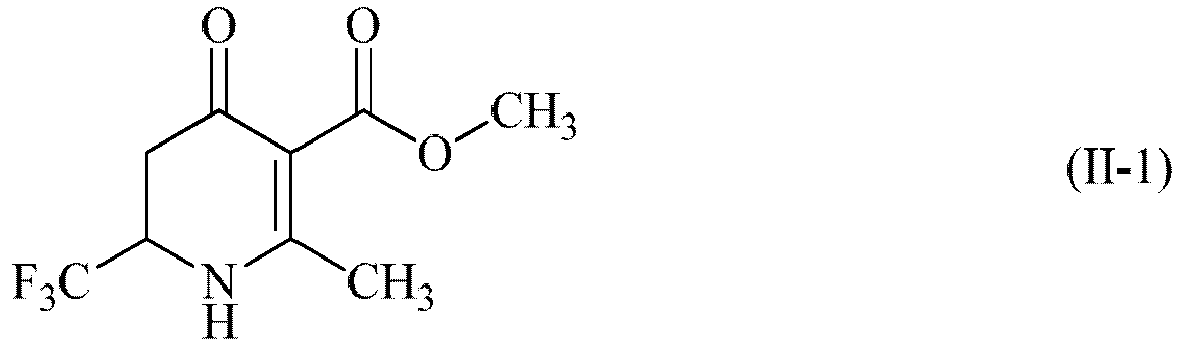
- Further subj ect of the invention is the use of any of the compound of formula (III), compound of formula (II) and compound of formula (I) for the production of pharmaceutical, chemical or agro-chemical products,
with compound of formula (III), compound of formula (II) and compound of formula (I) as defined above, also with all their preferred embodiments,
wherein any of the compound of formula (III), compound of formula (II) and compound of formula (I) has been prepared according to one of the respective methods as described above, also with all their preferred respective embodiments. - To a solution of racemic ethyl 4,4,4-trifluoro-3-aminobutanoate (approx 20 mmol; prepared by hydrogenation of ethyl 4,4,4-trifluoro-3-aminocrotonate, in analogy to Cen et al. Journal of Fluorine Chemistry 1995, 73, 161-164) in acetonitrile (3 ml) methyl acetoacetate (3.11 ml, 29 mmol) was added. The mixture was stirred at room temperature for 4 h. The mixture was concentrated under reduced pressure (40 mbar, 60 °C, 15 min), and the NMR of the residue showed compound of formula (III-1).
- 1H NMR (400 MHz, d6-DMSO): delta 1.18 (t, J = 7 Hz, 3H), 2.00 (s, 3H), 2.76 (dd, J = 16 Hz, 7 Hz, 1H), 2.96 (dd, J = 16 Hz, 2 Hz, 1H), 3.53 (s, 3H), 4.11 (q, J = 7 Hz, 2H), 4.60 (s, 1H), 4.75 (m, 1H), 8.70 (d, J = 9 Hz, 1H).
- Compound of formula (III-1), prepared according to example 1 and used without further purification, was dissolved in THF (20 ml), and this solution was added drop wise to a suspension of NaOtBu (6.6 g, 69 mmol) in THF (30 ml), while keeping the temperature at 20 to 40 °C with an ice bath. The resulting mixture was stirred at room temperature for 17 h. The mixture was then poured onto aqueous hydrochloric acid (1 N, 100 ml). The THF was removed by distillation under reduced pressure, and the remaining aqueous solution was saturated with sodium chloride. Extraction (3 x 30 ml AcOEt), drying of the combined extracts with MgSO4, and concentration under reduced pressure yielded 4.59 g of compound of formula (II-1) as an oil, which crystallized completely within a few days.
- 1H NMR (400 MHz, d6-DMSO): delta 2.19 (s, 3H), 2.35 (dd, J = 16 Hz, 1 Hz, 1H), 2.89 (dd, J = 16 Hz, 7 Hz, 1H), 3.59 (s, 3H), 4.54 (m, 1H), 8.80 (br s, 1H).
- To a solution of compound of formula (II-1) (50 mg, 0.21 mmol, prepared according to example 2 and used without further purification) in pyridine (1 ml, 12.4 mmol) were added Pd(OAc)2 (5 mg, 0.02 mmol), PPh3 (145 mg, 0.55 mmol), and finally bromine (0.022 ml, 0.4 mmol). The resulting mixture was stirred at 80 °C for 18 h. The mixture was diluted with aqueous hydrochloric acid (1 N, 15 ml) and extracted with AcOEt (3 ml). A sample of this extract was concentrated and analyzed. 1H NMR indicated it to be a mixture of compound of formula (I-1) and unchanged starting material, i.e. compound of formula (II-1), in a molar ratio of 60 : 40, and triphenylphosphine oxide.

- 1H NMR (400 MHz, d6-DMSO): delta 2.78 (s, 3H), 3.91 (s, 3H), 7.89 (d, J = 8 Hz, 1H), 8.44 (d, J = 8 Hz, 1H).
- To Pd(OAc)2 (16 mg, 0.07 mmol) in pyridine (0.5 ml) was added PPh3 (74 mg, 0.28 mmol), and the mixture was heated to reflux for 30 s, providing catalyst (CatS1-1) in form of a solution.
- To a solution of compound of formula (II-1) (50 mg, 0.21 mmol, prepared according to example 2 and used without further purification) in acetonitrile (0.5 ml) were added pyridine (0.17 ml, 2.1 mmol), PPh3 (173 mg, 0.66 mmol), catalyst (CatS1-1) (0.08 ml, corresponds to 0.011 mmol Pd complex), and finally bromine (0.032 ml, 0.63 mmol). The resulting mixture was stirred at 80 °C for 21 h. The mixture was diluted with aqueous hydrochloric acid (1 N, 15 ml) and extracted with AcOEt (3 ml). A sample of this extract was concentrated and analyzed. 1H NMR indicated it to be a mixture of compound of formula (I-1) and unchanged starting material, i.e. compound of formula (II-1), in a molar ratio of 75 : 25, and triphenylphosphine oxide.
- To Pd(OAc)2 (16 mg, 0.07 mmol) in pyridine (0.5 ml) was added PPh3 (61 mg, 0.23 mmol), and the mixture was heated to reflux for 30 s, providing catalyst (CatS1-2) in form of a solution.
- To a solution of compound of formula (II-1) (70%, 156 mg, 0.46 mmol, prepared according to example 2 and used without further purification) in acetonitrile (1.5 ml) were added pyridine (0.51 ml, 6.6 mmol), PPh3 (173 mg, 0.66 mmol), catalyst (CatS1-2) (0.24 ml, corresponds to 0.034 mmol Pd complex), and finally, at 0 °C, bromine (0.097 ml, 1.9 mmol). The resulting mixture was stirred at 80 °C for 18 h. Then a solution of NaOH (0.36 g, 9 mmol) in water (0.75 ml) was added, and stirring at 80 °C was continued for 1.5 h. The mixture was diluted with brine (15 ml) and washed with toluene (3 x 5 ml). The aqueous phase was then acidified with aqueous concentrated hydrochloric acid to pH 2, and extracted with AcOEt (3 x 10 ml). The combined extracts were dried (MgSO4) and concentrated under reduced pressure to yield 40 mg (42%) of the compound of formula (I-Sap-1).

- 1H NMR (400 MHz, d6-DMSO): delta 2.78 (s, 3H), 7.85 (d, J = 8 Hz, 1H), 8.41 (d, J = 8 Hz, 1H).
Claims (15)
- Method for preparation of compound of formula (I);

step (StepS1) comprises a reaction (ReacS1);
reaction (ReacS1) is a reaction of a compound of formula (II) with a compound (PhosS1) and a compound (HalS1) in the presence of a catalyst (CatS1);
R11, R12 and R13 are identical or different and independently from each other selected from the group consisting of C1-8 alkyl, C3-10 cycloalkyl and phenyl,
said phenyl being unsubstituted or substituted with 1 or 2 identical or different substituents independently from each other selected from the group consisting of C1-6 alkyl and phenyl;
compound (HalS1) is selected from the group consisting of Cl2, Br2, I2, ICl, BrCl, IBr, N-bromosuccinimide, N-chlorosuccinimide, N-bromophthalimide, N-chlorophthalimide, N,N',N"-trichloroisocyanuric acid, Ca(OCl)2, CCl4, CBr4, hexachloroethane, 1,3-dibromo-5,5-dimethylhydantoin, 1,3-dichloro-5,5-dimethylhydantoin, diethyl azodicarboxylate, diisopropyl azodicarboxylate, azodicarbonamide, 1,1'-(azodicarbonyl)dipiperidine, and mixtures thereof;
catalyst (CatS1) is selected from the group consisting of elemental palladium, Pd(0) complex, Pd(II) complex, hydrate of Pd(0) complex, hydrate of Pd(II) complex, adduct of Pd(0) complex to solvent (SolvS1-Add) adduct of Pd(II) complex to solvent (SolvS1-Add), and mixtures thereof;
solvent (SolvS1-Add) is selected from the group consisting of dichloromethane, chloroform, acetonitrile, pyridine, toluene, benzene, and mixtures thereof;
R1 is selected from the group consisting of C1-10 alkyl, C3-8 cycloalkyl, C(O)-O-C1-4 alkyl, CH=CH2, benzyl, phenyl and naphthyl;
the C1-10 alkyl of R1 is unsubstituted or substituted with 1, 2, 3, 4 or 5 identical or different substituents selected from the group consisting of halogen, OH, O-C(O)-C1-5 alkyl, O-C1-10 alkyl, S-C1-10 alkyl, S(O)-C1-10 alkyl, S(O2)-C1-10 alkyl, O-C1-6 alkylen-O-C1-6 alkyl, C3-8 cycloalkyl and 1,2,4-triazolyl;
the benzyl, the phenyl and the naphthyl of R1 are independently from each other unsubstituted or substituted with 1, 2, 3, 4 or 5 identical or different substituents selected from the group consisting of halogen, C1-4 alkoxy, NO2 and CN;
Y is selected from the group consisting of C1-6 alkoxy, O-C1-6 alkylen-O-C1-6 alkyl, NH2, NHR4 and N(R4)R5;
R4 and R5 are identical or different and independently from each other C1-6 alkyl, or represent together a tetramethylene or a pentamethylene chain. - Method according to claim1, wherein
R11, R12, and R13 are identical or different and independently from each other selected from the group consisting of C1-6 alkyl, C3-7 cycloalkyl, and phenyl, said phenyl being unsubstituted or substituted with methyl or phenyl. - Method according to claim 1 or 2, wherein
compound (HalS1) is selected from the group consisting of Cl2, Br2, I2, N-bromosuccinimide, N-chlorosuccinimide, N,N',N"-trichloroisocyanuric acid, CCl4, CBr4, 1,3-dibromo-5,5-dimethylhydantoin, 1,3-dichloro-5,5-dimethylhydantoin, azodicarbonamide, and mixtures thereof. - Method according to one or more of claims 1 to 3, wherein
Pd(0) complex and Pd(II) complex are selected from the group consisting of PdCl2, Pd(OAc)2, Pd(dba)2, Pd2(dba)3, PdCl2(PhCN)2, PdCl2(MeCN)2, PdCl2(PPh3)2, Pd(P(tBu)3)2, Pd2(P(tBu)3)3, Pd(P(1-adamantyl)3)2, Pd2(P(1-adamantyl)3)3, Pd(PPh3)4, Pd(P(2-tolyl)3)4, PdCl2(dppf), and mixtures thereof. - Method according to one or more of claims 1 to 4, wherein
catalyst (CatS1) is selected from the group consisting of Pd(0), Pd(OAc)2, PdCl2, Pd2(dba)3, Pd(PPh3)4, Pd(P(2-tolyl)3)4, PdCl2(dppf), hydrate of Pd(0) complex, hydrate of Pd(II) complex, adduct of Pd(0) complex to solvent (SolvS1-Add) adduct of Pd(II) complex to solvent (SolvS1-Add) and mixtures thereof. - Method according to one or more of claims 1 to 5, wherein
R1 is selected from the group consisting of C1-5 alkyl, C3-6 cycloalkyl, C(O)-O-C1-4 alkyl, CH=CH2, benzyl and phenyl;
said C1-5 alkyl of R1 is unsubstituted or substituted with 1, 2, 3, 4 or 5 identical of different substituents selected from the group consisting of halogen, OH, O-C(O)-CH3, O-C1-5 alkyl, S-C1-5 alkyl, S(O)-C1-5 alkyl, S(O2)-C1-5 alkyl, O-C1-4 alkylen-O-C1-4 alkyl, C3-6 cycloalkyl and 1,2,4-triazolyl;
said benzyl and said phenyl of R1 are independently from each other unsubstituted or substituted with 1, 2, 3, 4 or 5 identical of different substituents selected from the group consisting of halogen, C1-2 alkoxy, NO2 and CN. - Method according to one or more of claims 1 to 6, wherein
Y is selected from the group consisting of C1-6 alkoxy, NHR4 and N(R4)R5;
R4 and R5 are identical or different and independently from each other C1-6 alkyl, or represent together a tetramethylene or a pentamethylene chain. - Method according to one or more of claims 1 to 7, wherein
reaction (ReacS1) is done in the presence of a base (BasS1); base (BasS1) is selected from the group consisting of N,N-di-C1-4 alkyl aniline, N(R40)(R41)(R42), N-C1-4 alkyl morpholine, unsubstituted pyridine, pyridine substituted with 1, 2 and 3 identical or different substituents independently from each other selected from the group consisting of methyl and ethyl, and mixtures thereof;
R40, R41 and R42 are identical or different and independently from each other C1-6 alkyl. - Method according to one or more of claims 1 to 8, wherein
the method comprises furthermore a step (S2), step (S2) is done before step (S1);
step (StepS2) comprises a reaction (ReacS2), in reaction (ReacS2) compound of formula (II) is prepared;
reaction (ReacS2) is a reaction of a compound of formula (III) with a base (BasS2);
base (BasS2) is selected from the group consisting of NaOC1-6 alkyl, KOC1-6 alkyl, NaN(SiMe3)2, KN(SiMe3)2, NaH, LiH, CaH2, KH, and mixtures thereof;
with compound of formula (II), R1 and Y as defined in claim 1. - Method according to claim 9, wherein
X is C1-4 alkoxy. - Method according to claim 9 or 10, wherein
base (BasS2) is selected from the group consisting of NaOtBu, KOtBu, NaOEt, NaOMe, NaOiPr, NaN(SiMe3)2, KN(SiMe3)2, NaH, LiH, CaH2, KH, and mixtures thereof. - Method according to one or more of claims 9 to 11, wherein
the method comprises furthermore a step (S3), step (S3) is done before step (S2);
step (StepS3) comprises a reaction (ReacS3), in reaction (ReacS3) compound of formula (III) is prepared;
reaction (ReacS3) is a reaction of a compound of formula (IV) with a compound of formula (V);
- Compound of formula (III) and compound of formula (II); wherein
compound of formula (III) is as defined in claim 9;
and compound of formula (II) is as defined in claim 1. - Compound of formula (III) and compound of formula (II) according to claim 13, wherein
compound of formula (III) is compound of formula (III-1); and
compound of formula (II) is compound of formula (II-1).

- Use of any of the compound of formula (III), compound of formula (II) and compound of
formula (I) for the production of pharmaceutical, chemical or agro-chemical products, with compound of formula (III) as defined in claim 9, and with compound of formula (II) and
compound of formula (I) as defined in claim 1,
wherein
compound of formula (III) has been prepared according to claim 12,
compound of formula (II) has been prepared according to claim 9, and compound of formula (I) has been prepared according to claim 1.
Priority Applications (1)
| Application Number | Priority Date | Filing Date | Title |
|---|---|---|---|
| EP13174887.3A EP2821398A1 (en) | 2013-07-03 | 2013-07-03 | Method for preparation of 6-trifluoromethylpyridine-3-carboxylic acid derivatives from 4,4,4-trifluoro-3-aminobutanoates |
Applications Claiming Priority (1)
| Application Number | Priority Date | Filing Date | Title |
|---|---|---|---|
| EP13174887.3A EP2821398A1 (en) | 2013-07-03 | 2013-07-03 | Method for preparation of 6-trifluoromethylpyridine-3-carboxylic acid derivatives from 4,4,4-trifluoro-3-aminobutanoates |
Publications (1)
| Publication Number | Publication Date |
|---|---|
| EP2821398A1 true EP2821398A1 (en) | 2015-01-07 |
Family
ID=48703292
Family Applications (1)
| Application Number | Title | Priority Date | Filing Date |
|---|---|---|---|
| EP13174887.3A Withdrawn EP2821398A1 (en) | 2013-07-03 | 2013-07-03 | Method for preparation of 6-trifluoromethylpyridine-3-carboxylic acid derivatives from 4,4,4-trifluoro-3-aminobutanoates |
Country Status (1)
| Country | Link |
|---|---|
| EP (1) | EP2821398A1 (en) |
Citations (5)
| Publication number | Priority date | Publication date | Assignee | Title |
|---|---|---|---|---|
| EP0448542A2 (en) | 1990-03-19 | 1991-09-25 | Rohm And Haas Company | Process for preparation of fluoromethyl-substituted dihydropyridine carbodithioates |
| WO2000039094A1 (en) | 1998-12-23 | 2000-07-06 | Syngenta Participations Ag | Substituted pyridine herbicides |
| WO2006059103A2 (en) | 2004-12-03 | 2006-06-08 | Peakdale Molecular Limited | Pyridine based compounds useful as intermediates for pharmaceutical or agricultural end-products |
| WO2008013414A1 (en) | 2006-07-27 | 2008-01-31 | Amorepacific Corporation | Novel compounds, isomer thereof, or pharmaceutically acceptable salts thereof as vanilloid receptor antagonist; and pharmaceutical compositions containing the same |
| WO2012061926A1 (en) | 2010-11-08 | 2012-05-18 | Zalicus Pharmaceuticals Ltd. | Bisarylsulfone and dialkylarylsulfone compounds as calcium channel blockers |
-
2013
- 2013-07-03 EP EP13174887.3A patent/EP2821398A1/en not_active Withdrawn
Patent Citations (5)
| Publication number | Priority date | Publication date | Assignee | Title |
|---|---|---|---|---|
| EP0448542A2 (en) | 1990-03-19 | 1991-09-25 | Rohm And Haas Company | Process for preparation of fluoromethyl-substituted dihydropyridine carbodithioates |
| WO2000039094A1 (en) | 1998-12-23 | 2000-07-06 | Syngenta Participations Ag | Substituted pyridine herbicides |
| WO2006059103A2 (en) | 2004-12-03 | 2006-06-08 | Peakdale Molecular Limited | Pyridine based compounds useful as intermediates for pharmaceutical or agricultural end-products |
| WO2008013414A1 (en) | 2006-07-27 | 2008-01-31 | Amorepacific Corporation | Novel compounds, isomer thereof, or pharmaceutically acceptable salts thereof as vanilloid receptor antagonist; and pharmaceutical compositions containing the same |
| WO2012061926A1 (en) | 2010-11-08 | 2012-05-18 | Zalicus Pharmaceuticals Ltd. | Bisarylsulfone and dialkylarylsulfone compounds as calcium channel blockers |
Non-Patent Citations (5)
| Title |
|---|
| CEN ET AL., JOURNAL OF FLUORINE CHEMISTRY, vol. 73, 1995, pages 161 - 164 |
| D. MA ET AL., ORG. LETT., vol. 2, 2000, pages 2503 - 2505 |
| N. LEFLEMME ET AL., SYNTHESIS, vol. 12, 2002, pages 1740 - 1746 |
| NICOLAS LEFLEMME ET AL: "A Versatile and Efficient Synthesis of 2-Alkyl and 2-Aryl-6-alkyl-2,3-dihydro-1 H -pyridin-4-ones", SYNTHESIS, vol. 2002, no. 12, 1 January 2002 (2002-01-01), pages 1740 - 1746, XP055077850, ISSN: 0039-7881, DOI: 10.1055/s-2002-33648 * |
| OKADA ET AL., HETEROCYCLES, vol. 46, 1997, pages 129 - 132 |
Similar Documents
| Publication | Publication Date | Title |
|---|---|---|
| TWI758377B (en) | Process for the preparation of a 2-pyridylethylcarboxamide derivative | |
| CZ281966B6 (en) | Process for preparing phenoxypyrimidine compound | |
| KR101420892B1 (en) | Process for the preparation of Imatinib and intermediates thereof | |
| JPH04230263A (en) | Process for preparing pyridinedicarboxylic acid compound | |
| EP2818461A1 (en) | Method for preparation of 6-trifluoromethylpyridine-3-carboxylic acid derivatives from 4,4,4-trifluoro-3-oxobutanoyl chloride | |
| US5925764A (en) | Process and intermediated for the manufacture of pyridine-2, 3-dicarboxylate compounds | |
| JPH01228963A (en) | Production of 5-amino-4, 6-dihalogenopyridines | |
| EP2376472B1 (en) | Process for manufacturing 5-formyl-pyridine-2,3-dicarboxylic acid esters | |
| EP2997014B1 (en) | Method for preparation of 6-trifluoromethylpyridine-3-carboxylic acid derivatives from trifluoroacetylacetic acid | |
| EP2803661A1 (en) | Method for preparation of 6-trifluoromethylpyridine-3-carboxylic acid derivatives | |
| EP0990647A1 (en) | Process for producing quinolone derivatives | |
| JP2005097116A (en) | Alkali metal salt of quinolinecarboxylic acid derivative and method of purifying quinolinecarboxylic acid derivative using the same | |
| EP3515893B1 (en) | Process for preparing 3-fluoroalkyl-5-pyrazolecarboxylates and 3-fluoroalkyl-5-pyrazolecarboxylic acids | |
| EP3129344B1 (en) | Method for preparation of 4-alkoxy-1,1,1-trifluorobut-3-en-2- ones from 1,1,1-trifluoroacetone | |
| US6114535A (en) | Process and intermediates for the manufacture of pyridine-2,3-dicarboxylate compounds | |
| HK1218295B (en) | Method for preparation of 6-trifluoromethylpyridine-3-carboxylic acid derivatives from trifluoroacetylacetic acid | |
| EP2821399A1 (en) | Method for preparation of 6-trifluoromethylpyridine-3-carboxylic acid derivatives from 4,4,4-trifluoro-3-oxobutanoyl chloride | |
| EP1873145B1 (en) | Method for producing nicotinic acid derivative or salt thereof | |
| JPH0730032B2 (en) | Method for producing 1-aryl-5-amino-billazole | |
| KR20150087246A (en) | Process for preparing 4-(cyclopropylmethoxy)-n-(3,5-dichloro-1-oxido-4-pyridyl)-5-methoxypyridine-2-carboxamide | |
| JPH0780851B2 (en) | 2,3,5-Trimethylpyridine derivative and process for producing the same | |
| EP1538145B1 (en) | Process for production of phenoxy-substituted 2-pyridone compounds | |
| JP4432376B2 (en) | Method for producing 2-pyridone compound substituted with phenoxy group | |
| JP2023063617A (en) | 6-(fluoroalkyl)-3,4-dihydro-2h-pyran-5-carboxylate derivative and method for producing them | |
| HK1170240A1 (en) | Process for the preparation of 2-substituted-5-(1-alkylthio) alkylpyridines |
Legal Events
| Date | Code | Title | Description |
|---|---|---|---|
| PUAI | Public reference made under article 153(3) epc to a published international application that has entered the european phase |
Free format text: ORIGINAL CODE: 0009012 |
|
| 17P | Request for examination filed |
Effective date: 20130703 |
|
| AK | Designated contracting states |
Kind code of ref document: A1 Designated state(s): AL AT BE BG CH CY CZ DE DK EE ES FI FR GB GR HR HU IE IS IT LI LT LU LV MC MK MT NL NO PL PT RO RS SE SI SK SM TR |
|
| AX | Request for extension of the european patent |
Extension state: BA ME |
|
| R17P | Request for examination filed (corrected) |
Effective date: 20150707 |
|
| RBV | Designated contracting states (corrected) |
Designated state(s): AL AT BE BG CH CY CZ DE DK EE ES FI FR GB GR HR HU IE IS IT LI LT LU LV MC MK MT NL NO PL PT RO RS SE SI SK SM TR |
|
| GRAP | Despatch of communication of intention to grant a patent |
Free format text: ORIGINAL CODE: EPIDOSNIGR1 |
|
| RIC1 | Information provided on ipc code assigned before grant |
Ipc: C07D 211/90 20060101ALI20151013BHEP Ipc: C07C 227/04 20060101ALI20151013BHEP Ipc: C07C 229/30 20060101ALI20151013BHEP Ipc: C07D 213/803 20060101ALI20151013BHEP Ipc: C07D 213/80 20060101AFI20151013BHEP |
|
| INTG | Intention to grant announced |
Effective date: 20151117 |
|
| GRAS | Grant fee paid |
Free format text: ORIGINAL CODE: EPIDOSNIGR3 |
|
| STAA | Information on the status of an ep patent application or granted ep patent |
Free format text: STATUS: THE APPLICATION IS DEEMED TO BE WITHDRAWN |
|
| 18D | Application deemed to be withdrawn |
Effective date: 20160330 |