EP2820489B1 - Method of analysing flight data - Google Patents
Method of analysing flight data Download PDFInfo
- Publication number
- EP2820489B1 EP2820489B1 EP13706513.2A EP13706513A EP2820489B1 EP 2820489 B1 EP2820489 B1 EP 2820489B1 EP 13706513 A EP13706513 A EP 13706513A EP 2820489 B1 EP2820489 B1 EP 2820489B1
- Authority
- EP
- European Patent Office
- Prior art keywords
- flight
- matrix
- vector
- abnormal
- data
- Prior art date
- Legal status (The legal status is an assumption and is not a legal conclusion. Google has not performed a legal analysis and makes no representation as to the accuracy of the status listed.)
- Active
Links
Images


Classifications
-
- G—PHYSICS
- G07—CHECKING-DEVICES
- G07C—TIME OR ATTENDANCE REGISTERS; REGISTERING OR INDICATING THE WORKING OF MACHINES; GENERATING RANDOM NUMBERS; VOTING OR LOTTERY APPARATUS; ARRANGEMENTS, SYSTEMS OR APPARATUS FOR CHECKING NOT PROVIDED FOR ELSEWHERE
- G07C5/00—Registering or indicating the working of vehicles
- G07C5/02—Registering or indicating driving, working, idle, or waiting time only
-
- G—PHYSICS
- G05—CONTROLLING; REGULATING
- G05B—CONTROL OR REGULATING SYSTEMS IN GENERAL; FUNCTIONAL ELEMENTS OF SUCH SYSTEMS; MONITORING OR TESTING ARRANGEMENTS FOR SUCH SYSTEMS OR ELEMENTS
- G05B23/00—Testing or monitoring of control systems or parts thereof
- G05B23/02—Electric testing or monitoring
- G05B23/0205—Electric testing or monitoring by means of a monitoring system capable of detecting and responding to faults
- G05B23/0218—Electric testing or monitoring by means of a monitoring system capable of detecting and responding to faults characterised by the fault detection method dealing with either existing or incipient faults
- G05B23/0224—Process history based detection method, e.g. whereby history implies the availability of large amounts of data
- G05B23/0227—Qualitative history assessment, whereby the type of data acted upon, e.g. waveforms, images or patterns, is not relevant, e.g. rule based assessment; if-then decisions
-
- G—PHYSICS
- G07—CHECKING-DEVICES
- G07C—TIME OR ATTENDANCE REGISTERS; REGISTERING OR INDICATING THE WORKING OF MACHINES; GENERATING RANDOM NUMBERS; VOTING OR LOTTERY APPARATUS; ARRANGEMENTS, SYSTEMS OR APPARATUS FOR CHECKING NOT PROVIDED FOR ELSEWHERE
- G07C5/00—Registering or indicating the working of vehicles
- G07C5/08—Registering or indicating performance data other than driving, working, idle, or waiting time, with or without registering driving, working, idle or waiting time
-
- B—PERFORMING OPERATIONS; TRANSPORTING
- B64—AIRCRAFT; AVIATION; COSMONAUTICS
- B64D—EQUIPMENT FOR FITTING IN OR TO AIRCRAFT; FLIGHT SUITS; PARACHUTES; ARRANGEMENT OR MOUNTING OF POWER PLANTS OR PROPULSION TRANSMISSIONS IN AIRCRAFT
- B64D45/00—Aircraft indicators or protectors not otherwise provided for
- B64D2045/0065—Black boxes, devices automatically broadcasting distress signals
-
- G—PHYSICS
- G01—MEASURING; TESTING
- G01D—MEASURING NOT SPECIALLY ADAPTED FOR A SPECIFIC VARIABLE; ARRANGEMENTS FOR MEASURING TWO OR MORE VARIABLES NOT COVERED IN A SINGLE OTHER SUBCLASS; TARIFF METERING APPARATUS; MEASURING OR TESTING NOT OTHERWISE PROVIDED FOR
- G01D9/00—Recording measured values
-
- G—PHYSICS
- G05—CONTROLLING; REGULATING
- G05B—CONTROL OR REGULATING SYSTEMS IN GENERAL; FUNCTIONAL ELEMENTS OF SUCH SYSTEMS; MONITORING OR TESTING ARRANGEMENTS FOR SUCH SYSTEMS OR ELEMENTS
- G05B23/00—Testing or monitoring of control systems or parts thereof
- G05B23/02—Electric testing or monitoring
- G05B23/0205—Electric testing or monitoring by means of a monitoring system capable of detecting and responding to faults
- G05B23/0218—Electric testing or monitoring by means of a monitoring system capable of detecting and responding to faults characterised by the fault detection method dealing with either existing or incipient faults
- G05B23/0224—Process history based detection method, e.g. whereby history implies the availability of large amounts of data
- G05B23/024—Quantitative history assessment, e.g. mathematical relationships between available data; Functions therefor; Principal component analysis [PCA]; Partial least square [PLS]; Statistical classifiers, e.g. Bayesian networks, linear regression or correlation analysis; Neural networks
-
- G—PHYSICS
- G07—CHECKING-DEVICES
- G07C—TIME OR ATTENDANCE REGISTERS; REGISTERING OR INDICATING THE WORKING OF MACHINES; GENERATING RANDOM NUMBERS; VOTING OR LOTTERY APPARATUS; ARRANGEMENTS, SYSTEMS OR APPARATUS FOR CHECKING NOT PROVIDED FOR ELSEWHERE
- G07C5/00—Registering or indicating the working of vehicles
Definitions
- the invention relates to a method of analysing a set of flight data recorded during at least one flight of at least one aircraft.
- the regulations in terms of maintenance and air traffic define standards that airline companies are required to comply with in order to ensure to a user a maximum level of safety.
- Flight data analysis systems known by the name FDM (Flight Data Monitoring) or instead FOQA (Flight Operational Quality Assurance) are known. These systems consist in equipping an aircraft with a flight data recorder.
- a flight data recorder is for example a black box or instead a specific recorder such as an ACMS (Aircraft Condition Monitoring System).
- these systems detect predefined events occurring during the flight and an expert then analyses these events, which indicate that a technical incident has occurred during the flight, that a practice or a condition provided by a flight procedure has not been complied with, thus giving warning at a very advanced stage of any incidents or accidents that could arise.
- US2008/091630 A1 discloses a method for defining normal operating regions and identifying anomalous behaviour of units within a fleet, operating in a complex, dynamic environment.
- An aim of the invention is to make it possible to detect abnormal flights without having the need to define detection rules.
- the invention proposes a method of analysing flight data recorded during N flights of at least one aircraft, the data being grouped together by flight i in a signature vector of the flight X i of size d, the components of which correspond to data recorded during said flight i of the aircraft, a flight i being thus defined by the signature vector X i , the method comprising the following steps:
- the invention has numerous advantages.
- the detection of abnormal flights is automatic and does not necessitate the intervention of an expert for said detection.
- the detection is implemented in a statistical manner while taking into account parameters. In this way, there is an automatic learning that takes place.
- the invention enables unexpected problems to be highlighted.
- the invention enables problems stemming from the contribution of several parameters to be detected.
- the method of the invention may be used by a non expert in statistics or data mining.
- the diagnosis of abnormal flights is simple because it makes it possible to create a reference flight, the phantom flight for each abnormal flight detected.
- flight data recorded during several flights made by at least one aircraft are recovered.
- flight data correspond to flight parameters such as for example the speed, the altitude, the temperature, etc.
- a first step E1 it is advisable to extract for each flight i , among all the data recorded during the flight i , those that characterise the flight i in other words the signature of each flight i.
- a restriction is made to a flight phase (for example, the landing) of time T ⁇ T 0 and only a restricted number P ⁇ P 0 of pertinent parameters are retained for the analysis of the data of this flight i.
- Each signature vector X i thus contains the set of pertinent information relative to the flight i.
- the grouping together E2 may be implemented according to three embodiments.
- the grouping together E2 in the vector consists in keeping all of the data. This is then known as an exhaustive approach.
- the grouping together according to this first embodiment is useful when one has little extensive job knowledge, and makes it possible to spot quite easily any flight path deviation.
- the grouping together E2 in the vector X i consists in focusing on the value of the parameters at precise instants, which are known as snapshots. These precise instants have an operational sense, for example for the landing phase a snapshot may be made every 1000 feet from 10000 feet of altitude, or then snapshots may be made at instants where particular events take place: landing gear down, etc.
- This second embodiment makes it possible to obtain better results than with the first embodiment. Indeed, in this second embodiment, since T >> n there is much less data to process than in the first embodiment.
- the grouping together E2 in the vector X i consists in "summarising" each "curve” of each parameter in a small set of k ⁇ 5 or 10 values: these k values may for example be the average, the variance, the max. value, the min. value of each parameter recorded.
- N ⁇ 1 signature vectors X i of size d there are available N ⁇ 1 signature vectors X i of size d, the components of which correspond to pertinent data recorded during said flight i of the aircraft.
- each of the components of each signature vector X i may be normalised E3.
- the normalisation E3 leads to having components of zero average and standard deviation 1 on the set of all of the flights.
- X i is hereafter employed to designate the signature vector of a flight i , the components of which are normalised or not.
- the signature vectors X i are going to undergo several treatments to make it possible to identify if a flight is abnormal.
- a Gaussian kernel entropy component analysis E4 of the signature vectors X i is going to be implemented to obtain a zone of normal flights E and classifying the signature vectors X i with respect to their distance to said zone.
- a matrix of similarity K is determined E41 of size N ⁇ N, the components of which quantify the proximity between two signature vectors X i (in other words between two flights).
- This matrix K is known by the name Gram matrix.
- the matrix K is obtained from a matrix of the distances D to which a Gaussian function with a predetermined bandwidth parameter ⁇ 2 is applied (the determination of this parameter will be described later).
- the bandwidth parameter is obtained by calculation of the distances of each signature vector X i to its k nearest neighbours with k a whole number between 4 and 10.
- the value of k depends on the number of flights N and the dimension d.
- the average of each column of the matrix D ' is determined to obtain N values y 1 ,...,y N which represent in fact the average distance of each vector to its k nearest neighbours.
- the values y 1 ,...,y N that are aberrant are eliminated.
- ⁇ which is written mad mediane ⁇
- each of the eigen vectors a i is of size N : a i ⁇ R N and a i,j designates the j th component of the vector a i .
- the ⁇ i are also called the energy coefficients.
- the entropy coefficients are a pertinent criterion to select only the most pertinent data in the set of signature vectors of all the flights.
- a sub-assembly of eigen vectors ⁇ a m ⁇ m ⁇ 1,..., N ⁇ is selected E45 such that the sum of the corresponding entropies ⁇ m is greater than the percentage of the sum of the N entropies ⁇ i .
- the percentage is comprised between 75 and 95%, preferably 90%.
- this sub-assembly makes it possible to define a zone of normal flights E going back to the parameters of each vector X i associated with the selected eigen vectors.
- an abnormality score z i is determined E5, defined by the distance of the flight X i with respect to the zone of normal flights E.
- the abnormality score is comprised between 0 and 1. The closer the score is to 1, the more the flight is considered abnormal.
- the abnormality score may be displayed to be viewed by an analyst.
- the method uses all the data at its disposal to, itself, determine in what manner a flight may be considered normal and thereby determine which are not. Thus, it is not necessary to put in place detection rules.
- phantom flight a nominal reference flight known as "phantom flight" the nearest to this abnormal flight detected is determined E7 while being in the zone of normal flights, the phantom flight being able to be different to a signature flight X i .
- the phantom flight is defined as the theoretical flight the nearest to the abnormal flight detected while being in the zone of normal flights.
- the phantom flight has a score z less than 0.99 (or 0.95 if it is really wished to ensure the normality of this flight).
- the phantom flight is thus the projection of the abnormal flight detected in the zone of normal flights. In particular, it is the nearest projection.
- the phantom flight is generated during the method, it is potentially independent of the flights analysed.
- the phantom flight of signature Z 0 associated with an abnormal flight detected of signature X i is generated via a constrained non linear optimisation procedure.
- the norm 1 above makes it possible to ensure that the minimum of components are changed between the abnormal flight and its phantom flight.
- This optimisation procedure necessitates the calculation of the score z ( Z ) to obtain the signature Z 0 of the phantom flight.
- k Z exp ⁇ ⁇ Z ⁇ X 1 ⁇ 2 2 ⁇ 2 ⁇ exp ⁇ ⁇ Z ⁇ X N ⁇ 2 2 ⁇ 2 .
- the corresponding phantom flight is the flight for which the parameters are referenced 20'.
Landscapes
- Physics & Mathematics (AREA)
- General Physics & Mathematics (AREA)
- Engineering & Computer Science (AREA)
- Automation & Control Theory (AREA)
- Artificial Intelligence (AREA)
- Evolutionary Computation (AREA)
- Mathematical Physics (AREA)
- Complex Calculations (AREA)
- Traffic Control Systems (AREA)
- Other Investigation Or Analysis Of Materials By Electrical Means (AREA)
Description
- The invention relates to a method of analysing a set of flight data recorded during at least one flight of at least one aircraft.
- The regulations in terms of maintenance and air traffic define standards that airline companies are required to comply with in order to ensure to a user a maximum level of safety.
- In order to optimise the maintenance phases, airline companies have equipped themselves with flight data analysis systems.
- Flight data analysis systems known by the name FDM (Flight Data Monitoring) or instead FOQA (Flight Operational Quality Assurance) are known. These systems consist in equipping an aircraft with a flight data recorder. Such a recorder is for example a black box or instead a specific recorder such as an ACMS (Aircraft Condition Monitoring System).
- These systems enable airline companies to understand in detail the course of a flight from regular recordings of the values of these flight data made during each flight of each of their airplanes.
- To do this, these systems detect predefined events occurring during the flight and an expert then analyses these events, which indicate that a technical incident has occurred during the flight, that a practice or a condition provided by a flight procedure has not been complied with, thus giving warning at a very advanced stage of any incidents or accidents that could arise.
- These techniques necessitate predefining rules for detecting events, usually defined as exceeding thresholds of one or more parameters, which may trigger alerts so that the expert analyses more closely the flight.
- A problem is that these techniques do not make it possible to detect singular events beyond the predefined rules, which may lead to a non detection of an abnormal flight.
-
US2008/091630 A1 discloses a method for defining normal operating regions and identifying anomalous behaviour of units within a fleet, operating in a complex, dynamic environment. - An aim of the invention is to make it possible to detect abnormal flights without having the need to define detection rules.
- To this end, the invention proposes a method of analysing flight data recorded during N flights of at least one aircraft, the data being grouped together by flight i in a signature vector of the flight Xi of size d, the components of which correspond to data recorded during said flight i of the aircraft, a flight i being thus defined by the signature vector Xi, the method comprising the following steps:
- Gaussian kernel entropy component analysis of the flight signatures Xi to obtain a zone of normal flights and classifying the flight signatures Xi with respect to their distance to said zone;
- determining, for each flight i, an abnormality score zi defined by the distance of a flight signature Xi with respect to the zone of normal flights;
- detecting, as a function of the abnormality score zi , at least one abnormal flight; and
- determining for each abnormal flight, a phantom flight the nearest to the abnormal flight while being in the zone of normal flights, wherein the parameters of the abnormal flight detected are compared with those of the phantom flight determined in order to detect at least one parameter of the abnormal flight which has rendered abnormal said abnormal flight detected.
- The invention is advantageously completed by the following characteristics, taken singly or in any technically possible combination thereof:
- the Gaussian entropy component analysis comprises the following sub-steps:
- ∘ determination of a matrix of similarity K of size N × N, the components of which quantify the proximity between two flight signatures Xi ;
- ∘ breakdown into eigen vectors of the matrix of similarity K to obtain N eigen vectors a 1,...,aN and N eigen values λ 1,...,λN such that ∀i = 1,...,N K · ai = λ · ai ;
- ∘ determination, for each eigen vector, of its entropy coefficient γi
- ∘ selection of a sub-assembly of eigen vectors {am } m∈{1,...,N} such that the sum of the entropies γm is greater than the percentage of the sum of the N entropies γi .
- the entropy coefficient is defined by

- the abnormality score of a flight i is defined by:

- the components of the matrix of similarity K are defined by:

- the bandwidth parameter σ2 is determined in the following manner:
- ∘ a matrix D of size N × N is determined corresponding to the distance between two flights and is defined in the following manner

- ∘ each component of each column is arranged in ascending order to obtain a matrix D';
- ∘ k first lines of the matrix D' thereby obtained are selected and the others are eliminated to obtain a matrix D' of size k × N ;
- ∘ the average of each column of the matrix D' is determined to obtain N values y 1,...,yN ;
- ∘ the median absolute deviation of the values y 1,...,yN defined by mad =mediane{|yi -med|} with med =mediane{y1,..., yN } is determined;
- ∘ the bandwidth parameter σ2 is determined from the median absolute deviation of the values y 1,...,yN by the following functional

- ∘ a matrix D of size N × N is determined corresponding to the distance between two flights and is defined in the following manner
- the data of a flight i are grouped together in a matrix Fi of dimension T×P with T the number of data recorded during the flight i and P the number of parameters recorded, the vector Xi having for components the columns of the matrix Fi end to end, the vector Xi being then of dimension d = T × P and is defined by

- the data of a flight i are grouped together in a matrix Fi of dimension T × P with T the number of data recorded during the flight i and P the number of parameters recorded, the vector Xi having for components the columns of the matrix Fi sampled to select n < T recordings


- the data of a flight i are grouped together in a matrix Fi of dimension T × P with T the number of data recorded during the flight i and P the number of parameters recorded, the vector Xi having for components the average, the variance, the minimal value, the maximal value of a parameter among all the recordings of this parameter, the vector Xi being then defined by:

- The invention has numerous advantages.
- With the invention, the detection of abnormal flights is automatic and does not necessitate the intervention of an expert for said detection.
- With the invention the detection is implemented in a statistical manner while taking into account parameters. In this way, there is an automatic learning that takes place.
- The invention enables unexpected problems to be highlighted.
- The invention enables problems stemming from the contribution of several parameters to be detected.
- The method of the invention may be used by a non expert in statistics or data mining.
- Moreover, with the invention, the diagnosis of abnormal flights is simple because it makes it possible to create a reference flight, the phantom flight for each abnormal flight detected.
- Other characteristics, aims and advantages of the invention will become clearer from the description that follows, which is purely illustrative and non limiting, and which should be read with reference to the appended drawings, in which:
-
figures 1a and 1b schematically illustrate steps of a method according to an embodiment of the invention; -
figure 2 illustrates a representation of flight data according to an embodiment of the invention. - In all of the figures, similar elements have identical numerical references.
- In a method of analysing flight data in a preliminary step (not detailed) flight data recorded during several flights made by at least one aircraft are recovered.
- These flight data correspond to flight parameters such as for example the speed, the altitude, the temperature, etc.
- Then, in a first step E1, it is advisable to extract for each flight i, among all the data recorded during the flight i, those that characterise the flight i in other words the signature of each flight i.
- For N ≥ 1 flights, there are a number P 0 of parameters recorded over a flight time T 0. By way of example, in certain recorders, it is possible to have up to P 0 = 2000 parameters.
- It is considered that the parameters are recorded/sampled at the same frequency, if necessary, well known techniques of oversampling and linear approximation are implemented on the data.
- To extract E1 the data characteristic of a flight i, according to one embodiment, a restriction is made to a flight phase (for example, the landing) of time T < T 0 and only a restricted number P < P 0 of pertinent parameters are retained for the analysis of the data of this flight i. By way of example, it is possible to make a restriction to T = 1000 seconds and P = 30parameters.
- Hereafter, the value of each data of the flight i is designated in the following manner: Fi (t = 5, p = 1) in other words the value of the first parameter recorded at the 5th second (if the data are sampled in seconds) for the flight i.
- Then, after the extraction E1, in a signature vector Xi of a flight i of dimension d, the data is grouped together E2.
- Each signature vector Xi thus contains the set of pertinent information relative to the flight i.
- The grouping together E2 may be implemented according to three embodiments.
- According to a first embodiment, the grouping together E2 in the vector consists in keeping all of the data. This is then known as an exhaustive approach.
- According to this first embodiment, to obtain a vector Xi it is advisable to take the matrix Fi and to stick columns one to one.
- The vector Xi is then of dimension d = T × P and is defined by:

- For example if T = 1000 and P = 30 then there is a vector Xi of size 30000 (and not a matrix of size 1000 x 30) .
- The grouping together according to this first embodiment is useful when one has little extensive job knowledge, and makes it possible to spot quite easily any flight path deviation.
- According to a second embodiment, the grouping together E2 in the vector Xi consists in focusing on the value of the parameters at precise instants, which are known as snapshots. These precise instants have an operational sense, for example for the landing phase a snapshot may be made every 1000 feet from 10000 feet of altitude, or then snapshots may be made at instants where particular events take place: landing gear down, etc.
- In assuming that n instants of snapshots have been defined then for a flight i the instants of snapshots
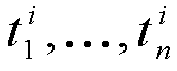
- The vector Xi is then of dimension d = n × P and is defined by

- This second embodiment makes it possible to obtain better results than with the first embodiment. Indeed, in this second embodiment, since T>>n there is much less data to process than in the first embodiment.
- According to a third embodiment, the grouping together E2 in the vector Xi consists in "summarising" each "curve" of each parameter in a small set of k≈5 or 10 values: these k values may for example be the average, the variance, the max. value, the min. value of each parameter recorded.
- These k values are then combined for all of the parameters to obtain the signature vector Xi of dimension d = k × P for k ≈ 4 is defined by

- If for example there are P=30 parameters, one then has a signature vector Xi of size d = 120.
- At the end of the grouping together step E2, there are available N ≥ 1 signature vectors Xi of size d, the components of which correspond to pertinent data recorded during said flight i of the aircraft.
- In a complementary manner, each of the components of each signature vector Xi may be normalised E3.
- Such a normalisation proves useful when the components of each signature vector Xi have varied orders of magnitude.
- In a preferred manner, the normalisation E3 leads to having components of zero average and standard deviation 1 on the set of all of the flights.
- Xi is hereafter employed to designate the signature vector of a flight i, the components of which are normalised or not.
- The signature vectors Xi are going to undergo several treatments to make it possible to identify if a flight is abnormal.
- To do this, a Gaussian kernel entropy component analysis E4 of the signature vectors Xi is going to be implemented to obtain a zone of normal flights E and classifying the signature vectors Xi with respect to their distance to said zone.
- In other words, it involves, from all of the flight signatures Xi grouping them together in order to demarcate a zone E of normal flights.
- Such an analysis E4 is for example described in the document R. Jenssen: "Kernel entropy component analysis", IEEE transactions on pattern analysis and machine intelligence, vol. 32, n°5, pages 847-860, May 2010.
- To carry out the analysis, a matrix of similarity K is determined E41 of size N × N, the components of which quantify the proximity between two signature vectors Xi (in other words between two flights).
- This matrix K is known by the name Gram matrix.
- The matrix K is obtained from a matrix of the distances D to which a Gaussian function with a predetermined bandwidth parameter σ2 is applied (the determination of this parameter will be described later).
- The matrix K has for expression ∀i = 1,...,N

- The bandwidth parameter is obtained by calculation of the distances of each signature vector Xi to its k nearest neighbours with k a whole number between 4 and 10. The value of k depends on the number of flights N and the dimension d.
- To determine E42 the bandwidth parameter σ2, a matrix D is determined of size N × N corresponding to the distance between two flights and which is defined in the following manner ∀i = 1,...,N Di,j = ∥Xi - Xj ∥2.
- Next, for each of the columns of the matrix D, its elements are arranged in ascending order to obtain a matrix D' such that ∀j = 1,...,N

- Next, the k first lines of the matrix D' thereby obtained are selected and the others are eliminated to obtain a matrix D' of size k × N.
- Then, the average of each column of the matrix D' is determined to obtain N values y 1 ,...,yN which represent in fact the average distance of each vector to its k nearest neighbours.
- Next, the values y 1 ,...,yN that are aberrant are eliminated. To do this, one begins by determining med the median value of the set y 1 ,...,yN, which is written med = median{yl, ..., yN}. Next the absolute median deviation of the values y 1 ,...,yN defined as being the median value of the set {|y1 - med|, ... |yN - med|} which is written mad = mediane{|yi - med|} is determined.
- Then, the bandwidth parameter σ2 is determined from the median absolute deviation of the values y 1 ,...,yN by the following functional

- Once the matrix K is obtained, the matrix of similarity K is broken down E43 into eigen vectors to obtain N eigen vectors a 1,...,aN and N eigen values λ 1,...,λN such that ∀i = 1,...,N K·ai = λi·ai.
- It should be noted that each of the eigen vectors ai is of size N :

- From the vectors and eigen values obtained one determines E44 for each eigen vector its entropy coefficient γi defined by

- The entropy coefficients are a pertinent criterion to select only the most pertinent data in the set of signature vectors of all the flights.
- In particular, a sub-assembly of eigen vectors {am } m∈{1,...,N} is selected E45 such that the sum of the corresponding entropies γm is greater than the percentage of the sum of the N entropies γi .
- In a preferred manner, the percentage is comprised between 75 and 95%, preferably 90%.
- The selection of this sub-assembly makes it possible to define a zone of normal flights E going back to the parameters of each vector Xi associated with the selected eigen vectors.
- In relation with
figure 2 , if a simple example is considered with two parameters, it is then possible to represent all the flights in a two dimensional graph and it is then possible to determine the zone of normal flights E as being the circle surrounding the cluster of data. - Then, for each flight i, an abnormality score zi is determined E5, defined by the distance of the flight Xi with respect to the zone of normal flights E.
- The abnormality score is defined by

- The abnormality score is comprised between 0 and 1. The closer the score is to 1, the more the flight is considered abnormal.
- With reference to
figure 2 , the flights far from the zone of normal flights E have "abnormal" scores. - In a preferred manner, it is considered that the flights i for which the abnormality score is greater than 0.99 are very probably abnormal and the flights i for which the score is greater than 0.999 are very decidedly abnormal.
- Consequently, one detects E6, as a function of the abnormality score zi, if at least one flight is abnormal.
- The abnormality score may be displayed to be viewed by an analyst.
- As will have been understood, to determine whether a flight is abnormal, the method uses all the data at its disposal to, itself, determine in what manner a flight may be considered normal and thereby determine which are not. Thus, it is not necessary to put in place detection rules.
- If an abnormal flight is detected, for the latter a nominal reference flight known as "phantom flight" the nearest to this abnormal flight detected is determined E7 while being in the zone of normal flights, the phantom flight being able to be different to a signature flight Xi.
- In other words, the phantom flight is defined as the theoretical flight the nearest to the abnormal flight detected while being in the zone of normal flights.
- It is in particular the signature Z 0 of the phantom flight that is going to be determined.
- The phantom flight has a score z less than 0.99 (or 0.95 if it is really wished to ensure the normality of this flight).
- The phantom flight is thus the projection of the abnormal flight detected in the zone of normal flights. In particular, it is the nearest projection.
- The phantom flight is generated during the method, it is potentially independent of the flights analysed.
- The phantom flight of signature Z 0 associated with an abnormal flight detected of signature Xi is generated via a constrained non linear optimisation procedure. This optimisation procedure, for a fixed threshold value seuil, is expressed in the following manner:

- It should be noted that the norm 1 above makes it possible to ensure that the minimum of components are changed between the abnormal flight and its phantom flight.
- This optimisation procedure necessitates the calculation of the score z(Z) to obtain the signature Z 0 of the phantom flight.
- To do this, the following vector is defined as kZ, valid for all

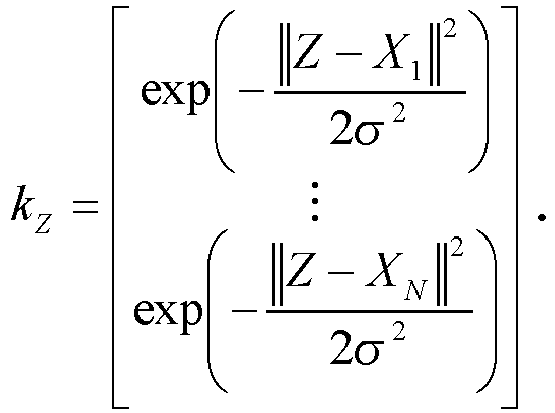
- Thus, the function z giving the score of any vector ofis defined by:


- In relation with
figure 2 , if the flight corresponding to the parameters referenced 20 is abnormal, the corresponding phantom flight is the flight for which the parameters are referenced 20'. - This makes it possible to compare E8 the parameters of the abnormal flight detected with those of the phantom flight determined in order to detect at least one parameter of the abnormal flight that has rendered abnormal said abnormal flight detected.
Claims (9)
- Method of analysing flight data recorded during N flights of at least one aircraft, by means of a flight data recorder of an aircraft, the data being grouped together (E2) by flight i in a signature vector of the flight Xi of size d, the components of which correspond to data recorded during said flight i of the aircraft, a flight i being thus defined by the signature vector Xi, the method comprising the following steps:- Gaussian kernel entropy component analysis (E4) of the flight signatures Xi to obtain a zone of normal flights (E) and classifying the flight signatures Xi with respect to their distance to said zone;- determining (E5), for each flight i, an abnormality score zi defined by the distance of a flight signature Xi with respect to the zone of normal flights (E);- detecting (E6), as a function of the abnormality score zi , at least one abnormal flight;characterised in that the method further comprises the step of- determining for each abnormal flight, a phantom flight the nearest to the abnormal flight while being in the zone of normal flights, wherein the parameters of the abnormal flight detected are compared with those of the phantom flight determined in order to detect at least one parameter of the abnormal flight which has rendered abnormal said abnormal flight detected.
- Analysis method according to claim 1, in which the Gaussian entropy component analysis comprises the following sub-steps:- determination of a matrix of similarity K of size N × N, the components of which quantify the proximity between two flight signatures Xi ;- breakdown into eigen vectors of the matrix of similarity K to obtain N eigen vectors a 1,...,aN and N eigen values λ 1,...,λN such that ∀i = 1,...,N K·ai = λi·ai ;- determination for each eigen vector of its entropy coefficient γi ;- selection of a sub-assembly of eigen vectors {am } m∈{1,...,N} such that the sum of the entropies γm is greater than the percentage of the sum of the N entropies γi .
- Analysis method according to claim 2, in which the entropy coefficient is defined by ∀i = 1,...,N

- Analysis method according to one of claims 2 to 3 in which the abnormality score of a flight i is defined by:

- Analysis method according to one of claims 2 to 4, in which the components of the matrix of similarity K are defined by:

- Analysis method according to the preceding claim, in which the bandwidth parameter σ2 is determined in the following manner:- a matrix D of size N × N corresponding to the distance between two flights is determined and is defined in the following manner ∀i = 1,...,N Di,j = ∥Xi - Xj ∥2;- each component of each column is arranged in ascending order to obtain a matrix D';- k first lines of the matrix D' thereby obtained are selected and the others are eliminated to obtain a matrix D' of size k × N;- the average of each column of the matrix D' to obtain N values y 1,...,yN is determined;- the median absolute deviation of the values y 1,...,yN defined by mad = mediane{|yi - med|} with med = mediane{y1,...,yN } is determined;- the bandwidth parameter σ2 is determined from the median absolute deviation of the values y 1 ,...,yN by the following functional

- Analysis method according to one of the preceding claims, in which the data of a flight i are grouped together in a matrix Fi of dimension T × P with T the number of data recorded during the flight i and P the number of parameters recorded, the vector Xi having for components the columns of the matrix Fi end to end, the vector Xi being then of dimension d = T × P and is defined by

- Analysis method according to one of claims 1 to 5, in which the data of a flight i are grouped together in a matrix Fi of dimension T × P with T the number of data recorded during the flight i and P the number of parameters recorded, the vector Xi having for components the columns of the matrix Fi sampled to select n < T recordings


- Analysis method according to one of claims 1 to 6, in which the data of a flight i are grouped together in a matrix Fi of dimension T × P with T the number of data recorded during the flight i and P the number of parameters recorded, the vector Xi having for components the average, the variance, the minimal value, the maximal value of a parameter among all the recordings of this parameter, the vector Xi being then defined by:

Applications Claiming Priority (3)
| Application Number | Priority Date | Filing Date | Title |
|---|---|---|---|
| FR1251870A FR2987483B1 (en) | 2012-02-29 | 2012-02-29 | METHOD OF ANALYSIS OF FLIGHT DATA |
| US201261617601P | 2012-03-29 | 2012-03-29 | |
| PCT/EP2013/053798 WO2013127781A1 (en) | 2012-02-29 | 2013-02-26 | Method of analysing flight data |
Publications (2)
| Publication Number | Publication Date |
|---|---|
| EP2820489A1 EP2820489A1 (en) | 2015-01-07 |
| EP2820489B1 true EP2820489B1 (en) | 2019-10-09 |
Family
ID=46704741
Family Applications (1)
| Application Number | Title | Priority Date | Filing Date |
|---|---|---|---|
| EP13706513.2A Active EP2820489B1 (en) | 2012-02-29 | 2013-02-26 | Method of analysing flight data |
Country Status (9)
| Country | Link |
|---|---|
| US (1) | US9478077B2 (en) |
| EP (1) | EP2820489B1 (en) |
| CN (1) | CN104321708B (en) |
| AU (1) | AU2013225140A1 (en) |
| BR (1) | BR112014021260B1 (en) |
| FR (1) | FR2987483B1 (en) |
| RU (1) | RU2618359C2 (en) |
| SG (1) | SG11201405227XA (en) |
| WO (1) | WO2013127781A1 (en) |
Families Citing this family (13)
| Publication number | Priority date | Publication date | Assignee | Title |
|---|---|---|---|---|
| WO2014093670A1 (en) * | 2012-12-12 | 2014-06-19 | University Of North Dakota | Analyzing flight data using predictive models |
| US10227140B2 (en) * | 2014-07-11 | 2019-03-12 | Cmc Electronics Inc | System and method for detecting and alerting the user of an aircraft of an impendent adverse condition |
| FR3027417B1 (en) * | 2014-10-20 | 2016-11-25 | Airbus Operations Sas | METHOD AND SYSTEM FOR GENERATING ALERT REPORTS IN AN AIRCRAFT |
| WO2016154938A1 (en) * | 2015-03-31 | 2016-10-06 | SZ DJI Technology Co., Ltd. | Systems and methods for analyzing flight behavior |
| WO2016154937A1 (en) | 2015-03-31 | 2016-10-06 | SZ DJI Technology Co., Ltd. | Systems and methods for monitoring flight |
| FR3052273B1 (en) * | 2016-06-02 | 2018-07-06 | Airbus | PREDICTION OF TROUBLES IN AN AIRCRAFT |
| US11299288B2 (en) | 2019-03-20 | 2022-04-12 | City University Of Hong Kong | Method of presenting flight data of an aircraft and a graphical user interface for use with the same |
| US11587448B2 (en) * | 2019-07-26 | 2023-02-21 | General Electric Company | Systems and methods for manifolds learning of airline network data |
| CN110712765B (en) * | 2019-10-30 | 2021-06-18 | 北京航空航天大学 | A method for locating abnormal operation of aircraft based on operation sequence |
| FR3108738B1 (en) | 2020-03-26 | 2022-04-29 | Safran Electronics & Defense | Flight data processing method |
| CN112991575A (en) * | 2021-02-08 | 2021-06-18 | 北京航空航天大学 | Quantitative detection method for atmospheric environment chaos degree in airplane flying process |
| CN116821644A (en) * | 2023-03-23 | 2023-09-29 | 南京航空航天大学 | A flight data identification method |
| CN116774719B (en) * | 2023-08-18 | 2023-11-07 | 成都庆龙航空科技有限公司 | Unmanned aerial vehicle flight parameter self-diagnosis method and system |
Family Cites Families (16)
| Publication number | Priority date | Publication date | Assignee | Title |
|---|---|---|---|---|
| DE3939731A1 (en) * | 1989-12-01 | 1991-06-06 | Dornier Luftfahrt | AUTONOMOUS LANDING SYSTEM |
| RU21238U1 (en) * | 2001-06-27 | 2001-12-27 | Закрытое акционерное общество "Гефест и Т" | FLIGHT INFORMATION REGISTRATION SYSTEM |
| US20030225492A1 (en) * | 2002-05-29 | 2003-12-04 | Cope Gary G. | Flight data transmission via satellite link and ground storage of data |
| KR100819111B1 (en) * | 2002-07-08 | 2008-04-04 | 이노베이티브 솔루션즈 앤드 서포트 인코포레이티드 | Method and Appartus for Facilitationg Ease of Viewing and Interpretation of Data Concurrently Presented to the Flight Crew on a Multifunction Flat Panel Display in an Aircraft |
| JP4287670B2 (en) * | 2003-02-18 | 2009-07-01 | パナソニック株式会社 | Communication apparatus and communication method |
| US6937924B1 (en) * | 2004-05-21 | 2005-08-30 | The United States Of America As Represented By The Administrator Of The National Aeronautics And Space Administration | Identification of atypical flight patterns |
| US7716100B2 (en) * | 2005-12-02 | 2010-05-11 | Kuberre Systems, Inc. | Methods and systems for computing platform |
| US7937334B2 (en) * | 2006-05-31 | 2011-05-03 | Lockheed Martin Corporation | System and method for defining normal operating regions and identifying anomalous behavior of units within a fleet, operating in a complex, dynamic environment |
| GB2477324A (en) * | 2010-02-01 | 2011-08-03 | Rolls Royce Plc | Device monitoring |
| US8798347B2 (en) * | 2010-03-15 | 2014-08-05 | Siemens Aktiengesellschaft | System and method for image-based respiratory motion compensation for fluoroscopic coronary roadmapping |
| US8510078B2 (en) * | 2010-03-31 | 2013-08-13 | Mitsubishi Electric Research Laboratories, Inc. | Method and system for registering an object with a probe using entropy-based motion selection and Rao-Blackwellized particle filtering |
| GB201009101D0 (en) * | 2010-06-01 | 2010-07-14 | Nordic Bioscience As | Computer based analysis of MRI images |
| KR101873609B1 (en) * | 2010-10-14 | 2018-08-02 | 톰슨 라이센싱 | Methods and apparatus for video encoding and decoding using motion matrix |
| US8897820B2 (en) * | 2010-11-16 | 2014-11-25 | Jack L. Marovets | System, method, and apparatus for storing, transmitting, receiving, and using structured data using un-structured text message bodies |
| CN102176118B (en) * | 2011-01-27 | 2012-09-26 | 西北工业大学 | Multi-input-multi-output aircraft equivalent stability margin robustness determining method |
| FR2983528B1 (en) * | 2011-12-05 | 2014-01-17 | Snecma | METHOD FOR MONITORING A MEASUREMENT CHAIN OF A TURBOJET ENGINE |
-
2012
- 2012-02-29 FR FR1251870A patent/FR2987483B1/en active Active
-
2013
- 2013-02-26 SG SG11201405227XA patent/SG11201405227XA/en unknown
- 2013-02-26 WO PCT/EP2013/053798 patent/WO2013127781A1/en not_active Ceased
- 2013-02-26 RU RU2014138937A patent/RU2618359C2/en active
- 2013-02-26 CN CN201380011376.6A patent/CN104321708B/en active Active
- 2013-02-26 AU AU2013225140A patent/AU2013225140A1/en not_active Abandoned
- 2013-02-26 US US14/381,207 patent/US9478077B2/en active Active
- 2013-02-26 BR BR112014021260-0A patent/BR112014021260B1/en active IP Right Grant
- 2013-02-26 EP EP13706513.2A patent/EP2820489B1/en active Active
Non-Patent Citations (1)
| Title |
|---|
| None * |
Also Published As
| Publication number | Publication date |
|---|---|
| BR112014021260A2 (en) | 2020-11-10 |
| CN104321708A (en) | 2015-01-28 |
| FR2987483B1 (en) | 2014-03-07 |
| WO2013127781A1 (en) | 2013-09-06 |
| FR2987483A1 (en) | 2013-08-30 |
| BR112014021260B1 (en) | 2021-08-10 |
| RU2014138937A (en) | 2016-04-20 |
| AU2013225140A1 (en) | 2014-10-16 |
| RU2618359C2 (en) | 2017-05-03 |
| US20150019070A1 (en) | 2015-01-15 |
| US9478077B2 (en) | 2016-10-25 |
| EP2820489A1 (en) | 2015-01-07 |
| SG11201405227XA (en) | 2014-09-26 |
| CN104321708B (en) | 2016-12-07 |
Similar Documents
| Publication | Publication Date | Title |
|---|---|---|
| US9478077B2 (en) | Method of analysing flight data | |
| Sheridan et al. | An application of dbscan clustering for flight anomaly detection during the approach phase | |
| Li et al. | Anomaly detection via a Gaussian Mixture Model for flight operation and safety monitoring | |
| Barry | Estimating runway veer-off risk using a Bayesian network with flight data | |
| Madsen et al. | Airline safety improvement through experience with near‐misses: A cautionary tale | |
| US20210035453A1 (en) | Systems and methods to utilize flight monitoring data | |
| CN107463161A (en) | Predict the method and system and monitoring system of the failure in aircraft | |
| US9767413B2 (en) | Method and computer program for the maintenance aid of aircraft equipment | |
| US20150331975A1 (en) | A method for analyzing flight data recorded by an aircraft in order to cut them up into flight phases | |
| Ackley et al. | A supervised learning approach for safety event precursor identification in commercial aviation | |
| CN103970122A (en) | Aircraft fault real-time monitoring method and system based on ACMS | |
| EP3462266B1 (en) | Aircraft maintenance message prediction | |
| Nimmagadda et al. | Predicting airline crash due to birds strike using machine learning | |
| Puranik et al. | Identifying instantaneous anomalies in general aviation operations | |
| Zhong et al. | Hard landing pattern recognition and precaution with QAR data by functional data analysis | |
| US7206674B1 (en) | Information display system for atypical flight phase | |
| Kong et al. | Identifying anomalous behavior in aircraft landing trajectory using a Bayesian autoencoder | |
| Garcia et al. | Multiclass Flight Anomaly Detection Using Sensor Fusion Based on Dempster-Shafer Theory | |
| Smart et al. | Combining multiple classifiers to quantitatively rank the impact of abnormalities in flight data | |
| US12339653B2 (en) | Method for processing flight data | |
| Kasprzyk et al. | Reporting UAS related incidents under aviation occurrence reporting legislation | |
| Hasan et al. | Analysis and Predictive Modeling of Stall and Spin Accidents in General Aviation Fixed-Wing Aircraft | |
| Panagopoulos et al. | Safety management and the concept of dynamic risk management dashboards | |
| Smart | Detecting abnormalities in aircraft flight data and ranking their impact on the flight | |
| Kumar et al. | Flight safe: Enhancing safety with epilots for approach phase predictions |
Legal Events
| Date | Code | Title | Description |
|---|---|---|---|
| PUAI | Public reference made under article 153(3) epc to a published international application that has entered the european phase |
Free format text: ORIGINAL CODE: 0009012 |
|
| 17P | Request for examination filed |
Effective date: 20140929 |
|
| AK | Designated contracting states |
Kind code of ref document: A1 Designated state(s): AL AT BE BG CH CY CZ DE DK EE ES FI FR GB GR HR HU IE IS IT LI LT LU LV MC MK MT NL NO PL PT RO RS SE SI SK SM TR |
|
| AX | Request for extension of the european patent |
Extension state: BA ME |
|
| DAX | Request for extension of the european patent (deleted) | ||
| RAP1 | Party data changed (applicant data changed or rights of an application transferred) |
Owner name: UNIVERSITE DE TECHNOLOGIE DE TROYES Owner name: SAFRAN ELECTRONICS & DEFENSE |
|
| GRAP | Despatch of communication of intention to grant a patent |
Free format text: ORIGINAL CODE: EPIDOSNIGR1 |
|
| STAA | Information on the status of an ep patent application or granted ep patent |
Free format text: STATUS: GRANT OF PATENT IS INTENDED |
|
| RIC1 | Information provided on ipc code assigned before grant |
Ipc: G07C 5/02 20060101ALI20190612BHEP Ipc: G01D 9/00 20060101ALI20190612BHEP Ipc: G07C 5/08 20060101ALI20190612BHEP Ipc: G05B 23/02 20060101AFI20190612BHEP Ipc: B64D 45/00 20060101ALI20190612BHEP |
|
| INTG | Intention to grant announced |
Effective date: 20190711 |
|
| GRAS | Grant fee paid |
Free format text: ORIGINAL CODE: EPIDOSNIGR3 |
|
| GRAA | (expected) grant |
Free format text: ORIGINAL CODE: 0009210 |
|
| STAA | Information on the status of an ep patent application or granted ep patent |
Free format text: STATUS: THE PATENT HAS BEEN GRANTED |
|
| AK | Designated contracting states |
Kind code of ref document: B1 Designated state(s): AL AT BE BG CH CY CZ DE DK EE ES FI FR GB GR HR HU IE IS IT LI LT LU LV MC MK MT NL NO PL PT RO RS SE SI SK SM TR |
|
| REG | Reference to a national code |
Ref country code: GB Ref legal event code: FG4D |
|
| REG | Reference to a national code |
Ref country code: CH Ref legal event code: EP |
|
| REG | Reference to a national code |
Ref country code: IE Ref legal event code: FG4D |
|
| REG | Reference to a national code |
Ref country code: DE Ref legal event code: R096 Ref document number: 602013061420 Country of ref document: DE |
|
| REG | Reference to a national code |
Ref country code: AT Ref legal event code: REF Ref document number: 1189542 Country of ref document: AT Kind code of ref document: T Effective date: 20191115 |
|
| REG | Reference to a national code |
Ref country code: NL Ref legal event code: MP Effective date: 20191009 |
|
| REG | Reference to a national code |
Ref country code: LT Ref legal event code: MG4D |
|
| REG | Reference to a national code |
Ref country code: AT Ref legal event code: MK05 Ref document number: 1189542 Country of ref document: AT Kind code of ref document: T Effective date: 20191009 |
|
| PG25 | Lapsed in a contracting state [announced via postgrant information from national office to epo] |
Ref country code: NL Free format text: LAPSE BECAUSE OF FAILURE TO SUBMIT A TRANSLATION OF THE DESCRIPTION OR TO PAY THE FEE WITHIN THE PRESCRIBED TIME-LIMIT Effective date: 20191009 Ref country code: LT Free format text: LAPSE BECAUSE OF FAILURE TO SUBMIT A TRANSLATION OF THE DESCRIPTION OR TO PAY THE FEE WITHIN THE PRESCRIBED TIME-LIMIT Effective date: 20191009 Ref country code: PL Free format text: LAPSE BECAUSE OF FAILURE TO SUBMIT A TRANSLATION OF THE DESCRIPTION OR TO PAY THE FEE WITHIN THE PRESCRIBED TIME-LIMIT Effective date: 20191009 Ref country code: NO Free format text: LAPSE BECAUSE OF FAILURE TO SUBMIT A TRANSLATION OF THE DESCRIPTION OR TO PAY THE FEE WITHIN THE PRESCRIBED TIME-LIMIT Effective date: 20200109 Ref country code: BG Free format text: LAPSE BECAUSE OF FAILURE TO SUBMIT A TRANSLATION OF THE DESCRIPTION OR TO PAY THE FEE WITHIN THE PRESCRIBED TIME-LIMIT Effective date: 20200109 Ref country code: FI Free format text: LAPSE BECAUSE OF FAILURE TO SUBMIT A TRANSLATION OF THE DESCRIPTION OR TO PAY THE FEE WITHIN THE PRESCRIBED TIME-LIMIT Effective date: 20191009 Ref country code: SE Free format text: LAPSE BECAUSE OF FAILURE TO SUBMIT A TRANSLATION OF THE DESCRIPTION OR TO PAY THE FEE WITHIN THE PRESCRIBED TIME-LIMIT Effective date: 20191009 Ref country code: LV Free format text: LAPSE BECAUSE OF FAILURE TO SUBMIT A TRANSLATION OF THE DESCRIPTION OR TO PAY THE FEE WITHIN THE PRESCRIBED TIME-LIMIT Effective date: 20191009 Ref country code: GR Free format text: LAPSE BECAUSE OF FAILURE TO SUBMIT A TRANSLATION OF THE DESCRIPTION OR TO PAY THE FEE WITHIN THE PRESCRIBED TIME-LIMIT Effective date: 20200110 Ref country code: AT Free format text: LAPSE BECAUSE OF FAILURE TO SUBMIT A TRANSLATION OF THE DESCRIPTION OR TO PAY THE FEE WITHIN THE PRESCRIBED TIME-LIMIT Effective date: 20191009 Ref country code: ES Free format text: LAPSE BECAUSE OF FAILURE TO SUBMIT A TRANSLATION OF THE DESCRIPTION OR TO PAY THE FEE WITHIN THE PRESCRIBED TIME-LIMIT Effective date: 20191009 Ref country code: PT Free format text: LAPSE BECAUSE OF FAILURE TO SUBMIT A TRANSLATION OF THE DESCRIPTION OR TO PAY THE FEE WITHIN THE PRESCRIBED TIME-LIMIT Effective date: 20200210 |
|
| PG25 | Lapsed in a contracting state [announced via postgrant information from national office to epo] |
Ref country code: RS Free format text: LAPSE BECAUSE OF FAILURE TO SUBMIT A TRANSLATION OF THE DESCRIPTION OR TO PAY THE FEE WITHIN THE PRESCRIBED TIME-LIMIT Effective date: 20191009 Ref country code: IS Free format text: LAPSE BECAUSE OF FAILURE TO SUBMIT A TRANSLATION OF THE DESCRIPTION OR TO PAY THE FEE WITHIN THE PRESCRIBED TIME-LIMIT Effective date: 20200224 Ref country code: HR Free format text: LAPSE BECAUSE OF FAILURE TO SUBMIT A TRANSLATION OF THE DESCRIPTION OR TO PAY THE FEE WITHIN THE PRESCRIBED TIME-LIMIT Effective date: 20191009 |
|
| PG25 | Lapsed in a contracting state [announced via postgrant information from national office to epo] |
Ref country code: AL Free format text: LAPSE BECAUSE OF FAILURE TO SUBMIT A TRANSLATION OF THE DESCRIPTION OR TO PAY THE FEE WITHIN THE PRESCRIBED TIME-LIMIT Effective date: 20191009 |
|
| REG | Reference to a national code |
Ref country code: DE Ref legal event code: R097 Ref document number: 602013061420 Country of ref document: DE |
|
| PG2D | Information on lapse in contracting state deleted |
Ref country code: IS |
|
| PG25 | Lapsed in a contracting state [announced via postgrant information from national office to epo] |
Ref country code: IS Free format text: LAPSE BECAUSE OF FAILURE TO SUBMIT A TRANSLATION OF THE DESCRIPTION OR TO PAY THE FEE WITHIN THE PRESCRIBED TIME-LIMIT Effective date: 20200209 Ref country code: DK Free format text: LAPSE BECAUSE OF FAILURE TO SUBMIT A TRANSLATION OF THE DESCRIPTION OR TO PAY THE FEE WITHIN THE PRESCRIBED TIME-LIMIT Effective date: 20191009 Ref country code: EE Free format text: LAPSE BECAUSE OF FAILURE TO SUBMIT A TRANSLATION OF THE DESCRIPTION OR TO PAY THE FEE WITHIN THE PRESCRIBED TIME-LIMIT Effective date: 20191009 Ref country code: CZ Free format text: LAPSE BECAUSE OF FAILURE TO SUBMIT A TRANSLATION OF THE DESCRIPTION OR TO PAY THE FEE WITHIN THE PRESCRIBED TIME-LIMIT Effective date: 20191009 Ref country code: RO Free format text: LAPSE BECAUSE OF FAILURE TO SUBMIT A TRANSLATION OF THE DESCRIPTION OR TO PAY THE FEE WITHIN THE PRESCRIBED TIME-LIMIT Effective date: 20191009 |
|
| PLBE | No opposition filed within time limit |
Free format text: ORIGINAL CODE: 0009261 |
|
| STAA | Information on the status of an ep patent application or granted ep patent |
Free format text: STATUS: NO OPPOSITION FILED WITHIN TIME LIMIT |
|
| PG25 | Lapsed in a contracting state [announced via postgrant information from national office to epo] |
Ref country code: SK Free format text: LAPSE BECAUSE OF FAILURE TO SUBMIT A TRANSLATION OF THE DESCRIPTION OR TO PAY THE FEE WITHIN THE PRESCRIBED TIME-LIMIT Effective date: 20191009 Ref country code: SM Free format text: LAPSE BECAUSE OF FAILURE TO SUBMIT A TRANSLATION OF THE DESCRIPTION OR TO PAY THE FEE WITHIN THE PRESCRIBED TIME-LIMIT Effective date: 20191009 |
|
| 26N | No opposition filed |
Effective date: 20200710 |
|
| REG | Reference to a national code |
Ref country code: CH Ref legal event code: PL |
|
| REG | Reference to a national code |
Ref country code: BE Ref legal event code: MM Effective date: 20200229 |
|
| PG25 | Lapsed in a contracting state [announced via postgrant information from national office to epo] |
Ref country code: LU Free format text: LAPSE BECAUSE OF NON-PAYMENT OF DUE FEES Effective date: 20200226 Ref country code: MC Free format text: LAPSE BECAUSE OF FAILURE TO SUBMIT A TRANSLATION OF THE DESCRIPTION OR TO PAY THE FEE WITHIN THE PRESCRIBED TIME-LIMIT Effective date: 20191009 |
|
| PG25 | Lapsed in a contracting state [announced via postgrant information from national office to epo] |
Ref country code: CH Free format text: LAPSE BECAUSE OF NON-PAYMENT OF DUE FEES Effective date: 20200229 Ref country code: LI Free format text: LAPSE BECAUSE OF NON-PAYMENT OF DUE FEES Effective date: 20200229 Ref country code: SI Free format text: LAPSE BECAUSE OF FAILURE TO SUBMIT A TRANSLATION OF THE DESCRIPTION OR TO PAY THE FEE WITHIN THE PRESCRIBED TIME-LIMIT Effective date: 20191009 |
|
| PG25 | Lapsed in a contracting state [announced via postgrant information from national office to epo] |
Ref country code: IE Free format text: LAPSE BECAUSE OF NON-PAYMENT OF DUE FEES Effective date: 20200226 |
|
| PG25 | Lapsed in a contracting state [announced via postgrant information from national office to epo] |
Ref country code: BE Free format text: LAPSE BECAUSE OF NON-PAYMENT OF DUE FEES Effective date: 20200229 |
|
| PG25 | Lapsed in a contracting state [announced via postgrant information from national office to epo] |
Ref country code: TR Free format text: LAPSE BECAUSE OF FAILURE TO SUBMIT A TRANSLATION OF THE DESCRIPTION OR TO PAY THE FEE WITHIN THE PRESCRIBED TIME-LIMIT Effective date: 20191009 Ref country code: MT Free format text: LAPSE BECAUSE OF FAILURE TO SUBMIT A TRANSLATION OF THE DESCRIPTION OR TO PAY THE FEE WITHIN THE PRESCRIBED TIME-LIMIT Effective date: 20191009 Ref country code: CY Free format text: LAPSE BECAUSE OF FAILURE TO SUBMIT A TRANSLATION OF THE DESCRIPTION OR TO PAY THE FEE WITHIN THE PRESCRIBED TIME-LIMIT Effective date: 20191009 |
|
| PG25 | Lapsed in a contracting state [announced via postgrant information from national office to epo] |
Ref country code: MK Free format text: LAPSE BECAUSE OF FAILURE TO SUBMIT A TRANSLATION OF THE DESCRIPTION OR TO PAY THE FEE WITHIN THE PRESCRIBED TIME-LIMIT Effective date: 20191009 |
|
| PGFP | Annual fee paid to national office [announced via postgrant information from national office to epo] |
Ref country code: GB Payment date: 20260219 Year of fee payment: 14 |
|
| PGFP | Annual fee paid to national office [announced via postgrant information from national office to epo] |
Ref country code: DE Payment date: 20260217 Year of fee payment: 14 |
|
| PGFP | Annual fee paid to national office [announced via postgrant information from national office to epo] |
Ref country code: IT Payment date: 20260227 Year of fee payment: 14 |
|
| PGFP | Annual fee paid to national office [announced via postgrant information from national office to epo] |
Ref country code: FR Payment date: 20260219 Year of fee payment: 14 |