EP2818989A2 - Electronic device and control program - Google Patents
Electronic device and control program Download PDFInfo
- Publication number
- EP2818989A2 EP2818989A2 EP20140166203 EP14166203A EP2818989A2 EP 2818989 A2 EP2818989 A2 EP 2818989A2 EP 20140166203 EP20140166203 EP 20140166203 EP 14166203 A EP14166203 A EP 14166203A EP 2818989 A2 EP2818989 A2 EP 2818989A2
- Authority
- EP
- European Patent Office
- Prior art keywords
- parameter
- touch panel
- threshold
- pressure
- corrected
- Prior art date
- Legal status (The legal status is an assumption and is not a legal conclusion. Google has not performed a legal analysis and makes no representation as to the accuracy of the status listed.)
- Withdrawn
Links
Images

Classifications
-
- G—PHYSICS
- G06—COMPUTING OR CALCULATING; COUNTING
- G06F—ELECTRIC DIGITAL DATA PROCESSING
- G06F3/00—Input arrangements for transferring data to be processed into a form capable of being handled by the computer; Output arrangements for transferring data from processing unit to output unit, e.g. interface arrangements
- G06F3/01—Input arrangements or combined input and output arrangements for interaction between user and computer
- G06F3/03—Arrangements for converting the position or the displacement of a member into a coded form
- G06F3/041—Digitisers, e.g. for touch screens or touch pads, characterised by the transducing means
- G06F3/0416—Control or interface arrangements specially adapted for digitisers
- G06F3/0418—Control or interface arrangements specially adapted for digitisers for error correction or compensation, e.g. based on parallax, calibration or alignment
- G06F3/04186—Touch location disambiguation
-
- G—PHYSICS
- G06—COMPUTING OR CALCULATING; COUNTING
- G06F—ELECTRIC DIGITAL DATA PROCESSING
- G06F3/00—Input arrangements for transferring data to be processed into a form capable of being handled by the computer; Output arrangements for transferring data from processing unit to output unit, e.g. interface arrangements
- G06F3/01—Input arrangements or combined input and output arrangements for interaction between user and computer
- G06F3/048—Interaction techniques based on graphical user interfaces [GUI]
- G06F3/0484—Interaction techniques based on graphical user interfaces [GUI] for the control of specific functions or operations, e.g. selecting or manipulating an object, an image or a displayed text element, setting a parameter value or selecting a range
- G06F3/0485—Scrolling or panning
-
- G—PHYSICS
- G06—COMPUTING OR CALCULATING; COUNTING
- G06F—ELECTRIC DIGITAL DATA PROCESSING
- G06F3/00—Input arrangements for transferring data to be processed into a form capable of being handled by the computer; Output arrangements for transferring data from processing unit to output unit, e.g. interface arrangements
- G06F3/01—Input arrangements or combined input and output arrangements for interaction between user and computer
- G06F3/048—Interaction techniques based on graphical user interfaces [GUI]
- G06F3/0487—Interaction techniques based on graphical user interfaces [GUI] using specific features provided by the input device, e.g. functions controlled by the rotation of a mouse with dual sensing arrangements, or of the nature of the input device, e.g. tap gestures based on pressure sensed by a digitiser
- G06F3/0488—Interaction techniques based on graphical user interfaces [GUI] using specific features provided by the input device, e.g. functions controlled by the rotation of a mouse with dual sensing arrangements, or of the nature of the input device, e.g. tap gestures based on pressure sensed by a digitiser using a touch-screen or digitiser, e.g. input of commands through traced gestures
- G06F3/04883—Interaction techniques based on graphical user interfaces [GUI] using specific features provided by the input device, e.g. functions controlled by the rotation of a mouse with dual sensing arrangements, or of the nature of the input device, e.g. tap gestures based on pressure sensed by a digitiser using a touch-screen or digitiser, e.g. input of commands through traced gestures for inputting data by handwriting, e.g. gesture or text
Definitions
- the embodiments discussed herein are related to an electronic device and a control program.
- the users may press the touch panel with pressure of the certain amount or more while trying to perform scroll operation. Therefore, while the users are just trying to perform scroll operation, the electronic device may determine that confirmation operation to execute a process is performed. As a result, the users may perform erroneous operation, and the convenience for the users may be reduced.
- an electronic device includes a touch panel; a memory; and a processor.
- the processor is connected to the memory, calculates a corrected pressure parameter by correcting a parameter of pressure applied by a contact object to the touch panel based on a parameter of a contact area of the contact object on the touch panel, and determines whether certain operation is performed based on the corrected pressure parameter and a threshold.
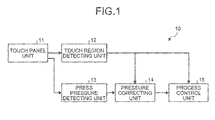
- FIG. 1 is a block diagram illustrating an example of an electronic device according to a first embodiment.
- an electronic device 10 includes a touch panel unit 11, a touch region detecting unit 12, a press pressure detecting unit 13, a pressure correcting unit 14, and a process control unit 15.
- the electronic device 10 is, for example, a mobile terminal.
- the touch panel unit 11 outputs a capacitance of each of unit regions, which are multiple divided regions of a surface (i.e., touch target surface) of the touch panel unit 11, to the touch region detecting unit 12 and the press pressure detecting unit 13.
- the touch region detecting unit 12 detects a "contact position” and a "parameter of the contact area” based on the capacitance of each of the unit regions received from the touch panel unit 11.
- the "contact position” indicates a position on the surface of the touch panel unit 11 touched by a contact object such as a user's finger
- the "contact area” is the area of a region (i.e., a "contact region") on the surface of the touch panel unit 11 touched by the contact object such as a user's finger.
- the "parameter of the contact area” may be the contact area as it is, or may be a long diameter of the contact region.
- the contact area obtained by touching the touch panel unit 11 with a tip of a finger is smaller than the contact area obtained by touching the touch panel unit 11 with a pad of a finger. Namely, it becomes possible to distinguish whether the touch panel unit 11 is touched by the tip of the finger or by the pad of the finger based on the contact area. Furthermore, the contact region touched by the pad of the finger has an elliptical shape or a shape similar to an ellipse. In contrast, the contact region touched by the tip of the finger has a circular shape or a shape similar to a circle. The short diameter of the ellipse and the diameter of the circle correspond to the width of the finger and therefore approximately coincide with each other.
- the long diameter of the ellipse is longer than the diameter of the circle.
- the long diameter of the contact region can be used mainly as the parameter of the contact area.
- the long diameter of the contact region is mainly used as "the parameter of the contact area" .
- the touch region detecting unit 12 outputs the detected contact position and the detected parameter of the contact area to the pressure correcting unit 14 and the process control unit 15.
- the press pressure detecting unit 13 detects "press pressure” based on the capacitance of each of the unit regions received from the touch panel unit 11. For example, the press pressure detecting unit 13 calculates an amount of change in the total capacitance received from the touch panel unit 11 and converts the calculated amount of change into a pressure value to thereby obtain the "press pressure”.
- the press pressure detecting unit 13 outputs the detected press pressure to the pressure correcting unit 14.
- FIG. 2 is a diagram schematically illustrating a contact region on the surface of the touch panel unit.
- a long diameter A of a contact region A20 illustrated in FIG. 2 corresponds to A in Equation (2).
- B in FIG. 2 indicates a short diameter of the contact region A20.
- the process control unit 15 specifies an execution target process based on the contact position received from the touch region detecting unit 12. For example, when the contact position overlaps a display position of an icon, the process control unit 15 specifies a process corresponding to the icon. Furthermore, the process control unit 15 determines whether "confirmation operation" is performed based on the corrected pressure parameter and a threshold. The "confirmation operation” is operation to confirm execution of a process. For example, when the corrected pressure parameter is equal to or greater the threshold, the process control unit 15 determines that the confirmation operation is performed and performs the execution target process. In contrast, when the corrected pressure parameter is smaller than the threshold, the process control unit 15 determines that the confirmation operation is not performed and does not perform the execution target process.
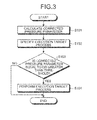
- FIG. 3 is a flowchart illustrating an example of the processing operation performed by the electronic device according to the first embodiment. In particular, the processing operation performed by the pressure correcting unit 14 and the process control unit 15 will be described below.
- the pressure correcting unit 14 calculates a corrected pressure parameter by correcting the press pressure based on the parameter of the contact area received from the touch region detecting unit 12 (Step S101). Therefore, even when the touch panel unit 11 is pressed with the same pressure, it becomes possible to reduce the corrected pressure parameter obtained when the touch panel unit is pressed with a pad of a finger as compared to the corrected pressure parameter obtained when the touch panel unit is pressed with a tip of a finger.
- the process control unit 15 specifies an execution target process based on the contact position received from the touch region detecting unit 12 (Step S102).
- the process control unit 15 determines whether the corrected pressure parameter calculated by the pressure correcting unit 14 is equal to or greater than a threshold (Step S103).
- the process control unit 15 determines that the confirmation operation is performed, and performs the execution target process specified at Step S102 (Step S104). In contrast, when the corrected pressure parameter is smaller than the threshold (NO at Step S103), the process control unit 15 determines that the confirmation operation is not performed, and does not perform the execution target process specified at Step S102.
- the touch panel unit 11 when the touch panel unit 11 is touched by the pad of the finger, it is unlikely that certain operation (for example, the confirmation operation) other than scroll operation is performed. Therefore, when the touch panel unit 11 is touched by the pad of the finger, the corrected pressure parameter is relatively reduced in order to reduce the possibility to determine that the certain operation other than the scroll operation is performed and reduce the frequency of the erroneous operation by a user.
- certain operation for example, the confirmation operation
- Step S101 to Step S104 may be repeated with certain periods.
- the pressure correcting unit 14 of the electronic device 10 calculates the corrected pressure parameter by correcting the press pressure applied by a contact object to the touch panel unit 11 based on the parameter of the contact area of the contact object on the touch panel unit 11. Furthermore, the process control unit 15 determines whether the confirmation operation is performed based on the corrected pressure parameter and the threshold.
- the electronic device 10 configured as described above, it becomes possible to use the contact area of a finger, which differs between when a user intends to perform the confirmation operation and when the user does not intend to perform the confirmation operation, such that the press pressure obtained when the user does not intend to perform the confirmation operation can be corrected to reduce the possibility to determine that the confirmation operation is performed. Therefore, it becomes possible to reduce the frequency of the erroneous operation by the user. For example, it becomes possible to reduce the frequency of cases in which the scroll operation is erroneously determined as the confirmation operation.
- a reference threshold is corrected instead of the press pressure, and whether the certain operation is performed is determined based on the corrected threshold and the press pressure.
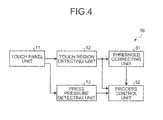
- FIG. 4 is a block diagram illustrating an example of an electronic device according to the second embodiment.
- an electronic device 50 further includes a threshold correcting unit 51 and a process control unit 52.
- Th before correction is the reference threshold
- Th after correction is the corrected threshold
- A is the length of the long diameter of the contact region detected by the touch region detecting unit 12 as described above.
- the process control unit 52 specifies an execution target process based on the contact position received from the touch region detecting unit 12, similarly to the process control unit 15 according to the first embodiment. Furthermore, the process control unit 52 determines whether the "confirmation operation" is performed based on the press pressure detected by the press pressure detecting unit 13 and the corrected threshold calculated by the threshold correcting unit 51. For example, when the press pressure is equal to or greater than the corrected threshold, the process control unit 52 determines that the confirmation operation is performed and performs the execution target process. In contrast, when the press pressure is smaller than the corrected threshold, the process control unit 52 determines that the confirmation operation is not performed and does not perform the execution target process.
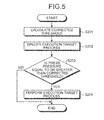
- FIG. 5 is a flowchart illustrating an example of the processing operation performed by the electronic device according to the second embodiment.
- the processing operation performed by the threshold correcting unit 51 and the process control unit 52 will be described below.
- the threshold correcting unit 51 calculates a corrected threshold by correcting the reference threshold based on the parameter of the contact area received from the touch region detecting unit 12 (Step S201). Therefore, even when the touch panel unit 11 is pressed with the same pressure, it becomes possible to increase the corrected threshold used when the touch panel unit is pressed with a pad of a finger as compared to the corrected threshold used when the touch panel unit is pressed with a tip of a finger.
- the process control unit 52 specifies an execution target process based on the contact position received from the touch region detecting unit 12 (Step S202).
- the process control unit 52 determines whether the press pressure detected by the press pressure detecting unit 13 is equal to or greater than the corrected threshold calculated by the threshold correcting unit 51 (Step S203).
- the process control unit 52 determines that the confirmation operation is performed and performs the execution target process specified at Step S202 (Step S204). In contrast, when the press pressure is smaller than the corrected threshold (NO at Step S203), the process control unit 52 determines that the confirmation operation is not performed and does not perform the execution target process specified at Step S202.
- the corrected threshold is relatively increased in order to reduce the possibility to determine that the certain operation other than the scroll operation is performed and reduce the frequency of the erroneous operation by a user.
- Step S201 to Step S204 may be repeated with certain periods.
- the threshold correcting unit 51 of the electronic device 50 calculates the corrected threshold by correcting the reference threshold based on the parameter of the contact area of the contact object on the touch panel unit 11. Furthermore, the process control unit 52 determines whether the certain operation is performed based on the press pressure of the contact object on the touch panel unit 11 and the corrected threshold.
- the electronic device 50 configured as described above, it becomes possible to use the contact area of a finger, which differs between when a user intends to perform the confirmation operation and when the user does not intend to perform the confirmation operation, such that the threshold used when the user does not intend to perform the confirmation operation can be corrected to reduce the possibility to determine that the confirmation operation is performed. Therefore, it becomes possible to reduce the frequency of the erroneous operation by the user. For example, it becomes possible to reduce the frequency of cases in which the scroll operation is erroneously determined as the confirmation operation.
- the pressure correcting unit 14 may correct the press pressure to calculate the corrected pressure parameter only when the parameter of the contact area received from the touch region detecting unit 12 is equal to or greater than the certain value. In contrast, when the parameter of the contact area received from the touch region detecting unit 12 is smaller than the certain value, the pressure correcting unit 14 may output the press pressure to the process control unit 15 without any correction.
- the process control unit 15 determines whether the confirmation operation is performed based on the corrected pressure parameter and the threshold. In contrast, when the parameter of the contact area is smaller than the certain value, the process control unit 15 determines whether the confirmation operation is performed based on the press pressure and the threshold.
- the threshold correcting unit 51 may correct the reference threshold to calculate the corrected threshold only when the parameter of the contact area received from the touch region detecting unit 12 is equal to or greater than a certain value. In contrast, when the parameter of the contact area received from the touch region detecting unit 12 is smaller than the certain value, the threshold correcting unit 51 may output the reference threshold to the process control unit 52 without any correction.
- the process control unit 52 determines whether the confirmation operation is performed based on the press pressure and the corrected threshold. In contrast, when the parameter of the contact area is smaller than the certain value, the process control unit 52 determines whether the confirmation operation is performed base on the press pressure and the reference threshold.
- the pressure correcting unit 14 may correct the press pressure to calculate the corrected pressure parameter only when the press pressure received from the press pressure detecting unit 13 is equal to or greater than the certain value. In contrast, when the press pressure received from the press pressure detecting unit 13 is smaller than the certain value, the pressure correcting unit 14 may outputs the press pressure to the process control unit 15 without correction.
- the process control unit 15 determines whether the confirmation operation is performed based on the corrected pressure parameter and the threshold. In contrast, when the press pressure is smaller than the certain value, the process control unit 15 determines whether the confirmation operation is performed based on the press pressure and the threshold.
- the threshold correcting unit 51 may correct the reference threshold to calculate the corrected threshold only when the press pressure received from the press pressure detecting unit 13 is equal to or greater than a certain value, although this is not illustrated in FIG. 4 .
- the threshold correcting unit 51 may output the reference threshold without correction to the process control unit 52.
- the process control unit 52 determines whether the confirmation operation is performed based on the press pressure and the corrected threshold.
- the process control unit 52 determines whether the confirmation operation is performed based on the press pressure and the reference threshold.
- all or an arbitrary part of the processing functions implemented by the apparatuses may be realized by a central processing unit (CPU) (or a micro computer, such as a micro processing unit (MPU) or a micro controller unit (MCU)). Furthermore, all or an arbitrary part of the processing functions may be realized by a program analyzed and executed by a CPU (or a micro computer, such as an MPU or a MCU), or may be realized by hardware using wired logic.
- CPU central processing unit
- MPU micro processing unit
- MCU micro controller unit
- the electronic device is realized by, for example, a hardware configuration as described below.
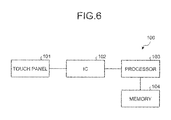
- FIG. 6 is a diagram illustrating a hardware configuration example of the electronic device.
- an electronic device 100 includes a touch panel 101, an integrated circuit (IC) 102, a processor 103, and a memory 104.
- IC integrated circuit
- each of the electronic device 10 and the electronic device 50 has the hardware configuration as illustrated in FIG. 6 .
- Examples of the processor 103 includes a CPU, a digital signal processor (DSP), and a field programmable gate array (FPGA).
- examples of the memory 104 include a random access memory (RAM), such as a synchronous dynamic random access memory (SDRAM), a read only memory (ROM), and a flash memory.
- RAM random access memory
- SDRAM synchronous dynamic random access memory
- ROM read only memory
- flash memory a flash memory
- the processing functions implemented by the electronic device may be realized by causing a processor provided in an amplifier to execute programs stored in various memories, such as a nonvolatile storage medium.
- a processor provided in an amplifier
- the processes performed by the pressure correcting unit 14, the process control units 15 and 52, and the threshold correcting unit 51 may be distributed to multiple processors.
- the touch region detecting unit 12 and the press pressure detecting unit 13 may be implemented by the IC 102.
- the touch region detecting unit 12 and the press pressure detecting unit 13 may be implemented by separate ICs.
Landscapes
- Engineering & Computer Science (AREA)
- General Engineering & Computer Science (AREA)
- Theoretical Computer Science (AREA)
- Human Computer Interaction (AREA)
- Physics & Mathematics (AREA)
- General Physics & Mathematics (AREA)
- Position Input By Displaying (AREA)
- User Interface Of Digital Computer (AREA)
Abstract
Description
- The embodiments discussed herein are related to an electronic device and a control program.
- Conventionally, electronic devices (for example, mobile terminals) provided with a touch panel and a press-pressure sensor are known. In such electronic devices, in some cases, a process is received only after it is only detected that an icon or the like displayed on the touch panel is touched and the touch panel is pressed with pressure of a certain amount or more, rather than when it is only detected that an icon or the like displayed on the touch panel is touched. With this control, because a process is not received when the touch panel is only touched but is received only after the touch panel is touched and the touch panel is pressed with pressure of a certain amount or more, it is possible to reduce the frequency of erroneous operation by a user. A conventional example is described in Japanese Laid-open Patent Publication No.
2011-86191 - However, users, in particular, elderly people, who are not familiar with operation apply more pressure than necessary during the operation, and in some cases, the users may press the touch panel with pressure of the certain amount or more while trying to perform scroll operation. Therefore, while the users are just trying to perform scroll operation, the electronic device may determine that confirmation operation to execute a process is performed. As a result, the users may perform erroneous operation, and the convenience for the users may be reduced.
- Accordingly, it is an object in one aspect of an embodiment of the invention to provide an electronic device and a control program capable of reducing the frequency of erroneous operation by a user.
- According to an aspect of an embodiment, an electronic device includes a touch panel; a memory; and a processor. The processor is connected to the memory, calculates a corrected pressure parameter by correcting a parameter of pressure applied by a contact object to the touch panel based on a parameter of a contact area of the contact object on the touch panel, and determines whether certain operation is performed based on the corrected pressure parameter and a threshold.
-
-
FIG. 1 is a block diagram illustrating an example of an electronic device according to a first embodiment; -
FIG. 2 is a diagram schematically illustrating a contact region on a surface of a touch panel unit; -
FIG. 3 is a flowchart illustrating an example of processing operation performed by the electronic device according to the first embodiment; -
FIG. 4 is a block diagram illustrating an example of an electronic device according to a second embodiment; -
FIG. 5 is a flowchart illustrating an example of processing operation performed by the electronic device according to the second embodiment; and -
FIG. 6 is a diagram illustrating a hardware configuration example of the electronic device. - Preferred embodiments of the present invention will be explained with reference to accompanying drawings. The electronic device and the control program of the disclosed technology are not limited by the embodiments below. The components with the same functions in the embodiments will be denoted by the same reference numerals and symbols, and the same explanation will not be repeated.
-
FIG. 1 is a block diagram illustrating an example of an electronic device according to a first embodiment. InFIG. 1 , anelectronic device 10 includes atouch panel unit 11, a touchregion detecting unit 12, a presspressure detecting unit 13, apressure correcting unit 14, and aprocess control unit 15. Theelectronic device 10 is, for example, a mobile terminal. - The
touch panel unit 11 outputs a capacitance of each of unit regions, which are multiple divided regions of a surface (i.e., touch target surface) of thetouch panel unit 11, to the touchregion detecting unit 12 and the presspressure detecting unit 13. - The touch
region detecting unit 12 detects a "contact position" and a "parameter of the contact area" based on the capacitance of each of the unit regions received from thetouch panel unit 11. The "contact position" indicates a position on the surface of thetouch panel unit 11 touched by a contact object such as a user's finger, and the "contact area" is the area of a region (i.e., a "contact region") on the surface of thetouch panel unit 11 touched by the contact object such as a user's finger. The "parameter of the contact area" may be the contact area as it is, or may be a long diameter of the contact region. Incidentally, the contact area obtained by touching thetouch panel unit 11 with a tip of a finger is smaller than the contact area obtained by touching thetouch panel unit 11 with a pad of a finger. Namely, it becomes possible to distinguish whether thetouch panel unit 11 is touched by the tip of the finger or by the pad of the finger based on the contact area. Furthermore, the contact region touched by the pad of the finger has an elliptical shape or a shape similar to an ellipse. In contrast, the contact region touched by the tip of the finger has a circular shape or a shape similar to a circle. The short diameter of the ellipse and the diameter of the circle correspond to the width of the finger and therefore approximately coincide with each other. In contrast, the long diameter of the ellipse is longer than the diameter of the circle. Namely, the long diameter of the contact region can be used mainly as the parameter of the contact area. In the following, an example will be explained in which the long diameter of the contact region is mainly used as "the parameter of the contact area". - The touch
region detecting unit 12 outputs the detected contact position and the detected parameter of the contact area to thepressure correcting unit 14 and theprocess control unit 15. - The press
pressure detecting unit 13 detects "press pressure" based on the capacitance of each of the unit regions received from thetouch panel unit 11. For example, the presspressure detecting unit 13 calculates an amount of change in the total capacitance received from thetouch panel unit 11 and converts the calculated amount of change into a pressure value to thereby obtain the "press pressure". - The press
pressure detecting unit 13 outputs the detected press pressure to thepressure correcting unit 14. - The
pressure correcting unit 14 corrects the press pressure received from the presspressure detecting unit 13 based on the parameter of the contact area received from the touchregion detecting unit 12, to thereby calculate a "corrected pressure parameter". For example, thepressure correcting unit 14 calculates the corrected pressure parameter by reducing the press pressure as the parameter of the contact area increases. For example, thepressure correcting unit 14 multiplies the press pressure received from the presspressure detecting unit 13 by the inverse of the parameter of the contact area received from the touchregion detecting unit 12, to thereby calculate the corrected pressure parameter. For example, thepressure correcting unit 14 may calculate the corrected pressure parameter by Equations (1) and (2) below.

- Here, Pbefore correction is the press pressure that the
pressure correcting unit 14 has received from the presspressure detecting unit 13, and Pafter correction is the corrected pressure parameter. Furthermore, A is the length of the long diameter of the contact region detected by the touchregion detecting unit 12.FIG. 2 is a diagram schematically illustrating a contact region on the surface of the touch panel unit. A long diameter A of a contact region A20 illustrated inFIG. 2 corresponds to A in Equation (2). Incidentally, B inFIG. 2 indicates a short diameter of the contact region A20. - The
process control unit 15 specifies an execution target process based on the contact position received from the touchregion detecting unit 12. For example, when the contact position overlaps a display position of an icon, theprocess control unit 15 specifies a process corresponding to the icon. Furthermore, theprocess control unit 15 determines whether "confirmation operation" is performed based on the corrected pressure parameter and a threshold. The "confirmation operation" is operation to confirm execution of a process. For example, when the corrected pressure parameter is equal to or greater the threshold, theprocess control unit 15 determines that the confirmation operation is performed and performs the execution target process. In contrast, when the corrected pressure parameter is smaller than the threshold, theprocess control unit 15 determines that the confirmation operation is not performed and does not perform the execution target process. - Example of operation performed by electronic device An example of processing operation performed by the
electronic device 10 with the above configuration will be described below.FIG. 3 is a flowchart illustrating an example of the processing operation performed by the electronic device according to the first embodiment. In particular, the processing operation performed by thepressure correcting unit 14 and theprocess control unit 15 will be described below. - The
pressure correcting unit 14 calculates a corrected pressure parameter by correcting the press pressure based on the parameter of the contact area received from the touch region detecting unit 12 (Step S101). Therefore, even when thetouch panel unit 11 is pressed with the same pressure, it becomes possible to reduce the corrected pressure parameter obtained when the touch panel unit is pressed with a pad of a finger as compared to the corrected pressure parameter obtained when the touch panel unit is pressed with a tip of a finger. - The
process control unit 15 specifies an execution target process based on the contact position received from the touch region detecting unit 12 (Step S102). - The
process control unit 15 determines whether the corrected pressure parameter calculated by thepressure correcting unit 14 is equal to or greater than a threshold (Step S103). - When the corrected pressure parameter is equal to or greater than the threshold (YES at Step S103), the
process control unit 15 determines that the confirmation operation is performed, and performs the execution target process specified at Step S102 (Step S104). In contrast, when the corrected pressure parameter is smaller than the threshold (NO at Step S103), theprocess control unit 15 determines that the confirmation operation is not performed, and does not perform the execution target process specified at Step S102. - Incidentally, when the
touch panel unit 11 is touched by the pad of the finger, it is unlikely that certain operation (for example, the confirmation operation) other than scroll operation is performed. Therefore, when thetouch panel unit 11 is touched by the pad of the finger, the corrected pressure parameter is relatively reduced in order to reduce the possibility to determine that the certain operation other than the scroll operation is performed and reduce the frequency of the erroneous operation by a user. - Incidentally, the processes from Step S101 to Step S104 may be repeated with certain periods.
- As described above, according to the first embodiment, the
pressure correcting unit 14 of theelectronic device 10 calculates the corrected pressure parameter by correcting the press pressure applied by a contact object to thetouch panel unit 11 based on the parameter of the contact area of the contact object on thetouch panel unit 11. Furthermore, theprocess control unit 15 determines whether the confirmation operation is performed based on the corrected pressure parameter and the threshold. - According to the
electronic device 10 configured as described above, it becomes possible to use the contact area of a finger, which differs between when a user intends to perform the confirmation operation and when the user does not intend to perform the confirmation operation, such that the press pressure obtained when the user does not intend to perform the confirmation operation can be corrected to reduce the possibility to determine that the confirmation operation is performed. Therefore, it becomes possible to reduce the frequency of the erroneous operation by the user. For example, it becomes possible to reduce the frequency of cases in which the scroll operation is erroneously determined as the confirmation operation. - In a second embodiment, a reference threshold is corrected instead of the press pressure, and whether the certain operation is performed is determined based on the corrected threshold and the press pressure.
-
FIG. 4 is a block diagram illustrating an example of an electronic device according to the second embodiment. InFIG. 4 , anelectronic device 50 further includes a threshold correcting unit 51 and aprocess control unit 52. - The threshold correcting unit 51 corrects a reference threshold based on the parameter of the contact area received from the touch
region detecting unit 12, to thereby calculate a "corrected threshold". For example, the threshold correcting unit 51 calculates the corrected threshold by reducing the reference threshold as the parameter of the contact area increases. For example, the threshold correcting unit 51 multiples the reference threshold by the parameter of the contact area received from the touchregion detecting unit 12, to thereby calculate the corrected threshold. For example, the threshold correcting unit 51 may calculate the corrected threshold by Equations (3) and (4) below.

- Here, Thbefore correction is the reference threshold, and Thafter correction is the corrected threshold. Furthermore, A is the length of the long diameter of the contact region detected by the touch
region detecting unit 12 as described above. - The
process control unit 52 specifies an execution target process based on the contact position received from the touchregion detecting unit 12, similarly to theprocess control unit 15 according to the first embodiment. Furthermore, theprocess control unit 52 determines whether the "confirmation operation" is performed based on the press pressure detected by the presspressure detecting unit 13 and the corrected threshold calculated by the threshold correcting unit 51. For example, when the press pressure is equal to or greater than the corrected threshold, theprocess control unit 52 determines that the confirmation operation is performed and performs the execution target process. In contrast, when the press pressure is smaller than the corrected threshold, theprocess control unit 52 determines that the confirmation operation is not performed and does not perform the execution target process. - An example of processing operation performed by the
electronic device 50 with the above configuration will be described below.FIG. 5 is a flowchart illustrating an example of the processing operation performed by the electronic device according to the second embodiment. In particular, the processing operation performed by the threshold correcting unit 51 and theprocess control unit 52 will be described below. - The threshold correcting unit 51 calculates a corrected threshold by correcting the reference threshold based on the parameter of the contact area received from the touch region detecting unit 12 (Step S201). Therefore, even when the
touch panel unit 11 is pressed with the same pressure, it becomes possible to increase the corrected threshold used when the touch panel unit is pressed with a pad of a finger as compared to the corrected threshold used when the touch panel unit is pressed with a tip of a finger. - The
process control unit 52 specifies an execution target process based on the contact position received from the touch region detecting unit 12 (Step S202). - The
process control unit 52 determines whether the press pressure detected by the presspressure detecting unit 13 is equal to or greater than the corrected threshold calculated by the threshold correcting unit 51 (Step S203). - When the press pressure is equal to or greater than the corrected threshold (YES at Step S203), the
process control unit 52 determines that the confirmation operation is performed and performs the execution target process specified at Step S202 (Step S204). In contrast, when the press pressure is smaller than the corrected threshold (NO at Step S203), theprocess control unit 52 determines that the confirmation operation is not performed and does not perform the execution target process specified at Step S202. - Incidentally, when the
touch panel unit 11 is touched by the pad of the finger, it is unlikely that certain operation (for example, the confirmation operation) other than scroll operation is performed. Therefore when thetouch panel unit 11 is touched by the pad of the finger, the corrected threshold is relatively increased in order to reduce the possibility to determine that the certain operation other than the scroll operation is performed and reduce the frequency of the erroneous operation by a user. - Incidentally, the processes from Step S201 to Step S204 may be repeated with certain periods.
- As described above, according to the second embodiment, the threshold correcting unit 51 of the
electronic device 50 calculates the corrected threshold by correcting the reference threshold based on the parameter of the contact area of the contact object on thetouch panel unit 11. Furthermore, theprocess control unit 52 determines whether the certain operation is performed based on the press pressure of the contact object on thetouch panel unit 11 and the corrected threshold. - According to the
electronic device 50 configured as described above, it becomes possible to use the contact area of a finger, which differs between when a user intends to perform the confirmation operation and when the user does not intend to perform the confirmation operation, such that the threshold used when the user does not intend to perform the confirmation operation can be corrected to reduce the possibility to determine that the confirmation operation is performed. Therefore, it becomes possible to reduce the frequency of the erroneous operation by the user. For example, it becomes possible to reduce the frequency of cases in which the scroll operation is erroneously determined as the confirmation operation. -
- [1] In the first and the second embodiments, the
process control unit 15 and theprocess control unit 52 employ the "confirmation operation" as target operation to determine whether the target operation is performed or not. However, the target operation is not limited to the confirmation operation. For example, selection operation may be employed as the target operation. - [2] The correction process in the first and the second embodiments may be performed only when the parameter of the contact area is equal to or greater than a certain value, and may be omitted from being performed when the parameter of the contact area is smaller than the certain value. In other words, it may be possible to set the lower limit of the parameter of the contact area in the correction process of the first and the second embodiments.
- For example, the
pressure correcting unit 14 according to the first embodiment may correct the press pressure to calculate the corrected pressure parameter only when the parameter of the contact area received from the touchregion detecting unit 12 is equal to or greater than the certain value. In contrast, when the parameter of the contact area received from the touchregion detecting unit 12 is smaller than the certain value, thepressure correcting unit 14 may output the press pressure to theprocess control unit 15 without any correction. When the parameter of the contact area is equal to or greater than the certain value, theprocess control unit 15 determines whether the confirmation operation is performed based on the corrected pressure parameter and the threshold. In contrast, when the parameter of the contact area is smaller than the certain value, theprocess control unit 15 determines whether the confirmation operation is performed based on the press pressure and the threshold. - Furthermore, the threshold correcting unit 51 according to the second embodiment may correct the reference threshold to calculate the corrected threshold only when the parameter of the contact area received from the touch
region detecting unit 12 is equal to or greater than a certain value. In contrast, when the parameter of the contact area received from the touchregion detecting unit 12 is smaller than the certain value, the threshold correcting unit 51 may output the reference threshold to theprocess control unit 52 without any correction. When the parameter of the contact area is equal to or greater than the certain value, theprocess control unit 52 determines whether the confirmation operation is performed based on the press pressure and the corrected threshold. In contrast, when the parameter of the contact area is smaller than the certain value, theprocess control unit 52 determines whether the confirmation operation is performed base on the press pressure and the reference threshold. - [3] The correction process in the first and the second embodiments may be performed only when the press pressure is equal to or greater than a certain value, and may be omitted from being performed when the press pressure is smaller than the certain value. In other words, it may be possible to set the lower limit of the press pressure in the correction process of the first and the second embodiments.
- For example, the
pressure correcting unit 14 according to the first embodiment may correct the press pressure to calculate the corrected pressure parameter only when the press pressure received from the presspressure detecting unit 13 is equal to or greater than the certain value. In contrast, when the press pressure received from the presspressure detecting unit 13 is smaller than the certain value, thepressure correcting unit 14 may outputs the press pressure to theprocess control unit 15 without correction. When the press pressure is equal to or greater than the certain value, theprocess control unit 15 determines whether the confirmation operation is performed based on the corrected pressure parameter and the threshold. In contrast, when the press pressure is smaller than the certain value, theprocess control unit 15 determines whether the confirmation operation is performed based on the press pressure and the threshold. - Furthermore, the threshold correcting unit 51 according to the second embodiment may correct the reference threshold to calculate the corrected threshold only when the press pressure received from the press
pressure detecting unit 13 is equal to or greater than a certain value, although this is not illustrated inFIG. 4 . In contrast, when the press pressure received from the presspressure detecting unit 13 is smaller than the certain value, the threshold correcting unit 51 may output the reference threshold without correction to theprocess control unit 52. When the press pressure is equal to or greater than the certain value, theprocess control unit 52 determines whether the confirmation operation is performed based on the press pressure and the corrected threshold. In contrast, when the press pressure is smaller than the certain value, theprocess control unit 52 determines whether the confirmation operation is performed based on the press pressure and the reference threshold. - [4] The components illustrated in the drawings of the first and the second embodiments do not necessarily have to be physically configured in the manner illustrated in the drawings. In other words, specific forms of distribution and integration of the components are not limited to those illustrated in the drawings, and all or part of the components can be functionally or physically distributed or integrated in arbitrary units depending on various loads or use conditions.
- Furthermore, all or an arbitrary part of the processing functions implemented by the apparatuses may be realized by a central processing unit (CPU) (or a micro computer, such as a micro processing unit (MPU) or a micro controller unit (MCU)). Furthermore, all or an arbitrary part of the processing functions may be realized by a program analyzed and executed by a CPU (or a micro computer, such as an MPU or a MCU), or may be realized by hardware using wired logic.
- The electronic device according to the first and the second embodiments is realized by, for example, a hardware configuration as described below.
-
FIG. 6 is a diagram illustrating a hardware configuration example of the electronic device. As illustrated inFIG. 6 , anelectronic device 100 includes atouch panel 101, an integrated circuit (IC) 102, aprocessor 103, and amemory 104. Incidentally, each of theelectronic device 10 and theelectronic device 50 has the hardware configuration as illustrated inFIG. 6 . - Examples of the
processor 103 includes a CPU, a digital signal processor (DSP), and a field programmable gate array (FPGA). Furthermore, examples of thememory 104 include a random access memory (RAM), such as a synchronous dynamic random access memory (SDRAM), a read only memory (ROM), and a flash memory. - The processing functions implemented by the electronic device according to the first and the second embodiments may be realized by causing a processor provided in an amplifier to execute programs stored in various memories, such as a nonvolatile storage medium. For example, it may be possible to store programs corresponding to the processes performed by the
pressure correcting unit 14, theprocess control units memory 104, and cause theprocessor 103 to perform each of the programs. Furthermore, the processes performed by thepressure correcting unit 14, theprocess control units region detecting unit 12 and the presspressure detecting unit 13 may be implemented by theIC 102. Alternatively, the touchregion detecting unit 12 and the presspressure detecting unit 13 may be implemented by separate ICs. - According to an embodiment of the present invention, it becomes possible to reduce the frequency of erroneous operation by a user.
Claims (5)
- An electronic device (10, 100) comprising:a touch panel (11, 101);a memory (104); anda processor (14, 15, 103) that is connected to the memory, calculates a corrected pressure parameter by correcting a parameter of pressure applied by a contact object to the touch panel based on a parameter of a contact area of the contact object on the touch panel, and determines whether certain operation is performed based on the corrected pressure parameter and a threshold.
- The electronic device (10, 100) according to claim 1, wherein
the parameter of the contact area is a long diameter of a contact region of the contact object on the touch panel, and
the processor (14, 103) calculates the corrected pressure parameter by reducing the parameter of the pressure as the long diameter increases. - An electronic device (50, 100) comprising:a touch panel (11, 101);a memory (104); anda processor (51, 52, 103) that is connected to the memory, calculates a corrected threshold by correcting a reference threshold based on a parameter of a contact area of a contact object on the touch panel, and determines whether certain operation is performed based on a parameter of pressure applied by the contact object to the touch panel and the corrected threshold.
- The electronic device (50, 100) according to claim 3, wherein
the parameter of the contact area is a long diameter of a contact region of the contact object on the touch panel, and
the processor (51, 103) calculates the corrected threshold by reducing the reference threshold as the long diameter increases. - A control program for causing an electronic device (10, 100) including a touch panel to execute a process, the process comprising:calculating a corrected pressure parameter by correcting a parameter of pressure applied by a contact object to the touch panel based on a parameter of a contact area of the contact object on the touch panel; anddetermining whether certain operation is performed based on the corrected pressure parameter and a threshold.
Applications Claiming Priority (1)
| Application Number | Priority Date | Filing Date | Title |
|---|---|---|---|
| JP2013134187A JP2015011401A (en) | 2013-06-26 | 2013-06-26 | Electronic device and control program |
Publications (2)
| Publication Number | Publication Date |
|---|---|
| EP2818989A2 true EP2818989A2 (en) | 2014-12-31 |
| EP2818989A3 EP2818989A3 (en) | 2015-01-14 |
Family
ID=50884664
Family Applications (1)
| Application Number | Title | Priority Date | Filing Date |
|---|---|---|---|
| EP14166203.1A Withdrawn EP2818989A3 (en) | 2013-06-26 | 2014-04-28 | Electronic device and control program |
Country Status (3)
| Country | Link |
|---|---|
| US (1) | US9395843B2 (en) |
| EP (1) | EP2818989A3 (en) |
| JP (1) | JP2015011401A (en) |
Cited By (2)
| Publication number | Priority date | Publication date | Assignee | Title |
|---|---|---|---|---|
| WO2016164193A1 (en) * | 2015-04-09 | 2016-10-13 | Microsoft Technology Licensing, Llc | Force-sensitive touch sensor compensation |
| CN107203290A (en) * | 2016-03-17 | 2017-09-26 | 上海和辉光电有限公司 | A kind of method and its mobile terminal for distinguishing touch pressure |
Families Citing this family (35)
| Publication number | Priority date | Publication date | Assignee | Title |
|---|---|---|---|---|
| US11223619B2 (en) | 2010-11-29 | 2022-01-11 | Biocatch Ltd. | Device, system, and method of user authentication based on user-specific characteristics of task performance |
| US10949514B2 (en) | 2010-11-29 | 2021-03-16 | Biocatch Ltd. | Device, system, and method of differentiating among users based on detection of hardware components |
| US10685355B2 (en) | 2016-12-04 | 2020-06-16 | Biocatch Ltd. | Method, device, and system of detecting mule accounts and accounts used for money laundering |
| US10949757B2 (en) | 2010-11-29 | 2021-03-16 | Biocatch Ltd. | System, device, and method of detecting user identity based on motor-control loop model |
| US10621585B2 (en) | 2010-11-29 | 2020-04-14 | Biocatch Ltd. | Contextual mapping of web-pages, and generation of fraud-relatedness score-values |
| US10970394B2 (en) | 2017-11-21 | 2021-04-06 | Biocatch Ltd. | System, device, and method of detecting vishing attacks |
| US10262324B2 (en) | 2010-11-29 | 2019-04-16 | Biocatch Ltd. | System, device, and method of differentiating among users based on user-specific page navigation sequence |
| US10474815B2 (en) | 2010-11-29 | 2019-11-12 | Biocatch Ltd. | System, device, and method of detecting malicious automatic script and code injection |
| US20190158535A1 (en) * | 2017-11-21 | 2019-05-23 | Biocatch Ltd. | Device, System, and Method of Detecting Vishing Attacks |
| US10404729B2 (en) | 2010-11-29 | 2019-09-03 | Biocatch Ltd. | Device, method, and system of generating fraud-alerts for cyber-attacks |
| US12641120B2 (en) * | 2010-11-29 | 2026-05-26 | Biocatch Ltd. | Device, system, and method of detecting vishing attacks |
| US12101354B2 (en) * | 2010-11-29 | 2024-09-24 | Biocatch Ltd. | Device, system, and method of detecting vishing attacks |
| US10897482B2 (en) | 2010-11-29 | 2021-01-19 | Biocatch Ltd. | Method, device, and system of back-coloring, forward-coloring, and fraud detection |
| US10776476B2 (en) | 2010-11-29 | 2020-09-15 | Biocatch Ltd. | System, device, and method of visual login |
| US10069837B2 (en) * | 2015-07-09 | 2018-09-04 | Biocatch Ltd. | Detection of proxy server |
| US10917431B2 (en) | 2010-11-29 | 2021-02-09 | Biocatch Ltd. | System, method, and device of authenticating a user based on selfie image or selfie video |
| US10747305B2 (en) | 2010-11-29 | 2020-08-18 | Biocatch Ltd. | Method, system, and device of authenticating identity of a user of an electronic device |
| US11210674B2 (en) | 2010-11-29 | 2021-12-28 | Biocatch Ltd. | Method, device, and system of detecting mule accounts and accounts used for money laundering |
| US11269977B2 (en) | 2010-11-29 | 2022-03-08 | Biocatch Ltd. | System, apparatus, and method of collecting and processing data in electronic devices |
| US10586036B2 (en) | 2010-11-29 | 2020-03-10 | Biocatch Ltd. | System, device, and method of recovery and resetting of user authentication factor |
| US10728761B2 (en) | 2010-11-29 | 2020-07-28 | Biocatch Ltd. | Method, device, and system of detecting a lie of a user who inputs data |
| US10834590B2 (en) | 2010-11-29 | 2020-11-10 | Biocatch Ltd. | Method, device, and system of differentiating between a cyber-attacker and a legitimate user |
| US10298614B2 (en) * | 2010-11-29 | 2019-05-21 | Biocatch Ltd. | System, device, and method of generating and managing behavioral biometric cookies |
| JP5794399B2 (en) * | 2012-12-12 | 2015-10-14 | 株式会社村田製作所 | Touch input device |
| JP2016197284A (en) | 2015-04-02 | 2016-11-24 | 富士通株式会社 | Electronic device, control method, and control program |
| GB2539705B (en) | 2015-06-25 | 2017-10-25 | Aimbrain Solutions Ltd | Conditional behavioural biometrics |
| US9927917B2 (en) * | 2015-10-29 | 2018-03-27 | Microsoft Technology Licensing, Llc | Model-based touch event location adjustment |
| GB2552032B (en) | 2016-07-08 | 2019-05-22 | Aimbrain Solutions Ltd | Step-up authentication |
| US10198122B2 (en) * | 2016-09-30 | 2019-02-05 | Biocatch Ltd. | System, device, and method of estimating force applied to a touch surface |
| US10579784B2 (en) | 2016-11-02 | 2020-03-03 | Biocatch Ltd. | System, device, and method of secure utilization of fingerprints for user authentication |
| US10397262B2 (en) | 2017-07-20 | 2019-08-27 | Biocatch Ltd. | Device, system, and method of detecting overlay malware |
| CN107450788B (en) * | 2017-09-19 | 2020-12-18 | 惠科股份有限公司 | Touch control display device |
| KR102447185B1 (en) | 2018-01-02 | 2022-09-27 | 삼성전자 주식회사 | Pressure value compensation method of force sensor and electronic device using the same |
| US11606353B2 (en) | 2021-07-22 | 2023-03-14 | Biocatch Ltd. | System, device, and method of generating and utilizing one-time passwords |
| WO2023163490A1 (en) * | 2022-02-25 | 2023-08-31 | 삼성전자주식회사 | Method for adjusting recognition sensitivity for touch recognition, and electronic device performing same |
Citations (1)
| Publication number | Priority date | Publication date | Assignee | Title |
|---|---|---|---|---|
| JP2011086191A (en) | 2009-10-16 | 2011-04-28 | Sony Corp | Electronic apparatus |
Family Cites Families (13)
| Publication number | Priority date | Publication date | Assignee | Title |
|---|---|---|---|---|
| US11275405B2 (en) * | 2005-03-04 | 2022-03-15 | Apple Inc. | Multi-functional hand-held device |
| JP2005018669A (en) * | 2003-06-30 | 2005-01-20 | Pentel Corp | Capacitive digital touch panel |
| JP4715257B2 (en) | 2005-03-22 | 2011-07-06 | パナソニック株式会社 | Data processing device |
| JP2006345209A (en) | 2005-06-08 | 2006-12-21 | Sony Corp | INPUT DEVICE, INFORMATION PROCESSING DEVICE, INFORMATION PROCESSING METHOD, AND PROGRAM |
| TW200715192A (en) | 2005-10-07 | 2007-04-16 | Elan Microelectronics Corp | Method for a window to generate different moving speed |
| CN102257457A (en) * | 2008-12-25 | 2011-11-23 | 富士通株式会社 | Computer program, input device, and input method |
| JP5157969B2 (en) * | 2009-03-09 | 2013-03-06 | ソニー株式会社 | Information processing apparatus, threshold setting method and program thereof |
| JP4808804B2 (en) * | 2009-08-27 | 2011-11-02 | 京セラ株式会社 | Input device |
| JP5463240B2 (en) * | 2010-08-25 | 2014-04-09 | 京セラ株式会社 | Input device |
| US20120105367A1 (en) | 2010-11-01 | 2012-05-03 | Impress Inc. | Methods of using tactile force sensing for intuitive user interface |
| US8976128B2 (en) | 2011-09-12 | 2015-03-10 | Google Technology Holdings LLC | Using pressure differences with a touch-sensitive display screen |
| US8773382B2 (en) * | 2011-10-28 | 2014-07-08 | Nintendo Co., Ltd. | Computer-readable storage medium, coordinate processing apparatus, coordinate processing system, and coordinate processing method |
| JP2013161208A (en) * | 2012-02-03 | 2013-08-19 | Sony Corp | Information processing apparatus, information processing method, and program |
-
2013
- 2013-06-26 JP JP2013134187A patent/JP2015011401A/en active Pending
-
2014
- 2014-04-18 US US14/256,512 patent/US9395843B2/en not_active Expired - Fee Related
- 2014-04-28 EP EP14166203.1A patent/EP2818989A3/en not_active Withdrawn
Patent Citations (1)
| Publication number | Priority date | Publication date | Assignee | Title |
|---|---|---|---|---|
| JP2011086191A (en) | 2009-10-16 | 2011-04-28 | Sony Corp | Electronic apparatus |
Cited By (6)
| Publication number | Priority date | Publication date | Assignee | Title |
|---|---|---|---|---|
| WO2016164193A1 (en) * | 2015-04-09 | 2016-10-13 | Microsoft Technology Licensing, Llc | Force-sensitive touch sensor compensation |
| US9612685B2 (en) | 2015-04-09 | 2017-04-04 | Microsoft Technology Licensing, Llc | Force-sensitive touch sensor compensation |
| US10234992B2 (en) | 2015-04-09 | 2019-03-19 | Microsoft Technology Licensing, Llc | Force-sensitive touch sensor compensation |
| CN107203290A (en) * | 2016-03-17 | 2017-09-26 | 上海和辉光电有限公司 | A kind of method and its mobile terminal for distinguishing touch pressure |
| KR20170108764A (en) * | 2016-03-17 | 2017-09-27 | 에버디스플레이 옵트로닉스 (상하이) 리미티드 | Method and mobile terminal for identifying touch pressure |
| CN107203290B (en) * | 2016-03-17 | 2020-05-05 | 上海和辉光电有限公司 | Method for distinguishing touch pressure and mobile terminal thereof |
Also Published As
| Publication number | Publication date |
|---|---|
| US9395843B2 (en) | 2016-07-19 |
| US20150002479A1 (en) | 2015-01-01 |
| EP2818989A3 (en) | 2015-01-14 |
| JP2015011401A (en) | 2015-01-19 |
Similar Documents
| Publication | Publication Date | Title |
|---|---|---|
| US9395843B2 (en) | Electronic device and control program | |
| US10394443B2 (en) | Method for viewing message and user terminal | |
| US20150002416A1 (en) | Electronic device | |
| US9710108B2 (en) | Touch sensor control device having a calibration unit for calibrating detection sensitivity of a touch except for a mask region | |
| CN101833393B (en) | Information processing apparatus and threshold value setting method | |
| ZA202106911B (en) | Electronic device for reducing occurrence of unintended user input and operation method for the same | |
| JP2014071835A (en) | Electronic apparatus and processing control method | |
| CN111095173A (en) | Pressure detection method, device and system, touch chip and electronic equipment | |
| KR101826212B1 (en) | Capacitive sensor action in response to proximity sensor data | |
| CN104536643B (en) | A kind of icon drag method and terminal | |
| CN106201311A (en) | A kind of method regulating volume and mobile terminal | |
| CN105183314B (en) | A kind of bright screen duration adjusting method and mobile terminal | |
| WO2018016722A3 (en) | User interface providing method using pressure input and electronic device implementing same | |
| US9983752B2 (en) | Pressure detection method for in-cell touch display and mobile device using the same | |
| US20120068958A1 (en) | Portable electronic device and control method thereof | |
| CN106786963A (en) | The charge protection method and mobile terminal of a kind of mobile terminal | |
| JP6135413B2 (en) | Electronic device and program | |
| CN105389072A (en) | Automatic zoom-in/zoom-out system and method for user interface | |
| US20150185901A1 (en) | Driving method for touch panel and touch control system | |
| US20140347316A1 (en) | Touch device and measuring voltage dynamic adjustment method thereof | |
| TWI526906B (en) | Signal processing method | |
| CN105677104A (en) | User terminal control method and user terminal | |
| US10108298B2 (en) | Portable electronic device and touch control chip and touch control method thereof | |
| JP7731260B2 (en) | Input device and control method for input device | |
| US20150116281A1 (en) | Portable electronic device and control method |
Legal Events
| Date | Code | Title | Description |
|---|---|---|---|
| PUAL | Search report despatched |
Free format text: ORIGINAL CODE: 0009013 |
|
| PUAI | Public reference made under article 153(3) epc to a published international application that has entered the european phase |
Free format text: ORIGINAL CODE: 0009012 |
|
| 17P | Request for examination filed |
Effective date: 20140428 |
|
| AK | Designated contracting states |
Kind code of ref document: A2 Designated state(s): AL AT BE BG CH CY CZ DE DK EE ES FI FR GB GR HR HU IE IS IT LI LT LU LV MC MK MT NL NO PL PT RO RS SE SI SK SM TR |
|
| AX | Request for extension of the european patent |
Extension state: BA ME |
|
| AK | Designated contracting states |
Kind code of ref document: A3 Designated state(s): AL AT BE BG CH CY CZ DE DK EE ES FI FR GB GR HR HU IE IS IT LI LT LU LV MC MK MT NL NO PL PT RO RS SE SI SK SM TR |
|
| AX | Request for extension of the european patent |
Extension state: BA ME |
|
| RIC1 | Information provided on ipc code assigned before grant |
Ipc: G06F 3/041 20060101AFI20141209BHEP Ipc: G06F 3/0485 20130101ALI20141209BHEP Ipc: G06F 3/0488 20130101ALI20141209BHEP |
|
| R17P | Request for examination filed (corrected) |
Effective date: 20150413 |
|
| RBV | Designated contracting states (corrected) |
Designated state(s): AL AT BE BG CH CY CZ DE DK EE ES FI FR GB GR HR HU IE IS IT LI LT LU LV MC MK MT NL NO PL PT RO RS SE SI SK SM TR |
|
| 17Q | First examination report despatched |
Effective date: 20180112 |
|
| STAA | Information on the status of an ep patent application or granted ep patent |
Free format text: STATUS: THE APPLICATION IS DEEMED TO BE WITHDRAWN |
|
| 18D | Application deemed to be withdrawn |
Effective date: 20180523 |