EP2818673A1 - Apparatus and method for supplying fuel to bi-fuel engine - Google Patents
Apparatus and method for supplying fuel to bi-fuel engine Download PDFInfo
- Publication number
- EP2818673A1 EP2818673A1 EP12870328.7A EP12870328A EP2818673A1 EP 2818673 A1 EP2818673 A1 EP 2818673A1 EP 12870328 A EP12870328 A EP 12870328A EP 2818673 A1 EP2818673 A1 EP 2818673A1
- Authority
- EP
- European Patent Office
- Prior art keywords
- flow passage
- liquefied gas
- fuel supply
- supply flow
- space
- Prior art date
- Legal status (The legal status is an assumption and is not a legal conclusion. Google has not performed a legal analysis and makes no representation as to the accuracy of the status listed.)
- Granted
Links
Images


Classifications
-
- F—MECHANICAL ENGINEERING; LIGHTING; HEATING; WEAPONS; BLASTING
- F02—COMBUSTION ENGINES; HOT-GAS OR COMBUSTION-PRODUCT ENGINE PLANTS
- F02D—CONTROLLING COMBUSTION ENGINES
- F02D41/00—Electrical control of supply of combustible mixture or its constituents
- F02D41/0025—Controlling engines characterised by use of non-liquid fuels, pluralities of fuels, or non-fuel substances added to the combustible mixtures
-
- F—MECHANICAL ENGINEERING; LIGHTING; HEATING; WEAPONS; BLASTING
- F02—COMBUSTION ENGINES; HOT-GAS OR COMBUSTION-PRODUCT ENGINE PLANTS
- F02D—CONTROLLING COMBUSTION ENGINES
- F02D19/00—Controlling engines characterised by their use of non-liquid fuels, pluralities of fuels, or non-fuel substances added to the combustible mixtures
- F02D19/06—Controlling engines characterised by their use of non-liquid fuels, pluralities of fuels, or non-fuel substances added to the combustible mixtures peculiar to engines working with pluralities of fuels, e.g. alternatively with light and heavy fuel oil, other than engines indifferent to the fuel consumed
- F02D19/0663—Details on the fuel supply system, e.g. tanks, valves, pipes, pumps, rails, injectors or mixers
- F02D19/0673—Valves; Pressure or flow regulators; Mixers
- F02D19/0676—Multi-way valves; Switch-over valves
-
- F—MECHANICAL ENGINEERING; LIGHTING; HEATING; WEAPONS; BLASTING
- F02—COMBUSTION ENGINES; HOT-GAS OR COMBUSTION-PRODUCT ENGINE PLANTS
- F02D—CONTROLLING COMBUSTION ENGINES
- F02D41/00—Electrical control of supply of combustible mixture or its constituents
- F02D41/0025—Controlling engines characterised by use of non-liquid fuels, pluralities of fuels, or non-fuel substances added to the combustible mixtures
- F02D41/0027—Controlling engines characterised by use of non-liquid fuels, pluralities of fuels, or non-fuel substances added to the combustible mixtures the fuel being gaseous
-
- F—MECHANICAL ENGINEERING; LIGHTING; HEATING; WEAPONS; BLASTING
- F02—COMBUSTION ENGINES; HOT-GAS OR COMBUSTION-PRODUCT ENGINE PLANTS
- F02D—CONTROLLING COMBUSTION ENGINES
- F02D41/00—Electrical control of supply of combustible mixture or its constituents
- F02D41/30—Controlling fuel injection
- F02D41/3094—Controlling fuel injection the fuel injection being effected by at least two different injectors, e.g. one in the intake manifold and one in the cylinder
-
- Y—GENERAL TAGGING OF NEW TECHNOLOGICAL DEVELOPMENTS; GENERAL TAGGING OF CROSS-SECTIONAL TECHNOLOGIES SPANNING OVER SEVERAL SECTIONS OF THE IPC; TECHNICAL SUBJECTS COVERED BY FORMER USPC CROSS-REFERENCE ART COLLECTIONS [XRACs] AND DIGESTS
- Y02—TECHNOLOGIES OR APPLICATIONS FOR MITIGATION OR ADAPTATION AGAINST CLIMATE CHANGE
- Y02T—CLIMATE CHANGE MITIGATION TECHNOLOGIES RELATED TO TRANSPORTATION
- Y02T10/00—Road transport of goods or passengers
- Y02T10/10—Internal combustion engine [ICE] based vehicles
- Y02T10/30—Use of alternative fuels, e.g. biofuels
Definitions
- the present invention relates to an apparatus and method for supplying fuels of a bi-fuel engine, whereby a supply pressure of a liquid fuel is increased by using a high pressure of a liquefied gas fuel so that the liquid fuel can be smoothly supplied to the bi-fuel engine.
- Engines using two types of fuels include bi-fuel engines, such as combinations gasoline-liquefied petroleum gas (LPG) or combinations gasoline-compressed natural gas (CNG).
- LPG gasoline-liquefied petroleum gas
- CNG gasoline-compressed natural gas
- Vehicles equipped with bi-fuel engines include a fuel supplying apparatus in which fuel is converted to be supplied to a bi-fuel engine according to driver's manipulation or control of a control unit that diagnoses a status of a vehicle.
- Korean Patent Laid-open Publication No. 10-2010-0128319 discloses an 'apparatus for directly spraying two types of fuels for an internal-combustion engine.
- the apparatus disclosed in the above-published patent includes at least two fuel storage tanks for storing a first liquefied gas fuel and a second liquid fuel and two fuel pipes that are connected from the fuel storage tanks to an entrance of a high-pressure pump so as to supply two types of fuels to the high-pressure pump.
- the apparatus further includes a cleaning unit for cleaning the fuel pipes connected to the high-pressure pump, and check valves are disposed at the fuel pipes.
- the fuel supplying apparatus is configured so that the fuel pipes that are connected from the fuel storage tanks to the engine have a junction.
- a control unit controls the fuel supplying apparatus to convert the fuels to be supplied to the engine by controlling opening/closing of the fuel pipes. In this case, the converted and supplied fuels are supplied to the engine via the junction.
- the liquefied gas fuel and the liquid fuel are two types of fuels, and the former has a much higher supply pressure than that of the latter. Thus, a pressure difference between a pipe to which the liquefied gas fuel is supplied and a pipe to which the liquid fuel is supplied, is very large.
- the liquid fuel to be supplied via the junction should push the high-pressure liquefied gas fuel that remains in the pipe including the junction, so as to be supplied to the engine.
- the pressure of the liquid fuel should be increased to be higher than the pressure of the liquefied gas fuel, so as to be supplied to the engine.
- an additional device may be disposed so as to increase the supply pressure of the liquefied fuel; however, it is difficult to handle a pressure change of the liquefied gas fuel with a variable pressure by using a structure in which the liquid fuel is supplied at a constant pressure.
- the present invention provides an apparatus and method for supplying fuels of a bi-fuel engine, whereby a supply pressure of a liquid fuel is increased to be higher than the pressure of a liquefied gas fuel that remains in a fuel supply flow passage, by using a high pressure of the liquefied gas fuel supplied to a liquefied gas fuel supply flow passage when a liquefied gas fuel supply mode is converted into a liquid fuel supply mode so that the liquid fuel can be smoothly supplied to the bi-fuel engine.
- an apparatus for supplying fuels of a bi-fuel engine including: a fuel supply flow passage that is connected to an engine; a liquefied gas fuel supply flow passage that is connected to the fuel supply flow passage and allows a liquefied gas fuel to be supplied from a liquefied gas fuel tank to the fuel supply flow passage; a liquid fuel supply flow passage that is connected to the fuel supply flow passage and allows a liquid fuel to be supplied from a liquid fuel tank to the fuel supply flow passage; a fuel selection valve that allows the liquefied gas fuel supply flow passage or the liquid fuel supply flow passage to be selectively open; a first chamber which is connected to the liquid fuel supply flow passage and in which the liquid fuel supplied to the liquid fuel supply flow passage is stored; and a pressurizing unit that operates so that a volume of an internal space of the first chamber is reduced and that pressurizes the liquid fuel stored in the first chamber, wherein the pressurizing unit operates due to a pressure of the liquefied gas fuel supplied to the first chamber
- the pressurizing unit may include a first piston that is disposed to be able to make a reciprocal motion within the first chamber and pressurizes the liquid fuel stored in the first chamber as the first piston is moved in a first direction of reciprocal motion directions and a second piston that is disposed to be able to make a reciprocal motion within a second chamber, is connected by a piston rod to the first piston and makes a reciprocal motion together with the first piston as one body, and the second piston may be moved in the first direction or may make a reciprocal motion due to a pressure of the liquefied gas fuel supplied from the liquefied gas fuel supply flow passage into the second chamber.
- a division flow passage that is connected to the second chamber from the liquefied gas fuel supply flow passage may be formed on the liquefied gas fuel supply flow passage, and the liquefied gas fuel supplied to the liquefied gas fuel supply flow passage may be supplied into the second chamber via the division flow passage.
- An internal space of the second chamber may be partitioned by the second piston into a first space and a second space, and a first division flow passage that is connected to the first space from the liquefied gas fuel supply flow passage and a second division flow passage that is connected to the second space from the liquefied gas fuel supply flow passage may be formed on the liquefied gas fuel supply flow passage, and the liquefied gas fuel supplied to the liquefied gas fuel supply flow passage may be supplied to the first space and the second space via the first division flow passage and the second division flow passage, and the second piston may make a reciprocal motion within the second chamber due to a pressure difference between the first space and the second space.
- a first ejection flow passage that is connected to an outside from the first space so that the liquefied gas fuel supplied to the first space is ejected to the outside and a second ejection flow passage that is connected to the outside from the second space so that the liquefied gas fuel supplied to the second space is ejected to the outside may be formed on the second chamber, and the first ejection flow passage may be open or closed by a first control valve, and the second ejection flow passage may be open or closed by a second control valve, and a pressure difference between the first space and the second space may occur due to selective opening/closing the first ejection flow passage or the second ejection flow passage.
- the liquefied gas fuel ejected via the first ejection flow passage and the second ejection flow passage may be returned to a liquefied gas fuel tank via a liquefied gas fuel return flow passage.
- a cross-section of the first chamber may be smaller than a cross-section of the second chamber.
- the apparatus may further include an elastic body that provides an elastic force to the second piston in a second direction that is opposite to the first direction.
- a method for supplying fuels of a bi-fuel engine by using the apparatus including: (a) the fuel selection valve opening the liquefied gas fuel supply flow passage and closing the liquid fuel supply flow passage to supply a liquefied gas fuel to the fuel supply flow passage; (b) supplying a liquid fuel to the liquid fuel supply flow passage, simultaneously opening the first ejection flow passage and closing the second ejection flow passage and allowing the second piston to be moved in a second direction of reciprocal motion directions due to a pressure of the second space so that the liquid fuel is filled in the first chamber; (c) closing the first ejection flow passage, opening the second ejection flow passage, and allowing the second piston to be moved in the first direction due to a pressure of the first space so that the liquid fuel in the first chamber is pressurized by the first piston; and (d) the fuel selection valve closing the liquefied gas fuel supply flow passage and opening the liquid fuel supply flow passage to supply the liquid fuel to the fuel supply flow passage.
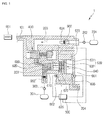
- FIG. 1 is a schematic view of an apparatus 1 for supplying fuels of a bi-fuel engine, according to an embodiment of the present invention
- FIG. 2 is a schematic view illustrating a state where fuel supply is converted from a liquefied gas fuel to a liquid fuel by using the apparatus 1 illustrated in FIG. 1
- FIG. 3 is a schematic view of an operation of preparing to pressurize the liquid fuel by using the apparatus 1 of FIG. 1 .
- the apparatus 1 for supplying fuels of a bi-fuel engine includes a fuel supply flow passage 101 that is connected to an engine 901, a liquefied gas fuel supply flow passage 203 that is connected to the fuel supply flow passage 101 and allows a liquefied gas fuel to be supplied from a liquefied gas fuel tank 201 to the fuel supply flow passage 101, a liquid fuel supply flow passage 303 that is connected to the fuel supply flow passage 101 and allows a liquid fuel to be supplied from a liquid fuel tank 301 to the fuel supply flow passage 101, a fuel selection valve 400 that allows the liquefied gas fuel supply flow passage 203 or the liquid fuel supply flow passage 303 to be selectively open, a first chamber 610 which is connected to the liquid fuel supply flow passage 303 and in which the liquid fuel supplied to the liquid fuel supply flow passage 303 is stored, and a pressurizing unit that operates so that a volume of an internal space of the first chamber 610 can be reduced and that pressurize
- the fuel supply flow passage 101 is connected to the engine 910.
- the fuel supply flow passage 101 may be connected to a fuel rail (not shown) of the engine 901.
- a pressure adjusting unit (not shown) may be interposed between the fuel supply flow passage 101 and the fuel rail (not shown) in order to adjust the pressure of fuel supplied via the fuel supply flow passage 101 to a required pressure.
- the fuel that passes through the pressure adjusting unit (not shown) may be supplied by a fuel supply pump (not shown) to the fuel rail.
- the fuel supply flow passage 101 is connected to the liquefied gas fuel supply flow passage 203 and the liquid fuel supply flow passage 303 so that one of the liquefied gas fuel and the liquid fuel can be supplied to the fuel supply flow passage 101.
- the liquefied gas fuel supply flow passage 203 is connected to the liquefied gas fuel tank 201.
- the liquefied gas fuel is stored in the liquefied gas fuel tank 201, and the stored fuel may be supplied by a first pump 202 to the liquefied gas fuel supply flow passage 203 at a high pressure.
- the liquid fuel supply flow passage 303 is connected to the liquid fuel tank 301.
- the liquid fuel stored in the liquid fuel tank 301 may be supplied by a second pump 302 to the liquid fuel supply flow passage 303 at a high pressure.
- a check valve 902 may be disposed at each of the liquefied gas fuel supply flow passage 203 and the liquid fuel supply flow passage 303, so as to prevent fuels supplied from the liquefied gas fuel tank 201 and the liquid fuel tank 301 from flowing backward.
- the fuel selection valve 400 allows the liquefied gas fuel supply flow passage 203 or the liquid fuel supply flow passage 303 to be selectively open to the fuel supply flow passage 101.
- the fuel selection valve 400 may be controlled by a control unit 500.
- the fuel selection valve 400 may be configured as one solenoid valve, as illustrated in FIGS. 1 through 3 .
- the fuel selection valve 400 may be configured as two valves that are disposed on the liquefied gas fuel supply flow passage 203 and the liquid fuel supply flow passage 303.
- FIG. 1 illustrates an operating state of the fuel selection valve 400 in a liquefied gas fuel supply mode.
- the fuel selection valve 400 illustrated in FIG. 1 is in a position where the liquid fuel supply flow passage 303 is closed towards the fuel supply flow passage 101 and simultaneously, the liquefied gas fuel supply flow passage 203 is open to the fuel supply flow passage 101.
- FIG. 2 illustrates an operating state of the fuel selection valve 400 in a liquid fuel supply mode.
- the fuel selection valve 400 illustrated in FIG. 2 is in a position where the liquefied gas fuel supply flow passage 203 is closed towards the fuel supply flow passage 101 and simultaneously, the liquid fuel supply flow passage 303 is open to the fuel supply flow passage 101.
- the pressure of the liquefied gas fuel supplied to the liquefied gas fuel supply flow passage 203 is much higher than the pressure of the liquid fuel supplied to the liquid fuel supply flow passage 303. This is because the pressurized liquid fuel has a non-compression property compared to the liquefied gas fuel.
- the pressure of the liquid fuel should be increased to be higher than the pressure of the liquefied gas fuel that remains in the fuel supply flow passage 101 so as to be smoothly supplied to the engine 901 via the fuel supply flow passage 101.
- a pressurizing unit for pressurizing the liquid fuel supplied to the liquid fuel supply flow passage 303 is disposed.
- the first chamber 610 may be formed on the liquid fuel supply flow passage 303.
- the first chamber 610 may be connected to the liquid fuel supply flow passage 303, and the liquid fuel supplied to the liquid fuel supply flow passage 303 may be filled in the internal space of the first chamber 610 and may be stored therein.
- the pressurizing unit operates to pressurize the liquid fuel stored in the first chamber 610.
- the pressurizing unit operates so that a volume of the internal space of the first chamber 610 can be reduced, and pressurizes the liquid fuel in the first chamber 610.
- the pressurizing unit may include a first piston 620 that is disposed to be able to make a reciprocal motion within the first chamber 610 and pressurizes the liquid fuel stored in the first chamber 610 as the first piston 620 is moved in a first direction of reciprocal motion directions and a second piston 640 that is disposed to be able to make a reciprocal motion within a second chamber 630, is connected by a piston rod 650 to the first piston 620 and makes a reciprocal motion together with the first piston 620 as one body.
- the first piston 620 is disposed to be able to make a reciprocal motion within the first chamber 610.
- the first piston 620 pressurizes the liquid fuel in the first chamber 610 while being moved in a first direction of reciprocal motion directions, i.e., to the left based on FIG. 1 .
- the first position 620 is moved in a second direction that is opposite to the first direction, i.e., to the right based on FIG. 1 , so that a space in which the liquid fuel is to be filled, can be formed in the first chamber 610.
- the second piston 640 is disposed to be able to make a reciprocal motion within the second chamber 630 that may be adjacent to the first chamber 610.
- the first piston 620 and the second piston 640 are connected by the piston rod 650 to each other, and the second piston 640 makes a reciprocal motion as one body with the first piston 620.
- the above-described operation of the pressurizing unit i.e., the operation of the pressurizing unit so that the volume of the internal space of the first chamber 610 can be reduced, refers to an operation of the pressurizing unit so that the first piston 620 can moved in the first direction, in view of the specific example of the above-described pressurizing unit.
- the movement of the first piston 620 is performed by the first direction movement of the second piston 640 that is connected to the first piston 620 as one body.
- the operation of the pressurizing unit is performed by the pressure of the liquefied gas fuel supplied to the liquefied gas fuel supply flow passage 203.
- the liquefied gas fuel supplied to the liquefied gas fuel supply flow passage 203 is supplied into the second chamber 630 so that the second piston 640 can be moved in the first direction by the pressure of the supplied liquefied gas fuel.
- the internal space of the second chamber 630 is partitioned by the second piston 640 into a first space 631 and a second space 632.
- a division flow passage (hereinafter, referred to as a 'first division flow passage') 633 that is connected to the first space 631 from the liquefied gas fuel supply flow passage 203, may be formed on the liquefied gas fuel supply flow passage 203.
- the liquefied gas fuel supplied to the liquefied gas fuel supply flow passage 203 may be supplied into the second chamber 630, i.e., to the first space 631 via the first division flow passage 633.
- the second piston 640 is moved in a first direction, i.e., to the left based on the drawings due to the pressure of the liquefied gas fuel supplied to the first space 631.
- the first piston 620 is moved in the first direction, and due to the movement of the first piston 620, the liquid fuel filled in the first chamber 610 may be pressurized.
- the cross-section of the first chamber 610 may be smaller than that of the second chamber 630.
- the cross-section refers to a longitudinal cross-section based on the drawings.
- the cross-section of the first chamber 610 being smaller than that of the second chamber 630 means that the cross-section of a region of the first chamber 610 pressurized by the first piston 620 is smaller than that of a region of the second chamber 630 to which the pressure of the first space 631 is applied.
- pressure applied to the liquid fuel in the first chamber 610 may be further increased due to the predetermined pressure of the first space 631.
- the movement of the second piston 640 in the first direction and its movement in the second direction that is opposite to the first direction may be performed due to the pressure of the liquefied gas fuel.
- a second division flow passage 634 that is connected to the second space 632 from the liquefied gas fuel supply flow passage 203 may be formed on the liquefied gas fuel supply flow passage 203.
- the liquefied gas fuel supplied to the liquefied gas fuel supply flow passage 203 may be supplied to the second space 203 via the second division flow passage 634.
- the liquefied gas fuel is supplied to the first space 631 and the second space 632 via the first division flow passage 633 and the second division flow passage 634, respectively.
- the movement of the second piston 640 may be limited.
- the pressure of the first space 631 and the pressure of the second space 632 may be different from each other so that the second piston 640 can be moved in both directions within the second chamber 630 due to the pressure of the liquefied gas fuel supplied into the second chamber 630.
- FIG. 631 Various structures for making the pressure of the first space 631 and the pressure of the second space 632 different from each other may be represented.
- the present embodiment is a specific example of these structures in which a first ejection flow passage 635 and a second ejection flow passage 636 are formed on the second chamber 630.
- the first ejection flow passage 635 is formed to be connected to the outside from the first space 631
- the second ejection flow passage 636 is formed to be connected to the outside from the second space 632.
- the liquefied gas fuel supplied to the first space 631 may be ejected to the outside from the first space 631 via the first ejection flow passage 635
- the liquefied gas fuel supplied to the second space 632 may be ejected to the outside from the second space 632 via the second ejection flow passage 636.
- the pressure of the first space 631 and the pressure of the second space 632 are increased when the liquefied gas fuel is supplied to the first space 631 and the second space 632 via the first division flow passage 633 and the second division flow passage 634, respectively.
- the liquefied gas fuel is ejected via the first ejection flow passage 635 and the second ejection flow passage 636 so that the pressure of the first space 631 and the pressure of the second space 632 can be decreased.
- first ejection flow passage 635 or the second ejection flow passage 636 is selectively open or closed so that the pressure of one of the first space 631 and the second space 632 may be larger or small than the pressure of the other one.
- the first ejection flow passage 635 and the second ejection flow passage 636 are controlled in this way so that the second piston 640 can be moved in a required direction.
- a first control valve 661 for opening/closing the first ejection flow passage 635 may be disposed on the first ejection flow passage 635
- a second control valve 662 for opening/closing the second ejection flow passage 636 may be disposed on the second ejection flow passage 636.
- the first control valve 661 and the second control valve 662 may be controlled by the control unit 500.
- the present embodiment may further include an elastic body that provides an elastic force to the second piston 640 in the second direction so that the first piston 620 and the second piston 640 can be more smoothly moved in the second direction.
- the elastic body 670 may be a coil spring, as illustrated in FIGS. 1 through 3 .
- the first ejection flow passage 635 and the second ejection flow passage 636 may be connected to a liquefied gas fuel return flow passage 204 that is connected to the liquefied gas fuel tank 201.
- the liquefied gas fuel ejected via the first ejection flow passage 635 and the second ejection flow passage 636 may be returned to the liquefied gas fuel tank 201 via the liquefied gas fuel return flow passage 204.
- the first control valve 661 closes the first ejection flow passage 635, and the second control valve 662 opens the second ejection flow passage 636.
- the liquefied gas fuel supplied to the second space 632 is ejected via the second ejection flow passage 636 so that the pressure of the second space 632 is relatively lower than the pressure of the first space 631. Due to the relatively high pressure of the first space 631, the second piston 640 is moved in the first direction, i.e., to the left based on the drawings, and as the second piston 640 is moved, the first piston 620 is also moved in the first direction. Due to the movement of the first piston 620, the liquid fuel filled in the first chamber 610 is pressurized.
- the liquid fuel pressurized by the pressurizing unit is supplied to the engine 901 via the fuel supply flow passage 101 when the control unit 500 controls the fuel selection valve 400 to open the liquid fuel supply flow passage 303, as illustrated in FIG. 2 .
- the pressure of the supplied liquid fuel is higher than the pressure of the liquefied gas fuel that remains in the fuel supply flow passage 101, the liquid fuel can be smoothly supplied to the engine 901 via the fuel supply flow passage 101.
- the fuel selection valve 400 opens the liquefied gas fuel supply flow passage 203 and closes the liquid fuel supply flow passage 303.
- the pressure of the liquefied gas fuel supplied to the liquefied gas fuel supply flow passage 203 is much higher than the pressure of the liquid fuel, even when the liquid fuel remains in the fuel supply flow passage 101, the liquefied gas fuel can be smoothly supplied to the engine 901 via the fuel supply flow passage 101.
- a liquid fuel supply preparation signal is applied to the control unit 500 in this state, as illustrated in FIG. 3 , in a state where the liquid fuel supply flow passage 303 is closed, the liquid fuel is supplied to the liquid fuel supply flow passage 303 by control of the second pump 302.
- the first piston 620 is pressurized by the liquid fuel supplied.
- the first control valve 661 and the second control valve 662 are controlled to open the first ejection flow passage 635 and to close the second ejection flow passage 636, the pressure of the first space 631 is lower than the pressure of the second space 632 so that the second piston 640 can be moved in the second direction due to the pressure of the second space 632 added to the pressure of the liquid fuel.
- the second piston 640 can be more smoothly moved in the second direction while the elastic force generated by the elastic body 670 is applied to the second piston 640.
- the liquid fuel is filled in the first chamber 610, and preparation for pressurizing the filled liquid fuel is completed. If the operation of preparing to pressurize the liquid fuel is completed, the above-described procedure, i.e., opening the second ejection flow passage 636 and closing the first ejection flow passage 635 so as to induce first direction movement of the first piston 620 is performed such that the liquid fuel in the first chamber 610 is pressurized.
- a configuration that is expressed as a 'flow passage' described above may be one having a space in which fuels can be transferred, such as a pipe or a hole through which a specific body that constitutes the apparatus 1 for supplying fuels passes, and the flow passage is not limited to a specific member or shape.
- a supply pressure of the liquid fuel is increased using a high pressure of a liquefied gas fuel supplied to a liquefied gas fuel supply flow passage so that the supply pressure of the liquid fuel can be increased without the need of disposing a pressure-raising device that requires additional power.
Landscapes
- Engineering & Computer Science (AREA)
- Chemical & Material Sciences (AREA)
- Combustion & Propulsion (AREA)
- Mechanical Engineering (AREA)
- General Engineering & Computer Science (AREA)
- Oil, Petroleum & Natural Gas (AREA)
- Output Control And Ontrol Of Special Type Engine (AREA)
- Fuel-Injection Apparatus (AREA)
Description
- The present invention relates to an apparatus and method for supplying fuels of a bi-fuel engine, whereby a supply pressure of a liquid fuel is increased by using a high pressure of a liquefied gas fuel so that the liquid fuel can be smoothly supplied to the bi-fuel engine.
- Engines using two types of fuels include bi-fuel engines, such as combinations gasoline-liquefied petroleum gas (LPG) or combinations gasoline-compressed natural gas (CNG).
- Vehicles equipped with bi-fuel engines include a fuel supplying apparatus in which fuel is converted to be supplied to a bi-fuel engine according to driver's manipulation or control of a control unit that diagnoses a status of a vehicle.
- As an example of a fuel supplying apparatus, Korean Patent Laid-open Publication No.
10-2010-0128319 - The apparatus disclosed in the above-published patent includes at least two fuel storage tanks for storing a first liquefied gas fuel and a second liquid fuel and two fuel pipes that are connected from the fuel storage tanks to an entrance of a high-pressure pump so as to supply two types of fuels to the high-pressure pump. The apparatus further includes a cleaning unit for cleaning the fuel pipes connected to the high-pressure pump, and check valves are disposed at the fuel pipes.
- The fuel supplying apparatus according to the related art is configured so that the fuel pipes that are connected from the fuel storage tanks to the engine have a junction. A control unit controls the fuel supplying apparatus to convert the fuels to be supplied to the engine by controlling opening/closing of the fuel pipes. In this case, the converted and supplied fuels are supplied to the engine via the junction.
- The liquefied gas fuel and the liquid fuel are two types of fuels, and the former has a much higher supply pressure than that of the latter. Thus, a pressure difference between a pipe to which the liquefied gas fuel is supplied and a pipe to which the liquid fuel is supplied, is very large.
- Thus, when the liquefied gas fuel is converted into the liquid fuel and is supplied to the engine, the liquid fuel to be supplied via the junction should push the high-pressure liquefied gas fuel that remains in the pipe including the junction, so as to be supplied to the engine.
- However, since an internal pressure of the pipe in which the liquefied gas fuel remains, is higher than the pressure of the liquid fuel to be supplied, the pressure of the liquid fuel should be increased to be higher than the pressure of the liquefied gas fuel, so as to be supplied to the engine.
- Of course, an additional device may be disposed so as to increase the supply pressure of the liquefied fuel; however, it is difficult to handle a pressure change of the liquefied gas fuel with a variable pressure by using a structure in which the liquid fuel is supplied at a constant pressure.
- The present invention provides an apparatus and method for supplying fuels of a bi-fuel engine, whereby a supply pressure of a liquid fuel is increased to be higher than the pressure of a liquefied gas fuel that remains in a fuel supply flow passage, by using a high pressure of the liquefied gas fuel supplied to a liquefied gas fuel supply flow passage when a liquefied gas fuel supply mode is converted into a liquid fuel supply mode so that the liquid fuel can be smoothly supplied to the bi-fuel engine.
- According to an aspect of the present invention, there is provided an apparatus for supplying fuels of a bi-fuel engine, including: a fuel supply flow passage that is connected to an engine; a liquefied gas fuel supply flow passage that is connected to the fuel supply flow passage and allows a liquefied gas fuel to be supplied from a liquefied gas fuel tank to the fuel supply flow passage; a liquid fuel supply flow passage that is connected to the fuel supply flow passage and allows a liquid fuel to be supplied from a liquid fuel tank to the fuel supply flow passage; a fuel selection valve that allows the liquefied gas fuel supply flow passage or the liquid fuel supply flow passage to be selectively open; a first chamber which is connected to the liquid fuel supply flow passage and in which the liquid fuel supplied to the liquid fuel supply flow passage is stored; and a pressurizing unit that operates so that a volume of an internal space of the first chamber is reduced and that pressurizes the liquid fuel stored in the first chamber, wherein the pressurizing unit operates due to a pressure of the liquefied gas fuel supplied to the liquefied gas fuel supply flow passage.
- The pressurizing unit may include a first piston that is disposed to be able to make a reciprocal motion within the first chamber and pressurizes the liquid fuel stored in the first chamber as the first piston is moved in a first direction of reciprocal motion directions and a second piston that is disposed to be able to make a reciprocal motion within a second chamber, is connected by a piston rod to the first piston and makes a reciprocal motion together with the first piston as one body, and the second piston may be moved in the first direction or may make a reciprocal motion due to a pressure of the liquefied gas fuel supplied from the liquefied gas fuel supply flow passage into the second chamber.
- A division flow passage that is connected to the second chamber from the liquefied gas fuel supply flow passage may be formed on the liquefied gas fuel supply flow passage, and the liquefied gas fuel supplied to the liquefied gas fuel supply flow passage may be supplied into the second chamber via the division flow passage.
- An internal space of the second chamber may be partitioned by the second piston into a first space and a second space, and a first division flow passage that is connected to the first space from the liquefied gas fuel supply flow passage and a second division flow passage that is connected to the second space from the liquefied gas fuel supply flow passage may be formed on the liquefied gas fuel supply flow passage, and the liquefied gas fuel supplied to the liquefied gas fuel supply flow passage may be supplied to the first space and the second space via the first division flow passage and the second division flow passage, and the second piston may make a reciprocal motion within the second chamber due to a pressure difference between the first space and the second space.
- A first ejection flow passage that is connected to an outside from the first space so that the liquefied gas fuel supplied to the first space is ejected to the outside and a second ejection flow passage that is connected to the outside from the second space so that the liquefied gas fuel supplied to the second space is ejected to the outside may be formed on the second chamber, and the first ejection flow passage may be open or closed by a first control valve, and the second ejection flow passage may be open or closed by a second control valve, and a pressure difference between the first space and the second space may occur due to selective opening/closing the first ejection flow passage or the second ejection flow passage.
- The liquefied gas fuel ejected via the first ejection flow passage and the second ejection flow passage may be returned to a liquefied gas fuel tank via a liquefied gas fuel return flow passage.
- A cross-section of the first chamber may be smaller than a cross-section of the second chamber.
- The apparatus may further include an elastic body that provides an elastic force to the second piston in a second direction that is opposite to the first direction.
- According to another aspect of the present invention, there is provided a method for supplying fuels of a bi-fuel engine by using the apparatus, the method including: (a) the fuel selection valve opening the liquefied gas fuel supply flow passage and closing the liquid fuel supply flow passage to supply a liquefied gas fuel to the fuel supply flow passage; (b) supplying a liquid fuel to the liquid fuel supply flow passage, simultaneously opening the first ejection flow passage and closing the second ejection flow passage and allowing the second piston to be moved in a second direction of reciprocal motion directions due to a pressure of the second space so that the liquid fuel is filled in the first chamber; (c) closing the first ejection flow passage, opening the second ejection flow passage, and allowing the second piston to be moved in the first direction due to a pressure of the first space so that the liquid fuel in the first chamber is pressurized by the first piston; and (d) the fuel selection valve closing the liquefied gas fuel supply flow passage and opening the liquid fuel supply flow passage to supply the liquid fuel to the fuel supply flow passage.
-
-
FIG. 1 is a schematic view of an apparatus for supplying fuels of a bi-fuel engine, according to an embodiment of the present invention; -
FIG. 2 is a schematic view illustrating a state where fuel supply is converted from a liquefied gas fuel to a liquid fuel by using the apparatus illustrated inFIG. 1 ; and -
FIG. 3 is a schematic view of an operation of preparing to pressurize the liquid fuel by using the apparatus ofFIG. 1 . - Hereinafter, an apparatus for supplying fuels of a bi-fuel engine according to the present invention will be described in detail by explaining an embodiment of the invention with reference to the attached drawings.
-
FIG. 1 is a schematic view of an apparatus 1 for supplying fuels of a bi-fuel engine, according to an embodiment of the present invention,FIG. 2 is a schematic view illustrating a state where fuel supply is converted from a liquefied gas fuel to a liquid fuel by using the apparatus 1 illustrated inFIG. 1 , andFIG. 3 is a schematic view of an operation of preparing to pressurize the liquid fuel by using the apparatus 1 ofFIG. 1 . - As illustrated in
FIGS. 1 through 3 , the apparatus 1 for supplying fuels of a bi-fuel engine according to the current embodiment of the present invention includes a fuelsupply flow passage 101 that is connected to anengine 901, a liquefied gas fuelsupply flow passage 203 that is connected to the fuelsupply flow passage 101 and allows a liquefied gas fuel to be supplied from a liquefiedgas fuel tank 201 to the fuelsupply flow passage 101, a liquid fuelsupply flow passage 303 that is connected to the fuelsupply flow passage 101 and allows a liquid fuel to be supplied from aliquid fuel tank 301 to the fuelsupply flow passage 101, afuel selection valve 400 that allows the liquefied gas fuelsupply flow passage 203 or the liquid fuelsupply flow passage 303 to be selectively open, afirst chamber 610 which is connected to the liquid fuelsupply flow passage 303 and in which the liquid fuel supplied to the liquid fuelsupply flow passage 303 is stored, and a pressurizing unit that operates so that a volume of an internal space of thefirst chamber 610 can be reduced and that pressurizes the liquid fuel stored in thefirst chamber 610. - The fuel
supply flow passage 101 is connected to the engine 910. In detail, the fuelsupply flow passage 101 may be connected to a fuel rail (not shown) of theengine 901. A pressure adjusting unit (not shown) may be interposed between the fuelsupply flow passage 101 and the fuel rail (not shown) in order to adjust the pressure of fuel supplied via the fuelsupply flow passage 101 to a required pressure. The fuel that passes through the pressure adjusting unit (not shown) may be supplied by a fuel supply pump (not shown) to the fuel rail. - The fuel
supply flow passage 101 is connected to the liquefied gas fuelsupply flow passage 203 and the liquid fuelsupply flow passage 303 so that one of the liquefied gas fuel and the liquid fuel can be supplied to the fuelsupply flow passage 101. - The liquefied gas fuel
supply flow passage 203 is connected to the liquefiedgas fuel tank 201. The liquefied gas fuel is stored in the liquefiedgas fuel tank 201, and the stored fuel may be supplied by afirst pump 202 to the liquefied gas fuelsupply flow passage 203 at a high pressure. - The liquid fuel
supply flow passage 303 is connected to theliquid fuel tank 301. The liquid fuel stored in theliquid fuel tank 301 may be supplied by asecond pump 302 to the liquid fuelsupply flow passage 303 at a high pressure. - A
check valve 902 may be disposed at each of the liquefied gas fuelsupply flow passage 203 and the liquid fuelsupply flow passage 303, so as to prevent fuels supplied from the liquefiedgas fuel tank 201 and theliquid fuel tank 301 from flowing backward. - The
fuel selection valve 400 allows the liquefied gas fuelsupply flow passage 203 or the liquid fuelsupply flow passage 303 to be selectively open to the fuelsupply flow passage 101. Thefuel selection valve 400 may be controlled by acontrol unit 500. - The
fuel selection valve 400 may be configured as one solenoid valve, as illustrated inFIGS. 1 through 3 . Alternatively, although not shown, thefuel selection valve 400 may be configured as two valves that are disposed on the liquefied gas fuelsupply flow passage 203 and the liquid fuelsupply flow passage 303. -
FIG. 1 illustrates an operating state of thefuel selection valve 400 in a liquefied gas fuel supply mode. Thefuel selection valve 400 illustrated inFIG. 1 is in a position where the liquid fuelsupply flow passage 303 is closed towards the fuelsupply flow passage 101 and simultaneously, the liquefied gas fuelsupply flow passage 203 is open to the fuelsupply flow passage 101. -
FIG. 2 illustrates an operating state of thefuel selection valve 400 in a liquid fuel supply mode. Thefuel selection valve 400 illustrated inFIG. 2 is in a position where the liquefied gas fuelsupply flow passage 203 is closed towards the fuelsupply flow passage 101 and simultaneously, the liquid fuelsupply flow passage 303 is open to the fuelsupply flow passage 101. - The pressure of the liquefied gas fuel supplied to the liquefied gas fuel
supply flow passage 203 is much higher than the pressure of the liquid fuel supplied to the liquid fuelsupply flow passage 303. This is because the pressurized liquid fuel has a non-compression property compared to the liquefied gas fuel. - Thus, when the fuel supply mode is converted from the liquefied gas fuel supply mode to the liquid fuel supply mode, the pressure of the liquid fuel should be increased to be higher than the pressure of the liquefied gas fuel that remains in the fuel
supply flow passage 101 so as to be smoothly supplied to theengine 901 via the fuelsupply flow passage 101. - To this end, in the present embodiment, a pressurizing unit for pressurizing the liquid fuel supplied to the liquid fuel
supply flow passage 303 is disposed. - First, the
first chamber 610 may be formed on the liquid fuelsupply flow passage 303. In detail, thefirst chamber 610 may be connected to the liquid fuelsupply flow passage 303, and the liquid fuel supplied to the liquid fuelsupply flow passage 303 may be filled in the internal space of thefirst chamber 610 and may be stored therein. - The pressurizing unit operates to pressurize the liquid fuel stored in the
first chamber 610. In detail, the pressurizing unit operates so that a volume of the internal space of thefirst chamber 610 can be reduced, and pressurizes the liquid fuel in thefirst chamber 610. - As a specific example, the pressurizing unit may include a
first piston 620 that is disposed to be able to make a reciprocal motion within thefirst chamber 610 and pressurizes the liquid fuel stored in thefirst chamber 610 as thefirst piston 620 is moved in a first direction of reciprocal motion directions and asecond piston 640 that is disposed to be able to make a reciprocal motion within asecond chamber 630, is connected by apiston rod 650 to thefirst piston 620 and makes a reciprocal motion together with thefirst piston 620 as one body. - The
first piston 620 is disposed to be able to make a reciprocal motion within thefirst chamber 610. Thefirst piston 620 pressurizes the liquid fuel in thefirst chamber 610 while being moved in a first direction of reciprocal motion directions, i.e., to the left based onFIG. 1 . Thefirst position 620 is moved in a second direction that is opposite to the first direction, i.e., to the right based onFIG. 1 , so that a space in which the liquid fuel is to be filled, can be formed in thefirst chamber 610. - The
second piston 640 is disposed to be able to make a reciprocal motion within thesecond chamber 630 that may be adjacent to thefirst chamber 610. Thefirst piston 620 and thesecond piston 640 are connected by thepiston rod 650 to each other, and thesecond piston 640 makes a reciprocal motion as one body with thefirst piston 620. - The above-described operation of the pressurizing unit, i.e., the operation of the pressurizing unit so that the volume of the internal space of the
first chamber 610 can be reduced, refers to an operation of the pressurizing unit so that thefirst piston 620 can moved in the first direction, in view of the specific example of the above-described pressurizing unit. The movement of thefirst piston 620 is performed by the first direction movement of thesecond piston 640 that is connected to thefirst piston 620 as one body. - In the present embodiment, the operation of the pressurizing unit is performed by the pressure of the liquefied gas fuel supplied to the liquefied gas fuel
supply flow passage 203. In detail, in the present embodiment, the liquefied gas fuel supplied to the liquefied gas fuelsupply flow passage 203 is supplied into thesecond chamber 630 so that thesecond piston 640 can be moved in the first direction by the pressure of the supplied liquefied gas fuel. - An example of a detailed structure in which the
second piston 640 is moved in the first direction by the pressure of the liquefied gas fuel supplied to the liquefied gas fuelsupply flow passage 203, will be represented below. - First, the internal space of the
second chamber 630 is partitioned by thesecond piston 640 into a first space 631 and asecond space 632. - A division flow passage (hereinafter, referred to as a 'first division flow passage') 633 that is connected to the first space 631 from the liquefied gas fuel
supply flow passage 203, may be formed on the liquefied gas fuelsupply flow passage 203. - The liquefied gas fuel supplied to the liquefied gas fuel
supply flow passage 203 may be supplied into thesecond chamber 630, i.e., to the first space 631 via the firstdivision flow passage 633. Thesecond piston 640 is moved in a first direction, i.e., to the left based on the drawings due to the pressure of the liquefied gas fuel supplied to the first space 631. As thesecond piston 640 is moved, thefirst piston 620 is moved in the first direction, and due to the movement of thefirst piston 620, the liquid fuel filled in thefirst chamber 610 may be pressurized. - In this case, in order to allow the liquid fuel in the
first chamber 610 to be pressurized at a higher pressure than a predetermined pressure of the first space 631 in which thesecond piston 640 is moved in the first direction, the cross-section of thefirst chamber 610 may be smaller than that of thesecond chamber 630. Here, the cross-section refers to a longitudinal cross-section based on the drawings. - This means that the area of the
first piston 620 is smaller than that of thesecond piston 640. - The cross-section of the
first chamber 610 being smaller than that of thesecond chamber 630 means that the cross-section of a region of thefirst chamber 610 pressurized by thefirst piston 620 is smaller than that of a region of thesecond chamber 630 to which the pressure of the first space 631 is applied. Thus, pressure applied to the liquid fuel in thefirst chamber 610 may be further increased due to the predetermined pressure of the first space 631. - The movement of the
second piston 640 in the first direction and its movement in the second direction that is opposite to the first direction may be performed due to the pressure of the liquefied gas fuel. - To this end, a second
division flow passage 634 that is connected to thesecond space 632 from the liquefied gas fuelsupply flow passage 203 may be formed on the liquefied gas fuelsupply flow passage 203. The liquefied gas fuel supplied to the liquefied gas fuelsupply flow passage 203 may be supplied to thesecond space 203 via the seconddivision flow passage 634. - In this case, the liquefied gas fuel is supplied to the first space 631 and the
second space 632 via the firstdivision flow passage 633 and the seconddivision flow passage 634, respectively. In this case, if there is no pressure difference between the first space 631 and thesecond space 632, the movement of thesecond piston 640 may be limited. - Thus, the pressure of the first space 631 and the pressure of the
second space 632 may be different from each other so that thesecond piston 640 can be moved in both directions within thesecond chamber 630 due to the pressure of the liquefied gas fuel supplied into thesecond chamber 630. - Various structures for making the pressure of the first space 631 and the pressure of the
second space 632 different from each other may be represented. The present embodiment is a specific example of these structures in which a firstejection flow passage 635 and a secondejection flow passage 636 are formed on thesecond chamber 630. - The first
ejection flow passage 635 is formed to be connected to the outside from the first space 631, and the secondejection flow passage 636 is formed to be connected to the outside from thesecond space 632. The liquefied gas fuel supplied to the first space 631 may be ejected to the outside from the first space 631 via the firstejection flow passage 635, and the liquefied gas fuel supplied to thesecond space 632 may be ejected to the outside from thesecond space 632 via the secondejection flow passage 636. - The pressure of the first space 631 and the pressure of the
second space 632 are increased when the liquefied gas fuel is supplied to the first space 631 and thesecond space 632 via the firstdivision flow passage 633 and the seconddivision flow passage 634, respectively. The liquefied gas fuel is ejected via the firstejection flow passage 635 and the secondejection flow passage 636 so that the pressure of the first space 631 and the pressure of thesecond space 632 can be decreased. - Thus, the first
ejection flow passage 635 or the secondejection flow passage 636 is selectively open or closed so that the pressure of one of the first space 631 and thesecond space 632 may be larger or small than the pressure of the other one. The firstejection flow passage 635 and the secondejection flow passage 636 are controlled in this way so that thesecond piston 640 can be moved in a required direction. - In order to control the apparatus 1 to selectively open/close the first
ejection flow passage 635 or the secondejection flow passage 636, afirst control valve 661 for opening/closing the firstejection flow passage 635 may be disposed on the firstejection flow passage 635, and asecond control valve 662 for opening/closing the secondejection flow passage 636 may be disposed on the secondejection flow passage 636. Thefirst control valve 661 and thesecond control valve 662 may be controlled by thecontrol unit 500. - The present embodiment may further include an elastic body that provides an elastic force to the
second piston 640 in the second direction so that thefirst piston 620 and thesecond piston 640 can be more smoothly moved in the second direction. Theelastic body 670 may be a coil spring, as illustrated inFIGS. 1 through 3 . - The first
ejection flow passage 635 and the secondejection flow passage 636 may be connected to a liquefied gas fuelreturn flow passage 204 that is connected to the liquefiedgas fuel tank 201. In this case, the liquefied gas fuel ejected via the firstejection flow passage 635 and the secondejection flow passage 636 may be returned to the liquefiedgas fuel tank 201 via the liquefied gas fuelreturn flow passage 204. - Hereinafter, a method for supplying fuels of a bi-fuel engine by using the apparatus 1 for supplying fuels of the bi-fuel engine illustrated in
FIG. 1 will be described below. - As illustrated in
FIG. 1 , in a state where the liquefied gas fuelsupply flow passage 203 is open, as a liquefied gas fuel supply mode, thefirst control valve 661 closes the firstejection flow passage 635, and thesecond control valve 662 opens the secondejection flow passage 636. - In this case, the liquefied gas fuel supplied to the
second space 632 is ejected via the secondejection flow passage 636 so that the pressure of thesecond space 632 is relatively lower than the pressure of the first space 631. Due to the relatively high pressure of the first space 631, thesecond piston 640 is moved in the first direction, i.e., to the left based on the drawings, and as thesecond piston 640 is moved, thefirst piston 620 is also moved in the first direction. Due to the movement of thefirst piston 620, the liquid fuel filled in thefirst chamber 610 is pressurized. - The liquid fuel pressurized by the pressurizing unit is supplied to the
engine 901 via the fuelsupply flow passage 101 when thecontrol unit 500 controls thefuel selection valve 400 to open the liquid fuelsupply flow passage 303, as illustrated inFIG. 2 . In this case, since the pressure of the supplied liquid fuel is higher than the pressure of the liquefied gas fuel that remains in the fuelsupply flow passage 101, the liquid fuel can be smoothly supplied to theengine 901 via the fuelsupply flow passage 101. - When the liquid fuel supply mode is again converted into the liquefied gas fuel supply mode, the
fuel selection valve 400 opens the liquefied gas fuelsupply flow passage 203 and closes the liquid fuelsupply flow passage 303. In this case, since the pressure of the liquefied gas fuel supplied to the liquefied gas fuelsupply flow passage 203 is much higher than the pressure of the liquid fuel, even when the liquid fuel remains in the fuelsupply flow passage 101, the liquefied gas fuel can be smoothly supplied to theengine 901 via the fuelsupply flow passage 101. - If a liquid fuel supply preparation signal is applied to the
control unit 500 in this state, as illustrated inFIG. 3 , in a state where the liquid fuelsupply flow passage 303 is closed, the liquid fuel is supplied to the liquid fuelsupply flow passage 303 by control of thesecond pump 302. In this case, thefirst piston 620 is pressurized by the liquid fuel supplied. Simultaneously, if thefirst control valve 661 and thesecond control valve 662 are controlled to open the firstejection flow passage 635 and to close the secondejection flow passage 636, the pressure of the first space 631 is lower than the pressure of thesecond space 632 so that thesecond piston 640 can be moved in the second direction due to the pressure of thesecond space 632 added to the pressure of the liquid fuel. Thesecond piston 640 can be more smoothly moved in the second direction while the elastic force generated by theelastic body 670 is applied to thesecond piston 640. - If the
first piston 620 and thesecond piston 640 are moved in the second direction due to the action of this external force, the liquid fuel is filled in thefirst chamber 610, and preparation for pressurizing the filled liquid fuel is completed. If the operation of preparing to pressurize the liquid fuel is completed, the above-described procedure, i.e., opening the secondejection flow passage 636 and closing the firstejection flow passage 635 so as to induce first direction movement of thefirst piston 620 is performed such that the liquid fuel in thefirst chamber 610 is pressurized. - A configuration that is expressed as a 'flow passage' described above may be one having a space in which fuels can be transferred, such as a pipe or a hole through which a specific body that constitutes the apparatus 1 for supplying fuels passes, and the flow passage is not limited to a specific member or shape.
- While the present invention has been particularly shown and described with reference to exemplary embodiments thereof, it will be understood by those of ordinary skill in the art that various changes in form and details may be made therein without departing from the spirit and scope of the present invention as defined by the following claims.
- According to the present invention, when a liquefied gas fuel supply mode is converted into a liquid fuel supply mode and a liquid fuel is supplied to an engine, a supply pressure of the liquid fuel is increased using a high pressure of a liquefied gas fuel supplied to a liquefied gas fuel supply flow passage so that the supply pressure of the liquid fuel can be increased without the need of disposing a pressure-raising device that requires additional power.
Claims (9)
- An apparatus for supplying fuels of a bi-fuel engine, the apparatus comprising:a fuel supply flow passage that is connected to an engine;a liquefied gas fuel supply flow passage that is connected to the fuel supply flow passage and allows a liquefied gas fuel to be supplied from a liquefied gas fuel tank to the fuel supply flow passage;a liquid fuel supply flow passage that is connected to the fuel supply flow passage and allows a liquid fuel to be supplied from a liquid fuel tank to the fuel supply flow passage;a fuel selection valve that allows the liquefied gas fuel supply flow passage or the liquid fuel supply flow passage to be selectively open;a first chamber which is connected to the liquid fuel supply flow passage and in which the liquid fuel supplied to the liquid fuel supply flow passage is stored; anda pressurizing unit that operates so that a volume of an internal space of the first chamber is reduced and that pressurizes the liquid fuel stored in the first chamber,wherein the pressurizing unit operates due to a pressure of the liquefied gas fuel supplied to the liquefied gas fuel supply flow passage.
- The apparatus of claim 1, wherein the pressurizing unit comprises a first piston that is disposed to be able to make a reciprocal motion within the first chamber and pressurizes the liquid fuel stored in the first chamber as the first piston is moved in a first direction of reciprocal motion directions, and a second piston that is disposed to be able to make a reciprocal motion within a second chamber, is connected by a piston rod to the first piston and makes a reciprocal motion together with the first piston as one body,and
wherein the second piston is moved in the first direction or makes a reciprocal motion due to a pressure of the liquefied gas fuel supplied from the liquefied gas fuel supply flow passage into the second chamber. - The apparatus of claim 2, wherein a division flow passage that is connected to the second chamber from the liquefied gas fuel supply flow passage is formed on the liquefied gas fuel supply flow passage, and the liquefied gas fuel supplied to the liquefied gas fuel supply flow passage is supplied into the second chamber via the division flow passage.
- The apparatus of claim 2, wherein an internal space of the second chamber is partitioned by the second piston into a first space and a second space, and a first division flow passage that is connected to the first space from the liquefied gas fuel supply flow passage and a second division flow passage that is connected to the second space from the liquefied gas fuel supply flow passage are formed on the liquefied gas fuel supply flow passage, and the liquefied gas fuel supplied to the liquefied gas fuel supply flow passage is supplied to the first space and the second space via the first division flow passage and the second division flow passage, and the second piston makes a reciprocal motion within the second chamber due to a pressure difference between the first space and the second space.
- The apparatus of claim 4, wherein a first ejection flow passage that is connected to an outside from the first space so that the liquefied gas fuel supplied to the first space is ejected to the outside and a second ejection flow passage that is connected to the outside from the second space so that the liquefied gas fuel supplied to the second space is ejected to the outside are formed on the second chamber, and the first ejection flow passage is open or closed by a first control valve, and the second ejection flow passage is open or closed by a second control valve, and a pressure difference between the first space and the second space occurs due to selective opening/closing the first ejection flow passage or the second ejection flow passage.
- The apparatus of claim 5, wherein the liquefied gas fuel ejected via the first ejection flow passage and the second ejection flow passage is returned to a liquefied gas fuel tank via a liquefied gas fuel return flow passage.
- The apparatus of claim 2, wherein a cross-section of the first chamber is smaller than a cross-section of the second chamber.
- The apparatus of claim 2, further comprising an elastic body that provides an elastic force to the second piston in a second direction that is opposite to the first direction.
- A method for supplying fuels of a bi-fuel engine by using the apparatus of claim 5, the method comprising:(a) the fuel selection valve opening the liquefied gas fuel supply flow passage and closing the liquid fuel supply flow passage to supply a liquefied gas fuel to the fuel supply flow passage;(b) supplying a liquid fuel to the liquid fuel supply flow passage, simultaneously opening the first ejection flow passage and closing the second ejection flow passage and allowing the second piston to be moved in a second direction of reciprocal motion directions due to a pressure of the second space so that the liquid fuel is filled in the first chamber;(c) closing the first ejection flow passage, opening the second ejection flow passage, and allowing the second piston to be moved in the first direction due to a pressure of the first space so that the liquid fuel in the first chamber is pressurized by the first piston; and(d) the fuel selection valve closing the liquefied gas fuel supply flow passage and opening the liquid fuel supply flow passage to supply the liquid fuel to the fuel supply flow passage.
Applications Claiming Priority (1)
| Application Number | Priority Date | Filing Date | Title |
|---|---|---|---|
| PCT/KR2012/008772 WO2014065447A1 (en) | 2012-10-24 | 2012-10-24 | Apparatus and method for supplying fuel to bi-fuel engine |
Publications (3)
| Publication Number | Publication Date |
|---|---|
| EP2818673A1 true EP2818673A1 (en) | 2014-12-31 |
| EP2818673A4 EP2818673A4 (en) | 2015-12-02 |
| EP2818673B1 EP2818673B1 (en) | 2016-12-21 |
Family
ID=50544808
Family Applications (1)
| Application Number | Title | Priority Date | Filing Date |
|---|---|---|---|
| EP12870328.7A Active EP2818673B1 (en) | 2012-10-24 | 2012-10-24 | Apparatus and method for supplying fuel to bi-fuel engine |
Country Status (4)
| Country | Link |
|---|---|
| EP (1) | EP2818673B1 (en) |
| CN (1) | CN103906911B (en) |
| PL (1) | PL2818673T3 (en) |
| WO (1) | WO2014065447A1 (en) |
Cited By (1)
| Publication number | Priority date | Publication date | Assignee | Title |
|---|---|---|---|---|
| NO344301B1 (en) * | 2018-09-20 | 2019-10-28 | Bergen Engines As | A gas supply system for a gas engine |
Families Citing this family (4)
| Publication number | Priority date | Publication date | Assignee | Title |
|---|---|---|---|---|
| US10221780B2 (en) * | 2015-06-12 | 2019-03-05 | Champion Power Equipment, Inc. | Dual fuel lockout switch for generator engine |
| CN108915915B (en) * | 2018-06-26 | 2020-08-25 | 桂林航天工业学院 | Double-oil-tank oil supply control device for lightweight automobile |
| CN110792516B (en) * | 2019-09-30 | 2022-04-26 | 潍柴动力股份有限公司 | Pressure adjusting device of dual-fuel engine and dual-fuel engine with pressure adjusting device |
| US12085216B2 (en) | 2022-02-17 | 2024-09-10 | Arctic Cat Inc. | Multi-use fuel filler tube |
Family Cites Families (11)
| Publication number | Priority date | Publication date | Assignee | Title |
|---|---|---|---|---|
| FR2595761B1 (en) * | 1986-03-14 | 1988-05-13 | Semt | INJECTION DEVICE FOR AN INTERNAL COMBUSTION ENGINE, ALLOWING THE INJECTION OF TWO FUELS |
| FR2792037B1 (en) * | 1999-04-07 | 2001-06-01 | Renault | METHOD FOR MANAGING THE FUEL SUPPLY OF A MIXED FUEL INJECTION ENGINE, AND DEVICE FOR CARRYING OUT SAID METHOD |
| JP4078272B2 (en) * | 2003-09-10 | 2008-04-23 | 株式会社クボタ | Dual fuel engine |
| EP2156043A4 (en) * | 2007-05-23 | 2015-08-26 | Interlocking Buildings Pty Ltd | A method of manufacturing and installation of high pressure liquid lpg fuel supply and dual or mixed fuel supply systems |
| NL2002384C2 (en) | 2008-03-03 | 2011-04-04 | Vialle Alternative Fuel Systems Bv | DEVICE AND METHOD FOR A COMBUSTION ENGINE WITH DIRECT INJECTION WITH TWO FUELS. |
| US7950370B2 (en) * | 2008-03-13 | 2011-05-31 | Cummins Inc. | High pressure common rail fuel system with gas injection |
| NL2003791C2 (en) * | 2009-11-12 | 2011-05-16 | Vialle Alternative Fuel Systems Bv | FUEL FEED SYSTEM AND HIGH PRESSURE PUMP FOR A COMBUSTION ENGINE. |
| EP2341234A3 (en) * | 2009-12-31 | 2012-02-22 | Indopar B.V. | Direct injection bi-fuel system for combustion engines |
| SE534873C2 (en) * | 2010-06-22 | 2012-01-31 | Scania Cv Ab | Fuel system for injecting a fuel mixture into an internal combustion engine |
| KR101473996B1 (en) * | 2010-12-28 | 2014-12-18 | 현대중공업 주식회사 | Dual Fual injection Valve and Dual Fual injection Device Using The Same |
| KR101250068B1 (en) * | 2011-09-21 | 2013-04-02 | 주식회사 현대케피코 | Apparatus and method for supplying fuel of bi-fuel engine |
-
2012
- 2012-10-24 WO PCT/KR2012/008772 patent/WO2014065447A1/en not_active Ceased
- 2012-10-24 EP EP12870328.7A patent/EP2818673B1/en active Active
- 2012-10-24 PL PL12870328T patent/PL2818673T3/en unknown
- 2012-10-24 CN CN201280034698.8A patent/CN103906911B/en active Active
Cited By (2)
| Publication number | Priority date | Publication date | Assignee | Title |
|---|---|---|---|---|
| NO344301B1 (en) * | 2018-09-20 | 2019-10-28 | Bergen Engines As | A gas supply system for a gas engine |
| US11268475B2 (en) | 2018-09-20 | 2022-03-08 | Bergen Engines As | Cylinder head for a combustion engine, and a method for supply of prechamber gas in a cylinder head |
Also Published As
| Publication number | Publication date |
|---|---|
| CN103906911B (en) | 2016-08-17 |
| WO2014065447A1 (en) | 2014-05-01 |
| PL2818673T3 (en) | 2017-07-31 |
| EP2818673A4 (en) | 2015-12-02 |
| CN103906911A (en) | 2014-07-02 |
| EP2818673B1 (en) | 2016-12-21 |
Similar Documents
| Publication | Publication Date | Title |
|---|---|---|
| EP2818673A1 (en) | Apparatus and method for supplying fuel to bi-fuel engine | |
| EP2508742A2 (en) | Dual fuel injector and engine using same | |
| CN104011365A (en) | Dual fuel injector with crossover valve | |
| JP6968818B2 (en) | Fuel exchange system and fuel supply system for fuel system | |
| US10060421B2 (en) | Hydraulic drive multi-element cryogenic pump | |
| AU2016287519B2 (en) | Method of operating cryogenic pump and cryogenic pump system | |
| KR102202003B1 (en) | Fuel supply system for internal combustion engines | |
| KR101250068B1 (en) | Apparatus and method for supplying fuel of bi-fuel engine | |
| US20180058218A1 (en) | Safety Hydraulic Dump for a Cryogenic Pump | |
| JP6384366B2 (en) | Fuel injection device | |
| US20140352664A1 (en) | Flow limiting system | |
| JP2008151043A (en) | Fuel injection valve | |
| KR101705008B1 (en) | Fuel Supply Device and Method for Bi-Fuel Engine | |
| KR101887962B1 (en) | Apparatus for dual fuel switching of two cylinder type and method for supplying fuel | |
| JP2009209717A (en) | Fuel injection valve | |
| US20170045022A1 (en) | System Configured to Pump Fuel | |
| JP2015090088A (en) | Fuel injection valve | |
| US20130319374A1 (en) | Injection Device for a Fluid | |
| KR20160027335A (en) | Fuel supply apparatus and method for bi-fuel engine | |
| JP2008151042A (en) | Fuel injection valve | |
| JP2012132331A (en) | Fuel injection device | |
| US20160348669A1 (en) | Method and system for flow rate control of hydraulic pump | |
| KR20190067988A (en) | Gas supply valve for gas valve unit of ship | |
| JP2007239651A (en) | Manufacturing method of fuel injection valve |
Legal Events
| Date | Code | Title | Description |
|---|---|---|---|
| PUAI | Public reference made under article 153(3) epc to a published international application that has entered the european phase |
Free format text: ORIGINAL CODE: 0009012 |
|
| 17P | Request for examination filed |
Effective date: 20130911 |
|
| AK | Designated contracting states |
Kind code of ref document: A1 Designated state(s): AL AT BE BG CH CY CZ DE DK EE ES FI FR GB GR HR HU IE IS IT LI LT LU LV MC MK MT NL NO PL PT RO RS SE SI SK SM TR |
|
| AX | Request for extension of the european patent |
Extension state: BA ME |
|
| RA4 | Supplementary search report drawn up and despatched (corrected) |
Effective date: 20151030 |
|
| RIC1 | Information provided on ipc code assigned before grant |
Ipc: F02D 19/06 20060101AFI20151026BHEP Ipc: F02D 41/04 20060101ALI20151026BHEP Ipc: F02M 37/00 20060101ALI20151026BHEP Ipc: F02M 59/44 20060101ALI20151026BHEP |
|
| DAX | Request for extension of the european patent (deleted) | ||
| GRAP | Despatch of communication of intention to grant a patent |
Free format text: ORIGINAL CODE: EPIDOSNIGR1 |
|
| INTG | Intention to grant announced |
Effective date: 20160701 |
|
| GRAS | Grant fee paid |
Free format text: ORIGINAL CODE: EPIDOSNIGR3 |
|
| GRAA | (expected) grant |
Free format text: ORIGINAL CODE: 0009210 |
|
| AK | Designated contracting states |
Kind code of ref document: B1 Designated state(s): AL AT BE BG CH CY CZ DE DK EE ES FI FR GB GR HR HU IE IS IT LI LT LU LV MC MK MT NL NO PL PT RO RS SE SI SK SM TR |
|
| REG | Reference to a national code |
Ref country code: GB Ref legal event code: FG4D |
|
| REG | Reference to a national code |
Ref country code: CH Ref legal event code: EP |
|
| REG | Reference to a national code |
Ref country code: IE Ref legal event code: FG4D |
|
| REG | Reference to a national code |
Ref country code: AT Ref legal event code: REF Ref document number: 855719 Country of ref document: AT Kind code of ref document: T Effective date: 20170115 |
|
| REG | Reference to a national code |
Ref country code: DE Ref legal event code: R096 Ref document number: 602012026980 Country of ref document: DE |
|
| PG25 | Lapsed in a contracting state [announced via postgrant information from national office to epo] |
Ref country code: LV Free format text: LAPSE BECAUSE OF FAILURE TO SUBMIT A TRANSLATION OF THE DESCRIPTION OR TO PAY THE FEE WITHIN THE PRESCRIBED TIME-LIMIT Effective date: 20161221 |
|
| REG | Reference to a national code |
Ref country code: LT Ref legal event code: MG4D |
|
| REG | Reference to a national code |
Ref country code: NL Ref legal event code: MP Effective date: 20161221 |
|
| PG25 | Lapsed in a contracting state [announced via postgrant information from national office to epo] |
Ref country code: GR Free format text: LAPSE BECAUSE OF FAILURE TO SUBMIT A TRANSLATION OF THE DESCRIPTION OR TO PAY THE FEE WITHIN THE PRESCRIBED TIME-LIMIT Effective date: 20170322 Ref country code: NO Free format text: LAPSE BECAUSE OF FAILURE TO SUBMIT A TRANSLATION OF THE DESCRIPTION OR TO PAY THE FEE WITHIN THE PRESCRIBED TIME-LIMIT Effective date: 20170321 Ref country code: LT Free format text: LAPSE BECAUSE OF FAILURE TO SUBMIT A TRANSLATION OF THE DESCRIPTION OR TO PAY THE FEE WITHIN THE PRESCRIBED TIME-LIMIT Effective date: 20161221 Ref country code: SE Free format text: LAPSE BECAUSE OF FAILURE TO SUBMIT A TRANSLATION OF THE DESCRIPTION OR TO PAY THE FEE WITHIN THE PRESCRIBED TIME-LIMIT Effective date: 20161221 |
|
| REG | Reference to a national code |
Ref country code: AT Ref legal event code: MK05 Ref document number: 855719 Country of ref document: AT Kind code of ref document: T Effective date: 20161221 |
|
| PG25 | Lapsed in a contracting state [announced via postgrant information from national office to epo] |
Ref country code: RS Free format text: LAPSE BECAUSE OF FAILURE TO SUBMIT A TRANSLATION OF THE DESCRIPTION OR TO PAY THE FEE WITHIN THE PRESCRIBED TIME-LIMIT Effective date: 20161221 Ref country code: FI Free format text: LAPSE BECAUSE OF FAILURE TO SUBMIT A TRANSLATION OF THE DESCRIPTION OR TO PAY THE FEE WITHIN THE PRESCRIBED TIME-LIMIT Effective date: 20161221 Ref country code: HR Free format text: LAPSE BECAUSE OF FAILURE TO SUBMIT A TRANSLATION OF THE DESCRIPTION OR TO PAY THE FEE WITHIN THE PRESCRIBED TIME-LIMIT Effective date: 20161221 |
|
| PG25 | Lapsed in a contracting state [announced via postgrant information from national office to epo] |
Ref country code: NL Free format text: LAPSE BECAUSE OF FAILURE TO SUBMIT A TRANSLATION OF THE DESCRIPTION OR TO PAY THE FEE WITHIN THE PRESCRIBED TIME-LIMIT Effective date: 20161221 |
|
| PG25 | Lapsed in a contracting state [announced via postgrant information from national office to epo] |
Ref country code: EE Free format text: LAPSE BECAUSE OF FAILURE TO SUBMIT A TRANSLATION OF THE DESCRIPTION OR TO PAY THE FEE WITHIN THE PRESCRIBED TIME-LIMIT Effective date: 20161221 Ref country code: SK Free format text: LAPSE BECAUSE OF FAILURE TO SUBMIT A TRANSLATION OF THE DESCRIPTION OR TO PAY THE FEE WITHIN THE PRESCRIBED TIME-LIMIT Effective date: 20161221 Ref country code: RO Free format text: LAPSE BECAUSE OF FAILURE TO SUBMIT A TRANSLATION OF THE DESCRIPTION OR TO PAY THE FEE WITHIN THE PRESCRIBED TIME-LIMIT Effective date: 20161221 Ref country code: CZ Free format text: LAPSE BECAUSE OF FAILURE TO SUBMIT A TRANSLATION OF THE DESCRIPTION OR TO PAY THE FEE WITHIN THE PRESCRIBED TIME-LIMIT Effective date: 20161221 Ref country code: IS Free format text: LAPSE BECAUSE OF FAILURE TO SUBMIT A TRANSLATION OF THE DESCRIPTION OR TO PAY THE FEE WITHIN THE PRESCRIBED TIME-LIMIT Effective date: 20170421 |
|
| PG25 | Lapsed in a contracting state [announced via postgrant information from national office to epo] |
Ref country code: AT Free format text: LAPSE BECAUSE OF FAILURE TO SUBMIT A TRANSLATION OF THE DESCRIPTION OR TO PAY THE FEE WITHIN THE PRESCRIBED TIME-LIMIT Effective date: 20161221 Ref country code: SM Free format text: LAPSE BECAUSE OF FAILURE TO SUBMIT A TRANSLATION OF THE DESCRIPTION OR TO PAY THE FEE WITHIN THE PRESCRIBED TIME-LIMIT Effective date: 20161221 Ref country code: PT Free format text: LAPSE BECAUSE OF FAILURE TO SUBMIT A TRANSLATION OF THE DESCRIPTION OR TO PAY THE FEE WITHIN THE PRESCRIBED TIME-LIMIT Effective date: 20170421 Ref country code: BG Free format text: LAPSE BECAUSE OF FAILURE TO SUBMIT A TRANSLATION OF THE DESCRIPTION OR TO PAY THE FEE WITHIN THE PRESCRIBED TIME-LIMIT Effective date: 20170321 Ref country code: BE Free format text: LAPSE BECAUSE OF FAILURE TO SUBMIT A TRANSLATION OF THE DESCRIPTION OR TO PAY THE FEE WITHIN THE PRESCRIBED TIME-LIMIT Effective date: 20161221 Ref country code: ES Free format text: LAPSE BECAUSE OF FAILURE TO SUBMIT A TRANSLATION OF THE DESCRIPTION OR TO PAY THE FEE WITHIN THE PRESCRIBED TIME-LIMIT Effective date: 20161221 |
|
| REG | Reference to a national code |
Ref country code: DE Ref legal event code: R097 Ref document number: 602012026980 Country of ref document: DE |
|
| PLBE | No opposition filed within time limit |
Free format text: ORIGINAL CODE: 0009261 |
|
| STAA | Information on the status of an ep patent application or granted ep patent |
Free format text: STATUS: NO OPPOSITION FILED WITHIN TIME LIMIT |
|
| 26N | No opposition filed |
Effective date: 20170922 |
|
| PG25 | Lapsed in a contracting state [announced via postgrant information from national office to epo] |
Ref country code: DK Free format text: LAPSE BECAUSE OF FAILURE TO SUBMIT A TRANSLATION OF THE DESCRIPTION OR TO PAY THE FEE WITHIN THE PRESCRIBED TIME-LIMIT Effective date: 20161221 |
|
| PG25 | Lapsed in a contracting state [announced via postgrant information from national office to epo] |
Ref country code: SI Free format text: LAPSE BECAUSE OF FAILURE TO SUBMIT A TRANSLATION OF THE DESCRIPTION OR TO PAY THE FEE WITHIN THE PRESCRIBED TIME-LIMIT Effective date: 20161221 |
|
| REG | Reference to a national code |
Ref country code: DE Ref legal event code: R119 Ref document number: 602012026980 Country of ref document: DE |
|
| PG25 | Lapsed in a contracting state [announced via postgrant information from national office to epo] |
Ref country code: MC Free format text: LAPSE BECAUSE OF FAILURE TO SUBMIT A TRANSLATION OF THE DESCRIPTION OR TO PAY THE FEE WITHIN THE PRESCRIBED TIME-LIMIT Effective date: 20161221 |
|
| REG | Reference to a national code |
Ref country code: CH Ref legal event code: PL |
|
| GBPC | Gb: european patent ceased through non-payment of renewal fee |
Effective date: 20171024 |
|
| REG | Reference to a national code |
Ref country code: IE Ref legal event code: MM4A |
|
| REG | Reference to a national code |
Ref country code: FR Ref legal event code: ST Effective date: 20180629 |
|
| PG25 | Lapsed in a contracting state [announced via postgrant information from national office to epo] |
Ref country code: DE Free format text: LAPSE BECAUSE OF NON-PAYMENT OF DUE FEES Effective date: 20180501 Ref country code: LU Free format text: LAPSE BECAUSE OF NON-PAYMENT OF DUE FEES Effective date: 20171024 Ref country code: GB Free format text: LAPSE BECAUSE OF NON-PAYMENT OF DUE FEES Effective date: 20171024 Ref country code: LI Free format text: LAPSE BECAUSE OF NON-PAYMENT OF DUE FEES Effective date: 20171031 Ref country code: CH Free format text: LAPSE BECAUSE OF NON-PAYMENT OF DUE FEES Effective date: 20171031 |
|
| PG25 | Lapsed in a contracting state [announced via postgrant information from national office to epo] |
Ref country code: FR Free format text: LAPSE BECAUSE OF NON-PAYMENT OF DUE FEES Effective date: 20171031 |
|
| PG25 | Lapsed in a contracting state [announced via postgrant information from national office to epo] |
Ref country code: MT Free format text: LAPSE BECAUSE OF NON-PAYMENT OF DUE FEES Effective date: 20171024 |
|
| PG25 | Lapsed in a contracting state [announced via postgrant information from national office to epo] |
Ref country code: IE Free format text: LAPSE BECAUSE OF NON-PAYMENT OF DUE FEES Effective date: 20171024 |
|
| PG25 | Lapsed in a contracting state [announced via postgrant information from national office to epo] |
Ref country code: HU Free format text: LAPSE BECAUSE OF FAILURE TO SUBMIT A TRANSLATION OF THE DESCRIPTION OR TO PAY THE FEE WITHIN THE PRESCRIBED TIME-LIMIT; INVALID AB INITIO Effective date: 20121024 |
|
| PG25 | Lapsed in a contracting state [announced via postgrant information from national office to epo] |
Ref country code: CY Free format text: LAPSE BECAUSE OF FAILURE TO SUBMIT A TRANSLATION OF THE DESCRIPTION OR TO PAY THE FEE WITHIN THE PRESCRIBED TIME-LIMIT Effective date: 20161221 |
|
| PG25 | Lapsed in a contracting state [announced via postgrant information from national office to epo] |
Ref country code: MK Free format text: LAPSE BECAUSE OF FAILURE TO SUBMIT A TRANSLATION OF THE DESCRIPTION OR TO PAY THE FEE WITHIN THE PRESCRIBED TIME-LIMIT Effective date: 20161221 |
|
| PG25 | Lapsed in a contracting state [announced via postgrant information from national office to epo] |
Ref country code: AL Free format text: LAPSE BECAUSE OF FAILURE TO SUBMIT A TRANSLATION OF THE DESCRIPTION OR TO PAY THE FEE WITHIN THE PRESCRIBED TIME-LIMIT Effective date: 20161221 |
|
| PGFP | Annual fee paid to national office [announced via postgrant information from national office to epo] |
Ref country code: PL Payment date: 20250924 Year of fee payment: 14 Ref country code: TR Payment date: 20250924 Year of fee payment: 14 Ref country code: IT Payment date: 20250924 Year of fee payment: 14 |