EP2818504A1 - Use of an extrusion processing aid for the production of coloured polyethylene pipes - Google Patents
Use of an extrusion processing aid for the production of coloured polyethylene pipes Download PDFInfo
- Publication number
- EP2818504A1 EP2818504A1 EP20130003298 EP13003298A EP2818504A1 EP 2818504 A1 EP2818504 A1 EP 2818504A1 EP 20130003298 EP20130003298 EP 20130003298 EP 13003298 A EP13003298 A EP 13003298A EP 2818504 A1 EP2818504 A1 EP 2818504A1
- Authority
- EP
- European Patent Office
- Prior art keywords
- cas
- polyethylene composition
- stabiliser
- pigments
- pigment
- Prior art date
- Legal status (The legal status is an assumption and is not a legal conclusion. Google has not performed a legal analysis and makes no representation as to the accuracy of the status listed.)
- Granted
Links
Images

Classifications
-
- C—CHEMISTRY; METALLURGY
- C08—ORGANIC MACROMOLECULAR COMPOUNDS; THEIR PREPARATION OR CHEMICAL WORKING-UP; COMPOSITIONS BASED THEREON
- C08K—Use of inorganic or non-macromolecular organic substances as compounding ingredients
- C08K5/00—Use of organic ingredients
- C08K5/16—Nitrogen-containing compounds
- C08K5/34—Heterocyclic compounds having nitrogen in the ring
- C08K5/3412—Heterocyclic compounds having nitrogen in the ring having one nitrogen atom in the ring
- C08K5/3432—Six-membered rings
- C08K5/3435—Piperidines
-
- C—CHEMISTRY; METALLURGY
- C08—ORGANIC MACROMOLECULAR COMPOUNDS; THEIR PREPARATION OR CHEMICAL WORKING-UP; COMPOSITIONS BASED THEREON
- C08K—Use of inorganic or non-macromolecular organic substances as compounding ingredients
- C08K5/00—Use of organic ingredients
- C08K5/16—Nitrogen-containing compounds
- C08K5/34—Heterocyclic compounds having nitrogen in the ring
- C08K5/3467—Heterocyclic compounds having nitrogen in the ring having more than two nitrogen atoms in the ring
- C08K5/3477—Six-membered rings
- C08K5/3492—Triazines
- C08K5/34924—Triazines containing cyanurate groups; Tautomers thereof
-
- C—CHEMISTRY; METALLURGY
- C08—ORGANIC MACROMOLECULAR COMPOUNDS; THEIR PREPARATION OR CHEMICAL WORKING-UP; COMPOSITIONS BASED THEREON
- C08L—COMPOSITIONS OF MACROMOLECULAR COMPOUNDS
- C08L23/00—Compositions of homopolymers or copolymers of unsaturated aliphatic hydrocarbons having only one carbon-to-carbon double bond; Compositions of derivatives of such polymers
- C08L23/02—Compositions of homopolymers or copolymers of unsaturated aliphatic hydrocarbons having only one carbon-to-carbon double bond; Compositions of derivatives of such polymers not modified by chemical after-treatment
- C08L23/04—Homopolymers or copolymers of ethene
- C08L23/08—Copolymers of ethene
-
- C—CHEMISTRY; METALLURGY
- C08—ORGANIC MACROMOLECULAR COMPOUNDS; THEIR PREPARATION OR CHEMICAL WORKING-UP; COMPOSITIONS BASED THEREON
- C08L—COMPOSITIONS OF MACROMOLECULAR COMPOUNDS
- C08L2203/00—Applications
- C08L2203/18—Applications used for pipes
Definitions
- the present invention relates to the use of UV stabilisers as an extrusion processing aid for polyethylene compositions comprising pigments and to polyethylene compositions comprising pigments and UV stabilisers and to an article comprising said polyethylene composition.
- Polyethylene compositions are frequently used e.g. for the production of pipes due to their favourable physical and chemical properties as e.g. mechanical strength, corrosion resistance and long-term stability.
- Polyethylene pipes are manufactured by extruding the molten compound through a specially designed die. The pipe is subsequently cooled in a water bath.
- Plate-out also called die build-up, die drool or die bleed, refers to the undesired and unwanted accumulation of coloured "material” or “substrate” on the open face of extrusion dies, the mandrel or the sizing or calibration sleeve within the cooling bath.
- This "material” or “substrate” is usually composed of pigments, additives, lubricating agent and soluble polymer parts.
- Plate-out has also been an issue in the extrusion processes of blown film, fibre spinning, extrusion coating, blow moulding and wire and cable coating. Plate-out causes a variety of problems. For instance, recrystallisation of the accumulated material on the sizing sleeve leads to hard pigmented "substrates” being formed, thereby scoring the external surface of the pipe and, hence, diminishing the aesthetic quality of the pipe. Even further, a negative effect of this "substrate” could be breaking off as an inclusion within the pipe wall causing premature hoop stress failure. Plate-out issues generally mean regular cleaning of the extrusion system to remove the substrate with subsequent down time leading to commercial losses.
- JP 2006057036 discloses a resin composition for pipe that causes no pigment plate-out and can produce polyethylene pipes having smooth surface.
- the resin composition for pipes comprises polyethylene resin, pigment, and a lubricant selected from the group consisting of fatty acid, fatty acid ester, fatty acid amine and fatty alcohol.
- JP55045765 discloses a stabilized polymer composition having improved weather resistance, plate-out resistance and initial colour development. This is achieved by adding an organic phosphorous acid ester and a specific phosphoric pr phosphorous acid derivative to the polymer composition.
- co-additives are used to improve the plate-out performance of polyolefins containing sorbitol-based clarifiers. These co-additives are selected from the group consisting of homopolymers of ethylene oxide, copolymers containing ethylene oxide segments and polycaprolactone and its derivatives and any combination thereof.
- Coloured means that the polyethylene composition comprises one or more pigments.
- the present invention is based on the finding that by using a specific type of UV stabiliser in a coloured polyethylene composition plate-out can be significantly reduced or even avoided and at the same time protection against UV light is conferred.
- the present invention provides the use of at least one UV stabiliser (A) of formula (I) wherein
- the present invention provides a polyethylene composition
- a polyethylene composition comprising one or more pigments (C) and a UV stabiliser (A) having the formula (II) wherein n is from 1 to 6, and any combination thereof, UV stabiliser (A) being present in a concentration of 0.01 to 1 wt.-% based on the total polyethylene composition.
- UV-stabilizer (A) UV-stabilizer
- the at least one UV stabiliser (A) according to the use of the present invention has the following formula (I) wherein
- heteroatoms which may be present in the non-substituted or substituted aliphatic or aromatic hydrocarbyl radical R 1 of UV stabilizer (A) according to formula (I) may be oxygen, sulphur, nitrogen, triazine groups, phosphorus or the like.
- the heteroatoms are oxygen or nitrogen or a combination thereof.
- R 1 is an aromatic hydrocarbyl radical and the heteroatoms are triazine groups
- R 2 , R 3 , R 5 and R 6 of formula (I) are independently methyl, ethyl and/or propyl. More preferably, R 2 , R 3 , R 5 and R 6 are all methyl.
- R 4 of formula (I) is H or CH 3 . More preferably, R 4 of formula (I) is H.
- the UV stabiliser (A) is polymeric.
- Polymeric means that the UV stabiliser (A) may comprise the structural unit according to formula (I) several times, e.g. two, three or more times.
- two structural units according to formula (I) may be linked to each other via a bridging group.
- a bridging group can be, for instance, a triazine group, C 1 -C 10 hydrocarbyl radicals comprising one or more nitrogen atoms and the like.
- the UV-stabilizer (A) is suitably a commercially available hindered amine light stabilizer (HALS).
- HALS hindered amine light stabilizer
- the UV stabiliser (A) is preferably selected from Poly((6-((1,1,3,3-tetramethylbutyl)amino)-1,3,5-triazine-2,4-diyl)(2,2,6,6-tetramethyl-4-piperidyl)imino)-1,6-hexanediyl ((2,2,6,6-tetramethyl-4-piperidyl)imino)) having CAS number 71878-19-8 (commercially available from CIBA (BASF) as Chimassorb 944), 1,3,5-Triazine-2,4,6-triamine, N,N "'-(1,2-ethane-diylbis(((4,6-bis(butyl (1,2,2,6,6-pentamethyl-4-piperidinyl)amin
- the UV stabiliser (A) has the following formula (II): wherein n is from 1 to 6, preferably from 2 to 4, and any combination thereof.
- the UV stabiliser (A) is 1,6-Hexanediamine, N,N'-bis(2,2,6,6-tetramethyl-4-piperidinyl)-polymer with 2,4,6-trichloro-1,3,5-triazine, reaction products with N-butyl-1-butanamine and N-butyl-2,2,6,6-tetramethyl-4-piperidinamine (CAS No.: 192268-64-7; commercially available from CIBA (BASF) as Chimassorb 2020).
- the concentration of the UV stabiliser (A) in the polyethylene composition according to the use of the present invention is preferably 0.01 to 1 wt.-%, more preferably 0.05 to 0.7 wt.-%, even more preferably 0.1 to 0.5 wt.-% and most preferably 0.2 to 0.4 wt.-% based on the total weight of the polyethylene composition.
- the UV stabiliser (A) according to the use of the present invention has a weight average molecular weight (M w ) preferably of at least 1000 g/mol, more preferably of at least 1500 g/mol, even more preferably of at least 2000 g/mol and most preferably of at least 2500 g/mol.
- M w weight average molecular weight
- the UV stabiliser (A) according to the use of the present invention has a weight average molecular weight (M w ) preferably not more than 5300 g/mol, more preferably not more than 4100 g/mol, and most preferably not more than 3500 g/mol.
- the UV stabiliser (A) according to the use of the present invention has a melting range (T m ) of preferably 80 to 450 °C, more preferably 100 to 180 °C, and most preferably 110 to 160 °C.
- the UV-stabilizer (A) can be added separately to the polyethylene composition in the compounding step described below.
- UV stabiliser (A) can also be comprised in a master batch which is added to the polyethylene composition in the compounding step described below.
- the polyethylene composition according to the use of the present invention preferably further comprises an UV absorber (B).
- the protection mechanism of UV absorbers according to the present invention is based essentially on absorbing UV radiation and its dissipation so that it does not lead to photosensitisation.
- An UV absorber (B) according to the present invention is a compound comprising at least one hydroxylphenyl group, but does not comprise a structural unit of formula (I).
- the concentration of the UV absorber (B) in the polyethylene composition according to the use of the present invention is preferably 0.01 to 1 wt.-%, more preferably 0.05 to 0.7 wt.-%, even more preferably 0.1 to 0.5 wt.-% and most preferably 0.2 to 0.4 wt.-% based on the total weight of the polyethylene composition.
- the UV absorber (B) is 2-(3'-t-butyl-5'-methyl-2'-hydroxyphenyl)-5-chlorobenzotriazole having the CAS number 3896-11-5 (commercially available as Tinuvin 326 from Ciba), 2-hydroxy-4-n-octoxy-benzophenone having CAS number 1843-05-6 (commercially available as Chimassorb 81 from Ciba), n-Hexadecyl-3,5-di-t-butyl-4-hydroxybenzoate having CAS number 67845-93-6 (commercially available as Cyasorb UV-2908 from Cytec), 2-(3',5'di-1,1-dimethylpropyl-2'-hydroxyphenyl)-benzotriazole having CAS number 25973-55-1 (commercially available as Tinuvin 328 from Ciba), 2-(2'-Hydroxy-5'-t-octylphenyl)benzotriazole having CAS number 3147-75-9
- UV absorber (B) can be added separately to the polyethylene composition in the compounding step described below. However, UV absorber (B) can also be comprised in a master batch which is added to the polyethylene composition in the compounding step described below.
- the polyethylene compositions according to the use of the present invention are coloured.
- the colours can be white, yellow, orange, red, green, blue and black or any colour combination thereof.
- Coloured means that the polyethylene composition comprises one or more pigments (C).
- pigment (C) is selected from the group of macrocyclic organic pigments or inorganic pigments or a mixture thereof.
- a macrocycle is defined by IUPAC as a cyclic macromolecule or a macromolecular cyclic portion of a macromolecule (IUPAC Compendium of Chemical Technology).
- the macrocyclic organic pigment is suitably a commercially available pigment selected from Colour Index (C.I.) Pigment Blue 15 ( ⁇ -CuPc; CAS no.: 147-14-8), C.I. Pigment Blue 15:1 ( ⁇ -CuPc s -Cl 0.5-1 ; CAS no.: 147-14-8), C.I. Pigment Blue 15:2 ( ⁇ -CuPc s -Cl 0.5-1 ; CAS no.: 147-14-8), C.I. Pigment Blue 15:3 ( ⁇ -CuPc; CAS no.: 147-14-8), C.I.
- Pigment Blue 15:4 ( ⁇ -CuPc; CAS no.: 147-14-8), Pigment Blue 15:6 ( ⁇ -CuPc; CAS no.: 147-14-8), C.I. Pigment Blue 16 (Pc; 574-93-6), C.I. Pigment Green 7 (CuPc-Cl 14-15 ; CAS no.: 1328-53-6), C.I. Pigment Green 36 (CuPc-Br 14-15 Cl 8-2 ; CAS no.: 14302-13-7), Pigment Orange 34 (CAS No. 15793-73-4), Pigment Orange 43 (CAS No. 4424-06-0), Pigment Orange 64 (CAS No. 72102-84-2), Pigment Orange 72 (CAS No. 78245-94-0), Pigment Yellow 83 (CAS No.
- Pigment Yellow 93 (CAS No. 5580-57-4), Pigment Yellow 95 (CAS No. 5280-80-8), Pigment Yellow 138 (CAS No. 77804-81-0), Pigment Yellow 183 (CAS No. 65212-77-3), Pigment Yellow 191 (CAS No. 129423-54-7), Pigment Yellow 180 (CAS No. 77804-81-0), Pigment Yellow 181 (CAS No. 74441-05-7) and mixtures thereof.
- Most suitable is C.I. Pigment Blue 15:1 or Pigment Yellow 95.
- the one or more pigment (C) can also be an inorganic pigment.
- the one or more inorganic pigments are selected from Ultramarine Blue (CAS No. 57455-37-5), titanium dioxide (CAS No. 13463-67-7), Pigment Green (CAS No. 1328-53-6), Pigment Yellow 53 (CAS No. 8007-18-9), Pigment Brown 24 (CAS No. 68186-90-3), Pigment Yellow 35 (CAS No. 8048-07-5), Pigment Yellow 119 (CAS No. 68187-51-9), Pigment Yellow 184 (CAS No. 112764-76-8), Pigment Orange 20 (CAS No. 12656-57-4), Pigment Red 104 (CAS No. 12656-85-8), or carbon black or any combination thereof.
- Ultramarine Blue CAS No. 57455-37-5
- titanium dioxide CAS No. 13463-67-7
- Pigment Green CAS No. 1328-53-6
- Pigment Yellow 53 CAS No. 8007-18-9
- Pigment Brown 24 CAS No. 68186-90-3
- Pigment Yellow 35 CAS No. 8048-07-5
- the total concentration of the one or more pigments (C) in the polyethylene composition according to the use of the present invention is preferably 0.01 to 3 wt.-%, more preferably 0.05 to 2 wt.-%, even more preferably 0.1 to 0.5 wt.-% and most preferably 0.15 to 0.35 wt.-% based on the weight of the total polyethylene composition.
- the total concentration of pigments (C) refers to the sum of the concentrations of the one or more the macrocyclic organic pigments and the one or more inorganic pigments.
- the polyethylene composition pigments optionally may contain further pigments, not mentioned herein.
- the concentration of all pigments in the polyethylene composition is preferably less than 3.5 wt.-%, more preferably less than 1.5 wt.-% and most preferably less than 0.7 wt.-% based on the total weight of the polyethylene composition.
- the concentration of all pigments refers to the sum of the concentrations of the one or more macrocyclic organic pigment, the one or more inorganic pigment and the further pigments.
- the one or more pigments (C) are added to the polyethylene composition according to the use of the present invention in the form of a masterbatch.
- master batch denotes a polymeric composition comprising in a polymeric carrier material optimally dispersed a high concentration of the one or more pigments (C).
- the polymeric carrier material needs to have good polymer-polymer miscibility with the polymeric resin used to make up the final polyolefin composition to form after compounding a single phase polymer-polymer-mixture.
- Polymeric carrier materials typically used comprise polyethylene, polyethylene copolymer, polypropylene, polystyrene, ethylene vinyl acetate, low molecular weight wax, alkyl resin, or the like.
- the polymeric carrier material is preferably polyethylene and the polyolefin composition is the polyethylene composition according to the use of the present invention and the polymeric resin is the base resin according to the use of the present invention.
- the masterbatch according to the use of the present invention comprises the at least one macrocyclic organic pigment and/or the at least one inorganic pigment. More preferably the masterbatch according to the use of the present invention comprises the at least one macrocyclic organic pigment and the at least one inorganic pigment.
- the master batch may further comprise usual additives for utilization with polyolefins, such as further pigments, stabilizers, acid scavengers, further UV-stabilizers, antistatic agents, utilization agents (such as processing aid agents), demoulding agents, nucleating agents, fillers or foaming agents and the like or any combination thereof.
- additives for utilization with polyolefins such as further pigments, stabilizers, acid scavengers, further UV-stabilizers, antistatic agents, utilization agents (such as processing aid agents), demoulding agents, nucleating agents, fillers or foaming agents and the like or any combination thereof.
- the total amount of such usual additives usually is 20 wt.-% or below based on the total weight of the master batch.
- the master batch according to the use of the present invention is added to the base resin in the compounding step described below.
- the concentration of the master batch in the polyethylene composition according to the use of the present invention is 0.5 to 10 wt.-% based on the total weight of the polyolefin composition. More preferably, the concentration is 1 to 5 wt.-% and most preferably 1.5 to 3 wt.-%.
- one or more further master batches having a different composition may be comprised in the polyethylene composition according to the use of the present invention.
- the one or more further master batches are added to the base resin in the compounding step described below.
- the polyethylene composition according to the use of the present invention comprises a base resin comprising a polyethylene homo- or copolymer.
- base resin denotes in case no master batch is added to the base resin the entirety of polymeric components in the polyolefin composition according to the use of the present invention, usually making up at least 90 wt.-% of the total weight of the polyolefin composition.
- base resin denotes the entirety of polymeric components in the polyethylene composition according to the use of the present invention except the polymeric carrier material comprised in the master batch added to the base resin.
- the entirety of polymeric components in the polyethylene composition usually makes up at least 90 wt.-% of the total weight of the polyethylene composition.
- the base resin comprises an ethylene homo- or copolymer. It is more preferred that the base resin consists of an ethylene homo- or copolymer.
- the base resin comprises two or more polyethylene fractions with different weight average molecular weight. Such resins are usually denoted as multimodal resins.
- Polyethylene compositions comprising multimodal base resins are frequently used e.g. for the production of pipes due to their favourable physical and chemical properties as e.g. mechanical strength, corrosion resistance and long-term stability. Such compositions are described e.g. in EP 0 739 937 and WO 02/102891 .
- An especially suitable polyethylene composition for the use in the present invention is the polyethylene composition described in the Example according to the invention of EP 1 655 333 .
- molecular weight as used herein generally denotes the weight average molecular weight M w .
- a polyethylene composition comprises at least two polyolefin fractions, which have been produced under different polymerisation conditions resulting in different weight average molecular weights for the fractions, is referred to as "multimodal".
- multi relates to the number of different polymer fractions the composition is consisting of.
- a composition consisting of two fractions only is called "bimodal".
- the form of the molecular weight distribution curve i.e. the appearance of the graph of the polymer weight fraction as function of its molecular weight, of such a multimodal polyolefin or polyethylene will show two or more maxima or at least be distinctly broadened in comparison with the curves for the individual fractions.
- the polymer fractions produced in the different reactors will each have their own molecular weight distribution and weight average molecular weight.
- the individual curves from these fractions are superimposed into the molecular weight distribution curve for the total resulting polymer product, usually yielding a curve with two or more distinct maxima.
- fraction (i) preferably is an ethylene homopolymer.
- ethylene homopolymer used herein relates to an ethylene polymer that consists substantially, i.e. to at least 98 wt.-%, preferably at least 99 wt.-%, most preferably 99.8 wt.-% of ethylene units.
- Fraction (ii) preferably is an ethylene copolymer, and preferably comprises at least 0.1 mol% of at least one alpha-olefin comonomer.
- the content of comonomer is preferably at most 14 mol%.
- the comonomer content of the base resin of the polyethylene composition according to the use of the present invention is preferably at least 0.1 mol%, more preferably at least 0.3 mol%, and still more preferably at least 0.7 mol% of at least one alpha-olefin comonomer.
- the comonomer content is preferably at most 7.0 mol%, more preferably at most 6.0 mol%, and still more preferably at most 5.0 mol%.
- an alpha-olefin comonomer preferably an alpha-olefin having from 4 to 8 carbon atoms is used. Still more preferably an alpha-olefin selected from 1-butene, 1-hexene, 4-methyl-1-pentene and 1-octene is used. Most preferably the alpha-olefin is 1-hexene.
- the base resin preferably has an MFR 5 (190 °C, 5 kg) in the range of 0.1 to 2.0 g/10 min when measured according to ISO 1133, condition T. More preferably, the MFR 5 is in the range of 0.05 to 1.0 g/10 min and most preferably in the range of 0.1 to 0.6 g/10 min.
- the density of the base resin preferably is in the range of 925 to 965 kg/m 3 , more preferably of 932 to 955 kg/m 3 , even more preferably of 935 to 951 kg/m 3 and most preferably 942 to 950 kg/m 3 when measured according to ISO 1183-1:2004 (Method A).
- the UV stabiliser (A), pigment (C) and optionally the UV absorber (B), usual additives for utilization with polyolefins, such as further pigments, antioxidants, stabilizers, acid scavengers, further UV-stabilizers, antistatic agents, utilization agents (such as processing aid agents), demoulding agents, nucleating agents, fillers or foaming agents and the like or a combination thereof may be comprised in the polyethylene composition according to the use in the present invention.
- the total amount of such usual additives usually is 20 wt.-% or below based on the total weight of the polyethylene composition.
- the polymerisation catalysts for the production of the base resin of the polyethylene composition used in the present invention include coordination catalysts of a transition metal, such as Ziegler-Natta (ZN), metallocenes, non-metallocenes, Cr-catalysts etc.
- the catalyst may be supported, e.g. with conventional supports including silica, Al-containing supports and magnesium dichloride based supports.
- the catalyst is a ZN catalyst, more preferably the catalyst is a non-silica supported ZN catalyst, and most preferably a MgCl 2 -based ZN catalyst.
- the Ziegler-Natta catalyst further preferably comprises a group 4 (group numbering according to new IUPAC system) metal compound, preferably titanium, magnesium dichloride and aluminium.
- the catalyst may be commercially available or be produced in accordance or analogously to the literature.
- the content of these documents in its entirety is incorporated herein by reference, in particular concerning the general and all preferred embodiments of the catalysts described therein as well as the methods for the production of the catalysts.
- Particularly preferred Ziegler-Natta catalysts are described in EP 0 810 235 .
- a Ziegler-Natta catalyst in accordance with Example 1 of EP 0 688 794 is used.
- the polyethylene composition is produced in a process comprising a compounding step.
- the pigment (C) or the UV stabiliser (A) or the master batch or any combination of one or more of them and optionally UV absorber (B) and/or usual additives and further master batches are added to the base resin - which is typically obtained as a base resin powder from the reactor - and are extruded together in an extruder to yield the composition according to the use of the present invention.
- the adding of the one or more pigments (C) or the at least one UV stabiliser (A) or of the master batch or any combination of one or more of them and optionally the UV absorber (B) and/or usual additives and further master batches may also occur during the polymerisation process of the fractions (i) and/or (ii) of the base resin and/or they may be added to the polyolefin composition before or after the compounding step.
- the polyethylene composition according to the use of the present invention is preferably extruded to a pipe.
- pipe comprises pipes as well as all supplementary parts for pipes such as fittings, valves, chambers and all other parts which are commonly necessary for a piping system.
- such a pipe is used for the transport of water.
- the pipe is suitable for the use in a drinking water supply system.
- the pipe may be used as a hot and/or cold water pipe, i.e. that it is designed for the transport of hot and/or cold water.
- the present invention further relates to a polyethylene composition
- a polyethylene composition comprising one or more pigments (C) and a UV stabiliser (A) having the formula (II) wherein n is from 1 to 6, preferably from 2 to 4, and any combination thereof, UV stabiliser (A) being present in a concentration of 0.01 to 1 wt.-% based on the total polyethylene composition.
- the polyethylene composition according to the present invention is described above.
- the polyethylene composition further comprises an UV absorber (B) in a concentration of 0.01 to 1 wt.-% based on the total polyethylene composition.
- the UV absorber (B) is described above.
- the UV absorber (B) is 2-(3'-t-butyl-5'-methyl-2'-hydroxyphenyl)-5-chlorobenzotriazole having the CAS number 3896-11-5.
- the one or more pigments (C) comprised in the polyethylene composition are described above.
- the pigments (C) are selected from Ultramarine Blue having CAS No. 57455-37-5 and/or titanium dioxide having CAS No. 13463-67-8 and/or Pigment Yellow 95 having CAS No. 5280-80-8 and/or Pigment Blue 15:1 having CAS No. 147-14-8 or any combination thereof.
- pipes are produced by extrusion of the polyethylene composition according to the present invention.
- the present invention relates to an article comprising the polyethylene composition described above.
- this article is a pipe.
- the extrusion was performed on a Battenfeld 1-45- 25 B extruder, year of manufacture 1987 and a 3-zone screw.
- the compositions are formed into pipes having an outer diameter of 32 mm and a wall thickness of 3 mm.
- Table 1 shows the temperature profile applied for pipe extrusion.
- Table 1 Inlet Barrel Die Zone 0 1 2 3 1 2 3 4 5 6 [°C] 30 175 180 185 195 195 195 195 195 195 195 195 195 195 195 195 195
- a screw speed of 40 - 50 rpm was used with an output rate of approximately 31 kg/h.
- Extrusion work lasted for exactly 4 h for Inventive examples IE 1 and IE2 as well as Comparative examples CE1 to CE7, and between 90 and 210 min for Inventive example IE3 as well as Comparative examples CE8 to CE12, see below.
- the extruder then stopped to monitor the "plate out" on both the tooling and the calibration sleeve.
- the die head was further stripped for further investigation.
- the extrusion apparatus was dismantled for visual inspection of the calibration sleeve and the mandrel for determination of the plate-out.
- the calibration sleeve and/or the mandrel have been visually inspected with the naked eye.
- "no plate-out observations” (denoted as "-" in tables 2 and 3) means that no coloured material or substrate is observed with the naked eye on the open face of the calibration sleeve and/or the mandrel.
- plate-out is observed with the naked eye on the calibrator sleeve and/or, for instance coloured plate-out substrate of crystalline nature or coloured streaks, this is indicated in the tables given below.
- the denotation “high” (denoted as “+++” in tables 2 and 3) means that significant plate-out is observed on the calibration sleeve and/or the mandrel. Accordingly, "++” and “+” means that medium and little plate out is observed, respectively.
- Density is measured according to ISO 1183-1:2004 (method A) on compression moulded specimen prepared according to EN ISO 1872-2 (February 2007) and is given in kg/m 3 .
- the melt flow rate is determined according to ISO 1133 and is indicated in g/10 min.
- the MFR is an indication of the flowability, and hence the processability, of the polymer. The higher the melt flow rate, the lower the viscosity of the polymer.
- the MFR is determined at 190 °C for polyethylene at a load of 2.16 kg (MFR 2 ) or 5.00 kg (MFR 5 ).
- the bimodal polyethylene base resin PE1 used for compounding has a density of 949 kg/m 3 and a MFR 5 of 0.24 g/10 min.
- the base resin of inventive examples IE1 and IE2 and comparative examples CE1 to CE7 is produced as described in the example of EP 1 655 333 .
- the density of the polyethylene composition of the IE1 and IE 2 is 951 kg/m 3 and the MFR 5 is 0.30 g/10 min.
- the density of the polyethylene composition of CE1 to CE7 is 951 kg/m 3 and the MFR 5 0.30 g/10 min (ISO 1133, 190°C, 5.0 kg).
- the resultant polyethylene composition of the IE1 and IE2 and CE1 to CE7 is classified as PE-100 material (MRS 10.0 N/mm 2 ).
- the bimodal polyethylene base resin PE2 used for compounding has a density 944 kg/m 3 and a MFR 5 of 0.75 g/10 min.
- the base resin of inventive example IE3 and comparative examples CE8 to CE12 is produced as described in example 1 of EP 1 095 102 .
- the density of the polyethylene composition of IE3 is 947 kg/m 3 and the MFR 5 0.80 g/10 min.
- the density of the polyethylene composition of CE8 to CE12 is 947 kg/m 3 and the MFR 5 is 0.80 g/10 min (ISO 1133, 190°C, 5.0 kg).
- the resultant polyethylene composition of the IE3 and CE8 to CE12 is classified as PE-80 material (MRS 8.0 N/mm 2 ).
- the inventive and comparative examples were compounded/melt homogenized in a ZSK 53/57 kneader.
- the respective base resin and additives as listed in Tables 2 and 3 were fed into the first mixer inlet of the ZSK 53/57 Kneader which is a single screw extruder with a downstream discharge single extruder with pelletizing unit cutting pellets in molten stage and cooled via water.
- the mixer temperature profile was 179/169/190/184/188/199 °C from first inlet to outlet, and discharge extruder temperature 185 °C.
- the mixer screw rpm was 201 rpm and the throughput 100 kg/h.
- compositions of the inventive and comparative examples were extruded to pipes and plate-out formation in accordance with item b) has been determined.
- Tables 2 and 3 show the results of the plate-out observations.
- Comparative example CE1 comprising "Tinuvin 622" on the calibrator sleeve as can be seen from Figure 3 .
- a relatively high level of plate-out of hard crystalline nature was observed sticking to the calibrator. Blue streaks were also evident on the metal tooling.
- Inventive example IE3 showed a significant reduction of plate-out formation on the mandrel. Only a little plate-out can be observed on the mandrel (see figure 5 ). The calibration sleeve for Inventive example IE3, however, was clean (see figure 4 ).
- Table 2 Contents of the blue coloured polyolefin compositions of inventive (IE) and comparative examples (CE) and results of the "plate out” observations. All contents are given in wt.-%.
Landscapes
- Chemical & Material Sciences (AREA)
- Health & Medical Sciences (AREA)
- Chemical Kinetics & Catalysis (AREA)
- Medicinal Chemistry (AREA)
- Polymers & Plastics (AREA)
- Organic Chemistry (AREA)
- Compositions Of Macromolecular Compounds (AREA)
- Manufacture Of Macromolecular Shaped Articles (AREA)
- Extrusion Moulding Of Plastics Or The Like (AREA)
Abstract
Description
- The present invention relates to the use of UV stabilisers as an extrusion processing aid for polyethylene compositions comprising pigments and to polyethylene compositions comprising pigments and UV stabilisers and to an article comprising said polyethylene composition.
- Polyethylene compositions are frequently used e.g. for the production of pipes due to their favourable physical and chemical properties as e.g. mechanical strength, corrosion resistance and long-term stability. Polyethylene pipes are manufactured by extruding the molten compound through a specially designed die. The pipe is subsequently cooled in a water bath.
- During extrusion of coloured pipe compounds, a phenomena known as "plate-out" frequently occurs. Plate-out, also called die build-up, die drool or die bleed, refers to the undesired and unwanted accumulation of coloured "material" or "substrate" on the open face of extrusion dies, the mandrel or the sizing or calibration sleeve within the cooling bath. This "material" or "substrate" is usually composed of pigments, additives, lubricating agent and soluble polymer parts.
- Excessive plate-out has also been an issue in the extrusion processes of blown film, fibre spinning, extrusion coating, blow moulding and wire and cable coating. Plate-out causes a variety of problems. For instance, recrystallisation of the accumulated material on the sizing sleeve leads to hard pigmented "substrates" being formed, thereby scoring the external surface of the pipe and, hence, diminishing the aesthetic quality of the pipe. Even further, a negative effect of this "substrate" could be breaking off as an inclusion within the pipe wall causing premature hoop stress failure. Plate-out issues generally mean regular cleaning of the extrusion system to remove the substrate with subsequent down time leading to commercial losses.
- Common methods introduce low molecular substances like lubricants, silica, oil and fluorinated processing aids and also additive to stabilise the polymer.
-
JP 2006057036 -
JP55045765 - In
WO 2006/083642 co-additives are used to improve the plate-out performance of polyolefins containing sorbitol-based clarifiers. These co-additives are selected from the group consisting of homopolymers of ethylene oxide, copolymers containing ethylene oxide segments and polycaprolactone and its derivatives and any combination thereof. - However, there is still a need for extrusion processing aids for coloured polyethylene compositions having improved plate-out performance. Coloured means that the polyethylene composition comprises one or more pigments.
- Surprisingly it was found that the above object can be solved by using a specific type of UV stabiliser in a polyethylene composition comprising pigments.
- Accordingly, the present invention is based on the finding that by using a specific type of UV stabiliser in a coloured polyethylene composition plate-out can be significantly reduced or even avoided and at the same time protection against UV light is conferred.
- Hence, the present invention provides the use of at least one UV stabiliser (A) of formula (I)

- R1 is a non-substituted or substituted aliphatic or aromatic hydrocarbyl radical comprising heteroatoms; and
- R2, R3, R5 and R6 are independently non-substituted or substituted aliphatic C1-C4 hydrocarbyl radicals,
- R4 is H or CH3,
- It has surprisingly been found that addition of at least one UV stabiliser to a polyethylene composition comprising pigments improves the plate-out performance during extrusion and at the same time protection against UV light is conferred to the formed pipe.
- Further, the present invention provides a polyethylene composition comprising one or more pigments (C) and a UV stabiliser (A) having the formula (II)

- The at least one UV stabiliser (A) according to the use of the present invention has the following formula (I)

- R1 is a non-substituted or substituted aliphatic or aromatic hydrocarbyl radical comprising heteroatoms; and
- R2, R3, R5 and R6 are independently non-substituted or substituted aliphatic C1-C4 hydrocarbyl radicals,
- R4 is H or CH3,
- The heteroatoms which may be present in the non-substituted or substituted aliphatic or aromatic hydrocarbyl radical R1 of UV stabilizer (A) according to formula (I) may be oxygen, sulphur, nitrogen, triazine groups, phosphorus or the like. Preferably, the heteroatoms are oxygen or nitrogen or a combination thereof.
- Preferably, R1 is an aromatic hydrocarbyl radical and the heteroatoms are triazine groups
- Preferably, R2, R3, R5 and R6 of formula (I) are independently methyl, ethyl and/or propyl. More preferably, R2, R3, R5 and R6 are all methyl.
- Preferably, R4 of formula (I) is H or CH3. More preferably, R4 of formula (I) is H.
- It is additionally preferred that the UV stabiliser (A) is polymeric. Polymeric means that the UV stabiliser (A) may comprise the structural unit according to formula (I) several times, e.g. two, three or more times. For example, two structural units according to formula (I) may be linked to each other via a bridging group. A bridging group can be, for instance, a triazine group, C1-C10 hydrocarbyl radicals comprising one or more nitrogen atoms and the like.
- The UV-stabilizer (A) according to the use of the present invention is suitably a commercially available hindered amine light stabilizer (HALS). Among the hindered amine light stabilizer (HALS), the UV stabiliser (A) is preferably selected from Poly((6-((1,1,3,3-tetramethylbutyl)amino)-1,3,5-triazine-2,4-diyl)(2,2,6,6-tetramethyl-4-piperidyl)imino)-1,6-hexanediyl ((2,2,6,6-tetramethyl-4-piperidyl)imino)) having CAS number 71878-19-8 (commercially available from CIBA (BASF) as Chimassorb 944), 1,3,5-Triazine-2,4,6-triamine, N,N"'-(1,2-ethane-diylbis(((4,6-bis(butyl (1,2,2,6,6-pentamethyl-4-piperidinyl)amino)-1,3,5-triazine-2-yl) imino)-3,1-propanediyl))-bis-(N',N"-dibutyl-N',N"-bis-(1,2,2,6,6-pentamethyl-4-piperidinyl) having CAS number 106990-43-6 (commercially available from Ciba(BASF) as Chimassorb 119), "1,6-Hexanediamine, N,N'-bis(2,2,6,6-tetramethyl-4-piperidinyl)-, polymer with 2,4,6-trichloro-1,3,5-triazine, reaction products with 3-bromo-l-propene, N-butyl-1-butanamine and N-butyl-2,2,6,6-tetramethyl-4-piperidinamine, oxidised, hydrogenated" having CAS number 247243-62-5 (commercially available from CIBA (BASF) as Tinuvin NOR 371), 2,9,11,13,15,22,24,26,27,28-Decaazatricyclo(21.3.1.110.14)octacosa-1 (27),10,12,14(28),23,25-hexaene-12,25-diamine, N,N'-bis(1,1,3,3-tetramethylbutyl)-2,9,15,22-tetrakis(2,2,6,6-tetramethyl-4-piperidinyl) having CAS number 86168-95-8 (commercially available from CIBA (BASF) as Chimassorb 966), Poly((6-morpholino-s-triazine-2,4-diyl)(2,2,6,6-tetramethyl-4-piperidyl) imino)hexamethylene (2,2,6,6-tetramethyl-4-piperidyl)imino)) having CAS number 82451-48-7 (commercially available from Cytec as Cyasorb UV-3346), Poly((6-morpholino-s-triazine-2,4-diyl)(1,2,2,6,6-pentamethyl-4-piperidyl)imino)hexamethylene (1,2,2,6,6-pentamethyl-4-piperidyl)imino)) having CAS number 193098-40-7 (commercially available from Cytec as Cyasorb UV-3529), 1,3- Propanediamine, N, N" - 1,2- ethanediylbis -, polymer with 2,4,6- trichloro- 1,3,5-triazine, reaction products with N-butyl - 2,2,6,6 - tetramethyl - 4 - piperidinamine having CAS number 136504-96-6 (commercially available from 3V as Uvasorb HA 88) and any mixture thereof.
- Most preferably, the UV stabiliser (A) has the following formula (II):

- Most preferably, the UV stabiliser (A) is 1,6-Hexanediamine, N,N'-bis(2,2,6,6-tetramethyl-4-piperidinyl)-polymer with 2,4,6-trichloro-1,3,5-triazine, reaction products with N-butyl-1-butanamine and N-butyl-2,2,6,6-tetramethyl-4-piperidinamine (CAS No.: 192268-64-7; commercially available from CIBA (BASF) as Chimassorb 2020).
- Moreover, the concentration of the UV stabiliser (A) in the polyethylene composition according to the use of the present invention is preferably 0.01 to 1 wt.-%, more preferably 0.05 to 0.7 wt.-%, even more preferably 0.1 to 0.5 wt.-% and most preferably 0.2 to 0.4 wt.-% based on the total weight of the polyethylene composition.
- The UV stabiliser (A) according to the use of the present invention has a weight average molecular weight (Mw) preferably of at least 1000 g/mol, more preferably of at least 1500 g/mol, even more preferably of at least 2000 g/mol and most preferably of at least 2500 g/mol.
- The UV stabiliser (A) according to the use of the present invention has a weight average molecular weight (Mw) preferably not more than 5300 g/mol, more preferably not more than 4100 g/mol, and most preferably not more than 3500 g/mol.
- The UV stabiliser (A) according to the use of the present invention has a melting range (Tm) of preferably 80 to 450 °C, more preferably 100 to 180 °C, and most preferably 110 to 160 °C.
- The UV-stabilizer (A) can be added separately to the polyethylene composition in the compounding step described below.
- However, UV stabiliser (A) can also be comprised in a master batch which is added to the polyethylene composition in the compounding step described below.
- The polyethylene composition according to the use of the present invention preferably further comprises an UV absorber (B).
- The protection mechanism of UV absorbers according to the present invention is based essentially on absorbing UV radiation and its dissipation so that it does not lead to photosensitisation.
- An UV absorber (B) according to the present invention is a compound comprising at least one hydroxylphenyl group, but does not comprise a structural unit of formula (I).
- Moreover, the concentration of the UV absorber (B) in the polyethylene composition according to the use of the present invention is preferably 0.01 to 1 wt.-%, more preferably 0.05 to 0.7 wt.-%, even more preferably 0.1 to 0.5 wt.-% and most preferably 0.2 to 0.4 wt.-% based on the total weight of the polyethylene composition.
- Preferably, the UV absorber (B) is 2-(3'-t-butyl-5'-methyl-2'-hydroxyphenyl)-5-chlorobenzotriazole having the CAS number 3896-11-5 (commercially available as Tinuvin 326 from Ciba), 2-hydroxy-4-n-octoxy-benzophenone having CAS number 1843-05-6 (commercially available as Chimassorb 81 from Ciba), n-Hexadecyl-3,5-di-t-butyl-4-hydroxybenzoate having CAS number 67845-93-6 (commercially available as Cyasorb UV-2908 from Cytec), 2-(3',5'di-1,1-dimethylpropyl-2'-hydroxyphenyl)-benzotriazole having CAS number 25973-55-1 (commercially available as Tinuvin 328 from Ciba), 2-(2'-Hydroxy-5'-t-octylphenyl)benzotriazole having CAS number 3147-75-9 (commercially available as Tinuvin 329 from Ciba), 2-[4,6-Bis(2,4-dimethylphenyl)-1,3,5-triazin-2-yl]-5-(octyloxy)phenol having CAS number 2725-22-6 (commercially available as Tinuvin 1545 from Ciba).
- The UV absorber (B) can be added separately to the polyethylene composition in the compounding step described below. However, UV absorber (B) can also be comprised in a master batch which is added to the polyethylene composition in the compounding step described below.
- The polyethylene compositions according to the use of the present invention are coloured. The colours can be white, yellow, orange, red, green, blue and black or any colour combination thereof. Coloured means that the polyethylene composition comprises one or more pigments (C). Preferably, pigment (C) is selected from the group of macrocyclic organic pigments or inorganic pigments or a mixture thereof.
- A macrocycle is defined by IUPAC as a cyclic macromolecule or a macromolecular cyclic portion of a macromolecule (IUPAC Compendium of Chemical Technology).
- The macrocyclic organic pigment is suitably a commercially available pigment selected from Colour Index (C.I.) Pigment Blue 15 (α-CuPc; CAS no.: 147-14-8), C.I. Pigment Blue 15:1 (α-CuPcs-Cl0.5-1; CAS no.: 147-14-8), C.I. Pigment Blue 15:2 (α-CuPcs-Cl0.5-1; CAS no.: 147-14-8), C.I. Pigment Blue 15:3 (β-CuPc; CAS no.: 147-14-8), C.I. Pigment Blue 15:4 (β-CuPc; CAS no.: 147-14-8), Pigment Blue 15:6 (ε-CuPc; CAS no.: 147-14-8), C.I. Pigment Blue 16 (Pc; 574-93-6), C.I. Pigment Green 7 (CuPc-Cl14-15; CAS no.: 1328-53-6), C.I. Pigment Green 36 (CuPc-Br14-15Cl8-2; CAS no.: 14302-13-7), Pigment Orange 34 (CAS No. 15793-73-4), Pigment Orange 43 (CAS No. 4424-06-0), Pigment Orange 64 (CAS No. 72102-84-2), Pigment Orange 72 (CAS No. 78245-94-0), Pigment Yellow 83 (CAS No. 5567-15-7), Pigment Yellow 93 (CAS No. 5580-57-4), Pigment Yellow 95 (CAS No. 5280-80-8), Pigment Yellow 138 (CAS No. 77804-81-0), Pigment Yellow 183 (CAS No. 65212-77-3), Pigment Yellow 191 (CAS No. 129423-54-7), Pigment Yellow 180 (CAS No. 77804-81-0), Pigment Yellow 181 (CAS No. 74441-05-7) and mixtures thereof. Especially suitable are C.I. Pigment Blue 15:1, C.I. Pigment Blue 15:3 and Pigment Yellow 95 and mixtures thereof. Most suitable is C.I. Pigment Blue 15:1 or Pigment Yellow 95.
- The one or more pigment (C) can also be an inorganic pigment.
- Preferably, the one or more inorganic pigments are selected from Ultramarine Blue (CAS No. 57455-37-5), titanium dioxide (CAS No. 13463-67-7), Pigment Green (CAS No. 1328-53-6), Pigment Yellow 53 (CAS No. 8007-18-9), Pigment Brown 24 (CAS No. 68186-90-3), Pigment Yellow 35 (CAS No. 8048-07-5), Pigment Yellow 119 (CAS No. 68187-51-9), Pigment Yellow 184 (CAS No. 112764-76-8), Pigment Orange 20 (CAS No. 12656-57-4), Pigment Red 104 (CAS No. 12656-85-8), or carbon black or any combination thereof. Ultramarine Blue (CAS No. 57455-37-5) and/or titanium dioxide (CAS No. 13463-67-7) is more preferred.
- Most preferably, a mixture of Ultramarine Blue, Pigment Blue 15:1 and titanium dioxide or a mixture of Pigment Yellow 95 and titanium dioxide is used.
- Preferably, the total concentration of the one or more pigments (C) in the polyethylene composition according to the use of the present invention is preferably 0.01 to 3 wt.-%, more preferably 0.05 to 2 wt.-%, even more preferably 0.1 to 0.5 wt.-% and most preferably 0.15 to 0.35 wt.-% based on the weight of the total polyethylene composition. The total concentration of pigments (C) refers to the sum of the concentrations of the one or more the macrocyclic organic pigments and the one or more inorganic pigments.
- Additionally, the polyethylene composition pigments optionally may contain further pigments, not mentioned herein. The concentration of all pigments in the polyethylene composition is preferably less than 3.5 wt.-%, more preferably less than 1.5 wt.-% and most preferably less than 0.7 wt.-% based on the total weight of the polyethylene composition. The concentration of all pigments refers to the sum of the concentrations of the one or more macrocyclic organic pigment, the one or more inorganic pigment and the further pigments.
- Preferably, the one or more pigments (C) are added to the polyethylene composition according to the use of the present invention in the form of a masterbatch. The term "master batch" denotes a polymeric composition comprising in a polymeric carrier material optimally dispersed a high concentration of the one or more pigments (C). The polymeric carrier material needs to have good polymer-polymer miscibility with the polymeric resin used to make up the final polyolefin composition to form after compounding a single phase polymer-polymer-mixture. Polymeric carrier materials typically used comprise polyethylene, polyethylene copolymer, polypropylene, polystyrene, ethylene vinyl acetate, low molecular weight wax, alkyl resin, or the like.
- According to the use of the present invention, the polymeric carrier material is preferably polyethylene and the polyolefin composition is the polyethylene composition according to the use of the present invention and the polymeric resin is the base resin according to the use of the present invention.
- Preferably, the masterbatch according to the use of the present invention comprises the at least one macrocyclic organic pigment and/or the at least one inorganic pigment. More preferably the masterbatch according to the use of the present invention comprises the at least one macrocyclic organic pigment and the at least one inorganic pigment.
- Additionally, the master batch may further comprise usual additives for utilization with polyolefins, such as further pigments, stabilizers, acid scavengers, further UV-stabilizers, antistatic agents, utilization agents (such as processing aid agents), demoulding agents, nucleating agents, fillers or foaming agents and the like or any combination thereof.
- The total amount of such usual additives usually is 20 wt.-% or below based on the total weight of the master batch.
- Preferably, the master batch according to the use of the present invention is added to the base resin in the compounding step described below.
- Preferably, the concentration of the master batch in the polyethylene composition according to the use of the present invention is 0.5 to 10 wt.-% based on the total weight of the polyolefin composition. More preferably, the concentration is 1 to 5 wt.-% and most preferably 1.5 to 3 wt.-%.
- In addition to the master batch according to the use of the present invention one or more further master batches having a different composition may be comprised in the polyethylene composition according to the use of the present invention.
- Preferably, the one or more further master batches are added to the base resin in the compounding step described below.
- Preferably the polyethylene composition according to the use of the present invention comprises a base resin comprising a polyethylene homo- or copolymer.
- The term "base resin" denotes in case no master batch is added to the base resin the entirety of polymeric components in the polyolefin composition according to the use of the present invention, usually making up at least 90 wt.-% of the total weight of the polyolefin composition.
- In case a master batch is added to the base resin the term "base resin" denotes the entirety of polymeric components in the polyethylene composition according to the use of the present invention except the polymeric carrier material comprised in the master batch added to the base resin.
- The entirety of polymeric components in the polyethylene composition usually makes up at least 90 wt.-% of the total weight of the polyethylene composition.
- It is preferred that the base resin comprises an ethylene homo- or copolymer. It is more preferred that the base resin consists of an ethylene homo- or copolymer.
- In one embodiment of the invention the base resin comprises two or more polyethylene fractions with different weight average molecular weight. Such resins are usually denoted as multimodal resins.
- Polyethylene compositions comprising multimodal base resins are frequently used e.g. for the production of pipes due to their favourable physical and chemical properties as e.g. mechanical strength, corrosion resistance and long-term stability. Such compositions are described e.g. in
EP 0 739 937 andWO 02/102891 EP 1 655 333 . - The term molecular weight as used herein generally denotes the weight average molecular weight Mw.
- As mentioned, usually a polyethylene composition comprises at least two polyolefin fractions, which have been produced under different polymerisation conditions resulting in different weight average molecular weights for the fractions, is referred to as "multimodal". The prefix "multi" relates to the number of different polymer fractions the composition is consisting of. Thus, for example, a composition consisting of two fractions only is called "bimodal".
- The form of the molecular weight distribution curve, i.e. the appearance of the graph of the polymer weight fraction as function of its molecular weight, of such a multimodal polyolefin or polyethylene will show two or more maxima or at least be distinctly broadened in comparison with the curves for the individual fractions.
- For example, if a polymer is produced in a sequential multistage process, utilizing reactors coupled in series and using different conditions in each reactor, the polymer fractions produced in the different reactors will each have their own molecular weight distribution and weight average molecular weight. When the molecular weight distribution curve of such a polymer is recorded, the individual curves from these fractions are superimposed into the molecular weight distribution curve for the total resulting polymer product, usually yielding a curve with two or more distinct maxima.
- In the preferred embodiment wherein the base resin consists of two polyethylene fractions, the fraction having a lower weight average molecular weight is denoted fraction (i), the other is denoted fraction (ii). Fraction (i) preferably is an ethylene homopolymer. As a matter of definition, the expression "ethylene homopolymer" used herein relates to an ethylene polymer that consists substantially, i.e. to at least 98 wt.-%, preferably at least 99 wt.-%, most preferably 99.8 wt.-% of ethylene units.
- Fraction (ii) preferably is an ethylene copolymer, and preferably comprises at least 0.1 mol% of at least one alpha-olefin comonomer. The content of comonomer is preferably at most 14 mol%.
- The comonomer content of the base resin of the polyethylene composition according to the use of the present invention is preferably at least 0.1 mol%, more preferably at least 0.3 mol%, and still more preferably at least 0.7 mol% of at least one alpha-olefin comonomer. The comonomer content is preferably at most 7.0 mol%, more preferably at most 6.0 mol%, and still more preferably at most 5.0 mol%.
- As an alpha-olefin comonomer, preferably an alpha-olefin having from 4 to 8 carbon atoms is used. Still more preferably an alpha-olefin selected from 1-butene, 1-hexene, 4-methyl-1-pentene and 1-octene is used. Most preferably the alpha-olefin is 1-hexene.
- The base resin preferably has an MFR5 (190 °C, 5 kg) in the range of 0.1 to 2.0 g/10 min when measured according to ISO 1133, condition T. More preferably, the MFR5 is in the range of 0.05 to 1.0 g/10 min and most preferably in the range of 0.1 to 0.6 g/10 min.
- The density of the base resin preferably is in the range of 925 to 965 kg/m3, more preferably of 932 to 955 kg/m3, even more preferably of 935 to 951 kg/m3 and most preferably 942 to 950 kg/m3 when measured according to ISO 1183-1:2004 (Method A).
- In addition to the base resin, the UV stabiliser (A), pigment (C) and optionally the UV absorber (B), usual additives for utilization with polyolefins, such as further pigments, antioxidants, stabilizers, acid scavengers, further UV-stabilizers, antistatic agents, utilization agents (such as processing aid agents), demoulding agents, nucleating agents, fillers or foaming agents and the like or a combination thereof may be comprised in the polyethylene composition according to the use in the present invention.
- The total amount of such usual additives usually is 20 wt.-% or below based on the total weight of the polyethylene composition.
- The polymerisation catalysts for the production of the base resin of the polyethylene composition used in the present invention include coordination catalysts of a transition metal, such as Ziegler-Natta (ZN), metallocenes, non-metallocenes, Cr-catalysts etc. The catalyst may be supported, e.g. with conventional supports including silica, Al-containing supports and magnesium dichloride based supports. Preferably the catalyst is a ZN catalyst, more preferably the catalyst is a non-silica supported ZN catalyst, and most preferably a MgCl2-based ZN catalyst.
- The Ziegler-Natta catalyst further preferably comprises a group 4 (group numbering according to new IUPAC system) metal compound, preferably titanium, magnesium dichloride and aluminium.
- The catalyst may be commercially available or be produced in accordance or analogously to the literature. For the preparation of the preferable catalyst usable in the invention, reference is made to
WO 2004/055068 andWO 2004/055069 of Borealis andEP 0 810 235 . The content of these documents in its entirety is incorporated herein by reference, in particular concerning the general and all preferred embodiments of the catalysts described therein as well as the methods for the production of the catalysts. Particularly preferred Ziegler-Natta catalysts are described inEP 0 810 235 . Most preferably, as a catalyst, a Ziegler-Natta catalyst in accordance with Example 1 ofEP 0 688 794 is used. - Preferably the polyethylene composition is produced in a process comprising a compounding step.
- In the compounding step the pigment (C) or the UV stabiliser (A) or the master batch or any combination of one or more of them and optionally UV absorber (B) and/or usual additives and further master batches are added to the base resin - which is typically obtained as a base resin powder from the reactor - and are extruded together in an extruder to yield the composition according to the use of the present invention.
- However, the adding of the one or more pigments (C) or the at least one UV stabiliser (A) or of the master batch or any combination of one or more of them and optionally the UV absorber (B) and/or usual additives and further master batches may also occur during the polymerisation process of the fractions (i) and/or (ii) of the base resin and/or they may be added to the polyolefin composition before or after the compounding step.
- Of course, when using the polyethylene composition according to the use of the present invention, further compounds selected from conventional additives, fillers, minerals and lubricants may be added for improving processability and surface characteristics thereof.
- The polyethylene composition according to the use of the present invention is preferably extruded to a pipe.
- The term "pipe" comprises pipes as well as all supplementary parts for pipes such as fittings, valves, chambers and all other parts which are commonly necessary for a piping system.
- Preferably, such a pipe is used for the transport of water.
- The pipe is suitable for the use in a drinking water supply system. The pipe may be used as a hot and/or cold water pipe, i.e. that it is designed for the transport of hot and/or cold water.
- The present invention further relates to a polyethylene composition comprising one or more pigments (C) and a UV stabiliser (A) having the formula (II)

- The polyethylene composition according to the present invention is described above.
- Preferably, the polyethylene composition further comprises an UV absorber (B) in a concentration of 0.01 to 1 wt.-% based on the total polyethylene composition. The UV absorber (B) is described above.
- Preferably, the UV absorber (B) is 2-(3'-t-butyl-5'-methyl-2'-hydroxyphenyl)-5-chlorobenzotriazole having the CAS number 3896-11-5.
- The one or more pigments (C) comprised in the polyethylene composition are described above. Preferably, the pigments (C) are selected from Ultramarine Blue having CAS No. 57455-37-5 and/or titanium dioxide having CAS No. 13463-67-8 and/or Pigment Yellow 95 having CAS No. 5280-80-8 and/or Pigment Blue 15:1 having CAS No. 147-14-8 or any combination thereof.
- Preferably, pipes are produced by extrusion of the polyethylene composition according to the present invention.
- Still further, the present invention relates to an article comprising the polyethylene composition described above. Preferably, this article is a pipe.
-
-
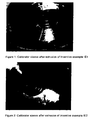
Figure 1 illustrates a picture of the calibrator sleeve taken immediately after extrusion of Inventive example IE1. -
Figure 2 illustrates a picture of the calibrator sleeve taken immediately after extrusion of Inventive example IE2. -
Figure 3 illustrates a picture of the calibrator sleeve taken immediately after extrusion of Comparative example CE1. -
Figure 4 illustrates a picture of the calibrator sleeve taken immediately after extrusion of Inventive example IE3. -
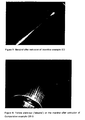
Figure 5 illustrates a picture of the mandrel taken after extrusion of Inventive example IE3. -
Figure 6 illustrates a picture of the mandrel taken after extrusion of Comparative example CE10. - The extrusion was performed on a Battenfeld 1-45- 25 B extruder, year of manufacture 1987 and a 3-zone screw. The compositions are formed into pipes having an outer diameter of 32 mm and a wall thickness of 3 mm.The following table 1 shows the temperature profile applied for pipe extrusion.
Table 1 Inlet Barrel Die Zone 0 1 2 3 1 2 3 4 5 6 [°C] 30 175 180 185 195 195 195 195 195 195 - A screw speed of 40 - 50 rpm was used with an output rate of approximately 31 kg/h. Extrusion work lasted for exactly 4 h for Inventive examples IE 1 and IE2 as well as Comparative examples CE1 to CE7, and between 90 and 210 min for Inventive example IE3 as well as Comparative examples CE8 to CE12, see below. The extruder then stopped to monitor the "plate out" on both the tooling and the calibration sleeve. The die head was further stripped for further investigation.
- Prior to each run all the metal areas of the extruder, i.e. die, mandrel, calibration sleeve etc., have been cleaned and polished to ensure similar starting conditions and that no artefact was present from the previous run.
- After extrusion of the polyethylene pipes, the extrusion apparatus was dismantled for visual inspection of the calibration sleeve and the mandrel for determination of the plate-out. The calibration sleeve and/or the mandrel have been visually inspected with the naked eye. In the following, "no plate-out observations" (denoted as "-" in tables 2 and 3) means that no coloured material or substrate is observed with the naked eye on the open face of the calibration sleeve and/or the mandrel. In case plate-out is observed with the naked eye on the calibrator sleeve and/or, for instance coloured plate-out substrate of crystalline nature or coloured streaks, this is indicated in the tables given below. In particular, the denotation "high" (denoted as "+++" in tables 2 and 3) means that significant plate-out is observed on the calibration sleeve and/or the mandrel. Accordingly, "++" and "+" means that medium and little plate out is observed, respectively.
- Density is measured according to ISO 1183-1:2004 (method A) on compression moulded specimen prepared according to EN ISO 1872-2 (February 2007) and is given in kg/m3.
- The melt flow rate (MFR) is determined according to ISO 1133 and is indicated in g/10 min. The MFR is an indication of the flowability, and hence the processability, of the polymer. The higher the melt flow rate, the lower the viscosity of the polymer. The MFR is determined at 190 °C for polyethylene at a load of 2.16 kg (MFR2) or 5.00 kg (MFR5).
- The MRS of pipes prepared according to ISO 1167 is extrapolated according to the principles of ISO 9080. T
-
- Irgafos B225:
- Antioxidant, Blend of Irganox 1010 (Pentaerythrityl-tetrakis(3-(3',5'-di-tert.butyl-4-hydroxyphenyl)-propionate; CAS No. 6683-19-8) and Irgafos 168 (Tris (2,4-di-t-butylphenyl) phosphate; CAS No. 31570-04-4)
- Ca Stearate:
- obtained from Faci, CAS No.: 1592-23-0
- Tinuvin 326:
- UV Absorber,
2-(3'-t-butyl-5'-methyl-2'-hydroxyphenyl)-5-chlorobenzotriazole,
CAS No. 3896-11-5 - Tinuvin 622:
- UV Stabiliser, Dimethyl succinate polymer with 4-hydroxy-2,2,6,6-tetramethyl-1-piperidine ethanol obtained from BASF, CAS No. 65447-77-0
- Chimassorb 2020
- UV Stabiliser,
1,6-hexanediamine, N,N'-bis(2,2,6,6-tetramethyl-4-piperidinyl)-, polymer with 2,4,6-trichloro-1,3,5-triazine, reaction product with, N-butyl-1-butanamine and N-butyl-2,2,6,6- tetramethyl-4-piperidinamine; obtained from Ciba (BASF), CAS No. 192268-64-7 -
- 86.15 wt%
- LDPE (masterbatch carrier), density 923 kg/m3, MFR5 = 2.2 g/10 min,
- 8.5 wt%
- Ultramarine Blue (CAS No. 57455-37-5),
- 2.5 wt%
- Pigment Blue 15:1 (CAS No. 147-14-8),
- 2.7 wt%
- Titanium dioxide (CAS No.13463-67-7),
- 0.15 wt%
- Irganox 1076 FF or Anox PP 18 Granular.
-
- 78.65 wt%
- LDPE (masterbatch carrier), density 923 kg/m3, MFR5 = 2.2 g/10 min,
- 7.20 wt%
- Pigment Yellow 95 (CAS No. 5280-80-8),
- 4.0 wt%
- Titanium dioxide (CAS No. 13463-67-7),
- 10.0 wt%
- Chimassorb 119 FL,
- 0.15 wt%
- Irganox 1076 FF or Anox PP 18 Granular.
- The bimodal polyethylene base resin PE1 used for compounding has a density of 949 kg/m3 and a MFR5 of 0.24 g/10 min. The base resin of inventive examples IE1 and IE2 and comparative examples CE1 to CE7 is produced as described in the example of
EP 1 655 333 . The density of the polyethylene composition of the IE1 and IE 2 is 951 kg/m3 and the MFR5 is 0.30 g/10 min. The density of the polyethylene composition of CE1 to CE7 is 951 kg/m3 and the MFR5 0.30 g/10 min (ISO 1133, 190°C, 5.0 kg). - The resultant polyethylene composition of the IE1 and IE2 and CE1 to CE7 is classified as PE-100 material (MRS 10.0 N/mm2).
- The bimodal polyethylene base resin PE2 used for compounding has a density 944 kg/m3 and a MFR5 of 0.75 g/10 min. The base resin of inventive example IE3 and comparative examples CE8 to CE12 is produced as described in example 1 of
EP 1 095 102 . The density of the polyethylene composition of IE3 is 947 kg/m3 and the MFR5 0.80 g/10 min. The density of the polyethylene composition of CE8 to CE12 is 947 kg/m3 and the MFR5 is 0.80 g/10 min (ISO 1133, 190°C, 5.0 kg). - The resultant polyethylene composition of the IE3 and CE8 to CE12 is classified as PE-80 material (MRS 8.0 N/mm2).
- The inventive and comparative examples were compounded/melt homogenized in a ZSK 53/57 kneader. The respective base resin and additives as listed in Tables 2 and 3 were fed into the first mixer inlet of the ZSK 53/57 Kneader which is a single screw extruder with a downstream discharge single extruder with pelletizing unit cutting pellets in molten stage and cooled via water. The mixer temperature profile was 179/169/190/184/188/199 °C from first inlet to outlet, and discharge extruder temperature 185 °C. The mixer screw rpm was 201 rpm and the throughput 100 kg/h.
- The compositions of the inventive and comparative examples were extruded to pipes and plate-out formation in accordance with item b) has been determined. Tables 2 and 3 show the results of the plate-out observations.
- Significant plate-out is observed in Comparative example CE1 comprising "Tinuvin 622" on the calibrator sleeve as can be seen from
Figure 3 . A relatively high level of plate-out of hard crystalline nature was observed sticking to the calibrator. Blue streaks were also evident on the metal tooling. - As regards Inventive examples IE1 and IE2, the calibration sleeve and tooling was very clean with no indication of any plate-out or streaking on the tooling (cf.
figures 1 and 2 ). - Inventive example IE3 showed a significant reduction of plate-out formation on the mandrel. Only a little plate-out can be observed on the mandrel (see
figure 5 ). The calibration sleeve for Inventive example IE3, however, was clean (seefigure 4 ). - In contrast thereto, Comparative example CE10 using "Tinuvin 622" instead of "Chimassorb 2020" as used in Inventive example IE3, showed significant plate-out on the surface of the mandrel (see
figure 6 ).Table 2: Contents of the blue coloured polyolefin compositions of inventive (IE) and comparative examples (CE) and results of the "plate out" observations. All contents are given in wt.-%. Polyolefin composition CE1 CE2 CE3 CE4 CE5 CE6 CE7 IE1 IE2 PE 1 Polyethylene resin 97.35 97.75 97.50 97.71 97.60 97.46 97.46 97.51 97.51 Tinuvin 622 UV stabiliser 0.25 0.25 0.25 0.25 Chimassorb 2020 UV stabiliser 0.10 0.10 Tinuvin 326 UV absorber 0.10 0.10 Irgafos B225 Anti-oxidant 0.35 0.35 0.35 0.35 0.35 0.35 0.35 0.35 0.35 MB 1 Pigment 1.90 1.90 1.90 1.90 1.90 1.90 1.90 1.90 1.90 Ca-Stearate Acid scavenger 0.15 0.04 0.15 0.04 0.04 0.04 0.04 "plate out" observation +++ + + + ++ ++ ++ - - +++ high plate out; ++ medium plate out; + little plate out; - no plate out Table 3: Contents of the yellow coloured polyolefin compositions of inventive (IE) and comparative examples (CE) and results of the "plate out" observations. All contents are given in wt.-%. Polyolefin composition CE8 CE9 CE10 CE11 CE12 IE3 PE 2 Polyethylene resin 98.35 98.70 98.50 98.66 98.55 98.46 Tinuvin 622 UV stabiliser 0.20 0.20 Chimassorb 2020 UV stabiliser 0.20 Irgafos B225 Anti-oxidant 0.30 0.30 0.30 0.30 0.30 0.30 MB 2 Pigment 1.00 1.00 1.00 1.00 1.00 1.00 Ca-Stearate Acid scavenger 0.15 0.04 0.15 0.04 "plate out" observations +++ - +++ ++ +++ + (on mandrel only) +++ high plate out; ++ medium plate out; + little plate out; - no plate out
Claims (16)
- Use of at least one UV stabiliser (A) of formula (I)
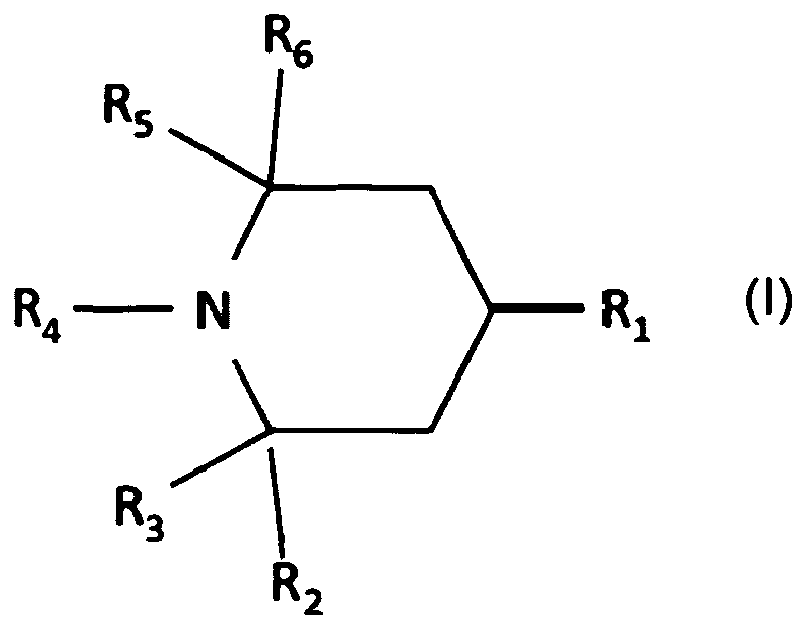 - R1 is a non-substituted or substituted aliphatic or aromatic hydrocarbyl radical comprising heteroatoms; and- R2, R3, R5 and R6 are independently non-substituted or substituted aliphatic C1-C4 hydrocarbyl radicals,- R4 is H or CH3,as an extrusion processing aid for polyethylene compositions comprising one or more pigments (C).
 - Use according to claim 1, wherein R1 is an aromatic hydrocarbyl radical and wherein the heteroatoms are triazine groups.
- Use according to claims 1 or 2, wherein the at least one UV stabiliser (A) has a melting range (Tm) of 80 to 450 °C.
- Use according to any one of claims 1 or 4, wherein the at least one UV stabiliser (A) has a weight average molecular weight (Mw) of at least 1000 g/mol.
- Use according to any one of the preceding claims, wherein the at least one UV stabiliser (A) has the formula (II):

- Use according to any one of the preceding claims, wherein the concentration of the UV stabiliser (A) is 0.01 to 1 wt.-% based on the total polyethylene composition.
- Use according to according to any one of the preceding claims, wherein the polyethylene composition further comprises an UV absorber (B).
- Use according to claim 7, wherein the concentration of the UV absorber (B) is 0.01 to 1 wt.-% based on the total polyethylene composition.
- Use according to claims 7 or 8, wherein the UV absorber (B) is 2-(3'-t-butyl-5'-methyl-2'-hydroxyphenyl)-5-chlorobenzotriazole having the CAS number 3896-11-5.
- Use according to any one of the preceding claims, wherein the pigments (C) are selected from Ultramarine Blue having CAS No. 57455-37-5 and/or titanium dioxide having CAS No. 13463-67-8 and/or Pigment Yellow 95 having CAS No. 5280-80-8 and/or Pigment Blue 15:1 having CAS No. 147-14-8 or any combination thereof.
- Use according to any one of the preceding claims, wherein the polyethylene composition is extruded to a pipe.
- Polyethylene composition comprising one or more pigments (C) and a UV stabiliser (A) having the formula (II)

- Polyethylene composition according to claim 12, further comprising an UV absorber (B) in a concentration of 0.01 to 1 wt.-% based on the total polyethylene composition.
- Polyethylene composition according to claim 12 or 13, wherein the UV absorber (B) is 2-(3'-t-butyl-5'-methyl-2'-hydroxyphenyl)-5-chlorobenzotriazole having the CAS number 3896-11-5.
- Polyethylene composition according to any one of claims 12 to 14, wherein the pigments (C) are selected from Ultramarine Blue having CAS No. 57455-37-5 and/or titanium dioxide having CAS No. 13463-67-8 and/or Pigment Yellow 95 having CAS No. 5280-80-8 and/or Pigment Blue 15:1 having CAS No. 147-14-8 or any combination thereof.
- Article comprising the polyethylene composition according to any one of claims 12 to 15.
Priority Applications (8)
| Application Number | Priority Date | Filing Date | Title |
|---|---|---|---|
| PL13003298T PL2818504T3 (en) | 2013-06-28 | 2013-06-28 | Use of an extrusion processing aid for the production of coloured polyethylene pipes |
| EP13003298.0A EP2818504B1 (en) | 2013-06-28 | 2013-06-28 | Use of an extrusion processing aid for the production of coloured polyethylene pipes |
| KR1020197016004A KR102103946B1 (en) | 2013-06-28 | 2014-05-27 | Use of an extrusion processing aid for the production of coloured polyethylene pipes |
| CN201480023448.3A CN105143331B (en) | 2013-06-28 | 2014-05-27 | For the application for the extrusion processing aid for producing colored polyvinyl piping materials |
| KR1020157027547A KR102024806B1 (en) | 2013-06-28 | 2014-05-27 | Use of an extrusion processing aid for the production of coloured polyethylene pipes |
| PCT/EP2014/001419 WO2014206517A1 (en) | 2013-06-28 | 2014-05-27 | Use of an extrusion processing aid for the production of coloured polyethylene pipes |
| JP2016506811A JP6125092B2 (en) | 2013-06-28 | 2014-05-27 | Use of extrusion aids for the production of colored polyethylene tubes. |
| AU2014301662A AU2014301662B2 (en) | 2013-06-28 | 2014-05-27 | Use of an extrusion processing aid for the production of coloured polyethylene pipes |
Applications Claiming Priority (1)
| Application Number | Priority Date | Filing Date | Title |
|---|---|---|---|
| EP13003298.0A EP2818504B1 (en) | 2013-06-28 | 2013-06-28 | Use of an extrusion processing aid for the production of coloured polyethylene pipes |
Publications (2)
| Publication Number | Publication Date |
|---|---|
| EP2818504A1 true EP2818504A1 (en) | 2014-12-31 |
| EP2818504B1 EP2818504B1 (en) | 2020-06-03 |
Family
ID=48703119
Family Applications (1)
| Application Number | Title | Priority Date | Filing Date |
|---|---|---|---|
| EP13003298.0A Active EP2818504B1 (en) | 2013-06-28 | 2013-06-28 | Use of an extrusion processing aid for the production of coloured polyethylene pipes |
Country Status (7)
| Country | Link |
|---|---|
| EP (1) | EP2818504B1 (en) |
| JP (1) | JP6125092B2 (en) |
| KR (2) | KR102024806B1 (en) |
| CN (1) | CN105143331B (en) |
| AU (1) | AU2014301662B2 (en) |
| PL (1) | PL2818504T3 (en) |
| WO (1) | WO2014206517A1 (en) |
Families Citing this family (2)
| Publication number | Priority date | Publication date | Assignee | Title |
|---|---|---|---|---|
| CN105860265A (en) * | 2016-05-10 | 2016-08-17 | 上海纳岩新材料科技有限公司 | Long glass fiber reinforced polypropylene composite material and preparation method thereof |
| CN114316471A (en) * | 2021-12-31 | 2022-04-12 | 天津利安隆新材料股份有限公司 | Composite light stabilizer suitable for rigid polyvinyl chloride material, rigid polyvinyl chloride material and preparation method thereof |
Citations (12)
| Publication number | Priority date | Publication date | Assignee | Title |
|---|---|---|---|---|
| JPS5545765B2 (en) | 1975-04-17 | 1980-11-19 | ||
| EP0688794A1 (en) | 1994-06-20 | 1995-12-27 | Borealis Polymers Oy | Procatalyst for ethylene polymer production, method for its preparation and use |
| EP0739937A2 (en) | 1995-04-28 | 1996-10-30 | Hoechst Aktiengesellschaft | Tube made from polyethylene having improved mechanical properties |
| EP0810235A2 (en) | 1996-05-31 | 1997-12-03 | Intevep SA | Polymerization catalyst |
| EP1095102A1 (en) | 1998-07-06 | 2001-05-02 | Borealis Polymers Oy | Polymer composition for pipes |
| US6232376B1 (en) * | 1999-10-14 | 2001-05-15 | Nippon Unicar Company Ltd. | Moisture curable polyolefin compositions |
| WO2002102891A1 (en) | 2001-06-14 | 2002-12-27 | Solvay Polyolefins Europe-Belgium (Société Anonyme) | Ethylene polymer composition |
| WO2004055068A1 (en) | 2002-12-18 | 2004-07-01 | Borealis Technology Oy | Method for the preparation of olefin polymerisation catalyst support and an olefin polymerisation catalyst |
| JP2006057036A (en) | 2004-08-23 | 2006-03-02 | Dainichiseika Color & Chem Mfg Co Ltd | Pipe resin composition |
| EP1655333A1 (en) | 2004-11-03 | 2006-05-10 | Borealis Technology Oy | Multimodal polyethylene composition for pipes |
| WO2006083642A1 (en) | 2005-01-28 | 2006-08-10 | Milliken & Company | Method and compositions for reducing plate-out in the manufacture of plastic articles |
| WO2010040079A1 (en) * | 2008-10-03 | 2010-04-08 | Uponor Innovation Ab | Methods and compositions for coating pipe |
Family Cites Families (9)
| Publication number | Priority date | Publication date | Assignee | Title |
|---|---|---|---|---|
| JPS5545765A (en) | 1978-09-29 | 1980-03-31 | Katsuta Kako Kk | Stabilized polymer composition |
| TW401437B (en) * | 1995-02-10 | 2000-08-11 | Ciba Sc Holding Ag | Synergistic stabilizer mixture |
| JPH11106577A (en) * | 1997-09-30 | 1999-04-20 | Asahi Denka Kogyo Kk | Automotive interior materials |
| JPH11255975A (en) * | 1998-03-06 | 1999-09-21 | Furukawa Electric Co Ltd:The | Crosslinked polyethylene pipe |
| ZA200301683B (en) * | 2002-03-04 | 2004-09-06 | Ciba Sc Holding Ag | Synergistic combinations of UV absorbers for pigmented polyolefins. |
| EP1462478A1 (en) * | 2003-03-26 | 2004-09-29 | Clariant International Ltd. | Improved long term dimensional stability of pigmented polymer articles |
| US20080032101A1 (en) * | 2006-07-24 | 2008-02-07 | Jack Reilly | Multilayer UV resistant thermoplastic composition |
| JP5588361B2 (en) * | 2011-01-06 | 2014-09-10 | 日東電工株式会社 | Surface protection sheet |
| EP2511332B1 (en) * | 2011-04-15 | 2014-09-17 | Borealis AG | Polyolefin pipe with improved migration behaviour |
-
2013
- 2013-06-28 PL PL13003298T patent/PL2818504T3/en unknown
- 2013-06-28 EP EP13003298.0A patent/EP2818504B1/en active Active
-
2014
- 2014-05-27 KR KR1020157027547A patent/KR102024806B1/en active Active
- 2014-05-27 WO PCT/EP2014/001419 patent/WO2014206517A1/en not_active Ceased
- 2014-05-27 JP JP2016506811A patent/JP6125092B2/en active Active
- 2014-05-27 KR KR1020197016004A patent/KR102103946B1/en active Active
- 2014-05-27 AU AU2014301662A patent/AU2014301662B2/en active Active
- 2014-05-27 CN CN201480023448.3A patent/CN105143331B/en active Active
Patent Citations (13)
| Publication number | Priority date | Publication date | Assignee | Title |
|---|---|---|---|---|
| JPS5545765B2 (en) | 1975-04-17 | 1980-11-19 | ||
| EP0688794A1 (en) | 1994-06-20 | 1995-12-27 | Borealis Polymers Oy | Procatalyst for ethylene polymer production, method for its preparation and use |
| EP0739937A2 (en) | 1995-04-28 | 1996-10-30 | Hoechst Aktiengesellschaft | Tube made from polyethylene having improved mechanical properties |
| EP0810235A2 (en) | 1996-05-31 | 1997-12-03 | Intevep SA | Polymerization catalyst |
| EP1095102A1 (en) | 1998-07-06 | 2001-05-02 | Borealis Polymers Oy | Polymer composition for pipes |
| US6232376B1 (en) * | 1999-10-14 | 2001-05-15 | Nippon Unicar Company Ltd. | Moisture curable polyolefin compositions |
| WO2002102891A1 (en) | 2001-06-14 | 2002-12-27 | Solvay Polyolefins Europe-Belgium (Société Anonyme) | Ethylene polymer composition |
| WO2004055068A1 (en) | 2002-12-18 | 2004-07-01 | Borealis Technology Oy | Method for the preparation of olefin polymerisation catalyst support and an olefin polymerisation catalyst |
| WO2004055069A1 (en) | 2002-12-18 | 2004-07-01 | Borealis Technology Oy | Method for the preparation of olefin polymerisation catalyst support and an olefin polymerisation catalyst |
| JP2006057036A (en) | 2004-08-23 | 2006-03-02 | Dainichiseika Color & Chem Mfg Co Ltd | Pipe resin composition |
| EP1655333A1 (en) | 2004-11-03 | 2006-05-10 | Borealis Technology Oy | Multimodal polyethylene composition for pipes |
| WO2006083642A1 (en) | 2005-01-28 | 2006-08-10 | Milliken & Company | Method and compositions for reducing plate-out in the manufacture of plastic articles |
| WO2010040079A1 (en) * | 2008-10-03 | 2010-04-08 | Uponor Innovation Ab | Methods and compositions for coating pipe |
Also Published As
| Publication number | Publication date |
|---|---|
| KR102024806B1 (en) | 2019-09-24 |
| WO2014206517A1 (en) | 2014-12-31 |
| CN105143331B (en) | 2018-04-03 |
| KR20150126020A (en) | 2015-11-10 |
| AU2014301662B2 (en) | 2016-09-08 |
| KR20190065486A (en) | 2019-06-11 |
| KR102103946B1 (en) | 2020-04-27 |
| CN105143331A (en) | 2015-12-09 |
| AU2014301662A1 (en) | 2015-09-24 |
| EP2818504B1 (en) | 2020-06-03 |
| JP6125092B2 (en) | 2017-05-10 |
| PL2818504T3 (en) | 2021-03-08 |
| JP2016516114A (en) | 2016-06-02 |
Similar Documents
| Publication | Publication Date | Title |
|---|---|---|
| EP2725057B2 (en) | Use of an acid scavenger to increase the resistance of a polyolefin composition against disinfectant containing water | |
| CN101903456A (en) | Olefin elastic resin composition | |
| AU2008278010A1 (en) | Low migration polyolefin composition comprising vitamin E-type stabiliser | |
| EP2551294B1 (en) | Use of a polyolefin composition for pipes and fittings with increased resistance to chlorine dioxide | |
| EP2367877B1 (en) | Polyolefin composition for water pipes with good resistance to chlorine dioxide and low migration | |
| JPWO2020153343A1 (en) | A method for producing a nucleating agent composition, an olefin resin composition, a molded product thereof, and an olefin resin composition. | |
| AU2014301662B2 (en) | Use of an extrusion processing aid for the production of coloured polyethylene pipes | |
| EP2511332B1 (en) | Polyolefin pipe with improved migration behaviour | |
| JP2001089611A (en) | Polyolefin resin composition, its film and agricultural film | |
| EP2607417A1 (en) | Polyolefin composition with increased resistance against degradation caused by chlorine dioxide | |
| EP2690115B1 (en) | Slow partial cross-linking polyolefin composition for improving disinfectant resistance of an article | |
| WO2003072648A1 (en) | Stabilized polypropylene resin composition | |
| JP2013173952A (en) | Olefinic elastic resin composition | |
| JP2001089610A (en) | Polyolefin resin composition, its film and agricultural film | |
| CN120025620B (en) | A weather-resistant polyethylene composition for mulch film, its preparation method and application | |
| KR20140027513A (en) | Polyolefin composition with excellent colour and thermal stability as well as oxidation resistance for pipes | |
| EP2935438B1 (en) | Use of additives for improving pipe stability against desinfectant containing water | |
| JP2001089609A (en) | Polyolefin resin composition, its film and agricultural film |
Legal Events
| Date | Code | Title | Description |
|---|---|---|---|
| PUAI | Public reference made under article 153(3) epc to a published international application that has entered the european phase |
Free format text: ORIGINAL CODE: 0009012 |
|
| 17P | Request for examination filed |
Effective date: 20130628 |
|
| AK | Designated contracting states |
Kind code of ref document: A1 Designated state(s): AL AT BE BG CH CY CZ DE DK EE ES FI FR GB GR HR HU IE IS IT LI LT LU LV MC MK MT NL NO PL PT RO RS SE SI SK SM TR |
|
| AX | Request for extension of the european patent |
Extension state: BA ME |
|
| R17P | Request for examination filed (corrected) |
Effective date: 20150630 |
|
| RBV | Designated contracting states (corrected) |
Designated state(s): AL AT BE BG CH CY CZ DE DK EE ES FI FR GB GR HR HU IE IS IT LI LT LU LV MC MK MT NL NO PL PT RO RS SE SI SK SM TR |
|
| STAA | Information on the status of an ep patent application or granted ep patent |
Free format text: STATUS: EXAMINATION IS IN PROGRESS |
|
| 17Q | First examination report despatched |
Effective date: 20180503 |
|
| GRAP | Despatch of communication of intention to grant a patent |
Free format text: ORIGINAL CODE: EPIDOSNIGR1 |
|
| STAA | Information on the status of an ep patent application or granted ep patent |
Free format text: STATUS: GRANT OF PATENT IS INTENDED |
|
| INTG | Intention to grant announced |
Effective date: 20200127 |
|
| RIN1 | Information on inventor provided before grant (corrected) |
Inventor name: JERUZAL, MARK |
|
| GRAS | Grant fee paid |
Free format text: ORIGINAL CODE: EPIDOSNIGR3 |
|
| GRAA | (expected) grant |
Free format text: ORIGINAL CODE: 0009210 |
|
| STAA | Information on the status of an ep patent application or granted ep patent |
Free format text: STATUS: THE PATENT HAS BEEN GRANTED |
|
| AK | Designated contracting states |
Kind code of ref document: B1 Designated state(s): AL AT BE BG CH CY CZ DE DK EE ES FI FR GB GR HR HU IE IS IT LI LT LU LV MC MK MT NL NO PL PT RO RS SE SI SK SM TR |
|
| REG | Reference to a national code |
Ref country code: GB Ref legal event code: FG4D |
|
| REG | Reference to a national code |
Ref country code: CH Ref legal event code: EP Ref country code: AT Ref legal event code: REF Ref document number: 1276975 Country of ref document: AT Kind code of ref document: T Effective date: 20200615 |
|
| REG | Reference to a national code |
Ref country code: DE Ref legal event code: R096 Ref document number: 602013069548 Country of ref document: DE |
|
| REG | Reference to a national code |
Ref country code: LT Ref legal event code: MG4D |
|
| PG25 | Lapsed in a contracting state [announced via postgrant information from national office to epo] |
Ref country code: LT Free format text: LAPSE BECAUSE OF FAILURE TO SUBMIT A TRANSLATION OF THE DESCRIPTION OR TO PAY THE FEE WITHIN THE PRESCRIBED TIME-LIMIT Effective date: 20200603 Ref country code: GR Free format text: LAPSE BECAUSE OF FAILURE TO SUBMIT A TRANSLATION OF THE DESCRIPTION OR TO PAY THE FEE WITHIN THE PRESCRIBED TIME-LIMIT Effective date: 20200904 Ref country code: FI Free format text: LAPSE BECAUSE OF FAILURE TO SUBMIT A TRANSLATION OF THE DESCRIPTION OR TO PAY THE FEE WITHIN THE PRESCRIBED TIME-LIMIT Effective date: 20200603 Ref country code: NO Free format text: LAPSE BECAUSE OF FAILURE TO SUBMIT A TRANSLATION OF THE DESCRIPTION OR TO PAY THE FEE WITHIN THE PRESCRIBED TIME-LIMIT Effective date: 20200903 Ref country code: SE Free format text: LAPSE BECAUSE OF FAILURE TO SUBMIT A TRANSLATION OF THE DESCRIPTION OR TO PAY THE FEE WITHIN THE PRESCRIBED TIME-LIMIT Effective date: 20200603 |
|
| REG | Reference to a national code |
Ref country code: NL Ref legal event code: MP Effective date: 20200603 |
|
| PG25 | Lapsed in a contracting state [announced via postgrant information from national office to epo] |
Ref country code: RS Free format text: LAPSE BECAUSE OF FAILURE TO SUBMIT A TRANSLATION OF THE DESCRIPTION OR TO PAY THE FEE WITHIN THE PRESCRIBED TIME-LIMIT Effective date: 20200603 Ref country code: HR Free format text: LAPSE BECAUSE OF FAILURE TO SUBMIT A TRANSLATION OF THE DESCRIPTION OR TO PAY THE FEE WITHIN THE PRESCRIBED TIME-LIMIT Effective date: 20200603 Ref country code: LV Free format text: LAPSE BECAUSE OF FAILURE TO SUBMIT A TRANSLATION OF THE DESCRIPTION OR TO PAY THE FEE WITHIN THE PRESCRIBED TIME-LIMIT Effective date: 20200603 Ref country code: BG Free format text: LAPSE BECAUSE OF FAILURE TO SUBMIT A TRANSLATION OF THE DESCRIPTION OR TO PAY THE FEE WITHIN THE PRESCRIBED TIME-LIMIT Effective date: 20200903 |
|
| REG | Reference to a national code |
Ref country code: AT Ref legal event code: MK05 Ref document number: 1276975 Country of ref document: AT Kind code of ref document: T Effective date: 20200603 |
|
| PG25 | Lapsed in a contracting state [announced via postgrant information from national office to epo] |
Ref country code: NL Free format text: LAPSE BECAUSE OF FAILURE TO SUBMIT A TRANSLATION OF THE DESCRIPTION OR TO PAY THE FEE WITHIN THE PRESCRIBED TIME-LIMIT Effective date: 20200603 Ref country code: AL Free format text: LAPSE BECAUSE OF FAILURE TO SUBMIT A TRANSLATION OF THE DESCRIPTION OR TO PAY THE FEE WITHIN THE PRESCRIBED TIME-LIMIT Effective date: 20200603 |
|
| PG25 | Lapsed in a contracting state [announced via postgrant information from national office to epo] |
Ref country code: PT Free format text: LAPSE BECAUSE OF FAILURE TO SUBMIT A TRANSLATION OF THE DESCRIPTION OR TO PAY THE FEE WITHIN THE PRESCRIBED TIME-LIMIT Effective date: 20201006 Ref country code: EE Free format text: LAPSE BECAUSE OF FAILURE TO SUBMIT A TRANSLATION OF THE DESCRIPTION OR TO PAY THE FEE WITHIN THE PRESCRIBED TIME-LIMIT Effective date: 20200603 Ref country code: AT Free format text: LAPSE BECAUSE OF FAILURE TO SUBMIT A TRANSLATION OF THE DESCRIPTION OR TO PAY THE FEE WITHIN THE PRESCRIBED TIME-LIMIT Effective date: 20200603 Ref country code: SM Free format text: LAPSE BECAUSE OF FAILURE TO SUBMIT A TRANSLATION OF THE DESCRIPTION OR TO PAY THE FEE WITHIN THE PRESCRIBED TIME-LIMIT Effective date: 20200603 Ref country code: ES Free format text: LAPSE BECAUSE OF FAILURE TO SUBMIT A TRANSLATION OF THE DESCRIPTION OR TO PAY THE FEE WITHIN THE PRESCRIBED TIME-LIMIT Effective date: 20200603 Ref country code: CZ Free format text: LAPSE BECAUSE OF FAILURE TO SUBMIT A TRANSLATION OF THE DESCRIPTION OR TO PAY THE FEE WITHIN THE PRESCRIBED TIME-LIMIT Effective date: 20200603 Ref country code: RO Free format text: LAPSE BECAUSE OF FAILURE TO SUBMIT A TRANSLATION OF THE DESCRIPTION OR TO PAY THE FEE WITHIN THE PRESCRIBED TIME-LIMIT Effective date: 20200603 |
|
| REG | Reference to a national code |
Ref country code: CH Ref legal event code: PL |
|
| PG25 | Lapsed in a contracting state [announced via postgrant information from national office to epo] |
Ref country code: SK Free format text: LAPSE BECAUSE OF FAILURE TO SUBMIT A TRANSLATION OF THE DESCRIPTION OR TO PAY THE FEE WITHIN THE PRESCRIBED TIME-LIMIT Effective date: 20200603 Ref country code: IS Free format text: LAPSE BECAUSE OF FAILURE TO SUBMIT A TRANSLATION OF THE DESCRIPTION OR TO PAY THE FEE WITHIN THE PRESCRIBED TIME-LIMIT Effective date: 20201003 |
|
| REG | Reference to a national code |
Ref country code: DE Ref legal event code: R097 Ref document number: 602013069548 Country of ref document: DE |
|
| PG25 | Lapsed in a contracting state [announced via postgrant information from national office to epo] |
Ref country code: LU Free format text: LAPSE BECAUSE OF NON-PAYMENT OF DUE FEES Effective date: 20200628 Ref country code: MC Free format text: LAPSE BECAUSE OF FAILURE TO SUBMIT A TRANSLATION OF THE DESCRIPTION OR TO PAY THE FEE WITHIN THE PRESCRIBED TIME-LIMIT Effective date: 20200603 |
|
| PLBE | No opposition filed within time limit |
Free format text: ORIGINAL CODE: 0009261 |
|
| STAA | Information on the status of an ep patent application or granted ep patent |
Free format text: STATUS: NO OPPOSITION FILED WITHIN TIME LIMIT |
|
| REG | Reference to a national code |
Ref country code: BE Ref legal event code: MM Effective date: 20200630 |
|
| PG25 | Lapsed in a contracting state [announced via postgrant information from national office to epo] |
Ref country code: IE Free format text: LAPSE BECAUSE OF NON-PAYMENT OF DUE FEES Effective date: 20200628 Ref country code: LI Free format text: LAPSE BECAUSE OF NON-PAYMENT OF DUE FEES Effective date: 20200630 Ref country code: CH Free format text: LAPSE BECAUSE OF NON-PAYMENT OF DUE FEES Effective date: 20200630 Ref country code: DK Free format text: LAPSE BECAUSE OF FAILURE TO SUBMIT A TRANSLATION OF THE DESCRIPTION OR TO PAY THE FEE WITHIN THE PRESCRIBED TIME-LIMIT Effective date: 20200603 |
|
| 26N | No opposition filed |
Effective date: 20210304 |
|
| PG25 | Lapsed in a contracting state [announced via postgrant information from national office to epo] |
Ref country code: BE Free format text: LAPSE BECAUSE OF NON-PAYMENT OF DUE FEES Effective date: 20200630 Ref country code: SI Free format text: LAPSE BECAUSE OF FAILURE TO SUBMIT A TRANSLATION OF THE DESCRIPTION OR TO PAY THE FEE WITHIN THE PRESCRIBED TIME-LIMIT Effective date: 20200603 |
|
| PG25 | Lapsed in a contracting state [announced via postgrant information from national office to epo] |
Ref country code: TR Free format text: LAPSE BECAUSE OF FAILURE TO SUBMIT A TRANSLATION OF THE DESCRIPTION OR TO PAY THE FEE WITHIN THE PRESCRIBED TIME-LIMIT Effective date: 20200603 Ref country code: MT Free format text: LAPSE BECAUSE OF FAILURE TO SUBMIT A TRANSLATION OF THE DESCRIPTION OR TO PAY THE FEE WITHIN THE PRESCRIBED TIME-LIMIT Effective date: 20200603 Ref country code: CY Free format text: LAPSE BECAUSE OF FAILURE TO SUBMIT A TRANSLATION OF THE DESCRIPTION OR TO PAY THE FEE WITHIN THE PRESCRIBED TIME-LIMIT Effective date: 20200603 |
|
| PG25 | Lapsed in a contracting state [announced via postgrant information from national office to epo] |
Ref country code: MK Free format text: LAPSE BECAUSE OF FAILURE TO SUBMIT A TRANSLATION OF THE DESCRIPTION OR TO PAY THE FEE WITHIN THE PRESCRIBED TIME-LIMIT Effective date: 20200603 |
|
| P01 | Opt-out of the competence of the unified patent court (upc) registered |
Effective date: 20230602 |
|
| PGFP | Annual fee paid to national office [announced via postgrant information from national office to epo] |
Ref country code: PL Payment date: 20250624 Year of fee payment: 13 Ref country code: DE Payment date: 20250618 Year of fee payment: 13 |
|
| PGFP | Annual fee paid to national office [announced via postgrant information from national office to epo] |
Ref country code: GB Payment date: 20250618 Year of fee payment: 13 |
|
| PGFP | Annual fee paid to national office [announced via postgrant information from national office to epo] |
Ref country code: FR Payment date: 20250624 Year of fee payment: 13 |
|
| PGFP | Annual fee paid to national office [announced via postgrant information from national office to epo] |
Ref country code: IT Payment date: 20250624 Year of fee payment: 13 |