EP2818465A1 - 2-Oxo-1,3-dioxolane-4-acyl halides, their preparation and use - Google Patents
2-Oxo-1,3-dioxolane-4-acyl halides, their preparation and use Download PDFInfo
- Publication number
- EP2818465A1 EP2818465A1 EP13173801.5A EP13173801A EP2818465A1 EP 2818465 A1 EP2818465 A1 EP 2818465A1 EP 13173801 A EP13173801 A EP 13173801A EP 2818465 A1 EP2818465 A1 EP 2818465A1
- Authority
- EP
- European Patent Office
- Prior art keywords
- dioxolane
- oxo
- groups
- formula
- preparation
- Prior art date
- Legal status (The legal status is an assumption and is not a legal conclusion. Google has not performed a legal analysis and makes no representation as to the accuracy of the status listed.)
- Withdrawn
Links
- 238000002360 preparation method Methods 0.000 title claims abstract description 16
- INDZWIZFONXCIY-UHFFFAOYSA-N 2-oxo-1,3-dioxolane-4-carboxylic acid Chemical class OC(=O)C1COC(=O)O1 INDZWIZFONXCIY-UHFFFAOYSA-N 0.000 claims abstract description 16
- 239000000203 mixture Substances 0.000 claims abstract description 13
- 150000001412 amines Chemical class 0.000 claims abstract description 12
- 238000000034 method Methods 0.000 claims abstract description 11
- 230000000903 blocking effect Effects 0.000 claims abstract description 5
- ZMXDDKWLCZADIW-UHFFFAOYSA-N N,N-Dimethylformamide Chemical compound CN(C)C=O ZMXDDKWLCZADIW-UHFFFAOYSA-N 0.000 claims description 11
- 238000006243 chemical reaction Methods 0.000 claims description 9
- 125000004400 (C1-C12) alkyl group Chemical group 0.000 claims description 8
- 125000000041 C6-C10 aryl group Chemical group 0.000 claims description 8
- 125000004122 cyclic group Chemical group 0.000 claims description 8
- 238000005658 halogenation reaction Methods 0.000 claims description 8
- 239000003795 chemical substances by application Substances 0.000 claims description 7
- FYSNRJHAOHDILO-UHFFFAOYSA-N thionyl chloride Chemical group ClS(Cl)=O FYSNRJHAOHDILO-UHFFFAOYSA-N 0.000 claims description 7
- 230000026030 halogenation Effects 0.000 claims description 6
- 239000002904 solvent Substances 0.000 claims description 6
- GKJYRYGNJQHVSQ-UHFFFAOYSA-N 2-oxo-1,3-dioxolane-4-carboxamide Chemical compound NC(=O)C1COC(=O)O1 GKJYRYGNJQHVSQ-UHFFFAOYSA-N 0.000 claims description 5
- 239000003054 catalyst Substances 0.000 claims description 4
- 125000004433 nitrogen atom Chemical group N* 0.000 claims description 3
- WNXJIVFYUVYPPR-UHFFFAOYSA-N 1,3-dioxolane Chemical group C1COCO1 WNXJIVFYUVYPPR-UHFFFAOYSA-N 0.000 claims description 2
- 229910006124 SOCl2 Inorganic materials 0.000 claims description 2
- 125000004429 atom Chemical group 0.000 claims description 2
- ZMANZCXQSJIPKH-UHFFFAOYSA-N Triethylamine Chemical compound CCN(CC)CC ZMANZCXQSJIPKH-UHFFFAOYSA-N 0.000 description 13
- 239000002244 precipitate Substances 0.000 description 10
- IAZDPXIOMUYVGZ-WFGJKAKNSA-N Dimethyl sulfoxide Chemical compound [2H]C([2H])([2H])S(=O)C([2H])([2H])[2H] IAZDPXIOMUYVGZ-WFGJKAKNSA-N 0.000 description 8
- KMTRUDSVKNLOMY-UHFFFAOYSA-N Ethylene carbonate Chemical compound O=C1OCCO1 KMTRUDSVKNLOMY-UHFFFAOYSA-N 0.000 description 8
- -1 isocyanate compounds Chemical class 0.000 description 8
- 239000000047 product Substances 0.000 description 8
- 239000002253 acid Substances 0.000 description 7
- 150000001875 compounds Chemical class 0.000 description 7
- QTBSBXVTEAMEQO-UHFFFAOYSA-N Acetic acid Chemical compound CC(O)=O QTBSBXVTEAMEQO-UHFFFAOYSA-N 0.000 description 6
- OKKJLVBELUTLKV-UHFFFAOYSA-N Methanol Chemical compound OC OKKJLVBELUTLKV-UHFFFAOYSA-N 0.000 description 6
- 239000012298 atmosphere Substances 0.000 description 6
- 230000015572 biosynthetic process Effects 0.000 description 6
- 230000009257 reactivity Effects 0.000 description 6
- 125000004185 ester group Chemical group 0.000 description 5
- 239000011541 reaction mixture Substances 0.000 description 5
- 238000007142 ring opening reaction Methods 0.000 description 5
- NGNBDVOYPDDBFK-UHFFFAOYSA-N 2-[2,4-di(pentan-2-yl)phenoxy]acetyl chloride Chemical compound CCCC(C)C1=CC=C(OCC(Cl)=O)C(C(C)CCC)=C1 NGNBDVOYPDDBFK-UHFFFAOYSA-N 0.000 description 4
- JFMGYULNQJPJCY-UHFFFAOYSA-N 4-(hydroxymethyl)-1,3-dioxolan-2-one Chemical compound OCC1COC(=O)O1 JFMGYULNQJPJCY-UHFFFAOYSA-N 0.000 description 4
- HEDRZPFGACZZDS-MICDWDOJSA-N Trichloro(2H)methane Chemical compound [2H]C(Cl)(Cl)Cl HEDRZPFGACZZDS-MICDWDOJSA-N 0.000 description 4
- 239000011230 binding agent Substances 0.000 description 4
- 125000003178 carboxy group Chemical group [H]OC(*)=O 0.000 description 4
- 239000007788 liquid Substances 0.000 description 4
- 238000003786 synthesis reaction Methods 0.000 description 4
- YMWUJEATGCHHMB-UHFFFAOYSA-N Dichloromethane Chemical compound ClCCl YMWUJEATGCHHMB-UHFFFAOYSA-N 0.000 description 3
- RTZKZFJDLAIYFH-UHFFFAOYSA-N Diethyl ether Chemical compound CCOCC RTZKZFJDLAIYFH-UHFFFAOYSA-N 0.000 description 3
- 125000003368 amide group Chemical group 0.000 description 3
- 125000003118 aryl group Chemical group 0.000 description 3
- VGEWEGHHYWGXGG-UHFFFAOYSA-N ethyl n-hydroxycarbamate Chemical class CCOC(=O)NO VGEWEGHHYWGXGG-UHFFFAOYSA-N 0.000 description 3
- 239000012948 isocyanate Substances 0.000 description 3
- RJRHGWXTHIUHOY-UHFFFAOYSA-N n-cyclohexyl-2-oxo-1,3-dioxolane-4-carboxamide Chemical compound C1OC(=O)OC1C(=O)NC1CCCCC1 RJRHGWXTHIUHOY-UHFFFAOYSA-N 0.000 description 3
- 239000004814 polyurethane Substances 0.000 description 3
- 229920002635 polyurethane Polymers 0.000 description 3
- XLYOFNOQVPJJNP-UHFFFAOYSA-N water Substances O XLYOFNOQVPJJNP-UHFFFAOYSA-N 0.000 description 3
- 125000004209 (C1-C8) alkyl group Chemical group 0.000 description 2
- 238000001644 13C nuclear magnetic resonance spectroscopy Methods 0.000 description 2
- 238000005160 1H NMR spectroscopy Methods 0.000 description 2
- RNLHGQLZWXBQNY-UHFFFAOYSA-N 3-(aminomethyl)-3,5,5-trimethylcyclohexan-1-amine Chemical compound CC1(C)CC(N)CC(C)(CN)C1 RNLHGQLZWXBQNY-UHFFFAOYSA-N 0.000 description 2
- CSCPPACGZOOCGX-UHFFFAOYSA-N Acetone Chemical compound CC(C)=O CSCPPACGZOOCGX-UHFFFAOYSA-N 0.000 description 2
- LFRIABJMNLGABF-UHFFFAOYSA-N C(=O)(Cl)Cl.O=C1OCCO1 Chemical compound C(=O)(Cl)Cl.O=C1OCCO1 LFRIABJMNLGABF-UHFFFAOYSA-N 0.000 description 2
- HEDRZPFGACZZDS-UHFFFAOYSA-N Chloroform Chemical compound ClC(Cl)Cl HEDRZPFGACZZDS-UHFFFAOYSA-N 0.000 description 2
- DTLDSVWACINSJC-UHFFFAOYSA-N ClC(=O)C1COC(=O)O1 Chemical compound ClC(=O)C1COC(=O)O1 DTLDSVWACINSJC-UHFFFAOYSA-N 0.000 description 2
- 229920005863 Lupranol® Polymers 0.000 description 2
- 150000001204 N-oxides Chemical class 0.000 description 2
- UIIMBOGNXHQVGW-UHFFFAOYSA-M Sodium bicarbonate Chemical compound [Na+].OC([O-])=O UIIMBOGNXHQVGW-UHFFFAOYSA-M 0.000 description 2
- 125000000217 alkyl group Chemical group 0.000 description 2
- 238000007098 aminolysis reaction Methods 0.000 description 2
- PAFZNILMFXTMIY-UHFFFAOYSA-N cyclohexylamine Chemical compound NC1CCCCC1 PAFZNILMFXTMIY-UHFFFAOYSA-N 0.000 description 2
- 125000006575 electron-withdrawing group Chemical class 0.000 description 2
- 150000002513 isocyanates Chemical class 0.000 description 2
- 230000001404 mediated effect Effects 0.000 description 2
- HNHHKYXWATVPLU-UHFFFAOYSA-N methyl 2-oxo-1,3-dioxolane-4-carboxylate Chemical compound COC(=O)C1COC(=O)O1 HNHHKYXWATVPLU-UHFFFAOYSA-N 0.000 description 2
- 125000002496 methyl group Chemical group [H]C([H])([H])* 0.000 description 2
- ZHFSEWIBDSJBTO-UHFFFAOYSA-N n-butyl-2-oxo-1,3-dioxolane-4-carboxamide Chemical compound CCCCNC(=O)C1COC(=O)O1 ZHFSEWIBDSJBTO-UHFFFAOYSA-N 0.000 description 2
- 230000003647 oxidation Effects 0.000 description 2
- 238000007254 oxidation reaction Methods 0.000 description 2
- 230000037361 pathway Effects 0.000 description 2
- 229920000642 polymer Polymers 0.000 description 2
- 238000010992 reflux Methods 0.000 description 2
- JHJLBTNAGRQEKS-UHFFFAOYSA-M sodium bromide Chemical compound [Na+].[Br-] JHJLBTNAGRQEKS-UHFFFAOYSA-M 0.000 description 2
- 125000001424 substituent group Chemical group 0.000 description 2
- 238000005809 transesterification reaction Methods 0.000 description 2
- 125000006273 (C1-C3) alkyl group Chemical group 0.000 description 1
- 125000004169 (C1-C6) alkyl group Chemical group 0.000 description 1
- 0 *C(CO1)OC1=O Chemical compound *C(CO1)OC1=O 0.000 description 1
- YRIZYWQGELRKNT-UHFFFAOYSA-N 1,3,5-trichloro-1,3,5-triazinane-2,4,6-trione Chemical compound ClN1C(=O)N(Cl)C(=O)N(Cl)C1=O YRIZYWQGELRKNT-UHFFFAOYSA-N 0.000 description 1
- VUZNLSBZRVZGIK-UHFFFAOYSA-N 2,2,6,6-Tetramethyl-1-piperidinol Chemical group CC1(C)CCCC(C)(C)N1O VUZNLSBZRVZGIK-UHFFFAOYSA-N 0.000 description 1
- HBAQYPYDRFILMT-UHFFFAOYSA-N 8-[3-(1-cyclopropylpyrazol-4-yl)-1H-pyrazolo[4,3-d]pyrimidin-5-yl]-3-methyl-3,8-diazabicyclo[3.2.1]octan-2-one Chemical class C1(CC1)N1N=CC(=C1)C1=NNC2=C1N=C(N=C2)N1C2C(N(CC1CC2)C)=O HBAQYPYDRFILMT-UHFFFAOYSA-N 0.000 description 1
- XDTMQSROBMDMFD-UHFFFAOYSA-N Cyclohexane Chemical compound C1CCCCC1 XDTMQSROBMDMFD-UHFFFAOYSA-N 0.000 description 1
- LCGLNKUTAGEVQW-UHFFFAOYSA-N Dimethyl ether Chemical compound COC LCGLNKUTAGEVQW-UHFFFAOYSA-N 0.000 description 1
- LFQSCWFLJHTTHZ-UHFFFAOYSA-N Ethanol Chemical compound CCO LFQSCWFLJHTTHZ-UHFFFAOYSA-N 0.000 description 1
- 229920005874 Lupranol® 2048 Polymers 0.000 description 1
- YDQULWWXVUJODH-UHFFFAOYSA-N OC(C(CO1)OC1=O)Cl Chemical compound OC(C(CO1)OC1=O)Cl YDQULWWXVUJODH-UHFFFAOYSA-N 0.000 description 1
- VUKCPUAOPNOVKC-UHFFFAOYSA-N OCC1OC(OC1)=O.OCC1OC(OC1)=O Chemical compound OCC1OC(OC1)=O.OCC1OC(OC1)=O VUKCPUAOPNOVKC-UHFFFAOYSA-N 0.000 description 1
- 239000004952 Polyamide Substances 0.000 description 1
- 238000005903 acid hydrolysis reaction Methods 0.000 description 1
- 230000002378 acidificating effect Effects 0.000 description 1
- 150000007513 acids Chemical class 0.000 description 1
- 125000002252 acyl group Chemical group 0.000 description 1
- 239000000853 adhesive Substances 0.000 description 1
- 230000001070 adhesive effect Effects 0.000 description 1
- 150000001298 alcohols Chemical class 0.000 description 1
- 150000001408 amides Chemical class 0.000 description 1
- HQABUPZFAYXKJW-UHFFFAOYSA-N butan-1-amine Chemical compound CCCCN HQABUPZFAYXKJW-UHFFFAOYSA-N 0.000 description 1
- 230000021523 carboxylation Effects 0.000 description 1
- 238000006473 carboxylation reaction Methods 0.000 description 1
- 125000002843 carboxylic acid group Chemical group 0.000 description 1
- 238000005266 casting Methods 0.000 description 1
- 238000000576 coating method Methods 0.000 description 1
- 239000000470 constituent Substances 0.000 description 1
- 238000005260 corrosion Methods 0.000 description 1
- 230000007797 corrosion Effects 0.000 description 1
- 239000002537 cosmetic Substances 0.000 description 1
- 238000004132 cross linking Methods 0.000 description 1
- 125000004093 cyano group Chemical group *C#N 0.000 description 1
- 125000006165 cyclic alkyl group Chemical group 0.000 description 1
- 150000005676 cyclic carbonates Chemical group 0.000 description 1
- 125000000753 cycloalkyl group Chemical group 0.000 description 1
- KQWGXHWJMSMDJJ-UHFFFAOYSA-N cyclohexyl isocyanate Chemical compound O=C=NC1CCCCC1 KQWGXHWJMSMDJJ-UHFFFAOYSA-N 0.000 description 1
- 238000000354 decomposition reaction Methods 0.000 description 1
- 230000001419 dependent effect Effects 0.000 description 1
- 238000002845 discoloration Methods 0.000 description 1
- 230000002255 enzymatic effect Effects 0.000 description 1
- 150000002118 epoxides Chemical class 0.000 description 1
- 125000001033 ether group Chemical group 0.000 description 1
- 125000001495 ethyl group Chemical group [H]C([H])([H])C([H])([H])* 0.000 description 1
- 238000001704 evaporation Methods 0.000 description 1
- 230000008020 evaporation Effects 0.000 description 1
- 239000000706 filtrate Substances 0.000 description 1
- 239000007789 gas Substances 0.000 description 1
- 238000002290 gas chromatography-mass spectrometry Methods 0.000 description 1
- 150000004676 glycans Chemical class 0.000 description 1
- 229930182470 glycoside Natural products 0.000 description 1
- 150000002338 glycosides Chemical class 0.000 description 1
- 229910052739 hydrogen Inorganic materials 0.000 description 1
- 239000001257 hydrogen Substances 0.000 description 1
- 125000004435 hydrogen atom Chemical class [H]* 0.000 description 1
- 230000003301 hydrolyzing effect Effects 0.000 description 1
- 125000002887 hydroxy group Chemical group [H]O* 0.000 description 1
- 239000004973 liquid crystal related substance Substances 0.000 description 1
- 238000004519 manufacturing process Methods 0.000 description 1
- 150000004702 methyl esters Chemical class 0.000 description 1
- GDOPTJXRTPNYNR-UHFFFAOYSA-N methyl-cyclopentane Natural products CC1CCCC1 GDOPTJXRTPNYNR-UHFFFAOYSA-N 0.000 description 1
- HNHVTXYLRVGMHD-UHFFFAOYSA-N n-butyl isocyanate Chemical compound CCCCN=C=O HNHVTXYLRVGMHD-UHFFFAOYSA-N 0.000 description 1
- 231100000252 nontoxic Toxicity 0.000 description 1
- 230000003000 nontoxic effect Effects 0.000 description 1
- 229920001542 oligosaccharide Polymers 0.000 description 1
- 150000002482 oligosaccharides Chemical class 0.000 description 1
- 150000005677 organic carbonates Chemical class 0.000 description 1
- 230000001590 oxidative effect Effects 0.000 description 1
- 229920002647 polyamide Polymers 0.000 description 1
- 239000004848 polyfunctional curative Substances 0.000 description 1
- 239000005056 polyisocyanate Substances 0.000 description 1
- 229920001228 polyisocyanate Polymers 0.000 description 1
- 229920005862 polyol Polymers 0.000 description 1
- 150000003077 polyols Chemical class 0.000 description 1
- 229920001282 polysaccharide Polymers 0.000 description 1
- 239000005017 polysaccharide Substances 0.000 description 1
- 239000000843 powder Substances 0.000 description 1
- 239000000565 sealant Substances 0.000 description 1
- 238000007789 sealing Methods 0.000 description 1
- 238000000926 separation method Methods 0.000 description 1
- 229910000030 sodium bicarbonate Inorganic materials 0.000 description 1
- 235000017557 sodium bicarbonate Nutrition 0.000 description 1
- 238000003756 stirring Methods 0.000 description 1
- 239000000126 substance Substances 0.000 description 1
- 229950009390 symclosene Drugs 0.000 description 1
- 231100000331 toxic Toxicity 0.000 description 1
- 230000002588 toxic effect Effects 0.000 description 1
- 238000005891 transamination reaction Methods 0.000 description 1
- 150000004072 triols Chemical class 0.000 description 1
Classifications
-
- C—CHEMISTRY; METALLURGY
- C07—ORGANIC CHEMISTRY
- C07D—HETEROCYCLIC COMPOUNDS
- C07D317/00—Heterocyclic compounds containing five-membered rings having two oxygen atoms as the only ring hetero atoms
- C07D317/08—Heterocyclic compounds containing five-membered rings having two oxygen atoms as the only ring hetero atoms having the hetero atoms in positions 1 and 3
- C07D317/10—Heterocyclic compounds containing five-membered rings having two oxygen atoms as the only ring hetero atoms having the hetero atoms in positions 1 and 3 not condensed with other rings
- C07D317/32—Heterocyclic compounds containing five-membered rings having two oxygen atoms as the only ring hetero atoms having the hetero atoms in positions 1 and 3 not condensed with other rings with hetero atoms or with carbon atoms having three bonds to hetero atoms with at the most one bond to halogen, e.g. ester or nitrile radicals, directly attached to ring carbon atoms
- C07D317/34—Oxygen atoms
- C07D317/36—Alkylene carbonates; Substituted alkylene carbonates
-
- C—CHEMISTRY; METALLURGY
- C07—ORGANIC CHEMISTRY
- C07B—GENERAL METHODS OF ORGANIC CHEMISTRY; APPARATUS THEREFOR
- C07B41/00—Formation or introduction of functional groups containing oxygen
- C07B41/08—Formation or introduction of functional groups containing oxygen of carboxyl groups or salts, halides or anhydrides thereof
Definitions
- the present invention relates to 2-oxo-1,3-dioxolane-4-acyl halides of formula (I), wherein X is selected from F, Cl, Br, I and mixtures thereof, to processes for the preparation of said 2-oxo-1,3-dioxolane-4-acyl halides, to the use of said 2-oxo-1,3-dioxo-lane-4-acyl halides for the preparation of 2-oxo-1,3-dioxolane-4-carboxylic esters of formula (II) wherein R 1 is selected from straight-chain, branched or cyclic C 1-12 -alkyl groups, C 6-10 -aryl groups, C 6-12 -aralkyl groups and C 6-12 -alkaryl groups, to the use of said 2-oxo-1,3-dioxolane-4-acyl halides for the preparation of 2-oxo-1,3-dioxolane-4-carboxamides of formula (III), wherein
- R 4 may be hydrogen, straight-chain or branched C 1-8 -alkyl, C 5-12 -cycloalkyl or C 6-15 -aryl.
- R 3 may be straight-chain or branched C 1-8 -alkyl or C 6-15 -aryl.
- WO 2004/003001 A1 describes the enzymatic racemate separation of the enantiomers of type (VI) but without indicating a synthesis for these compounds.
- EP 1941946 A1 describes the use of a carbonitride catalyst inter alia for the preparation of certain disubstituted organic carbonates.
- These may also be compounds of the general formula (V), where R 10 and R 11 , independently of one another, are selected optional substituents.
- Possible meanings of the substituents are alkyl, aryl, herteroaryl and ester groups CO 2 A, where A may in turn be alkyl or aryl, e.g. straight-chain or branched C 1-6 -alkyl, preferably C 1-3 -alkyl and particularly preferably methyl or ethyl.
- no syntheses for 2-oxo-1,3-dioxolane systems are stated.
- JP 2006-003433 A discloses a sealing composition for liquid crystal display elements which comprises a compound of the general formula (VI), where R is H, a hydroxyl group, a cyano group, a carboxylic acid group, an optionally substituted aromatic ring, a straight-chain, branched or cyclic alkyl group, an acyl group or an ester group.
- the 2-oxo-1,3-dioxolane-4-carboxylic acid (R COOH) is also mentioned.
- EP 0001088 A1 describes inter alia 2-oxo-1,3-dioxolanes of the general formula (VII), where R can be H or CH 3 .
- EP 2397474 A1 describes 2-oxo-1,3-dioxolane-4-carboxylic esters of formula (VIII) in which R 1 may preferably be Me or Et or an n-valent radical which may be substituted with a maximum of n-1 further 2-oxo-1,3-dioxolane-4-carboxyl groups, a process for their preparation by means of carboxylation of the corresponding epoxides, a process for their transesterification, and also their use for the preparation of hydroxyurethanes and as end groups for the blocking of amines.
- US 2010/0317838 A1 describes compounds of formula (IX) in which Z can be O and n can be 0, and at least one of the radicals W1 or W1a comprises a protected glycoside, and each of the radicals W1 and W1a, independently of one another, may inter alia also be an amide group.
- Polyurethanes based on polyisocyanates belong to the prior art. These are used for example as adhesives, sealants, casting compositions, as corrosion protection and for coatings. The high resistance to acids, alkalis and chemicals of the cured compositions obtained in this way are advantageous. However, monomeric low molecular weight (poly)isocyanate compounds are toxicologically unacceptable, especially if they are readily volatile or migrate.
- Polyurethane systems can also be obtained starting from cyclic carbonate compounds, which are toxicologically acceptable.
- glycerol carbonate (4-(hydro-xymethyl)-2-oxo-1,3-dioxolane) is regularly used in cosmetics, i.e. it is non-toxic.
- R in the formula scheme below means the polymeric main chain
- the ring opening (hardening) reaction is accompanied by a certain amount of aminolysis of the ester bond leading to the detachment of the main chain in the form of an unreactive alcohol.
- the aim was to provide an alternative 2-oxo-1,3-dioxolane system with an electron-withdrawing group.
- the aim was to provide a 2-oxo-1,3-dioxolane system which is toxicologically acceptable, readily accessible and possesses higher reactivity towards alcohols and amines so that the aforementioned -4-carboxamides and -4-carboxylic esters could be easily synthesized.
- the present invention provides a 2-oxo-1,3-dioxolane-4-acyl halide of formula (I), wherein X is selected from F, Cl, Br, I and mixtures thereof. In a preferred embodiment of the present invention X is Cl.
- (2-Oxo-1,3-dioxolane-4-acyl halides may also be called 2-oxo-1,3-dioxolane-4-carbonyl halides.
- the atoms 4 and/or 5 of the dioxolane ring can be substituted with a total of one, two or three independently selected straight-chain, branched or cyclic C 1-12 -alkyl groups, C 6-10 -aryl groups, C 6-12 -aralkyl groups and C 6-12 -alkaryl groups.
- the present invention also provides a process for the preparation of a 2-oxo-1,3-dioxolane-4-acyl halide as defined hereinabove, wherein 2-oxo-1,3-dioxolane-4-carboxylic acid of formula (X) is reacted with an halogenation agent.
- the halogenation agent is SOCl 2 .
- the said halogenation reaction is preferably carried out without a solvent at an elevated temperature.
- the halogenation is preferably carried out at about 60 °C in the presence of dimethylformamide as a catalyst.
- 2-oxo-1,3-dioxolane-4-carboxylic acid The key intermediate in the above halogenation reaction is 2-oxo-1,3-dioxolane-4-carboxylic acid, the synthesis whereof being described in the aforementioned PCT/EP2012/ 072589 .
- 2-oxo-1,3-dioxolane-4-carboxylic acid can be prepared by oxidizing glycerol carbonate (4-(hydroxymethyl)-2-oxo-1,3-dioxolane) by means of N-oxide-mediated oxidation (see Reference Examples 1 and 2.)
- the present invention also provides for the use of a 2-oxo-1,3-dioxolane-4-acyl halide of the invention for the preparation of a 2-oxo-1,3-dioxolane-4-carboxylic ester of formula (II), wherein R 1 is selected from straight-chain, branched or cyclic C 1-12 -alkyl groups, C 6-10 -aryl groups, C 6-12 -aralkyl groups and C 6-12 -alkaryl groups.
- R 1 can also be a radical having a valency of 2 to 6 (preferably 2 to 3), which is substituted with 1 to 5 (preferably 1 to 2) further 2-oxo-1,3-dioxolane-4-carboxylic ester groups.
- R 1 is derived from a polyol such as an oligosaccharide or a polysaccharide.
- the present invention also provides for the use of a 2-oxo-1,3-dioxolane-4-acyl halide of the invention for the preparation of a 2-oxo-1,3-dioxolane-4-carboxamide of formula (III), wherein R 1 and R 2 , in each case independently of one another, are selected from H, straight-chain, branched or cyclic C 1-12 -alkyl groups, C 6-10 -aryl groups, C 6-12 -aralkyl groups and C 6-12 -alkaryl groups or, together with the N atom to which they are bonded, form a 5- to 8-membered ring.
- R 1 and R 2 in each case independently of one another, are selected from H, straight-chain, branched or cyclic C 1-12 -alkyl groups, C 6-10 -aryl groups, C 6-12 -aralkyl groups and C 6-12 -alkaryl groups or, together with the N atom to which they are bonded, form a 5-
- R 2 can also be a radical having a valency of 2 to 6 (preferably 2 to 3), which is substituted with 1 to 5 (preferably 1 to 2) further 2-oxo-1,3-dioxolane-4-carboxamide groups. It is also possible that R 1 is derived from a polyamide.
- the present invention provides for the use of use of a 2-oxo-1,3-dioxolane-4-acyl halide of the invention as an agent for the blocking of amines, i.e. as an end group (so-called "end cap”).
- end cap an end group
- IR (v [cm -1 ]): 2977 bs (OH acid), 2751 bw, 2658 bw, 2621 bw, 2538 bw, 2407 bw, 1785 bm (CO cyclocarbonate), 1793 bs (CO acid), 1546 w, 1481 w, 1431 w, 1399 s, 1345 w, 1325 w, 128 m, 1196 s, 1087 s, 1074 s, 1039 m, 928 w, 832 s, 769 s, 724 m, 699 s, 650 m, 633 s, 525 s.
- N-n-butyl-2-oxo-1,3-dioxolane-4-carboxamide was obtained as a brownish oil in 96% yield.
- Analytic data agree with known data of N-n-butyl-2-oxo-1,3-dioxolane-4-carboxamide prepared from 2-oxo-1,3-dioxolane carboxylic acid and n-butylisocyanate.
- N-cyclohexyl-2-oxo-1,3-dioxolane-4-carboxamide was obtained as a beige powder in 94% yield.
- the analytical data agree with known data of N-cyclohexyl-2-oxo-1,3-dioxolane-4-carboxamide prepared from 2-oxo-1,3-dioxolane-4-carboxylic acid and cyclohexyl-isocyanate.
- Example 7 Formation and curing of multifunctional binders from 2-oxo-1,3-dioxolane-4-acyl chloride
- Example 8 Formation and curing of multifunctional binders from 2-oxo-1,3-dioxolane-4-acyl chloride
- Cyclocarbonate-functional binders were also prepared from 2-oxo-1,3-dioxolane-4-carbonyl chloride using triols (such as Lupranol 1301 or 2048, BASF SE) instead of triamines:
Landscapes
- Chemical & Material Sciences (AREA)
- Organic Chemistry (AREA)
- Polyurethanes Or Polyureas (AREA)
- Organic Low-Molecular-Weight Compounds And Preparation Thereof (AREA)
- Plural Heterocyclic Compounds (AREA)
- Low-Molecular Organic Synthesis Reactions Using Catalysts (AREA)
Abstract
The present invention suggests 2-oxo-1,3-dioxolane-4-acyl halides of formula (I),

wherein X is selected from F, Cl, Br, I and mixtures thereof, preferably Cl, processes for the preparation of said 2-oxo-1,3-dioxolane-4-acyl halides, the use of said 2-oxo-1,3-dioxolane-4-acyl halides for the preparation of 2-oxo-1,3-dioxolane-4-carboxylic esters of formula (II),

the use of said 2-oxo-1,3-dioxolane-4-acyl halides for the preparation of 2-oxo-1,3-diox-olane-4-carboxamides of formula (III),
and also the use of said 2-oxo-1,3-dioxolane-4-acyl halides as agents for the blocking of amines.
Description
- The present invention relates to 2-oxo-1,3-dioxolane-4-acyl halides of formula (I),


- Structurally similar compounds are already known in the prior art. For example,
WO 2004/003001 A1 describes compounds of the general formula (IV)
WO 2004/003001 A1 describes the enzymatic racemate separation of the enantiomers of type (VI) but without indicating a synthesis for these compounds. -
EP 1941946 A1 describes the use of a carbonitride catalyst inter alia for the preparation of certain disubstituted organic carbonates. These may also be compounds of the general formula (V),
-
JP 2006-003433 A 
-
EP 0001088 A1 describes inter alia 2-oxo-1,3-dioxolanes of the general formula (VII), where R can be H or CH3.
-
EP 2397474 A1 describes 2-oxo-1,3-dioxolane-4-carboxylic esters of formula (VIII)
-
US 2010/0317838 A1 describes compounds of formula (IX)
- Polyurethanes based on polyisocyanates belong to the prior art. These are used for example as adhesives, sealants, casting compositions, as corrosion protection and for coatings. The high resistance to acids, alkalis and chemicals of the cured compositions obtained in this way are advantageous. However, monomeric low molecular weight (poly)isocyanate compounds are toxicologically unacceptable, especially if they are readily volatile or migrate.
- Polyurethane systems can also be obtained starting from cyclic carbonate compounds, which are toxicologically acceptable. Thus, for instance, glycerol carbonate (4-(hydro-xymethyl)-2-oxo-1,3-dioxolane) is regularly used in cosmetics, i.e. it is non-toxic.
- Cyclic carbonate compounds react with amines with ring opening inter alia to give hydroxyurethanes (cf. formula scheme below):
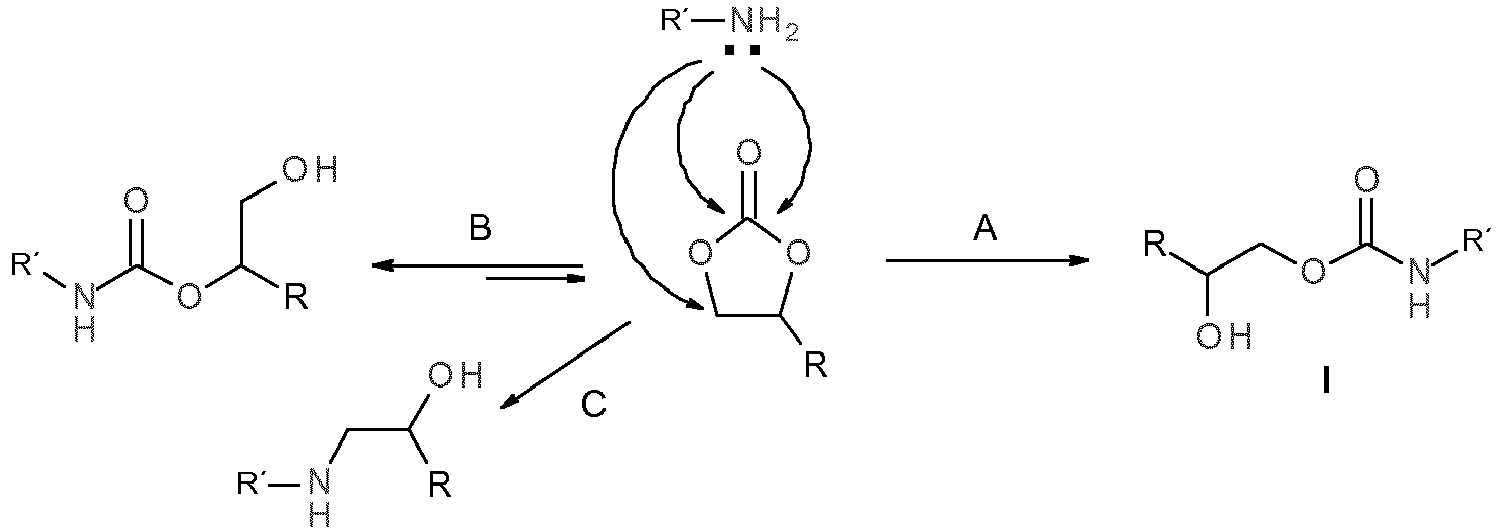
- Disadvantages of the systems based on glycerol carbonate are the low regioselectivity, which leads to reaction pathways A, B and C, the comparatively low reactivity of the systems at room temperature, and the fact that catalysts which increase the rate of the ring opening obviously also promote the back-reaction, which can lead to a partial decomposition of the products already formed.
- In the aforementioned
EP 2397474 A1 , these problems have been partially solved by using an ester group instead of an ether group in R. This electron-withdrawing group led to a considerable increase in the rate of the reaction and to a preference for reaction pathway A. In the case of the secondary hydroxyurethanes [I] formed, no back-reaction was observed. However, the production of binders which comprise two or more 2-oxo-1,3-dioxolane-4-carboxyl groups in the molecule is difficult since this takes place via a transesterification, during which the cyclocarbonate ring can also be attacked. - The aforementioned
US 2010/0317838 A1 gives the impression that this ring opening reaction is independent of the nature of R (cf. claim 17 ofUS 2010/0317838 A1 which is directed to the ring opening of compounds of claim 1 which may contain ester groups or amide groups alike). However, this impression is quite misleading. - Firstly, studies have been carried out (cf. H. Tomita, F. Sanda, T. Endo, Journal of Polymer Science: Part A: Polymer Chemistry, Vol. 39, 3678-3685 (2001)) according to which the reactivity of the 2-oxo-1,3-dioxolanes, which are substituted in 4-position with the group R, with amines increases in the order: R = Me < R = H < R = Ph < R = CH2OPh « R = CF3.
- Secondly, in the case of the products of the aforementioned
EP 2397474 A1 where the polymeric main chain is attached through ester bonds, i.e. R in the formula scheme below means the polymeric main chain, the ring opening (hardening) reaction is accompanied by a certain amount of aminolysis of the ester bond leading to the detachment of the main chain in the form of an unreactive alcohol.
- In the case of the amides as disclosed in
PCT/EP2012/072589 
- This is a clear advantage of the -4-carboxamides over the -4-carboxylic esters. However, the -4-carboxamide derivatives in the aforementioned
PCT/EP 2012/072589 
- It was the object of the present invention to essentially avoid at least some of the disadvantages of the prior art described above. In general terms, the aim was to provide an alternative 2-oxo-1,3-dioxolane system with an electron-withdrawing group. In particular, the aim was to provide a 2-oxo-1,3-dioxolane system which is toxicologically acceptable, readily accessible and possesses higher reactivity towards alcohols and amines so that the aforementioned -4-carboxamides and -4-carboxylic esters could be easily synthesized.
- This object has been achieved with the features of the independent claims. The dependent claims relate to preferred embodiments.
- The present invention provides a 2-oxo-1,3-dioxolane-4-acyl halide of formula (I),

- Moreover, in formula (I) the atoms 4 and/or 5 of the dioxolane ring can be substituted with a total of one, two or three independently selected straight-chain, branched or cyclic C1-12-alkyl groups, C6-10-aryl groups, C6-12-aralkyl groups and C6-12-alkaryl groups.
- The present invention also provides a process for the preparation of a 2-oxo-1,3-dioxolane-4-acyl halide as defined hereinabove, wherein 2-oxo-1,3-dioxolane-4-carboxylic acid of formula (X)

- The said halogenation reaction is preferably carried out without a solvent at an elevated temperature. In particular, the halogenation is preferably carried out at about 60 °C in the presence of dimethylformamide as a catalyst.
- The key intermediate in the above halogenation reaction is 2-oxo-1,3-dioxolane-4-carboxylic acid, the synthesis whereof being described in the aforementioned
PCT/EP2012/ 072589 - Moreover, the present invention also provides for the use of a 2-oxo-1,3-dioxolane-4-acyl halide of the invention for the preparation of a 2-oxo-1,3-dioxolane-4-carboxylic ester of formula (II),

- The present invention also provides for the use of a 2-oxo-1,3-dioxolane-4-acyl halide of the invention for the preparation of a 2-oxo-1,3-dioxolane-4-carboxamide of formula (III),

- Finally, the present invention provides for the use of use of a 2-oxo-1,3-dioxolane-4-acyl halide of the invention as an agent for the blocking of amines, i.e. as an end group (so-called "end cap"). This is also of interest with regard to conventional, amine-crosslinked polyurethane systems since an amine excess can lead to discolorations, while an isocyanate excess is toxicologically unacceptable.
- The present invention is now illustrated in more detail by reference to the examples hereinbelow.
-

- 73 g (0.5 mol) of 4-methoxycarbonyl-2-oxo-1,3-dioxolane (
EP 2397474 A1 ) was heated under reflux for 3 hours with 11 g (0.55 mol) of water and 48 g (0.8 mol) of acetic acid. The mixture was then added to cyclohexane, the separated-off oil was carefully freed from all volatile constituents and the residue was ground with methylene chloride until a colourless crystalline precipitate had formed. The precipitate was washed with diethyl ether and dried in vacuo. This gave 2-oxo-1,3-dioxolane-4-carboxylic acid. m.p.: 119-121°C. 1H-NMR (CDCl3/DMSO-d6 (1/0.1 [mol/mol])): 9.486 (broad, s; 1 H); 5.012 (dd; 1 H); 4.637 (t; 1 H); 4.506 (dd; 1H).13C-NMR (CDCl3/DMSO-d6 (1/0.1 [mol/ mol])): 168.425 (CO acid); 153.348 (CO cyclocarbonate); 72.247 (CH-COOH); 66.988 (CH2CH-COOH). IR (v [cm-1]): 2977 bs (OH acid), 2751 bw, 2658 bw, 2621 bw, 2538 bw, 2407 bw, 1785 bm (CO cyclocarbonate), 1793 bs (CO acid), 1546 w, 1481 w, 1431 w, 1399 s, 1345 w, 1325 w, 128 m, 1196 s, 1087 s, 1074 s, 1039 m, 928 w, 832 s, 769 s, 724 m, 699 s, 650 m, 633 s, 525 s. -

- (Procedure analogous to JOC 2003; 68; pages 4999 ff.) 118.1 g (1 mol) of glycerol carbonate, 168 g (2 mol) of sodium hydrogencarbonate, 232 g (1 mol) of trichloroisocyanuric acid, 18 g (1 mol) of water, 1.5 g (0.01 mol) of TEMPO (2,2,6,6-tetramethylpiperidin-1-oxyl) and 5 g (0.05 mol) of NaBr were introduced in 1.5 I of acetone at 0°C with stirring. The mixture was left to warm to room temperature and stirred for a further 12 hours, after which it was filtered off. The filtrate was concentrated by evaporation. The resulting oil was heated at reflux with chloroform. This gave 2-oxo-1,3-dioxolane-4-carboxylic acid in 97% yield.
-

- In a dry schlenk tube under an atmosphere of dry N2, 2.5 g (0.019 mol) of 2-oxo-1,3-dioxolane-4-carboxylic acid, 2.5 g (0.021 mol) of freshly distilled thionyl chloride and 0.115 ml of dimethylformamide were heated to 50°C until the formation of a clear solution. The reaction mixture was heated to 60°C for 2h. After DMF and the excess of thionyl chlorid were removed in vacuo, 2-oxo-1,3-dioxolane-4-acyl chloride was obtained as a colorless liquid in quantitative yield.
- 1H-NMR (400 MHz, DMSO-d6): δ = 5.27 (dd, 1 H, CH2), 4.71 (t, 1 H, CH), 4.52 (dd, 1 H, CH2') ppm; 13C-NMR (100 MHz, DMSO-d6): δ = 169.5 (C=O), 154.7 (OC(=O)O), 72.9 (CH), 67.7 (CH2) ppm; IR (v, cm-1): 2976 (bw, COOH), 1802 (s, cyclocarbonate), 1668 (w), 1529 (w), 1480 (w), 1385 (m), 1310 (w), 1210 (w), 1147 (s), 1104 (m), 1060 (s), 921 (s), 882 (s), 760 (s), 699 (s), 640 (w), 560 (m), 526 (m); GC-MS (EtAc, RT: 8.73 min): m/z= 86.99 [Cyclocarbonate]+, 62.93 [CCIO]+.
-

- In a dry schlenk tube under an atmosphere of dry N2, to 2.86 g (0.019 mol) of 2-oxo-1,3-dioxolane acyl chloride was carefully added 0.73 g (0.023 mol) of methanol. During the exothermic reaction the evolution of HCI-gas was observed. The reaction was cooled to RT using a cold water bath, the excess of MeOH was removed in vacuo and 2-oxo-1,3-dioxolane carboxylic acid methyl ester was obtained in quantitative yield. The analytical data agree with known data of 2-oxo-1,3-dioxolane carboxylic acid methyl ether.
-

- In a dry schlenk flask under an atmosphere of dry N2, 2.86 g (0.019 mol) 2-oxo-1,3-dioxolane carbonyl chloride was diluted with 20 ml abs. THF and cooled to 0-4°C using an ice bath. In a dropping funnel 0.019 mol n-butylamine and 2.31 g (0.019 mol) triethylamine were mixed and diluted with 10 ml abs. THF. This mixture was carefully added to the acid chloride at 0-4°C. Immediately a white precipitate of Et3NCl formed. The reaction mixture was stirred at 0-4°C for 1 h and additional 12 h at RT. The precipitate was filtered off and the solvent was removed in vacuo. N-n-butyl-2-oxo-1,3-dioxolane-4-carboxamide was obtained as a brownish oil in 96% yield. Analytic data agree with known data of N-n-butyl-2-oxo-1,3-dioxolane-4-carboxamide prepared from 2-oxo-1,3-dioxolane carboxylic acid and n-butylisocyanate.
-

- In a dry schlenk flask under an atmosphere of dry N2, 2.86 g (0.019 mol) 2-oxo-1,3-dioxolane-4-carbonyl chloride was diluted with 10 ml abs. THF and cooled to 0-4°C using an ice bath. In a dropping funnel 1.88 g cyclohexylamine (0.019 mol) and 2.31 g (0.019 mol) triethylamine were mixed and diluted with 20 ml abs. THF. This mixture was carefully added to the acid chloride at 0-4°C. Immediately a white precipitate of Et3NCl formed. The reaction mixture was stirred at 0-4°C for 1 h and additional 12 h at RT. The precipitate was filtered off and the solvent was removed in vacuo. N-cyclohexyl-2-oxo-1,3-dioxolane-4-carboxamide was obtained as a beige powder in 94% yield. The analytical data agree with known data of N-cyclohexyl-2-oxo-1,3-dioxolane-4-carboxamide prepared from 2-oxo-1,3-dioxolane-4-carboxylic acid and cyclohexyl-isocyanate.
-

- In a dry schlenk flask under an atmosphere of dry N2, 30.10 g (0.2 mol) 2-oxo-1,3-dioxolane carbonyl chloride ("CYCA-chloride") was diluted with 70 ml abs. THF and cooled to 0-4°C using an ice bath. In a dropping funnel 29.33 g polyetheramine T 403 (BASF SE, 0.2 mol) and 24.29 g (0.24 mol) triethylamine were mixed and diluted with 40 ml abs. THF. This mixture was carefully added to the acid chloride at 0-4°C. Immediately a white precipitate of Et3NCl formed. The reaction mixture was stirred at 0-4°C for 1 h and additional 12 h at RT. The precipitate was filtered off and the solvent was removed in vacuo. The trifunctional product was obtained as a red-brown oil in almost quantitative yield.
- IR (v, cm-1): 3311 (bw), 3082 (w), 2972 (w), 2932 (w), 2874 (w), 1811 (s, cyclocarbonate), 1666 (s), 1541 (m), 1456 (m), 1385 (m), 1378 (m), 1255 (w), 1153 (s), 1080 (s), 1060 (s), 922 (w), 840 (w), 768 (m), 730 (w), 661 (w).
- The procedure was analogously carried out with Polyetheramine T 5000 (BASF SE) or Jeffamine T 3000 (Huntsman). The properties are summarized in Table 1 hereinbelow:
Table 1: Amount [g] Amount [mol] Properties CYCA-chloride 30.10 0.2 - T 403 29.33 0.2 Red-brown viscous liquid, 2.650.000 mPas, Meq= 261 g/mol T 3000 200.00 0.2 Red-brown liquid, 10.500 mPas, Meq= 1115 g/mol T 5000 333.33 0.2 Red-brow liquid, 6.000 mPas, Meq= 1800 g/mol NEt3 24.29 0.24 - - The resulting products were subsequently cured with different amines to give stable hydroxypolyurethane films. The results are summarized in Table 2 hereinbelow:
Table 2: Binder Amine T403-CYCA T3000-CYCA T5000-CYCA Lupasol FG (BASF SE) Cured, tack-free IPDA Cured, tack-free, brittle Not completely cured, tacky T 403 (Huntsman) Cured, tack-free, σM= 0.86 mPas, εM= 78 % Cured, elastic Not completely cured, tacky - Cyclocarbonate-functional binders were also prepared from 2-oxo-1,3-dioxolane-4-carbonyl chloride using triols (such as Lupranol 1301 or 2048, BASF SE) instead of triamines:

- In a dry schlenk flask under an atmosphere of dry N2, 10.00 g (0.07 mol) 2-oxo-1,3-dioxolane-4-acyl chloride were diluted with 200 ml abs. THF and cooled to 0-4°C using an ice bath. In a dropping funnel 88.18 g Lupranol 2048 (BASF SE, 0.07 mol) and 8.00 g (0.08 mol) triethylamine were mixed and diluted with 50 ml abs. THF. This mixture was carefully added to the acid chloride at 0-4°C. Immediately a white precipitate of Et3NCl formed. The reaction mixture was stirred at 0-4°C for 1 h and additional 12 h at RT. The precipitate was filtered off and the solvent was removed in vacuo. The trifunctional product was obtained as a red-brown oil in almost quantitative yield. (Lupranol 1301 can be used analogously.)
- IR (v, cm-1): 2865 (s), 1821 (s, cyclocarbonate), 1752 (m), 1455 (m), 1373 (m), 1349 (m), 1296 (m), 1248 (m), 1090 (vs), 1060 (s), 949 (m), 846 (w), 768 (w).
- The resulting products were subsequently cured with different amines to give hydroxypolyurethane films. The results are summarized in Table 3 hereinbelow:
Table 3: Binder Amine 2048-CYCA (Meq= 255 g/mol) Lupasol FG(BASF SE) Not completely cured IPDA Not completely cured T 403 (Huntsman) Not completely cured - Due to the lower stability of the ester groups in comparison to the amide groups in the triamine-based products, a poorer curing behavior is observed and less stable films are obtained.
Claims (12)
- 2-Oxo-1,3-dioxolane-4-acyl halide of formula (I),

- 2-Oxo-1,3-dioxolane-4-acyl halide according to Claim 1, wherein X is Cl.
- 2-Oxo-1,3-dioxolane-4-acyl halide according to Claim 1 or 2, wherein atoms 4 and/or 5 of the dioxolane ring are substituted with a total of one, two or three independently selected straight-chain, branched or cyclic C1-12-alkyl groups, C6-10-aryl groups, C6-12-aralkyl groups and C6-12-alkaryl groups.
- A process for the preparation of a 2-oxo-1,3-dioxolane-4-acyl halide as defined in one of Claims 1 to 3, wherein 2-oxo-1,3-dioxolane-4-carboxylic acid of formula (X)

- The process according to Claim 4, wherein the halogenation agent is SOCl2.
- The process according to Claim 5, characterized in that the reaction is carried out without a solvent at an elevated temperature.
- The process according to Claim 6, characterized in that the halogenation is carried out at about 60 °C in the presence of dimethylformamide as a catalyst.
- Use of a 2-oxo-1,3-dioxolane-4-acyl halide as defined in one of Claims 1 to 3, for the preparation of a 2-oxo-1,3-dioxolane-4-carboxylic ester of formula (II),

- Use according to Claim 8, wherein R1 is a radical having a valency of 2 to 6, which is substituted with 1 to 5 further 2-oxo-1,3-dioxolane-4-carboxylic ester groups.
- Use of a 2-oxo-1,3-dioxolane-4-acyl halide as defined in one of Claims 1 to 3, for the preparation of a 2-oxo-1,3-dioxolane-4-carboxamide of formula (III),

- Use according to Claim 10, wherein R2 is a radical having a valency of 2 to 6, which is substituted with 1 to 5 further 2-oxo-1,3-dioxolane-4-carboxamide groups.
- Use of a 2-oxo-1,3-dioxolane-4-acyl halide as defined in one of Claims 1 to 3, as an agent for the blocking of amines.
Priority Applications (8)
| Application Number | Priority Date | Filing Date | Title |
|---|---|---|---|
| EP13173801.5A EP2818465A1 (en) | 2013-06-26 | 2013-06-26 | 2-Oxo-1,3-dioxolane-4-acyl halides, their preparation and use |
| AU2014301613A AU2014301613B2 (en) | 2013-06-26 | 2014-05-15 | 2-oxo-1,3-dioxolane-4-acyl halides, their preparation and use |
| CN201480031330.5A CN105283448B (en) | 2013-06-26 | 2014-05-15 | 2- oxo -1,3- dioxolanes -4- acyl halides, it is prepared and purposes |
| PCT/EP2014/059973 WO2014206636A1 (en) | 2013-06-26 | 2014-05-15 | 2-oxo-1,3-dioxolane-4-acyl halides, their preparation and use |
| US14/899,638 US9643948B2 (en) | 2013-06-26 | 2014-05-15 | 2-oxo-1,3-dioxolane-4-acyl halides, their preparation and use |
| EP14725112.8A EP3013811B1 (en) | 2013-06-26 | 2014-05-15 | 2-oxo-1,3-dioxolane-4-acyl halides, their preparation and use |
| ES14725112.8T ES2643440T3 (en) | 2013-06-26 | 2014-05-15 | Halides of 2-oxo-1,3-dioxolane-4-acyl, their preparation and use |
| JP2016522353A JP6545159B2 (en) | 2013-06-26 | 2014-05-15 | 2-oxo-1,3-dioxolane-4-acyl halides, their preparation and use |
Applications Claiming Priority (1)
| Application Number | Priority Date | Filing Date | Title |
|---|---|---|---|
| EP13173801.5A EP2818465A1 (en) | 2013-06-26 | 2013-06-26 | 2-Oxo-1,3-dioxolane-4-acyl halides, their preparation and use |
Publications (1)
| Publication Number | Publication Date |
|---|---|
| EP2818465A1 true EP2818465A1 (en) | 2014-12-31 |
Family
ID=48670455
Family Applications (2)
| Application Number | Title | Priority Date | Filing Date |
|---|---|---|---|
| EP13173801.5A Withdrawn EP2818465A1 (en) | 2013-06-26 | 2013-06-26 | 2-Oxo-1,3-dioxolane-4-acyl halides, their preparation and use |
| EP14725112.8A Active EP3013811B1 (en) | 2013-06-26 | 2014-05-15 | 2-oxo-1,3-dioxolane-4-acyl halides, their preparation and use |
Family Applications After (1)
| Application Number | Title | Priority Date | Filing Date |
|---|---|---|---|
| EP14725112.8A Active EP3013811B1 (en) | 2013-06-26 | 2014-05-15 | 2-oxo-1,3-dioxolane-4-acyl halides, their preparation and use |
Country Status (7)
| Country | Link |
|---|---|
| US (1) | US9643948B2 (en) |
| EP (2) | EP2818465A1 (en) |
| JP (1) | JP6545159B2 (en) |
| CN (1) | CN105283448B (en) |
| AU (1) | AU2014301613B2 (en) |
| ES (1) | ES2643440T3 (en) |
| WO (1) | WO2014206636A1 (en) |
Families Citing this family (7)
| Publication number | Priority date | Publication date | Assignee | Title |
|---|---|---|---|---|
| CN107922569B (en) | 2015-08-10 | 2021-02-12 | 建筑研究和技术有限公司 | Process for producing ring-opening polymerization product |
| US20170078806A1 (en) * | 2015-09-14 | 2017-03-16 | Bitwave Pte Ltd | Sound level control for hearing assistive devices |
| US11613681B2 (en) | 2016-06-03 | 2023-03-28 | Basf Se | Use of compounds having n 2-oxo-1,3-dioxolane-4-carboxamide units in two-component adhesives |
| FR3055900B1 (en) | 2016-09-15 | 2018-08-31 | Bostik Sa | HYDROCARBON POLYMERS WITH TWO TERMINAL GROUPS 2-OXO-1,3-DIOXOLAN-4-CARBOXYLATE |
| FR3071501A1 (en) | 2017-09-28 | 2019-03-29 | Bostik Sa | LIQUID HYDROCARBON COPOLYMERS WITH TWO TERMINAL GROUPS ETHER CYCLOCARBONATE |
| FR3088326B1 (en) * | 2018-11-09 | 2021-12-03 | Bostik Sa | FUNCTIONALIZED HYDROXYSILANES, SILYLATED POLYURETHANES, AND COMPOSITIONS CONTAINING THEM |
| US11897861B2 (en) | 2019-01-18 | 2024-02-13 | Basf Se | Method for the preparation of compounds with cyclic monothiocarbonate groups |
Citations (7)
| Publication number | Priority date | Publication date | Assignee | Title |
|---|---|---|---|---|
| EP0001088A1 (en) | 1977-09-05 | 1979-03-21 | BASF Aktiengesellschaft | Polymers containing carbonate groups |
| WO2004003001A1 (en) | 2002-06-28 | 2004-01-08 | Altus Biologics Inc. | Process for the enzymatic resolution of 1,3-dioxolane-4-carboxylates |
| JP2006003433A (en) | 2004-06-15 | 2006-01-05 | Sekisui Chem Co Ltd | Sealant for liquid crystal display element, vertical conduction material, and liquid crystal display element |
| EP1932840A1 (en) * | 2005-10-03 | 2008-06-18 | Ono Pharmaceutical Co., Ltd. | Nitrogen-containing heterocyclic compound and pharmaceutical application thereof |
| EP1941946A1 (en) | 2007-01-04 | 2008-07-09 | Max-Planck-Gesellschaft zur Förderung der Wissenschaften e.V. | Carbonitrides as catalysts |
| US20100317838A1 (en) | 2009-06-12 | 2010-12-16 | International Business Machines Corporation | Cyclic carbonyl monomers functionalized with carbohydrates, polymers derived therefrom, and methods of preparation thereof |
| EP2397474A1 (en) | 2010-06-17 | 2011-12-21 | Construction Research & Technology GmbH | 2-Oxo-1,3-dioxolan-4-carbolic acid esters, production and use of same |
Family Cites Families (10)
| Publication number | Priority date | Publication date | Assignee | Title |
|---|---|---|---|---|
| JP3586881B2 (en) | 1994-04-19 | 2004-11-10 | 三菱化学株式会社 | Dioxolane-containing solvent |
| US6190850B1 (en) * | 1999-12-28 | 2001-02-20 | Eastman Kodak Company | Photographic element, compound, and process |
| KR20060013632A (en) * | 2002-05-17 | 2006-02-13 | 오쎄라 파마슈티걸즈, 인크. | Improve the development of cataracts and other eye diseases |
| US6689551B1 (en) * | 2002-12-18 | 2004-02-10 | Eastman Kodak Company | Photographic element, compound, and process |
| JP2006009001A (en) * | 2004-05-26 | 2006-01-12 | Japan Paint Manufacturers Association | Method for producing polyhydroxyurethane |
| EP1941948A1 (en) | 2006-12-13 | 2008-07-09 | Hamilton Bonaduz AG | Device for receiving pipette tips |
| US8742137B2 (en) | 2010-06-17 | 2014-06-03 | Construction Research & Technology Gmbh | 2-oxo-1, 3-dioxolane-4-carboxylic acid and derivatives thereof, their preparation and use |
| JP2012013834A (en) * | 2010-06-30 | 2012-01-19 | Fujifilm Corp | Actinic ray sensitive or radiation sensitive resin composition and pattern forming method using the same |
| JP6072067B2 (en) | 2011-12-22 | 2017-02-01 | コンストラクション リサーチ アンド テクノロジー ゲーエムベーハーConstruction Research & Technology GmbH | 2-oxo-1,3-dioxolane-4-carboxamide, process for its preparation and use |
| EP2762471A1 (en) | 2013-01-31 | 2014-08-06 | Construction Research & Technology GmbH | 2-oxo-1,3-dioxolane-4-carboxamide building blocks, their preparation and use |
-
2013
- 2013-06-26 EP EP13173801.5A patent/EP2818465A1/en not_active Withdrawn
-
2014
- 2014-05-15 CN CN201480031330.5A patent/CN105283448B/en active Active
- 2014-05-15 EP EP14725112.8A patent/EP3013811B1/en active Active
- 2014-05-15 AU AU2014301613A patent/AU2014301613B2/en not_active Ceased
- 2014-05-15 US US14/899,638 patent/US9643948B2/en not_active Expired - Fee Related
- 2014-05-15 ES ES14725112.8T patent/ES2643440T3/en active Active
- 2014-05-15 WO PCT/EP2014/059973 patent/WO2014206636A1/en not_active Ceased
- 2014-05-15 JP JP2016522353A patent/JP6545159B2/en not_active Expired - Fee Related
Patent Citations (7)
| Publication number | Priority date | Publication date | Assignee | Title |
|---|---|---|---|---|
| EP0001088A1 (en) | 1977-09-05 | 1979-03-21 | BASF Aktiengesellschaft | Polymers containing carbonate groups |
| WO2004003001A1 (en) | 2002-06-28 | 2004-01-08 | Altus Biologics Inc. | Process for the enzymatic resolution of 1,3-dioxolane-4-carboxylates |
| JP2006003433A (en) | 2004-06-15 | 2006-01-05 | Sekisui Chem Co Ltd | Sealant for liquid crystal display element, vertical conduction material, and liquid crystal display element |
| EP1932840A1 (en) * | 2005-10-03 | 2008-06-18 | Ono Pharmaceutical Co., Ltd. | Nitrogen-containing heterocyclic compound and pharmaceutical application thereof |
| EP1941946A1 (en) | 2007-01-04 | 2008-07-09 | Max-Planck-Gesellschaft zur Förderung der Wissenschaften e.V. | Carbonitrides as catalysts |
| US20100317838A1 (en) | 2009-06-12 | 2010-12-16 | International Business Machines Corporation | Cyclic carbonyl monomers functionalized with carbohydrates, polymers derived therefrom, and methods of preparation thereof |
| EP2397474A1 (en) | 2010-06-17 | 2011-12-21 | Construction Research & Technology GmbH | 2-Oxo-1,3-dioxolan-4-carbolic acid esters, production and use of same |
Non-Patent Citations (2)
| Title |
|---|
| H. TOMITA; F. SANDA; T. ENDO, JOURNAL OF PO- LYMER SCIENCE: PART A: POLYMER CHEMISTRY, vol. 39, 2001, pages 3678 - 3685 |
| LEWIS M D ET AL: "Synthesis of L-660,631 methyl ester and related compounds", TETRAHEDRON LETTERS, PERGAMON, vol. 29, no. 19, 1 January 1988 (1988-01-01), pages 2279 - 2282, XP022581010, ISSN: 0040-4039, [retrieved on 19880101], DOI: 10.1016/S0040-4039(00)86037-2 * |
Also Published As
| Publication number | Publication date |
|---|---|
| CN105283448B (en) | 2018-08-10 |
| EP3013811A1 (en) | 2016-05-04 |
| AU2014301613A1 (en) | 2016-01-07 |
| CN105283448A (en) | 2016-01-27 |
| EP3013811B1 (en) | 2017-07-12 |
| US9643948B2 (en) | 2017-05-09 |
| WO2014206636A1 (en) | 2014-12-31 |
| ES2643440T3 (en) | 2017-11-22 |
| AU2014301613B2 (en) | 2017-12-14 |
| US20160145232A1 (en) | 2016-05-26 |
| JP6545159B2 (en) | 2019-07-17 |
| JP2016525083A (en) | 2016-08-22 |
Similar Documents
| Publication | Publication Date | Title |
|---|---|---|
| EP3013811B1 (en) | 2-oxo-1,3-dioxolane-4-acyl halides, their preparation and use | |
| EP2794585B1 (en) | 2-oxo-1,3-dioxolane-4-carboxamides, their preparation and use | |
| EP2951166B1 (en) | 2-oxo-1,3-dioxolane-4-carboxamide building blocks, their preparation and use | |
| EP3909962A1 (en) | Method of producing l-glufosinate | |
| KR102132087B1 (en) | Method for preparing azoxystrobin | |
| JP2013528200A (en) | Method for preparing ester amide compounds | |
| KR101764476B1 (en) | Method for producing polyalkylene glycol derivative with narrow molecular weight distribution, and acetal group-containing alcohol compound for use therein and alkali metal salt thereof | |
| EP2797908B1 (en) | Preparing cyclocarbonate-functionalized compounds | |
| KR20230046122A (en) | Methods for manufacturing a n-acyl derivative with high purity | |
| JP6992976B2 (en) | Method for Producing Trimethylene Carbonate Derivative | |
| JP4991184B2 (en) | Method for producing alkylimidazole | |
| JP2010105921A (en) | Method of producing bicyclic compound | |
| CN102731426A (en) | One-pot synthesis method for four-membered ring of thiourea and synthesized four-membered thiourea compound | |
| DE19835747A1 (en) | Production of alpha-(hetero)aryloxy (cyclo)alkanol derivatives useful as herbicide intermediates by reacting oxirane derivatives with hydroxy(hetero)arenes at atmospheric pressure without diluent |
Legal Events
| Date | Code | Title | Description |
|---|---|---|---|
| PUAI | Public reference made under article 153(3) epc to a published international application that has entered the european phase |
Free format text: ORIGINAL CODE: 0009012 |
|
| 17P | Request for examination filed |
Effective date: 20130626 |
|
| AK | Designated contracting states |
Kind code of ref document: A1 Designated state(s): AL AT BE BG CH CY CZ DE DK EE ES FI FR GB GR HR HU IE IS IT LI LT LU LV MC MK MT NL NO PL PT RO RS SE SI SK SM TR |
|
| AX | Request for extension of the european patent |
Extension state: BA ME |
|
| STAA | Information on the status of an ep patent application or granted ep patent |
Free format text: STATUS: THE APPLICATION IS DEEMED TO BE WITHDRAWN |
|
| 18D | Application deemed to be withdrawn |
Effective date: 20150701 |