EP2816832A1 - Heterogeneous network - Google Patents
Heterogeneous network Download PDFInfo
- Publication number
- EP2816832A1 EP2816832A1 EP13305843.8A EP13305843A EP2816832A1 EP 2816832 A1 EP2816832 A1 EP 2816832A1 EP 13305843 A EP13305843 A EP 13305843A EP 2816832 A1 EP2816832 A1 EP 2816832A1
- Authority
- EP
- European Patent Office
- Prior art keywords
- base station
- user equipment
- cell base
- small cell
- macro
- Prior art date
- Legal status (The legal status is an assumption and is not a legal conclusion. Google has not performed a legal analysis and makes no representation as to the accuracy of the status listed.)
- Granted
Links
- 238000004891 communication Methods 0.000 claims abstract description 128
- 238000000034 method Methods 0.000 claims abstract description 58
- 238000004590 computer program Methods 0.000 claims abstract description 7
- 238000004364 calculation method Methods 0.000 claims description 8
- 238000004088 simulation Methods 0.000 description 20
- UEUIKXVPXLWUDU-UHFFFAOYSA-N 4-diazoniobenzenesulfonate Chemical compound [O-]S(=O)(=O)C1=CC=C([N+]#N)C=C1 UEUIKXVPXLWUDU-UHFFFAOYSA-N 0.000 description 9
- 230000000116 mitigating effect Effects 0.000 description 8
- 230000006870 function Effects 0.000 description 7
- 238000010187 selection method Methods 0.000 description 6
- 238000013459 approach Methods 0.000 description 5
- 230000005540 biological transmission Effects 0.000 description 5
- 238000004422 calculation algorithm Methods 0.000 description 5
- 241001522296 Erithacus rubecula Species 0.000 description 4
- 230000008859 change Effects 0.000 description 4
- 230000007246 mechanism Effects 0.000 description 4
- 230000008901 benefit Effects 0.000 description 3
- 230000001186 cumulative effect Effects 0.000 description 3
- 238000010586 diagram Methods 0.000 description 3
- 238000005315 distribution function Methods 0.000 description 3
- 230000006872 improvement Effects 0.000 description 3
- 238000005259 measurement Methods 0.000 description 3
- 230000003044 adaptive effect Effects 0.000 description 2
- 238000013500 data storage Methods 0.000 description 2
- 230000007423 decrease Effects 0.000 description 2
- 230000001419 dependent effect Effects 0.000 description 2
- 230000001965 increasing effect Effects 0.000 description 2
- 230000015654 memory Effects 0.000 description 2
- 238000010295 mobile communication Methods 0.000 description 2
- FGUUSXIOTUKUDN-IBGZPJMESA-N C1(=CC=CC=C1)N1C2=C(NC([C@H](C1)NC=1OC(=NN=1)C1=CC=CC=C1)=O)C=CC=C2 Chemical compound C1(=CC=CC=C1)N1C2=C(NC([C@H](C1)NC=1OC(=NN=1)C1=CC=CC=C1)=O)C=CC=C2 FGUUSXIOTUKUDN-IBGZPJMESA-N 0.000 description 1
- 230000009286 beneficial effect Effects 0.000 description 1
- 230000010261 cell growth Effects 0.000 description 1
- 230000003247 decreasing effect Effects 0.000 description 1
- 238000009795 derivation Methods 0.000 description 1
- 230000000694 effects Effects 0.000 description 1
- 230000002708 enhancing effect Effects 0.000 description 1
- 230000003993 interaction Effects 0.000 description 1
- 150000002500 ions Chemical class 0.000 description 1
- 230000007774 longterm Effects 0.000 description 1
- 238000013507 mapping Methods 0.000 description 1
- 230000008569 process Effects 0.000 description 1
- 239000007787 solid Substances 0.000 description 1
- 230000007704 transition Effects 0.000 description 1
Images




Classifications
-
- H—ELECTRICITY
- H04—ELECTRIC COMMUNICATION TECHNIQUE
- H04W—WIRELESS COMMUNICATION NETWORKS
- H04W16/00—Network planning, e.g. coverage or traffic planning tools; Network deployment, e.g. resource partitioning or cells structures
- H04W16/02—Resource partitioning among network components, e.g. reuse partitioning
- H04W16/06—Hybrid resource partitioning, e.g. channel borrowing
-
- H—ELECTRICITY
- H04—ELECTRIC COMMUNICATION TECHNIQUE
- H04W—WIRELESS COMMUNICATION NETWORKS
- H04W16/00—Network planning, e.g. coverage or traffic planning tools; Network deployment, e.g. resource partitioning or cells structures
- H04W16/24—Cell structures
- H04W16/32—Hierarchical cell structures
Definitions
- the present invention relates to a method of controlling operation of a heterogeneous wireless communication network, a computer program product and network control node operable to perform that method. Also provided is a method of scheduling resource at a small cell base station in a heterogeneous wireless communication network, a computer program product and scheduling control unit operable to perform that method.
- Wireless telecommunication systems are known.
- mobile communication devices for example, mobile telephones
- base stations provided by network providers.
- radio coverage is provided to network connectable devices, such as mobile telephones, or wireless devices such as iPads or other similar tablets, within areas known as cells.
- Abase station is located in each cell to provide radio coverage.
- network connectable devices in each cell are operable to receive information and data from a base station and to transmit information and data to a base station.
- Base stations are typically provided which support areas of radio coverage. A number of such base stations are provided and are distributed geographically in order to provide a wide area of coverage to user equipment.
- Each base station When user equipment is within an area served by a base station, communications may be established between the user equipment and the base station over associated radio links.
- Each base station typically supports a number of sectors within the geographical area of service. Typically, a different antenna within a base station supports each associated sector. Each base station has multiple antennas.
- Traditional base stations provide coverage in relatively large geographical areas and those cells are often referred to as macro cells. It is possible to provide a heterogeneous network (hetnet) where smaller sized cells are provided within macro cells. Such smaller sized cells are sometimes referred to as micro cells, pico cells or femto cells.
- Hetnet heterogeneous network
- One way to establish a small cell is to provide a small cell base station that provides coverage having a relatively limited range within the coverage area of the macro cell.
- the transmission power of a small cell base station is relatively low and, hence, each small cell provides a small coverage area compared to that of a macro cell and covers, for example, an office or a home.
- Such small cells operating to use the same frequency band as a macro cell are typically provided where the communications coverage provided by the macro cell is poor or where a user wishes to use an alternative communications link provided locally, by the small cell base station, to communicate with the core network, and/ or to increase capacity within a network.
- a first aspect provides a method of controlling operation of a heterogeneous communication network comprising user equipment, a macro cell base station supporting a macro region of radio coverage and at least one small cell base station supporting a small cell region of radio coverage which overlaps with said macro region of radio coverage, the user equipment being operable to communicate with either of the macrocell base station and the at least one small cell base station and wherein the macrocell is operable to release a proportion of available resource for facilitating communication between the user equipment and the at least one small cell base station; the method comprising: determining which of the user equipment are attached to the macro base station in a first scenario and establishing an indication of the available resource available to user equipment attached to the macro cell base station in the first scenario; determining which of the user equipment are attached to the macro base station in a second scenario in which some of the user equipment have been offloaded to the at least one small cell base station and selecting a proportion of the available resource to release for communication between the offloaded user equipment and the at least one small cell base station such that available resource available to user equipment which remains attached to
- a heterogeneous network where smaller sized cells, typically supported by low power nodes, are provided within macro cells. Such smaller sized cells are sometimes also referred to as micro cells, pico cells or femto cells.
- One way to establish a small cell is to provide a small cell base station that provides coverage having a relatively limited range within the coverage area of the macro cell. The transmission power of a small cell base station is relatively low and, hence, each small cell provides a small coverage area compared to that of a macro cell and covers, for example, an office or a home.
- Such small cells are typically provided where the communications coverage provided by the macro cell is poor or where a user wishes to use an alternative communications link provided locally, by the small cell base station, to communicate with the core network, and/or to increase capacity within a network. That is to say, in a heterogeneous network, small cells supported by "Low Power Nodes" (LPN) can be placed within a macro cell supported by a macro base station to increase the capacity of the network by offloading some user equipment operating within the macro cell to one of the small cells.
- LPN Low Power Nodes
- the DL and UL coverage imbalance can mean that associating user equipment with the cell that provides the strongest downlink received signal strength may not always be the best strategy, since user equipment can tend to connect to a potentially distant high-power macro base station rather than to a nearby low-power small cell base station, thus potentially wasting an opportunity to offer efficient spatial reuse within a network.
- DL RSS downlink received signal strength
- Cell range expansion is one cell selection procedure which maybe implemented in a network to allow, or force, user equipment to connect to nearby small cell nodes.
- a positive range expansion bias can be added to the DL RSSs of a small cell pilot signal to artificially increase the DL coverage footprint provided by such a small cell base station.
- the better spatial reuse and UL interference mitigation offered by cell range expansion comes at the expense of reduced DL signal qualities for user equipment operating in the "Expanded-Region" (ER).
- ER "Expanded-Region”
- Small cell user equipment operating in the expanded region may suffer from low DL Signal-to-Interference-plus-Noise Ratios (SINRs), since they are connected to cells which do not provide the strongest DL RSSs in the expanded region and therefore are more susceptible to suffer from interference.
- SINRs Signal-to-Interference-plus-Noise Ratios
- the interference suffered by expanded region user equipment may be significantly alleviated by using a time domain enhanced Inter-Cell Interference Coordination (eICIC) method based on transmission of so-called "Almost Blank Subframes"(ABSs) by one or more macro cell base stations.
- Almost Blank Subframes are subframes, in which control information, but no user data, is sent. Since ABSs are light on user data, a large degree of DL interference mitigation can be achieved in the control and data regions of user equipment operating in an expanded region of a small cell base station by scheduling those expanded region user equipment within subframes overlapping with the Almost Blank Subframes of a macrocell.
- ABS schemes can be implemented to adapt to different traffic loads and different numbers of small cells in a network, for example, at various geographical locations.
- Adaptive ABS schemes can be implemented in LTE networks and are enabled through X2 backhaul inter-base station coordination.
- a macro base station may be operable to inform one or more small cell base stations operating within its region of radio coverage of the subframes it will use for scheduling Macro UEs (MUEs) and which ones are Almost Blank Subframes.
- MUEs Macro UEs
- the specific ABS pattern to be used can be agreed in conjunction with macro base stations supporting neighboring cells.
- the ABS pattern may be described by a bitmap, where '1' indicates an Almost Blank Subframe and '0' indicates a non- Almost Blank Subframe.
- ABS duty cycle the higher the performance of macro cell user equipment due to resource blanking.
- aspects and embodiments may offer a method of choosing an appropriate ABS duty cycle, that is to say, a means to choose an appropriate ratio of ABS to non-ABS subframes scheduled at the macro cell, that ratio being chosen to take into account overall network performance for a given network.
- the "best" ratio for a given deployment being a result of parameters such as: base station locations, cell-specific range expansion biases, and similar.
- aspects and embodiments may provide a method to compute the number of Almost Blank Subframes that an umbrella macrocell should offer to its overlaid small cells, so that the performance of macro cell user equipment in a scenario with expanded region small cells is substatially the same, or controllably larger than, performance of macro cell user equipment in the same network deployment scenario without expanded region small cells.
- some aspects and embodiments are such that each small cell base station, in each scheduling period, can perform load balanced scheduling such that the performance of the worst small cell users scheduled in subframes that do and do not overlap with the Almost Blank Subframes of the macrocell are equalized.
- the first aspect recognizes that it is possible to provide a method to compute the number of ABSs that an umbrella macrocell should offer to its overlaid small cells, given a specific set of range expanded small cells in a network deployment, such that the performance of the user equipment served by a macro cell in the scenario where users have been offloaded to small cells is the same or controllably larger than the performance of user equipment served by a macrocell in a scenario in which no range expansion is implemented.
- Aspects and embodiments may offer an improved overall network throughput due to better spatial reuse.
- the second scenario may be one in which small cell base stations are able to offer coverage to user equipment in a network as a result of implementation of a cell expansion region at one or more of said small cell base stations. Accordingly, in the second scenario, although the total number of user equipment operating in the network under consideration may remain constant, the number of macro user equipment is likely to fall as some are offloaded to small cells. It will be appreciated that if no user equipment are offloaded to small cells when comparing the first scenario to the second scenario, then no change to a proportion of resource offered to small cells to support offloaded user equipment may be required.
- the released proportion of available resource comprises almost blank subframes transmitted by the macro base station, thereby releasing those subframes for use by the at least one small cell base station.
- the method may be such that it provides a means to compute the number of ABSs that an umbrella macrocell should offer to its overlaid small cells, given a set of range expanded small cells in a particular network deployment.
- the released proportion of available resource comprises reduced power subframes transmitted by the macro base station, thereby releasing those subframes for use by the at least one small cell base station.
- establishing an indication of the available resource available to user equipment attached to the macro cell base station in the first scenario and available resource available to user equipment which remains attached to the macro cell base station in the second scenario comprises: establishing an indication of available resource to traffic load of the macro cell user equipment. Accordingly, some aspects and embodiments may be used to realise a calculation of an appropriate duty cycle of almost blank subframes which takes into account specific user equipment traffic demands.
- a set of macrocells may be operable to coordinate and select a shared duty cycle and pattern of ABSs according to a group policy, for example, a choice may be made as, for example: the maximum D ABS of all macrocells, or the average D ABS of all macrocells in a group.
- a second aspect provides a computer program product operable, when executed on a computer, to perform the method of the first aspect.
- a third aspect provides a network control node operable to control operation of a heterogeneous communication network comprising user equipment, a macro cell base station supporting a macro region of radio coverage and at least one small cell base station supporting a small cell region of radio coverage which overlaps with the macro region of radio coverage, the user equipment being operable to communicate with either of the macrocell base station and the at least one small cell base station and wherein the macrocell is operable to release a proportion of available resource for facilitating communication between the user equipment and the at least one small cell base station;
- the network control node comprising: determination logic operable to determine which of the user equipment are attached to the macro base station in a first scenario and to establish an indication of the available resource available to user equipment attached to the macro cell base station in the first scenario; the determination logic being further operable to determine which of the user equipment are attached to the macro base station in a second scenario in which some of the user equipment have been offloaded to the at least one small cell base station and selection logic operable to select a proportion of the available resource to release for communication between
- the released proportion of available resource comprises almost blank subframes transmitted by the macro base station, thereby releasing those subframes for use by the at least one small cell base station.
- the released proportion of available resource comprises reduced power subframes transmitted by the macro base station, thereby releasing those subframes for use by the at least one small cell base station.
- establishing an indication of the available resource available to user equipment attached to the macro cell base station in the first scenario and available resource available to user equipment which remains attached to the macro cell base station in the second scenario comprises: establishing an indication of available resource to traffic load of the macro cell user equipment.
- a fourth aspect provides a method of scheduling resource at a small cell base station in a heterogeneous wireless communication network comprising user equipment, a macro cell base station supporting a macro region of radio coverage and at least one small cell base station supporting a small cell region of radio coverage which overlaps with the macro region of radio coverage, the user equipment being operable to communicate with either of the macrocell base station or the at least one small cell base station and wherein the macrocell is operable to release a proportion of available resource for facilitating communication between the user equipment and the at least one small cell base station; the small cell base station being configured to support communication with the user equipment in a first communication mode using all of the available resource or a second communication mode using said released portion of available resource; the method comprising: receiving an indication of signal quality at the user equipment in resource used for the first and second communication modes; associating the user equipment with one of the first or second communication modes such that throughput of a worst user associated with the first communication mode is substantially equivalent to throughput of a worst user associated with the second communication mode; and scheduling resource to the user
- the fourth aspect recognises that in order to make the most of resource offered to a small cell by a macrocell for users in an expansion region, for example, by setting Almost Blank Subframes at the macrocell, which allows those subframes to be offered to small cells, some aspects and embodiments are such that each small cell base station, in each scheduling period, can perform a load balanced scheduling method such that the performance of the worst small cell users scheduled in subframes that do and do not overlap with the Almost Blank Subframes of the macrocell are equalized.
- User equipment load and traffic conditions may change faster than the ability of a network to update the duty cycle of ABS in a given deployment.
- different small cells operating under one umbrella macrocell may have different UE load and traffic in their core or "nominal" coverage region and expanded region of coverage.
- some aspects and embodiments described herein relate to a load balancing mechanism that can operate independently in each small cell.
- the load balancing mechanism may target avoidance of the misuse, be it underutilization or overutilization, of the subframes used by the small cells in their "expansion region". That is to say, those subframes which overlap with the Almost Blank Subframes scheduled at macrocells.
- the method comprises associating user equipment with one of the first or second communication modes such that throughput of a worst user associated with the first communication mode is substantially equivalent to throughput of a worst user associated with the second communication mode by: receiving an indication of signal to interference and noise ratio experienced at user equipment in resource used for the first and second communication modes; creating an initial association with a communication mode for each user equipment based on the received indication; identifying a worst user of each communication mode based on the initial association; estimating a throughput associated with each worst user based on the initial association; calculating how many users should be associated with each of the first communication modes based on the estimated throughput associated with each worst user; and adjusting the initial association until a number of users associated with each of the first and second communication modes corresponds to the calculation.
- the adjusting comprises: adjusting by moving user equipment associated with one communication mode which has a high reported signal to noise and interference ratio in resource associated with the other communication mode to be associated with that other communication mode.
- the first communication mode is associated with a core region of small cell base station radio coverage and the second communication mode is associated with an extension region of small cell base station radio coverage.
- a small cell may choose to implement a scheme which offers a degree of load balancing between so-called core region and expansion region user equipment.
- associating a user with the first communication mode is subject to that user having a wideband signal quality determined to be higher than an out-of-synchronization threshold value. Accordingly, in such an implementation of load balancing, it is important to ensure that offloaded user equipment, for example, from subframes overlapping with ABS to subframes not overlapping with ABS do not suffer from such poor control channel performance that they lose synchronization with the serving small cell.
- associating user equipment with one of the first or second communication modes is performed such that throughput of an average user associated with the first communication mode is substantially equivalent to throughput of an average user associated with the second communication mode.
- associating user equipment with one of the first or second communication modes is performed such that throughput of the median user associated with the first communication mode is substantially equivalent to throughput of the median user associated with the second communication mode.
- a fifth aspect provides a computer program product operable, when executed on a computer, to perform the method of the fourth aspect.
- a sixth aspect provides a scheduling unit operable to schedule resource at a small cell base station in a heterogeneous wireless communication network comprising user equipment, a macro cell base station supporting a macro region of radio coverage and at least one small cell base station supporting a small cell region of radio coverage which overlaps with the macro region of radio coverage, the user equipment being operable to communicate with either of the macrocell base station or the at least one small cell base station and wherein the macrocell is operable to release a proportion of available resource for facilitating communication between the user equipment and the at least one small cell base station; the small cell base station being configured to support communication with the user equipment in a first communication mode using all of the available resource or a second communication mode using the released portion of available resource; the scheduling unit comprising: reception logic operable to receive an indication of signal quality at the user equipment in resource used for the first and second communication modes; association logic operable to associate user equipment with one of the first or second communication modes such that throughput of a worst user associated with the first communication mode is substantially equivalent to throughput of a worst user associated with
- the association logic is operable to associate user equipment with one of the first or second communication modes such that throughput of a worst user associated with the first communication mode is substantially equivalent to throughput of a worst user associated with the second communication mode by: receiving an indication of signal to interference and noise ratio experienced at user equipment in the resource used in the first and second communication modes; creating an initial association for each user equipment based on the received indication; identifying a worst user of each communication mode based on the initial association; estimating a throughput associated with each worst user based on the initial association; calculating how many users should be associated with each of the first and second communication modes based on the estimated throughput associated with each worst user; and adjusting the initial association until a number of users associated with each of the first and second communication modes corresponds to the calculation.
- the adjusting comprises: adjusting by moving user equipment associated with one communication mode which has a high reported signal to noise and interference ratio in resource used in the other communication mode to be associated with that other communication mode.
- the first communication mode is associated with a core region of small cell base station radio coverage and the second communication mode is associated with an extension region of small cell base station radio coverage.
- the association logic is operable to associate a user with the first communication mode subject to that user having a wideband signal quality determined to be higher than an out-of-synchronization threshold value.
- the association logic is operable to associate the user equipment with one of the first or second communication modes such that throughput of an average user associated with the first communication mode is substantially equivalent to throughput of an average user associated with the second communication mode.
- the association logic is operable to associate the user equipment with one of the first or second communication modes such that throughput of the median user associated with said first communication mode is substantially equivalent to throughput of the median user associated with said second communication mdoe.
- Wireless telecommunication systems are known.
- mobile communication devices for example, mobile telephones, are operable to communicate with base stations provided by network providers.
- radio coverage is provided to network connectable devices according to areas known as cells.
- a base station is located in each cell to provide radio coverage.
- user devices in each cell are operable to receive information and data from a base station and to transmit information and data to a base station.
- Base stations are typically provided which support areas of radio coverage. A number of such base stations are provided and are distributed geographically in order to provide a wide area of coverage to user equipment.
- Each base station When user equipment is within an area served by a base station, communications may be established between the user equipment and the base station over associated radio links.
- Each base station typically supports a number of sectors within the geographical area of service. Typically, a different antenna within a base station supports each associated sector. Each base station has multiple antennas.
- Traditional base stations provide coverage in relatively large geographical areas and those cells are often referred to as macro cells. It is possible to provide a heterogeneous network (hetnet) where smaller sized cells, sometimes referred to as low power nodes, are provided within macro cells. Such smaller sized cells are sometimes also referred to as micro cells, pico cells or femto cells.
- Hetnet heterogeneous network
- One way to establish a small cell is to provide a small cell base station that provides coverage having a relatively limited range within the coverage area of the macro cell.
- the transmission power of a small cell base station is relatively low and, hence, each small cell provides a small coverage area compared to that of a macro cell and covers, for example, an office or a home.
- Such small cells are typically provided where the communications coverage provided by the macro cell is poor or where a user wishes to use an alternative communications link provided locally, by the small cell base station, to communicate with the core network, and/or to increase capacity within a network. That is to say, in a heterogeneous network, small cells or "Low Power Nodes" (LPN) can be placed within a macro cell supported by a macro base station to increase the capacity of the network by offloading some user equipment operating within the macro cell to one of the low power nodes.
- LPN Low Power Nodes
- the effective shrinking may prevent efficient off-loading.
- UL Uplink
- such coverage shrinking does not occur because the UL RSSs from user equipment at different base station s typically depend on user equipment transmit power. This leads to a mismatch between the DL and UL small cell base station coverage.
- the DL and UL coverage imbalance can mean that associating user equipment with the cell that provides the strongest downlink received signal strength may not always be the best strategy, since user equipment can tend to connect to a potentially distant high-power macro base station rather than to a nearby low-power small cell base station, thus potentially wasting an opportunity to offer efficient spatial reuse within a network.
- DL RSS downlink received signal strength
- Cell range expansion is one cell selection procedure which maybe implemented in a network to allow, or force, user equipment to connect to nearby small cell nodes.
- a positive range expansion bias can be added to the DL RSSs of a small cell pilot signal to artificially increase the DL coverage footprint provided by such a small cell base station.
- the better spatial reuse and UL interference mitigation offered by cell range expansion comes at the expense of reduced DL signal qualities for user equipment operating in the "Expanded-Region" (ER).
- ER "Expanded-Region”
- Small cell user equipment operating in the expanded region may suffer from low DL Signal-to-Interference-plus-Noise Ratios (SINRs), since they are connected to cells which do not provide the strongest DL RSSs in the expanded region and therefore are more susceptible to suffer from interference.
- SINRs Signal-to-Interference-plus-Noise Ratios
- Figure 1 illustrates an example of an Almost Blank Subframe implementation between a macrocell and a small cell.
- the interference suffered by expanded region user equipment may be significantly alleviated by using a time domain enhanced Inter-Cell Interference Coordination (eICIC) method based on transmission of so-called "Almost Blank Subframes "(ABSs) by one or more macro cell base stations.
- Almost Blank Subframes are subframes, in which control information, but no user data, is sent. Since ABSs are light on user data, a large degree of DL interference mitigation can be achieved in the control and data regions of user equipment operating in an expanded region of a small cell base station by scheduling those expanded region user equipment within subframes overlapping with the Almost Blank Subframes of a macrocell.
- eICIC time domain enhanced Inter-Cell Interference Coordination
- ABS schemes can be implemented to adapt to different traffic loads and different numbers of small cells in a network, for example, at various geographical locations.
- Adaptive ABS schemes can be implemented in LTE networks and are enabled through X2 backhaul inter-base station coordination.
- a macro base station may be operable to inform one or more small cell base stations operating within its region of radio coverage of the subframes it will use for scheduling Macro UEs (MUEs) and which ones are Almost Blank Subframes.
- MUEs Macro UEs
- the specific ABS pattern to be used can be agreed in conjunction with macro base stations supporting neighboring cells.
- the ABS pattern may be described by a bitmap, where '1' indicates an Almost Blank Subframe and '0' indicates a non- Almost Blank Subframe.
- a macrocell is operable to schedule ABSs in subframes 2 and 9 (0.2 duty cycle), and small cells (in this instance, picocells, PeNB-1 &PeNB-2) are operable to schedule ER PUEs in the subframes that overlap with the macrocell ABSFs, so that their performance can be enhanced.
- aspects and embodiments may offer a method of choosing an appropriate ABS duty cycle, that is to say, a means to choose an appropriate ratio of ABS to non-ABS subframes scheduled, that ratio being chosen to take into account overall network performance for a given network.
- the "best" ratio for a given deployment being a result of parameters such as: base station locations, cell-specific range expansion biases, and similar.
- aspects and embodiments may provide a method to compute the number of Almost Blank Subframes that an umbrella macrocell should offer to its overlaid small cells, so that the performance of macro cell user equipment in a scenario with expanded region small cells is substatially the same, or controllably larger than, performance of macro cell user equipment in the same network deployment scenario without expanded region small cells.
- some aspects and embodiments are such that each small cell base station, in each scheduling period, can perform a load balanced scheduling method such that the performance of the worst small cell users scheduled in subframes that do and do not overlap with the Almost Blank Subframes of the macrocell are equalized.
- Figure 2 illustrates an example of a heterogeneous network in which range expansion is not implemented;
- picocells operate without range expansion.
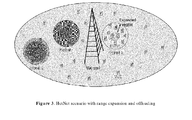
- Figure 3 illustrates an example of a heterogeneous network in which range expansion and user offloading is implemented.
- picocells operate with range expansion, and thus a given number of user equipment (UEs) are offloaded from an umbrella macrocell to the "overlaid" picocells.
- UEs user equipment
- MUEs Macro Cell user equipment
- ABSs Almost Blank Subframes
- aspects and embodiments may be operable to provide a method to compute the number of ABSs that an umbrella macrocell should offer to its overlaid picocells, given the specific picocell range expansion biases in a network deployment, such that the performance of the MUEs in the scenario illustrated in Figure 3 (picocells with range expansion) is the same or controllably larger than the performance of MUEs in a scenario illustrated ion Figure 2 (picocells without range expansion).
- each small cell base station in each scheduling period, can perform a load balanced scheduling method such that the performance of the worst small cell users scheduled in subframes that do and do not overlap with the Almost Blank Subframes of the macrocell are equalized.
- a first scenario there is one macrocell and three picocells that operate without range expansion. Both the macrocell tier and the picocell tier reuse the same time and frequency resources (co-channel deployment).
- the network has S subframes and K Resource Blocks (RBs).
- a second scenario (such as that shown in Figure 3 ), there are the same cells as in Scenario 1, but the three picocells operate with a given range expansion bias. That reange expansion bias does not need to be necessarily the same for all picocells.
- the range expansion bias for each picocell will be known and will have been selected according to some specific strategy (for example, covering hot spot user equipment).
- MUE' ⁇ MUE' 1 , ..,MUE' m' , ...MUE' M' ⁇ and its cardinality by M'.
- PUE p nonABS ⁇ PUE' 1 , .., PUE' x , ...PUE' Xp ⁇ and its cardinality by X p .
- ERPUE p ABS ⁇ ERPUE 1 , .., ERPUE y , ...ERPUE Yp ⁇ and its cardinality by Y p.
- the set of MUEs in scenario 1 is split into UEs that remain attached to the macrocell, i.e., MUEs, and UEs that are offloaded to the picocells due to range expansion, i.e., ERPUEs.
- all macrocells in a set of neighbouring macrocells are operable to use the same duty cycle and pattern of ABSs, D ABS , in order to mitigate inter-cell interference issues.
- a set of macrocells may be operable to coordinate and select a shared duty cycle and pattern of ABSs according to a group policy, for example, a choice may be made as the maximum D ABS of all macrocells, or the average D ABS of all macrocells in a group.
- User equipment load and traffic conditions may change faster than the ability of a network to update the duty cycle of ABS in a given deployment.
- different small cells operating under one umbrella macrocell may have different UE load and traffic in their core or "nominal" coverage region and expanded region of coverage.
- some aspects and embodiments described herein relate to a load balancing mechanism that can operate independently in each small cell.
- the load balancing mechanism may target avoidance of the misuse, be it underutilization or overutilization, of the subframes used by the small cells in their "expansion region". That is to say, those subframes which overlap with the Almost Blank Subframes scheduled at macrocells.
- Figure 3 illustrates schematically a scenario in which a macrocell has a duty cycle of ABS, picocell 1 has 5 PUEs and 5 ERPUEs, while picocell 2 has 9 PUEs and 1 ERPUE.
- picocell 2 has 9 PUEs and 1 ERPUE.
- the small cell may choose to implement a scheme which offers a degree of load balancing between core region and expansion region user equipment.
- FIG. 4 is a flow chart illustrating one possible implementation of a load balancing algorithm to be implemented by a small cell.
- SINR n ⁇ SINR n ABS
- SINR n nonABS ⁇ denote wideband signal to noise plus interference ratio (SINR) of user U n in the subframes overlapping with ABS and subframes not overlapping with ABS, respectively.
- SINR n ⁇ SINR n ABS
- SINR n nonABS ⁇ wideband signal to noise plus interference ratio (SINR) of user U n in the subframes overlapping with ABS and subframes not overlapping with ABS, respectively.
- the method illustrated in Figure 4 comprises the following steps:
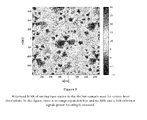
- Figure 5 illustrates an example of wideband SINR of a set of base stations used for system level simulations of some aspects and embodiments.
- the network of Figure 5 there are 21 macrocell sectors and a random deployment of 4 hot spots of 40m radius per macrocell sector, each one of them covered by a picocell located in its centre. All system-level simulation results are given for deployments with 1 LTE carrier centered at 2GHZ and with 5MHz bandwidth.
- Figure 6 illustrates schematically Macrocell user equipment throughput according to a range of simulations.
- Figure 6 presents graphically an indication of the cumulative distribution function of the Macrocell User Equipment (MUE) throughput.
- MUE Macrocell User Equipment
- Figure 6 also illustrates that, when using the proposed ABS duty cycle selection approach according to an embodiment, it is possible, by changing ⁇ , to tune expected MUE performance: When ⁇ is large, the MUE throughput is increased and when it is small, the MUE throughput is decreased. Thus, ⁇ provides a simple and flexible way to tune and control MUE performance.
- Figure 7 presents the cumulative distribution function of picocell user equipment throughput.
- the simulation of a scenario in which expansion bias and no ABS is implemented across a network provides the worst PUE performance, since more PUEs are captured by picocells (due to range expansion) and the macrocells are allowed to use all subframes (no interference mitigation).
- This is a general trend confirmed across simulation results for thedifferent cases: enhancing PUE performances reduces MUE performance and vice versa.
- Figure 7 also shows that increasing the duty cycle of ABS through ⁇ increases PUE throughput but decreases MUE throughput.
- load balancing adopting the proposed load balancing at the picocells (between ABS and non ABS overlapping subframes) significantly enhances PUE performance.
- Figure 8 presents a cumulative distribution function of total UE throughput. This figure allows easy observation of previous trends and derivation of previous conclusions. It can, for example, be seen that when comparing a method in accordance with proposed aspects and embodiments to compute a suitable duty cycle of ABSs to alternative ABS selection algorithms, the overall UE 50percentile performance is 10% larger, thus confirming that due to the larger number of PUEs, the 14% PUE capacity gain more than compensates for the 30% MUE loss and results in an improved overall UE satisfaction and network capacity.
- Control of selection of a duty cycle of ABSs and enabling load balancing in accordance with some aspects and embodiments can result in more efficient small cell user offloading in a HetNet scenario, that offloading occurring with a controlled MUE performance.
- Aspects and embodiments may allow for better load balancing and use of resources.
- Simulations set out above demonstrate a 55% and 29% small cell user equipment 5 percentile and 50 percentile performance improvement, respectively when using load balancing in accordance with one embodiment.
- Aspects and embodiments may require a slight increase in network computing complexity due to the need to implement ABS duty cycle selection and load balancing computations, but the benefits may outweigh this very minor drawback.
- program storage devices e.g., digital data storage media, which are machine or computer readable and encode machine-executable or computer-executable programs of instructions, wherein said instructions perform some or all of the steps of said above-described methods.
- the program storage devices may be, e.g., digital memories, magnetic storage media such as a magnetic disks and magnetic tapes, hard drives, or optically readable digital data storage media.
- the embodiments are also intended to cover computers programmed to perform said steps of the above-described methods.
- processors may be provided through the use of dedicated hardware as well as hardware capable of executing software in association with appropriate software.
- the functions may be provided by a single dedicated processor, by a single shared processor, or by a plurality of individual processors, some of which may be shared.
- processor or “controller” or “logic” should not be construed to refer exclusively to hardware capable of executing software, and may implicitly include, without limitation, digital signal processor (DSP) hardware, network processor, application specific integrated circuit (ASIC), field programmable gate array (FPGA), read only memory (ROM) for storing software, random access memory (RAM), and non volatile storage. Other hardware, conventional and/ or custom, may also be included.
- DSP digital signal processor
- ASIC application specific integrated circuit
- FPGA field programmable gate array
- ROM read only memory
- RAM random access memory
- any switches shown in the Figures are conceptual only. Their function may be carried out through the operation of program logic, through dedicated logic, through the interaction of program control and dedicated logic, or even manually, the particular technique being selectable by the implementer as more specifically understood from the context.
- any block diagrams herein represent conceptual views of illustrative circuitry embodying the principles of the invention.
- any flow charts, flow diagrams, state transition diagrams, pseudo code, and the like represent various processes which may be subase stationtantially represented in computer readable medium and so executed by a computer or processor, whether or not such computer or processor is explicitly shown.
Landscapes
- Engineering & Computer Science (AREA)
- Computer Networks & Wireless Communication (AREA)
- Signal Processing (AREA)
- Mobile Radio Communication Systems (AREA)
Abstract
Description
- The present invention relates to a method of controlling operation of a heterogeneous wireless communication network, a computer program product and network control node operable to perform that method. Also provided is a method of scheduling resource at a small cell base station in a heterogeneous wireless communication network, a computer program product and scheduling control unit operable to perform that method.
- Wireless telecommunication systems are known. In such systems, mobile communication devices (for example, mobile telephones) are operable to communicate with base stations provided by network providers.
- In known wireless telecommunication systems, radio coverage is provided to network connectable devices, such as mobile telephones, or wireless devices such as iPads or other similar tablets, within areas known as cells. Abase station is located in each cell to provide radio coverage. Typically, network connectable devices in each cell are operable to receive information and data from a base station and to transmit information and data to a base station.
- User equipment roam through a wireless communications system. Base stations are typically provided which support areas of radio coverage. A number of such base stations are provided and are distributed geographically in order to provide a wide area of coverage to user equipment.
- When user equipment is within an area served by a base station, communications may be established between the user equipment and the base station over associated radio links. Each base station typically supports a number of sectors within the geographical area of service. Typically, a different antenna within a base station supports each associated sector. Each base station has multiple antennas.
- Traditional base stations provide coverage in relatively large geographical areas and those cells are often referred to as macro cells. It is possible to provide a heterogeneous network (hetnet) where smaller sized cells are provided within macro cells. Such smaller sized cells are sometimes referred to as micro cells, pico cells or femto cells. One way to establish a small cell is to provide a small cell base station that provides coverage having a relatively limited range within the coverage area of the macro cell. The transmission power of a small cell base station is relatively low and, hence, each small cell provides a small coverage area compared to that of a macro cell and covers, for example, an office or a home.
- Such small cells operating to use the same frequency band as a macro cell are typically provided where the communications coverage provided by the macro cell is poor or where a user wishes to use an alternative communications link provided locally, by the small cell base station, to communicate with the core network, and/ or to increase capacity within a network.
- Although the deployment of such small cell base stations can provide advantages, unexpected consequences can occur.
- Accordingly, it is desired to provide an improved technique for the operation of heterogeneous networks.
- A first aspect provides a method of controlling operation of a heterogeneous communication network comprising user equipment, a macro cell base station supporting a macro region of radio coverage and at least one small cell base station supporting a small cell region of radio coverage which overlaps with said macro region of radio coverage, the user equipment being operable to communicate with either of the macrocell base station and the at least one small cell base station and wherein the macrocell is operable to release a proportion of available resource for facilitating communication between the user equipment and the at least one small cell base station; the method comprising: determining which of the user equipment are attached to the macro base station in a first scenario and establishing an indication of the available resource available to user equipment attached to the macro cell base station in the first scenario; determining which of the user equipment are attached to the macro base station in a second scenario in which some of the user equipment have been offloaded to the at least one small cell base station and selecting a proportion of the available resource to release for communication between the offloaded user equipment and the at least one small cell base station such that available resource available to user equipment which remains attached to the macro cell base station in the second scenario is at least equivalent to the established indication of the available resource available to user equipment attached to the macro cell base station in the first scenario.
- As described above, traditional base stations provide coverage in relatively large geographical areas and those cells are often referred to as macro cells. It is possible to provide a heterogeneous network (hetnet) where smaller sized cells, typically supported by low power nodes, are provided within macro cells. Such smaller sized cells are sometimes also referred to as micro cells, pico cells or femto cells. One way to establish a small cell is to provide a small cell base station that provides coverage having a relatively limited range within the coverage area of the macro cell. The transmission power of a small cell base station is relatively low and, hence, each small cell provides a small coverage area compared to that of a macro cell and covers, for example, an office or a home.
- Such small cells are typically provided where the communications coverage provided by the macro cell is poor or where a user wishes to use an alternative communications link provided locally, by the small cell base station, to communicate with the core network, and/or to increase capacity within a network. That is to say, in a heterogeneous network, small cells supported by "Low Power Nodes" (LPN) can be placed within a macro cell supported by a macro base station to increase the capacity of the network by offloading some user equipment operating within the macro cell to one of the small cells.
- Due to the large difference in transmit power between small cell base stations, for example, a pico base station (30 dBm), and a macro base station (43 dBm), the closer a small cell base station is to a macro base station, the smaller its Downlink (DL) coverage becomes. That is to say, the area in which the pico base station provides a dominant DL Received Signal Strength (RSS) shrinks. The effective shrinking may prevent efficient off-loading. In the Uplink (UL), such coverage shrinking does not occur because the UL RSSs from user equipment at different base stations typically depend on user equipment transmit power. This leads to a mismatch between the DL and UL small cell base station coverage.
- The DL and UL coverage imbalance can mean that associating user equipment with the cell that provides the strongest downlink received signal strength may not always be the best strategy, since user equipment can tend to connect to a potentially distant high-power macro base station rather than to a nearby low-power small cell base station, thus potentially wasting an opportunity to offer efficient spatial reuse within a network.
- Furthermore, a downlink received signal strength (DL RSS) based cell selection procedure can result in user equipment which are connected to a distant macro base station causing interference to uplink communication occurring at nearby small cell base stations.
- Cell range expansion is one cell selection procedure which maybe implemented in a network to allow, or force, user equipment to connect to nearby small cell nodes. In particular, a positive range expansion bias can be added to the DL RSSs of a small cell pilot signal to artificially increase the DL coverage footprint provided by such a small cell base station. However, the better spatial reuse and UL interference mitigation offered by cell range expansion comes at the expense of reduced DL signal qualities for user equipment operating in the "Expanded-Region" (ER). Small cell user equipment operating in the expanded region may suffer from low DL Signal-to-Interference-plus-Noise Ratios (SINRs), since they are connected to cells which do not provide the strongest DL RSSs in the expanded region and therefore are more susceptible to suffer from interference.
- The interference suffered by expanded region user equipment may be significantly alleviated by using a time domain enhanced Inter-Cell Interference Coordination (eICIC) method based on transmission of so-called "Almost Blank Subframes"(ABSs) by one or more macro cell base stations. Almost Blank Subframes are subframes, in which control information, but no user data, is sent. Since ABSs are light on user data, a large degree of DL interference mitigation can be achieved in the control and data regions of user equipment operating in an expanded region of a small cell base station by scheduling those expanded region user equipment within subframes overlapping with the Almost Blank Subframes of a macrocell. In order to enable efficient interference mitigation, ABS schemes can be implemented to adapt to different traffic loads and different numbers of small cells in a network, for example, at various geographical locations. Adaptive ABS schemes can be implemented in LTE networks and are enabled through X2 backhaul inter-base station coordination.
- According to one example of an ABS scheme, a macro base station may be operable to inform one or more small cell base stations operating within its region of radio coverage of the subframes it will use for scheduling Macro UEs (MUEs) and which ones are Almost Blank Subframes. The specific ABS pattern to be used can be agreed in conjunction with macro base stations supporting neighboring cells. The ABS pattern may be described by a bitmap, where '1' indicates an Almost Blank Subframe and '0' indicates a non- Almost Blank Subframe.
- The larger the range expansion bias for a given small cell base station in a given position within a network, the more expanded region user equipment are forced to connect to such a small cell base station, and thus a larger ABS duty cycle can be implemented to provide a desired quality of service to expanded region user equipment. It will, however, be appreciated that the larger the duty cycle of ABS, the lower the performance of macro cell user equipment due to resource blanking.
- Aspects and embodiments may offer a method of choosing an appropriate ABS duty cycle, that is to say, a means to choose an appropriate ratio of ABS to non-ABS subframes scheduled at the macro cell, that ratio being chosen to take into account overall network performance for a given network. The "best" ratio for a given deployment being a result of parameters such as: base station locations, cell-specific range expansion biases, and similar.
- Aspects and embodiments may provide a method to compute the number of Almost Blank Subframes that an umbrella macrocell should offer to its overlaid small cells, so that the performance of macro cell user equipment in a scenario with expanded region small cells is substatially the same, or controllably larger than, performance of macro cell user equipment in the same network deployment scenario without expanded region small cells. In order to make the most of the Almost Blank Subframes that the macrocells offer to small cells, some aspects and embodiments are such that each small cell base station, in each scheduling period, can perform load balanced scheduling such that the performance of the worst small cell users scheduled in subframes that do and do not overlap with the Almost Blank Subframes of the macrocell are equalized.
- The first aspect recognizes that it is possible to provide a method to compute the number of ABSs that an umbrella macrocell should offer to its overlaid small cells, given a specific set of range expanded small cells in a network deployment, such that the performance of the user equipment served by a macro cell in the scenario where users have been offloaded to small cells is the same or controllably larger than the performance of user equipment served by a macrocell in a scenario in which no range expansion is implemented. Aspects and embodiments may offer an improved overall network throughput due to better spatial reuse.
- It will be appreciated that the second scenario may be one in which small cell base stations are able to offer coverage to user equipment in a network as a result of implementation of a cell expansion region at one or more of said small cell base stations. Accordingly, in the second scenario, although the total number of user equipment operating in the network under consideration may remain constant, the number of macro user equipment is likely to fall as some are offloaded to small cells. It will be appreciated that if no user equipment are offloaded to small cells when comparing the first scenario to the second scenario, then no change to a proportion of resource offered to small cells to support offloaded user equipment may be required.
- In one embodiment, the released proportion of available resource comprises almost blank subframes transmitted by the macro base station, thereby releasing those subframes for use by the at least one small cell base station. Accordingly, the method may be such that it provides a means to compute the number of ABSs that an umbrella macrocell should offer to its overlaid small cells, given a set of range expanded small cells in a particular network deployment.
- In one embodiment, the released proportion of available resource comprises reduced power subframes transmitted by the macro base station, thereby releasing those subframes for use by the at least one small cell base station.
- In one embodiment, establishing an indication of the available resource available to user equipment attached to the macro cell base station in the first scenario and available resource available to user equipment which remains attached to the macro cell base station in the second scenario comprises: establishing an indication of available resource to traffic load of the macro cell user equipment. Accordingly, some aspects and embodiments may be used to realise a calculation of an appropriate duty cycle of almost blank subframes which takes into account specific user equipment traffic demands.
- In a typical network deployment, all macrocells in a set of neighbouring macrocells are operable to use the same duty cycle and pattern of almost blank subframes (DABS ), in order to mitigate inter-cell interference issues. As a result, in some embodiments, a set of macrocells may be operable to coordinate and select a shared duty cycle and pattern of ABSs according to a group policy, for example, a choice may be made as, for example: the maximum DABS of all macrocells, or the average DABS of all macrocells in a group.
- A second aspect provides a computer program product operable, when executed on a computer, to perform the method of the first aspect.
- A third aspect provides a network control node operable to control operation of a heterogeneous communication network comprising user equipment, a macro cell base station supporting a macro region of radio coverage and at least one small cell base station supporting a small cell region of radio coverage which overlaps with the macro region of radio coverage, the user equipment being operable to communicate with either of the macrocell base station and the at least one small cell base station and wherein the macrocell is operable to release a proportion of available resource for facilitating communication between the user equipment and the at least one small cell base station; the network control node comprising: determination logic operable to determine which of the user equipment are attached to the macro base station in a first scenario and to establish an indication of the available resource available to user equipment attached to the macro cell base station in the first scenario; the determination logic being further operable to determine which of the user equipment are attached to the macro base station in a second scenario in which some of the user equipment have been offloaded to the at least one small cell base station and selection logic operable to select a proportion of the available resource to release for communication between the offloaded user equipment and the at least one small cell base station such that available resource available to user equipment which remains attached to the macro cell base station in the second scenario is at least equivalent to the established indication of the available resource available to user equipment attached to the macro cell base station in the first scenario.
- In one embodiment, the released proportion of available resource comprises almost blank subframes transmitted by the macro base station, thereby releasing those subframes for use by the at least one small cell base station.
- In one embodiment, the released proportion of available resource comprises reduced power subframes transmitted by the macro base station, thereby releasing those subframes for use by the at least one small cell base station.
- In one embodiment, establishing an indication of the available resource available to user equipment attached to the macro cell base station in the first scenario and available resource available to user equipment which remains attached to the macro cell base station in the second scenario comprises: establishing an indication of available resource to traffic load of the macro cell user equipment.
- A fourth aspect provides a method of scheduling resource at a small cell base station in a heterogeneous wireless communication network comprising user equipment, a macro cell base station supporting a macro region of radio coverage and at least one small cell base station supporting a small cell region of radio coverage which overlaps with the macro region of radio coverage, the user equipment being operable to communicate with either of the macrocell base station or the at least one small cell base station and wherein the macrocell is operable to release a proportion of available resource for facilitating communication between the user equipment and the at least one small cell base station; the small cell base station being configured to support communication with the user equipment in a first communication mode using all of the available resource or a second communication mode using said released portion of available resource; the method comprising: receiving an indication of signal quality at the user equipment in resource used for the first and second communication modes; associating the user equipment with one of the first or second communication modes such that throughput of a worst user associated with the first communication mode is substantially equivalent to throughput of a worst user associated with the second communication mode; and scheduling resource to the user equipment in the first or second communication mode in accordance with the association.
- The fourth aspect recognises that in order to make the most of resource offered to a small cell by a macrocell for users in an expansion region, for example, by setting Almost Blank Subframes at the macrocell, which allows those subframes to be offered to small cells, some aspects and embodiments are such that each small cell base station, in each scheduling period, can perform a load balanced scheduling method such that the performance of the worst small cell users scheduled in subframes that do and do not overlap with the Almost Blank Subframes of the macrocell are equalized.
- User equipment load and traffic conditions may change faster than the ability of a network to update the duty cycle of ABS in a given deployment. Furthermore, different small cells operating under one umbrella macrocell may have different UE load and traffic in their core or "nominal" coverage region and expanded region of coverage. Accordingly, some aspects and embodiments described herein relate to a load balancing mechanism that can operate independently in each small cell. The load balancing mechanism may target avoidance of the misuse, be it underutilization or overutilization, of the subframes used by the small cells in their "expansion region". That is to say, those subframes which overlap with the Almost Blank Subframes scheduled at macrocells.
- In one embodiment, the method comprises associating user equipment with one of the first or second communication modes such that throughput of a worst user associated with the first communication mode is substantially equivalent to throughput of a worst user associated with the second communication mode by: receiving an indication of signal to interference and noise ratio experienced at user equipment in resource used for the first and second communication modes; creating an initial association with a communication mode for each user equipment based on the received indication; identifying a worst user of each communication mode based on the initial association; estimating a throughput associated with each worst user based on the initial association; calculating how many users should be associated with each of the first communication modes based on the estimated throughput associated with each worst user; and adjusting the initial association until a number of users associated with each of the first and second communication modes corresponds to the calculation.
- In one embodiment, the adjusting comprises: adjusting by moving user equipment associated with one communication mode which has a high reported signal to noise and interference ratio in resource associated with the other communication mode to be associated with that other communication mode.
- In one embodiment, the first communication mode is associated with a core region of small cell base station radio coverage and the second communication mode is associated with an extension region of small cell base station radio coverage. In other words, a small cell may choose to implement a scheme which offers a degree of load balancing between so-called core region and expansion region user equipment.
- In one embodiment, associating a user with the first communication mode is subject to that user having a wideband signal quality determined to be higher than an out-of-synchronization threshold value. Accordingly, in such an implementation of load balancing, it is important to ensure that offloaded user equipment, for example, from subframes overlapping with ABS to subframes not overlapping with ABS do not suffer from such poor control channel performance that they lose synchronization with the serving small cell.
- In one embodiment, associating user equipment with one of the first or second communication modes is performed such that throughput of an average user associated with the first communication mode is substantially equivalent to throughput of an average user associated with the second communication mode.
- In one embodiment, associating user equipment with one of the first or second communication modes is performed such that throughput of the median user associated with the first communication mode is substantially equivalent to throughput of the median user associated with the second communication mode.
- A fifth aspect provides a computer program product operable, when executed on a computer, to perform the method of the fourth aspect.
- A sixth aspect provides a scheduling unit operable to schedule resource at a small cell base station in a heterogeneous wireless communication network comprising user equipment, a macro cell base station supporting a macro region of radio coverage and at least one small cell base station supporting a small cell region of radio coverage which overlaps with the macro region of radio coverage, the user equipment being operable to communicate with either of the macrocell base station or the at least one small cell base station and wherein the macrocell is operable to release a proportion of available resource for facilitating communication between the user equipment and the at least one small cell base station; the small cell base station being configured to support communication with the user equipment in a first communication mode using all of the available resource or a second communication mode using the released portion of available resource; the scheduling unit comprising: reception logic operable to receive an indication of signal quality at the user equipment in resource used for the first and second communication modes; association logic operable to associate user equipment with one of the first or second communication modes such that throughput of a worst user associated with the first communication mode is substantially equivalent to throughput of a worst user associated with the second communication mode; and scheduling logic operable to schedule resource to the user equipment in the first or second communication mode in accordance with the association.
- In one embodiment, the association logic is operable to associate user equipment with one of the first or second communication modes such that throughput of a worst user associated with the first communication mode is substantially equivalent to throughput of a worst user associated with the second communication mode by: receiving an indication of signal to interference and noise ratio experienced at user equipment in the resource used in the first and second communication modes; creating an initial association for each user equipment based on the received indication; identifying a worst user of each communication mode based on the initial association; estimating a throughput associated with each worst user based on the initial association; calculating how many users should be associated with each of the first and second communication modes based on the estimated throughput associated with each worst user; and adjusting the initial association until a number of users associated with each of the first and second communication modes corresponds to the calculation.
- In one embodiment, the adjusting comprises: adjusting by moving user equipment associated with one communication mode which has a high reported signal to noise and interference ratio in resource used in the other communication mode to be associated with that other communication mode.
- In one embodiment, the first communication mode is associated with a core region of small cell base station radio coverage and the second communication mode is associated with an extension region of small cell base station radio coverage.
- In one embodiment, the association logic is operable to associate a user with the first communication mode subject to that user having a wideband signal quality determined to be higher than an out-of-synchronization threshold value.
- In one embodiment, the association logic is operable to associate the user equipment with one of the first or second communication modes such that throughput of an average user associated with the first communication mode is substantially equivalent to throughput of an average user associated with the second communication mode.
- In one embodiment, the association logic is operable to associate the user equipment with one of the first or second communication modes such that throughput of the median user associated with said first communication mode is substantially equivalent to throughput of the median user associated with said second communication mdoe. Further particular and preferred aspects are set out in the accompanying independent and dependent claims. Features of the dependent claims may be combined with features of the independent claims as appropriate, and in combinations other than those explicitly set out in the claims.
- Where an apparatus feature is described as being operable to provide a function, it will be appreciated that this includes an apparatus feature which provides that function or which is adapted or configured to provide that function.
- Embodiments of the present invention will now be described further, with reference to the accompanying drawings, in which:
-
Figure 1 illustrates an example of an Almost Blank Subframe implementation between a macrocell and a small cell; -
Figure 2 illustrates an example of a heterogeneous network in which range expansion is not implemented; -
Figure 3 illustrates an example of a heterogeneous network in which range expansion and user offloading is implemented; -
Figure 4 is a flow chart illustrating one possible implementation of a load balancing algorithm to be implemented by a small cell; -
Figure 5 illustrates an example of wideband SINR of a set of base stations used for system level simulations of some aspects and embodiments; -
Figure 6 illustrates schematically macrocell user equipment throughput in one network deployment according to a range of simulations; -
Figure 7 illustrates schematically small cell user equipment throughput in one network deployment according to a range of simulations; and -
Figure 8 illustrates schematically overall user equipment throughput in one network deployment according to a range of simulations. - Wireless telecommunication systems are known. In such systems, mobile communication devices, for example, mobile telephones, are operable to communicate with base stations provided by network providers.
- In known wireless telecommunication systems, radio coverage is provided to network connectable devices according to areas known as cells. A base station is located in each cell to provide radio coverage. Typically, user devices in each cell are operable to receive information and data from a base station and to transmit information and data to a base station.
- User equipment roam through a wireless communications system. Base stations are typically provided which support areas of radio coverage. A number of such base stations are provided and are distributed geographically in order to provide a wide area of coverage to user equipment.
- When user equipment is within an area served by a base station, communications may be established between the user equipment and the base station over associated radio links. Each base station typically supports a number of sectors within the geographical area of service. Typically, a different antenna within a base station supports each associated sector. Each base station has multiple antennas.
- Traditional base stations provide coverage in relatively large geographical areas and those cells are often referred to as macro cells. It is possible to provide a heterogeneous network (hetnet) where smaller sized cells, sometimes referred to as low power nodes, are provided within macro cells. Such smaller sized cells are sometimes also referred to as micro cells, pico cells or femto cells. One way to establish a small cell is to provide a small cell base station that provides coverage having a relatively limited range within the coverage area of the macro cell. The transmission power of a small cell base station is relatively low and, hence, each small cell provides a small coverage area compared to that of a macro cell and covers, for example, an office or a home.
- Such small cells are typically provided where the communications coverage provided by the macro cell is poor or where a user wishes to use an alternative communications link provided locally, by the small cell base station, to communicate with the core network, and/or to increase capacity within a network. That is to say, in a heterogeneous network, small cells or "Low Power Nodes" (LPN) can be placed within a macro cell supported by a macro base station to increase the capacity of the network by offloading some user equipment operating within the macro cell to one of the low power nodes.
- Due to the large difference in transmit power between small cell base stations, for example a pico base station (30 dBm) and a macro base station (43 dBm), the closer a small cell base station is to a macro base station, the smaller its Downlink (DL) coverage becomes. That is to say, the area in which the pico base station provides a dominant DL Received Signal Strength (RSS) shrinks. The effective shrinking may prevent efficient off-loading. In the Uplink (UL), such coverage shrinking does not occur because the UL RSSs from user equipment at different base station s typically depend on user equipment transmit power. This leads to a mismatch between the DL and UL small cell base station coverage.
- The DL and UL coverage imbalance can mean that associating user equipment with the cell that provides the strongest downlink received signal strength may not always be the best strategy, since user equipment can tend to connect to a potentially distant high-power macro base station rather than to a nearby low-power small cell base station, thus potentially wasting an opportunity to offer efficient spatial reuse within a network.
- Furthermore, a downlink received signal strength (DL RSS) based cell selection procedure, can result in user equipment which are connected to a distant macro base station causing interference to uplink communication occurring at nearby small cell base stations.
- Cell range expansion is one cell selection procedure which maybe implemented in a network to allow, or force, user equipment to connect to nearby small cell nodes. In particular, a positive range expansion bias can be added to the DL RSSs of a small cell pilot signal to artificially increase the DL coverage footprint provided by such a small cell base station. However, the better spatial reuse and UL interference mitigation offered by cell range expansion comes at the expense of reduced DL signal qualities for user equipment operating in the "Expanded-Region" (ER). Small cell user equipment operating in the expanded region may suffer from low DL Signal-to-Interference-plus-Noise Ratios (SINRs), since they are connected to cells which do not provide the strongest DL RSSs in the expanded region and therefore are more susceptible to suffer from interference.
-
Figure 1 illustrates an example of an Almost Blank Subframe implementation between a macrocell and a small cell. The interference suffered by expanded region user equipment may be significantly alleviated by using a time domain enhanced Inter-Cell Interference Coordination (eICIC) method based on transmission of so-called "Almost Blank Subframes "(ABSs) by one or more macro cell base stations. Almost Blank Subframes are subframes, in which control information, but no user data, is sent. Since ABSs are light on user data, a large degree of DL interference mitigation can be achieved in the control and data regions of user equipment operating in an expanded region of a small cell base station by scheduling those expanded region user equipment within subframes overlapping with the Almost Blank Subframes of a macrocell. In order to enable efficient interference mitigation, ABS schemes can be implemented to adapt to different traffic loads and different numbers of small cells in a network, for example, at various geographical locations. Adaptive ABS schemes can be implemented in LTE networks and are enabled through X2 backhaul inter-base station coordination. - According to one example of an ABS scheme, a macro base station may be operable to inform one or more small cell base stations operating within its region of radio coverage of the subframes it will use for scheduling Macro UEs (MUEs) and which ones are Almost Blank Subframes. The specific ABS pattern to be used can be agreed in conjunction with macro base stations supporting neighboring cells. The ABS pattern may be described by a bitmap, where '1' indicates an Almost Blank Subframe and '0' indicates a non- Almost Blank Subframe.
- In the example shown in
Figure 1 , a macrocell (eNB)is operable to schedule ABSs insubframes 2 and 9 (0.2 duty cycle), and small cells (in this instance, picocells, PeNB-1 &PeNB-2) are operable to schedule ER PUEs in the subframes that overlap with the macrocell ABSFs, so that their performance can be enhanced. - The larger the range expansion bias for a given small cell base station in a given position within a network, the more expanded region user equipment are forced to connect to such a small cell base station, and thus a larger ABS duty cycle can be implemented to provide a desired quality of service to expanded region user equipment. It will, however, be appreciated that the more Almost Blank Subframes that are scheduled by macrocells, the larger the duty cycle of ABS, and the lower the performance of macro cell user equipment due to resource blanking.
- Before discussing the embodiments in any more detail, first an overview will be provided.
- Aspects and embodiments may offer a method of choosing an appropriate ABS duty cycle, that is to say, a means to choose an appropriate ratio of ABS to non-ABS subframes scheduled, that ratio being chosen to take into account overall network performance for a given network. The "best" ratio for a given deployment being a result of parameters such as: base station locations, cell-specific range expansion biases, and similar.
- Aspects and embodiments may provide a method to compute the number of Almost Blank Subframes that an umbrella macrocell should offer to its overlaid small cells, so that the performance of macro cell user equipment in a scenario with expanded region small cells is substatially the same, or controllably larger than, performance of macro cell user equipment in the same network deployment scenario without expanded region small cells. In order to make the most of the Almost Blank Subframes that the macrocells offer to small cells, some aspects and embodiments are such that each small cell base station, in each scheduling period, can perform a load balanced scheduling method such that the performance of the worst small cell users scheduled in subframes that do and do not overlap with the Almost Blank Subframes of the macrocell are equalized.
- By way of example, consider two HetNet scenarios, which are further illustrated in
Figure 2 andFigure 3 , respectively.Figure 2 illustrates an example of a heterogeneous network in which range expansion is not implemented; In the illustrated example, picocells operate without range expansion.Figure 3 illustrates an example of a heterogeneous network in which range expansion and user offloading is implemented. In the illustrated example, picocells operate with range expansion, and thus a given number of user equipment (UEs) are offloaded from an umbrella macrocell to the "overlaid" picocells. - In the scenario shown in
Figure 2 , there are more Macro Cell user equipment (MUEs) than in the scenario shown inFigure 3 . InFigure 3 , some of the user equipment of the network have been offloaded to the small cells. In the scenario shown inFigure 2 , the MUEs benefit from a larger number of subframes since in that scenario, there are no Almost Blank Subframes (ABSs). - Aspects and embodiments may be operable to provide a method to compute the number of ABSs that an umbrella macrocell should offer to its overlaid picocells, given the specific picocell range expansion biases in a network deployment, such that the performance of the MUEs in the scenario illustrated in
Figure 3 (picocells with range expansion) is the same or controllably larger than the performance of MUEs in a scenario illustrated ionFigure 2 (picocells without range expansion). - Use of a method in accordance with some aspects and embodiments described can allow a network to balance the conflicting requirements to provide a large number of ABSs to small cells operating in a network, while providing continued performance to macro cell user equipment. Aspects and embodiments may offer an improved overall network throughput due to better spatial reuse.
- In order to make the most of the Almost Blank Subframes that the macrocells offer to small cells, some aspects and embodiments are such that each small cell base station, in each scheduling period, can perform a load balanced scheduling method such that the performance of the worst small cell users scheduled in subframes that do and do not overlap with the Almost Blank Subframes of the macrocell are equalized.
- In a first scenario (such as that shown in
Figure 2 ), there is one macrocell and three picocells that operate without range expansion. Both the macrocell tier and the picocell tier reuse the same time and frequency resources (co-channel deployment).
The set of picocells is denoted by
P = {P1, .., Pp, ...PP} with P=3 (as shown inFigure 2 andFigure 3 ).
The set of macrocell user equipment (MUEs) is denoted by
MUE = {MUE1, .., MUEm, ...MUEM} and its cardinality is given by M.
The set of small cell user equipment (PUEs) of picocell Pp is denoted by
PUE p= {PUE1, .., PUEi, ...PUEIp} and its cardinality by Ip.
In the illustrated example, the network has S subframes and K Resource Blocks (RBs).
The set of subframes and RBs are denoted by S = {1, .., s, ...S} and
K = {1, .., k, ...K}, respectively. - In a second scenario (such as that shown in
Figure 3 ), there are the same cells as inScenario 1, but the three picocells operate with a given range expansion bias. That reange expansion bias does not need to be necessarily the same for all picocells. Typically the range expansion bias for each picocell will be known and will have been selected according to some specific strategy (for example, covering hot spot user equipment). According to a scenario such as that shown inFigure 3 :
The new set of MUEs is denoted by:
MUE' = {MUE'1, ..,MUE'm', ...MUE'M'} and its cardinality by M'. - The set of PUEs of picocell Pp located outside the "expanded region" coverage (in other words, in the nominal or primitive coverage area of a picocell) and naturally allocated to non ABS is denoted by:
PUEp nonABS = {PUE'1, .., PUE'x, ...PUE'Xp} and its cardinality by Xp. - The new set of PUEs of picocell Pp located in the expanded region coverage and naturally allocated to ABS is denoted by:
ERPUEp ABS = {ERPUE1, .., ERPUEy, ...ERPUEYp} and its cardinality by Yp. - Given those two scenarios it is possible to identify the following relationships:
PUE p = PUEp nonABS - The use of range expansion does not change the set of PUEs served by a picocell in its inner region, i.e., outside the expanded region coverage.
MUE = MUE' U ERPUEp ABS for all p in P - The set of MUEs in
scenario 1 is split into UEs that remain attached to the macrocell, i.e., MUEs, and UEs that are offloaded to the picocells due to range expansion, i.e., ERPUEs. - It is possible to compute a duty cycle of Almost Blank Subframes, DABS, which an umbrella macrocell should offer to its overlaid small cells, given their small cell specific range expansion biases, so that the performance of MUE' in
scenario 2 is the same or controllably larger than the performance of MUE inscenario 1. - In order to perform such a calculation:
- The ratio of subframes-to-MUEs in
scenario 1 is defined as

scenario 2 is defined as

- The duty cycle of ABSs can be calculated according to:

where
α = 1, if the network wants to offer the same performance to MUEs inscenario 2 as in scenario 1 (with and without range expansion), and
- As a result,

- In a typical network deployment, all macrocells in a set of neighbouring macrocells are operable to use the same duty cycle and pattern of ABSs, DABS, in order to mitigate inter-cell interference issues. As a result, in some embodiments, a set of macrocells may be operable to coordinate and select a shared duty cycle and pattern of ABSs according to a group policy, for example, a choice may be made as the maximum DABS of all macrocells, or the average DABS of all macrocells in a group.
- User equipment load and traffic conditions may change faster than the ability of a network to update the duty cycle of ABS in a given deployment. Furthermore, different small cells operating under one umbrella macrocell may have different UE load and traffic in their core or "nominal" coverage region and expanded region of coverage. Accordingly, some aspects and embodiments described herein relate to a load balancing mechanism that can operate independently in each small cell. The load balancing mechanism may target avoidance of the misuse, be it underutilization or overutilization, of the subframes used by the small cells in their "expansion region". That is to say, those subframes which overlap with the Almost Blank Subframes scheduled at macrocells.
- By way of example,
Figure 3 illustrates schematically a scenario in which a macrocell has a duty cycle of ABS,picocell 1 has 5 PUEs and 5 ERPUEs, whilepicocell 2 has 9 PUEs and 1 ERPUE. In such a scenario, it could be advantageous that inpicocell 2, some PUEs are scheduled in subframes overlapping with the ABS scheduled at macrocells, since that ABS resource could be more efficiently used by some user equipment in the core coverage region rather than just the single expansion region user equipment. In other words, the small cell may choose to implement a scheme which offers a degree of load balancing between core region and expansion region user equipment. The reverse situation, where some expansion region user equipment are scheduled in subframes which do not overlap with the ABS scheduled at macrocells, may also be beneficial in some scenarios. However, in such an implementation of load balancing, it is important to ensure that offloaded UEs from subframes overlapping with ABS to subframes not overlapping with ABS do not suffer from such poor control channel performance that they lose synchronization with the serving small cell. - It will be appreciated that when the number of scheduling realizations is sufficiently large, the performance of a proportional fair scheduler tends to be equivalent to that of a round robin scheduler. Thus a round robin scheduler can be assumed in calculations, which gives a long-term perspective and the possibility of making fast calculations that can be updated regularly.
-
Figure 4 is a flow chart illustrating one possible implementation of a load balancing algorithm to be implemented by a small cell. InFigure 4
Let:
U p = {U1, ...Un ...UN} denote a set of users connected to a picocell Pp ,
where U p = PUEp nonABS U ERPUEp ABS , being N the total number of users (N = Xp + Yp ) and Un one element of the set.
Let SINR n = {SINRn ABS, SINRn nonABS} denote wideband signal to noise plus interference ratio (SINR) of user U n in the subframes overlapping with ABS and subframes not overlapping with ABS, respectively. - The method illustrated in
Figure 4 comprises the following steps: - a. First, the picocell is operable to estimate for each of its users, U n , a user wideband SINR in the subframes overlapping with ABS and subframes not overlapping with ABS. SINR n = {SINR n ABS, SINR n nonABS}
- b. Based on RSRP measurements, the picocell is operable to classify users as expanded region users ERPUEp ABS = {ERPUE1, .., ERPUEy, ...ERPUEYp} and non expanded region users PUEp nonABS = {PUE'1, .., PUE'x, ...PUE'Xp}, where Yp is the total number of users in the picocell expanded region, and Xp is the total number of users in the picocell core coverage region. After such user classification, the picocell is operable to 'store' classified users in an "expanded region user queue" and a "non-expanded region user queue".
- c. Thereafter, the picocell is operable to identify, based on their wideband SINR measurements, a worst expanded region user U n ABS,worse and a worst non expanded region user U n nonABS,worse.
- d. The picocell is then operable to estimate the user throughput TP n ABS,worse TP n nonABS,worse for both worst users U n ABS,worse U n nonABS,worse. That throughput is calculated as if the worst users were allocated to all RBs handled by the subframes overlapping with ABS and subframes not overlapping with ABS, respectively. Such a computation is straightforward since a picocell will typically be aware of the user wideband SINR in each subframe if it has instructed users to take such measurements. TP n ABS,worse = f(SINR n ABS) K and TP n nonABS,worse = f(SINR n nonABS) K, where f(x) is a mapping function that translates RB SINR into RB throughput and K is the total number of RBs.
- e. Once the achievable throughput of both worst users is estimated and assuming a round robin scheduler, it is possible to compute how many users there should be in each subframe type so that the worse users roughly achieve the same throughput performance. This can be easily computed due to the round robin scheduler properties:

where Yp ' and Xp ' are the total number of users that there should be in the subframes overlapping with ABS and subframes not overlapping with ABS, respectively to achieve the targeted load balancing - f. The picocell may then be operable to move users from a source subframe type queue to a destination subframe type queue, until the number of desired users in each subframe type is achieved.
When moving a user from non-ABS to ABS overlapping subframes, and because the performance of such a user will always improve due to ABS interference mitigation, the picocell may be operable to first move the worst performing user in the non ABS overlapping subframes. Such an approach targets maximizing worst user performance.
However, when moving a user from the ABS to the non ABS overlapping subframes, because the performance of this user will always decrease due to macrocell interference, the picocell may be operable to move the best performing user subject to the following constraint: all users using non ABS subframes should be able to decode control channels; otherwise the user is not moved. In other words, all users using non ABS should have a wideband SINR higher than an out-of-synchronization threshold.
If, when the picocell moves one user from one queue to the other, that user becomes the worst user in the new queue, then the picocell may be operable to re-compute how many users there should be in each subframe type according to step e), and then continue with step f). - g. The algorithm stops when the number of desired users per subframe type is achieved, or when the picocell begins to move users from the ABS to the non ABS overlapping subframes, when in the previous iteration it was moving users in the opposite direction, from the non ABS to the ABS overlapping subframes, or vice versa.
- System-level simulations have been performed in relation to the following LTE deployments to compare performance of: Picocells with no bias and macrocells with no ABSs; Picocells with bias and macrocells with no ABSs; Picocells with bias, and macrocells with a duty cycle of ABSs DABS = 0.5, and no load balancing; Picocells with bias, and macrocells with a duty cycle of ABSs DABS = 0.5, but with proposed load balancing; Picocells with bias, and macrocells with a duty cycle of ABSs computed according to an alternative ABS selection algorithm and load balancing; and Picocells with bias, and macrocells with a duty cycle of ABSs computed according to one aspect, and load balancing. Moreover, different α values are used to show the effects of this parameter.
-
Figure 5 illustrates an example of wideband SINR of a set of base stations used for system level simulations of some aspects and embodiments. In the network ofFigure 5 , there are 21 macrocell sectors and a random deployment of 4 hot spots of 40m radius per macrocell sector, each one of them covered by a picocell located in its centre. All system-level simulation results are given for deployments with 1 LTE carrier centered at 2GHZ and with 5MHz bandwidth. - In the simulations shown in later Figures a range expansion bias per picocell was adopted which allowed each picocell to cover the hot spot with 40m radius. The scheduling scheme used was proportional fair.
-
Figure 6 illustrates schematically Macrocell user equipment throughput according to a range of simulations. In particular,Figure 6 presents graphically an indication of the cumulative distribution function of the Macrocell User Equipment (MUE) throughput. The simulation of an implementation with bias and no ABS (solid black line) provides the best MUE performance, since some MUEs are offloaded to picocells and the macrocells are still allowed to use all subframes (no blanking of subframes). It can also be seen that adopting load balancing techniques such as those described herein in some aspects and embodiments at picocells (balancing load between ABS and non ABS overlapping subframes for user equipment in the expanded and core regions of coverage) does not affect MUE performance: The case with bias and 0.5 duty cycle of ABSs with and without the proposed load balancing perform substantially identically. When using the proposed ABS duty cycle selection approach according to aspects and embodiments, and when α = 1, the graph ofFigure 6 shows that performance of MUEs is approximately the same as when using no bias and no ABS. This is, of course, an aim of such an embodiment, and thus simulations validate the method used to select an ABS duty cycle according to some embodiments.Figure 6 also illustrates that, when using the proposed ABS duty cycle selection approach according to an embodiment, it is possible, by changing α, to tune expected MUE performance: When α is large, the MUE throughput is increased and when it is small, the MUE throughput is decreased. Thus, α provides a simple and flexible way to tune and control MUE performance. - Use of an alternative method to compute a duty cycle of ABSs in these simulations results in the choice of a smaller duty cycle of ABS than one according to aspects and embodiments in which α = 1. As a result,
MUE 50 percentile performance is 30% larger that when selecting an ABS duty cycle in accordance with aspects described herein, that increase being at the expense of both a reduced small cell user equipment throughput performance and at the expense of overall network capacity as is illustrated inFigures 7 and8 . -
Figure 7 presents the cumulative distribution function of picocell user equipment throughput. The simulation of a scenario in which expansion bias and no ABS is implemented across a network (which provided the best MUE performance) provides the worst PUE performance, since more PUEs are captured by picocells (due to range expansion) and the macrocells are allowed to use all subframes (no interference mitigation). This is a general trend confirmed across simulation results for thedifferent cases: enhancing PUE performances reduces MUE performance and vice versa. For example,Figure 7 also shows that increasing the duty cycle of ABS through α increases PUE throughput but decreases MUE throughput. With regard to load balancing, adopting the proposed load balancing at the picocells (between ABS and non ABS overlapping subframes) significantly enhances PUE performance. Comparison of the simulations of an implementation with bias and 0.5 duty cycle of ABSs with and without the proposed load balancing, the PUE 5 percentile and 50 percentile performance increases by 55% and 29%, respectively. As described above, use of an alternative method to compute a duty cycle of ABSs in these simulations results in the choice of a smaller duty cycle of ABS than one according to aspects and embodiments in which α = 1. - The simulation results show that the
PUE 50 percentile performance is 14% larger in the latter case at the expense, as indicated before, of aMUE 50%percentile performance which is 30% smaller. However, in terms of overall UE satisfaction and network capacity, since the number of PUEs is larger than the number of MUEs, the 14% PUE capacity gain is more valuable than the 30 % MUE capacity loss, as it will be shown inFigure 8 . -
Figure 8 presents a cumulative distribution function of total UE throughput. This figure allows easy observation of previous trends and derivation of previous conclusions. It can, for example, be seen that when comparing a method in accordance with proposed aspects and embodiments to compute a suitable duty cycle of ABSs to alternative ABS selection algorithms, the overall UE 50percentile performance is 10% larger, thus confirming that due to the larger number of PUEs, the 14% PUE capacity gain more than compensates for the 30% MUE loss and results in an improved overall UE satisfaction and network capacity. - Some aspects and embodiments described can be extended, for example: some aspects and embodiments may be used to realise a duty cycle of ABSs calculation that is aware of specific UE traffic demands. In this case, instead of considering the ratio ER PUEs to MUEs plus ER PUEs

- Control of selection of a duty cycle of ABSs and enabling load balancing in accordance with some aspects and embodiments can result in more efficient small cell user offloading in a HetNet scenario, that offloading occurring with a controlled MUE performance. Aspects and embodiments may allow for better load balancing and use of resources.
- Simulations set out above demonstrate a 55% and 29% small cell user equipment 5 percentile and 50 percentile performance improvement, respectively when using load balancing in accordance with one embodiment. Simulations set out above demonstrate a 14% small
cell user equipment 50 percentile performance improvement when comparing an alternative ABS selection method and an approach in accordance with one embodiment in which α = 1. Simulations set out above demonstrate a 10%overall UE 50 percentile performance improvement when comparing an alternative ABS selection method and an approach in accordance with one embodiment in which α = 1. Aspects and embodiments may require a slight increase in network computing complexity due to the need to implement ABS duty cycle selection and load balancing computations, but the benefits may outweigh this very minor drawback. - A person of skill in the art would readily recognize that steps of various above-described methods can be performed by programmed computers. Herein, some embodiments are also intended to cover program storage devices, e.g., digital data storage media, which are machine or computer readable and encode machine-executable or computer-executable programs of instructions, wherein said instructions perform some or all of the steps of said above-described methods. The program storage devices may be, e.g., digital memories, magnetic storage media such as a magnetic disks and magnetic tapes, hard drives, or optically readable digital data storage media. The embodiments are also intended to cover computers programmed to perform said steps of the above-described methods.
- The functions of the various elements shown in the Figures, including any functional blocks labelled as "processors" or "logic", may be provided through the use of dedicated hardware as well as hardware capable of executing software in association with appropriate software. When provided by a processor, the functions may be provided by a single dedicated processor, by a single shared processor, or by a plurality of individual processors, some of which may be shared. Moreover, explicit use of the term "processor" or "controller" or "logic" should not be construed to refer exclusively to hardware capable of executing software, and may implicitly include, without limitation, digital signal processor (DSP) hardware, network processor, application specific integrated circuit (ASIC), field programmable gate array (FPGA), read only memory (ROM) for storing software, random access memory (RAM), and non volatile storage. Other hardware, conventional and/ or custom, may also be included. Similarly, any switches shown in the Figures are conceptual only. Their function may be carried out through the operation of program logic, through dedicated logic, through the interaction of program control and dedicated logic, or even manually, the particular technique being selectable by the implementer as more specifically understood from the context.
- It should be appreciated by those skilled in the art that any block diagrams herein represent conceptual views of illustrative circuitry embodying the principles of the invention. Similarly, it will be appreciated that any flow charts, flow diagrams, state transition diagrams, pseudo code, and the like represent various processes which may be subase stationtantially represented in computer readable medium and so executed by a computer or processor, whether or not such computer or processor is explicitly shown.
- The description and drawings merely illustrate the principles of the invention. It will thus be appreciated that those skilled in the art will be able to devise various arrangements that, although not explicitly described or shown herein, embody the principles of the invention and are included within its spirit and scope. Furthermore, all examples recited herein are principally intended expressly to be only for pedagogical purposes to aid the reader in understanding the principles of the invention and the concepts contributed by the inventor(s) to furthering the art, and are to be construed as being without limitation to such specifically recited examples and conditions. Moreover, all statements herein reciting principles, aspects, and embodiments of the invention, as well as specific examples thereof, are intended to encompass equivalents thereof.
Claims (15)
- A method of controlling operation of a heterogeneous communication network comprising user equipment, a macro cell base station supporting a macro region of radio coverage and at least one small cell base station supporting a small cell region of radio coverage which overlaps with said macro region of radio coverage, said user equipment being operable to communicate with either of said macrocell base station and said at least one small cell base station and wherein said macrocell is operable to release a proportion of available resource for facilitating communication between said user equipment and said at least one small cell base station; said method comprising: determining which of said user equipment are attached to said macro base station in a first scenario and establishing an indication of said available resource available to user equipment attached to said macro cell base station in said first scenario; determining which of said user equipment are attached to said macro base station in a second scenario in which some of said user equipment have been offloaded to said at least one small cell base station and selecting a proportion of said available resource to release by said macro cell base station for facilitating communication between said offloaded user equipment and said at least one small cell base station such that available resource available to user equipment which remains attached to said macro cell base station in said second scenario is at least equivalent to the established indication of said available resource available to user equipment attached to said macro cell base station in said first scenario.
- A method according to claim 1, wherein said released proportion of available resource comprises almost blank subframes transmitted by said macro base station, thereby releasing those subframes for facilitating communication between offloaded user equipment and said at least one small cell base station.
- A method according to claim 1, wherein said released proportion of available resource comprises reduced power subframes transmitted by said macro base station, thereby essentially releasing those subframes for facilitating communication between offloaded user equipment and said at least one small cell base station.
- A method according to any preceding claim, wherein establishing an indication of said available resource available to user equipment attached to said macro cell base station in said first scenario and available resource available to user equipment which remains attached to said macro cell base station in said second scenario comprises: establishing an indication of available resource to traffic load of said user equipment.
- A computer program product operable, when executed on a computer, to perform the method of any one of claims 1 to 4.
- A network control node operable to control operation of a heterogeneous communication network comprising user equipment, a macro cell base station supporting a macro region of radio coverage and at least one small cell base station supporting a small cell region of radio coverage which overlaps with said macro region of radio coverage, said user equipment being operable to communicate with either of said macrocell base station and said at least one small cell base station and wherein said macrocell is operable to release a proportion of available resource for facilitating communication between said user equipment and said at least one small cell base station; said network control node comprising:determination logic operable to determine which of said user equipment are attached to said macro base station in a first scenario and to establish an indication of said available resource available to user equipment attached to said macro cell base station in said first scenario;said determination logic being further operable to determine which of said user equipment are attached to said macro base station in a second scenario in which some of said user equipment have been offloaded to said at least one small cell base station andselection logic operable to select a proportion of said available resource to release for facilitating communication between said offloaded user equipment and said at least one small cell base station such that available resource available to user equipment which remains attached to said macro cell base station in said second scenario is at least equivalent to the established indication of said available resource available to user equipment attached to said macro cell base station in said first scenario.
- A method of scheduling resource at a small cell base station in a heterogeneous wireless communication network comprising user equipment, a macro cell base station supporting a macro region of radio coverage and at least one said small cell base station supporting a small cell region of radio coverage which overlaps with said macro region of radio coverage, said user equipment being operable to communicate with either of said macrocell base station and said at least one small cell base station and wherein said macrocell is operable to release a proportion of available resource for facilitating communication between said user equipment to said at least one small cell base station;
said small cell base station being configured to support communication with said user equipment in a first communication mode using all of said available resource or a second communication mode using said released portion of available resource; said method comprising:receiving an indication of signal quality at said user equipment;associating said user equipment with one of said first or second communication modes such that throughput of a worst user associated with said first communication mode is substantially equivalent to throughput of a worst user associated with said second communication mode; andscheduling resource to said user equipment using said first or second communication mode in accordance with said association. - A method according to claim 7, wherein the method comprises: associating user equipment with one of the first or second communication modes such that throughput of a worst user associated with the first communication mode is substantially equivalent to throughput of a worst user associated with the second communication mode by: receiving an indication of signal to interference and noise ratio experienced at user equipment in resource used in the first and second communication modes; creating an initial association for each user equipment based on the received indication; identifying a worst user of each mode based on the initial association; estimating a throughput associated with each worst user based on the initial association; calculating how many users should be associated with each of the first and second communication modes based on the estimated throughput associated with each worst user; and adjusting the initial association until a number of users associated with each of the first and second communication modes corresponds to the calculation.
- A method according to claim 8, wherein adjusting comprises: adjusting by moving user equipment associated with one communication mode which have a high reported signal to noise and interference ratio in resource associated with the other communication mode to be associated with that other communication mode.
- A method according to any one of claims 7 to 9, wherein said first communication mode relates to a core radio coverage region of small cell base station radio coverage and said second communication mode relates to an extension region of small cell base station radio coverage.
- A method according to any one of claims 7 to 10, wherein associating a user with said first communication mode is subject to that user having a wideband signal quality determined to be higher than an out-of-synchronization threshold value.
- A method according to any one of claims 7 to 11, wherein associating said user equipment with one of said first or second communication mode is performed such that throughput of an average user associated with said first communication mode is substantially equivalent to throughput of an average user associated with said second communication mode.
- A method according to any one of claims 7 to 11, wherein associating said user equipment with one of said first or second communication modes is performed such that throughput of the median user associated with said first communication mode is substantially equivalent to throughput of the median user associated with said second communication mode.
- A computer program product operable, when executed on a computer, to perform the method of any one of claims 7 to 13.
- A scheduling unit operable to schedule resource at a small cell base station in a heterogeneous wireless communication network comprising user equipment, a macro cell base station supporting a macro region of radio coverage and at least said small cell base station supporting a small cell region of radio coverage which overlaps with said macro region, said user equipment being operable to communicate with either of said macrocell base station and said at least one small cell base station and wherein said macrocell is operable to release a proportion of available resource for facilitating communication between said user equipment and said at least one small cell base station;
said small cell base station being configured to support communication with said user equipment in a first communication mode using all of said available resource or a second communication mode using said released portion of available resource; said scheduling unit comprising:reception logic operable to receiving an indication of signal quality at said user equipment in resource used said first and second communication modes;association logic operable to associate said user equipment with one of said first or second communication modes such that throughput of a worst user associated with said first communication mode is substantially equivalent to throughput of a worst user associated with said second communication mode; andscheduling logic operable to schedule resource to said user equipment in said first or second communication modes in accordance with said association.
Priority Applications (1)
| Application Number | Priority Date | Filing Date | Title |
|---|---|---|---|
| EP13305843.8A EP2816832B1 (en) | 2013-06-21 | 2013-06-21 | Heterogeneous network |
Applications Claiming Priority (1)
| Application Number | Priority Date | Filing Date | Title |
|---|---|---|---|
| EP13305843.8A EP2816832B1 (en) | 2013-06-21 | 2013-06-21 | Heterogeneous network |
Publications (2)
| Publication Number | Publication Date |
|---|---|
| EP2816832A1 true EP2816832A1 (en) | 2014-12-24 |
| EP2816832B1 EP2816832B1 (en) | 2017-08-09 |
Family
ID=48771369
Family Applications (1)
| Application Number | Title | Priority Date | Filing Date |
|---|---|---|---|
| EP13305843.8A Not-in-force EP2816832B1 (en) | 2013-06-21 | 2013-06-21 | Heterogeneous network |
Country Status (1)
| Country | Link |
|---|---|
| EP (1) | EP2816832B1 (en) |
Cited By (4)
| Publication number | Priority date | Publication date | Assignee | Title |
|---|---|---|---|---|
| CN105554818A (en) * | 2015-12-21 | 2016-05-04 | 中国联合网络通信集团有限公司 | Load equalizing method and device |
| WO2016144145A3 (en) * | 2015-03-12 | 2016-10-27 | Samsung Electronics Co., Ltd. | Method and apparatus for controlling uplink coverage in wireless communication system |
| EP3337218A1 (en) * | 2016-12-14 | 2018-06-20 | Industrial Technology Research Institute | Method and apparatus of mitigating interference in a heterogeneous network using an inter-cell interference coordination |
| US10251088B2 (en) | 2015-04-09 | 2019-04-02 | At&T Mobility Ii Llc | Facilitating load balancing in wireless heterogeneous networks |
Citations (6)
| Publication number | Priority date | Publication date | Assignee | Title |
|---|---|---|---|---|
| US20120188884A1 (en) * | 2011-01-26 | 2012-07-26 | Telefonaktiebolaget L M Ericsson (Publ) | Method and a network node for determining an offset for selection of a cell of a first radio network node |
| US20130044600A1 (en) * | 2011-08-18 | 2013-02-21 | Alcatel-Lucent Deutschland | Method and apparatus for providing increased small cell resource utilization |
| US20130045740A1 (en) * | 2011-08-15 | 2013-02-21 | Alcatel-Lucent Usa Inc. | Automated triggers for application of cell association bias and/or interference mitigation techniques |
| US20130084864A1 (en) * | 2011-09-29 | 2013-04-04 | Nokia Siemens Networks Oy | Methods And Apparatus For Handover Management |
| US20130109384A1 (en) * | 2010-04-30 | 2013-05-02 | Nitt Docomo Inc. | Base station apparatus, mobile terminal apparatus and communication control method |
| EP2590442A1 (en) * | 2011-11-04 | 2013-05-08 | Research In Motion Limited | Apparatus and method for adaptive transmission during almost blank subframes in a wireless communication network |
-
2013
- 2013-06-21 EP EP13305843.8A patent/EP2816832B1/en not_active Not-in-force
Patent Citations (6)
| Publication number | Priority date | Publication date | Assignee | Title |
|---|---|---|---|---|
| US20130109384A1 (en) * | 2010-04-30 | 2013-05-02 | Nitt Docomo Inc. | Base station apparatus, mobile terminal apparatus and communication control method |
| US20120188884A1 (en) * | 2011-01-26 | 2012-07-26 | Telefonaktiebolaget L M Ericsson (Publ) | Method and a network node for determining an offset for selection of a cell of a first radio network node |
| US20130045740A1 (en) * | 2011-08-15 | 2013-02-21 | Alcatel-Lucent Usa Inc. | Automated triggers for application of cell association bias and/or interference mitigation techniques |
| US20130044600A1 (en) * | 2011-08-18 | 2013-02-21 | Alcatel-Lucent Deutschland | Method and apparatus for providing increased small cell resource utilization |
| US20130084864A1 (en) * | 2011-09-29 | 2013-04-04 | Nokia Siemens Networks Oy | Methods And Apparatus For Handover Management |
| EP2590442A1 (en) * | 2011-11-04 | 2013-05-08 | Research In Motion Limited | Apparatus and method for adaptive transmission during almost blank subframes in a wireless communication network |
Non-Patent Citations (1)
| Title |
|---|
| QUALCOMM EUROPE: "Range expansion for efficient support of heterogeneous networks", 3GPP DRAFT; R1-083813, 3RD GENERATION PARTNERSHIP PROJECT (3GPP), MOBILE COMPETENCE CENTRE ; 650, ROUTE DES LUCIOLES ; F-06921 SOPHIA-ANTIPOLIS CEDEX ; FRANCE, no. Prague, Czech Republic; 20080924, 24 September 2008 (2008-09-24), XP050317137 * |
Cited By (8)
| Publication number | Priority date | Publication date | Assignee | Title |
|---|---|---|---|---|
| WO2016144145A3 (en) * | 2015-03-12 | 2016-10-27 | Samsung Electronics Co., Ltd. | Method and apparatus for controlling uplink coverage in wireless communication system |
| US10075959B2 (en) | 2015-03-12 | 2018-09-11 | Samsung Electronics Co., Ltd. | Method and apparatus for controlling uplink coverage in wireless communication system |
| US10251088B2 (en) | 2015-04-09 | 2019-04-02 | At&T Mobility Ii Llc | Facilitating load balancing in wireless heterogeneous networks |
| US10798611B2 (en) | 2015-04-09 | 2020-10-06 | At&T Intellectual Property I, L.P. | Facilitating load balancing in wireless heterogeneous networks |
| CN105554818A (en) * | 2015-12-21 | 2016-05-04 | 中国联合网络通信集团有限公司 | Load equalizing method and device |
| CN105554818B (en) * | 2015-12-21 | 2018-09-25 | 中国联合网络通信集团有限公司 | A kind of load equalization method and device |
| EP3337218A1 (en) * | 2016-12-14 | 2018-06-20 | Industrial Technology Research Institute | Method and apparatus of mitigating interference in a heterogeneous network using an inter-cell interference coordination |
| US10541793B2 (en) | 2016-12-14 | 2020-01-21 | Industrial Technology Research Institute | Method and apparatus of mitigating interference in a heterogeneous network using an inter-cell interference coordination |
Also Published As
| Publication number | Publication date |
|---|---|
| EP2816832B1 (en) | 2017-08-09 |
Similar Documents
| Publication | Publication Date | Title |
|---|---|---|
| EP2453711B1 (en) | Method for assigning frequency subbands to a plurality of interfering nodes in a wireless communication network, controller for a wireless communication network and wireless communication network | |
| Hakola et al. | Device-to-device (D2D) communication in cellular network-performance analysis of optimum and practical communication mode selection | |
| US8594672B2 (en) | Methods and apparatus for interference management | |
| US9426809B2 (en) | Radio communication system, high-power base station, low-power base station, and communication control method | |
| US10097300B2 (en) | Fractional frequency reuse in heterogeneous networks | |
| JP6034500B2 (en) | Mitigating interference from mobile relay nodes to heterogeneous networks | |
| US8880088B2 (en) | Signalling for interference management in HETNETs | |
| Rangan | Femto-macro cellular interference control with subband scheduling and interference cancelation | |
| JP4918609B2 (en) | Mobile transceiver device and base station transceiver device for communication | |
| CN108702674B (en) | A load redistribution method, source node and computer-readable storage medium | |
| López-Pérez et al. | Duty cycles and load balancing in HetNets with eICIC almost blank subframes | |
| Giambene et al. | Soft frequency reuse schemes for heterogeneous LTE systems | |
| WO2015081570A1 (en) | Method for scheduling user equipment in a heterogeneous network | |
| Thakur et al. | Improving capacity and energy efficiency of femtocell based cellular network through cell biasing | |
| EP2816832B1 (en) | Heterogeneous network | |
| Daeinabi et al. | Performance evaluation of cell selection techniques for picocells in LTE-advanced networks | |
| EP2779756B1 (en) | Control of user equipment to base station association to optimise network capacity utilisation | |
| Castro-Hernandez et al. | A distributed load balancing algorithm for LTE/LTE-A heterogeneous networks | |
| EP2779731B1 (en) | Network Control | |
| Li et al. | Radio resource management for public femtocell networks | |
| EP2490497A1 (en) | A mobile and a base station transceiver, methods and computer programs for providing measurement configuration and measurement result | |
| Kumar et al. | Power efficient and coordinated eICIC-CPC-ABS method for downlink in LTE-advanced heterogeneous networks | |
| Yang et al. | Location-based hybrid spectrum allocation and reuse for tiered LTE-A networks | |
| Daeinabi et al. | A Proposal for an Enhanced Inter-Cell Interference Coordination Scheme with Cell Range Expansion in LTE-A Heterogeneous Networks | |
| Jain et al. | Improving capacity in wireless heterogeneous networks by mitigation of interference |
Legal Events
| Date | Code | Title | Description |
|---|---|---|---|
| PUAI | Public reference made under article 153(3) epc to a published international application that has entered the european phase |
Free format text: ORIGINAL CODE: 0009012 |
|
| 17P | Request for examination filed |
Effective date: 20130621 |
|
| AK | Designated contracting states |
Kind code of ref document: A1 Designated state(s): AL AT BE BG CH CY CZ DE DK EE ES FI FR GB GR HR HU IE IS IT LI LT LU LV MC MK MT NL NO PL PT RO RS SE SI SK SM TR |
|
| AX | Request for extension of the european patent |
Extension state: BA ME |
|
| R17P | Request for examination filed (corrected) |
Effective date: 20150624 |
|
| RBV | Designated contracting states (corrected) |
Designated state(s): AL AT BE BG CH CY CZ DE DK EE ES FI FR GB GR HR HU IE IS IT LI LT LU LV MC MK MT NL NO PL PT RO RS SE SI SK SM TR |
|
| REG | Reference to a national code |
Ref country code: DE Ref legal event code: R079 Ref document number: 602013024692 Country of ref document: DE Free format text: PREVIOUS MAIN CLASS: H04W0016100000 Ipc: H04W0016060000 |
|
| GRAP | Despatch of communication of intention to grant a patent |
Free format text: ORIGINAL CODE: EPIDOSNIGR1 |
|
| RIC1 | Information provided on ipc code assigned before grant |
Ipc: H04W 16/32 20090101ALN20170123BHEP Ipc: H04W 16/06 20090101AFI20170123BHEP |
|
| INTG | Intention to grant announced |
Effective date: 20170208 |
|
| GRAS | Grant fee paid |
Free format text: ORIGINAL CODE: EPIDOSNIGR3 |
|
| GRAA | (expected) grant |
Free format text: ORIGINAL CODE: 0009210 |
|
| AK | Designated contracting states |
Kind code of ref document: B1 Designated state(s): AL AT BE BG CH CY CZ DE DK EE ES FI FR GB GR HR HU IE IS IT LI LT LU LV MC MK MT NL NO PL PT RO RS SE SI SK SM TR |
|
| REG | Reference to a national code |
Ref country code: GB Ref legal event code: FG4D |
|
| REG | Reference to a national code |
Ref country code: CH Ref legal event code: EP Ref country code: AT Ref legal event code: REF Ref document number: 918046 Country of ref document: AT Kind code of ref document: T Effective date: 20170815 |
|
| REG | Reference to a national code |
Ref country code: IE Ref legal event code: FG4D |
|
| REG | Reference to a national code |
Ref country code: DE Ref legal event code: R096 Ref document number: 602013024692 Country of ref document: DE |
|
| REG | Reference to a national code |
Ref country code: NL Ref legal event code: MP Effective date: 20170809 |
|
| REG | Reference to a national code |
Ref country code: LT Ref legal event code: MG4D |
|
| REG | Reference to a national code |
Ref country code: AT Ref legal event code: MK05 Ref document number: 918046 Country of ref document: AT Kind code of ref document: T Effective date: 20170809 |
|
| PG25 | Lapsed in a contracting state [announced via postgrant information from national office to epo] |
Ref country code: NL Free format text: LAPSE BECAUSE OF FAILURE TO SUBMIT A TRANSLATION OF THE DESCRIPTION OR TO PAY THE FEE WITHIN THE PRESCRIBED TIME-LIMIT Effective date: 20170809 Ref country code: NO Free format text: LAPSE BECAUSE OF FAILURE TO SUBMIT A TRANSLATION OF THE DESCRIPTION OR TO PAY THE FEE WITHIN THE PRESCRIBED TIME-LIMIT Effective date: 20171109 Ref country code: SE Free format text: LAPSE BECAUSE OF FAILURE TO SUBMIT A TRANSLATION OF THE DESCRIPTION OR TO PAY THE FEE WITHIN THE PRESCRIBED TIME-LIMIT Effective date: 20170809 Ref country code: HR Free format text: LAPSE BECAUSE OF FAILURE TO SUBMIT A TRANSLATION OF THE DESCRIPTION OR TO PAY THE FEE WITHIN THE PRESCRIBED TIME-LIMIT Effective date: 20170809 Ref country code: AT Free format text: LAPSE BECAUSE OF FAILURE TO SUBMIT A TRANSLATION OF THE DESCRIPTION OR TO PAY THE FEE WITHIN THE PRESCRIBED TIME-LIMIT Effective date: 20170809 Ref country code: FI Free format text: LAPSE BECAUSE OF FAILURE TO SUBMIT A TRANSLATION OF THE DESCRIPTION OR TO PAY THE FEE WITHIN THE PRESCRIBED TIME-LIMIT Effective date: 20170809 Ref country code: LT Free format text: LAPSE BECAUSE OF FAILURE TO SUBMIT A TRANSLATION OF THE DESCRIPTION OR TO PAY THE FEE WITHIN THE PRESCRIBED TIME-LIMIT Effective date: 20170809 |
|
| PG25 | Lapsed in a contracting state [announced via postgrant information from national office to epo] |
Ref country code: LV Free format text: LAPSE BECAUSE OF FAILURE TO SUBMIT A TRANSLATION OF THE DESCRIPTION OR TO PAY THE FEE WITHIN THE PRESCRIBED TIME-LIMIT Effective date: 20170809 Ref country code: IS Free format text: LAPSE BECAUSE OF FAILURE TO SUBMIT A TRANSLATION OF THE DESCRIPTION OR TO PAY THE FEE WITHIN THE PRESCRIBED TIME-LIMIT Effective date: 20171209 Ref country code: PL Free format text: LAPSE BECAUSE OF FAILURE TO SUBMIT A TRANSLATION OF THE DESCRIPTION OR TO PAY THE FEE WITHIN THE PRESCRIBED TIME-LIMIT Effective date: 20170809 Ref country code: GR Free format text: LAPSE BECAUSE OF FAILURE TO SUBMIT A TRANSLATION OF THE DESCRIPTION OR TO PAY THE FEE WITHIN THE PRESCRIBED TIME-LIMIT Effective date: 20171110 Ref country code: RS Free format text: LAPSE BECAUSE OF FAILURE TO SUBMIT A TRANSLATION OF THE DESCRIPTION OR TO PAY THE FEE WITHIN THE PRESCRIBED TIME-LIMIT Effective date: 20170809 Ref country code: BG Free format text: LAPSE BECAUSE OF FAILURE TO SUBMIT A TRANSLATION OF THE DESCRIPTION OR TO PAY THE FEE WITHIN THE PRESCRIBED TIME-LIMIT Effective date: 20171109 Ref country code: ES Free format text: LAPSE BECAUSE OF FAILURE TO SUBMIT A TRANSLATION OF THE DESCRIPTION OR TO PAY THE FEE WITHIN THE PRESCRIBED TIME-LIMIT Effective date: 20170809 |
|
| REG | Reference to a national code |
Ref country code: CH Ref legal event code: PCOW Free format text: NEW ADDRESS: SITE NOKIA PARIS SACLAY ROUTE DE VILLEJUST, 91620 NOZAY (FR) |
|
| RAP2 | Party data changed (patent owner data changed or rights of a patent transferred) |
Owner name: ALCATEL LUCENT |
|
| PG25 | Lapsed in a contracting state [announced via postgrant information from national office to epo] |
Ref country code: CZ Free format text: LAPSE BECAUSE OF FAILURE TO SUBMIT A TRANSLATION OF THE DESCRIPTION OR TO PAY THE FEE WITHIN THE PRESCRIBED TIME-LIMIT Effective date: 20170809 Ref country code: RO Free format text: LAPSE BECAUSE OF FAILURE TO SUBMIT A TRANSLATION OF THE DESCRIPTION OR TO PAY THE FEE WITHIN THE PRESCRIBED TIME-LIMIT Effective date: 20170809 Ref country code: DK Free format text: LAPSE BECAUSE OF FAILURE TO SUBMIT A TRANSLATION OF THE DESCRIPTION OR TO PAY THE FEE WITHIN THE PRESCRIBED TIME-LIMIT Effective date: 20170809 |
|
| REG | Reference to a national code |
Ref country code: DE Ref legal event code: R097 Ref document number: 602013024692 Country of ref document: DE |
|
| PG25 | Lapsed in a contracting state [announced via postgrant information from national office to epo] |
Ref country code: SM Free format text: LAPSE BECAUSE OF FAILURE TO SUBMIT A TRANSLATION OF THE DESCRIPTION OR TO PAY THE FEE WITHIN THE PRESCRIBED TIME-LIMIT Effective date: 20170809 Ref country code: SK Free format text: LAPSE BECAUSE OF FAILURE TO SUBMIT A TRANSLATION OF THE DESCRIPTION OR TO PAY THE FEE WITHIN THE PRESCRIBED TIME-LIMIT Effective date: 20170809 Ref country code: IT Free format text: LAPSE BECAUSE OF FAILURE TO SUBMIT A TRANSLATION OF THE DESCRIPTION OR TO PAY THE FEE WITHIN THE PRESCRIBED TIME-LIMIT Effective date: 20170809 Ref country code: EE Free format text: LAPSE BECAUSE OF FAILURE TO SUBMIT A TRANSLATION OF THE DESCRIPTION OR TO PAY THE FEE WITHIN THE PRESCRIBED TIME-LIMIT Effective date: 20170809 |
|
| PLBE | No opposition filed within time limit |
Free format text: ORIGINAL CODE: 0009261 |
|
| STAA | Information on the status of an ep patent application or granted ep patent |
Free format text: STATUS: NO OPPOSITION FILED WITHIN TIME LIMIT |
|
| REG | Reference to a national code |
Ref country code: FR Ref legal event code: PLFP Year of fee payment: 6 |
|
| 26N | No opposition filed |
Effective date: 20180511 |
|
| PGFP | Annual fee paid to national office [announced via postgrant information from national office to epo] |
Ref country code: DE Payment date: 20180625 Year of fee payment: 6 |
|
| PG25 | Lapsed in a contracting state [announced via postgrant information from national office to epo] |
Ref country code: SI Free format text: LAPSE BECAUSE OF FAILURE TO SUBMIT A TRANSLATION OF THE DESCRIPTION OR TO PAY THE FEE WITHIN THE PRESCRIBED TIME-LIMIT Effective date: 20170809 |
|
| PGFP | Annual fee paid to national office [announced via postgrant information from national office to epo] |
Ref country code: FR Payment date: 20180620 Year of fee payment: 6 |
|
| PGFP | Annual fee paid to national office [announced via postgrant information from national office to epo] |
Ref country code: GB Payment date: 20180620 Year of fee payment: 6 |
|
| REG | Reference to a national code |
Ref country code: CH Ref legal event code: PL |
|
| REG | Reference to a national code |
Ref country code: BE Ref legal event code: MM Effective date: 20180630 |
|
| REG | Reference to a national code |
Ref country code: IE Ref legal event code: MM4A |
|
| PG25 | Lapsed in a contracting state [announced via postgrant information from national office to epo] |
Ref country code: MC Free format text: LAPSE BECAUSE OF FAILURE TO SUBMIT A TRANSLATION OF THE DESCRIPTION OR TO PAY THE FEE WITHIN THE PRESCRIBED TIME-LIMIT Effective date: 20170809 Ref country code: LU Free format text: LAPSE BECAUSE OF NON-PAYMENT OF DUE FEES Effective date: 20180621 |
|
| PG25 | Lapsed in a contracting state [announced via postgrant information from national office to epo] |
Ref country code: LI Free format text: LAPSE BECAUSE OF NON-PAYMENT OF DUE FEES Effective date: 20180630 Ref country code: IE Free format text: LAPSE BECAUSE OF NON-PAYMENT OF DUE FEES Effective date: 20180621 Ref country code: CH Free format text: LAPSE BECAUSE OF NON-PAYMENT OF DUE FEES Effective date: 20180630 |
|
| PG25 | Lapsed in a contracting state [announced via postgrant information from national office to epo] |
Ref country code: BE Free format text: LAPSE BECAUSE OF NON-PAYMENT OF DUE FEES Effective date: 20180630 |
|
| REG | Reference to a national code |
Ref country code: DE Ref legal event code: R119 Ref document number: 602013024692 Country of ref document: DE |
|
| PG25 | Lapsed in a contracting state [announced via postgrant information from national office to epo] |
Ref country code: MT Free format text: LAPSE BECAUSE OF NON-PAYMENT OF DUE FEES Effective date: 20180621 |
|
| GBPC | Gb: european patent ceased through non-payment of renewal fee |
Effective date: 20190621 |
|
| PG25 | Lapsed in a contracting state [announced via postgrant information from national office to epo] |
Ref country code: TR Free format text: LAPSE BECAUSE OF FAILURE TO SUBMIT A TRANSLATION OF THE DESCRIPTION OR TO PAY THE FEE WITHIN THE PRESCRIBED TIME-LIMIT Effective date: 20170809 |
|
| PG25 | Lapsed in a contracting state [announced via postgrant information from national office to epo] |
Ref country code: GB Free format text: LAPSE BECAUSE OF NON-PAYMENT OF DUE FEES Effective date: 20190621 Ref country code: DE Free format text: LAPSE BECAUSE OF NON-PAYMENT OF DUE FEES Effective date: 20200101 |
|
| PG25 | Lapsed in a contracting state [announced via postgrant information from national office to epo] |
Ref country code: PT Free format text: LAPSE BECAUSE OF FAILURE TO SUBMIT A TRANSLATION OF THE DESCRIPTION OR TO PAY THE FEE WITHIN THE PRESCRIBED TIME-LIMIT Effective date: 20170809 Ref country code: HU Free format text: LAPSE BECAUSE OF FAILURE TO SUBMIT A TRANSLATION OF THE DESCRIPTION OR TO PAY THE FEE WITHIN THE PRESCRIBED TIME-LIMIT; INVALID AB INITIO Effective date: 20130621 |
|
| PG25 | Lapsed in a contracting state [announced via postgrant information from national office to epo] |
Ref country code: MK Free format text: LAPSE BECAUSE OF NON-PAYMENT OF DUE FEES Effective date: 20170809 Ref country code: FR Free format text: LAPSE BECAUSE OF NON-PAYMENT OF DUE FEES Effective date: 20190630 Ref country code: CY Free format text: LAPSE BECAUSE OF FAILURE TO SUBMIT A TRANSLATION OF THE DESCRIPTION OR TO PAY THE FEE WITHIN THE PRESCRIBED TIME-LIMIT Effective date: 20170809 |
|
| PG25 | Lapsed in a contracting state [announced via postgrant information from national office to epo] |
Ref country code: AL Free format text: LAPSE BECAUSE OF FAILURE TO SUBMIT A TRANSLATION OF THE DESCRIPTION OR TO PAY THE FEE WITHIN THE PRESCRIBED TIME-LIMIT Effective date: 20170809 |