EP2815567B1 - Security element and method to inspect authenticity of a print - Google Patents
Security element and method to inspect authenticity of a print Download PDFInfo
- Publication number
- EP2815567B1 EP2815567B1 EP13721389.8A EP13721389A EP2815567B1 EP 2815567 B1 EP2815567 B1 EP 2815567B1 EP 13721389 A EP13721389 A EP 13721389A EP 2815567 B1 EP2815567 B1 EP 2815567B1
- Authority
- EP
- European Patent Office
- Prior art keywords
- code
- image
- security element
- information
- printing
- Prior art date
- Legal status (The legal status is an assumption and is not a legal conclusion. Google has not performed a legal analysis and makes no representation as to the accuracy of the status listed.)
- Active
Links
Images

Classifications
-
- G—PHYSICS
- G06—COMPUTING OR CALCULATING; COUNTING
- G06K—GRAPHICAL DATA READING; PRESENTATION OF DATA; RECORD CARRIERS; HANDLING RECORD CARRIERS
- G06K19/00—Record carriers for use with machines and with at least a part designed to carry digital markings
- G06K19/06—Record carriers for use with machines and with at least a part designed to carry digital markings characterised by the kind of the digital marking, e.g. shape, nature, code
- G06K19/06009—Record carriers for use with machines and with at least a part designed to carry digital markings characterised by the kind of the digital marking, e.g. shape, nature, code with optically detectable marking
- G06K19/06018—Record carriers for use with machines and with at least a part designed to carry digital markings characterised by the kind of the digital marking, e.g. shape, nature, code with optically detectable marking one-dimensional coding
- G06K19/06028—Record carriers for use with machines and with at least a part designed to carry digital markings characterised by the kind of the digital marking, e.g. shape, nature, code with optically detectable marking one-dimensional coding using bar codes
-
- H—ELECTRICITY
- H04—ELECTRIC COMMUNICATION TECHNIQUE
- H04L—TRANSMISSION OF DIGITAL INFORMATION, e.g. TELEGRAPHIC COMMUNICATION
- H04L9/00—Cryptographic mechanisms or cryptographic arrangements for secret or secure communications; Network security protocols
- H04L9/32—Cryptographic mechanisms or cryptographic arrangements for secret or secure communications; Network security protocols including means for verifying the identity or authority of a user of the system or for message authentication, e.g. authorization, entity authentication, data integrity or data verification, non-repudiation, key authentication or verification of credentials
- H04L9/3226—Cryptographic mechanisms or cryptographic arrangements for secret or secure communications; Network security protocols including means for verifying the identity or authority of a user of the system or for message authentication, e.g. authorization, entity authentication, data integrity or data verification, non-repudiation, key authentication or verification of credentials using a predetermined code, e.g. password, passphrase or PIN
-
- G—PHYSICS
- G06—COMPUTING OR CALCULATING; COUNTING
- G06K—GRAPHICAL DATA READING; PRESENTATION OF DATA; RECORD CARRIERS; HANDLING RECORD CARRIERS
- G06K19/00—Record carriers for use with machines and with at least a part designed to carry digital markings
- G06K19/06—Record carriers for use with machines and with at least a part designed to carry digital markings characterised by the kind of the digital marking, e.g. shape, nature, code
- G06K19/06009—Record carriers for use with machines and with at least a part designed to carry digital markings characterised by the kind of the digital marking, e.g. shape, nature, code with optically detectable marking
- G06K19/06037—Record carriers for use with machines and with at least a part designed to carry digital markings characterised by the kind of the digital marking, e.g. shape, nature, code with optically detectable marking multi-dimensional coding
-
- G—PHYSICS
- G06—COMPUTING OR CALCULATING; COUNTING
- G06K—GRAPHICAL DATA READING; PRESENTATION OF DATA; RECORD CARRIERS; HANDLING RECORD CARRIERS
- G06K19/00—Record carriers for use with machines and with at least a part designed to carry digital markings
- G06K19/06—Record carriers for use with machines and with at least a part designed to carry digital markings characterised by the kind of the digital marking, e.g. shape, nature, code
- G06K19/06009—Record carriers for use with machines and with at least a part designed to carry digital markings characterised by the kind of the digital marking, e.g. shape, nature, code with optically detectable marking
- G06K19/06046—Constructional details
- G06K19/06056—Constructional details the marking comprising a further embedded marking, e.g. a 1D bar code with the black bars containing a smaller sized coding
-
- G—PHYSICS
- G06—COMPUTING OR CALCULATING; COUNTING
- G06T—IMAGE DATA PROCESSING OR GENERATION, IN GENERAL
- G06T1/00—General purpose image data processing
- G06T1/0021—Image watermarking
- G06T1/005—Robust watermarking, e.g. average attack or collusion attack resistant
-
- G—PHYSICS
- G06—COMPUTING OR CALCULATING; COUNTING
- G06V—IMAGE OR VIDEO RECOGNITION OR UNDERSTANDING
- G06V10/00—Arrangements for image or video recognition or understanding
- G06V10/20—Image preprocessing
- G06V10/26—Segmentation of patterns in the image field; Cutting or merging of image elements to establish the pattern region, e.g. clustering-based techniques; Detection of occlusion
-
- G—PHYSICS
- G06—COMPUTING OR CALCULATING; COUNTING
- G06V—IMAGE OR VIDEO RECOGNITION OR UNDERSTANDING
- G06V20/00—Scenes; Scene-specific elements
- G06V20/80—Recognising image objects characterised by unique random patterns
-
- G—PHYSICS
- G06—COMPUTING OR CALCULATING; COUNTING
- G06V—IMAGE OR VIDEO RECOGNITION OR UNDERSTANDING
- G06V30/00—Character recognition; Recognising digital ink; Document-oriented image-based pattern recognition
- G06V30/10—Character recognition
- G06V30/22—Character recognition characterised by the type of writing
- G06V30/224—Character recognition characterised by the type of writing of printed characters having additional code marks or containing code marks
-
- G—PHYSICS
- G06—COMPUTING OR CALCULATING; COUNTING
- G06V—IMAGE OR VIDEO RECOGNITION OR UNDERSTANDING
- G06V30/00—Character recognition; Recognising digital ink; Document-oriented image-based pattern recognition
- G06V30/40—Document-oriented image-based pattern recognition
- G06V30/41—Analysis of document content
- G06V30/413—Classification of content, e.g. text, photographs or tables
-
- G—PHYSICS
- G07—CHECKING-DEVICES
- G07D—HANDLING OF COINS OR VALUABLE PAPERS, e.g. TESTING, SORTING BY DENOMINATIONS, COUNTING, DISPENSING, CHANGING OR DEPOSITING
- G07D7/00—Testing specially adapted to determine the identity or genuineness of valuable papers or for segregating those which are unacceptable, e.g. banknotes that are alien to a currency
- G07D7/005—Testing security markings invisible to the naked eye, e.g. verifying thickened lines or unobtrusive markings or alterations
- G07D7/0054—Testing security markings invisible to the naked eye, e.g. verifying thickened lines or unobtrusive markings or alterations involving markings the properties of which are altered from original properties
- G07D7/0056—Testing security markings invisible to the naked eye, e.g. verifying thickened lines or unobtrusive markings or alterations involving markings the properties of which are altered from original properties involving markings of altered colours
-
- G—PHYSICS
- G07—CHECKING-DEVICES
- G07D—HANDLING OF COINS OR VALUABLE PAPERS, e.g. TESTING, SORTING BY DENOMINATIONS, COUNTING, DISPENSING, CHANGING OR DEPOSITING
- G07D7/00—Testing specially adapted to determine the identity or genuineness of valuable papers or for segregating those which are unacceptable, e.g. banknotes that are alien to a currency
- G07D7/20—Testing patterns thereon
- G07D7/202—Testing patterns thereon using pattern matching
- G07D7/2041—Matching statistical distributions, e.g. of particle sizes orientations
-
- H—ELECTRICITY
- H04—ELECTRIC COMMUNICATION TECHNIQUE
- H04N—PICTORIAL COMMUNICATION, e.g. TELEVISION
- H04N1/00—Scanning, transmission or reproduction of documents or the like, e.g. facsimile transmission; Details thereof
- H04N1/32—Circuits or arrangements for control or supervision between transmitter and receiver or between image input and image output device, e.g. between a still-image camera and its memory or between a still-image camera and a printer device
- H04N1/32101—Display, printing, storage or transmission of additional information, e.g. ID code, date and time or title
- H04N1/32144—Display, printing, storage or transmission of additional information, e.g. ID code, date and time or title embedded in the image data, i.e. enclosed or integrated in the image, e.g. watermark, super-imposed logo or stamp
- H04N1/32149—Methods relating to embedding, encoding, decoding, detection or retrieval operations
- H04N1/32203—Spatial or amplitude domain methods
- H04N1/32251—Spatial or amplitude domain methods in multilevel data, e.g. greyscale or continuous tone data
-
- H—ELECTRICITY
- H04—ELECTRIC COMMUNICATION TECHNIQUE
- H04N—PICTORIAL COMMUNICATION, e.g. TELEVISION
- H04N1/00—Scanning, transmission or reproduction of documents or the like, e.g. facsimile transmission; Details thereof
- H04N1/32—Circuits or arrangements for control or supervision between transmitter and receiver or between image input and image output device, e.g. between a still-image camera and its memory or between a still-image camera and a printer device
- H04N1/32101—Display, printing, storage or transmission of additional information, e.g. ID code, date and time or title
- H04N1/32144—Display, printing, storage or transmission of additional information, e.g. ID code, date and time or title embedded in the image data, i.e. enclosed or integrated in the image, e.g. watermark, super-imposed logo or stamp
- H04N1/32149—Methods relating to embedding, encoding, decoding, detection or retrieval operations
- H04N1/3232—Robust embedding or watermarking
- H04N1/32325—Robust embedding or watermarking the embedded data being visible
-
- H—ELECTRICITY
- H04—ELECTRIC COMMUNICATION TECHNIQUE
- H04N—PICTORIAL COMMUNICATION, e.g. TELEVISION
- H04N1/00—Scanning, transmission or reproduction of documents or the like, e.g. facsimile transmission; Details thereof
- H04N1/32—Circuits or arrangements for control or supervision between transmitter and receiver or between image input and image output device, e.g. between a still-image camera and its memory or between a still-image camera and a printer device
- H04N1/32101—Display, printing, storage or transmission of additional information, e.g. ID code, date and time or title
- H04N1/32144—Display, printing, storage or transmission of additional information, e.g. ID code, date and time or title embedded in the image data, i.e. enclosed or integrated in the image, e.g. watermark, super-imposed logo or stamp
- H04N1/32352—Controlling detectability or arrangements to facilitate detection or retrieval of the embedded information, e.g. using markers
-
- G—PHYSICS
- G06—COMPUTING OR CALCULATING; COUNTING
- G06T—IMAGE DATA PROCESSING OR GENERATION, IN GENERAL
- G06T2201/00—General purpose image data processing
- G06T2201/005—Image watermarking
- G06T2201/0051—Embedding of the watermark in the spatial domain
-
- G—PHYSICS
- G06—COMPUTING OR CALCULATING; COUNTING
- G06T—IMAGE DATA PROCESSING OR GENERATION, IN GENERAL
- G06T2201/00—General purpose image data processing
- G06T2201/005—Image watermarking
- G06T2201/0062—Embedding of the watermark in text images, e.g. watermarking text documents using letter skew, letter distance or row distance
-
- G—PHYSICS
- G06—COMPUTING OR CALCULATING; COUNTING
- G06T—IMAGE DATA PROCESSING OR GENERATION, IN GENERAL
- G06T2201/00—General purpose image data processing
- G06T2201/005—Image watermarking
- G06T2201/0065—Extraction of an embedded watermark; Reliable detection
-
- G—PHYSICS
- G06—COMPUTING OR CALCULATING; COUNTING
- G06V—IMAGE OR VIDEO RECOGNITION OR UNDERSTANDING
- G06V20/00—Scenes; Scene-specific elements
- G06V20/95—Pattern authentication; Markers therefor; Forgery detection
Definitions
- the present invention relates to a security element, as well as to a method to ascertain the authenticity of a print arranged on a printing substrate. Its application field falls into the field of protection of printed matters produced by printing machines or documents generated with ink jet printers and/or laser printers against counterfeiting.
- Any document provided with a data carrier such as e.g. a writing or drawing, produced by e.g. a printing machine or an ink jet and/or a laser printer, may constitute a printed matter that requires protection.
- a data carrier such as e.g. a writing or drawing, produced by e.g. a printing machine or an ink jet and/or a laser printer
- Such printed matters are, for example, the various packaging labels (e.g. for medicaments, CD covers), valuable entrance tickets, certifications, bank notes, cheques, personal identifiers, various vouchers, etc. just to mention only a few examples.
- said printed matters are generally provided by appropriate security elements. In general, the security elements applied and/or their combinations are rather complicated.
- the security element disclosed in RU Patent No. 2,430,836 is a strong security element that can be inspected by the naked eye and gives an extraordinary aesthetical experience.
- the application of the obtained security element onto a printing substrate requires the use of a specific (intaglio) printing machine.
- Such printing machines are typically owned by banknote printers, and thus the access to such machines is rather limited.
- the print comprises one or more identifiers that can associate the print with a database.
- U.S. Patent No. 6,952,485 teaches a so-called electronical watermark as the identifier.
- a noise incorporated into the image and not visible to the naked eye carries the information.
- the electronical watermark can be reconstructed from the copy prepared by reproduction without any changes, that is said electronical watermark is always transferred by copying.
- An application field for said electronical watermarks is the protection of bank notes against copying.
- such an electronical watermark is included in Euro banknotes as the security element. This watermark is recognized by the driver of every single printing machine sold nowadays, and then simply refuses to print out the image comprising the electronical watermark.
- a drawback of this technique lies in the fact that a wide agreement is required amongst the printer and scanner manufacturers as to the electronical watermark used for copy protection. This means that this kind of print protection can be used merely on highly exceptional printed matters. Moreover, the forbidden watermark has to be "taught" to every printer/scanner driver. A further drawback of this technique originates just from the latter: printing devices manufactured before the agreement had been made simply don't recognize the forbidden watermark, and thus they print out the printed matter protected by said watermark.
- a visible primary identifier and a unique random interference image element that is not visible to the naked eye are arranged on an article to be protected during manufacturing.
- Said primary identifier and the image element also referred to as secondary information, are stored in a database over the Internet in digitized form.
- the image stored in the database is looked up and then is compared with a photo of the inspected article taken on the spot.
- a drawback of the solution lies in that to perform the inspection, an access to the remote database is required in every single case that necessitates the availability of a data communication connection with an appropriate bandwidth.
- U.S. Patent Appl. No. 2002/0037093 relates to a solution wherein a photocopying machine or a laser printer "fouls" the (paper) printing substrate passing through it randomly with toner or ink microdots not visible to the naked eye when the copy is prepared. That is, by analyzing a highdefinition digital image of a document, if toner or ink microdots are looked for particularly in portions of said document carrying no print, one can unambiguously decide whether or not the document is generated by copying.
- a drawback of this technique lies in that to perform the study, a digitizing means of high resolution is required.
- Japanese Patent Appl. No. 2009/034921 A discloses a printed matter provided with an antiforgery means comprising a line-patterned latent figure, that is a secondary information.
- a line-patterned latent figure that is a secondary information.
- ink covered extended projection regions protruding along the line width direction, fairly close to one another.
- FR Patent No. 2,962,828 A1 discloses a product marking method that comprises a step of forming, on or in said product, a mark robust to copying, with a first resolution; a step of forming, on or in said product, a mark sensitive to copying, with a second resolution higher than the first resolution; a step of capturing an image of the robust mark, the sensitive mark and another part of the product; and a step of memorizing a piece of information representative of the image of the robust mark, the sensitive mark and the other image part.
- the mark robust to copying is a two-dimensional bar code and the mark sensitive to copying is a digital authentication code.
- a discrete cosine transform is applied to determine said piece of information.
- U.S. Pat. No. 5,189,292 discloses an optically encoded information bearing label with a two-dimensional array of data cells that includes a finder pattern comprising a plurality of spots arranged in a predetermined geometric pattern substantially analogous to the predetermined geometric pattern of said two dimensional array of data cells.
- the finder pattern is detected by first scanning the image area to detect spots. The locations of detected spots are compared to the known geometry of the finder pattern in order to provide for rapid and reliable finding of the finder pattern and the information bearing label. Additionally, the detected finder pattern spots provide information for decoding the two-dimensional data array in order to compensate for label magnification, tilt and other distortions.
- U.S. Pat. Appl. No. 2009/059304 A1 describes how to make halftone images on intaglio printing.
- the method comprises the generation of stochastic microstructure(s) that is/are used to increase the halftone representation.
- the overall appearance of the image gets modified, that is, an observer can recognize the applied modifications by means of e.g. appropriate magnifying means.
- U.S. Pat. Appl. No. 2009/046931 A1 discloses systems and methods for segmenting an image into at least two layers, a foreground and a background layer, based on grayscale mainly for the purpose of scanning.
- a primary object of the present invention is to provide a security element applied to a printing substrate by printing which, on the one hand, contains identification data associated with the printed matter itself as primary information and, on the other hand, also provides a reliable copy protection for the printed matter via latent secondary information.
- a further object of the present invention is to provide a print protection technique, especially a method to inspect/determine print authenticity that allows authenticity check of a printed matter with a security element according to the invention for anyone and with no qualification in information safety immediately and on the spot by means of devices of at least medium resolution (that is, of 300 to 1200 dpi) that are available in everyday usage, such as e.g. mobile phones, tablets, smartphones, web cameras, etc..
- a security element achieving the object of the invention can be accomplished by combining a suitably chosen code carrying primary information with a piece of secondary information, wherein the secondary information cannot be reconstructed from the print itself (or its copies) but provides an inherent feature that can be analyzed by statistical methods.
- a structure carrying such secondary information can be generated in the form of areas incorporated (preferentially by the manufacturer) into the code carrying primary information in accordance with a predefined coding concept/algorithm and not printed upon directly. Due to printing distortions/uncertainties, such as e.g.
- a condition for said left-out area(s) to be undetectable to the naked eye in the print of the security element is that the largest dimension of said left-out area(s) within the print along at least one direction is 2 to 40 microns, depending on the printing technology applied and the quality of the printing substrate.
- the secondary information concerned will not at all be detectable to the naked eye in the print of the security element, neither its ordered nature is recognizable by a loupe (at a magnification of 2-20x), it was found that the incorporation of said secondary information alters the grayscale value of that portion of the digital representation of the print into which it had actually been incorporated. Via altering the grayscale value, said secondary information attributes the inventive security element with an inherent feature that can be analyzed by statistical methods, wherein the result of the analysis is characteristic of the security element itself and thus it can be used as a copy protection element for the security element, as well as for the printing substrate having such a security element.
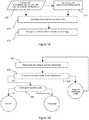
- a code that carries information is chosen (step 100) which is formed by a well-known code sign (e.g. a bar code, a QR code, a Data Matrix code, a mobile code) or a uniquely coded line or point code.
- the code carrying primary information can also be formed by a line or point code hidden within an ornamental graphical illustration of the print.
- the code carrying primary information can be the primary information itself, printed simply onto the printing substrate in an uncoded manner.
- the printing substrate can be any document or the surface of an object to be protected; in particular, e.g.
- Primary information means a piece of information that relates to the document to be protected, generally, the data identifying the document itself. It is of importance that the code carrying primary information could be segmented, i.e. could be covered by a mesh of cells of given size and typically of regular shape (in particular, rectangular shape), being optionally rotated with a given angle relative to the code carrying primary information. Due to the constructional design, this latter requirement is automatically fulfilled for the above mentioned well-known code signs.
- a code that carries secondary information is generated (step 110). This step is performed in harmony with a preset coding concept/algorithm in a way discussed for a specific example in what follows with reference to Figures 2 to 4 in more detail.
- the secondary information is carried by the areas left out from the print of the code carrying primary information. Due to its size, the code carrying secondary information is a piece of latent information, i.e. it is not visible when inspected by the naked eye. Such exemplary secondary information defined by the left-out areas are illustrated in Figures 3 and 6 .
- the secondary information preferably results from the primary information, e.g. from an element/data thereof.
- the codes carrying primary and secondary information are combined together (step 120), as a result of which a combined code that corresponds to the inventive security element is obtained.
- the printed matter with the security element is produced by applying the thus obtained security element onto the printing substrate via the selected printing technology (step 130).
- the security element of the printed matter produced by the method shown in Figure 1A contains data that can be used to identify said printed matter (primary information) and, on the other hand, is suitable for protecting said printing matter against copying, as the secondary information is a latent information that is not visible to the naked eye and disappears or gets distorted in a detectable manner when being printed/copied.
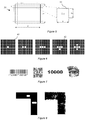
- Figures 2 to 4 illustrates the steps of combining together the codes carrying first and second information in a specific case, wherein the code carrying primary information is provided by a point code (see Figure 2 ) formed by ink dots 20 and representing a figure "0" printed at the resolution of 600 dpi, wherein segmenting is performed by means of a mesh 30 of square shaped cells 34 (see Figure 3 ).
- the size of each cell 34 is at least 300 microns along both the X and Y directions. It was found that the size of 300 microns is sufficient to ensure that each individual ink dot 20 fall into a separate cell 34 and far away from the borders of said cell 34 (that is, practically to the middle of the cell 34).
- each cell 34 is divided into seven by seven pixels 40 (in this specific case); the pixels 40 forming units of said division are the "building blocks" for the left-out areas 32, 42 encoding secondary information.
- segmenting can be performed with different cell sizes and/or with different numbers of pixels along the X, Y directions per cells for a different type of code sign.
- a common rectangular mesh 50 and its (i,j)-th cell 52 applicable for segmenting are shown in Figure 5 . It is also noted here that if higher resolution is used, the pixel number along each of the directions has to be increased proportionally.
- the cells 34 of the code carrying primary information obtained by the segmentation and containing an ink dot are sorted into several classes.
- the number of various classes is chosen to fall between four and six, however, any other number of classes can be equally used.
- the secondary information leads to a feature that can be analyzed by statistical techniques, preferably there are at least ten cells 34 in each class. Said sorting may take place on a regular basis or in a random manner, however, it always results from the code carrying primary information.
- classification is performed in terms of the number of pixels forming the left-out area within each cell.
- the number inscribed into a given cell corresponds to the size of the left-out area within the cell, expressed in pixels.
- the size of the left-out area changes from class to class in a strictly increasing manner. Consequently, for example, the first class remains unaltered (i.e. there is no left-out area therein), the second class will have a left-out area of one pixel, the third class will have a left-out area of at least two pixels, the forth class will have a left-out area of at least three pixels, and so on.
- the size of the left-out area in each cell 34 depends on the printing technology to be applied: the size/dimension of the left-out area is always chosen in such a manner that the printing technology applied is just inadequate to print said left-out area sharply. Consequently, due to printing uncertainty of the left-out areas, said areas will not at all be visible in the printed security element when inspected by the naked eye. Furthermore, the ordered nature of the secondary information is not recognizable by a loupe (at a magnification of 2-20x) either.
- FIG. 6 Several examples for the possible shape of the left-out areas formed of pixels are shown in Figure 6 . Shape and dimension of the left-out area cannot be arbitrary, the latter is limited by the printing technology to be applied, as discussed above.
- Table 1 a couple of white printability line widths proposed for the preparation of the inventive security element, obtained empirically by performing ink wetting experiments on a printing substrate is collected for different printing technologies. The ink wetting measurements were carried out with printing inks tailored to various printing technologies, that is, e.g.
- the inventive security element provided by the combined code discussed above exhibits an inherent feature in the form of the above defined grayscale values that can be associated with the latent secondary information; after printing out the security element and generating a digital representation of the obtained print said inherent feature can be analyzed statistically.
- a digital representation of the code sign carrying primary information of said security element is generated (step 160) in visible light falling into the wavelength range of 380 to 750 nm or by making use of a light source providing illumination that spectrally corresponds to natural light falling into said wavelength range by means of a suitable digital imaging means, such as a mobile phone, a smartphone, a (hand) scanner, a web camera, optionally a camera, having typically a medium resolution.
- a suitable digital imaging means such as a mobile phone, a smartphone, a (hand) scanner, a web camera, optionally a camera, having typically a medium resolution.
- pre-processing of the image of the code sign is performed (step 170), wherein at first the quality of the image is inspected: in case of an image with inadequate quality (due to e.g. insufficient illumination), the image of the code sign is disregarded and a new code sign image is recorded. If said code sign is hidden into an ornamental illustration, separating the image of the code sign from the ornamental illustration is also performed during pre-processing. The manner of executing the separation depends on the way of hiding; in this respect, International Publication Pamphlet No. WO99/35819 , mentioned earlier, discloses a possible exemplary solution in detail. Further separation methods are known to a skilled person in the art and, hence, are not discussed here in more detail. As a finishing step of pre-processing, the image of the code sign is converted into a gray shaded image and the thus obtained grayscale image is then stored for further analysis.
- a check of the secondary information introduced into the code carrying primary information at the time of generating the security element applied to the printed matter is carried out (step 180).
- the classification of dots based on the code carrying primary information is performed again.
- a statistical analysis of the grayscale values of the obtained classes is carried out.
- the grayscale values of the classes have to decrease continuously. The statistical analysis is required because of the camera distortion.
- the pixel islands forming the tiny left-out area get closed up, and thus an increase in grayscale mean values of the classes no longer maintains.
- the closing-up is caused by the steps during copying.
- the number of pixels forming the left-out area and the arrangement of said pixels are of high importance.
- Said left-out area has to exhibit a width, along at least one of its dimensions, that corresponds to the white printability line width given in Table 1 in order that the used scanner or photocopying machine could remove the pixels of the left-out area for sure.
- the inspected printed matter is considered to be a "counterfeit". If, as a result of the statistical analysis, it can be stated that the increase in grayscale mean values of the classes maintains, the inspected printed matter provided with the inventive security element is considered to be "genuine".
- Figure 7 illustrates a couple of exemplary point codes carrying primary information (visible to the naked eye), in particular, from left to right, a bar code, a QR code, a Data Matrix code and a so-called design code, wherein each of them exhibits a greatest dimension exceeding 50 microns.
- primary information visible to the naked eye
- a bar code a QR code
- a Data Matrix code a so-called design code, wherein each of them exhibits a greatest dimension exceeding 50 microns.
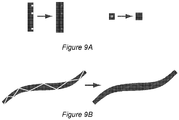
- Figures 9A and 9B illustrate some examples for a piece of secondary information hidden into designs.
- a specific inspection device is not absolutely necessary; to this end, a photo taken by e.g. an ordinary smartphone and a decoding and analyzing software based on the method shown in Figure 1B installed in the phone are sufficient. (Nevertheless, the photo or the digital representation of the security element can be taken by any other camera as well, and the analyzing software can be executed by any computer with appropriate computing capacity.)
- the inspection device can be a custom-built device; it should contain a reader unit (CCD, CMOS), for example a digital camera, for generating a digital representation of the security element, a data processing unit, for example a microcontroller or a processor, preferably a memory unit, as well as the decoding software itself.
- the secondary information in general, is not stored in a database, to inspect authenticity of a printed matter with the security element according to the invention, there is no need for a data communication link.
- the latent (secondary) information can be deduced from the primary information, and hence, it is merely the inspection device that is actually needed for the authenticity check.
- the inspection device establishes a connection with the database through an appropriate data communication channel, interrogates the generating key needed, and then performs the authenticity check of the printed matter challenged.
- said inspection device can also provide precise information for the database about the geographical location of the key interrogation as a consequence of the data communication established. If the inspection device is a mobile phone or a smartphone, said information can easily be provided in the form of either the mobile base data or GPS coordinates.
- the inventive security element can also be formed on/in a surface of the object to be protected by laser ablation instead of ink printing.
- the paper-based substrate is replaced by any materials that can be machined by laser ablation.
- the security element according to the present invention can be used alone or in combination with other security elements as an additional element thereto.
Landscapes
- Engineering & Computer Science (AREA)
- General Physics & Mathematics (AREA)
- Physics & Mathematics (AREA)
- Multimedia (AREA)
- Theoretical Computer Science (AREA)
- Signal Processing (AREA)
- Computer Vision & Pattern Recognition (AREA)
- Computer Security & Cryptography (AREA)
- Artificial Intelligence (AREA)
- Computer Networks & Wireless Communication (AREA)
- Credit Cards Or The Like (AREA)
- Printing Methods (AREA)
- Inspection Of Paper Currency And Valuable Securities (AREA)
Description
- The present invention relates to a security element, as well as to a method to ascertain the authenticity of a print arranged on a printing substrate. Its application field falls into the field of protection of printed matters produced by printing machines or documents generated with ink jet printers and/or laser printers against counterfeiting.
- By the time being, photocopying and laser printing technologies have undergone an enormous improvement. As a result, high quality reproduction of various printed matters has become significantly simplified by using these techniques. At the same time, unfortunately, counterfeiting of valuable or personalized printed matters have become easier as well. Thus, the protection of such documents against counterfeiting has come to the fore. Any document provided with a data carrier, such as e.g. a writing or drawing, produced by e.g. a printing machine or an ink jet and/or a laser printer, may constitute a printed matter that requires protection. Such printed matters are, for example, the various packaging labels (e.g. for medicaments, CD covers), valuable entrance tickets, certifications, bank notes, cheques, personal identifiers, various vouchers, etc. just to mention only a few examples. To avoid (or to minimize) misuses, said printed matters are generally provided by appropriate security elements. In general, the security elements applied and/or their combinations are rather complicated.
- A great number of solutions exists in the field of print protection. In a class thereof, the security element providing protection is hidden in the printed image itself. International Patent Application Pamphlet No.
WO99/35819 U.S. Patent Application No. 1996/019310 disclose solutions based on just this concept. According to the solutions taught, a secondary image not visible to the naked eye, but visible to a specific decoding device is hidden within a primary image that is visible to the naked eye. The physical parameters of the techniques used to create said secondary image can be chosen in such a manner that the secondary image simply disappears upon copying the substrate (the document) printed upon with the combined image. That is, this information cannot be reconstructed from a copy of the print. To implement the solutions concerned, however, a high-precision printing machine (with a resolution of at least 8000 dpi) is required, and to inspect authenticity of the print, there is a need also for a decoding lens. Due to these drawbacks, the application of said solutions did/could not become well-spread in everyday practice, where - as a consequence of the advancements achieved in digital printing - the protection of printed matters with prints produced by machines generally with much lower resolution (typically of 600 dpi) has to be safeguarded. - The security element disclosed in
RU Patent No. 2,430,836 - In a further class of print protection, it is the printing ink used to apply the print and/or the printing substrate itself what is made specific, and non-copyable nature is attempted to achieve in this way. Such solutions are disclosed e.g. in
EP Patent Nos. 2,004,414 ;1,858,605 ;1,827,864 and1,779,335 . The largest drawback of the solutions concerned is due to the specific and, hence, relatively expensive inks (for example, printing inks with optically variable pigments) or the usage of specific printing substrates that can be produced at relatively high costs, too. - In a yet further class of print protection, the print comprises one or more identifiers that can associate the print with a database.
U.S. Patent No. 6,952,485 teaches a so-called electronical watermark as the identifier. Here, a noise incorporated into the image and not visible to the naked eye carries the information. The electronical watermark can be reconstructed from the copy prepared by reproduction without any changes, that is said electronical watermark is always transferred by copying. An application field for said electronical watermarks is the protection of bank notes against copying. In particular, such an electronical watermark is included in Euro banknotes as the security element. This watermark is recognized by the driver of every single printing machine sold nowadays, and then simply refuses to print out the image comprising the electronical watermark. A drawback of this technique lies in the fact that a wide agreement is required amongst the printer and scanner manufacturers as to the electronical watermark used for copy protection. This means that this kind of print protection can be used merely on highly exceptional printed matters. Moreover, the forbidden watermark has to be "taught" to every printer/scanner driver. A further drawback of this technique originates just from the latter: printing devices manufactured before the agreement had been made simply don't recognize the forbidden watermark, and thus they print out the printed matter protected by said watermark. - According to the solution disclosed in International Patent Appl. No.
PCT/EP2009/061073 - In a yet further class of print protection, to inspect authenticity of a print, interference of the printing device and the printing support during printing is exploited.
U.S. Patent Appl. No. 2002/0037093 relates to a solution wherein a photocopying machine or a laser printer "fouls" the (paper) printing substrate passing through it randomly with toner or ink microdots not visible to the naked eye when the copy is prepared. That is, by analyzing a highdefinition digital image of a document, if toner or ink microdots are looked for particularly in portions of said document carrying no print, one can unambiguously decide whether or not the document is generated by copying. A drawback of this technique lies in that to perform the study, a digitizing means of high resolution is required. - Japanese Patent Appl. No.
2009/034921 A -
FR Patent No. 2,962,828 A1 -
U.S. Pat. No. 5,189,292 discloses an optically encoded information bearing label with a two-dimensional array of data cells that includes a finder pattern comprising a plurality of spots arranged in a predetermined geometric pattern substantially analogous to the predetermined geometric pattern of said two dimensional array of data cells. The finder pattern is detected by first scanning the image area to detect spots. The locations of detected spots are compared to the known geometry of the finder pattern in order to provide for rapid and reliable finding of the finder pattern and the information bearing label. Additionally, the detected finder pattern spots provide information for decoding the two-dimensional data array in order to compensate for label magnification, tilt and other distortions. -
U.S. Pat. Appl. No. 2009/059304 A1 describes how to make halftone images on intaglio printing. The method comprises the generation of stochastic microstructure(s) that is/are used to increase the halftone representation. As a consequence of applying said microstructure(s), the overall appearance of the image gets modified, that is, an observer can recognize the applied modifications by means of e.g. appropriate magnifying means. -
U.S. Pat. Appl. No. 2009/046931 A1 discloses systems and methods for segmenting an image into at least two layers, a foreground and a background layer, based on grayscale mainly for the purpose of scanning. - By the time being, barcodes, Data Matrix codes, various QR-codes, mobile codes, and similar other codes (from now on, point codes, in general) have become well-spread information carrier means. Their popularity is mainly due to the speedy spread of mobile phones, especially of smartphones. Their disadvantage lies in the fact that, in general, they contain no copy protection, and thus their application as security elements are highly limited.
- In light of the above, it is apparent that although a plurality of print protection technologies is available to protect prints to be equipped with copy protection and printing substrates/documents having such prints, the technologies are either too expensive or require a specific set of devices for their creation and/or inspection.
- It is a natural demand, however, that authenticity of a document could be determined simply and rapidly by anyone and essentially anywhere without the necessity of additional competence and technical equipments.
- In light of the above, a primary object of the present invention is to provide a security element applied to a printing substrate by printing which, on the one hand, contains identification data associated with the printed matter itself as primary information and, on the other hand, also provides a reliable copy protection for the printed matter via latent secondary information.
- A further object of the present invention is to provide a print protection technique, especially a method to inspect/determine print authenticity that allows authenticity check of a printed matter with a security element according to the invention for anyone and with no qualification in information safety immediately and on the spot by means of devices of at least medium resolution (that is, of 300 to 1200 dpi) that are available in everyday usage, such as e.g. mobile phones, tablets, smartphones, web cameras, etc..
- Our studies led us to the conclusion that a security element achieving the object of the invention can be accomplished by combining a suitably chosen code carrying primary information with a piece of secondary information, wherein the secondary information cannot be reconstructed from the print itself (or its copies) but provides an inherent feature that can be analyzed by statistical methods. A structure carrying such secondary information can be generated in the form of areas incorporated (preferentially by the manufacturer) into the code carrying primary information in accordance with a predefined coding concept/algorithm and not printed upon directly. Due to printing distortions/uncertainties, such as e.g. the deformation of the printing substrate and/or the printing plate upon contacting each other or the inevitable ink wetting of the printing ink applied on the printing substrate, arising when printing is executed, the areas left out from direct printing become more or less covered by ink. According to our studies, a condition for said left-out area(s) to be undetectable to the naked eye in the print of the security element is that the largest dimension of said left-out area(s) within the print along at least one direction is 2 to 40 microns, depending on the printing technology applied and the quality of the printing substrate. Although, due to printing uncertainties, the secondary information concerned will not at all be detectable to the naked eye in the print of the security element, neither its ordered nature is recognizable by a loupe (at a magnification of 2-20x), it was found that the incorporation of said secondary information alters the grayscale value of that portion of the digital representation of the print into which it had actually been incorporated. Via altering the grayscale value, said secondary information attributes the inventive security element with an inherent feature that can be analyzed by statistical methods, wherein the result of the analysis is characteristic of the security element itself and thus it can be used as a copy protection element for the security element, as well as for the printing substrate having such a security element.
- The object aiming at providing a method to inspect the authenticity of a print is achieved by the method according to
Claim 1. Further preferred variants of the inventive method are set forth inClaims 1 to 9. - The object aiming at the provision of an apparatus implementing the method of
Claim 1 is achieved by the apparatus according to Claim 10. - The embodiments or examples of the following description which are not covered by the appended claims are provided for mere illustrative purposes.
- In what follows, the invention is discussed in more detail with reference to the attached drawing, wherein
-
Figure 1A shows the block diagram of a method to generate a security element according to the invention and to apply it on a printing substrate; -
Figure 1B illustrates the block diagram of an authenticity inspection method based on the application of a security element according to the invention; -
Figure 2 shows schematically the way of generating a combined code, that constitutes the security element, from codes carrying primary and secondary information; -
Figure 3 shows a portion of the combined code ofFigure 2 in enlarged view; -
Figure 4 illustrates the decomposition of the combined code portion shown inFigure 3 into classes in terms of the secondary information, performed along with a coding concept set by the manufacturer; -
Figure 5 shows a generalized code cell applicable when the secondary information is introduced into a point code; -
Figure 6 illustrates a couple of possible preferred embodiments of the left-out area(s) (pixels) representing secondary information that are applicable in a security element according to the invention; -
Figure 7 shows several exemplary point codes (visible to the naked eye) carrying primary information that have the largest dimension greater than 50 microns; -
Figure 8 illustrates the theoretical appearance (as formed in a printing plate) and the actual appearance (as seen after having printed onto a printing substrate) of a portion of the security element provided by the combined code; and -
Figures 9A and 9B illustrate a piece of secondary (latent) information that has a dimension of at most 50 microns along at least one direction, hidden into a point like and a line like design, respectively, before and after printing. - A general method to generate a security element according to the invention formed by a combined code is shown in
Figure 1A . According to this, a code that carries information is chosen (step 100) which is formed by a well-known code sign (e.g. a bar code, a QR code, a Data Matrix code, a mobile code) or a uniquely coded line or point code. According to a yet further possibility, the code carrying primary information can also be formed by a line or point code hidden within an ornamental graphical illustration of the print. Moreover, the code carrying primary information can be the primary information itself, printed simply onto the printing substrate in an uncoded manner. The printing substrate can be any document or the surface of an object to be protected; in particular, e.g. banknotes, securities, invoices, product packagings, identity cards/labels, covers, entrance tickets, certificates, personal documents, vouchers or any other similar documents. Primary information means a piece of information that relates to the document to be protected, generally, the data identifying the document itself. It is of importance that the code carrying primary information could be segmented, i.e. could be covered by a mesh of cells of given size and typically of regular shape (in particular, rectangular shape), being optionally rotated with a given angle relative to the code carrying primary information. Due to the constructional design, this latter requirement is automatically fulfilled for the above mentioned well-known code signs. - After selecting the code carrying primary information, a code that carries secondary information is generated (step 110). This step is performed in harmony with a preset coding concept/algorithm in a way discussed for a specific example in what follows with reference to
Figures 2 to 4 in more detail. In particular, the secondary information is carried by the areas left out from the print of the code carrying primary information. Due to its size, the code carrying secondary information is a piece of latent information, i.e. it is not visible when inspected by the naked eye. Such exemplary secondary information defined by the left-out areas are illustrated inFigures 3 and6 . The secondary information preferably results from the primary information, e.g. from an element/data thereof. - After generating the code carrying secondary information, the codes carrying primary and secondary information are combined together (step 120), as a result of which a combined code that corresponds to the inventive security element is obtained.
- Finally, the printed matter with the security element is produced by applying the thus obtained security element onto the printing substrate via the selected printing technology (step 130).
- The security element of the printed matter produced by the method shown in
Figure 1A , on the one hand, contains data that can be used to identify said printed matter (primary information) and, on the other hand, is suitable for protecting said printing matter against copying, as the secondary information is a latent information that is not visible to the naked eye and disappears or gets distorted in a detectable manner when being printed/copied. -
Figures 2 to 4 illustrates the steps of combining together the codes carrying first and second information in a specific case, wherein the code carrying primary information is provided by a point code (seeFigure 2 ) formed byink dots 20 and representing a figure "0" printed at the resolution of 600 dpi, wherein segmenting is performed by means of amesh 30 of square shaped cells 34 (seeFigure 3 ). Here, the size of eachcell 34 is at least 300 microns along both the X and Y directions. It was found that the size of 300 microns is sufficient to ensure that eachindividual ink dot 20 fall into aseparate cell 34 and far away from the borders of said cell 34 (that is, practically to the middle of the cell 34). Furthermore, eachcell 34 is divided into seven by seven pixels 40 (in this specific case); thepixels 40 forming units of said division are the "building blocks" for the left-outareas rectangular mesh 50 and its (i,j)-th cell 52 applicable for segmenting are shown inFigure 5 . It is also noted here that if higher resolution is used, the pixel number along each of the directions has to be increased proportionally. - Having segmented the code that carries primary information, introduction of the code that carries secondary information is performed. To this end, the
cells 34 of the code carrying primary information obtained by the segmentation and containing an ink dot, are sorted into several classes. Here, the number of various classes is chosen to fall between four and six, however, any other number of classes can be equally used. Since after printing the inventive security element, the secondary information leads to a feature that can be analyzed by statistical techniques, preferably there are at least tencells 34 in each class. Said sorting may take place on a regular basis or in a random manner, however, it always results from the code carrying primary information. In the present example, classification is performed in terms of the number of pixels forming the left-out area within each cell. Here, the number inscribed into a given cell corresponds to the size of the left-out area within the cell, expressed in pixels. The size of the left-out area changes from class to class in a strictly increasing manner. Consequently, for example, the first class remains unaltered (i.e. there is no left-out area therein), the second class will have a left-out area of one pixel, the third class will have a left-out area of at least two pixels, the forth class will have a left-out area of at least three pixels, and so on. - The size of the left-out area in each
cell 34 depends on the printing technology to be applied: the size/dimension of the left-out area is always chosen in such a manner that the printing technology applied is just inadequate to print said left-out area sharply. Consequently, due to printing uncertainty of the left-out areas, said areas will not at all be visible in the printed security element when inspected by the naked eye. Furthermore, the ordered nature of the secondary information is not recognizable by a loupe (at a magnification of 2-20x) either. - Several examples for the possible shape of the left-out areas formed of pixels are shown in
Figure 6 . Shape and dimension of the left-out area cannot be arbitrary, the latter is limited by the printing technology to be applied, as discussed above. In Table 1 below, a couple of white printability line widths proposed for the preparation of the inventive security element, obtained empirically by performing ink wetting experiments on a printing substrate is collected for different printing technologies. The ink wetting measurements were carried out with printing inks tailored to various printing technologies, that is, e.g. with a black printing ink from Hewlett Packard, with a black printing ink from MEMJET, with the KODAK Prosper press black ink and a black printing ink from EPSON, wherein fibrous paper used typically for security printing was applied as the printing substrate at the temperature of 18-22°C (room temperature) and at 101 kPa ambient pressure. It is noted here that the values enlisted in Table 1 are valid for other kinds of paper as well, although the required resolution generally changes. In particular, if the printing substrate is e.g. a glossy paper, printing has to be performed at the resolution of at least 600-1200 dpi instead of 300-600 dpi. - In line with the above, when a novel printing technology becomes available, the ink wetting can be determined on a pilot print and then a proposed white printability line width for the left-out area expressed in number of pixels can be derived for the novel technology. To this end the following empirical equations can also be used:


Table 1. Line width of left-out areas carrying secondary information. Technology Typical resolution [dpi] Ink wetting [micron] (paper dependent) White printability line width (of an area left out from direct printing) [micron] [pix] Inkjet printing 600 10-50 12-60 1-2 Laser printing 720 30-40 36-48 2-3 Offset printing 8000 10-20 12-24 4-8 - Although the areas left out from direct printing are not visible to the naked eye in the print of the security element, due to printing uncertainties they change the grayscale of the cell defined by the expression of

- Decoding the inventive security element applied on a printing substrate and, as a result of this, deciding on the authenticity of the printed matter concerned are performed in line with the scheme shown in
Figure 1B . According to this, in a first step a digital representation of the code sign carrying primary information of said security element is generated (step 160) in visible light falling into the wavelength range of 380 to 750 nm or by making use of a light source providing illumination that spectrally corresponds to natural light falling into said wavelength range by means of a suitable digital imaging means, such as a mobile phone, a smartphone, a (hand) scanner, a web camera, optionally a camera, having typically a medium resolution. - After this step, pre-processing of the image of the code sign is performed (step 170), wherein at first the quality of the image is inspected: in case of an image with inadequate quality (due to e.g. insufficient illumination), the image of the code sign is disregarded and a new code sign image is recorded. If said code sign is hidden into an ornamental illustration, separating the image of the code sign from the ornamental illustration is also performed during pre-processing. The manner of executing the separation depends on the way of hiding; in this respect, International Publication Pamphlet No.
WO99/35819 - After completing the above pre-processing steps in good order, a check of the secondary information introduced into the code carrying primary information at the time of generating the security element applied to the printed matter is carried out (step 180). To this end, the classification of dots based on the code carrying primary information is performed again. After completion of the classification, a statistical analysis of the grayscale values of the obtained classes is carried out. For the image taken of a genuine print, the grayscale values of the classes have to decrease continuously. The statistical analysis is required because of the camera distortion. Here, the two-sample t-test is a suitable method with the hypothesis of mean1=mean2 against the alternative hypothesis of mean1<mean2 with a significance level of p=0.05. To a skilled person in the art it is clear that, instead of t-test, other statistical tests are equally applicable in this case.
- Upon copying, the pixel islands forming the tiny left-out area get closed up, and thus an increase in grayscale mean values of the classes no longer maintains. The closing-up is caused by the steps during copying. As far as this process is concerned, the number of pixels forming the left-out area and the arrangement of said pixels are of high importance. Said left-out area has to exhibit a width, along at least one of its dimensions, that corresponds to the white printability line width given in Table 1 in order that the used scanner or photocopying machine could remove the pixels of the left-out area for sure. In such a case, the inspected printed matter is considered to be a "counterfeit". If, as a result of the statistical analysis, it can be stated that the increase in grayscale mean values of the classes maintains, the inspected printed matter provided with the inventive security element is considered to be "genuine".
-
Figure 7 illustrates a couple of exemplary point codes carrying primary information (visible to the naked eye), in particular, from left to right, a bar code, a QR code, a Data Matrix code and a so-called design code, wherein each of them exhibits a greatest dimension exceeding 50 microns. To generate the security element according to the invention, all of them can be used. - The closing-up of white islands carrying secondary information of a print produced by an ink jet printer is shown in
Figure 8 taken by a field microscope at a magnification of 50x. While the left-out area of the printing plate on the left side exhibits sharp borderlines, the left-out areas can be hardly detected in the print on the right side. Moreover, upon copying, these uncertain spots are closed by the photocopying machine, and the photocopy becomes black in 100%. -
Figures 9A and 9B illustrate some examples for a piece of secondary information hidden into designs. - Briefly summarized: to accomplish the present invention in practice, a specific inspection device is not absolutely necessary; to this end, a photo taken by e.g. an ordinary smartphone and a decoding and analyzing software based on the method shown in
Figure 1B installed in the phone are sufficient. (Nevertheless, the photo or the digital representation of the security element can be taken by any other camera as well, and the analyzing software can be executed by any computer with appropriate computing capacity.) The inspection device can be a custom-built device; it should contain a reader unit (CCD, CMOS), for example a digital camera, for generating a digital representation of the security element, a data processing unit, for example a microcontroller or a processor, preferably a memory unit, as well as the decoding software itself. Application of the inventive security element on a printing substrate does not require a printing machine of high-precision; to this end an ink jet printer with the resolution of even 600 dpi is appropriate. This allows a wide range applicability for the solution according to the present invention. - As the secondary information, in general, is not stored in a database, to inspect authenticity of a printed matter with the security element according to the invention, there is no need for a data communication link. The latent (secondary) information can be deduced from the primary information, and hence, it is merely the inspection device that is actually needed for the authenticity check.
- For a skilled person in the art it is, however, apparent that the previously selected coding concept for the secondary information (or its generating key) can be stored in a remote database. In such a case, within the framework of the method for authenticity inspection, the inspection device establishes a connection with the database through an appropriate data communication channel, interrogates the generating key needed, and then performs the authenticity check of the printed matter challenged. A further advantage of such an embodiment is that said inspection device can also provide precise information for the database about the geographical location of the key interrogation as a consequence of the data communication established. If the inspection device is a mobile phone or a smartphone, said information can easily be provided in the form of either the mobile base data or GPS coordinates.
- Furthermore, when a security element according to the present invention is to be applied, neither expensive printing ink(s) of specific composition nor specifically produced expensive printing substrates are required. As it is also apparent to a skilled person in the art, the inventive security element can also be formed on/in a surface of the object to be protected by laser ablation instead of ink printing. In case of such applications, the paper-based substrate is replaced by any materials that can be machined by laser ablation.
- It is also clear for a skilled person in the art that the security element according to the present invention can be used alone or in combination with other security elements as an additional element thereto.
Claims (10)
- A method to inspect authenticity of a printed matter with a security element, said security element comprising a code (20) that carries primary information and is detectable to the naked eye in visible light falling into the wavelength range of 380 to 750 nm, and, combined therewith, a code (32, 42) that carries secondary information and is undetectable to the naked eye, wherein in the security element applied as a print on a printing substrate the largest dimension in at least one planar direction of the code carrying secondary information is 2 to 40 microns, and wherein the code carrying secondary information is generated by areas of the code carrying primary information not printed upon directly, the method comprising the steps of
recording an image of the code (20) carrying the primary information of the security element upon illuminating the printed matter with visible light falling into the wavelength range of 380 to 750 nm;
converting the obtained image into a grayscale image and storing the grayscale image;
segmenting the grayscale image stored;
sorting segments of the segmented grayscale image into a given number of classes based on a preset coding algorithm;
assigning a grayscale mean value, as inherent feature that can be statistically analyzed, to each class by subjecting said classes one after the other to statistical analysis;
generating a trend from the obtained grayscale mean values changing from class to class;
taking a stand on the matter of authenticity of said printed matter based on the shape of said trend. - The method according to Claim 1, wherein the code (20) carrying primary information is chosen from a group consisting of bar codes, QR codes, Data Matrix codes, and uniquely developed point codes with non-public coding.
- The method according to Claim 1, wherein the printing substrate is provided with an ornamental graphical illustration and said code carrying primary information is hidden in said illustration.
- The method according to any of Claims 1 to 3, wherein the secondary information results from the primary information.
- The method according to any of Claims 1 to 4, characterized in that the printing substrate is chosen from a group consisting of banknotes, securities, invoices, product packagings, identity cards/labels, covers, entrance tickets, certificates, personal documents, vouchers or any other similar documents or object surfaces to be equipped with copy protection.
- The method according to any of Claims 1 to 5, wherein said image is generated by an imaging device with a resolution of 300 to 1200 dpi.
- The method according to any of Claims 1 to 6, also comprising the step of separating the image of the code carrying primary information from an ornamental illustration if said code is hidden in the ornamental illustration before converting said recorded image of the code into the grayscale image.
- The method according to any of Claims 1 to 7, wherein in said statistical analysis of classes a two-sample t-test of pairs of the classes is also performed.
- The method according to any of Claims 1 to 8, wherein taking a stand on the matter of authenticity comprises
confirming authenticity of the printed matter when said trend matches a predetermined trend of increasing grayscale mean values; and
denying authenticity of the printed matter when said trend does not match the predetermined trend of increasing grayscale mean values. - An apparatus configured to implement the method according to any of Claims 1 to 9.
Applications Claiming Priority (2)
| Application Number | Priority Date | Filing Date | Title |
|---|---|---|---|
| HU1200097A HUP1200097A2 (en) | 2012-02-15 | 2012-02-15 | Security element and method for checking originality of a printed matter |
| PCT/IB2013/051260 WO2013121401A2 (en) | 2012-02-15 | 2013-02-15 | Security element and method to inspect authenticity of a print |
Publications (2)
| Publication Number | Publication Date |
|---|---|
| EP2815567A2 EP2815567A2 (en) | 2014-12-24 |
| EP2815567B1 true EP2815567B1 (en) | 2020-03-25 |
Family
ID=89990612
Family Applications (1)
| Application Number | Title | Priority Date | Filing Date |
|---|---|---|---|
| EP13721389.8A Active EP2815567B1 (en) | 2012-02-15 | 2013-02-15 | Security element and method to inspect authenticity of a print |
Country Status (21)
| Country | Link |
|---|---|
| US (1) | US9594994B2 (en) |
| EP (1) | EP2815567B1 (en) |
| JP (1) | JP6765783B2 (en) |
| KR (1) | KR101712167B1 (en) |
| CN (1) | CN104115480B (en) |
| AU (1) | AU2013220001B2 (en) |
| BR (1) | BR112014020232B1 (en) |
| CA (1) | CA2864486C (en) |
| CL (1) | CL2014002182A1 (en) |
| EA (1) | EA027635B1 (en) |
| ES (1) | ES2791399T3 (en) |
| HU (2) | HUP1200097A2 (en) |
| IL (1) | IL233973A (en) |
| MX (1) | MX2014009891A (en) |
| MY (1) | MY172512A (en) |
| NZ (1) | NZ629838A (en) |
| PE (1) | PE20142203A1 (en) |
| SG (1) | SG11201404639TA (en) |
| UA (1) | UA115779C2 (en) |
| WO (1) | WO2013121401A2 (en) |
| ZA (1) | ZA201406460B (en) |
Families Citing this family (17)
| Publication number | Priority date | Publication date | Assignee | Title |
|---|---|---|---|---|
| WO2015067725A1 (en) | 2013-11-07 | 2015-05-14 | Scantrust Sa | Two dimensional barcode and method of authentication of such barcode |
| WO2015103396A1 (en) * | 2013-12-31 | 2015-07-09 | I-Property Holding Corp. | Pharmaceutical product packaging to prevent counterfeits |
| US9443180B2 (en) | 2014-03-03 | 2016-09-13 | Nthdegree Technologies Worldwide Inc. | Security label using printed LEDs |
| WO2016081152A1 (en) * | 2014-11-18 | 2016-05-26 | Nthdegree Technologies Worldwide Inc. | Security label using printed leds |
| EP3166048A1 (en) * | 2015-11-06 | 2017-05-10 | ams AG | Optical reader device, tag for use on a disposable or replaceable component, optical data validation system and method for optical data validation |
| KR102747775B1 (en) * | 2016-03-23 | 2024-12-31 | 소니그룹주식회사 | Information processing device and information processing method |
| CN108537077B (en) * | 2017-03-06 | 2023-07-14 | 手持产品公司 | System and method for bar code verification |
| TWI770123B (en) * | 2017-03-13 | 2022-07-11 | 日商佐藤控股股份有限公司 | Information processing apparatus, program, information processing method and information processing system |
| EP3630044A4 (en) * | 2017-05-01 | 2021-03-31 | I-Property Holding Corp. | AUTHENTICATION SYSTEM FOR USE WITH PHARMACEUTICAL PRODUCTS |
| US20200357210A1 (en) * | 2017-09-01 | 2020-11-12 | Nec Corporation | Entry-exit management system, entry-exit management method and recording medium |
| DE102017128258A1 (en) * | 2017-09-14 | 2019-03-14 | Schattdecor Ag | Method of manufacturing and protecting against inadmissible duplication of decor paper or films |
| CN108229457A (en) * | 2017-12-14 | 2018-06-29 | 深圳市商汤科技有限公司 | Verification method, device, electronic equipment and the storage medium of certificate |
| DE102018115146A1 (en) * | 2018-06-24 | 2019-12-24 | Industry365 Ug (Haftungsbeschränkt) | Process for producing security elements that are invisible to the human eye and cannot be copied in an image, and method for verifying the authenticity of products based on the comparison of unequal information and printed image |
| PL3656571T3 (en) | 2018-11-20 | 2022-01-03 | Flooring Industries Limited, Sarl | DECORATIVE PAPER OR FOIL |
| DE102019132518A1 (en) | 2019-11-29 | 2021-06-02 | Schreiner Group Gmbh & Co. Kg | Method for testing a grid-like printed and / or designed surface of an object and object |
| US12482140B2 (en) | 2023-01-13 | 2025-11-25 | Xerox Corporation | Methods and systems for encoding data using artificial fingerprints |
| US12456316B2 (en) * | 2023-08-07 | 2025-10-28 | Xerox Corporation | Methods and systems for document authentication using ink satellites |
Citations (2)
| Publication number | Priority date | Publication date | Assignee | Title |
|---|---|---|---|---|
| US20090046931A1 (en) * | 2007-08-13 | 2009-02-19 | Jing Xiao | Segmentation-based image labeling |
| US20090059304A1 (en) * | 2006-04-13 | 2009-03-05 | Kba-Giori S.A. | Method of generating patterns representing a halftone image |
Family Cites Families (28)
| Publication number | Priority date | Publication date | Assignee | Title |
|---|---|---|---|---|
| US5189292A (en) * | 1990-10-30 | 1993-02-23 | Omniplanar, Inc. | Finder pattern for optically encoded machine readable symbols |
| US6345104B1 (en) * | 1994-03-17 | 2002-02-05 | Digimarc Corporation | Digital watermarks and methods for security documents |
| US5708717A (en) * | 1995-11-29 | 1998-01-13 | Alasia; Alfred | Digital anti-counterfeiting software method and apparatus |
| DE19758587C2 (en) * | 1997-03-04 | 2003-03-27 | Bundesdruckerei Gmbh | Arrangement for the visual and mechanical authenticity check of value and security documents |
| US6104812A (en) | 1998-01-12 | 2000-08-15 | Juratrade, Limited | Anti-counterfeiting method and apparatus using digital screening |
| US6571001B2 (en) | 1998-06-10 | 2003-05-27 | Micron Technology, Inc. | System for detecting photocopied or laser-printed documents |
| AU2001260512A1 (en) * | 2000-06-05 | 2001-12-17 | Optaglio Limited | Product verification and authentication system and method |
| US6952485B1 (en) | 2000-09-11 | 2005-10-04 | Digimarc Corporation | Watermark encoding and decoding in imaging devices and imaging device interfaces |
| ES2356598T3 (en) * | 2000-09-20 | 2011-04-11 | Alpvision Sa | PROCESS INTENDED TO PREVENT THE FALSIFICATION OR ALTERATION OF A PRINTED OR RECORDED SURFACE. |
| GB0031016D0 (en) * | 2000-12-20 | 2001-01-31 | Alphafox Systems Ltd | Security systems |
| DE10162050A1 (en) * | 2001-12-17 | 2003-07-03 | Giesecke & Devrient Gmbh | value document |
| JP2004153405A (en) * | 2002-10-29 | 2004-05-27 | Fuji Xerox Co Ltd | Method and apparatus for confirming document |
| DE102005011612A1 (en) | 2004-08-13 | 2006-02-23 | Giesecke & Devrient Gmbh | Data carrier with an optically variable structure |
| DE102004049118A1 (en) | 2004-10-07 | 2006-04-13 | Giesecke & Devrient Gmbh | Security element and method for its production |
| DE102005005615A1 (en) | 2005-02-08 | 2006-10-05 | Giesecke & Devrient Gmbh | Back up information |
| US8077905B2 (en) * | 2006-01-23 | 2011-12-13 | Digimarc Corporation | Capturing physical feature data |
| JP2007272541A (en) * | 2006-03-31 | 2007-10-18 | Fuji Xerox Co Ltd | Inspection object checked with authenticity, peculiar information registration device and authenticity determination device |
| DE102006016118A1 (en) | 2006-04-04 | 2007-10-11 | Giesecke & Devrient Gmbh | security element |
| JP4831320B2 (en) * | 2006-04-24 | 2011-12-07 | 大日本印刷株式会社 | Authenticity identification structure |
| US8050502B2 (en) * | 2006-06-21 | 2011-11-01 | Namco Bandai Games Inc. | Two-Dimensional code generation method, two-dimensional code, two-dimensional code recognition method, and image recognition device |
| GB2456114B (en) * | 2006-11-14 | 2011-05-04 | Securency Int Pty Ltd | Methods of protecting security documents from counterfeiting |
| GB0702092D0 (en) * | 2007-02-02 | 2007-03-14 | Fracture Code Corp Aps | Graphic Code Application Apparatus and Method |
| JP5179112B2 (en) | 2007-08-02 | 2013-04-10 | 小林クリエイト株式会社 | Anti-counterfeiting form |
| FR2962828B1 (en) * | 2010-07-19 | 2012-08-17 | Advanced Track & Trace | METHODS AND DEVICES FOR MARKING AND AUTHENTICATING A PRODUCT BY A CONSUMER |
| RU2430836C1 (en) | 2010-07-29 | 2011-10-10 | Федеральное Государственное Унитарное Предприятие "Гознак" (Фгуп "Гознак") | Multilayer protective element with alternate optical effect and counterfeit-proof document |
| WO2012174545A1 (en) * | 2011-06-17 | 2012-12-20 | I-Property Holding Corp. | 3d laser coding in glass |
| US20140295032A1 (en) * | 2011-11-15 | 2014-10-02 | Nestec S.A. | Optical readable code support and capsule for preparing a beverage having such code support providing an enhanced readable optical signal |
| US9619310B2 (en) | 2012-09-26 | 2017-04-11 | Honeywell International Inc. | High speed data transmission methods and systems upon error detection |
-
2012
- 2012-02-15 HU HU1200097A patent/HUP1200097A2/en unknown
-
2013
- 2013-02-15 UA UAA201409980A patent/UA115779C2/en unknown
- 2013-02-15 EA EA201491491A patent/EA027635B1/en unknown
- 2013-02-15 JP JP2014557161A patent/JP6765783B2/en active Active
- 2013-02-15 HU HUE13721389A patent/HUE049577T2/en unknown
- 2013-02-15 CN CN201380009395.5A patent/CN104115480B/en active Active
- 2013-02-15 PE PE2014001268A patent/PE20142203A1/en active IP Right Grant
- 2013-02-15 MY MYPI2014702239A patent/MY172512A/en unknown
- 2013-02-15 WO PCT/IB2013/051260 patent/WO2013121401A2/en not_active Ceased
- 2013-02-15 KR KR1020147025709A patent/KR101712167B1/en active Active
- 2013-02-15 AU AU2013220001A patent/AU2013220001B2/en active Active
- 2013-02-15 MX MX2014009891A patent/MX2014009891A/en active IP Right Grant
- 2013-02-15 EP EP13721389.8A patent/EP2815567B1/en active Active
- 2013-02-15 ES ES13721389T patent/ES2791399T3/en active Active
- 2013-02-15 US US14/378,901 patent/US9594994B2/en active Active
- 2013-02-15 NZ NZ629838A patent/NZ629838A/en unknown
- 2013-02-15 SG SG11201404639TA patent/SG11201404639TA/en unknown
- 2013-02-15 BR BR112014020232-0A patent/BR112014020232B1/en active IP Right Grant
- 2013-02-15 CA CA2864486A patent/CA2864486C/en active Active
-
2014
- 2014-08-06 IL IL233973A patent/IL233973A/en active IP Right Grant
- 2014-08-14 CL CL2014002182A patent/CL2014002182A1/en unknown
- 2014-09-03 ZA ZA2014/06460A patent/ZA201406460B/en unknown
Patent Citations (2)
| Publication number | Priority date | Publication date | Assignee | Title |
|---|---|---|---|---|
| US20090059304A1 (en) * | 2006-04-13 | 2009-03-05 | Kba-Giori S.A. | Method of generating patterns representing a halftone image |
| US20090046931A1 (en) * | 2007-08-13 | 2009-02-19 | Jing Xiao | Segmentation-based image labeling |
Also Published As
Similar Documents
| Publication | Publication Date | Title |
|---|---|---|
| US9594994B2 (en) | Security element and method to inspect authenticity of a print | |
| RU2681696C2 (en) | Two dimensional barcode and method of authentication of such barcode | |
| US7982917B2 (en) | Document containing scanning survivable security features | |
| US8059858B2 (en) | Identification document and related methods | |
| EP1849139B1 (en) | Method to apply an invisible mark on a media | |
| US20140369569A1 (en) | Printed Authentication Pattern for Low Resolution Reproductions | |
| US8452044B2 (en) | Printed matter, image processing apparatus, printed matter authenticity determination apparatus, image processing method, printed matter authenticity determination method, and program | |
| US12220933B2 (en) | Method for printing and identifying authentication marks by means of an amplitude-modulated raster print | |
| US11749048B2 (en) | Method for authenticating a secure document | |
| Tkachenko | Generation and analysis of graphical codes using textured patterns for printed document authentication | |
| JP2023177613A (en) | Secure document and secure document verification method | |
| JP4288998B2 (en) | Paper authentication method | |
| GB2411862A (en) | Printed security information using numismatics | |
| WO2010012059A1 (en) | Varying position print, method for document authentication and method for counterfeit monitoring | |
| RU2616448C1 (en) | Method for producing valuable document, valuabl document and method for determining its authenticity | |
| JP5190621B2 (en) | Anti-counterfeit printed matter with confidential information | |
| JP2008062417A (en) | Anti-counterfeit medium and method for manufacturing the same | |
| JP2015199267A (en) | Coupon manufacturing system with anti-counterfeiting pattern | |
| JP2017035795A (en) | Information printed matter, method for reading, and authentication method |
Legal Events
| Date | Code | Title | Description |
|---|---|---|---|
| PUAI | Public reference made under article 153(3) epc to a published international application that has entered the european phase |
Free format text: ORIGINAL CODE: 0009012 |
|
| 17P | Request for examination filed |
Effective date: 20140912 |
|
| AK | Designated contracting states |
Kind code of ref document: A2 Designated state(s): AL AT BE BG CH CY CZ DE DK EE ES FI FR GB GR HR HU IE IS IT LI LT LU LV MC MK MT NL NO PL PT RO RS SE SI SK SM TR |
|
| AX | Request for extension of the european patent |
Extension state: BA ME |
|
| STAA | Information on the status of an ep patent application or granted ep patent |
Free format text: STATUS: EXAMINATION IS IN PROGRESS |
|
| 17Q | First examination report despatched |
Effective date: 20180410 |
|
| GRAP | Despatch of communication of intention to grant a patent |
Free format text: ORIGINAL CODE: EPIDOSNIGR1 |
|
| STAA | Information on the status of an ep patent application or granted ep patent |
Free format text: STATUS: GRANT OF PATENT IS INTENDED |
|
| RIC1 | Information provided on ipc code assigned before grant |
Ipc: H04N 1/32 20060101AFI20190918BHEP Ipc: G07D 7/202 20160101ALI20190918BHEP Ipc: G07D 7/005 20160101ALI20190918BHEP Ipc: G07D 7/20 20160101ALI20190918BHEP Ipc: G07D 7/00 20160101ALI20190918BHEP |
|
| INTG | Intention to grant announced |
Effective date: 20191010 |
|
| GRAS | Grant fee paid |
Free format text: ORIGINAL CODE: EPIDOSNIGR3 |
|
| GRAA | (expected) grant |
Free format text: ORIGINAL CODE: 0009210 |
|
| STAA | Information on the status of an ep patent application or granted ep patent |
Free format text: STATUS: THE PATENT HAS BEEN GRANTED |
|
| AK | Designated contracting states |
Kind code of ref document: B1 Designated state(s): AL AT BE BG CH CY CZ DE DK EE ES FI FR GB GR HR HU IE IS IT LI LT LU LV MC MK MT NL NO PL PT RO RS SE SI SK SM TR |
|
| AX | Request for extension of the european patent |
Extension state: BA ME |
|
| REG | Reference to a national code |
Ref country code: GB Ref legal event code: FG4D |
|
| REG | Reference to a national code |
Ref country code: DE Ref legal event code: R096 Ref document number: 602013067139 Country of ref document: DE |
|
| REG | Reference to a national code |
Ref country code: AT Ref legal event code: REF Ref document number: 1249935 Country of ref document: AT Kind code of ref document: T Effective date: 20200415 Ref country code: IE Ref legal event code: FG4D |
|
| REG | Reference to a national code |
Ref country code: CH Ref legal event code: NV Representative=s name: VALIPAT S.A. C/O BOVARD SA NEUCHATEL, CH |
|
| REG | Reference to a national code |
Ref country code: NL Ref legal event code: FP |
|
| PG25 | Lapsed in a contracting state [announced via postgrant information from national office to epo] |
Ref country code: RS Free format text: LAPSE BECAUSE OF FAILURE TO SUBMIT A TRANSLATION OF THE DESCRIPTION OR TO PAY THE FEE WITHIN THE PRESCRIBED TIME-LIMIT Effective date: 20200325 Ref country code: FI Free format text: LAPSE BECAUSE OF FAILURE TO SUBMIT A TRANSLATION OF THE DESCRIPTION OR TO PAY THE FEE WITHIN THE PRESCRIBED TIME-LIMIT Effective date: 20200325 Ref country code: NO Free format text: LAPSE BECAUSE OF FAILURE TO SUBMIT A TRANSLATION OF THE DESCRIPTION OR TO PAY THE FEE WITHIN THE PRESCRIBED TIME-LIMIT Effective date: 20200625 |
|
| PG25 | Lapsed in a contracting state [announced via postgrant information from national office to epo] |
Ref country code: BG Free format text: LAPSE BECAUSE OF FAILURE TO SUBMIT A TRANSLATION OF THE DESCRIPTION OR TO PAY THE FEE WITHIN THE PRESCRIBED TIME-LIMIT Effective date: 20200625 Ref country code: GR Free format text: LAPSE BECAUSE OF FAILURE TO SUBMIT A TRANSLATION OF THE DESCRIPTION OR TO PAY THE FEE WITHIN THE PRESCRIBED TIME-LIMIT Effective date: 20200626 Ref country code: SE Free format text: LAPSE BECAUSE OF FAILURE TO SUBMIT A TRANSLATION OF THE DESCRIPTION OR TO PAY THE FEE WITHIN THE PRESCRIBED TIME-LIMIT Effective date: 20200325 Ref country code: LV Free format text: LAPSE BECAUSE OF FAILURE TO SUBMIT A TRANSLATION OF THE DESCRIPTION OR TO PAY THE FEE WITHIN THE PRESCRIBED TIME-LIMIT Effective date: 20200325 Ref country code: HR Free format text: LAPSE BECAUSE OF FAILURE TO SUBMIT A TRANSLATION OF THE DESCRIPTION OR TO PAY THE FEE WITHIN THE PRESCRIBED TIME-LIMIT Effective date: 20200325 |
|
| REG | Reference to a national code |
Ref country code: LT Ref legal event code: MG4D |
|
| REG | Reference to a national code |
Ref country code: HU Ref legal event code: AG4A Ref document number: E049577 Country of ref document: HU |
|
| PG25 | Lapsed in a contracting state [announced via postgrant information from national office to epo] |
Ref country code: SM Free format text: LAPSE BECAUSE OF FAILURE TO SUBMIT A TRANSLATION OF THE DESCRIPTION OR TO PAY THE FEE WITHIN THE PRESCRIBED TIME-LIMIT Effective date: 20200325 Ref country code: EE Free format text: LAPSE BECAUSE OF FAILURE TO SUBMIT A TRANSLATION OF THE DESCRIPTION OR TO PAY THE FEE WITHIN THE PRESCRIBED TIME-LIMIT Effective date: 20200325 Ref country code: IS Free format text: LAPSE BECAUSE OF FAILURE TO SUBMIT A TRANSLATION OF THE DESCRIPTION OR TO PAY THE FEE WITHIN THE PRESCRIBED TIME-LIMIT Effective date: 20200725 Ref country code: SK Free format text: LAPSE BECAUSE OF FAILURE TO SUBMIT A TRANSLATION OF THE DESCRIPTION OR TO PAY THE FEE WITHIN THE PRESCRIBED TIME-LIMIT Effective date: 20200325 Ref country code: PT Free format text: LAPSE BECAUSE OF FAILURE TO SUBMIT A TRANSLATION OF THE DESCRIPTION OR TO PAY THE FEE WITHIN THE PRESCRIBED TIME-LIMIT Effective date: 20200818 Ref country code: RO Free format text: LAPSE BECAUSE OF FAILURE TO SUBMIT A TRANSLATION OF THE DESCRIPTION OR TO PAY THE FEE WITHIN THE PRESCRIBED TIME-LIMIT Effective date: 20200325 Ref country code: CZ Free format text: LAPSE BECAUSE OF FAILURE TO SUBMIT A TRANSLATION OF THE DESCRIPTION OR TO PAY THE FEE WITHIN THE PRESCRIBED TIME-LIMIT Effective date: 20200325 Ref country code: LT Free format text: LAPSE BECAUSE OF FAILURE TO SUBMIT A TRANSLATION OF THE DESCRIPTION OR TO PAY THE FEE WITHIN THE PRESCRIBED TIME-LIMIT Effective date: 20200325 |
|
| REG | Reference to a national code |
Ref country code: ES Ref legal event code: FG2A Ref document number: 2791399 Country of ref document: ES Kind code of ref document: T3 Effective date: 20201104 |
|
| REG | Reference to a national code |
Ref country code: AT Ref legal event code: MK05 Ref document number: 1249935 Country of ref document: AT Kind code of ref document: T Effective date: 20200325 |
|
| REG | Reference to a national code |
Ref country code: DE Ref legal event code: R097 Ref document number: 602013067139 Country of ref document: DE |
|
| PG25 | Lapsed in a contracting state [announced via postgrant information from national office to epo] |
Ref country code: AT Free format text: LAPSE BECAUSE OF FAILURE TO SUBMIT A TRANSLATION OF THE DESCRIPTION OR TO PAY THE FEE WITHIN THE PRESCRIBED TIME-LIMIT Effective date: 20200325 Ref country code: DK Free format text: LAPSE BECAUSE OF FAILURE TO SUBMIT A TRANSLATION OF THE DESCRIPTION OR TO PAY THE FEE WITHIN THE PRESCRIBED TIME-LIMIT Effective date: 20200325 |
|
| PLBE | No opposition filed within time limit |
Free format text: ORIGINAL CODE: 0009261 |
|
| STAA | Information on the status of an ep patent application or granted ep patent |
Free format text: STATUS: NO OPPOSITION FILED WITHIN TIME LIMIT |
|
| PG25 | Lapsed in a contracting state [announced via postgrant information from national office to epo] |
Ref country code: PL Free format text: LAPSE BECAUSE OF FAILURE TO SUBMIT A TRANSLATION OF THE DESCRIPTION OR TO PAY THE FEE WITHIN THE PRESCRIBED TIME-LIMIT Effective date: 20200325 |
|
| 26N | No opposition filed |
Effective date: 20210112 |
|
| PG25 | Lapsed in a contracting state [announced via postgrant information from national office to epo] |
Ref country code: SI Free format text: LAPSE BECAUSE OF FAILURE TO SUBMIT A TRANSLATION OF THE DESCRIPTION OR TO PAY THE FEE WITHIN THE PRESCRIBED TIME-LIMIT Effective date: 20200325 |
|
| PG25 | Lapsed in a contracting state [announced via postgrant information from national office to epo] |
Ref country code: CY Free format text: LAPSE BECAUSE OF FAILURE TO SUBMIT A TRANSLATION OF THE DESCRIPTION OR TO PAY THE FEE WITHIN THE PRESCRIBED TIME-LIMIT Effective date: 20200325 |
|
| P01 | Opt-out of the competence of the unified patent court (upc) registered |
Effective date: 20230530 |
|
| PG25 | Lapsed in a contracting state [announced via postgrant information from national office to epo] |
Ref country code: MK Free format text: LAPSE BECAUSE OF FAILURE TO SUBMIT A TRANSLATION OF THE DESCRIPTION OR TO PAY THE FEE WITHIN THE PRESCRIBED TIME-LIMIT Effective date: 20200325 |
|
| PG25 | Lapsed in a contracting state [announced via postgrant information from national office to epo] |
Ref country code: TR Free format text: LAPSE BECAUSE OF FAILURE TO SUBMIT A TRANSLATION OF THE DESCRIPTION OR TO PAY THE FEE WITHIN THE PRESCRIBED TIME-LIMIT Effective date: 20200325 |
|
| PGFP | Annual fee paid to national office [announced via postgrant information from national office to epo] |
Ref country code: ES Payment date: 20250331 Year of fee payment: 13 |
|
| REG | Reference to a national code |
Ref country code: CH Ref legal event code: U11 Free format text: ST27 STATUS EVENT CODE: U-0-0-U10-U11 (AS PROVIDED BY THE NATIONAL OFFICE) Effective date: 20260301 |
|
| PGFP | Annual fee paid to national office [announced via postgrant information from national office to epo] |
Ref country code: LU Payment date: 20260218 Year of fee payment: 14 Ref country code: NL Payment date: 20260218 Year of fee payment: 14 |
|
| PGFP | Annual fee paid to national office [announced via postgrant information from national office to epo] |
Ref country code: HU Payment date: 20260107 Year of fee payment: 14 |
|
| PGFP | Annual fee paid to national office [announced via postgrant information from national office to epo] |
Ref country code: GB Payment date: 20260219 Year of fee payment: 14 |
|
| PGFP | Annual fee paid to national office [announced via postgrant information from national office to epo] |
Ref country code: MC Payment date: 20260220 Year of fee payment: 14 |
|
| PGFP | Annual fee paid to national office [announced via postgrant information from national office to epo] |
Ref country code: IE Payment date: 20260218 Year of fee payment: 14 Ref country code: DE Payment date: 20260218 Year of fee payment: 14 |
|
| PGFP | Annual fee paid to national office [announced via postgrant information from national office to epo] |
Ref country code: BE Payment date: 20260218 Year of fee payment: 14 Ref country code: IT Payment date: 20260224 Year of fee payment: 14 |
|
| PGFP | Annual fee paid to national office [announced via postgrant information from national office to epo] |
Ref country code: FR Payment date: 20260218 Year of fee payment: 14 |
|
| PGFP | Annual fee paid to national office [announced via postgrant information from national office to epo] |
Ref country code: CH Payment date: 20260301 Year of fee payment: 14 |
|
| PGFP | Annual fee paid to national office [announced via postgrant information from national office to epo] |
Ref country code: MT Payment date: 20260128 Year of fee payment: 14 |