EP2814957B1 - Method of enzyme inactivation - Google Patents
Method of enzyme inactivation Download PDFInfo
- Publication number
- EP2814957B1 EP2814957B1 EP12704077.2A EP12704077A EP2814957B1 EP 2814957 B1 EP2814957 B1 EP 2814957B1 EP 12704077 A EP12704077 A EP 12704077A EP 2814957 B1 EP2814957 B1 EP 2814957B1
- Authority
- EP
- European Patent Office
- Prior art keywords
- composition
- acid
- enzymes
- enzyme
- cleaning
- Prior art date
- Legal status (The legal status is an assumption and is not a legal conclusion. Google has not performed a legal analysis and makes no representation as to the accuracy of the status listed.)
- Active
Links
- 0 C*([N+](*=C)[O-])=C Chemical compound C*([N+](*=C)[O-])=C 0.000 description 4
Classifications
-
- C—CHEMISTRY; METALLURGY
- C12—BIOCHEMISTRY; BEER; SPIRITS; WINE; VINEGAR; MICROBIOLOGY; ENZYMOLOGY; MUTATION OR GENETIC ENGINEERING
- C12N—MICROORGANISMS OR ENZYMES; COMPOSITIONS THEREOF; PROPAGATING, PRESERVING, OR MAINTAINING MICROORGANISMS; MUTATION OR GENETIC ENGINEERING; CULTURE MEDIA
- C12N9/00—Enzymes; Proenzymes; Compositions thereof; Processes for preparing, activating, inhibiting, separating or purifying enzymes
- C12N9/99—Enzyme inactivation by chemical treatment
-
- B—PERFORMING OPERATIONS; TRANSPORTING
- B01—PHYSICAL OR CHEMICAL PROCESSES OR APPARATUS IN GENERAL
- B01D—SEPARATION
- B01D65/00—Accessories or auxiliary operations, in general, for separation processes or apparatus using semi-permeable membranes
- B01D65/02—Membrane cleaning or sterilisation ; Membrane regeneration
-
- C—CHEMISTRY; METALLURGY
- C11—ANIMAL OR VEGETABLE OILS, FATS, FATTY SUBSTANCES OR WAXES; FATTY ACIDS THEREFROM; DETERGENTS; CANDLES
- C11D—DETERGENT COMPOSITIONS; USE OF SINGLE SUBSTANCES AS DETERGENTS; SOAP OR SOAP-MAKING; RESIN SOAPS; RECOVERY OF GLYCEROL
- C11D3/00—Other compounding ingredients of detergent compositions covered in group C11D1/00
- C11D3/16—Organic compounds
- C11D3/38—Products with no well-defined composition, e.g. natural products
- C11D3/386—Preparations containing enzymes, e.g. protease or amylase
-
- C—CHEMISTRY; METALLURGY
- C11—ANIMAL OR VEGETABLE OILS, FATS, FATTY SUBSTANCES OR WAXES; FATTY ACIDS THEREFROM; DETERGENTS; CANDLES
- C11D—DETERGENT COMPOSITIONS; USE OF SINGLE SUBSTANCES AS DETERGENTS; SOAP OR SOAP-MAKING; RESIN SOAPS; RECOVERY OF GLYCEROL
- C11D3/00—Other compounding ingredients of detergent compositions covered in group C11D1/00
- C11D3/39—Organic or inorganic per-compounds
- C11D3/3945—Organic per-compounds
-
- C—CHEMISTRY; METALLURGY
- C12—BIOCHEMISTRY; BEER; SPIRITS; WINE; VINEGAR; MICROBIOLOGY; ENZYMOLOGY; MUTATION OR GENETIC ENGINEERING
- C12Y—ENZYMES
- C12Y301/00—Hydrolases acting on ester bonds (3.1)
- C12Y301/01—Carboxylic ester hydrolases (3.1.1)
-
- B—PERFORMING OPERATIONS; TRANSPORTING
- B01—PHYSICAL OR CHEMICAL PROCESSES OR APPARATUS IN GENERAL
- B01D—SEPARATION
- B01D2321/00—Details relating to membrane cleaning, regeneration, sterilization or to the prevention of fouling
- B01D2321/16—Use of chemical agents
- B01D2321/166—Use of enzymatic agents
-
- C—CHEMISTRY; METALLURGY
- C11—ANIMAL OR VEGETABLE OILS, FATS, FATTY SUBSTANCES OR WAXES; FATTY ACIDS THEREFROM; DETERGENTS; CANDLES
- C11D—DETERGENT COMPOSITIONS; USE OF SINGLE SUBSTANCES AS DETERGENTS; SOAP OR SOAP-MAKING; RESIN SOAPS; RECOVERY OF GLYCEROL
- C11D2111/00—Cleaning compositions characterised by the objects to be cleaned; Cleaning compositions characterised by non-standard cleaning or washing processes
- C11D2111/10—Objects to be cleaned
- C11D2111/12—Soft surfaces, e.g. textile
-
- C—CHEMISTRY; METALLURGY
- C11—ANIMAL OR VEGETABLE OILS, FATS, FATTY SUBSTANCES OR WAXES; FATTY ACIDS THEREFROM; DETERGENTS; CANDLES
- C11D—DETERGENT COMPOSITIONS; USE OF SINGLE SUBSTANCES AS DETERGENTS; SOAP OR SOAP-MAKING; RESIN SOAPS; RECOVERY OF GLYCEROL
- C11D2111/00—Cleaning compositions characterised by the objects to be cleaned; Cleaning compositions characterised by non-standard cleaning or washing processes
- C11D2111/10—Objects to be cleaned
- C11D2111/14—Hard surfaces
Definitions
- the present invention relates to a chemical method of inactivating enzymes, in particular hydrolytic enzymes used in cleaning applications.
- WO 97/02753 A1 discloses that enzymes can be used to remove protein- and lipid-containing soils at low temperatures and without the need for additional chemicals. Thereby, the use of enzymes in cleaning applications increases the material compatibility, decreases the energy costs, reduces water consumption, and reduces the health and environmental risks that would result from the use of chemicals.
- Enzyme-based cleaning products are used for example in the food industry, in particular for the cleaning-in-place of equipment used to process food or beverages.
- cleaning-in-place refers to the cleaning of process equipment by circulating a cleaning solution through the equipment without the need to disassemble the equipment prior to the cleaning procedure.
- a particular example for the use of enzymes in cleaning applications is the use of proteolytic enzymes for the cleaning of membranes in used to process dairy products.
- Enzymes can also be employed for the cleaning of textiles or other laundry articles at low temperatures.
- a problem associated with the use of enzymes in the cleaning-in-place of food processing equipment is that they might contaminate and potentially degrade the foodstuff, if they are not completely inactivated after the cleaning step. For example, a lipase might degrade any dairy products coming into contact with the enzyme. This might change the taste of the foodstuff and potentially prevent its commercial use. Therefore, an effective and cost-efficient way to inactivate the enzymes is needed.
- US6197739 discloses the removal of food soil from manufacturing equipment using compositions containing enzymes. As a further step, residual proteases are denatured using oxidizing agents like aqueous peroxy acids.
- the technical object of the present invention is to provide a method of enzyme inactivation that affects a broad range of enzymes, that is effective at ambient temperature (i.e. 20°C to 30°C), that does not require strongly acidic or basic conditions, and that has a high material compatibility in order to be used in cleaning-in-place applications.
- the present invention provides a method for the inactivation of enzymes with a composition comprising a sulfonated peroxycarboxylic acid according to formula 1.
- R 1 is hydrogen, or a substituted or unsubstituted C m alkyl group
- R 2 is a substituted or unsubstituted C n alkyl group
- X is a hydrogen atom, a cationic group, or an ester forming moiety
- Y is a hydrogen atom, a cationic group, or an ester forming moiety
- n is 1 to 10
- m is 1 to 10
- n + m is less than or equal to 18, and wherein the composition is contacted with the enzyme.
- Y is a hydrogen atom
- the composition further comprises an oxidizing reagent, which is not a chlorine-containing compound.
- the composition further comprises hydrogen peroxide as an oxidizing reagent.
- composition may further comprise a C 1 to C 22 carboxylic or peroxycarboxylic acid.
- the enzymes are selected from the group of hydrolases.
- the enzymes are selected from the group consisting of proteases, lipases, glycosidases, or mixtures thereof.
- the method may be used after at least one cleaning step using an enzyme-based cleaning product to inactivate the enzymes deriving from the cleaning product.
- the enzyme-based cleaning product is used for the cleaning-in-place of soiled process equipment, and the inactivation composition is contacted with the equipment.
- the enzyme-based cleaning product may be used for the cleaning of microfiltration, ultrafiltration, nanofiltration and reverse osmosis membranes, and the inactivation composition may be contacted with those membranes.
- the membranes may consist of cellulose, cellulose acetate, nitrocellulose, polysulfone, polyethersulfone, fully aromatic polyamide, polyvinylidene fluoride, polytetrafluoroethylene, polyacrylnitrile, polypropylene, carbon, ⁇ -aluminium oxide, or zirconium oxide, combined with not further specified backing material.
- the method may be carried out at a temperature that is in the range of 10°C to 70 °C.
- the present invention relates to the use of sulfonated peroxycarboxylic acids and compositions thereof in the inactivation of enzymes.
- the sulfonated peroxycarboxylic acids which have been described in US 2010/0021557 A1 , can have a general structure according to formula 1:
- R 1 is hydrogen, or a substituted or unsubstituted C m alkyl group
- R 2 is a substituted or unsubstituted C n alkyl group
- X is a hydrogen atom, a cationic group, or an ester forming moiety
- Y is a hydrogen atom, a cationic group, or an ester forming moiety
- n is 1 to 10
- m is 1 to 10
- n + m is less than or equal to 18, and wherein the composition is contacted with the enzyme.
- R 1 and R 2 may be unsubstituted or substituted alkyl groups. In preferred embodiments, R 1 and R 2 do not contain cyclic alkyl groups. Suitable substituents include for example hydroxyl groups, sulfonic acid groups, or epoxide groups. Preferred embodiments of R 1 are for example a hydrogen atom, a methyl group, an unsubstituted C 8 or C 9 alkyl group, a C 9 or C 10 alkyl group substituted with at least one hydroxyl group, or a C 9 or C 10 alkyl group including at least one epoxide group.
- R 2 are for example a C 6 to C 9 unsubstituted alkyl group, a C 8 or C 9 alkyl group substituted with at least one hydroxyl group, a C 8 or C 9 alkyl group substituted with at least one sulfonic acid group, or a C 9 group including at least one epoxide group.
- the composition of the present invention can include a mixture of two or more of the sulfonated peroxycarboxylic acids.
- composition of the present invention includes a sulfonated peroxycarboxylic acid that is selected from the group consisting of the compounds shown in this table, or salts and mixtures thereof.
- the sulfonated peroxycarboxylic acids may be prepared from, for example, sulfonated fatty acids or from non-sulfonated fatty acids, which can be sulfonated. If non-sulfonated fatty acids are used as a starting material, they may be sulfonated prior to their conversion to the peroxycarboxylic acid form or they may be sulfonated at the same time or after formation of the peroxycarboxylic acid form. Sulfonation may be carried out by any method known to a person skilled in the art.
- Preferred sulfonated fatty acids for use in forming compounds of the present invention are for example, 11-sulfo-undecanoic acid, 10,11-disulfo-undecanoic acid, sulfonated oleic acid, sulfonated linoleic acid, sulfonated palmitoleic acid, or sulfonated stearic acid.
- the peroxycarboxylic acid can be formed using a variety of reaction mechanisms.
- the percarboxylic acid is formed by the direct acid catalyzed equilibrium action of hydrogen peroxide with the starting material.
- sulfonated oleic acid is used as a starting material. It is thought that because sulfonated oleic acid is derived from natural sources, it is not chemically pure, i.e. it does not contain only one form of sulfonated oleic acid. Therefore, the peroxycarboxylic form of the sulfonated oleic acid may comprise a mixture of compounds F, G, J, K from the above table.
- the sulfonated peroxycarboxylic acids of the present invention may be present in a composition comprising one or more additional components.
- the composition additionally includes oxidizing reagents, carboxylic and percarboxylic acids, surfactants, and stabilizing agents.
- the composition of the present invention may also be used in conjunction with conventional cleaning agents, for example alkaline detergents, or compositions containing urea, nitric acid, phosphoric acid, or mixtures thereof.
- the composition of the present invention may comprise at least one oxidizing agent.
- the oxidizing agent may be an organic or an inorganic oxidizing agent.
- suitable inorganic oxidizing agents are hydrogen peroxide, inorganic peroxides such as for example sodium peroxide, perborates such as for example sodium perborate, salts of monoperoxopersulfuric acid such as for example potassium monopersulfate, adducts of hydrogen peroxide to inorganic compounds such as for example sodium percarbonate, as well as adducts of hydrogen peroxide to sodium phosphates.
- suitable organic oxidizing agents include peroxycarboxylic acids such as for example peroxyacetic acid.
- the composition of the present invention comprises hydrogen peroxide as an oxidizing reagent.
- composition of the present invention may comprise at least one carboxylic acid in addition to the sulfonated peroxycarboxylic acid.
- the carboxylic acid may be any C 1 to C 22 carboxylic acid.
- the carboxylic acid may be saturated or unsaturated.
- Suitable monocarboxylic acids are formic, acetic, propionic, butyric, pentanoic, hexanoic, heptanoic, octanoic, nonanoic, decanoic, undecanoic, dodecanoic, tetradecanoic, hexadecanoic, octadecanoic, or icosanoic acid, as well as their branched isomers such as for example neopentanoic, neoheptanoic, or neodecanoic acid.
- Examples for suitable dicarboxylic acids are oxalic, malonic, succinic, glutaric, adipic, pimelic, or suberic acid.
- Examples for suitable tricarboxylic acids are citric acid or isocitric acid.
- Examples for suitable hydroxy carboxylic acids are hydroxyacetic or lactic acid.
- Other examples for suitable carboxylic acids are ascorbic acid or maleic acid.
- composition of the present invention may also include the peroxycarboxylic forms of any of the carboxylic acids mentioned above.
- the peroxycarboxylic form may be prepared by any method known in the art, for example by combining the carboxylic acid with hydrogen peroxide.
- a solution of peroxyoctanoic acid can for example be obtained by combining octanoic acid and hydrogen peroxide and a hydrotrope, solvent or carrier.
- composition of the present invention may include one ore more surfactants.
- surfactants in general, all kinds of surfactants known in the art are appropriate in the present invention, like for example anionic surfactants, non-ionic surfactants, cationic surfactants, and amphiprotic surfactants.
- a suitable surfactant is for example sodium cumene sulfonate.
- the composition of the present invention may include one ore more stabilizing agents.
- the stabilizing agents serve to stabilize the peroxycarboxylic acid and peroxide compounds of the present composition.
- Suitable stabilizing agents include, for example, metal cation chelating agents.
- chelating agents include aminopolycarboxylic acids, such as ethylenediamine tetraacetic acid, or polyphosphonic acids and aminopolyphosphonic acids, such as hydroxyethane diphosphonic acid, ethylenediamine tetramethylene phosphonic acid and diethylene triamine pentamethylene phosphonic acid, and water-soluble salts thereof.
- the composition of the present invention includes 10% to 20% by weight of sulfonated oleic acid, up to 10% by weight of acetic acid, 5% to 10% of peracetic acid, 1 % to 5% by weight of octanoic acid, 1 % to 5% by weight of peroxyoctanoic acid, 1% to 5% by weight of hydroxyethane diphosphonic acid, and 8% to 35% by weight of hydrogen peroxide.
- the composition described above can be used to inactivate enzymes.
- the enzymes that may be inactivated using the present invention are hydrolases such as, for example, proteases, lipases, nucleases, or glycosidases.
- the enzymes may be part of an enzyme composition, comprising any of the enzymes described herein or mixtures thereof.
- the enzyme composition is used in alkaline conditions, more preferably of pH 7 to pH 9.
- proteases may include, for example, those of animal, vegetable, or microbial origin. Chemically or genetically modified proteases are also included. Preferably, proteases include serine proteases, for example subtilisins or trypsin-like proteases. More preferably, the proteases are subtilisins derived from, for example, alkalophilic Bacillus. sp., Aspergillus sp., Bacillus licheniformis, or Bacillus lentus, or variants of those subtilisins.
- Lipases may include, for example, those of fungal or bacterial origin. Chemically or genetically modified lipase mutants are also included. Preferably, lipases are derived from, for example, Humicola lanuginosa, Pseudomonas mendocina, Chromobacter, or Rhizopus arrhizus. More preferably, lipases include those derived from Humincola lanuginosa, or variants thereof. Lipases may also include phospholipases, such as, for example, those obtained from bovine or porcine pancreas, from snake or bee venom, or those deriving from microbial origin, and other types of lipolitic enzymes such as, for example, cutinases.
- Glycosidases may include amylases and cellulases.
- Amylases include, for example, those of fungal or bacterial origin. Chemically or genetically modified amylase mutants are also included.
- amylases are derived from, for example, Bacillus amyloliquefaciens or thermostable Bacillus licheniformis.
- Cellulases include, for example, those of fungal or bacterial origin. Chemically or genetically modified cellulase mutants are also included.
- cellulases are derived from, for example, Humicola insolens or Trichoderma longibrachiatum.
- cellulases include those that have a pH optimum between pH 5 and pH 9.5.
- the present invention may be used to inactivate enzymes, which are, for example, in solution or immobilized on any kind of substrate.
- the inactivation may be achieved, for example, by mixing the composition of the present invention with the enzyme solution, or by contacting the composition with the substrate.
- the present invention discloses a method to inactivate enzymes derived from an enzyme-based cleaning product. This may, for example, be achieved by contacting the cleaning product with the composition of the present invention.
- the composition of the present invention may also be contacted with an object that has been contacted with the cleaning product in a preceding step to inactivate any residual enzyme that is left on the object. It is possible to apply the composition directly after use of the cleaning product, or to perform any number of additional cleaning steps (e.g. flushing) between application of the cleaning product and of the composition.
- composition of the present invention is used to inactivate enzymes on process equipment.
- Process equipment includes equipment that is used for the processing of food and beverages, such as, for example, that used for dairy, food and beverage processing, in slaughter houses, in breweries, for fish or fish meal production, or for animal feed production or feed pelleting.
- the composition is used as part of a cleaning-in-place procedure, wherein the cleaning product and the composition are circulated through the equipment, without prior disassembly of the equipment.
- composition of the present invention may also be used to inactivate enzymes in processes such as enzymatic cleaning of fabrics and textiles or in surface cleaning of kitchen or hospital environments.
- the composition of the present invention may be used to inactivate enzymes used for the cleaning of laundry articles.
- Laundry articles may be soiled fabrics or textiles that are cleaned by agitating the articles in a cleaning product, e.g. an enzyme-containing detergent solution, for a certain period of time followed by rinsing the articles with water.
- the composition for the inactivation of the enzymes deriving from the cleaning product may be contacted with the laundry before the rinsing step, or it may be applied after the rinsing step and then be followed by an additional rinsing step.
- the cleaning procedure may be performed in an automatized washing machine or it may be performed as a hand wash. In particular, the cleaning procedure may be part of an on-premise laundry application.
- the composition may also be used to inactivate enzymes on membranes that are used, for example, in any of the food processing applications described above.
- Membranes include, for example, ultrafiltration, microfiltration, nanofiltration and reverse osmosis membranes.
- the membranes may be part of a process equipment, which is cleaned in a cleaning-in-place procedure.
- the membranes may consist of, for example, cellulose, cellulose acetate, nitrocellulose, polysulfone, polyethersulfone, fully aromatic polyamide, polyvinylidene fluoride, polytetrafluoroethylene, polyacrylnitrile, polypropylene, carbon, anorganic membrane materials, such as ⁇ -aluminium oxide or zirconium oxide, and may include not further specified backing material.
- Enzyme inactivation according to the present invention may be carried out at a temperature from 5°C to 95°C, preferably from 10°C to 60°C, more preferably from 20°C to 30°C.
- Lipase concentration is reported as ⁇ g of lipase per g of membrane, the specific lipase activity is reported as KLU per g of lipase.
- membranes were treated by circulating an aqueous solution containing 0.1 % by weight of urea, 24% by weight of phosphoric acid, and 29% by weight of nitric acid, supplemented with 0.3% by weight of an aqueous solution containing 26.7% by weight of hydrogen peroxide, 6.7% by weight of acetic acid, and 4.5% by weight of peracetic acid. Circulation was carried out for 30 minutes at 25°C. This treatment reduced the lipase concentration from 295 ⁇ g/g to 44 ⁇ g/g and its specific activity from 1.7 KLU/g to 0.26 KLU/g.
- membranes were treated by circulating an aqueous solution containing 0.1 % by weight of urea, 24% by weight of phosphoric acid, and 29% by weight of nitric acid, supplemented with 0.3% by weight of an aqueous solution containing 5.1% by weight hydrogen peroxide, 42.09% by weight of acetic acid, 8.6% by weight of peracetic acid, 3.37% by weight of octanoic acid, and 0.7% by weight of peroctanoic acid. Circulation was carried out for 30 minutes at 25°C. This treatment reduced the lipase concentration from 229 ⁇ g/g to 1.91 ⁇ g/g and its specific activity from 1.4 KLU/g to 0.011 KLU/g.
- membranes were treated by circulating an aqueous solution containing 0.1 % by weight of urea, 24% by weight of phosphoric acid, and 29% by weight of nitric acid, supplemented with 0.3% by weight of an aqueous solution according to the present invention containing 8-35% by weight of Hydrogen peroxide, 10-20% by weight of sulfonated oleic acid, less than 10% by weight of acetic acid, 5-10% by weight of peracetic acid, 1-5% by weight of octanoic acid, 1-5% by weight of hydroxyethane diphosphonic acid, and 1-5% by weight of peroxyoctanoic acid. Circulation was carried out for 30 minutes at 25°C. This treatment reduced the lipase concentration from 220 ⁇ g/g to a level below the detection limit and its specific activity from 1.3 KLU/g to a level below the detection limit.
- membranes were treated by circulating an aqueous solution containing 0.1 % by weight of urea, 24% by weight of phosphoric acid, and 29% by weight of nitric acid. Circulation was carried out for 30 minutes at 50°C. This treatment reduced the lipase concentration from 314 ⁇ g/g to 0.1 ⁇ g/g and its specific activity from 1.8 KLU/g to 0.0006 KLU/g.
- procedure 3 represents a method according to the present invention.
Landscapes
- Chemical & Material Sciences (AREA)
- Life Sciences & Earth Sciences (AREA)
- Organic Chemistry (AREA)
- Engineering & Computer Science (AREA)
- Wood Science & Technology (AREA)
- Health & Medical Sciences (AREA)
- Genetics & Genomics (AREA)
- Bioinformatics & Cheminformatics (AREA)
- Zoology (AREA)
- Chemical Kinetics & Catalysis (AREA)
- General Health & Medical Sciences (AREA)
- General Engineering & Computer Science (AREA)
- Biochemistry (AREA)
- Oil, Petroleum & Natural Gas (AREA)
- Biomedical Technology (AREA)
- Biotechnology (AREA)
- Microbiology (AREA)
- Molecular Biology (AREA)
- Medicinal Chemistry (AREA)
- General Chemical & Material Sciences (AREA)
- Inorganic Chemistry (AREA)
- Detergent Compositions (AREA)
Description
- The present invention relates to a chemical method of inactivating enzymes, in particular hydrolytic enzymes used in cleaning applications.
- The use of enzymes, for example proteases and lipases, offers considerable advantages in cleaning applications. For example,
WO 97/02753 A1 - Enzyme-based cleaning products are used for example in the food industry, in particular for the cleaning-in-place of equipment used to process food or beverages. Here, cleaning-in-place refers to the cleaning of process equipment by circulating a cleaning solution through the equipment without the need to disassemble the equipment prior to the cleaning procedure. A particular example for the use of enzymes in cleaning applications is the use of proteolytic enzymes for the cleaning of membranes in used to process dairy products.
- Enzymes can also be employed for the cleaning of textiles or other laundry articles at low temperatures.
- A problem associated with the use of enzymes in the cleaning-in-place of food processing equipment is that they might contaminate and potentially degrade the foodstuff, if they are not completely inactivated after the cleaning step. For example, a lipase might degrade any dairy products coming into contact with the enzyme. This might change the taste of the foodstuff and potentially prevent its commercial use. Therefore, an effective and cost-efficient way to inactivate the enzymes is needed.
-
US6197739 discloses the removal of food soil from manufacturing equipment using compositions containing enzymes. As a further step, residual proteases are denatured using oxidizing agents like aqueous peroxy acids. - Similarly, residual enzymes in laundry-cleaning applications might degrade laundry components, especially if the laundry material is a textile of biological origin, e.g. wool, resulting in degradation products that have an unpleasant odour. Proteases are commonly inactivated by very high or very low pH. Lipases, on the other hand, are less sensitive towards pH and require the combination of a pH lower than 2 and a temperature in the range of 40°C to 70°C for their inactivation. However, this method of inactivation is potentially damaging to the equipment that is to be cleaned. For example, an acid treatment might have a corrosive effect on the surfaces of process equipment and on filtration membranes used therein. Also, the rather high temperature required entails an increase in energy costs. Furthermore, the use of large volumes of acidic inactivation compositions requires their neutralization and proper disposal of the liquid waste.
- Therefore, the technical object of the present invention is to provide a method of enzyme inactivation that affects a broad range of enzymes, that is effective at ambient temperature (i.e. 20°C to 30°C), that does not require strongly acidic or basic conditions, and that has a high material compatibility in order to be used in cleaning-in-place applications.
- The present invention provides a method for the inactivation of enzymes with a composition comprising a sulfonated peroxycarboxylic acid according to formula 1.

- Wherein: R1 is hydrogen, or a substituted or unsubstituted Cm alkyl group; R2 is a substituted or unsubstituted Cn alkyl group; X is a hydrogen atom, a cationic group, or an ester forming moiety; Y is a hydrogen atom, a cationic group, or an ester forming moiety; n is 1 to 10; m is 1 to 10; and n + m is less than or equal to 18, and wherein the composition is contacted with the enzyme.
- In a preferred embodiment, Y is a hydrogen atom.
- In another embodiment, the composition further comprises an oxidizing reagent, which is not a chlorine-containing compound.
- Preferably, the composition further comprises hydrogen peroxide as an oxidizing reagent.
- The composition may further comprise a C1 to C22 carboxylic or peroxycarboxylic acid.
- In a preferred embodiment, the enzymes are selected from the group of hydrolases.
- Preferably, the enzymes are selected from the group consisting of proteases, lipases, glycosidases, or mixtures thereof.
- The method may be used after at least one cleaning step using an enzyme-based cleaning product to inactivate the enzymes deriving from the cleaning product. Preferably, the enzyme-based cleaning product is used for the cleaning-in-place of soiled process equipment, and the inactivation composition is contacted with the equipment.
- The enzyme-based cleaning product may be used for the cleaning of microfiltration, ultrafiltration, nanofiltration and reverse osmosis membranes, and the inactivation composition may be contacted with those membranes.
- In some embodiments, the membranes may consist of cellulose, cellulose acetate, nitrocellulose, polysulfone, polyethersulfone, fully aromatic polyamide, polyvinylidene fluoride, polytetrafluoroethylene, polyacrylnitrile, polypropylene, carbon, α-aluminium oxide, or zirconium oxide, combined with not further specified backing material.
- The method may be carried out at a temperature that is in the range of 10°C to 70 °C.
- The present invention relates to the use of sulfonated peroxycarboxylic acids and compositions thereof in the inactivation of enzymes. The sulfonated peroxycarboxylic acids, which have been described in
US 2010/0021557 A1 , can have a general structure according to formula 1:
- Wherein: R1 is hydrogen, or a substituted or unsubstituted Cm alkyl group; R2 is a substituted or unsubstituted Cn alkyl group; X is a hydrogen atom, a cationic group, or an ester forming moiety; Y is a hydrogen atom, a cationic group, or an ester forming moiety; n is 1 to 10; m is 1 to 10; and n + m is less than or equal to 18, and wherein the composition is contacted with the enzyme.
- R1 and R2 may be unsubstituted or substituted alkyl groups. In preferred embodiments, R1 and R2 do not contain cyclic alkyl groups. Suitable substituents include for example hydroxyl groups, sulfonic acid groups, or epoxide groups. Preferred embodiments of R1 are for example a hydrogen atom, a methyl group, an unsubstituted C8 or C9 alkyl group, a C9 or C10 alkyl group substituted with at least one hydroxyl group, or a C9 or C10 alkyl group including at least one epoxide group. Preferred embodiments for R2 are for example a C6 to C9 unsubstituted alkyl group, a C8 or C9 alkyl group substituted with at least one hydroxyl group, a C8 or C9 alkyl group substituted with at least one sulfonic acid group, or a C9 group including at least one epoxide group.
- In some embodiments, the composition of the present invention can include a mixture of two or more of the sulfonated peroxycarboxylic acids.
- The following table shows examples of preferred embodiments of sulfonated peroxycarboxylic acids suitable for use in the composition of the present invention. In some embodiments, the composition of the present invention includes a sulfonated peroxycarboxylic acid that is selected from the group consisting of the compounds shown in this table, or salts and mixtures thereof.
ID Structure and name of compound A 
11-Sulfo-undecaneperoxoic acid B 
10-Sulfo-undecaneperoxoic acid C 
10,11-Disulfo-undecaneperoxic acid D 
9-Sulfo-octadecaneperoxoic acid E 
10-Sulfo-octadecaneperoxoic acid F 
10-Hydroxy-9-sulfo-octadecaneperoxoic acid G 
9-Hydroxy-10-sulfo-octadecaneperoxoic acid H 
9,10-Dihydroxy-8-sulfo-octadecaneperoxoic acid I 
9,10-Dihydroxy-11-sulfo-octadecaneperoxoic acid J 
10,11-Dihydroxy-9-sulfo-octadecaneperoxoic acid K 
8,9-Dihydroxy-10-sulfo-octadecaneperoxoic acid L 
8-(3-octyloxiran-2-yl)-8-sulfo-octaneperoxoic acid M 
9-(3-heptyloxiran-2-yl)-9-sulfo-nonaneperoxoic acid N 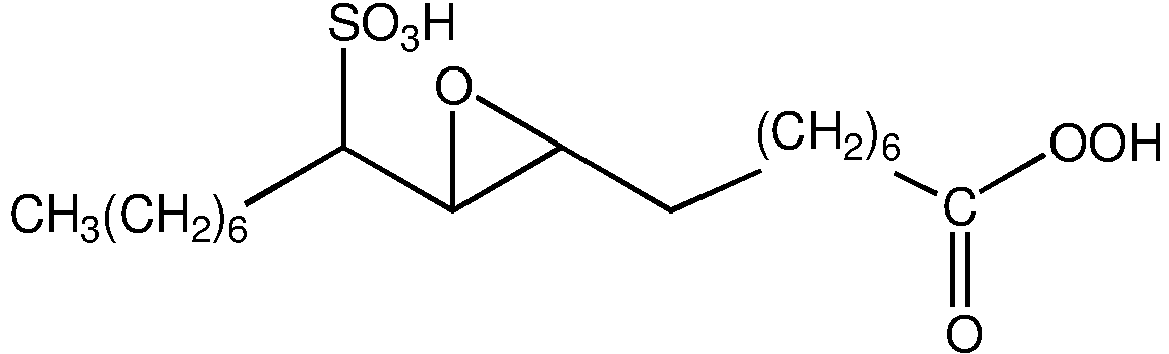
8-(3-(1-sulfo-octyl)-oxiran-2-yl)-octaneperoxoic acid O 
9,10-Disulfo-octadecaneperoxoic acid - The sulfonated peroxycarboxylic acids may be prepared from, for example, sulfonated fatty acids or from non-sulfonated fatty acids, which can be sulfonated. If non-sulfonated fatty acids are used as a starting material, they may be sulfonated prior to their conversion to the peroxycarboxylic acid form or they may be sulfonated at the same time or after formation of the peroxycarboxylic acid form. Sulfonation may be carried out by any method known to a person skilled in the art.
- Preferred sulfonated fatty acids for use in forming compounds of the present invention are for example, 11-sulfo-undecanoic acid, 10,11-disulfo-undecanoic acid, sulfonated oleic acid, sulfonated linoleic acid, sulfonated palmitoleic acid, or sulfonated stearic acid.
- The peroxycarboxylic acid can be formed using a variety of reaction mechanisms. For example, in some embodiments, the percarboxylic acid is formed by the direct acid catalyzed equilibrium action of hydrogen peroxide with the starting material.
- In a preferred embodiment sulfonated oleic acid is used as a starting material. It is thought that because sulfonated oleic acid is derived from natural sources, it is not chemically pure, i.e. it does not contain only one form of sulfonated oleic acid. Therefore, the peroxycarboxylic form of the sulfonated oleic acid may comprise a mixture of compounds F, G, J, K from the above table.
- The sulfonated peroxycarboxylic acids of the present invention may be present in a composition comprising one or more additional components. In a preferred embodiment the composition additionally includes oxidizing reagents, carboxylic and percarboxylic acids, surfactants, and stabilizing agents. The composition of the present invention may also be used in conjunction with conventional cleaning agents, for example alkaline detergents, or compositions containing urea, nitric acid, phosphoric acid, or mixtures thereof.
- The composition of the present invention may comprise at least one oxidizing agent. The oxidizing agent may be an organic or an inorganic oxidizing agent. Examples for suitable inorganic oxidizing agents are hydrogen peroxide, inorganic peroxides such as for example sodium peroxide, perborates such as for example sodium perborate, salts of monoperoxopersulfuric acid such as for example potassium monopersulfate, adducts of hydrogen peroxide to inorganic compounds such as for example sodium percarbonate, as well as adducts of hydrogen peroxide to sodium phosphates. Examples for suitable organic oxidizing agents include peroxycarboxylic acids such as for example peroxyacetic acid. In a preferred embodiment, the composition of the present invention comprises hydrogen peroxide as an oxidizing reagent.
- The composition of the present invention may comprise at least one carboxylic acid in addition to the sulfonated peroxycarboxylic acid. The carboxylic acid may be any C1 to C22 carboxylic acid. The carboxylic acid may be saturated or unsaturated. Examples for suitable monocarboxylic acids are formic, acetic, propionic, butyric, pentanoic, hexanoic, heptanoic, octanoic, nonanoic, decanoic, undecanoic, dodecanoic, tetradecanoic, hexadecanoic, octadecanoic, or icosanoic acid, as well as their branched isomers such as for example neopentanoic, neoheptanoic, or neodecanoic acid. Examples for suitable dicarboxylic acids are oxalic, malonic, succinic, glutaric, adipic, pimelic, or suberic acid. Examples for suitable tricarboxylic acids are citric acid or isocitric acid. Examples for suitable hydroxy carboxylic acids are hydroxyacetic or lactic acid. Other examples for suitable carboxylic acids are ascorbic acid or maleic acid.
- The composition of the present invention may also include the peroxycarboxylic forms of any of the carboxylic acids mentioned above. The peroxycarboxylic form may be prepared by any method known in the art, for example by combining the carboxylic acid with hydrogen peroxide. A solution of peroxyoctanoic acid can for example be obtained by combining octanoic acid and hydrogen peroxide and a hydrotrope, solvent or carrier.
- The composition of the present invention may include one ore more surfactants. In general, all kinds of surfactants known in the art are appropriate in the present invention, like for example anionic surfactants, non-ionic surfactants, cationic surfactants, and amphiprotic surfactants. A suitable surfactant is for example sodium cumene sulfonate.
- The composition of the present invention may include one ore more stabilizing agents. The stabilizing agents serve to stabilize the peroxycarboxylic acid and peroxide compounds of the present composition. Suitable stabilizing agents include, for example, metal cation chelating agents. Examples for chelating agents include aminopolycarboxylic acids, such as ethylenediamine tetraacetic acid, or polyphosphonic acids and aminopolyphosphonic acids, such as hydroxyethane diphosphonic acid, ethylenediamine tetramethylene phosphonic acid and diethylene triamine pentamethylene phosphonic acid, and water-soluble salts thereof.
- In a preferred embodiment, the composition of the present invention includes 10% to 20% by weight of sulfonated oleic acid, up to 10% by weight of acetic acid, 5% to 10% of peracetic acid, 1 % to 5% by weight of octanoic acid, 1 % to 5% by weight of peroxyoctanoic acid, 1% to 5% by weight of hydroxyethane diphosphonic acid, and 8% to 35% by weight of hydrogen peroxide.
- According to the present invention, the composition described above can be used to inactivate enzymes. Preferably, the enzymes that may be inactivated using the present invention are hydrolases such as, for example, proteases, lipases, nucleases, or glycosidases. The enzymes may be part of an enzyme composition, comprising any of the enzymes described herein or mixtures thereof. Preferably, the enzyme composition is used in alkaline conditions, more preferably of pH 7 to pH 9.
- Proteases may include, for example, those of animal, vegetable, or microbial origin. Chemically or genetically modified proteases are also included. Preferably, proteases include serine proteases, for example subtilisins or trypsin-like proteases. More preferably, the proteases are subtilisins derived from, for example, alkalophilic Bacillus. sp., Aspergillus sp., Bacillus licheniformis, or Bacillus lentus, or variants of those subtilisins.
- Lipases may include, for example, those of fungal or bacterial origin. Chemically or genetically modified lipase mutants are also included. Preferably, lipases are derived from, for example, Humicola lanuginosa, Pseudomonas mendocina, Chromobacter, or Rhizopus arrhizus. More preferably, lipases include those derived from Humincola lanuginosa, or variants thereof. Lipases may also include phospholipases, such as, for example, those obtained from bovine or porcine pancreas, from snake or bee venom, or those deriving from microbial origin, and other types of lipolitic enzymes such as, for example, cutinases.
- Glycosidases may include amylases and cellulases. Amylases include, for example, those of fungal or bacterial origin. Chemically or genetically modified amylase mutants are also included. Preferably, amylases are derived from, for example, Bacillus amyloliquefaciens or thermostable Bacillus licheniformis. Cellulases include, for example, those of fungal or bacterial origin. Chemically or genetically modified cellulase mutants are also included. Preferably, cellulases are derived from, for example, Humicola insolens or Trichoderma longibrachiatum. Preferably, cellulases include those that have a pH optimum between pH 5 and pH 9.5.
- The present invention may be used to inactivate enzymes, which are, for example, in solution or immobilized on any kind of substrate. The inactivation may be achieved, for example, by mixing the composition of the present invention with the enzyme solution, or by contacting the composition with the substrate.
- In a preferred embodiment, the present invention discloses a method to inactivate enzymes derived from an enzyme-based cleaning product. This may, for example, be achieved by contacting the cleaning product with the composition of the present invention. The composition of the present invention may also be contacted with an object that has been contacted with the cleaning product in a preceding step to inactivate any residual enzyme that is left on the object. It is possible to apply the composition directly after use of the cleaning product, or to perform any number of additional cleaning steps (e.g. flushing) between application of the cleaning product and of the composition.
- Preferably, the composition of the present invention is used to inactivate enzymes on process equipment.
- Process equipment includes equipment that is used for the processing of food and beverages, such as, for example, that used for dairy, food and beverage processing, in slaughter houses, in breweries, for fish or fish meal production, or for animal feed production or feed pelleting. Preferably, the composition is used as part of a cleaning-in-place procedure, wherein the cleaning product and the composition are circulated through the equipment, without prior disassembly of the equipment.
- The composition of the present invention may also be used to inactivate enzymes in processes such as enzymatic cleaning of fabrics and textiles or in surface cleaning of kitchen or hospital environments.
- As a particular example, the composition of the present invention may be used to inactivate enzymes used for the cleaning of laundry articles. Laundry articles may be soiled fabrics or textiles that are cleaned by agitating the articles in a cleaning product, e.g. an enzyme-containing detergent solution, for a certain period of time followed by rinsing the articles with water. The composition for the inactivation of the enzymes deriving from the cleaning product may be contacted with the laundry before the rinsing step, or it may be applied after the rinsing step and then be followed by an additional rinsing step. The cleaning procedure may be performed in an automatized washing machine or it may be performed as a hand wash. In particular, the cleaning procedure may be part of an on-premise laundry application.
- The composition may also be used to inactivate enzymes on membranes that are used, for example, in any of the food processing applications described above. Membranes include, for example, ultrafiltration, microfiltration, nanofiltration and reverse osmosis membranes. The membranes may be part of a process equipment, which is cleaned in a cleaning-in-place procedure. The membranes may consist of, for example, cellulose, cellulose acetate, nitrocellulose, polysulfone, polyethersulfone, fully aromatic polyamide, polyvinylidene fluoride, polytetrafluoroethylene, polyacrylnitrile, polypropylene, carbon, anorganic membrane materials, such as α-aluminium oxide or zirconium oxide, and may include not further specified backing material.
- Enzyme inactivation according to the present invention may be carried out at a temperature from 5°C to 95°C, preferably from 10°C to 60°C, more preferably from 20°C to 30°C.
- Tests of lipase inactivation were conducted on a DDS M38 flat sheet MF/UF lab test plant. Microfiltration membranes of type Alfa Laval GRM 0.2 were incubated for 30 minutes to 60 minutes at 50°C by circulating an aqueous solution containing 0.2% of an enzyme composition at pH 9. The enzyme composition contained 5% to 10% by weight of Rizolipase (a lipase from Rhizopus arrhizus) and 5% to 10% by weight of Subtilisin. Subsequently, the membranes were subjected to one of the cleaning and inactivation procedures described below. Immediately before and after the cleaning and inactivation procedures, samples of the membranes were frozen and stored frozen until the analysis of lipase concentration and activity. Analysis of lipase concentration and activity was performed by enzyme-linked immunosorbent assays (ELISA) by Novozymes A/S. Lipase concentration is reported as µg of lipase per g of membrane, the specific lipase activity is reported as KLU per g of lipase.
- In procedure 1 (comparative example), membranes were treated by circulating an aqueous solution containing 0.1 % by weight of urea, 24% by weight of phosphoric acid, and 29% by weight of nitric acid, supplemented with 0.3% by weight of an aqueous solution containing 26.7% by weight of hydrogen peroxide, 6.7% by weight of acetic acid, and 4.5% by weight of peracetic acid. Circulation was carried out for 30 minutes at 25°C. This treatment reduced the lipase concentration from 295 µg/g to 44 µg/g and its specific activity from 1.7 KLU/g to 0.26 KLU/g.
- In procedure 2 (comparative example), membranes were treated by circulating an aqueous solution containing 0.1 % by weight of urea, 24% by weight of phosphoric acid, and 29% by weight of nitric acid, supplemented with 0.3% by weight of an aqueous solution containing 5.1% by weight hydrogen peroxide, 42.09% by weight of acetic acid, 8.6% by weight of peracetic acid, 3.37% by weight of octanoic acid, and 0.7% by weight of peroctanoic acid. Circulation was carried out for 30 minutes at 25°C. This treatment reduced the lipase concentration from 229 µg/g to 1.91 µg/g and its specific activity from 1.4 KLU/g to 0.011 KLU/g.
- In procedure 3, membranes were treated by circulating an aqueous solution containing 0.1 % by weight of urea, 24% by weight of phosphoric acid, and 29% by weight of nitric acid, supplemented with 0.3% by weight of an aqueous solution according to the present invention containing 8-35% by weight of Hydrogen peroxide, 10-20% by weight of sulfonated oleic acid, less than 10% by weight of acetic acid, 5-10% by weight of peracetic acid, 1-5% by weight of octanoic acid, 1-5% by weight of hydroxyethane diphosphonic acid, and 1-5% by weight of peroxyoctanoic acid. Circulation was carried out for 30 minutes at 25°C. This treatment reduced the lipase concentration from 220 µg/g to a level below the detection limit and its specific activity from 1.3 KLU/g to a level below the detection limit.
- In procedure 4 (comparative example), membranes were treated by circulating an aqueous solution containing 0.1 % by weight of urea, 24% by weight of phosphoric acid, and 29% by weight of nitric acid. Circulation was carried out for 30 minutes at 50°C. This treatment reduced the lipase concentration from 314 µg/g to 0.1 µg/g and its specific activity from 1.8 KLU/g to 0.0006 KLU/g.
- The following table summarizes the results of the lipase concentration and activity measurements for each procedure. Please note that procedures 1, 2 and 4 are comparative examples, and that procedure 3 represents a method according to the present invention.
Procedure Lipase concentration (µg protein/g membrane) Lipase activity (KLU/g protein) Before treatment After treatment Before treatment After treatment 1 295 44 1.7 0.26 2 229 1.91 1.4 0.011 3 220 n.d. 1.3 n.d. 4 314 0.1 1.8 0.0006 - This test demonstrates that the procedure using a composition comprising a sulfonated peroxycarboxylic acid according to the present invention effectively inactivates lipases derived from an enzyme-based cleaning product at a temperature of 25°C. Furthermore, this procedure is more effective than any of the other procedures tested, shown by the fact that lipase concentration and activity were reduced to below the detection limit of the ELISA test in procedure 3. In particular, the composition of the present invention inactivates enzymes more effectively than compositions comprising peroxycarboxylic acids only (procedures 1 and 2) or a conventional acidic treatment at 50°C (procedure 4).
Claims (13)
- A method for the inactivation of enzymes with a composition comprising a sulfonated peroxycarboxylic acid according to formula 1.

- A method according to claim 1, wherein Y is a hydrogen atom.
- A method according to claims 1 or 2, wherein the composition further comprises an oxidizing reagent, which is not a chlorine-containing compound.
- A method according to claims 1 or 2, wherein the composition further comprises hydrogen peroxide.
- A method according to any one of the preceding claims, wherein the composition further comprises a C1 to C22 carboxylic or peroxycarboxylic acid.
- A method according to any one of the preceding claims, wherein the enzymes are hydrolases.
- A method according to any one of the preceding claims, wherein the enzymes are selected from the group consisting of proteases, lipases, glycosidases, or mixtures thereof.
- A method according to any one of the preceding claims, wherein the enzyme inactivation is carried out after at least one cleaning step using an enzyme-based cleaning product to inactivate the enzymes deriving from the cleaning product.
- A method according to claim 8, wherein the enzyme-based cleaning product is used for the cleaning-in-place of soiled process equipment, wherein the inactivation composition is contacted with the equipment.
- A method according to claim 8, wherein the enzyme-based cleaning product is used for the cleaning of laundry articles, wherein the inactivation composition is contacted laundry articles.
- A method according to claim 8, wherein the enzyme-based cleaning product is used for the cleaning of microfiltration, ultrafiltration, nanofiltration and reverse osmosis membranes, wherein the membranes are contacted with the composition.
- A method according to claim 11, wherein the membranes consist of cellulose, cellulose acetate, nitrocellulose, polysulfone, polyethersulfone, fully aromatic polyamide, polyvinylidene fluoride, polytetrafluoroethylene, polyacrylnitrile, polypropylene, carbon, α-aluminium oxide, or zirconium oxide, combined with not further specified backing material.
- A method according to any one of the preceding claims, wherein the inactivation of enzymes is carried out at a temperature that is in the range of 10°C to 70°C.
Applications Claiming Priority (1)
| Application Number | Priority Date | Filing Date | Title |
|---|---|---|---|
| PCT/EP2012/052541 WO2013120515A1 (en) | 2012-02-15 | 2012-02-15 | Method of enzyme inactivation |
Publications (2)
| Publication Number | Publication Date |
|---|---|
| EP2814957A1 EP2814957A1 (en) | 2014-12-24 |
| EP2814957B1 true EP2814957B1 (en) | 2016-01-13 |
Family
ID=45607266
Family Applications (1)
| Application Number | Title | Priority Date | Filing Date |
|---|---|---|---|
| EP12704077.2A Active EP2814957B1 (en) | 2012-02-15 | 2012-02-15 | Method of enzyme inactivation |
Country Status (5)
| Country | Link |
|---|---|
| US (1) | US9988621B2 (en) |
| EP (1) | EP2814957B1 (en) |
| DK (1) | DK2814957T3 (en) |
| ES (1) | ES2566365T3 (en) |
| WO (1) | WO2013120515A1 (en) |
Families Citing this family (5)
| Publication number | Priority date | Publication date | Assignee | Title |
|---|---|---|---|---|
| JP5910696B1 (en) * | 2014-10-06 | 2016-04-27 | 栗田工業株式会社 | Reverse osmosis membrane cleaning agent, cleaning liquid, and cleaning method |
| PE20181758A1 (en) | 2015-12-16 | 2018-10-30 | Ecolab Usa Inc | METHODS FOR REMOVING MICROORGANISMS OR MICROBIAL GROWTH AND MINERAL DEPOSITS IN A MEMBRANE SYSTEM |
| CA3020824C (en) | 2016-04-15 | 2021-06-15 | Ecolab Usa Inc. | Performic acid biofilm prevention for industrial co2 scrubbers |
| CA3045775C (en) | 2016-12-15 | 2021-07-27 | Ecolab Usa Inc. | Peroxyformic acid compositions for membrane filtration cleaning in energy services |
| WO2019006252A1 (en) * | 2017-06-30 | 2019-01-03 | Diversey, Inc. | Membrane cleaning solution and method of accelerated membrane cleaning using the same |
Family Cites Families (6)
| Publication number | Priority date | Publication date | Assignee | Title |
|---|---|---|---|---|
| US5858117A (en) * | 1994-08-31 | 1999-01-12 | Ecolab Inc. | Proteolytic enzyme cleaner |
| DE19503060A1 (en) * | 1995-02-01 | 1996-08-08 | Henkel Ecolab Gmbh & Co Ohg | Cleaning procedure for membrane filters |
| WO1997002753A1 (en) | 1995-07-12 | 1997-01-30 | Novo Nordisk A/S | Cleaning-in-place with a solution containing a protease and a lipase |
| US7001873B2 (en) * | 2001-10-05 | 2006-02-21 | Steris Inc. | Decontamination of surfaces contaminated with prion-infected material with oxidizing agent-based formulations |
| WO2009118714A2 (en) * | 2008-03-28 | 2009-10-01 | Ecolab Inc. | Sulfoperoxycarboxylic acids, their preparation and methods of use as bleaching and antimicrobial agents |
| US8809392B2 (en) * | 2008-03-28 | 2014-08-19 | Ecolab Usa Inc. | Sulfoperoxycarboxylic acids, their preparation and methods of use as bleaching and antimicrobial agents |
-
2012
- 2012-02-15 EP EP12704077.2A patent/EP2814957B1/en active Active
- 2012-02-15 ES ES12704077.2T patent/ES2566365T3/en active Active
- 2012-02-15 WO PCT/EP2012/052541 patent/WO2013120515A1/en not_active Ceased
- 2012-02-15 US US14/373,029 patent/US9988621B2/en active Active
- 2012-02-15 DK DK12704077.2T patent/DK2814957T3/en active
Also Published As
| Publication number | Publication date |
|---|---|
| WO2013120515A1 (en) | 2013-08-22 |
| ES2566365T3 (en) | 2016-04-12 |
| US9988621B2 (en) | 2018-06-05 |
| DK2814957T3 (en) | 2016-03-07 |
| EP2814957A1 (en) | 2014-12-24 |
| US20150056679A1 (en) | 2015-02-26 |
Similar Documents
| Publication | Publication Date | Title |
|---|---|---|
| US7183248B2 (en) | Enzymatic cleaner having high pH stability | |
| US9988621B2 (en) | Method of enzyme inactivation | |
| JP2020516245A (en) | Detergent composition and use thereof | |
| US8609390B2 (en) | Fungal serine protease and use thereof | |
| EP2424992B1 (en) | A novel fungal protease and use thereof | |
| US9133424B2 (en) | Stabilization and activation of protease for use at high temperature | |
| RU2611043C2 (en) | Enzyme protease and its application | |
| JP2013541356A (en) | Concentrated immersion cleaning | |
| JP2008522625A (en) | Enzyme stabilization | |
| CN102016050A (en) | Acyltransferases for stain removal | |
| KR20130102537A (en) | Double soaked laundry | |
| CN112996894A (en) | Cleaning composition and use thereof | |
| WO2006131503A2 (en) | Detergents with enzymatic builder and bleach systems | |
| EP2838983B1 (en) | Storage stable detergent composition having improved washing performance | |
| CN108603146B (en) | Method for cleaning a medical or dental instrument | |
| CN117957318A (en) | Particles containing biologically active substances | |
| Katiyar et al. | Microbial lipases in modern detergency: sources, production, and application | |
| EP0745118A1 (en) | Enzymatic bleach booster compositions | |
| CN117377758A (en) | Enzyme reaction promotion method | |
| EP3856882A1 (en) | Compositions for medical instrument cleaning | |
| WO2025202382A1 (en) | Polypeptides having protease activity for use in cleaning compositions | |
| KR20250130619A (en) | Detergent composition comprising catalase and amylase | |
| JP2023161601A (en) | Hard surface cleaning composition | |
| JP2005143444A (en) | Chimeric enzyme and detergent composition |
Legal Events
| Date | Code | Title | Description |
|---|---|---|---|
| PUAI | Public reference made under article 153(3) epc to a published international application that has entered the european phase |
Free format text: ORIGINAL CODE: 0009012 |
|
| 17P | Request for examination filed |
Effective date: 20140829 |
|
| AK | Designated contracting states |
Kind code of ref document: A1 Designated state(s): AL AT BE BG CH CY CZ DE DK EE ES FI FR GB GR HR HU IE IS IT LI LT LU LV MC MK MT NL NO PL PT RO RS SE SI SK SM TR |
|
| AX | Request for extension of the european patent |
Extension state: BA ME |
|
| DAX | Request for extension of the european patent (deleted) | ||
| GRAP | Despatch of communication of intention to grant a patent |
Free format text: ORIGINAL CODE: EPIDOSNIGR1 |
|
| INTG | Intention to grant announced |
Effective date: 20150710 |
|
| RIN1 | Information on inventor provided before grant (corrected) |
Inventor name: VOGT, PETRA Inventor name: PATTEN, ANJA Inventor name: NOLDE, CHRISTOF |
|
| GRAS | Grant fee paid |
Free format text: ORIGINAL CODE: EPIDOSNIGR3 |
|
| GRAA | (expected) grant |
Free format text: ORIGINAL CODE: 0009210 |
|
| AK | Designated contracting states |
Kind code of ref document: B1 Designated state(s): AL AT BE BG CH CY CZ DE DK EE ES FI FR GB GR HR HU IE IS IT LI LT LU LV MC MK MT NL NO PL PT RO RS SE SI SK SM TR |
|
| REG | Reference to a national code |
Ref country code: GB Ref legal event code: FG4D |
|
| REG | Reference to a national code |
Ref country code: CH Ref legal event code: EP |
|
| REG | Reference to a national code |
Ref country code: FR Ref legal event code: PLFP Year of fee payment: 5 |
|
| REG | Reference to a national code |
Ref country code: IE Ref legal event code: FG4D |
|
| REG | Reference to a national code |
Ref country code: AT Ref legal event code: REF Ref document number: 770543 Country of ref document: AT Kind code of ref document: T Effective date: 20160215 |
|
| REG | Reference to a national code |
Ref country code: DE Ref legal event code: R096 Ref document number: 602012013863 Country of ref document: DE |
|
| REG | Reference to a national code |
Ref country code: DK Ref legal event code: T3 Effective date: 20160229 |
|
| REG | Reference to a national code |
Ref country code: ES Ref legal event code: FG2A Ref document number: 2566365 Country of ref document: ES Kind code of ref document: T3 Effective date: 20160412 |
|
| REG | Reference to a national code |
Ref country code: LT Ref legal event code: MG4D |
|
| REG | Reference to a national code |
Ref country code: NL Ref legal event code: MP Effective date: 20160113 |
|
| PG25 | Lapsed in a contracting state [announced via postgrant information from national office to epo] |
Ref country code: BE Free format text: LAPSE BECAUSE OF NON-PAYMENT OF DUE FEES Effective date: 20160229 |
|
| REG | Reference to a national code |
Ref country code: AT Ref legal event code: MK05 Ref document number: 770543 Country of ref document: AT Kind code of ref document: T Effective date: 20160113 |
|
| PG25 | Lapsed in a contracting state [announced via postgrant information from national office to epo] |
Ref country code: NL Free format text: LAPSE BECAUSE OF FAILURE TO SUBMIT A TRANSLATION OF THE DESCRIPTION OR TO PAY THE FEE WITHIN THE PRESCRIBED TIME-LIMIT Effective date: 20160113 |
|
| PG25 | Lapsed in a contracting state [announced via postgrant information from national office to epo] |
Ref country code: FI Free format text: LAPSE BECAUSE OF FAILURE TO SUBMIT A TRANSLATION OF THE DESCRIPTION OR TO PAY THE FEE WITHIN THE PRESCRIBED TIME-LIMIT Effective date: 20160113 Ref country code: NO Free format text: LAPSE BECAUSE OF FAILURE TO SUBMIT A TRANSLATION OF THE DESCRIPTION OR TO PAY THE FEE WITHIN THE PRESCRIBED TIME-LIMIT Effective date: 20160413 Ref country code: HR Free format text: LAPSE BECAUSE OF FAILURE TO SUBMIT A TRANSLATION OF THE DESCRIPTION OR TO PAY THE FEE WITHIN THE PRESCRIBED TIME-LIMIT Effective date: 20160113 Ref country code: GR Free format text: LAPSE BECAUSE OF FAILURE TO SUBMIT A TRANSLATION OF THE DESCRIPTION OR TO PAY THE FEE WITHIN THE PRESCRIBED TIME-LIMIT Effective date: 20160414 |
|
| PG25 | Lapsed in a contracting state [announced via postgrant information from national office to epo] |
Ref country code: SE Free format text: LAPSE BECAUSE OF FAILURE TO SUBMIT A TRANSLATION OF THE DESCRIPTION OR TO PAY THE FEE WITHIN THE PRESCRIBED TIME-LIMIT Effective date: 20160113 Ref country code: IS Free format text: LAPSE BECAUSE OF FAILURE TO SUBMIT A TRANSLATION OF THE DESCRIPTION OR TO PAY THE FEE WITHIN THE PRESCRIBED TIME-LIMIT Effective date: 20160513 Ref country code: PT Free format text: LAPSE BECAUSE OF FAILURE TO SUBMIT A TRANSLATION OF THE DESCRIPTION OR TO PAY THE FEE WITHIN THE PRESCRIBED TIME-LIMIT Effective date: 20160513 Ref country code: PL Free format text: LAPSE BECAUSE OF FAILURE TO SUBMIT A TRANSLATION OF THE DESCRIPTION OR TO PAY THE FEE WITHIN THE PRESCRIBED TIME-LIMIT Effective date: 20160113 Ref country code: LV Free format text: LAPSE BECAUSE OF FAILURE TO SUBMIT A TRANSLATION OF THE DESCRIPTION OR TO PAY THE FEE WITHIN THE PRESCRIBED TIME-LIMIT Effective date: 20160113 Ref country code: LT Free format text: LAPSE BECAUSE OF FAILURE TO SUBMIT A TRANSLATION OF THE DESCRIPTION OR TO PAY THE FEE WITHIN THE PRESCRIBED TIME-LIMIT Effective date: 20160113 Ref country code: AT Free format text: LAPSE BECAUSE OF FAILURE TO SUBMIT A TRANSLATION OF THE DESCRIPTION OR TO PAY THE FEE WITHIN THE PRESCRIBED TIME-LIMIT Effective date: 20160113 Ref country code: RS Free format text: LAPSE BECAUSE OF FAILURE TO SUBMIT A TRANSLATION OF THE DESCRIPTION OR TO PAY THE FEE WITHIN THE PRESCRIBED TIME-LIMIT Effective date: 20160113 |
|
| REG | Reference to a national code |
Ref country code: CH Ref legal event code: PL |
|
| REG | Reference to a national code |
Ref country code: DE Ref legal event code: R097 Ref document number: 602012013863 Country of ref document: DE |
|
| PG25 | Lapsed in a contracting state [announced via postgrant information from national office to epo] |
Ref country code: LI Free format text: LAPSE BECAUSE OF NON-PAYMENT OF DUE FEES Effective date: 20160229 Ref country code: CH Free format text: LAPSE BECAUSE OF NON-PAYMENT OF DUE FEES Effective date: 20160229 Ref country code: MC Free format text: LAPSE BECAUSE OF FAILURE TO SUBMIT A TRANSLATION OF THE DESCRIPTION OR TO PAY THE FEE WITHIN THE PRESCRIBED TIME-LIMIT Effective date: 20160113 Ref country code: EE Free format text: LAPSE BECAUSE OF FAILURE TO SUBMIT A TRANSLATION OF THE DESCRIPTION OR TO PAY THE FEE WITHIN THE PRESCRIBED TIME-LIMIT Effective date: 20160113 |
|
| PLBE | No opposition filed within time limit |
Free format text: ORIGINAL CODE: 0009261 |
|
| STAA | Information on the status of an ep patent application or granted ep patent |
Free format text: STATUS: NO OPPOSITION FILED WITHIN TIME LIMIT |
|
| PG25 | Lapsed in a contracting state [announced via postgrant information from national office to epo] |
Ref country code: SM Free format text: LAPSE BECAUSE OF FAILURE TO SUBMIT A TRANSLATION OF THE DESCRIPTION OR TO PAY THE FEE WITHIN THE PRESCRIBED TIME-LIMIT Effective date: 20160113 Ref country code: CZ Free format text: LAPSE BECAUSE OF FAILURE TO SUBMIT A TRANSLATION OF THE DESCRIPTION OR TO PAY THE FEE WITHIN THE PRESCRIBED TIME-LIMIT Effective date: 20160113 Ref country code: SK Free format text: LAPSE BECAUSE OF FAILURE TO SUBMIT A TRANSLATION OF THE DESCRIPTION OR TO PAY THE FEE WITHIN THE PRESCRIBED TIME-LIMIT Effective date: 20160113 Ref country code: RO Free format text: LAPSE BECAUSE OF FAILURE TO SUBMIT A TRANSLATION OF THE DESCRIPTION OR TO PAY THE FEE WITHIN THE PRESCRIBED TIME-LIMIT Effective date: 20160113 |
|
| REG | Reference to a national code |
Ref country code: IE Ref legal event code: MM4A |
|
| 26N | No opposition filed |
Effective date: 20161014 |
|
| PG25 | Lapsed in a contracting state [announced via postgrant information from national office to epo] |
Ref country code: BE Free format text: LAPSE BECAUSE OF FAILURE TO SUBMIT A TRANSLATION OF THE DESCRIPTION OR TO PAY THE FEE WITHIN THE PRESCRIBED TIME-LIMIT Effective date: 20160113 |
|
| REG | Reference to a national code |
Ref country code: FR Ref legal event code: PLFP Year of fee payment: 6 |
|
| PG25 | Lapsed in a contracting state [announced via postgrant information from national office to epo] |
Ref country code: IE Free format text: LAPSE BECAUSE OF NON-PAYMENT OF DUE FEES Effective date: 20160215 |
|
| PG25 | Lapsed in a contracting state [announced via postgrant information from national office to epo] |
Ref country code: BG Free format text: LAPSE BECAUSE OF FAILURE TO SUBMIT A TRANSLATION OF THE DESCRIPTION OR TO PAY THE FEE WITHIN THE PRESCRIBED TIME-LIMIT Effective date: 20160413 Ref country code: SI Free format text: LAPSE BECAUSE OF FAILURE TO SUBMIT A TRANSLATION OF THE DESCRIPTION OR TO PAY THE FEE WITHIN THE PRESCRIBED TIME-LIMIT Effective date: 20160113 |
|
| PG25 | Lapsed in a contracting state [announced via postgrant information from national office to epo] |
Ref country code: MT Free format text: LAPSE BECAUSE OF FAILURE TO SUBMIT A TRANSLATION OF THE DESCRIPTION OR TO PAY THE FEE WITHIN THE PRESCRIBED TIME-LIMIT Effective date: 20160113 |
|
| REG | Reference to a national code |
Ref country code: FR Ref legal event code: PLFP Year of fee payment: 7 |
|
| PG25 | Lapsed in a contracting state [announced via postgrant information from national office to epo] |
Ref country code: HU Free format text: LAPSE BECAUSE OF FAILURE TO SUBMIT A TRANSLATION OF THE DESCRIPTION OR TO PAY THE FEE WITHIN THE PRESCRIBED TIME-LIMIT; INVALID AB INITIO Effective date: 20120215 |
|
| PG25 | Lapsed in a contracting state [announced via postgrant information from national office to epo] |
Ref country code: LU Free format text: LAPSE BECAUSE OF NON-PAYMENT OF DUE FEES Effective date: 20160215 Ref country code: MK Free format text: LAPSE BECAUSE OF FAILURE TO SUBMIT A TRANSLATION OF THE DESCRIPTION OR TO PAY THE FEE WITHIN THE PRESCRIBED TIME-LIMIT Effective date: 20160113 Ref country code: CY Free format text: LAPSE BECAUSE OF FAILURE TO SUBMIT A TRANSLATION OF THE DESCRIPTION OR TO PAY THE FEE WITHIN THE PRESCRIBED TIME-LIMIT Effective date: 20160113 Ref country code: MT Free format text: LAPSE BECAUSE OF FAILURE TO SUBMIT A TRANSLATION OF THE DESCRIPTION OR TO PAY THE FEE WITHIN THE PRESCRIBED TIME-LIMIT Effective date: 20160229 |
|
| PG25 | Lapsed in a contracting state [announced via postgrant information from national office to epo] |
Ref country code: TR Free format text: LAPSE BECAUSE OF FAILURE TO SUBMIT A TRANSLATION OF THE DESCRIPTION OR TO PAY THE FEE WITHIN THE PRESCRIBED TIME-LIMIT Effective date: 20160113 Ref country code: AL Free format text: LAPSE BECAUSE OF FAILURE TO SUBMIT A TRANSLATION OF THE DESCRIPTION OR TO PAY THE FEE WITHIN THE PRESCRIBED TIME-LIMIT Effective date: 20160113 |
|
| PGFP | Annual fee paid to national office [announced via postgrant information from national office to epo] |
Ref country code: DE Payment date: 20210202 Year of fee payment: 10 |
|
| REG | Reference to a national code |
Ref country code: DE Ref legal event code: R119 Ref document number: 602012013863 Country of ref document: DE |
|
| PG25 | Lapsed in a contracting state [announced via postgrant information from national office to epo] |
Ref country code: DE Free format text: LAPSE BECAUSE OF NON-PAYMENT OF DUE FEES Effective date: 20220901 |
|
| PGFP | Annual fee paid to national office [announced via postgrant information from national office to epo] |
Ref country code: FR Payment date: 20251208 Year of fee payment: 15 |
|
| PGFP | Annual fee paid to national office [announced via postgrant information from national office to epo] |
Ref country code: GB Payment date: 20260106 Year of fee payment: 15 |
|
| PGFP | Annual fee paid to national office [announced via postgrant information from national office to epo] |
Ref country code: ES Payment date: 20260310 Year of fee payment: 15 |
|
| PGFP | Annual fee paid to national office [announced via postgrant information from national office to epo] |
Ref country code: DK Payment date: 20260213 Year of fee payment: 15 |
|
| PGFP | Annual fee paid to national office [announced via postgrant information from national office to epo] |
Ref country code: IT Payment date: 20260122 Year of fee payment: 15 |