EP2814831B1 - New quaternary ammonium salts, method for preparation and applications thereof - Google Patents
New quaternary ammonium salts, method for preparation and applications thereof Download PDFInfo
- Publication number
- EP2814831B1 EP2814831B1 EP13711983.0A EP13711983A EP2814831B1 EP 2814831 B1 EP2814831 B1 EP 2814831B1 EP 13711983 A EP13711983 A EP 13711983A EP 2814831 B1 EP2814831 B1 EP 2814831B1
- Authority
- EP
- European Patent Office
- Prior art keywords
- phenyl
- mono
- oxazolo
- substituted
- general formula
- Prior art date
- Legal status (The legal status is an assumption and is not a legal conclusion. Google has not performed a legal analysis and makes no representation as to the accuracy of the status listed.)
- Not-in-force
Links
- 0 *C(*)(*)C[N+]1CCO*OCC1 Chemical compound *C(*)(*)C[N+]1CCO*OCC1 0.000 description 7
- LTMRLZSHHUFQDP-UHFFFAOYSA-N C(CO1)N2C1OCC2 Chemical compound C(CO1)N2C1OCC2 LTMRLZSHHUFQDP-UHFFFAOYSA-N 0.000 description 2
Images

Classifications
-
- C—CHEMISTRY; METALLURGY
- C07—ORGANIC CHEMISTRY
- C07D—HETEROCYCLIC COMPOUNDS
- C07D498/00—Heterocyclic compounds containing in the condensed system at least one hetero ring having nitrogen and oxygen atoms as the only ring hetero atoms
- C07D498/02—Heterocyclic compounds containing in the condensed system at least one hetero ring having nitrogen and oxygen atoms as the only ring hetero atoms in which the condensed system contains two hetero rings
- C07D498/04—Ortho-condensed systems
-
- A—HUMAN NECESSITIES
- A61—MEDICAL OR VETERINARY SCIENCE; HYGIENE
- A61P—SPECIFIC THERAPEUTIC ACTIVITY OF CHEMICAL COMPOUNDS OR MEDICINAL PREPARATIONS
- A61P31/00—Antiinfectives, i.e. antibiotics, antiseptics, chemotherapeutics
-
- A—HUMAN NECESSITIES
- A61—MEDICAL OR VETERINARY SCIENCE; HYGIENE
- A61P—SPECIFIC THERAPEUTIC ACTIVITY OF CHEMICAL COMPOUNDS OR MEDICINAL PREPARATIONS
- A61P33/00—Antiparasitic agents
Definitions
- the present invention relates to a novel class of quaternary ammonium salts containing tetrahydro[1,3]oxazolo[2,3-b][1,3]oxazol-4-ium moiety in the structure, process for the preparation of a novel class of quaternary ammonium salts and applications thereof.
- Quaternary ammonium salts are chemical compounds of the molecular formula [R 1 R 2 R 3 R 4 ]N + X - , wherein X represents mononegative ion, usually halide, and R 1 - R 4 are carbon chains with different length and structure, usually substituted with further functional groups.
- nitrogen atom is a part of five-, six- or seven-membered aromatic or non-aromatic ring. Due to amphiphilic character, quaternary ammonium salts are cationic surfactants having a broad spectrum of practical applications in many branches of modern economy.
- QAS are used as a cleaning agents, antistatics, foam-makers, emulsifiers, softeners, moisturizers or stabilisers used for the production of detergents, creams, shampoos, balms, shaving foams, hair dyes and regenerating conditioners.
- foam-makers emulsifiers, softeners, moisturizers or stabilisers used for the production of detergents, creams, shampoos, balms, shaving foams, hair dyes and regenerating conditioners.
- liquids with QAS are used for rinsing and softening of textiles.
- the surfactant activity of quaternary ammonium salts facilitates the penetration of chemical substances through biological membranes. Pharmaceutical companies use this property for production of modern forms of drugs, such as emulsions, ointments, gels, capsules, suppositories, etc.
- Ammonium salts exhibit very strong activity against bacteria, fungi, protozoans and some viruses, therefore, they are commonly applied as disinfectants, antiseptics and preservatives. In agriculture and wood industry they are applied as active components of preparations protecting wood or plants from diseases caused by fungi and other microorganisms.
- the quaternary ammonium salts are used as skeletal muscle relaxants with depolarising or non-depolarising mechanism of action.
- QAS are also used in scientific research laboratories and industrial technological installations as phase transfer catalysts (PTC). Such compounds enable transfer of individual reagents from one thermodynamic phase to another, which is of particular importance to the course of reaction when it takes place in an environment with more than one thermodynamic phase and one or more reagents are soluble in one phase but insoluble in the other.
- PTC phase transfer catalysts
- Such compounds enable transfer of individual reagents from one thermodynamic phase to another, which is of particular importance to the course of reaction when it takes place in an environment with more than one thermodynamic phase and one or more reagents are soluble in one phase but insoluble in the other.
- QAS are more and more often applied in chemical production processes, where they replace traditional toxic solvents.
- the present invention provides a novel class of quaternary ammonium salts containing tetrahydro[1,3]oxazolo[2,3-b][1,3]oxazol-4-ium moiety, in particular the new derivatives of 4-methyltetrahydro[1,3]oxazolo[2,3- b ][1,3]oxazol-4-ium, 4-(2-oxoethyl)tetrahydro-[1,3]oxazolo[2,3- b ][1,3]oxazol-4-ium, bis ⁇ 4-methyltetrahydro[1,3]oxazolo[2,3- b ][1,3]oxazol-4-ium ⁇ , bis ⁇ 4-(2-oxoethyl)tetrahydro[1,3]oxazolo[2,3- b ][1,3]oxazol-4-ium ⁇ and tris ⁇ 4-methyltetrahydro[1,3]oxazolo[
- the invention relates to the new 4-methyltetrahydro[1,3]oxazolo[2,3- b ][1,3]oxazol-4-ium derivatives of general formula (1), wherein:
- the invention also relates to the new 4-(2-oxoethyl)tetra-hydro[1,3]oxazolo[2,3-b][1,3]oxazol-4-ium derivatives of general formula (2), wherein:
- the invention also relates to the new bis ⁇ 4-methyltetra-hydro[1,3]oxazolo[2,3- b ][1,3]oxazol-4-ium ⁇ derivatives of general formula (3), wherein:
- the invention also relates to the new bis ⁇ 4-(2-oxoethyl)tetra-hydro[1,3]oxazolo[2,3- b ][1,3]oxazol-4-ium ⁇ derivatives of general formula (4), wherein:
- the invention also relates to the new tris ⁇ 4-methyltetrahydro[1,3]oxazolo[2,3- b ][1,3]oxazol-4-ium ⁇ derivatives of general formula (5), wherein:
- a process for the preparation of the novel class of quaternary ammonium salts containing tetrahydro[1,3]oxazolo[2,3-b][1,3]oxazol-4-ium moiety is provided.
- the invention relates to the preparation of the new derivatives of general formula (1) or (2) or (3) or (4) or (5), wherein:
- R 1 is phenyl; 2-nitrophenyl; 3-nitrophenyl; 4-nitrophenyl; 2-bromophenyl; 3-bromophenyl; 4-bromophenyl; 2,3-dibromophenyl; 2,4-dibromophenyl; 2-chlorophenyl; 3-chlorophenyl; 4-chlorophenyl; 2,4-dichlorophenyl; 3,4-dichlorophenyl; 3,5-dichlorophenyl; 2,6-dichlorophenyl; 2-iodophenyl; 4-iodophenyl; 2-methoxyphenyl; 3-methoxyphenyl; 4-methoxyphenyl; 2,5-dimethoxyphenyl; 3,4-dimethoxyphenyl; 2,3,4-trimethoxyphenyl; 3,4,5-trimethoxyphenyl; 2-methylphenyl; 3-methylphenyl; 4-methylphenyl; 3,5-dimethylphenyl
- R 2 is phenyl; 2-fluorophenyl; 3-fluorophenyl; 4-fluorophenyl; 2,4-difluorophenyl; 2,5-difluorophenyl; 2,6-difluorophenyl; 2,3,4-trichlorophenyl; 2,3,4,5-tetrafluorophenyl; 2-chlorophenyl; 3-chlorophenyl; 4-chlorophenyl; 2,4-dichlorophenyl; 3,4-dichlorophenyl; 2,5-dichlorophenyl; 2-bromophenyl; 3-bromophenyl; 4-bromophenyl; 3-iodophenyl; 4-iodophenyl; 2-hydroxyphenyl; 3-hydroxyphenyl; 4-hydroxyphenyl; 2,4-dihydroxyphenyl; 2,3-dihydroxyphenyl; 3,4-dihydroxyphenyl; 2,5-dihydroxyphenyl; 2-
- R 3 is benzene-1,4-diyl; benzene-1,3-diyl; 1,2-dioxoethan-1,2-diyl; biphenyl-4,4'-diyl; methanediyldibenzene-4,1-diyl; oxodibenzene-4,1-diyl or carbonyldibenzene-4,1-diyl; and X is chloride, bromide or iodide.
- R 4 is benzene-1,4-diyl; benzene-1,3-diyl; biphenyl-4,4'-diyl or oxydibenzene-4,1-diyl; and X is chloride, bromide or iodide.
- R 5 is benzene-1,3,5-triyl and X is chloride, bromide or iodide.
- the skills required for carrying out the reaction and purification of the resulting products are known to those persons skilled in the art.
- the reaction is carried out in an organic solvent at a temperature of room temperature to the boiling point of reaction mixture, but no higher than 120°C, for a time period of 10 min. to 7 days, preferably at temperature no higher than 70°C, for a time period of 30 min. to 3 days.
- the solvent used in the sythesis is selected from alcohols; ethers; chlorinated hydrocarbons; N,N-dialkylamides; sulfoxides; aromatic hydrocarbons; ketones; esters; nitriles and mixtures thereof, preferably selected from methanol; ethanol; n-propanol; isopropanol; dichloromethane; chloroform; diethyl ether; diisopropyl ether; tetrahydrofurane; benzene; toluene; acetonitrile; N,N-dimethylformamide; dimethyl sulfoxide; ethyl acetate and mixtures thereof.
- a solvent selected from alcohols; ketones; nitriles and mixtures thereof, preferably selected from methanol; ethanol; isopropanol; acetonitrile and mixtures thereof, in particular selected from ethanol or isopropanol.
- alkyl denotes a monovalent linear or branched, saturated or unsaturated hydrocarbon group of 1 to 12 carbon atoms, preferably of 1 to 6 carbon atoms, for example, methyl, ethyl, propyl, isopropyl, n-butyl, iso-butyl, sec-butyl, tert-butyl.
- cycloalkyl denotes a monovalent saturated or partially unsaturated mono- or bicyclic hydrocarbon group of 3 to 10 ring carbon atoms, preferably a monovalent saturated monocyclic hydrocarbon group of 3 to 8 ring carbon atoms, for example, cyclopropyl, cyclobutanyl, cyclopentyl, cyclohexyl, cycloheptyl, bicyclo[2.2.I]heptanyl, bicyclo[2.2.2]octanyl.
- aryl denotes a monovalent aromatic carbocyclic mono- bi- or tricyclic ring system comprising 6 to 14 carbon ring atoms, for example, phenyl, naphthyl, anthracenyl.
- heteroaryl denotes a monovalent aromatic heterocyclic mono-, bi- or tricyclic ring system of 5 to 16 ring atoms, comprising 1, 2, 3 or 4 heteroatoms selected from N, O and S, the remaining ring atoms being carbon, wherein secondary nitrogen atom is substituted with alkyl, acyl or aryl as mentioned herein.
- heteroaryl group examples include 1-methylpyrrolyl, furanyl, thienyl, 1-ethylimidazolyl, oxazolyl, thiazolyl, triazolyl, oxadiazolyl, thiadiazolyl, 1-phenyltetrazolyl, pyridinyl, pyrazinyl, 1-acetylpyrazolyl, pyridazinyl, pyrimidinyl, triazinyl, azepinyl, 1-methyldiazepinyl, isoxazolyl, benzofuranyl, isothiazolyl, benzothienyl, 1-phenylindolyl, isoindolyl, isobenzofuranyl, 1-formylbenzimidazolyl, benzoxazolyl, benzothiazolyl, benzooxadiazolyl, benzothiadiazolyl, 1-propylbenzotriazolyl, 9-benzylpurinyl
- amino denotes a -NH 2 group.
- alkoxyl denotes a group of the formula -O-Alk, wherein Alk is an alkyl group, for example, methoxyl, ethoxyl, n-propoxyl, isopropoxyl, n-butoxyl, isobutoxyl, tert-butoxyl.
- aryloxyl denotes a group of the formula -O-Ar, wherein Ar is aryl, for example, phenoxyl, naphthoxyl.
- acyl denotes groups of the formula -C(O)H, -C(O)-Alk or -C(O)-Ar, wherein Alk is alkyl and Ar is aryl, for example, formyl, acetyl, propionyl, butyryl, benzoyl.
- alkoxycarbonyl denotes groups of the formula -O-C(O)-H or -O-C(O)-Alk, wherein Alk is alkyl, for example, formyloxidanyl, acetyloxidanyl, iso-propanoyloxidanyl.
- aryloxycarbonyl denotes a group of the formula -O-C(O)-Ar, wherein Ar is aryl, for example, (phenylcarbonyl)oxidanyl, (naphthylcarbonyl)oxidanyl.
- halogen denotes fluoro, chloro, bromo, or iodo.
- cyano denotes a -C ⁇ N group.
- alkylthio denotes a group of the formula -S-Alk, wherein Alk is alkyl, for example, methylsulfanyl, ethylsulfanyl, propylsulfanyl, iso-propylsulfanyl.
- arylthio denotes a group of the formula -S-Ar, wherein Ar is aryl, for example, phenylsulfanyl, naphthylsulfanyl.
- alkylsulfonyl denotes a group of the formula -SO 2 -Alk, wherein Alk is alkyl, for example, methylsulfonyl, ethylsulfonyl, propylsulfonyl, butylsulfonyl.
- arylsulfonyl denotes a group of the formula -SO 2 -Ar, wherein Ar is aryl, for example, phenylsulfonyl, naphthylsulfonyl.
- aminosulfonyl denotes a -SO 2 NH 2 group.
- nitro denotes a -NO 2 group.
- room temperature denotes a temperature ranging between 15 and 25°C.
- the present invention provides applications of the novel class of quaternary ammonium salts containing tetrahydro[1,3]oxazolo[2,3-b][1,3]oxazol-4-ium moiety.
- the application relates to the new derivatives of general formula (1) or (2) or (3) or (4) or (5), wherein:
- Fig.1 - presents the general structures of the new quaternary ammonium salts containing tetrahydro[1,3]oxazolo[2,3-b][1,3]oxazol-4-ium moiety.
- the four reference strains were indications of the minimum inhibitory concentration (MIC) and minimum bactericidal concentration (MBC) tests conducted for two newly synthesized compounds of the new quaternary ammonium salts derivatives: 4-[2-(4-bromophenyl)-2-oxoethyl]tetrahydro[1,3]oxazolo[2,3-b][1,3]oxazol-4-ium bromide and 4-[2-(biphenyl-4-yl)-2-oxoethyl]tetrahydro[1,3]oxazolo[2,3-b][1,3]oxazol-4-ium bromide.
- MIC minimum inhibitory concentration
- MCC minimum bactericidal concentration
Landscapes
- Organic Chemistry (AREA)
- Chemical & Material Sciences (AREA)
- Health & Medical Sciences (AREA)
- Veterinary Medicine (AREA)
- Chemical Kinetics & Catalysis (AREA)
- Public Health (AREA)
- Medicinal Chemistry (AREA)
- Nuclear Medicine, Radiotherapy & Molecular Imaging (AREA)
- General Chemical & Material Sciences (AREA)
- Pharmacology & Pharmacy (AREA)
- Life Sciences & Earth Sciences (AREA)
- Animal Behavior & Ethology (AREA)
- General Health & Medical Sciences (AREA)
- Oncology (AREA)
- Communicable Diseases (AREA)
- Tropical Medicine & Parasitology (AREA)
- Heterocyclic Carbon Compounds Containing A Hetero Ring Having Nitrogen And Oxygen As The Only Ring Hetero Atoms (AREA)
- Pharmaceuticals Containing Other Organic And Inorganic Compounds (AREA)
- Nitrogen And Oxygen Or Sulfur-Condensed Heterocyclic Ring Systems (AREA)
Description
- The present invention relates to a novel class of quaternary ammonium salts containing tetrahydro[1,3]oxazolo[2,3-b][1,3]oxazol-4-ium moiety in the structure, process for the preparation of a novel class of quaternary ammonium salts and applications thereof.
- Quaternary ammonium salts (QAS) are chemical compounds of the molecular formula [R1R2 R3R4]N+X-, wherein X represents mononegative ion, usually halide, and R1 - R4 are carbon chains with different length and structure, usually substituted with further functional groups. In some ammonium salts nitrogen atom is a part of five-, six- or seven-membered aromatic or non-aromatic ring. Due to amphiphilic character, quaternary ammonium salts are cationic surfactants having a broad spectrum of practical applications in many branches of modern economy. In the cosmetic industry, QAS are used as a cleaning agents, antistatics, foam-makers, emulsifiers, softeners, moisturizers or stabilisers used for the production of detergents, creams, shampoos, balms, shaving foams, hair dyes and regenerating conditioners. Because of their anticorrosive and antistatic effect on such textiles as wool, cotton, synthetic and cellulose fibres, liquids with QAS are used for rinsing and softening of textiles. The surfactant activity of quaternary ammonium salts facilitates the penetration of chemical substances through biological membranes. Pharmaceutical companies use this property for production of modern forms of drugs, such as emulsions, ointments, gels, capsules, suppositories, etc. Ammonium salts exhibit very strong activity against bacteria, fungi, protozoans and some viruses, therefore, they are commonly applied as disinfectants, antiseptics and preservatives. In agriculture and wood industry they are applied as active components of preparations protecting wood or plants from diseases caused by fungi and other microorganisms.
- In anaesthesiology the quaternary ammonium salts are used as skeletal muscle relaxants with depolarising or non-depolarising mechanism of action.
- These compounds are also helpful in the technology of production and processing of unsaturated polyester resins, which are used for the production of laminates for manufacturing boats, yachts, aeroplanes, gliders, shower cabins, bathtubs, etc. QAS are also used in scientific research laboratories and industrial technological installations as phase transfer catalysts (PTC). Such compounds enable transfer of individual reagents from one thermodynamic phase to another, which is of particular importance to the course of reaction when it takes place in an environment with more than one thermodynamic phase and one or more reagents are soluble in one phase but insoluble in the other. Finally, as ionic liquids QAS are more and more often applied in chemical production processes, where they replace traditional toxic solvents.
- In its first aspect, the present invention provides a novel class of quaternary ammonium salts containing tetrahydro[1,3]oxazolo[2,3-b][1,3]oxazol-4-ium moiety, in particular the new derivatives of 4-methyltetrahydro[1,3]oxazolo[2,3-b][1,3]oxazol-4-ium, 4-(2-oxoethyl)tetrahydro-[1,3]oxazolo[2,3-b][1,3]oxazol-4-ium, bis{4-methyltetrahydro[1,3]oxazolo[2,3-b][1,3]oxazol-4-ium}, bis{4-(2-oxoethyl)tetrahydro[1,3]oxazolo[2,3-b][1,3]oxazol-4-ium} and tris{4-methyltetrahydro[1,3]oxazolo[2,3-b][1,3]oxazol-4-ium}salts.
- According to the first aspect, the invention relates to the new 4-methyltetrahydro[1,3]oxazolo[2,3-b][1,3]oxazol-4-ium derivatives of general formula (1),

- R1 is phenyl; 2-nitrophenyl; 3-nitrophenyl; 4-nitrophenyl; 2-bromophenyl; 3-bromophenyl; 4-bromophenyl; 2,3-dibromophenyl; 2,4-dibromophenyl; 2-chlorophenyl; 3-chlorophenyl; 4-chlorophenyl; 2,4-dichlorophenyl; 3,4-dichlorophenyl; 3,5-dichlorophenyl; 2,6-dichlorophenyl; 2-iodophenyl; 4-iodophenyl; 2-methoxyphenyl; 3-methoxyphenyl; 4-methoxyphenyl; 2,5-dimethoxyphenyl; 3,4-dimethoxyphenyl; 2,3,4-trimethoxyphenyl; 3,4,5-trimethoxyphenyl; 2-methylphenyl; 3-methylphenyl; 4-methylphenyl; 3,5-dimethylphenyl; 2,4-dimethylphenyl; 2-fluorophenyl; 3-fluorophenyl; 4-fluorophenyl; 3,4-difluorophenyl; 2,3-difluorophenyl; 3,5-difluorophenyl; 2,4-difluorophenyl; 2,3,4,5-tetrafluorophenyl; 2-(methoxycarbonyl)phenyl; 3-(methoxycarbonylphenyl; 4-(methoxycarbonyl)phenyl; 2-(trifluoromethyl)phenyl; 3-(trifluoromethyl)phenyl; 4-(trifluoromethyl)phenyl; 4-tert-butylphenyl; 2-phenylophenyl; 3-phenylophenyl; 4-phenylophenyl; 4-benzoylphenyl; 4-benzyloxyphenyl; 4-(methylsulphonyl)phenyl; 2-cyanophenyl; 3-cyanophenyl; 4-cyanophenyl; 4-formylphenyl; 4-methylthiophenyl; 3-phenoxyphenyl; 4-phenoxyphenyl; 2,4-diphenoxyphenyl; 2,4-dinitrophenyl; 4-(aminosulfonyl)phenyl; 2-pyridyl; 3-pyridyl; 4-pyridyl; 2-furyl; 2-thienyl; 2-benzo[b]furyl; 1-naphthyl or 2-naphthyl;
- X is chloride, bromide or iodide.
- According to the first aspect, the invention also relates to the new 4-(2-oxoethyl)tetra-hydro[1,3]oxazolo[2,3-b][1,3]oxazol-4-ium derivatives of general formula (2),

- R2 is phenyl; 2-fluorophenyl; 3-fluorophenyl; 4-fluorophenyl; 2,4-difluorophenyl; 2,5-difluorophenyl; 2,6-difluorophenyl; 2,3,4-trichlorophenyl; 2,3,4,5-tetrafluorophenyl; 2-chlorophenyl; 3-chlorophenyl; 4-chlorophenyl; 2,4-dichlorophenyl; 3,4-dichlorophenyl; 2,5-dichlorophenyl; 2-bromophenyl; 3-bromophenyl; 4-bromophenyl; 3-iodophenyl; 4-iodophenyl; 2-hydroxyphenyl; 3-hydroxyphenyl; 4-hydroxyphenyl; 2,4-dihydroxyphenyl; 2,3-dihydroxyphenyl; 3,4-dihydroxyphenyl; 2,5-dihydroxyphenyl; 2-(acetyloxy)phenyl; 3-(acetyloxy)phenyl; 4-(acetyloxy)phenyl; 2,4-bis(acetyloxy)phenyl; 3,4-bis(acetyloxy)phenyl; 2,5-bis(acetyloxy)phenyl; 1,3-benzodioxol-5-yl; 2-phenylophenyl; 3-phenylophenyl; 4-phenylophenyl; 2-nitrophenyl; 3-nitrophenyl; 4-nitrophenyl; 2,4-dinitrophenyl; 3,4-dinitrophenyl; 2,5-dinitrophenyl; 4-chloro-3-nitrophenyl; 2-chloro-3-nitrophenyl; 2-methylphenyl; 3-methylphenyl; 4-methylphenyl; 2,4-dimethylphenyl; 3,4-dimethylphenyl; 2-methoxyphenyl; 3-methoxyphenyl; 4-methoxyphenyl; 3,4-dimethoxyphenyl; 2,4-dimethoxyphenyl; 2,5-dimethoxyphenyl; 3,4,5-trimethoxyphenyl; 4-ethylphenyl; 3-benzyloxyphenyl; 4-benzyloxyphenyl; 4-phenoxyphenyl; 2-cyanophenyl; 3-cyanophenyl; 4-cyanophenyl; 2-aminophenyl; 3-aminophenyl; 4-aminophenyl; 3-(trifluoromethyl)phenyl; 4-(trifluoromethyl)phenyl; 4-carbamoylphenyl; 4-sulfamoylphenyl; 4-(methylsulfonyl)-phenyl; 4-(methoxycarbonyl)phenyl; 4-(acetylamino)phenyl; 4-(N,N-dimethylamino)phenyl; 4-tert-butylphenyl; trifluoromethyl; trichloromethyl; 2-pyridyl; 3-pyridyl; 4-pyridyl; 1-naphthyl; 2-naphthyl; 2-furyl; 2-benzo[b]furyl; 2-thienyl; amino; methylamino; dimethylamino; phenylamino; diphenylamino; benzylamino or dibenzylamino;
- X is chloride, bromide or iodide.
- According to the first aspect, the invention also relates to the new bis{4-methyltetra-hydro[1,3]oxazolo[2,3-b][1,3]oxazol-4-ium} derivatives of general formula (3),

- R3 is benzene-1,4-diyl; benzene-1,3-diyl; 1,2-dioxoethan-1,2-diyl; biphenyl-4,4'-diyl; methanediyldibenzene-4,1-diyl; oxodibenzene-4,1-diyl or carbonyldibenzene-4,1-diyl;
- X is chloride, bromide or iodide.
- According to the first aspect, the invention also relates to the new bis{4-(2-oxoethyl)tetra-hydro[1,3]oxazolo[2,3-b][1,3]oxazol-4-ium} derivatives of general formula (4),

- R4 is benzene-1,4-diyl; benzene-1,3-diyl; biphenyl-4,4'-diyl or oxydibenzene-4,1-diyl;
- X is chloride, bromide or iodide.
- According to the first aspect, the invention also relates to the new tris{4-methyltetrahydro[1,3]oxazolo[2,3-b][1,3]oxazol-4-ium} derivatives of general formula (5),

- R5 is benzene-1,3,5-triyl;
- X is chloride, bromide or iodide.
- In a further aspect of the invention, a process for the preparation of the novel class of quaternary ammonium salts containing tetrahydro[1,3]oxazolo[2,3-b][1,3]oxazol-4-ium moiety is provided. In particular, the invention relates to the preparation of the new derivatives of general formula (1) or (2) or (3) or (4) or (5), wherein:
- R1 or R3 or R5 is non-substituted or substituted group selected from alkyl, cycloalkyl, aryl or heteroaryl, wherein substituted group denotes group substituted with radical independently selected from alkyl, aryl, acyl, alkoxyl, aryloxyl, alkoxycarbonyl, aryloxycarbonyl, halogen, cyano, alkylthio, arylthio, alkylsulfonyl, arylsulfonyl, aminosulfonyl, nitro, amino, mono- or dialkylamino, mono- or diarylamino or acylamino;
- R2 or R4 is non-substituted or substituted group selected from alkyl, cycloalkyl, aryl, heteroaryl, amino, mono- or dialkylamino, mono- or diarylamino or acylamino, wherein substituted group denotes group substituted with radical independently selected from alkyl, aryl, acyl, alkoxyl, aryloxyl, alkoxycarbonyl, aryloxycarbonyl, halogen, cyano, alkylthio, arylthio, alkylsulfonyl, arylsulfonyl, aminosulfonyl, nitro, amino, mono- or dialkylamino, mono- or diarylamino or acylamino;
- X is fluoride, chloride, bromide, iodide or methanesulfonate.
- The Process for preparation of the 4-methyltetrahydro[1,3]oxazolo[2,3-b][1,3]oxazol-4-ium derivatives of general formula (1) is shown in
scheme 1.


- Preferably R1 is phenyl; 2-nitrophenyl; 3-nitrophenyl; 4-nitrophenyl; 2-bromophenyl; 3-bromophenyl; 4-bromophenyl; 2,3-dibromophenyl; 2,4-dibromophenyl; 2-chlorophenyl; 3-chlorophenyl; 4-chlorophenyl; 2,4-dichlorophenyl; 3,4-dichlorophenyl; 3,5-dichlorophenyl; 2,6-dichlorophenyl; 2-iodophenyl; 4-iodophenyl; 2-methoxyphenyl; 3-methoxyphenyl; 4-methoxyphenyl; 2,5-dimethoxyphenyl; 3,4-dimethoxyphenyl; 2,3,4-trimethoxyphenyl; 3,4,5-trimethoxyphenyl; 2-methylphenyl; 3-methylphenyl; 4-methylphenyl; 3,5-dimethylphenyl; 2,4-dimethylphenyl; 2-fluorophenyl; 3-fluorophenyl; 4-fluorophenyl; 3,4-difluorophenyl; 2,3-difluorophenyl; 3,5-difluorophenyl; 2,4-difluorophenyl; 2,3,4,5-tetrafluorophenyl; 2-(methoxycarbonyl)phenyl; 3-(methoxycarbonyl)phenyl; 4-(methoxycarbonyl)phenyl; 2-(trifluoromethyl)phenyl; 3-(trifluoromethyl)phenyl; 4-(trifluoromethyl)phenyl; 4-tert-butylphenyl; 2-phenylophenyl; 3-phenylophenyl; 4-phenylophenyl; 4-benzoylphenyl; 4-benzyloxyphenyl; 4-(methylsulphonyl)phenyl; 2-cyanophenyl; 3-cyanophenyl; 4-cyanophenyl; 4-formylphenyl; 4-methylthiophenyl; 3-phenoxyphenyl; 4-phenoxyphenyl; 2,4-diphenoxyphenyl; 2,4-dinitrophenyl; 4-(aminosulfonyl)phenyl; 2-pyridyl; 3-pyridyl; 4-pyridyl; 2-furyl; 2-thienyl; 2-benzo[b]furyl; 1-naphthyl or 2-naphthyl; and X is chloride, bromide or iodide.
- It is also preferable to carry out the reaction between approximately equimolar amounts of both reactants.
- The Process for preparation of the 4-(2-oxoethyl)tetrahydro[1,3]oxazolo[2,3-b][1,3]oxazol-4-ium derivatives of general formula (2) is shown in
scheme 2.

- Preferably R2 is phenyl; 2-fluorophenyl; 3-fluorophenyl; 4-fluorophenyl; 2,4-difluorophenyl; 2,5-difluorophenyl; 2,6-difluorophenyl; 2,3,4-trichlorophenyl; 2,3,4,5-tetrafluorophenyl; 2-chlorophenyl; 3-chlorophenyl; 4-chlorophenyl; 2,4-dichlorophenyl; 3,4-dichlorophenyl; 2,5-dichlorophenyl; 2-bromophenyl; 3-bromophenyl; 4-bromophenyl; 3-iodophenyl; 4-iodophenyl; 2-hydroxyphenyl; 3-hydroxyphenyl; 4-hydroxyphenyl; 2,4-dihydroxyphenyl; 2,3-dihydroxyphenyl; 3,4-dihydroxyphenyl; 2,5-dihydroxyphenyl; 2-(acetyloxy)phenyl; 3-(acetyloxy)phenyl; 4-(acetyloxy)phenyl; 2,4-bis(acetyloxy)phenyl; 3,4-bis(acetyloxy)phenyl; 2,5-bis-(acetyloxy)phenyl; 1,3-benzodioxol-5-yl; 2-phenylophenyl; 3-phenylophenyl; 4-phenylophenyl; 2-nitrophenyl; 3-nitrophenyl; 4-nitrophenyl; 2,4-dinitrophenyl; 3,4-dinitrophenyl; 2,5-dinitrophenyl; 4-chloro-3-nitrophenyl; 2-chloro-3-nitrophenyl; 2-methylphenyl; 3-methylphenyl; 4-methylphenyl; 2,4-dimethylphenyl; 3,4-dimethylphenyl; 2-methoxyphenyl; 3-methoxyphenyl; 4-methoxyphenyl; 3,4-dimethoxyphenyl; 2,4-dimethoxyphenyl; 2,5-dimethoxyphenyl; 3,4,5-trimethoxyphenyl; 4-ethylphenyl; 3-benzyloxyphenyl; 4-benzyloxyphenyl; 4-phenoxyphenyl; 2-cyanophenyl; 3-cyanophenyl; 4-cyanophenyl; 2-aminophenyl; 3-aminophenyl; 4-aminophenyl; 3-(trifluoromethyl)phenyl; 4-(trifluoromethyl)phenyl; 4-carbamoylphenyl; 4-sulfamoylphenyl; 4-(methylsulfonyl)phenyl; 4-(methoxycarbonyl)phenyl; 4-(acetylamino)phenyl; 4-(N,N-dimethylamino)phenyl; 4-tert-butylphenyl; trifluoromethyl; trichloromethyl; 2-pyridyl; 3-pyridyl; 4-pyridyl; 1-naphthyl; 2-naphthyl; 2-furyl; 2-benzo[b]furyl; 2-thienyl; amino; methylamino; dimethylamino; phenylamino; diphenylamino; benzylamino or dibenzylamino; and X is chloride, bromide or iodide.
- It is also preferable to carry out the reaction between approximately equimolar amounts of both reactants.
- The Process for preparation of the bis{4-methyltetrahydro[1,3]oxazolo[2,3-b][1,3]oxazol-4-ium} derivatives of general formula (3) is shown in
scheme 3.

- Preferably R3 is benzene-1,4-diyl; benzene-1,3-diyl; 1,2-dioxoethan-1,2-diyl; biphenyl-4,4'-diyl; methanediyldibenzene-4,1-diyl; oxodibenzene-4,1-diyl or carbonyldibenzene-4,1-diyl; and X is chloride, bromide or iodide.
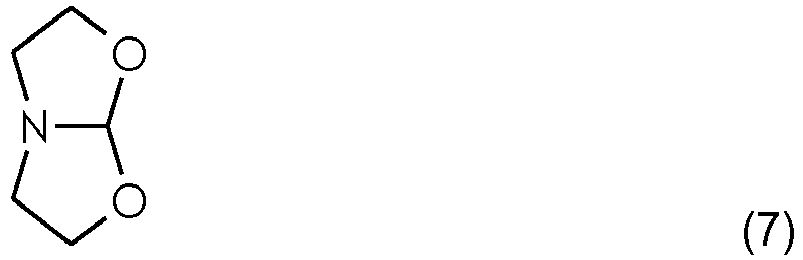
- It is also preferable using in the reaction approximately double molar amount of tetra-hydro[1,3]oxazolo[2,3-b][1,3]oxazole of formula (7).
- The Process for preparation of the new bis{4-(2-oxoethyl)tetrahydro[1,3]oxazolo[2,3-b][1,3]-oxazol-4-ium} derivatives of general formula (4) is shown in
scheme 4.

- Preferably R4 is benzene-1,4-diyl; benzene-1,3-diyl; biphenyl-4,4'-diyl or oxydibenzene-4,1-diyl; and X is chloride, bromide or iodide.
- It is also preferable using in the reaction approximately double molar amount of tetrahydro[1,3]oxazolo[2,3-b][1,3]oxazole of formula (7).
- The Process for preparation of the new tris{4-methyltetrahydro[1,3]oxazolo[2,3-b][1,3]oxazol-4-ium} derivatives of general formula (5) is shown in
scheme 5.

- Preferably R5 is benzene-1,3,5-triyl and X is chloride, bromide or iodide.
- It is also preferable using in the reaction approximately triple molar amount of tetrahydro[1,3]oxazolo[2,3-b][1,3]oxazole of formula (7).
- The skills required for carrying out the reaction and purification of the resulting products are known to those persons skilled in the art. The reaction is carried out in an organic solvent at a temperature of room temperature to the boiling point of reaction mixture, but no higher than 120°C, for a time period of 10 min. to 7 days, preferably at temperature no higher than 70°C, for a time period of 30 min. to 3 days. The solvent used in the sythesis is selected from alcohols; ethers; chlorinated hydrocarbons; N,N-dialkylamides; sulfoxides; aromatic hydrocarbons; ketones; esters; nitriles and mixtures thereof, preferably selected from methanol; ethanol; n-propanol; isopropanol; dichloromethane; chloroform; diethyl ether; diisopropyl ether; tetrahydrofurane; benzene; toluene; acetonitrile; N,N-dimethylformamide; dimethyl sulfoxide; ethyl acetate and mixtures thereof.
- After reaction, the solvent is removed by evaporation or filtration and then, resulting crude product is purified by recrystallization from a solvent selected from alcohols; ketones; nitriles and mixtures thereof, preferably selected from methanol; ethanol; isopropanol; acetonitrile and mixtures thereof, in particular selected from ethanol or isopropanol.
- In the context of the invention and unless otherwise mentioned in the text,
the term "alkyl" denotes a monovalent linear or branched, saturated or unsaturated hydrocarbon group of 1 to 12 carbon atoms, preferably of 1 to 6 carbon atoms, for example, methyl, ethyl, propyl, isopropyl, n-butyl, iso-butyl, sec-butyl, tert-butyl. - The term "cycloalkyl" denotes a monovalent saturated or partially unsaturated mono- or bicyclic hydrocarbon group of 3 to 10 ring carbon atoms, preferably a monovalent saturated monocyclic hydrocarbon group of 3 to 8 ring carbon atoms, for example, cyclopropyl, cyclobutanyl, cyclopentyl, cyclohexyl, cycloheptyl, bicyclo[2.2.I]heptanyl, bicyclo[2.2.2]octanyl.
- The term "aryl" denotes a monovalent aromatic carbocyclic mono- bi- or tricyclic ring system comprising 6 to 14 carbon ring atoms, for example, phenyl, naphthyl, anthracenyl.
- The term "heteroaryl" denotes a monovalent aromatic heterocyclic mono-, bi- or tricyclic ring system of 5 to 16 ring atoms, comprising 1, 2, 3 or 4 heteroatoms selected from N, O and S, the remaining ring atoms being carbon, wherein secondary nitrogen atom is substituted with alkyl, acyl or aryl as mentioned herein. Examples of heteroaryl group include 1-methylpyrrolyl, furanyl, thienyl, 1-ethylimidazolyl, oxazolyl, thiazolyl, triazolyl, oxadiazolyl, thiadiazolyl, 1-phenyltetrazolyl, pyridinyl, pyrazinyl, 1-acetylpyrazolyl, pyridazinyl, pyrimidinyl, triazinyl, azepinyl, 1-methyldiazepinyl, isoxazolyl, benzofuranyl, isothiazolyl, benzothienyl, 1-phenylindolyl, isoindolyl, isobenzofuranyl, 1-formylbenzimidazolyl, benzoxazolyl, benzothiazolyl, benzooxadiazolyl, benzothiadiazolyl, 1-propylbenzotriazolyl, 9-benzylpurinyl, quinolinyl, isoquinolinyl, quinazolinyl, quinoxalinyl.
- The term "amino" denotes a -NH2 group.
- The term "alkoxyl" denotes a group of the formula -O-Alk, wherein Alk is an alkyl group, for example, methoxyl, ethoxyl, n-propoxyl, isopropoxyl, n-butoxyl, isobutoxyl, tert-butoxyl.
- The term "aryloxyl" denotes a group of the formula -O-Ar, wherein Ar is aryl, for example, phenoxyl, naphthoxyl.
- The term "acyl" denotes groups of the formula -C(O)H, -C(O)-Alk or -C(O)-Ar, wherein Alk is alkyl and Ar is aryl, for example, formyl, acetyl, propionyl, butyryl, benzoyl.
- The term "alkoxycarbonyl" denotes groups of the formula -O-C(O)-H or -O-C(O)-Alk, wherein Alk is alkyl, for example, formyloxidanyl, acetyloxidanyl, iso-propanoyloxidanyl.
- The term "aryloxycarbonyl" denotes a group of the formula -O-C(O)-Ar, wherein Ar is aryl, for example, (phenylcarbonyl)oxidanyl, (naphthylcarbonyl)oxidanyl.
- The term "halogen" denotes fluoro, chloro, bromo, or iodo.
- The term "cyano" denotes a -C≡N group.
- The term "alkylthio" denotes a group of the formula -S-Alk, wherein Alk is alkyl, for example, methylsulfanyl, ethylsulfanyl, propylsulfanyl, iso-propylsulfanyl.
- The term "arylthio" denotes a group of the formula -S-Ar, wherein Ar is aryl, for example, phenylsulfanyl, naphthylsulfanyl.
- The term "alkylsulfonyl" denotes a group of the formula -SO2-Alk, wherein Alk is alkyl, for example, methylsulfonyl, ethylsulfonyl, propylsulfonyl, butylsulfonyl.
- The term "arylsulfonyl" denotes a group of the formula -SO2-Ar, wherein Ar is aryl, for example, phenylsulfonyl, naphthylsulfonyl.
- The term "aminosulfonyl" denotes a -SO2NH2 group.
- The term "nitro" denotes a -NO2 group.
- The term "room temperature" denotes a temperature ranging between 15 and 25°C.
- In the third aspect, the present invention provides applications of the novel class of quaternary ammonium salts containing tetrahydro[1,3]oxazolo[2,3-b][1,3]oxazol-4-ium moiety. The application relates to the new derivatives of general formula (1) or (2) or (3) or (4) or (5), wherein:
- R1 or R3 or R5 is non-substituted or substituted group selected from alkyl, cycloalkyl, aryl or heteroaryl, wherein substituted group denotes group substituted with radical independently selected from alkyl, aryl, acyl, alkoxyl, aryloxyl, alkoxycarbonyl, aryloxycarbonyl, halogen, cyano, alkylthio, arylthio, alkylsulfonyl, arylsulfonyl, aminosulfonyl, nitro, amino, mono- or dialkylamino, mono- or diarylamino or acylamino;
- R2 or R4 is non-substituted or substituted group selected from alkyl, cycloalkyl, aryl, heteroaryl, amino, mono- or dialkylamino, mono- or diarylamino or acylamino, wherein substituted group denotes group substituted with radical independently selected from alkyl, aryl, acyl, alkoxyl, aryloxyl, alkoxycarbonyl, aryloxycarbonyl, halogen, cyano, alkylthio, arylthio, alkylsulfonyl, arylsulfonyl, aminosulfonyl, nitro, amino, mono- or dialkylamino, mono- or diarylamino or acylamino;
- X is fluoride, chloride, bromide, iodide or methanesulfonate;
- The application relates also to the new derivatives of general formula (1) or (2) or (3) or (4) or (5), wherein:
- R1 or R2 or R4 or R3 or R5 and X have the above-mentioned meaning,
- The application relates also to the new derivatives of general formula (1) or (2) or (3) or (4) or (5), wherein:
- R1 or R2 or R4 or R3 or R5 and X have the above-mentioned meaning,
-
Fig.1 - presents the general structures of the new quaternary ammonium salts containing tetrahydro[1,3]oxazolo[2,3-b][1,3]oxazol-4-ium moiety. - The following examples are given for the purpose of illustrating the present disclosure and should not be considered as limitation on the scope or spitit of the disclosure.
1H and 13C-NMR spectra were recorded on a Varian Unity 300 and Bruker Avance III 500 spectrometers at ambient temperature and in d6-DMSO as a solvent. The chemical shifts δ are reported in ppm relative to tetramethylsilane (TMS) as a internal standard. The diffraction data were collected on an Agilent Xcalibur Atlas diffractometer, equipped with molybdenum lamp as a source of radiation. CrysAlisPro software was used for data collection and initial processing, Sir92 program was used to solve the structure and SHELXL-97 for the structure refinement. - A solution of 1.710 g (10 mmol) of benzyl bromide and 1.152 g (10 mmol) of tetrahydro-[1,3]oxazolo[2,3-b][1,3]oxazole in 20 ml of diisopropyl ether was stirred at the room temperature for 24 hours. The precipitate was filtered off, washed twice with diisopropyl ether and dried. 2.698 g (94.3%) of white amorphous product was obtained, which can be further purified by recrystallisation from rectified ethanol.
1H NMR (500 MHz, DMSO) δ 7.83 (d, J = 7.0 Hz, 2H), 7.49 (dq, J = 14.3, 7.1 Hz, 3H), 6.98 (s, 1H), 5.04 (s, 2H), 4.48 - 4.31 (m, 4H), 4.13 (dt, J = 11.7, 7.5 Hz, 2H), 3.91 (dt, J = 11.2, 5.7 Hz, 2H). 13C NMR (126 MHz, DMSO) δ 132.28, 130.33, 128.98, 128.72, 119.02, 66.83, 62.41, 57.35.Table 1. The crystallographic data and structure parameters Empirical formula C12 H16 Br NO2 Formula weight 285.16 Temperature 293(2) K Wave lenght 0.71073 Å Crystal system, space group monoclinic, P2(1)/n Unit cell dimensions a = 7.7184(2) Å α = 90° b = 10.2120(3) Å β = 99.816(3)° c = 15.6318(6) A γ = 90° Volume 1214.07(7) Å3 Z, calculated density 4, 1.560 g/cm3 Absorption coefficient 3.371 mm-1 F(000) 580 Crystal size 1.0 x 0.4 x 0.2 mm Theta range for data collection 2.39 to 24.99° Reflections collected / unique 7773 / 2128 [R(int) = 0.0210] Data / restraints / parameters 2128 / 0 / 210 Goodnes-of-fit 0.986 Extinction coefficient 0.0062(7) - A solution of 1.850 g (10 mmol) iodoacetamide and 1.152 g (10 mmol) tetrahydro[1,3]oxazolo[2,3-b][1,3]oxazole in 20 ml of methanol was refluxed for 1 hour. The solvent was then removed under reduced pressure and the residue was allowed to crystallize overnight. The precipitate was filtered off, washed twice with dichloromethane and dried. 2.041 g (68.0%) of white crystalline product was obtained.
1H NMR (500 MHz, DMSO) δ 7.82 (d, J = 118.2 Hz, 2H), 6.65 (s, 1H), 4.46 - 4.33 (m, 6H), 4.13 (dt, J = 11.5, 5.7 Hz, 2H), 3.88 (dt, J = 12.1, 7.4 Hz, 2H). 13C NMR (126 MHz, DMSO) δ 165.19, 120.08, 66.73, 60.87, 60.31. - A solution of 2.779 g (10 mmol) 2,4'-dibromoacetophenone and 1.152 g (10 mmol) tetrahydro[1,3]oxazolo[2,3-b][1,3]oxazole in 20 ml of dichloromethane was refluxed for 3 hours. The precipitate was filtered off, washed twice with dichloromethane and dried. 3.801 g (96.7%) of white amorphous product was obtained, which can be further purified by recrystallisation from rectified ethanol.
1H NMR (300 MHz, DMSO) δ 7.93 (d, J = 8.7 Hz, 2H), 7.84 (d, J = 8.6 Hz, 2H), 6.92 (s, 1H), 5.70 (s, 2H), 4.56 - 4.38 (m, 4H), 4.26 (dt, J = 11.4, 5.7 Hz, 2H), 3.99 (dt, J = 11.9, 7.1 Hz, 2H). 13C NMR (75 MHz, DMSO) δ 190.37, 133.00, 131.95, 130.03, 128.66, 120.87, 66.98, 66.28, 60.22. - A solution of 2.751 g (10 mmol) 2-bromo-4'-phenylacetophenone and 1.152 g (10 mmol) tetrahydro[1,3]oxazolo[2,3-b][1,3]oxazole in 20 ml of isopropanol was refluxed for 30 minutes. The reaction mixture was allowed to cool overnight and the precipitate was then filtered off, washed twice with dichloromethane and dried. 3.520 g (90.2%) of white fine crystalline product was obtained.
1H NMR (400 MHz, DMSO) δ 8.08 (d, J = 8.5 Hz, 2H), 7.95 (d, J = 8.5 Hz, 2H), 7.84 - 7.77 (m, 2H), 7.57 - 7.41 (m, 3H), 6.92 (s, 1H), 5.70 (s, 2H), 4.55 - 4.41 (m, 4H), 4.28 (dt, J = 11.5, 5.8 Hz, 2H), 4.00 (dt, J = 11.9, 7.1 Hz, 2H). 13C NMR (101 MHz, DMSO) δ 190.58, 145.75, 138.42, 132.76, 129.15, 128.86, 128.75, 127.08,126.96, 120.95, 67.00, 66.31, 60.35. - A solution of 1.716 g (10 mmol) 4-nitrobenzyl chloride and 1.152 g (10 mmol) tetrahydro-[1,3]oxazolo[2,3-b][1,3]oxazole in 20 ml of chloroform was stirred at the room temperature for 3 days. The precipitate was filtered off, washed twice with dichloromethane and dried. 2.161 g (75.4%) of white amorphous product was obtained, which can be further purified by recrystallisation from rectified ethanol.
1H NMR (300 MHz, DMSO) δ 8.33 (d, J = 8.7 Hz, 2H), 8.13 (d, J = 8.7 Hz, 2H), 6.98 (s, 1H), 5.14 (s, 2H), 4.46 - 4.36 (m, 4H), 4.12 (dt, J = 11.7, 7.5 Hz, 2H), 3.97 - 3.85 (m, 2H). 13C NMR (75 MHz, DMSO) δ 148.57, 135.77, 133.85, 123.88, 119.55, 67.01, 61.12, 57.70. - A solution of 1.716 g (10 mmol) 3-nitrobenzyl chloride and 1.152 g (10 mmol) tetrahydro-[1,3]oxazolo[2,3-b][1,3]oxazole in 20 ml of chloroform was stirred at the room temperature for 3 days. The precipitate was filtered off, washed twice with dichloromethane and dried. 1.894 g (66.1%) of white amorphous product was obtained, which can be further purified by recrystallisation from rectified ethanol.
1H NMR (300 MHz, DMSO) δ 8.74 (t, J = 1.8 Hz, 1H), 8.38 (ddd, J = 8.3, 2.2, 0.8 Hz, 1H), 8.31 (d, J = 7.8 Hz, 1H), 7.82 (t, J = 8.0 Hz, 1H), 7.00 (s, 1H), 5.14 (s, 2H), 4.40 (dd, J = 7.5, 5.5 Hz, 4H), 4.14 (dt, J = 11.7, 7.6 Hz, 2H), 3.95 - 3.79 (m, 2H). 13C NMR (75 MHz, DMSO) δ 148.06, 138.90, 130.80, 130.65, 127.25, 125.17, 119.51, 66.96, 61.17, 57.55. - The four reference strains were indications of the minimum inhibitory concentration (MIC) and minimum bactericidal concentration (MBC) tests conducted for two newly synthesized compounds of the new quaternary ammonium salts derivatives: 4-[2-(4-bromophenyl)-2-oxoethyl]tetrahydro[1,3]oxazolo[2,3-b][1,3]oxazol-4-ium bromide and 4-[2-(biphenyl-4-yl)-2-oxoethyl]tetrahydro[1,3]oxazolo[2,3-b][1,3]oxazol-4-ium bromide. The study was carried out on strains: Staphylocoocus aureus ATCC 6538, Escherichia coli ATCC 25922, Pseudomonas aeruginosa ATCC 6749, Candida albicans ATCC 10231,
Table 2. Antimicrobial activity of analyzed compounds presented as MIC and MBC [g/l]. Tested strain 4-[2-(4-bromophenyl)-2-oxoethyl]tetrahydro[1,3]oxaz olo[2,3-b][1,3]oxazol-4-ium bromide 4-[2-(biphenyl-4-yl)-2-oxoethyl]tetrahydro[1,3]oxaz olo[2,3-b][1,3]oxazol-4-ium bromide MIC MBC MIC MBC Staphylocoocus aureus ATCC 6538 (-) 1,73 (-) 0,43 Escherichia coli ATCC 25922 (-) 6,94 (-) 3,47 Pseudomonas aeruginosa ATCC 6749 27.75 27.75 13.87 55.5 Candida albicans ATCC 10231 (-) 27.75 (-) 6.94
Claims (14)
- 4-Methyltetrahydro[1,3]oxazolo[2,3-b][1,3]oxazol-4-ium derivatives of the general formula (1),
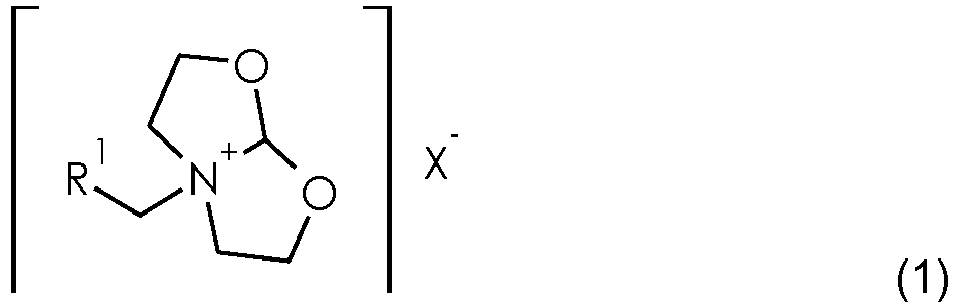 - R1 is phenyl; 2-nitrophenyl; 3-nitrophenyl; 4-nitrophenyl; 2-bromophenyl; 3-bromophenyl; 4-bromophenyl; 2,3-dibromophenyl; 2,4-dibromophenyl; 2-chlorophenyl; 3-chlorophenyl; 4-chlorophenyl; 2,4-dichlorophenyl; 3,4-dichlorophenyl; 3,5-dichlorophenyl; 2,6-dichlorophenyl; 2-iodophenyl; 4-iodophenyl; 2-methoxyphenyl; 3-methoxyphenyl; 4-methoxyphenyl; 2,5-dimethoxyphenyl; 3,4-dimethoxyphenyl; 2,3,4-trimethoxyphenyl; 3,4,5-trimethoxyphenyl; 2-methylphenyl; 3-methylphenyl; 4-methylphenyl; 3,5-dimethylphenyl; 2,4-dimethylphenyl; 2-fluorophenyl; 3-fluorophenyl; 4-fluorophenyl; 3,4-difluorophenyl; 2,3-difluorophenyl; 3,5-difluorophenyl; 2,4-difluorophenyl; 2,3,4,5-tetrafluorophenyl; 2-(methoxycarbonyl)phenyl; 3-(methoxycarbonyl)phenyl; 4-(methoxycarbonyl)phenyl; 2-(trifluoromethyl)phenyl; 3-(trifluoromethyl)phenyl; 4-(trifluoromethyl)phenyl; 4-tert-butylphenyl; 2-phenylophenyl; 3-phenylophenyl; 4-phenylophenyl; 4-benzoylphenyl; 4-benzyloxyphenyl; 4-(methylsulphonyl)phenyl; 2-cyanophenyl; 3-cyanophenyl; 4-cyanophenyl; 4-formylphenyl; 4-methylthiophenyl; 3-phenoxyphenyl; 4-phenoxyphenyl; 2,4-diphenoxyphenyl; 2,4-dinitrophenyl; 4-(aminosulfonyl)phenyl; 2-pyridyl; 3-pyridyl; 4-pyridyl; 2-furyl; 2-thienyl; 2-benzo[b]furyl; 1-naphthyl or 2-naphthyl;- X is chloride, bromide or iodide.
 - 4-(2-Oxoethyl)tetrahydro[1,3]oxazolo[2,3-b][1,3]oxazol-4-ium derivatives of the general formula (2),
 - R2 is phenyl; 2-fluorophenyl; 3-fluorophenyl; 4-fluorophenyl; 2,4-difluorophenyl; 2,5-difluorophenyl; 2,6-difluorophenyl; 2,3,4-trichlorophenyl; 2,3,4,5-tetrafluorophenyl; 2-chlorophenyl; 3-chlorophenyl; 4-chlorophenyl; 2,4-dichlorophenyl; 3,4-dichlorophenyl; 2,5-dichlorophenyl; 2-bromophenyl; 3-bromophenyl; 4-bromophenyl; 3-iodophenyl; 4-iodophenyl; 2-hydroxyphenyl; 3-hydroxyphenyl; 4-hydroxyphenyl; 2,4-dihydroxyphenyl; 2,3-dihydroxyphenyl; 3,4-dihydroxyphenyl; 2,5-dihydroxyphenyl; 2-(acetyloxy)phenyl; 3-(acetyloxy)phenyl; 4-(acetyloxy)phenyl; 2,4-bis(acetyloxy)phenyl; 3,4-bis(acetyloxy)phenyl; 2,5-bis(acetyloxy)phenyl; 1,3-benzodioxol-5-yl; 2-phenylophenyl; 3-phenylophenyl; 4-phenylophenyl; 2-nitrophenyl; 3-nitrophenyl; 4-nitrophenyl; 2,4-dinitrophenyl; 3,4-dinitrophenyl; 2,5-dinitrophenyl; 4-chloro-3-nitrophenyl; 2-chloro-3-nitrophenyl; 2-methylphenyl; 3-methylphenyl; 4-methylphenyl; 2,4-dimethylphenyl; 3,4-dimethylphenyl; 2-methoxyphenyl; 3-methoxyphenyl; 4-methoxyphenyl; 3,4-dimethoxyphenyl; 2,4-dimethoxyphenyl; 2,5-dimethoxyphenyl; 3,4,5-trimethoxyphenyl; 4-ethylphenyl; 3-benzyloxyphenyl; 4-benzyloxyphenyl; 4-phenoxyphenyl; 2-cyanophenyl; 3-cyanophenyl; 4-cyanophenyl; 2-aminophenyl; 3-aminophenyl; 4-aminophenyl; 3-(trifluoromethyl)phenyl; 4-(trifluoromethyl)phenyl; 4-carbamoylphenyl; 4-sulfamoylphenyl; 4-(methylsulfonyl)phenyl; 4-(methoxycarbonyl)phenyl; 4-(acetylamino)phenyl; 4-(N,N-dimethylamino)phenyl; 4-tert-butylphenyl; trifluoromethyl; trichloromethyl; 2-pyridyl; 3-pyridyl; 4-pyridyl; 1-naphthyl; 2-naphthyl; 2-furyl; 2-benzo[b]furyl; 2-thienyl; amino; methylamino; dimethylamino; phenylamino; diphenylamino; benzylamino or dibenzylamino;- X is chloride, bromide or iodide.
 - Bis{4-methyltetrahydro[1,3]oxazolo[2,3-b][1,3]oxazol-4-ium} derivatives of the general formula (3),
 - R3 is benzene-1,4-diyl; benzene-1,3-diyl; 1,2-dioxoethan-1,2-diyl; biphenyl-4,4'-diyl; methanediyldibenzene-4,1-diyl; oxodibenzene-4,1-diyl or carbonyldibenzene-4,1-diyl;- X is chloride, bromide or iodide.
 - Bis{4-(2-oxoethyl)tetrahydro[1,3]oxazolo[2,3-b][1,3]oxazol-4-ium} derivatives of the general formula (4),
 - R4 is benzene-1,4-diyl; benzene-1,3-diyl; biphenyl-4,4'-diyl or oxydibenzene-4,1-diyl;- X is chloride, bromide or iodide.
 - Tris{4-methyltetrahydro[1,3]oxazolo[2,3-b][1,3]oxazol-4-ium} derivatives of the general formula (5),
 - R5 is benzene-1,3,5-triyl;- X is chloride, bromide or iodide.
 - The process for the preparation of 4-methyltetrahydro[1,3]oxazolo[2,3-b][1,3]oxazol-4-ium derivatives of general formula (1),


 - R1 is non-substituted or substituted group selected from alkyl, cycloalkyl, aryl or heteroaryl, wherein substituted group denotes group substituted with radical independently selected from alkyl, aryl, acyl, alkoxyl, aryloxyl, alkoxycarbonyl, aryloxycarbonyl, halogen, cyano, alkylthio, arylthio, alkylsulfonyl, arylsulfonyl, aminosulfonyl, nitro, amino, mono- or dialkylamino, mono- or diarylamino or acylamino;- X is fluoride, chloride, bromide, iodide or methanesulfonate.
 - The process for the preparation of 4-(2-oxoethyl)tetrahydro[1,3]oxazolo[2,3-b][1,3]oxazol-4-ium derivatives of general formula (2),


 - R2 is non-substituted or substituted group selected from alkyl, cycloalkyl, aryl, heteroaryl, amino, mono- or dialkylamino, mono- or diarylamino or acylamino, wherein substituted group denotes group substituted with radical independently selected from alkyl, aryl, acyl, alkoxyl, aryloxyl, alkoxycarbonyl, aryloxycarbonyl, halogen, cyano, alkylthio, arylthio, alkylsulfonyl, arylsulfonyl, aminosulfonyl, nitro, amino, mono- or dialkylamino, mono- or diarylamino or acylamino;- X is fluoride, chloride, bromide, iodide or methanesulfonate.
 - The process for the preparation of bis{4-methyltetrahydro[1,3]oxazolo[2,3-b][1,3]oxazol-4-ium} derivatives of general formula (3),


 - R3 is non-substituted or substituted group selected from alkyl, cycloalkyl, aryl or heteroaryl, wherein substituted group denotes group substituted with radical independently selected from alkyl, aryl, acyl, alkoxyl, aryloxyl, alkoxycarbonyl, aryloxycarbonyl, halogen, cyano, alkylthio, arylthio, alkylsulfonyl, arylsulfonyl, aminosulfonyl, nitro, amino, mono- or dialkylamino, mono- or diarylamino or acylamino;- X is fluoride, chloride, bromide, iodide or methanesulfonate.
 - The process for the preparation of bis{4-(2-oxoethyl)tetrahydro[1,3]oxazolo[2,3-b][1,3]-oxazol-4-ium} derivatives of general formula (4),

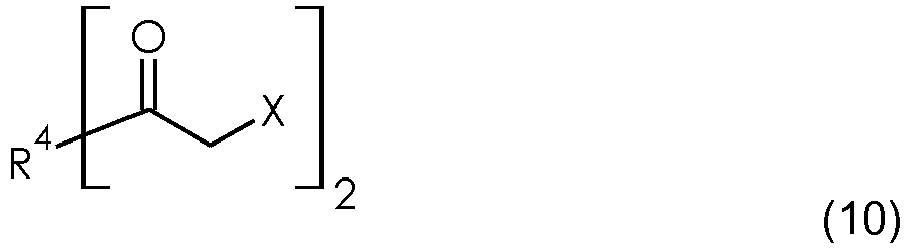
 - R4 is non-substituted or substituted group selected from alkyl, cycloalkyl, aryl, heteroaryl, amino, mono- or dialkylamino, mono- or diarylamino or acylamino, wherein substituted group denotes group substituted with radical independently selected from alkyl, aryl, acyl, alkoxyl, aryloxyl, alkoxycarbonyl, aryloxycarbonyl, halogen, cyano, alkylthio, arylthio, alkylsulfonyl, arylsulfonyl, aminosulfonyl, nitro, amino, mono- or dialkylamino, mono- or diarylamino or acylamino;- X is fluoride, chloride, bromide, iodide or methanesulfonate.
 - The process for the preparation of tris{4-methyltetrahydro[1,3]oxazolo[2,3-b][1,3]oxazol-4-ium} derivatives of general formula (5),


 - R5 is non-substituted or substituted group selected from alkyl, cycloalkyl, aryl or heteroaryl, wherein substituted group denotes group substituted with radical independently selected from alkyl, aryl, acyl, alkoxyl, aryloxyl, alkoxycarbonyl, aryloxycarbonyl, halogen, cyano, alkylthio, arylthio, alkylsulfonyl, arylsulfonyl, aminosulfonyl, nitro, amino, mono- or dialkylamino, mono- or diarylamino or acylamino;- X is fluoride, chloride, bromide, iodide or methanesulfonate.
 - The application of a compounds of general formula (1) or (2) or (3) or (4) or (5), wherein:- R1 or R3 or R5 is non-substituted or substituted group selected from alkyl, cycloalkyl, aryl, heteroaryl, wherein substituted group denotes group substituted with radical independently selected from alkyl, aryl, acyl, alkoxyl, aryloxyl, alkoxycarbonyl, aryloxycarbonyl, halogen, cyano, alkylthio, arylthio, alkylsulfonyl, arylsulfonyl, aminosulfonyl, nitro, amino, mono- or dialkylamino, mono- or diarylamino or acylamino;- R2 or R4 is non-substituted or substituted group selected from alkyl, cycloalkyl, aryl, heteroaryl, amino, mono- or dialkylamino, mono- or diarylamino or acylamino, wherein substituted group denotes group substituted with radical independently selected from alkyl, aryl, acyl, alkoxyl, aryloxyl, alkoxycarbonyl, aryloxycarbonyl, halogen, cyano, alkylthio, arylthio, alkylsulfonyl, arylsulfonyl, aminosulfonyl, nitro, amino, mono- or dialkylamino, mono- or diarylamino or acylamino;- X is fluoride, chloride, bromide, iodide or methanesulfonate;as a cleaning agents, antistatics, foam-makers, emulsifiers, softeners, moisturizers or stabilisers used for the production of detergents, creams, shampoos, balms, shaving foams, hair dyes or regenerating conditioners.
- The application of a compounds of general formula (1) or (2) or (3) or (4) or (5), wherein:- R1 or R2 or R4 or R3 or R5 and X have the above-mentioned meaning,as a germicides, fungicides, parasiticides, virucides, spermicides, disinfectants or antiseptics for the production of washing, preserving or sterilizing agents or disinfectants.
- The application of a compounds of general formula (1) or (2) or (3) or (4) or (5), wherein:- R1 or R2 or R4 or R3 or R5 and X have the above-mentioned meaning,as a phase transfer catalysts.
- The application according to claim 12, wherein:- R2 is 4-phenyl or biphenyl-4-yl;- X is bromide;as a germicide, fungicide, parasiticide, virucide, spermicide, disinfectant or antiseptic for the production of washing or preserving or sterilizing agents or disinfectants.
Applications Claiming Priority (2)
| Application Number | Priority Date | Filing Date | Title |
|---|---|---|---|
| PL39795112A PL233374B1 (en) | 2012-01-31 | 2012-01-31 | Novel quaternary ammonium salts derivatives and the method for preparation of new derivatives of quaternary ammonium salts |
| PCT/PL2013/000010 WO2013115661A1 (en) | 2012-01-31 | 2013-01-31 | New quaternary ammonium salts, method for preparation and applications thereof |
Publications (2)
| Publication Number | Publication Date |
|---|---|
| EP2814831A1 EP2814831A1 (en) | 2014-12-24 |
| EP2814831B1 true EP2814831B1 (en) | 2018-08-01 |
Family
ID=47997747
Family Applications (1)
| Application Number | Title | Priority Date | Filing Date |
|---|---|---|---|
| EP13711983.0A Not-in-force EP2814831B1 (en) | 2012-01-31 | 2013-01-31 | New quaternary ammonium salts, method for preparation and applications thereof |
Country Status (4)
| Country | Link |
|---|---|
| US (1) | US9169267B2 (en) |
| EP (1) | EP2814831B1 (en) |
| PL (1) | PL233374B1 (en) |
| WO (1) | WO2013115661A1 (en) |
Family Cites Families (2)
| Publication number | Priority date | Publication date | Assignee | Title |
|---|---|---|---|---|
| DE1770781A1 (en) * | 1968-07-03 | 1972-01-13 | Huels Chemische Werke Ag | 1,3-Dioxa-6-aza-cyclooctanes |
| JPH04295483A (en) * | 1991-03-22 | 1992-10-20 | Nippon Paint Co Ltd | New ammonium salt |
-
2012
- 2012-01-31 PL PL39795112A patent/PL233374B1/en unknown
-
2013
- 2013-01-31 WO PCT/PL2013/000010 patent/WO2013115661A1/en not_active Ceased
- 2013-01-31 US US14/375,363 patent/US9169267B2/en active Active
- 2013-01-31 EP EP13711983.0A patent/EP2814831B1/en not_active Not-in-force
Also Published As
| Publication number | Publication date |
|---|---|
| US20150080583A1 (en) | 2015-03-19 |
| EP2814831A1 (en) | 2014-12-24 |
| PL397951A1 (en) | 2013-08-05 |
| US9169267B2 (en) | 2015-10-27 |
| PL233374B1 (en) | 2019-10-31 |
| WO2013115661A1 (en) | 2013-08-08 |
Similar Documents
| Publication | Publication Date | Title |
|---|---|---|
| KR940001728B1 (en) | Triazine derivatives and herbicides having the same as active ingredients | |
| BRPI0614911A2 (en) | 3-acylaminobenzanilides insecticides | |
| DD282609A5 (en) | PROCESS FOR IMMUNIZING PLANTS AGAINST MICROORGANISM PHYTOPATHOGENIC ATTACK | |
| DE68917617T2 (en) | Triazole compounds, processes for their preparation and herbicidal compositions containing them. | |
| US9169267B2 (en) | Quaternary ammonium salts, method for preparation and applications thereof | |
| HU203946B (en) | Insecticidal and acaricidal compositions comprising phenoxyphenyl thiourea, isothiourea and carbodiimide derivatives as active ingredient and process for producing the active ingredients | |
| BR112013015601B1 (en) | PROCESS FOR PREPARING 2- (TRIAZINYL CARBONYL) SULPHONANILIDES, USING N-SULPHONYL-SUBSTITUTED 3-TRIAZINYLXYDOLES, AND PROCEDURES FOR PREPARING N-ALKYL-N- [2- (1,3,5-TRIAZIN-2-IHLENLONYLASULIDONES] | |
| PT87764B (en) | METHOD FOR THE PREPARATION OF ETHER (AZOLYL-VINYL) -PHENOL-ALCENYLS WITH MICROBICIDE EFFECT | |
| DE69419661T2 (en) | Thiazolotriazole and thiazolodiazole derivatives with fungicidal activity | |
| JPH0211581A (en) | 2-adamantyl-4-isothiazolin-3-one, production thereof and bacteriocidal and fungicidal agent | |
| LU83815A1 (en) | ACYL UREAS, INSECTICIDAL AGENTS CONTAINING THESE COMPOUNDS AND METHOD FOR THE PRODUCTION THEREOF | |
| CN103864694A (en) | Fluorine-containing benzoylurea benzimidazole compound and application thereof | |
| DE69732539T2 (en) | Arylheterocyclic compounds with herbicidal activity | |
| CN101591295B (en) | Water-soluble benzopyrazolyl quaternary ammonium salt, preparation method thereof and application thereof | |
| CA1204443A (en) | Alkylene(cycloalkylene)-bis-heterocyclyl-biguanides | |
| US3873591A (en) | Halo-substituted cyanomethyl benzenesulfonates | |
| US2541930A (en) | Amides of monocarboxylic acids having acaricidal and disinfecting properties | |
| US3594375A (en) | Triazine compounds | |
| US4315846A (en) | Metal salt of N-substituted alkylenebisdithiocarbamic acid | |
| PL186225B1 (en) | Substituted pyridin-2-ones and substituted pyridino-2-thiones as biocidal agents | |
| US3766208A (en) | Certain geranyl ethers | |
| JPS5843962A (en) | 1-(trihalogenmethyl-sulfenyl)-4-aryl-1,2,4- triazin-5-one and bactericide containing same | |
| Yoneyama et al. | Herbicidal activity of N-(2, 3-epoxypropyl) benzenesulfonamide derivatives | |
| JPS62404A (en) | Agricultural fungicide | |
| US3031373A (en) | 8-quinolyl carbonate derivatives |
Legal Events
| Date | Code | Title | Description |
|---|---|---|---|
| PUAI | Public reference made under article 153(3) epc to a published international application that has entered the european phase |
Free format text: ORIGINAL CODE: 0009012 |
|
| 17P | Request for examination filed |
Effective date: 20140829 |
|
| AK | Designated contracting states |
Kind code of ref document: A1 Designated state(s): AL AT BE BG CH CY CZ DE DK EE ES FI FR GB GR HR HU IE IS IT LI LT LU LV MC MK MT NL NO PL PT RO RS SE SI SK SM TR |
|
| AX | Request for extension of the european patent |
Extension state: BA ME |
|
| DAX | Request for extension of the european patent (deleted) | ||
| GRAP | Despatch of communication of intention to grant a patent |
Free format text: ORIGINAL CODE: EPIDOSNIGR1 |
|
| STAA | Information on the status of an ep patent application or granted ep patent |
Free format text: STATUS: GRANT OF PATENT IS INTENDED |
|
| INTG | Intention to grant announced |
Effective date: 20180216 |
|
| GRAS | Grant fee paid |
Free format text: ORIGINAL CODE: EPIDOSNIGR3 |
|
| GRAA | (expected) grant |
Free format text: ORIGINAL CODE: 0009210 |
|
| STAA | Information on the status of an ep patent application or granted ep patent |
Free format text: STATUS: THE PATENT HAS BEEN GRANTED |
|
| AK | Designated contracting states |
Kind code of ref document: B1 Designated state(s): AL AT BE BG CH CY CZ DE DK EE ES FI FR GB GR HR HU IE IS IT LI LT LU LV MC MK MT NL NO PL PT RO RS SE SI SK SM TR |
|
| REG | Reference to a national code |
Ref country code: GB Ref legal event code: FG4D |
|
| REG | Reference to a national code |
Ref country code: CH Ref legal event code: EP Ref country code: AT Ref legal event code: REF Ref document number: 1024156 Country of ref document: AT Kind code of ref document: T Effective date: 20180815 |
|
| REG | Reference to a national code |
Ref country code: IE Ref legal event code: FG4D |
|
| REG | Reference to a national code |
Ref country code: DE Ref legal event code: R096 Ref document number: 602013041139 Country of ref document: DE |
|
| REG | Reference to a national code |
Ref country code: NL Ref legal event code: MP Effective date: 20180801 |
|
| REG | Reference to a national code |
Ref country code: LT Ref legal event code: MG4D |
|
| REG | Reference to a national code |
Ref country code: AT Ref legal event code: MK05 Ref document number: 1024156 Country of ref document: AT Kind code of ref document: T Effective date: 20180801 |
|
| PG25 | Lapsed in a contracting state [announced via postgrant information from national office to epo] |
Ref country code: LT Free format text: LAPSE BECAUSE OF FAILURE TO SUBMIT A TRANSLATION OF THE DESCRIPTION OR TO PAY THE FEE WITHIN THE PRESCRIBED TIME-LIMIT Effective date: 20180801 Ref country code: PL Free format text: LAPSE BECAUSE OF FAILURE TO SUBMIT A TRANSLATION OF THE DESCRIPTION OR TO PAY THE FEE WITHIN THE PRESCRIBED TIME-LIMIT Effective date: 20180801 Ref country code: RS Free format text: LAPSE BECAUSE OF FAILURE TO SUBMIT A TRANSLATION OF THE DESCRIPTION OR TO PAY THE FEE WITHIN THE PRESCRIBED TIME-LIMIT Effective date: 20180801 Ref country code: IS Free format text: LAPSE BECAUSE OF FAILURE TO SUBMIT A TRANSLATION OF THE DESCRIPTION OR TO PAY THE FEE WITHIN THE PRESCRIBED TIME-LIMIT Effective date: 20181201 Ref country code: FI Free format text: LAPSE BECAUSE OF FAILURE TO SUBMIT A TRANSLATION OF THE DESCRIPTION OR TO PAY THE FEE WITHIN THE PRESCRIBED TIME-LIMIT Effective date: 20180801 Ref country code: BG Free format text: LAPSE BECAUSE OF FAILURE TO SUBMIT A TRANSLATION OF THE DESCRIPTION OR TO PAY THE FEE WITHIN THE PRESCRIBED TIME-LIMIT Effective date: 20181101 Ref country code: NL Free format text: LAPSE BECAUSE OF FAILURE TO SUBMIT A TRANSLATION OF THE DESCRIPTION OR TO PAY THE FEE WITHIN THE PRESCRIBED TIME-LIMIT Effective date: 20180801 Ref country code: AT Free format text: LAPSE BECAUSE OF FAILURE TO SUBMIT A TRANSLATION OF THE DESCRIPTION OR TO PAY THE FEE WITHIN THE PRESCRIBED TIME-LIMIT Effective date: 20180801 Ref country code: GR Free format text: LAPSE BECAUSE OF FAILURE TO SUBMIT A TRANSLATION OF THE DESCRIPTION OR TO PAY THE FEE WITHIN THE PRESCRIBED TIME-LIMIT Effective date: 20181102 Ref country code: NO Free format text: LAPSE BECAUSE OF FAILURE TO SUBMIT A TRANSLATION OF THE DESCRIPTION OR TO PAY THE FEE WITHIN THE PRESCRIBED TIME-LIMIT Effective date: 20181101 Ref country code: SE Free format text: LAPSE BECAUSE OF FAILURE TO SUBMIT A TRANSLATION OF THE DESCRIPTION OR TO PAY THE FEE WITHIN THE PRESCRIBED TIME-LIMIT Effective date: 20180801 |
|
| PG25 | Lapsed in a contracting state [announced via postgrant information from national office to epo] |
Ref country code: AL Free format text: LAPSE BECAUSE OF FAILURE TO SUBMIT A TRANSLATION OF THE DESCRIPTION OR TO PAY THE FEE WITHIN THE PRESCRIBED TIME-LIMIT Effective date: 20180801 Ref country code: LV Free format text: LAPSE BECAUSE OF FAILURE TO SUBMIT A TRANSLATION OF THE DESCRIPTION OR TO PAY THE FEE WITHIN THE PRESCRIBED TIME-LIMIT Effective date: 20180801 Ref country code: HR Free format text: LAPSE BECAUSE OF FAILURE TO SUBMIT A TRANSLATION OF THE DESCRIPTION OR TO PAY THE FEE WITHIN THE PRESCRIBED TIME-LIMIT Effective date: 20180801 |
|
| PG25 | Lapsed in a contracting state [announced via postgrant information from national office to epo] |
Ref country code: CZ Free format text: LAPSE BECAUSE OF FAILURE TO SUBMIT A TRANSLATION OF THE DESCRIPTION OR TO PAY THE FEE WITHIN THE PRESCRIBED TIME-LIMIT Effective date: 20180801 Ref country code: IT Free format text: LAPSE BECAUSE OF FAILURE TO SUBMIT A TRANSLATION OF THE DESCRIPTION OR TO PAY THE FEE WITHIN THE PRESCRIBED TIME-LIMIT Effective date: 20180801 Ref country code: EE Free format text: LAPSE BECAUSE OF FAILURE TO SUBMIT A TRANSLATION OF THE DESCRIPTION OR TO PAY THE FEE WITHIN THE PRESCRIBED TIME-LIMIT Effective date: 20180801 Ref country code: ES Free format text: LAPSE BECAUSE OF FAILURE TO SUBMIT A TRANSLATION OF THE DESCRIPTION OR TO PAY THE FEE WITHIN THE PRESCRIBED TIME-LIMIT Effective date: 20180801 Ref country code: RO Free format text: LAPSE BECAUSE OF FAILURE TO SUBMIT A TRANSLATION OF THE DESCRIPTION OR TO PAY THE FEE WITHIN THE PRESCRIBED TIME-LIMIT Effective date: 20180801 |
|
| REG | Reference to a national code |
Ref country code: DE Ref legal event code: R097 Ref document number: 602013041139 Country of ref document: DE |
|
| PG25 | Lapsed in a contracting state [announced via postgrant information from national office to epo] |
Ref country code: SM Free format text: LAPSE BECAUSE OF FAILURE TO SUBMIT A TRANSLATION OF THE DESCRIPTION OR TO PAY THE FEE WITHIN THE PRESCRIBED TIME-LIMIT Effective date: 20180801 Ref country code: DK Free format text: LAPSE BECAUSE OF FAILURE TO SUBMIT A TRANSLATION OF THE DESCRIPTION OR TO PAY THE FEE WITHIN THE PRESCRIBED TIME-LIMIT Effective date: 20180801 Ref country code: SK Free format text: LAPSE BECAUSE OF FAILURE TO SUBMIT A TRANSLATION OF THE DESCRIPTION OR TO PAY THE FEE WITHIN THE PRESCRIBED TIME-LIMIT Effective date: 20180801 |
|
| PLBE | No opposition filed within time limit |
Free format text: ORIGINAL CODE: 0009261 |
|
| STAA | Information on the status of an ep patent application or granted ep patent |
Free format text: STATUS: NO OPPOSITION FILED WITHIN TIME LIMIT |
|
| 26N | No opposition filed |
Effective date: 20190503 |
|
| PG25 | Lapsed in a contracting state [announced via postgrant information from national office to epo] |
Ref country code: MC Free format text: LAPSE BECAUSE OF FAILURE TO SUBMIT A TRANSLATION OF THE DESCRIPTION OR TO PAY THE FEE WITHIN THE PRESCRIBED TIME-LIMIT Effective date: 20180801 Ref country code: SI Free format text: LAPSE BECAUSE OF FAILURE TO SUBMIT A TRANSLATION OF THE DESCRIPTION OR TO PAY THE FEE WITHIN THE PRESCRIBED TIME-LIMIT Effective date: 20180801 |
|
| REG | Reference to a national code |
Ref country code: CH Ref legal event code: PL |
|
| PG25 | Lapsed in a contracting state [announced via postgrant information from national office to epo] |
Ref country code: LU Free format text: LAPSE BECAUSE OF NON-PAYMENT OF DUE FEES Effective date: 20190131 |
|
| REG | Reference to a national code |
Ref country code: BE Ref legal event code: MM Effective date: 20190131 |
|
| REG | Reference to a national code |
Ref country code: IE Ref legal event code: MM4A |
|
| PG25 | Lapsed in a contracting state [announced via postgrant information from national office to epo] |
Ref country code: FR Free format text: LAPSE BECAUSE OF NON-PAYMENT OF DUE FEES Effective date: 20190131 |
|
| PG25 | Lapsed in a contracting state [announced via postgrant information from national office to epo] |
Ref country code: BE Free format text: LAPSE BECAUSE OF NON-PAYMENT OF DUE FEES Effective date: 20190131 |
|
| PG25 | Lapsed in a contracting state [announced via postgrant information from national office to epo] |
Ref country code: LI Free format text: LAPSE BECAUSE OF NON-PAYMENT OF DUE FEES Effective date: 20190131 Ref country code: CH Free format text: LAPSE BECAUSE OF NON-PAYMENT OF DUE FEES Effective date: 20190131 |
|
| PG25 | Lapsed in a contracting state [announced via postgrant information from national office to epo] |
Ref country code: IE Free format text: LAPSE BECAUSE OF NON-PAYMENT OF DUE FEES Effective date: 20190131 |
|
| PG25 | Lapsed in a contracting state [announced via postgrant information from national office to epo] |
Ref country code: TR Free format text: LAPSE BECAUSE OF FAILURE TO SUBMIT A TRANSLATION OF THE DESCRIPTION OR TO PAY THE FEE WITHIN THE PRESCRIBED TIME-LIMIT Effective date: 20180801 |
|
| PG25 | Lapsed in a contracting state [announced via postgrant information from national office to epo] |
Ref country code: PT Free format text: LAPSE BECAUSE OF FAILURE TO SUBMIT A TRANSLATION OF THE DESCRIPTION OR TO PAY THE FEE WITHIN THE PRESCRIBED TIME-LIMIT Effective date: 20181201 Ref country code: MT Free format text: LAPSE BECAUSE OF NON-PAYMENT OF DUE FEES Effective date: 20190131 |
|
| PG25 | Lapsed in a contracting state [announced via postgrant information from national office to epo] |
Ref country code: CY Free format text: LAPSE BECAUSE OF FAILURE TO SUBMIT A TRANSLATION OF THE DESCRIPTION OR TO PAY THE FEE WITHIN THE PRESCRIBED TIME-LIMIT Effective date: 20180801 |
|
| PG25 | Lapsed in a contracting state [announced via postgrant information from national office to epo] |
Ref country code: HU Free format text: LAPSE BECAUSE OF FAILURE TO SUBMIT A TRANSLATION OF THE DESCRIPTION OR TO PAY THE FEE WITHIN THE PRESCRIBED TIME-LIMIT; INVALID AB INITIO Effective date: 20130131 |
|
| PG25 | Lapsed in a contracting state [announced via postgrant information from national office to epo] |
Ref country code: MK Free format text: LAPSE BECAUSE OF FAILURE TO SUBMIT A TRANSLATION OF THE DESCRIPTION OR TO PAY THE FEE WITHIN THE PRESCRIBED TIME-LIMIT Effective date: 20180801 |
|
| PGFP | Annual fee paid to national office [announced via postgrant information from national office to epo] |
Ref country code: GB Payment date: 20231221 Year of fee payment: 12 |
|
| PGFP | Annual fee paid to national office [announced via postgrant information from national office to epo] |
Ref country code: DE Payment date: 20240124 Year of fee payment: 12 |
|
| REG | Reference to a national code |
Ref country code: DE Ref legal event code: R119 Ref document number: 602013041139 Country of ref document: DE |
|
| GBPC | Gb: european patent ceased through non-payment of renewal fee |
Effective date: 20250131 |
|
| PG25 | Lapsed in a contracting state [announced via postgrant information from national office to epo] |
Ref country code: DE Free format text: LAPSE BECAUSE OF NON-PAYMENT OF DUE FEES Effective date: 20250801 |
|
| PG25 | Lapsed in a contracting state [announced via postgrant information from national office to epo] |
Ref country code: GB Free format text: LAPSE BECAUSE OF NON-PAYMENT OF DUE FEES Effective date: 20250131 |