EP2813984A1 - Method and System for Summarizing Multimedia Content - Google Patents
Method and System for Summarizing Multimedia Content Download PDFInfo
- Publication number
- EP2813984A1 EP2813984A1 EP13305788.5A EP13305788A EP2813984A1 EP 2813984 A1 EP2813984 A1 EP 2813984A1 EP 13305788 A EP13305788 A EP 13305788A EP 2813984 A1 EP2813984 A1 EP 2813984A1
- Authority
- EP
- European Patent Office
- Prior art keywords
- multimedia
- segments
- multimedia content
- topic
- topics
- Prior art date
- Legal status (The legal status is an assumption and is not a legal conclusion. Google has not performed a legal analysis and makes no representation as to the accuracy of the status listed.)
- Withdrawn
Links
Images
Classifications
-
- G—PHYSICS
- G06—COMPUTING OR CALCULATING; COUNTING
- G06Q—INFORMATION AND COMMUNICATION TECHNOLOGY [ICT] SPECIALLY ADAPTED FOR ADMINISTRATIVE, COMMERCIAL, FINANCIAL, MANAGERIAL OR SUPERVISORY PURPOSES; SYSTEMS OR METHODS SPECIALLY ADAPTED FOR ADMINISTRATIVE, COMMERCIAL, FINANCIAL, MANAGERIAL OR SUPERVISORY PURPOSES, NOT OTHERWISE PROVIDED FOR
- G06Q30/00—Commerce
- G06Q30/02—Marketing; Price estimation or determination; Fundraising
- G06Q30/0201—Market modelling; Market analysis; Collecting market data
-
- G—PHYSICS
- G06—COMPUTING OR CALCULATING; COUNTING
- G06F—ELECTRIC DIGITAL DATA PROCESSING
- G06F16/00—Information retrieval; Database structures therefor; File system structures therefor
- G06F16/70—Information retrieval; Database structures therefor; File system structures therefor of video data
- G06F16/78—Retrieval characterised by using metadata, e.g. metadata not derived from the content or metadata generated manually
-
- G—PHYSICS
- G06—COMPUTING OR CALCULATING; COUNTING
- G06Q—INFORMATION AND COMMUNICATION TECHNOLOGY [ICT] SPECIALLY ADAPTED FOR ADMINISTRATIVE, COMMERCIAL, FINANCIAL, MANAGERIAL OR SUPERVISORY PURPOSES; SYSTEMS OR METHODS SPECIALLY ADAPTED FOR ADMINISTRATIVE, COMMERCIAL, FINANCIAL, MANAGERIAL OR SUPERVISORY PURPOSES, NOT OTHERWISE PROVIDED FOR
- G06Q10/00—Administration; Management
- G06Q10/40—Business processes related to social networking or social networking services
- G06Q10/44—Identification of trends within social networks, e.g. identification of trending topics
-
- G—PHYSICS
- G11—INFORMATION STORAGE
- G11B—INFORMATION STORAGE BASED ON RELATIVE MOVEMENT BETWEEN RECORD CARRIER AND TRANSDUCER
- G11B27/00—Editing; Indexing; Addressing; Timing or synchronising; Monitoring; Measuring tape travel
- G11B27/02—Editing, e.g. varying the order of information signals recorded on, or reproduced from, record carriers
- G11B27/031—Electronic editing of digitised analogue information signals, e.g. audio or video signals
- G11B27/034—Electronic editing of digitised analogue information signals, e.g. audio or video signals on discs
-
- G—PHYSICS
- G11—INFORMATION STORAGE
- G11B—INFORMATION STORAGE BASED ON RELATIVE MOVEMENT BETWEEN RECORD CARRIER AND TRANSDUCER
- G11B27/00—Editing; Indexing; Addressing; Timing or synchronising; Monitoring; Measuring tape travel
- G11B27/10—Indexing; Addressing; Timing or synchronising; Measuring tape travel
- G11B27/11—Indexing; Addressing; Timing or synchronising; Measuring tape travel by using information not detectable on the record carrier
-
- G—PHYSICS
- G11—INFORMATION STORAGE
- G11B—INFORMATION STORAGE BASED ON RELATIVE MOVEMENT BETWEEN RECORD CARRIER AND TRANSDUCER
- G11B27/00—Editing; Indexing; Addressing; Timing or synchronising; Monitoring; Measuring tape travel
- G11B27/10—Indexing; Addressing; Timing or synchronising; Measuring tape travel
- G11B27/19—Indexing; Addressing; Timing or synchronising; Measuring tape travel by using information detectable on the record carrier
- G11B27/28—Indexing; Addressing; Timing or synchronising; Measuring tape travel by using information detectable on the record carrier by using information signals recorded by the same method as the main recording
Definitions
- the present invention relates to the technical field of multimedia summarization with related social interactions content.
- multimedia is meant broadly and not restrictively to include resources or files comprising one or several content such as images, videos, sounds, or music.
- Perspective refer here to how an object, a subject or a topic is perceived, described or interpreted.
- Social interactions refer here to social content such as information, comments or ideas created, shared, and exchanged in a “conversational space” such as microblogging, social networks or any other discussion spaces.
- “social interactions” may be, for instance, interpreted as microposts.
- searching engines offering filtering features could help users to determine their choice, in most cases accuracy of responses is not satisfactory when the users request does not match exactly terms contained in the classification index of these searching engines.
- one problem to solve is to decrease the time consuming and difficulty to find a relevant multimedia content among the overabundance of contents.
- the methods of indexation of contents require descriptive metadata of a multimedia content to index/classify. These metadata are used by a search engine to process and retrieve the searched multimedia content.
- the descriptive metadata set is generated from the multimedia content material: audio transcription, closed captions, subtitles, Electronic Program Guide. More rarely, it could be enriched by added textual elements reflecting a category in a classification system. So in any cases, the classification index source is based on terms provided by the multimedia content producer that do not always fit the users request such as in term of vocabulary specificities or word combination.
- the descriptive metadata provided with the multimedia content and/or its summary are sufficient to give a coarse grain overview of the whole multimedia content, that rarely fits the user point of views expressed through their request.
- results of these methods are generally provided according only to perspectives representative of various aspects of the multimedia content itself, and do not describe various point of views of users.
- One object of the present solution is to provide a solution to the aforementioned problems, and offers other advantages over the prior art.
- Another object of the present invention is to decrease the consumption time and the difficulty to find a relevant multimedia content.
- Another object of the present invention is to target more accurately multimedia segments according to the user requests.
- Another object of the present invention is to provide a users oriented solution.
- Another object of the present invention is to provide a more accurate data source for summarization methods.
- Another object of the present invention is to leverage the social interactions associated to multimedia content, to compute different user perspectives.
- Various embodiments relate to methods for summarizing a multimedia content, the method comprising the following steps:
- the above methods may further comprise a concatenation step of relevant multimedia segments into multimedia summary segments.
- various embodiments relate to systems for summarizing a multimedia content, the system comprising the following modules:
- the above system may further comprise a Multi-Layer Summarizer module, configured to concatenate the multimedia segments into multimedia summary segments.
- Various embodiments further relate to computer program products for performing the above methods.
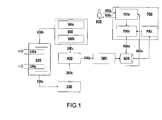
- FIG. 1 is a schematic diagram illustrating a functional architecture of an embodiment for multi-viewpoint multimedia summarization based on the analysis of social interactions content.
- the presented architecture shows the components of an embodiment permitting to provide multi-viewpoint summaries of a multimedia content, based on the analysis of associated social interactions.
- the considered context is a social multimedia content stream 100, comprising two types of input data: a multimedia content 100a and its related social interactions 100b.
- the multimedia content 100a may be for instance a video mainly mixing images and sounds, and may be eventually augmented by audio transcript, closed captions or EPG.
- the social interactions 100b may be, for instance, microposts, comments provided by users on microblogging services, media sharing services or social networks, these comments referring to the multimedia content 100a.
- the merging step between the multimedia content 100a and the social interactions 100b may be performed for instance based on a method such as described in the Alcatel-Lucent® patent application EP-13155839 ("Device For Controlling Synchronization Of A Set Of Data Contents With A Multimedia Content, And Device For Retrieving Said Data Contents For An Equipment", GASTE Yann; VERDOT Vincent).
- this document describes means for providing communication equipments with data contents to be stored, transferred and displayed with associated multimedia contents. To do so, data contents associated to multimedia contents are collected and organized to produce a data content channel and associated channel information.
- the data content channel is divided into data blocks depending on the associated channel information. Indexes are respectively associated to these data blocks. Then, a file is produced comprising the indexes, the data blocks and first and second information describing respectively the file and these data blocks. If communication equipments request a multimedia content, first information describing at least one file associated to a multimedia content are retrieved. Indexes of each file described by the retrieved first information are, then, downloaded. Accordingly, at least one data block associated to a downloaded index can be downloaded on demand. The downloaded indexes and channel information associated to the file are analyzed on demand of the communication equipments, to determine each data block to be downloaded at a chosen time. Finally, each downloaded data block is provided, on demand and at chosen time, to the communication equipments so that data contents that it comprises could be analyzed and displayed.
- a method for merging the multimedia content 100a and the social interactions 100b may be performed, by associating microposts messages to a live multimedia event (for instance filtering Twitter® messages based on the hash tags).
- the multimedia content 100a is provided to a Multimedia Segmentation module 200.
- the segmentation step may be performed manually or with using current methods of the background art, for instance by exploiting characteristics of the multimedia content such as speaker detection, speaker change detection, shot detection or camera motion detection.
- the social interactions 100b are used as input of a Topic Generator module 300.
- This module is in charge to extract from a stream of social interactions, used as a "knowledge source", a set of topics/perspective that will be used to form a multidimensional semantic referential.
- Each dimension/axis of the semantic referential constitutes a user perspective or a salient knowledge topic extracted from the social interactions.
- each topic/user perspective refers to a "knowledge plan" extracted from the users social interactions.
- the Topic Generator module 300 comprises a Social Topics Extractor 300a component. This component aims to extract the expressed knowledge collected in the users social interactions 100b, and to organize it through a number m of distinct topics. These topics constitute a multidimensional space referential with m dimensions.
- the component 300a performs a keywords extraction from the social interactions 100b, filters nouns, computes their importance/relevance and classifies them in the appropriate topics.
- this algorithm may be a LDA (Latent Dirichlet Allocation) based approach.
- each topic may be described by a set of weighted keywords, defining a particular semantic field, or user point of view.
- the weighting of the keywords may be, for instance, computed during a semantic analysis based on relevance criterions such as number/frequency of occurrence of a word/group of words within the social interactions content.
- the Topic Generator module 300 may further comprises an Opinions & Sentiments Extractor 300b component.
- This component is in charge to build a k-space with opinions and sentiments extracted from the users social interactions 100b. More particularly, it permits to complete a semantic analysis, by extracting subjectivity provided by the user in social interactions 100b (for instance if some comments/opinions are positive, negative or neutral with respect to the multimedia content 100a).
- These secondary perspectives/topics may be then, for example, either combined with the generated/extracted topics (i.e. perspectives) of the semantic referential computed by the module 300a, or used as a secondary "subjective" referential after a first search using the semantic referential.
- the Topic Generator module 300 provides as output, the set of topics 300c based on the results of the component 300a (extracted topics/perspectives), and optionally based on the results (secondary perspectives/topics) of the component 300b.
- the multimedia segments 200c, and the generated/extracted topics 300c, forming a multidimensional semantic referential, are used as inputs of a Multimedia Segments Classifier module 400.
- the module 400 processes the inputs data to classify all multimedia segments in the semantic referential with regards to topics/perspectives.
- Each multimedia segment is weighted, according to its relevance, along each perspective/topic dimension. Accordingly, each perspective/topic is associated to an ordered list (i.e. a sequence) of weighted multimedia segments 400a.
- the sequence of classified/weighted multimedia segments 400a is then provided to a Multi-Layer Summarizer module 500. Based on information such as weighting, the module 500 concatenates the most relevant multimedia segments 400a for each perspective/topic dimension. Hence, the most relevant segments 400a, that could be initially found anywhere in the multimedia content 100a, are chosen and concatenated into a single summary segment according to each user perspective/topic.
- the concatenation step can be performed according to predefined constraints such as length or size of the resulting video segments.
- the Multi-Layer Summarizer 500 module provides as output a sequence of summary segments with related extracted perspectives or topics.
- Each generated summary segment and its related extracted perspective/topic is then provided to the Multi-layered summaries database 600.
- the database 600 can be used as a data source for a visualization system.
- a visualization system may be a system comprising an interface provided to users, to facilitate the browsing of multimedia contents.
- a Summary Visualization System 700 exploits the data stored in the Multi-layered summaries database 600.
- a user 800 performs a request 900a for a multimedia content, through a Summarization interface 700a comprising a search engine.
- Each request 900a is translated into a weight vector in the perspective spaces of the semantic referential.
- a Perspective Selector module 700b requests at least one weighted perspective 700d to the Multi-layered summaries database 600.
- the database provides as output to the Summarization interface 700a, at least one multimedia summary segment 600a linked to a user perspective.
- the Summary Visualization system 700 proposes to the user 800 a display 900b of the selected multimedia summary segment 600a.
- the user 800 may update or refine his initial request 900a through the Summarization interface 700a.
- the Summary Visualization system 700 may compute again possible alternatives, based on the refined request and suggest other possible ends of the ongoing initial multimedia segment 600a.
- one advantage of such an embodiment is that it provides adaptability and flexibility to summarization methods.
- a new semantic Next/Previous (Fast Forward/Backward) segment can be implemented, to browse and display multimedia summary segments, according to a generated point of view/perspective, in the order defined by the relevance (i.e. the weightings of the segments) in the semantic space.
- the present solution may be performed either with a live, or with a register multimedia content.
- this solution may be integrated into a MVP ( Multi Screen Video Platform ) Alcatel Lucent® product which creates, manages and monetizes advanced video and payTV services and delivers them to more subscribers, devices and locations.
- MVP Multi Screen Video Platform
- Alcatel Lucent® product which creates, manages and monetizes advanced video and payTV services and delivers them to more subscribers, devices and locations.
- the present solution may be used with any application supporting communication or social interactions, in the context of social TV or video service platforms.
- the above-described system and method leverage social collective intelligence brought by users communities through their social interactions around a multimedia content.
- Social interactions are used as a data source to derive several user perspectives concerning a same multimedia content.
- the said multimedia content is associated to new knowledge dimensions and users perspectives not directly detectable inside a multimedia content.
- the vocabulary captured from textual data stream embedded in a multimedia content is representative of the content itself and does not comprise any kind of abstraction or interpretation.
- the vocabulary captured from social interactions stream is relative to the users themselves, with a diversity of terms and with different angles, hence more representative and accurate of users point of views.
- a set of relevant video segments according to each user perspective is provided to users, solving the problem of the summarization of a whole multimedia content.
- Another advantage is that it offers the users the possibility to request a specific multimedia segment matching accurately his textual request. Indeed, sentiment/opinion topics bring subjective dimension and combined with extracted topics, provide more accurate results compared to other existing methods.
- the fact to introduce user subjectivity allows to perform a further more accurate selection of a multimedia segment, following a user request. For instance, a user may request relevant media content, where its related subject is linked to a chosen positive or negative point of view.
- the above-described embodiments permit to save time and decrease difficulty when searching a relevant multimedia content, fitting specific user requests.
Landscapes
- Engineering & Computer Science (AREA)
- Theoretical Computer Science (AREA)
- Business, Economics & Management (AREA)
- Strategic Management (AREA)
- Physics & Mathematics (AREA)
- General Physics & Mathematics (AREA)
- Entrepreneurship & Innovation (AREA)
- Multimedia (AREA)
- Data Mining & Analysis (AREA)
- Finance (AREA)
- Accounting & Taxation (AREA)
- Development Economics (AREA)
- General Engineering & Computer Science (AREA)
- Databases & Information Systems (AREA)
- Library & Information Science (AREA)
- Economics (AREA)
- Marketing (AREA)
- General Business, Economics & Management (AREA)
- Game Theory and Decision Science (AREA)
- Human Resources & Organizations (AREA)
- Operations Research (AREA)
- Quality & Reliability (AREA)
- Tourism & Hospitality (AREA)
- Information Retrieval, Db Structures And Fs Structures Therefor (AREA)
Abstract
- segmenting a multimedia content (100a) into temporally ordered multimedia segments;
- extracting topics from social interactions (100b) relating to the said multimedia content (100a);
- associating each extracted topic to a sequence of multimedia segments.
Description
- The present invention relates to the technical field of multimedia summarization with related social interactions content.
- As used herein, the term "multimedia" is meant broadly and not restrictively to include resources or files comprising one or several content such as images, videos, sounds, or music.
- The term "summarization" refers here to methods and means to select, extract or retain information judged as the most relevant/important of a certain content.
- "Perspective", "point of view" refer here to how an object, a subject or a topic is perceived, described or interpreted.
- "Social interactions" refer here to social content such as information, comments or ideas created, shared, and exchanged in a "conversational space" such as microblogging, social networks or any other discussion spaces. In the context of microblogging, "social interactions" may be, for instance, interpreted as microposts.
- The proliferation of broadband internet connections and the development of innovative media sharing services over the World Wide Web have contributed to the establishment of digital media as a necessary part of our lives. Social media services such as Facebook®, Youtube® and micro blogging applications such as Twitter®, are changing how many people consume traditional media. As an example, the second television debate between Barack Obama and Mitt Romney during US'12 Elections generated 7.2 million tweets. Letting people broadcast their own thoughts, sentiments, opinions and emotions and following other social interactions related to what they are watching provides a more active and powerful experience from the end-user point of view.
- However, the increased significance of digital media as a means of communication combined with the availability of inexpensive hardware for capturing and transmitting digital media have inevitably resulted in a tremendous growth of media material created every day. Video-sharing websites, social networks or microblogging services especially reflects these tendencies. For instance, every minute, on Flickr®, 20 millions of photos are viewed and on YouTube®, 1.3 millions videos are watched and 30 hours of videos are shared.
- As a consequence, there is a real problem of navigation in this overabundance of contents. Searching and finding a relevant multimedia content is then a cumbersome and difficult task since it is quite difficult and time consuming for users to read all the pertinent multimedia contents to find a particular one.
- While searching engines, offering filtering features could help users to determine their choice, in most cases accuracy of responses is not satisfactory when the users request does not match exactly terms contained in the classification index of these searching engines.
- Accordingly one problem to solve is to decrease the time consuming and difficulty to find a relevant multimedia content among the overabundance of contents.
- Most common solutions to solve this problem, rely either on indexation or on summarization of contents.
- The methods of indexation of contents require descriptive metadata of a multimedia content to index/classify. These metadata are used by a search engine to process and retrieve the searched multimedia content.
- Hence, to provide an efficient searching tool, good quality descriptive metadata are required.
- Usually, the descriptive metadata set is generated from the multimedia content material: audio transcription, closed captions, subtitles, Electronic Program Guide. More rarely, it could be enriched by added textual elements reflecting a category in a classification system. So in any cases, the classification index source is based on terms provided by the multimedia content producer that do not always fit the users request such as in term of vocabulary specificities or word combination.
- Although this technology could be accurate, the classification is done for the whole multimedia content and is not generally enough to solve the problem of finding a relevant part of a multimedia content corresponding to a user interest.
- Consequently, additional technologies are considered to go further in the problem resolution of decreasing search consumption time.
- One other most common technique to solve the above cited problem is the summarizing of multimedia content.
- Several methods for summarizing a multimedia content are described in the prior art. Most of them use descriptive information coming from textual analysis of the closed caption content, Electronic Program Guide (EPG), speech to text analysis/audio transcript, or multimedia analyses of the video content.
- Nevertheless, the existing methods are limited by the fact that their data inputs are provided by multimedia content creators.
- In a limited number of cases, the descriptive metadata provided with the multimedia content and/or its summary are sufficient to give a coarse grain overview of the whole multimedia content, that rarely fits the user point of views expressed through their request.
- In fact, it is not possible to retrieve a short extract of multimedia content, designated below as "segment", matching closely to what has been requested by the user.
- Moreover, the results of these methods are generally provided according only to perspectives representative of various aspects of the multimedia content itself, and do not describe various point of views of users.
- One object of the present solution is to provide a solution to the aforementioned problems, and offers other advantages over the prior art.
- Another object of the present invention is to decrease the consumption time and the difficulty to find a relevant multimedia content.
- Another object of the present invention is to target more accurately multimedia segments according to the user requests.
- Another object of the present invention is to provide a users oriented solution.
- Another object of the present invention is to provide a more accurate data source for summarization methods.
- Another object of the present invention is to leverage the social interactions associated to multimedia content, to compute different user perspectives.
- Various embodiments are directed to addressing the effects of one or more of the problems set forth above. The following presents a simplified summary of embodiments in order to provide a basic understanding of some aspects of the various embodiments. This summary is not an exhaustive overview of these various embodiments. It is not intended to identify key of critical elements or to delineate the scope of these various embodiments. Its sole purpose is to present some concepts in a simplified form as a prelude to the more detailed description that is discussed later.
- Various embodiments relate to methods for summarizing a multimedia content, the method comprising the following steps:
- segmenting a multimedia content into temporally ordered multimedia segments;
- extracting topics from social interactions relating to the said multimedia content;
- associating each extracted topic to a sequence of multimedia segments.
- In accordance with a broad aspect, the above methods may further comprise a concatenation step of relevant multimedia segments into multimedia summary segments.
- Further, various embodiments relate to systems for summarizing a multimedia content, the system comprising the following modules:
- a Multimedia Segmentation module configured to segment a multimedia content into temporally ordered multimedia segments;
- a Topic Generator module comprising a Social Topics Extractor module, configured to extract topics from social interactions relating to the said multimedia content;
- a Multimedia Segments Classifier module configured to associate each extracted topic to a sequence of multimedia segments.
- In accordance with a broad aspect, the above system may further comprise a Multi-Layer Summarizer module, configured to concatenate the multimedia segments into multimedia summary segments.
- Various embodiments further relate to computer program products for performing the above methods.
- While the various embodiments are susceptible to various modification and alternative forms, specific embodiments thereof have been shown by way of example in the drawings. It should be understood, however, that the description herein of specific embodiments is not intended to limit the various embodiments to the particular forms disclosed.
- It may of course be appreciated that in the development of any such actual embodiments, implementation-specific decisions should be made to achieve the developer's specific goal, such as compliance with system-related and business-related constraints. It will be appreciated that such a development effort might be time consuming but may nevertheless be a routine understanding for those or ordinary skill in the art having the benefit of this disclosure.
- The objects, advantages and other features of various embodiments will become more apparent from the following disclosure and claims. The following non-restrictive description of preferred embodiments is given for the purpose of exemplification only with reference to the accompanying drawing in which
FIG. 1 is a schematic diagram illustrating a functional architecture of an embodiment for multi-viewpoint multimedia summarization based on the analysis of social interactions content. - With reference to
figure 1 , the presented architecture shows the components of an embodiment permitting to provide multi-viewpoint summaries of a multimedia content, based on the analysis of associated social interactions. - The considered context is a social
multimedia content stream 100, comprising two types of input data: amultimedia content 100a and its relatedsocial interactions 100b. Themultimedia content 100a may be for instance a video mainly mixing images and sounds, and may be eventually augmented by audio transcript, closed captions or EPG. - The
social interactions 100b may be, for instance, microposts, comments provided by users on microblogging services, media sharing services or social networks, these comments referring to themultimedia content 100a. The merging step between themultimedia content 100a and thesocial interactions 100b may be performed for instance based on a method such as described in the Alcatel-Lucent® patent applicationEP-13155839 - As another example, a method for merging the
multimedia content 100a and thesocial interactions 100b may be performed, by associating microposts messages to a live multimedia event (for instance filtering Twitter® messages based on the hash tags). - The
multimedia content 100a is provided to aMultimedia Segmentation module 200. This module uses themultimedia content 100a and provides as output a sequence S ofn multimedia segments 200c temporally ordered: S= S1,S2,..,S3,..,Sn. The segmentation step may be performed manually or with using current methods of the background art, for instance by exploiting characteristics of the multimedia content such as speaker detection, speaker change detection, shot detection or camera motion detection. - The
social interactions 100b are used as input of aTopic Generator module 300. This module is in charge to extract from a stream of social interactions, used as a "knowledge source", a set of topics/perspective that will be used to form a multidimensional semantic referential. Each dimension/axis of the semantic referential constitutes a user perspective or a salient knowledge topic extracted from the social interactions. Hence each topic/user perspective refers to a "knowledge plan" extracted from the users social interactions. - The
Topic Generator module 300 comprises aSocial Topics Extractor 300a component. This component aims to extract the expressed knowledge collected in the userssocial interactions 100b, and to organize it through a number m of distinct topics. These topics constitute a multidimensional space referential with m dimensions. Thecomponent 300a performs a keywords extraction from thesocial interactions 100b, filters nouns, computes their importance/relevance and classifies them in the appropriate topics. - To do so a topic model algorithm is performed. In one embodiment, this algorithm may be a LDA (Latent Dirichlet Allocation) based approach.
- Moreover, each topic may be described by a set of weighted keywords, defining a particular semantic field, or user point of view. The weighting of the keywords may be, for instance, computed during a semantic analysis based on relevance criterions such as number/frequency of occurrence of a word/group of words within the social interactions content.
- In one embodiment, the
Topic Generator module 300 may further comprises an Opinions &Sentiments Extractor 300b component. This component is in charge to build a k-space with opinions and sentiments extracted from the userssocial interactions 100b. More particularly, it permits to complete a semantic analysis, by extracting subjectivity provided by the user insocial interactions 100b (for instance if some comments/opinions are positive, negative or neutral with respect to themultimedia content 100a). - Accordingly, a number of secondary perspectives/topics are generated according to the sentiments and/or opinions expressed by users in the
social interactions 100b. - These secondary perspectives/topics may be then, for example, either combined with the generated/extracted topics (i.e. perspectives) of the semantic referential computed by the
module 300a, or used as a secondary "subjective" referential after a first search using the semantic referential. - The
Topic Generator module 300 provides as output, the set oftopics 300c based on the results of thecomponent 300a (extracted topics/perspectives), and optionally based on the results (secondary perspectives/topics) of thecomponent 300b. - The
multimedia segments 200c, and the generated/extractedtopics 300c, forming a multidimensional semantic referential, are used as inputs of a MultimediaSegments Classifier module 400. Themodule 400 processes the inputs data to classify all multimedia segments in the semantic referential with regards to topics/perspectives. Each multimedia segment is weighted, according to its relevance, along each perspective/topic dimension. Accordingly, each perspective/topic is associated to an ordered list (i.e. a sequence) ofweighted multimedia segments 400a. - The sequence of classified/
weighted multimedia segments 400a is then provided to aMulti-Layer Summarizer module 500. Based on information such as weighting, themodule 500 concatenates the mostrelevant multimedia segments 400a for each perspective/topic dimension. Hence, the mostrelevant segments 400a, that could be initially found anywhere in themultimedia content 100a, are chosen and concatenated into a single summary segment according to each user perspective/topic. - In one embodiment, the concatenation step can be performed according to predefined constraints such as length or size of the resulting video segments.
- The
Multi-Layer Summarizer 500 module provides as output a sequence of summary segments with related extracted perspectives or topics. - Each generated summary segment and its related extracted perspective/topic is then provided to the
Multi-layered summaries database 600. - In one embodiment, the
database 600 can be used as a data source for a visualization system. For instance, a visualization system may be a system comprising an interface provided to users, to facilitate the browsing of multimedia contents. - In one embodiment, a
Summary Visualization System 700 exploits the data stored in theMulti-layered summaries database 600. - For instance, a
user 800 performs arequest 900a for a multimedia content, through aSummarization interface 700a comprising a search engine. Eachrequest 900a is translated into a weight vector in the perspective spaces of the semantic referential. - Based on the
user request 900a and onrelated perspective indicators 700c provided by thedatabase 600, aPerspective Selector module 700b requests at least oneweighted perspective 700d to theMulti-layered summaries database 600. The database provides as output to theSummarization interface 700a, at least onemultimedia summary segment 600a linked to a user perspective. As a result, theSummary Visualization system 700 proposes to the user 800 adisplay 900b of the selectedmultimedia summary segment 600a. - In another embodiment, following an
ongoing display 900b of a selected multimedia summary segment, theuser 800 may update or refine hisinitial request 900a through theSummarization interface 700a. As a consequence, theSummary Visualization system 700 may compute again possible alternatives, based on the refined request and suggest other possible ends of the ongoinginitial multimedia segment 600a. - Accordingly, one advantage of such an embodiment is that it provides adaptability and flexibility to summarization methods.
- In one embodiment, a new semantic Next/Previous (Fast Forward/Backward) segment can be implemented, to browse and display multimedia summary segments, according to a generated point of view/perspective, in the order defined by the relevance (i.e. the weightings of the segments) in the semantic space.
- In one embodiment, the present solution may be performed either with a live, or with a register multimedia content.
- In another embodiment, this solution may be integrated into a MVP (Multi Screen Video Platform) Alcatel Lucent® product which creates, manages and monetizes advanced video and payTV services and delivers them to more subscribers, devices and locations.
- In one embodiment, the present solution may be used with any application supporting communication or social interactions, in the context of social TV or video service platforms.
- Advantageously, the above-described system and method leverage social collective intelligence brought by users communities through their social interactions around a multimedia content.
- Social interactions are used as a data source to derive several user perspectives concerning a same multimedia content. The said multimedia content is associated to new knowledge dimensions and users perspectives not directly detectable inside a multimedia content.
- More specifically, in the background art, the vocabulary captured from textual data stream embedded in a multimedia content is representative of the content itself and does not comprise any kind of abstraction or interpretation. At the opposite, in the described embodiments, the vocabulary captured from social interactions stream is relative to the users themselves, with a diversity of terms and with different angles, hence more representative and accurate of users point of views.
- Advantageously, a set of relevant video segments according to each user perspective is provided to users, solving the problem of the summarization of a whole multimedia content.
- Another advantage is that it offers the users the possibility to request a specific multimedia segment matching accurately his textual request. Indeed, sentiment/opinion topics bring subjective dimension and combined with extracted topics, provide more accurate results compared to other existing methods.
- Advantageously, the fact to introduce user subjectivity, allows to perform a further more accurate selection of a multimedia segment, following a user request. For instance, a user may request relevant media content, where its related subject is linked to a chosen positive or negative point of view. Advantageously, the above-described embodiments permit to save time and decrease difficulty when searching a relevant multimedia content, fitting specific user requests.
Claims (15)
- A method for summarizing a multimedia content, the method comprising the following steps:- segmenting a multimedia content (100a) into temporally ordered multimedia segments;- extracting topics from social interactions (100b) relating to the said multimedia content (100a);- associating each extracted topic to a sequence of multimedia segments.
- The method of claim 1, wherein each topic comprises a sequence of weighted keywords and forms a dimension of a multidimensional semantic referential.
- The method of claim 2, wherein during the association step, each multimedia segment is classified by relevance according to the weightings of each topic dimension in the multidimensional semantic referential.
- The method of claim 3, further comprising a concatenation step of relevant multimedia segments into multimedia summary segments.
- The method of any claims 1 to 4, wherein the extraction step further comprises an extraction of users opinions and sentiments from social interactions (100b).
- The method of claim 5, wherein opinions and sentiments are used as secondary topics to form a multidimensional subjective referential.
- The method of claim 6, wherein each multimedia segment is further classified regarding to the multidimensional subjective referential.
- The method of any claims 4 to 7, wherein it further comprises a selecting and displaying steps of the multimedia summary segments following a user request (900a).
- The method of any claims 4 to 8, wherein it further comprises a browsing step of the multimedia summary segments, according to the classification of each multimedia segment in the multidimensional semantic referential.
- The method of any claims 1-9, wherein the topics are extracted with a Latent Dirichlet based algorithm
- A system for summarizing a multimedia content, the system comprising the following modules:- a Multimedia Segmentation module (200) configured to segment a multimedia content (100a) into temporally ordered multimedia segments;- a Topic Generator module (300) comprising a Social Topics Extractor module (300a), configured to extract topics from social interactions (100b) relating to the said multimedia content (100a);- a Multimedia Segments Classifier module (400) configured to associate each extracted topic to a sequence of multimedia segments.
- The system of claim 11, wherein the Topic Generator module (300) further comprises an "Opinions and Sentiments Extractor" module (300b), configured to extract users opinions and sentiments from the social interactions (100b).
- The system of claim 11 or 12, further comprising a Multi-Layer Summarizer module (500), configured to concatenate the multimedia segments into multimedia summary segments.
- The system of any claims 11 to 13, further comprising a Summary Visualization System (700) configured to select multimedia summary segments stored in a Multi-layered summaries database (600) and display them, following a user request (900a).
- A computer program implemented on a processing unit of a computer, the program including code sections for performing instructions corresponding to the steps of a method according to any of claims 1-10.
Priority Applications (1)
| Application Number | Priority Date | Filing Date | Title |
|---|---|---|---|
| EP13305788.5A EP2813984A1 (en) | 2013-06-11 | 2013-06-11 | Method and System for Summarizing Multimedia Content |
Applications Claiming Priority (1)
| Application Number | Priority Date | Filing Date | Title |
|---|---|---|---|
| EP13305788.5A EP2813984A1 (en) | 2013-06-11 | 2013-06-11 | Method and System for Summarizing Multimedia Content |
Publications (1)
| Publication Number | Publication Date |
|---|---|
| EP2813984A1 true EP2813984A1 (en) | 2014-12-17 |
Family
ID=48748105
Family Applications (1)
| Application Number | Title | Priority Date | Filing Date |
|---|---|---|---|
| EP13305788.5A Withdrawn EP2813984A1 (en) | 2013-06-11 | 2013-06-11 | Method and System for Summarizing Multimedia Content |
Country Status (1)
| Country | Link |
|---|---|
| EP (1) | EP2813984A1 (en) |
Cited By (1)
| Publication number | Priority date | Publication date | Assignee | Title |
|---|---|---|---|---|
| US20240311569A1 (en) * | 2023-03-17 | 2024-09-19 | Microsoft Technology Licensing, Llc | Machine learning summarization on non-structured digital content |
Citations (3)
| Publication number | Priority date | Publication date | Assignee | Title |
|---|---|---|---|---|
| US20080154908A1 (en) * | 2006-12-22 | 2008-06-26 | Google Inc. | Annotation Framework for Video |
| US20080316307A1 (en) * | 2007-06-20 | 2008-12-25 | Fraunhofer-Gesellschaft Zur Forderung Der Angewandten Forschung E.V. | Automated method for temporal segmentation of a video into scenes with taking different types of transitions between frame sequences into account |
| EP2083386A1 (en) * | 2008-01-25 | 2009-07-29 | Decisive Media Limited | Advertisement annotation system and method |
-
2013
- 2013-06-11 EP EP13305788.5A patent/EP2813984A1/en not_active Withdrawn
Patent Citations (3)
| Publication number | Priority date | Publication date | Assignee | Title |
|---|---|---|---|---|
| US20080154908A1 (en) * | 2006-12-22 | 2008-06-26 | Google Inc. | Annotation Framework for Video |
| US20080316307A1 (en) * | 2007-06-20 | 2008-12-25 | Fraunhofer-Gesellschaft Zur Forderung Der Angewandten Forschung E.V. | Automated method for temporal segmentation of a video into scenes with taking different types of transitions between frame sequences into account |
| EP2083386A1 (en) * | 2008-01-25 | 2009-07-29 | Decisive Media Limited | Advertisement annotation system and method |
Non-Patent Citations (1)
| Title |
|---|
| AMIR H RAZAVI ET AL: "General Topic Annotation in Social Networks: A Latent Dirichlet Allocation Approach", 28 May 2013, ADVANCES IN ARTIFICIAL INTELLIGENCE, SPRINGER BERLIN HEIDELBERG, BERLIN, HEIDELBERG, PAGE(S) 293 - 300, ISBN: 978-3-642-38456-1, XP047028347 * |
Cited By (2)
| Publication number | Priority date | Publication date | Assignee | Title |
|---|---|---|---|---|
| US20240311569A1 (en) * | 2023-03-17 | 2024-09-19 | Microsoft Technology Licensing, Llc | Machine learning summarization on non-structured digital content |
| WO2024196607A1 (en) * | 2023-03-17 | 2024-09-26 | Microsoft Technology Licensing, Llc | Machine learning summarization on non-structured digital content |
Similar Documents
| Publication | Publication Date | Title |
|---|---|---|
| EP3690674A1 (en) | Method for recommending video content | |
| US9253511B2 (en) | Systems and methods for performing multi-modal video datastream segmentation | |
| US12524464B2 (en) | Video matching service to offline counterpart | |
| US8528018B2 (en) | System and method for evaluating visual worthiness of video data in a network environment | |
| US20160014482A1 (en) | Systems and Methods for Generating Video Summary Sequences From One or More Video Segments | |
| US8909617B2 (en) | Semantic matching by content analysis | |
| US20140074866A1 (en) | System and method for enhancing metadata in a video processing environment | |
| US8601076B2 (en) | Systems and methods for identifying and notifying users of electronic content based on biometric recognition | |
| US20160019202A1 (en) | System, method, and apparatus for review and annotation of audiovisual media content | |
| EP2701078A1 (en) | Process for summarising automatically a video content for a user of at least one video service provider in a network | |
| EP3007082A1 (en) | Method for computing a similarity measure for video segments | |
| US10389779B2 (en) | Information processing | |
| US9106966B2 (en) | Multi-dimensional channel directories | |
| EP2813984A1 (en) | Method and System for Summarizing Multimedia Content | |
| US9208157B1 (en) | Spam detection for user-generated multimedia items based on concept clustering | |
| WO2015114036A1 (en) | Method for automatically selecting a real-time video stream among a plurality of available real-time video streams, and associated system | |
| Gibbon et al. | Automated content metadata extraction services based on MPEG standards | |
| Diplaris et al. | " Making sense of it all" an attempt to aid journalists in analysing and filtering user generated content | |
| CN116483946B (en) | Data processing method, device, equipment and computer program product | |
| KR20150023492A (en) | Synchronized movie summary | |
| CN107704477B (en) | Multimedia content classification system and method | |
| Miyamori et al. | Towards integration services for heterogeneous resources: An integrated search engine forweb content and tv programs | |
| EP2739009A1 (en) | Process for selecting at least one relevant multimedia analyser for a multimedia content to be analysed in a network | |
| Liu et al. | Web-based real time content processing and monitoring service for digital TV broadcast | |
| KR20150105134A (en) | Apparatus and method for content recommendation |
Legal Events
| Date | Code | Title | Description |
|---|---|---|---|
| 17P | Request for examination filed |
Effective date: 20130611 |
|
| AK | Designated contracting states |
Kind code of ref document: A1 Designated state(s): AL AT BE BG CH CY CZ DE DK EE ES FI FR GB GR HR HU IE IS IT LI LT LU LV MC MK MT NL NO PL PT RO RS SE SI SK SM TR |
|
| AX | Request for extension of the european patent |
Extension state: BA ME |
|
| PUAI | Public reference made under article 153(3) epc to a published international application that has entered the european phase |
Free format text: ORIGINAL CODE: 0009012 |
|
| R17P | Request for examination filed (corrected) |
Effective date: 20150617 |
|
| RBV | Designated contracting states (corrected) |
Designated state(s): AL AT BE BG CH CY CZ DE DK EE ES FI FR GB GR HR HU IE IS IT LI LT LU LV MC MK MT NL NO PL PT RO RS SE SI SK SM TR |
|
| STAA | Information on the status of an ep patent application or granted ep patent |
Free format text: STATUS: EXAMINATION IS IN PROGRESS |
|
| 17Q | First examination report despatched |
Effective date: 20170323 |
|
| STAA | Information on the status of an ep patent application or granted ep patent |
Free format text: STATUS: THE APPLICATION IS DEEMED TO BE WITHDRAWN |
|
| 18D | Application deemed to be withdrawn |
Effective date: 20170803 |