EP2813688A2 - Integral filter and regulator for valve - Google Patents
Integral filter and regulator for valve Download PDFInfo
- Publication number
- EP2813688A2 EP2813688A2 EP20140165227 EP14165227A EP2813688A2 EP 2813688 A2 EP2813688 A2 EP 2813688A2 EP 20140165227 EP20140165227 EP 20140165227 EP 14165227 A EP14165227 A EP 14165227A EP 2813688 A2 EP2813688 A2 EP 2813688A2
- Authority
- EP
- European Patent Office
- Prior art keywords
- regulator
- pressure
- cavity
- disposed
- actuator
- Prior art date
- Legal status (The legal status is an assumption and is not a legal conclusion. Google has not performed a legal analysis and makes no representation as to the accuracy of the status listed.)
- Granted
Links
Images


Classifications
-
- F—MECHANICAL ENGINEERING; LIGHTING; HEATING; WEAPONS; BLASTING
- F02—COMBUSTION ENGINES; HOT-GAS OR COMBUSTION-PRODUCT ENGINE PLANTS
- F02C—GAS-TURBINE PLANTS; AIR INTAKES FOR JET-PROPULSION PLANTS; CONTROLLING FUEL SUPPLY IN AIR-BREATHING JET-PROPULSION PLANTS
- F02C9/00—Controlling gas-turbine plants; Controlling fuel supply in air- breathing jet-propulsion plants
- F02C9/16—Control of working fluid flow
- F02C9/18—Control of working fluid flow by bleeding, bypassing or acting on variable working fluid interconnections between turbines or compressors or their stages
-
- B—PERFORMING OPERATIONS; TRANSPORTING
- B64—AIRCRAFT; AVIATION; COSMONAUTICS
- B64D—EQUIPMENT FOR FITTING IN OR TO AIRCRAFT; FLIGHT SUITS; PARACHUTES; ARRANGEMENT OR MOUNTING OF POWER PLANTS OR PROPULSION TRANSMISSIONS IN AIRCRAFT
- B64D13/00—Arrangements or adaptations of air-treatment apparatus for aircraft crew or passengers, or freight space
- B64D13/02—Arrangements or adaptations of air-treatment apparatus for aircraft crew or passengers, or freight space the air being pressurised
- B64D13/04—Automatic control of pressure
-
- F—MECHANICAL ENGINEERING; LIGHTING; HEATING; WEAPONS; BLASTING
- F16—ENGINEERING ELEMENTS AND UNITS; GENERAL MEASURES FOR PRODUCING AND MAINTAINING EFFECTIVE FUNCTIONING OF MACHINES OR INSTALLATIONS; THERMAL INSULATION IN GENERAL
- F16K—VALVES; TAPS; COCKS; ACTUATING-FLOATS; DEVICES FOR VENTING OR AERATING
- F16K1/00—Lift valves or globe valves, i.e. cut-off apparatus with closure members having at least a component of their opening and closing motion perpendicular to the closing faces
- F16K1/16—Lift valves or globe valves, i.e. cut-off apparatus with closure members having at least a component of their opening and closing motion perpendicular to the closing faces with pivoted closure-members
- F16K1/18—Lift valves or globe valves, i.e. cut-off apparatus with closure members having at least a component of their opening and closing motion perpendicular to the closing faces with pivoted closure-members with pivoted discs or flaps
- F16K1/22—Lift valves or globe valves, i.e. cut-off apparatus with closure members having at least a component of their opening and closing motion perpendicular to the closing faces with pivoted closure-members with pivoted discs or flaps with axis of rotation crossing the valve member, e.g. butterfly valves
- F16K1/221—Lift valves or globe valves, i.e. cut-off apparatus with closure members having at least a component of their opening and closing motion perpendicular to the closing faces with pivoted closure-members with pivoted discs or flaps with axis of rotation crossing the valve member, e.g. butterfly valves specially adapted operating means therefor
-
- F—MECHANICAL ENGINEERING; LIGHTING; HEATING; WEAPONS; BLASTING
- F16—ENGINEERING ELEMENTS AND UNITS; GENERAL MEASURES FOR PRODUCING AND MAINTAINING EFFECTIVE FUNCTIONING OF MACHINES OR INSTALLATIONS; THERMAL INSULATION IN GENERAL
- F16K—VALVES; TAPS; COCKS; ACTUATING-FLOATS; DEVICES FOR VENTING OR AERATING
- F16K31/00—Actuating devices; Operating means; Releasing devices
- F16K31/12—Actuating devices; Operating means; Releasing devices actuated by fluid
- F16K31/122—Actuating devices; Operating means; Releasing devices actuated by fluid the fluid acting on a piston
- F16K31/1225—Actuating devices; Operating means; Releasing devices actuated by fluid the fluid acting on a piston with a plurality of pistons
-
- F—MECHANICAL ENGINEERING; LIGHTING; HEATING; WEAPONS; BLASTING
- F16—ENGINEERING ELEMENTS AND UNITS; GENERAL MEASURES FOR PRODUCING AND MAINTAINING EFFECTIVE FUNCTIONING OF MACHINES OR INSTALLATIONS; THERMAL INSULATION IN GENERAL
- F16K—VALVES; TAPS; COCKS; ACTUATING-FLOATS; DEVICES FOR VENTING OR AERATING
- F16K31/00—Actuating devices; Operating means; Releasing devices
- F16K31/12—Actuating devices; Operating means; Releasing devices actuated by fluid
- F16K31/16—Actuating devices; Operating means; Releasing devices actuated by fluid with a mechanism, other than pulling-or pushing-rod, between fluid motor and closure member
- F16K31/163—Actuating devices; Operating means; Releasing devices actuated by fluid with a mechanism, other than pulling-or pushing-rod, between fluid motor and closure member the fluid acting on a piston
- F16K31/1635—Actuating devices; Operating means; Releasing devices actuated by fluid with a mechanism, other than pulling-or pushing-rod, between fluid motor and closure member the fluid acting on a piston for rotating valves
-
- G—PHYSICS
- G05—CONTROLLING; REGULATING
- G05D—SYSTEMS FOR CONTROLLING OR REGULATING NON-ELECTRIC VARIABLES
- G05D16/00—Control of fluid pressure
- G05D16/14—Control of fluid pressure with auxiliary non-electric power
- G05D16/16—Control of fluid pressure with auxiliary non-electric power derived from the controlled fluid
- G05D16/166—Control of fluid pressure with auxiliary non-electric power derived from the controlled fluid using pistons within the main valve
-
- Y—GENERAL TAGGING OF NEW TECHNOLOGICAL DEVELOPMENTS; GENERAL TAGGING OF CROSS-SECTIONAL TECHNOLOGIES SPANNING OVER SEVERAL SECTIONS OF THE IPC; TECHNICAL SUBJECTS COVERED BY FORMER USPC CROSS-REFERENCE ART COLLECTIONS [XRACs] AND DIGESTS
- Y10—TECHNICAL SUBJECTS COVERED BY FORMER USPC
- Y10T—TECHNICAL SUBJECTS COVERED BY FORMER US CLASSIFICATION
- Y10T137/00—Fluid handling
- Y10T137/7722—Line condition change responsive valves
- Y10T137/7758—Pilot or servo controlled
- Y10T137/7762—Fluid pressure type
-
- Y—GENERAL TAGGING OF NEW TECHNOLOGICAL DEVELOPMENTS; GENERAL TAGGING OF CROSS-SECTIONAL TECHNOLOGIES SPANNING OVER SEVERAL SECTIONS OF THE IPC; TECHNICAL SUBJECTS COVERED BY FORMER USPC CROSS-REFERENCE ART COLLECTIONS [XRACs] AND DIGESTS
- Y10—TECHNICAL SUBJECTS COVERED BY FORMER USPC
- Y10T—TECHNICAL SUBJECTS COVERED BY FORMER US CLASSIFICATION
- Y10T137/00—Fluid handling
- Y10T137/7722—Line condition change responsive valves
- Y10T137/7758—Pilot or servo controlled
- Y10T137/7762—Fluid pressure type
- Y10T137/7764—Choked or throttled pressure type
- Y10T137/7768—Pilot controls supply to pressure chamber
-
- Y—GENERAL TAGGING OF NEW TECHNOLOGICAL DEVELOPMENTS; GENERAL TAGGING OF CROSS-SECTIONAL TECHNOLOGIES SPANNING OVER SEVERAL SECTIONS OF THE IPC; TECHNICAL SUBJECTS COVERED BY FORMER USPC CROSS-REFERENCE ART COLLECTIONS [XRACs] AND DIGESTS
- Y10—TECHNICAL SUBJECTS COVERED BY FORMER USPC
- Y10T—TECHNICAL SUBJECTS COVERED BY FORMER US CLASSIFICATION
- Y10T137/00—Fluid handling
- Y10T137/7722—Line condition change responsive valves
- Y10T137/7758—Pilot or servo controlled
- Y10T137/7762—Fluid pressure type
- Y10T137/7769—Single acting fluid servo
- Y10T137/777—Spring biased
-
- Y—GENERAL TAGGING OF NEW TECHNOLOGICAL DEVELOPMENTS; GENERAL TAGGING OF CROSS-SECTIONAL TECHNOLOGIES SPANNING OVER SEVERAL SECTIONS OF THE IPC; TECHNICAL SUBJECTS COVERED BY FORMER USPC CROSS-REFERENCE ART COLLECTIONS [XRACs] AND DIGESTS
- Y10—TECHNICAL SUBJECTS COVERED BY FORMER USPC
- Y10T—TECHNICAL SUBJECTS COVERED BY FORMER US CLASSIFICATION
- Y10T137/00—Fluid handling
- Y10T137/7722—Line condition change responsive valves
- Y10T137/7781—With separate connected fluid reactor surface
- Y10T137/7784—Responsive to change in rate of fluid flow
- Y10T137/7787—Expansible chamber subject to differential pressures
-
- Y—GENERAL TAGGING OF NEW TECHNOLOGICAL DEVELOPMENTS; GENERAL TAGGING OF CROSS-SECTIONAL TECHNOLOGIES SPANNING OVER SEVERAL SECTIONS OF THE IPC; TECHNICAL SUBJECTS COVERED BY FORMER USPC CROSS-REFERENCE ART COLLECTIONS [XRACs] AND DIGESTS
- Y10—TECHNICAL SUBJECTS COVERED BY FORMER USPC
- Y10T—TECHNICAL SUBJECTS COVERED BY FORMER US CLASSIFICATION
- Y10T137/00—Fluid handling
- Y10T137/794—With means for separating solid material from the fluid
-
- Y—GENERAL TAGGING OF NEW TECHNOLOGICAL DEVELOPMENTS; GENERAL TAGGING OF CROSS-SECTIONAL TECHNOLOGIES SPANNING OVER SEVERAL SECTIONS OF THE IPC; TECHNICAL SUBJECTS COVERED BY FORMER USPC CROSS-REFERENCE ART COLLECTIONS [XRACs] AND DIGESTS
- Y10—TECHNICAL SUBJECTS COVERED BY FORMER USPC
- Y10T—TECHNICAL SUBJECTS COVERED BY FORMER US CLASSIFICATION
- Y10T137/00—Fluid handling
- Y10T137/794—With means for separating solid material from the fluid
- Y10T137/8085—Hollow strainer, fluid inlet and outlet perpendicular to each other
Definitions
- valves relate to valves and, more particularly, to pneumatically actuated valves and pressure regulators therefor.
- Bleed systems such as those for aircraft, generally involve taking compressed air from an engine, and converting it to various temperatures and pressures suitable for one or more uses. Pressure is usually managed through one or more bleed control valves, such as butterfly valves. Depending on the aircraft configuration, bleed control valves can be generally controlled either pneumatically, electronically, or both via through proportional and/or integral feedback control loops.
- Pneumatic control is done through physical components, flow passages, levers, etc., while electronic control utilizes electrical signals.
- An electronically controlled proportional valve generally is operated by receiving an electrical control signal which corresponds to a valve position.
- An electronically controlled integrating valve is controlled with an electrical signal that corresponds to a valve velocity, causing the valve to open or close due to the valve travelling at a velocity for a certain amount of time.
- Maintaining stable bleed system pressures can improve performance and decrease valve wear. Bleed system pressures can be stabilized, for example, by resisting cycling and input disturbances in the system. At the same time, actuator components are prone to particulate damage from fluids being drawn in from the flow duct. Constant actuator fluid supply pressure improves proportional control of pneumatically actuated valves and prevents fluttering of the closure element or disk.
- Existing systems for regulating valve actuation pressure can require separate regulator units and filter units which take up needed space on the valve assembly and add weight.
- a valve assembly comprises a closure element disposed in a flow control duct, a fluid-driven actuator assembly, a shaft operable to translate linear movement of the actuator assembly into rotation of the closure element, and an integral filter and pressure regulator unit disposed in line with an actuator fluid supply passage.
- the actuator fluid supply passage extends between the flow control duct and the actuator assembly.
- the integral filter and pressure regulator unit includes a regulator housing having at least one cylindrical wall surrounding a vent cavity and a regulator cavity. Filter media is secured to the regulator housing and is disposed across a regulator orifice in communication with the regulator cavity.
- a pressure regulator unit comprises a regulator housing having a first cylindrical wall portion defining a regulator cavity, and a second cylindrical wall portion defining a vent cavity in selective communication with the regulator cavity.
- a regulator inlet orifice and a regulator outlet orifice are formed through the regulator housing proximate the first cylindrical wall portion.
- First filter media is secured to a regulator side of the regulator housing and disposed across a first regulator orifice.
- a bleed air control valve comprises a closure disk rotatable within a flow control duct, a pneumatic actuator operable to drive rotation of the closure disk, a connecting rod, a shaft, and an actuator fluid supply passage.
- the pneumatic actuator includes a first piston disposed between a first pressure chamber and a second pressure chamber, a second piston disposed between the second pressure chamber and a third pressure chamber, and an integral filter and pressure regulator unit disposed in line with the actuator fluid supply passage.
- the shaft includes a first end connected to a connecting rod linking the first and second pistons, and a second end connected to the closure disk.
- the actuator fluid supply passage provides communication between an inlet side of the flow control duct and at least one of the first, second, and third pressure chambers.
- the integral filter and pressure regulator unit has a cylindrical regulator cavity in selective communication with a cylindrical vent cavity. Filter media is secured to the pressure regulator unit and is disposed across at least one of a regulator inlet orifice and a regulator outlet orifice.
- FIG. 1 is a block diagram of a valve according to a first embodiment.
- FIG. 1 shows airflow control system 10, butterfly valve 12, valve housing 14A, disk 14B, shaft 14C, flow control passage 16, upstream flow passage 18A, downstream flow passage 18B, valve actuator 20, electronic controller 22, pneumatic feedback system 24, torque motor 26, electronic flow restrictions 28 u , 28 d , actuator fluid supply passage 29, first piston 30 (with first side 32 and second side 34), second piston 36, connection rod 38, first pressure chamber 40, second pressure chamber 42, third pressure chamber 44, second piston first side 46, second piston second side 48, actuator fluid supply passage portions 50A, 50B, feedback flow passage 52, pneumatic flow restrictions 54A, 54B, upstream electronic pressure sensor 58 u , and downstream electronic pressure sensor 58 d .
- Airflow control system 10 includes butterfly valve 12 with valve housing 14A, closure disk 14B, and shaft 14C.
- Closure disk 14B is a closure element rotatable in valve flow control passage 16 to manage flow between upstream flow passage 18A and downstream flow passage 18B.
- Valve actuator 20, which can be driven by a fluid such as air, works to rotate valve disk 14B in a range between fully closed and fully open to regulate pressure in downstream flow passage 18B.
- Operation of valve actuator 20, which drives rotation of closure disk 14B can be managed, for example using electronic controller 22 and/or optional pneumatic feedback system 24.
- Torque motor 26 is operable to adjust relative sizes of flow restriction 28 u and/or 28 d in accordance with a command to close or open valve 12.
- another control device such as a solenoid, pneumatic control, or similar structure is used in place of torque motor 26 to adjust valve 12.
- actuator 20 can include first piston 30 disposed between first pressure chamber 40 and second pressure chamber 42.
- Optional second piston 36 which can be disposed between second pressure chamber 42 and third pressure chamber 44, offers more control and valve stability as described below.
- first piston 30 and optional second piston 36 move together (via connection rod 38) due to respective pressures in first pressure chamber 40, second pressure chamber 42 and third pressure chamber 44.
- Pressure in first pressure chamber 40 acts on first side 32 of first piston 30 and acts as an opening force for valve 12.
- Pressure in second pressure chamber 42 acts on second side 34 of first piston 30 more so than first side 46 of second piston 36 due to the larger surface area of first piston 30, thereby acting as a first closing force on valve disk 14B.
- Pressure in third pressure chamber 44 acts on second side 48 of second piston 36 to act as a second closing force on valve disk 14B.
- the actuator pistons may also be aligned such that pressure changes in chamber 40 closes the valve.
- Actuator fluid supply passage 29 draws a small amount of fluid from upstream flow passage 18A or an upstream/inlet side of flow control duct 16.
- Actuator supply passage 29 branches into first supply portion 50A leading to first pressure chamber 40 and second supply portion 50B leading to third pressure chamber 44.
- Relative actuation pressures are controlled by torque motor 26 to drive rotation of closure disk 14B. If torque motor 26 is acting to open valve 12, it will increase flow area at restriction 28 u and/or decrease flow area at restriction 28 d , which increases pressure (and force) applied to first side 32 of first piston 30.
- torque motor 26 will decrease flow area 28 u or increase flow area 28 d (which flows overboard or to an area of ambient pressure).
- Pressure in first pressure chamber 40 is decreased relative to second pressure chamber 42 and third pressure chamber 44 to create a closing force against first piston 30 and second piston 36.
- Shaft 14C is operable to translate movement of first piston 30 and second piston 44 to rotate valve disk 14B via lever arm or other suitable mechanism for translating linear movement into rotational movement.
- Valve 12 can include optional pneumatic feedback system 24 to provide pneumatic feedback to valve actuator 20 and stabilize valve disk 14B.
- Flow restrictions 54A, 54B are set in flow passage 52 to ensure that pressure flowing into second pressure chamber 42 is coupled to, but also some amount less than, pressure in downstream flow passage 18B. This allows full opening of valve 12 as needed, while also helping to slow movement of pistons 30, 36, and in turn movement of valve disk 14B. It also acts as a pneumatic feedback for valve actuator 20 so that controller 22 can send an appropriate signal to torque motor 26 and modulate applicable flow areas 28 u and 28 d . An excess pressure increase in downstream flow passage 18B causes pressure to be fed back into second pressure chamber 42 and act as a closing force.
- valve 12 can include integral regulator and filter assembly 60 disposed in line with actuator supply passage 29.
- FIG. 2 depicts an example construction of a fluid-actuated valve assembly 112.
- Valve assembly 112 generally includes a housing, a bore, flow control duct 116, inlet 117A, outlet 117B, actuator section 120, actuator housing 121, actuator supply passage 129, integral filter and pressure regulator unit 160, and regulator receptacle 162. Similar reference numbers indicate similar elements and/or function unless otherwise described.
- FIG. 2 shows valve assembly 112, which includes a closure element (e.g., disk 14B shown in FIG. 1 ), disposed in flow control duct 116 between valve inlet 117A and valve outlet 117B.
- Fluid-driven actuator assembly 120 is operable to drive the closure element to regulate fluid passing through flow control duct 116.
- Actuator assembly 120 can use a pressurized fluid (e.g., compressor bleed air) redirected from an upstream of inlet side of flow control duct 116. The fluid may be communicated from flow control duct 116 to actuator assembly 120 through any suitable means.
- Valve assembly 112 also includes integral filter and pressure regulator unit 160.
- Unit 160 can be a line replaceable unit (LRU) which can be readily inserted and removed from actuator assembly 120 as a single element. In the example shown, unit 160 can be threaded into regulator receptacle 162.
- LRU line replaceable unit
- one or more actuator supply passages 129 to provide communication between flow control duct 116 and one or more pressure chambers in actuator assembly 120.
- Actuator supply passage 129 can include one or more branch lines (shown in FIG. 3 ) to provide fluid from flow control duct 116 to various pressure chambers of actuator 120 contained in actuator housing 121.
- These pressure chambers receiving actuation fluid from supply passage(s) 129 can include, for example, one or more of chambers 40, 42, 44, as well as flow restriction(s) 28 u , 28 d , shown in FIG. 1 .
- Regulator unit 160 has a geometry which allows for incorporation of integral filter media in line with actuator fluid supply passage 129. As shown in more detail in FIGS. 3 and 4 , the regulator filter media can be disposed across one or both of an inlet or outlet regulator orifice in communication with the regulator cavity. This arrangement makes valve 112 lighter, more compact, and allows for simple on-wing cleaning and/or replacement. Filter media can be brazed onto the line replaceable regulator unit, allowing for periodic cleaning during inspection or repair of the regulator.
- filtered pressure regulator unit 160 is arranged to be easily accessible and removable from valve 112. Both the filter media and the regulator can be inspected, cleaned, and/or replaced as part of regular on-wing maintenance tasks, increasing reliability of the bleed system and reducing wear due to excess valve cycling from a damaged regulator. The configuration also reduces weight and packaging requirements of valve 112.
- FIG. 3 shows a sectional view through actuator assembly 120 and filtered pressure regulator unit 160 adjacent valve inlet 117A.
- Regulator housing 164 secured in receptacle 162, includes at least one cylindrical wall 166A, 166B respectively surrounding regulator cavity 168 and vent cavity 170.
- Regulator housing 164 can also include threaded portion 165 for retaining filtered pressure regulator unit 160 in actuator assembly 112.
- Regulator cavity 168 has at least one inlet orifice 172A and outlet orifice 172B formed through regulator housing 164, and each orifice 172A, 172B is disposed in line with actuator supply passage 129.
- Actuator supply passage 129 can include upstream portion 176A extending between flow control duct 116 (e.g., valve inlet 117A shown in FIG. 2 ), and regulator receptacle 162. This provides communication between flow control duct 116 and inlet orifice(s) 172A. Downstream portion 176B of actuator supply passage 129 can extend between regulator receptacle 162 and actuator pressure chambers (shown in FIG. 1 ) contained in actuator housing 121 (shown in FIG. 3 ), which provides communication between outlet orifice(s) 172B and the actuator pressure chamber(s).
- the arrangement disclosed herein keeps contaminates on the outside of the filter. Air from the bleed duct enters the chamber outside of the filter and in then regulated, e.g. by dumping some of the airflow to ambient, and the remaining airflow is ported out through orifice 172B.
- FIG. 2 shows filter media 174A, 174B can be secured to regulator housing 164, so that it is disposed across at least one of inlet orifice 172A, and outlet orifice 172B.
- Filter media 174A, 174B which can be a permanent metal mesh capable of withstanding the fluid temperatures and pressures in actuator fluid supply passage 129, is disposed so that it traverses actuator fluid supply passage 129 upstream of the actuator pressure chambers along upstream actuator fluid supply branch 150A.
- the flow through the filtered pressure regulator unit 160 may be reversed, e.g., those items described as upstream may be downstream, and vice versa.
- first filter media 174A is secured peripherally around a first cylindrical portion 176 of regulator housing 164, around regulator cavity 168.
- regulator cavity 168 has multiple inlet orifices 172A around the first cylindrical portion of regulator housing 164.
- second filter media 174B is secured to at least one regulator outlet orifice 172B disposed through first axial wall 176A.
- Seal 178 can be placed around regulator housing outlet orifice 172B adjacent first axial wall 176A in order to segregate the inlet and outlet flows through regulator cavity 168.
- regulator nozzle 180 is disposed between vent cavity 170 and regulator cavity 168.
- Regulator nozzle 180 provides at least one regulator port 182 in selective communication with regulator cavity 168 in order to vent excess actuator fluid supply pressure contained in actuator fluid supply passage 129.
- filtered pressure regulator unit 160 includes ball 184 disposed in regulator nozzle 180 against resilient element 186. Resilient element 186 reacts against seat surface 188, providing a closure force to bias ball 184 against regulator port(s) 182.
- seat 188 can be in inwardly facing surface of adjustment screw 190 movable within vent cavity 170.
- Adjustment screw 190 can be accessed from the outside of valve 112 to periodically vary a magnitude of the expected maximum closure force.
- Seat 188 and/or adjustment screw 190 can include at least one vent orifice 194 for ventilating excess fluid from the vent cavity. In this configuration, vent orifice 194 ejects excess air pressure overboard into the ambient atmosphere.
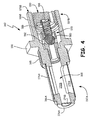
- FIG. 4 shows line replaceable filtered pressure regulator unit 160.
- regulator housing 160 can include cylindrical regulator wall 166A defining regulator cavity 168, and cylindrical vent wall 166B defining vent cavity 170, which is in selective communication with regulator cavity 168 via regulator nozzle 180.
- elongated inlet orifices 172A are covered by inlet filter media 174A, while outlet orifice 172B is formed through first axial wall 176A, and is additionally and/or alternatively covered by outlet filter media 174B.
- Adjustment screw 190 (with seat 188) is disposed through second axial wall 176B.
- Each cylindrical wall 166A, 166B has a corresponding nominal diameter, which may be different from one another.
- a smaller diameter regulator side can reduce the cross-sectional area and/or volume occupied by regulator side 197A within valve 112 (shown in FIGS. 2 and 3 ).
- An outer surface of cylindrical wall 166A can include threaded portion 165 adjacent external flange 198 to simplify insertion and removal of filtered pressure regulator unit 160 into a corresponding recess (e.g., receptacle 162 shown in FIG. 3 ).
- fluid driven valve actuators may have a single cylinder opposing a spring or other constant counterforce taking the place of the second and/or third pressure chambers shown in FIG. 1 .
- an integrated filter and regulator unit can be incorporated into actuator fluid supply passages to provide constant feed pressure to accurately provide actuator piston pressure(s).
Landscapes
- Engineering & Computer Science (AREA)
- General Engineering & Computer Science (AREA)
- Physics & Mathematics (AREA)
- Mechanical Engineering (AREA)
- Fluid Mechanics (AREA)
- Chemical & Material Sciences (AREA)
- Combustion & Propulsion (AREA)
- General Physics & Mathematics (AREA)
- Automation & Control Theory (AREA)
- Power Engineering (AREA)
- Aviation & Aerospace Engineering (AREA)
- Pulmonology (AREA)
- General Health & Medical Sciences (AREA)
- Health & Medical Sciences (AREA)
- Control Of Fluid Pressure (AREA)
- Details Of Valves (AREA)
- Fluid-Pressure Circuits (AREA)
Abstract

Description
- The subject matter disclosed herein relates to valves and, more particularly, to pneumatically actuated valves and pressure regulators therefor.
- Bleed systems, such as those for aircraft, generally involve taking compressed air from an engine, and converting it to various temperatures and pressures suitable for one or more uses. Pressure is usually managed through one or more bleed control valves, such as butterfly valves. Depending on the aircraft configuration, bleed control valves can be generally controlled either pneumatically, electronically, or both via through proportional and/or integral feedback control loops.
- Pneumatic control is done through physical components, flow passages, levers, etc., while electronic control utilizes electrical signals. An electronically controlled proportional valve generally is operated by receiving an electrical control signal which corresponds to a valve position. An electronically controlled integrating valve is controlled with an electrical signal that corresponds to a valve velocity, causing the valve to open or close due to the valve travelling at a velocity for a certain amount of time.
- Maintaining stable bleed system pressures can improve performance and decrease valve wear. Bleed system pressures can be stabilized, for example, by resisting cycling and input disturbances in the system. At the same time, actuator components are prone to particulate damage from fluids being drawn in from the flow duct. Constant actuator fluid supply pressure improves proportional control of pneumatically actuated valves and prevents fluttering of the closure element or disk. Existing systems for regulating valve actuation pressure can require separate regulator units and filter units which take up needed space on the valve assembly and add weight.
- A valve assembly comprises a closure element disposed in a flow control duct, a fluid-driven actuator assembly, a shaft operable to translate linear movement of the actuator assembly into rotation of the closure element, and an integral filter and pressure regulator unit disposed in line with an actuator fluid supply passage. The actuator fluid supply passage extends between the flow control duct and the actuator assembly. The integral filter and pressure regulator unit includes a regulator housing having at least one cylindrical wall surrounding a vent cavity and a regulator cavity. Filter media is secured to the regulator housing and is disposed across a regulator orifice in communication with the regulator cavity.
- A pressure regulator unit comprises a regulator housing having a first cylindrical wall portion defining a regulator cavity, and a second cylindrical wall portion defining a vent cavity in selective communication with the regulator cavity. A regulator inlet orifice and a regulator outlet orifice are formed through the regulator housing proximate the first cylindrical wall portion. First filter media is secured to a regulator side of the regulator housing and disposed across a first regulator orifice.
- A bleed air control valve comprises a closure disk rotatable within a flow control duct, a pneumatic actuator operable to drive rotation of the closure disk, a connecting rod, a shaft, and an actuator fluid supply passage. The pneumatic actuator includes a first piston disposed between a first pressure chamber and a second pressure chamber, a second piston disposed between the second pressure chamber and a third pressure chamber, and an integral filter and pressure regulator unit disposed in line with the actuator fluid supply passage. The shaft includes a first end connected to a connecting rod linking the first and second pistons, and a second end connected to the closure disk. The actuator fluid supply passage provides communication between an inlet side of the flow control duct and at least one of the first, second, and third pressure chambers. The integral filter and pressure regulator unit has a cylindrical regulator cavity in selective communication with a cylindrical vent cavity. Filter media is secured to the pressure regulator unit and is disposed across at least one of a regulator inlet orifice and a regulator outlet orifice.
-
-
FIG. 1 is a block diagram of a valve according to a first embodiment. -
FIG. 2 shows an example butterfly-type valve including an actuator and a pressure regulator having an integral filter. -
FIG. 3 is a sectional view taken through the actuator and the pressure regulator ofFIG. 1 . -
FIG. 4 shows an example embodiment of a line replaceable regulator unit with an integral filter. -
FIG. 1 is a block diagram of a valve according to a first embodiment.FIG. 1 showsairflow control system 10,butterfly valve 12,valve housing 14A,disk 14B,shaft 14C,flow control passage 16,upstream flow passage 18A,downstream flow passage 18B,valve actuator 20,electronic controller 22,pneumatic feedback system 24,torque motor 26, electronic flow restrictions 28u, 28d, actuatorfluid supply passage 29, first piston 30 (withfirst side 32 and second side 34),second piston 36,connection rod 38,first pressure chamber 40,second pressure chamber 42,third pressure chamber 44, second pistonfirst side 46, second pistonsecond side 48, actuator fluidsupply passage portions feedback flow passage 52,pneumatic flow restrictions 54A, 54B, upstream electronic pressure sensor 58u, and downstream electronic pressure sensor 58d. - In the example shown,
valve assembly 12 is a butterfly-type valve, andairflow control system 10 forms part of an aircraft bleed air system. However, it will be appreciated thatairflow control system 10 andvalve assembly 12 are not necessarily limited to aircraft bleed systems, and thus can be adapted to find use in numerous other airflow control applications. -
Airflow control system 10 includesbutterfly valve 12 withvalve housing 14A,closure disk 14B, andshaft 14C. Closuredisk 14B is a closure element rotatable in valveflow control passage 16 to manage flow betweenupstream flow passage 18A anddownstream flow passage 18B.Valve actuator 20, which can be driven by a fluid such as air, works to rotatevalve disk 14B in a range between fully closed and fully open to regulate pressure indownstream flow passage 18B. Operation ofvalve actuator 20, which drives rotation ofclosure disk 14B, can be managed, for example usingelectronic controller 22 and/or optionalpneumatic feedback system 24.Torque motor 26 is operable to adjust relative sizes of flow restriction 28u and/or 28d in accordance with a command to close oropen valve 12. In other embodiments, another control device, such as a solenoid, pneumatic control, or similar structure is used in place oftorque motor 26 to adjustvalve 12. - In the example shown,
actuator 20 can includefirst piston 30 disposed betweenfirst pressure chamber 40 andsecond pressure chamber 42. Optionalsecond piston 36, which can be disposed betweensecond pressure chamber 42 andthird pressure chamber 44, offers more control and valve stability as described below. As seen inFIG. 1 ,first piston 30 and optionalsecond piston 36 move together (via connection rod 38) due to respective pressures infirst pressure chamber 40,second pressure chamber 42 andthird pressure chamber 44. Pressure infirst pressure chamber 40 acts onfirst side 32 offirst piston 30 and acts as an opening force forvalve 12. Pressure insecond pressure chamber 42 acts on second side 34 offirst piston 30 more so thanfirst side 46 ofsecond piston 36 due to the larger surface area offirst piston 30, thereby acting as a first closing force onvalve disk 14B. Pressure inthird pressure chamber 44 acts onsecond side 48 ofsecond piston 36 to act as a second closing force onvalve disk 14B. In alternate embodiments, the actuator pistons may also be aligned such that pressure changes inchamber 40 closes the valve. - Pressure in
first pressure chamber 40 andthird pressure chamber 44 is delivered via different branches of actuatorfluid supply passage 29. Actuatorfluid supply passage 29 draws a small amount of fluid fromupstream flow passage 18A or an upstream/inlet side offlow control duct 16.Actuator supply passage 29 branches intofirst supply portion 50A leading tofirst pressure chamber 40 andsecond supply portion 50B leading tothird pressure chamber 44. Relative actuation pressures are controlled bytorque motor 26 to drive rotation ofclosure disk 14B. Iftorque motor 26 is acting toopen valve 12, it will increase flow area at restriction 28u and/or decrease flow area at restriction 28d, which increases pressure (and force) applied tofirst side 32 offirst piston 30. To closevalve 12,torque motor 26 will decrease flow area 28u or increase flow area 28d (which flows overboard or to an area of ambient pressure). Pressure infirst pressure chamber 40, is decreased relative tosecond pressure chamber 42 andthird pressure chamber 44 to create a closing force againstfirst piston 30 andsecond piston 36. Shaft 14C is operable to translate movement offirst piston 30 andsecond piston 44 to rotatevalve disk 14B via lever arm or other suitable mechanism for translating linear movement into rotational movement. - Valve 12 can include optional
pneumatic feedback system 24 to provide pneumatic feedback tovalve actuator 20 and stabilizevalve disk 14B.Flow restrictions 54A, 54B are set inflow passage 52 to ensure that pressure flowing intosecond pressure chamber 42 is coupled to, but also some amount less than, pressure indownstream flow passage 18B. This allows full opening ofvalve 12 as needed, while also helping to slow movement ofpistons valve disk 14B. It also acts as a pneumatic feedback forvalve actuator 20 so thatcontroller 22 can send an appropriate signal totorque motor 26 and modulate applicable flow areas 28u and 28d. An excess pressure increase indownstream flow passage 18B causes pressure to be fed back intosecond pressure chamber 42 and act as a closing force. - Accuracy and precision of proportional controlled valves can be improved by providing a substantially constant actuator fluid supply pressure from the upstream through the passages. For example, if actuator fluid supply pressure exceeds levels expected by the control system and/or
torque motor 26, the pressure differential betweenpressure chambers valve 12 can include integral regulator and filterassembly 60 disposed in line withactuator supply passage 29. An example construction for a valve and a line replaceable unit for the valve is also described and shown in subsequent figures. -
FIG. 2 depicts an example construction of a fluid-actuatedvalve assembly 112.Valve assembly 112 generally includes a housing, a bore,flow control duct 116,inlet 117A,outlet 117B,actuator section 120,actuator housing 121,actuator supply passage 129, integral filter andpressure regulator unit 160, andregulator receptacle 162. Similar reference numbers indicate similar elements and/or function unless otherwise described. -
FIG. 2 showsvalve assembly 112, which includes a closure element (e.g.,disk 14B shown inFIG. 1 ), disposed inflow control duct 116 betweenvalve inlet 117A andvalve outlet 117B. Fluid-drivenactuator assembly 120 is operable to drive the closure element to regulate fluid passing throughflow control duct 116.Actuator assembly 120 can use a pressurized fluid (e.g., compressor bleed air) redirected from an upstream of inlet side offlow control duct 116. The fluid may be communicated fromflow control duct 116 toactuator assembly 120 through any suitable means.Valve assembly 112 also includes integral filter andpressure regulator unit 160.Unit 160 can be a line replaceable unit (LRU) which can be readily inserted and removed fromactuator assembly 120 as a single element. In the example shown,unit 160 can be threaded intoregulator receptacle 162. - In one example, one or more actuator supply passages 129 (best seen in
FIG. 3 ) to provide communication betweenflow control duct 116 and one or more pressure chambers inactuator assembly 120.Actuator supply passage 129 can include one or more branch lines (shown inFIG. 3 ) to provide fluid fromflow control duct 116 to various pressure chambers ofactuator 120 contained inactuator housing 121. These pressure chambers receiving actuation fluid from supply passage(s) 129 can include, for example, one or more ofchambers FIG. 1 . -
Regulator unit 160 has a geometry which allows for incorporation of integral filter media in line with actuatorfluid supply passage 129. As shown in more detail inFIGS. 3 and4 , the regulator filter media can be disposed across one or both of an inlet or outlet regulator orifice in communication with the regulator cavity. This arrangement makesvalve 112 lighter, more compact, and allows for simple on-wing cleaning and/or replacement. Filter media can be brazed onto the line replaceable regulator unit, allowing for periodic cleaning during inspection or repair of the regulator. - Many existing butterfly valves for aircraft bleed systems include a changeable filter cartridge separate from the pressure regulator unit. Since the separate filter cartridge requires more frequent cleaning and/or replacement as compared to a pressure regulator, the filter cartridge has been previously placed in a more accessible location. However, the regulator is typically located in a less accessible location as compared to the filter cartridge. Space constraints have prevented the ability to make both the filter cartridge and the regulator accessible for on-wing maintenance. Thus the regulator cannot be inspected, repaired, or replaced without substantial disassembly of the valve, or the overall airflow control (e.g., bleed) system. This increases maintenance cost and risk for such systems.
- In contrast, filtered
pressure regulator unit 160 is arranged to be easily accessible and removable fromvalve 112. Both the filter media and the regulator can be inspected, cleaned, and/or replaced as part of regular on-wing maintenance tasks, increasing reliability of the bleed system and reducing wear due to excess valve cycling from a damaged regulator. The configuration also reduces weight and packaging requirements ofvalve 112. -
FIG. 3 shows a sectional view throughactuator assembly 120 and filteredpressure regulator unit 160adjacent valve inlet 117A.Regulator housing 164, secured inreceptacle 162, includes at least onecylindrical wall regulator cavity 168 and ventcavity 170.Regulator housing 164 can also include threadedportion 165 for retaining filteredpressure regulator unit 160 inactuator assembly 112.Regulator cavity 168 has at least oneinlet orifice 172A andoutlet orifice 172B formed throughregulator housing 164, and eachorifice actuator supply passage 129.Actuator supply passage 129 can includeupstream portion 176A extending between flow control duct 116 (e.g.,valve inlet 117A shown inFIG. 2 ), andregulator receptacle 162. This provides communication betweenflow control duct 116 and inlet orifice(s) 172A.Downstream portion 176B ofactuator supply passage 129 can extend betweenregulator receptacle 162 and actuator pressure chambers (shown inFIG. 1 ) contained in actuator housing 121 (shown inFIG. 3 ), which provides communication between outlet orifice(s) 172B and the actuator pressure chamber(s). The arrangement disclosed herein keeps contaminates on the outside of the filter. Air from the bleed duct enters the chamber outside of the filter and in then regulated, e.g. by dumping some of the airflow to ambient, and the remaining airflow is ported out throughorifice 172B. - Taking the place of a separate filter cartridge,
FIG. 2 shows filtermedia regulator housing 164, so that it is disposed across at least one ofinlet orifice 172A, andoutlet orifice 172B.Filter media fluid supply passage 129, is disposed so that it traverses actuatorfluid supply passage 129 upstream of the actuator pressure chambers along upstream actuatorfluid supply branch 150A. In alternate embodiments, the flow through the filteredpressure regulator unit 160 may be reversed, e.g., those items described as upstream may be downstream, and vice versa. In this example,first filter media 174A is secured peripherally around a first cylindrical portion 176 ofregulator housing 164, aroundregulator cavity 168. Here,regulator cavity 168 hasmultiple inlet orifices 172A around the first cylindrical portion ofregulator housing 164. Additionally and/or alternatively,second filter media 174B is secured to at least oneregulator outlet orifice 172B disposed through firstaxial wall 176A.Seal 178 can be placed around regulatorhousing outlet orifice 172B adjacent firstaxial wall 176A in order to segregate the inlet and outlet flows throughregulator cavity 168. - In the illustrative example of
FIGS. 3 and4 ,regulator nozzle 180 is disposed betweenvent cavity 170 andregulator cavity 168.Regulator nozzle 180 provides at least oneregulator port 182 in selective communication withregulator cavity 168 in order to vent excess actuator fluid supply pressure contained in actuatorfluid supply passage 129. In the example shown, filteredpressure regulator unit 160 includesball 184 disposed inregulator nozzle 180 againstresilient element 186.Resilient element 186 reacts againstseat surface 188, providing a closure force tobias ball 184 against regulator port(s) 182. In certain embodiments,seat 188 can be in inwardly facing surface ofadjustment screw 190 movable withinvent cavity 170.Adjustment screw 190 can be accessed from the outside ofvalve 112 to periodically vary a magnitude of the expected maximum closure force.Seat 188 and/oradjustment screw 190 can include at least onevent orifice 194 for ventilating excess fluid from the vent cavity. In this configuration,vent orifice 194 ejects excess air pressure overboard into the ambient atmosphere. -
FIG. 4 shows line replaceable filteredpressure regulator unit 160. As was seen inFIG. 3 ,regulator housing 160 can includecylindrical regulator wall 166A definingregulator cavity 168, andcylindrical vent wall 166B definingvent cavity 170, which is in selective communication withregulator cavity 168 viaregulator nozzle 180. In this example, elongated inlet orifices 172A are covered byinlet filter media 174A, whileoutlet orifice 172B is formed through firstaxial wall 176A, and is additionally and/or alternatively covered byoutlet filter media 174B. Adjustment screw 190 (with seat 188) is disposed through secondaxial wall 176B. - Each
cylindrical wall regulator side 197A within valve 112 (shown inFIGS. 2 and3 ). An outer surface ofcylindrical wall 166A can include threadedportion 165 adjacentexternal flange 198 to simplify insertion and removal of filteredpressure regulator unit 160 into a corresponding recess (e.g.,receptacle 162 shown inFIG. 3 ). - Operation of other types of fluid driven valve actuators is well known, and will not be described in detail here. For example, other fluid driven valve actuators may have a single cylinder opposing a spring or other constant counterforce taking the place of the second and/or third pressure chambers shown in
FIG. 1 . However, it will be appreciated that an integrated filter and regulator unit can be incorporated into actuator fluid supply passages to provide constant feed pressure to accurately provide actuator piston pressure(s). - While the invention has been described with reference to an exemplary embodiment(s), it will be understood by those skilled in the art that various changes may be made and equivalents may be substituted for elements thereof without departing from the scope of the invention. In addition, many modifications may be made to adapt a particular situation or material to the teachings of the invention without departing from the essential scope thereof. Therefore, it is intended that the invention not be limited to the particular embodiment(s) disclosed, but that the invention will include all embodiments falling within the scope of the appended claims.
Claims (15)
- An integral filter and pressure regulator unit (160) comprising:a regulator housing (164) having a first cylindrical wall portion (166A) defining a regulator cavity (168), and a second cylindrical wall portion (166B) defining a vent cavity (170) in selective communication with the regulator cavity (168);a regulator inlet orifice (172A) and a regulator outlet orifice (172B) formed through the regulator housing (164) proximate the first cylindrical wall portion (116A); andfirst filter media (174A,174B) secured to a regulator side of the regulator housing (16A) and disposed across one of: the regulator inlet orifice (172A) and the regulator outlet orifice (172B).
- The pressure regulator unit of claim 1, wherein the first cylindrical portion (116A) has a first nominal diameter and the second cylindrical portion (116B) has a second nominal diameter larger than the first nominal diameter.
- The pressure regulator unit of claim 1 or claim 2, wherein the vent cavity (170) is longitudinally adjacent to the regulator cavity (168).
- The pressure regulator unit of any of claims 1, 2 or 3, further comprising:a regulator nozzle (180) disposed axially between the vent cavity (170) and the regulator cavity (168), the regulator nozzle (180) having at least one regulator port (182) providing selective communication between the vent cavity (170) and the regulator cavity (168).
- The pressure regulator unit of claim 4, further comprising:a ball (184) disposed in the regulator nozzle (180); anda resilient element (186) disposed in the vent cavity (170), the resilient element (186) including a first end abutting a seat surface (188), and a second end receiving applying a closure force to bias the ball (184) toward the at least one regulator port (182);wherein, optionally, the closure force corresponds to a maximum regulator pressure in the regulator cavity (168).
- The valve assembly of claim 5, wherein the resilient element (186) reacts against the seat surface (188) disposed distal from the regulator cavity (168).
- The pressure regulator unit of claim 5 or 6, further comprising:an adjustment screw (190) movable longitudinally within the vent cavity (170) to vary a location of the seat surface (188),wherein the location of the seat surface (188) defines a length of the resilient element (186) and a resulting magnitude of the closure force.
- The pressure regulator unit of claim 7, wherein the adjustment screw (190) includes at least one vent orifice (194) for directing fluid overboard from the vent cavity (170).
- The pressure regulator unit of any preceding claim, further comprising:second filter media (174B) secured to the regulator housing (164) and disposed across the other of: the regulator inlet orifice (172A) and the regulator outlet orifice (172B).
- The pressure regulation unit of any preceding claim, wherein at least one of the regulator inlet orifice (172A) and the regulator outlet orifice (172B) is formed through an axial wall of the regulator housing (164) adjacent the regulator cavity (168).
- A valve assembly comprising:a closure element (14B) disposed in a flow control duct (16;116);a fluid-driven actuator assembly (20) including a first piston (30) disposed between a first pressure chamber (40) and a second pressure chamber (42), and a shaft (14C) linked to the first piston (30), the shaft (38) operable to translate linear movement of the first piston (30) into rotation of the closure element (14B);an actuator fluid supply passage (29) extending between the flow control duct (16;116) and the first pressure chamber (40); andat least one integral filter and pressure regulator unit (160) according to any preceding claim, the at least one integral filter and pressure regulator unit (160) disposed in line with the actuator fluid supply passage (29) such that the filter media (174A,174B) secured to the regulator housing (154) is disposed across at least one of the regulator inlet orifice (172A) and the regulator outlet orifice (172B).
- The valve assembly of claim 11, wherein the closure element (14B) comprises a disk.
- The valve assembly of claim 11 or 12, wherein the fluid-driven actuator assembly (20) also includes a second piston (36) disposed between the second pressure chamber (42) and a third pressure chamber (44), the first and second pistons (30,36) linked by a connecting rod (38), and the connecting rod (38) linked to the shaft (14C).
- The valve assembly of any of claims 11, 12, or 13, wherein at least one of the regulator inlet orifice (172A) and the regulator outlet orifice (172B) includes at least one opening formed through a portion of the cylindrical wall (116A) defining the regulator cavity (168).
- A bleed air control valve (10) comprising:a closure disk (14B) rotatable within a flow control duct (16);a pneumatic actuator (20) operable to drive rotation of the closure disk (14B), the pneumatic actuator (20) including a first piston (30) disposed between a first pressure chamber (40) and a second pressure chamber (42), and a second piston (36) disposed between the second pressure chamber (42) and a third pressure chamber (44);a connecting rod (38) linking the first piston (30) to the second piston (36);a shaft (14C) including a first end connected to the connecting rod (38) and a second end connected to the closure disk (14B), the shaft (14C) operable to translate linear movement of the first and second piston (30,36) into rotation of the closure disk (14B);an actuator fluid supply passage (29) providing communication between an inlet side of the flow control duct (16) and at least one of the first pressure chamber (40), the second pressure chamber (42), and the third pressure chamber (44); andan integral filter and pressure regulator unit (160) disposed in line with the actuator fluid supply passage (29), the unit (160) having a cylindrical regulator cavity (168) in selective communication with a cylindrical vent cavity (170), with filter media (174A,174B) secured to the pressure regulator unit (160) and disposed across at least one of a regulator inlet orifice (172A) and a regulator outlet orifice (172B).
Applications Claiming Priority (1)
| Application Number | Priority Date | Filing Date | Title |
|---|---|---|---|
| US13/917,312 US9110475B2 (en) | 2013-06-13 | 2013-06-13 | Integral filter and regulator for valve |
Publications (3)
| Publication Number | Publication Date |
|---|---|
| EP2813688A2 true EP2813688A2 (en) | 2014-12-17 |
| EP2813688A3 EP2813688A3 (en) | 2015-03-04 |
| EP2813688B1 EP2813688B1 (en) | 2019-09-11 |
Family
ID=50513087
Family Applications (1)
| Application Number | Title | Priority Date | Filing Date |
|---|---|---|---|
| EP14165227.1A Active EP2813688B1 (en) | 2013-06-13 | 2014-04-17 | Integral filter and regulator for valve |
Country Status (2)
| Country | Link |
|---|---|
| US (2) | US9110475B2 (en) |
| EP (1) | EP2813688B1 (en) |
Cited By (8)
| Publication number | Priority date | Publication date | Assignee | Title |
|---|---|---|---|---|
| EP3045792A1 (en) * | 2015-01-19 | 2016-07-20 | Hamilton Sundstrand Corporation | Pneumatic actuator low flow servo valve |
| CN107131057A (en) * | 2017-06-07 | 2017-09-05 | 长沙理工大学 | Operation and maintenance method of gas turbine energy recycling system |
| CN107165724A (en) * | 2017-06-07 | 2017-09-15 | 长沙理工大学 | Gas turbine energy recycling system |
| WO2018013408A1 (en) * | 2016-07-13 | 2018-01-18 | Ge Aviation Systems Llc | Differential pressure regulating shut-off valve |
| US10126763B2 (en) | 2016-08-19 | 2018-11-13 | Rolls-Royce Plc | Poppet valve |
| EP4033128A1 (en) * | 2021-01-22 | 2022-07-27 | Microtecnica S.r.l. | Butterfly valve assembly |
| CN116357796A (en) * | 2023-05-19 | 2023-06-30 | 重庆川仪调节阀有限公司 | Signal regulating mechanism |
| CN117704081A (en) * | 2024-02-05 | 2024-03-15 | 四川顺腾机械制造有限公司 | High-pressure pneumatic execution valve |
Families Citing this family (16)
| Publication number | Priority date | Publication date | Assignee | Title |
|---|---|---|---|---|
| US9169939B2 (en) * | 2012-02-16 | 2015-10-27 | Mike Lybarger | Pressure control system for relief and shutdown of flow |
| ES2463915B1 (en) * | 2012-11-29 | 2015-04-15 | Aqualogy Aqua Ambiente Servicios Integrales, S.A. | System for regulating pressure in a fluid supply pipe |
| FR2998871B1 (en) * | 2012-12-05 | 2015-01-30 | Airbus Operations Sas | DOUBLE LEVEL CONTROL VALVE AND DEVICE FOR DEFROSTING AN AIR INLET OF AN AIRCRAFT NACELLE INTEGRATING SAID VALVE |
| US20140346379A1 (en) * | 2013-05-23 | 2014-11-27 | Hamilton Sundstrand Corporation | Backflow prevention valve |
| US9110475B2 (en) * | 2013-06-13 | 2015-08-18 | Hamilton Sundstrand Corporation | Integral filter and regulator for valve |
| WO2015105734A1 (en) * | 2014-01-08 | 2015-07-16 | Wu, Chunyu | Proactive pressure stabilizing system and method |
| US9714740B2 (en) * | 2014-07-18 | 2017-07-25 | Instrument Solutions Inc. | System, method, and apparatus for regulating the flow of gas |
| US9933085B2 (en) * | 2014-12-29 | 2018-04-03 | Hamilton Sundstrand Corporation | Integrating valve with soft start |
| US10443622B2 (en) * | 2016-06-13 | 2019-10-15 | United Technologies Corporation | Active core cooling system |
| US11260978B2 (en) * | 2019-05-03 | 2022-03-01 | Pratt & Whitney Canada Corp. | Valve for aircraft environmental control system conduit |
| US11802509B2 (en) * | 2021-06-25 | 2023-10-31 | Pratt & Whitney Canada Corp. | Air filtration system and method for compressor bleed valve |
| US11639689B2 (en) | 2021-09-17 | 2023-05-02 | Pratt & Whitney Canada Corp. | Intake device for gas turbine engine |
| US12268981B2 (en) | 2022-02-23 | 2025-04-08 | Hamilton Sundstrand Corporation | Motorized valve with washing filter extending from a bleed conduit inlet into valve duct |
| EP4269842B1 (en) * | 2022-04-26 | 2024-08-28 | Microtecnica S.r.l. | Pressure regulating shut-off valve |
| US11731778B1 (en) * | 2022-05-13 | 2023-08-22 | Pratt & Whitney Canada Corp. | Apparatus for removing particulate matter from bleed gas |
| JP7425518B1 (en) * | 2023-06-30 | 2024-01-31 | 株式会社岩谷技研 | Adjustment device and system for adjusting the pressure inside the cabin of a flying object, and a flying object equipped with a function to adjust the pressure inside the cabin. |
Family Cites Families (12)
| Publication number | Priority date | Publication date | Assignee | Title |
|---|---|---|---|---|
| US2518852A (en) * | 1945-03-19 | 1950-08-15 | Fluid Control Engineering Co | Regulating device |
| US3773296A (en) * | 1971-10-08 | 1973-11-20 | L Mckendrick | Pneumatic balancing hoist |
| US4251985A (en) | 1979-07-17 | 1981-02-24 | General Motors Corporation | Bleed valve control circuit |
| US5810031A (en) * | 1996-02-21 | 1998-09-22 | Aeroquip Corporation | Ultra high purity gas distribution component with integral valved coupling and methods for its use |
| US6892745B2 (en) * | 2002-04-10 | 2005-05-17 | Honeywell International Inc. | Flow control valve with integral sensor and controller and related method |
| US8210201B2 (en) * | 2008-03-17 | 2012-07-03 | Honeywell International Inc. | Regulator valve with locking system |
| US8047226B2 (en) * | 2008-06-18 | 2011-11-01 | Honeywell International Inc. | Pressure relief valves and pneumatic control systems |
| US20100006165A1 (en) * | 2008-07-11 | 2010-01-14 | Honeywell International Inc. | Hydraulically actuated pneumatic regulator |
| US8011382B2 (en) | 2008-10-06 | 2011-09-06 | Honeywell International Inc. | Bi-modal bleed valve assembly for gas turbine engine |
| US20120199211A1 (en) | 2011-02-08 | 2012-08-09 | Hamilton Sundstrand Corporation | Airflow control system |
| US9128492B2 (en) | 2011-08-10 | 2015-09-08 | Tescom Corporation | Regulators having an isolated loading chamber and blowout prevention apparatus |
| US9110475B2 (en) * | 2013-06-13 | 2015-08-18 | Hamilton Sundstrand Corporation | Integral filter and regulator for valve |
-
2013
- 2013-06-13 US US13/917,312 patent/US9110475B2/en active Active
-
2014
- 2014-04-17 EP EP14165227.1A patent/EP2813688B1/en active Active
-
2015
- 2015-07-13 US US14/797,897 patent/US9483061B2/en active Active
Non-Patent Citations (1)
| Title |
|---|
| None |
Cited By (14)
| Publication number | Priority date | Publication date | Assignee | Title |
|---|---|---|---|---|
| EP3045792A1 (en) * | 2015-01-19 | 2016-07-20 | Hamilton Sundstrand Corporation | Pneumatic actuator low flow servo valve |
| CN109416549A (en) * | 2016-07-13 | 2019-03-01 | 通用电气航空系统有限责任公司 | Pressure difference adjustable cut-off valve |
| WO2018013408A1 (en) * | 2016-07-13 | 2018-01-18 | Ge Aviation Systems Llc | Differential pressure regulating shut-off valve |
| CN109416549B (en) * | 2016-07-13 | 2022-05-24 | 通用电气航空系统有限责任公司 | Differential pressure regulating stop valve |
| US10126763B2 (en) | 2016-08-19 | 2018-11-13 | Rolls-Royce Plc | Poppet valve |
| CN107165724A (en) * | 2017-06-07 | 2017-09-15 | 长沙理工大学 | Gas turbine energy recycling system |
| CN107165724B (en) * | 2017-06-07 | 2018-08-17 | 长沙理工大学 | Gas turbine energy recycling system |
| CN107131057A (en) * | 2017-06-07 | 2017-09-05 | 长沙理工大学 | Operation and maintenance method of gas turbine energy recycling system |
| EP4033128A1 (en) * | 2021-01-22 | 2022-07-27 | Microtecnica S.r.l. | Butterfly valve assembly |
| EP4279771A1 (en) * | 2021-01-22 | 2023-11-22 | Microtecnica S.r.l. | Butterfly valve assembly |
| US11898647B2 (en) | 2021-01-22 | 2024-02-13 | Microtecnica S.R.L. | Butterfly valve assembly |
| CN116357796A (en) * | 2023-05-19 | 2023-06-30 | 重庆川仪调节阀有限公司 | Signal regulating mechanism |
| CN117704081A (en) * | 2024-02-05 | 2024-03-15 | 四川顺腾机械制造有限公司 | High-pressure pneumatic execution valve |
| CN117704081B (en) * | 2024-02-05 | 2024-04-09 | 四川顺腾机械制造有限公司 | High-pressure pneumatic execution valve |
Also Published As
| Publication number | Publication date |
|---|---|
| US20140366965A1 (en) | 2014-12-18 |
| EP2813688B1 (en) | 2019-09-11 |
| US9110475B2 (en) | 2015-08-18 |
| US20150315975A1 (en) | 2015-11-05 |
| US9483061B2 (en) | 2016-11-01 |
| EP2813688A3 (en) | 2015-03-04 |
Similar Documents
| Publication | Publication Date | Title |
|---|---|---|
| EP2813688B1 (en) | Integral filter and regulator for valve | |
| US8910653B2 (en) | Valve assembly | |
| US9222596B2 (en) | Fault tolerant airflow control system | |
| CN102483631B (en) | multi-stage fluid regulator | |
| KR102613620B1 (en) | Poppet valve system and method | |
| RU2558487C2 (en) | Device increasing force of drive with locking device | |
| CN101368643A (en) | A method of detecting failure of a pneumatically operated control valve in a control loop | |
| KR20250021391A (en) | Systems and methods for control and monitoring of actuated valves | |
| US9933085B2 (en) | Integrating valve with soft start | |
| CA2938738C (en) | Gas pressure reducer with electrically-powered master system | |
| CN112262277A (en) | Device for controlling fluid flow | |
| JP2018529905A (en) | valve | |
| US20010035512A1 (en) | Environmentally friendly electro-pneumatic positioner | |
| EP2932143B1 (en) | Pressure volume regulator | |
| US8858164B2 (en) | Air discharge system for an aeronautical turbine engine compressor | |
| US11859724B2 (en) | Check valve | |
| US8959927B2 (en) | Pitot tube with increased particle separation for a compressor bleed system of a gas turbine engine | |
| US11732819B2 (en) | Servo valve | |
| EP3995928B1 (en) | Digitally augmented pneumatic control |
Legal Events
| Date | Code | Title | Description |
|---|---|---|---|
| 17P | Request for examination filed |
Effective date: 20140417 |
|
| AK | Designated contracting states |
Kind code of ref document: A2 Designated state(s): AL AT BE BG CH CY CZ DE DK EE ES FI FR GB GR HR HU IE IS IT LI LT LU LV MC MK MT NL NO PL PT RO RS SE SI SK SM TR |
|
| AX | Request for extension of the european patent |
Extension state: BA ME |
|
| PUAI | Public reference made under article 153(3) epc to a published international application that has entered the european phase |
Free format text: ORIGINAL CODE: 0009012 |
|
| PUAL | Search report despatched |
Free format text: ORIGINAL CODE: 0009013 |
|
| AK | Designated contracting states |
Kind code of ref document: A3 Designated state(s): AL AT BE BG CH CY CZ DE DK EE ES FI FR GB GR HR HU IE IS IT LI LT LU LV MC MK MT NL NO PL PT RO RS SE SI SK SM TR |
|
| AX | Request for extension of the european patent |
Extension state: BA ME |
|
| RIC1 | Information provided on ipc code assigned before grant |
Ipc: F02C 9/18 20060101AFI20150126BHEP Ipc: F16K 31/122 20060101ALI20150126BHEP |
|
| R17P | Request for examination filed (corrected) |
Effective date: 20150904 |
|
| RBV | Designated contracting states (corrected) |
Designated state(s): AL AT BE BG CH CY CZ DE DK EE ES FI FR GB GR HR HU IE IS IT LI LT LU LV MC MK MT NL NO PL PT RO RS SE SI SK SM TR |
|
| STAA | Information on the status of an ep patent application or granted ep patent |
Free format text: STATUS: EXAMINATION IS IN PROGRESS |
|
| 17Q | First examination report despatched |
Effective date: 20180910 |
|
| GRAP | Despatch of communication of intention to grant a patent |
Free format text: ORIGINAL CODE: EPIDOSNIGR1 |
|
| STAA | Information on the status of an ep patent application or granted ep patent |
Free format text: STATUS: GRANT OF PATENT IS INTENDED |
|
| INTG | Intention to grant announced |
Effective date: 20190322 |
|
| GRAS | Grant fee paid |
Free format text: ORIGINAL CODE: EPIDOSNIGR3 |
|
| GRAA | (expected) grant |
Free format text: ORIGINAL CODE: 0009210 |
|
| STAA | Information on the status of an ep patent application or granted ep patent |
Free format text: STATUS: THE PATENT HAS BEEN GRANTED |
|
| AK | Designated contracting states |
Kind code of ref document: B1 Designated state(s): AL AT BE BG CH CY CZ DE DK EE ES FI FR GB GR HR HU IE IS IT LI LT LU LV MC MK MT NL NO PL PT RO RS SE SI SK SM TR |
|
| REG | Reference to a national code |
Ref country code: GB Ref legal event code: FG4D |
|
| REG | Reference to a national code |
Ref country code: CH Ref legal event code: EP |
|
| REG | Reference to a national code |
Ref country code: AT Ref legal event code: REF Ref document number: 1178752 Country of ref document: AT Kind code of ref document: T Effective date: 20190915 |
|
| REG | Reference to a national code |
Ref country code: DE Ref legal event code: R096 Ref document number: 602014053302 Country of ref document: DE |
|
| REG | Reference to a national code |
Ref country code: IE Ref legal event code: FG4D |
|
| REG | Reference to a national code |
Ref country code: NL Ref legal event code: MP Effective date: 20190911 |
|
| REG | Reference to a national code |
Ref country code: LT Ref legal event code: MG4D |
|
| PG25 | Lapsed in a contracting state [announced via postgrant information from national office to epo] |
Ref country code: BG Free format text: LAPSE BECAUSE OF FAILURE TO SUBMIT A TRANSLATION OF THE DESCRIPTION OR TO PAY THE FEE WITHIN THE PRESCRIBED TIME-LIMIT Effective date: 20191211 Ref country code: SE Free format text: LAPSE BECAUSE OF FAILURE TO SUBMIT A TRANSLATION OF THE DESCRIPTION OR TO PAY THE FEE WITHIN THE PRESCRIBED TIME-LIMIT Effective date: 20190911 Ref country code: NO Free format text: LAPSE BECAUSE OF FAILURE TO SUBMIT A TRANSLATION OF THE DESCRIPTION OR TO PAY THE FEE WITHIN THE PRESCRIBED TIME-LIMIT Effective date: 20191211 Ref country code: HR Free format text: LAPSE BECAUSE OF FAILURE TO SUBMIT A TRANSLATION OF THE DESCRIPTION OR TO PAY THE FEE WITHIN THE PRESCRIBED TIME-LIMIT Effective date: 20190911 Ref country code: FI Free format text: LAPSE BECAUSE OF FAILURE TO SUBMIT A TRANSLATION OF THE DESCRIPTION OR TO PAY THE FEE WITHIN THE PRESCRIBED TIME-LIMIT Effective date: 20190911 Ref country code: LT Free format text: LAPSE BECAUSE OF FAILURE TO SUBMIT A TRANSLATION OF THE DESCRIPTION OR TO PAY THE FEE WITHIN THE PRESCRIBED TIME-LIMIT Effective date: 20190911 |
|
| PG25 | Lapsed in a contracting state [announced via postgrant information from national office to epo] |
Ref country code: ES Free format text: LAPSE BECAUSE OF FAILURE TO SUBMIT A TRANSLATION OF THE DESCRIPTION OR TO PAY THE FEE WITHIN THE PRESCRIBED TIME-LIMIT Effective date: 20190911 Ref country code: AL Free format text: LAPSE BECAUSE OF FAILURE TO SUBMIT A TRANSLATION OF THE DESCRIPTION OR TO PAY THE FEE WITHIN THE PRESCRIBED TIME-LIMIT Effective date: 20190911 Ref country code: LV Free format text: LAPSE BECAUSE OF FAILURE TO SUBMIT A TRANSLATION OF THE DESCRIPTION OR TO PAY THE FEE WITHIN THE PRESCRIBED TIME-LIMIT Effective date: 20190911 Ref country code: RS Free format text: LAPSE BECAUSE OF FAILURE TO SUBMIT A TRANSLATION OF THE DESCRIPTION OR TO PAY THE FEE WITHIN THE PRESCRIBED TIME-LIMIT Effective date: 20190911 Ref country code: GR Free format text: LAPSE BECAUSE OF FAILURE TO SUBMIT A TRANSLATION OF THE DESCRIPTION OR TO PAY THE FEE WITHIN THE PRESCRIBED TIME-LIMIT Effective date: 20191212 |
|
| REG | Reference to a national code |
Ref country code: AT Ref legal event code: MK05 Ref document number: 1178752 Country of ref document: AT Kind code of ref document: T Effective date: 20190911 |
|
| PG25 | Lapsed in a contracting state [announced via postgrant information from national office to epo] |
Ref country code: PT Free format text: LAPSE BECAUSE OF FAILURE TO SUBMIT A TRANSLATION OF THE DESCRIPTION OR TO PAY THE FEE WITHIN THE PRESCRIBED TIME-LIMIT Effective date: 20200113 Ref country code: RO Free format text: LAPSE BECAUSE OF FAILURE TO SUBMIT A TRANSLATION OF THE DESCRIPTION OR TO PAY THE FEE WITHIN THE PRESCRIBED TIME-LIMIT Effective date: 20190911 Ref country code: NL Free format text: LAPSE BECAUSE OF FAILURE TO SUBMIT A TRANSLATION OF THE DESCRIPTION OR TO PAY THE FEE WITHIN THE PRESCRIBED TIME-LIMIT Effective date: 20190911 Ref country code: EE Free format text: LAPSE BECAUSE OF FAILURE TO SUBMIT A TRANSLATION OF THE DESCRIPTION OR TO PAY THE FEE WITHIN THE PRESCRIBED TIME-LIMIT Effective date: 20190911 Ref country code: PL Free format text: LAPSE BECAUSE OF FAILURE TO SUBMIT A TRANSLATION OF THE DESCRIPTION OR TO PAY THE FEE WITHIN THE PRESCRIBED TIME-LIMIT Effective date: 20190911 Ref country code: AT Free format text: LAPSE BECAUSE OF FAILURE TO SUBMIT A TRANSLATION OF THE DESCRIPTION OR TO PAY THE FEE WITHIN THE PRESCRIBED TIME-LIMIT Effective date: 20190911 Ref country code: IT Free format text: LAPSE BECAUSE OF FAILURE TO SUBMIT A TRANSLATION OF THE DESCRIPTION OR TO PAY THE FEE WITHIN THE PRESCRIBED TIME-LIMIT Effective date: 20190911 |
|
| PG25 | Lapsed in a contracting state [announced via postgrant information from national office to epo] |
Ref country code: IS Free format text: LAPSE BECAUSE OF FAILURE TO SUBMIT A TRANSLATION OF THE DESCRIPTION OR TO PAY THE FEE WITHIN THE PRESCRIBED TIME-LIMIT Effective date: 20200224 Ref country code: SM Free format text: LAPSE BECAUSE OF FAILURE TO SUBMIT A TRANSLATION OF THE DESCRIPTION OR TO PAY THE FEE WITHIN THE PRESCRIBED TIME-LIMIT Effective date: 20190911 Ref country code: SK Free format text: LAPSE BECAUSE OF FAILURE TO SUBMIT A TRANSLATION OF THE DESCRIPTION OR TO PAY THE FEE WITHIN THE PRESCRIBED TIME-LIMIT Effective date: 20190911 Ref country code: CZ Free format text: LAPSE BECAUSE OF FAILURE TO SUBMIT A TRANSLATION OF THE DESCRIPTION OR TO PAY THE FEE WITHIN THE PRESCRIBED TIME-LIMIT Effective date: 20190911 |
|
| REG | Reference to a national code |
Ref country code: DE Ref legal event code: R097 Ref document number: 602014053302 Country of ref document: DE |
|
| PLBE | No opposition filed within time limit |
Free format text: ORIGINAL CODE: 0009261 |
|
| STAA | Information on the status of an ep patent application or granted ep patent |
Free format text: STATUS: NO OPPOSITION FILED WITHIN TIME LIMIT |
|
| PG2D | Information on lapse in contracting state deleted |
Ref country code: IS |
|
| PG25 | Lapsed in a contracting state [announced via postgrant information from national office to epo] |
Ref country code: DK Free format text: LAPSE BECAUSE OF FAILURE TO SUBMIT A TRANSLATION OF THE DESCRIPTION OR TO PAY THE FEE WITHIN THE PRESCRIBED TIME-LIMIT Effective date: 20190911 Ref country code: IS Free format text: LAPSE BECAUSE OF FAILURE TO SUBMIT A TRANSLATION OF THE DESCRIPTION OR TO PAY THE FEE WITHIN THE PRESCRIBED TIME-LIMIT Effective date: 20200112 |
|
| 26N | No opposition filed |
Effective date: 20200615 |
|
| PG25 | Lapsed in a contracting state [announced via postgrant information from national office to epo] |
Ref country code: SI Free format text: LAPSE BECAUSE OF FAILURE TO SUBMIT A TRANSLATION OF THE DESCRIPTION OR TO PAY THE FEE WITHIN THE PRESCRIBED TIME-LIMIT Effective date: 20190911 |
|
| REG | Reference to a national code |
Ref country code: DE Ref legal event code: R119 Ref document number: 602014053302 Country of ref document: DE |
|
| PG25 | Lapsed in a contracting state [announced via postgrant information from national office to epo] |
Ref country code: MC Free format text: LAPSE BECAUSE OF FAILURE TO SUBMIT A TRANSLATION OF THE DESCRIPTION OR TO PAY THE FEE WITHIN THE PRESCRIBED TIME-LIMIT Effective date: 20190911 |
|
| REG | Reference to a national code |
Ref country code: CH Ref legal event code: PL |
|
| PG25 | Lapsed in a contracting state [announced via postgrant information from national office to epo] |
Ref country code: LI Free format text: LAPSE BECAUSE OF NON-PAYMENT OF DUE FEES Effective date: 20200430 Ref country code: LU Free format text: LAPSE BECAUSE OF NON-PAYMENT OF DUE FEES Effective date: 20200417 Ref country code: CH Free format text: LAPSE BECAUSE OF NON-PAYMENT OF DUE FEES Effective date: 20200430 Ref country code: DE Free format text: LAPSE BECAUSE OF NON-PAYMENT OF DUE FEES Effective date: 20201103 |
|
| REG | Reference to a national code |
Ref country code: BE Ref legal event code: MM Effective date: 20200430 |
|
| PG25 | Lapsed in a contracting state [announced via postgrant information from national office to epo] |
Ref country code: BE Free format text: LAPSE BECAUSE OF NON-PAYMENT OF DUE FEES Effective date: 20200430 |
|
| PG25 | Lapsed in a contracting state [announced via postgrant information from national office to epo] |
Ref country code: IE Free format text: LAPSE BECAUSE OF NON-PAYMENT OF DUE FEES Effective date: 20200417 |
|
| PG25 | Lapsed in a contracting state [announced via postgrant information from national office to epo] |
Ref country code: TR Free format text: LAPSE BECAUSE OF FAILURE TO SUBMIT A TRANSLATION OF THE DESCRIPTION OR TO PAY THE FEE WITHIN THE PRESCRIBED TIME-LIMIT Effective date: 20190911 Ref country code: MT Free format text: LAPSE BECAUSE OF FAILURE TO SUBMIT A TRANSLATION OF THE DESCRIPTION OR TO PAY THE FEE WITHIN THE PRESCRIBED TIME-LIMIT Effective date: 20190911 Ref country code: CY Free format text: LAPSE BECAUSE OF FAILURE TO SUBMIT A TRANSLATION OF THE DESCRIPTION OR TO PAY THE FEE WITHIN THE PRESCRIBED TIME-LIMIT Effective date: 20190911 |
|
| PG25 | Lapsed in a contracting state [announced via postgrant information from national office to epo] |
Ref country code: MK Free format text: LAPSE BECAUSE OF FAILURE TO SUBMIT A TRANSLATION OF THE DESCRIPTION OR TO PAY THE FEE WITHIN THE PRESCRIBED TIME-LIMIT Effective date: 20190911 |
|
| P01 | Opt-out of the competence of the unified patent court (upc) registered |
Effective date: 20230522 |
|
| PGFP | Annual fee paid to national office [announced via postgrant information from national office to epo] |
Ref country code: GB Payment date: 20260319 Year of fee payment: 13 |
|
| PGFP | Annual fee paid to national office [announced via postgrant information from national office to epo] |
Ref country code: FR Payment date: 20260319 Year of fee payment: 13 |