EP2813098B1 - A fast-accessing method and apparatus - Google Patents
A fast-accessing method and apparatus Download PDFInfo
- Publication number
- EP2813098B1 EP2813098B1 EP12867929.7A EP12867929A EP2813098B1 EP 2813098 B1 EP2813098 B1 EP 2813098B1 EP 12867929 A EP12867929 A EP 12867929A EP 2813098 B1 EP2813098 B1 EP 2813098B1
- Authority
- EP
- European Patent Office
- Prior art keywords
- network node
- security
- information
- user equipment
- network
- Prior art date
- Legal status (The legal status is an assumption and is not a legal conclusion. Google has not performed a legal analysis and makes no representation as to the accuracy of the status listed.)
- Active
Links
Images



Classifications
-
- H—ELECTRICITY
- H04—ELECTRIC COMMUNICATION TECHNIQUE
- H04W—WIRELESS COMMUNICATION NETWORKS
- H04W12/00—Security arrangements; Authentication; Protecting privacy or anonymity
- H04W12/04—Key management, e.g. using generic bootstrapping architecture [GBA]
- H04W12/041—Key generation or derivation
-
- H—ELECTRICITY
- H04—ELECTRIC COMMUNICATION TECHNIQUE
- H04L—TRANSMISSION OF DIGITAL INFORMATION, e.g. TELEGRAPHIC COMMUNICATION
- H04L63/00—Network architectures or network communication protocols for network security
- H04L63/08—Network architectures or network communication protocols for network security for authentication of entities
-
- H—ELECTRICITY
- H04—ELECTRIC COMMUNICATION TECHNIQUE
- H04L—TRANSMISSION OF DIGITAL INFORMATION, e.g. TELEGRAPHIC COMMUNICATION
- H04L63/00—Network architectures or network communication protocols for network security
- H04L63/10—Network architectures or network communication protocols for network security for controlling access to devices or network resources
-
- H—ELECTRICITY
- H04—ELECTRIC COMMUNICATION TECHNIQUE
- H04L—TRANSMISSION OF DIGITAL INFORMATION, e.g. TELEGRAPHIC COMMUNICATION
- H04L2463/00—Additional details relating to network architectures or network communication protocols for network security covered by H04L63/00
- H04L2463/061—Additional details relating to network architectures or network communication protocols for network security covered by H04L63/00 applying further key derivation, e.g. deriving traffic keys from a pair-wise master key
-
- H—ELECTRICITY
- H04—ELECTRIC COMMUNICATION TECHNIQUE
- H04L—TRANSMISSION OF DIGITAL INFORMATION, e.g. TELEGRAPHIC COMMUNICATION
- H04L63/00—Network architectures or network communication protocols for network security
- H04L63/20—Network architectures or network communication protocols for network security for managing network security; network security policies in general
- H04L63/205—Network architectures or network communication protocols for network security for managing network security; network security policies in general involving negotiation or determination of the one or more network security mechanisms to be used, e.g. by negotiation between the client and the server or between peers or by selection according to the capabilities of the entities involved
-
- H—ELECTRICITY
- H04—ELECTRIC COMMUNICATION TECHNIQUE
- H04W—WIRELESS COMMUNICATION NETWORKS
- H04W36/00—Hand-off or reselection arrangements
- H04W36/0005—Control or signalling for completing the hand-off
- H04W36/0011—Control or signalling for completing the hand-off for data sessions of end-to-end connection
- H04W36/0033—Control or signalling for completing the hand-off for data sessions of end-to-end connection with transfer of context information
- H04W36/0038—Control or signalling for completing the hand-off for data sessions of end-to-end connection with transfer of context information of security context information
-
- H—ELECTRICITY
- H04—ELECTRIC COMMUNICATION TECHNIQUE
- H04W—WIRELESS COMMUNICATION NETWORKS
- H04W48/00—Access restriction; Network selection; Access point selection
- H04W48/08—Access restriction or access information delivery, e.g. discovery data delivery
Definitions
- the present invention generally relates to communication networks. More specifically, the invention relates to a fast-accessing method and apparatus.
- the present description introduces a solution for fast accessing a communication network, which can speed up the access procedure for users and bring good user experiences when enjoying communication services.
- a method comprising: establishing a first security connection between a first network node and a UE; obtaining, by the first network node, first information from a second network node, wherein the first information comprises at least one of system information of the second network node and an identifier of a security algorithm selected by the second network node for the UE; providing, by the first network node, second information to the second network node, in response to an indication of the second network node from the UE, wherein the second information comprises security information related to the UE; and sending, by the first network node, the first information to the UE for establishing a second security connection between the UE and the second network node, wherein the first security connection is still maintained after the second security connection is established.
- a method comprising: establishing a first security connection between a first network node and a UE; sending, by the UE, an indication of a second network node to the first network node; and receiving, by the UE, first information from the first network node for establishing a second security connection between the UE and the second network node, wherein the first information comprises at least one of system information of the second network node and an identifier of a security algorithm selected by the second network node for the UE, wherein the first security connection is still maintained after the second security connection is established.
- a method comprising: reporting, by a second network node, first information to a first network node, wherein the first information comprises at least one of system information of the second network node and an identifier of a security algorithm selected by the second network node for a UE having a first security connection with the first network node; and receiving, by the second network node, second information from the first network node for establishing a second security connection between the second network node and the UE, wherein the second information comprises security information related to the UE, wherein the first security connection is still maintained after the second security connection is established.
- a computer program which, when executed, causes the method of at least one of the first, second or third aspects to be performed.
- an apparatus comprising means for causing a method according to at least one of the first, second or third aspects to be performed.
- the provided methods, apparatus, and computer program products can decrease time-delay during an access procedure to a communications network, and speed up access progress for a UE to obtain services supported by the communications network.
- LAE Local Area Evolution
- SN Support Node
- RAN Radio Access Network
- HeNB Home evolved Node B
- a UE may maintain two connections, one with a macro eNB (macro connection) and another with a LAE BS (LAE connection), which is called “dual radio connections”.
- LTE-LAN Another architecture called as LTE-LAN is also researched to compete with world-wide popular Wireless Fidelity (WiFi) technique.
- LTE-LAN is basically assumed to be based on LTE technology but is more focused on some local area use cases and scenarios, and it has much similarity with LAE concept.
- LTE-LAN is also expected to provide high performance local services for users with low cost.
- a BS in LAE architecture may be considered as an AP in LTE-LAN system.
- LTE-LAN and LTE macro network are independent networks which may operate in different bands. So far, an X2-like or S1-like interface may be introduced between different APs and between an AP and an eNB, since a lot of features (for example carrier aggregation, interference management, etc.) would be developed with this interface.
- Fig.1 exemplarily shows a service request procedure for a UE considering security issues.
- the UE When the UE is trying to establish a RRC connection with the serving eNB, the UE needs to read system information from the serving eNB.
- the UE before the UE initiates transmission of RRC messages and NAS messages, it is needed to activate SMC procedures for AS and NAS separately.
- a SMC procedure for AS is performed to obtain security keys for AS from the core network such as a Mobility Management Entity (MME).
- MME Mobility Management Entity
- KASME Access Security Management Entity
- a UE may maintain two connections, one for a macro network and another for a local area network, which is called "dual radio connections".
- the UE may have two independent RRC connections, one with its serving eNB and the other with its serving AP.
- the UE may have to read system information from the second network first since the UE only has system information obtained from the first network during establishment of the first RRC connection.
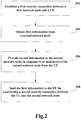
- Fig.2 is a flowchart illustrating a fast-accessing method, which may be performed at a first network node (such as a BS/eNB/AP/control center, etc.) in accordance with embodiments of the present invention.
- the solution according to exemplary embodiments may be applicable to a communication network such as LTE-LAN and LAE where a UE (such as a mobile station, a wireless terminal, a personal digital assistant (PDA), a portable device and the like) may establish respective radio connections with two network nodes.
- a first security connection may be established between the first network node and the UE.
- the first network node may obtain first information from a second network node, as shown in block 204.
- the first network node may obtain respective first information from one or more neighboring network nodes comprising the second network node.
- the first information may comprise at least one of: system information of the second network node, and an identifier (ID) of a security algorithm selected by the second network node for the UE.
- the first information may be obtained through an interface between the first network node and the second network node.
- the interface may comprise a direct interface (such as a X2-like interface, or a S1-like interface defined for direct data transmissions) through which the first information may be transferred to the first network node from the second network node directly, or an indirect interface (such as a S1-like interface) through which the first information from the second network node may be transferred to the first network node via a network entity (such as a MME) or other suitable intermediate entity in core networks.
- a direct interface such as a X2-like interface, or a S1-like interface defined for direct data transmissions
- an indirect interface such as a S1-like interface
- the first network node may provide second information to the second network node, as shown in block 206.
- the first network node may use a signaling message (for example any X2-AP messages such as eNB configuration update procedure) or a dedicated procedure to communicate the second information to the second network node.
- the second information may comprise security information related to the UE, which can be used by the second network node in establishing a second security connection with the UE.
- the first network node may send the first information to the UE for establishing a second security connection between the UE and the second network node.
- the first network node may use a signaling message such as downlink (DL) information transfer or any newly defined signaling messages to transmit the first information to the UE.
- DL downlink
- establishing the first security connection between the first network node and the UE may comprise obtaining a first security key (such as K eNB ) for the first security connection.
- the security information related to the UE may comprise an identifier of the UE (such as System Architecture Evolution Temporary Mobile Station Identifier (S-TMSI)), and a second security key generated based at least in part on the first security key (such as K eNB * calculated with K eNB , Physical Cell Identity (PCI) and frequency of the second network node, for example according to TS 33.401).
- S-TMSI System Architecture Evolution Temporary Mobile Station Identifier
- K eNB * calculated with K eNB
- PCI Physical Cell Identity
- frequency of the second network node for example according to TS 33.401
- Fig.3 is a flowchart illustrating a fast-accessing method, which may be performed at a UE in accordance with embodiments of the present invention.
- the UE such as a mobile station, a wireless terminal, a PDA, a portable device and the like
- a first network node such as a BS/eNB/AP/control center, etc.
- a user of the UE may want to establish a second security connection with a second network node, in addition to the first security connection.
- the first network node and the second network node may be the same kind of network nodes or different types of network nodes.
- one of these two connections may be used for local network services (such as high speed data services in a local area), and the other may be used for macro network services (such as more stable and more carefully managed services in a macro network).
- the UE may send an indication of the second network node to the first network node.
- the UE may indicate the second network node to the first network node by the first security connection using a signaling message such as uplink (UL) information transfer or any newly defined signaling messages. Then, the UE may receive first information from the first network node for establishing a second security connection with the second network node, as shown in block 306. It is noted that the first security connection is still maintained when the second security connection is established.
- the first information may comprise at least one of the following: an identifier of a security algorithm selected by the second network node for the UE, and system information of the second network node.
- the UE can initiate establishment of the second security connection with the second network node directly based on the received first information, without triggering a security activation procedure such as Authentication and Key Agreement (AKA) or AS SMC procedure.
- AKA Authentication and Key Agreement
- AS SMC procedure For example, the UE may perform an authentication procedure with the second network node based at least in part on the first information and second information comprising security information related to the UE.
- the security information related to the UE may comprise an identifier of the UE, and a second security key (such as K eNB *) generated based at least in part on a first security key (such as K eNB ) which is obtained during establishment of the first security connection with the first network node.
- the UE may indicate its identifier during a connection setup procedure to the second network node, so that the second network node can map this identifier to a corresponding security key and perform a proper security algorithm selected for the UE.
- the UE can use K eNB * (which may be calculated with K eNB , PCI and frequency of the second network node according to TS 33.401) to derive keys for integrity (such as K RRCint ) and keys for encryption (such as K RRCenc and K UPenc ), for example according to TS 33.401.
- K RRCint keys for integrity
- K RRCenc and K UPenc keys for example according to TS 33.401.
- transmitting system information of the second network node from the first network node to the UE can save time of reading the system information from the second network node by the UE, which can also shorten access delay greatly.
- Fig.4 is a flowchart illustrating a fast-accessing method, which may be performed at a second network node (such as a BS/eNB/AP/control center, etc.) in accordance with embodiments of the present invention.
- the second network node may report first information to a first network node, as shown in block 402.
- the second network node may use a signaling message (for example any X2-AP messages such as eNB configuration update procedure) or a dedicated procedure to report the first information, which may be provided to a UE by the first network node, in response to an indication from the UE.
- a signaling message for example any X2-AP messages such as eNB configuration update procedure
- a dedicated procedure to report the first information, which may be provided to a UE by the first network node, in response to an indication from the UE.
- the first information may comprise at least one of the following: system information of the second network node, and an identifier of a security algorithm selected by the second network node for a UE having a first security connection with the first network node.
- the first network node may require the second network node to report identifiers of the preferred security algorithms (such as RRC integrity/encryption algorithm ID, UP encryption algorithm ID, etc.) by sending the related UE capability to the second network node for algorithm selection.
- the second network node may receive second information from the first network node for establishing a second security connection with the UE. For example, an authentication procedure may be performed between the UE and the second network node based at least in part on the first information and the second information.
- the second information may comprise security information related to the UE, such as an identifier of the UE and a second security key generated based at least in part on a first security key for the first security connection. Based on the identifier of the UE, the second network node can map the corresponding second security key to this UE.
- the second network node may maintain a binding relationship between the UE and previously received security keys from the first network nodes, for example, based on S-TMSI.
- Figs.2-4 may be viewed as method steps, and/or as operations that result from operation of computer program code, and/or as a plurality of coupled logic circuit elements constructed to carry out the associated function(s).
- the schematic flow chart diagrams described above are generally set forth as logical flow chart diagrams. As such, the depicted order and labeled steps are indicative of specific embodiments of the presented methods. Other steps and methods may be conceived that are equivalent in function, logic, or effect to one or more steps, or portions thereof, of the illustrated methods. Additionally, the order in which a particular method occurs may or may not strictly adhere to the order of the corresponding steps shown.
- the serving eNB of the UE can use K eNB to derive the K RRCint and K RRCenc for integrity protection and ciphering on Uu interface with the UE.
- the serving eNB transfers K eNB * to the serving AP in advance.
- the UE initiates a RRC connection setup procedure with the serving AP, the UE can use the same key (K eNB *) to derive security keys for integrity check and encryption for RRC messages.
- K eNB * the same key
- the serving eNB can also send system information of the serving AP to the UE, which enables the UE to save time for system information acquisition.
- This solution can help a UE which has an ongoing communication connection with a network realize that it can fast access to another network with much less delay and good user experiences.
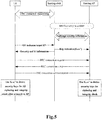
- Fig.5 shows exemplary security procedures when a UE accesses to an AP in accordance with an embodiment of the present invention.
- a UE may maintain two co-existing RRC connections with a communication system, one with a macro eNB (shown as the serving eNB in Fig.5 ) and the other with a local AP such as LTE-LAN AP (shown as the serving AP in Fig.5 ).
- the UE has already established a RRC connection with the macro eNB and AS SMC has been completed based at least in part on a first security key (such as K eNB ), for example.
- K eNB first security key
- the serving eNB may begin to setup interfaces (for example direct or indirect interfaces) with one or more neighboring APs which comprise the serving AP shown in Fig.5 .
- one or more neighboring APs comprising the serving AP may report some essential information (for example system information, which may be used by the UE to initiate a RRC connection setup procedure towards the serving AP directly) to the serving eNB, with any X2-AP messages such as the eNB configuration update procedure.
- the serving eNB may also require the serving AP to report some security information such as preferred algorithms ID (for example, RRC integrity/encryption algorithm ID, UP encryption algorithm ID, etc) by sending the related UE capability to the AP for algorithm selection, using for example X2-AP messages such as the eNB configuration update procedure or a dedicated procedure.
- preferred algorithms ID for example, RRC integrity/encryption algorithm ID, UP encryption algorithm ID, etc
- the UE can indicate the serving AP as a target AP to the serving eNB through the existing RRC connection, using a RRC message such as UL information transfer or any new uplink RRC messages.
- the serving eNB may send the target AP's system information and/or algorithm ID selected by the target AP to the UE, using any downlink RRC message such as DL information transfer or any new downlink RRC messages.
- the algorithm selection for the UE may be done by the serving AP in advance, for example during exchange of security information between the serving eNB and the serving AP.
- the serving eNB of the UE may send a second security key (such as K eNB *, which may be calculated with K eNB , PCI and frequency of the serving AP) together with UE ID (for example S-TMSI) to the serving AP, using X2-AP messages such as the eNB configuration update procedure or a dedicated procedure.
- the serving AP can store the second security key to derive other security keys for further integrity check and ciphering procedures, for example.
- the UE does not have to read the system information of the serving AP. Rather, the UE can initiate a RRC connection setup procedure towards the serving AP directly according to the received system information.
- the UE may indicate the same UE ID (for example S-TMSI) as that sent by the serving eNB to the serving AP.
- this UE ID can be used by the serving AP to map a corresponding second security key to the related UE.
- the UE can directly activate AS security and transmit user data in the air to save time.
- the UE can derive K RRCint , K RRCenc and K UPenc from K eNB * (which is also calculated with K eNB , PCI and frequency of the serving AP), for example according to TS 33.401.
- K RRCint , K RRCenc and K UPenc may delete K RRCint , K RRCenc and K UPenc for this connection.
- the fast-accessing solution provided in the present invention also can be used when a UE (which has established a first connection with a local area network) needs to establish a second connection with a macro network.
- a UE which has established a first connection with a local area network
- its serving AP may transfer a security key for the second connection to the eNB in advance.
- the UE can directly use the same security key to derive keys for an authentication procedure with the eNB, and no additional security activation procedure such as AKA or AS SMC is needed.
- the serving AP can also send system information of the eNB to the UE, which makes the UE save time for system information acquisition.
- system information of the eNB can also send system information of the eNB to the UE, which makes the UE save time for system information acquisition.
- Many advantages may be achieved by using the above solutions described with respect to Figs.2-5 . For example, since there is no need to read system information from a target network and negotiate AS security keys, time delay for a UE to establish services with the network can be sharply decreased, and good user performances can be provided with least impact on current specifications.
- Fig.6 is a simplified block diagram of various apparatuses which are suitable for use in practicing exemplary embodiments of the present invention.
- a UE 630 (such as mobile phone, wireless terminal, portable device, PDA, multimedia tablet, and etc.) may be adapted for communicating with one or more network nodes such as a first network node 610 and a second network node 620.
- the first network node 610 (such as a BS/eNB/AP/control center, etc.) and the second network node 620 (such as a BS/eNB/AP/control center, etc.) may be adapted for communicating with each other directly or through a network entity such as a MME or other intermediate entity in a core network (not shown in Fig.6 ).
- the UE 630 may comprise a data processor (DP) 630A, a memory (MEM) 630B that stores a program (PROG) 630C, and a suitable transceiver 630D for communicating with an apparatus such as another UE, a network node, a server and so on.
- DP data processor
- MEM memory
- PROG program
- transceiver 630D for communicating with an apparatus such as another UE, a network node, a server and so on.
- the first network node 610 may comprise a data processor (DP) 610A, a memory (MEM) 610B that stores a program (PROG) 610C, and a suitable transceiver 610D for communicating with an apparatus such as the second network node 620, a UE 630 or a network entity (not shown in Fig.6 ).
- the second network node 620 may comprise a data processor (DP) 620A, a memory (MEM) 620B that stores a program (PROG) 620C, and a suitable transceiver 620D for communicating with an apparatus such as the first network node 610, the UE 630 or a network entity (not shown in Fig.6 ).
- At least one of the transceivers 610D, 620D, 630D may be an integrated component for transmitting and/or receiving signals and messages.
- at least one of the transceivers 610D, 620D, 630D may comprise separate components to support transmitting and receiving signals/messages, respectively.
- the respective DPs 610A, 620A and 630A may be used for processing these signals and messages.
- the UE 630, the first network node 610 and the second network node 620 may comprise various means and/or components for implementing functions of the foregoing steps and methods in Figs.2-4 .
- the UE 630 may comprise: establishing means for establishing a first security connection between a first network node (such as the first network node 610) and the UE; sending means for sending an indication of a second network node (such as the second network node 620) to the first network node; and receiving means for receiving first information from the first network node for establishing a second security connection between the UE and the second network node, wherein the first information may comprise at least one of: system information of the second network node, and an identifier of a security algorithm selected by the second network node for the UE.
- the first network node 610 may comprise: establishing means for establishing a first security connection between the first network node and a UE (such as the UE 630); obtaining means for obtaining first information from a second network node (such as the second network node 620), wherein the first information may comprise at least one of: system information of the second network node, and an identifier of a security algorithm selected by the second network node for the UE; providing means for providing second information to the second network node, in response to an indication of the second network node from the UE, wherein the second information may comprise security information related to the UE; and sending means for sending the first information to the UE for establishing a second security connection between the UE and the second network node.
- the second network node 620 may comprise: reporting means for reporting first information to a first network node (such as the first network node 610), wherein the first information may comprise at least one of: system information of the second network node, and an identifier of a security algorithm selected by the second network node for a UE (such as the UE 630) having a first security connection with the first network node; and receiving means for receiving second information from the first network node for establishing a second security connection between the second network node and the UE, wherein the second information may comprise security information related to the UE.
- a first network node such as the first network node 610
- the first information may comprise at least one of: system information of the second network node, and an identifier of a security algorithm selected by the second network node for a UE (such as the UE 630) having a first security connection with the first network node
- At least one of the PROGs 610C, 620C, 630C is assumed to comprise program instructions that, when executed by the associated DP, enable an apparatus to operate in accordance with the exemplary embodiments, as discussed above. That is, the exemplary embodiments of the present invention may be implemented at least in part by computer software executable by the DP 610A of the first network node 610, by the DP 620A of the second network node 620 and by the DP 630A of the UE 630, or by hardware, or by a combination of software and hardware.
- the MEMs 610B, 620B and 630B may be of any type suitable to the local technical environment and may be implemented using any suitable data storage technology, such as semiconductor based memory devices, flash memory, magnetic memory devices and systems, optical memory devices and systems, fixed memory and removable memory.
- the DPs 610A, 620A and 630A may be of any type suitable to the local technical environment, and may comprise one or more of general purpose computers, special purpose computers, microprocessors, digital signal processors (DSPs) and processors based on multi-core processor architectures, as non-limiting examples.
- the various exemplary embodiments may be implemented in hardware or special purpose circuits, software, logic or any combination thereof.
- some aspects may be implemented in hardware, while other aspects may be implemented in firmware or software which may be executed by a controller, microprocessor or other computing device, although the invention is not limited thereto.
- firmware or software which may be executed by a controller, microprocessor or other computing device, although the invention is not limited thereto.
- While various aspects of the exemplary embodiments of this invention may be illustrated and described as block diagrams, flow charts, or using some other pictorial representation, it is well understood that these blocks, apparatus, systems, techniques or methods described herein may be implemented in, as non-limiting examples, hardware, software, firmware, special purpose circuits or logic, general purpose hardware or controller or other computing devices, or some combination thereof.
- exemplary embodiments of the inventions may be embodied in computer-executable instructions, such as in one or more program modules, executed by one or more computers or other devices.
- program modules include routines, programs, objects, components, data structures, etc. that perform particular tasks or implement particular abstract data types when executed by a processor in a computer or other device.
- the computer executable instructions may be stored on a computer readable medium such as a hard disk, optical disk, removable storage media, solid state memory, random access memory (RAM), and etc.
- the functionality of the program modules may be combined or distributed as desired in various embodiments.
- the functionality may be embodied in whole or in part in firmware or hardware equivalents such as integrated circuits, field programmable gate arrays (FPGA), and the like.
Landscapes
- Engineering & Computer Science (AREA)
- Computer Security & Cryptography (AREA)
- Computer Networks & Wireless Communication (AREA)
- Signal Processing (AREA)
- Computer Hardware Design (AREA)
- Computing Systems (AREA)
- General Engineering & Computer Science (AREA)
- Mobile Radio Communication Systems (AREA)
Description
- The present invention generally relates to communication networks. More specifically, the invention relates to a fast-accessing method and apparatus.
- The modern communications era has brought about a tremendous expansion of communication networks. Wireless and mobile networking technologies have addressed related consumer demands, while providing more flexibility and immediacy of information transfer. In a communication system such as Long Term Evolution (LTE) network, before a user equipment (UE) initiates transmission of Radio Resource Control (RRC) messages and Non- Access Stratum (NAS) messages, Security Mode Command (SMC) procedures for Access Stratum (AS) and NAS need to be activated separately. The security procedures and system information acquisitions are time-consuming, which introduce much time-delay when users access to a communication network. A solution to accelerate the access procedure for users in a communication network may be desired. Document
US2009/209259 discloses a handover method, wherein key management forms part of the handover procedure. This method comprises communicating a random handover seed key protected by a secure protocol from a core component of a network to a user equipment. - The present description introduces a solution for fast accessing a communication network, which can speed up the access procedure for users and bring good user experiences when enjoying communication services.
- According to a first aspect of the present invention, there is provided a method comprising: establishing a first security connection between a first network node and a UE; obtaining, by the first network node, first information from a second network node, wherein the first information comprises at least one of system information of the second network node and an identifier of a security algorithm selected by the second network node for the UE; providing, by the first network node, second information to the second network node, in response to an indication of the second network node from the UE, wherein the second information comprises security information related to the UE; and sending, by the first network node, the first information to the UE for establishing a second security connection between the UE and the second network node, wherein the first security connection is still maintained after the second security connection is established.
- According to a second aspect of the present invention, there is provided a method comprising: establishing a first security connection between a first network node and a UE; sending, by the UE, an indication of a second network node to the first network node; and receiving, by the UE, first information from the first network node for establishing a second security connection between the UE and the second network node, wherein the first information comprises at least one of system information of the second network node and an identifier of a security algorithm selected by the second network node for the UE, wherein the first security connection is still maintained after the second security connection is established.
- According to a third aspect of the present invention, there is provided a method comprising: reporting, by a second network node, first information to a first network node, wherein the first information comprises at least one of system information of the second network node and an identifier of a security algorithm selected by the second network node for a UE having a first security connection with the first network node; and receiving, by the second network node, second information from the first network node for establishing a second security connection between the second network node and the UE, wherein the second information comprises security information related to the UE, wherein the first security connection is still maintained after the second security connection is established.
- According to a fourth aspect of the present invention, a computer program is provided which, when executed, causes the method of at least one of the first, second or third aspects to be performed.
- According to a fifth aspect of the present invention, an apparatus is provided, comprising means for causing a method according to at least one of the first, second or third aspects to be performed.
- In exemplary embodiments of the present invention, the provided methods, apparatus, and computer program products can decrease time-delay during an access procedure to a communications network, and speed up access progress for a UE to obtain services supported by the communications network.
- The invention itself, the preferable mode of use and further objectives are best understood by reference to the following detailed description of the embodiments when read in conjunction with the accompanying drawings, in which:
-
Fig.1 exemplarily shows a service request procedure for a UE considering
security issues; -
Fig.2 is a flowchart illustrating a fast-accessing method, which may be performed at a first network node in accordance with embodiments of the present invention; -
Fig.3 is a flowchart illustrating a fast-accessing method, which may be performed at a UE in accordance with embodiments of the present invention; -
Fig.4 is a flowchart illustrating a fast-accessing method, which may be performed at a second network node in accordance with embodiments of the present invention; -
Fig.5 shows exemplary security procedures when a UE accesses to an Access Point (AP) in accordance with an embodiment of the present invention; and -
Fig.6 is a simplified block diagram of various apparatuses which are suitable for use in practicing exemplary embodiments of the present invention. - The embodiments of the present invention are described in detail with reference to the accompanying drawings. Reference throughout this specification to features, advantages, or similar language does not imply that all of the features and advantages that may be realized with the present invention should be or are in any single embodiment of the invention. Rather, language referring to the features and advantages is understood to mean that a specific feature, advantage, or characteristic described in connection with an embodiment is included in at least one embodiment of the present invention. Furthermore, the described features, advantages, and characteristics of the invention may be combined in any suitable manner in one or more embodiments. One skilled in the relevant art will recognize that the invention may be practiced without one or more of the specific features or advantages of a particular embodiment. In other instances, additional features and advantages may be recognized in certain embodiments that may not be present in all embodiments of the invention.
- Along with the development of radio communication networks such as LTE system, high-speed data services have been treated as one of the most important requirements. Especially for a Local Area Network (LAN), higher data rate is expected from a user's perspective. How to provide local services with high speed data rate has become a hot topic in 3GPP (3rd Generation Partnership Project).
- A new architecture called as Local Area Evolution (LAE) is designed aiming to deploy a local area system providing high performance on peak data rate, cell capacity, Quality of Service (QoS) guarantee, interference management, etc. In LAE system, Support Node (SN) concept is introduced and it is a network element located in the core network, providing some support/control/maintenance functionalities to the LAE system. A Base Station (BS) is located in the Radio Access Network (RAN) side which provides a local area network, just like Home evolved Node B (HeNB) in LTE system. A UE may maintain two connections, one with a macro eNB (macro connection) and another with a LAE BS (LAE connection), which is called "dual radio connections". The macro network connection is more stable and more carefully managed so that the UE could not easily lose its connection, while the LAE connection is there more for providing high speed data services and some characteristic services in a local area. Another architecture called as LTE-LAN is also researched to compete with world-wide popular Wireless Fidelity (WiFi) technique. LTE-LAN is basically assumed to be based on LTE technology but is more focused on some local area use cases and scenarios, and it has much similarity with LAE concept. LTE-LAN is also expected to provide high performance local services for users with low cost. A BS in LAE architecture may be considered as an AP in LTE-LAN system. LTE-LAN and LTE macro network are independent networks which may operate in different bands. So far, an X2-like or S1-like interface may be introduced between different APs and between an AP and an eNB, since a lot of features (for example carrier aggregation, interference management, etc.) would be developed with this interface.
- In a LTE system, for example, system acquisition procedures and authentication procedures for AS are performed to support a RRC connection between a UE and a network node such as a serving eNB.
Fig.1 exemplarily shows a service request procedure for a UE considering security issues. When the UE is trying to establish a RRC connection with the serving eNB, the UE needs to read system information from the serving eNB. In addition, before the UE initiates transmission of RRC messages and NAS messages, it is needed to activate SMC procedures for AS and NAS separately. Specifically, after the RRC connection is established, as shown inFig.1 , a SMC procedure for AS is performed to obtain security keys for AS from the core network such as a Mobility Management Entity (MME). Generally, during the RRC connection establishment procedure, the same key for Access Security Management Entity (KASME) is shared between the UE and the MME, which may be used to provide keys for NAS layer security and AS layer security. As illustrated inFig.1 , the security procedures and system information acquisitions are time-consuming, which introduce much time-delay when users access to the network. - In a communication system such as LTE-LAN and LAE network, as described above, a UE may maintain two connections, one for a macro network and another for a local area network, which is called "dual radio connections". For example, the UE may have two independent RRC connections, one with its serving eNB and the other with its serving AP. When the UE has established a first RRC connection with a first network (such as a macro network) and is trying to establish a second RRC connection with a second network (such as a local area network), the UE may have to read system information from the second network first since the UE only has system information obtained from the first network during establishment of the first RRC connection. After the second RRC connection is established, according to the specifications for LTE (for example 3GPP TS 33.401), a SMC procedure for AS is needed to ensure security, which is time-consuming and introduces time-delay during access procedures for users. Thus, it is desirable to provide a novel solution to accelerate access procedures for users, for example in a second serving network such as a local area network, and bring good user experiences when enjoying local services.
-
Fig.2 is a flowchart illustrating a fast-accessing method, which may be performed at a first network node (such as a BS/eNB/AP/control center, etc.) in accordance with embodiments of the present invention. The solution according to exemplary embodiments may be applicable to a communication network such as LTE-LAN and LAE where a UE (such as a mobile station, a wireless terminal, a personal digital assistant (PDA), a portable device and the like) may establish respective radio connections with two network nodes. Inblock 202, a first security connection may be established between the first network node and the UE. Then the first network node may obtain first information from a second network node, as shown inblock 204. According to an exemplary embodiment, the first network node may obtain respective first information from one or more neighboring network nodes comprising the second network node. For example, the first information may comprise at least one of: system information of the second network node, and an identifier (ID) of a security algorithm selected by the second network node for the UE. In an exemplary embodiment, the first information may be obtained through an interface between the first network node and the second network node. The interface may comprise a direct interface (such as a X2-like interface, or a S1-like interface defined for direct data transmissions) through which the first information may be transferred to the first network node from the second network node directly, or an indirect interface (such as a S1-like interface) through which the first information from the second network node may be transferred to the first network node via a network entity (such as a MME) or other suitable intermediate entity in core networks. In response to an indication of the second network node from the UE, the first network node may provide second information to the second network node, as shown inblock 206. For example, the first network node may use a signaling message (for example any X2-AP messages such as eNB configuration update procedure) or a dedicated procedure to communicate the second information to the second network node. In an exemplary embodiment, the second information may comprise security information related to the UE, which can be used by the second network node in establishing a second security connection with the UE. Inblock 208, the first network node may send the first information to the UE for establishing a second security connection between the UE and the second network node. For example, the first network node may use a signaling message such as downlink (DL) information transfer or any newly defined signaling messages to transmit the first information to the UE. In an exemplary embodiment, establishing the first security connection between the first network node and the UE may comprise obtaining a first security key (such as KeNB) for the first security connection. In this case, the security information related to the UE may comprise an identifier of the UE (such as System Architecture Evolution Temporary Mobile Station Identifier (S-TMSI)), and a second security key generated based at least in part on the first security key (such as KeNB* calculated with KeNB, Physical Cell Identity (PCI) and frequency of the second network node, for example according to TS 33.401). According to exemplary embodiments, the first security connection is still maintained when the second security connection is established. -
Fig.3 is a flowchart illustrating a fast-accessing method, which may be performed at a UE in accordance with embodiments of the present invention. Corresponding to the description with respect toFig.2 , the UE (such as a mobile station, a wireless terminal, a PDA, a portable device and the like) may establish a first security connection with a first network node (such as a BS/eNB/AP/control center, etc.), as shown inblock 302. According to exemplary embodiments, since the UE can maintain two independent RRC connections for different services (for example, one with its serving eNB and the other with its serving AP), a user of the UE may want to establish a second security connection with a second network node, in addition to the first security connection. The first network node and the second network node may be the same kind of network nodes or different types of network nodes. For example, one of these two connections may be used for local network services (such as high speed data services in a local area), and the other may be used for macro network services (such as more stable and more carefully managed services in a macro network). Inblock 304, the UE may send an indication of the second network node to the first network node. For example, the UE may indicate the second network node to the first network node by the first security connection using a signaling message such as uplink (UL) information transfer or any newly defined signaling messages. Then, the UE may receive first information from the first network node for establishing a second security connection with the second network node, as shown inblock 306. It is noted that the first security connection is still maintained when the second security connection is established. In an exemplary embodiment, the first information may comprise at least one of the following: an identifier of a security algorithm selected by the second network node for the UE, and system information of the second network node. As such, the UE can initiate establishment of the second security connection with the second network node directly based on the received first information, without triggering a security activation procedure such as Authentication and Key Agreement (AKA) or AS SMC procedure. For example, the UE may perform an authentication procedure with the second network node based at least in part on the first information and second information comprising security information related to the UE. In an exemplary embodiment, the security information related to the UE may comprise an identifier of the UE, and a second security key (such as KeNB*) generated based at least in part on a first security key (such as KeNB) which is obtained during establishment of the first security connection with the first network node. For example, the UE may indicate its identifier during a connection setup procedure to the second network node, so that the second network node can map this identifier to a corresponding security key and perform a proper security algorithm selected for the UE. According to an exemplary embodiment, the UE can use KeNB* (which may be calculated with KeNB, PCI and frequency of the second network node according to TS 33.401) to derive keys for integrity (such as KRRCint) and keys for encryption (such as KRRCenc and KUPenc), for example according to TS 33.401. Besides the time-reduction of AS security procedures, transmitting system information of the second network node from the first network node to the UE can save time of reading the system information from the second network node by the UE, which can also shorten access delay greatly. -
Fig.4 is a flowchart illustrating a fast-accessing method, which may be performed at a second network node (such as a BS/eNB/AP/control center, etc.) in accordance with embodiments of the present invention. Corresponding to the description with respect toFig.2 , the second network node may report first information to a first network node, as shown inblock 402. For example, the second network node may use a signaling message (for example any X2-AP messages such as eNB configuration update procedure) or a dedicated procedure to report the first information, which may be provided to a UE by the first network node, in response to an indication from the UE. The first information may comprise at least one of the following: system information of the second network node, and an identifier of a security algorithm selected by the second network node for a UE having a first security connection with the first network node. In an exemplary embodiment, the first network node may require the second network node to report identifiers of the preferred security algorithms (such as RRC integrity/encryption algorithm ID, UP encryption algorithm ID, etc.) by sending the related UE capability to the second network node for algorithm selection. Inblock 404, the second network node may receive second information from the first network node for establishing a second security connection with the UE. For example, an authentication procedure may be performed between the UE and the second network node based at least in part on the first information and the second information. According to an exemplary embodiment, the second information may comprise security information related to the UE, such as an identifier of the UE and a second security key generated based at least in part on a first security key for the first security connection. Based on the identifier of the UE, the second network node can map the corresponding second security key to this UE. According to an exemplary embodiment, the second network node may maintain a binding relationship between the UE and previously received security keys from the first network nodes, for example, based on S-TMSI. Thus it can be seen that with this method, there is no need to trigger an additional security activation procedure such as AKA or AS SMC procedure to obtain a security key for the authentication between the second network node and the UE. The time-delay during an access procedure between the UE and the second network node can be decreased while the access progress for the UE to obtain services supported by the second network node can be speeded up. - The various blocks shown in
Figs.2-4 may be viewed as method steps, and/or as operations that result from operation of computer program code, and/or as a plurality of coupled logic circuit elements constructed to carry out the associated function(s). The schematic flow chart diagrams described above are generally set forth as logical flow chart diagrams. As such, the depicted order and labeled steps are indicative of specific embodiments of the presented methods. Other steps and methods may be conceived that are equivalent in function, logic, or effect to one or more steps, or portions thereof, of the illustrated methods. Additionally, the order in which a particular method occurs may or may not strictly adhere to the order of the corresponding steps shown. In an exemplary implement, given that a UE has already established a first RRC connection with a serving eNB, and that a SMC procedure for AS is also finished, the serving eNB of the UE can use KeNB to derive the KRRCint and KRRCenc for integrity protection and ciphering on Uu interface with the UE. Before the UE establishes a second RRC connection with a serving AP, the serving eNB transfers KeNB* to the serving AP in advance. When the UE initiates a RRC connection setup procedure with the serving AP, the UE can use the same key (KeNB*) to derive security keys for integrity check and encryption for RRC messages. Thus no additional AKA or AS SMC are needed. Besides, the serving eNB can also send system information of the serving AP to the UE, which enables the UE to save time for system information acquisition. This solution can help a UE which has an ongoing communication connection with a network realize that it can fast access to another network with much less delay and good user experiences. -
Fig.5 shows exemplary security procedures when a UE accesses to an AP in accordance with an embodiment of the present invention. In the implementation illustrated inFig.5 , a UE may maintain two co-existing RRC connections with a communication system, one with a macro eNB (shown as the serving eNB inFig.5 ) and the other with a local AP such as LTE-LAN AP (shown as the serving AP inFig.5 ). According to the exemplary implementation inFig.5 , the UE has already established a RRC connection with the macro eNB and AS SMC has been completed based at least in part on a first security key (such as KeNB), for example. The serving eNB may begin to setup interfaces (for example direct or indirect interfaces) with one or more neighboring APs which comprise the serving AP shown inFig.5 . In an exemplary embodiment, one or more neighboring APs comprising the serving AP may report some essential information (for example system information, which may be used by the UE to initiate a RRC connection setup procedure towards the serving AP directly) to the serving eNB, with any X2-AP messages such as the eNB configuration update procedure. Alternatively or additionally, the serving eNB may also require the serving AP to report some security information such as preferred algorithms ID (for example, RRC integrity/encryption algorithm ID, UP encryption algorithm ID, etc) by sending the related UE capability to the AP for algorithm selection, using for example X2-AP messages such as the eNB configuration update procedure or a dedicated procedure. When the UE decides to access to the serving AP for local services, the UE can indicate the serving AP as a target AP to the serving eNB through the existing RRC connection, using a RRC message such as UL information transfer or any new uplink RRC messages. Then the serving eNB may send the target AP's system information and/or algorithm ID selected by the target AP to the UE, using any downlink RRC message such as DL information transfer or any new downlink RRC messages. According to an exemplary embodiment, the algorithm selection for the UE may be done by the serving AP in advance, for example during exchange of security information between the serving eNB and the serving AP. On the other hand, the serving eNB of the UE may send a second security key (such as KeNB*, which may be calculated with KeNB, PCI and frequency of the serving AP) together with UE ID (for example S-TMSI) to the serving AP, using X2-AP messages such as the eNB configuration update procedure or a dedicated procedure. The serving AP can store the second security key to derive other security keys for further integrity check and ciphering procedures, for example. - According to an exemplary embodiment, as the system information of the serving AP has been provided by the serving eNB, the UE does not have to read the system information of the serving AP. Rather, the UE can initiate a RRC connection setup procedure towards the serving AP directly according to the received system information. Alternatively or additionally, in the RRC connection setup procedure (for example in a RRC connection request towards the serving AP), the UE may indicate the same UE ID (for example S-TMSI) as that sent by the serving eNB to the serving AP. In an exemplary embodiment, this UE ID can be used by the serving AP to map a corresponding second security key to the related UE. After the RRC setup procedure and NAS SMC are finished, as shown in
Fig.5 , there is no need to trigger an additional AKA or AS SMC procedure to negotiate the second security key (such as KeNB*) between the UE and the serving AP. The UE can directly activate AS security and transmit user data in the air to save time. For example, the UE can derive KRRCint, KRRCenc and KUPenc from KeNB* (which is also calculated with KeNB, PCI and frequency of the serving AP), for example according to TS 33.401. When the UE is detached from the serving AP, both the UE and the serving AP may delete KRRCint, KRRCenc and KUPenc for this connection. - It will be realized by those skilled in the art that the fast-accessing solution provided in the present invention also can be used when a UE (which has established a first connection with a local area network) needs to establish a second connection with a macro network. In this case, before the UE establishes the second connection with an eNB in the macro network, its serving AP may transfer a security key for the second connection to the eNB in advance. When initiating a connection setup procedure with the eNB, the UE can directly use the same security key to derive keys for an authentication procedure with the eNB, and no additional security activation procedure such as AKA or AS SMC is needed. Besides, the serving AP can also send system information of the eNB to the UE, which makes the UE save time for system information acquisition. Many advantages may be achieved by using the above solutions described with respect to
Figs.2-5 . For example, since there is no need to read system information from a target network and negotiate AS security keys, time delay for a UE to establish services with the network can be sharply decreased, and good user performances can be provided with least impact on current specifications. -
Fig.6 is a simplified block diagram of various apparatuses which are suitable for use in practicing exemplary embodiments of the present invention. InFig.6 , a UE 630 (such as mobile phone, wireless terminal, portable device, PDA, multimedia tablet, and etc.) may be adapted for communicating with one or more network nodes such as afirst network node 610 and asecond network node 620. The first network node 610 (such as a BS/eNB/AP/control center, etc.) and the second network node 620 (such as a BS/eNB/AP/control center, etc.) may be adapted for communicating with each other directly or through a network entity such as a MME or other intermediate entity in a core network (not shown inFig.6 ). In an exemplary embodiment, theUE 630 may comprise a data processor (DP) 630A, a memory (MEM) 630B that stores a program (PROG) 630C, and asuitable transceiver 630D for communicating with an apparatus such as another UE, a network node, a server and so on. Thefirst network node 610 may comprise a data processor (DP) 610A, a memory (MEM) 610B that stores a program (PROG) 610C, and asuitable transceiver 610D for communicating with an apparatus such as thesecond network node 620, aUE 630 or a network entity (not shown inFig.6 ). Similarly, thesecond network node 620 may comprise a data processor (DP) 620A, a memory (MEM) 620B that stores a program (PROG) 620C, and asuitable transceiver 620D for communicating with an apparatus such as thefirst network node 610, theUE 630 or a network entity (not shown inFig.6 ). For example, at least one of thetransceivers transceivers respective DPs - Alternatively or additionally, the
UE 630, thefirst network node 610 and thesecond network node 620 may comprise various means and/or components for implementing functions of the foregoing steps and methods inFigs.2-4 . For example, theUE 630 may comprise: establishing means for establishing a first security connection between a first network node (such as the first network node 610) and the UE; sending means for sending an indication of a second network node (such as the second network node 620) to the first network node; and receiving means for receiving first information from the first network node for establishing a second security connection between the UE and the second network node, wherein the first information may comprise at least one of: system information of the second network node, and an identifier of a security algorithm selected by the second network node for the UE. In an exemplary embodiment, thefirst network node 610 may comprise: establishing means for establishing a first security connection between the first network node and a UE (such as the UE 630); obtaining means for obtaining first information from a second network node (such as the second network node 620), wherein the first information may comprise at least one of: system information of the second network node, and an identifier of a security algorithm selected by the second network node for the UE; providing means for providing second information to the second network node, in response to an indication of the second network node from the UE, wherein the second information may comprise security information related to the UE; and sending means for sending the first information to the UE for establishing a second security connection between the UE and the second network node. In another exemplary embodiment, thesecond network node 620 may comprise: reporting means for reporting first information to a first network node (such as the first network node 610), wherein the first information may comprise at least one of: system information of the second network node, and an identifier of a security algorithm selected by the second network node for a UE (such as the UE 630) having a first security connection with the first network node; and receiving means for receiving second information from the first network node for establishing a second security connection between the second network node and the UE, wherein the second information may comprise security information related to the UE. - At least one of the
PROGs DP 610A of thefirst network node 610, by theDP 620A of thesecond network node 620 and by theDP 630A of theUE 630, or by hardware, or by a combination of software and hardware. - The
MEMs DPs - In general, the various exemplary embodiments may be implemented in hardware or special purpose circuits, software, logic or any combination thereof. For example, some aspects may be implemented in hardware, while other aspects may be implemented in firmware or software which may be executed by a controller, microprocessor or other computing device, although the invention is not limited thereto. While various aspects of the exemplary embodiments of this invention may be illustrated and described as block diagrams, flow charts, or using some other pictorial representation, it is well understood that these blocks, apparatus, systems, techniques or methods described herein may be implemented in, as non-limiting examples, hardware, software, firmware, special purpose circuits or logic, general purpose hardware or controller or other computing devices, or some combination thereof.
- It will be appreciated that at least some aspects of the exemplary embodiments of the inventions may be embodied in computer-executable instructions, such as in one or more program modules, executed by one or more computers or other devices. Generally, program modules include routines, programs, objects, components, data structures, etc. that perform particular tasks or implement particular abstract data types when executed by a processor in a computer or other device. The computer executable instructions may be stored on a computer readable medium such as a hard disk, optical disk, removable storage media, solid state memory, random access memory (RAM), and etc. As will be realized by one of skill in the art, the functionality of the program modules may be combined or distributed as desired in various embodiments. In addition, the functionality may be embodied in whole or in part in firmware or hardware equivalents such as integrated circuits, field programmable gate arrays (FPGA), and the like.
- Although specific embodiments of the invention have been disclosed, those having ordinary skill in the art will understand that changes can be made to the specific embodiments without departing from the scope of the invention. The scope of the invention is not to be restricted therefore to the specific embodiments, and it is intended that the appended claims cover any and all such applications, modifications, and embodiments within the scope of the present invention.
Claims (14)
- A method, comprising:establishing (202) a first security connection between a first network node and a user equipment;obtaining (204), by the first network node, first information from a second network node, wherein the first information comprises at least one of: system information of the second network node, and an identifier of a security algorithm selected by the second network node for the user equipment;providing (206), by the first network node, second information to the second network node, in response to an indication of the second network node from the user equipment, wherein the second information comprises security information related to the user equipment; andsending (208), by the first network node, the first information to the user equipment for establishing a second security connection between the user equipment and the second network node,wherein the first security connection is still maintained after the second security connection is established.
- The method according to claim 1, wherein establishing (202) the first security connection between the first network node and the user equipment comprises obtaining a first security key for the first security connection, and wherein the security information related to the user equipment comprises: an identifier of the user equipment, and a second security key generated based at least in part on the first security key.
- The method according to claim 1 or 2, wherein the first information is obtained through a direct interface or an indirect interface between the first network node and the second network node.
- The method according to any one of claims 1 to 3, wherein the first network node is comprised in a local network and the second network node is comprised in a macro network.
- A method, comprising:establishing (302) a first security connection between a first network node and a user equipment;sending (304), by the user equipment, an indication of a second network node to the first network node; andreceiving (306), by the user equipment, first information from the first network node for establishing a second security connection between the user equipment and the second network node, wherein the first information comprises at least one of: system information of the second network node, and an identifier of a security algorithm selected by the second network node for the user equipmentwherein the first security connection is still maintained after the second security connection is established.
- The method according to claim 5, wherein establishing the second security connection between the user equipment and the second network node comprises:
performing an authentication procedure based at least in part on the first information and second information comprising security information related to the user equipment. - The method according to claim 6, wherein establishing (302) the first security connection between the first network node and the user equipment comprises obtaining a first security key for the first security connection, and wherein the security information related to the user equipment comprises: an identifier of the user equipment, and a second security key generated based at least in part on the first security key.
- The method according to any one of claims 5 to 7, wherein the first network node is comprised in a local network and the second network node is comprised in a macro network.
- A method, comprising:reporting (402), by a second network node, first information to a first network node, wherein the first information comprises at least one of: system information of the second network node, and an identifier of a security algorithm selected by the second network node for a user equipment having a first security connection with the first network node; andreceiving (404), by the second network node, second information from the first network node for establishing a second security connection between the second network node and the user equipment, wherein the second information comprises security information related to the user equipment,wherein the first security connection is still maintained after the second security connection is established.
- The method according to claim 9, wherein the security information related to the user equipment comprises: an identifier of the user equipment, and a second security key generated based at least in part on a first security key for the first security connection.
- The method according to claim 9 or 10, wherein establishing the second security connection between the second network node and the user equipment comprises:
performing an authentication procedure based at least in part on the first information and the second information. - The method according to any one of claims 9 to 11, wherein the first network node is comprised in a local network and the second network node is comprised in a macro network.
- A computer program (610C, 620C, 630C) which, when executed by a data processor (610A, 620A, 630A), causes the method of at least one of claims 1 to 12 to be performed.
- An apparatus (610, 620, 630) comprising means for causing a method according to at least one of claims 1 - 12 to be performed.
Priority Applications (1)
| Application Number | Priority Date | Filing Date | Title |
|---|---|---|---|
| PL12867929T PL2813098T3 (en) | 2012-02-06 | 2012-02-06 | A fast-accessing method and apparatus |
Applications Claiming Priority (1)
| Application Number | Priority Date | Filing Date | Title |
|---|---|---|---|
| PCT/CN2012/070896 WO2013116976A1 (en) | 2012-02-06 | 2012-02-06 | A fast-accessing method and apparatus |
Publications (3)
| Publication Number | Publication Date |
|---|---|
| EP2813098A1 EP2813098A1 (en) | 2014-12-17 |
| EP2813098A4 EP2813098A4 (en) | 2015-09-23 |
| EP2813098B1 true EP2813098B1 (en) | 2019-03-27 |
Family
ID=48946878
Family Applications (1)
| Application Number | Title | Priority Date | Filing Date |
|---|---|---|---|
| EP12867929.7A Active EP2813098B1 (en) | 2012-02-06 | 2012-02-06 | A fast-accessing method and apparatus |
Country Status (5)
| Country | Link |
|---|---|
| US (2) | US9807072B2 (en) |
| EP (1) | EP2813098B1 (en) |
| CN (1) | CN104160730B (en) |
| PL (1) | PL2813098T3 (en) |
| WO (1) | WO2013116976A1 (en) |
Families Citing this family (26)
| Publication number | Priority date | Publication date | Assignee | Title |
|---|---|---|---|---|
| HK1214718A1 (en) * | 2013-01-18 | 2016-07-29 | 美国博通公司 | Information exchange for cellular non-cellular interworking |
| ES2827299T3 (en) | 2013-01-30 | 2021-05-20 | Ericsson Telefon Ab L M | Security key generation for dual connectivity |
| US20160277445A1 (en) * | 2013-01-30 | 2016-09-22 | Telefonaktiebolaget L M Ericsson (Publ) | Security Activation for Dual Connectivity |
| EP3512298B1 (en) | 2013-02-22 | 2021-03-24 | HTC Corporation | Method and apparatus for the release of a cell |
| US9386619B2 (en) | 2013-02-22 | 2016-07-05 | Htc Corporation | Method of handling a cell addition for dual connectivity and related communication device |
| EP2836050B1 (en) | 2013-08-09 | 2017-07-19 | HTC Corporation | Method, device and network for radio network temporary identifier allocation in dual connectivity |
| EP2965554B1 (en) * | 2013-09-11 | 2019-07-24 | Samsung Electronics Co., Ltd. | Method and system to enable secure communication for inter-enb transmission |
| EP3057349A1 (en) * | 2013-11-01 | 2016-08-17 | Huawei Technologies Co., Ltd. | Dual connection mode key processing method and device |
| US9338136B2 (en) * | 2013-12-05 | 2016-05-10 | Alcatel Lucent | Security key generation for simultaneous multiple cell connections for mobile device |
| CN105027667B (en) * | 2014-01-29 | 2019-06-11 | 华为技术有限公司 | State feedback method and device in dual connection mode |
| US9426649B2 (en) * | 2014-01-30 | 2016-08-23 | Intel IP Corporation | Apparatus, system and method of securing communications of a user equipment (UE) in a wireless local area network |
| CN104918242B (en) * | 2014-03-14 | 2020-04-03 | 中兴通讯股份有限公司 | Slave base station key update method, slave base station, terminal and communication system |
| US20160366707A1 (en) * | 2014-03-24 | 2016-12-15 | Intel IP Corporation | Apparatus, system and method of securing communications of a user equipment (ue) in a wireless local area network |
| TW201941659A (en) * | 2015-04-08 | 2019-10-16 | 內數位專利控股公司 | Control plane method and apparatus for Wireless Local Area Network (WLAN) integration in cellular systems |
| EP3440860B1 (en) * | 2016-04-05 | 2025-01-15 | Nokia Solutions and Networks Oy | Optimized security key refresh procedure for 5g mc |
| CN108307524B (en) * | 2016-09-19 | 2021-11-19 | 华为技术有限公司 | Link establishment method and equipment and wireless communication system |
| CN109792602B (en) * | 2016-09-29 | 2021-06-08 | 华为技术有限公司 | A method, device and system for supporting data transmission |
| CN108024314B (en) | 2016-11-03 | 2021-07-16 | 华为技术有限公司 | A method and device for selecting a network |
| WO2018082673A1 (en) * | 2016-11-03 | 2018-05-11 | 华为技术有限公司 | Network selection method and apparatus |
| CN109314861B (en) * | 2017-05-04 | 2021-09-07 | 华为技术有限公司 | Method, device and communication system for obtaining key |
| US10681593B2 (en) | 2017-11-30 | 2020-06-09 | At&T Intellectual Property I, L.P. | Session transfer for packet data network connection |
| WO2019138292A1 (en) * | 2018-01-12 | 2019-07-18 | Lenovo (Singapore) Pte. Ltd. | Receiving a paging message |
| US10736005B1 (en) | 2018-02-23 | 2020-08-04 | Mbit Wireless, Inc. | Method and apparatus for internet based wireless communication for networks |
| CN111866872B (en) * | 2019-04-29 | 2023-06-02 | 华为技术有限公司 | A communication method and device |
| US12382294B2 (en) * | 2020-10-01 | 2025-08-05 | Qualcomm Incorporated | Secure communication link establishment for a UE-to-UE relay |
| US20250081046A1 (en) * | 2023-08-31 | 2025-03-06 | Qualcomm Incorporated | Cellular connection over non-cellular access via gateway |
Family Cites Families (24)
| Publication number | Priority date | Publication date | Assignee | Title |
|---|---|---|---|---|
| US6965992B1 (en) * | 2000-02-24 | 2005-11-15 | 3Com Corporation | Method and system for network security capable of doing stronger encryption with authorized devices |
| WO2002063901A1 (en) | 2001-02-06 | 2002-08-15 | Nokia Corporation | Access system for a cellular network |
| CN1298179C (en) | 2002-04-17 | 2007-01-31 | 汤姆森特许公司 | Wireless local area networks as land public mobile networks for interworking of wireless local area network/telecommunication systems |
| US20040014422A1 (en) * | 2002-07-19 | 2004-01-22 | Nokia Corporation | Method and system for handovers using service description data |
| US7475241B2 (en) * | 2002-11-22 | 2009-01-06 | Cisco Technology, Inc. | Methods and apparatus for dynamic session key generation and rekeying in mobile IP |
| JP4327800B2 (en) | 2003-10-16 | 2009-09-09 | テレフオンアクチーボラゲット エル エム エリクソン(パブル) | Access to CDMA / UMTS services via a WLAN access point using a gateway node between the WLAN access point and the serving network |
| WO2005076564A1 (en) * | 2004-02-06 | 2005-08-18 | Telecom Italia S.P.A. | Method and system for the secure and transparent provision of mobile ip services in an aaa environment |
| US7606194B2 (en) * | 2004-02-20 | 2009-10-20 | Hewlett-Packard Development Company, L.P. | Method and apparatus for registering a mobile node with a home agent |
| US7639802B2 (en) * | 2004-09-27 | 2009-12-29 | Cisco Technology, Inc. | Methods and apparatus for bootstrapping Mobile-Foreign and Foreign-Home authentication keys in Mobile IP |
| WO2007036764A1 (en) | 2005-09-30 | 2007-04-05 | Telefonaktiebolaget Lm Ericsson (Publ) | Means and methods for improving the handover characteristics of integrated radio access networks |
| CN100518376C (en) | 2005-10-31 | 2009-07-22 | 华为技术有限公司 | Method for quickening switch of terminal |
| GB0619499D0 (en) * | 2006-10-03 | 2006-11-08 | Lucent Technologies Inc | Encrypted data in a wireless telecommunications system |
| CN101212798B (en) * | 2006-12-26 | 2011-07-20 | 中兴通讯股份有限公司 | Pre-authentication process that supports quick switching |
| US7983656B2 (en) * | 2007-09-12 | 2011-07-19 | At&T Intellectual Property I, L.P. | Method and apparatus for end-to-end mobile user security |
| GB2454204A (en) * | 2007-10-31 | 2009-05-06 | Nec Corp | Core network selecting security algorithms for use between a base station and a user device |
| CN101889423B (en) * | 2007-12-19 | 2013-07-24 | 诺基亚公司 | Methods, apparatuses, system for handover security |
| US20090209259A1 (en) * | 2008-02-15 | 2009-08-20 | Alec Brusilovsky | System and method for performing handovers, or key management while performing handovers in a wireless communication system |
| US8515436B2 (en) * | 2008-03-27 | 2013-08-20 | Qualcomm Incorporated | Management of wireless connections |
| EP2109278B1 (en) * | 2008-04-07 | 2011-09-14 | NTT DoCoMo, Inc. | Method and apparatus for generating a new key |
| EP2422471B1 (en) * | 2009-04-21 | 2019-02-27 | LG Electronics Inc. | Method of utilizing a relay node in wireless communication system |
| US8458353B2 (en) * | 2009-08-13 | 2013-06-04 | Qualcomm Incorporated | Method and apparatus for link aggregation in a heterogeneous communication system |
| CN101998388B (en) | 2009-08-21 | 2015-05-20 | 中兴通讯股份有限公司 | Interaction method and device for security information |
| US8904167B2 (en) * | 2010-01-22 | 2014-12-02 | Qualcomm Incorporated | Method and apparatus for securing wireless relay nodes |
| US20110305339A1 (en) * | 2010-06-11 | 2011-12-15 | Karl Norrman | Key Establishment for Relay Node in a Wireless Communication System |
-
2012
- 2012-02-06 PL PL12867929T patent/PL2813098T3/en unknown
- 2012-02-06 WO PCT/CN2012/070896 patent/WO2013116976A1/en not_active Ceased
- 2012-02-06 US US14/372,860 patent/US9807072B2/en active Active
- 2012-02-06 CN CN201280071196.2A patent/CN104160730B/en active Active
- 2012-02-06 EP EP12867929.7A patent/EP2813098B1/en active Active
-
2017
- 2017-09-21 US US15/711,499 patent/US10187370B2/en active Active
Non-Patent Citations (1)
| Title |
|---|
| None * |
Also Published As
| Publication number | Publication date |
|---|---|
| EP2813098A1 (en) | 2014-12-17 |
| WO2013116976A1 (en) | 2013-08-15 |
| EP2813098A4 (en) | 2015-09-23 |
| US20180026958A1 (en) | 2018-01-25 |
| US20140337935A1 (en) | 2014-11-13 |
| CN104160730B (en) | 2018-09-25 |
| US10187370B2 (en) | 2019-01-22 |
| US9807072B2 (en) | 2017-10-31 |
| CN104160730A (en) | 2014-11-19 |
| PL2813098T3 (en) | 2019-09-30 |
Similar Documents
| Publication | Publication Date | Title |
|---|---|---|
| US10187370B2 (en) | Fast-accessing method and apparatus | |
| US12581290B2 (en) | Security negotiation method and apparatus | |
| US10278123B2 (en) | Network slice selection | |
| US9942210B2 (en) | Key derivation method and apparatus for local access under control of a cellular network | |
| US12335319B2 (en) | Method and apparatus for determining security protection mode | |
| US20180343249A1 (en) | Method and apparatus for authenticating ue between heterogeneous networks in wireless communication system | |
| US20180227826A1 (en) | Non-access stratum transport for non-mobility management messages | |
| EP3031225B1 (en) | A method and apparatus for proxy algorithm identity selection | |
| US20170359719A1 (en) | Key generation method, device, and system | |
| CN113382404B (en) | Method and equipment for acquiring UE security capability | |
| CN103929740B (en) | Data security transmission method and LTE access network system | |
| WO2015062097A1 (en) | Dual connection mode key processing method and device | |
| JP6702595B2 (en) | Access authentication method and apparatus | |
| CN108293259A (en) | A kind of processing of NAS message, cell list update method and equipment | |
| US20190350026A1 (en) | A multi-connectivity establishment method, communication system, user equipment and access point | |
| CN117119542A (en) | A communication method and communication device | |
| EP3311599B1 (en) | Ultra dense network security architecture and method | |
| CN117062055A (en) | Security protection method and communication device | |
| CN112154682B (en) | Key updating method, device and storage medium | |
| US20250274493A1 (en) | Communication method and apparatus | |
| WO2024146459A1 (en) | Communication method and apparatus, terminal device, primary node, and secondary node | |
| WO2024066766A1 (en) | Communication method and apparatus | |
| CN120238861A (en) | A communication method and device | |
| CN121128205A (en) | Dual registration of user equipment |
Legal Events
| Date | Code | Title | Description |
|---|---|---|---|
| PUAI | Public reference made under article 153(3) epc to a published international application that has entered the european phase |
Free format text: ORIGINAL CODE: 0009012 |
|
| 17P | Request for examination filed |
Effective date: 20140811 |
|
| AK | Designated contracting states |
Kind code of ref document: A1 Designated state(s): AL AT BE BG CH CY CZ DE DK EE ES FI FR GB GR HR HU IE IS IT LI LT LU LV MC MK MT NL NO PL PT RO RS SE SI SK SM TR |
|
| AX | Request for extension of the european patent |
Extension state: BA ME |
|
| DAX | Request for extension of the european patent (deleted) | ||
| RAP1 | Party data changed (applicant data changed or rights of an application transferred) |
Owner name: NOKIA TECHNOLOGIES OY |
|
| RA4 | Supplementary search report drawn up and despatched (corrected) |
Effective date: 20150821 |
|
| RIC1 | Information provided on ipc code assigned before grant |
Ipc: H04W 12/06 20090101ALI20150817BHEP Ipc: H04W 12/04 20090101AFI20150817BHEP Ipc: H04L 29/06 20060101ALI20150817BHEP |
|
| GRAP | Despatch of communication of intention to grant a patent |
Free format text: ORIGINAL CODE: EPIDOSNIGR1 |
|
| STAA | Information on the status of an ep patent application or granted ep patent |
Free format text: STATUS: GRANT OF PATENT IS INTENDED |
|
| INTG | Intention to grant announced |
Effective date: 20180913 |
|
| GRAS | Grant fee paid |
Free format text: ORIGINAL CODE: EPIDOSNIGR3 |
|
| GRAA | (expected) grant |
Free format text: ORIGINAL CODE: 0009210 |
|
| STAA | Information on the status of an ep patent application or granted ep patent |
Free format text: STATUS: THE PATENT HAS BEEN GRANTED |
|
| AK | Designated contracting states |
Kind code of ref document: B1 Designated state(s): AL AT BE BG CH CY CZ DE DK EE ES FI FR GB GR HR HU IE IS IT LI LT LU LV MC MK MT NL NO PL PT RO RS SE SI SK SM TR |
|
| REG | Reference to a national code |
Ref country code: GB Ref legal event code: FG4D |
|
| REG | Reference to a national code |
Ref country code: CH Ref legal event code: EP |
|
| REG | Reference to a national code |
Ref country code: DE Ref legal event code: R096 Ref document number: 602012058426 Country of ref document: DE |
|
| REG | Reference to a national code |
Ref country code: AT Ref legal event code: REF Ref document number: 1114462 Country of ref document: AT Kind code of ref document: T Effective date: 20190415 |
|
| REG | Reference to a national code |
Ref country code: IE Ref legal event code: FG4D |
|
| REG | Reference to a national code |
Ref country code: NL Ref legal event code: FP |
|
| REG | Reference to a national code |
Ref country code: SE Ref legal event code: TRGR |
|
| PG25 | Lapsed in a contracting state [announced via postgrant information from national office to epo] |
Ref country code: LT Free format text: LAPSE BECAUSE OF FAILURE TO SUBMIT A TRANSLATION OF THE DESCRIPTION OR TO PAY THE FEE WITHIN THE PRESCRIBED TIME-LIMIT Effective date: 20190327 Ref country code: FI Free format text: LAPSE BECAUSE OF FAILURE TO SUBMIT A TRANSLATION OF THE DESCRIPTION OR TO PAY THE FEE WITHIN THE PRESCRIBED TIME-LIMIT Effective date: 20190327 Ref country code: NO Free format text: LAPSE BECAUSE OF FAILURE TO SUBMIT A TRANSLATION OF THE DESCRIPTION OR TO PAY THE FEE WITHIN THE PRESCRIBED TIME-LIMIT Effective date: 20190627 |
|
| PG25 | Lapsed in a contracting state [announced via postgrant information from national office to epo] |
Ref country code: GR Free format text: LAPSE BECAUSE OF FAILURE TO SUBMIT A TRANSLATION OF THE DESCRIPTION OR TO PAY THE FEE WITHIN THE PRESCRIBED TIME-LIMIT Effective date: 20190628 Ref country code: BG Free format text: LAPSE BECAUSE OF FAILURE TO SUBMIT A TRANSLATION OF THE DESCRIPTION OR TO PAY THE FEE WITHIN THE PRESCRIBED TIME-LIMIT Effective date: 20190627 Ref country code: LV Free format text: LAPSE BECAUSE OF FAILURE TO SUBMIT A TRANSLATION OF THE DESCRIPTION OR TO PAY THE FEE WITHIN THE PRESCRIBED TIME-LIMIT Effective date: 20190327 Ref country code: RS Free format text: LAPSE BECAUSE OF FAILURE TO SUBMIT A TRANSLATION OF THE DESCRIPTION OR TO PAY THE FEE WITHIN THE PRESCRIBED TIME-LIMIT Effective date: 20190327 Ref country code: HR Free format text: LAPSE BECAUSE OF FAILURE TO SUBMIT A TRANSLATION OF THE DESCRIPTION OR TO PAY THE FEE WITHIN THE PRESCRIBED TIME-LIMIT Effective date: 20190327 |
|
| RAP2 | Party data changed (patent owner data changed or rights of a patent transferred) |
Owner name: NOKIA TECHNOLOGIES OY |
|
| PG25 | Lapsed in a contracting state [announced via postgrant information from national office to epo] |
Ref country code: PT Free format text: LAPSE BECAUSE OF FAILURE TO SUBMIT A TRANSLATION OF THE DESCRIPTION OR TO PAY THE FEE WITHIN THE PRESCRIBED TIME-LIMIT Effective date: 20190727 Ref country code: ES Free format text: LAPSE BECAUSE OF FAILURE TO SUBMIT A TRANSLATION OF THE DESCRIPTION OR TO PAY THE FEE WITHIN THE PRESCRIBED TIME-LIMIT Effective date: 20190327 Ref country code: AL Free format text: LAPSE BECAUSE OF FAILURE TO SUBMIT A TRANSLATION OF THE DESCRIPTION OR TO PAY THE FEE WITHIN THE PRESCRIBED TIME-LIMIT Effective date: 20190327 Ref country code: CZ Free format text: LAPSE BECAUSE OF FAILURE TO SUBMIT A TRANSLATION OF THE DESCRIPTION OR TO PAY THE FEE WITHIN THE PRESCRIBED TIME-LIMIT Effective date: 20190327 Ref country code: SK Free format text: LAPSE BECAUSE OF FAILURE TO SUBMIT A TRANSLATION OF THE DESCRIPTION OR TO PAY THE FEE WITHIN THE PRESCRIBED TIME-LIMIT Effective date: 20190327 Ref country code: RO Free format text: LAPSE BECAUSE OF FAILURE TO SUBMIT A TRANSLATION OF THE DESCRIPTION OR TO PAY THE FEE WITHIN THE PRESCRIBED TIME-LIMIT Effective date: 20190327 Ref country code: IT Free format text: LAPSE BECAUSE OF FAILURE TO SUBMIT A TRANSLATION OF THE DESCRIPTION OR TO PAY THE FEE WITHIN THE PRESCRIBED TIME-LIMIT Effective date: 20190327 Ref country code: EE Free format text: LAPSE BECAUSE OF FAILURE TO SUBMIT A TRANSLATION OF THE DESCRIPTION OR TO PAY THE FEE WITHIN THE PRESCRIBED TIME-LIMIT Effective date: 20190327 |
|
| PG25 | Lapsed in a contracting state [announced via postgrant information from national office to epo] |
Ref country code: SM Free format text: LAPSE BECAUSE OF FAILURE TO SUBMIT A TRANSLATION OF THE DESCRIPTION OR TO PAY THE FEE WITHIN THE PRESCRIBED TIME-LIMIT Effective date: 20190327 |
|
| PG25 | Lapsed in a contracting state [announced via postgrant information from national office to epo] |
Ref country code: IS Free format text: LAPSE BECAUSE OF FAILURE TO SUBMIT A TRANSLATION OF THE DESCRIPTION OR TO PAY THE FEE WITHIN THE PRESCRIBED TIME-LIMIT Effective date: 20190727 |
|
| REG | Reference to a national code |
Ref country code: DE Ref legal event code: R097 Ref document number: 602012058426 Country of ref document: DE |
|
| PG25 | Lapsed in a contracting state [announced via postgrant information from national office to epo] |
Ref country code: DK Free format text: LAPSE BECAUSE OF FAILURE TO SUBMIT A TRANSLATION OF THE DESCRIPTION OR TO PAY THE FEE WITHIN THE PRESCRIBED TIME-LIMIT Effective date: 20190327 |
|
| PLBE | No opposition filed within time limit |
Free format text: ORIGINAL CODE: 0009261 |
|
| STAA | Information on the status of an ep patent application or granted ep patent |
Free format text: STATUS: NO OPPOSITION FILED WITHIN TIME LIMIT |
|
| PG25 | Lapsed in a contracting state [announced via postgrant information from national office to epo] |
Ref country code: SI Free format text: LAPSE BECAUSE OF FAILURE TO SUBMIT A TRANSLATION OF THE DESCRIPTION OR TO PAY THE FEE WITHIN THE PRESCRIBED TIME-LIMIT Effective date: 20190327 |
|
| 26N | No opposition filed |
Effective date: 20200103 |
|
| REG | Reference to a national code |
Ref country code: AT Ref legal event code: UEP Ref document number: 1114462 Country of ref document: AT Kind code of ref document: T Effective date: 20190327 |
|
| PG25 | Lapsed in a contracting state [announced via postgrant information from national office to epo] |
Ref country code: MC Free format text: LAPSE BECAUSE OF FAILURE TO SUBMIT A TRANSLATION OF THE DESCRIPTION OR TO PAY THE FEE WITHIN THE PRESCRIBED TIME-LIMIT Effective date: 20190327 Ref country code: LU Free format text: LAPSE BECAUSE OF NON-PAYMENT OF DUE FEES Effective date: 20200206 |
|
| PG25 | Lapsed in a contracting state [announced via postgrant information from national office to epo] |
Ref country code: MT Free format text: LAPSE BECAUSE OF FAILURE TO SUBMIT A TRANSLATION OF THE DESCRIPTION OR TO PAY THE FEE WITHIN THE PRESCRIBED TIME-LIMIT Effective date: 20190327 Ref country code: CY Free format text: LAPSE BECAUSE OF FAILURE TO SUBMIT A TRANSLATION OF THE DESCRIPTION OR TO PAY THE FEE WITHIN THE PRESCRIBED TIME-LIMIT Effective date: 20190327 |
|
| PG25 | Lapsed in a contracting state [announced via postgrant information from national office to epo] |
Ref country code: MK Free format text: LAPSE BECAUSE OF FAILURE TO SUBMIT A TRANSLATION OF THE DESCRIPTION OR TO PAY THE FEE WITHIN THE PRESCRIBED TIME-LIMIT Effective date: 20190327 |
|
| P01 | Opt-out of the competence of the unified patent court (upc) registered |
Effective date: 20230527 |
|
| PGFP | Annual fee paid to national office [announced via postgrant information from national office to epo] |
Ref country code: FR Payment date: 20251231 Year of fee payment: 15 |
|
| PGFP | Annual fee paid to national office [announced via postgrant information from national office to epo] |
Ref country code: NL Payment date: 20260106 Year of fee payment: 15 |
|
| REG | Reference to a national code |
Ref country code: CH Ref legal event code: U11 Free format text: ST27 STATUS EVENT CODE: U-0-0-U10-U11 (AS PROVIDED BY THE NATIONAL OFFICE) Effective date: 20260301 |
|
| PGFP | Annual fee paid to national office [announced via postgrant information from national office to epo] |
Ref country code: SE Payment date: 20251230 Year of fee payment: 15 |
|
| PGFP | Annual fee paid to national office [announced via postgrant information from national office to epo] |
Ref country code: GB Payment date: 20260106 Year of fee payment: 15 |
|
| PGFP | Annual fee paid to national office [announced via postgrant information from national office to epo] |
Ref country code: IE Payment date: 20260102 Year of fee payment: 15 Ref country code: DE Payment date: 20251230 Year of fee payment: 15 |
|
| PGFP | Annual fee paid to national office [announced via postgrant information from national office to epo] |
Ref country code: AT Payment date: 20260127 Year of fee payment: 15 |
|
| PGFP | Annual fee paid to national office [announced via postgrant information from national office to epo] |
Ref country code: BE Payment date: 20260105 Year of fee payment: 15 |
|
| PGFP | Annual fee paid to national office [announced via postgrant information from national office to epo] |
Ref country code: TR Payment date: 20260203 Year of fee payment: 15 |
|
| PGFP | Annual fee paid to national office [announced via postgrant information from national office to epo] |
Ref country code: CH Payment date: 20260301 Year of fee payment: 15 |
|
| PGFP | Annual fee paid to national office [announced via postgrant information from national office to epo] |
Ref country code: PL Payment date: 20260102 Year of fee payment: 15 |