EP2812322B1 - Novel azetidine derivatives - Google Patents
Novel azetidine derivatives Download PDFInfo
- Publication number
- EP2812322B1 EP2812322B1 EP13702070.7A EP13702070A EP2812322B1 EP 2812322 B1 EP2812322 B1 EP 2812322B1 EP 13702070 A EP13702070 A EP 13702070A EP 2812322 B1 EP2812322 B1 EP 2812322B1
- Authority
- EP
- European Patent Office
- Prior art keywords
- chloro
- azetidine
- carbonyl
- pyrrolidine
- pyridin
- Prior art date
- Legal status (The legal status is an assumption and is not a legal conclusion. Google has not performed a legal analysis and makes no representation as to the accuracy of the status listed.)
- Not-in-force
Links
- KQOYQHGEJCDXOF-TUCIMNAFSA-N CC(C)(C)OC(N(C1)CC1(C(N(C[C@@H](C1)S(c(c(Cl)c2)ccc2OCC(F)(F)F)(=O)=O)[C@@H]1C(NC1(CC1)C#N)O)=O)c(ncc(Cl)c1)c1F)=O Chemical compound CC(C)(C)OC(N(C1)CC1(C(N(C[C@@H](C1)S(c(c(Cl)c2)ccc2OCC(F)(F)F)(=O)=O)[C@@H]1C(NC1(CC1)C#N)O)=O)c(ncc(Cl)c1)c1F)=O KQOYQHGEJCDXOF-TUCIMNAFSA-N 0.000 description 1
- CWCFRYXOBJJRRR-UHFFFAOYSA-N CC(C)(C)OC(N(C1)CC1(C(OC)=O)c(nc1)ccc1Cl)=O Chemical compound CC(C)(C)OC(N(C1)CC1(C(OC)=O)c(nc1)ccc1Cl)=O CWCFRYXOBJJRRR-UHFFFAOYSA-N 0.000 description 1
- MNVJYJUEHVOPSA-HLDJPIALSA-N CC(C)(C)OC(N(CC1)C1(C(N(C[C@@H](C1)S(c(c(Cl)c2)ccc2-c2cc(C)ncc2)(=O)=O)[C@@H]1C(NC1(CC1)C#N)=O)=O)c(ncc(Br)c1)c1F)=O Chemical compound CC(C)(C)OC(N(CC1)C1(C(N(C[C@@H](C1)S(c(c(Cl)c2)ccc2-c2cc(C)ncc2)(=O)=O)[C@@H]1C(NC1(CC1)C#N)=O)=O)c(ncc(Br)c1)c1F)=O MNVJYJUEHVOPSA-HLDJPIALSA-N 0.000 description 1
- XJKJCKLHFZWKFQ-YNPWLRABSA-N N#CC1(CC1)NC([C@H](C[C@H](C1)S(c(c(Cl)c2)ccc2F)(=O)=O)N1C(C1(c(ncc(Br)c2)c2F)NCC1)=O)=O Chemical compound N#CC1(CC1)NC([C@H](C[C@H](C1)S(c(c(Cl)c2)ccc2F)(=O)=O)N1C(C1(c(ncc(Br)c2)c2F)NCC1)=O)=O XJKJCKLHFZWKFQ-YNPWLRABSA-N 0.000 description 1
- YCJAZWGGWUWUMI-APWZRJJASA-N N#CC1(CC1)NC([C@H](C[C@H](C1)S(c(c(Cl)c2)ccc2OCC(F)(F)F)(=O)=O)N1C(C1(CNC1)c(ncc(Br)c1)c1F)=O)=O Chemical compound N#CC1(CC1)NC([C@H](C[C@H](C1)S(c(c(Cl)c2)ccc2OCC(F)(F)F)(=O)=O)N1C(C1(CNC1)c(ncc(Br)c1)c1F)=O)=O YCJAZWGGWUWUMI-APWZRJJASA-N 0.000 description 1
- CJBQZTNGRANTLJ-MJGOQNOKSA-N N#CC1(CC1)NC([C@H](C[C@H](C1)S(c(ccc(OCC(F)(F)F)c2)c2Cl)(=O)=O)N1C(C1(CNC1)c(cc1)ncc1Cl)=O)=O Chemical compound N#CC1(CC1)NC([C@H](C[C@H](C1)S(c(ccc(OCC(F)(F)F)c2)c2Cl)(=O)=O)N1C(C1(CNC1)c(cc1)ncc1Cl)=O)=O CJBQZTNGRANTLJ-MJGOQNOKSA-N 0.000 description 1
- NSNODLMCUTYBRZ-QAPCUYQASA-N N#CC1(CC1)NC([C@H](C[C@H](C1)S(c(cccc2)c2Cl)(=O)=O)N1C(C1(CNC1)c(ncc(Br)c1)c1F)=O)=O Chemical compound N#CC1(CC1)NC([C@H](C[C@H](C1)S(c(cccc2)c2Cl)(=O)=O)N1C(C1(CNC1)c(ncc(Br)c1)c1F)=O)=O NSNODLMCUTYBRZ-QAPCUYQASA-N 0.000 description 1
Classifications
-
- C—CHEMISTRY; METALLURGY
- C07—ORGANIC CHEMISTRY
- C07D—HETEROCYCLIC COMPOUNDS
- C07D401/00—Heterocyclic compounds containing two or more hetero rings, having nitrogen atoms as the only ring hetero atoms, at least one ring being a six-membered ring with only one nitrogen atom
- C07D401/14—Heterocyclic compounds containing two or more hetero rings, having nitrogen atoms as the only ring hetero atoms, at least one ring being a six-membered ring with only one nitrogen atom containing three or more hetero rings
-
- A—HUMAN NECESSITIES
- A61—MEDICAL OR VETERINARY SCIENCE; HYGIENE
- A61P—SPECIFIC THERAPEUTIC ACTIVITY OF CHEMICAL COMPOUNDS OR MEDICINAL PREPARATIONS
- A61P13/00—Drugs for disorders of the urinary system
- A61P13/12—Drugs for disorders of the urinary system of the kidneys
-
- A—HUMAN NECESSITIES
- A61—MEDICAL OR VETERINARY SCIENCE; HYGIENE
- A61P—SPECIFIC THERAPEUTIC ACTIVITY OF CHEMICAL COMPOUNDS OR MEDICINAL PREPARATIONS
- A61P27/00—Drugs for disorders of the senses
- A61P27/02—Ophthalmic agents
-
- A—HUMAN NECESSITIES
- A61—MEDICAL OR VETERINARY SCIENCE; HYGIENE
- A61P—SPECIFIC THERAPEUTIC ACTIVITY OF CHEMICAL COMPOUNDS OR MEDICINAL PREPARATIONS
- A61P3/00—Drugs for disorders of the metabolism
-
- A—HUMAN NECESSITIES
- A61—MEDICAL OR VETERINARY SCIENCE; HYGIENE
- A61P—SPECIFIC THERAPEUTIC ACTIVITY OF CHEMICAL COMPOUNDS OR MEDICINAL PREPARATIONS
- A61P3/00—Drugs for disorders of the metabolism
- A61P3/08—Drugs for disorders of the metabolism for glucose homeostasis
- A61P3/10—Drugs for disorders of the metabolism for glucose homeostasis for hyperglycaemia, e.g. antidiabetics
-
- A—HUMAN NECESSITIES
- A61—MEDICAL OR VETERINARY SCIENCE; HYGIENE
- A61P—SPECIFIC THERAPEUTIC ACTIVITY OF CHEMICAL COMPOUNDS OR MEDICINAL PREPARATIONS
- A61P35/00—Antineoplastic agents
-
- A—HUMAN NECESSITIES
- A61—MEDICAL OR VETERINARY SCIENCE; HYGIENE
- A61P—SPECIFIC THERAPEUTIC ACTIVITY OF CHEMICAL COMPOUNDS OR MEDICINAL PREPARATIONS
- A61P5/00—Drugs for disorders of the endocrine system
- A61P5/48—Drugs for disorders of the endocrine system of the pancreatic hormones
- A61P5/50—Drugs for disorders of the endocrine system of the pancreatic hormones for increasing or potentiating the activity of insulin
-
- A—HUMAN NECESSITIES
- A61—MEDICAL OR VETERINARY SCIENCE; HYGIENE
- A61P—SPECIFIC THERAPEUTIC ACTIVITY OF CHEMICAL COMPOUNDS OR MEDICINAL PREPARATIONS
- A61P9/00—Drugs for disorders of the cardiovascular system
-
- A—HUMAN NECESSITIES
- A61—MEDICAL OR VETERINARY SCIENCE; HYGIENE
- A61P—SPECIFIC THERAPEUTIC ACTIVITY OF CHEMICAL COMPOUNDS OR MEDICINAL PREPARATIONS
- A61P9/00—Drugs for disorders of the cardiovascular system
- A61P9/10—Drugs for disorders of the cardiovascular system for treating ischaemic or atherosclerotic diseases, e.g. antianginal drugs, coronary vasodilators, drugs for myocardial infarction, retinopathy, cerebrovascula insufficiency, renal arteriosclerosis
-
- A—HUMAN NECESSITIES
- A61—MEDICAL OR VETERINARY SCIENCE; HYGIENE
- A61K—PREPARATIONS FOR MEDICAL, DENTAL OR TOILETRY PURPOSES
- A61K31/00—Medicinal preparations containing organic active ingredients
- A61K31/33—Heterocyclic compounds
- A61K31/395—Heterocyclic compounds having nitrogen as a ring hetero atom, e.g. guanethidine or rifamycins
- A61K31/435—Heterocyclic compounds having nitrogen as a ring hetero atom, e.g. guanethidine or rifamycins having six-membered rings with one nitrogen as the only ring hetero atom
- A61K31/44—Non condensed pyridines; Hydrogenated derivatives thereof
- A61K31/4427—Non condensed pyridines; Hydrogenated derivatives thereof containing further heterocyclic ring systems
- A61K31/4439—Non condensed pyridines; Hydrogenated derivatives thereof containing further heterocyclic ring systems containing a five-membered ring with nitrogen as a ring hetero atom, e.g. omeprazole
Definitions
- Cathepsin S is prominently expressed in antigen presenting cells like macrophages and dendritic cells and smooth muscle cells.
- Cathepsin S is only weakly expressed in normal arterial tissue, strong upregulation is seen in atherosclerotic arteries ( Liu, J., et al.
- Cathepsin L shows a broader expression profile than cathepsin S and there are also data which suggest a role of cathepsin L in atherosclerosis, e.g. LDLrec & Cat L deficient mice show a reduced atherosclerotic phenotype ( Kitamoto, S., et al. (2007), 'Cathepsin L deficiency reduces diet-induced atherosclerosis in low-density lipoprotein receptor-knockout mice', Circulation, 115 (15), 2065-75 ). In addition, Cat L was suggested to be involved in metabolic syndrome as it controls adipogenesis and peripheral glucose tolerance.
- alkyl signifies a straight-chain or branched-chain alkyl group with 1 to 8 carbon atoms, in particular a straight or branched-chain alkyl group with 1 to 6 carbon atoms and particularly a straight or branched-chain alkyl group with 1 to 4 carbon atoms.
- “Pharmaceutically acceptable esters” means that the compound of general formula (I) may be derivatised at functional groups to provide derivatives which are capable of conversion back to the parent compounds in vivo.
- examples of such compounds include physiologically acceptable and metabolically labile ester derivatives, such as methoxymethyl esters, methylthiomethyl esters and pivaloyloxymethyl esters.
- any physiologically acceptable equivalents of the compound of general formula (I), similar to the metabolically labile esters, which are capable of producing the parent compound of general formula (I) in vivo are within the scope of this invention.
- example 34 50 mg, 69.2 ⁇ mol, Eq: 1.00 was combined with acetonitrile (1.5 ml) to give a colorless solution.
- 2,2,2-Trifluoroethyl trifluoromethanesulfonate (20.1 mg, 12.5 ⁇ L, 86.5 umol, Eq: 1.25) and Hunig's base (11.2 mg, 15.1 ⁇ L, 86.5 umol, Eq: 1.25) were added.
- the reaction mixture stirred for 18 h at 25 °C.
- the crude material was purified by preparative HPLC to yield the title compound as a colorless solid (12 mg; 22%).
- m/z 806.0479 [M+H] + .
Landscapes
- Health & Medical Sciences (AREA)
- Chemical & Material Sciences (AREA)
- Organic Chemistry (AREA)
- Life Sciences & Earth Sciences (AREA)
- General Health & Medical Sciences (AREA)
- Veterinary Medicine (AREA)
- Chemical Kinetics & Catalysis (AREA)
- General Chemical & Material Sciences (AREA)
- Medicinal Chemistry (AREA)
- Nuclear Medicine, Radiotherapy & Molecular Imaging (AREA)
- Bioinformatics & Cheminformatics (AREA)
- Pharmacology & Pharmacy (AREA)
- Engineering & Computer Science (AREA)
- Animal Behavior & Ethology (AREA)
- Public Health (AREA)
- Diabetes (AREA)
- Heart & Thoracic Surgery (AREA)
- Cardiology (AREA)
- Urology & Nephrology (AREA)
- Endocrinology (AREA)
- Hematology (AREA)
- Obesity (AREA)
- Ophthalmology & Optometry (AREA)
- Vascular Medicine (AREA)
- Emergency Medicine (AREA)
- Pharmaceuticals Containing Other Organic And Inorganic Compounds (AREA)
- Plural Heterocyclic Compounds (AREA)
Description
- The present invention relates to organic compounds useful for therapy and/or prophylaxis in a mammal, and in particular to compounds that are preferential inhibitors of the cysteine protease cathepsin, in particular of the cysteine protease cathepsin S or L.
- The invention relates in particular to a compound of formula (I)

- Objects of the present invention are the compounds of formula (I) and their aforementioned salts per se and their use as therapeutically active substances, a process for the manufacture of the said compounds, intermediates, pharmaceutical compositions, medicaments containing the said compounds, their pharmaceutically acceptable salts, the use of the said compounds and salts for the prophylaxis and/or therapy of illnesses, especially in the treatment or prophylaxis of diabetes, atherosclerosis, abdominal aortic aneurysm, peripheral arterial disease, cancer, reduction of cardiovascular events in chronic kidney disease and diabetic nephropathy, and the use of the said compounds and salts for the production of medicaments for the treatment or prophylaxis of diabetes, atherosclerosis, abdominal aortic aneurysm, peripheral arterial disease, cancer, reduction of cardiovascular events in chronic kidney disease and diabetic nephropathy.
- Mammalian cathepsins are cysteine-type proteases involved in key steps of biological and pathological events. Cathepsins are considered tractable drug targets as it is feasible to inhibit enzymatic activity with small molecules and are therefore of interest to the pharmaceutical industry (Bromme, D. (2001), 'Papain-like cysteine proteases', Curr Protoc Protein Sci, Chapter 21, Unit 21 2; Roberts, R. (2005), 'Lysosomal cysteine proteases: structure, function and inhibition of cathepsins', Drug News Perspect, 18 (10), 605-14).
- Cathepsin S is prominently expressed in antigen presenting cells like macrophages and dendritic cells and smooth muscle cells. (Hsing, L. C. and Rudensky, A. Y. (2005), 'The lysosomal cysteine proteases in MHC class II antigen presentation', Immunol Rev, 207, 229-41; Rudensky, A. and Beers, C. (2006), 'Lysosomal cysteine proteases and antigen presentation', Ernst Schering Res Found Workshop, (56), 81-95). While Cathepsin S is only weakly expressed in normal arterial tissue, strong upregulation is seen in atherosclerotic arteries (Liu, J., et al. (2006), 'Increased serum cathepsin S in patients with atherosclerosis and diabetes', Atherosclerosis, 186 (2), 411-9; Sukhova, G. K., et al. (1998), 'Expression of the elastolytic cathepsins S and K in human atheroma and regulation of their production in smooth muscle cells', J Clin Invest, 102 (3), 576-83).
- Preclinical data suggest that the function of Cathepsin S is critical for atherosclerosis as Cathepsin S deficient mice have a reduced atherosclerosis-phenotype when tested in appropriate mouse models. In LDL-Rec deficient mice reduced lipid accumulation, elastin-fibre breakdown and chronic arterial inflammation is reported. In APO E deficient mice a significant reduction of acute plaque rupture events was reported. When chronic renal disease is introduced into CatS/In APO-E deficient mice a strong reduction of accelerated calcification is seen on top of the anti atherosclerotic activity in arteries and heart valves Aikawa, E., et al. (2009), 'Arterial and aortic valve calcification abolished by elastolytic cathepsin S deficiency in chronic renal disease', Circulation, 119 (13), 1785-94; de Nooijer, R., et al. (2009), 'Leukocyte cathepsin S is a potent regulator of both cell and matrix turnover in advanced atherosclerosis', Arterioscler Thromb Vasc Biol, 29 (2), 188-94; Rodgers, K. J., et al. (2006), 'Destabilizing role of cathepsin S in murine atherosclerotic plaques', Arterioscler Thromb Vasc Biol, 26 (4), 851-6; Sukhova et al. (2003), 'Deficiency of cathepsin S reduces atherosclerosis in LDL receptor-deficient mice', J Clin Invest, 111 (6), 897-906). This suggests a potential inhibitor of Cathepsin S would stabilise atherosclerotic plaque by reducing extracellular matrix breakdown, by reducing the proinflammatory state and by reducing accelerated calcification and subsequently its clinical manifestations.
- These phenotypes described in atherosclerosis models are in agreement with known cellular functions of Cathepsin S. Firstly, Cathepsin S is involved in the degradation of extracellular matrix that stabilises the plaque. In particular, Cathepsin S has potent elastinolytic activity and can exert this at neutral pH, a feature that distinguishes Cathepsin S from all other Cathepsins. Secondly, Cathepsin S is the major protease involved in antigen processing, in particular cleavage of the invariant chain in antigen presenting cells, resulting in reduced contribution of Tcells to the chronic inflammation of the atherosclerotic tissue. Elevated inflammation results in further oxidative and proteolytic tissue damage and subsequently plaque destabilisation (Cheng, X. W., et al. (2004), 'Increased expression of elastolytic cysteine proteases, cathepsins S and K, in the neointima of balloon-injured rat carotid arteries', Am J Pathol, 164 (1), 243-51; Driessen, C., et al. (1999), 'Cathepsin S controls the trafficking and maturation of MHC class II molecules in dendritic cells', J Cell Biol, 147 (4), 775-90; Rudensky, A. and Beers, C. (2006), 'Lysosomal cysteine proteases and antigen presentation', Ernst Schering Res Found Workshop, (56), 81-95).
- The anti-inflammatory and anti-elastinolytic properties of a Cat S inhibitor make it also a prominent target for chronic obstructive pulmonary disease (Williams, A. S., et al. (2009), 'Role of cathepsin S in ozone-induced airway hyperresponsiveness and inflammation', Pulm Pharmacol Ther, 22 (1), 27-32). Furthermore due to its extracellular functions in matrix degradation, inhibition of cathepsin S will impact neointima formation and angiogenesis (Burns-Kurtis, C. L., et al. (2004), 'Cathepsin S expression is up-regulated following balloon angioplasty in the hypercholesterolemic rabbit', Cardiovasc Res, 62 (3), 610-20; Cheng, X. W., et al. (2004), 'Increased expression of elastolytic cysteine proteases, cathepsins S and K, in the neointima of balloon-injured rat carotid arteries', Am J Pathol, 164 (1), 243-51; Shi, G. P., et al. (2003), 'Deficiency of the cysteine protease cathepsin S impairs microvessel growth', Circ Res, 92 (5), 493-500; Wang, B., et al. (2006), 'Cathepsin S controls angiogenesis and tumor growth via matrix-derived angiogenic factors', J Biol Chem, 281 (9), 6020-9). An inhibitor of Cathepsin S might therefore be useful in several different disease settings.
- Cathepsin S plays also a role in the reduction of tumor growth and tumor cell invasion as described by Roberta E. Burden in Clin Cancer Res 2009;15(19). In addition, nephrectomized Cathepsin S knock out mice showed a significant reduction of arterial calcification when compared to nephrectomized wild type mice. This indicates that inhibition of Cathepsin S may have a beneficial effect on the reduction of cardiovascular events in chronic kidney disease patients (Elena Aikawa, Circulation, 2009, 1785-1794).
- Cathepsin L shows a broader expression profile than cathepsin S and there are also data which suggest a role of cathepsin L in atherosclerosis, e.g. LDLrec & Cat L deficient mice show a reduced atherosclerotic phenotype (Kitamoto, S., et al. (2007), 'Cathepsin L deficiency reduces diet-induced atherosclerosis in low-density lipoprotein receptor-knockout mice', Circulation, 115 (15), 2065-75). In addition, Cat L was suggested to be involved in metabolic syndrome as it controls adipogenesis and peripheral glucose tolerance. In renal disease Cathepsin L is described to regulate podocyte function by proteolytically processing dynamin and thereby proteinuria (Sever, S., et al. (2007), 'Proteolytic processing of dynamin by cytoplasmic cathepsin L is a mechanism for proteinuric kidney disease', J Clin Invest, 117 (8), 2095-104).
- Tissue remodelling, extracellular matrix degradation, the generation of active neuropeptides and roles in antigen presentation in thymic epithelial cells are cellular activities described for Cathepsin L (Funkelstein et al. (2008), (a) 'Major role of cathepsin L for producing the peptide hormones ACTH, β -Endorphin, and α -MSH, illustrated by protease gene knockout and expression', Journal of Biological Chemistry, 283(51), 35652-35659; (b) 'Cathepsin L participates in the production of neuropeptide Y in secretory vesicles, demonstrated by protease gene knockout and expression', Journal of Neurochemistry, 106(1), 384-391; Rudensky and Beers 2006).
- Further background information can be found in Frizler et al. Current Topics in Medicinal Chemistry 2010, 10, 294-322.
- In the present description the term "alkyl", alone or in combination, signifies a straight-chain or branched-chain alkyl group with 1 to 8 carbon atoms, in particular a straight or branched-chain alkyl group with 1 to 6 carbon atoms and particularly a straight or branched-chain alkyl group with 1 to 4 carbon atoms. Examples of straight-chain and branched C1-C8 alkyl groups are methyl, ethyl, propyl, isopropyl, butyl, isobutyl, tert.-butyl, the isomeric pentyls, the isomeric hexyls, the isomeric heptyls and the isomeric octyls, in particular methyl, ethyl, propyl, isopropyl, isobutyl and tert.-butyl, more particularly methyl and ethyl.
- The term "cycloalkyl", alone or in combination, signifies a cycloalkyl ring with 3 to 8 carbon atoms and particularly a cycloalkyl ring with 3 to 6 carbon atoms. Examples of C3-C8 cycloalkyl are cyclopropyl, cyclobutyl, cyclopentyl, cyclohexyl, cycloheptyl and cyclooctyl. Particular cycloalkyl are cyclopropyl, cyclobutyl, cyclopentyl and cyclohexyl. Cyclopropyl is a particular cycloalkyl.
- The term "alkoxy", alone or in combination, signifies a group of the formula alkyl-O- in which the term "alkyl" has the previously given significance, such as methoxy, ethoxy, n-propoxy, isopropoxy, n-butoxy, isobutoxy, sec. butoxy and tert.butoxy, in particular methoxy and tert.butoxy.
- The term "oxy", alone or in combination, signifies the -O- group.
- The term "halogen" or "halo", alone or in combination, signifies fluorine, chlorine, bromine or iodine, in particular fluorine, chlorine or bromine.
- The terms "haloalkyl", "halocycloalkyl" and "haloalkoxy", alone or in combination, denote an alkyl group, a cycloalkyl group and an alkoxy group substituted with at least one halogen, in particular substituted with one to five halogens, particularly one to three halogens. Fluoroalkyl is an alkyl group substituted with at least one fluorine atom, particularly substituted with one to five fluorine atoms, more particularly one to three fluorine atoms. Particular haloalkyl are difluoroethyl and trifluoroethyl. Particular haloalkoxy are trifluoroethoxy and trifluoropropyloxy.
- The term "carbonyl", alone or in combination, signifies the -C(O)- group.
- The term "acyl", alone or in combination, is used to mean the formyl group (-CH(O)).
- The term "pharmaceutically acceptable salts" refers to those salts which retain the biological effectiveness and properties of the free bases or free acids, which are not biologically or otherwise undesirable. The salts are formed with inorganic acids such as hydrochloric acid, hydrobromic acid, sulfuric acid, nitric acid, phosphoric acid, in particular, hydrochloric acid, and organic acids such as acetic acid, propionic acid, glycolic acid, pyruvic acid, oxylic acid, maleic acid, malonic acid, succinic acid, fumaric acid, tartaric acid, citric acid, benzoic acid, cinnamic acid, mandelic acid, methanesulfonic acid, ethanesulfonic acid, p-toluenesulfonic acid, salicylic acid, N-acetylcystein. In addition these salts may be prepared form addition of an inorganic base or an organic base to the free acid. Salts derived from an inorganic base include, but are not limited to, the sodium, potassium, lithium, ammonium, calcium, magnesium salts. Salts derived from organic bases include, but are not limited to salts of primary, secondary, and tertiary amines, substituted amines including naturally occurring substituted amines, cyclic amines and basic ion exchange resins, such as isopropylamine, trimethylamine, diethylamine, triethylamine, tripropylamine, ethanolamine, lysine, arginine, N-ethylpiperidine, piperidine, polymine resins. The compound of formula (I) can also be present in the form of zwitterions. Particular pharmaceutically acceptable salts of compound of formula (I) are the salts of hydrochloric acid, hydrobromic acid, sulfuric acid, phosphoric acid and methanesulfonic acid.
- "Pharmaceutically acceptable esters" means that the compound of general formula (I) may be derivatised at functional groups to provide derivatives which are capable of conversion back to the parent compounds in vivo. Examples of such compounds include physiologically acceptable and metabolically labile ester derivatives, such as methoxymethyl esters, methylthiomethyl esters and pivaloyloxymethyl esters. Additionally, any physiologically acceptable equivalents of the compound of general formula (I), similar to the metabolically labile esters, which are capable of producing the parent compound of general formula (I) in vivo, are within the scope of this invention.
- If one of the starting materials or compounds of formula (I) contains one or more functional groups which are not stable or are reactive under the reaction conditions of one or more reaction steps, appropriate protecting groups (as described e.g. in "Protective Groups in Organic Chemistry" by T. W. Greene and P. G. M. Wutts, 3rd Ed., 1999, Wiley, New York) can be introduced before the critical step applying methods well known in the art. Such protecting groups can be removed at a later stage of the synthesis using standard methods described in the literature. Examples of protecting groups are tert-butoxycarbonyl (Boc), 9-fluorenylmethyl carbamate (Fmoc), 2-trimethylsilylethyl carbamate (Teoc), carbobenzyloxy (Cbz) and p-methoxybenzyloxycarbonyl (Moz).
- The compound of formula (I) can contain several asymmetric centers and can be present in the form of optically pure enantiomers, mixtures of enantiomers such as, for example, racemates, mixtures of diastereoisomers, diastereoisomeric racemates or mixtures of diastereoisomeric racemates.
- The term "asymmetric carbon atom" means a carbon atom with four different substituents. According to the Cahn-Ingold-Prelog Convention an asymmetric carbon atom can be of the "R" or "S" configuration.
- The invention relates in particular to the following:
- A compound of formula (I) wherein A1 is -NR9-;
- A compound of formula (I) wherein A1 is -CH2-;
- A compound of formula (I) wherein A2 is -NR9-;
- A compound of formula (I) wherein A2 is -CH2-;
- A compound of formula (I) wherein R1 is chloro or bromo;
- A compound of formula (I) wherein R2 is hydrogen;
- A compound of formula (I) wherein R3 is hydrogen or halogen;
- A compound of formula (I) wherein R3 is hydrogen or fluoro;
- A compound of formula (I) wherein R4 and R5 together with the carbon atom to which they are attached form cyclopropyl;
- A compound of formula (I) wherein R6 is halogen;
- A compound of formula (I) wherein R6 is chloro;
- A compound of formula (I) wherein R7 is hydrogen;
- A compound of formula (I) wherein R8 is hydrogen, halogen, alkoxy, haloalkoxy, cycloalkyl, alkylpyridinyl or alkyl-1H-pyrazolyl;
- A compound of formula (I) wherein R8 is hydrogen, halogen, alkoxy, haloalkoxy, alkylpyridinyl or alkyl-1H-pyrazolyl;
- A compound of formula (I) wherein R8 is hydrogen, fluoro, methoxy, trifluoroethoxy, trifluoropropoxy, methylpyridinyl or methyl-1H-pyrazolyl;
- A compound of formula (I) wherein R9 is hydrogen, alkyl, haloalkyl, cycloalkyl, formyl or alkoxycarbonyl;
- A compound of formula (I) wherein R9 is hydrogen, alkyl, haloalkyl or alkoxycarbonyl;
- A compound of formula (I) wherein R9 is hydrogen or alkyl;
- A compound of formula (I) wherein R9 is hydrogen, methyl, ethyl, tert-butoxycarbonyl or difluoroethyl;
- A compound of formula (I) wherein R9 is hydrogen, methyl or ethyl;
- A compound of formula (I) wherein R9 is hydrogen, alkyl, haloalkyl, formyl or alkoxycarbonyl; and
- A compound of formula (I) wherein R9 is hydrogen, methyl, ethyl, difluoroethyl, formyl, methoxycarbonyl or trifluoroethyl.
- The invention further relates to a compound of formula (I) selected from:
- 3-[(2S,4R)-4-(2-Chloro-4-methoxy-benzenesulfonyl)-2-(1-cyano-cyclopropylcarbamoyl)-pyrrolidine-1-carbonyl]-3-(5-chloro-pyridin-2-yl)-azetidine-1-carboxylic acid tert-butyl ester;
- (2S,4R)-4-(2-Chloro-4-methoxy-benzenesulfonyl)-1-[3-(5-chloro-pyridin-2-yl)-azetidine-3-carbonyl]-pyrrolidine-2-carboxylic acid (1-cyano-cyclopropyl)-amide;
- (2S,4R)-4-(2-Chloro-4-methoxy-benzenesulfonyl)-1-[3-(5-chloro-pyridin-2-yl)-1-methyl-azetidine-3-carbonyl]-pyrrolidine-2-carboxylic acid (1-cyano-cyclopropyl)-amide;
- 3-(5-Chloro-pyridin-2-yl)-3-[(2S,4R)-4-[2-chloro-4-(2,2,2-trifluoro-ethoxy)-benzenesulfonyl]-2-(1-cyano-cyclopropylcarbamoyl)-pyrrolidine-1-carbonyl]-azetidine-1-carboxylic acid tert-butyl ester;
- 3-(5-Bromo-pyridin-2-yl)-3-[(2S,4R)-4-[2-chloro-4-(2,2,2-trifluoro-ethoxy)-benzenesulfonyl]-2-(1-cyano-cyclopropylcarbamoyl)-pyrrolidine-1-carbonyl]-azetidine-1-carboxylic acid tert-butyl ester;
- (2S,4R)-1-[3-(5-Chloro-pyridin-2-yl)-azetidine-3-carbonyl]-4-[2-chloro-4-(2,2,2-trifluoroethoxy)-benzenesulfonyl]-pyrrolidine-2-carboxylic acid (1-cyano-cyclopropyl)-amide;
- (2S,4R)-1-[3-(5-Bromo-pyridin-2-yl)-azetidine-3-carbonyl]-4-[2-chloro-4-(2,2,2-trifluoroethoxy)-benzenesulfonyl]-pyrrolidine-2-carboxylic acid (1-cyano-cyclopropyl)-amide;
- (2S,4R)-1-[3-(5-Chloro-pyridin-2-yl)-1-(2,2-difluoro-ethyl)-azetidine-3-carbonyl]-4-[2-chloro-4-(2,2,2-trifluoro-ethoxy)-benzenesulfonyl]-pyrrolidine-2-carboxylic acid (1-cyano-cyclopropyl)-amide;
- (2S,4R)-1-[3-(5-Bromo-pyridin-2-yl)-1-(2,2-difluoro-ethyl)-azetidine-3-carbonyl]-4-[2-chloro-4-(2,2,2-trifluoro-ethoxy)-benzenesulfonyl]-pyrrolidine-2-carboxylic acid (1-cyano-cyclopropyl)-amide;
- 3-[(2S,4R)-4-(2-Chloro-benzenesulfonyl)-2-(1-cyano-cyclopropylcarbamoyl)-pyrrolidine-1-carbonyl]-3-(5-chloro-3-fluoro-pyridin-2-yl)-azetidine-1-carboxylic acid tert-butyl ester;
- tert-Butyl3-(5-bromo-3-fluoropyridin-2-yl)-3-((2S,4R)-4-(2-chlorophenylsulfonyl)-2-(1-cyanocyclopropylcarbamoyl)pyrrolidine-1-carbonyl)azetidine-1-carboxylate;
- (2S,4R)-1-(3-(5-Chloro-3-fluoropyridin-2-yl)azetidine-3-carbonyl)-4-(2-chlorophenylsulfonyl)-N-(1-cyanocyclopropyl)pyrrolidine-2-carboxamide;
- (2S,4R)-1-[3-(5-Bromo-3-fluoro-pyridin-2-yl)-azetidine-3-carbonyl]-4-(2-chlorobenzenesulfonyl)-pyrrolidine-2-carboxylic acid (1-cyano-cyclopropyl)-amide;
- (2S,4R)-1-[3-(5-Bromo-3-fluoro-pyridin-2-yl)-1-methyl-azetidine-3-carbonyl]-4-(2-chlorobenzenesulfonyl)-pyrrolidine-2-carboxylic acid (1-cyano-cyclopropyl)-amide;
- (2S,4R)-1-[3-(5-Bromo-3-fluoro-pyridin-2-yl)-1-ethyl-azetidine-3-carbonyl]-4-(2-chlorobenzenesulfonyl)-pyrrolidine-2-carboxylic acid (1-cyano-cyclopropyl)-amide;
- (2S,4R)-4-(2-Chloro-benzenesulfonyl)-1-[3-(5-chloro-3-fluoro-pyridin-2-yl)-1-methyl-azetidine-3-carbonyl]-pyrrolidine-2-carboxylic acid (1-cyano-cyclopropyl)-amide;
- 3-(5-Chloro-3-fluoro-pyridin-2-yl)-3-[(2S,4R)-4-[2-chloro-4-(2,2,2-trifluoro-ethoxy)-benzenesulfonyl]-2-(1-cyano-cyclopropylcarbamoyl)-pyrrolidine-1-carbonyl]-azetidine-1-carboxylic acid tert-butyl ester;
- 3-(5-Bromo-3-fluoro-pyridin-2-yl)-3-[(2S,4R)-4-[2-chloro-4-(2,2,2-trifluoro-ethoxy)-benzenesulfonyl]-2-(1-cyano-cyclopropylcarbamoyl)-pyrrolidine-1-carbonyl]-azetidine-1-carboxylic acid tert-butyl ester;
- (2S,4R)-1-(3-(5-Bromo-3-fluoropyridin-2-yl)azetidine-3-carbonyl)-4-(2-chloro-4-(2,2,2-trifluoroethoxy)phenylsulfonyl)-N-(1-cyanocyclopropyl)pyrrolidine-2-carboxamide;
- (2S,4R)-1-(3-(5-Chloro-3-fluoropyridin-2-yl)azetidine-3-carbonyl)-4-(2-chloro-4-(2,2,2-trifluoroethoxy)phenylsulfonyl)-N-(1-cyanocyclopropyl)pyrrolidine-2-carboxamide;
- 2-[(2S,4R)-4-(2-Chloro-4-fluoro-benzenesulfonyl)-2-(1-cyano-cyclopropylcarbamoyl)-pyrrolidine-1-carbonyl]-2-(5-chloro-3-fluoro-pyridin-2-yl)-azetidine-1-carboxylic acid tert-butyl ester;
- 2-(5-Bromo-3-fluoro-pyridin-2-yl)-2-[(2S,4R)-4-(2-chloro-4-fluoro-benzenesulfonyl)-2-(1-cyano-cyclopropylcarbamoyl)-pyrrolidine-1-carbonyl]-azetidine-1-carboxylic acid tert-butyl ester;
- 2-[(2S,4R)-4-(2-Chloro-4-fluoro-benzenesulfonyl)-2-(1-cyano-cyclopropylcarbamoyl)-pyrrolidine-1-carbonyl]-2-(5-chloro-3-fluoro-pyridin-2-yl)-azetidine-1-carboxylic acid tert-butyl ester;
- 2-[(2S,4R)-4-(2-Chloro-4-fluoro-benzenesulfonyl)-2-(1-cyano-cyclopropylcarbamoyl)-pyrrolidine-1-carbonyl]-2-(5-chloro-3-fluoro-pyridin-2-yl)-azetidine-1-carboxylic acid tert-butyl ester;
- 2-(5-Bromo-3-fluoro-pyridin-2-yl)-2-[(2S,4R)-4-(2-chloro-4-fluoro-benzenesulfonyl)-2-(1-cyano-cyclopropylcarbamoyl)-pyrrolidine-1-carbonyl]-azetidine-1-carboxylic acid tert-butyl ester;
- 2-(5-Bromo-3-fluoro-pyridin-2-yl)-2-[(2S,4R)-4-(2-chloro-4-fluoro-benzenesulfonyl)-2-(1-cyano-cyclopropylcarbamoyl)-pyrrolidine-1-carbonyl]-azetidine-1-carboxylic acid tert-butyl ester;
- tert-Butyl 2-(5-chloro-3-fluoropyridin-2-yl)-2-((2S,4R)-4-(2-chloro-4-((S)-1,1,1-trifluoropropan-2-yloxy)phenylsulfonyl)-2-(1-cyanocyclopropylcarbamoyl)pyrrolidine-1-carbonyl)azetidine-1-carboxylate;
- tert-Butyl 2-(5-chloro-3-fluoropyridin-2-yl)-2-((2S,4R)-4-(2-chloro-4-((S)-1,1,1-trifluoropropan-2-yloxy)phenylsulfonyl)-2-(1-cyanocyclopropylcarbamoyl)pyrrolidine-1-carbonyl)azetidine-1-carboxylate;
- 2-(5-Bromo-3-fluoro-pyridin-2-yl)-2-[(2S,4R)-4-[2-chloro-4-((S)-2,2,2-trifluoro-1-methyl-ethoxy)-benzenesulfonyl]-2-(1-cyano-cyclopropylcarbamoyl)-pyrrolidine-1-carbonyl]-azetidine-1-carboxylic acid tert-butyl ester;
- 2-(5-Bromo-3-fluoro-pyridin-2-yl)-2-[(2S,4R)-4-[2-chloro-4-((S)-2,2,2-trifluoro-1-methyl-ethoxy)-benzenesulfonyl]-2-(1-cyano-cyclopropylcarbamoyl)-pyrrolidine-1-carbonyl]-azetidine-1-carboxylic acid tert-butyl ester;
- (2S,4R)-4-(2-Chloro-4-fluoro-benzenesulfonyl)-1-[2-(5-chloro-3-fluoro-pyridin-2-yl)-azetidine-2-carbonyl]-pyrrolidine-2-carboxylic acid (1-cyano-cyclopropyl)-amide;
- (2S,4R)-4-(2-Bromo-4-fluoro-benzenesulfonyl)-1-[2-(5-chloro-3-fluoro-pyridin-2-yl)-azetidine-2-carbonyl]-pyrrolidine-2-carboxylic acid (1-cyano-cyclopropyl)-amide;
- 3-(5-Bromo-3-fluoro-pyridin-2-yl)-3-[(2S,4R)-4-[2-chloro-4-((S)-2,2,2-trifluoro-1-methyl-ethoxy)-benzenesulfonyl]-2-(1-cyano-cyclopropylcarbamoyl)-pyrrolidine-1-carbonyl]-azetidine-1-carboxylic acid tert-butyl ester;
- (2S,4R)-1-[3-(5-Bromo-3-fluoro-pyridin-2-yl)-azetidine-3-carbonyl]-4-[2-chloro-4-((S)-2,2,2-trifluoro-1-methyl-ethoxy)-benzenesulfonyl]-pyrrolidine-2-carboxylic acid (1-cyano-cyclopropyl)-amide;
- (2S,4R)-4-(2-Chloro-4-fluoro-benzenesulfonyl)-1-[2-(5-chloro-3-fluoro-pyridin-2-yl)-azetidine-2-carbonyl]-pyrrolidine-2-carboxylic acid (1-cyano-cyclopropyl)-amide;
- (2S,4R)-1-[2-(5-Bromo-3-fluoro-pyridin-2-yl)-azetidine-2-carbonyl]-4-(2-chloro-4-fluoro-benzenesulfonyl)-pyrrolidine-2-carboxylic acid (1-cyano-cyclopropyl)-amide;
- (2S,4R)-1-[2-(5-Chloro-3-fluoro-pyridin-2-yl)-azetidine-2-carbonyl]-4-[2-chloro-4-((S)-2,2,2-trifluoro-1-methyl-ethoxy)-benzenesulfonyl]-pyrrolidine-2-carboxylic acid (1-cyano-cyclopropyl)-amide;
- (2S,4R)-1-[2-(5-Chloro-3-fluoro-pyridin-2-yl)-azetidine-2-carbonyl]-4-[2-chloro-4-((S)-2,2,2-trifluoro-1-methyl-ethoxy)-benzenesulfonyl]-pyrrolidine-2-carboxylic acid (1-cyano-cyclopropyl)-amide;
- (2S,4R)-1-[2-(5-Bromo-3-fluoro-pyridin-2-yl)-azetidine-2-carbonyl]-4-[2-chloro-4-((S)-2,2,2-trifluoro-1-methyl-ethoxy)-benzenesulfonyl]-pyrrolidine-2-carboxylic acid (1-cyano-cyclopropyl)-amide;
- (2S,4R)-1-[3-(5-Bromo-3-fluoro-pyridin-2-yl)-1-methyl-azetidine-3-carbonyl]-4-[2-chloro-4-((S)-2,2,2-trifluoro-1-methyl-ethoxy)-benzenesulfonyl]-pyrrolidine-2-carboxylic acid (1-cyano-cyclopropyl)-amide;
- 2-(5-Chloro-3-fluoro-pyridin-2-yl)-2-[(2S,4R)-4-[2-chloro-4-(2-methyl-pyridin-4-yl)-benzenesulfonyl]-2-(1-cyano-cyclopropylcarbamoyl)-pyrrolidine-1-carbonyl]-azetidine-1-carboxylic acid tert-butyl ester;
- 2-(5-Bromo-3-fluoro-pyridin-2-yl)-2-[(2S,4R)-4-[2-chloro-4-(2-methyl-pyridin-4-yl)-benzenesulfonyl]-2-(1-cyano-cyclopropylcarbamoyl)-pyrrolidine-1-carbonyl]-azetidine-1-carboxylic acid tert-butyl ester;
- (2S,4R)-1-[2-(5-Chloro-3-fluoro-pyridin-2-yl)-azetidine-2-carbonyl]-4-[2-chloro-4-(2-methyl-pyridin-4-yl)-benzenesulfonyl]-pyrrolidine-2-carboxylic acid (1-cyano-cyclopropyl)-amide;
- (2S,4R)-1-[2-(5-Bromo-3-fluoro-pyridin-2-yl)-azetidine-2-carbonyl]-4-[2-chloro-4-(2-methyl-pyridin-4-yl)-benzenesulfonyl]-pyrrolidine-2-carboxylic acid (1-cyano-cyclopropyl)-amide;
- tert-Butyl 2-(5-chloro-3-fluoropyridin-2-yl)-2-((2S,4R)-4-(2-chloro-4-(1-methyl-1H-pyrazol-4-yl)phenylsulfonyl)-2-(1-cyanocyclopropylcarbamoyl)pyrrolidine-1-carbonyl)azetidine-1-carboxylate;
- tert-Butyl2-(5-bromo-3-fluoropyridin-2-yl)-2-((2S,4R)-4-(2-chloro-4-(1-methyl-1H-pyrazol-4-yl)phenylsulfonyl)-2-(1-cyanocyclopropylcarbamoyl)pyrrolidine-1-carbonyl)azetidine-1-carboxylate;
- (2S,4R)-1-[2-(5-Chloro-3-fluoro-pyridin-2-yl)-azetidine-2-carbonyl]-4-[2-chloro-4-(1-methyl-1H-pyrazol-4-yl)-benzenesulfonyl]-pyrrolidine-2-carboxylic acid (1-cyano-cyclopropyl)-amide; and
- (2S,4R)-1-[2-(5-Bromo-3-fluoro-pyridin-2-yl)-azetidine-2-carbonyl]-4-[2-chloro-4-(1-methyl-1H-pyrazol-4-yl)-benzenesulfonyl]-pyrrolidine-2-carboxylic acid (1-cyano-cyclopropyl)-amide.
- The invention relates in particular to a compound of formula (I) selected from:
- (2S,4R)-4-(2-Chloro-4-methoxy-benzenesulfonyl)-1-[3-(5-chloro-pyridin-2-yl)-azetidine-3-carbonyl]-pyrrolidine-2-carboxylic acid (1-cyano-cyclopropyl)-amide;
- (2S,4R)-1-(3-(5-chloro-3-fluoropyridin-2-yl)azetidine-3-carbonyl)-4-(2-chlorophenylsulfonyl)-N-(1-cyanocyclopropyl)pyrrolidine-2-carboxamide;
- (2S,4R)-1-[3-(5-Bromo-3-fluoro-pyridin-2-yl)-azetidine-3-carbonyl]-4-(2-chlorobenzenesulfonyl)-pyrrolidine-2-carboxylic acid (1-cyano-cyclopropyl)-amide;
- (2S,4R)-1-[3-(5-Bromo-3-fluoro-pyridin-2-yl)-1-methyl-azetidine-3-carbonyl]-4-(2-chlorobenzenesulfonyl)-pyrrolidine-2-carboxylic acid (1-cyano-cyclopropyl)-amide;
- (2S,4R)-1-[3-(5-Bromo-3-fluoro-pyridin-2-yl)-1-ethyl-azetidine-3-carbonyl]-4-(2-chlorobenzenesulfonyl)-pyrrolidine-2-carboxylic acid (1-cyano-cyclopropyl)-amide;
- (2S,4R)-4-(2-Chloro-benzenesulfonyl)-1-[3-(5-chloro-3-fluoro-pyridin-2-yl)-1-methyl-azetidine-3-carbonyl]-pyrrolidine-2-carboxylic acid (1-cyano-cyclopropyl)-amide;
- (2S,4R)-1-(3-(5-Bromo-3-fluoropyridin-2-yl)azetidine-3-carbonyl)-4-(2-chloro-4-(2,2,2-trifluoroethoxy)phenylsulfonyl)-N-(1-cyanocyclopropyl)pyrrolidine-2-carboxamide;
- (2S,4R)-1-(3-(5-Chloro-3-fluoropyridin-2-yl)azetidine-3-carbonyl)-4-(2-chloro-4-(2,2,2-trifluoroethoxy)phenylsulfonyl)-N-(1-cyanocyclopropyl)pyrrolidine-2-carboxamide;
- (2S,4R)-4-(2-Bromo-4-fluoro-benzenesulfonyl)-1-[2-(5-chloro-3-fluoro-pyridin-2-yl)-azetidine-2-carbonyl]-pyrrolidine-2-carboxylic acid (1-cyano-cyclopropyl)-amide;
- (2S,4R)-1-[3-(5-Bromo-3-fluoro-pyridin-2-yl)-azetidine-3-carbonyl]-4-[2-chloro-4-((S)-2,2,2-trifluoro-1-methyl-ethoxy)-benzenesulfonyl]-pyrrolidine-2-carboxylic acid (1-cyano-cyclopropyl)-amide;
- (2S,4R)-1-[2-(5-Chloro-3-fluoro-pyridin-2-yl)-azetidine-2-carbonyl]-4-[2-chloro-4-((S)-2,2,2-trifluoro-1-methyl-ethoxy)-benzenesulfonyl]-pyrrolidine-2-carboxylic acid (1-cyano-cyclopropyl)-amide;
- (2S,4R)-1-[2-(5-Bromo-3-fluoro-pyridin-2-yl)-azetidine-2-carbonyl]-4-[2-chloro-4-((S)-2,2,2-trifluoro-1-methyl-ethoxy)-benzenesulfonyl]-pyrrolidine-2-carboxylic acid (1-cyano-cyclopropyl)-amide;
- (2S,4R)-1-[3-(5-Bromo-3-fluoro-pyridin-2-yl)-1-methyl-azetidine-3-carbonyl]-4-[2-chloro-4-((S)-2,2,2-trifluoro-1-methyl-ethoxy)-benzenesulfonyl]-pyrrolidine-2-carboxylic acid (1-cyano-cyclopropyl)-amide;
- (2S,4R)-1-[2-(5-Bromo-3-fluoro-pyridin-2-yl)-azetidine-2-carbonyl]-4-[2-chloro-4-(2-methyl-pyridin-4-yl)-benzenesulfonyl]-pyrrolidine-2-carboxylic acid (1-cyano-cyclopropyl)-amide; and
- (2S,4R)-1-[2-(5-Chloro-3-fluoro-pyridin-2-yl)-azetidine-2-carbonyl]-4-[2-chloro-4-(1-methyl-1H-pyrazol-4-yl)-benzenesulfonyl]-pyrrolidine-2-carboxylic acid (1-cyano-cyclopropyl)-amide.
- The invention further relates in particular to a compound of formula (I) selected from:
- (2S,4R)-1-[3-(5-Bromo-3-fluoro-pyridin-2-yl)-1-(2,2-difluoro-ethyl)-azetidine-3-carbonyl]-4-[2-chloro-4-((S)-2,2,2-trifluoro-1-methyl-ethoxy)-benzenesulfonyl]-pyrrolidine-2-carboxylic acid (1-cyano-cyclopropyl)-amide;
- (2S,4R)-1-[3-(5-Bromo-3-fluoro-pyridin-2-yl)-1-formyl-azetidine-3-carbonyl]-4-[2-chloro-4-((S)-2,2,2-trifluoro-1-methyl-ethoxy)-benzenesulfonyl]-pyrrolidine-2-carboxylic acid (1-cyano-cyclopropyl)-amide;
- 3-(5-Bromo-3-fluoro-pyridin-2-yl)-3-[(2S,4R)-4-[2-chloro-4-((S)-2,2,2-trifluoro-1-methyl-ethoxy)-benzenesulfonyl]-2-(1-cyano-cyclopropylcarbamoyl)-pyrrolidine-1-carbonyl]-azetidine-1-carboxylic acid methyl ester; and
- (2S,4R)-1-[3-(5-Bromo-3-fluoro-pyridin-2-yl)-1-(2,2,2-trifluoro-ethyl)-azetidine-3-carbonyl]-4-[2-chloro-4-((S)-2,2,2-trifluoro-1-methyl-ethoxy)-benzenesulfonyl]-pyrrolidine-2-carboxylic acid (1-cyano-cyclopropyl)-amide.
- The compound of formula (I) can be prepared using procedures known in the art. The compound of formula (I) can also be prepared using the following procedures.
- The following abbreviations are used in the present specification.
- AcOEt: Ethyl acetate;
- ACN: Acetonitrile;
- BOP: Benzotriazolyl-N-oxy-tris(dimethylamino)-phosphonium hexafluorophosphate;
- BOP-Cl: Bis-(2-oxo-3-oxazolidinyl)-phosphinic acid chloride;
- CDI: 1,1 '-Carbonyldiimidazole;
- DCM : Dichloromethane
- DIEA: Diisopropyl ethyl amine;
- DMF: N,N-Dimethylformamide;
- EDCI: N-(3-Dimetylaminopropyl)-N'-ethyl-carbodiimide hydrochloride;
- h: hour
- HATU: O-(7-azabenzotriazol-1-yl)-1,1,3,3-tetramethyluronium hexafluorophosphate;
- HOBT: 1-Hydroxybenzotriazole;
- Hunig's Base: Ethyl-diisopropyl-amine
- KHMDS: Potassium bis(trimethylsilyl)amide
- LDA: Lithiumdiisopropylamide
- LHMDS: Lithium bis(trimethylsilyl)amide
- MeOH: Methanol
- Mes-Cl: Mesyl chloride;
- min: minute
- Na2SO4: Sodium sulfate
- Nos-Cl: 3-Nitrobenzenesulfonyl chloride;
- Pd2(dba)3: Tris(dibenzylideneacetone)dipalladium
- PyBOP: Benzotriazol-1-yl-oxytripyrrolidinephosphonium hexafluorophosphate;
- TBTU: O-(Benzotriazol-1-yl)-N,N,N',N'-tetramethyluronium terafluoroborate;
- THF: Tetrahydrofurane;
- TFA: Trifluoroacetic acid; and
- Tos-Cl: Toluene-4-sulfonyl chloride.


- A 2-fluoro pyridine derivative such as 1 is treated with a Boc-protected azetidine derivative 2 in the presence of a base (Base 1 as defined above) to yield the azetidine derivative 3. Compound 3 is treated with a base (Base 2 as defined above) to yield the final carboxylic acid derivative 4 as free acid or as a salt thereof.

- A 2-fluoro pyridine derivative such as 1 is treated with a Boc-protected azetidine derivative 5 in the presence of a base (Base 1 as defined above) to yield the azetidine derivative 6. Compound 6 is treated with a base (Base 2 as defined above) to yield the final carboxylic acid derivative 4 as free acid or as a salt thereof.


- A Boc-protected proline derivative 8 is reacted with a 2-chlorophenylthiol derivative in the presence of a base such as triethyl amine, DIEA, 2,6-lutidine, etc. To yield the thioether derivative 9. Oxidation of 9 with a peroxide reagent such as H2O2, oxone, MCPBA yields the sulfone derivative 10. Saponification of the ester to the acid with a base such as LiOH, NaOH, KOH, etc. yields the corresponding carboxylic acid 11 or salts thereof. Amide coupling is accomplished by reaction of 11 with 1-amino-cyclopropane-carbonitrile and a coupling reagent such as EDCI, CDI, BOP-Cl, TBTU, HATU, PyBOP. BOP etc. in the presence of a base such as DIEA, triethyl amine, lutidine, etc. to yield amide 12. Finally, the Boc-pretecting group is removed by treating compound 12 with an acid such as TFA, HCl in an organic solvent (e.g. AcOEt, dioxane) or formic acid to yield amine 13.


- Carboxylic acid 4 is reacted with amine 13 in the presence of one of the amide coupling reagents such as EDCI, CDI, BOP-Cl, TBTU, HATU, PyBOP, BOP etc. in the presence of a base such as DIEA, triethyl amine, 2,6-lutidine, etc. to yield amide 14. Compound 14 is deprotected with an acid such as TFA, formic acid, HCl in an organic solvent (e.g. dioxane, AcOEt) to yield amine 15. The amine 15 can be alkylated with an alkylating agent R9-X such as alkyl halides, sulfonates, etc. or alternatively by reductive amination to yield amine 16. In the latter case R10-C(O)-Y is an adehyde or ketone; R10 is e.g. alkyl, haloalkyl or cycloalkyl; Y is e.g. hydrogen, alkyl or haloalkyl; reducing agents are e.g. NaBH4, NaCNBH3 or sodium triacetoxyborohydride.


- Carboxylic acid 7 is reacted with amine 13 in the presence of one of the amide coupling reagents such as EDCI, CDI, BOP-Cl, TBTU, HATU, PyBOP, BOP etc. in the presence of a base such as DIEA, triethyl amine, lutidine, etc. to yield amide 17. Compound 18 is deprotected with an acid such as TFA, formic acid, HCl in an organic solvent (e.g. dioxane, AcOEt) to yield amine 18.

- Compound 14 is reacted with alcohol R-OH in the presence of a base such as Na2CO3, K2CO3, Cs2CO3, triethyl amine, DIEA, etc. to the ether 19. Ether 19 is deprotected with an acid such as TFA, formic acid, HCl in an organic solvent (e.g. dioxane, AcOEt) to yield amine 20. The amine 20 is alkylated with alkylating agents R9-X such as halides, sulfonates, etc. or alternatively by reductive amination to yield amine 21. In the latter case R10-C(O)-Y is an adehyde or ketone; R10 is e.g. alkyl, haloalkyl or cycloalkyl; Y is e.g. hydrogen, alkyl or haloalkyl; reducing agents are e.g. NaBH4, NaCNBH3 or sodium triacetoxyborohydride.
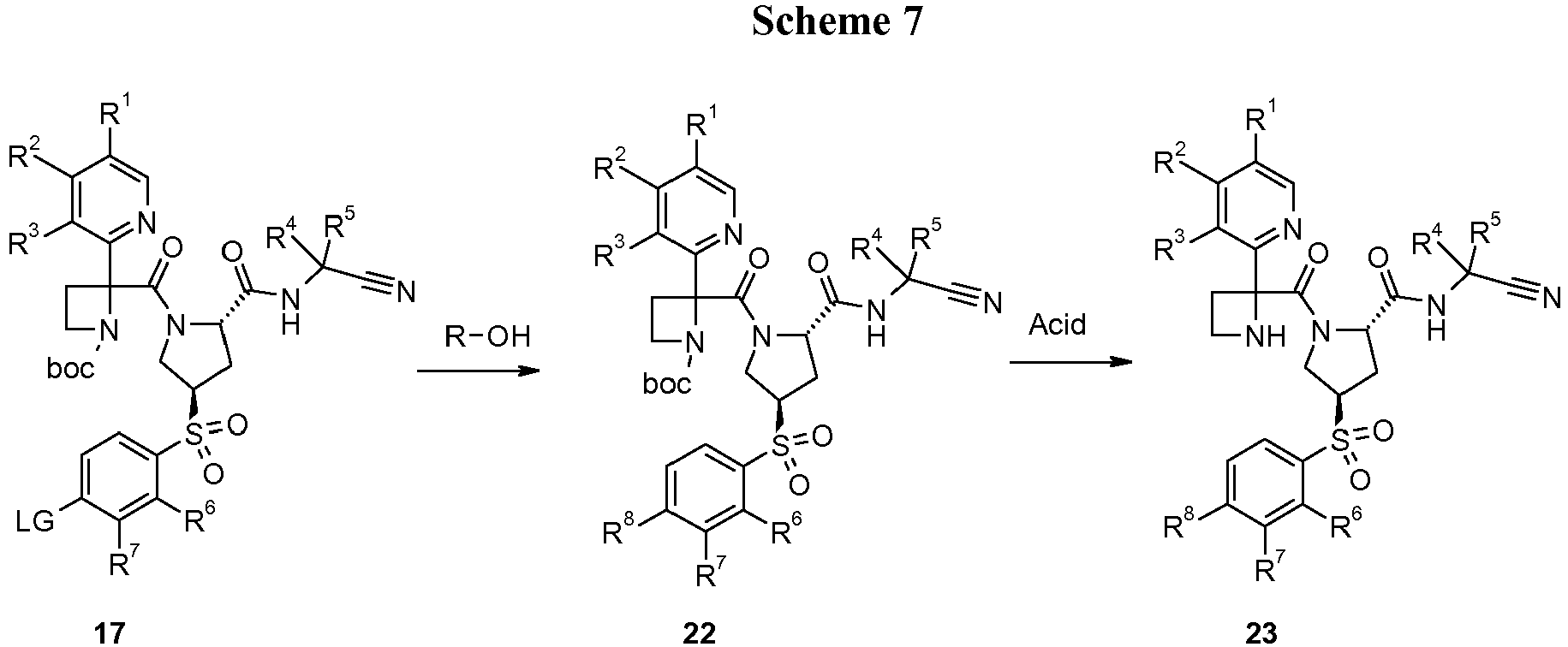
- Compound 17 is reacted with alcohol R-OH in the presence of a base such as Na2CO3, K2CO3, Cs2CO3, triethyl amine, DIEA, etc. to the ether 22. Ether 22 is deprotected with an acid such as TFA, formic acid, HCl in an organic solvent (e.g. dioxane, AcOEt) to yield amine 23.

- Compound 17 is reacted with a boronic acid or ester derivative 26 in the presence of a base such as Na2CO3, K2CO3, Cs2CO3, KOtBu, K3PO4, etc. and a catalyst known in the art for performing Suzuki reactions such as e.g. Pd(PPh3)4, Pd2(dba)3 with a phosphine ligand, etc. to yield the biaryl derivative 24. Compound 24 is deprotected with an acid such as TFA, formic acid, HCl in an organic solvent (e.g. dioxane, AcOEt) to yield amine 25.
- The invention also relates to a process for the preparation of a compound of formula (I) as defined above, comprising one of the following steps:
- (a) The reaction of a compound of formula (II)

- (b) The reaction of a compound of formula (III)
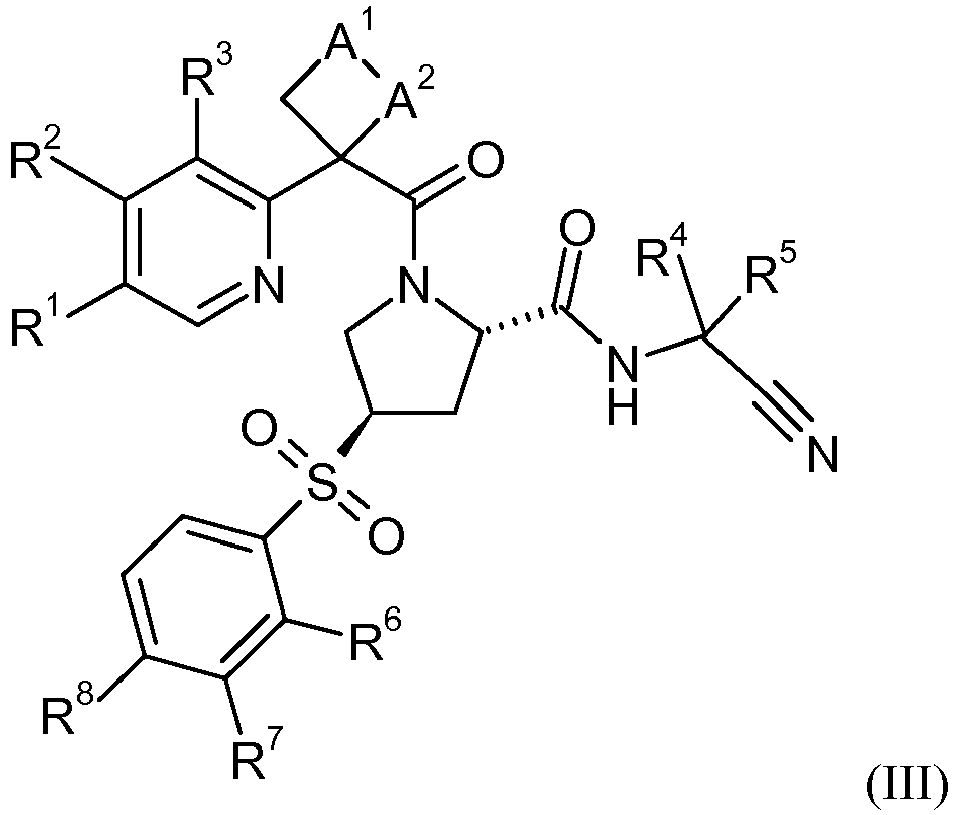
- (c) The reaction of a compound of formula (III) as defined above in the presence of R10-C(O)-Y and a reducing agent, wherein A1, A2 and R1 to R9 are as defined above, R10 is alkyl, haloalkyl or cycloalkyl and Y is hydrogen, alkyl or haloalkyl.
- In step (a), the acid is for example TFA, HCl or formic acid.
- In step (a), the amine protecting group is for example Boc, Fmoc, Cbz, Teoc, benzyl, or Moz.
- In step (c), the reducing agent is for example NaBH4, NaCNBH3 or sodium triacetoxyborohydride.
- The compounds of formula (I) and their pharmaceutically acceptable salts can be used as medicaments (e.g. in the form of pharmaceutical preparations). The pharmaceutical preparations can be administered internally, such as orally (e.g. in the form of tablets, coated tablets, dragées, hard and soft gelatin capsules, solutions, emulsions or suspensions), nasally (e.g. in the form of nasal sprays) or rectally (e.g. in the form of suppositories). However, the administration can also be effected parentally, such as intramuscularly or intravenously (e.g. in the form of injection solutions).
- The compounds of formula (I) and their pharmaceutically acceptable salts can be processed with pharmaceutically inert, inorganic or organic adjuvants for the production of tablets, coated tablets, dragées and hard gelatin capsules. Lactose, corn starch or derivatives thereof, talc, stearic acid or its salts etc. can be used, for example, as such adjuvants for tablets, dragées and hard gelatin capsules.
- Suitable adjuvants for soft gelatin capsules are, for example, vegetable oils, waxes, fats, semi-solid substances and liquid polyols, etc.
- Suitable adjuvants for the production of solutions and syrups are, for example, water, polyols, saccharose, invert sugar, glucose, etc.
- Suitable adjuvants for injection solutions are, for example, water, alcohols, polyols, glycerol, vegetable oils, etc.
- Suitable adjuvants for suppositories are, for example, natural or hardened oils, waxes, fats, semi-solid or liquid polyols, etc.
- Moreover, the pharmaceutical preparations can contain preservatives, solubilizers, viscosity-increasing substances, stabilizers, wetting agents, emulsifiers, sweeteners, colorants, flavorants, salts for varying the osmotic pressure, buffers, masking agents or antioxidants. They can also contain still other therapeutically valuable substances.
- The invention thus also relates in particular to the following:
- A compound of formula (I) for use as therapeutically active substance;
- A pharmaceutical composition comprising a compound of formula (I) and a therapeutically inert carrier; and
- A compound of formula (I) for use as therapeutically active substance for the treatment or prophylaxis of diabetes, atherosclerosis, abdominal aortic aneurysm, peripheral arterial disease, cancer, reduction of cardiovascular events in chronic kidney disease, diabetic nephropathy, diabetic rethinopathy or age related macular degeneration.20
- The invention will be illustrated by the following examples which have no limiting character.
-

-

- To a solution of 5-chloro-2-fluoropyridine (0.5 g, 3.8 mmol, Eq: 1.00) and 1-tert-butyl 3-methyl azetidine-1,3-dicarboxylate (818 mg, 3.8 mmol, Eq: 1.00) in toluene (5 ml) was added dropwise at 0°C for 15 min a 0.5 M solution of KHMDS (7.6 ml, 3.8 mmol, Eq: 1.00) in toluene. The colorless solution turned into yellow-orange. After stirring at 0°C for 45 min, the reaction mixture was allowed to warm to 20°C and stirred for 2.5 h. A saturated aqueous NH4Cl solution (50 ml) was added and the aqueous phase was extracted with AcOEt (2 x 75 ml).The combined organic layers were washed with brine, dried over Na2SO4, filtered and concentrated under reduced pressure. The crude material was purified by flash chromatography (silica gel, 12 g, 10% to 60% AcOEt in heptane) to yield a colorless gum (0.234 g; 19%). m/z = 327.2 [M+H]+.
-

- In a 10 ml round-bottomed flask, example 1A) (0.21 g, 643 µmol, Eq: 1.00) and lithium hydroxide (24.6 mg, 1.03 mmol, Eq: 1.6) were combined with tetrahydrofurane (1.8 ml) and water (1.2 ml) to give a light yellow suspension. The reaction mixture was stirred at 22°C for 2 h. The crude reaction mixture was concentrated in vacuo to yield an off-white solid (0.241 g; 100%). m/z = 311.3 [M-H]-.
-

- In a 10 ml round-bottomed flask, CAS # 1252640-17-7 (0.25 g, 517 µmol, Eq: 1.00) and 4 M hydrogen chloride solution in dioxane (517 µl, 2.07 mmol, Eq: 4) were combined to give a colorless solution. The reaction mixture was stirred at 22°C for 1.5 h. After stirring for 20 min, a slurry was formed. The crude reaction mixture was diluted in AcOEt (30 ml) and extracted with aqueous 10% Na2CO3-solution (20 ml). The aqueous layer was back-extracted with AcOEt (2 x 20 ml).The organic layers were combined, washed with brine (1 x 15 ml), dried over Na2SO4 and concentrated in vacuo to yield a colorless foam (202 mg; 100%). m/z = 384.3 [M+H]+.
-

- In a 10 ml round-bottomed flask, example 1B) (0.165 g, 518 µmol, Eq: 1.00), HATU (394 mg, 1.04 mmol, Eq: 2) and DIPEA (134 mg, 181 µl, 1.04 mmol, Eq: 2) were combined with acetonitrile (3 ml) to give a light brown solution. Example 1C) (199 mg, 518 µmol, Eq: 1.00) was added to the above solution and stirred at 20°C for 18 h. The crude reaction mixture was concentrated in vaccuo, the residue was diluted with AcOEt (30 ml) and extracted with aqueous 10% Na2CO3-solution (25 ml), The aqueous layer was back-extracted with AcOEt (2 x 20 ml), washed with brine, dried over Na2SO4 and evaporated to dryness. The crude product was subsequently purified by flash chromatography (silica gel, 12 g, 30% to 90% AcOEt in heptane) to yield an off-white foam (0.166 g; 48%). m/z = 678.3 [M+H]+.
-

- In a 10 ml round-bottomed flask, example ID) (0.15 g, 221 µmol, Eq: 1.00) and formic acid (305 mg, 254 µl, 6.63 mmol, Eq: 30) were combined to give a yellow solution. The mixture was stirred at 20°C for 20 h. The reaction mixture was diluted with water (2 ml), adjusted to pH= 8 with icecold aqueous 10% Na2CO3-solution, extracted with CH2Cl2 twice, the combined organic layers were washed with brine, dried over Na2SO4, filtered and evaporated to yield a light yellow solid (0.131 g; 100%). m/z = 580.3 [M+H]+.
-

- To a solution of example 2 (0.05 g, 86.4 µmol, Eq: 1.00) in refluxing methanol (1 ml) was added methyl iodide (9.2 mg, 4.05 µl, 64.8 µmol, Eq: 0.75). After complete addition the mixture was stirred at 80°C for 2 h. Additional methyl iodide (9.2 mg, 4.05 µl, 64.8 µmol, Eq: 0.75) was added and the mixture was stirred at 80°C for 2 h, then at 20°C over night. The mixture was purified by preparative HPLC to yield a colorless solid (3 mg; 6 %). m/z = 592.2 [M+H]+.
-

- The title compound was prepared in analogy to example 1 starting from CAS# 1252634-04-0 to yield a colorless amorphous solid. m/z = 746.1 [M+H]+.
-

- The title compound was prepared in analogy to the methods described in example 1 starting from 5-bromo-2-fluoro-pyridine and CAS# 1252634-04-0 to yield a yellow foam. m/z = 792.1 [M+H]+.
-

- The title compound was prepared in analogy to example 2 starting from example 4 to yield a colorless waxy solid. m/z = 646.1 [M+H]+.
-

- The title compound was prepared in analogy to example 2 starting from example 5 to yield a yellow foam. m/z = 692.0 [M+H]+.
-

- In a 10 ml round-bottomed flask, example 6 (0.082 g, 127 µmol, Eq: 1.00), 2,2-difluoroethyl trifluoromethanesulfonate (40.7 mg, 27.0 µl, 190 µmol, Eq: 1.5) and DIEA (24.6 mg, 33.2 µl, 190 µmol, Eq: 1.5) were combined with acetonitrile (1.5 ml) to give a light yellow solution. The reaction mixture was stirred at 22°C for 72 h. The crude reaction mixture was concentrated in vacuo and purified by flash chromatography (silica gel, 12 g, 25% to 80% AcOEt in heptane) to yield the title compound as a colorless amorphous solid (0.014 g; 16%). m/z = 710.2 [M+H]+.
-
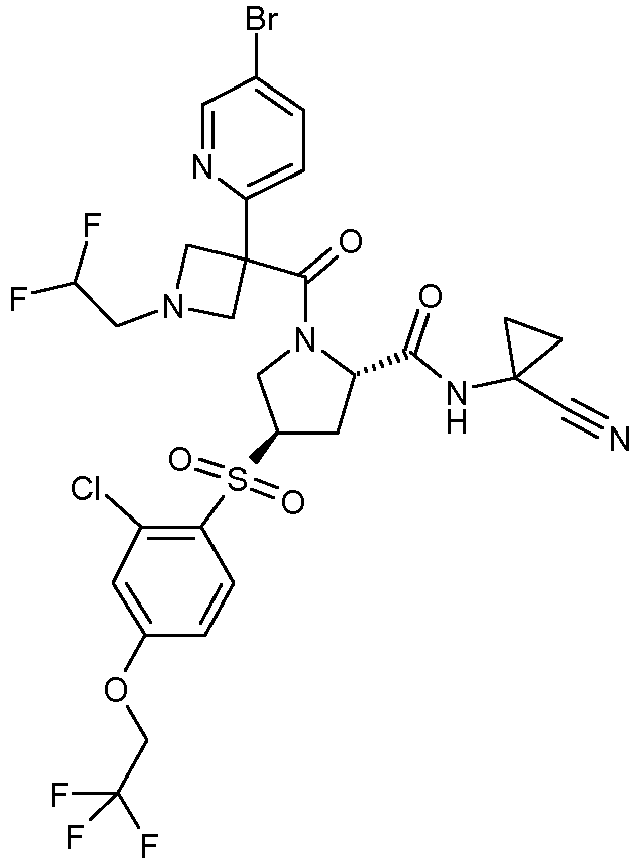
- The title compound was prepared in analogy to example 8 starting from example 7 to yield a colorless amorphous solid. m/z = 756.1 [M+H]+.
-

- The title compound was prepared in analogy to the methods described for example 1 starting from 5-chloro-2,3-difluoro-pyridine and CAS# 1252638-10-0 to yield a colorless foam. m/z = 666.2 [M+H]+.
-

- The title compound was prepared in analogy to the methods described for example 1 starting from 5-bromo-2,3-difluoro-pyridine and CAS# 1252638-10-0 to yield a colorless foam. m/z = 712.0 [M+H]+.
-

- The title compound was prepared in analogy to the methods described for example 2 starting from example 10 to yield a colorless foam. m/z = 566.1 [M+H]+.
-

- The title compound was prepared in analogy to the methods described for example 2 starting from example 11 to yield a colorless foam. m/z = 611.9 [M+H]+.
-

- To a mixture of example 13 (0.05 g, 81.8 µmol, Eq: 1.00), sodium acetate (14.8 mg, 180 µmol, Eq: 2.2) and acetic acid (10.8 mg, 10.3 µl, 180 µmol, Eq: 2.2) in dichloromethane (0.5 ml) was added at 25°C aqueous formaldehyde solution (36%; 19.1 mg, 17.5 µl, 229 µmol, Eq: 2.8). The mixture was stirred for 45 min, then sodium triacetoxyborohydride (55.5 mg, 262 µmol, Eq: 3.2) was added in one portion at 0-5°C. The cooling bath was removed after 10 min and stirring was continued at 25°C for further 18 h. The reaction mixture was quenched with aqueous 0.5 M NaOH-solution (2 ml), stirred for 2 min, then the layers were separated. The aqueous layer was extracted with three portions of AcOEt (each 5 ml).The combined organic layers were washed with brine, dried over Na2SO4 and concentrated in vacuo. The crude material was purified by preparative HPLC to yield the title compound as a colorless amorphous solid (0.0206 g; 40%). m/z = 626.1 [M+H]+.
-

- The title compound was prepared in analogy to the methods described for example 14 starting from example 13 to yield a light yellow amorphous solid. m/z = 640.1 [M+H]+.
-

- The title compound was prepared in analogy to the methods described for example 14 starting from example 12 to yield a light yellow amorphous solid. m/z = 580.1 [M+H]+.
-

- The title compound was prepared in analogy to the methods described for example 4 to yield a colorless amorphous solid. m/z = 764.3 [M+H]+.
-

- The title compound was prepared in analogy to the methods described for example 4 to yield a colorless amorphous solid. m/z = 710.1 [M+H-Boc]+.
-

- In a 10 mL round-bottomed flask example 18 (0.210 g, 260 µmol, Eq: 1.00) dissolved in dioxane (1.5 ml) and 4 M hydrogen chloride solution in dioxane (260 µl, 1.04 mmol, Eq: 4) were combined to give a colorless solution.The reaction mixture was heated to 22°C and stirred for 18 h. The crude reaction mixture was concetrated in vacuo and the residue was diluted in AcOEt (30 ml) and extracted with aqueous 10% Na2CO3-solution (50 ml). The aqueous layer was back extracted with AcOEt (2 x 30 ml).The organic layers were combined, washed with brine (1 x 20mL), dried over Na2SO4 and concentrated in vacuo. The crude material was purified by preparative HPLC to yield a colorless amorphous solid (0.038 g; 21 %). m/z = 710.0 [M+H-Boc]+.
-

- The title compound was prepared in analogy to the methods described for example 19 to yield a colorless amorphous solid. m/z = 664.1 [M+H-Boc]+.
-

-

- To a solution of 5-chloro-2,3-difluoropyridine (1.39 g, 9.29 mmol, Eq: 1.00) and 1-tert-butyl 2-methyl azetidine-1,2-dicarboxylate (2 g, 9.29 mmol, Eq: 1.00) in toluene (15 ml) was added dropwise at 0°C over 15 min a 0.5 M solution of KHMDS (18.6 ml, 9.29 mmol, Eq: 1.00) in toluene. The colorless solution turned into light brown. After stirring at 0°C for 45 min, the reaction mixture was allowed to warm up to 25°C. The reaction mixture was stirred for 2.5 h. Saturated aqueous NH4Cl solution (100 ml) was added and the aqueous phase was extracted with AcOEt (2x150 ml).The combined organic layers were washed with brine, dried over Na2SO4, filtered and concentrated under reduced pressure. The crude material was purified by flash chromatography (silica gel, 40g, 10% to 60% AcOEt in heptane) to yield a colorless viscous oil as a racemate (1.746 g; 55%). m/z = 345.2 [M+H]+.
-

- The title compound was prepared in analogy to the methods described for example 1 starting from example 21A) and CAS# 1252633-65-0 to yield a mixture of epimers as a colorless amorphous solid. m/z = 684.3 [M+H]+.
-

- The title compound was prepared in analogy to the methods described for example 21. The obtained mixture of epimers was purified by chiral HPLC to yield a single epimer as a colorless amorphous solid. m/z = 730.1 [M+H]+.
-

- Example 23 was obtained as single epimer after chiral HPLC separation of example 21 to yield a single epimer as a colorless amorphous solid. m/z = 684.3 [M+H]+.
-

- Example 24 was obtained as single epimer after chiral HPLC separation of example 21 to yield a single epimer as a colorless amorphous solid. m/z = 684.3 [M+H]+.
-

- Example 25 was obtained as single epimer after chiral HPLC separation of example 22 to yield a single epimer as a colorless amorphous solid. m/z = 730.1 [M+H]+.
-

- Example 26 was obtained as single epimer after chiral HPLC separation of example 22 to yield a single epimer as a colorless amorphous solid. m/z = 730.1 [M+H]+.
-

- In a 25 ml round-bottomed flask example 21 (0.1 g, 146 µmol, Eq: 1.00) was combined with N,N-dimethylacetamide (1.5 ml) to give a light yellow solution. (S)-1,1,1-trifluoropropan-2-ol (26.7 mg, 234 µmol, Eq: 1.6) and cesium carbonate (57.1 mg, 175 µmol, Eq: 1.2) were added at 25°C to above solution and stirred for 24 h. After that, additional (S)-1,1,1-trifluoropropan-2-ol (6.67 mg, 58.4 µmol, Eq: 0.4) was added to the reaction mixture and stirred for further 24 h at 25°C. The crude reaction mixture was concentrated, the residue was dissolved in AcOEt (100 ml), extracted in succession with aqueous 0.5 N HCl-solution (35 ml) and aqueous 10% Na2CO3-solution (25 ml). The aqueous layer was back extracted with AcOEt (2 x 25 ml).The combined organic layers were washed with brine, dried over Na2SO4, filtered and evaporated. The crude material was subsequently purified by flash chromatography (silica gel, 40 g, 10% to 50% EtOAc in heptane) to yield a mixture of epimers which was then subsequntly purified with chiral HPLC to yield one epimer as an amorphous colorless solid (9 mg; 8 %). m/z = 778.3 [M+H]+.
-

- Example 28 was obtained after chiral HPLC purification of example 27 as the other epimer. m/z = 778.3 [M+H]+.
-

- The title compound was prepared in analogy to the methods described for example 27. The obtained mixture of epimers was purified by chiral HPLC to yield a single epimer as a colorless amorphous solid. m/z = 842.1 [M+H]+.
-

- Example 30 was obtained after chiral HPLC purification of example 27 as the other epimer. m/z = 842.1 [M+H]+.
-

- In a 10 mL round-bottomed flask example 24 (0.034 g, 49.7 µmol, Eq: 1.00) in dioxane (0.1 ml) and 4 M hydrogen chloride solution in dioxane (62.1 µl, 248 µmol, Eq: 5) were combined to give a colorless solution. The reaction mixture was heated to 22°C and stirred for 18 h. After that, 4 M hydrogen chloride solution in dioxane (62.1 µl, 248 µmol, Eq: 5) was added and the reaction mixture was stirred for 24 h at 25°C. After that, additional 4 M hydrogen chloride solution in dioxane (24.8 µl, 99.3 µmol, Eq: 2) was added and the mixture was stirred for 2 h. The reaction mixture was concetrated in vacuo to yield an off-white foam (0.031 g; 100%). m/z = 584.0 [M+H]+.
-
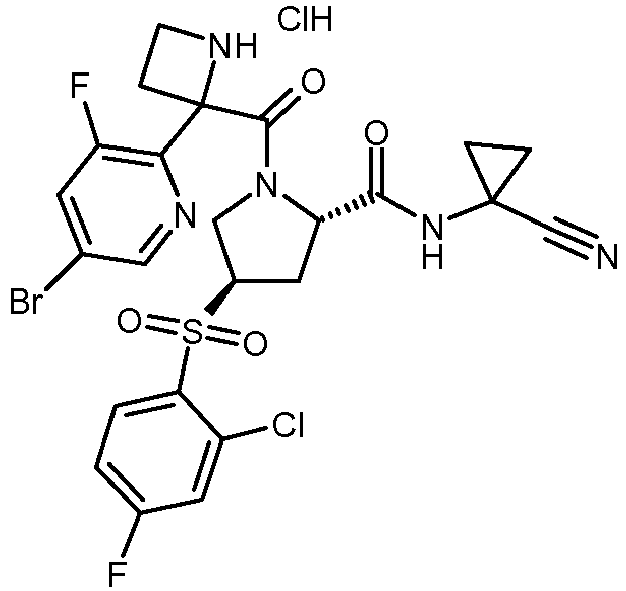
- The title compound was prepared from example 26 in analogy to example 31 to yield an off-white solid. m/z = 630.2 [M+H]+.
-

- The title compound was prepared in analogy to the methods described for examples 1 and 11 starting from CAS # 1252636-85-3 to yield a colorless waxy solid. m/z = 824.1 [M+H]+.
-

- The title compound was prepared from example 33 using the methods described for example 31. After evaporation the compound was purified with preparative HPLC to yield a white solid. m/z = 724.2 [M+H]+.
-

- The title compound was prepared from example 23 using the methods described for example 31 to yield a colorless solid. m/z = 584.2 [M+H]+.
-

- The title compound was prepared from example 25 using the methods described for example 31 to yield a colorless solid. m/z = 630.2 [M+H]+.
-

- The title compound was prepared from example 27 using the methods described for example 31 to yield a colorless solid. m/z = 678.2 [M+H]+.
-

- The title compound was prepared from example 28 using the methods described for example 31 to yield a colorless solid. m/z = 678.2 [M+H]+.
-

- The title compound was prepared from example 29 using the methods described for example 31 to yield a colorless solid. m/z = 724.1 [M+H]+.
-

- The title compound was prepared from example 34 according to the methods described for example 14 to yield an amorphous colorless solid. m/z = 756.3 [M+H]+.
-

-

- CAS # 1252633-25-2 (5.3 g, 12.3 mmol, Eq: 1.00) was dissolved in propionitrile (40 ml) and 4-bromo-2-chlorobenzenethiol (3.3 g, 14.8 mmol, Eq: 1.20) was added. Now triethyl amine (2.49 g, 3.43 ml, 24.6 mmol, Eq: 2.00) was added. The reaction mixture was stirred at reflux over night. The reaction mixture was poured into 100 ml 10% Na2CO3 and extracted with EtOAc (2 x 100 mL). The organic layer was extracted with 100 ml 0.1N HCl, dired over Na2SO4, filtered and evaporated. The crude material was purified by flash chromatography (silica gel, 120 g, 0% to 30% AcOEt in heptane in 30 min) to yield a colorless oil (4.72 g; 85%). m/z = 352.1 [M+H-Boc]+.
-

- Example 41A) (4.72 g, 10.5 mmol, Eq: 1.00) was dissolved in dichloromethane (40 ml) and MCPBA (3.79 g, 22.0 mmol, Eq: 2.10) was carefully portion-wise added. The reaction mixture was stirred for 18 h at 25°C. The reaction mixture was extracted with aqueous 10% Na2CO3 solution, aqueous 0.1 N HCl solution and saturated aqueous Na2S2O3 solution. The organic layers were dried over Na2SO4 and Na2SO3 for 2 h, filtered and carefully evoporated to yield a colorless waxy solid (4.96 g; 98%). m/z = 383.9 [M+H-Boc]+.
-

- Example 41B) (4.96 g, 10.3 mmol, Eq: 1.00) was dissolved in THF (15 ml) and water (10 ml). Now LiOH hydrate (418 mg, 17.5 mmol, Eq: 1.70) was added and the reaction mixture was stirred 3 h at 22°C. The reaction mixture was extracted with aqueous 0.2 N HCl solution / dichloromethane. The organic layers were dried over Na2SO4, filtered and concentrated in vacuo to a white foam (4.83 g; 100%). m/z = 467.9 [M-H]-.
-

- Example 41C) (4.83 g, 10.3 mmol, Eq: 1.00) was dissolved in acetonitrile (40 ml). HATU (7.84 g, 20.6 mmol, Eq: 2.00), DIEA (2.66 g, 3.6 ml, 20.6 mmol, Eq: 2.00) and 1-aminocyclopropane-carbonitrile hydrochloride (1.47 g, 12.4 mmol, Eq: 1.20) were added to the solution and stirred at 22°C for 2 h. The reaction mixture was poured into aqueous 0.1 M HCl (100 ml) and extracted with dischloromethane (3 x 75 mL). The organic layers were dried over Na2SO4 and concentrated in vacuo. The crude material was purified by flash chromatography (silica gel, 120 g, 0% to 60% AcOEt in heptane) to yield a white solid (3.2 g; 58%). m/z = 531.9 [M-H]-.
-

- The title compound was prepared according to the methods described for example 2 to yield an off-white solid. m/z = 434.1 [M+H]+.
-

- The title compound was prepared in analogy to the methods described for example 21 to yield a colorless foam. m/z = 746.0 [M+H]+.
-

- To a 10 ml microwave vial was added example 41G) (0.05 g, 67.1 µmol, Eq: 1.00), 2-methylpyridine-4-boronic acid pinacol ester (16.2 mg, 73.8 umol, Eq: 1.1) and tripotassium phosphate (42.7 mg, 201 µmol, Eq: 3) and 2'-(dimethylamino)-2-biphenyl-palladium (II) chloridedinorbornlphosphine complex (3.76 mg, 6.71 umol, Eq: 0.1) in water (1.0 ml) and dioxane (2.5 ml). The vial was capped and heated in the microwave at 120°C for 30 min.The crude material was purified by preparative HPLC to yield a colorless foam (0.019 g; 37%). m/z = 757.4 [M+H]+.
-

- The title compound was prepared in analogy to the methods described for example 21 and 41 to yield a colorless amorphous solid. m/z = 803.1 [M+H]+.
-
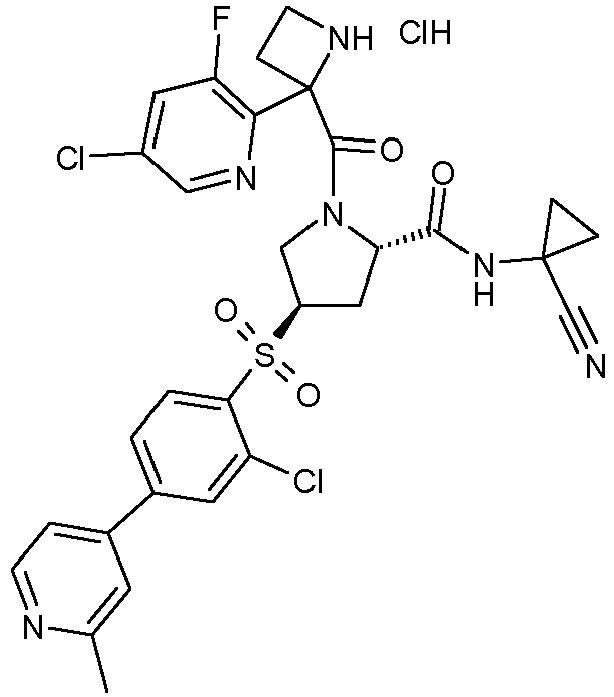
- The title compound was prepared from example 41 in analogy to example 31 to yield a white solid. m/z = 657.4 [M+H]+.
-

- The title compound was prepared from example 42 in analogy to example 31 to yield a white amorphous solid. m/z = 703.3 [M+H]+.
-

- The title compound was prepared from example 41F) and 1-methyl-4-(4,4,5,5-tetramethyl-1,3,2-dioxaborolan-2-yl)-1H-pyrazole in analogy to the method of example 41G) to yield a colorless foam. m/z = 746.3 [M+H]+.
-

- The title compound was prepared in analogy to example 42 and 45 to yield a colorless foam. m/z = 746.3 [M+H]+.
-

- The title compound was prepared from example 45 in analogy to example 31 to yield a white solid. m/z = 646.5 [M+H]+.
-

- The title compound was prepared from example 46 in analogy to example 31 to yield a colorless foam. m/z = 692.2 [M+H]+.
-

- In a 5 ml round-bottomed flask, example 34 (100 mg, 138 µmol, Eq: 1.00), 2,2-difluoroethyl trifluoromethanesulfonate (51.8 mg, 34.3 µl, 242 umol, Eq: 1.75) and Hunig's base (31.3 mg, 42.3 µl, 242 umol, Eq: 1.75) were combined with Acetonitrile (1.5 ml) to give a light yellow solution. The reaction mixture was stirred for 4 h at 25 °C. The crude reaction mixture was concentrated in vacuo. The reaction mixture was poured into EtOAc (20 ml) and extracted with aqueous 10% Na2CO3 solution (1 x 15 mL).The aqueous layer was back-extracted with EtOAc (2 x 20 mL). The organic layers were combined, washed with saturated aqueous NaCl solution (1 x 15 mL). The organic layers were dried over Na2SO4 and concentrated in vacuo. The crude material was purified by flash chromatography (silica gel, 12 g, 10% to 80% EtOAc in heptane) to yield the title compound as a colorless amorphous solid (41 mg; 38%). m/z = 786.0415 [M-H]-.
-

- In a 5 ml round-bottomed flask, example 34 was combined with DMSO (0.5 ml) to give a colorless solution. 4-Nitrophenyl formate (12.7 mg, 76.1 umol, Eq: 1.10) was added. The reaction mixture was stirred for 3 days at 25 °C. After that, additional 4-nitrophenyl formate (3.47 mg, 20.7 µmol, Eq: 0.3) were added to above solution and stirred for 5 days. The crude material was purified by preparative HPLC to yield the title compound as a colorless amorphous solid (14 mg; 27%). m/z = 752.0394 [M+H]+.
-

- In a 5 ml round-bottomed flask, example 34 (50 mg, 69.2 µmol, Eq: 1.00) was combined with dichloromethane (1.0 ml) to give a colorless solution. Methyl chloro formate (13.1 mg, 10.7 µl, 138 µmol, Eq: 2.00) and triethylamine (14.0 mg, 19.3 µl, 138 µmol, Eq: 2.00) were added. The reaction mixture stirred for 4 h at 25 °C. The crude material was purified by preparative HPLC to yield the title compound as a white solid (15 mg; 27%). m/z = 782.0487 [M+H]+.
-

- In a 5 ml round-bottomed flask, example 34 (50 mg, 69.2 µmol, Eq: 1.00) was combined with acetonitrile (1.5 ml) to give a colorless solution. 2,2,2-Trifluoroethyl trifluoromethanesulfonate (20.1 mg, 12.5 µL, 86.5 umol, Eq: 1.25) and Hunig's base (11.2 mg, 15.1 µL, 86.5 umol, Eq: 1.25) were added. The reaction mixture stirred for 18 h at 25 °C. The crude material was purified by preparative HPLC to yield the title compound as a colorless solid (12 mg; 22%). m/z = 806.0479 [M+H]+.
- Enzyme activity is measured by observing the increase in fluorescence intensity caused by cleavage of a peptide substrate containing a fluorophore whose emission is quenched in the intact peptide.
- Assay buffer: 100 mM potassium phosphate pH 6.5, EDTA-Na 5 mM, Triton X-100 0.001%, DTT 5 mM.
- Enzymes (all at 1 nM): human and mouse Cathepsin S, Cat K, Cat B, Cat L.
- Substrate (20 µM): Z-Val-Val-Arg-AMC, except for Cat K which uses Z-Leu-Arg-AMC (both from Bachem).
- Z = Benzyloxycarbonyl.
- AMC = 7-Amino-4-Methyl-Coumarin.
- DTT = dithiothreitol.
- Final volume: 100 µL.
- Excitation 360 nm, Emission 465 nm.
- Enzyme is added to the substance dilutions in 96-well microtitre plates and the reaction is started with substrate. Fluorescence emission is measured over 20 minutes, during which time a linear increase is observed in the absence of inhibitor. IC50 are calculated by standard methods.
- Inhibition of human Cat S, mouse Cat S, human Cat K, human Cat B, human Cat L and mouse Cat L have been measured separately. The results obtained for human Cat S and L for representative compounds of the invention are expressed in the following table in µM.
Example IC50 h L IC50 h S Example IC50 h L IC50 h S 1 1.073 0.003223 27 0.5277 0.007062 2 0.0381 0.001486 28 0.5565 0.001078 3 0.2923 0.001198 29 0.1883 0.005501 4 1.239 0.002749 30 1.057 0.002219 5 0.7531 0.003687 31 0.0816 0.001574 6 0.0898 0.003158 32 0.0485 0.001769 7 0.0735 0.003823 33 0.0895 0.003542 8 0.1413 0.000694 34 0.0142 0.003478 9 0.0917 0.000779 35 1.435 0.001299 10 0.1939 0.00126 36 0.621 0.001424 11 0.0705 0.001269 37 0.0585 0.003826 12 0.0236 0.001066 38 0.3172 0.004161 13 0.0046 0.001086 39 0.0269 0.005455 14 0.0125 0.000613 40 0.0166 0.002134 15 0.0201 0.000721 41 0.523 0.001553 16 0.0398 0.000525 42 0.6616 0.004597 17 43 0.0866 0.00233 18 44 0.0706 0.002076 19 0.0338 0.001666 45 0.6251 0.000965 20 0.0782 0.002917 46 1.163 0.001124 21 1.338 0.001045 47 0.0821 0.000791 22 1.016 0.001257 48 0.0989 0.001854 23 2.013 0.000377 49 0.005 0.001 24 0.922 0.00456 50 0.005 0.0009 25 2.909 0.000492 51 0.007 0.002 26 0.4708 0.004445 52 0.006 0.001 - The compounds of the invention are preferential inhibitors of Cathepsin-S and L over Cathepsin- K and B.
- The compounds according to the invention have, in the foregoing assay, an IC50 at Cat S and/or L which is between 0.00001 and 100 µM, preferably between 0.00001 and 50 µM, more preferably between 0.00001 and 20 µM. The particular compounds of the invention have an IC50 in at least one of the foregoing assay below 0.09 µM.
- A compound of formula (I) can be used in a manner known per se as the active ingredient for the production of tablets of the following composition:
-
Active ingredient 200 mg Micro crystalline cellulose 155 mg Corn starch 25 mg Talc 25 mg Hydroxypropylmethylcellulose 20 mg 425 mg - A compound of formula (I) can be used in a manner known per se as the active ingredient for the production of capsules of the following composition:
-
Active ingredient 100.0 mg Corn starch 20.0 mg Lactose 95.0 mg Talc 4.5 mg Magnesium stearate 0.5 mg 220.0 mg
Claims (19)
- A compound of formula (I)
 one of A1 and A2 is -NR9- and the other one is -CH2-;R1 is halogen;R2 is hydrogen, halogen, alkyl or haloalkyl;R3 is hydrogen, halogen, alkyl or haloalkyl;R4 and R5 are both hydrogen at the same time;or R4 and R5 together with the carbon atom to which they are attached form cycloalkyl;R6 is hydrogen, halogen, alkyl, haloalkyl or cycloalkyl;R7 is hydrogen, halogen, alkyl, haloalkyl or cycloalkyl;R8 is hydrogen, halogen, alkoxy, haloalkoxy, cycloalkyl, alkylpyridinyl or alkyl-1H-pyrazolyl; andR9 is hydrogen, alkyl, haloalkyl, cycloalkyl, acyl or alkoxycarbonyl;or a pharmaceutically acceptable salt thereof.
 - A compound according to claim 1, wherein R1 is chloro or bromo.
- A compound according to claim 1 or 2, wherein R2 is hydrogen.
- A compound according to any one of claims 1 to 3, wherein R3 is hydrogen or halogen.
- A compound according to any one of claims 1 to 4, wherein R3 is hydrogen or fluoro.
- A compound according to any one of claims 1 to 5, wherein R4 and R5 together with the carbon atom to which they are attached form cyclopropyl.
- A compound according to any one of claims 1 to 6, wherein R6 is halogen.
- A compound according to any one of claims 1 to 7, wherein R6 is chloro.
- A compound according to any one of claims 1 to 8, wherein R7 is hydrogen.
- A compound according to any one of claims 1 to 9, wherein R8 is hydrogen, halogen, alkoxy, haloalkoxy, alkylpyridinyl or alkyl-1H-pyrazolyl.
- A compound according to any one of claims 1 to 10, wherein R8 is hydrogen, fluoro, methoxy, trifluoroethoxy, trifluoropropoxy, methylpyridinyl or methyl-1H-pyrazolyl.
- A compound according to any one of claims 1 to 11, wherein R9 is hydrogen, alkyl, haloalkyl, formyl or alkoxycarbonyl.
- A compound according to any one of claims 1 to 12, wherein R9 is hydrogen, methyl, ethyl, difluoroethyl, formyl, methoxycarbonyl or trifluoroethyl.
- A compound according to any one of claims 1 to 13 selected from
3-[(2S,4R)-4-(2-Chloro-4-methoxy-benzenesulfonyl)-2-(1-cyano-cyclopropylcarbamoyl)-pyrrolidine-l-carbonyl]-3-(5-chloro-pyridin-2-yl)-azetidine-1-carboxylic acid tert-butyl ester;
(25,4R)-4-(2-Chloro-4-methoxy-benzenesulfonyl)-1-[3-(5-chloro-pyridin-2-yl)-azetidine-3-carbonyl]-pyrrolidine-2-carboxylic acid (1-cyano-cyclopropyl)-amide;
(2S,4R)-4-(2-Chloro-4-methoxy-benzenesulfonyl)-1-[3-(5-chloro-pyridin-2-yl)-1-methyl-azetidine-3-carbonyl]-pyrrolidine-2-carboxylic acid (1-cyano-cyclopropyl)-amide;
3-(5-Chloro-pyridin-2-yl)-3-[(2S,4R)-4-[2-chloro-4-(2,2,2-trifluoro-ethoxy)-benzenesulfonyl]-2-(1-cyano-cyclopropylcarbamoyl)-pyrrolidine-1-carbonyl]-azetidine-1-carboxylic acid tert-butyl ester;
3-(5-Bromo-pyridin-2-yl)-3-[(2S,4R)-4-[2-chloro-4-(2,2,2-trifluoro-ethoxy)-benzenesulfonyl]-2-(1-cyano-cyclopropylcarbamoyl)-pyrrolidine-1-carbonyl]-azetidine-1-carboxylic acid tert-butyl ester;
(2S,4R)-1-[3-(5-Chloro-pyridin-2-yl)-azetidine-3-carbonyl]-4-[2-chloro-4-(2,2,2-trifluoro-ethoxy)-benzenesulfonyl]-pyrrolidine-2-carboxylic acid (1-cyano-cyclopropyl)-amide;
(2S,4R)-1-[3-(5-Bromo-pyridin-2-yl)-azetidine-3-carbonyl]-4-[2-chloro-4-(2,2,2-trifluoro-ethoxy)-benzenesulfonyl]-pyrrolidine-2-carboxylic acid (1-cyano-cyclopropyl)-amide;
(2S,4R)-1-[3-(5-Chloro-pyridin-2-yl)-1-(2,2-difluoro-ethyl)-azetidine-3-carbonyl]-4-[2-chloro-4-(2,2,2-trifluoro-ethoxy)-benzenesulfonyl]-pyrrolidine-2-carboxylic acid (1-cyano-cyclopropyl)-amide;
(2S,4R)-1-[3-(5-Bromo-pyridin-2-yt)-1-(2,2-difluoro-ethyl)-azetidine-3-carbonyl]-4-[2-chloro-4-(2,2,2-trifluoro-ethoxy)-benzenesulfonyl]-pyrrolidine-2-carboxylic acid (1-cyano-cyclopropyl)-amide;
3-[(2S,4R)-4-(2-Chloro-benzenesulfonyl)-2-(1-cyano-cyclopropylcarbamoyl)-pyrrolidine-1-carbonyl]-3-(5-chloro-3-fluoro-pyridin-2-yl)-azetidine-1-carboxylic acid tert-butyl ester;
tert-Butyl 3-(5-bromo-3-fluoropyridin-2-yl)-3-((2S,4R)-4-(2-chlorophenylsulfonyl)-2-(1-cyanocyclopropylcarbamoyl)pyrrolidine-1-carbonyl)azetidine-1-carboxylate;
(2S,4R)-1-(3-(5-Chloro-3-fluoropyridin-2-yl)azetidine-3-carbonyl)-4-(2-chlorophenylsulfonyl)-N-(1-cyanocyclopropyl)pyrrolidine-2-carboxamide;
(2S,4R)-1-[3-(5-Bromo-3-fluoro-pyridin-2-yl)-azetidine-3-carbonyl]-4-(2-chloro-benzenesulfonyl)-pyrrolidine-2-carboxylic acid (1-cyano-cyclopropyl)-amide;
(2S,4R)-1-[3-(5-Bromo-3-fluoro-pyridin-2-yl)-1-methyl-azetidine-3-carbonyl]-4-(2-chloro-benzenesulfonyl)-pyrrolidine-2-carboxylic acid (1-cyano-cyclopropyl)-amide;
(2S,4R)-1-[3-(5-Bromo-3-fluoro-pyridin-2-yl)-1-ethyl-azetidine-3-carbonyl]1-4-(2-chloro-benzenesulfonyl)-pyrrolidine-2-carboxylic acid (1-cyano-cyclopropyl)-amide;
(2S,4R)-4-(2-Chloro-benzenesulfonyl)-1-[3-(5-chloro-3-fluoro-pyridin-2-yl)-1-methyl-azetidine-3-carbonyl]-pyrrolidine-2-carboxylic acid (1-cyano-cyclopropyl)-amide;
3-(5-Chloro-3-fluoro-pyridin-2-yl)-3-[(2S,4R)-4-[2-chloro-4-(2,2,2-trifluoroethoxy)-benzenesulfonyl]-2-(1-cyano-cyclopropylcarbamoyl)-pyrrolidine-1-carbonyl]-azetidine-1-carboxylic acid tert-butyl ester;
3-(5-Bromo-3-fluoro-pyridin-2-yl)-3-[(2S,4R)-4-[2-chloro-4-(2,2,2-trifluoroethoxy)-benzenesulfonyl]-2-(1-cyano-cyclopropylcarbamoyl)-pyrrolidine-1-carbonyl]-azetidine-1-carboxylic acid tert-butyl ester;
(2S,4R)-1-(3-(5-Bromo-3-fluoropyridin-2-yl)azetidine-3-carbonyl)-4-(2-chloro-4-(2,2,2-trifluoroethoxy)phenylsulfonyl)-N-(1-cyanocyclopropyl)pyrrolidine-2-carboxamide;
(2S,4R)-1-(3-(5-Chloro-3-fluoropyridin-2-yl)azetidine-3-carbonyl)-4-(2-chloro-4-(2,2,2-trifluoroethoxy)phenylsulfonyl)-N-(1-cyanocyclopropyl)pyrrolidine-2-carboxamide;
2-[(2S,4R)-4-(2-Chloro-4-fluoro-benzenesulfonyl)-2-(1-cyano-cyclopropylcarbamoyl)-pyrrolidine-1-carbonyl]-2-(5-chloro-3-fluoro-pyridin-2-yl)-azetidine-1-carboxylic acid tert-butyl ester;
2-(5-Bromo-3-fluoro-pyridin-2-yl)-2-[(2S,4R)-4-(2-chloro-4-fluoro-benzenesulfonyl)-2-(1-cyano-cyclopropylcarbamoyl)-pyrrolidine-1-carbonyl]-azetidine-1-carboxylic acid tert-butyl ester;
2-[(2S,4R)-4-(2-Chloro-4-fluoro-benzenesulfonyl)-2-(1-cyano-cyclopropylcarbamoyl)-pyrrolidine-1-carbonyl]-2-(5-chloro-3-fluoro-pyridin-2-yl)-azetidine-1-carboxylic acid tert-butyl ester;
2-[(2S,4R)-4-(2-Chloro-4-fluoro-benzenesulfonyl)-2-(1-cyano-cyclopropylcarbamoyl)-pyrrolidine-1-carbonyl]-2-(5-chloro-3-fluoro-pyridin-2-yl)-azetidine-1-carboxylic acid tert-butyl ester;
2-(5-Bromo-3-fluoro-pyridin-2-yl)-2-[(2S,4R)-4-(2-chloro-4-fluoro-benzenesulfonyl)-2-(1-cyano-cyclopropylcarbamoyl)-pyrrolidine-1-carbonyl]-azetidine-1-carboxylic acid tert-butyl ester;
2-(5-Bromo-3-fluoro-pyridin-2-yl)-2-[(2S,4R)-4-(2-chloro-4-fluoro-benzenesulfonyl)-2-(1-cyano-cyclopropylcarbamoyl)-pyrrolidine-1-carbonyl]-azetidine-1-carboxylic acid tert-butyl ester;
tert-Butyl 2-(5-chloro-3-fluoropyridin-2-yl)-2-((2S,4R)-4-(2-chloro-4-((S)-1,1,1-trifluoropropan-2-yloxy)phenylsulfonyl)-2-(1-cyanocyclopropylcarbamoyl)pyrrolidine-1-carbonyl)azetidine-1-carboxylate;
tert-Butyl 2-(5-chloro-3-fluoropyridin-2-yl)-2-((2S,4R)-4-(2-chloro-4-((S)-1,1,1-trifluoropropan-2-yloxy)phenylsulfonyl)-2-(1-cyanocyclopropylcarbamoyl)pyrrolidine-1-carbonyl)azetidine-1-carboxylate;
2-(5-Bromo-3-fluoro-pyridin-2-yl)-2-[(2S,4R)-4-[2-chloro-4-((S)-2,2,2-trifluoro-1-methyl-ethoxy)-benzenesulfonyl]-2-(1-cyano-cyclopropylcarbamoyl)-pyrrolidine-1-carbonyl]-azetidine-1-carboxylic acid tert-butyl ester;
2-(5-Bromo-3-fluoro-pyridin-2-yl)-2-[(2S,4R)-4-[2-chloro-4-((S)-2,2,2-trifluoro-1-methyl-ethoxy)-benzenesulfonyl]-2-(1-cyano-cyclopropylcarbamoyl)-pyrrolidine-1-carbonyl]-azetidine-1-carboxylic acid tert-butyl ester;
(2S,4R)-4-(2-Chloro-4-fluoro-benzenesulfonyl)-1-[2-(5-chloro-3-fluoro-pyridin-2-yl)-azetidine-2-carbonyl]-pyrrolidine-2-carboxylic acid (1-cyano-cyclopropyl)-amide;
(2S,4R)-4-(2-Bromo-4-fluoro-benzenesulfonyl)-1-[2-(5-chloro-3-fluoro-pyridin-2-yl)-azetidine-2-carbonyl]-pyrrolidine-2-carboxylic acid (1-cyano-cyclopropyl)-amide;
3-(5-Bromo-3-fluoro-pyridin-2-yl)-3-[(2S,4R)-4-[2-chloro-4-((S)-2,2,2-trifluoro-1-methyl-ethoxy)-benzenesulfonyl]-2-(1-cyano-cyclopropylcarbamoyl)-pyrrolidine-1-carbonyl]-azetidine-1-carboxylic acid tert-butyl ester;
(2S,4R)-1-[3-(5-Bromo-3-fluoro-pyridin-2-yl)-azetidine-3-carbonyl]-4-[2-chloro-4-((S)-2,2,2-trifluoro-1-methyl-ethoxy)-benzenesulfonyl]-pyrrolidine-2-carboxylic acid (1-cyano-cyclopropyl)-amide;
(2S,4R)-4-(2-Chloro-4-fluoro-benzenesulfonyl)-1-[2-(5-chloro-3-fluoro-pyridin-2-yl)-azetidine-2-carbonyl]-pyrrolidine-2-carboxylic acid (1-cyano-cyclopropyl)-amide;
(2S,4R)-1-[2-(5-Bromo-3-fluoro-pyridin-2-yl)-azetidine-2-carbonyl]-4-(2-chloro-4-fluoro-benzenesulfonyl)-pyrrolidine-2-carboxylic acid (1-cyano-cyclopropyl)-amide;
(2S,4R)-1-[2-(5-Chloro-3-fluoro-pyridin-2-yl)-azetidine-2-carbonyl]-4-[2-chloro-4-((S)-2,2,2-trifluoro-1-methyl-ethoxy)-benzenesulfonyl]-pyrrolidine-2-carboxylic acid (1-cyano-cyclopropyl)-amide;
(2S,4R)-1-[2-(5-Chloro-3-fluoro-pyridin-2-yl)-azetidine-2-carbonyl]-4-[2-chloro-4-((S)-2,2,2-trifluoro-1-methyl-ethoxy)-benzenesulfonyl]-pyrrolidine-2-carboxylic acid (1-cyano-cyclopropyl)-amide;
(2S,4R)-1-[2-(5-Bromo-3-fluoro-pyridin-2-yl)-azetidine-2-carbonyl]-4-[2-chloro-4-((S)-2,2,2-trifluoro-1-methyl-ethoxy)-benzenesulfonyl]-pyrrolidine-2-carboxylic acid (1-cyano-cyclopropyl)-amide;
(2S,4R)-1-[3-(5-Bromo-3-fluoro-pyridin-2-yl)-1-methyl-azetidine-3-carbonyl]-4-[2-chloro-4-((S)-2,2,2-trifluoro-1-methyl-ethoxy)-benzenesulfonyl]-pyrrolidine-2-carboxylic acid (1-cyano-cyclopropyl)-amide;
2-(5-Chloro-3-fluoro-pyridin-2-yl)-2-[(2S,4R)-4-[2-chloro-4-(2-methyl-pyridin-4-yl)-benzenesulfonyl]-2-(1-cyano-cyclopropylcarbamoyl)-pyrrolidine-1-carbonyl]-azetidine-1-carboxylic acid tert-butyl ester;
2-(5-Bromo-3-fluoro-pyridin-2-yi)-2-[(2S,4R)-4-[2-chloro-4-(2-methyl-pyridin-4-yl)-benzenesulfonyl]-2-(1-cyano-cyclopropylcarbamoyl)-pyrrolidine-l-carbonyl]-azetidine-1-carboxylic acid tert-butyl ester;
(2S,4R)-1-[2-(5-Chloro-3-fluoro-pyridin-2-yl)-azetidine-2-carbonyl]-4-[2-chloro-4-(2-methyl-pyridin-4-yl)-benzenesulfonyl]-pyrrolidine-2-carboxylic acid (1-cyano-cyclopropyl)-amide;
(2S,4R)-1-[2-(5-Bromo-3-fluoro-pyridin-2-yl)-azetidine-2-carbonyl]-4-[2-chloro-4-(2-methyl-pyridin-4-yl)-benzenesulfonyl]-pyrrolidine-2-carboxylic acid (1-cyano-cyclopropyl)-amide;
tert-Butyl2-(5-chloro-3-fluoropyridin-2-yl)-2-((2S,4R)-4-(2-chloro-4-(1-methyl-1H-pyrazol-4-yl)phenylsulfonyl)-2-(1-cyanocyclopropylcarbamoyl)pyrrolidine-1-carbonyl)azetidine-1-carboxylate;
tert-Butyl2-(5-bromo-3-fluoropyridin-2-yl)-2-((25,4R)-4-(2-chloro-4-(1-methyl-1H-pyrazol-4-yl)phenylsulfonyl)-2-(1-cyanocyclopropylcarbamoyl)pyrrolidine-1-carbonyl)azetidine-1-carboxylate;
(2S,4R)-1-[2-(5-Chloro-3-fluoro-pyridin-2-yl)-azetidine-2-carbonyl]-4-1-2-chloro-4-(1-methyl-1H-pyrazol-4-yl)-benzenesulfonyl]-pyrrolidine-2-carboxylic acid (1-cyano-cyclopropyl )-amide;
(2S,4R)-1-[2-(5-Bromo-3-fluoro-pyridin-2-yl)-azetidine-2-carbonyl]-4-[2-chloro-4-(1-methyl-1H-pyrazol-4-yl)-benzenesulfonyl]-pyrrolidine-2-carboxylic acid (1-cyano-cyclopropyl)-amide;
(2S,4R)-1-[3-(5-Bromo-3-fluoro-pyridin-2-yl)-1-(2,2-difluoro-ethyl)-azetidine-3-carbonyl]-4-[2-chloro-4-((S)-2,2,2-trifluoro-1-methyl-ethoxy)-benzenesulfonyl]-pyrrolidine-2-carboxylic acid (1-cyano-cyclopropyl)-amide;
(2S,4R)-1-[3-(5-Bromo-3-fluoro-pyridin-2-yl)-1-formyl-azetidine-3-carbonyl]-4-[2-chloro-4-((S)-2,2,2-trifluoro-1-methyl-ethoxy)-benzenesulfonyl]-pyrrolidine-2-carboxylic acid (1-cyano-cyclopropyl)-amide;
3-(5-Bromo-3-fluoro-pyridin-2-yl)-3-[(2S,4R)-4-[2-chloro-4-((S)-2,2,2-trifluoro-1-methyl-ethoxy)-benzenesulfonyl]-2-(1-cyano-cyclopropylcarbamoyl)-pyrrolidine-1-carbonyl]-azetidine-1-carboxylic acid methyl ester; and
(2S,4R)-1-[3-(5-Bromo-3-fluoro-pyridin-2-yl)-1-(2,2,2-trifluoro-ethyl)-azetidine-3-carbonyl]-4-[2-chloro-4-((S)-2,2,2-trifluoro-1-methyl-ethoxy)-benzenesulfonyl]-pyrrolidine-2-carboxylic acid (1-cyano-cyclopropyl)-amide. - A compound according to any one of claims 1 to 14 selected from
(2S,4R)-4-(2-Chloro-4-methoxy-benzenesulfonyl)-1-[3-(5-chloro-pyridin-2-yl)-azetidine-3-carbonyl]-pyrrolidine-2-carboxylic acid (1-cyano-cyclopropyl)-amide;
(2S,4R)-1-(3-(5-chloro-3-fluoropyridin-2-yl)azetidine-3-carbonyl)-4-(2-chlorophenylsulfonyl)-N-(1-cyanocyclopropyl)pyrrolidine-2-carboxamide;
(2S,4R)-1-[3-(5-Bromo-3-fluoro-pyridin-2-yl)-azetidine-3-carbonyl]-4-(2-chloro-benzenesulfonyl)-pyrrolidine-2-carboxylic acid (1-cyano-cyclopropyl)-amide;
(2S,4R)-1-[3-(5-Bromo-3-fluoro-pyridin-2-yl)-1-methyl-azetidine-3-carbonyl]-4-(2-chloro-benzenesulfonyl)-pyrrolidine-2-carboxylic acid (1-cyano-cyclopropyl)-amide;
(2S,4R)-1-[3-(5-Bromo-3-fluoro-pyridin-2-yl)-1-ethyl-azetidine-3-carbonyl]-4-(2-chloro-benzenesulfonyl)-pyrrolidine-2-carboxylic acid (1-cyano-cyclopropyl)-amide;
(2S,4R)-4-(2-Chloro-benzenesulfonyl)-1-[3-(5-chloro-3-fluoro-pyridin-2-yl)-1-methyl-azetidine-3-carbonyl]-pyrrolidine-2-carboxylic acid (1-cyano-cyclopropyl)-amide;
(2S,4R)-1-(3-(5-Bromo-3-fluoropyridin-2-yl)azetidine-3-carbonyl)-4-(2-chloro-4-(2,2,2-trifluoroethoxy)phenylsulfonyl)-N-(1-cyanocyclopropyl)pyrrolidine-2-carboxamide;
(2S,4R)-1-(3-(5-Chloro-3-fluoropyridin-2-yl)azetidine-3-carbonyl)-4-(2-chloro-4-(2,2,2-trifluoroethoxy)phenylsulfonyl)-N-(1-cyanocyclopropyl)pyrrolidine-2-carboxamide;
(2S,4R)-4-(2-Bromo-4-fluoro-benzenesulfonyl)-1-[2-(5-chloro-3-fluoro-pyridin-2-yl)-azetidine-2-carbonyl]-pyrrolidine-2-carboxylic acid (1-cyano-cyclopropyl)-amide;
(2S,4R)-1-[3-(5-Bromo-3-fluoro-pyridin-2-yl)-azetidine-3-carbonyl]-4-[2-chloro-4-((S)-2,2,2-trifluoro-1-methyl-ethoxy)-benzenesulfonyl]-pyrrolidine-2-carboxylic acid (1-cyano-cyclopropyl)-amide;
(2S,4 R)-1-[2-(5-Chloro-3-fluoro-pyridin-2-yl)-azetidine-2-carbonyl]-4-[2-chloro-4-((S)-2,2,2-trifluoro-1-methyl-ethoxy)-benzenesulfonyl]-pyrrolidine-2-carboxylic acid (1-cyano-cyclopropyl)-amide;
(2S,4R)-1-[2-(5-Bromo-3-fluoro-pyridin-2-yl)-azetidine-2-carbonyl]-4-[2-chloro-4-((S)-2,2,2-trifluoro-l-methyl-ethoxy)-benzenesulfonyl]-pyrrolidine-2-carboxylic acid (1-cyano-cyclopropyl)-amide;
(2S,4R)-1-[3-(5-Bromo-3-fluoro-pyridin-2-yl)-1-methyl-azetidine-3-carbonyl]-4-[2-chloro-4-((S)-2,2,2-trifluoro-1-methyl-ethoxy)-benzenesulfonyl]-pyrrolidine-2-carboxylic acid (1-cyano-cyclopropyl)-amide;
(2S,4R)-1-[2-(5-Bromo-3-fluoro-pyridin-2-yl)-azetidine-2-carbonyl]-4-[2-chloro-4-(2-methyl-pyridin-4-yl)-benzenesulfonyl]-pyrrolidine-2-carboxylic acid (1-cyano-cyclopropyl)-amide;
(2S,4R)-1-[2-(5-Chloro-3-fluoro-pyridin-2-yl)-azetidine-2-carbonyl]-4-[2-chloro-4-(1-methyl-1H-pyrazol-4-yl)-benzenesulfonyl]-pyrrolidine-2-carboxylic acid (1-cyano-cyclopropyl)-amide;
(2S,4R)-1-[3-(5-Bromo-3-fluoro-pyridin-2-yl)-1-(2,2-difluoro-ethyl)-azetidine-3-carbonyl]-4-[2-chloro-4-((S)-2,2,2-trifluoro-1-methyl-ethoxy)-benzenesulfonyl]-pyrrolidine-2-carboxylic acid (1-cyano-cyclopropyl)-amide;
(2S,4R)-1-[3-(5-Bromo-3-fluoro-pyridin-2-yl)-1-formyl-azetidine-3-carbonyl]-4-[2-chloro-4-((S)-2,2,2-trifluoro-1-methyl-ethoxy)-benzenesulfonyl]-pyrrolidine-2-carboxylic acid (1-cyano-cyclopropyl)-amide;
3-(5-Bromo-3-fluoro-pyridin-2-yl)-3-[(2S,4R)-4-[2-chloro-4-((S)-2,2,2-trifluoro-1-methyl-ethoxy)-benzenesulfonyl]-2-(1-cyano-cyclopropylcarbamoyl)-pynolidine-1-carbonyl]-azetidine-1-carboxylic acid methyl ester; and (2S,4R)-1-[3-(5-Bromo-3-fluoro-pyridin-2-yl)-1-(2,2,2-trifluoro-ethyl)-azetidine-3-carbonyl]-4-[2-chloro-4-((S)-2,2,2-trifluoro-1-methyl-ethoxy)-benzenesulfonyl]-pyrrolidine-2-carboxylic acid (1-cyano-cyclopropyl)-amide. - A process for the preparation of a compound of formula (I) according to any one of claims 1 to 15 comprising one of the following steps:(a) The reaction of a compound of formula (II)
 (b) The reaction of a compound of formula (III)
 (c) The reaction of a compound of formula (III) as defined above in the presence of R10-C(O)-Y and a reducing agent, wherein A1, A2 and R1 to R9 are as defined in any one of claims 1 to 14, R10 is alkyl, haloalkyl or cycloalkyl and Y is hydrogen, alkyl or haloalkyl.
 - A compound according to any one of claims 1 to 15 for use as therapeutically active substance.
- A compound according to any one of claims 1 to 15 for use as therapeutically active substance for the treatment or prophylaxis of diabetes, atherosclerosis, abdominal aortic aneurysm, peripheral arterial disease, cancer, reduction of cardiovascular events in chronic kidney disease, diabetic nephropathy, diabetic rethinopathy or age related macular degeneration.
- A pharmaceutical composition comprising a compound in accordance with any one of claims 1 to 15 and a therapeutically inert carrier.
Priority Applications (1)
| Application Number | Priority Date | Filing Date | Title |
|---|---|---|---|
| EP13702070.7A EP2812322B1 (en) | 2012-02-07 | 2013-02-04 | Novel azetidine derivatives |
Applications Claiming Priority (3)
| Application Number | Priority Date | Filing Date | Title |
|---|---|---|---|
| EP12154244 | 2012-02-07 | ||
| PCT/EP2013/052139 WO2013117512A1 (en) | 2012-02-07 | 2013-02-04 | Novel azetidine derivatives |
| EP13702070.7A EP2812322B1 (en) | 2012-02-07 | 2013-02-04 | Novel azetidine derivatives |
Publications (2)
| Publication Number | Publication Date |
|---|---|
| EP2812322A1 EP2812322A1 (en) | 2014-12-17 |
| EP2812322B1 true EP2812322B1 (en) | 2017-12-06 |
Family
ID=47630385
Family Applications (1)
| Application Number | Title | Priority Date | Filing Date |
|---|---|---|---|
| EP13702070.7A Not-in-force EP2812322B1 (en) | 2012-02-07 | 2013-02-04 | Novel azetidine derivatives |
Country Status (11)
| Country | Link |
|---|---|
| US (1) | US8822505B2 (en) |
| EP (1) | EP2812322B1 (en) |
| JP (1) | JP6096808B2 (en) |
| KR (1) | KR20140120902A (en) |
| CN (1) | CN104093713B (en) |
| AR (1) | AR089903A1 (en) |
| BR (1) | BR112014019180A8 (en) |
| CA (1) | CA2859271A1 (en) |
| MX (1) | MX351093B (en) |
| RU (1) | RU2629114C2 (en) |
| WO (1) | WO2013117512A1 (en) |
Families Citing this family (2)
| Publication number | Priority date | Publication date | Assignee | Title |
|---|---|---|---|---|
| EP2814822B1 (en) | 2012-02-17 | 2016-04-20 | F.Hoffmann-La Roche Ag | Novel pyrrolidine derivatives |
| CN109053524A (en) * | 2018-09-11 | 2018-12-21 | 山东谛爱生物技术有限公司 | A kind of preparation method of N-Boc-3- hydroxy azetidine |
Family Cites Families (4)
| Publication number | Priority date | Publication date | Assignee | Title |
|---|---|---|---|---|
| GB0419235D0 (en) * | 2004-08-28 | 2004-09-29 | Astrazeneca Ab | Compounds |
| CA2730477A1 (en) * | 2008-07-16 | 2010-01-21 | Astrazeneca Ab | Pyrimidyl sulfonaminde derivative and its use for the treatment of chemokine mediated diseases |
| NZ595073A (en) * | 2009-04-20 | 2012-11-30 | Hoffmann La Roche | Proline derivatives as cathepsin inhibitors |
| US7893099B2 (en) * | 2009-06-11 | 2011-02-22 | Hoffman-La Roche Inc. | Cyclopentane derivatives |
-
2013
- 2013-02-04 KR KR1020147021898A patent/KR20140120902A/en not_active Ceased
- 2013-02-04 WO PCT/EP2013/052139 patent/WO2013117512A1/en not_active Ceased
- 2013-02-04 CA CA2859271A patent/CA2859271A1/en not_active Abandoned
- 2013-02-04 RU RU2014133987A patent/RU2629114C2/en not_active IP Right Cessation
- 2013-02-04 BR BR112014019180A patent/BR112014019180A8/en not_active Application Discontinuation
- 2013-02-04 EP EP13702070.7A patent/EP2812322B1/en not_active Not-in-force
- 2013-02-04 JP JP2014555243A patent/JP6096808B2/en not_active Expired - Fee Related
- 2013-02-04 CN CN201380008271.5A patent/CN104093713B/en not_active Expired - Fee Related
- 2013-02-04 MX MX2014009451A patent/MX351093B/en active IP Right Grant
- 2013-02-05 AR ARP130100349A patent/AR089903A1/en unknown
- 2013-02-06 US US13/760,519 patent/US8822505B2/en not_active Expired - Fee Related
Also Published As
| Publication number | Publication date |
|---|---|
| WO2013117512A1 (en) | 2013-08-15 |
| EP2812322A1 (en) | 2014-12-17 |
| JP2015509484A (en) | 2015-03-30 |
| CN104093713A (en) | 2014-10-08 |
| US20130210799A1 (en) | 2013-08-15 |
| RU2014133987A (en) | 2016-03-27 |
| RU2629114C2 (en) | 2017-08-24 |
| BR112014019180A2 (en) | 2017-06-20 |
| US8822505B2 (en) | 2014-09-02 |
| CN104093713B (en) | 2016-11-02 |
| KR20140120902A (en) | 2014-10-14 |
| MX351093B (en) | 2017-10-02 |
| JP6096808B2 (en) | 2017-03-15 |
| AR089903A1 (en) | 2014-09-24 |
| MX2014009451A (en) | 2014-10-23 |
| CA2859271A1 (en) | 2013-08-15 |
| BR112014019180A8 (en) | 2017-07-11 |
Similar Documents
| Publication | Publication Date | Title |
|---|---|---|
| EP2782903B1 (en) | Novel pyrrolidine derivatives as inhibitors of cathepsin | |
| EP2814822B1 (en) | Novel pyrrolidine derivatives | |
| US9409882B2 (en) | Pyridine derivatives | |
| US8822505B2 (en) | Azetidine derivatives | |
| EP3419970B1 (en) | Novel pyrrolidine derivatives | |
| TW201336837A (en) | Novel azetidine derivatives | |
| HK1197673A (en) | Novel azetidine derivatives | |
| HK1197673B (en) | Novel azetidine derivatives | |
| BR112018070451B1 (en) | PYRROLIDINE DERIVATIVE COMPOUND, PHARMACEUTICAL COMPOSITION AND USE OF THIS COMPOUND |
Legal Events
| Date | Code | Title | Description |
|---|---|---|---|
| PUAI | Public reference made under article 153(3) epc to a published international application that has entered the european phase |
Free format text: ORIGINAL CODE: 0009012 |
|
| 17P | Request for examination filed |
Effective date: 20140908 |
|
| AK | Designated contracting states |
Kind code of ref document: A1 Designated state(s): AL AT BE BG CH CY CZ DE DK EE ES FI FR GB GR HR HU IE IS IT LI LT LU LV MC MK MT NL NO PL PT RO RS SE SI SK SM TR |
|
| AX | Request for extension of the european patent |
Extension state: BA ME |
|
| DAX | Request for extension of the european patent (deleted) | ||
| 17Q | First examination report despatched |
Effective date: 20151026 |
|
| GRAP | Despatch of communication of intention to grant a patent |
Free format text: ORIGINAL CODE: EPIDOSNIGR1 |
|
| INTG | Intention to grant announced |
Effective date: 20170529 |
|
| RIN1 | Information on inventor provided before grant (corrected) |
Inventor name: HAAP, WOLFGANG Inventor name: SPINNLER, BEAT Inventor name: PETERS, JENS-UWE Inventor name: KUHN, BERND Inventor name: LUEBBERS, THOMAS Inventor name: BANNER, DAVID Inventor name: ANSELM, LILLI |
|
| GRAJ | Information related to disapproval of communication of intention to grant by the applicant or resumption of examination proceedings by the epo deleted |
Free format text: ORIGINAL CODE: EPIDOSDIGR1 |
|
| GRAP | Despatch of communication of intention to grant a patent |
Free format text: ORIGINAL CODE: EPIDOSNIGR1 |
|
| INTC | Intention to grant announced (deleted) | ||
| INTG | Intention to grant announced |
Effective date: 20170809 |
|
| GRAS | Grant fee paid |
Free format text: ORIGINAL CODE: EPIDOSNIGR3 |
|
| GRAA | (expected) grant |
Free format text: ORIGINAL CODE: 0009210 |
|
| AK | Designated contracting states |
Kind code of ref document: B1 Designated state(s): AL AT BE BG CH CY CZ DE DK EE ES FI FR GB GR HR HU IE IS IT LI LT LU LV MC MK MT NL NO PL PT RO RS SE SI SK SM TR |
|
| REG | Reference to a national code |
Ref country code: GB Ref legal event code: FG4D |
|
| REG | Reference to a national code |
Ref country code: AT Ref legal event code: REF Ref document number: 952254 Country of ref document: AT Kind code of ref document: T Effective date: 20171215 Ref country code: CH Ref legal event code: EP |
|
| REG | Reference to a national code |
Ref country code: IE Ref legal event code: FG4D |
|
| REG | Reference to a national code |
Ref country code: DE Ref legal event code: R096 Ref document number: 602013030361 Country of ref document: DE |
|
| REG | Reference to a national code |
Ref country code: FR Ref legal event code: PLFP Year of fee payment: 6 |
|
| REG | Reference to a national code |
Ref country code: NL Ref legal event code: MP Effective date: 20171206 |
|
| REG | Reference to a national code |
Ref country code: LT Ref legal event code: MG4D |
|
| PG25 | Lapsed in a contracting state [announced via postgrant information from national office to epo] |
Ref country code: ES Free format text: LAPSE BECAUSE OF FAILURE TO SUBMIT A TRANSLATION OF THE DESCRIPTION OR TO PAY THE FEE WITHIN THE PRESCRIBED TIME-LIMIT Effective date: 20171206 Ref country code: LT Free format text: LAPSE BECAUSE OF FAILURE TO SUBMIT A TRANSLATION OF THE DESCRIPTION OR TO PAY THE FEE WITHIN THE PRESCRIBED TIME-LIMIT Effective date: 20171206 Ref country code: SE Free format text: LAPSE BECAUSE OF FAILURE TO SUBMIT A TRANSLATION OF THE DESCRIPTION OR TO PAY THE FEE WITHIN THE PRESCRIBED TIME-LIMIT Effective date: 20171206 Ref country code: FI Free format text: LAPSE BECAUSE OF FAILURE TO SUBMIT A TRANSLATION OF THE DESCRIPTION OR TO PAY THE FEE WITHIN THE PRESCRIBED TIME-LIMIT Effective date: 20171206 Ref country code: NO Free format text: LAPSE BECAUSE OF FAILURE TO SUBMIT A TRANSLATION OF THE DESCRIPTION OR TO PAY THE FEE WITHIN THE PRESCRIBED TIME-LIMIT Effective date: 20180306 |
|
| REG | Reference to a national code |
Ref country code: AT Ref legal event code: MK05 Ref document number: 952254 Country of ref document: AT Kind code of ref document: T Effective date: 20171206 |
|
| PG25 | Lapsed in a contracting state [announced via postgrant information from national office to epo] |
Ref country code: BG Free format text: LAPSE BECAUSE OF FAILURE TO SUBMIT A TRANSLATION OF THE DESCRIPTION OR TO PAY THE FEE WITHIN THE PRESCRIBED TIME-LIMIT Effective date: 20180306 Ref country code: LV Free format text: LAPSE BECAUSE OF FAILURE TO SUBMIT A TRANSLATION OF THE DESCRIPTION OR TO PAY THE FEE WITHIN THE PRESCRIBED TIME-LIMIT Effective date: 20171206 Ref country code: RS Free format text: LAPSE BECAUSE OF FAILURE TO SUBMIT A TRANSLATION OF THE DESCRIPTION OR TO PAY THE FEE WITHIN THE PRESCRIBED TIME-LIMIT Effective date: 20171206 Ref country code: GR Free format text: LAPSE BECAUSE OF FAILURE TO SUBMIT A TRANSLATION OF THE DESCRIPTION OR TO PAY THE FEE WITHIN THE PRESCRIBED TIME-LIMIT Effective date: 20180307 Ref country code: HR Free format text: LAPSE BECAUSE OF FAILURE TO SUBMIT A TRANSLATION OF THE DESCRIPTION OR TO PAY THE FEE WITHIN THE PRESCRIBED TIME-LIMIT Effective date: 20171206 |
|
| PG25 | Lapsed in a contracting state [announced via postgrant information from national office to epo] |
Ref country code: NL Free format text: LAPSE BECAUSE OF FAILURE TO SUBMIT A TRANSLATION OF THE DESCRIPTION OR TO PAY THE FEE WITHIN THE PRESCRIBED TIME-LIMIT Effective date: 20171206 |
|
| PG25 | Lapsed in a contracting state [announced via postgrant information from national office to epo] |
Ref country code: CZ Free format text: LAPSE BECAUSE OF FAILURE TO SUBMIT A TRANSLATION OF THE DESCRIPTION OR TO PAY THE FEE WITHIN THE PRESCRIBED TIME-LIMIT Effective date: 20171206 Ref country code: SK Free format text: LAPSE BECAUSE OF FAILURE TO SUBMIT A TRANSLATION OF THE DESCRIPTION OR TO PAY THE FEE WITHIN THE PRESCRIBED TIME-LIMIT Effective date: 20171206 Ref country code: EE Free format text: LAPSE BECAUSE OF FAILURE TO SUBMIT A TRANSLATION OF THE DESCRIPTION OR TO PAY THE FEE WITHIN THE PRESCRIBED TIME-LIMIT Effective date: 20171206 |
|
| PG25 | Lapsed in a contracting state [announced via postgrant information from national office to epo] |
Ref country code: RO Free format text: LAPSE BECAUSE OF FAILURE TO SUBMIT A TRANSLATION OF THE DESCRIPTION OR TO PAY THE FEE WITHIN THE PRESCRIBED TIME-LIMIT Effective date: 20171206 Ref country code: PL Free format text: LAPSE BECAUSE OF FAILURE TO SUBMIT A TRANSLATION OF THE DESCRIPTION OR TO PAY THE FEE WITHIN THE PRESCRIBED TIME-LIMIT Effective date: 20171206 Ref country code: AT Free format text: LAPSE BECAUSE OF FAILURE TO SUBMIT A TRANSLATION OF THE DESCRIPTION OR TO PAY THE FEE WITHIN THE PRESCRIBED TIME-LIMIT Effective date: 20171206 Ref country code: SM Free format text: LAPSE BECAUSE OF FAILURE TO SUBMIT A TRANSLATION OF THE DESCRIPTION OR TO PAY THE FEE WITHIN THE PRESCRIBED TIME-LIMIT Effective date: 20171206 Ref country code: IT Free format text: LAPSE BECAUSE OF FAILURE TO SUBMIT A TRANSLATION OF THE DESCRIPTION OR TO PAY THE FEE WITHIN THE PRESCRIBED TIME-LIMIT Effective date: 20171206 |
|
| REG | Reference to a national code |
Ref country code: DE Ref legal event code: R097 Ref document number: 602013030361 Country of ref document: DE |
|
| PG25 | Lapsed in a contracting state [announced via postgrant information from national office to epo] |
Ref country code: MC Free format text: LAPSE BECAUSE OF FAILURE TO SUBMIT A TRANSLATION OF THE DESCRIPTION OR TO PAY THE FEE WITHIN THE PRESCRIBED TIME-LIMIT Effective date: 20171206 |
|
| PLBE | No opposition filed within time limit |
Free format text: ORIGINAL CODE: 0009261 |
|
| STAA | Information on the status of an ep patent application or granted ep patent |
Free format text: STATUS: NO OPPOSITION FILED WITHIN TIME LIMIT |
|
| 26N | No opposition filed |
Effective date: 20180907 |
|
| REG | Reference to a national code |
Ref country code: IE Ref legal event code: MM4A |
|
| REG | Reference to a national code |
Ref country code: BE Ref legal event code: MM Effective date: 20180228 |
|
| PG25 | Lapsed in a contracting state [announced via postgrant information from national office to epo] |
Ref country code: DK Free format text: LAPSE BECAUSE OF FAILURE TO SUBMIT A TRANSLATION OF THE DESCRIPTION OR TO PAY THE FEE WITHIN THE PRESCRIBED TIME-LIMIT Effective date: 20171206 Ref country code: LU Free format text: LAPSE BECAUSE OF NON-PAYMENT OF DUE FEES Effective date: 20180204 Ref country code: SI Free format text: LAPSE BECAUSE OF FAILURE TO SUBMIT A TRANSLATION OF THE DESCRIPTION OR TO PAY THE FEE WITHIN THE PRESCRIBED TIME-LIMIT Effective date: 20171206 |
|
| PG25 | Lapsed in a contracting state [announced via postgrant information from national office to epo] |
Ref country code: IE Free format text: LAPSE BECAUSE OF NON-PAYMENT OF DUE FEES Effective date: 20180204 |
|
| PG25 | Lapsed in a contracting state [announced via postgrant information from national office to epo] |
Ref country code: BE Free format text: LAPSE BECAUSE OF NON-PAYMENT OF DUE FEES Effective date: 20180228 |
|
| PGFP | Annual fee paid to national office [announced via postgrant information from national office to epo] |
Ref country code: GB Payment date: 20190128 Year of fee payment: 7 Ref country code: CH Payment date: 20190125 Year of fee payment: 7 Ref country code: FR Payment date: 20190117 Year of fee payment: 7 Ref country code: DE Payment date: 20190115 Year of fee payment: 7 |
|
| PG25 | Lapsed in a contracting state [announced via postgrant information from national office to epo] |
Ref country code: MT Free format text: LAPSE BECAUSE OF NON-PAYMENT OF DUE FEES Effective date: 20180204 |
|
| PG25 | Lapsed in a contracting state [announced via postgrant information from national office to epo] |
Ref country code: TR Free format text: LAPSE BECAUSE OF FAILURE TO SUBMIT A TRANSLATION OF THE DESCRIPTION OR TO PAY THE FEE WITHIN THE PRESCRIBED TIME-LIMIT Effective date: 20171206 |
|
| PG25 | Lapsed in a contracting state [announced via postgrant information from national office to epo] |
Ref country code: HU Free format text: LAPSE BECAUSE OF FAILURE TO SUBMIT A TRANSLATION OF THE DESCRIPTION OR TO PAY THE FEE WITHIN THE PRESCRIBED TIME-LIMIT; INVALID AB INITIO Effective date: 20130204 Ref country code: PT Free format text: LAPSE BECAUSE OF FAILURE TO SUBMIT A TRANSLATION OF THE DESCRIPTION OR TO PAY THE FEE WITHIN THE PRESCRIBED TIME-LIMIT Effective date: 20171206 |
|
| PG25 | Lapsed in a contracting state [announced via postgrant information from national office to epo] |
Ref country code: MK Free format text: LAPSE BECAUSE OF NON-PAYMENT OF DUE FEES Effective date: 20171206 Ref country code: CY Free format text: LAPSE BECAUSE OF FAILURE TO SUBMIT A TRANSLATION OF THE DESCRIPTION OR TO PAY THE FEE WITHIN THE PRESCRIBED TIME-LIMIT Effective date: 20171206 |
|
| PG25 | Lapsed in a contracting state [announced via postgrant information from national office to epo] |
Ref country code: AL Free format text: LAPSE BECAUSE OF FAILURE TO SUBMIT A TRANSLATION OF THE DESCRIPTION OR TO PAY THE FEE WITHIN THE PRESCRIBED TIME-LIMIT Effective date: 20171206 Ref country code: IS Free format text: LAPSE BECAUSE OF FAILURE TO SUBMIT A TRANSLATION OF THE DESCRIPTION OR TO PAY THE FEE WITHIN THE PRESCRIBED TIME-LIMIT Effective date: 20180406 |
|
| REG | Reference to a national code |
Ref country code: DE Ref legal event code: R119 Ref document number: 602013030361 Country of ref document: DE |
|
| REG | Reference to a national code |
Ref country code: CH Ref legal event code: PL |
|
| GBPC | Gb: european patent ceased through non-payment of renewal fee |
Effective date: 20200204 |
|
| PG25 | Lapsed in a contracting state [announced via postgrant information from national office to epo] |
Ref country code: CH Free format text: LAPSE BECAUSE OF NON-PAYMENT OF DUE FEES Effective date: 20200229 Ref country code: LI Free format text: LAPSE BECAUSE OF NON-PAYMENT OF DUE FEES Effective date: 20200229 |
|
| PG25 | Lapsed in a contracting state [announced via postgrant information from national office to epo] |
Ref country code: GB Free format text: LAPSE BECAUSE OF NON-PAYMENT OF DUE FEES Effective date: 20200204 Ref country code: FR Free format text: LAPSE BECAUSE OF NON-PAYMENT OF DUE FEES Effective date: 20200229 Ref country code: DE Free format text: LAPSE BECAUSE OF NON-PAYMENT OF DUE FEES Effective date: 20200901 |