EP2811715A2 - Systems and methods for intermediate message authentication in a switched-path network - Google Patents
Systems and methods for intermediate message authentication in a switched-path network Download PDFInfo
- Publication number
- EP2811715A2 EP2811715A2 EP14171083.0A EP14171083A EP2811715A2 EP 2811715 A2 EP2811715 A2 EP 2811715A2 EP 14171083 A EP14171083 A EP 14171083A EP 2811715 A2 EP2811715 A2 EP 2811715A2
- Authority
- EP
- European Patent Office
- Prior art keywords
- message
- authentication
- copy
- communication nodes
- switched
- Prior art date
- Legal status (The legal status is an assumption and is not a legal conclusion. Google has not performed a legal analysis and makes no representation as to the accuracy of the status listed.)
- Granted
Links
Images




Classifications
-
- H—ELECTRICITY
- H04—ELECTRIC COMMUNICATION TECHNIQUE
- H04L—TRANSMISSION OF DIGITAL INFORMATION, e.g. TELEGRAPHIC COMMUNICATION
- H04L9/00—Cryptographic mechanisms or cryptographic arrangements for secret or secure communications; Network security protocols
- H04L9/32—Cryptographic mechanisms or cryptographic arrangements for secret or secure communications; Network security protocols including means for verifying the identity or authority of a user of the system or for message authentication, e.g. authorization, entity authentication, data integrity or data verification, non-repudiation, key authentication or verification of credentials
- H04L9/3247—Cryptographic mechanisms or cryptographic arrangements for secret or secure communications; Network security protocols including means for verifying the identity or authority of a user of the system or for message authentication, e.g. authorization, entity authentication, data integrity or data verification, non-repudiation, key authentication or verification of credentials involving digital signatures
-
- H—ELECTRICITY
- H04—ELECTRIC COMMUNICATION TECHNIQUE
- H04L—TRANSMISSION OF DIGITAL INFORMATION, e.g. TELEGRAPHIC COMMUNICATION
- H04L63/00—Network architectures or network communication protocols for network security
- H04L63/12—Applying verification of the received information
-
- H—ELECTRICITY
- H04—ELECTRIC COMMUNICATION TECHNIQUE
- H04B—TRANSMISSION
- H04B10/00—Transmission systems employing electromagnetic waves other than radio-waves, e.g. infrared, visible or ultraviolet light, or employing corpuscular radiation, e.g. quantum communication
- H04B10/80—Optical aspects relating to the use of optical transmission for specific applications, not provided for in groups H04B10/03 - H04B10/70, e.g. optical power feeding or optical transmission through water
- H04B10/85—Protection from unauthorised access, e.g. eavesdrop protection
-
- H—ELECTRICITY
- H04—ELECTRIC COMMUNICATION TECHNIQUE
- H04L—TRANSMISSION OF DIGITAL INFORMATION, e.g. TELEGRAPHIC COMMUNICATION
- H04L63/00—Network architectures or network communication protocols for network security
- H04L63/14—Network architectures or network communication protocols for network security for detecting or protecting against malicious traffic
-
- H—ELECTRICITY
- H04—ELECTRIC COMMUNICATION TECHNIQUE
- H04L—TRANSMISSION OF DIGITAL INFORMATION, e.g. TELEGRAPHIC COMMUNICATION
- H04L9/00—Cryptographic mechanisms or cryptographic arrangements for secret or secure communications; Network security protocols
- H04L9/32—Cryptographic mechanisms or cryptographic arrangements for secret or secure communications; Network security protocols including means for verifying the identity or authority of a user of the system or for message authentication, e.g. authorization, entity authentication, data integrity or data verification, non-repudiation, key authentication or verification of credentials
- H04L9/321—Cryptographic mechanisms or cryptographic arrangements for secret or secure communications; Network security protocols including means for verifying the identity or authority of a user of the system or for message authentication, e.g. authorization, entity authentication, data integrity or data verification, non-repudiation, key authentication or verification of credentials involving a third party or a trusted authority
-
- H—ELECTRICITY
- H04—ELECTRIC COMMUNICATION TECHNIQUE
- H04L—TRANSMISSION OF DIGITAL INFORMATION, e.g. TELEGRAPHIC COMMUNICATION
- H04L45/00—Routing or path finding of packets in data switching networks
- H04L45/50—Routing or path finding of packets in data switching networks using label swapping, e.g. multi-protocol label switch [MPLS]
Definitions
- This disclosure relates to detecting message tampering by a communication node in a switched-path network.
- the message When a message is sent over a network, such as the Internet, the message may pass through one or more large telecommunications provider networks.
- a particular provider network receives the message as it travels from a sender to a receiver, the provider network may transmit the message over a switched path through several communication nodes controlled by that provider network.
- the switched-path network of the telecommunications provider may predefine the path through communication nodes that the message will take on its way through the telecommunications provider network.
- One example of such a switched-path network is an optical transport network (OTN).
- the sender may employ end-to-end encryption and authentication
- individual communication nodes or even entire telecommunications provider networks could attempt to tamper with the message or otherwise behave unreliably.
- the ultimate receiver of the message may use the end-to-end authentication to identify that the message is not authentic and, as such, that the message has been tampered with somewhere along the path between the sender and the receiver.
- end-to-end authentication can enable the receiver to identify that the message is not authentic, the source of the message tampering may be unknown. Indeed, in some circumstances, neither the sender, nor the receiver, nor the telecommunications provider may be able to identify a particular untrustworthy or unreliable communication node.
- Embodiments of the disclosure relate to systems, methods, and devices for authenticating a message transmitted through a switched-path network (e.g., an optical transport network (OTN)).
- a message transmitted through communication nodes of a switched-path network may be authenticated, at least partially, by authentication logic of one or more of the communication nodes.
- the communication nodes may identify whether a prior one of the communication nodes has tampered with the message.
- an authentication authority may authenticate the message based on an authentication tag generated by the one or more communication nodes.
- One exemplary embodiment of the disclosure relates to a method comprising passing a message deriving from a sender and bound for a receiver through communication nodes of a switched-path network; and when the message passes through each of one or more of the communication nodes, using authentication logic of that communication node to:
- the switched-path network comprises an optical transport network (OTN).
- OTN optical transport network
- each of the one or more of the communication nodes authenticates the message using an end-to-end authentication key that is also configured to be used to authenticate the message at the receiver.
- each of the one or more of the communication nodes authenticates the message using an authentication key other than an end-to-end authentication key that is configured to be used to authenticate the message at the receiver.
- each of the one or more of the communication nodes generates the authentication tag using an authentication key other than an end-to-end authentication key that is configured to be used to authenticate the message at the receiver and sends the authentication tag to the third-party authentication authority, wherein authentication tag is configured to enable the third-party authentication authority to identify whether the message has been tampered with or corrupted by comparing the authentication tag to another authentication tag generated based on another copy of the message.
- the one or more of the communication nodes comprises all of the communication nodes of the switched-path network.
- each of the one or more of the communication nodes is configured to authenticate the message or generate the authentication tag, or the combination thereof, for every message passed through the switched-path network.
- each of the one or more of the communication nodes is configured to authenticate the message or generate the authentication tag, or the combination thereof, at a periodic, random, or statistical sampling interval of messages passed through the switched-path network.
- the method further comprises using a control plane of the switched-path network, routing future messages around the troublesome communication node to prevent or reduce tampering with or corruption of the future messages.
- the authentication authority may be for example comprised in a system.
- the authentication authority :
- the authentication authority determines that a communication node prior to the one of the plurality of communication nodes has tampered with the second copy of the message when the authentication authority identifies that the second copy of the message is not authentic when the second copy of the message passes through the one of the plurality of communication nodes of the first switched-path network.
- the authentication authority determines that a different switched-path network prior to the first switched path network has tampered with the second copy of the message when the authentication authority identifies that the second copy of the message is not authentic when the second copy of the message passes through the one of the plurality of communication nodes of the first switched-path network.
- the authentication authority identifies whether the second copy of the message is authentic when the second copy of the message passes through all of the plurality of communication nodes of the first switched-path network in the same manner as when the second copy of the message passes through the one of the plurality of communication nodes of the first switched-path network.
- the authentication authority receives the first copy of the message directly from the sender to ensure that the first copy of the message is a genuine copy of the message.
- authentication authority after receiving the first copy of the message but before generating the first authentication tag, verifies that the first copy of the message is a genuine copy of the message by authenticating the first copy of the message using a fourth, end-to-end, authentication key, wherein the first copy of the message comprises an end-to-end authentication tag generated by the sender using the fourth, end-to-end, authentication key.
- a system comprising the authentication authority further comprises the first switched-path network, wherein the first switched-path network comprises the plurality of communication nodes, wherein the one of the plurality of communication nodes:
- Another exemplary embodiment of the disclosure provides an optical transport network comprising a plurality of switched-path optical communication nodes that pass a message routed in a switched path through the communication nodes, wherein at least one of the communication nodes comprises authentication logic to at least partially authenticate the message to enable identification of whether the message was tampered with or corrupted by a troublesome communication node that handled the message prior to the at least one of the communication nodes.
- the authentication logic of the at least one of the communication nodes at least partially authenticates the message by:
- the network interface circuitry comprises an optical receiver, an optical transmitter, or both, to enable the electronic device to operate as the communication node in the switched-path network, wherein the switched-path network comprises an optical transport network (OTN).
- OTN optical transport network
- the authentication logic authenticates the message using:
- the authentication logic generates the authentication tag using an authentication key other than an end-to-end authentication key that is used to authenticate the message at a destination beyond the switched-path network and sends the authentication tag to the third-party authentication authority, wherein the authentication tag provides enough information to allow the third-party authentication authority to identify whether the message has been tampered with or corrupted by comparing the authentication tag to another authentication tag generated based on another copy of the message.
- Another exemplary embodiment of the disclosure provides an integrated circuit programmed with authentication logic for intermediate authentication of a message passing through a communication node along a switched path in a switched-path network, comprising:
- the integrated circuit comprises a programmable logic device and the authentication logic comprises data utilization circuitry of the programmable logic device that has been programmed to include the authentication logic.
- the integrated circuit comprises an application-specific integrated circuit (ASIC).
- ASIC application-specific integrated circuit
- a message sent through a network may pass through a number of communication nodes to reach a receiver.
- a network e.g., the Internet
- this disclosure describes various systems, methods, and devices to authenticate the message as it passes through communication nodes of intermediate (e.g., telecommunications) provider networks.
- intermediate provider network e.g., telecommunications
- the message traverses an intermediate provider network it may do so via a switched-path network.
- switched-path network is an optical transport network (OTN).
- OTN optical transport network
- the path the message will take may be defined or predefined when the message is initially received in the intermediate provider network.
- predefining the network path of the message may enable a bad actor to tamper with the message by compromising a communication node of the switched-path network.
- the intermediate provider network and/or an authentication authority may authenticate the message as it passes through the communication nodes. This intermediate message authentication may take place every time the message enters a new communication node or through some form of sampling (e.g., randomly sampling or sampling according to any suitable statistical model). By at least occasionally authenticating messages, troublesome communication node(s) may be identified.
- the intermediate provider network and/or the authentication authority may thereafter take action to ameliorate the effect of the troublesome nodes (e.g., cause network management software and/or a network control plane, which may run on one or more of the communication nodes or may be apart from the communication nodes, to route around the troublesome communication node(s) or identify a possible bad actor that has compromised the communication node).
- the troublesome nodes e.g., cause network management software and/or a network control plane, which may run on one or more of the communication nodes or may be apart from the communication nodes, to route around the troublesome communication node(s) or identify a possible bad actor that has compromised the communication node).
- the sender may use end-to-end authentication to enable both the intermediate provider networks and the end receiver to authenticate the message.
- the sender may use a first authentication key to generate an authentication tag, which may also be referred to as a digital signature, by processing the data of the message according to the first authentication key.
- the intermediate provider networks may also use the first authentication key to determine whether the message has been tampered with. By authenticating the message at various communication nodes through the intermediate provider network, the intermediate provider network may identify that a previous communication node has tampered with or otherwise has corrupted the message.
- the sender may use end-to-end authentication to enable the receiver to authenticate the message and use other authentication to enable the intermediate provider networks to authenticate the message.
- the sender may use a first authentication key to generate a first authentication tag, which may also be referred to as a digital signature, by processing the data of the message according to the first authentication key.
- the sender may also use a second authentication key to generate a second authentication key to generate a second authentication key.
- the intermediate provider networks may use the second authentication key to determine whether the message has been tampered with. As in the previous example above, by authenticating the message at various communication nodes through the intermediate provider network, the intermediate provider network may identify that a previous communication node has tampered with or otherwise has corrupted the message.
- a separate authentication authority may identify troublesome communication nodes. For instance, each intermediate provider network and/or communication nodes of each intermediate provider network may authenticate the message using a different authentication key. The intermediate provider networks may generate authentication tags using these authentication keys and provide the authentication tags to the authentication authority. The authentication authority may authenticate the message using these authentication keys. When the authentication authority identifies that a message is not authentic, the authentication authority may identify which communication node and/or intermediate provider network has been compromised and/or is otherwise troublesome. The authentication authority may instruct the sender, receiver, and/or intermediate provider network that a troublesome communication node has been detected to enable remedial action.
- FIG. 1 is a block diagram of a message transmission system 10 that can detect and/or mitigate message tampering.
- a sender 12 may transmit a message 14 to a receiver 16 (e.g., over the Internet) by way of intermediate provider networlc(s) 18.
- the message 14 may be routed through a number of communication nodes 20.
- the message 14 may be routed through the communication nodes 20 in a switched path that is predefined at the outset of traversing the intermediate provider network 18.
- the intermediate provider networks 18 may be networks controlled by large telecommunications entities and, in some embodiments, the networks may employ multiprotocol label switching (MPLS) networks.
- MPLS multiprotocol label switching
- one or more of the intermediate provider networks 18 may be optical transport networks (OTNs) that route the message 14 over a label-switched path through the communication nodes 20.
- OTNs optical transport networks
- the sender 12 may initially encrypt and authenticate (e.g., digitally sign) 22 the message 14 before sending the message 14 to the intermediate provider networks 18.
- the intermediate provider networks 18 may perform intermediate message authentication 24 to authenticate the message 14 and verify that the message 14 has not been tampered with.
- the intermediate message authentication 24 may take place in a variety of ways-for instance, using a common end-to-end authentication key, using additional authentication keys, and/or using different authentication keys and communication with an authentication authority. Various ways of performing the intermediate message authentication 24 will be discussed further below.
- the intermediate message authentication 24 may be used to identify whether the message 14 has been tampered with as it passes through the communication nodes 20 of the intermediate provider networks 18.
- the receiver 16 may perform a terminal decryption and authentication 26 of the message 14 using the end-to-end encryption and authentication scheme. As such, the receiver 16 may read the data provided in the message 14 while also identifying whether the message 14 has been tampered with.
- a particular intermediate provider network 18 may include a number of communication nodes 20 that may both route the message 14 through the intermediate provider network 18 and authenticate the message 14.
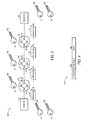
- a particular intermediate provider network 18 may include several communication nodes 20, here shown as 20A, 20B, 20C, and 20D.
- the communication nodes 20A, 20B, 20C, and 20D include routing logic 40 to route the message 14 through the intermediate provider network 18 and authentication logic 42 that may authenticate the message 14.
- the routing logic 40 and the authentication logic 42 may be implemented in hardware logic (e.g., an application-specific integrated circuit (ASIC) and/or a programmable logic device (PLD) such as a field programmable gate array (FPGA) from Altera Corporation) and/or using software instructions executed by a microprocessor.
- ASIC application-specific integrated circuit
- PLD programmable logic device
- FPGA field programmable gate array
- Such instructions may be stored on any suitable article of manufacture, such as memory and/or storage in the form of read-only memory (ROM), random access memory (RAM), a hard drive, flash memory, and/or an optical storage medium.
- the communication node 20A may represent an ingress communication node that includes an ingress receiver (RX) 44 by which to receive the message 14 from an electronic device external to the intermediate provider network 18 (e.g., the sender 12 or another communication node 20 from a different intermediate provider network 18).
- the communication node 20A may implement multiprotocol label switching (MPLS).
- MPLS multiprotocol label switching
- the communication node 20A may operate as an ingress label switching router (LSR) that may determine the switched path through which the message 14 will travel in the intermediate provider network 18.
- LSR ingress label switching router
- the communication node 20A may perform any other suitable routing through the intermediate provider network 18.
- the intermediate provider network 18 is an optical transport network (OTN).
- the node 20A may include an optical transmitter (TX) 46 that may connect to one or more optical receivers (RX) 48 located in other communication nodes 20 (e.g., communication node 20B and communication node 20C).
- these nodes may also include optical transmitters (TX) 46, which themselves may be connected to other communication nodes 20 of the intermediate provider network 18 (e.g., communication node 20D).
- the communication node 20D may operate as an egress node.
- the intermediate provider network 18 operates using multiprotocol label switching (MPLS) routing
- the communication node 20D may operate as an egress label switching router (LSR).
- the communication node 20D may include an egress transmitter (TX) 52 with a connection to an electronic device external to the intermediate provider network 18 (e.g., the receiver 14 or another intermediate provider network 18).
- MPLS multiprotocol label switching
- LSR egress label switching router
- the message 14 traverses a switched path through communication nodes 20A, 20C, and 20D.
- the authentication logic 42 of the communication node 20 may perform the intermediate authentication 24 discussed above with reference to FIG. 1 . In this way, the authentication logic 42 may identify whether the message 14 has been tampered with by a prior communication node 20. For instance, the communication node 20D may authenticate the message 14 using its corresponding authentication logic 42. If the authentication logic 42 detects that the message 14 is not authentic, it may be assumed that the message 14 was corrupted or tampered with prior to arriving at the communication node 20D.
- the intermediate provider network 18 may route around the communication node 20C, taking the message 14 through the communication 20B instead, and/or take other remedial action.
- the message 14 may be authenticated along the path through the intermediate provider networlc(s) 18 in a variety of ways.
- a system 60 shown in FIG. 3 which represents one example of the system 10 of FIG. 1 , allows the intermediate provider networks 18 to authenticate the message 14 using the same end-to-end authentication scheme employed by the sender 12 and the receiver 16.
- the sender 12 holds an end-to-end encryption key E 62 and an authentication key A1 64.
- the receiver 16 holds a corresponding encryption key E 62 and a corresponding authentication key A1 64.
- Each of the intermediate provider networks 18 also holds the authentication key A1 64.
- the authentication scheme may be referred to as a symmetric authentication scheme (e.g., Advanced Encryption Standard (AES)) that may be less computationally expensive than asymmetric authentication schemes (e.g., public-private authentication).
- AES Advanced Encryption Standard
- the authentication scheme may be asymmetric and use distinct public-private keys.
- the encryption keys E 62 and the authentication keys A1 64 may be changed occasionally over time.
- the message 14 when the sender 12 encrypts and authenticates the message 14, the message 14 generally may have a format illustrated in FIG. 4 .
- the message 14 may include, for example, at least some data 66 and a corresponding authentication tag 68.
- the message 14 may include many other components, which may be used for routing and encryption, among other things.
- the authentication tag 68 which may also be referred to as a digital signature, is generated when the sender 12 processes the data 30 using an authentication key.
- the authentication tag 68 is specific to the data 30 and the particular authentication key.
- the intermediate provider networks 18 and/or the receiver 16, given a corresponding authentication key may determine whether the authentication tag 68 does, in fact, properly authenticate the message 14.
- the data 30 used to generate the authentication tag 68 may represent data that previously has been encrypted by the encryption key E 62.
- the encryption key E 62 may be distributed to the sender 12 and receiver 16, respectively, in any suitable manner (block 72).
- the encryption key E 62 may be distributed, for example, through any suitable form of public-private key encryption (e.g., Diffie-Hellman) or any other suitable key distribution techniques.
- the encryption key E 62 may be propagated between the sender 12 and the receiver 16 by sending the encryption key E 62 through a separate message from the sender 12 to the receiver 16 that is encrypted using a public-private key authentication scheme.
- the authentication key A1 64 may be distributed to the sender 12 and the intermediate provider networlc(s) 18 and the receiver 16 (block 74).
- the authentication key A1 64 also may be distributed, for example, through any suitable form of public-private key encryption or any other suitable key distribution techniques.
- the sender 12 may encrypt the message 14 using the encryption key E 62 and digitally sign the message 14 using the authentication key A1 64 (block 76) before transmitting the message 14 out toward the receiver 16 (block 78).
- each communication node 20 may perform some form of authentication using the authentication logic 42 and the authentication key A1 64 to identify whether a prior communication node 20 has tampered with the message 14. That is, if a communication node 20 identifies that the message 14 is not authentic, the communication node 20 may indicate that a prior communication node 20 has been compromised and the intermediate provider network 18 take some form of remedial action (e.g., route around the troublesome communication node 20). In another example, all or a subset of communication nodes 20 may periodically, randomly, or otherwise statistically sample messages 14 passing through the communication nodes 20 to authenticate the messages 14.
- the receiver 16 may decrypt the message 14 using the encryption key E 62 and authenticate the message using the authentication key A1 64 (block 82).
- the sender 12 may apply an additional digital signature using a second authentication key A2 84.
- the sender 12 may hold the encryption key E 62, the authentication key A1 64, and the authentication key A2 84.
- the receiver 16 holds the encryption key E 62 and the authentication key A1 64, while the intermediate provider networks 18 hold the second authentication key A2 84.
- the message 14 may include the data 66, the first authentication tag 68 generated using the authentication key A1 64, as well as an additional second authentication tag 86 generated using the authentication key A2 84. It should be appreciated that the message 14 may include other components used in routing and/or encrypting the message 14.
- the encryption key E 62 may be distributed to the sender 12 and receiver 16, respectively, in any suitable manner (block 92).
- the encryption key E 62 may be distributed, for example, through any suitable form of public-private key encryption (e.g., Diffie-Hellman) or any other suitable key distribution techniques.
- the encryption key E 62 may be propagated between the sender 12 and the receiver 16 by sending the encryption key E 62 through a separate message from the sender 12 to the receiver 16 that is encrypted using a public-private key authentication scheme.
- the authentication key A1 64 may be distributed to the sender 12 and the receiver 16 (block 94).
- the authentication key A1 64 also may be distributed, for example, through any suitable form of public-private key encryption or any other suitable key distribution techniques.
- the authentication key A2 84 may be similarly distributed using any suitable distribution technique to the sender 12 and the intermediate provider networks 18 (block 95).
- the authentication key A2 84 may be propagated between the sender 12 and the receiver 16 by sending the authentication key A2 84 through a separate message, encrypted using a public-private key authentication scheme, from the sender 12 to the intermediate provider networks 18.
- the sender 12 may encrypt the message 14 using the encryption key E 62 and digitally sign the message 14 using the authentication key A1 64 (block 96) before transmitting the message 14 out toward the receiver 16 (block 98).
- each communication node 20 may perform some form of authentication using the authentication logic 42 and the authentication key A2 84 to identify whether a prior communication node 20 has tampered with the message 14. That is, if a communication node 20 identifies that the message 14 is not authentic based on the second authentication tag 86 and the second authentication key A2 84, the communication node 20 may indicate that a prior communication node 20 has been compromised and the intermediate provider network 18 take some form of remedial action (e.g., route around the troublesome communication node 20).
- remedial action e.g., route around the troublesome communication node 20.
- all or a subset of communication nodes 20 may periodically, randomly, or otherwise statistically sample messages 14 passing through the communication nodes 20 to authenticate the messages 14. Doing so may consume fewer resources than authenticating every message 14 at every communication node 20.
- the receiver 16 may decrypt the message 14 using the encryption key E 62 and authenticate the message using the authentication key A1 64 (block 102).
- the message 14 may be authenticated at each communication node 20, some subset of the communication nodes 20, and/or according to some statistical sampling scheme of the communication nodes 20 (block 112). Occasionally, the message 14 may be identified as not authentic, which may enable the intermediate provider network 18 to identify one or more troublesome communication node(s) 20 as having tampered with or otherwise corrupted the message 14 (block 114). The intermediate provider network 18 may route around the troublesome node(s) 20 and/or may inform the sender 12 and/or receiver 16.
- a system 120 of FIG. 10 represents another example of the message authentication system 10 of FIG. 1 .
- the sender 12 holds the encryption key E 62 and the authentication key A1 64.
- the receiver 16 holds the corresponding encryption key E 62 and the corresponding authentication key A1 64.
- An authentication authority 122 holds an authentication key A2 124, an authentication key A3 126, and an authentication key A4 128.
- the intermediate provider networks 18 hold corresponding authentication key A2 124, authentication key A3 126, and authentication key A4 128.
- the communication nodes 20 of the intermediate provider networks 18 may use these authentication keys A2 124, A3 128, and A4 130, respectively, to generate authentication tag 2 136, authentication tag 3 138, and authentication tag 4 140.
- the authentication authority 122 may be able to independently verify the authenticity of the message 14 and/or issue guidance to the intermediate provider networks 18 using the authentication tags 136, 138, and 140, the message 14, and the authentication keys A2 124, A3 128, and A4 130.
- the system 120 of FIG. 10 is not mutually exclusive of the system 60 of FIG. 3 or the system 83 of FIG. 6 . That is, in some embodiments, the intermediate provider networks 18 may authenticate the message 14 using the end-to-end authentication key A1 64 while the authentication authority 122 may independently authenticate the message 14 based on the authentication keys A2 124, A3 126, and A4 128. Also, it may be appreciated that the system 120 of FIG. 10 may pass messages 14 having data 66 and an authentication tag 68, as illustrated in FIG. 4 and discussed further above.
- authentication keys other than the end-to-end authentication key A1 64 may be used to authenticate the message 14 as it passes through the intermediate provider networks 18, which may increase the security of the end-to-end authentication key A1 64, without appending additional authentication tags to the data 66 as it passes through the intermediate provider networks 18.
- the system 120 of FIG. 10 may operate, for example, as shown by a flowchart 150 of FIG. 11 .
- the encryption key E 62 may be distributed to the sender 12 and receiver 16, respectively, in any suitable manner (block 152).
- the encryption key E 62 may be distributed, for example, through any suitable form of public-private key encryption (e.g., Diffie-Hellman) or any other suitable key distribution techniques.
- the encryption key E 62 may be propagated between the sender 12 and the receiver 16 by sending the encryption key E 62 through a separate message from the sender 12 to the receiver 16 that is encrypted using a public-private key authentication scheme.
- the authentication key A1 64 may be distributed to the sender 12 and the receiver 16 (block 154).
- the authentication key A1 64 also may be distributed, for example, through any suitable form of public-private key encryption or any other suitable key distribution techniques.
- the authentication keys A2 124, A3 126, and A4 128 may be distributed to the intermediate provider network(s) 18 and the authentication authority 122 in any suitable manner, such as a form of public-private key encryption (block 158).
- the authentication authority 122 may coordinate the distribution of the various public-authentication key pairs.
- the sender 12 may encrypt the message 14 using the encryption key E 62 and digitally sign the message 14 using the encryption key A1 64 (block 158) before transmitting the message 14 out toward the receiver 16 and to the authentication authority (block 160).
- the sender 12 may send the message 14 either directly to the authentication authority 122 or via some other trusted network to the authentication authority 122.
- the authentication authority 122 may be located within or in direct or near-direct communication with the sender 12 to ensure that the authentication authority 122 receives a genuine, unchanged copy of the message 14.
- the authentication authority may authenticate the message 14 using the end-to-end authentication key A1 64 or some other authentication key to ensure that the authentication authority 122 receives a genuine, unchanged copy of the message 14.
- the various communication nodes 20 of the intermediate provider networks 18 may generate the authentication tags 136, 138, and/or 140 and send them to the authentication authority 122 (block 162). In one example, this may take place at each communication node 20 using the authentication logic 42 and the particular authentication key A2 124, A3 126, or A4 128. In another example, all or a subset of communication nodes 20 may periodically, randomly, or otherwise statistically sample messages 14 to generate the authentication tags 136, 138, and/or 140. Doing so may consume fewer resources than generating the authentication tags 136, 138, and/or 140 for every message 14 at every communication node 20. The intermediate provider networks 18 may send the authentication tags 136, 138, and/or 140 to the authentication authority 122 in any suitable way.
- the authentication authority 122 can identify whether the authentication tags 136, 138, and/or 140 properly reflect the original message 14 sent by the sender 12 (block 164). If the message 14 has been tampered with by any troublesome communication nodes 20 of the intermediate provider network(s) 18, the authentication authority 122 can detect that the authentication tags 136, 138, and/or 140 do not match the expected values in relation to the copy of the message 14 held by the authentication authority.
- the authentication authority 122 may verify the authenticity of the message 14 simply by receiving the authentication tags 136, 138, and/or 140 from the intermediate provider networks 18, which may consume less bandwidth than transmitting the entire message 14 to the authentication authority from the intermediate provider networks 18.
- the receiver 16 may decrypt the message 14 using the encryption key E 62 and authenticate the message using the authentication key A1 64 (block 166).
- the message 14 may be authenticated at each communication node 20, some subset of the communication nodes 20, and/or according to some statistical sampling scheme of the communication nodes 20 by observing the authentication tags 136, 138, and/or 140 in the authentication authority 122 (block 192). Occasionally, the message 14 may be identified as not authentic, which may enable the authentication authority 122 to identify one or more troublesome communication node(s) 20 and/or troublesome intermediate provider network(s) 18 as having tampered with or otherwise corrupted the message 14 (block 194). The authentication authority 122 may use this information to cause remedial action.
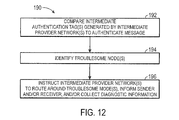
- the authentication authority 122 may instruct the intermediate provider network 18 to route around the troublesome communication node(s) 20 or otherwise inform the sender 12, receiver 16, and/or intermediate provider networks 18 of the troublesome communication node(s) 20 and/or troublesome intermediate provider network(s) 18 to enable them to take remedial action (block 196).
- the sender 12 may modify the data 30 of the message 14 in an effort to conduct a diagnostic evaluation of the nature of the tampering and/or the intermediate provider networlc(s) 18 that are not compromised may avoid sending the message 14 through intermediate provider network(s) 18 that are compromised, and so forth.
- knowledge of a compromised or troublesome communication node 20 may be used to identify an underlying entity that may have caused the communication node 20 to become compromised.
Landscapes
- Engineering & Computer Science (AREA)
- Computer Security & Cryptography (AREA)
- Computer Networks & Wireless Communication (AREA)
- Signal Processing (AREA)
- Computer Hardware Design (AREA)
- Computing Systems (AREA)
- General Engineering & Computer Science (AREA)
- Physics & Mathematics (AREA)
- Electromagnetism (AREA)
- Data Exchanges In Wide-Area Networks (AREA)
Abstract
Description
- This application claims the benefit of and priority to
U.S. Provisional Application No. 61/830,655 - This disclosure relates to detecting message tampering by a communication node in a switched-path network.
- This section is intended to introduce the reader to various aspects of art that may be related to various aspects of the present disclosure, which are described and/or claimed below. This discussion is believed to be helpful in providing the reader with background information to facilitate a better understanding of the various aspects of the present disclosure. Accordingly, it should be understood that these statements are to be read in this light, and not as admissions of prior art.
- When a message is sent over a network, such as the Internet, the message may pass through one or more large telecommunications provider networks. When a particular provider network receives the message as it travels from a sender to a receiver, the provider network may transmit the message over a switched path through several communication nodes controlled by that provider network. The switched-path network of the telecommunications provider may predefine the path through communication nodes that the message will take on its way through the telecommunications provider network. One example of such a switched-path network is an optical transport network (OTN).
- Although the sender may employ end-to-end encryption and authentication, individual communication nodes or even entire telecommunications provider networks could attempt to tamper with the message or otherwise behave unreliably. When the message is tampered with, the ultimate receiver of the message may use the end-to-end authentication to identify that the message is not authentic and, as such, that the message has been tampered with somewhere along the path between the sender and the receiver. Although end-to-end authentication can enable the receiver to identify that the message is not authentic, the source of the message tampering may be unknown. Indeed, in some circumstances, neither the sender, nor the receiver, nor the telecommunications provider may be able to identify a particular untrustworthy or unreliable communication node.
- A summary of certain embodiments disclosed herein is set forth below. It should be understood that these aspects are presented merely to provide the reader with a brief summary of these certain embodiments and that these aspects are not intended to limit the scope of this disclosure. Indeed, this disclosure may encompass a variety of aspects that may not be set forth below.
- Embodiments of the disclosure relate to systems, methods, and devices for authenticating a message transmitted through a switched-path network (e.g., an optical transport network (OTN)). By way of example, a message transmitted through communication nodes of a switched-path network may be authenticated, at least partially, by authentication logic of one or more of the communication nodes. By way of example, the communication nodes may identify whether a prior one of the communication nodes has tampered with the message. Additionally or alternatively, an authentication authority may authenticate the message based on an authentication tag generated by the one or more communication nodes.
- Various refinements of the features noted above may be made in relation to various aspects of the present disclosure. Further features may also be incorporated in these various aspects as well. These refinements and additional features may be made individually or in any combination. For instance, various features discussed below in relation to one or more of the illustrated embodiments may be incorporated into any of the above-described aspects of the present invention alone or in any combination. The brief summary presented above is intended only to familiarize the reader with certain aspects and contexts of embodiments of the present disclosure without limitation to the claimed subject matter.
- One exemplary embodiment of the disclosure relates to a method comprising
passing a message deriving from a sender and bound for a receiver through communication nodes of a switched-path network; and
when the message passes through each of one or more of the communication nodes, using authentication logic of that communication node to: - authenticate the message to identify whether the message has been tampered with or corrupted upon arrival at that communication node; or
- generate an authentication tag based on the message, wherein the authentication tag is configured to enable a third-party authentication authority to authenticate the message to identify whether the message has been tampered with or corrupted upon arrival at that communication node; or
- a combination thereof.
- According to another exemplary embodiment, the switched-path network comprises an optical transport network (OTN).
- According to a further exemplary embodiment, each of the one or more of the communication nodes authenticates the message using an end-to-end authentication key that is also configured to be used to authenticate the message at the receiver.
- According to a further exemplary embodiment, each of the one or more of the communication nodes authenticates the message using an authentication key other than an end-to-end authentication key that is configured to be used to authenticate the message at the receiver.
- According to a further exemplary embodiment, each of the one or more of the communication nodes generates the authentication tag using an authentication key other than an end-to-end authentication key that is configured to be used to authenticate the message at the receiver and sends the authentication tag to the third-party authentication authority, wherein authentication tag is configured to enable the third-party authentication authority to identify whether the message has been tampered with or corrupted by comparing the authentication tag to another authentication tag generated based on another copy of the message.
- According to a further exemplary embodiment, the one or more of the communication nodes comprises all of the communication nodes of the switched-path network.
- According to a further exemplary embodiment, each of the one or more of the communication nodes is configured to authenticate the message or generate the authentication tag, or the combination thereof, for every message passed through the switched-path network.
- According to an further exemplary embodiment, each of the one or more of the communication nodes is configured to authenticate the message or generate the authentication tag, or the combination thereof, at a periodic, random, or statistical sampling interval of messages passed through the switched-path network.
- According to a further exemplary embodiment, comprising, using at least one of the one or more communication nodes or using the authentication authority, or both, determining that a communication node prior to one of the one or more communication nodes is a troublesome communication node that has tampered with or corrupted the message when the message is identified as not authentic upon reaching the one of the one or more communication nodes.
- According to a further exemplary embodiment, which is a more detailed implementation of the previous exemplary embodiment, the method further comprises using a control plane of the switched-path network, routing future messages around the troublesome communication node to prevent or reduce tampering with or corruption of the future messages.
- Another embodiment of the disclosure relates to an authentication authority that:
- receives a first copy of a message from a sender;
- generates a first authentication tag using the first copy of the message and a first authentication key; and
- identifies whether a second copy of the message is authentic when the second copy of the message passes through one of a plurality of communication nodes of a first switched-path network by:
- receiving a second authentication tag generated by the one of the plurality of communication nodes of the first switched-path network using the second copy of the message and the first authentication key;
- comparing the first authentication tag and the second authentication tag;
- identifying the second copy of the message as being authentic when the first authentication tag matches the second authentication tag; and
- identifying the second copy of the message as not being authentic when the first authentication tag does not match the second authentication tag.
- The authentication authority may be for example comprised in a system.
- According to a further embodiment, the authentication authority:
- generates a third authentication tag using the first copy of the message and a second authentication key; and
- identifies whether the second copy of the message is authentic when the second copy of the message passes through one of a plurality of communication nodes of a second switched-path network by:
- receiving a fourth authentication tag generated by the one of the plurality of communication nodes of the second switched-path network using the second copy of the message and the second authentication key;
- comparing the third authentication tag and the fourth authentication tag; identifying the second copy of the message as being authentic when the third authentication tag matches the fourth authentication tag; and
- identifying the second copy of the message as not being authentic when the third authentication tag does not match the fourth authentication tag.
- According to a further exemplary embodiment, the authentication authority determines that a communication node prior to the one of the plurality of communication nodes has tampered with the second copy of the message when the authentication authority identifies that the second copy of the message is not authentic when the second copy of the message passes through the one of the plurality of communication nodes of the first switched-path network.
- According to a further exemplary embodiment, the authentication authority determines that a different switched-path network prior to the first switched path network has tampered with the second copy of the message when the authentication authority identifies that the second copy of the message is not authentic when the second copy of the message passes through the one of the plurality of communication nodes of the first switched-path network.
- According to a further embodiment, the authentication authority identifies whether the second copy of the message is authentic when the second copy of the message passes through all of the plurality of communication nodes of the first switched-path network in the same manner as when the second copy of the message passes through the one of the plurality of communication nodes of the first switched-path network.
- According to a further embodiment, the authentication authority receives the first copy of the message directly from the sender to ensure that the first copy of the message is a genuine copy of the message.
- According to a further embodiment, authentication authority, after receiving the first copy of the message but before generating the first authentication tag, verifies that the first copy of the message is a genuine copy of the message by authenticating the first copy of the message using a fourth, end-to-end, authentication key, wherein the first copy of the message comprises an end-to-end authentication tag generated by the sender using the fourth, end-to-end, authentication key.
- According to another embodiment, a system comprising the authentication authority further comprises the first switched-path network, wherein the first switched-path network comprises the plurality of communication nodes, wherein the one of the plurality of communication nodes:
- generates the second authentication tag using the second copy of the message and the first authentication key;
- sends the second authentication tag to the authentication authority to enable the authentication authority to identify whether the second copy of the message is authentic; and
- identifies, independently of the authentication authority, whether the second copy of the message is authentic using a fourth, end-to-end, authentication key, wherein the second copy of the message comprises an end-to-end authentication tag generated by the sender using the fourth, end-to-end, authentication key.
- Another exemplary embodiment of the disclosure provides an optical transport network comprising a plurality of switched-path optical communication nodes that pass a message routed in a switched path through the communication nodes, wherein at least one of the communication nodes comprises authentication logic to at least partially authenticate the message to enable identification of whether the message was tampered with or corrupted by a troublesome communication node that handled the message prior to the at least one of the communication nodes.
- According to a further embodiment, the authentication logic of the at least one of the communication nodes at least partially authenticates the message by:
- authenticating the message itself using a first authentication key also used for end-to-end authentication of the message by an end receiver of the message;
- authenticating the message itself using a second authentication key not used for end-to-end authentication of the message;
- authenticating the message itself using the first authentication key and the second authentication key; or
- enabling a third-party authentication authority to authenticate the message by:
- generating an authentication tag using a third authentication key also held by a third-party authentication authority; and
- sending the authentication tag to the third-party authentication authority to enable the third-party authentication authority to identify whether the message is authentic; or
- Another exemplary embodiment of the disclosure provides an electronic device comprising:
- network interface circuitry to enable the electronic device to operate as a communication node in a switched-path network by receiving and forwarding a message through the switched-path network; and
- authentication logic, wherein the authentication logic is tangibly embodied on a non-transitory computer-readable medium that is executed on a processor of the electronic device or programmed onto an integrated circuit, or both, and wherein the authentication logic:
- authenticates the message to identify whether the message has been tampered with or corrupted upon receipt at the electronic device; or
- generates an authentication tag based on the message, wherein the authentication tag provides sufficient information to enable a third-party authentication authority to authenticate the message to identify whether the message has been tampered with or corrupted upon receipt at the electronic device; or
- a combination thereof.
- According to a further embodiment of the electronic device, the network interface circuitry comprises an optical receiver, an optical transmitter, or both, to enable the electronic device to operate as the communication node in the switched-path network, wherein the switched-path network comprises an optical transport network (OTN).
- According to a further embodiment of the electronic device, the authentication logic authenticates the message using:
- an end-to-end authentication key that is also used to authenticate the message when the message reaches a destination beyond the switched-path network; or
- a second authentication key used in addition to the end-to-end authentication key; or both.
- According to a further embodiment of the electronic device, the authentication logic generates the authentication tag using an authentication key other than an end-to-end authentication key that is used to authenticate the message at a destination beyond the switched-path network and sends the authentication tag to the third-party authentication authority, wherein the authentication tag provides enough information to allow the third-party authentication authority to identify whether the message has been tampered with or corrupted by comparing the authentication tag to another authentication tag generated based on another copy of the message.
- Another exemplary embodiment of the disclosure provides an integrated circuit programmed with authentication logic for intermediate authentication of a message passing through a communication node along a switched path in a switched-path network, comprising:
- logic to authenticate the message to identify whether the message has been tampered with or corrupted upon receipt at the communication node by:
- authenticating the message using an end-to-end authentication key intermediately in the switched path that is also used to authenticate the message when the message reaches a destination beyond the switched-path network; or authenticating the message using a second authentication key intermediately in the switched path in addition to the end-to-end authentication key; or
both; or - logic to generate an authentication tag based on the message, wherein the authentication tag provides sufficient information to a third-party authentication authority to authenticate the message to identify whether the message has been tampered with or corrupted upon receipt at the electronic device; or
- a combination thereof.
- authenticating the message using an end-to-end authentication key intermediately in the switched path that is also used to authenticate the message when the message reaches a destination beyond the switched-path network; or authenticating the message using a second authentication key intermediately in the switched path in addition to the end-to-end authentication key; or
- According to a further embodiment, the integrated circuit comprises a programmable logic device and the authentication logic comprises data utilization circuitry of the programmable logic device that has been programmed to include the authentication logic.
- According to a further embodiment, the integrated circuit comprises an application-specific integrated circuit (ASIC).
- Various aspects of this disclosure may be better understood upon reading the following detailed description and upon reference to the drawings in which:
-
FIG. 1 is a block diagram of a system for detecting message tampering through intermediate provider networks when a message is sent from a sender to a receiver, in accordance with an embodiment; -
FIG. 2 is a plot diagram of an optical transport network (OTN) of an intermediate provider network that may employ intermediate authentication to identify troublesome communication nodes, in accordance with an embodiment; -
FIG. 3 is a block diagram illustrating a system for authenticating the message between the sender and the receiver through communication nodes of the intermediate provider networks, in accordance with an embodiment; -
FIG. 4 is a schematic diagram of the message sent through the system ofFIG. 3 , in accordance with an embodiment; -
FIG. 5 is a flowchart of a method for detecting troublesome communication nodes using the system shown inFIG. 3 , in accordance with an embodiment; -
FIG. 6 is a block diagram illustrating a system for authenticating the message between the sender and the receiver through communication nodes of the intermediate provider networks, in accordance with an embodiment; -
FIG. 7 is a schematic diagram of the message sent through the system ofFIG. 6 , in accordance with an embodiment; -
FIG. 8 is a flowchart of a method for detecting troublesome communication nodes using the system shown inFIG. 6 , in accordance with an embodiment; -
FIG. 9 is a flowchart of a method for responding to the detection of troublesome communication nodes, in accordance with an embodiment; -
FIG. 10 is a block diagram illustrating another system for authenticating the message between the sender and the receiver through communication nodes of the intermediate provider networks, in accordance with an embodiment; -
FIG. 11 is a flowchart of a method for detecting troublesome communication nodes using the system ofFIG. 10 , in accordance with an embodiment; and -
FIG. 12 is a flowchart of a method for responding to the detection of a troublesome communication node, in accordance with an embodiment. - One or more specific embodiments will be described below. In an effort to provide a concise description of these embodiments, not all features of an actual implementation are described in the specification. It should be appreciated that in the development of any such actual implementation, as in any engineering or design project, numerous implementation-specific decisions must be made to achieve the developers' specific goals, such as compliance with system-related and business-related constraints, which may vary from one implementation to another. Moreover, it should be appreciated that such a development effort might be complex and time consuming, but would nevertheless be a routine undertaking of design, fabrication, and manufacture for those of ordinary skill having the benefit of this disclosure.
- When introducing elements of various embodiments of this disclosure, the articles "a," "an," and "the" are intended to mean that there are one or more of the elements. The terms "comprising," "including," and "having" are intended to be inclusive and mean that there may be additional elements other than the listed elements. Additionally, it should be understood that references to "one embodiment" or "an embodiment" of this disclosure are not intended to be interpreted as excluding the existence of additional embodiments that also incorporate the recited features.
- A message sent through a network (e.g., the Internet), by a sender, may pass through a number of communication nodes to reach a receiver. To detect troublesome communication nodes that could tamper with the message along the way, this disclosure describes various systems, methods, and devices to authenticate the message as it passes through communication nodes of intermediate (e.g., telecommunications) provider networks. When the message traverses an intermediate provider network, it may do so via a switched-path network. One example of a switched-path network is an optical transport network (OTN). In a switched-path network, the path the message will take may be defined or predefined when the message is initially received in the intermediate provider network. It is believed that predefining the network path of the message may enable a bad actor to tamper with the message by compromising a communication node of the switched-path network. To prevent tampering or corruption by troublesome communication nodes in the predefined message path, the intermediate provider network and/or an authentication authority may authenticate the message as it passes through the communication nodes. This intermediate message authentication may take place every time the message enters a new communication node or through some form of sampling (e.g., randomly sampling or sampling according to any suitable statistical model). By at least occasionally authenticating messages, troublesome communication node(s) may be identified. The intermediate provider network and/or the authentication authority may thereafter take action to ameliorate the effect of the troublesome nodes (e.g., cause network management software and/or a network control plane, which may run on one or more of the communication nodes or may be apart from the communication nodes, to route around the troublesome communication node(s) or identify a possible bad actor that has compromised the communication node).
- In one example, the sender may use end-to-end authentication to enable both the intermediate provider networks and the end receiver to authenticate the message. For instance, the sender may use a first authentication key to generate an authentication tag, which may also be referred to as a digital signature, by processing the data of the message according to the first authentication key. The intermediate provider networks may also use the first authentication key to determine whether the message has been tampered with. By authenticating the message at various communication nodes through the intermediate provider network, the intermediate provider network may identify that a previous communication node has tampered with or otherwise has corrupted the message.
- In another example, the sender may use end-to-end authentication to enable the receiver to authenticate the message and use other authentication to enable the intermediate provider networks to authenticate the message. For instance, the sender may use a first authentication key to generate a first authentication tag, which may also be referred to as a digital signature, by processing the data of the message according to the first authentication key. The sender may also use a second authentication key to generate a second authentication key to generate a second authentication key. The intermediate provider networks may use the second authentication key to determine whether the message has been tampered with. As in the previous example above, by authenticating the message at various communication nodes through the intermediate provider network, the intermediate provider network may identify that a previous communication node has tampered with or otherwise has corrupted the message.
- In another example, a separate authentication authority may identify troublesome communication nodes. For instance, each intermediate provider network and/or communication nodes of each intermediate provider network may authenticate the message using a different authentication key. The intermediate provider networks may generate authentication tags using these authentication keys and provide the authentication tags to the authentication authority. The authentication authority may authenticate the message using these authentication keys. When the authentication authority identifies that a message is not authentic, the authentication authority may identify which communication node and/or intermediate provider network has been compromised and/or is otherwise troublesome. The authentication authority may instruct the sender, receiver, and/or intermediate provider network that a troublesome communication node has been detected to enable remedial action.
- With this in mind,
FIG. 1 is a block diagram of amessage transmission system 10 that can detect and/or mitigate message tampering. Asender 12 may transmit amessage 14 to a receiver 16 (e.g., over the Internet) by way of intermediate provider networlc(s) 18. When themessage 14 reaches eachintermediate provider network 18, the message may be routed through a number ofcommunication nodes 20. In general, themessage 14 may be routed through thecommunication nodes 20 in a switched path that is predefined at the outset of traversing theintermediate provider network 18. In certain examples, theintermediate provider networks 18 may be networks controlled by large telecommunications entities and, in some embodiments, the networks may employ multiprotocol label switching (MPLS) networks. By way of example, one or more of theintermediate provider networks 18 may be optical transport networks (OTNs) that route themessage 14 over a label-switched path through thecommunication nodes 20. - The
sender 12 may initially encrypt and authenticate (e.g., digitally sign) 22 themessage 14 before sending themessage 14 to the intermediate provider networks 18. Theintermediate provider networks 18 may performintermediate message authentication 24 to authenticate themessage 14 and verify that themessage 14 has not been tampered with. Theintermediate message authentication 24 may take place in a variety of ways-for instance, using a common end-to-end authentication key, using additional authentication keys, and/or using different authentication keys and communication with an authentication authority. Various ways of performing theintermediate message authentication 24 will be discussed further below. Theintermediate message authentication 24 may be used to identify whether themessage 14 has been tampered with as it passes through thecommunication nodes 20 of the intermediate provider networks 18. Thereceiver 16 may perform a terminal decryption and authentication 26 of themessage 14 using the end-to-end encryption and authentication scheme. As such, thereceiver 16 may read the data provided in themessage 14 while also identifying whether themessage 14 has been tampered with. - When the
message 14 enters a particularintermediate provider network 18, themessage 14 may be authenticated by thecommunication nodes 20. A particularintermediate provider network 18 may include a number ofcommunication nodes 20 that may both route themessage 14 through theintermediate provider network 18 and authenticate themessage 14. For instance, as shown inFIG. 2 , anintermediate provider network 18 may includeseveral communication nodes 20, here shown as 20A, 20B, 20C, and 20D. Thecommunication nodes logic 40 to route themessage 14 through theintermediate provider network 18 andauthentication logic 42 that may authenticate themessage 14. Therouting logic 40 and theauthentication logic 42 may be implemented in hardware logic (e.g., an application-specific integrated circuit (ASIC) and/or a programmable logic device (PLD) such as a field programmable gate array (FPGA) from Altera Corporation) and/or using software instructions executed by a microprocessor. Such instructions may be stored on any suitable article of manufacture, such as memory and/or storage in the form of read-only memory (ROM), random access memory (RAM), a hard drive, flash memory, and/or an optical storage medium. - The
communication node 20A may represent an ingress communication node that includes an ingress receiver (RX) 44 by which to receive themessage 14 from an electronic device external to the intermediate provider network 18 (e.g., thesender 12 or anothercommunication node 20 from a different intermediate provider network 18). In some embodiments, thecommunication node 20A may implement multiprotocol label switching (MPLS). As such, thecommunication node 20A may operate as an ingress label switching router (LSR) that may determine the switched path through which themessage 14 will travel in theintermediate provider network 18. In other embodiments, thecommunication node 20A may perform any other suitable routing through theintermediate provider network 18. - In the example of
FIG. 2 , theintermediate provider network 18 is an optical transport network (OTN). As such, thenode 20A may include an optical transmitter (TX) 46 that may connect to one or more optical receivers (RX) 48 located in other communication nodes 20 (e.g.,communication node 20B andcommunication node 20C). Likewise, these nodes may also include optical transmitters (TX) 46, which themselves may be connected toother communication nodes 20 of the intermediate provider network 18 (e.g.,communication node 20D). Thecommunication node 20D may operate as an egress node. For instance, when theintermediate provider network 18 operates using multiprotocol label switching (MPLS) routing, thecommunication node 20D may operate as an egress label switching router (LSR). Thecommunication node 20D may include an egress transmitter (TX) 52 with a connection to an electronic device external to the intermediate provider network 18 (e.g., thereceiver 14 or another intermediate provider network 18). - In the example of
FIG. 2 , themessage 14 traverses a switched path throughcommunication nodes communication node 20, or some subset of thecommunication nodes 20, in the switched path traversed by themessage 14, theauthentication logic 42 of thecommunication node 20 may perform theintermediate authentication 24 discussed above with reference toFIG. 1 . In this way, theauthentication logic 42 may identify whether themessage 14 has been tampered with by aprior communication node 20. For instance, thecommunication node 20D may authenticate themessage 14 using itscorresponding authentication logic 42. If theauthentication logic 42 detects that themessage 14 is not authentic, it may be assumed that themessage 14 was corrupted or tampered with prior to arriving at thecommunication node 20D. This may suggest, for example, that thecommunication node 20C has been compromised, and is tampering with the data. Theintermediate provider network 18 thus may route around thecommunication node 20C, taking themessage 14 through thecommunication 20B instead, and/or take other remedial action. - As noted above, the
message 14 may be authenticated along the path through the intermediate provider networlc(s) 18 in a variety of ways. Asystem 60 shown inFIG. 3 , which represents one example of thesystem 10 ofFIG. 1 , allows theintermediate provider networks 18 to authenticate themessage 14 using the same end-to-end authentication scheme employed by thesender 12 and thereceiver 16. In thesystem 60 ofFIG. 3 , thesender 12 holds an end-to-endencryption key E 62 and anauthentication key A1 64. Thereceiver 16 holds a correspondingencryption key E 62 and a correspondingauthentication key A1 64. Each of theintermediate provider networks 18 also holds theauthentication key A1 64. In this configuration, the authentication scheme may be referred to as a symmetric authentication scheme (e.g., Advanced Encryption Standard (AES)) that may be less computationally expensive than asymmetric authentication schemes (e.g., public-private authentication). In other examples, however, the authentication scheme may be asymmetric and use distinct public-private keys. Moreover, it should be understood that theencryption keys E 62 and theauthentication keys A1 64 may be changed occasionally over time. - In the example of
FIG. 3 , when thesender 12 encrypts and authenticates themessage 14, themessage 14 generally may have a format illustrated inFIG. 4 . Themessage 14 may include, for example, at least somedata 66 and acorresponding authentication tag 68. Although not shown inFIG. 4 , themessage 14 may include many other components, which may be used for routing and encryption, among other things. Theauthentication tag 68, which may also be referred to as a digital signature, is generated when thesender 12 processes the data 30 using an authentication key. Theauthentication tag 68 is specific to the data 30 and the particular authentication key. Thus, theintermediate provider networks 18 and/or thereceiver 16, given a corresponding authentication key, may determine whether theauthentication tag 68 does, in fact, properly authenticate themessage 14. As should be appreciated, the data 30 used to generate theauthentication tag 68 may represent data that previously has been encrypted by theencryption key E 62. - Still considering the example of
FIG. 3 , as illustrated in aflowchart 70 ofFIG. 5 , theencryption key E 62 may be distributed to thesender 12 andreceiver 16, respectively, in any suitable manner (block 72). Theencryption key E 62 may be distributed, for example, through any suitable form of public-private key encryption (e.g., Diffie-Hellman) or any other suitable key distribution techniques. For instance, theencryption key E 62 may be propagated between thesender 12 and thereceiver 16 by sending theencryption key E 62 through a separate message from thesender 12 to thereceiver 16 that is encrypted using a public-private key authentication scheme. Similarly, theauthentication key A1 64 may be distributed to thesender 12 and the intermediate provider networlc(s) 18 and the receiver 16 (block 74). Theauthentication key A1 64 also may be distributed, for example, through any suitable form of public-private key encryption or any other suitable key distribution techniques. When theencryption key E 62 and theauthentication key A1 64 have been distributed, thesender 12 may encrypt themessage 14 using theencryption key E 62 and digitally sign themessage 14 using the authentication key A1 64 (block 76) before transmitting themessage 14 out toward the receiver 16 (block 78). - As the
message 14 is travelling through thecommunication nodes 20 of the intermediate provider network(s) 18, thevarious communication nodes 20 may authenticate the message 14 (block 80). For example, eachcommunication node 20 may perform some form of authentication using theauthentication logic 42 and theauthentication key A1 64 to identify whether aprior communication node 20 has tampered with themessage 14. That is, if acommunication node 20 identifies that themessage 14 is not authentic, thecommunication node 20 may indicate that aprior communication node 20 has been compromised and theintermediate provider network 18 take some form of remedial action (e.g., route around the troublesome communication node 20). In another example, all or a subset ofcommunication nodes 20 may periodically, randomly, or otherwise statisticallysample messages 14 passing through thecommunication nodes 20 to authenticate themessages 14. Doing so may consume fewer resources than authenticating everymessage 14 at everycommunication node 20. When themessage 14 has finished traversing theintermediate provider networks 18 and arrives at thereceiver 16, thereceiver 16 may decrypt themessage 14 using theencryption key E 62 and authenticate the message using the authentication key A1 64 (block 82). - Additionally or alternatively, as shown in a
system 83 ofFIG. 6 , thesender 12 may apply an additional digital signature using a secondauthentication key A2 84. Thus, thesender 12 may hold theencryption key E 62, theauthentication key A1 64, and theauthentication key A2 84. Thereceiver 16 holds theencryption key E 62 and theauthentication key A1 64, while theintermediate provider networks 18 hold the secondauthentication key A2 84. - When the
sender 12 encrypts and authenticates themessage 14, two authentication tags may be generated, as shown inFIG. 7 . Namely, themessage 14 may include thedata 66, thefirst authentication tag 68 generated using theauthentication key A1 64, as well as an additionalsecond authentication tag 86 generated using theauthentication key A2 84. It should be appreciated that themessage 14 may include other components used in routing and/or encrypting themessage 14. - In an example shown in a
flowchart 90 ofFIG. 8 , theencryption key E 62 may be distributed to thesender 12 andreceiver 16, respectively, in any suitable manner (block 92). Theencryption key E 62 may be distributed, for example, through any suitable form of public-private key encryption (e.g., Diffie-Hellman) or any other suitable key distribution techniques. For instance, theencryption key E 62 may be propagated between thesender 12 and thereceiver 16 by sending theencryption key E 62 through a separate message from thesender 12 to thereceiver 16 that is encrypted using a public-private key authentication scheme. Similarly, theauthentication key A1 64 may be distributed to thesender 12 and the receiver 16 (block 94). Theauthentication key A1 64 also may be distributed, for example, through any suitable form of public-private key encryption or any other suitable key distribution techniques. Theauthentication key A2 84 may be similarly distributed using any suitable distribution technique to thesender 12 and the intermediate provider networks 18 (block 95). For example, theauthentication key A2 84 may be propagated between thesender 12 and thereceiver 16 by sending theauthentication key A2 84 through a separate message, encrypted using a public-private key authentication scheme, from thesender 12 to the intermediate provider networks 18. When theencryption key E 62, theauthentication key A1 64, and theauthentication key A2 84 have been distributed, thesender 12 may encrypt themessage 14 using theencryption key E 62 and digitally sign themessage 14 using the authentication key A1 64 (block 96) before transmitting themessage 14 out toward the receiver 16 (block 98). - As the
message 14 is travelling through thecommunication nodes 20 of the intermediate provider network(s) 18, thevarious communication nodes 20 may authenticate the message 14 (block 100). For example, eachcommunication node 20 may perform some form of authentication using theauthentication logic 42 and theauthentication key A2 84 to identify whether aprior communication node 20 has tampered with themessage 14. That is, if acommunication node 20 identifies that themessage 14 is not authentic based on thesecond authentication tag 86 and the secondauthentication key A2 84, thecommunication node 20 may indicate that aprior communication node 20 has been compromised and theintermediate provider network 18 take some form of remedial action (e.g., route around the troublesome communication node 20). In another example, all or a subset ofcommunication nodes 20 may periodically, randomly, or otherwise statisticallysample messages 14 passing through thecommunication nodes 20 to authenticate themessages 14. Doing so may consume fewer resources than authenticating everymessage 14 at everycommunication node 20. When themessage 14 has finished traversing theintermediate provider networks 18 and arrives at thereceiver 16, thereceiver 16 may decrypt themessage 14 using theencryption key E 62 and authenticate the message using the authentication key A1 64 (block 102). - In other words, as described by a
flowchart 110 ofFIG. 9 , themessage 14 may be authenticated at eachcommunication node 20, some subset of thecommunication nodes 20, and/or according to some statistical sampling scheme of thecommunication nodes 20
(block 112). Occasionally, themessage 14 may be identified as not authentic, which may enable theintermediate provider network 18 to identify one or more troublesome communication node(s) 20 as having tampered with or otherwise corrupted the message 14 (block 114). Theintermediate provider network 18 may route around the troublesome node(s) 20 and/or may inform thesender 12 and/orreceiver 16. - A
system 120 ofFIG. 10 represents another example of themessage authentication system 10 ofFIG. 1 . In thesystem 120 ofFIG. 10 , as in thesystems 60 ofFIG. 3 and 83 ofFIG. 6 , thesender 12 holds theencryption key E 62 and theauthentication key A1 64. Thereceiver 16 holds the correspondingencryption key E 62 and the correspondingauthentication key A1 64. Anauthentication authority 122 holds anauthentication key A2 124, anauthentication key A3 126, and anauthentication key A4 128. Theintermediate provider networks 18 hold correspondingauthentication key A2 124,authentication key A3 126, andauthentication key A4 128. Thecommunication nodes 20 of theintermediate provider networks 18 may use theseauthentication keys A2 124,A3 128, and A4 130, respectively, to generateauthentication tag 2 136,authentication tag 3 138, and authentication tag 4 140. Theauthentication authority 122 may be able to independently verify the authenticity of themessage 14 and/or issue guidance to theintermediate provider networks 18 using the authentication tags 136, 138, and 140, themessage 14, and theauthentication keys A2 124,A3 128, and A4 130. - Moreover, it should be understood that the
system 120 ofFIG. 10 is not mutually exclusive of thesystem 60 ofFIG. 3 or thesystem 83 ofFIG. 6 . That is, in some embodiments, theintermediate provider networks 18 may authenticate themessage 14 using the end-to-endauthentication key A1 64 while theauthentication authority 122 may independently authenticate themessage 14 based on theauthentication keys A2 124,A3 126, andA4 128. Also, it may be appreciated that thesystem 120 ofFIG. 10 may passmessages 14 havingdata 66 and anauthentication tag 68, as illustrated inFIG. 4 and discussed further above. In this way, authentication keys other than the end-to-endauthentication key A1 64 may be used to authenticate themessage 14 as it passes through theintermediate provider networks 18, which may increase the security of the end-to-endauthentication key A1 64, without appending additional authentication tags to thedata 66 as it passes through the intermediate provider networks 18. - The
system 120 ofFIG. 10 may operate, for example, as shown by aflowchart 150 ofFIG. 11 . Theencryption key E 62 may be distributed to thesender 12 andreceiver 16, respectively, in any suitable manner (block 152). Theencryption key E 62 may be distributed, for example, through any suitable form of public-private key encryption (e.g., Diffie-Hellman) or any other suitable key distribution techniques. For instance, theencryption key E 62 may be propagated between thesender 12 and thereceiver 16 by sending theencryption key E 62 through a separate message from thesender 12 to thereceiver 16 that is encrypted using a public-private key authentication scheme. Similarly, theauthentication key A1 64 may be distributed to thesender 12 and the receiver 16 (block 154). Theauthentication key A1 64 also may be distributed, for example, through any suitable form of public-private key encryption or any other suitable key distribution techniques. Theauthentication keys A2 124,A3 126, andA4 128 may be distributed to the intermediate provider network(s) 18 and theauthentication authority 122 in any suitable manner, such as a form of public-private key encryption (block 158). By way of example, in one embodiment, theauthentication authority 122 may coordinate the distribution of the various public-authentication key pairs. - The
sender 12 may encrypt themessage 14 using theencryption key E 62 and digitally sign themessage 14 using the encryption key A1 64 (block 158) before transmitting themessage 14 out toward thereceiver 16 and to the authentication authority (block 160). To enable theauthentication authority 122 to authenticate themessage 14 as themessage 14 travels through theintermediate provider networks 18, thesender 12 may send themessage 14 either directly to theauthentication authority 122 or via some other trusted network to theauthentication authority 122. Thus, in some embodiments, theauthentication authority 122 may be located within or in direct or near-direct communication with thesender 12 to ensure that theauthentication authority 122 receives a genuine, unchanged copy of themessage 14. Additionally or alternatively, the authentication authority may authenticate themessage 14 using the end-to-endauthentication key A1 64 or some other authentication key to ensure that theauthentication authority 122 receives a genuine, unchanged copy of themessage 14. - The
various communication nodes 20 of theintermediate provider networks 18 may generate the authentication tags 136, 138, and/or 140 and send them to the authentication authority 122 (block 162). In one example, this may take place at eachcommunication node 20 using theauthentication logic 42 and the particularauthentication key A2 124,A3 126, orA4 128. In another example, all or a subset ofcommunication nodes 20 may periodically, randomly, or otherwise statisticallysample messages 14 to generate the authentication tags 136, 138, and/or 140. Doing so may consume fewer resources than generating the authentication tags 136, 138, and/or 140 for everymessage 14 at everycommunication node 20. Theintermediate provider networks 18 may send the authentication tags 136, 138, and/or 140 to theauthentication authority 122 in any suitable way. - Because the
authentication authority 122 holds a genuine copy of themessage 14 and theauthentication keys A2 124,A3 126, andA4 128, theauthentication authority 122 can identify whether the authentication tags 136, 138, and/or 140 properly reflect theoriginal message 14 sent by the sender 12 (block 164). If themessage 14 has been tampered with by anytroublesome communication nodes 20 of the intermediate provider network(s) 18, theauthentication authority 122 can detect that the authentication tags 136, 138, and/or 140 do not match the expected values in relation to the copy of themessage 14 held by the authentication authority. As such, theauthentication authority 122 may verify the authenticity of themessage 14 simply by receiving the authentication tags 136, 138, and/or 140 from theintermediate provider networks 18, which may consume less bandwidth than transmitting theentire message 14 to the authentication authority from the intermediate provider networks 18. When themessage 14 has finished traversing theintermediate provider networks 18 and arrives at thereceiver 16, thereceiver 16 may decrypt themessage 14 using theencryption key E 62 and authenticate the message using the authentication key A1 64 (block 166). - Thus, as described by a
flowchart 190 ofFIG. 12 , themessage 14 may be authenticated at eachcommunication node 20, some subset of thecommunication nodes 20, and/or according to some statistical sampling scheme of thecommunication nodes 20 by observing the authentication tags 136, 138, and/or 140 in the authentication authority 122 (block 192). Occasionally, themessage 14 may be identified as not authentic, which may enable theauthentication authority 122 to identify one or more troublesome communication node(s) 20 and/or troublesome intermediate provider network(s) 18 as having tampered with or otherwise corrupted the message 14 (block 194). Theauthentication authority 122 may use this information to cause remedial action. For example, theauthentication authority 122 may instruct theintermediate provider network 18 to route around the troublesome communication node(s) 20 or otherwise inform thesender 12,receiver 16, and/orintermediate provider networks 18 of the troublesome communication node(s) 20 and/or troublesome intermediate provider network(s) 18 to enable them to take remedial action (block 196). By way of example, thesender 12 may modify the data 30 of themessage 14 in an effort to conduct a diagnostic evaluation of the nature of the tampering and/or the intermediate provider networlc(s) 18 that are not compromised may avoid sending themessage 14 through intermediate provider network(s) 18 that are compromised, and so forth. Additionally or alternatively, knowledge of a compromised ortroublesome communication node 20 may be used to identify an underlying entity that may have caused thecommunication node 20 to become compromised.
Claims (15)
- A method comprising the steps of:passing a message deriving from a sender and bound for a receiver through communication nodes of a switched-path network; andwhen the message passes through each of one or more of the communication nodes, using authentication logic of that communication node to:authenticate the message to identify whether the message has been tampered with or corrupted upon arrival at that communication node; orgenerate an authentication tag based on the message, wherein the authentication tag is configured to enable a third-party authentication authority to authenticate the message to identify whether the message has been tampered with or corrupted upon arrival at that communication node; ora combination thereof.
- The method of claim 1, wherein the switched-path network comprises an optical transport network.
- The method of claim 1, wherein each of the one or more of the communication nodes authenticates the message using an end-to-end authentication key that is also configured to be used to authenticate the message at the receiver.
- The method of claim 1, wherein each of the one or more of the communication nodes authenticates the message using an authentication key other than an end-to-end authentication key that is configured to be used to authenticate the message at the receiver.
- The method of claim 1, wherein each of the one or more of the communication nodes generates the authentication tag using an authentication key other than an end-to-end authentication key that is configured to be used to authenticate the message at the receiver and sends the authentication tag to the third-party authentication authority, wherein authentication tag is configured to enable the third-party authentication authority to identify whether the message has been tampered with or corrupted by comparing the authentication tag to another authentication tag generated based on another copy of the message.
- The method of claim 1, wherein the one or more of the communication nodes comprises all of the communication nodes of the switched-path network.
- The method of claim 1, wherein each of the one or more of the communication nodes is configured to authenticate the message or generate the authentication tag, or the combination thereof, for every message passed through the switched-path network.
- The method of claim 1, wherein each of the one or more of the communication nodes is configured to authenticate the message or generate the authentication tag, or the combination thereof, at a periodic, random, or statistical sampling interval of messages passed through the switched-path network.
- The method of claim 1, further comprising the steps of:using at least one of the one or more communication nodes or using the authentication authority, or both, anddetermining that a communication node prior to one of the one or more communication nodes is a troublesome communication node that has tampered with or corrupted the message when the message is identified as not authentic upon reaching the one of the one or more communication nodes.
- A system comprising:an authentication authority that:receives a first copy of a message from a sender;generates a first authentication tag using the first copy of the message and a first authentication key; andidentifies whether a second copy of the message is authentic when the second copy of the message passes through one of a plurality of communication nodes of a first switched-path network by:receiving a second authentication tag generated by the one of the plurality of communication nodes of the first switched-path network using the second copy of the message and the first authentication key;comparing the first authentication tag and the second authentication tag;identifying the second copy of the message as being authentic when the first authentication tag matches the second authentication tag; andidentifying the second copy of the message as not being authentic when the first authentication tag does not match the second authentication tag.
- The system of claim 10, wherein the authentication authority:generates a third authentication tag using the first copy of the message and a second authentication key; andidentifies whether the second copy of the message is authentic when the second copy of the message passes through one of a plurality of communication nodes of a second switched-path network by:receiving a fourth authentication tag generated by the one of the plurality of communication nodes of the second switched-path network using the second copy of the message and the second authentication key;comparing the third authentication tag and the fourth authentication tag;identifying the second copy of the message as being authentic when the third authentication tag matches the fourth authentication tag; andidentifying the second copy of the message as not being authentic when the third authentication tag does not match the fourth authentication tag.
- The system of claim 10, wherein the authentication authority determines that a communication node prior to the one of the plurality of communication nodes has tampered with the second copy of the message when the authentication authority identifies that the second copy of the message is not authentic when the second copy of the message passes through the one of the plurality of communication nodes of the first switched-path network.
- The system of claim 10, wherein the authentication authority determines that a different switched-path network prior to the first switched path network has tampered with the second copy of the message when the authentication authority identifies that the second copy of the message is not authentic when the second copy of the message passes through the one of the plurality of communication nodes of the first switched-path network.
- The system of claim 10, wherein the authentication authority identifies whether the second copy of the message is authentic when the second copy of the message passes through all of the plurality of communication nodes of the first switched-path network in the same manner as when the second copy of the message passes through the one of the plurality of communication nodes of the first switched-path network.
- The system of claim 10, comprising the first switched-path network, wherein the first switched-path network comprises the plurality of communication nodes, wherein the one of the plurality of communication nodes:generates the second authentication tag using the second copy of the message and the first authentication key;sends the second authentication tag to the authentication authority to enable the authentication authority to identify whether the second copy of the message is authentic; andidentifies, independently of the authentication authority, whether the second copy of the message is authentic using a fourth, end-to-end, authentication key, wherein the second copy of the message comprises an end-to-end authentication tag generated by the sender using the fourth, end-to-end, authentication key.
Applications Claiming Priority (2)
| Application Number | Priority Date | Filing Date | Title |
|---|---|---|---|
| US201361830655P | 2013-06-04 | 2013-06-04 | |
| US14/137,641 US9391781B2 (en) | 2013-06-04 | 2013-12-20 | Systems and methods for intermediate message authentication in a switched-path network |
Publications (3)
| Publication Number | Publication Date |
|---|---|
| EP2811715A2 true EP2811715A2 (en) | 2014-12-10 |
| EP2811715A3 EP2811715A3 (en) | 2014-12-31 |
| EP2811715B1 EP2811715B1 (en) | 2018-11-14 |
Family
ID=50927936
Family Applications (1)
| Application Number | Title | Priority Date | Filing Date |
|---|---|---|---|
| EP14171083.0A Active EP2811715B1 (en) | 2013-06-04 | 2014-06-04 | Systems and methods for intermediate message authentication in a switched-path network |
Country Status (3)
| Country | Link |
|---|---|
| US (1) | US9391781B2 (en) |
| EP (1) | EP2811715B1 (en) |
| CN (1) | CN104219222B (en) |
Families Citing this family (5)
| Publication number | Priority date | Publication date | Assignee | Title |
|---|---|---|---|---|
| CN106301768B (en) * | 2015-05-18 | 2020-04-28 | 中兴通讯股份有限公司 | Method, device and system for updating key based on optical transport network OTN |
| CN106470198B (en) * | 2015-08-20 | 2021-02-23 | 中兴通讯股份有限公司 | Identity verification method, device and system of optical transport network |
| US10880207B2 (en) * | 2017-11-28 | 2020-12-29 | Cumulus Networks Inc. | Methods and systems for flow virtualization and visibility |
| US11122346B1 (en) * | 2020-06-25 | 2021-09-14 | Cisco Technology, Inc. | Attestation in optical transport network environments |
| CN113645133B (en) * | 2021-09-18 | 2023-06-27 | 迈普通信技术股份有限公司 | Message forwarding method, device, network equipment and computer readable storage medium |
Family Cites Families (7)
| Publication number | Priority date | Publication date | Assignee | Title |
|---|---|---|---|---|
| US20040268123A1 (en) | 2003-06-27 | 2004-12-30 | Nokia Corporation | Security for protocol traversal |
| US8813216B2 (en) * | 2004-12-16 | 2014-08-19 | International Business Machines Corporation | Network security protection |
| US8311214B2 (en) * | 2006-04-24 | 2012-11-13 | Motorola Mobility Llc | Method for elliptic curve public key cryptographic validation |
| CN101222331B (en) * | 2007-01-09 | 2013-04-24 | 华为技术有限公司 | Authentication server, method and system for bidirectional authentication in mesh network |
| CN101145915B (en) * | 2007-10-10 | 2011-08-10 | 中国科学院计算技术研究所 | An authentication system and method of trustable router |
| WO2010003713A1 (en) | 2008-06-16 | 2010-01-14 | Telefonaktiebolaget Lm Ericsson (Publ) | Sending media data via an intermediate node |
| US8984286B2 (en) * | 2012-06-28 | 2015-03-17 | International Business Machines Corporation | Message originator token verification |
-
2013
- 2013-12-20 US US14/137,641 patent/US9391781B2/en not_active Expired - Fee Related
-
2014
- 2014-06-04 EP EP14171083.0A patent/EP2811715B1/en active Active
- 2014-06-04 CN CN201410347443.8A patent/CN104219222B/en not_active Expired - Fee Related
Non-Patent Citations (1)
| Title |
|---|
| None |
Also Published As
| Publication number | Publication date |
|---|---|
| EP2811715B1 (en) | 2018-11-14 |
| EP2811715A3 (en) | 2014-12-31 |
| US9391781B2 (en) | 2016-07-12 |
| CN104219222A (en) | 2014-12-17 |
| US20140359297A1 (en) | 2014-12-04 |
| CN104219222B (en) | 2018-04-10 |
Similar Documents
| Publication | Publication Date | Title |
|---|---|---|
| US10887087B2 (en) | Secure and disruption-tolerant communications for unmanned underwater vehicles | |
| EP2823619B1 (en) | Policy for secure packet transmission using required node paths and cryptographic signatures | |
| EP3254418B1 (en) | Packet obfuscation and packet forwarding | |
| US7886145B2 (en) | Method and system for including security information with a packet | |
| WO2015120783A1 (en) | System and method for securing source routing using public key based digital signature | |
| US9391781B2 (en) | Systems and methods for intermediate message authentication in a switched-path network | |
| US11228431B2 (en) | Communication systems and methods for authenticating data packets within network flow | |
| CN111447235A (en) | Network device and network system | |
| US11115395B2 (en) | Cross-domain information transfer system and associated methods | |
| US10158610B2 (en) | Secure application communication system | |
| CN105743863A (en) | Method and device used for processing message | |
| JP2003069581A (en) | Method and apparatus for preventing unauthorized packet in wireless multi-hop network | |
| JP2005065004A (en) | ENCRYPTED COMMUNICATION DATA INSPECTION METHOD, ENCRYPTED COMMUNICATION DATA INSPECTION DEVICE, AND ENCRYPTED COMMUNICATION DATA INSPECTION PROGRAM | |
| US20260135840A1 (en) | Autonomous Quantum-Secure Mesh Networking System | |
| US9781076B2 (en) | Secure communication system | |
| KR20160050928A (en) | Method and Apparatus for Generating Data Packet Requiring Encryption in Short Distance Communications |
Legal Events
| Date | Code | Title | Description |
|---|---|---|---|
| PUAL | Search report despatched |
Free format text: ORIGINAL CODE: 0009013 |
|
| PUAI | Public reference made under article 153(3) epc to a published international application that has entered the european phase |
Free format text: ORIGINAL CODE: 0009012 |
|
| 17P | Request for examination filed |
Effective date: 20140604 |
|
| AK | Designated contracting states |
Kind code of ref document: A2 Designated state(s): AL AT BE BG CH CY CZ DE DK EE ES FI FR GB GR HR HU IE IS IT LI LT LU LV MC MK MT NL NO PL PT RO RS SE SI SK SM TR |
|
| AX | Request for extension of the european patent |
Extension state: BA ME |
|
| AK | Designated contracting states |
Kind code of ref document: A3 Designated state(s): AL AT BE BG CH CY CZ DE DK EE ES FI FR GB GR HR HU IE IS IT LI LT LU LV MC MK MT NL NO PL PT RO RS SE SI SK SM TR |
|
| AX | Request for extension of the european patent |
Extension state: BA ME |
|
| RIC1 | Information provided on ipc code assigned before grant |
Ipc: H04L 29/06 20060101AFI20141125BHEP Ipc: H04L 12/723 20130101ALI20141125BHEP |
|
| R17P | Request for examination filed (corrected) |
Effective date: 20150629 |
|
| RBV | Designated contracting states (corrected) |
Designated state(s): AL AT BE BG CH CY CZ DE DK EE ES FI FR GB GR HR HU IE IS IT LI LT LU LV MC MK MT NL NO PL PT RO RS SE SI SK SM TR |
|
| 17Q | First examination report despatched |
Effective date: 20160211 |
|
| STAA | Information on the status of an ep patent application or granted ep patent |
Free format text: STATUS: EXAMINATION IS IN PROGRESS |
|
| REG | Reference to a national code |
Ref country code: DE Ref legal event code: R079 Ref document number: 602014035888 Country of ref document: DE Free format text: PREVIOUS MAIN CLASS: H04L0029060000 Ipc: H04B0010850000 |
|
| RIC1 | Information provided on ipc code assigned before grant |
Ipc: H04L 12/723 20130101ALI20180502BHEP Ipc: H04L 9/32 20060101ALI20180502BHEP Ipc: H04L 29/06 20060101ALI20180502BHEP Ipc: H04B 10/85 20130101AFI20180502BHEP |
|
| GRAP | Despatch of communication of intention to grant a patent |
Free format text: ORIGINAL CODE: EPIDOSNIGR1 |
|
| STAA | Information on the status of an ep patent application or granted ep patent |
Free format text: STATUS: GRANT OF PATENT IS INTENDED |
|
| INTG | Intention to grant announced |
Effective date: 20180608 |
|
| GRAS | Grant fee paid |
Free format text: ORIGINAL CODE: EPIDOSNIGR3 |
|
| GRAA | (expected) grant |
Free format text: ORIGINAL CODE: 0009210 |
|
| STAA | Information on the status of an ep patent application or granted ep patent |
Free format text: STATUS: THE PATENT HAS BEEN GRANTED |
|
| AK | Designated contracting states |
Kind code of ref document: B1 Designated state(s): AL AT BE BG CH CY CZ DE DK EE ES FI FR GB GR HR HU IE IS IT LI LT LU LV MC MK MT NL NO PL PT RO RS SE SI SK SM TR |
|
| REG | Reference to a national code |
Ref country code: CH Ref legal event code: EP Ref country code: AT Ref legal event code: REF Ref document number: 1066096 Country of ref document: AT Kind code of ref document: T Effective date: 20181115 |
|
| REG | Reference to a national code |
Ref country code: DE Ref legal event code: R096 Ref document number: 602014035888 Country of ref document: DE |
|
| REG | Reference to a national code |
Ref country code: IE Ref legal event code: FG4D |
|
| REG | Reference to a national code |
Ref country code: NL Ref legal event code: MP Effective date: 20181114 |
|
| REG | Reference to a national code |
Ref country code: LT Ref legal event code: MG4D |
|
| REG | Reference to a national code |
Ref country code: AT Ref legal event code: MK05 Ref document number: 1066096 Country of ref document: AT Kind code of ref document: T Effective date: 20181114 |
|
| PG25 | Lapsed in a contracting state [announced via postgrant information from national office to epo] |
Ref country code: AT Free format text: LAPSE BECAUSE OF FAILURE TO SUBMIT A TRANSLATION OF THE DESCRIPTION OR TO PAY THE FEE WITHIN THE PRESCRIBED TIME-LIMIT Effective date: 20181114 Ref country code: NO Free format text: LAPSE BECAUSE OF FAILURE TO SUBMIT A TRANSLATION OF THE DESCRIPTION OR TO PAY THE FEE WITHIN THE PRESCRIBED TIME-LIMIT Effective date: 20190214 Ref country code: LV Free format text: LAPSE BECAUSE OF FAILURE TO SUBMIT A TRANSLATION OF THE DESCRIPTION OR TO PAY THE FEE WITHIN THE PRESCRIBED TIME-LIMIT Effective date: 20181114 Ref country code: HR Free format text: LAPSE BECAUSE OF FAILURE TO SUBMIT A TRANSLATION OF THE DESCRIPTION OR TO PAY THE FEE WITHIN THE PRESCRIBED TIME-LIMIT Effective date: 20181114 Ref country code: BG Free format text: LAPSE BECAUSE OF FAILURE TO SUBMIT A TRANSLATION OF THE DESCRIPTION OR TO PAY THE FEE WITHIN THE PRESCRIBED TIME-LIMIT Effective date: 20190214 Ref country code: IS Free format text: LAPSE BECAUSE OF FAILURE TO SUBMIT A TRANSLATION OF THE DESCRIPTION OR TO PAY THE FEE WITHIN THE PRESCRIBED TIME-LIMIT Effective date: 20190314 Ref country code: LT Free format text: LAPSE BECAUSE OF FAILURE TO SUBMIT A TRANSLATION OF THE DESCRIPTION OR TO PAY THE FEE WITHIN THE PRESCRIBED TIME-LIMIT Effective date: 20181114 Ref country code: ES Free format text: LAPSE BECAUSE OF FAILURE TO SUBMIT A TRANSLATION OF THE DESCRIPTION OR TO PAY THE FEE WITHIN THE PRESCRIBED TIME-LIMIT Effective date: 20181114 Ref country code: FI Free format text: LAPSE BECAUSE OF FAILURE TO SUBMIT A TRANSLATION OF THE DESCRIPTION OR TO PAY THE FEE WITHIN THE PRESCRIBED TIME-LIMIT Effective date: 20181114 |
|
| PG25 | Lapsed in a contracting state [announced via postgrant information from national office to epo] |
Ref country code: GR Free format text: LAPSE BECAUSE OF FAILURE TO SUBMIT A TRANSLATION OF THE DESCRIPTION OR TO PAY THE FEE WITHIN THE PRESCRIBED TIME-LIMIT Effective date: 20190215 Ref country code: RS Free format text: LAPSE BECAUSE OF FAILURE TO SUBMIT A TRANSLATION OF THE DESCRIPTION OR TO PAY THE FEE WITHIN THE PRESCRIBED TIME-LIMIT Effective date: 20181114 Ref country code: SE Free format text: LAPSE BECAUSE OF FAILURE TO SUBMIT A TRANSLATION OF THE DESCRIPTION OR TO PAY THE FEE WITHIN THE PRESCRIBED TIME-LIMIT Effective date: 20181114 Ref country code: AL Free format text: LAPSE BECAUSE OF FAILURE TO SUBMIT A TRANSLATION OF THE DESCRIPTION OR TO PAY THE FEE WITHIN THE PRESCRIBED TIME-LIMIT Effective date: 20181114 Ref country code: NL Free format text: LAPSE BECAUSE OF FAILURE TO SUBMIT A TRANSLATION OF THE DESCRIPTION OR TO PAY THE FEE WITHIN THE PRESCRIBED TIME-LIMIT Effective date: 20181114 Ref country code: PT Free format text: LAPSE BECAUSE OF FAILURE TO SUBMIT A TRANSLATION OF THE DESCRIPTION OR TO PAY THE FEE WITHIN THE PRESCRIBED TIME-LIMIT Effective date: 20190314 |
|
| PG25 | Lapsed in a contracting state [announced via postgrant information from national office to epo] |
Ref country code: DK Free format text: LAPSE BECAUSE OF FAILURE TO SUBMIT A TRANSLATION OF THE DESCRIPTION OR TO PAY THE FEE WITHIN THE PRESCRIBED TIME-LIMIT Effective date: 20181114 Ref country code: PL Free format text: LAPSE BECAUSE OF FAILURE TO SUBMIT A TRANSLATION OF THE DESCRIPTION OR TO PAY THE FEE WITHIN THE PRESCRIBED TIME-LIMIT Effective date: 20181114 Ref country code: CZ Free format text: LAPSE BECAUSE OF FAILURE TO SUBMIT A TRANSLATION OF THE DESCRIPTION OR TO PAY THE FEE WITHIN THE PRESCRIBED TIME-LIMIT Effective date: 20181114 Ref country code: IT Free format text: LAPSE BECAUSE OF FAILURE TO SUBMIT A TRANSLATION OF THE DESCRIPTION OR TO PAY THE FEE WITHIN THE PRESCRIBED TIME-LIMIT Effective date: 20181114 |
|
| REG | Reference to a national code |
Ref country code: DE Ref legal event code: R097 Ref document number: 602014035888 Country of ref document: DE |
|
| PG25 | Lapsed in a contracting state [announced via postgrant information from national office to epo] |
Ref country code: RO Free format text: LAPSE BECAUSE OF FAILURE TO SUBMIT A TRANSLATION OF THE DESCRIPTION OR TO PAY THE FEE WITHIN THE PRESCRIBED TIME-LIMIT Effective date: 20181114 Ref country code: EE Free format text: LAPSE BECAUSE OF FAILURE TO SUBMIT A TRANSLATION OF THE DESCRIPTION OR TO PAY THE FEE WITHIN THE PRESCRIBED TIME-LIMIT Effective date: 20181114 Ref country code: SM Free format text: LAPSE BECAUSE OF FAILURE TO SUBMIT A TRANSLATION OF THE DESCRIPTION OR TO PAY THE FEE WITHIN THE PRESCRIBED TIME-LIMIT Effective date: 20181114 Ref country code: SK Free format text: LAPSE BECAUSE OF FAILURE TO SUBMIT A TRANSLATION OF THE DESCRIPTION OR TO PAY THE FEE WITHIN THE PRESCRIBED TIME-LIMIT Effective date: 20181114 |
|
| PGFP | Annual fee paid to national office [announced via postgrant information from national office to epo] |
Ref country code: FR Payment date: 20190604 Year of fee payment: 6 |
|
| PLBE | No opposition filed within time limit |
Free format text: ORIGINAL CODE: 0009261 |
|
| STAA | Information on the status of an ep patent application or granted ep patent |
Free format text: STATUS: NO OPPOSITION FILED WITHIN TIME LIMIT |
|
| 26N | No opposition filed |
Effective date: 20190815 |
|
| PG25 | Lapsed in a contracting state [announced via postgrant information from national office to epo] |
Ref country code: SI Free format text: LAPSE BECAUSE OF FAILURE TO SUBMIT A TRANSLATION OF THE DESCRIPTION OR TO PAY THE FEE WITHIN THE PRESCRIBED TIME-LIMIT Effective date: 20181114 |
|
| PG25 | Lapsed in a contracting state [announced via postgrant information from national office to epo] |
Ref country code: MC Free format text: LAPSE BECAUSE OF FAILURE TO SUBMIT A TRANSLATION OF THE DESCRIPTION OR TO PAY THE FEE WITHIN THE PRESCRIBED TIME-LIMIT Effective date: 20181114 |
|
| REG | Reference to a national code |
Ref country code: CH Ref legal event code: PL |
|
| REG | Reference to a national code |
Ref country code: BE Ref legal event code: MM Effective date: 20190630 |
|
| PG25 | Lapsed in a contracting state [announced via postgrant information from national office to epo] |
Ref country code: TR Free format text: LAPSE BECAUSE OF FAILURE TO SUBMIT A TRANSLATION OF THE DESCRIPTION OR TO PAY THE FEE WITHIN THE PRESCRIBED TIME-LIMIT Effective date: 20181114 |
|
| PG25 | Lapsed in a contracting state [announced via postgrant information from national office to epo] |
Ref country code: IE Free format text: LAPSE BECAUSE OF NON-PAYMENT OF DUE FEES Effective date: 20190604 |
|
| PG25 | Lapsed in a contracting state [announced via postgrant information from national office to epo] |
Ref country code: LI Free format text: LAPSE BECAUSE OF NON-PAYMENT OF DUE FEES Effective date: 20190630 Ref country code: CH Free format text: LAPSE BECAUSE OF NON-PAYMENT OF DUE FEES Effective date: 20190630 Ref country code: BE Free format text: LAPSE BECAUSE OF NON-PAYMENT OF DUE FEES Effective date: 20190630 Ref country code: LU Free format text: LAPSE BECAUSE OF NON-PAYMENT OF DUE FEES Effective date: 20190604 |
|
| PG25 | Lapsed in a contracting state [announced via postgrant information from national office to epo] |
Ref country code: FR Free format text: LAPSE BECAUSE OF NON-PAYMENT OF DUE FEES Effective date: 20200630 |
|
| PG25 | Lapsed in a contracting state [announced via postgrant information from national office to epo] |
Ref country code: CY Free format text: LAPSE BECAUSE OF FAILURE TO SUBMIT A TRANSLATION OF THE DESCRIPTION OR TO PAY THE FEE WITHIN THE PRESCRIBED TIME-LIMIT Effective date: 20181114 |
|
| PG25 | Lapsed in a contracting state [announced via postgrant information from national office to epo] |
Ref country code: HU Free format text: LAPSE BECAUSE OF FAILURE TO SUBMIT A TRANSLATION OF THE DESCRIPTION OR TO PAY THE FEE WITHIN THE PRESCRIBED TIME-LIMIT; INVALID AB INITIO Effective date: 20140604 Ref country code: MT Free format text: LAPSE BECAUSE OF FAILURE TO SUBMIT A TRANSLATION OF THE DESCRIPTION OR TO PAY THE FEE WITHIN THE PRESCRIBED TIME-LIMIT Effective date: 20181114 |
|
| PG25 | Lapsed in a contracting state [announced via postgrant information from national office to epo] |
Ref country code: MK Free format text: LAPSE BECAUSE OF FAILURE TO SUBMIT A TRANSLATION OF THE DESCRIPTION OR TO PAY THE FEE WITHIN THE PRESCRIBED TIME-LIMIT Effective date: 20181114 |
|
| P01 | Opt-out of the competence of the unified patent court (upc) registered |
Effective date: 20230531 |
|
| PGFP | Annual fee paid to national office [announced via postgrant information from national office to epo] |
Ref country code: GB Payment date: 20260604 Year of fee payment: 13 |
|
| PGFP | Annual fee paid to national office [announced via postgrant information from national office to epo] |
Ref country code: DE Payment date: 20260515 Year of fee payment: 13 |