EP2809708B1 - Halogenated organosilicon electrolytes, methods of using them, and electrochemical devices containing them - Google Patents
Halogenated organosilicon electrolytes, methods of using them, and electrochemical devices containing them Download PDFInfo
- Publication number
- EP2809708B1 EP2809708B1 EP13742989.0A EP13742989A EP2809708B1 EP 2809708 B1 EP2809708 B1 EP 2809708B1 EP 13742989 A EP13742989 A EP 13742989A EP 2809708 B1 EP2809708 B1 EP 2809708B1
- Authority
- EP
- European Patent Office
- Prior art keywords
- alkyl
- aryl
- group
- subscript
- lithium
- Prior art date
- Legal status (The legal status is an assumption and is not a legal conclusion. Google has not performed a legal analysis and makes no representation as to the accuracy of the status listed.)
- Active
Links
- 0 C*C(C1)*OC1=O Chemical compound C*C(C1)*OC1=O 0.000 description 2
Images




Classifications
-
- H—ELECTRICITY
- H01—ELECTRIC ELEMENTS
- H01M—PROCESSES OR MEANS, e.g. BATTERIES, FOR THE DIRECT CONVERSION OF CHEMICAL ENERGY INTO ELECTRICAL ENERGY
- H01M10/00—Secondary cells; Manufacture thereof
- H01M10/05—Accumulators with non-aqueous electrolyte
- H01M10/056—Accumulators with non-aqueous electrolyte characterised by the materials used as electrolytes, e.g. mixed inorganic/organic electrolytes
- H01M10/0564—Accumulators with non-aqueous electrolyte characterised by the materials used as electrolytes, e.g. mixed inorganic/organic electrolytes the electrolyte being constituted of organic materials only
- H01M10/0566—Liquid materials
- H01M10/0567—Liquid materials characterised by the additives
-
- C—CHEMISTRY; METALLURGY
- C07—ORGANIC CHEMISTRY
- C07F—ACYCLIC, CARBOCYCLIC OR HETEROCYCLIC COMPOUNDS CONTAINING ELEMENTS OTHER THAN CARBON, HYDROGEN, HALOGEN, OXYGEN, NITROGEN, SULFUR, SELENIUM OR TELLURIUM
- C07F7/00—Compounds containing elements of Groups 4 or 14 of the Periodic Table
- C07F7/02—Silicon compounds
- C07F7/08—Compounds having one or more C—Si linkages
- C07F7/0834—Compounds having one or more O-Si linkage
- C07F7/0838—Compounds with one or more Si-O-Si sequences
-
- C—CHEMISTRY; METALLURGY
- C07—ORGANIC CHEMISTRY
- C07F—ACYCLIC, CARBOCYCLIC OR HETEROCYCLIC COMPOUNDS CONTAINING ELEMENTS OTHER THAN CARBON, HYDROGEN, HALOGEN, OXYGEN, NITROGEN, SULFUR, SELENIUM OR TELLURIUM
- C07F7/00—Compounds containing elements of Groups 4 or 14 of the Periodic Table
- C07F7/02—Silicon compounds
- C07F7/08—Compounds having one or more C—Si linkages
- C07F7/12—Organo silicon halides
-
- C—CHEMISTRY; METALLURGY
- C07—ORGANIC CHEMISTRY
- C07F—ACYCLIC, CARBOCYCLIC OR HETEROCYCLIC COMPOUNDS CONTAINING ELEMENTS OTHER THAN CARBON, HYDROGEN, HALOGEN, OXYGEN, NITROGEN, SULFUR, SELENIUM OR TELLURIUM
- C07F7/00—Compounds containing elements of Groups 4 or 14 of the Periodic Table
- C07F7/02—Silicon compounds
- C07F7/08—Compounds having one or more C—Si linkages
- C07F7/12—Organo silicon halides
- C07F7/121—Preparation or treatment not provided for in C07F7/14, C07F7/16 or C07F7/20
- C07F7/123—Preparation or treatment not provided for in C07F7/14, C07F7/16 or C07F7/20 by reactions involving the formation of Si-halogen linkages
-
- H—ELECTRICITY
- H01—ELECTRIC ELEMENTS
- H01M—PROCESSES OR MEANS, e.g. BATTERIES, FOR THE DIRECT CONVERSION OF CHEMICAL ENERGY INTO ELECTRICAL ENERGY
- H01M10/00—Secondary cells; Manufacture thereof
- H01M10/05—Accumulators with non-aqueous electrolyte
- H01M10/052—Li-accumulators
-
- H—ELECTRICITY
- H01—ELECTRIC ELEMENTS
- H01M—PROCESSES OR MEANS, e.g. BATTERIES, FOR THE DIRECT CONVERSION OF CHEMICAL ENERGY INTO ELECTRICAL ENERGY
- H01M10/00—Secondary cells; Manufacture thereof
- H01M10/05—Accumulators with non-aqueous electrolyte
- H01M10/052—Li-accumulators
- H01M10/0525—Rocking-chair batteries, i.e. batteries with lithium insertion or intercalation in both electrodes; Lithium-ion batteries
-
- H—ELECTRICITY
- H01—ELECTRIC ELEMENTS
- H01M—PROCESSES OR MEANS, e.g. BATTERIES, FOR THE DIRECT CONVERSION OF CHEMICAL ENERGY INTO ELECTRICAL ENERGY
- H01M10/00—Secondary cells; Manufacture thereof
- H01M10/05—Accumulators with non-aqueous electrolyte
- H01M10/056—Accumulators with non-aqueous electrolyte characterised by the materials used as electrolytes, e.g. mixed inorganic/organic electrolytes
- H01M10/0564—Accumulators with non-aqueous electrolyte characterised by the materials used as electrolytes, e.g. mixed inorganic/organic electrolytes the electrolyte being constituted of organic materials only
-
- H—ELECTRICITY
- H01—ELECTRIC ELEMENTS
- H01M—PROCESSES OR MEANS, e.g. BATTERIES, FOR THE DIRECT CONVERSION OF CHEMICAL ENERGY INTO ELECTRICAL ENERGY
- H01M10/00—Secondary cells; Manufacture thereof
- H01M10/05—Accumulators with non-aqueous electrolyte
- H01M10/056—Accumulators with non-aqueous electrolyte characterised by the materials used as electrolytes, e.g. mixed inorganic/organic electrolytes
- H01M10/0564—Accumulators with non-aqueous electrolyte characterised by the materials used as electrolytes, e.g. mixed inorganic/organic electrolytes the electrolyte being constituted of organic materials only
- H01M10/0565—Polymeric materials, e.g. gel-type or solid-type
-
- H—ELECTRICITY
- H01—ELECTRIC ELEMENTS
- H01M—PROCESSES OR MEANS, e.g. BATTERIES, FOR THE DIRECT CONVERSION OF CHEMICAL ENERGY INTO ELECTRICAL ENERGY
- H01M4/00—Electrodes
- H01M4/02—Electrodes composed of, or comprising, active material
- H01M4/13—Electrodes for accumulators with non-aqueous electrolyte, e.g. for lithium-accumulators; Processes of manufacture thereof
- H01M4/131—Electrodes based on mixed oxides or hydroxides, or on mixtures of oxides or hydroxides, e.g. LiCoOx
-
- H—ELECTRICITY
- H01—ELECTRIC ELEMENTS
- H01M—PROCESSES OR MEANS, e.g. BATTERIES, FOR THE DIRECT CONVERSION OF CHEMICAL ENERGY INTO ELECTRICAL ENERGY
- H01M4/00—Electrodes
- H01M4/02—Electrodes composed of, or comprising, active material
- H01M2004/026—Electrodes composed of, or comprising, active material characterised by the polarity
- H01M2004/028—Positive electrodes
-
- H—ELECTRICITY
- H01—ELECTRIC ELEMENTS
- H01M—PROCESSES OR MEANS, e.g. BATTERIES, FOR THE DIRECT CONVERSION OF CHEMICAL ENERGY INTO ELECTRICAL ENERGY
- H01M2300/00—Electrolytes
- H01M2300/0017—Non-aqueous electrolytes
- H01M2300/0025—Organic electrolyte
-
- H—ELECTRICITY
- H01—ELECTRIC ELEMENTS
- H01M—PROCESSES OR MEANS, e.g. BATTERIES, FOR THE DIRECT CONVERSION OF CHEMICAL ENERGY INTO ELECTRICAL ENERGY
- H01M2300/00—Electrolytes
- H01M2300/0017—Non-aqueous electrolytes
- H01M2300/0065—Solid electrolytes
-
- Y—GENERAL TAGGING OF NEW TECHNOLOGICAL DEVELOPMENTS; GENERAL TAGGING OF CROSS-SECTIONAL TECHNOLOGIES SPANNING OVER SEVERAL SECTIONS OF THE IPC; TECHNICAL SUBJECTS COVERED BY FORMER USPC CROSS-REFERENCE ART COLLECTIONS [XRACs] AND DIGESTS
- Y02—TECHNOLOGIES OR APPLICATIONS FOR MITIGATION OR ADAPTATION AGAINST CLIMATE CHANGE
- Y02E—REDUCTION OF GREENHOUSE GAS [GHG] EMISSIONS, RELATED TO ENERGY GENERATION, TRANSMISSION OR DISTRIBUTION
- Y02E60/00—Enabling technologies; Technologies with a potential or indirect contribution to GHG emissions mitigation
- Y02E60/10—Energy storage using batteries
Definitions
- a variety of primary batteries employ electrolytes with organic solvents such as diethyl carbonate (DEC) and ethylene carbonate (EC). These batteries are often stored for extended periods of time before use. However, the performance of these batteries often drops after this storage. For instance, the capacity of these batteries often decreases after extended storage. Additionally, the pulsing capability of these batteries can drop after storage.
- organic solvents such as diethyl carbonate (DEC) and ethylene carbonate (EC).
- Rechargeable lithium batteries are widely discussed in the literature and are readily commercially available. They typically consist of a positive electrode and a negative electrode spaced by a separator, an electrolyte, a case, and feedthrough pins respectively connected to the electrodes and extending externally of the case.
- Each electrode is typically formed of a metal substrate that is coated with a mixture of an active material, a binder, and a solvent.
- the electrodes comprise sheets which are rolled together, separated by separator sheets, and then placed in a prismatic case. Positive and/or negative feed through pins (i.e., terminals) are then connected to the respective electrodes and the case is sealed.
- the negative electrode is typically formed of a copper substrate carrying graphite as the active material.
- the positive electrode is typically formed of an aluminum substrate carrying lithium cobalt dioxide as the active material.
- the electrolyte is most commonly a 1:1 mixture of EC:DEC in a 1.0 M salt solution of LiPF 6 .
- the separator is frequently a micro porous membrane made of a polyolefin such as a combination of polyethylene and/or polypropylene.
- Electrolytes that include a polysiloxane solvent typically have a low ionic conductivity that limits their use to applications that do not require high rate performance. Additionally, batteries that include conventional polysiloxane solvents have shown poor cycling performance when used in secondary batteries. As a result, lithium bis-oxalato borate (LiBOB) has been used as the salt in these electrolytes. While LiBOB improves the performance of the batteries, LiBOB is unstable in the presence of water. The amount of moisture in battery electrolytes and/or electrodes can be on the order of several hundred ppm. The presence of this moisture can cause LiBOB to decompose into lithium oxalate (LiHC 2 O 4 •H 2 O) and form a precipitate in the electrolyte. This precipitate tends to increase the internal resistance of electrical devices such as batteries.
- LiBOB lithium bis-oxalato borate
- Document EP 0 446 578 discloses in example 5 a composition which comprises lithium perchlorate and dimethoxydichlorosilane.
- an electrolyte composition comprising at least one salt and at least one compound selected from the group consisting of:
- R is substituted or unsubstituted lower alkoxy, and R 1 is substituted lower alkyl or lower alkoxy.
- At least one salt may be a lithium-containing salt. At least one salt may be present in a concentration of from 0.1 M to 3.5 M. Concentrations above and below 0.1 M to 3.5 M are explicitly within the scope of the composition described and claimed herein.
- At least one salt may be selected from the group consisting of LiClO 4 , LiBF 4 , LiAsF 6 , LiPF 6 , LiCF 3 SO 3 , Li(CF 3 SO 2 ) 2 N, Li(CF 3 SO 2 ) 3 C, Li(C 2 F 5 SO 2 ) 2 N, LiDFOB, LiBOB, lithium alkyl fluorophosphates, lithium borates and lithium bis(chelato)borates.
- Other salts are within the scope of the composition described and claimed herein. This list is by way of example only and not limitation.
- the electrolyte composition may be a liquid, a gel, or a solid.
- an electrochemical device characterized in that it includes an electrolyte composition as recited as described and claimed herein.
- the electrochemical device may include an anode and the electrolyte composition may further be characterized in that it forms a passivation layer on the anode.
- the device is a lithium secondary battery comprising at least one lithium metal oxide cathode and at least one anode.
- the present disclosure relates to an electrolyte composition containing at least one halogenated organosilicon solvent, and an electrochemical device characterized by including the electrolyte composition.
- the preferred electrochemical device is a lithium secondary battery comprising the electrolyte composition described herein. More specifically, described herein is an electrolyte composition that is moisture-resistant, non-flammable, has a wide temperature-operation window, and is far safer as compared to conventional electrolytes. Moreover, the electrolyte composition disclosed herein has improved capacity retention properties, voltage stability and durability when incorporated into a lithium secondary battery or other lithium-ion charge storage devices.
- the electrolyte compositions described herein which are halogenated organosilicon solvents (generally liquids, but can also be solid) are non-flammable, offer improved safety and higher voltage windows than conventional electrolytes, and provide a unique solid electrolyte interphase (SEI) film on the graphite anode, resulting in better performance and cell capacity.
- SEI solid electrolyte interphase
- alkyl by itself or as part of another substituent, means, unless otherwise stated, a fully saturated, straight, branched chain, or cyclic hydrocarbon radical, or combination thereof, and can include di- and multi-valent radicals, having the number of carbon atoms designated ( e.g ., C 1 -C 10 means from one to ten carbon atoms, inclusive).
- alkyl groups include, without limitation, methyl, ethyl, n-propyl, isopropyl, n-butyl, t-butyl, isobutyl, sec-butyl, cyclohexyl, (cyclohexyl)ethyl, cyclopropylmethyl, and homologs, and isomers thereof, for example, n-pentyl, n-hexyl, n-heptyl, n-octyl.
- alkyl unless otherwise noted, also includes “cycloalkyl.”
- alkenyl means an alkyl group as defined above containing one or more double bonds.
- alkenyl groups include vinyl, 2-propenyl, crotyl, 2-isopentenyl, 2-butadienyl, 2,4-pentadienyl, 1,4-pentadienyl, etc., and higher homologs and isomers.
- alkynyl means an alkyl or alkenyl group as defined above containing one or more triple bonds.
- alkynyl groups include ethynyl, 1- and 3-propynyl, 3-butynyl, including higher homologs and isomers.
- alkylene alkenylene
- alkynylene alone or as part of another substituent means a divalent radical derived from an alkyl, alkenyl, or alkynyl group, respectively, as exemplified by -CH 2 CH 2 CH 2 CH 2 -.
- alkyl, alkenyl, and alkynyl groups (as well as alkylene, alkenylene, and alkynylene groups) will have from 1 to 36 carbon atoms, although longer alkyl groups are explicitly within the scope of the term "alkyl.” Those groups having 10 or fewer carbon atoms in the main chain are preferred in the present compositions, and groups of this length are collectively referred to as “lower alkyl, or "lower alkenyl”.
- alkoxy is used herein to refer to the -OR group, where R is an alkyl as defined herein or a substituted analog thereof. Suitable alkoxy radicals include, for example, methoxy, ethoxy, or t-butoxy. In the same fashion as “lower” with respect to alkyl, “lower alkoxy” refers to an alkoxy group of 10 or fewer carbon atoms in the main chain.
- Substituted refers to a chemical group as described herein that further includes one or more substituents, such as lower alkyl, aryl, acyl, halogen ( e . g ., alkylhalo such as CF 3 ), hydroxy, amino, alkoxy, alkylamino, acylamino, thioamido, acyloxy, aryloxy, aryloxyalkyl, mercapto, thia, aza, oxo, both saturated and unsaturated cyclic hydrocarbons, and heterocycles.
- substituents such as lower alkyl, aryl, acyl, halogen ( e . g ., alkylhalo such as CF 3 ), hydroxy, amino, alkoxy, alkylamino, acylamino, thioamido, acyloxy, aryloxy, aryloxyalkyl, mercapto, thia, aza, oxo
- These groups may be attached to any carbon or substituent of the alkyl, alkoxy, and aryl moieties. Additionally, these groups may be pendent from, or integral to, the carbon chain itself.
- acyl is used to describe a ketone substituent, -C(O)R, where R is substituted or unsubstituted alkyl or aryl as defined herein.
- carbonyl is used to describe an aldehyde substituent.
- carboxy refers to an ester substituent or carboxylic acid, i.e ., -C(O)O- or -C(O)-OH.
- aryl is used herein to refer to an aromatic substituent, which may be a single aromatic ring or multiple aromatic rings which are fused together, linked covalently, or linked to a common group such as a diazo, methylene or ethylene moiety.
- the common linking group may also be a carbonyl as in benzophenone.
- the aromatic ring(s) may include, for example phenyl, naphthyl, biphenyl, diphenylmethyl and benzophenone, among others.
- aryl encompasses "arylalkyl” and "substituted aryl.”
- the aryl ring may be mono-, di-, tri-, tetra-, or penta-substituted. Larger rings may be unsubstituted or bear one or more substituents.
- Substituted aryl refers to aryl as just described including one or more functional groups such as lower alkyl, acyl, halogen, alkylhalo ( e.g ., CF 3 ), hydroxy, amino, alkoxy, alkylamino, acylamino, acyloxy, phenoxy, mercapto, and both saturated and unsaturated cyclic hydrocarbons which are fused to the aromatic ring(s), linked covalently or linked to a common group such as a diazo, methylene, or ethylene moiety.
- the linking group may also be a carbonyl such as in cyclohexyl phenyl ketone.
- Halogen refers to the elements of Group 17 (IUPAC-style) (formerly group VII or VIIA) of the periodic table, namely fluorine (F), chlorine (Cl), bromine (Br), iodine (I), and astatine (At).
- organic spacer refers to a divalent group including alkylene, alkenylene, and alkynylene groups.
- suitable spacers include alkylene oxide, and bivalent ether moieties. These spacers can be substituted or unsubstituted.
- the above spacers can also be completely or partially halogenated. For instance, the spacers can be completely or partially fluorinated.
- the electrolyte compositions comprise at least one salt and at least one compound selected from the group consisting of: wherein subscript "a” is an integer of from 1 to 3; subscript "b” is 1 or 2; and 4 ⁇ "a” + “b” ⁇ 2.
- X is fluorine.
- R is selected from the group consisting of moieties selected from Formula 1 and/or Formula II: wherein R 2 is an organic spacer; R 3 is nil or an organic spacer; R 4 is hydrogen, alkyl, or aryl; R 5 is alkyl or aryl; subscript "c" is 1 or 2; and subscript "d” is from 1 to 12.
- R 1 is selected from the group consisting of alkyl, substituted alkyl, aryl, substituted aryl, alkoxy, and substituted alkoxy.
- R 1 is C 1 to C 10 alkyl (and most preferably R 1 is methyl).
- R is substituted or unsubstituted lower alkoxy, and R 1 is substituted lower alkyl or lower alkoxy.
- silicon-containing compounds according to the present disclosure are: wherein X is Cl, Fl, or Br. Most preferred are those in which X is fluorine, and the C 1-10 alkyl groups are C 6 or smaller (and most preferably methyl).
- the preferred silicon-containing compounds are designated F1S3M3, and F1S3M2; F1S3M3 is depicted in Fig. 1 .
- the salt be a lithium-containing salt.
- the lithium-containing salts LiCiO 4 , LiBF 4 , LiAsF 6 , LiPF 6 , LiCF 3 SO 3 , Li(CF 3 SO 2 ) 2 N, Li(CF 3 SO 2 ) 3 C, Li(C 2 F 5 SO 2 ) 2 N, LiDFOB, LiBOB, lithium alkyl fluorophosphates, lithium borates and lithium bis(chelato)borates are preferred.
- a lithium salt is used, preferably it is present in the composition in a concentration of from about 0.1 M to about 3.5 M. Concentrations above and below this stated range are explicitly within the scope of the present disclosure.
- the composition is preferably formulated to be a free-flowing liquid.
- the electrolyte may also be formulated to be a gel or a solid, depending upon the moieties selected for R and R 1 and the concentration of the silicon-containing compound in the electrolyte composition as a whole.
- the present disclosure includes any and all electrochemical devices that comprise the electrolyte composition described and claimed herein. Such devices may optionally comprise an anode and the electrolyte composition optionally further comprises an additive dimensioned and configured to form a passivation layer on the anode.
- Preferred electrochemical devices are lithium secondary batteries that comprise at least one lithium metal oxide cathode and at least one anode.
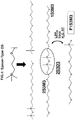
- Fig. 1 Depicted in Fig. 1 is the preferred silicon-containing compound, which has been designated F1S3M3.
- TMGAME triethyleneglycol allyl methyl ether
- Triethyleneglycol methyl ether (185 mL) was dissolved in 500 mL of toluene and 47.2 g of NaOH were added under vigorous stirring in a 1L flask.
- 143 g of allylbromide was added drop-wise using an addition funnel over a two hour period. Care was taken to ensure that the mixture did not get too hot. (If the solution boils, the concentration of allylbromide drops.) After the two-hour addition, the mixture was kept at about 50 °C overnight. The next day the liquid was decanted and the solid washed with hexane.
- the liquid fractions were mixed and the solvents (hexane and toluene) were evaporated by rotary evaporation.
- the crude orange product was vacuum distilled (about 85 °C at 0.5 Torr) to give the intermediate product, the triethyleneglycol allyl methyl ether.
- the next step involved the synthesis of the disiloxane 2S3D3 using a hydrosilylation reaction. See Fig. 1 .
- This synthesis can also be accomplished under different conditions and using different catalysts.
- the route used here was as follows:
- Triethyleneglycol allyl methyl ether (185 mL) was mixed with 66 g of 1,1,3,3-tetramethyldisiloxane and added approximately 100 uL of platinum(0)-1,3-divinyl-1,1,3,3-tetramethyldisiloxane complex solution in xylene, Pt ⁇ 2 %. This was stirred at room temperature, with care taken that the solution did not boil. The mixture was then heated to about 50 °C overnight. In some runs, the disiloxane 2S3D3 was distilled ( ⁇ 240 °C; 1 Torr). In other runs, the disiloxane was used without further purification. See Scheme 2:
- the Si-O-Si bond in 2S3D3 is then substituted with a halogen, in this example, fluorine.
- a halogen in this example, fluorine.
- This can be done using LiPF 6 , NaF, NH 4 F, NH 4 FHF, and the like. Any analogous halogen-containing compound ( i.e ., containing Cl or Br, rather than F) can be used.
- Fig. 2 which describes the analogous preferred synthesis of F1S3M2.
- the initial hydrosilylation step takes place over a platinum catalyst to yield a chlorinated intermediate.
- the chloro intermediate is then treated with NH 4 FHF (ammonium bifluoride) to yield the product F1S3M2 in good yield.
- NH 4 FHF ammonium bifluoride
- compositions described herein have much improved thermal stability as compared to other Si-containing electrolytes such as 1NM3.
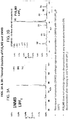
- Figs 3A and 3B are graphs depicting the thermal stability of 1NM3 ( Fig. 3A ) versus the stability of F1S3M2 ( Fig. 3B ).
- (1NM3" (CH 3 ) 3 -Si-O-(CH 2 CH 2 O) 3 -CH 3 )
- F1S3M2 displayed less than 5% decomposition after heating to 150°C in the present of 1M LiPF 6 .
- Fig. 3A 1NM3 displayed near-complete ( ⁇ 100%) at 100°C in the presence of 1 M LiPF 6 .
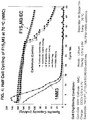
- Fig. 4 is a graph depicting half cell cycling performance of compound F1S3M3 at 70°C, using a NMC cathode.
- the X-axis records cycle number
- the Y-axis records specific capacity in mAh/g.
- the specifics of the charge-discharge cycle and anode/cathode construction are recorded at the bottom of the figure.
- Fig. 4 is the very strong specific capacity of the F1S3M3 half cell after 50 charge/discharge cycles.
- the specific capacity for the F1S3M3 half cell after 50 charge/discharge cycles was still well above 100 mAh/g.
- the specific capacity of the 1NM3 half cell plummeted to close to zero after only 15 cycles. While the carbonate control half cell performed far better than the 1NM3 half cell, its performance was significantly worse than the F1S3M3 half cell after about 35 charge/discharge cycles.
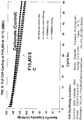
- Fig. 5 is a graph depicting full cell cycling performance of compound F1S3M3 at 70°C using a NMC cathode.
- the F1S3M3 full cell equaled the performance of the carbonate control cell under these conditions.
- Similar results were obtained for F1S3M2 using a NCA cathode, as shown in Fig 7.
- Fig. 7 is also notable because the discharge capacities followed identical trajectories whether at C/10 or C/2.
- the electrolyte composition containing F1S3M2 performed in essentially identical fashion to the graphite control and the EC/DEC control. (The graph depicted in Fig. 7 shows full cell cycling performance of F1S3M2 at 70°C using a NCA cathode.)
- Figure 8 is similar to Fig. 7 , but depicts full cell cycling performance of F1S3M2 at 55°C using a NCA cathode.
- the results are virtually indistinguishable between at both C/10 and C/2 as between the full cell containing the F1S3M2 electrolyte versus graphite control versus EC:DEC control. All results were indistinguishable.
- compositions according to the present disclosure are able to function at a host of different temperature conditions, using different anode and cathode materials, and different separators.
- Fig. 9 is a graph comparing discharge rates at 30°C between F1S3M2 as compared to EC:DEC control device using aNCA cathode.
- the discharge capacity of the F1S3M2 device closely mirrored that of the EC:DEC device at a host of different discharge conditions varying between C/10 to 2C during the course of the charge-discharge cycling.
- the results here are very significant in that the discharge rate was varied widely in cycles 1 to 8 (C/10, to C/4, to C/2, to C/1, to 2C, to C/10, and then held steady at C/4 from cycle 8 to cycle 17).
- the device including the electrolyte composition described herein performed in essentially the same fashion as the controls.
Landscapes
- Chemical & Material Sciences (AREA)
- Organic Chemistry (AREA)
- Chemical Kinetics & Catalysis (AREA)
- Engineering & Computer Science (AREA)
- Electrochemistry (AREA)
- General Chemical & Material Sciences (AREA)
- Manufacturing & Machinery (AREA)
- Inorganic Chemistry (AREA)
- General Physics & Mathematics (AREA)
- Physics & Mathematics (AREA)
- Materials Engineering (AREA)
- Condensed Matter Physics & Semiconductors (AREA)
- Dispersion Chemistry (AREA)
- Secondary Cells (AREA)
- Compositions Of Macromolecular Compounds (AREA)
- Polyethers (AREA)
- Primary Cells (AREA)
Description
- A variety of primary batteries employ electrolytes with organic solvents such as diethyl carbonate (DEC) and ethylene carbonate (EC). These batteries are often stored for extended periods of time before use. However, the performance of these batteries often drops after this storage. For instance, the capacity of these batteries often decreases after extended storage. Additionally, the pulsing capability of these batteries can drop after storage.
- Rechargeable lithium batteries are widely discussed in the literature and are readily commercially available. They typically consist of a positive electrode and a negative electrode spaced by a separator, an electrolyte, a case, and feedthrough pins respectively connected to the electrodes and extending externally of the case. Each electrode is typically formed of a metal substrate that is coated with a mixture of an active material, a binder, and a solvent. In a typical battery design, the electrodes comprise sheets which are rolled together, separated by separator sheets, and then placed in a prismatic case. Positive and/or negative feed through pins (i.e., terminals) are then connected to the respective electrodes and the case is sealed.
- The negative electrode is typically formed of a copper substrate carrying graphite as the active material. The positive electrode is typically formed of an aluminum substrate carrying lithium cobalt dioxide as the active material. The electrolyte is most commonly a 1:1 mixture of EC:DEC in a 1.0 M salt solution of LiPF6. The separator is frequently a micro porous membrane made of a polyolefin such as a combination of polyethylene and/or polypropylene.
- The demand for lithium batteries has increased enormously in recent years. This increased demand has resulted in ongoing research and development to improve the safety and performance of these batteries. The conventional organic carbonate solvents employed in the electrolytes of many lithium ion batteries are associated with a high degree of volatility, flammability, and chemical reactivity. A variety of electrolytes that include polysiloxane solvents have been developed to address these issues.
- Electrolytes that include a polysiloxane solvent typically have a low ionic conductivity that limits their use to applications that do not require high rate performance. Additionally, batteries that include conventional polysiloxane solvents have shown poor cycling performance when used in secondary batteries. As a result, lithium bis-oxalato borate (LiBOB) has been used as the salt in these electrolytes. While LiBOB improves the performance of the batteries, LiBOB is unstable in the presence of water. The amount of moisture in battery electrolytes and/or electrodes can be on the order of several hundred ppm. The presence of this moisture can cause LiBOB to decompose into lithium oxalate (LiHC2O4 •H2O) and form a precipitate in the electrolyte. This precipitate tends to increase the internal resistance of electrical devices such as batteries.
- Thus there remains a long-felt and unmet need to increase the performance, safety, and storage life of lithium-based batteries and other electrical charge-storing devices.
-
- Disclosed herein is an electrolyte composition comprising at least one salt and at least one compound selected from the group consisting of:

- wherein subscript "a" is an integer of from 1 to 3;
- subscript "b" is 1 or 2; and
- 4≥ "a" + "b" ≥ 2;
- X is a fluorine;
- R is selected from the group consisting of
Formula 1 moieties, and Formula II moieties:

- wherein R2 is an organic spacer;
- R3 is nil or an organic spacer;
- R4 is hydrogen, alkyl, or aryl;
- R5 is alkyl or aryl;
- subscript "c" is 1 or 2; and
- subscript "d" is from 1 to 12; and
- R1 is selected from the group consisting of alkyl, substituted alkyl, aryl, substituted aryl, alkoxy, and substituted alkoxy.
- In certain versions of the electrolyte composition, "a" is 1, "b" is 1, and R1 is C1 to C10 alkyl. In still other versions of the electrolyte composition, R1 is methyl.
- In yet another version of the composition, R is substituted or unsubstituted lower alkoxy, and R1 is substituted lower alkyl or lower alkoxy.
- In any version of the composition described herein, at least one salt may be a lithium-containing salt. At least one salt may be present in a concentration of from 0.1 M to 3.5 M. Concentrations above and below 0.1 M to 3.5 M are explicitly within the scope of the composition described and claimed herein.
- In any version of the composition described herein, at least one salt may be selected from the group consisting of LiClO4, LiBF4, LiAsF6, LiPF6, LiCF3SO3, Li(CF3SO2)2N, Li(CF3SO2)3C, Li(C2F5 SO2)2N, LiDFOB, LiBOB, lithium alkyl fluorophosphates, lithium borates and lithium bis(chelato)borates. Other salts are within the scope of the composition described and claimed herein. This list is by way of example only and not limitation.
- The electrolyte composition may be a liquid, a gel, or a solid.
- Also described herein is an electrochemical device characterized in that it includes an electrolyte composition as recited as described and claimed herein. The electrochemical device may include an anode and the electrolyte composition may further be characterized in that it forms a passivation layer on the anode. In one version, the device is a lithium secondary battery comprising at least one lithium metal oxide cathode and at least one anode.
- The compounds described herein are also part of the invention. Thus, disclosed herein are compounds selected from the group consisting of:

- wherein subscript "a" is an integer of from 1 to 3; subscript "b" is 1 or 2; and 4 ≥ "a" + "b" ≥ 2; X is fluorine;
- R is selected from the group consisting of
Formula 1 moieties, and Formula II moieties:

-
-
FIG. 1 is a reaction scheme depicting how to make one of the preferred organosilicon compounds. As depicted, the compound F1S3M3 includes a silicon atom to which is bonded a fluorine (F1), two methyl groups, a trimethylene spacer (S3), and three (3) polyethylene oxide units in tandem (M3). -
FIG. 2 is a graph depicting the synthesis of F1S3M2, a homolog of the F1S3M3 compound depicted inFig. 1 . As shown inFig. 2 , the compound F1S3M2 includes a silicon atom to which is bonded a fluorine (F1), two methyl groups, a trimethylene spacer (S3), and two (2) polyethylene oxide units in tandem (M2). -
FIGS. 3A and 3B are graphs depicting the thermal stability of 1NM3 (Fig. 3A ) and F1S3M2 (Fig. 3B ). As noted in the figure, F1S3M2 displayed less than 5% decomposition after heating to 150°C in the present of 1M LiPF6. -
FIG. 4 is a graph depicting half cell cycling performance of compound F1S3M3 as shown inFig. 1 , at 70°C, using a NMC cathode. The X-axis records cycle number, the Y-axis records specific capacity in mAh/g. The specifics of the charge-discharge cycle and anode/cathode construction are recorded at the bottom of the figure. ("NMC" = Nickel Magnesium Cobalt; "CCCV" = constant current, constant voltage. NMC cathodes are available from many commercial suppliers, such as Targray Inc., Laguna Niguel, CA, USA; "W-Scope" film is a commercial, proprietary separator sold by W-Scope Corporation, Kawasaki, Japan.) -
FIG. 5 is a graph depicting half cell cycling performance of compound F1S3M3 at 70°C using a NCA cathode. The X-axis records cycle number, the Y-axis records specific capacity in mAh/g. The specifics of the charge-discharge cycle and anode/cathode construction are recorded at the bottom of the figure. ("NCA" = Nickel Cobalt Aluminum. NCA cathodes are commercially available from numerous sources, including Targray Inc. "Celgard 2400" is a monolayer polypropylene-based separator available commercially from Celgard LLC, Charlotte, NC, USA.) -
FIG. 6 is a graph depicting full cell cycling performance of compound F1S3M3 at 70°C using a NMC cathode. The X-axis records cycle number, the Y-axis records specific capacity in mAh/g. The specifics of the charge-discharge cycle and anode/cathode construction are recorded at the bottom of the figure. ("EC" = ethylene carbonate; "DEC" = diethyl carbonate.) -
FIG. 7 is a graph depicting full cell cycling performance of F1S3M2 at 70°C using a NCA cathode. The X-axis records cycle number, the Y-axis records discharge capacity in mAh. -
FIG. 8 is a graph depicting full cell cycling performance of F1S3M2 at 55°C using a NCA cathode. The X-axis records cycle number, the Y-axis records discharge capacity in mAh. This graph compares using EC:DEC as the electrolyte versus 78% F1S3M2/20% EC/1M LiPF6. -
FIG. 9 is a graph comparing discharge rates at 30°C between F1S3M2 as compared to carbonate using a NCA cathode. As noted in the figure, the two are indistinguishable. - The present disclosure relates to an electrolyte composition containing at least one halogenated organosilicon solvent, and an electrochemical device characterized by including the electrolyte composition. The preferred electrochemical device is a lithium secondary battery comprising the electrolyte composition described herein. More specifically, described herein is an electrolyte composition that is moisture-resistant, non-flammable, has a wide temperature-operation window, and is far safer as compared to conventional electrolytes. Moreover, the electrolyte composition disclosed herein has improved capacity retention properties, voltage stability and durability when incorporated into a lithium secondary battery or other lithium-ion charge storage devices.
- It has been discovered by the named co-inventors that fluorinated organosilicon compounds are non-hydrolyzable at room temperature. Thus, the resulting electrolytes have a much higher tolerance for moisture. Simultaneously, the voltage stability of the organosilicon compounds described herein is greatly improved, presumably due to the effect of halogen substitutions. The electrolyte compositions described herein, which are halogenated organosilicon solvents (generally liquids, but can also be solid) are non-flammable, offer improved safety and higher voltage windows than conventional electrolytes, and provide a unique solid electrolyte interphase (SEI) film on the graphite anode, resulting in better performance and cell capacity. Cells using the electrolyte compositions described herein improve capacity retention, voltage and thermal stability, and can be operated over a wide temperature window - most notably at elevated temperatures.
- As used herein, the term "alkyl," by itself or as part of another substituent, means, unless otherwise stated, a fully saturated, straight, branched chain, or cyclic hydrocarbon radical, or combination thereof, and can include di- and multi-valent radicals, having the number of carbon atoms designated (e.g., C1-C10 means from one to ten carbon atoms, inclusive). Examples of alkyl groups include, without limitation, methyl, ethyl, n-propyl, isopropyl, n-butyl, t-butyl, isobutyl, sec-butyl, cyclohexyl, (cyclohexyl)ethyl, cyclopropylmethyl, and homologs, and isomers thereof, for example, n-pentyl, n-hexyl, n-heptyl, n-octyl. The term "alkyl," unless otherwise noted, also includes "cycloalkyl."
- The term "alkenyl" means an alkyl group as defined above containing one or more double bonds. Examples of alkenyl groups include vinyl, 2-propenyl, crotyl, 2-isopentenyl, 2-butadienyl, 2,4-pentadienyl, 1,4-pentadienyl, etc., and higher homologs and isomers.
- The term "alkynyl" means an alkyl or alkenyl group as defined above containing one or more triple bonds. Examples of alkynyl groups include ethynyl, 1- and 3-propynyl, 3-butynyl, including higher homologs and isomers.
- The terms "alkylene," "alkenylene," and "alkynylene," alone or as part of another substituent means a divalent radical derived from an alkyl, alkenyl, or alkynyl group, respectively, as exemplified by -CH2CH2CH2CH2-.
- Typically, alkyl, alkenyl, and alkynyl groups (as well as alkylene, alkenylene, and alkynylene groups) will have from 1 to 36 carbon atoms, although longer alkyl groups are explicitly within the scope of the term "alkyl." Those groups having 10 or fewer carbon atoms in the main chain are preferred in the present compositions, and groups of this length are collectively referred to as "lower alkyl, or "lower alkenyl".
- The term "alkoxy" is used herein to refer to the -OR group, where R is an alkyl as defined herein or a substituted analog thereof. Suitable alkoxy radicals include, for example, methoxy, ethoxy, or t-butoxy. In the same fashion as "lower" with respect to
alkyl, "lower alkoxy" refers to an alkoxy group of 10 or fewer carbon atoms in the main chain. - "Substituted" refers to a chemical group as described herein that further includes one or more substituents, such as lower alkyl, aryl, acyl, halogen (e.g., alkylhalo such as CF3), hydroxy, amino, alkoxy, alkylamino, acylamino, thioamido, acyloxy, aryloxy, aryloxyalkyl, mercapto, thia, aza, oxo, both saturated and unsaturated cyclic hydrocarbons, and heterocycles.
- These groups may be attached to any carbon or substituent of the alkyl, alkoxy, and aryl moieties. Additionally, these groups may be pendent from, or integral to, the carbon chain itself.
- The term "acyl" is used to describe a ketone substituent, -C(O)R, where R is substituted or unsubstituted alkyl or aryl as defined herein. The term "carbonyl" is used to describe an aldehyde substituent. The term "carboxy" refers to an ester substituent or carboxylic acid, i.e., -C(O)O- or -C(O)-OH.
- The term "aryl" is used herein to refer to an aromatic substituent, which may be a single aromatic ring or multiple aromatic rings which are fused together, linked covalently, or linked to a common group such as a diazo, methylene or ethylene moiety. The common linking group may also be a carbonyl as in benzophenone. The aromatic ring(s) may include, for example phenyl, naphthyl, biphenyl, diphenylmethyl and benzophenone, among others. The term "aryl" encompasses "arylalkyl" and "substituted aryl." For phenyl groups, the aryl ring may be mono-, di-, tri-, tetra-, or penta-substituted. Larger rings may be unsubstituted or bear one or more substituents.
- "Substituted aryl" refers to aryl as just described including one or more functional groups such as lower alkyl, acyl, halogen, alkylhalo (e.g., CF3), hydroxy, amino, alkoxy, alkylamino, acylamino, acyloxy, phenoxy, mercapto, and both saturated and unsaturated cyclic hydrocarbons which are fused to the aromatic ring(s), linked covalently or linked to a common group such as a diazo, methylene, or ethylene moiety. The linking group may also be a carbonyl such as in cyclohexyl phenyl ketone.
- "Halogen" or "halo" refers to the elements of Group 17 (IUPAC-style) (formerly group VII or VIIA) of the periodic table, namely fluorine (F), chlorine (Cl), bromine (Br), iodine (I), and astatine (At).
- The term "organic spacer" or "spacer" refers to a divalent group including alkylene, alkenylene, and alkynylene groups. Other suitable spacers include alkylene oxide, and bivalent ether moieties. These spacers can be substituted or unsubstituted. The above spacers can also be completely or partially halogenated. For instance, the spacers can be completely or partially fluorinated.
- The electrolyte compositions comprise at least one salt and at least one compound selected from the group consisting of:

- R is selected from the group consisting of moieties selected from
Formula 1 and/or Formula II:

- R1 is selected from the group consisting of alkyl, substituted alkyl, aryl, substituted aryl, alkoxy, and substituted alkoxy.
- It is preferred that "a" is 1, "b" is 1, and R1 is C1 to C10 alkyl (and most preferably R1 is methyl). In certain preferred embodiments of the composition, R is substituted or unsubstituted lower alkoxy, and R1 is substituted lower alkyl or lower alkoxy.
- Particularly preferred silicon-containing compounds according to the present disclosure are:

Fig. 1 . - It is preferred that the salt be a lithium-containing salt. From among the lithium-containing salts, LiCiO4, LiBF4, LiAsF6, LiPF6, LiCF3SO3, Li(CF3SO2)2N, Li(CF3SO2)3C, Li(C2F5 SO2)2N, LiDFOB, LiBOB, lithium alkyl fluorophosphates, lithium borates and lithium bis(chelato)borates are preferred. If a lithium salt is used, preferably it is present in the composition in a concentration of from about 0.1 M to about 3.5 M. Concentrations above and below this stated range are explicitly within the scope of the present disclosure. The composition is preferably formulated to be a free-flowing liquid. However, the electrolyte may also be formulated to be a gel or a solid, depending upon the moieties selected for R and R1 and the concentration of the silicon-containing compound in the electrolyte composition as a whole.
- The present disclosure includes any and all electrochemical devices that comprise the electrolyte composition described and claimed herein. Such devices may optionally comprise an anode and the electrolyte composition optionally further comprises an additive dimensioned and configured to form a passivation layer on the anode. Preferred electrochemical devices are lithium secondary batteries that comprise at least one lithium metal oxide cathode and at least one anode.
- Depicted in
Fig. 1 is the preferred silicon-containing compound, which has been designated F1S3M3. - The synthesis begins with the triethyleneglycol allyl methyl ether ("TEGAME"). This is a known and common compound that can be made by several literature routes, most of which involve adding the allyl group to the glycol using allyl bromide under different conditions, and using different solvents, temperatures, times, and bases. The route used here was as follows (illustrated in
Scheme 1, below): - Triethyleneglycol methyl ether (185 mL) was dissolved in 500 mL of toluene and 47.2 g of NaOH were added under vigorous stirring in a 1L flask. When the mixture was homogenous, 143 g of allylbromide was added drop-wise using an addition funnel over a two hour period. Care was taken to ensure that the mixture did not get too hot. (If the solution boils, the concentration of allylbromide drops.) After the two-hour addition, the mixture was kept at about 50 °C overnight. The next day the liquid was decanted and the solid washed with hexane. The liquid fractions were mixed and the solvents (hexane and toluene) were evaporated by rotary evaporation. The crude orange product was vacuum distilled (about 85 °C at 0.5 Torr) to give the intermediate product, the triethyleneglycol allyl methyl ether.

- The next step involved the synthesis of the disiloxane 2S3D3 using a hydrosilylation reaction. See
Fig. 1 . This synthesis can also be accomplished under different conditions and using different catalysts. The route used here was as follows: - Triethyleneglycol allyl methyl ether (185 mL) was mixed with 66 g of 1,1,3,3-tetramethyldisiloxane and added approximately 100 uL of platinum(0)-1,3-divinyl-1,1,3,3-tetramethyldisiloxane complex solution in xylene, Pt ~2 %. This was stirred at room temperature, with care taken that the solution did not boil. The mixture was then heated to about 50 °C overnight. In some runs, the disiloxane 2S3D3 was distilled (~240 °C; 1 Torr). In other runs, the disiloxane was used without further purification. See Scheme 2:

- The Si-O-Si bond in 2S3D3 is then substituted with a halogen, in this example, fluorine. This can be done using LiPF6, NaF, NH4F, NH4FHF, and the like. Any analogous halogen-containing compound (i.e., containing Cl or Br, rather than F) can be used.
- 265 g of 2S3D3 were mixed with 37 g of LiPF6 and the mixture stirred to dissolve the salt. Then 4.5 g of water were added and the mixture was stirred overnight. The solution was then heated to about 80 °C for three hours to make it homogenous. The crude dark mixture was distilled three times to get pure F1S3M3. See
Fig. 1 and Scheme 3:
- This same set of reactions can be used to make analogous compounds by using longer or shorter glycol units in
Scheme 1, and altering the terminal moieties in the starting ether. Likewise, inScheme 2, the 1,1,3,3-tetramethyldisiloxane can be replaced with other disiloxanes having a distinct substitution pattern, for example, different alkyl lengths, alkyloxy groups, etc. In the same fashion, the halogen-containing compound used to replace the Si-O-Si bond in 2S3D3 dictates the halogen atom that appears in the final product. - For example, see
Fig. 2 , which describes the analogous preferred synthesis of F1S3M2. Here, the initial hydrosilylation step takes place over a platinum catalyst to yield a chlorinated intermediate. The chloro intermediate is then treated with NH4FHF (ammonium bifluoride) to yield the product F1S3M2 in good yield. - All analogous compounds as recited above can be fabricated using the synthetic approach presented in
Figs. 1 and2 and using the appropriate starting material to arrive at the desired chain length of the spacer (R2 and/or R3), the desired side groups R and R1, and the desired halogen X. In addition, one skilled in the art will recognize that alternate routes from reagents such as Me2SiHF are equally viable. - Of particular note is that the compositions described herein have much improved thermal stability as compared to other Si-containing electrolytes such as 1NM3. See
Figs 3A and 3B , which are graphs depicting the thermal stability of 1NM3 (Fig. 3A ) versus the stability of F1S3M2 (Fig. 3B ). ("1NM3" = (CH3)3-Si-O-(CH2CH2O)3-CH3) As shown inFig. 3B , F1S3M2 displayed less than 5% decomposition after heating to 150°C in the present of 1M LiPF6. In stark contrast, as shown inFig. 3A , 1NM3 displayed near-complete (~100%) at 100°C in the presence of 1 M LiPF6. -
Fig. 4 is a graph depicting half cell cycling performance of compound F1S3M3 at 70°C, using a NMC cathode. The X-axis records cycle number, the Y-axis records specific capacity in mAh/g. The specifics of the charge-discharge cycle and anode/cathode construction are recorded at the bottom of the figure. Of particular note inFig. 4 is the very strong specific capacity of the F1S3M3 half cell after 50 charge/discharge cycles. The specific capacity for the F1S3M3 half cell after 50 charge/discharge cycles was still well above 100 mAh/g. In contrast, the specific capacity of the 1NM3 half cell plummeted to close to zero after only 15 cycles. While the carbonate control half cell performed far better than the 1NM3 half cell, its performance was significantly worse than the F1S3M3 half cell after about 35 charge/discharge cycles. - The performance results were even more dramatic when comparing F1S3M3 at 70°C using NCA cathodes. See
Fig. 5 . In this set of experiments, the carbonate control half cell and the F1S3M3 half cell performed in near-parallel fashion. In contrast, the specific capacity of the 1NM3 half cell plummeted after approximately 10 cycles. This graph shows that the electrolyte composition described herein function quite well using different types of anodes, cathodes, and separators. Note that theFig. 4 experiments used a half cell constructed of a NMC cathode, a lithium anode, and a W-Scope film separator. The F1S3M3 half cell performed admirably. TheFig. 5 experiments used a half cell constructed of a NCA cathode, a lithium anode, and a Celgard 2400 separator. The F1S3M3 half cell performed admirably under these conditions too. - In full cell cycling (F1S3M3/EC), the compositions according to the present disclosure also fared well. See
Fig. 5 , which is a graph depicting full cell cycling performance of compound F1S3M3 at 70°C using a NMC cathode. As shown in the figure, the F1S3M3 full cell equaled the performance of the carbonate control cell under these conditions. Similar results were obtained for F1S3M2 using a NCA cathode, as shown inFig 7. Fig. 7 is also notable because the discharge capacities followed identical trajectories whether at C/10 or C/2. In short, the electrolyte composition containing F1S3M2 performed in essentially identical fashion to the graphite control and the EC/DEC control. (The graph depicted inFig. 7 shows full cell cycling performance of F1S3M2 at 70°C using a NCA cathode.) -
Figure 8 is similar toFig. 7 , but depicts full cell cycling performance of F1S3M2 at 55°C using a NCA cathode. In the same fashion as inFig. 7 , the results are virtually indistinguishable between at both C/10 and C/2 as between the full cell containing the F1S3M2 electrolyte versus graphite control versus EC:DEC control. All results were indistinguishable. This is notable in that compositions according to the present disclosure are able to function at a host of different temperature conditions, using different anode and cathode materials, and different separators. - Lastly, see
Fig. 9 , which is a graph comparing discharge rates at 30°C between F1S3M2 as compared to EC:DEC control device using aNCA cathode. As is clearly seen inFig. 9 , the discharge capacity of the F1S3M2 device closely mirrored that of the EC:DEC device at a host of different discharge conditions varying between C/10 to 2C during the course of the charge-discharge cycling. The results here are very significant in that the discharge rate was varied widely incycles 1 to 8 (C/10, to C/4, to C/2, to C/1, to 2C, to C/10, and then held steady at C/4 fromcycle 8 to cycle 17). The device including the electrolyte composition described herein performed in essentially the same fashion as the controls.
Claims (11)
- An electrolyte composition comprising at least one salt and at least one compound selected from the group consisting of:
 wherein subscript "a" is an integer of from 1 to 3;subscript "b" is 1 or 2; and4 ≥ "a" + "b" ≥ 2;X is a fluorine;R is selected from the group consisting of Formula 1 moieties and Formula II moieties:
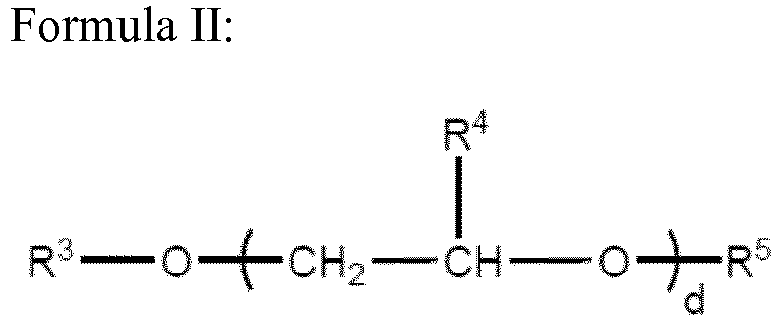 wherein R2 is an organic spacer;R3 is nil or an organic spacer;R4 is hydrogen, alkyl, or aryl;R5 is alkyl or aryl;subscript "c" is 1 or 2; andsubscript "d" is from 1 to 12; andR1 is selected from the group consisting of alkyl, substituted alkyl, aryl, substituted aryl, alkoxy, and substituted alkoxy.
 - The electrolyte composition of Claim 1, wherein "a" is 1, "b" is 1, and R1 is C1 to C10 alkyl.
- The electrolyte composition of Claim 1, wherein R1 is methyl or substituted lower alkyl.
- The electrolyte composition according to any one of the preceding claims, wherein at least one salt is a lithium-containing salt.
- The electrolyte composition according to any one of the preceding claims, wherein at least one salt is selected from the group consisting of LiClO4, LiBF4, LiAsF6, LiPF6, LiCF3SO3, Li(CF3SO2)2N, Li(CF3SO2)3C, Li(C2F5 SO2)2N, LiDFOB, LiBOB, lithium alkyl fluorophosphates, lithium borates and lithium bis(chelato)borates, and the salt is present in a concentration of from 0.1 M to 3.5 M.
- An electrochemical device comprising an electrolyte composition as recited in any one of the preceding claims.
- The device of claim 6, wherein the electrochemical device includes an anode and the electrolyte composition further comprises an additive that forms a passivation layer on the anode.
- The device of claim 6, wherein the device is a lithium secondary battery comprising at least one lithium metal oxide cathode and at least one anode.
- A compound selected from the group consisting of:
 wherein subscript "a" is an integer of from 1 to 3;subscript "b" is 1 or 2; and4 ≥ "a" + "b" ≥ 2;X is a fluorine;R is selected from the group consisting of Formula 1 moieties and Formula II moieties:
 wherein R2 is an organic spacer;R3 is nil or an organic spacer;R4 is hydrogen, alkyl, or aryl;R5 is alkyl or aryl;subscript "c" is 1 or 2; andsubscript "d" is from 1 to 12; andR1 is selected from the group consisting of alkyl, substituted alkyl, aryl, substituted aryl, alkoxy, and substituted alkoxy.
 - A compound of Claim 9, wherein "a" is 1, "b" is 1, and R1 is C1 to C10 alkyl.
- A compound of Claim 9, wherein R1 is methyl or substituted lower alkyl.
Applications Claiming Priority (2)
| Application Number | Priority Date | Filing Date | Title |
|---|---|---|---|
| US201261594672P | 2012-02-03 | 2012-02-03 | |
| PCT/US2013/024629 WO2013116836A1 (en) | 2012-02-03 | 2013-02-04 | Halogenated organosilicon electrolytes, methods of using them, and electrochemical devices containing them |
Publications (3)
| Publication Number | Publication Date |
|---|---|
| EP2809708A1 EP2809708A1 (en) | 2014-12-10 |
| EP2809708A4 EP2809708A4 (en) | 2015-02-18 |
| EP2809708B1 true EP2809708B1 (en) | 2017-04-05 |
Family
ID=48905949
Family Applications (1)
| Application Number | Title | Priority Date | Filing Date |
|---|---|---|---|
| EP13742989.0A Active EP2809708B1 (en) | 2012-02-03 | 2013-02-04 | Halogenated organosilicon electrolytes, methods of using them, and electrochemical devices containing them |
Country Status (6)
| Country | Link |
|---|---|
| US (2) | US20150270573A1 (en) |
| EP (1) | EP2809708B1 (en) |
| JP (1) | JP6272240B2 (en) |
| KR (1) | KR101874153B1 (en) |
| CA (1) | CA2860922C (en) |
| WO (1) | WO2013116836A1 (en) |
Families Citing this family (10)
| Publication number | Priority date | Publication date | Assignee | Title |
|---|---|---|---|---|
| US9765096B2 (en) * | 2012-10-15 | 2017-09-19 | Guangzhou Institute Of Energy Conversion, Chinese Academy Of Sciences | Organohalosilane and use thereof in electrolytes of non-aqueous lithium ion batteries |
| CN102924495B (en) * | 2012-10-15 | 2015-10-28 | 中国科学院广州能源研究所 | Containing polyether chain organohalosilanes and the application in nonaqueous lithium ionization cell electrolytic solution thereof |
| CN106795184B (en) * | 2014-10-03 | 2024-06-21 | 塞勒创尼克斯公司 | Functionalized silane, electrolyte composition and electrochemical device containing the same |
| JP2016098189A (en) * | 2014-11-19 | 2016-05-30 | セントラル硝子株式会社 | Fluorine-containing ether compound, non-aqueous electrolyte, and non-aqueous electrolyte battery |
| WO2016160703A1 (en) | 2015-03-27 | 2016-10-06 | Harrup Mason K | All-inorganic solvents for electrolytes |
| US10707531B1 (en) | 2016-09-27 | 2020-07-07 | New Dominion Enterprises Inc. | All-inorganic solvents for electrolytes |
| KR102434069B1 (en) | 2018-08-16 | 2022-08-19 | 주식회사 엘지에너지솔루션 | Electrolyte for lithium secondary battery |
| EP3864090B1 (en) | 2018-10-09 | 2022-12-07 | BYK-Chemie GmbH | A composition comprising a grafted polylactic acid |
| US12230753B2 (en) * | 2021-01-26 | 2025-02-18 | GM Global Technology Operations LLC | Electrolyte for electrochemical cells with a silicon-containing electrode |
| KR102785414B1 (en) | 2023-01-18 | 2025-03-21 | 계명대학교 산학협력단 | Solid Electrolyte Additives containing trimethylsilylacetylene derivative |
Family Cites Families (11)
| Publication number | Priority date | Publication date | Assignee | Title |
|---|---|---|---|---|
| JP3028348B2 (en) * | 1990-01-18 | 2000-04-04 | 達哉 庄野 | Method for producing polysilane |
| US20050106470A1 (en) * | 2003-01-22 | 2005-05-19 | Yoon Sang Y. | Battery having electrolyte including one or more additives |
| JP4650625B2 (en) * | 2004-10-15 | 2011-03-16 | 信越化学工業株式会社 | Cyclic carbonate-modified organosilicon compound, nonaqueous electrolyte containing the same, secondary battery and capacitor |
| JP4650627B2 (en) | 2005-09-14 | 2011-03-16 | 信越化学工業株式会社 | Cyclic carbonate-modified siloxane, method for producing the same, non-aqueous electrolyte, secondary battery, and capacitor |
| KR20130090913A (en) * | 2005-10-20 | 2013-08-14 | 미쓰비시 가가꾸 가부시키가이샤 | Lithium secondary cell and nonaqueous electrolytic solution for use therein |
| JP5004495B2 (en) * | 2006-04-17 | 2012-08-22 | 株式会社デンソー | Non-aqueous electrolyte and secondary battery using the electrolyte |
| KR100803197B1 (en) * | 2006-08-16 | 2008-02-14 | 삼성에스디아이 주식회사 | Silane Compound, Organic Electrolyte and Lithium Battery |
| US8187746B2 (en) * | 2008-05-16 | 2012-05-29 | Uchicago Argonne, Llc | Surface modification agents for lithium batteries |
| CN101820082B (en) * | 2009-02-27 | 2013-06-12 | 比亚迪股份有限公司 | Electrolyte and lithium-ion secondary battery |
| CN102074736B (en) * | 2010-06-07 | 2012-09-05 | 中国科学院广州能源研究所 | Organic silicon amine electrolyte material containing polyether chain and application thereof in lithium battery electrolyte |
| JP5709574B2 (en) * | 2011-02-21 | 2015-04-30 | 株式会社Adeka | Non-aqueous electrolyte for secondary battery and non-aqueous electrolyte secondary battery having the electrolyte |
-
2013
- 2013-02-04 KR KR1020147024252A patent/KR101874153B1/en active Active
- 2013-02-04 JP JP2014555815A patent/JP6272240B2/en active Active
- 2013-02-04 CA CA2860922A patent/CA2860922C/en active Active
- 2013-02-04 US US14/374,742 patent/US20150270573A1/en not_active Abandoned
- 2013-02-04 EP EP13742989.0A patent/EP2809708B1/en active Active
- 2013-02-04 WO PCT/US2013/024629 patent/WO2013116836A1/en not_active Ceased
- 2013-02-04 US US14/374,734 patent/US9917328B2/en active Active
Also Published As
| Publication number | Publication date |
|---|---|
| JP2015513172A (en) | 2015-04-30 |
| EP2809708A1 (en) | 2014-12-10 |
| US20150037686A1 (en) | 2015-02-05 |
| EP2809708A4 (en) | 2015-02-18 |
| US9917328B2 (en) | 2018-03-13 |
| US20150270573A1 (en) | 2015-09-24 |
| CA2860922C (en) | 2020-05-12 |
| WO2013116836A1 (en) | 2013-08-08 |
| JP6272240B2 (en) | 2018-01-31 |
| CA2860922A1 (en) | 2013-08-08 |
| KR101874153B1 (en) | 2018-07-03 |
| KR20140127840A (en) | 2014-11-04 |
Similar Documents
| Publication | Publication Date | Title |
|---|---|---|
| US9917328B2 (en) | Halogenated organosilicon electrolytes, methods of using them, and electrochemical devices containing them | |
| US11444329B2 (en) | Functionalized silanes and electrolyte compositions and electrochemical devices containing them | |
| JP4588319B2 (en) | Non-aqueous electrolyte battery and electrode stabilizer for non-aqueous electrolyte battery | |
| JP5199130B2 (en) | Rechargeable lithium ion battery with triphenylamine redox shuttle | |
| KR102617501B1 (en) | Electrolyte composition, secondary battery, and method of using the secondary battery | |
| CN106458872B (en) | Use of reactive ionic liquids as additives for electrolytes in secondary lithium-ion batteries | |
| US20150270574A1 (en) | Halogenosilane functionalized carbonate electrolyte material, preparation method thereof and use in electrolyte for lithium ion battery | |
| CN109485579B (en) | Preparation of boron cluster-based ionic liquids | |
| Wang et al. | Fluorosilane compounds with oligo (ethylene oxide) substituent as safe electrolyte solvents for high-voltage lithium-ion batteries | |
| JPH03236169A (en) | chemical battery | |
| WO2015179831A1 (en) | Electrolyte solutions including a phosphoranimine compound, and energy storage devices including same | |
| WO2015151977A1 (en) | Zwitterionic compound and ion conductor | |
| JP2017528880A (en) | Electrochemical cell, electrolyte suitable for filling electrochemical cell, method for producing electrochemical cell, and method for operating electrochemical cell | |
| KR20260039719A (en) | Ionic organic compounds, compositions containing the same, electrolytes, and electrochemical uses thereof | |
| Mei | New solid and liquid electrolytes for lithium rechargeable batteries | |
| HK1233648A1 (en) | Functionalized silanes and electrolyte compostions and electrochemical devices containing them |
Legal Events
| Date | Code | Title | Description |
|---|---|---|---|
| PUAI | Public reference made under article 153(3) epc to a published international application that has entered the european phase |
Free format text: ORIGINAL CODE: 0009012 |
|
| 17P | Request for examination filed |
Effective date: 20140723 |
|
| AK | Designated contracting states |
Kind code of ref document: A1 Designated state(s): AL AT BE BG CH CY CZ DE DK EE ES FI FR GB GR HR HU IE IS IT LI LT LU LV MC MK MT NL NO PL PT RO RS SE SI SK SM TR |
|
| AX | Request for extension of the european patent |
Extension state: BA ME |
|
| A4 | Supplementary search report drawn up and despatched |
Effective date: 20150115 |
|
| RIC1 | Information provided on ipc code assigned before grant |
Ipc: C08G 77/18 20060101AFI20150109BHEP |
|
| DAX | Request for extension of the european patent (deleted) | ||
| GRAP | Despatch of communication of intention to grant a patent |
Free format text: ORIGINAL CODE: EPIDOSNIGR1 |
|
| STAA | Information on the status of an ep patent application or granted ep patent |
Free format text: STATUS: GRANT OF PATENT IS INTENDED |
|
| INTG | Intention to grant announced |
Effective date: 20161205 |
|
| GRAS | Grant fee paid |
Free format text: ORIGINAL CODE: EPIDOSNIGR3 |
|
| GRAA | (expected) grant |
Free format text: ORIGINAL CODE: 0009210 |
|
| STAA | Information on the status of an ep patent application or granted ep patent |
Free format text: STATUS: THE PATENT HAS BEEN GRANTED |
|
| AK | Designated contracting states |
Kind code of ref document: B1 Designated state(s): AL AT BE BG CH CY CZ DE DK EE ES FI FR GB GR HR HU IE IS IT LI LT LU LV MC MK MT NL NO PL PT RO RS SE SI SK SM TR |
|
| REG | Reference to a national code |
Ref country code: GB Ref legal event code: FG4D |
|
| REG | Reference to a national code |
Ref country code: CH Ref legal event code: EP |
|
| REG | Reference to a national code |
Ref country code: AT Ref legal event code: REF Ref document number: 881784 Country of ref document: AT Kind code of ref document: T Effective date: 20170415 |
|
| REG | Reference to a national code |
Ref country code: IE Ref legal event code: FG4D |
|
| REG | Reference to a national code |
Ref country code: DE Ref legal event code: R096 Ref document number: 602013019464 Country of ref document: DE |
|
| REG | Reference to a national code |
Ref country code: NL Ref legal event code: MP Effective date: 20170405 |
|
| REG | Reference to a national code |
Ref country code: LT Ref legal event code: MG4D |
|
| REG | Reference to a national code |
Ref country code: AT Ref legal event code: MK05 Ref document number: 881784 Country of ref document: AT Kind code of ref document: T Effective date: 20170405 |
|
| PG25 | Lapsed in a contracting state [announced via postgrant information from national office to epo] |
Ref country code: NL Free format text: LAPSE BECAUSE OF FAILURE TO SUBMIT A TRANSLATION OF THE DESCRIPTION OR TO PAY THE FEE WITHIN THE PRESCRIBED TIME-LIMIT Effective date: 20170405 |
|
| PG25 | Lapsed in a contracting state [announced via postgrant information from national office to epo] |
Ref country code: GR Free format text: LAPSE BECAUSE OF FAILURE TO SUBMIT A TRANSLATION OF THE DESCRIPTION OR TO PAY THE FEE WITHIN THE PRESCRIBED TIME-LIMIT Effective date: 20170706 Ref country code: FI Free format text: LAPSE BECAUSE OF FAILURE TO SUBMIT A TRANSLATION OF THE DESCRIPTION OR TO PAY THE FEE WITHIN THE PRESCRIBED TIME-LIMIT Effective date: 20170405 Ref country code: LT Free format text: LAPSE BECAUSE OF FAILURE TO SUBMIT A TRANSLATION OF THE DESCRIPTION OR TO PAY THE FEE WITHIN THE PRESCRIBED TIME-LIMIT Effective date: 20170405 Ref country code: AT Free format text: LAPSE BECAUSE OF FAILURE TO SUBMIT A TRANSLATION OF THE DESCRIPTION OR TO PAY THE FEE WITHIN THE PRESCRIBED TIME-LIMIT Effective date: 20170405 Ref country code: NO Free format text: LAPSE BECAUSE OF FAILURE TO SUBMIT A TRANSLATION OF THE DESCRIPTION OR TO PAY THE FEE WITHIN THE PRESCRIBED TIME-LIMIT Effective date: 20170705 Ref country code: HR Free format text: LAPSE BECAUSE OF FAILURE TO SUBMIT A TRANSLATION OF THE DESCRIPTION OR TO PAY THE FEE WITHIN THE PRESCRIBED TIME-LIMIT Effective date: 20170405 Ref country code: ES Free format text: LAPSE BECAUSE OF FAILURE TO SUBMIT A TRANSLATION OF THE DESCRIPTION OR TO PAY THE FEE WITHIN THE PRESCRIBED TIME-LIMIT Effective date: 20170405 |
|
| PG25 | Lapsed in a contracting state [announced via postgrant information from national office to epo] |
Ref country code: BG Free format text: LAPSE BECAUSE OF FAILURE TO SUBMIT A TRANSLATION OF THE DESCRIPTION OR TO PAY THE FEE WITHIN THE PRESCRIBED TIME-LIMIT Effective date: 20170705 Ref country code: LV Free format text: LAPSE BECAUSE OF FAILURE TO SUBMIT A TRANSLATION OF THE DESCRIPTION OR TO PAY THE FEE WITHIN THE PRESCRIBED TIME-LIMIT Effective date: 20170405 Ref country code: RS Free format text: LAPSE BECAUSE OF FAILURE TO SUBMIT A TRANSLATION OF THE DESCRIPTION OR TO PAY THE FEE WITHIN THE PRESCRIBED TIME-LIMIT Effective date: 20170405 Ref country code: SE Free format text: LAPSE BECAUSE OF FAILURE TO SUBMIT A TRANSLATION OF THE DESCRIPTION OR TO PAY THE FEE WITHIN THE PRESCRIBED TIME-LIMIT Effective date: 20170405 Ref country code: PL Free format text: LAPSE BECAUSE OF FAILURE TO SUBMIT A TRANSLATION OF THE DESCRIPTION OR TO PAY THE FEE WITHIN THE PRESCRIBED TIME-LIMIT Effective date: 20170405 Ref country code: IS Free format text: LAPSE BECAUSE OF FAILURE TO SUBMIT A TRANSLATION OF THE DESCRIPTION OR TO PAY THE FEE WITHIN THE PRESCRIBED TIME-LIMIT Effective date: 20170805 |
|
| REG | Reference to a national code |
Ref country code: FR Ref legal event code: PLFP Year of fee payment: 6 |
|
| REG | Reference to a national code |
Ref country code: DE Ref legal event code: R097 Ref document number: 602013019464 Country of ref document: DE |
|
| PG25 | Lapsed in a contracting state [announced via postgrant information from national office to epo] |
Ref country code: DK Free format text: LAPSE BECAUSE OF FAILURE TO SUBMIT A TRANSLATION OF THE DESCRIPTION OR TO PAY THE FEE WITHIN THE PRESCRIBED TIME-LIMIT Effective date: 20170405 Ref country code: EE Free format text: LAPSE BECAUSE OF FAILURE TO SUBMIT A TRANSLATION OF THE DESCRIPTION OR TO PAY THE FEE WITHIN THE PRESCRIBED TIME-LIMIT Effective date: 20170405 Ref country code: CZ Free format text: LAPSE BECAUSE OF FAILURE TO SUBMIT A TRANSLATION OF THE DESCRIPTION OR TO PAY THE FEE WITHIN THE PRESCRIBED TIME-LIMIT Effective date: 20170405 Ref country code: RO Free format text: LAPSE BECAUSE OF FAILURE TO SUBMIT A TRANSLATION OF THE DESCRIPTION OR TO PAY THE FEE WITHIN THE PRESCRIBED TIME-LIMIT Effective date: 20170405 Ref country code: SK Free format text: LAPSE BECAUSE OF FAILURE TO SUBMIT A TRANSLATION OF THE DESCRIPTION OR TO PAY THE FEE WITHIN THE PRESCRIBED TIME-LIMIT Effective date: 20170405 |
|
| PLBE | No opposition filed within time limit |
Free format text: ORIGINAL CODE: 0009261 |
|
| STAA | Information on the status of an ep patent application or granted ep patent |
Free format text: STATUS: NO OPPOSITION FILED WITHIN TIME LIMIT |
|
| PG25 | Lapsed in a contracting state [announced via postgrant information from national office to epo] |
Ref country code: SM Free format text: LAPSE BECAUSE OF FAILURE TO SUBMIT A TRANSLATION OF THE DESCRIPTION OR TO PAY THE FEE WITHIN THE PRESCRIBED TIME-LIMIT Effective date: 20170405 Ref country code: IT Free format text: LAPSE BECAUSE OF FAILURE TO SUBMIT A TRANSLATION OF THE DESCRIPTION OR TO PAY THE FEE WITHIN THE PRESCRIBED TIME-LIMIT Effective date: 20170405 |
|
| 26N | No opposition filed |
Effective date: 20180108 |
|
| PG25 | Lapsed in a contracting state [announced via postgrant information from national office to epo] |
Ref country code: SI Free format text: LAPSE BECAUSE OF FAILURE TO SUBMIT A TRANSLATION OF THE DESCRIPTION OR TO PAY THE FEE WITHIN THE PRESCRIBED TIME-LIMIT Effective date: 20170405 |
|
| REG | Reference to a national code |
Ref country code: CH Ref legal event code: PL |
|
| PG25 | Lapsed in a contracting state [announced via postgrant information from national office to epo] |
Ref country code: MC Free format text: LAPSE BECAUSE OF FAILURE TO SUBMIT A TRANSLATION OF THE DESCRIPTION OR TO PAY THE FEE WITHIN THE PRESCRIBED TIME-LIMIT Effective date: 20170405 |
|
| REG | Reference to a national code |
Ref country code: IE Ref legal event code: MM4A |
|
| REG | Reference to a national code |
Ref country code: BE Ref legal event code: MM Effective date: 20180228 |
|
| PG25 | Lapsed in a contracting state [announced via postgrant information from national office to epo] |
Ref country code: LU Free format text: LAPSE BECAUSE OF NON-PAYMENT OF DUE FEES Effective date: 20180204 Ref country code: CH Free format text: LAPSE BECAUSE OF NON-PAYMENT OF DUE FEES Effective date: 20180228 Ref country code: LI Free format text: LAPSE BECAUSE OF NON-PAYMENT OF DUE FEES Effective date: 20180228 |
|
| PG25 | Lapsed in a contracting state [announced via postgrant information from national office to epo] |
Ref country code: IE Free format text: LAPSE BECAUSE OF NON-PAYMENT OF DUE FEES Effective date: 20180204 |
|
| PG25 | Lapsed in a contracting state [announced via postgrant information from national office to epo] |
Ref country code: BE Free format text: LAPSE BECAUSE OF NON-PAYMENT OF DUE FEES Effective date: 20180228 |
|
| PG25 | Lapsed in a contracting state [announced via postgrant information from national office to epo] |
Ref country code: MT Free format text: LAPSE BECAUSE OF NON-PAYMENT OF DUE FEES Effective date: 20180204 |
|
| PG25 | Lapsed in a contracting state [announced via postgrant information from national office to epo] |
Ref country code: TR Free format text: LAPSE BECAUSE OF FAILURE TO SUBMIT A TRANSLATION OF THE DESCRIPTION OR TO PAY THE FEE WITHIN THE PRESCRIBED TIME-LIMIT Effective date: 20170405 |
|
| PG25 | Lapsed in a contracting state [announced via postgrant information from national office to epo] |
Ref country code: PT Free format text: LAPSE BECAUSE OF FAILURE TO SUBMIT A TRANSLATION OF THE DESCRIPTION OR TO PAY THE FEE WITHIN THE PRESCRIBED TIME-LIMIT Effective date: 20170405 Ref country code: HU Free format text: LAPSE BECAUSE OF FAILURE TO SUBMIT A TRANSLATION OF THE DESCRIPTION OR TO PAY THE FEE WITHIN THE PRESCRIBED TIME-LIMIT; INVALID AB INITIO Effective date: 20130204 |
|
| PG25 | Lapsed in a contracting state [announced via postgrant information from national office to epo] |
Ref country code: MK Free format text: LAPSE BECAUSE OF NON-PAYMENT OF DUE FEES Effective date: 20170405 Ref country code: CY Free format text: LAPSE BECAUSE OF FAILURE TO SUBMIT A TRANSLATION OF THE DESCRIPTION OR TO PAY THE FEE WITHIN THE PRESCRIBED TIME-LIMIT Effective date: 20170405 |
|
| REG | Reference to a national code |
Ref country code: DE Ref legal event code: R082 Ref document number: 602013019464 Country of ref document: DE Representative=s name: MUELLER, THOMAS, DIPL.-ING., DE |
|
| PG25 | Lapsed in a contracting state [announced via postgrant information from national office to epo] |
Ref country code: AL Free format text: LAPSE BECAUSE OF FAILURE TO SUBMIT A TRANSLATION OF THE DESCRIPTION OR TO PAY THE FEE WITHIN THE PRESCRIBED TIME-LIMIT Effective date: 20170405 |
|
| REG | Reference to a national code |
Ref country code: DE Ref legal event code: R081 Ref document number: 602013019464 Country of ref document: DE Owner name: ORBIA FLUOR & ENERGY MATERIALS USA, INC., MADI, US Free format text: FORMER OWNER: SILATRONIX, INC., MADISON, WIS., US |
|
| PGFP | Annual fee paid to national office [announced via postgrant information from national office to epo] |
Ref country code: GB Payment date: 20251211 Year of fee payment: 14 |
|
| PGFP | Annual fee paid to national office [announced via postgrant information from national office to epo] |
Ref country code: FR Payment date: 20251128 Year of fee payment: 14 |
|
| PGFP | Annual fee paid to national office [announced via postgrant information from national office to epo] |
Ref country code: DE Payment date: 20251210 Year of fee payment: 14 |