EP2809168B1 - Multilayer microencapsulated probiotic bacteria as well as food and pharmaceutical compositions comprising said bacteria - Google Patents
Multilayer microencapsulated probiotic bacteria as well as food and pharmaceutical compositions comprising said bacteria Download PDFInfo
- Publication number
- EP2809168B1 EP2809168B1 EP13707032.2A EP13707032A EP2809168B1 EP 2809168 B1 EP2809168 B1 EP 2809168B1 EP 13707032 A EP13707032 A EP 13707032A EP 2809168 B1 EP2809168 B1 EP 2809168B1
- Authority
- EP
- European Patent Office
- Prior art keywords
- weight
- bacteria
- coating
- lipid
- grams
- Prior art date
- Legal status (The legal status is an assumption and is not a legal conclusion. Google has not performed a legal analysis and makes no representation as to the accuracy of the status listed.)
- Active
Links
Images


Classifications
-
- C—CHEMISTRY; METALLURGY
- C12—BIOCHEMISTRY; BEER; SPIRITS; WINE; VINEGAR; MICROBIOLOGY; ENZYMOLOGY; MUTATION OR GENETIC ENGINEERING
- C12N—MICROORGANISMS OR ENZYMES; COMPOSITIONS THEREOF; PROPAGATING, PRESERVING, OR MAINTAINING MICROORGANISMS; MUTATION OR GENETIC ENGINEERING; CULTURE MEDIA
- C12N1/00—Microorganisms; Compositions thereof; Processes of propagating, maintaining or preserving microorganisms or compositions thereof; Processes of preparing or isolating a composition containing a microorganism; Culture media therefor
- C12N1/20—Bacteria; Culture media therefor
-
- A—HUMAN NECESSITIES
- A23—FOODS OR FOODSTUFFS; TREATMENT THEREOF, NOT COVERED BY OTHER CLASSES
- A23C—DAIRY PRODUCTS, e.g. MILK, BUTTER OR CHEESE; MILK OR CHEESE SUBSTITUTES; PREPARATION THEREOF
- A23C13/00—Cream; Cream preparations; Making thereof
- A23C13/12—Cream preparations
- A23C13/16—Cream preparations containing, or treated with, microorganisms, enzymes, or antibiotics; Sour cream
-
- A—HUMAN NECESSITIES
- A23—FOODS OR FOODSTUFFS; TREATMENT THEREOF, NOT COVERED BY OTHER CLASSES
- A23C—DAIRY PRODUCTS, e.g. MILK, BUTTER OR CHEESE; MILK OR CHEESE SUBSTITUTES; PREPARATION THEREOF
- A23C15/00—Butter; Butter preparations; Making thereof
- A23C15/12—Butter preparations
- A23C15/123—Addition of microorganisms or cultured milk products; Addition of enzymes; Addition of starter cultures other than destillates
-
- A—HUMAN NECESSITIES
- A23—FOODS OR FOODSTUFFS; TREATMENT THEREOF, NOT COVERED BY OTHER CLASSES
- A23C—DAIRY PRODUCTS, e.g. MILK, BUTTER OR CHEESE; MILK OR CHEESE SUBSTITUTES; PREPARATION THEREOF
- A23C19/00—Cheese; Cheese preparations; Making thereof
- A23C19/06—Treating cheese curd after whey separation; Products obtained thereby
- A23C19/086—Cheese powder; Dried cheese preparations
-
- A—HUMAN NECESSITIES
- A23—FOODS OR FOODSTUFFS; TREATMENT THEREOF, NOT COVERED BY OTHER CLASSES
- A23C—DAIRY PRODUCTS, e.g. MILK, BUTTER OR CHEESE; MILK OR CHEESE SUBSTITUTES; PREPARATION THEREOF
- A23C19/00—Cheese; Cheese preparations; Making thereof
- A23C19/14—Treating cheese after having reached its definite form, e.g. ripening or smoking
-
- A—HUMAN NECESSITIES
- A23—FOODS OR FOODSTUFFS; TREATMENT THEREOF, NOT COVERED BY OTHER CLASSES
- A23C—DAIRY PRODUCTS, e.g. MILK, BUTTER OR CHEESE; MILK OR CHEESE SUBSTITUTES; PREPARATION THEREOF
- A23C9/00—Milk preparations; Milk powder or milk powder preparations
- A23C9/12—Fermented milk preparations; Treatment using microorganisms or enzymes
-
- A—HUMAN NECESSITIES
- A23—FOODS OR FOODSTUFFS; TREATMENT THEREOF, NOT COVERED BY OTHER CLASSES
- A23C—DAIRY PRODUCTS, e.g. MILK, BUTTER OR CHEESE; MILK OR CHEESE SUBSTITUTES; PREPARATION THEREOF
- A23C9/00—Milk preparations; Milk powder or milk powder preparations
- A23C9/152—Milk preparations; Milk powder or milk powder preparations containing additives
-
- A—HUMAN NECESSITIES
- A23—FOODS OR FOODSTUFFS; TREATMENT THEREOF, NOT COVERED BY OTHER CLASSES
- A23C—DAIRY PRODUCTS, e.g. MILK, BUTTER OR CHEESE; MILK OR CHEESE SUBSTITUTES; PREPARATION THEREOF
- A23C9/00—Milk preparations; Milk powder or milk powder preparations
- A23C9/16—Agglomerating or granulating milk powder; Making instant milk powder; Products obtained thereby
-
- A—HUMAN NECESSITIES
- A23—FOODS OR FOODSTUFFS; TREATMENT THEREOF, NOT COVERED BY OTHER CLASSES
- A23G—COCOA; COCOA PRODUCTS, e.g. CHOCOLATE; SUBSTITUTES FOR COCOA OR COCOA PRODUCTS; CONFECTIONERY; CHEWING GUM; ICE-CREAM; PREPARATION THEREOF
- A23G3/00—Sweetmeats; Confectionery; Marzipan; Coated or filled products
- A23G3/34—Sweetmeats, confectionery or marzipan; Processes for the preparation thereof
- A23G3/346—Finished or semi-finished products in the form of powders, paste or liquids
-
- A—HUMAN NECESSITIES
- A23—FOODS OR FOODSTUFFS; TREATMENT THEREOF, NOT COVERED BY OTHER CLASSES
- A23G—COCOA; COCOA PRODUCTS, e.g. CHOCOLATE; SUBSTITUTES FOR COCOA OR COCOA PRODUCTS; CONFECTIONERY; CHEWING GUM; ICE-CREAM; PREPARATION THEREOF
- A23G3/00—Sweetmeats; Confectionery; Marzipan; Coated or filled products
- A23G3/34—Sweetmeats, confectionery or marzipan; Processes for the preparation thereof
- A23G3/36—Sweetmeats, confectionery or marzipan; Processes for the preparation thereof characterised by the composition containing organic or inorganic compounds
- A23G3/364—Sweetmeats, confectionery or marzipan; Processes for the preparation thereof characterised by the composition containing organic or inorganic compounds containing microorganisms or enzymes; containing paramedical or dietetical agents, e.g. vitamins
- A23G3/366—Sweetmeats, confectionery or marzipan; Processes for the preparation thereof characterised by the composition containing organic or inorganic compounds containing microorganisms or enzymes; containing paramedical or dietetical agents, e.g. vitamins containing microorganisms, enzymes
-
- A—HUMAN NECESSITIES
- A23—FOODS OR FOODSTUFFS; TREATMENT THEREOF, NOT COVERED BY OTHER CLASSES
- A23L—FOODS, FOODSTUFFS OR NON-ALCOHOLIC BEVERAGES, NOT OTHERWISE PROVIDED FOR; PREPARATION OR TREATMENT THEREOF
- A23L21/00—Marmalades, jams, jellies or the like; Products from apiculture; Preparation or treatment thereof
- A23L21/10—Marmalades; Jams; Jellies; Other similar fruit or vegetable compositions; Simulated fruit products
-
- A—HUMAN NECESSITIES
- A23—FOODS OR FOODSTUFFS; TREATMENT THEREOF, NOT COVERED BY OTHER CLASSES
- A23L—FOODS, FOODSTUFFS OR NON-ALCOHOLIC BEVERAGES, NOT OTHERWISE PROVIDED FOR; PREPARATION OR TREATMENT THEREOF
- A23L33/00—Modifying nutritive qualities of foods; Dietetic products; Preparation or treatment thereof
- A23L33/10—Modifying nutritive qualities of foods; Dietetic products; Preparation or treatment thereof using additives
- A23L33/135—Bacteria or derivatives thereof, e.g. probiotics
-
- A—HUMAN NECESSITIES
- A23—FOODS OR FOODSTUFFS; TREATMENT THEREOF, NOT COVERED BY OTHER CLASSES
- A23P—SHAPING OR WORKING OF FOODSTUFFS, NOT FULLY COVERED BY A SINGLE OTHER SUBCLASS
- A23P10/00—Shaping or working of foodstuffs characterised by the products
- A23P10/30—Encapsulation of particles, e.g. foodstuff additives
- A23P10/35—Encapsulation of particles, e.g. foodstuff additives with oils, lipids, monoglycerides or diglycerides
-
- A—HUMAN NECESSITIES
- A61—MEDICAL OR VETERINARY SCIENCE; HYGIENE
- A61K—PREPARATIONS FOR MEDICAL, DENTAL OR TOILETRY PURPOSES
- A61K35/00—Medicinal preparations containing materials or reaction products thereof with undetermined constitution
- A61K35/66—Microorganisms or materials therefrom
- A61K35/74—Bacteria
- A61K35/741—Probiotics
- A61K35/744—Lactic acid bacteria, e.g. enterococci, pediococci, lactococci, streptococci or leuconostocs
- A61K35/745—Bifidobacteria
-
- A—HUMAN NECESSITIES
- A61—MEDICAL OR VETERINARY SCIENCE; HYGIENE
- A61K—PREPARATIONS FOR MEDICAL, DENTAL OR TOILETRY PURPOSES
- A61K9/00—Medicinal preparations characterised by special physical form
- A61K9/14—Particulate form, e.g. powders, Processes for size reducing of pure drugs or the resulting products, Pure drug nanoparticles
-
- A—HUMAN NECESSITIES
- A23—FOODS OR FOODSTUFFS; TREATMENT THEREOF, NOT COVERED BY OTHER CLASSES
- A23V—INDEXING SCHEME RELATING TO FOODS, FOODSTUFFS OR NON-ALCOHOLIC BEVERAGES AND LACTIC OR PROPIONIC ACID BACTERIA USED IN FOODSTUFFS OR FOOD PREPARATION
- A23V2002/00—Food compositions, function of food ingredients or processes for food or foodstuffs
-
- A—HUMAN NECESSITIES
- A23—FOODS OR FOODSTUFFS; TREATMENT THEREOF, NOT COVERED BY OTHER CLASSES
- A23V—INDEXING SCHEME RELATING TO FOODS, FOODSTUFFS OR NON-ALCOHOLIC BEVERAGES AND LACTIC OR PROPIONIC ACID BACTERIA USED IN FOODSTUFFS OR FOOD PREPARATION
- A23V2200/00—Function of food ingredients
-
- A—HUMAN NECESSITIES
- A23—FOODS OR FOODSTUFFS; TREATMENT THEREOF, NOT COVERED BY OTHER CLASSES
- A23V—INDEXING SCHEME RELATING TO FOODS, FOODSTUFFS OR NON-ALCOHOLIC BEVERAGES AND LACTIC OR PROPIONIC ACID BACTERIA USED IN FOODSTUFFS OR FOOD PREPARATION
- A23V2400/00—Lactic or propionic acid bacteria
- A23V2400/11—Lactobacillus
- A23V2400/175—Rhamnosus
-
- A—HUMAN NECESSITIES
- A23—FOODS OR FOODSTUFFS; TREATMENT THEREOF, NOT COVERED BY OTHER CLASSES
- A23V—INDEXING SCHEME RELATING TO FOODS, FOODSTUFFS OR NON-ALCOHOLIC BEVERAGES AND LACTIC OR PROPIONIC ACID BACTERIA USED IN FOODSTUFFS OR FOOD PREPARATION
- A23V2400/00—Lactic or propionic acid bacteria
- A23V2400/51—Bifidobacterium
- A23V2400/519—Breve
-
- A—HUMAN NECESSITIES
- A61—MEDICAL OR VETERINARY SCIENCE; HYGIENE
- A61K—PREPARATIONS FOR MEDICAL, DENTAL OR TOILETRY PURPOSES
- A61K35/00—Medicinal preparations containing materials or reaction products thereof with undetermined constitution
- A61K2035/11—Medicinal preparations comprising living procariotic cells
- A61K2035/115—Probiotics
-
- A—HUMAN NECESSITIES
- A61—MEDICAL OR VETERINARY SCIENCE; HYGIENE
- A61K—PREPARATIONS FOR MEDICAL, DENTAL OR TOILETRY PURPOSES
- A61K35/00—Medicinal preparations containing materials or reaction products thereof with undetermined constitution
- A61K35/66—Microorganisms or materials therefrom
- A61K35/74—Bacteria
- A61K35/741—Probiotics
-
- A—HUMAN NECESSITIES
- A61—MEDICAL OR VETERINARY SCIENCE; HYGIENE
- A61K—PREPARATIONS FOR MEDICAL, DENTAL OR TOILETRY PURPOSES
- A61K9/00—Medicinal preparations characterised by special physical form
- A61K9/48—Preparations in capsules, e.g. of gelatin, of chocolate
- A61K9/50—Microcapsules having a gas, liquid or semi-solid filling; Solid microparticles or pellets surrounded by a distinct coating layer, e.g. coated microspheres, coated drug crystals
- A61K9/5073—Microcapsules having a gas, liquid or semi-solid filling; Solid microparticles or pellets surrounded by a distinct coating layer, e.g. coated microspheres, coated drug crystals having two or more different coatings optionally including drug-containing subcoatings
Definitions
- the present invention relates to multilayer microencapsulated bacteria with probiotic activity, preferably lactic bacteria and bifidobacteria, and the use thereof to prepare a food product, supplement product, medical device or pharmaceutical composition or water- and/or fruit-based beverage.
- the present invention relates to a food product selected from among water, water- and/or fruit-based beverages, milk, fresh whole milk, partially skimmed milk, powdered milk, cheese, fresh cheese, aged cheese, grated cheese, butter, margarine, yogurt, cream, milk- and chocolate-based custards, custards for sweets, jams and oily suspensions
- a food product selected from among water, water- and/or fruit-based beverages, milk, fresh whole milk, partially skimmed milk, powdered milk, cheese, fresh cheese, aged cheese, grated cheese, butter, margarine, yogurt, cream, milk- and chocolate-based custards, custards for sweets, jams and oily suspensions
- multilayer microencapsulated bacteria of the invention preferably multilayer microencapsulated lactic bacteria and bifidobacteria with probiotic activity.
- a first drawback relates to the stability of the bacteria present within a finished product.
- the lactic bacteria or bifidobacteria present for example, in a finished food product suffer from low or reduced stability.
- the low or reduced stability is due to the environment in which the bacteria are situated.
- the low or reduced stability in general causes a decline in the concentration of bacteria present in the finished product over time.
- a given initial concentration of bacteria declared at t0 for a given finished product declines over time because of the low stability of the bacteria themselves within said finished product.
- the initial concentration of bacteria present (at t(0), initial time of manufacture of the finished product) in the finished product does not correspond, already after a certain relatively brief interval of time after the manufacturing date, to the concentration of bacteria declared on the label, due to the decline in the concentration of bacteria that occurs over said interval of time.
- the coated or microencapsulated (covered) bacteria it would be desirable to have a technology for coating or microencapsulating or covering the bacteria which enables the coated or microencapsulated (covered) bacteria to be prepared in such a way that said coated or microencapsulated bacteria can be used to prepare any finished product irrespective of the nature of the finished product they will be added to, the chemical and physical properties of the finished product, the water content present in the ingredients, excipients and additives used to formulate the finished product, and the physical state of the finished product, which can be, for example, solid, in powder or granular form, liquid or in a suspension.
- a second drawback relates to the nature of the ingredients, excipients and additives used to formulate and prepare the finished product, such as, for example, the pH value, the free water content and the chemical composition from a qualitative and quantitative viewpoint. All of these factors, besides influencing the viability of the bacteria, can condition/modify their effectiveness once administered into the body (in vivo viability and functionality) and, consequently, prejudice their ability to colonize the intestine. In this regard it is very important to stress that the bacteria must be protected during gastric and duodenal transit, otherwise they will arrive in the intestine in a greatly reduced number and in a hardly viable state for multiplying in sufficient number.
- a third drawback relates to the fact that the coatings used to coat or cover the bacteria are not such as to ensure a sufficient endurance or resistance to mechanical friction stresses that occur during mixing of the bacteria with the ingredients, excipients and additives used in the formulation of the final product.
- the coatings used to coat the bacteria suffer from mechanical stresses or friction that are created during the processing steps, for example during mixing of the bacteria with the various ingredients, excipients and additives necessary to formulate a finished product, be it a food product, a supplement product, a medical device or a pharmaceutical composition.
- the consequence is that an erosion occurs which weakens the coating, causing it to lose consistency and structure.
- micro fractures are created on the outer part of the coating, which allows the passage of humidity and substances that are toxic for the bacteria. The consequence is a loss of stability and viability and a low or reduced colonization.
- a finished product (food product or a medical device or a supplement product or a pharmaceutical composition) comprising lactic bacteria or bifidobacteria, preferably bacteria with probiotic activity, having an improved shelf stability compared to the finished products present on the market.
- a finished product (food product or a medical device or a supplement product or a pharmaceutical composition) comprising lactic bacteria or bifidobacteria, preferably bacteria with probiotic activity, in which the concentration of bacteria initially present is not subject to a decline over time such as to lead to a drastic reduction in the concentration of bacteria initially estimated at time t(0), the time of the product's manufacture.
- the food product containing the probiotic bacteria it is necessary for the food product containing the probiotic bacteria to be prepared in such a way as to maintain the bacteria in a good state of viability and functionality in order to ensure sufficient colonization also if the coated bacteria are placed in contact, in the formulation, with substances of a toxic character or antibiotics.
- the subject matter of the present invention relates to a finished product (food product or a medical device or a supplement product or a pharmaceutical composition) comprising the multilayer coated or microencapsulated bacteria, as claimed in the appended claims.
- the coating to be applied externally to the bacteria must not be formed of a single coating (or covering) layer but, on the contrary, it must be formed of at least two coating layers.
- the formation of a coating consisting of a single layer does not fall within the context of the present invention.
- the coating layers that are formed on the bacteria are in a number "n" comprised from 2 to 10; preferably "n” is comprised from 3 to 9; advantageously "n” is equal to 3, or 4, or 5, or 6, or 7, or 8.
- a given amount "X" by weight of bacteria, having a concentration expressed in CFU/g, is coated or microencapsulated with a given amount "Y" by weight of a coating material comprising lipids of vegetable origin.
- the amount by weight Y can be less than, equal to or greater than X.
- the ratio by weight Y:X, relative to the final weight of the coated bacteria can be, for example, 1:1, or 1,25:1, or 1,50:1, or 1,75:1, or 2:1.
- the amount Y is applied in a number "n" of layers or coatings, where in each layer or coating the amount by weight applied is equal to Y/n.
- 100 grams of bacteria (“X") having a concentration of 200x10 9 CFU/g can be coated or microencapsulated with 100 grams ("Y") of coating material.
- Y is equal to X.
- the 100 grams ("Y") of coating material are not applied to the bacteria in a single coating or microencapsulation step in order to yield bacteria with a single layer or coating (mono-coated bacteria).
- the 100 grams ("Y") of coating material are applied on the bacteria in a number "n" of coating layers. For each coating layer that is formed, the amount of coating material applied is equal to Y/n.
- the coated or microencapsulated bacteria that are obtained are multilayer coated or multi-coated bacteria.
- n is fixed a priori according to the properties it is desired to impart to the coated bacteria, which depends on the chemical and physical properties of the finished product they will be added to, the type of processing necessary to formulate the finished product, the water content present in the finished product, ingredients, excipients and additives used to formulate the finished product, the physical state of the finished product or the presence of toxic or antibiotic substances.
- lipids to be used also depend on the chemical and physical properties of the finished product the coated bacteria will be added to, the type of processing necessary to formulate the finished product, the water content present in the finished product, ingredients, excipients and additives used to formulate the finished product, the physical state of the finished product or the presence of toxic or antibiotic substances.
- the 100 grams ("Y") of coating material can be applied on the bacteria as follows: 60 grams (first layer) + 40 grams (second layer) or, alternatively, 80 grams (first layer) + 20 grams (second layer).
- 200 grams of bacteria coated with two layers will be obtained, at a concentration of 100x10 9 CFU/g.
- the 100 grams ("Y") of coating material can also be applied on the bacteria as follows: 40 grams (first layer) + 40 grams (second layer) + 20 grams (third layer) or, alternatively, 50 grams (first layer) + 25 grams (second layer) + 25 grams (third layer) .
- 200 grams of bacteria coated with three layers will be obtained, at a concentration of 100x10 9 CFU/g.
- the 100 grams ("Y") of coating material can also be applied on the bacteria as follows: 30 grams (first layer) + 20 grams (second layer) + 30 grams (third layer) + 20 grams (fourth layer), or, alternatively, 40 grams (first layer) + 20 grams (second layer) + 20 grams (third layer) + 20 grams (fourth layer).
- 200 grams of bacteria coated with four layers will be obtained, at a concentration of 100x10 9 CFU/g.
- the 100 grams ("Y") of coating material can also be applied on the bacteria as follows: 40 grams (first layer) + 15 grams (second layer) + 15 grams (third layer) + 15 grams (fourth layer) + 15 (fifth layer), or, alternatively, 30 grams (first layer) + 20 grams (second layer) + 20 grams (third layer) + 15 grams (fourth layer) + 15 grams (fifth).
- 200 grams of bacteria coated with five layers will be obtained, at a concentration of 100x10 9 CFU/g.
- 100 grams of bacteria (“X”) having a concentration of 200x10 9 CFU/g can be coated with 150 grams ("Y") of coating material.
- Y is greater than X.
- the 150 grams ("Y") of coating material can also be applied on the bacteria as follows: 100 grams (first layer) + 50 grams (second layer) or, alternatively, 80 grams (first layer) + 70 grams (second layer). At the end of the coating or microencapsulation process 250 grams of bacteria coated with two layers will be obtained, at a concentration of 80x10 9 CFU/g.
- the 150 grams ("Y") of coating material can also be applied on the bacteria as follows: 75 grams (first layer) + 50 grams (second layer) + 25 grams (third layer) or, alternatively, 60 grams (first layer) + 60 grams (second layer) + 30 grams (third layer).
- 250 grams of bacteria coated with three layers will be obtained, at a concentration of 80x10 9 CFU/g.
- the 150 grams ("Y") of coating material can also be applied on the bacteria as follows: 50 grams (first layer) + 50 grams (second layer) + 25 grams (third layer) + 25 grams (fourth layer), or, alternatively, 60 grams (first layer) + 30 grams (second layer) + 30 grams (third layer) + 30 grams (fourth layer).
- 250 grams of bacteria coated with four layers will be obtained, at a concentration of 80x10 9 CFU/g.
- the 150 grams ("Y") of coating material can also be applied on the bacteria as follows: 50 grams (first layer) + 25 grams (second layer) + 25 grams (third layer) + 25 grams (fourth layer) + 25 (fifth layer), or, alternatively, 40 grams (first layer) + 30 grams (second layer) + 30 grams (third layer) + 25 grams (fourth layer) + 25 grams (fifth).
- 250 grams of bacteria coated with five layers will be obtained, at a concentration of 80x10 9 CFU/g.
- the bacteria used in the invention are probiotic bacteria, preferably lactic bacteria and bifidobacteria.
- Probiotic bacteria are live bacteria capable of assuring a beneficial effect to the consumer when taken in large amounts and for an adequate amount of time.
- the bacteria are coated or microencapsulated with a coating comprising or, alternatively, consisting of at least one lipid of vegetable origin.
- the coating is formed of a number of coating layers comprised from 2 to 10, in order to yield a multilayer coating or covering.
- n is equal to 3, or 4, or 5, or 6.
- the probiotic bacteria used in preparing the finished product are selected from the group comprising the species: L. acidophilus, L. crispatus, L. gasseri, group L. delbrueckii, L. salivarius, L. casei, L. paracasei, group L. plantarum, L. rhamnosus, L. reuteri, L. brevis, L. buchneri, L. fermentum, L. Johnsonii, B. adolescent is, B. angulatum, B. bifidum, B. breve, B. catenulatum, B. infantis, B. lactis, B. longum, B. pseudolongum, B. pseudocatenulatum and S. thermophilus.
- the bacteria to be coated or microencapsulated are in lyophilized form.
- the bacteria are coated or microencapsulated with a coating material comprising or, alternatively, consisting, of at least one lipid of vegetable origin, using techniques and processes known to those skilled in the art.
- the individual coating layers are applied/formed with a multilayer coating or microencapsulation or multi-covering technique that envisages the formation of separate layers.
- the process efficiency for applying/forming a single coating layer is at least 70%, but it is usually comprised from 80 to 90%.
- the bacteria in lyophilized form can be coated or microencapsulated using a fluid bed technique (for example, top spray or bottom spray) in which the coating material, represented by lipids of vegetable origin, is applied externally on the bacteria after being heated and turned into a liquid state.
- the coated probiotic bacteria are then added, using known techniques, to the finished product (food product, a supplement product, a medical device or a pharmaceutical composition), for example a food product.
- the food product is selected from the group comprising milk, whole fresh milk, partially skimmed milk, powdered or freeze-dried milk, cheese, fresh cheese, aged cheese, grated cheese, butter, margarine, yogurt, cream, milk- and chocolate-based custards, custards for sweets, jams and oily suspensions.
- the food product can also be represented by drinking water or a non-alcoholic beverage.
- the water or beverage can contain the coated bacteria of the present invention.
- the coated probiotic bacteria in solid form are gradually added, under stirring, to the finished product, avoiding the formation of lumps and agglomerates.
- the product is kept under stirring for a time comprised from 1 to 20 minutes at a temperature comprised from 4 to 18°C.
- the coated bacteria can be, for example, accommodated in an undercap of a bottle containing water or a beverage, for example orange-flavoured or fruit-flavoured in general.
- the undercap can be opened and the coated bacteria contained in it will fall into the beverage contained in the bottle.
- the bacteria can be mixed by simple stirring with water or with the beverage, which may be orange-flavoured for example.
- the first and second coating layers comprises or, alternatively, consists of at least one lipid of vegetable origin selected from the group consisting of mono- and di-glycerides of saturated fatty acids, polyglycerols esterified with saturated fatty acids and free saturated fatty acids.
- the lipids are selected from the group comprising or, alternatively, consisting of saturated vegetable fats having a melting point comprised from 35°C to 85 °C, preferably comprised from 45 to 70°C.
- saturated vegetable fats having a certain degree of hydrophilicity and/or hydrophobicity can be used; these can be selected from the group comprising mono- and di-glycerides of saturated fatty acids, polyglycerols esterified with saturated fatty acids and free saturated fatty acids.
- the saturated fatty acids can be selected from the group comprising from 8 to 32 carbon atoms, preferably 12 to 28 carbon atoms, even more preferably 16 to 24 carbon atoms.
- the lipid of natural origin is selected from the group comprising or, alternatively, consisting of:
- the type and chemical nature of the lipid used in the coating layer depend on the chemical and physical properties of the finished product, the water content present in the finished product the coated bacteria are added to, the ingredients, excipients and additives used to formulate the finished product, the physical state of the finished product, for example it can be a finished product in an aqueous solution (for example, milk), a finished product in powder or granular form (for example a powdered milk or a grated cheese or butter) or an oily suspension.
- an aqueous solution for example, milk
- a finished product in powder or granular form for example a powdered milk or a grated cheese or butter
- first coating layer means the coating layer applied externally on surface of the bacteria
- second coating layer means the coating layer applied externally on said first layer and so forth for the other layers that follow.
- the coated bacteria of the present invention are coated or microencapsulated (covered) with a coating comprising or, alternatively, consisting of at least one lipid of vegetable origin as defined in the appended claims.
- Said coating is a multilayer coating formed of a number of coating layers "n" comprised from 2 to 10.
- n the first and the second coating layer comprise or, alternatively, consist of a lipid of vegetable origin which is the same between them.
- n is comprised from 3 to 10
- the first and second coating layers comprise or, alternatively, consist of at least one lipid of vegetable origin which is the same between them.
- the bacteria are coated or microencapsulated with a coating comprising lipids of vegetable origin as defined in the appended claims.
- Said coating is formed of a number of coating layers "n" comprised from 2 to 10. When "n" is 2, there are two coating layers. In practical terms, a double coating (two layers) is produced in succession, with two lipids the same as each other.
- the first and second coating layer comprise or, alternatively, consist of at least one lipid of vegetable origin which is the same between them.
- the lipid is selected from the group comprising or, alternatively, consisting, of lipids (i), (ii), (iii) and (iv).
- the bacteria can be coated with a first coating layer comprising or, alternatively, consisting of lipid (i) and a second coating layer comprising or, alternatively, consisting of lipid (i).
- the ratio by weight between said first and second coating layer is comprised from 1:3 to 3:1, preferably 1:2 to 2:1, or 1:1.
- the bacteria can be coated with a first coating layer comprising or, alternatively, consisting of lipid (ii) and a second coating layer comprising or, alternatively, consisting of lipid (ii).
- the ratio by weight between said first and second coating layer is comprised from 1:3 to 3:1, preferably 1:2 to 2:1, or 1:1.
- the two lipids are sprayed onto the lyophilized bacteria in succession, i.e. a double covering is applied on the lyophilizate, consisting of a first coating layer (the coating layer applied externally on the surface of the bacteria) and a second coating layer (the coating layer applied externally on said first layer). Between said first and said second coating layer, a pause is made in order to let the bacteria with the first coating layer cool and enable the coating to solidify. Subsequently, the second coating layer is applied.
- the lipid to be applied is heated to the melting temperature in order to obtain a sprayable liquid form and, at that temperature, is applied on the lyophilized bacteria.
- the bacteria can be coated or microencapsulated with three coating layers.
- a coating with three lipids different from or the same as each other is produced in succession.
- the bacteria can be coated with a first and second layer of lipid (i) and then a third layer of lipid (ii), or with a first and second layer of lipid (ii) and a third layer of lipid (i).
- the stability that is achieved is maintained over time with the coated bacteria of the present invention; in particular, in an environment that is highly unfavourable to bacteria, such as that represented by water or very moist powders, it enables water- or water and fruit-based beverages to be successfully prepared.
- the coated bacteria of the present invention enable the probiotic bacteria to be formulated in an intimate mixture with antibiotics so as to prepare, for example, a capsule containing coated probiotic bacteria and antibiotics for simultaneous administration. In this manner we are able to assure that the bacteria resist the gastric barrier and the presence of antibiotics and are able to arrive intact in the intestine and colonize so as to restore the balance of bacterial flora threatened by the effect of the antibiotic.
- the subject matter of the present invention also relates to a pharmaceutical composition
- a pharmaceutical composition comprising the coated lyophilized bacteria of the present invention and at least one pharmaceutical active ingredient with antibiotic activity; preferably an antibiotic can be selected from the group comprising, among others, ciprofloxacin, erythromycin or ampicillin.
- Table A shows, by way of example, a group of microorganisms that have valid application in the context of the present invention. All of the strains were deposited in accordance with the Budapest Treaty and are made accessible to the public, on request, by the competent Depositing Authority.
- the Applicant conducted experimental trials in vivo and in vitro in order to evaluate the stability and resistance to gastric juices, pancreatic juices and bile salts of the bacteria coated with two, three and four coating layers comprising the above-mentioned lipids (i), (ii), (iii) and (iv).
- the tests conducted confirm that the coated bacteria (gastro-protected) are capable of withstanding the attack of gastric and pancreatic juices and bile salts and are therefore capable of arriving in the intestine live and viable and at a concentration identical to the initial one present in the product at the time of preparation.
- Table 1 shows that with an equal amount of coating material used (Y), in this case 100 grams, the formation of two coating layers surprisingly imparts a higher stability to the cells of the coated bacteria.
- the coated bacteria (Reference sample 3) were placed in water in a quantity such as to ensure a concentration of 5x10 9 CFU/10 ml.
- the suspensions obtained were stored at 25°C in glass vials.
- Table 2 Reference Sample 3 BLN/g expected BLN/g obtained BLN/g 4 days 25°C BLN/g 14 days 25°C Total 0.62 0.63 0.58 0.56 Free 0.12 0.15 0.09 0.80 Coated 0.50 0.48 0.49 0.48 coating % 81 76 84 86
- Table 2 shows that in an aqueous environment (highly unfavourable to bacteria), the double coating imparts excellent stability, also for a very long period of time such as 14 days.
- the results of Table 2 confirm those shown in Table 1.
Landscapes
- Life Sciences & Earth Sciences (AREA)
- Chemical & Material Sciences (AREA)
- Engineering & Computer Science (AREA)
- Polymers & Plastics (AREA)
- Food Science & Technology (AREA)
- Health & Medical Sciences (AREA)
- Microbiology (AREA)
- Nutrition Science (AREA)
- Mycology (AREA)
- Medicinal Chemistry (AREA)
- General Health & Medical Sciences (AREA)
- Bioinformatics & Cheminformatics (AREA)
- Molecular Biology (AREA)
- Organic Chemistry (AREA)
- Epidemiology (AREA)
- Veterinary Medicine (AREA)
- Biotechnology (AREA)
- Public Health (AREA)
- Genetics & Genomics (AREA)
- Wood Science & Technology (AREA)
- Zoology (AREA)
- Animal Behavior & Ethology (AREA)
- Pharmacology & Pharmacy (AREA)
- Biophysics (AREA)
- Inorganic Chemistry (AREA)
- General Engineering & Computer Science (AREA)
- Tropical Medicine & Parasitology (AREA)
- Biochemistry (AREA)
- Biomedical Technology (AREA)
- Virology (AREA)
- Medicines Containing Material From Animals Or Micro-Organisms (AREA)
- Crystallography & Structural Chemistry (AREA)
- Coloring Foods And Improving Nutritive Qualities (AREA)
Description
- The present invention relates to multilayer microencapsulated bacteria with probiotic activity, preferably lactic bacteria and bifidobacteria, and the use thereof to prepare a food product, supplement product, medical device or pharmaceutical composition or water- and/or fruit-based beverage. In particular, the present invention relates to a food product selected from among water, water- and/or fruit-based beverages, milk, fresh whole milk, partially skimmed milk, powdered milk, cheese, fresh cheese, aged cheese, grated cheese, butter, margarine, yogurt, cream, milk- and chocolate-based custards, custards for sweets, jams and oily suspensions comprising multilayer microencapsulated bacteria of the invention, preferably multilayer microencapsulated lactic bacteria and bifidobacteria with probiotic activity.
- The presence on the market of food products such as, for example, chocolate and yogurt, or supplement products such as, for example, nutritional supplements or products in the form of an oily suspension, all containing probiotic bacteria, is well known. However, said finished products exhibit some drawbacks which limit their effectiveness and use.
- A first drawback relates to the stability of the bacteria present within a finished product. In practical terms, the lactic bacteria or bifidobacteria present, for example, in a finished food product suffer from low or reduced stability. The low or reduced stability is due to the environment in which the bacteria are situated. The low or reduced stability in general causes a decline in the concentration of bacteria present in the finished product over time. In practical terms, a given initial concentration of bacteria declared at t0 for a given finished product declines over time because of the low stability of the bacteria themselves within said finished product.
- Therefore, the initial concentration of bacteria present (at t(0), initial time of manufacture of the finished product) in the finished product does not correspond, already after a certain relatively brief interval of time after the manufacturing date, to the concentration of bacteria declared on the label, due to the decline in the concentration of bacteria that occurs over said interval of time.
- To increase stability it has been proposed to coat or microencapsulate (cover) the bacteria with a coating. For example:
-
WO 2010/103374 A2 describes an oily suspension containing probiotic bacteria that are particularly suitable for paediatric use;US 2012/021095 A1 describes a probiotic tablet comprising an inner part, represented by a core of chocolate containing coated probiotic bacteria, and an outer part, represented by an outer coating. The tablet allows for administration of a high and stable load of probiotic bacteria to persons of paediatric age; -
WO 2010/138522 A2 describes the embedding of live or dead microorganisms and/or bioactive materials in a protective dry formulation matrix, wherein the formulation includes the bioactive microorganism or material, a formulation stabilizer agent, and a protective agent. -
WO 93/19162 A2 -
WO 2012/021432 A describes a soft gel capsule containing microencapsulated probiotic bacteria that is manufactured such that the soft gel capsule is stable for at least about 24 months at room temperature. - However, there does not exist at present a coating or microencapsulation or covering technology capable of imparting stability to the bacteria irrespective of the nature of the finished product they will be added to, the chemical and physical properties of the finished product, the water content present in the ingredients, excipients and additives used to formulate the finished product, and the physical state of the finished product, which can be, for example, solid, in powder or granular form, liquid or in a suspension.
- Therefore, it would be desirable to have a technology for coating or microencapsulating or covering the bacteria which enables the coated or microencapsulated (covered) bacteria to be prepared in such a way that said coated or microencapsulated bacteria can be used to prepare any finished product irrespective of the nature of the finished product they will be added to, the chemical and physical properties of the finished product, the water content present in the ingredients, excipients and additives used to formulate the finished product, and the physical state of the finished product, which can be, for example, solid, in powder or granular form, liquid or in a suspension.
- A second drawback relates to the nature of the ingredients, excipients and additives used to formulate and prepare the finished product, such as, for example, the pH value, the free water content and the chemical composition from a qualitative and quantitative viewpoint. All of these factors, besides influencing the viability of the bacteria, can condition/modify their effectiveness once administered into the body (in vivo viability and functionality) and, consequently, prejudice their ability to colonize the intestine. In this regard it is very important to stress that the bacteria must be protected during gastric and duodenal transit, otherwise they will arrive in the intestine in a greatly reduced number and in a hardly viable state for multiplying in sufficient number.
- Therefore, it would be desirable to have a technology for coating or microencapsulating (covering) bacteria which enables the coated or microencapsulated (covered) bacteria to be prepared in such a way that said coated or microencapsulated bacteria can acquire the necessary resistance enabling them to pass through gastric and duodenal transit intact.
- A third drawback relates to the fact that the coatings used to coat or cover the bacteria are not such as to ensure a sufficient endurance or resistance to mechanical friction stresses that occur during mixing of the bacteria with the ingredients, excipients and additives used in the formulation of the final product. In practical terms, it often occurs that the coatings used to coat the bacteria suffer from mechanical stresses or friction that are created during the processing steps, for example during mixing of the bacteria with the various ingredients, excipients and additives necessary to formulate a finished product, be it a food product, a supplement product, a medical device or a pharmaceutical composition. The consequence is that an erosion occurs which weakens the coating, causing it to lose consistency and structure. Moreover, micro fractures (cracks) are created on the outer part of the coating, which allows the passage of humidity and substances that are toxic for the bacteria. The consequence is a loss of stability and viability and a low or reduced colonization.
- Finally, there are also several considerations to be made concerning the stability of the food product itself. In practical terms, after a certain time interval, the lactic bacteria placed within a food product can give rise to precipitation phenomena and/or aggregation phenomena with the subsequent formation of a bacterial aggregate or a precipitate. These phenomena can alter the shelf life of the food product.
- Therefore, there remains a need to be able to have a finished product (food product or a medical device or a supplement product or a pharmaceutical composition) comprising lactic bacteria or bifidobacteria, preferably bacteria with probiotic activity, having an improved shelf stability compared to the finished products present on the market.
- There remains a need in particular to be able to have a finished product (food product or a medical device or a supplement product or a pharmaceutical composition) comprising lactic bacteria or bifidobacteria, preferably bacteria with probiotic activity, in which the concentration of bacteria initially present is not subject to a decline over time such as to lead to a drastic reduction in the concentration of bacteria initially estimated at time t(0), the time of the product's manufacture.
- Finally, it is necessary for the food product containing the probiotic bacteria to be prepared in such a way as to maintain the bacteria in a good state of viability and functionality in order to ensure sufficient colonization also if the coated bacteria are placed in contact, in the formulation, with substances of a toxic character or antibiotics.
- After intense research activity, the Applicant has provided an answer to the above-mentioned needs by developing a technology for coating or microencapsulating (covering) bacteria which makes it possible to produce coated or microencapsulated (covered) bacteria that do not exhibit the drawbacks of the prior art.
- The subject matter of the present invention relates to multilayer coated or microencapsulated bacteria, as claimed in the appended claims.
- The subject matter of the present invention relates to a finished product (food product or a medical device or a supplement product or a pharmaceutical composition) comprising the multilayer coated or microencapsulated bacteria, as claimed in the appended claims.
- Preferred embodiments of the present invention are set forth in the detailed description that follows, which is presented by way of example.
- The Applicant has found that the coating to be applied externally to the bacteria (bacterial cells) must not be formed of a single coating (or covering) layer but, on the contrary, it must be formed of at least two coating layers. The formation of a coating consisting of a single layer does not fall within the context of the present invention. The coating layers that are formed on the bacteria are in a number "n" comprised from 2 to 10; preferably "n" is comprised from 3 to 9; advantageously "n" is equal to 3, or 4, or 5, or 6, or 7, or 8.
- A given amount "X" by weight of bacteria, having a concentration expressed in CFU/g, is coated or microencapsulated with a given amount "Y" by weight of a coating material comprising lipids of vegetable origin. The amount by weight Y can be less than, equal to or greater than X. The ratio by weight Y:X, relative to the final weight of the coated bacteria, can be, for example, 1:1, or 1,25:1, or 1,50:1, or 1,75:1, or 2:1. The amount Y is applied in a number "n" of layers or coatings, where in each layer or coating the amount by weight applied is equal to Y/n.
- For example, 100 grams of bacteria ("X") having a concentration of 200x109 CFU/g can be coated or microencapsulated with 100 grams ("Y") of coating material. In this case Y is equal to X. The 100 grams ("Y") of coating material are not applied to the bacteria in a single coating or microencapsulation step in order to yield bacteria with a single layer or coating (mono-coated bacteria). On the contrary, the 100 grams ("Y") of coating material are applied on the bacteria in a number "n" of coating layers. For each coating layer that is formed, the amount of coating material applied is equal to Y/n. The coated or microencapsulated bacteria that are obtained are multilayer coated or multi-coated bacteria. The value of "n" is fixed a priori according to the properties it is desired to impart to the coated bacteria, which depends on the chemical and physical properties of the finished product they will be added to, the type of processing necessary to formulate the finished product, the water content present in the finished product, ingredients, excipients and additives used to formulate the finished product, the physical state of the finished product or the presence of toxic or antibiotic substances.
- The types of lipids to be used also depend on the chemical and physical properties of the finished product the coated bacteria will be added to, the type of processing necessary to formulate the finished product, the water content present in the finished product, ingredients, excipients and additives used to formulate the finished product, the physical state of the finished product or the presence of toxic or antibiotic substances.
- In this example, the 100 grams ("Y") of coating material can be applied on the bacteria in two steps (n=2). Therefore, in each layer or coating the amount applied is equal to Y/n, i.e. 50 grams. The 100 grams ("Y") of coating material can be applied on the bacteria as follows: 60 grams (first layer) + 40 grams (second layer) or, alternatively, 80 grams (first layer) + 20 grams (second layer). At the end of the coating or
microencapsulation process 200 grams of bacteria coated with two layers will be obtained, at a concentration of 100x109 CFU/g. - In this example, the 100 grams ("Y") of coating material can be applied on the bacteria in three steps (n=3). Therefore, in each layer or coating the amount applied is equal to Y/n, i.e. 33.3 grams. The 100 grams ("Y") of coating material can also be applied on the bacteria as follows: 40 grams (first layer) + 40 grams (second layer) + 20 grams (third layer) or, alternatively, 50 grams (first layer) + 25 grams (second layer) + 25 grams (third layer) . At the end of the coating or
microencapsulation process 200 grams of bacteria coated with three layers will be obtained, at a concentration of 100x109 CFU/g. - Alternatively, for example, the 100 grams ("Y") of coating material can be applied on the bacteria in four steps (n=4). Therefore, in each layer or coating the amount applied is equal to Y/n, i.e. 25 grams. The 100 grams ("Y") of coating material can also be applied on the bacteria as follows: 30 grams (first layer) + 20 grams (second layer) + 30 grams (third layer) + 20 grams (fourth layer), or, alternatively, 40 grams (first layer) + 20 grams (second layer) + 20 grams (third layer) + 20 grams (fourth layer). At the end of the coating or
microencapsulation process 200 grams of bacteria coated with four layers will be obtained, at a concentration of 100x109 CFU/g. - Alternatively, for example, the 100 grams ("Y") of coating material can be applied on the bacteria in five steps (n=5). Therefore, in each layer or coating the amount applied is equal to Y/n, i.e. 20 grams. The 100 grams ("Y") of coating material can also be applied on the bacteria as follows: 40 grams (first layer) + 15 grams (second layer) + 15 grams (third layer) + 15 grams (fourth layer) + 15 (fifth layer), or, alternatively, 30 grams (first layer) + 20 grams (second layer) + 20 grams (third layer) + 15 grams (fourth layer) + 15 grams (fifth). At the end of the coating or
microencapsulation process 200 grams of bacteria coated with five layers will be obtained, at a concentration of 100x109 CFU/g. - For example, 100 grams of bacteria ("X") having a concentration of 200x109 CFU/g can be coated with 150 grams ("Y") of coating material. In this case Y is greater than X. The 150 grams ("Y") of coating material can be applied on the bacteria in a number "n" of coating layers, for example, n=3, or 4, or 5.
- With n=2, for example, the 150 grams ("Y") of coating material can be applied on the bacteria in two steps (n=2) . Therefore, in each layer or coating the amount applied is equal to Y/n, i.e. 75 grams. The 150 grams ("Y") of coating material can also be applied on the bacteria as follows: 100 grams (first layer) + 50 grams (second layer) or, alternatively, 80 grams (first layer) + 70 grams (second layer). At the end of the coating or microencapsulation process 250 grams of bacteria coated with two layers will be obtained, at a concentration of 80x109 CFU/g.
- With n=3, for example, the 150 grams ("Y") of coating material can be applied on the bacteria in three steps (n=3). Therefore, in each layer or coating the amount applied is equal to Y/n, i.e. 50 grams. The 150 grams ("Y") of coating material can also be applied on the bacteria as follows: 75 grams (first layer) + 50 grams (second layer) + 25 grams (third layer) or, alternatively, 60 grams (first layer) + 60 grams (second layer) + 30 grams (third layer). At the end of the coating or microencapsulation process 250 grams of bacteria coated with three layers will be obtained, at a concentration of 80x109 CFU/g.
- With n=4, for example, the 150 grams ("Y") of coating material can be applied on the bacteria in four steps (n=4). Therefore, in each layer or coating the amount applied is equal to Y/n, i.e. 37.5 grams. The 150 grams ("Y") of coating material can also be applied on the bacteria as follows: 50 grams (first layer) + 50 grams (second layer) + 25 grams (third layer) + 25 grams (fourth layer), or, alternatively, 60 grams (first layer) + 30 grams (second layer) + 30 grams (third layer) + 30 grams (fourth layer). At the end of the coating or microencapsulation process 250 grams of bacteria coated with four layers will be obtained, at a concentration of 80x109 CFU/g.
- With n=5, for example, the 150 grams ("Y") of coating material can be applied on the bacteria in five steps (n=5). Therefore, in each layer or coating the amount applied is equal to Y/n, i.e. 30 grams. the 150 grams ("Y") of coating material can also be applied on the bacteria as follows: 50 grams (first layer) + 25 grams (second layer) + 25 grams (third layer) + 25 grams (fourth layer) + 25 (fifth layer), or, alternatively, 40 grams (first layer) + 30 grams (second layer) + 30 grams (third layer) + 25 grams (fourth layer) + 25 grams (fifth). At the end of the coating or microencapsulation process 250 grams of bacteria coated with five layers will be obtained, at a concentration of 80x109 CFU/g.
- The bacteria used in the invention are probiotic bacteria, preferably lactic bacteria and bifidobacteria. Probiotic bacteria are live bacteria capable of assuring a beneficial effect to the consumer when taken in large amounts and for an adequate amount of time.
- The bacteria are coated or microencapsulated with a coating comprising or, alternatively, consisting of at least one lipid of vegetable origin. The coating is formed of a number of coating layers comprised from 2 to 10, in order to yield a multilayer coating or covering. Advantageously, n is equal to 3, or 4, or 5, or 6.
- The probiotic bacteria used in preparing the finished product, in accordance with the present invention, are selected from the group comprising the species: L. acidophilus, L. crispatus, L. gasseri, group L. delbrueckii, L. salivarius, L. casei, L. paracasei, group L. plantarum, L. rhamnosus, L. reuteri, L. brevis, L. buchneri, L. fermentum, L. Johnsonii, B. adolescent is, B. angulatum, B. bifidum, B. breve, B. catenulatum, B. infantis, B. lactis, B. longum, B. pseudolongum, B. pseudocatenulatum and S. thermophilus.
- The bacteria to be coated or microencapsulated are in lyophilized form.
- The bacteria are coated or microencapsulated with a coating material comprising or, alternatively, consisting, of at least one lipid of vegetable origin, using techniques and processes known to those skilled in the art.
- The individual coating layers are applied/formed with a multilayer coating or microencapsulation or multi-covering technique that envisages the formation of separate layers. The process efficiency for applying/forming a single coating layer is at least 70%, but it is usually comprised from 80 to 90%.
- The bacteria in lyophilized form can be coated or microencapsulated using a fluid bed technique (for example, top spray or bottom spray) in which the coating material, represented by lipids of vegetable origin, is applied externally on the bacteria after being heated and turned into a liquid state. The coated probiotic bacteria are then added, using known techniques, to the finished product (food product, a supplement product, a medical device or a pharmaceutical composition), for example a food product. The food product is selected from the group comprising milk, whole fresh milk, partially skimmed milk, powdered or freeze-dried milk, cheese, fresh cheese, aged cheese, grated cheese, butter, margarine, yogurt, cream, milk- and chocolate-based custards, custards for sweets, jams and oily suspensions. The food product can also be represented by drinking water or a non-alcoholic beverage. The water or beverage can contain the coated bacteria of the present invention. For example, the coated probiotic bacteria in solid form are gradually added, under stirring, to the finished product, avoiding the formation of lumps and agglomerates. When the addition of bacteria has ended, the product is kept under stirring for a time comprised from 1 to 20 minutes at a temperature comprised from 4 to 18°C. Alternatively, the coated bacteria can be, for example, accommodated in an undercap of a bottle containing water or a beverage, for example orange-flavoured or fruit-flavoured in general. At the time of need, the undercap can be opened and the coated bacteria contained in it will fall into the beverage contained in the bottle. The bacteria can be mixed by simple stirring with water or with the beverage, which may be orange-flavoured for example.
- The first and second coating layers comprises or, alternatively, consists of at least one lipid of vegetable origin selected from the group consisting of mono- and di-glycerides of saturated fatty acids, polyglycerols esterified with saturated fatty acids and free saturated fatty acids. The lipids are selected from the group comprising or, alternatively, consisting of saturated vegetable fats having a melting point comprised from 35°C to 85 °C, preferably comprised from 45 to 70°C. Advantageously, from 50 to 60°C.
- In a preferred embodiment, saturated vegetable fats having a certain degree of hydrophilicity and/or hydrophobicity can be used; these can be selected from the group comprising mono- and di-glycerides of saturated fatty acids, polyglycerols esterified with saturated fatty acids and free saturated fatty acids.
- The saturated fatty acids can be selected from the group comprising from 8 to 32 carbon atoms, preferably 12 to 28 carbon atoms, even more preferably 16 to 24 carbon atoms.
- Advantageously, the lipid of natural origin is selected from the group comprising or, alternatively, consisting of:
- (i) Glyceryl dipalmitostearate E471, INCI (PCPC): glyceryl stearate, CAS: 85251-77-0 (or 1323-83-7), EINECS: 286-490-9 (or 215-359-0). Example of a commercial product: Biogapress Vegetal BM 297 ATO -Gattefossé SAS - lipid (i);
- (ii) Polyglyceryl palmitostearate E475, INCI: polyglyceryl-6-distearate, CAS: 61725-93-7. Example of a commercial product: Plurol Stearique WL 1009 -Gattefossé SAS -lipid (ii);
- (iii) a mixture of esters of glycerol and fatty acids C16-C18, CAS: 68002-71-1, EINECS: 268-084-3. Example of a commercial product Precirol Ato 5 -Gattefossé SAS -lipid (iii);
- (iv) a hydrogenated vegetable fat of non-lauric origin, having a content of free fatty acids calculated as a % of oleic acid, max. 0.20%, a peroxide value of max. 0.20 meqO2/Kg of saturated fatty acids, a minimum solid fat percentage at 20°C of 94% and a solid fat percentage at 40°C ranging from a minimum of 94% to a maximum of 99%. Example of a commercial name: Revel C -Loders Croklaan B.V. -lipid (iv).
- The type and chemical nature of the lipid used in the coating layer depend on the chemical and physical properties of the finished product, the water content present in the finished product the coated bacteria are added to, the ingredients, excipients and additives used to formulate the finished product, the physical state of the finished product, for example it can be a finished product in an aqueous solution (for example, milk), a finished product in powder or granular form (for example a powdered milk or a grated cheese or butter) or an oily suspension.
- In the context of the present invention, "first coating layer" means the coating layer applied externally on surface of the bacteria, whereas "second coating layer" means the coating layer applied externally on said first layer and so forth for the other layers that follow.
- The coated bacteria of the present invention are coated or microencapsulated (covered) with a coating comprising or, alternatively, consisting of at least one lipid of vegetable origin as defined in the appended claims. Said coating is a multilayer coating formed of a number of coating layers "n" comprised from 2 to 10. When n=2, the first and the second coating layer comprise or, alternatively, consist of a lipid of vegetable origin which is the same between them.
When n is comprised from 3 to 10, the first and second coating layers comprise or, alternatively, consist of at least one lipid of vegetable origin which is the same between them. - The bacteria are coated or microencapsulated with a coating comprising lipids of vegetable origin as defined in the appended claims. Said coating is formed of a number of coating layers "n" comprised from 2 to 10. When "n" is 2, there are two coating layers. In practical terms, a double coating (two layers) is produced in succession, with two lipids the same as each other.
- When "n" is equal to 2, the first and second coating layer comprise or, alternatively, consist of at least one lipid of vegetable origin which is the same between them. The lipid is selected from the group comprising or, alternatively, consisting, of lipids (i), (ii), (iii) and (iv).
- The bacteria can be coated with a first coating layer comprising or, alternatively, consisting of lipid (i) and a second coating layer comprising or, alternatively, consisting of lipid (i). The ratio by weight between said first and second coating layer is comprised from 1:3 to 3:1, preferably 1:2 to 2:1, or 1:1.
- The bacteria can be coated with a first coating layer comprising or, alternatively, consisting of lipid (ii) and a second coating layer comprising or, alternatively, consisting of lipid (ii). The ratio by weight between said first and second coating layer is comprised from 1:3 to 3:1, preferably 1:2 to 2:1, or 1:1.
- Irrespective of the specific type of lipid used, the two lipids are sprayed onto the lyophilized bacteria in succession, i.e. a double covering is applied on the lyophilizate, consisting of a first coating layer (the coating layer applied externally on the surface of the bacteria) and a second coating layer (the coating layer applied externally on said first layer). Between said first and said second coating layer, a pause is made in order to let the bacteria with the first coating layer cool and enable the coating to solidify. Subsequently, the second coating layer is applied. The lipid to be applied is heated to the melting temperature in order to obtain a sprayable liquid form and, at that temperature, is applied on the lyophilized bacteria.
- The bacteria can be coated or microencapsulated with three coating layers. In practical terms, a coating with three lipids different from or the same as each other (triple coating or triple layer) is produced in succession.
- The bacteria can be coated with a first and second layer of lipid (i) and then a third layer of lipid (ii), or with a first and second layer of lipid (ii) and a third layer of lipid (i).
- Advantageously, the stability that is achieved is maintained over time with the coated bacteria of the present invention; in particular, in an environment that is highly unfavourable to bacteria, such as that represented by water or very moist powders, it enables water- or water and fruit-based beverages to be successfully prepared.
- Moreover, the coated bacteria of the present invention enable the probiotic bacteria to be formulated in an intimate mixture with antibiotics so as to prepare, for example, a capsule containing coated probiotic bacteria and antibiotics for simultaneous administration. In this manner we are able to assure that the bacteria resist the gastric barrier and the presence of antibiotics and are able to arrive intact in the intestine and colonize so as to restore the balance of bacterial flora devastated by the effect of the antibiotic.
- The subject matter of the present invention also relates to a pharmaceutical composition comprising the coated lyophilized bacteria of the present invention and at least one pharmaceutical active ingredient with antibiotic activity; preferably an antibiotic can be selected from the group comprising, among others, ciprofloxacin, erythromycin or ampicillin.
- The Applicant conducted a series of experimental trials, the results of which are reported below.
- Table A shows, by way of example, a group of microorganisms that have valid application in the context of the present invention. All of the strains were deposited in accordance with the Budapest Treaty and are made accessible to the public, on request, by the competent Depositing Authority.
- The Applicant conducted experimental trials in vivo and in vitro in order to evaluate the stability and resistance to gastric juices, pancreatic juices and bile salts of the bacteria coated with two, three and four coating layers comprising the above-mentioned lipids (i), (ii), (iii) and (iv). The tests conducted confirm that the coated bacteria (gastro-protected) are capable of withstanding the attack of gastric and pancreatic juices and bile salts and are therefore capable of arriving in the intestine live and viable and at a concentration identical to the initial one present in the product at the time of preparation.
-
- Sample 1 (Reference Example): 100 grams of Lactobacillus rhamnosus GG (ATCC53103) at a concentration of 200 CFU/g are coated with a coating layer consisting of 100 grams of lipid (ii). Ratio by weight of lyophilized bacteria:lipid (ii)= 1:1 - (mono coating).
- Sample 2 (Reference Example): 100 grams of Lactobacillus rhamnosus GG (ATCC53103) at a concentration of 200 CFU/g are coated with a coating layer consisting of 100 grams of lipid (i). Ratio by weight lyophilized bacteria:lipid (i) = 1:1 - (mono coating).
- Sample 3 (Reference example): 100 grams of Lactobacillus rhamnosus GG (ATCC53103) at a concentration of 200 CFU/g are coated with two coating layers: the first coating layer consists of 50 grams of lipid (i), whereas the second coating layer consists of 50 grams of lipid (ii) - (double coating). Ratio by weight of lyophilized bacteria:lipid (i)+(ii) = 1:1 - (double coating).
- The coated bacteria (
Reference samples 1, 2 and 3) were placed in water in a quantity such as to ensure a concentration of 5x10⁹ CFU/10 ml. The suspensions obtained were stored at 25°C in glass vials.Table 1 Reference Sample 1 LGG + lipid (ii) Mono coating BLN/g expected BLN/g obtained BLN/ g 4 days 25°C % mortality 4 days 25°C Total 0.71 0.24 0.021 97.04 Free 0.21 0.26 0.019 90.95 Coated 0.5 0.002 99.6 coating % 70 Nd 9.5 Reference Sample 2 LGG + lipid (i) Mono coatingBLN/g expected E BLN/g obtained BLN/ g 4 days 25°C % mortality 4 days 25°C Total 0.65 0.38 0.23 64.62 Free 0.15 0.09 0.017 88.67 Coated 0.5 0.29 0.213 57.40 coating % 77 76 92 Reference Sample 3 LGG + lipid (i)+(ii) Double coating BLN/g expected BLN/g obtained BLN/ g 4 days 25°C % mortality 4 days 25°C Total 0.62 0.63 0.58 6.45 Free 0.12 0.15 0.09 25.00 Coated 0.5 0.48 0.49 2.00 coating % 81 76 84 4 - Table 1 shows that with an equal amount of coating material used (Y), in this
case 100 grams, the formation of two coating layers surprisingly imparts a higher stability to the cells of the coated bacteria. - A sample like the one in the above trial, Reference sample 3, was tested in water at 25°C for 14 days. Reference Sample 3: 100 grams of Lactobacillus rhamnosus GG (ATCC53103) at a concentration of 200 CFU/g are coated with two coating layers: the first coating layer consists of 50 grams of lipid (i), whereas the second coating layer consists of 50 grams of lipid (ii) -(double coating). Ratio by weight of lyophilized bacteria:lipid (i)+(ii) = 1:1 - (double coating).
- The coated bacteria (Reference sample 3) were placed in water in a quantity such as to ensure a concentration of 5x10⁹ CFU/10 ml. The suspensions obtained were stored at 25°C in glass vials.
Table 2 Reference Sample 3 BLN/g expected BLN/g obtained BLN/ g 4 days 25°CBLN/ g 14 days 25°CTotal 0.62 0.63 0.58 0.56 Free 0.12 0.15 0.09 0.80 Coated 0.50 0.48 0.49 0.48 coating % 81 76 84 86 - Table 2 shows that in an aqueous environment (highly unfavourable to bacteria), the double coating imparts excellent stability, also for a very long period of time such as 14 days. The results of Table 2 confirm those shown in Table 1.
-
- Sample a: Powdered milk + uncoated lyophilized bacteria ("naked" cells) of the strain Bifidobacterium breve BR03 (DSM 16604) -NR.
- Sample b: Powdered milk + bacteria of Bifidobacterium breve BR03 (DSM 16604). 100 grams of the strain Bifidobacterium breve BR03 (DSM 16604) at a concentration of 200 CFU/g are coated with two coating layers -R: the first coating layer consists of 50 grams of lipid (i), whereas the second coating layer consists of 50 grams of lipid (i) - (double coating). Ratio by weight of lyophilized bacteria:lipid (i)+(i) = 1:1 - (double coating). The coated bacteria (sample (b)) were mixed with powdered milk and stored at 25°C for 60 days.
-
- Sample 4a: Fresh milk + uncoated lyophilized bacteria ("naked" cells) of the strain Lactobacillus rhamnosus GG (ATCC53103) - NR.
- Sample 4b: Fresh milk + bacteria of the strain Lactobacillus rhamnosus GG (ATCC53103). 100 grams of Lactobacillus rhamnosus GG (ATCC53103) at a concentration of 200 CFU/g are coated with two coating layers -R: the first coating layer consists of 50 grams of lipid (i), whereas the second coating layer consists of 50 grams of lipid (i) -(double coating). Ratio by weight of lyophilized bacteria:lipid (i)+(i) = 1:1 - (double coating). The coated bacteria (sample (4b)) were mixed with fresh milk and stored at 4°C for 7 and 14 days.
-
- Sample 5a: Butter + uncoated lyophilized bacteria ("naked" cells) of the strain Lactobacillus rhamnosus GG (ATCC53103) - NR.
- Sample 5b: Butter + bacteria of the strain Lactobacillus rhamnosus GG (ATCC53103). 100 grams of Lactobacillus rhamnosus GG (ATCC53103) at a concentration of 200 CFU/g are coated with two coating layers -R: the first coating layer consists of 50 grams of lipid (ii), whereas the second coating layer consists of 50 grams of lipid (ii) -(double coating). Ratio by weight of lyophilized bacteria:lipid (ii)+(ii) = 1:1 - (double coating). The coated bacteria (sample (5b)) were mixed with fresh butter and stored at 4°C for 20, 50 and 150 days.
-
- Sample 6a: Grated cheese + uncoated lyophilized bacteria ("naked" cells) of the strain Lactobacillus rhamnosus GG (ATCC53103) -NR.
- Sample 6b: Grated cheese + bacteria of the strain Lactobacillus rhamnosus GG (ATCC53103). 100 grams of Lactobacillus rhamnosus GG (ATCC53103) at a concentration of 200 CFU/g are coated with two coating layers -R: the first coating layer consists of 50 grams of lipid (ii), whereas the second coating layer consists of 50 grams of lipid (ii) - (double coating). Ratio by weight of lyophilized bacteria:lipid (ii)+(ii) = 1:1 - (double coating). The coated bacteria (sample 6(b)) were mixed with a grated cheese and stored at 4°C for 20, 50 and 150 days.
-
- Sample 7a: Milk-flavoured custard for filling sweets + uncoated lyophilized bacteria ("naked" cells) of the strain Lactobacillus rhamnosus GG (ATCC53103) -NR.
- Sample 7b: Milk-flavoured custard for filling sweets + bacteria of the strain Lactobacillus rhamnosus GG (ATCC53103). 100 grams of Lactobacillus rhamnosus GG (ATCC53103) at a concentration of 200 CFU/g are coated with two coating layers -R: the first coating layer consists of 50 grams of lipid (ii), whereas the second coating layer consists of 50 grams of lipid (ii) -(double coating). Ratio by weight of lyophilized bacteria:lipid (ii)+(ii) = 1:1 - (double coating). The coated bacteria (sample 7(b)) were mixed with a milk-flavoured custard for filling sweets and stored at 25°C for 30, 90 and 180 days.
-
- Sample 8a: Chocolate-flavoured custard for filling sweets + uncoated lyophilized bacteria ("naked" cells) of the strain Lactobacillus rhamnosus GG (ATCC53103) -NR.
- Sample 8b: Milk-flavoured custard for filling sweets + bacteria of the strain Lactobacillus rhamnosus GG (ATCC53103). 100 grams of Lactobacillus rhamnosus GG (ATCC53103) at a concentration of 200 CFU/g are coated with two coating layers -R: the first coating layer consists of 50 grams of lipid (ii), whereas the second coating layer consists of 50 grams of lipid (ii) -(double coating). Ratio by weight of lyophilized bacteria:lipid (ii)+(ii) = 1:1 - (double coating). The coated bacteria (sample 8(b)) were mixed with a chocolate-flavoured custard for filling sweets and stored at 25°C per 30, 90 and 180 days.
-
- Sample 9a: Apricot-flavoured jam + uncoated lyophilized bacteria ("naked" cells) of the strain Lactobacillus rhamnosus GG (ATCC53103) -NR.
- Sample 9b: Apricot-flavoured jam + bacteria of the strain Lactobacillus rhamnosus GG (ATCC53103). 100 grams of Lactobacillus rhamnosus GG (ATCC53103) at a concentration of 200 CFU/g are coated with two coating layers -R: the first coating layer consists of 50 grams of lipid (i), whereas the second coating layer consists of 50 grams of lipid (i) - (double coating). Ratio by weight of lyophilized bacteria:lipid (i)+(i) = 1:1 - (double coating). The coated bacteria (sample 9(b)) were mixed with an apricot-flavoured jam and stored at 25°C for 30, 90 and 180 days.
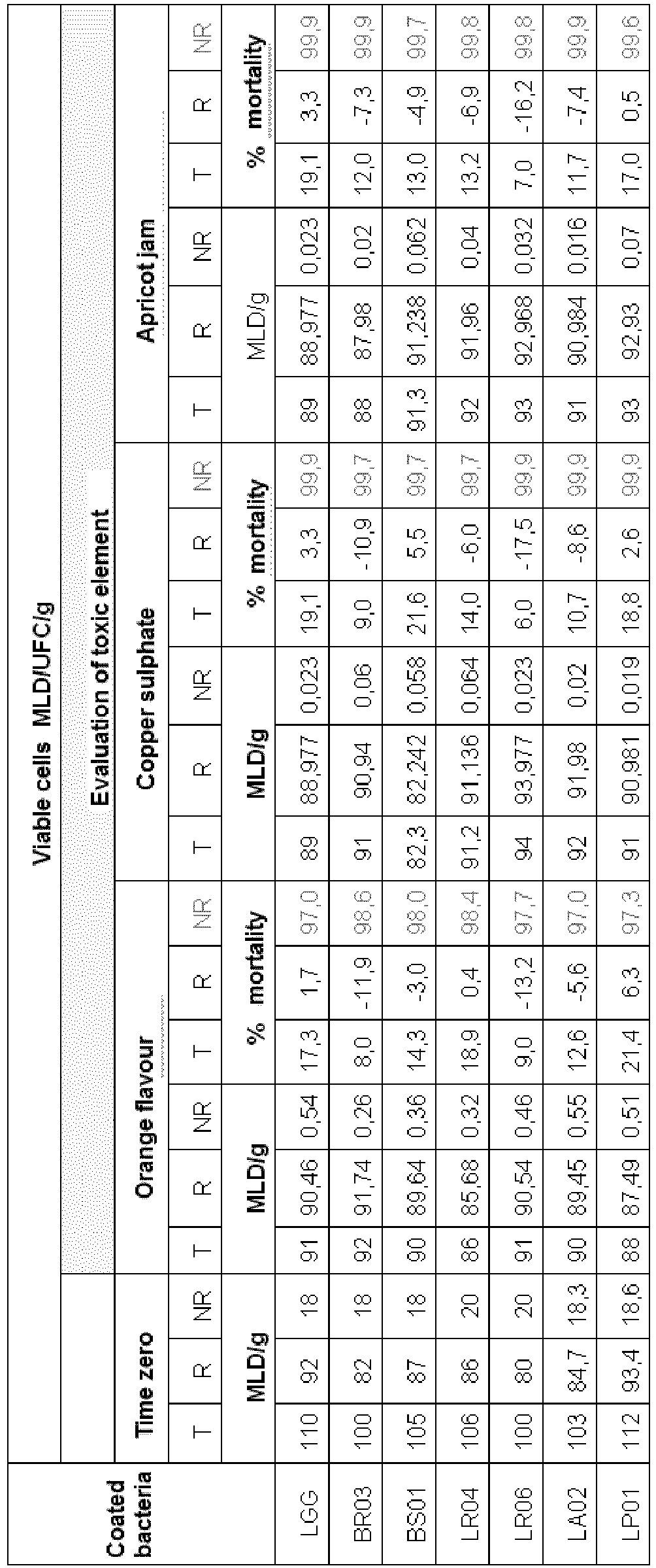
- In Tables 10, 11, 12 and 13, the following expressions are used:
- T=
- Total
- R=
- Coated
- NR=
- Uncoated
- Days=
- number of days
- BLN=
- Billion
- CFU=
- Colony forming units
- LGG
- Lactobacillus rhamnosus GG (ATCC53103)
- BR03
- Bifidobacterium breve BR03 (DSM16604)
- BS01
- Bifidobacterium lactis BS01 (LMG P-21384)
- LR04
- Lactobacillus casei ssp. rhamnosus LR04 (DSM 16605)
- LR06
- Lactobacillus rahmnosus LR06 (DSM 21981)
- LA02
- Lactobacillus acidophilus LA02 (LMG P-21382)
- LP01
- Lactobacillus plantarum LP 01 (LMG P-21021)
| T0 | 24 days at 25°C | 24 days at 25° |
60 days at 25° |
60 days at 25°C | |
| Sample | BLN/g | BLN/g | t/2 | BLN/g | t/2 |
| Sample (a) | 13.5 | 10.3 | 61.5 | 7 | 63.3 |
| Sample (b) | 3.2 | 3 | 257.8 | 2.9 | 422.5 |
| Fresh milk ( |
T0 | 7 days | 1 day |
| Viable cells (Billions BLN/CFUxg) | |||
| Sample 4(b) | 1.00 | 0.99 | 0.985 |
| Sample 4(a) | 1.00 | 0.71 | 0.50 |
| Butter (shelf life 90 days) | |
20 days | 50 days | 150 days |
| Viable cells (Billions BLN/CFUxg) | ||||
| Sample 5(b) | 1.00 | 0.86 | 0.81 | 0.640 |
| Sample 5(a) | 1.00 | 0.30 | 0.10 | 0.03 |
| Grated cheese (shelf life 68 days) | |
20 days | 50 days | 150 days |
| Viable cells (Billions BLN/CFUxg) | ||||
| Sample 6(b) | 1.00 | 0.86 | 0.79 | 0.600 |
| Sample 6(a) | 1.00 | 0.38 | 0.12 | 0.02 |
| Custard for sweets | T0 | 30 days | 90 |
180 days |
| Viable cells (Billions BLN/CFU/g) | ||||
| Sample 7(b) | 1.00 | 0.95 | 0.86 | 0.75 |
| Sample 7(a) | 1.00 | 0.22 | 0.05 | 0.02 |
| Custard for sweets | T0 | 30 days | 90 |
180 days |
| Viable cells (Billions BLN/CFUxg) | ||||
| Sample 8(b) | 1.00 | 0.96 | 0.89 | 0.80 |
| Sample 8(a) | 1.00 | 0.24 | 0.06 | 0.02 |
| Apricot jam | T0 | 30 days | 90 |
180 days |
| Viable cells (Billions BLN/CFUxg) | ||||
| Sample 9(b) | 1.00 | 0.96 | 0.89 | 0.800 |
| Sample 9(a) | 1.00 | 0.12 | 0.00030 | 0.000002 |

| Viable cells | |||||||
| NR | Time zero | Orange flavour | Copper sulphate | Apricot jam | |||
| BLN/g | BLN/g | % mortality | BLN/g | % mortality | BLN/g | | |
| LGG | |||||||
| 120 | 0.3 | 99.8 | 0.02 | 99.98 | 0.09 | 99.93 | |
| BR03 | 130 | 0.6 | 99.5 | 0.016 | 99.99 | 0.08 | 99.94 |
| | 100 | 0.15 | 99.9 | 0.032 | 99.97 | 0.032 | 99.97 |
| LR04 | 150 | 0.03 | 100.0 | 0.049 | 99.97 | 0.056 | 99.96 |
| | 120 | 0.2 | 99.8 | 0.032 | 99.97 | 0.023 | 99.98 |
| LA02 | 112 | 0.3 | 99.7 | 0.022 | 99.98 | 0.016 | 99.99 |
| LP01 | 116 | 0.16 | 99.9 | 0.026 | 99.98 | 0.018 | 99.98 |

| Viable cells | |||||||
| NR | Time zero | A1 (10ug/ml) | A2 (0.5ug/ml) | A3 | |||
| BLN/g | BLN/g | % mortality | BLN/g | % mortality | BLN/g | | |
| LGG | |||||||
| 120 | 0.1 | 99.9 | 0.09 | 99.93 | 0.11 | 99.91 | |
| BR03 | 130 | 1.02 | 99.2 | 1.3 | 99.00 | 0.103 | 99.92 |
| | 100 | 0.102 | 99.9 | 1.23 | 98.77 | 0.111 | 99.89 |
| LR04 | 150 | 0.12 | 99.9 | 0.01 | 99.99 | 0.023 | 99.98 |
| | 120 | 0.13 | 99.9 | 0.13 | 99.89 | 0.106 | 99.91 |
| LA02 | 112 | 0.2 | 99.8 | 0.12 | 99.89 | 0.16 | 99.86 |
| LP01 | 116 | 0.1 | 99.9 | 0.16 | 99.86 | 0.12 | 99.90 |
| No. | Name | Comm name | Deposit institution | Deposit number | Deposit number | Owner | |
| 1 | Lactobacillus casei | LF1i | CNCM I.P. | I-785 | 21.07.1988 | | |
| 2 | Lactobacillus gasseri | LF2i | CNCM I.P. | I-786 | 21.07.1988 | Anidral Srl | |
| 3 | Lactobacillus crispatus | LF3i | CNCM I.P. | I-787 | 21.07.1988 | | |
| 4 | Lactobacillus fermentum | LF4i | CNCM I.P. | I-788 | 21.07.1988 | Anidral Srl | |
| 5 | Lactobacillus fermentum | LF5 | CNCM I.P. | I-789 | 21.07.1988 | | |
| 6 | Lactobacillus casei ssp. pseudoplantarum | LFH the | CNCM I.P. | I-790 | 21.07.1988 | Anidral Srl | |
| 7 | Streptococcus thermophilus B39 | BCCM LMG | LMG P-18383 | 5.05.1998 | | ||
| 8 | Streptococcus thermophilus T003 | BCCM LMG | LMG P-18384 | 5.05.1998 | Anidral Srl | ||
| 9 | Lactobacillus pentosus 9/1 ei | BCCM LMG | LMG P-21019 | 16.10.2001 | | ||
| 10 | Lactobacillus plantarum 776/1 bi | LP 02 | BCCM LMG | LMG P-21020 | 16.10.2001 | Mofin Srl | |
| 11 | | LP 01 | BCCM LMG | LMG P-21021 | 16.10.2001 | | |
| 12 | Lactobacillus plantarum PR ci | BCCM LMG | LMG P-21022 | 16.10.2001 | Mofin Srl | ||
| 13 | Lactobacillus plantarum 776/2 hi | BCCM LMG | LMG P-21023 | 16.10.2001 | | ||
| 14 | Lactobacillus casei ssp. paracasei 181A/3 aiai | LPC00 | BCCM LMG | LMG P-21380 | 31.01.2002 | Anidral Srl | |
| 15 | Lactobacillus belonging to the acidophilus group 192A/1 aiai | LA 02 | BCCM LMG | LMG P-21381 | 31.01.2002 | | |
| 16 | Bifidobacterium longum 175A/1 aiai | BCCM LMG | LMG P-21382 | 31.01.2002 | Anidral Srl | ||
| 17 | Bifidobacterium breve 195A/1 aici | BCCM LMG | LMG P-21383 | 31.01.2002 | Anidral Srl | ||
| 18 | Bifidobacterium lactis 32A/3 aiai | BS 01 | BCCM LMG | LMG P-21384 | 31.01.2002 | Anidral Srl | |
| 19 | Lactobacillus plantarum 501/2 gi | COAKTI V | BCCM LMG | LMG P-21385 | 31.01.2002 | | |
| 20 | Lactococcus lactis ssp. lactis 501/4 ci | BCCM LMG | LMG P-21388 | 31.01.2002 | Mofin Srl | ||
| 21 | Lactococcus lactis ssp. lactis 501/4 hi | BCCM LMG | LMG P-21387 | 15.03.2002 | Mofin Srl | ||
| 22 | Lactococcus lactis ssp. lactis 501/4 ci | BCCM LMG | LMG P-21388 | 31.01.2002 | Mofin Srl | ||
| 23 | Lactobacillus plantarum 501/4 li | BCCM LMG | LMG P-21389 | 15.03.2002 | Mofin Srl | ||
| 24 | Lactobacillus acidophilus | LA08 | BCCM LMG | LMG P-26144 | 03.11.2010 | Probiotical SpA | |
| 25 | Lactobacillus paracasei ssp. paracasei | LPC10 | BCCM LMG | LMG P-26143 | 03.11.2010 | Probiotical SpA | |
| 26 | Streptococcus thermophilus | GB1 | DSMZ | DSM 16506 | 18.06.2004 | Anidral Srl | |
| 27 | Streptococcus thermophilus | GB5 | DSMZ | DSM 16507 | 18.06.2004 | Anidral Srl | |
| 28 | Streptococcus thermophilus | Y02 | DSMZ | DSM 16590 | 20.07.2004 | Anidral Srl | |
| 29 | Streptococcus thermophilus | Y03 | DSMZ | DSM 16591 | 20.07.2004 | Anidral Srl | |
| 30 | Streptococcus thermophilus | Y04 | DSMZ | DSM 16592 | 20.07.2004 | Anidral Srl | |
| 31 | Streptococcus thermophilus | Y05 | DSMZ | DSM 16593 | 20.07.2004 | Anidral Srl | |
| 32 = 56 | Bifidobacterium adolescentis | BA 03 | DSMZ | DSM 16594 | 21.07.2004 | Anidral Srl | |
| 33 | Bifidobacterium adolescentis | BA 04 | DSMZ | DSM 16595 | 21.07.2004 | Anidral Srl | |
| 34 | Bifidobacterium breve | BR04 | DSMZ | DSM 16596 | 21.07.2004 | Anidral Srl | |
| 35 | Bifidobacterium pseudocatenulatum | BP 01 | DSMZ | DSM 16597 | 21.07.2004 | Anidral Srl | |
| 36 | Bifidobacterium pseudocatenulatum | BP 02 | DSMZ | DSM 16598 | 21.07.2004 | Anidral Srl | |
| 37 | Bifidobacterium longum | BL 03 | DSMZ | DSM 16603 | 20.07.2004 | Anidral Srl | |
| 38 | Bifidobacterium breve | BR 03 | DSMZ | DSM 16604 | 20.07.2004 | Anidral Srl | |
| 39 | Lactobacillus casei ssp. rhamnosus | LR04 | DSMZ | DSM 16605 | 20.07.2004 | | |
| 40 | Lactobacillus delbrueckii ssp. bulgaricus | LDB 01 | DSMZ | DSM 16606 | 20.07.2004 | Anidral Srl | |
| 41 | Lactobacillus delbrueckii ssp. bulgaricus | LDB 02 | DSMZ | DSM 16607 | 20.07.2004 | Anidral Srl | |
| 42 | Staphylococcus xylosus | SX01 | DSMZ | DSM 17102 | 01.02.2005 | Anidral Srl | |
| 43 = 57 | Bifidobacterium adolescentis | BA 02 | DSMZ | DSM 17103 | 01.02.2005 | Anidral Srl | |
| 44 | Lactobacillus plantarum | LP 07 | DSMZ | DSM 17104 | 01.02.2005 | Anidral Srl | |
| 45 | Streptococcus thermophilus | Y08 | DSMZ | DSM 17843 | 21.12.2005 | Anidral Srl | |
| 46 | Streptococcus thermophilus | YO9 | DSMZ | DSM 17844 | 21.12.2005 | Anidral Srl | |
| 47 | Streptococcus thermophilus | YO100 | DSMZ | DSM 17845 | 21.12.2005 | Anidral Srl | |
| 48 | Lactobacillus fermentum | LF06 | DSMZ | DSM 18295 | 24.05.2006 | Anidral Srl | |
| 49 | Lactobacillus fermentum | LF07 | DSMZ | DSM 18296 | 24.05.2006 | Anidral Srl | |
| 50 | Lactobacillus fermentum | LF08 | DSMZ | DSM 18297 | 24.05.2006 | Anidral Srl | |
| 51 | Lactobacillus fermentum | LF09 | DSMZ | DSM 18298 | 24.05.2006 | Anidral Srl | |
| 52 | Lactobacillus gasseri | LGS01 | DSMZ | DSM 18299 | 24.05.2006 | Anidral Srl | |
| 53 | Lactobacillus gasseri | LGS02 | DSMZ | DSM 18300 | 24.05.2006 | Anidral Srl | |
| 54 | Lactobacillus gasseri | LGS03 | DSMZ | DSM 18301 | 24.05.2006 | Anidral Srl | |
| 55 | Lactobacillus gasseri | LGS04 | DSMZ | DSM 18302 | 24.05.2006 | Anidral Srl | |
| 56 = 32 | Bifidobacterium adolescentis EI-3 Bifidobacterium catenulatum sp./pseudocatenulatum EI-31, ID 09-255 | BA 03 | DSMZ | DSM 18350 | 15.06.2006 | Anidral Srl | |
| 57 = 43 | Bifidobacterium adolescentis EI-15 | BA 02 | DSMZ | DSM 18351 | 15.06.2006 | Anidral Srl | |
| 58 | Bifidobacterium adolescentis EI-18 Bifidobacterium animalis subsp. l actis EI-18, ID 09-256 | BA 05 | DSMZ | DSM 18352 | 15.06.2006 | Anidral Srl | |
| 59 | Bifidobacterium catenulatum EI-20 | BC 01 | DSMZ | DSM 18353 | 15.06.2006 | Anidral Srl | |
| 60 | Streptococcus thermophilus FRai | MO1 | DSMZ | DSM 18613 | 13.09.2006 | Mofin Srl | |
| 61 | Streptococcus thermophilus LB2bi | MO2 | DSMZ | DSM 18614 | 13.09.2006 | Mofin Srl | |
| 62 | Streptococcus thermophilus LRci | MO3 | DSMZ | DSM 18615 | 13.09.2006 | Mofin Srl | |
| 63 | Streptococcus thermophilus FP4 | MO4 | DSMZ | DSM 18616 | 13.09.2006 | Mofin Srl | |
| 64 | Streptococcus thermophilus ZZ5F8 | MO5 | DSMZ | DSM 18617 | 13.09.2006 | Mofin Srl | |
| 65 | Streptococcus thermophilus TEO4 | MO6 | DSMZ | DSM 18618 | 13.09.2006 | Mofin Srl | |
| 66 | Streptococcus thermophilus S1ci | MO7 | DSMZ | DSM 18619 | 13.09.2006 | Mofin Srl | |
| 67 | Streptococcus thermophilus 641bi | MO8 | DSMZ | DSM 18620 | 13.09.2006 | Mofin Srl | |
| 68 | Streptococcus thermophilus 277A/1ai | MO9 | DSMZ | DSM 18621 | 13.09.2006 | Mofin Srl | |
| 69 | Streptococcus thermophilus 277A/2ai | MO10 | DSMZ | DSM 18622 | 13.09.2006 | Mofin Srl | |
| 70 | Streptococcus thermophilus IDC11 | MO11 | DSMZ | DSM 18623 | 13.09.2006 | Mofin Srl | |
| 71 | Streptococcus thermophilus ML3di | MO14 | DSMZ | DSM 18624 | 13.09.2006 | Mofin Srl | |
| 72 | Streptococcus thermophilus TEO3 | MO15 | DSMZ | DSM 18625 | 13.09.2006 | Mofin Srl | |
| 73 | Streptococcus thermophilus G62 | GG1 | DSMZ | DSM 19057 | 21.02.2007 | Mofin Srl | |
| 74 | Streptococcus thermophilus G1192 | GG2 | DSMZ | DSM 19058 | 21.02.2007 | Mofin Srl | |
| 75 | Streptococcus thermophilus GB18 | GG3 MO2 | DSMZ | DSM 19059 | 21.02.2007 | Mofin Srl | |
| 76 | Streptococcus thermophilus CCR21 | GG4 | DSMZ | DSM 19060 | 21.02.2007 | Mofin Srl | |
| 77 | Streptococcus thermophilus G92 | GG5 | DSMZ | DSM 19061 | 21.02.2007 | Mofin Srl | |
| 78 | Streptococcus thermophilus G69 | GG6 | DSMZ | DSM 19062 | 21.02.2007 | Mofin Srl | |
| 79 | Streptococcus thermophilus | YO 10 | DSMZ | DSM 19063 | 21.02.2007 | Anidral Srl | |
| 80 | Streptococcus thermophilus | YO 11 | DSMZ | DSM 19064 | 21.02.2007 | Anidral Srl | |
| 81 | Streptococcus thermophilus | YO 12 | DSMZ | DSM 19065 | 21.02.2007 | Anidral Srl | |
| 82 | Streptococcus thermophilus | YO 13 | DSMZ | DSM 19066 | 21.02.2007 | Anidral Srl | |
| 83 | Weissella ssp. WSP 01 | EX | DSMZ | DSM 19067 | 21.02.2007 | Anidral Srl | |
| 84 | Weissella ssp. WSP 02 | EX | DSMZ | DSM 19068 | 21.02.2007 | Anidral Srl | |
| 85 | Lactobacillus ssp. WSP 03 | EX | DSMZ | DSM 19069 | 21.02.2007 | Anidral Srl | |
| 86 | Lactobacillus plantarum LP 09 | OY | DSMZ | DSM 19070 | 21.02.2007 | Anidral Srl | |
| 87 | | OY | DSMZ | DSM 19071 | 21.02.2007 | Anidral Srl | |
| 88 | Lactococcus lactis | NS 01 | DSMZ | DSM 19072 | 21.02.2007 | Anidral Srl | |
| 89 | | LF | 10 | DSMZ | DSM 19187 | 20.03.2007 | Anidral Srl |
| 90 | Lactobacillus fermentum | LF 11 | DSMZ | DSM 19188 | 20.03.2007 | Anidral Srl | |
| 91 | Lactobacillus casei ssp. rhamnosus | LR05 | DSMZ | DSM 19739 | 27.09.2007 | Anidral Srl | |
| 92 | Bifidobacterium bifidum | BB01 | DSMZ | DSM 19818 | 30.10.2007 | Anidral Srl | |
| 93 | Lactobacillus delbrueckii subsp. bulgaricus LD 01 | Lb | DSMZ | DSM 19948 | 28.11.2007 | Anidral Srl | |
| 94 | Lactobacillus delbrueckii subsp. bulgaricus LD 02 | Lb | DSMZ | DSM 19949 | 28.11.2007 | Anidral Srl | |
| 95 | Lactobacillus delbrueckii subsp. bulgaricus LD 03 | Lb | DSMZ | DSM 19950 | 28.11.2007 | Anidral Srl | |
| 96 | Lactobacillus delbrueckii subsp. bulgaricus LD 04 | Lb | DSMZ | DSM 19951 | 28.11.2007 | Anidral Srl | |
| 97 | Lactobacillus delbrueckii subsp. bulgaricus LD 05 | Lb | DSMZ | DSM 19952 | 28.11.2007 | Anidral Srl | |
| 98 | Bifidobacterium pseudocatenulatum | B660 | DSMZ | DSM 21444 | 13.05.2008 | Probiotical SpA | |
| 99 | Lactobacillus acidophilus | LA02 | DSMZ | DSM 21717 | 06.08.2008 | | |
| 100 | Lactobacillus paracasei | LPC 08 | DSMZ | DSM 21718 | 06.08.2008 | Probiotical SpA | |
| 101 | Lactobacillus pentosus | LPS 01 | DSMZ | DSM 21980 | 14.11.2008 | Probiotical SpA | |
| 102 | Lactobacillus rahmnosus | LR06 | DSMZ | DSM 21981 | 14.11.2008 | Probiotical SpA | |
| 103 | Lactobacillus delbrueckii ssp. delbrueckii | DSMZ 20074 | DSMZ | DSM 22106 | 10.12.2008 | Probiotical SpA | |
| 104 | Lactobacillus plantarum | LP1 | DSMZ | DSM 22107 | 10.12.2008 | Probiotical SpA | |
| 105 | Lactobacillus salivarius | LS01 | DSMZ | DSM 22775 | 23.07.2009 | Probiotical SpA | |
| 106 | Lactobacillus salivarius | LS03 | DSMZ | DSM 22776 | 23.07.2009 | Probiotical SpA | |
| 107 | Bifidobacterium bifidum | BB01 | DSMZ | DSM 22892 | 28.08.2009 | Probiotical SpA | |
| 108 | Bifidobacterium bifidum | DSMZ | DSM 22893 | 28.08.2009 | Probiotical SpA | ||
| 109 | Bifidobacterium bifidum | BB03 | DSMZ | DSM 22894 | 28.08.2009 | Probiotical SpA | |
| 110 | Bifidobacterium lactis | BS05 | DSMZ | DSM 23032 | 13.10.2009 | Probiotical SpA | |
| 111 | Lactobacillus acidophilus | LA 06 | DSMZ | DSM 23033 | 13.10.2009 | Probiotical SpA | |
| 112 | Lactobacillus brevis | LBR01 | DSMZ | DSM 23034 | 13.10.2009 | Probiotical SpA | |
| 113 | Bifidobacterium animalis ssp. lactis | BS06 | DSMZ | DSM 23224 | 12.01.2010 | Probiotical SpA | |
| 114 | Bifidobacterium longum | BL04 | DSMZ | DSM 23233 | 12.01.2010 | Probiotical SpA | |
| 115 | Bifidobacterium longum | BL05 | DSMZ | DSM 23234 | 12.01.2010 | Probiotical SpA | |
| 116 | Bifidobacterium bifidum | MB 109 | DSMZ | DSM 23731 | 29.06.2010 | Probiotical SpA | |
| 117 | Bifidobacterium breve | MB 113 | DSMZ | DSM 23732 | 29.06.2010 | Probiotical SpA | |
| 118 | Bifidobacterium lactis | MB 2409 | DSMZ | DSM 23733 | 29.06.2010 | Probiotical SpA | |
| 119 | Lactobacillus reuteri | LRE01 | DSMZ | DSM 23877 | 05.08.2010 | | |
| 120 | Lactobacillus reuteri | LRE02 | DSMZ | DSM 23878 | 05.08.2010 | Probiotical SpA | |
| 121 | Lactobacillus reuteri | LRE03 | DSMZ | DSM 23879 | 05.08.2010 | Probiotical SpA | |
| 122 | Lactobacillus reuteri | LRE04 | DSMZ | DSM 23880 | 05.08.2010 | Probiotical SpA | |
| 123 | Lactobacillus paracasei ssp. paracasei | LPC09 | DSMZ | DSM 24243 | 23.11.2010 | Probiotical SpA | |
| 124 | Lactobacillus acidophilus | LA 07 | DSMZ | DSM 24303 | 23.11.2010 | Probiotical SpA | |
| 125 | Bifidobacterium bifidum | BB04 | DSMZ | DSM 24437 | 04.01.2011 | Probiotical SpA | |
| 126 | Lactobacillus crispatus | CRL 1251 | DSMZ | DSM 24438 | 04.01.2011 | Probiotical SpA | |
| 127 | Lactobacillus crispatus | CRL 1266 | DSMZ | DSM 24439 | 04.01.2011 | Probiotical SpA | |
| 128 | Lactobacillus paracasei | CRL 1289 | DSMZ | DSM 24440 | 04.01.2011 | Probiotical SpA | |
| 129 | Lactobacillus salivarius | CRL 1328 | DSMZ | DSM 24441 | 04.01.2011 | Probiotical SpA | |
| 130 | Lactobacillus gasseri | CRL 1259 | DSMZ | DSM 24512 | 25.01.2011 | Probiotical SpA | |
| 131 | Lactobacillus acidophilus | CRL 1294 | DSMZ | DSM 24513 | 25.01.2011 | Probiotical SpA | |
| 132 | Lactobacillus salivarius | LS04 | DSMZ | DSM 24618 | 02.03.2011 | Probiotical SpA | |
| 133 | Lactobacillus crispatus | LCR01 | DSMZ | DSM 24619 | 02.03.2011 | Probiotical SpA | |
| 134 | Lactobacillus crispatus | LCR02 | DSMZ | DSM 24620 | 02.03.2011 | Probiotical SpA | |
| 135 | Lacotbacillus acidophilus | LA09 | DSMZ | DSM 24621 | 02.03.2011 | Probiotical SpA | |
| 136 | Lactobacillus gasseri | LGS05 | DSMZ | DSM 24622 | 02.03.2011 | Probiotical SpA | |
| 137 | Lactobacillus paracasei | LPC11 | DSMZ | DSM 24623 | 02.03.2011 | Probiotical SpA | |
| 138 | Bifidobacterium infantis | BI 02 | DSMZ | DSM 24687 | 29.03.2011 | Probiotical SpA | |
| 139 | Bifidobacterium bifidum | BB 06 | DSMZ | DSM 24688 | 29.03.2011 | Probiotical SpA | |
| 140 | Bifidobacterium longum | BL 06 | DSMZ | DSM 24689 | 29.03.2011 | Probiotical SpA | |
| 141 | Bifidobacterium lactis | BS 07 | DSMZ | DSM 24690 | 29.03.2011 | Probiotical SpA | |
| 142 | Bifidobacterium longum | PCB133 | DSMZ | DSM 24691 | 29.03.2011 | Probiotical SpA | |
| 143 | Bifidobacterium breve | B632 | DSMZ | DSM 24706 | 07.04.2011 | Probiotical SpA | |
| 144 | Bifidobacterium breve | B2274 | DSMZ | DSM 24707 | 07.04.2011 | Probiotical SpA | |
| 145 | Bifidobacterium breve | B7840 | DSMZ | DSM 24708 | 07.04.2011 | Probiotical SpA | |
| 146 | Bifidobacterium longum | B1975 | DSMZ | DSM 24709 | 07.04.2011 | Probiotical SpA | |
| 147 | Lactobacillus salivarius | DLV1 | DSMZ | DSM 25138 | 02.09.2011 | Probiotical SpA | |
| 148 | Lactobacillus reuteri | LRE05 | DSMZ | DSM 25139 | 02.09.2011 | Probiotical SpA | |
| 149 | Lactobacillus reuteri | LRE06 | DSMZ | DSM 25140 | 02.09.2011 | Probiotical SpA | |
| 150 | Lactobacillus reuteri | RC 14 | DSMZ | DSM 25141 | 02.09.2011 | Probiotical SpA | |
| 151 | Streptococcus thermophilus | ST 10 | DSMZ | DSM 25246 | 19.09.2011 | Probiotical SpA | |
| 152 | Streptococcus thermophilus | ST 11 | DSMZ | DSM 25247 | 19.09.2011 | Probiotical SpA | |
| 153 | Streptococcus thermophilus | ST 12 | DSMZ | DSM 25282 | 20.10.2011 | Probiotical SpA | |
| 154 | Lactobacillus salivarius | DLV8 | DSMZ | DSM 25545 | 12.01.2012 | Probiotical SpA | |
| 155 | Bifidobacterium longum | DLBL 07 | DSMZ | DSM 25669 | 16.02.2012 | Probiotical SpA | |
| 156 | Bifidobacterium longum | DLBL 08 | DSMZ | DSM 25670 | 16.02.2012 | Probiotical SpA | |
| 157 | Bifidobacterium longum | DLBL 09 | DSMZ | DSM 25671 | 16.02.2012 | Probiotical SpA | |
| 158 | Bifidobacterium longum | DLBL 10 | DSMZ | DSM 25672 | 16.02.2012 | Probiotical SpA | |
| 159 | Bifidobacterium longum | DLBL 11 | DSMZ | DSM 25673 | 16.02.2012 | Probiotical SpA | |
| 160 | Bifidobacterium longum | DLBL 12 | DSMZ | DSM 25674 | 16.02.2012 | Probiotical SpA | |
| 161 | Bifidobacterium longum | DLBL 13 | DSMZ | DSM 25675 | 16.02.2012 | Probiotical SpA | |
| 162 | Bifidobacterium longum | DLBL 14 | DSMZ | DSM 25676 | 16.02.2012 | Probiotical SpA | |
| 163 | Bifidobacterium longum | DLBL 15 | DSMZ | DSM 25677 | 16.02.2012 | Probiotical SpA | |
| 164 | Bifidobacterium longum | DLBL 16 | DSMZ | DSM 25678 | 16.02.2012 | Probiotical SpA | |
| 165 | Bifidobacterium longum | DLBL 17 | DSMZ | DSM 25679 | 16.02.2012 | Probiotical SpA | |
| 166 | Lactobacillus johnsonii | DLLJO 01 | DSMZ | DSM 25680 | 16.02.2012 | Probiotical SpA | |
| 167 | Lactobacillus rhamnosus | DLLR 07 | DSMZ | DSM 25681 | 16.02.2012 | Probiotical SpA | |
| 168 | Lactobacillus rhamnosus | DLLR 08 | DSMZ | DSM 25682 | 16.02.2012 | Probiotical SpA | |
| 169 | Lactobacillus reuteri | DLLRE 07 | DSMZ | DSM 25683 | 16.02.2012 | Probiotical SpA | |
| 170 | Lactobacillus reuteri | DLLRE 08 | DSMZ | DSM 25684 | 16.02.2012 | Probiotical SpA | |
| 171 | Lactobacillus reuteri | DLLRE 09 | DSMZ | DSM 25685 | 16.02.2012 | Probiotical SpA | |
| 172 | Bifidobacterium longum | DLBL 18 | DSMZ | DSM 25708 | 24.02.2012 | Probiotical SpA | |
| 173 | Bifidobacterium infantis | BI 03 | DSMZ | DSM 25709 | 24.02.2012 | Probiotical SpA | |
| 174 | Lactobacillus plantarum | LP 09 | DSMZ | DSM 25710 | 24.02.2012 | Probiotical SpA | |
| 175 | Bifidobacterium longum | DLBL 19 | DSMZ | DSM 25717 | 01.03.2012 | Probiotical SpA | |
| 176 | Bifidobacterium longum | DLBL 20 | DSMZ | DSM 25718 | 01.03.2012 | Probiotical SpA | |
| 177 | Lactobacillus salivarius | LS 05 | DSMZ | DSM 26036 | 06.06.2012 | Probiotical SpA | |
| 178 | Lactobacillus salivarius | LS 06 | DSMZ | DSM 26037 | 06.06.2012 | Probiotical SpA | |
| 179 | Lactobacillus pentosus | LPS 02 | DSMZ | DSM 26038 | 06.06.2012 | Probiotical SpA | |
| 180 | Bifidobacterium pseudolongum ssp. globosum | BPS 01 | DSMZ | DSM 26456 | 02.10.2012 | Probiotical SpA |
Claims (10)
- Probiotic bacteria coated with a coating comprising lipids of vegetable origin, characterized in that said coating is a multilayer coating comprising at least a first coating layer and a second coating layer, wherein the first and second coating layers are made from the same coating material and wherein:- a first coating layer is formed on the outer surface of the bacteria, and a second coating layer is formed on the outer surface of said first coating layer, wherein said first and second coating layers comprise or, alternatively, consist of a lipid of vegetable origin selected from the group consisting of mono- and di-glycerides of saturated fatty acids, polyglycerols esterified with saturated fatty acids and free saturated fatty acids and wherein:
the first and second coatings are sprayed onto lyophilized bacteria in succession, wherein between said first and second coating, a pause is made to allow the first coating layer to cool and solidify, and subsequently the second coating layer is applied. - The bacteria according to claim 1, wherein the lipids are saturated vegetable fats having a melting point from 35°C to 85°C, preferably from 45 to 70°C.
- The bacteria according to claim 1 or 2, wherein the lipids are selected from a glyceryl dipalmitostearate E471 -lipid (i), a polyglyceryl palmitostearate E475 -lipid (ii), a mixture of esters of glycerol and fatty acids C16-C18 -lipid (iii) and a hydrogenated vegetable fat of non-lauric origin-lipid (iv).
- The bacteria according to claim 3, wherein the multilayer coating consists of two layers, and the first and second coating layers comprise or, alternatively, consist of lipid (i) .
- The bacteria according to claim 3, wherein the multilayer consists of two layers, and the first and second coating layers comprise or, alternatively, consist of lipid (ii).
- The bacteria according to claim 3, wherein the multilayer consists of three layers, the first and second coating layers comprise or, alternatively, consist of lipid (i) and a third coating layer comprises or, alternatively, consists of lipid (ii), (iii) and (iv) or, alternatively, the first and second coating layers comprise or, alternatively, consist of lipid (ii) and a third coating layer comprises or, alternatively, consists of lipid (i), (iii) and (iv).
- The bacteria according to any one of claims 1-6, wherein said coated bacteria have a concentration comprised from 1x10⁶ to 1x10¹¹ CFU/g, preferably 1x10⁷ to 1x10¹⁰ CFU/g, even more preferably 1x10⁸ to 1x10⁹ CFU/g.
- A food product or a medical device or a supplement product comprising the coated bacteria according to any one of claims 1-7.
- The food product according to claim 8, wherein the coated bacteria, preferably at a concentration comprised from 1x10⁶ to 1x10¹¹ CFU/g or 1x10⁷ to 1x10¹⁰ CFU/g or 1x10⁸ to 1x10⁹ CFU/g, are introduced into a food selected from the group comprising:- powdered milk, in a quantity comprised from 0.1 to 20% by weight, preferably 0.5 to 10% by weight, even more preferably 1 to 5% by weight, relative to the weight of the food product;- fresh milk, in a quantity comprised from 0.1 to 20% by weight, preferably 0.5 to 10% by weight, even more preferably 1 to 5% by weight, relative to the weight of the food product;- butter or margarine, in a quantity comprised from 0.1 to 20% by weight, preferably 0.5 to 10% by weight, even more preferably 1 to 5% by weight, relative to the weight of the food product;- cream or yogurt, in a quantity comprised from 0.1 to 20% by weight, preferably 0.5 to 10% by weight, even more preferably 1 to 5% by weight, relative to the weight of the food product;- grated cheese, in a quantity comprised from 0.1 to 20% by weight, preferably 0.5 to 10% by weight, even more preferably 1 to 5% by weight, relative to the weight of the food product;- milk-flavoured custard for filling sweets, in a quantity comprised from 0.1 to 20% by weight, preferably 0.5 to 10% by weight, even more preferably 1 to 5% by weight, relative to the weight of the food product;- chocolate-flavoured custard for filling sweets, in a quantity comprised from 0.1 to 20% by weight, preferably 0.5 to 10% by weight, even more preferably 1 to 5% by weight, relative to the weight of the food product;- apricot jam, in a quantity comprised from 0.1 to 20% by weight, preferably 0.5 to 10% by weight, even more preferably 1 to 5% by weight, relative to the weight of the food product.
- A pharmaceutical composition comprising the coated bacteria according to any one of claims 1-7 and at least one pharmaceutical active ingredient with antibiotic activity; preferably an antibiotic selected from the group comprising ciprofloxacin, erythromycin or ampicillin.
Priority Applications (2)
| Application Number | Priority Date | Filing Date | Title |
|---|---|---|---|
| PL13707032T PL2809168T3 (en) | 2012-02-01 | 2013-02-01 | Multilayer microencapsulated probiotic bacteria as well as food and pharmaceutical compositions comprising said bacteria |
| SI201331829T SI2809168T1 (en) | 2012-02-01 | 2013-02-01 | Multilayer microencapsulated probiotic bacteria as well as food and pharmaceutical compositions comprising said bacteria |
Applications Claiming Priority (2)
| Application Number | Priority Date | Filing Date | Title |
|---|---|---|---|
| IT000131A ITMI20120131A1 (en) | 2012-02-01 | 2012-02-01 | MULTILAYER MICROCAPSULATED PROBIOTIC BACTERIA, THEIR PRODUCTION AND USE |
| PCT/IB2013/000124 WO2013114185A1 (en) | 2012-02-01 | 2013-02-01 | Multilayer microincapsulated probiotic bacteria |
Publications (2)
| Publication Number | Publication Date |
|---|---|
| EP2809168A1 EP2809168A1 (en) | 2014-12-10 |
| EP2809168B1 true EP2809168B1 (en) | 2020-09-30 |
Family
ID=45998501
Family Applications (1)
| Application Number | Title | Priority Date | Filing Date |
|---|---|---|---|
| EP13707032.2A Active EP2809168B1 (en) | 2012-02-01 | 2013-02-01 | Multilayer microencapsulated probiotic bacteria as well as food and pharmaceutical compositions comprising said bacteria |
Country Status (9)
| Country | Link |
|---|---|
| US (1) | US10738274B2 (en) |
| EP (1) | EP2809168B1 (en) |
| DK (1) | DK2809168T3 (en) |
| ES (1) | ES2845559T3 (en) |
| IT (1) | ITMI20120131A1 (en) |
| PL (1) | PL2809168T3 (en) |
| PT (1) | PT2809168T (en) |
| SI (1) | SI2809168T1 (en) |
| WO (1) | WO2013114185A1 (en) |
Families Citing this family (13)
| Publication number | Priority date | Publication date | Assignee | Title |
|---|---|---|---|---|
| EP3139940B1 (en) * | 2014-05-05 | 2021-02-17 | Probiotical S.p.A. | Composition comprising l. reuteri ler03 and l. salivarius ls06 for use in the treatment of tumors, aids and leukemias |
| WO2015170159A1 (en) | 2014-05-05 | 2015-11-12 | Giovanni Mogna | A composition for use in treating or preventing viral or bacterial infections in a subject undergoing anti-tumor chemotherapy, leukemia treatment or aids therapy comprising l. reuteri ler03 and/or l. salivarius ls06. |
| CA2985729C (en) | 2015-05-11 | 2023-05-09 | Mybiotics Pharma Ltd | Systems and methods for growing a biofilm of probiotic bacteria on solid particles for colonization of bacteria in the gut |
| EP3127434A1 (en) * | 2015-08-07 | 2017-02-08 | Robertus Hasert | The use of e471 as a coating agent for food ingredients and the method of preparation of e471 as a coating agent for food ingredients |
| ITUB20153106A1 (en) * | 2015-08-13 | 2017-02-13 | Probiotical Spa | Composition of lactic bacteria for use in the treatment of infections caused by Propionibacterium acnes and in particular for acne |
| ITUB20159138A1 (en) | 2015-12-22 | 2017-06-22 | Euro Pharma Srl | Integrative therapeutic formulations for the separate, sequential or simultaneous administration of butyric acid, G.S.E probiotics and prebiotics. |
| ES2698384T3 (en) * | 2016-02-10 | 2019-02-04 | Fundacion Tecnalia Res & Innovation | Multilayer probiotic microcapsules |
| KR102380134B1 (en) | 2016-05-25 | 2022-03-29 | 마이바이오틱스 파마 엘티디. | Compositions and methods for the treatment of microflora |
| JP2022535323A (en) * | 2019-03-28 | 2022-08-08 | マイバイオティクス ファーマ リミテッド | Probiotic biofilm composition and method of preparing same |
| FR3095761B1 (en) | 2019-05-06 | 2023-11-10 | Lab Attitude | Nutraceutical composition for inducing weight loss and reducing abdominal fat |
| IT201900020805A1 (en) * | 2019-11-11 | 2021-05-11 | Probiotical Spa | Gastro-protected granular bacteria with coating matrix in crystalline form, process for their preparation and their compositions |
| CN112544977B (en) * | 2020-11-03 | 2022-02-18 | 国家粮食和物资储备局科学研究院 | Preparation method of multi-layer coated probiotic microcapsule |
| FR3125945B1 (en) | 2021-08-03 | 2024-07-12 | Setalg | Composition for protecting a microorganism in an acidic environment. |
Family Cites Families (10)
| Publication number | Priority date | Publication date | Assignee | Title |
|---|---|---|---|---|
| WO1993019162A1 (en) | 1992-03-17 | 1993-09-30 | Pioneer Hi-Bred International, Inc. | Fatty acid microspheres containing enterococcus for use to enhance growth and improve carcass quality |
| US6676933B2 (en) * | 2001-05-23 | 2004-01-13 | Osmotica Corp. | Pharmaceutical composition containing mosapride and pancreatin |
| FR2867682B1 (en) * | 2004-03-22 | 2009-06-05 | Galderma Res & Dev | ANHYDROUS PHARMACEUTICAL COMPOSITION COMPRISING A SILICONE AGENT AND A SOLUBILIZED ACTIVE INGREDIENT. |
| DE102004026706A1 (en) * | 2004-05-28 | 2005-12-15 | Merck Patent Gmbh | Oral dosage form containing probiotic bacteria |
| EP2381799B1 (en) * | 2009-01-27 | 2018-08-08 | Probiotical S.p.a. | Chocolate flavoured probiotic supplement |
| IT1400821B1 (en) * | 2009-03-09 | 2013-07-02 | Probiotical Spa | OIL SUSPENSION CONTAINING PROBIOTIC BACTERIA FOR PEDIATRIC USE |
| SG176253A1 (en) * | 2009-05-26 | 2011-12-29 | Advanced Bionutrition Corp | Stable dry powder composition comprising biologically active microorganisms and/or bioactive materials and methods of making |
| WO2010138552A1 (en) | 2009-05-26 | 2010-12-02 | Redfern Integrated Optics, Inc. | Achieving low phase noise in external cavity laser implemented using planar lightwave circuit technology |
| IT1398730B1 (en) * | 2009-09-08 | 2013-03-18 | Giuliani Spa | PROBIOTIC BACTERIAL STRAIN AND ITS USES BY ORAL AND TOPIC ROUTE |
| US9427012B2 (en) * | 2010-08-10 | 2016-08-30 | R.P. Scherer Technologies, Llc | Process of manufacturing a stable softgel capsule containing microencapsulated probiotic bacteria |
-
2012
- 2012-02-01 IT IT000131A patent/ITMI20120131A1/en unknown
-
2013
- 2013-02-01 DK DK13707032.2T patent/DK2809168T3/en active
- 2013-02-01 PT PT137070322T patent/PT2809168T/en unknown
- 2013-02-01 ES ES13707032T patent/ES2845559T3/en active Active
- 2013-02-01 WO PCT/IB2013/000124 patent/WO2013114185A1/en not_active Ceased
- 2013-02-01 EP EP13707032.2A patent/EP2809168B1/en active Active
- 2013-02-01 PL PL13707032T patent/PL2809168T3/en unknown
- 2013-02-01 US US14/376,268 patent/US10738274B2/en active Active
- 2013-02-01 SI SI201331829T patent/SI2809168T1/en unknown
Non-Patent Citations (1)
| Title |
|---|
| None * |
Also Published As
| Publication number | Publication date |
|---|---|
| ITMI20120131A1 (en) | 2013-08-02 |
| SI2809168T1 (en) | 2021-04-30 |
| PL2809168T3 (en) | 2021-05-04 |
| ES2845559T3 (en) | 2021-07-27 |
| PT2809168T (en) | 2021-01-05 |
| US10738274B2 (en) | 2020-08-11 |
| EP2809168A1 (en) | 2014-12-10 |
| WO2013114185A1 (en) | 2013-08-08 |
| DK2809168T3 (en) | 2021-01-04 |
| US20140370107A1 (en) | 2014-12-18 |
Similar Documents
| Publication | Publication Date | Title |
|---|---|---|
| US10738274B2 (en) | Multilayer microencapsulated probiotic bacteria | |
| EP2451300B2 (en) | Heat resistant probiotic compositions and healthy food comprising them | |
| EP2381799B1 (en) | Chocolate flavoured probiotic supplement | |
| EP3205216B1 (en) | Multilayer probiotic microcapsules | |
| CN103180432B (en) | Prepare the method for shelf-stable probiotic food | |
| KR102458232B1 (en) | Lactobacillus-containing chocolate and manufacturing method thereof | |
| US11123384B2 (en) | Microencapsulated probiotic bacteria | |
| EP2405894A2 (en) | Oily suspension containing probiotic bacteria for paediatric uses | |
| CA2799725A1 (en) | Probiotic compositions, methods and apparatus for their administration | |
| US20070098847A1 (en) | Food product containing lactic bacteria granules | |
| KR20180129168A (en) | Natural liposome comprising lactic acid bacteria, process for the preparation thereof and food or pharmaceutical composition comprising the same | |
| US20240148661A1 (en) | High temperature resistant probiotics for food or beverage and method of making the same | |
| US10532076B2 (en) | Probiotic anhydrous fatty foodstuffs and methods of making same | |
| EP3305086A1 (en) | Lactic acid bacterium-containing fat or oil composition and method for manufacturing same | |
| KR102607143B1 (en) | Multifunctional yogurt and manufacturing method thereof | |
| Hati et al. | Encapsulation of probiotics for enhancing the survival in gastrointestinal tract | |
| Ezekiel et al. | Stability of encapsulated Lactobacillus rhamnosus GG in cocoa (Theobroma cacao L.) juice | |
| Eminoglu et al. | Probiotic dairy foods | |
| Mandal et al. | Diversification of probiotics through encapsulation technology | |
| Rodrigues et al. | P-090 Encapsulation of Probiotic for Dairy Food Application–a Review | |
| Sekhavatizadeh et al. | JFST No. 145, Vol. 20, March 2024 ABSTRACT | |
| MXPA06007313A (en) | Food product containing lactic bacteria granules |
Legal Events
| Date | Code | Title | Description |
|---|---|---|---|
| PUAI | Public reference made under article 153(3) epc to a published international application that has entered the european phase |
Free format text: ORIGINAL CODE: 0009012 |
|
| 17P | Request for examination filed |
Effective date: 20140812 |
|
| AK | Designated contracting states |
Kind code of ref document: A1 Designated state(s): AL AT BE BG CH CY CZ DE DK EE ES FI FR GB GR HR HU IE IS IT LI LT LU LV MC MK MT NL NO PL PT RO RS SE SI SK SM TR |
|
| AX | Request for extension of the european patent |
Extension state: BA ME |
|
| DAX | Request for extension of the european patent (deleted) | ||
| STAA | Information on the status of an ep patent application or granted ep patent |
Free format text: STATUS: EXAMINATION IS IN PROGRESS |
|
| 17Q | First examination report despatched |
Effective date: 20161026 |
|
| REG | Reference to a national code |
Ref country code: DE Ref legal event code: R079 Ref document number: 602013072909 Country of ref document: DE Free format text: PREVIOUS MAIN CLASS: A23C0015120000 Ipc: A23C0009120000 |
|
| RIC1 | Information provided on ipc code assigned before grant |
Ipc: A23C 19/086 20060101ALI20200228BHEP Ipc: A23C 9/12 20060101AFI20200228BHEP Ipc: A23C 15/12 20060101ALI20200228BHEP Ipc: A23G 3/34 20060101ALI20200228BHEP Ipc: A23L 33/135 20160101ALI20200228BHEP Ipc: A61K 35/741 20150101ALI20200228BHEP Ipc: A23C 9/16 20060101ALI20200228BHEP Ipc: A23L 21/10 20160101ALI20200228BHEP Ipc: A23P 10/35 20160101ALI20200228BHEP Ipc: A61K 9/50 20060101ALI20200228BHEP Ipc: A23C 13/16 20060101ALI20200228BHEP |
|
| GRAP | Despatch of communication of intention to grant a patent |
Free format text: ORIGINAL CODE: EPIDOSNIGR1 |
|
| STAA | Information on the status of an ep patent application or granted ep patent |
Free format text: STATUS: GRANT OF PATENT IS INTENDED |
|
| INTG | Intention to grant announced |
Effective date: 20200514 |
|
| GRAS | Grant fee paid |
Free format text: ORIGINAL CODE: EPIDOSNIGR3 |
|
| GRAA | (expected) grant |
Free format text: ORIGINAL CODE: 0009210 |
|
| STAA | Information on the status of an ep patent application or granted ep patent |
Free format text: STATUS: THE PATENT HAS BEEN GRANTED |
|
| AK | Designated contracting states |
Kind code of ref document: B1 Designated state(s): AL AT BE BG CH CY CZ DE DK EE ES FI FR GB GR HR HU IE IS IT LI LT LU LV MC MK MT NL NO PL PT RO RS SE SI SK SM TR |
|
| REG | Reference to a national code |
Ref country code: GB Ref legal event code: FG4D Ref country code: CH Ref legal event code: EP |
|
| REG | Reference to a national code |
Ref country code: AT Ref legal event code: REF Ref document number: 1317823 Country of ref document: AT Kind code of ref document: T Effective date: 20201015 |
|
| REG | Reference to a national code |
Ref country code: DE Ref legal event code: R096 Ref document number: 602013072909 Country of ref document: DE |
|
| REG | Reference to a national code |
Ref country code: IE Ref legal event code: FG4D |
|
| REG | Reference to a national code |
Ref country code: DK Ref legal event code: T3 Effective date: 20201222 |
|
| REG | Reference to a national code |
Ref country code: PT Ref legal event code: SC4A Ref document number: 2809168 Country of ref document: PT Date of ref document: 20210105 Kind code of ref document: T Free format text: AVAILABILITY OF NATIONAL TRANSLATION Effective date: 20201228 |
|
| REG | Reference to a national code |
Ref country code: NL Ref legal event code: FP |
|
| REG | Reference to a national code |
Ref country code: SE Ref legal event code: TRGR |
|
| PG25 | Lapsed in a contracting state [announced via postgrant information from national office to epo] |
Ref country code: HR Free format text: LAPSE BECAUSE OF FAILURE TO SUBMIT A TRANSLATION OF THE DESCRIPTION OR TO PAY THE FEE WITHIN THE PRESCRIBED TIME-LIMIT Effective date: 20200930 Ref country code: NO Free format text: LAPSE BECAUSE OF FAILURE TO SUBMIT A TRANSLATION OF THE DESCRIPTION OR TO PAY THE FEE WITHIN THE PRESCRIBED TIME-LIMIT Effective date: 20201230 Ref country code: GR Free format text: LAPSE BECAUSE OF FAILURE TO SUBMIT A TRANSLATION OF THE DESCRIPTION OR TO PAY THE FEE WITHIN THE PRESCRIBED TIME-LIMIT Effective date: 20201231 Ref country code: BG Free format text: LAPSE BECAUSE OF FAILURE TO SUBMIT A TRANSLATION OF THE DESCRIPTION OR TO PAY THE FEE WITHIN THE PRESCRIBED TIME-LIMIT Effective date: 20201230 Ref country code: FI Free format text: LAPSE BECAUSE OF FAILURE TO SUBMIT A TRANSLATION OF THE DESCRIPTION OR TO PAY THE FEE WITHIN THE PRESCRIBED TIME-LIMIT Effective date: 20200930 |
|
| REG | Reference to a national code |
Ref country code: CH Ref legal event code: NV Representative=s name: VALIPAT S.A. C/O BOVARD SA NEUCHATEL, CH |
|
| REG | Reference to a national code |
Ref country code: AT Ref legal event code: MK05 Ref document number: 1317823 Country of ref document: AT Kind code of ref document: T Effective date: 20200930 |
|
| PG25 | Lapsed in a contracting state [announced via postgrant information from national office to epo] |
Ref country code: LV Free format text: LAPSE BECAUSE OF FAILURE TO SUBMIT A TRANSLATION OF THE DESCRIPTION OR TO PAY THE FEE WITHIN THE PRESCRIBED TIME-LIMIT Effective date: 20200930 Ref country code: RS Free format text: LAPSE BECAUSE OF FAILURE TO SUBMIT A TRANSLATION OF THE DESCRIPTION OR TO PAY THE FEE WITHIN THE PRESCRIBED TIME-LIMIT Effective date: 20200930 |
|
| REG | Reference to a national code |
Ref country code: LT Ref legal event code: MG4D |
|
| PG25 | Lapsed in a contracting state [announced via postgrant information from national office to epo] |
Ref country code: LT Free format text: LAPSE BECAUSE OF FAILURE TO SUBMIT A TRANSLATION OF THE DESCRIPTION OR TO PAY THE FEE WITHIN THE PRESCRIBED TIME-LIMIT Effective date: 20200930 Ref country code: RO Free format text: LAPSE BECAUSE OF FAILURE TO SUBMIT A TRANSLATION OF THE DESCRIPTION OR TO PAY THE FEE WITHIN THE PRESCRIBED TIME-LIMIT Effective date: 20200930 Ref country code: SM Free format text: LAPSE BECAUSE OF FAILURE TO SUBMIT A TRANSLATION OF THE DESCRIPTION OR TO PAY THE FEE WITHIN THE PRESCRIBED TIME-LIMIT Effective date: 20200930 Ref country code: EE Free format text: LAPSE BECAUSE OF FAILURE TO SUBMIT A TRANSLATION OF THE DESCRIPTION OR TO PAY THE FEE WITHIN THE PRESCRIBED TIME-LIMIT Effective date: 20200930 Ref country code: CZ Free format text: LAPSE BECAUSE OF FAILURE TO SUBMIT A TRANSLATION OF THE DESCRIPTION OR TO PAY THE FEE WITHIN THE PRESCRIBED TIME-LIMIT Effective date: 20200930 |
|
| PG25 | Lapsed in a contracting state [announced via postgrant information from national office to epo] |
Ref country code: AT Free format text: LAPSE BECAUSE OF FAILURE TO SUBMIT A TRANSLATION OF THE DESCRIPTION OR TO PAY THE FEE WITHIN THE PRESCRIBED TIME-LIMIT Effective date: 20200930 Ref country code: AL Free format text: LAPSE BECAUSE OF FAILURE TO SUBMIT A TRANSLATION OF THE DESCRIPTION OR TO PAY THE FEE WITHIN THE PRESCRIBED TIME-LIMIT Effective date: 20200930 Ref country code: IS Free format text: LAPSE BECAUSE OF FAILURE TO SUBMIT A TRANSLATION OF THE DESCRIPTION OR TO PAY THE FEE WITHIN THE PRESCRIBED TIME-LIMIT Effective date: 20210130 |
|
| PG25 | Lapsed in a contracting state [announced via postgrant information from national office to epo] |
Ref country code: SK Free format text: LAPSE BECAUSE OF FAILURE TO SUBMIT A TRANSLATION OF THE DESCRIPTION OR TO PAY THE FEE WITHIN THE PRESCRIBED TIME-LIMIT Effective date: 20200930 |
|
| REG | Reference to a national code |
Ref country code: DE Ref legal event code: R097 Ref document number: 602013072909 Country of ref document: DE |
|
| REG | Reference to a national code |
Ref country code: ES Ref legal event code: FG2A Ref document number: 2845559 Country of ref document: ES Kind code of ref document: T3 Effective date: 20210727 |
|
| PLBE | No opposition filed within time limit |
Free format text: ORIGINAL CODE: 0009261 |
|
| STAA | Information on the status of an ep patent application or granted ep patent |
Free format text: STATUS: NO OPPOSITION FILED WITHIN TIME LIMIT |
|
| 26N | No opposition filed |
Effective date: 20210701 |
|
| PG25 | Lapsed in a contracting state [announced via postgrant information from national office to epo] |
Ref country code: MC Free format text: LAPSE BECAUSE OF FAILURE TO SUBMIT A TRANSLATION OF THE DESCRIPTION OR TO PAY THE FEE WITHIN THE PRESCRIBED TIME-LIMIT Effective date: 20200930 |
|
| PG25 | Lapsed in a contracting state [announced via postgrant information from national office to epo] |
Ref country code: CH Free format text: LAPSE BECAUSE OF NON-PAYMENT OF DUE FEES Effective date: 20210228 Ref country code: LU Free format text: LAPSE BECAUSE OF NON-PAYMENT OF DUE FEES Effective date: 20210201 Ref country code: LI Free format text: LAPSE BECAUSE OF NON-PAYMENT OF DUE FEES Effective date: 20210228 |
|
| PG25 | Lapsed in a contracting state [announced via postgrant information from national office to epo] |
Ref country code: IE Free format text: LAPSE BECAUSE OF NON-PAYMENT OF DUE FEES Effective date: 20210201 |
|
| REG | Reference to a national code |
Ref country code: DE Ref legal event code: R082 Ref document number: 602013072909 Country of ref document: DE Representative=s name: FRANKE & PARTNER PATENT- UND RECHTSANWAELTE IN, DE |
|
| PG25 | Lapsed in a contracting state [announced via postgrant information from national office to epo] |
Ref country code: HU Free format text: LAPSE BECAUSE OF FAILURE TO SUBMIT A TRANSLATION OF THE DESCRIPTION OR TO PAY THE FEE WITHIN THE PRESCRIBED TIME-LIMIT; INVALID AB INITIO Effective date: 20130201 |
|
| PG25 | Lapsed in a contracting state [announced via postgrant information from national office to epo] |
Ref country code: CY Free format text: LAPSE BECAUSE OF FAILURE TO SUBMIT A TRANSLATION OF THE DESCRIPTION OR TO PAY THE FEE WITHIN THE PRESCRIBED TIME-LIMIT Effective date: 20200930 |
|
| PG25 | Lapsed in a contracting state [announced via postgrant information from national office to epo] |
Ref country code: MK Free format text: LAPSE BECAUSE OF FAILURE TO SUBMIT A TRANSLATION OF THE DESCRIPTION OR TO PAY THE FEE WITHIN THE PRESCRIBED TIME-LIMIT Effective date: 20200930 |
|
| PG25 | Lapsed in a contracting state [announced via postgrant information from national office to epo] |
Ref country code: MT Free format text: LAPSE BECAUSE OF FAILURE TO SUBMIT A TRANSLATION OF THE DESCRIPTION OR TO PAY THE FEE WITHIN THE PRESCRIBED TIME-LIMIT Effective date: 20200930 |
|
| PG25 | Lapsed in a contracting state [announced via postgrant information from national office to epo] |
Ref country code: TR Free format text: LAPSE BECAUSE OF FAILURE TO SUBMIT A TRANSLATION OF THE DESCRIPTION OR TO PAY THE FEE WITHIN THE PRESCRIBED TIME-LIMIT Effective date: 20200930 |
|
| PGFP | Annual fee paid to national office [announced via postgrant information from national office to epo] |
Ref country code: NL Payment date: 20260217 Year of fee payment: 14 |
|
| PGFP | Annual fee paid to national office [announced via postgrant information from national office to epo] |
Ref country code: SE Payment date: 20260212 Year of fee payment: 14 |
|
| PGFP | Annual fee paid to national office [announced via postgrant information from national office to epo] |
Ref country code: GB Payment date: 20260223 Year of fee payment: 14 |
|
| PGFP | Annual fee paid to national office [announced via postgrant information from national office to epo] |
Ref country code: ES Payment date: 20260303 Year of fee payment: 14 |
|
| PGFP | Annual fee paid to national office [announced via postgrant information from national office to epo] |
Ref country code: DK Payment date: 20260212 Year of fee payment: 14 Ref country code: DE Payment date: 20260216 Year of fee payment: 14 |
|
| PGFP | Annual fee paid to national office [announced via postgrant information from national office to epo] |
Ref country code: BE Payment date: 20260223 Year of fee payment: 14 Ref country code: IT Payment date: 20260213 Year of fee payment: 14 |
|
| PGFP | Annual fee paid to national office [announced via postgrant information from national office to epo] |
Ref country code: FR Payment date: 20260218 Year of fee payment: 14 |
|
| PGFP | Annual fee paid to national office [announced via postgrant information from national office to epo] |
Ref country code: PT Payment date: 20260127 Year of fee payment: 14 |
|
| PGFP | Annual fee paid to national office [announced via postgrant information from national office to epo] |
Ref country code: PL Payment date: 20260128 Year of fee payment: 14 |
|
| PGFP | Annual fee paid to national office [announced via postgrant information from national office to epo] |
Ref country code: SI Payment date: 20260127 Year of fee payment: 14 |