EP2804066A1 - Method and system for aircraft guidance - Google Patents
Method and system for aircraft guidance Download PDFInfo
- Publication number
- EP2804066A1 EP2804066A1 EP20130382183 EP13382183A EP2804066A1 EP 2804066 A1 EP2804066 A1 EP 2804066A1 EP 20130382183 EP20130382183 EP 20130382183 EP 13382183 A EP13382183 A EP 13382183A EP 2804066 A1 EP2804066 A1 EP 2804066A1
- Authority
- EP
- European Patent Office
- Prior art keywords
- time
- rta
- aircraft
- trajectory
- speed
- Prior art date
- Legal status (The legal status is an assumption and is not a legal conclusion. Google has not performed a legal analysis and makes no representation as to the accuracy of the status listed.)
- Granted
Links
Images
Classifications
-
- G—PHYSICS
- G05—CONTROLLING; REGULATING
- G05D—SYSTEMS FOR CONTROLLING OR REGULATING NON-ELECTRIC VARIABLES
- G05D1/00—Control of position, course, altitude or attitude of land, water, air or space vehicles, e.g. using automatic pilots
- G05D1/10—Simultaneous control of position or course in three dimensions
- G05D1/101—Simultaneous control of position or course in three dimensions specially adapted for aircraft
-
- B—PERFORMING OPERATIONS; TRANSPORTING
- B64—AIRCRAFT; AVIATION; COSMONAUTICS
- B64C—AEROPLANES; HELICOPTERS
- B64C19/00—Aircraft control not otherwise provided for
-
- G—PHYSICS
- G08—SIGNALLING
- G08G—TRAFFIC CONTROL SYSTEMS
- G08G5/00—Traffic control systems for aircraft
- G08G5/30—Flight plan management
- G08G5/34—Flight plan management for flight plan modification
-
- G—PHYSICS
- G08—SIGNALLING
- G08G—TRAFFIC CONTROL SYSTEMS
- G08G5/00—Traffic control systems for aircraft
- G08G5/50—Navigation or guidance aids
- G08G5/53—Navigation or guidance aids for cruising
-
- G—PHYSICS
- G08—SIGNALLING
- G08G—TRAFFIC CONTROL SYSTEMS
- G08G5/00—Traffic control systems for aircraft
- G08G5/50—Navigation or guidance aids
- G08G5/55—Navigation or guidance aids for a single aircraft
-
- G—PHYSICS
- G08—SIGNALLING
- G08G—TRAFFIC CONTROL SYSTEMS
- G08G5/00—Traffic control systems for aircraft
- G08G5/30—Flight plan management
Definitions
- This invention relates to a method and system for aircraft guidance, and in particular to an improved Required Time of Arrival (RTA) aircraft guidance strategy.
- RTA Required Time of Arrival
- RTA Required Time of Arrival
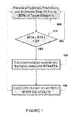
- Guidance of the aircraft involves specification of a Required time of Arrival at a target waypoint of the flight plan (step 100 of Figure 1 ).
- the aircraft flight management system then periodically predicts an Estimated Time of Arrival (ETA) at the specified target waypoint, based upon various measured and predicted variables such as current wind speed/groundspeed, weather forecast etc., (also step 100 of Figure 1 ).
- ETA Estimated Time of Arrival
- a deviation between the RTA and the ETA is determined and, if it is below a chosen threshold DT, then no action is taken. If however the deviation between RTA and ETA exceeds the chosen threshold DT, then at step 120, the aircraft guidance modifies the cruise/descent speeds in order to meet the RTA. At step 130, the flight plan with the modified speeds is executed. Such modifications of flight plan speeds take place several times during cruise and descent before arrival at the target waypoint.
- the threshold DT is variable in the sense that it is intentionally larger, the further away from the waypoint the aircraft is.
- the threshold time difference between RTA and ETA (below which no adjustments are mandated) may be 1 minute when the aircraft is 200 nautical miles (NM) from the waypoint. This is because the degree of uncertainty in the ETA increases with distance from the waypoint. It is an inefficient use of the engines to continually adjust flight speed to try to narrow the 'dead band' of 1 minute. As the aircraft approaches the target waypoint, it becomes more important to track the RTA more closely, and equally the degree of predictability increases. Thus the value of DT can be reduced. For example, DT may be 5 seconds when the aircraft is 10NM from the waypoint. See, for example, US-A-5,121,325 , Figure 9.
- the present invention provides for an improved aircraft guidance method and system.
- a method for guiding an aircraft is defined in claim 1.
- a system therefore is defined in claim 7.
- a computer program is set out in claim 10.
- Prior art guidance methods are based upon the premise that only the final arrival time (or, in the Jackson paper identified above), only a discrete set of arrival times at a set of intermediate waypoints), is important.
- the present invention chooses instead the novel approach of following an initial predicted 4D trajectory.
- a 4D trajectory is an aircraft trajectory predicted accurately as a function of time.
- the aircraft speed is also controlled with the aim of following the 4D trajectory throughout the flight.
- the aircraft has greater chances of completing the flight without tactical interventions from ground control.
- This fact implies several advantages: fewer chances that the flight will be diverted by ground control from its optional lateral path (vectoring) or put in a holding pattern, and fewer chances that ground control mandates an aircraft speed change. This in turn results in fuel and time savings (fewer delays) with consequential operational and cost benefits.
- Preferred embodiments of the present invention employ the novel guidance system explained above in a manner complementary to the state of the art RTA based guidance methods.
- the original RTA speed commands are maintained (based upon control of
- the method allows a trajectory to be shared between the ground and the aircraft, and gives the capability for the aircraft to follow that trajectory with accuracy.
- the novel guidance method/system of the invention can optionally be combined with one or more of a range of RTA based control techniques which are, of themselves, known in the art.
- a further advantage of the method set out herein is that it requires only minimal modification to the aircraft Flight Management System.
- a small algorithm added to the existing RTA software is sufficient. In particular no hardware, flight deck, displays or auto throttle modifications are necessary. This contrasts markedly with the modifications needed to implement the multiple RTA technique of the aforementioned Jackson paper, which requires major modifications both to the human interface and to the RTA software, to allow the pilot to enter multiple RTA at multiple waypoints.
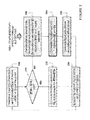
- Figure 2 shows a simplified flow chart of an aircraft guidance method embodying the present invention.
- the flowchart may be logically divided into two parts: a first part (to the left side of Figure 2 ) that acts to reduce excessive differences between an ETA and an predefined RTA for a chosen waypoint, and a complementary second part, to the right of Figure 2 , which comprises a flow of calculations that seek to maintain the aircraft upon a selected 4D flight trajectory - that is, the plot of aircraft position, speed and direction as a function of time.
- the second part of the flowchart that is, the control loop to the right of Figure 2 is enabled periodically, preferably when no speed adjustment is specified by the first part of the flowchart.
- any decisions to adjust the speed of the aircraft as a result of discrepancies between the selected flight path and the measured flight trajectory are complementary to any decisions to adjust the aircraft speed as a result of RTA-ETA exceeding DT.
- the calculations in the first part of the flowchart do not substitute or compete against the second part of the flowchart.
- the process starts at step 200.
- the RTA at a predetermined waypoint is identified or selected.
- An initial 4D flight trajectory to the waypoint is also selected. This initial 4D trajectory may be predicted by the aircraft flight management system, or may be predicted elsewhere and provided to the aircraft.
- a difference between the RTA and a current ETA (based upon estimated and measured parameters, as with the prior art) is determined. If the difference exceeds a threshold DT, then at step 220 new predictions are computed by modifying the planned speeds, with the aim of reducing the difference between RTA and ETA. Once the new predictions have been calculated, at step 230 the updated flight plan with the new speeds is executed by sending a throttle adjustment signal so as to adjust the aircraft speed.
- the parameter DT may be chosen so as to be larger further away from the waypoint.
- deviations from RTA tend to be smaller than in prior art methods, particularly as the waypoint is approached.
- step 210 if the difference between the RTA and the ETA is below the threshold DT, so that no speed adjustment would otherwise be mandated, the flowchart moves to step 240.
- deviations of time and groundspeed with respect to the initially predicted 4D trajectory are calculated. It is important to note that these deviations are NOT deviations of prediction of time of arrival at the target waypoint. These are instead deviations of current time and groundspeed with respect to the predicted 4D trajectory.
- a new speed command is generated in order to minimize the 4D navigation deviations.
- the algorithms to compute the new speed command are as follows: if the aircraft is late, a speed increment proportional to time deviation is added to current speed. If the aircraft arrives early, by contrast, a speed decrease proportional to time deviation is taken off the current speed. Also if the aircraft flies slower with respect to the predicted trajectory and with respect to the ground, a speed increment proportional to groundspeed deviation is added to current speed. Likewise if the aircraft flies faster with respect to the predicted trajectory and with respect to the ground, a speed reduction proportional to groundspeed deviation is taken from current speed.
- Garrido-López, D. and Gómez Ledesma, R. Four Dimensional Guidance of an Aircraft, U.S. Patent Application No. 20100282916 (April 2010 ) and Garrido-López, D., D'Alto, L., and Gómez Ledesma, R., A Novel Four-Dimensional Guidance For Continuous Descent Approaches, Proceedings of the 28th Digital Avionics Systems Conference, Orlando (Florida), Paper 6.E.1, 2009, pp. 1-11 , doi: http://dx.doi.org/10.1109/DASC.2009.5347433 .
- the predictions of the planned flight are modified so that they are consistent with the new speed command.
- the new estimated time of arrival at the target waypoint may in general differ from the Required Time of Arrival.
- this ETA should in general disagree with the RTA by a small magnitude compared to the threshold DT. This is particularly the case when the aircraft is far from the target waypoint, since the threshold DT, as explained above, is set very large in order to avoid too frequent RTA speed commands.
- the benefit of the new speed commands is particularly significant when the aircraft is far from the target waypoint: these new commands enable the aircraft to follow the 4D trajectory with accuracy precisely when the original RTA speed commands are less effective.
- step 230 the flight plan with the new speed is executed and the new speed is immediately commanded.
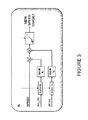
- Figure 3 shows a more detailed schematic of the control box that calculates the speed commands based on time and groundspeed deviations with respect to the 4D trajectory.
- the algorithms are as explained above in connection with Figure 2 , and have proven to be stable, robust, and effective in the literature.
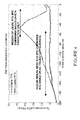
- FIG 4 shows statistical results of fast-time aircraft arrival simulations with the prior art RTA technology and the modified RTA technology embodying the present invention.
- the plot shows the percentile 95 of time error distribution as a function of distance to the metering fix (RTA target waypoint) for all the simulated aircraft.
- RTA target waypoint Two days of real southbound arrivals toward Palma deêt International Airport (Spain) were used (over 230 flights of different aircraft types).
- Real and predicted winds and temperature were taken from Global Forecast System (GFS) for the same days.
- GFS Global Forecast System
- the metering fix is MUROS. Required times of Arrival were imposed by a traffic sequencer in MUROS, which thus becomes the RTA target waypoint.
- the traffic simulation tool takes accurate aircraft performance models, and assimilates weather and temperature conditions from different sources (GFS most notably).
- the tool also computes accurate flight plan and trajectory prediction for every aircraft, and simulates Auto-Flight and Auto-Throttle systems, pilot speed brake actuations, vertical navigation
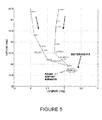
- Figure 5 shows the lateral tracks of the simulated arrivals at Palma de Majorca airport in Spain.
Landscapes
- Engineering & Computer Science (AREA)
- Aviation & Aerospace Engineering (AREA)
- Physics & Mathematics (AREA)
- General Physics & Mathematics (AREA)
- Radar, Positioning & Navigation (AREA)
- Remote Sensing (AREA)
- Automation & Control Theory (AREA)
- Traffic Control Systems (AREA)
Abstract
Description
- This invention relates to a method and system for aircraft guidance, and in particular to an improved Required Time of Arrival (RTA) aircraft guidance strategy.
- Required Time of Arrival (RTA) guidance is a widely available technology employed in commercial aircraft.
Figure 1 illustrates schematically the feedback loop that is used to control the aircraft speed during cruise and descent. - Guidance of the aircraft involves specification of a Required time of Arrival at a target waypoint of the flight plan (
step 100 ofFigure 1 ). The aircraft flight management system then periodically predicts an Estimated Time of Arrival (ETA) at the specified target waypoint, based upon various measured and predicted variables such as current wind speed/groundspeed, weather forecast etc., (alsostep 100 ofFigure 1 ). - At
step 110 ofFigure 1 , a deviation between the RTA and the ETA is determined and, if it is below a chosen threshold DT, then no action is taken. If however the deviation between RTA and ETA exceeds the chosen threshold DT, then atstep 120, the aircraft guidance modifies the cruise/descent speeds in order to meet the RTA. Atstep 130, the flight plan with the modified speeds is executed. Such modifications of flight plan speeds take place several times during cruise and descent before arrival at the target waypoint. - The threshold DT is variable in the sense that it is intentionally larger, the further away from the waypoint the aircraft is. For example, the threshold time difference between RTA and ETA (below which no adjustments are mandated) may be 1 minute when the aircraft is 200 nautical miles (NM) from the waypoint. This is because the degree of uncertainty in the ETA increases with distance from the waypoint. It is an inefficient use of the engines to continually adjust flight speed to try to narrow the 'dead band' of 1 minute. As the aircraft approaches the target waypoint, it becomes more important to track the RTA more closely, and equally the degree of predictability increases. Thus the value of DT can be reduced. For example, DT may be 5 seconds when the aircraft is 10NM from the waypoint. See, for example,
US-A-5,121,325 , Figure 9. - Some further examples of prior art RTA guidance techniques in accordance with the general scheme of
Figure 1 are set out inUS-B-6,507,782 and "Airborne Required Time of Arrival control and Integration with ATM", AIAA Aviation Technology Integration and Operations Conference (ATIO_, 2007 (Paper AIAA 2007 - 7835), by Jackson et al. The latter paper suggest the use of a plurality of waypoints en route to the destination airport, with the RTA and ETA being determined and their difference compared with a threshold, for each intermediate waypoint. - The problem with such prior art strategies is that they all result in unpredictabilities during the flight. Unpredictable flights are probe to tactical interventions to correct aircraft positions when they are not in accordance with an agreed trajectory. Such tactical interventions reduce the efficiency of the flight.
- Against this background, the present invention provides for an improved aircraft guidance method and system.
- According to the present invention, a method for guiding an aircraft is defined in claim 1. A system therefore is defined in claim 7. A computer program is set out in
claim 10. - Prior art guidance methods are based upon the premise that only the final arrival time (or, in the Jackson paper identified above), only a discrete set of arrival times at a set of intermediate waypoints), is important. The present invention, by contrast, chooses instead the novel approach of following an initial predicted 4D trajectory. A 4D trajectory is an aircraft trajectory predicted accurately as a function of time. In other words, in accordance with the present invention, instead of controlling aircraft speed with the aim of exclusively arriving on time at one, or a discrete number of waypoints, the aircraft speed is also controlled with the aim of following the 4D trajectory throughout the flight.
- Following a 4D trajectory rather than simply aiming to arrive at a waypoint at a give time provides several advantages. Firstly, as explained in the background section, large errors between the RTA and the ETA in prior art guidance methods are both tolerated and indeed inevitable, during those parts of the flight distant from the waypoint, not least because of the magnitude of uncertainties there. Following the 4D trajectory, by contrast, results in a significant reduction in the difference between the RTA and the actual time of arrival at the waypoint.
- As a consequence of meeting an agreed 4D trajectory between ground and air, the aircraft has greater chances of completing the flight without tactical interventions from ground control. This fact implies several advantages: fewer chances that the flight will be diverted by ground control from its optional lateral path (vectoring) or put in a holding pattern, and fewer chances that ground control mandates an aircraft speed change. This in turn results in fuel and time savings (fewer delays) with consequential operational and cost benefits.
- Preferred embodiments of the present invention employ the novel guidance system explained above in a manner complementary to the state of the art RTA based guidance methods. In other words, in preference, the original RTA speed commands are maintained (based upon control of | RTA - ETA | below DT) but, additionally, control of the speed and flight plan is carried out in complementary fashion to track a given 4D trajectory with accuracy. Thus the method allows a trajectory to be shared between the ground and the aircraft, and gives the capability for the aircraft to follow that trajectory with accuracy. It will be understood that the novel guidance method/system of the invention can optionally be combined with one or more of a range of RTA based control techniques which are, of themselves, known in the art.
- A further advantage of the method set out herein is that it requires only minimal modification to the aircraft Flight Management System. A small algorithm added to the existing RTA software is sufficient. In particular no hardware, flight deck, displays or auto throttle modifications are necessary. This contrasts markedly with the modifications needed to implement the multiple RTA technique of the aforementioned Jackson paper, which requires major modifications both to the human interface and to the RTA software, to allow the pilot to enter multiple RTA at multiple waypoints.
- Finally it will be observed that current Air Traffic Management systems are evolving from Surveillance based Management (control based upon knowing where aircraft are) into Trajectory based Management (control based upon knowing where the aircraft will be). 4D trajectory/navigation forms a part of the proposals in the 'Concept of Operations for the Next Generation Air Transportation System, Version 2.0, June 2007, as defined by the Joint Planning and Development Office. The method of the present invention is thus aligned with the future Trajectory based Air Traffic Management procedures.
- The invention may be put into practice in a number of ways, one of which will now be described with reference to the drawings in which:
-
Figure 1 shows a flow chart of a prior art aircraft guidance method; -
Figure 2 shows a flow chart of an aircraft guidance method embodying the present invention and including an aircraft speed controller; -
Figure 3 shows a schematic diagram of the aircraft speed controller ofFigure 2 ; -
Figure 4 shows a graph of the time deviation from a Required time of Arrival at a waypoint, as a function of distance from that waypoint, for the methods ofFigures 1 and2 respectively; and -
Figure 5 shows simulated flight paths for aircraft arriving at a waypoint proximal to Palma de Majorca airport in Spain. -
Figure 2 shows a simplified flow chart of an aircraft guidance method embodying the present invention. The flowchart may be logically divided into two parts: a first part (to the left side ofFigure 2 ) that acts to reduce excessive differences between an ETA and an predefined RTA for a chosen waypoint, and a complementary second part, to the right ofFigure 2 , which comprises a flow of calculations that seek to maintain the aircraft upon a selected 4D flight trajectory - that is, the plot of aircraft position, speed and direction as a function of time. - The second part of the flowchart, that is, the control loop to the right of
Figure 2 is enabled periodically, preferably when no speed adjustment is specified by the first part of the flowchart. Specifically, it is desirable that any decisions to adjust the speed of the aircraft as a result of discrepancies between the selected flight path and the measured flight trajectory are complementary to any decisions to adjust the aircraft speed as a result of RTA-ETA exceeding DT. Thus the calculations in the first part of the flowchart do not substitute or compete against the second part of the flowchart. - The process starts at
step 200. Here, the RTA at a predetermined waypoint is identified or selected. An initial 4D flight trajectory to the waypoint is also selected. This initial 4D trajectory may be predicted by the aircraft flight management system, or may be predicted elsewhere and provided to the aircraft. Atstep 210, a difference between the RTA and a current ETA (based upon estimated and measured parameters, as with the prior art) is determined. If the difference exceeds a threshold DT, then atstep 220 new predictions are computed by modifying the planned speeds, with the aim of reducing the difference between RTA and ETA. Once the new predictions have been calculated, atstep 230 the updated flight plan with the new speeds is executed by sending a throttle adjustment signal so as to adjust the aircraft speed. As with prior art guidance methods, the parameter DT may be chosen so as to be larger further away from the waypoint. However, as will be explained below, by including the 4D flight trajectory control in accordance with preferred embodiments of the invention, deviations from RTA tend to be smaller than in prior art methods, particularly as the waypoint is approached. - Referring still to
Figure 2 , atstep 210, if the difference between the RTA and the ETA is below the threshold DT, so that no speed adjustment would otherwise be mandated, the flowchart moves to step 240. - Here, deviations of time and groundspeed with respect to the initially predicted 4D trajectory are calculated. It is important to note that these deviations are NOT deviations of prediction of time of arrival at the target waypoint. These are instead deviations of current time and groundspeed with respect to the predicted 4D trajectory. For instance, the aircraft reaches a waypoint X. At that position, the aircraft was supposed to arrive at 12:05:10 Z and with a groundspeed (speed with respect to the ground) of 450 knots. However, the aircraft in fact reaches the waypoint at 12:05:14 Z and with 445 knots of speed. That means that the aircraft is late by 4 seconds (Δt = 4 seconds) and slower than predicted by 5 knots (Δvg = -5 knots.
- At
step 250 ofFigure 2 , a new speed command is generated in order to minimize the 4D navigation deviations. The algorithms to compute the new speed command are as follows: if the aircraft is late, a speed increment proportional to time deviation is added to current speed. If the aircraft arrives early, by contrast, a speed decrease proportional to time deviation is taken off the current speed. Also if the aircraft flies slower with respect to the predicted trajectory and with respect to the ground, a speed increment proportional to groundspeed deviation is added to current speed. Likewise if the aircraft flies faster with respect to the predicted trajectory and with respect to the ground, a speed reduction proportional to groundspeed deviation is taken from current speed. - These simple speed command algorithms have been tested before as part of another developed 4D guidance technology with exceptional results. Garrido-López, D. and Gómez Ledesma, R., Four Dimensional Guidance of an Aircraft,
U.S. Patent Application No. 20100282916 (April 2010 ) and Garrido-López, D., D'Alto, L., and Gómez Ledesma, R., A Novel Four-Dimensional Guidance For Continuous Descent Approaches, Proceedings of the 28th Digital Avionics Systems Conference, Orlando (Florida), Paper 6.E.1, 2009, pp. 1-11, doi: http://dx.doi.org/10.1109/DASC.2009.5347433. - At
step 260, the predictions of the planned flight are modified so that they are consistent with the new speed command. The new estimated time of arrival at the target waypoint may in general differ from the Required Time of Arrival. However, this ETA should in general disagree with the RTA by a small magnitude compared to the threshold DT. This is particularly the case when the aircraft is far from the target waypoint, since the threshold DT, as explained above, is set very large in order to avoid too frequent RTA speed commands. The benefit of the new speed commands is particularly significant when the aircraft is far from the target waypoint: these new commands enable the aircraft to follow the 4D trajectory with accuracy precisely when the original RTA speed commands are less effective. - Finally at
step 230, the flight plan with the new speed is executed and the new speed is immediately commanded. -
Figure 3 shows a more detailed schematic of the control box that calculates the speed commands based on time and groundspeed deviations with respect to the 4D trajectory. The algorithms are as explained above in connection withFigure 2 , and have proven to be stable, robust, and effective in the literature. -
Figure 4 shows statistical results of fast-time aircraft arrival simulations with the prior art RTA technology and the modified RTA technology embodying the present invention. The plot shows the percentile 95 of time error distribution as a function of distance to the metering fix (RTA target waypoint) for all the simulated aircraft. Two days of real southbound arrivals toward Palma de Mallorca International Airport (Spain) were used (over 230 flights of different aircraft types). Real and predicted winds and temperature were taken from Global Forecast System (GFS) for the same days. The metering fix is MUROS. Required times of Arrival were imposed by a traffic sequencer in MUROS, which thus becomes the RTA target waypoint. The traffic simulation tool takes accurate aircraft performance models, and assimilates weather and temperature conditions from different sources (GFS most notably). The tool also computes accurate flight plan and trajectory prediction for every aircraft, and simulates Auto-Flight and Auto-Throttle systems, pilot speed brake actuations, vertical navigation, lateral navigation, and RTA guidance (previously existing and new). - The simulations show that:
- Under existing RTA guidance, the time deviations with respect to established 4D trajectories are confined to within 25 seconds for 95% of the flights. This is because the existing RTA method avoids changes of aircraft speed far away from the metering fix.
- Time deviation using the novel RTA guidance is greatly improved far from the metering fix, and kept under 6 seconds. This is because the new complementary 4D-navigation based speed commands guide the aircraft more accurately following the 4D trajectory.
- About 50 or 60 NM before the metering fix, original RTA speed commands take place and reduce time deviations. For the method embodying the present invention, however, fewer speed commands are required, since flights reach this mid-range distance under good agreement with 4D trajectory, and therefore, fewer speed corrections are required.
- In the last stretch of 10 NM to 20NM, aircraft speeds are no longer modified, since there are additional operational constraints, and also because RTA methods avoid speed changes too close to the metering fix (otherwise very large speed changes may occur). Therefore, time deviations grow up to 8 seconds for the prior art RTA method. An improvement is observed in the results using the method of the invention (7 seconds of final error for 95% of aircraft).
-
Figure 5 shows the lateral tracks of the simulated arrivals at Palma de Majorca airport in Spain. - Although a specific example of a preferred embodiment has been described, the skilled reader will recognize that various modifications are contemplated. For example, there are many different RTA control strategies known per se in the art, beyond the specific strategy described in
Figure 2 , left hand side. Moreover, as already explained, whilst the combination of the prior art RTA control strategy with the 4D trajectory control strategy provides particular advantages, it is not essential to the present invention that any RTA control is incorporated along with the 4D trajectory control strategy.
Claims (9)
- A method of guiding an aircraft comprising the steps of:(a) selecting an initial predicted flight trajectory as a function of time;(b) determining during flight, a deviation between the initial predicted flight trajectory and a measured current trajectory;(c) generating a revised speed command in order to minimize the determined deviation;(d) computing modifications to the planned flight speeds, based upon the generated revised speed command; and(e) executing the revised speed command so that the aircraft seeks to reduce time and groundspeed deviations with respect to the initial predicted flight trajectory.
- The method of claim 1, further comprising:(f) identifying an initial Required Time of Arrival (RTA) at a selected waypoint;(g) determining, during flight, an Estimated Time of Arrival (ETA) based upon one or more measured or predicted parameters;(h) calculating a difference between RTA and ETA;(i) determining whether |RTA-ETA| is greater than a threshold time DT; and(j) generating a further revised speed command when it is determined that |RTA-ETA| > DT.
- The method of claim 1 or claim 2, further comprising subsequent to the completion of step (e) of executing the revised speed command, the steps of(k) repeating the steps (b) to (e) so as to generate a further revised speed commands for causing the aircraft to seek to follow the initial predicted flight trajectory.
- The method of claim 1, claim 2 or claim 3 wherein the step (b) of determining the deviation comprises determining:(i) the time difference between a predicted time of arrival at a location within the initial predicted flight trajectory, and a measured time of arrival at that point, and(ii) the speed difference between a predicted speed at that location within the initial predicted flight trajectory, and a measured speed at that location within the initial predicted flight trajectory.
- The method of claim 4, wherein the speed change defined by the revised speed command is proportional to the magnitude of the time and/or speed differences.
- A system for guiding an aircraft comprising:(a) means for selecting an initial predicted flight trajectory as a function of time;(b) means for determining during flight, a deviation between the initial predicted flight trajectory and a measured current trajectory;(c) means for generating a revised speed command in order to minimize the determined deviation;(d) means for computing modifications to the planned flight speeds, based upon the generated revised speed command; and(e) means for executing the revised speed command so that the aircraft seeks to follow the initial predicted flight trajectory
- The system of claim 6, further comprising:(f) means for identifying an initial Required Time of Arrival (RTA) at a selected waypoint;(g) means for determining, during flight, an Estimated Time of Arrival (ETA) based upon one or more measured or predicted parameters;(h) means for calculating a difference between RTA and ETA;(i) means for determining whether |RTA-ETA| is greater than a threshold time DT; and(j) means for generating a further revised speed command when it is determined that |RTA-ETA| > DT.
- The system of claim 6 or claim 7, wherein the means for determining the deviation comprises means for determining:(i) the time difference between a predicted time of arrival at a location within the initial predicted flight trajectory, and a measured time of arrival at that point, and(ii) the speed difference between a predicted speed at that location within the initial predicted flight trajectory, and a measured speed at that location within the initial predicted flight trajectory.
- A computer program comprising program code which, when executed, carries out the method steps of any of claims 1 to 5.
Priority Applications (3)
| Application Number | Priority Date | Filing Date | Title |
|---|---|---|---|
| EP13382183.5A EP2804066B1 (en) | 2013-05-17 | 2013-05-17 | Method and system for aircraft guidance |
| ES13382183T ES2758738T3 (en) | 2013-05-17 | 2013-05-17 | Aircraft guidance method and system |
| US14/280,079 US9365287B2 (en) | 2013-05-17 | 2014-05-16 | Methods and systems for aircraft guidance |
Applications Claiming Priority (1)
| Application Number | Priority Date | Filing Date | Title |
|---|---|---|---|
| EP13382183.5A EP2804066B1 (en) | 2013-05-17 | 2013-05-17 | Method and system for aircraft guidance |
Publications (2)
| Publication Number | Publication Date |
|---|---|
| EP2804066A1 true EP2804066A1 (en) | 2014-11-19 |
| EP2804066B1 EP2804066B1 (en) | 2019-08-28 |
Family
ID=48576331
Family Applications (1)
| Application Number | Title | Priority Date | Filing Date |
|---|---|---|---|
| EP13382183.5A Active EP2804066B1 (en) | 2013-05-17 | 2013-05-17 | Method and system for aircraft guidance |
Country Status (3)
| Country | Link |
|---|---|
| US (1) | US9365287B2 (en) |
| EP (1) | EP2804066B1 (en) |
| ES (1) | ES2758738T3 (en) |
Cited By (7)
| Publication number | Priority date | Publication date | Assignee | Title |
|---|---|---|---|---|
| US20160358481A1 (en) * | 2015-06-08 | 2016-12-08 | Honeywell International Inc. | Flight management mode transitioning for aircraft trajectory management |
| CN106339292A (en) * | 2015-07-10 | 2017-01-18 | 空中客车集团印度私人有限公司 | Monitoring scheduled turnaround activities and alerting on time deviation of scheduled turnaround activities |
| CN109542111A (en) * | 2018-12-19 | 2019-03-29 | 南京航空航天大学 | Unmanned plane hedgehopping control method based on segmented |
| CN111060106A (en) * | 2019-12-30 | 2020-04-24 | 四川函钛科技有限公司 | Airplane landing track correction method based on QAR multi-dimensional parameter fusion |
| CN112327848A (en) * | 2020-11-05 | 2021-02-05 | 北京京东乾石科技有限公司 | Robot obstacle avoidance method and device, storage medium and electronic device |
| EP3926606A1 (en) * | 2020-06-16 | 2021-12-22 | Honeywell International Inc. | Methods and systems for graphical representation of required time of arrival (rta) constraint information |
| US11527164B2 (en) | 2020-06-16 | 2022-12-13 | Honeywell International Inc. | Methods and systems for graphical representation of required time of arrival (RTA) constraint information |
Families Citing this family (17)
| Publication number | Priority date | Publication date | Assignee | Title |
|---|---|---|---|---|
| US9384670B1 (en) | 2013-08-12 | 2016-07-05 | The Boeing Company | Situational awareness display for unplanned landing zones |
| EP2889579B1 (en) * | 2013-12-31 | 2018-02-14 | The Boeing Company | System and method for defining and predicting aircraft trajectories |
| EP3109724B1 (en) | 2015-06-26 | 2022-02-09 | The Boeing Company | Method and system of controlling a flight of an aircraft subjected to a required time of arrival constraint |
| ES2707449T3 (en) | 2015-06-26 | 2019-04-03 | Boeing Co | Method and system to control the flight of an aircraft subjected to at least two times required of restrictions of arrival |
| US10386543B2 (en) * | 2016-08-01 | 2019-08-20 | International Business Machines Corporation | Temporal bias correction in wind forecasting |
| CN107227950B (en) * | 2017-08-03 | 2020-07-28 | 陕西延长石油(集团)有限责任公司研究院 | Method for evaluating integrity of actual drilling hole track |
| CN114141060A (en) * | 2017-09-28 | 2022-03-04 | 联想(北京)有限公司 | Method and apparatus for controlling operation of an over-the-air UE |
| US10957206B2 (en) * | 2017-10-18 | 2021-03-23 | Honeywell International Inc. | System and method for integration of smart trajectory generation and decision aid applications in legacy cockpits |
| US11257382B2 (en) * | 2018-11-28 | 2022-02-22 | The Boeing Company | System and method for optimizing a cruise vertical profile subject to a time-of-arrival constraint |
| CN111123977A (en) * | 2019-12-25 | 2020-05-08 | 中国航空工业集团公司西安飞机设计研究所 | A time guidance method for flight management system |
| CN111081073A (en) * | 2019-12-27 | 2020-04-28 | 中国航空工业集团公司西安飞机设计研究所 | A method for bidirectional ordering of waypoints in flight management system |
| US11443641B2 (en) | 2020-03-18 | 2022-09-13 | Honeywell International Inc. | Systems and methods for flight plan modifications |
| FR3112883B1 (en) * | 2020-07-22 | 2023-06-09 | Thales Sa | DEVICE AND METHOD FOR ASSISTING AIRCRAFT GUIDANCE |
| CN116486657A (en) * | 2023-04-21 | 2023-07-25 | 中国商用飞机有限责任公司 | A ground deceleration automatic control method and architecture |
| CN116661471A (en) * | 2023-05-11 | 2023-08-29 | 中国商用飞机有限责任公司 | Leveling mode control method, system, storage medium and terminal equipment of aircraft |
| CN117351783B (en) * | 2023-09-20 | 2025-12-16 | 中电莱斯信息系统有限公司 | Empty pipe system track prediction correction method based on airborne downloading data |
| FR3165524A1 (en) * | 2023-10-27 | 2026-02-13 | Thales | Electronic installation and decision support process with improved management of mission duration in the area, aircraft and associated computer program |
Citations (6)
| Publication number | Priority date | Publication date | Assignee | Title |
|---|---|---|---|---|
| US5121325A (en) | 1990-04-04 | 1992-06-09 | Smiths Industries Aerospace & Defense Systems, Inc. | Required time of arrival (RTA) control system |
| US6507782B1 (en) | 2001-05-14 | 2003-01-14 | Honeywell International Inc. | Aircraft control system for reaching a waypoint at a required time of arrival |
| US20090088972A1 (en) * | 2007-09-28 | 2009-04-02 | The Boeing Company | Vehicle-based automatic traffic conflict and collision avoidance |
| US20100152930A1 (en) * | 2008-11-07 | 2010-06-17 | Thales | Method for Determining the Speed of an Aircraft |
| US20100282916A1 (en) | 2009-05-05 | 2010-11-11 | The Boeing Company | Four-Dimensional Guidance of an Aircraft |
| US20120053760A1 (en) * | 2010-08-24 | 2012-03-01 | The Boeing Company | Four-dimensional guidance of an aircraft |
Family Cites Families (4)
| Publication number | Priority date | Publication date | Assignee | Title |
|---|---|---|---|---|
| FR2923032B1 (en) | 2007-10-31 | 2010-11-12 | Airbus France | METHOD AND DEVICE FOR AIDING THE CONTROL OF AN AIRCRAFT FOR A DOWNHILL PHASE. |
| US8788189B2 (en) * | 2012-08-31 | 2014-07-22 | Honeywell International Inc. | Aircraft control system and method for reaching a waypoint at a required time of arrival |
| US8781651B2 (en) | 2012-09-21 | 2014-07-15 | Georgia Tech Research Corporation | Systems and methods providing a fuel-efficient RTA implementation with uncertain winds |
| US9177479B2 (en) * | 2013-03-13 | 2015-11-03 | General Electric Company | System and method for determining aircraft operational parameters and enhancing aircraft operation |
-
2013
- 2013-05-17 EP EP13382183.5A patent/EP2804066B1/en active Active
- 2013-05-17 ES ES13382183T patent/ES2758738T3/en active Active
-
2014
- 2014-05-16 US US14/280,079 patent/US9365287B2/en active Active
Patent Citations (6)
| Publication number | Priority date | Publication date | Assignee | Title |
|---|---|---|---|---|
| US5121325A (en) | 1990-04-04 | 1992-06-09 | Smiths Industries Aerospace & Defense Systems, Inc. | Required time of arrival (RTA) control system |
| US6507782B1 (en) | 2001-05-14 | 2003-01-14 | Honeywell International Inc. | Aircraft control system for reaching a waypoint at a required time of arrival |
| US20090088972A1 (en) * | 2007-09-28 | 2009-04-02 | The Boeing Company | Vehicle-based automatic traffic conflict and collision avoidance |
| US20100152930A1 (en) * | 2008-11-07 | 2010-06-17 | Thales | Method for Determining the Speed of an Aircraft |
| US20100282916A1 (en) | 2009-05-05 | 2010-11-11 | The Boeing Company | Four-Dimensional Guidance of an Aircraft |
| US20120053760A1 (en) * | 2010-08-24 | 2012-03-01 | The Boeing Company | Four-dimensional guidance of an aircraft |
Non-Patent Citations (3)
| Title |
|---|
| "Concept of Operations for the Next Generation Air Transportation System, Version 2.0", JOINT PLANNING AND DEVELOPMENT OFFICE, June 2007 (2007-06-01) |
| GARRIDO-L6PEZ, D.; D'ALTO, L.; GOMEZ LEDESMA, R.: "A Novel Four-Dimensional Guidance For Continuous Descent Approaches", PROCEEDINGS OF THE 28TH DIGITAL AVIONICS SYSTEMS CONFERENCE, 2009, pages 1 - 11, Retrieved from the Internet <URL:http://dx.doi.org/10.1109/DASC.2009.5347433> |
| JACKSON: "Airborne Required Time of Arrival control and Integration with ATM", AIAA AVIATION TECHNOLOGY INTEGRATION AND OPERATIONS CONFERENCE, 2007, pages 7835 |
Cited By (11)
| Publication number | Priority date | Publication date | Assignee | Title |
|---|---|---|---|---|
| US20160358481A1 (en) * | 2015-06-08 | 2016-12-08 | Honeywell International Inc. | Flight management mode transitioning for aircraft trajectory management |
| US9711055B2 (en) * | 2015-06-08 | 2017-07-18 | Honeywell International Inc. | Flight management mode transitioning for aircraft trajectory management |
| CN106339292A (en) * | 2015-07-10 | 2017-01-18 | 空中客车集团印度私人有限公司 | Monitoring scheduled turnaround activities and alerting on time deviation of scheduled turnaround activities |
| CN106339292B (en) * | 2015-07-10 | 2021-12-17 | 空中客车集团印度私人有限公司 | Monitoring of scheduled turnaround activity and alerting of time deviation thereof |
| CN109542111A (en) * | 2018-12-19 | 2019-03-29 | 南京航空航天大学 | Unmanned plane hedgehopping control method based on segmented |
| CN109542111B (en) * | 2018-12-19 | 2021-04-13 | 南京航空航天大学 | Segmented-based UAV ultra-low-altitude flight control method |
| CN111060106A (en) * | 2019-12-30 | 2020-04-24 | 四川函钛科技有限公司 | Airplane landing track correction method based on QAR multi-dimensional parameter fusion |
| CN111060106B (en) * | 2019-12-30 | 2023-07-04 | 四川函钛科技有限公司 | Airplane landing track correction method based on QAR multidimensional parameter fusion |
| EP3926606A1 (en) * | 2020-06-16 | 2021-12-22 | Honeywell International Inc. | Methods and systems for graphical representation of required time of arrival (rta) constraint information |
| US11527164B2 (en) | 2020-06-16 | 2022-12-13 | Honeywell International Inc. | Methods and systems for graphical representation of required time of arrival (RTA) constraint information |
| CN112327848A (en) * | 2020-11-05 | 2021-02-05 | 北京京东乾石科技有限公司 | Robot obstacle avoidance method and device, storage medium and electronic device |
Also Published As
| Publication number | Publication date |
|---|---|
| US9365287B2 (en) | 2016-06-14 |
| EP2804066B1 (en) | 2019-08-28 |
| US20140343759A1 (en) | 2014-11-20 |
| ES2758738T3 (en) | 2020-05-06 |
Similar Documents
| Publication | Publication Date | Title |
|---|---|---|
| EP2804066B1 (en) | Method and system for aircraft guidance | |
| EP3660815B1 (en) | System and method for optimizing a cruise vertical profile subject to a time-of-arrival constraint | |
| EP2703926B1 (en) | Aircraft control system and method for reaching a waypoint at a required time of arrival | |
| JP5289581B2 (en) | Method and system for arrival time control using arrival time uncertainty | |
| US8386097B2 (en) | Method and device to assist in the guidance of an airplane | |
| EP3232292B1 (en) | Aircraft systems and methods with multiple sap speed profiles | |
| US9815567B2 (en) | Aircraft speed guidance display | |
| US10380901B2 (en) | Method for automatically rejoining a reference vertical profile of an aircraft | |
| AU2012350148A1 (en) | A flight prediction system | |
| US9963247B2 (en) | Method and system for automatic determination of an optimized descent and approach profile for an aircraft | |
| EP2685292A2 (en) | Systems and methods for flight management | |
| KR20160118658A (en) | Aircraft trajectory predicting method and system by real-time track data monitoring | |
| US20070078573A1 (en) | Method for planning the velocity of a craft along a route | |
| Mueller et al. | Strategic aircraft trajectory prediction uncertainty and statistical sector traffic load modeling | |
| Bronsvoort et al. | Improved trajectory prediction for air traffic management by simulation of guidance logic and inferred aircraft intent using existing data-link technology | |
| Banerjee et al. | Uncertainty quantification of expected time-of-arrival in UAV flight trajectory | |
| Prats et al. | Evaluation of in-flight trajectory optimisation with time constraints in a moving base flight simulator | |
| JP7228229B2 (en) | Program, information processing device and information processing method | |
| Weitz et al. | Deriving estimated time of arrival accuracy requirements for time-based traffic management | |
| Di Vito et al. | An overview on systems and algorithms for on-board 3D/4D trajectory management | |
| Alizadeh et al. | Optimal trajectory planning based on wind-optimal cost index | |
| Jung et al. | Optimal Airspeed Selection for the Cruise and Descent Phases under Wind Uncertainty | |
| Vaddi et al. | Evaluation of time arrival uncertainties associated with NextGen FMS capabilities | |
| Chaloulos et al. | Wind Uncertainty Correlation and Aircraft Conflict Detection based on RUC-1 Forecasts | |
| In't Veld et al. | Pilot Support for Separation Assurance During Decelerated Approaches |
Legal Events
| Date | Code | Title | Description |
|---|---|---|---|
| PUAI | Public reference made under article 153(3) epc to a published international application that has entered the european phase |
Free format text: ORIGINAL CODE: 0009012 |
|
| 17P | Request for examination filed |
Effective date: 20130517 |
|
| AK | Designated contracting states |
Kind code of ref document: A1 Designated state(s): AL AT BE BG CH CY CZ DE DK EE ES FI FR GB GR HR HU IE IS IT LI LT LU LV MC MK MT NL NO PL PT RO RS SE SI SK SM TR |
|
| AX | Request for extension of the european patent |
Extension state: BA ME |
|
| STAA | Information on the status of an ep patent application or granted ep patent |
Free format text: STATUS: EXAMINATION IS IN PROGRESS |
|
| 17Q | First examination report despatched |
Effective date: 20181005 |
|
| REG | Reference to a national code |
Ref country code: DE Ref legal event code: R079 Ref document number: 602013059685 Country of ref document: DE Free format text: PREVIOUS MAIN CLASS: G05D0001100000 Ipc: B64C0019000000 |
|
| GRAP | Despatch of communication of intention to grant a patent |
Free format text: ORIGINAL CODE: EPIDOSNIGR1 |
|
| STAA | Information on the status of an ep patent application or granted ep patent |
Free format text: STATUS: GRANT OF PATENT IS INTENDED |
|
| RIC1 | Information provided on ipc code assigned before grant |
Ipc: B64C 19/00 20060101AFI20190304BHEP Ipc: G05D 1/10 20060101ALI20190304BHEP Ipc: G08G 5/00 20060101ALI20190304BHEP |
|
| INTG | Intention to grant announced |
Effective date: 20190328 |
|
| GRAS | Grant fee paid |
Free format text: ORIGINAL CODE: EPIDOSNIGR3 |
|
| GRAA | (expected) grant |
Free format text: ORIGINAL CODE: 0009210 |
|
| STAA | Information on the status of an ep patent application or granted ep patent |
Free format text: STATUS: THE PATENT HAS BEEN GRANTED |
|
| AK | Designated contracting states |
Kind code of ref document: B1 Designated state(s): AL AT BE BG CH CY CZ DE DK EE ES FI FR GB GR HR HU IE IS IT LI LT LU LV MC MK MT NL NO PL PT RO RS SE SI SK SM TR |
|
| REG | Reference to a national code |
Ref country code: GB Ref legal event code: FG4D |
|
| REG | Reference to a national code |
Ref country code: CH Ref legal event code: EP |
|
| REG | Reference to a national code |
Ref country code: DE Ref legal event code: R096 Ref document number: 602013059685 Country of ref document: DE |
|
| REG | Reference to a national code |
Ref country code: AT Ref legal event code: REF Ref document number: 1172083 Country of ref document: AT Kind code of ref document: T Effective date: 20190915 |
|
| REG | Reference to a national code |
Ref country code: IE Ref legal event code: FG4D |
|
| REG | Reference to a national code |
Ref country code: NL Ref legal event code: MP Effective date: 20190828 |
|
| REG | Reference to a national code |
Ref country code: LT Ref legal event code: MG4D |
|
| REG | Reference to a national code |
Ref country code: DE Ref legal event code: R082 Ref document number: 602013059685 Country of ref document: DE Representative=s name: MAIER, LL.M., MICHAEL C., DE Ref country code: DE Ref legal event code: R082 Ref document number: 602013059685 Country of ref document: DE Representative=s name: BOULT WADE TENNANT LLP, DE |
|
| PG25 | Lapsed in a contracting state [announced via postgrant information from national office to epo] |
Ref country code: BG Free format text: LAPSE BECAUSE OF FAILURE TO SUBMIT A TRANSLATION OF THE DESCRIPTION OR TO PAY THE FEE WITHIN THE PRESCRIBED TIME-LIMIT Effective date: 20191128 Ref country code: LT Free format text: LAPSE BECAUSE OF FAILURE TO SUBMIT A TRANSLATION OF THE DESCRIPTION OR TO PAY THE FEE WITHIN THE PRESCRIBED TIME-LIMIT Effective date: 20190828 Ref country code: HR Free format text: LAPSE BECAUSE OF FAILURE TO SUBMIT A TRANSLATION OF THE DESCRIPTION OR TO PAY THE FEE WITHIN THE PRESCRIBED TIME-LIMIT Effective date: 20190828 Ref country code: SE Free format text: LAPSE BECAUSE OF FAILURE TO SUBMIT A TRANSLATION OF THE DESCRIPTION OR TO PAY THE FEE WITHIN THE PRESCRIBED TIME-LIMIT Effective date: 20190828 Ref country code: PT Free format text: LAPSE BECAUSE OF FAILURE TO SUBMIT A TRANSLATION OF THE DESCRIPTION OR TO PAY THE FEE WITHIN THE PRESCRIBED TIME-LIMIT Effective date: 20191230 Ref country code: FI Free format text: LAPSE BECAUSE OF FAILURE TO SUBMIT A TRANSLATION OF THE DESCRIPTION OR TO PAY THE FEE WITHIN THE PRESCRIBED TIME-LIMIT Effective date: 20190828 Ref country code: NL Free format text: LAPSE BECAUSE OF FAILURE TO SUBMIT A TRANSLATION OF THE DESCRIPTION OR TO PAY THE FEE WITHIN THE PRESCRIBED TIME-LIMIT Effective date: 20190828 Ref country code: NO Free format text: LAPSE BECAUSE OF FAILURE TO SUBMIT A TRANSLATION OF THE DESCRIPTION OR TO PAY THE FEE WITHIN THE PRESCRIBED TIME-LIMIT Effective date: 20191128 |
|
| REG | Reference to a national code |
Ref country code: DE Ref legal event code: R082 Ref document number: 602013059685 Country of ref document: DE Representative=s name: BOULT WADE TENNANT LLP, DE |
|
| PG25 | Lapsed in a contracting state [announced via postgrant information from national office to epo] |
Ref country code: AL Free format text: LAPSE BECAUSE OF FAILURE TO SUBMIT A TRANSLATION OF THE DESCRIPTION OR TO PAY THE FEE WITHIN THE PRESCRIBED TIME-LIMIT Effective date: 20190828 Ref country code: GR Free format text: LAPSE BECAUSE OF FAILURE TO SUBMIT A TRANSLATION OF THE DESCRIPTION OR TO PAY THE FEE WITHIN THE PRESCRIBED TIME-LIMIT Effective date: 20191129 Ref country code: IS Free format text: LAPSE BECAUSE OF FAILURE TO SUBMIT A TRANSLATION OF THE DESCRIPTION OR TO PAY THE FEE WITHIN THE PRESCRIBED TIME-LIMIT Effective date: 20191228 Ref country code: RS Free format text: LAPSE BECAUSE OF FAILURE TO SUBMIT A TRANSLATION OF THE DESCRIPTION OR TO PAY THE FEE WITHIN THE PRESCRIBED TIME-LIMIT Effective date: 20190828 Ref country code: LV Free format text: LAPSE BECAUSE OF FAILURE TO SUBMIT A TRANSLATION OF THE DESCRIPTION OR TO PAY THE FEE WITHIN THE PRESCRIBED TIME-LIMIT Effective date: 20190828 |
|
| REG | Reference to a national code |
Ref country code: AT Ref legal event code: MK05 Ref document number: 1172083 Country of ref document: AT Kind code of ref document: T Effective date: 20190828 |
|
| PG25 | Lapsed in a contracting state [announced via postgrant information from national office to epo] |
Ref country code: TR Free format text: LAPSE BECAUSE OF FAILURE TO SUBMIT A TRANSLATION OF THE DESCRIPTION OR TO PAY THE FEE WITHIN THE PRESCRIBED TIME-LIMIT Effective date: 20190828 |
|
| PG25 | Lapsed in a contracting state [announced via postgrant information from national office to epo] |
Ref country code: RO Free format text: LAPSE BECAUSE OF FAILURE TO SUBMIT A TRANSLATION OF THE DESCRIPTION OR TO PAY THE FEE WITHIN THE PRESCRIBED TIME-LIMIT Effective date: 20190828 Ref country code: EE Free format text: LAPSE BECAUSE OF FAILURE TO SUBMIT A TRANSLATION OF THE DESCRIPTION OR TO PAY THE FEE WITHIN THE PRESCRIBED TIME-LIMIT Effective date: 20190828 Ref country code: AT Free format text: LAPSE BECAUSE OF FAILURE TO SUBMIT A TRANSLATION OF THE DESCRIPTION OR TO PAY THE FEE WITHIN THE PRESCRIBED TIME-LIMIT Effective date: 20190828 Ref country code: PL Free format text: LAPSE BECAUSE OF FAILURE TO SUBMIT A TRANSLATION OF THE DESCRIPTION OR TO PAY THE FEE WITHIN THE PRESCRIBED TIME-LIMIT Effective date: 20190828 Ref country code: DK Free format text: LAPSE BECAUSE OF FAILURE TO SUBMIT A TRANSLATION OF THE DESCRIPTION OR TO PAY THE FEE WITHIN THE PRESCRIBED TIME-LIMIT Effective date: 20190828 |
|
| REG | Reference to a national code |
Ref country code: ES Ref legal event code: FG2A Ref document number: 2758738 Country of ref document: ES Kind code of ref document: T3 Effective date: 20200506 |
|
| PG25 | Lapsed in a contracting state [announced via postgrant information from national office to epo] |
Ref country code: IS Free format text: LAPSE BECAUSE OF FAILURE TO SUBMIT A TRANSLATION OF THE DESCRIPTION OR TO PAY THE FEE WITHIN THE PRESCRIBED TIME-LIMIT Effective date: 20200224 Ref country code: SK Free format text: LAPSE BECAUSE OF FAILURE TO SUBMIT A TRANSLATION OF THE DESCRIPTION OR TO PAY THE FEE WITHIN THE PRESCRIBED TIME-LIMIT Effective date: 20190828 Ref country code: SM Free format text: LAPSE BECAUSE OF FAILURE TO SUBMIT A TRANSLATION OF THE DESCRIPTION OR TO PAY THE FEE WITHIN THE PRESCRIBED TIME-LIMIT Effective date: 20190828 Ref country code: CZ Free format text: LAPSE BECAUSE OF FAILURE TO SUBMIT A TRANSLATION OF THE DESCRIPTION OR TO PAY THE FEE WITHIN THE PRESCRIBED TIME-LIMIT Effective date: 20190828 |
|
| REG | Reference to a national code |
Ref country code: DE Ref legal event code: R097 Ref document number: 602013059685 Country of ref document: DE |
|
| PLBE | No opposition filed within time limit |
Free format text: ORIGINAL CODE: 0009261 |
|
| STAA | Information on the status of an ep patent application or granted ep patent |
Free format text: STATUS: NO OPPOSITION FILED WITHIN TIME LIMIT |
|
| PG2D | Information on lapse in contracting state deleted |
Ref country code: IS |
|
| 26N | No opposition filed |
Effective date: 20200603 |
|
| PG25 | Lapsed in a contracting state [announced via postgrant information from national office to epo] |
Ref country code: SI Free format text: LAPSE BECAUSE OF FAILURE TO SUBMIT A TRANSLATION OF THE DESCRIPTION OR TO PAY THE FEE WITHIN THE PRESCRIBED TIME-LIMIT Effective date: 20190828 |
|
| PG25 | Lapsed in a contracting state [announced via postgrant information from national office to epo] |
Ref country code: LI Free format text: LAPSE BECAUSE OF NON-PAYMENT OF DUE FEES Effective date: 20200531 Ref country code: CH Free format text: LAPSE BECAUSE OF NON-PAYMENT OF DUE FEES Effective date: 20200531 Ref country code: MC Free format text: LAPSE BECAUSE OF FAILURE TO SUBMIT A TRANSLATION OF THE DESCRIPTION OR TO PAY THE FEE WITHIN THE PRESCRIBED TIME-LIMIT Effective date: 20190828 |
|
| REG | Reference to a national code |
Ref country code: BE Ref legal event code: MM Effective date: 20200531 |
|
| PG25 | Lapsed in a contracting state [announced via postgrant information from national office to epo] |
Ref country code: LU Free format text: LAPSE BECAUSE OF NON-PAYMENT OF DUE FEES Effective date: 20200517 |
|
| PG25 | Lapsed in a contracting state [announced via postgrant information from national office to epo] |
Ref country code: IE Free format text: LAPSE BECAUSE OF NON-PAYMENT OF DUE FEES Effective date: 20200517 |
|
| PG25 | Lapsed in a contracting state [announced via postgrant information from national office to epo] |
Ref country code: BE Free format text: LAPSE BECAUSE OF NON-PAYMENT OF DUE FEES Effective date: 20200531 |
|
| PG25 | Lapsed in a contracting state [announced via postgrant information from national office to epo] |
Ref country code: MT Free format text: LAPSE BECAUSE OF FAILURE TO SUBMIT A TRANSLATION OF THE DESCRIPTION OR TO PAY THE FEE WITHIN THE PRESCRIBED TIME-LIMIT Effective date: 20190828 Ref country code: CY Free format text: LAPSE BECAUSE OF FAILURE TO SUBMIT A TRANSLATION OF THE DESCRIPTION OR TO PAY THE FEE WITHIN THE PRESCRIBED TIME-LIMIT Effective date: 20190828 |
|
| PG25 | Lapsed in a contracting state [announced via postgrant information from national office to epo] |
Ref country code: MK Free format text: LAPSE BECAUSE OF FAILURE TO SUBMIT A TRANSLATION OF THE DESCRIPTION OR TO PAY THE FEE WITHIN THE PRESCRIBED TIME-LIMIT Effective date: 20190828 |
|
| P01 | Opt-out of the competence of the unified patent court (upc) registered |
Effective date: 20230516 |
|
| PGFP | Annual fee paid to national office [announced via postgrant information from national office to epo] |
Ref country code: DE Payment date: 20250529 Year of fee payment: 13 |
|
| PGFP | Annual fee paid to national office [announced via postgrant information from national office to epo] |
Ref country code: GB Payment date: 20250527 Year of fee payment: 13 Ref country code: ES Payment date: 20250602 Year of fee payment: 13 |
|
| PGFP | Annual fee paid to national office [announced via postgrant information from national office to epo] |
Ref country code: IT Payment date: 20250521 Year of fee payment: 13 |
|
| PGFP | Annual fee paid to national office [announced via postgrant information from national office to epo] |
Ref country code: FR Payment date: 20250526 Year of fee payment: 13 |