EP2804065A1 - Mobile device for generating first map information for an electronic device and receiving second map information from the electronic device - Google Patents
Mobile device for generating first map information for an electronic device and receiving second map information from the electronic device Download PDFInfo
- Publication number
- EP2804065A1 EP2804065A1 EP13184250.2A EP13184250A EP2804065A1 EP 2804065 A1 EP2804065 A1 EP 2804065A1 EP 13184250 A EP13184250 A EP 13184250A EP 2804065 A1 EP2804065 A1 EP 2804065A1
- Authority
- EP
- European Patent Office
- Prior art keywords
- mobile device
- map information
- unit
- control unit
- electronic device
- Prior art date
- Legal status (The legal status is an assumption and is not a legal conclusion. Google has not performed a legal analysis and makes no representation as to the accuracy of the status listed.)
- Ceased
Links
Images


Classifications
-
- G—PHYSICS
- G05—CONTROLLING; REGULATING
- G05D—SYSTEMS FOR CONTROLLING OR REGULATING NON-ELECTRIC VARIABLES
- G05D1/00—Control of position, course, altitude or attitude of land, water, air or space vehicles, e.g. using automatic pilots
- G05D1/0011—Control of position, course, altitude or attitude of land, water, air or space vehicles, e.g. using automatic pilots associated with a remote control arrangement
- G05D1/0044—Control of position, course, altitude or attitude of land, water, air or space vehicles, e.g. using automatic pilots associated with a remote control arrangement by providing the operator with a computer generated representation of the environment of the vehicle, e.g. virtual reality, maps
-
- A—HUMAN NECESSITIES
- A47—FURNITURE; DOMESTIC ARTICLES OR APPLIANCES; COFFEE MILLS; SPICE MILLS; SUCTION CLEANERS IN GENERAL
- A47L—DOMESTIC WASHING OR CLEANING; SUCTION CLEANERS IN GENERAL
- A47L9/00—Details or accessories of suction cleaners, e.g. mechanical means for controlling the suction or for effecting pulsating action; Storing devices specially adapted to suction cleaners or parts thereof; Carrying-vehicles specially adapted for suction cleaners
- A47L9/28—Installation of the electric equipment, e.g. adaptation or attachment to the suction cleaner; Controlling suction cleaners by electric means
- A47L9/2894—Details related to signal transmission in suction cleaners
-
- G—PHYSICS
- G05—CONTROLLING; REGULATING
- G05D—SYSTEMS FOR CONTROLLING OR REGULATING NON-ELECTRIC VARIABLES
- G05D1/00—Control of position, course, altitude or attitude of land, water, air or space vehicles, e.g. using automatic pilots
- G05D1/0011—Control of position, course, altitude or attitude of land, water, air or space vehicles, e.g. using automatic pilots associated with a remote control arrangement
-
- G—PHYSICS
- G05—CONTROLLING; REGULATING
- G05D—SYSTEMS FOR CONTROLLING OR REGULATING NON-ELECTRIC VARIABLES
- G05D1/00—Control of position, course, altitude or attitude of land, water, air or space vehicles, e.g. using automatic pilots
- G05D1/02—Control of position or course in two dimensions
- G05D1/021—Control of position or course in two dimensions specially adapted to land vehicles
- G05D1/0268—Control of position or course in two dimensions specially adapted to land vehicles using internal positioning means
- G05D1/0274—Control of position or course in two dimensions specially adapted to land vehicles using internal positioning means using mapping information stored in a memory device
-
- G—PHYSICS
- G05—CONTROLLING; REGULATING
- G05D—SYSTEMS FOR CONTROLLING OR REGULATING NON-ELECTRIC VARIABLES
- G05D1/00—Control of position, course, altitude or attitude of land, water, air or space vehicles, e.g. using automatic pilots
- G05D1/02—Control of position or course in two dimensions
- G05D1/021—Control of position or course in two dimensions specially adapted to land vehicles
- G05D1/0231—Control of position or course in two dimensions specially adapted to land vehicles using optical position detecting means
- G05D1/0238—Control of position or course in two dimensions specially adapted to land vehicles using optical position detecting means using obstacle or wall sensors
- G05D1/024—Control of position or course in two dimensions specially adapted to land vehicles using optical position detecting means using obstacle or wall sensors in combination with a laser
-
- G—PHYSICS
- G05—CONTROLLING; REGULATING
- G05D—SYSTEMS FOR CONTROLLING OR REGULATING NON-ELECTRIC VARIABLES
- G05D1/00—Control of position, course, altitude or attitude of land, water, air or space vehicles, e.g. using automatic pilots
- G05D1/02—Control of position or course in two dimensions
- G05D1/021—Control of position or course in two dimensions specially adapted to land vehicles
- G05D1/0268—Control of position or course in two dimensions specially adapted to land vehicles using internal positioning means
- G05D1/0272—Control of position or course in two dimensions specially adapted to land vehicles using internal positioning means comprising means for registering the travel distance, e.g. revolutions of wheels
Definitions
- the invention relates to a mobile device, and more particularly, to a mobile device, which is capable of generating first map information to an electronic device and receiving second map information generated from the electronic device.
- a sign object is used to limit a cleaning area of a cleaning robot.
- a cleaning robot performs a cleaning operation, if the cleaning robot detects the existence of a sign object, the cleaning robot avoids the area of the sign object.
- a cleaning robot performs a cleaning operation, a user has to place sign objects. If a user forgets to place a sign object, the cleaning robot may enter dangerous areas, for example, an outdoor area. Moreover, in order to achieve preferred cleaning effect, several sign objects are usually required to reduce the cleaning area of the cleaning robot. However, a large number of sign objects increases costs and also negatively affects the aesthetic interior design of a house.
- a mobile device moving in a specific area comprises a driving unit, an environment sensing unit, a control unit and a transmittal unit.
- the driving unit moves according to a first driving signal.
- the environment sensing unit detects an outline of the specific area to generate detection information.
- the control unit processes the detection information to generate first map information and position information.
- the transmittal unit transmits the first map information to an electronic device.
- the electronic device generates second map information according to the first map information, and the control unit generates the first driving signal according to the first map information, the second map information and the position information.
- FIG. 1 is a schematic diagram of an exemplary embodiment of a control system in accordance with some embodiments
- FIG. 2 is a schematic diagram of an exemplary embodiment of a mobile device in accordance with some embodiments
- FIG. 3 is a schematic diagram of an exemplary embodiment of a specific area in accordance with some embodiments.
- FIG. 4 is a schematic diagram of an exemplary embodiment of map information in accordance with some embodiments.
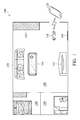
- FIG. 1 is a schematic diagram of an exemplary embodiment of a control system in accordance with some embodiments.
- the control system 100 comprises a mobile device 110 and an electronic device 120.
- the mobile device 110 is a robot with a cleaning function, such as a sweeping robot or a mopping robot.
- the mobile device 110 moves in a specific area 130.
- the specific area 130 has rooms 140 and 150 and a living room 160.
- the disclosure does not limit the kind of the electronic device 120. Any device can serve as the electronic device 120, as long as the device is capable of processing signals.
- the electronic device 120 is a smart phone or a computer.
- the electronic device 120 is separated from the mobile device 110, but the disclosure is not limited thereto.
- the disclosure does not limit the location of the electronic device 120.
- the electronic device 120 can be disposed at any position, as long as the electronic device 120 is capable of communicating with the mobile device 110.
- the electronic device 120 is disposed on the outside or inside of the specific area 130.
- the disclosure does not limit the communication method between the mobile device 110 and the electronic device 120.
- the mobile device 110 communicates with the electronic device 120 according to a wireless transmittal method, such as Infrared transmittal or a Bluetooth transmittal.
- the mobile device 110 communicates with the electronic device 120 according to a wire transmittal method, such as a USB 2.0 protocol , a USB 3.0 protocol or other protocol method.
- FIG. 2 is a schematic diagram of an exemplary embodiment of a mobile device in accordance with some embodiments.
- the mobile device 110 includes an environment sensing unit 210, a control unit 220, a transmittal unit 230 and a driving unit 240.
- the environment sensing unit 210 detects the outline of the specific area 130 to generate detection information IFM D .
- the environment sensing unit 210 includes sensors 211 and 212.
- the output signal of the sensor 211 is combined with the output signal of the sensor 212 to serve as the detection information IFM D .
- the sensor 211 detects a distance from the mobile device 110 to an object. Taking FIG. 1 as an example, the sensor 211 detects the distance between the mobile 110 and the table 161, the distance between the mobile 110 and the television 162, the distance between the mobile 110 and the cabinet 163 and the distance between the mobile 110 and the wall 164.
- the sensor 212 detects a moving length and a moving direction of the driving unit 240.
- the driving unit 240 may include wheels, a track, or other movable stages.
- the driving unit 240 moves according to a driving signal S D1 . Taking wheels as an example, the sensor 212 detects the rotation direction of the wheels and the rotation number of the wheels.
- the disclosure does not limit the kind of the sensors 211 and 212.
- the sensor 211 may be a sonic sensor, a photo sensor, a magnetic sensor, a laser sensor or an Infrared sensor.
- the sensor 212 is an odometer.
- the control unit 220 processes the detection information IFM D to generate map information M 1 and position information.
- the disclosure does not limit the circuit structure of the control unit 220.
- the control unit 220 includes hardware, such as microprocessors, microcontrollers, logic circuits, and memories. One of the memories stores programming code. When the programming code is executed, the microprocessors or the microcontrollers are capable of generating the map information M 1 and the position information.
- the control unit 220 processes the detection information IFM D to generate the map information M 1 according to simultaneous localization and mapping (SLAM) technology. The outline of the specific area 130 is determined according to the map information M 1 .
- FIG. 3 is a schematic diagram of an exemplary embodiment of a specific area in accordance with some embodiments.
- the transmittal unit 230 transmits the map information M 1 to the electronic device 120.
- the disclosure does not limit the kind of the transmittal unit 230.
- the transmittal unit 230 communicates with the electronic device 120 according to a wire communication protocol or a wireless communication protocol.
- the electronic device 120 generates map information M 2 according to the map information M 1 .
- the transmittal unit 230 receives and provides the map information M 2 to the control unit 220.
- the control unit 220 generates a driving signal S D1 according to the position information and the map information M 2 .
- the electronic device 120 modifies the map information M 1 , serves the modified result as the map information M 2 and transmits the map information M 2 to the mobile device 110.
- FIG. 4 is a schematic diagram of an exemplary embodiment of the map information M 2 in accordance with some embodiments.
- a user is capable of utilizing the electronic device 120 to mark blocking lines 310-330 in the map information M 1 to prevent the mobile device 110 from entering the rooms 140 and 150 or leaving the living room 160.
- the control unit 220 generates the driving signal S D1 to the driving unit 240 according to the map information M 2 with the blocking lines 310 ⁇ 330. Therefore, the mobile device 110 only moves in the living room 160 and does not leave the living room 160.
- the control unit 220 determines the location of the mobile device 110 in the specific area 130 according to the map information M 1 and the position information.
- the control unit 220 plans a traveling path of the mobile device 110 according to the map information M 2 . Since the user does not need to utilize a virtual wall or a magnetic line to limit the traveling path of the mobile device 110, the convenience of the control system 100 is increased and the cost of the control system 100 is reduced.
- the user is capable of utilizing the electronic device 120 to mark an enhancement sign 340 in the map information M 1 such that the cleaning efficiency of the mobile device 110 is enhanced when the mobile device 110 in an unclean area 350 of the specific area 130, wherein the enhancement sign 340 corresponds to the unclean area 350 of the specific area 130.
- the user can utilize the electronic device 120 to mark an enhancement sign 340 in the map information M 1 such that the mobile device 110 enhances the cleaning efficiency for the area around the cabinet 163.
- the disclosure does not limit the shape of the enhancement sign 340.
- the enhancement sign 340 is a line segment.
- the control unit 220 generates the driving signal S D2 to a cleaning unit 250 according to the map information M 2 with the enhancement sign 340. Therefore, when the mobile device 110 moves into the unclean area 350 corresponding to the enhancement sign 340, the cleaning unit 250 operates in an enhancement mode according to the driving signal S D2 . In the enhancement mode, the cleaning unit 250 enhances its cleaning efficiency to clean the unclean area 350. When the mobile device 110 leaves the unclean area 350, the cleaning unit 250 operates in a normal mode according to the driving signal S D2 . In some embodiments, the cleaning efficiency of the cleaning unit 250 operating in the enhancement mode is higher than the cleaning efficiency of the cleaning unit 250 operating in the normal mode.
- the user is capable of utilizing the electronic device 120 to remove the enhancement sign 340. Therefore, the cleaning efficiency of the mobile device 110 is not enhanced for the unclean area 350, but the mobile device 110 still cleans the unclean area 350. In other words, the cleaning unit 250 has the same cleaning efficiency for the living room 160.
- the enhancement sign is removed by the control unit 220.
- the control unit 220 determines that the unclean level of the unclean area 350 is less than a pre-determined level according to the detection information IFM D generated by the environment sensing unit 210, the control unit 220 removes the enhancement sign 340 such that the cleaning efficiency of the cleaning unit 250 is maintained.
- the enhancement sign 340 is generated by the control unit 220.
- the control unit 220 determines that the unclean level of the unclean area 350 exceeds the pre-determined level according to the detection information IFM D generated by the environment sensing unit 210, the control unit 220 marks an enhancement sign 340 in the map information M 1 .
- the control unit 220 When the mobile device 110 moves into the unclean area 350 corresponding to the enhancement sign 340, the control unit 220 generates the driving signal S D2 such that the cleaning unit 250 operates in an enhancement mode.
- control unit 250 activates the mobile device 110 according to the driving signal S D1 such that the mobile device 110 operates in the unclean area 350 until the unclean level of the unclean area 350 is less than the pre-determined level.
- the mobile device 110 moves according to a pre-determined path. Before the mobile device 110 enters the unclean area 350, the cleaning efficiency of the mobile device 110 is increased.
- the control unit 220 determines the cleaning efficiency of the cleaning unit 250 according to the depth of the enhancement sign 340. Furthermore, the control unit 220 determines the unclean level of the unclean area 350 according to the detection information IFM D generated by the environment sensing unit 210 and adjusts the cleaning efficiency of the cleaning unit 250 according to the determined result. In some embodiments, the cleaning unit 250 is capable of providing different cleaning efficiencies.
- the disclosure does not limit the structure of the cleaning unit 250. Any device can be integrated in the cleaning unit 250, as long as the device is capable of cleaning.
- the cleaning unit 250 has a dust collecting function or a mopping function.
- the cleaning unit 250 provides different cleaning efficiencies according to the driving signal S D2 . In other embodiments, if the mobile device 110 is not required to provide a cleaning service, the cleaning unit 250 can be omitted.
- the electronic device 120 is integrated in the mobile device 110.
- the electronic device 120 is a display panel to display the map information M 1 .
- the display panel provides the map information M 2 according to an external control command.
- the display panel is a touch panel.
- a user can utilize the touch panel to modify the map information M 1 .
- the user utilizes buttons to modify the map information M 1 displayed in the display panel.
- the display panel transmits the modified map information M 2 to the control unit 220 via the transmittal unit 230.
Landscapes
- Engineering & Computer Science (AREA)
- Radar, Positioning & Navigation (AREA)
- Remote Sensing (AREA)
- Physics & Mathematics (AREA)
- Aviation & Aerospace Engineering (AREA)
- General Physics & Mathematics (AREA)
- Automation & Control Theory (AREA)
- General Engineering & Computer Science (AREA)
- Mechanical Engineering (AREA)
- Control Of Position, Course, Altitude, Or Attitude Of Moving Bodies (AREA)
- Optics & Photonics (AREA)
- Electromagnetism (AREA)
Abstract
Description
- This Application claims priority of China Patent Application No.
201310184562.1, filed on May 17, 2013 - The invention relates to a mobile device, and more particularly, to a mobile device, which is capable of generating first map information to an electronic device and receiving second map information generated from the electronic device.
- With technological advancements, the number of the types of electronic products, including cleaning robots, has increased. Generally, a sign object is used to limit a cleaning area of a cleaning robot. When a cleaning robot performs a cleaning operation, if the cleaning robot detects the existence of a sign object, the cleaning robot avoids the area of the sign object.
- Thus, before a cleaning robot performs a cleaning operation, a user has to place sign objects. If a user forgets to place a sign object, the cleaning robot may enter dangerous areas, for example, an outdoor area. Moreover, in order to achieve preferred cleaning effect, several sign objects are usually required to reduce the cleaning area of the cleaning robot. However, a large number of sign objects increases costs and also negatively affects the aesthetic interior design of a house.
- In accordance with an embodiment, a mobile device moving in a specific area comprises a driving unit, an environment sensing unit, a control unit and a transmittal unit. The driving unit moves according to a first driving signal. The environment sensing unit detects an outline of the specific area to generate detection information. The control unit processes the detection information to generate first map information and position information. The transmittal unit transmits the first map information to an electronic device. The electronic device generates second map information according to the first map information, and the control unit generates the first driving signal according to the first map information, the second map information and the position information.
- A detailed description is given in the following embodiments with reference to the accompanying drawings.
- The invention can be more fully understood by referring to the following detailed description and examples with references made to the accompanying drawings, wherein:
-
FIG. 1 is a schematic diagram of an exemplary embodiment of a control system in accordance with some embodiments; -
FIG. 2 is a schematic diagram of an exemplary embodiment of a mobile device in accordance with some embodiments -
FIG. 3 is a schematic diagram of an exemplary embodiment of a specific area in accordance with some embodiments; and -
FIG. 4 is a schematic diagram of an exemplary embodiment of map information in accordance with some embodiments. - The following description is of the best-contemplated mode of carrying out the invention. This description is made for the purpose of illustrating the general principles of the invention and should not be taken in a limiting sense. The scope of the invention is best determined by reference to the appended claims.
-
FIG. 1 is a schematic diagram of an exemplary embodiment of a control system in accordance with some embodiments. Thecontrol system 100 comprises amobile device 110 and anelectronic device 120. There is no limitation to the kinds of themobile device 110. In some embodiments, themobile device 110 is a robot with a cleaning function, such as a sweeping robot or a mopping robot. Themobile device 110 moves in aspecific area 130. Thespecific area 130 hasrooms living room 160. - The disclosure does not limit the kind of the
electronic device 120. Any device can serve as theelectronic device 120, as long as the device is capable of processing signals. In some embodiments, theelectronic device 120 is a smart phone or a computer. In this embodiment, theelectronic device 120 is separated from themobile device 110, but the disclosure is not limited thereto. The disclosure does not limit the location of theelectronic device 120. Theelectronic device 120 can be disposed at any position, as long as theelectronic device 120 is capable of communicating with themobile device 110. In some embodiments, theelectronic device 120 is disposed on the outside or inside of thespecific area 130. - The disclosure does not limit the communication method between the
mobile device 110 and theelectronic device 120. In some embodiments, themobile device 110 communicates with theelectronic device 120 according to a wireless transmittal method, such as Infrared transmittal or a Bluetooth transmittal. In other embodiments, themobile device 110 communicates with theelectronic device 120 according to a wire transmittal method, such as a USB 2.0 protocol , a USB 3.0 protocol or other protocol method. -
FIG. 2 is a schematic diagram of an exemplary embodiment of a mobile device in accordance with some embodiments. Themobile device 110 includes anenvironment sensing unit 210, acontrol unit 220, atransmittal unit 230 and adriving unit 240. Theenvironment sensing unit 210 detects the outline of thespecific area 130 to generate detection information IFMD. In some embodiments, theenvironment sensing unit 210 includessensors - The output signal of the
sensor 211 is combined with the output signal of thesensor 212 to serve as the detection information IFMD. Thesensor 211 detects a distance from themobile device 110 to an object. TakingFIG. 1 as an example, thesensor 211 detects the distance between the mobile 110 and the table 161, the distance between the mobile 110 and thetelevision 162, the distance between the mobile 110 and thecabinet 163 and the distance between the mobile 110 and thewall 164. - The
sensor 212 detects a moving length and a moving direction of thedriving unit 240. In one embodiment, the drivingunit 240 may include wheels, a track, or other movable stages. In other embodiments, the drivingunit 240 moves according to a driving signal SD1. Taking wheels as an example, thesensor 212 detects the rotation direction of the wheels and the rotation number of the wheels. - In addition, the disclosure does not limit the kind of the
sensors sensor 211 may be a sonic sensor, a photo sensor, a magnetic sensor, a laser sensor or an Infrared sensor. In some embodiments, thesensor 212 is an odometer. - The
control unit 220 processes the detection information IFMD to generate map information M1 and position information. The disclosure does not limit the circuit structure of thecontrol unit 220. In some embodiments, thecontrol unit 220 includes hardware, such as microprocessors, microcontrollers, logic circuits, and memories. One of the memories stores programming code. When the programming code is executed, the microprocessors or the microcontrollers are capable of generating the map information M1 and the position information. In some embodiments, thecontrol unit 220 processes the detection information IFMD to generate the map information M1 according to simultaneous localization and mapping (SLAM) technology. The outline of thespecific area 130 is determined according to the map information M1.FIG. 3 is a schematic diagram of an exemplary embodiment of a specific area in accordance with some embodiments. - The
transmittal unit 230 transmits the map information M1 to theelectronic device 120. The disclosure does not limit the kind of thetransmittal unit 230. In one embodiment, thetransmittal unit 230 communicates with theelectronic device 120 according to a wire communication protocol or a wireless communication protocol. In some embodiments, theelectronic device 120 generates map information M2 according to the map information M1. Thetransmittal unit 230 receives and provides the map information M2 to thecontrol unit 220. Thecontrol unit 220 generates a driving signal SD1 according to the position information and the map information M2. - In some embodiments, the
electronic device 120 modifies the map information M1, serves the modified result as the map information M2 and transmits the map information M2 to themobile device 110.FIG. 4 is a schematic diagram of an exemplary embodiment of the map information M2 in accordance with some embodiments. A user is capable of utilizing theelectronic device 120 to mark blocking lines 310-330 in the map information M1 to prevent themobile device 110 from entering therooms living room 160. - The
control unit 220 generates the driving signal SD1 to thedriving unit 240 according to the map information M2 with the blockinglines 310∼330. Therefore, themobile device 110 only moves in theliving room 160 and does not leave theliving room 160. In some embodiments, thecontrol unit 220 determines the location of themobile device 110 in thespecific area 130 according to the map information M1 and the position information. Thecontrol unit 220 plans a traveling path of themobile device 110 according to the map information M2. Since the user does not need to utilize a virtual wall or a magnetic line to limit the traveling path of themobile device 110, the convenience of thecontrol system 100 is increased and the cost of thecontrol system 100 is reduced. - In some embodiments, the user is capable of utilizing the
electronic device 120 to mark anenhancement sign 340 in the map information M1 such that the cleaning efficiency of themobile device 110 is enhanced when themobile device 110 in anunclean area 350 of thespecific area 130, wherein theenhancement sign 340 corresponds to theunclean area 350 of thespecific area 130. For example, if the user feels that an area around thecabinet 163 is unclean, the user can utilize theelectronic device 120 to mark anenhancement sign 340 in the map information M1 such that themobile device 110 enhances the cleaning efficiency for the area around thecabinet 163. The disclosure does not limit the shape of theenhancement sign 340. In some embodiments, theenhancement sign 340 is a line segment. - The
control unit 220 generates the driving signal SD2 to acleaning unit 250 according to the map information M2 with theenhancement sign 340. Therefore, when themobile device 110 moves into theunclean area 350 corresponding to theenhancement sign 340, thecleaning unit 250 operates in an enhancement mode according to the driving signal SD2. In the enhancement mode, thecleaning unit 250 enhances its cleaning efficiency to clean theunclean area 350. When themobile device 110 leaves theunclean area 350, thecleaning unit 250 operates in a normal mode according to the driving signal SD2. In some embodiments, the cleaning efficiency of thecleaning unit 250 operating in the enhancement mode is higher than the cleaning efficiency of thecleaning unit 250 operating in the normal mode. - In some embodiments, the user is capable of utilizing the
electronic device 120 to remove theenhancement sign 340. Therefore, the cleaning efficiency of themobile device 110 is not enhanced for theunclean area 350, but themobile device 110 still cleans theunclean area 350. In other words, thecleaning unit 250 has the same cleaning efficiency for theliving room 160. - In some embodiments, the enhancement sign is removed by the
control unit 220. When thecontrol unit 220 determines that the unclean level of theunclean area 350 is less than a pre-determined level according to the detection information IFMD generated by theenvironment sensing unit 210, thecontrol unit 220 removes theenhancement sign 340 such that the cleaning efficiency of thecleaning unit 250 is maintained. - In other embodiments, the
enhancement sign 340 is generated by thecontrol unit 220. For example, when thecontrol unit 220 determines that the unclean level of theunclean area 350 exceeds the pre-determined level according to the detection information IFMD generated by theenvironment sensing unit 210, thecontrol unit 220 marks anenhancement sign 340 in the map information M1. When themobile device 110 moves into theunclean area 350 corresponding to theenhancement sign 340, thecontrol unit 220 generates the driving signal SD2 such that thecleaning unit 250 operates in an enhancement mode. - In some embodiments, the
control unit 250 activates themobile device 110 according to the driving signal SD1 such that themobile device 110 operates in theunclean area 350 until the unclean level of theunclean area 350 is less than the pre-determined level. In other embodiments, themobile device 110 moves according to a pre-determined path. Before themobile device 110 enters theunclean area 350, the cleaning efficiency of themobile device 110 is increased. - In some embodiments, if the user hopes that the
mobile device 110 enhances the cleaning efficiency for theunclean area 350, the user is capable of utilizing theelectronic device 120 to increase the depth of theenhancement sign 340. Thecontrol unit 220 determines the cleaning efficiency of thecleaning unit 250 according to the depth of theenhancement sign 340. Furthermore, thecontrol unit 220 determines the unclean level of theunclean area 350 according to the detection information IFMD generated by theenvironment sensing unit 210 and adjusts the cleaning efficiency of thecleaning unit 250 according to the determined result. In some embodiments, thecleaning unit 250 is capable of providing different cleaning efficiencies. - The disclosure does not limit the structure of the
cleaning unit 250. Any device can be integrated in thecleaning unit 250, as long as the device is capable of cleaning. In other embodiments, thecleaning unit 250 has a dust collecting function or a mopping function. In some embodiments, thecleaning unit 250 provides different cleaning efficiencies according to the driving signal SD2. In other embodiments, if themobile device 110 is not required to provide a cleaning service, thecleaning unit 250 can be omitted. - In other embodiments, the
electronic device 120 is integrated in themobile device 110. In some embodiments, theelectronic device 120 is a display panel to display the map information M1. The display panel provides the map information M2 according to an external control command. In some embodiments, the display panel is a touch panel. A user can utilize the touch panel to modify the map information M1. In other embodiments, the user utilizes buttons to modify the map information M1 displayed in the display panel. The display panel transmits the modified map information M2 to thecontrol unit 220 via thetransmittal unit 230. - Unless otherwise defined, all terms (including technical and scientific terms) used herein have the same meaning as commonly understood by one of ordinary skill in the art to which this invention belongs. It will be further understood that terms, such as those defined in commonly used dictionaries, should be interpreted as having a meaning that is consistent with their meaning in the context of the relevant art and will not be interpreted in an idealized or overly formal sense unless expressly so defined herein.
- While the invention has been described by way of example and in terms of the preferred embodiments, it is to be understood that the invention is not limited to the disclosed embodiments. To the contrary, it is intended to cover various modifications and similar arrangements (as would be apparent to those skilled in the art). Therefore, the scope of the appended claims should be accorded the broadest interpretation so as to encompass all such modifications and similar arrangements.
Claims (14)
- A mobile device moving in a specific area, comprising:a driving unit moving according to a first driving signal;an environment sensing unit detecting an outline of the specific area to generate detection information;a control unit processing the detection information to generate first map information and position information; anda transmittal unit transmitting the first map information to an electronic device,wherein the electronic device generates second map information according to the first map information, and the control unit generates the first driving signal according to the first map information, the second map information and the position information.
- The mobile device as claimed in claim 1, wherein the environment sensing unit comprises:a first sensor detecting a distance between the mobile device and an object; anda second sensor detecting a moving length and a moving direction of the driving unit.
- The mobile device as claimed in claim 2, wherein the first sensor is a laser sensor and the second sensor is an odometer.
- The mobile device as claimed in claim 1, wherein the control unit processes the detection information according to simultaneous localization and mapping (SLAM) technology.
- The mobile device as claimed in claim 1, wherein the environment sensing unit generates the detection information according to an unclean level of the specific area, the control unit marks an enhancement sign in the first map information according to the detection information, wherein the enhancement sign corresponds to an unclean area of the specific area.
- The mobile device as claimed in claim 5, further comprising:a cleaning unit controlled by the control unit to operate in a first mode or in a second mode, wherein when the mobile device moves into the unclean area, the cleaning unit operates in the first mode and has a first cleaning efficiency, and when the mobile device leaves the unclean area, the cleaning unit operates in the second mode and has a second cleaning efficiency, and the first cleaning efficiency is higher than the second cleaning efficiency.
- The mobile device as claimed in claim 6, wherein when the unclean level is less than a pre-determined level, the control unit removes the enhancement sign from the first map information, and when the mobile device moves to the unclean area, the control unit controls the cleaning unit to operate in the second mode.
- The mobile device as claimed in claim 1, wherein the electronic device marks an enhancement sign in the first map information to generate the second map information, and wherein the enhancement sign corresponds to an unclean area of the specific area.
- The mobile device as claimed in claim 8, wherein the control unit generates a second driving signal to a cleaning unit according to the second map information, whereby the cleaning unit enhances a cleaning efficiency for the unclean area.
- The mobile device as claimed in claim 1, wherein the electronic device is separated from the mobile device.
- The mobile device as claimed in claim 1, wherein the electronic device is integrated with the mobile device.
- The mobile device as claimed in claim 11, wherein the electronic device is a display panel to display the first map information.
- The mobile device as claimed in claim 12, wherein the display panel provides the second map information according to an external control command.
- The mobile device as claimed in claim 1, wherein the control unit determines a position of the mobile device according to the first map information and plans a traveling path of the mobile device according to the second map information.
Applications Claiming Priority (1)
| Application Number | Priority Date | Filing Date | Title |
|---|---|---|---|
| CN201310184562.1A CN104161487B (en) | 2013-05-17 | 2013-05-17 | Mobile device |
Publications (1)
| Publication Number | Publication Date |
|---|---|
| EP2804065A1 true EP2804065A1 (en) | 2014-11-19 |
Family
ID=49293434
Family Applications (1)
| Application Number | Title | Priority Date | Filing Date |
|---|---|---|---|
| EP13184250.2A Ceased EP2804065A1 (en) | 2013-05-17 | 2013-09-13 | Mobile device for generating first map information for an electronic device and receiving second map information from the electronic device |
Country Status (4)
| Country | Link |
|---|---|
| US (1) | US9357893B2 (en) |
| EP (1) | EP2804065A1 (en) |
| JP (1) | JP2014229300A (en) |
| CN (1) | CN104161487B (en) |
Cited By (10)
| Publication number | Priority date | Publication date | Assignee | Title |
|---|---|---|---|---|
| WO2016103067A1 (en) * | 2014-12-22 | 2016-06-30 | Husqvarna Ab | Garden mapping and planning via robotic vehicle |
| CN106843229A (en) * | 2017-03-24 | 2017-06-13 | 上海思岚科技有限公司 | For the virtual rail design system and its implementation of mobile device |
| CN106843239A (en) * | 2017-04-11 | 2017-06-13 | 珠海市微半导体有限公司 | Motion planning and robot control method based on map prediction |
| CN106873597A (en) * | 2017-03-24 | 2017-06-20 | 上海思岚科技有限公司 | The implementation method of virtual rail is set by computer client to mobile robot |
| WO2018053100A1 (en) * | 2016-09-14 | 2018-03-22 | Irobot Corporation | Systems and methods for configurable operation of a robot based on area classification |
| CN108523765A (en) * | 2017-03-01 | 2018-09-14 | 松下电器(美国)知识产权公司 | Reminding method, suggestion device and record have the recording medium of attention program |
| EP3285630A4 (en) * | 2015-04-24 | 2019-03-06 | Avidbots Corp. | APPARATUS AND METHODS FOR SEMI-AUTONOMOUS CLEANING OF SURFACES |
| EP3689215A4 (en) * | 2017-11-08 | 2021-01-20 | Hangzhou Ezviz Software Co., Ltd. | REGION ATTRIBUTE DETERMINATION |
| US11144064B2 (en) | 2017-04-11 | 2021-10-12 | Amicro Semiconductor Co., Ltd. | Method for controlling motion of robot based on map prediction |
| US11510545B2 (en) | 2015-04-24 | 2022-11-29 | Avidbots Corp. | Apparatus and methods for semi-autonomous cleaning of surfaces |
Families Citing this family (31)
| Publication number | Priority date | Publication date | Assignee | Title |
|---|---|---|---|---|
| KR101555589B1 (en) * | 2014-05-15 | 2015-09-24 | 엘지전자 주식회사 | Method of controlling a cleaner |
| EP3078935A1 (en) * | 2015-04-10 | 2016-10-12 | The European Atomic Energy Community (EURATOM), represented by the European Commission | Method and device for real-time mapping and localization |
| DE102015109775B3 (en) | 2015-06-18 | 2016-09-22 | RobArt GmbH | Optical triangulation sensor for distance measurement |
| CN105072580B (en) * | 2015-08-25 | 2019-11-05 | 深圳先进技术研究院 | WIFI fingerprint map automated collection systems and method based on sweeping robot |
| DE102015114883A1 (en) | 2015-09-04 | 2017-03-09 | RobArt GmbH | Identification and localization of a base station of an autonomous mobile robot |
| DE102015119501A1 (en) | 2015-11-11 | 2017-05-11 | RobArt GmbH | Subdivision of maps for robot navigation |
| DE102015119865B4 (en) | 2015-11-17 | 2023-12-21 | RobArt GmbH | Robot-assisted processing of a surface using a robot |
| DE102015121666B3 (en) | 2015-12-11 | 2017-05-24 | RobArt GmbH | Remote control of a mobile, autonomous robot |
| DE102016102644A1 (en) | 2016-02-15 | 2017-08-17 | RobArt GmbH | Method for controlling an autonomous mobile robot |
| US11726490B1 (en) * | 2016-02-19 | 2023-08-15 | AI Incorporated | System and method for guiding heading of a mobile robotic device |
| CN105867366A (en) * | 2016-03-28 | 2016-08-17 | 国网福建省电力有限公司 | Method for full-automatic smart routing inspection of electrical equipment in substation |
| EP3494446B1 (en) | 2016-08-05 | 2023-09-13 | Robart GmbH | Method and apparatus for controlling an autonomous mobile robot |
| JP2020509500A (en) | 2017-03-02 | 2020-03-26 | ロブアート ゲーエムベーハーROBART GmbH | Control method of autonomous mobile robot |
| CN106843230B (en) * | 2017-03-24 | 2019-11-19 | 上海思岚科技有限公司 | A virtual wall system applied to a mobile device and its realization method |
| DE102017109219A1 (en) | 2017-04-28 | 2018-10-31 | RobArt GmbH | Method for robot navigation |
| KR102024092B1 (en) * | 2017-07-12 | 2019-09-23 | 엘지전자 주식회사 | Moving Robot and controlling method |
| KR102021834B1 (en) | 2017-07-12 | 2019-09-17 | 엘지전자 주식회사 | Moving Robot and controlling method |
| CN107684401A (en) * | 2017-09-25 | 2018-02-13 | 北京石头世纪科技有限公司 | Control method and control device for intelligent cleaning equipment |
| US11921517B2 (en) | 2017-09-26 | 2024-03-05 | Aktiebolaget Electrolux | Controlling movement of a robotic cleaning device |
| US11154170B2 (en) * | 2018-02-07 | 2021-10-26 | Techtronic Floor Care Technology Limited | Autonomous vacuum operation in response to dirt detection |
| CN108334090A (en) * | 2018-02-12 | 2018-07-27 | 弗徕威智能机器人科技(上海)有限公司 | A kind of setting method of virtual obstacles |
| US11687092B2 (en) | 2018-04-23 | 2023-06-27 | Sharkninja Operating Llc | Techniques for bounding cleaning operations of a robotic surface cleaning device within a region of interest |
| US11471016B2 (en) * | 2018-05-11 | 2022-10-18 | Samsung Electronics Co., Ltd. | Method and apparatus for executing cleaning operation |
| JP2019204336A (en) | 2018-05-24 | 2019-11-28 | 東芝ライフスタイル株式会社 | Autonomous traveling body |
| TWI660275B (en) * | 2018-06-27 | 2019-05-21 | 廣達電腦股份有限公司 | Methods and systems of distributing task areas for cleaning devices, and cleaning devices |
| US11154991B2 (en) * | 2018-09-26 | 2021-10-26 | Disney Enterprises, Inc. | Interactive autonomous robot configured for programmatic interpretation of social cues |
| EP3870555A4 (en) | 2018-10-22 | 2022-09-07 | SharkNinja Operating LLC | ROBOT CLEANER DOCKING STATION |
| TWI687191B (en) * | 2018-10-23 | 2020-03-11 | 廣達電腦股份有限公司 | Methods and systems of distributing task areas for a plurality of cleaning devices |
| WO2021171855A1 (en) * | 2020-02-27 | 2021-09-02 | パナソニックIpマネジメント株式会社 | Information presentation method, information presentation device, and program |
| WO2023018947A1 (en) | 2021-08-13 | 2023-02-16 | Sharkninja Operating Llc | Robotic cleaner |
| KR20250058586A (en) * | 2023-10-23 | 2025-04-30 | 삼성전자주식회사 | An electronic device and Method for controlling the electronic device thereof |
Citations (7)
| Publication number | Priority date | Publication date | Assignee | Title |
|---|---|---|---|---|
| WO2007051972A1 (en) * | 2005-10-31 | 2007-05-10 | Qinetiq Limited | Navigation system |
| US20070282484A1 (en) * | 2006-06-01 | 2007-12-06 | Samsung Electronics Co., Ltd. | Method, medium and apparatus classifying and collecting area feature information according to a robot's moving path, and a robot controlled by the area features |
| EP2175337A2 (en) * | 2008-08-25 | 2010-04-14 | Murata Machinery, Ltd. | Autonomous moving apparatus |
| EP2330471A2 (en) * | 2009-11-10 | 2011-06-08 | Vorwerk & Co. Interholding GmbH | Method for controlling a robot |
| EP2508957A2 (en) * | 2011-04-07 | 2012-10-10 | LG Electronics Inc. | Robot cleaner, remote controlling system and method of the same |
| US20130024025A1 (en) * | 2011-07-21 | 2013-01-24 | Harry Chia-Hung Hsu | Autonomous Robot and A Positioning Method Thereof |
| US20130056032A1 (en) * | 2011-09-07 | 2013-03-07 | Suuk Choe | Robot cleaner, and system and method for remotely controlling the same |
Family Cites Families (13)
| Publication number | Priority date | Publication date | Assignee | Title |
|---|---|---|---|---|
| US5995884A (en) * | 1997-03-07 | 1999-11-30 | Allen; Timothy P. | Computer peripheral floor cleaning system and navigation method |
| RU2220643C2 (en) * | 2001-04-18 | 2004-01-10 | Самсунг Гванджу Электроникс Ко., Лтд. | Automatic cleaning apparatus, automatic cleaning system and method for controlling of system (versions) |
| JP2005204872A (en) * | 2004-01-22 | 2005-08-04 | Matsushita Electric Ind Co Ltd | Self-propelled vacuum cleaner and its program |
| JP2006031503A (en) * | 2004-07-20 | 2006-02-02 | Sharp Corp | Autonomous mobile body |
| KR100695172B1 (en) * | 2006-03-09 | 2007-03-14 | 삼성전자주식회사 | Robot cleaner with microbe detection |
| US7934575B2 (en) * | 2007-12-20 | 2011-05-03 | Markus Waibel | Robotic locomotion method and mobile robot |
| KR20090077547A (en) * | 2008-01-11 | 2009-07-15 | 삼성전자주식회사 | Path planning method and device of mobile robot |
| JP5304128B2 (en) * | 2008-09-16 | 2013-10-02 | 村田機械株式会社 | Environmental map correction device and autonomous mobile device |
| KR20110119118A (en) * | 2010-04-26 | 2011-11-02 | 엘지전자 주식회사 | Robot cleaner, and remote monitoring system using the same |
| TWI423779B (en) * | 2011-01-28 | 2014-01-21 | Micro Star Int Co Ltd | Cleaning robot and control method thereof |
| TW201239643A (en) * | 2011-03-30 | 2012-10-01 | Micro Star Int Co Ltd | Clean path guiding method with dirt detection |
| TW201240636A (en) * | 2011-04-11 | 2012-10-16 | Micro Star Int Co Ltd | Cleaning system |
| JP5828088B2 (en) * | 2011-11-04 | 2015-12-02 | パナソニックIpマネジメント株式会社 | Remote control system |
-
2013
- 2013-05-17 CN CN201310184562.1A patent/CN104161487B/en active Active
- 2013-08-23 US US13/974,653 patent/US9357893B2/en active Active
- 2013-09-13 EP EP13184250.2A patent/EP2804065A1/en not_active Ceased
- 2013-10-15 JP JP2013214366A patent/JP2014229300A/en active Pending
Patent Citations (7)
| Publication number | Priority date | Publication date | Assignee | Title |
|---|---|---|---|---|
| WO2007051972A1 (en) * | 2005-10-31 | 2007-05-10 | Qinetiq Limited | Navigation system |
| US20070282484A1 (en) * | 2006-06-01 | 2007-12-06 | Samsung Electronics Co., Ltd. | Method, medium and apparatus classifying and collecting area feature information according to a robot's moving path, and a robot controlled by the area features |
| EP2175337A2 (en) * | 2008-08-25 | 2010-04-14 | Murata Machinery, Ltd. | Autonomous moving apparatus |
| EP2330471A2 (en) * | 2009-11-10 | 2011-06-08 | Vorwerk & Co. Interholding GmbH | Method for controlling a robot |
| EP2508957A2 (en) * | 2011-04-07 | 2012-10-10 | LG Electronics Inc. | Robot cleaner, remote controlling system and method of the same |
| US20130024025A1 (en) * | 2011-07-21 | 2013-01-24 | Harry Chia-Hung Hsu | Autonomous Robot and A Positioning Method Thereof |
| US20130056032A1 (en) * | 2011-09-07 | 2013-03-07 | Suuk Choe | Robot cleaner, and system and method for remotely controlling the same |
Non-Patent Citations (1)
| Title |
|---|
| REISTER D B ET AL: "DEMO 89-the initial experiment with the HERMIES-III robot", PROCEEDINGS OF THE INTERNATIONAL CONFERENCE ON ROBOTICS AND AUTOMATION SACRAMENTO, APR. 9 - 11, 1991; [PROCEEDINGS OF THE INTERNATIONAL CONFERENCE ON ROBOTICS AND AUTOMATION], LOS ALAMITOS, IEEE COMP. SOC. PRESS, US, vol. CONF. 7, 9 April 1991 (1991-04-09), pages 2562 - 2567, XP010024119, ISBN: 978-0-8186-2163-5, DOI: 10.1109/ROBOT.1991.132013 * |
Cited By (22)
| Publication number | Priority date | Publication date | Assignee | Title |
|---|---|---|---|---|
| WO2016103067A1 (en) * | 2014-12-22 | 2016-06-30 | Husqvarna Ab | Garden mapping and planning via robotic vehicle |
| US10643377B2 (en) | 2014-12-22 | 2020-05-05 | Husqvarna Ab | Garden mapping and planning via robotic vehicle |
| US11844474B2 (en) | 2015-04-24 | 2023-12-19 | Avidbots Corp. | Apparatus and methods for semi-autonomous cleaning of surfaces |
| EP3285630A4 (en) * | 2015-04-24 | 2019-03-06 | Avidbots Corp. | APPARATUS AND METHODS FOR SEMI-AUTONOMOUS CLEANING OF SURFACES |
| US10667664B2 (en) | 2015-04-24 | 2020-06-02 | Avidbots Corp. | Apparatus and methods for semi-autonomous cleaning of surfaces |
| US11510545B2 (en) | 2015-04-24 | 2022-11-29 | Avidbots Corp. | Apparatus and methods for semi-autonomous cleaning of surfaces |
| US11314260B2 (en) | 2016-09-14 | 2022-04-26 | Irobot Corporation | Systems and methods for configurable operation of a robot based on area classification |
| US12235650B2 (en) | 2016-09-14 | 2025-02-25 | Irobot Corporation | Systems and methods for configurable operation of a robot based on area classification |
| US11740634B2 (en) | 2016-09-14 | 2023-08-29 | Irobot Corporation | Systems and methods for configurable operation of a robot based on area classification |
| WO2018053100A1 (en) * | 2016-09-14 | 2018-03-22 | Irobot Corporation | Systems and methods for configurable operation of a robot based on area classification |
| US10168709B2 (en) | 2016-09-14 | 2019-01-01 | Irobot Corporation | Systems and methods for configurable operation of a robot based on area classification |
| US10310507B2 (en) | 2016-09-14 | 2019-06-04 | Irobot Corporation | Systems and methods for configurable operation of a robot based on area classification |
| CN108523765A (en) * | 2017-03-01 | 2018-09-14 | 松下电器(美国)知识产权公司 | Reminding method, suggestion device and record have the recording medium of attention program |
| CN108523765B (en) * | 2017-03-01 | 2021-08-31 | 松下电器(美国)知识产权公司 | Presentation method, presentation device, and recording medium on which presentation program is recorded |
| CN106873597B (en) * | 2017-03-24 | 2020-11-10 | 上海思岚科技有限公司 | Method for realizing setting of virtual track for mobile robot through computer client |
| CN106843229B (en) * | 2017-03-24 | 2020-11-10 | 上海思岚科技有限公司 | Virtual track design system for mobile equipment and implementation method thereof |
| CN106873597A (en) * | 2017-03-24 | 2017-06-20 | 上海思岚科技有限公司 | The implementation method of virtual rail is set by computer client to mobile robot |
| CN106843229A (en) * | 2017-03-24 | 2017-06-13 | 上海思岚科技有限公司 | For the virtual rail design system and its implementation of mobile device |
| US11144064B2 (en) | 2017-04-11 | 2021-10-12 | Amicro Semiconductor Co., Ltd. | Method for controlling motion of robot based on map prediction |
| CN106843239A (en) * | 2017-04-11 | 2017-06-13 | 珠海市微半导体有限公司 | Motion planning and robot control method based on map prediction |
| EP3689215A4 (en) * | 2017-11-08 | 2021-01-20 | Hangzhou Ezviz Software Co., Ltd. | REGION ATTRIBUTE DETERMINATION |
| US11877716B2 (en) | 2017-11-08 | 2024-01-23 | Hangzhou Ezviz Software Co., Ltd. | Determining region attribute |
Also Published As
| Publication number | Publication date |
|---|---|
| JP2014229300A (en) | 2014-12-08 |
| US20140343783A1 (en) | 2014-11-20 |
| US9357893B2 (en) | 2016-06-07 |
| CN104161487A (en) | 2014-11-26 |
| CN104161487B (en) | 2018-09-04 |
Similar Documents
| Publication | Publication Date | Title |
|---|---|---|
| US9357893B2 (en) | Mobile device generating map information to an electronic device | |
| KR102071575B1 (en) | Moving robot, user terminal apparatus, and control method thereof | |
| RU2321487C2 (en) | Robot system, capable of detecting a movement area | |
| JP2015090547A (en) | Information input device, information input method, and computer program | |
| US11194420B2 (en) | Device and method for proximity sensing for display panel having a variable display frame rate | |
| KR102434410B1 (en) | Electronic Device and Operating Method Thereof | |
| EP2741207A1 (en) | Method and system for providing information based on context, and computer-readable recording medium thereof | |
| KR20110064535A (en) | Mobile terminal with gesture recognition function and interface system using same | |
| CN103488253A (en) | Smart cover peek | |
| US20150241987A1 (en) | Electronic device | |
| US12226067B2 (en) | Robot cleaner and control method thereof | |
| EP3019937B1 (en) | Gesture-sensitive display | |
| WO2016034112A1 (en) | Methods and devices for controlling display of applications on vehicle console using touch apparatus | |
| KR102412847B1 (en) | Robot cleaner and robot cleaning system | |
| US9031693B2 (en) | Cleaning robot and system utilizing the same | |
| KR20130015978A (en) | Apparatus for detecting lane and method thereof | |
| CN102346431A (en) | Portable electronic device with remote control function | |
| KR20090076124A (en) | Home appliance control method and apparatus using same | |
| US9285915B2 (en) | Method of touch command integration and touch system using the same | |
| KR102719976B1 (en) | Method for operating based on touch input and electronic device thereof | |
| US10768793B2 (en) | User interface and method for changing between screen views of a user interface | |
| KR20160150380A (en) | Destination leading system using infrared rays, pad for travelling mobile robot and method for controlling robot thereof | |
| KR101677640B1 (en) | Apparatus for detecting lane and method thereof | |
| KR20180033920A (en) | Mobile terminal and computer readable recording medium recording operating method of mobile terminal | |
| CN101634906B (en) | Touch pointing control system and method |
Legal Events
| Date | Code | Title | Description |
|---|---|---|---|
| PUAI | Public reference made under article 153(3) epc to a published international application that has entered the european phase |
Free format text: ORIGINAL CODE: 0009012 |
|
| 17P | Request for examination filed |
Effective date: 20140728 |
|
| AK | Designated contracting states |
Kind code of ref document: A1 Designated state(s): AL AT BE BG CH CY CZ DE DK EE ES FI FR GB GR HR HU IE IS IT LI LT LU LV MC MK MT NL NO PL PT RO RS SE SI SK SM TR |
|
| AX | Request for extension of the european patent |
Extension state: BA ME |
|
| 17Q | First examination report despatched |
Effective date: 20161006 |
|
| STAA | Information on the status of an ep patent application or granted ep patent |
Free format text: STATUS: EXAMINATION IS IN PROGRESS |
|
| STAA | Information on the status of an ep patent application or granted ep patent |
Free format text: STATUS: THE APPLICATION HAS BEEN REFUSED |
|
| 18R | Application refused |
Effective date: 20180512 |