EP2801259A1 - Container for transport or storage of ethylene sensitive perishable products, device for use therein and method for inhibiting degradation of ethylene sensitive perishable products - Google Patents
Container for transport or storage of ethylene sensitive perishable products, device for use therein and method for inhibiting degradation of ethylene sensitive perishable products Download PDFInfo
- Publication number
- EP2801259A1 EP2801259A1 EP13166679.4A EP13166679A EP2801259A1 EP 2801259 A1 EP2801259 A1 EP 2801259A1 EP 13166679 A EP13166679 A EP 13166679A EP 2801259 A1 EP2801259 A1 EP 2801259A1
- Authority
- EP
- European Patent Office
- Prior art keywords
- ethylene
- releasing agent
- perishable products
- container
- chlorine releasing
- Prior art date
- Legal status (The legal status is an assumption and is not a legal conclusion. Google has not performed a legal analysis and makes no representation as to the accuracy of the status listed.)
- Withdrawn
Links
- VGGSQFUCUMXWEO-UHFFFAOYSA-N Ethene Chemical compound C=C VGGSQFUCUMXWEO-UHFFFAOYSA-N 0.000 title claims abstract description 167
- 239000005977 Ethylene Substances 0.000 title claims abstract description 167
- 238000003860 storage Methods 0.000 title claims abstract description 24
- 230000015556 catabolic process Effects 0.000 title claims abstract description 19
- 238000006731 degradation reaction Methods 0.000 title claims abstract description 19
- 238000000034 method Methods 0.000 title claims abstract description 19
- 230000002401 inhibitory effect Effects 0.000 title claims abstract description 9
- ZAMOUSCENKQFHK-UHFFFAOYSA-N Chlorine atom Chemical compound [Cl] ZAMOUSCENKQFHK-UHFFFAOYSA-N 0.000 claims abstract description 104
- 229910052801 chlorine Inorganic materials 0.000 claims abstract description 102
- 239000000460 chlorine Substances 0.000 claims abstract description 102
- 230000003578 releasing effect Effects 0.000 claims abstract description 83
- 239000003795 chemical substances by application Substances 0.000 claims abstract description 76
- 239000000463 material Substances 0.000 claims description 48
- 240000005561 Musa balbisiana Species 0.000 claims description 34
- 235000021015 bananas Nutrition 0.000 claims description 33
- 229920000642 polymer Polymers 0.000 claims description 29
- CURLTUGMZLYLDI-UHFFFAOYSA-N Carbon dioxide Chemical compound O=C=O CURLTUGMZLYLDI-UHFFFAOYSA-N 0.000 claims description 18
- 230000004888 barrier function Effects 0.000 claims description 18
- 239000011248 coating agent Substances 0.000 claims description 14
- 238000000576 coating method Methods 0.000 claims description 14
- 229910002092 carbon dioxide Inorganic materials 0.000 claims description 13
- 229910052760 oxygen Inorganic materials 0.000 claims description 13
- 239000001301 oxygen Substances 0.000 claims description 13
- QVGXLLKOCUKJST-UHFFFAOYSA-N atomic oxygen Chemical compound [O] QVGXLLKOCUKJST-UHFFFAOYSA-N 0.000 claims description 12
- 241000220317 Rosa Species 0.000 claims description 7
- 239000007787 solid Substances 0.000 claims description 7
- 235000011299 Brassica oleracea var botrytis Nutrition 0.000 claims description 6
- 240000003259 Brassica oleracea var. botrytis Species 0.000 claims description 6
- 239000001569 carbon dioxide Substances 0.000 claims description 5
- 238000009792 diffusion process Methods 0.000 claims description 5
- 244000061458 Solanum melongena Species 0.000 claims description 4
- 235000009436 Actinidia deliciosa Nutrition 0.000 claims description 3
- 244000298697 Actinidia deliciosa Species 0.000 claims description 3
- 241000556588 Alstroemeria Species 0.000 claims description 3
- 235000017647 Brassica oleracea var italica Nutrition 0.000 claims description 3
- 244000241257 Cucumis melo Species 0.000 claims description 3
- 235000015510 Cucumis melo subsp melo Nutrition 0.000 claims description 3
- 240000008067 Cucumis sativus Species 0.000 claims description 3
- 241000735332 Gerbera Species 0.000 claims description 3
- 241000233855 Orchidaceae Species 0.000 claims description 3
- 235000008673 Persea americana Nutrition 0.000 claims description 3
- 244000025272 Persea americana Species 0.000 claims description 3
- 235000002597 Solanum melongena Nutrition 0.000 claims description 3
- -1 chlorinated cyanurate compound Chemical class 0.000 claims description 3
- 229930186364 cyclamen Natural products 0.000 claims description 3
- 229910052602 gypsum Inorganic materials 0.000 claims description 3
- 239000010440 gypsum Substances 0.000 claims description 3
- 235000005254 Allium ampeloprasum Nutrition 0.000 claims description 2
- 240000006108 Allium ampeloprasum Species 0.000 claims description 2
- 235000007119 Ananas comosus Nutrition 0.000 claims description 2
- 244000099147 Ananas comosus Species 0.000 claims description 2
- 244000003416 Asparagus officinalis Species 0.000 claims description 2
- 235000005340 Asparagus officinalis Nutrition 0.000 claims description 2
- 235000016068 Berberis vulgaris Nutrition 0.000 claims description 2
- 241000335053 Beta vulgaris Species 0.000 claims description 2
- 240000007124 Brassica oleracea Species 0.000 claims description 2
- 235000003899 Brassica oleracea var acephala Nutrition 0.000 claims description 2
- 235000011301 Brassica oleracea var capitata Nutrition 0.000 claims description 2
- 235000004221 Brassica oleracea var gemmifera Nutrition 0.000 claims description 2
- 235000001169 Brassica oleracea var oleracea Nutrition 0.000 claims description 2
- 244000308368 Brassica oleracea var. gemmifera Species 0.000 claims description 2
- 235000009467 Carica papaya Nutrition 0.000 claims description 2
- 241000219172 Caricaceae Species 0.000 claims description 2
- 241001672694 Citrus reticulata Species 0.000 claims description 2
- 244000018436 Coriandrum sativum Species 0.000 claims description 2
- 235000009847 Cucumis melo var cantalupensis Nutrition 0.000 claims description 2
- 235000009849 Cucumis sativus Nutrition 0.000 claims description 2
- 244000019459 Cynara cardunculus Species 0.000 claims description 2
- 235000019106 Cynara scolymus Nutrition 0.000 claims description 2
- 235000002767 Daucus carota Nutrition 0.000 claims description 2
- 244000000626 Daucus carota Species 0.000 claims description 2
- 235000011511 Diospyros Nutrition 0.000 claims description 2
- 241000723267 Diospyros Species 0.000 claims description 2
- 240000009088 Fragaria x ananassa Species 0.000 claims description 2
- 235000010702 Insulata Nutrition 0.000 claims description 2
- 244000165077 Insulata Species 0.000 claims description 2
- 235000003228 Lactuca sativa Nutrition 0.000 claims description 2
- 240000008415 Lactuca sativa Species 0.000 claims description 2
- 235000013628 Lantana involucrata Nutrition 0.000 claims description 2
- 240000005183 Lantana involucrata Species 0.000 claims description 2
- 244000108452 Litchi chinensis Species 0.000 claims description 2
- 235000007688 Lycopersicon esculentum Nutrition 0.000 claims description 2
- 241000218922 Magnoliophyta Species 0.000 claims description 2
- 244000070406 Malus silvestris Species 0.000 claims description 2
- 235000006677 Monarda citriodora ssp. austromontana Nutrition 0.000 claims description 2
- 235000015742 Nephelium litchi Nutrition 0.000 claims description 2
- 235000010582 Pisum sativum Nutrition 0.000 claims description 2
- 240000004713 Pisum sativum Species 0.000 claims description 2
- 244000018633 Prunus armeniaca Species 0.000 claims description 2
- 235000009827 Prunus armeniaca Nutrition 0.000 claims description 2
- 244000141353 Prunus domestica Species 0.000 claims description 2
- 240000005809 Prunus persica Species 0.000 claims description 2
- 235000006029 Prunus persica var nucipersica Nutrition 0.000 claims description 2
- 235000006040 Prunus persica var persica Nutrition 0.000 claims description 2
- 244000017714 Prunus persica var. nucipersica Species 0.000 claims description 2
- 241000508269 Psidium Species 0.000 claims description 2
- 244000088415 Raphanus sativus Species 0.000 claims description 2
- 235000006140 Raphanus sativus var sativus Nutrition 0.000 claims description 2
- 240000003768 Solanum lycopersicum Species 0.000 claims description 2
- 235000009337 Spinacia oleracea Nutrition 0.000 claims description 2
- 244000300264 Spinacia oleracea Species 0.000 claims description 2
- 241000219094 Vitaceae Species 0.000 claims description 2
- 235000021016 apples Nutrition 0.000 claims description 2
- 235000016520 artichoke thistle Nutrition 0.000 claims description 2
- 235000021021 grapes Nutrition 0.000 claims description 2
- 235000021018 plums Nutrition 0.000 claims description 2
- 235000021012 strawberries Nutrition 0.000 claims description 2
- 241000612152 Cyclamen hederifolium Species 0.000 claims 1
- 239000000047 product Substances 0.000 description 94
- 239000008187 granular material Substances 0.000 description 30
- 235000013399 edible fruits Nutrition 0.000 description 29
- 238000004519 manufacturing process Methods 0.000 description 21
- 230000005070 ripening Effects 0.000 description 21
- 229920003023 plastic Polymers 0.000 description 16
- 239000004033 plastic Substances 0.000 description 16
- PEDCQBHIVMGVHV-UHFFFAOYSA-N Glycerine Chemical compound OCC(O)CO PEDCQBHIVMGVHV-UHFFFAOYSA-N 0.000 description 15
- 230000000694 effects Effects 0.000 description 15
- 238000003306 harvesting Methods 0.000 description 15
- 239000012286 potassium permanganate Substances 0.000 description 15
- SHDPRTQPPWIEJG-UHFFFAOYSA-N 1-methylcyclopropene Chemical compound CC1=CC1 SHDPRTQPPWIEJG-UHFFFAOYSA-N 0.000 description 11
- 238000002474 experimental method Methods 0.000 description 11
- 239000007789 gas Substances 0.000 description 10
- 230000035800 maturation Effects 0.000 description 10
- 238000012360 testing method Methods 0.000 description 10
- 238000001816 cooling Methods 0.000 description 9
- XLYOFNOQVPJJNP-UHFFFAOYSA-N water Substances O XLYOFNOQVPJJNP-UHFFFAOYSA-N 0.000 description 9
- 238000005259 measurement Methods 0.000 description 8
- 230000002503 metabolic effect Effects 0.000 description 8
- 241000196324 Embryophyta Species 0.000 description 7
- 230000008569 process Effects 0.000 description 7
- 239000012080 ambient air Substances 0.000 description 6
- 125000000816 ethylene group Chemical group [H]C([H])([*:1])C([H])([H])[*:2] 0.000 description 6
- 108091054761 ethylene receptor family Proteins 0.000 description 6
- 230000004060 metabolic process Effects 0.000 description 6
- 230000035699 permeability Effects 0.000 description 6
- 239000003570 air Substances 0.000 description 5
- 230000000903 blocking effect Effects 0.000 description 5
- 238000011161 development Methods 0.000 description 5
- 230000018109 developmental process Effects 0.000 description 5
- 230000002035 prolonged effect Effects 0.000 description 5
- 238000011282 treatment Methods 0.000 description 5
- 239000006185 dispersion Substances 0.000 description 4
- 230000026030 halogenation Effects 0.000 description 4
- 238000005658 halogenation reaction Methods 0.000 description 4
- 208000015181 infectious disease Diseases 0.000 description 4
- 238000002360 preparation method Methods 0.000 description 4
- 230000009467 reduction Effects 0.000 description 4
- 230000002829 reductive effect Effects 0.000 description 4
- 239000000126 substance Substances 0.000 description 4
- 235000004936 Bromus mango Nutrition 0.000 description 3
- 235000014826 Mangifera indica Nutrition 0.000 description 3
- 235000009184 Spondias indica Nutrition 0.000 description 3
- XTXRWKRVRITETP-UHFFFAOYSA-N Vinyl acetate Chemical compound CC(=O)OC=C XTXRWKRVRITETP-UHFFFAOYSA-N 0.000 description 3
- 229920004482 WACKER® Polymers 0.000 description 3
- 230000001133 acceleration Effects 0.000 description 3
- 230000002411 adverse Effects 0.000 description 3
- 230000004071 biological effect Effects 0.000 description 3
- 150000001732 carboxylic acid derivatives Chemical class 0.000 description 3
- 239000011111 cardboard Substances 0.000 description 3
- 239000003292 glue Substances 0.000 description 3
- 239000000178 monomer Substances 0.000 description 3
- 238000006386 neutralization reaction Methods 0.000 description 3
- 230000003472 neutralizing effect Effects 0.000 description 3
- 108020003175 receptors Proteins 0.000 description 3
- 230000002269 spontaneous effect Effects 0.000 description 3
- 229920001567 vinyl ester resin Polymers 0.000 description 3
- 241000249058 Anthracothorax Species 0.000 description 2
- KZBUYRJDOAKODT-UHFFFAOYSA-N Chlorine Chemical compound ClCl KZBUYRJDOAKODT-UHFFFAOYSA-N 0.000 description 2
- 241000219112 Cucumis Species 0.000 description 2
- 241000612153 Cyclamen Species 0.000 description 2
- 235000018290 Musa x paradisiaca Nutrition 0.000 description 2
- 229910000831 Steel Inorganic materials 0.000 description 2
- 208000027418 Wounds and injury Diseases 0.000 description 2
- 230000004913 activation Effects 0.000 description 2
- 229940024548 aluminum oxide Drugs 0.000 description 2
- 238000013459 approach Methods 0.000 description 2
- 239000010692 aromatic oil Substances 0.000 description 2
- 230000009286 beneficial effect Effects 0.000 description 2
- 238000006243 chemical reaction Methods 0.000 description 2
- 239000013065 commercial product Substances 0.000 description 2
- 238000004320 controlled atmosphere Methods 0.000 description 2
- 229920001577 copolymer Polymers 0.000 description 2
- 239000002178 crystalline material Substances 0.000 description 2
- 230000002354 daily effect Effects 0.000 description 2
- 238000010494 dissociation reaction Methods 0.000 description 2
- 230000005593 dissociations Effects 0.000 description 2
- 238000009826 distribution Methods 0.000 description 2
- 231100000673 dose–response relationship Toxicity 0.000 description 2
- 238000013265 extended release Methods 0.000 description 2
- 235000012055 fruits and vegetables Nutrition 0.000 description 2
- 229910052736 halogen Inorganic materials 0.000 description 2
- 150000002367 halogens Chemical class 0.000 description 2
- 239000005556 hormone Substances 0.000 description 2
- 229940088597 hormone Drugs 0.000 description 2
- 230000002779 inactivation Effects 0.000 description 2
- 230000005764 inhibitory process Effects 0.000 description 2
- JVTAAEKCZFNVCJ-UHFFFAOYSA-N lactic acid Chemical compound CC(O)C(O)=O JVTAAEKCZFNVCJ-UHFFFAOYSA-N 0.000 description 2
- 230000014759 maintenance of location Effects 0.000 description 2
- 239000000203 mixture Substances 0.000 description 2
- 230000003647 oxidation Effects 0.000 description 2
- 238000007254 oxidation reaction Methods 0.000 description 2
- TWNQGVIAIRXVLR-UHFFFAOYSA-N oxo(oxoalumanyloxy)alumane Chemical compound O=[Al]O[Al]=O TWNQGVIAIRXVLR-UHFFFAOYSA-N 0.000 description 2
- 238000012545 processing Methods 0.000 description 2
- 239000010802 sludge Substances 0.000 description 2
- 241000894007 species Species 0.000 description 2
- 238000010186 staining Methods 0.000 description 2
- 239000010959 steel Substances 0.000 description 2
- 235000000346 sugar Nutrition 0.000 description 2
- 150000008163 sugars Chemical class 0.000 description 2
- 230000001629 suppression Effects 0.000 description 2
- 229920001897 terpolymer Polymers 0.000 description 2
- 235000013311 vegetables Nutrition 0.000 description 2
- OAOABCKPVCUNKO-UHFFFAOYSA-N 8-methyl Nonanoic acid Chemical compound CC(C)CCCCCCC(O)=O OAOABCKPVCUNKO-UHFFFAOYSA-N 0.000 description 1
- 235000009434 Actinidia chinensis Nutrition 0.000 description 1
- 206010003497 Asphyxia Diseases 0.000 description 1
- 241001465180 Botrytis Species 0.000 description 1
- VEXZGXHMUGYJMC-UHFFFAOYSA-M Chloride anion Chemical compound [Cl-] VEXZGXHMUGYJMC-UHFFFAOYSA-M 0.000 description 1
- 235000010799 Cucumis sativus var sativus Nutrition 0.000 description 1
- 229920000858 Cyclodextrin Polymers 0.000 description 1
- IAYPIBMASNFSPL-UHFFFAOYSA-N Ethylene oxide Chemical compound C1CO1 IAYPIBMASNFSPL-UHFFFAOYSA-N 0.000 description 1
- 240000007228 Mangifera indica Species 0.000 description 1
- 241000234295 Musa Species 0.000 description 1
- 235000014443 Pyrus communis Nutrition 0.000 description 1
- 229920002472 Starch Polymers 0.000 description 1
- FJJCIZWZNKZHII-UHFFFAOYSA-N [4,6-bis(cyanoamino)-1,3,5-triazin-2-yl]cyanamide Chemical compound N#CNC1=NC(NC#N)=NC(NC#N)=N1 FJJCIZWZNKZHII-UHFFFAOYSA-N 0.000 description 1
- 230000006578 abscission Effects 0.000 description 1
- 238000010521 absorption reaction Methods 0.000 description 1
- 238000009825 accumulation Methods 0.000 description 1
- 239000011149 active material Substances 0.000 description 1
- 239000013543 active substance Substances 0.000 description 1
- 230000001464 adherent effect Effects 0.000 description 1
- 230000000975 bioactive effect Effects 0.000 description 1
- 230000015572 biosynthetic process Effects 0.000 description 1
- 239000012876 carrier material Substances 0.000 description 1
- 230000008859 change Effects 0.000 description 1
- 239000007795 chemical reaction product Substances 0.000 description 1
- 238000005660 chlorination reaction Methods 0.000 description 1
- 238000004140 cleaning Methods 0.000 description 1
- 150000001875 compounds Chemical class 0.000 description 1
- 238000009833 condensation Methods 0.000 description 1
- 230000005494 condensation Effects 0.000 description 1
- 239000007859 condensation product Substances 0.000 description 1
- 230000003750 conditioning effect Effects 0.000 description 1
- 238000005520 cutting process Methods 0.000 description 1
- 230000002939 deleterious effect Effects 0.000 description 1
- 238000001514 detection method Methods 0.000 description 1
- 238000001035 drying Methods 0.000 description 1
- 239000000428 dust Substances 0.000 description 1
- 230000008030 elimination Effects 0.000 description 1
- 238000003379 elimination reaction Methods 0.000 description 1
- 230000003203 everyday effect Effects 0.000 description 1
- 229920002457 flexible plastic Polymers 0.000 description 1
- 230000008124 floral development Effects 0.000 description 1
- 238000011010 flushing procedure Methods 0.000 description 1
- 231100001261 hazardous Toxicity 0.000 description 1
- 230000003054 hormonal effect Effects 0.000 description 1
- QWPPOHNGKGFGJK-UHFFFAOYSA-N hypochlorous acid Chemical class ClO QWPPOHNGKGFGJK-UHFFFAOYSA-N 0.000 description 1
- 230000001771 impaired effect Effects 0.000 description 1
- 230000006872 improvement Effects 0.000 description 1
- 230000002458 infectious effect Effects 0.000 description 1
- 230000003993 interaction Effects 0.000 description 1
- 239000004310 lactic acid Substances 0.000 description 1
- 235000014655 lactic acid Nutrition 0.000 description 1
- 238000011068 loading method Methods 0.000 description 1
- 230000007246 mechanism Effects 0.000 description 1
- 244000005700 microbiome Species 0.000 description 1
- 238000003801 milling Methods 0.000 description 1
- 230000001590 oxidative effect Effects 0.000 description 1
- 238000006213 oxygenation reaction Methods 0.000 description 1
- 238000004806 packaging method and process Methods 0.000 description 1
- 239000000123 paper Substances 0.000 description 1
- 230000036961 partial effect Effects 0.000 description 1
- 238000005192 partition Methods 0.000 description 1
- 230000037361 pathway Effects 0.000 description 1
- 239000013500 performance material Substances 0.000 description 1
- 239000002985 plastic film Substances 0.000 description 1
- 230000008092 positive effect Effects 0.000 description 1
- 230000001681 protective effect Effects 0.000 description 1
- 239000012429 reaction media Substances 0.000 description 1
- 239000002464 receptor antagonist Substances 0.000 description 1
- 229940044551 receptor antagonist Drugs 0.000 description 1
- 230000004044 response Effects 0.000 description 1
- 238000005070 sampling Methods 0.000 description 1
- 230000002000 scavenging effect Effects 0.000 description 1
- HFHDHCJBZVLPGP-UHFFFAOYSA-N schardinger α-dextrin Chemical compound O1C(C(C2O)O)C(CO)OC2OC(C(C2O)O)C(CO)OC2OC(C(C2O)O)C(CO)OC2OC(C(O)C2O)C(CO)OC2OC(C(C2O)O)C(CO)OC2OC2C(O)C(O)C1OC2CO HFHDHCJBZVLPGP-UHFFFAOYSA-N 0.000 description 1
- 238000005201 scrubbing Methods 0.000 description 1
- 238000000926 separation method Methods 0.000 description 1
- 238000007873 sieving Methods 0.000 description 1
- 229910001220 stainless steel Inorganic materials 0.000 description 1
- 239000010935 stainless steel Substances 0.000 description 1
- 235000019698 starch Nutrition 0.000 description 1
- 239000008107 starch Substances 0.000 description 1
- 239000002352 surface water Substances 0.000 description 1
- 238000003786 synthesis reaction Methods 0.000 description 1
- 231100000331 toxic Toxicity 0.000 description 1
- 230000002588 toxic effect Effects 0.000 description 1
- 230000007306 turnover Effects 0.000 description 1
- 238000005406 washing Methods 0.000 description 1
- 230000004580 weight loss Effects 0.000 description 1
- 239000002023 wood Substances 0.000 description 1
Images
Classifications
-
- A—HUMAN NECESSITIES
- A23—FOODS OR FOODSTUFFS; TREATMENT THEREOF, NOT COVERED BY OTHER CLASSES
- A23B—PRESERVATION OF FOODS, FOODSTUFFS OR NON-ALCOHOLIC BEVERAGES; CHEMICAL RIPENING OF FRUIT OR VEGETABLES
- A23B7/00—Preservation of fruit or vegetables; Chemical ripening of fruit or vegetables
- A23B7/14—Preserving or ripening with chemicals not covered by group A23B7/08 or A23B7/10
- A23B7/144—Preserving or ripening with chemicals not covered by group A23B7/08 or A23B7/10 in the form of gases, e.g. fumigation; Compositions or apparatus therefor
- A23B7/152—Preserving or ripening with chemicals not covered by group A23B7/08 or A23B7/10 in the form of gases, e.g. fumigation; Compositions or apparatus therefor in a controlled atmosphere comprising other gases in addition to CO2, N2, O2 or H2O ; Elimination of such other gases
-
- A—HUMAN NECESSITIES
- A01—AGRICULTURE; FORESTRY; ANIMAL HUSBANDRY; HUNTING; TRAPPING; FISHING
- A01N—PRESERVATION OF BODIES OF HUMANS OR ANIMALS OR PLANTS OR PARTS THEREOF; BIOCIDES, e.g. AS DISINFECTANTS, AS PESTICIDES OR AS HERBICIDES; PEST REPELLANTS OR ATTRACTANTS; PLANT GROWTH REGULATORS
- A01N3/00—Preservation of plants or parts thereof, e.g. inhibiting evaporation, improvement of the appearance of leaves or protection against physical influences such as UV radiation using chemical compositions; Grafting wax
Definitions
- the invention relates to a container for transport or storage of ethylene sensitive perishable products and its use and a device for use in this container and use of this device.
- the invention also relates to a method for inhibiting degradation of ethylene sensitive perishable products wherein a chlorine releasing agent is used to inhibit degradation of said perishable products.
- Harvest products such as fruit, vegetables and flowers are usually harvested in an early to late pre-ripening stage, subsequently cooled and transported by various means such as road and air transport but also by ship in containers. Upon arrival at their destination, the products are transported to cooled storage facilities, but may also be moved between cooled storage facilities a number of times. Here they remain until marketing and retail shipping. Transporting fruit often involves long distance transport with a considerable time lapse. This creates a pressure to harvest or pick fruit as early as possible. However, in many cases products cannot be harvested too early because of the climacteric nature of the product. Climacteric fruit, for instance, passes a point during its development, after which, left to itself either on the plant or after picking, such fruit will mature and ripen normally. This is often referred to as the point of climacterium.
- Ripening of fruit or of any other ethylene sensitive perishable product is induced by ethylene which is a natural "ripening hormone" that is naturally released by the fruit itself although fruits may also be artificially exposed to ethylene. If harvested before the point of climacterium, no amount of time or exposure to ethylene hormone will result in proper ripening with all its characteristic features, such as change of color, texture, development of sweetness and species specific taste and smell by the release from starch stores of free sugars and the synthesis and release of aromatic oils.
- Another problem is that broken surfaces of stems of fruit, vegetables or flowers after cutting and areas of damage to fruit skin cause vulnerability to infections. These infections may manifest during and after storage, especially with molds and in particular botrytis species. These organisms and their spores are present in low density on harvested products already at harvest, but may cause infection in the stored products. More importantly, such spores are present at relevant quantities in circulating air and especially in processing facilities where dust of dead plant material is present at high concentrations. Infected harvest products will seriously affect retail prices thereof and lead to considerable losses. Because damaged plant parts also release ethylene, these broken surfaces also cause a burst of ethylene. The release of ethylene associated with damaged plant parts accelerates flower maturation or opening or may lead to abscission of buds in early stages of flower development. This will seriously affect commercial product value and shorten vase life in the case of cut flowers.
- a strategy to counter ripening problems that is often used in support of cooling is to eliminate any hormonally active ethylene produced by the transported or stored product or present in the ambient air, by circulating the air through a "scrubbing" device where, with the aid of potassium permanganate, ethylene is oxidized to the hormonally inactive ethylene oxide (see for instance US 8,293,171 ).
- active ethylene concentrations within the bags or boxes containing such bananas and mangos can reach well above those known to have a biological effect.
- KMnO 4 preparations offer only a very limited time span in which they release oxygen at any effective level, usually limited to at most a few days. This precludes effective use in transport by container and/or ship for intercontinental or other long distance purposes.
- 1-MCP an artificial ethylene hormone-like molecule that is known for blocking the ethylene receptors of products.
- 1-MCP can be applied as an aromatic oil and can be vaporized into storage spaces. This vapor will dissolve into the surface water of fruit and other plant tissues and block ethylene receptors within the tissues.
- US2011143004 discloses a slow-release system contained in a coating, using cyclodextrin micro-containers for extended release of ethylene receptor antagonist 1-MCP, which could result in an extended period during which ripening and maturation are inhibited. This is required as the half-life of receptors, with immediate replacement by, as yet unblocked and therefore active new receptors, is usually less than 14 days.
- Objects of the present invention are therefore to provide a means for extended, i.e. weeks rather than days, protection of ethylene perishable products, during storage; and a method for effectively inhibiting degradation of ethylene sensitive perishable products within a unit of environment surrounding various trading qualities of such products, being either bags, boxes, crates, sacs or the like.
- the invention solves the abovementioned problems by making use of the abilities of chlorine to inactivate ethylene produced by ethylene producing products by using a chlorine releasing agent in the proximity of the ethylene sensitive perishable products.
- the chlorine releasing agent preferably has the ability for extended release of chlorine in time. This way degradation of ethylene sensitive perishable products which may produce ethylene by themselves is significantly inhibited over a long period.
- This invention relates to a container for transport or storage of ethylene sensitive perishable products comprising within the container a chlorine releasing agent which is accessible for ethylene and a barrier that prevents direct contact of said chlorine releasing agent with said perishable products.
- the invention also relates to such a container which comprises ethylene sensitive perishable products.
- the invention in another aspect relates to a device for use in a container for transport or storage of ethylene sensitive perishable products, which comprises a chlorine releasing agent, wherein said chlorine releasing agent is attached to a surface of a solid support and optionally coated with a polymer coating which allows gaseous contact between the chlorine releasing agent and the surroundings thereof, wherein semi-permeable material which is permeable for ethylene and chlorine covers the optionally coated chlorine releasing agent, said semi-permeable material forming a barrier that prevents direct contact of the ethylene sensitive perishable products with the coated chlorine releasing agent.
- the invention also relates to the use of this container or device for inhibiting degradation of ethylene sensitive perishable products.
- the invention in another aspect, relates to a method for inhibiting degradation of ethylene sensitive perishable products, wherein a chlorine releasing agent is used to inhibit degradation of said ethylene sensitive perishable products, wherein ethylene released by said ethylene sensitive perishable products during storage or conservation thereof is functionally eliminated by means of said chlorine releasing agent.
- the device and method of the invention can advantageously be applied in a container surrounding various trading quantities of said perishable products, being either bags, boxes, crates, sacs or even trucks and or shipping containers and the like.
- a container surrounding various trading quantities of said perishable products, being either bags, boxes, crates, sacs or even trucks and or shipping containers and the like.
- neutralization of ethylene can take place keeping the levels of bio-active ethylene well below the threshold for any accelerating effect on the ripening.
- the invention allows for a minimal continued release of ethylene with otherwise unaltered metabolism and maturation of the fruit item within the same compartment.
- application of the invention avoids the high costs involved with cooling or use of 1-MCP.
- the device can be placed in the container wherein the perishable products are stored or transported no additional space is occupied, thereby providing a maximal transport capacity.
- the invention neither involves the adverse effects on ripening that occur when oxygen levels are kept too low or the staining that occurs when KMnO 4 is used.
- the invention once applied, has considerable potential for reduction of weight loss through reduction of the ethylene stimulated metabolic activity. Production of CO 2 will also be reduced, because metabolic production of CO 2 , as a result of oxidative turnover of sugars, will be significantly reduced through the effective blockage of the ethylene stimulant pathway.
- the inventor has found that by transporting or storing ethylene sensitive perishable products in a container wherein a chlorine releasing agent is present, degradation of ethylene sensitive perishable products is inhibited.
- a barrier should be present between the ethylene sensitive perishable products and the chlorine releasing agent.
- the barrier should be permeable for gases and prevent direct contact of said chlorine releasing agent with said perishable products.
- the barrier used should have gas and vapour permeability to allow unfettered access of any ambient ethylene to the crystallized chlorine-radical releasing agent but without direct contact between produce and active agent to occur as this has been found to, on occasion, result in local damage to tissues.
- the container for transport or storage of ethylene sensitive perishable products of the invention contains ethylene sensitive perishable products.
- Ethylene sensitive perishable products may be selected from various harvested fruits and vegetables, cut flowers or potted plants which are partly in bloom.
- Non limited examples of products to be used in the container of the invention comprise ethylene sensitive perishable products that may be selected from the group of apples, apricots, artichokes, asparagus, avocados, bananas, beets, strawberries, broccoli, brussels sprouts, cabbage, carrots, cauliflower, cilantro, cucumbers, egg plants, figs, grapes, guavas, iceberg lettuce, lychees, nectarines, oranges, mandarins, melons, oregano, kiwifruit, leeks, lettuces, cantaloupes, papayas, peaches, peas, persimmons, pine apples, pods, plums, prunes, radishes, spinach, tomatoes, cut flowers such as alstroemeria, cyclamen, gerbera, gypsum, orchid, rose, and potted flowering plants, such as potted rose or any other ethylene sensitive form of produce.
- a container for transport or storage of ethylene sensitive perishable products the device is positioned with and directly adjacent to the harvested fruit or produce that requires protection.
- the term "container" as used for purposes of the invention should be understood as being any unit that is suitable for transport or storage of ethylene sensitive perishable products.
- Such a container should comprise a structure surrounding or covering the ethylene sensitive perishable products to be transported or stored.
- Such a structure may be rigid (i.e. wall like) and be made of for instance plastic, cardboard, wood or steel or any other suitable material.
- Such containers comprise for instance plastic containers, cardboard containers, wooden containers or steel containers.
- Such a container may be a box or a crate.
- a loading chamber of a truck or a ship may be considered a container.
- the structure surrounding or covering the ethylene sensitive perishable products to be transported or stored may also be flexible and be made of plastic or paper or any other suitable material.
- a container made of this material may be in the form of sac or a bag.
- containers made in part of a rigid structure and in part of a flexible structure may be used for purposes of the invention, such as for instance a box with a flexible plastic sheet covering the products.
- a bag in a box or any suitable container that may be used for purposes of transport or storage of ethylene sensitive perishable products may be suitable.
- the ethylene sensitive perishable products may be completely enclosed by the container, for instance a box or crate with a lid or a closed bag, or partially, such as by means of a box or a crate without a lid or a (partially) open bag.
- a box or crate with a lid or a closed bag or partially, such as by means of a box or a crate without a lid or a (partially) open bag.
- some degree of permeability of the enclosing or surrounding structure forming the container is preferred.
- the container is preferably arranged such that it allows diffusion of moisture, oxygen and carbon dioxide into and out of said container.
- the structure surrounding or covering the ethylene sensitive perishable products to be transported or stored should be permeable (e.g. with holes) for moisture, oxygen and carbon dioxide.
- permeable is also meant to encompass an opening of the container (such as a bag) made of impermeable material which is not completely closed in order to allow inward and outward diffusion of moisture, oxygen and carbon dioxide.
- a form of enclosure surrounding quantities of the produce appropriate to the quantity of active material present is beneficial to the development of the full protective effect of the chlorine releasing agent, because the inventor has found that this is beneficial for the inhibition of degradation of ethylene sensitive perishable products.
- Using a structure surrounding or enclosing the ethylene sensitive perishable products results in local retention of chlorinated ethylene. This causes an even better inhibition of degradation of ethylene sensitive perishable products compared to a situation wherein native ethylene is merely scavenged away from the product. This is probably due to an ethylene receptor blocking effect caused by the chlorinated ethylene.
- the permeability of the enclosing or surrounding structure forming the container should be such that gases diffuse in a manner that local retention of chlorinated ethylene occurs to such an extent that it results in the abovementioned effects.
- This goal is achieved by using for instance a container with small holes or a bag with holes. Also a plastic bag sealed by strips wound loosely around the opening of it will be suitable as a container for these purposes. The skilled person will acknowledge that there are many more ways to reach the abovementioned goal.
- the chlorine releasing agent used in the invention is preferably a crystalline material which has chlorine releasing properties that enable prolonged exposure of the ethylene sensitive perishable product. For this reason an important feature of said crystalline material as the source material of highly reactive chlorine, is that the process of releasing chlorine is slow by nature at occurring temperatures.
- the crystalline chlorine releasing material therefore provides for extended effective release, measured in periods of weeks rather than days.
- a chlorine releasing agent that is suitable for purposes of the invention is therefore a chlorinated cyanurate compound or a derivative thereof. Such agents provide slow release of chlorine, and thus prolonged exposure of the ethylene and the ethylene sensitive perishable products to chlorine.
- agents such as sodium-di-iso-chloro-cyanurate or trichloro-cyanurate are suitable for the purposes of the invention. These compounds are commercially available in crystallized form. It should be understood that also other chlorine releasing agents that provide prolonged release of chlorine radicals may be suitable for purposes of the invention. In fact any slow chlorine release vehicle may be suitable. For instance slow release chlorine tablets prepared of hypochlorite compounds may also be applicable.
- source materials for chloride radicals and chlorine release are best sought from substances that are not too hygroscopic and, even if they are hygroscopic to a certain degree, will remain stable over a long to very long period in water (weeks rather than days) as extensive condensation of water vapor on all available surfaces of containers of produce and its contents are a common occurrence.
- the chlorine releasing agent is in the form of granula, preferably with an average diameter of between approximately 0,4 mm and 1,6 mm.
- the released rate of chlorine per gram of a chlorine releasing agent can be influenced by selecting a particular granule size of the source material because the release rate of chlorine per unit weight of source material is determined by the mean size or diameter, or total surface or surface to volume ratio of the granules used.
- the exposure of surface area from the granulate from which the chloride radical is released from the source material is probably the dominant determinant of the function of halogenation of ambient ethylene.
- a fine granulate has a higher surface area to weight ratio, releasing a larger quantity of chlorine per gram of source material per unit of time, but the total quantity of the source material then is the ultimate determinant of the period over which effective quantities of such gasses are released.
- a suitable diameter of granula has been found to be between approximately 0,4 mm and 1,6 mm.
- a barrier between the chlorine releasing material itself and the perishable products is provided.
- a barrier may be a material barrier, such as a partition or a partition-like structure, but a barrier may also be realised by spatial separation of the chlorine releasing agent and the ethylene sensitive perishable products, i.e. the chlorine releasing agent is placed in the container, adjacent to the products in such a way that direct contact with the ethylene sensitive perishable products is prevented.
- a material barrier may have the form of a small bag or sachet of permeable or semi-permeable material wherein the chlorine releasing agent is placed.
- Such a small bag or sachet may be composed of woven material or of otherwise sufficiently permeable material.
- the chlorine releasing agent may be attached to a surface of a solid support and coated with a polymer coating which allows gaseous contact between the chlorine releasing agent and the surroundings thereof, wherein a cover which is at least permeable for ethylene and chlorine covers the coated chlorine releasing agent, said cover forming a barrier that prevents direct contact of the perishable products with the coated chlorine releasing agent.
- a device which comprises a chlorine releasing agent, wherein said chlorine releasing agent is attached to a surface of a solid support and optionally coated with a polymer coating which allows gaseous contact between the chlorine releasing agent and the surroundings, wherein permeable or semi-permeable material which is permeable for ethylene and chlorine and chlorine radicals, covers the coated chlorine releasing agent, said permeable or semi-permeable material forming a barrier that prevents direct contact of the perishable products with the coated chlorine releasing agent.
- a device can be put in a container for transport or storage of ethylene sensitive perishable products (e.g.
- bag or box either by simply placing it inside the respective bag or box or by attaching it to the inner surface to the container by any suitable means.
- the device may be put in a small bag, which is suitably permeable for vapour and gases.
- a bag containing the device may then be put in the container or attached to an inner surface of the container.
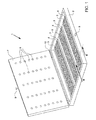
- FIG. 1 An exemplary embodiment of a device according to the invention is shown in figure 1 and figure 2 .
- a device (1) comprises strips measuring for example 2 x 8 cm with for instance 4 grams of chlorine releasing granulate (e.g. sodium-di-iso-chloro-cyanurate granulate) (6) glued onto a flat carrier (3), for example a plastic strip.
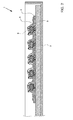
- Figure 2 shows a cross section (indicated as II in figure 1 ) of such a strip placed on a support member (2) (for instance made of plastic).
- granulate (6) is embedded in a layer of glue (4) onto a flat carrier (3).
- the granulate is covered by a thin polymer layer (5).
- the actual quantity and granule size distribution is to be determined based on the size of the compartment contained within the container and the quantities of ethylene released per unit of time that are to be controlled.
- the strips may be placed on a support member (2) of the device.
- a semi-permeable barrier may for instance be realised by means of a lid (7) of suitable material, such as plastic, with holes (8) in it to allow gas transport.
- the support member and the lid may be attached to each other by means of a hinge (10).
- the device may be closed by means of closing members (9) which are attached to the support member (2) and the lid (7).
- a bag of semi-permeable woven or non-woven material may be used to put the strips in, the bag then functioning as a semi permeable body.
- any suitable number of strips may be incorporated in such a body, for instance 3 as in figure 1 .
- granules prepared of the chlorine releasing agent are attached to the surface of a solid support in a layer of single granule thickness.
- Any suitable material may serve as support, for instance plastic or a biodegradable material. This provides the most predictable and controllable of surfaces with respect to release rate of chlorine radical per gram of source material.
- granules are bound to or embedded in a surface of a support, for instance by a binding substance such as a glue.
- the side of the granula facing the surface of the support may be partially inactivated or impaired in its chlorine releasing properties by partial occlusion of the granular surface. Although this influences the release speed of chlorine radical per gram of source material, said release is still equally predictable. The fineness and evenness of the granulate are further determinants for the release rate of chlorine radical per gram of chlorine releasing source material. These factors can be controlled by a process of milling and sieving of the ground source material.
- the granulate is covered by a thin layer of a polymer coating.
- a polymer coating forms a means to control the generation and release of chlorine, Cl- and chloride radicals.
- the thickness of this layer may for instance be between 1 and 20 micron, such as 3 or 10 micron.
- the polymer layer should be resistant to contact with the source material as well as the presence of chlorine gas, Cl-and chloride radicals in considerable concentrations for a long period (weeks rather than days).
- the polymer coating may be applied to the granula in the form of a dispersion.
- a dispersion may comprise a polymer composition produced the monomers vinyl acetate and ethylene, optionally mixed with a vinyl ester of a highly branched carboxylic acid.
- the polymer is a copolymer.
- Such copolymer may e.g. be Vinnapas EP 400 or Vinnapas EF 3777 of Wacker Chemie AG.
- the polymer is produced from the monomers vinyl acetate, ethylene and a vinyl ester of a highly branched carboxylic acid
- the polymer is a terpolymer.
- the vinyl ester of a highly branched carboxylic acid may be for example Versatic acid (9 or 10) of Momentive Performance Materials.
- the terpolymer may e.g. be Vinnapas EZ 3523 of Wacker Chemie AG.
- Glycerol may be present in the polymer layer in an amount of from 0,1 to 20 % by weight of the polymer content, preferably from 5 to 10 % by weight of the polymer content, such as approximately 8% by weight of the polymer content, the balance of the composition being water. Dispersions produced from the abovementioned polymers allow for inclusion of glycerol, and should not sequester glycerol during the drying process.
- a polymer coating used to cover the chlorine releasing agent should allow gas and vapour diffusion between the granula and the surroundings. In addition, this layer slows down the dissociation of the source material so as to extend the life span of the source system as a whole. It should be noted that in the light of the need to produce such constructs in an industrial manner (even if the active granulate is added onto the construct at the latest possible moment in time) such a polymer coating with reduced permeability, whilst increasing the amount of source material required may well provide for an extended "shelf" life of the construct of up to 6 months (and under extreme designs and properties of the suppliers packaging, up to a year). This may well increase the commercial applicability of the invention.
- the invention also relates to a method for inhibiting degradation of ethylene sensitive perishable products, wherein a chlorine releasing agent is used to inhibit degradation of said perishable products, wherein ethylene released by said perishable products during storage or conservation thereof is functionally "eliminated" by means of said chlorine releasing agent.
- a chlorine releasing agent is used to inhibit degradation of said perishable products
- ethylene released by said perishable products during storage or conservation thereof is functionally "eliminated" by means of said chlorine releasing agent.
- functional elimination of ethylene is meant that ethylene is eliminated by chlorination rather than spatial removal of the ethylene.
- the container or device of the invention are used to perform such a method. How the container and device of the invention can be applied for the purposes of the invention will be illustrated in the following examples which are merely meant to illustrate the invention and not to limit the invention.
- the 40 grams of chlorine product releasing material equated to 26 grams or 0,37 mol of chloride. Over an 8 hour period of the first day and at 2 hour intervals the free and non oxidized / non-halogenated ethylene concentration in the reaction chamber was measured followed by once daily measurements at 24 hour intervals for 4 more days. The experiment was repeated with identical quantities of chlorine product releasing granulate and different starting concentrations of ethylene.
- Table 1 ethylene conversion in the presence of a chlorine releasing agent Ethylene concentrations measurements (detection threshold: 1 ppm)of non-halogenated ethylene. Ethylene measurements using ICA56 portable ethylene meter, supplier: VWR, the Netherlands Starting conc. ethylene (ppm) conc. ethylene day 1 conc. ethylene day 2 conc. ethylene day 3 conc. ethylene day 4 conc. ethylene day 5 2 hrs 4 hrs 8 hrs 10 hrs 200 146 110 80 58 42 28 22 17 100 73 55 40 29 21 14 11 8,5 50 34 24 16 10 5 2 1 25 17 12 8 5 2,5 1 10 8,5 6 4 2,5 1 5 4,25 3 2 1 2 1,5 1
- Ethylene controlling devices of the invention used in this experiment comprised strips with 4 grams of sodium-di-iso-chloro-cyanurate granulate glued onto flat strips of plastic measuring 2 x 8 cm. Strips were be incorporated in a plastic body with holes in it to allow transport of gas and vapour.
- Bananas were exposed either to no granulate (a device without strips of sodium-di-iso-chloro-butanocyanurate granulate) or to an ethylene controlling device, formulated as described above and loaded with a total of 4, 8 or 12 grams of granulate of di-chloro-iso-cyanurate (i.e. 1, 2 or 3 strips respectively). A total of 16 metabolic chambers was used, each group of treatments was repeated 4 times. The results of all calculations, converted into week averages are shown in summary in table 2. Table 2.
- Boxes were stacked with test boxes at the corners of the pallets only, separated from each other by a control box without added material and not placed on the top or in the bottom layer.
- the pallet with test material was placed alongside a second pallet without any treated boxes as a second control.
- Both pallets were placed in the 4 th row from the end of the reefer container for transport and were shipped with routine cooling treatment only and without any conditioning of atmosphere but cooled to temperature of 13,4 °C with the usual tolerances.
- An identical experiment was conducted at the same time under identical circumstances with boxes of bananas allocated to either experiment randomly from the same source and harvested at the same time.
- an oxygen source (commercially purchased sachets of 8 grams combined weight of potassium permanganate attached onto a granular aluminum-oxide carrier) was placed within plastic bags containing bananas.
- test boxes with oxygen releasing sachets carried either 1, 2 or 3 sachets in an identical distribution of boxes involved.
- a directly adjacent pallet of untreated bananas was designated as a separate, additional control.
- ethylene concentration were measured in all test and control boxes of the pallet containing treated boxes as well as in a representative sample of boxes (12) of the adjacent pallet from the same levels as the treated boxes from the test pallet.
- Controls 1 shows the averaged results of the sampling of control boxes within the test pallet, controls 2 the results of measurements in the 12 boxes of the adjacent pallet. From the results it is evident that the presence of the granulate of the ethylene controlling device (ECD) of the invention has resulted in suppression of (the expected rise in) ethylene production during the 3-4 weeks of transport overseas in a standard reefer container. This is associated with a marginal difference in color grade on arrival between treated and control bananas. However, left to develop spontaneously at 13,4 °C after arrival, differences gradually increase demonstrating an effective delay on the process of spontaneous maturation.
- ECD ethylene controlling device
- ethylene controlling device of the invention may be able to cause an additional ethylene-receptor blocking effect on top of scavenging ethylene gas.
- an ethylene controlling device formulated as described above and loaded with a total of 4 grams of granulate of di-chloro-iso-cyanurate (i.e. 1 strip) was used.
- the bananas were compared to bananas treated by 12 hours of oxidation (2 sachets of KMnO 4 on aluminum oxide granulate (8 grams combined weight per sachet) per 20 kg of bananas) or 1-MCP, 12 hours of exposure to air in enclosed space (108 cubic meter with 1 dosing Unit of commercially purchased 1-MCP. Subsequently all 4 groups of bananas were exposed to 24 hours of a controlled atmosphere containing 60 ppm of ethylene ("standard gassing"). Bananas were followed for 21 days of ripening as measured by grading of color and measurements of ethylene production over 24 hours by placing appr. 1 kg of bananas in a 4 liter container as before, every day. Between measurement periods all bananas were stored separately at 13,4 °C.
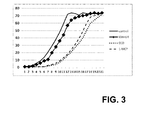
- results show a delay of onset of (self-)acceleration of ethylene production after 12 hours of treatment using the device of the invention and 1-MCP as compared to treatment by oxidation provided by commercially purchased KMnO 4 sachets. See also Figure 3 .
- the effectiveness of the ethylene controlling device (ECD) of the invention in protecting sensitive products against the deleterious influences of ambient ethylene, even in late intervention studies (in protecting produce purchased at local retail outlets) by daily recording the sale-ability of the produce ("shelf-life", is illustrated by the following table. Tested by placement of produce in and exposure to ethylene in 1 m 3 air chambers with continuous exposure to ethylene naturally produced by 1.5 kg of overripe banana's at room temperature (16-18C°) and with or without continuous presence of and protection by a ECD unit containing 4 grams of polymer coated granulate glued to a strip of 2 x 8 cm, the strip being incorporated in a plastic body with holes in it to allow transport of gas and vapour.
- ECD ethylene controlling device
- Table 4 Improvement of shelf life of ethylene sensitive perishable products by exposure to the ethylene controlling device of the invention in a later stage of ripening.
- product Number of items per test Number of repeats Mean extension of shelf life in days Banana 6 4 4,7 Mango 6 4 6,3 Kiwi 6 4 4,5 Melon 6 4 7,9 Aubergine (egg plant) 8 3 11,1 Broccoli 8 3 3,5 Ice berg salade 12 2 4,7 Cucumber 8 6 8,8 Pear 8 6 6,7
- This example shows that the shelf life of ethylene sensitive perishable products, even when protection commences only after release of produce to retail centers, i.e. in a rather late stage of ripening, can still be substantially prolonged by exposing the product to a chlorine releasing agent and placed in a moderately restrictive display structure intended for use with ethylene sensitive perishable products according to the invention.
- the examples show that the shelf life of ethylene sensitive perishable products can be substantially prolonged by exposing the product to a chlorine releasing agent in a container for transport or storage of ethylene sensitive perishable products according to the invention.
- a device which comprises a chlorine releasing agent wherein said device a chlorine releasing agent is attached to a surface of a solid support and coated with a polymer coating which allows gaseous contact between the a chlorine releasing agent and the surroundings, and thus wherein a material which is permeable for ethylene covers the chlorine releasing agent, said semi-permeable material forming a barrier that prevents direct contact of the perishable products with the coated a chlorine releasing agent, is suitable for use in such a container.
- the device and container can be applied in a method to inhibit degradation of sensitive perishable products.
Landscapes
- Life Sciences & Earth Sciences (AREA)
- Engineering & Computer Science (AREA)
- Wood Science & Technology (AREA)
- Chemical & Material Sciences (AREA)
- General Health & Medical Sciences (AREA)
- Health & Medical Sciences (AREA)
- Zoology (AREA)
- Plant Pathology (AREA)
- Dentistry (AREA)
- Toxicology (AREA)
- Environmental Sciences (AREA)
- Agronomy & Crop Science (AREA)
- Chemical Kinetics & Catalysis (AREA)
- General Chemical & Material Sciences (AREA)
- Food Science & Technology (AREA)
- Polymers & Plastics (AREA)
- Packages (AREA)
- Storage Of Fruits Or Vegetables (AREA)
Abstract
The invention relates to a container for transport or storage of ethylene sensitive perishable products and its use and a device for use in this container and use of this device. The invention also relates to a method for inhibiting degradation of ethylene sensitive perishable products wherein a chlorine releasing agent is used to inhibit degradation of said perishable products.
Description
- The invention relates to a container for transport or storage of ethylene sensitive perishable products and its use and a device for use in this container and use of this device. The invention also relates to a method for inhibiting degradation of ethylene sensitive perishable products wherein a chlorine releasing agent is used to inhibit degradation of said perishable products.
- Harvest products such as fruit, vegetables and flowers are usually harvested in an early to late pre-ripening stage, subsequently cooled and transported by various means such as road and air transport but also by ship in containers. Upon arrival at their destination, the products are transported to cooled storage facilities, but may also be moved between cooled storage facilities a number of times. Here they remain until marketing and retail shipping. Transporting fruit often involves long distance transport with a considerable time lapse. This creates a pressure to harvest or pick fruit as early as possible. However, in many cases products cannot be harvested too early because of the climacteric nature of the product. Climacteric fruit, for instance, passes a point during its development, after which, left to itself either on the plant or after picking, such fruit will mature and ripen normally. This is often referred to as the point of climacterium.
- Ripening of fruit or of any other ethylene sensitive perishable product is induced by ethylene which is a natural "ripening hormone" that is naturally released by the fruit itself although fruits may also be artificially exposed to ethylene. If harvested before the point of climacterium, no amount of time or exposure to ethylene hormone will result in proper ripening with all its characteristic features, such as change of color, texture, development of sweetness and species specific taste and smell by the release from starch stores of free sugars and the synthesis and release of aromatic oils.
- Once past the point of climacterium, the path towards ripening and inevitable over-ripening has irreversibly been set in. This leaves a limited time span for harvesting, processing, transporting and sale of such fruit. Untimely over-ripening results in considerable commercial losses because a substantial amount of fruit has not yet been sold by the end of "shelf life". Similarly, commercial losses by complaints and re-imbursement of dissatisfied customers occur when fruit was picked to early and satisfactory ripening had not been achieved. However, during this period, the self-generated and secreted ethylene has a positive bio-feedback in that it accelerates ripening. Thus, exposure to excess ethylene may serve to further accelerate ripening. On the other hand, removal or inactivation of self-generated ethylene may serve to slow down ripening postharvest.
- An additional problem in this fine balance between timing of harvest and the limited time available to accommodate the whole of logistical processes is that because of the abovementioned positive bio-feedback and consequent accelerated ripening, even a single item of fruit which matures ahead of the bulk of the stored fruit can have an adverse affect on the whole stored quantity.
- Another problem is that broken surfaces of stems of fruit, vegetables or flowers after cutting and areas of damage to fruit skin cause vulnerability to infections. These infections may manifest during and after storage, especially with molds and in particular botrytis species. These organisms and their spores are present in low density on harvested products already at harvest, but may cause infection in the stored products. More importantly, such spores are present at relevant quantities in circulating air and especially in processing facilities where dust of dead plant material is present at high concentrations. Infected harvest products will seriously affect retail prices thereof and lead to considerable losses. Because damaged plant parts also release ethylene, these broken surfaces also cause a burst of ethylene. The release of ethylene associated with damaged plant parts accelerates flower maturation or opening or may lead to abscission of buds in early stages of flower development. This will seriously affect commercial product value and shorten vase life in the case of cut flowers.
- One effective strategy commercially applied to counter ripening problems consists of cooling. For bananas this is performed by cooling to an established optimum temperature of 13,4°C. For mangos variable temperatures, according to species differences, are applied to slow down metabolism and maturation of the fruit. Cooling also slows down developing of activated spores of harmful micro-organisms. One of the disadvantages of the cooling approach is that cooling involves high energy costs.
- A strategy to counter ripening problems that is often used in support of cooling, is to eliminate any hormonally active ethylene produced by the transported or stored product or present in the ambient air, by circulating the air through a "scrubbing" device where, with the aid of potassium permanganate, ethylene is oxidized to the hormonally inactive ethylene oxide (see for instance
US 8,293,171 ). However, this limits the carrying capacity of any container to which this is applied by 5% and thus adds significant further costs to the product. In addition, even with complete neutralization of ethylene in the ambient air in containers treated in such a manner, active ethylene concentrations within the bags or boxes containing such bananas and mangos, can reach well above those known to have a biological effect. - Even when placed inside the containers (see for instance
JP58220648 - An alternative approach is to use 1-MCP, an artificial ethylene hormone-like molecule that is known for blocking the ethylene receptors of products. 1-MCP can be applied as an aromatic oil and can be vaporized into storage spaces. This vapor will dissolve into the surface water of fruit and other plant tissues and block ethylene receptors within the tissues.
US2011143004 discloses a slow-release system contained in a coating, using cyclodextrin micro-containers for extended release of ethylene receptor antagonist 1-MCP, which could result in an extended period during which ripening and maturation are inhibited. This is required as the half-life of receptors, with immediate replacement by, as yet unblocked and therefore active new receptors, is usually less than 14 days. However, there are no examples of any factual effect of this coating on fruit or a post-harvest live product and the cost of products based on 1-MCP in various slow-release forms has been prohibitively high. The use of 1-MCP without such a slow-release system has proven effective in short term transport protection by blocking receptors in road transport in the US by using a 1-MCP dispenser. The commercial product for this manner of use also involves high costs: up to 500 Euro per truckload or transport. As of yet such a dispenser would be placed in the storage room outside of the boxes or bags wherein the products are stored. Therefore also in this case, even with complete neutralization of ethylene in the ambient air in containers treated in such a manner, active ethylene concentrations within the bags or boxes containing the harvest products, can reach well above those known to have a biological effect. - Finally, slowing down of maturation and ripening can be established by restricting the amount of oxygen. However, if the amount of oxygen available for the fruit is too low, this will result in various metabolic responses such as the increasing activation of lactic acid metabolism, which can result in undesirable effects on fruit taste. Unfortunately, unequal ripening causes unpredictable and uncontrollable effects on the minimum level of oxygen required or tolerated. This precludes low-oxygen controlled atmosphere transport to become implemented at any scale.
- Thus as to date, no effective or affordable strategy has been developed to extend the period of post-harvest maturation to reduce the risk of production losses due to picking fruit too early or too late. Thus, the state of the art of post-harvest protection of harvested products results in significant and unavoidable losses due to a combination of metabolic and infectious processes. This problem applies to almost any other kind of ethylene sensitive perishable product, such as fruit and vegetables but also cut flowers or potted plants which are partly in bloom and have become very sensitive to ethylene in the process.
- Therefore, there is a strong need in the fruit but also other agricultural industry, for means to protect ethylene sensitive perishable products from ethylene in order to slow down the maturation process of such fruit, which does not display the above described disadvantages and possibly even leads to further reduction of these problems by allowing harvesting at a later stage, resulting in positive effects on taste and appearance of the harvested products, quality and remaining post-retail shelf life.
- Objects of the present invention are therefore to provide a means for extended, i.e. weeks rather than days, protection of ethylene perishable products, during storage; and a method for effectively inhibiting degradation of ethylene sensitive perishable products within a unit of environment surrounding various trading qualities of such products, being either bags, boxes, crates, sacs or the like. The invention solves the abovementioned problems by making use of the abilities of chlorine to inactivate ethylene produced by ethylene producing products by using a chlorine releasing agent in the proximity of the ethylene sensitive perishable products. The chlorine releasing agent preferably has the ability for extended release of chlorine in time. This way degradation of ethylene sensitive perishable products which may produce ethylene by themselves is significantly inhibited over a long period.
- This invention relates to a container for transport or storage of ethylene sensitive perishable products comprising within the container a chlorine releasing agent which is accessible for ethylene and a barrier that prevents direct contact of said chlorine releasing agent with said perishable products.
- In another aspect, the invention also relates to such a container which comprises ethylene sensitive perishable products.
- In another aspect the invention relates to a device for use in a container for transport or storage of ethylene sensitive perishable products, which comprises a chlorine releasing agent, wherein said chlorine releasing agent is attached to a surface of a solid support and optionally coated with a polymer coating which allows gaseous contact between the chlorine releasing agent and the surroundings thereof, wherein semi-permeable material which is permeable for ethylene and chlorine covers the optionally coated chlorine releasing agent, said semi-permeable material forming a barrier that prevents direct contact of the ethylene sensitive perishable products with the coated chlorine releasing agent.
- In another aspect, the invention also relates to the use of this container or device for inhibiting degradation of ethylene sensitive perishable products.
- In another aspect, the invention relates to a method for inhibiting degradation of ethylene sensitive perishable products, wherein a chlorine releasing agent is used to inhibit degradation of said ethylene sensitive perishable products, wherein ethylene released by said ethylene sensitive perishable products during storage or conservation thereof is functionally eliminated by means of said chlorine releasing agent.
- The device and method of the invention can advantageously be applied in a container surrounding various trading quantities of said perishable products, being either bags, boxes, crates, sacs or even trucks and or shipping containers and the like. In the environment in such a container, namely directly adjacent to the source of any ethylene and within the same compartment, neutralization of ethylene can take place keeping the levels of bio-active ethylene well below the threshold for any accelerating effect on the ripening. The invention allows for a minimal continued release of ethylene with otherwise unaltered metabolism and maturation of the fruit item within the same compartment. Because of this, ripening is protracted and the storage life of the ethylene perishable products is extended and the product, once harvested and ripened, remains appreciable to clients for a longer period of time, weeks rather than days, during storage (i.e. it has an extended shelf life). As a result the risk of harvesting too early can be avoided and it is expected that if the device and method of the invention are used harvest may be postponed for even 3 or 4 days.
- In addition, application of the invention avoids the high costs involved with cooling or use of 1-MCP. As the device can be placed in the container wherein the perishable products are stored or transported no additional space is occupied, thereby providing a maximal transport capacity.
- The invention neither involves the adverse effects on ripening that occur when oxygen levels are kept too low or the staining that occurs when KMnO4 is used.
- The invention, once applied, has considerable potential for reduction of weight loss through reduction of the ethylene stimulated metabolic activity. Production of CO2 will also be reduced, because metabolic production of CO2, as a result of oxidative turnover of sugars, will be significantly reduced through the effective blockage of the ethylene stimulant pathway.
-
-
Figure 1 . Exemplary embodiment of the ethylene controlling device of the invention. -
Figure 2 . Cross-section of strip covered with a chlorine releasing agent for use in the ethylene controlling device of the invention. -
Figure 3 . 24 hour production of ethylene in ppm of bananas after arrival 25 days after harvest, exposed to 12 hours of treatment with KMnO4, the ethylene controlling device of the invention (ECD) and 1-MCP, followed by 24 hours of exposure to ethylene at 60 ppm. (X-axis: time in hours, Y-axis: production of ethylene in ppm. - The inventor has found that by transporting or storing ethylene sensitive perishable products in a container wherein a chlorine releasing agent is present, degradation of ethylene sensitive perishable products is inhibited. To avoid direct contact between the ethylene sensitive perishable products and the chlorine releasing agent a barrier should be present between the ethylene sensitive perishable products and the chlorine releasing agent. The barrier should be permeable for gases and prevent direct contact of said chlorine releasing agent with said perishable products. The barrier used should have gas and vapour permeability to allow unfettered access of any ambient ethylene to the crystallized chlorine-radical releasing agent but without direct contact between produce and active agent to occur as this has been found to, on occasion, result in local damage to tissues.
- When used for the purposes of the invention the container for transport or storage of ethylene sensitive perishable products of the invention contains ethylene sensitive perishable products. Ethylene sensitive perishable products may be selected from various harvested fruits and vegetables, cut flowers or potted plants which are partly in bloom. Non limited examples of products to be used in the container of the invention comprise ethylene sensitive perishable products that may be selected from the group of apples, apricots, artichokes, asparagus, avocados, bananas, beets, strawberries, broccoli, brussels sprouts, cabbage, carrots, cauliflower, cilantro, cucumbers, egg plants, figs, grapes, guavas, iceberg lettuce, lychees, nectarines, oranges, mandarins, melons, oregano, kiwifruit, leeks, lettuces, cantaloupes, papayas, peaches, peas, persimmons, pine apples, pods, plums, prunes, radishes, spinach, tomatoes, cut flowers such as alstroemeria, cyclamen, gerbera, gypsum, orchid, rose, and potted flowering plants, such as potted rose or any other ethylene sensitive form of produce.
- In a container for transport or storage of ethylene sensitive perishable products the device is positioned with and directly adjacent to the harvested fruit or produce that requires protection. The term "container" as used for purposes of the invention should be understood as being any unit that is suitable for transport or storage of ethylene sensitive perishable products. Such a container should comprise a structure surrounding or covering the ethylene sensitive perishable products to be transported or stored.
- Such a structure may be rigid (i.e. wall like) and be made of for instance plastic, cardboard, wood or steel or any other suitable material. Such containers comprise for instance plastic containers, cardboard containers, wooden containers or steel containers. Such a container may be a box or a crate. Also a loading chamber of a truck or a ship may be considered a container. The structure surrounding or covering the ethylene sensitive perishable products to be transported or stored may also be flexible and be made of plastic or paper or any other suitable material. A container made of this material may be in the form of sac or a bag. Also containers made in part of a rigid structure and in part of a flexible structure may be used for purposes of the invention, such as for instance a box with a flexible plastic sheet covering the products. Also a bag in a box or any suitable container that may be used for purposes of transport or storage of ethylene sensitive perishable products may be suitable.
- The ethylene sensitive perishable products may be completely enclosed by the container, for instance a box or crate with a lid or a closed bag, or partially, such as by means of a box or a crate without a lid or a (partially) open bag. To allow for sufficient water vapour permeability and permeability to oxygen and carbon dioxide to prevent death of tissue by suffocation or accumulation of toxic quantities of CO2, some degree of permeability of the enclosing or surrounding structure forming the container (plastic bag, box etc.) is preferred.
- The container is preferably arranged such that it allows diffusion of moisture, oxygen and carbon dioxide into and out of said container. For this purpose the structure surrounding or covering the ethylene sensitive perishable products to be transported or stored should be permeable (e.g. with holes) for moisture, oxygen and carbon dioxide. In this respect the term "permeable" is also meant to encompass an opening of the container (such as a bag) made of impermeable material which is not completely closed in order to allow inward and outward diffusion of moisture, oxygen and carbon dioxide.
- A form of enclosure surrounding quantities of the produce appropriate to the quantity of active material present is beneficial to the development of the full protective effect of the chlorine releasing agent, because the inventor has found that this is beneficial for the inhibition of degradation of ethylene sensitive perishable products. Using a structure surrounding or enclosing the ethylene sensitive perishable products results in local retention of chlorinated ethylene. This causes an even better inhibition of degradation of ethylene sensitive perishable products compared to a situation wherein native ethylene is merely scavenged away from the product. This is probably due to an ethylene receptor blocking effect caused by the chlorinated ethylene. Therefore the permeability of the enclosing or surrounding structure forming the container should be such that gases diffuse in a manner that local retention of chlorinated ethylene occurs to such an extent that it results in the abovementioned effects. This goal is achieved by using for instance a container with small holes or a bag with holes. Also a plastic bag sealed by strips wound loosely around the opening of it will be suitable as a container for these purposes. The skilled person will acknowledge that there are many more ways to reach the abovementioned goal.
- The chlorine releasing agent used in the invention is preferably a crystalline material which has chlorine releasing properties that enable prolonged exposure of the ethylene sensitive perishable product. For this reason an important feature of said crystalline material as the source material of highly reactive chlorine, is that the process of releasing chlorine is slow by nature at occurring temperatures. The crystalline chlorine releasing material therefore provides for extended effective release, measured in periods of weeks rather than days. A chlorine releasing agent that is suitable for purposes of the invention is therefore a chlorinated cyanurate compound or a derivative thereof. Such agents provide slow release of chlorine, and thus prolonged exposure of the ethylene and the ethylene sensitive perishable products to chlorine. In particular agents such as sodium-di-iso-chloro-cyanurate or trichloro-cyanurate are suitable for the purposes of the invention. These compounds are commercially available in crystallized form. It should be understood that also other chlorine releasing agents that provide prolonged release of chlorine radicals may be suitable for purposes of the invention. In fact any slow chlorine release vehicle may be suitable. For instance slow release chlorine tablets prepared of hypochlorite compounds may also be applicable. For the purpose of remaining stable under circumstances of very high humidity levels, source materials for chloride radicals and chlorine release are best sought from substances that are not too hygroscopic and, even if they are hygroscopic to a certain degree, will remain stable over a long to very long period in water (weeks rather than days) as extensive condensation of water vapor on all available surfaces of containers of produce and its contents are a common occurrence.
- It is preferred that for purposes of the invention the chlorine releasing agent is in the form of granula, preferably with an average diameter of between approximately 0,4 mm and 1,6 mm. The released rate of chlorine per gram of a chlorine releasing agent can be influenced by selecting a particular granule size of the source material because the release rate of chlorine per unit weight of source material is determined by the mean size or diameter, or total surface or surface to volume ratio of the granules used. The exposure of surface area from the granulate from which the chloride radical is released from the source material is probably the dominant determinant of the function of halogenation of ambient ethylene. In this respect a fine granulate has a higher surface area to weight ratio, releasing a larger quantity of chlorine per gram of source material per unit of time, but the total quantity of the source material then is the ultimate determinant of the period over which effective quantities of such gasses are released. For sodium-di-iso-chloro-cyanuric acid or trichlor-cyanuric acid a suitable diameter of granula has been found to be between approximately 0,4 mm and 1,6 mm.
- As direct contact between produce and the source material of chloride radicals and/or chlorine gas is to be avoided, a barrier between the chlorine releasing material itself and the perishable products is provided. Such a barrier may be a material barrier, such as a partition or a partition-like structure, but a barrier may also be realised by spatial separation of the chlorine releasing agent and the ethylene sensitive perishable products, i.e. the chlorine releasing agent is placed in the container, adjacent to the products in such a way that direct contact with the ethylene sensitive perishable products is prevented. A material barrier may have the form of a small bag or sachet of permeable or semi-permeable material wherein the chlorine releasing agent is placed. Such a small bag or sachet may be composed of woven material or of otherwise sufficiently permeable material. Alternatively the chlorine releasing agent may be attached to a surface of a solid support and coated with a polymer coating which allows gaseous contact between the chlorine releasing agent and the surroundings thereof, wherein a cover which is at least permeable for ethylene and chlorine covers the coated chlorine releasing agent, said cover forming a barrier that prevents direct contact of the perishable products with the coated chlorine releasing agent.
- With respect to avoiding direct contact between the chlorine releasing agent and the ethylene sensitive perishable products invention also relates to a device which comprises a chlorine releasing agent, wherein said chlorine releasing agent is attached to a surface of a solid support and optionally coated with a polymer coating which allows gaseous contact between the chlorine releasing agent and the surroundings, wherein permeable or semi-permeable material which is permeable for ethylene and chlorine and chlorine radicals, covers the coated chlorine releasing agent, said permeable or semi-permeable material forming a barrier that prevents direct contact of the perishable products with the coated chlorine releasing agent. Such a device can be put in a container for transport or storage of ethylene sensitive perishable products (e.g. bag or box) either by simply placing it inside the respective bag or box or by attaching it to the inner surface to the container by any suitable means. For instance the device may be put in a small bag, which is suitably permeable for vapour and gases. Such a bag containing the device may then be put in the container or attached to an inner surface of the container.
- An exemplary embodiment of a device according to the invention is shown in
figure 1 andfigure 2 . Such a device (1) comprises strips measuring for example 2 x 8 cm with forinstance 4 grams of chlorine releasing granulate (e.g. sodium-di-iso-chloro-cyanurate granulate) (6) glued onto a flat carrier (3), for example a plastic strip.Figure 2 shows a cross section (indicated as II infigure 1 ) of such a strip placed on a support member (2) (for instance made of plastic). In this embodiment granulate (6) is embedded in a layer of glue (4) onto a flat carrier (3). Optionally the granulate is covered by a thin polymer layer (5). The actual quantity and granule size distribution is to be determined based on the size of the compartment contained within the container and the quantities of ethylene released per unit of time that are to be controlled. The strips may be placed on a support member (2) of the device. To prevent direct contact of the perishable products with the coated chlorine releasing agent a semi-permeable barrier may for instance be realised by means of a lid (7) of suitable material, such as plastic, with holes (8) in it to allow gas transport. The support member and the lid may be attached to each other by means of a hinge (10). The device may be closed by means of closing members (9) which are attached to the support member (2) and the lid (7). Alternatively a bag of semi-permeable woven or non-woven material may be used to put the strips in, the bag then functioning as a semi permeable body. For dosage purposes any suitable number of strips may be incorporated in such a body, forinstance 3 as infigure 1 . - For the purpose of controlling the released amount of chlorine radical per gram of chlorine releasing source material in a given period of time, granules prepared of the chlorine releasing agent are attached to the surface of a solid support in a layer of single granule thickness. Any suitable material may serve as support, for instance plastic or a biodegradable material. This provides the most predictable and controllable of surfaces with respect to release rate of chlorine radical per gram of source material. In such an embodiment granules are bound to or embedded in a surface of a support, for instance by a binding substance such as a glue. When using a binding substance such as glue or a similar agent, the side of the granula facing the surface of the support may be partially inactivated or impaired in its chlorine releasing properties by partial occlusion of the granular surface. Although this influences the release speed of chlorine radical per gram of source material, said release is still equally predictable. The fineness and evenness of the granulate are further determinants for the release rate of chlorine radical per gram of chlorine releasing source material. These factors can be controlled by a process of milling and sieving of the ground source material.
- Optionally, the granulate is covered by a thin layer of a polymer coating. Such a polymer coating forms a means to control the generation and release of chlorine, Cl- and chloride radicals. The thickness of this layer may for instance be between 1 and 20 micron, such as 3 or 10 micron. The polymer layer should be resistant to contact with the source material as well as the presence of chlorine gas, Cl-and chloride radicals in considerable concentrations for a long period (weeks rather than days).
- The polymer coating may be applied to the granula in the form of a dispersion. Such a dispersion may comprise a polymer composition produced the monomers vinyl acetate and ethylene, optionally mixed with a vinyl ester of a highly branched carboxylic acid. In case the polymer is produced from the monomers vinyl acetate and ethylene, the polymer is a copolymer. Such copolymer may e.g. be Vinnapas EP 400 or Vinnapas EF 3777 of Wacker Chemie AG. In case the polymer is produced from the monomers vinyl acetate, ethylene and a vinyl ester of a highly branched carboxylic acid, the polymer is a terpolymer. The vinyl ester of a highly branched carboxylic acid may be for example Versatic acid (9 or 10) of Momentive Performance Materials. The terpolymer may e.g. be Vinnapas EZ 3523 of Wacker Chemie AG.
- Glycerol may be present in the polymer layer in an amount of from 0,1 to 20 % by weight of the polymer content, preferably from 5 to 10 % by weight of the polymer content, such as approximately 8% by weight of the polymer content, the balance of the composition being water. Dispersions produced from the abovementioned polymers allow for inclusion of glycerol, and should not sequester glycerol during the drying process.
- A polymer coating used to cover the chlorine releasing agent should allow gas and vapour diffusion between the granula and the surroundings. In addition, this layer slows down the dissociation of the source material so as to extend the life span of the source system as a whole. It should be noted that in the light of the need to produce such constructs in an industrial manner (even if the active granulate is added onto the construct at the latest possible moment in time) such a polymer coating with reduced permeability, whilst increasing the amount of source material required may well provide for an extended "shelf" life of the construct of up to 6 months (and under extreme designs and properties of the suppliers packaging, up to a year). This may well increase the commercial applicability of the invention.
- Because a "shelf" life of the construct of up to 6 months may not be required for all fields of application of the invention, the use of a device or simply the source material for the release of chlorine radicals and Cl- dissociation products without such a polymer covering is totally feasible and is to be considered as falling under this application as anyone skilled in the art would appreciate the effectiveness of this variant. Under these parameters the total quantity of source material in proportion to the produce to be protected may be reduced, with some degree of reduction of the "life span" of the system as whole as a consequence that may very well be acceptable or even wanted under the given circumstances.
- The invention also relates to a method for inhibiting degradation of ethylene sensitive perishable products, wherein a chlorine releasing agent is used to inhibit degradation of said perishable products, wherein ethylene released by said perishable products during storage or conservation thereof is functionally "eliminated" by means of said chlorine releasing agent. With functional elimination of ethylene is meant that ethylene is eliminated by chlorination rather than spatial removal of the ethylene. In a preferred embodiment the container or device of the invention are used to perform such a method. How the container and device of the invention can be applied for the purposes of the invention will be illustrated in the following examples which are merely meant to illustrate the invention and not to limit the invention.
- The examples shown in this application all used a polymer coating in the form of a water based dispersion of EF3777 polymer (as provided by Wacker), in a layer of 3 or 10 microns and with either 5 or 10% of glycerol by weight of polymer.
- To investigate whether ethylene can be converted at considerable speed the following experiment was conducted. Using a 1 m3 stainless steel airtight container 200 ml of ethylene gas was added to ambient air within to achieve a 200 ppm concentration, with a final content of 0,085 mol of ethylene. A 40 gram quantity of finely granulated sodium-di-chloro-iso-cyanurate was placed in the form of separate granula as a releaser of chlorine and or Cl- reaction products. The granula were placed in the container in a small box with open contact with the ambient air in the container. A tray of water was placed in the container to simulate the presence of water condensation products and as a possible reaction medium for the interaction of chlorine products and ethylene. The 40 grams of chlorine product releasing material equated to 26 grams or 0,37 mol of chloride. Over an 8 hour period of the first day and at 2 hour intervals the free and non oxidized / non-halogenated ethylene concentration in the reaction chamber was measured followed by once daily measurements at 24 hour intervals for 4 more days. The experiment was repeated with identical quantities of chlorine product releasing granulate and different starting concentrations of ethylene.
- The results are shown below in table 1.
Table 1: ethylene conversion in the presence of a chlorine releasing agent Ethylene concentrations measurements (detection threshold: 1 ppm)of non-halogenated ethylene. Ethylene measurements using ICA56 portable ethylene meter, supplier: VWR, the Netherlands Starting conc. ethylene (ppm) conc. ethylene day 1conc. ethylene day 2conc. ethylene day 3conc. ethylene day 4conc. ethylene day 52 hrs 4 hrs 8 hrs 10 hrs 200 146 110 80 58 42 28 22 17 100 73 55 40 29 21 14 11 8,5 50 34 24 16 10 5 2 1 25 17 12 8 5 2,5 1 10 8,5 6 4 2,5 1 5 4,25 3 2 1 2 1,5 1 - From these results it is evident that at an initial rate of about 4 to 1 based on molecular weight (0,37 mol to 0,085 mol) over a 5 day period ethylene is converted at an exponential rate at a considerable speed.
- In the following experiment the effects of neutralizing ethylene on metabolism, and in particular O2 consumption, CO2 production and ethylene production, of harvested bananas was tested. Using 4000 ml metabolic chambers and between 700 and 850 grams of post climacteric, freshly harvested bananas, O2 consumption, CO2 production and ethylene production was measured on a 24 hour basis, with flushing of the chambers with ambient air directly after each measurement. Bananas were kept at 13,4 °C. This is the normal temperature that is maintained at transport and is known to suppress the metabolism of bananas without negative effects while still delaying the onset of the self-acceleration moment of the spontaneous rise in ethylene release. The study lasted 35 days (5 weeks), which is normally sufficiently long to allow for the spontaneous occurrence of commencement of ethylene production acceleration with self acceleration and proportional increase in metabolic activity. From the concentrations of the gasses, production or consumption per kg bananas per hour was determined. Ethylene controlling devices of the invention used in this experiment comprised strips with 4 grams of sodium-di-iso-chloro-cyanurate granulate glued onto flat strips of plastic measuring 2 x 8 cm. Strips were be incorporated in a plastic body with holes in it to allow transport of gas and vapour. Bananas were exposed either to no granulate (a device without strips of sodium-di-iso-chloro-butanocyanurate granulate) or to an ethylene controlling device, formulated as described above and loaded with a total of 4, 8 or 12 grams of granulate of di-chloro-iso-cyanurate (i.e. 1, 2 or 3 strips respectively). A total of 16 metabolic chambers was used, each group of treatments was repeated 4 times. The results of all calculations, converted into week averages are shown in summary in table 2.
Table 2. The effects of neutralizing ethylene by means of a chlorine releasing agent on O2 consumption, CO2 production and ethylene production average ethylene production in µl kg-1 h-1 week 1 week 2week 3week 4week 5controls 0,2 0,3 0,7 4,8 27,3 4 grams 0,2 0,2 0,3 0,8 1,4 8 grams 0,2 0,2 0,3 0,8 1,4 12 grams 0,2 0,2 0,3 0,8 1,4 average CO2 production in ml kg-1 h-1 week 1 week 2week 3week 4week 5controls 10 12 14 23 38 4 grams 10 11 11 12 14 8 grams 10 10 11 12 14 12 grams 10 11 11 10 14 average O2 consumption in ml kg-1 h-1 week 1 week 2week 3week 4week 5controls 9 11 13 18 35 4 grams 9 11 11 11 12 8 grams 9 11 11 11 12 12 grams 9 11 11 10 11 - It is evident from these results that the normal activation of metabolism with increase of ethylene production commencing 3-4 weeks after harvest with cooling at 13,4 °C is effectively suppressed to beyond 35 days. There is no clear dose effect of the presence of the granulate which indicates a considerable excess of material once dosed above 4 grams di-chloro-iso-cyanurate per kg of bananas in this setup. The biological effect of neutralizing ethylene by halogenation is clearly present. The mechanism of this inactivation is as yet not fully understood and cannot be easily deduced in full from these experiments at this stage.
- To compare the ethylene controlling device of the invention with conventional KMnO4 carrying structures the following experiment was carried out. Strips carrying 4, 8 and 12 grams of sodium-di-chloro-iso-cyanurate granulate, adherent onto a flat carrier material (4 grams per strip of plastic measuring 2 x 8 cm, using 1, 2 or 3 strips per box of 20 kg bananas alternatively) were placed into plastic bags containing 20 kg of bunches of 5-7 bananas per bunch, directly at the production site and immediately after washing and cleaning as per usual. Plastic bags with bananas were sealed by strips wound loosely around openings to allow diffusion of vapor, O2 and CO2 to a certain extent. The bags were placed in standard cardboard boxes for palletizing at 40 boxes to a pallet (8 layers of 5 boxes in conventional configuration). Boxes were stacked with test boxes at the corners of the pallets only, separated from each other by a control box without added material and not placed on the top or in the bottom layer. The pallet with test material was placed alongside a second pallet without any treated boxes as a second control. Both pallets were placed in the 4th row from the end of the reefer container for transport and were shipped with routine cooling treatment only and without any conditioning of atmosphere but cooled to temperature of 13,4 °C with the usual tolerances. An identical experiment was conducted at the same time under identical circumstances with boxes of bananas allocated to either experiment randomly from the same source and harvested at the same time. In this experiment instead of a halogen source, an oxygen source (commercially purchased sachets of 8 grams combined weight of potassium permanganate attached onto a granular aluminum-oxide carrier) was placed within plastic bags containing bananas. Identical to the first experiment test boxes with oxygen releasing sachets carried either 1, 2 or 3 sachets in an identical distribution of boxes involved. Again a directly adjacent pallet of untreated bananas was designated as a separate, additional control. At arrival ethylene concentration were measured in all test and control boxes of the pallet containing treated boxes as well as in a representative sample of boxes (12) of the adjacent pallet from the same levels as the treated boxes from the test pallet. In addition to ethylene level measurements, bananas were color graded every second day for 6 days as an average color grade per box. With regard to the color grade it is noted that a low grade indicates a good quality of the fruit and a high grade indicates bad quality of the fruit. The results are table below.
Table 3. Comparison between the ethylene controlling device (ECD) of the invention with conventional KMnO4 carrying structures. ECD day 0 day 2day 4day 6test bananas eth. ppm grade eth. ppm grade eth. ppm grade eth. ppm grade 1 strip 0,5 1,2 0,5 1,5 0,6 1,5 0,6 1,6 2 strips 0,5 1,2 0,5 1,4 0,5 1,5 0,5 1,6 3 strips 0,5 1,2 0,5 1,5 0,5 1,4 0,7 1,6 controls 10,6 1,4 0,7 1,9 0,7 2,1 1 2,4 controls 20,7 1,5 0,9 2,1 1,1 2,5 2,2 2,9 KMnO4 day 0 day 2day 4day 6test bananas eth. ppm grade eth. ppm grade eth. ppm grade eth. ppm grade 1 sachet 1,3 1,5 1,4 1,8 2,4 2,2 3,7 2,7 2 sachets 1,2 1,4 1,2 1,8 1,6 2,1 2,1 2,5 3 sachets 0,9 1,4 1,1 1,5 1,2 2,1 1,4 2,4 controls 11,5 1,7 1,8 1,9 3,5 2,6 5,6 3,2 controls 21,6 1,7 1,9 2,2 3,7 2,8 5,9 3,3 -
Controls 1 shows the averaged results of the sampling of control boxes within the test pallet, controls 2 the results of measurements in the 12 boxes of the adjacent pallet. From the results it is evident that the presence of the granulate of the ethylene controlling device (ECD) of the invention has resulted in suppression of (the expected rise in) ethylene production during the 3-4 weeks of transport overseas in a standard reefer container. This is associated with a marginal difference in color grade on arrival between treated and control bananas. However, left to develop spontaneously at 13,4 °C after arrival, differences gradually increase demonstrating an effective delay on the process of spontaneous maturation. Surprising in itself is that the effect has to some degree possibly extended beyond the boxes / bags containing the strips into the boxes immediately above and below the boxes with treated bananas with a small, but recognizable difference between ethylene presence and development rate of maturation in the adjacent pallet. In the case of suppression with potassium permanganate, the suppressive effects on the ethylene levels within the test boxes is evidently less effective than that in ECD treated boxes. In addition, differences between treated boxes and control boxes, both on the same pallet and those on the adjacent pallet, are considerably smaller with less difference between boxes in either control group when using the ECD. - The absence of any clear dose response with respect to ethylene production or color development in relation to the number of strips placed in the boxes indicates that at 4 grams of the granulate as defined per box, sufficient capacity for the desired effect to occur (both in time as well as over time) is provided by 4 grams of granulate. In contrast some dose-response relationship seems to exist between bananas protected by 1, 2 or 3 sachets of the KMnO4 carrying structures, respectively.
- The results above suggest that the effects of halogenation may be greater than those of oxygenation. The absence of a dose relationship between the amount of halogen producing material and ethylene concentration and maturation of the target fruit, whereas such a relationship exists for KMnO4, suggests that potentially halogenated ethylene may have an additional ethylene-receptor blocking effect.
- To investigate whether the ethylene controlling device of the invention may be able to cause an additional ethylene-receptor blocking effect on top of scavenging ethylene gas the following experiment was carried out. After arrival untreated bananas were exposed to 12 hours of halogenation of any ethylene produced (4 grams of granulate per 20 kg of bananas in bag sealed with strap). For this purpose an ethylene controlling device, formulated as described above and loaded with a total of 4 grams of granulate of di-chloro-iso-cyanurate (i.e. 1 strip) was used. The bananas were compared to bananas treated by 12 hours of oxidation (2 sachets of KMnO4 on aluminum oxide granulate (8 grams combined weight per sachet) per 20 kg of bananas) or 1-MCP, 12 hours of exposure to air in enclosed space (108 cubic meter with 1 dosing Unit of commercially purchased 1-MCP. Subsequently all 4 groups of bananas were exposed to 24 hours of a controlled atmosphere containing 60 ppm of ethylene ("standard gassing"). Bananas were followed for 21 days of ripening as measured by grading of color and measurements of ethylene production over 24 hours by placing appr. 1 kg of bananas in a 4 liter container as before, every day. Between measurement periods all bananas were stored separately at 13,4 °C. The results show a delay of onset of (self-)acceleration of ethylene production after 12 hours of treatment using the device of the invention and 1-MCP as compared to treatment by oxidation provided by commercially purchased KMnO4 sachets. See also
Figure 3 . - The effectiveness of the ethylene controlling device (ECD) of the invention in protecting sensitive products against the deleterious influences of ambient ethylene, even in late intervention studies (in protecting produce purchased at local retail outlets) by daily recording the sale-ability of the produce ("shelf-life", is illustrated by the following table. Tested by placement of produce in and exposure to ethylene in 1 m3 air chambers with continuous exposure to ethylene naturally produced by 1.5 kg of overripe banana's at room temperature (16-18C°) and with or without continuous presence of and protection by a ECD unit containing 4 grams of polymer coated granulate glued to a strip of 2 x 8 cm, the strip being incorporated in a plastic body with holes in it to allow transport of gas and vapour.
- The results are shown in table 4:
Table 4: Improvement of shelf life of ethylene sensitive perishable products by exposure to the ethylene controlling device of the invention in a later stage of ripening. product Number of items per test Number of repeats Mean extension of shelf life in days Banana 6 4 4,7 Mango 6 4 6,3 Kiwi 6 4 4,5 Melon 6 4 7,9 Aubergine (egg plant) 8 3 11,1 Broccoli 8 3 3,5 Ice berg salade 12 2 4,7 Cucumber 8 6 8,8 Pear 8 6 6,7 Avocado 4 7 5,5 Cauliflower 6 4 5,2 Alstroemeria 6 4 5,9 Cyclamen 6 4 7,9 Gerbera 6 4 4,2 Gypsum 6 4 6,9 Orchid 8 4 12,8 Pot plant rose 8 4 7,4 Cut rose (Pink Aqua) 10 4 4,3 Cut rose white (Akito) 10 4 3,7 - This example shows that the shelf life of ethylene sensitive perishable products, even when protection commences only after release of produce to retail centers, i.e. in a rather late stage of ripening, can still be substantially prolonged by exposing the product to a chlorine releasing agent and placed in a moderately restrictive display structure intended for use with ethylene sensitive perishable products according to the invention.
- The examples show that the shelf life of ethylene sensitive perishable products can be substantially prolonged by exposing the product to a chlorine releasing agent in a container for transport or storage of ethylene sensitive perishable products according to the invention. The results show that a device which comprises a chlorine releasing agent, wherein said device a chlorine releasing agent is attached to a surface of a solid support and coated with a polymer coating which allows gaseous contact between the a chlorine releasing agent and the surroundings, and thus wherein a material which is permeable for ethylene covers the chlorine releasing agent, said semi-permeable material forming a barrier that prevents direct contact of the perishable products with the coated a chlorine releasing agent, is suitable for use in such a container. In addition the examples show that the device and container can be applied in a method to inhibit degradation of sensitive perishable products.
Claims (15)
- A container for transport or storage of ethylene sensitive perishable products comprising within the container a chlorine releasing agent which is accessible for ethylene and a barrier that prevents direct contact of said chlorine releasing agent with said perishable products.
- The container according to claim 1 which comprises ethylene sensitive perishable products.
- The container according to claim 2, wherein the ethylene sensitive perishable products are selected from the group of apples, apricots, artichokes, asparagus, avocados, bananas, beets, strawberries, broccoli, brussels sprouts, cabbage, carrots, cauliflower, cilantro, cucumbers, egg plants, figs, grapes, guavas, iceberg lettuce, lychees, nectarines, oranges, mandarins, melons, oregano, kiwifruit, leeks, lettuces, cantaloupes, papayas, peaches, peas, persimmons, pine apples, pods, plums, prunes, radishes, spinach, tomatoes, cut flowers such as alstroemeria, cyclamen, gerbera, gypsum, orchid, rose, and potted flowering plants, such as potted rose.
- The container according to any of the claims 1-3, wherein the chlorine releasing agent is a chlorinated cyanurate compound or a derivative thereof.
- The container according to any of the claims 1-4 wherein the chlorine releasing agent is in the form of granula with an average diameter of between approximately 0,4 mm and 1,6 mm.
- The container to any of the claims 1-5, wherein the container is arranged such that it allows diffusion of moisture, oxygen and carbon dioxide into and out of said container.
- The container according to any of the claims 1-6, wherein the chlorine releasing agent is attached to a surface of a solid support and coated with a polymer coating which allows gaseous contact between the chlorine releasing agent and the surroundings thereof, wherein a cover which is at least permeable for ethylene and chlorine covers the coated chlorine releasing agent, said cover forming a barrier that prevents direct contact of the perishable products with the coated chlorine releasing agent.
- The container according to any of the claims 1-6, wherein the barrier is formed by a sachet of permeable or semi-permeable material wherein the chlorine releasing agent is placed.
- A device for use in a container for transport or storage of ethylene sensitive perishable products, which comprises a chlorine releasing agent, wherein said chlorine releasing agent is attached to a surface of a solid support, wherein semi-permeable material which is permeable for ethylene and chlorine covers the chlorine releasing agent, said semi-permeable material forming a barrier that prevents direct contact of the ethylene sensitive perishable products with the coated chlorine releasing agent.
- The device according to claim 9 wherein the chlorine releasing agent is coated with a polymer coating which allows gaseous contact between the chlorine releasing agent and the surroundings thereof.
- The device according to claim 9 or claim 10, wherein the chlorine releasing agent is a chlorinated cyanurate compound or a derivative thereof.
- The device according to any of the claims 9 to 11, wherein the chlorine releasing agent is in the form of granula with an average size of between approximately 0,4 mm and 1,6 mm.
- Use of the container according any of the claims 1-8 or the device according any of the claims 9-12 for inhibiting degradation of ethylene sensitive perishable products.
- A method for inhibiting degradation of ethylene sensitive perishable products, wherein a chlorine releasing agent is used to inhibit degradation of said ethylene sensitive perishable products, wherein ethylene released by said ethylene sensitive perishable products during storage or conservation thereof is functionally eliminated by means of said chlorine releasing agent.
- The method according to claim 14 comprising using the container according to any of the claims 1-8 or the device according to any of the claims 9-12.
Priority Applications (3)
| Application Number | Priority Date | Filing Date | Title |
|---|---|---|---|
| EP13166679.4A EP2801259A1 (en) | 2013-05-06 | 2013-05-06 | Container for transport or storage of ethylene sensitive perishable products, device for use therein and method for inhibiting degradation of ethylene sensitive perishable products |
| EP14724175.6A EP2993989B1 (en) | 2013-05-06 | 2014-05-02 | Container for transport or storage of ethylene sensitive perishable products, device for use therein and method for inhibiting degradation of ethylene sensitive perishable products |
| PCT/NL2014/050285 WO2014182164A1 (en) | 2013-05-06 | 2014-05-02 | Container for transport or storage of ethylene sensitive perishable products, device for use therein and method for inhibiting degradation of ethylene sensitive perishable products |
Applications Claiming Priority (1)
| Application Number | Priority Date | Filing Date | Title |
|---|---|---|---|
| EP13166679.4A EP2801259A1 (en) | 2013-05-06 | 2013-05-06 | Container for transport or storage of ethylene sensitive perishable products, device for use therein and method for inhibiting degradation of ethylene sensitive perishable products |
Publications (1)
| Publication Number | Publication Date |
|---|---|
| EP2801259A1 true EP2801259A1 (en) | 2014-11-12 |
Family
ID=48444054
Family Applications (2)
| Application Number | Title | Priority Date | Filing Date |
|---|---|---|---|
| EP13166679.4A Withdrawn EP2801259A1 (en) | 2013-05-06 | 2013-05-06 | Container for transport or storage of ethylene sensitive perishable products, device for use therein and method for inhibiting degradation of ethylene sensitive perishable products |
| EP14724175.6A Not-in-force EP2993989B1 (en) | 2013-05-06 | 2014-05-02 | Container for transport or storage of ethylene sensitive perishable products, device for use therein and method for inhibiting degradation of ethylene sensitive perishable products |
Family Applications After (1)
| Application Number | Title | Priority Date | Filing Date |
|---|---|---|---|
| EP14724175.6A Not-in-force EP2993989B1 (en) | 2013-05-06 | 2014-05-02 | Container for transport or storage of ethylene sensitive perishable products, device for use therein and method for inhibiting degradation of ethylene sensitive perishable products |
Country Status (2)
| Country | Link |
|---|---|
| EP (2) | EP2801259A1 (en) |
| WO (1) | WO2014182164A1 (en) |
Cited By (2)
| Publication number | Priority date | Publication date | Assignee | Title |
|---|---|---|---|---|
| CN108029756A (en) * | 2018-01-10 | 2018-05-15 | 合肥师范学院 | A kind of Kiwi fresh fruit antistaling agent |
| CN111609663A (en) * | 2020-05-06 | 2020-09-01 | 珠海格力电器股份有限公司 | Fresh-keeping control device, refrigerator and fresh-keeping control method thereof |
Families Citing this family (1)
| Publication number | Priority date | Publication date | Assignee | Title |
|---|---|---|---|---|
| ES2685994B1 (en) * | 2017-03-30 | 2019-05-03 | Smurfit Kappa Espana Sa | Procedure for obtaining an ethylene absorber paper and product obtained |
Citations (6)
| Publication number | Priority date | Publication date | Assignee | Title |
|---|---|---|---|---|
| JPS58220648A (en) | 1982-06-16 | 1983-12-22 | Toyo Soda Mfg Co Ltd | Preserving agent for freshness of vegetable and fruit |
| EP0261422A2 (en) * | 1986-08-26 | 1988-03-30 | Nippon Kayaku Kabushiki Kaisha | Method for adsorbing and decomposing ethylene and/or other odorous substances present in air or other odor-generating sources |
| US4748904A (en) * | 1986-07-01 | 1988-06-07 | Razeto Andres V R | Chlorine generator for preservation of fruits and vegetables |
| WO2000032052A1 (en) * | 1998-11-25 | 2000-06-08 | Raytec Corporation | Methods and systems for reducing microbial populations |
| US20110143004A1 (en) | 2009-12-14 | 2011-06-16 | Cellresin Technologies, Llc | Maturation or ripening inhibitor release from polymer, fiber, film, sheet or packaging |
| US8293171B2 (en) | 2010-04-27 | 2012-10-23 | Gerald D. Haven | Bio turbo technology of removing ethylene gas |
-
2013
- 2013-05-06 EP EP13166679.4A patent/EP2801259A1/en not_active Withdrawn
-
2014
- 2014-05-02 WO PCT/NL2014/050285 patent/WO2014182164A1/en not_active Ceased
- 2014-05-02 EP EP14724175.6A patent/EP2993989B1/en not_active Not-in-force
Patent Citations (6)
| Publication number | Priority date | Publication date | Assignee | Title |
|---|---|---|---|---|
| JPS58220648A (en) | 1982-06-16 | 1983-12-22 | Toyo Soda Mfg Co Ltd | Preserving agent for freshness of vegetable and fruit |
| US4748904A (en) * | 1986-07-01 | 1988-06-07 | Razeto Andres V R | Chlorine generator for preservation of fruits and vegetables |
| EP0261422A2 (en) * | 1986-08-26 | 1988-03-30 | Nippon Kayaku Kabushiki Kaisha | Method for adsorbing and decomposing ethylene and/or other odorous substances present in air or other odor-generating sources |
| WO2000032052A1 (en) * | 1998-11-25 | 2000-06-08 | Raytec Corporation | Methods and systems for reducing microbial populations |
| US20110143004A1 (en) | 2009-12-14 | 2011-06-16 | Cellresin Technologies, Llc | Maturation or ripening inhibitor release from polymer, fiber, film, sheet or packaging |
| US8293171B2 (en) | 2010-04-27 | 2012-10-23 | Gerald D. Haven | Bio turbo technology of removing ethylene gas |
Cited By (2)
| Publication number | Priority date | Publication date | Assignee | Title |
|---|---|---|---|---|
| CN108029756A (en) * | 2018-01-10 | 2018-05-15 | 合肥师范学院 | A kind of Kiwi fresh fruit antistaling agent |
| CN111609663A (en) * | 2020-05-06 | 2020-09-01 | 珠海格力电器股份有限公司 | Fresh-keeping control device, refrigerator and fresh-keeping control method thereof |
Also Published As
| Publication number | Publication date |
|---|---|
| EP2993989B1 (en) | 2017-02-15 |
| WO2014182164A1 (en) | 2014-11-13 |
| EP2993989A1 (en) | 2016-03-16 |
Similar Documents
| Publication | Publication Date | Title |
|---|---|---|
| AU2021202418B2 (en) | Methods of use of purified hydrogen peroxide gas in agricultural production, transport, and storage | |
| US10035639B2 (en) | Treatment of modified atmosphere packaging | |
| Hardenburg | Effect of In-Package Environment on Keeping Quality of Fruits and Vegetables1 | |
| Lichter et al. | Evaluation of table grape storage in boxes with sulfur dioxide-releasing pads with either an internal plastic liner or external wrap | |
| EP3195731A1 (en) | Coating for fruit | |
| KR20230156442A (en) | Methods and device for co-treatment of crop protection chemicals with plant growth regulators | |
| US4235750A (en) | Container for prevention of postharvest decay, maturation and senescense of harvested crops | |
| EP2559340B1 (en) | Method for potato sprout control | |
| Knee et al. | The technology of ethylene control: use and removal in post‐harvest handling of horticultural commodities | |
| EP2993989B1 (en) | Container for transport or storage of ethylene sensitive perishable products, device for use therein and method for inhibiting degradation of ethylene sensitive perishable products | |
| EP1547466A2 (en) | A method to reverse ethylene inhibitor responses in plants | |
| RU2325811C2 (en) | Method of storing fruits, vegetables and crop products | |
| US20230062559A1 (en) | Humidity control material for fruits and vegetables, storage container for fruits and vegetables, and methods of preserving fruits and vegetables | |
| US11420806B2 (en) | Method for improving the storability of seeds | |
| Matche | Packaging aspects of fruits and vegetables | |
| US20180339834A1 (en) | Treatment of modified atmosphere packaging | |
| JP4821100B2 (en) | Method for inhibiting germination and rooting of garlic | |
| Coursey et al. | RECENT ADVANCES IN RESEARCH ON POST-HARVEST HANDLING OF TROPICAL AND SUBTROPICAL FRUIT | |
| CA2983831C (en) | Methods of use of purified hydrogen peroxide gas in agricultural production, transport, and storage | |
| Paine et al. | Fresh fruits and vegetables (including herbs, spices and nuts) | |
| KR20100008549U (en) | Fruits package | |
| Sharma et al. | Postharvest rotting, quality and shelf life of apple as affected by chemicals, GA treatment and packaging | |
| Hirsch | How Should Fruits and Vegetables Be Packaged? | |
| KNEE | Ann. zyxwvutsrqponmlkjihg | |
| CN108477294A (en) | A kind of antistaling agent and its preparation method and application |
Legal Events
| Date | Code | Title | Description |
|---|---|---|---|
| PUAI | Public reference made under article 153(3) epc to a published international application that has entered the european phase |
Free format text: ORIGINAL CODE: 0009012 |
|
| 17P | Request for examination filed |
Effective date: 20130506 |
|
| AK | Designated contracting states |
Kind code of ref document: A1 Designated state(s): AL AT BE BG CH CY CZ DE DK EE ES FI FR GB GR HR HU IE IS IT LI LT LU LV MC MK MT NL NO PL PT RO RS SE SI SK SM TR |
|
| AX | Request for extension of the european patent |
Extension state: BA ME |
|
| STAA | Information on the status of an ep patent application or granted ep patent |
Free format text: STATUS: THE APPLICATION IS DEEMED TO BE WITHDRAWN |
|
| 18D | Application deemed to be withdrawn |
Effective date: 20150513 |