EP2800757B1 - Affinity tag system - Google Patents
Affinity tag system Download PDFInfo
- Publication number
- EP2800757B1 EP2800757B1 EP13700036.0A EP13700036A EP2800757B1 EP 2800757 B1 EP2800757 B1 EP 2800757B1 EP 13700036 A EP13700036 A EP 13700036A EP 2800757 B1 EP2800757 B1 EP 2800757B1
- Authority
- EP
- European Patent Office
- Prior art keywords
- hand
- subdomain
- protein
- fragment
- seq
- Prior art date
- Legal status (The legal status is an assumption and is not a legal conclusion. Google has not performed a legal analysis and makes no representation as to the accuracy of the status listed.)
- Not-in-force
Links
- 108090000623 proteins and genes Proteins 0.000 claims description 94
- 102000004169 proteins and genes Human genes 0.000 claims description 82
- 239000012634 fragment Substances 0.000 claims description 66
- 239000011159 matrix material Substances 0.000 claims description 57
- 239000000758 substrate Substances 0.000 claims description 48
- 239000003446 ligand Substances 0.000 claims description 46
- 229920001184 polypeptide Polymers 0.000 claims description 41
- 108090000765 processed proteins & peptides Proteins 0.000 claims description 41
- 102000004196 processed proteins & peptides Human genes 0.000 claims description 41
- OYPRJOBELJOOCE-UHFFFAOYSA-N Calcium Chemical compound [Ca] OYPRJOBELJOOCE-UHFFFAOYSA-N 0.000 claims description 31
- 239000011575 calcium Substances 0.000 claims description 31
- 229910052791 calcium Inorganic materials 0.000 claims description 31
- 108020001507 fusion proteins Proteins 0.000 claims description 31
- 102000037865 fusion proteins Human genes 0.000 claims description 31
- 239000002105 nanoparticle Substances 0.000 claims description 28
- 125000003275 alpha amino acid group Chemical group 0.000 claims description 23
- 241000282414 Homo sapiens Species 0.000 claims description 22
- 238000000034 method Methods 0.000 claims description 21
- VYPSYNLAJGMNEJ-UHFFFAOYSA-N Silicium dioxide Chemical compound O=[Si]=O VYPSYNLAJGMNEJ-UHFFFAOYSA-N 0.000 claims description 20
- 102000012738 S100 Calcium Binding Protein G Human genes 0.000 claims description 18
- 108010079423 S100 Calcium Binding Protein G Proteins 0.000 claims description 18
- 102000005701 Calcium-Binding Proteins Human genes 0.000 claims description 17
- 108010045403 Calcium-Binding Proteins Proteins 0.000 claims description 17
- 239000003795 chemical substances by application Substances 0.000 claims description 15
- 239000000377 silicon dioxide Substances 0.000 claims description 14
- KCXVZYZYPLLWCC-UHFFFAOYSA-N EDTA Chemical compound OC(=O)CN(CC(O)=O)CCN(CC(O)=O)CC(O)=O KCXVZYZYPLLWCC-UHFFFAOYSA-N 0.000 claims description 12
- 125000000539 amino acid group Chemical group 0.000 claims description 9
- 230000003993 interaction Effects 0.000 claims description 8
- 239000000463 material Substances 0.000 claims description 7
- 102000016675 EF-hand domains Human genes 0.000 claims description 5
- 108050006297 EF-hand domains Proteins 0.000 claims description 5
- 239000003112 inhibitor Substances 0.000 claims description 5
- FWMNVWWHGCHHJJ-SKKKGAJSSA-N 4-amino-1-[(2r)-6-amino-2-[[(2r)-2-[[(2r)-2-[[(2r)-2-amino-3-phenylpropanoyl]amino]-3-phenylpropanoyl]amino]-4-methylpentanoyl]amino]hexanoyl]piperidine-4-carboxylic acid Chemical compound C([C@H](C(=O)N[C@H](CC(C)C)C(=O)N[C@H](CCCCN)C(=O)N1CCC(N)(CC1)C(O)=O)NC(=O)[C@H](N)CC=1C=CC=CC=1)C1=CC=CC=C1 FWMNVWWHGCHHJJ-SKKKGAJSSA-N 0.000 claims description 4
- 241000283690 Bos taurus Species 0.000 claims description 4
- 241001529936 Murinae Species 0.000 claims description 4
- 241000700159 Rattus Species 0.000 claims description 4
- 239000001913 cellulose Substances 0.000 claims description 4
- 229920002678 cellulose Polymers 0.000 claims description 4
- 230000008878 coupling Effects 0.000 claims description 4
- 238000010168 coupling process Methods 0.000 claims description 4
- 238000005859 coupling reaction Methods 0.000 claims description 4
- 150000004676 glycans Chemical class 0.000 claims description 4
- 229910052751 metal Inorganic materials 0.000 claims description 4
- 239000002184 metal Substances 0.000 claims description 4
- 229920001282 polysaccharide Polymers 0.000 claims description 4
- 239000005017 polysaccharide Substances 0.000 claims description 4
- 150000001412 amines Chemical class 0.000 claims description 3
- 239000000919 ceramic Substances 0.000 claims description 3
- 239000011521 glass Substances 0.000 claims description 3
- 239000004033 plastic Substances 0.000 claims description 3
- 229920003023 plastic Polymers 0.000 claims description 3
- FTEDXVNDVHYDQW-UHFFFAOYSA-N BAPTA Chemical compound OC(=O)CN(CC(O)=O)C1=CC=CC=C1OCCOC1=CC=CC=C1N(CC(O)=O)CC(O)=O FTEDXVNDVHYDQW-UHFFFAOYSA-N 0.000 claims description 2
- 238000003776 cleavage reaction Methods 0.000 claims description 2
- DEFVIWRASFVYLL-UHFFFAOYSA-N ethylene glycol bis(2-aminoethyl)tetraacetic acid Chemical compound OC(=O)CN(CC(O)=O)CCOCCOCCN(CC(O)=O)CC(O)=O DEFVIWRASFVYLL-UHFFFAOYSA-N 0.000 claims description 2
- 230000003100 immobilizing effect Effects 0.000 claims description 2
- 230000007017 scission Effects 0.000 claims description 2
- 108020001580 protein domains Proteins 0.000 claims 3
- 239000003715 calcium chelating agent Substances 0.000 claims 2
- KRKNYBCHXYNGOX-UHFFFAOYSA-K Citrate Chemical compound [O-]C(=O)CC(O)(CC([O-])=O)C([O-])=O KRKNYBCHXYNGOX-UHFFFAOYSA-K 0.000 claims 1
- 229910019142 PO4 Inorganic materials 0.000 claims 1
- NBIIXXVUZAFLBC-UHFFFAOYSA-K phosphate Chemical compound [O-]P([O-])([O-])=O NBIIXXVUZAFLBC-UHFFFAOYSA-K 0.000 claims 1
- 239000010452 phosphate Substances 0.000 claims 1
- 235000018102 proteins Nutrition 0.000 description 77
- 210000004027 cell Anatomy 0.000 description 26
- 230000000295 complement effect Effects 0.000 description 23
- 239000013604 expression vector Substances 0.000 description 21
- 108091033319 polynucleotide Proteins 0.000 description 20
- 102000040430 polynucleotide Human genes 0.000 description 20
- 239000002157 polynucleotide Substances 0.000 description 20
- 239000013612 plasmid Substances 0.000 description 18
- 238000000746 purification Methods 0.000 description 17
- 108020004414 DNA Proteins 0.000 description 16
- RAXXELZNTBOGNW-UHFFFAOYSA-N imidazole Natural products C1=CNC=N1 RAXXELZNTBOGNW-UHFFFAOYSA-N 0.000 description 15
- 239000006228 supernatant Substances 0.000 description 15
- 239000013598 vector Substances 0.000 description 14
- 239000000523 sample Substances 0.000 description 13
- 230000001580 bacterial effect Effects 0.000 description 12
- 239000000203 mixture Substances 0.000 description 9
- 235000001014 amino acid Nutrition 0.000 description 8
- 150000001413 amino acids Chemical class 0.000 description 8
- 239000000872 buffer Substances 0.000 description 8
- 238000010367 cloning Methods 0.000 description 8
- 230000001105 regulatory effect Effects 0.000 description 8
- 229910052681 coesite Inorganic materials 0.000 description 7
- 229910052906 cristobalite Inorganic materials 0.000 description 7
- 239000006166 lysate Substances 0.000 description 7
- 229910052682 stishovite Inorganic materials 0.000 description 7
- 229910052905 tridymite Inorganic materials 0.000 description 7
- 238000010828 elution Methods 0.000 description 6
- 238000004519 manufacturing process Methods 0.000 description 6
- 238000012986 modification Methods 0.000 description 6
- 230000004048 modification Effects 0.000 description 6
- 238000001742 protein purification Methods 0.000 description 6
- 229920000936 Agarose Polymers 0.000 description 5
- 241001244729 Apalis Species 0.000 description 5
- 241000588724 Escherichia coli Species 0.000 description 5
- 238000001514 detection method Methods 0.000 description 5
- 239000012149 elution buffer Substances 0.000 description 5
- 239000000499 gel Substances 0.000 description 5
- 239000002773 nucleotide Substances 0.000 description 5
- 125000003729 nucleotide group Chemical group 0.000 description 5
- 239000002245 particle Substances 0.000 description 5
- 238000002360 preparation method Methods 0.000 description 5
- 238000003498 protein array Methods 0.000 description 5
- 230000010076 replication Effects 0.000 description 5
- UXVMQQNJUSDDNG-UHFFFAOYSA-L Calcium chloride Chemical compound [Cl-].[Cl-].[Ca+2] UXVMQQNJUSDDNG-UHFFFAOYSA-L 0.000 description 4
- 108091005804 Peptidases Proteins 0.000 description 4
- 102100037486 Reverse transcriptase/ribonuclease H Human genes 0.000 description 4
- FAPWRFPIFSIZLT-UHFFFAOYSA-M Sodium chloride Chemical compound [Na+].[Cl-] FAPWRFPIFSIZLT-UHFFFAOYSA-M 0.000 description 4
- 238000007792 addition Methods 0.000 description 4
- 238000001261 affinity purification Methods 0.000 description 4
- 239000000427 antigen Substances 0.000 description 4
- 102000036639 antigens Human genes 0.000 description 4
- 108091007433 antigens Proteins 0.000 description 4
- 239000001110 calcium chloride Substances 0.000 description 4
- 229910001628 calcium chloride Inorganic materials 0.000 description 4
- 229910052799 carbon Inorganic materials 0.000 description 4
- 238000005119 centrifugation Methods 0.000 description 4
- 150000001875 compounds Chemical class 0.000 description 4
- 229940079593 drug Drugs 0.000 description 4
- 239000003814 drug Substances 0.000 description 4
- 238000000605 extraction Methods 0.000 description 4
- 125000000524 functional group Chemical group 0.000 description 4
- 238000003780 insertion Methods 0.000 description 4
- 230000037431 insertion Effects 0.000 description 4
- 229930027917 kanamycin Natural products 0.000 description 4
- 229960000318 kanamycin Drugs 0.000 description 4
- SBUJHOSQTJFQJX-NOAMYHISSA-N kanamycin Chemical compound O[C@@H]1[C@@H](O)[C@H](O)[C@@H](CN)O[C@@H]1O[C@H]1[C@H](O)[C@@H](O[C@@H]2[C@@H]([C@@H](N)[C@H](O)[C@@H](CO)O2)O)[C@H](N)C[C@@H]1N SBUJHOSQTJFQJX-NOAMYHISSA-N 0.000 description 4
- 229930182823 kanamycin A Natural products 0.000 description 4
- 239000003550 marker Substances 0.000 description 4
- 239000008188 pellet Substances 0.000 description 4
- 238000003259 recombinant expression Methods 0.000 description 4
- 108091008146 restriction endonucleases Proteins 0.000 description 4
- 239000007787 solid Substances 0.000 description 4
- 238000006467 substitution reaction Methods 0.000 description 4
- 239000011534 wash buffer Substances 0.000 description 4
- QKNYBSVHEMOAJP-UHFFFAOYSA-N 2-amino-2-(hydroxymethyl)propane-1,3-diol;hydron;chloride Chemical compound Cl.OCC(N)(CO)CO QKNYBSVHEMOAJP-UHFFFAOYSA-N 0.000 description 3
- 241000894006 Bacteria Species 0.000 description 3
- 229920002307 Dextran Polymers 0.000 description 3
- XUJNEKJLAYXESH-REOHCLBHSA-N L-Cysteine Chemical compound SC[C@H](N)C(O)=O XUJNEKJLAYXESH-REOHCLBHSA-N 0.000 description 3
- 239000004365 Protease Substances 0.000 description 3
- 229960000723 ampicillin Drugs 0.000 description 3
- AVKUERGKIZMTKX-NJBDSQKTSA-N ampicillin Chemical compound C1([C@@H](N)C(=O)N[C@H]2[C@H]3SC([C@@H](N3C2=O)C(O)=O)(C)C)=CC=CC=C1 AVKUERGKIZMTKX-NJBDSQKTSA-N 0.000 description 3
- 238000013459 approach Methods 0.000 description 3
- 239000011324 bead Substances 0.000 description 3
- 235000011148 calcium chloride Nutrition 0.000 description 3
- 238000001962 electrophoresis Methods 0.000 description 3
- 108010030074 endodeoxyribonuclease MluI Proteins 0.000 description 3
- BRZYSWJRSDMWLG-CAXSIQPQSA-N geneticin Natural products O1C[C@@](O)(C)[C@H](NC)[C@@H](O)[C@H]1O[C@@H]1[C@@H](O)[C@H](O[C@@H]2[C@@H]([C@@H](O)[C@H](O)[C@@H](C(C)O)O2)N)[C@@H](N)C[C@H]1N BRZYSWJRSDMWLG-CAXSIQPQSA-N 0.000 description 3
- 238000011534 incubation Methods 0.000 description 3
- 230000001404 mediated effect Effects 0.000 description 3
- 230000035772 mutation Effects 0.000 description 3
- 230000003204 osmotic effect Effects 0.000 description 3
- 230000000717 retained effect Effects 0.000 description 3
- 230000035939 shock Effects 0.000 description 3
- 238000005406 washing Methods 0.000 description 3
- 244000058084 Aegle marmelos Species 0.000 description 2
- 235000003930 Aegle marmelos Nutrition 0.000 description 2
- 108010028310 Calbindin 1 Proteins 0.000 description 2
- 108010028326 Calbindin 2 Proteins 0.000 description 2
- 102100021849 Calretinin Human genes 0.000 description 2
- WQZGKKKJIJFFOK-GASJEMHNSA-N Glucose Natural products OC[C@H]1OC(O)[C@H](O)[C@@H](O)[C@@H]1O WQZGKKKJIJFFOK-GASJEMHNSA-N 0.000 description 2
- 108010043121 Green Fluorescent Proteins Proteins 0.000 description 2
- 102000004144 Green Fluorescent Proteins Human genes 0.000 description 2
- 108091006054 His-tagged proteins Proteins 0.000 description 2
- 101000609947 Homo sapiens Rod cGMP-specific 3',5'-cyclic phosphodiesterase subunit alpha Proteins 0.000 description 2
- 101000652315 Homo sapiens Synaptosomal-associated protein 25 Proteins 0.000 description 2
- CSNNHWWHGAXBCP-UHFFFAOYSA-L Magnesium sulfate Chemical compound [Mg+2].[O-][S+2]([O-])([O-])[O-] CSNNHWWHGAXBCP-UHFFFAOYSA-L 0.000 description 2
- 239000004793 Polystyrene Substances 0.000 description 2
- 102100039177 Rod cGMP-specific 3',5'-cyclic phosphodiesterase subunit alpha Human genes 0.000 description 2
- 102100030552 Synaptosomal-associated protein 25 Human genes 0.000 description 2
- XSQUKJJJFZCRTK-UHFFFAOYSA-N Urea Chemical compound NC(N)=O XSQUKJJJFZCRTK-UHFFFAOYSA-N 0.000 description 2
- 108010084455 Zeocin Proteins 0.000 description 2
- 210000001106 artificial yeast chromosome Anatomy 0.000 description 2
- 239000012472 biological sample Substances 0.000 description 2
- 125000003178 carboxy group Chemical group [H]OC(*)=O 0.000 description 2
- 238000006243 chemical reaction Methods 0.000 description 2
- 239000003431 cross linking reagent Substances 0.000 description 2
- 125000004093 cyano group Chemical group *C#N 0.000 description 2
- 238000012217 deletion Methods 0.000 description 2
- 230000037430 deletion Effects 0.000 description 2
- 230000001419 dependent effect Effects 0.000 description 2
- 238000002474 experimental method Methods 0.000 description 2
- 239000008103 glucose Substances 0.000 description 2
- 239000005090 green fluorescent protein Substances 0.000 description 2
- 230000002209 hydrophobic effect Effects 0.000 description 2
- 238000001597 immobilized metal affinity chromatography Methods 0.000 description 2
- -1 iodoacetyl Chemical group 0.000 description 2
- 239000012139 lysis buffer Substances 0.000 description 2
- 230000003647 oxidation Effects 0.000 description 2
- 238000007254 oxidation reaction Methods 0.000 description 2
- CWCMIVBLVUHDHK-ZSNHEYEWSA-N phleomycin D1 Chemical compound N([C@H](C(=O)N[C@H](C)[C@@H](O)[C@H](C)C(=O)N[C@@H]([C@H](O)C)C(=O)NCCC=1SC[C@@H](N=1)C=1SC=C(N=1)C(=O)NCCCCNC(N)=N)[C@@H](O[C@H]1[C@H]([C@@H](O)[C@H](O)[C@H](CO)O1)O[C@@H]1[C@H]([C@@H](OC(N)=O)[C@H](O)[C@@H](CO)O1)O)C=1N=CNC=1)C(=O)C1=NC([C@H](CC(N)=O)NC[C@H](N)C(N)=O)=NC(N)=C1C CWCMIVBLVUHDHK-ZSNHEYEWSA-N 0.000 description 2
- 229920001977 poly(N,N-diethylacrylamides) Polymers 0.000 description 2
- 229920002401 polyacrylamide Polymers 0.000 description 2
- 230000008488 polyadenylation Effects 0.000 description 2
- 229920002223 polystyrene Polymers 0.000 description 2
- 239000000047 product Substances 0.000 description 2
- 238000011084 recovery Methods 0.000 description 2
- 239000011780 sodium chloride Substances 0.000 description 2
- 239000000243 solution Substances 0.000 description 2
- 238000010561 standard procedure Methods 0.000 description 2
- 239000000126 substance Substances 0.000 description 2
- 210000001519 tissue Anatomy 0.000 description 2
- 238000001890 transfection Methods 0.000 description 2
- 241001430294 unidentified retrovirus Species 0.000 description 2
- 150000003923 2,5-pyrrolediones Chemical class 0.000 description 1
- YJIYWYAMZFVECX-UHFFFAOYSA-N 2-[N-[2-(acetyloxymethoxy)-2-oxoethyl]-2-[2-[2-[bis[2-(acetyloxymethoxy)-2-oxoethyl]amino]phenoxy]ethoxy]anilino]acetic acid acetyloxymethyl ester Chemical compound CC(=O)OCOC(=O)CN(CC(=O)OCOC(C)=O)C1=CC=CC=C1OCCOC1=CC=CC=C1N(CC(=O)OCOC(C)=O)CC(=O)OCOC(C)=O YJIYWYAMZFVECX-UHFFFAOYSA-N 0.000 description 1
- KCTRRYZOCJDOTC-UHFFFAOYSA-N 5,5'-dibromo-BAPTA Chemical compound OC(=O)CN(CC(O)=O)C1=CC=C(Br)C=C1OCCOC1=CC(Br)=CC=C1N(CC(O)=O)CC(O)=O KCTRRYZOCJDOTC-UHFFFAOYSA-N 0.000 description 1
- 108010011170 Ala-Trp-Arg-His-Pro-Gln-Phe-Gly-Gly Proteins 0.000 description 1
- 101100136076 Aspergillus oryzae (strain ATCC 42149 / RIB 40) pel1 gene Proteins 0.000 description 1
- 108010077805 Bacterial Proteins Proteins 0.000 description 1
- BTBUEUYNUDRHOZ-UHFFFAOYSA-N Borate Chemical compound [O-]B([O-])[O-] BTBUEUYNUDRHOZ-UHFFFAOYSA-N 0.000 description 1
- 102100021851 Calbindin Human genes 0.000 description 1
- 102000016838 Calbindin 1 Human genes 0.000 description 1
- BHPQYMZQTOCNFJ-UHFFFAOYSA-N Calcium cation Chemical compound [Ca+2] BHPQYMZQTOCNFJ-UHFFFAOYSA-N 0.000 description 1
- 102100025580 Calmodulin-1 Human genes 0.000 description 1
- 101710164735 Calmodulin-1 Proteins 0.000 description 1
- 102100025579 Calmodulin-2 Human genes 0.000 description 1
- 101710164734 Calmodulin-2 Proteins 0.000 description 1
- 102100025926 Calmodulin-3 Human genes 0.000 description 1
- 101710164738 Calmodulin-3 Proteins 0.000 description 1
- 102100036339 Calmodulin-like protein 3 Human genes 0.000 description 1
- 102100036419 Calmodulin-like protein 5 Human genes 0.000 description 1
- 102100036420 Calmodulin-like protein 6 Human genes 0.000 description 1
- 108091026890 Coding region Proteins 0.000 description 1
- 239000004971 Cross linker Substances 0.000 description 1
- 102000053602 DNA Human genes 0.000 description 1
- 102000012410 DNA Ligases Human genes 0.000 description 1
- 108010061982 DNA Ligases Proteins 0.000 description 1
- 241000450599 DNA viruses Species 0.000 description 1
- 241000702421 Dependoparvovirus Species 0.000 description 1
- 241000196324 Embryophyta Species 0.000 description 1
- BDAGIHXWWSANSR-UHFFFAOYSA-M Formate Chemical compound [O-]C=O BDAGIHXWWSANSR-UHFFFAOYSA-M 0.000 description 1
- 238000012357 Gap analysis Methods 0.000 description 1
- 108010010803 Gelatin Proteins 0.000 description 1
- 102000053187 Glucuronidase Human genes 0.000 description 1
- 108010060309 Glucuronidase Proteins 0.000 description 1
- 101000714692 Homo sapiens Calmodulin-like protein 3 Proteins 0.000 description 1
- 101000714353 Homo sapiens Calmodulin-like protein 5 Proteins 0.000 description 1
- 101000714372 Homo sapiens Calmodulin-like protein 6 Proteins 0.000 description 1
- 108060003951 Immunoglobulin Proteins 0.000 description 1
- 239000004201 L-cysteine Substances 0.000 description 1
- 235000013878 L-cysteine Nutrition 0.000 description 1
- 102000004856 Lectins Human genes 0.000 description 1
- 108090001090 Lectins Proteins 0.000 description 1
- 108060001084 Luciferase Proteins 0.000 description 1
- 239000005089 Luciferase Substances 0.000 description 1
- 108090000362 Lymphotoxin-beta Proteins 0.000 description 1
- UBQYURCVBFRUQT-UHFFFAOYSA-N N-benzoyl-Ferrioxamine B Chemical compound CC(=O)N(O)CCCCCNC(=O)CCC(=O)N(O)CCCCCNC(=O)CCC(=O)N(O)CCCCCN UBQYURCVBFRUQT-UHFFFAOYSA-N 0.000 description 1
- 229930193140 Neomycin Natural products 0.000 description 1
- 108091028043 Nucleic acid sequence Proteins 0.000 description 1
- 102000001675 Parvalbumin Human genes 0.000 description 1
- 108060005874 Parvalbumin Proteins 0.000 description 1
- IAJOBQBIJHVGMQ-UHFFFAOYSA-N Phosphinothricin Natural products CP(O)(=O)CCC(N)C(O)=O IAJOBQBIJHVGMQ-UHFFFAOYSA-N 0.000 description 1
- 108010008281 Recombinant Fusion Proteins Proteins 0.000 description 1
- 102000007056 Recombinant Fusion Proteins Human genes 0.000 description 1
- 102100034572 Recoverin Human genes 0.000 description 1
- 108010076570 Recoverin Proteins 0.000 description 1
- 240000004808 Saccharomyces cerevisiae Species 0.000 description 1
- 102000007969 Secretagogins Human genes 0.000 description 1
- 108010089384 Secretagogins Proteins 0.000 description 1
- 229920005654 Sephadex Polymers 0.000 description 1
- 239000012507 Sephadex™ Substances 0.000 description 1
- 229920002684 Sepharose Polymers 0.000 description 1
- 239000004280 Sodium formate Substances 0.000 description 1
- 229930006000 Sucrose Natural products 0.000 description 1
- CZMRCDWAGMRECN-UGDNZRGBSA-N Sucrose Chemical compound O[C@H]1[C@H](O)[C@@H](CO)O[C@@]1(CO)O[C@@H]1[C@H](O)[C@@H](O)[C@H](O)[C@@H](CO)O1 CZMRCDWAGMRECN-UGDNZRGBSA-N 0.000 description 1
- 239000004098 Tetracycline Substances 0.000 description 1
- 239000007983 Tris buffer Substances 0.000 description 1
- 102000013534 Troponin C Human genes 0.000 description 1
- 241000700618 Vaccinia virus Species 0.000 description 1
- 241000251539 Vertebrata <Metazoa> Species 0.000 description 1
- 241000700605 Viruses Species 0.000 description 1
- 101000979710 Xenopus laevis Neuronal calcium sensor 1 Proteins 0.000 description 1
- GNJXVFXIDHCCKR-UHFFFAOYSA-N acetyloxymethyl 2-[[2-(acetyloxymethoxy)-2-oxoethyl]-[2-[2-[2-[bis[2-(acetyloxymethoxy)-2-oxoethyl]amino]ethoxy]ethoxy]ethyl]amino]acetate Chemical compound CC(=O)OCOC(=O)CN(CC(=O)OCOC(C)=O)CCOCCOCCN(CC(=O)OCOC(C)=O)CC(=O)OCOC(C)=O GNJXVFXIDHCCKR-UHFFFAOYSA-N 0.000 description 1
- 238000005903 acid hydrolysis reaction Methods 0.000 description 1
- 230000002378 acidificating effect Effects 0.000 description 1
- 230000009471 action Effects 0.000 description 1
- 238000001042 affinity chromatography Methods 0.000 description 1
- 150000001299 aldehydes Chemical class 0.000 description 1
- 125000005210 alkyl ammonium group Chemical group 0.000 description 1
- 125000000217 alkyl group Chemical group 0.000 description 1
- 125000003277 amino group Chemical group 0.000 description 1
- 238000003491 array Methods 0.000 description 1
- 230000008901 benefit Effects 0.000 description 1
- 230000001588 bifunctional effect Effects 0.000 description 1
- 230000015572 biosynthetic process Effects 0.000 description 1
- SNCZNSNPXMPCGN-UHFFFAOYSA-N butanediamide Chemical class NC(=O)CCC(N)=O SNCZNSNPXMPCGN-UHFFFAOYSA-N 0.000 description 1
- 229910001424 calcium ion Inorganic materials 0.000 description 1
- 239000001506 calcium phosphate Substances 0.000 description 1
- 229910000389 calcium phosphate Inorganic materials 0.000 description 1
- 235000011010 calcium phosphates Nutrition 0.000 description 1
- 239000004202 carbamide Substances 0.000 description 1
- 150000001718 carbodiimides Chemical class 0.000 description 1
- 150000001720 carbohydrates Chemical class 0.000 description 1
- 125000004432 carbon atom Chemical group C* 0.000 description 1
- 150000001735 carboxylic acids Chemical class 0.000 description 1
- 239000013592 cell lysate Substances 0.000 description 1
- 230000001413 cellular effect Effects 0.000 description 1
- 239000002738 chelating agent Substances 0.000 description 1
- 229960005091 chloramphenicol Drugs 0.000 description 1
- WIIZWVCIJKGZOK-RKDXNWHRSA-N chloramphenicol Chemical compound ClC(Cl)C(=O)N[C@H](CO)[C@H](O)C1=CC=C([N+]([O-])=O)C=C1 WIIZWVCIJKGZOK-RKDXNWHRSA-N 0.000 description 1
- 238000004587 chromatography analysis Methods 0.000 description 1
- 210000000349 chromosome Anatomy 0.000 description 1
- 239000013599 cloning vector Substances 0.000 description 1
- 238000012790 confirmation Methods 0.000 description 1
- 239000000470 constituent Substances 0.000 description 1
- 239000013078 crystal Substances 0.000 description 1
- 125000000151 cysteine group Chemical group N[C@@H](CS)C(=O)* 0.000 description 1
- 230000009089 cytolysis Effects 0.000 description 1
- 230000009849 deactivation Effects 0.000 description 1
- 230000002950 deficient Effects 0.000 description 1
- 229940099217 desferal Drugs 0.000 description 1
- 238000000502 dialysis Methods 0.000 description 1
- 150000002019 disulfides Chemical class 0.000 description 1
- 241001493065 dsRNA viruses Species 0.000 description 1
- 238000004520 electroporation Methods 0.000 description 1
- 210000002257 embryonic structure Anatomy 0.000 description 1
- 239000002158 endotoxin Substances 0.000 description 1
- 239000003623 enhancer Substances 0.000 description 1
- 239000011536 extraction buffer Substances 0.000 description 1
- 230000002538 fungal effect Effects 0.000 description 1
- YFHXZQPUBCBNIP-UHFFFAOYSA-N fura-2 Chemical compound CC1=CC=C(N(CC(O)=O)CC(O)=O)C(OCCOC=2C(=CC=3OC(=CC=3C=2)C=2OC(=CN=2)C(O)=O)N(CC(O)=O)CC(O)=O)=C1 YFHXZQPUBCBNIP-UHFFFAOYSA-N 0.000 description 1
- 229920000159 gelatin Polymers 0.000 description 1
- 235000019322 gelatine Nutrition 0.000 description 1
- 235000011852 gelatine desserts Nutrition 0.000 description 1
- 230000002068 genetic effect Effects 0.000 description 1
- IAJOBQBIJHVGMQ-BYPYZUCNSA-N glufosinate-P Chemical compound CP(O)(=O)CC[C@H](N)C(O)=O IAJOBQBIJHVGMQ-BYPYZUCNSA-N 0.000 description 1
- 239000001963 growth medium Substances 0.000 description 1
- 125000005179 haloacetyl group Chemical group 0.000 description 1
- 125000002887 hydroxy group Chemical group [H]O* 0.000 description 1
- 102000018358 immunoglobulin Human genes 0.000 description 1
- 238000001114 immunoprecipitation Methods 0.000 description 1
- 238000000338 in vitro Methods 0.000 description 1
- 210000003000 inclusion body Anatomy 0.000 description 1
- 230000001939 inductive effect Effects 0.000 description 1
- 229910052500 inorganic mineral Inorganic materials 0.000 description 1
- 229920000592 inorganic polymer Polymers 0.000 description 1
- 150000002500 ions Chemical class 0.000 description 1
- 238000002955 isolation Methods 0.000 description 1
- BPHPUYQFMNQIOC-NXRLNHOXSA-N isopropyl beta-D-thiogalactopyranoside Chemical compound CC(C)S[C@@H]1O[C@H](CO)[C@H](O)[C@H](O)[C@H]1O BPHPUYQFMNQIOC-NXRLNHOXSA-N 0.000 description 1
- 101150109249 lacI gene Proteins 0.000 description 1
- 239000004816 latex Substances 0.000 description 1
- 229920000126 latex Polymers 0.000 description 1
- 239000002523 lectin Substances 0.000 description 1
- 150000002632 lipids Chemical class 0.000 description 1
- 238000001638 lipofection Methods 0.000 description 1
- 229920006008 lipopolysaccharide Polymers 0.000 description 1
- 229910052943 magnesium sulfate Inorganic materials 0.000 description 1
- 238000012423 maintenance Methods 0.000 description 1
- 230000014759 maintenance of location Effects 0.000 description 1
- 210000004962 mammalian cell Anatomy 0.000 description 1
- 239000012528 membrane Substances 0.000 description 1
- 230000002503 metabolic effect Effects 0.000 description 1
- 238000000520 microinjection Methods 0.000 description 1
- 239000011707 mineral Substances 0.000 description 1
- 235000010755 mineral Nutrition 0.000 description 1
- 229960004927 neomycin Drugs 0.000 description 1
- 102000039446 nucleic acids Human genes 0.000 description 1
- 108020004707 nucleic acids Proteins 0.000 description 1
- 150000007523 nucleic acids Chemical class 0.000 description 1
- 229920000620 organic polymer Polymers 0.000 description 1
- 239000000123 paper Substances 0.000 description 1
- 101150040383 pel2 gene Proteins 0.000 description 1
- 101150050446 pelB gene Proteins 0.000 description 1
- 238000010647 peptide synthesis reaction Methods 0.000 description 1
- 150000003904 phospholipids Chemical class 0.000 description 1
- 229920001515 polyalkylene glycol Polymers 0.000 description 1
- 229920000642 polymer Polymers 0.000 description 1
- 239000002952 polymeric resin Substances 0.000 description 1
- 239000013641 positive control Substances 0.000 description 1
- 238000001556 precipitation Methods 0.000 description 1
- 125000002924 primary amino group Chemical group [H]N([H])* 0.000 description 1
- 239000011347 resin Substances 0.000 description 1
- 229920005989 resin Polymers 0.000 description 1
- 238000000926 separation method Methods 0.000 description 1
- 238000002864 sequence alignment Methods 0.000 description 1
- 150000004760 silicates Chemical class 0.000 description 1
- 239000002002 slurry Substances 0.000 description 1
- 150000003384 small molecules Chemical class 0.000 description 1
- HLBBKKJFGFRGMU-UHFFFAOYSA-M sodium formate Chemical compound [Na+].[O-]C=O HLBBKKJFGFRGMU-UHFFFAOYSA-M 0.000 description 1
- 235000019254 sodium formate Nutrition 0.000 description 1
- 239000007790 solid phase Substances 0.000 description 1
- 238000010532 solid phase synthesis reaction Methods 0.000 description 1
- 238000000527 sonication Methods 0.000 description 1
- 238000010186 staining Methods 0.000 description 1
- 239000005720 sucrose Substances 0.000 description 1
- 239000004094 surface-active agent Substances 0.000 description 1
- 239000000725 suspension Substances 0.000 description 1
- 238000003786 synthesis reaction Methods 0.000 description 1
- 229920003002 synthetic resin Polymers 0.000 description 1
- 230000008685 targeting Effects 0.000 description 1
- 238000012360 testing method Methods 0.000 description 1
- 229960002180 tetracycline Drugs 0.000 description 1
- 229930101283 tetracycline Natural products 0.000 description 1
- 235000019364 tetracycline Nutrition 0.000 description 1
- 150000003522 tetracyclines Chemical class 0.000 description 1
- XAGUNWDMROKIFJ-UHFFFAOYSA-J tetrapotassium;2-[2-[[8-[bis(carboxylatomethyl)amino]-6-methoxyquinolin-2-yl]methoxy]-n-(carboxylatomethyl)-4-methylanilino]acetate Chemical compound [K+].[K+].[K+].[K+].C1=CC2=CC(OC)=CC(N(CC([O-])=O)CC([O-])=O)=C2N=C1COC1=CC(C)=CC=C1N(CC([O-])=O)CC([O-])=O XAGUNWDMROKIFJ-UHFFFAOYSA-J 0.000 description 1
- 125000003396 thiol group Chemical group [H]S* 0.000 description 1
- 150000003573 thiols Chemical class 0.000 description 1
- 231100000331 toxic Toxicity 0.000 description 1
- 230000002588 toxic effect Effects 0.000 description 1
- 238000013518 transcription Methods 0.000 description 1
- 230000035897 transcription Effects 0.000 description 1
- 108091006106 transcriptional activators Proteins 0.000 description 1
- 230000014616 translation Effects 0.000 description 1
- QORWJWZARLRLPR-UHFFFAOYSA-H tricalcium bis(phosphate) Chemical compound [Ca+2].[Ca+2].[Ca+2].[O-]P([O-])([O-])=O.[O-]P([O-])([O-])=O QORWJWZARLRLPR-UHFFFAOYSA-H 0.000 description 1
- LENZDBCJOHFCAS-UHFFFAOYSA-N tris Chemical compound OCC(N)(CO)CO LENZDBCJOHFCAS-UHFFFAOYSA-N 0.000 description 1
- 241000701161 unidentified adenovirus Species 0.000 description 1
- 241000701447 unidentified baculovirus Species 0.000 description 1
- 241001529453 unidentified herpesvirus Species 0.000 description 1
- 241001515965 unidentified phage Species 0.000 description 1
- 238000011144 upstream manufacturing Methods 0.000 description 1
- 230000000007 visual effect Effects 0.000 description 1
- 238000012800 visualization Methods 0.000 description 1
- 210000005253 yeast cell Anatomy 0.000 description 1
Images



Classifications
-
- C—CHEMISTRY; METALLURGY
- C07—ORGANIC CHEMISTRY
- C07K—PEPTIDES
- C07K17/00—Carrier-bound or immobilised peptides; Preparation thereof
- C07K17/02—Peptides being immobilised on, or in, an organic carrier
- C07K17/06—Peptides being immobilised on, or in, an organic carrier attached to the carrier via a bridging agent
-
- C—CHEMISTRY; METALLURGY
- C07—ORGANIC CHEMISTRY
- C07K—PEPTIDES
- C07K1/00—General methods for the preparation of peptides, i.e. processes for the organic chemical preparation of peptides or proteins of any length
- C07K1/14—Extraction; Separation; Purification
- C07K1/16—Extraction; Separation; Purification by chromatography
- C07K1/22—Affinity chromatography or related techniques based upon selective absorption processes
-
- C—CHEMISTRY; METALLURGY
- C07—ORGANIC CHEMISTRY
- C07K—PEPTIDES
- C07K14/00—Peptides having more than 20 amino acids; Gastrins; Somatostatins; Melanotropins; Derivatives thereof
- C07K14/435—Peptides having more than 20 amino acids; Gastrins; Somatostatins; Melanotropins; Derivatives thereof from animals; from humans
- C07K14/46—Peptides having more than 20 amino acids; Gastrins; Somatostatins; Melanotropins; Derivatives thereof from animals; from humans from vertebrates
- C07K14/47—Peptides having more than 20 amino acids; Gastrins; Somatostatins; Melanotropins; Derivatives thereof from animals; from humans from vertebrates from mammals
- C07K14/4701—Peptides having more than 20 amino acids; Gastrins; Somatostatins; Melanotropins; Derivatives thereof from animals; from humans from vertebrates from mammals not used
- C07K14/4728—Calcium binding proteins, e.g. calmodulin
-
- C—CHEMISTRY; METALLURGY
- C07—ORGANIC CHEMISTRY
- C07K—PEPTIDES
- C07K2319/00—Fusion polypeptide
-
- C—CHEMISTRY; METALLURGY
- C07—ORGANIC CHEMISTRY
- C07K—PEPTIDES
- C07K2319/00—Fusion polypeptide
- C07K2319/50—Fusion polypeptide containing protease site
Definitions
- the present invention relates to an affinity tag system for the immobilisation, detection and/or purification of molecules.
- the invention relates to the use of EF-hand subdomains of calcium-binding proteins, such as the EF1 and EF2 subdomains of calbindin D9k, as affinity tags and cognate affinity ligands for the immobilisation, detection and/or purification of proteins and other molecules.
- the ability to 'tether' or 'immobilise' small molecules at a desired location is important for numerous applications.
- the immobilisation of proteins at a solid substrate may be used to isolate and/or detect specific proteins within a complex biological sample.
- the tethering of a protein to a substrate is often used to achieve separation or purification of proteins from a mixture of biological molecules, for example a cell lysate.
- proteins include antibodies may be exploited to purify their respective antigens by immunoprecipitation. Proteins may also be purified using alternative affinity purification techniques, wherein an "affinity ligand" capable of binding to the protein of interest is typically used to isolate the protein.
- the protein of interest is often "tagged" with a molecule to which an affinity ligand specifically binds.
- tags including the following: myc tag; Flag-peptide tag; His Tag; Strep-Tag; GST-Tag; MBP-Tag; SNAP-Tag; Halo-Tag; Tap-Tag; INPACT-CN.
- the cognate affinity ligands for each of these tags are known and can be used, for example, in the context of affinity chromatography approaches, for the isolation of tagged proteins of interest.
- the size of the tag can create problems during production of the recombinant fusion protein, such as the formation of inclusion bodies, difficulty in solubilisation, lack of stability and/or incorrect folding of the fusion protein and non-specific purification of bacterial proteins.
- metal containing resins that bind His-Tags promote non-specific oxidation on amino acid side chains of the protein during purification. This oxidation often affects protein functionality.
- An additional challenge in the field of molecular or affinity tags used for the purposes of protein purification is to balance the strength and specificity of binding needed to achieve efficient purification with a sufficiently low-affinity interaction that can be dissociated so as to elute the purified protein. If the strength of binding between the tag of the fusion protein and its cognate affinity ligand is too high, a harsh elution protocol may be required to release the protein, and this may significantly impair the function of the purified protein.
- the present inventors sought to exploit calcium-dependent interactions between fragments or regions of naturally-occurring proteins in order to develop a new affinity tag system, which overcomes many of the disadvantages associated with the existing systems.
- the molecular/affinity tags and affinity ligand binding pairs' of the present invention are based upon EF-hand subdomains found in many calcium-binding proteins.
- an affinity tag system for immobilizing a molecule comprising:
- the first EF-hand subdomain or fragment thereof will typically bind the second EF-hand subdomain or fragment thereof in the presence of calcium.
- a fragment of a first or second EF-hand subdomain is a fragment which retains the ability of the full-length EF-hand subdomain to form an EF-hand binding pair.
- an affinity matrix comprising a first EF-hand subdomain or fragment thereof that is capable of binding to a second EF-hand subdomain in the presence of calcium, wherein said first EF-hand subdomain or fragment thereof is attached to a substrate and wherein said first EF-hand subdomain is selected from:
- the EF-hand subdomains, or fragments thereof will typically bind in the presence of calcium.
- a fragment of the EF-hand subdomain tag is a fragment which retains the ability of the full-length EF-hand subdomain to form an EF-hand binding pair with the EF-hand affinity ligand.
- the present invention provides an affinity tag system based on the use of EF-hand subdomains.
- the system of the invention is based on two components: (i) an affinity matrix comprising a first EF-hand subdomain or fragment thereof attached to a substrate; and (ii) a molecule tagged with a second EF-hand subdomain or fragment thereof.
- EF-hand subdomains are discrete regions of conserved 3-dimensional structure found in many calcium binding proteins such as calmodulin 1 (SEQ ID NO: 3), calmodulin 2 (SEQ ID NO: 4), calmodulin 3 (SEQ ID NO: 5), calmodulin-like 3 (SEQ ID NO: 6), calmodulin-like 5 (SEQ ID NO: 7), calmodulin-like 6 (SEQ ID NO: 8), calbindin 1 (SEQ ID NO: 9), calbindin 2 (SEQ ID NO: 10), calbindin D9K (SEQ ID NO: 11), recoverin (SEQ ID NO: 12), frequenin (SEQ ID NO: 13), troponin C (SEQ ID NO: 14), parvalbumin (SEQ ID NO: 15), calbindin D28k (SEQ ID NO: 16), secretagogin (SEQ ID NO: 17) and calretinin (SEQ ID NO: 18).
- calmodulin 1 SEQ ID NO: 3
- EF-hand subdomains The underlying amino acid sequences of protein regions defined as "EF-hand subdomains" can vary considerably. However, EF-hand subdomains are typically characterised by a conserved "helix-loop-helix” secondary structure protein motif. The crystal structures of many EF-hand containing proteins have been solved ( H ⁇ kansson M. et al. An extended hydrophobic core induces EF-hand swapping. Protein Science (2001), 10: 927-933 ).
- the first EF-hand subdomain and the second EF-hand subdomain of the affinity tag system form a "binding pair".
- binding pair means two molecules or entities that are capable of interacting or associating so as to form a binding complex. It is preferable that the binding interaction between the binding pair is specific such that each member of the binding pair is only able to bind its respective partner, or a limited number of binding partners.
- EF-hand subdomains for use in conjunction with the present invention include EF-hand subdomains selected from any calcium-binding protein that are capable of forming a binding pair with a second EF-hand subdomain.
- the first and second EF-hand subdomains that make up the binding pair of the present affinity tag system may derive from different calcium binding proteins, but are preferably derived from the same calcium binding protein.
- the calcium-binding protein may be selected from any suitable source including proteins of human, bovine, murine or rat origin.
- EF-hand subdomains may also derive from proteins having at least 70%, 75%, 80%, 85%, 90% or 95% identity to calcium-binding proteins of human, bovine, murine or rat origin.
- the proteins from which the EF-hand subdomains derive may be purified proteins, recombinantly-expressed proteins or chemically-synthesised proteins.
- the first and second EF-hand subdomains are non-identical and derive from the same calcium binding protein, wherein said calcium binding protein contains at least two different EF-hand subdomains.
- the first and second EF-hand subdomains typically bind to each other in the presence of calcium.
- EF-hand subdomains that form binding pairs suitable for use in the affinity tag system of the present invention may therefore be identified by taking a calcium binding protein containing at least two EF-hand subdomains, fragmenting said protein so as to produce at least two fragments, each fragment containing at least one EF-hand subdomain, and attempting to reconstitute the protein from the respective fragments in a calcium-dependent manner. Fragments that permit reconstitution of the protein in the presence of calcium or that permit the non-covalent association of at least two fragments of the original protein in the presence of calcium, are suitable sources of EF-hand subdomains for use in the affinity tag system of the present invention.
- the affinity of binding between the first EF-hand subdomain and the second EF-hand subdomain of the affinity tag system in the presence of calcium comprises a K D less than 1 ⁇ M, preferably less than 100nM and more preferably less than 10nM.
- the binding affinity between the first EF-hand subdomain and the second EF-hand subdomain may be in the nM, pM or fM range.
- the first and second EF-hand subdomains derive from the calcium-binding protein calbindin D9k.
- Calbindin D9k also known as S100 calcium binding protein
- the first EF-hand subdomain of the binding pair forms at least part of the "affinity ligand" attached to the substrate of the affinity matrix.
- the second EF-hand subdomain forms at least part of the tag or molecular tag or affinity tag attached to a molecule of interest.
- the first EF-hand subdomain comprises the amino acid sequence as follows: STLDELFEELDKNGDGEVSFEEFQVLVKKISQ (SEQ ID NO: 1) or a fragment thereof as described herein.
- the first EF-hand subdomain comprises an amino acid sequence with at least 70%, 75%, 80%, 85%, 90%, 95% sequence identity to SEQ ID NO: 1.
- sequence identity is used to describe the sequence relationship between two or more nucleotide or amino acid sequences.
- the percentage of “sequence identity” between two sequences is determined by comparing two optimally aligned sequences over a comparison window (a defined number of positions), wherein the portion of the sequence in the comparison window may comprise additions or deletions ( i.e. gaps) as compared to the reference sequence in order to achieve optimal alignment.
- the percentage sequence identity is calculated by determining the number of positions at which the identical nucleotide base or amino acid residue occurs in both sequences to yield the number of 'matched' positions, dividing the number of matched positions by the total number of positions in the comparison window and multiplying the result by 100.
- the comparison window will be determined by the full length of the aligned regions.
- Methods and software for determining sequence identity are available in the art and include the Blast software and GAP analysis. Sequences may be aligned using any of the algorithms available within the sequence alignment tools, including algorithms utilising standard parameters such as the megablast, discontinuous megablast or blastn algorithms for aligning nucleotide sequences or the PSI-BLAST, PHI-BLAST or blastp algorithms for aligning protein sequences, available via the Blast software.
- the second EF-hand subdomain comprises the amino acid sequence as follows: KSPEELKGIFEKYAAKEGDPNQLSKEELKLLLGTEFPSLLKGM (SEQ ID NO:2) or a fragment thereof as described herein.
- the second EF-hand subdomain comprises an amino acid sequence with at least 70%, 75%, 80%, 85%, 90%, 95% sequence identity to SEQ ID NO: 2.
- the second EF-hand subdomain may be encoded by a polynucleotide as represented by SEQ ID NO: 31 or SEQ ID NO: 32 or a polynucleotide with at least 70%, 75%, 80%, 85%, 90%, 95% sequence identity thereto.
- Expression vectors incorporating a polynucleotide sequence encoding a second EF-hand subdomain are as described elsewhere herein.
- the EF-hand subdomains for use in conjunction with the affinity tag system of the present invention may represent native or wild-type forms such as subdomains isolated from native or wild-type forms of calcium-binding proteins.
- modified EF-hand subdomains may be used, so long as sufficient binding affinity between the EF-hand subdomain of the affinity matrix (the first EF-hand subdomain) and the EF-hand subdomain of the affinity tag (the second EF-hand subdomain) is retained.
- the binding affinity between the EF-hand subdomains is sufficient, if the K D is less than 1 ⁇ M, preferably less than100nM and more preferably less than 10nM.
- Modifications of the EF-hand subdomains may include deletion of amino acid residues, insertion of amino acid residues, point mutations and/or concatenations.
- Point mutations may include missense mutations wherein any amino acid within an EF-hand subdomain is substituted for any other amino acid.
- conservative substitutions may be introduced wherein a conservative substitution involves the substitution of one amino acid for another amino acid of the same category, i.e. acidic, basic, hydrophobic and hydrophilic. A conservative substitution may be introduced so as to preserve the overall charge of the EF-hand subdomain.
- modifications may be made for a number of reasons. These may include modifications to enhance or reduce the affinity of binding between the EF-hand subdomains, modifications to improve the stability of the EF-hand subdomain or the molecule to which it is attached, modifications to facilitate attachment of the first EF-hand subdomain of the affinity ligand to the substrate of the affinity matrix or to facilitate attachment of the second EF-hand subdomain of the affinity tag to the molecule of interest.
- Modified EF-hand subdomains may have varying levels of sequence identity with the corresponding wild-type form of the EF-hand subdomain.
- a modified EF-hand subdomain may have at least 70%, 75%, 80%, 85%, 90% or 95% identity to the corresponding wild-type form of the EF-hand subdomain.
- the affinity tag system of the present invention may comprise an affinity matrix comprising a fragment of a first EF-hand domain attached to a substrate.
- the affinity tag system of the present invention may comprise a molecule tagged with a fragment of a second EF-hand domain.
- fragment should be taken to mean a region of an EF-hand subdomain that is shorter in length as compared with the full-length EF-hand subdomain by 1, 2, 3, 4, 5 etc amino acids. It is however, a requirement of the present invention that any EF-hand subdomain fragments used as part of the affinity tag system of the present invention retain the ability of the full-length EF-hand subdomain to form an EF-hand binding pair. Therefore, a fragment of a first or second EF-hand subdomain may be any fragment which retains the ability of the full-length EF-hand subdomain to form an EF-hand binding pair. The binding affinity of such EF-hand subdomain fragments may be enhanced or reduced as compared with the corresponding full-length EF-hand subdomains.
- the first component of the affinity tag system of the present invention is an "affinity matrix".
- affinity matrix refers to a substrate to which an affinity ligand is attached.
- the affinity ligand comprises a first EF-hand subdomain or fragment thereof in accordance with the description above; this is referred to herein as the EF-hand affinity ligand.
- the EF-hand affinity ligand is capable of binding to the second EF-hand subdomain "tag" attached to the molecule of interest and is therefore capable of immobilising the molecule at the substrate of the affinity matrix. Binding of the EF-hand affinity ligand to the second EF-hand subdomain tag typically occurs in the presence of calcium. Binding of the EF-hand tagged molecule may occur at calcium concentrations exceeding 10nM.
- the first EF-hand subdomain of the affinity ligand comprises the amino acid sequence of SEQ ID NO:1 or an amino acid sequence with at least 70%, 75%, 80%, 85%, 90%, 95% sequence identity to SEQ ID NO: 1.
- the affinity ligand may include additional amino acid residues.
- the affinity ligand may include additional polypeptide sequences or fragments that flank the EF-hand subdomain in the context of the wild-type protein from which the EF-hand subdomain derives.
- the affinity ligand may also include additional EF-hand subdomains, for example, one or more, two or more, three or more and so on, EF-hand subdomains. Additional amino acid residues and/or subdomains may be included in the affinity ligand for a number of reasons, for example to increase the affinity of the affinity ligand for the second EF-hand subdomain tag attached to the molecule of interest.
- the substrate of the affinity matrix may consist of any suitable material but is preferably solid.
- the substrate may include but is not limited to crosslinked polysaccharides such as cellulose, dextran (sephadex), agarose, sepharose, paper, glass, plastic, metal, minerals, ceramics, cellulose, semiconductive materials, silica, various membranes (porous or non-porous) or rigid polymeric resins such as polystyrene, polystyrene/latex, and other organic and inorganic polymers, both natural and synthetic.
- Substances that form gels, such as proteins (e.g. gelatins), lipopolysaccharides, silicates, agarose, and polyacrylamides can also be used.
- Polymers such as dextrans, polyalkylene glycols or surfactants, such as phospholipids or long chain (12-24 carbon atoms) alkyl ammonium salts are also suitable.
- the substrate may take any of a number of forms. These include but are not limited to solid or porous beads or other particles, solid surfaces such as array substrates, columns, capillaries and the like.
- the substrate comprises nanoparticles, such as silica nanoparticles.
- nanoparticle should be taken to mean a microscopic particle with at least one dimension less than 100 nm.
- the substrate is not a sensor chip of the type used in conjunction with the Biacore 3000 apparatus.
- the substrate may be attached to a further support such that the affinity matrix adopts a suitable form for the required application.
- the substrate may be packed into a column, a capillary, a microcapillary or an electrophoresis tube to form an affinity matrix through which a sample can pass.
- the substrate may be used to line the walls of a vessel or the wells of a multiwell plate to which a sample containing the tagged molecule of interest is added.
- the EF-hand affinity ligand may be attached to the substrate via any suitable means.
- the ligand is covalently attached to the substrate.
- the substrate can be polyfunctional or capable of being polyfunctionalized.
- Functional groups that can be present on the substrate and used for linking include but are not limited to carboxylic acids, aldehydes, amino groups, cyano groups, ethylenic groups, hydroxyl groups, mercapto groups and haloacetyl groups ( i.e. iodoacetyl groups).
- the EF-hand affinity ligand may be attached to the substrate directly.
- the ligand is attached to the substrate via random amine coupling mediated by any amino acid along the length of the EF-hand subdomain, provided that this does not interfere with binding of the EF-hand affinity ligand to the second EF-hand subdomain tag.
- the EF-hand affinity ligand incorporates a cysteine residue at the N-terminus or C-terminus and the first EF-hand affinity ligand is attached to the substrate via thiol coupling.
- the EF-hand affinity ligand may also be attached to the substrate indirectly, for example by means of a cross-linking reagent or linker.
- Suitable cross-linking reagents would be known to one of skill in the art and include, but are not limited to carbodiimides, maleimides, succinamides and reactive disulfides.
- Suitable linkers are also known and include but are not limited to alkyl chains such as straight or branched-chain carbon linkers, heterocyclic carbon linkers, carbohydrate linkers and polypeptide linkers.
- the second component of the affinity tag system of the present invention is a molecule tagged with a second EF-hand subdomain or fragment thereof.
- a 'tag' is a molecule attached to the molecule of interest.
- the tag comprises an EF-hand subdomain or fragment thereof according to any of the embodiments described above; the tag will therefore be referred to herein as the "EF-hand tag”.
- An "EF-hand tagged" molecule or “tagged” molecule is any molecule to which an EF-hand tag of the invention is attached so as to form a chimeric molecule.
- the affinity tag may include additional amino acid residues.
- the affinity tag may include additional polypeptide sequences or fragments that flank the EF-hand subdomain in the context of the wild-type protein from which the EF-hand subdomain derives.
- the affinity tag may also include additional EF-hand subdomains, for example, one or more, two or more, three or more and so on, EF-hand subdomains. Additional amino acid residues and/or subdomains may be included in the affinity tag for a number of reasons, for example to increase the affinity of the affinity tag for the EF-hand affinity ligand of the affinity matrix.
- the molecule to which the EF-hand tag is attached may be any organic or biological molecule of interest including but not limited to a protein, a polypeptide, a nucleic acid, a lipid, a polysaccharide, a carbohydrate and a lectin.
- the EF-hand tag is attached to a polypeptide or protein sequence that is not part of the EF-hand subdomain, to form a fusion protein.
- the EF-hand tag may be attached to the molecule of interest by any suitable means, and may be attached directly or indirectly.
- the molecule is a protein or polypeptide
- the EF-hand tag may be covalently attached to the polypeptide sequence at the N-terminus of the polypeptide sequence or at the C-terminus of the polypeptide sequence.
- the EF-hand tag may be attached to the side chain functional group of an amino acid residue of the polypeptide sequence at a position between the N-terminus and C-terminus of the polypeptide sequence.
- a linker is capable of forming covalent bonds to both the EF-hand tag and to the molecule that is to be tagged.
- Suitable linkers are known to those skilled in the art and include but are not limited to straight or branched-chain carbon linkers, heterocyclic carbon linkers, carbohydrate linkers and polypeptide linkers.
- a bifunctional linker may be used that includes one functional group reactive with a pre-existing functionality on the EF-hand tag, and another group reactive with a pre-existing functionality on the molecule to be tagged.
- the linker is a polypeptide linker.
- the linker may be joined to side chain functional groups of constituent amino acids of the tag and/or the polypeptide or to the alpha amino and carboxyl groups of the terminal amino acids of the EF-hand tag and the polypeptide that is to be tagged.
- cleavable linkers may be used to attach the molecule of interest to the EF-hand tag. This allows for the EF-hand tag to be separated from the molecule of interest, for example by the addition of an agent capable of cleaving the linker.
- an agent capable of cleaving the linker A number of different cleavable linkers are known to those of skill in the art. Such linkers may be cleaved for example, by irradiation of a photolabile bond or acid-catalyzed hydrolysis.
- polypeptide linkers which incorporate a protease recognition site and which can be cleaved by the addition of a suitable protease enzyme.
- EF-hand fusion proteins comprise an EF-hand subdomain or fragment thereof according to the embodiments described above, conjugated to a polypeptide sequence that is not part of the EF-hand subdomain or fragment thereof.
- the EF-hand subdomain comprises the amino acid sequence of SEQ ID NO: 2 or a fragment thereof, or an amino acid sequence with at least 70%, 75%, 80%, 85%, 90%, 95% identity thereto.
- the EF-hand subdomain comprises EF1 from calbindin D9k.
- polypeptide part of the fusion protein that is not part of the EF-hand subdomain may be any suitable polypeptide or protein sequence.
- the polypeptide to which the EF-hand subdomain tag is attached may be a single chain variable fragment (scFv) of an immunoglobulin comprising any V H and V L domains of interest.
- EF-hand fusion proteins used in the present invention may be produced using either chemical synthesis techniques or using recombinant expression techniques. Standard chemical peptide synthesis techniques are known in the art and include solid phase synthesis techniques.
- Recombinant expression typically involves protein production via use of a suitable expression cassette or expression vector.
- Expression vectors of the present invention are designed so as to express a polypeptide or protein tagged with an EF-hand subdomain or fragment thereof.
- the expression vector comprises a polynucleotide sequence encoding an EF-hand tag according to the present invention and a cloning site having one or more restriction sites (i.e. a multiple cloning site) for the insertion of a further polynucleotide sequence encoding the polypeptide or protein to be tagged with the EF-hand subdomain or fragment thereof.
- the cloning site should be positioned such that when the polynucleotide sequence encoding the polypeptide or protein is inserted in the vector, it is in frame with the polynucleotide sequence encoding the EF-hand tag, such that when the polynucleotide of the vector is transcribed and translated, a fusion protein is produced.
- the polynucleotide encoding the EF-hand tag may be positioned upstream of downstream of the multiple cloning site such that the tag is positioned at either the 5' or 3' end of the polypeptide.
- Expression vectors for the production of EF-hand fusion proteins may be bacterial plasmids or cosmids or may be yeast vectors such as yeast artificial chromosomes (YACs), which replicate as small linear chromosomes.
- Suitable expression vectors may also be derived from bacteriophage, including all DNA and RNA phage, or viruses such as baculoviruses, retroviruses, adenoviruses, adeno-associated viruses, Herpes viruses, Vaccinia viruses and all single-stranded, double-stranded and partially double-stranded DNA viruses, all positive and negative stranded RNA viruses, and replication defective retroviruses.
- the polynucleotide encoding the fusion protein should be operably linked to at least one regulatory sequence within the expression vector, wherein the regulatory sequence is capable of driving or effecting expression of the fusion protein.
- the term regulatory sequence' is to be taken in a broad context and is intended to refer to any nucleotide sequence capable of effecting expression of polynucleotides to which it is operably linked including but not limited to promoters, enhancers and other naturally-occurring or synthetic transcriptional activator elements.
- the regulatory sequence may be located at the 5' or 3' end of the polynucleotide sequence.
- operably linked refers to a functional linkage between the regulatory sequence and the polynucleotide sequence such that the regulatory sequence drives transcription of the polynucleotide.
- Operably linked elements may be contiguous or non-contiguous.
- the regulatory sequence is a promoter selected from the group including but not limited to constitutive promoters, inducible promoters and/or tissue specific promoters.
- the EF-hand tagged fusion proteins used in the present invention can be expressed in a host cell.
- the term "host cell” is intended to include any cell or cell line into which a recombinant expression vector for production of an EF-hand tagged fusion protein as described above may be introduced for the purposes of effecting expression.
- Suitable host cells include, but are not limited to bacterial cells (e.g. E.coli ), yeast cells, fungal cells, plant cells, invertebrate cells and vertebrate cells including mammalian cells.
- the host cells should not be derived from human embryos.
- expression vector and associated regulatory or promoter sequence may depend on the host cell to be used.
- expression vectors incorporating the CMV immediate early promoter are suitable for use in mammalian host cells.
- the expression vector may be transfected or transformed into a suitable host cell using any of the standard techniques known to those skilled in the art. Examples of transfection techniques include, but are not limited to, calcium phosphate precipitation, DEAE-dextran-mediated transfection, lipofection, electroporation and microinjection.
- transfection techniques include, but are not limited to, calcium phosphate precipitation, DEAE-dextran-mediated transfection, lipofection, electroporation and microinjection.
- the vector may be maintained as a non-integrated vector, for example a plasmid, or alternatively, may be integrated into the host cell genome.
- the expression vector may optionally comprise a selectable marker gene.
- a selectable marker gene includes any gene, which confers a phenotype on a cell in which it is expressed to facilitate the identification and/or selection of cells, which are transfected or transformed with an expression construct of the invention.
- suitable selectable markers include resistance genes against ampicillin (Ampr), tetracycline (Tcr), kanamycin (Kanr), phosphinothricin, chloramphenicol (CAT), neomycin and G418 geneticin.
- Other suitable marker genes provide a metabolic trait, for example manA.
- Visual marker genes may also be used and include for example beta-glucuronidase (GUS), luciferase and Green Fluorescent Protein (GFP).
- the expression vector of the invention may further include an origin of replication which is required for maintenance and/or replication in a specific cell type or host cell.
- an origin of replication which is required for maintenance and/or replication in a specific cell type or host cell.
- an expression construct is required to be maintained in a bacterial cell as an extra-chromosomal or episomal genetic element (e.g. a plasmid or cosmid molecule) in a cell.
- Preferred origins of replication include but are not limited to pUC-ori, f1-ori, pBR322 ori (pMB1) and colE1 ori.
- An expression vector (pJexpress411:59935 - pelBEF1a_optEc1) of the present invention is shown in Figure 1 and the polynucleotide sequence is shown in SEQ ID NO:19.
- the expression vector comprises an expression cassette suitable for expression of a fusion protein incorporating the EF1 EF-hand subdomain of calbindin D9k.
- the expression vector incorporates a pelB leader sequence and a multiple cloning site, including the Ncol and Notl sites for insertion of a polypeptide of interest downstream of a T7 promoter.
- the insertion of a polypeptide allows the polypeptide to be transcribed in frame with the EF1 EF-hand subdomain of calbindin D9k (encoded by the polynucleotide sequence represented by nucleotides 1621-1746 of SEQ ID NO:19 i.e. SEQ ID NO: 31 within the vector insert at nucleotides 1496-1758 of SEQ ID NO:19 i.e. SEQ ID NO: 30).
- the expression vector also includes multiple restriction sites, a kanamycin resistance gene and a pUC_ori origin of replication. Full details of the features and restriction enzyme sites present in the vector shown in Figure 1 are provided in Table 1 below.
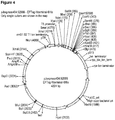
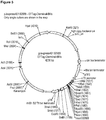
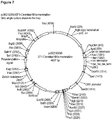
- FIGS 4-7 Further expression vectors according to the present invention are shown in Figures 4-7 : pJexpress404:92688-EFTag-Nterminal-6His ( Figure 4 , polynucleotide sequence in SEQ ID NO:20); pJexpress401:92689-EFTag-Cterminal-6His ( Figure 5 , polynucleotide sequence in SEQ ID NO:21); pJ602:92691-EFTag-Nterminal-6His-mammalian ( Figure 6 , polynucleotide sequence in SEQ ID NO:22); and pJ602:92690-EF1-Cterminal-6His-mammalian ( Figure 7 , polynucleotide sequence in SEQ ID NO:23).
- These expression vectors also comprise an expression casette suitable for expression of a fusion protein incorporating the EF1 EF-hand subdomain of calbindin D9k. Full details of the features and restriction enzyme sites present in the vectors shown in Figures 4-7 are provided in Table 2 below.
- the fusion proteins may be purified according to standard procedures.
- the proteins are purified using the affinity matrix of the present invention according to the methods described below.
- the affinity tag system of the present invention may be used for a variety of applications in which it is required to tether or immobilise a molecule at a substrate.
- the affinity tag system may be used to detect the presence of a molecule in a sample containing a mixture of molecules, for example to detect a specific biological molecule or protein in a biological sample containing many different types of biological molecule.
- the molecule or protein of interest is attached to an EF-hand tag of the type described above, and the sample containing the EF-hand tagged molecule or protein is then brought into contact with an affinity matrix according to any of the embodiments described above comprising the cognate EF-hand affinity ligand. Any unbound molecules are washed away leaving only bound EF-hand-tagged molecules immobilised at the substrate of the affinity matrix.
- Detection of bound molecules may be carried out using any suitable means known to one of skill in the art including detection of bound proteins using antibodies or antigen-binding fragments thereof capable of recognising the protein of interest.
- the affinity tag system of the invention may be used to generate a protein "array", such as a protein array for use in detecting the binding of a ligand or inhibitor compound to proteins of interest.
- the substrate of the affinity matrix may take the form of a "chip” or solid-phase array to which multiple EF-hand affinity ligands are attached.
- the term 'multiple' means at least two, at least three, at least four, etc and up to at least 1000, 5000, 10,000 etc.
- EF-hand tagged fusion proteins of the type described above may be immobilised at the substrate via binding to the EF-hand affinity ligands attached thereto, to produce a protein array.
- the EF-hand tagged proteins are different such that multiple proteins are displayed on the "chip” or "array” at any one time.
- Ligands or inhibitor compounds for testing may be applied to the protein array under suitable conditions such that ligands or inhibitor compounds with binding affinity for any of the proteins displayed are captured. Any unbound material may be washed away and any bound ligands or inhibitor compounds may be detected by techniques known to those skilled in the art.
- the protein arrays described above may be modified so as to display different sets of proteins depending on the required application.
- a first set of EF-hand tagged proteins attached to the affinity matrix may be detached by the addition of a suitable releasing agent.
- Suitable releasing agents include any agents capable of disrupting the interaction between the EF-hand tag of the proteins and the EF-hand affinity ligand of the affinity matrix.
- the matrix may be re-loaded with a different set of EF-hand tagged proteins.
- affinity matrices of the invention in the form of chips or arrays coated with EF-hand affinity ligands may be recycled so as to produce different protein arrays for subsequent use.
- the affinity tag system of the present invention may be used to purify molecules, such as biological molecules, tagged with an EF-hand subdomain or fragment thereof from a sample.
- the affinity tag system is used to purify proteins or polypeptides from a sample.
- the molecule or protein of interest is tagged with an EF-hand tag as described above.
- a sample containing an EF-hand tagged molecule of interest is brought into contact with an affinity matrix comprising an EF-hand subdomain or fragment thereof attached to a substrate.
- the EF-hand subdomain or fragment thereof of the affinity matrix i.e. the EF-hand affinity ligand, must be capable of binding the EF-hand tag attached to the molecule of interest.
- the sample containing the EF-hand tagged molecule of interest is brought into contact with the affinity matrix under conditions that permit binding of the EF-hand tag and the EF-hand affinity ligand.
- the EF-hand tagged molecule to be purified is generally contacted with the affinity matrix in a solution or buffer that includes calcium ions (or another ion or other equivalent that can substitute for calcium) to facilitate binding of the tagged molecule to the matrix. Binding of the EF-hand tagged molecule may occur at calcium concentrations exceeding 10nM. In the presence of calcium, the K D for the binding of the EF-hand subdomains or fragments thereof will typically be less than 1 ⁇ M, preferably less than 100nM and more preferably less than 10nM.
- any unbound material in the sample can be removed, for example by washing of the affinity matrix.
- the molecule of interest may be released from the affinity matrix using any suitable releasing agent.
- a substantially pure composition of at least 80%, 85%, 90%, 95% 98% or 99% homogeneity is obtained.
- the releasing agent may be any agent capable of separating the molecule of interest from the affinity matrix.
- the releasing agent is an agent capable of disrupting the interaction between the EF-hand tag and the EF-hand affinity ligand of the matrix.
- Suitable agents for this purpose include agents capable of sequestering or chelating calcium.
- Calcium chelators are well known to those of skill in the art and include, but are not limited to, EDTA, EGTA, desferal, biphosphonate, 1,2-bis (2-aminophenoxy) etane-N,N,N'N'-tetraacetic acid (BAPTA), BAPTA/AM, EGTA/AM, 5N-BAPTA, 5,5'Br 2 -BAPTA, fura-2, Quin-2 and the like.
- BAPTA 1,2-bis (2-aminophenoxy) etane-N,N,N'N'-tetraacetic acid
- BAPTA/AM 1,2-bis (2-aminophenoxy) etane-N,N,N'N'-tetraacetic acid
- BAPTA/AM 1,2-bis (2-aminophenoxy) etane-N,N,N'N'-tetraacetic acid
- BAPTA/AM 1,2-bis (2-aminophenoxy) et
- the releasing agent is an agent capable of cleaving the molecule of interest from the EF-hand tag such that the molecule of interest is detached from the affinity matrix.
- the EF-hand tag may be attached to the molecule of interest via a cleavable linker.
- the molecule of interest is a polypeptide or protein attached to the EF-hand tag via a polypeptide linker
- the polypeptide linker may be engineered so as to contain a protease recognition site. Any protease capable of recognising the cleavage site of the polypeptide linker may be used to release the protein of interest from the EF-hand tag and thereby detach the protein of interest from the affinity matrix.
- the affinity matrix may take any suitable form.
- the affinity matrix may occupy the interior of an affinity purification column to which a sample is applied. Any unbound material may be separated from the bound EF-tagged proteins by washing of the column.
- the affinity matrix comprises a substrate of nanoparticles, in particular silica nanoparticles, with EF-hand affinity ligands attached.
- the sample containing the EF-hand tagged proteins is mixed with the nanoparticles under conditions that permit binding between the EF-hand subdomains.
- the EF-hand tagged molecules bound to the nanoparticles may be collected by centrifugation under conditions suitable for specifically pelleting the nanoparticles. Various washing steps may be employed to improve the purity of the protein preparation, as would be readily understood by one skilled in the art.
- the affinity tag system of the invention may be used to achieve targeted delivery of molecules of interest.
- the affinity tag system may be used to target the delivery of drugs to particular sites within the body of a patient to be treated.
- the substrate of the affinity matrix may comprise a targeting agent, for example an antibody, or antigen binding fragment thereof, capable of recognising an antigen present within a particular tissue or on a particular cell within the body.
- the affinity matrix would thus be localised to a particular site within the body.
- the EF-hand tag could be attached to any molecule or drug intended for administration to a patient.
- the EF-hand tagged molecule or drug once administered to the patient, would thus be localised to the site of the affinity matrix via the interaction with the cognate EF-hand affinity ligand.
- This approach may be used in particular, to target relatively non-specific or toxic drugs to their site of action and thereby reduce the overall dose needed for administration to a patient.
- variable heavy gene, glycine serine linker sequence and the variable light chain gene sequence was excised from anti-ubiquitin scFv clone (Tomlinson I library, MRC Gene resource) using the restriction sites Nco I/Not I.
- the excised fragment was gel purified and ligated into the pJexpress411:59935 - pelBEF1a optEc1 cloning vector (pJexpress-pelB-EF1, Figure 1 ) which had been digested with the Nco I/Not I restriction sites and gel purified.
- the ligation mixture was used to transform chemically competent E.coli BL21 cells.
- An overnight culture of E.coli BL21 transformed with pJExpress pelB-anti-ubiquitin scFv-EF1 was prepared by picking a single colony of the transformed bacteria into 2 ml 2 ⁇ TY/100 ⁇ g/mL ampicillin/2% (w/v) glucose. The overnight culture was used to inoculate 2 liters of 2 ⁇ TY/100 ⁇ g/mL ampicillin/0.1% (w/v) glucose which was grown in a 37°C shaking incubator until it achieved an OD 600nm of approx.
- IPTG (Sigma) was added to a final concentration of 1 mM to induce expression of the scFv-EF1 fusion protein and the expression culture was transferred to a 30 °C shaking incubator set at 250 rpm. Following a 4 h incubation, the bacteria were pelleted by centrifugation at 4000 g for 20 min. Fifty mL of ice cold periplasmic extraction buffer (30 mM Tris-HCI, pH 8.0, 20% (w/v) sucrose, 1 mM EDTA) were then added to the bacterial pellets for resuspension. The bacteria were centrifuged again at 4000 g for 20 min and the supernatant was retained.
- a PDEA solution made by dissolving 4.5 mg PDEA in 205 ⁇ l 0.1M borate buffer at pH 8.5, was used to resuspend the particles to introduce a reactive disulphide group onto carboxyl groups of the carboxylated nanoparticles.
- the nanoparticles were pelleted once more and the supernatant removed.
- EF2-GGC at 0.1 mg/ml in 100 ⁇ l 10 mM sodium formate buffer at pH 4.3 was then used to resuspend the particles and left to incubate for 10 minutes.
- the C-term Cys of EF2-GGC was used to create a covalent link between the immobilized EF2-GGC on the nanoparticle surface.
- Deactivation of the excess reactive disulphides on the nanoparticle surface was done by resuspending the pelleted particles in 200 ⁇ l of 50 mM L-cysteine with 1 M NaCl in 100 mM formate buffer at pH 4.3.
- the resulting EF2-SiO 2 nanoparticles were reconstituted in 10mM Tris HCl, 1mM CaCl2, 150mM KCl.
- the nanoparticle mixture was then washed twice in 150 ⁇ l of calcium wash buffer (10mM Tris-HCI, 1mM CaCl2, 150mM KCI pH7.4).
- the nanoparticles were then eluted two or three times in 150 ⁇ l of EDTA elution buffer (10mM Tris-HCl, 1mM EDTA, pH8.0).
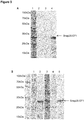
- the resulting fractions (supernatants, washes and eluates) were analysed by electrophoresis on a 10% polyacrylamide gel and visualisation by Coomassies staining and destaining ( Figure 2 ).
- the coding sequence for human synaptosomal-associated protein, 25kDa (accession number: NM_130811) was amplified from a vector construct using gene specific PCR cloning primers:- Snap25-BamHI TGG GGA TCC ATG GCC GAA GAC (SEQ ID NO:28) Snap25-NcoI ATC CCA TGG TTA ACC ACT TCC CAG (SEQ ID NO:29)
- the PCR product was digested with BamHI and Ncol restriction enzymes that cut within restriction sites incorporated into the cloning primer sequences.
- the digested PCR product was purified and ligated into the multiple cloning sequence of pEFTag-N terminal expression vector (pEF1-N, Figure 4 ) that had been digested with the same restriction enzymes and gel purified. Briefly, 1 ⁇ l of T4 DNA Ligase was added to a 2:1 ratio of gene insert to vector in a 20 ⁇ l reaction for 10 minutes.
- EF1-Snap25 was purified from cleared bacterial lysate following incubation of 1ml of native lysate with 0.1mg/ml EF2-SiO 2 nanoparticles on a rotary shaker, rotating for at least 1 hour at 4°C. The mixture was then spun at 10,000 RPM in a microcentrifuge for 10 minutes. The supernatant was removed and saved. The nanoparticle mixture was then washed twice in 150 ⁇ l of calcium wash buffer (10mM Tris-HCI, 1mM CaCl 2 , 150mM KCI pH7.4).
- the nanoparticles were then eluted twice in 250 ⁇ l of EDTA elution buffer (10mM Tris-HCl, 1mM EDTA, pH8.0). The resulting fractions (supernatants, washes and eluates) were analysed by electrophoresis as shown in Figure 3A .
- EF1-Snap25 was also purified using the 6xHis sequence incorporated into the EF1-N vector sequence. Using immobilised metal affinity chromatography and Ni-NTA agarose beads the EF1-Snap25 protein was purified by incubating 5ml of native lysate with 1ml Ni-NTA agarose slurry (approximately 0.25 - 0.5 g/ml) and placing in a chromatography column. The column was washed in 10-20 mM imidazole containing buffer followed by elution in 1ml native lysis buffer containing 250 mM imidazole. This purification protocol was performed as a positive control for the purification of EF1-Snap25 via the EF1-EF2 protocol. The results are shown in Figure 3B .
- the EF-hand affinity tag system facilitated a significantly more rapid purification protocol than His tag purification, with the centrifugation-based recovery facilitating purification of protein in a significantly shorter timeframe than the immobilised metal affinity chromatography employed with the His tag method.
- the recovery of protein was also significantly better using the EF-hand affinity tag system requiring very little affinity matrix (i.e., EF2-nanoparticles) to purify equivalent amounts of protein as is shown in Figure 3 .
- affinity matrix i.e., EF2-nanoparticles
Landscapes
- Chemical & Material Sciences (AREA)
- Organic Chemistry (AREA)
- Health & Medical Sciences (AREA)
- Life Sciences & Earth Sciences (AREA)
- Proteomics, Peptides & Aminoacids (AREA)
- Biochemistry (AREA)
- Biophysics (AREA)
- General Health & Medical Sciences (AREA)
- Genetics & Genomics (AREA)
- Medicinal Chemistry (AREA)
- Molecular Biology (AREA)
- Analytical Chemistry (AREA)
- Gastroenterology & Hepatology (AREA)
- Zoology (AREA)
- Toxicology (AREA)
- Peptides Or Proteins (AREA)
Description
- The present invention relates to an affinity tag system for the immobilisation, detection and/or purification of molecules. Particularly, although not exclusively, the invention relates to the use of EF-hand subdomains of calcium-binding proteins, such as the EF1 and EF2 subdomains of calbindin D9k, as affinity tags and cognate affinity ligands for the immobilisation, detection and/or purification of proteins and other molecules.
- The ability to 'tether' or 'immobilise' small molecules at a desired location is important for numerous applications. For example, in biological systems, the immobilisation of proteins at a solid substrate may be used to isolate and/or detect specific proteins within a complex biological sample. Moreover, the tethering of a protein to a substrate is often used to achieve separation or purification of proteins from a mixture of biological molecules, for example a cell lysate.
- Several approaches exist for the immobilisation, detection and purification of biological molecules, including proteins. For example, antibodies may be exploited to purify their respective antigens by immunoprecipitation. Proteins may also be purified using alternative affinity purification techniques, wherein an "affinity ligand" capable of binding to the protein of interest is typically used to isolate the protein.
- For the purposes of affinity purification, the protein of interest is often "tagged" with a molecule to which an affinity ligand specifically binds. Several molecular tagging systems have been developed and used to generate fusion proteins incorporating tags including the following: myc tag; Flag-peptide tag; His Tag; Strep-Tag; GST-Tag; MBP-Tag; SNAP-Tag; Halo-Tag; Tap-Tag; INPACT-CN. The cognate affinity ligands for each of these tags are known and can be used, for example, in the context of affinity chromatography approaches, for the isolation of tagged proteins of interest.
- Despite the availability of several commercial molecular tagging systems, there are disadvantages associated with many of the existing tags. In particular, the size of the tag can create problems during production of the recombinant fusion protein, such as the formation of inclusion bodies, difficulty in solubilisation, lack of stability and/or incorrect folding of the fusion protein and non-specific purification of bacterial proteins. Moreover, it has been reported that metal containing resins that bind His-Tags promote non-specific oxidation on amino acid side chains of the protein during purification. This oxidation often affects protein functionality.
- An additional challenge in the field of molecular or affinity tags used for the purposes of protein purification is to balance the strength and specificity of binding needed to achieve efficient purification with a sufficiently low-affinity interaction that can be dissociated so as to elute the purified protein. If the strength of binding between the tag of the fusion protein and its cognate affinity ligand is too high, a harsh elution protocol may be required to release the protein, and this may significantly impair the function of the purified protein.
- The present inventors sought to exploit calcium-dependent interactions between fragments or regions of naturally-occurring proteins in order to develop a new affinity tag system, which overcomes many of the disadvantages associated with the existing systems. The molecular/affinity tags and affinity ligand binding pairs' of the present invention are based upon EF-hand subdomains found in many calcium-binding proteins.
- In accordance with a first aspect of the invention, there is provided an affinity tag system for immobilizing a molecule, said system comprising:
- (i) an affinity matrix comprising a first EF-hand subdomain or fragment thereof attached to a substrate; and
- (ii) a molecule tagged with a second EF-hand subdomain or fragment thereof,
- The first EF-hand subdomain or fragment thereof will typically bind the second EF-hand subdomain or fragment thereof in the presence of calcium.
- A fragment of a first or second EF-hand subdomain is a fragment which retains the ability of the full-length EF-hand subdomain to form an EF-hand binding pair.
- In accordance with a second aspect of the invention, there is provided an affinity matrix comprising a first EF-hand subdomain or fragment thereof that is capable of binding to a second EF-hand subdomain in the presence of calcium, wherein said first EF-hand subdomain or fragment thereof is attached to a substrate and wherein said first EF-hand subdomain is selected from:
- (i) EF2 from calbindin D9K,
- (ii) an EF-hand subdomain comprising the amino acid sequence of SEQ ID NO:1 or
- (iii) an EF-hand subdomain comprising an amino acid sequence with at least 85% sequence identity to SEQ ID NO:1,
- (i) providing an affinity matrix according to the second aspect of the invention;
- (ii) bringing a sample containing the tagged biological molecule into contact with the affinity matrix of (i) under conditions that permit binding of the EF-hand subdomains;
- (iii) separating any unbound material from the tagged biological molecule bound to the affinity matrix; and
- (iv) effecting release of the tagged biological molecule from the affinity matrix.
- In the methods of the invention, the EF-hand subdomains, or fragments thereof will typically bind in the presence of calcium. A fragment of the EF-hand subdomain tag is a fragment which retains the ability of the full-length EF-hand subdomain to form an EF-hand binding pair with the EF-hand affinity ligand.
-
-
Figure 1 Plasmid map for pJexpress-pelB-EF1. -
Figure 2 Proof of concept experiment for novel EF2-SiO2 nanoparticle protein purification method - expression and purification of EF1-scFv fusion protein from pelBEF1. (PP) periplasmic fraction of lysate from pelB-scFv-EF1 expressing E.coli (S) supernatant post-incubation with EF2-SiO2 nanoparticles (W1)supernatant post-wash 1 with calcium containing wash buffer (W2)supernatant post-wash 2 with calcium containing wash buffer (E1) supernatant post-wash with calcium free EDTA elution buffer (E2) supernatant post-wash with calcium free EDTA elution buffer (E3) supernatant post-wash with calcium free EDTA elution buffer. -
Figure 3 Proof of concept experiment for novel EF2-SiO2 nanoparticle protein purification method - expression and purification of EF1-Snap25 fusion protein from pEF1-N.- A Fusion protein purification using EF2-silica nanoparticles: (1) native lysate of EF1-Snap25 (2) first calcium wash (3) second calcium wash (4) elution of EF1-Snap25 in EDTA buffer.
- B Confirmation of fusion protein expression with 6xHis tag: (1) no fusion protein expression from empty vector (2) denatured lysate of EF1-Snap25 (3) native lysate of EF1-Snap25 (4) flow through from Ni-NTA column (5) elution of EF1-Snap25 fusion protein in 250mM imidazole.
-
Figure 4 Plasmid map for pJexpress404:92688 (EFTag-Nterminal-6His) -
Figure 5 Plasmid map for pJexpress401:92689 (EFTag-Cterminal-6His) -
Figure 6 Plasmid map for pJ602:92691 (EFTag-Nterminal-6His-mammalian) -
Figure 7 Plasmid map for pJ602:92690 (EF1-Cterminal-6His-mammalian) - The present invention provides an affinity tag system based on the use of EF-hand subdomains. The system of the invention is based on two components: (i) an affinity matrix comprising a first EF-hand subdomain or fragment thereof attached to a substrate; and (ii) a molecule tagged with a second EF-hand subdomain or fragment thereof.
- EF-hand subdomains are discrete regions of conserved 3-dimensional structure found in many calcium binding proteins such as calmodulin 1 (SEQ ID NO: 3), calmodulin 2 (SEQ ID NO: 4), calmodulin 3 (SEQ ID NO: 5), calmodulin-like 3 (SEQ ID NO: 6), calmodulin-like 5 (SEQ ID NO: 7), calmodulin-like 6 (SEQ ID NO: 8), calbindin 1 (SEQ ID NO: 9), calbindin 2 (SEQ ID NO: 10), calbindin D9K (SEQ ID NO: 11), recoverin (SEQ ID NO: 12), frequenin (SEQ ID NO: 13), troponin C (SEQ ID NO: 14), parvalbumin (SEQ ID NO: 15), calbindin D28k (SEQ ID NO: 16), secretagogin (SEQ ID NO: 17) and calretinin (SEQ ID NO: 18).
- The underlying amino acid sequences of protein regions defined as "EF-hand subdomains" can vary considerably. However, EF-hand subdomains are typically characterised by a conserved "helix-loop-helix" secondary structure protein motif. The crystal structures of many EF-hand containing proteins have been solved (Håkansson M. et al. An extended hydrophobic core induces EF-hand swapping. Protein Science (2001), 10: 927-933).
- It is a requirement of the present invention that the first EF-hand subdomain and the second EF-hand subdomain of the affinity tag system form a "binding pair". As used herein, the term binding pair means two molecules or entities that are capable of interacting or associating so as to form a binding complex. It is preferable that the binding interaction between the binding pair is specific such that each member of the binding pair is only able to bind its respective partner, or a limited number of binding partners. EF-hand subdomains for use in conjunction with the present invention include EF-hand subdomains selected from any calcium-binding protein that are capable of forming a binding pair with a second EF-hand subdomain. The first and second EF-hand subdomains that make up the binding pair of the present affinity tag system may derive from different calcium binding proteins, but are preferably derived from the same calcium binding protein.
- The calcium-binding protein may be selected from any suitable source including proteins of human, bovine, murine or rat origin. EF-hand subdomains may also derive from proteins having at least 70%, 75%, 80%, 85%, 90% or 95% identity to calcium-binding proteins of human, bovine, murine or rat origin. The proteins from which the EF-hand subdomains derive may be purified proteins, recombinantly-expressed proteins or chemically-synthesised proteins.
- In certain embodiments, the first and second EF-hand subdomains are non-identical and derive from the same calcium binding protein, wherein said calcium binding protein contains at least two different EF-hand subdomains.
- The first and second EF-hand subdomains typically bind to each other in the presence of calcium. EF-hand subdomains that form binding pairs suitable for use in the affinity tag system of the present invention may therefore be identified by taking a calcium binding protein containing at least two EF-hand subdomains, fragmenting said protein so as to produce at least two fragments, each fragment containing at least one EF-hand subdomain, and attempting to reconstitute the protein from the respective fragments in a calcium-dependent manner. Fragments that permit reconstitution of the protein in the presence of calcium or that permit the non-covalent association of at least two fragments of the original protein in the presence of calcium, are suitable sources of EF-hand subdomains for use in the affinity tag system of the present invention.
- Typically, the affinity of binding between the first EF-hand subdomain and the second EF-hand subdomain of the affinity tag system in the presence of calcium comprises a KD less than 1µM, preferably less than 100nM and more preferably less than 10nM. The binding affinity between the first EF-hand subdomain and the second EF-hand subdomain may be in the nM, pM or fM range.
- In a preferred embodiment of the invention, the first and second EF-hand subdomains derive from the calcium-binding protein calbindin D9k. Calbindin D9k (also known as S100 calcium binding protein) is a small (Mr 8500) calcium binding protein consisting of two EF-hand subdomains, EF1 and EF2. EF1 and EF2 interact with high affinity (KA = 1.3 x 10¹⁰ M-1; KD = 80 pM) and therefore calbindin D9k can be reconstituted in vitro from two separate protein fragments corresponding to its EF1 and EF2 domains.
- In the present invention, the first EF-hand subdomain of the binding pair forms at least part of the "affinity ligand" attached to the substrate of the affinity matrix. The second EF-hand subdomain forms at least part of the tag or molecular tag or affinity tag attached to a molecule of interest.
- In certain embodiments of the invention, the first EF-hand subdomain comprises the amino acid sequence as follows:
STLDELFEELDKNGDGEVSFEEFQVLVKKISQ (SEQ ID NO: 1) or a fragment thereof as described herein. - In further embodiments, the first EF-hand subdomain comprises an amino acid sequence with at least 70%, 75%, 80%, 85%, 90%, 95% sequence identity to SEQ ID NO: 1.
- As used herein, the term "sequence identity" is used to describe the sequence relationship between two or more nucleotide or amino acid sequences. The percentage of "sequence identity" between two sequences is determined by comparing two optimally aligned sequences over a comparison window (a defined number of positions), wherein the portion of the sequence in the comparison window may comprise additions or deletions (i.e. gaps) as compared to the reference sequence in order to achieve optimal alignment. The percentage sequence identity is calculated by determining the number of positions at which the identical nucleotide base or amino acid residue occurs in both sequences to yield the number of 'matched' positions, dividing the number of matched positions by the total number of positions in the comparison window and multiplying the result by 100. For comparison of two optimally aligned sequences, the comparison window will be determined by the full length of the aligned regions. Methods and software for determining sequence identity are available in the art and include the Blast software and GAP analysis. Sequences may be aligned using any of the algorithms available within the sequence alignment tools, including algorithms utilising standard parameters such as the megablast, discontinuous megablast or blastn algorithms for aligning nucleotide sequences or the PSI-BLAST, PHI-BLAST or blastp algorithms for aligning protein sequences, available via the Blast software.
- In certain embodiments of the invention, the second EF-hand subdomain comprises the amino acid sequence as follows:
KSPEELKGIFEKYAAKEGDPNQLSKEELKLLLGTEFPSLLKGM (SEQ ID NO:2) or a fragment thereof as described herein. - In further embodiments, the second EF-hand subdomain comprises an amino acid sequence with at least 70%, 75%, 80%, 85%, 90%, 95% sequence identity to SEQ ID NO: 2.
- In certain embodiments of the invention, the second EF-hand subdomain may be encoded by a polynucleotide as represented by SEQ ID NO: 31 or SEQ ID NO: 32 or a polynucleotide with at least 70%, 75%, 80%, 85%, 90%, 95% sequence identity thereto. Expression vectors incorporating a polynucleotide sequence encoding a second EF-hand subdomain are as described elsewhere herein.
- The EF-hand subdomains for use in conjunction with the affinity tag system of the present invention may represent native or wild-type forms such as subdomains isolated from native or wild-type forms of calcium-binding proteins. Alternatively, modified EF-hand subdomains may be used, so long as sufficient binding affinity between the EF-hand subdomain of the affinity matrix (the first EF-hand subdomain) and the EF-hand subdomain of the affinity tag (the second EF-hand subdomain) is retained. As used herein, the binding affinity between the EF-hand subdomains is sufficient, if the KD is less than 1µM, preferably less than100nM and more preferably less than 10nM.
- Modifications of the EF-hand subdomains may include deletion of amino acid residues, insertion of amino acid residues, point mutations and/or concatenations. Point mutations may include missense mutations wherein any amino acid within an EF-hand subdomain is substituted for any other amino acid. In certain embodiments, conservative substitutions may be introduced wherein a conservative substitution involves the substitution of one amino acid for another amino acid of the same category, i.e. acidic, basic, hydrophobic and hydrophilic. A conservative substitution may be introduced so as to preserve the overall charge of the EF-hand subdomain.
- A person skilled in the art will recognise that modifications may be made for a number of reasons. These may include modifications to enhance or reduce the affinity of binding between the EF-hand subdomains, modifications to improve the stability of the EF-hand subdomain or the molecule to which it is attached, modifications to facilitate attachment of the first EF-hand subdomain of the affinity ligand to the substrate of the affinity matrix or to facilitate attachment of the second EF-hand subdomain of the affinity tag to the molecule of interest.
- Modified EF-hand subdomains may have varying levels of sequence identity with the corresponding wild-type form of the EF-hand subdomain. In certain embodiments, a modified EF-hand subdomain may have at least 70%, 75%, 80%, 85%, 90% or 95% identity to the corresponding wild-type form of the EF-hand subdomain.
- In certain embodiments, the affinity tag system of the present invention may comprise an affinity matrix comprising a fragment of a first EF-hand domain attached to a substrate. In alternative or additional embodiments, the affinity tag system of the present invention may comprise a molecule tagged with a fragment of a second EF-hand domain.
- As used herein, the term fragment should be taken to mean a region of an EF-hand subdomain that is shorter in length as compared with the full-length EF-hand subdomain by 1, 2, 3, 4, 5 etc amino acids. It is however, a requirement of the present invention that any EF-hand subdomain fragments used as part of the affinity tag system of the present invention retain the ability of the full-length EF-hand subdomain to form an EF-hand binding pair. Therefore, a fragment of a first or second EF-hand subdomain may be any fragment which retains the ability of the full-length EF-hand subdomain to form an EF-hand binding pair. The binding affinity of such EF-hand subdomain fragments may be enhanced or reduced as compared with the corresponding full-length EF-hand subdomains.
- The first component of the affinity tag system of the present invention is an "affinity matrix". As used herein, the term affinity matrix refers to a substrate to which an affinity ligand is attached. The affinity ligand comprises a first EF-hand subdomain or fragment thereof in accordance with the description above; this is referred to herein as the EF-hand affinity ligand. The EF-hand affinity ligand is capable of binding to the second EF-hand subdomain "tag" attached to the molecule of interest and is therefore capable of immobilising the molecule at the substrate of the affinity matrix. Binding of the EF-hand affinity ligand to the second EF-hand subdomain tag typically occurs in the presence of calcium. Binding of the EF-hand tagged molecule may occur at calcium concentrations exceeding 10nM.
- In a preferred embodiment, the first EF-hand subdomain of the affinity ligand comprises the amino acid sequence of SEQ ID NO:1 or an amino acid sequence with at least 70%, 75%, 80%, 85%, 90%, 95% sequence identity to SEQ ID NO: 1.
- In addition to a first EF-hand subdomain, the affinity ligand may include additional amino acid residues. For example, the affinity ligand may include additional polypeptide sequences or fragments that flank the EF-hand subdomain in the context of the wild-type protein from which the EF-hand subdomain derives. The affinity ligand may also include additional EF-hand subdomains, for example, one or more, two or more, three or more and so on, EF-hand subdomains. Additional amino acid residues and/or subdomains may be included in the affinity ligand for a number of reasons, for example to increase the affinity of the affinity ligand for the second EF-hand subdomain tag attached to the molecule of interest.
- The substrate of the affinity matrix may consist of any suitable material but is preferably solid. In certain embodiments, the substrate may include but is not limited to crosslinked polysaccharides such as cellulose, dextran (sephadex), agarose, sepharose, paper, glass, plastic, metal, minerals, ceramics, cellulose, semiconductive materials, silica, various membranes (porous or non-porous) or rigid polymeric resins such as polystyrene, polystyrene/latex, and other organic and inorganic polymers, both natural and synthetic. Substances that form gels, such as proteins (e.g. gelatins), lipopolysaccharides, silicates, agarose, and polyacrylamides can also be used. Polymers such as dextrans, polyalkylene glycols or surfactants, such as phospholipids or long chain (12-24 carbon atoms) alkyl ammonium salts are also suitable.
- The substrate may take any of a number of forms. These include but are not limited to solid or porous beads or other particles, solid surfaces such as array substrates, columns, capillaries and the like. In a preferred embodiment of the invention, the substrate comprises nanoparticles, such as silica nanoparticles. As used herein, the term "nanoparticle" should be taken to mean a microscopic particle with at least one dimension less than 100 nm. In certain embodiments, the substrate is not a sensor chip of the type used in conjunction with the Biacore 3000 apparatus.
- Moreover, the substrate may be attached to a further support such that the affinity matrix adopts a suitable form for the required application. For example, the substrate may be packed into a column, a capillary, a microcapillary or an electrophoresis tube to form an affinity matrix through which a sample can pass. Alternatively, the substrate may be used to line the walls of a vessel or the wells of a multiwell plate to which a sample containing the tagged molecule of interest is added.
- The EF-hand affinity ligand may be attached to the substrate via any suitable means. In one embodiment, the ligand is covalently attached to the substrate. If the EF-hand affinity ligand is to be covalently bound to the substrate of the affinity matrix, the substrate can be polyfunctional or capable of being polyfunctionalized. Functional groups that can be present on the substrate and used for linking include but are not limited to carboxylic acids, aldehydes, amino groups, cyano groups, ethylenic groups, hydroxyl groups, mercapto groups and haloacetyl groups (i.e. iodoacetyl groups).
The EF-hand affinity ligand may be attached to the substrate directly. In one embodiment, the ligand is attached to the substrate via random amine coupling mediated by any amino acid along the length of the EF-hand subdomain, provided that this does not interfere with binding of the EF-hand affinity ligand to the second EF-hand subdomain tag. In a further embodiment, the EF-hand affinity ligand incorporates a cysteine residue at the N-terminus or C-terminus and the first EF-hand affinity ligand is attached to the substrate via thiol coupling. - The EF-hand affinity ligand may also be attached to the substrate indirectly, for example by means of a cross-linking reagent or linker. Suitable cross-linking reagents would be known to one of skill in the art and include, but are not limited to carbodiimides, maleimides, succinamides and reactive disulfides. Suitable linkers are also known and include but are not limited to alkyl chains such as straight or branched-chain carbon linkers, heterocyclic carbon linkers, carbohydrate linkers and polypeptide linkers.
- The second component of the affinity tag system of the present invention is a molecule tagged with a second EF-hand subdomain or fragment thereof. As used herein, a 'tag' is a molecule attached to the molecule of interest. In the present invention, the tag comprises an EF-hand subdomain or fragment thereof according to any of the embodiments described above; the tag will therefore be referred to herein as the "EF-hand tag". An "EF-hand tagged" molecule or "tagged" molecule is any molecule to which an EF-hand tag of the invention is attached so as to form a chimeric molecule.
- In addition to an EF-hand subdomain, the affinity tag may include additional amino acid residues. For example, the affinity tag may include additional polypeptide sequences or fragments that flank the EF-hand subdomain in the context of the wild-type protein from which the EF-hand subdomain derives. The affinity tag may also include additional EF-hand subdomains, for example, one or more, two or more, three or more and so on, EF-hand subdomains. Additional amino acid residues and/or subdomains may be included in the affinity tag for a number of reasons, for example to increase the affinity of the affinity tag for the EF-hand affinity ligand of the affinity matrix.
- The molecule to which the EF-hand tag is attached may be any organic or biological molecule of interest including but not limited to a protein, a polypeptide, a nucleic acid, a lipid, a polysaccharide, a carbohydrate and a lectin. In a preferred embodiment, the EF-hand tag is attached to a polypeptide or protein sequence that is not part of the EF-hand subdomain, to form a fusion protein.
- The EF-hand tag may be attached to the molecule of interest by any suitable means, and may be attached directly or indirectly. Wherein the molecule is a protein or polypeptide, the EF-hand tag may be covalently attached to the polypeptide sequence at the N-terminus of the polypeptide sequence or at the C-terminus of the polypeptide sequence. Alternatively, the EF-hand tag may be attached to the side chain functional group of an amino acid residue of the polypeptide sequence at a position between the N-terminus and C-terminus of the polypeptide sequence.
- Wherein attachment of the EF-hand tag to the molecule is indirect, attachment may be mediated by a linker. A preferred linker is capable of forming covalent bonds to both the EF-hand tag and to the molecule that is to be tagged. Suitable linkers are known to those skilled in the art and include but are not limited to straight or branched-chain carbon linkers, heterocyclic carbon linkers, carbohydrate linkers and polypeptide linkers. In some embodiments, a bifunctional linker may be used that includes one functional group reactive with a pre-existing functionality on the EF-hand tag, and another group reactive with a pre-existing functionality on the molecule to be tagged.
- Wherein the EF-hand tag is attached to a polypeptide or protein so as to form a fusion protein, it is preferred that the linker is a polypeptide linker. Moreover, the linker may be joined to side chain functional groups of constituent amino acids of the tag and/or the polypeptide or to the alpha amino and carboxyl groups of the terminal amino acids of the EF-hand tag and the polypeptide that is to be tagged.
- In certain embodiments, cleavable linkers may be used to attach the molecule of interest to the EF-hand tag. This allows for the EF-hand tag to be separated from the molecule of interest, for example by the addition of an agent capable of cleaving the linker. A number of different cleavable linkers are known to those of skill in the art. Such linkers may be cleaved for example, by irradiation of a photolabile bond or acid-catalyzed hydrolysis. There are also polypeptide linkers which incorporate a protease recognition site and which can be cleaved by the addition of a suitable protease enzyme.
- Provided herein but not part of the invention, are EF-hand fusion proteins. Such fusion proteins comprise an EF-hand subdomain or fragment thereof according to the embodiments described above, conjugated to a polypeptide sequence that is not part of the EF-hand subdomain or fragment thereof.
- In a preferred embodiment, the EF-hand subdomain comprises the amino acid sequence of SEQ ID NO: 2 or a fragment thereof, or an amino acid sequence with at least 70%, 75%, 80%, 85%, 90%, 95% identity thereto. In a further preferred embodiment, the EF-hand subdomain comprises EF1 from calbindin D9k.
- The polypeptide part of the fusion protein that is not part of the EF-hand subdomain may be any suitable polypeptide or protein sequence. In one embodiment, the polypeptide to which the EF-hand subdomain tag is attached may be a single chain variable fragment (scFv) of an immunoglobulin comprising any VH and VL domains of interest.
- EF-hand fusion proteins used in the present invention may be produced using either chemical synthesis techniques or using recombinant expression techniques. Standard chemical peptide synthesis techniques are known in the art and include solid phase synthesis techniques.
- Recombinant expression typically involves protein production via use of a suitable expression cassette or expression vector. Expression vectors of the present invention are designed so as to express a polypeptide or protein tagged with an EF-hand subdomain or fragment thereof.
- In certain embodiments, the expression vector comprises a polynucleotide sequence encoding an EF-hand tag according to the present invention and a cloning site having one or more restriction sites (i.e. a multiple cloning site) for the insertion of a further polynucleotide sequence encoding the polypeptide or protein to be tagged with the EF-hand subdomain or fragment thereof. The cloning site should be positioned such that when the polynucleotide sequence encoding the polypeptide or protein is inserted in the vector, it is in frame with the polynucleotide sequence encoding the EF-hand tag, such that when the polynucleotide of the vector is transcribed and translated, a fusion protein is produced. Within the expression vector, the polynucleotide encoding the EF-hand tag may be positioned upstream of downstream of the multiple cloning site such that the tag is positioned at either the 5' or 3' end of the polypeptide.
- Expression vectors for the production of EF-hand fusion proteins may be bacterial plasmids or cosmids or may be yeast vectors such as yeast artificial chromosomes (YACs), which replicate as small linear chromosomes. Suitable expression vectors may also be derived from bacteriophage, including all DNA and RNA phage, or viruses such as baculoviruses, retroviruses, adenoviruses, adeno-associated viruses, Herpes viruses, Vaccinia viruses and all single-stranded, double-stranded and partially double-stranded DNA viruses, all positive and negative stranded RNA viruses, and replication defective retroviruses.
- For recombinant expression of the fusion protein, the polynucleotide encoding the fusion protein should be operably linked to at least one regulatory sequence within the expression vector, wherein the regulatory sequence is capable of driving or effecting expression of the fusion protein. The term regulatory sequence' is to be taken in a broad context and is intended to refer to any nucleotide sequence capable of effecting expression of polynucleotides to which it is operably linked including but not limited to promoters, enhancers and other naturally-occurring or synthetic transcriptional activator elements. The regulatory sequence may be located at the 5' or 3' end of the polynucleotide sequence. The term 'operably linked' refers to a functional linkage between the regulatory sequence and the polynucleotide sequence such that the regulatory sequence drives transcription of the polynucleotide. Operably linked elements may be contiguous or non-contiguous. Preferably, the regulatory sequence is a promoter selected from the group including but not limited to constitutive promoters, inducible promoters and/or tissue specific promoters.
- The EF-hand tagged fusion proteins used in the present invention can be expressed in a host cell. The term "host cell" is intended to include any cell or cell line into which a recombinant expression vector for production of an EF-hand tagged fusion protein as described above may be introduced for the purposes of effecting expression. Suitable host cells include, but are not limited to bacterial cells (e.g. E.coli), yeast cells, fungal cells, plant cells, invertebrate cells and vertebrate cells including mammalian cells. The host cells should not be derived from human embryos.
- The choice of expression vector and associated regulatory or promoter sequence may depend on the host cell to be used. For example, expression vectors incorporating the CMV immediate early promoter are suitable for use in mammalian host cells.
- The expression vector may be transfected or transformed into a suitable host cell using any of the standard techniques known to those skilled in the art. Examples of transfection techniques include, but are not limited to, calcium phosphate precipitation, DEAE-dextran-mediated transfection, lipofection, electroporation and microinjection. The vector may be maintained as a non-integrated vector, for example a plasmid, or alternatively, may be integrated into the host cell genome.
- The expression vector may optionally comprise a selectable marker gene. As used herein, the term 'selectable marker gene' includes any gene, which confers a phenotype on a cell in which it is expressed to facilitate the identification and/or selection of cells, which are transfected or transformed with an expression construct of the invention. Examples of suitable selectable markers include resistance genes against ampicillin (Ampr), tetracycline (Tcr), kanamycin (Kanr), phosphinothricin, chloramphenicol (CAT), neomycin and G418 geneticin. Other suitable marker genes provide a metabolic trait, for example manA. Visual marker genes may also be used and include for example beta-glucuronidase (GUS), luciferase and Green Fluorescent Protein (GFP).
- The expression vector of the invention may further include an origin of replication which is required for maintenance and/or replication in a specific cell type or host cell. One example is when an expression construct is required to be maintained in a bacterial cell as an extra-chromosomal or episomal genetic element (e.g. a plasmid or cosmid molecule) in a cell. Preferred origins of replication include but are not limited to pUC-ori, f1-ori, pBR322 ori (pMB1) and colE1 ori.
- An expression vector (pJexpress411:59935 - pelBEF1a_optEc1) of the present invention is shown in
Figure 1 and the polynucleotide sequence is shown in SEQ ID NO:19. The expression vector comprises an expression cassette suitable for expression of a fusion protein incorporating the EF1 EF-hand subdomain of calbindin D9k. The expression vector incorporates a pelB leader sequence and a multiple cloning site, including the Ncol and Notl sites for insertion of a polypeptide of interest downstream of a T7 promoter. The insertion of a polypeptide allows the polypeptide to be transcribed in frame with the EF1 EF-hand subdomain of calbindin D9k (encoded by the polynucleotide sequence represented by nucleotides 1621-1746 of SEQ ID NO:19 i.e. SEQ ID NO: 31 within the vector insert at nucleotides 1496-1758 of SEQ ID NO:19 i.e. SEQ ID NO: 30). The expression vector also includes multiple restriction sites, a kanamycin resistance gene and a pUC_ori origin of replication. Full details of the features and restriction enzyme sites present in the vector shown inFigure 1 are provided in Table 1 below.Table 1 Vector Feature Map Restriction Map Name Sequence Cut Positions pJexpress411: 59935 (SEQ ID NO: 19) Insert including sequence encoding calbindin D9k EF1 EF-hand subdomain: 59935 - Start:1496 End:1758 (SEQ ID NO: 30) AclI AACGTT 3115 AlwNI 
321,1537 ApaI GGGCCC 974,3664 ApaLI GTGCAC 416,3433 AscI GGCGCGCC 3024 EF1 sequence - Start:1621 End:1746 (SEQ ID NO: 31) AseI ATTAAT 1423,2835,4138 AsiSI GCGATCGC 2636 pUC_ori - Start:2 End:805 AvaI CYCGRG 967,1753,1864 BelI TGATCA 3467 rpn txn terminator - Start:977 End:1090 (Complementary) BqlI 
978,1564 BsmBI CGTCTC 1810(C) bla txn terminator - Start:1097 End:1397 (Complementary) BspHI TCATGA 2,2158 BsrBI CCGCTC 801,2156, 1453(C) BsrDI GCAATG 3866,3500(C) rrnB1 B2 T1 txn terminator - Start:1858 End:2032 BssHII GCGCGC 32,3024,3864 BstEII GGTNACC 3634 pTF3 - Start:1281 End:1306 BstXI 
3255,3384,3507 pTR - Start:1941 End:1957 (Complementary) BtsI GCAGTG 2584,4186,2497(C) ,3818(C) EagI CGGCCG 1589 EcoRV GATATC 1314,3903 T7-terminator - Start:1764 End:1810 HincII GTYRAC 1332,3959 HpaI GTTAAC 3959 KasI GGCGCC 1091,4092 T7-promoter - Start:1424 End:1440 MluI ACGCGT 1819,3453 NarI GGCGCC 1092,4093 NcoI CCATGG 1568 Kanamycin - Start:2217 End:3011 NdeI CATATG 1508 NotI GCGGCCGC 1589 NruI TCGCGA 2073,2293 NsiI ATGCAT 1388,2486,2752 lacI - Start:3106 End:4176 PciI ACATGT 730,1326 PspOMI GGGCCC 970,3660 PspXI VCTCGAGB 1753 PvuI CGATCG 2636 PvuII CAGCTG 4053,4146 SapI GCTCTTC 1625(C) SapI-Rev GAAGAGC 1625 SfiI 
1564 SmaI CCCGGG 1866 SspI AATATT 1083,1244,2193,25 60 XbaI TCTAGA 1470 XhoI CTCGAG 1753 XmaI CCCGGG 1864 - Further expression vectors according to the present invention are shown in
Figures 4-7 : pJexpress404:92688-EFTag-Nterminal-6His (Figure 4 , polynucleotide sequence in SEQ ID NO:20); pJexpress401:92689-EFTag-Cterminal-6His (Figure 5 , polynucleotide sequence in SEQ ID NO:21); pJ602:92691-EFTag-Nterminal-6His-mammalian (Figure 6 , polynucleotide sequence in SEQ ID NO:22); and pJ602:92690-EF1-Cterminal-6His-mammalian (Figure 7 , polynucleotide sequence in SEQ ID NO:23). These expression vectors also comprise an expression casette suitable for expression of a fusion protein incorporating the EF1 EF-hand subdomain of calbindin D9k. Full details of the features and restriction enzyme sites present in the vectors shown inFigures 4-7 are provided in Table 2 below.Table 2 Vector Feature Map Restriction Map Name Sequence Cut Positions pJexpress 404:92688 (SEQ ID NO: 20) Insert including sequence encoding calbindin D9k EF1 EF-hand subdomain:92688 - Start:153 End:489 (SEQ ID NO: 24) Acc65I GGTACC 401 AclI AACGTT 2974,3371,3744 AfeI AGCGCT 103,3195 AlwNI CAGNNNCTG 1588 ApaI GGGCCC 936,2431 EF1 sequence - Start:241 End: 366 (SEQ ID NO: 32) ApaLI GTGCAC 1486,2654,3812 AscI GGCGCGCC 3063 AseI ATTAAT 1951,3317 pUC_ori - Start:1102 End:1905 (Complementary) AvaI CYCGRG 385,935,4274 BamHI GGATCC 376 BclI TGATCA 2620 rpn txn terminator - Start:817 End:930 BglI 
495,9313265 BglII AGATCT 389 BlpI GCTNAGC 475 rrnB1 B2 T1 txn terminator - Start:4111 End:4285 (Complementary) BspEI TCCGGA 3231 BspHI TCATGA 44,1900,3980 BsrBI CCGCTC 9(C),70(C),1105 (C),3986(C) pTF3 - Start:601 End:626 (Complementary) BsrDI GCAATG 2593,2227(C) BssHII GCGCGC 1870,2223,3063 BstBI TTCGAA 269 pTR - Start:4186 End:4202 BstEII GGTNACC 2452 rpo_bla_txn_term - Start:506 End:930 BstXI 
2588,2711,2840 BtsI GCAGTG 2275,3545,1907 (C),3565(C) T5 promoter - Start:41 End:88 EcoRI GAATTC 343 EcoRV GATATC 592,2188 txn terminator - Start:506 End:930 HincII GTYRAC 574,2132 HindIII AAGCTT 417 HpaI GTTAAC 2132 high copy bacterial ori - Start:1103 End:1906 (Complementary) KasI GGCGCC 811,1995 KpnI GGTACC 405 MluI ACGCGT 2634 NarI GGCGCC 812,1996 Ampicilin - Start:3081 End:3929 (Complementary) NcoI CCATGG 405 NdeI CATATG 170 NheI GCTAGC 208 AmpR - Start:3087 End:3929 (Complementary) NruI TCGCGA 4069 PciI ACATGT 576,1172 PsiI TTATAA 83,772 lacl - Start:1916 End:2986 (Complementary) PspOMI GGGCCC 932,2427 PstI CTGCAG 397 PvuI CGATCG 3515 PvuII CAGCTG 398,1945,2038 SacI GAGCTC 386 ScaI-HF AGTACT 3625 SmaI CCCGGG 4276 SspI AATATT 662,823,3949 XbaI TCTAGA 129 XhoI CTCGAG 385 XmaI CCCGGG 4274 XmnI GAANNNNTTC 3744 pJexpress 401:92689 (SEQ ID NO: 21) Insert including sequence encoding calbindin D9k EF1 EF-hand subdomain:92689 - Start:1567 End:1888 (SEQ ID NO: 25) Acc65I GGTACC 1686 AclI AACGTT 3166 AfeI AGCGCT 1517 AlwNI CAGNNNCTG 321 ApaI GGGCCC 974,3715 ApaLI GTGCAC 416,3484 EF1 sequence - Start:1757 End: 1882 (SEQ ID NO: 32) AscI GGCGCGCC 3075 AseI ATTAAT 2886,4189 pUC_ori - Start:2 End:805 AsiSI GCGATCGC 2687 AvaI CYCGRG 967,1670,1915 rpn txn terminator - Start:977 End:1090 (Complementary) BamHI GGATCC 1661 BclI TGATCA 3518 bla txn terminator - BglI 
978,1894 BglII AGATCT 1674 Start:1097 End:1397 (Complementary) BspHI TCATGA 2,1458,2209 BsrBI CCGCTC 801,2207,1423 (C), 1484(C) rrnB1 B2 T1 txn terminator - Start:1909 End:2083 BsrDI GCAATG 3917,3551 (C) BssHII GCGCGC 32,3075,3915 BstBI TTCGAA 1785 pTF3 - Start:1281 End:1306 BstEII GGTNACC 3685 pTR - Start:1992 End:2008 (Complementary) BstXI 
3306,3435,3558 BtsI GCAGTG 2635,4237,2548 (C),3869(C) T5 promoter - Start:1455 End:1502 EcoRI GAATTC 1859 EcoRV GATATC 1314,3954 HincII GTYRAC 1332,4010 high copy bacterial ori - Start:1 End:804 HpaI GTTAAC 4010 KasI GGCGCC 1091,4143 Kanamycin - Start:2265 End:3062 KpnI GGTACC 1690 MluI ACGCGT 3504 NarI GGCGCC 1092,4144 lacl -Start:3157 End:4227 NcoI CCATGG 1690 NdeI CATATG 1584 NheI GCTAGC 1622 NruI TCGCGA 2124,2344 NsiI ATGCAT 1388,2537,2803 PciI ACATGT 730,1326 PsiI TTATAA 1134,1497 PspOMI GGGCCC 970,3711 PstI CTGCAG 1682 PvuI CGATCG 2687 PvuII CAGCTG 1683,4104,4197 SacI GAGCTC 1671 SmaI CCCGGG 1917 SspI AATATT 1083,1244,2244, 2612 XbaI TCTAGA 1543 XhoI CTCGAG 1670 XmaI CCCGGG 1915 pJ602:92691 (SEQIDNO: 22) Insert including sequence encoding calbindin D9k EF1 EF-hand subdomain:92691 - Start:2108 End:2444 (SEQ ID NO: 26) AatII GACGTC 1599,1652,1735, 1921,3182 Acc65I GGTACC 2356 AccI GTMKAC 3771,3778 AclI AACGTT 4113,4486 EF1 sequence - Start:2196 End: 2321 (SEQ ID NO: 32) AfeI AGCGCT 3937 AlwNI CAGNNNCTG 321 ApaI GGGCCC 974 pUC_ori - Start:2 End:805 ApaLI GTGCAC 416,3481,4554 rpn txn terminator - Start:977 End:1090 (Complementary) AseI ATTAAT 1481,2086,2678, 3078,4059 AvaI CYCGRG 967,2340,3028,3 214,3224 pTF3 - Start:1281 End:1306 AvrII CCTAGG 3007 BamHI GGATCC 2331 rpo_bla_txn_term - Start:977 End:1401 (Complementary) BclI TGATCA 3058 BglI 
978,1564,1686,1757,3441,4007 
txn_terminator - Start:977 End:1401 (Complementary) BglII AGATCT 2344 BlpI GCTNAGC 2430 BspEI TCCGGA 3973 CMV promoter - Start:1454 End:2054 BspHI TCATGA 2,4722 BsrBI CCGCTC 801,1422(C),319 0(C),4728(C) SV40 ori - Start:2682 End:3025 BssHII GCGCGC 32,3172 BstBI TTCGAA 2224 zeocin resistance - Start:3136 End:3510 BtsI GCAGTG 4287,2062(C),37 15(C),4307(C) EaqI CGGCCG 3467 SV40 polyadenylation signal - Start:3638 End:3768 EcoRI GAATTC 2298 EcoRV GATATC 1314 FseI GGCCGGCC 3412 high copy bacterial ori - Start:1 End:804 HincII GTYRAC 1332,1458,3072, 3146,3779 HindIII AAGCTT 2372 ZeoR - Start:3139 End:3501 KasI GGCGCC 1091 KpnI GGTACC 2360 Ampicilin - Start:3823 End:4671 (Complementary) MscI TGGCCA 3139 NarI GGCGCC 1092 AmpR - Start:3829 End:4671 (Complementary) NcoI CCATGG 1834,2360,2914, 3134 NdeI CATATG 1708,2125 NqoMIV GCCGGC 3408,3469,3583 NheI GCTAGC 2163 NruI TCGCGA 4811 NsiI ATGCAT 2757,2829 PciI ACATGT 730,1326 PmlI CACGTG 3067,3513 PsiI TTATAA 1134,2609,3659 PspOMI GGGCCC 970 PstI CTGCAG 2352 PvuI CGATCG 4257 PvuII CAGCTG 2353 SacI GAGCTC 2042,2341 SalI GTCGAC 3777 SalI-HF GTCGAC 3777 ScaI-HF AGTACT 4367 SexAI ACCWGGT 2774,3299 SmaI CCCGGG 3030,3226 SnaBI TACGTA 1814 SpeI ACTAGT 1473 SphI GCATGC 2755,2827 SspI AATATT 1083,1244,4691 StuI AGGCCT 3006 XhoI CTCGAG 2340 XmaI CCCGGG 3028,3224 XmnI GAANNNNTTC 2679,4486 ZraI GACGTC 1597,1650,1733, 1919,3180 pJ602:92690 Insert including sequence encoding calbindin D9k EF1 AatII GACGTC 1599,1652,1735, 1921,3167 (SEQ ID NO: 23) EF-hand subdomain:92690 - Start:2108 End:2429 (SEQ ID NO: 27) Acc65I GGTACC 2227 AccI GTMKAC 3756,3763 AclI AACGTT 4098,4471 AfeI AGCGCT 3922 EF1 sequence - Start:2298 End: 2423 (SEQ ID NO: 32) AlwNI CAGNNNCTG 321 ApaI GGGCCC 974 ApaLI GTGCAC 416,3466,4539 pUC_ori - Start:2 End:805 AseI ATTAAT 1481,2086,2663, 3063,4044 rpn txn terminator - Start:977 End:1090 (Complementary) AvaI CYCGRG 967,2211,3013,3 199,3209 pTF3 - Start:1281 End:1306 AvrII CCTAGG 2992 BamHI GGATCC 2202 rpo_bla_txn_term - Start:977 End:1401 (Complementary) BelI TGATCA 3043 BglI 
978,1564,1686,1 757,3426,3992 txn terminator - Start:977 End:1401 (Complementary) BglII AGATCT 2215 BspEI TCCGGA 3958 BSpHI TCATGA 2,4707 CMV promoter - Start:1454 End:2054 BsrBI CCGCTC 801,1422(C),317 5(C),4713(C) BssHII GCGCGC 32,3157 SV40 ori - Start:2667 End:3010 BstBI TTCGAA 2326 BtsI GCAGTG 4272,2062(C),37 00(C),4292(C) zeocin resistance - Start:3121 End:3495 EagI CGGCCG 3452 EcoRI GAATTC 2400 EcoRV GATATC 1314 SV40 polyadenylation signal - Start:3623 End:3753 FseI GGCCGGCC 3397 HincII GTYRAC 1332,1458,3057, 3131,3764 high copy bacterial ori - Start:1 End:804 KasI GGCGCC 1091 KpnI GGTACC 2231 MscI TGGCCA 3124 ZeoR - Start:3124 End:3486 NarI GGCGCC 1092 Ampicilin - Start:3808 End:4656 (Complementary) NcoI CCATGG 1834,2231,2899, 3119 NdeI CATATG 1708,2125 NqoMIV GCCGGC 3393,3454,3568 AmpR - Start:3814 End:4656 (Complementary) NheI GCTAGC 2163 NruI TCGCGA 4796 NsiI ATGCAT 2742,2814 PciI ACATGT 730,1326 PmlI CACGTG 3052,3498 PsiI TTATAA 1134,2594,3644 PspOMI GGGCCC 970 PstI CTGCAG 2223 PvuI CGATCG 4242 PvuII CAGCTG 2224 SacI GAGCTC 2042,2212 SaII GTCGAC 3762 SaII-HF GTCGAC 3762 ScaI-HF AGTACT 4352 SexAI ACCWGGT 2759,3284 SmaI CCCGGG 3015,3211 SnaBI TACGTA 1814 SpeI ACTAGT 1473 SphI GCATGC 2740,2812 SspI AATATT 1083,1244,4676 StuI AGGCCT 2991 XhoI CTCGAG 2211 XmaI CCCGGG 3013,3209 XmnI GAANNNNTTC 2664,4471 ZraI GACGTC 1597,1650,1733, 1919,3165 - Once expressed, the fusion proteins may be purified according to standard procedures. In a preferred embodiment, the proteins are purified using the affinity matrix of the present invention according to the methods described below.
- The affinity tag system of the present invention may be used for a variety of applications in which it is required to tether or immobilise a molecule at a substrate.
- In one embodiment, the affinity tag system may be used to detect the presence of a molecule in a sample containing a mixture of molecules, for example to detect a specific biological molecule or protein in a biological sample containing many different types of biological molecule. The molecule or protein of interest is attached to an EF-hand tag of the type described above, and the sample containing the EF-hand tagged molecule or protein is then brought into contact with an affinity matrix according to any of the embodiments described above comprising the cognate EF-hand affinity ligand. Any unbound molecules are washed away leaving only bound EF-hand-tagged molecules immobilised at the substrate of the affinity matrix. Detection of bound molecules may be carried out using any suitable means known to one of skill in the art including detection of bound proteins using antibodies or antigen-binding fragments thereof capable of recognising the protein of interest.
- In another embodiment, the affinity tag system of the invention may be used to generate a protein "array", such as a protein array for use in detecting the binding of a ligand or inhibitor compound to proteins of interest. Under these circumstances, the substrate of the affinity matrix may take the form of a "chip" or solid-phase array to which multiple EF-hand affinity ligands are attached. In the context of the present invention, the term 'multiple' means at least two, at least three, at least four, etc and up to at least 1000, 5000, 10,000 etc. EF-hand tagged fusion proteins of the type described above may be immobilised at the substrate via binding to the EF-hand affinity ligands attached thereto, to produce a protein array. In one embodiment, the EF-hand tagged proteins are different such that multiple proteins are displayed on the "chip" or "array" at any one time. Ligands or inhibitor compounds for testing may be applied to the protein array under suitable conditions such that ligands or inhibitor compounds with binding affinity for any of the proteins displayed are captured. Any unbound material may be washed away and any bound ligands or inhibitor compounds may be detected by techniques known to those skilled in the art.
- The protein arrays described above may be modified so as to display different sets of proteins depending on the required application. For example, a first set of EF-hand tagged proteins attached to the affinity matrix may be detached by the addition of a suitable releasing agent. Suitable releasing agents include any agents capable of disrupting the interaction between the EF-hand tag of the proteins and the EF-hand affinity ligand of the affinity matrix. Once the EF-tagged proteins are detached from the matrix, the matrix may be re-loaded with a different set of EF-hand tagged proteins. In this way, affinity matrices of the invention in the form of chips or arrays coated with EF-hand affinity ligands may be recycled so as to produce different protein arrays for subsequent use.
- In a preferred embodiment, the affinity tag system of the present invention may be used to purify molecules, such as biological molecules, tagged with an EF-hand subdomain or fragment thereof from a sample. In a particularly preferred embodiment, the affinity tag system is used to purify proteins or polypeptides from a sample. In a first step, the molecule or protein of interest is tagged with an EF-hand tag as described above. In a second step, a sample containing an EF-hand tagged molecule of interest is brought into contact with an affinity matrix comprising an EF-hand subdomain or fragment thereof attached to a substrate. The EF-hand subdomain or fragment thereof of the affinity matrix, i.e. the EF-hand affinity ligand, must be capable of binding the EF-hand tag attached to the molecule of interest.
- The sample containing the EF-hand tagged molecule of interest is brought into contact with the affinity matrix under conditions that permit binding of the EF-hand tag and the EF-hand affinity ligand. The EF-hand tagged molecule to be purified is generally contacted with the affinity matrix in a solution or buffer that includes calcium ions (or another ion or other equivalent that can substitute for calcium) to facilitate binding of the tagged molecule to the matrix. Binding of the EF-hand tagged molecule may occur at calcium concentrations exceeding 10nM. In the presence of calcium, the KD for the binding of the EF-hand subdomains or fragments thereof will typically be less than 1µM, preferably less than 100nM and more preferably less than 10nM.
- Any unbound material in the sample can be removed, for example by washing of the affinity matrix. In a final step, the molecule of interest may be released from the affinity matrix using any suitable releasing agent. Generally, using methods of the invention, a substantially pure composition of at least 80%, 85%, 90%, 95% 98% or 99% homogeneity is obtained.
- The releasing agent may be any agent capable of separating the molecule of interest from the affinity matrix. In one embodiment, the releasing agent is an agent capable of disrupting the interaction between the EF-hand tag and the EF-hand affinity ligand of the matrix. Suitable agents for this purpose include agents capable of sequestering or chelating calcium. Calcium chelators are well known to those of skill in the art and include, but are not limited to, EDTA, EGTA, desferal, biphosphonate, 1,2-bis (2-aminophenoxy) etane-N,N,N'N'-tetraacetic acid (BAPTA), BAPTA/AM, EGTA/AM, 5N-BAPTA, 5,5'Br2-BAPTA, fura-2, Quin-2 and the like.
- In an alternative or in some cases, additional embodiment, the releasing agent is an agent capable of cleaving the molecule of interest from the EF-hand tag such that the molecule of interest is detached from the affinity matrix. As described above, the EF-hand tag may be attached to the molecule of interest via a cleavable linker. Wherein the molecule of interest is a polypeptide or protein attached to the EF-hand tag via a polypeptide linker, the polypeptide linker may be engineered so as to contain a protease recognition site. Any protease capable of recognising the cleavage site of the polypeptide linker may be used to release the protein of interest from the EF-hand tag and thereby detach the protein of interest from the affinity matrix.
- For the methods of affinity purification described herein, the affinity matrix may take any suitable form. For example, the affinity matrix may occupy the interior of an affinity purification column to which a sample is applied. Any unbound material may be separated from the bound EF-tagged proteins by washing of the column.
- In a preferred embodiment, the affinity matrix comprises a substrate of nanoparticles, in particular silica nanoparticles, with EF-hand affinity ligands attached. The sample containing the EF-hand tagged proteins is mixed with the nanoparticles under conditions that permit binding between the EF-hand subdomains. The EF-hand tagged molecules bound to the nanoparticles may be collected by centrifugation under conditions suitable for specifically pelleting the nanoparticles. Various washing steps may be employed to improve the purity of the protein preparation, as would be readily understood by one skilled in the art.
- In a further application, the affinity tag system of the invention may be used to achieve targeted delivery of molecules of interest. In one embodiment, the affinity tag system may be used to target the delivery of drugs to particular sites within the body of a patient to be treated. Under these circumstances, the substrate of the affinity matrix may comprise a targeting agent, for example an antibody, or antigen binding fragment thereof, capable of recognising an antigen present within a particular tissue or on a particular cell within the body. The affinity matrix would thus be localised to a particular site within the body. The EF-hand tag could be attached to any molecule or drug intended for administration to a patient. The EF-hand tagged molecule or drug, once administered to the patient, would thus be localised to the site of the affinity matrix via the interaction with the cognate EF-hand affinity ligand. This approach may be used in particular, to target relatively non-specific or toxic drugs to their site of action and thereby reduce the overall dose needed for administration to a patient.
- The invention will be further understood with reference to the following non-limiting examples.
- The variable heavy gene, glycine serine linker sequence and the variable light chain gene sequence was excised from anti-ubiquitin scFv clone (Tomlinson I library, MRC Gene resource) using the restriction sites Nco I/Not I. The excised fragment was gel purified and ligated into the pJexpress411:59935 - pelBEF1a optEc1 cloning vector (pJexpress-pelB-EF1,
Figure 1 ) which had been digested with the Nco I/Not I restriction sites and gel purified. The ligation mixture was used to transform chemically competent E.coli BL21 cells. An overnight culture of E.coli BL21 transformed with pJExpress pelB-anti-ubiquitin scFv-EF1 was prepared by picking a single colony of the transformed bacteria into 2ml 2×TY/100 µg/mL ampicillin/2% (w/v) glucose. The overnight culture was used to inoculate 2 liters of 2×TY/100 µg/mL ampicillin/0.1% (w/v) glucose which was grown in a 37°C shaking incubator until it achieved an OD600nm of approx. - 1.0. IPTG (Sigma) was added to a final concentration of 1 mM to induce expression of the scFv-EF1 fusion protein and the expression culture was transferred to a 30 °C shaking incubator set at 250 rpm. Following a 4 h incubation, the bacteria were pelleted by centrifugation at 4000 g for 20 min. Fifty mL of ice cold periplasmic extraction buffer (30 mM Tris-HCI, pH 8.0, 20% (w/v) sucrose, 1 mM EDTA) were then added to the bacterial pellets for resuspension. The bacteria were centrifuged again at 4000 g for 20 min and the supernatant was retained. Fifty mL of ice cold osmotic shock buffer (5 mM MgSO4) were then added to the bacterial pellets. The preparation was again centrifuged at 4000 g for 20 min and the supernatant was retained. Supernatants from the periplasmic extraction and osmotic shock extraction were pooled and centrifuged at 17,500 g for 20 min to remove cellular debris.
- 1mg of 70nm SiO2 -COOH nanoparticles (5mg/ml) was pelleted in a microcentrifuge at 10,000 RPM for 5 minutes. Equal volumes of 0.1 M NHS and 0.4 M EDC were first mixed, and 100 µl of the mixture was used to re-suspend the nanoparticles. The EDC/NHS was removed from the nanoparticles after a brief spin (5min) at 10,000 RPM in a microcentrifuge. 100 microliters of a PDEA solution, made by dissolving 4.5 mg PDEA in 205 µl 0.1M borate buffer at pH 8.5, was used to resuspend the particles to introduce a reactive disulphide group onto carboxyl groups of the carboxylated nanoparticles. The nanoparticles were pelleted once more and the supernatant removed. EF2-GGC at 0.1 mg/ml in 100 µl 10 mM sodium formate buffer at pH 4.3 was then used to resuspend the particles and left to incubate for 10 minutes. The C-term Cys of EF2-GGC was used to create a covalent link between the immobilized EF2-GGC on the nanoparticle surface. Deactivation of the excess reactive disulphides on the nanoparticle surface was done by resuspending the pelleted particles in 200 µl of 50 mM L-cysteine with 1 M NaCl in 100 mM formate buffer at pH 4.3. The resulting EF2-SiO2 nanoparticles were reconstituted in 10mM Tris HCl, 1mM CaCl2, 150mM KCl.
- Pooled supernatants from the periplasmic extraction and osmotic shock extraction were buffer exchanged in 10mM Tris-HCI, 1mM CaCl2, 150mM KCI pH7.4 using a centriprep YM-10 cartridge with centrifugation at 3,000 xg. 1ml of the exchanged preparation was then incubated with 0.1mg/ml EF2-SiO2 nanoparticles on a rotary shaker, rotating for at least 1 hour at room temperature. The mixture was then spun at 10,000 RPM in a microcentrifuge for 10 minutes. The supernatant was removed and saved. The nanoparticle mixture was then washed twice in 150 µl of calcium wash buffer (10mM Tris-HCI, 1mM CaCl2, 150mM KCI pH7.4). The nanoparticles were then eluted two or three times in 150 µl of EDTA elution buffer (10mM Tris-HCl, 1mM EDTA, pH8.0). The resulting fractions (supernatants, washes and eluates) were analysed by electrophoresis on a 10% polyacrylamide gel and visualisation by Coomassies staining and destaining (
Figure 2 ). - The coding sequence for human synaptosomal-associated protein, 25kDa (SNAP25) (accession number: NM_130811) was amplified from a vector construct using gene specific PCR cloning primers:-
Snap25-BamHI TGG GGA TCC ATG GCC GAA GAC (SEQ ID NO:28) Snap25-NcoI ATC CCA TGG TTA ACC ACT TCC CAG (SEQ ID NO:29) - The PCR product was digested with BamHI and Ncol restriction enzymes that cut within restriction sites incorporated into the cloning primer sequences. The digested PCR product was purified and ligated into the multiple cloning sequence of pEFTag-N terminal expression vector (pEF1-N,
Figure 4 ) that had been digested with the same restriction enzymes and gel purified. Briefly, 1 µl of T4 DNA Ligase was added to a 2:1 ratio of gene insert to vector in a 20 µl reaction for 10 minutes. 5 µl of this ligation reaction was used to transform competent E.coli BL21 Rosetta cells and a single transformed colony was picked and inoculated into 5ml of Overnight Express Autoinduction Media (Novagen) and grown for 8 hours at 37°C from which 2ml was used to inoculate 100ml of culture media. After 16 hours of growth the cells were pelleted and proteins were purified under denaturing or native conditions. Briefly denaturing preparation involved the lysis of bacterial pellets with lysis buffer containing 8M Urea with subsequent purification on Ni-NTA agarose beads on a pH gradient from pH8 to pH4.5. Native purification was performed by suspension of bacterial pellets in a Tris buffer with 300mM NaCl and sonication of cells with a sonicator microtip at 60W. - EF1-Snap25 was purified from cleared bacterial lysate following incubation of 1ml of native lysate with 0.1mg/ml EF2-SiO2 nanoparticles on a rotary shaker, rotating for at least 1 hour at 4°C. The mixture was then spun at 10,000 RPM in a microcentrifuge for 10 minutes. The supernatant was removed and saved. The nanoparticle mixture was then washed twice in 150 µl of calcium wash buffer (10mM Tris-HCI, 1mM CaCl2, 150mM KCI pH7.4). The nanoparticles were then eluted twice in 250 µl of EDTA elution buffer (10mM Tris-HCl, 1mM EDTA, pH8.0). The resulting fractions (supernatants, washes and eluates) were analysed by electrophoresis as shown in
Figure 3A . - EF1-Snap25 was also purified using the 6xHis sequence incorporated into the EF1-N vector sequence. Using immobilised metal affinity chromatography and Ni-NTA agarose beads the EF1-Snap25 protein was purified by incubating 5ml of native lysate with 1ml Ni-NTA agarose slurry (approximately 0.25 - 0.5 g/ml) and placing in a chromatography column. The column was washed in 10-20 mM imidazole containing buffer followed by elution in 1ml native lysis buffer containing 250 mM imidazole. This purification protocol was performed as a positive control for the purification of EF1-Snap25 via the EF1-EF2 protocol. The results are shown in
Figure 3B . - The EF-hand affinity tag system facilitated a significantly more rapid purification protocol than His tag purification, with the centrifugation-based recovery facilitating purification of protein in a significantly shorter timeframe than the immobilised metal affinity chromatography employed with the His tag method. The recovery of protein was also significantly better using the EF-hand affinity tag system requiring very little affinity matrix (i.e., EF2-nanoparticles) to purify equivalent amounts of protein as is shown in
Figure 3 . As a consequence, a much higher purity was achieved in a much shorter timeframe. Importantly for sensitive proteins, the EDTA elution of protein is a much more gentle treatment than the imidazole elution protocol used for His-tagged proteins. Using the EF-hand affinity tag system, very often the resulting protein preparation will not require dialysis whereas this is a prerequisite with imidazole eluted His-tagged protein. In summary, there is a significant advantage using the EF-hand affinity tag system in terms of speed of purification, yield of purified protein and optimum condition of the protein. The present invention is not to be limited in scope by the specific embodiments described herein. Indeed, various modifications of the invention in addition to those described herein will become apparent to those skilled in the art from the foregoing description and accompanying figures. -
- <110> University College Dublin
- <120> Affinity Tag System
- <130> P106453WO00
- <160> 32
- <170> PatentIn version 3.5
- <210> 1
<211> 32
<212> PRT
<213> Artificial - <220>
<223> Fragment - <400> 1

- <210> 2
<211> 43
<212> PRT
<213> Artificial - <220>
<223> Fragment - <400> 2

- <210> 3
<211> 149
<212> PRT
<213> Homo sapiens - <400> 3


- <210> 4
<211> 149
<212> PRT
<213> Homo sapiens - <400> 4


- <210> 5
<211> 148
<212> PRT
<213> Homo sapiens - <400> 5


- <210> 6
<211> 148
<212> PRT
<213> Homo sapiens - <400> 6
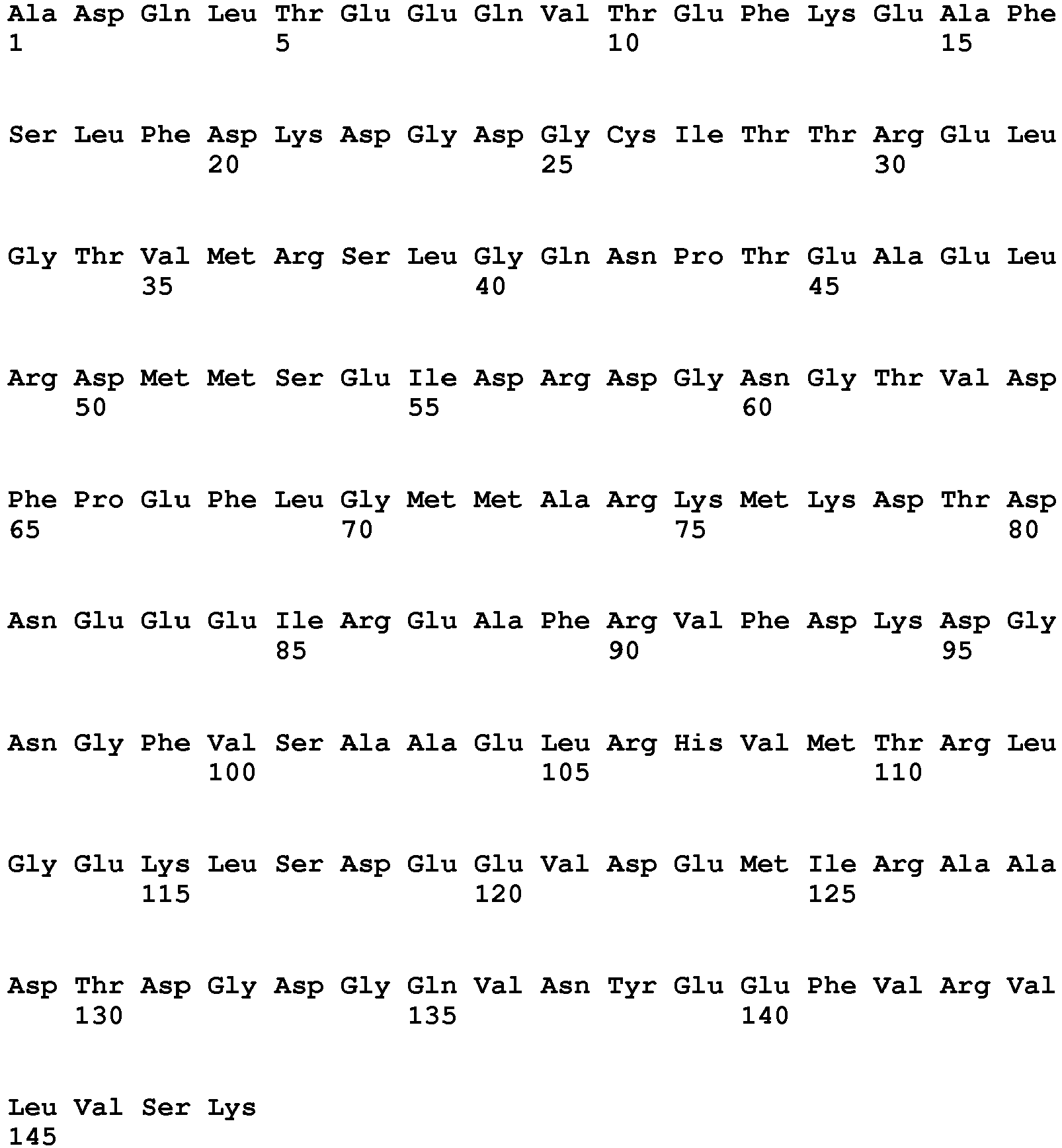
- <210> 7
<211> 146
<212> PRT
<213> Homo sapiens - <400> 7


- <210> 8
<211> 181
<212> PRT
<213> Homo sapiens - <400> 8


- <210> 9
<211> 260
<212> PRT
<213> Homo sapiens - <400> 9


- <210> 10
<211> 271
<212> PRT
<213> Homo sapiens - <400> 10


- <210> 11
<211> 79
<212> PRT
<213> Homo sapiens - <400> 11


- <210> 12
<211> 200
<212> PRT
<213> Homo sapiens - <400> 12


- <210> 13
<211> 190
<212> PRT
<213> Homo sapiens - <400> 13


- <210> 14
<211> 161
<212> PRT
<213> Homo sapiens - <400> 14

- <210> 15
<211> 110
<212> PRT
<213> Homo sapiens - <400> 15


- <210> 16
<211> 261
<212> PRT
<213> Homo sapiens - <400> 16


- <210> 17
<211> 276
<212> PRT
<213> Homo sapiens - <400> 17


- <210> 18
<211> 271
<212> PRT
<213> Homo sapiens - <400> 18


- <210> 19
<211> 4185
<212> DNA
<213> Artificial - <220>
<223> Plasmid - <400> 19


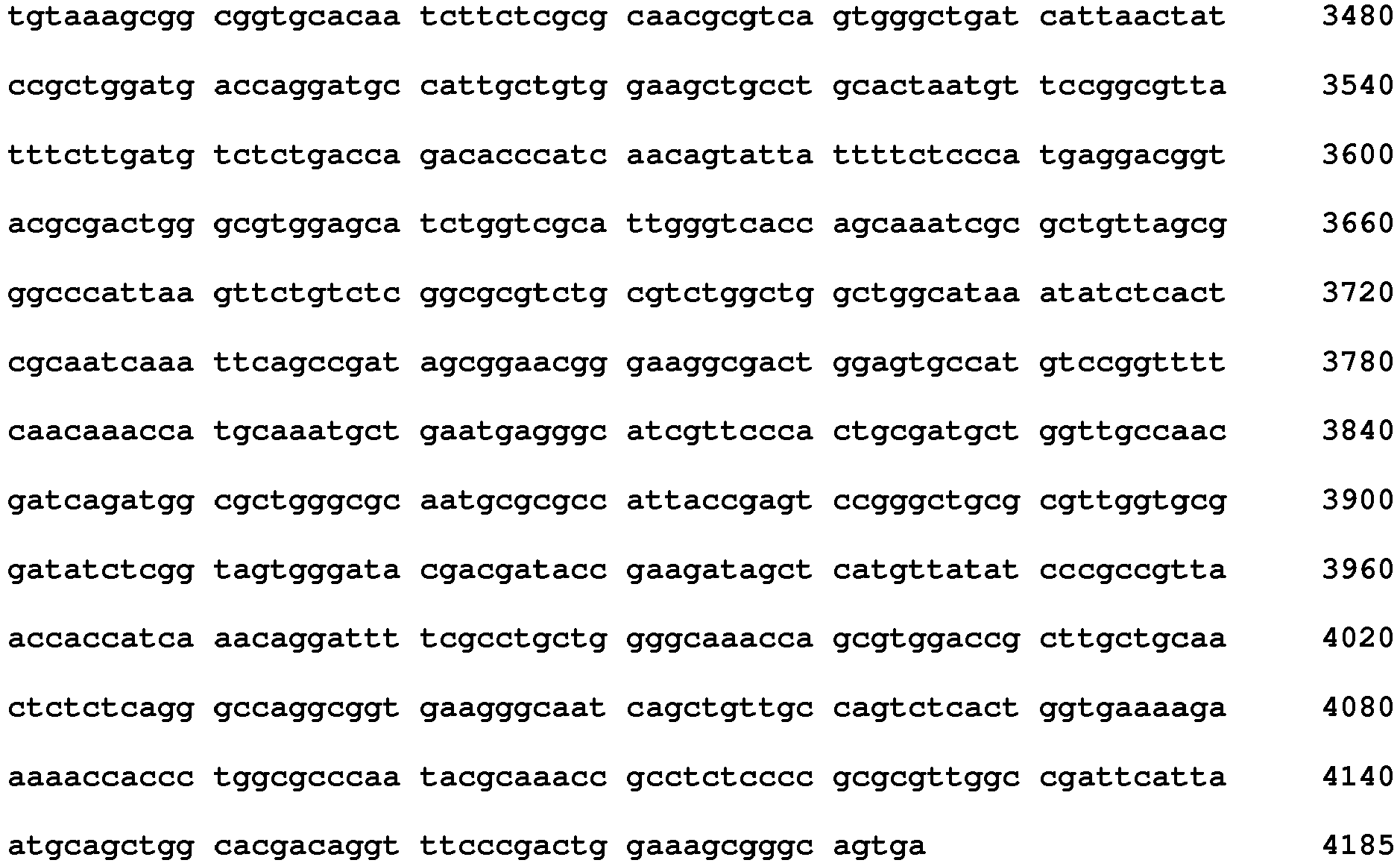
- <210> 20
<211> 4301
<212> DNA
<213> Artificial - <220>
<223> Plasmid - <400> 20


- <210> 21
<211> 4236
<212> DNA
<213> Artificial - <220>
<223> Plasmid - <400> 21


- <210> 22
<211> 4852
<212> DNA
<213> Artificial - <220>
<223> Plasmid - <400> 22


- <210> 23
<211> 4837
<212> DNA
<213> Artificial - <220>
<223> Plasmid - <400> 23


- <210> 24
<211> 337
<212> DNA
<213> Artificial - <220>
<223> Plasmid - <400> 24


- <210> 25
<211> 322
<212> DNA
<213> Artificial - <220>
<223> Plasmid - <400> 25

- <210> 26
<211> 337
<212> DNA
<213> Artificial - <220>
<223> Plasmid - <400> 26

- <210> 27
<211> 322
<212> DNA
<213> Artificial - <220>
<223> Plasmid - <400> 27


- <210> 28
<211> 21
<212> DNA
<213> Artificial - <220>
<223> Primer - <400> 28
tggggatcca tggccgaaga c 21 - <210> 29
<211> 24
<212> DNA
<213> Artificial - <220>
<223> Primer - <400> 29
atcccatggt taaccacttc ccag 24 - <210> 30
<211> 263
<212> DNA
<213> Artificial - <220>
<223> Plasmid - <400> 30

- <210> 31
<211> 126
<212> DNA
<213> Artificial - <220>
<223> EF1 hand subdomain - <400> 31


- <210> 32
<211> 126
<212> DNA
<213> Artificial - <220>
<223> EF1 hand subdomain - <400> 32

Claims (12)
- An affinity tag system for immobilizing a molecule, said system comprising:(i) an affinity matrix comprising a first EF-hand subdomain or fragment thereof attached to a substrate; and(ii) a molecule tagged with a second EF-hand subdomain or fragment thereof,wherein the molecule is immobilized at the substrate via the interaction between the first and second EF-hand subdomains or fragments thereof, and wherein a fragment of a first or second EF-hand subdomain retains the ability of the full-length EF-hand subdomain to form an EF-hand binding pair.
- The system of claim 1 wherein the first EF-hand subdomain or fragment thereof is capable of binding to the second EF-hand subdomain or fragment thereof in the presence of calcium and/or wherein the affinity of binding between the first EF-hand subdomain and the second EF-hand subdomain is KD = 10nM or less.
- The system of claim 1 or claim 2 wherein the first EF-hand subdomain is selected from the group consisting of the EF-hand domains found in any calcium binding protein comprising two or more EF hands, and wherein the EF-hand subdomain is capable of forming a binding pair with a second EF-hand subdomain, in the presence of calcium, optionally wherein the first EF-hand subdomain is selected from:(i) a protein of human, bovine, murine or rat origin;(ii) the group of protein subdomains comprising the amino acid sequence of any one of SEQ ID NO: 3-18;(iii) the group of protein domains comprising an amino acid sequence with at least 85% sequence identity to any one of SEQ ID NO: 3-18;(iv) EF2 from calbindin D9k;(v) an EF-hand subdomain comprising the amino acid sequence of SEQ ID NO: 1;(vi) an EF-hand subdomain comprising an amino acid sequence with at least 85% sequence identity to SEQ ID NO: 1.
- The system of any one of claims 1-3 wherein the substrate of the affinity matrix is selected from the group consisting of cross-linked polysaccharide, ceramic, metal, glass, plastic, cellulose, silica,
and/or wherein the first EF-hand subdomain is attached to the substrate via random amine coupling
or wherein the first EF-hand subdomain is modified so as to facilitate attachment to the substrate
and/or wherein the first EF-hand subdomain is attached to the substrate via a linker. - The system of any of claims 1-4 wherein the molecule tagged with a second EF-hand subdomain or fragment thereof is a fusion protein comprising a second EF-hand subdomain and a polypeptide sequence that is not part of the EF-hand subdomain,
optionally wherein the second EF-hand subdomain is attached to the polypeptide sequence at the N-terminus of the polypeptide sequence or at the C-terminus of the polypeptide sequence or to an amino acid residue of the polypeptide sequence at a position between the N-terminus and C-terminus of the polypeptide sequence or wherein the second EF-hand subdomain is attached to the polypeptide sequence via a linker. - The system of any one of claims 1-5, wherein the second EF-hand subdomain is selected from the group consisting of the EF-hand subdomains found in any calcium binding protein comprising two or more EF hands, and wherein the EF-hand subdomain is capable of forming a binding pair with a first EF-hand subdomain in the presence of calcium, optionally wherein the second EF-hand subdomain is:(i) derived from the same calcium binding protein as the first EF-hand subdomain; or(ii) is from a protein of human, bovine, murine or rat origin; or(iii) is selected from the group of protein domains comprising the amino acid sequence of any one of SEQ ID NO: 3-17; or(iv) is selected from the group of protein domains comprising an amino acid sequence with at least 85% sequence identity to any one of SEQ ID NO: 3-17; or(v) is EF1 from calbindin D9K; or(vi) is an EF-hand subdomain comprising the amino acid sequence of SEQ ID NO: 2; or(vii) is an EF-hand subdomain comprising an amino acid sequence with at least 85% sequence identity to SEQ ID NO: 2.
- The system of any one of claims 1-6 wherein the first and second EF-hands are dissociated by addition of a calcium chelating agent, optionally wherein the calcium chelating agent is selected from the group consisting of EDTA, EGTA, BAPTA, citrate and phosphate.
- Use of the system of any of the preceding claims for detecting the presence of a biological molecule in a sample or for detecting the binding of a ligand or inhibitor to a biological molecule in a sample or for purifying biological molecules tagged with an EF-hand subdomain.
- An affinity matrix comprising a first EF-hand subdomain or fragment thereof that is capable of binding to a second EF-hand subdomain in the presence of calcium, wherein said first EF-hand domain or fragment thereof is attached to a substrate and wherein said first EF-hand subdomain is selected from:(i) EF2 from calbindin D9K,(ii) an EF-hand subdomain comprising the amino acid sequence of SEQ ID NO: 1 or(iii) an EF-hand subdomain comprising an amino acid sequence with at least 85% sequence identity to SEQ ID NO: 1,wherein the fragment of the first EF-hand subdomain retains the ability of the full-length EF-hand subdomain to form an EF-hand binding pair.
- The matrix of claim 9 wherein the substrate of the affinity matrix is selected from the group consisting of cross-linked polysaccharide, ceramic, metal, glass, plastic, cellulose, silica and/or
wherein the first EF-hand subdomain or fragment thereof is attached to the substrate via random amine coupling or wherein the first EF-hand subdomain or fragment thereof is modified so as to facilitate attachment to the substrate,
and/or wherein the first EF-hand subdomain or fragment thereof is attached to the substrate via a linker. - A method for purifying a biological molecule tagged with an EF-hand subdomain or a fragment thereof from a sample, said method comprising the steps of:(i) providing the affinity matrix of claim 9 or claim 10;(ii) bringing a sample containing the tagged biological molecule into contact with the affinity matrix of (i) under conditions that permit binding of the EF-hand subdomains (i.e. in the presence of calcium);(iii) separating any unbound material from the tagged biological molecule bound to the affinity matrix; and(iv) effecting release of the tagged biological molecule from the affinity matrix.
- The method of claim 11 wherein release of the tagged biological molecule is effected by adding an agent that chelates calcium or by cleavage of the EF-hand subdomain tag
and/or wherein the affinity matrix comprises an EF-hand domain attached to a substrate comprising, consisting essentially of or consisting of silica nanoparticles
and/or wherein the biological molecule is a protein or polypeptide.
Priority Applications (1)
| Application Number | Priority Date | Filing Date | Title |
|---|---|---|---|
| EP13700036.0A EP2800757B1 (en) | 2012-01-06 | 2013-01-07 | Affinity tag system |
Applications Claiming Priority (3)
| Application Number | Priority Date | Filing Date | Title |
|---|---|---|---|
| EP12150412.0A EP2612864A1 (en) | 2012-01-06 | 2012-01-06 | Affinity tag system |
| PCT/EP2013/050169 WO2013102684A1 (en) | 2012-01-06 | 2013-01-07 | Affinity tag system |
| EP13700036.0A EP2800757B1 (en) | 2012-01-06 | 2013-01-07 | Affinity tag system |
Publications (2)
| Publication Number | Publication Date |
|---|---|
| EP2800757A1 EP2800757A1 (en) | 2014-11-12 |
| EP2800757B1 true EP2800757B1 (en) | 2018-07-25 |
Family
ID=47521031
Family Applications (2)
| Application Number | Title | Priority Date | Filing Date |
|---|---|---|---|
| EP12150412.0A Ceased EP2612864A1 (en) | 2012-01-06 | 2012-01-06 | Affinity tag system |
| EP13700036.0A Not-in-force EP2800757B1 (en) | 2012-01-06 | 2013-01-07 | Affinity tag system |
Family Applications Before (1)
| Application Number | Title | Priority Date | Filing Date |
|---|---|---|---|
| EP12150412.0A Ceased EP2612864A1 (en) | 2012-01-06 | 2012-01-06 | Affinity tag system |
Country Status (5)
| Country | Link |
|---|---|
| US (1) | US9676872B2 (en) |
| EP (2) | EP2612864A1 (en) |
| DK (1) | DK2800757T3 (en) |
| ES (1) | ES2683365T3 (en) |
| WO (1) | WO2013102684A1 (en) |
Families Citing this family (5)
| Publication number | Priority date | Publication date | Assignee | Title |
|---|---|---|---|---|
| CN104166481B (en) * | 2014-08-15 | 2017-05-24 | 京东方科技集团股份有限公司 | Display substrate and display device |
| CA2991804A1 (en) * | 2015-07-20 | 2017-01-26 | Universite Laval | Recoverin as a fusion protein tag to improve expression, solubility and purification of proteins |
| JP2020518240A (en) * | 2017-01-17 | 2020-06-25 | ザ テキサス エー アンド エム ユニバーシティー システム | An endolysosomal targeting conjugate for enhanced delivery of cargo molecules to the endolysosomal compartment of target cells |
| WO2019133976A1 (en) * | 2017-12-29 | 2019-07-04 | Howard Hughes Medical Institute | Chemigenetic calcium indicators |
| WO2020154541A1 (en) | 2019-01-24 | 2020-07-30 | The Board Of Trustees Of The Leland Stanford Junior University | Compact hydroxamate-based affinity tags for artificially tagging biological macromolecules |
Family Cites Families (1)
| Publication number | Priority date | Publication date | Assignee | Title |
|---|---|---|---|---|
| US20100297734A1 (en) * | 2007-10-12 | 2010-11-25 | University Health Network | Fusion Tag Comprising an Affinity Tag and an EF-Hand Motif Containing Polypeptide and Methods of Use Thereof |
-
2012
- 2012-01-06 EP EP12150412.0A patent/EP2612864A1/en not_active Ceased
-
2013
- 2013-01-07 ES ES13700036.0T patent/ES2683365T3/en active Active
- 2013-01-07 EP EP13700036.0A patent/EP2800757B1/en not_active Not-in-force
- 2013-01-07 WO PCT/EP2013/050169 patent/WO2013102684A1/en not_active Ceased
- 2013-01-07 DK DK13700036.0T patent/DK2800757T3/en active
- 2013-01-07 US US14/369,331 patent/US9676872B2/en not_active Expired - Fee Related
Non-Patent Citations (1)
| Title |
|---|
| None * |
Also Published As
| Publication number | Publication date |
|---|---|
| WO2013102684A1 (en) | 2013-07-11 |
| EP2800757A1 (en) | 2014-11-12 |
| US9676872B2 (en) | 2017-06-13 |
| US20150005480A1 (en) | 2015-01-01 |
| ES2683365T3 (en) | 2018-09-26 |
| DK2800757T3 (en) | 2018-10-29 |
| EP2612864A1 (en) | 2013-07-10 |
Similar Documents
| Publication | Publication Date | Title |
|---|---|---|
| Hearn et al. | Applications of novel affinity cassette methods: use of peptide fusion handles for the purification of recombinant proteins | |
| CN113980089B (en) | A method for detecting extracellular membrane vesicles in a sample and use of a detection kit | |
| CN101910194B (en) | Double affinity polypeptides for purification | |
| US9676872B2 (en) | Affinity tag system | |
| JP7060522B2 (en) | Methods for Purification and Activation of Botulinum Neurotoxin | |
| WO2002074928A2 (en) | Fusion peptides isolatable by phase transition | |
| JP6453208B2 (en) | Antibody refolding method, method for producing refolded antibody, refolded antibody, and use thereof | |
| AU2020283748A1 (en) | Affinity agents | |
| KR20220105157A (en) | Protein Purification Using the Split Intein System | |
| US20040029781A1 (en) | Affinity peptides and method for purification of recombinant proteins | |
| WO2008028218A1 (en) | Affinity separation methods and systems | |
| JP2025530255A (en) | affinity agent | |
| JP2002522085A (en) | Method for purifying protein and / or biomolecule or protein complex | |
| US20120009624A1 (en) | Protein particles | |
| US10844112B2 (en) | Method for purifying antibody or antibody fragment containing κ-chain variable region | |
| WO2020194968A1 (en) | Method for producing extracellular membrane vesicle-binding carrier | |
| Muruaga et al. | Adaptation of the binding domain of Lactobacillus acidophilus S-layer protein as a molecular tag for affinity chromatography development | |
| AU2008255631B2 (en) | Fluorescent protein particles | |
| KR101864375B1 (en) | Detecting, isolating or purifying material with biosilica | |
| CN118599803A (en) | CKMB recombinant antigen and its preparation method and application | |
| JP2024516907A (en) | Improved Protein Purification | |
| EP4294542A1 (en) | Aav2 affinity agents | |
| KR20220158004A (en) | Reuse of intein-binding resins for protein purification | |
| CN117843767A (en) | Preparation and application of high-affinity scFv antibody against infectious bursal virus of chicken | |
| US20070148693A1 (en) | Circular recombinant plasmid dna constructs and their protein products, methods of preparation and immobilisation of proteins on support |
Legal Events
| Date | Code | Title | Description |
|---|---|---|---|
| PUAI | Public reference made under article 153(3) epc to a published international application that has entered the european phase |
Free format text: ORIGINAL CODE: 0009012 |
|
| 17P | Request for examination filed |
Effective date: 20140804 |
|
| AK | Designated contracting states |
Kind code of ref document: A1 Designated state(s): AL AT BE BG CH CY CZ DE DK EE ES FI FR GB GR HR HU IE IS IT LI LT LU LV MC MK MT NL NO PL PT RO RS SE SI SK SM TR |
|
| DAX | Request for extension of the european patent (deleted) | ||
| STAA | Information on the status of an ep patent application or granted ep patent |
Free format text: STATUS: EXAMINATION IS IN PROGRESS |
|
| 17Q | First examination report despatched |
Effective date: 20170119 |
|
| GRAP | Despatch of communication of intention to grant a patent |
Free format text: ORIGINAL CODE: EPIDOSNIGR1 |
|
| STAA | Information on the status of an ep patent application or granted ep patent |
Free format text: STATUS: GRANT OF PATENT IS INTENDED |
|
| INTG | Intention to grant announced |
Effective date: 20180209 |
|
| GRAS | Grant fee paid |
Free format text: ORIGINAL CODE: EPIDOSNIGR3 |
|
| GRAA | (expected) grant |
Free format text: ORIGINAL CODE: 0009210 |
|
| STAA | Information on the status of an ep patent application or granted ep patent |
Free format text: STATUS: THE PATENT HAS BEEN GRANTED |
|
| AK | Designated contracting states |
Kind code of ref document: B1 Designated state(s): AL AT BE BG CH CY CZ DE DK EE ES FI FR GB GR HR HU IE IS IT LI LT LU LV MC MK MT NL NO PL PT RO RS SE SI SK SM TR |
|
| REG | Reference to a national code |
Ref country code: GB Ref legal event code: FG4D |
|
| REG | Reference to a national code |
Ref country code: CH Ref legal event code: NV Representative=s name: KIRKER AND CIE S.A., CH Ref country code: CH Ref legal event code: EP |
|
| REG | Reference to a national code |
Ref country code: AT Ref legal event code: REF Ref document number: 1021645 Country of ref document: AT Kind code of ref document: T Effective date: 20180815 |
|
| REG | Reference to a national code |
Ref country code: IE Ref legal event code: FG4D |
|
| REG | Reference to a national code |
Ref country code: DE Ref legal event code: R096 Ref document number: 602013040753 Country of ref document: DE |
|
| REG | Reference to a national code |
Ref country code: NL Ref legal event code: FP |
|
| REG | Reference to a national code |
Ref country code: ES Ref legal event code: FG2A Ref document number: 2683365 Country of ref document: ES Kind code of ref document: T3 Effective date: 20180926 |
|
| REG | Reference to a national code |
Ref country code: DK Ref legal event code: T3 Effective date: 20181016 |
|
| REG | Reference to a national code |
Ref country code: SE Ref legal event code: TRGR |
|
| REG | Reference to a national code |
Ref country code: LT Ref legal event code: MG4D |
|
| REG | Reference to a national code |
Ref country code: AT Ref legal event code: MK05 Ref document number: 1021645 Country of ref document: AT Kind code of ref document: T Effective date: 20180725 |
|
| PG25 | Lapsed in a contracting state [announced via postgrant information from national office to epo] |
Ref country code: FI Free format text: LAPSE BECAUSE OF FAILURE TO SUBMIT A TRANSLATION OF THE DESCRIPTION OR TO PAY THE FEE WITHIN THE PRESCRIBED TIME-LIMIT Effective date: 20180725 Ref country code: RS Free format text: LAPSE BECAUSE OF FAILURE TO SUBMIT A TRANSLATION OF THE DESCRIPTION OR TO PAY THE FEE WITHIN THE PRESCRIBED TIME-LIMIT Effective date: 20180725 Ref country code: NO Free format text: LAPSE BECAUSE OF FAILURE TO SUBMIT A TRANSLATION OF THE DESCRIPTION OR TO PAY THE FEE WITHIN THE PRESCRIBED TIME-LIMIT Effective date: 20181025 Ref country code: GR Free format text: LAPSE BECAUSE OF FAILURE TO SUBMIT A TRANSLATION OF THE DESCRIPTION OR TO PAY THE FEE WITHIN THE PRESCRIBED TIME-LIMIT Effective date: 20181026 Ref country code: AT Free format text: LAPSE BECAUSE OF FAILURE TO SUBMIT A TRANSLATION OF THE DESCRIPTION OR TO PAY THE FEE WITHIN THE PRESCRIBED TIME-LIMIT Effective date: 20180725 Ref country code: IS Free format text: LAPSE BECAUSE OF FAILURE TO SUBMIT A TRANSLATION OF THE DESCRIPTION OR TO PAY THE FEE WITHIN THE PRESCRIBED TIME-LIMIT Effective date: 20181125 Ref country code: PL Free format text: LAPSE BECAUSE OF FAILURE TO SUBMIT A TRANSLATION OF THE DESCRIPTION OR TO PAY THE FEE WITHIN THE PRESCRIBED TIME-LIMIT Effective date: 20180725 Ref country code: LT Free format text: LAPSE BECAUSE OF FAILURE TO SUBMIT A TRANSLATION OF THE DESCRIPTION OR TO PAY THE FEE WITHIN THE PRESCRIBED TIME-LIMIT Effective date: 20180725 Ref country code: BG Free format text: LAPSE BECAUSE OF FAILURE TO SUBMIT A TRANSLATION OF THE DESCRIPTION OR TO PAY THE FEE WITHIN THE PRESCRIBED TIME-LIMIT Effective date: 20181025 |
|
| PG25 | Lapsed in a contracting state [announced via postgrant information from national office to epo] |
Ref country code: LV Free format text: LAPSE BECAUSE OF FAILURE TO SUBMIT A TRANSLATION OF THE DESCRIPTION OR TO PAY THE FEE WITHIN THE PRESCRIBED TIME-LIMIT Effective date: 20180725 Ref country code: AL Free format text: LAPSE BECAUSE OF FAILURE TO SUBMIT A TRANSLATION OF THE DESCRIPTION OR TO PAY THE FEE WITHIN THE PRESCRIBED TIME-LIMIT Effective date: 20180725 Ref country code: HR Free format text: LAPSE BECAUSE OF FAILURE TO SUBMIT A TRANSLATION OF THE DESCRIPTION OR TO PAY THE FEE WITHIN THE PRESCRIBED TIME-LIMIT Effective date: 20180725 |
|
| REG | Reference to a national code |
Ref country code: DE Ref legal event code: R097 Ref document number: 602013040753 Country of ref document: DE |
|
| PG25 | Lapsed in a contracting state [announced via postgrant information from national office to epo] |
Ref country code: RO Free format text: LAPSE BECAUSE OF FAILURE TO SUBMIT A TRANSLATION OF THE DESCRIPTION OR TO PAY THE FEE WITHIN THE PRESCRIBED TIME-LIMIT Effective date: 20180725 Ref country code: IT Free format text: LAPSE BECAUSE OF FAILURE TO SUBMIT A TRANSLATION OF THE DESCRIPTION OR TO PAY THE FEE WITHIN THE PRESCRIBED TIME-LIMIT Effective date: 20180725 Ref country code: CZ Free format text: LAPSE BECAUSE OF FAILURE TO SUBMIT A TRANSLATION OF THE DESCRIPTION OR TO PAY THE FEE WITHIN THE PRESCRIBED TIME-LIMIT Effective date: 20180725 Ref country code: EE Free format text: LAPSE BECAUSE OF FAILURE TO SUBMIT A TRANSLATION OF THE DESCRIPTION OR TO PAY THE FEE WITHIN THE PRESCRIBED TIME-LIMIT Effective date: 20180725 |
|
| PG25 | Lapsed in a contracting state [announced via postgrant information from national office to epo] |
Ref country code: SM Free format text: LAPSE BECAUSE OF FAILURE TO SUBMIT A TRANSLATION OF THE DESCRIPTION OR TO PAY THE FEE WITHIN THE PRESCRIBED TIME-LIMIT Effective date: 20180725 Ref country code: SK Free format text: LAPSE BECAUSE OF FAILURE TO SUBMIT A TRANSLATION OF THE DESCRIPTION OR TO PAY THE FEE WITHIN THE PRESCRIBED TIME-LIMIT Effective date: 20180725 |
|
| PLBE | No opposition filed within time limit |
Free format text: ORIGINAL CODE: 0009261 |
|
| STAA | Information on the status of an ep patent application or granted ep patent |
Free format text: STATUS: NO OPPOSITION FILED WITHIN TIME LIMIT |
|
| 26N | No opposition filed |
Effective date: 20190426 |
|
| PG25 | Lapsed in a contracting state [announced via postgrant information from national office to epo] |
Ref country code: SI Free format text: LAPSE BECAUSE OF FAILURE TO SUBMIT A TRANSLATION OF THE DESCRIPTION OR TO PAY THE FEE WITHIN THE PRESCRIBED TIME-LIMIT Effective date: 20180725 Ref country code: MC Free format text: LAPSE BECAUSE OF FAILURE TO SUBMIT A TRANSLATION OF THE DESCRIPTION OR TO PAY THE FEE WITHIN THE PRESCRIBED TIME-LIMIT Effective date: 20180725 |
|
| PG25 | Lapsed in a contracting state [announced via postgrant information from national office to epo] |
Ref country code: LU Free format text: LAPSE BECAUSE OF NON-PAYMENT OF DUE FEES Effective date: 20190107 |
|
| PG25 | Lapsed in a contracting state [announced via postgrant information from national office to epo] |
Ref country code: TR Free format text: LAPSE BECAUSE OF FAILURE TO SUBMIT A TRANSLATION OF THE DESCRIPTION OR TO PAY THE FEE WITHIN THE PRESCRIBED TIME-LIMIT Effective date: 20180725 |
|
| PGFP | Annual fee paid to national office [announced via postgrant information from national office to epo] |
Ref country code: DE Payment date: 20200203 Year of fee payment: 8 Ref country code: GB Payment date: 20200127 Year of fee payment: 8 Ref country code: DK Payment date: 20200130 Year of fee payment: 8 Ref country code: IE Payment date: 20200131 Year of fee payment: 8 Ref country code: SE Payment date: 20200131 Year of fee payment: 8 Ref country code: NL Payment date: 20200131 Year of fee payment: 8 Ref country code: ES Payment date: 20200203 Year of fee payment: 8 |
|
| PGFP | Annual fee paid to national office [announced via postgrant information from national office to epo] |
Ref country code: BE Payment date: 20200131 Year of fee payment: 8 Ref country code: CH Payment date: 20200128 Year of fee payment: 8 |
|
| PG25 | Lapsed in a contracting state [announced via postgrant information from national office to epo] |
Ref country code: PT Free format text: LAPSE BECAUSE OF FAILURE TO SUBMIT A TRANSLATION OF THE DESCRIPTION OR TO PAY THE FEE WITHIN THE PRESCRIBED TIME-LIMIT Effective date: 20181125 Ref country code: MT Free format text: LAPSE BECAUSE OF NON-PAYMENT OF DUE FEES Effective date: 20190107 |
|
| PGFP | Annual fee paid to national office [announced via postgrant information from national office to epo] |
Ref country code: FR Payment date: 20200129 Year of fee payment: 8 |
|
| PG25 | Lapsed in a contracting state [announced via postgrant information from national office to epo] |
Ref country code: CY Free format text: LAPSE BECAUSE OF FAILURE TO SUBMIT A TRANSLATION OF THE DESCRIPTION OR TO PAY THE FEE WITHIN THE PRESCRIBED TIME-LIMIT Effective date: 20180725 |
|
| PG25 | Lapsed in a contracting state [announced via postgrant information from national office to epo] |
Ref country code: HU Free format text: LAPSE BECAUSE OF FAILURE TO SUBMIT A TRANSLATION OF THE DESCRIPTION OR TO PAY THE FEE WITHIN THE PRESCRIBED TIME-LIMIT; INVALID AB INITIO Effective date: 20130107 |
|
| REG | Reference to a national code |
Ref country code: DE Ref legal event code: R119 Ref document number: 602013040753 Country of ref document: DE |
|
| REG | Reference to a national code |
Ref country code: DK Ref legal event code: EBP Effective date: 20210131 |
|
| REG | Reference to a national code |
Ref country code: CH Ref legal event code: PL Ref country code: SE Ref legal event code: EUG |
|
| REG | Reference to a national code |
Ref country code: NL Ref legal event code: MM Effective date: 20210201 |
|
| GBPC | Gb: european patent ceased through non-payment of renewal fee |
Effective date: 20210107 |
|
| REG | Reference to a national code |
Ref country code: BE Ref legal event code: MM Effective date: 20210131 |
|
| PG25 | Lapsed in a contracting state [announced via postgrant information from national office to epo] |
Ref country code: NL Free format text: LAPSE BECAUSE OF NON-PAYMENT OF DUE FEES Effective date: 20210201 Ref country code: FR Free format text: LAPSE BECAUSE OF NON-PAYMENT OF DUE FEES Effective date: 20210131 |
|
| PG25 | Lapsed in a contracting state [announced via postgrant information from national office to epo] |
Ref country code: GB Free format text: LAPSE BECAUSE OF NON-PAYMENT OF DUE FEES Effective date: 20210107 Ref country code: CH Free format text: LAPSE BECAUSE OF NON-PAYMENT OF DUE FEES Effective date: 20210131 Ref country code: DE Free format text: LAPSE BECAUSE OF NON-PAYMENT OF DUE FEES Effective date: 20210803 Ref country code: LI Free format text: LAPSE BECAUSE OF NON-PAYMENT OF DUE FEES Effective date: 20210131 Ref country code: SE Free format text: LAPSE BECAUSE OF NON-PAYMENT OF DUE FEES Effective date: 20210108 |
|
| PG25 | Lapsed in a contracting state [announced via postgrant information from national office to epo] |
Ref country code: IE Free format text: LAPSE BECAUSE OF NON-PAYMENT OF DUE FEES Effective date: 20210107 Ref country code: DK Free format text: LAPSE BECAUSE OF NON-PAYMENT OF DUE FEES Effective date: 20210131 |
|
| REG | Reference to a national code |
Ref country code: ES Ref legal event code: FD2A Effective date: 20220426 |
|
| PG25 | Lapsed in a contracting state [announced via postgrant information from national office to epo] |
Ref country code: MK Free format text: LAPSE BECAUSE OF FAILURE TO SUBMIT A TRANSLATION OF THE DESCRIPTION OR TO PAY THE FEE WITHIN THE PRESCRIBED TIME-LIMIT Effective date: 20180725 |
|
| PG25 | Lapsed in a contracting state [announced via postgrant information from national office to epo] |
Ref country code: ES Free format text: LAPSE BECAUSE OF NON-PAYMENT OF DUE FEES Effective date: 20210108 Ref country code: BE Free format text: LAPSE BECAUSE OF NON-PAYMENT OF DUE FEES Effective date: 20210131 |