EP2800748B1 - Cyclic amide derivatives as inhibitors of 11-beta-hydroxysteroid dehydrogenase and uses thereof - Google Patents
Cyclic amide derivatives as inhibitors of 11-beta-hydroxysteroid dehydrogenase and uses thereof Download PDFInfo
- Publication number
- EP2800748B1 EP2800748B1 EP12846788.3A EP12846788A EP2800748B1 EP 2800748 B1 EP2800748 B1 EP 2800748B1 EP 12846788 A EP12846788 A EP 12846788A EP 2800748 B1 EP2800748 B1 EP 2800748B1
- Authority
- EP
- European Patent Office
- Prior art keywords
- compound
- group
- optionally substituted
- synthesis
- indol
- Prior art date
- Legal status (The legal status is an assumption and is not a legal conclusion. Google has not performed a legal analysis and makes no representation as to the accuracy of the status listed.)
- Not-in-force
Links
- 0 CC(CC(*)(*)C(F)(F)F)=O Chemical compound CC(CC(*)(*)C(F)(F)F)=O 0.000 description 16
- NJPCRERTUWBSGE-UHFFFAOYSA-N OC(C(CC1)C(CCCC2)C2N1C(CC(c1c[nH]c2cc(F)ccc12)c1ccccc1)=O)=O Chemical compound OC(C(CC1)C(CCCC2)C2N1C(CC(c1c[nH]c2cc(F)ccc12)c1ccccc1)=O)=O NJPCRERTUWBSGE-UHFFFAOYSA-N 0.000 description 6
- JOPIWHGTDQFGGF-UHFFFAOYSA-N CC(CC(N(C(C)CC1)C(CCC2)C1C2C(O)=O)=O)c1c[nH]c2c1c(-c1ccc[o]1)ccc2 Chemical compound CC(CC(N(C(C)CC1)C(CCC2)C1C2C(O)=O)=O)c1c[nH]c2c1c(-c1ccc[o]1)ccc2 JOPIWHGTDQFGGF-UHFFFAOYSA-N 0.000 description 3
- QJRIAZTXQKREIR-UHFFFAOYSA-N OC(C(CC1)C(CCCC2)C2N1C(CC(c1c[nH]c2c1c(F)ccc2)c1ccccc1)=O)=O Chemical compound OC(C(CC1)C(CCCC2)C2N1C(CC(c1c[nH]c2c1c(F)ccc2)c1ccccc1)=O)=O QJRIAZTXQKREIR-UHFFFAOYSA-N 0.000 description 3
- MNEOSWZFHUERSA-UHFFFAOYSA-N CC(C)(C(C(N1C(CCCC2)C2CCC1)=O)C#N)c1c[nH]c2ccccc12 Chemical compound CC(C)(C(C(N1C(CCCC2)C2CCC1)=O)C#N)c1c[nH]c2ccccc12 MNEOSWZFHUERSA-UHFFFAOYSA-N 0.000 description 2
- RDFCTHSMNHLGJY-UHFFFAOYSA-N CC(C)(C)NC(C(CC(CCCC1)C1C1)N1C(CCc1c[nH]c2ccccc12)=O)=O Chemical compound CC(C)(C)NC(C(CC(CCCC1)C1C1)N1C(CCc1c[nH]c2ccccc12)=O)=O RDFCTHSMNHLGJY-UHFFFAOYSA-N 0.000 description 2
- GQCCYCKPRMCJOB-UHFFFAOYSA-N CC(C)(CC(N(CCC1)C(CCC2)C1C2C(O)=O)=O)c1n[n](C)c2cccc(-c3ccc[s]3)c12 Chemical compound CC(C)(CC(N(CCC1)C(CCC2)C1C2C(O)=O)=O)c1n[n](C)c2cccc(-c3ccc[s]3)c12 GQCCYCKPRMCJOB-UHFFFAOYSA-N 0.000 description 2
- IWVQJGCZGXVADY-UHFFFAOYSA-N CC(C)C(CC(N(CC1)C(CCCC2)C2C1C(OC)=O)=O)c1c[nH]c2ccccc12 Chemical compound CC(C)C(CC(N(CC1)C(CCCC2)C2C1C(OC)=O)=O)c1c[nH]c2ccccc12 IWVQJGCZGXVADY-UHFFFAOYSA-N 0.000 description 2
- KWDGFZFNVKTKBK-UHFFFAOYSA-N CC(C)Oc1cccc2c1c(C(C)CC(N(CCC1)C(CCC3)C1C3C(O)=O)=O)c[n]2C Chemical compound CC(C)Oc1cccc2c1c(C(C)CC(N(CCC1)C(CCC3)C1C3C(O)=O)=O)c[n]2C KWDGFZFNVKTKBK-UHFFFAOYSA-N 0.000 description 2
- LKCZWLBPVYIKPQ-UHFFFAOYSA-N CC(C1CC(N(CC2)C(CCCC3)C3C2C(O)=O)=O)[F]c2cccc3c2c1c[nH]3 Chemical compound CC(C1CC(N(CC2)C(CCCC3)C3C2C(O)=O)=O)[F]c2cccc3c2c1c[nH]3 LKCZWLBPVYIKPQ-UHFFFAOYSA-N 0.000 description 2
- JZJBSHFWVXKJPO-UHFFFAOYSA-N CC(CC(N(CCC1)C(CC2)C1CC2C(O)=O)=O)c1c[nH]c2cccc(C3CC3)c12 Chemical compound CC(CC(N(CCC1)C(CC2)C1CC2C(O)=O)=O)c1c[nH]c2cccc(C3CC3)c12 JZJBSHFWVXKJPO-UHFFFAOYSA-N 0.000 description 2
- JTAOZTSVAMZQSM-UHFFFAOYSA-N CC(CC(N(CCC1)C(CCC2)C1C2C(O)=O)=O)C1c(c(-c([o]2)ccc2F)ccc2)c2OC1 Chemical compound CC(CC(N(CCC1)C(CCC2)C1C2C(O)=O)=O)C1c(c(-c([o]2)ccc2F)ccc2)c2OC1 JTAOZTSVAMZQSM-UHFFFAOYSA-N 0.000 description 2
- RWEKLAXHSVHKBO-UHFFFAOYSA-N CC(CC(N(CCC1)C(CCC2)C1C2C(O)=O)=O)C1c(c(C2CC2)ccc2)c2OC1 Chemical compound CC(CC(N(CCC1)C(CCC2)C1C2C(O)=O)=O)C1c(c(C2CC2)ccc2)c2OC1 RWEKLAXHSVHKBO-UHFFFAOYSA-N 0.000 description 2
- WYCAYMWWSONKDL-UHFFFAOYSA-N CC(CC(N(CCC1)C(CCC2)C1C2C(O)=O)=O)c(c1c2cccc1C1CC1)c[n]2OC Chemical compound CC(CC(N(CCC1)C(CCC2)C1C2C(O)=O)=O)c(c1c2cccc1C1CC1)c[n]2OC WYCAYMWWSONKDL-UHFFFAOYSA-N 0.000 description 2
- ROXCUDPKADJBNK-UHFFFAOYSA-N CC(CC(N(CCC1)C(CCC2)C1C2C(O)=O)=O)c1c(C#N)[n](C)c2c1c(C1CC1)ccc2 Chemical compound CC(CC(N(CCC1)C(CCC2)C1C2C(O)=O)=O)c1c(C#N)[n](C)c2c1c(C1CC1)ccc2 ROXCUDPKADJBNK-UHFFFAOYSA-N 0.000 description 2
- QZOUEGVTZDOSEA-UHFFFAOYSA-N CC(CC(N(CCC1)C(CCC2)C1C2C(O)=O)=O)c1c[nH]c2c1c(-c(cc1)ccc1F)ccc2 Chemical compound CC(CC(N(CCC1)C(CCC2)C1C2C(O)=O)=O)c1c[nH]c2c1c(-c(cc1)ccc1F)ccc2 QZOUEGVTZDOSEA-UHFFFAOYSA-N 0.000 description 2
- FIWYGEKZQRQMMD-UHFFFAOYSA-N CC(CC(N(CCC1)C(CCC2)C1C2C(O)=O)=O)c1c[nH]c2c1c(-c(cccc1)c1F)ccc2 Chemical compound CC(CC(N(CCC1)C(CCC2)C1C2C(O)=O)=O)c1c[nH]c2c1c(-c(cccc1)c1F)ccc2 FIWYGEKZQRQMMD-UHFFFAOYSA-N 0.000 description 2
- ZSNPKXRVTQQMCT-UHFFFAOYSA-N CC(CC(N(CCC1)C(CCC2)C1C2C(O)=O)=O)c1c[nH]c2c1c(-c1ccc[o]1)ccc2 Chemical compound CC(CC(N(CCC1)C(CCC2)C1C2C(O)=O)=O)c1c[nH]c2c1c(-c1ccc[o]1)ccc2 ZSNPKXRVTQQMCT-UHFFFAOYSA-N 0.000 description 2
- JOKBPLCHKXVXGR-UHFFFAOYSA-N CC(CC(N(CCC1)C(CCC2)C1C2C(O)=O)=O)c1c[nH]c2c1c(-c1ccc[s]1)ccc2 Chemical compound CC(CC(N(CCC1)C(CCC2)C1C2C(O)=O)=O)c1c[nH]c2c1c(-c1ccc[s]1)ccc2 JOKBPLCHKXVXGR-UHFFFAOYSA-N 0.000 description 2
- KKOXQGWLQJHNAI-UHFFFAOYSA-N CC(CC(N(CCC1)C(CCC2)C1C2C(O)=O)=O)c1c[nH]c2cccc(-c3ncc[s]3)c12 Chemical compound CC(CC(N(CCC1)C(CCC2)C1C2C(O)=O)=O)c1c[nH]c2cccc(-c3ncc[s]3)c12 KKOXQGWLQJHNAI-UHFFFAOYSA-N 0.000 description 2
- MOMJUBOVHFCUGQ-UHFFFAOYSA-N CC(CC(N(CCC1)C(CCC2)C1C2C(O)=O)=O)c1c[nH]c2cccc(Cl)c12 Chemical compound CC(CC(N(CCC1)C(CCC2)C1C2C(O)=O)=O)c1c[nH]c2cccc(Cl)c12 MOMJUBOVHFCUGQ-UHFFFAOYSA-N 0.000 description 2
- QRRXAOUSHWBGQP-UHFFFAOYSA-N CC(CC(N(CCC1)C(CCC2)C1C2C(O)=O)=O)c1c[nH]c2nccc(C3CC3)c12 Chemical compound CC(CC(N(CCC1)C(CCC2)C1C2C(O)=O)=O)c1c[nH]c2nccc(C3CC3)c12 QRRXAOUSHWBGQP-UHFFFAOYSA-N 0.000 description 2
- ZGJSSFRYRDNHQR-UHFFFAOYSA-N CC(CC(N(CCC1)C(CCC2)C1C2C(O)=O)=O)c1c[n](COC)c2c1c(C1CC1)ccc2 Chemical compound CC(CC(N(CCC1)C(CCC2)C1C2C(O)=O)=O)c1c[n](COC)c2c1c(C1CC1)ccc2 ZGJSSFRYRDNHQR-UHFFFAOYSA-N 0.000 description 2
- DIWPULJGBDAYCH-UHFFFAOYSA-N CC(CC(N(CCC1)C(CCC2)C1C2C(O)=O)=O)c1n[nH]c2cccc(-c([o]3)ccc3F)c12 Chemical compound CC(CC(N(CCC1)C(CCC2)C1C2C(O)=O)=O)c1n[nH]c2cccc(-c([o]3)ccc3F)c12 DIWPULJGBDAYCH-UHFFFAOYSA-N 0.000 description 2
- JSCGXSFHWVKILY-UHFFFAOYSA-N CC(CC(N(CCC1)C(CCC2)C1C2C(O)=O)=O)c1n[nH]c2cccc(C3CC3)c12 Chemical compound CC(CC(N(CCC1)C(CCC2)C1C2C(O)=O)=O)c1n[nH]c2cccc(C3CC3)c12 JSCGXSFHWVKILY-UHFFFAOYSA-N 0.000 description 2
- ZMCHIHRVMRWZSO-UHFFFAOYSA-N CC(CC(N(CCC1)C(CCCC2)C12C#N)=O)c1c[nH]c2cccc(C)c12 Chemical compound CC(CC(N(CCC1)C(CCCC2)C12C#N)=O)c1c[nH]c2cccc(C)c12 ZMCHIHRVMRWZSO-UHFFFAOYSA-N 0.000 description 2
- VHWMZNFHZSHMJY-UHFFFAOYSA-N CC(CC(N1C(CCCC2)C2CCC1)=O)c1c[nH]c2cccc(F)c12 Chemical compound CC(CC(N1C(CCCC2)C2CCC1)=O)c1c[nH]c2cccc(F)c12 VHWMZNFHZSHMJY-UHFFFAOYSA-N 0.000 description 2
- NCMFRVANTVQMBF-UHFFFAOYSA-N CC(CC(O)=O)c1c[nH]c2c1c(C1CC1)ccc2 Chemical compound CC(CC(O)=O)c1c[nH]c2c1c(C1CC1)ccc2 NCMFRVANTVQMBF-UHFFFAOYSA-N 0.000 description 2
- PMHQCFZTDPVXIS-UHFFFAOYSA-N COC(C(CC1)C(CCCC2)C2N1C(CCc1c[nH]c2ccccc12)=O)=O Chemical compound COC(C(CC1)C(CCCC2)C2N1C(CCc1c[nH]c2ccccc12)=O)=O PMHQCFZTDPVXIS-UHFFFAOYSA-N 0.000 description 2
- UJSOLHZYILUSSX-LXGFQCHUSA-N C[C@@H](CC(N(C(C)CC1)C(CCC2)C1C2C(O)=O)=O)c1c[nH]c2c1c(-c1ccc[s]1)ccc2 Chemical compound C[C@@H](CC(N(C(C)CC1)C(CCC2)C1C2C(O)=O)=O)c1c[nH]c2c1c(-c1ccc[s]1)ccc2 UJSOLHZYILUSSX-LXGFQCHUSA-N 0.000 description 2
- IYFCNKBUBAKGQV-UHFFFAOYSA-N C[n](cc(CCC(N1C(CCCC2)C2CCC1)=O)c1c2)c1ccc2O Chemical compound C[n](cc(CCC(N1C(CCCC2)C2CCC1)=O)c1c2)c1ccc2O IYFCNKBUBAKGQV-UHFFFAOYSA-N 0.000 description 2
- VPMBXYNJFZPVMQ-UHFFFAOYSA-N C[n]1c2cccc(F)c2c(CCC(N2C(CCCC3)C3CCC2)=O)c1 Chemical compound C[n]1c2cccc(F)c2c(CCC(N2C(CCCC3)C3CCC2)=O)c1 VPMBXYNJFZPVMQ-UHFFFAOYSA-N 0.000 description 2
- HYZHAFBMHJYPDA-UHFFFAOYSA-N O=C(CCc(c1c2)c[nH]c1ccc2Cl)N1C(CCCC2)C2CCC1 Chemical compound O=C(CCc(c1c2)c[nH]c1ccc2Cl)N1C(CCCC2)C2CCC1 HYZHAFBMHJYPDA-UHFFFAOYSA-N 0.000 description 2
- XIPBDKKLGPANRB-UHFFFAOYSA-N O=C(CCc1c[nH]c2ccccc12)N(CC1)C(CCCC2)C2C1=O Chemical compound O=C(CCc1c[nH]c2ccccc12)N(CC1)C(CCCC2)C2C1=O XIPBDKKLGPANRB-UHFFFAOYSA-N 0.000 description 2
- BKJMSBJRTDDCSN-UHFFFAOYSA-N O=C(CCc1nc(cccc2)c2[s]1)N1C(CCCC2)C2OCC1 Chemical compound O=C(CCc1nc(cccc2)c2[s]1)N1C(CCCC2)C2OCC1 BKJMSBJRTDDCSN-UHFFFAOYSA-N 0.000 description 2
- PHNWZWLNGFWZKM-UHFFFAOYSA-N O=C(CCc1nc2ccccc2[s]1)N(CC1)C2C1CCCC2 Chemical compound O=C(CCc1nc2ccccc2[s]1)N(CC1)C2C1CCCC2 PHNWZWLNGFWZKM-UHFFFAOYSA-N 0.000 description 2
- CDBRVOHDEAWTOA-UHFFFAOYSA-N OC(C(CC1)C(CCCC2)C2N1C(CC(c1c[nH]c2c1c(Cl)ccc2)c1ccc[s]1)=O)=O Chemical compound OC(C(CC1)C(CCCC2)C2N1C(CC(c1c[nH]c2c1c(Cl)ccc2)c1ccc[s]1)=O)=O CDBRVOHDEAWTOA-UHFFFAOYSA-N 0.000 description 2
- RRZMOONTXMBHLO-UHFFFAOYSA-N OC(C(CCC1C2CCCC1)N2C(CC(c1c[nH]c2cc(F)ccc12)c1ccccc1)=O)=O Chemical compound OC(C(CCC1C2CCCC1)N2C(CC(c1c[nH]c2cc(F)ccc12)c1ccccc1)=O)=O RRZMOONTXMBHLO-UHFFFAOYSA-N 0.000 description 2
- POTIYWUALSJREP-UHFFFAOYSA-N C(CC1)CC2C1NCCC2 Chemical compound C(CC1)CC2C1NCCC2 POTIYWUALSJREP-UHFFFAOYSA-N 0.000 description 1
- WVTDISDIGXLNPY-UHFFFAOYSA-N CC(C(C(OC(C)(C)O1)=O)C1=O)c1c[nH]c2ccccc12 Chemical compound CC(C(C(OC(C)(C)O1)=O)C1=O)c1c[nH]c2ccccc12 WVTDISDIGXLNPY-UHFFFAOYSA-N 0.000 description 1
- WHYYRJNZIWXKRW-UHFFFAOYSA-N CC(C(CC(N1C(C)(CCCC2)C2CCC1)=O)c1c[nH]2)[F]c3c1c2ccc3 Chemical compound CC(C(CC(N1C(C)(CCCC2)C2CCC1)=O)c1c[nH]2)[F]c3c1c2ccc3 WHYYRJNZIWXKRW-UHFFFAOYSA-N 0.000 description 1
- BTUSSQUDZJXYIF-UHFFFAOYSA-N CC(C(CC(N1C(CCCC2)C2CCC1)=O)c1c[nH]2)[F]c3c1c2ccc3 Chemical compound CC(C(CC(N1C(CCCC2)C2CCC1)=O)c1c[nH]2)[F]c3c1c2ccc3 BTUSSQUDZJXYIF-UHFFFAOYSA-N 0.000 description 1
- DODKPXSHWMGOEE-UHFFFAOYSA-N CC(C(N1C(CCCC2)C2CCC1)=O)Oc1c[nH]c2c1cccc2 Chemical compound CC(C(N1C(CCCC2)C2CCC1)=O)Oc1c[nH]c2c1cccc2 DODKPXSHWMGOEE-UHFFFAOYSA-N 0.000 description 1
- GADINIANYMEEEN-UHFFFAOYSA-N CC(C)(C(N(CCC1)C(CCC2)C1C2C(O)=O)=O)c1n[n](C)c2c1c(C1CC1)ccc2 Chemical compound CC(C)(C(N(CCC1)C(CCC2)C1C2C(O)=O)=O)c1n[n](C)c2c1c(C1CC1)ccc2 GADINIANYMEEEN-UHFFFAOYSA-N 0.000 description 1
- MTCFVIYKYZIDCG-UHFFFAOYSA-N CC(C)(C(N(CCC1)C(CCC2)C1C2C(O)=O)=O)c1n[n](C)c2cccc(-c([o]3)ccc3F)c12 Chemical compound CC(C)(C(N(CCC1)C(CCC2)C1C2C(O)=O)=O)c1n[n](C)c2cccc(-c([o]3)ccc3F)c12 MTCFVIYKYZIDCG-UHFFFAOYSA-N 0.000 description 1
- KVVOQJJYTZIIIO-UHFFFAOYSA-N CC(C)(C(N1C(CCCC2)C2CCC1)=O)Sc1nc2ccccc2[s]1 Chemical compound CC(C)(C(N1C(CCCC2)C2CCC1)=O)Sc1nc2ccccc2[s]1 KVVOQJJYTZIIIO-UHFFFAOYSA-N 0.000 description 1
- AQMOEAMLTWVXCO-UHFFFAOYSA-N CC(C)(CC(N(CC1)C(CCCC2C(O)=O)C2C1=O)=O)c1c[nH]c2cccc(-c3ccc[s]3)c12 Chemical compound CC(C)(CC(N(CC1)C(CCCC2C(O)=O)C2C1=O)=O)c1c[nH]c2cccc(-c3ccc[s]3)c12 AQMOEAMLTWVXCO-UHFFFAOYSA-N 0.000 description 1
- BGFQAVSPPXWPEC-UHFFFAOYSA-N CC(C)(CC(N(CCC1)C(CCC2)C1C2C(O)=O)=O)c1c[nH]c2c1c(-c([o]1)ccc1F)ccc2 Chemical compound CC(C)(CC(N(CCC1)C(CCC2)C1C2C(O)=O)=O)c1c[nH]c2c1c(-c([o]1)ccc1F)ccc2 BGFQAVSPPXWPEC-UHFFFAOYSA-N 0.000 description 1
- GNCDJQVHBMSFIE-UHFFFAOYSA-N CC(C)(CC(N(CCC1)C(CCC2)C1C2C(O)=O)=O)c1n[nH]c2c1c(C1CC1)ccc2 Chemical compound CC(C)(CC(N(CCC1)C(CCC2)C1C2C(O)=O)=O)c1n[nH]c2c1c(C1CC1)ccc2 GNCDJQVHBMSFIE-UHFFFAOYSA-N 0.000 description 1
- IETUAJMHVGOWQE-UHFFFAOYSA-N CC(C)(CC(N(CCC1)C(CCC2)C1C2C(O)=O)=O)c1n[n](C)c2cccc(-c([o]3)ccc3F)c12 Chemical compound CC(C)(CC(N(CCC1)C(CCC2)C1C2C(O)=O)=O)c1n[n](C)c2cccc(-c([o]3)ccc3F)c12 IETUAJMHVGOWQE-UHFFFAOYSA-N 0.000 description 1
- FBURRDUIVXJJKO-UHFFFAOYSA-N CC(C)(CC(N(CCC1)C(CCC2)C1C2C(O)=O)=O)c1n[n](C)c2cccc(C3CC3)c12 Chemical compound CC(C)(CC(N(CCC1)C(CCC2)C1C2C(O)=O)=O)c1n[n](C)c2cccc(C3CC3)c12 FBURRDUIVXJJKO-UHFFFAOYSA-N 0.000 description 1
- JFUYPCZDGAQERC-UHFFFAOYSA-N CC(C)(CC(N(CCC1)C(CCC2)C1C2C(O)=O)OC)c1n[n](C)c2cccc(C3(C)SC=CC3)c12 Chemical compound CC(C)(CC(N(CCC1)C(CCC2)C1C2C(O)=O)OC)c1n[n](C)c2cccc(C3(C)SC=CC3)c12 JFUYPCZDGAQERC-UHFFFAOYSA-N 0.000 description 1
- YRDCMVXLXRZMOL-UHFFFAOYSA-N CC(C)(CC(N(CCC1)C(CCC2)C1C2c1nnn[nH]1)=O)c1c[nH]c2cccc(-c3ccc[s]3)c12 Chemical compound CC(C)(CC(N(CCC1)C(CCC2)C1C2c1nnn[nH]1)=O)c1c[nH]c2cccc(-c3ccc[s]3)c12 YRDCMVXLXRZMOL-UHFFFAOYSA-N 0.000 description 1
- AXLJSJHICNOEBZ-UHFFFAOYSA-N CC(C)(CC(N(CCC1)C(CCC2)C1C2c1nnn[nH]1)=O)c1c[nH]c2cccc(C3CC3)c12 Chemical compound CC(C)(CC(N(CCC1)C(CCC2)C1C2c1nnn[nH]1)=O)c1c[nH]c2cccc(C3CC3)c12 AXLJSJHICNOEBZ-UHFFFAOYSA-N 0.000 description 1
- RYTJZVKDZFUYOK-UHFFFAOYSA-N CC(C)(CC(N1C(CCCC2)C2(C)CCC1)=O)c1c[n](C)c2ccccc12 Chemical compound CC(C)(CC(N1C(CCCC2)C2(C)CCC1)=O)c1c[n](C)c2ccccc12 RYTJZVKDZFUYOK-UHFFFAOYSA-N 0.000 description 1
- KSCVRROKPXQCFZ-UHFFFAOYSA-N CC(C)(CC(N1C(CCCC2)C2CCC1)=O)c1c[n](C)c2ccccc12 Chemical compound CC(C)(CC(N1C(CCCC2)C2CCC1)=O)c1c[n](C)c2ccccc12 KSCVRROKPXQCFZ-UHFFFAOYSA-N 0.000 description 1
- GXHFUVWIGNLZSC-UHFFFAOYSA-N CC(C)(OC(C1)=O)OC1=O Chemical compound CC(C)(OC(C1)=O)OC1=O GXHFUVWIGNLZSC-UHFFFAOYSA-N 0.000 description 1
- GENFDSTUKMOQSC-UHFFFAOYSA-N CC(C)C(CC(N(CC1)C(CCCC2)C2C1=O)=O)c1c[nH]c2ccccc12 Chemical compound CC(C)C(CC(N(CC1)C(CCCC2)C2C1=O)=O)c1c[nH]c2ccccc12 GENFDSTUKMOQSC-UHFFFAOYSA-N 0.000 description 1
- VOFKSFLQFKQDGZ-UHFFFAOYSA-N CC(C)C(CC(N(CC1)C(CCCC2)C2C1C(O)=O)=O)c1c[nH]c2c1ccc(Cl)c2 Chemical compound CC(C)C(CC(N(CC1)C(CCCC2)C2C1C(O)=O)=O)c1c[nH]c2c1ccc(Cl)c2 VOFKSFLQFKQDGZ-UHFFFAOYSA-N 0.000 description 1
- VNDJNCWNXWOKRH-UHFFFAOYSA-N CC(C)C(CC(N(CC1)C(CCCC2)C2C1C(O)=O)=O)c1c[nH]c2ccccc12 Chemical compound CC(C)C(CC(N(CC1)C(CCCC2)C2C1C(O)=O)=O)c1c[nH]c2ccccc12 VNDJNCWNXWOKRH-UHFFFAOYSA-N 0.000 description 1
- GFLWJRZQZSLDGN-UHFFFAOYSA-N CC(C)C(CC(N(CC1)C(CCCC2)C2C1C(O)=O)=O)c1c[nH]c2ncccc12 Chemical compound CC(C)C(CC(N(CC1)C(CCCC2)C2C1C(O)=O)=O)c1c[nH]c2ncccc12 GFLWJRZQZSLDGN-UHFFFAOYSA-N 0.000 description 1
- UCOCVAVHVBENFI-UHFFFAOYSA-N CC(C)C(CC(N(CCCC1(C)CCCCC1)CN)=O)c1c[nH]c2cccc(F)c12 Chemical compound CC(C)C(CC(N(CCCC1(C)CCCCC1)CN)=O)c1c[nH]c2cccc(F)c12 UCOCVAVHVBENFI-UHFFFAOYSA-N 0.000 description 1
- JEZXXELTWXDSLI-UHFFFAOYSA-N CC(C)C(CC(N1C(CCCC2)C2CCC1)=O)c1c[nH]c2c1cccc2 Chemical compound CC(C)C(CC(N1C(CCCC2)C2CCC1)=O)c1c[nH]c2c1cccc2 JEZXXELTWXDSLI-UHFFFAOYSA-N 0.000 description 1
- BLDDMCUOXAIYSB-UHFFFAOYSA-N CC(C)C(CC(N1C(CCCC2)C2CCC1)=O)c1c[nH]c2c1cccn2 Chemical compound CC(C)C(CC(N1C(CCCC2)C2CCC1)=O)c1c[nH]c2c1cccn2 BLDDMCUOXAIYSB-UHFFFAOYSA-N 0.000 description 1
- QTFIILCWUPKGCX-UHFFFAOYSA-N CC(C)C(CC(N1C(CCCC2)C2OCC1)=O)c1c[n](C)c2c1cccc2 Chemical compound CC(C)C(CC(N1C(CCCC2)C2OCC1)=O)c1c[n](C)c2c1cccc2 QTFIILCWUPKGCX-UHFFFAOYSA-N 0.000 description 1
- GXCQNSZHMTZDCN-UHFFFAOYSA-N CC(C1)C=C2N(C)N=C(C3(CC(N(CCC4)C(CCC5)C4C5C(O)=O)=O)CC3)C2=C1C1CC1 Chemical compound CC(C1)C=C2N(C)N=C(C3(CC(N(CCC4)C(CCC5)C4C5C(O)=O)=O)CC3)C2=C1C1CC1 GXCQNSZHMTZDCN-UHFFFAOYSA-N 0.000 description 1
- DGIZKXJVVMLDPL-UHFFFAOYSA-N CC(C1CC(N(CCC2)C(CCC3)C2C3C(O)=O)=O)[ClH]c2cccc3c2c1c[nH]3 Chemical compound CC(C1CC(N(CCC2)C(CCC3)C2C3C(O)=O)=O)[ClH]c2cccc3c2c1c[nH]3 DGIZKXJVVMLDPL-UHFFFAOYSA-N 0.000 description 1
- OODWOJLQMPDRRT-UHFFFAOYSA-N CC(CC(N(CC1)C(CCCC2)C2C1=O)=O)c1c[nH]c2c1c(Cl)ccc2 Chemical compound CC(CC(N(CC1)C(CCCC2)C2C1=O)=O)c1c[nH]c2c1c(Cl)ccc2 OODWOJLQMPDRRT-UHFFFAOYSA-N 0.000 description 1
- ZJZCCSWJVNJIKU-UHFFFAOYSA-N CC(CC(N(CC1)C(CCCC2)C2C1=O)=O)c1c[nH]c2c1cccc2 Chemical compound CC(CC(N(CC1)C(CCCC2)C2C1=O)=O)c1c[nH]c2c1cccc2 ZJZCCSWJVNJIKU-UHFFFAOYSA-N 0.000 description 1
- CYYOOOXAUWMNHB-UHFFFAOYSA-N CC(CC(N(CC1)C(CCCC2)C2C1O)=O)c1c[nH]c(cc2Cl)c1cc2F Chemical compound CC(CC(N(CC1)C(CCCC2)C2C1O)=O)c1c[nH]c(cc2Cl)c1cc2F CYYOOOXAUWMNHB-UHFFFAOYSA-N 0.000 description 1
- ASEFXJYYCKHODU-UHFFFAOYSA-N CC(CC(N(CC1)C(CCCC2C(O)=O)C2C1=O)=O)c1c[nH]c2c1c(-c1ccc[s]1)ccc2 Chemical compound CC(CC(N(CC1)C(CCCC2C(O)=O)C2C1=O)=O)c1c[nH]c2c1c(-c1ccc[s]1)ccc2 ASEFXJYYCKHODU-UHFFFAOYSA-N 0.000 description 1
- PCPMXRGVLGKNPW-UHFFFAOYSA-N CC(CC(N(CC1)C(CCCC2C(O)=O)C2C1=O)=O)c1c[nH]c2cccc(-c([o]3)ccc3F)c12 Chemical compound CC(CC(N(CC1)C(CCCC2C(O)=O)C2C1=O)=O)c1c[nH]c2cccc(-c([o]3)ccc3F)c12 PCPMXRGVLGKNPW-UHFFFAOYSA-N 0.000 description 1
- WAFPKKDIEWVMHV-UHFFFAOYSA-N CC(CC(N(CCC1)C(CCC2)C1(C)C2C(O)=O)=O)c1c[nH]c2cccc(-c([o]3)ccc3F)c12 Chemical compound CC(CC(N(CCC1)C(CCC2)C1(C)C2C(O)=O)=O)c1c[nH]c2cccc(-c([o]3)ccc3F)c12 WAFPKKDIEWVMHV-UHFFFAOYSA-N 0.000 description 1
- LIQRBQHSWJEYFN-UHFFFAOYSA-N CC(CC(N(CCC1)C(CCC2)C1(C)C2C(O)=O)=O)c1c[nH]c2cccc(-c3ccc[s]3)c12 Chemical compound CC(CC(N(CCC1)C(CCC2)C1(C)C2C(O)=O)=O)c1c[nH]c2cccc(-c3ccc[s]3)c12 LIQRBQHSWJEYFN-UHFFFAOYSA-N 0.000 description 1
- CACBYHFMMATHMR-UHFFFAOYSA-N CC(CC(N(CCC1)C(CCC2)C1C2(C)C(O)=O)=O)c1c[nH]c2c1c(C1CC1)ccc2 Chemical compound CC(CC(N(CCC1)C(CCC2)C1C2(C)C(O)=O)=O)c1c[nH]c2c1c(C1CC1)ccc2 CACBYHFMMATHMR-UHFFFAOYSA-N 0.000 description 1
- QJMGRZMYRPOEBZ-UHFFFAOYSA-N CC(CC(N(CCC1)C(CCC2)C1C2C#N)=O)c1c[nH]c2c1c(C1CC1)ccc2 Chemical compound CC(CC(N(CCC1)C(CCC2)C1C2C#N)=O)c1c[nH]c2c1c(C1CC1)ccc2 QJMGRZMYRPOEBZ-UHFFFAOYSA-N 0.000 description 1
- WNBAQNJEFVYRAT-UHFFFAOYSA-N CC(CC(N(CCC1)C(CCC2)C1C2C(O)=O)=O)(C(F)(F)F)c1c[nH]c2c1c(-c([o]1)ccc1F)ccc2 Chemical compound CC(CC(N(CCC1)C(CCC2)C1C2C(O)=O)=O)(C(F)(F)F)c1c[nH]c2c1c(-c([o]1)ccc1F)ccc2 WNBAQNJEFVYRAT-UHFFFAOYSA-N 0.000 description 1
- SUFSCBFIIKVKFB-UHFFFAOYSA-N CC(CC(N(CCC1)C(CCC2)C1C2C(O)=O)=O)(c1c[nH]c2c1c(-c([o]1)ccc1F)ccc2)F Chemical compound CC(CC(N(CCC1)C(CCC2)C1C2C(O)=O)=O)(c1c[nH]c2c1c(-c([o]1)ccc1F)ccc2)F SUFSCBFIIKVKFB-UHFFFAOYSA-N 0.000 description 1
- BQIMILRYDXGVHQ-UHFFFAOYSA-N CC(CC(N(CCC1)C(CCC2)C1C2C(O)=O)=O)(c1c[nH]c2c1c(-c1ccc[o]1)ccc2)F Chemical compound CC(CC(N(CCC1)C(CCC2)C1C2C(O)=O)=O)(c1c[nH]c2c1c(-c1ccc[o]1)ccc2)F BQIMILRYDXGVHQ-UHFFFAOYSA-N 0.000 description 1
- JAALQWITEQHACT-UHFFFAOYSA-N CC(CC(N(CCC1)C(CCC2)C1C2C(O)=O)=O)C(CN(C)c1ccc2)c1c2-c([o]1)ccc1F Chemical compound CC(CC(N(CCC1)C(CCC2)C1C2C(O)=O)=O)C(CN(C)c1ccc2)c1c2-c([o]1)ccc1F JAALQWITEQHACT-UHFFFAOYSA-N 0.000 description 1
- YYPDPNMBIHOJQT-UHFFFAOYSA-N CC(CC(N(CCC1)C(CCC2)C1C2C(O)=O)=O)C1c2c(C3CC3)cccc2N(C)C1 Chemical compound CC(CC(N(CCC1)C(CCC2)C1C2C(O)=O)=O)C1c2c(C3CC3)cccc2N(C)C1 YYPDPNMBIHOJQT-UHFFFAOYSA-N 0.000 description 1
- JMLXYVWCBMEJAJ-UHFFFAOYSA-N CC(CC(N(CCC1)C(CCC2)C1C2C(O)=O)=O)c1c[nH]c2c1c(-c([o]1)ccc1F)ccc2 Chemical compound CC(CC(N(CCC1)C(CCC2)C1C2C(O)=O)=O)c1c[nH]c2c1c(-c([o]1)ccc1F)ccc2 JMLXYVWCBMEJAJ-UHFFFAOYSA-N 0.000 description 1
- RTOCMWXXSUAAPJ-UHFFFAOYSA-N CC(CC(N(CCC1)C(CCC2)C1C2C(O)=O)=O)c1c[nH]c2c1c(-c1cc(C)n[o]1)ccc2 Chemical compound CC(CC(N(CCC1)C(CCC2)C1C2C(O)=O)=O)c1c[nH]c2c1c(-c1cc(C)n[o]1)ccc2 RTOCMWXXSUAAPJ-UHFFFAOYSA-N 0.000 description 1
- WWGYPRATPBELMY-UHFFFAOYSA-N CC(CC(N(CCC1)C(CCC2)C1C2C(O)=O)=O)c1c[nH]c2c1c(-c1ccc(C)[o]1)ccc2 Chemical compound CC(CC(N(CCC1)C(CCC2)C1C2C(O)=O)=O)c1c[nH]c2c1c(-c1ccc(C)[o]1)ccc2 WWGYPRATPBELMY-UHFFFAOYSA-N 0.000 description 1
- OPNLBBQPPBNDID-UHFFFAOYSA-N CC(CC(N(CCC1)C(CCC2)C1C2C(O)=O)=O)c1c[nH]c2c1c(-c1ccc(F)[s]1)ccc2 Chemical compound CC(CC(N(CCC1)C(CCC2)C1C2C(O)=O)=O)c1c[nH]c2c1c(-c1ccc(F)[s]1)ccc2 OPNLBBQPPBNDID-UHFFFAOYSA-N 0.000 description 1
- SDTIJZLLCFCHHB-UHFFFAOYSA-N CC(CC(N(CCC1)C(CCC2)C1C2C(O)=O)=O)c1c[nH]c2c1c(-c1ccc[n]1C)ccc2 Chemical compound CC(CC(N(CCC1)C(CCC2)C1C2C(O)=O)=O)c1c[nH]c2c1c(-c1ccc[n]1C)ccc2 SDTIJZLLCFCHHB-UHFFFAOYSA-N 0.000 description 1
- WJILAKVRXIXFCG-UHFFFAOYSA-N CC(CC(N(CCC1)C(CCC2)C1C2C(O)=O)=O)c1c[nH]c2c1c(C(F)(F)F)ccc2 Chemical compound CC(CC(N(CCC1)C(CCC2)C1C2C(O)=O)=O)c1c[nH]c2c1c(C(F)(F)F)ccc2 WJILAKVRXIXFCG-UHFFFAOYSA-N 0.000 description 1
- QCMLGOLMYZNAMY-UHFFFAOYSA-N CC(CC(N(CCC1)C(CCC2)C1C2C(O)=O)=O)c1c[nH]c2c1c(C1(C)CC1)ccc2 Chemical compound CC(CC(N(CCC1)C(CCC2)C1C2C(O)=O)=O)c1c[nH]c2c1c(C1(C)CC1)ccc2 QCMLGOLMYZNAMY-UHFFFAOYSA-N 0.000 description 1
- GOPJOPCREYOWJN-UHFFFAOYSA-N CC(CC(N(CCC1)C(CCC2)C1C2C(O)=O)=O)c1c[nH]c2c1c(C1CC1)ccc2 Chemical compound CC(CC(N(CCC1)C(CCC2)C1C2C(O)=O)=O)c1c[nH]c2c1c(C1CC1)ccc2 GOPJOPCREYOWJN-UHFFFAOYSA-N 0.000 description 1
- ZBKGKHFJIAWULC-UHFFFAOYSA-N CC(CC(N(CCC1)C(CCC2)C1C2C(O)=O)=O)c1c[nH]c2c1c(OC(F)(F)F)ccc2 Chemical compound CC(CC(N(CCC1)C(CCC2)C1C2C(O)=O)=O)c1c[nH]c2c1c(OC(F)(F)F)ccc2 ZBKGKHFJIAWULC-UHFFFAOYSA-N 0.000 description 1
- GBPJTHKJVSLDPL-UHFFFAOYSA-N CC(CC(N(CCC1)C(CCC2)C1C2C(O)=O)=O)c1c[nH]c2c1c(OC)ccc2 Chemical compound CC(CC(N(CCC1)C(CCC2)C1C2C(O)=O)=O)c1c[nH]c2c1c(OC)ccc2 GBPJTHKJVSLDPL-UHFFFAOYSA-N 0.000 description 1
- GBPGRELGGNAOKL-UHFFFAOYSA-N CC(CC(N(CCC1)C(CCC2)C1C2C(O)=O)=O)c1c[nH]c2cccc(-c3ccc(C#N)[o]3)c12 Chemical compound CC(CC(N(CCC1)C(CCC2)C1C2C(O)=O)=O)c1c[nH]c2cccc(-c3ccc(C#N)[o]3)c12 GBPGRELGGNAOKL-UHFFFAOYSA-N 0.000 description 1
- IFYVLGQVQGYRJZ-UHFFFAOYSA-N CC(CC(N(CCC1)C(CCC2)C1C2C(O)=O)=O)c1c[n](C)c(cc2)c1c(C1CC1)c2F Chemical compound CC(CC(N(CCC1)C(CCC2)C1C2C(O)=O)=O)c1c[n](C)c(cc2)c1c(C1CC1)c2F IFYVLGQVQGYRJZ-UHFFFAOYSA-N 0.000 description 1
- SFEKVXBXHYPEDF-UHFFFAOYSA-N CC(CC(N(CCC1)C(CCC2)C1C2C(O)=O)=O)c1c[n](C)c2c1c(-c1ccc[o]1)ccc2 Chemical compound CC(CC(N(CCC1)C(CCC2)C1C2C(O)=O)=O)c1c[n](C)c2c1c(-c1ccc[o]1)ccc2 SFEKVXBXHYPEDF-UHFFFAOYSA-N 0.000 description 1
- GUPGMBZLDGMSNV-UHFFFAOYSA-N CC(CC(N(CCC1)C(CCC2)C1C2C(O)=O)=O)c1c[n](C)c2c1c(C(F)(F)F)ccc2 Chemical compound CC(CC(N(CCC1)C(CCC2)C1C2C(O)=O)=O)c1c[n](C)c2c1c(C(F)(F)F)ccc2 GUPGMBZLDGMSNV-UHFFFAOYSA-N 0.000 description 1
- IXSJAAZGWJJSTC-UHFFFAOYSA-N CC(CC(N(CCC1)C(CCC2)C1C2C(O)=O)=O)c1c[n](C)c2c1c(C1CC1)ccc2 Chemical compound CC(CC(N(CCC1)C(CCC2)C1C2C(O)=O)=O)c1c[n](C)c2c1c(C1CC1)ccc2 IXSJAAZGWJJSTC-UHFFFAOYSA-N 0.000 description 1
- GRBSFLJZMYGHGP-UHFFFAOYSA-N CC(CC(N(CCC1)C(CCC2)C1C2C(O)=O)=O)c1c[n](C)c2cccc(-c3ccc[s]3)c12 Chemical compound CC(CC(N(CCC1)C(CCC2)C1C2C(O)=O)=O)c1c[n](C)c2cccc(-c3ccc[s]3)c12 GRBSFLJZMYGHGP-UHFFFAOYSA-N 0.000 description 1
- QYYRJNZTMKVSQI-UHFFFAOYSA-N CC(CC(N(CCC1)C(CCC2)C1C2C(O)=O)=O)c1n[nH]c2c1c(-c1ccc(F)[s]1)ccc2 Chemical compound CC(CC(N(CCC1)C(CCC2)C1C2C(O)=O)=O)c1n[nH]c2c1c(-c1ccc(F)[s]1)ccc2 QYYRJNZTMKVSQI-UHFFFAOYSA-N 0.000 description 1
- CZNSYJJSFLRGGB-UHFFFAOYSA-N CC(CC(N(CCC1)C(CCC2)C1C2C(O)=O)=O)c1n[n](C)c2cccc(-c([o]3)ccc3F)c12 Chemical compound CC(CC(N(CCC1)C(CCC2)C1C2C(O)=O)=O)c1n[n](C)c2cccc(-c([o]3)ccc3F)c12 CZNSYJJSFLRGGB-UHFFFAOYSA-N 0.000 description 1
- OBBLNNKWOOAAHD-UHFFFAOYSA-N CC(CC(N(CCC1)C(CCC2)C1C2C(O)=O)=O)c1n[n](C)c2cccc(-c3ccc[s]3)c12 Chemical compound CC(CC(N(CCC1)C(CCC2)C1C2C(O)=O)=O)c1n[n](C)c2cccc(-c3ccc[s]3)c12 OBBLNNKWOOAAHD-UHFFFAOYSA-N 0.000 description 1
- LACIKXPYKGVEOG-UHFFFAOYSA-N CC(CC(N(CCC1)C(CCC2)C1C2C(OC)=O)=O)C1=CNC2=CCCC(C3CC3)=C12 Chemical compound CC(CC(N(CCC1)C(CCC2)C1C2C(OC)=O)=O)C1=CNC2=CCCC(C3CC3)=C12 LACIKXPYKGVEOG-UHFFFAOYSA-N 0.000 description 1
- OHAMZMVWGLMZLA-UHFFFAOYSA-N CC(CC(N(CCC1)C(CCC2)C1C2c1nnn[nH]1)=O)c1c[nH]c2c1c(C1CC1)ccc2 Chemical compound CC(CC(N(CCC1)C(CCC2)C1C2c1nnn[nH]1)=O)c1c[nH]c2c1c(C1CC1)ccc2 OHAMZMVWGLMZLA-UHFFFAOYSA-N 0.000 description 1
- XKOVIWQPOLZGIX-UHFFFAOYSA-N CC(CC(N(CCC1)C(CCC2)C1C2c1nnn[nH]1)=O)c1c[nH]c2cccc(-c3ccc[s]3)c12 Chemical compound CC(CC(N(CCC1)C(CCC2)C1C2c1nnn[nH]1)=O)c1c[nH]c2cccc(-c3ccc[s]3)c12 XKOVIWQPOLZGIX-UHFFFAOYSA-N 0.000 description 1
- FTVLZEDZGAUCCR-UHFFFAOYSA-N CC(CC(N(CCC1)C(CCC2)C1C2c1nnn[nH]1)=O)c1c[n](C)c2cccc(-c3ccc[o]3)c12 Chemical compound CC(CC(N(CCC1)C(CCC2)C1C2c1nnn[nH]1)=O)c1c[n](C)c2cccc(-c3ccc[o]3)c12 FTVLZEDZGAUCCR-UHFFFAOYSA-N 0.000 description 1
- ZIQHJWPKRJAYMA-UHFFFAOYSA-N CC(CC(N(CCC1)C(CCC2)C1C2c1nnn[nH]1)=O)c1c[n](C)c2cccc(C3CC3)c12 Chemical compound CC(CC(N(CCC1)C(CCC2)C1C2c1nnn[nH]1)=O)c1c[n](C)c2cccc(C3CC3)c12 ZIQHJWPKRJAYMA-UHFFFAOYSA-N 0.000 description 1
- JXXSMZDFFDQFAO-UHFFFAOYSA-N CC(CC(N(CCC1)C(CCCC2)C12O)=O)C(CNc1ncc2)c1c2Cl Chemical compound CC(CC(N(CCC1)C(CCCC2)C12O)=O)C(CNc1ncc2)c1c2Cl JXXSMZDFFDQFAO-UHFFFAOYSA-N 0.000 description 1
- KATAJJWBMYTYIM-UHFFFAOYSA-N CC(CC(N(CCC1)C(CCCC2)C12O)=O)c1c[nH]c2nccc(Cl)c12 Chemical compound CC(CC(N(CCC1)C(CCCC2)C12O)=O)c1c[nH]c2nccc(Cl)c12 KATAJJWBMYTYIM-UHFFFAOYSA-N 0.000 description 1
- WFARBGUVTCOYRK-UHFFFAOYSA-N CC(CC(N(CCC1)C(CCCC2)C12OC)=O)c1c[nH]c2c1cccn2 Chemical compound CC(CC(N(CCC1)C(CCCC2)C12OC)=O)c1c[nH]c2c1cccn2 WFARBGUVTCOYRK-UHFFFAOYSA-N 0.000 description 1
- FBJWWVOIOMMSAU-UHFFFAOYSA-N CC(CC(N(CCC1)C(CCCC2)C12c1ccccc1)=O)c1c[nH]c2cccc(Cl)c12 Chemical compound CC(CC(N(CCC1)C(CCCC2)C12c1ccccc1)=O)c1c[nH]c2cccc(Cl)c12 FBJWWVOIOMMSAU-UHFFFAOYSA-N 0.000 description 1
- LSRICQJHOGUPDU-UHFFFAOYSA-N CC(CC(N1C(CCCC2)C2(C)CCC1)=O)C(C(C)Nc1ccc2)c1c2F Chemical compound CC(CC(N1C(CCCC2)C2(C)CCC1)=O)C(C(C)Nc1ccc2)c1c2F LSRICQJHOGUPDU-UHFFFAOYSA-N 0.000 description 1
- DJRIHKCHNZXIAB-UHFFFAOYSA-N CC(CC(N1C(CCCC2)C2(C)CCC1)=O)c1c[nH]c2cccc(F)c12 Chemical compound CC(CC(N1C(CCCC2)C2(C)CCC1)=O)c1c[nH]c2cccc(F)c12 DJRIHKCHNZXIAB-UHFFFAOYSA-N 0.000 description 1
- WDHSQJWTIFBKSC-UHFFFAOYSA-N CC(CC(N1C(CCCC2)C2(C)CCC1)=O)c1c[n](C)c2c1cccn2 Chemical compound CC(CC(N1C(CCCC2)C2(C)CCC1)=O)c1c[n](C)c2c1cccn2 WDHSQJWTIFBKSC-UHFFFAOYSA-N 0.000 description 1
- KWKFAFMBIUMCCB-UHFFFAOYSA-N CC(CC(N1C(CCCC2)C2CCC1)=O)[n]1nnc2c1cccc2Cl Chemical compound CC(CC(N1C(CCCC2)C2CCC1)=O)[n]1nnc2c1cccc2Cl KWKFAFMBIUMCCB-UHFFFAOYSA-N 0.000 description 1
- NQDRNYCSGLXJDQ-UHFFFAOYSA-N CC(CC(N1C(CCCC2)C2CCC1)=O)c([s]c1ccc2)nc1c2Cl Chemical compound CC(CC(N1C(CCCC2)C2CCC1)=O)c([s]c1ccc2)nc1c2Cl NQDRNYCSGLXJDQ-UHFFFAOYSA-N 0.000 description 1
- OXAQKVUVXKQANP-UHFFFAOYSA-N CC(CC(N1C(CCCC2)C2CCC1)=O)c1c[nH]c2c1c(Br)ccc2 Chemical compound CC(CC(N1C(CCCC2)C2CCC1)=O)c1c[nH]c2c1c(Br)ccc2 OXAQKVUVXKQANP-UHFFFAOYSA-N 0.000 description 1
- ZRULRGZTYGACMS-UHFFFAOYSA-N CC(CC(N1C(CCCC2)C2CCC1)=O)c1c[nH]c2c1c(N(CC1)CCC1C(O)=O)ccc2 Chemical compound CC(CC(N1C(CCCC2)C2CCC1)=O)c1c[nH]c2c1c(N(CC1)CCC1C(O)=O)ccc2 ZRULRGZTYGACMS-UHFFFAOYSA-N 0.000 description 1
- VXMMDSBVMBVBTN-UHFFFAOYSA-N CC(CC(N1C(CCCC2)C2CCC1)=O)c1c[nH]c2c1c(N(CC1)CCC1C(OC)=O)ccc2 Chemical compound CC(CC(N1C(CCCC2)C2CCC1)=O)c1c[nH]c2c1c(N(CC1)CCC1C(OC)=O)ccc2 VXMMDSBVMBVBTN-UHFFFAOYSA-N 0.000 description 1
- RYBHZJODZOPLLU-UHFFFAOYSA-N CC(CC(N1C(CCCC2)C2CCC1)=O)c1c[n](C)c2ccccc12 Chemical compound CC(CC(N1C(CCCC2)C2CCC1)=O)c1c[n](C)c2ccccc12 RYBHZJODZOPLLU-UHFFFAOYSA-N 0.000 description 1
- PIGPRUOXHCMZBN-UHFFFAOYSA-N CC(CC(N1C(CCCC2)C2CCC1)O)C1=CNC2(C)NC=CC=C12 Chemical compound CC(CC(N1C(CCCC2)C2CCC1)O)C1=CNC2(C)NC=CC=C12 PIGPRUOXHCMZBN-UHFFFAOYSA-N 0.000 description 1
- AJIPITPFLLLDHV-UHFFFAOYSA-N CC(CC(N1C(CCCC2)C2OCC1)=O)c1c[nH]c2ncccc12 Chemical compound CC(CC(N1C(CCCC2)C2OCC1)=O)c1c[nH]c2ncccc12 AJIPITPFLLLDHV-UHFFFAOYSA-N 0.000 description 1
- OFNWILZICDVDLW-SYGMWZTRSA-N CC(CC(N1C(CCCC2)[C@H]2OCC1)=O)c1c[nH]c2cccc(F)c12 Chemical compound CC(CC(N1C(CCCC2)[C@H]2OCC1)=O)c1c[nH]c2cccc(F)c12 OFNWILZICDVDLW-SYGMWZTRSA-N 0.000 description 1
- FVFZYDXNRDZLHL-UHFFFAOYSA-N CC(CC(N1C(CCCC2C(O)=O)C2OCC1)=O)c1c[nH]c2cccc(C3CC3)c12 Chemical compound CC(CC(N1C(CCCC2C(O)=O)C2OCC1)=O)c1c[nH]c2cccc(C3CC3)c12 FVFZYDXNRDZLHL-UHFFFAOYSA-N 0.000 description 1
- IKTJMKYSKNYTJM-UHFFFAOYSA-N CC(CC(O)=O)c1c[nH]c2ccccc12 Chemical compound CC(CC(O)=O)c1c[nH]c2ccccc12 IKTJMKYSKNYTJM-UHFFFAOYSA-N 0.000 description 1
- NCFATUQEILPSQF-UHFFFAOYSA-N CC(CC1C2CCCC1)CN2C(CCc1c[nH]c2c1cccc2)=O Chemical compound CC(CC1C2CCCC1)CN2C(CCc1c[nH]c2c1cccc2)=O NCFATUQEILPSQF-UHFFFAOYSA-N 0.000 description 1
- KLVCPDPYFOCLBK-UHFFFAOYSA-N CC(CCC1C2CCCC1)N2C(CCc1c[nH]c2ccccc12)=O Chemical compound CC(CCC1C2CCCC1)N2C(CCc1c[nH]c2ccccc12)=O KLVCPDPYFOCLBK-UHFFFAOYSA-N 0.000 description 1
- OKGWWNSHZHYYDR-UHFFFAOYSA-N CC(CCCC1)(CC(C2)C(O)=O)C1N2C(CC(c1c[nH]c2c1c(F)ccc2)c1ccccc1)=O Chemical compound CC(CCCC1)(CC(C2)C(O)=O)C1N2C(CC(c1c[nH]c2c1c(F)ccc2)c1ccccc1)=O OKGWWNSHZHYYDR-UHFFFAOYSA-N 0.000 description 1
- OQWGRPJEINWFHK-UHFFFAOYSA-N CC(CCCC1)(CCC2)C1N2C(CC[n]1nnc2c1cccc2)=O Chemical compound CC(CCCC1)(CCC2)C1N2C(CC[n]1nnc2c1cccc2)=O OQWGRPJEINWFHK-UHFFFAOYSA-N 0.000 description 1
- SYQUDNYFPURUCL-UHFFFAOYSA-N CCC(CC(N(CC1)C(CCCC2)C2C1C(O)=O)=O)c1c[nH]c2c1c(Cl)ccc2 Chemical compound CCC(CC(N(CC1)C(CCCC2)C2C1C(O)=O)=O)c1c[nH]c2c1c(Cl)ccc2 SYQUDNYFPURUCL-UHFFFAOYSA-N 0.000 description 1
- RIOMLLBGJLUWED-UHFFFAOYSA-N CCOC(C(CCCC1)(CCC2)C1N2C(CC(C)c1c[nH]c2cccc(Cl)c12)=O)=O Chemical compound CCOC(C(CCCC1)(CCC2)C1N2C(CC(C)c1c[nH]c2cccc(Cl)c12)=O)=O RIOMLLBGJLUWED-UHFFFAOYSA-N 0.000 description 1
- ILIXMZWLPCYGFN-UHFFFAOYSA-N CCOC(CC(C)c1c[nH]c2c1c(Br)ccc2)=O Chemical compound CCOC(CC(C)c1c[nH]c2c1c(Br)ccc2)=O ILIXMZWLPCYGFN-UHFFFAOYSA-N 0.000 description 1
- JQCNCJLAKONZFP-UHFFFAOYSA-N CCOC(CC(C)c1c[nH]c2c1c(C1CC1)ccc2)=O Chemical compound CCOC(CC(C)c1c[nH]c2c1c(C1CC1)ccc2)=O JQCNCJLAKONZFP-UHFFFAOYSA-N 0.000 description 1
- DOABEWVYDYLWIK-UHFFFAOYSA-N CCOC(CC(C)c1c[nH]c2ccccc12)=O Chemical compound CCOC(CC(C)c1c[nH]c2ccccc12)=O DOABEWVYDYLWIK-UHFFFAOYSA-N 0.000 description 1
- XQWMBJAACNLJJX-UHFFFAOYSA-N CC[n](cc1C(C)CC(N(CCC2)C(CCC3)C2C3C(O)=O)=O)c2c1c(Cl)ccc2 Chemical compound CC[n](cc1C(C)CC(N(CCC2)C(CCC3)C2C3C(O)=O)=O)c2c1c(Cl)ccc2 XQWMBJAACNLJJX-UHFFFAOYSA-N 0.000 description 1
- FIQKGSMFKSMKAF-UHFFFAOYSA-N CC[n]1c2cccc(-c([o]3)ccc3F)c2c(C(C)CC(N(CCC2)C(CCC3)C2C3C(O)=O)=O)c1 Chemical compound CC[n]1c2cccc(-c([o]3)ccc3F)c2c(C(C)CC(N(CCC2)C(CCC3)C2C3C(O)=O)=O)c1 FIQKGSMFKSMKAF-UHFFFAOYSA-N 0.000 description 1
- DYGSQHQDDCSYIH-UHFFFAOYSA-N COc1ccc2[nH]cc(CCC(N3C(CCCC4)C4CCC3)=O)c2c1 Chemical compound COc1ccc2[nH]cc(CCC(N3C(CCCC4)C4CCC3)=O)c2c1 DYGSQHQDDCSYIH-UHFFFAOYSA-N 0.000 description 1
- QZOUEGVTZDOSEA-KXNKRACNSA-N C[C@@H](CC(N(CCC1)C(CCC2)C1C2C(O)=O)=O)c1c[nH]c2c1c(-c(cc1)ccc1F)ccc2 Chemical compound C[C@@H](CC(N(CCC1)C(CCC2)C1C2C(O)=O)=O)c1c[nH]c2c1c(-c(cc1)ccc1F)ccc2 QZOUEGVTZDOSEA-KXNKRACNSA-N 0.000 description 1
- ZSNPKXRVTQQMCT-ACGOYWBDSA-N C[C@@H](CC(N(CCC1)C(CCC2)C1C2C(O)=O)=O)c1c[nH]c2c1c(-c1ccc[o]1)ccc2 Chemical compound C[C@@H](CC(N(CCC1)C(CCC2)C1C2C(O)=O)=O)c1c[nH]c2c1c(-c1ccc[o]1)ccc2 ZSNPKXRVTQQMCT-ACGOYWBDSA-N 0.000 description 1
- ZSNPKXRVTQQMCT-ZMLMIBLPSA-N C[C@H](CC(N(CCC1)C(CCC2)C1C2C(O)=O)=O)c1c[nH]c2c1c(-c1ccc[o]1)ccc2 Chemical compound C[C@H](CC(N(CCC1)C(CCC2)C1C2C(O)=O)=O)c1c[nH]c2c1c(-c1ccc[o]1)ccc2 ZSNPKXRVTQQMCT-ZMLMIBLPSA-N 0.000 description 1
- QZOUEGVTZDOSEA-RRFJRTKXSA-N C[C@H](CC(N(CCC1)C(CCC2)C1C2C(O)=O)=O)c1c[nH]c2cccc(-c(cc3)ccc3F)c12 Chemical compound C[C@H](CC(N(CCC1)C(CCC2)C1C2C(O)=O)=O)c1c[nH]c2cccc(-c(cc3)ccc3F)c12 QZOUEGVTZDOSEA-RRFJRTKXSA-N 0.000 description 1
- UAQCJAUNYIQTEI-UHFFFAOYSA-N C[n]1nc(C2(CC(N(CCC3)C(CCC4)C3C4C(O)=O)=O)CC2)c2c1cccc2C1CC1 Chemical compound C[n]1nc(C2(CC(N(CCC3)C(CCC4)C3C4C(O)=O)=O)CC2)c2c1cccc2C1CC1 UAQCJAUNYIQTEI-UHFFFAOYSA-N 0.000 description 1
- AFBPDRYYUOZUPC-UHFFFAOYSA-N Cc1c(c(CCC(N2C(CCCC3)C3CCC2)=O)c[n]2C)c2ccc1 Chemical compound Cc1c(c(CCC(N2C(CCCC3)C3CCC2)=O)c[n]2C)c2ccc1 AFBPDRYYUOZUPC-UHFFFAOYSA-N 0.000 description 1
- LLXRPAYNCOYIDG-UHFFFAOYSA-N Cc1c(c(CCC(N2C(CCCC3)C3CCC2)=O)c[n]2C3CC3)c2ccc1 Chemical compound Cc1c(c(CCC(N2C(CCCC3)C3CCC2)=O)c[n]2C3CC3)c2ccc1 LLXRPAYNCOYIDG-UHFFFAOYSA-N 0.000 description 1
- DXYYSGDWQCSKKO-UHFFFAOYSA-N Cc1nc2ccccc2[s]1 Chemical compound Cc1nc2ccccc2[s]1 DXYYSGDWQCSKKO-UHFFFAOYSA-N 0.000 description 1
- QNTWAYGROZPRLU-UHFFFAOYSA-N N#CC(CC(N1C(CCCC2)C2CCC1)=O)c1c[nH]c2ccccc12 Chemical compound N#CC(CC(N1C(CCCC2)C2CCC1)=O)c1c[nH]c2ccccc12 QNTWAYGROZPRLU-UHFFFAOYSA-N 0.000 description 1
- KESQFSYXCNTJQD-UHFFFAOYSA-N O=C(CC[n]1nnc2c1cccc2)N1C(CCCC2)C2OCC1 Chemical compound O=C(CC[n]1nnc2c1cccc2)N1C(CCCC2)C2OCC1 KESQFSYXCNTJQD-UHFFFAOYSA-N 0.000 description 1
- MLWWSNCSLHWRDE-UHFFFAOYSA-N O=C(CCc(c1c2)c[nH]c1ccc2F)N1C(CCCC2)C2CCC1 Chemical compound O=C(CCc(c1c2)c[nH]c1ccc2F)N1C(CCCC2)C2CCC1 MLWWSNCSLHWRDE-UHFFFAOYSA-N 0.000 description 1
- MJHPCAHFBMMFRY-UHFFFAOYSA-N O=C(CCc1c[nH]c2cccc(F)c12)N1C(CCCC2)C2CCC1 Chemical compound O=C(CCc1c[nH]c2cccc(F)c12)N1C(CCCC2)C2CCC1 MJHPCAHFBMMFRY-UHFFFAOYSA-N 0.000 description 1
- KNJKVEMWDODEGP-UHFFFAOYSA-N O=C(CCc1c[nH]c2cccc(F)c12)N1C(CCCC2)C2OCC1 Chemical compound O=C(CCc1c[nH]c2cccc(F)c12)N1C(CCCC2)C2OCC1 KNJKVEMWDODEGP-UHFFFAOYSA-N 0.000 description 1
- IKMDIDUYXHVEML-UHFFFAOYSA-N O=C(CCc1c[nH]c2ccccc12)N1C(CCCC2)C2CCC1 Chemical compound O=C(CCc1c[nH]c2ccccc12)N1C(CCCC2)C2CCC1 IKMDIDUYXHVEML-UHFFFAOYSA-N 0.000 description 1
- XMXJUECVBWDKLQ-UHFFFAOYSA-N O=C(CCc1c[nH]c2ccccc12)N1CC(CCCC2)C2CC1 Chemical compound O=C(CCc1c[nH]c2ccccc12)N1CC(CCCC2)C2CC1 XMXJUECVBWDKLQ-UHFFFAOYSA-N 0.000 description 1
- YWWRQWVPWSACMW-UHFFFAOYSA-N O=C(CCc1nc2ccccc2[s]1)N(C1)CC2C1CCCC2 Chemical compound O=C(CCc1nc2ccccc2[s]1)N(C1)CC2C1CCCC2 YWWRQWVPWSACMW-UHFFFAOYSA-N 0.000 description 1
- OZNQYFNALGULRF-UHFFFAOYSA-N O=C(CCc1nc2ccccc2[s]1)N1C(CCCC2)C2CCC1 Chemical compound O=C(CCc1nc2ccccc2[s]1)N1C(CCCC2)C2CCC1 OZNQYFNALGULRF-UHFFFAOYSA-N 0.000 description 1
- WQOGBLWBCKYTRN-UHFFFAOYSA-N OC(C(CC1)C(CCCC2)C2N1C(CC(c([s]c1ccc2)nc1c2F)c1ccccc1)=O)=O Chemical compound OC(C(CC1)C(CCCC2)C2N1C(CC(c([s]c1ccc2)nc1c2F)c1ccccc1)=O)=O WQOGBLWBCKYTRN-UHFFFAOYSA-N 0.000 description 1
- GNWRLTLMSHULPO-UHFFFAOYSA-N OC(C(CC1)C(CCCC2)C2N1C(CC(c(cc1)ccc1F)[n]1nnc2cc(F)ccc12)=O)=O Chemical compound OC(C(CC1)C(CCCC2)C2N1C(CC(c(cc1)ccc1F)[n]1nnc2cc(F)ccc12)=O)=O GNWRLTLMSHULPO-UHFFFAOYSA-N 0.000 description 1
- MDSNTTSPMMYYEK-UHFFFAOYSA-N OC(C(CC1)C(CCCC2)C2N1C(CC(c1c[nH]c2c1ccc(Cl)c2)c1ccc[s]1)=O)=O Chemical compound OC(C(CC1)C(CCCC2)C2N1C(CC(c1c[nH]c2c1ccc(Cl)c2)c1ccc[s]1)=O)=O MDSNTTSPMMYYEK-UHFFFAOYSA-N 0.000 description 1
- SSNNZZFVQPZWJA-UHFFFAOYSA-N OC(C(CC1)C(CCCC2)C2N1C(CC(c1c[nH]c2nccc(F)c12)c1ccc[s]1)=O)=O Chemical compound OC(C(CC1)C(CCCC2)C2N1C(CC(c1c[nH]c2nccc(F)c12)c1ccc[s]1)=O)=O SSNNZZFVQPZWJA-UHFFFAOYSA-N 0.000 description 1
- UWHSVIQQWURCIG-UHFFFAOYSA-N OC(C(CC1)C(CCCC2)C2N1C(CC(c1ccc[s]1)[n]1nnc2cc(F)ccc12)=O)=O Chemical compound OC(C(CC1)C(CCCC2)C2N1C(CC(c1ccc[s]1)[n]1nnc2cc(F)ccc12)=O)=O UWHSVIQQWURCIG-UHFFFAOYSA-N 0.000 description 1
- HFMAFKFYPFJRTO-UHFFFAOYSA-N OC(C(CC1)C(CCCC2)C2N1C(CC(c1nc(cccc2)c2[s]1)c1ccccc1)=O)=O Chemical compound OC(C(CC1)C(CCCC2)C2N1C(CC(c1nc(cccc2)c2[s]1)c1ccccc1)=O)=O HFMAFKFYPFJRTO-UHFFFAOYSA-N 0.000 description 1
- WPNCCRFMURWMBC-UHFFFAOYSA-N OC(C(CC1)C(CCCC2)C2N1C(CCc1c[nH]c2c1cccc2)=O)=O Chemical compound OC(C(CC1)C(CCCC2)C2N1C(CCc1c[nH]c2c1cccc2)=O)=O WPNCCRFMURWMBC-UHFFFAOYSA-N 0.000 description 1
- HQNHNZOEYDUWOF-VBOKJNFPSA-N OC(C(CC1)C(CCCC2)C2N1C(C[C@@H](c1c[nH]c2c1c(F)ccc2)c(cc1)ccc1F)=O)=O Chemical compound OC(C(CC1)C(CCCC2)C2N1C(C[C@@H](c1c[nH]c2c1c(F)ccc2)c(cc1)ccc1F)=O)=O HQNHNZOEYDUWOF-VBOKJNFPSA-N 0.000 description 1
- HQNHNZOEYDUWOF-HBKLEIMZSA-N OC(C(CC1)C(CCCC2)C2N1C(C[C@H](c1c[nH]c2c1c(F)ccc2)c(cc1)ccc1F)=O)=O Chemical compound OC(C(CC1)C(CCCC2)C2N1C(C[C@H](c1c[nH]c2c1c(F)ccc2)c(cc1)ccc1F)=O)=O HQNHNZOEYDUWOF-HBKLEIMZSA-N 0.000 description 1
- UTWALYOVNFXVIV-UHFFFAOYSA-N OC(C(CC1)CC(CCC2)C1N2C(CC(c1c[nH]c2c1c(F)ccc2)c1ccccc1)=O)=O Chemical compound OC(C(CC1)CC(CCC2)C1N2C(CC(c1c[nH]c2c1c(F)ccc2)c1ccccc1)=O)=O UTWALYOVNFXVIV-UHFFFAOYSA-N 0.000 description 1
- IEOBEPFPTPWYRC-UHFFFAOYSA-N OC(C(CC1C2CCCC1)CN2C(CC(c1c[nH]c2c1c(F)ccc2)c1ccccc1)=O)=O Chemical compound OC(C(CC1C2CCCC1)CN2C(CC(c1c[nH]c2c1c(F)ccc2)c1ccccc1)=O)=O IEOBEPFPTPWYRC-UHFFFAOYSA-N 0.000 description 1
- CCUVSVOYXIRPKU-UHFFFAOYSA-N OC(C(CCC1)C(CCC2)C1N2C(CC(C(F)(F)F)(c1c[nH]c2c1c(-c1ccc(F)[s]1)ccc2)F)=O)=O Chemical compound OC(C(CCC1)C(CCC2)C1N2C(CC(C(F)(F)F)(c1c[nH]c2c1c(-c1ccc(F)[s]1)ccc2)F)=O)=O CCUVSVOYXIRPKU-UHFFFAOYSA-N 0.000 description 1
- LQGYLXAUZHMFFR-UHFFFAOYSA-N OC(C(CCC1)C(CCC2)C1N2C(CC(C(F)(F)F)(c1c[nH]c2c1c(C1CC1)ccc2)F)=O)=O Chemical compound OC(C(CCC1)C(CCC2)C1N2C(CC(C(F)(F)F)(c1c[nH]c2c1c(C1CC1)ccc2)F)=O)=O LQGYLXAUZHMFFR-UHFFFAOYSA-N 0.000 description 1
- INHIJHIEIZWFMJ-UHFFFAOYSA-N OC(C(CCC1)C(CCC2)C1N2C(CC(c1c[nH]c2c1c(Cl)ccc2)c1ccc[o]1)=O)=O Chemical compound OC(C(CCC1)C(CCC2)C1N2C(CC(c1c[nH]c2c1c(Cl)ccc2)c1ccc[o]1)=O)=O INHIJHIEIZWFMJ-UHFFFAOYSA-N 0.000 description 1
- XCOQYAALPXWVQP-UHFFFAOYSA-N OC(C(CCC1)C(CCC2)C1N2C(CC(c1c[nH]c2c1c(Cl)ccc2)c1ccc[s]1)=O)=O Chemical compound OC(C(CCC1)C(CCC2)C1N2C(CC(c1c[nH]c2c1c(Cl)ccc2)c1ccc[s]1)=O)=O XCOQYAALPXWVQP-UHFFFAOYSA-N 0.000 description 1
- BHUAWJYDQGRVQX-UHFFFAOYSA-N OC(C(CCC1)C(CCC2)C1N2C(CC1(CC1)c1c[nH]c2cccc(C3CC3)c12)=O)=O Chemical compound OC(C(CCC1)C(CCC2)C1N2C(CC1(CC1)c1c[nH]c2cccc(C3CC3)c12)=O)=O BHUAWJYDQGRVQX-UHFFFAOYSA-N 0.000 description 1
- VGYDATQJQDARQU-UHFFFAOYSA-N OC(C(CCC1)C(CCC2)C1N2C(CCc1c[nH]c2c1c(-c1ccc[s]1)ccc2)=O)=O Chemical compound OC(C(CCC1)C(CCC2)C1N2C(CCc1c[nH]c2c1c(-c1ccc[s]1)ccc2)=O)=O VGYDATQJQDARQU-UHFFFAOYSA-N 0.000 description 1
- FPQBLLASMULUFO-XZDGRMCRSA-N OC(C(CCC1)C(CCC2)C1N2C(C[C@H](C1SC=CC1)c1c[nH]c2c1c(Cl)ccc2)=O)=O Chemical compound OC(C(CCC1)C(CCC2)C1N2C(C[C@H](C1SC=CC1)c1c[nH]c2c1c(Cl)ccc2)=O)=O FPQBLLASMULUFO-XZDGRMCRSA-N 0.000 description 1
- IEFIADBUSNGOLJ-UHFFFAOYSA-N OC(C(CCC1C2CCCC1)N2C(CC(c1c[nH]c2c1c(F)ccc2)c1ccccc1)=O)=O Chemical compound OC(C(CCC1C2CCCC1)N2C(CC(c1c[nH]c2c1c(F)ccc2)c1ccccc1)=O)=O IEFIADBUSNGOLJ-UHFFFAOYSA-N 0.000 description 1
- ORQFRRKISOJZEU-UHFFFAOYSA-N OC(CC(N1C(CCCC2)C2CCC1)=O)(C(F)(F)F)c1c[nH]c2ccccc12 Chemical compound OC(CC(N1C(CCCC2)C2CCC1)=O)(C(F)(F)F)c1c[nH]c2ccccc12 ORQFRRKISOJZEU-UHFFFAOYSA-N 0.000 description 1
- VWGFABPQHOAUQY-UHFFFAOYSA-N OC(CCc(c1c2)c[nH]c1ccc2F)=O Chemical compound OC(CCc(c1c2)c[nH]c1ccc2F)=O VWGFABPQHOAUQY-UHFFFAOYSA-N 0.000 description 1
- BTRSJXPYWIYSON-UHFFFAOYSA-N OC(C[n]1c2ccccc2c(CCC(N2C(CCCC3)C3CCC2)=O)c1)=O Chemical compound OC(C[n]1c2ccccc2c(CCC(N2C(CCCC3)C3CCC2)=O)c1)=O BTRSJXPYWIYSON-UHFFFAOYSA-N 0.000 description 1
- VIGAHPUOXSXBNG-UHFFFAOYSA-N Oc(cc1)cc2c1[n](CCC(N1C(CCCC3)C3CCC1)=O)nn2 Chemical compound Oc(cc1)cc2c1[n](CCC(N1C(CCCC3)C3CCC1)=O)nn2 VIGAHPUOXSXBNG-UHFFFAOYSA-N 0.000 description 1
- KQDBFJOOGQDRAG-UHFFFAOYSA-N Oc1ccc2[nH]cc(CCC(N3C(CCCC4)C4CCC3)=O)c2c1 Chemical compound Oc1ccc2[nH]cc(CCC(N3C(CCCC4)C4CCC3)=O)c2c1 KQDBFJOOGQDRAG-UHFFFAOYSA-N 0.000 description 1
- SIKJAQJRHWYJAI-UHFFFAOYSA-N c1c[nH]c2ccccc12 Chemical compound c1c[nH]c2ccccc12 SIKJAQJRHWYJAI-UHFFFAOYSA-N 0.000 description 1
Classifications
-
- C—CHEMISTRY; METALLURGY
- C07—ORGANIC CHEMISTRY
- C07D—HETEROCYCLIC COMPOUNDS
- C07D401/00—Heterocyclic compounds containing two or more hetero rings, having nitrogen atoms as the only ring hetero atoms, at least one ring being a six-membered ring with only one nitrogen atom
- C07D401/02—Heterocyclic compounds containing two or more hetero rings, having nitrogen atoms as the only ring hetero atoms, at least one ring being a six-membered ring with only one nitrogen atom containing two hetero rings
- C07D401/06—Heterocyclic compounds containing two or more hetero rings, having nitrogen atoms as the only ring hetero atoms, at least one ring being a six-membered ring with only one nitrogen atom containing two hetero rings linked by a carbon chain containing only aliphatic carbon atoms
-
- A—HUMAN NECESSITIES
- A61—MEDICAL OR VETERINARY SCIENCE; HYGIENE
- A61K—PREPARATIONS FOR MEDICAL, DENTAL OR TOILETRY PURPOSES
- A61K31/00—Medicinal preparations containing organic active ingredients
- A61K31/33—Heterocyclic compounds
- A61K31/395—Heterocyclic compounds having nitrogen as a ring hetero atom, e.g. guanethidine or rifamycins
- A61K31/435—Heterocyclic compounds having nitrogen as a ring hetero atom, e.g. guanethidine or rifamycins having six-membered rings with one nitrogen as the only ring hetero atom
- A61K31/47—Quinolines; Isoquinolines
- A61K31/4709—Non-condensed quinolines and containing further heterocyclic rings
-
- A—HUMAN NECESSITIES
- A61—MEDICAL OR VETERINARY SCIENCE; HYGIENE
- A61K—PREPARATIONS FOR MEDICAL, DENTAL OR TOILETRY PURPOSES
- A61K31/00—Medicinal preparations containing organic active ingredients
- A61K31/33—Heterocyclic compounds
- A61K31/395—Heterocyclic compounds having nitrogen as a ring hetero atom, e.g. guanethidine or rifamycins
- A61K31/435—Heterocyclic compounds having nitrogen as a ring hetero atom, e.g. guanethidine or rifamycins having six-membered rings with one nitrogen as the only ring hetero atom
- A61K31/47—Quinolines; Isoquinolines
- A61K31/472—Non-condensed isoquinolines, e.g. papaverine
- A61K31/4725—Non-condensed isoquinolines, e.g. papaverine containing further heterocyclic rings
-
- A—HUMAN NECESSITIES
- A61—MEDICAL OR VETERINARY SCIENCE; HYGIENE
- A61P—SPECIFIC THERAPEUTIC ACTIVITY OF CHEMICAL COMPOUNDS OR MEDICINAL PREPARATIONS
- A61P13/00—Drugs for disorders of the urinary system
- A61P13/12—Drugs for disorders of the urinary system of the kidneys
-
- A—HUMAN NECESSITIES
- A61—MEDICAL OR VETERINARY SCIENCE; HYGIENE
- A61P—SPECIFIC THERAPEUTIC ACTIVITY OF CHEMICAL COMPOUNDS OR MEDICINAL PREPARATIONS
- A61P19/00—Drugs for skeletal disorders
- A61P19/02—Drugs for skeletal disorders for joint disorders, e.g. arthritis, arthrosis
-
- A—HUMAN NECESSITIES
- A61—MEDICAL OR VETERINARY SCIENCE; HYGIENE
- A61P—SPECIFIC THERAPEUTIC ACTIVITY OF CHEMICAL COMPOUNDS OR MEDICINAL PREPARATIONS
- A61P19/00—Drugs for skeletal disorders
- A61P19/08—Drugs for skeletal disorders for bone diseases, e.g. rachitism, Paget's disease
- A61P19/10—Drugs for skeletal disorders for bone diseases, e.g. rachitism, Paget's disease for osteoporosis
-
- A—HUMAN NECESSITIES
- A61—MEDICAL OR VETERINARY SCIENCE; HYGIENE
- A61P—SPECIFIC THERAPEUTIC ACTIVITY OF CHEMICAL COMPOUNDS OR MEDICINAL PREPARATIONS
- A61P25/00—Drugs for disorders of the nervous system
- A61P25/18—Antipsychotics, i.e. neuroleptics; Drugs for mania or schizophrenia
-
- A—HUMAN NECESSITIES
- A61—MEDICAL OR VETERINARY SCIENCE; HYGIENE
- A61P—SPECIFIC THERAPEUTIC ACTIVITY OF CHEMICAL COMPOUNDS OR MEDICINAL PREPARATIONS
- A61P25/00—Drugs for disorders of the nervous system
- A61P25/24—Antidepressants
-
- A—HUMAN NECESSITIES
- A61—MEDICAL OR VETERINARY SCIENCE; HYGIENE
- A61P—SPECIFIC THERAPEUTIC ACTIVITY OF CHEMICAL COMPOUNDS OR MEDICINAL PREPARATIONS
- A61P25/00—Drugs for disorders of the nervous system
- A61P25/28—Drugs for disorders of the nervous system for treating neurodegenerative disorders of the central nervous system, e.g. nootropic agents, cognition enhancers, drugs for treating Alzheimer's disease or other forms of dementia
-
- A—HUMAN NECESSITIES
- A61—MEDICAL OR VETERINARY SCIENCE; HYGIENE
- A61P—SPECIFIC THERAPEUTIC ACTIVITY OF CHEMICAL COMPOUNDS OR MEDICINAL PREPARATIONS
- A61P27/00—Drugs for disorders of the senses
- A61P27/02—Ophthalmic agents
-
- A—HUMAN NECESSITIES
- A61—MEDICAL OR VETERINARY SCIENCE; HYGIENE
- A61P—SPECIFIC THERAPEUTIC ACTIVITY OF CHEMICAL COMPOUNDS OR MEDICINAL PREPARATIONS
- A61P27/00—Drugs for disorders of the senses
- A61P27/02—Ophthalmic agents
- A61P27/06—Antiglaucoma agents or miotics
-
- A—HUMAN NECESSITIES
- A61—MEDICAL OR VETERINARY SCIENCE; HYGIENE
- A61P—SPECIFIC THERAPEUTIC ACTIVITY OF CHEMICAL COMPOUNDS OR MEDICINAL PREPARATIONS
- A61P29/00—Non-central analgesic, antipyretic or antiinflammatory agents, e.g. antirheumatic agents; Non-steroidal antiinflammatory drugs [NSAID]
-
- A—HUMAN NECESSITIES
- A61—MEDICAL OR VETERINARY SCIENCE; HYGIENE
- A61P—SPECIFIC THERAPEUTIC ACTIVITY OF CHEMICAL COMPOUNDS OR MEDICINAL PREPARATIONS
- A61P3/00—Drugs for disorders of the metabolism
- A61P3/04—Anorexiants; Antiobesity agents
-
- A—HUMAN NECESSITIES
- A61—MEDICAL OR VETERINARY SCIENCE; HYGIENE
- A61P—SPECIFIC THERAPEUTIC ACTIVITY OF CHEMICAL COMPOUNDS OR MEDICINAL PREPARATIONS
- A61P3/00—Drugs for disorders of the metabolism
- A61P3/06—Antihyperlipidemics
-
- A—HUMAN NECESSITIES
- A61—MEDICAL OR VETERINARY SCIENCE; HYGIENE
- A61P—SPECIFIC THERAPEUTIC ACTIVITY OF CHEMICAL COMPOUNDS OR MEDICINAL PREPARATIONS
- A61P3/00—Drugs for disorders of the metabolism
- A61P3/08—Drugs for disorders of the metabolism for glucose homeostasis
- A61P3/10—Drugs for disorders of the metabolism for glucose homeostasis for hyperglycaemia, e.g. antidiabetics
-
- A—HUMAN NECESSITIES
- A61—MEDICAL OR VETERINARY SCIENCE; HYGIENE
- A61P—SPECIFIC THERAPEUTIC ACTIVITY OF CHEMICAL COMPOUNDS OR MEDICINAL PREPARATIONS
- A61P31/00—Antiinfectives, i.e. antibiotics, antiseptics, chemotherapeutics
- A61P31/12—Antivirals
-
- A—HUMAN NECESSITIES
- A61—MEDICAL OR VETERINARY SCIENCE; HYGIENE
- A61P—SPECIFIC THERAPEUTIC ACTIVITY OF CHEMICAL COMPOUNDS OR MEDICINAL PREPARATIONS
- A61P43/00—Drugs for specific purposes, not provided for in groups A61P1/00-A61P41/00
-
- A—HUMAN NECESSITIES
- A61—MEDICAL OR VETERINARY SCIENCE; HYGIENE
- A61P—SPECIFIC THERAPEUTIC ACTIVITY OF CHEMICAL COMPOUNDS OR MEDICINAL PREPARATIONS
- A61P5/00—Drugs for disorders of the endocrine system
- A61P5/48—Drugs for disorders of the endocrine system of the pancreatic hormones
- A61P5/50—Drugs for disorders of the endocrine system of the pancreatic hormones for increasing or potentiating the activity of insulin
-
- A—HUMAN NECESSITIES
- A61—MEDICAL OR VETERINARY SCIENCE; HYGIENE
- A61P—SPECIFIC THERAPEUTIC ACTIVITY OF CHEMICAL COMPOUNDS OR MEDICINAL PREPARATIONS
- A61P9/00—Drugs for disorders of the cardiovascular system
- A61P9/10—Drugs for disorders of the cardiovascular system for treating ischaemic or atherosclerotic diseases, e.g. antianginal drugs, coronary vasodilators, drugs for myocardial infarction, retinopathy, cerebrovascula insufficiency, renal arteriosclerosis
-
- A—HUMAN NECESSITIES
- A61—MEDICAL OR VETERINARY SCIENCE; HYGIENE
- A61P—SPECIFIC THERAPEUTIC ACTIVITY OF CHEMICAL COMPOUNDS OR MEDICINAL PREPARATIONS
- A61P9/00—Drugs for disorders of the cardiovascular system
- A61P9/12—Antihypertensives
-
- C—CHEMISTRY; METALLURGY
- C07—ORGANIC CHEMISTRY
- C07D—HETEROCYCLIC COMPOUNDS
- C07D209/00—Heterocyclic compounds containing five-membered rings, condensed with other rings, with one nitrogen atom as the only ring hetero atom
- C07D209/02—Heterocyclic compounds containing five-membered rings, condensed with other rings, with one nitrogen atom as the only ring hetero atom condensed with one carbocyclic ring
- C07D209/04—Indoles; Hydrogenated indoles
- C07D209/10—Indoles; Hydrogenated indoles with substituted hydrocarbon radicals attached to carbon atoms of the hetero ring
- C07D209/18—Radicals substituted by carbon atoms having three bonds to hetero atoms with at the most one bond to halogen, e.g. ester or nitrile radicals
-
- C—CHEMISTRY; METALLURGY
- C07—ORGANIC CHEMISTRY
- C07D—HETEROCYCLIC COMPOUNDS
- C07D209/00—Heterocyclic compounds containing five-membered rings, condensed with other rings, with one nitrogen atom as the only ring hetero atom
- C07D209/02—Heterocyclic compounds containing five-membered rings, condensed with other rings, with one nitrogen atom as the only ring hetero atom condensed with one carbocyclic ring
- C07D209/44—Iso-indoles; Hydrogenated iso-indoles
-
- C—CHEMISTRY; METALLURGY
- C07—ORGANIC CHEMISTRY
- C07D—HETEROCYCLIC COMPOUNDS
- C07D401/00—Heterocyclic compounds containing two or more hetero rings, having nitrogen atoms as the only ring hetero atoms, at least one ring being a six-membered ring with only one nitrogen atom
- C07D401/02—Heterocyclic compounds containing two or more hetero rings, having nitrogen atoms as the only ring hetero atoms, at least one ring being a six-membered ring with only one nitrogen atom containing two hetero rings
- C07D401/08—Heterocyclic compounds containing two or more hetero rings, having nitrogen atoms as the only ring hetero atoms, at least one ring being a six-membered ring with only one nitrogen atom containing two hetero rings linked by a carbon chain containing alicyclic rings
-
- C—CHEMISTRY; METALLURGY
- C07—ORGANIC CHEMISTRY
- C07D—HETEROCYCLIC COMPOUNDS
- C07D401/00—Heterocyclic compounds containing two or more hetero rings, having nitrogen atoms as the only ring hetero atoms, at least one ring being a six-membered ring with only one nitrogen atom
- C07D401/02—Heterocyclic compounds containing two or more hetero rings, having nitrogen atoms as the only ring hetero atoms, at least one ring being a six-membered ring with only one nitrogen atom containing two hetero rings
- C07D401/12—Heterocyclic compounds containing two or more hetero rings, having nitrogen atoms as the only ring hetero atoms, at least one ring being a six-membered ring with only one nitrogen atom containing two hetero rings linked by a chain containing hetero atoms as chain links
-
- C—CHEMISTRY; METALLURGY
- C07—ORGANIC CHEMISTRY
- C07D—HETEROCYCLIC COMPOUNDS
- C07D403/00—Heterocyclic compounds containing two or more hetero rings, having nitrogen atoms as the only ring hetero atoms, not provided for by group C07D401/00
- C07D403/02—Heterocyclic compounds containing two or more hetero rings, having nitrogen atoms as the only ring hetero atoms, not provided for by group C07D401/00 containing two hetero rings
- C07D403/06—Heterocyclic compounds containing two or more hetero rings, having nitrogen atoms as the only ring hetero atoms, not provided for by group C07D401/00 containing two hetero rings linked by a carbon chain containing only aliphatic carbon atoms
-
- C—CHEMISTRY; METALLURGY
- C07—ORGANIC CHEMISTRY
- C07D—HETEROCYCLIC COMPOUNDS
- C07D405/00—Heterocyclic compounds containing both one or more hetero rings having oxygen atoms as the only ring hetero atoms, and one or more rings having nitrogen as the only ring hetero atom
- C07D405/02—Heterocyclic compounds containing both one or more hetero rings having oxygen atoms as the only ring hetero atoms, and one or more rings having nitrogen as the only ring hetero atom containing two hetero rings
- C07D405/06—Heterocyclic compounds containing both one or more hetero rings having oxygen atoms as the only ring hetero atoms, and one or more rings having nitrogen as the only ring hetero atom containing two hetero rings linked by a carbon chain containing only aliphatic carbon atoms
-
- C—CHEMISTRY; METALLURGY
- C07—ORGANIC CHEMISTRY
- C07D—HETEROCYCLIC COMPOUNDS
- C07D405/00—Heterocyclic compounds containing both one or more hetero rings having oxygen atoms as the only ring hetero atoms, and one or more rings having nitrogen as the only ring hetero atom
- C07D405/14—Heterocyclic compounds containing both one or more hetero rings having oxygen atoms as the only ring hetero atoms, and one or more rings having nitrogen as the only ring hetero atom containing three or more hetero rings
-
- C—CHEMISTRY; METALLURGY
- C07—ORGANIC CHEMISTRY
- C07D—HETEROCYCLIC COMPOUNDS
- C07D409/00—Heterocyclic compounds containing two or more hetero rings, at least one ring having sulfur atoms as the only ring hetero atoms
- C07D409/14—Heterocyclic compounds containing two or more hetero rings, at least one ring having sulfur atoms as the only ring hetero atoms containing three or more hetero rings
-
- C—CHEMISTRY; METALLURGY
- C07—ORGANIC CHEMISTRY
- C07D—HETEROCYCLIC COMPOUNDS
- C07D413/00—Heterocyclic compounds containing two or more hetero rings, at least one ring having nitrogen and oxygen atoms as the only ring hetero atoms
- C07D413/02—Heterocyclic compounds containing two or more hetero rings, at least one ring having nitrogen and oxygen atoms as the only ring hetero atoms containing two hetero rings
- C07D413/06—Heterocyclic compounds containing two or more hetero rings, at least one ring having nitrogen and oxygen atoms as the only ring hetero atoms containing two hetero rings linked by a carbon chain containing only aliphatic carbon atoms
-
- C—CHEMISTRY; METALLURGY
- C07—ORGANIC CHEMISTRY
- C07D—HETEROCYCLIC COMPOUNDS
- C07D413/00—Heterocyclic compounds containing two or more hetero rings, at least one ring having nitrogen and oxygen atoms as the only ring hetero atoms
- C07D413/14—Heterocyclic compounds containing two or more hetero rings, at least one ring having nitrogen and oxygen atoms as the only ring hetero atoms containing three or more hetero rings
-
- C—CHEMISTRY; METALLURGY
- C07—ORGANIC CHEMISTRY
- C07D—HETEROCYCLIC COMPOUNDS
- C07D417/00—Heterocyclic compounds containing two or more hetero rings, at least one ring having nitrogen and sulfur atoms as the only ring hetero atoms, not provided for by group C07D415/00
- C07D417/02—Heterocyclic compounds containing two or more hetero rings, at least one ring having nitrogen and sulfur atoms as the only ring hetero atoms, not provided for by group C07D415/00 containing two hetero rings
- C07D417/06—Heterocyclic compounds containing two or more hetero rings, at least one ring having nitrogen and sulfur atoms as the only ring hetero atoms, not provided for by group C07D415/00 containing two hetero rings linked by a carbon chain containing only aliphatic carbon atoms
-
- C—CHEMISTRY; METALLURGY
- C07—ORGANIC CHEMISTRY
- C07D—HETEROCYCLIC COMPOUNDS
- C07D417/00—Heterocyclic compounds containing two or more hetero rings, at least one ring having nitrogen and sulfur atoms as the only ring hetero atoms, not provided for by group C07D415/00
- C07D417/02—Heterocyclic compounds containing two or more hetero rings, at least one ring having nitrogen and sulfur atoms as the only ring hetero atoms, not provided for by group C07D415/00 containing two hetero rings
- C07D417/12—Heterocyclic compounds containing two or more hetero rings, at least one ring having nitrogen and sulfur atoms as the only ring hetero atoms, not provided for by group C07D415/00 containing two hetero rings linked by a chain containing hetero atoms as chain links
-
- C—CHEMISTRY; METALLURGY
- C07—ORGANIC CHEMISTRY
- C07D—HETEROCYCLIC COMPOUNDS
- C07D471/00—Heterocyclic compounds containing nitrogen atoms as the only ring hetero atoms in the condensed system, at least one ring being a six-membered ring with one nitrogen atom, not provided for by groups C07D451/00 - C07D463/00
- C07D471/02—Heterocyclic compounds containing nitrogen atoms as the only ring hetero atoms in the condensed system, at least one ring being a six-membered ring with one nitrogen atom, not provided for by groups C07D451/00 - C07D463/00 in which the condensed system contains two hetero rings
- C07D471/04—Ortho-condensed systems
Definitions
- the present invention relates to bicyclic heterocyclic amide derivatives that have the ability to inhibit 11- ⁇ -hydroxysteroid dehydrogenase type 1 (11 ⁇ -HSD-1) and which are therefore useful in the treatment of certain disorders that can be prevented or treated by inhibition of this enzyme.
- the invention relates to the compounds, methods for their preparation, pharmaceutical compositions containing the compounds and the uses of these compounds in the treatment of certain disorders. It is expected that the compounds of the invention will find application in the treatment of conditions such as non-insulin dependent type 2 diabetes mellitus (NIDDM), insulin resistance, obesity, impaired fasting glucose, impaired glucose tolerance, lipid disorders such as dyslipidemia, hypertension and as well as other diseases and conditions.
- NIDDM non-insulin dependent type 2 diabetes mellitus
- Glucocorticoids are stress hormones with regulatory effects on carbohydrate, protein and lipid metabolism.
- Cortisol or hydrocortisone in rodent
- 11-beta hydroxyl steroid dehydrogenase or 11 beta-HSD1 (11 ⁇ -HSD-1) is a member of the short chain dehydrogenase super-family of enzymes which converts functionally inert cortisone to active cortisol locally, in a pre-receptor manner.
- 11 ⁇ -HSD-1 offers the potential to restore the glucose lowering action of insulin in these tissues without impacting the central HPA.
- Another important 11-beta hydroxyl steroid dehydrogenase namely Type 2 11-beta-HSD (11 ⁇ -HSD-2), which converts cortisol into cortisone, is a unidirectional dehydrogenase mainly located in kidney and protects mineralocorticoid receptors from illicit activation by glucocorticoids.
- Adipose tissue 11 ⁇ -HSD-1 and Hexose-6-Phosphate Dehydrogenase gene expressions have also been shown to increase in patients with type 2 diabetes mellitus (Uçkaya G et al (2008)).
- 11 ⁇ -HSD-1 expression was found to be positively associated with insulin resistance (Whorwood CB et al (2002)).
- Increased 11 ⁇ -HSD-1 expression was also seen in diabetic myotubes (Abdallah BM et al (2005)).
- 11 ⁇ -HSD-1 as an important regulator of liver glucocorticoid level and thus of hepatic glucose production is well substantiated.
- Hepatic insulin sensitivity was improved in healthy human volunteers treated with the non-specific 11 ⁇ -HSD-1 inhibitor carbenoxolone (Walker BR (1995)).
- Many in vitro and in vivo (animal model) studies showed that the mRNA levels and activities of two key enzymes (PEPCK and G6PC) in gluconeogenesis and glycogenolysis were reduced by reducing 11 ⁇ -HSD-1 activity.
- pancreas cortisol is shown to inhibit glucose induced insulin secretion as well as increase stress induced beta cell apoptosis. Inhibition of 11 ⁇ -HSD-1 by carbenoxolone in isolated murine pancreatic beta-cells improves glucose-stimulated insulin secretion (Davani B et al (2000)). Recently, it was shown that 11 ⁇ -HSD-1 within alpha cells regulates glucagon secretion and in addition may act in a paracrine manner to limit insulin secretion from beta cells (Swali A et al (2008)).
- 11 ⁇ -HSD-1 in islets from ob/ob mice were shown to be positively regulated by glucocorticoids and were lowered by a selective 11 ⁇ -HSD-1 inhibitor and a glucocorticoid receptor antagonist. Increased levels of 11 ⁇ -HSD-1 were associated with impaired GSIS (Ortsöer H et al (2005)). In Zuker diabetic rats, troglitazone treatment improved metabolic abnormalities with a 40% decline in expression of 11 ⁇ -HSD-1 in the islets (Duplomb L et al (2004)). Cortisol inhibition may lead to an increase in the insulin gene transcription and a normalization of first phase insulin secretion (Shinozuka Y et al (2001)).
- 11 ⁇ -HSD-1 expression is positively associated insulin resistance and increased expression of 11 ⁇ -HSD-1 was also reported in type 2 diabetic myotubes (Abdallah BM et al (2005)). Recently the contribution of cortisol in muscle pathology is being considered for modulating its action. Very recently it has been demonstrated that targeted reduction or pharmacological inhibition of 11 ⁇ -HSD-1 in primary human skeletal muscle prevents the effect of cortisone on glucose metabolism and palmitate oxidation (Salehzadeh F et al (2009)). Over activity of cortisol in muscle leads to muscle atrophy, fibre type switch and poor utilization of glucose due to insulin resistance. Cortisol might have a direct role in reducing muscle glucose uptake.
- Obesity is an important factor in Metabolic syndrome as well as in the majority (>80%) of type 2 diabetics, and omental (visceral) fat appears to be of central importance.
- 11 ⁇ -HSD-1 activity is increased in the both visceral and subcutaneous adipose tissue of obese individual (Lindsay R S et al (2003)). Cortisol activity in adipose is known to increase the adipogenic program. Inhibition of 11 ⁇ -HSD-1 activity in pre-adipocytes has been shown to decrease the rate of differentiation into adipocytes (Bader T et al (2002)).
- Cortisol in coordination with adrenergic signalling is also known to increase lipolysis which leads to increase in plasma free fatty acid concentrations which, in turn, is the primary cause of many deleterious effects of obesity (Tomlinson JW et al (2007)).
- Adrenalectomy attenuates the effect of fasting to increase both food intake and hypothalamic neuropeptide Y expression. This supports the role of glucocorticoids in promoting food intake and suggests that inhibition of 11 ⁇ -HSD-1 in the brain might increase satiety and therefore reduce food intake (Woods SC (1998)). Inhibition of 11 ⁇ -HSD-1 by a small molecule inhibitor also decreased food intake and weight gain in diet induced obese mice (Wang SJY et al (2006)).
- Cortisol in excess can also trigger triglyceride formation and VLDL secretion in liver, which can contribute to hyperlipidemia and associated dyslipidemia. It has been shown that 11 ⁇ -HSD-1-/- transgenic mice have markedly lower plasma triglyceride levels and increased HDL cholesterol levels indicating a potential atheroprotective phenotype (Morton NM et al (2001)). In a diet-induced obese mouse model, a non-selective inhibitor of 11 ⁇ -HSD-1 reduced plasma free fatty acid as well as triacylglycerol (Wang SJ et al (2006)).
- Atherosclerotic mouse model (APOE -/-) which are susceptible to atheroma when fed high fat diet, are protected against development of atherosclerosis when treated with 11 ⁇ -HSD-1 inhibitors (Hermanowski-Vostaka A et al, (2005)).
- glucocorticoid-induced osteoporosis is the most common and serious side-effect for patients receiving GC.
- Loss of bone mineral density (BMD) is greatest in the first few months of GC use.
- Mature bone-forming cells (osteoblasts) are considered to be the principal site of action of GC in the skeleton.
- the whole differentiation of mesenchymal stem cell toward the osteoblast lineage has been proven to be sensitive to GC as well as collagen synthesis (Kim CH et al (1999)).
- the effects of GC on this process are different according to the stage of differentiation of bone cell precursors.
- 11 ⁇ -HSD-1 is suggested to have a role in aqueous production, rather than drainage, but it is presently unknown if this is by interfering with activation of the glucocorticoid or the mineralocorticoid receptor, or both (Rauz S et al (2001; 2003)).
- glucocorticoid action is exemplified in patients with prolonged increase in plasma glucocorticoids, so called "Cushing's syndrome". These patients have prolonged increase in plasma glucocorticoids and exhibit impaired glucose tolerance, type 2 diabetes, central obesity, and osteoporosis. These patients also have impaired wound healing and brittle skin.
- Administration of glucocorticoid receptor agonist ( RU38486 ) in Cushing's syndrome patients reverses the features of metabolic syndrome (Neiman LK et al (1985)).
- Glucocorticoids have been shown to increase risk of infection and delay healing of open wounds. Patients treated with glucocorticoids have 2-5-fold increased risk of complications when undergoing surgery. Glucocorticoids influence wound healing by interfering with production or action of cytokines and growth factors like IGF, TGF-beta, EGF, KGF and PDGF (Beer HD et al (2000)). TGF-beta reverses the glucocorticoid-induced wound-healing deficit in rats by PDGF regulation in macrophages (Pierce GF et al (1989)). It has also been shown that glucocorticoids decrease collagen synthesis in rat and mouse skin in vivo and in rat and human fibroblasts (Oishi Y et al, 2002).
- Glucocorticoids have also been implicated in conditions as diverse aspolycystic Ovaries Syndrome, infertility, memory dysfunction, sleep disorders, myopathy ( Endocrinology. 2011 Jan; 152(1):93-102 . Epub 2010 Nov 24.PMID: 21106871) and muscular dystrophy. As such the ability to target enzymes that have an impact on glucocorticoid levels is expected to provide promise for the treatment of these conditions:
- Incyte Corporation's INCB13739 has proceeded furthest to phase IIb stage of clinical trial.
- the results of phase IIa trial for type 2 diabetes 28-days, placebo-controlled, two-step hyperinsulinemic clamp studies) showed that it was safe and well tolerated without any serious side effects and hypoglycemia.
- Incyte's lead inhibitor INCB13739 was tested in rhesus monkey and was shown to inhibit adipose 11 ⁇ -HSD-1 (INCBO13739, a selective inhibitor of 11 ⁇ -Hydroxysteroid Dehydrogenase Type 1 (11 ⁇ HSD1) improves insulin sensitivity and lowers plasma cholesterol over 28 days in patients with type 2 diabetes mellitus.
- the principal object of the invention is to provide compounds that are inhibitors of 11 ⁇ -Hydroxysteroid Dehydrogenase. These compounds would be expected to be useful in the treatment of 11 ⁇ -Hydroxysteroid Dehydrogenase related conditions as discussed above.
- a further object is to provide a pharmaceutical composition containing a compound that is an inhibitor of 11 ⁇ -Hydroxysteroid Dehydrogenase and a pharmaceutically acceptable excipient, diluent or carrier.
- a further object is to provide a compound for use in a method of prevention or treatment of a condition associated with 11 ⁇ -Hydroxysteroid Dehydrogenase activity in a mammal.
- the present invention provides compounds of Formula (I): wherein:
- R a and R b are each independently selected from the group consisting of H, CH 3 , CH 2 CH 3 , CH 2 CH 2 CH 3 , CH(CH 3 ) 2 , (CH 2 ) 3 CH 3, Cl, Br, F, I, OH, NO 2 , NH 2 , CN, SO 3 H, OCH 3 , OCH 2 CH 2 CH 3 , CF 3 , and OCF 3 .
- R a is H.
- R b is H.
- R a and R b are different such that the carbon is a chiral carbon.
- one of R a and R b is H and the other is an optionally substituted alkyl.
- B is a group of the formula -(CR c R d ) n -. In some embodiments n is 0. In some embodiments n is 1. In some embodiments n is 2.
- R c and R d are each independently selected from the group consisting of H, CH 3 , CH 2 CH 3 , CH 2 CH 2 CH 3 , CH(CH 3 ) 2 , (CH 2 ) 3 CH 3 , Cl, Br, F, I, OH, NO 2 , NH 2 , CN, SO 3 H, OCH 3 , OCH 2 CH 2 CH 3 , CF 3 , and OCF 3 .
- both R c and R d are H such that B is CH 2 .
- any two or more R a , R b , R c and R d may join together to form a multiple bond between adjacent carbon atoms such as a double or triple bond, or a cyclic moiety connecting the carbon atoms to which they are attached.
- R a , R b , R c and R d on adjacent carbon atoms are joined to form a double bond. In some embodiments four of R a , R b , R c and R d on adjacent carbon atoms are joined to form a triple bond.
- R a and R b and one or R c and R d when taken together with the carbon atoms to which they are attached form a cyclic moiety.
- cyclic moieties that may be formed include cyclopropyl, cyclobutyl, cyclopentyl and cyclohexyl.
- n 2 and one of R a and R b and one or R c and R d on the carbon atom two carbons removed (on the beta carbon) when taken together with the carbon atoms to which they are attached and the alpha carbon atom form a cyclic moiety.
- cyclic moieties that may be formed include cyclobutyl, cyclopentyl and cyclohexyl.
- A is CR a R b and B is CH 2 , this provides compounds of formula (II): wherein R 1 , R 1a , R a , R b , Ar, W 1 , W 2 , D, a, b and c are as defined above.
- D is O. In some embodiments D is (CR 1 2 ).
- A is CR a R b
- B is CH 2 and D is O
- this provides compounds of formula (IIIa): wherein R 1 , R 1a , R a , R b , Ar, W 1 , W 2 , a, b and c are as defined above.
- A is CR a R b
- B is CH 2
- D is (CR 1 2 )
- this provides compounds of formula (IIIb): wherein R 1 , R 1a , R a , R b , Ar, W 1 , W 2 , a, b and c are as defined above.
- A is CR a R b
- B is CH 2
- D is O
- c is 1, this provides compounds of formula (IVa): wherein R 1 , R 1a , R a , R b , Ar, W 1 , W 2 , a, and b are as defined above.
- A is CR a R b
- B is CH 2
- D is (CR 1 2 )
- c is 1, this provides compounds of formula (IVb): wherein R 1 , R 1a , R a , R b , Ar, W 1 , W 2 , a and b are as defined above.
- W 1 is N and W 2 is (CR 1 2 ). In some embodiments W 1 is (CR 1 2 ), and W 2 is N.
- A is CR a R b
- B is CH 2
- D is O
- c is 1
- W 1 is N
- W 2 is (CR 1 2 ).
- A is CR a R b
- B is CH 2
- D is (CR 1 2 )
- c is 1
- W 1 is N
- W 2 is (CR 1 2 )
- this provides compounds of formula (Vb). wherein R 1 , R 1a , R a , R b , Ar, a and b are as defined above.
- A is CR a R b
- B is CH 2
- D is O
- c is 1
- W 1 is (CR 1 2 )
- W 2 is N this provides compounds of formula (Vc): wherein R 1 , R 1a , R a , R b , Ar, a, and b are as defined above.
- A is CR a R b
- B is CH 2
- D is (CR 1 2 )
- c is 1
- W 1 is N
- W 2 is (CR 1 2 )
- this provides compounds of formula (Vd). wherein R 1 , R 1a , R a , R b , Ar, a and b are as defined above.
- the group Ar is an optionally substituted C 1 -C 18 heteroaryl moiety.
- Suitable heteroaryl groups include benzimidazole, benzothiazole, indole, isoindole, 1H-indazole, and indolyl. In each instance where there is the possibility of multiple sites of substitution on the heteroaryl ring all possible attachment points are contemplated.
- Ar is selected from the group consisting of: and wherein R 7 , e and f are as defined above.
- A is CR a R b
- B is CH 2
- D is (CR 1 2 )
- c is 1
- W 1 is N
- W 2 is (CR 1 2 )
- Ar is a group of formula VIa, this provides compounds of formula (VIIa): wherein R 1 , R 1a , R a , R b , R 7 , R 8 , a, b and e are as defined above.
- A is CR a R b
- B is CH 2
- D is (CR 1 2 )
- c is 1
- W 1 is N
- W 2 is (CR 1 2 )
- Ar is a group of formula VIb, this provides compounds of formula (VIIb): wherein R 1 , R 1a , R a , R b , R 7 , R 8 , a, b and f are as defined above.
- A is CR a R b
- B is CH 2
- D is (CR 1 2 )
- c is 1
- W 1 is N
- W 2 is (CR 1 2 )
- Ar is a group of formula VIc, this provides compounds of formula (VIIc): wherein R 1 , R 1a , R a , R b , R 7 , R 8 , a, b and e are as defined above.
- A is CR a R b
- B is CH 2
- D is (CR 1 2 )
- c is 1
- W 1 is N
- W 2 is (CR 1 2 )
- Ar is a group of formula VId, this provides compounds of formula (VIId): wherein R 1 , R 1a , R a , R b , R 7 , a, b and e are as defined above.
- A is CR a R b
- B is CH 2
- D is (CR 1 2 )
- c is 1
- W 1 is N
- W 2 is (CR 1 2 )
- Ar is a group of formula VIe, this provides compounds of formula (VIIe): wherein R 1 , R 1a , R a , R b , R 7 , a, b and e are as defined above.
- A is CR a R b
- B is CH 2
- D is (CR 1 2 )
- c is 1
- W 1 is N
- W 2 is (CR 1 2 )
- Ar is a group of formula VIf, this provides compounds of formula (VIIf): wherein R 1 , R 1a , R a , R b , R 7 , R 8 , a, b and e are as defined above.
- A is CR a R b
- B is CH 2
- D is (CR 1 2 )
- c is 1
- W 1 is N
- W 2 is (CR 1 2 )
- Ar is a group of formula VIg, this provides compounds of formula (VIIg): wherein R 1 , R 1a , R a , R b , R 7 , a, b and e are as defined above.
- R 1 is selected from the group consisting of H, methyl, CONHC(CH 3 ) 3 , OH, CO 2 H, CO 2 CH 3 , CO 2 CH 2 CH 3 , phenyl, CH 2 OH, CN and OCH 3 . In some embodiments R 1 is CO 2 H.
- a is 0. In some embodiments a is 1. In some embodiments a is 2. In some embodiments a is 3.
- b is 0. In some embodiments b is 1. In some embodiments b is 2. In some embodiments b is 3. In some embodiments b is 4. In some embodiments b is 5. In some embodiments b is 6. In some embodiments b is 7. In some embodiments b is 8.
- the substituent may be present on any available carbon atom. In some embodiments the substituent is located at the 4 position of the isoquinoline or quinoline ring. In some embodiments the substituent is located at the 5 position of the the isoquinoline or quinoline ring.
- R 1a is selected from the group consisting of H, methyl, CONHC(CH 3 ) 3 , OH, CO 2 H, CO 2 CH 3 , CO 2 CH 2 CH 3 , phenyl, CH 2 OH, CN and OCH 3 .
- the R 2 group is selected from H and C 1 -C 12 alkyl. In some embodiments R 2 is H. in some embodiments R 2 is methyl.
- the R 3 group is selected from H and C 1 -C 12 alkyl. In some embodiments R 3 is H. in some embodiments R 3 is methyl.
- e is 1. In some embodiments e is 2. In some embodiments e is 3. In some embodiments e is 4. In circumstances where e is 1 the R 7 group may be located at either the 4, 5, 6, or 7 position on the six membered ring. In some embodiments where e is 1 the R 7 substituent is located at the 4 position on the ring. In some embodiments where e is 1 the R 7 substituent is located at the 5 position on the ring. In some embodiments where e is 1 the R 7 substituent is located at the 6 position on the ring. In some embodiments where e is 1 the R 7 substituent is located at the 7 position on the ring.
- f is 1. In some embodiments f is 2. In some embodiments fi is 3. In some embodiments where f is 1 the R 7 substituent is located at the 4 position on the ring. In some embodiments where f is 1 the R 7 substituent is located at the 5 position on the ring. In some embodiments where f is 1 the R 7 substituent is located at the 6 position on the ring. In some embodiments where f is 1 the R 7 substituent is located at the 7 position on the ring.
- R 7 may be selected from a wide range of possible substituents as discussed above.
- each R 7 is independently selected from the group consisting of H, halogen, OH, NO 2 , CN, optionally substituted C 1 -C 12 alkyl, optionally substituted C 3 -C 12 cycloalkyl, optionally substituted C 1 -C 12 haloalkyl, optionally substituted C 6 -C 18 aryl, optionally substituted C 1 -C 18 heteroaryl, optionally substituted C 2 -C 12 heterocycloalkyloxy, C 1 -C 12 alkoxyl, and C 1 -C 12 haloalkoxyl.
- R 7 substituents include CH 3 , CH 2 CH 3 , CH 2 CH 2 CH 3 , CH(CH 3 ) 2 , (CH 2 ) 3 CH 3 , cyclopropyl, isopropoxy, I, Br, F, Cl, OH, NO 2 , NH 2 , CN, SO 3 H, OCH 3 , OCH 2 CH 2 CH 3 , CF 3 , OCF 3 , thiophen-2-yl, 5-fluoro-thiophen-2-yl, furan-2-yl, 5-methylfuran-2-yl, pyridine-2-yl, 3-fluoropyridine-2-yl, 3-methyl-isoxazol-5-yl, 3-fluoro-phenyl, 4-fluoro-phenyl, 1-methyl pyroll-2-yl, 5-fluoro-furan-2-yl, 5-cyano-furan-2-yl, and 5-carboxy-furan-2-yl.
- R 8 may be selected from a wide range of possible substituents as discussed above.
- each R 8 is independently selected from the group consisting of H, C 1 -C 12 alkyl, C 1 -C 12 haloalkyl, C 1 -C 12 alkoxyl, and C 1 -C 12 haloalkoxyl.
- Exemplary R 8 substituents include CH 3 , CH 2 CH 3 , CH 2 CH 2 CH 3 , CH(CH 3 ) 2 , (CH 2 ) 3 CH 3 , SO 3 H, OCH 3 , OCH 2 CH 2 CH 3 , CF 3 , and OCF 3 .
- optionally substituted includes a fused ring such as a cycloalkyl ring, a heterocycloalkyl ring, an aryl ring or a heteroaryl ring.
- the invention also relates to pharmaceutical compositions including a compound of the invention and a pharmaceutically acceptable carrier, diluent or excipient.
- the invention may provide for the use of a compound of the invention as a medicament.
- a compound of the invention may be used for the treatment of a condition in a mammal.
- the condition is a condition that can be treated by inhibition of 11 ⁇ -HSD1.
- the invention provides a compound of the invention for use in the treatment of a condition in a mammal.
- the condition is a condition that can be treated by inhibition of 11 ⁇ -HSD1.
- the condition is selected from the group consisting of is selected from the group consisting of diabetes, hyperglycemia, low glucose tolerance, hyperinsulinemia, hyperlipidemia, hypertriglyceridemia, hypercholesterolemia, dyslipidemia, obesity, abdominal obesity, glaucoma, hypertension, atherosclerosis and its sequelae, retinopathy and other ocular disorders, nephropathy, neuropathy, myopathy, osteoporosis, osteoarthritis, dementia, depression, neurodegenerative disease, psychiatric disorders, Polycystic ovaries syndrome, infertility, Cushing's Disease, Cushing's syndrome, viral diseases, and inflammatory diseases.
- the condition is diabetes. In some embodiments the condition is type II diabetes.
- the compound is administered in combination with an adjuvant.
- the adjuvant is selected from the group consisting of dipeptidyl peptidase-IV (DP-IV) inhibitors; (b) insulin sensitizing agents; (c) insulin and insulin mimetics; (d) sulfonylureas and other insulin secretagogues; (e) alpha.-glucosidase inhibitors; (f) GLP-1, GLP-1 analogs, and GLP-1 receptor agonists; and combinations thereof.
- DP-IV dipeptidyl peptidase-IV
- the adjuvant is selected from the group consisting of dipeptidyl peptidase-IV (DP-IV) inhibitors; (b) insulin sensitizing agents; (c) insulin and insulin mimetics; (d) sulfonylureas and other insulin secretagogues; (e) alpha.-glucosidase inhibitors; (f) GLP-1, GLP-1 analogs, and GLP-1 receptor agonists
- the compound is administered as a substitute for monotherapy or combination therapy, in an event of failure of treatment by agent selected from the group consisting of dipeptidyl peptidase-IV (DP-IV) inhibitors; (b) insulin sensitizing agents; (c) insulin and insulin mimetics; (d) sulfonylureas and other insulin secretagogues; (e) alpha.-glucosidase inhibitors; (f) GLP-1, GLP-1 analogs, and GLP-1 receptor agonists; and combinations thereof.
- agent selected from the group consisting of dipeptidyl peptidase-IV (DP-IV) inhibitors; (b) insulin sensitizing agents; (c) insulin and insulin mimetics; (d) sulfonylureas and other insulin secretagogues; (e) alpha.-glucosidase inhibitors; (f) GLP-1, GLP-1 analogs, and GLP-1 receptor agonists; and combinations thereof.
- the insulin sensitizing agent is selected from the group consisting of (i) PPAR-gamma-agonists, (ii) PPAR-alpha-agonists, (iii) PPAR-alpha/gamma-dual agonists, (iv) biguanides, and combinations thereof.
- the term "optionally substituted” as used throughout the specification denotes that the group may or may not be further substituted or fused (so as to form a condensed polycyclic system), with one or more non-hydrogen substituent groups.
- Examples of particularly suitable optional substituents include F, Cl, Br, I, CH 3 , CH 2 CH 3 , OH, OCH 3 , CF 3 , OCF 3 , NO 2 , NH 2 , and CN.
- the group may be a terminal group or a bridging group. This is intended to signify that the use of the term is intended to encompass the situation where the group is a linker between two other portions of the molecule as well as where it is a terminal moiety.
- alkyl alkyl
- alkylene alkylene
- examples of acyl include acetyl and benzoyl.
- the group may be a terminal group or a bridging group. If the group is a terminal group it is bonded to the remainder of the molecule through the carbonyl carbon.
- the group may be a terminal group or a bridging group. If the group is a terminal group it is bonded to the remainder of the molecule through the nitrogen atom.
- Alkenyl as a group or part of a group denotes an aliphatic hydrocarbon group containing at least one carbon-carbon double bond and which may be straight or branched preferably having 2-12 carbon atoms, more preferably 2-10 carbon atoms, most preferably 2-6 carbon atoms, in the normal chain.
- the group may contain a plurality of double bonds in the normal chain and the orientation about each is independently E or Z.
- the alkenyl group is preferably a 1-alkenyl group.
- Exemplary alkenyl groups include, but are not limited to, ethenyl, propenyl, butenyl, pentenyl, hexenyl, heptenyl, octenyl and nonenyl.
- the group may be a terminal group or a bridging group.
- alkenyloxy refers to an alkenyl-O- group in which alkenyl is as defined herein. Preferred alkenyloxy groups are C 1 -C 6 alkenyloxy groups. The group may be a terminal group or a bridging group. If the group is a terminal group it is bonded to the remainder of the molecule through the oxygen atom.
- Alkyl as a group or part of a group refers to a straight or branched aliphatic hydrocarbon group, preferably a C 1 -C 12 alkyl, more preferably a C 1 -C 10 alkyl, most preferably C 1 -C 6 unless otherwise noted.
- suitable straight and branched C 1 -C 6 alkyl substituents include methyl, ethyl, n-propyl, 2-propyl, n-butyl, sec-butyl, t-butyl, hexyl, and the like.
- the group may be a terminal group or a bridging group.
- Alkylamino includes both mono-alkylamino and dialkylamino, unless specified.
- Mono-alkylamino means an Alkyl-NH- group, in which alkyl is as defined herein.
- Dialkylamino means a (alkyl) 2 N- group, in which each alkyl may be the same or different and are each as defined herein for alkyl.
- the alkyl group is preferably a C 1 -C 6 alkyl group.
- the group may be a terminal group or a bridging group. If the group is a terminal group it is bonded to the remainder of the molecule through the nitrogen atom.
- the group may be a terminal group or a bridging group. If the group is a terminal group it is bonded to the remainder of the molecule through the carbonyl carbon.
- Alkyloxy refers to an alkyl-O- group in which alkyl is as defined herein.
- the alkyloxy is a C 1 -C 6 alkyloxy. Examples include, but are not limited to, methoxy and ethoxy.
- the group may be a terminal group or a bridging group.
- Alkyloxyalkyl refers to an alkyloxy-alkyl- group in which the alkyloxy and alkyl moieties are as defined herein.
- the group may be a terminal group or a bridging group. If the group is a terminal group it is bonded to the remainder of the molecule through the alkyl group.
- Alkyloxyaryl refers to an alkyloxy-aryl- group in which the alkyloxy and aryl moieties are as defined herein.
- the group may be a terminal group or a bridging group. If the group is a terminal group it is bonded to the remainder of the molecule through the aryl group.
- the alkyl group is preferably a C 1 -C 6 alkyl group. Examples include, but are not limited to, methoxycarbonyl and ethoxycarbonyl.
- the group may be a terminal group or a bridging group. If the group is a terminal group it is bonded to the remainder of the molecule through the carbonyl carbon.
- Alkyloxycycloalkyl refers to an alkyloxy-cycloalkyl- group in which the alkyloxy and cycloalkyl moieties are as defined herein.
- the group may be a terminal group or a bridging group. If the group is a terminal group it is bonded to the remainder of the molecule through the cycloalkyl group.
- Alkyloxyheteroaryl refers to an alkyloxy-heteroaryl- group in which the alkyloxy and heteroaryl moieties are as defined herein.
- the group may be a terminal group or a bridging group. If the group is a terminal group it is bonded to the remainder of the molecule through the heteroaryl group.
- Alkyloxyheterocycloalkyl refers to an alkyloxy-heterocycloalkyl- group in which the alkyloxy and heterocycloalkyl moieties are as defined herein.
- the group may be a terminal group or a bridging group. If the group is a terminal group it is bonded to the remainder of the molecule through the heterocycloalkyl group.
- the alkyl group is preferably a C 1 -C 6 alkyl group.
- Exemplary alkylsulfinyl groups include, but not limited to, methylsulfinyl and ethylsulfinyl.
- the group may be a terminal group or a bridging group. If the group is a terminal group it is bonded to the remainder of the molecule through the sulfur atom.
- the alkyl group is preferably a C 1 -C 6 alkyl group. Examples include, but not limited to methylsulfonyl and ethylsulfonyl.
- the group may be a terminal group or a bridging group. If the group is a terminal group it is bonded to the remainder of the molecule through the sulfur atom.
- Alkynyl as a group or part of a group means an aliphatic hydrocarbon group containing a carbon-carbon triple bond and which may be straight or branched preferably having from 2-12 carbon atoms, more preferably 2-10 carbon atoms, more preferably 2-6 carbon atoms in the normal chain.
- Exemplary structures include, but are not limited to, ethynyl and propynyl.
- the group may be a terminal group or a bridging group.
- Alkynyloxy refers to an alkynyl-O- group in which alkynyl is as defined herein. Preferred alkynyloxy groups are C 1 -C 6 alkynyloxy groups.
- the group may be a terminal group or a bridging group. If the group is a terminal group it is bonded to the remainder of the molecule through the oxygen atom.
- Aminoalkyl means an NH 2 -alkyl- group in which the alkyl group is as defined herein.
- the group may be a terminal group or a bridging group. If the group is a terminal group it is bonded to the remainder of the molecule through the alkyl group.
- the group may be a terminal group or a bridging group. If the group is a terminal group it is bonded to the remainder of the molecule through the sulfur atom.
- Aryl as a group or part of a group denotes (i) an optionally substituted monocyclic, or fused polycyclic, aromatic carbocycle (ring structure having ring atoms that are all carbon) preferably having from 5 to 12 atoms per ring.
- aryl groups include phenyl, naphthyl, and the like; (ii) an optionally substituted partially saturated bicyclic aromatic carbocyclic moiety in which a phenyl and a C 5-7 cycloalkyl or C 5-7 cycloalkenyl group are fused together to form a cyclic structure, such as tetrahydronaphthyl, indenyl or indanyl.
- the group may be a terminal group or a bridging group.
- an aryl group is a C 6 -C 18 aryl group.
- Arylalkenyl means an aryl-alkenyl- group in which the aryl and alkenyl are as defined herein.
- exemplary arylalkenyl groups include phenylallyl.
- the group may be a terminal group or a bridging group. If the group is a terminal group it is bonded to the remainder of the molecule through the alkenyl group.
- Arylalkyl means an aryl-alkyl- group in which the aryl and alkyl moieties are as defined herein. Preferred arylalkyl groups contain a C 1-5 alkyl moiety. Exemplary arylalkyl groups include benzyl, phenethyl, 1-naphthalenemethyl and 2-naphthalenemethyl. The group may be a terminal group or a bridging group. If the group is a terminal group it is bonded to the remainder of the molecule through the alkyl group.
- Arylalkyloxy refers to an aryl-alkyl-O- group in which the alkyl and aryl are as defined herein.
- the group may be a terminal group or a bridging group. If the group is a terminal group it is bonded to the remainder of the molecule through the oxygen atom.
- Arylamino includes both mono-arylamino and di-arylamino unless specified.
- Mono-arylamino means a group of formula arylNH-, in which aryl is as defined herein.
- Di-arylamino means a group of formula (aryl) 2 N- where each aryl may be the same or different and are each as defined herein for aryl.
- the group may be a terminal group or a bridging group. If the group is a terminal group it is bonded to the remainder of the molecule through the nitrogen atom.
- Arylheteroalkyl means an aryl-heteroalkyl- group in which the aryl and heteroalkyl moieties are as defined herein.
- the group may be a terminal group or a bridging group. If the group is a terminal group it is bonded to the remainder of the molecule through the heteroalkyl group.
- Aryloxy refers to an aryl-O- group in which the aryl is as defined herein.
- the aryloxy is a C 6 -C 18 aryloxy, more preferably a C 6 -C 10 aryloxy.
- the group may be a terminal group or a bridging group. If the group is a terminal group it is bonded to the remainder of the molecule through the oxygen atom.
- the group may be a terminal group or a bridging group. If the group is a terminal group it is bonded to the remainder of the molecule through the sulfur atom.
- a “bond” is a linkage between atoms in a compound or molecule.
- the bond may be a single bond, a double bond, or a triple bond.
- Cycloalkenyl means a non-aromatic monocyclic or multicyclic ring system containing at least one carbon-carbon double bond and preferably having from 5-10 carbon atoms per ring.
- Exemplary monocyclic cycloalkenyl rings include cyclopentenyl, cyclohexenyl or cycloheptenyl.
- the cycloalkenyl group may be substituted by one or more substituent groups.
- a cycloalkenyl group typically is a C 3 -C 12 alkenyl group. The group may be a terminal group or a bridging group.
- Cycloalkyl refers to a saturated monocyclic or fused or spiro polycyclic, carbocycle preferably containing from 3 to 9 carbons per ring, such as cyclopropyl, cyclobutyl, cyclopentyl, cyclohexyl and the like, unless otherwise specified. It includes monocyclic systems such as cyclopropyl and cyclohexyl, bicyclic systems such as decalin, and polycyclic systems such as adamantane.
- a cycloalkyl group typically is a C 3 -C 12 alkyl group. The group may be a terminal group or a bridging group.
- Cycloalkylalkyl means a cycloalkyl-alkyl- group in which the cycloalkyl and alkyl moieties are as defined herein.
- Exemplary monocycloalkylalkyl groups include cyclopropylmethyl, cyclopentylmethyl, cyclohexylmethyl and cycloheptylmethyl.
- the group may be a terminal group or a bridging group. If the group is a terminal group it is bonded to the remainder of the molecule through the alkyl group.
- Cycloalkylalkenyl means a cycloalkyl-alkenyl- group in which the cycloalkyl and alkenyl moieties are as defined herein.
- the group may be a terminal group or a bridging group. If the group is a terminal group it is bonded to the remainder of the molecule through the alkenyl group.
- Cycloalkylheteroalkyl means a cycloalkyl-heteroalkyl- group in which the cycloalkyl and heteroalkyl moieties are as defined herein.
- the group may be a terminal group or a bridging group. If the group is a terminal group it is bonded to the remainder of the molecule through the heteroalkyl group.
- Cycloalkyloxy refers to a cycloalkyl-O- group in which cycloalkyl is as defined herein.
- the cycloalkyloxy is a C 1 -C 6 cycloalkyloxy. Examples include, but are not limited to, cyclopropanoxy and cyclobutanoxy.
- the group may be a terminal group or a bridging group. If the group is a terminal group it is bonded to the remainder of the molecule through the oxygen atom.
- Cycloalkenyloxy refers to a cycloalkenyl-O- group in which the cycloalkenyl is as defined herein.
- the cycloalkenyloxy is a C 1 -C 6 cycloalkenyloxy.
- the group may be a terminal group or a bridging group. If the group is a terminal group it is bonded to the remainder of the molecule through the oxygen atom.
- Failure of treatment can be defined as condition in which a non-fasting blood glucose level of less than 200 mg/dl and a blood glucose level during fasting (deprived of food for at least 8 hr) of less than 126 mg/dl are retained after administration of the agent in its recommended dose.
- Haloalkyl refers to an alkyl group as defined herein in which one or more of the hydrogen atoms has been replaced with a halogen atom selected from the group consisting of fluorine, chlorine, bromine and iodine.
- a haloalkyl group typically has the formula C n H (2n+1-m) X m wherein each X is independently selected from the group consisting of F, Cl, Br and I.
- n is typically from 1 to 10, more preferably from 1 to 6, most preferably 1 to 3.
- m is typically 1 to 6, more preferably 1 to 3.
- Examples of haloalkyl include fluoromethyl, difluoromethyl and trifluoromethyl.
- Haloalkenyl refers to an alkenyl group as defined herein in which one or more of the hydrogen atoms has been replaced with a halogen atom independently selected from the group consisting of F, Cl, Br and I.
- Haloalkynyl refers to an alkynyl group as defined herein in which one or more of the hydrogen atoms has been replaced with a halogen atom independently selected from the group consisting of F, Cl, Br and I.
- Halogen represents chlorine, fluorine, bromine or iodine.
- Heteroalkyl refers to a straight- or branched-chain alkyl group preferably having from 2 to 12 carbons, more preferably 2 to 6 carbons in the chain, in which one or more of the carbon atoms (and any associated hydrogen atoms) are each independently replaced by a heteroatomic group selected from S, O, P and NR' where R' is selected from the group consisting of H, optionally substituted C 1 -C 12 alkyl, optionally substituted C 3 -C 12 cycloalkyl, optionally substituted C 6 -C 18 aryl, and optionally substituted C 1 -C 18 heteroaryl.
- heteroalkyls include alkyl ethers, secondary and tertiary alkyl amines, amides, alkyl sulfides, and the like.
- heteroalkyl also include hydroxyC 1 -C 6 alkyl, C 1 -C 6 alkyloxyC 1 -C 6 alkyl, aminoC 1 -C 6 alkyl, C 1 -C 6 alkylaminoC 1 -C 6 alkyl, and di(C 1 -C 6 alkyl)aminoC 1 -C 6 alkyl.
- the group may be a terminal group or a bridging group.
- Heteroalkyloxy refers to a heteroalkyl-O- group in which heteroalkyl is as defined herein.
- the heteroalkyloxy is a C 2 -C 6 heteroalkyloxy.
- the group may be a terminal group or a bridging group.
- Heteroaryl either alone or part of a group refers to groups containing an aromatic ring (preferably a 5 or 6 membered aromatic ring) having one or more heteroatoms as ring atoms in the aromatic ring with the remainder of the ring atoms being carbon atoms. Suitable heteroatoms include nitrogen, oxygen and sulphur.
- heteroaryl examples include thiophene, benzothiophene, benzofuran, benzimidazole, benzoxazole, benzothiazole, benzisothiazole, naphtho[2,3-b]thiophene, furan, isoindolizine, xantholene, phenoxatine, pyrrole, imidazole, pyrazole, pyridine, pyrazine, pyrimidine, pyridazine, tetrazole, indole, isoindole, 1H-indazole, purine, quinoline, isoquinoline, phthalazine, naphthyridine, quinoxaline, cinnoline, carbazole, phenanthridine, acridine, phenazine, thiazole, isothiazole, phenothiazine, oxazole, isooxazole, furazane, pheno
- Heteroarylalkyl means a heteroaryl-alkyl group in which the heteroaryl and alkyl moieties are as defined herein. Preferred heteroarylalkyl groups contain a lower alkyl moiety. Exemplary heteroarylalkyl groups include pyridylmethyl. The group may be a terminal group or a bridging group. If the group is a terminal group it is bonded to the remainder of the molecule through the alkyl group.
- Heteroarylalkenyl means a heteroaryl-alkenyl- group in which the heteroaryl and alkenyl moieties are as defined herein.
- the group may be a terminal group or a bridging group. If the group is a terminal group it is bonded to the remainder of the molecule through the alkenyl group.
- Heteroarylheteroalkyl means a heteroaryl-heteroalkyl- group in which the heteroaryl and heteroalkyl moieties are as defined herein.
- the group may be a terminal group or a bridging group. If the group is a terminal group it is bonded to the remainder of the molecule through the heteroalkyl group.
- Heteroaryloxy refers to a heteroaryl-O- group in which the heteroaryl is as defined herein.
- the heteroaryloxy is a C 1 -C 18 heteroaryloxy.
- the group may be a terminal group or a bridging group. If the group is a terminal group it is bonded to the remainder of the molecule through the oxygen atom.
- Heterocyclic refers to saturated, partially unsaturated or fully unsaturated monocyclic, bicyclic or polycyclic ring system containing at least one heteroatom selected from the group consisting of nitrogen, sulfur and oxygen as a ring atom.
- heterocyclic moieties include heterocycloalkyl, heterocycloalkenyl and heteroaryl.
- Heterocycloalkenyl refers to a heterocycloalkyl group as defined herein but containing at least one double bond.
- a heterocycloalkenyl group typically is a C 2 -C 12 heterocycloalkenyl group.
- the group may be a terminal group or a bridging group.
- Heterocycloalkyl refers to a saturated monocyclic, bicyclic, or polycyclic ring containing at least one heteroatom selected from nitrogen, sulfur, oxygen, preferably from 1 to 3 heteroatoms in at least one ring. Each ring is preferably from 3 to 10 membered, more preferably 4 to 7 membered.
- heterocycloalkyl substituents include pyrrolidyl, tetrahydrofuryl, tetrahydrothiofuranyl, piperidyl, piperazyl, tetrahydropyranyl, morphilino, 1,3-diazapane, 1,4-diazapane, 1,4-oxazepane, and 1,4-oxathiapane.
- a heterocycloalkyl group typically is a C 2 -C 12 heterocycloalkyl group. The group may be a terminal group or a bridging group.
- Heterocycloalkylalkyl refers to a heterocycloalkyl-alkyl- group in which the heterocycloalkyl and alkyl moieties are as defined herein.
- exemplary heterocycloalkylalkyl groups include (2-tetrahydrofuryl)methyl, (2-tetrahydrothiofuranyl) methyl.
- the group may be a terminal group or a bridging group. If the group is a terminal group it is bonded to the remainder of the molecule through the alkyl group.
- Heterocycloalkylalkenyl refers to a heterocycloalkyl-alkenyl- group in which the heterocycloalkyl and alkenyl moieties are as defined herein.
- the group may be a terminal group or a bridging group. If the group is a terminal group it is bonded to the remainder of the molecule through the alkenyl group.
- Heterocycloalkylheteroalkyl means a heterocycloalkyl-heteroalkyl- group in which the heterocycloalkyl and heteroalkyl moieties are as defined herein.
- the group may be a terminal group or a bridging group. If the group is a terminal group it is bonded to the remainder of the molecule through the heteroalkyl group.
- Heterocycloalkyloxy refers to a heterocycloalkyl-O- group in which the heterocycloalkyl is as defined herein.
- the heterocycloalkyloxy is a C 1 -C 6 heterocycloalkyloxy.
- the group may be a terminal group or a bridging group. If the group is a terminal group it is bonded to the remainder of the molecule through the oxygen atom.
- Heterocycloalkenyloxy refers to a heterocycloalkenyl-O- group in which heterocycloalkenyl is as defined herein.
- the Heterocycloalkenyloxy is a C 1 -C 6 Heterocycloalkenyloxy.
- the group may be a terminal group or a bridging group. If the group is a terminal group it is bonded to the remainder of the molecule through the oxygen atom.
- Hydroalkyl refers to an alkyl group as defined herein in which one or more of the hydrogen atoms has been replaced with an OH group.
- a hydroxyalkyl group typically has the formula C n H (2n+1-x) (OH) x .
- n is typically from 1 to 10, more preferably from 1 to 6, most preferably 1 to 3.
- x is typically 1 to 6, more preferably 1 to 3.
- the group may be a terminal group or a bridging group. If the group is a terminal group it is bonded to the remainder of the molecule through the sulfur atom.
- the group may be a terminal group or a bridging group. If the group is a terminal group it is bonded to the remainder of the molecule through the nitrogen atom.
- the group may be a terminal group or a bridging group. If the group is a terminal group it is bonded to the remainder of the molecule through the sulfur atom.
- the group may be a terminal group or a bridging group. If the group is a terminal group it is bonded to the remainder of the molecule through the nitrogen atom.
- Some of the compounds of the disclosed embodiments may exist as single stereoisomers, racemates, and/or mixtures of enantiomers and /or diastereomers. All such single stereoisomers, racemates and mixtures thereof, are intended to be within the scope of the subject matter described and claimed.
- Formula (I) is intended to cover, where applicable, solvated as well as unsolvated forms of the compounds.
- each formula includes compounds having the indicated structure, including the hydrated as well as the non-hydrated forms.
- pharmaceutically acceptable salts refers to salts that retain the desired biological activity of the above-identified compounds, and include pharmaceutically acceptable acid addition salts and base addition salts.
- Suitable pharmaceutically acceptable acid addition salts of compounds of Formula (I) may be prepared from an inorganic acid or from an organic acid. Examples of such inorganic acids are hydrochloric, sulfuric, and phosphoric acid.
- Appropriate organic acids may be selected from aliphatic, cycloaliphatic, aromatic, heterocyclic carboxylic and sulfonic classes of organic acids, examples of which are formic, acetic, propanoic, succinic, glycolic, gluconic, lactic, malic, tartaric, citric, fumaric, maleic, alkyl sulfonic, arylsulfonic. Additional information on pharmaceutically acceptable salts can be found in Remington's Pharmaceutical Sciences, 19th Edition, Mack Publishing Co., Easton, PA 1995 . In the case of agents that are solids, it is understood by those skilled in the art that the inventive compounds, agents and salts may exist in different crystalline or polymorphic forms, all of which are intended to be within the scope of the present invention and specified formulae.
- Prodrug means a compound that undergoes conversion to a compound of formula (I) within a biological system, usually by metabolic means (e.g. by hydrolysis, reduction or oxidation).
- metabolic means e.g. by hydrolysis, reduction or oxidation.
- an ester prodrug of a compound of formula (I) containing a hydroxyl group may be convertible by hydrolysis in vivo to the parent molecule.
- Suitable esters of compounds of formula (I) containing a hydroxyl group are for example acetates, citrates, lactates, tartrates, malonates, oxalates, salicylates, propionates, succinates, fumarates, maleates, methylene-bis- ⁇ -hydroxynaphthoates, gestisates, isethionates, di- p -toluoyltartrates, methanesulphonates, ethanesulphonates, benzenesulphonates, p -toluenesulphonates, cyclohexylsulphamates and quinates.
- an ester prodrug of a compound of formula (I) containing a carboxy group may be convertible by hydrolysis in vivo to the parent molecule.
- ester prodrugs are those described by F.J. Leinweber, Drug Metab. Res., 18:379, 1987 ).
- an acyl prodrug of a compound of formula (I) containing an amino group may be convertible by hydrolysis in vivo to the parent molecule.
- Methods of prodrugs for these and other functional groups, including amines are described in Prodrugs: Challenges and Rewards (Parts 1 and 2); Ed V. Stella, R. Borchardt, M. Hageman, R. Oliyai, H. Maag and J Tilley; Springer, 2007 ).
- terapéuticaally effective amount or “effective amount” is an amount sufficient to effect beneficial or desired clinical results.
- An effective amount can be administered in one or more administrations.
- An effective amount is typically sufficient to palliate, ameliorate, stabilize, reverse, slow or delay the progression of the disease state.
- Specific compounds of the invention include the following: or pharmaceutically acceptable salt thereof.
- the compounds have the ability to inhibit 11 ⁇ -HSD1.
- the ability to inhibit 11 ⁇ -HSD1 may be a result of the compounds acting directly and solely on the 11 ⁇ -HSD1 to modulate/potentiate biological activity. However, it is understood that the compounds may also act at least partially on other factors associated with 11 ⁇ -HSD1 activity.
- the inhibition of 11 ⁇ -HSD1 may be carried out in any of a number of ways known in the art. For example if inhibition of 11 ⁇ -HSD1 in vitro is desired an appropriate amount of the compound may be added to a solution containing the 11 ⁇ -HSD1. In circumstances where it is desired to inhibit 11 ⁇ -HSD1 in a mammal, the inhibition of the 11 ⁇ -HSD1 typically involves administering the compound to a mammal containing the 11 ⁇ -HSD1.
- the compounds may find a multiple number of applications in which their ability to inhibit 11 ⁇ -HSD1 enzyme of the type mentioned above can be utilised.
- compounds of the invention would be expected to have useful therapeutic properties especially in relation to diabetes, hyperglycemia, low glucose tolerance, hyperinsulinemia, hyperlipidemia, hypertriglyceridemia, hypercholesterolemia, dyslipidemia, obesity, abdominal obesity, glaucoma, hypertension, atherosclerosis and its sequelae, retinopathy and other ocular disorders, nephropathy, neuropathy, myopathy, osteoporosis, osteoarthritis, dementia, depression, neurodegenerative disease, psychiatric disorders, Polycystic ovaries syndrome, infertility, Cushing's Disease, Cushing's syndrome, virus diseases, and inflammatory diseases.
- Administration of compounds within Formula (I) to humans can be by any of the accepted modes for enteral administration such as oral or rectal, or by parenteral administration such as subcutaneous, intramuscular, intravenous and intradermal routes. Injection can be bolus or via constant or intermittent infusion.
- the active compound is typically included in a pharmaceutically acceptable carrier or diluent and in an amount sufficient to deliver to the patient a therapeutically effective dose.
- the activator compound may be selectively toxic or more toxic to rapidly proliferating cells, e.g. cancerous tumours, than to normal cells.
- the compounds of the invention can be administered in any form or mode which makes the compound bioavailable.
- One skilled in the art of preparing formulations can readily select the proper form and mode of administration depending upon the particular characteristics of the compound selected, the condition to be treated, the stage of the condition to be treated and other relevant circumstances. We refer the reader to Remingtons Pharmaceutical Sciences, 19th edition, Mack Publishing Co. (1995 ) for further information.
- the compounds of the present invention can be administered alone or in the form of a pharmaceutical composition in combination with a pharmaceutically acceptable carrier, diluent or excipient.
- a pharmaceutically acceptable carrier diluent or excipient.
- the compounds of the invention while effective themselves, are typically formulated and administered in the form of their pharmaceutically acceptable salts as these forms are typically more stable, more easily crystallised and have increased solubility.
- the compounds are, however, typically used in the form of pharmaceutical compositions which are formulated depending on the desired mode of administration.
- the present invention provides a pharmaceutical composition including a compound of Formula (I) and a pharmaceutically acceptable carrier, diluent or excipient.
- the compositions are prepared in manners well known in the art.
- kits comprising one or more containers filled with one or more of the ingredients of the pharmaceutical compositions of the invention.
- a pack or kit can be found a container having a unit dosage of the agent(s).
- the kits can include a composition comprising an effective agent either as concentrates (including lyophilized compositions), which can be diluted further prior to use or they can be provided at the concentration of use, where the vials may include one or more dosages.
- single dosages can be provided in sterile vials so that the physician can employ the vials directly, where the vials will have the desired amount and concentration of agent(s).
- Associated with such container(s) can be various written materials such as instructions for use, or a notice in the form prescribed by a governmental agency regulating the manufacture, use or sale of pharmaceuticals or biological products, which notice reflects approval by the agency of manufacture, use or sale for human administration.
- the compounds of the invention may be used or administered in combination with one or more additional drug(s) for the treatment of the disorder/diseases mentioned.
- the components can be administered in the same formulation or in separate formulations. If administered in separate formulations the compounds of the invention may be administered sequentially or simultaneously with the other drug(s).
- the compounds of the invention may be used in a combination therapy. When this is done the compounds are typically administered in combination with each other. Thus one or more of the compounds of the invention may be administered either simultaneously (as a combined preparation) or sequentially in order to achieve a desired effect. This is especially desirable where the therapeutic profile of each compound is different such that the combined effect of the two drugs provides an improved therapeutic result.
- compositions of this invention for parenteral injection comprise pharmaceutically acceptable sterile aqueous or nonaqueous solutions, dispersions, suspensions or emulsions as well as sterile powders for reconstitution into sterile injectable solutions or dispersions just prior to use.
- suitable aqueous and nonaqueous carriers, diluents, solvents or vehicles include water, ethanol, polyols (such as glycerol, propylene glycol, polyethylene glycol, and the like), and suitable mixtures thereof, vegetable oils (such as olive oil), and injectable organic esters such as ethyl oleate.
- Proper fluidity can be maintained, for example, by the use of coating materials such as lecithin, by the maintenance of the required particle size in the case of dispersions, and by the use of surfactants.
- compositions may also contain adjuvants such as preservative, wetting agents, emulsifying agents, and dispersing agents. Prevention of the action of micro-organisms may be ensured by the inclusion of various antibacterial and antifungal agents, for example, paraben, chlorobutanol, phenol sorbic acid, and the like. It may also be desirable to include isotonic agents such as sugars, sodium chloride, and the like. Prolonged absorption of the injectable pharmaceutical form may be brought about by the inclusion of agents that delay absorption such as aluminium monostearate and gelatin.
- the compounds can be incorporated into slow release or targeted delivery systems such as polymer matrices, liposomes, and microspheres.
- the injectable formulations can be sterilized, for example, by filtration through a bacterial-retaining filter, or by incorporating sterilizing agents in the form of sterile solid compositions that can be dissolved or dispersed in sterile water or other sterile injectable medium just prior to use.
- Solid dosage forms for oral administration include capsules, tablets, pills, powders, and granules.
- the active compound is mixed with at least one inert, pharmaceutically acceptable excipient or carrier such as sodium citrate or dicalcium phosphate and/or a) fillers or extenders such as starches, lactose, sucrose, glucose, mannitol, and silicic acid, b) binders such as, for example, carboxymethylcellulose, alginates, gelatin, polyvinylpyrrolidone, sucrose, and acacia, c) humectants such as glycerol, d) disintegrating agents such as agar-agar, calcium carbonate, potato or tapioca starch, alginic acid, certain silicates, and sodium carbonate, e) solution retarding agents such as paraffin, f) absorption accelerators such as quaternary ammonium compounds, g) wetting agents such as, for example, cetyl alcohol and gly
- compositions of a similar type may also be employed as fillers in soft and hard-filled gelatin capsules using such excipients as lactose or milk sugar as well as high molecular weight polyethylene glycols and the like.
- the solid dosage forms of tablets, dragees, capsules, pills, and granules can be prepared with coatings and shells such as enteric coatings and other coatings well known in the pharmaceutical formulating art. They may optionally contain opacifying agents and can also be of a composition that they release the active ingredient(s) only, or preferentially, in a certain part of the intestinal tract, optionally, in a delayed manner. Examples of embedding compositions which can be used include polymeric substances and waxes.
- the active compounds can also be in microencapsulated form, if appropriate, with one or more of the above-mentioned excipients.
- Liquid dosage forms for oral administration include pharmaceutically acceptable emulsions, solutions, suspensions, syrups and elixirs.
- the liquid dosage forms may contain inert diluents commonly used in the art such as, for example, water or other solvents, solubilizing agents and emulsifiers such as ethyl alcohol, isopropyl alcohol, ethyl carbonate, ethyl acetate, benzyl alcohol, benzyl benzoate, propylene glycol, 1,3-butylene glycol, dimethyl formamide, oils (in particular, cottonseed, groundnut, corn, germ, olive, castor, and sesame oils), glycerol, tetrahydrofurfuryl alcohol, polyethylene glycols and fatty acid esters of sorbitan, and mixtures thereof.
- inert diluents commonly used in the art such as, for example, water or other solvents, solubilizing agents and emulsifiers such
- the oral compositions can also include adjuvants such as wetting agents, emulsifying and suspending agents, sweetening, flavoring, and perfuming agents.
- adjuvants such as wetting agents, emulsifying and suspending agents, sweetening, flavoring, and perfuming agents.
- Suspensions in addition to the active compounds, may contain suspending agents as, for example, ethoxylated isostearyl alcohols, polyoxyethylene sorbitol and sorbitan esters, microcrystalline cellulose, aluminium metahydroxide, bentonite, agar-agar, and tragacanth, and mixtures thereof.
- suspending agents as, for example, ethoxylated isostearyl alcohols, polyoxyethylene sorbitol and sorbitan esters, microcrystalline cellulose, aluminium metahydroxide, bentonite, agar-agar, and tragacanth, and mixtures thereof.
- compositions for rectal or vaginal administration are preferably suppositories which can be prepared by mixing the compounds of this invention with suitable non-irritating excipients or carriers such as cocoa butter, polyethylene glycol or a suppository wax which are solid at room temperature but liquid at body temperature and therefore melt in the rectum or vaginal cavity and release the active compound.
- suitable non-irritating excipients or carriers such as cocoa butter, polyethylene glycol or a suppository wax which are solid at room temperature but liquid at body temperature and therefore melt in the rectum or vaginal cavity and release the active compound.
- Dosage forms for topical administration of a compound of this invention include powders, patches, sprays, ointments and inhalants.
- the active compound is mixed under sterile conditions with a pharmaceutically acceptable carrier and any needed preservatives, buffers, or propellants which may be required.
- the amount of compound administered will preferably treat and reduce or alleviate the condition.
- a therapeutically effective amount can be readily determined by an attending diagnostician by the use of conventional techniques and by observing results obtained under analogous circumstances. In determining the therapeutically effective amount a number of factors are to be considered including but not limited to, the species of animal, its size, age and general health, the specific condition involved, the severity of the condition, the response of the patient to treatment, the particular compound administered, the mode of administration, the bioavailability of the preparation administered, the dose regime selected, the use of other medications and other relevant circumstances.
- a preferred dosage will be a range from about 0.01 to 300 mg per kilogram of body weight per day.
- a more preferred dosage will be in the range from 0.1 to 100 mg per kilogram of body weight per day, more preferably from 0.2 to 80 mg per kilogram of body weight per day, even more preferably 0.2 to 50 mg per kilogram of body weight per day.
- a suitable dose can be administered in multiple sub-doses per day.
- the compound of the invention may also be administered in combination with (or simultaneously or sequentially with) an adjuvant to increase compound performance.
- Suitable adjuvants may include (a) dipeptidyl peptidase-IV (DP-IV) inhibitors; (b) insulin sensitizing agents; (iv) biguanides; (c) insulin and insulin mimetics; (d) sulfonylureas and other insulin secretagogues; (e) alpha-glucosidase inhibitors; and (f) GLP-1, GLP-1 analogs, and GLP-1 receptor agonists.
- the adjuvants may be part of the same composition, or the adjuvants may be administered separately (either simultaneously or sequentially). The order of the administration of the composition and the adjuvant will generally be known to the medical practitioner involved and may be varied.
- the agents of the various embodiments may be prepared using the reaction routes and synthesis schemes as described below, employing the techniques available in the art using starting materials that are readily available.
- the preparation of particular compounds of the embodiments is described in detail in the following examples, but the artisan will recognize that the chemical reactions described may be readily adapted to prepare a number of other agents of the various embodiments.
- the synthesis of non-exemplified compounds may be successfully performed by modifications apparent to those skilled in the art, e.g. by appropriately protecting interfering groups, by changing to other suitable reagents known in the art, or by making routine modifications of reaction conditions.
- a list of suitable protecting groups in organic synthesis can be found in T.W. Greene's Protective Groups in Organic Synthesis, 3rd Edition, John Wiley & Sons, 1991 .
- other reactions disclosed herein or known in the art will be recognized as having applicability for preparing other compounds of the various embodiments.
- Reagents useful for synthesizing compounds may be obtained or prepared according to techniques known in the art.
- Mass spectra were obtained on single quadruple 6120 LCMS from Agilent technologies, using either atmospheric chemical ionization (APCI) or Electrospray ionization (ESI) or in the combination of these two sources.
- APCI atmospheric chemical ionization
- ESI Electrospray ionization
- EXAMPLE 1 Compound (1): 3-(1 H -indol-3-yl)-1-(octahydroquinolin-1(2H)-yl)butan-1-one:
- EXAMPLE 2 Compound (2): 2-methyl-2-(1-methyl-1H-indol-3-yl)-1-(octahydroquinolin-1(2 H )-yl)propan-1-one
- EXAMPLE 8 (2 E )-3-(1 H -indol-3-yl)-1-(octahydroquinolin-1(2 H )-yl)prop-2-en-1-one (8)
- Compound (12) was synthesized by following the procedure used to make Compound (1) (Scheme 2). The crude product was obtained by evaporating the organic layer under reduced pressure and was purified by silica gel column using Petroleum ether: Ethyl acetate as eluent to obtain Compound (12).
- EXAMPLE 28 3-(1-cyclopropyl-4-methyl-1 H -indol-3-yl)-1-(octahydroquinolin-1(2 H )-yl)propan-1-one (28)
- Compound (30) was synthesized by following the procedure used to make Compound (19) (Scheme 20). The crude product was obtained by evaporating the organic layer under reduced pressure and was purified by silica gel column using Petroleum ether: Ethyl acetate as eluent to obtain Compound (30).
- Compound (31) was synthesized by following the procedure used to make Compound (1) (Scheme 2). The crude product was obtained by evaporating the organic layer under reduced pressure and was purified by silica gel column using Petroleum ether: Ethyl acetate as eluent to obtain Compound (31).
- Compound (32) was synthesized by following the procedure used to make Compound (1) (Scheme 2). The crude product was obtained by evaporating the organic layer under reduced pressure and was purified by silica gel column using Petroleum ether: Ethyl acetate as eluent to obtain Compound (32).
- EXAMPLE 33 3-(1-ethyl-4-methyl-1 H -indol-3-yl)-1-(octahydroquinolin-1(2 H )-yl)propan-1-one (33)
- Compound (34) was synthesized by following the procedure used to make Compound (1) (Scheme 2). The crude product was obtained by evaporating the organic layer under reduced pressure and was purified by silica gel column using Petroleum ether: Ethyl acetate as eluent to obtain Compound (34).
- EXAMPLE 36 3-(1 H- indol-3-yl)-1-[(4 E )-4-(methoxyimino)decahydronaphthalen-1-yl]propan-1-one (36)
- Compound (36) was synthesized by following the procedure used to make Compound (1) (Scheme 2). The crude product was obtained by evaporating the organic layer under reduced pressure and was purified by silica gel column using Petroleum ether: Ethyl acetate as eluent to obtain Compound (36).
- EXAMPLE 37 3-(1 H -indol-3-yl)-1-(3-methyloctahydroquinolin-1(2 H )-yl)propan-1-one (37)
- Compound (37) was synthesized by following the procedure used to make Compound (1) (Scheme 2). The crude product was obtained by evaporating the organic layer under reduced pressure and was purified by silica gel column using Petroleum ether: Ethyl acetate as eluent to obtain Compound (37).
- EXAMPLE 38 3-(1 H -indol-3-yl)-1-(2-methyloctahydroquinolin-1(2 H )-yl)propan-1-one (38)
- Compound (38) was synthesized by following the procedure used to make Compound (1) (Scheme 2). The crude product was obtained by evaporating the organic layer under reduced pressure and was purified by silica gel column using Petroleum ether: Ethyl acetate as eluent to obtain Compound (38).
- EXAMPLE 40 3-(6-fluoro-1 H -indol-3-yl)-1-(2-methyloctahydroquinolin-1(2 H )-yl)propan-1-one (40)
- Compound (40) was synthesized by following the procedure used to make Compound (1) (Scheme 2). The crude product was obtained by evaporating the organic layer under reduced pressure and was purified by silica gel column using Petroleum ether: Ethyl acetate as eluent to obtain Compound (40).
- Compound (45) was synthesized by following the procedure used to make Compound (1) (Scheme 2). The crude product was obtained by evaporating the organic layer under reduced pressure and was purified by silica gel column using Petroleum ether: Ethyl acetate as eluent to obtain Compound (45).
- EXAMPLE 46 ⁇ 3-[3-(octahydroquinolin-1(2 H )-yl)-3-oxopropyl]-1 H -indol-1-yl ⁇ acetic acid (46)
- EXAMPLE 48 1-(3,4,5,6,7,8-hexahydroquinolin-1(2 H )-yl)-3-(1 H- indol-3-yl)propan-1-one (48)
- Compound (48) was synthesized by following the procedure used to make Compound (1) (Scheme 2). The crude product was obtained by evaporating the organic layer under reduced pressure and was purified by silica gel column using Petroleum ether: Ethyl acetate as eluent to obtain Compound (48).
- EXAMPLE 52 3-(1 H -indol-3-yl)-1-(octahydroquinolin-1(2 H )-yl)propan-1-one (Peak-1) (52)
- EXAMPLE 53 3-(1 H -indol-3-yl)-1-(octahydroquinolin-1(2 H )-yl)propan-1-one (Peak-2) (53)
- EXAMPLE 54 1-(decahydro-1 H- 1-benzazepin-1-yl)-3-(1 H- indol-3-yl)propan-1-one (54)
- Compound (54) was synthesized by following the procedure used to make Compound (1) (Scheme 2). The crude product was obtained by evaporating the organic layer under reduced pressure and was purified by silica gel column using Petroleum ether: Ethyl acetate as eluent to obtain Compound (54).
- a 50 mL RB flask fitted with magnetic stirrer was charged with 10 mL of THF and was cooled to -78°C to which 2- methyl 2 butene (3 mL) was added and stirred for 15 minutes.
- Another 100 mL RB flask fitted with magnetic stirrer was charged with Intermediate-53 (557 mg, 2.59mmol) and tert butanol (15 mL) and was stirred at RT and the above prepared THF solution was added to it. Then the resulting mass was cooled to 0°C to which NaH 2 PO 4 (1.42 g) in water was added followed by addition of NaClO 2 (0.35g) in water.
- Compound (60) was synthesized by following the procedure used to make Compound (1) (Scheme 2). The crude product was obtained by evaporating the organic layer under reduced pressure and was purified by silica gel column using Petroleum ether: Ethyl acetate as eluent to obtain Compound (60).
- Compound (61) was synthesized by following the procedure used to make Compound (1) (Scheme 2). The crude product was obtained by evaporating the organic layer under reduced pressure and was purified by silica gel column using Petroleum ether: Ethyl acetate as eluent to obtain Compound (61).
- EXAMPLE 64 3-(4-methyl-1 H- indol-3-yl)-1-(octahydro-4 H- 1,4-benzoxazin-4-yl)propan-1-one (64)
- Compound (64) was synthesized by following the procedure used to make Compound (1) (Scheme 2). The crude product was obtained by evaporating the organic layer under reduced pressure and was purified by silica gel column using Petroleum ether: Ethyl acetate as eluent to obtain Compound (64).
- EXAMPLE 65 3-(1,4-dimethyl-1 H- indol-3-yl)-1-[trans-(4a,8a)-octahydro-4 H- 1,4-benzoxazin-4-yl]propan-1-one (Peak-1) (65)
- Compound (68) was synthesized by following the procedure used to make Compound (1) (Scheme 2). The crude product was obtained by evaporating the organic layer under reduced pressure and was purified by silica gel column using Petroleum ether: Ethyl acetate as eluent to obtain Compound (68).
- EXAMPLE 70 3-(1,4-dimethyl-1 H -indol-3-yl)-1-(2,2-dimethyloctahydro-4 H -1,4-benzoxazin-4-yl)propan-1-one (70)
- EXAMPLE 72 3-(4-fluoro-1 H- indol-3-yl)-1-(octahydro-4 H- 1,4-benzoxazin-4-yl)propan-1-one (72)
- Compound (73) was synthesized by following the procedure used to make Compound (1) (Scheme 2). The crude product was obtained by evaporating the organic layer under reduced pressure and was purified by silica gel column using Petroleum ether: Ethyl acetate as eluent to obtain Compound (73).
- Compound (75) was synthesized by following the procedure used to make Compound (1) (Scheme 2). The crude product was obtained by evaporating the organic layer under reduced pressure and was purified by silica gel column using Petroleum ether: Ethyl acetate as eluent to obtain Compound (75).
- Compound (76) was synthesized by following the procedure used to make Compound (1) (Scheme 2). The crude product was obtained by evaporating the organic layer under reduced pressure and was purified by silica gel column using Petroleum ether: Ethyl acetate as eluent to obtain Compound (76).
- Compound (82) was synthesized by following the procedure used to make Compound (1) (Scheme 2). The crude product was obtained by evaporating the organic layer under reduced pressure and was purified by silica gel column using Petroleum ether: Ethyl acetate as eluent to obtain Compound (82).
- Compound (83) was synthesized by following the procedure used to make Compound (1) (Scheme 2). The crude product was obtained by evaporating the organic layer under reduced pressure and was purified by silica gel column using Petroleum ether: Ethyl acetate as eluent to obtain Compound (83).
- Compound (84) was synthesized by following the procedure used to make Compound (1) (Scheme 2). The crude product was obtained by evaporating the organic layer under reduced pressure and was purified by silica gel column using Petroleum ether: Ethyl acetate as eluent to obtain Compound (84).
- EXAMPLE 90 3-(1 H- benzotriazol-1-yl)-1-(4a-methyloctahydroquinolin-1(2 H )-yl)propan-1-one (90)
- Compound (96) was synthesized by following the procedure used to make Compound (1) (Scheme 1). The crude product was obtained by evaporating the organic layer under reduced pressure and was purified by silica gel column using Petroleum ether: Ethyl acetate as eluent to obtain Compound (96).
- Intermediate-81 was synthesized by following the procedure used to make Intermediate-7 (Scheme 4). The crude product was obtained by evaporating the organic layer under reduced pressure and was purified by silica gel column using Petroleum ether: Ethyl acetate as eluent to obtain Intermediate-81 (3.85 g)
- EXAMPLE 100 2-[(1-methyl-1 H- indol-3-yl)oxy]-1-(octahydroquinolin-1(2 H )-yl)propan-1-one (100)
- Compound (101) was synthesized by following the procedure used to make Compound (1) (Scheme 2). The crude product was obtained by evaporating the organic layer under reduced pressure and was purified by silica gel column using Petroleum ether: Ethyl acetate as eluent to obtain Compound (101).
- Compound (102) was synthesized by following the procedure used to make Compound (1) (Scheme 2). The crude product was obtained by evaporating the organic layer under reduced pressure and was purified by silica gel column using Petroleum ether: Ethyl acetate as eluent to obtain Compound (102).
- Compound (104) was synthesized by following the procedure used to make Compound (1) (Scheme 2). The crude product was obtained by evaporating the organic layer under reduced pressure and was purified by silica gel column using Petroleum ether: Ethyl acetate as eluent to obtain Compound (104).
- Compound (106) was synthesized by following the procedure used to make Compound (1) (Scheme 2). The crude product was obtained by evaporating the organic layer under reduced pressure and was purified by silica gel column using Petroleum ether: Ethyl acetate as eluent to obtain Compound (106).
- Compound (111) was synthesized by following the procedure used to make Compound (1) (Scheme 2). The crude product was obtained by evaporating the organic layer under reduced pressure and was purified by silica gel column using Petroleum ether: Ethyl acetate as eluent to obtain Compound (111).
- EXAMPLE 120 3-(1 H -indol-3-yl)-1-(octahydroquinolin-1(2 H )-yl)butan-1-one (peak-2) (120)
- Compound (121) was synthesized by following the procedure used to make Compound (1) (Scheme 2). The crude product was obtained by evaporating the organic layer under reduced pressure and was purified by silica gel column using Petroleum ether: Ethyl acetate as eluent to obtain Compound (121).
- EXAMPLE 126 3-(4-chloro-1 H -indol-3-yl)-1-[trans-(4a,8a)-octahydroquinolin-1(2 H )-yl]butan-1-one (126)
- EXAMPLE 130 3-(4-chloro-1 H -indol-3-yl)-1-[4a-(hydroxymethyl)octahydroquinolin-1(2 H )-yl]butan-1-one (130)
- Compound (132) was synthesized by following the procedure used to make Compound (1) (Scheme 2). The crude product was obtained by evaporating the organic layer under reduced pressure and was purified by silica gel column using Petroleum ether: Ethyl acetate as eluent to obtain Compound (132).
- Compound (133) was synthesized by following the procedure used to make Compound (1) (Scheme 2). The crude product was obtained by evaporating the organic layer under reduced pressure and was purified by silica gel column using Petroleum ether: Ethyl acetate as eluent to obtain Compound (133).
- Compound (134) was synthesized by following the procedure used to make Compound (1) (Scheme 2). The crude product was obtained by evaporating the organic layer under reduced pressure and was purified by silica gel column using Petroleum ether: Ethyl acetate as eluent to obtain Compound (134).
- Compound (136) was synthesized by following the procedure used to make Compound (1) (Scheme 2). The crude product was obtained by evaporating the organic layer under reduced pressure and was purified by silica gel column using Petroleum ether: Ethyl acetate as eluent to obtain Compound (136).
- EXAMPLE 140 3-(4-fluoro-1 H- indol-3-yl)-1-[cis-(4a,8a)-octahydro-4 H- 1,4-benzoxazin-4-yl]butan-1-one (peak-2) (140)
- Compound (142) was synthesized by following the procedure used to make Compound (1) (Scheme 2). The crude product was obtained by evaporating the organic layer under reduced pressure and was purified by silica gel column using Petroleum ether: Ethyl acetate as eluent to obtain Compound (142).
- Compound (146) was synthesized by following the procedure used to make Compound (1) (Scheme 2). The crude product was obtained by evaporating the organic layer under reduced pressure and was purified by silica gel column using Petroleum ether: Ethyl acetate as eluent to obtain Compound (146).
- Compound (148) was synthesized by following the procedure used to make Compound (1) (Scheme 2). The crude product was obtained by evaporating the organic layer under reduced pressure and was purified by silica gel column using Petroleum ether: Ethyl acetate as eluent to obtain Compound (148).
- Compound (149) was synthesized by following the procedure used to make Compound (1) (Scheme 2). The crude product was obtained by evaporating the organic layer under reduced pressure and was purified by silica gel column using Petroleum ether: Ethyl acetate as eluent to obtain Compound (149).
- EXAMPLE 150 1-[3-(4-fluoro-1 H -indol-3-yl)-3-phenylpropanoyl]decahydroquinoline-4-carboxylic acid (150)
- EXAMPLE 156 1-[3-(4-fluoro-1 H -indol-3-yl)-3-(thiophen-2-yl)propanoyl] decahydroquinoline- 4-carboxylic acid (160):
- EXAMPLE 160 1-[3-(6-fluoro-1 H- indol-3-yl)-3-phenylpropanoyl]decahydroquinoline-4-carboxylic acid (peak-2) (160):
- EXAMPLE 164 4-methyl-1-(octahydroquinolin-1(2 H )-yl)-3-(1 H -pyrrolo[2,3-b]pyridin-3-yl)pentan-1-one (164):
- Compound (164) was synthesized by following the procedure used to make Compound (1) (Scheme 2). The crude product was obtained by evaporating the organic layer under reduced pressure and was purified by silica gel column using Petroleum ether: Ethyl acetate as eluent to obtain Compound (164).
- EXAMPLE 166 3-(4-chloro-1 H- benzotriazol-1-yl)-1-(octahydroquinolin-1(2 H )-yl)butan-1-one (166):
- Compound (167) was synthesized by following the procedure used to make Compound (1) (Scheme 2). The crude product was obtained by evaporating the organic layer under reduced pressure and was purified by silica gel column using Petroleum ether: Ethyl acetate as eluent to obtain Compound (167).
- EXAMPLE 170 1-[3-(4-fluoro-1H-indol-3-yl)-3-(thiophen-2-yl)propanoyl]decahydroquinoline-2-carboxylic acid (170):
- EXAMPLE 172 4-methyl-3-(4-methyl-1H-benzotriazol-1-yl)-1-(octahydroquinolin-1(2H)-yl)pentan-1-one (172):
- EXAMPLE 175 1-[3-(6-fluoro-1 H- indol-3-yl)-3-phenylpropanoyl]decahydroquinoline-3-carboxylic acid (175):
- EXAMPLE 180 1-[4-methyl-3-(4-methyl-1 H- pyrrolo[2,3- b ]pyridin-3-yl)pentanoyl]decahydroquinoline-4-carboxylic acid (180):
Landscapes
- Chemical & Material Sciences (AREA)
- Organic Chemistry (AREA)
- Health & Medical Sciences (AREA)
- Life Sciences & Earth Sciences (AREA)
- Veterinary Medicine (AREA)
- Public Health (AREA)
- General Health & Medical Sciences (AREA)
- Animal Behavior & Ethology (AREA)
- Pharmacology & Pharmacy (AREA)
- Medicinal Chemistry (AREA)
- Engineering & Computer Science (AREA)
- Bioinformatics & Cheminformatics (AREA)
- Nuclear Medicine, Radiotherapy & Molecular Imaging (AREA)
- General Chemical & Material Sciences (AREA)
- Chemical Kinetics & Catalysis (AREA)
- Diabetes (AREA)
- Obesity (AREA)
- Hematology (AREA)
- Physical Education & Sports Medicine (AREA)
- Rheumatology (AREA)
- Neurosurgery (AREA)
- Biomedical Technology (AREA)
- Neurology (AREA)
- Endocrinology (AREA)
- Orthopedic Medicine & Surgery (AREA)
- Ophthalmology & Optometry (AREA)
- Psychiatry (AREA)
- Cardiology (AREA)
- Heart & Thoracic Surgery (AREA)
- Epidemiology (AREA)
- Emergency Medicine (AREA)
- Urology & Nephrology (AREA)
- Pain & Pain Management (AREA)
- Immunology (AREA)
- Oncology (AREA)
- Vascular Medicine (AREA)
- Communicable Diseases (AREA)
- Virology (AREA)
- Child & Adolescent Psychology (AREA)
- Hospice & Palliative Care (AREA)
Description
- The present invention relates to bicyclic heterocyclic amide derivatives that have the ability to inhibit 11-β-hydroxysteroid dehydrogenase type 1 (11β-HSD-1) and which are therefore useful in the treatment of certain disorders that can be prevented or treated by inhibition of this enzyme. In addition the invention relates to the compounds, methods for their preparation, pharmaceutical compositions containing the compounds and the uses of these compounds in the treatment of certain disorders. It is expected that the compounds of the invention will find application in the treatment of conditions such as non-insulin dependent type 2 diabetes mellitus (NIDDM), insulin resistance, obesity, impaired fasting glucose, impaired glucose tolerance, lipid disorders such as dyslipidemia, hypertension and as well as other diseases and conditions.
- Glucocorticoids are stress hormones with regulatory effects on carbohydrate, protein and lipid metabolism. Cortisol (or hydrocortisone in rodent) is the most important human glucocorticoid. 11-beta hydroxyl steroid dehydrogenase or 11 beta-HSD1 (11β-HSD-1) is a member of the short chain dehydrogenase super-family of enzymes which converts functionally inert cortisone to active cortisol locally, in a pre-receptor manner. Given that the enzyme is abundantly expressed in metabolically important tissues, such as adipose, muscle, and liver, that become resistant to insulin action in Type 2 Diabetes, inhibition of 11β-HSD-1 offers the potential to restore the glucose lowering action of insulin in these tissues without impacting the central HPA. Another important 11-beta hydroxyl steroid dehydrogenase, namely Type 2 11-beta-HSD (11β-HSD-2), which converts cortisol into cortisone, is a unidirectional dehydrogenase mainly located in kidney and protects mineralocorticoid receptors from illicit activation by glucocorticoids.
- Multiple lines of evidence indicate that 11β-HSD-1-mediated intracellular cortisol production may have a pathogenic role in Obesity, Type 2 Diabetes and its co-morbidities.
- In humans, treatment with non-specific inhibitor carbenoxolone improves insulin sensitivity in lean healthy volunteers and people with type2 diabetes (Walker B R et al (1995)). Likewise, 11β-HSD-1 activity was decreased in liver and increased in the adipose tissue of obese individuals. Similarly 11β-HSD-1 mRNA was found to be increased in both visceral and subcutaneous adipose tissue of obese patients (Desbriere R et al (2006)) and was positively related to BMI and central obesity in Pima Indians, Caucasians and Chinese youth (Lindsay RS et al (2003), Lee ZS et al (1999)). Adipose tissue 11β-HSD-1 and Hexose-6-Phosphate Dehydrogenase gene expressions have also been shown to increase in patients with type 2 diabetes mellitus (Uçkaya G et al (2008)). In human skeletal muscle 11β-HSD-1 expression was found to be positively associated with insulin resistance (Whorwood CB et al (2002)). Increased 11β-HSD-1 expression was also seen in diabetic myotubes (Abdallah BM et al (2005)).
- Various studies have been conducted in rodent models to substantiate the role of 11β-HSD-1 in diabetes and obesity. For example, over-expression of 11β-HSD-1 specifically in adipose tissue causes development of metabolic syndrome (glucose intolerance, obesity, dyslipidemia and hypertension) in mice (Masuzaki H et al (2001)). Conversely, when 11β-HSD-1 gene was knocked out, the resulting mice showed resistance to diet induced obesity and improvement of the accompanying dysregulation of glucose and lipid metabolism (Kotelevtsev Y et al (1997), Morton NM et al (2001), Morton NM et al (2004)). In addition, treatment of diabetic mouse models with specific inhibitors of 11β-HSD-1 caused a decrease in glucose output from the liver and overall increase in insulin sensitivity (Alberts P et al (2003)).
- The results of the preclinical and early clinical studies suggest that the treatment with a selective and potent inhibitor of 11P-HSD-1 will be an efficacious therapy for type 2 diabetes, obesity and metabolic syndrome.
- The role of 11β-HSD-1 as an important regulator of liver glucocorticoid level and thus of hepatic glucose production is well substantiated. Hepatic insulin sensitivity was improved in healthy human volunteers treated with the non-specific 11β-HSD-1 inhibitor carbenoxolone (Walker BR (1995)). Many in vitro and in vivo (animal model) studies showed that the mRNA levels and activities of two key enzymes (PEPCK and G6PC) in gluconeogenesis and glycogenolysis were reduced by reducing 11β-HSD-1 activity. Data from these models also confirm that inhibition of 11β-HSD-1 will not cause hypoglycemia, as predicted since the basal levels of PEPCK and G6Pase are regulated independently of glucocorticoids (Kotelevtsev Y (1997)).
- In the pancreas cortisol is shown to inhibit glucose induced insulin secretion as well as increase stress induced beta cell apoptosis. Inhibition of 11β-HSD-1 by carbenoxolone in isolated murine pancreatic beta-cells improves glucose-stimulated insulin secretion (Davani B et al (2000)). Recently, it was shown that 11β-HSD-1 within alpha cells regulates glucagon secretion and in addition may act in a paracrine manner to limit insulin secretion from beta cells (Swali A et al (2008)). Levels of 11β-HSD-1 in islets from ob/ob mice were shown to be positively regulated by glucocorticoids and were lowered by a selective 11β-HSD-1 inhibitor and a glucocorticoid receptor antagonist. Increased levels of 11β-HSD-1 were associated with impaired GSIS (Ortsäter H et al (2005)). In Zuker diabetic rats, troglitazone treatment improved metabolic abnormalities with a 40% decline in expression of 11β-HSD-1 in the islets (Duplomb L et al (2004)). Cortisol inhibition may lead to an increase in the insulin gene transcription and a normalization of first phase insulin secretion (Shinozuka Y et al (2001)).
- In human skeletal muscle 11β-HSD-1 expression is positively associated insulin resistance and increased expression of 11β-HSD-1 was also reported in type 2 diabetic myotubes (Abdallah BM et al (2005)). Recently the contribution of cortisol in muscle pathology is being considered for modulating its action. Very recently it has been demonstrated that targeted reduction or pharmacological inhibition of 11β-HSD-1 in primary human skeletal muscle prevents the effect of cortisone on glucose metabolism and palmitate oxidation (Salehzadeh F et al (2009)). Over activity of cortisol in muscle leads to muscle atrophy, fibre type switch and poor utilization of glucose due to insulin resistance. Cortisol might have a direct role in reducing muscle glucose uptake.
- Obesity is an important factor in Metabolic syndrome as well as in the majority (>80%) of type 2 diabetics, and omental (visceral) fat appears to be of central importance. 11β-HSD-1 activity is increased in the both visceral and subcutaneous adipose tissue of obese individual (Lindsay R S et al (2003)). Cortisol activity in adipose is known to increase the adipogenic program. Inhibition of 11β-HSD-1 activity in pre-adipocytes has been shown to decrease the rate of differentiation into adipocytes (Bader T et al (2002)). This is predicted to result in diminished expansion (possibly reduction) of the omental fat depot, i.e., reduced central obesity (Bujalska IJ et al (1997) and (2006)). Intra-adipose cortisol levels have been associated with adipose hypertrophy, independent of obesity (Michailidou Z et al (2006)).
- Cortisol in coordination with adrenergic signalling is also known to increase lipolysis which leads to increase in plasma free fatty acid concentrations which, in turn, is the primary cause of many deleterious effects of obesity (Tomlinson JW et al (2007)).
- Adrenalectomy attenuates the effect of fasting to increase both food intake and hypothalamic neuropeptide Y expression. This supports the role of glucocorticoids in promoting food intake and suggests that inhibition of 11β-HSD-1 in the brain might increase satiety and therefore reduce food intake (Woods SC (1998)). Inhibition of 11β-HSD-1 by a small molecule inhibitor also decreased food intake and weight gain in diet induced obese mice (Wang SJY et al (2006)).
- The effects discussed above therefore suggest that an effective 11β-HSD-1 inhibitor would have activity as an anti-obesity agent.
- Cortisol in excess can also trigger triglyceride formation and VLDL secretion in liver, which can contribute to hyperlipidemia and associated dyslipidemia. It has been shown that 11β-HSD-1-/- transgenic mice have markedly lower plasma triglyceride levels and increased HDL cholesterol levels indicating a potential atheroprotective phenotype (Morton NM et al (2001)). In a diet-induced obese mouse model, a non-selective inhibitor of 11β-HSD-1 reduced plasma free fatty acid as well as triacylglycerol (Wang SJ et al (2006)). Over-expression of 11β-HSD-1 in liver increased liver triglyceride and serum free fatty acids with the up regulation of hepatic lipogenic genes (Paterson JM et al (2004). It has been illustrated that inhibition of 11β-HSD-1 improves triglyceridemia by reducing hepatic VLDL-TG secretion, with a shift in the pattern of TG-derived fatty acid uptake toward oxidative tissues, in which lipid accumulation is prevented by increased lipid oxidation (Berthiaume M et al (2007)).
- Atherosclerotic mouse model (APOE -/-) which are susceptible to atheroma when fed high fat diet, are protected against development of atherosclerosis when treated with 11β-HSD-1 inhibitors (Hermanowski-Vostaka A et al, (2005)).
- Inhibition of 11β-HSD-1 in mature adipocytes is expected to attenuate secretion of the plasminogen activator inhibitor 1 (PAI-1)--an independent cardiovascular risk factor (Halleux CM et al (1999)). Furthermore, there is a clear correlation between glucocorticoid activity and cardiovascular risk factor suggesting that a reduction of the glucocorticoid effects would be beneficial (Walker BR et al (1998), Fraser R et al (1999)).
- The association between hypertension and insulin resistance might be explained by increased activity of cortisol. Recent data show that the intensity of dermal vasoconstriction after topical application of glucocorticoids is increased in patients with essential hypertension (Walker BR et al (1998)). Glucocorticoid was shown to increase the expression of angiotensin receptor in vascular cell and thus potentiating the renin-angiotensin pathway (Ullian ME et al (1996)), (Sato A et al (1994)). Role of cortisol in NO signalling and hence vasoconstriction has been proved recently (Liu Y et al (2009)). These findings render 11β-HSD-1 a potential target for controlling hypertension and improving blood-flow in target tissues.
- In the past decade, concern on glucocorticoid-induced osteoporosis has increased with the widespread use of exogenous glucocorticoids (GC). GC-induced osteoporosis is the most common and serious side-effect for patients receiving GC. Loss of bone mineral density (BMD) is greatest in the first few months of GC use. Mature bone-forming cells (osteoblasts) are considered to be the principal site of action of GC in the skeleton. The whole differentiation of mesenchymal stem cell toward the osteoblast lineage has been proven to be sensitive to GC as well as collagen synthesis (Kim CH et al (1999)). The effects of GC on this process are different according to the stage of differentiation of bone cell precursors. The presence of intact GC signalling is crucial for normal bone development and physiology, as opposed to the detrimental effect of high dose exposure (Pierotti S et al (2008), Cooper MS et al (2000)). Other data suggest a role of 11β-HSD-1 in providing sufficiently high levels of active glucocorticoid in osteoclasts, and thus in augmenting bone resorption (Cooper M S et al (2000)). The negative effect on bone nodule formation could be blocked by the non-specific inhibitor carbenoxolone suggesting an important role of 11β-HSD-1 in the glucocorticoid effect (Bellows C G et al (1998)).
- Stress and glucocorticoids influence cognitive function (de Quervain DJ et al (1998)). The enzyme 11β-HSD-1 controls the level of glucocorticoid action in the brain also known to contributes to neurotoxicity (Rajan V et al (1996)). It has been also suggested that inhibiting 11β-HSD-1 in the brain may result in reduced anxiety (Tronche F et al (1999)). Thus, taken together, the hypothesis is that inhibition of 11β-HSD-1in the human brain would prevent reactivation of cortisone into cortisol and protect against deleterious glucocorticoid-mediated effects on neuronal survival and other aspects of neuronal function, including cognitive impairment, depression, and increased appetite.
- Recent data suggest that the levels of the glucocorticoid target receptors and the 11β-HSD-1 enzymes determine the susceptibility to glaucoma (Stokes, J. et al. (2000)). Ingestion of carbenoxolone, a non-specific inhibitor of 11β-HSD-1, was shown to reduce the intraocular pressure by 20% in normal subjects. There are evidences that 11β-HSD-1 isozyme may modulate steroid-regulated sodium transport across the NPE, thereby influencing intra ocular pressure (IOP). 11β-HSD-1 is suggested to have a role in aqueous production, rather than drainage, but it is presently unknown if this is by interfering with activation of the glucocorticoid or the mineralocorticoid receptor, or both (Rauz S et al (2001; 2003)).
- The multitude of glucocorticoid action is exemplified in patients with prolonged increase in plasma glucocorticoids, so called "Cushing's syndrome". These patients have prolonged increase in plasma glucocorticoids and exhibit impaired glucose tolerance, type 2 diabetes, central obesity, and osteoporosis. These patients also have impaired wound healing and brittle skin. Administration of glucocorticoid receptor agonist (
RU38486 - Glucocorticoids have been shown to increase risk of infection and delay healing of open wounds. Patients treated with glucocorticoids have 2-5-fold increased risk of complications when undergoing surgery. Glucocorticoids influence wound healing by interfering with production or action of cytokines and growth factors like IGF, TGF-beta, EGF, KGF and PDGF (Beer HD et al (2000)). TGF-beta reverses the glucocorticoid-induced wound-healing deficit in rats by PDGF regulation in macrophages (Pierce GF et al (1989)). It has also been shown that glucocorticoids decrease collagen synthesis in rat and mouse skin in vivo and in rat and human fibroblasts (Oishi Y et al, 2002).
- Glucocorticoids have also been implicated in conditions as diverse aspolycystic Ovaries Syndrome, infertility, memory dysfunction, sleep disorders, myopathy (Endocrinology. 2011 Jan; 152(1):93-102. Epub 2010 Nov 24.PMID: 21106871) and muscular dystrophy. As such the ability to target enzymes that have an impact on glucocorticoid levels is expected to provide promise for the treatment of these conditions:
- Based on patent literature and company press releases, there are many compound tested for 11β-HSD-1 inhibition in the different stages of drug discovery pipeline.
- Incyte Corporation's INCB13739 has proceeded furthest to phase IIb stage of clinical trial. The results of phase IIa trial for type 2 diabetes (28-days, placebo-controlled, two-step hyperinsulinemic clamp studies) showed that it was safe and well tolerated without any serious side effects and hypoglycemia.
- Though this molecule significantly improved hepatic insulin sensitivity there was no appreciable improvement in plasma glucose levels. The molecule appeared to be having positive effects on risk factors for cardiovascular disease including reduction of LDL, total cholesterol and triglycerides as well as more modest increases in HDL. INCB13739 is currently being studied in a dose ranging phase II b trials in T2D patients whose glucose levels are not controlled by metformin monotherapy.
- In the pre-clinical stage, Incyte's lead inhibitor INCB13739 was tested in rhesus monkey and was shown to inhibit adipose 11β-HSD-1 (INCBO13739, a selective inhibitor of 11β-Hydroxysteroid Dehydrogenase Type 1 (11βHSD1) improves insulin sensitivity and lowers plasma cholesterol over 28 days in patients with type 2 diabetes mellitus.
- The evidence therefore strongly suggests that compounds that are inhibitors of 11β-Hydroxysteroid Dehydrogenase would be useful in the treatment of a number of clinical conditions associated with the expression of this enzyme. In addition it would be desirable if the inhibitors were selective inhibitors so as not to interfere with the functioning of closely related enzymes such as 11β-HSD-2 which is known to provide a protective effect in the body.
- The principal object of the invention is to provide compounds that are inhibitors of 11β-Hydroxysteroid Dehydrogenase. These compounds would be expected to be useful in the treatment of 11β-Hydroxysteroid Dehydrogenase related conditions as discussed above.
- A further object is to provide a pharmaceutical composition containing a compound that is an inhibitor of 11β-Hydroxysteroid Dehydrogenase and a pharmaceutically acceptable excipient, diluent or carrier.
- A further object is to provide a compound for use in a method of prevention or treatment of a condition associated with 11β-Hydroxysteroid Dehydrogenase activity in a mammal.
- The present invention provides compounds of Formula (I):

- each R1 and R1a is independently selected from the group consisting of H, methyl, CONHC(CH3)3, OH, CO2H, CO2CH3, CO2CH2CH3, phenyl, CH2OH, CN and OCH3,
- or any two R1 on adjacent carbon atoms may be joined to form a cyclic moiety, or any two R1 on the same carbon when taken together may form a group of the formula =O
- Ar is an optionally substituted C1-C18heteroaryl group selected from the group consisting of:
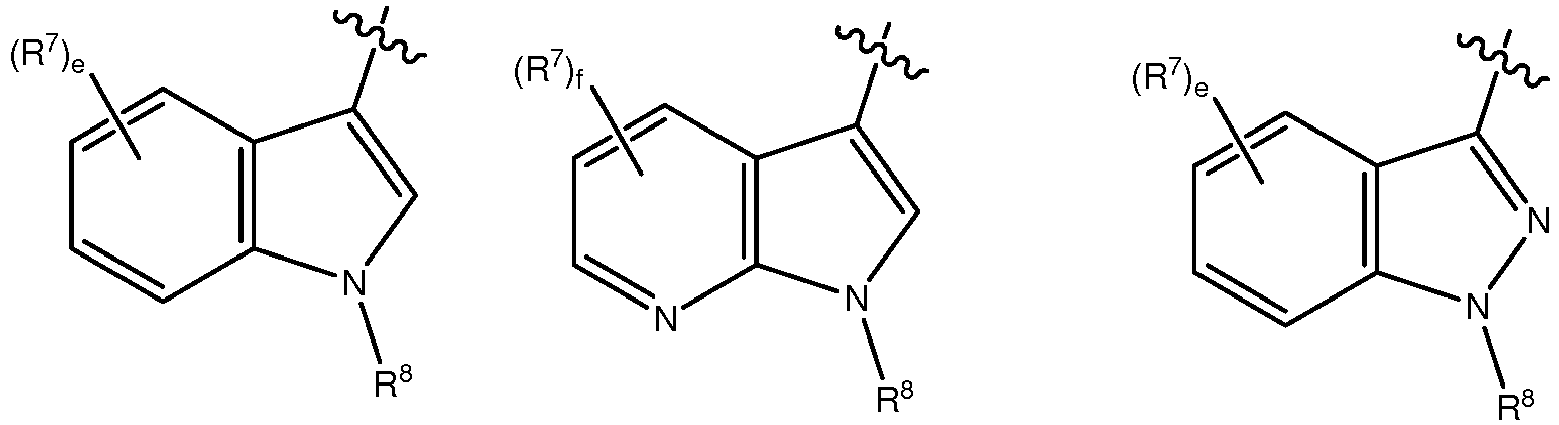
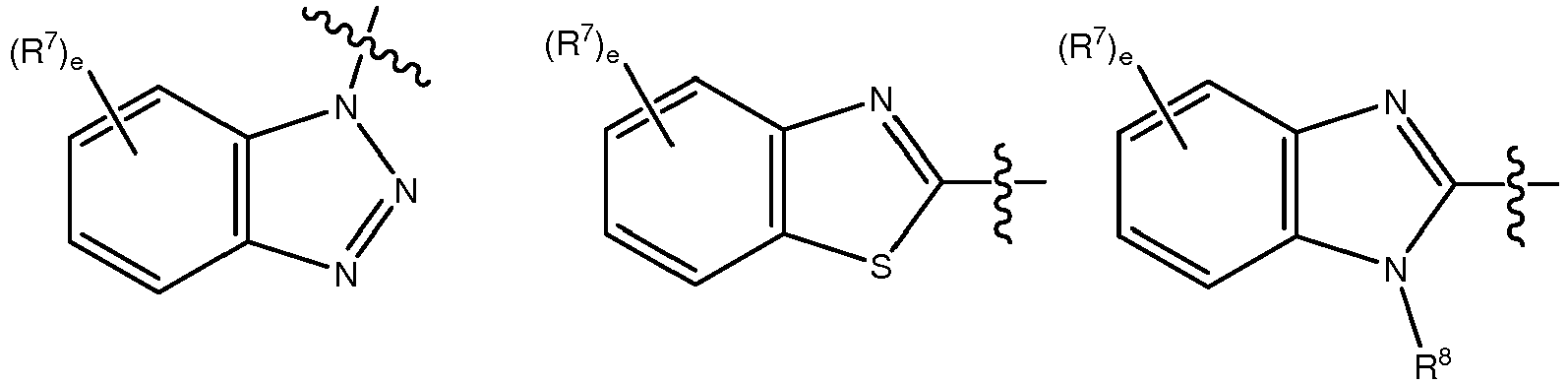

- wherein each R7 is independently selected from the group consisting of H, halogen, OH, NO2, CN, SH, NH2, CF3, OCF3, optionally substituted C1-C12alkyl, optionally substituted C1-C12haloalkyl, optionally substituted C2-C12alkenyl, optionally substituted C2-C12alkynyl, optionally substituted C2-C12heteroalkyl, optionally substituted C3-C12cycloalkyl, optionally substituted C3-C12cycloalkenyl, optionally substituted C2-C12heterocycloalkyl, optionally substituted C2-C12heterocycloalkenyl, optionally substituted C6-C18aryl, optionally substituted C1-C18heteroaryl, optionally substituted C1-C12alkyloxy, optionally substituted C2-C12alkenyloxy, optionally substituted C2-C12alkynyloxy, optionally substituted C2-C10heteroalkyloxy, optionally substituted C3-C12cycloalkyloxy, optionally substituted C3-C12cycloalkenyloxy, optionally substituted C2-C12heterocycloalkyloxy, optionally substituted C2-C12 heterocycloalkenyloxy, optionally substituted C6-C18aryloxy, optionally substituted C1-C18 heteroaryloxy, optionally substituted C1-C12alkylamino, SR9, SO3H, SO2NR9R10, SO2R9, SONR9R10, SOR9, COR9, COOH, COOR9, CONR9R10, NR9COR10, NR9COOR10, NR9SO2R10, NR9CONR9R10, NR9R10, and acyl;
- wherein R8 is selected from the group consisting of H, optionally substituted C1-C12alkyl, optionally substituted C2-C12alkenyl, optionally substituted C2-C12alkynyl, optionally substituted C2-C12heteroalkyl, optionally substituted C3-C12cycloalkyl, optionally substituted C2-C12heterocycloalkyl, optionally substituted C6-C18aryl, optionally substituted C1-C18heteroaryl, SO3H, SO2NR9R10, SO2R9, SONR9R10, SOR9, COR9, COOH, COOR9, and CONR9R10;
- wherein each R9 and R10 is independently selected from the group consisting of H, optionally substituted C1-C12alkyl, optionally substituted C2-C10heteroalkyl, optionally substituted C1-C12haloalkyl, optionally substituted C3-C12cycloalkyl, optionally substituted C6-C18aryl, and optionally substituted C1-C18heteroaryl.
- e is an integer selected from the group consisting of 0, 1, 2, 3 and 4;
- f is an integer selected from the group consisting of 0, 1, 2, and 3;
- A is -CRaRb-;
- B is a group of the formula -(CRcRd)n-;
- wherein each Ra, Rb, Rc and Rd is independently selected from the group consisting of H, halogen, OH, NO2, CN, SH, NH2, CF3, OCF3, C1-C12alkyl, C2-C10heteroalkyl, C1-C12haloalkyl, C3-C12cycloalkyl, C6-C18aryl, C1-C18heteroaryl; SR2, SO3H, SO2NR2R3, SO2R2, SONR2R3, SOR2, COR2, COOH, COOR2, CONR2R3, NR2COR3, NR2COOR3, NR2SO2R3, NR2CONR2R3, NR2R3, and acyl,
- wherein each R2 and R3 is independently selected from the group consisting of H, C1-C12alkyl, C2-C10heteroalkyl, C1-C12haloalkyl, C3-C12cycloalkyl, C6-C18aryl, and C1-C18heteroaryl;
- W1 and W2 are selected such that one is N and the other is (CR1 2),
- the bond from the carbonyl carbon is joined to whichever of W1 or W2 is N;
- D is O or (CR1 2);
- n is an integer selected from the group consisting of 0, 1, and 2;
- a is an integer selected from the group consisting of 0, 1, and 2, 3;
- b is an integer selected from the group consisting of 0, 1, 2, 3, 4, 5, 6, 7, and 8,
- c is 1;
- or a pharmaceutically acceptable salt thereof.
- As with any group of structurally related compounds which possess a particular utility, certain embodiments of variables of the compounds of the Formula (I), are particularly useful in their end use application.
- In some embodiments Ra and Rb are each independently selected from the group consisting of H, CH3, CH2CH3, CH2CH2CH3, CH(CH3)2, (CH2)3CH3, Cl, Br, F, I, OH, NO2, NH2, CN, SO3H, OCH3, OCH2CH2CH3, CF3, and OCF3. In some embodiments Ra is H. In some embodiments Rb is H. In some embodiments Ra and Rb are different such that the carbon is a chiral carbon. In some embodiments one of Ra and Rb is H and the other is an optionally substituted alkyl.
- B is a group of the formula -(CRcRd)n-. In some embodiments n is 0. In some embodiments n is 1. In some embodiments n is 2.
- In some embodiments Rc and Rd are each independently selected from the group consisting of H, CH3, CH2CH3, CH2CH2CH3, CH(CH3)2, (CH2)3CH3, Cl, Br, F, I, OH, NO2, NH2, CN, SO3H, OCH3, OCH2CH2CH3, CF3, and OCF3. In some embodiments both Rc and Rd are H such that B is CH2.
- In some embodiments any two or more Ra, Rb, Rc and Rd may join together to form a multiple bond between adjacent carbon atoms such as a double or triple bond, or a cyclic moiety connecting the carbon atoms to which they are attached.
- In some embodiments two of Ra, Rb, Rc and Rd on adjacent carbon atoms are joined to form a double bond. In some embodiments four of Ra, Rb, Rc and Rd on adjacent carbon atoms are joined to form a triple bond.
- In some embodiments one of Ra and Rb and one or Rc and Rd when taken together with the carbon atoms to which they are attached form a cyclic moiety. Examples of cyclic moieties that may be formed include cyclopropyl, cyclobutyl, cyclopentyl and cyclohexyl.
- In some embodiments n = 2 and one of Ra and Rb and one or Rc and Rd on the carbon atom two carbons removed (on the beta carbon) when taken together with the carbon atoms to which they are attached and the alpha carbon atom form a cyclic moiety. Examples of cyclic moieties that may be formed include cyclobutyl, cyclopentyl and cyclohexyl.
- In some embodiments A is CRaRb and B is CH2, this provides compounds of formula (II):

- In some embodiments D is O. In some embodiments D is (CR1 2).
- In some embodiments A is CRaRb, B is CH2 and D is O, this provides compounds of formula (IIIa):

- In some embodiments A is CRaRb, B is CH2 and D is (CR1 2), this provides compounds of formula (IIIb):

- In some embodiments A is CRaRb, B is CH2, D is O and c is 1, this provides compounds of formula (IVa):

- In some embodiments A is CRaRb, B is CH2, D is (CR1 2) and c is 1, this provides compounds of formula (IVb):

- In some embodiments W1 is N and W2 is (CR1 2). In some embodiments W1 is (CR1 2), and W2 is N.
- In some embodiments A is CRaRb, B is CH2, D is O, c is 1, W1 is N and W2 is (CR1 2). This provides compounds of formula (Va):

- In some embodiments A is CRaRb, B is CH2, D is (CR1 2), c is 1, W1 is N and W2 is (CR1 2), this provides compounds of formula (Vb).

- In some embodiments A is CRaRb, B is CH2, D is O, c is 1, W1 is (CR1 2), and W2 is N this provides compounds of formula (Vc):

- In some embodiments A is CRaRb, B is CH2, D is (CR1 2), c is 1, W1 is N and W2 is (CR1 2), this provides compounds of formula (Vd).

- The group Ar is an optionally substituted C1-C18 heteroaryl moiety. Suitable heteroaryl groups include benzimidazole, benzothiazole, indole, isoindole, 1H-indazole, and indolyl. In each instance where there is the possibility of multiple sites of substitution on the heteroaryl ring all possible attachment points are contemplated.
- Ar is selected from the group consisting of:


- In some embodiments A is CRaRb, B is CH2, D is (CR1 2), c is 1, W1 is N, W2 is (CR1 2) and Ar is a group of formula VIa, this provides compounds of formula (VIIa):

- In some embodiments A is CRaRb, B is CH2, D is (CR1 2), c is 1, W1 is N, W2 is (CR1 2) and Ar is a group of formula VIb, this provides compounds of formula (VIIb):

- In some embodiments A is CRaRb, B is CH2, D is (CR1 2), c is 1, W1 is N, W2 is (CR1 2) and Ar is a group of formula VIc, this provides compounds of formula (VIIc):

- In some embodiments A is CRaRb, B is CH2, D is (CR1 2), c is 1, W1 is N, W2 is (CR1 2) and Ar is a group of formula VId, this provides compounds of formula (VIId):

- In some embodiments A is CRaRb, B is CH2, D is (CR1 2), c is 1, W1 is N, W2 is (CR1 2) and Ar is a group of formula VIe, this provides compounds of formula (VIIe):

- In some embodiments A is CRaRb, B is CH2, D is (CR1 2), c is 1, W1 is N, W2 is (CR1 2) and Ar is a group of formula VIf, this provides compounds of formula (VIIf):

- In some embodiments A is CRaRb, B is CH2, D is (CR1 2), c is 1, W1 is N, W2 is (CR1 2) and Ar is a group of formula VIg, this provides compounds of formula (VIIg):

- As can be seen many of the compounds of the present invention contain a quinoline or isoquinoline moiety as shown below. In order to assist the reader in determining substitution patterns on these moieties the accepted ring atom numbering is shown below.

- R1 is selected from the group consisting of H, methyl, CONHC(CH3)3, OH, CO2H, CO2CH3, CO2CH2CH3, phenyl, CH2OH, CN and OCH3. In some embodiments R1 is CO2H.
- In some embodiments a is 0. In some embodiments a is 1. In some embodiments a is 2. In some embodiments a is 3.
- In some embodiments b is 0. In some embodiments b is 1. In some embodiments b is 2. In some embodiments b is 3. In some embodiments b is 4. In some embodiments b is 5. In some embodiments b is 6. In some embodiments b is 7. In some embodiments b is 8.
- In the compounds of the invention where there is a non H value for R1, the substituent may be present on any available carbon atom. In some embodiments the substituent is located at the 4 position of the isoquinoline or quinoline ring. In some embodiments the substituent is located at the 5 position of the the isoquinoline or quinoline ring.
- R1a is selected from the group consisting of H, methyl, CONHC(CH3)3, OH, CO2H, CO2CH3, CO2CH2CH3, phenyl, CH2OH, CN and OCH3.
- In some embodiments of the compounds of the invention containing an R2 group, the R2 group is selected from H and C1-C12alkyl. In some embodiments R2 is H. in some embodiments R2 is methyl.
- In some embodiments of the compounds of the invention containing an R3 group, the R3 group is selected from H and C1-C12alkyl. In some embodiments R3 is H. in some embodiments R3 is methyl.
- In some embodiments e is 1. In some embodiments e is 2. In some embodiments e is 3. In some embodiments e is 4. In circumstances where e is 1 the R7 group may be located at either the 4, 5, 6, or 7 position on the six membered ring. In some embodiments where e is 1 the R7 substituent is located at the 4 position on the ring. In some embodiments where e is 1 the R7 substituent is located at the 5 position on the ring. In some embodiments where e is 1 the R7 substituent is located at the 6 position on the ring. In some embodiments where e is 1 the R7 substituent is located at the 7 position on the ring.
- In some embodiments f is 1. In some embodiments f is 2. In some embodiments fi is 3. In some embodiments where f is 1 the R7 substituent is located at the 4 position on the ring. In some embodiments where f is 1 the R7 substituent is located at the 5 position on the ring. In some embodiments where f is 1 the R7 substituent is located at the 6 position on the ring. In some embodiments where f is 1 the R7 substituent is located at the 7 position on the ring.
- R7 may be selected from a wide range of possible substituents as discussed above. In some embodiments each R7 is independently selected from the group consisting of H, halogen, OH, NO2, CN, optionally substituted C1-C12alkyl, optionally substituted C3-C12cycloalkyl, optionally substituted C1-C12haloalkyl, optionally substituted C6-C18aryl, optionally substituted C1-C18heteroaryl, optionally substituted C2-C12heterocycloalkyloxy, C1-C12alkoxyl, and C1-C12haloalkoxyl.
- Exemplary R7 substituents include CH3, CH2CH3, CH2CH2CH3, CH(CH3)2, (CH2)3CH3, cyclopropyl, isopropoxy, I, Br, F, Cl, OH, NO2, NH2, CN, SO3H, OCH3, OCH2CH2CH3, CF3, OCF3, thiophen-2-yl, 5-fluoro-thiophen-2-yl, furan-2-yl, 5-methylfuran-2-yl, pyridine-2-yl, 3-fluoropyridine-2-yl, 3-methyl-isoxazol-5-yl, 3-fluoro-phenyl, 4-fluoro-phenyl, 1-methyl pyroll-2-yl, 5-fluoro-furan-2-yl, 5-cyano-furan-2-yl, and 5-carboxy-furan-2-yl.
- R8 may be selected from a wide range of possible substituents as discussed above. In some embodiments each R8 is independently selected from the group consisting of H, C1-C12alkyl, C1-C12haloalkyl, C1-C12alkoxyl, and C1-C12haloalkoxyl. Exemplary R8 substituents include CH3, CH2CH3, CH2CH2CH3, CH(CH3)2, (CH2)3CH3, SO3H, OCH3, OCH2CH2CH3, CF3, and OCF3.
- Many if not all of the variables discussed above may be optionally substituted. If the variable is optionally substituted then in some embodiments each optional substituent is independently selected from the group consisting of halogen, =O, =S, -CN, -NO2, -CF3, -OCF3, alkyl, alkenyl, alkynyl, haloalkyl, haloalkenyl, haloalkynyl, heteroalkyl, cycloalkyl, cycloalkenyl, heterocycloalkyl, heterocycloalkenyl, aryl, heteroaryl, cycloalkylalkyl, heterocycloalkylalkyl, heteroarylalkyl, arylalkyl, cycloalkylalkenyl, heterocycloalkylalkenyl, arylalkenyl, heteroarylalkenyl, cycloalkylheteroalkyl, heterocycloalkylheteroalkyl, arylheteroalkyl, heteroarylheteroalkyl, hydroxy, hydroxyalkyl, alkyloxy, alkyloxyalkyl, alkyloxycycloalkyl, alkyloxyheterocycloalkyl, alkyloxyaryl, alkyloxyheteroaryl, alkyloxycarbonyl, alkylaminocarbonyl, alkenyloxy, alkynyloxy, cycloalkyloxy, cycloalkenyloxy, heterocycloalkyloxy, heterocycloalkenyloxy, aryloxy, phenoxy, benzyloxy, heteroaryloxy, arylalkyloxy, amino, alkylamino, acylamino, aminoalkyl, arylamino, sulfonylamino, sulfinylamino, sulfonyl, alkylsulfonyl, arylsulfonyl, aminosulfonyl, sulfinyl, alkylsulfinyl, arylsulfinyl, aminosulfinylaminoalkyl, -C(=O)OH, -C(=O)Re, -C(=O)ORe, C(=O)NReRf, C(=NOH)Re, C(=NRe)NRfRg, NReRf, NReC(=O)Rf, NReC(=O)ORf, NReC(=O)NRfRg, NReC(=NRf)NRgRh, NReSO2Rf, -SRe, SO2NReRf, -ORe, OC(=O)NReRf, OC(=O)Re and acyl,
wherein Re, Rf, Rg and Rh are each independently selected from the group consisting of H, C1-C12alkyl, C1-C12haloalkyl, C2-C12alkenyl, C2-C12alkynyl, C1-C10 heteroalkyl, C3-C12cycloalkyl, C3-C12cycloalkenyl, C1-C12heterocycloalkyl, C1-C12 heterocycloalkenyl, C6-C18aryl, C1-C18heteroaryl, and acyl, or any two or more of Ra, Rb, Rc and Rd, when taken together with the atoms to which they are attached form a heterocyclic ring system with 3 to 12 ring atoms. - In some embodiments each optional substituent is independently selected from the group consisting of: F, Cl, Br, =O, =S, -CN, -NO2, alkyl, alkenyl, heteroalkyl, haloalkyl, alkynyl, aryl, cycloalkyl, heterocycloalkyl, heteroaryl, hydroxy, hydroxyalkyl, alkoxy, alkylamino, aminoalkyl, acylamino, phenoxy, alkoxyalkyl, benzyloxy, alkylsulfonyl, arylsulfonyl, aminosulfonyl, -C(O)ORa, COOH, SH, and acyl.
- In some embodiments each optional substituent is independently selected from the group consisting of: F, Br, Cl, =O, =S, -CN methyl, trifluoro-methyl, ethyl, 2,2,2-trifluoroethyl, isopropyl, propyl, 2-ethyl-propyl, 3,3-dimethyl-propyl, butyl, isobutyl, 3,3-dimethyl-butyl, 2-ethyl-butyl, pentyl, 2-methyl-pentyl, pent-4-enyl, hexyl, heptyl, octyl, phenyl, NH2, -NO2, phenoxy, hydroxy, methoxy, trifluoro-methoxy, ethoxy, and methylenedioxy.
- Alternatively, two optional substituents on the same moiety when taken together may be joined to form a fused cyclic substituent attached to the moiety that is optionally substituted. Accordingly the term optionally substituted includes a fused ring such as a cycloalkyl ring, a heterocycloalkyl ring, an aryl ring or a heteroaryl ring.
- In addition to compounds of formula I, the embodiments disclosed are also directed to pharmaceutically acceptable salts thereof.
- The invention also relates to pharmaceutical compositions including a compound of the invention and a pharmaceutically acceptable carrier, diluent or excipient.
- The invention may provide for the use of a compound of the invention as a medicament. A compound of the invention may be used for the treatment of a condition in a mammal. In one embodiment the condition is a condition that can be treated by inhibition of 11β-HSD1.
- In yet an even further aspect the invention provides a compound of the invention for use in the treatment of a condition in a mammal. In one embodiment the condition is a condition that can be treated by inhibition of 11β-HSD1.
- In some embodiments the condition is selected from the group consisting of is selected from the group consisting of diabetes, hyperglycemia, low glucose tolerance, hyperinsulinemia, hyperlipidemia, hypertriglyceridemia, hypercholesterolemia, dyslipidemia, obesity, abdominal obesity, glaucoma, hypertension, atherosclerosis and its sequelae, retinopathy and other ocular disorders, nephropathy, neuropathy, myopathy, osteoporosis, osteoarthritis, dementia, depression, neurodegenerative disease, psychiatric disorders, Polycystic ovaries syndrome, infertility, Cushing's Disease, Cushing's syndrome, viral diseases, and inflammatory diseases.
- In some embodiments the condition is diabetes. In some embodiments the condition is type II diabetes.
- In some embodiments the compound is administered in combination with an adjuvant. In some embodiments the adjuvant is selected from the group consisting of dipeptidyl peptidase-IV (DP-IV) inhibitors; (b) insulin sensitizing agents; (c) insulin and insulin mimetics; (d) sulfonylureas and other insulin secretagogues; (e) alpha.-glucosidase inhibitors; (f) GLP-1, GLP-1 analogs, and GLP-1 receptor agonists; and combinations thereof.
- In one other embodiment the compound is administered as a substitute for monotherapy or combination therapy, in an event of failure of treatment by agent selected from the group consisting of dipeptidyl peptidase-IV (DP-IV) inhibitors; (b) insulin sensitizing agents; (c) insulin and insulin mimetics; (d) sulfonylureas and other insulin secretagogues; (e) alpha.-glucosidase inhibitors; (f) GLP-1, GLP-1 analogs, and GLP-1 receptor agonists; and combinations thereof.
- In one embodiment the insulin sensitizing agent is selected from the group consisting of (i) PPAR-gamma-agonists, (ii) PPAR-alpha-agonists, (iii) PPAR-alpha/gamma-dual agonists, (iv) biguanides, and combinations thereof.
- These and other teachings of the invention are set forth herein.
- In this specification a number of terms are used which are well known to a skilled addressee. Nevertheless for the purposes of clarity a number of terms will be defined.
- As used herein, the term "unsubstituted" means that there is no substituent or that the only substituents are hydrogen.
- The term "optionally substituted" as used throughout the specification denotes that the group may or may not be further substituted or fused (so as to form a condensed polycyclic system), with one or more non-hydrogen substituent groups. In certain embodiments the substituent groups are one or more groups independently selected from the group consisting of halogen, =O, =S, -CN, -NO2, -CF3, -OCF3, alkyl, alkenyl, alkynyl, haloalkyl, haloalkenyl, haloalkynyl, heteroalkyl, cycloalkyl, cycloalkenyl, heterocycloalkyl, heterocycloalkenyl, aryl, heteroaryl, cycloalkylalkyl, heterocycloalkylalkyl, heteroarylalkyl, arylalkyl, cycloalkylalkenyl, heterocycloalkylalkenyl, arylalkenyl, heteroarylalkenyl, cycloalkylheteroalkyl, heterocycloalkylheteroalkyl, arylheteroalkyl, heteroarylheteroalkyl, hydroxy, hydroxyalkyl, alkyloxy, alkyloxyalkyl, alkyloxycycloalkyl, alkyloxyheterocycloalkyl, alkyloxyaryl, alkyloxyheteroaryl, alkyloxycarbonyl, alkylaminocarbonyl, alkenyloxy, alkynyloxy, cycloalkyloxy, cycloalkenyloxy, heterocycloalkyloxy, heterocycloalkenyloxy, aryloxy, phenoxy, benzyloxy, heteroaryloxy, arylalkyloxy, amino, alkylamino, acylamino, aminoalkyl, arylamino, sulfonylamino, sulfinylamino, sulfonyl, alkylsulfonyl, arylsulfonyl, aminosulfonyl, sulfinyl, alkylsulfinyl, arylsulfinyl, aminosulfinylaminoalkyl, -C(=O)OH, -C(=O)Re, -C(=O)ORe, C(=O)NReRf, C(=NOH)Re, C(=NRe)NRfRg, NReRf, NReC(=O)Rf, NReC(=O)ORf, NReC(=O)NRfRg, NReC(=NRf)NRgRh, NReSO2Rf, -SRe, SO2NReRf, -ORe, OC(=O)NReRf, OC(=O)Re and acyl,
wherein Re, Rf, Rg and Rh are each independently selected from the group consisting of H, C1-C12alkyl, C1-C12haloalkyl, C2-C12alkenyl, C2-C12alkynyl, C1-C10heteroalkyl, C3-C12cycloalkyl, C3-C12cycloalkenyl, C1-C12heterocycloalkyl, C1-C12heterocycloalkenyl, C6-C18aryl, C1-C18heteroaryl, and acyl, or any two or more of Ra, Rb, Rc and Rd, when taken together with the atoms to which they are attached form a heterocyclic ring system with 3 to 12 ring atoms. - In some embodiments each optional substituent is independently selected from the group consisting of: halogen, =O, =S, -CN, -NO2, -CF3, -OCF3, alkyl, alkenyl, alkynyl, haloalkyl, haloalkenyl, haloalkynyl, heteroalkyl, cycloalkyl, cycloalkenyl, heterocycloalkyl, heterocycloalkenyl, aryl, heteroaryl, hydroxy, hydroxyalkyl, alkyloxy, alkyloxyalkyl, alkyloxyaryl, alkyloxyheteroaryl, alkenyloxy, alkynyloxy, cycloalkyloxy, cycloalkenyloxy, heterocycloalkyloxy, heterocycloalkenyloxy, aryloxy, heteroaryloxy, arylalkyl, heteroarylalkyl, arylalkyloxy, amino, alkylamino, acylamino, aminoalkyl, arylamino, sulfonyl, alkylsulfonyl, arylsulfonyl, aminosulfonyl, aminoalkyl, -COOH, -SH, and acyl.
- Examples of particularly suitable optional substituents include F, Cl, Br, I, CH3, CH2CH3, OH, OCH3, CF3, OCF3, NO2, NH2, and CN.
- In the definitions of a number of substituents below it is stated that "the group may be a terminal group or a bridging group". This is intended to signify that the use of the term is intended to encompass the situation where the group is a linker between two other portions of the molecule as well as where it is a terminal moiety. Using the term alkyl as an example, some publications would use the term "alkylene" for a bridging group and hence in these other publications there is a distinction between the terms "alkyl" (terminal group) and "alkylene" (bridging group). In the present application no such distinction is made and most groups may be either a bridging group or a terminal group.
- "Acyl" means an R-C(=O)- group in which the R group may be an alkyl, cycloalkyl, heterocycloalkyl, aryl or heteroaryl group as defined herein. Examples of acyl include acetyl and benzoyl. The group may be a terminal group or a bridging group. If the group is a terminal group it is bonded to the remainder of the molecule through the carbonyl carbon.
- "Acylamino" means an R-C(=O)-NH- group in which the R group may be an alkyl, cycloalkyl, heterocycloalkyl, aryl or heteroaryl group as defined herein. The group may be a terminal group or a bridging group. If the group is a terminal group it is bonded to the remainder of the molecule through the nitrogen atom.
- "Alkenyl" as a group or part of a group denotes an aliphatic hydrocarbon group containing at least one carbon-carbon double bond and which may be straight or branched preferably having 2-12 carbon atoms, more preferably 2-10 carbon atoms, most preferably 2-6 carbon atoms, in the normal chain. The group may contain a plurality of double bonds in the normal chain and the orientation about each is independently E or Z. The alkenyl group is preferably a 1-alkenyl group. Exemplary alkenyl groups include, but are not limited to, ethenyl, propenyl, butenyl, pentenyl, hexenyl, heptenyl, octenyl and nonenyl. The group may be a terminal group or a bridging group.
- "Alkenyloxy" refers to an alkenyl-O- group in which alkenyl is as defined herein. Preferred alkenyloxy groups are C1-C6alkenyloxy groups. The group may be a terminal group or a bridging group. If the group is a terminal group it is bonded to the remainder of the molecule through the oxygen atom.
- "Alkyl" as a group or part of a group refers to a straight or branched aliphatic hydrocarbon group, preferably a C1-C12alkyl, more preferably a C1-C10alkyl, most preferably C1-C6 unless otherwise noted. Examples of suitable straight and branched C1-C6alkyl substituents include methyl, ethyl, n-propyl, 2-propyl, n-butyl, sec-butyl, t-butyl, hexyl, and the like. The group may be a terminal group or a bridging group.
- "Alkylamino" includes both mono-alkylamino and dialkylamino, unless specified. "Mono-alkylamino" means an Alkyl-NH- group, in which alkyl is as defined herein. "Dialkylamino" means a (alkyl)2N- group, in which each alkyl may be the same or different and are each as defined herein for alkyl. The alkyl group is preferably a C1-C6alkyl group. The group may be a terminal group or a bridging group. If the group is a terminal group it is bonded to the remainder of the molecule through the nitrogen atom.
- "Alkylaminocarbonyl" refers to a group of the formula (Alkyl)x(H)yNC(=O)- in which alkyl is as defined herein, x is 1 or 2, and the sum of X+Y =2. The group may be a terminal group or a bridging group. If the group is a terminal group it is bonded to the remainder of the molecule through the carbonyl carbon.
- "Alkyloxy" refers to an alkyl-O- group in which alkyl is as defined herein. Preferably the alkyloxy is a C1-C6alkyloxy. Examples include, but are not limited to, methoxy and ethoxy. The group may be a terminal group or a bridging group.
- "Alkyloxyalkyl" refers to an alkyloxy-alkyl- group in which the alkyloxy and alkyl moieties are as defined herein. The group may be a terminal group or a bridging group. If the group is a terminal group it is bonded to the remainder of the molecule through the alkyl group.
- "Alkyloxyaryl" refers to an alkyloxy-aryl- group in which the alkyloxy and aryl moieties are as defined herein. The group may be a terminal group or a bridging group. If the group is a terminal group it is bonded to the remainder of the molecule through the aryl group.
- "Alkyloxycarbonyl" refers to an alkyl-O-C(=O)- group in which alkyl is as defined herein. The alkyl group is preferably a C1-C6 alkyl group. Examples include, but are not limited to, methoxycarbonyl and ethoxycarbonyl. The group may be a terminal group or a bridging group. If the group is a terminal group it is bonded to the remainder of the molecule through the carbonyl carbon.
- "Alkyloxycycloalkyl" refers to an alkyloxy-cycloalkyl- group in which the alkyloxy and cycloalkyl moieties are as defined herein. The group may be a terminal group or a bridging group. If the group is a terminal group it is bonded to the remainder of the molecule through the cycloalkyl group.
- "Alkyloxyheteroaryl" refers to an alkyloxy-heteroaryl- group in which the alkyloxy and heteroaryl moieties are as defined herein. The group may be a terminal group or a bridging group. If the group is a terminal group it is bonded to the remainder of the molecule through the heteroaryl group.
- "Alkyloxyheterocycloalkyl" refers to an alkyloxy-heterocycloalkyl- group in which the alkyloxy and heterocycloalkyl moieties are as defined herein. The group may be a terminal group or a bridging group. If the group is a terminal group it is bonded to the remainder of the molecule through the heterocycloalkyl group.
- "Alkylsulfinyl" means an alkyl-S-(=O)- group in which alkyl is as defined herein. The alkyl group is preferably a C1-C6 alkyl group. Exemplary alkylsulfinyl groups include, but not limited to, methylsulfinyl and ethylsulfinyl. The group may be a terminal group or a bridging group. If the group is a terminal group it is bonded to the remainder of the molecule through the sulfur atom.
- "Alkylsulfonyl" refers to an alkyl-S(=O)2- group in which alkyl is as defined above. The alkyl group is preferably a C1-C6alkyl group. Examples include, but not limited to methylsulfonyl and ethylsulfonyl. The group may be a terminal group or a bridging group. If the group is a terminal group it is bonded to the remainder of the molecule through the sulfur atom.
- "Alkynyl" as a group or part of a group means an aliphatic hydrocarbon group containing a carbon-carbon triple bond and which may be straight or branched preferably having from 2-12 carbon atoms, more preferably 2-10 carbon atoms, more preferably 2-6 carbon atoms in the normal chain. Exemplary structures include, but are not limited to, ethynyl and propynyl. The group may be a terminal group or a bridging group.
- "Alkynyloxy" refers to an alkynyl-O- group in which alkynyl is as defined herein. Preferred alkynyloxy groups are C1-C6alkynyloxy groups. The group may be a terminal group or a bridging group. If the group is a terminal group it is bonded to the remainder of the molecule through the oxygen atom.
- "Aminoalkyl" means an NH2-alkyl- group in which the alkyl group is as defined herein. The group may be a terminal group or a bridging group. If the group is a terminal group it is bonded to the remainder of the molecule through the alkyl group.
- "Aminosulfonyl" means an NH2-S(=O)2- group. The group may be a terminal group or a bridging group. If the group is a terminal group it is bonded to the remainder of the molecule through the sulfur atom.
- "Aryl" as a group or part of a group denotes (i) an optionally substituted monocyclic, or fused polycyclic, aromatic carbocycle (ring structure having ring atoms that are all carbon) preferably having from 5 to 12 atoms per ring. Examples of aryl groups include phenyl, naphthyl, and the like; (ii) an optionally substituted partially saturated bicyclic aromatic carbocyclic moiety in which a phenyl and a C5-7 cycloalkyl or C5-7 cycloalkenyl group are fused together to form a cyclic structure, such as tetrahydronaphthyl, indenyl or indanyl. The group may be a terminal group or a bridging group. Typically an aryl group is a C6-C18 aryl group.
- "Arylalkenyl" means an aryl-alkenyl- group in which the aryl and alkenyl are as defined herein. Exemplary arylalkenyl groups include phenylallyl. The group may be a terminal group or a bridging group. If the group is a terminal group it is bonded to the remainder of the molecule through the alkenyl group.
- "Arylalkyl" means an aryl-alkyl- group in which the aryl and alkyl moieties are as defined herein. Preferred arylalkyl groups contain a C1-5alkyl moiety. Exemplary arylalkyl groups include benzyl, phenethyl, 1-naphthalenemethyl and 2-naphthalenemethyl. The group may be a terminal group or a bridging group. If the group is a terminal group it is bonded to the remainder of the molecule through the alkyl group.
- "Arylalkyloxy" refers to an aryl-alkyl-O- group in which the alkyl and aryl are as defined herein. The group may be a terminal group or a bridging group. If the group is a terminal group it is bonded to the remainder of the molecule through the oxygen atom.
- "Arylamino" includes both mono-arylamino and di-arylamino unless specified. Mono-arylamino means a group of formula arylNH-, in which aryl is as defined herein. Di-arylamino means a group of formula (aryl)2N- where each aryl may be the same or different and are each as defined herein for aryl. The group may be a terminal group or a bridging group. If the group is a terminal group it is bonded to the remainder of the molecule through the nitrogen atom.
- "Arylheteroalkyl" means an aryl-heteroalkyl- group in which the aryl and heteroalkyl moieties are as defined herein. The group may be a terminal group or a bridging group. If the group is a terminal group it is bonded to the remainder of the molecule through the heteroalkyl group.
- "Aryloxy" refers to an aryl-O- group in which the aryl is as defined herein. Preferably the aryloxy is a C6-C18aryloxy, more preferably a C6-C10aryloxy. The group may be a terminal group or a bridging group. If the group is a terminal group it is bonded to the remainder of the molecule through the oxygen atom.
- "Arylsulfonyl" means an aryl-S(=O)2- group in which the aryl group is as defined herein. The group may be a terminal group or a bridging group. If the group is a terminal group it is bonded to the remainder of the molecule through the sulfur atom.
- A "bond" is a linkage between atoms in a compound or molecule. The bond may be a single bond, a double bond, or a triple bond.
- "Cycloalkenyl" means a non-aromatic monocyclic or multicyclic ring system containing at least one carbon-carbon double bond and preferably having from 5-10 carbon atoms per ring. Exemplary monocyclic cycloalkenyl rings include cyclopentenyl, cyclohexenyl or cycloheptenyl. The cycloalkenyl group may be substituted by one or more substituent groups. A cycloalkenyl group typically is a C3-C12 alkenyl group. The group may be a terminal group or a bridging group.
- "Cycloalkyl" refers to a saturated monocyclic or fused or spiro polycyclic, carbocycle preferably containing from 3 to 9 carbons per ring, such as cyclopropyl, cyclobutyl, cyclopentyl, cyclohexyl and the like, unless otherwise specified. It includes monocyclic systems such as cyclopropyl and cyclohexyl, bicyclic systems such as decalin, and polycyclic systems such as adamantane. A cycloalkyl group typically is a C3-C12 alkyl group. The group may be a terminal group or a bridging group.
- "Cycloalkylalkyl" means a cycloalkyl-alkyl- group in which the cycloalkyl and alkyl moieties are as defined herein. Exemplary monocycloalkylalkyl groups include cyclopropylmethyl, cyclopentylmethyl, cyclohexylmethyl and cycloheptylmethyl. The group may be a terminal group or a bridging group. If the group is a terminal group it is bonded to the remainder of the molecule through the alkyl group.
- "Cycloalkylalkenyl" means a cycloalkyl-alkenyl- group in which the cycloalkyl and alkenyl moieties are as defined herein. The group may be a terminal group or a bridging group. If the group is a terminal group it is bonded to the remainder of the molecule through the alkenyl group.
- "Cycloalkylheteroalkyl" means a cycloalkyl-heteroalkyl- group in which the cycloalkyl and heteroalkyl moieties are as defined herein. The group may be a terminal group or a bridging group. If the group is a terminal group it is bonded to the remainder of the molecule through the heteroalkyl group.
- "Cycloalkyloxy" refers to a cycloalkyl-O- group in which cycloalkyl is as defined herein. Preferably the cycloalkyloxy is a C1-C6cycloalkyloxy. Examples include, but are not limited to, cyclopropanoxy and cyclobutanoxy. The group may be a terminal group or a bridging group. If the group is a terminal group it is bonded to the remainder of the molecule through the oxygen atom.
- "Cycloalkenyloxy" refers to a cycloalkenyl-O- group in which the cycloalkenyl is as defined herein. Preferably the cycloalkenyloxy is a C1-C6cycloalkenyloxy. The group may be a terminal group or a bridging group. If the group is a terminal group it is bonded to the remainder of the molecule through the oxygen atom.
- Failure of treatment can be defined as condition in which a non-fasting blood glucose level of less than 200 mg/dl and a blood glucose level during fasting (deprived of food for at least 8 hr) of less than 126 mg/dl are retained after administration of the agent in its recommended dose.
- "Haloalkyl" refers to an alkyl group as defined herein in which one or more of the hydrogen atoms has been replaced with a halogen atom selected from the group consisting of fluorine, chlorine, bromine and iodine. A haloalkyl group typically has the formula CnH(2n+1-m)Xm wherein each X is independently selected from the group consisting of F, Cl, Br and I. In groups of this type n is typically from 1 to 10, more preferably from 1 to 6, most preferably 1 to 3. m is typically 1 to 6, more preferably 1 to 3. Examples of haloalkyl include fluoromethyl, difluoromethyl and trifluoromethyl.
- "Haloalkenyl" refers to an alkenyl group as defined herein in which one or more of the hydrogen atoms has been replaced with a halogen atom independently selected from the group consisting of F, Cl, Br and I.
- "Haloalkynyl" refers to an alkynyl group as defined herein in which one or more of the hydrogen atoms has been replaced with a halogen atom independently selected from the group consisting of F, Cl, Br and I.
- "Halogen" represents chlorine, fluorine, bromine or iodine.
- "Heteroalkyl" refers to a straight- or branched-chain alkyl group preferably having from 2 to 12 carbons, more preferably 2 to 6 carbons in the chain, in which one or more of the carbon atoms (and any associated hydrogen atoms) are each independently replaced by a heteroatomic group selected from S, O, P and NR' where R' is selected from the group consisting of H, optionally substituted C1-C12alkyl, optionally substituted C3-C12cycloalkyl, optionally substituted C6-C18aryl, and optionally substituted C1-C18heteroaryl. Exemplary heteroalkyls include alkyl ethers, secondary and tertiary alkyl amines, amides, alkyl sulfides, and the like. Examples of heteroalkyl also include hydroxyC1-C6alkyl, C1-C6alkyloxyC1-C6alkyl, aminoC1-C6alkyl, C1-C6alkylaminoC1-C6alkyl, and di(C1-C6alkyl)aminoC1-C6alkyl. The group may be a terminal group or a bridging group.
- "Heteroalkyloxy" refers to a heteroalkyl-O- group in which heteroalkyl is as defined herein. Preferably the heteroalkyloxy is a C2-C6heteroalkyloxy. The group may be a terminal group or a bridging group.
- "Heteroaryl" either alone or part of a group refers to groups containing an aromatic ring (preferably a 5 or 6 membered aromatic ring) having one or more heteroatoms as ring atoms in the aromatic ring with the remainder of the ring atoms being carbon atoms. Suitable heteroatoms include nitrogen, oxygen and sulphur. Examples of heteroaryl include thiophene, benzothiophene, benzofuran, benzimidazole, benzoxazole, benzothiazole, benzisothiazole, naphtho[2,3-b]thiophene, furan, isoindolizine, xantholene, phenoxatine, pyrrole, imidazole, pyrazole, pyridine, pyrazine, pyrimidine, pyridazine, tetrazole, indole, isoindole, 1H-indazole, purine, quinoline, isoquinoline, phthalazine, naphthyridine, quinoxaline, cinnoline, carbazole, phenanthridine, acridine, phenazine, thiazole, isothiazole, phenothiazine, oxazole, isooxazole, furazane, phenoxazine, 2-, 3- or 4- pyridyl, 2-, 3-, 4-, 5-, or 8- quinolyl, 1-, 3-, 4-, or 5- isoquinolinyl 1-, 2-, or 3- indolyl, and 2-, or 3-thienyl. A heteroaryl group is typically a C1-C18 heteroaryl group. The group may be a terminal group or a bridging group.
- "Heteroarylalkyl" means a heteroaryl-alkyl group in which the heteroaryl and alkyl moieties are as defined herein. Preferred heteroarylalkyl groups contain a lower alkyl moiety. Exemplary heteroarylalkyl groups include pyridylmethyl. The group may be a terminal group or a bridging group. If the group is a terminal group it is bonded to the remainder of the molecule through the alkyl group.
- "Heteroarylalkenyl" means a heteroaryl-alkenyl- group in which the heteroaryl and alkenyl moieties are as defined herein. The group may be a terminal group or a bridging group. If the group is a terminal group it is bonded to the remainder of the molecule through the alkenyl group.
- "Heteroarylheteroalkyl" means a heteroaryl-heteroalkyl- group in which the heteroaryl and heteroalkyl moieties are as defined herein. The group may be a terminal group or a bridging group. If the group is a terminal group it is bonded to the remainder of the molecule through the heteroalkyl group.
- "Heteroaryloxy" refers to a heteroaryl-O- group in which the heteroaryl is as defined herein. Preferably the heteroaryloxy is a C1-C18heteroaryloxy. The group may be a terminal group or a bridging group. If the group is a terminal group it is bonded to the remainder of the molecule through the oxygen atom.
- "Heterocyclic" refers to saturated, partially unsaturated or fully unsaturated monocyclic, bicyclic or polycyclic ring system containing at least one heteroatom selected from the group consisting of nitrogen, sulfur and oxygen as a ring atom. Examples of heterocyclic moieties include heterocycloalkyl, heterocycloalkenyl and heteroaryl.
- "Heterocycloalkenyl" refers to a heterocycloalkyl group as defined herein but containing at least one double bond. A heterocycloalkenyl group typically is a C2-C12 heterocycloalkenyl group. The group may be a terminal group or a bridging group.
- "Heterocycloalkyl" refers to a saturated monocyclic, bicyclic, or polycyclic ring containing at least one heteroatom selected from nitrogen, sulfur, oxygen, preferably from 1 to 3 heteroatoms in at least one ring. Each ring is preferably from 3 to 10 membered, more preferably 4 to 7 membered. Examples of suitable heterocycloalkyl substituents include pyrrolidyl, tetrahydrofuryl, tetrahydrothiofuranyl, piperidyl, piperazyl, tetrahydropyranyl, morphilino, 1,3-diazapane, 1,4-diazapane, 1,4-oxazepane, and 1,4-oxathiapane. A heterocycloalkyl group typically is a C2-C12heterocycloalkyl group. The group may be a terminal group or a bridging group.
- "Heterocycloalkylalkyl" refers to a heterocycloalkyl-alkyl- group in which the heterocycloalkyl and alkyl moieties are as defined herein. Exemplary heterocycloalkylalkyl groups include (2-tetrahydrofuryl)methyl, (2-tetrahydrothiofuranyl) methyl. The group may be a terminal group or a bridging group. If the group is a terminal group it is bonded to the remainder of the molecule through the alkyl group.
- "Heterocycloalkylalkenyl" refers to a heterocycloalkyl-alkenyl- group in which the heterocycloalkyl and alkenyl moieties are as defined herein. The group may be a terminal group or a bridging group. If the group is a terminal group it is bonded to the remainder of the molecule through the alkenyl group.
- "Heterocycloalkylheteroalkyl" means a heterocycloalkyl-heteroalkyl- group in which the heterocycloalkyl and heteroalkyl moieties are as defined herein. The group may be a terminal group or a bridging group. If the group is a terminal group it is bonded to the remainder of the molecule through the heteroalkyl group.
- "Heterocycloalkyloxy" refers to a heterocycloalkyl-O- group in which the heterocycloalkyl is as defined herein. Preferably the heterocycloalkyloxy is a C1-C6heterocycloalkyloxy. The group may be a terminal group or a bridging group. If the group is a terminal group it is bonded to the remainder of the molecule through the oxygen atom.
- "Heterocycloalkenyloxy" refers to a heterocycloalkenyl-O- group in which heterocycloalkenyl is as defined herein. Preferably the Heterocycloalkenyloxy is a C1-C6 Heterocycloalkenyloxy. The group may be a terminal group or a bridging group. If the group is a terminal group it is bonded to the remainder of the molecule through the oxygen atom.
- "Hydroxyalkyl" refers to an alkyl group as defined herein in which one or more of the hydrogen atoms has been replaced with an OH group. A hydroxyalkyl group typically has the formula CnH(2n+1-x)(OH)x. In groups of this type n is typically from 1 to 10, more preferably from 1 to 6, most preferably 1 to 3. x is typically 1 to 6, more preferably 1 to 3.
- "Sulfinyl" means an R-S(=O)- group in which the R group may be OH, alkyl, cycloalkyl, heterocycloalkyl; aryl or heteroaryl group as defined herein. The group may be a terminal group or a bridging group. If the group is a terminal group it is bonded to the remainder of the molecule through the sulfur atom.
- "Sulfinylamino" means an R-S(=O)-NH- group in which the R group may be OH, alkyl, cycloalkyl, heterocycloalkyl; aryl or heteroaryl group as defined herein. The group may be a terminal group or a bridging group. If the group is a terminal group it is bonded to the remainder of the molecule through the nitrogen atom.
- "Sulfonyl" means an R-S(=O)2- group in which the R group may be OH, alkyl, cycloalkyl, heterocycloalkyl; aryl or heteroaryl group as defined herein. The group may be a terminal group or a bridging group. If the group is a terminal group it is bonded to the remainder of the molecule through the sulfur atom.
- "Sulfonylamino" means an R-S(=O)2-NH- group. The group may be a terminal group or a bridging group. If the group is a terminal group it is bonded to the remainder of the molecule through the nitrogen atom.
- It is understood that included in the family of compounds of Formula (I) are isomeric forms including diastereoisomers, enantiomers, tautomers, and geometrical isomers in "E" or "Z" configurational isomer or a mixture of E and Z isomers. It is also understood that some isomeric forms such as diastereomers, enantiomers, and geometrical isomers can be separated by physical and/or chemical methods and by those skilled in the art. For those compounds where there is the possibility of geometric isomerism the applicant has drawn the isomer that the compound is thought to be although it will be appreciated that the other isomer may be the correct structural assignment.
- Some of the compounds of the disclosed embodiments may exist as single stereoisomers, racemates, and/or mixtures of enantiomers and /or diastereomers. All such single stereoisomers, racemates and mixtures thereof, are intended to be within the scope of the subject matter described and claimed.
- Additionally, Formula (I) is intended to cover, where applicable, solvated as well as unsolvated forms of the compounds. Thus, each formula includes compounds having the indicated structure, including the hydrated as well as the non-hydrated forms.
- The term "pharmaceutically acceptable salts" refers to salts that retain the desired biological activity of the above-identified compounds, and include pharmaceutically acceptable acid addition salts and base addition salts. Suitable pharmaceutically acceptable acid addition salts of compounds of Formula (I) may be prepared from an inorganic acid or from an organic acid. Examples of such inorganic acids are hydrochloric, sulfuric, and phosphoric acid. Appropriate organic acids may be selected from aliphatic, cycloaliphatic, aromatic, heterocyclic carboxylic and sulfonic classes of organic acids, examples of which are formic, acetic, propanoic, succinic, glycolic, gluconic, lactic, malic, tartaric, citric, fumaric, maleic, alkyl sulfonic, arylsulfonic. Additional information on pharmaceutically acceptable salts can be found in Remington's Pharmaceutical Sciences, 19th Edition, Mack Publishing Co., Easton, PA 1995. In the case of agents that are solids, it is understood by those skilled in the art that the inventive compounds, agents and salts may exist in different crystalline or polymorphic forms, all of which are intended to be within the scope of the present invention and specified formulae.
- "Prodrug" means a compound that undergoes conversion to a compound of formula (I) within a biological system, usually by metabolic means (e.g. by hydrolysis, reduction or oxidation). For example an ester prodrug of a compound of formula (I) containing a hydroxyl group may be convertible by hydrolysis in vivo to the parent molecule. Suitable esters of compounds of formula (I) containing a hydroxyl group, are for example acetates, citrates, lactates, tartrates, malonates, oxalates, salicylates, propionates, succinates, fumarates, maleates, methylene-bis-β-hydroxynaphthoates, gestisates, isethionates, di-p-toluoyltartrates, methanesulphonates, ethanesulphonates, benzenesulphonates, p-toluenesulphonates, cyclohexylsulphamates and quinates. As another example an ester prodrug of a compound of formula (I) containing a carboxy group may be convertible by hydrolysis in vivo to the parent molecule. (Examples of ester prodrugs are those described by F.J. Leinweber, Drug Metab. Res., 18:379, 1987). Similarly, an acyl prodrug of a compound of formula (I) containing an amino group may be convertible by hydrolysis in vivo to the parent molecule (Many examples of prodrugs for these and other functional groups, including amines, are described in Prodrugs: Challenges and Rewards (Parts 1 and 2); Ed V. Stella, R. Borchardt, M. Hageman, R. Oliyai, H. Maag and J Tilley; Springer, 2007).
- The term "therapeutically effective amount" or "effective amount" is an amount sufficient to effect beneficial or desired clinical results. An effective amount can be administered in one or more administrations. An effective amount is typically sufficient to palliate, ameliorate, stabilize, reverse, slow or delay the progression of the disease state.
- Specific compounds of the invention include the following:


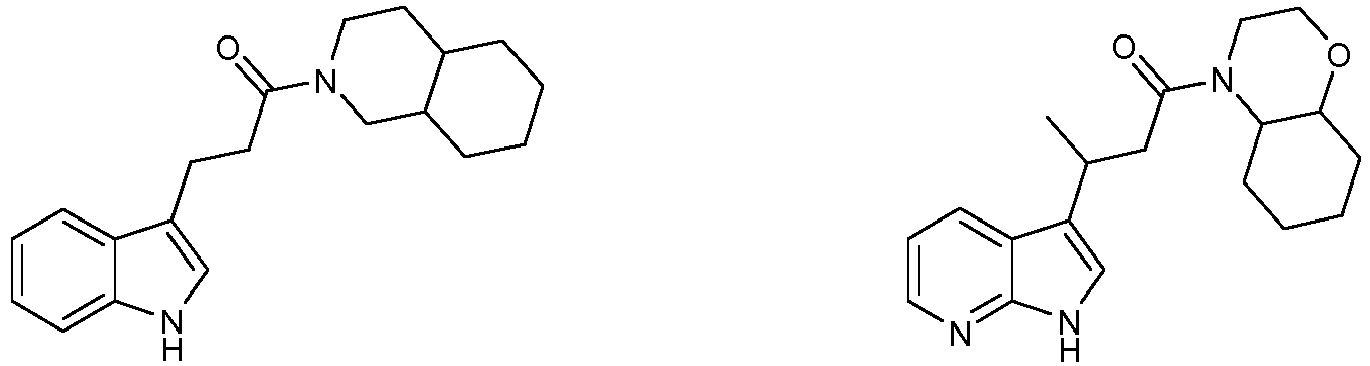


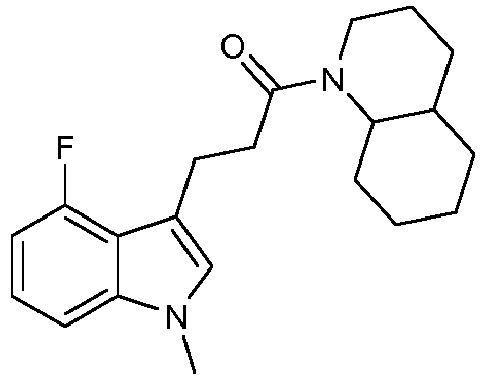


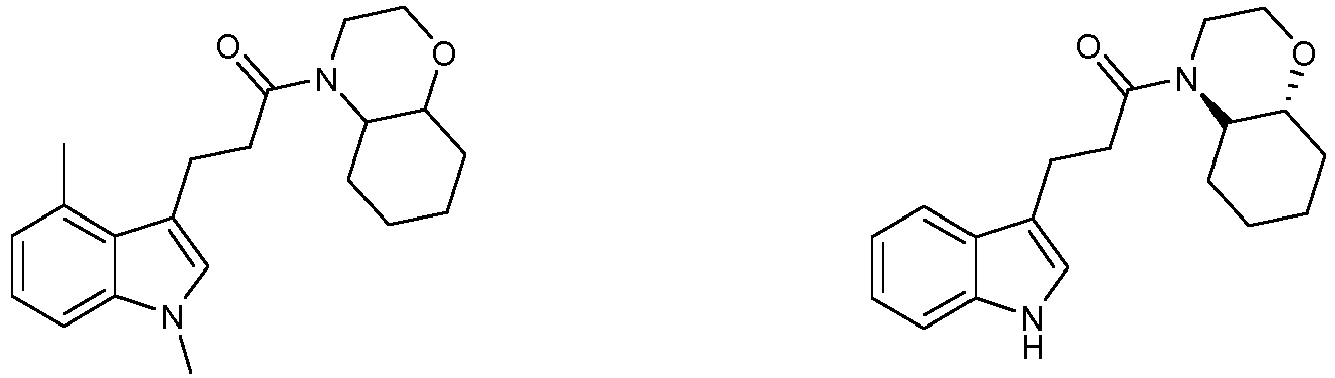


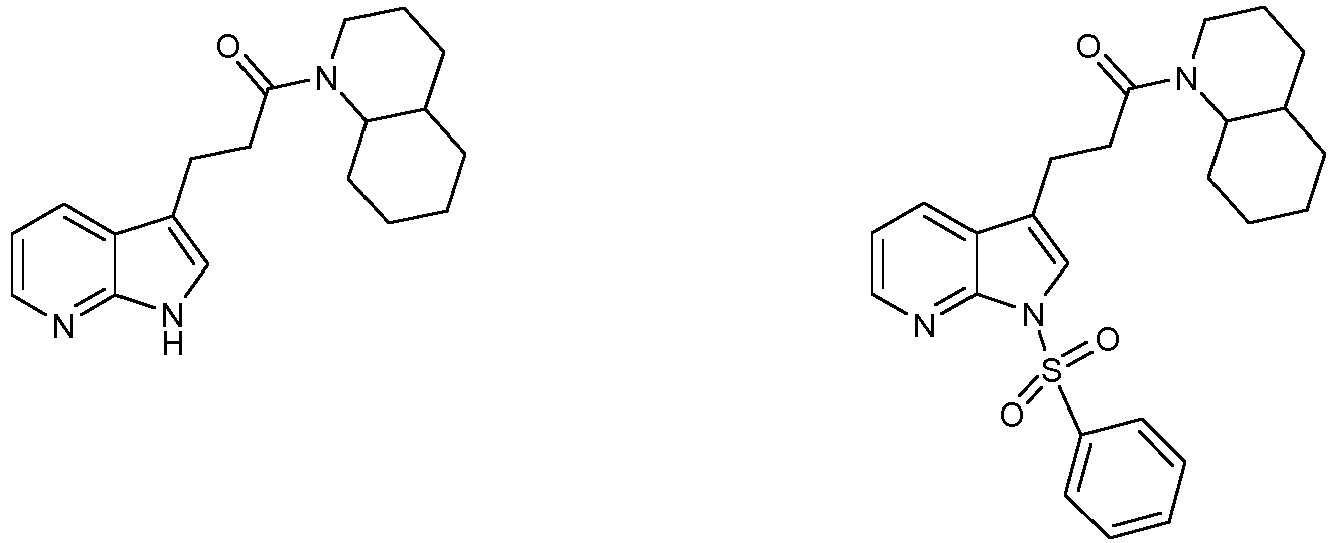


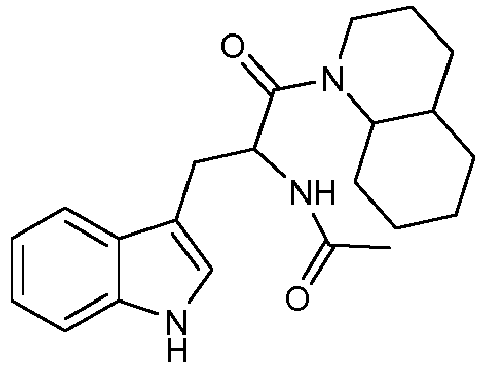


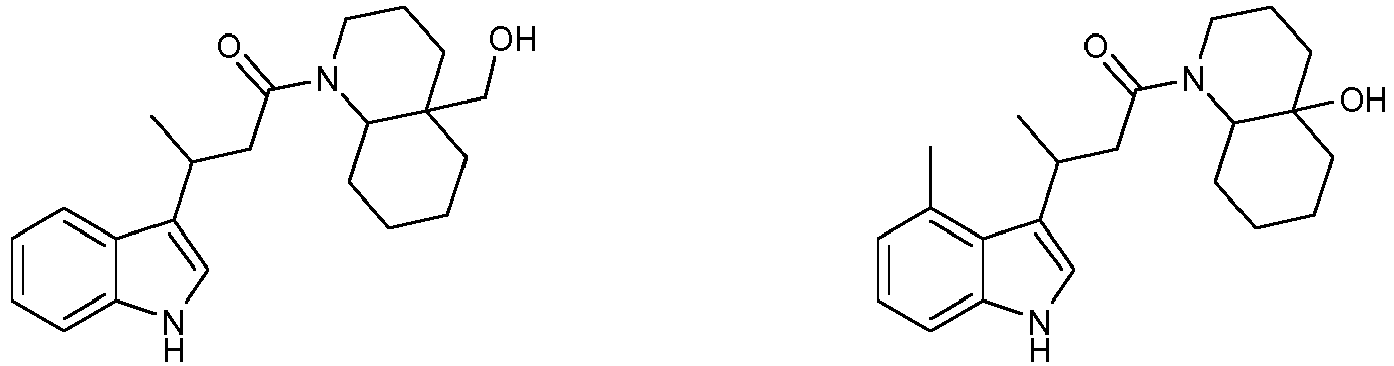


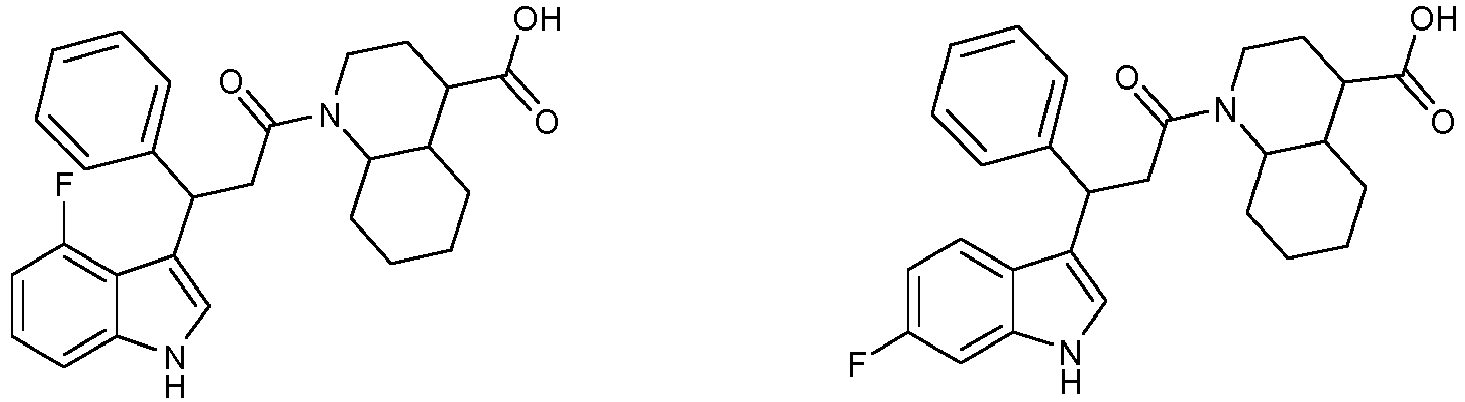

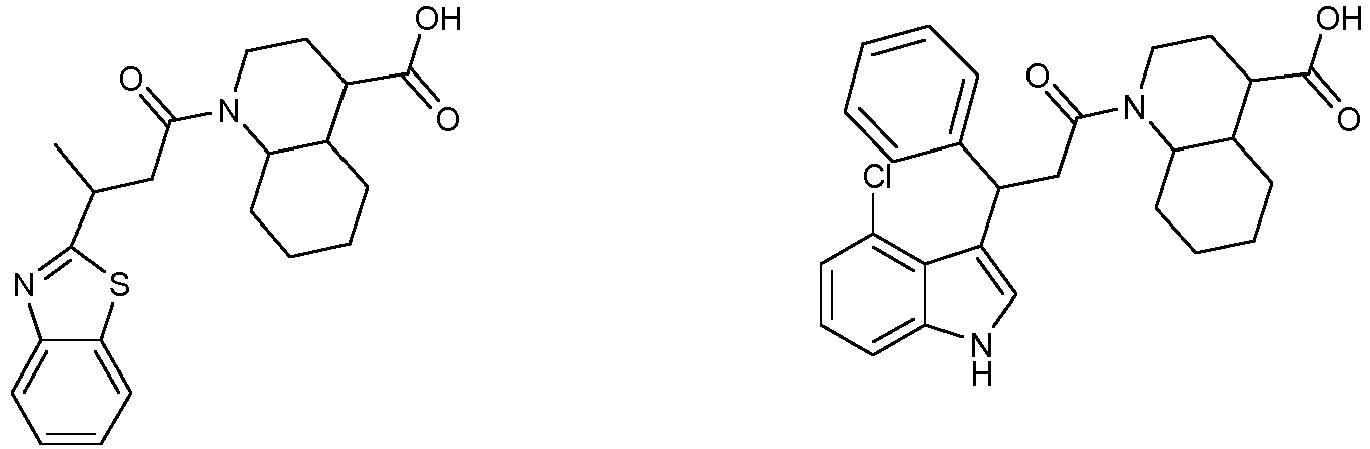


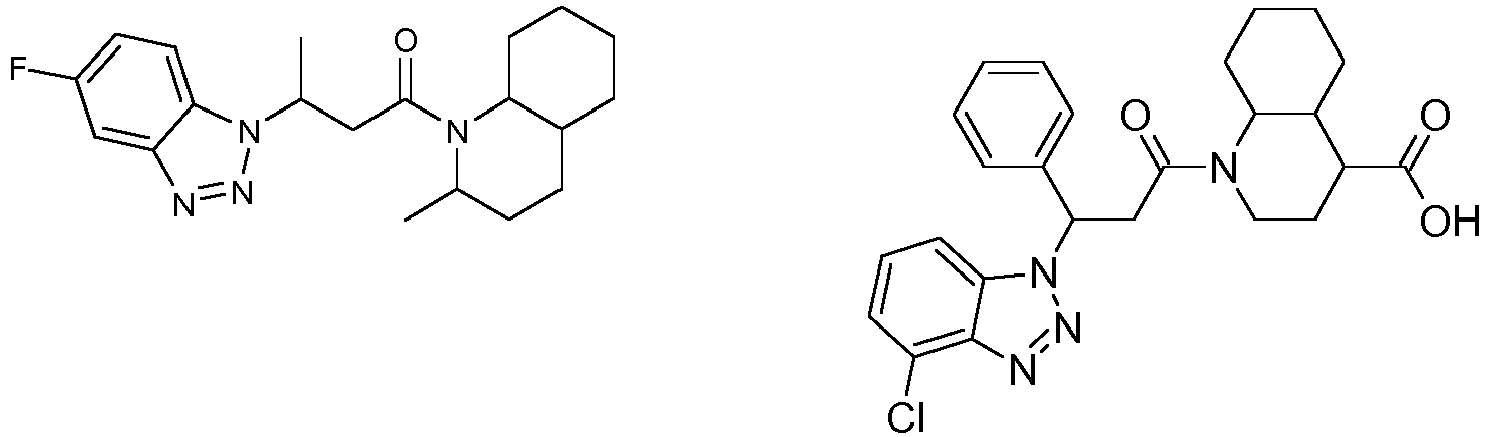


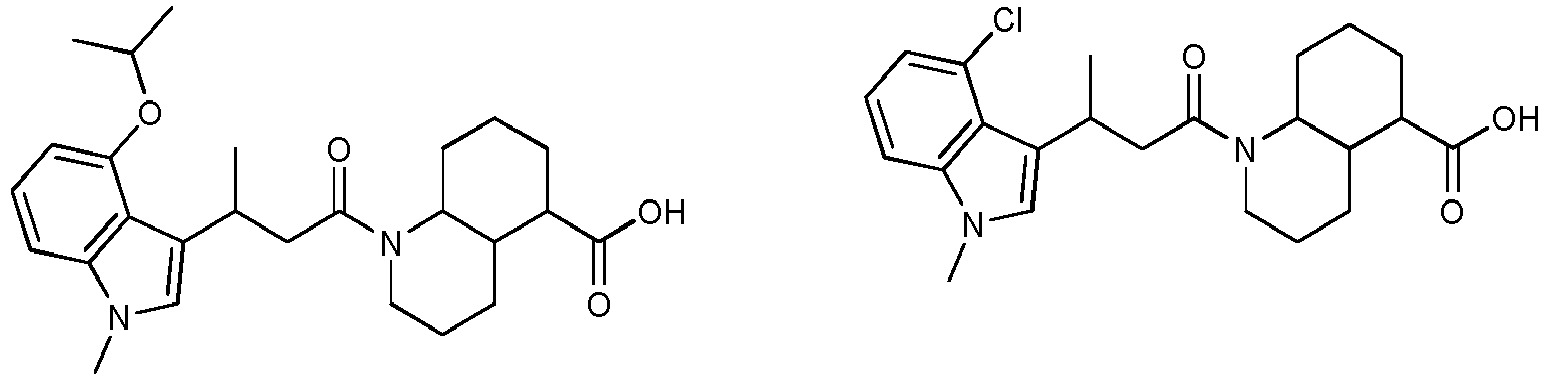





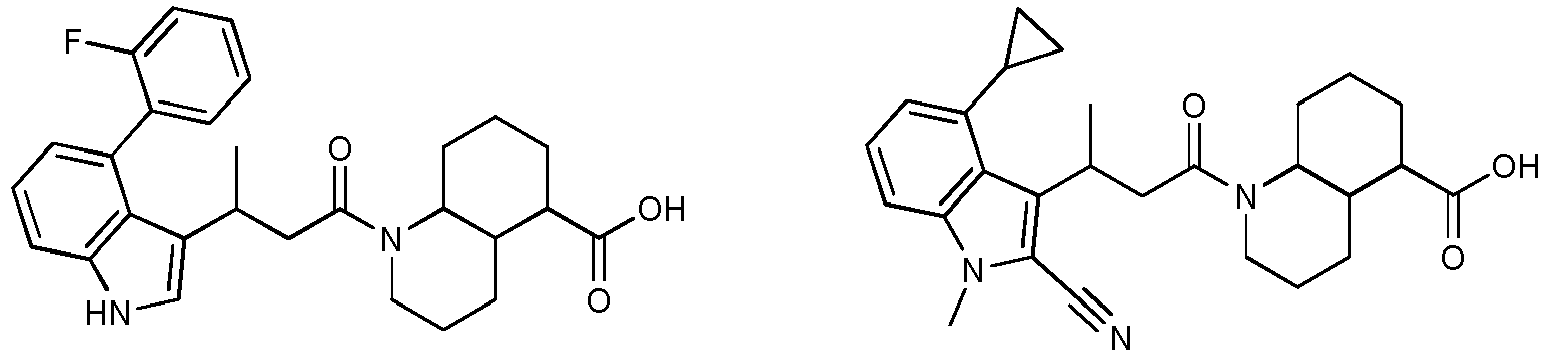


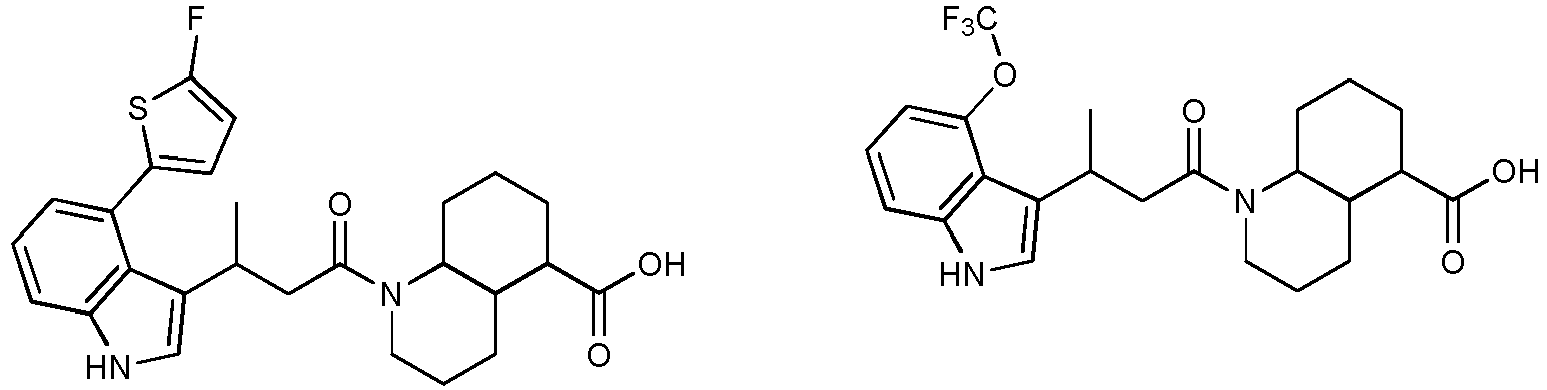



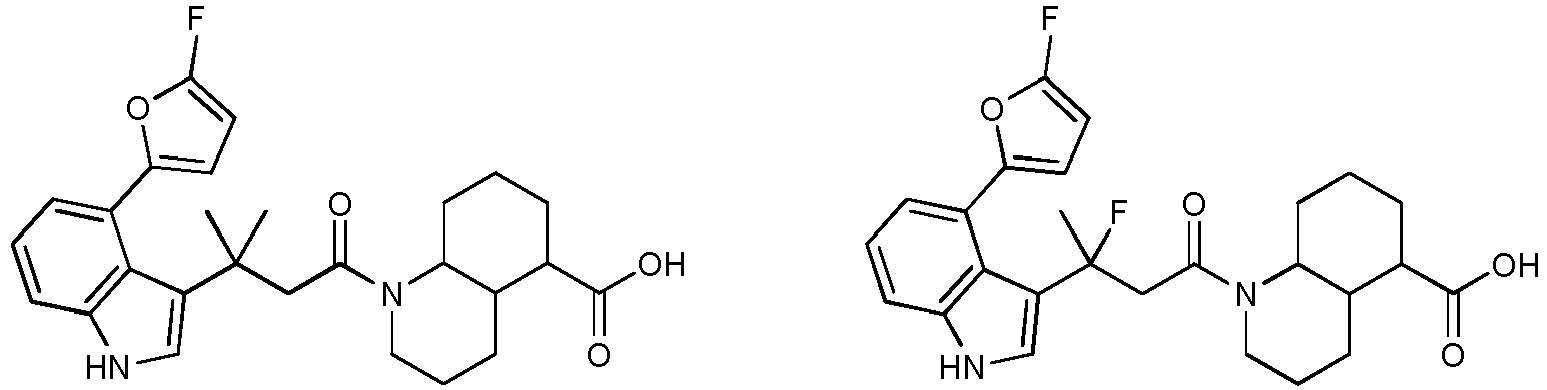


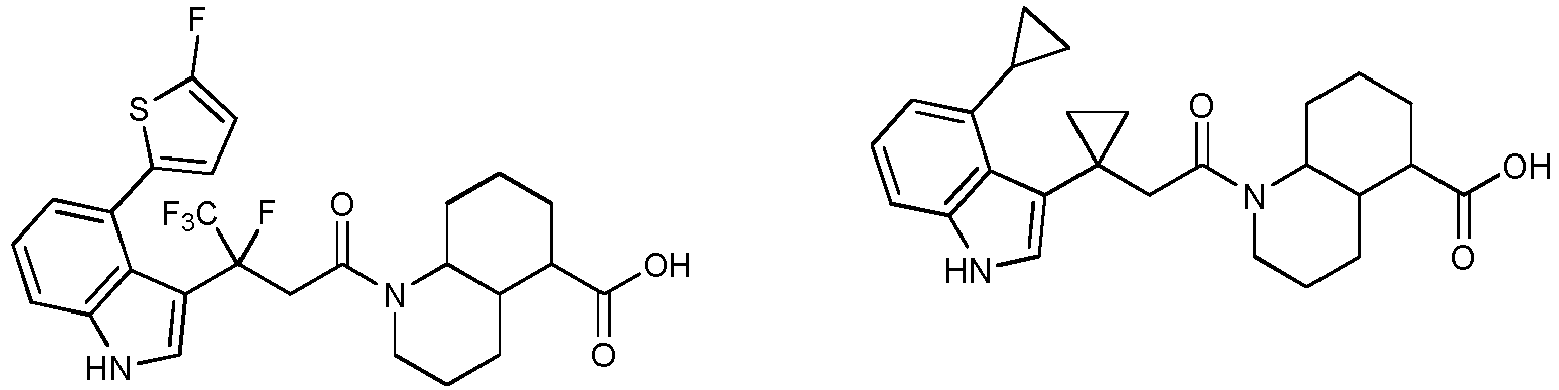


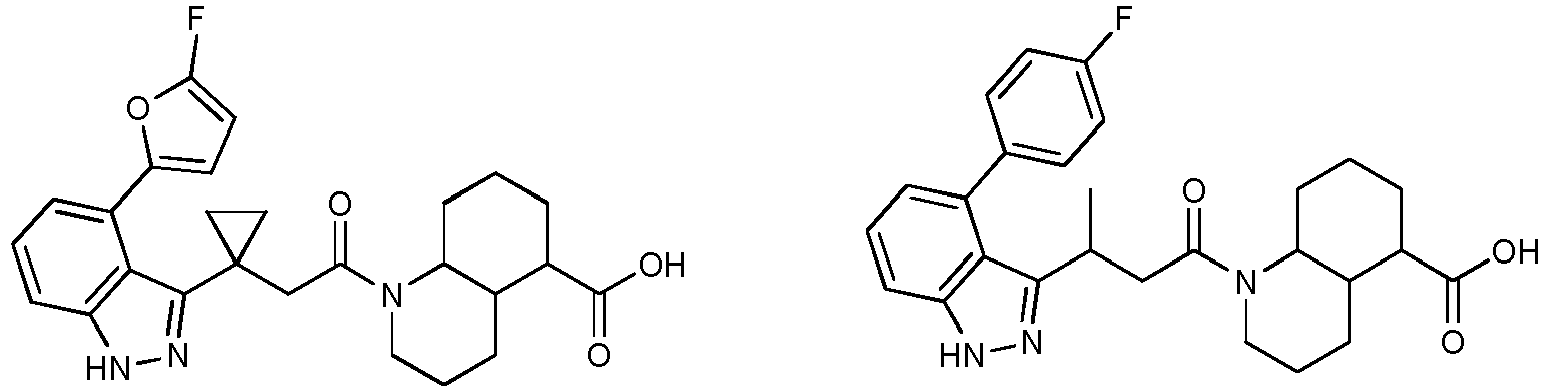


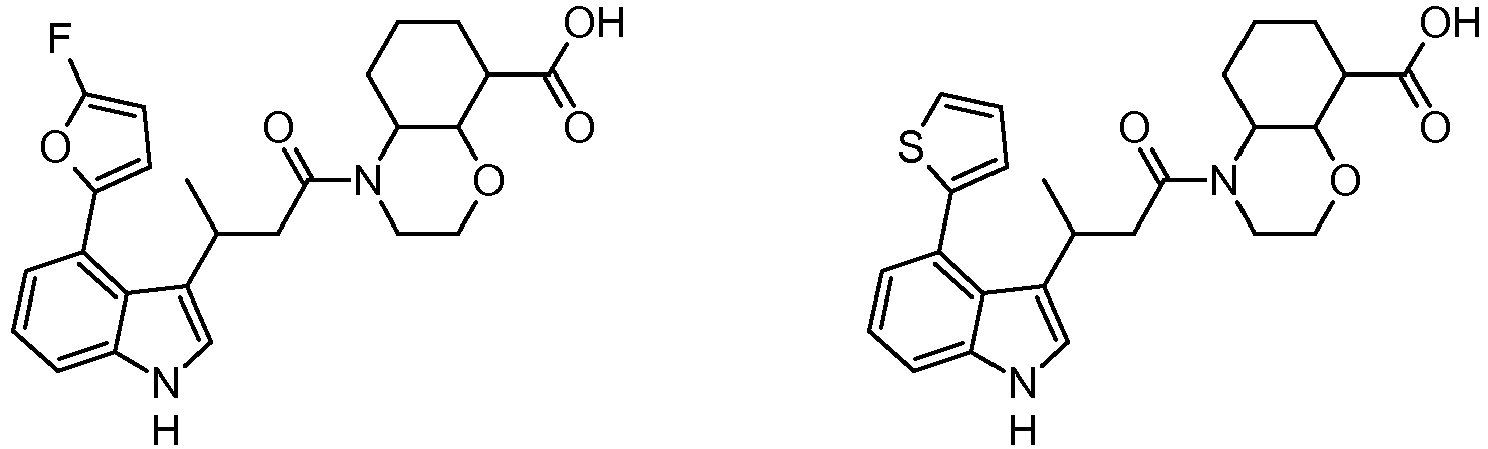


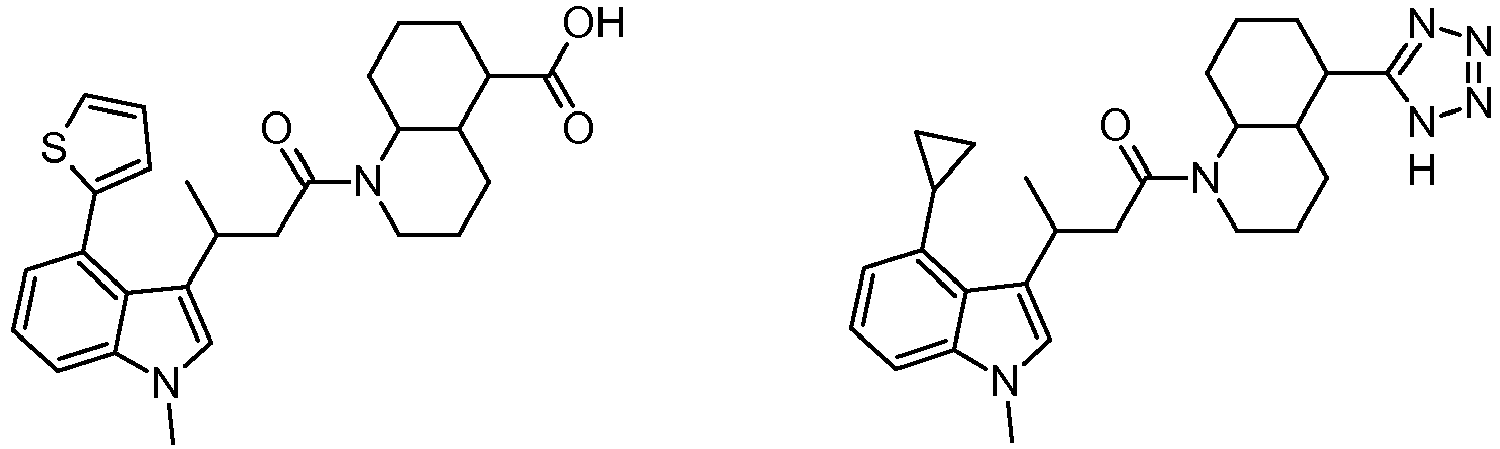


- The compounds have the ability to inhibit 11β-HSD1. The ability to inhibit 11β-HSD1 may be a result of the compounds acting directly and solely on the 11β-HSD1 to modulate/potentiate biological activity. However, it is understood that the compounds may also act at least partially on other factors associated with 11β-HSD1 activity.
- The inhibition of 11β-HSD1 may be carried out in any of a number of ways known in the art. For example if inhibition of 11β-HSD1 in vitro is desired an appropriate amount of the compound may be added to a solution containing the 11β-HSD1. In circumstances where it is desired to inhibit 11β-HSD1 in a mammal, the inhibition of the 11β-HSD1 typically involves administering the compound to a mammal containing the 11β-HSD1.
- Accordingly the compounds may find a multiple number of applications in which their ability to inhibit 11β-HSD1 enzyme of the type mentioned above can be utilised.
- Accordingly compounds of the invention would be expected to have useful therapeutic properties especially in relation to diabetes, hyperglycemia, low glucose tolerance, hyperinsulinemia, hyperlipidemia, hypertriglyceridemia, hypercholesterolemia, dyslipidemia, obesity, abdominal obesity, glaucoma, hypertension, atherosclerosis and its sequelae, retinopathy and other ocular disorders, nephropathy, neuropathy, myopathy, osteoporosis, osteoarthritis, dementia, depression, neurodegenerative disease, psychiatric disorders, Polycystic ovaries syndrome, infertility, Cushing's Disease, Cushing's syndrome, virus diseases, and inflammatory diseases.
- Administration of compounds within Formula (I) to humans can be by any of the accepted modes for enteral administration such as oral or rectal, or by parenteral administration such as subcutaneous, intramuscular, intravenous and intradermal routes. Injection can be bolus or via constant or intermittent infusion. The active compound is typically included in a pharmaceutically acceptable carrier or diluent and in an amount sufficient to deliver to the patient a therapeutically effective dose. In various embodiments the activator compound may be selectively toxic or more toxic to rapidly proliferating cells, e.g. cancerous tumours, than to normal cells.
- In using the compounds of the invention they can be administered in any form or mode which makes the compound bioavailable. One skilled in the art of preparing formulations can readily select the proper form and mode of administration depending upon the particular characteristics of the compound selected, the condition to be treated, the stage of the condition to be treated and other relevant circumstances. We refer the reader to Remingtons Pharmaceutical Sciences, 19th edition, Mack Publishing Co. (1995) for further information.
- The compounds of the present invention can be administered alone or in the form of a pharmaceutical composition in combination with a pharmaceutically acceptable carrier, diluent or excipient. The compounds of the invention, while effective themselves, are typically formulated and administered in the form of their pharmaceutically acceptable salts as these forms are typically more stable, more easily crystallised and have increased solubility.
- The compounds are, however, typically used in the form of pharmaceutical compositions which are formulated depending on the desired mode of administration. As such in some embodiments the present invention provides a pharmaceutical composition including a compound of Formula (I) and a pharmaceutically acceptable carrier, diluent or excipient. The compositions are prepared in manners well known in the art.
- The invention in other embodiments provides a pharmaceutical pack or kit comprising one or more containers filled with one or more of the ingredients of the pharmaceutical compositions of the invention. In such a pack or kit can be found a container having a unit dosage of the agent(s). The kits can include a composition comprising an effective agent either as concentrates (including lyophilized compositions), which can be diluted further prior to use or they can be provided at the concentration of use, where the vials may include one or more dosages. Conveniently, in the kits, single dosages can be provided in sterile vials so that the physician can employ the vials directly, where the vials will have the desired amount and concentration of agent(s). Associated with such container(s) can be various written materials such as instructions for use, or a notice in the form prescribed by a governmental agency regulating the manufacture, use or sale of pharmaceuticals or biological products, which notice reflects approval by the agency of manufacture, use or sale for human administration.
- The compounds of the invention may be used or administered in combination with one or more additional drug(s) for the treatment of the disorder/diseases mentioned. The components can be administered in the same formulation or in separate formulations. If administered in separate formulations the compounds of the invention may be administered sequentially or simultaneously with the other drug(s).
- In addition to being able to be administered in combination with one or more additional drugs, the compounds of the invention may be used in a combination therapy. When this is done the compounds are typically administered in combination with each other. Thus one or more of the compounds of the invention may be administered either simultaneously (as a combined preparation) or sequentially in order to achieve a desired effect. This is especially desirable where the therapeutic profile of each compound is different such that the combined effect of the two drugs provides an improved therapeutic result.
- Pharmaceutical compositions of this invention for parenteral injection comprise pharmaceutically acceptable sterile aqueous or nonaqueous solutions, dispersions, suspensions or emulsions as well as sterile powders for reconstitution into sterile injectable solutions or dispersions just prior to use. Examples of suitable aqueous and nonaqueous carriers, diluents, solvents or vehicles include water, ethanol, polyols (such as glycerol, propylene glycol, polyethylene glycol, and the like), and suitable mixtures thereof, vegetable oils (such as olive oil), and injectable organic esters such as ethyl oleate. Proper fluidity can be maintained, for example, by the use of coating materials such as lecithin, by the maintenance of the required particle size in the case of dispersions, and by the use of surfactants.
- These compositions may also contain adjuvants such as preservative, wetting agents, emulsifying agents, and dispersing agents. Prevention of the action of micro-organisms may be ensured by the inclusion of various antibacterial and antifungal agents, for example, paraben, chlorobutanol, phenol sorbic acid, and the like. It may also be desirable to include isotonic agents such as sugars, sodium chloride, and the like. Prolonged absorption of the injectable pharmaceutical form may be brought about by the inclusion of agents that delay absorption such as aluminium monostearate and gelatin.
- If desired, and for more effective distribution, the compounds can be incorporated into slow release or targeted delivery systems such as polymer matrices, liposomes, and microspheres.
- The injectable formulations can be sterilized, for example, by filtration through a bacterial-retaining filter, or by incorporating sterilizing agents in the form of sterile solid compositions that can be dissolved or dispersed in sterile water or other sterile injectable medium just prior to use.
- Solid dosage forms for oral administration include capsules, tablets, pills, powders, and granules. In such solid dosage forms, the active compound is mixed with at least one inert, pharmaceutically acceptable excipient or carrier such as sodium citrate or dicalcium phosphate and/or a) fillers or extenders such as starches, lactose, sucrose, glucose, mannitol, and silicic acid, b) binders such as, for example, carboxymethylcellulose, alginates, gelatin, polyvinylpyrrolidone, sucrose, and acacia, c) humectants such as glycerol, d) disintegrating agents such as agar-agar, calcium carbonate, potato or tapioca starch, alginic acid, certain silicates, and sodium carbonate, e) solution retarding agents such as paraffin, f) absorption accelerators such as quaternary ammonium compounds, g) wetting agents such as, for example, cetyl alcohol and glycerol monostearate, h) absorbents such as kaolin and bentonite clay, and i) lubricants such as talc, calcium stearate, magnesium stearate, solid polyethylene glycols, sodium lauryl sulfate, and mixtures thereof. In the case of capsules, tablets and pills, the dosage form may also comprise buffering agents.
- Solid compositions of a similar type may also be employed as fillers in soft and hard-filled gelatin capsules using such excipients as lactose or milk sugar as well as high molecular weight polyethylene glycols and the like.
- The solid dosage forms of tablets, dragees, capsules, pills, and granules can be prepared with coatings and shells such as enteric coatings and other coatings well known in the pharmaceutical formulating art. They may optionally contain opacifying agents and can also be of a composition that they release the active ingredient(s) only, or preferentially, in a certain part of the intestinal tract, optionally, in a delayed manner. Examples of embedding compositions which can be used include polymeric substances and waxes.
- The active compounds can also be in microencapsulated form, if appropriate, with one or more of the above-mentioned excipients.
- Liquid dosage forms for oral administration include pharmaceutically acceptable emulsions, solutions, suspensions, syrups and elixirs. In addition to the active compounds, the liquid dosage forms may contain inert diluents commonly used in the art such as, for example, water or other solvents, solubilizing agents and emulsifiers such as ethyl alcohol, isopropyl alcohol, ethyl carbonate, ethyl acetate, benzyl alcohol, benzyl benzoate, propylene glycol, 1,3-butylene glycol, dimethyl formamide, oils (in particular, cottonseed, groundnut, corn, germ, olive, castor, and sesame oils), glycerol, tetrahydrofurfuryl alcohol, polyethylene glycols and fatty acid esters of sorbitan, and mixtures thereof.
- Besides inert diluents, the oral compositions can also include adjuvants such as wetting agents, emulsifying and suspending agents, sweetening, flavoring, and perfuming agents.
- Suspensions, in addition to the active compounds, may contain suspending agents as, for example, ethoxylated isostearyl alcohols, polyoxyethylene sorbitol and sorbitan esters, microcrystalline cellulose, aluminium metahydroxide, bentonite, agar-agar, and tragacanth, and mixtures thereof.
- Compositions for rectal or vaginal administration are preferably suppositories which can be prepared by mixing the compounds of this invention with suitable non-irritating excipients or carriers such as cocoa butter, polyethylene glycol or a suppository wax which are solid at room temperature but liquid at body temperature and therefore melt in the rectum or vaginal cavity and release the active compound.
- Dosage forms for topical administration of a compound of this invention include powders, patches, sprays, ointments and inhalants. The active compound is mixed under sterile conditions with a pharmaceutically acceptable carrier and any needed preservatives, buffers, or propellants which may be required.
- The amount of compound administered will preferably treat and reduce or alleviate the condition. A therapeutically effective amount can be readily determined by an attending diagnostician by the use of conventional techniques and by observing results obtained under analogous circumstances. In determining the therapeutically effective amount a number of factors are to be considered including but not limited to, the species of animal, its size, age and general health, the specific condition involved, the severity of the condition, the response of the patient to treatment, the particular compound administered, the mode of administration, the bioavailability of the preparation administered, the dose regime selected, the use of other medications and other relevant circumstances.
- A preferred dosage will be a range from about 0.01 to 300 mg per kilogram of body weight per day. A more preferred dosage will be in the range from 0.1 to 100 mg per kilogram of body weight per day, more preferably from 0.2 to 80 mg per kilogram of body weight per day, even more preferably 0.2 to 50 mg per kilogram of body weight per day. A suitable dose can be administered in multiple sub-doses per day.
- The compound of the invention may also be administered in combination with (or simultaneously or sequentially with) an adjuvant to increase compound performance. Suitable adjuvants may include (a) dipeptidyl peptidase-IV (DP-IV) inhibitors; (b) insulin sensitizing agents; (iv) biguanides; (c) insulin and insulin mimetics; (d) sulfonylureas and other insulin secretagogues; (e) alpha-glucosidase inhibitors; and (f) GLP-1, GLP-1 analogs, and GLP-1 receptor agonists. The adjuvants may be part of the same composition, or the adjuvants may be administered separately (either simultaneously or sequentially). The order of the administration of the composition and the adjuvant will generally be known to the medical practitioner involved and may be varied.
- The agents of the various embodiments may be prepared using the reaction routes and synthesis schemes as described below, employing the techniques available in the art using starting materials that are readily available. The preparation of particular compounds of the embodiments is described in detail in the following examples, but the artisan will recognize that the chemical reactions described may be readily adapted to prepare a number of other agents of the various embodiments. For example, the synthesis of non-exemplified compounds may be successfully performed by modifications apparent to those skilled in the art, e.g. by appropriately protecting interfering groups, by changing to other suitable reagents known in the art, or by making routine modifications of reaction conditions. A list of suitable protecting groups in organic synthesis can be found in T.W. Greene's Protective Groups in Organic Synthesis, 3rd Edition, John Wiley & Sons, 1991. Alternatively, other reactions disclosed herein or known in the art will be recognized as having applicability for preparing other compounds of the various embodiments.
- Reagents useful for synthesizing compounds may be obtained or prepared according to techniques known in the art.
- The symbols, abbreviations and conventions in the processes, schemes, and examples are consistent with those used in the contemporary scientific literature. Specifically but not meant as limiting, the following abbreviations may be used in the examples and throughout the specification.
- g (grams)
- L (liters)
- Hz (Hertz)
- mol (moles)
- RT (room temperature)
- min (minutes)
- MeOH (methanol)
- CHCl3 (chloroform)
- DCM (dichloromethane)
- DMSO (dimethylsulfoxide)
- EtOAc (ethyl acetate)
- mg (milligrams)
- mL (milliliters)
- psi (pounds per square inch)
- mM (millimolar)
- MHz (megahertz)
- h (hours)
- TLC (thin layer chromatography)
- EtOH (ethanol)
- CDCl3 (deuterated chloroform)
- HCl (hydrochloric acid)
- DMF (N, N-dimethylformamide)
- THF (tetrahydro furan)
- K2CO3 (potassium carbonate)
- Na2SO4 (sodium sulfate)
- RM (Reaction Mixture)
- Unless otherwise indicated, all temperatures are expressed in °C (degree centigrade). All reactions conducted at room temperature unless otherwise mentioned.
- All the solvents and reagents used are commercially available and purchased from Sigma Aldrich, Fluka, Acros, Spectrochem, Alfa Aesar, Avra, Qualigens, Merck, Rankem and Leonid Chemicals.
- 1H NMR spectra were recorded on a Bruker AV 300. Chemical shifts are expressed in parts per million (ppm, δ units). Coupling constants are in units of hertz (Hz). Splitting patterns describe apparent multiplicities and are designated as s (singlet), d (doublet), t (triplet), q (quartet), m (multiplet), or br (broad).
- Mass spectra were obtained on single quadruple 6120 LCMS from Agilent technologies, using either atmospheric chemical ionization (APCI) or Electrospray ionization (ESI) or in the combination of these two sources.
- All samples were run on SHIMADZU system with an LC-20 AD pump, SPD-M20A diode array detector, SIL-20A auto sampler.
- Note that example compounds (5), (8), (19), (25), (30), (31), (36), (41), (42), (43), (45), (48), (54), (57), (73), (74), (97), (99), (100) and (260) below do not form part of the claimed scope of the invention. Some of the synthetic steps used for preparing some of these compounds are used in the preparation of other compounds, and so the full descriptions of the various syntheses for these compounds and their intermediates (where relevant) are provided below for completeness.
- One scheme for making certain compounds of the invention is shown in scheme 1 below.

- A 100mL RB flask fitted with magnetic stirrer was charged with Starting Material 1 (4.0g, 34mmol), Starting Material 2 (4.92, 34 mmol) and Starting Material 3 (3g, 68mmol) in 75mL of acetonitrile. The resulting solution was stirred at room temperature overnight. After completion of the reaction (reaction monitored by TLC), the Solvent was removed under reduced pressure, and the resulting crude compound was purified by column chromatography on silica gel (230-400 mesh) using Petroleum ether (60-80) and ethyl acetate as eluent. The product (intermediate 1) was obtained as a brown liquid (2.51g). LC-MS (M-H)+ = 286.
- A 100 mL RB flask fitted with magnetic stirrer was charged with intermediate-1 (2.5g, 8.7 mmol) in 50mL of pyridine and 8 ml of ethanol. To this mixture copper powder (0.4g, 5 mol%) was added. Then the resulting reaction mass was refluxed at 110°C for 3 hours. After completion of the reaction (reaction monitored by TLC), solvent was removed from the reaction mass and the reaction mass was diluted with 100mL of ethyl acetate, washed with 50mL 1.5N HCl (2X25mL) and brine solution. Then the organic layer was dried over anhydrous MSO4. The solvent was removed under reduced pressure, and the resulting crude compound was purified by column chromatography on silica gel (230-400 mesh) using Petroleum ether (60-80) and ethyl acetate as eluent. The product (intermediate 2) was obtained as a brown liquid. (0.380g). LC-MS (M+H)+ ==232.
- A 50 mL RB flask fitted with magnetic stirrer was charged with 6mL of methanol and 2 mL of water. To the stirred solvent inetermediate-2 (0.145g, 0.62mmol) and KOH (0.098g, 2.54mmol) was added. Then the resulting reaction mass was refluxed at 70°C for 3 hours. After completion of the reaction (reaction monitored by TLC), solvent was removed from the reaction mass and the reaction mass was diluted with 20mL of water. The resulting aqueous layer was then washed with 20 mL of diethylether. The aqueous layer was acidified by 1NHCl to pH 5.5 and product was extracted with ethyl acetate and the solvent was removed under reduced pressure. The product (intermediate 3) was obtained as a brown liquid (0.115g). The product obtained above was directly taken for next step without any purification.
-
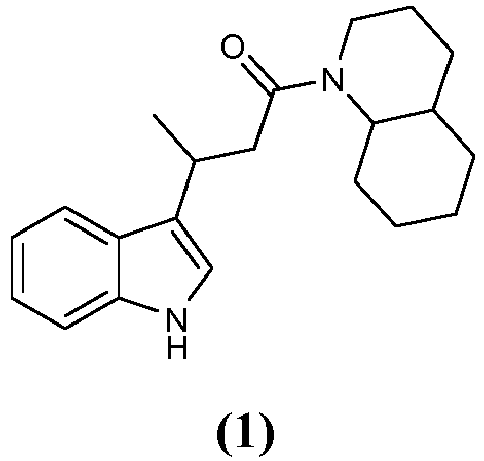

- Synthesis of Compound (1): A 100mL RB flask fitted with magnetic stirrer was charged with intermediate-3 (0.115g, 0.56mmol),Starting Material 4 (0.078g, 0.56mmol), EDCI (0.162g, 0.84mmol), HOBt (0.104g, 0.69mmol) in 8mL of dichloromethane and it was cooled to 0°C. Then to the stirred solution triethylamine (0.301mL, 2.0mmol) was added. The resulting solution was stirred at room temperature overnight. After completion of the reaction (reaction monitored by TLC), the reaction mass was diluted with 20mL of water and organic layer was separated. The Solvent was removed under reduced pressure, and the resulting crude compound was purified by 60-120 silical-gel chromatography by using petether ethylacetate as eluent. The final product obtained was pale yellow gummy solid (0.110 g). 1H NMR (300MHz,CDCl3) : δ 7.89(s,1H), 7.59-7.61(m,1H), 7.27-7.30(d,1H), 7.00-7.13(m,2H), 6.94-6.95(d,1H), 4.41-4.60(m,1H), 3.49-3.61(m,2H), 2.46-2.91(m,3H), 0.98-1.71(m,16H). LC-MS (M+H)+ = 325.2; HPLC purity: 92.84%.
-


- A 100 mL RB flask fitted with magnetic stirrer was charged with 15 mL of Methanol. To the stirred solvent Starting Material-5 (2.0 g, 11.41mmol) was added. The resulting mixture was cooled to zero degrees to which concentrated H2SO4 (0.5 mL) was added. The mixture was then stirred at ambient temperatures for 1 hour. After completion of the reaction (reaction monitored by TLC), the solvent from the reaction mass was removed under reduced pressure. The resulting crude mass was taken in Ethyl acetate (100 mL) and was washed with water (50 mL), Sodium bicarbonate solution (100 mL X 2) saturated brine solution (50 mL) and the organic layer dried over anhydrous sodium sulphate. Then the solvent was removed under reduced pressure. The product was obtained as brown syrup. (2.1g). LC-MS (M+H)+ = 190.2.
- A 100 mL 3 neck RB flask fitted with magnetic stirrer was charged with 10mL of dry THF. To the stirred solvent, diisopropyl amine (401.12 mg, 3.964mmol) was added and the resulting solution was cooled to -78 degrees. Further n-BuLi (2.5 mL, 3.964mmol) was added to it and stirred for 1 hour at 0°C. Once again the resulting solution was cooled to -78 degrees to which Intermediate-4 (150 mg, 0.7928 mmol) was added and stirred for 1 hour. Then Methyl Iodide was added and the resulting mass was stirred at ambient temperature for 15 hours. After completion of the reaction (reaction monitored by TLC), the reaction mass was quenched with saturated ammonium chloride and was extracted using EtOAc (100 mLX3). The combined organic layer washed with brine was dried and the solvent was removed under reduced pressure. The resulting crude compound was purified by column chromatography on silica gel (120 meshes) using Petroleum ether (60-80) and ethyl acetate as eluent. The product was obtained as brown syrup. (150mg). LC-MS (M+H)+ = 232.2.
- A 100 mL RB flask fitted with magnetic stirrer was charged with THF 5 mL. To the stirred solvent Intermediate-5 (150 mg, 0.6485 mmol) was added which was followed by the addition of NaOH (77.82 mg; 1.945 mmol), and water-methanol mixture (1 mL, 1:1). The resulting mass was heated at 70°C for 4 hours. After completion of the reaction, the solvent from the reaction mass was removed under reduced pressure. The crude mass was treated with water and washed with ether (50 mL X 3). The resulting aqueous solution was acidified to pH = 1 to 2 by using 1N HCl and extracted with DCM (50 mL X 3). The combined DCM layers were washed with brine, dried over anhydrous Na2SO4 and the solvent was removed under reduced pressure to give Intermediate-6 as brown solid (85mg). LC-MS (M+H)+ = 218.2.
- Synthesis of Compound (2): Compound (2) was synthesized by following the procedure used to make compound (1) (Scheme 2). The crude product was obtained by evaporating the organic layer under reduced pressure and was purified using silica gel column where Petroleum ether: Ethyl acetate was used as an eluent to obtain Compound (2). 1H NMR (300MHz,CDCl3) : δ 7.43-7.48(m,1H), 7.18-7.21(d,1H), 7.09-7.14(t,1H), 6.92-6.97(t,1H), 6.75-6.80(d,1H), 4.50-4.75(m,1H), 3.57-3.98(m,4H), 2.28-2.45(m,1H), 1.47-1.58(m,8H), 1.37-1.40(m,6H), 0.94-1.09(m,5H). LC-MS (M+H)+ = 339.2; HPLC purity: 98.09%.
-


- Triethylphosphenoacetate (9.4 mmol) was taken in THF (20 mL) to which NaH (60%) was added portion wise at -5°C. The reaction mass thus obtained was maintained at same temperature for 45 min. To this the Starting Material-6 (750 mg, 4.7 mmol) was added and the resulting reaction mass was stirred at RT for 24 hours. Then reaction mass was diluted with ethyl acetate and the organic layer was separated and the separated organic layer was washed with saturated NaHCO3, dried over anhydrous Na2SO4 and concentrated. The crude product thus obtained was purified by 60-120 silica gel by using hexanes: EtOAc as eluent to give Intermediate 7 (490 mg). LC-MS (M+H)+= 230.
- Intermediate-7 (1.31 g, 5.6 mmol) was taken in MeOH (25 mL) to which 10%Pd/C (150 mg) was added. The resulting reaction mass was stirred under H2 atmosphere (25 psi) for 10 hours. Further the reaction mass thus obtained was filtered through celite bed and concentrated to give Intermediate-8 (820 mg). LC-MS (M+H)+= 232.
- Intermediate -8 (600mg, 2.5mmol) was taken in MeOH (8 mL) to which KOH (500 mg, 9.0 mmol) and 1mL of water was added. Resulting reaction mixture was refluxed for 3 hours. The reaction mixture was concentrated and then diluted with water. The resulting mixture was acidified (pH = 1 to 2) with 1N HCl, extracted with EtOAc and then concentrated to give Intermediate-9 (430 mg). LC-MS (M+H)+= 204.
- Synthesis of (3): Compound (3) was synthesized by following the procedure used to make Compound (1) (Scheme 2). The crude product was obtained by evaporating the organic layer under reduced pressure and was purified by silica gel column using Petroleum ether: Ethyl acetate as eluent to obtain Compound (3). 1H NMR (300MHz,CDCl3) : δ 7.90(s,1H), 7.31-7.34(d,1H), 7.15-7.18(m,1H), 6.92-6.95(m,2H), 4.30-4.40(m,1H), 3.30-3.60(m,1H), 2.45-3.06(m,5H), 2.38-2.39(d,3H), 1.18-1.77(m,13H). LC-MS (M+H)+ = 325.2; HPLC purity: 95.93%.
-


- Synthesis of 3-(5-fluoro-1H-indol-3-yl)propanoic acid (Intermediate-10): Intermediate-10 was synthesized by following the procedure used to make Intermediate-9 (Scheme 4).
- Synthesis of Compound (4): Compound (4) was synthesized by following the procedure used to make Compound (1) (Scheme 2). The crude product was obtained by evaporating the organic layer under reduced pressure and was purified by silica gel column using Petroleum ether: Ethyl acetate as eluent to obtain Compound (4). 1H NMR (300MHz,CDCl3) : δ 8.55(s,1H), 7.17-7.18(d,2H), 6.96(s,1H), 6.80-6.85(t,1H), 4.43-4.57(m,1H), 3.41-3.58(m,1H), 2.44-3.03(m,5H), 0.99-1.94(m,13 H). LC-MS (M+H)+ = 329.1; HPLC purity: 96.44%.
-


- Synthesis of 1H-indole-3-thiol (Intermediate-11): A stirred solution of Starting Material-1 (2.93 g, 25.0 mmol) and thiourea (1.9 g, 25.0 mmol) in methanol (50 ml) was treated with a mixture of iodine (6.35g, 25.0 mmol) and KI (4.17 g, 25.0 mmol) in water (25 ml), stirred for 1 hour, filtered through a cotton plug, concentrated in vacuo to remove methanol and 1/3 of water, and filtered concentrated solution again. The tan solid filter cake is heated with 2M NaOH (50 ml) at 85°C for 30 min, cooled and filtered. The filtrate is acidified with conc. HCl to pH= 1 and filtered. This filter cake is dried under a nitrogen stream to obtain the Intermediate-11 as cream-colored solid (900 mg).
- Synthesis of methyl (1H-indol-3-ylsulfanyl)acetate (Intermediate-12): Anhydrous potassium carbonate (2.1g, 15.9 mmol) was added to a solution of Intermediate-11 (0.8 g, 5.3 mmol) and ethyl 2-chlortoacetate (0.96 ml, 5.3 mmol) in acetonitrile (30 mL). The resulting mixture was heated to reflux under argon for 18 hours. The cooled mixture was filtered and concentrated under vacuo. Water was added to the reaction mass and extracted with ethyl acetate. Combined organic extracts were dried over (MgSO4) and concentrated to a crude gummy material, which was purified by column chromatography using hexane : ethyl acetate (1:9) to give Intermediate-12 (300 mg).
- Synthesis of (1H-indol-3-ylsulfanyl)acetic acid (Intermediate-13): A mixture of (1H-Intermediate-12 (0.30g, 1.27 mmol), 10% aqueous sodium hydroxide solution (5 ml) and methanol (8 mL) were stirred at room temperature over-night. Reaction was monitored by TLC and LC-MS. Then reaction mixture was concentrated under reduced pressure. Aqueous layer was washed twice with DCM to remove organic impurities and was then acidified with concentrated HCl. A white solid thus formed was isolated by extraction and the solvent was removed under high vacuum. The crude reaction mass was purified by column chromatography using ethylacetate:hexane (1:1) as eluent to give Intermediate-13 (170 mg).

- Synthesis of Compounds (5): Compound (5) was synthesized by following the procedure used to make Compound (1) (Scheme 2). The crude product was obtained by evaporating the organic layer under reduced pressure and was purified by silica gel column using Petroleum ether: Ethyl acetate as eluent to obtain Compound (5). 1H NMR (300MHz,CDCl3) : δ 8.78-8.96(d,1H), 7.73-7.76(m,1H), 7.37(s,2H), 7.00-7.06(m,2H), 4.23-4.64(m,1H), 3.41-3.85(m,3H), 2.26-3.41(m,3H), 1.25-1.72(m,11H). LC-MS (M+H)+ = 329.1; HPLC purity: 98.84%.
-


- Intermediate-14 was synthesized by following the procedure used to make Intermediate-9 (Scheme 4).
- Synthesis of Compound (6): Compound (6) was synthesized by following the procedure used to make Compound(1) (Scheme 2). The crude product was obtained by evaporating the organic layer under reduced pressure and was purified by silica gel column using Petroleum ether: Ethyl acetate as eluent to obtain Compound (6). 1H NMR (300MHz, CDCl3) : δ 8.05 (s,1H), 7.48-7.51 (m,1H), 7.17-7.21 (m,1H), 7.03-7.08 (m,1H), 6.99(s,1H), 4.43-4.61(m,1H), 3.45-3.59(m,1H), 2.96-3.04(m,2H), 2.45-2.93(m,3H), 1.21-1.66(m,13H). LC-MS (M+H)+ = 345.2; HPLC purity: 89.78%.
-

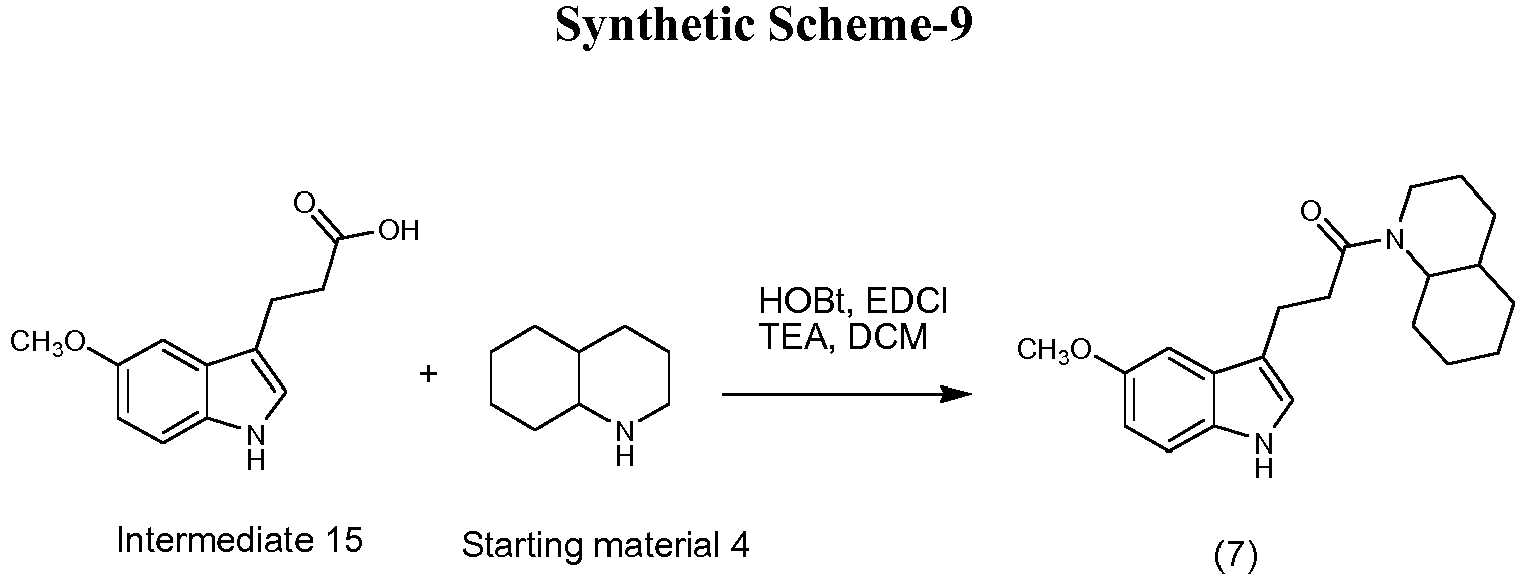
- Intermediate-15 was synthesized by following the procedure used to make Intermediate-9 (Scheme 4).
- Synthesis of Compound (7): Compound (7) was synthesized by following the procedure used to make Compound (1) (Scheme 2). The crude product was obtained by evaporating the organic layer under reduced pressure and was purified by silica gel column using Petroleum ether: Ethyl acetate as eluent to obtain Compound (7). 1H NMR (300MHz,CDCl3) : δ 8.19(s,1H), 7.22-7.25(m,1H), 7.04-7.05(d,1H), 6.98(s,1H), 6.82-6.86(m,1H), 4.48-4.75(m,1H), 3.82(s,3H), 3.48-3.72(m,1H), 3.04-3.13(m,2H), 2.74-2.95(m,1H), 2.56-2.72(m,3H), 1.55-1.79(m,6H), 1.20-1.49(m,6H). LC-MS (M+H)+ = 341.2; HPLC purity: 98.01%.
-


- Synthesis of ethyl (2E)-3-(1H-indol-3-yl)prop-2-enoate (Intermediate-16): Intermediate-16 was synthesized by following the procedure used to make Intermediate-7 (Scheme 4).
- Synthesis of (2E)-3-(1-indol-3-yl)prop-2-enoic acid (Intermediate-17): Intermediate-17 was synthesized by following the procedure used to make Intermediate-9 (Scheme 4).
- Synthesis of Compound (8): Compound (8) was synthesized by following the procedure used to make Compound (1) (Scheme 2). The crude product was obtained by evaporating the organic layer under reduced pressure and was purified by silica gel column using Petroleum ether: Ethyl acetate as eluent to obtain Compound (8). 1H NMR (300MHz,CDCl3) : δ 8.50(s,1H), 7.80-7.88(m,3H), 7.34-7.38(m,2H), 6.78-6.89(m,2H), 4.55-4.76(m,1H), 3.89-4.18(m,1H), 3.05-3.48(m,1H), 2.06-2.71(m,1H), 1.29-1.81(m,12H). LC-MS (M+H)+= 309.1; HPLC purity: 98.83%.
-


- Synthesis of Compound (9): Compound (9) was synthesized by following the procedure used to make Compound (1) (Scheme 2). The crude product was obtained by evaporating the organic layer under reduced pressure and was purified by silica gel column using Petroleum ether: Ethyl acetate as eluent to obtain Compound (9). 1H NMR (300MHz,CDCl3) : δ 8.20(s,1H), 7.61-7.63(d,1H), 7.34-7.36(d,1H), 7.05-7.21(m,3H), 4.57-4.73(m,1H), 3.69-3.88(m,3H), 3.10-3.50(m,1H), 2.60-3.00(m,1H), 1.01-1.90(m,12H). LC-MS (M+H)+=297.3; HPLC purity: 98.39%.
-

- Synthesis of Compound (10): Compound (10) was synthesized by following the procedure used to make Compound (1) (Scheme 2). The crude product was obtained by evaporating the organic layer under reduced pressure and was purified by silica gel column using Petroleum ether: Ethyl acetate as eluent to obtain Compound (10). 1H NMR (300MHz,CDCl3): δ 8.45(s,1H), 7.20-7.30(m,2H), 7.00-7.15(d,1H), 6.95(m,1H), 4.53-4.73(m,1H), 3.64-3.91(m,2H), 2.60-3.03(m,1H), 1.29-1.84(m,14H). LC-MS (M+H)+ = 315.1; HPLC purity: 89.32%.
-


- Synthesis of Compound (11): Compound (11) was synthesized by following the procedure used to make Compound (1) (Scheme 2). The crude product was obtained by evaporating the organic layer under reduced pressure and was purified by silica gel column using Petroleum ether: Ethyl acetate as eluent to obtain Compound (11). 1H NMR (300MHz,CDCl3) : δ 8.04(s,1H), 7.59-7.62(d,1H), 7.34-7.36(d,1H), 7.07-7.20(m,2H), 7.00(s,1H), 4.48-4.75(m,1H), 3.48-3.62(m,1H), 2.88-3.15(m,1H), 2.80-2.85(m,2H), 2.31-2.52(m,2H), 2.02-2.11(m,2H), 1.51-1.80(m,7H), 1.23-1.38(m,6H). LC-MS (M+H)+ = 325.2; HPLC purity: 91.10%.
-


- Synthesis of 4-methyldecahydroquinoline (Intermediate-18): To a solution of Starting Material-9 (1 g, 6.9 mmol) in 15 mL of acetic acid, PtO2 (0.793 g, 3.5 mmol) was added under N2 atmosphere. N2 gas was purged for 5 min and then was degassed (two times). This reaction mixture as then kept under hydrogen atmosphere at 60 psi for 12 hours. The mixture was filtered and basified with 10% NaOH solution, extracted with EtOAc and concentrated to give Intermediate-18 (700mg).
- Synthesis of Compound (12): Compound (12) was synthesized by following the procedure used to make Compound (1) (Scheme 2). The crude product was obtained by evaporating the organic layer under reduced pressure and was purified by silica gel column using Petroleum ether: Ethyl acetate as eluent to obtain Compound (12). 1H NMR (300MHz,CDCl3) : δ 8.03(s,1H), 7.61-7.63(d,1H), 7.34-7.37(d,1H), 7.09-7.21(m,2H), 7.04(s,1H), 4.00(m.1H), 3.11-3.16(t,2H), 2.97(m,1H), 2.61-2.81(m,2H), 1.28-1.84(m,13H), 1.11-1.13(d,3H). LC-MS (M+H)+ = 325.2; HPLC purity: 99.15%.
-


- Synthesis of (13): 18-crown-6 ether (30mg) and potassium tertiary butyl oxide (108 mg, 0.9mmol) was taken in benzene at 4°C. To this mixture (96) (250mg, 0.8mmol) was added. The reaction mass was then stirred at room temperature for 15 minutes and was further cooled to 0°C. To this, Methyl iodide (171 mg, 1.2mmol) dissolved in benzene was added. This reaction mixture was then stirred at room temperature for 15 hours. The mixture was filtered through celite and concentrated. Resulted crude material was purified by using silica gel column chromatography eluting with hexanes: EtOAc to give (13) (156mg). 1H NMR (300MHz,CDCl3) : δ 7.48-7.52(m,1H), 6.97-7.18(m,3H), 6.78(s,1H), 4.42-4.60(m,1H), 3.60(s,3H), 3.37-3.54(m,1H), 2.99-3.05(m,2H), 2.49-2.74(m,3H), 0.99-1.52(m,13H). LC-MS (M+H)+ = 325.2; HPLC purity: 98.37%.
-


- Intermediate-19 was synthesized by following the procedure used to make Intermediate-9 (Scheme 4).
- Synthesis of Compound (14): Compound (14) was synthesized by following the procedure used to make Compound (1) (Scheme 2). The crude product was obtained by evaporating the organic layer under reduced pressure and was purified by silica gel column using Petroleum ether: Ethyl acetate as eluent to obtain Compound (14). 1H NMR (300MHz,CDCl3) δ 9.28(s,1H), 7.41-7.43(d,1H), 7.21-7.24(d,1H), 6.92-7.03(m,2H), 6.11(s,1H), 4.50-4.63(m,1H), 3.43-3.63(m,1H), 2.50-3.02(m,5H), 1.16-1.67(m,13H). LC-MS (M+H)+= 311.2; HPLC purity: 99.23%.
-


- Intermediate-20 was synthesized by following the procedure used to make Intermediate-9 (Scheme 4).
- Synthesis of 3-(5-methoxy-1H-indol-3-yl)-1-(octahydroquinolin-1(2H)-yl)propan-1-one (Intermediate-21): Intermediate-21 was synthesized by following the procedure used to make Compound (1) (Scheme 2). The crude product was obtained by evaporating the organic layer under reduced pressure and was purified by silica gel column using Petroleum ether: Ethyl acetate as eluent to obtain Intermediate-21.
- Synthesis of Compound (15): A 100mL RB flask fitted with magnetic stirrer was charged with 5 mL of DCM. Intermediate-21 (80 mg, 0.23 mmol) was then added to the stirred solvent. The resulting solution was cooled to -78°C to which 1M solution of BBr3 (188.6 mg, 0.74mmol) in DCM was added. The reaction mass was further stirred at room temperature for 20 hours. After completion of the reaction (reaction monitored by TLC), reaction mass was diluted with 10mL of water and extracted with DCM (2X10mL). The DCM layer was dried over of anhydrous Na2SO4. Solvent was removed under reduced pressure. Crude material was purified by silica gel column chromatography eluting with hexanes: EtOAc to give Compound (15) (55 mg). 1H NMR (300MHz,CDCl3) : δ 7.79(s,1H), 7.11-7.15(m,1H), 6.93-6.97(m,2H), 6.68-6.73 (m,1H), 5.21 (s,1H), 4.44-4.62(m,1H), 3.45-3.59(m,1H), 2.94-3.03(m,2H), 2.66-2.91(m,1H), 2.53-2.63(m,2H), 1.63-1.76(m,6H), 1.25-1.35(m,7H). LC-MS (M+H)+ = 327.2; HPLC purity: 87.98%.
-
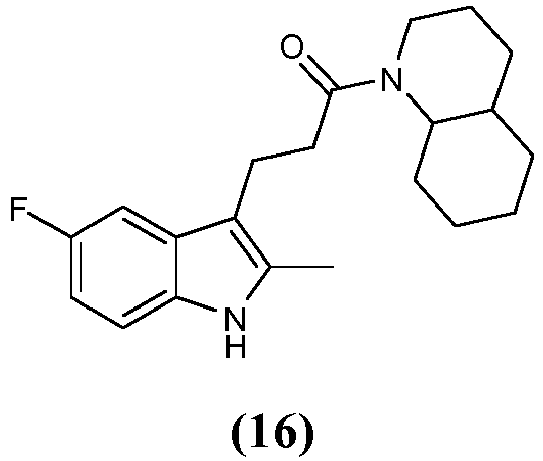

- Intermediate-22 was synthesized by following the procedure used to make Intermediate-9 (Scheme 4).
- Synthesis of Compound (16): Compound (16) was synthesized by following the procedure used to make Compound (1) (Scheme 2). The crude product was obtained by evaporating the organic layer under reduced pressure and was purified by silica gel column using Petroleum ether: Ethyl acetate as eluent to obtain Compound (16). 1H NMR (300MHz,CDCl3) : δ 7.81(s,1H), 7.10-7.18(m,2H), 6.81-6.88(m,1H), 4.49-4.68(m,1H), 3.47-3.53(m,1H), 2.94-3.11(m,2H), 2.48-3.11(m,3H), 2.37(s,3H), 1.30-1.78(m,13H). LC-MS (M+H)+ = 343.2; HPLC purity: 90.88%.
-


- Synthesis of 3-(2-methyl-1H-indol-3-yl)propanoic acid (Intermediate-23): Intermediate-23 was synthesized by following the procedure used to make Intermediate-9 (Scheme 4).
- Synthesis of Compound (17): Compound (17) was synthesized by following the procedure used to make Compound (1) (Scheme 2). The crude product was obtained by evaporating the organic layer under reduced pressure and was purified by silica gel column using Petroleum ether: Ethyl acetate as eluent to obtain Compound (17). 1H NMR (300MHz,CDCl3) : δ 7.89(s,1H), 7.40-7.44(m,1H), 7.17-7.19(t,1H), 6.98-7.05(m,2H), 4.43-4.62(m,1H),3.38-3.47(m,1H), 2.94-3.04(m,2H), 2.68-2.86(m,1H), 2.51-2.66(m,2H), 2.29(s,3H), 1.52-1.70(m,6H), 1.21-1.34(m,7H). LC-MS (M+H)+ = 325.2; HPLC purity: 94.48%.
-


- Synthesis of 3-(1H-indol-1-yl)propanoic acid (Intermediate-25): A 100ml RB flask fitted with magnetic stirrer was charged with 10 ml of DMF. To the stirred solvent Starting Material-1 (1.0g, 8.53 mmol) followed by Sodium hydride (400 mg, 10.24 mmol) were added. The resulting solution was stirred at room temperature for 1 hour. To the above solution methyl-3-bromo-propionate (2.13 g, 12.79 mmol) was added and stirred at room temperature for 24 hours. After completion of the reaction (reaction monitored by TLC), reaction mass was diluted with 30mL of ice cold water and washed with ether. Aqueous portion was acidified with 1N HCl (pH =2) and was then extracted with EtOAc and concentrated to give Intermediate-24 (900mg).
- Synthesis of Compound (18): Compound (18) was synthesized by following the procedure used to make Compound (1) (Scheme 2). The crude product was obtained by evaporating the organic layer under reduced pressure and was purified by silica gel column using Petroleum ether: Ethyl acetate as eluent to obtain Compound (18). 1H NMR (300MHz,CDCl3) : δ 7.38-7.43(t,1H), 7.16-7.28(m,1H), 7.01-7.10(m,1H), 6.84-6.90(m,2H), 6.43-6.52(m,1H), 4.40-4.77(m,1H), 4.30-4.35(t,2H), 3.14-3.35(m,3H), 2.42-2.78(m,2H), 1.57-1.61(t,4H), 1.28-1.49(m,3H), 1.06-1.16(m,5H). LC-MS (M+H)+ = 311.1; HPLC purity: 98.08%.
-

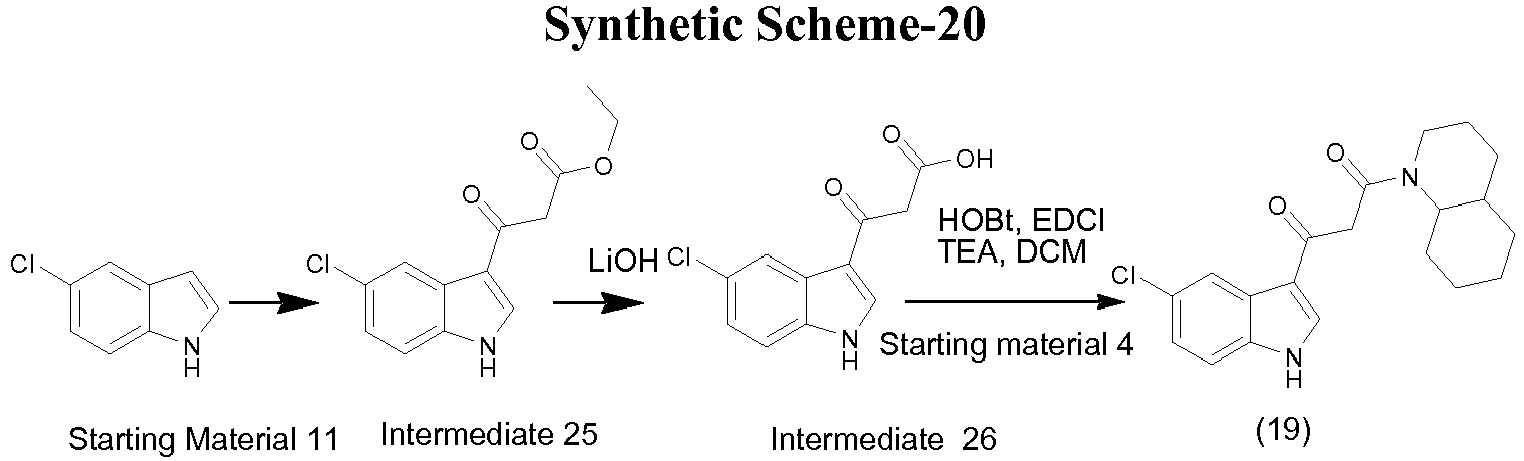
- Synthesis of ethyl 3-(5-chloro-1H-indol-3-yl)-3-oxopropanoate (Intermediate-25): To a 50mL two neck RB 10mL of dichloromethane was added. To this solvent, ethylmalonylchloride (1.0mL, 8.24mmol) was added and the reaction mixture thus obtained was cooled to 0°C. To the cooled reaction mixture, TiCl4 (0.9ml, 8.24mmol) was slowly added and the mixture was stirred at room temperature for 20min. The reaction mixture was once again cooled to 0°C and to the cooled mixture Starting Material-11 (0.5g, 3.29mmol) dissolved in 2mL of dichloroethane was added and stirred at room temperature for 3 hours. The reaction mass was quenched with 1N HCl solution and extracted with ethyl acetate. Organic layers were concentrated, purified by silica-gel column chromatography eluting with hexanes: EtOAc to give Intermedate-25 (566 mg).
- Synthesis of ethyl 3-(5-chloro-1H-indol-3-yl)-3-oxopropanoic acid (Intermediate-26): Intermediate-26 was synthesized by following the procedure used to make intermediate-3 (1) (Scheme 1).
- Synthesis of Compound (19): Compound (19) was synthesized by following the procedure used to make Compound (1) (Scheme 2). The crude product was obtained by evaporating the organic layer under reduced pressure and was purified by silica gel column using Petroleum ether: Ethyl acetate (1:4) as eluent to obtain Compound (19). 1H NMR (300MHz,CDCl3) : δ 10.58(s,1H), 8.22(s,1H), 7.96(s,1H), 7.10(m,2H), 4.00-4.58(m,1H), 3.31-3.84(m,3H), 2.50-3.10(m,1H), 1.16-1.82(m,13H). LC-MS (M+H)+= 359.1; HPLC purity: 90.09%.
-

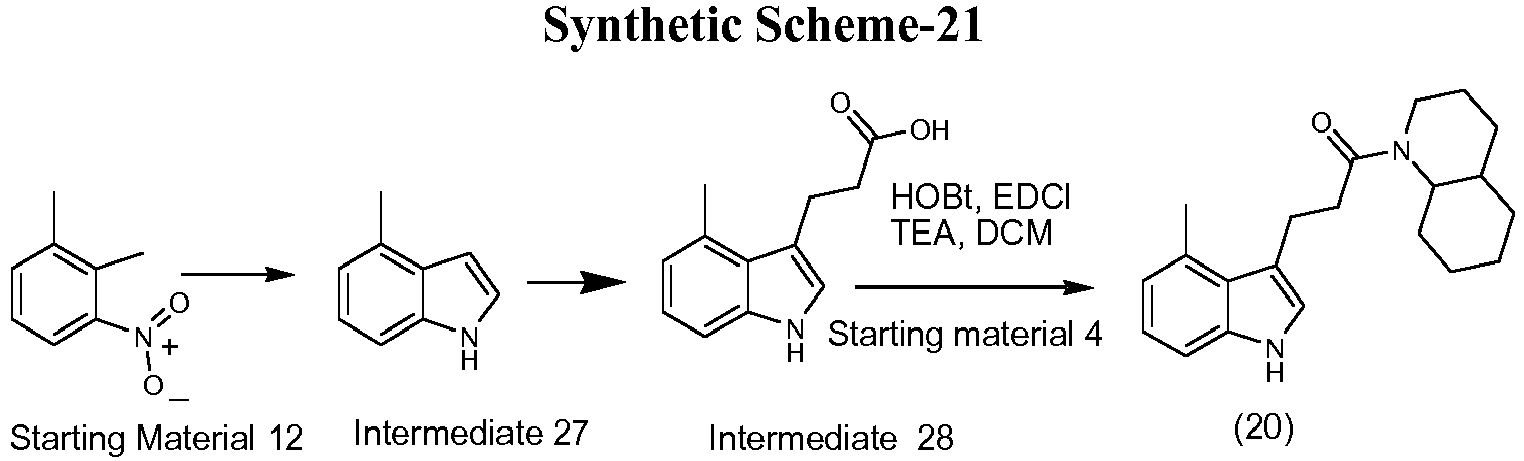
- Synthesis of 4-methyl-1H-indole (Intermediate-27): A 100 mL RB flask fitted with magnetic stirrer and reflux condenser was charged with 60 mL of DMF. To the stirred solvent Starting Material-12 (5 g, 33 mmol) was added followed by addition of Dimethyl formamide dimethyl acetal (13.1 mL, 99.2 mmol). To this reaction mixture Pyrrolidine (3.2 mL, 39.6 mmol) was added and it was heated at 120°C under Nitrogen atmosphere for 21 hours. After completion of the reaction the mixture was cooled to room temperature and solvent was removed under reduced pressure. The resulting crude mass was taken in ether (250 mL) and was washed with water (50 mLx3) and saturated brine solution (50 mL) and the organic layer was dried over anhydrous sodium sulphate and concentrated. Resulted crude material was taken in Ethyl acetate (50 mL). To this 10%Pd/C (1.0 g, 10% w/w) was added and hydrogenated in a parr shaker for 2 hours. After completion of the reaction (reaction monitored by TLC), the mixture was filtered through celite bed. Filtrate was concentrated to give crude product, which was purified by column chromatography on silica gel (120 meshe) using Petroleum ether (60-80) and ethyl acetate as eluent to give Intermediate-27 (1.2 g).
- Synthesis of 3-(4-methyl-1H-indol-3-yl)propanoic acid (Intermediate-28): A 100 mL RB flask fitted with magnetic stirrer was charged with 2.5 mL of acetic acid. To the stirred solvent acetic anhydride 2.0 mL was added followed by addition of acrylic acid (1.8 mL, 27.4 mmol). To this stirred mixture, Intermediate-27 (1.2 g, 9.15mmol) was added and the reaction mixture was further stirred at room temperature for 1 week. After completion of the reaction (reaction was monitored by TLC), reaction mass was basified using 5N NaOH (5 mL) and washed with Ethyl acetate (100 mLX2). The aqueous layer was acidified with Concentrated HCl (3ML) and was extracted using Ethyl acetate (100 mLX3). The combined ethyl acetate layer was washed with brine solution and concentrated to give Intermediate-28 (350 mg).
- Synthesis of Compound (20): Compound (20) was synthesized by following the procedure used to make Compound (1) (Scheme 2). The crude product was obtained by evaporating the organic layer under reduced pressure and was purified by silica gel column using Petroleum ether: Ethyl acetate as eluent to obtain Compound (20). 1H NMR (300MHz,CDCl3) : δ 8.23(s,1H), 7.08-7.11(t,1H), 6.93-6.99(m,1H), 6.88-6.89(d,1H), 6.73-6.77(t,1H), 4.46-4.50(m,1H), 3.53-3.60(m,1H), 3.46-3.51(m,2H), 2.71-2.92(m,1H), 2.45-2.87(m,6H), 1.71-1.77(m,5H), 1.29-1.39(m,7H). LC-MS (M+H)+ = 325.2; HPLC purity: 96.28%.
-

- Synthesis of Compound (21): Compound (21) was synthesized by following the procedure used to make Compound (1) (Scheme 2). The crude product was obtained by evaporating the organic layer under reduced pressure and was purified by silica gel column using Petroleum ether: Ethyl acetate as eluent to obtain Compound (21). 1H NMR (300MHz,CDCl3) : δ 8.59(s,1H), 7.49-7.52(d,1H), 7.24-7.26(d,1H), 6.98-7.10(m,2H), 6.90(s,1H), 4.44-4.66(m,1H), 3.40-3.70(m,1H), 3.01-3.06(m,2H), 1.99-2.81(m,4H), 0.44-1.63(m,12H). LC-MS (M+H)+ = 311.0; HPLC purity: 96.03%.
-
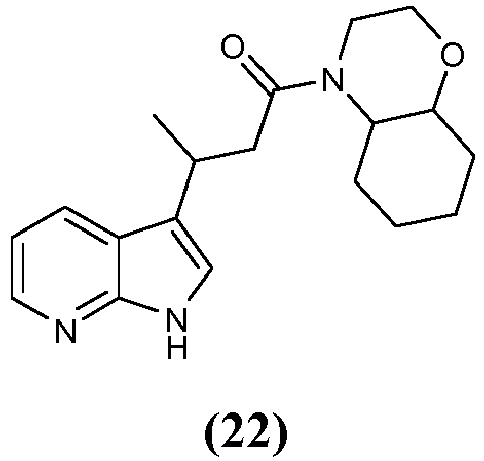

- Synthesis of 3,4-dihydro-2H-1,4-benzoxazine (Intermediate-29): A solution of Starting Material-13(5 g, 33.5 mmol) in tetrahydrofuran (50 mL) was slowly added to a suspension of lithium aluminum hydride (3.18 g, 83.8 mmol) under N2 atmosphere at 0°C. The reaction mixture was refluxed for 16 h. The reaction mixture was diluted with EtOAc, quenched with 15% aqueous sodium hydroxide solution at 0°C, and extracted with ether, and concentrated to give Intermediate-29 as brown liquid (4.3 g).
- Synthesis of octahydro-2H-1,4-benzoxazine (Intermediate-30): To a solution of Intermediate-29 (1.5 g, 11.1 mmol) in 20 mL of acetic acid, 10% PtO2 (252 mg) was added, and hydrogenated at 60 psi for 5 h. The mixture was filtered and basified with 10% NaOH solution, extracted with diethyl ether, dried over sodium sulphate and concentrated to give Intermediate-30 as brown liquid (520 mg).
- Synthesis of 3-(1H-pyrrolo[2,3-b]pyridin-3-yl)butanoic acid (Intermediate-31): Intermediate-31 was synthesized by following the procedure used to make Intermidiate-3 (Scheme 1).
- Synthesis of Compound (22): Compound (22) was synthesized by following the procedure used to make Compound (1) (Scheme 2). The crude product was obtained by evaporating the organic layer under reduced pressure and was purified by silica gel column using Petroleum ether: Ethyl acetate as eluent to obtain Compound (22). 1H NMR (300MHz,DMSO-d6) : δ 11.31(s,1H), 8.15-8.17(m,1H), 7.95-7.99(m,1H), 7.25-7.29(d,1H), 6.98-7.04(m,1H), 3.99-4.10(m,1H), 3.43-3.74(m,4H), 2.63-3.10(m,3H), 1.15-1.99(m,12H). LC-MS (M+H)+= 328.2; HPLC purity: 95.42%.
-

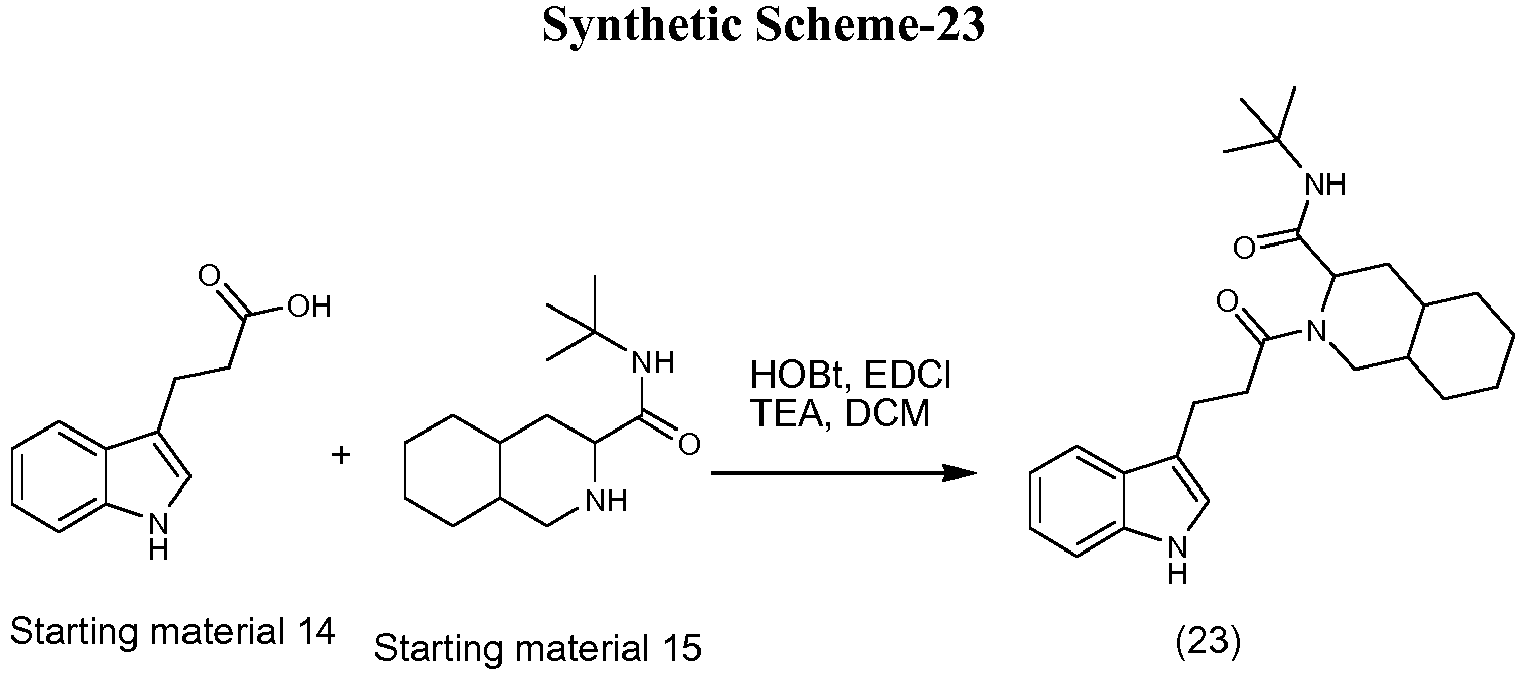
- Synthesis of Compound (23): Compound (23) was synthesized by following the procedure used to make Compound (1) (Scheme 2). The crude product was obtained by evaporating the organic layer under reduced pressure and was purified by silica gel column using Petroleum ether: Ethyl acetate (1:4) as eluent to obtain Compound (23). 1H NMR (300MHz,CDCl3) : δ 7.99(s,1H), 7.48-7.55(m,1H), 7.28-7.30(d,1H), 7.03-7.15(m,2H), 6.97(s,1H), 5.57-5.72(d,1H), 4.95(s,1H), 3.24-4.33(m,3H), 3.05-3.37(m,1H), 2.09-2.86(m,3H), 1.15-1.56(m,20H). LC-MS (M-H)+ = 408.2; HPLC purity: 98.47%.
-

- Synthesis of Compound (24): Compound (24) was synthesized by following the procedure used to make Compound (1) (Scheme 2). The crude product was obtained by evaporating the organic layer under reduced pressure and was purified by silica gel column using Petroleum ether: Ethyl acetate as eluent to obtain Compound (24). 1H NMR (300MHz,CDCl3) δ 6.95-7.02(m,2H), 6.76-6.79(d,1H), 6.70-6.79(d,1H), 4.44-4.62(m,1H), 3.56-3.57(d,3H), 3.41-3.50(m,1H), 2.91-3.06(m,2H), 2.67-2.84(m,1H), 2.48-2.65(m,2H), 1.57-1.71(m,4H), 1.46-1.47(d,2H), 1.18-1.34(m,7H). LC-MS (M+H)+ = 341.2; HPLC purity: 97.31 %.
-


- Synthesis of 2-[(carboxymethyl)amino]benzoic acid (Intermediate-32): To a 500mL 2 neck RB flask fitted with magnetic stirrer, Starting Material-16 (20g, 145 mmol) was added lot wise to a stirred solution of K2CO3 (83 g, 602 mmol) in water (140 mL) followed by chloroacetic acid (13.7g, 145 mmol) under N2 atmosphere at room temperature for about 30 minutes. Then reaction mass was heated at 90°C for 16 hours. After the reaction was cooled to room temperature the reaction mass pH was adjusted to 4-5 using citric acid. The solid material was then filtered and dried under vacuum oven at 70°C for 12 hours to give Intermediate-32 (23 g) as brownish solid.
- To a 500mL 2neck RB flask fitted with magnetic stirrer, acetic anhydride (110 mL, 1200 mmol) was added slowly at 0°C to a stirred solution of triethylamine (170 mL, 1242 mmol) and Intermediate-32 (23g, 117 mmol) under N2 atmosphere. Reaction mass was stirred at room temperature for 5 hours and was further heated at 80°C for 16 hours. Then the reaction was cooled to 0°C and was extracted with ethyl acetate (4 x 150 mL). Organic layer was washed with brine solution, dried over Na2SO4 and concentrated. Crude material was purified by silica gel column eluting with hexanes: EtOAc to give Intermediate-33 (5.5 g) as brown solid.
- To a 50mL 2 neck RB flask fitted with magnetic stirrer, ethanol and water was added. To the solvent, the stirred mixture of Intermediate-33 (5 g, 23 mmol), Na2SO3 (11.6 g, 426 mmol) was added. The reaction mixture was heated at 80°C for 12 hours. After completion of reaction (reaction monitored by TLC), reaction mass was quenched with water and extracted with Ethyl Acetate (3x100 mL). The organic layer was washed with saturated brine solution (15mL), dried over anhydrous Na2SO4, and concentrated. The crude product was purified by silica gel column eluting with hexanes: EtOAc to give Intermediate-34 (1.5 g) as pink solid.
- To a 50mL 2 neck RB flask fitted with magnetic stirrer containing reaction mixture of Starting Material-4 (0.7g, 5 mmol), EDCI (1.17g, 6.3 mmol) and 1-hydroxy benzothioazole (0.762g, 5.6 mmol) in DCM at 0°C, triethylamine (1.3 mL, 9.9 mmol), was added followed by addition of 2-chloropropanoic acid (0.543g, 5 mmol). Resulted reaction mixture was stirred at room temperature for 16 hours. After completion of reaction (reaction monitored by TLC), reaction mass was quenched with water and extracted with DCM (3x25 mL). The organic layer was washed with saturated brine solution (15mL), dried over anhydrous Na2SO4, and concentrated. The crude product was purified by silica gel column eluting with hexanes: EtOAc to give Intermediate-35 (0.5g) as liquid material.
- To a 50mL 2 neck RB flask fitted with magnetic stirrer Intermediate-34 (0.05g, 0.28 mmol) and DMSO (3ml) were added at 0°C under nitrogen atmosphere. To this Potassium t-Butoxide (0.05g, 0.46 mmol) was added and stirred for 1 hour, then Intermediate-35 (0.065g, 0.28 mmol) was added. Resulting mixture stirred at room temperature for 16 hours. After reaction (reaction monitored by TLC), quenched with water and extracted with ethyl acetate (3x10 mL). The organic layer was washed with saturated brine solution (10mL), dried over anhydrous Na2SO4, and concentrated to give Intermediate-36 (100 mg).
- Synthesis of Compound (25): To a stirred solution of Intermediate-36 (0.1g, 0.27 mmol) in methanol and water was added K2CO3 (0.15g, 1.0 mmol), and stirred at room temperature for 3 hours. After completion of the reaction (reaction monitored by TLC), quenched with water and extracted with ethyl acetate (3x10 mL). The organic layer was washed with saturated brine solution (15mL)), and concentrated. The crude product was purified by silica gel column eluting with hexanes: EtOAc to give Compound (25) (6 mg) as a sticky solid. 1H NMR (300MHz,CDCl3) : δ 7.55-7.58(d,2H), 7.19-7.22(d,1H), 7.08-7.013(t,1H), 6.98-7.02(t,1H), 6.67-6.68(d,1H), 4.75-4.85(m,1H), 4.10-4.56(m,2H), 2.52-2.96(m,1H), 1.18-1.60(m,16H). LC-MS (M+H)+ = 327.2; HPLC purity: 99.99%.
-


- Starting Material-17 (5g, 40.3mmol), dimethyl amine hydrochloride (3.62g, 44.3mmol), paraformaldehyde (2.42g, 80.5mmol), 37% aqueous HCl (0.2 mL, 40.3mmol) were combined in ethanol (5mL). The resultant mixture was heated to reflux in a sealed tube for 20 hours. The reaction was then concentrated, basified with aq. NaOH and extracted with CHCl3. The combined organic layers were dried over Na2SO4, concentrated to give Inermediate-37 (4.78 g) as light orange oily material.
- Intermediate-37 (4.2 g, 23.2mmol), was taken in 1,4-dioxane (3 mL), and concentrated NH4OH (5 mL) in a sealed tube. The vessel was sealed and then heated in an oil bath at 120°C for 18 hours. Then reaction mixture was cooled to room temperature, and concentrated. The residue was taken up in CHCl3, dried over Na2SO4 and concentrated to give crude material (3.35 g). This crude material was treated with Boc2O (4.8g, 29.8mmol), in presence of TEA (9 mL, 64.5mmol), in THF (10 mL) at room temperature for 16 hours. After completion of reaction, the reaction mixture was diluted with water, extracted with EtOAc and concentrated to give crude material, which is purified by silica gel column chromatography eluting with hexanes: EtOAc to give Intermediate-38 (1.34 g).
- Synthesis of octahydroquinolin-4(1H)-one trifluoroacetic acid salt (Intermediate-39): At 0°C, Trifluoro acetic acid (0.162g, 1.42 mmol) was added drop wise to a solution of Intermediate-38 (0.3g, 1.18mmol) in DCM (3 mL), under nitrogen atmosphere. Resultant mixture was stirred at RT for 16 h. After completion the reaction mixture was concentrated to give Intermediate-39 (352 mg).
- Synthesis of Compound (26): Compound (26) was synthesized by following the procedure used to make Compound (1) (Scheme 2). The crude product was obtained by evaporating the organic layer under reduced pressure and was purified by silica gel column using Petroleum ether: Ethyl acetate as eluent to obtain Compound (26). 1H NMR (300MHz,CDCl3) : δ 8.05(s,1H), 7.53-7.58(t,1H), 7.27-7.29(d,1H), 7.02-7.19(m,2H), 6.98(s,1H), 4.60-4.92(m,1H), 3.69-3.83(m,1H), 306-3.37(m,3H), 2.63-2.92(m,2H), 1.35-2.25(m,11H). LC-MS (M+H)+ = 325.2; HPLC purity: 93.87%.
-


- Synthesis of Compound (27): Under N2 atmosphere to a stirred solution of (20) (70 mg 0.2157 mmol) in 5 mL of dry THF, sodium hydride (22 mg, 0.5394 mmol) was added, and stirred for 30 minutes at room temperature. To this reaction mixture methyl iodide (77 mg, 0.5394 mmol) was added at 0°C. The mixture was stirred at room temperature for 3 hours. The mixture was quenched with crushed ice and extracted with ethyl acetate, and concentrated. Resulting crude material was purified by silica-gel column chromatography eluting with hexanes: EtOAc to give Compound (27) (55 mg). 1H NMR (300MHz,CDCl3) : δ 6.98-7.03(m,2H), 6.76-6.78(m,2H), 3.47-4.63(m,1H), 3.62-3.63(d,3H), 3.15-3.20(m,2H), 2.63-2.92(m,4H), 2.46-2.60(m,2H), 1.23-1.93(m,14H). LC-MS (M+H)+ = 339.2; HPLC purity: 99.79%.
-

- Synthesis of Compound (28): Compound (28) was synthesized by following the procedure used to make Compound (27) (Scheme 26). The crude product was obtained by evaporating the organic layer under reduced pressure and was purified by silica gel column using Petroleum ether: Ethyl acetate as eluent to obtain Compound (28). 1H NMR (300MHz,CDCl3) : δ 6.96-7.04(m,2H), 6.80-6.81(m,1H), 6.64-6.67(m,1H), 5.34-5.41(m,1H), 4.49-4.63(m,1H), 3.49-3.63(m,1H), 3.18-3.22(m,2H), 2.64-2.74(m,4H), 2.46-2.60(m,2H), 1.23-1.80(m,17H). LC-MS (M+H)+ = 365.3; HPLC purity: 98.79%.
-

- Synthesis of Compound (29): Compound (29) was synthesized by following the procedure used to make Compound (27) (Scheme 26). The crude product was obtained by evaporating the organic layer under reduced pressure and was purified by silica gel column using Petroleum ether: Ethyl acetate as eluent to obtain Compound (29). 1H NMR (300MHz,CDCl3) : δ 7.08-7.10(d,1H), 6.97-7.02(m,1H), 6.91-6.93(d,1H), 6.75(m,1H), 4.45-4.63(m,1H), 3.81-3.83(d,2H), 3.45-3.58(m,1H), 3.16-3.21(m,2H), 2.49-2.77(m,6H), 1.23-1.97(m,14H), 0.51-0.54(m,2H), 0.26-0.27(m,2H). LC-MS (M+H)+ = 379.3; HPLC purity: 99.43%.
-
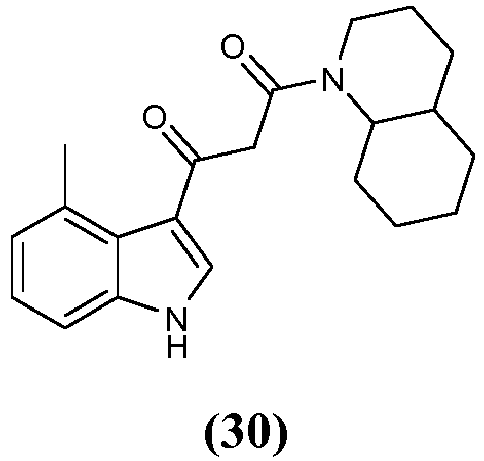
- Synthesis of Compound (30): Compound (30) was synthesized by following the procedure used to make Compound (19) (Scheme 20). The crude product was obtained by evaporating the organic layer under reduced pressure and was purified by silica gel column using Petroleum ether: Ethyl acetate as eluent to obtain Compound (30). 1H NMR (300MHz,CDCl3) : δ 9.25-9.31(d,1H), 8.26-8.30(m,1H), 7.06-7.15(m,2H), 6.95-6.97(d,1H), 4.12-4.60(m,1H), 3.90(s,2H), 3.59-4.16(m,1H), 2.52-3.06(m,1H), 2.75-2.76(d,3H), 1.93-2.30(m,1H), 1.26-1.98(m,12H). LC-MS (M+H)+= 339.2; HPLC purity: 98.52%.
-


- Synthesis of tert-butyl 3-[(1Z)-2-cyano-3-ethoxy-3-oxoprop-1-en-1-yl]-1H-indole-1-carboxylate (Intermediate-40): A 50mL RB flask fitted with magnetic stirrer was charged with isoproponol (10mL) and Starting Material-18. To this ethyl cyano acetate (0.255g, 2.2mmol) and potassium hydroxide (0.12g, 2.2mmol) were added at 0°C and was stirred for 1hour. After completion of the reaction (reaction monitored by TLC), reaction mixture was quenched with Ice-Water 350mL and extracted with ethyl acetate. The organic layer washed with brine solution and dried by anhydrous sodium sulphate and concentrated to give Intermediate-40 (600 mg).
- Synthesis of (2Z)-2-cyano-3-(1H-indol-3-yl)prop-2-enoic acid (Intermediate-41): A 100mL RB flask fitted with magnetic stirrer was charged with 5 mL of Ethanol and Intermediate-40 (0.6g, 1.7mmol). To this NaOH (0.20g, 2.4mmol) in 0.5mL of water was added and the reaction mixture was stirred at room temperature for 3hours. After completion of the reaction (reaction monitored by TLC), the reaction mixture was concentrated. The resulted crude was acidified with 1N HCl (pH 1-2), and extracted with ethyl acetate. Organic layers were washed with brine solution and dried by anhydrous sodium sulphate and concentrated to give Intermediate-41(400 mg).
- Synthesis of Compound (31): Compound (31) was synthesized by following the procedure used to make Compound (1) (Scheme 2). The crude product was obtained by evaporating the organic layer under reduced pressure and was purified by silica gel column using Petroleum ether: Ethyl acetate as eluent to obtain Compound (31). 1H NMR (300MHz,CDCl3) : δ 8.94(s,1H), 8.44(s,1H), 8.13(s,1H), 7.68-7.71(d,1H), 7.37-7.40(d,1H), 7.21-7.26(m,2H), 4.30-4.48(m,1H), 3.90-4.08(m,1H), 2.75-3.18(m,1H), 1.30-1.86(m,13H). LC-MS (M+H)+= 334.2; HPLC purity: 94.91%.
-

- Synthesis of Compound (32): Compound (32) was synthesized by following the procedure used to make Compound (1) (Scheme 2). The crude product was obtained by evaporating the organic layer under reduced pressure and was purified by silica gel column using Petroleum ether: Ethyl acetate as eluent to obtain Compound (32). 1H NMR (300MHz,CDCl3) : δ 7.92(s,1H), 7.11-7.14(d,1H), 6.95-6.99(m,2H), 6.79(s,1H), 4.62-4.94(m,1H), 4.04-4.06(d,3H), 3.57-3.87(m,1H), 3.25-3.39(m,2H), 2.57-2.66(m,4H), 1.43-2.26(m,10H). LC-MS (M+H)+ = 339.2; HPLC purity: 92.86%.
-


- Synthesis of Compound (33): Compound (33) was synthesized by following the procedure used to make Compound (27) (Scheme 26). The crude product was obtained by evaporating the organic layer under reduced pressure and was purified by silica gel column using Petroleum ether: Ethyl acetate as eluent to obtain Compound (33). 1H NMR (300MHz,CDCl3) : δ 6.98-7.08(m,2H), 6.83-6.84(d,1H), 6.75-6.77(m,1H), 4.45-4.63(m,1H), 3.98-4.05(m,2H), 3.47-3.57(m,1H), 3.16-3.20(t,2H), 2.50-2.92(m,6H), 1.23-1.76(m,16H). LC-MS (M+H)+ = 353.3
-

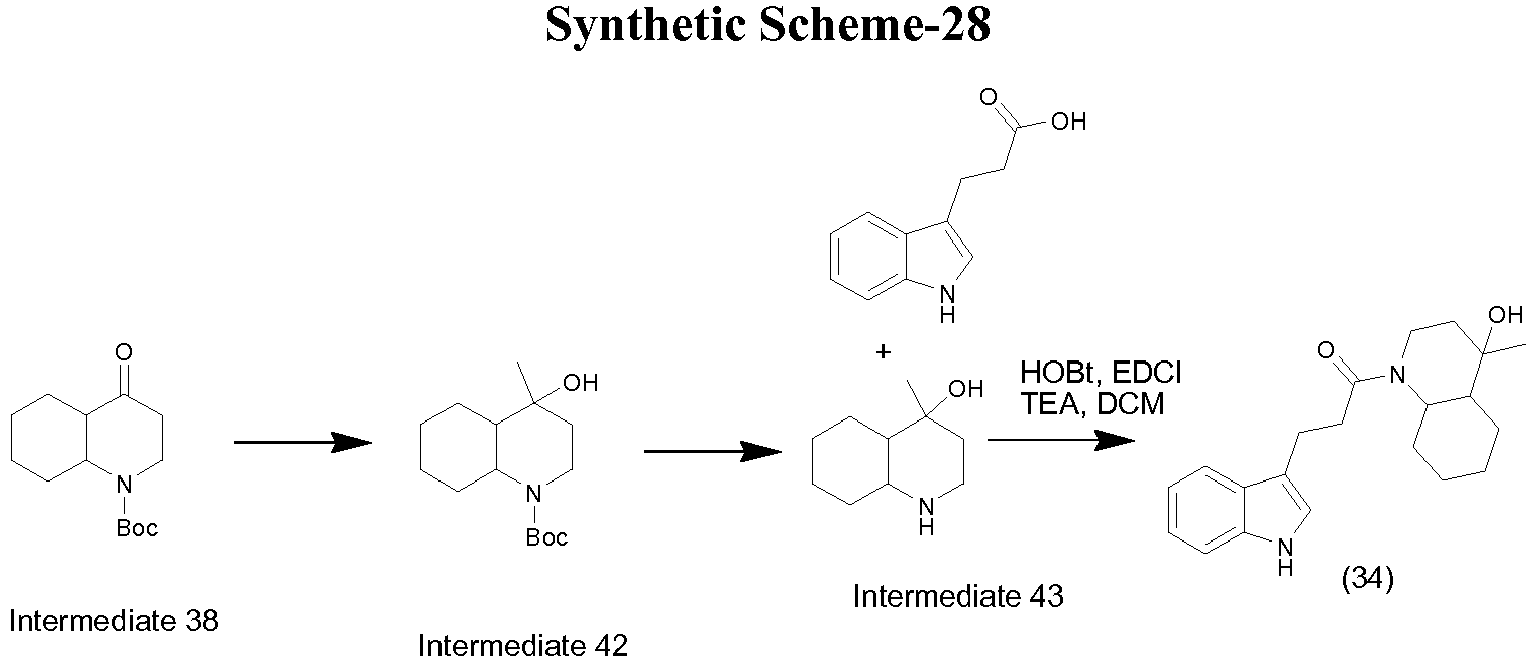
- Synthesis of tert-butyl 4-hydroxy-4-methyloctahydroquinoline-1(2H)-carboxylate (Intermediate-42): In a 50 mL-2 neck-RB flask fitted with magnetic sitter, a 3.0 M solution of methyl magnesium iodide in ether (1.45 mL, 4.4 mmol) was added drop wise at -20°C to a stirred solution of Intermediate-38 (0.55g, 2.2 mmol) in 5 ml of dry THF under N2 atmosphere. Resulting mixture was stirred at room temperature for 16 hours. After completion of the reaction (monitored by TLC), the reaction mixture was quenched with ice water and extracted with ethyl acetate (3 x 15 ml). Organic layer was washed with brine solution and dried over Na2SO4 and concentrated. Crude material was purified by silica-gel column chromatography eluting with hexanes: EtOAc to give Intermediate-42 (82 mg) as gummy solid. LC-MS (M+H)+ = 270.1.
- Intermediate-43 was synthesized by following the procedure used to make Intermediate-39 (Scheme 25).
- Synthesis of Compound (34): Compound (34) was synthesized by following the procedure used to make Compound (1) (Scheme 2). The crude product was obtained by evaporating the organic layer under reduced pressure and was purified by silica gel column using Petroleum ether: Ethyl acetate as eluent to obtain Compound (34). 1H NMR (300MHz,CDCl3) : δ 7.95(s,1H), 7.54-7.56(d,1H), 7.27-7.29(d,1H), 7.02-7.14(m,2H), 6.97(s,1H), 4.38-4.53(m,1H), 3.39-3.42(m,1H), 3.06-3.08(m,2H), 2.51-2.77(m,2H), 0.86-2.10(m,16H). LC-MS (M+H)+ = 341.2; HPLC purity: 80.53%.
-

- Synthesis of Compound (35): Compound (35) was synthesized by following the procedure used to make Compound (1) (Scheme 2). The crude product was obtained by evaporating the organic layer under reduced pressure and was purified by silica gel column using Petroleum ether: Ethyl acetate as eluent to obtain Compound (35). 1H NMR (300MHz,CDCl3) : δ 7.90(s,1H), 7.10-7.13 (d,1H), 6.92-7.01(m,2H), 6.79(m,1H), 4.48-4.71 (m,1H), 3.48-3.94(m,1H), 3.19-3.24(t,2H), 2.48-2.79(m,6H), 1.09-1.77(m,15H). LC-MS (M+H)+ = 339.3; HPLC purity: 98.23%.
-
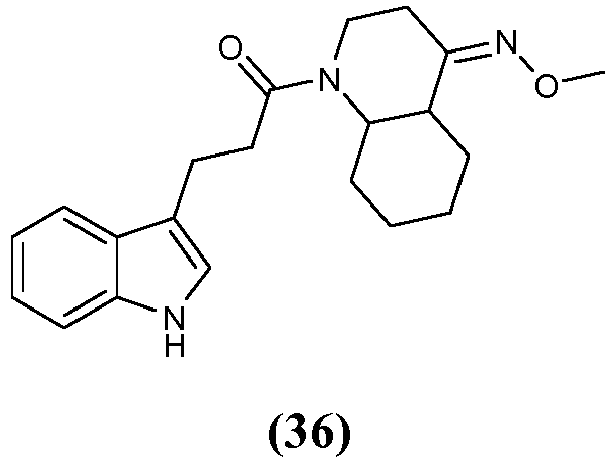

- Synthesis of tert-butyl (4E)-4-(methoxyimino)octahydroquinoline-1(2H)-carboxylate (Intermediate-44): In a 50 mL-2 neck-RB flask fitted with magnetic sitter, pyridine (0.45 mL, 3 vol) was added to a stirred solution of Intermediate-38 (150 mg, 0.596 mmol) in ethanol (1.5 ml, 8 vol). To this O-methoxylamine hydrochloride (250 mg, 2.96 mmol) was added. The resulting mass was refluxed at 90°C for 3 hours. After completion of reaction (monitored by TLC), the solvent was completely removed from the reaction mass under vacuum. Crude was portioned between water and ethyl acetate. The organic layer was separated and the aqueous layer thus obtained was washed with ethyl acetate and concentrated. Resulted crude material was purified by silica-gel column chromatography eluted with hexanes: EtOAc to give Intermediate-44 (150 mg) as pale greenish liquid material.
- Synthesis of (4E)-N-methoxyoctahydroquinolin-4(1H)-imine trifluoroacetic acid salt (Intermediate-45): Intermediate-45 was synthesized by following the procedure used to make Intermediate-39 (Scheme 25).
- Synthesis of Compound (36): Compound (36) was synthesized by following the procedure used to make Compound (1) (Scheme 2). The crude product was obtained by evaporating the organic layer under reduced pressure and was purified by silica gel column using Petroleum ether: Ethyl acetate as eluent to obtain Compound (36). 1H NMR (300MHz,CDCl3): δ 7.95(s,1H), 7.52-7.54(m,1H), 7.27-7.30(m,1H), 7.02-7.15(m,2H), 6.97(s,1H), 4.10-4.67(m,1H), 3.76(d,3H), 3.18-3.59(m,1H), 3.04-3.17(m,2H), 2.54-2.86(m,3H), 1.35-2.26(m,11H). LC-MS (M+H)+ = 354.2; HPLC purity: 88.00%.
-

- Synthesis of Compound (37): Compound (37) was synthesized by following the procedure used to make Compound (1) (Scheme 2). The crude product was obtained by evaporating the organic layer under reduced pressure and was purified by silica gel column using Petroleum ether: Ethyl acetate as eluent to obtain Compound (37). 1H NMR (300MHz,DMSO-d6) : δ 10.76(s,1H), 7.49-7.52(d,1H), 7.30-7.33(d,1H), 7.02-7.12(m,2H), 6.94-6.99(t,1H), 4.00-4.60(m,1H), 3.37-3.66(m,1H), 3.01-3.19(m,1H), 2.87-2.95(m,2H), 2.54-2.78(m,2H), 0.30-1.98(m,15H). LC-MS (M+H)+ = 325.2; HPLC purity: 97.66%.
-

- Synthesis of Compound (38): Compound (38) was synthesized by following the procedure used to make Compound (1) (Scheme 2). The crude product was obtained by evaporating the organic layer under reduced pressure and was purified by silica gel column using Petroleum ether: Ethyl acetate as eluent to obtain Compound (38). 1H NMR (300MHz,CDCl3) : δ 8.05(s,1H), 7.54-7.57(m,1H), 7.27-7.30(d,1H), 7.04-7.18(m,2H), 6.96(s,1H), 4.48-4.87(m,1H), 3.26-4.09(m,1H), 3.05-3.10(m,2H), 2.50-2.81(m,2H), 0.90-1.80(m,16H). LC-MS (M+H)+ = 325.2; HPLC purity: 98.14%.
-

- Synthesis of Compound (39): Compound (39) was synthesized by following the procedure used to make Compound (1) (Scheme 2). The crude product was obtained by evaporating the organic layer under reduced pressure and was purified by silica gel column using Petroleum ether: Ethyl acetate (1:4) as eluent to obtain Compound (39). 1H NMR (300MHz,CDCl3) : δ 7.92(s,1H), 7.41-7.47(m,1H), 6.94-6.98(m,2H), 6.78-6.84(m,1H), 4.30-4.60(m,1H), 3.30-3.60(m,1H), 3.10-3.30(m,3H), 2.49-2.68(m,2H), 1.16-1.66(m,13H). LC-MS (M+H)+= 329.2
-

- Synthesis of Compound (40): Compound (40) was synthesized by following the procedure used to make Compound (1) (Scheme 2). The crude product was obtained by evaporating the organic layer under reduced pressure and was purified by silica gel column using Petroleum ether: Ethyl acetate as eluent to obtain Compound (40). 1H NMR (300MHz,CDCl3) : δ 7.98(s,1H), 7.41-7.47(m,1H), 6.94-6.98(d,2H), 6.78-6.84(m,1H), 4.47-4.71(m,1H), 3.37-3.90(m,1H), 3.02-3.07(t,2H), 2.46-2.77(m,2H), 0.91-1.82(m,16H). LC-MS (M+H)+= 343.22; HPLC purity: 97.64%.
-


- Synthesis of octahydro-1H-indole (Intermediate-46): Intermediate-46 was synthesized by following the procedure used to make Intermediate-18 (Scheme 13).
- Synthesis of Compound (41): Compound (41) was synthesized by following the procedure used to make Compound (1) (Scheme 2). The crude product was obtained by evaporating the organic layer under reduced pressure and was purified by silica gel column using Petroleum ether: Ethyl acetate as eluent to obtain Compound (41). 1H NMR (300MHz,CDCl3) : δ 8.02(s,1H), 7.53-7.56(d,1H), 7.27-7.30(d,1H), 7.02-7.14(m,2H), 6.96(s,1H), 3.29-4.03(m,3H), 3.03-3.23(m,2H), 2.49-2.70(m,2H), 0.88-2.07(m,11H). LC-MS (M+H)+ = 297.22; HPLC purity: 99.0%.
-
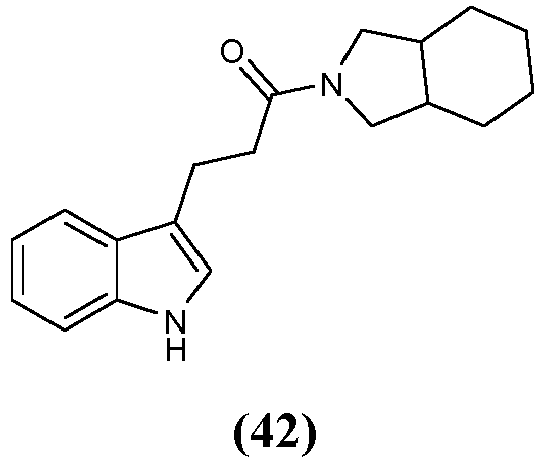
- Synthesis of Compound (42): Compound (42) was synthesized by following the procedure used to make Compound (1) (Scheme 2). The crude product was obtained by evaporating the organic layer under reduced pressure and was purified by silica gel column using Petroleum ether: Ethyl acetate as eluent to obtain Compound (42). 1H NMR (300MHz,CDCl3) : δ 7.98(s,1H), 7.53-7.56(d,1H), 7.27-7.30(d,1H), 6.99-7.13(m,3H), 3.28(s,2H), 3.13(m,3H), 2.94(s,1H), 2.63-2.68(t,2H), 2.24(s,3H), 2.02(s,2H), 1.31(m,5H). LC-MS (M+H)+ = 297.2; HPLC purity: 97.66%.
-

- Synthesis of Compound (43): Compound (43) was synthesized by following the procedure used to make Compound (1) (Scheme 2). The crude product was obtained by evaporating the organic layer under reduced pressure and was purified by silica gel column using Petroleum ether: Ethyl acetate (1:4) as eluent to obtain Compound (43). 1H NMR (300MHz, CDCl3) : δ 8.14(s,1H), 7.42-7.43 (m,1H), 6.95 (s,1H), 6.67-6.84(m,2H), 4.62-4.91 (m,1H), 3.71-3.81 (m,1H), 2.78-3.42(m,4H), 2.69(m,2H), 1.28-2.47(m,10H). LC-MS (M+H)+ = 343.2; HPLC purity: 96.03%.
-

- Synthesis of Compound (44): Compound (44) was synthesized by following the procedure used to make Compound (1) (Scheme 2). The crude product was obtained by evaporating the organic layer under reduced pressure and was purified by silica gel column using Petroleum ether: Ethyl acetate as eluent to obtain Compound (44). 1H NMR (300MHz,DMSO-d6) : δ 11.07(s,1H), 7.14-7.17(m,2H), 6.99-7.01 (m,1H), 6.66-6.75 (m,1H), 4.29-4.48(m,1H), 3.63-3.76(m,1), 2.95-2.97(m,2H), 2.56-2.76(m,3H), 1.66-1.75(m,5H), 1.52-1.61(m,2H), 1.28-1.45(m,6H). LC-MS (M+H)+ = 329.3; HPLC purity: 97.26%.
-

- Synthesis of Compound (45): Compound (45) was synthesized by following the procedure used to make Compound (1) (Scheme 2). The crude product was obtained by evaporating the organic layer under reduced pressure and was purified by silica gel column using Petroleum ether: Ethyl acetate as eluent to obtain Compound (45). 1H NMR (300MHz,CDCl3) : δ 8.00(s,1H), 7.54-7.56(d,1H), 7.28-7.30(d,1H), 7.02-7.14(m,2H), 6.97(s,1H), 3.86-4.10(m,1H), 3.29-3.65(m,1H), 3.01-3.20(m,2H), 2.57-2.72(m,2H), 2.04(s,3H), 1.72-1.86(m,2H), 1.55-1.66(m,3H), 1.03-1.35(m,6H). LC-MS (M+H)+ = 311.2; HPLC purity: 99.27%.
-
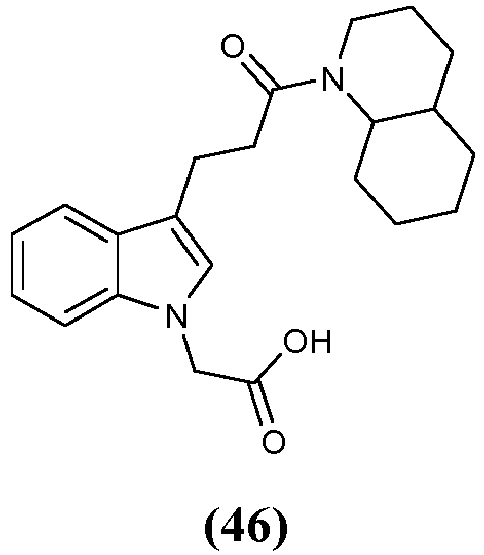

- Synthesis of ethyl {3-[3-(octahydroquinolin-1(2H)-yl)-3-oxopropyl]-1H-indol-1-yl}acetate (Intermediate-47): Intermediate-47 was synthesized by following the procedure used to make Intermediate-24 (Scheme 19).
- Synthesis of Compound (46): Compound (46) was synthesized by following the procedure used to make Intermediate-3 (Scheme 1). The crude product was obtained by evaporating the organic layer under reduced pressure and was purified by silica gel column using Petroleum ether: Ethyl acetate as eluent to obtain Compound (46). 1H NMR (300MHz,CDCl3) : δ 7.46-7.50(t,1H), 7.02-7.18(m,3H), 6.80(s,1H), 4.66(s,2H), 4.39-4.58(m,1H), 3.47-3.60(m,1H), 2.93-3.01(m,2H), 2.44-2.85(m,4H), 1.25-1.65(m,13H). LC-MS (M+H)+ = 369.22; HPLC purity: 93.09%.
-

- Synthesis of Compound (47): Compound (47) was synthesized by following the procedure used to make Compound (1) (Scheme 2). The crude product was obtained by evaporating the organic layer under reduced pressure and was purified by silica gel column using Petroleum ether: Ethyl acetate as eluent to obtain Compound (47). 1H NMR (300MHz,CDCl3) : δ 7.20-7.23(d,1H), 7.14(s,1H), 7.05-7.11(m,1H), 6.71-6.79(,.1H), 4.29-4.48(m,1H), 3.62-3.79(m,4H), 2.92-2.98(m,2H), 2.61-2.72(m,3H), 1.35-1.75(m,13H). LC-MS (M+H)+ = 343.3; HPLC purity: 98.84%.
-

- Synthesis of Compound (48): Compound (48) was synthesized by following the procedure used to make Compound (1) (Scheme 2). The crude product was obtained by evaporating the organic layer under reduced pressure and was purified by silica gel column using Petroleum ether: Ethyl acetate as eluent to obtain Compound (48). 1H NMR (300MHz,CDCl3) : δ 8.00(s,1H), 7.51-7.54(d,1H), 7.26-7.29(d,1H), 7.01-7.18(m,2H), 6.94(s,1H), 3.37(s,2H), 3.03-3.08(t,2H), 2.65-2.70(t,2H), 2.30-2.39(m,1H), 1.87(s,3H), 1.79(s,2H), 1.53-1.59(m,6H). LC-MS (M+H)+ = 309.25; HPLC purity: 85.06%.
-


- Synthesis of decahydroquinoline-4-carboxylic acid (Intermediate-48): Intermediate- was synthesized by following the procedure used to make Intermediate-18 (Scheme 13).
- Synthesis of methyl decahydroquinoline-4-carboxylate (Intermediate-49): To a stirred solution of Intermediate-48 (800 mg g, 4.3656 mmol) in methanol (30 mL) thionyl chloride (0.48 mL, 6.5483 mmol) was added under nitrogen atmosphere at 0°C. The mixture was stirred at room temperature for 16 hours. After completion of the reaction, the reaction mixture was concentrated to give Intermediate-49 (775 mg).
- Synthesis of Compound (49): Compound (49) was synthesized by following the procedure used to make Compound (1) (Scheme 2). The crude product was obtained by evaporating the organic layer under reduced pressure and was purified by silica gel column using Petroleum ether: Ethyl acetate as eluent to obtain Compound (49). 1H NMR (300MHz,CDCl3) : δ 7.97(s,1H), 7.54-7.56(d,1H), 7.27-7.30(d,1H), 7.02-7.14(m,2H), 6.97(s,1H), 3.73-4.08(m,1H), 3.59(s,3H), 3.28-3.53(m,1H), 3.04-3.09(t,2H), 2.46-2.74(m,3H), 0.91-2.03(m,12H). LC-MS (M+H)+ = 369.2; HPLC purity: 96.44%.
-


- Synthesis of Compound (50): Compound (50) was synthesized by following the procedure used to make Intermediate-3 (Scheme 1). The crude product was obtained by evaporating the organic layer under reduced pressure and was purified by silica gel column using Petroleum ether: Ethyl acetate as eluent to obtain Compound (50). 1H NMR (300MHz,DMSO-d6) : δ 12.26(s,1H), 10.77(s,1H), 7.50-7.52(d,1H), 7.30-7.33(d,1H), 7.13(s,1H), 6.94-7.07(m,2H), 3.69-4.53(m,1H), 2.89-2.94(t,2H), 2.42-2.74(m,3H), 1.27-1.91(m,13H). LC-MS (M+H)+ = 355.2.
-
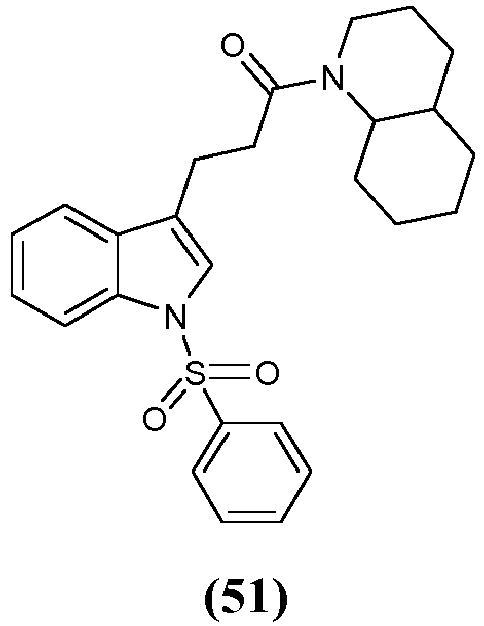

- Synthesis of Compound (51): A 100 mL RB flask fitted with magnetic stirrer was charged with 60% NaH (77.26 mg, 1.932 mmol). To this 10 mL of THF was added at 0°C under nitrogen atmosphere. (96) (200 mg, 0.644 mmol) in THF was then added to the solvent and stirred at this temperature for 30 minutes. Phenyl sulfonyl chloride (170.61 mg, 0.966 mmol) was added and stirred at room temperature for 15 hours. After completion of reaction (reaction monitored by TLC), the reaction mass was quenched with crushed ice, extracted with ether (100 mlX3). The combined ether layer was washed with water (100 mLX3), brine, dried over anhydrous Na2SO4, and concentrated. Crude material was purified by silica-gel column chromatography eluting with hexanes: EtOAc to give (170 mg) as yellow sticky solid. 1H NMR (300MHz,CDCl3) : δ 7.89-7.92(d,1H), 7.77-7.81(m,2H), 7.42-7.46(m,2H), 7.13-7.36(m,5H), 4.42-4.60(m,1H), 3.45-3.57(m,1H), 2.22-2.43 (m,. 5H), 1.54-1.76(m,6H), 1.49(s,2H), 1.27-1.34(m,5H). LC-MS (M+H)+ = 451.2; HPLC purity: 93.06%.
-

- Synthesis of Compound (52) (Peak-1): Compound (96) mixture of isomers was separated by reverse phase column to give Compound (52) (Peak-1). 1H NMR (300MHz,CDCl3) : δ 8.13(s, 1H), 7.52-7.55(d, 1H), 7.26-7.28(d, 1H), 7.01-7.12(m, 2H), 6.92-6.93(d, 1H) m, 3.66-3.68(m,1H), 2.73-3.09(m,5H), 1.94(s,2H), 1.21-1.66(m,12H). LC-MS (M+H)+ = 311.2; HPLC purity: 99.86% (Column: Zorbax eclipse XDB-C18, RT = 16.83 min, mobile phase: H2O: MeCN =55: 45).
-

- Synthesis of Compound (53) (Peak 2): Compound (96) mixture of isomers was separated by reverse phase column to give compound, Compound (53) (peak 2). 1H NMR (300MHz,CDCl3) : δ 7.89(s,1H), 7.53-7.58(t,1H), 7.26-7.31(t,1H), 7.02-7.14(m,2H), 6.98(s,1H), 4.45-4.62(m,1H), 3.47-3.58(m,1H), 3.01-3.09(m,2H), 2.50-2.91(m,3H), 1.27-1.67(m,13H). LC-MS (M+H)+ = 311.1; HPLC purity: 99.80% (Column: Zorbax eclipse XDB-C18, RT = 17.87 min, mobile phase: H2O: MeCN =55: 45).
-

- Synthesis of Compound (54): Compound (54) was synthesized by following the procedure used to make Compound (1) (Scheme 2). The crude product was obtained by evaporating the organic layer under reduced pressure and was purified by silica gel column using Petroleum ether: Ethyl acetate as eluent to obtain Compound (54). 1H NMR (300MHz,CDCl3) : δ 7.93(s,1H), 7.53-7.57(t,1H), 7.27-7.30(d,1H), 7.02-7.14(m,2H), 6.97(s,1H), 4.13-4.70(m,1H), 3.35-3.62(m,1H), 3.05-3.17(m,2H), 2.53-2.81(m,3H), 1.29-1.81(m,15H). LC-MS (M+H)+ = 325.2; HPLC purity: 98.41%.
-

- Synthesis of Compound (55) (Peak 1): Mixture of isomers were separated by silica gel column chromatography eluting with hexanes: EtOAc to give Compound (55) (peak 1). 1H NMR (300MHz,CDCl3): δ 7.92(s,1H), 7.53-7.55(d,1H), 7.28-7.31(d,1H), 7.04-7.15(m,2H), 6.97(s,1H), 4.25-4.54(m,1H), 3.24-3.52(m,1H), 3.03-3.08(m,2H), 2.58-2.76(m,3H), 0.83-1.94(m,15H). LC-MS (M+H)+ = 325.2; HPLC purity: 91.22%; Column: Zorbax eclipse XDB-C18, RT = 17.43 min, mobile phase: H2O: MeCN: TFA (0.01%) gradient.
-

- Synthesis of Compound (56) (Peak 2): Mixture of isomers were separated by silica gel column chromatography eluting with hexanes: EtOAc to give Compound (56) (Peak-2). 1H NMR (300MHz,CDCl3) : δ 7.93(s,1H), 7.53-7.55(d,1H), 7.27-7.30(d,1H), 7.01-7.14(m,2H), 6.96(s,1H), 3.80-4.61(m,1H), 3.25-3.60(m,1H), 2.99-3.05(m,2H), 2.59-2.78(m,4H), 0.83-1.93(m,14H). LC-MS (M+H)+ = 325.2; HPLC purity: 97.45%; Zorbax eclipse XDB-C18, RT = 18.36 min, mobile phase: H2O: MeCN: TFA (0.01%) gradient.
-


- Synthesis of Compound (57): To a stirred solution of (5) (100 mg, 0.30 mmol) in DCM (5 mL) was added m-CPBA (78 mg, 0.45 mmol) and stirred at rt for 16 hours. After completion of reaction (reaction monitored by TLC), the reaction mixture was quenched with saturated NaHCO3 solution, extracted with DCM and concentrated. The crude product was purified by silica gel column using Petroleum ether: Ethyl acetate as eluent to obtain Compound (57) (50 mg) as yellow solid. 1H NMR (300MHz,CDCl3) : δ 9.95(s,1H), 7.81-7.84(d,1H), 7.49(s,1H), 7.10-7.15(m,3H), 3.85-4.43(m,3H), 2.56-3.28(m,1H), 1.16-1.86(m,14H). LC-MS (M+H)+ = 361.1; HPLC purity: 98.60%.
-


- A 250 mL RB flask fitted with magnetic stirrer was charged with Lithium aluminum hydride (0.983 g, 25.951mmol)) and THF (20 mL) was added to it at 0°C. To this resulting suspension Intermediate-5 (2.0 g, 8.65mmol) in THF (20 mL) was added and the resulting mixture was stirred at room temperature for 2 hours. After completion of the reaction, the reaction mixture was diluted with EtOAc (50 mL) and was quenched with Na2SO4 (5g) and the resulting slurry was stirred at room temperature for 1 hour, filtered through celite washed with ethyl acetate. The resulting filtrate was concentrated to give Intermediate-50 (0.9 g). 1H NMR (300MHz,DMSO-d6) : δ 7.65-7.68(d,1H), 7.34-7.36(d,1H), 7.07-7.12(t,1H), 7.03(s,1H), 6.94-6.99(t,1H), 4.53-4.57(t,1H), 3.71(s,3H), 3.54-3.56(d,2H), 1.31(s,6H).
- A 100 mL RB flask fitted with magnetic stirrer was charged with 30 mL DCM and Pyridinium chloro chromate (2.466g, 11.4419mmol) was added followed by the addition of Intermediate-50 (1.55 g ,7.627 mmol) in 10 mL of DCM. The resulting mixture was stirred at room temperature for 2 hours. After completion of the reaction, the solvent from the reaction mass was removed under reduced pressure to yield the crude compound. Crude mass was purified by column chromatography using 60-120 silica gel and 9:1 Pet ether/ethyl acetate as eluent to give Intermediate-51 (0.79 g). 1H NMR (300MHz,DMSO-d6) : δ 9.39(s,1H), 7.40-7.44(t,1H), 7.32(s,1H), 7.13-7.18(t,1H), 6.98-7.03(t,1H), 3.77(s,3H), 1.46(s,H).
- A 100 mL RB flask fitted with magnetic stirrer was charged with 20 mL of dry THF and Methoxy methyl triphenyl phosphonium chloride (2.566 g, 7.487 mmol) was added followed by addition of Pot tert butoxide (2.295 g, 20.451 mmol). The resulting mass was stirred at room temperature for 2 hours and then cooled to 0°C. Intermediate-51 (1.37 g, 6.807 mmol) in 10 mL of THF was added to the above reaction mass and was stirred at room temperature for 2 hours. After completion of the reaction (by TLC) reaction mass was diluted with 10 mL of water and was extracted with ethyl acetate (100 mL X 3) and the combined organic layers were washed with brine solution and was dried over anhydrous sodium sulfate concentrated. Crude product was purified by column chromatography using 60-120 silica gel and 6% of ethyl acetate in Pet ether as eluent to give Intermediate-52. Yield: 1.12 g (71.8%). 1H NMR (300MHz,CDCl3) : δ 7.73-7.80(m1H), 7.33(s,1H), 7.16-7.21(t,1H), 7.03-7.08(t,1H), 6.81(s,1H), 5.79-6.34(m,1H), 4.58-5.15(m,1H), 3.73-3.74(d,3H), 3.49-3.53(d,3H), 1.55(s,6H).
- A 100 mL RB flask fitted with magnetic stirrer was charged with 50.4 mL of 1,4 dioxane and 12.76 mL of water. To this Intermediate-52 (1.12 g, 4.884 mmol) followed by p-toluene sulphonic acid (0.0424 g, 0.2232 mmol) was added. The resulting mass was heated at 60°C for 16 hours. After completion of the reaction, the reaction mixture was quenched with 10 mL of water and extracted with ethyl acetate (100 mL X 3) and the combine organic layer was washed with saturated sodium bicarbonate solution followed by brine solution and was dried over anhydrous sodium sulfate and concentrated. Crude product was purified by column chromatography using 60-120 silica gel and 8% of ethyl acetate in Pet ether as eluent to give Intermediate-53. 1H NMR (300MHz,DMSO-d6) : δ 9.47-9.49(t,1H), 7.73-7.76(d,1H), 7.37-7.40(d,1H), 7.11-7.16(t,1H), 7.10(s,1H), 6.99-7.04(t,1H) 3.72(s,3H), 2.78(s,2H), 1.49(s,6H).
- A 50 mL RB flask fitted with magnetic stirrer was charged with 10 mL of THF and was cooled to -78°C to which 2- methyl 2 butene (3 mL) was added and stirred for 15 minutes. Another 100 mL RB flask fitted with magnetic stirrer was charged with Intermediate-53 (557 mg, 2.59mmol) and tert butanol (15 mL) and was stirred at RT and the above prepared THF solution was added to it. Then the resulting mass was cooled to 0°C to which NaH2PO4 (1.42 g) in water was added followed by addition of NaClO2 (0.35g) in water. The resulting mixture was stirred at 0°C for 20 minutes and quenched with water and pH adjusted to 1-2 using 1N HCl and extracted with ethyl acetate and concentrated to give Intermediate-54 (480 mg). 1H NMR (300MHz,DMSO-d6) : δ 11.82(s,1H), 7.69-7.71(d,1H), 7.35-7.38(d,1H), 7.09-7.14(t,1H), 7.05(s,1H), 6.96-7.01(t,1H), 3.71(s,3H), 2.66(s,2H), 1.48(s,6H).
- Synthesis of Compound (58): Compound (58) was synthesized by following the procedure used to make Compound (1) (Scheme 2). The crude product was obtained by evaporating the organic layer under reduced pressure and was purified by silica gel column using Petroleum ether: Ethyl acetate as eluent to obtain Compound (58). 1H NMR (300MHz,CDCl3) : δ 7.72-7.74(d,1H), 7.20-7.23(d,1H), 7.11-7.16(t,1H), 7.03(s,1H), 6.76(s,1H), 4.34-4.53(m,1H), 3.65(s,1H), 3.07-3.29(,.2H), 2.75-2.84(m,2H), 2.75-2.84(m,2H), 2.27-2.39(m,4H), 1.54-1.56(d,6H), 1.38-1.43(m,3H), 1.07(m,2H), 0.09(m,2H), 0.37-0.65(m,2H). LC-MS (M+H)+ = 353.3; HPLC purity: 92.52%.
-


- Synthesis of 3-(1-methyl-2-oxocyclohexyl)propanenitrile (Intermediate-55): To a stirred solution of Starting Material-20 (5g, 44.6 mmol) in 15 mL of DMF, Triton-B (40% solution of Binzyl trimethylammonium hydroxide) (20.5 mL, 49.0 mmol) was added in 10 mL of DMF drop wise at 0°C under nitrogen atmosphere. The mixture was stirred at RT for 30 minutes. To this acrylonitrile (2.6 g, 49.0 mmol) in 15 mL of DMF was added and stirred for 16 hours. Then reaction mixture was poured in water and extracted with ethyl acetate, and concentrated. The crude material was purified by column chromatography using hexanes: ethyl acetate as eluent to give Intermediate-55 (975 mg).
- Synthesis of 4a-methyldecahydroquinoline (Intermediate-56): A solution of Intermediate-55 (500 mg, 3.0261 mmol) in 25 mL of methanol was added to 10% of Pd/C (100 mg, 20% W/W) under N2 atmosphere. N2 gas was purged 5 min and then the reaction mixture was kept under hydrogen atmosphere at 60 psi for 16 h. After reaction, the catalyst was filtered and the solvent was concentrated to give Intermediate-56 (287 mg).
- Synthesis of Compound (59): Compound (59) was synthesized by following the procedure used to make Compound (1) (Scheme 2). The crude product was obtained by evaporating the organic layer under reduced pressure and was purified by silica gel column using Petroleum ether: Ethyl acetate as eluent to obtain Compound (59). 1H NMR (300MHz,CDCl3) : δ 7.70-7.73 (m,1H), 7.18-7.21(m,1H), 7.02-7.14(m,1H), 7.00-7.02(m,1H), 6.75-6.76(m,1H), 4.10-4.40(m,1H), 3.63-3.64(d,3H), 2.62-3.00(m,5H), 1.64-1.66(m,3H), 1.52-1.55(m,6H), 0.62-1.46(m,11H). LC-MS (M+H)+ = 367.3; HPLC purity: 96.39%.
-

- Synthesis of Compound (60): Compound (60) was synthesized by following the procedure used to make Compound (1) (Scheme 2). The crude product was obtained by evaporating the organic layer under reduced pressure and was purified by silica gel column using Petroleum ether: Ethyl acetate as eluent to obtain Compound (60). 1H NMR (300MHz,CDCl3) : δ 6.99-7.05(m,2H), 6.76-6.78(m,2H), 4.16-4.34(m,1H), 3.70-3.88(m,1H), 3.63-3.64(d,3H), 3.16-3.43(m,5H), 2.83-2.97(m,1H), 2.47- 2.73(m,4H), 0.90-1.90(m,9H). LC-MS (M+H)+ = 341.2; HPLC purity: 98.03%.
-


- Starting Material (1 g, 6.6 mmol) was suspended in DCM (10 mL) and triethylamine (1.94 mL, 13.9 mmol) was added at -10°C. To this chloroacetyl chloride (0.53 mL, 6.6 mmol) was added slowly and the mixture was stirred at RT for 16 hours. After reaction was completed the reaction mixture was diluted with saturated aqueous sodium hydrogen carbonate and extracted with 5 percent IPA in ethyl acetate, and concentrated to give Intermediate-57 (570 mg) as brown oil.
- To a stirred solution of Intermediate-57 (570 mg, 2.974 mmol) in THF (10 mL) at 0°C under N2 atmosphere, sodium hydride (60 percent in mineral oil) (131 mg, 3.2714 mmol) was added carefully and the mixture was stirred for 16h at room temperature. After completion of the reaction, the reaction mixture was quenched with 1N HCl and extracted with DCM and concentrated. The crude material was purified by chromatography on a silica gel column chromatography eluting with DCM: MeOH afforded Intermediate-58 (300 mg).
- Intermediate-58 (250 mg, 1.6114 mmol) in tetrahydrofuran (10 mL) was slowly added to a suspension of lithium aluminum hydride (153 mg, 4.0286 mmol) at 0°C. Then reaction mixture was refluxed for 16 hours. After completion of the reaction, the reaction mixture was quenched with 15% sodium hydroxide solution and the insoluble solids were removed by filtration. The aqueous layer was extracted with diethyl ether. Organic layers were dried by sodium sulfate and concentrated to give Intermediate-59 (170 mg) as pale brown oil.
- Synthesis of Compound (61): Compound (61) was synthesized by following the procedure used to make Compound (1) (Scheme 2). The crude product was obtained by evaporating the organic layer under reduced pressure and was purified by silica gel column using Petroleum ether: Ethyl acetate as eluent to obtain Compound (61). 1H NMR (300MHz,CDCl3) : δ 8.00(s,1H), 7.52-7.55(d,1H), 7.27-7.30(d,1H), 7.02-7.14(m,2H), 6.95(s,1H), 3.67-3.73(m,3H), 3.32-3.44(m,3H), 3.05-3.10(m,2H), 2.87-2.90(m,1H), 2.45-2.66(m,4H), 2.15(s,1H), 1.81-1.84(m,2H), 1.60-1.64(m,2H). LC-MS (M+H)+ = 313.2; HPLC purity: 94.77%.
-

- Synthesis of (62): Compound (62) was synthesized by following the procedure used to make (Scheme 2). The crude product was obtained by evaporating the organic layer under reduced pressure and was purified by silica gel column using Petroleum ether: Ethyl acetate as eluent to obtain. 1H NMR (300MHz,CDCl3) : δ 6.99-7.06(m,2H), 6.75-6.77(d,2H), 3.68-3.86(m,3H), 3.63(s,3H), 3.35-3.48(m,2H), 3.12-3.29(m,3H), 2.64(s,3H), 2.50-2.61(m,2H), 1.05-2.14(m,8H). LC-MS (M+H)+ = 341.2; HPLC purity: 94.06%.
-

- Synthesis of Compound (63): Compound (63) was synthesized by following the procedure used to make Compound (1) (Scheme 2). The crude product was obtained by evaporating the organic layer under reduced pressure and was purified by silica gel column using Petroleum ether: Ethyl acetate as eluent to obtain Compound (63). 1H NMR (300MHz,CDCl3) : δ 7.51-7.53(d, 1H), 7..12-7.23(m, 2H), 7.01-7.06(t,1H), 6.81(s,1H), 3.68-3.76(m,3H), 3.67(s,3H), 3.22-3.48(m,4H), 3.03-3.08(t,2H), 2.51-2.69(m,2H), 1.05-2.12(m,7H). LC-MS (M+H)+ = 327.2; HPLC purity: 96.13%.
-

- Synthesis of Compound (64): Compound (64) was synthesized by following the procedure used to make Compound (1) (Scheme 2). The crude product was obtained by evaporating the organic layer under reduced pressure and was purified by silica gel column using Petroleum ether: Ethyl acetate as eluent to obtain Compound (64). 1H NMR (300MHz,CDCl3) : δ 7.94(s,1H), 7.10-7.14(m,1H), 6.90-7.02(m,2H), 6.76-6.80(t,1H), 4.11-4.35(m,1H), 3.66-3.87(m,1H), 3.13-3.49(m,5H), 2.47-2.99(m,6H), 0.91-1.97(m,8H). LC-MS (M+H)+ = 327.2; HPLC purity: 98.86%.
-

- Synthesis of Compound (65) (Peak-1): Mixture of isomers of Compound (60) was separated by reverse phase column chromatography to give Compound (65) (Peak-1). 1H NMR (300MHz,CDCl3) : δ 6.99-7.06(m,2H), 6.75-6.77(d,2H), 3.68-3.76(m,3H), 3.63(s, 3H), 3.40-3.48(m,2H), 3.08-3.35(m,3H), 2.64(s,3H), 2.45-2.61(m,2H), 1.05-2.14(m,8H). LC-MS (M+H)+ = 341.2; HPLC purity: 97.63% % (column: Zorbax eclipse XDB-C18, RT = 15.84 min, mobile phase: 0.01%TFA:MeCN gradient).
-

- Synthesis of Compound (66) (Peak-2): Mixture of isomers of Compound (60) was separated by reverse phase column chromatography to give Compound (66) (Peak-2). 1H NMR (300MHz,CDCl3) : δ 6.98-7.06(m,2H), 6.76-6.78(m,2H), 4.16-4.34(m,1H), 3.69-3.87(m,1H), 3.63(d,3H), 3.07-3.43(m,5H), 2.81-2.97(m,1H), 2.43-2.73(m,5H), 0.91-1.94(m,8H). LC-MS (M+H)+ = 341.2; HPLC purity: 96.84%(column: Zorbax eclipse XDB-C18, RT = 16.19 min, mobile phase: 0.01%TFA:MeCN gradient).
-

- Synthesis of Compound (67): Compound (67) was synthesized by following the procedure used to make Compound (1) (Scheme 2). The crude product was obtained by evaporating the organic layer under reduced pressure and was purified by silica gel column using Petroleum ether: Ethyl acetate as eluent to obtain Compound (66). 1H NMR (300MHz,CDCl3) : δ 8.02(s,1H), 7.53-7.56(m,1H), 7.27-7.30(m,1H), 7.02-7.15(m,2H), 6.96(s,1H), 4.13-4.32(m,1H), 3.61-3.84(m,1H), 3.03-3.47(m,5H), 2.47-2.93(m,3H), 0.94-2.12(m,8). LC-MS (M+H)+ = 313.2; HPLC purity: 98.01%.
-
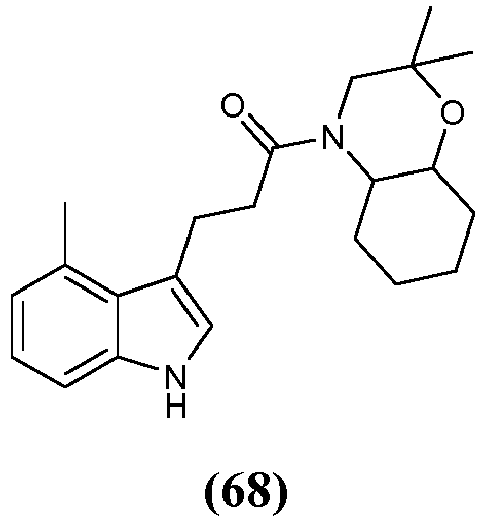

- Intermediate-60 was synthesized by following the procedure used to make Intermediate-57 (Scheme 38).
- Intermediate-61 was synthesized by following the procedure used to make Intermediate-58 (Scheme 38).
- Intermediate-62 was synthesized by following the procedure used to make Intermediate-29 (Scheme 22).
- Intermediate-63 was synthesized by following the procedure used to make Intermediate-30 (Scheme 22).
- Synthesis of Compound (68): Compound (68) was synthesized by following the procedure used to make Compound (1) (Scheme 2). The crude product was obtained by evaporating the organic layer under reduced pressure and was purified by silica gel column using Petroleum ether: Ethyl acetate as eluent to obtain Compound (68). 1H NMR (300MHz,CDCl3) : δ 7.93(s,1H), 7.10-7.13(d,1H), 6.91-7.02(m,2H), 6.76-6.81(m,1H), 4.04-4.40(m,1H), 3.39-3.80(m,1H), 2.96-3.31(m,4H),2.51-2.81(m,6H), 1.65-1.93(m,3H), 1.04-1.41(m,10H). LC-MS (M+H)+ = 355.22; HPLC purity: 94.97%.
-

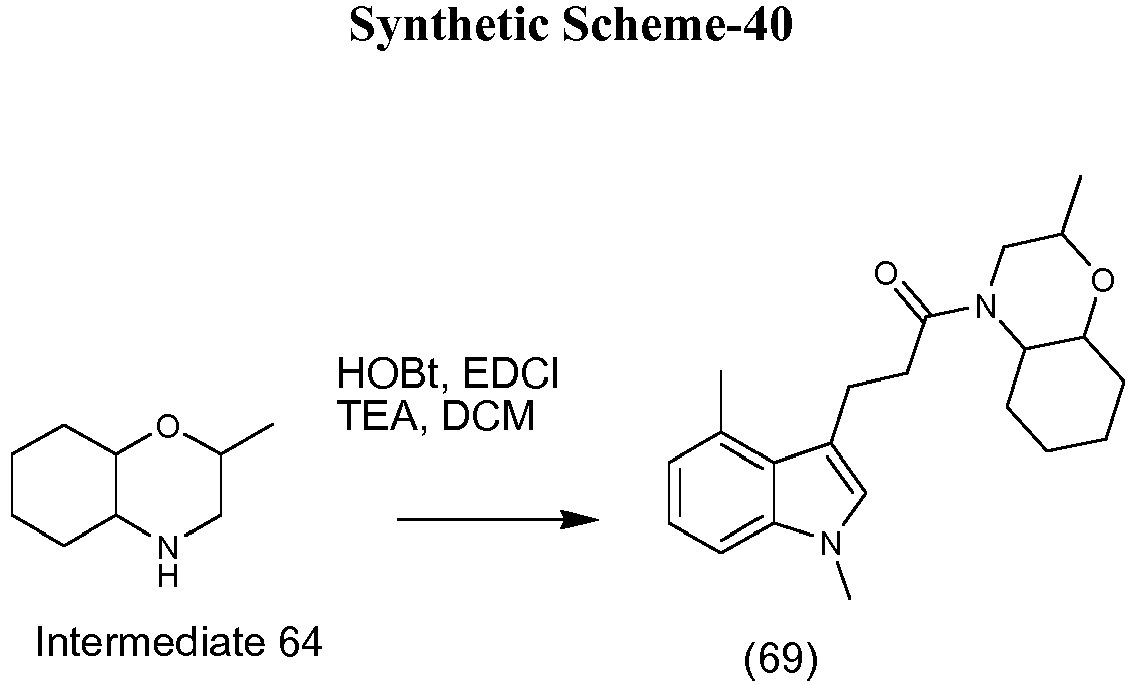
- Intermediate-64 was synthesized by following the procedure used to make Intermediate-63 (Scheme 39).
- Synthesis of Compound (69): Compound (69) was synthesized by following the procedure used to make Compound (1) (Scheme 2). The crude product was obtained by evaporating the organic layer under reduced pressure and was purified by silica gel column using Petroleum ether: Ethyl acetate as eluent to obtain Compound (69). 1H NMR (300MHz,CDCl3) : δ 6.99-7.06(m,2H), 6.77-6.77(d,2H), 3.86-4.31(m,1H), 3.63(s,3H), 3.29-3.44(m,2H), 3.16-3.13(m,3H), 3.04-3.12(m,1H), 2.68-2.75(m,1H), 2.64(s,3H), 2.42-2.61(m,2H), 1.80-2.24(m,1H), 1.63-1.76(m,3H), 1.29-1.43(m,2H), 1.11-1.13(d,1H), 1.01-1.07(m,2H), 0.92-0.98(m,1H). LC-MS (M+H)+ = 355.2; HPLC purity: 95.0%.
-

- Synthesis of Compound (70): Compound (70) was synthesized by following the procedure used to make Compound (1) (Scheme 2). The crude product was obtained by evaporating the organic layer under reduced pressure and was purified by silica gel column using Petroleum ether: Ethyl acetate as eluent to obtain Compound (70). 1H NMR (300MHz,CDCl3) : δ 6.99-7.06(m,2H), 6.76-6.78(m,2H), 4.03-4.39(m,1H), 3.62-3.63(d,3H), 3.41(m,1H), 2.95-3.29(m,4H), 2.47-2.80(m,5H), 0.99-1.93(m,14H). LC-MS (M+H)+ = 369.2; HPLC purity: 98.90%.
-

- Synthesis of Compound (71): Compound (71) was synthesized by following the procedure used to make Compound (1) (Scheme 2). The crude product was obtained by evaporating the organic layer under reduced pressure and was purified by silica gel column using Petroleum ether: Ethyl acetate as eluent to obtain Compound (71). 1H NMR (300MHz,CDCl3) δ 7.70-7.79(m,1H), 7.35-7.40(t,1H), 7.03-7.11(m,3H), 4.04-4.11(m,1H), 3.70(m,3H), 3.50(m,3H), 2.00-3.40(m,5H), 0.83-1.70(m,14H). LC-MS (M+H)+ = 355.3; HPLC purity: 88.82%.
-


- Synthesis of 3-(4-fluoro-1H-indol-3-yl)propanoic acid (Intermediate-65): Intermediate-65 was synthesized by following the procedure used to make Intermediate-28 (Scheme 21).
- Synthesis of Compound (72): Compound (72) was synthesized by following the procedure used to make Compound (1) (Scheme 2). The crude product was obtained by evaporating the organic layer under reduced pressure and was purified by silica gel column using Petroleum ether: Ethyl acetate as eluent to obtain Compound (72). 1H NMR (300MHz,CDCl3) : 8.12(s,1H), 6.99-7.08(m,2H), 6.95(s,1H), 6.64-6.74(m,1H), 4.15-4.20(m,1H), 3.66-3.85(m,1H), 3.12-3.43(m,4H), 2.65-2.97(m,3H), 1.18-2.10(m,9H). LC-MS (M+H)+ = 331.2; HPLC purity: 97.15%.
-


- Synthesis of ethyl (1,3-benzothiazol-2-ylsulfanyl)acetate (Intermediate-66): To a 100mL RB flask fitted with magnetic stirrer was charged 10 mL of dimethylformamide. To this Starting Material-25 (1.0 g, 5.979 mmol) followed by potassium carbonate (2.477 g, 17.925 mmol) were added and stirred at room temperature for 30 minutes. Then ethylbromoacetate (1.997 g, 11.958 mmol) was added. The resulting solution was stirred at room temperature for 15 hours. After completion of the reaction (reaction monitored by TLC), the reaction mixture was concentrated. The resulting crude was taken in ethyl acetate (100 mL) and washed with water (100 mL X 3), brine (100mL) and concentrated to give Intermediate-66 (2.6 g).
- Synthesis of (1,3-benzothiazol-2-ylsulfanyl)acetic acid (Intermediate-67): To a 100mL RB flask fitted with magnetic stirrer was charged 15 mL of tetrahydrofuran, 0.5 mL water, 0.5mL methanol. To this Intermediate-66 (2.6g, 10.262 mmol), followed by lithium hydroxide (738.9 mg, 30.788 mmol) were added at 0°C. Then the reaction mixture was stirred at room temperature for 7 hours. After completion of the reaction (reaction monitored by TLC), reaction mass was diluted with 10mL of water and washed with 20mL dichloro methane DCM (2 X 10mL). Then aqueous layer was acidified with 1N HCl (pH = 2), and the resulted solids were filtered and dried to give Intermediate-67 (1.17g).
- Synthesis of Compound (73): Compound (73) was synthesized by following the procedure used to make Compound (1) (Scheme 2). The crude product was obtained by evaporating the organic layer under reduced pressure and was purified by silica gel column using Petroleum ether: Ethyl acetate as eluent to obtain Compound (73). 1H NMR (300MHz,CDCl3) : δ 7.69-7.73(m,1H), 7.58-7.60(d,1H), 7.21-7.28(m,1H), 7.11-7.16(t,1H), 4.33-4.40(m,1H), 4.19-4.29(m,2H), 3.78-3.82(m,1H), 2.47-3.05(m,1H), 1.56-1.77(m,5H), 1.42(s,2H), 1.14-1.33(m,6H). LC-MS (M+H)+ = 347.1; HPLC purity: 97.01%.
-


- Synthesis of 2-(1,3-benzothiazol-2-ylsulfanyl)-2-methylpropanoic acid (Intermediate-68): Intermediate-68 was synthesized by following the procedure used to make Intermediate-67 (Scheme 42).
- Synthesis of Compound (74): Compound (74) was synthesized by following the procedure used to make 1) (Scheme 2). The crude product was obtained by evaporating the organic layer under reduced pressure and was purified by silica gel column using Petroleum ether: Ethyl acetate as eluent to obtain Compound (77). 1H NMR (300MHz,CDCl3) : δ 7.86-7.89(d,1H), 7.68-7.71(m,1H), 7.33-7.38(m,1H), 7.23-7.29(m,1H), 4.58-4.62(m,2H), 2.69-3.05(m,1H), 1.63-1.72(m,12H), 1.42-1.45(m,1H), 1.22-1.40(m,6H). LC-MS (M+H)+= 375.1; HPLC purity: 91.48%.
-


- Starting material-27 (3.97 mmol) in benzene was added drop wise to the solution of Starting Material-26 (3.97 mmol) in benzene. The resulting solution was heated to reflux for 2 hours. After 2 hours the reaction mass was cooled to room temperature and extracted with 10% sodium hydroxide solution. The aqueous layer was acidified using Conc.HCl (3ml) at 0°C. The resulting solids were filtered and dried at room temperature to get Intermediate-69 (660mg).
- Synthesis of Compound (75): Compound (75) was synthesized by following the procedure used to make Compound (1) (Scheme 2). The crude product was obtained by evaporating the organic layer under reduced pressure and was purified by silica gel column using Petroleum ether: Ethyl acetate as eluent to obtain Compound (75). 1H NMR (300MHz,CDCl3) : δ 7.93-7.97(m,1H), 7.81-7.84(d,1H), 7.41-7.46(m,1H), 7.31-7.36(m,1H), 4.49-4.67(m,1H), 3.65-3.83(m,1H), 3.44-3.51(m,2H), 2.61-3.10(m,3H), 1.71-1.78(m,6H), 1.30-1.42(m,7H). LC-MS (M+H)+ = 329.1; HPLC purity: 98.13%.
-

- Synthesis of Compound (76): Compound (76) was synthesized by following the procedure used to make Compound (1) (Scheme 2). The crude product was obtained by evaporating the organic layer under reduced pressure and was purified by silica gel column using Petroleum ether: Ethyl acetate as eluent to obtain Compound (76). 1H NMR (300MHz,CDCl3) : δ 7.86-7.89(d,1H), 7.75-7.77(d,1H), 7.34-7.39(t,1H),7.24-7.29(t,1H), 4.45-4.70(m,1H), 3.67-4.08(m,1H), 3.40-3.45(t,2H), 2.94-3.05(m,1H), 2.77-2.85(m,1H), 1.58-1.76(m,9H), 1.20-1.23(d,7H). LC-MS (M+H)+ = 343.1; HPLC purity: 95.24%.
-

- Synthesis of Compound (77): Compound (77) was synthesized by following the procedure used to make Compound (1) (Scheme 2). The crude product was obtained by evaporating the organic layer under reduced pressure and was purified by silica gel column using Petroleum ether: Ethyl acetate as eluent to obtain Compound (77). 1H NMR (300MHz,CDCl3) : δ 7.86-7.89(d,1H), 7.75-7.77(d,1H), 7.35-7.39(t,1H), 7.25-7.30(t,1H), 3.86-4.32(m,1H), 3.61(d,3H), 3.39-3.44(t,2H), 2.55-3.01(m,2H), 0.90-2.24(m,14H). LC-MS (M+H)+ = 387.2; HPLC purity: 95.28%.
-

- Synthesis of Compound (78): Compound (78) was synthesized by following the procedure used to make Compound (1) (Scheme 2). The crude product was obtained by evaporating the organic layer under reduced pressure and was purified by silica gel column using Petroleum ether: Ethyl acetate as eluent to obtain Compound (78). 1H NMR (300MHz,CDCl3) : δ 7.85-7.89(m,1H), 7.74-7.77(d,1H), 7.34-7.39(t,1H), 7.24-7.29(t,1H), 4.23-4.50(m,1H), 3.31-3.64(m,3H), 2.54-3.09(m,3H), 0.84-1.96(m,15H). LC-MS (M+H)+ = 343.2; HPLC purity: 97.13%.
-

- Synthesis of Compound (79): Compound (79) was synthesized by following the procedure used to make Compound (1) (Scheme 2). The crude product was obtained by evaporating the organic layer under reduced pressure and was purified by silica gel column using Petroleum ether: Ethyl acetate as eluent to obtain Compound (79). 1H NMR (300MHz,CDCl3) : δ 7.86-7.89(d,1H), 7.75-7.77(d,1H), 7.35-7.39(t,1H), 7.25-7.30(t,1H), 3.80-3.93(m,2H), 3.39-3.55(m,5H), 2.78-2.96(m,2H), 1.18-2.22(m,9H). LC-MS (M+H)+ = 331.22; HPLC purity: 96.52%.
-

- Synthesis of Compound (80): Compound (80) was synthesized by following the procedure used to make Compound (1) (Scheme 2). The crude product was obtained by evaporating the organic layer under reduced pressure and was purified by silica gel column using Petroleum ether: Ethyl acetate as eluent to obtain Compound (80). 1H NMR (300MHz,CDCl3) : δ 7.85-7.89(m,1H), 7.75-7.77(d,1H), 7.34-7.40(m,1H), 7.25-7.30(m,1H), 4.11-4.31(m,1H), 3.80-3.91(m,1H), 3.31-3.57(m,5H), 2.68-3.04(m,2H), 1.66-2.24(m,6H), 1.32-1.44(m,3H). LC-MS (M+H)+ = 331.2; HPLC purity: 94.03%.
-

- Synthesis of Compound (81): Compound (81) was synthesized by following the procedure used to make Compound (1) (Scheme 2). The crude product was obtained by evaporating the organic layer under reduced pressure and was purified by silica gel column using Petroleum ether: Ethyl acetate as eluent to obtain Compound (81). 1H NMR (300MHz,CDCl3) : δ 7.89-7.91(d,1H), 7.75-7.77(d,1H), 7.36-7.41(t,1H), 7.26-7.31(t,1H), 3.64-4.03(m,1H), 3.32-3.52(m,3H), 2.71-2.97(m,2H), 0.95-2.24(m,12H). LC-MS (M+H)+ = 315.1; HPLC purity: 95.99%.
-

- Synthesis of Compound (82): Compound (82) was synthesized by following the procedure used to make Compound (1) (Scheme 2). The crude product was obtained by evaporating the organic layer under reduced pressure and was purified by silica gel column using Petroleum ether: Ethyl acetate as eluent to obtain Compound (82). 1H NMR (300MHz,CDCl3) : δ 7.91-7.94(d,1H), 7.75-7.78(d,1H), 7.37-7.42(t,1H), 7.27-7.32(t,1H), 3.22-3.47(m,6H), 2.81-2.91(m,2H), 2.10-2.21(m,2H), 1.89(s,1H), 1.30-1.40(m,7H). LC-MS (M+H)+ = 315.2; HPLC purity: 98.47%.
-

- Synthesis of Compound (83): Compound (83) was synthesized by following the procedure used to make Compound (1) (Scheme 2). The crude product was obtained by evaporating the organic layer under reduced pressure and was purified by silica gel column using Petroleum ether: Ethyl acetate as eluent to obtain Compound (83). 1H NMR (300MHz,CDCl3) : δ 7.87-7.90(d,1H), 7.75-7.77(d,1H), 7.35-7.40(t,1H), 7.25-7.30(t,1H), 3.86-4.13(m,1H), 3.62-3.69(m,1H), 3.34-3.52(m,2H), 2.68-2.97(m,2H), 1.80-2.14(m,4H), 1.00-1.67(m,10H). LC-MS (M+H)+ = 329.2; HPLC purity: 97.23%.
-


- Intermediate-70 was synthesized by following the procedure used to make Intermediate-9 (Scheme 4).
- Synthesis of Compound (84): Compound (84) was synthesized by following the procedure used to make Compound (1) (Scheme 2). The crude product was obtained by evaporating the organic layer under reduced pressure and was purified by silica gel column using Petroleum ether: Ethyl acetate as eluent to obtain Compound (84). 1H NMR (300MHz,CDCl3) : δ 9.77-9.80(d,1H), 8.29-8.30(d,1H), 7.93-7.96(m,1H), 7.16-7.18(d,1H), 7.05-7.11(m,1H), 4.50-4.68(m,1H), 3.57-3.65(m,1H), 3.07-3.15(m,2H), 2.56-2.95(m,4H), 1.25-1.87(m,12H). LC-MS (M+H)+ = 312.3; HPLC purity: 95.95%.
-


- Synthesis of Compound (85): Compound (85) was synthesized by following the procedure used to make (51) (Scheme 34). The crude product was obtained by evaporating the organic layer under reduced pressure and was purified by silica gel column using Petroleum ether: Ethyl acetate as eluent to obtain Compound (85). 1H NMR (300MHz,CDCl3) : δ 8.34-8.36(t,1H), 8.09-8.13(t,2H), 7.78-7.81(d,1H), 7.37-7.49(m,4H), 7.08-7.14(m,1H), 4.42-4.59(m,1H), 3.48-3.60(m,1H), 2.89-2.97(m,2H), 2.47-2.75(m,3H), 1.25-1.74(m,13H). LC-MS (M+H)+ = 452.2; HPLC purity: 99.87%.
-

- Synthesis of Compound (86): Compound (86) was synthesized by following the procedure used to make Compound (1) (Scheme 2). The crude product was obtained by evaporating the organic layer under reduced pressure and was purified by silica gel column using Petroleum ether: Ethyl acetate as eluent to obtain Compound (86). 1H NMR (300MHz,CDCl3) : δ 9.48(s,1H), 8.21-8.23(d,1H), 7.86-7.90(m,1H), 6.98-7.09(m,2H), 4.46-4.70(m,1H), 3.47-3.90(m,1H), 3.03-3.08(m,2H), 2.49-2.77(m,2H), 1.07-1.86(m,16H). LC-MS (M+H)+= 326.2; HPLC purity: 97.13%.
-

- Synthesis of Compound (87): Compound (87) was synthesized by following the procedure used to make Compound (27) (Scheme 26). The crude product was obtained by evaporating the organic layer under reduced pressure and was purified by silica gel column using Petroleum ether: Ethyl acetate as eluent to obtain Compound (87). 1H NMR (300MHz,CDCl3) : δ 8.25(s,1H), 7.82-7.84(m,1H), 6.94-7.00(m,2H), 4.43-4.61(m,1H), 3.77(s,1H), 3.38-3.62(m,1H), 2.98-3.05(m,2H), 2.45-2.92(m,4H), 1.18-1.66(m,14H). LC-MS (M+H)+ = 326.3; HPLC purity: 98.68%.
-


- Starting Material-28 (42mmol) in DMF (50ml) was cooled to 0°C. Then potassium hydroxide (84.6mmol) was added which was followed by the addition of Iodine (42mmol). The reaction mixture was maintained at room temperature for 2 hours. Then the reaction mixture was diluted with ice cooled water and extracted with ethyl acetate. The organic layer was dried over anhydrous MgSO4, and evaporated to give Intermediate-71 (8g, pale yellow solid).
- DMAP (16.37mmol) was added to Intermediate-71(39 mmol) in acetonitrile (50ml). The reaction mixture was then cooled to 0°C. BOC anhydride (39.9mmol) was added to the cooled reaction mixture. The reaction was carried out at room temperature for 16 hours. Then the reaction mixture was diluted with water (100ml) and extracted with ethyl acetate. The organic layer was dried over anhydrous Na2SO4 and evaporated to obtain Intermediate-72 (7g, pale yellow solid).
- To Triethylamine (3ml), Intermediate-72 (5.8mmol) was added to which methyl acrylate (5.8mmol) was further added. The reaction mixture was purged with argon for 10 minutes. The Pd (II) acetate (0.5mmol) and tri-o-tolyl phosphine (0.5mmol) was added to the reaction mixture. The reaction was carried out for 16 hours at room temperature. Then the reaction mixture was filtered through celite, the filtrate was diluted with ethyl acetate (250ml) and washed with NaHCO3 (50ml) and brine solution. The organic layer was dried over anhydrous MgSO4, and obtained the crude product by evaporating the organic layer under reduced pressure. The crude product was purified using silica gel column using Hexane and Ethyl acetate as the eluent, to obtain Intermediate-73 (500mg, pale yellow liquid). 1H NMR (300 MHz, DMSO-d6): δ 8.24-8.27(d, 1H), 8.13-8.16(d, 1H), 7.85-7.90 (d, 1H), 7.65-7.71(t, 1H), 7.45-7.50(t, 1H), 6.96-7.02(d, 1H), 3.80(s, 3H), 1.67(s, 9H).
- Intermediate-73 (1.58mmol) dissolved in EtOAc (10ml) was taken in a par shaker flask. To this reaction mixture 10% Pd-C (20% W/W) was added. The resulting reaction mixture was stirred under hydrogen atmosphere (50 psi) for 5 hours at room temperature. After 5 hours the reaction mixture was filtered through celite. The filtrate was further concentrated to give Intermediate-74 (200mg, pale yellow liquid).1H NMR (300 MHz, DMSO-d6): δ 7.99-8.02(d, 1H), 7.62-7.65(d, 1H), 7.44-7.47 (t, 1H), 7.21-7.26(t, 1H), 3.63 (s,3H), 3.21-3.26(t,2H), 2.84-2.89(t,2H), 1.65(s, 9H).
- Intermediate 74 (0.6mmol) is added to a solvent (equal ratio of the solvents THF (2ml) and MeOH (2ml)) to which LiOH (3.4mmol) solution in 1ml water is further added. The reaction was allowed for 16 hours at room temperature. After 16 hours the reaction mixture was concentrated, and acidified with 1N HCl (pH = 2). The reaction mixture was then extracted with ethyl acetate. The organic layer was dried over anhydrous MgSO4, and evaporated to obtain Intermediate-75(100mg, pale yellow liquid).
- Synthesis of Compound (88): Compound (88) was synthesized by following the procedure used to make Compound (1) (Scheme 2). The crude product was obtained by evaporating the organic layer under reduced pressure and was purified by silica gel column using Petroleum ether: Ethyl acetate as eluent to obtain Compound (88). 1H NMR (300MHz,CDCl3) : δ 7.72-7.74(d,1H), 7.36-7.47(m,2H), 7.11-7.16(m,1H), 4.42-4.61 (m,1H), 3.57-3.74(m,1H), 3.10-3.35(m,3H), 2.22-3.00(m,3H), 1.56-1.67(m,12H). LC-MS (M+H)+ = 312.2; HPLC purity: 90.23%.
-


- Intermediate-74 (1.7 mmol) in DCM (5ml) was cooled to 0°C, followed by the addition of TFA (5.1mmol)). The reaction was allowed for 3 hours at room temperature. After 3 hours the reaction mixture was concentrated and diluted with ethyl acetate (50ml). Further washed with NaHCO3 solution (20ml), the organic layer was dried over anhydrous MgSO4, and evaporated to obtain Intermediate-76 (250mg, pale yellow liquid).
- Intermediate-76 (1.2mmol) was added to dry THF (5ml) and was cooled to 0°C. Then to the reaction mixture, NaH (2.4mmol) was added. After 15 minutes, MeI (1.8mmol) was added to the reaction mixture. The reaction was allowed for 3 hours at room temperature. After 3 hours the reaction mixture was quenched with 1N HCl and extracted with ethyl acetate. The organic layer was dried over anhydrous MgSO4, and evaporated to obtain Intermediate-77 (100mg, pale yellow liquid).
- Synthesis of Compound (89): Compound (89) was synthesized by following the procedure used to make Compound (1) (Scheme 2). The crude product was obtained by evaporating the organic layer under reduced pressure and was purified by silica gel column using Petroleum ether: Ethyl acetate as eluent to obtain Compound (89). 1H NMR (300MHz,CDCl3) : δ 7.64-7.67(d,1H), 7.24-7.33(m,2H), 7.03-7.11(m,1H), 4.44-4.62(m,1H), 3.93-3.95(d,3H), 3.57-3.70(m,1H), 3.21-3.26(m,2H), 2.42-2.93(m,3H), 1.21-1.68(m,13H). LC-MS (M+H)+= 326.3; HPLC purity: 96.80%.
-


- The starting material-29 (4.1mmol) in dry THF (5ml) was cooled to 0°C, followed by the addition of NaH (6.0mmol). The reaction mixture was gradually warmed to room temperature and allowed to react for 20 minutes. The reaction mixture was again cooled to 0°C, followed by the drop wise addition of ethyl 3-bromopropanoate (4.6mmol) in THF (2.5ml). The reaction was allowed for 12 hours at room temperature. After 12 hours the reaction mixture was quenched with ice cooled water and extracted with ethyl acetate. The organic layer was dried over anhydrous MgSO4, and concentrated to obtain Intermediate-78 (70mg). 1H NMR (300MHz, CDCl3) : δ 7.98-8.01(1H,d), 7.55-7.58(d,1H), 7.41-7.46(t,1H), 7.28-7.33(t,1H), 4.82-4.87 (t,2H), 4.00-4.07(t,2H), 3.00-3.05(t,2H), 1.08-1.1(t,3H).
- At 0°C, LiOH (1.5mmol) in water (1ml) was added to Intermediate-78 in the solvent THF: MeOH (1:1, 3ml each). The reaction was allowed for 12 hours at room temperature. After 12 hours the reaction mixture was concentrated, further acidified with 1N HCl (pH = 2). The reaction mixture was extracted with ethyl acetate. The organic layer was dried over anhydrous MgSO4, and evaporated under reduced pressure to obtain Intermediate-79 (60mg). 1H NMR (300MHz, CDCl3) : δ 7.29-8.00(4H,m), 4.82-4.87(t,2H), 3.09-3.14(t,2H).
- Synthesis of Compound (90): Compound (90) was synthesized by following the procedure used to make Compound (1) (Scheme 2). The crude product was obtained by evaporating the organic layer under reduced pressure and was purified by silica gel column using Petroleum ether: Ethyl acetate as eluent to obtain Compound (90). 1H NMR (300MHz,CDCl3) : δ 7.96-7.99(m,1H), 7.60-7.62(m,1H), 7.42-7.47(m,1H), 7.28-7.33(m,1H), 4.88-4.94(m,2H), 4.10-4.50(m,1H), 3.20-3.30(m,1H), 2.40-3.20(m,3H), 0.70-1.94(m,15H). LC-MS (M+H)+= 327.2; HPLC purity: 99.10%.
-
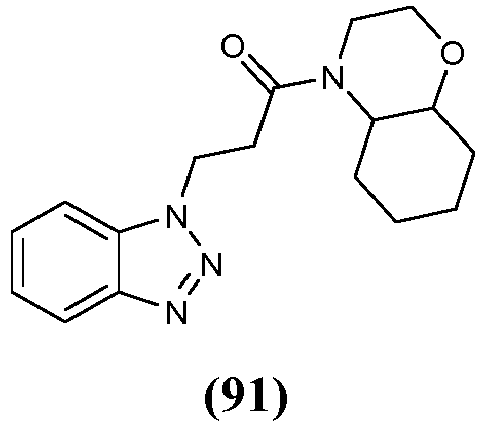
- Synthesis of Compound (91): Compound (91) was synthesized by following the procedure used to make Compound (1) (Scheme 2). The crude product was obtained by evaporating the organic layer under reduced pressure and was purified by silica gel column using Petroleum ether: Ethyl acetate as eluent to obtain Compound (91). 1H NMR (300MHz,CDCl3) : δ 7.96-7.99(m,1H), 7.57-7.61(m,1H), 7.41-7.46(t,1H), 7.27-7.33(t,1H), 4.89-4.94(m,2H), 3.77-4.11(m,2H), 2.90-3.31(m,5H), 1.18-1.88(m,9H). LC-MS (M+H)+ = 315.2; HPLC purity: 92.32%.
-

- Synthesis of Compound (92): Compound (92) was synthesized by following the procedure used to make Compound (1) (Scheme 2). The crude product was obtained by evaporating the organic layer under reduced pressure and was purified by silica gel column using Petroleum ether: Ethyl acetate as eluent to obtain Compound (92). 1H NMR (300MHz,CDCl3) : δ 8.00(s,1H), 7.29(m,2H), 6.98(s,1H), 6.82(t,1H), 4.40-4.70(m,1H), 2.61-3.58(m,5H), 1.59(m,9H), 1.35-1.43(t,6H), 1.02(m,3H). LC-MS (M+H)+ = 357.2; HPLC purity: 82.80%.
-

- Synthesis of Compound (93): Compound (93) was synthesized by following the procedure used to make Compound (1) (Scheme 2). The crude product was obtained by evaporating the organic layer under reduced pressure and was purified by silica gel column using Petroleum ether: Ethyl acetate as eluent to obtain Compound (93). 1H NMR (300MHz,DMSO-d6) : δ 10.75(s,1H), 7.48-7.52(t,1H), 7.30-7.33(m,1H), 7.12(s,1H), 6.93-7.07(m,2H), 4.29-4.48(m,1H), 3.60-3.71(m,1H), 2.43-2.96(m,5H), 1.23-1.70(m, 13H). LC-MS (M+H)+ = 311.1; HPLC purity: 97.67%.
-

- Synthesis of Compound (94): Compound (94) was synthesized by following the procedure used to make Compound (27) (Scheme 26). The crude product was obtained by evaporating the organic layer under reduced pressure and was purified by silica gel column using Petroleum ether: Ethyl acetate as eluent to obtain Compound (94). 1H NMR (300MHz,CDCl3) : δ 7.57(m,1H), 7.10-7.28(m,2H), 6.98-7.03(m,1H), 6.78-6.80(d,1H), 4.43-4.60(m,1H), 3.65(m,3H), 3.51-3.59(m,2H), 2.37-2.87(m,3H), 0.90-1.63(m,16H). LC-MS (M+H)+ = 339.2; HPLC purity: 91.90%.
-

- Synthesis of Compound (95): Compound (95) was synthesized by following the procedure used to make Compound (1) (Scheme 2). The crude product was obtained by evaporating the organic layer under reduced pressure and was purified by silica gel column using Petroleum ether: Ethyl acetate as eluent to obtain Compound (95). 1H NMR (300MHz,CDCl3) : δ 8.51-8.55(d,1H), 7.53-7.61(m,1H), 7.22-7.25(d,1H), 6.94-7.06(m,2H), 6.84(d,1H), 4.32-4.47(m,1H), 3.35-3.65(m,1H), 3.02-3.20(m,1H), 2.28-2.92(m,3H), 0.78-1.99(m,20H). LC-MS (M+H)+ = 353.3; HPLC purity: 88.81%.
-

- Synthesis of Compound (96): Compound (96) was synthesized by following the procedure used to make Compound (1) (Scheme 1). The crude product was obtained by evaporating the organic layer under reduced pressure and was purified by silica gel column using Petroleum ether: Ethyl acetate as eluent to obtain Compound (96). 1H NMR (300MHz,DMSO-d6) : δ 10.78-10.85(m,1H), 8.19-8.22(m,1H), 7.52-7.58(m,1H), 7.30-7.33(m,1H), 6.97-7.11(m,3H), 5.06 (m,1H), 4.20(m,1H), 2.86-3.07(m,3H), 0.96-1.83(m,17H). LC-MS (M+H)+ = 368.1; HPLC purity: 94.46%.
-


- Synthesis of 1-benzyl-1H-indole-3-carbaldehyde (Intermediate-80): To a 250ml 3 neck RBF was charged 40ml of THF. To the stirred solution NaH (1.24g,31.0mmol) was added followed by addition of Starting Material-30 (3g,20.6mmol). The reaction mixture was stirred at RT for 30 min. Then benzyl bromide (2.7ml, 22.6mmol) was added to the mixture at 0°C. Resulted reaction mixture was stirred at RT for 12 h. After completion of reaction, the reaction mixture was quenched with ice and extracted with ethylacetate and concentrated. Crude Material was purified by silica gel column chromatography eluting with hexanes: EtOAc to give Intermediate-80 (4.25 g).
- Intermediate-81 was synthesized by following the procedure used to make Intermediate-7 (Scheme 4). The crude product was obtained by evaporating the organic layer under reduced pressure and was purified by silica gel column using Petroleum ether: Ethyl acetate as eluent to obtain Intermediate-81 (3.85 g)
- To a 250ml 3neck RB was charged 40ml of DMSO. To this Intermediate-81 (3.5g, 11.4mmol), TMSOI (2.7g, 12.6mmol), and then KOH (55mg, 0.98mmol) was added. Resulting reaction mixture was stirred at RT for 12hours. After reaction was completed (monitored by TLC) the reaction mixture was quenched with water and extracted with ethyl acetate, and concentrated. Crude material was purified by silica gel column chromatography eluting with hexanes: EtOAc to give Intermediate-82 (655mg).
- Synthesis of 2-(1-benzyl-1H-indol-3-yl)cyclopropanecarboxylic acid (Intermediate-83): Intermediate-83 was synthesized by following the procedure used to make Intermediate-79 (Scheme 49).
- Synthesis of [2-(1-benzyl-1H-indol-3-yl)cyclopropyl] (octahydroquinolin-1(2H)-yl)methanone (Intermediate-84): Intermediate-84 was synthesized by following the procedure used to make Compound (1) (Scheme 2). The crude product was obtained by evaporating the organic layer under reduced pressure and was purified by silica gel column using Petroleum ether: Ethyl acetate as eluent to obtain Intermediate-84 (275 mg).
- Synthesis of [2-(1H-indol-3-yl)cyclopropyl](octahydroquinolin-1(2H)-yl)methanone (Intermediate-85): 5ml of DMSO was taken in a 25ml single neck RB. To this Intermediate-84 (275mg, 0.66mmol) followed by potassium-t-butoxide (525mg, 4.66mmol) in THF was added and stirred at rt for 3 hours. After reaction quenched with NH4Cl solution and extracted with ethyl acetate. The combined organic layers were washed with DM water and brine solution and concentrated. The crude product was obtained purified by silica gel column using Petroleum ether: Ethyl acetate as eluent to obtain Intermediate-85 (18 mg).
- Synthesis of Compound (97): Compound (97) was synthesized by following the procedure used to make Intermediate-77 (Scheme 48). The crude product was obtained by evaporating the organic layer under reduced pressure and was purified by silica gel column using Petroleum ether: Ethyl acetate as eluent to obtain Compound (97). 1H NMR (300MHz,CDCl3) : δ 7.52-7.58(m,1H), 7.13-7.22(m,2H), 7.01-7.06(m,1H), 6.65-6.78(m,1H), 4.41-4.66(m,1H), 3.84-4.06(m,1H), 3.70(s,3H), 2.98-3.33(m,1H), 2.42-2.76(m,2H), 1.52-1.86(m,9H), 1.26-1.45(m, 6H). LC-MS (M+H)+ = 337.2; HPLC purity: 96.48%.
-

- Synthesis of Compound (98): Compound (98) was synthesized by following the procedure used to make Compound (1) (Scheme 2). The crude product was obtained by evaporating the organic layer under reduced pressure and was purified by silica gel column using Petroleum ether: Ethyl acetate as eluent to obtain Compound (98). 1H NMR (300MHz,CDCl3) : δ 8.11(s,1H), 7.48-7.55(m,1H), 7.31-7.34(d,1H), 7.09-7.13(m,3H), 4.36-4.59(m,1H), 3.82-4.03(m,1H), 3.26-3.48(m,3H), 2.51-2.85(m,1H), 2.15-2.30(m,1H), 1.93-2.01(m,1H), 1.52-1.64(m,11H). LC-MS (M+H)+ = 336.2; HPLC purity: 92.84%.
-

- Synthesis of Compound (99): Compound (99) was synthesized by following the procedure used to make Compound (1) (Scheme 2). The crude product was obtained by evaporating the organic layer under reduced pressure and was purified by silica gel column using Petroleum ether: Ethyl acetate as eluent to obtain Compound (99). 1H NMR (300MHz,CDCl3) : δ 7.53-7.58(t,1H), 7.50(s,1H), 7.20-7.23(d,1H), 7.09-7.14(t,1H), 6.98-7.03(t,1H), 6.76-6.77(t,1H), 4.57-4.72(m,2H), 4.35-4.52(m,1H), 3.82-4.02(m,1H), 2.54-3.07(m,1H), 1.26-1.78(m,13H). LC-MS (M+H)+ = 313.2; HPLC purity: 96.80%.
-

- Synthesis of Compound (100): Compound (100) was synthesized by following the procedure used to make Compound (1) (Scheme 2). The crude product was obtained by evaporating the organic layer under reduced pressure and was purified by silica gel column using Petroleum ether: Ethyl acetate as eluent to obtain Compound (100). 1H NMR (300MHz,CDCl3) : δ 7.53-7.55(m,1H), 7.14-7.18(m,2H), 6.97-6.99(m,1H), 6.53-6.55(t,1H), 4.71-4.79(m,1H), 4.08-4.58(m,2H), 3.58(d,3H), 2.47-2.95(m,1H), 1.18-1.68(m,16H). LC-MS (M+H)+ = 341.2; HPLC purity: 98.96%.
-

- Synthesis of Compound (101): Compound (101) was synthesized by following the procedure used to make Compound (1) (Scheme 2). The crude product was obtained by evaporating the organic layer under reduced pressure and was purified by silica gel column using Petroleum ether: Ethyl acetate as eluent to obtain Compound (101). 1H NMR (300MHz,CDCl3) : δ 8.02(s,1H), 7.56-7.59(d,1H), 7.23-7.26(m,1H), 7.06-7.11(t,1H), 6.97-7.04(t,1H), 6.91-6.92(d,1H), 4.00-4.09(m,1H), 3.66-3.67(d,1H), 3.56(s,3H), 3.45-3.49(d,1H), 3.17-3.24(m,1H), 2.66-2.81(m,2H), 2.24-2.28(m,1H), 1.97-2.15(m,1H), 1.07-1.78(m,11H), 0.93-0.96(d,3H), 0.77-0.80(d,3H). LC-MS (M+H)+ = 411.3; HPLC purity: 94.17%.
-

- Synthesis of Compound (102): Compound (102) was synthesized by following the procedure used to make Compound (1) (Scheme 2). The crude product was obtained by evaporating the organic layer under reduced pressure and was purified by silica gel column using Petroleum ether: Ethyl acetate as eluent to obtain Compound (102). 1H NMR (300MHz,CDCl3) : δ 7.99(s,1H), 7.59-7.65(m,1H), 7.25-7.28(d,1H), 6.97-7.12(m,2H), 6.94-6.95(d,1H), 4.00-4.23(m,1H), 3.52-3.65(m,4H), 2.69-2.79(m,1H), 2.43-2.57(m,1H), 2.37(s,1H), 0.95-2.01(m,16H). LC-MS (M+H)+ = 383.3; HPLC purity: 95.38%.
-

- Synthesis of Compound (103): Compound (103) was synthesized by following the procedure used to make Compound (1) (Scheme 2). The crude product was obtained by evaporating the organic layer under reduced pressure and was purified by silica gel column using Petroleum ether: Ethyl acetate as eluent to obtain Compound (103). 1H NMR (300MHz,CDCl3): δ 8.08(s,1H), 7.57-7.67(m,1H), 7.24-7.30(m,1H), 6.97-7.11(m,3H), 4.45-4.85(m,1H), 3.62-3.67(m,3H), 1.11-3.31(m,16H). LC-MS (M+H)+ = 339.2; HPLC purity: 81.37%.
-

- Synthesis of Compound (104): Compound (104) was synthesized by following the procedure used to make Compound (1) (Scheme 2). The crude product was obtained by evaporating the organic layer under reduced pressure and was purified by silica gel column using Petroleum ether: Ethyl acetate as eluent to obtain Compound (104). 1H NMR (300MHz,CDCl3) : δ 7.94(s,1H), 7.55-7.61(m,1H), 7.23-7.25(m,1H), 6.95-7.09(m,3H), 4.44-4.84(m,1H), 3.63-3.70(m, 1H), 3.14-3.24(m,1H), 1.94-2.98(m,15H), 1.06-1.08(d,3H), 1.00-1.01(d,3H). LC-MS (M+H)+ = 367.3; HPLC purity: 96.24%.
-


- Synthesis of methyl 1-[3-(1H-indol-3-yl)-4-methylpentanoyl] decahydroquinoline-4-carboxylate (Intermediate-86): Intermediate-86 was synthesized by following the procedure used to make (49) (Scheme 32).
- Synthesis of Compound (105): Compound (105) was synthesized by following the procedure used to make Intermediate-3 (Scheme 1). 1H NMR (300MHz,CDCl3) : δ 7.97-8.00(d,1H), 7.56-7.59(d,1H), 7.23-7.25(d,1H), 6.97-7.11(m,2H), 6.92-6.93(d,1H), 4.04-4.21(m,1H), 3.37-3.64(m,1H), 3.07-3.19(m,1H), 2.63-2.90(m,2H), 1.34-2.28(m,14H), 0.94-0.96(,3H), 0.75-0.80(d,3H) LC-MS (M+H)+= 397.2; HPLC purity: 97.21%.
-

- Synthesis of Compound (106): Compound (106) was synthesized by following the procedure used to make Compound (1) (Scheme 2). The crude product was obtained by evaporating the organic layer under reduced pressure and was purified by silica gel column using Petroleum ether: Ethyl acetate as eluent to obtain Compound (106). 1H NMR (300MHz,CDCl3) : δ 7.91(s,1H), 7.60-7.62(d,1H), 7.27(m,1H), 7.01-7.13(m,2H), 6.95(s,1H), 3.89-4.51(m,1H), 3.56-3.61(m,2H), 3.12-3.29(m,2H), 1.53-2.76(m,13H), 1.36-1.40(m,3H). LC-MS (M+H)+ = 341.3; HPLC purity: 89.75%.
-


- Synthesis of Compound (107): To the stirred solution of Compound (105) (25 mg, 0.063 mmol) in THF, MeOH and water, NaHCO3 (0.063 mmol) was added at 0°C. The reaction mixture was stirred at RT for 30 minutes. After completion of the reaction, the reaction mixture was concentrated. Resulted crude material was triturated with ether to give Compound (107) (24 mg) as white solid.1H NMR (300MHz, DMSO-d6) : δ 10.90(s,1H), 7.44-7.52(m,1H), 7.28-7.31(d,1H), 6.92-7.05(m,3H), 4.17(m,1H), 3.70-3.90(m,1H), 3.165-3.21(m,4H), 2.64-2.67(m,2H), 1.40-2.31(m,11H), 0.80-0.90(m,6H). LC-MS (M+H)+ = 397.2; HPLC purity: 89.15%.
-

- Synthesis of Compound (108): Compound (108) was synthesized by following the procedure used to make Compound (1) (Scheme 2). The crude product was obtained by evaporating the organic layer under reduced pressure and was purified by silica gel column using Petroleum ether: Ethyl acetate as eluent to obtain Compound (108). 1H NMR (300MHz,CDCl3) : δ 8.15(s,1H), 7.70(m,1H), 7.29-7.37(m,3H), 7.08-7.12(m,1H), 4.25-4.43(m,1H), 3.51-3.62(m,1H), 3.29-3.37(m,1H), 2.76-3.05(m,1H), 1.30-1.82(m,14H). LC-MS (M+H)+ = 395.1; HPLC purity: 97.32%.
-

- Synthesis of Compound (109): Compound 109) was synthesized by following the procedure used to make Compound (1) (Scheme 2). The crude product was obtained by evaporating the organic layer under reduced pressure and was purified by silica gel column using Petroleum ether: Ethyl acetate as eluent to obtain Compound (109). 1H NMR (300MHz,CDCl3) : δ 8.15(s,1H), 7.61-7.66(t,1H), 7.32-7.36(m,1H), 7.20-7.25(m,2H), 7.08-7.17(m,1H), 4.66-4.72(m,1H), 4.40-4.62(m,1H), 3.37-3.48(m,1H), 2.48-3.13(m,3H), 1.30-1.84(m,13H). LC-MS (M+H)+ = 336.1; HPLC purity: 98.95%.
-

- Synthesis of Compound (110): Compound (110) was synthesized by following the procedure used to make Compound (1) (Scheme 2). The crude product was obtained by evaporating the organic layer under reduced pressure and was purified by silica gel column using Petroleum ether: Ethyl acetate as eluent to obtain Compound (110). 1H NMR (300MHz,CDCl3) : δ 8.08(s,1H), 7.61-7.72(m,1H), 7.30-7.33(m,1H), 7.01-7.16(m,3H), 4.35-4.40(m,1H), 3.00-3.20(m,1H), 2.25-2.41(m,2H), 1.07-1.78(m,19H). LC-MS (M-H)+ = 362.4; HPLC purity: 95.88%.
-

- Synthesis of Compound (111): Compound (111) was synthesized by following the procedure used to make Compound (1) (Scheme 2). The crude product was obtained by evaporating the organic layer under reduced pressure and was purified by silica gel column using Petroleum ether: Ethyl acetate as eluent to obtain Compound (111). 1H NMR (300MHz,CDCl3) : δ 8.19-8.23(d,1H), 7.09-7.12(d,1H), 7.05(m,1H), 6.97(m,1H), 6.73-6.81(m,1H), 4.36-4.50(m,1H), 3.59-3.79(m,1H), 3.00-3.30(m,1H), 2.60-2.96(m,2H), 2.10-2.45(m,1H), 1.00-1.48(m,14H), 0.75-0.88(m,6H). LC-MS (M+H)+ = 371.2; HPLC purity: 99.54%.
-

- Synthesis of Compound (112): Compound (112) was synthesized by following the procedure used to make Compound (1) (Scheme 2). The crude product was obtained by evaporating the organic layer under reduced pressure and was purified by silica gel column using Petroleum ether: Ethyl acetate as eluent to obtain Compound (112). 1H NMR (300MHz,CDCl3) : δ 8.28-8.34(d,1H), 7.07-7.12(m,1H), 6.95-7.04(m,2H), 6.68-6.76(m,1H), 4.12-4.43(m,1H), 3.58-3.67(m,1H), 3.25-3.39(m,1H), 2.92-3.00(m,1H), 2.68-2.87(m,2H), 2.43-2.56(m,1H), 1.21-2.03(m,12H), 0.77-1.04(m,9H). LC-MS (M+H)+ = 385.3; HPLC purity: 98.01 %.
-

- Synthesis of Compound (113): Compound (113) was synthesized by following the procedure used to make Compound (1) (Scheme 2). The crude product was obtained by evaporating the organic layer under reduced pressure and was purified by silica gel column using Petroleum ether: Ethyl acetate as eluent to obtain Compound (113). 1H NMR (300MHz,CDC13) : δ 7.56-7.60(m,1H), 7.20-7.22(m,1H), 7.11-7.16(t,1H), 6.99-7.04(t,1H), 6.80-6.82(d,1H), 3.80-3.83(m,1H), 3.66-3.73(m, 3H), 3.53-3.62(m,1H), 2.64-2.82(m,4H), 2.49-2.59(m,2H), 1.52-2.15(m,10H), 1.34-1.42(m,6H). LC-MS (M+H)+ = 353.3; HPLC purity: 88.48%.
-

- Synthesis of Compound (114): Compound (114) was synthesized by following the procedure used to make Compound (1) (Scheme 2). The crude product was obtained by evaporating the organic layer under reduced pressure and was purified by silica gel column using Petroleum ether: Ethyl acetate as eluent to obtain (114). 1H NMR (300MHz,CDC13) : δ 8.13(s,1H), 6.96-7.07(m,2H), 6.92-6.93(m,1H), 6.65-6.73(m,1H), 4.20-4.48(m,1H), 3.38-3.65(m,2H), 2.80-2.97(m,1H), 2.37-2.59(m,1H), 1.14-1.97(m,16H), 0.76-0.79(m,3H). LC-MS (M+H)+ = 357.3; HPLC purity: 98.46%.
-

- Synthesis of Compound (115) (Peak-1): Mixture of isomers of compound (112) was separated by reverse phase HPLC to give Compound (115) (peak 1). 1H NMR (300MHz, CDC13) : δ 8.31(d,1H), 7.02-7.05(d,1H), 6.92-6.99(m,1H), 6.85(s,1H), 6.62-6.68(t,1H), 4.05-4.36(m,1H), 3.17-3.57(m,2H), 2.85-2.95(m,2H), 2.66-2.68(m,1H), 1.58-2.63(m,13H), 0.69-0.96(m,9H). LC-MS (M+H)+ = 385.3; HPLC purity: 99.62%. Column: Zorbax eclipse XDB-C18, 4.6X150mm, 5µM; RT = 16.97 min; Mobile phase: MeCN:H2O (6:4).
-

- Synthesis of Compound (116) (Peak-2): Mixture of isomers of compound (112) was separated by reverse phase HPLC to give Compound (116) (peak-2). 1H NMR (300MHz,CDC13) : δ 8.47(s,1H), 7.02-7.05(d,1H), 6.87-6.98(m,2H), 6.85(s,1H), 6.60-6.88(t,1H), 4.04-4.37(m,1H), 3.24-3.60(m,1H), 2.85-2.95(m,1H), 2.65-2.76(m,2H), 1.58-2.46(m,13H), 0.69-0.96(m,9H). LC-MS (M+H)+ = 385.3; HPLC purity: 98.53%. Column: Zorbax eclipse XDB-C18, 4.6X150mm, 5µM; RT = 17.70 min; Mobile phase: MeCN:H2O (6:4).
-

- Synthesis of Compound (117) (peak-1): Mixture of isomers of compound (95) was separated by using reverse phase preparative HPLC to give Compound (117) (peak-1). 1H NMR (300MHz,CDC13) : δ 7.92(s,1H), 7.55-7.63(m,1H), 7.25-7.28(d,1H), 7.00-7.10(m,2H), 6.91-6.93(m,1H), 4.31-4.47(m,1H), 3.34-3.49(m,1H), 3.04-3.22(m,1H), 2.52-2.86(m,1H), 2.33-2.37(m,2H), 1.08-2.28(m,14H), 0.90-1.00(m,6H). LC-MS (M+H)+ = 353.3; HPLC purity: 97.76%. Column: Zorbax eclipse XDB-C18, 4.6X150mm, 5µM; RT = 18.77 min; Mobile phase: MeCN: 0.01% TFA in H2O, runtime: 30 minutes.
-

- Synthesis of Compound (118) (peak-2): Mixture of isomers of compound (95) was separated by using reverse phase preparative HPLC to give Compound (118) (peak-2). 1H NMR (300MHz,CDC13) : δ 7.91(s,1H), 7.56-7.59(m,1H), 7.24-7.27(d,1H), 6.97-7.09(m,2H), 6.92-6.94(m,1H), 4.31-4.46(m,1H), 3.34-3.64(m,1H), 3.17-3.26(m,1H), 2.67-2.87(m,2H), 2.03-2.41(m,1H), 1.08-2.28(m,14H), 0.91-0.94(m,6H). LC-MS (M+H)+ = 353.3; HPLC purity: 97.40%. Column: Zorbax eclipse XDB-C18, 4.6X150mm, 5µM; RT = 19.07 min; Mobile phase: MeCN: 0.01% TFA in H2O, runtime: 30 minutes.
-

- Synthesis of Compound (119) (Peak-1): Mixture of isomers of compound (1) was separated by using reverse phase preparative HPLC to give Compound (119) (peak-1). δ 7.92(s,1H), 7.58-7.65(m,1H), 7.27-7.30(d,1H), 7.00-7.13(m,2H), 6.93-6.96(m,1H), 4.30-4.60(m,1H), 3.50-3.58(m,1H), 2.60-2.90(m,1H), 2.30-2.55(m,2H), 0.78-1.67(m,17H). LC-MS (M+H)+ = 325.3; HPLC purity: 99.59%. Column: Zorbax eclipse XDB-C18, 4.6X150mm, 5µM; RT = 13.37 min; Mobile phase: MeCN: H2O (50:50).
-

- Synthesis of Compound (120) (peak-2): Mixture of isomers of compound (1) was separated by using reverse phase preparative HPLC to give Compound (120) (peak-2). 1H NMR (300MHz,CDC13) : δ 7.90(s,1H), 7.59-7.63(m,1H), 7.26-7.30(d,1H), 7.00-7.13(m,2H), 6.94-6.95(m,1H), 4.30-4.60(m,1H), 3.56-3.65(m,1H), 2.43-2.89(m,3H), 0.79-1.64(m,17H). LC-MS (M+H)+ = 325.2; HPLC purity: 98.57%. Column: Zorbax eclipse XDB-C18, 4.6X150mm, 5µM; RT = 14.37 min; Mobile phase: MeCN: H2O (50:50).
-

- Synthesis of Compound (121): Compound (121) was synthesized by following the procedure used to make Compound (1) (Scheme 2). The crude product was obtained by evaporating the organic layer under reduced pressure and was purified by silica gel column using Petroleum ether: Ethyl acetate as eluent to obtain Compound (121). 1H NMR (300MHz,CDC13) : δ 8.85-8.88(d,1H), 6.98-7.08(m,1H), 6.92-6.97(m,1H), 6.85(s,1H), 6.62-6.72(m,1H), 4.41-4.59(m,1H), 3.54-3.79(m,2H), 2.37-3.04(m,3H), 1.52-1.63(m,6H), 1.46-1.47(m,2H), 1.37(s,5H), 1.32-1.34(m,3H). LC-MS (M+H)+ = 343.2; HPLC purity: 96.57%.
-

- Synthesis of Compound (122) (peak-1): Compound (122) (peak-1) was synthesized by following the procedure used to make Compound (1) (Scheme 2). The crude product was obtained by evaporating the organic layer under reduced pressure and was purified by silica gel column using Petroleum ether: Ethyl acetate as eluent to obtain Compound (122) (peak-1). 1H NMR (300MHz,CDC13) : δ 8.10(s,1H), 6.96-7.07(m,2H), 6.93(d,1H), 6.67-6.75(m,1H), 4.45-4.59(m,1H), 3.55-3.69(m,2H), 2.41-2.96(m,3H), 0.76-1.60(m,16H). LC-MS (M+H)+ = 343.2; HPLC purity: 97.18%.
-

- Synthesis of Compound (123) (peak-2): Compound (123) (peak-2) was synthesized by following the procedure used to make Compound (1) (Scheme 2). The crude product was obtained by evaporating the organic layer under reduced pressure and was purified by silica gel column using Petroleum ether: Ethyl acetate as eluent to obtain Compound (123) (peak-2). 1H NMR (300MHz,CDC13) : δ 8.08(s,1H), 6.96-7.07(m,2H), 6.93-6.94(d,1H), 6.65-6.75(m,1H), 4.40-4.59(m,1H), 3.55-3.69(m,2H), 2.41-2.96(m,3H), 0.76-1.60(m,16H). LC-MS (M+H)+ = 343.2; HPLC purity: 95.41%.
-

- Synthesis of Compound (124) (peak-1): Compound (124) (peak-1) was synthesized by following the procedure used to make Compound (1) (Scheme 2). The crude product was obtained by evaporating the organic layer under reduced pressure and was purified by silica gel column using Petroleum ether: Ethyl acetate as eluent to obtain Compound (124) (peak-1). 1H NMR (300MHz,CDC13) : δ 7.93(s,1H), 7.59-7.65(m,1H), 7.27-7.30(d,1H), 7.00-7.13(m,2H), 6.95(s,1H), 4.40-4.61(m,1H), 3.46-3.65(m,2H), 2.37-2.92(m,4H), 1.61-1.64(m,6H), 1.36-1.47(m,5H), 1.26-1.29(m,4H). LC-MS (M+H)+ = 325.2; HPLC purity: 93.69%.
-

- Synthesis of (125) (peak-2): Compound (125) (peak-2) was synthesized by following the procedure used to make Compound (1) (Scheme 2). The crude product was obtained by evaporating the organic layer under reduced pressure and was purified by silica gel column using Petroleum ether: Ethyl acetate as eluent to obtain Compound (125) (peak-2). 1H NMR (300MHz,CDC13) : δ 7.94(s,1H), 7.59-7.65(m,1H), 7.27-7.30(d,1H), 7.02-7.13(m,2H), 7.00(s,1H), 4.40-4.61(m,1H), 3.46-3.64(m,2H), 2.42-2.97(m,4H), 1.64-1.91(m,6H), 1.41-1.47(m,5H), 1.36(m,4H). LC-MS (M+H)+ = 325.2; HPLC purity: 94.79%.
-

- Synthesis of Compound (126): Compound (126) was synthesized by following the procedure used to make Compound (1) (Scheme 2). The crude product was obtained by evaporating the organic layer under reduced pressure and was purified by silica gel column using Petroleum ether: Ethyl acetate as eluent to obtain Compound (126). 1H NMR (300MHz,CDC13) : δ 8.32(s,1H), 7.12(s,1H), 6.99-7.04(m,3H), 3.68-4.16(m,1H), 2.98-3.22(m,2H), 2.25-2.85(m,1H), 0.65-1.85(m,18H). LC-MS (M+H)+ = 359.2; HPLC purity: 84.27%.
-

- Synthesis of Compound (127): Compound (127) was synthesized by following the procedure used to make Compound (1) (Scheme 2). The crude product was obtained by evaporating the organic layer under reduced pressure and was purified by silica gel column using Petroleum ether: Ethyl acetate as eluent to obtain Compound (127). 1H NMR (300MHz,CDC13) : δ 8.06(s,1H), 6.99-7.02(m,4H), 3.99-4.10(m,5H), 2.66-3.08(m,2H), 1.74-2.50(m,13H), 1.33-1.36(m,6H). LC-MS (M+H)+ = 431.2; HPLC purity: 94.82%.
-

- Synthesis of (128): Compound (128) was synthesized by following the procedure used to make Compound (1) (Scheme 2). The crude product was obtained by evaporating the organic layer under reduced pressure and was purified by silica gel column using Petroleum ether: Ethyl acetate as eluent to obtain Compound (128). 1H NMR (300MHz,CDC13) : δ 8.01(s,1H), 7.60-7.62(d,2H), 7.11-7.19(m,3H), 7.02(m,1H), 6.98(d,3H), 3.80-4.21(m,2H), 3.17-3.23(m,1H), 2.80-2.92(m,2H), 2.41-2.49(m,2H), 0.78-2.15(m,14H). LC-MS (M+H)+ = 435.2; HPLC purity: 88.09%.
-

- Synthesis of (129): Compound (129) was synthesized by following the procedure used to make Compound (1) (Scheme 2). The crude product was obtained by evaporating the organic layer under reduced pressure and was purified by silica gel column using Petroleum ether: Ethyl acetate as eluent to obtain Compound (129). 1H NMR (300MHz,DMSO-d6) : δ 12.24(s,1H), 11.15(s,1H), 7.24-7.31(m,2H), 6.97-7.01(m,2H), 3.92-3.95(m,1H), 3.26(m,2H), 2.72-2.76(m,2H), 1.21-2.40(m,16H). LC-MS (M+H)+ = 403.2; HPLC purity: 99.09%.
-

- Synthesis of (130): Compound (130) was synthesized by following the procedure used to make Compound (1) (Scheme 2). The crude product was obtained by evaporating the organic layer under reduced pressure and was purified by silica gel column using Petroleum ether: Ethyl acetate as eluent to obtain Compound (130). 1H NMR (300MHz,CDC13) : δ 8.10(s,1H), 7.16(m,1H), 7.02-7.03(d,1H), 6.98-7.00(m,2H), 3.87-4.00(m,1H), 3.46-3.71(m,1H), 2.79-2.98(m,3H), 2.44-2.52(m,1H), 1.37-1.81(m,17H). LC-MS (M+H)+ = 389.2; HPLC purity: 93.28%.
-

- Synthesis of (131): Compound (131) was synthesized by following the procedure used to make Compound (1) (Scheme 2). The crude product was obtained by evaporating the organic layer under reduced pressure and was purified by silica gel column using Petroleum ether: Ethyl acetate as eluent to obtain Compound (131). 1H NMR (300MHz,CDC1) : δ 7.94(s,1H), 7.60-7.63(d,1H), 7.27-7.30(d,1H), 7.01-7.13(m,2H), 6.96-6.97(m,1H), 3.32-3.76(m,3H), 2.79-2.84(m,3H), 2.44-2.62(m,2H), 1.62-1.96(m,12H), 1.36-1.38(d,3H). LC-MS (M+H)+ = 355.2; HPLC purity: 97.69%.
-

- Synthesis of Compound (132): Compound (132) was synthesized by following the procedure used to make Compound (1) (Scheme 2). The crude product was obtained by evaporating the organic layer under reduced pressure and was purified by silica gel column using Petroleum ether: Ethyl acetate as eluent to obtain Compound (132). 1H NMR (300MHz,CDC13) : δ 7.96(s,1H), 7.10-7.13(m,1H), 6.94-7.01(m,2H), 6.76-6.78(d,1H), 4.40-4.53(m,1H), 3.86-3.95(m,1H), 3.41-3.66(m,1H), 2.71-3.01(m,2H), 2.66-2.68(m,3H), 2.28-2.60(m,2H), 1.31-1.99(m,14H). LC-MS (M+H)+ = 355.2; HPLC purity: 91.85%.
-

- Synthesis of Compound (133): Compound (133) was synthesized by following the procedure used to make Compound (1) (Scheme 2). The crude product was obtained by evaporating the organic layer under reduced pressure and was purified by silica gel column using Petroleum ether: Ethyl acetate as eluent to obtain Compound (133). 1H NMR (300MHz,CDC13) : δ 7.98(s,1H), 7.56-7.58(d,1H), 7.26-7.28(d,1H), 6.97-7.11(m,2H), 6.92-6.93(d,1H), 4.01-4.22(m,1H), 3.29-3.57(m,3H), 3.10-3.25(m,2H), 2.64-2.94(m,2H), 1.99-2.39(m,1H), 1.67-1.84(m,1H), 1.15-1.21(m,5H), 0.95-0.99(m,4H), 0.76-0.83(m,5H). LC-MS (M+H)+ = 355.2; HPLC purity: 98.87%.
-
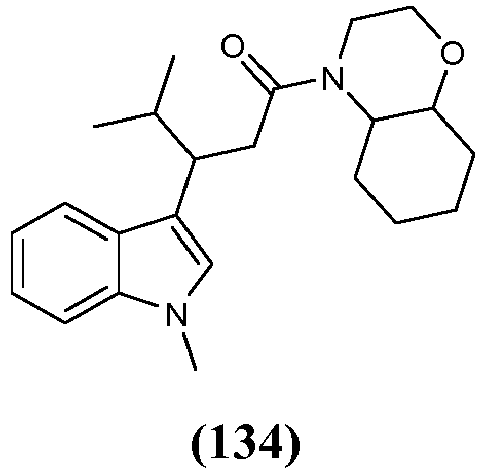
- Synthesis of Compound (134): Compound (134) was synthesized by following the procedure used to make Compound (1) (Scheme 2). The crude product was obtained by evaporating the organic layer under reduced pressure and was purified by silica gel column using Petroleum ether: Ethyl acetate as eluent to obtain Compound (134). 1H NMR (300MHz,CDC13) : δ 7.53-7.56(d,1H), 7.19-7.21(d,1H), 7.08-7.13(t,1H), 6.95-7.02(m,1H), 6.77(s,1H), 3.76-4.16(m,1H), 3.66(s,3H), 3.47-3.55(m,1H), 3.27-3.42(m,2H), 3.09-3.20(m,2H), 2.62-2.92(m,3H), 2.24-2.35(m,1H), 1.94-2.17(m,2H), 1.51-1.80(m,6H), 0.93-0.97(m,3H), 0.76-0.80(m,3H). LC-MS (M+H)+ = 369.3; HPLC purity: 91.33%.
-

- Synthesis of Compound (135): Compound (135) was synthesized by following the procedure used to make Compound (1) (Scheme 2). The crude product was obtained by evaporating the organic layer under reduced pressure and was purified by silica gel column using Petroleum ether: Ethyl acetate as eluent to obtain Compound (135). 1H NMR (300MHz,CDC13) : δ 8.22(s,1H), 6.98-7.13(m,3H), 6.70-6.76(m,1H), 4.07-4.22(m,1H), 3.10-3.83(m,3H), 2.70-2.88(m,2H), 2.04-2.13(m,1H), 1.66-1.86(m,3H), 0.77-1.33(m,14H). LC-MS (M+H)+ = 373.2; HPLC purity: 94.76%.
-

- Synthesis of Compound (136): Compound (136) was synthesized by following the procedure used to make Compound (1) (Scheme 2). The crude product was obtained by evaporating the organic layer under reduced pressure and was purified by silica gel column using Petroleum ether: Ethyl acetate as eluent to obtain Compound (136). 1H NMR (300MHz,CDC13) : δ 8.08(s,1H), 6.96-7.12(m,3H), 6.68-6.77(m,1H), 3.87-4.28(m,1H), 3.24-3.87(m,2H), 2.64-2.96(m,2H), 2.42-2.56(m,1H), 2.21-2.30(m,1H), 1.32-2.02(m,13H). LC-MS (M+H)+ = 345.2; HPLC purity: 94.02%.
-
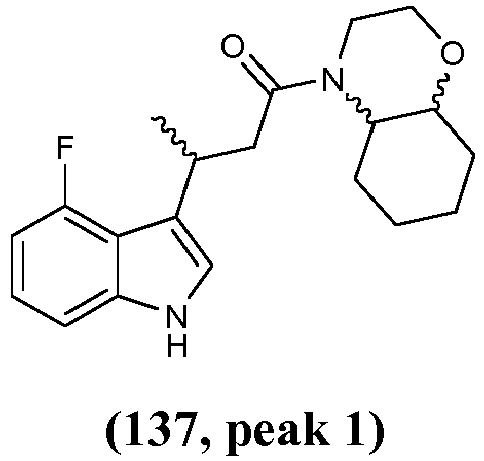
- Synthesis of Compound (137) (peak-1): Mixture of isomers of Compound (136) was separated by using preparative reverse phase HPLC column to give Compound (137) (peak-1). 1H NMR (300MHz,CDC13) : δ 8.26-8.33(d,1H), 6.91-7.10(m,3H), 6.65-6.76(m,1H), 4.11-4.29(m,1H), 3.58-3.78(m,1H), 3.54-3.58(m,1H), 3.29-3.42(m,2H), 3.08-3.15(m,1H), 2.77-3.03(m,2H), 2.34-2.55(m,2H), 1.78-1.91(m,1H), 1.52-1.67(m,3H), 1.32-1.41(m,6H). LC-MS (M+H)+ = 345.2; HPLC purity: 97.60%; Column: Zorbax eclipse XDB-C18, Mobile phase: MeCN: H2O, 40:60, RT = 14.93 min.
-

- Synthesis of Compound (138) (peak-2): Mixture of isomers of Compound (136) was separated by using preparative reverse phase HPLC column to give Compound (138) (peak-2). 1H NMR (300MHz,CDC13) : δ 8.14(s,1H), 6.93-7.12(m,3H), 6.65-6.74(m,1H), 4.13-4.28(m,1H), 3.44-3.86(m,2H), 3.18-3.38(m,2H), 2.57-2.88(m,2H), 2.43-2.52(m,1H), 1.84-2.33(m,2H), 1.56-1.88(m,4H), 1.33-1.40(m,6H). LC-MS (M+H)+ = 345.2; HPLC purity: 96.43%; column: Zorbax eclipse XDB-C18, Mobile phase: MeCN: H2O, 40:60, RT = 15.46 min.
-

- Synthesis of Compound (139) (peak-1): Compound (139) (peak-1)was synthesized by following the procedure used to make Compound (1) (Scheme 2). The crude product was obtained by evaporating the organic layer under reduced pressure and was purified by silica gel column using Petroleum ether: Ethyl acetate as eluent to obtain, Compound (139) (peak-1). 1H NMR (300MHz,CDC13) : δ 8.03(s,1H), 6.92-7.10(m,3H), 6.72-6.77(m,1H), 4.10-4.30(m,1H), 3.54-3.76(m,2H), 2.46-3.27(m,7H), 1.67-1.79(m,4H), 1.33-1.41(m,6H). LC-MS (M+H)+ = 345.2; HPLC purity: 96.25%.
-

- Synthesis of Compound (140): Compound (140) (peak-2) was synthesized by following the procedure used to make Compound (1) (Scheme 2). The crude product was obtained by evaporating the organic layer under reduced pressure and was purified by silica gel column using Petroleum ether: Ethyl acetate as eluent to obtain Compound (140) (peak-2). 1H NMR (300MHz,CDC13) : δ 8.03(s,1H), 6.92-7.07(m,3H), 6.7-6.77(m,1H), 4.10-4.30(m,1H), 3.54-3.76(m,2H), 2.-3.27(m,7H), 1.67-1.83(m,4H), 1.33-1.41(m,6H). LC-MS (M+H)+ = 345.2; HPLC purity: 97.10%.
-

- Synthesis of Compound (141): Compound (141) was synthesized by following the procedure used to make Compound (1) (Scheme 2). The crude product was obtained by evaporating the organic layer under reduced pressure and was purified by silica gel column using Petroleum ether: Ethyl acetate as eluent to obtain Compound (141). 1H NMR (300MHz,CDC13) : δ 7.75-7.89(m,2H), 7.23-7.38(m,2H), 3.81-4.13(m,3H), 2.99-3.09(m,1H), 2.53-2.87(m,1H), 2.01-2.19(m,3H), 1.22-1.78(m,18H). LC-MS (M+H)+ = 415.2; HPLC purity: 93.99%.
-

- Synthesis of Compound (142): Compound (142) was synthesized by following the procedure used to make Compound (1) (Scheme 2). The crude product was obtained by evaporating the organic layer under reduced pressure and was purified by silica gel column using Petroleum ether: Ethyl acetate as eluent to obtain Compound (142). 1H NMR (300MHz,CDC13) : δ 7.88-7.91(d,1H), 7.75-7.78(d,1H), 7.35-7.40(t,1H), 7.25-7.30(t,1H), 3.86-4.10(m,2H), 3.38-3.50(m,2H), 2.91(m,1H), 2.56(m,1H), 1.05-2.06(m,14H). LC-MS (M+H)+ = 329.2; HPLC purity: 97.29%.
-

- Synthesis of Compound (143): Compound (143) was synthesized by following the procedure used to make Compound (1) (Scheme 2). The crude product was obtained by evaporating the organic layer under reduced pressure and was purified by silica gel column using Petroleum ether: Ethyl acetate as eluent to obtain Compound (143). 1H NMR (300MHz,CDC13) : δ 9.63(s,1H), 7.94-8.14(m,2H), 6.97-7.07(m,2H), 4.40-4.60(m,1H), 3.40-3.65(m,2H), 2.41-2.88(m,5H), 1.18-1.48(m,14H). LC-MS (M+H)+ = 326.1; HPLC purity: 94.48%.
-

- Synthesis of Compound (144) (Peak-1): Mixture of isomers of Compound (143) was separated by using preparative reverse phase HPLC column to give Compound (144) (peak-1). 1H NMR (300MHz,CDC13) : δ 12.04(s,1H), 8.55-8.57(d,1H), 8.14-8.16(d,1H), 7.30-7.34(m,2H), 4.32-4.67(m,1H), 3.47-3.85(m,2H), 2.51-2.98(m,5H), 1.32-1.73(m,14H). LC-MS (M+H)+ = 326.2; HPLC purity: 99.85%; Column: Zorbax eclipse XDB-C-18, mobile phase: MeCN: H2O 50: 50, RT = 4.77 min.
-

- Synthesis of Compound (145) (Peak-2): Mixture of isomers of Compound (143) was separated by using preparative reverse phase HPLC column to give Compound (145) (peak-2). 1H NMR (300MHz,CDC13) : δ 11.84(s,1H), 8.51-8.54(d,1H), 8.16(d,1H), 7.30 (m,2H), 4.32-4.67(m,1H), 3.45-3.76(m,2H), 2.51-2.98(m,5H), 1.32-1.73(m,14H). LC-MS (M+H)+ = 326.2; HPLC purity: 98.76%; Column: Zorbax eclipse XDB-C-18, mobile phase: MeCN: H2O 50: 50, RT = 5.24 min.
-

- Synthesis of Compound (146): Compound (146) was synthesized by following the procedure used to make Compound (1) (Scheme 2). The crude product was obtained by evaporating the organic layer under reduced pressure and was purified by silica gel column using Petroleum ether: Ethyl acetate as eluent to obtain Compound (146). 1H NMR (300MHz,DMSO-d6) : δ 11.28(s,1H), 8.15-8.17(d,1H), 7.93-7.96(d,1H), 6.99-7.25(m,2H), 3.90-4.25(m,1H), 3.39-3.70(m,3H), 2.84-2.93(m,2H), 2.58-2.75(m,4H), 1.24-2.03(m,14H). LC-MS (M+H)+ = 356.2; HPLC purity: 96.35%.
-

- Synthesis of Compound (147): Compound (147) was synthesized by following the procedure used to make Compound (1) (Scheme 2). The crude product was obtained by evaporating the organic layer under reduced pressure and was purified by silica gel column using Petroleum ether: Ethyl acetate as eluent to obtain Compound (147). 1H NMR (300MHz,CDC13) : δ 9.07(s,1H), 8.05-8.07(d,1H), 6.99-7.10(m,2H), 3.51-3.92(m,4H), 2.78-2.94(m,4H), 2.14-2.32(m,2H), 1.35-1.96(m,13H). LC-MS (M+H)+ = 390.2; HPLC purity: 91.09%.
-

- Synthesis of Compound (148): Compound (148) was synthesized by following the procedure used to make Compound (1) (Scheme 2). The crude product was obtained by evaporating the organic layer under reduced pressure and was purified by silica gel column using Petroleum ether: Ethyl acetate as eluent to obtain Compound (148). 1H NMR (300MHz,DMSO-d6) : δ 11.28(s,1H), 8.16(d,1H), 7.95-7.99(m,1H), 7.20-7.24(m,1H), 6.99-7.03(m,1H), 4.35(s,1H), 4.15-4.29(m,1H), 3.63-3.72(m,1H), 3.42-3.51(m,2H), 2.62-2.83(m,3H), 1.20-1.98(m,14H). LC-MS (M+H)+ = 342.2; HPLC purity: 98.98%.
-

- Synthesis of Compound (149): Compound (149) was synthesized by following the procedure used to make Compound (1) (Scheme 2). The crude product was obtained by evaporating the organic layer under reduced pressure and was purified by silica gel column using Petroleum ether: Ethyl acetate as eluent to obtain Compound (149). 1H NMR (300MHz,CDC13) : δ 6.98-7.05 (m, 2H), 6.75-6.78 (m, 2H), 4.82 (s, 1H), 3.93 (s, 1H), 3.63 (s, 3H), 3.16-3.22 (m, 2H), 2.64 (s, 3H), 2.55-2.61 (m, 2H), 1.97-2.01 (m, 2H), 1.75-1.79 (m, 2H), 1.70-1.72 (m, 3H), 1.59-1.65 (m, 7H). LC-MS (M+H)+ = 364.2; HPLC purity: 93.73%.
-

- Synthesis of Compound (150): Compound (150) was synthesized by following the procedure used to make Compound (105) (Scheme 51). 1H NMR (300MHz, DMSO-d6) : δ 12.23(s,1H), 11.17(s,1H), 7.34-7.36(d,1H), 7.18-7.27(m,4H), 7.09-7.15(m,2H), 6.93-7.00(m,1H), 6.58-6.64(m,1H), 4.83(m,1H), 3.91-4.06(m,1H), 3.00-3.18(m,3H), 1.09-1.88(m,13H). LC-MS (M+H)+ = 449.2; HPLC purity: 96.20%.
-

- Synthesis of Compound (151): Compound (151) was synthesized by following the procedure used to make Compound (105) (Scheme 51). 1H NMR (300MHz,DMSO-d6) : δ 12.21(s,1H), 10.94(s,1H), 7.27-7.30(m,4H), 7.19-7.24(t,2H), 7.05-7.13(m,2H), 6.69-6.75(m,1H), 4.63-4.65(m,1H), 3.90-3.98(m,2H), 2.98-3.26(m,3H), 2.27-2.43(m,2H), 1.10-1.84(m,10H). LC-MS (M+H)+ = 449.22; HPLC purity: 96.21%.
-

- Synthesis of Compound (152): Compound (152) was synthesized by following the procedure used to make Compound (105) (Scheme 51). 1H NMR (300MHz,DMSO-d6) : δ 12.26(s,1H), 7.92-8.00(m,2H), 7.24-7.49(m,7H), 4.96-4.98(m,1H), 3.50-4.23(m,3H), 2.90-3.21(m,1H), 1.47-2.27(m,13H). LC-MS (M+H)+ = 449.1; HPLC purity: 99.48%.
-

- Synthesis of Compound (153): Compound (153) was synthesized by following the procedure used to make Compound (1) (Scheme 2). The crude product was obtained by evaporating the organic layer under reduced pressure and was purified by silica gel column using Petroleum ether: Ethyl acetate as eluent to obtain Compound (153). 1H NMR (300MHz,CDC13) : δ 9.14(s,1H), 8.20-8.21(d,1H), 7.93-7.96(m,1H), 6.96-7.08(m,2H)3.44-3.64(m,3H), 303-3.06(m,3H), 2.42-2.75(m,2H), 1.27-1.83(m,16H). LC-MS (M+H)+ = 356.2; HPLC purity: 94.26%.
-

- Synthesis of Compound (154): Compound (154) was synthesized by following the procedure used to make Compound (105) (Scheme 51). 1H NMR (300MHz,CD3OD) : δ 7.88-7.94(m,2H), 7.44-7.50(m,1H), 7.35-7.41(m,1H), 4.17(s,1H), 3.79-3.97(m,2H), 3.52-3.63(m,1H), 3.07-3.22(m,1H), 2.69-2.86(m,1H), 2.56(m,1H)2.04-2.11(m,2H), 1.88-1.92(m,2H), 1.61(m,4H), 1.45-1.51(m,3H), 1.35-1.38(m,4H). LC-MS (M+H)+ = 387.2; HPLC purity: 93.02%.
-

- Synthesis of (155): Compound (155) was synthesized by following the procedure used to make Compound (105) (Scheme 51). 1H NMR (300 MHz, DMSO-d6) : δ 12.19 (brs, 1H), 11.31 (s, 1H), 7.49, brs, 1H), 7.20-7.31 (m, 5H), 7.09-7.11 (m, 1H), 6.96-7.01 (t, 1H), 6.85-6.87 (d, 1H), 5.27-5.30 (m, 1H), 3.81-3.91 (2H, m), 2.60-2.95 (m, 3H), 2.25 (brs, 1H), 1.39-1.95 (m, 11H). LC-MS (M+H)+ = 465.2; HPLC purity: 99.0%.
-
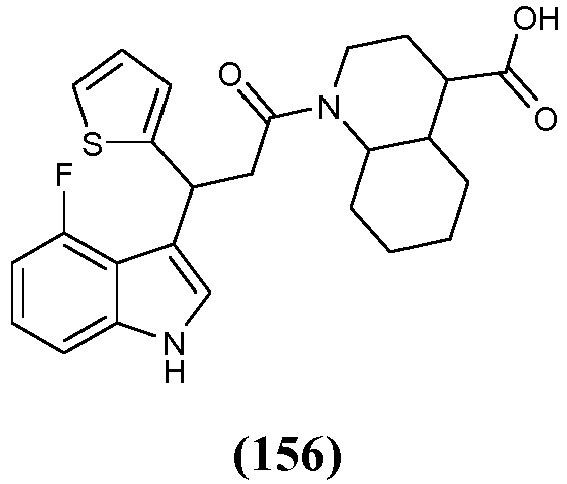
- Synthesis of (156): Compound (156) was synthesized by following the procedure used to make Compound (105) (Scheme 51). 1H NMR (300 MHz, CDC13) : δ 8.28 (brs, 1H), 6.98-7.06 (m, 4H), 6.80-6.82 (m, 2H), 6.62-6.68 (m, 1H), 5.06-5.20 (m, 1H), 4.46-4.59 (m, 1H), 3.94-4.06 (m, 1H)3.54-3.64 (1H), 3.30-3.42 (m, 1H), 3.04-3.16 (m, 2H), 2.27-2.55 (m, 1H), 1.59-1.87 (m, 6H), 1.35-1.40 (m, 4H). LC-MS (M+H)+ = 455.2; HPLC purity: 98.58%.
-

- Synthesis of (157): Compound (157) was synthesized by following the procedure used to make Compound (105) (Scheme 51). 1H NMR (300 MHz, DMSO-d6) : δ 12.23 (brs, 1H), 11.19 (brs, 1H), 7.24-7.53 (m, 3H), 7.12-7.15 (d, 1H), 6.94-7.06 (m, 3H), 6.61-6.65 (m, 1H), 4.83 (brs, 1H), 3.87-4.06 (m, 1H), 2.92-3.20 (4H), 2.45-2.60 (m, 2H), 1.47-1.86 (m, 10H). LC-MS (M+H)+ = 467.2; HPLC purity: 97.74%.
-

- Synthesis of (158): Compound (158) was synthesized by following the procedure used to make Compound (105) (Scheme 51). 1H NMR (300 MHz, DMSO-d6) : δ 12.25 (brs, 1H), 11.19 (brs, 1H), 7.28-7.32 (m, 2H), 6.96-7.04 (m, 2H), 3.96-4.01 (m, 2H), 3.45-3.50 (m, 1H), 2.63-2.79 (, 4H), 1.91-1.95 (m, 1H), 1.23-1.70 (m, 13H). LC-MS (M+H)+ = 403.2; HPLC purity: 93.16%.
-


- At 0°C, to a stirred solution of Intermediate-87 (0.800g, 2.8 mmol) and Starting Material-31 (0.387g, 2.8 mmol) in THF: DMF (10 mL: 0.5 mL), HBTU (1.28g,3.3 mmol) was added followed by addition of isopropyl ethylamine (1.09g, 8.4 mmol). The resulted reaction mixture was stirred at room temperature for 2 hours. After completion of the reaction (reaction monitored by TLC), the reaction mass was quenched with water and extracted with Ethyl acetate (3x50 mL). The organic layer was washed with saturated brine solution (50mL) and concentrated. Crude product was purified by combi flash chromatography eluting with hexanes: EtOAc (1: 1) to give Intermediate-88 (200 mg) and Intermediate-89 (280 mg) as pink solid.
- Intermediate-88, peak-1: LC-MS (M+H)+ = 403.2; HPLC purity: 91.08%; Column: Zorbax eclipse XDB-C18, 4.6X50mm, 5µm; RT = 13.58 minutes, Mobile phase: MeCN: 0.01%TFA gradient.
- Intermediate-89, peak-2: LC-MS (M+H)+ = 403.2; HPLC purity: 91.62%; Column: Zorbax eclipse XDB-C18, 4.6X50mm, 5µm; RT = 13.82 minutes, Mobile phase: MeCN: 0.01%TFA gradient.

- To a stirred solution of Intermediate-88, peak-1 (0.200g, 0.49 mmol) in 1,4 dioxane: H2O (2mL: 2mL) Conc. H2SO4 (0.6 mL) was added and the resultant mixture was heated at 90°C for 6 hours. After completion of the reaction (reaction monitored by TLC), the reaction mass was quenched with ice and extracted with Ethyl acetate (3 x 50 mL). The organic layer was washed with saturated brine solution (50mL) and dried over anhydrous Na2SO4 and concentrated to give Intermediate-90 (130 mg) as a pink oily material.
- Intermediate-91, peak-1 was synthesized by following the procedure used to make Compound (1) (Scheme 2).

- Synthesis of Compound (159) (peak-1): Compound (159) (peak-1) was synthesized by following the procedure used to make Compound (105) (Scheme 51). 1H NMR (300 MHz, DMSO-d6) : δ 12.21 (brs, 1H), 10.93 (brs, 1H), 7.22-7.29 (m, 3H), 7.05-7.13 (m, 3H), 6.93-6.97 (m, 2H), 6.75-6.80 (m, 1H), 4.56-4.64 (m, 1H), 3.50-3.60 (m, 2H), 2.99-3.1 (m, 3H), 2.27-2.32 (m, 1H), 1.15-1.83 (m, 11H). LC-MS (M+H)+ = 449.2; HPLC purity: 96.66%.
-


- Synthesis of 3-(6-fluoro-1H-indol-3-yl)-3-phenylpropanoic acid (Intermediate-92, peak-2): Intermediate-92 (peak-2) was synthesized by following the procedure used to make Intermediate-90 (peak-1) (Scheme 54).
- Intermediate-93 (peak-2) was synthesized by following the procedure used to make Compound (1) (Scheme 2).
- Synthesis of Compound (160) (peak-2): Compound (160) (peak-2) was synthesized by following the procedure used to make Compound (105) (Scheme 51). 1H NMR (300 MHz, DMSO-d6) : δ 12.22 (brs, 1H), 10.94 (brs, 1H), 7.19-7.31 (m, 3H), 7.05-7.13 (m, 3H), 7.05-7.11 (m, 2H), 6.69-6.75 (m 1H), 4.62-4.65 (m, 1H), 3.78-3.93 (m, 1H), 2.97-3.18 (m, 4H), 2.41-2.45 (m, 1H), 1.46-1.90 (m, 11H). LC-MS (M+H)+ = 449.2; HPLC purity: 97.44%.
-

- Synthesis of Compound (161) (Peak-1): Compound (161) (peak-1) was synthesized by following the procedure used to make Compound (159) (peak-2) (Scheme 53, & 54). 1H NMR (300 MHz, CDC13) : δ 8.38 (brs, 1H), 6.90-7.35 (m, 8H), 6.55-6.61 (m, 1H), 4.86-4.93 (m, 1H), 3.73-3.93 (m, 1H), 3.31-3.36 (m, 1H), 2.98-3.08 (m, 3H), 2.22-2.35 (m, 1H), 1.31-1.69 (m, 11H). LC-MS (M+H)+ = 449.2; HPLC purity: 97.90%.
-

- Synthesis of Compound (162) (peak-2): Compound (162) (peak-2) was synthesized by following the procedure used to make Compound (160) (peak-2) (Scheme 55). 1H NMR (300 MHz, DMSO-d6) : δ 12.23 (brs, 1H), 11.18 (brs, 1H), 7.35-7.36 (m, 1H), 7.07-7.27 (m, 6H), 6.93-7.00 (m, 1H), 6.51-6.71 (dd, 1H), 4.83 (brs, 1H), 3.91-3.99 (m, 1H), 2.92-3.20 (m, 3H), 2.41-2.45 (m, 2H), 1.45-1.88 (m, 11H).LC-MS (M+H)+ = 449.2; HPLC purity: 98.50%.
-

- Synthesis of Compound (163): Compound (163) was synthesized by following the procedure used to make Compound (105) (Scheme 51). 1H NMR (300 MHz, DMSO-d6) : δ 12.22 (brs, 1H), 11.30(brs, 1H), 8.13-8.14 (d, H), 7.94-7.96 (d, 1H), 7.19-7.20 (m, 1H), 6.97-7.01 (m, 1H), 3.82-4.04 (m, 1H), 3.16-3.21 (m, 2H), 2.71-2.84 (m, 5H), 2.20-2.25 (m, 1H), 1.40-2.03 (m, 6H), 1.17-1.23 (4H), 0.90-0.92 (d, 3H), 0.56-0.58 (d, 3H). LC-MS (M+H)+ = 396.2; HPLC purity: 95.12%.
-
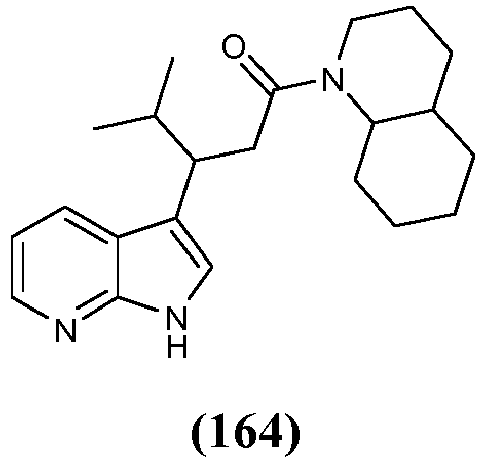
- Synthesis of Compound (164): Compound (164) was synthesized by following the procedure used to make Compound (1) (Scheme 2). The crude product was obtained by evaporating the organic layer under reduced pressure and was purified by silica gel column using Petroleum ether: Ethyl acetate as eluent to obtain Compound (164). 1H NMR (300 MHz, CDC13) : δ 9.46 (brs, 1H), 8.17-8.21 (m, 1H), 7.89-7.95 (m, 1H), 6.95-7.05 (m, 2H), 4.29-4.45 (m, 1H), 3.35-3.65 (m, 2H), 3.09-3.25 (m, 1H), 2.69-2.89 (m, 3H), 2.29-2.37 (m, 1H), 1.95-2.12 (m, 3H0, 1.55-1.70 (m, 3H), 1.37-1.49 (m, 6H), 0.90-0.92 (d, 3H), 0.76-0.78 (d, 3H). LC-MS (M+H)+ = 354.3; HPLC purity: 96.20%.
-

- Synthesis of Compound (165): Compound (165) was synthesized by following the procedure used to make Compound (105) (Scheme 51). 1H NMR (300 MHz, DMSO-d6) : δ 12.22 (brs, 1H), 11.31 1H), 8.15-8.16 (m, H), 7.95-7.98 (d, 1H), 7.25-7.26 (m, 1H), 6.98-7.02 (m, 1H), 4.05-4.06 (m, 1H), 3.74-3.87 (m, 1H), 3.48-3.52 (m, 2H), 2.63-2.81 (m, 3H), 2.27-2.34 (m, 1H), 1.60-1.98 (m, 8H), 1.45-1.49 (m, 2H), 1.25-1.28, m, 3H). LC-MS (M+H)+ = 370.2; HPLC purity: 91.67%.
-

- Synthesis of Compound (166): Compound (166) was synthesized by following the procedure used to make Compound (1) (Scheme 2). The crude product was obtained by evaporating the organic layer under reduced pressure and was purified by silica gel column using Petroleum ether: Ethyl acetate as eluent to obtain Compound (166). 1H NMR (300MHz,CD3OD) 1H NMR (300 MHz, CDC13) : δ 7.49-7.54 (t, 1H), 7.26-7.35 (m, 2H), 5.40-5.44 (m, 1H), 4.23-4.38 (m, 1H), 3.30-3.76 (m, 2H0, 2.71-3.02 (m, 1.5H), 2.41-2.51 (m, 0.5H), 1.18-1.75 (m, 16H).: LC-MS: (M+H)+ = 361.1; HPLC purity = 89.09%.
-

- Synthesis of Compound (167): Compound (167) was synthesized by following the procedure used to make Compound (1) (Scheme 2). The crude product was obtained by evaporating the organic layer under reduced pressure and was purified by silica gel column using Petroleum ether: Ethyl acetate as eluent to obtain Compound (167). 1H NMR (300 MHz, CDC13) : δ 7.67-7.71 (m, 1H), 7.28-7.31 (M, 1H), 7.19-7.24 (m, 1H), 5.55-5.64 (m, 1H), 4.38-4.55 (m, 1H), 3.50-3.62 (m, 1H), 3.20-3.45 (m, 1H), 2.75-3.05 (m, 2H), 2.46-2.50 (m, 1H), 1.70 (d, 3H), 1.17-1.68 (m, 12H). LC-MS: (M+H)+ = 361.2; HPLC purity = 95.89%.
-

- Synthesis of Compound (168): Compound (168) was synthesized by following the procedure used to make Compound (105) (Scheme 51). 1H NMR (300 MHz, DMSO-d6) : δ 7.66-7.69 (d, 1H), 7.37-7.42 (t, 1H), 7.14-7.16 (d, 1H), 5.41 (brs, 1H), 3.70-3.86 (m, 3H), 2.66 (s, 3H), 2.45-2.51 (m, 2H), 2.27 (brs, 1H), 1.19-1.83 (m, 14H). LC-MS: (M+H)+ = 385.2; HPLC purity = 83.84%.
-

- Synthesis of Compound (169): Compound (169) was synthesized by following the procedure used to make Compound (105) (Scheme 51). 1H NMR (300 MHz, DMSO-d6) : δ 12.26 (brs, 1H), 7.65-7.70 (1H, m), 7.37-7.42 (t, 1H), 7.14-7.16 (d, 1H), 5.41-5.43 (m, 1H), 3.88-3.96 (m, 2H), 2.85-3.12 (m, 3H0, 2.69 (s, 3H), 2.27 (brs, 1H),1.70-2.0 (m, 11H), 1.61 (d, 3H). LC-MS: (M+H)+ = 385.2; HPLC purity = 84.25%.
-

- Synthesis of Compound (170): Compound (170) was synthesized by following the procedure used to make (105) (Scheme 51). 1H NMR (300 MHz, DMSO-d6) : δ 11.18 (brs, 1H), 7.35-7.40 (m, 1H), 7.13-7.28 (m, 2H), 6.98-7.02 (m, 1H), 6.80-6.88 (m, 2H), 6.65-6.71 (m, 1H), 5.00-5.12 (m, 1H), 4.59-4.66 (m, 0.5H), (4.26-4.34 (m, 0.5H), 3.80-3.86 (m, 1H), 2.92-3.05 (m, 2H), 2.20-2.22 (m, 1H), 1.33-1.75 (m, 10 H). LC-MS: (M+H)+ = 455.1 ; HPLC purity = 97.36%.
-

- Synthesis of (171): Compound (171) was synthesized by following the procedure used to make Compound (105) (Scheme 51). 1H NMR (300 MHz, DMSO-d6) : δ 12.26 (brs, 1H), 11.77 (s, 1H), 8.09-8.11 (d, 1H), 7.42 (s, 1H), 7.10-7.12 (d, 1H), 4.05 (brs, 1H), 3.85-3.87 (m, 2H), 3.45-3.51 (m, 2H), 2.66-2.76 m, 2H), 1.62-1.97 (m, 11H), 1.40-1.43 (d, 3H). LC-MS: (M+H)+ = 404.2; HPLC purity = 90.05%
-

- Synthesis of Compound (172): Compound (172) was synthesized by following the procedure used to make Compound (1) (Scheme 2). The crude product was obtained by evaporating the organic layer under reduced pressure and was purified by silica gel column using Petroleum ether: Ethyl acetate as eluent to obtain Compound (172)1H NMR (300 MHz, CDC13) : δ 7.34-7.39 (m, 1H), 7.25-7.30 (m, 1H), 7.00-7.02 (m, 1H), 5.00-5.03 (m, 1H), 4.61 (brs, 0.5H), 4.15-4.30 (m, 0.5H), 3.41-3.61 (m, 2H), 2.78-3.01 (m, 1H), 2.70 (s, 3H), 2.15-2.42 (m, 1H), 1.32-1.95 (m, 14H), 0.70-0.81 (m, 6H). LC-MS: (M+H)+ = 369.3; HPLC purity = 82.9%
-

- Synthesis of Compound (173): Compound (173) was synthesized by following the procedure used to make Compound (1) (Scheme 2). The crude product was obtained by evaporating the organic layer under reduced pressure and was purified by silica gel column using Petroleum ether: Ethyl acetate as eluent to obtain Compound (173)1H NMR (300 MHz, CDC13) : δ 7.64-7.67 (d, 1H), 7.36-7.39 (d, 1H), 7.16-7.21 (m, 1H), 4.39-4.56 (m, 1H), 3.64-3.94 (m, 2H), 3.01-3.23 (m, 2H), 2.48-2.65 (m, 2H), 1.52-1.78 (m, 8H), 1.46 (d, 3H), 1.31-142 (m, 6H). LC-MS: (M+H)+ = 377.1; HPLC purity = 98.83%
-

- Synthesis of Compound (174): Compound (174) was synthesized by following the procedure used to make Compound (105) (Scheme 51)1H NMR (300 MHz, CDC13) : δ 8.06 (brs, 0.5H), 7.98 (brs, 0.5H), 7.22-7.24 (m, 2H), 6.91-6.98 (m, 5H), 6.60-6.75 (m, 2H), 4.85-4.87 (m, 1H), 4.78-4.83 (m, 2H), 3.54-3.66 (m, 2H), 3.24-3.32 (dd, 1H), 3.03-3.10 (dd, 1H), 2.12-2.30 (m, 2H), 1.85-2.00 (m, 5H), 1.41-1.58 (m, 4H). LC-MS: (M+H)+ = 449.2; HPLC purity = 93.61%.
-
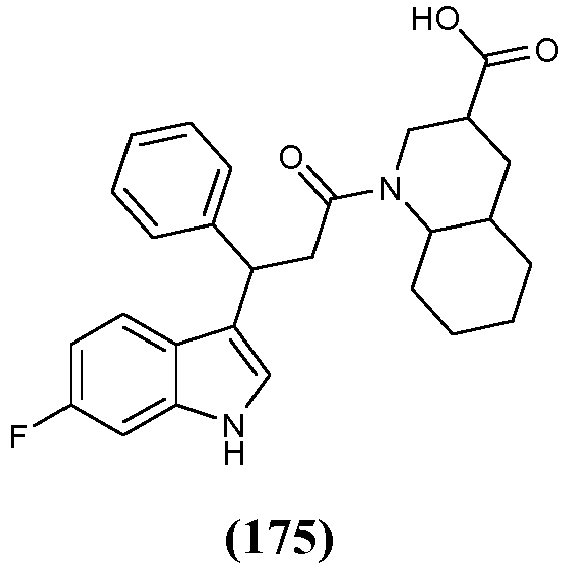
- Synthesis of Compound (175): Compound (175) was synthesized by following the procedure used to make Compound (105) (Scheme 51)1H NMR (300 MHz, DMSO-d6) : δ 12.35 (brs, 1H), 10.99 (brs, 1H), 7.20-7.31 (m, 6H), 7.05-7.12 (m, 2H), 6.69-6.75 (t, 1H), 4.62-4.66 (m, 1H), 4.30-4.45 (m, 0.5H), 3.81-4.10 (m, 0.5H), 2.93-3.22 (m, 2H), 2.45-2.51 (m, 2H), 2.24-2.30 (m, 1H), 1.17-1.75 (m, 11H). LC-MS: (M+H)+ = 449.2.
-
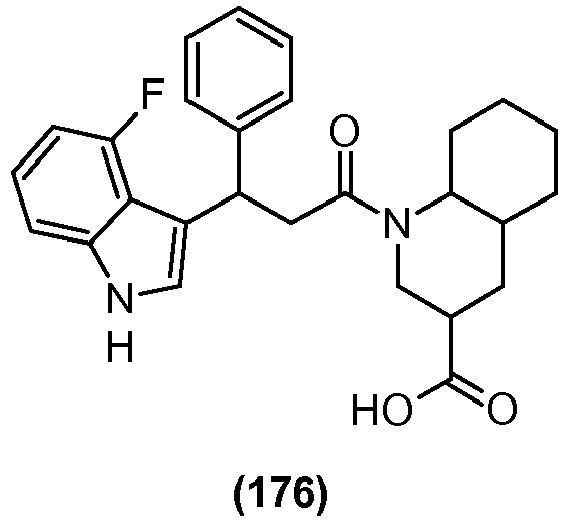
- Synthesis of Compound (176): Compound (176) was synthesized by following the procedure used to make Compound (105) (Scheme 51). 1H NMR (300 MHz, CDC13): δ 8.19 (brs, 1H), 7.19-7.23 (m, 1H), 6.92-7.12 (m, 7H), 6.54-6.65 (m, 1H), 4.88-4.90 (m, 1H), 4.51-4.64 (m, 1H), 3.66-3.79 (m, 1H), 2.94-3.09 (m, 2H), 2.48-2.74 (m, 2H), 2.12-2.30 (m, 1H), 1.95-2.02 (m, 1H), 1.31-1.85 (m, 10H). LC-MS: (M+H)+ = 449.2; HPLC purity = 99.50%.
-

- Synthesis of Compound (177): Compound (177) was synthesized by following the procedure used to make Compound (105) (Scheme 51). 1H NMR (300 MHz, DMSO-d6) : δ 10.87 (brs, 1H), 7.48-7.53 (dd, 1H), 7.04-7.07 (m, 2H), 6.75-6.82 (m, 1H), 3.75-3.96 (m, 2H), 3.17-3.24 (q, 2H), 2.67-2.69 (d, 2H), 2.23-2.30 (m, 1H), 1.94-2.02 (m, 2H), 1.01-1.84 (m, 10H), 0.86-0.88 (d, 3H), 0.76-0.78 (d, 3H) . LC-MS: (M+H)+ = 415.2; HPLC purity = 99.75%.
-

- Synthesis of Compound (178): Compound (178) was synthesized by following the procedure used to make Compound (105) (Scheme 51). 1H NMR (300 MHz, CDC13): δ 8.81 (brs, 0.5H), 8.45 (brs, 0.5H), 7.43-7.47 (dd, 1H), 6.84-6.90 (m, 1H), 6.79 (brs, 1H), 6.70-6.76 (m, 1H), 4.35-4.50 (m, 1H), 3.45-3.53 (m, 1H), 3.02-3.15 (m, 2H), 2.63-2.77 (m, 2H), 2.00-2.10 (m, 1H), 1.75-1.95 (m, 2H), 1.23-1.65 (m, 10H), 0.94-0.96 (d, 3H), 0.78-0.80 (d, 3H). LC-MS: (M+H)+ = 415.2; HPLC purity = 88.97%.
-
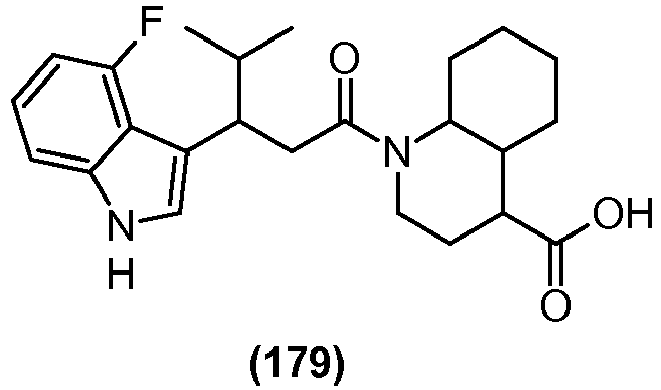
- Synthesis of Compound (179): Compound (179) was synthesized by following the procedure used to make Compound (105) (Scheme 51). 1H NMR (300 MHz, CDC13) : δ 8.44 (brs, 0.5H), 8.37 (brs, 1H), 6.88-7.05 (m, 3H), 6.62-6.70 (m, 1H), 4.37-4.50 (m, 1H), 3.61 (t, 1H), 3.51-3.58 (m, 1H), 3.10-3.20 (m, 1H), 2.60-2.80 (m, 2H), 2.34-2.45 (m, 1H), 1.99-2.04 (m, 1H), 1.79-1.87 (m, 1H), 1.15-1.80 (m, 10H), 0.93-0.95 (d, 3H), 0.70-0.72 (d, 3H). LC-MS: (M+H)+ = 415.3; HPLC purity = 96.54%.
-

- Synthesis of Compound (180): Compound (180) was synthesized by following the procedure used to make Compound (105) (Scheme 51). 1H NMR (300 MHz, CDC13) : δ 11.71 (brs, 0.5H), 11.32 (brs, 0.5H), 7.88-8.01 (m, 1H), 7.07 (s, 1H), 6.81-6.84 (m, 1H), 3.92-3.94 (m, 1H), 3.73-3.75 (m, 1H), 3.45-3.50 (m, 1H), 2.86 (s, 2H), 2.84 (s, 1H), 2.45-2.70 (m, 4H), 1.95-2.10 (m, 2H), 1.12-1.75 (m, 10H), 0.95-1.05 (m, 6H). LC-MS: (M+H)+ = 412.3; HPLC purity = 97.39%.
-

- Synthesis of Compound (181): Compound (181) was synthesized by following the procedure used to make Compound (105) (Scheme 51). 1H NMR (300 MHz, DMSO-d6) : δ 7.67-7.73 (m, 3H), 7.45-7.50 (m, 1H), 7.37-7.42 (m, 4H), 7.21-7.28 (dd, 1H), 7.08-7.13 (d, 1H), 4.55-4.65 (m, 1H), 4.25-4.41 (m, 1H), 4.00-4.13 (m, 1H)< 3.02-3.09 (m, 1H), 3.02-3.09 (m, 1H), 2.72-2.79 (m, 1H), 2.27-2.32 (m, 1H), 1.30-2.15 (m, 10H) . LC-MS: (M+H)+ = 433.2; HPLC purity = 98.45%.
-

- Synthesis of Compound (182): Compound (182) was synthesized by following the procedure used to make Compound (105) (Scheme 51). 1H NMR (300 MHz, DMSO-d6) : δ 12.36 (brs, 1H), 7.69-7.71 (d, 2H), 7.36-7.48 (m, 7H), 7.19-7.24 (d, 1H), 4.26-4.30 (m, 1H), 4.11-4.15 (m, 1H), 3.52-3.59 (m, 2H), 2.39-2.45 (m, 2H), 2.25-2.28 (m, 1H), 1.35-2.16 (m, 10H). LC-MS: (M+H)+ = 433.2; HPLC purity = 97.16%.
-

- Synthesis of Compound (183): Compound (183) was synthesized by following the procedure used to make Compound (105) (Scheme 51). 1H NMR (300 MHz, CDC13) : δ 7.38-7.41 (d, 1H), 7.25-7.30 (t, 1H), 7.00-7.03 (d, 1H), 5.02-5.05 (m, 1H), 3.95-4.10 (m, 1H), 3.46-3.68 (m, 2H), 2.84-2.90 (m, 1H), 2.75 (s, 3H), 2.21-2.39 (m, 4H), 1.25-1.95 (m, 4H), 0.96-0.98 (d, 3H), 0.75-0.77 (d, 3H). LC-MS: (M+H)+ = 413.2; HPLC purity = 95.52%.
-

- Synthesis of Compound (184): Compound (184) was synthesized by following the procedure used to make Compound (105) (Scheme 51). 1H NMR (300 MHz, CDC13) : δ 8.36 (br s, 1H), 7.16-7.21 (m, 2H), 7.11 -7.14 (d, 1H), 7.06-7.09 (m, 1H), 6.95-6.97 (m, 1H), 6.83-6.78 (m, 2H), 5.58-5.64 (m, 1H), 4.40-4.60 (m, 1H), 3.60-3.65 (m, 1H), 3.34-3.42 (M, 1H), 2.99-3.19 (m, 1H), 2.43-2.71 (m, 1H), 2.12-2.15 (m, 1H), 1.23-1.84 (m, 11H). LC-MS: (M+H)+ = 471.2; HPLC purity = 98.02%.
-
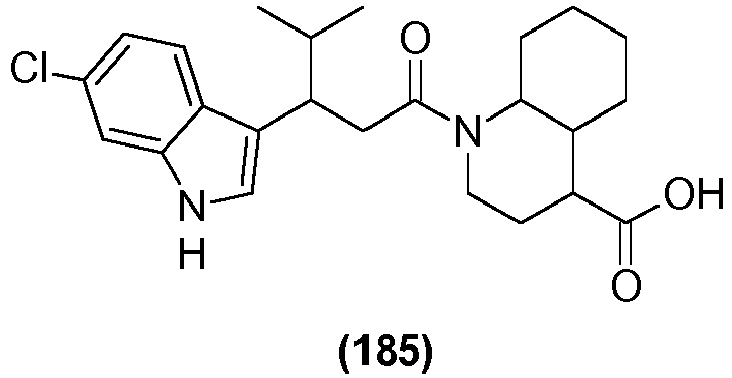
- Synthesis of Compound (185): Compound (185) was synthesized by following the procedure used to make Compound (105) (Scheme 51). 1H NMR (300 MHz, DMSO-d6) : δ 10.94 (br s, 1H), 7.52-7.55 (d, 1H), 7.33 (s, 1H), 7.13 (s, 1H), 6.93-6.96 (d, 1H), 3.78-3.97 (m, 1H), 3.34-3.41 (m, 1H), 3.16-3.22 (m, 2H), 2.68-2.70 (m, 2H), 2.29-2.33 (m, 1H), 1.06-2.02 (m, 12H), 0.86-0.88 (d, 3H), 0.75-0.77 (d, 3H). LC-MS: (M+H)+ = 431.3; HPLC purity = 96.39%.
-

- Synthesis of Compound (186): Compound (186) was synthesized by following the procedure used to make Compound (105) (Scheme 51). 1H NMR (300 MHz, DMSO-d6) : δ 12.07 (br s, 1H), 11.18 (brs, 1H), 7.33-7.38 (m, 1H), 7.18-7.29 (m, 4H), 7.08-7.15 (m, 2H), 6.93-7.00 (m, 1H), 6.55-6.64 (m, 1H), 4.78-4.85 (m, 1H), 4.18-4.35 (m, 1H), 3.74-4.00 (m, 1H), 2.93-3.19 (m, 2H), 2.20-2.25 (m, 2H), 1.25-1.82 (m, 11H). LC-MS: (M+H)+ = 449.3; HPLC purity = 98.98%.
-

- Synthesis of Compound (187): Compound (187) was synthesized by following the procedure used to make Compound (105) (Scheme 51). 1H NMR (300 MHz, CDC13): δ 8.31 (brs 1H), 7.16-7.18 (m, 1H), 6.97-7.01 (m, 3H), 3.65-3.87 (m, 2H), 3.39-3.53 (m, 1H), 2.44-2.73 (m, 4H0, 1.23-1.85 (m, 13H), 0.81-0.86 (t, 3H). LC-MS: (M+H)+ = 417.2; HPLC purity = 90.53%.
-

- Synthesis of Compound (188): Compound (188) was synthesized by following the procedure used to make Compound (105) (Scheme 51). 1H NMR (300 MHz, DMSO-d6) : δ 12.26 (br s, 1H), 11.18 (br s, 1H), 7.32-7.35 (m, 1H), 7.09-7.27 (m, 6H), 6.93-7.00 (m, 1H), 6.58-6.64 (m, 1H), 4.79-4.86 (m, 1H), 4.04-4.41 (m, 1H), 3.93-4.05 (m, 1H), 3.75-3.79 (m, 1H), 2.95-3.17 (m, 2H), 2.71-2.75 (m, 1H), 1.25-1.89 (m, 11H). LC-MS: (M+H)+ = 449.2; HPLC purity = 94.73%.
-

- Synthesis of Compound (189): Compound (189) was synthesized by following the procedure used to make Compound (105) (Scheme 51). 1H NMR (300 MHz, CDC13) : δ 7.99 (br s, 1H), 7.09-7.12 (d, 1H), 6.97-7.01 (m, 2H), 6.66-6.68 (d, 1H), 4.45-4.53 (m, 0.5H), 4.10-4.15 (m, 1H), 3.50-3.64 (m, 1H), 3.05-3.07 (m, 0.5H), 2.67-2.83 (m, 2H), 2.19-2.50 (m, 4H), 1.40-1.96 (m, 12H), 1.36-1.38 (d, 3H), 0.89-0.93 (m, 2H), 0.82-0.85 (m, 2H). LC-MS: (M+H)+ = 423.2; HPLC purity = 95.52%.
-


- Intemediate-94 was synthesized by following the procedure used to make Intermediate-2 (Scheme-1).
- A 250mL RB flask fitted with magnetic stirrer was charged with Intermedieate-94 (15.95g, 51.47mmol), cyclopropylboronic acid (8.8g,102.9 mmol), cesium carbonate (33.45g, 102.9mmol), in a miture of dioxane and water (100 mL: 20 ML). Then purged with N2 gas and added PdCl2(dppf) (4.2g, 5.1 mmol). Resulting solution was stirred at 100 °C for 13 h. After completion of the reaction (reaction monitored by TLC), reaction solution was filtered through celite. Filtrate diluted with water and extracted with EtOAc and concentrated to give crude material, which is purified by silica gel column chromatography eluting with Petroleum ether (60-80) and ethyl acetate as eluent. The product (intermediate-95) was obtained as a brown liquid (12.5g).
- Intemediate-96 was synthesized by following the procedure used to make Intermediate-3 (Scheme-1).

- A 500mL RB flask fitted with magnetic stirrer was charged with Starting Material-32 (60g, 435mmol), Starting material-33 (168g, 1824mmol), 3-nitrobenzoic acid (30g, 179mmol) in 90mL of conc.H2SO4. Then reaction mixture was heated at 150 °C for 7 h. After reaction cooled to RT and added MeOH (600 mL) and refluxed for 12 hours. Then cooled to 0 °C quenched with ice and concentrated. Crude reaction mixture was basified with NaHCO3, extracted with DCM and concentrated. Resulted crude material was purified by silica gel column chromatography eluting with Petroleum ether (60-80), ethyl acetate and 0.5% of triethylamine as eluent. The product (intermediate-97) was obtained as a brown liquid (21g).
- To a stirred solution of Intermediate-97 (21g, 112mmol) in a mixture of THF: MeOH (25 mL: 200 mL) was added LiOH (10.75g, 448mmol) in water (25 mL) at 0 °C . Resulted reaction mixture was stirred at room temperature for 3 hours. After reaction (monitored by TLC), it was concentrated and acidified (PH= 5) with 1N. HCl. Reslted precipitate was filtered and dried to give product Intermediate-98 (19g).
- Intemediate-99 was synthesized by following the procedure used to make Intermediate-18 (Scheme-13).
- A 250mL RB flask fitted with magnetic stirrer was charged with Intermediate-99 (5.4g, 29.5mmol) in 50 mL MeOH. To this thionylchloride (10 mL) was slowly added at 0 °C . Resulted reaction mixture was stirred at room temperature for 12 hours. After reaction (Monitered by LC-MS), it was concentrated followed by azetroped with with tolune to give product Intermediate-100 as white solid (4.4 g).
- Synthesis of Compound (190): Compound (190) was synthesized by following the procedure used to make Compound (105) (Scheme 51). 1H NMR (300 MHz, CDC13) : δ 7.94 (br s, 1H), 7.10-7.12 (m, 1H), 6.96-7.00 (m, 2H), 6.65-6.69 (m, 1H), 4.68-4.70 (m, 0.5H), 4.44-4.48 (m, 0.5H), 4.14-4.17 (m, 1H), 3.57-3.63 (m, 1H), 2.70-2.94 (m, 2H), 2.41-2.55 (m, 3H), 2.12-2.15 (m, 1H), 1.44-1.77 (m, 8H), 1.35-1.37 (d, 3H), 1.30-1.35 (m, 2H), 0.91-0.93 (m, 2H), 0.77-0.80 (m, 2H).. LC-MS: (M+H)+ = 409.2; HPLC purity = 97.56%.
-

- Synthesis of Compound (191): Compound (191) was synthesized by following the procedure used to make Compound (105) (Scheme 51). 1H NMR (300 MHz, DMSO-d6) : δ 12.11 (br s, 1H), 10.80 (br s, 1H), 7.16-7.19 (m, 1H), 7.12-7.14 (d, 1H), 6.88-6.93 (t, 1H), 6.55-6.58 (d, 1H), 4.05-4.10 (m, 1H), 3.70-3.73 (m, 1H), 2.90-3.01 (m, 1H), 2.61-2.70 (m, 2H), 2.30-2.39 (m, 2H), 2.25-2.28 (m, 1H), 1.31-2.06 (m, 11H), 1.27-1.29 (d, 3H), 0.89-0.91 (m, 2H), 0.72-0.73 (m, 2H). LC-MS: (M+H)+ = 409.2; HPLC purity = 93.25%.
-

- Synthesis of Compound (192): Compound (192) was synthesized by following the procedure used to make Compound (105) (Scheme 51). 1H NMR (300 MHz, CDC13) : δ 8.30 (br s, 1H), 7.37-7.40 (d, 1H), 7.29-7.32 (m, 1H), 7.18-7.20 (d, 1H), 7.08-7.15 (m, 4H), 3.22-3.46 (m, 2H), 2.71-2.93 (m, 1H), 2.39-2.57 (m, 2H), 2.10-2.25 (m, 2H), 1.42-1.94 (m, 11H), 0.85-0.88 (d, 3H). LC-MS: (M+H)+ = 451.1; HPLC purity = 99.67%.
-

- Synthesis of Compound (193): Compound (193) was synthesized by following the procedure used to make Compound (105) (Scheme 51). 1H NMR (300 MHz, DMSO-d6) : δ 12.15 (br s, 1H), 11.18 (brs, 1H), 7.28-7.31 (m, 2H), 7.01-6.98 (m, 2H), 4.47-4.49 (m, 0.5H), 4.29-4.33 (m, 0.5H), 3.72-3.95 (m, 2H), 2.62-3.02 (m, 4H), 1.30-1.94 (m, 11H), 1.25-1.27 (d, 3H). LC-MS: (M+H)+ = 403.1; HPLC purity = 98.12%.
-

- Synthesis of Compound (194): Compound (194) was synthesized by following the procedure used to make Compound (105) (Scheme 51). 1H NMR (300 MHz, CDC13) : δ 7.95 (br s, 1H), 7.10-7.13 (d, 1H), 6.96-7.02 (m, 2H), 6.66-6.68 (d, 1H), 4.17-4.20 (m, 2H), 3.46-3.49 (m, 1H), 2.80-2.88 (m, 1H), 2.53-2.60 (m, 2H), 2.41-2.48 (m, 2H), 1.45-1.98 (m, 11H), 1.36-1.38 (d, 3H), 0.92-0.95 (m, 2H), 0.74-0.81 (m, 2H). LC-MS: (M+H)+ = 409.2; HPLC purity = 92.83%.
-
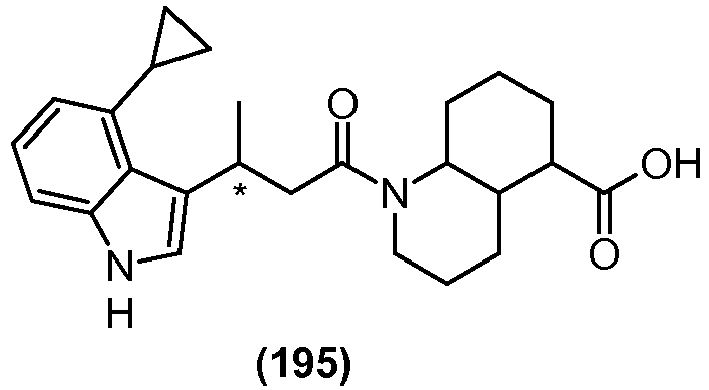

- Intemediate-101, peak-1 was synthesized by following the procedure used to make Intermediate-90, peak-1 (Scheme-54). 1H NMR (300 MHz, DMSO-d6) : δ 12.01 (br s, 1H), 10.83 (br s, 1H), 7.12-7.15 (m, 2H)m 6.89-6.94 (t, 1H), 6.58-6.61 (d, 1H), 3.99-4.03 (m, 1H), 2.71-2.78 (dd, 1H), 2.34-2.42 (m, 2H), 1.30-1.32 (d, 3H), 0.92-0.94 (m, 2H), 0.72-0.74 (m, 2H). LC-MS: (M+H)+ = 244.1; HPLC purity = 96.90%; Chiral RT = 7.91 min [chiral pak IA, mobile phase hexane:i-PrOH: DCM (8.5:1.0:0.5)]; [α]D 23 = +10.62° (c 0.032, MeOH).
- Intemediate-102, peak-1 was synthesized by following the procedure used to make Compound-1 (Scheme-2).
- Synthesis of Compound (195): Compound (195) was synthesized by following the procedure used to make Compound (105) (Scheme 51). 1H NMR (300 MHz, CDC13) : δ 8.04 (br s, 1H), 7.08-7.11 (d, 1H), 6.95-6.98 (m, 2H), 6.68 (s, 1H), 4.44-4.68 (m, 1H), 4.16 (br s, 1H), 3.39-3.59 (m, 1H), 2.66-2.93 (m, 2H), 2.14-2.51 (m, 3H), 1.38-1.85 (m, 11H), 1.30-.132 (d, 3H), 0.91-0.93 (m, 2H), 0.70-0.72 (m, 2H). LC-MS: (M+H)+ = 409.2; HPLC purity = 96.52%.
-
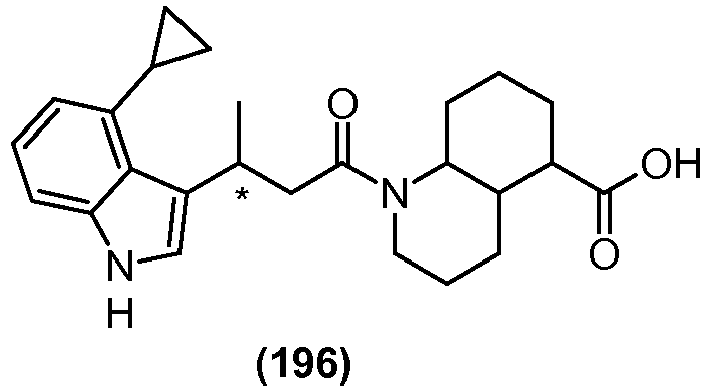


- Intemediate-103, peak-2 was synthesized by following the procedure used to make Intermediate-90, peak-1 (Scheme-54). 1H NMR (300 MHz, DMSO-d6) : δ 12.01 (br s, 1H), 10.83 (br s, 1H), 7.12-7.15 (m, 2H)m 6.89-6.94 (t, 1H), 6.58-6.61 (d, 1H), 3.99-4.03 (m, 1H), 2.71-2.78 (dd, 1H), 2.34-2.42 (m, 2H), 1.30-1.32 (d, 3H), 0.92-0.94 (m, 2H), 0.72-0.74 (m, 2H). LC-MS: (M+H)+ = 244.1; HPLC purity = 89.91%; Chiral RT = 9.15 min [chiral pak IA, mobile phase hexane:i-PrOH: DCM (8.5:1.0:0.5)]; [a]D 23 = -6.04° (c 0.033, MeOH)
- Intemediate-104, peak-2 was synthesized by following the procedure used to make Compound-1 (Scheme-2).
- Synthesis of Compound (196): Compound (196) was synthesized by following the procedure used to make Compound (105) (Scheme 51). 1H NMR (300 MHz, CDC13) : δ 8.08 (br s, 1H), 7.08-7.10 (d, 1H), 6.94-7.00 (m, 2H), 6.65-6.67 (m, 1H), 4.44-4.68 (m, 1H), 4.15 (br s, 1H), 3.38-3.64 (m, 1H), 2.71-2.92 (m, 2H), 2.13-2.54 (m, 3H), 1.45-1.78 (m, 11H), 1.40-1.43 (d, 3H), 0.90-0.93 (m, 2H), 0.74-0.77 (m, 2H). LC-MS: (M+H)+ = 409.2; HPLC purity = 96.11%.
-

- Synthesis of Compound (197): Compound (197) was synthesized by following the procedure used to make Compound (105) (Scheme 51). 1H NMR (300 MHz, DMSO-d6) : δ 12.13 (br s, 1H), 11.48 (br s, 1H), 7.67-7.70 (d, 1H), 7.46-7.48 (m, 2H), 7.17-7.22 (t, 1H), 4.45-4.49 (m, 0.5H), 4.25-4.30 (0.5H), 3.74-3.85 (m, 3H), 2.91-3.00 (m, 1H), 2.69-2.86 (m, 2H), 1.30-1.98 (m, 14H). LC-MS: (M+H)+ = 394.2; HPLC purity = 99.0%.
-

- Synthesis of Compound (198): Mixture of isomers 195 was separated by using chiral column chromatography to give Compound 198. 1H NMR (300 MHz, CDC13) : δ7.92 (br s, 1H), 7.10-7.13 (d, 1H), 6.97-7.02 (m, 2H), 6.67-6.69 (m, 1H), 4.67-4.72 (m, 0.5H), 4.45-4.48 (m, 0.5H), 4.16-4.18 (m, 1H), 3.00-3.62 (m, 1H), 2.69-2.96 (m, 2H), 2.37-2.48 (m, 2H), 2.13-2.24 (m, 1H), 1.37-1.92 (m, 11H), 1.33-1.35 (d, 3H), 0.92-0.95 (m, 2H), 0.83-0.88 (M, 2H). LC-MS: (M+H)+ = 409.2; HPLC purity = 99.39%; Chiral RT = 12.44 min [Column: Chiral Pak IC; mobile phase: hexane: IPA:DCM (8:1:1)].
-

- Synthesis of Compound (199): Mixture of isomers 195 was separated by using chiral column chromatography to give Compound 199. 1H NMR (300 MHz, DMSO-d6) : δ 12.11 (br s, 1H), 10.80 (br s, 1H), 7.12-7.18 (m, 2H), 6.88-6.93 (t, 1H), 6.55-6.58 (d, 1H), 4.49-4.52 (m, 0.5H), 4.31-4.35 (m, 0.5H), 3.91-4.04 (m, 2H), 3.70-3.74 (m, 1H), 2.86-2.98 (m, 1H), 2.67-2.74 (m, 2H), 2.37-2.39 (m, 1H), 1.47-2.00 (M, 11H), 1.27-1.30 (d, 3H), 0.85-0.91 (m, 2H), 0.68-0.74 (m, 2H). LC-MS: (M+H)+ = 409.2; HPLC purity = 99.31%; Chiral RT = 14.93 min [Column: Chiral Pak IC; mobile phase: hexane: IPA:DCM (8:1:1)]. [a]D 24 = +111.84° (c 0.001, MeOH).
-

- Synthesis of Compound (200): Mixture of isomers 195 was separated by using chiral column chromatography to give Compound 200. 1H NMR (300 MHz, DMSO-d6) : δ 12.23 (br s, 1H), 10.80 (br s, 1H), 7.11-7.16 (m, 2H), 6.88-6.93 (t, 1H), 6.55-6.57 (d, 1H), 4.54-4.56 (m, 0.5H), 4.30-4.34 (m, 0.5H), 3.89-4.06 (m, 2H), 3.70-3.73 (m, 1H), 2.92-3.00 (m, 1H), 2.66-2.72 (m, 2H), 2.26-2.29 (m, 1H), 1.35-1.98 (m, 11H), 1.28-1.31 (d, 3H), 0.87-0.91 (m, 2H), 0.70-0.74 (m, 2H). LC-MS: (M+H)+ = 409.2; HPLC purity = 94.22%; Chiral RT = 14.61 min [Column: Chiral Pak IC; mobile phase: hexane: IPA:DCM (8:1:1)].
-

- Synthesis of Compound (201): Compound (201) was synthesized by following the procedure used to make Compound (105) (Scheme 51). 1H NMR (300 MHz, DMSO-d6) : δ 12.0 (br s, 1H), 10.67 (br s, 1H), 6.83-6.92 (m, 3H), 6.40-6.43 (d, 1H), 4.69-4.72 (m, 1H), 4.53-4.55 (m, 0.5H), 4.06-4.09 (m, 0.5H), 3.58-3.75 (m, 3H), 2.63-2.98 (m, 2H), 2.18-2.22 (m, 1H), 1.45-1.98 (m, 11H), 1.27-1.31 (m, 9H). LC-MS: (M+H)+ = 427.2; HPLC purity = 95.46%.
-


- Synthesis of Intermediate-105: Intermediate-105 was synthesized by following the procedure used to make Compound (1) (Scheme2).
- Synthesis of Intermediate-106: To a stirred solution of Intermeidate-105 (0.35 g, 1.09 mmol) in dry THF (4 mL), NaH (0.052 g, 2.1 mmol) was added at 0°C and stirred for 10 minutes. To the stirred solution tosyl chloride (0.27 g, 1.4 mmol) was added and stirred for 30 minutes at room temperature. After completion of the reaction, the reaction mixture was quenched with H2O, extracted with EtOAc to give crude material which was purified by using Silica-gel column chromatography eluting with mixture of hexanes: EtOAc to give Intermediate-106 (260 mg).
- Synthesis of Intermediate-107: To a stirred solution of Intermediate-106 (0.26 g, 0.46 mmol) in dioxane(4 mL), methyl isonipecotate (0.10 mL, 0.69 mmol) and cesium carbonate (0.46 g, 1.39 mmol) were added. The resulted reaction mixture was purged with argon gas and Pd2(dba)3 (0.085 g, 0.009 mmol), BINAP (0.015g, 0.023 mmol) were added, then heated at 90 °C for 12 hours. After completion of the reaction, the reaction mixture was filtered through celite and concentrated to give crude material which was purified by using Silica-gel column chromatography eluting with mixture of hexanes: EtOAc to give Intermediate-107 (150 mg).
- Synthesis of Intermediate-108: To a stirred solution of magnesium (0.3 g, 12.3 mmol) in MeOH (18 mL), Intermediate-107 (0.15 g, 0.29 mol) and ammonium chloride (0.12 g, 2.1 mmol) were added, and stirred for 2 hours at room temperature. After completion of the reaction, the reaction mixture was quenched with saturated NH4Cl solution, extracted with EtOAc and concentrated to give crude material which was purified by using Silica-gel column chromatography eluting with mixture of hexanes: EtOAc to give Intermediate-108 (50 mg).
- Synthesis of Compound (202): To a stirred solution of Intermediate-108 (0.05 g, 0.10 mmol) in THF: MeOH (2mL, 1:1), aqueous NaOH (0.021 g, 0.53 mmol) was added and stirred at room temperature for 8 hours. After completion of the reaction, the reaction mixture was concentrated to give crude product, which was taken in H2O, acidified with 10% aqueous KHSO4 (PH=5), extracted with EtOAc, concentrated, and purified by using Silica-gel column chromatography eluting with mixture of hexanes: EtOAc to give Compound-202 (10 mg) as brown solid. 1H NMR (300 MHz, CDC13) : δ 7.95 (br s, 1H), 7.03-7.06 (m, 2H), 6.91-6.94 (m, 1H), 6.72-6.75 (m, 1H), 4.46-4.61 (m, 1H), 3.80-3.84 (m, 0.5H), 3.58-3.60 (m, 0.5H), 3.29-3.31 (m, 1H), 3.15-3.18 (m, 1H), 2.85-2.92 (m, 2H), 2.45-2.48 (m, 3H), 2.10-2.15 (m, 2H), 1.30-1.94 (m, 20H). LC-MS: (M+H)+ = 452.2; HPLC purity = 96.62%.
-

- Synthesis of Compound (203): Compound (203) was synthesized by following the procedure used to make Compound (105) (Scheme 51). 1H NMR (300 MHz, DMSO-d6) : δ 11.10 (br s, 1H), 7.18-7.23 (m, 2H), 6.97-7.00 (d, 1H), 4.46-4.55 (m, 1H), 4.20-4.34 (m, 1H), 3.91-3.95 (m, 1H), 3.75-3.79 (m, 2H), 2.36 (s, 3H), 2.27-2.30 (m, 2H), 1.30-1.90 (m, 14H). LC-MS: (M+H)+ = 417.1; HPLC purity = 99.11%.
-


- Synthesis of Compound (204): Compound (204) was synthesized by following the procedure used to make Compound (27) (Scheme 26). 1H NMR (300 MHz, CDC13) : δ 7.10-7.12 (m, 2H), 6.88-6.91 (d, 1H), 6.72-6.75 (m, 1H), 4.77-4.82 (m, 0.5H), 4.54-4.58 (m, 0.5H), 4.23-4.25 (m, 1H), 3.72 (s, 3H), 3.68-3.70 (m, 1H), 2.74-2.92 (m, 1H), 2.54-2.62 (m, 1H), 2.46-2.49 (m, 2H), 2.20-2.23 (m, 1H), 1.30-1.90 (m, 14H0, 0.98-1.01 (m, 2H0, 0.83-0.86 (m, 2H). LC-MS: (M+H)+ = 423.2; HPLC purity = 98.91%.
-

- Synthesis of Compound (205): Compound (205) was synthesized by following the procedure used to make Compound (105) (Scheme 51). 1H NMR (300 MHz, CDC13) : δ 11.01 (br s, 1H), 7.91-8.00 (m, 1H), 7.04 (s, 1H), 6.46-6.59 (m, 1H), 4.51-4.63 (m, 1H), 4.38-4.42 (m, 1H), 3.98-4.06 (m, 2H), 3.44-3.47 (0.5H), 3.15-3.19 (m, 0.5H), 2.84-2.95 (m, 1H), 2.37-2.54 (m, 2H), 1.55-1.85 (m, 6H), 1.45-1.47 (d, 3H), 1.30-1.40 (m, 5H), 0.94-0.97 (m, 2H0, 0.78-0.83 (m, 2H). LC-MS: (M+H)+ = 410.2; HPLC purity = 98.14%.
-

- Synthesis of Compound (206): Compound (206) was synthesized by following the procedure used to make Compound (105) (Scheme 51). 1H NMR (300 MHz, DMSO-d6) : δ 12.13 (br s, 1H), 11.31 (br s, 1H), 7.40-7.45 (m, 1H), 7.31-7.33 (d, 1H), 7.20-7.22 (m, 1H), 7.00-7.05 (t, 1H), 6.93-6.96 (d, 1H), 6.78-6.87 (m, 2H), 5.54-5.56 (m, 1H), 4.43-4.45 (m, 0.5H), 4.19-4.26 (m, 0.5H), 4.01-4.03 (M, 1H), 3.78-3.82 (m, 1H), 3.02-3.11 (m, 2H), 2.40-2.45 (m, 1H), 1.31-1.88 (m, 11H). LC-MS: (M+H)+ = 471.1; HPLC purity = 97.94%.
-

- Synthesis of Compound (207): Compound (207) was synthesized by following the procedure used to make Compound (27) (Scheme 26). 1H NMR (300 MHz, CDC13) : δ 7.05-7.12 (m, 2H), 6.80-6.89 (m, 2H), 4.73-4.77 (m, 0.5H), 4.52-4.56 (m, 0.5H), 3.91-3.95 (m, 1H), 3.71(s, 3H), 3.60-3.63 (m, 1H), 2.86-3.06 (m, 1H), 2.72 (s, 3H), 2.41-2.57 (m, 2H), 2.21-2.24 (m, 1H), 1.49-1.90 (m, 11H), 1,39-1.41 (d, 3H). LC-MS: (M+H)+ = 397.2; HPLC purity = 98.36%.
-

- Synthesis of Compound (208): Compound (208) was synthesized by following the procedure used to make Compound (27) (Scheme 26). 1H NMR (300 MHz, DMSO-d6 : δ 12.01 (br s, 1H), 6.84-7.02 (m, 3H), 6.46-6.48 (m, 1H), 4.70-4.72 (m, 1H), 4.45-4.50 (m, 0.5H), 4.30-4.33 (m, 0.5H), 3.70-3.72 (m, 1H), 3.64 (s, 3H), 3.51-3.53 (m, 1H), 2.66-3.05 (m, 3H), 2.23-2.39 (m, 1H), 1.45-1.98 (m, 11H), 1.30-1.42 (m, 9H). LC-MS: (M+H)+ = 441.2; HPLC purity = 99.01%.
-
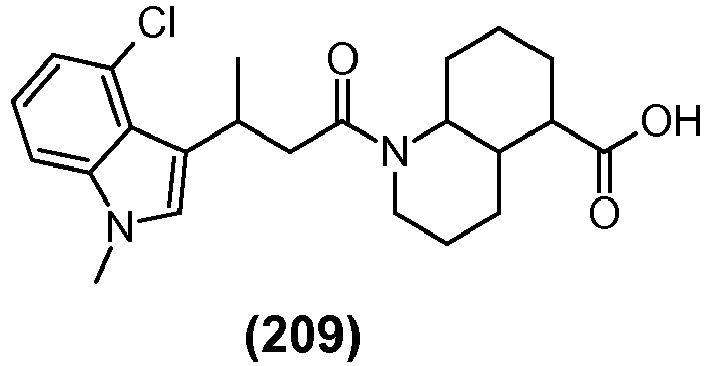
- Synthesis of Compound (209): Compound (209) was synthesized by following the procedure used to make Compound (27) (Scheme 26). 1H NMR (300 MHz, CDC13) : δ 7.09-7.11 (m, 1H), 6.97-7.05 (m, 2H), 6.85-6.91 (m, 1H), 4.664.68 (m, 0.5H), 4.47-4.49 (m, 0.5H), 3.66 (s, 3H), 2.69-3.05 (m, 2H), 2.36-2.57 (m, 1H), 2.16-2.24 (m, 1H), 1.45-1.90 (m, 11H0, 1.33-1.35 (d, 3H). LC-MS: (M+H)+ = 417.1; HPLC purity = 98.82%.
-

- Synthesis of Compound (210): Compound (210) was synthesized by following the procedure used to make Compound (27) (Scheme 26). 1H NMR (300 MHz, CDC13) : δ 6.98-7.09 (m, 2H0, 6.87-6.91 (m, 1H), 6.64-6.66 (d, 1H), 4.68-4.70 (m, 0.5H), 4.48-4.51 (m, 0.5H), 4.14-4.16 (m, 1H), 4.00-4.07 (q, 2H), 3.57-3.65 (m, 1H), 2.68-2.98 (m, 2H), 2.39-2.58 (m, 2H), 2.15-2.27 (m, 1H), 1.40-1.97 (m, 11H), 1.34-1.36 (d, 3H), 0.88-0.94 (m, 2H), 0.75-0.81 (m, 5H). LC-MS: (M+H)+ = 437.2; HPLC purity = 98.31%.
-
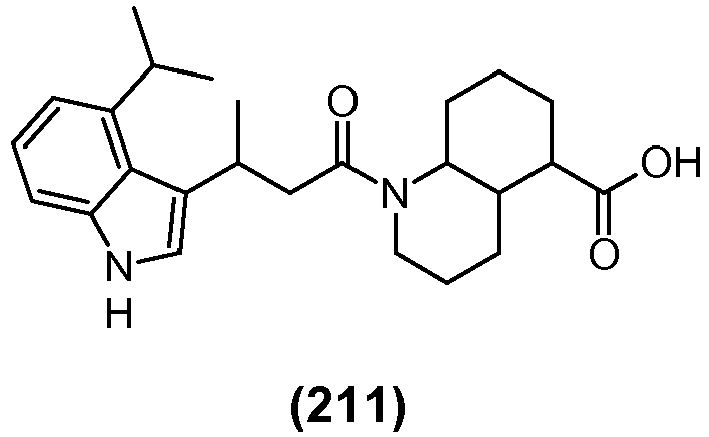
- Synthesis of Compound (211): Compound (211) was synthesized by following the procedure used to make Compound (105) (Scheme 51). 1H NMR (300 MHz, CDC13): δ 7.99 (br s, 1H), 7.15-7.18 (m, 2H), 7.01-7.05 (m, 2H), 4.74-4.77 (m, 0.5H0, 4.53-4.56 (m, 0.5H0, 3.85-3.88 (m, 1H), 3.62-3-66 (m, 2H), 2.44-3.04 (m, 3H), 2.21-2.23 (m, 1H), 1.46-1.95 (m, 11H), 1.41-1.43 (d, 3H), 1.34-1.36 (d, 6H). LC-MS: (M+H)+ = 411.2; HPLC purity = 93.44%.
-

- Synthesis of Compound (212): Mixture of isomers of Compound (204) was seperated by using chiral column chromatography to give compound 212. 1H NMR (300 MHz, CDC13) : δ 7.03-7.05 (m, 2H), 6.81 (s, 1H), 6.65-6.68 (m, 1H), 4.19-4.23 (m, 1H), 4.09-4.10 (m, 1H), 3.66 (s, 3H), 3.36-3.40 (m, 1H), 3.00-3.03 (m, 1H), 2.70-2.84 (m, 1H), 2.38-2.45 (m, 2H), 2.21-2.26 (m, 1H), 1.45-1.95 (m, 11H), 1.33-1.36 (d, 3H), 0.92-0.95 (m, 2H), 0.76-0.79 (m, 2H). LC-MS: (M+H)+ = 423.2; HPLC purity = 99.14%; Chiral RT = 19.99 min [Column: Chiral Pak IC; mobile phase: hexane: IPA:DCM (8.5:0.5:1.0)].
-
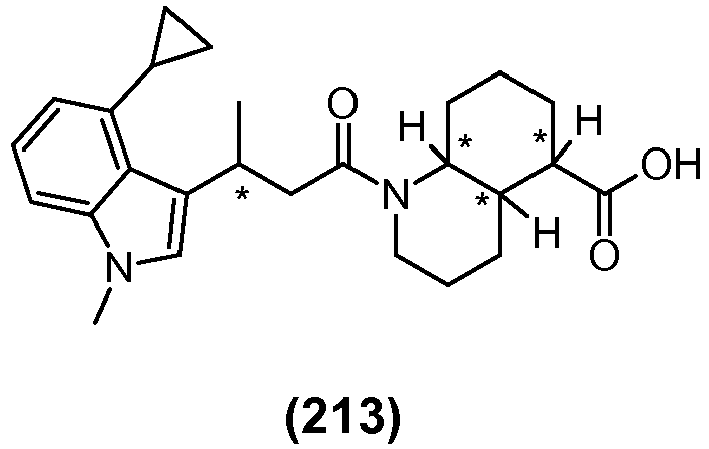
- Synthesis of Compound (213): Mixture of isomers of Compound (204) was separated by using chiral column chromatography to give compound 213. 1H NMR (300 MHz, CDC13) : δ 7.03-7.05 (m, 2H), 6.82-6.85 (d, 1H), 6.65-6.68 (m, 1H), 4.67-4.70 (m, 0.5H), 4.44-4.49 (m, 0.5H), 4.15-4.16 (m, 1H), 3.65 (s, 3H), 3.42-3.46 (m, 1H), 2.79-2.95 (m, 2H), 2.68-2.70 (m, 1H), 2.56-2.59 (m, 1H), 2.39-2.43 (m, 1H), 1.38-1.82 (m, 11H), 1.31-1.34 (d, 3H), 0.92-0.94 (m, 2H), 0.76-0.80 (m, 2H). LC-MS: (M+H)+ = 423.2; HPLC purity = 94.30%; Chiral RT = 27.35 min [Column: Chiral Pak IC; mobile phase: hexane: IPA:DCM (8.5:0.5:1.0)].
-

- Synthesis of Compound (214): Mixture of isomers of Compound (204) was separated by using chiral column chromatography to give compound 214. 1H NMR (300 MHz, CDC13) : δ 7.03-7.05 (m, 2H), 6.82-6.85 (d, 1H), 6.65-6.68 (m, 1H), 4.67-4.70 (m, 0.5H), 4.46-4.49 (m, 0.5H), 4.11-4.14 (m, 1H), 3.65 (s, 3H), 3.42-3.46 (m, 1H), 2.79-2.95 (m, 2H), 2.68-2.70 (m, 1H), 2.56-2.59 (m, 1H), 2.39-2.43 (m, 1H), 1.38-1.82 (m, 11H), 1.31-1.34 (d, 3H), 0.92-0.94 (m, 2H), 0.76-0.80 (m, 2H). LC-MS: (M+H)+ = 423.2; HPLC purity = 98.00%; Chiral RT = 30.61 min [Column: Chiral Pak IC; mobile phase: hexane: IPA:DCM (8.5:0.5:1.0)].
-

- Synthesis of Compound (215): Compound (215) was synthesized by following the procedure used to make (105) (Scheme 51). 1H NMR (300 MHz, DMSO-d6) : δ 12.14 (br s, 1H), 11.08 (br s, 1H), 7.63-7.65 (m, 1H), 7.39-7.41 (d, 1H), 7.25 (s, 1H), 7.06-7.11 (t, 1H), 6.94-7.03 (m, 1H), 6.52-6.54 (m, 2H), 4.45-4.47 (m, 0.5H), 4.24-4.28 (m, 0.5H), 3.66-3.74 (m, 1H), 3.46-3.49 (m, 1H), 2.82-2.90 (m, 1H), 2.57-2.72 (m, 1H), 2.07-.31 (m, 1H), 2.07-2.10 (m, 1H), 1.25-1.85 (m, 11H), 1.04-1.09 (d, 3H). LC-MS: (M+H)+ = 435.2; HPLC purity = 93.62%.
-

- Synthesis of Compound (216): Compound (216) was synthesized by following the procedure used to make (105) (Scheme 51). 1H NMR (300 MHz, CDCl3) : δ 7.43-7.48 (m, 1H), 7.24-7.27 (m, 1H), 7.09-7.16 (m, 2H), 6.91 (s, 1H), 6.40-6.42 (m, 2H), 4.56-4.60 (m, 0.5H), 4.39-4.42 (m, 0.5H), 3.70 (s, 3H), 3.50-3.53 (m, 1H), 3.22-3.37 (m, 2H), 2.65-2.81 (m, 1H), 2.37-2.46 (m, 1H), 1.99-2.18 (m, 1H), 1.37-1.83 (m, 11H), 1.32-1.35 (d, 3H). LC-MS: (M+H)+ = 449.2; HPLC purity = 97.01 %.
-

- Synthesis of Compound (217): Compound (217) was synthesized by following the procedure used to make Compound (195) (Scheme 59). 1H NMR (300 MHz, CDC13): δ 7.95 (br s, 1H), 7.10-7.12 (d, 1H), 6.99-7.01 (d, 1H), 6.96 (s, 1H), 6.65-6.68 (d, 1H), 4.62-4.63 (m, 0.5H), 4.44-4.46 (m, 0.5H), 4.16-4.18 (m, 1H), 3.56-3.58 (m, 1H), 2.77-2.86 (m, 1H), 2.69-2.71 (m, 1H), 2.42-2.45 (m, 1H), 2.18-2.24 (m, 1H), 1.35-1.75 (m, 11H), 1.30-1.33 (d, 3H), 0.92-0.95 (m, 2H), 0.78-0.81 (m, 2H). LC-MS: (M+H)+ = 409.2; HPLC purity = 96.63%.
-

- Synthesis of Compound (218): Compound (218) was synthesized by following the procedure used to make Compound (195) (Scheme 58). 1H NMR (300 MHz, DMSO-d6) : δ 12.14 (br s, 1H), 11.31 (br s, 1H), 7.40-7.45 (m, 1H), 7.31-7.33 (d, 1H), 7.20-7.22 (m, 1H), 7.00-7.05 (m, 1H), 6.89-6.96 (m, 1H), 6.78-6.86 (m, 2H), 5.48-5.55 (m, 1H), 4.42-4.44 (m, 0.5H), 4.22-4.26 (m, 0.5H), 4.00-4.04 (m, 0.5H), 3.78-3.83 (m, 0.5H), 2.95-3.16 (m, 2H), 2.45-2.55 (m, 2H), 1.32-1.92 (m, 11H). LC-MS: (M+H)+ = 471.1; HPLC purity = 99.98%.
-

- Synthesis of Compound (219): Compound (219) was synthesized by following the procedure used to make Compound (196) (Scheme 59). 1H NMR (300 MHz, DMSO-d6) : δ12.15 (br s, 1H), 11.34 (br s, 1H), 7.41-7.45 (m, 1H), 7.31-7.33 (d, 1H), 7.22-7.24 (m, 1H), 7.00-7.05 (m, 2H), 6.94-6.96 (d, 1H), 6.86-6.89 (m, 1H), 5.56-5.58 (m, 1H), 4.41-4.51 (m, 0.5H), 4.21-4.23 (m, 0.5H), 4.00-4.04 (m, 1H), 3.78-3.82 (m, 1H), 2.95-3.11 (m, 2H), 2.08-2.15 (m, 1H), 1.33-1.80 (m, 11H). LC-MS: (M+H)+ = 471.1; HPLC purity = 91.48%.
-

- Synthesis of Compound (220): Compound (220) was synthesized by following the procedure used to make Compound (105) (Scheme 51). 1H NMR (300 MHz, CDC13): δ 8.02 (br s, 1H), 7.08-7.11 (m, 2H), 6.80-6.87 (t, 1H), 4.72-4.74 (m, 0.5H), 4.50-4.54 (m, 0.5H), 4.18-4.20 (m, 1H), 3.65-3.68 (m, 1H), 2.80-3.07 (m, 1H), 2.51-2.64 (m, 2H), 2.01-2.05 (m, 1H), 1.45-1.86 (11H), 1.39-1.42 (d, 3H), 1.06-1.08 (m, 2H), 0.88-0.92 (m, 2H). LC-MS: (M+H)+ = 427.2; HPLC purity = 99.0%.
-

- Synthesis of Compound (221): Compound (221) was synthesized by following the procedure used to make Compound (195) (Scheme 58). 1H NMR (300 MHz, CDC13): δ 8.20 (br s, 1H), 7.51-7.55 (m, 1H), 7.39-7.41 (m, 1H), 7.14-7.19 (m, 3H), 6.48-6.50 (m, 2H), 4.66-4.69 (m, 0.5H), 4.43-4.45 (m, 0.5H), 4.11-4.32 (m, 1H), 3.53-3.63 (m, 1H), 2.80-2.85 (m, 1H), 2.53-2.62 (m, 1H), 2.28-2.35 (m, 2H), 1.40-1.80 (m, 11H), 1.28-1.31 (d, 3H). LC-MS: (M+H)+ = 435.2; HPLC purity = 98.74%.
-

- Synthesis of Compound (222): Compound (222) was synthesized by following the procedure used to make Compound (196) (Scheme 59). 1H NMR (300 MHz, CDC13): δ 8.27 (br s, 1H), 7.51-7.56 (m, 1H)m 7.38-7.41 (m, 1H), 7.23-7.28 (m, 1H), 7.13-7.17 (m, 3H), 6.48-6.50 (d, 1H), 4.63-4.67 (m, 0.5H), 4.46-4.49 (m, 0.5H), 3.51-3.64 (m, 1H), 3.37-3.40 (m, 1H), 2.80-2.88 (m, 1H), 2.49-2.62 (m, 1H), 2.16-2.29 (m, 2H), 1.40-1.86 (m, 11H), 1.36-1.38 (d, 3H). LC-MS: (M+H)+ = 435.2; HPLC purity = 99.83%.
-

- Synthesis of Compound (223): Mixture of isomers of Compound (221) separated by preparative chiral chromatography to give Compound (223). 1H NMR (300 MHz, CD3OD): δ 7.57-7.6 (d, 1H), 7.37-7.42 (t, 1H), 7.17 (br s, 1H), 7.05-7.11 (m, 2H), 6.52-6.53 (m, 1H), 6.46-6.47 (m, 1H), 4.28-4.31 (d, 1H), 3.50-3.63 (m, 2H), 2.48-2.54 (m, 2H), 2.20-2.36 (m, 1H), 2.02-2.06 (m, 1H), 1.28-1.80 (m, 11H), 1.21-1.23 (d, 3H). LC-MS: (M+H)+ = 435.2; HPLC purity = 100%. Chiral RT = 19.31 min [Column: Chiral Pak IC; mobile phase: hexane: IPA:DCM (8.5:1:0.5)].
-

- Synthesis of Compound (224): Mixture of isomers of Compound (221) separated by preparative chiral chromatography to give Compound (224). 1H NMR (300 MHz, CDC13): δ 8.14 (br s, 1H), 7.44-7.49 (d, 1H), 7.32-7.34 (d, 1H), 7.08-7.12 (m, 3H), 6.41-6.44 (d, 2H), 4.56-4.61 (m, 0.5H), 4.39-4.43 (m, 0.5H), 4.20 (4.25 (dd, 0.5H), 4.01-4.10 (m, 0.5H), 3.47-3.59 (m, 1H), 3.30-3.34 (m, 1H), 2.73-2.81 (m, 1H), 2.42-2.52 (m, 1H), 2.28-2.30 (m, 1H), 1.48-1.80 (m, 11H), 1.35-1.37 (d, 3H). LC-MS: (M+H)+ = 435.2; HPLC purity = 96.72%. Chiral RT = 23.19 min [Column: Chiral Pak IC; mobile phase: hexane: IPA:DCM (8.5:1:0.5)].
-

- Synthesis of Compound (225): Compound (225) was synthesized by following the procedure used to make Compound (195) (Scheme 58).1H NMR (300 MHz, DMSO-d6): δ 12.23 (br s, 1H), 11.19 (br s, 1H), 7.25-7.36 (m, 3H), 7.13-7.16 (d, 1H), 7.03-7.06 (d, 1H), 6.93-6.97 (m, 2H), 6.59-6.65 (dd, 1H), 4.84 (br s, 1H), 3.88-3.94 (m, 1H), 3.30-3.32 (m, 1H), 2.94-3.21 (m, 2H), 2.38-2.40 (m, 1H), 1.40-1.90 (m, 11H). LC-MS: (M+H)+ = 467.1; HPLC purity = 95.38%.
-

- Synthesis of Compound (226): Compound (226) was synthesized by following the procedure used to make Compound (196) (Scheme 59).1H NMR (300 MHz, DMSO-d6): δ 12.24 (br s, 1H), 11.20 (br s, 1H), 7.36-7.37 (m, 1H), 7.25-7.29 (t, 2H), 7.13-7.16 (d, 1H), 7.03-7.06 (d, 1H), 6.94-7.00 (m, 2H), 6.59-6.66 (dd, 1H), 4.84 (br s, 1H), 3.88-3.90 (m, 1H), 3.29-3.32 (m, 1H), 2.93-3.21 (m, 2H), 2.38-2.42 (m, 2H), 1.28-1.91 (m, 11H). LC-MS: (M+H)+ = 467.1; HPLC purity = 100%.
-

- Synthesis of Compound (227): Compound (227) was synthesized by following the procedure used to make Compound (105) (Scheme 51).1H NMR (300 MHz, CDC13): δ 8.39 (br s, 1H), 7.51-7.53 (m, 1H), 7.37-7.39 (m, 1H), 7.13-7.20 (m, 4H), 6.48 (s, 1H), 3.55-3.58 (m, 1H), 3.37-3.42 (m, 1H), 2.39-2.58 (m, 3H), 2.23-2.29 (m, 2H), 1.45-1.87 (m, 11H), 1.41-1.43 (d, 3H). LC-MS: (M+H)+ = 435.1; HPLC purity = 98.43%.
-

- Synthesis of Compound (228): Compound (228) was synthesized by following the procedure used to make Compound (105) (Scheme 51).1H NMR (300 MHz, CDC13): δ 8.19 (br s, 1H), 7.21-7.24 (m, 1H), 7.03-7.10 (m, 3H), 4.27-4.68 (m, 1H), 4.11-4.17 (m, 1H), 3.68-3.71 (m, 1H), 2.80-3.02 (m, 1H), 2.40-2.53 (m, 2H), 2.28-2.33 (m, 1H), 1.50-1.89 (m, 11H), 1.45-1.47 (d, 3H). LC-MS: (M+H)+ = 403.3; HPLC purity = 94.02%.
-

- Synthesis of Compound (229): Compound (229) was synthesized by following the procedure used to make Compound (105) (Scheme 51).1H NMR (300 MHz, CDC13): δ 8.19 (br s, 1H), 7.50-7.52 (m, 1H), 7.39-7.41 (m, 1H), 7.18-7.20 (m, 2H), 7.14 (s, 1H), 6.48-6.49 (d, 2H), 4.27-4.32 (dd, 0.5H), 4.11-4.17 (d, 0.5H), 3.57-3.59 (m, 1H), 3.39-3.41 (m, 1H), 2.75-2.79 (m, 1H), 2.22-2.38 (m, 3H), 1.47-1.87 (m, 14H). LC-MS: (M+H)+ = 435.2; HPLC purity = 98.67%.
-

- Synthesis of Compound (230): Compound (230) was synthesized by following the procedure used to make Compound (105) (Scheme 51).1H NMR (300 MHz, DMSO-d6): δ 12.16 (br s, 1H), 10.81 (br s, 1H), 7.17 (s, 1H), 7.13-7.15 (d, 1H), 6.88-6.94 (t, 1H), 6.55-6.58 (t, 1H), 4.58-4.62 (t, 0.5H), 4.41-4.45 (m, 0.5H), 3.99-4.11 (m, 1H), 3.81-3.85 (m, 1H), 2.58-2.93 (m, 2H), 2.31-2.43 (m, 2H), 1.33-1.99 (m, 11H), 1.27-1.30 (d, 3H), 1.06-1.08 (d, 3H), 0.90-0.96 (m, 2H), 0.65-0.72 (m, 2H). LC-MS: (M+H)+ = 423.4; HPLC purity = 98.0%.
-

- Synthesis of Compound (231): Compound (231) was synthesized by following the procedure used to make Compound (105) (Scheme 51).1H NMR (300 MHz, CDC13): δ 12.11 (br s, 1H), 11.09 (br s, 1H), 7.61-7.64 (m, 1H), 7.39-7.42 (d, 1H), 7.23-7.26 (d, 1H), 7.06-7.12 (t, 1H), 7.02-7.03 (m, 1H), 6.51-6.53 (m, 2H), 4.49-4.51 (m, 0.5H), 4.33-4.45 (m, 0.5H), 3.96-3.98 (m, 1H), 2.65-2.73 (m, 2H), 2.16-2.28 (m, 2H), 1.37-1.94 (m, 11H), 1.15-1.18 (d, 3H), 1.02-1.05 (d, 3H). LC-MS: (M+H)+ = 449.2; HPLC purity = 98.27%.
-

- Synthesis of Compound (232): Compound (232) was synthesized by following the procedure used to make Compound (195) (Scheme 58).1H NMR (300 MHz, CDC13): δ 8.23 (br s, 1H), 7.317.41 (m, 2H), 7.12-7.22 (m, 5H), 4.62-4.64 (m, 0.5H), 4.47-4.51 (m, 0.5H), 3.71-3.77 (m, 1H), 3.42-3.54 (m, 1H), 2.55-2.64 (m, 1H), 2.27-2.35 (m, 1H), 2.05-2.12 (m, 1H), 1.25-1.75 (m, 11H), 1.14-1.16 (d, 3H), 1.09-1.11 (d, 3H). LC-MS: (M+H)+ = 465.4; HPLC purity = 96.26%.
-

- Synthesis of Compound (233): Compound (233) was synthesized by following the procedure used to make Compound (196) (Scheme 59). 1H NMR (300 MHz, CDC13): δ 8.47 (br s, 1H), 7.21-7.29 (m, 2H), 7.00-7.11 (m, 5H), 4.56-4.57 (m, 0.5H), 4.41-4.43 (m, 0.5H), 3.63-3.68 (m, 1H), 3.42-3.44 (m, 1H), 2.51-2.59 (m, 1H), 2.25-2.27 (m, 1H), 2.02-2.10 (m, 1H), 1.34-1.68 (m, 11H), 1.00-1.03 (d, 3H), 0.98-1.00 (d, 3H). LC-MS: (M+H)+ = 465.4; HPLC purity = 97.31%.
-

- Synthesis of Compound (234): Compound (234) was synthesized by following the procedure used to make Compound (105) (Scheme 51). 1H NMR (300 MHz, DMSO-d6): δ 12.14 (br s, 1H), 11.20 (br s, 1H), 7.25-7.32 (m, 2H), 6.96-7.02 (m, 2H), 4.58-4.60 (m, 0.5H), 4.41-4.43 (m, 0.5H), 3.99-4.01 (m, 1H), 2.72-2.93 (m, 2H), 2.25-2.27 (m, 1H), 1.92-1.97 (m, 1H), 1.30-1.72 (m, 11H), 1.15-1.17 (d, 3H), 1.07-1.09 (d, 3H). LC-MS: (M+H)+ = 417.1; HPLC purity = 97.11%.
-

- Synthesis of Compound (235): Compound (235) was synthesized by following the procedure used to make Compound (26) (Scheme 25).1H NMR (300 MHz, CDC13): δ 8.18 (br s, 1H), 7.16-7.18 (m, 1H), 7.04-7.07 (m, 1H), 7.01-7.03 (d, 2H), 4.91-4.95 (m, 0.5H), 4.62-4.68 (m, 0.5H), 4.08-4.11 (m, 1H), 3.86-3.98 (m, 1H), 3.31-3.46 (m, 0.5H), 2.83-2.91 (m, 1H), 2.48-2.70 (m, 1H), 2.11-2.23 (m, 3H), 1.53-1.70 (m, 8H), 1.46-1.48 (d, 3H), 1.41-1.43 (d, 3H). LC-MS: (M+H)+ = 373.3; HPLC purity = 97.62%.
-

- Synthesis of Compound (236): Compound (236) was synthesized by following the procedure used to make Compound (105) (Scheme 51). 1H NMR (300 MHz, CDC13): δ 8.19 (br s, 1H), 7.28-7.32 (m, 1H), 7.05-7.16 (m, 3H), 6.29-6.33 (m, 1H), 5.98-6.00 (m, 1H), 4.58-4.60 (m, 0.5H), 4.37-4.42 (m, 0.5H), 3.49-3.62 (m, 1H), 3.28-3.31 (m, 1H), 2.43-2.55 (m, 2H), 2.30 (s, 3H), 2.05-2.07 (m, 1H), 1.97-2.05 (m, 1H), 1.24-1.80 (m, 11H), 1.18-1.20 (d, 3H). LC-MS: (M+H)+ = 449.2; HPLC purity = 98.32%.
-

- Synthesis of Compound (237): Compound (237) was synthesized by following the procedure used to make Compound (105) (Scheme 51). 1H NMR (300 MHz, DMSO-d6): δ 12.20 (br s, 1H), 10.79 (br s, 1H), 7.12-7.15 (d, 2H), 6.88-6.92 (t, 1H), 6.55-6.58 (d, 1H), 4.01-4.03 (m, 1H), 3.69-3.87 (m, 1H), 2.90-2.95 (m, 1H), 2.65-2.78 (m, 2H), 2.35-2.41 (m, 2H), 1.49-1.98 (m, 10H), 1.28 (s, 3H), 1.24-1.26 (d, 3H). LC-MS: (M+H)+ = 423.2; HPLC purity = 91.85%.
-

- Synthesis of Compound (238): Compound (238) was synthesized by following the procedure used to make Compound (105) (Scheme 51). 1H NMR (300 MHz, DMSO-d6): δ 12.15 (br s, 1H), 11.06 (br s, 1H), 8.59 (br s, 1H), 7.82-7.87 (t, 1H), 7.51-7.53 (d, 1H), 7.41-7.44 (d, 1H), 7.33-7.36 (m, 1H), 7.23 (s, 1H), 7.10-7.15 (t, 1H), 6.90-6.92 (d, 1H), 4.37-4.40 (m, 0.5H), 4.16-4.20 (m, 0.5H), 3.64-3.69 (m, 1H), 3.10-3.14 (m, 1H), 2.69-2.80 (m, 2H), 2.30-2.35 (m, 1H), 2.14-2.19 (m, 1H), 1.45-2.00 (m, 11H), 1.33-1.37 (d, 3H). LC-MS: (M+H)+ = 446.2; HPLC purity = 96.69%.
-

- Synthesis of Compound (239): Compound (239) was synthesized by following the procedure used to make Compound (105) (Scheme 51). 1H NMR (300 MHz, CDC13): δ 8.28 (br s, 1H), 7.48-7.51 (d, 1H), 7.13-7.16 (m, 2H), 7.09 (s, 1H), 6.34 (s, 1H), 4.46-4.50 (m, 0.5H), 4.20-4.25 (dd, 1H), 4.04-4.08 (dd, 1H), 3.84-3.86 (m, 0.5H), 3.39-3.45 (m, 1H), 2.52-2.60 (m, 1H), 2.37 (s, 3H), 2.24-2.30 (m, 1H), 2,12-2.17 (m, 1H), 1.35-1.90 (m, 14H). LC-MS: (M+H)+ = 450.2; HPLC purity = 99.79%.
-


- Synthesis of Compound (240): To a stirred solution of Intermediate-109 (30mg, 0.077 mmol) in DMF (2 mL), NaN3 (25 mg, 0.38 mmol) and ammonium chloride (15 mg, 0.22 mmol) were added. Resulted reaction mixture was heated at 110 °C for 48 hours. After completion of the reaction (monitored by TLC), the reaction mixture was quenched with water and was extracted with ethyl acetate (3 x 10 mL). The combined organic layer was concentrated to obtain a crude product. The resulted crude product was purified by preparative HPLC to give Compound (240) (2.5 mg) as brown gummy material. 1H NMR (300 MHz, CDC13): δ 8.03 (br s, 1H), 7.08-7.11 (m, 1H), 6.97-7.04 (m, 2H), 6.63-6.70 (m, 1H), 5.20-5.27 (m, 1H), 4.08-4.24 (m, 2H), 3.52-3.58 (m, 1H), 2.77-2.97 (m, 2H), 2.21-2.30 (m, 2H), 1.45-1.90 (m, 11H), 1.37-1.40 (d, 3H), 0.70-0.90 (m, 4H). LC-MS: (M-H)+ = 431.3; HPLC purity = 91.69%.
-

- Synthesis of Compound (241): Compound (241) was synthesized by following the procedure used to make Compound (105) (Scheme 51). 1H NMR (300 MHz, CDC13): δ 7.10 (s, 1H), 7.02-7.07 (m, 2H), 6.65-6.68 (d, 1H), 4.20-4.25 (m, 1H), 4.04-4.10 (m, 2H), 3.98 (s, 3H), 3.52-3.65 (m, 1H), 2.61-2.82 (m, 1H), 2.38-2.47 (m, 2H), 2.21-2.24 (m, 1H), 0.7-1.90 (m, 18H). LC-MS: (M+H)+ = 439.3; HPLC purity = 92.8%.
-

- Synthesis of Compound (242): Compound (242) was synthesized by following the procedure used to make Compound (105) (Scheme 51). 1H NMR (300 MHz, CDC13): δ 7.23 (s, 1H), 7.02-7.07 (t, 1H), 6.94-6.97 (d, 1H), 6.70-6.72 (d, 1H), 5.31 (s, 2H), 4.62-4.69 (m, 0.5H), 4.49-4.52 (m, 0.5H), 4.17-4.25 (m, 1H), 4.04-4.10 (m, 1H), 3.52-3.62 (m, 1H), 3.18 (s, 3H), 2.75-2.81 (m, 1H), 2.39-2.43 (m, 2H), 2.15-2.30 (m, 1H), 1.39-1.80 (m, 11H), 1.32-1.35 (d, 3H), 0.94-0.96 (m, 2H), 0.73-0.77 (m, 2H). LC-MS: (M-H)+ = 451.2; HPLC purity = 92.13%.
-

- Synthesis of Compound (243): Compound (243) was synthesized by following the procedure used to make Compound (105) (Scheme 51). 1H NMR (300 MHz, CDC13): δ 8.25 (br s, 1H), 7.36-7.46 (m, 3H), 7.18-7.22 (t, 1H), 7.06-7.13 (m, 3H), 6.90-6.93 (d, 1H), 4.55-4.59 (m, 0.5H), 4.36-4.39 (m, 0.5H), 3.45-3.49 (m, 1H), 3.11-3.15 (m, 1H), 2.52-2.77 (m, 2H), 2.31-2.40 (dd, 1H), 2.07-2.16 (m, 2H), 1.36-1.96 (m, 10H), 1.13-1.15 (d, 3H). LC-MS: (M-H)+ = 463.3; HPLC purity = 98.0%.
-

- Synthesis of Compound (244): Compound (244) was synthesized by following the procedure used to make Compound (105) (Scheme 51). LC-MS: (M-H)+ = 448.4; HPLC purity = 84.68%.
-


- To a stirred solution of Starting Material-34 (1.0 g, 5.26 mmol) in water (5 mL) sodium bicarbonate (1.06 g, 12.6 mmol) was added at room temperature and stirred for 30 min. To this n-hexane (5 mL) followed by selectfluor (2.23 g, 6.31 mmol) was added at 10 °C and stirred for 2 hours at same temperature. After reaction hexane layer was separated and dried over anhydrous MgSO4 to give crude intermediate-110 hexane solution, which was taken for next step without any purification.
- To a stirred solution of Intermediate-110 hexanes solution (0.863 g, 5.26 mmol) in ether (5 mL) was added 2.5 M n-BuLi (2.52 mL, 6.31 mmol) at -78°C and stirred for 20 minutes. To this tributyltin chloride (1.56 mL, 5.78 mmol) was added and stirred for 10 min at -78°C, then rt for 12 h. After reaction quenched with aqueous 1N NaOH solution and extracted with EtOAc and concentrated to give crude material Intermediate-111 (0.95 g) as brown liquid.
- To a stirred solution of Intermediate-110 (0.050 g, 0.16 mmol), and Intermediate-111 (0.060 g, 0.16 mmol) in toluene purged with argon gas for 15 minutes, then added PdCl2 (Dppf) catalyst (0.013 g, 0.016 mmol). Then reaction was carried out under micro wave for 30 min at 130°C. After reaction quenched with water and extracted with EtOAc and concentrated to give crude material, which was further purified by silica gel column chromatography eluting with hexanes: EtOAc to give 0.035 g of Intermediate-112 as brown liquid).
- Intermediate-113 was synthesized by following the procedure used to make Intermediate-3 (Scheme 1).
- Intermediate-114 was synthesized by following the procedure used to make Compound-1 (Scheme 2).
- Synthesis of Compound (245): Compound (245) was synthesized by following the procedure used to make Compound (105) (Scheme 51). 1H NMR (300 MHz, CDC13): δ 8.24 (br s, 1H), 7.40-7.42 (m, 1H), 7.15-7.21 (m, 3H), 6.37-6.39 (m, 1H), 5.51-5.54 (m, 1H), 4.66-4.70 (m, 0.5H), 4.48-4.52 (m, 0.5H), 3.60-3.61 (m, 1H), 3.47-3.51 (m, 1H), 2.91-2.99 (m, 1H), 2.59-2.76 (m, 2H), 2.31-2.39 (m, 1H), 2.20-2.23 (m, 1H), 1.41-1.86 (m, 10H), 1.31-1.34 (d, 3H). LC-MS: (M-H)+ = 453.2; HPLC purity = 97.87%.
-


- Synthesis of Intermediate-116: To a stirred solution of Intermediate-115 (0.2 g, 0.49 mmol) in dioxane (5 mL), bis(pinacolato)diboron (0.25g, 0.99 mmol), and KOAc (0.145 g, 1.48 mmol) were added, and then the reaction solution was purged with argon gas. To the reaction mixture PdCl2(dppf) (0.040 g, 0.049 mmol) was added and heated at 100°C for 12 hours. After completion of the reaction, the reaction mixture was diluted with H2O, extracted with EtOAc and concentrated to give crude product. The crude product was purified using Silica-gel column chromatography eluting with mixture of hexanes: EtOAc to give Intermediate-116 (100 mg) as brown gummy material.
- Synthesis of Compound (246): To a stirred solution of Intermediate-116 (0.1 g, 0.22 mmol) in dioxane: H2O (5 mL, 8:2), 2-bromofuroic acid (0.084 g, 0.44 mmol) and Cs2CO3 (0.28 g, 0.88 mmol) were added, and then reaction solution was purged with argon gas. To the reaction mixture PdCl2(dppf) (0.018 g, 0.022 mmol) was added and heated at 100°C for 12 hours. After completion of reaction, the reaction mixture was diluted with H2O, extracted with EtOAc and concentrated to give crude product. The crude product was purified using Silica-gel column chromatography eluting with mixture of hexanes: EtOAc to give Compound-246 (12 mg) as white solid. 1H NMR (300 MHz, CDC13): δ 8.59 (br s, 1H), 7.42-7.45 (m, 1H), 7.34-7.37 (m, 1H), 7.19-7.25 (m, 3H), 6.62-6.64 (m, 1H), 4.53-4.56 (m, 0.5H), 4.42-4.47 (m, 0.5H), 3.61-3.65 (m, 1H), 3.49-3.53 (m, 1H), 2.80-2.84 (m, 1H), 2.61-2.63 (m, 1H), 2.29-2.31 (m, 1H), 1.47-1.87 (m, 13H), 1.41-1.44 (d, 3H). LC-MS: (M-H)+ = 435.3; HPLC purity = 99.33%.
-

- Synthesis of Compound (247): Compound (247) was synthesized by following the procedure used to make Compound (105) (Scheme 51). 1H NMR (300 MHz, DMSO-d6): δ 12.30 (brs, 1H), 10.79 (br s, 1H), 8.02-8.04 (m, 1H), 7.12-7.15 (m, 2H), 6.88-6.93 (t, 1H), 6.55-6.59 (m, 1H), 4.49-4.52 (m, 0.5H), 4.31-4.33 (m, 0.5H), 4.02-4.05 (m, 1H), 3.68-3.70 (m, 2H), 3.10-3.13 (m, 1H), 2.93-2.98 (m, 1H), 2.62-2.78 (m, 2H), 2.31-2.35 (m, 2H), 1.90-1.95 (m, 1H), 1.37-1.75 (m, 10H), 1.31-1.34 (d, 3H), 0.84-0.88 (m, 2H), 0.72-0.76 (m, 2H). LC-MS: (M-H)+ = 466.4; HPLC purity = 94.3%.
-


- To a stirred solution of Intermediate-100 (14.5 g, 62.0 mmol) in DCM (250 mL), 50 mL of TEA (31.39 g, 310 mmol) was added followed by benzyl chloroformate (15.87 g, 93.1 mmol) at 0°C. Then it was stirred at room temperature for 12 hours. After completion of the reaction the reaction mixture was quenched with water and extracted with DCM. The combined organic layers were concentrated to give crude material, which was further purified by using silica gel column chromatography eluting with hexanes: EtOAc to give 20 g of Intermediate-117 as pate brown liquid.
- Mixture of isomers of Intermediate 117 (20 g) was separated by using Preparative Reverse HPLC to give 6.4 g of Intermediate-118: HPLC: [Column: Phenomenex Luna C-18, Mobile phase: 0.1% Formic acid in H2O and MeCN (1:1), RT = 15.40 min].
- A stirred solution of Intermediate-118 (6.4 g, 19.33mmol) in MeOH (70 mL) was purged with N2 gas, and then 10%Pd-C (1.2 g, 10% w/w) was added. The resulted reaction mixuture was stirred under hydrogen atmosphere for 12 hours. After completion of the reaction, the reaction mixture was filtered through the celite and concentrated to give Intermediate-121 (3.79 g) as white solid.

- Intermediate-122, peak-1 was synthesized by following the procedure used to make Intermediate-90 (Peak-1) (Scheme 54).
- Intermediate-123, peak-1 was synthesized by following the procedure used to make Intermediate-91 (Peak-1) (Scheme 54).
- Synthesis of Compound (248): Compound (248) was synthesized by following the procedure used to make Compound (105) (Scheme 51). 1H NMR (300 MHz, CD3OD): δ 7.33-7.37 (m, 1H), 7.12-7.14 (d, 1H), 7.01-7.05 (t, 1H), 6.94-6.97 (m, 1H), 6.30-6.33 (m, 1H), 5.53-5.56 (m, 1H), 4.46-4.55 (m, 0.5H), 4.23-4.28 (m, 0.5H), 3.43-3.57 (m, 2H), 2.83-2.92 (m, 1H), 2.46-2.73 (m, 2H), 2.17-2.36 (m, 1H), 1.97-2.06 (m, 1H), 1.49-1.78 (m, 10H), 1.37-1.40 (d, 3H). LC-MS: (M-H)+ = 453.3; HPLC purity = 93.80%.
-
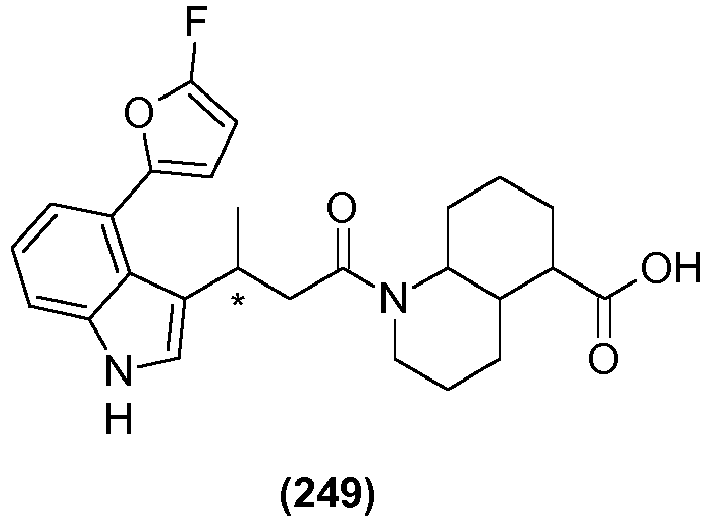

- Intermediate-124, peak-2 was synthesized by following the procedure used to make Intermediate-92 (Peak-2) (Scheme 55).
- Intermediate-125, peak-2 was synthesized by following the procedure used to make Intermediate-93 (Peak-2) (Scheme 55).
- Synthesis of Compound (249): Compound (249) was synthesized by following the procedure used to make Compound (105) (Scheme 51). 1H NMR (300 MHz, CDC13): δ 8.24 (br s, 1H), 7.40-7.42 (m, 1H), 7.13-7.21 (m, 3H), 6.35-6.38 (m, 1H), 5.50-5.54 (m, 1H), 4.66-4.70 (m, 0.5H), 4.48-4.52 (0.5H), 3.60-3.62 (m, 1H), 3.47-3.51 (m, 1H), 2.91-2.99 (m, 1H), 2.60-2.73 (m, 2H), 2.32-2.39 (m, 1H), 2.25-2.28 (m, 1H), 1.48-1.87 (m, 10H), 1.41-1.43 (d, 3H). LC-MS: (M-H)+ = 453.3; HPLC purity = 98.07%.
-

- Synthesis of Compound (250): Mixture of isomers of Compound (248) separated by using chiral column chromatography to give Compound (250). 1H NMR (300 MHz, CD3OD): δ 7.39-7.45 (t, 1H), 7.20 (s, 1H), 7.01-7.15 (m, 2H), 6.39-6.41 (m, 1H), 5.60-5.66 (m, 1H), 4.53-4.57 (d, 0.5H), 4.30-4.34 (d, 0.5H), 3.50-3.59 (m, 2H), 2.86-2.99 (m, 1H), 2.65-2.70 (m, 1H), 2.52-2.60 (m, 2H), 2.00-2.21 (m, 1H), 1.46-1.73 (m, 10H), 1.37-1.40 (d, 3H). LC-MS: (M-H)+ = 453.3; HPLC purity = 98.29%; chiral purity=94.75% [column: Chiralpak IC,; mobile phase: hexane: IPA: DCM (8.5:1.0:0.5); RT = 10.88 min].
-

- Synthesis of Compound (251): Mixture of isomers of Compound (248) separated by using chiral column chromatography to give Compound (251). 1H NMR (300 MHz, CDC13): δ8.32 (br s, 1H), 7.32-7.35 (d, 1H), 7.05-7.13 (m, 3H), 6.29-6.32 (m, 1H), 5.43-5.46 (m, 1H), 4.58-4.62 (m, 0.5H), 4.39-4.44 (m, 0.5H), 3.52-3.56 (m, 2H), 2.83-2.91 (m, 1H), 2.61-2.70 m, 1H), 2.46-2.51 (m, 1H), 2.25-2.34 (m, 1H), 2.07-2.18 (m, 1H), 1.45-1.79 (m, 10H), 1.37-1.40 (d, 3H). LC-MS: (M-H)+ = 453.4; HPLC purity = 96.81%. chiral purity=99.52% [column: Chiralpak IC,; mobile phase: hexane: IPA: DCM (8.5:1.0:0.5); RT = 13.71 min].
-

- Synthesis of Compound (252): Compound (252) was synthesized by following the procedure used to make Compound (105) (Scheme 51). 1H NMR (300 MHz, CDCl3): δ 8.75 (br s, 1H), 7.13-7.22 (m, 2H), 6.90-6.92 (d, 1H), 4.76-4.81 (m, 1H), 4.67-4.71 (m, 0.5H), 4.40-4.53 (m, 0.5H), 3.78-4.01 (m, 1H), 3.01-3.27 (m, 1H), 2.85-2.97 (m, 1H), 2.50-2.57 (m, 2H), 2.22 (2.36 (m, 1H), 2.12-2.18 (m, 1H), 1.52-1.85 (m, 10H), 1.46-1.49 (d, 3H), 1.01-1.04 (m, 2H), 0.84-0.87 (m, 2H). LC-MS: (M-H)+ = 434.3; HPLC purity = 97.78%.
-

- Synthesis of Compound (253): Compound (253) was synthesized by following the procedure used to make Compound (159, peak-1) (Scheme 53-54). 1H NMR (300 MHz, CDC13): δ 8.27 (br s, 1H), 7.42-7.46 (m, 2H), 7.36-7.39 (d, 1H), 7.14-7.20 (t, 1H), 7.08-7.14 (m, 3H), 6.90-6.97 (m, 1H), 4.55-4.59 (m, 0.5H), 4.37-4.39 (m, 0.5H), 3.06-3.32 (m, 2H), 2.73-2.82 (m, 1H), 2.59-2.64 (m, 1H), 2.41-2.48 (m, 1H), 2.32-2.38 (m, 1H), 2.10-2.15 (m, 1H), 1.39-1.93 (m, 10H), 1.13-1.15 (d, 3H). LC-MS: (M-H)+ = 463.3; HPLC purity = 95.23%,
-

- Synthesis of Compound (254): Compound (254) was synthesized by following the procedure used to make Compound (160, peak-2) (Scheme 53 and 55). 1H NMR (300 MHz, CDC13): δ 8.30 (br s, 1H), 7.42-7.46 (m, 2H), 7.36-7.39 (d, 1H), 7.17-7.22 (t, 1H), 7.07-7.14 (m, 3H), 6.90-6.97 (m, 1H), 4.55-4.59 (m, 0.5H), 4.37-4.39 (m, 0.5H), 3.11-3.32 (m, 2H), 2.69-2.82 (m, 1H), 2.40-2.50 (m, 2H), 2.13-2.23 (m, 2H), 1.39-1.90 (m, 10H), 1.13-1.15 (d, 3H). LC-MS: (M-H)+ = 463.3; HPLC purity = 96.95%.
-

- Synthesis of Compound (255): Mixture of isomers of (253) separated by using chiral column chromatography to give Compound (255). 1H NMR (300 MHz, CDC13): δ 8.21 (br s, 1H), 7.34-7.39 (m, 2H), 7.29-7.32 (d, 1H), 7.13-7.17 (d, 1H), 7.00-7.06 (m, 3H), 6.81-6.90 (m, 1H), 4.48-4.52 (m, 0.5H), 4.28-4.32 (m, 0.5H), 3.24-3.46 (m, 1H), 2.97-3.03 (m, 1H), 2.33-2.67 (m, 3H), 1.85-1.90 (m, 2H), 1.41-1.74 (m, 10H), 1.05-1.08 (d, 3H). LC-MS: (M-H)+ = 463.4; HPLC purity = 99.7%; chiral purity = 90.74% [column: Chiralpak IC; mobile phase: hexane: IPA: DCM (8.5:1.0:0.5); RT = 16.87 min].
-

- Synthesis of Compound (256): Mixture of isomers of (253) separated by using chiral column chromatography to give Compound (256). 1H NMR (300 MHz, DMSO-d6): δ 12.15 (br s, 1H), 11.04 (br s, 1H), 7.34-7.44 (m, 3H), 7.16-7.23 (m, 3H), 7.06-7.11 (t, 1H), 6.73-6.75 (d, 1H), 4.36-4.40 (m, 0.5H), 4.17-4.21 (m, 0.5H), 3.70-3.74 (m, 1H), 3.45-3.48 (m, 1H), 3.04-3.06 (m, 1H), 2.73-2.86 (m, 1H), 2.27-2.44 (m, 2H), 2.11-2.19 (m, 1H), 1.35-1.94 (m, 10H), 1.20-1.24 (d, 3H). LC-MS: (M-H) + = 463.3; HPLC purity = 96.51%; chiral purity=89.64% [column: Chiralpak IC; mobile phase: hexane: IPA: DCM (8.5:1.0:0.5); RT = 12.92 min].
-

- Synthesis of Compound (257): Compound (257) was synthesized by following the procedure used to make Compound (105) (Scheme 51). 1H NMR (300 MHz, CDCl3): δ 8.22 (br s, 1H), 7.25-7.35 (m, 3H), 7.03-7.16 (m, 4H), 6.86-6.91 (m, 1H), 4.49-4.51 (m, 0.5H), 4.29-4.34 (m, 0.5H), 3.22-3.25 (m, 1H), 2.98-3.05 (m, 1H), 2.70-2.78 (m, 1H), 2.36-2.50 (m, 2H), 2.06-2.23 (m, 2H), 1.34-1.75 (m, 10H), 1.09-1.11 (d, 3H). LC-MS: (M-H)+ = 463.3; HPLC purity = 94.78%.
-

- Synthesis of Compound (258): Compound (258) was synthesized by following the procedure used to make Compound (105) (Scheme 51). 1H NMR (300 MHz, CDC13): δ 7.16-7.21 (t, 1H), 7.04-7.07 (d, 1H), 6.85-6.87 (d, 1H), 4.70-4.75 (m, 1H), 4.60-4.65 (m, 1H), 4.37-4.45 (m, 1H), 3.77 (s, 3H), 2.84-3.01 (m, 2H), 2.46-2.55 (m, 2H), 2.09-2.27 (m, 2H), 1.47-1.80 (m, 10H), 1.40-1.43 (d, 3H). 0.97-1.00 (m, 2H), 0.76-0.79 (m, 2H). LC-MS: (M-H)+ = 448.4; HPLC purity = 99.99%.
-
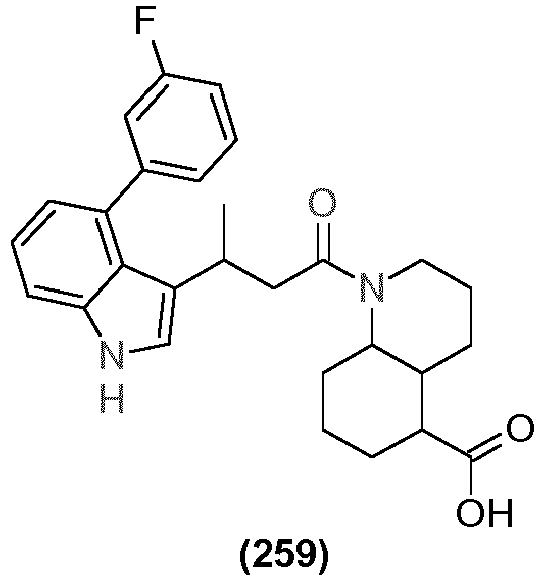
- Synthesis of Compound (259): Compound (259) was synthesized by following the procedure used to make Compound (105) (Scheme 51). 1H NMR (300 MHz, CDCl3): δ 8.50 (br s, 1H), 7.27-7.30 (m, 2H), 7.07-7.15 (m, 3H), 6.97-6.99 (m, 2H), 6.84-6.87 (m, 1H), 4.46-4.47 (m, 0.5H), 4.21-4.25 (m, 0.5H), 3.12-3.14 (m, 1H), 3.02-3.05 (m, 1H), 2.51-2.57 (m, 2H), 2.35-2.39 (m, 2H), 1.37-1.72 (m, 10H), 1.09-1.11 (d, 3H). LC-MS: (M-H)+ = 463.3; HPLC purity = 95.6%.
-

- Synthesis of Compound (260): Compound (260) was synthesized by following the procedure used to make Compound (105) (Scheme 51). 1H NMR (300 MHz, CDCl3): δ 8.33 (br s, 1H), 7.26-7.36 (m, 1H), 7.09-7.12 (m, 1H), 7.01-7.07 (m, 1H), 6.59-6.62 (d, 1H), 4.57-4.61 (m, 0.5H), 4.41-4.46 (m, 0.5H), 3.99-4.08 (m, 1H), 3.50-3.66 (m, 2H), 3.19-3.26 (m, 1H), 2.24-2.31 (m, 1H), 2.16-2.21 (m, 1H), 1.92-1.94 (m, 1H), 1.35-1.74 (m, 10H), 1.00-1.03 (m, 2H), 0.74-0.77 (m, 2H). LC-MS: (M-H)+ = 413.3; HPLC purity = 99.65%.
-

- Synthesis of Compound (261): Compound (261) was synthesized by following the procedure used to make Compound (105) (Scheme 51). 1H NMR (300 MHz, CDC13): δ 7.36-7.38 (m, 1H), 6.96-7.02 (m, 3H), 4.62-4.68 (, 0.5H), 4.20-4.26 (m, 0.5H), 3.95-4.10 (m, 1H), 3.62-3.68 (m, 1H), 3.20-3.22 (m, 1H), 2.83-2.89 (m, 1H), 2.51-2.58 (m, 3H), 2.19-2.23 (m, 1H), 1.38-1.79 (m, 10H), 1.34-1.36 (d, 3H), 0.98-1.00 (m, 2H), 0.91-0.92 (m, 2H). LC-MS: (M-H)+ = 443.3; HPLC purity = 97.77%.
-

- Synthesis of Compound (262): Compound (262) was synthesized by following the procedure used to make Compound (105) (Scheme 51). 1H NMR (300 MHz, DMSO-d6): δ 12.01 (br s, 1H), 11.09 (br s, 1H), 8.45 (s, 1H), 7.72-7.81 (m, 1H), 7.47-.50 (m, 2H), 7.24 (s, 1H), 7.12-7.17 (t, 1H), 6.88-6.90 (d, 1H), 4.14-4.38 (m, 0.5H), 3.70-3.78 (m, 0.5H), 3.40-3.48 (m, 2H), 2.72-2.78 (m, 2H), 2.30-2.35 (m, 1H), 2.22-2.26 (m,1H), 1.91-2.05 (m, 1H), 1.33-1.70 (m, 10H), 1.13-1.17 (d, 3H).LC-MS: (M-H)+ = 464.3; HPLC purity = 95.01%.
-

- Synthesis of Compound (263): Compound (263) was synthesized by following the procedure used to make Compound (105) (Scheme 51). 1H NMR (300 MHz, CDC13): δ 7.26-7.29 (m, 1H), 7.12-7.15 (d, 1H), 7.05-7.07 (m, 1H), 6.95 (br s, 1H), 6.28-6.30 (m, 1H), 5.45-5.47 (m, 1H), 4.61-4.65 (m, 0.5H), 4.49-4.43 (m, 0.5H), 3.72 (s, 3H), 3.43-3.51 (m, 2H), 2.54-2.58 (m, 2H), 2.27-2.30 (m, 1H), 2.21-2.24 (m, 1H), 2.05-2.10 (m, 1H), 1.49-1.85 (m, 10H), 1.33-1.36 (d, 3H). LC-MS: (M-H)+ = 467.4; HPLC purity = 98.0%.
-

- Synthesis of Compound (264): Compound (264) was synthesized by following the procedure used to make Compound (105) (Scheme 51). 1H NMR (300 MHz, DMSO-d6): δ 12.13 (br s, 1H), 10.76 (br s, 1H), 6.95-6.98 (m, 2H), 6.92-6.93 (d, 1H), 6.43-6.46 (d, 1H), 4.52-4.56 (m, 0.5H), 4.30-4.34 (m, 0.5H), 3.82 (s, 3H), 3.61-3.63 (m, 2H), 2.96-3.05 (m, 1H), 2.74-2.90 (m, 2H), 2.16-2.39 (m, 1H), 1.44-1.90 (m, 10H), 1.37-1.40 (d, 3H). LC-MS: (M-H)+ = 399.2; HPLC purity = 94.44%.
-


- Synthesis of Intermediate-126: To a stirred solution of Starting Material-1 (3.0 g, 25.6 mmol) in toluene (50 mL), Montmorillonite K 10 (15 g) was added and heated at 80 °C for 4 hours. After completion of the reaction (LC-MS), catalyst was filtered through the sintered funnel, the filtrate diluted with H2O and extracted with EtOAc and concentrated to give crude Intermediate 126 (5 g), which was taken for next step without any purification.
- Synthesis of Intermediate-127: Intermediate-127 was synthesized by following the procedure used to make Intermediate-3 (Scheme 1).
- Synthesis of Intermediate-128: Intermediate-128 was synthesized by following the procedure used to make Compound-1 (Scheme 2).
- Synthesis of Compound (265): Compound (265) was synthesized by following the procedure used to make Compound (105) (Scheme 51). 1H NMR (300 MHz, CDC13): δ 8.25 (br s, 1H), 7.70-7.80 (m, 1H), 7.33-7.39 (m, 2H), 7.17-7.22 (m, 1H), 7.11-7.16 (m, 1H), 4.54-4.58 (m, 0.5H), 4.37-4.41 (m, 0.5H), 3.50-3.75 (m, 1H), 3.37-3.45 (d, 1H), 3.04-3.13 (d, 1H), 2.50-2.61 (m, 2H), 2.29-2.31 (m, 1H), 1.43-1.90 (m, 10H). LC-MS: (M-H)+ = 439.2; HPLC purity = 93.26%.
-
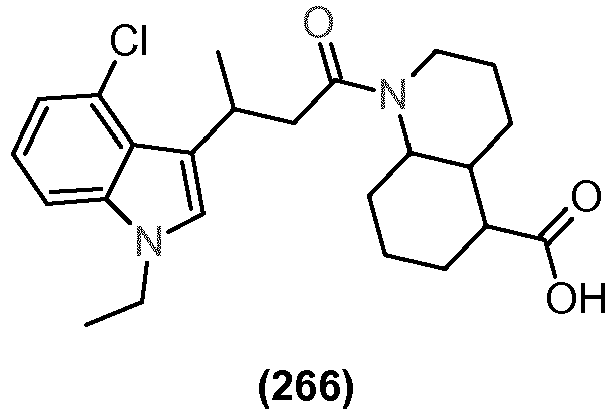
- Synthesis of Compound (266): Compound (266) was synthesized by following the procedure used to make Compound (105) (Scheme 51). 1H NMR (300 MHz, DMSO-d6): δ 12.10 (br s, 1H), 7.39-7.42 (d, 3H), 7.33-7.36 (d, 3H), 7.05-7.10 (t, 1H), 7.01-7.02 (m, 1H), 4.46-4.48 (m, 0.5H), 4.27-4.29 (m, 0.5H), 4.13-4.18 (m, 2H), 3.96-3.98 (m, 1H), 3.70-3.72 (m, 1H), 1.14-1.20 (m, 2H), 2.62-2.75 (m, 2H), 2.00-2.05 (m, 1H), 1.45-1.80 (m, 10H), 1.26-1.32 (m, 6H). LC-MS: (M-H)+ = 431.3; HPLC purity = 95.81%.
-



- Synthesis of Intermediate 129: To a stirred solution of Starting Material-35 (40 g, 206 mmol) in ether (400 mL), oxalyl chloride (23.2 mL, 268 mmol) was added at 0°C, and stirred at room temperature for 5 hours. The reaction mixture was then filtered and washed with ether to get solid materilal (42 g), which was treated with MeOH (28 mL) in ether (200 mL) at 0°C to room temperature for 5 hours. After completion of the reaction, the reaction mixture was diluted with hexanes, resulted precipitate was filtered and dried to get Intermediate-129 (35 g) as yellow solid.
- Synthesis of Intermediate-130: To a stirred solution of Intermediate-129 (35 g, 129 mmol) in MeOH (350 mL), tosyl hydrazine (23.1 g, 129 mmol) was added and refluxed for 4 hours. After completion of the reaction, the reaction mixture was concentrated to give crude mixture, which was diluted with H2O, extracted with DCM and concentrated to give Intermediate-130 (35 g) as pale yellow solid.
- Synthesis of Intermediate-131: To a stirred solution of Intermediate-131 (14 g, 31 mmol) in THF (140mL), NaBH4 (1.8 g, 46 mmol) was added at 0°C and continued to stir at room temperature for 6 hours. After completion of the reaction, the reaction mixture was quenched with H2O, extracted with DCM and concentrated. The resulted crude product was purified by using silica gel column chromatography elutive with mixture of hexanes, EtOAc to give Intermediate-131 (3 g) as pale yellow liquid.
- Synthesis of Intermediate-132: Intermediate-132 was synthesized by following the procedure used to make Intermediate-95 (Scheme 56).
- Synthesis of Intermediate-133: Intermediate-133 was synthesized by following the procedure used to make Intermediate-72 (Scheme 47).
- Synthesis of Intermediate-134: Intermediate-134 was synthesized by following the procedure used to make Intermediate-5 (Scheme 3).
- Synthesis of Intermediate-135: Intermediate-135 was synthesized by following the procedure used to make Intermediate-3 (Scheme 1).
- Synthesis of Intermediate-136: Intermediate-136 was synthesized by following the procedure used to make Intermediate-75 (Scheme 47).
- Synthesis of Compound (267): Compound (267) was synthesized by following the procedure used to make Compound (105) (Scheme 51). LC-MS: (M-H)+ = 395.3; HPLC purity = 94.32%.
-
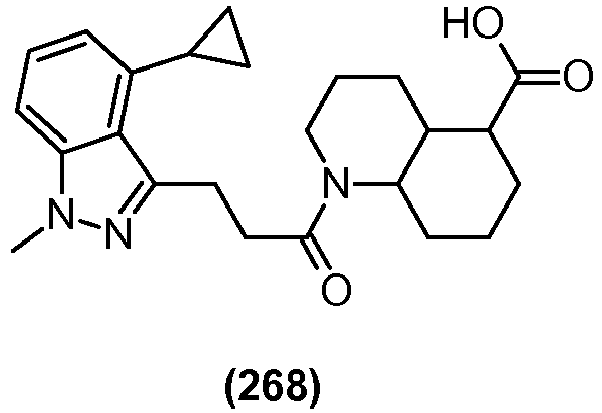
- Synthesis of Compound (268): Compound (268) was synthesized by following the procedure used to make Compound (88) (Scheme 47). LC-MS: (M-H)+ = 410.2.
- CHO cells were maintained in Dulbecco's modified Eagle's medium/nutrient mixture F-12 containing 5% fetal bovine serum (v/v) and 2 mM glutamine. Cells were cultured at 37°C with 5% CO2. For transient expression of human full length HSD11 β 1 expression vector (OriGene Technologies), cells were seeded at a density of 2 x 10⁵ cells/well in a 6-well plate. Transfection was done using Turbofectin8 reagent (OriGene Technologies), according to the protocol provided with the reagent. After 24hours post-transfection, cells were trypsinized and pooled together before they were re-seeding to 96-well plate at a density of 40000 cells/well. 24 hours after re-seeding, cells were incubated with 200 nM cortisone + 500uM NADPH (or along with small molecule inhibitors) overnight. The enzymatic activity or inhibition of enzyme activity was measured by estimating the conversion of cortisone to cortisol by LC/MS-MS method. The IC50 in nM was calculated from an 8 point log scale of concentration versus inhibition.
- The results of the biological testing are shown in table 1:
Table 1 Cmpd No 11βHSD1 (IC50) Cmpd No 11βHSD1 (IC50) Cmpd No 11βHSD1 (IC50) 1 ***** 96 * 191 **** 2 * 97 *** 192 ***** 3 *** 98 * 193 **** 4 **** 99 * 194 * 5 ***** 100 * 195 ***** 6 ** 101 * 196 ***** 7 * 102 * 197 * 8 **** 103 * 198 **** 9 ** 104 * 199 ***** 10 **** 105 * 200 ***** 11 **** 106 * 201 ***** 12 * 107 * 202 * 13 ***** 108 * 203 * 14 * 109 * 204 ***** 15 **** 110 * 205 * 16 *** 111 ***** 206 ***** 17 ***** 112 ***** 207 * 18 * 113 * 208 **** 19 * 114 ***** 209 *** 20 ***** 115 * 210 **** 21 * 116 * 211 ***** 22 * 117 ***** 212 * 23 * 118 ***** 213 * 24 * 119 ***** 214 ***** 25 * 120 ***** 215 ***** 26 * 121 ***** 216 ***** 27 ***** 122 ***** 217 **** 28 **** 123 ***** 218 ***** 29 * 124 **** 219 * 30 * 125 ***** 220 ***** 31 * 126 * 221 ***** 32 * 127 * 222 **** 33 * 128 * 223 **** 34 * 129 * 224 ***** 35 ***** 130 * 225 ***** 36 * 131 * 226 * 37 * 132 *** 227 * 38 *** 133 * 228 * 39 * 134 * 229 **** 40 * 135 * 230 *** 41 **** 136 * 231 *** 42 * 137 **** 232 *** 43 * 138 *** 233 * 44 ***** 139 **** 234 * 45 * 140 ***** 235 ***** 46 * 141 * 236 **** 47 ***** 142 ***** 237 *** 48 * 143 ***** 238 * 49 * 144 * 239 * 50 * 145 ***** 240 * 51 * 146 * 241 * 52 * 147 * 242 * 53 ***** 148 * 243 ***** 54 * 149 * 244 * 55 ***** 150 **** 245 ***** 56 *** 151 **** 246 * 57 * 152 * 247 * 58 * 153 *** 248 ***** 59 *** 154 * 249 ** 60 ***** 155 * 250 ***** 61 * 156 ***** 251 ***** 62 * 157 ***** 252 * 63 * 158 * 253 ***** 64 *** 159 ***** 254 * 65 * 160 * 255 ***** 66 ***** 161 ***** 256 * 67 * 162 * 257 **** 68 * 163 * 258 * 69 * 164 **** 259 *** 70 * 165 * 260 * 71 *** 166 * 261 ** 72 ***** 167 ***** 262 * 73 * 168 * 263 ***** 74 * 169 * 264 * 75 ***** 170 * 265 * 76 * 171 * 266 * 77 * 172 * 267 * 78 ***** 173 ***** 268 * 79 * 174 * 80 * 175 * 81 ***** 176 *** 82 * 177 *** 83 * 178 * 84 ***** 179 * 85 * 180 * 86 ***** 181 * 87 ***** 182 * 88 * 183 * 89 *** 184 * 90 **** 185 *** 91 * 186 ***** 92 **** 187 * 93 ***** 188 ***** 94 *** 189 * 95 ***** 190 ***** ***** = <100nM
**** = 100nM< and <150 nM
*** = 150nM< and <200 nM
** = 200nM< and <250 nM
* = 250nM<
Claims (14)
- A compound of formula (I):
 each R1 and R1a is independently selected from the group consisting of H, methyl, CONHC(CH3)3, OH, CO2H, CO2CH3, CO2CH2CH3, phenyl, CH2OH, CN and OCH3.or any two R1 on adjacent carbon atoms may be joined to form a cyclic moiety, or any two R1 on the same carbon when taken together may form a group of the formula =OAr is an optionally substituted C1-C18heteroaryl group selected from the group consisting of:

 wherein R8 is selected from the group consisting of H, optionally substituted C1-C12alkyl, optionally substituted C2-C12alkenyl, optionally substituted C2-C12alkynyl, optionally substituted C2-C12heteroalkyl, optionally substituted C3-C12cycloalkyl, optionally substituted C2-C12heterocycloalkyl, optionally substituted C6-C18aryl, optionally substituted C1-C18heteroaryl, SO3H, SO2NR9R10, SO2R9, SONR9R10, SOR9, COR9, COOH, COOR9, and CONR9R10;wherein each R9 and R10 is independently selected from the group consisting of H, optionally substituted C1-C12alkyl, optionally substituted C2-C10heteroalkyl, optionally substituted C1-C12haloalkyl, optionally substituted C3-C12cycloalkyl, optionally substituted C6-C18aryl, and optionally substituted C1-C18heteroaryl.e is an integer selected from the group consisting of 0, 1, 2, 3 and 4;f is an integer selected from the group consisting of 0, 1, 2, and 3;A is -CRaRb-;B is a group of the formula -(CRcRd)n-;wherein each Ra, Rb, Rc and Rd is independently selected from the group consisting of H, halogen, OH, NO2, CN, SH, NH2, CF3, OCF3, C1-C12alkyl, C2-C10heteroalkyl C1-C12haloalkyl, C3-C12cycloalkyl, C6-C18aryl, C1-C18heteroaryl; SR2, SO3H, SO2NR2R3, SO2R2, SONR2R3, SOR2, COR2, COOH, COOR2, CONR2R3, NR2COR3, NR2COOR3, NR2SO2R3, NR2CONR2R2, NR2R3, and acyl,wherein each R2 and R3 is independently selected from the group consisting of H, C1-C12alkyl, C2-C10heteroalkyl, C1-C12haloalkyl, C3-C12cycloalkyl, C6-C18aryl, and C1-C18heteroaryl;W1 and W2 are selected such that one is N and the other is (CR1 2),the bond from the carbonyl carbon is joined to whichever of W1 or W2 is N,D is O or (CR1 2),n is an integer selected from the group consisting of 0, 1, and 2;a is an integer selected from the group consisting of 0, 1, and 2, 3 ;b is an integer selected from the group consisting of 0, 1, 2, 3, 4, 5, 6, 7, and 8,c is 1;or a pharmaceutically acceptable salt thereof.
 - A compound according to claim 1 wherein D is (CR1 2).
- A compound according to claim 1 or 2 wherein B is CH2.
- A compound according to any one of claims 1 to 3 wherein Ra and Rb are different.
- A compound according to claim 1 having the formula:

- A compound according to claim 5 wherein one of Ra and Rb is H and the other is optionally substituted alkyl.
- A compound according to claim 1 wherein the R7 substituent is located in the 4 or the 5 position of the six membered ring.
- A compound according to claim 1 wherein R7 is selected from the group consisting of CH3, CH2CH3, CH2CH2CH3, CH(CH3)2, (CH2)3CH3, Cl, Br, F, I, OH, NO2, NH2, CN, SO3H, OCH3, OCH2CH2CH3, CF3, and OCF3.
- A compound according to claim 1 selected from the group consisting of:

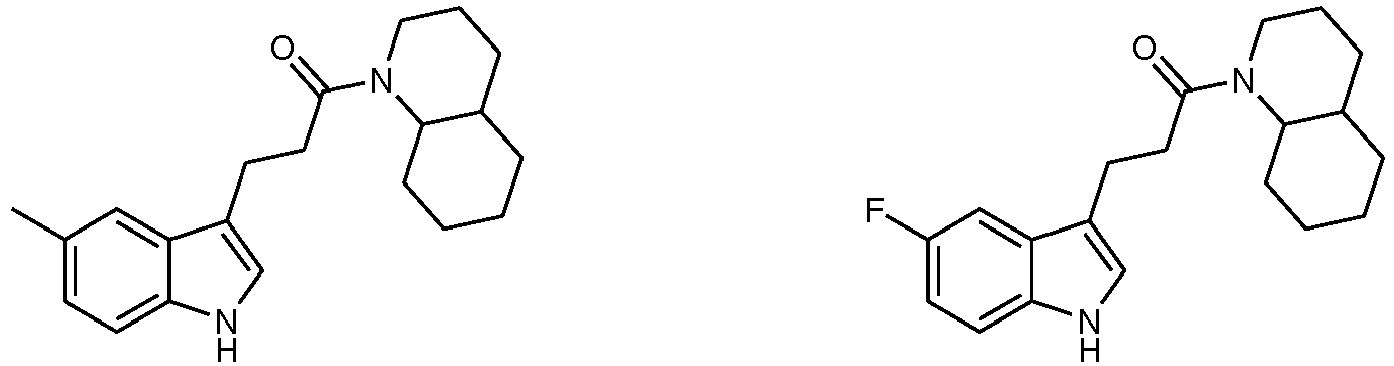


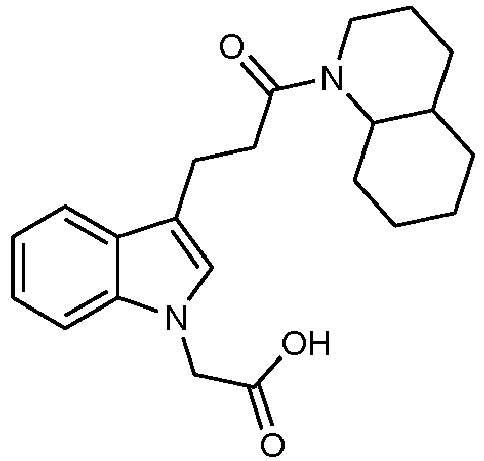


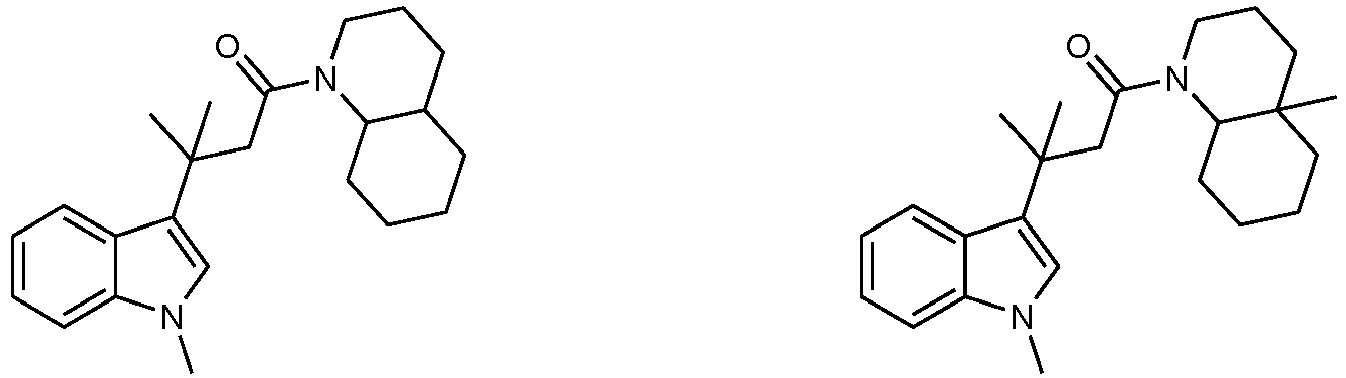


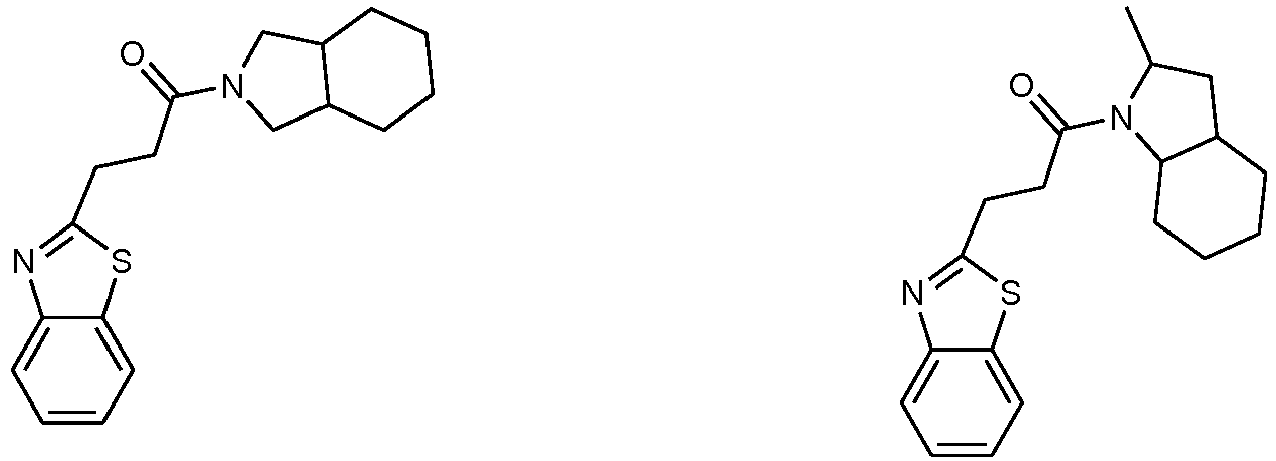
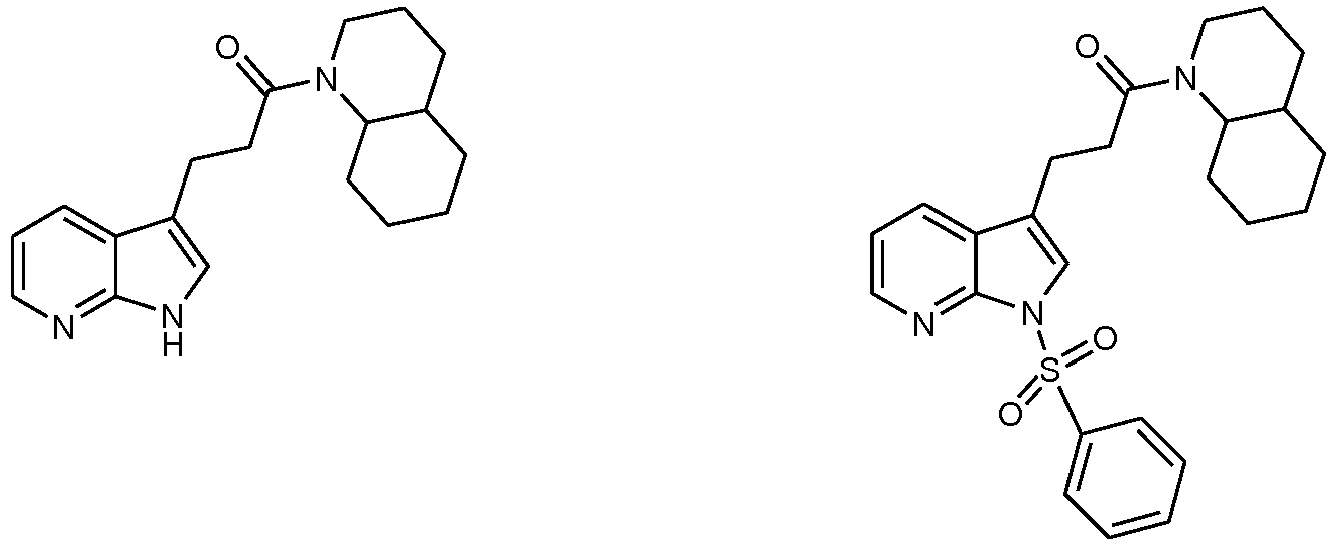


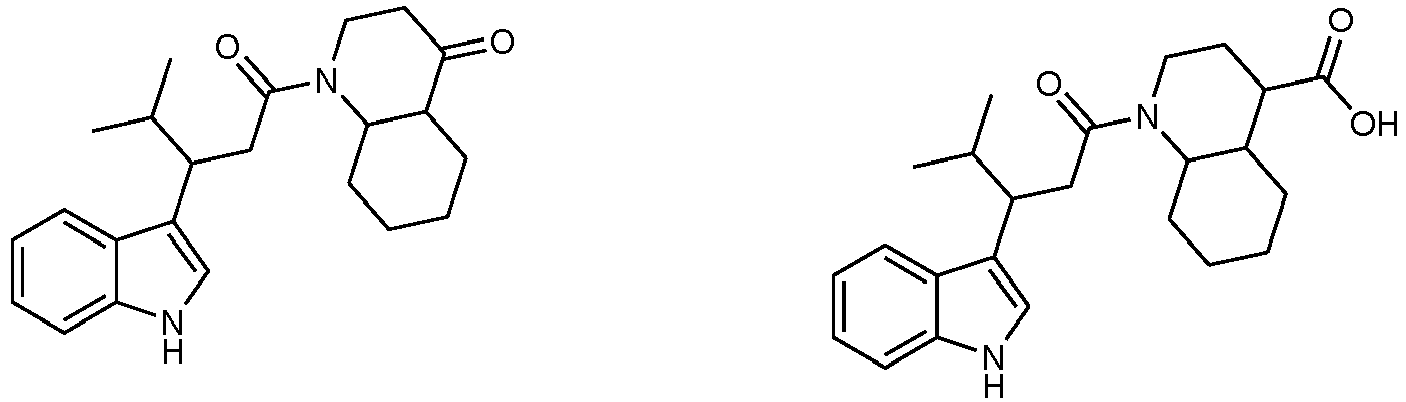
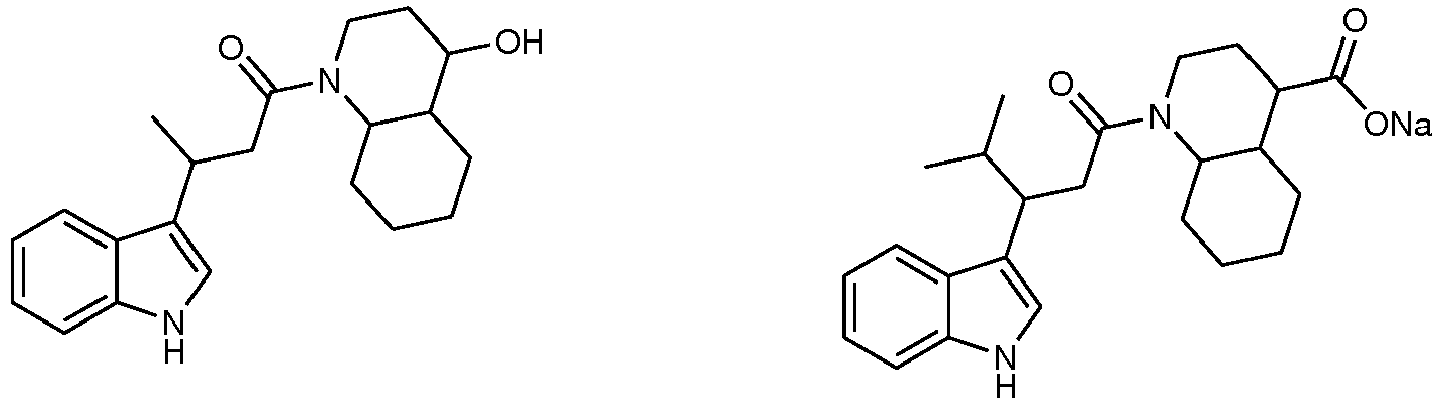


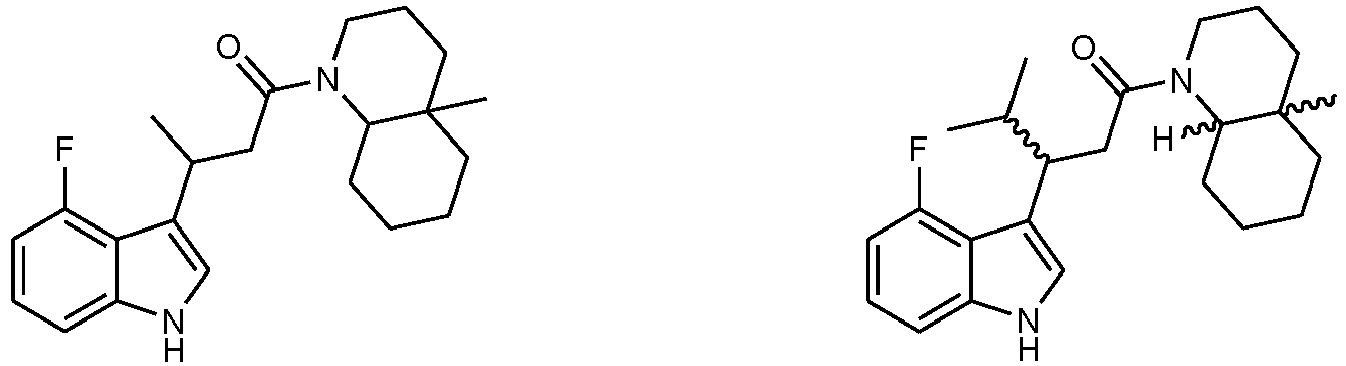


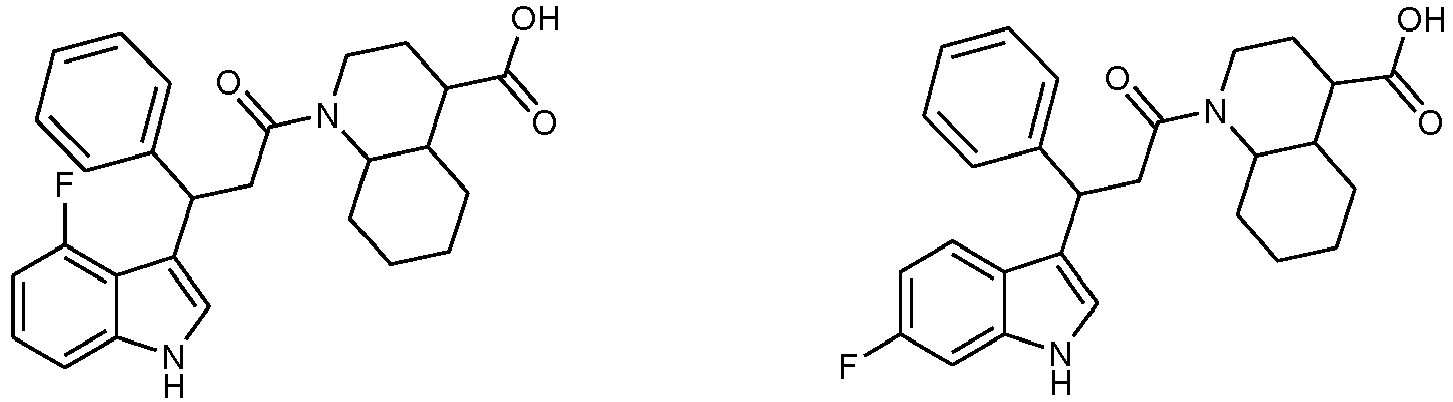


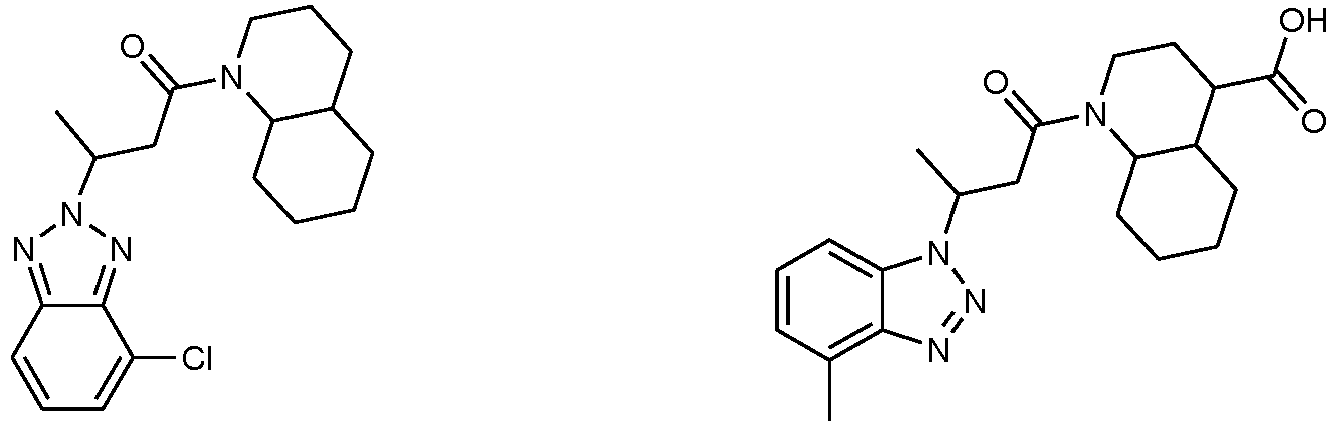


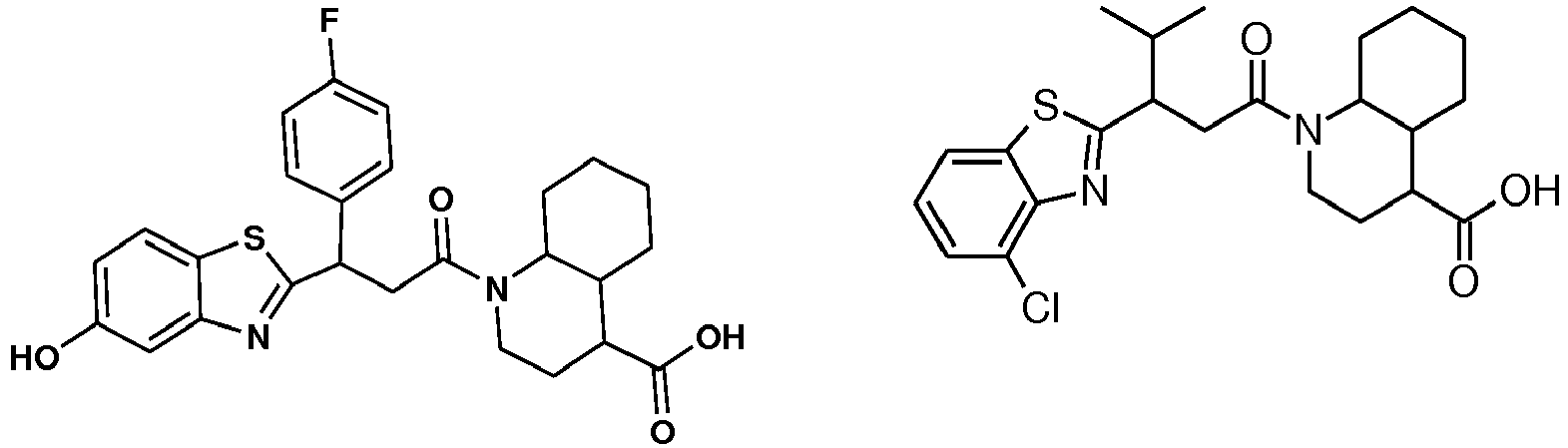


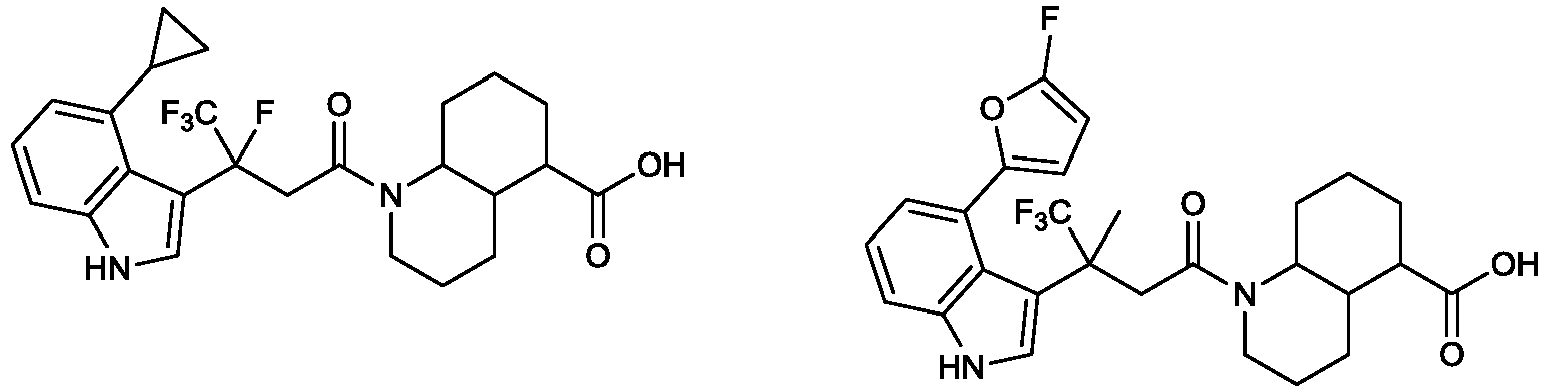


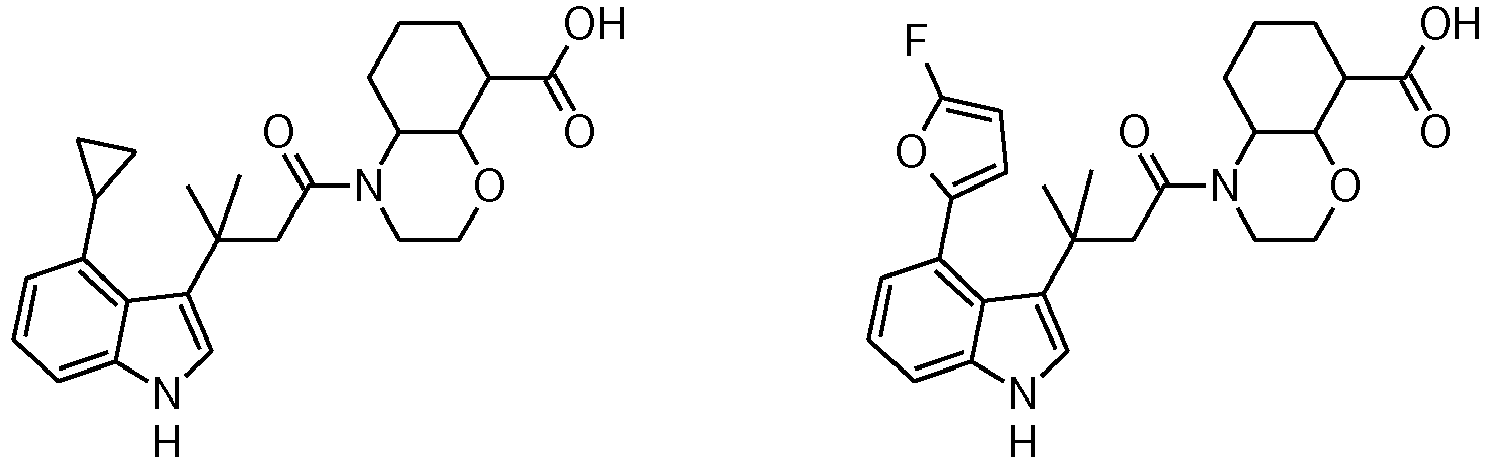


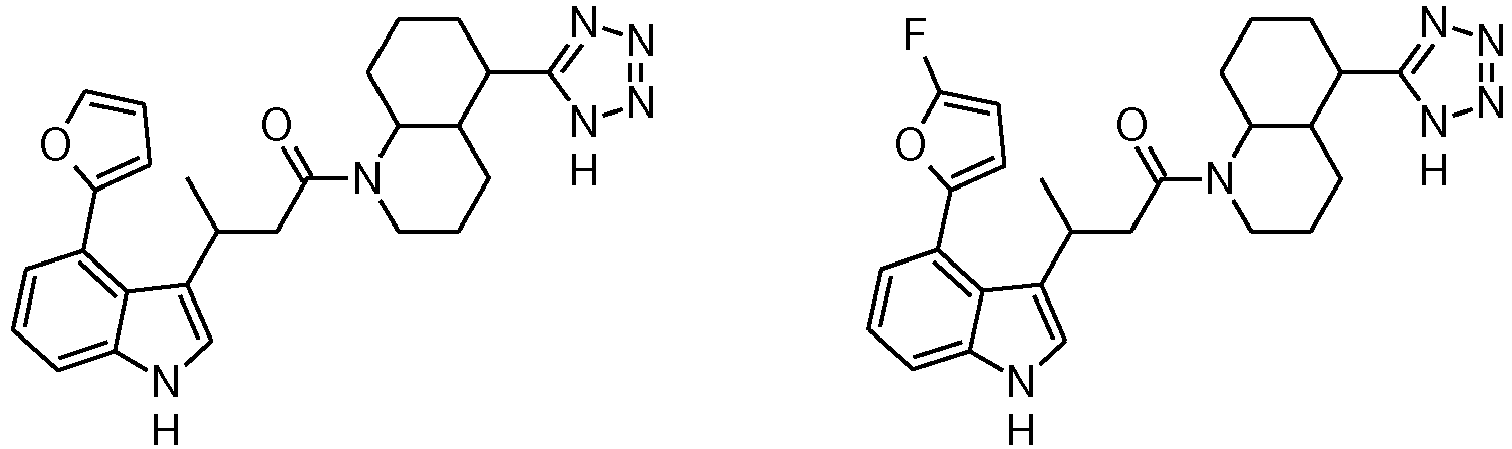
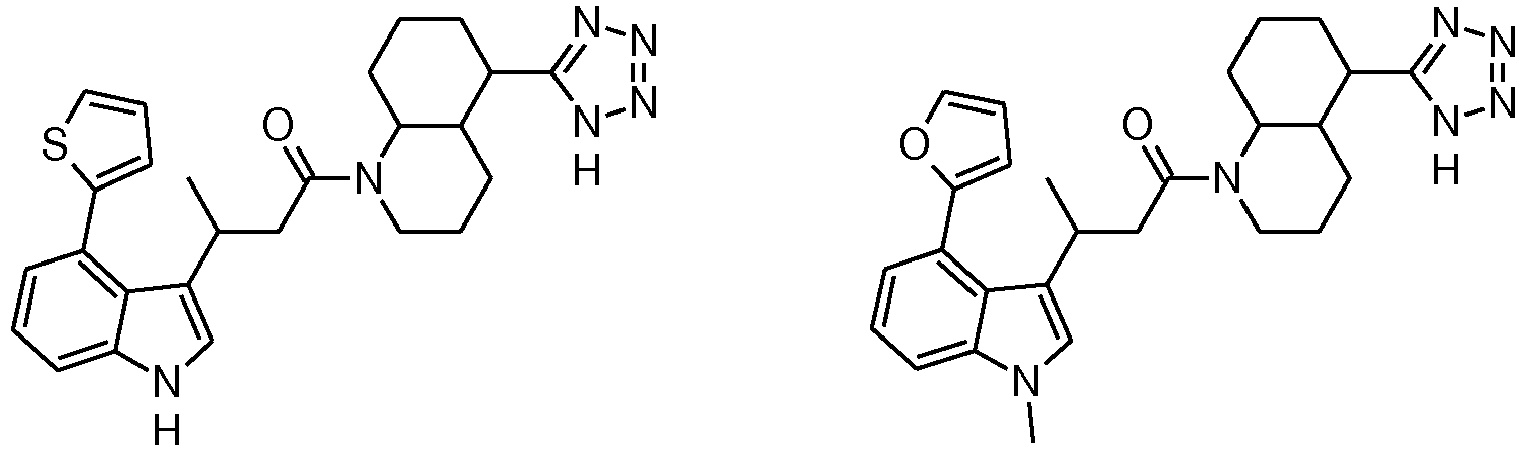


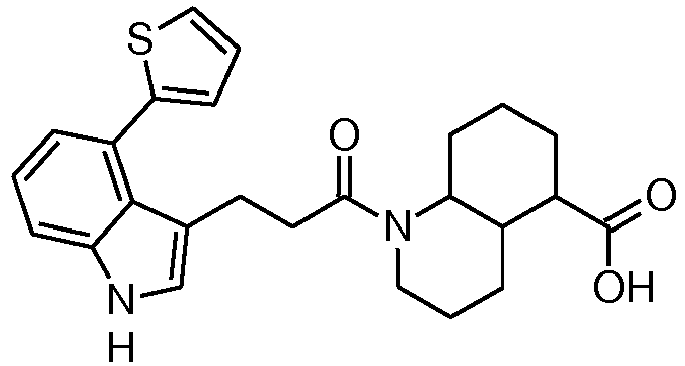
- A pharmaceutical composition including a compound according to any one of claims 1 to 9 and a pharmaceutically acceptable diluent, excipient or carrier.
- A compound according to claim 1 for use as a medicament.
- A compound according to any one of claims 1 to 9 for use in the treatment of a condition selected from the group consisting of diabetes, hyperglycemia, low glucose tolerance, hyperinsulinemia, hyperlipidemia, hypertriglyceridemia, hypercholesterolemia, dyslipidemia, obesity, abdominal obesity, glaucoma, hypertension, atherosclerosis and its sequelae, retinopathy, nephropathy, neuropathy, osteoporosis, osteoarthritis, dementia, depression, neurodegenerative disease, psychiatric disorders, Cushing's Disease, Cushing's syndrome, virus diseases, and inflammatory diseases.
- The compound for use according to claim 12 wherein the condition is diabetes.
- The compound for use according to claim 13 wherein the condition is type II diabetes.
Applications Claiming Priority (2)
| Application Number | Priority Date | Filing Date | Title |
|---|---|---|---|
| IN4527CH2011 | 2011-12-22 | ||
| PCT/IN2012/000841 WO2013128465A1 (en) | 2011-12-22 | 2012-12-21 | Cyclic amide derivatives as inhibitors of 11 - beta - hydroxysteroid dehydrogenase and uses thereof |
Publications (2)
| Publication Number | Publication Date |
|---|---|
| EP2800748A1 EP2800748A1 (en) | 2014-11-12 |
| EP2800748B1 true EP2800748B1 (en) | 2017-03-29 |
Family
ID=54258979
Family Applications (1)
| Application Number | Title | Priority Date | Filing Date |
|---|---|---|---|
| EP12846788.3A Not-in-force EP2800748B1 (en) | 2011-12-22 | 2012-12-21 | Cyclic amide derivatives as inhibitors of 11-beta-hydroxysteroid dehydrogenase and uses thereof |
Country Status (21)
| Country | Link |
|---|---|
| US (1) | US9453014B2 (en) |
| EP (1) | EP2800748B1 (en) |
| JP (1) | JP6118340B2 (en) |
| KR (1) | KR102083040B1 (en) |
| CN (1) | CN104125956B (en) |
| AU (1) | AU2012372019B2 (en) |
| BR (1) | BR112014015301A8 (en) |
| CA (1) | CA2860187C (en) |
| CL (1) | CL2014001704A1 (en) |
| CO (1) | CO7160013A2 (en) |
| DK (1) | DK2800748T3 (en) |
| ES (1) | ES2630309T3 (en) |
| IL (1) | IL233270A0 (en) |
| MA (1) | MA35874B1 (en) |
| MX (1) | MX354361B (en) |
| MY (1) | MY173696A (en) |
| PH (1) | PH12014501442B1 (en) |
| RU (1) | RU2669695C2 (en) |
| SG (1) | SG11201403268QA (en) |
| WO (1) | WO2013128465A1 (en) |
| ZA (1) | ZA201405263B (en) |
Families Citing this family (14)
| Publication number | Priority date | Publication date | Assignee | Title |
|---|---|---|---|---|
| WO2013049062A2 (en) | 2011-09-26 | 2013-04-04 | Nitto Denko Corporation | Highly-fluorescent and photo-stable chromophores for enhanced solar harvesting efficiency |
| WO2013052381A2 (en) | 2011-10-05 | 2013-04-11 | Nitto Denko Corporation | Wavelength conversion film having pressure sensitive adhesive layer to enhance solar harvesting efficiency |
| AR089284A1 (en) | 2011-12-22 | 2014-08-13 | Galapagos Nv | DIHYDROPIRIMIDINOISOQUINOLINONES AND PHARMACEUTICAL COMPOSITIONS OF THE SAME FOR THE TREATMENT OF INFLAMMATORY DISORDERS |
| SG10201610936RA (en) | 2011-12-22 | 2017-02-27 | Alios Biopharma Inc | Substituted nucleosides, nucleotides and analogs thereof |
| USRE48171E1 (en) | 2012-03-21 | 2020-08-25 | Janssen Biopharma, Inc. | Substituted nucleosides, nucleotides and analogs thereof |
| US9441007B2 (en) | 2012-03-21 | 2016-09-13 | Alios Biopharma, Inc. | Substituted nucleosides, nucleotides and analogs thereof |
| WO2016004305A2 (en) | 2014-07-02 | 2016-01-07 | Pharmacyclics Llc | Inhibitors of bruton's tyrosine kinase |
| CN106397377B (en) * | 2016-09-05 | 2019-04-05 | 中南大学 | The method of fluorine on a kind of electron rich five-ring heterocycles acid and its derivative decarboxylation |
| CA3050635A1 (en) | 2017-02-24 | 2018-03-01 | The Regents Of The University Of California | Compositions and methods for promoting hair growth with mpc inhibitors |
| PH12019502776A1 (en) * | 2017-06-30 | 2020-10-26 | Univ California | Compositions and methods for modulating hair growth |
| US12559490B2 (en) | 2020-06-30 | 2026-02-24 | The Regents Of The University Of California | Compositions and methods for modulating hair growth |
| WO2022013684A1 (en) | 2020-07-11 | 2022-01-20 | Pfizer Inc. | Antiviral heteroaryl ketone derivatives |
| US11351149B2 (en) | 2020-09-03 | 2022-06-07 | Pfizer Inc. | Nitrile-containing antiviral compounds |
| CN118724781B (en) * | 2024-06-05 | 2025-09-16 | 延安大学 | Novel chiral amino amide-selenoether ligand and preparation method thereof |
Family Cites Families (12)
| Publication number | Priority date | Publication date | Assignee | Title |
|---|---|---|---|---|
| DE2903966A1 (en) | 1979-02-02 | 1980-08-07 | Bayer Ag | 2-Carbamoyl:methoxy-benzoxazole and benzothiazole derivs. - useful as herbicides, fungicides and plant growth regulators |
| DE2961415D1 (en) * | 1978-05-20 | 1982-01-28 | Bayer Ag | Heteroaryloxy-acetamides, process for their preparation and their use as herbicides |
| JPH03503650A (en) * | 1988-04-05 | 1991-08-15 | アボツト・ラボラトリーズ | Tryptophan derivatives as CCK antagonists |
| FR2703679B1 (en) * | 1993-04-05 | 1995-06-23 | Rhone Poulenc Rorer Sa | NOVEL PERHYDROISOINDOLE DERIVATIVES, THEIR PREPARATION AND THE PHARMACEUTICAL COMPOSITIONS CONTAINING THEM. |
| FR2777566B1 (en) * | 1998-04-15 | 2003-02-21 | Synthelabo | AZACYCLOALCANE DERIVATIVES, THEIR PREPARATION AND THEIR THERAPEUTIC APPLICATION |
| US7022725B2 (en) * | 2000-11-17 | 2006-04-04 | Takeda Pharmaceutical Company Limited | Isoxazole derivatives |
| ATE482747T1 (en) * | 2003-04-11 | 2010-10-15 | High Point Pharmaceuticals Llc | NEW AMIDE DERIVATIVES AND THEIR PHARMACEUTICAL USES |
| DE102004005172A1 (en) * | 2004-02-02 | 2005-08-18 | Aventis Pharma Deutschland Gmbh | Indazole derivatives as inhibitors of the hormone sensitive lipase |
| US20050239853A1 (en) * | 2004-02-04 | 2005-10-27 | Tjeerd Barf | New compounds |
| US20080146811A1 (en) * | 2004-07-23 | 2008-06-19 | Hongfeng Deng | Compounds and Methods For Treatment of Thrombosis |
| CA2720613A1 (en) * | 2008-04-09 | 2009-10-15 | Boehringer Ingelheim International Gmbh | 2-sulfonylamino-4-heteroaryl butyramide antagonists of ccr10 |
| ES2350077B1 (en) * | 2009-06-04 | 2011-11-04 | Laboratorios Salvat, S.A. | INHIBITING COMPOUNDS OF 11BETA-HYDROXIESTEROID DEHYDROGENASE TYPE 1. |
-
2012
- 2012-12-21 AU AU2012372019A patent/AU2012372019B2/en not_active Ceased
- 2012-12-21 EP EP12846788.3A patent/EP2800748B1/en not_active Not-in-force
- 2012-12-21 ES ES12846788T patent/ES2630309T3/en active Active
- 2012-12-21 MX MX2014007719A patent/MX354361B/en active IP Right Grant
- 2012-12-21 CN CN201280070441.8A patent/CN104125956B/en not_active Expired - Fee Related
- 2012-12-21 DK DK12846788.3T patent/DK2800748T3/en active
- 2012-12-21 CA CA2860187A patent/CA2860187C/en not_active Expired - Fee Related
- 2012-12-21 US US14/367,614 patent/US9453014B2/en not_active Expired - Fee Related
- 2012-12-21 KR KR1020147020455A patent/KR102083040B1/en not_active Expired - Fee Related
- 2012-12-21 WO PCT/IN2012/000841 patent/WO2013128465A1/en not_active Ceased
- 2012-12-21 MY MYPI2014001836A patent/MY173696A/en unknown
- 2012-12-21 BR BR112014015301A patent/BR112014015301A8/en not_active IP Right Cessation
- 2012-12-21 RU RU2014126646A patent/RU2669695C2/en active
- 2012-12-21 SG SG11201403268QA patent/SG11201403268QA/en unknown
- 2012-12-21 JP JP2014548339A patent/JP6118340B2/en not_active Expired - Fee Related
-
2014
- 2014-06-19 IL IL233270A patent/IL233270A0/en unknown
- 2014-06-20 PH PH12014501442A patent/PH12014501442B1/en unknown
- 2014-06-23 CL CL2014001704A patent/CL2014001704A1/en unknown
- 2014-07-18 ZA ZA2014/05263A patent/ZA201405263B/en unknown
- 2014-07-20 MA MA37227A patent/MA35874B1/en unknown
- 2014-07-22 CO CO14158010A patent/CO7160013A2/en unknown
Non-Patent Citations (1)
| Title |
|---|
| None * |
Also Published As
| Publication number | Publication date |
|---|---|
| BR112014015301A2 (en) | 2017-06-13 |
| ZA201405263B (en) | 2016-05-25 |
| CN104125956B (en) | 2019-08-16 |
| MX354361B (en) | 2018-02-28 |
| CL2014001704A1 (en) | 2015-03-13 |
| MX2014007719A (en) | 2015-03-19 |
| WO2013128465A1 (en) | 2013-09-06 |
| KR102083040B1 (en) | 2020-02-28 |
| US20150158860A1 (en) | 2015-06-11 |
| PH12014501442A1 (en) | 2014-10-08 |
| MY173696A (en) | 2020-02-17 |
| CN104125956A (en) | 2014-10-29 |
| CA2860187C (en) | 2020-11-10 |
| RU2669695C2 (en) | 2018-10-15 |
| JP6118340B2 (en) | 2017-04-19 |
| AU2012372019B2 (en) | 2017-06-15 |
| RU2014126646A (en) | 2016-02-10 |
| SG11201403268QA (en) | 2014-07-30 |
| AU2012372019A1 (en) | 2014-07-24 |
| JP2015521154A (en) | 2015-07-27 |
| DK2800748T3 (en) | 2017-07-17 |
| US9453014B2 (en) | 2016-09-27 |
| MA35874B1 (en) | 2014-12-01 |
| BR112014015301A8 (en) | 2017-07-04 |
| PH12014501442B1 (en) | 2014-10-08 |
| ES2630309T3 (en) | 2017-08-21 |
| IL233270A0 (en) | 2014-08-31 |
| CA2860187A1 (en) | 2013-09-06 |
| CO7160013A2 (en) | 2015-01-15 |
| EP2800748A1 (en) | 2014-11-12 |
| KR20140127226A (en) | 2014-11-03 |
| NZ626745A (en) | 2016-06-24 |
Similar Documents
| Publication | Publication Date | Title |
|---|---|---|
| DK2800748T3 (en) | CYCLIC AMIDE DERIVATIVES AS INHIBITORS OF 11-BETA-HYDROXYSTEROID DEHYDROGENASE AND APPLICATIONS THEREOF | |
| EP3455204B1 (en) | Cyclopropyl-amide compounds as dual lsd1/hdac inhibitors | |
| EP3116859B1 (en) | Novel compounds as histone deacetylase 6 inhibitors and pharmaceutical compositions comprising the same | |
| KR101919680B1 (en) | Novel pyrrolidine compound and application as melanocortin receptor agonist | |
| EP3426243B1 (en) | 3-phosphoglycerate dehydrogenase inhibitors and uses thereof | |
| EP2794607B1 (en) | Derivatives of aza adamantane and uses thereof | |
| EP1995243A1 (en) | Triazole derivative or salt thereof | |
| KR20220141331A (en) | P2X3 modifier | |
| WO2024263605A2 (en) | 17-beta-hydroxysteroid dehydrogenase type 13 inhibitors and methods of use thereof | |
| EP3212638B1 (en) | New dihydroquinoline pyrazolyl compounds as aldosterone synthase inhibitors | |
| NZ626745B2 (en) | Cyclic amide derivatives as inhibitors of 11 - beta - hydroxysteroid dehydrogenase and uses thereof | |
| HK1165419B (en) | Piperazine compound capable of inhibiting prostaglandin d synthase |
Legal Events
| Date | Code | Title | Description |
|---|---|---|---|
| PUAI | Public reference made under article 153(3) epc to a published international application that has entered the european phase |
Free format text: ORIGINAL CODE: 0009012 |
|
| 17P | Request for examination filed |
Effective date: 20140722 |
|
| AK | Designated contracting states |
Kind code of ref document: A1 Designated state(s): AL AT BE BG CH CY CZ DE DK EE ES FI FR GB GR HR HU IE IS IT LI LT LU LV MC MK MT NL NO PL PT RO RS SE SI SK SM TR |
|
| DAX | Request for extension of the european patent (deleted) | ||
| 17Q | First examination report despatched |
Effective date: 20151117 |
|
| RAP1 | Party data changed (applicant data changed or rights of an application transferred) |
Owner name: CONNEXIOS LIFE SCIENCES PVT. LTD. |
|
| GRAP | Despatch of communication of intention to grant a patent |
Free format text: ORIGINAL CODE: EPIDOSNIGR1 |
|
| INTG | Intention to grant announced |
Effective date: 20161012 |
|
| GRAJ | Information related to disapproval of communication of intention to grant by the applicant or resumption of examination proceedings by the epo deleted |
Free format text: ORIGINAL CODE: EPIDOSDIGR1 |
|
| GRAR | Information related to intention to grant a patent recorded |
Free format text: ORIGINAL CODE: EPIDOSNIGR71 |
|
| GRAS | Grant fee paid |
Free format text: ORIGINAL CODE: EPIDOSNIGR3 |
|
| GRAA | (expected) grant |
Free format text: ORIGINAL CODE: 0009210 |
|
| INTC | Intention to grant announced (deleted) | ||
| INTG | Intention to grant announced |
Effective date: 20170215 |
|
| AK | Designated contracting states |
Kind code of ref document: B1 Designated state(s): AL AT BE BG CH CY CZ DE DK EE ES FI FR GB GR HR HU IE IS IT LI LT LU LV MC MK MT NL NO PL PT RO RS SE SI SK SM TR |
|
| REG | Reference to a national code |
Ref country code: GB Ref legal event code: FG4D |
|
| REG | Reference to a national code |
Ref country code: CH Ref legal event code: EP |
|
| REG | Reference to a national code |
Ref country code: AT Ref legal event code: REF Ref document number: 879634 Country of ref document: AT Kind code of ref document: T Effective date: 20170415 |
|
| REG | Reference to a national code |
Ref country code: IE Ref legal event code: FG4D |
|
| REG | Reference to a national code |
Ref country code: DE Ref legal event code: R096 Ref document number: 602012030587 Country of ref document: DE |
|
| REG | Reference to a national code |
Ref country code: NL Ref legal event code: FP |
|
| REG | Reference to a national code |
Ref country code: DK Ref legal event code: T3 Effective date: 20170706 |
|
| PG25 | Lapsed in a contracting state [announced via postgrant information from national office to epo] |
Ref country code: GR Free format text: LAPSE BECAUSE OF FAILURE TO SUBMIT A TRANSLATION OF THE DESCRIPTION OR TO PAY THE FEE WITHIN THE PRESCRIBED TIME-LIMIT Effective date: 20170630 Ref country code: NO Free format text: LAPSE BECAUSE OF FAILURE TO SUBMIT A TRANSLATION OF THE DESCRIPTION OR TO PAY THE FEE WITHIN THE PRESCRIBED TIME-LIMIT Effective date: 20170629 Ref country code: FI Free format text: LAPSE BECAUSE OF FAILURE TO SUBMIT A TRANSLATION OF THE DESCRIPTION OR TO PAY THE FEE WITHIN THE PRESCRIBED TIME-LIMIT Effective date: 20170329 Ref country code: LT Free format text: LAPSE BECAUSE OF FAILURE TO SUBMIT A TRANSLATION OF THE DESCRIPTION OR TO PAY THE FEE WITHIN THE PRESCRIBED TIME-LIMIT Effective date: 20170329 Ref country code: HR Free format text: LAPSE BECAUSE OF FAILURE TO SUBMIT A TRANSLATION OF THE DESCRIPTION OR TO PAY THE FEE WITHIN THE PRESCRIBED TIME-LIMIT Effective date: 20170329 |
|
| REG | Reference to a national code |
Ref country code: AT Ref legal event code: MK05 Ref document number: 879634 Country of ref document: AT Kind code of ref document: T Effective date: 20170329 |
|
| REG | Reference to a national code |
Ref country code: ES Ref legal event code: FG2A Ref document number: 2630309 Country of ref document: ES Kind code of ref document: T3 Effective date: 20170821 |
|
| PG25 | Lapsed in a contracting state [announced via postgrant information from national office to epo] |
Ref country code: BG Free format text: LAPSE BECAUSE OF FAILURE TO SUBMIT A TRANSLATION OF THE DESCRIPTION OR TO PAY THE FEE WITHIN THE PRESCRIBED TIME-LIMIT Effective date: 20170629 Ref country code: LV Free format text: LAPSE BECAUSE OF FAILURE TO SUBMIT A TRANSLATION OF THE DESCRIPTION OR TO PAY THE FEE WITHIN THE PRESCRIBED TIME-LIMIT Effective date: 20170329 Ref country code: RS Free format text: LAPSE BECAUSE OF FAILURE TO SUBMIT A TRANSLATION OF THE DESCRIPTION OR TO PAY THE FEE WITHIN THE PRESCRIBED TIME-LIMIT Effective date: 20170329 Ref country code: SE Free format text: LAPSE BECAUSE OF FAILURE TO SUBMIT A TRANSLATION OF THE DESCRIPTION OR TO PAY THE FEE WITHIN THE PRESCRIBED TIME-LIMIT Effective date: 20170329 |
|
| PG25 | Lapsed in a contracting state [announced via postgrant information from national office to epo] |
Ref country code: EE Free format text: LAPSE BECAUSE OF FAILURE TO SUBMIT A TRANSLATION OF THE DESCRIPTION OR TO PAY THE FEE WITHIN THE PRESCRIBED TIME-LIMIT Effective date: 20170329 Ref country code: RO Free format text: LAPSE BECAUSE OF FAILURE TO SUBMIT A TRANSLATION OF THE DESCRIPTION OR TO PAY THE FEE WITHIN THE PRESCRIBED TIME-LIMIT Effective date: 20170329 Ref country code: CZ Free format text: LAPSE BECAUSE OF FAILURE TO SUBMIT A TRANSLATION OF THE DESCRIPTION OR TO PAY THE FEE WITHIN THE PRESCRIBED TIME-LIMIT Effective date: 20170329 Ref country code: SK Free format text: LAPSE BECAUSE OF FAILURE TO SUBMIT A TRANSLATION OF THE DESCRIPTION OR TO PAY THE FEE WITHIN THE PRESCRIBED TIME-LIMIT Effective date: 20170329 Ref country code: AT Free format text: LAPSE BECAUSE OF FAILURE TO SUBMIT A TRANSLATION OF THE DESCRIPTION OR TO PAY THE FEE WITHIN THE PRESCRIBED TIME-LIMIT Effective date: 20170329 |
|
| PG25 | Lapsed in a contracting state [announced via postgrant information from national office to epo] |
Ref country code: PL Free format text: LAPSE BECAUSE OF FAILURE TO SUBMIT A TRANSLATION OF THE DESCRIPTION OR TO PAY THE FEE WITHIN THE PRESCRIBED TIME-LIMIT Effective date: 20170329 Ref country code: PT Free format text: LAPSE BECAUSE OF FAILURE TO SUBMIT A TRANSLATION OF THE DESCRIPTION OR TO PAY THE FEE WITHIN THE PRESCRIBED TIME-LIMIT Effective date: 20170731 Ref country code: SM Free format text: LAPSE BECAUSE OF FAILURE TO SUBMIT A TRANSLATION OF THE DESCRIPTION OR TO PAY THE FEE WITHIN THE PRESCRIBED TIME-LIMIT Effective date: 20170329 Ref country code: IS Free format text: LAPSE BECAUSE OF FAILURE TO SUBMIT A TRANSLATION OF THE DESCRIPTION OR TO PAY THE FEE WITHIN THE PRESCRIBED TIME-LIMIT Effective date: 20170729 |
|
| REG | Reference to a national code |
Ref country code: FR Ref legal event code: PLFP Year of fee payment: 6 |
|
| REG | Reference to a national code |
Ref country code: DE Ref legal event code: R097 Ref document number: 602012030587 Country of ref document: DE |
|
| PLBE | No opposition filed within time limit |
Free format text: ORIGINAL CODE: 0009261 |
|
| STAA | Information on the status of an ep patent application or granted ep patent |
Free format text: STATUS: NO OPPOSITION FILED WITHIN TIME LIMIT |
|
| 26N | No opposition filed |
Effective date: 20180103 |
|
| PG25 | Lapsed in a contracting state [announced via postgrant information from national office to epo] |
Ref country code: SI Free format text: LAPSE BECAUSE OF FAILURE TO SUBMIT A TRANSLATION OF THE DESCRIPTION OR TO PAY THE FEE WITHIN THE PRESCRIBED TIME-LIMIT Effective date: 20170329 |
|
| PG25 | Lapsed in a contracting state [announced via postgrant information from national office to epo] |
Ref country code: MT Free format text: LAPSE BECAUSE OF NON-PAYMENT OF DUE FEES Effective date: 20171221 Ref country code: LU Free format text: LAPSE BECAUSE OF NON-PAYMENT OF DUE FEES Effective date: 20171221 |
|
| PG25 | Lapsed in a contracting state [announced via postgrant information from national office to epo] |
Ref country code: HU Free format text: LAPSE BECAUSE OF FAILURE TO SUBMIT A TRANSLATION OF THE DESCRIPTION OR TO PAY THE FEE WITHIN THE PRESCRIBED TIME-LIMIT; INVALID AB INITIO Effective date: 20121221 Ref country code: MC Free format text: LAPSE BECAUSE OF FAILURE TO SUBMIT A TRANSLATION OF THE DESCRIPTION OR TO PAY THE FEE WITHIN THE PRESCRIBED TIME-LIMIT Effective date: 20170329 |
|
| PG25 | Lapsed in a contracting state [announced via postgrant information from national office to epo] |
Ref country code: CY Free format text: LAPSE BECAUSE OF FAILURE TO SUBMIT A TRANSLATION OF THE DESCRIPTION OR TO PAY THE FEE WITHIN THE PRESCRIBED TIME-LIMIT Effective date: 20170329 |
|
| PG25 | Lapsed in a contracting state [announced via postgrant information from national office to epo] |
Ref country code: MK Free format text: LAPSE BECAUSE OF FAILURE TO SUBMIT A TRANSLATION OF THE DESCRIPTION OR TO PAY THE FEE WITHIN THE PRESCRIBED TIME-LIMIT Effective date: 20170329 |
|
| PG25 | Lapsed in a contracting state [announced via postgrant information from national office to epo] |
Ref country code: TR Free format text: LAPSE BECAUSE OF FAILURE TO SUBMIT A TRANSLATION OF THE DESCRIPTION OR TO PAY THE FEE WITHIN THE PRESCRIBED TIME-LIMIT Effective date: 20170329 |
|
| PG25 | Lapsed in a contracting state [announced via postgrant information from national office to epo] |
Ref country code: AL Free format text: LAPSE BECAUSE OF FAILURE TO SUBMIT A TRANSLATION OF THE DESCRIPTION OR TO PAY THE FEE WITHIN THE PRESCRIBED TIME-LIMIT Effective date: 20170329 |
|
| PGFP | Annual fee paid to national office [announced via postgrant information from national office to epo] |
Ref country code: DK Payment date: 20211222 Year of fee payment: 10 Ref country code: FR Payment date: 20211219 Year of fee payment: 10 Ref country code: IE Payment date: 20211219 Year of fee payment: 10 Ref country code: DE Payment date: 20211222 Year of fee payment: 10 Ref country code: GB Payment date: 20211216 Year of fee payment: 10 |
|
| PGFP | Annual fee paid to national office [announced via postgrant information from national office to epo] |
Ref country code: IT Payment date: 20211222 Year of fee payment: 10 Ref country code: CH Payment date: 20211220 Year of fee payment: 10 Ref country code: BE Payment date: 20211216 Year of fee payment: 10 |
|
| PGFP | Annual fee paid to national office [announced via postgrant information from national office to epo] |
Ref country code: NL Payment date: 20211216 Year of fee payment: 10 |
|
| PGFP | Annual fee paid to national office [announced via postgrant information from national office to epo] |
Ref country code: ES Payment date: 20220119 Year of fee payment: 10 |
|
| REG | Reference to a national code |
Ref country code: DE Ref legal event code: R119 Ref document number: 602012030587 Country of ref document: DE |
|
| REG | Reference to a national code |
Ref country code: DK Ref legal event code: EBP Effective date: 20221231 |
|
| REG | Reference to a national code |
Ref country code: CH Ref legal event code: PL |
|
| REG | Reference to a national code |
Ref country code: NL Ref legal event code: MM Effective date: 20230101 |
|
| GBPC | Gb: european patent ceased through non-payment of renewal fee |
Effective date: 20221221 |
|
| REG | Reference to a national code |
Ref country code: BE Ref legal event code: MM Effective date: 20221231 |
|
| PG25 | Lapsed in a contracting state [announced via postgrant information from national office to epo] |
Ref country code: NL Free format text: LAPSE BECAUSE OF NON-PAYMENT OF DUE FEES Effective date: 20230101 |
|
| PG25 | Lapsed in a contracting state [announced via postgrant information from national office to epo] |
Ref country code: LI Free format text: LAPSE BECAUSE OF NON-PAYMENT OF DUE FEES Effective date: 20221231 Ref country code: IE Free format text: LAPSE BECAUSE OF NON-PAYMENT OF DUE FEES Effective date: 20221221 Ref country code: GB Free format text: LAPSE BECAUSE OF NON-PAYMENT OF DUE FEES Effective date: 20221221 Ref country code: DE Free format text: LAPSE BECAUSE OF NON-PAYMENT OF DUE FEES Effective date: 20230701 Ref country code: CH Free format text: LAPSE BECAUSE OF NON-PAYMENT OF DUE FEES Effective date: 20221231 |
|
| PG25 | Lapsed in a contracting state [announced via postgrant information from national office to epo] |
Ref country code: FR Free format text: LAPSE BECAUSE OF NON-PAYMENT OF DUE FEES Effective date: 20221231 Ref country code: BE Free format text: LAPSE BECAUSE OF NON-PAYMENT OF DUE FEES Effective date: 20221231 |
|
| PG25 | Lapsed in a contracting state [announced via postgrant information from national office to epo] |
Ref country code: IT Free format text: LAPSE BECAUSE OF NON-PAYMENT OF DUE FEES Effective date: 20221221 Ref country code: DK Free format text: LAPSE BECAUSE OF NON-PAYMENT OF DUE FEES Effective date: 20221231 |
|
| PG25 | Lapsed in a contracting state [announced via postgrant information from national office to epo] |
Ref country code: ES Free format text: LAPSE BECAUSE OF NON-PAYMENT OF DUE FEES Effective date: 20221222 |
|
| PG25 | Lapsed in a contracting state [announced via postgrant information from national office to epo] |
Ref country code: ES Free format text: LAPSE BECAUSE OF NON-PAYMENT OF DUE FEES Effective date: 20221222 |