EP2799907A1 - Positioning by using encrypted GNSS navigation signals - Google Patents
Positioning by using encrypted GNSS navigation signals Download PDFInfo
- Publication number
- EP2799907A1 EP2799907A1 EP13002338.5A EP13002338A EP2799907A1 EP 2799907 A1 EP2799907 A1 EP 2799907A1 EP 13002338 A EP13002338 A EP 13002338A EP 2799907 A1 EP2799907 A1 EP 2799907A1
- Authority
- EP
- European Patent Office
- Prior art keywords
- signal
- encrypted
- sideband
- gnss navigation
- sidebands
- Prior art date
- Legal status (The legal status is an assumption and is not a legal conclusion. Google has not performed a legal analysis and makes no representation as to the accuracy of the status listed.)
- Granted
Links
Images
Classifications
-
- G—PHYSICS
- G01—MEASURING; TESTING
- G01S—RADIO DIRECTION-FINDING; RADIO NAVIGATION; DETERMINING DISTANCE OR VELOCITY BY USE OF RADIO WAVES; LOCATING OR PRESENCE-DETECTING BY USE OF THE REFLECTION OR RERADIATION OF RADIO WAVES; ANALOGOUS ARRANGEMENTS USING OTHER WAVES
- G01S19/00—Satellite radio beacon positioning systems; Determining position, velocity or attitude using signals transmitted by such systems
- G01S19/01—Satellite radio beacon positioning systems transmitting time-stamped messages, e.g. GPS [Global Positioning System], GLONASS [Global Orbiting Navigation Satellite System] or GALILEO
- G01S19/03—Cooperating elements; Interaction or communication between different cooperating elements or between cooperating elements and receivers
- G01S19/09—Cooperating elements; Interaction or communication between different cooperating elements or between cooperating elements and receivers providing processing capability normally carried out by the receiver
-
- G—PHYSICS
- G01—MEASURING; TESTING
- G01S—RADIO DIRECTION-FINDING; RADIO NAVIGATION; DETERMINING DISTANCE OR VELOCITY BY USE OF RADIO WAVES; LOCATING OR PRESENCE-DETECTING BY USE OF THE REFLECTION OR RERADIATION OF RADIO WAVES; ANALOGOUS ARRANGEMENTS USING OTHER WAVES
- G01S19/00—Satellite radio beacon positioning systems; Determining position, velocity or attitude using signals transmitted by such systems
- G01S19/01—Satellite radio beacon positioning systems transmitting time-stamped messages, e.g. GPS [Global Positioning System], GLONASS [Global Orbiting Navigation Satellite System] or GALILEO
- G01S19/13—Receivers
- G01S19/14—Receivers specially adapted for specific applications
-
- G—PHYSICS
- G01—MEASURING; TESTING
- G01S—RADIO DIRECTION-FINDING; RADIO NAVIGATION; DETERMINING DISTANCE OR VELOCITY BY USE OF RADIO WAVES; LOCATING OR PRESENCE-DETECTING BY USE OF THE REFLECTION OR RERADIATION OF RADIO WAVES; ANALOGOUS ARRANGEMENTS USING OTHER WAVES
- G01S19/00—Satellite radio beacon positioning systems; Determining position, velocity or attitude using signals transmitted by such systems
- G01S19/01—Satellite radio beacon positioning systems transmitting time-stamped messages, e.g. GPS [Global Positioning System], GLONASS [Global Orbiting Navigation Satellite System] or GALILEO
- G01S19/13—Receivers
- G01S19/35—Constructional details or hardware or software details of the signal processing chain
- G01S19/36—Constructional details or hardware or software details of the signal processing chain relating to the receiver frond end
Definitions
- the invention relates to positioning by using encrypted GNSS navigation signals.
- the Galileo Public Regulated Service (PRS) service offers secured navigation for authorized users.
- the access control to the PRS service is achieved by encryption of ranging codes and data, so that only a PRS receiver can acquire and track these encrypted GNSS navigation signals and perform a positioning, particularly calculate a Position, Velocity, time (PVT), if appropriate keys for decrypting the encrypted GNSS navigation signals are available.
- the security processing such as the decrypting is performed inside the security module of the PRS receiver, which is a major driver for complexity, power consumption and cost.
- the need for a security module inside the receiver can be overcome, if the receiver just captures raw GNSS digital samples, and sends them over a secured communication link to a secured server containing a software PRS receiver and appropriate PRS keys.
- the secured server calculates a PVT from these raw GNSS samples, and sends the PVT - or just a position fix - back to the receiver.
- the drawback of this approach is the huge amount of data that has to be transferred via the communication network due to the large bandwidth of the PRS signals: In order to calculate a position fix, a snapshot size of between several milliseconds and more than one second is required, depending on the required sensitivity.
- the receiver acquires 200ms of raw (NAVSTAR-)GPS (Global Positioning System) baseband or IF (Intermediate Frequency) samples, which are processed later on a PC (Personal Computer) to generate a position fix.
- the required additional information like Ephemeris data is provided by a server via the internet.
- This technique is used e.g. for geo-tagging of images, and offers the advantage that when an image shall be taken for which geo-tagging is desired, it is not necessary to wait for the GPS receiver to acquire and track the GPS signals, which would take between seconds and minutes. This approach does not provide position fixes in realtime or near-realtime.
- the ULTRA project aims at the development of an ultra low-cost PRS receiver, based on the approach described above:
- Raw baseband or IF samples are transferred via a secured communication link to a secured server containing a software PRS receiver.
- the raw baseband or IF samples are used to calculate a position fix, which is then sent back to the receiver.
- the load for the communication network connected to the transfer of raw baseband or IF samples from the receiver to the secured server is extremely demanding for PRS signals, which have a significant larger bandwidth than e.g. the GPS SPS open signal.
- the project website can be found at http://www.ultra-prs.eu.
- the invention proposes to capture only one of the sidebands of an encrypted GNSS navigation signal, which is modulated with a BOC method, in order to reduce the amount of data that has to be transferred from a GNSS receiver to a secured server.
- This can be achieved in different ways: Either, by an appropriate combination of front-end, down-conversion, filtering and ADC (Analog Digital Conversion) conversion only one of the encrypted GNSS navigation signal sidebands is sampled, or the encrypted GNSS navigation signal is sampled completely and the reduction to one sideband allowing for the reduction of the sample rate is performed by signal processing techniques.
- ADC Analog Digital Conversion
- An embodiment of the invention relates to a method for positioning by using encrypted GNSS navigation signals, which are modulated with a BOC method and transmit encrypted information in their sidebands, comprising the acts of: capturing only one of the sidebands of an encrypted GNSS navigation signal, transmitting samples of the captured sideband of the encrypted GNSS navigation signal to a secured server for calculating a PVT from the received samples, and receiving the calculated PVT from the secured server.
- the act of capturing of only one of the sidebands of an encrypted GNSS navigation signal may comprise front-end processing, down-conversion, filtering and analog to digital conversion of only one of the sidebands of the encrypted GNSS navigation signal.
- the act of capturing of only one of the sidebands of an encrypted GNSS navigation signal may comprise sampling the encrypted GNSS navigation signal completely and reducing the sampled signal to only one of the sidebands by performing a signal processing technique.
- the performing of a signal processing technique can comprise down converting of the sampled signal into a baseband, splitting the deterministic part of the down converted sampled signal into an upper and a lower sideband signal, filtering the split down converted signal in order to remove the upper or the lower sideband signal, removing the subcarrier modulation of the filtered sideband signal in order to obtain a sideband signal with a center frequency 0, and decimating the sideband signal with a center frequency 0 in order to obtain a captured sideband signal with a lower sample rate.
- a further embodiment of the invention relates to a computer program, which implements the method according to the invention and as described herein and enabling positioning by using encrypted GNSS navigation signals provided according to the invention when executed by a computer.
- a computer program could be used by a computer equipped with a GNSS receiver, for example a smartphone or portable navigation computer, enabling the computer to not only process standard GNSS navigation signals, but also encrypted GNSS service signals such as the PRS signals from Galileo.
- the computer must not be equipped with a security module, but has only to be configured for communication with a secured server in order to perform positioning with encrypted GNSS navigation signals.
- a record carrier storing a computer program according to the invention may be provided, for example a CD-ROM, a DVD, a memory card, a diskette, or a similar data carrier suitable to store the computer program for electronic access.
- a yet further embodiment of the invention relates to a GNSS receiver for positioning by using encrypted GNSS navigation signals, which are modulated with a BOC method and transmit encrypted information in their sidebands, comprising means for capturing only one of the sidebands of an encrypted GNSS navigation signal, means for transmitting samples of the captured sideband of the encrypted GNSS navigation signal to a secured server being provided for calculating a PVT from the received samples, and means for receiving the calculated PVT from the secured server.
- the means for capturing only one of the sidebands of an encrypted GNSS navigation signal may comprise a RF front end for converting a received encrypted GNSS navigation signal into a baseband, a filter for removing the upper or the lower sideband signal from the down converted signal, a multiplier and a subcarrier wipeoff unit for removing the subcarrier modulation of the filtered sideband signal, and a decimation unit for obtaining a captured sideband signal with a lower sample rate.
- the means for transmitting samples of the captured sideband of the encrypted GNSS navigation signal to a secured server and/or means for receiving the calculated PVT from the secured server may be configured to establish a secured communication link with the secured server via a communication network, particularly the internet.
- a yet further embodiment of the invention relates to a secured server for calculating a PVT from samples of a sideband of an encrypted GNSS navigation signal received from a GNSS receiver of the invention and as described herein and comprising a PRS decryption unit for decrypting the received samples of the sideband of the encrypted GNSS navigation signal, a PRS software receiver for calculating a PVT from the decrypted samples of the sideband of the encrypted GNSS navigation signal, and means for transmitting the calculated PVT to the GNSS receiver.
- the secured server may be for example implemented by a PC configured to execute a computer program implementing the PRS software receiver and the PRS decryption unit and equipped with a network adapter in order establish particularly secured communication links with GNSS receivers according to the invention and as described herein
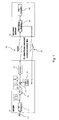
- Fig. 1 shows a receiver 10 being a rover for a Galileo SIS (Signal-In-Space) 12.
- the SIS 12 is BOC modulated and transmits encrypted PRS information in its sidebands.
- the received SIS 12 is in a RF front-end 14 down converted in a complex baseband.
- A is an amplitude
- c(t) is the PRN code
- b ( t ) is a rectangular sub-carrier with angular frequency ⁇ sub
- ⁇ dop is the angular Doppler frequency
- n(t) is complex noise.
- the deterministic part of this signal model can be split into an upper sideband signal s u ( t ) and a lower sideband signal s l ( t ):
- the resulting signal has a bandwidth that is equal to the bandwidth of the PRN code, and an appropriate decimation with a decimator 22 can now be applied to obtain a signal 24 with a lower sample rate.
- the lower sidelobe can be used, or IF samples instead of baseband samples.
- the signal 24 with the lower sample rate is transmitted by the GNSS receiver 10 to a secured server 26 via a bidirectional secured communication link established between the receiver 10 and server 26, for example an encrypted communication link over the internet such as a VPN (Virtual Private Network), a SSL (Secure Sockets Layer) or another encrypted communication link.
- VPN Virtual Private Network
- SSL Secure Sockets Layer
- the secured server 26 comprises a PRS software receiver 28 and a a PRS decryption unit 30 corresponding to the security module of a PRS receiver.
- the PRE software receiver 28 calculates with the received samples 24 after decryption by means of the PRS decryption unit 30 a PVT.
- the calculated PVT 32 is transmitted with a transmitter over the bidirectional encrypted communication link back to the GNSS receiver 10.
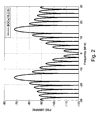
- the Power Spectral Density of a BOCc(15,2.5) modulated GNSS navigation signal is shown exemplary in Fig. 2 .
- the Galileo PRS signal on E1 is a BOCc(15,2.5) and would require a sample rate of at least 32.5 MHz to capture both sidelobes, given that complex baseband samples are used.
- the reduction to one sidelobe allows reducing the sample rate to 2.5 MHz, i.e. the data transfer volume is reduced by a factor of 13.
- the snapshot duration can be increased by a factor 13, which offers an increase in sensitivity of more than 11 dB.
Landscapes
- Engineering & Computer Science (AREA)
- Radar, Positioning & Navigation (AREA)
- Remote Sensing (AREA)
- Computer Networks & Wireless Communication (AREA)
- Physics & Mathematics (AREA)
- General Physics & Mathematics (AREA)
- Signal Processing (AREA)
- Position Fixing By Use Of Radio Waves (AREA)
Abstract
Description
- The invention relates to positioning by using encrypted GNSS navigation signals.
- In the European Global Navigation Satellite System (GNSS) Galileo, the Galileo Public Regulated Service (PRS) service offers secured navigation for authorized users. The access control to the PRS service is achieved by encryption of ranging codes and data, so that only a PRS receiver can acquire and track these encrypted GNSS navigation signals and perform a positioning, particularly calculate a Position, Velocity, time (PVT), if appropriate keys for decrypting the encrypted GNSS navigation signals are available. The security processing such as the decrypting is performed inside the security module of the PRS receiver, which is a major driver for complexity, power consumption and cost.
- The need for a security module inside the receiver can be overcome, if the receiver just captures raw GNSS digital samples, and sends them over a secured communication link to a secured server containing a software PRS receiver and appropriate PRS keys. The secured server calculates a PVT from these raw GNSS samples, and sends the PVT - or just a position fix - back to the receiver. The drawback of this approach is the huge amount of data that has to be transferred via the communication network due to the large bandwidth of the PRS signals: In order to calculate a position fix, a snapshot size of between several milliseconds and more than one second is required, depending on the required sensitivity. Considering for example the BOCc (Binary Offset Carrier) (15,2.5) PRS signal on E1, complex baseband samples at a minimum rate of 32.5 MHz are required to capture the main lobes of the signal. With a 3-bit ADC (Analog Digital Converter) and a snapshot size of only 100 ms, this already leads to almost 20 Mbit of data per snapshot.
- The receiver manufacturer u-blox AG, Zürich, Switzerland, offers a technology called "Capture & Process". Hereby, the receiver acquires 200ms of raw (NAVSTAR-)GPS (Global Positioning System) baseband or IF (Intermediate Frequency) samples, which are processed later on a PC (Personal Computer) to generate a position fix. The required additional information like Ephemeris data is provided by a server via the internet. This technique is used e.g. for geo-tagging of images, and offers the advantage that when an image shall be taken for which geo-tagging is desired, it is not necessary to wait for the GPS receiver to acquire and track the GPS signals, which would take between seconds and minutes. This approach does not provide position fixes in realtime or near-realtime.
- The ULTRA project aims at the development of an ultra low-cost PRS receiver, based on the approach described above: Raw baseband or IF samples are transferred via a secured communication link to a secured server containing a software PRS receiver. At the secured server the raw baseband or IF samples are used to calculate a position fix, which is then sent back to the receiver. As mentioned above, the load for the communication network connected to the transfer of raw baseband or IF samples from the receiver to the secured server is extremely demanding for PRS signals, which have a significant larger bandwidth than e.g. the GPS SPS open signal. The project website can be found at http://www.ultra-prs.eu.
- It is an object of the invention to provide positioning by using encrypted GNSS navigation, wherein a secured server is used and the amount of data transmitted to a secured server is reduced compared to the known methods described at the beginning.
- This object is achieved by the subject matter of the independent claims. Further embodiments are shown by the dependent claims.
- The invention proposes to capture only one of the sidebands of an encrypted GNSS navigation signal, which is modulated with a BOC method, in order to reduce the amount of data that has to be transferred from a GNSS receiver to a secured server. This can be achieved in different ways: Either, by an appropriate combination of front-end, down-conversion, filtering and ADC (Analog Digital Conversion) conversion only one of the encrypted GNSS navigation signal sidebands is sampled, or the encrypted GNSS navigation signal is sampled completely and the reduction to one sideband allowing for the reduction of the sample rate is performed by signal processing techniques. With the proposed invention, following advantages can be observed:
- All advantages of the architecture described in the ULTRA-project are maintained: No security module is required at a GNSS receiver, which allows for reductions in cost, complexity, and power consumption of the GNSS receiver. Furthermore, security issues related to the receiver are avoided.
- The amount of baseband or IF samples that have to be transferred from a GNSS receiver without a security module to a secured server for calculating a PVT is significantly reduced. Alternatively, for a given data transfer volume, the time interval for which samples can be captured is increased, which allows for a higher sensitivity.
- An embodiment of the invention relates to a method for positioning by using encrypted GNSS navigation signals, which are modulated with a BOC method and transmit encrypted information in their sidebands, comprising the acts of: capturing only one of the sidebands of an encrypted GNSS navigation signal, transmitting samples of the captured sideband of the encrypted GNSS navigation signal to a secured server for calculating a PVT from the received samples, and receiving the calculated PVT from the secured server.
- The act of capturing of only one of the sidebands of an encrypted GNSS navigation signal may comprise front-end processing, down-conversion, filtering and analog to digital conversion of only one of the sidebands of the encrypted GNSS navigation signal.
- Alternatively, the act of capturing of only one of the sidebands of an encrypted GNSS navigation signal may comprise sampling the encrypted GNSS navigation signal completely and reducing the sampled signal to only one of the sidebands by performing a signal processing technique.
- The performing of a signal processing technique can comprise down converting of the sampled signal into a baseband, splitting the deterministic part of the down converted sampled signal into an upper and a lower sideband signal, filtering the split down converted signal in order to remove the upper or the lower sideband signal, removing the subcarrier modulation of the filtered sideband signal in order to obtain a sideband signal with a
center frequency 0, and decimating the sideband signal with acenter frequency 0 in order to obtain a captured sideband signal with a lower sample rate. - A further embodiment of the invention relates to a computer program, which implements the method according to the invention and as described herein and enabling positioning by using encrypted GNSS navigation signals provided according to the invention when executed by a computer. Such a computer program could be used by a computer equipped with a GNSS receiver, for example a smartphone or portable navigation computer, enabling the computer to not only process standard GNSS navigation signals, but also encrypted GNSS service signals such as the PRS signals from Galileo. The computer must not be equipped with a security module, but has only to be configured for communication with a secured server in order to perform positioning with encrypted GNSS navigation signals.
- According to a further embodiment of the invention, a record carrier storing a computer program according to the invention may be provided, for example a CD-ROM, a DVD, a memory card, a diskette, or a similar data carrier suitable to store the computer program for electronic access.
- A yet further embodiment of the invention relates to a GNSS receiver for positioning by using encrypted GNSS navigation signals, which are modulated with a BOC method and transmit encrypted information in their sidebands, comprising means for capturing only one of the sidebands of an encrypted GNSS navigation signal, means for transmitting samples of the captured sideband of the encrypted GNSS navigation signal to a secured server being provided for calculating a PVT from the received samples, and means for receiving the calculated PVT from the secured server.
- The means for capturing only one of the sidebands of an encrypted GNSS navigation signal may comprise a RF front end for converting a received encrypted GNSS navigation signal into a baseband, a filter for removing the upper or the lower sideband signal from the down converted signal, a multiplier and a subcarrier wipeoff unit for removing the subcarrier modulation of the filtered sideband signal, and a decimation unit for obtaining a captured sideband signal with a lower sample rate.
- The means for transmitting samples of the captured sideband of the encrypted GNSS navigation signal to a secured server and/or means for receiving the calculated PVT from the secured server may be configured to establish a secured communication link with the secured server via a communication network, particularly the internet.
- A yet further embodiment of the invention relates to a secured server for calculating a PVT from samples of a sideband of an encrypted GNSS navigation signal received from a GNSS receiver of the invention and as described herein and comprising a PRS decryption unit for decrypting the received samples of the sideband of the encrypted GNSS navigation signal, a PRS software receiver for calculating a PVT from the decrypted samples of the sideband of the encrypted GNSS navigation signal, and means for transmitting the calculated PVT to the GNSS receiver. The secured server may be for example implemented by a PC configured to execute a computer program implementing the PRS software receiver and the PRS decryption unit and equipped with a network adapter in order establish particularly secured communication links with GNSS receivers according to the invention and as described herein
- These and other aspects of the invention will be apparent from and elucidated with reference to the embodiments described hereinafter.
- The invention will be described in more detail hereinafter with reference to exemplary embodiments. However, the invention is not limited to these exemplary embodiments.
-
- Fig. 1
- shows an embodiment of a block diagram of an implementation of system positioning by using encrypted GNSS navigation signals with a GNSS receiver and a secured server according to the invention; and
- Fig. 2
- shows the Power Spectral Density of BOCc(15,2.5) modulated GNSS navigation signal.
- In the following, functionally similar or identical elements may have the same reference numerals. Furthermore, the following embodiment of the invention is described for the case of Galileo PRS, but it should be noted that the invention can be applied to any secured navigation signals and services which use message and / or ranging code encryption.
- In the following, an embodiment of the invention is described in detail, where a received Galileo PRS signal is sampled completely and the reduction to one sideband allowing for the reduction of the sample rate is performed by signal processing techniques.
-
Fig. 1 shows areceiver 10 being a rover for a Galileo SIS (Signal-In-Space) 12. TheSIS 12 is BOC modulated and transmits encrypted PRS information in its sidebands. - At the
receiver 10, the receivedSIS 12 is in a RF front-end 14 down converted in a complex baseband. A simplified model for a BOC signal s(t), which is output by the RF front-end 14, in the complex baseband is given by
- Hereby, A is an amplitude, c(t) is the PRN code, b(t) is a rectangular sub-carrier with angular frequency ωsub , ωdop is the angular Doppler frequency, and n(t) is complex noise. Without impact on the validity of the results, the rectangular sub-carrier can be approximated with a cosine function, leading to

- Using some trigonometric identities, the deterministic part of this signal model can be split into an upper sideband signal su (t) and a lower sideband signal sl (t):

- The first step after downconversion of the BOC signal to baseband is to remove one sideband by an appropriate filtering with a
filter 16. For example, if the upper sideband is maintained, the resulting signal after filtering is given by
- Multiplication by means of a
multiplier 18 with
subcarrier wipeoff unit 20 removes the subcarrier modulation, which shifts the upper sidelobe to the frequency zero:
- The resulting signal has a bandwidth that is equal to the bandwidth of the PRN code, and an appropriate decimation with a
decimator 22 can now be applied to obtain asignal 24 with a lower sample rate. Alternatively, the lower sidelobe can be used, or IF samples instead of baseband samples. - The
signal 24 with the lower sample rate is transmitted by theGNSS receiver 10 to asecured server 26 via a bidirectional secured communication link established between thereceiver 10 andserver 26, for example an encrypted communication link over the internet such as a VPN (Virtual Private Network), a SSL (Secure Sockets Layer) or another encrypted communication link. - The
secured server 26 comprises aPRS software receiver 28 and a aPRS decryption unit 30 corresponding to the security module of a PRS receiver. ThePRE software receiver 28 calculates with the receivedsamples 24 after decryption by means of the PRS decryption unit 30 a PVT. Thecalculated PVT 32 is transmitted with a transmitter over the bidirectional encrypted communication link back to theGNSS receiver 10. - Since only samples from one sidelobe of the PRS signal are transferred from the
receiver 10 to thesecured server 26, the amount of transferred data is significantly reduced. This reduces the achievable accuracy of the position fix from what is achievable with the complete BOC signal to approximately the accuracy of the corresponding BPSK signal. On the other hand, the potential problem of a false lock to a sidepeak of the correlation function - which can occur with BOC signals - does not exist anymore. - The Power Spectral Density of a BOCc(15,2.5) modulated GNSS navigation signal is shown exemplary in
Fig. 2 . The Galileo PRS signal on E1 is a BOCc(15,2.5) and would require a sample rate of at least 32.5 MHz to capture both sidelobes, given that complex baseband samples are used. With the inventive approach, the reduction to one sidelobe allows reducing the sample rate to 2.5 MHz, i.e. the data transfer volume is reduced by a factor of 13. Alternatively, for a given data transfer volume, the snapshot duration can be increased by a factor 13, which offers an increase in sensitivity of more than 11 dB.REFERENCE NUMERALS 10 Rover with Galileo receiver 12 Galileo SIS with PRS 14 RF front- end 16 filter 18 multiplier 20 subcarrier wipeoff unit 22 decimation unit 24 PRS samples 26 secured server 28 PRS software receiver 30 PRS decryption unit 32 PVT
Claims (10)
- A method for positioning by using encrypted GNSS navigation signals (12), which are modulated with a Binary Offset Carrier - BOC -method and transmit encrypted information in their sidebands, comprising the acts of:- capturing (14, 16, 18, 20, 22) only one of the sidebands of an encrypted GNSS navigation signal,- transmitting samples (24) of the captured sideband of the encrypted GNSS navigation signal to a secured server (26) for calculating (28, 30) a position, velocity and/or time - PVT -(32) from the received samples, and- receiving the calculated PVT (32) from the secured server (26).
- The method of claim 1, wherein the act of capturing of only one of the sidebands of an encrypted GNSS navigation signal comprises front-end processing, down-conversion, filtering and analog to digital conversion of only one of the sidebands of the encrypted GNSS navigation signal.
- The method of claim 1, wherein the act of capturing of only one of the sidebands of an encrypted GNSS navigation signal comprises sampling the encrypted GNSS navigation signal completely and reducing the sampled signal to only one of the sidebands by performing a signal processing technique.
- The method of claim 3, wherein the performing of a signal processing technique comprises down converting of the sampled signal into a baseband, splitting the deterministic part of the down converted sampled signal into an upper and a lower sideband signal, filtering the split down converted signal in order to remove the upper or the lower sideband signal (16), removing the subcarrier modulation of the filtered sideband signal (18, 20) in order to obtain a sideband signal with a center frequency 0, and decimating (22) the sideband signal with a center frequency 0 in order to obtain a captured sideband signal with a lower sample rate (24).
- A computer program implementing a method of any of the preceding claims.
- A record carrier storing a computer program according to claim 5.
- A GNSS receiver (10) for positioning by using encrypted GNSS navigation signals (12), which are modulated with a Binary Offset Carrier - BOC -method and transmit encrypted information in their sidebands, comprising- means (14, 16, 18, 20, 22) for capturing only one of the sidebands of an encrypted GNSS navigation signal,- means for transmitting samples (24) of the captured sideband of the encrypted GNSS navigation signal to a secured server (26) being provided for calculating (28, 30) a position, velocity and/or time - PVT -(32) from the received samples, and- means for receiving the calculated PVT (32) from the secured server (26).
- The GNSS receiver of claim 7, wherein the means (14, 16, 18, 20, 22) for capturing only one of the sidebands of an encrypted GNSS navigation signal comprise- a RF front end (14) for converting a received encrypted GNSS navigation signal into a baseband,- a filter (16) for removing the upper or the lower sideband signal from the down converted signal,- a multiplier (18) and a subcarrier wipeoff unit (20) for removing the subcarrier modulation of the filtered sideband signal, and- a decimation unit (22) for obtaining a captured sideband signal with a lower sample rate (24).
- The GNSS receiver of claim 7 or 8, wherein the means for transmitting samples (24) of the captured sideband of the encrypted GNSS navigation signal to a secured server (26) and/or means for receiving the calculated PVT (32) from the secured server (26) are configured to establish a secured communication link with the secured server (26) via a communication network, particularly the internet.
- A secured server (26) for calculating (28, 30) a position, velocity and/or time - PVT -(32) from samples of a sideband of an encrypted GNSS navigation signal (12) received from a GNSS receiver (10) of any of claims 7 to 9 and comprising- a PRS decryption unit (30) for decrypting the received samples of the sideband of the encrypted GNSS navigation signal (12),- a PRS software receiver (28) for calculating a PVT (32) from the decrypted samples of the sideband of the encrypted GNSS navigation signal (12), and- means for transmitting the calculated PVT (32) to the GNSS receiver (10).
Priority Applications (2)
| Application Number | Priority Date | Filing Date | Title |
|---|---|---|---|
| EP13002338.5A EP2799907B1 (en) | 2013-05-02 | 2013-05-02 | Positioning by using encrypted GNSS navigation signals |
| ES13002338T ES2871256T3 (en) | 2013-05-02 | 2013-05-02 | Positioning using encrypted GNSS navigation signals |
Applications Claiming Priority (1)
| Application Number | Priority Date | Filing Date | Title |
|---|---|---|---|
| EP13002338.5A EP2799907B1 (en) | 2013-05-02 | 2013-05-02 | Positioning by using encrypted GNSS navigation signals |
Publications (2)
| Publication Number | Publication Date |
|---|---|
| EP2799907A1 true EP2799907A1 (en) | 2014-11-05 |
| EP2799907B1 EP2799907B1 (en) | 2021-03-03 |
Family
ID=48288744
Family Applications (1)
| Application Number | Title | Priority Date | Filing Date |
|---|---|---|---|
| EP13002338.5A Active EP2799907B1 (en) | 2013-05-02 | 2013-05-02 | Positioning by using encrypted GNSS navigation signals |
Country Status (2)
| Country | Link |
|---|---|
| EP (1) | EP2799907B1 (en) |
| ES (1) | ES2871256T3 (en) |
Cited By (9)
| Publication number | Priority date | Publication date | Assignee | Title |
|---|---|---|---|---|
| EP3147691A1 (en) * | 2015-09-23 | 2017-03-29 | Nottingham Scientific Limited | Server-based geo-positioning systems |
| EP3252504A1 (en) | 2016-06-03 | 2017-12-06 | Siemens Aktiengesellschaft | Method, and position determination unit for determining a current position of a receiver |
| EP3258292A1 (en) * | 2016-06-17 | 2017-12-20 | Airbus DS GmbH | Technique for position calculation of a receiver under use of encrypted signals of a public regulated service |
| CN108254767A (en) * | 2018-01-02 | 2018-07-06 | 桂林电子科技大学 | A kind of BOC signal acquisition methods and baseband synchronization receiver |
| CN108562918A (en) * | 2018-04-26 | 2018-09-21 | 桂林电子科技大学 | Based on associated shift BOC (n, n) without fuzziness catching method and device |
| EP3671281A1 (en) * | 2018-12-21 | 2020-06-24 | European Space Agency | Method and system for processing a gnss signal using homomorphic encryption |
| CN111562598A (en) * | 2020-07-20 | 2020-08-21 | 长沙海格北斗信息技术有限公司 | Satellite Navigation Anti-jamming Method, System and Receiver Based on BOC Signal |
| CN112187294A (en) * | 2020-09-28 | 2021-01-05 | 中国电子科技集团公司第五十四研究所 | Configurable multi-frequency-point short burst spread spectrum signal receiving device |
| CN115426195A (en) * | 2022-10-20 | 2022-12-02 | 广东电网有限责任公司佛山供电局 | Data transmission method and device, computer equipment and storage medium |
-
2013
- 2013-05-02 EP EP13002338.5A patent/EP2799907B1/en active Active
- 2013-05-02 ES ES13002338T patent/ES2871256T3/en active Active
Non-Patent Citations (6)
| Title |
|---|
| ADINA BURIAN ET AL: "BPSK-like Methods for Hybrid-Search Acquisition of Galileo Signals", COMMUNICATIONS, 2006. ICC '06. IEEE INTERNATIONAL CONFERENCE ON, IEEE, PI, 1 June 2006 (2006-06-01), pages 5211 - 5216, XP031025740, ISBN: 978-1-4244-0354-7 * |
| DAVIDE MARGARIA ET AL: "Galileo AltBOC signal multiresolution acquisition strategy", IEEE AEROSPACE AND ELECTRONIC SYSTEMS MAGAZINE, IEEE SERVICE CENTER, PISCATAWAY, NJ, US, vol. 23, no. 11, 1 November 2008 (2008-11-01), pages 4 - 10, XP011239176, ISSN: 0885-8985, DOI: 10.1109/MAES.2008.4693984 * |
| FISCHER S ET AL: "Acquisition Concepts for Galileo BOC", PROCEEDINGS / 2004 IEEE 59TH VEHICULAR TECHNOLOGY CONFERENCE, VTC 2004-SPRING : TOWARDS A GLOBAL WIRELESS WORLD ; 17 - 19 MAY 2004, MILAN, ITALY, IEEE OPERATIONS CENTER, PISCATAWAY, NJ, vol. 5, 17 May 2004 (2004-05-17), pages 2852 - 2856, XP010766771, ISBN: 978-0-7803-8255-8, DOI: 10.1109/VETECS.2004.1391445 * |
| GLEN GIBBONS: "Civil Galileo System Poses New Options for Secure Services", INSIDE GNSS, 18 December 2012 (2012-12-18), XP055089141, Retrieved from the Internet <URL:http://www.insidegnss.com/node/3326> [retrieved on 20131119] * |
| MARTIN N ET AL: "BOC(x,y) Signal Acquisition Techniques and Performances", ION GPS/GNSS, XX, XX, 9 September 2003 (2003-09-09), pages 188 - 198, XP002338824 * |
| PAVEL KOVÁR ET AL: "Galileo Receiver Core Technologies", JOURNAL OF GLOBAL POSITIONING SYSTEMS, vol. 4, no. 1&2, 1 January 2005 (2005-01-01), pages 176 - 183, XP055089648, ISSN: 1446-3156, DOI: 10.5081/jgps.4.1.176 * |
Cited By (15)
| Publication number | Priority date | Publication date | Assignee | Title |
|---|---|---|---|---|
| EP3147691A1 (en) * | 2015-09-23 | 2017-03-29 | Nottingham Scientific Limited | Server-based geo-positioning systems |
| EP3252504A1 (en) | 2016-06-03 | 2017-12-06 | Siemens Aktiengesellschaft | Method, and position determination unit for determining a current position of a receiver |
| DE102016209805A1 (en) | 2016-06-03 | 2017-12-07 | Siemens Aktiengesellschaft | Method and position determination unit for determining a current position of a receiver |
| US10831907B2 (en) | 2016-06-17 | 2020-11-10 | Airbus Ds Gmbh | Technique for position calculation of a receiver via use of encrypted signals of a public regulated service |
| EP3258292A1 (en) * | 2016-06-17 | 2017-12-20 | Airbus DS GmbH | Technique for position calculation of a receiver under use of encrypted signals of a public regulated service |
| CN108254767A (en) * | 2018-01-02 | 2018-07-06 | 桂林电子科技大学 | A kind of BOC signal acquisition methods and baseband synchronization receiver |
| CN108254767B (en) * | 2018-01-02 | 2021-06-04 | 桂林电子科技大学 | A BOC signal acquisition method and baseband synchronization receiver |
| CN108562918A (en) * | 2018-04-26 | 2018-09-21 | 桂林电子科技大学 | Based on associated shift BOC (n, n) without fuzziness catching method and device |
| EP3671281A1 (en) * | 2018-12-21 | 2020-06-24 | European Space Agency | Method and system for processing a gnss signal using homomorphic encryption |
| US11626971B2 (en) | 2018-12-21 | 2023-04-11 | European Space Agency | Method and system for processing a GNSS signal using homomorphic encryption |
| CN111562598A (en) * | 2020-07-20 | 2020-08-21 | 长沙海格北斗信息技术有限公司 | Satellite Navigation Anti-jamming Method, System and Receiver Based on BOC Signal |
| CN112187294A (en) * | 2020-09-28 | 2021-01-05 | 中国电子科技集团公司第五十四研究所 | Configurable multi-frequency-point short burst spread spectrum signal receiving device |
| CN112187294B (en) * | 2020-09-28 | 2021-12-24 | 中国电子科技集团公司第五十四研究所 | A configurable multi-frequency short burst spread spectrum signal receiving device |
| CN115426195A (en) * | 2022-10-20 | 2022-12-02 | 广东电网有限责任公司佛山供电局 | Data transmission method and device, computer equipment and storage medium |
| CN115426195B (en) * | 2022-10-20 | 2023-05-16 | 广东电网有限责任公司佛山供电局 | Data transmission method, device, computer equipment and storage medium |
Also Published As
| Publication number | Publication date |
|---|---|
| EP2799907B1 (en) | 2021-03-03 |
| ES2871256T3 (en) | 2021-10-28 |
Similar Documents
| Publication | Publication Date | Title |
|---|---|---|
| EP2799907B1 (en) | Positioning by using encrypted GNSS navigation signals | |
| Grenier et al. | A survey on low-power GNSS | |
| CN114063124B (en) | Beidou B1C signal rapid capturing method and storage medium | |
| US11626971B2 (en) | Method and system for processing a GNSS signal using homomorphic encryption | |
| RU2481596C2 (en) | Navigation receiver | |
| US10180500B2 (en) | Signal processing | |
| EP2746810B1 (en) | System for assisted secured navigation with a GNSS | |
| CA2803419A1 (en) | Method, device and network for authenticating the position of a navigation receiver | |
| CN101918856A (en) | Global navigation receiver | |
| CN110278715A (en) | Method and system for radionavigation certification | |
| CN102291162A (en) | Correlation method and correlation device for different modulated signals | |
| US20210109226A1 (en) | Identifying second gnss navigation data as potentially manipulated or as trustworthy at least partially based on first gnss navigation data | |
| Bender | DJI drone IDs are not encrypted | |
| Rügamer et al. | Secure position and time information by server side PRS snapshot processing | |
| US7233282B2 (en) | GPS receiver with encrypted data transmission | |
| EP3581966A1 (en) | Position information processing system and position information processing device | |
| EP3646551A1 (en) | Enhanced use of satellite navigation system related data | |
| US20120026901A1 (en) | Method and Apparatus for Processing Signals | |
| Feng | Decimation double-phase estimator: An efficient and unambiguous high-order binary offset carrier tracking algorithm | |
| US8599068B2 (en) | Systems and methods for mobile terminal location verification | |
| CN101207402B (en) | Apparatus and Method for Partial Chip Correlation Calculation in Spread Spectrum Receiver | |
| CN109633714B (en) | L2P (Y) signal tracking method with high W code adaptability | |
| KR101947885B1 (en) | Method dividing satellite signals into eight frequency points for processing | |
| US20100070129A1 (en) | Vehicle data recorder | |
| Gunawardena et al. | Multi-channel wideband GPS anomalous event monitor |
Legal Events
| Date | Code | Title | Description |
|---|---|---|---|
| PUAI | Public reference made under article 153(3) epc to a published international application that has entered the european phase |
Free format text: ORIGINAL CODE: 0009012 |
|
| 17P | Request for examination filed |
Effective date: 20130502 |
|
| AK | Designated contracting states |
Kind code of ref document: A1 Designated state(s): AL AT BE BG CH CY CZ DE DK EE ES FI FR GB GR HR HU IE IS IT LI LT LU LV MC MK MT NL NO PL PT RO RS SE SI SK SM TR |
|
| AX | Request for extension of the european patent |
Extension state: BA ME |
|
| R17P | Request for examination filed (corrected) |
Effective date: 20150423 |
|
| RAP1 | Party data changed (applicant data changed or rights of an application transferred) |
Owner name: AIRBUS DEFENCE AND SPACE GMBH |
|
| STAA | Information on the status of an ep patent application or granted ep patent |
Free format text: STATUS: EXAMINATION IS IN PROGRESS |
|
| 17Q | First examination report despatched |
Effective date: 20190320 |
|
| GRAP | Despatch of communication of intention to grant a patent |
Free format text: ORIGINAL CODE: EPIDOSNIGR1 |
|
| STAA | Information on the status of an ep patent application or granted ep patent |
Free format text: STATUS: GRANT OF PATENT IS INTENDED |
|
| INTG | Intention to grant announced |
Effective date: 20200928 |
|
| GRAS | Grant fee paid |
Free format text: ORIGINAL CODE: EPIDOSNIGR3 |
|
| GRAA | (expected) grant |
Free format text: ORIGINAL CODE: 0009210 |
|
| STAA | Information on the status of an ep patent application or granted ep patent |
Free format text: STATUS: THE PATENT HAS BEEN GRANTED |
|
| AK | Designated contracting states |
Kind code of ref document: B1 Designated state(s): AL AT BE BG CH CY CZ DE DK EE ES FI FR GB GR HR HU IE IS IT LI LT LU LV MC MK MT NL NO PL PT RO RS SE SI SK SM TR |
|
| REG | Reference to a national code |
Ref country code: GB Ref legal event code: FG4D |
|
| REG | Reference to a national code |
Ref country code: AT Ref legal event code: REF Ref document number: 1367810 Country of ref document: AT Kind code of ref document: T Effective date: 20210315 Ref country code: CH Ref legal event code: EP |
|
| REG | Reference to a national code |
Ref country code: DE Ref legal event code: R096 Ref document number: 602013075971 Country of ref document: DE |
|
| REG | Reference to a national code |
Ref country code: IE Ref legal event code: FG4D |
|
| REG | Reference to a national code |
Ref country code: FI Ref legal event code: FGE |
|
| REG | Reference to a national code |
Ref country code: LT Ref legal event code: MG9D |
|
| PG25 | Lapsed in a contracting state [announced via postgrant information from national office to epo] |
Ref country code: LT Free format text: LAPSE BECAUSE OF FAILURE TO SUBMIT A TRANSLATION OF THE DESCRIPTION OR TO PAY THE FEE WITHIN THE PRESCRIBED TIME-LIMIT Effective date: 20210303 Ref country code: HR Free format text: LAPSE BECAUSE OF FAILURE TO SUBMIT A TRANSLATION OF THE DESCRIPTION OR TO PAY THE FEE WITHIN THE PRESCRIBED TIME-LIMIT Effective date: 20210303 Ref country code: GR Free format text: LAPSE BECAUSE OF FAILURE TO SUBMIT A TRANSLATION OF THE DESCRIPTION OR TO PAY THE FEE WITHIN THE PRESCRIBED TIME-LIMIT Effective date: 20210604 Ref country code: BG Free format text: LAPSE BECAUSE OF FAILURE TO SUBMIT A TRANSLATION OF THE DESCRIPTION OR TO PAY THE FEE WITHIN THE PRESCRIBED TIME-LIMIT Effective date: 20210603 Ref country code: NO Free format text: LAPSE BECAUSE OF FAILURE TO SUBMIT A TRANSLATION OF THE DESCRIPTION OR TO PAY THE FEE WITHIN THE PRESCRIBED TIME-LIMIT Effective date: 20210603 |
|
| REG | Reference to a national code |
Ref country code: NL Ref legal event code: MP Effective date: 20210303 |
|
| REG | Reference to a national code |
Ref country code: AT Ref legal event code: MK05 Ref document number: 1367810 Country of ref document: AT Kind code of ref document: T Effective date: 20210303 |
|
| PG25 | Lapsed in a contracting state [announced via postgrant information from national office to epo] |
Ref country code: SE Free format text: LAPSE BECAUSE OF FAILURE TO SUBMIT A TRANSLATION OF THE DESCRIPTION OR TO PAY THE FEE WITHIN THE PRESCRIBED TIME-LIMIT Effective date: 20210303 Ref country code: RS Free format text: LAPSE BECAUSE OF FAILURE TO SUBMIT A TRANSLATION OF THE DESCRIPTION OR TO PAY THE FEE WITHIN THE PRESCRIBED TIME-LIMIT Effective date: 20210303 Ref country code: LV Free format text: LAPSE BECAUSE OF FAILURE TO SUBMIT A TRANSLATION OF THE DESCRIPTION OR TO PAY THE FEE WITHIN THE PRESCRIBED TIME-LIMIT Effective date: 20210303 Ref country code: PL Free format text: LAPSE BECAUSE OF FAILURE TO SUBMIT A TRANSLATION OF THE DESCRIPTION OR TO PAY THE FEE WITHIN THE PRESCRIBED TIME-LIMIT Effective date: 20210303 |
|
| PG25 | Lapsed in a contracting state [announced via postgrant information from national office to epo] |
Ref country code: NL Free format text: LAPSE BECAUSE OF FAILURE TO SUBMIT A TRANSLATION OF THE DESCRIPTION OR TO PAY THE FEE WITHIN THE PRESCRIBED TIME-LIMIT Effective date: 20210303 |
|
| REG | Reference to a national code |
Ref country code: ES Ref legal event code: FG2A Ref document number: 2871256 Country of ref document: ES Kind code of ref document: T3 Effective date: 20211028 |
|
| PG25 | Lapsed in a contracting state [announced via postgrant information from national office to epo] |
Ref country code: SM Free format text: LAPSE BECAUSE OF FAILURE TO SUBMIT A TRANSLATION OF THE DESCRIPTION OR TO PAY THE FEE WITHIN THE PRESCRIBED TIME-LIMIT Effective date: 20210303 Ref country code: AT Free format text: LAPSE BECAUSE OF FAILURE TO SUBMIT A TRANSLATION OF THE DESCRIPTION OR TO PAY THE FEE WITHIN THE PRESCRIBED TIME-LIMIT Effective date: 20210303 Ref country code: CZ Free format text: LAPSE BECAUSE OF FAILURE TO SUBMIT A TRANSLATION OF THE DESCRIPTION OR TO PAY THE FEE WITHIN THE PRESCRIBED TIME-LIMIT Effective date: 20210303 Ref country code: EE Free format text: LAPSE BECAUSE OF FAILURE TO SUBMIT A TRANSLATION OF THE DESCRIPTION OR TO PAY THE FEE WITHIN THE PRESCRIBED TIME-LIMIT Effective date: 20210303 |
|
| PG25 | Lapsed in a contracting state [announced via postgrant information from national office to epo] |
Ref country code: RO Free format text: LAPSE BECAUSE OF FAILURE TO SUBMIT A TRANSLATION OF THE DESCRIPTION OR TO PAY THE FEE WITHIN THE PRESCRIBED TIME-LIMIT Effective date: 20210303 Ref country code: IS Free format text: LAPSE BECAUSE OF FAILURE TO SUBMIT A TRANSLATION OF THE DESCRIPTION OR TO PAY THE FEE WITHIN THE PRESCRIBED TIME-LIMIT Effective date: 20210703 Ref country code: PT Free format text: LAPSE BECAUSE OF FAILURE TO SUBMIT A TRANSLATION OF THE DESCRIPTION OR TO PAY THE FEE WITHIN THE PRESCRIBED TIME-LIMIT Effective date: 20210705 Ref country code: SK Free format text: LAPSE BECAUSE OF FAILURE TO SUBMIT A TRANSLATION OF THE DESCRIPTION OR TO PAY THE FEE WITHIN THE PRESCRIBED TIME-LIMIT Effective date: 20210303 |
|
| REG | Reference to a national code |
Ref country code: DE Ref legal event code: R097 Ref document number: 602013075971 Country of ref document: DE |
|
| REG | Reference to a national code |
Ref country code: CH Ref legal event code: PL |
|
| PLBE | No opposition filed within time limit |
Free format text: ORIGINAL CODE: 0009261 |
|
| STAA | Information on the status of an ep patent application or granted ep patent |
Free format text: STATUS: NO OPPOSITION FILED WITHIN TIME LIMIT |
|
| PG25 | Lapsed in a contracting state [announced via postgrant information from national office to epo] |
Ref country code: DK Free format text: LAPSE BECAUSE OF FAILURE TO SUBMIT A TRANSLATION OF THE DESCRIPTION OR TO PAY THE FEE WITHIN THE PRESCRIBED TIME-LIMIT Effective date: 20210303 Ref country code: AL Free format text: LAPSE BECAUSE OF FAILURE TO SUBMIT A TRANSLATION OF THE DESCRIPTION OR TO PAY THE FEE WITHIN THE PRESCRIBED TIME-LIMIT Effective date: 20210303 Ref country code: CH Free format text: LAPSE BECAUSE OF NON-PAYMENT OF DUE FEES Effective date: 20210531 Ref country code: LI Free format text: LAPSE BECAUSE OF NON-PAYMENT OF DUE FEES Effective date: 20210531 Ref country code: MC Free format text: LAPSE BECAUSE OF FAILURE TO SUBMIT A TRANSLATION OF THE DESCRIPTION OR TO PAY THE FEE WITHIN THE PRESCRIBED TIME-LIMIT Effective date: 20210303 Ref country code: LU Free format text: LAPSE BECAUSE OF NON-PAYMENT OF DUE FEES Effective date: 20210502 |
|
| 26N | No opposition filed |
Effective date: 20211206 |
|
| REG | Reference to a national code |
Ref country code: BE Ref legal event code: MM Effective date: 20210531 |
|
| PG25 | Lapsed in a contracting state [announced via postgrant information from national office to epo] |
Ref country code: SI Free format text: LAPSE BECAUSE OF FAILURE TO SUBMIT A TRANSLATION OF THE DESCRIPTION OR TO PAY THE FEE WITHIN THE PRESCRIBED TIME-LIMIT Effective date: 20210303 |
|
| PG25 | Lapsed in a contracting state [announced via postgrant information from national office to epo] |
Ref country code: IE Free format text: LAPSE BECAUSE OF NON-PAYMENT OF DUE FEES Effective date: 20210502 |
|
| PG25 | Lapsed in a contracting state [announced via postgrant information from national office to epo] |
Ref country code: IS Free format text: LAPSE BECAUSE OF FAILURE TO SUBMIT A TRANSLATION OF THE DESCRIPTION OR TO PAY THE FEE WITHIN THE PRESCRIBED TIME-LIMIT Effective date: 20210703 |
|
| PG25 | Lapsed in a contracting state [announced via postgrant information from national office to epo] |
Ref country code: BE Free format text: LAPSE BECAUSE OF NON-PAYMENT OF DUE FEES Effective date: 20210531 |
|
| PGFP | Annual fee paid to national office [announced via postgrant information from national office to epo] |
Ref country code: FI Payment date: 20220523 Year of fee payment: 10 |
|
| PG25 | Lapsed in a contracting state [announced via postgrant information from national office to epo] |
Ref country code: HU Free format text: LAPSE BECAUSE OF FAILURE TO SUBMIT A TRANSLATION OF THE DESCRIPTION OR TO PAY THE FEE WITHIN THE PRESCRIBED TIME-LIMIT; INVALID AB INITIO Effective date: 20130502 |
|
| PG25 | Lapsed in a contracting state [announced via postgrant information from national office to epo] |
Ref country code: CY Free format text: LAPSE BECAUSE OF FAILURE TO SUBMIT A TRANSLATION OF THE DESCRIPTION OR TO PAY THE FEE WITHIN THE PRESCRIBED TIME-LIMIT Effective date: 20210303 |
|
| PG25 | Lapsed in a contracting state [announced via postgrant information from national office to epo] |
Ref country code: FI Free format text: LAPSE BECAUSE OF NON-PAYMENT OF DUE FEES Effective date: 20230502 |
|
| PG25 | Lapsed in a contracting state [announced via postgrant information from national office to epo] |
Ref country code: MK Free format text: LAPSE BECAUSE OF FAILURE TO SUBMIT A TRANSLATION OF THE DESCRIPTION OR TO PAY THE FEE WITHIN THE PRESCRIBED TIME-LIMIT Effective date: 20210303 |
|
| PG25 | Lapsed in a contracting state [announced via postgrant information from national office to epo] |
Ref country code: TR Free format text: LAPSE BECAUSE OF FAILURE TO SUBMIT A TRANSLATION OF THE DESCRIPTION OR TO PAY THE FEE WITHIN THE PRESCRIBED TIME-LIMIT Effective date: 20210303 |
|
| PG25 | Lapsed in a contracting state [announced via postgrant information from national office to epo] |
Ref country code: MT Free format text: LAPSE BECAUSE OF FAILURE TO SUBMIT A TRANSLATION OF THE DESCRIPTION OR TO PAY THE FEE WITHIN THE PRESCRIBED TIME-LIMIT Effective date: 20210303 |
|
| PGFP | Annual fee paid to national office [announced via postgrant information from national office to epo] |
Ref country code: ES Payment date: 20250627 Year of fee payment: 13 |
|
| PGFP | Annual fee paid to national office [announced via postgrant information from national office to epo] |
Ref country code: GB Payment date: 20260522 Year of fee payment: 14 |
|
| PGFP | Annual fee paid to national office [announced via postgrant information from national office to epo] |
Ref country code: IT Payment date: 20260525 Year of fee payment: 14 |
|
| PGFP | Annual fee paid to national office [announced via postgrant information from national office to epo] |
Ref country code: DE Payment date: 20260522 Year of fee payment: 14 |
|
| PGFP | Annual fee paid to national office [announced via postgrant information from national office to epo] |
Ref country code: FR Payment date: 20260526 Year of fee payment: 14 |