EP2799435B1 - Poly (adp-ribose) polymerase inhibitor - Google Patents
Poly (adp-ribose) polymerase inhibitor Download PDFInfo
- Publication number
- EP2799435B1 EP2799435B1 EP12852659.7A EP12852659A EP2799435B1 EP 2799435 B1 EP2799435 B1 EP 2799435B1 EP 12852659 A EP12852659 A EP 12852659A EP 2799435 B1 EP2799435 B1 EP 2799435B1
- Authority
- EP
- European Patent Office
- Prior art keywords
- carbonyl
- piperazine
- phthalazin
- fluoro
- phenoxy
- Prior art date
- Legal status (The legal status is an assumption and is not a legal conclusion. Google has not performed a legal analysis and makes no representation as to the accuracy of the status listed.)
- Active
Links
- PXYIFDVNUHAHEH-UHFFFAOYSA-N C=CC(N(CC1)CCN1C(c1cc(OC(c2ccccc22)=NNC2=O)ccc1F)=O)=O Chemical compound C=CC(N(CC1)CCN1C(c1cc(OC(c2ccccc22)=NNC2=O)ccc1F)=O)=O PXYIFDVNUHAHEH-UHFFFAOYSA-N 0.000 description 1
- ARWVVIIJDWQGHO-UHFFFAOYSA-N CCN(CC)C(N(CC1)CCN1C(c1cc(OC(c2ccccc22)=NNC2=O)ccc1F)=O)=O Chemical compound CCN(CC)C(N(CC1)CCN1C(c1cc(OC(c2ccccc22)=NNC2=O)ccc1F)=O)=O ARWVVIIJDWQGHO-UHFFFAOYSA-N 0.000 description 1
- OBGMGHCICGACRV-UHFFFAOYSA-N O=C(C(CC1)CCN1OC(c1ccccc1)=O)N(CC1)CCN1C(c1cc(OC(c2ccccc22)=NNC2=O)ccc1)=O Chemical compound O=C(C(CC1)CCN1OC(c1ccccc1)=O)N(CC1)CCN1C(c1cc(OC(c2ccccc22)=NNC2=O)ccc1)=O OBGMGHCICGACRV-UHFFFAOYSA-N 0.000 description 1
- PRJLLRBGAHEQMG-UHFFFAOYSA-N O=C(C(CCCC1)N1OC(c1ccccc1)=O)N(CC1)CCN1C(c1cc(OC(c2ccccc22)=NNC2=O)ccc1F)=O Chemical compound O=C(C(CCCC1)N1OC(c1ccccc1)=O)N(CC1)CCN1C(c1cc(OC(c2ccccc22)=NNC2=O)ccc1F)=O PRJLLRBGAHEQMG-UHFFFAOYSA-N 0.000 description 1
- UFVPUCUXFUEIDV-UHFFFAOYSA-N O=C(CC1CCCC1)N(CC1)CCN1C(c1cc(OC(c2ccccc22)=NNC2=O)ccc1F)=O Chemical compound O=C(CC1CCCC1)N(CC1)CCN1C(c1cc(OC(c2ccccc22)=NNC2=O)ccc1F)=O UFVPUCUXFUEIDV-UHFFFAOYSA-N 0.000 description 1
- YZLFPSRTRYPIFP-UHFFFAOYSA-N O=C(c(cc1)ccc1F)N(CC1)CCN1C(c1cc(OC(c2ccccc22)=NNC2=O)ccc1)=O Chemical compound O=C(c(cc1)ccc1F)N(CC1)CCN1C(c1cc(OC(c2ccccc22)=NNC2=O)ccc1)=O YZLFPSRTRYPIFP-UHFFFAOYSA-N 0.000 description 1
- MFRKQTCRFIRZLD-UHFFFAOYSA-N O=C(c1cc(OC(c2ccccc22)=NNC2=O)ccc1)N(CC1)CC=C1c(cc1)ccc1F Chemical compound O=C(c1cc(OC(c2ccccc22)=NNC2=O)ccc1)N(CC1)CC=C1c(cc1)ccc1F MFRKQTCRFIRZLD-UHFFFAOYSA-N 0.000 description 1
- GXBAVGQAXRFDOW-UHFFFAOYSA-N O=C(c1cc(OC(c2ccccc22)=NNC2=O)ccc1F)N(CC1)CCN1C(Nc(cc1)ccc1Cl)=O Chemical compound O=C(c1cc(OC(c2ccccc22)=NNC2=O)ccc1F)N(CC1)CCN1C(Nc(cc1)ccc1Cl)=O GXBAVGQAXRFDOW-UHFFFAOYSA-N 0.000 description 1
- VCSKZKVJEFRMPP-UHFFFAOYSA-N O=C(c1cc(OC(c2ccccc22)=NNC2=O)ccc1F)N(CC1)CCN1C([n]1cncc1)=O Chemical compound O=C(c1cc(OC(c2ccccc22)=NNC2=O)ccc1F)N(CC1)CCN1C([n]1cncc1)=O VCSKZKVJEFRMPP-UHFFFAOYSA-N 0.000 description 1
- NUSRLLJEWPPZLY-UHFFFAOYSA-N O=C(c1ccc[o]1)N(CC1)CCN1C(c1cc(OC(c2ccccc22)=NNC2=O)ccc1F)=O Chemical compound O=C(c1ccc[o]1)N(CC1)CCN1C(c1cc(OC(c2ccccc22)=NNC2=O)ccc1F)=O NUSRLLJEWPPZLY-UHFFFAOYSA-N 0.000 description 1
- PBNNJPCADRIPFL-UHFFFAOYSA-N O=C(c1ccncc1)N(CC1)CCN1C(c1cc(OC(c2ccccc22)=NNC2=O)ccc1)=O Chemical compound O=C(c1ccncc1)N(CC1)CCN1C(c1cc(OC(c2ccccc22)=NNC2=O)ccc1)=O PBNNJPCADRIPFL-UHFFFAOYSA-N 0.000 description 1
- VQHPTVHDNVWZCW-UHFFFAOYSA-N [O-][N+](c(cc1)ccc1C(N(CC1)CCN1C(c1cc(OC(c(c2ccc3)c3Cl)=NNC2=O)ccc1F)=O)=O)=O Chemical compound [O-][N+](c(cc1)ccc1C(N(CC1)CCN1C(c1cc(OC(c(c2ccc3)c3Cl)=NNC2=O)ccc1F)=O)=O)=O VQHPTVHDNVWZCW-UHFFFAOYSA-N 0.000 description 1
- FEOUWECRHACLNJ-UHFFFAOYSA-N [O-][N+](c1cccc2c1C(Oc(cc1C(N(CC3)CCN3C(c3ccccc3)=O)=O)ccc1F)=NNC2=O)=O Chemical compound [O-][N+](c1cccc2c1C(Oc(cc1C(N(CC3)CCN3C(c3ccccc3)=O)=O)ccc1F)=NNC2=O)=O FEOUWECRHACLNJ-UHFFFAOYSA-N 0.000 description 1
Images

Classifications
-
- C—CHEMISTRY; METALLURGY
- C07—ORGANIC CHEMISTRY
- C07D—HETEROCYCLIC COMPOUNDS
- C07D237/00—Heterocyclic compounds containing 1,2-diazine or hydrogenated 1,2-diazine rings
- C07D237/26—Heterocyclic compounds containing 1,2-diazine or hydrogenated 1,2-diazine rings condensed with carbocyclic rings or ring systems
- C07D237/30—Phthalazines
- C07D237/32—Phthalazines with oxygen atoms directly attached to carbon atoms of the nitrogen-containing ring
-
- A—HUMAN NECESSITIES
- A61—MEDICAL OR VETERINARY SCIENCE; HYGIENE
- A61K—PREPARATIONS FOR MEDICAL, DENTAL OR TOILETRY PURPOSES
- A61K31/00—Medicinal preparations containing organic active ingredients
- A61K31/33—Heterocyclic compounds
- A61K31/395—Heterocyclic compounds having nitrogen as a ring hetero atom, e.g. guanethidine or rifamycins
- A61K31/495—Heterocyclic compounds having nitrogen as a ring hetero atom, e.g. guanethidine or rifamycins having six-membered rings with two or more nitrogen atoms as the only ring heteroatoms, e.g. piperazine or tetrazines
- A61K31/50—Pyridazines; Hydrogenated pyridazines
- A61K31/502—Pyridazines; Hydrogenated pyridazines ortho- or peri-condensed with carbocyclic ring systems, e.g. cinnoline, phthalazine
-
- A—HUMAN NECESSITIES
- A61—MEDICAL OR VETERINARY SCIENCE; HYGIENE
- A61K—PREPARATIONS FOR MEDICAL, DENTAL OR TOILETRY PURPOSES
- A61K31/00—Medicinal preparations containing organic active ingredients
- A61K31/33—Heterocyclic compounds
- A61K31/395—Heterocyclic compounds having nitrogen as a ring hetero atom, e.g. guanethidine or rifamycins
- A61K31/495—Heterocyclic compounds having nitrogen as a ring hetero atom, e.g. guanethidine or rifamycins having six-membered rings with two or more nitrogen atoms as the only ring heteroatoms, e.g. piperazine or tetrazines
- A61K31/50—Pyridazines; Hydrogenated pyridazines
- A61K31/5025—Pyridazines; Hydrogenated pyridazines ortho- or peri-condensed with heterocyclic ring systems
-
- A—HUMAN NECESSITIES
- A61—MEDICAL OR VETERINARY SCIENCE; HYGIENE
- A61P—SPECIFIC THERAPEUTIC ACTIVITY OF CHEMICAL COMPOUNDS OR MEDICINAL PREPARATIONS
- A61P25/00—Drugs for disorders of the nervous system
-
- A—HUMAN NECESSITIES
- A61—MEDICAL OR VETERINARY SCIENCE; HYGIENE
- A61P—SPECIFIC THERAPEUTIC ACTIVITY OF CHEMICAL COMPOUNDS OR MEDICINAL PREPARATIONS
- A61P25/00—Drugs for disorders of the nervous system
- A61P25/28—Drugs for disorders of the nervous system for treating neurodegenerative disorders of the central nervous system, e.g. nootropic agents, cognition enhancers, drugs for treating Alzheimer's disease or other forms of dementia
-
- A—HUMAN NECESSITIES
- A61—MEDICAL OR VETERINARY SCIENCE; HYGIENE
- A61P—SPECIFIC THERAPEUTIC ACTIVITY OF CHEMICAL COMPOUNDS OR MEDICINAL PREPARATIONS
- A61P29/00—Non-central analgesic, antipyretic or antiinflammatory agents, e.g. antirheumatic agents; Non-steroidal antiinflammatory drugs [NSAID]
-
- A—HUMAN NECESSITIES
- A61—MEDICAL OR VETERINARY SCIENCE; HYGIENE
- A61P—SPECIFIC THERAPEUTIC ACTIVITY OF CHEMICAL COMPOUNDS OR MEDICINAL PREPARATIONS
- A61P3/00—Drugs for disorders of the metabolism
- A61P3/08—Drugs for disorders of the metabolism for glucose homeostasis
- A61P3/10—Drugs for disorders of the metabolism for glucose homeostasis for hyperglycaemia, e.g. antidiabetics
-
- A—HUMAN NECESSITIES
- A61—MEDICAL OR VETERINARY SCIENCE; HYGIENE
- A61P—SPECIFIC THERAPEUTIC ACTIVITY OF CHEMICAL COMPOUNDS OR MEDICINAL PREPARATIONS
- A61P35/00—Antineoplastic agents
-
- A—HUMAN NECESSITIES
- A61—MEDICAL OR VETERINARY SCIENCE; HYGIENE
- A61P—SPECIFIC THERAPEUTIC ACTIVITY OF CHEMICAL COMPOUNDS OR MEDICINAL PREPARATIONS
- A61P35/00—Antineoplastic agents
- A61P35/02—Antineoplastic agents specific for leukemia
-
- A—HUMAN NECESSITIES
- A61—MEDICAL OR VETERINARY SCIENCE; HYGIENE
- A61P—SPECIFIC THERAPEUTIC ACTIVITY OF CHEMICAL COMPOUNDS OR MEDICINAL PREPARATIONS
- A61P9/00—Drugs for disorders of the cardiovascular system
-
- C—CHEMISTRY; METALLURGY
- C07—ORGANIC CHEMISTRY
- C07D—HETEROCYCLIC COMPOUNDS
- C07D401/00—Heterocyclic compounds containing two or more hetero rings, having nitrogen atoms as the only ring hetero atoms, at least one ring being a six-membered ring with only one nitrogen atom
- C07D401/02—Heterocyclic compounds containing two or more hetero rings, having nitrogen atoms as the only ring hetero atoms, at least one ring being a six-membered ring with only one nitrogen atom containing two hetero rings
- C07D401/12—Heterocyclic compounds containing two or more hetero rings, having nitrogen atoms as the only ring hetero atoms, at least one ring being a six-membered ring with only one nitrogen atom containing two hetero rings linked by a chain containing hetero atoms as chain links
-
- C—CHEMISTRY; METALLURGY
- C07—ORGANIC CHEMISTRY
- C07D—HETEROCYCLIC COMPOUNDS
- C07D401/00—Heterocyclic compounds containing two or more hetero rings, having nitrogen atoms as the only ring hetero atoms, at least one ring being a six-membered ring with only one nitrogen atom
- C07D401/14—Heterocyclic compounds containing two or more hetero rings, having nitrogen atoms as the only ring hetero atoms, at least one ring being a six-membered ring with only one nitrogen atom containing three or more hetero rings
-
- C—CHEMISTRY; METALLURGY
- C07—ORGANIC CHEMISTRY
- C07D—HETEROCYCLIC COMPOUNDS
- C07D403/00—Heterocyclic compounds containing two or more hetero rings, having nitrogen atoms as the only ring hetero atoms, not provided for by group C07D401/00
- C07D403/02—Heterocyclic compounds containing two or more hetero rings, having nitrogen atoms as the only ring hetero atoms, not provided for by group C07D401/00 containing two hetero rings
- C07D403/12—Heterocyclic compounds containing two or more hetero rings, having nitrogen atoms as the only ring hetero atoms, not provided for by group C07D401/00 containing two hetero rings linked by a chain containing hetero atoms as chain links
-
- C—CHEMISTRY; METALLURGY
- C07—ORGANIC CHEMISTRY
- C07D—HETEROCYCLIC COMPOUNDS
- C07D405/00—Heterocyclic compounds containing both one or more hetero rings having oxygen atoms as the only ring hetero atoms, and one or more rings having nitrogen as the only ring hetero atom
- C07D405/02—Heterocyclic compounds containing both one or more hetero rings having oxygen atoms as the only ring hetero atoms, and one or more rings having nitrogen as the only ring hetero atom containing two hetero rings
- C07D405/12—Heterocyclic compounds containing both one or more hetero rings having oxygen atoms as the only ring hetero atoms, and one or more rings having nitrogen as the only ring hetero atom containing two hetero rings linked by a chain containing hetero atoms as chain links
-
- C—CHEMISTRY; METALLURGY
- C07—ORGANIC CHEMISTRY
- C07D—HETEROCYCLIC COMPOUNDS
- C07D407/00—Heterocyclic compounds containing two or more hetero rings, at least one ring having oxygen atoms as the only ring hetero atoms, not provided for by group C07D405/00
- C07D407/14—Heterocyclic compounds containing two or more hetero rings, at least one ring having oxygen atoms as the only ring hetero atoms, not provided for by group C07D405/00 containing three or more hetero rings
-
- C—CHEMISTRY; METALLURGY
- C07—ORGANIC CHEMISTRY
- C07D—HETEROCYCLIC COMPOUNDS
- C07D409/00—Heterocyclic compounds containing two or more hetero rings, at least one ring having sulfur atoms as the only ring hetero atoms
- C07D409/02—Heterocyclic compounds containing two or more hetero rings, at least one ring having sulfur atoms as the only ring hetero atoms containing two hetero rings
- C07D409/12—Heterocyclic compounds containing two or more hetero rings, at least one ring having sulfur atoms as the only ring hetero atoms containing two hetero rings linked by a chain containing hetero atoms as chain links
-
- C—CHEMISTRY; METALLURGY
- C07—ORGANIC CHEMISTRY
- C07D—HETEROCYCLIC COMPOUNDS
- C07D409/00—Heterocyclic compounds containing two or more hetero rings, at least one ring having sulfur atoms as the only ring hetero atoms
- C07D409/14—Heterocyclic compounds containing two or more hetero rings, at least one ring having sulfur atoms as the only ring hetero atoms containing three or more hetero rings
-
- C—CHEMISTRY; METALLURGY
- C07—ORGANIC CHEMISTRY
- C07D—HETEROCYCLIC COMPOUNDS
- C07D413/00—Heterocyclic compounds containing two or more hetero rings, at least one ring having nitrogen and oxygen atoms as the only ring hetero atoms
- C07D413/02—Heterocyclic compounds containing two or more hetero rings, at least one ring having nitrogen and oxygen atoms as the only ring hetero atoms containing two hetero rings
- C07D413/12—Heterocyclic compounds containing two or more hetero rings, at least one ring having nitrogen and oxygen atoms as the only ring hetero atoms containing two hetero rings linked by a chain containing hetero atoms as chain links
-
- C—CHEMISTRY; METALLURGY
- C07—ORGANIC CHEMISTRY
- C07D—HETEROCYCLIC COMPOUNDS
- C07D413/00—Heterocyclic compounds containing two or more hetero rings, at least one ring having nitrogen and oxygen atoms as the only ring hetero atoms
- C07D413/14—Heterocyclic compounds containing two or more hetero rings, at least one ring having nitrogen and oxygen atoms as the only ring hetero atoms containing three or more hetero rings
-
- C—CHEMISTRY; METALLURGY
- C07—ORGANIC CHEMISTRY
- C07D—HETEROCYCLIC COMPOUNDS
- C07D417/00—Heterocyclic compounds containing two or more hetero rings, at least one ring having nitrogen and sulfur atoms as the only ring hetero atoms, not provided for by group C07D415/00
- C07D417/02—Heterocyclic compounds containing two or more hetero rings, at least one ring having nitrogen and sulfur atoms as the only ring hetero atoms, not provided for by group C07D415/00 containing two hetero rings
- C07D417/12—Heterocyclic compounds containing two or more hetero rings, at least one ring having nitrogen and sulfur atoms as the only ring hetero atoms, not provided for by group C07D415/00 containing two hetero rings linked by a chain containing hetero atoms as chain links
-
- C—CHEMISTRY; METALLURGY
- C07—ORGANIC CHEMISTRY
- C07D—HETEROCYCLIC COMPOUNDS
- C07D417/00—Heterocyclic compounds containing two or more hetero rings, at least one ring having nitrogen and sulfur atoms as the only ring hetero atoms, not provided for by group C07D415/00
- C07D417/14—Heterocyclic compounds containing two or more hetero rings, at least one ring having nitrogen and sulfur atoms as the only ring hetero atoms, not provided for by group C07D415/00 containing three or more hetero rings
Definitions
- the present invention relates to poly (ADP-ribose) polymerase inhibitors comprising phthalic hydrazide (phthalazine ketone) compounds, compositions thereof, and use in the manufacture of medicaments for treating PARP enzyme activity associated diseases.
- poly (ADP-ribose) polymerase inhibitors comprising phthalic hydrazide (phthalazine ketone) compounds, compositions thereof, and use in the manufacture of medicaments for treating PARP enzyme activity associated diseases.
- PARP Poly (ADP-ribose) polymerase
- PARP family comprises at least subtypes including PARP-1, PARP-2, PARP-3, PARP-4/VPARP, tankyrases (TANK-1, TANK-2 and TANK-3).
- PARP superfamily members In human genome, a total of 16 different genes encode PARP superfamily members, all of which have a highly conservative PARP catalytic domain consisting of 50 amino acid residues. Except the conservative PARP catalytic domain, the PARP superfamily members have different primary structures, intracellular locations and specific substrates, indicating that poly (ADP-ribose) is a post-transcriptional regulation protein with different biological functions.
- PARP-1 is a polypeptide consisting of 1014 amino acid residues with a molecular weight of 113 kDa and an isoelectric point of 8.0 ⁇ 9.8. It is the first PARP family member discovered and is best characterized in the family.
- the PARP-1 polypeptide comprises 3 functional domains.
- An N-terminal DNA binding domain (DBD, 46 kDa) that ranges from amino acid residues 1 ⁇ 372 comprises a nuclear localization sequence (NLS) and two Zn finger motifs. These two Zn finger motifs participate in the DNA gap recognition.
- the first Zn finger motif recognizes DNA single and double-strand breaks, and its mutation will greatly reduce the activation of PARP; the second Zn finger motif only participates in the recognition of DNA single-strand breaks.
- An automodification domain (22 kDa) that ranges from amino acid residues 374-525, through which PARP-1 binds to ADP ribose and becomes self-glycosylated. The automodification domain may also lead to dimerization of PARP-1.
- a C-terminal catalytic domain (54 kDa) that ranges from amino acid residues 524-1014 provides the basis to convert NAD into an ADP ribose.
- the sequence of the catalytic domain is highly conservative, especially the segment of amino acid residues 859-908, which is 100% conservative in vertebrate.
- the catalytic domain consists of two parts, wherein amino acid residues 662-784 form six ⁇ -helixes of A, B, C, D, E, F, which is a unique structure of PARP.
- the helix region binds to the active region, namely the NAD binding site through F ⁇ -helix, which probably relates to the transduction of activation signals.
- PARP also comprises a leucine zipper structure, which is presumed to play a role in the homodimerization or heterodimerization of PARP.
- PARP-1 participates in the DNA gap recognition. After the DNA gap recognition, activated PARP-1 forms homodimers and catalyzes the cleavage process of NAD + , which converts into nicotinamide and ADP ribose, the later was used as the substrate for poly-(ADP-ribosyl)ation of nuclear receptor proteins. The activation of PARP-1 is positively correlated with the degree of DNA damage. PARP-1 activity may also be regulated through a negative feedback by self-repair during the poly (ADP-ribosyl)ation induced by DNA damage, forming a DNA damage-stimulated PARP-1 active cycle. Studies on PARP-1 inhibition and knock-out mice confirmed that PARP-1 plays a critical role in the maintenance of genomic stability.
- PARP is abundant in human cells, especially in the immune cells and germ cells. Poly (ADP-ribosyl)ation occurs in many physiological processes. The multiple roles of PARP comprise chromatin degradation, DNA replication, DNA repair, gene expression, cell division, differentiation, and apoptosis.
- the PARP-1 enzyme Upon DNA damage, the PARP-1 enzyme is activated and binds to the DNA to catalyze the ribosylation of poly adenosine diphosphate, and thus initiates the process of DNA damage control and repair.
- overreaction of PARP-1 could lead to the depletion of NAD + /ATP and eventually lead to cell necrosis.
- the apparently contradictory dual role of PARP-1 has attracted the broad interest of biologists and pharmaceutical chemists.
- small molecule inhibitors of PARP-1 have been widely investigated for anti-tumor therapy, nerve injury inhibition and inflammation injury. It is of great significance to discover and seek PARP-1 inhibitors.
- PARP-1 plays an important role in DNA repair, cell death, proliferation and differentiation. It is hypothesized that the inhibition of PARP-1 activity may result in the inhibition of PARP-1-mediated repair of DNA damage, enhancing the damage of radiotherapy and chemotherapy to tumor cell DNA. Therefore, PARP-1 is of potential therapeutic value in tumor therapy.
- AZD-2281 (olaparib/KU-59436) developed by AstraZeneca is an oral small molecule inhibitor of PARP -1 mainly used to treat ovarian cancer, breast cancer and solid tumors.
- AstraZeneca reported that AZD-2281 alone showed significant inhibitory activity for gastric cancer with good tolerance in Phase I clinical trial.
- AZD-2281 in combination with cisplatin, carboplatin, paclitaxel for solid tumors treatment is in Phase II clinical trial stage, and the clinical study mainly targeting hereditary breast and ovarian cancer has entered Phase III clinical trials.
- a novel PARP-1 inhibitor AG014699 developed by Pfizer is a promising malignant melanoma drug in combination with alkylating agent TMZ, and this compound has entered Phase II clinical trials.
- US2005/0059663A1 and WO2004/080976A1 disclose phthalazinone derivatives, and their use as pharmaceuticals. In particular, they disclose the use of these compounds to inhibit the activity of PARP.
- the PARP-1 inhibitors used alone or in combination with other chemotherapy or radiotherapy, have made important progress in the therapeutic studies in molecular, cellular and organism level in chemotherapy. Many studies have found that PARP-1 inhibitors can strengthen the effects of various antineoplastic drugs (e.g. alkylating agents, topoisomerase inhibitors). Tentori et al. (Blood 2002, vol. 99: 2241 ) found that NU1025 can prolong the survival of the mice bearing brain lymphoma. Delaney et al. (Clin Cancer Res 2000, vol.
- Treatment with 3-AB also enhanced functional recovery 24 hours after ischemia, attenuated the decrease in NAD + levels in ischemic tissues, and decreased the synthesis of poly(ADP-ribose) polymers.
- 3-AB (10 mg/kg) significantly reduced infarct volume in a suture occlusion model of focal ischemia in the rat ( Lo et al.
- PARP Activation of PARP has been implicated in the functional deficits that may result from traumatic brain injury and spinal cord injury.
- PARP -/- mice displayed significantly improved motor and cognitive function compared to PARP +/- mice ( Whalen et al. J. Cereb. Blood Flow Metab. 1999, vol. 19, 835 ).
- Peroxynitrite production and PARP activation have also been demonstrated in spinal cord-injured rats ( Scott et al. Ann. Neurol. 1999, vol. 45, 120 ).
- PARP as a mediator of cell death following ischemia and reperfusion
- the role of PARP as a mediator of cell death following ischemia and reperfusion may not be limited to the nervous system.
- a recent publication reported that a variety of structurally distinct PARP inhibitors, including 3-AB and related compounds, reduce infarct size following cardiac ischemia and reperfusion in the rabbit ( Thiemermann et al. Proc. Nat. Acad. Sci. 1997, 94, 679 ).
- inhibition of PARP reduced infarct volume and contractile dysfunction following global ischemia and reperfusion. Skeletal muscle necrosis following ischemia and reperfusion was also attenuated by PARP inhibitors.
- the activity of PARP is also implicated in the cellular damage that occurs in a variety of inflammatory diseases. Activation of macrophages by pro-inflammatory stimuli may result in the production of nitric oxide and superoxide anion, which combine to generate peroxynitrite, resulting in formation of DNA single-strand breaks and activation of PARP.
- the role of PARP as a mediator of inflammatory disease is supported by experiments employing PARP inhibitors in a number of animal models.
- the PARP inhibitor 5-iodo-6-amino-1,2-benzopyrone reduced the incidence and severity of arthritis in these animals, decreasing the severity of necrosis and hyperplasia of the synovium.
- PARP inhibitors appear to be useful for treating diabetes.
- the blood glucose concentration maintains at a high level for a long term, which disrupts the endothelial cell stability.
- hyperglycemia will cause the release of the oxidation medium (e.g. NADH/NADPH oxidase) from the mitochondrial electron-transport chain, and enhance the iNOS expression level, leading to the excessive release of vascular endothelial iNOS.
- the peroxides and superoxides produced by these processes lead to DNA damage, which activates PARP and depletes cellular NAD + , thus triggers a series of pathological processes that lead to the dysfunction of the entire cell and eventually cell death.
- Heller et al. "Inactivation of the Poly(ADP-Ribose)Polymerase Gene Affects Oxygen Radical and Nitric Oxide Toxicity in Islet Cells," J. Biol. Chem., 270:19, 11176-80 (May 1995 ), discusses the tendency of PARP to deplete cellular NAD + and induce the death of insulin-producing islet cells.
- Heller et al. used cells from mice with inactivated PARP genes and found that these mutant cells did not show NAD+ depletion after exposure to DNA-damaging radicals. The mutant cells were also found to be more resistant to the toxicity of NO.
- PARP inhibitor has also become as the key words for a number of patents including: WO 99/11645 , WO 00/32579 , WO 02/36599 , WO 02/36599 , WO 03/103666 , WO 03/063874 , WO 2004/096779 , WO 2005/023246 , WO 2005/054210 , WO 2006/003148 , WO 2007/138355 , WO 2008/017883 , US 2004/0248931 , US 2006/0063926 and US 2007/0093489 , etc.
- An objective of the present invention is to provide phthalic hydrazide (phthalazine ketone) compounds, pharmaceutically acceptable salts, hydrates, solvates or stereoisomers thereof as novel poly (ADP-ribose) polymerase inhibitors.
- Another objective of the present invention is to provide pharmaceutical compositions comprising the compounds, pharmaceutically acceptable salts, hydrates, solvates or stereoisomers thereof of the present invention.
- Yet another objective of the present invention is to provide use of the compounds of the present invention in the manufacture of medicaments for treating diseases associated with PARP enzyme activity, including cancers, neurodegenerative diseases, cardiovascular diseases, diabetes and inflammation.
- a further objective of the present invention is to provide compounds for use in methods for treating diseases associated with PARP enzyme activity by using the compounds, pharmaceutically acceptable salts, hydrates, solvates or stereoisomers thereof of the present invention.
- a compound represented by Formula (I) pharmaceutically acceptable salts, hydrates, solvates or stereoisomers thereof are provided, wherein:
- the substitution of N with R 1 or alkyl may be monosubstitution or double substitution, and the two substituents in the double substitution may be the same or different.
- H ring is:
- the preferred A ring is substituted or unsubstituted 4-9-membered saturated or unsaturated monocyclic heterocyclic ring comprising 1-3 heteroatoms selected from N, O and S; and R' is selected from the group consisting of -H, -C(O)R 1 , -C(O)NR 1 , -CO 2 R 1 , substituted or unsubstituted C 1-10 alkyl, substituted or unsubstituted C 2-10 alkenyl, substituted or unsubstituted C 3-10 cycloalkyl, substituted or unsubstituted C 5-10 cycloalkenyl, substituted or unsubstituted C 1-10 alkoxy, substituted or unsubstituted C 2-10 alkenyloxy, substituted or unsubstituted 3-10-membered saturated or unsaturated monocyclic heterocyclic ring comprising 1-3 heteroatoms selected from N, O and S, substituted or unsubstituted
- R 1 is selected from the group consisting of substituted or unsubstituted C 1-10 alkyl, substituted or unsubstituted C 2-10 alkenyl, substituted or unsubstituted C 3-10 cycloalkyl, substituted or unsubstituted C 5-10 cycloalkenyl, substituted or unsubstituted C 1-10 alkoxy, substituted or unsubstituted C 2-10 alkenyloxy, substituted or unsubstituted 3-10-membered saturated or unsaturated monocyclic heterocyclic ring comprising 1-3 heteroatoms selected from N, O and S, substituted or unsubstituted C 6-10 aryl and substituted or unsubstituted C 5-10 heteroaryl comprising 1-3 heteroatoms selected from N, O and S, wherein the substitution refers to substitution by at least one group selected from the group consisting of halogen, hydroxy, cyano, amino, carboxyl, C 2-10 hydrocarbyl ether,
- a ring can be selected from the group consisting of piperazine, homopiperazine, piperidine, tetrahydropyridine, 4-hydroxypiperidine, 2-methylpiperazine and 3-methylpiperazine.
- R' is selected from the group consisting of -H, -C(O)R 1 , -C(O)NR 1 , -CO 2 R 1 , substituted or unsubstituted C 1-10 alkyl, substituted or unsubstituted C 2-10 alkenyl, substituted or unsubstituted C 6-10 aryl and substituted or unsubstituted C 5-10 heteroaryl comprising 1-3 heteroatoms selected from N, O and S, and wherein R 1 is selected from the group consisting of substituted or unsubstituted C 1-10 alkyl, substituted or unsubstituted C 2-10 alkenyl, substituted or unsubstituted C 3-7 cycloalkyl, substituted or unsubstituted C 5-7 cycloalkenyl, substituted or unsubstituted C 1-10 alkoxy, substituted or unsubstituted 5-7-membered saturated or unsaturated monocyclic heterocyclic
- the compound of the present invention is represented by Formula (II) or (III): wherein R, X, and X 2 are as defined for Formula (I) of the disclosure herein.
- R 1 is defined in the appended claims.
- R' is preferably -C(O)R 1 , wherein R 1 is selected from the group consisting of substituted or unsubstituted C 3-6 alkyl, substituted or unsubstituted C 3-6 cycloalkyl, substituted or unsubstituted 5-6-membered saturated or unsaturated monocyclic heterocyclic ring comprising 1-2 heteroatoms selected from N, O and S, or substituted or unsubstituted phenyl, the substitution refers to substitution by at least one group selected from the group consisting of halogen, hydroxy, cyano, amino, nitro, phenyl, C 1-3 straight or branched chain alkyl, (C 1-3 alky) 1-2 amino.
- R is further preferably selected from the group consisting of hydrogen, fluoro, chloro, bromo, nitro and amino; and X 1 , X 2 are -CH, respectively.
- R' is more further preferably selected from the group consisting of ethyl, propyl, butyl, pentyl, cyclopropyl, cyclobutyl, cyclohexyl, phenyl, pyrrolidinyl and piperidinyl optionally substituted by one or two substituents selected from fluoro, chloro, nitro, amino, methylamino, dimethylamino, methyl and phenyl.
- propyl, butyl and pentyl may be straight or branched chain, and branched chain is more preferable.
- propyl is preferably isopropyl
- butyl is preferably tert-butyl
- phenyl is preferably 1- ethylpropyl.
- each of the alkyl, alkenyl and hydrocarbyl as used herein refer to straight or branched chain alkyl, alkenyl and hydrocarbyl.
- the compound of Formula (II) or (III) of the present invention can be the following compounds 1-130, unless marked with an asterisk (*), which signifies a comparative example for reference only.
- Compound No. Structure and Nomenclature 1* 4-(3-(4-(cyclopropanecarbonyl-piperazine-1-carbonyl)benzyloxy)-2H-phthal azin-1-one 2* 4-(3-( 4-benzoylpiperidine-1-carbonyl)benzyloxy)-2H-phthalazin-1-one 3* 4-(3-(4-propionylpiperazine-1 -carbonyl)benzyloxy)-2H-phthalazin-1-one 4* 4-(3-(4-(cyclohexanecarbonyl-piperazine-1-carbonyl)benzyloxy)-2H-phthala zin-1-one 5* 4-(3-(4-(cyclopentanecarbonyl-piperazine-1-carbonyl)benzyloxy)-2H-
- the present invention further provides a pharmaceutical composition
- a pharmaceutical composition comprising an effective amount of the aforementioned compounds, pharmaceutically acceptable salts, hydrates, solvates or stereoisomers thereof, and pharmaceutically acceptable carriers.
- the pharmaceutically acceptable carriers are conventional medicinal carriers in the art and are not discussed herein.
- the above-listed compounds, pharmaceutically acceptable salts, hydrates, solvates and stereoisomers and the pharmaceutical compositions thereof can be used as drugs for treating diseases mediated by PARP, including cancers, neurodegenerative diseases, cardiovascular diseases, diabetes and inflammation.
- the present invention also provides use of the compounds, pharmaceutically acceptable salts, hydrates, solvates or stereoisomers thereof in the manufacture of medicaments for treating diseases mediated by PARP.
- the diseases mediated by PARP are selected from cancers, neurodegenerative diseases, cardiovascular diseases, diabetes and inflammation.
- the cancers are histiocytic lymphoma, non-small cell lung cancer, small-cell lung cancer, lung adenocarcinoma, lung squamous carcinoma, pancreatic cancer, breast cancer, prostate cancer, liver cancer, gastric cancer, colon cancer, colorectal cancer, ovarian cancer, cervical cancer, brain cancer, esophageal cancer, bone cancer, testicular cancer, melanoma, skin cancer, epithelial cell cancer, prostate cancer, nasopharyngeal cancer, oral cancer, leukemia, and any one of brain tumor, reproductive system tumor, lymphatic system tumor, digestive system tumor, respiratory system tumor and skin tumor.
- the compounds and compositions thereof in the present invention can be used in the prevention or treatment of the onset or development of any of the PARP activity associated diseases or conditions in mammals especially in human.
- These symptoms comprise traumatic injuries to the central nervous system, e.g. brain damage, and neurodegenerations associated with the traumatic injuries to the central nervous system.
- the associated symptoms and diseases that can be treated by the methods of the present invention comprise vessel stroke, cardiac ischemia, cerebral ischemia, cerebral vascular disorders such as multiple sclerosis, and neurodegenerative diseases such as Alzheimer's disease, Huntington's disease and Parkinson's disease.
- the compounds of the present invention may be used in the treatment or prevention of tissue damages caused by cell damage or death that are induced by necrosis or apoptosis, and in alleviating nervous or cardiovascular tissue damage, comprising subsequent ischemia, myocardial infarction and reperfusion injury. It may be also used in the treatment or prevention of other cardiovascular diseases, such as angina and cardiovascular ischemia.
- inflammation e.g. pleurisy and colitis
- endotoxic shock e.g. diabetes, arthritis, cardiac ischemia, retinal ischemia, skin aging, chronic and acute pain, hemorrhagic shock, etc.
- the patient is treated with one or more compounds of the present invention to prevent the brain from damage or minimize the damage.
- the invention also provides compounds for use in methods for treating the aforementioned diseases mediated by PARP, comprising steps of administrating to a patient an effective amount of the compound, pharmaceutically acceptable salt, hydrate, solvate or stereoisomer thereof of the present invention.
- compositions generally comprise inert diluent carriers or edible carriers.
- Pharmaceutically compatible adhesives and/or adjuvants may be used as a part of the compositions.
- Tablets, pills, capsules and troches may contain any of the following components or compounds with similar properties: adhesives such as microcrystalline cellulose, tragacanth and gelatin; excipients such as starch or lactose; dispersants such as alginic acid, Primogel or corn starch; lubricants such as magnesium stearate; flow aid such as colloidal silica; sweeteners such as sucrose and saccharin; or flavoring agents such as mint oil, methyl salicylate or orange flavor.
- adhesives such as microcrystalline cellulose, tragacanth and gelatin
- excipients such as starch or lactose
- dispersants such as alginic acid, Primogel or corn starch
- lubricants such as magnesium stearate
- flow aid such as colloidal silica
- sweeteners such as sucrose and saccharin
- flavoring agents such as mint oil, methyl salicylate or orange flavor.
- the unit dosage form is a capsule, in addition to the above types of
- the unit dosage form may contain other substances of various physical forms that improve the dosage unit, such as sugar-coating, shellacs or intestinal solvents.
- syrup can contain sucrose as sweetener and certain preservative, dye, pigment and spice.
- the selective preparations for administration comprise sterile water or non-aqueous solutions, suspensions and emulsions.
- non-aqueous solvents are dimethyl sulfoxide, alcohol, propylene glycol, polyethylene glycol, vegetable oils such as olive oil and injectable organic esters such as ethyl oleate.
- Aqueous carriers comprise a mixture of alcohol and water, buffering medium and saline.
- Intravenous carriers comprise fluid and nutritional supplements, electrolyte supplements, such as the carriers based on ringer dextrose. Preservatives and other additives may also exist, such as antibacterials, antioxidants, chelating agents and inert gas.
- the compounds of the present invention may also be used as forms of pharmaceutically acceptable salts, hydrates, solvates or metabolites.
- the pharmaceutically acceptable salts comprise alkali salts of inorganic and organic acids, the acids comprise but not limit to hydrochloric acid, hydrobromic acid, sulfuric acid, phosphoric acid, methanesulfonic acid, ethylsulfonic acid, malic acid, acetic acid, oxalic acid, tartaric acid, citric acid, lactic acid, fumaric acid, succinic acid, maleic acid, salicylic acid, benzoic acid, phenylacetic acid, mandelic acid.
- the suitable pharmaceutically acceptable carboxylic cations are well-known for a person skilled in the art, including alkali, alkaline earth, ammonium, quaternary ammonium cations.
- Figure 1 is a result in Test Example 3 that shows the relationship between the peak area of compound AZD-2281 (as a standard) measured by HPLC and the concentration of the compound.
- the compounds of the present invention may be prepared by the methods known in the art.
- the following illustrate the detailed preparation methods of the preferred compounds of the present invention. However, they are by no means limiting the preparation methods of the compounds of the present application.
- Phthalic anhydride (1a) was reacted with hydrazine hydrate in the presence of glacial acetic acid to give phthalhydrazide (1b), which was then reacted with ethyl 3-chloromethylbenzoate (1c) in the presence of sodium hydride to give ethyl 3-((4-oxo-3-1,4-dihydro-phthalazin-1-yl-oxyl) methyl) benzoate (1d), after that, Id was hydrolyzed into 3-((4-oxo-3,4-dihydrophthalazin-1-yl-oxy)methyl) benzoic acid (1e) under alkali condition, 1e finally condensated with R' substituted nitrogen heterocycles, e.g.
- phthalhydrazide (1b) generated 1,4-dichlorophthalazine (2a), which was then reacted with 3-hydroxy-ethyl benzoate (2b) to give the crude product of 3-(4-chloronaphthyridine-1-yl-oxyl) ethyl benzoate (2c).
- phthalic anhydride (3a) with substituent R was transformed into R-substituted phthalhydrazide (3b), which subsequently generated substituted dichlorophthalazine compounds (3c) under the action of phosphorus pentachloride.
- 2-fluoro-5-methoxybenzonitrile (3d) was converted to 2-fluoro-5-hydroxybenzoic acid (3e), which was esterificated with methanol to give methyl 2-fluoro-5-hydroxybenzoate (3f).
- dichlorophthalazine (2a) was reacted with methyl 2-fluoro-5-hydroxybenzoate (3f) to give methyl 5-((4-chloronaphthyridine-1-yl)oxy)-2-fluorobenzoate (4a).
- HPLC High Performance Liquid Chromatography
- IC 50 values were determined using Envision 2104 microplate reader (Perkin Elmer Inc.).
- Thin layer chromatography was carried out using Yantai Huanghai HSGF254 silica gel plates.
- the silica gel plates used for thin layer chromatography (TLC) were 0.15mm ⁇ 0.2mm.
- the silica gel plates used for separating and purifying products by TLC were 0.4mm ⁇ 0.5mm.
- Purified chromatographic column uses the silica gel as the carrier (300 ⁇ 400 mesh, producted by Yantai Huanghai co.).
- the known starting materials of the present invention can be synthesized by using or according to the known methods in the art, or can be purchased from Alfa Aesar, Langcaster, TCI, Shanghai Shaoyuan Co. Ltd. and AstaTech (Chengdu) BioPharm. Co., Ltd.
- the reactions in the examples were all carried out under argon or nitrogen atmosphere.
- Argon or nitrogen atmosphere refers to that the reaction flask is connected to an argon or nitrogen ballon with a volume of about 1L.
- Hydrogenation was usually carried out under vacuum, filled with hydrogen, and repeated for three times.
- the reaction temperature in the examples was room temperature. Room temperature was the optimized reaction temperature, which was 20°C ⁇ 30°C.
- the reaction progress in the examples was monitored by thin layer chromatography (TLC).
- the eluent systems used for the reactions include: A: dichloromethane-methanol system, B: n-hexane-ethyl acetate system, C: petroleum ether- ethyl acetate system.
- the volume ratios of the solvents were adjusted according to the different polarities of compounds.
- the elution system of column chromatography used for purifying compounds and eluent system of TLC include A: dichloromethane-methanol system, B: n-hexane-ethyl acetate system, C: petroleum ether- ethyl acetate system.
- the volume ratios of the solvents were adjusted according to the different polarities of compounds.
- a small amount of alkaline or acidic agents such as triethylamine and acetic acid can be added for adjustment.
- Phthalic anhydride (1a purchased from Shanghai Shaoyuan Co. Ltd.
- 10g, 67.6 mmol was dissolved in glacial acetic acid (100 mL)
- hydrazine hydrate (20 mL) was added dropwise under the condition of ice bath (0°C) and stirring, and then refluxed for two hours at 125°C.
- the reaction was monitored by TLC.
- the solution was cooled to room temperature, filtrated and washed with water until the pH of the filtrate was 6.0, and then dried to give phthalhydrazide (1b), 10.5g white solid (yield 96%).
- ESI-MS m/z calculated for: 162.04, found: 173.15 [M+H] + .
- Phthalhydrazide (1b) (10g, 61.7 mmol) was dissolved in dried N, N -dimethylformamide (100 mL) in a round-bottom flask.
- Sodium hydride (1.63g, 67.9 mmol) was added at 0°C, and then stirred for half an hour.
- Ethyl 3-chloromethylbenzoate (1c, purchased from Shanghai Shaoyuan Co. Ltd.) (13.49g, 67.9 mmol) dissolved in N , N -dimethylformamide (20 mL) solution was added slowly dropwise at room temperature and reacted for 24 hours, and then ethyl acetate was added.
- Phthalhydrazide (1b) (1g, 6.2 mmol), phosphorus oxychloride (2.8 g, 18.6 mmol) and N , N -dimethylformamide were added into a reaction flask successively and refluxed for two hours, and then the reaction solution was carefully and slowly poured into ice water, and then warmed to room temperature, filtrated to remove the solid, the filtrate was concentrated under decreased pressure, and rapid column chromatography was performed with dichloromethane to give 1,4-dichlorophthalazine (2a), 281 mg pale yellow solid (yield 22.8%).
- 1,4-Dichlorophthalazine (2a) (277 mg, 1.4 mmol), N,N -dimethylformamide (10 mL), potassium carbonate (192 mg, 1.4 mmol), and ethyl 3-hydroxybenzoate (2b, purchased from Shanghai Shaoyuan Co. Ltd.) (231 mg, 1.4 mol) were added successively at room temperature, refluxed for two hours at 120°C.
- reaction mixture was diluted with 50 mL ethyl acetate, then the reaction solution was washed successively with 50 mL saturated sodium bicarbonate solution and saturated sodium chloride solution for three times, the organic phases were combined and concentrated to give a crude product of ethyl 3-((4-chloronaphthyridine-1-yl)oxy) benzoate (2c), 340 mg white solid (yield 74%).
- Methyl 2-fluoro-5-hydroxy benzoate (3f) (940 mg, 5.5 mmol) was dissolved in N, N -dimethylformamide (2 mL), and sodium hydride (140 mg, 6 mmol) was added slowly. Half an hour later, the reaction solution was slowly dropwise added to the N, N -dimethylformamide (4 mL) solution of 1,4-dichloro-5-chloro-phthalazine (5c) (1000 mg, 4.3 mmol), and stirred for another one hour.
- reaction solution was diluted with 250 mL ethyl acetate, and washed successively with 50 mL saturated sodium bicarbonate solution and saturated sodium chloride solution for three times, the organic phases were combined, concentrated and dried to give methyl 5-((4,8-dichlorophthalazin-1-yl)oxy)-2-fluorobenzoate (5d), 1.8 g white solid (yield 95%).
- Methyl 5-((4,8-dichlorophthalazin-1-yl)oxy)-2-fluorobenzoate (700 mg, 1.9 mmol), acetic acid (20 mL) and sodium acetate (420 mg, 3 mmol) were added into a reaction flask successively, the mixture was refluxed for one hour, and diluted with 50 mL ethyl acetate.
- 4-Fluorobenzoic acid (6b) (7g, 50 mmol) was dissolved in dichloromethane(100 mL), and 1-(3-dimethylaminopropyl)-3-ethylcarbodiimide hydrochloride (EDCI) (10.5 g, 55 mmol), triethylamine(7.7 mL, 55 mmol) and 1-hydroxy-7-azabenzotriazole (HOAt) (7.5 g, 55 mmol) were added successively, stirred for half an hour at room temperature, and then 1-tertbutoxycarbonylpiperazine (6a) (10.2 g, 55 mmol) was added and stirred overnight. On the next day, water was added to quench the reaction.
- EDCI 1-(3-dimethylaminopropyl)-3-ethylcarbodiimide hydrochloride
- HOAt 1-hydroxy-7-azabenzotriazole
- N , N' -carbonyldiimidazole (CDI) (1.62 g, 10 mmol) was added into the tetrahydrofuran (20 mL)/triethylamine (1.36 mL, 10 mmol) of 1-tertbutoxycarbonylpiperazine (6a) (1.86 g, 10 mmol) in ice bath (0°C) under the protection of nitrogen, stirred for one hour, and then isopropamide (8a) (0.71 g, 12 mmol) was added, reacted overnight at room temperature. The reaction solution was diluted with water, extracted with ethyl acetate for three times, the organic phases were combined and washed with 50 mL saturated sodium chloride solution for three times.
- CDI N -carbonyldiimidazole
- Compound 2 was prepared according to Scheme 1. The synthetic method was similar with Example 1, except that the N -(cyclopropanecarbonyl) piperazine was replaced. Firstly, 4-phenylcarbonyl piperidine (corresponds to A ring with substituent R' of Formula (I) in Compound 2) was prepared, and obtained as white solid.
- Compound 5 was prepared according to Scheme 1. The synthetic method was similar with Example 1, except that the N -(cyclopropanecarbonyl) piperazine was replaced. Firstly, 4-(cyclopentanecarbonyl) piperazine (corresponds to A ring with substituent R' of Formula (I) in Compound 5) was prepared, and obtained as white solid.
- Compound 8 was prepared according to Scheme 2. The synthetic method was similar with Example 7, except that the N -(cyclopropanecarbonyl) piperazine was replaced. Firstly, 4-propionyl piperazine (corresponds to A ring with substituent R' of Formula (I) in Compound 8) was prepared, and obtained as white solid.
- Compound 12 was prepared according to Scheme 2. The synthetic method was similar with Example 7, except that the N -(cyclopropanecarbonyl) piperazine was replaced. Firstly, 4-acetyl piperazine (corresponds to A ring with substituent R' of Formula (I) in Compound 12) was prepared, and obtained as white solid.
- Compound 13 was prepared according to Scheme 2. The synthetic method was similar with Example 7, except that the N -(cyclopropanecarbonyl) piperazine was replaced. Firstly, 4-(4-benzyloxycarbonyl-piperidine) carbonyl piperazine (corresponds to A ring with substituent R' of Formula (I) in Compound 13) was prepared, and obtained as white solid.
- Compound 14 was prepared according to Scheme 1. The synthetic method was similar with Example 1, except that the N -(cyclopropanecarbonyl) piperazine was replaced. Firstly, 4-paranitrophenyl piperazine (corresponds to A ring with substituent R' of Formula (I) in Compound 14) was prepared, and obtained as pale yellow solid.
- Compound 15 was prepared according to Scheme 1. The synthetic method was similar with Example 1, except that the N -(cyclopropanecarbonyl) piperazine was replaced. Firstly, 4-paranitrobenzoyl piperazine (corresponds to A ring with substituent R' of Formula (I) in Compound 15) was prepared, and obtained as pale yellow solid.
- Compound 16 was prepared according to Scheme 1. The synthetic method was similar with Example 7, except that the N -(cyclopropanecarbonyl) piperazine was replaced. Firstly, 4-benzyl-1,4-diazacycloheptane (corresponds to A ring with substituent R' of Formula (I) in Compound 16) was prepared, and obtained as white solid.
- Compound 17 was prepared according to Scheme 1. The synthetic method was similar with Example 1, except that the N -(cyclopropanecarbonyl) piperazine was replaced. Firstly, 4-(4-chloro-(3-trifluoromethyl-phenyl)-4-hydroxypiperidine (corresponds to A ring with substituent R' of Formula (I) in Compound 17) was prepared, and obtained as white solid.
- Compound 21 was prepared according to Scheme 1. The synthetic method was similar with Example 1, except that the N -(cyclopropanecarbonyl) piperazine was replaced. Firstly, 4-(3-chloro-phenyl)-4-hydroxypiperidine (corresponds to A ring with substituent R' of Formula (I) in Compound 21) was prepared, and obtained as white solid.
- Compound 22 was prepared according to Scheme 1. The synthetic method was similar with Example 1, except that the N -(cyclopropanecarbonyl) piperazine was replaced. Firstly, 4-(4-chloro-phenyl)-4-hydroxypiperidine (corresponds to A ring with substituent R' of Formula (I) in Compound 22) was prepared, and obtained as white solid.
- Compound 23 was prepared according to Scheme 1. The synthetic method was similar with Example 1, except that the N -(cyclopropanecarbonyl) piperazine was replaced. Firstly, 4-phenylpiperazine (corresponds to A ring with substituent R' of Formula (I) in Compound 23) was prepared, and obtained as white solid.
- Compound 24 was prepared according to Scheme 1. The synthetic method was similar with Example 1, except that the N -(cyclopropanecarbonyl) piperazine was replaced. Firstly, 4-phenyl-1,2,3,6-tetrahydropyridine (corresponds to A ring with substituent R' of Formula (I) in Compound 24) was prepared, and obtained as white solid.
- Compound 25 was prepared according to Scheme 2. The synthetic method was similar with Example 7, except that the N -(cyclopropanecarbonyl) piperazine was replaced. Firstly, 4-(4-fluoro-phenyl)-1,2,3,6-tetrahydropyridine (corresponds to A ring with substituent R' of Formula (I) in Compound 25) was prepared, and obtained as white solid.
- Compound 26 was prepared according to Scheme 2. The synthetic method was similar with Example 7, except that the N -(cyclopropanecarbonyl) piperazine was replaced. Firstly, 4-isonicotinoylpiperazine (corresponds to A ring with substituent R' of Formula (I) in Compound 26) was prepared, and obtained as white solid.
- Compound 27 was prepared according to Scheme 2. The synthetic method was similar with Example 7, except that the N -(cyclopropanecarbonyl) piperazine was replaced. Firstly, 4-(4-fluorobenzoyl) piperazine (corresponds to A ring with substituent R' of Formula (I) in Compound 27) was prepared, and obtained as white solid.
- Compound 28 was prepared according to Scheme 3. The synthetic method was similar with Example 1, except that the N -(cyclopropanecarbonyl) piperazine was replaced. Firstly, 4-(4-nitrobenzoyl)piperazine (corresponds to A ring with substituent R' of Formula (I) in Compound 28) was prepared, and obtained as pale yellow solid.
- Compound 29 was prepared according to Scheme 3. The synthetic method was similar with Example 1, except that the N -(cyclopropanecarbonyl) piperazine was replaced. Firstly, 4-(1-benzyloxycarbonyl-piperidine)carbonylpiperazine (corresponds to A ring with substituent R' of Formula (I) in Compound 29) was prepared, and obtained as white solid.
- Compound 30 of the present invention was prepared according to Scheme 4.
- the synthetic method was similar with Example 7, except that the N -(cyclopropanecarbonyl) piperazine was replaced.
- 4-(1-benzyloxycarbonyl-piperidine)carbonylpiperazine (corresponds to Aring with substituent R' of Formula (I) in Compound 30) was prepared, and obtained as white solid.
- Compound 32 of the present invention was prepared according to Scheme 4. The synthetic method was similar with Example 7, except that the N -(cyclopropanecarbonyl) piperazine was replaced. Firstly, 4-(5-methylisoxazole-4-carbonyl)piperazine (corresponds to A ring with substituent R' of Formula (I) in Compound 32) was prepared, and obtained as white solid.
- Compound 35 of the present invention was prepared according to Scheme 3.
- the synthetic method was similar with Example 7, except that the N -(cyclopropanecarbonyl) piperazine was replaced.
- 4-benzoylpiperazine (corresponds to A ring with substituent R' of Formula (I) in Compound 35) was prepared, and obtained as white solid.
- Compound 37 of the present invention was prepared according to Scheme 3.
- the synthetic method was similar with Example 7, except that the N -(cyclopropanecarbonyl) piperazine was replaced.
- 4-(4-fluorophenyl)piperazine (corresponds to A ring with substituent R' of Formula (I) in Compound 37) was prepared, and obtained as pale yellow solid.
- Compound 40 of the present invention was prepared according to Scheme 3. The synthetic method was similar with Example 7, except that the N -(cyclopropanecarbonyl) piperazine was replaced. Firstly, 4-(1-benzyloxycarbonyl-piperidine)carbonylpiperazine (corresponds to A ring with substituent R' of Formula (I) in Compound 40) was prepared, and obtained as yellow solid.
- Compound 41 of the present invention was prepared according to Scheme 3.
- the synthetic method was similar with Example 7, except that the N -(cyclopropanecarbonyl) piperazine was replaced.
- 4-(4-nitrobenzoyl)piperazine (corresponds to A ring with substituent R' of Formula (I) in Compound 41) was prepared, and obtained as yellow solid.
- Compound 44 of the present invention was prepared according to Scheme 4. The synthetic method was similar with Example 7, except that the N -(cyclopropanecarbonyl) piperazine was replaced. Firstly, 4-(thiazole-4-carbonyl)piperazine (corresponds to A ring with substituent R' of Formula (I) in Compound 44) was prepared, and obtained as white solid.
- Compound 45 of the present invention was prepared according to Scheme 4. The synthetic method was similar with Example 7, except that the N -(cyclopropanecarbonyl) piperazine was replaced. Firstly, 4-(2-benzyloxycarbonyl-piperidine)carbonylpiperazine (corresponds to A ring with substituent R' of Formula (I) in Compound 45) was prepared, and obtained as white solid.
- Compound 48 of the present invention was prepared according to Scheme 4. The synthetic method was similar with Example 7, except that the N -(cyclopropanecarbonyl) piperazine was replaced. Firstly, 4-(4-cyanobenzoyl)piperazine (corresponds to A ring with substituent R' of Formula (I) in Compound 48) was prepared, and obtained as white solid.
- Compound 50 of the present invention was prepared according to Scheme 4.
- the synthetic method was similar with Example 7, except that the N -(cyclopropanecarbonyl) piperazine was replaced.
- 4-(cyclopropanecarbonyl)piperazine (corresponds to A ring with substituent R' of Formula (I) in Compound 50) was prepared, and obtained as white solid.
- Compound 51 of the present invention was prepared according to Scheme 4. The synthetic method was similar with Example 7, except that the N -(cyclopropanecarbonyl) piperazine was replaced. Firstly, 1-(piperazine-1-yl) propane-1,2-dione (corresponds to A ring with substituent R' of Formula (I) in Compound 51) was prepared, and obtained as white solid.
- Compound 53 of the present invention was prepared according to Scheme 4.
- the synthetic method was similar with Example 7, except that the N -(cyclopropanecarbonyl) piperazine was replaced.
- 4-(2,2,2-trifluoroacetyl)piperazine (corresponds to A ring with substituent R' of Formula (I) in Compound 53) was prepared, and obtained as white solid.
- Compound 54 of the present invention was prepared according to Scheme 4.
- the synthetic method was similar with Example 7, except that the N -(cyclopropanecarbonyl) piperazine was replaced.
- 4-(3,3,3-trifluoropropionyl)piperazine (corresponds to A ring with substituent R' of Formula (I) in Compound 54) was prepared, and obtained as white solid.
- Compound 60 of the present invention was prepared according to Scheme 4.
- the synthetic method was similar with Example 7, except that the N -(cyclopropanecarbonyl) piperazine was replaced.
- 4-isonicotinoylpiperazine (corresponds to A ring with substituent R' of Formula (I) in Compound 60) was prepared, and obtained as white solid.
- Compound 64 of the present invention was prepared according to Scheme 4. The synthetic method was similar with Example 7, except that the N -(cyclopropanecarbonyl) piperazine was replaced. Firstly, 4-(3-hydroxypropyl)piperazine (corresponds to A ring with substituent R' of Formula (I) in Compound 64) was prepared, and obtained as white solid.
- Compound 65 was prepared according to Scheme 4. The synthetic method was similar with Example 7, except that the N -(cyclopropanecarbonyl) piperazine was replaced. Firstly, 4-formonitrile piperidine (corresponds to A ring with substituent R' of Formula (I) in Compound 65) was prepared, and obtained as white solid.
- Compound 70 of the present invention was prepared according to Scheme 4. The synthetic method was similar with Example 7, except that the N -(cyclopropanecarbonyl) piperazine was replaced. Firstly, 4-(2-hydroxypropionyl)piperazine (corresponds to A ring with substituent R' of Formula (I) in Compound 70) was prepared, and obtained as white solid.
- Compound 71 of the present invention was prepared according to Scheme 4. The synthetic method was similar with Example 7, except that the N -(cyclopropanecarbonyl) piperazine was replaced. Firstly, 4-(4,4-difluoropiperidine-1-carbonyl)piperidine (corresponds to A ring with substituent R' of Formula (I) in Compound 71) was prepared, and obtained as white solid.
- Compound 72 was prepared according to Scheme 4. The synthetic method was similar with Example 7, except that the N -(cyclopropanecarbonyl) piperazine was replaced. Firstly, 4-(piperidine-1-carbonyl)piperidine, (corresponds to A ring with substituent R' of Formula (I) in Compound 72) was prepared, and obtained as white solid.
- Compound 75 of the present invention was prepared according to Scheme 4. The synthetic method was similar with Example 7, except that the N -(cyclopropanecarbonyl) piperazine was replaced. Firstly, 4-(4-(dimethylamino)benzoyl)piperazine (corresponds to A ring with substituent R' of Formula (I) in Compound 75) was prepared, and obtained as white solid.
- Compound 76 of the present invention was prepared according to Scheme 4. The synthetic method was similar with Example 7, except that the N -(cyclopropanecarbonyl) piperazine was replaced. Firstly, 4-(3-(dimethylamino)benzoyl)piperazine (corresponds to A ring with substituent R' of Formula (I) in Compound 76) was prepared, and obtained as white solid.
- Compound 78 of the present invention was prepared according to Scheme 4. The synthetic method was similar with Example 7, except that the N -(cyclopropanecarbonyl) piperazine was replaced. Firstly, 4-(furan-2-carbonyl)piperazine (corresponds to A ring with substituent R' of Formula (I) in Compound 78) was prepared, and obtained as white solid.
- Compound 80 of the present invention was prepared according to Scheme 4. The synthetic method was similar with Example 7, except that the N -(cyclopropanecarbonyl) piperazine was replaced. Firstly, 4-allylpiperazine (corresponds to A ring with substituent R' of Formula (I) in Compound 80) was prepared, and obtained as white solid.
- Compound 81 of the present invention was prepared according to Scheme 4. The synthetic method was similar with Example 7, except that the N -(cyclopropanecarbonyl) piperazine was replaced. Firstly, 4-3-cyanobenzoylpiperazine (corresponds to A ring with substituent R' of Formula (I) in Compound 81) was prepared, and obtained as white solid.
- Compound 82 of the present invention was prepared according to Scheme 4. The synthetic method was similar with Example 7, except that the N -(cyclopropanecarbonyl) piperazine was replaced. Firstly, 4-(1H-pyrazole-1-carbonyl)piperazine (corresponds to A ring with substituent R' of Formula (I) in Compound 82) was prepared, and obtained as white solid.
- Compound 83 of the present invention was prepared according to Scheme 4. The synthetic method was similar with Example 7, except that the N -(cyclopropanecarbonyl) piperazine was replaced. Firstly, 4-(morpholine-4-carbonyl)piperazine (corresponds to A ring with substituent R' of Formula (I) in Compound 83) was prepared, and obtained as white solid.
- Compound 84 of the present invention was prepared according to Scheme 4. The synthetic method was similar with Example 7, except that the N -(cyclopropanecarbonyl) piperazine was replaced. Firstly, 4-(pyrrolidine-1-carbonyl)piperazine (corresponds to A ring with substituent R' of Formula (I) in Compound 84) was prepared, and obtained as white solid.
- Compound 85 of the present invention was prepared according to Scheme 4. The synthetic method was similar with Example 7, except that the N -(cyclopropanecarbonyl) piperazine was replaced. Firstly, 4-(piperidine-1-carbonyl)piperazine (corresponds to A ring with substituent R' of Formula (I) in Compound 85) was prepared, and obtained as white solid.
- Compound 95 of the present invention was prepared according to Scheme 4. The synthetic method was similar with Example 7, except that the N -(cyclopropanecarbonyl) piperazine was replaced. Firstly, 4-(tetrahydrofuran-2-carbonyl)piperazine (corresponds to A ring with substituent R' of Formula (I) in Compound 95) was prepared, and obtained as white solid.
- Compound 100 of the present invention was prepared according to Scheme 4.
- the synthetic method was similar with Example 7, except that the N -(cyclopropanecarbonyl) piperazine was replaced.
- 4-propionylpiperazine (corresponds to A ring with substituent R' of Formula (I) in Compound 100) was prepared, and obtained as white solid.
- Compound 105 of the present invention was prepared according to Scheme 3.
- the synthetic method was similar with Example 1, except that the N -(cyclopropanecarbonyl) piperazine was replaced.
- 4-(4-benzyloxycarbonyl-piperidine)carbonylpiperazine (corresponds to A ring with substituent R' of Formula (I) in Compound 105) was prepared, and obtained as white solid.
- Compound 110 of the present invention was prepared according to Scheme 4. The synthetic method was similar with Example 7, except that the N -(cyclopropanecarbonyl) piperazine was replaced. Firstly, 4-(4-fluorophenyl)piperazine (corresponds to A ring with substituent R' of Formula (I) in Compound 110) was prepared, and obtained as white solid.
- Compound 111 of the present invention was prepared according to Scheme 4. The synthetic method was similar with Example 7, except that the N-(cyclopropanecarbonyl) piperazine was replaced. Firstly, 4-(tetrahydrofuran-3-carbonyl)piperazine (corresponds to A ring with substituent R' of Formula (I) in Compound 111) was prepared, and obtained as white solid.
- Compound 115 of the present invention was prepared according to Scheme 4. The synthetic method was similar with Example 7, except that the N-(cyclopropanecarbonyl) piperazine was replaced. Firstly, 4-(4-(trifluoromethyl)benzoyl)piperazine (corresponds to A ring with substituent R' of Formula (I) in Compound 115) was prepared, and obtained as white solid.
- Compound 120 of the present invention was prepared according to Scheme 4. The synthetic method was similar with Example 7, except that the N -(cyclopropanecarbonyl) piperazine was replaced. Firstly, 4-(tetrahydrofuran-2-carbonyl)piperazine (corresponds to A ring with substituent R' of Formula (I) in Compound 120) was prepared, and obtained as white solid.
- Compound 121 of the present invention was prepared according to Scheme 4. The synthetic method was similar with Example 7, except that the N -(cyclopropanecarbonyl) piperazine was replaced. Firstly, 4-(2-cyclopropylacetyl)piperazine (corresponds to A ring with substituent R' of Formula (I) in Compound 121) was prepared, and obtained as white solid.
- Compound 122 of the present invention was prepared according to Scheme 4. The synthetic method was similar with Example 7, except that the N -(cyclopropanecarbonyl) piperazine was replaced. Firstly, 4-(2-cyclopentylacetyl)piperazine (corresponds to A ring with substituent R' of Formula (I) in Compound 122) was prepared, and obtained as white solid.
- Compound 124 of the present invention was prepared according to Scheme 4. The synthetic method was similar with Example 7, except that the N -(cyclopropanecarbonyl) piperazine was replaced. Firstly, 4-(1-(dimethylamino)cyclopropanecarbonyl)piperazine (corresponds to A ring with substituent R' of Formula (I) in Compound 124) was prepared, and obtained as white solid.
- Compound 125 of the present invention was prepared according to Scheme 4. The synthetic method was similar with Example 7, except that the N -(cyclopropanecarbonyl) piperazine was replaced. Firstly, 4-(1-aminocyclopropanecarbonyl)piperazine (corresponds to A ring with substituent R' of Formula (I) in Compound 125) was prepared, and obtained as white solid.
- Compound 128 of the present invention was prepared according to Scheme 4.
- the synthetic method was similar with Example 7, except that the N -(cyclopropanecarbonyl) piperazine was replaced.
- 4-(1-aminocyclobutanecarbonyl)piperazine (corresponds to A ring with substituent R' of Formula (I) in Compound 128) was prepared, and obtained as white solid.
- Compound 129 of the present invention was prepared according to Scheme 4. The synthetic method was similar with Example 7, except that the N -(cyclopropanecarbonyl) piperazine was replaced. Firstly, 4-(1,2-dimethylpyrrolidine-2-carbonyl)piperazine (corresponds to A ring with substituent R' of Formula (I) in Compound 129) was prepared, and obtained as white solid.
- Test Example 1 Screening assay for Poly (ADP-ribose) polymerase (PARP-1) Inhibition
- the following in vitro screening assay is used to evaluate the PARP-1 inhibiting effect of the compounds of present invention.
- PARP-1 can catalyze the NAD-dependent addition of poly (ADP-ribose) to adjacent nuclear proteins such as histone.
- the activity of PARP was determined by detecting biotin coupled ADP-ribose that attaches to histone using chemiluminiscence method with HT Universal Chemiluminescent PARP Assay Kit With Histone-coated Strip Wells purchased from TREVIGEN.
- the positive control compound was AZD-2281 purchased from SelleckChem.
- the kit is based on ELISA.
- X ⁇ l sample/well, Y ⁇ l PARP enzyme/well and PARP cocktail 25 ⁇ l/well with a total volume of 50 ⁇ l/well were added into a 96-well plate coated with histone. Meanwhile, blank control (without enzyme and sample) and negative control (without sample) were set.
- the plate was incubated at room temperature for 60 min; washed with 1 ⁇ PBS (+0.1% TritonX-100) for twice; Strep-HRP 50 ⁇ l/well was added and incubated at room temperature for 60 min; and then washed with 1 ⁇ PBS (+0.1% TritonX-100) for twice, chemiluminescence substrate 100 ⁇ l/well was added for measurement.
- RLU relative light unit
- IC 50 values were calculated using 4 Parameter Logistic Model in XLfit software according to the inhibition rate of samples. The results were shown in the following Table 1.
- Table 1 Compound No. IC 50 (PARP-1)/ ⁇ M AZD-2281 0.012 61 0.008 85 0.009 88 0.015 99 0.017 100 0.03 107 0.013 124 0.006 126 0.007
- BRCA1 and BRCA2 play an important role in homologous recombination DNA repair.
- BRCA-deficient cells represent homologous recombination repair defect, if PARP-mediated DNA repair is inhibited at the same time, DNA damage in cells may be increased, resulting in chromatin abnormality or even cell death.
- BRCA-deficient breast cancer cell line MDA-MB-436 was selected for the assay, PARP inhibitor was used alone to evaluate its damage effect on cells.
- the inhibition effect of the compound was expressed by IC 50 .
- solid or suspension dosage forms To absorb the compound in the intestinal after oral administration, solid or suspension dosage forms must be disintegrated, dissolved and diffused onto the surfaces of intestinal epithelial cells before entering circulatory system. Compounds with high solubility could increase its concentration on the epithelial cell surface and facilate intestinal to absorb more molecules in unit time and surface area. Insoluble compounds could lead to incomplete absorption, resulting in lower bioavailability when administered orally (see Drug Metabolism and Disposition, 1998, 26, 152-163 ; Journal of Medicinal Chemistry, 2001, 44, 1313-1333 ).
- test solution was injected for three times according to the above chromatographic conditions.
- the peak area was measured to calculate the corresponding concentration.
Landscapes
- Chemical & Material Sciences (AREA)
- Organic Chemistry (AREA)
- Health & Medical Sciences (AREA)
- Veterinary Medicine (AREA)
- Life Sciences & Earth Sciences (AREA)
- Public Health (AREA)
- General Health & Medical Sciences (AREA)
- Animal Behavior & Ethology (AREA)
- Medicinal Chemistry (AREA)
- Pharmacology & Pharmacy (AREA)
- Nuclear Medicine, Radiotherapy & Molecular Imaging (AREA)
- General Chemical & Material Sciences (AREA)
- Chemical Kinetics & Catalysis (AREA)
- Bioinformatics & Cheminformatics (AREA)
- Engineering & Computer Science (AREA)
- Epidemiology (AREA)
- Neurology (AREA)
- Neurosurgery (AREA)
- Diabetes (AREA)
- Biomedical Technology (AREA)
- Hematology (AREA)
- Pain & Pain Management (AREA)
- Oncology (AREA)
- Emergency Medicine (AREA)
- Rheumatology (AREA)
- Endocrinology (AREA)
- Hospice & Palliative Care (AREA)
- Obesity (AREA)
- Heart & Thoracic Surgery (AREA)
- Psychiatry (AREA)
- Cardiology (AREA)
- Pharmaceuticals Containing Other Organic And Inorganic Compounds (AREA)
- Plural Heterocyclic Compounds (AREA)
Description
- The present invention relates to poly (ADP-ribose) polymerase inhibitors comprising phthalic hydrazide (phthalazine ketone) compounds, compositions thereof, and use in the manufacture of medicaments for treating PARP enzyme activity associated diseases.
- Poly (ADP-ribose) polymerase (PARP) is a nuclear enzyme that catalyzes poly (ADP-ribosyl)ation, which is one of the important post-translational modifications in eukaryotic cells. Since its discovery over 40 years, PARP has attracted many scholars' attention due to its importance in repair of DNA damage and maintenance of genomic stability. In particular, encouraging progress has been made in the relationship between PARP and tumorigenesis and the improvement of tumor therapy by regulating PARP.
- Recent studies have revealed that the PARP family comprises at least subtypes including PARP-1, PARP-2, PARP-3, PARP-4/VPARP, tankyrases (TANK-1, TANK-2 and TANK-3). In human genome, a total of 16 different genes encode PARP superfamily members, all of which have a highly conservative PARP catalytic domain consisting of 50 amino acid residues. Except the conservative PARP catalytic domain, the PARP superfamily members have different primary structures, intracellular locations and specific substrates, indicating that poly (ADP-ribose) is a post-transcriptional regulation protein with different biological functions.
- PARP-1 is a polypeptide consisting of 1014 amino acid residues with a molecular weight of 113 kDa and an isoelectric point of 8.0∼9.8. It is the first PARP family member discovered and is best characterized in the family. The PARP-1 polypeptide comprises 3 functional domains. (1) An N-terminal DNA binding domain (DBD, 46 kDa) that ranges from amino acid residues 1∼372 comprises a nuclear localization sequence (NLS) and two Zn finger motifs. These two Zn finger motifs participate in the DNA gap recognition. The first Zn finger motif recognizes DNA single and double-strand breaks, and its mutation will greatly reduce the activation of PARP; the second Zn finger motif only participates in the recognition of DNA single-strand breaks. (2) An automodification domain (22 kDa) that ranges from amino acid residues 374-525, through which PARP-1 binds to ADP ribose and becomes self-glycosylated. The automodification domain may also lead to dimerization of PARP-1. (3) A C-terminal catalytic domain (54 kDa) that ranges from amino acid residues 524-1014 provides the basis to convert NAD into an ADP ribose. The sequence of the catalytic domain is highly conservative, especially the segment of amino acid residues 859-908, which is 100% conservative in vertebrate. The catalytic domain consists of two parts, wherein amino acid residues 662-784 form six α-helixes of A, B, C, D, E, F, which is a unique structure of PARP. The helix region binds to the active region, namely the NAD binding site through F α-helix, which probably relates to the transduction of activation signals. In addition, studies have found that PARP also comprises a leucine zipper structure, which is presumed to play a role in the homodimerization or heterodimerization of PARP.
- PARP-1 participates in the DNA gap recognition. After the DNA gap recognition, activated PARP-1 forms homodimers and catalyzes the cleavage process of NAD+, which converts into nicotinamide and ADP ribose, the later was used as the substrate for poly-(ADP-ribosyl)ation of nuclear receptor proteins. The activation of PARP-1 is positively correlated with the degree of DNA damage. PARP-1 activity may also be regulated through a negative feedback by self-repair during the poly (ADP-ribosyl)ation induced by DNA damage, forming a DNA damage-stimulated PARP-1 active cycle. Studies on PARP-1 inhibition and knock-out mice confirmed that PARP-1 plays a critical role in the maintenance of genomic stability.
- PARP is abundant in human cells, especially in the immune cells and germ cells. Poly (ADP-ribosyl)ation occurs in many physiological processes. The multiple roles of PARP comprise chromatin degradation, DNA replication, DNA repair, gene expression, cell division, differentiation, and apoptosis.
- Upon DNA damage, the PARP-1 enzyme is activated and binds to the DNA to catalyze the ribosylation of poly adenosine diphosphate, and thus initiates the process of DNA damage control and repair. On the other hand, overreaction of PARP-1 could lead to the depletion of NAD+/ATP and eventually lead to cell necrosis. The apparently contradictory dual role of PARP-1 has attracted the broad interest of biologists and pharmaceutical chemists. As a result, small molecule inhibitors of PARP-1 have been widely investigated for anti-tumor therapy, nerve injury inhibition and inflammation injury. It is of great significance to discover and seek PARP-1 inhibitors.
- At the molecular level, the strategies for most cancer therapies, e.g. radiotherapy and chemotherapy, kill the tumor cells by damaging the cancer cells' DNA. Accordingly, targeted therapies involved in the recognition, reaction and repair of DNA damage have been the research hotspot in recent years. PARP-1 plays an important role in DNA repair, cell death, proliferation and differentiation. It is hypothesized that the inhibition of PARP-1 activity may result in the inhibition of PARP-1-mediated repair of DNA damage, enhancing the damage of radiotherapy and chemotherapy to tumor cell DNA. Therefore, PARP-1 is of potential therapeutic value in tumor therapy.
- Currently, a variety of PARP-1 inhibitors, for example, BSI-201, AZD-2281, ABT-888, NU1025, GP115427, AG014699, CEP-6800, AG14361 and INO1001, etc. have entered clinical trials. Among these PARP-1 inhibitors, AZD-2281 (olaparib/KU-59436) developed by AstraZeneca is an oral small molecule inhibitor of PARP -1 mainly used to treat ovarian cancer, breast cancer and solid tumors. In April 2009, AstraZeneca reported that AZD-2281 alone showed significant inhibitory activity for gastric cancer with good tolerance in Phase I clinical trial. At present, the research of AZD-2281 in combination with cisplatin, carboplatin, paclitaxel for solid tumors treatment is in Phase II clinical trial stage, and the clinical study mainly targeting hereditary breast and ovarian cancer has entered Phase III clinical trials. In addition, a novel PARP-1 inhibitor AG014699 developed by Pfizer is a promising malignant melanoma drug in combination with alkylating agent TMZ, and this compound has entered Phase II clinical trials.
US2005/0059663A1 andWO2004/080976A1 disclose phthalazinone derivatives, and their use as pharmaceuticals. In particular, they disclose the use of these compounds to inhibit the activity of PARP. - The PARP-1 inhibitors, used alone or in combination with other chemotherapy or radiotherapy, have made important progress in the therapeutic studies in molecular, cellular and organism level in chemotherapy. Many studies have found that PARP-1 inhibitors can strengthen the effects of various antineoplastic drugs (e.g. alkylating agents, topoisomerase inhibitors). Tentori et al. (Blood 2002, vol. 99: 2241) found that NU1025 can prolong the survival of the mice bearing brain lymphoma. Delaney et al. (Clin Cancer Res 2000, vol. 6: 2860) used 12 human tumor cell lines (representing lung, colon, ovarian and breast tumor, each comprising 3 cell lines) and found that the combination of PARP-1 inhibitors NU1025 or NU10285 with antineoplastic drugs alkylating agent (temozolomide, TMZ) or camptothecin (topotecan, TP) can enhance their inhibition of tumor cell growth. The tumor-inhibition enhancement effect of NU1025 and NU10285 correlates to their stength of PARP-1 inhibition. The PARP-1 inhibitor GPI15427 developed by Guilford Inc. can enhance the effect of TMZ and significantly prolong the survival of the mice bearing glioblastoma multiforme, cerebral lymphoma or intracranial malignant melanoma. Studying on the mice subcutaneously transplated with colon cancer cells, Calabrese et al. (J Natl Cancer Inst 2004, vol. 96: 56) found that AG14361 enhanced the antineoplastic effect of TMZ. Miknyoczki et al. (Mol Cancer Ther 2003, vol. 2: 371) treated the xenograft models corresponding to clinically obtained tumor (i.e. U251MG human glioblastoma, HT29 human colon adenocarcinoma and Calu-6 non-small cell lung cancer) with PARP-1 inhibitor CEP-6800 combined with TMZ, CPT-11 (camptothecin) or cisplatin, showing that CEP-6800 can increase the time and/or percentage of the G2/M phase arrest of the tumor cells treated with TMZ, CPT-11 or cisplatin, and enhance the therapeutic effects of TMZ, CPT-11 and cisplatin on the tumor-bearing nude mice.
- Although the studies on the combination of PARP-1 inhibitors and chemotherapy showed significant enhancement in anti-tumor effects, people still concerns about its safety and feasibility. Miknyoczki et al. has found that the therapeutic dose of CEP-6800 did not increase the damage of the three chemotherapy drugs to the isolated human intestinal epithelial and kidney cells, or increase the TMZ gastrointestinal toxicity and cisplatin nephrotoxicity to the living mice, which indicates that the combination of CEP-6800 and chemotherapy is valuable and feasible. Moreover, PARP-1 inhibitor GPI15427 can achieve effective concentration in target tissue by oral administration due to its long half-life and high bioavailability, and a combination treatment of GPI15427 and TMZ on models of central nervous system tumor could achieve good therapeutic efficacy.
- Some reports demonstrated that the activation of PARP plays a role in cell death in a number of disease states, suggesting that PARP inhibitors would have therapeutic efficacy in those conditions. For example, enhanced poly(ADP-ribosyl)ation has been observed following focal cerebral ischemia in the stroke rat, it indicated that the PARP was activated (Tokime et al. J. Cereb. Blood Flow Metab. 1998, vol. 18, 991). A substantial body of published pharmacological and genetic data supports the hypothesis that PARP-1 inhibitors would be neuroprotective following cerebral ischemia, or stroke. Inhibitors of PARP-1 protected against NMDA- or NO-induced neurotoxicity in rat cerebral cortical cultures (Zhang et al., Science 1994, vol. 263, 687; Eliasson et al. Nature Med. 1997, 3, 1089). it was observed that a series of PARP-1 inhibitors have protective effect on the nerve.
-
Suto et al. (U.S. Pat. No. 5,177,075 ) found that the potent PARP-1 inhibitor DPQ (3,4-dihydro-5-[4-(1-piperidinyl)butoxy]-1(2H)-isoquinolinone) provided a 54% reduction in infarct volume in a rat model of focal cerebral ischemia (permanent MCAo and 90 min bilateral occlusion of the common carotid artery) following i.p. dosing (10 mg/kg) two hours prior to and two hours after the initiation of ischemia (Takahashi et al. Brain Res. 1997, vol. 829, 46). Intracerebroventricular administration of a less potent PARP-1 inhibitor, 3-aminobenzamide (3-AB), yielded a 47% decrease in infarct volume in mice following a two hour occlusion of the MCA by the suture thread method (Endres et al. J. Cereb. Blood Flow Metab. 1997, vol. 17, 1143). Treatment with 3-AB also enhanced functional recovery 24 hours after ischemia, attenuated the decrease in NAD+ levels in ischemic tissues, and decreased the synthesis of poly(ADP-ribose) polymers. Similarly, 3-AB (10 mg/kg) significantly reduced infarct volume in a suture occlusion model of focal ischemia in the rat (Lo et al. Stroke 1998, vol. 29, 830). The neuroprotective effect of 3-AB (3-30 mg/kg, i.c.v.) was also observed in a permanent middle cerebral artery occlusion model of ischemia in the rat (Tokime et al. J. Cereb. Blood Flow Metab. 1998, vol. 18, 991). - The availability of PARP knockout mice (Wang, Genes Dev. 1995, vol. 9, 509) has also helped to validate the role of PARP in neurodegeneration. In the mouse suture thread model of ischemia, an 80% reduction in infarct volume was observed in PARP-/- biallelic knockout mice, and a 65% reduction was noted in PARP monoallelic knockout mice (PARP+/- mice). Endres et al. (1997) found a 35% reduction in infarct volume in PARP-/- mice and a 31% reduction in PARP+/- animals. In addition to neuroprotection, PARP-/- mice demonstrated an improvement in neurological score and displayed increased NAD+ levels following ischemia.
- Activation of PARP has been implicated in the functional deficits that may result from traumatic brain injury and spinal cord injury. In a controlled cortical impact model of traumatic brain injury, PARP-/- mice displayed significantly improved motor and cognitive function compared to PARP+/- mice (Whalen et al. J. Cereb. Blood Flow Metab. 1999, vol. 19, 835). Peroxynitrite production and PARP activation have also been demonstrated in spinal cord-injured rats (Scott et al. Ann. Neurol. 1999, vol. 45, 120). These results suggest that PARP inhibitors could avoid the loss of function following head or spinal trauma.
- The role of PARP as a mediator of cell death following ischemia and reperfusion may not be limited to the nervous system. In this connection, a recent publication reported that a variety of structurally distinct PARP inhibitors, including 3-AB and related compounds, reduce infarct size following cardiac ischemia and reperfusion in the rabbit (Thiemermann et al. Proc. Nat. Acad. Sci. 1997, 94, 679). In the isolated perfused rabbit heart model, inhibition of PARP reduced infarct volume and contractile dysfunction following global ischemia and reperfusion. Skeletal muscle necrosis following ischemia and reperfusion was also attenuated by PARP inhibitors. Similar cardioprotective effects of 3-AB in a rat myocardial ischemia/reperfusion model were reported by Zingarelli and co-workers (Zingarelli et al. Cardiovascular Research 1997, 36, 205). These in vivo results are further supported by data from experiments in cultured rat cardiac myocytes (Gilad et al. J. Mol. Cell Cardiol. 1997, 29, 2585). Inhibitors of PARP (3-AB and nicotinamide) protected the myocytes from the reductions in mitochondrial respiration observed following treatment with oxidants such as hydrogen peroxide, peroxynitrite, or nitric oxide donors. The genetic disruption of PARP in mice was recently demonstrated to provide protection for delayed cellular injury and production of inflammatory mediators following myocardial ischemia and reperfusion (Yang et al. ). These data support the hypothesis that administration of a PARP inhibitor could contribute to a positive outcome following myocardial infarction.
- The activity of PARP is also implicated in the cellular damage that occurs in a variety of inflammatory diseases. Activation of macrophages by pro-inflammatory stimuli may result in the production of nitric oxide and superoxide anion, which combine to generate peroxynitrite, resulting in formation of DNA single-strand breaks and activation of PARP. The role of PARP as a mediator of inflammatory disease is supported by experiments employing PARP inhibitors in a number of animal models. The PARP inhibitor 5-iodo-6-amino-1,2-benzopyrone reduced the incidence and severity of arthritis in these animals, decreasing the severity of necrosis and hyperplasia of the synovium. In the carrageenan-induced pleurisy model of acute local inflammation, 3-AB inhibited the histological injury, pleural exudate formation and mononuclear cell infiltration characteristic of the inflammatory process (Cuzzocrea et al., Eur. J. Pharmacology 1998, 342, 67).
- Furthermore, PARP inhibitors appear to be useful for treating diabetes. In diabetic patients, the blood glucose concentration maintains at a high level for a long term, which disrupts the endothelial cell stability. For example, hyperglycemia will cause the release of the oxidation medium (e.g. NADH/NADPH oxidase) from the mitochondrial electron-transport chain, and enhance the iNOS expression level, leading to the excessive release of vascular endothelial iNOS. The peroxides and superoxides produced by these processes lead to DNA damage, which activates PARP and depletes cellular NAD+, thus triggers a series of pathological processes that lead to the dysfunction of the entire cell and eventually cell death. Heller et al., "Inactivation of the Poly(ADP-Ribose)Polymerase Gene Affects Oxygen Radical and Nitric Oxide Toxicity in Islet Cells," J. Biol. Chem., 270:19, 11176-80 (May 1995), discusses the tendency of PARP to deplete cellular NAD+ and induce the death of insulin-producing islet cells. Heller et al. used cells from mice with inactivated PARP genes and found that these mutant cells did not show NAD+ depletion after exposure to DNA-damaging radicals. The mutant cells were also found to be more resistant to the toxicity of NO.
- Recent comprehensive review of the prior art has been published by Jagtap and Szabó in Nature 2005, vol 4: 421. Various PARP inhibitors have been reported in the following references, Hattori et al., J Med Chem 2004, vol. 47: 4151 and Menear et al., J Med Chem 2008, vol. 51: 6581. "PARP inhibitor" has also become as the key words for a number of patents including:
WO 99/11645 WO 00/32579 WO 02/36599 WO 02/36599 WO 03/103666 WO 03/063874 WO 2004/096779 ,WO 2005/023246 ,WO 2005/054210 ,WO 2006/003148 ,WO 2007/138355 ,WO 2008/017883 ,US 2004/0248931 ,US 2006/0063926 andUS 2007/0093489 , etc. - An objective of the present invention is to provide phthalic hydrazide (phthalazine ketone) compounds, pharmaceutically acceptable salts, hydrates, solvates or stereoisomers thereof as novel poly (ADP-ribose) polymerase inhibitors.
- Another objective of the present invention is to provide pharmaceutical compositions comprising the compounds, pharmaceutically acceptable salts, hydrates, solvates or stereoisomers thereof of the present invention.
- Yet another objective of the present invention is to provide use of the compounds of the present invention in the manufacture of medicaments for treating diseases associated with PARP enzyme activity, including cancers, neurodegenerative diseases, cardiovascular diseases, diabetes and inflammation.
- A further objective of the present invention is to provide compounds for use in methods for treating diseases associated with PARP enzyme activity by using the compounds, pharmaceutically acceptable salts, hydrates, solvates or stereoisomers thereof of the present invention.
- According to one aspect of the present disclosure, a compound represented by Formula (I):

wherein: - R is selected from hydrogen, chloro, fluoro, bromo, iodo, nitro, hydroxy, amino, branched or straight-chain C1-C6 alkyl, haloalkyl, CF3, CN, NR11R12, NH-CO-R13 and O-C1-C4 alkyl, wherein R11 and R12 are each independently hydrogen or C1-C4 alkyl, R13 is hydrogen, C1-C4 alkyl, C1-C4 alkyl-phenyl or benzene;
- X1, X2 are each independently selected from -CH or -N, but they are not -N simultaneously;
- X3 is selected from hydrogen, chloro, fluoro, bromo and iodo;
- Het is:

- wherein Y1 is selected from CH and N, Y2 is selected from CH and N, and Y3 is selected from CH, CF and N; wherein Y1, Y2, Y3 may be N simultaneously, or only one or two are N;
- A ring is 4 ∼ 9-membered saturated or unsaturated monocyclic heterocyclic ring;
- R' is selected from -C(O)R1, -C(O)NR1, -CO2R1, alkyl, cycloalkyl, cycloalkenyl, alkoxy, alkenyloxy, saturated or unsaturated monocyclic heterocyclic ring, aryl and heteroaryl;
- R1 is selected from alkyl, cycloalkyl, cycloalkenyl, alkoxy, alkenyloxy, saturated or unsaturated monocyclic heterocyclic ring, aryl, heteroaryl and tert-butyl;
- n is selected from 0 ∼ 12;
- each alkyl, aryl, cycloalkyl, heteroaryl, saturated or unsaturated monocyclic heterocyclic ring and tert-butyl present in the compound structure can be optionally substituted with one or more halogen, hydroxy, cyano, amino, imino, ether, nitro, nitroso, sulfydryl, thioether, sulfoxide, sulfonyl, thioamido, sulfonamido, carboxylic acid, aryl, heteroaryl, C1-20 straight or branched chain alkyl, C1-20 straight or branched chain alkenyl, acyl, acyloxy, amide, acylamide, ureido, alkylamino, ester, phenoxy, benzyloxy, C3-20 cycloalkyl, C5-20 cycloalkenyl, C1-20 alkoxy, C1-20 alkenyloxy, C1-20 alkylthiol or C1-20 haloalkyl;
- and a heteroatom of the aforementioned heteroaryl and saturated or unsaturated monocyclic heterocyclic ring comprises N, O and S.
- According to another aspect of the present disclosure, a compound, pharmaceutically acceptable salts, hydrates, solvates or stereoisomers thereof are provided, wherein the compound is represented by Formula (I):

- R is selected from the group consisting of hydrogen, chloro, fluoro, bromo, iodo, nitro, hydroxy, amino, branched or straight-chain C1-C6 alkyl, haloalkyl, CF3, CN, NR11R12, NH-CO-R13 and O-C1-C4 alkyl, wherein R11 and R12 are each independently hydrogen or C1-C4 alkyl, R13 is hydrogen, C1-C4 alkyl, C1-C4 alkyl-phenyl or benzene;
- X1, X2 are each independently selected from -CH or -N, but they are not -N simultaneously;
- X3 is selected from hydrogen, chloro, fluoro, bromo and iodo;
- H ring is:

- wherein Y1 is selected from CH and N, Y2 is selected from CH and N, and Y3 is selected from CH, CF and N;
- A ring is 4 ∼ 9-membered saturated or unsaturated monocyclic heterocyclic ring;
- R' is selected from the group consisting of -H, -C(O)R1, -C(O)NR1, -CO2R1, alkyl, cycloalkyl, cycloalkenyl, alkoxy, alkenyloxy, saturated or unsaturated monocyclic heterocyclic ring, aryl and heteroaryl;
- R1 is selected from the group consisting of alkyl, cycloalkyl, cycloalkenyl, alkoxy, alkenyloxy, saturated or unsaturated monocyclic heterocyclic ring, aryl and heteroaryl;
- n is an integer selected from 0 ∼ 12;
- any one of the alkyl, aryl, cycloalkyl, heteroaryl, saturated or unsaturated monocyclic heterocyclic ring and tert-butyl is optionally substituted with one or more substituents selected from the group consisting of halogen, hydroxy, cyano, amino, imino, ether, nitro, nitroso, sulfydryl, thioether, sulfoxide, sulfonyl, thioamido, sulfonamido, carboxylic acid, aryl, heteroaryl, C1-20 straight or branched chain alkyl, C1-20 straight or branched chain alkenyl, acyl, acyloxy, amide, acyl amide, ureido, alkylamino, ester, phenoxy, benzyloxy, C3-20 cycloalkyl, C5-20 cycloalkenyl, C1-20 alkoxy, C1-20 alkenyloxy, C1-20 alkylthiol and C1-20 haloalkyl; and
- a heteroatom of the aforementioned heteroaryl and saturated / or unsaturated monocyclic heterocyclic ring is selected from N, O and S.
- For the aforementioned substituents comprising amino such as C(O)NR1, alkylamino, etc., the substitution of N with R1 or alkyl may be monosubstitution or double substitution, and the two substituents in the double substitution may be the same or different.
- According to one embodiment of the present disclosure, H ring is:

- In that embodiment of the disclosure, the preferred A ring is substituted or unsubstituted 4-9-membered saturated or unsaturated monocyclic heterocyclic ring comprising 1-3 heteroatoms selected from N, O and S; and R' is selected from the group consisting of -H, -C(O)R1, -C(O)NR1, -CO2R1, substituted or unsubstituted C1-10 alkyl, substituted or unsubstituted C2-10 alkenyl, substituted or unsubstituted C3-10 cycloalkyl, substituted or unsubstituted C5-10 cycloalkenyl, substituted or unsubstituted C1-10 alkoxy, substituted or unsubstituted C2-10 alkenyloxy, substituted or unsubstituted 3-10-membered saturated or unsaturated monocyclic heterocyclic ring comprising 1-3 heteroatoms selected from N, O and S, substituted or unsubstituted C6-10 aryl and substituted or unsubstituted C5-10 heteroaryl comprising 1-3 heteroatoms selected from N, O and S. And wherein R1 is selected from the group consisting of substituted or unsubstituted C1-10 alkyl, substituted or unsubstituted C2-10 alkenyl, substituted or unsubstituted C3-10 cycloalkyl, substituted or unsubstituted C5-10 cycloalkenyl, substituted or unsubstituted C1-10 alkoxy, substituted or unsubstituted C2-10 alkenyloxy, substituted or unsubstituted 3-10-membered saturated or unsaturated monocyclic heterocyclic ring comprising 1-3 heteroatoms selected from N, O and S, substituted or unsubstituted C6-10 aryl and substituted or unsubstituted C5-10 heteroaryl comprising 1-3 heteroatoms selected from N, O and S, wherein the substitution refers to substitution by at least one group selected from the group consisting of halogen, hydroxy, cyano, amino, carboxyl, C2-10 hydrocarbyl ether, nitro, C1-10 hydrocarbyl sulfonyl, C1-10 hydrocarbyl sulfonamide, C6-10 aryl, C5-10 heteroaryl comprising 1-3 heteroatoms selected from N, O and S, C1-10 straight or branched chain alkyl, C1-10 straight or branched chain alkenyl, C1-10 hydrocarbyl acyl, C1-10 hydrocarbyl acyloxy, C1-10 hydrocarbyl amide, C1-10 hydrocarbyl acyl amide, ureido, (C1-10 alky)1-2 amino, C1-10 hydrocarbyl ester, phenoxy, benzyloxy, C3-10 cycloalkyl, C5-10 cycloalkenyl, C1-10 alkoxy, C1-10 alkenyloxy, C1-10 alkylthiol and C1-10 haloalkyl.
- According to a further preferred embodiment of the disclosure, A ring can be selected from the group consisting of piperazine, homopiperazine, piperidine, tetrahydropyridine, 4-hydroxypiperidine, 2-methylpiperazine and 3-methylpiperazine.
- In that embodiment of the disclosure, R' is selected from the group consisting of -H, -C(O)R1, -C(O)NR1, -CO2R1, substituted or unsubstituted C1-10 alkyl, substituted or unsubstituted C2-10 alkenyl, substituted or unsubstituted C6-10 aryl and substituted or unsubstituted C5-10 heteroaryl comprising 1-3 heteroatoms selected from N, O and S, and wherein R1 is selected from the group consisting of substituted or unsubstituted C1-10 alkyl, substituted or unsubstituted C2-10 alkenyl, substituted or unsubstituted C3-7 cycloalkyl, substituted or unsubstituted C5-7 cycloalkenyl, substituted or unsubstituted C1-10 alkoxy, substituted or unsubstituted 5-7-membered saturated or unsaturated monocyclic heterocyclic ring comprising 1-3 heteroatoms selected from N, O and S, substituted or unsubstituted C6-10 aryl and substituted or unsubstituted C5-10 heteroaryl comprising 1-3 heteroatoms selected from N, O and S, wherein the substitution refers to substitution by at least one group selected from the group consisting of halogen, hydroxy, cyano, amino, nitro, C6-10 aryl, C1-10 straight or branched chain alkyl, C1-10 hydrocarbyl acyloxy, (C1-10 alky)1-2 amino, C1-10 hydrocarbyl ester, phenoxy, benzyloxy, C3-7 cycloalkyl, C1-10 alkoxy and C1-10 haloalkyl.
- The compound of the present invention is represented by Formula (II) or (III):

- In the above Formula (II) or (III), R' is preferably -C(O)R1, wherein R1 is selected from the group consisting of substituted or unsubstituted C3-6 alkyl, substituted or unsubstituted C3-6 cycloalkyl, substituted or unsubstituted 5-6-membered saturated or
unsaturated monocyclic heterocyclic ring comprising 1-2 heteroatoms selected from N, O and S, or substituted or unsubstituted phenyl, the substitution refers to substitution by at least one group selected from the group consisting of halogen, hydroxy, cyano, amino, nitro, phenyl, C1-3 straight or branched chain alkyl, (C1-3 alky)1-2 amino. - In Formula (II) or (III), R is further preferably selected from the group consisting of hydrogen, fluoro, chloro, bromo, nitro and amino; and X1, X2 are -CH, respectively.
- R' is more further preferably selected from the group consisting of ethyl, propyl, butyl, pentyl, cyclopropyl, cyclobutyl, cyclohexyl, phenyl, pyrrolidinyl and piperidinyl optionally substituted by one or two substituents selected from fluoro, chloro, nitro, amino, methylamino, dimethylamino, methyl and phenyl.
- The aforementioned propyl, butyl and pentyl may be straight or branched chain, and branched chain is more preferable. For example, propyl is preferably isopropyl, butyl is preferably tert-butyl, and phenyl is preferably 1- ethylpropyl.
- Besides, unless otherwise specified, each of the alkyl, alkenyl and hydrocarbyl as used herein refer to straight or branched chain alkyl, alkenyl and hydrocarbyl.
- In particular, the compound of Formula (II) or (III) of the present invention can be the following compounds 1-130, unless marked with an asterisk (*), which signifies a comparative example for reference only.
Compound No. Structure and Nomenclature 1* 
4-(3-(4-(cyclopropanecarbonyl-piperazine-1-carbonyl)benzyloxy)-2H-phthal azin-1-one 2* 
4-(3-( 4-benzoylpiperidine-1-carbonyl)benzyloxy)-2H-phthalazin-1-one 3* 
4-(3-(4-propionylpiperazine-1 -carbonyl)benzyloxy)-2H-phthalazin-1-one 4* 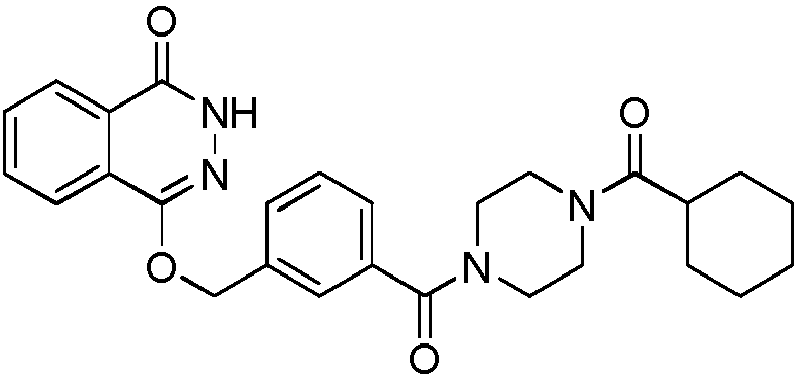
4-(3-(4-(cyclohexanecarbonyl-piperazine-1-carbonyl)benzyloxy)-2H-phthala zin-1-one 5* 
4-(3-(4-(cyclopentanecarbonyl-piperazine-1-carbonyl)benzyloxy)-2H-phthal azin-1-one 6* 
4-(3-(4-acetylpiperazine-1-carbonyl)benzyloxy)-2H-phthalazin-1-one 7* 
4-(3-(4-(cyclopropanecarbonyl-piperazine-1-carbonyl)phenoxy)-2H-phthalaz in-1-one 8* 
4-(3-(4-propionylpiperazine-1-carbonyl)phenoxy)-2H-phthalazin-1-one 9* 
4-(3-(4-benzoylpiperazine-1-carbonyl)phenoxy)-2H-phthalazin-1-one 10* 
4-(3-(4-(cyclohexanecarbonyl-piperazine-1-carbonyl)phenoxy)-2H-phthalazi n-1-one 11* 
4-(3-(4-(cyclopentanecarbonyl-piperazine-1-carbonyl)phenoxy)-2H-phthalaz in-1-one 12* 
4-(3-(4-acetylpiperazine-1-carbonyl)phenoxy)-2H-phthalazin-1-one 13* 
4-(3-(4-(1-benzyloxycarbonyl-piperidine)carbonylpiperazine-1-carbonyl)phe noxy)-2H-phthalazin-1-one 14* 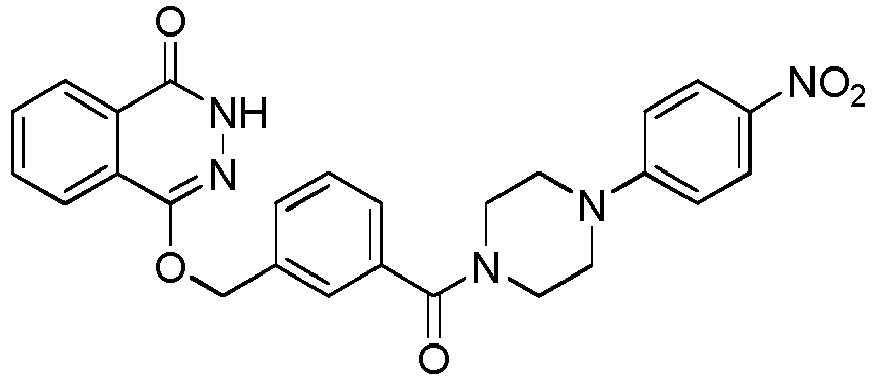
4-(3-(4-paranitrophenylpiperazine-1-carbonyl)benzyloxy)-2H-phthalazin-1-o ne 15* 
4-(3-(4-paranitrobenzoylpiperazine-1-carbonyl)benzyloxy)-2H-phthalazin-1-one 16* 
4-(3-(4-benzyl-1,4-diazacycloheptane-1-carbonyl)benzyloxy)-2H-phthalazin -1-one 17* 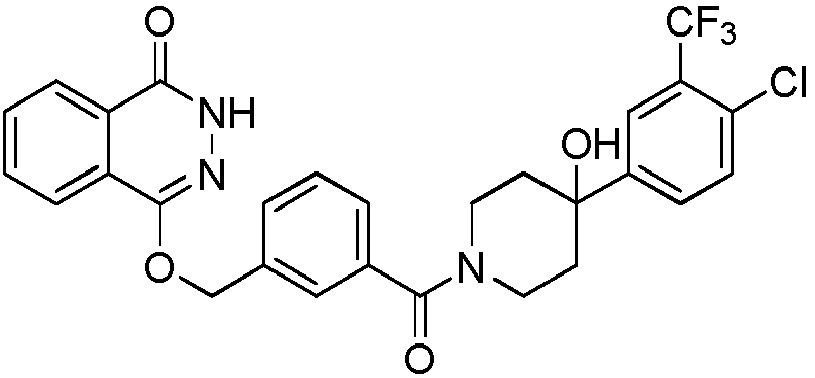
4-(3-(4-(4-chloro-3-trifluoromethyl-phenyl)-4-hydroxypiperidine-1-carbonyl )benzyloxy)-2H-phthalazin- 1 -one 18* 
4-(3-(4-(4-fluorophenyl)-1,2,3,6-tetrahydropyridine-1-carbonyl)benzyloxy-2 H-phthalazin-1-one 19* 
4-(3-(4-(pyrimidine-2-yl) piperazine-1-carbonyl)benzyloxy)-2H-phthalazin-1-one 20* 
4-(3-(4-tertbutoxycarbonyl-1,4-diazacycloheptane-1-carbonyl)benzyloxy)-2 H-phthalazin-1-one 21* 
4-(3-(4-(3-chloro-phenyl)-4-hydroxypiperidine-1-carbonyl)benzyloxy)-2H-p hthalazin-1-one 22* 
4-(3-(4-(4-chloro-phenyl)-4-hydroxypiperidine-1-carbonyl)benzyloxy)-2H-p hthalazin-1-one 23* 
4-(3-(4-phenylpiperazine-1-carbonyl)benzyloxy)-2H-phthalazin-1-one 24* 
4-(3-(4-phenyl-1,2,3,6-tetrahydropyridine-1-carbonyl) benzyloxy)-2H-phthalazin-1-one 25* 
4-(3-(4-(4-fluoro-phenyl)-1,2,3,6-tetrahydropyridine-1-carbonyl)phenoxy)-2 H-phthalazin-1-one 26* 
4-(3-(4-isonicotinoylpiperazine-1-carbonyl)phenoxy)-2H-phthalazin-1-one 27* 
4-(3-(4-(4-fluorobenzoyl) piperazine-1-carbonyl)phenoxy)-2H-phthalazin-1-one 28* 
5-fluoro-4-(3-(4-(4-nitrobenzoyl)piperazine-1-carbonyl)benzyloxy)-2H-phth alazin-1-one 29* 
5-fluoro-4-(3-(4-(1-benzyloxycarbonyl-piperidine)carbonylpiperazine-1-carb onyl)phenoxy)-2H-phthalazin-1-one 30 
4-(2-fluoro-(4-(1-benzyloxycarbonyl-piperidine)carbonylpiperazine-1-carbo nyl)phenoxy)-2H-phthalazin-1-one 31 
4-(4-fluoro-3-(4-(4-nitrobenzoyl)piperazine-1-carbonyl)phenoxy)-2H-phthal azin-1-one 32 
4-(4-fluoro-3-(4-(5-methylisoxazole-4-carbonyl)piperazine-1-carbonyl)phen oxy-2H-phthalazin-1-one 33 
4-(2-fluoro-5-(4-oxo-3,4-2H-phthalazine-1-yl-oxyl)benzoyl)-N-phenylpipera zine-1-formamide 34 
5-chloro-4-(4-fluoro-3-(4-(4-fluorobenzoyl)piperazine-1-carbonyl)phenoxy)-2H-phthalazin- 1 -one 35 
5-chloro-4-(4-fluoro-3-(4-benzoylpiperazine-1-carbonyl)phenoxy)-2H-phthalazin-1-one 36 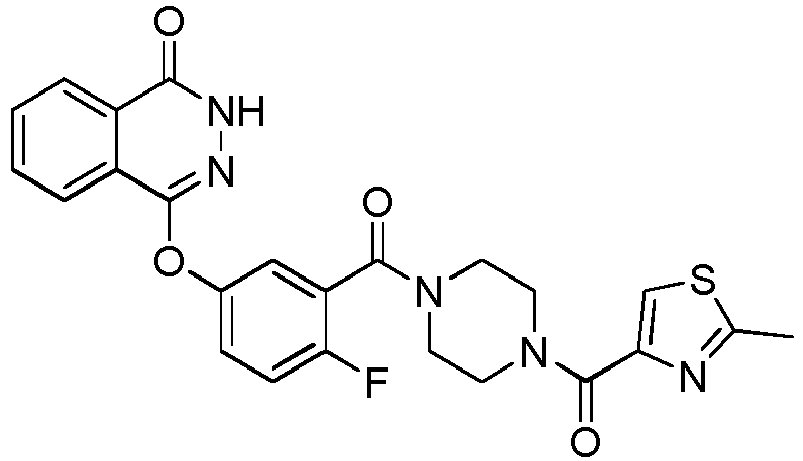
4-(4-fluoro-3-(4-(2-methylthiazole-4-carbonyl)piperazine-1-carbonyl)pheno xy-2H-phthalazin-1-one 37 
4-(4-fluoro-3-(4-(4-fluorophenyl)piperazine-1-carbonyl)phenoxy)-5-nitro-2 H-phthalazin-1-one 38 
4-(4-fluoro-3-(4-(4-fluorobenzoyl)piperazine-1-carbonyl)phenoxy)-5-nitro-2 H-phthalazin-1-one 39 
4-(4-fluoro-3-(4-benzoylpiperazine-1-carbonyl)phenoxy)-5-nitro-2H-phthala zin-1-one 40 
8-nitro-4-(2-fluoro-(4-(1-benzyloxycarbonyl-piperidine)carbonylpiperazine-1-carbonyl)phenoxy)-2H-phthalazin-1-one 41 
4-(4-fluoro-3-(4-(4-nitrobenzoyl)piperazine-1-carbonyl)phenoxy)-5-nitro-2H -phthalazin- 1 -one 42 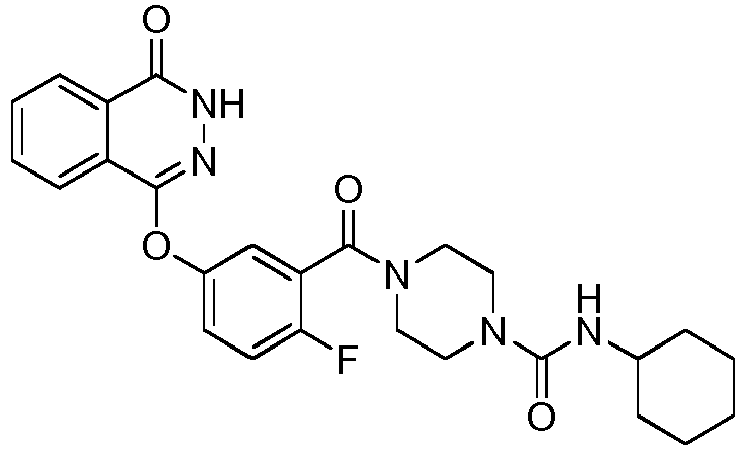
N-cyclohexyl-4-(2-fluoro-5-(4-oxo-3,4-2H-phthalazine-1-yl-oxyl)benzoyl)pi perazine-1-formamide 43 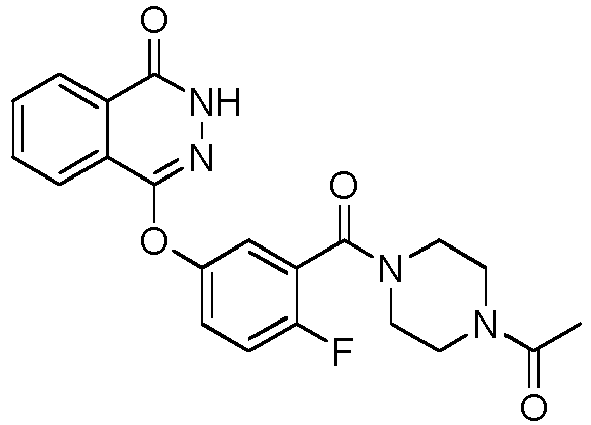
4-(3-(4-acetylpiperazine-1-carbonyl)-4-fluorophenoxy)-2H-phthalazin-1-one 44 
4-(4-fluoro-3-(4-(thiazole-4-carbonyl)piperazine-1-carbonyl)phenoxy)-2H-p hthalazin-1-one 45 
4-(2-fluoro-(4-(2-benzyloxycarbonyl-piperidine)carbonylpiperazine-1-carbo nyl)phenoxy)-2H-phthalazin-1-one 46 
4-(2-fluoro-(4-(3-benzyloxycarbonyl-piperidine)carbonylpiperazine-1-carbo nyl)phenoxy)-2H-phthalazin-1-one 47 
4-(4-fluoro-3-(4-(4-oxocyclohexanecarbonyl)piperazine-1-carbonyl)phenoxy )-2H-phthalazin- 1 -one 48 
4-(4-fluoro-3-(4-(4-cyanobenzoyl)piperazine-1-carbonyl)phenoxy)-2H-phtha lazin-1-one 49 
(R)-4-(4-fluoro-3-(4-(2-phenylpropionyl)piperazine-1-carbonyl)phenoxy)-2 H-phthalazin-1-one 50 
4-(3-(4-(cyclopropanecarbonyl)piperazine-1-carbonyl)-4-fluorophenoxy)-2H -phthalazin- 1 -one 51 
1-(4-(2-fluoro-5-(4-oxo-3-1,4-dihydronaphthyridin-1-yl-oxyl)benzoyl)pipera zine-1-yl)propane-1,2-phthalazinedione 52 
4-(4-fluoro-3-(4-(5-methylisoxazole-3-carbonyl)piperazine-1-carbonyl)phen oxy)-2H-phthalazin- 1 -one 53 
4-(4-fluoro-3-(4-(2,2,2-trifluoroacetyl)piperazine-1-carbonyl)phenoxy)-2H-p hthalazin-1-one 54 
4-(4-fluoro-3-(4-(3,3,3-trifluoropropionyl)piperazine-1-carbonyl)phenoxy)-2H-phthalazin-1-one 55 
4-(4-fluoro-3-(4-pivaloylpiperazine-1-carbonyl)phenoxy)-2H-phthalazin-1-o ne 56 
4-(4-fluoro-3-(4-(2-methoxyacetyl)piperazine-1-carbonyl)phenoxy-2H-phth alazin-1-one 57 
4-(4-fluoro-3-(4-(2-cyanobenzoyl)piperazine-1-carbonyl)phenoxy)-2H-phtha lazin-1-one 58 
4-(2-fluoro-5-(4-oxo-3,4-2H-phthalazin-1-yl-oxyl)benzoyl)-N-isopropyl-1-fo rmamide 59 
4-(3-(4-(2-ethoxyacetyl)piperazine-1-carbonyl)-4-fluorophenoxy)-2H-phthal azin-1-one 60 
4-(4-fluoro-3-(4-isonicotinoylpiperazine-1-carbonyl)phenoxy)-2H-phthalazi n-1-one 61 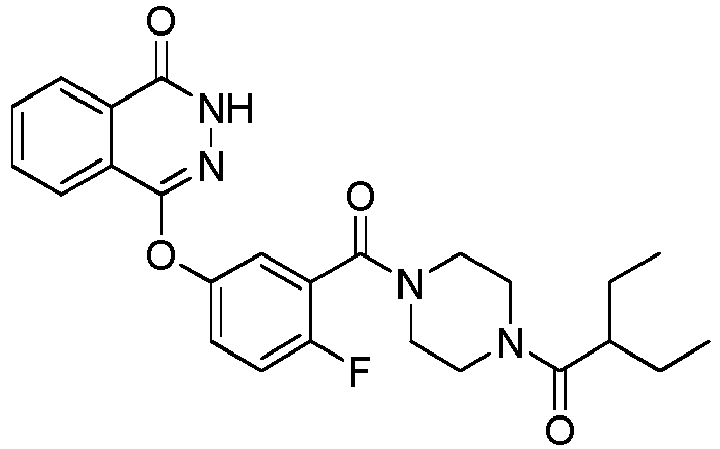
4-(3-(4-(2-ethylbutyryl)piperazine-1-carbonyl)-4-fluorophenoxy)-2H-phthala zin-1-one 62 
4-(4-fluoro-3-(4-(4,4-difluoropiperidine-1-carbonyl)piperazine-1-carbonyl)p henoxy)-2H-phthalazin-1-one 63 
4-(4-fluoro-3-(4-(thiophene-2-carbonyl)piperazine-1-carbonyl)phenoxy)-2H-phthalazin-1-one 64 
4-(4-fluoro-3-(4-(3-hydroxypropyl)piperazine-1-carbonyl)phenoxy)-2H-phth alazin-1-one 65* 
1-(2-fluoro-5-(4-oxo-3,4-2H-phthalazine-1-yl-oxyl)benzoyl)piperidine-4-for monitrile 66 
4-(4-fluoro-3-(4-isobutyrylpiperazine-1-carbonyl)phenoxy)-2H-phthalazin-1 -one 67 
4-(2-fluoro-5-(4-oxo-3,4-2H-phthalazin-1-yl-oxyl)benzoyl)-N,N-dimethylpip erazine-1-formamide 68 
4-(4-fluoro-3-(4-(3-trifluoromethyl-4-methyl-benzoyl)piperazine-1-carbonyl )phenoxy)-2H-phthalazin-1-one 69 
4-(3-(4-acryloylpiperazine-1-carbonyl)-4-fluorophenoxy)-2H-phthalazin-1-o ne 70 
4-(4-fluoro-3-(4-(2-hydroxypropionyl)piperazine-1-carbonyl)phenoxy)-2H-p hthalazin-1-one 71 
4-(3-(4-(4,4-difluoropiperidine-1-carbonyl)piperidine-1-carbonyl)-4-fluorophenoxy)-2H-phthalazin-1-one 72* 
4-(4-fluoro-3-(4-(piperidine-1-carbonyl)piperidine-1-carbonyl)phenoxy)-2H-phthalazin-1-one 73* 
1-(2-fluoro-5-(4-oxo-3,4-2H-phthalazin-1-yl-oxyl)benzoyl)-N-phenylpiperid ine-4-formamide 74* 
N-ethyl-1-(2-fluoro-5-(4-oxo-1,4-dihydro-phthalazin-1-yl-oxyl)benzoyl)pipe ridine-4-formamide 75 
4-(3-(4-(4-(dimethylamino)benzoyl)piperazine-1-carbonyl)-4-fluorophenoxy)-2H-phthalazin- 1 -one 76 
4-(3-(4-(3-(dimethylamino)benzoyl)piperazine-1-carbonyl)-4-fluorophenoxy )-2H-phthalazin-1-one 77 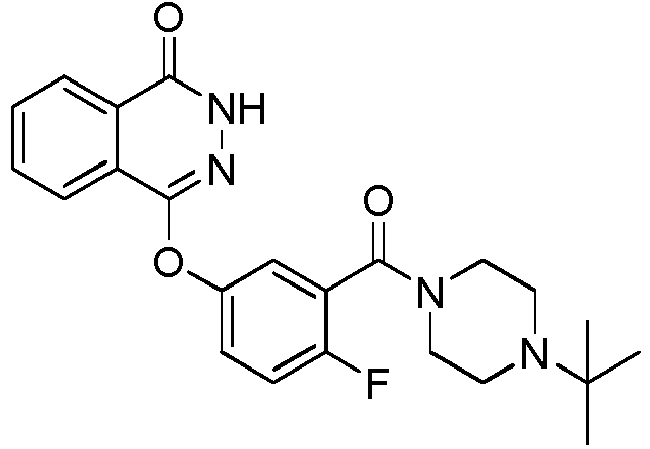
4-(3-(4-tertbutylpiperazine-1-carbonyl)-4-fluorophenoxy)-2H-phthalazin-1-o ne 78 
4-(4-fluoro-3-(4-(furan-2-carbonyl)piperazine-1-carbonyl)phenoxy)-2H-phth alazin-1-one 79 
4-(4-fluoro-3-(4-isopropylpiperazine-1-carbonyl)phenoxy)-2H-phthalazin-1-one 80 
4-(3-(4-allylpiperazine-1-carbonyl)-4-fluorophenoxy)-2H-phthalazin-1-one 81 
4-(3-(4-3-cyanobenzoylpiperazine-1-carbonyl)-4-fluorophenoxy)-2H-phthala zin-1-one 82 
4-(3-(4-(1H-pyrazole-1-carbonyl)piperazine-1-carbonyl)-4-fluorophenoxy)-2 H-phthalazin-1-one 83 
4-(4-fluoro-3-(4-(morpholine-4-carbonyl)piperazine-1-carbonyl)phenoxy)-2 H-phthalazin-1-one 84 
4-(4-fluoro-3-(4-(pyrrolidine-1-carbonyl)piperazine-1-carbonyl)phenoxy)-2 H-phthalazin-1-one 85 
4-(4-fluoro-3-(4-(piperidine-1-carbonyl)piperazine-1-carbonyl)phenoxy)-2H -phthalazin-1-one 86* 
4-(3-(4-oxo-3,4-dihydro-phthalazine-1-yl-oxyl)benzoyl)-N-(3-(trifluorometh yl)phenyl)piperazine-1-formamide 87 
4-(4-fluoro-3-(4-(3-nitrobenzoyl)piperazine-1-carbonyl)phenoxy)-2H-phthal azin-1-one 88 
4-(4-fluoro-3-(4-(2-nitrobenzoyl)piperazine-1-carbonyl)phenoxy)-2H-phthal azin-1-one 89 
(E)-4-(3-(4-but-2-enoylpiperazine-1-carbonyl)-4-fluorophenoxy-)2H-phthala zin-1-one 90 
4-(4-fluoro-3-(4-methylpiperazine-1-carbonyl)phenoxy)-2H-phthalazin-1-on e 91 
4-(4-fluoro-3-(4-(oxazole-4-carbonyl)piperazine-1-carbonyl)phenoxy)2H-ph thalazin-1-one 92 
4-(4-fluoro-3-(4-(2-hydroxyethyl)piperazine-1-carbonyl)phenoxy)2H-phthal azin-1-one 93 
4-(3-(4-(1H-1,2,4-triazole-1-carbonyl)piperazine-1-carbonyl)-4-fluoropheno xy)2H-phthalazin-1-one 94 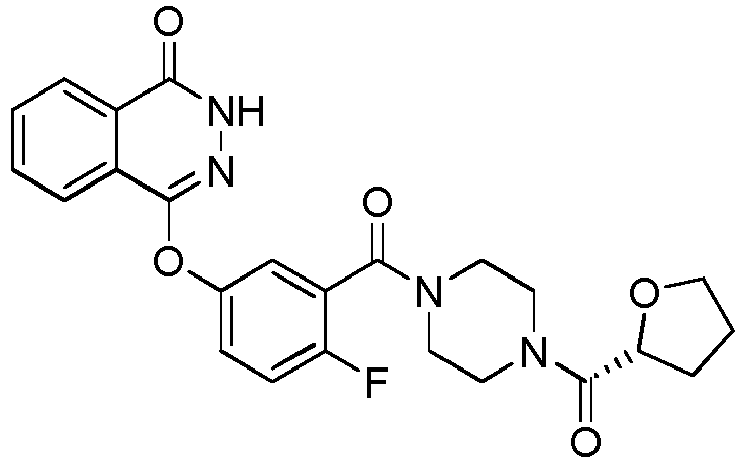
(R)-4-(4-fluoro-3-(4-(tetrahydrofuran-2-carbonyl)piperazine-1-carbonyl)phe noxy)2H-phthalazin-1-one 95 
4-(4-fluoro-3-(4-(tetrahydrofuran-2-carbonyl)piperazine-1-carbonyl)phenoxy )2H-phthalazin-1-one 96 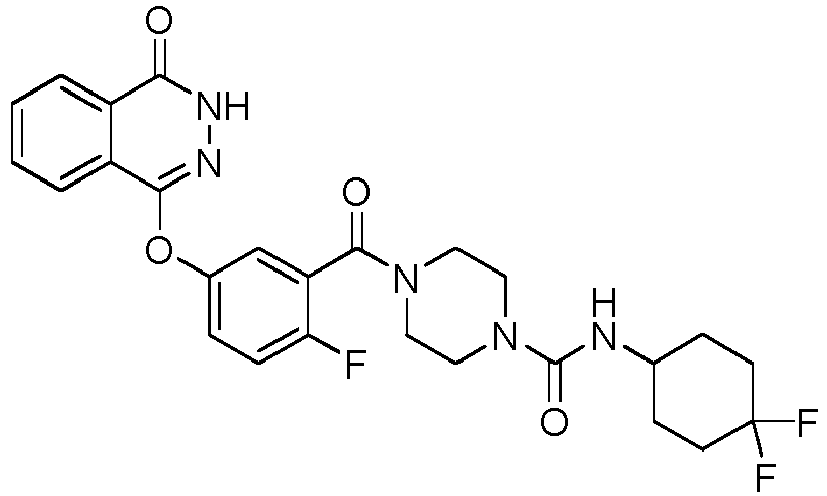
N-(4,4-difluorocyclohexyl)-4-(2-fluoro-5-(4-oxo-3,4-dihydro-phthalazin-1-y l-oxyl)benzoyl)piperazine-1-formamide 97 
N-cyclopropyl-4-(2-fluoro-5-(4-oxo-3,4-dihydro-phthalazine-1-yl-oxyl)benz oyl)piperazine-1-formamide 98 
4-(3-(4-(1H-imidazole-1-carbonyl)piperazine-1-carbonyl)-4-fluorophenoxy) 2H-phthalazin-1-one 99 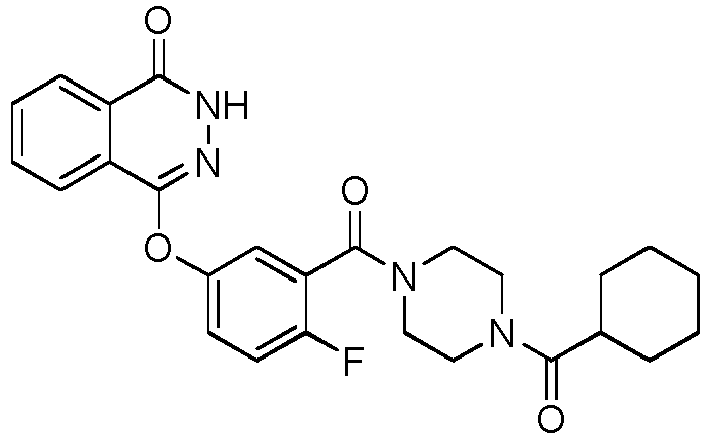
4-(3-(4-(cyclohexanecarbonyl)piperazine-1-carbonyl-4-fluorophenoxy)2H-p hthalazin-1-one 100 
4-(4-fluoro-3-(4-propionylpiperazine-1-carbonyl)phenoxy)2H-phthalazin-1-one 101 
4-(3-(4-(cyclopentylcarbonyl)piperazine-1-carbonyl)-4-fluorophenoxy)2H-p hthalazin-1-one 102 
8-chloro-4-(2-fluoro-(4-(4-benzyloxycarbonyl-piperidine)carbonylpiperazine -1-carbonyl)phenoxy-2H-phthalazin-1-one 103 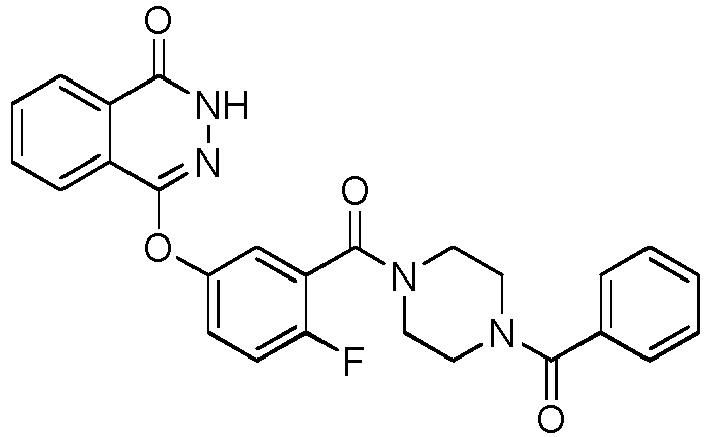
4-(3-(4-benzoylpiperazine-1-carbonyl)-4-fluorophenoxy)2H-phthalazin-1-on e 104 
5-chloro-4-(4-fluoro-3-(4-(4-fluorophenyl)piperazine-1-carbonyl)phenoxy)2 H-phthalazin-1-one 105 
1 -benzyloxycarbonyl-4-(4-(3-((7-fluoro-4-oxo-3-1,4-dihydro-phthalazine-1-yl-oxyl)methyl)benzoyl)piperazine-1-carbonyl)piperidine 106 
5-chloro-4-(4-fluoro-3-(4-(4-nitrobenzoyl)piperazine-1-carbonyl)phenoxy)2 H-phthalazin-1-one 107 
4-(3-(4-(4,4-difluorocyclohexanecarbonyl)piperazine-1-carbonyl)-4-fluoroph enoxy)2H-phthalazin-1-one 108 
1-benzyloxycarbonyl-2-(4-(2-fluoro-5-(4-oxo-3,4-dihydronaphthyridin-1-yl-oxyl)benzoyl)piperazine-1-carbonyl)pyrrolidine 109 
4-(4-fluoro-3-(4-(pyrrolidine-2-carbonyl)piperazine-1-carbonyl)phenoxy)2H -phthalazin-1-one 110 
4-(4-fluoro-3-(4-(4-fluorophenyl)piperazine-1-carbonyl)phenoxy)2H-phthala zin-1-one 111 
4-(4-fluoro-3-(4-(tetrahydrofuran-3-carbonyl)piperazine-1-carbonyl)phenoxy )2H-phthalazin-1-one 112 
N-(4-chlorophenyl)-4-(2-fluoro-5-(4-oxo-3,4-dihydronaphthyridin-1-yl-oxyl) benzoyl)piperazine-1-formamide 113 
N,N-diethyl-4-(2-fluoro-5-(4-oxo-3,4-dihydro-phthalazine-1-yl-oxyl)benzoyl )piperazine-1-formamide 114 
4-(4-fluoro-3-(4-(tetrahydropyran-4-carbonyl)piperazine-1-carbonyl)phenox y)2H-phthalazin-1-one 115 
4-(4-fluoro-3-(4-(4-(trifluoromethyl)benzoyl)piperazine-1-carbonyl)phenoxy )2H-phthalazin-1-one 116 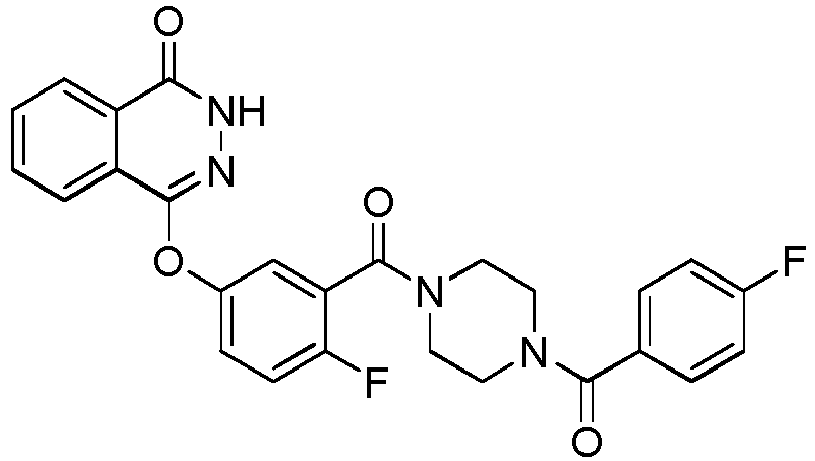
4-(4-fluoro-3-(4-(4-fluorobenzoyl)piperazine-1-carbonyl)phenoxy)2H-phthal azin-1-one 117 
4-(4-fluoro-3-(4-(4-fluorobenzyl)piperazine-1-carbonyl)phenoxy)-2H-phthal azin-1-one 118 
4-(4-fluoro-3-(piperazine-1-carbonyl)phenoxy)2H-phthalazin-1-one 119 
4-(4-fluoro-3-(4-pyridineformylpiperazine-1-carbonyl)phenoxy)2H-phthalaz in-1-one 120 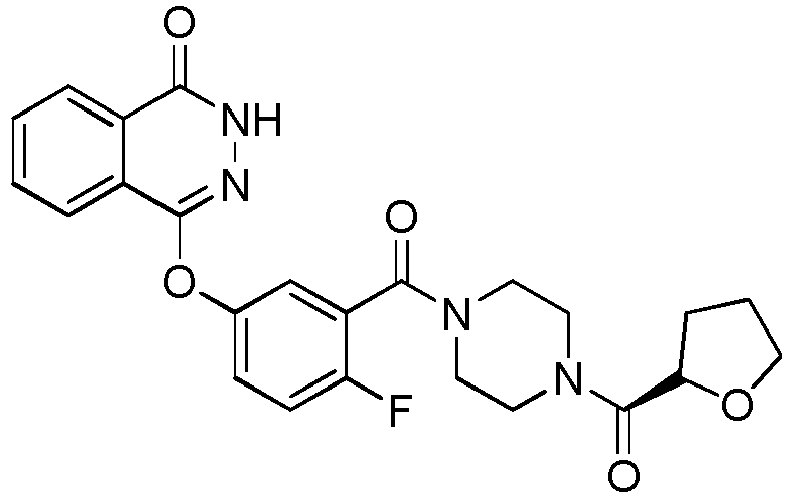
(S)-4-(4-fluoro-3-(4-(tetrahydrofuran-2-carbonyl)piperazine-1-carbonyl)phen oxy)2H-phthalazin-1-one 121 
4-(3-(4-(2-cyclopropylacetyl)piperazine-1-carbonyl)-4-fluorophenoxy)2H-ph thalazin-1-one 122 
4-(3-(4-(2-cyclopentylacetyl)piperazine-1-carbonyl)-4-fluorophenoxy)2H-ph thalazin-1-one 123 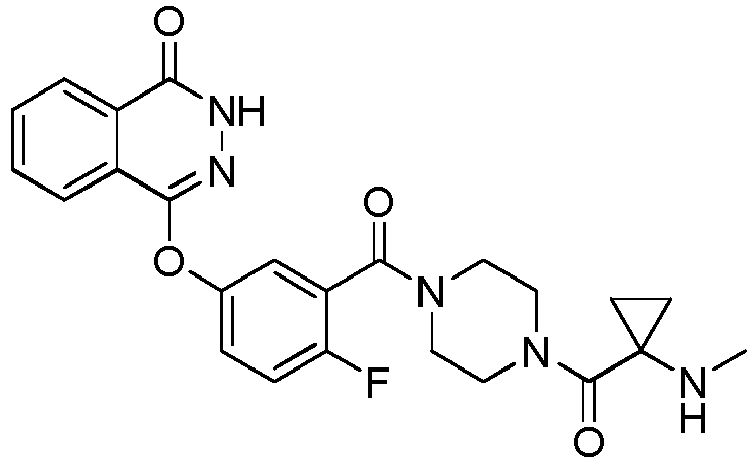
4-(4-fluoro-3-(4-(1-(methylamino)cyclopropanecarbonyl)piperazine-1-carbo nyl)phenoxy)2H-phthalazin-1-one 124 
4-(3-(4-(1-(dimethylamino)cyclopropanecarbonyl)piperazine-1-carbonyl)-4-f luorophenoxy)2H-phthalazin-1-one 125 
4-(3-(4-(1-aminocyclopropanecarbonyl)piperazine-1-carbonyl)-4-fluorophen oxy)2H-phthalazin- 1 -one 126 
4-(3-(4-(1-(dimethylamino)cyclobutanecarbonyl)piperazine-1-carbonyl)-4-fl uorophenoxy)2H-phthalazin-1-one 127 
4-(4-fluoro-3-(4-(1-(methylamino)cyclobutanecarbonyl)piperazine-1-carbon yl)phenoxy)2H-phthalazin-1-one 128 
4-(3-(4-(1-aminocyclobutanecarbonyl)piperazine-1-carbonyl)-4-fluoropheno xy)2H-phthalazin-1-one 129 
(R)-4-(3-(4-(1,2-dimethylpyrrolidine-2-carbonyl)piperazine-1-carbonyl)-4-fl uorophenoxy)2H-phthalazin-1-one 130 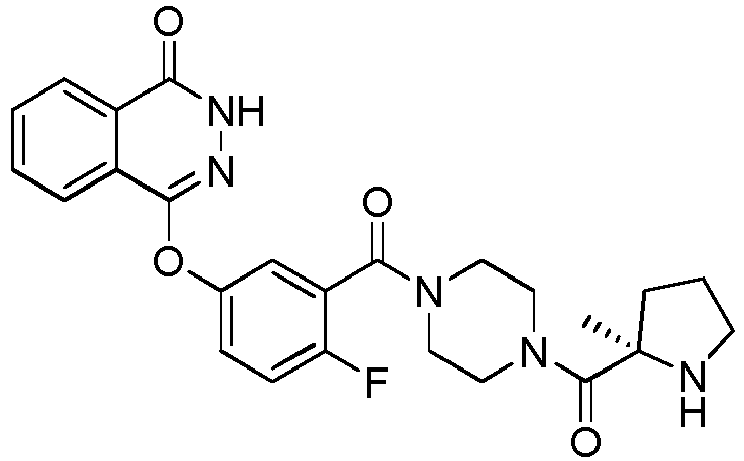
(R)-4-(4-fluoro-3-(4-(2-methylpyrrolidine-2-carbonyl)piperazine-1-carbonyl) phenoxy)-2H-phthalazin-1-one - The present invention further provides a pharmaceutical composition comprising an effective amount of the aforementioned compounds, pharmaceutically acceptable salts, hydrates, solvates or stereoisomers thereof, and pharmaceutically acceptable carriers. The pharmaceutically acceptable carriers are conventional medicinal carriers in the art and are not discussed herein.
- The above-listed compounds, pharmaceutically acceptable salts, hydrates, solvates and stereoisomers and the pharmaceutical compositions thereof can be used as drugs for treating diseases mediated by PARP, including cancers, neurodegenerative diseases, cardiovascular diseases, diabetes and inflammation.
- Therefore, the present invention also provides use of the compounds, pharmaceutically acceptable salts, hydrates, solvates or stereoisomers thereof in the manufacture of medicaments for treating diseases mediated by PARP. The diseases mediated by PARP are selected from cancers, neurodegenerative diseases, cardiovascular diseases, diabetes and inflammation.
- In particular, the cancers are histiocytic lymphoma, non-small cell lung cancer, small-cell lung cancer, lung adenocarcinoma, lung squamous carcinoma, pancreatic cancer, breast cancer, prostate cancer, liver cancer, gastric cancer, colon cancer, colorectal cancer, ovarian cancer, cervical cancer, brain cancer, esophageal cancer, bone cancer, testicular cancer, melanoma, skin cancer, epithelial cell cancer, prostate cancer, nasopharyngeal cancer, oral cancer, leukemia, and any one of brain tumor, reproductive system tumor, lymphatic system tumor, digestive system tumor, respiratory system tumor and skin tumor.
- The compounds and compositions thereof in the present invention can be used in the prevention or treatment of the onset or development of any of the PARP activity associated diseases or conditions in mammals especially in human. These symptoms comprise traumatic injuries to the central nervous system, e.g. brain damage, and neurodegenerations associated with the traumatic injuries to the central nervous system. The associated symptoms and diseases that can be treated by the methods of the present invention comprise vessel stroke, cardiac ischemia, cerebral ischemia, cerebral vascular disorders such as multiple sclerosis, and neurodegenerative diseases such as Alzheimer's disease, Huntington's disease and Parkinson's disease.
- The compounds of the present invention may be used in the treatment or prevention of tissue damages caused by cell damage or death that are induced by necrosis or apoptosis, and in alleviating nervous or cardiovascular tissue damage, comprising subsequent ischemia, myocardial infarction and reperfusion injury. It may be also used in the treatment or prevention of other cardiovascular diseases, such as angina and cardiovascular ischemia.
- Other PARP associated symptoms or diseases that can be treated with the compounds of the present invention comprise inflammation, e.g. pleurisy and colitis, endotoxic shock, diabetes, arthritis, cardiac ischemia, retinal ischemia, skin aging, chronic and acute pain, hemorrhagic shock, etc. For example, after a stroke symptom, the patient is treated with one or more compounds of the present invention to prevent the brain from damage or minimize the damage.
- The invention also provides compounds for use in methods for treating the aforementioned diseases mediated by PARP, comprising steps of administrating to a patient an effective amount of the compound, pharmaceutically acceptable salt, hydrate, solvate or stereoisomer thereof of the present invention.
- The compounds of the present invention can be administrated in pure form, in a combination with other active ingredients or a combination with pharmaceutically acceptable non-toxic excipients or carriers. Oral compositions generally comprise inert diluent carriers or edible carriers. Pharmaceutically compatible adhesives and/or adjuvants may be used as a part of the compositions. Tablets, pills, capsules and troches may contain any of the following components or compounds with similar properties: adhesives such as microcrystalline cellulose, tragacanth and gelatin; excipients such as starch or lactose; dispersants such as alginic acid, Primogel or corn starch; lubricants such as magnesium stearate; flow aid such as colloidal silica; sweeteners such as sucrose and saccharin; or flavoring agents such as mint oil, methyl salicylate or orange flavor. When the unit dosage form is a capsule, in addition to the above types of substances, the compositions may further comprise liquid carriers such as fatty oil. Besides, the unit dosage form may contain other substances of various physical forms that improve the dosage unit, such as sugar-coating, shellacs or intestinal solvents. Further, in addition to the active compounds, syrup can contain sucrose as sweetener and certain preservative, dye, pigment and spice.
- The selective preparations for administration comprise sterile water or non-aqueous solutions, suspensions and emulsions. Examples of non-aqueous solvents are dimethyl sulfoxide, alcohol, propylene glycol, polyethylene glycol, vegetable oils such as olive oil and injectable organic esters such as ethyl oleate. Aqueous carriers comprise a mixture of alcohol and water, buffering medium and saline. Intravenous carriers comprise fluid and nutritional supplements, electrolyte supplements, such as the carriers based on ringer dextrose. Preservatives and other additives may also exist, such as antibacterials, antioxidants, chelating agents and inert gas.
- The compounds of the present invention may also be used as forms of pharmaceutically acceptable salts, hydrates, solvates or metabolites. The pharmaceutically acceptable salts comprise alkali salts of inorganic and organic acids, the acids comprise but not limit to hydrochloric acid, hydrobromic acid, sulfuric acid, phosphoric acid, methanesulfonic acid, ethylsulfonic acid, malic acid, acetic acid, oxalic acid, tartaric acid, citric acid, lactic acid, fumaric acid, succinic acid, maleic acid, salicylic acid, benzoic acid, phenylacetic acid, mandelic acid. When the compounds of the present invention comprise acidic functional groups such as carboxyl, the suitable pharmaceutically acceptable carboxylic cations are well-known for a person skilled in the art, including alkali, alkaline earth, ammonium, quaternary ammonium cations.
-
Figure 1 is a result in Test Example 3 that shows the relationship between the peak area of compound AZD-2281 (as a standard) measured by HPLC and the concentration of the compound. - The followings further explain the general methods of the present invention. The compounds of the present invention may be prepared by the methods known in the art. The following illustrate the detailed preparation methods of the preferred compounds of the present invention. However, they are by no means limiting the preparation methods of the compounds of the present application.


- Phthalic anhydride (1a) was reacted with hydrazine hydrate in the presence of glacial acetic acid to give phthalhydrazide (1b), which was then reacted with ethyl 3-chloromethylbenzoate (1c) in the presence of sodium hydride to give ethyl 3-((4-oxo-3-1,4-dihydro-phthalazin-1-yl-oxyl) methyl) benzoate (1d), after that, Id was hydrolyzed into 3-((4-oxo-3,4-dihydrophthalazin-1-yl-oxy)methyl) benzoic acid (1e) under alkali condition, 1e finally condensated with R' substituted nitrogen heterocycles, e.g. piperazine, piperidine, 4-hydroxypiperidine, tetrahydropyridine and 1,4-diazacycloheptane (homopiperazine) in the presence of 1-(3-dimethylaminopropyl)-3-ethylcarbodiimide hydrochloride (EDCI), triethylamine, 1-hydroxy-7-azabenzotriazole (HOAt) to generate target compounds, wherein the definition of R' is as described above.


- Under the action of phosphorus oxychloride, phthalhydrazide (1b) generated 1,4-dichlorophthalazine (2a), which was then reacted with 3-hydroxy-ethyl benzoate (2b) to give the crude product of 3-(4-chloronaphthyridine-1-yl-oxyl) ethyl benzoate (2c). Sodium acetate was added to the crude product in glacial acetic acid to generate ethyl 3-((4-oxo-3,4-dihydrophthalazin-1-yl)oxy) benzoate (2d), which was then hydrolyzed under alkali condition into intermediate 3-(4-oxo-3,4-dihydro-phthalazin-1- yl-oxyl) benzoic acid (2e), which finally condensated with R' substituted nitrogen heterocycles, e.g. piperazine, piperidine, 4-hydroxypiperidine, tetrahydropyridine and 1,4-diazacycloheptane in the presence of 1-(3-dimethylaminopropyl)-3-ethylcarbodiimide hydrochloride (EDCI), triethylamine and 1-hydroxy-7-azabenzotriazole (HOAt) to generate target compounds, wherein the definition of R' is as described above.


- In the presence of hydrazine hydrate/glacial acetic acid, phthalic anhydride (3a) with substituent R was transformed into R-substituted phthalhydrazide (3b), which subsequently generated substituted dichlorophthalazine compounds (3c) under the action of phosphorus pentachloride. In another aspect, under the action of hydrobromic acid, 2-fluoro-5-methoxybenzonitrile (3d) was converted to 2-fluoro-5-hydroxybenzoic acid (3e), which was esterificated with methanol to give methyl 2-fluoro-5-hydroxybenzoate (3f). Under the action of sodium hydride, the prepared dichlorophthalazine compounds with substituent R (3c) was reacted with methyl 2-fluoro-5-hydroxybenzoate (3f) to give methyl 5-((4-chloronaphthyridine-1-yl)oxy)-2-fluorobenzoate with substituent R (3g), 3g was transformed into methyl 2-fluoro-5-((4-oxo-3,4-dihydro-phthalazin-1-yl)oxy)benzoate (3h)in the presence of AcOH/NaOAc under the reflux condition, 3h was then hydrolyzed under alkali condition into substituent-contained 2-fluoro-5-(4-oxo-3,4-dihydro-phthalazin-1-yl-oxyl) benzoic acid (3i), which finally condensated with R' substituted nitrogen heterocycles, e.g. piperazine, piperidine, 4-hydroxypiperidine, tetrahydropyridine and 1,4-diazacycloheptane in the presence of 1-(3-dimethylaminopropyl)-3-ethylcarbodiimide hydrochloride (EDCI), triethylamine and 1-hydroxy-7-azabenzotriazole (HOAt) to generate target compounds, wherein the definition of R and R' is as described above.

- Under the action of sodium hydride, dichlorophthalazine (2a) was reacted with methyl 2-fluoro-5-hydroxybenzoate (3f) to give methyl 5-((4-chloronaphthyridine-1-yl)oxy)-2-fluorobenzoate (4a). 4a was transformed into methyl 2-fluoro-5-((4-oxo-3,4-dihydro-phthalazin-1-yl)oxyl)benzoate (4b) in the presence of AcOH/NaOAc under the reflux condition, 4b was then hydrolyzed under alkali condition into 2-fluoro-5-(4-oxo-3,4-dihydro-phthalazin-1-yl-oxyl) benzoic acid (4c), which finally condensated with R' substituted nitrogen heterocycles, e.g. piperazine, piperidine, 4-hydroxypiperidine, tetrahydropyridine and 1,4-diazacycloheptane in the presence of 1-(3-dimethylaminopropyl)-3-ethylcarbodiimide hydrochloride (EDCI), triethylamine and 1-hydroxy-7-azabenzotriazole (HOAt) to generate target compounds, wherein the definition of R' is as described above.
- The present invention is further explained by the following examples. However, it shall be understood by a person skilled in the art that the present invention is not limited to these specific examples.
- The structures of the compounds in the following examples were characterized by nuclear magnetic resonance (NMR) or/and mass spectrometry (ESI). NMR shift (δ) was given in the unit of 10-6 (ppm). 1H-NMR spectra was recorded in dimethyl sulfoxide-d6 (DMSO-d6 ) or CDCl3 on a Varian Mercury-600 MHz NMR with tetramethylsilane (TMS) as an internal standard.
- ESI-MS measurement was carried out using Finnigan LCQ Deca mass spectrometer.
- High Performance Liquid Chromatography (HPLC) measurement was carried out on Agilent 1200 LC using the Phenomen C18 column (4.6mm*150mm, 0.4µm).
- IC50 values were determined using Envision 2104 microplate reader (Perkin Elmer Inc.).
- Thin layer chromatography was carried out using Yantai Huanghai HSGF254 silica gel plates. The silica gel plates used for thin layer chromatography (TLC) were 0.15mm∼0.2mm. The silica gel plates used for separating and purifying products by TLC were 0.4mm∼0.5mm.
- Purified chromatographic column uses the silica gel as the carrier (300∼400 mesh, producted by Yantai Huanghai co.).
- The known starting materials of the present invention can be synthesized by using or according to the known methods in the art, or can be purchased from Alfa Aesar, Langcaster, TCI, Shanghai Shaoyuan Co. Ltd. and AstaTech (Chengdu) BioPharm. Co., Ltd.
- Unless otherwise specified, the reactions in the examples were all carried out under argon or nitrogen atmosphere. Argon or nitrogen atmosphere refers to that the reaction flask is connected to an argon or nitrogen ballon with a volume of about 1L. Hydrogenation was usually carried out under vacuum, filled with hydrogen, and repeated for three times. Unless otherwise specified, the reaction temperature in the examples was room temperature. Room temperature was the optimized reaction temperature, which was 20°C∼30°C.
- The reaction progress in the examples was monitored by thin layer chromatography (TLC). The eluent systems used for the reactions include: A: dichloromethane-methanol system, B: n-hexane-ethyl acetate system, C: petroleum ether- ethyl acetate system. The volume ratios of the solvents were adjusted according to the different polarities of compounds.
- The elution system of column chromatography used for purifying compounds and eluent system of TLC include A: dichloromethane-methanol system, B: n-hexane-ethyl acetate system, C: petroleum ether- ethyl acetate system. The volume ratios of the solvents were adjusted according to the different polarities of compounds. A small amount of alkaline or acidic agents such as triethylamine and acetic acid can be added for adjustment.
-

- 2-Fluoro-5-methoxybenzonitrile (3d, purchased from Alfa Aesar) (5g, 33 mmol) was dissolved in hydrobromic acid (50 mL) and glacial acetic acid (30 mL), refluxed for 28 hours at 140°C, and then the reaction mixture was diluted with 100 mL ethyl acetate. The reaction mixture was then washed with 50 mL water and saturated sodium chloride solution successively for three times. The organic layers were combined and concentrated to give a crude product of 2-fluoro-5-hydroxybenzoic acid (3e), 2.88 g white solid (yield 56%). 1H NMR (600 MHz, DMSO-d6 ) δ 7.19-7.17 (m, 1H), 7.08-7.04 (m, 1H), 6.95-6.92 (m, 1H); ESI-MS m/z: calculated for 156.02, found 154.91 [M-H]+.
- The obtained 2-fluoro-5-hydroxybenzoic acid (3e) (780 mg, 5 mmol) was dissolved in 100 mL methanol. Thionyl chloride (0.8 mL, 10 mmol) was added dropwise under the condition of ice bath (0°C) and stirring, and then refluxed for two hours. The reaction solution was concentrated, and then column chromatography (petroleum ether : ethyl acetate = 2:1) was performed to isolate methyl 2-fluoro-5-hydroxybenzoate (3f), 833 mg white solid (yield 98%). 1H NMR (600 MHz, DMSO-d6 ) δ 9.73 (s, 1H), 7.20-7.18 (m, 1H), 7.13-7.09 (m, 1H), 6.99- 6.97 (m, 1H), 3.80 (s, 3H); ESI-MS m/z: calculated for 170.04, found 171.25 [M+H]+.
-

- Phthalic anhydride (1a, purchased from Shanghai Shaoyuan Co. Ltd.) (10g, 67.6 mmol) was dissolved in glacial acetic acid (100 mL), hydrazine hydrate (20 mL) was added dropwise under the condition of ice bath (0°C) and stirring, and then refluxed for two hours at 125°C. The reaction was monitored by TLC. The solution was cooled to room temperature, filtrated and washed with water until the pH of the filtrate was 6.0, and then dried to give phthalhydrazide (1b), 10.5g white solid (yield 96%). ESI-MS m/z calculated for: 162.04, found: 173.15 [M+H]+.
- Phthalhydrazide (1b) (10g, 61.7 mmol) was dissolved in dried N, N-dimethylformamide (100 mL) in a round-bottom flask. Sodium hydride (1.63g, 67.9 mmol) was added at 0°C, and then stirred for half an hour. Ethyl 3-chloromethylbenzoate (1c, purchased from Shanghai Shaoyuan Co. Ltd.) (13.49g, 67.9 mmol) dissolved in N,N-dimethylformamide (20 mL) solution was added slowly dropwise at room temperature and reacted for 24 hours, and then ethyl acetate was added. The reaction solution was successively washed with 50 mL saturated sodium bicarbonate and saturated sodium chloride solution for three times, the organic layer was dried and concentrated. Column chromatography was performed for the crude product (petroleum ether : ethyl acetate = 10:1) to give ethyl 3-(((4-oxo-3-1,4-dihydrophthalazin -1-yl)oxy)methyl)benzoate (1d), 6 g white solid (yield 30%). 1H NMR (600 MHz, DMSO-d6 ): δ 11.94 (s, 1H), 8.24 (d, 1H, J = 7.50 Hz), 7.97-7.95 (m, 1H),7.93-7.87 (m, 3H), 7.85-7.83 (m, 1H), 7.57-7.56 (m, 1H), 7.48-7.45 (m, 1H), 5.23 (s, 2H), 4.29-4.25 (m, 2H), 1.28-1.25 (m, 3H); ESI-MS m/z: calculated for 324.1, found 346.9 [M+Na]+.
- Ethyl 3-(((4-oxo-3-1,4-dihydro-phthalazin-1-yl)oxyl)methyl)benzoate (1d) (1g, 3.1 mmol) was completely dissolved in 1M potassium hydroxide aqueous solution, concentrated hydrochloric acid was added dropwise until a white solid was completely separate out, stirred for one hour and then filtrated, washed with water until the filtrate become faintly acid to give 3-(((4-oxo-3,4-dihydrophthalazin-1-yl)oxy)methyl) benzoic acid (1e), a crude product of 0.9g white solid (yield 98%). ESI-MS m/z: calculated for 269.08, found 270.02 [M+H]+.
-

- Phthalhydrazide (1b) (1g, 6.2 mmol), phosphorus oxychloride (2.8 g, 18.6 mmol) and N, N-dimethylformamide were added into a reaction flask successively and refluxed for two hours, and then the reaction solution was carefully and slowly poured into ice water, and then warmed to room temperature, filtrated to remove the solid, the filtrate was concentrated under decreased pressure, and rapid column chromatography was performed with dichloromethane to give 1,4-dichlorophthalazine (2a), 281 mg pale yellow solid (yield 22.8%).
- 1,4-Dichlorophthalazine (2a) (277 mg, 1.4 mmol), N,N-dimethylformamide (10 mL), potassium carbonate (192 mg, 1.4 mmol), and ethyl 3-hydroxybenzoate (2b, purchased from Shanghai Shaoyuan Co. Ltd.) (231 mg, 1.4 mol) were added successively at room temperature, refluxed for two hours at 120°C. The reaction mixture was diluted with 50 mL ethyl acetate, then the reaction solution was washed successively with 50 mL saturated sodium bicarbonate solution and saturated sodium chloride solution for three times, the organic phases were combined and concentrated to give a crude product of ethyl 3-((4-chloronaphthyridine-1-yl)oxy) benzoate (2c), 340 mg white solid (yield 74%).
- The crude product of ethyl 3-((4-chloronaphthyridine-1-yl)oxy) benzoate (2c) (670 mg, 2 mmol), acetic acid (20 mL) and sodium acetate (420 mg, 3 mmol) were added into a reaction flask successively, refluxed for one hour and then diluted with 50 mL ethyl acetate. The reaction solution was washed successively with 50 mL saturated sodium bicarbonate solution and saturated sodium chloride solution for three times, the organic phases were combined and concentrated to give a crude product of ethyl 3-((4-oxo-3,4-dihydrophthalazin-1-yl)oxy) benzoate (2d), 589 mg white solid (yield 95%). 1H NMR(600 MHz, DMSO-d6 ): δ 11.95 (s, 1H), 8.26 (d, 1H, J = 7.7 Hz), 8.12 (d, 1H, J = 7.7 Hz), 8.01-8.00 (m, 1H), 7.97-7.95 (m, 1H), 7.83-7.80 (m, 2H), 7.60-7.58 (m, 2H), 4.27 (q, J = 7.2 Hz, 2H), 1.30 (t, J = 7.2 Hz, 3H); ESI-MS m/z: calculated for 310.1, found 309.4 [M-H] +.
- Ethyl 3-((4-oxo-3,4-dihydrophthalazin-1-yl)oxy) benzoate (2d) (1g, 3.2 mmol) obtained in the last step was dissolved in 1M potassium hydroxide solution, stirred for two hours at room temperature, and then concentrated hydrochloric acid was added dropwise to adjust pH=3, stirred for two hours at room temperature, filtrated to give a white solid intermediate 3-(4-oxo-3,4-dihydro-phthalazin-1-yl-oxyl)benzoic acid (2e), 893 mg white solid (yield 99%). 1H NMR(600 MHz, DMSO-d6 ): δ 11.96 (s, 1H), 8.26 (d, 1H, J = 7.9 Hz), 8.12 (d, 1H, J = 7.9 Hz), 8.02-7.99 (m, 1H), 7.97-7.94 (m, 1H), 7.82-7.81 (m, 2H), 7.56-7.55 (m, 2H); ESI-MS m/z: calculated for 282.1, found 281.1 [M-H]+.
-

- 3-Chloro-phthalic anhydride (5a, purchased from TCI) (10 g, 54.95 mmol) was dissolved in glacial acetic acid (100 mL), and hydrazine hydrate (20 mL) was added dropwise at 0°C, and then refluxed for two hours at 125°C. When the reaction was completed, the solution was cooled down to room temperature, filtrated, and washed with water until the filtrate pH=6.0, and then dried to give 5-chloro-2,3-dihydrophthalazin-1,4-dione (5b), 10.08 g white solid (yield 93%).
- 5-Chloro-2,3-dihydrophthalazin-1,4-dione (5b) (1 g, 5.10 mmol) and phosphorus pentachloride (2.5 g, 12 mmol) were added into a reaction flask successively, and gradually warmed to 150°C. After the solid was melted, the mixture was reflux for two hours at 150°C, and then cooled down to room temperature. 200 mL dried dichloromethane was added, filtrated to remove insoluble substances, and the filtrate was concentrated. Rapid column chromatography was performed with dichloromethane, and the solvent was dried to give 1,4-dichloro-5-chloro-phthalazine (5c), 307 mg white solid (yield 26%).
- Methyl 2-fluoro-5-hydroxy benzoate (3f) (940 mg, 5.5 mmol) was dissolved in N, N-dimethylformamide (2 mL), and sodium hydride (140 mg, 6 mmol) was added slowly. Half an hour later, the reaction solution was slowly dropwise added to the N, N-dimethylformamide (4 mL) solution of 1,4-dichloro-5-chloro-phthalazine (5c) (1000 mg, 4.3 mmol), and stirred for another one hour. The reaction solution was diluted with 250 mL ethyl acetate, and washed successively with 50 mL saturated sodium bicarbonate solution and saturated sodium chloride solution for three times, the organic phases were combined, concentrated and dried to give methyl 5-((4,8-dichlorophthalazin-1-yl)oxy)-2-fluorobenzoate (5d), 1.8 g white solid (yield 95%).
- Methyl 5-((4,8-dichlorophthalazin-1-yl)oxy)-2-fluorobenzoate (5d) (700 mg, 1.9 mmol), acetic acid (20 mL) and sodium acetate (420 mg, 3 mmol) were added into a reaction flask successively, the mixture was refluxed for one hour, and diluted with 50 mL ethyl acetate. The reaction solution was washed with 50 mL saturated sodium bicarbonate solution and saturated sodium chloride solution successively for three times, the organic layers were combined, concentrated and dried to give methyl 5-((8-chloro-4-oxo-3,4-dihydrophthalazin-1-yl)oxy)-2-fluorobenzoate (5e), 650 mg white solid (yield 95%). 1H NMR(600MHZ, DMSO-d6 ): δ 12.12 (s, 1H), 8.13 (d, J= 8.0 Hz, 1H), 7.95-8.00 (m, 1H), 7.83-7.87 (m, 1H),7.74- 7.77 (m, 1H), 7.61-7.64 (m, 1H), 7.42-7.47 (m, 1H), 3.86 (s, 3H); ESI-MS m/z; calculated for 348.0, found 371.6 [M+Na]+.
- Methyl 5-((8-chloro-4-oxo-3,4-dihydrophthalazin-1-yl)oxy)-2-fluorobenzoate (5e) (1g, 2.87 mmol) was dissolved in 1M potassium hydroxide solution, stirred for two hours at room temperature, and then concentrated hydrochloric acid was added dropwise to adjust the reaction mixture pH=3, stirred for two hours at room temperature, and filtrated to give 2-fluoro-5-(8-chloro-4-oxo-3,4-dihydro-phthalazin-1-yl-oxyl)benzoic acid (5f), 900 mg white solid (yield 90%). ESI-MS m/z: calculated for 334.02, found 357.10 [M+Na]+.
- The procedures for synthesizing 2-fluoro-5-(4-oxo-3,4-dihydro-phthalazin-1-yl-oxyl)benzoic acid substituted by 5-nitro and 5-fluoro are similar with the synthesis of 2-fluoro--5-(8-chloro-4-oxo-3,4-dihydro-phthalazin-1-yl-oxyl)benzoic acid (Intermediate Preparation Example 4).
-

- The procedures for synthesizing 2-fluoro-5-(4-oxo-3,4-dihydro-phthalazin-1-yl-oxyl)benzoic acid (4d) are similar with the synthesis of 2-fluoro-5-(8-chloro-4-oxo-3,4-dihydro-phthalazin-1-yl-oxyl) benzoic acid (5f) (Intermediate Preparation Example 4), except that the starting material 1,4-dichloro-5-chloro-phthalazine (5c) was replaced by 1,4-dichlorophthalazine (2a).
- 2-Fluoro-5-(4-oxo-3,4-dihydro-phthalazin-1-yl-oxyl) benzoic acid (4d), a white solid. 1H NMR (600 MHz, DMSO) δ 11.93 (s, 1H), 8.24 (d, J = 7.8 Hz, 1H), 8.11 (d, J = 7.8 Hz, 1H), 7.99-7.96 (m, 1H), 7.95-7.92 (m, 1H), 7.73-7.58 (m, 1H), 7.60-7.58 (m, 1H), 7.40-7.36 (m, 1H); ESI-MS m/z calculated for 300.1, found 301.24 [M+H]+.
-

- 4-Fluorobenzoic acid (6b) (7g, 50 mmol) was dissolved in dichloromethane(100 mL), and 1-(3-dimethylaminopropyl)-3-ethylcarbodiimide hydrochloride (EDCI) (10.5 g, 55 mmol), triethylamine(7.7 mL, 55 mmol) and 1-hydroxy-7-azabenzotriazole (HOAt) (7.5 g, 55 mmol) were added successively, stirred for half an hour at room temperature, and then 1-tertbutoxycarbonylpiperazine (6a) (10.2 g, 55 mmol) was added and stirred overnight. On the next day, water was added to quench the reaction. The reaction solution was washed successively with 50 mL saturated sodium bicarbonate solution and saturated sodium chloride solution for three times, the organic phases were concentrated to give 1-tertbutoxycarbonyl-4-(4-fluorobenzoyl) piperazine (6c), 14.8 g white solid (yield 96%). ESI-MS m/z calculated for : 308.15, found : 309.25 [M+H]+.
-

- 1-Tertbutoxycarbonylpiperazine (6a) (1.86 g, 10 mmol) was dissolved in dichloromethane (20 mL), and anhydrous potassium carbonate (829 mg, 6 mmol) was added. The dichloromethane solution of chloromethyl cyclopropane (7a) (1.1 mL, 12 mmol) was added dropwise, and reacted overnight at room temperature, after that, the reaction mixture was washed with water. The water layer was extracted with dichloromethane for twice, the organic phases were combined, washed successively with 50 mL saturated sodium bicarbonate solution and saturated sodium chloride solution for three times, dried with anhydrous sodium sulfate. Column chromatography (petroleum ether:ethyl acetate=2:1) was performed to isolate white solid powder 1-tertbutoxycarbonyl-4-(cyclopropylmethyl)piperazine (7b), 2.01 g white solid (yield 79.0%). ESI-MS m/z calculated for: 240.18, found: 241.05 [M+H]+.
-

- N,N'-carbonyldiimidazole (CDI) (1.62 g, 10 mmol) was added into the tetrahydrofuran (20 mL)/triethylamine (1.36 mL, 10 mmol) of 1-tertbutoxycarbonylpiperazine (6a) (1.86 g, 10 mmol) in ice bath (0°C) under the protection of nitrogen, stirred for one hour, and then isopropamide (8a) (0.71 g, 12 mmol) was added, reacted overnight at room temperature. The reaction solution was diluted with water, extracted with ethyl acetate for three times, the organic phases were combined and washed with 50 mL saturated sodium chloride solution for three times. The organic phases were dried with anhydrous sodium sulfate. The organic phases were concentrated to give 1-tertbutoxycarbonyl-4-(isopropylformamyl) piperazine (8b), 1.68g pale yellow solid (yield 62%). ESI-MS m/z calculated for: 271.19, found: 294.28 [M+Na]+.
- When the substituent at the fourth position of tertbutoxycarbonylpiperazine is aryl, alkane or formamyl, and the substituent at the fourth position of 1,4-diazacycloheptane is aryl or alkane, the synthetic methods are similar with the above Intermediate Preparation Examples 6, 7, and 8, and are not described herein.
- Reference examples are marked with an asterisk (*).
- Compound 1 was prepared according to Scheme 1.
- 1-Tertbutoxycarbonyl-4-(cyclopropanecarbonyl) piperazine (190 mg, 0.75 mmol) was dissolved in dichloromethane, and then trifluoroacetic acid (1 mL) was added. The reaction mixture was stirred at room temperature until completely reacted, and then washed with saturated sodium bicarbonate solution for three times. The organic phases were concentrated to give 112 mg (yield 97%) pale yellow solid of N-(cyclopropanecarbonyl) piperazine for use.
- 3-((4-Oxo-3,4-dihydro-phthalazin-1-yl-oxyl)methyl) benzoic acid (148 mg, 0.5 mmol) was dissolved in N, N-dimethylformamide, and then 1-(3-dimethylaminopropyl) -3-ethylcarbodiimide hydrochloride (EDCI) (115 mg, 0.63 mmol), triethylamine (83.6 µL, 0.63 mmol) and 1-hydroxy-7-azabenzotriazole (HOAt) (81.6 mg, 0.63 mmol) were added successively. The mixture was stirred at room temperature for half an hour, and then N-(cyclopropanecarbonyl) piperazine was added and reacted at room temperature overnight, and then the reaction was quenched with water. The mixture was extracted with ethyl acetate, and washed with water for two times. The organic phases were combined and washed with saturated saline, dried with anhydrous sodium sulfate, concentrated and then purified by column chromatography (dichloromethane:methanol=20:1) to give a white solid 173 mg (yield 88%). 1H NMR (600 MHz, DMSO-d6 ):δ 11.94 (s, 1H), 8.21 (d, 1H, J = 7.68 Hz), 7.99 (d, 1H, J = 7.86 Hz), 7.94-7.92 (m, 1H), 7.90-7.88 (m, 1H), 7.61 (d, 1H, J = 7.62 Hz), 7.55 (s, 1H), 7.49 (t, 1H, J = 7.62 Hz), 7.39 (d, 1H, J = 7.62 Hz), 5.38 (s, 2H), 3.87-3.47 (m, 8H), 1.95 (brs, 1H), 0.69-0.72 (m, 4H); ESI-MS m/z: calculated for 432.1, found 455.1 [M+Na]+.
- Compound 2 was prepared according to Scheme 1. The synthetic method was similar with Example 1, except that the N-(cyclopropanecarbonyl)
piperazine was replaced. Firstly, 4-phenylcarbonyl piperidine (corresponds to A ring with substituent R' of Formula (I) in Compound 2) was prepared, and obtained as white solid. 1H NMR (600 MHz, DMSO-d6 ):δ 11.93 (s, 1H), 8.20 (d, 1H, J = 8.64Hz), 8.00-7.98 (m, 1H), 7.89-7.87 (m, 2H), 7.60 (d, 1H, J = 7.14 Hz), 7.54 (br, 1H), 7.49-7.40 (m, 7H), 5.37 (s, 2H), 3.64-3.34 (m, 8H); ESI-MS m/z: calculated for 468.1, found 490.9 [M+Na]+. - Compound 3 was prepared according to Scheme 1. The synthetic method was similar with Example 1, except that the N-(cyclopropanecarbonyl) piperazine was replaced. Firstly, 4-propionyl piperazine (corresponds to A ring with substituent R' of Formula (I) in Compound 3) was prepared, and obtained as white solid. 1H NMR (600 MHz, DMSO-d6 ): δ 11.94 (s, 1H), 8.21 (d, 1H, J = 7.80 Hz), 7.99 (d, 1H, J = 7.74 Hz), 7.94-7.92 (m, 1H), 7.90-7.87 (m, 1H), 7.60 (d, 1H, J = 7.68 Hz), 7.54 (s, 1H), 7.49 (t, 1H, J = 7.62 Hz), 7.38 (d, 1H, J = 7.56 Hz), 5.38 (m, 2H), 3.63-3.41 (m, 8H), 2.30 (br, 2H), 0.97 (t, 3H, J = 7.26 Hz); ESI-MS m/z: calculated for 420.1, found 443.1 [M+Na]+.
- Compound 4 was prepared according to Scheme 1. The synthetic method was similar with Example 1, except that the N-(cyclopropanecarbonyl) piperazine was replaced. Firstly, 4-(cyclohexanecarbonyl) piperazine (corresponds to A ring with substituent R' of Formula (I) in Compound 4) was prepared, and obtained as white solid. 1H NMR (600 MHz , DMSO-d6 ):δ 11.94 (s, 1H), 8.21 (d, 1H,J = 7.86 Hz), 7.99 (d, 1H, J = 7.86 Hz), 7.94-7.88 (m, 1H), 7.90-7.88 (m, 1H), 7.60 (d, 1H, J = 7.26 Hz), 7.54 (s, 1H), 7.49 (t, 1H, J = 7.68 Hz), 7.38 (d, 1H, J = 7.50 Hz), 5.38 (s, 2H), 3.64-3.40 (m, 8H), 2.09-2.06 (m, 3H), 1.60-1.67 (m, 5H), 1.29-1.30 (m, 3H); ESI-MS m/z: calculated for 474.2, found 497.2[M+Na]+.
- Compound 5 was prepared according to Scheme 1. The
synthetic method was similar with Example 1, except that the N-(cyclopropanecarbonyl) piperazine was replaced. Firstly, 4-(cyclopentanecarbonyl) piperazine (corresponds to A ring with substituent R' of Formula (I) in Compound 5) was prepared, and obtained as white solid. 1H NMR (600 MHz, DMSO-d6 ):δ 11.94 (s, 1H), 8.21 (d, 1H, J = 7.86 Hz), 7.99 (d, 1H, J = 7.80 Hz), 7.94-7.92 (m, 1H), 7.90-7.87 (m, 1H), 7.60 (d, 1H, J = 7.62 Hz), 7.54 (s, 1H), 7.48 (t, 1H, J = 7.62 Hz), 7.38 (d, 1H, J = 7.62 Hz), 5.38 (s, 2H), 3.56-3.49 (m, 8H), 2.96-2.90 (m, 1H), 1.49-1.73 (m, 8H); ESI-MS m/z: calculated for 460.2, found 483.2 [M+Na] +. - Compound 6 was prepared according to Scheme 1. The synthetic method was similar with Example 1, except that the N-(cyclopropanecarbonyl) piperazine was replaced. Firstly, 4-acetyl piperazine (corresponds to A ring with substituent R' of Formula (I) in Compound 6) was prepared, and obtained as white solid. 1H NMR (600 MHz, DMSO-d6 ):δ 11.94 (s, 1H), 8.21 (d, 1H, J = 7.68 Hz), 7.99 (d, 1H, J = 7.92 Hz), 7.95-7.92 (m, 1H), 7.90-7.88 (m, 1H), 7.61 (d, 1H, J = 7.74 Hz), 7.54 (s, 1H), 7.48 (m, 1H), 7.39 (d, 1H, J = 7.62 Hz), 5.38 (s, 2H), 3.63-3.45 (m, 8H), 2.07 (s, 3H); ESI-MS m/z: calculated for 406.1, found 429.1 [M+Na]+.
- Compound 7 was prepared according to Scheme 2. The preparation of Compound 7, 4-(3-(4 -(cyclopropanecarbonyl)piperazine-1-carbonyl)phenoxy)-2H-phthalazin-1-one:
- 1-Tertbutoxycarbonyl-4-(cyclopropanecarbonyl) piperazine (254 mg, 1 mmol) was dissolved in dichloromethane, and then trifluoroacetic acid (1.5 mL) was added. The reaction mixture was stirred at room temperature until completely reacted, and then washed with saturated sodium bicarbonate solution for three times. The organic phases were concentrated. N-(cyclopropanecarbonyl) piperazine was obtained for use.
- 3-(4-Oxo-3,4-dihydro-phthalazin-1-yl-oxyl) benzoic acid (54 mg, 0.3 mmol) was dissolved in N,N-dimethylformamide, and then 1-(3-dimethylaminopropyl) -3-ethylcarbodiimide hydrochloride (EDCI) (220 mg, 1.2 mmol), triethylamine(150 µL, 1.2 mmol) and 1-hydroxy-7-azabenzotriazole (HOAt)(165 mg, 1.2 mmol) were added successively. The mixture was stirred at room temperature for half an hour, and then N-(cyclopropanecarbonyl) piperazine was added and reacted at room temperature overnight, and then the reaction was quenched with water, extracted with ethyl acetate, and washed with water for three times. The organic phases were combined and washed with saturated saline, dried with anhydrous sodium sulfate, and concentrated for column chromatography isolation (dichloromethane:methanol=20:1) to give Compound 7. A white solid was obtained. 1H NMR (600 MHz, DMSO-d6 ): δ 11.98 (s, 1H), 8.27 (d, 1H, J = 7.38 Hz), 8.10 (d, 1H, J = 7.74 Hz), 7.99-8.01 (m, 1H), 7.94-7.96 (m, 1H), 7.52 (t, 1H, J = 7.86 Hz), 7.39-7.38 (m, 2H), 7.28 (d, 1H, J = 7.62 Hz), 3.33-3.81 (m, 8H), 1.96 (brs, 1H), 0.69-0.74 (m, 4H); ESI-MSm/z: calculated for 418.16, found 417.89 [M-H]-.
- Compound 8 was prepared according to Scheme 2. The synthetic method was similar with Example 7, except that the N-(cyclopropanecarbonyl) piperazine was replaced. Firstly, 4-propionyl piperazine (corresponds to A ring with substituent R' of Formula (I) in Compound 8) was prepared, and obtained as white solid. 1H NMR (600 MHz, DMSO-d6 ): δ 11.98 (s, 1H), 8.27 (d, 1H, J = 7.62 Hz), 8.10 (d, 1H, J = 7.74 Hz), 7.99-8.01 (m, 1H), 7.94-7.96 (m, 1H), 7.51 (t, 1H, J = 7.83 Hz), 7.39-7.36 (m, 2H), 7.28 (d, J = 7.62Hz, 1H), 3.60-3.48 (m, 8H), 2.33-2.29 (brs, 2H), 0.97 (t, 3H, J = 7.38 Hz) ; ESI-MS m/z: calculated for 406.16, found 407.09 [M+H]+.
- Compound 9 was prepared according to Scheme 2. The synthetic method was similar with Example 7, except that the N-(cyclopropanecarbonyl) piperazine was replaced. Firstly, 4-benzoyl piperazine (corresponds to A ring with substituent R' of Formula (I) in Compound 9) was prepared, and obtained as white solid.
1H NMR (600 MHz, DMSO-d6 ): δ 11.98 (s, 1H), 8.26 (d, 1H, J = 7.80 Hz), 8.09-8.10 (m, 1H), 7.98-8.00 (m, 1H), 7.96-7.93 (m, 1H), 7.49-7.52 (m, 1H), 7.43-7.44 (m, 3H), 7.40-7.36 (m, 4H), 7.28-7.27 (m, 1H), 3.64-3.40 (m, 8H) ; ESI-MS m/z: calculated for 454.16, found 453.31 [M-H]-. - Compound 10 was prepared according to Scheme 2. The synthetic method was similar with Example 7, except that the N-(cyclopropanecarbonyl) piperazine was replaced. Firstly, 4-(cyclohexanecarbonyl) piperazine (corresponds to A ring with substituent R' of Formula (I) in Compound 10) was prepared, and obtained as white solid. 1H NMR (600 MHz, DMSO-d6 ): δ 11.98 (s, 1H), 8.26 (d, 1H, J = 7.56 Hz), 8.10 (d, 1H, J = 7.80 Hz), 7.98-8.01 (m, 1H), 7.93-7.96 (m, 1H), 7.51 (t, 1H, J = 7.86 Hz), 7.36-7.39 (m, 2H), 7.27 (d, 1H, J = 7.56 Hz), 3.33-3.65 (m, 8H), 2.50-2.64 (m, 1H), 1.68-1.67 (m, 2H), 1.62-1.60 (m, 3H), 1.21-1.33 (m, 5H). ESI-MS m/z: calculated for 460.20, found 460.98 [M+H]+.
- Compound 11 was prepared according to Scheme 2. The synthetic method was similar with Example 7, except that the N-(cyclopropanecarbonyl) piperazine was replaced. Firstly, 4-(cyclopentanecarbonyl) piperazine (corresponds to A ring with substituent R' of Formula (I) in Compound 11) was prepared, and obtained as white solid. 1H NMR (600 MHz, DMSO-d6 ): δ 11.98 (s, 1H), 8.26 (d, 1H, J = 7.68Hz), 8.10 (d, 1H, J = 7.98Hz), 7.98-8.02 (m, 1H), 7.92-7.97 (m, 1H), 7.51 (m, 1H), 7.33-7.40 (m, 2H), 7.27 (d, 1H, J = 7.80Hz), 3.33-3.65 (m, 8H), 2.87-3.02 (m, 1H), 1.68-1.80 (m, 2H), 1.53-1.67 (m, 6H); ESI-MS m/z: calculated for 446.20, found 446.64 [M+H]+.
- Compound 12 was prepared according to Scheme 2. The synthetic method was similar with Example 7, except that the N-(cyclopropanecarbonyl)
piperazine was replaced. Firstly, 4-acetyl piperazine (corresponds to A ring with substituent R' of Formula (I) in Compound 12) was prepared, and obtained as white solid. 1H NMR (600 MHz, DMSO-d6 ): δ 11.98 (s, 1H), 8.26 (d, 1H, J = 7.74 Hz), 8.10 (d, 1H, J = 7.98 Hz), 7.99-8.01 (m, 1H), 7.94-7.96 (m, 1H), 7.51 (t, 1H, J = 7.83 Hz), 7.39-7.36 (m, 2H), 7.27 (d, 1H, J = 7.62 Hz), 3.33-3.65 (m, 8H), 2.51 (s, 3H); ESI-MS m/z: calculated for 392.15, found 393.26 [M+H]+. - Compound 13 was prepared according to Scheme 2. The synthetic method was similar with Example 7, except that the N-(cyclopropanecarbonyl) piperazine was replaced. Firstly, 4-(4-benzyloxycarbonyl-piperidine) carbonyl piperazine (corresponds to A ring with substituent R' of Formula (I) in Compound 13) was prepared, and obtained as white solid. 1H NMR (600 MHz, DMSO-d6 ): δ 11.18 (s, 1H), 7.47-7.46 (d, 1H, J = 7.2 Hz), 7.30-7.29 (d, 1H, J = 7.8 Hz), 7.21-7.18 (m, 1H), 7.16-7.13 (m, 1H), 6.72-6.70 (m, 1H), 6.59-6.47 (m, 8H), 4.25 (s, 2H), 3.20-3.18 (m, 2H), 2.77-2.54 (m, 8H), 2.10-2.01(brs, 3H), 0.83-0.80 (m, 2H), 0.64 -0.58(m, 2H); ESI-MS m/z: calculated for 595.2, found 617.9 [M+Na]+.
- Compound 14 was prepared according to Scheme 1. The synthetic method was similar with Example 1, except that the N-(cyclopropanecarbonyl) piperazine was replaced. Firstly, 4-paranitrophenyl piperazine (corresponds to A ring with substituent R' of Formula (I) in Compound 14) was prepared, and obtained as pale yellow solid. 1H NMR (600 MHz, CDCl3): δ 9.52 (s, 1H), 8.41 (d, 1H, J = 7.32 Hz), 8.11-8.09 (m, 2H), 8.04 (d, 1H, J = 7.08 Hz), 7.84-7.80 (m, 2H), 7.62 (brs, 1H), 7.59 (d, 1H, J = 7.68 Hz), 7.49 (t, 1H, J = 7.62 Hz), 7.44-7.43 (m, 1H), 6.79-6.78 (m, 2H), 5.40 (s, 2H), 3.94 (brs, 2H), 3.69 (brs, 2H), 3.46 (brs, 4H); ESI-MS m/z: calculated for 485.17, found 508.05 [M+Na]+.
- Compound 15 was prepared according to Scheme 1. The
synthetic method was similar with Example 1, except that the N-(cyclopropanecarbonyl) piperazine was replaced. Firstly, 4-paranitrobenzoyl piperazine (corresponds to A ring with substituent R' of Formula (I) in Compound 15) was prepared, and obtained as pale yellow solid. 1H NMR (600 MHz, CDCl3): δ 9.52 (s, 1H), 8.42-8.40 (m, 1H), 8.30-8.29 (m, 2H), 8.04-8.03 (m, 1H), 7.85-7.81 (m, 2H), 7.59-7.57 (m, 4H), 7.48 (brs, 1H), 7.40-7.38 (m, 1H), 5.38 (s, 2H), 3.81-3.46 (m, 8H); ESI-MS m/z: calculated for 513.16, found 536.17 [M+Na]+. - Compound 16 was prepared according to Scheme 1. The synthetic method was similar with Example 7, except that the N-(cyclopropanecarbonyl) piperazine was replaced. Firstly, 4-benzyl-1,4-diazacycloheptane (corresponds to A ring with substituent R' of Formula (I) in Compound 16) was prepared, and obtained as white solid. 1H NMR (600 MHz, CDCl3): δ 9.51 (s, 1H), 8.41-8.39 (m, 1H), 8.04-8.02 (m, 1H), 7.81-7.80 (m, 2H), 7.53-7.49 (m, 2H), 7.45-7.40 (m, 1H), 7.39-7.32 (m, 3H), 7.28-7.27 (m, 2H), 7.24-7.20 (m, 1H), 5.36 (d, 2H, J = 13.2 Hz), 3.81-3.79 (m, 2H), 3.67 (brs, 1H), 3.60 (brs, 1H), 3.47-3.45 (m, 2H), 2.83 (brs, 1H), 2.73-2.72 (m, 1H), 2.63-2.58 (m, 2H), 1.99 (brs, 1H), 1.78 (brs, 1H); ESI-MS m/z: calculated for 468.22, found 491.36 [M+Na]+.
- Compound 17 was prepared according to Scheme 1. The synthetic method was similar with Example 1, except that the N-(cyclopropanecarbonyl) piperazine was replaced. Firstly, 4-(4-chloro-(3-trifluoromethyl-phenyl)-4-hydroxypiperidine (corresponds to A ring with substituent R' of Formula (I) in Compound 17) was prepared, and obtained as white solid. 1H NMR (600 MHz, CDCl3): δ 11.92 (s, 1H), 8.18 (m, 1H), 8.00 (d, 1H, J = 7.26 Hz), 7.96 (brs, 1H), 7.88-7.83 (m, 2H), 7.80 (d, 1H, J = 8.28 Hz), 7.65 (d, 1H, J = 8.52 Hz), 7.59-7.58 (m, 2H), 7.50-7.47 (m, 1H), 7.45-7.44 (d, 1H, J = 7.50 Hz), 5.49 (s, 1H), 5.39 (s, 1H), 4.46 (brs, 1H), 3.46-3.43 (m, 2H), 3.14 (brs, 1H), 2.10-1.94 (m, 2H), 1.68 (brs, 1H), 1.46 (brs, 1H); ESI-MS m/z: calculated for 557.13, found 580.2 [M+Na]+.
- Compound 18 was prepared according to Scheme 1. The synthetic method was similar with Example 1, except that the N-(cyclopropanecarbonyl) piperazine was replaced. Firstly, 4-(4-fluorophenyl)-1,2,3,6-tetrahydropyridine (corresponds to A ring with substituent R' of Formula (I) in Compound 18) was prepared, and obtained as white solid. 1H NMR (600 MHz, CDCl3): δ 9.65 (s, 1H), 8.40 (d, 1H, J = 9.0 Hz), 8.05 (s, 1H), 7.81-7.79 (m, 2H), 7.60-7.55 (m, 2H), 7.50-7.45 (m, 2H), 7.32-7.30 (m, 2H), 7.02 (d, 2H, J= 8.4 Hz), 6.09-5.80 (m, 1H), 5.40 (s, 2H), 4.41 (brs, 1H), 4.11-4.10 (m, 2H), 3.66 (brs, 1H), 2.50-2.37 (m, 2H); ESI-MS m/z: calculated for 455.16, found 478.43 [M+Na]+.
- Compound 19 was prepared according to Scheme 1. The synthetic method was similar with Example 1, except that the N-(cyclopropanecarbonyl) piperazine was replaced. Firstly, 4-(pyrimidin-2-yl) piperazine (corresponds to A ring with substituent R' of Formula (I) in Compound 19) was prepared, and obtained as white solid. 1H NMR (600 MHz, CDCl3): δ 9.95 (s, 1H), 8.41 (d, 1H, J = 7.68 Hz), 8.30 (d, 2H, J = 4.68 Hz), 8.04 (d, 1H, J = 7.92 Hz), 7.85-7.83 (m, 1H), 7.82-7.79 (m, 1H), 7.61 (s, 1H), 7.57 (d, 1H, J = 7.20 Hz), 7.48 (t, 1H, J = 7.56 Hz), 7.42 (d, 1H, J = 7.56 Hz), 6.52 (m, 1H), 5.39 (s, 2H), 3.94-3.79 (m, 6H), 3.53 (brs, 2H); ESI-MS m/z: calculated for 442.19, found 465.40 [M+Na]+.
- Compound 20 was prepared according to Scheme 1. The synthetic method was similar with Example 1, except that the N-(cyclopropanecarbonyl) piperazine was replaced. Firstly, 4-tertbutoxycarbonyl-1,4-diazacycloheptane (corresponds to A ring with substituent R' of Formula (I) in Compound 20) was prepared, and obtained as white solid. 1H NMR (600 Hz, CDCl3) : δ 10.44 (s, 1H), 8.41 (d, 1H, J= 6.48 Hz), 8.03 (d,
- 1H, J = 7.50 Hz), 7.83-7.79 (m, 2H), 7.53-7.50 (m, 2H), 7.43 (brs, 1H), 7.34 (brs, 1H), 5.36 (d, 2H, J = 9.72 Hz), 3.81 (brs, 1H), 3.71 (brs, 1H), 3.64 (brs, 1H), 3.49-3.35 (m, 5H), 2.02-1.97 (m, 1H), 1.64-1.60 (m, 1H), 1.47 (s, 9H); ESI-MS m/z: calculated for 478.54, found 501.44 [M+Na]+.
- Compound 21 was prepared according to Scheme 1. The synthetic method was similar with Example 1, except that the N-(cyclopropanecarbonyl) piperazine was replaced. Firstly, 4-(3-chloro-phenyl)-4-hydroxypiperidine (corresponds to A ring with substituent R' of Formula (I) in Compound 21) was prepared, and obtained as white solid. 1H NMR (600 Hz, CDCl3): δ 9.87 (s, 1H), 8.39-8.38 (m, 1H), 8.05-8.03 (m, 1H), 7.82-7.77 (m, 2H), 7.57 (s, 1H), 7.54 (d, 1H, J = 7.50 Hz), 7.47-7.44 (m, 2H), 7.42 (d, 1H, J = 7.62 Hz), 7.32 (d, 1H, J = 7.62 Hz), 7.28 (t, 1H, J = 7.74 Hz), 7.25-7.24 (m, 1H), 5.39 (s, 2H), 4.69 (brs, 1H), 3.68 (m, 1H), 3.58 (m, 1H), 3.32 (brs, 1H), 2.11 (brs, 2H), 1.87 (brs, 2H); ESI-MS m/z: calculated for 489.95, found 512.28[M+Na]+.
- Compound 22 was prepared according to Scheme 1. The synthetic method was similar with Example 1, except that the N-(cyclopropanecarbonyl) piperazine was replaced. Firstly, 4-(4-chloro-phenyl)-4-hydroxypiperidine (corresponds to A ring with substituent R' of Formula (I) in Compound 22) was prepared, and obtained as white solid. 1H NMR (600 Hz, CDCl3): δ 9.50 (s, 1H), 8.40-8.38 (m, 1H), 8.05-8.03 (m, 1H), 7.81-7.79 (m, 2H), 7.56 (s, 1H), 7.54 (d, 1H, J = 7.50 Hz), 7.46 (t, 1H, J = 7.56 Hz), 7.42-7.39 (m, 3H), 7.34-7.32 (m, 2H), 5.39 (s, 2H), 4.70 (brs, 1H), 3.68-3.58 (m, 2H), 3.33 (brs, 1H), 2.14-2.12 (m, 1H), 1.86 (brs, 2H), 1.70 (brs, 1H); ESI-MS m/z: calculated for 489.95, found 512.30 [M+Na]+.
- Compound 23 was prepared according to Scheme 1. The
synthetic method was similar with Example 1, except that the N-(cyclopropanecarbonyl) piperazine was replaced. Firstly, 4-phenylpiperazine (corresponds to A ring with substituent R' of Formula (I) in Compound 23) was prepared, and obtained as white solid. 1H NMR (600 Hz, CDCl3): δ 9.86 (s, 1H), 8.42-8.40 (m, 1H), 8.06-8.04 (m, 1H), 7.84-7.79 (m, 2H), 7.59 (s, 1H), 7.56 (d, 1H, J = 7.56 Hz), 7.47 (t, 1H, J = 7.56 Hz), 7.42 (d, 1H, J = 7.56 Hz), 7.29-7.28 (m, 2H), 6.92-6.90 (m, 3H), 5.40 (s, 2H), 3.95-3.61 (m, 4H), 3.26-3.13 (m, 4H); ESI-MS m/z: calculated for 440.49, found 463.26 [M+Na]+. - Compound 24 was prepared according to Scheme 1. The synthetic method was similar with Example 1, except that the N-(cyclopropanecarbonyl) piperazine was replaced. Firstly, 4-phenyl-1,2,3,6-tetrahydropyridine (corresponds to A ring with substituent R' of Formula (I) in Compound 24) was prepared, and obtained as white solid. 1H NMR (600 Hz, CDCl3): δ 9.67 (s, 1H), 8.41-8.40 (m, 1H), 8.06-8.05 (m, 1H), 7.82-7.78 (m, 2H), 7.61(s, 1H), 7.56-7.55 (m, 1H), 7.48-7.43 (m, 2H), 7.36-7.32 (m, 4H), 7.28-7.27 (m, 1H), 6.16-6.15 (m, 1H), 5.40 (s, 2H), 4.41 (brs, 1H), 4.12 (brs, 1H), 4.00 (brs, 1H), 3.64 (brs, 1H), 2.68-2.55 (m, 2H); ESI-MS m/z: calculated for 437.49, found 460.32 [M+Na]+.
- Compound 25 was prepared according to Scheme 2. The synthetic method was similar with Example 7, except that the N-(cyclopropanecarbonyl) piperazine was replaced. Firstly, 4-(4-fluoro-phenyl)-1,2,3,6-tetrahydropyridine (corresponds to A ring with substituent R' of Formula (I) in Compound 25) was prepared, and obtained as white solid. 1H NMR (600 MHz, DMSO-d6 ): δ 11.97 (s, 1H), 8.28 (d, 1H, J = 7.8Hz), 8.13 (d, 1H, J = 8.4Hz), 8.03-8.00 (m, 1H), 7.80-7.95 (m, 1H), 7.54 (m, 1H), 7.48 (m, 2H), 7.42-7.40 (m, 2H), 7.33-7.32 (d, 1H, J = 7.8Hz), 7.19-7.16 (d, 2H, J = 7.8Hz), 6.21 (m, 1H), 4.24 (m, 1H), 4.10 (m, 1H), 4.04-4.02 (m, 1H), 3.83 (m, 1H), 3.54 (m, 1H), 1.99 (brs, 1H); ESI-MS m/z: calculated for 441.15, found 442.03 [M+H]+.
- Compound 26 was prepared according to Scheme 2. The synthetic method was similar with Example 7, except that the N-(cyclopropanecarbonyl) piperazine was replaced. Firstly, 4-isonicotinoylpiperazine (corresponds to A ring with substituent R' of Formula (I) in Compound 26) was prepared, and obtained as white solid. 1H NMR (600 MHz, DMSO-d6 ): δ 11.99 (s, 1H), 8.66-8.65 (m, 2H), 8.27-8.26 (m, 1H), 8.10-8.08 (m, 1H), 8.01-7.98 (m, 1H), 7.96-7.94 (m, 1H), 7.53-7.49 (m, 1H), 7.39-7.35 (m, 4H), 7.29-7.25 (m, 1H), 3.73-3.44 (m, 4H), 3.26-3.21 (m, 4H); ESI-MS m/z: calculated for 455.47, found 454.40 [M-H]-.
- Compound 27 was prepared according to Scheme 2. The synthetic method was similar with Example 7, except that the N-(cyclopropanecarbonyl) piperazine was replaced. Firstly, 4-(4-fluorobenzoyl) piperazine (corresponds to A ring with substituent R' of Formula (I) in Compound 27) was prepared, and obtained as white solid. 1H NMR (600 MHz, DMSO-d6 ): δ 11.98 (s, 1H), 8.27 (d, 1H, J = 7.2Hz), 8.10-8.09 (m, 1H), 8.01-7.98 (m, 1H), 7.96-7.93 (m, 1H), 7.53-7.46 (m, 3H), 7.39-7.36 (m, 2H), 7.28-7.25 (m, 3H), 3.63-3.41 (m, 8H); ESI-MS m/z: calculated for 472.47, found 471.28 [M-H]-.
- Compound 28 was prepared according to Scheme 3. The synthetic method was similar with Example 1, except that the N-(cyclopropanecarbonyl) piperazine was replaced. Firstly, 4-(4-nitrobenzoyl)piperazine (corresponds to A ring with substituent R' of Formula (I) in Compound 28) was prepared, and obtained as pale yellow solid. 1H NMR (600 MHZ, DMSO-d6 ):δ 11.89 (s, 1H), 8.27 (brs, 2H), 7.90 (brs, 1H), 7.80 (brs, 1H), 7.67-7.58 (m, 7H), 5.36 (s, 2H), 3.68-3.42 (m, 8H); ESI-MS m/z: calculated for 531.1, found 554.0 [M+Na]+.
- Compound 29 was prepared according to Scheme 3. The synthetic method was similar with Example 1, except that the N-(cyclopropanecarbonyl) piperazine was replaced. Firstly, 4-(1-benzyloxycarbonyl-piperidine)carbonylpiperazine (corresponds to A ring with substituent R' of Formula (I) in Compound 29) was prepared, and obtained as white solid. 1H NMR (600 MHZ, DMSO-d6 ):δ 11.90 (s, 1H), 7.93-7.91 (m, 1H), 7.82-7.80 (m, 1H), 7.67-7.58 (m, 2H), 7.54 (brs, 1H), 7.50-7.48 (m, 1H), 7.40-7.39 (m, 1H), 7.37-7.34 (m, 4H), 7.31-7.28 (m, 1H), 5.36 (s, 2H), 5.06 (s, 2H), 4.00-3.98 (m, 2H), 3.64-3.33 (m, 8H), 2.86 (brs, 3H), 1.61 (brs, 2H), 1.42 (m, 2H); ESI-MS m/z: calculated for 627.2, found 650.0 [M+Na] +.
- Compound 30 of the present invention was prepared according to Scheme 4. The synthetic method was similar with Example 7, except that the N-(cyclopropanecarbonyl) piperazine was replaced. Firstly, 4-(1-benzyloxycarbonyl-piperidine)carbonylpiperazine (corresponds to Aring with substituent R' of Formula (I) in Compound 30) was prepared, and obtained as white solid. 1H NMR (600 MHz, CDCl3): δ 9.90 (s, 1H), 8.43 (d, J = 7.80 Hz, 1H), 8.13 (d, J = 7.8 Hz, 1H), 7.93-7.91 (m, 2H), 7.89-7.87 (m, 1H), 7.35-7.30 (m, 7H), 7.18-7.15 (m, 1H), 5.12 (s, 2H), 4.22 (brs, 2H), 3.83-3.75 (m, 2H), 3.67-3.56 (m, 4H), 3.50-3.38 (m, 2H), 2.88 (brs, 2H), 2.70-2.63 (m, 1H), 1.80-1.66 (m, 4H); ESI-MS m/z: calculated for 613.23, found 612.41 [M-H]-.
- Compound 31 of the present invention was prepared according to Scheme 4. The synthetic method was similar with Example 7, except that the N-(cyclopropanecarbonyl) piperazine was replaced. Firstly, 4-(4-nitrobenzoyl)piperazine (corresponds to A ring with substituent R' of Formula (I) in Compound 31) was prepared, and obtained as yellow solid. 1H NMR (600 MHz, DMSO-d6 ) δ 11.97 (s, 1H), 8.27-8.26 (m, 3H), 8.12-8.08 (m, 1H), 8.01-7.98 (m, 1H), 7.96-7.93 (m, 1H), 7.72-7.67 (m, 2H), 7.47-7.34 (m, 3H), 3.76-3.63 (m, 8.01-7.98 (m, 1H), 7.96-7.93 (m, 1H), 7.72-7.67 (m, 2H), 7.47-7.34 (m, 3H), 3.76-3.63 (m, 4H), 3.40-3.28 (m, 4H). ESI-MS m/z:calculated for 517.14, found 516.37[M-H]+.
- Compound 32 of the present invention was prepared according to Scheme 4. The synthetic method was similar with Example 7, except that the N-(cyclopropanecarbonyl) piperazine was replaced. Firstly, 4-(5-methylisoxazole-4-carbonyl)piperazine (corresponds to A ring with substituent R' of Formula (I) in Compound 32) was prepared, and obtained as white solid. 1H NMR (600 MHz, CDCl3): δ 9.63 (s, 1H), 8.44 (d, J = 7.74 Hz, 1H), 8.14 (d, J = 8.04 Hz, 1H), 7.93-7.91 (m, 1H), 7.89-7.87 (m, 1H), 7.33-7.31 (m, 2H), 7.29-7.27 (m, 1H), 7.20-7.17 (m, 1H), 3.95-3.65 (m, 4H), 3.59-3.41 (m, 4H), 1.65 (s, 3H). ESI-MS m/z:calculated for 477.14, found 478.25 [M+H]+.
- Compound 33 of the present invention was prepared according to Scheme 4. The synthetic method was similar with Example 7, except that the N-(cyclopropanecarbonyl) piperazine was replaced. Firstly, N-phenylpiperazine-1-formamide (corresponds to A ring with substituent R' of Formula (I) in Compound 33) was prepared, and obtained as white solid. 1H NMR (600 MHz, DMSO-d6 ): δ 9.79 (s, 1H), 8.43 (d, J= 7.62 Hz, 1H), 8.14 (d, J = 7.74 Hz, 1H), 7.93-7.90 (m, 1H), 7.88-7.86 (m, 1H), 7.33-7.27 (m, 6H), 7.18 (t, 1H, J = 8.52 Hz), 7.06-7.03 (m, 1H), 6.57 (s, 1H), 3.70-3.57 (m, 5H), 3.54-3.47 (m, 3H); ESI-MS m/z: calculated for 487.2, found 510.1 [M+Na]+.
- Compound 34 of the present invention was prepared according to Scheme 3. The synthetic method was similar with Example 7, except that the N-(cyclopropanecarbonyl) piperazine was replaced. Firstly, 4-(4-fluorobenzoyl)piperazine (corresponds to A ring with substituent R' of Formula (I) in Compound 34) was prepared, and obtained as white solid. 1H NMR (600 MHz, DMSO-d6 ): δ 12.22 (s, 1H), 8.28-8.26 (m, 1H), 8.05 (d, J = 8.04 Hz, 1H), 7.88 (t, 1H, J = 7.95 Hz), 7.49-7.48 (m, 2H), 7.36-7.34 (m, 3H), 7.26 (t, 2H, J = 8.46 Hz), 3.67-3.39 (m, 8H); ESI-MS m/z: calculated for 524.0, found 523.0 [M-H]+.
- Compound 35 of the present invention was prepared according to Scheme 3. The synthetic method was similar with Example 7, except that the N-(cyclopropanecarbonyl) piperazine was replaced. Firstly, 4-benzoylpiperazine (corresponds to A ring with substituent R' of Formula (I) in Compound 35) was prepared, and obtained as white solid. 1H NMR (600 MHz, DMSO-d6 ): δ 12.22 (s, 1H), 8.27-8.26 (d, J = 7.92 Hz, 1H), 8.05 (d, J = 7.38 Hz, 1H), 7.88 (t, 1H, J = 7.89 Hz), 7.44-7.34 (m, 8H), 3.66-3.36 (m, 8H); ESI-MS m/z: calculated for 506.0, found 505.1 [M-H]+.
- Compound 36 of the present invention was prepared according to Scheme 4. The synthetic method was similar with Example 7, except that the N-(cyclopropanecarbonyl) piperazine was replaced. Firstly, 4-(2-methylthiazole-4-carbonyl)piperazine (corresponds to A ring with substituent R' of Formula (I) in Compound 36) was prepared, and obtained as white solid. 1H NMR (600 MHz, CDCl3): δ 10.17 (s, 1H), 8.43 (s, 1H), 8.13 (d, J = 7.62 Hz, 1H), 7.94-7.83 (m, 3H), 7.33-7.30 (m, 2H), 7.17-7.16 (m, 1H), 4.07-3.83 (m, 6H), 3.51 (brs, 2H), 2.73 (s, 3H); ESI-MS m/z: calculated for 493.12, found 493.95 [M+H]+.
- Compound 37 of the present invention was prepared according to Scheme 3. The synthetic method was similar with Example 7, except that the N-(cyclopropanecarbonyl) piperazine was replaced. Firstly, 4-(4-fluorophenyl)piperazine (corresponds to A ring with substituent R' of Formula (I) in Compound 37) was prepared, and obtained as pale yellow solid. 1H NMR (600 MHz, DMSO-d6 ):δ 12.31 (s, 1H), 8.32 (d, J = 7.92 Hz, 1H), 8.24 (d, J = 7.74 Hz, 1H), 8.18 (t, 1H, J = 7.95 Hz), 7.50-7.48 (m, 2H), 7.42 (t, 1H, J = 8.67 Hz), 7.08-7.05 (m, 2H), 7.00-6.97 (m, 2H), 3.78 (brs, 2H), 3.40-3.39 (m, 2H), 3.16-3.14 (m, 2H), 3.07-3.05 (m, 2H); ESI-MS m/z: calculated for 507.1, found 506.2 [M+H]+.
- Compound 38 of the present invention was prepared according to Scheme 3. The synthetic method was similar with Example 7, except that the N-(cyclopropanecarbonyl) piperazine was replaced. Firstly, 4-fluorobenzoyl (corresponds to A ring with substituent R' of Formula (I) in Compound 38) was prepared, and obtained as white solid. 1H NMR (600 MHz, DMSO-d6 ): δ 12.30 (s, 1H), 8.32 (d, J = 8.04 Hz, 1H), 8.24 (d, J = 7.68 Hz, 1H), 8.16 (t, 1H, J= 7.92 Hz), 7.50-7.45 (m, 4H), 7.41-7.37 (m, 1H), 7.28-7.25 (m, 2H), 3.67-3.49 (m, 4H), 3.29-3.16 (m, 4H); ESI-MS m/z: calculated for 535.1, found 534.3 [M-H]+.
- Compound 39 of the present invention was prepared according to Scheme 3. The synthetic method was similar with Example 7, except that the N-(cyclopropanecarbonyl) piperazine was replaced. Firstly, 4-benzoylpiperazine (corresponds to A ring with substituent R' of Formula (I) in Compound 39) was prepared, and obtained as pale yellow solid. 1H NMR (600 MHz, DMSO-d6 ): δ 12.32 (s, 1H), 8.34-8.33 (m, 1H), 8.26 (d, J = 7.74 Hz, 1H), 8.18 (t, 1H, J = 7.86 Hz), 7.46-7.42 (m, 8H), 3.68-3.42 (m, 8H); ESI-MS m/z: calculated for 517.1, found 516.1 [M-H]+.
- Compound 40 of the present invention was prepared according to Scheme 3. The synthetic method was similar with Example 7, except that the N-(cyclopropanecarbonyl) piperazine was replaced. Firstly, 4-(1-benzyloxycarbonyl-piperidine)carbonylpiperazine (corresponds to A ring with substituent R' of Formula (I) in Compound 40) was prepared, and obtained as yellow solid. 1H NMR (600 MHz, DMSO-d6 ): δ 12.32 (s, 1H), 8.33 (d, J = 7.74 Hz, 1H), 8.24 (d, J = 7.74 Hz, 1H), 8.18 (t, 1H, J = 7.92 Hz), 7.48-7.47 (m, 2H), 7.42-7.40 (m, 1H), 7.38-7.34 (m, 4H), 7.32-7.30 (m, 1H), 5.07 (s, 2H), 4.01-3.99 (m, 2H), 3.66-3.47 (m, 6H), 3.29-3.24 (m, 2H), 2.90-2.78 (m, 3H), 1.65-1.62 (m, 2H), 1.46-1.40 (m, 2H); ESI-MS m/z: calculated for 658.2, found 657.3 [M-H]+.
- Compound 41 of the present invention was prepared according to Scheme 3. The synthetic method was similar with Example 7, except that the N-(cyclopropanecarbonyl) piperazine was replaced. Firstly, 4-(4-nitrobenzoyl)piperazine (corresponds to A ring with substituent R' of Formula (I) in Compound 41) was prepared, and obtained as yellow solid. 1H NMR (600 MHz, DMSO-d6 ): 12.29 (s, 1H), 8.34-8.15 (m, 4H), 8.18 (s, 1H), 7.71 (brs, 2H), 7.49-7.39 (m, 3H), 3.76-3.65 (m, 4H), 3.44-3.36 (m, 2H), 3.31-3.25 (m, 2H); ESI-MS m/z: calculated for 562.1, found 561.1 [M-H]+.
- Compound 42 of the present invention was prepared according to Scheme 4. The synthetic method was similar with Example 7, except that the N-(cyclopropanecarbonyl) piperazine was replaced. Firstly, N-cyclohexyl piperazine-1-formamide (corresponds to A ring with substituent R' of Formula (I) in Compound 42) was prepared, and obtained as white solid. 1H NMR (600 MHz, DMSO-d6 ): δ 9.27 (s, 1H), 8.44 (d, J= 7.6 Hz, 1H), 8.14 (d, J = 7.4 Hz, 1H), 7.90 (m, 2H), 7.30 (m, 2H), 7.17 (m, 1H), 5.35 (s, 1H), 4.29 (m, 1H), 3.33 (m, 8H), 1.98 (m, 4H), 1.69 (s, 3H), 1.59 (s, 3H); ESI-MS m/z: calculated for 493.5, found 516.1 [M+Na]+.
- Compound 43 of the present invention was prepared according to Scheme 4. The synthetic method was similar with Example 7, except that the N-(cyclopropanecarbonyl) piperazine was replaced. Firstly, 4-acetylpiperazine (corresponds to A ring with substituent R' of Formula (I) in Compound 43) was prepared, and obtained as white solid. 1H NMR (600 MHz, DMSO-d6 ): δ 9.71 (s, 1H), 8.44 (d, 1H, J = 7.74 Hz), 8.13 (d, 1H, J = 7.80 Hz), 7.93-7.91 (m, 1H), 7.89-7.87 (m, 1H), 7.33-7.31 (m, 2H), 7.19-7.16 (m, 1H), 3.82-3.65 (m, 4H), 3.57-3.41 (m, 4H), 2.16 (s, 3H); ESI-MS m/z: calculated for 410.1, found 433.1 [M+Na] +.
- Compound 44 of the present invention was prepared according to Scheme 4. The synthetic method was similar with Example 7, except that the N-(cyclopropanecarbonyl) piperazine was replaced. Firstly, 4-(thiazole-4-carbonyl)piperazine (corresponds to A ring with substituent R' of Formula (I) in Compound 44) was prepared, and obtained as white solid. 1H NMR (600 MHz, CDCl3): δ 9.57 (s, 1H), 8.81-8.79 (m, 1H), 8.44 (d, J = 7.68 Hz, 1H), 8.14 (d, J = 7.92 Hz, 1H), 8.09 (brs, 1H), 7.93-7.91 (m, 1H), 7.89-7.86 (m, 1H), 7.35-7.31 (m, 2H), 7.18 (brs, 1H), 4.08-4.03 (m, 2H), 3.91-3.83 (m, 4H), 3.52 (brs, 2H); ESI-MS m/z: calculated for 479.11, found 480.24 [M+H]+.
- Compound 45 of the present invention was prepared according to Scheme 4. The synthetic method was similar with Example 7, except that the N-(cyclopropanecarbonyl) piperazine was replaced. Firstly, 4-(2-benzyloxycarbonyl-piperidine)carbonylpiperazine (corresponds to A ring with substituent R' of Formula (I) in Compound 45) was prepared, and obtained as white solid. 1H NMR (600 MHz, CDCl3): δ 9.50 (s, 1H), 8.44 (d, J = 7.86 Hz, 1H), 8.15-8.13 (m, 1H), 7.93-7.91 (m, 1H), 7.89-7.87 (m, 1H), 7.36-7.31 (m, 7H), 7.20-7.18 (m, 1H), 5.15 (s, 2H), 4.22-4.14 (m, 2H), 3.95-3.39 (m, 9H), 2.99-2.77 (m, 2H), 1.91-1.87 (m, 1H), 1.77-1.74 (m, 2H), 1.52-1.42 (m, 1H); ESI-MS m/z: calculated for 613.13, found 636.29 [M+Na]+.
- Compound 46 of the present invention was prepared according to Scheme 4. The synthetic method was similar with Example 7, except that the N-(cyclopropanecarbonyl) piperazine was replaced. Firstly, 4-(3-benzyloxycarbonyl-piperidine)carbonylpiperazine (corresponds to A ring with substituent R' of Formula (I) in Compound 46) was prepared, and obtained as white solid. 1H NMR (600 MHz, CDCl3): δ 10.72 (s, 1H), 8.42 (d, J = 7.26 Hz, 1H), 8.12 (d, J = 7.44 Hz, 1H), 7.91-7.87 (m, 1H), 7.87-7.84 (m, 1H), 7.30 (brs, 6H), 7.16-7.14 (m, 2H), 5.10 (s, 2H), 3.99-3.65 (m, 4H), 3.50-3.33 (m, 6H), 1.96 (brs, 1H), 1.88-1.63 (m, 5H), 1.42 (brs, 1H); ESI-MS m/z: calculated for 613.13, found 636.48 [M+Na] +.
- Compound 47 of the present invention was prepared according to Scheme 4. The synthetic method was similar with Example 7, except that the N-(cyclopropanecarbonyl) piperazine was replaced. Firstly, 4-(4-oxocyclohexanecarbonyl)piperazine (corresponds to A ring with substituent R' of Formula (I) in Compound 47) was prepared, and obtained as white solid. 1H NMR (600 MHz, CDCl3): δ 10.50 (s, 1H), 8.42 (d, J = 7.74 Hz, 1H), 8.12 (d, J = 7.86 Hz, 1H), 7.92-7.90 (m, 1H), 7.88-7.85 (m, 1H), 7.32-7.31 (m, 2H), 7.18-7.15 (m, 1H), 3.84-3.62 (m, 6H), 3.50-3.43 (m, 2H), 2.97-2.86 (m, 1H), 2.53 (brs, 2H), 2.37-2.25 (m, 2H), 2.04 (brs, 4H); ESI-MS m/z : calculated for 492.18, found 493.28 [M+H] +.
- Compound 48 of the present invention was prepared according to Scheme 4. The synthetic method was similar with Example 7, except that the N-(cyclopropanecarbonyl) piperazine was replaced. Firstly, 4-(4-cyanobenzoyl)piperazine (corresponds to A ring with substituent R' of Formula (I) in Compound 48) was prepared, and obtained as white solid. 1H NMR (600 MHz, DMSO-d6 ): δ 11.98 (s, 1H), 8.28 (d, 1H, J = 7.80 Hz), 8.12 (brs, 1H), 8.03-8.00 (m, 1H), 7.97-7.94 (m, 3H), 7.62 (brs, 2H), 7.49-7.36 (m, 3H), 3.76-3.65 (m, 4H), 3.44-3.37 (m, 4H); ESI-MS m/z: calculated for 497.15, found 520.12 [M+Na]+.
- Compound 49 of the present invention was prepared according to Scheme 4. The synthetic method was similar with Example 7, except that the N-(cyclopropanecarbonyl) piperazine was replaced. Firstly, (R)4-(2-phenylpropionyl)piperazine (corresponds to A ring with substituent R' of Formula (I) in Compound 49) was prepared, and obtained as white solid. 1H NMR (600 MHz, CDCl3): δ 10.73 (s, 1H), 8.41 (d, J = 7.74 Hz, 1H), 8.10-8.09 (m, 1H), 7.90-7.88 (m, 1H), 7.86-7.84 (m, 1H), 7.31-7.27 (m, 3H), 7.23-7.20 (m, 4H), 7.13-7.08 (m, 1H), 3.98-3.76 (m, 3H), 3.48-3.40 (m, 4H), 3.22 (brs, 1H), 2.92-2.74 (m, 1H), 1.45-1.44 (m, 3H); ESI-MS m/z: calculated for 500.19, found 523.03 [M+Na]+.
- Compound 50 of the present invention was prepared according to Scheme 4. The synthetic method was similar with Example 7, except that the N-(cyclopropanecarbonyl) piperazine was replaced. Firstly, 4-(cyclopropanecarbonyl)piperazine (corresponds to A ring with substituent R' of Formula (I) in Compound 50) was prepared, and obtained as white solid. 1H NMR (600 MHz, DMSO-d6 ): δ10.43 (s, 1H), 8.43 (d, J = 7.86 Hz, 1H), 8.13 (d, J = 7.86 Hz, 1H), 7.92-7.90 (m, 1H), 7.88-7.85 (m, 1H), 7.32-7.30 (m, 2H), 7.16 (t, 1H, J = 8.67 Hz), 3.85-3.68 (m, 6H), 3.49-3.42 (m, 2H), 1.76-1.69 (m, 1H), 1.01 (brs, 2H), 0.81-0.75 (m, 2H); ESI-MS m/z: calculated for 436.1, found 459.1 [M+Na]+.
- Compound 51 of the present invention was prepared according to Scheme 4. The synthetic method was similar with Example 7, except that the N-(cyclopropanecarbonyl) piperazine was replaced. Firstly, 1-(piperazine-1-yl) propane-1,2-dione (corresponds to A ring with substituent R' of Formula (I) in Compound 51) was prepared, and obtained as white solid. 1H NMR (600 MHz, CDCl3): δ 9.97 (s, 1H), 8.44 (d, J = 7.62 Hz, 1H), 8.13 (d, J = 7.74 Hz, 1H), 7.93-7.91 (m, 1H), 7.89-7.87 (m, 1H), 7.33-7.32 (m, 2H), 7.20-7.15 (m, 1H), 3.86 (brs, 2H), 3.74 (brs, 1H), 3.68 (brs, 1H), 3.62 (brs, 1H), 3.57 (brs, 1H), 3.49 (brs, 2H), 1.66 (s, 3H); SI-MS m/z: calculated for 438.13, found 460.91 [M+Na]+.
- Compound 52 of the present invention was prepared according to Scheme 4. The synthetic method was similar with Example 7, except that the N-(cyclopropanecarbonyl) piperazine was replaced. Firstly, 4-(5-methylisoxazole-3-carbonyl)piperazine (corresponds to A ring with substituent R' of Formula (I) in Compound 52) was prepared, and obtained as white solid. 1HNMR (600 MHz, CDCl3): δ 9.51(s, 1H), 8.44 (d, J = 7.62 Hz, 1H), 8.14 (d, J = 6.90 Hz, 1H), 7.93-7.91 (m, 1H), 7.89-7.87 (m, 1H), 7.34-7.30 (m, 2H), 7.21-7.15 (m, 1H), 6.33 (d, J = 4.86 Hz, 1H), 4.01-3.82 (m, 6H), 3.51 (brs, 2H), 2.48 (s, 3H); ESI-MS m/z: calculated for 477.14, found 475.82 [M-H]+.
- Compound 53 of the present invention was prepared according to Scheme 4. The synthetic method was similar with Example 7, except that the N-(cyclopropanecarbonyl) piperazine was replaced. Firstly, 4-(2,2,2-trifluoroacetyl)piperazine (corresponds to A ring with substituent R' of Formula (I) in Compound 53) was prepared, and obtained as white solid. 1H NMR (600 MHz, CDCl3): δ 10.70 (s, 1H), 8.42 (d, 1H, J = 7.80 Hz), 8.13 (d, 1H, J = 7.80 Hz), 7.90-7.93 (m, 1H), 7.88-7.86 (m, 1H), 7.34-7.33 (m, 2H), 7.19-7.17 (m, 1H), 3.87-3.66 (m, 6H), 3.52 (brs, 2H); ESI-MS m/z: calculated for 464.11, found 486.93 [M+Na] +.
- Compound 54 of the present invention was prepared according to Scheme 4. The synthetic method was similar with Example 7, except that the N-(cyclopropanecarbonyl) piperazine was replaced. Firstly, 4-(3,3,3-trifluoropropionyl)piperazine (corresponds to A ring with substituent R' of Formula (I) in Compound 54) was prepared, and obtained as white solid. 1H NMR (600 MHz, CDCl3): δ 10.18 (s, 1H), 8.43 (d, 1H, J = 7.62 Hz), 8.13 (d, 1H, J = 7.62 Hz), 7.93-7.87 (m, 2H), 7.33-7.32 (m, 2H), 7.19-7.16 (m, 1H), 3.85-3.71 (m, 4H), 3.59-3.45 (m, 4H), 3.33-3.23 (m, 2H); ESI-MS m/z: calculated for 478.13 , found 500.96 [M+Na]+.
- Compound 55 of the present invention was prepared according to Scheme 4. The synthetic method was similar with Example 7, except that the N-(cyclopropanecarbonyl) piperazine was replaced. Firstly, 4-pivaloylpiperazine (corresponds to A ring with substituent R' of Formula (I) in Compound 55) was prepared, and obtained as white solid. 1H NMR (600 MHz, CDCl3): δ 10.01 (s, 1H), 8.43 (d, J = 7.86 Hz, 1H), 8.13 (d, J = 7.74 Hz, 1H), 7.93-7.90 (m, 1H), 7.89-7.86 (m, 1H), 7.32-7.28 (m, 2H), 7.18-7.14 (m, 1H), 3.79-3.75 (m, 4H), 3.68-3.67 (m, 2H), 3.42 (brs, 2H), 1.29 (s, 9H); ESI-MS m/z: calculated for 452.19, found 475.05 [M+Na]+.
- Compound 56 of the present invention was prepared according to Scheme 4. The synthetic method was similar with Example 7, except that the N-(cyclopropanecarbonyl) piperazine was replaced. Firstly, 4-(2-methoxyacetyl)piperazine (corresponds to A ring with substituent R' of Formula (I) in Compound 56) was prepared, and obtained as white solid. 1H NMR (600 MHz, CDCl3): δ 9.85 (s, 1H), 8.44 (d, J = 7.62 Hz, 1H), 8.13 (d, J = 7.86 Hz, 1H), 7.93-7.92 (m, 1H), 7.89-7.92 (m, 1H), 7.32-7.31 (m, 2H), 7.18-7.16 (m, 1H), 4.12 (d, 2H, J = 26.4 Hz), 3.81-3.57 (m, 6H), 3.44-3.40 (m, 5H); ESI-MS m/z: calculated for 440.15, found 462.85 [M+Na]+.
- Compound 57 of the present invention was prepared according to Scheme 4. The synthetic method was similar with Example 7, except that the N-(cyclopropanecarbonyl) piperazine was replaced. Firstly, 4-(2-methylthiazole-4-carbonyl)piperazine (corresponds to A ring with substituent R' of Formula (I) in Compound 57) was prepared, and obtained as white solid. 1H NMR (600 MHz, CDCl3): δ 9.61 (s, 1H), 8.44 (d, J = 7.20 Hz, 1H), 8.14 (brs, 1H), 7.93-7.90 (m, 1H), 7.89-7.87 (m, 1H), 7.76-7.67 (m, 2H), 7.57-7.48 (m, 2H), 7.33-7.31 (m, 2H), 7.22-7.11 (m, 1H), 3.96-3.88 (m, 4H), 3.58-3.36 (m, 4H); ESI-MS m/z: calculated for 497.15 , found 520.00 [M+Na]+.
- Compound 58 of the present invention was prepared according to Scheme 4. The synthetic method was similar with Example 7, except that the N-(cyclopropanecarbonyl) piperazine was replaced. Firstly, N-isopropylpiperazine-1-formamide (corresponds to A ring with substituent R' of Formula (I) in Compound 58) was prepared, and obtained as white solid. 1H NMR (600 MHz, DMSO-d6 ): δ 11.96 (s, 1H), 8.26 (d, J = 7.80 Hz, 1H),8.10 (d, J = 7.80 Hz, 1H), 8.01-7.99 (m, 1H), 7.96-7.93 (m, 1H), 7.45-7.43 (m, 1H), 7.41-7.36 (m, 2H), 6.22 (d, J = 7.38 Hz, 1H), 3.75-3.70 (m, 1H), 3.58 (brs, 2H), 3.52-3.34 (m, 2H), 3.28-3.26 (m, 2H), 3.214-3.207 (m, 2H), 1.03 (d, J = 6.54 Hz, 6H); ESI-MS m/z: calculated for 453.18, found 476.12 [M+Na]+.
- Compound 59 of the present invention was prepared according to Scheme 4. The synthetic method was similar with Example 7, except that the N-(cyclopropanecarbonyl) piperazine was replaced. Firstly, 4-(2-ethoxyacetyl)piperazine (corresponds to A ring with substituent R' of Formula (I) in Compound 59) was prepared, and obtained as white solid. 1H NMR (600 MHz, CDCl3) δ 10.38 (s, 1H), 8.43 (d, J = 7.74 Hz, 1H), 8.12 (d, J = 7.92 Hz, 1H), 7.92-7.89 (m, 1H), 7.88-7.85 (m, 1H), 7.32-7.30 (m, 2H), 7.17-7.14 (m, 1H), 4.17-4.13 (m, 2H), 3.81 (brs, 2H), 3.71-3.53 (m, 6H), 3.48-3.39 (brs, 2H), 1.24-1.19 (m, 3H). ESI-MS m/z:calculated for 454.17, found 453.18[M-H]+.
- Compound 60 of the present invention was prepared according to Scheme 4. The synthetic method was similar with Example 7, except that the N-(cyclopropanecarbonyl) piperazine was replaced. Firstly, 4-isonicotinoylpiperazine (corresponds to A ring with substituent R' of Formula (I) in Compound 60) was prepared, and obtained as white solid. 1H NMR (600 MHz, DMSO-d6 ): δ 9.25 (s, 1H), 8.77-8.71 (m, 2H), 8.45 (d, J = 6.5 Hz, 1H), 8.14-8.13 (m, 1H), 7.94-7.92 (m, 1H), 7.90-7.88 (m, 1H), 7.35-7.30 (m, 4H), 7.21-7.11 (m, 1H), 3.93-3.75 (m, 4H), 3.56-3.39 (m, 4H); ESI-MS m/z: calculated for 473.1, found 474.02 [M+H]+.
- Compound 61 of the present invention was prepared according to Scheme 4. The synthetic method was similar with Example 7, except that the N-(cyclopropanecarbonyl) piperazine was replaced. Firstly, 4-(2-ethylbutyryl)piperazine (corresponds to A ring with substituent R' of Formula (I) in Compound 61) was prepared, and obtained as white solid. 1H NMR (600 MHz, CDCl3) δ 9.45 (s, 1H), 8.44 (d, J = 7.98 Hz, 1H), 8.14 (d, J = 7.68 Hz, 1H), 7.94-7.91 (m, 1H), 7.90-7.87 (m, 1H), 7.33-7.31 (m, 2H), 7.19-7.17 (m, 1H), 3.80-3.60 (m, 6H), 3.44-3.41 (m, 2H), 2.55-2.45 (m, 1H), 1.70-1.67 (m, 2H), 1.51-1.50 (m, 2H), 0.90-0.87 (m, 6H). ESI-MS m/z:calculated for 466.20, found 465.23[M-H]+.
- Compound 62 of the present invention was prepared according to Scheme 4. The synthetic method was similar with Example 7, except that the N-(cyclopropanecarbonyl) piperazine was replaced. Firstly, 4-(4,4-difluoropiperidine-1-carbonyl)piperazine (corresponds to A ring with substituent R' of Formula (I) in Compound 62) was prepared, and obtained as white solid. 1H NMR(600 MHz, CDCl3): δ 10.61 (s, 1H), 8.41 (d, J = 7.74 Hz, 1H), 8.11 (d, J = 7.80 Hz, 1H), 7.91-7.88 (m, 1H), 7.86-7.84 (m, 1H), 7.29-7.28 (m, 2H), 7.15-7.10 (m, 1H), 3.84-3.74 (m, 2H), 3.43 (brs, 2H), 3.38-3.35 (m, 6H), 3.30 (brs, 2H), 1.99-1.94 (m, 4H); ESI-MS m/z: calculated for 515.1, found 537.95 [M+Na]+.
- Compound 63 of the present invention was prepared according to Scheme 4. The synthetic method was similar with Example 7, except that the N-(cyclopropanecarbonyl) piperazine was replaced. Firstly, 4-(thiophene-2-carbonyl)piperazine (corresponds to A ring with substituent R' of Formula (I) in Compound 63) was prepared, and obtained as white solid. 1H NMR(600 MHz, CDCl3): δ 9.58 (s, 1H), 8.44 (d, J = 7.92 Hz, 1H), 8.13 (d, J = 7.74 Hz, 1H), 7.93-7.91 (m, 1H), 7.89-7.87 (m, 1H), 7.49-7.48 (m, 1H), 7.34-7.31 (m, 3H), 7.18 (t, 1H, J = 8.70 Hz), 7.07-7.06 (m, 1H), 3.87 (brs, 3H), 3.80-3.79 (m, 3H), 3.50 (brs, 2H); ESI-MS m/z: calculated for 478.1, found 477 .2[M-H]+.
- Compound 64 of the present invention was prepared according to Scheme 4. The synthetic method was similar with Example 7, except that the N-(cyclopropanecarbonyl) piperazine was replaced. Firstly, 4-(3-hydroxypropyl)piperazine (corresponds to A ring with substituent R' of Formula (I) in Compound 64) was prepared, and obtained as white solid. 1H NMR(600 MHz, CDCl3): δ 9.50 (s, 1H), 8.44 (d, J = 7.74 Hz, 1H), 8.14 (d, J = 7.62 Hz, 1H), 7.93-7.91 (m, 1H), 7.89-7.87 (m, 1H), 7.30-7.29 (m, 2H), 7.17-7.14 (m, 1H), 3.82 (t, 2H, J = 5.22 Hz), 3.45 (brs, 2H), 2.69-2.66 (m, 6H), 2.56 (brs, 2H), 1.78-1.75 (m, 2H); ESI-MS m/z: calculated for 426.1, found 427.0 [M+H]+.
- Compound 65 was prepared according to Scheme 4. The synthetic method was similar with Example 7, except that the N-(cyclopropanecarbonyl) piperazine was replaced. Firstly, 4-formonitrile piperidine (corresponds to A ring with substituent R' of Formula (I) in Compound 65) was prepared, and obtained as white solid. 1H NMR (600 MHz, CDCl3): δ 9.28 (s, 1H), 8.45 (d, J = 7.68 Hz, 1H), 8.14 (d, J = 7.92 Hz, 1H), 7.93-7.91 (m, 1H), 7.90-7.87 (m, 1H), 7.32-7.30 (m, 2H), 7.19-7.16 (m, 1H), 3.94-3.82 (m, 2H), 3.59 (brs, 1H), 3.40 (brs, 1H), 2.95 (brs, 1H), 2.06-1.88 (m, 4H); ESI-MS m/z: calculated for 393.1, found 394.1 [M+H]+.
- Compound 66 of the present invention was prepared according to Scheme 4. The synthetic method was similar with Example 7, except that the N-(cyclopropanecarbonyl) piperazine was replaced. Firstly, 4-isobutyrylpiperazine (corresponds to A ring with substituent R' of Formula (I) in Compound 66) was prepared, and obtained as white solid. 1H NMR (600 MHz, CDCl3): δ 10.15 (s, 1H), 8.43 (d, J = 7.74 Hz, 1H), 8.13 (d, J = 7.92 Hz, 1H), 7.93-7.90 (m, 1H), 7.89-7.86 (m, 1H), 7.32-7.31 (m, 2H), 7.18-7.15 (m, 1H), 3.81-3.56 (m, 6H), 3.46-3.41 (m, 2H), 2.82-2.74 (m, 1H), 1.14-1.13 (m, 6H); ESI-MS m/z: calculated for 438.1, found 461.07 [M+Na]+.
- Compound 67 of the present invention was prepared according to Scheme 4. The synthetic method was similar with Example 7, except that the N-(cyclopropanecarbonyl) piperazine was replaced. Firstly, N,N-dimethylpiperazine-1-formamide (corresponds to A ring with substituent R' of Formula (I) in Compound 67) was prepared, and obtained as white solid. 1H NMR (600 MHz, CDCl3): δ 9.87 (s, 1H), 8.44 (d, J = 7.80 Hz, 1H), 8.13 (d, J = 7.74 Hz, 1H), 7.92-7.90 (m, 1H), 7.88-7.86 (m, 1H), 7.31-7.28 (m, 2H), 7.17-7.14 (m, 1H), 3.80 (brs, 2H), 3.43 (brs, 2H), 3.33-3.31 (m, 2H), 3.26 (m, 2H), 2.85 (s, 6H); ESI-MS m/z: calculated for 439.1, found 439.95 [M+H]+.
- Compound 68 of the present invention was prepared according to Scheme 4. The synthetic method was similar with Example 7, except that the N-(cyclopropanecarbonyl) piperazine was replaced. Firstly, 4-(3-trifluoromethyl-4-methyl-benzoyl)piperazine (corresponds to A ring with substituent R' of Formula (I) in Compound 68) was prepared, and obtained as white solid. 1H NMR (600 MHz, CDCl3): δ 9.60 (s, 1H), 8.44 (d, J = 7.86 Hz, 1H), 8.13 (d, J= 7.62 Hz, 1H), 7.93-7.91 (m, 1H), 7.89-7.87 (m, 1H), 7.69 (s, 1H), 7.48 (d, J = 7.56 Hz, 1H), 7.37-7.35 (m, 1H), 7.32-7.30 (m, 2H), 7.17 (brs, 1H), 3.81-3.48 (m, 8H), 2.52 (s, 3H); ESI-MS m/z: calculated for 554.1, found 576.98 [M+Na]+.
- Compound 69 of the present invention was prepared according to Scheme 4. The synthetic method was similar with Example 7, except that the N-(cyclopropanecarbonyl) piperazine was replaced. Firstly, 4-acryloylpiperazine (corresponds to A ring with substituent R' of Formula (I) in Compound 69) was prepared, and obtained as white solid. 1H NMR (600 MHz, CDCl3): δ 10.25 (s, 1H), 8.43 (d, J = 7.80 Hz, 1H), 8.13 (d, J = 7.98 Hz, 1H), 7.93-7.90 (m, 1H), 7.89-7.86 (m, 1H), 7.33-7.31 (m, 2H), 7.18-7.15 (m, 1H), 6.56 (brs, 1H), 6.32 (d, 1H, J = 16.86 Hz), 5.75 (brs, 1H), 3.81-3.62 (m, 6H), 3.46 (brs, 2H); ESI-MS m/z: calculated for 422.1, found 444.97 [M+Na]+.
- Compound 70 of the present invention was prepared according to Scheme 4. The synthetic method was similar with Example 7, except that the N-(cyclopropanecarbonyl) piperazine was replaced. Firstly, 4-(2-hydroxypropionyl)piperazine (corresponds to A ring with substituent R' of Formula (I) in Compound 70) was prepared, and obtained as white solid. 1H NMR (600 MHz, CDCl3): δ 10.09 (s, 1H), 8.43 (d, J = 7.68 Hz, 1H), 8.13 (d, J = 7.62 Hz, 1H), 7.92-7.90 (m, 1H), 7.88-7.86 (m, 1H), 7.31 (brs, 2H), 7.17 (t, 1H, J = 8.58 Hz), 5.48-5.43 (m, 1H), 4.36-3.35 (m, 1H), 3.96-3.78 (m, 2H), 3.66-3.44 (m, 6H), 1.60-1.57 (m, 3H); ESI-MS m/z: calculated for 440.0, found 439.0 [M-H]-.
- Compound 71 of the present invention was prepared according to Scheme 4. The synthetic method was similar with Example 7, except that the N-(cyclopropanecarbonyl) piperazine was replaced. Firstly, 4-(4,4-difluoropiperidine-1-carbonyl)piperidine (corresponds to A ring with substituent R' of Formula (I) in Compound 71) was prepared, and obtained as white solid. 1H NMR (600 MHz, CDCl3): δ 9.40 (s, 1H), 8.44 (d, J = 7.74 Hz, 1H), 8.14 (d, J = 7.98 Hz, 1H), 7.94-7.91 (m, 1H), 7.89-7.86 (m, 1H), 7.32-7.28 (m, 2H), 7.16 (t, 1H, J = 8.7 Hz), 4.72-4.70 (m, 1H), 3.74 (brs, 3H), 3.62 (brs, 2H), 3.17 (brs, 1H), 2.97 (brs, 1H), 2.80 (brs, 1H), 2.00 (m, 4H), 1.84 (brs, 3H), 1.71-1.69 (m, 1H); ESI-MS m/z: calculated for 514.1, found 515.1 [M+H]+.
- Compound 72 was prepared according to Scheme 4. The synthetic method was similar with Example 7, except that the N-(cyclopropanecarbonyl) piperazine was replaced. Firstly, 4-(piperidine-1-carbonyl)piperidine, (corresponds to A ring with substituent R' of Formula (I) in Compound 72) was prepared, and obtained as white
solid. 1H NMR(600 MHz, CDCl3): δ 9.51 (s, 1H), 8.44 (d, J= 7.80 Hz, 1H), 8.14 (d, J = 7.98 Hz, 1H), 7.93-7.90 (m, 1H), 7.88-7.86 (m, 1H), 7.32-7.28 (m, 2H), 7.15 (t, 1H, J = 8.70 Hz), 4.71-4.69 (m, 1H), 3.75-3.72 (m, 1H), 3.55 (brs, 2H), 3.45 (brs, 2H), 3.15 (brs, 1H), 2.97-2.93 (m, 1H), 2.78 (brs, 1H), 1.83 (brs, 2H), 1.70-1.66 (m, 4H), 1.58-1.54 (m, 4H); ESI-MS m/z: calculated for 478.2, found 501.1 [M+Na]+. - Compound 73 was prepared according to Scheme 4. The synthetic method was similar with Example 7, except that the N-(cyclopropanecarbonyl) piperazine was replaced. Firstly, N-phenylpiperidine-4-formamide (corresponds to A ring with substituent R' of Formula (I) in Compound 73) was prepared, and obtained as white solid. 1H NMR (600 MHz, CDCl3): δ 9.82 (s, 1H), 8.43 (d, J = 7.86 Hz, 1H), 8.13 (d, J = 7.86 Hz, 1H), 7.92-7.90 (m, 1H), 7.87-7.85 (m, 1H), 7.54 (s, 1H), 7.51 (d, 2H, J= 7.38 Hz), 7.31-7.29 (m, 3H), 7.15 (t, 1H, J = 8.70 Hz), 7.10 (t, 1H, J = 7.23 Hz), 4.74-4.72 (m, 1H), 3.78-3.76 (m, 1H), 3.16 (brs, 1H), 2.97-2.93 (m, 1H), 2.56-2.51 (m, 1H), 2.05-2.03 (m, 1H), 1.95-1.84 (m, 3H); ESI-MS m/z: calculated for 486.1, found 485.1 [M-H]-.
- Compound 74 was prepared according to Scheme 4. The synthetic method was similar with Example 7, except that the N-(cyclopropanecarbonyl) piperazine was replaced. Firstly, N-ethylpiperidine-4-formamide (corresponds to A ring with substituent R' of Formula (I) in Compound 74) was prepared, and obtained as white solid. 1H NMR (600 MHz, CDCl3): δ 9.60 (s, 1H), 8.44 (d, J = 7.86 Hz, 1H), 8.13 (d, J = 7.86 Hz, 1H), 7.92-7.90 (m, 1H), 7.88-7.86 (m, 1H), 7.29-7.28 (m, 2H), 7.15 (t, 1H, J = 8.70 Hz), 5.54 (brs, 1H), 4.72-4.70 (m, 1H), 3.74-3.72 (m, 1H), 3.31-3.27 (m, 2H), 3.12 (brs, 1H), 2.92-2.88 (m, 1H), 2.34-2.31 (m, 1H), 1.96-1.94 (m, 1H), 1.85-1.83 (m, 1H), 1.77-1.76 (m, 2H), 1.13 (t, J = 7.23 Hz, 3H); ESI-MS m/z: calculated for 438.1, found 461.1 [M+Na]+.
- Compound 75 of the present invention was prepared according to Scheme 4. The synthetic method was similar with Example 7, except that the N-(cyclopropanecarbonyl) piperazine was replaced. Firstly, 4-(4-(dimethylamino)benzoyl)piperazine (corresponds to A ring with substituent R' of Formula (I) in Compound 75) was prepared, and obtained as white solid. 1H NMR (600 MHz, CDCl3): δ 9.50 (s, 1H), 8.44 (d, J = 7.68 Hz, 1H), 8.13 (d, J = 7.62 Hz, 1H), 7.93-7.91 (m, 1H), 7.89-7.86 (m, 1H), 7.37 (d, J = 8.76 Hz, 2H), 7.33-7.29 (m, 2H), 7.17 (t, 1H, J = 8.61 Hz), 6.68 (d, J = 8.64 Hz, 2H), 3.82-3.69 (m, 6H), 3.45 (brs, 2H), 3.01 (s, 6H); ESI-MS m/z: calculated for 515.1, found 538.1 [M+Na]+.
- Compound 76 of the present invention was prepared according to Scheme 4. The synthetic method was similar with Example 7, except that the N-(cyclopropanecarbonyl) piperazine was replaced. Firstly, 4-(3-(dimethylamino)benzoyl)piperazine (corresponds to A ring with substituent R' of Formula (I) in Compound 76) was prepared, and obtained as white solid. 1H NMR (600 MHz, CDCl3): δ 9.39 (s, 1H), 8.44 (d, J = 7.62 Hz, 1H), 8.13 (d, J = 7.68 Hz, 1H), 7.93-7.91 (m, 1H), 7.89-7.87 (m, 1H), 7.36-7.29 (m, 3H), 7.18 (brs, 1H), 6.76-6.76 (m, 2H), 6.70-6.69 (m, 1H), 3.79 (brs, 4H), 3.49 (brs, 4H), 2.98 (s, 6H); ESI-MS m/z: calculated for 515.1, found 538.1 [M+Na]+.
- Compound 77 of the present invention was prepared according to Scheme 4. The synthetic method was similar with Example 7, except that the N-(cyclopropanecarbonyl) piperazine was replaced. Firstly, 4-tertbutylpiperazine (corresponds to A ring with substituent R' of Formula (I) in Compound 77) was prepared, and obtained as white solid. 1H NMR (600 MHz, CDCl3): δ 8.53-8.48 (m, 1H), 8.13-8.12 (m, 1H), 8.08 (d, J = 6.90 Hz, 1H), 7.99-7.97 (m, 1H), 7.91-7.87 (m, 3H), 3.84-3.79 (m, 2H), 3.68-3.62 (m, 2H), 3.50-3.41 (m, 4H), 1.59 (s, 9H); ESI-MS m/z: calculated for 424.1, found 447.2 [M+Na]+.
- Compound 78 of the present invention was prepared according to Scheme 4. The synthetic method was similar with Example 7, except that the N-(cyclopropanecarbonyl) piperazine was replaced. Firstly, 4-(furan-2-carbonyl)piperazine (corresponds to A ring with substituent R' of Formula (I) in Compound 78) was prepared, and obtained as white solid. 1H NMR (600 MHz, CDCl3): δ 9.64 (s, 1H), 8.44 (d, J = 7.74 Hz, 1H), 8.14 (d, J = 7.92 Hz, 1H), 7.93-7.91 (m, 1H), 7.89-7.87 (m, 1H), 7.49 (s 1H), 7.34-7.31 (m, 2H), 7.18 (t, 1H, J = 8.64 Hz), 7.07 (d, J = 3.36 Hz, 1H), 6.51-6.50 (m, 1H), 3.92-3.84 (m, 6H), 3.51 (br, 2H); ESI-MS m/z: calculated for 462.13, found 463.08 [M+H]+.
- Compound 79 of the present invention was prepared according to Scheme 4. The synthetic method was similar with Example 7, except that the N-(cyclopropanecarbonyl) piperazine was replaced. Firstly, 4-isopropylpiperazine (corresponds to A ring with substituent R' of Formula (I) in Compound 79) was prepared, and obtained as white solid. 1H NMR (600 MHz, CDCl3): δ 9.07 (s, 1H), 8.44 (d, J = 7.80 Hz, 1H), 8.14 (d, J = 7.56 Hz, 1H), 7.93-7.91 (m, 1H), 7.89-7.87 (m, 1H), 7.30-7.28 (m, 2H), 7.15 (t, 1H, J = 8.52 Hz), 3.81 (brs, 2H), 3.41 (brs, 2H), 2.75 (brs, 1H), 2.60 (brs, 2H), 2.50 (brs, 2H), 1.06 (d, 6H, J = 6.00 Hz); ESI-MS m/z: calculated for 410.18, found 411.14 [M+H]+.
- Compound 80 of the present invention was prepared according to Scheme 4. The synthetic method was similar with Example 7, except that the N-(cyclopropanecarbonyl) piperazine was replaced. Firstly, 4-allylpiperazine (corresponds to A ring with substituent R' of Formula (I) in Compound 80) was prepared, and obtained as white solid. 1H NMR (600 MHz, CDCl3): δ 9.21 (s, 1H), 8.44 (d, J = 7.86 Hz, 1H), 8.14 (d, J = 7.98 Hz, 1H), 7.93-7.91 (m, 1H), 7.89-7.87 (m, 1H), 7.29-7.28 (m, 2H), 7.17-7.14 (m, 1H), 5.89-5.81 (m, 1H), 5.22-5.20 (m, 2H), 3.82 (brs, 2H), 3.42 (brs, 2H), 3.04 (d, 2H, J = 6.36 Hz), 2.54-2.53 (m, 2H), 2.44 (brs, 2H); ESI-MS m/z: calculated for 408.16, found 409.15 [M+H]+.
- Compound 81 of the present invention was prepared according to Scheme 4. The synthetic method was similar with Example 7, except that the N-(cyclopropanecarbonyl) piperazine was replaced. Firstly, 4-3-cyanobenzoylpiperazine (corresponds to A ring with substituent R' of Formula (I) in Compound 81) was prepared, and obtained as white solid. 1H NMR (600 MHz, CDCl3): δ 9.72 (s, 1H), 8.45 (d, J = 7.86 Hz, 1H), 8.15 (d, J = 7.86 Hz, 1H), 7.95-7.93 (m, 1H), 7.91-7.88 (m, 1H), 7.75-7.68 (m, 2H), 7.66 (d, J = 7.68 Hz, 1H), 7.58-7.56 (m, 1H), 7.34-7.32 (m, 2H), 7.21-7.14 (m, 1H), 3.83 (brs, 4H), 3.49 (brs, 4H); ESI-MS m/z: calculated for 497.15, found 496.22 [M-H]+.
- Compound 82 of the present invention was prepared according to Scheme 4. The synthetic method was similar with Example 7, except that the N-(cyclopropanecarbonyl) piperazine was replaced. Firstly, 4-(1H-pyrazole-1-carbonyl)piperazine (corresponds to A ring with substituent R' of Formula (I) in Compound 82) was prepared, and obtained as white solid. 1H NMR (600 MHz, DMSO-d6 ): δ 9.21 (s, 1H), 8.45 (d, J = 6.72 Hz, 1H), 8.16-8.13 (m, 2H), 7.94-7.91 (m, 1H), 7.90-7.87 (m, 1H), 7.65 (brs, 1H), 7.35-7.28 (m, 2H), 7.20-7.17 (m, 1H), 6.39-6.38 (m, 1H), 4.03-3.94 (m, 4H), 3.56 (brs, 2H); ESI-MS m/z: calculated for 462.1, found 485.1 [M+Na]+.
- Compound 83 of the present invention was prepared according to Scheme 4. The synthetic method was similar with Example 7, except that the N-(cyclopropanecarbonyl) piperazine was replaced. Firstly, 4-(morpholine-4-carbonyl)piperazine (corresponds to A ring with substituent R' of Formula (I) in Compound 83) was prepared, and obtained as white solid. 1H NMR (600 MHz, CDCl3): δ 10.52 (s, 1H), 8.42 (d, J = 7.74 Hz, 1H), 8.11 (d, J = 7.80 Hz, 1H), 7.91-7.89 (m, 1H), 7.87-7.84 (m, 1H), 7.29-7.28 (m, 2H), 7.15-7.12 (m, 1H), 3.78 (brs, 2H), 3.67-3.65 (m, 4H), 3.43 (brs, 2H), 3.35-3.34 (m, 2H), 3.28-3.27 (m, 6H); ESI-MS m/z: calculated for 481.18, found 480.22 [M+H]+.
- Compound 84 of the present invention was prepared according to Scheme 4. The synthetic method was similar with Example 7, except that the N-(cyclopropanecarbonyl) piperazine was replaced. Firstly, 4-(pyrrolidine-1-carbonyl)piperazine (corresponds to A ring with substituent R' of Formula (I) in Compound 84) was prepared, and obtained as white solid. 1H NMR (600 MHz, CDCl3): δ 10.14 (s, 1H), 8.43 (d, J = 7.86 Hz, 1H), 8.12 (d, J = 7.86 Hz, 1H), 7.92-7.89 (m, 1H), 7.87-7.85 (m, 1H), 7.30-7.29 (m, 2H), 7.16-7.14 (m, 1H), 3.80 (brs, 2H), 3.43-3.41 (m, 2H), 340-3.37 (m, 6H), 3.31-3.29 (m, 2H), 1.83 (brs, 4H); ESI-MS m/z: calculated for 465.18, found 464.30 [M-H]-.
- Compound 85 of the present invention was prepared according to Scheme 4. The synthetic method was similar with Example 7, except that the N-(cyclopropanecarbonyl) piperazine was replaced. Firstly, 4-(piperidine-1-carbonyl)piperazine (corresponds to A ring with substituent R' of Formula (I) in Compound 85) was prepared, and obtained as white solid. 1H NMR (600 MHz, CDCl3): δ 9.19 (s, 1H), 8.44 (d, J = 7.74 Hz, 1H), 8.13 (d, J = 7.62 Hz, 1H), 7.94-7.91 (m, 1H), 7.89-7.87 (m, 1H), 7.31-7.28 (m, 2H), 7.18-7.15 (m, 1H), 3.82-3.79 (m, 2H), 3.45-3.40 (m, 2H), 3.33-3.31 (m, 2H), 3.26-3.25 (m, 2H), 3.24-3.22 (m, 4H), 1.62-1.56 (m, 6H); ESI-MS m/z: calculated for 479.20, found 478.30 [M-H]-.
- Compound 86 was prepared according to Scheme 4. The synthetic method was similar with Example 7, except that the N-(cyclopropanccarbonyl) piperazine was replaced. Firstly, N-(3-(trifluoromethyl)phenyl)piperazine-1-formamide (corresponds to A ring with substituent R' of Formula (I) in Compound 86) was prepared, and obtained as white solid. 1H NMR (600 MHz, CDCl3): δ 9.52 (s, 1H), 8.43 (d, J = 7.8 Hz,1H), 8.13 (d, J = 7.8 Hz, 1H), 7.92-7.86 (m, 2H), 7.64-7.62 (m, 1H), 7.57-7.56 (m, 2H), 7.42-7.38 (m, 2H), 7.42-7.38 (m, 2H), 3.62-3.59 (m, 4H), 3.53-3.48 (m, 4H); ESI-MS m/z: calculated for 555.5, found 554.0[M-H]+.
- Compound 87 of the present invention was prepared according to Scheme 4. The synthetic method was similar with Example 7, except that the N-(cyclopropanecarbonyl) piperazine was replaced. Firstly, 4-(3-nitrobenzoyl)piperazine (corresponds to A ring with substituent R' of Formula (I) in Compound 87) was prepared, and obtained as white solid. 1H NMR (600 MHz, DMSO-d6 ): δ 11.96 (m, 1H), 8.29 (d, 1H, J = 6.96 Hz), 8.27-8.24 (m, 2H), 8.10 (brs, 1H), 8.01-7.99 (m, 1H), 7.96-7.93 (m 1H), 7.87-7.86 (m, 1H), 7.74 (brs, 1H), 7.43 (brs, 3H), 3.75-3.65 (m, 4H), 3.41-3.32 (m, 4H); ESI-MS m/z: calculated for 517.14, found 515.99 [M-H]+.
- Compound 88 of the present invention was prepared according to Scheme 4. The synthetic method was similar with Example 7, except that the N-(cyclopropanecarbonyl) piperazine was replaced. Firstly, 4-(2-nitrobenzoyl)piperazine (corresponds to A ring with substituent R' of Formula (I) in Compound 88) was prepared, and obtained as white solid. 1H NMR (600 MHz, CDCl3): δ 9.30 (m, 1H), 8.46-8.43 (m, 1H), 8.23-8.18 (m, 1H), 8.16-8.11 (m, 1H), 7.94-7.88 (m, 2H), 7.77-7.71 (m, 1H), 7.64-7.57 (m, 1H), 7.42-7.40 (m, 1H), 7.36-7.34 (m 1H), 7.31-7.30 (m, 1H), 7.23-7.20 (m, 1H), 4.24-3.68 (m, 4H), 3.59-3.28 (m, 4H); ESI-MS m/z: calculated for 517.14, found 516.10 [M-H] +.
- Compound 89 of the present invention was prepared according to Scheme 4. The synthetic method was similar with Example 7, except that the N-(cyclopropanecarbonyl) piperazine was replaced. Firstly, 4-but-2-enoylpiperazine (corresponds to A ring with substituent R' of Formula (I) in Compound 89) was prepared, and obtained as white solid. 1H NMR (600 MHz, CDCl3) δ 9.59 (s, 1H), 8.44 (d, J = 7.68 Hz, 1H), 8.14 (d, J = 7.80 Hz, 1H), 7.94-7.91 (m, 1H), 7.89-7.87 (m, 1H), 7.33-7.31 (m, 2H), 7.19-7.16 (m, 1H), 6.96-6.90 (m, 1H), 6.26 (brs, 1H), 3.82-3.60 (m, 6H), 3.44 (brs, 2H), 1.90 (brs, 3H); ESI-MS m/z: calculated for 436.15, found 435.06 [M-H]+.
- Compound 90 of the present invention was prepared according to Scheme 4. The synthetic method was similar with Example 7, except that the N-(cyclopropanecarbonyl) piperazine was replaced. Firstly, 4-methylpiperazine (corresponds to A ring with substituent R' of Formula (I) in Compound 90) was prepared, and obtained as white solid. 1H NMR (600 MHz, CDCl3): δ 10.16 (s, 1H), 8.43 (d, 1H, J = 7.74 Hz), 8.13 (d, 1H, J = 7.80 Hz), 7.92-7.90 (m, 1H), 7.88-7.85 (m, 1H), 7.29-7.27 (m, 2H), 7.16-7.13 (m, 1H), 3.84 (brs, 2H), 3.45 (brs, 2H), 2.53 (brs, 2H), 2.45 (brs, 2H), 2.35 (s, 3H); ESI-MS m/z: calculated for 382.14, found 381.17 [M-H]+.
- Compound 91 of the present invention was prepared according to Scheme 4. The synthetic method was similar with Example 7, except that the N-(cyclopropanecarbonyl) piperazine was replaced. Firstly, 4-(oxazole-4-carbonyl)piperazine (corresponds to A ring with substituent R' of Formula (I) in Compound 91) was prepared, and obtained as white solid. 1H NMR (600 MHz, CDCl3): δ 9.73 (s, 1H), 8.44 (d, J = 7.74 Hz, 1H), 8.26 (s, 1H), 8.14 (d, J = 7.80 Hz, 1H), 7.93-7.86 (m, 3H), 7.35-7.30 (m, 2H), 7.19-7.16 (m, 1H), 4.23-4.09 (m, 2H), 3.89-3.79 (m, 4H), 3.51 (brs, 2H); ESI-MS m/z: calculated for 463.13, found 463.92 [M+H]+.
- Compound 92 of the present invention was prepared according to Scheme 4. The synthetic method was similar with Example 7, except that the N-(cyclopropanecarbonyl) piperazine was replaced. Firstly, 4-(2-hydroxyethyl)piperazine (corresponds to A ring with substituent R' of Formula (I) in Compound 92) was prepared, and obtained as white solid. 1H NMR (600 MHz, CDCl3): δ 10.14 (s, 1H), 8.43 (d, J = 7.80 Hz, 1H), 8.13 (d, J = 7.92 Hz, 1H), 7.93-7.92 (m, 1H), 7.89-7.86 (m, 1H), 7.29-7.26 (m, 2H), 7.16-7.14 (m, 1H), 3.82 (brs, 2H), 3.67-3.65 (m, 2H), 3.43 (brs, 2H), 2.63-2.59 (m, 4H), 2.53 (brs, 2H); ESI-MS m/z: calculated for 412.15, found 411.30 [M-H]+.
- Compound 93 of the present invention was prepared according to Scheme 4. The synthetic method was similar with Example 7, except that the N-(cyclopropanecarbonyl) piperazine was replaced. Firstly, 4-(1H-1,2,4-triazole-1-carbonyl)piperazine (corresponds to A ring with substituent R' of Formula (I) in Compound 93) was prepared, and obtained as white solid. 1H NMR (600 MHz, DMSO-d6 ): δ 9.25 (s, 1H), 8.46-8.42 (m, 2H), 8.14 (d, J = 7.86 Hz, 1H), 7.94-7.92 (m, 1H), 7.90-7.88 (m, 1H), 7.46-7.44 (m, 1H), 7.38-7.35 (m, 2H), 7.22-7.19 (m, 1H), 4.02-3.99 (m, 4H), 3.73-3.59 (m, 4H); ESI-MS m/z: calculated for 463.1, found 486.2 [M+Na]+.
- Compound 94 of the present invention was prepared according to Scheme 4. The synthetic method was similar with Example 7, except that the N-(cyclopropanecarbonyl) piperazine was replaced. Firstly, 4-(tetrahydrofuran-2-carbonyl)piperazine (corresponds to A ring with substituent R' of Formula (I) in Compound 94) was prepared, and obtained as white solid. 1H NMR (600 MHz, DMSO-d6 ): δ 9.22 (s, 1H), 8.45 (d, J = 7.56 Hz, 1H), 8.14 (d, J = 7.44 Hz, 1H), 7.94-7.91 (m, 1H), 7.90-7.87 (m, 1H), 7.32-7.31 (m, 2H), 7.19-7.16 (m, 1H), 4.62-4.55 (m, 1H), 4.00-3.81 (m, 5H), 3.72-3.50 (m, 5H), 2.39-2.38 (m, 1H), 2.07-2.00 (m, 2H), 1.94-1.91 (m, 1H); ESI-MS m/z: calculated for 466.1, found 488.9 [M+Na]+.
- Compound 95 of the present invention was prepared according to Scheme 4. The synthetic method was similar with Example 7, except that the N-(cyclopropanecarbonyl) piperazine was replaced. Firstly, 4-(tetrahydrofuran-2-carbonyl)piperazine (corresponds to A ring with substituent R' of Formula (I) in Compound 95) was prepared, and obtained as white solid. 1H NMR (600 MHz, CDCl3): δ 10.00 (s, 1H), 8.44 (d, J = 7.80 Hz, 1H), 8.13 (d, J = 7.86 Hz, 1H), 7.93-7.90 (m, 1H), 7.89-7.86 (m, 1H), 7.32-7.31 (m, 2H), 7.18-7.15 (m, 1H), 4.62-4.55 (m, 1H), 3.97-3.81 (m, 5H), 3.69-3.39 (m, 5H), 2.38-2.34 (m, 1H), 2.06-1.99 (m, 2H), 1.94-1.89 (m, 1H); ESI-MS m/z: calculated for 466.17, found 465.27 [M-H]+.
- Compound 96 of the present invention was prepared according to Scheme 4. The synthetic method was similar with Example 7, except that the N-(cyclopropanecarbonyl) piperazine was replaced. Firstly, N-(4,4-difluorocyclohexyl)piperazine-1-formamide (corresponds to A ring with substituent R' of Formula (I) in Compound 96) was prepared, and obtained as white solid.. 1H NMR (600 MHz, CDCl3): δ 9.96 (d, J =7.8 Hz, 1H), 8.43 (d, J = 7.68 Hz, 1H), 8.14 (d, J = 7.80 Hz, 1H), 7.99-7.91 (m, 1H), 7.89-7.87 (m, 1H), 7.31-7.30 (m, 2H), 7.18-7.15 (m, 1H), 4.53-4.48 (m, 1H), 3.80 (brs, 2H), 3.44 (brs, 6H), 2.44-2.34 (m, 1H), 2.23-2.19 (m, 1H), 2.11-1.72 (m, 5H), 1.50-1.42 (m, 1H); ESI-MS m/z: calculated for 529.19, found 528.09 [M-H]+.
- Compound 97 of the present invention was prepared according to Scheme 4. The synthetic method was similar with Example 7, except that the N-(cyclopropanecarbonyl) piperazine was replaced. Firstly, N-cyclopropylpiperazine-1-formamide (corresponds to A ring with substituent R' of Formula (I) in Compound 97) was prepared, and obtained as white solid. 1H NMR (600 MHz, CDCl3): δ 10.14 (s, 1H), 8.43 (d, J = 7.74 Hz, 1H), 8.13 (d, J = 7.68 Hz, 1H), 7.91-7.90 (m, 1H), 7.89-7.87 (m, 1H), 7.31-7.30 (m, 2H), 7.17-7.14 (m, 1H), 4.93 (brs, 1H), 3.78 (brs, 2H), 3.44-3.42 (m, 6H), 0.71-0.69 (m, 2H), 0.45 (brs, 2H); ESI-MS m/z: calculated for 451.17, found 450.00 [M-H]+.
- Compound 98 of the present invention was prepared according to Scheme 4. The synthetic method was similar with Example 7, except that the N-(cyclopropanecarbonyl) piperazine was replaced. Firstly, 4-(1H-imidazole-1-carbonyl)piperazine (corresponds to A ring with substituent R' of Formula (I) in Compound 98) was prepared, and obtained as white solid. 1H NMR (600 MHz, CDCl3): δ 9.69 (s, 1H), 8.40 (d, J = 7.62 Hz, 1H), 8.34 (s, 1H), 8.12 (d, J = 7.86 Hz, 1H), 7.93-7.90 (m, 1H), 7.88-7.86 (m, 1H), 7.34-7.28 (m, 3H), 7.22-7.21 (m, 1H), 7.19-7.16 (m, 1H), 3.90 (brs, 2H), 3.74 (brs, 2H), 3.68 (brs, 2H) 3.55 (brs, 2H); ESI-MS m/z: calculated for 462.43, found 461.11 [M-H]+.
- Compound 99 of the present invention was prepared according to Scheme 4. The synthetic method was similar with Example 7, except that the N-(cyclopropanecarbonyl) piperazine was replaced. Firstly, 4-(cyclohexanecarbonyl)piperazine (corresponds to A ring with substituent R' of Formula (I) in Compound 99) was prepared, and obtained as white solid. 1H NMR (600 MHz, CDCl3): δ 10.78 (s, 1H), 8.41 (d, J = 7.74 Hz, 1H), 8.11 (d, J = 7.80 Hz, 1H), 7.91-7.88 (m, 1H), 7.86-7.84 (m, 1H), 7.30-7.29 (m, 2H), 7.15-7.12 (m, 1H), 3.80-3.54 (m, 6H), 3.44-3.39 (m, 2H), 2.48-2.41 (m, 1H), 1.78-1.69 (m, 5H), 1.54-1.48 (m, 2H), 1.29-1.21 (m, 3H); ESI-MS m/z: calculated for 478.52, found 477.22 [M-H]+.
- Compound 100 of the present invention was prepared according to Scheme 4. The synthetic method was similar with Example 7, except that the N-(cyclopropanecarbonyl) piperazine was replaced. Firstly, 4-propionylpiperazine (corresponds to A ring with substituent R' of Formula (I) in Compound 100) was prepared, and obtained as white solid. 1H NMR (600 MHz, CDCl3): δ 10.69 (s, 1H), 8.41 (d, 1H, J = 7.80 Hz), 8.11 (d, 1H, J = 7.86 Hz), 7.90 (t, 1H, J = 7.41 Hz), 7.86 (t, 1H, J = 7.38 Hz), 7.31-7.29 (m, 2H), 7.15 (t, 1H, J = 8.88 Hz), 3.79-3.65 (m, 4H), 3.56-3.40 (m, 4H), 2.40-2.37 (m, 1H), 2.32-2.31 (m, 1H), 1.16-1.11 (m, 3H); ESI-MS m/z: calculated for 424.42, found 423.13 [M-H]+.
- Compound 101 of the present invention was prepared according to Scheme 4. The synthetic method was similar with Example 7, except that the N-(cyclopropanecarbonyl) piperazine was replaced. Firstly, 4-(cyclopentylcarbonyl)piperazine (corresponds to A ring with substituent R' of Formula (I) in Compound 101) was prepared, and obtained as white solid. 1H NMR (600 MHz, CDCl3): δ 10.14 (s, 1H), 8.43 (d, J = 7.80 Hz, 1H), 8.13 (d, J = 7.86 Hz, 1H), 7.95-7.90 (m, 1H), 7.89-7.86 (m, 1H), 7.31-7.30 (m, 2H), 7.18-7.15 (m, 1H), 3.80-3.57 (m, 6H), 3.44-3.40 (m, 2H), 2.19 (brs, 1H), 1.83-1.74 (m, 8H); ESI-MS m/z: calculated for 464.49, found 463.21[M-H]+.
- Compound 102 of the present invention was prepared according to Scheme 3. The synthetic method was similar with Example 7, except that the N-(cyclopropanecarbonyl) piperazine was replaced. Firstly, 4-(4-benzyloxycarbonyl-piperidine)carbonylpiperazine (corresponds to A ring with substituent R' of Formula (I) in Compound 102) was prepared, and obtained as white solid. 1H NMR (600 MHz, DMSO-d6 ): δ 12.23 (s, 1H), 8.27 (d, J = 7.56 Hz, 1H), 8.06-8.05 (m, 1H), 7.88 (t, 1H, J = 7.92 Hz), 7.37-7.32 (m, 7H), 7.31-7.28 (m, 1H), 5.05 (s, 2H), 3.99-3.98 (m, 2H), 3.63-3.57 (m, 3H), 3.51-3.44 (m, 5H), 2.88-2.79 (m, 3H), 1.62 (brs, 2H), 1.44-1.37 (m, 2H); ESI-MS m/z: calculated for 647.2, found 646.3 [M-H] +.
- Compound 103 of the present invention was prepared according to Scheme 4. The synthetic method was similar with Example 7, except that the N-(cyclopropanecarbonyl) piperazine was replaced. Firstly, 4-benzoylpiperazine (corresponds to A ring with substituent R' of Formula (I) in Compound 103) was prepared, and obtained as white solid. 1H NMR (600 MHz, DMSO-d6 ): δ 11.98 (s, 1H), 8.28 (d, J = 7.80 Hz, 1H), 8.12 (d, J = 8.22 Hz, 1H), 8.03-8.00 (m, 1H), 7.98-7.95 (m, 1H), 7.51-7.49 (m, 2H), 7.47-7.40 (m, 4H), 7.28 (t, 2H, J = 8.64 Hz), 3.74-3.36 (m, 8H); ESI-MS m/z: calculated for 472.15, found 471.27[M-H] + .
- Compound 104 of the present invention was prepared according to Scheme 3. The synthetic method was similar with Example 7, except that the N-(cyclopropanecarbonyl) piperazine was replaced. Firstly, 4-(4-fluorophenyl)piperazine (corresponds to A ring with substituent R' of Formula (I) in Compound 104) was prepared, and obtained as white solid. 1H NMR (600 MHz, DMSO-d6 ): δ 12.22 (s, 1H), 8.27-8.26 (m, 1H), 8.06 (d, J = 7.74 Hz, 1H), 7.88 (t, 1H, J = 7.95 Hz), 7.37-7.34 (m, 3H), 7.06-7.03 (m, 2H), 6.97-6.94 (m, 2H), 3.76-3.75 (m, 2H), 3.39-3.37 (m, 2H), 3.14-3.12 (m, 2H), 3.05-3.03 (m, 2H); ESI-MS m/z: calculated for 496.0, found 497.0 [M+H]+.
- Compound 105 of the present invention was prepared according to Scheme 3. The synthetic method was similar with Example 1, except that the N-(cyclopropanecarbonyl) piperazine was replaced. Firstly, 4-(4-benzyloxycarbonyl-piperidine)carbonylpiperazine (corresponds to A ring with substituent R' of Formula (I) in Compound 105) was prepared, and obtained as white solid. 1H NMR (600 MHz, DMSO-d6 ): δ 12.06 (s, 1H), 8.10-8.08 (m, 1H), 7.90-7.89 (m, 1H), 7.80-7.77 (m, 1H), 7.61 (d, J = 7.50 Hz, 1H), 7.54 (s, 1H), 7.49 (t, J = 7.56 Hz, 1H), 7.39 (d, J = 7.62 Hz, 1H), 7.37-7.28 (m, 5H), 5.38 (s, 2H), 5.06 (s, 2H), 3.40-3.98 (m, 2H), 3.62-3.38 (m, 8H), 2.87 (brs, 3H), 1.61 (brs, 2H), 1.44-1.39 (m, 2H); ESI-MS m/z: calculated for 627.3, found 650.6 [M+Na]+.
- Compound 106 of the present invention was prepared according to Scheme 3. The synthetic method was similar with Example 7, except that the N-(cyclopropanecarbonyl) piperazine was replaced. Firstly, 4-(4-nitrobenzoyl)piperazine (corresponds to A ring with substituent R' of Formula (I) in Compound 106) was prepared, and obtained as white solid. 1H NMR (600 MHz, DMSO-d6 ): δ 12.24 (s, 1H), 8.27-8.26 (m, 3H), 8.05 (brs, 1H), 7.90-7.87 (m, 1H), 7.69 (brs, 2H), 7.36 (brs, 3H), 3.72-3.64 (m, 4H), 3.28-3.26 (m, 4H); ESI-MS m/z: calculated for 551.1, found 550.1 [M+H]+.
- Compound 107 of the present invention was prepared according to Scheme 4. The synthetic method was similar with Example 7, except that the N-(cyclopropanecarbonyl) piperazine was replaced. Firstly, 4-(4,4-difluorocyclohexanecarbonyl)piperazine (corresponds to A ring with substituent R' of Formula (I) in Compound 107) was prepared, and obtained as white solid. 1H NMR (600 MHz, CDCl3): δ 9.71 (s, 1H), 8.44 (d, J = 7.74 Hz, 1H), 8.13 (d, J = 7.80 Hz, 1H), 7.94-7.91 (m, 1H), 7.90-7.87 (m, 1H), 7.33-7.31 (m, 2H), 7.19-7.16 (m, 1H), 3.82-3.66 (m, 4H), 3.61-3.42 (m, 4H), 2.61-2.54 (m, 1H), 2.23-2.19 (m, 2H), 1.95-1.89 (m, 2H), 1.83-1.72 (m, 4H); ESI-MS m/z: calculated for 514.20, found 537.06 [M+ Na]+.
- Compound 108 of the present invention was prepared according to Scheme 4. The synthetic method was similar with Example 7, except that the N-(cyclopropanecarbonyl) piperazine was replaced. Firstly, 4-(4-benzyloxycarbonyl-pyrrolidine)carbonylpiperazine (corresponds to A ring with substituent R' of Formula (I) in Compound 108) was prepared, and obtained as white solid. 1H NMR (600 MHz, CDCl3): δ 9.27 (s, 1H), 8.44 (d, J = 8.3 Hz, 1H), 8.13 (br, 1H), 7.90 (m, 2H), 7.33 (m, 7H), 7.18 (s, 1H), 5.15 (m, 2H), 3.84 (br, 1H), 3.50 (m, 8H), 2.19 (m, 4H), 1.91 (br, 2H); ESI-MS m/z: calculated for 599.21, found 622.26 [M+ Na]+.
- Compound 109 of the present invention was prepared according to Scheme 4. The synthetic method was similar with Example 7, except that the N-(cyclopropanecarbonyl) piperazine was replaced. Firstly, 4-(pyrrolidine-2-carbonyl)piperazine (corresponds to A ring with substituent R' of Formula (I) in Compound 109) was prepared, and obtained as white solid. 1H NMR (600 MHz, CDCl3): δ 8.44 (s, 1H), 8.15 (d, J = 7.7 Hz, 1H), 7.88 (m, 3H), 7.43 (m, 2H), 7.19 (s, 1H), 4.06 (m, 2H), 3.74 (m, 2H), 3.53 (m, 8H), 2.63 (brs, 1H), 2.26-2.19 (m, 2H); ESI-MS m/z: calculated for 465.18, found 465.98 [M+H]+.
- Compound 110 of the present invention was prepared according to Scheme 4. The synthetic method was similar with Example 7, except that the N-(cyclopropanecarbonyl) piperazine was replaced. Firstly, 4-(4-fluorophenyl)piperazine (corresponds to A ring with substituent R' of Formula (I) in Compound 110) was prepared, and obtained as white solid. 1H NMR (600 MHz, CDCl3) δ 10.20 (s, 1H), 8.42 (d, J = 7.86 Hz, 1H), 8.14 (d, J = 7.92 Hz, 1H), 7.93-7.90 (m, 1H), 7.86-7.84 (m, 1H), 7.34-7.30 (m, 2H), 7.17 (t, 1H, J = 8.67 Hz), 6.97-6.94 (m, 2H), 6.90-6.88 (m, 2H), 3.96 (brs, 2H), 3.58 (brs, 2H), 3.18-3.17 (m, 2H), 3.10 (brs, 2H). ESI-MS m/z:calculated for 462.45, found 461.16 [M-H]+.
- Compound 111 of the present invention was prepared according to Scheme 4. The synthetic method was similar with Example 7, except that the N-(cyclopropanecarbonyl) piperazine was replaced. Firstly, 4-(tetrahydrofuran-3-carbonyl)piperazine (corresponds to A ring with substituent R' of Formula (I) in Compound 111) was prepared, and obtained as white solid. 1H NMR (600 MHz, CDCl3): δ 10.16 (m, 1H), 8.43 (d, J = 7.80 Hz, 1H), 8.13 (d, J = 7.74 Hz, 1H), 7.93-7.90 (m, 1H), 7.89-7.86 (m, 1H), 7.33-7.31 (m, 2H), 7.19-7.16 (m, 1H), 4.03-3.96 (m, 1H), 3.90-3.56 (m, 9H), 3.46-3.42 (m, 3H), 2.25-2.20 (m, 1H), 2.13-2.02 (m, 1H); ESI-MS m/z:.466.16, found 488.78 [M+Na]+.
- Compound 112 of the present invention was prepared according to Scheme 4. The synthetic method was similar with Example 7, except that the N-(cyclopropanecarbonyl) piperazine was replaced. Firstly, N-(4-chlorophenyl)piperazine-1-formamide (corresponds to A ring with substituent R' of Formula (I) in Compound 112) was prepared, and obtained as white solid. 1H NMR (600 MHz, CDCl3): δ 9.59 (s, 1H), 8.43 (d, J = 7.86 Hz, 1H), 8.14 (d, J = 7.50 Hz, 1H), 7.94-7.91 (m, 1H), 7.89-7.86 (m, 1H), 7.33-7.28 (m, 4H), 7.24-7.23 (m, 2H), 7.20-7.17 (m, 1H), 6.51 (s, 1H), 3.87 (brs, 2H), 3.61-3.57 (m, 4H), 3.50 (brs, 2H); ESI-MS m/z: calculated for 521.13, found 521.91(M+H]+.
- Compound 113 of the present invention was prepared according to Scheme 4. The synthetic method was similar with Example 7, except that the N-(cyclopropanecarbonyl) piperazine was replaced. Firstly, N,N-diethylpiperazine-1-formamide (corresponds to A ring with substituent R' of Formula (I) in Compound 113) was prepared, and obtained as white solid. 1H NMR (600 MHz, CDCl3): δ 10.09 (s, 1H), 8.43 (d, J = 7.68 Hz, 1H), 8.13 (d, J = 7.74 Hz, 1H), 7.92-7.90 (m, 1H), 7.88-7.85 (m, 1H), 7.30-7.28 (m, 2H), 7.16-9.13 (m, 1H), 3.80 (brs, 2H), 3.44 (brs, 2H), 3.30-3.29 (m, 2H), 3.24-3.21 (m, 6H), 1.13 (t, 6H, J = 7.05 Hz); ESI-MS m/z: calculated for 467.20, found 465.93 [M-H]+.
- Compound 114 of the present invention was prepared according to Scheme 4. The synthetic method was similar with Example 7, except that the N-(cyclopropanecarbonyl) piperazine was replaced. Firstly, 4-(tetrahydropyran-4-carbonyl)piperazine (corresponds to A ring with substituent R' of Formula (I) in Compound 114) was prepared, and obtained as white solid. 1H NMR (600 MHz, CDCl3): δ 10.57 (s, 1H), 8.41 (d, J = 7.68 Hz, 1H), 8.12 (d, J = 7.86 Hz, 1H), 7.91-7.89 (m, 1H), 7.87-7.85 (m, 1H), 7.31-7.30 (m, 2H), 7.17-7.14 (m, 1H), 4.00 (brs, 2H), 3.87-3.56 (m, 6H), 3.45-3.41 (m, 4H), 2.76-2.69 (m, 1H), 1.94-1.87 (m, 2H), 1.61-1.59 (m, 2H); ESI-MS m/z: calculated for 480.18, found 479.14 [M-H]+.
- Compound 115 of the present invention was prepared according to Scheme 4. The synthetic method was similar with Example 7, except that the N-(cyclopropanecarbonyl) piperazine was replaced. Firstly, 4-(4-(trifluoromethyl)benzoyl)piperazine (corresponds to A ring with substituent R' of Formula (I) in Compound 115) was prepared, and obtained as white solid. 1H NMR (600 MHz, CDCl3): δ 10.12 (s, 1H), 8.43 (d, J = 7.80 Hz, 1H), 8.13 (d, J = 7.56 Hz, 1H), 7.93-7.90 (m, 1H), 7.89-7.86 (m, 1H), 7.71-7.70 (m, 2H), 7.54-7.53 (m, 2H), 7.32 (brs, 2H), 7.21-7.14 (m, 1H), 3.90-3.76 (m, 4H), 3.57-3.41 (m, 4H) ; ESI-MS m/z: calculated for 540.14, found 539.23 [M-H]+.
- Compound 116 of the present invention was prepared according to Scheme 4. The synthetic method was similar with Example 7, except that the N-(cyclopropanecarbonyl) piperazine was replaced. Firstly, 4-(4-fluorobenzoyl)piperazine (corresponds to A ring with substituent R' of Formula (I) in Compound 116) was prepared, and obtained as white solid. 1H NMR (600 MHz, CDCl3): δ 10.21 (s, 1H), 8.42 (d, J = 7.74 Hz, 1H), 8.13 (d, J = 7.74 Hz, 1H), 7.93-7.90 (m, 1H), 7.88-7.86 (m, 1H), 7.44-7.42 (m, 2H), 7.32-7.30 (m, 2H), 7.17-7.09 (m, 3H), 3.81-3.27 (m, 8H); ESI-MS; m/z: calculated for 490.15, found 491.01 [M+H]+.
- Compound 117 of the present invention was prepared according to Scheme 4. The synthetic method was similar with Example 7, except that the N-(cyclopropanecarbonyl) piperazine was replaced. Firstly, 4-(4-fluorobenzyl)piperazine (corresponds to A ring with substituent R' of Formula (I) in Compound 117) was prepared, and obtained as white solid. 1H NMR (600 MHz, CDCl3): δ 9.33 (s, 1H), 8.44 (d, J = 7.92 Hz, 1H), 8.13 (d, J = 7.92 Hz, 1H), 7.93-7.91 (m, 1H), 7.89-7.87 (m, 1H), 7.28-7.27 (m, 4H), 7.16-7.13 (m, 1H), 7.01 (t, 2H, J = 8.58 Hz), 3.81 (brs, 2H), 3.51 (brs, 2H), 3.45-3.38 (m, 2H), 2.52 (brs, 2H), 2.42 (brs, 2H); ESI-MS m/z: calculated for 476.17, found 475.32 [M-H]+.
- Compound 118 of the present invention was prepared according to Scheme 4. The synthetic method was similar with Example 7, except that the N-(cyclopropanecarbonyl) piperazine was replaced. Firstly, piperazine (corresponds to A ring with substituent R' of Formula (I) in Compound 118) was prepared, and obtained as white solid. 1H NMR (600MHz, CDCl3): δ 9.51 (s, 1H), 8.44 (d, J = 7.8 Hz, 1H), 8.13 (d, J = 7.8 Hz, 1H), 7.91-7.87 (m, 2H), 7.31-7.30 (m, 2H), 7.16-7.15 (m, 1H), 3.77 (brs, 2H), 3.53 (brs, 2H), 3.00 (brs, 2H), 2.95 (brs, 2H); ESI-MS m/z calculated for : 368.13, found : 367.15 [M-H]+.
- Compound 119 of the present invention was prepared according to Scheme 4. The synthetic method was similar with Example 7, except that the N-(cyclopropanecarbonyl) piperazine was replaced. Firstly, 4-pyridineformylpiperazine (corresponds to A ring with substituent R' of Formula (I) in Compound 119) was prepared, and obtained as white solid. 1H NMR (600 MHz, CDCl3) δ 9.26 (s, 1H), 8.62-8.56 (m, 1H), 8.45-8.44 (m, 1H), 8.15-8.12 (m, 1H), 7.93-7.91 (m, 1H), 7.89-7.87 (m, 1H), 7.83-7.81 (m, 1H), 7.73 (brs, 1H), 7.39-7.28 (m, 3H), 7.21-7.13 (m, 1H), 3.93-3.72 (m, 6H), 3.55-3.49 (m, 2H) ; ESI-MS m/z calculated for : 437.15, found : 437.96 [M+H]+.
- Compound 120 of the present invention was prepared according to Scheme 4. The synthetic method was similar with Example 7, except that the N-(cyclopropanecarbonyl) piperazine was replaced. Firstly, 4-(tetrahydrofuran-2-carbonyl)piperazine (corresponds to A ring with substituent R' of Formula (I) in Compound 120) was prepared, and obtained as white solid. 1H NMR (600 MHz, CDCl3): δ 9.36 (s, 1H), 8.44 (d, J = 7.56 Hz, 1H), 8.14 (d, J = 7.56 Hz, 1H), 7.94-7.91 (m, 1H), 7.90-7.87 (m, 1H), 7.32-7.31 (m, 2H), 7.19-7.16 (m, 1H), 4.62-4.56 (m, 1H), 4.00-3.82 (m, 5H), 3.70-3.46 (m, 5H), 2.39-2.34 (m, 1H), 2.06-2.00 (m, 2H), 1.94-1.90 (m, 1H) ; ESI-MS m/z: calculated for 466.17, found 467.1 [M+H]+.
- Compound 121 of the present invention was prepared according to Scheme 4. The synthetic method was similar with Example 7, except that the N-(cyclopropanecarbonyl) piperazine was replaced. Firstly, 4-(2-cyclopropylacetyl)piperazine (corresponds to A ring with substituent R' of Formula (I) in Compound 121) was prepared, and obtained as white solid. 1H NMR (600 MHz, CDCl3): δ 9.93 (s, 1H), 8.43 (d, J = 7.68 Hz, 1H), 8.13 (d, J = 7.86 Hz, 1H), 7.93-7.90 (m, 1H), 7.89-7.86 (m, 1H), 7.32-7.31 (m, 2H), 7.18-7.16 (m, 1H), 3.80-3.67 (m, 4H), 3.57-3.42 (m, 4H), 2.33-2.27 (m, 2H), 1.04 (brs, 1H), 0.59-0.58 (m, 2H), 0.19-0.15 (m, 2H); ESI-MS m/z: calculated for 450.17, found 473.07 [M+ Na]+.
- Compound 122 of the present invention was prepared according to Scheme 4. The synthetic method was similar with Example 7, except that the N-(cyclopropanecarbonyl) piperazine was replaced. Firstly, 4-(2-cyclopentylacetyl)piperazine (corresponds to A ring with substituent R' of Formula (I) in Compound 122) was prepared, and obtained as white solid. 1H NMR (600 MHz, CDCl3): δ 9.72 (s, 1H), 8.44 (d, J = 7.26Hz, 1H), 8.13 (d, 1H, J = 7.80 Hz), 7.93-7.91 (m, 1H), 7.89-7.87 (m, 1H), 7.32-7.31 (m, 2H), 7.19-7.16 (m, 1H), 3.84-3.73 (m, 3H), 3.66 (brs, 1H), 3.59 (brs, 1H), 3.52 (brs, 1H), 3.47-3.40 (m, 2H), 2.41-2.34 (m, 2H), 1.86 (brs, 2H), 1.64-1.55 (m, 7H); ESI-MS m/z: calculated for 478.20, found 501.11 [M+Na]+.
- Compound 123 of the present invention was prepared according to Scheme 4. The synthetic method was similar with Example 7, except that the N-(cyclopropanecarbonyl) piperazine was replaced. Firstly, 4-(1-(methylamino)cyclopropanecarbonyl)piperazine (corresponds to A ring with substituent R' of Formula (I) in Compound 123) was prepared, and obtained as white solid. 1H NMR(600MHZ, DMSO-d6 ):δ11.97 (s, 1H), 8.26 (d, J = 7.80 Hz, 1H), 8.11 (d, J = 7.92 Hz, 1H), 8.01-7.99 (m, 1H), 7.96-7.94 (m, 1H), 7.46-7.41 (m, 2H), 7.38 (t, 1H, J = 8.88 Hz), 3.63-3.57 (m, 6H), 3.27-3.26 (m, 2H), 2.19 (s, 3H), 0.82-0.80 (m, 2H), 0.65-0.63 (m, 2H);ESI-MS m/z:calculated for 465.1, found 488.14 [M+Na]+.
- Compound 124 of the present invention was prepared according to Scheme 4. The synthetic method was similar with Example 7, except that the N-(cyclopropanecarbonyl) piperazine was replaced. Firstly, 4-(1-(dimethylamino)cyclopropanecarbonyl)piperazine (corresponds to A ring with substituent R' of Formula (I) in Compound 124) was prepared, and obtained as white solid. 1H NMR(600MHZ, DMSO-d6 ):δ11.96 (s, 1H), 8.26 (d, J = 7.92 Hz, 1H), 8.10 (d, J = 7.80 Hz, 1H), 8.01-7.99 (m, 1H), 7.96-7.94 (m, 1H), 7.46-7.41 (m, 2H), 7.38 (t, 1H, J = 8.85 Hz), 3.62-3.55 (m, 6H), 3.28-3.25 (m, 2H), 2.14 (s, 6H), 0.84-0.83 (m, 2H), 0.72-0.70 (m, 2H);ESI-MS m/z: calculated for 479.2, found 502.12 [M+Na]+.
- Compound 125 of the present invention was prepared according to Scheme 4. The synthetic method was similar with Example 7, except that the N-(cyclopropanecarbonyl) piperazine was replaced. Firstly, 4-(1-aminocyclopropanecarbonyl)piperazine (corresponds to A ring with substituent R' of Formula (I) in Compound 125) was prepared, and obtained as white solid. 1H NMR(600MHZ, DMSO-d6 ):δ11.97 (s, 1H), 8.26 (d, J = 7.62 Hz, 1H), 8.11 (d, J= 8.10 Hz, 1H), 8.01-7.99 (m, 1H), 7.96-7.94 (m, 1H), 7.45-7.36 (m, 3H), 3.64-3.56 (m, 6H), 3.26-3.20 (m, 2H), 0.85-0.81 (m, 2H), 0.76 (brs, 1H), 0.63-0.62 (m, 1H); ESI-MS m/z:calculated for 451.45, found 450.56 [M-H]+.
- Compound 126 of the present invention was prepared according to Scheme 4. The synthetic method was similar with Example 7, except that the N-(cyclopropanecarbonyl) piperazine was replaced. Firstly, 4-(1-(dimethylamino)cyclobutanecarbonyl)piperazine (corresponds to A ring with substituent R' of Formula (I) in Compound 126) was prepared, and obtained as white solid. 1H NMR (600MHz, DMSO-d6 ):δ 11.97 (s, 1H), 8.26 (d, J = 7.8 Hz, 1H), 8.11-8.09 (m, 1H), 8.01-7.98 (m, 1H), 7.96-7.93 (m, 1H), 7.45-7.40 (m, 2H), 7.37-7.35 (m, 1H), 3.62-3.55 (m, 4H), 3.52-3.47 (m, 2H), 3.27-3.19 (m, 2H), 2.36-2.21 (m, 4H), 2.15 (s, 3H), 2.11 (s, 3H), 1.62-1.57 (m, 1H), 1.53-1.48 (m, 1H); ESI-MS m/z: calculated for 493.2, found 515.98 [M+Na]+.
- Compound 127 of the present invention was prepared according to Scheme 4. The synthetic method was similar with Example 7, except that the N-(cyclopropanecarbonyl) piperazine was replaced. Firstly, 4-(1-(methylamino)cyclobutanecarbonyl)piperazine (corresponds to A ring with substituent R' of Formula (I) in Compound 127) was prepared, and obtained as white solid. 1H NMR (600MHz, DMSO-d6 ):δ 8.36 (d, J = 7.8 Hz, 1H), 8.20 (d, J = 7.8 Hz, 1H), 8.02-8.00 (m, 1H), 7.97-7.94 (m, 1H), 7.44-7.41 (m, 1H), 7.40-7.38 (m, 2H), 3.82-3.80 (m, 2H), 3.68-3.66 (m, 2H), 3.60-3.58 (m, 2H), 3.46-2.44 (m, 2H), 3.45 (s, 3H), 2.68-2.63 (m, 2H), 2.05-2.02 (m, 3H), 1.73-1.68 (m, 1H); ESI-MS m/z: calculated for 479.20, found 480.25 [M+H]+.
- Compound 128 of the present invention was prepared according to Scheme 4. The synthetic method was similar with Example 7, except that the N-(cyclopropanecarbonyl) piperazine was replaced. Firstly, 4-(1-aminocyclobutanecarbonyl)piperazine (corresponds to A ring with substituent R' of Formula (I) in Compound 128) was prepared, and obtained as white solid. 1H NMR (600MHz, DMSO-d6 ):δ 11.97 (s, 1H), 8.26 (d, J = 7.8 Hz, 1H), 8.11-8.09 (m, 1H), 8.01-7.98 (m, 1H), 7.96-7.93 (m, 1H), 7.45-7.43 (m, 1H), 7.41-7.36 (m, 2H), 3.63-3.52 (m, 3H), 3.51-3.41 (m, 4H), 3.36-3.32 (m, 1H), 2.73-2.54 (m, 1H), 2.23-2.10 (m, 1H), 1.83-1.70 (m, 2H), 1.64-1.57 (m, 1H), 1.54-1.43 (m, 1H); ESI-MS m/z: calculated for 465.2, found 487.77 [M+Na]+.
- Compound 129 of the present invention was prepared according to Scheme 4. The synthetic method was similar with Example 7, except that the N-(cyclopropanecarbonyl) piperazine was replaced. Firstly, 4-(1,2-dimethylpyrrolidine-2-carbonyl)piperazine (corresponds to A ring with substituent R' of Formula (I) in Compound 129) was prepared, and obtained as white solid. 1H NMR (600MHz, DMSO-d6 ):δ 8.36 (d, J = 7.2 Hz, 1H), 8.20 (d, J = 7.2 Hz, 1H), 8.02-7.99 (m, 1H), 7.96-7.94 (m, 1H), 7.44-7.43 (m, 1H), 7.40-7.38 (m, 1H), 7.32-7.29 (m, 1H), 3.82 (brs, 4H), 3.73 (brs, 2H), 3.47 (brs, 2H), 3.42 (brs, 1H), 3.02 (brs, 1H), 2.70 (s, 3H), 2.38-2.34 (m, 1H), 2.23 (brs, 1H), 2.10 (brs, 1H), 2.02-1.97 (m, 1H), 1.52 (s, 3H); ESI-MS m/z: calculated for 493.2, found 491.96 [M-H]+.
- Compound 130 of the present invention was prepared according to Scheme 4. The synthetic method was similar with Example 7, except that the N-(cyclopropanecarbonyl) piperazine was replaced. Firstly, 4-(2-methylpyrrolidine-2-carbonyl)piperazine (corresponds to A ring with substituent R' of Formula (I) in Compound 130) was prepared, and obtained as white solid. 1H NMR (600MHz, DMSO-d6 ):δ 8.37 (d, J = 7.2 Hz, 1H), 8.21 (d, J = 7.2 Hz, 1H), 8.03-8.00 (m, 1H), 7.97-7.95 (m, 1H), 7.46-7.42 (m, 1H), 7.41-7.38 (m, 1H), 7.33-7.29 (m, 1H), 3.88-3.82 (m, 2H), 3.81-3.77 (m, 2H), 3.75-3.69 (m, 2H), 3.55-3.50 (m, 2H), 2.35-2.22 (m, 2H), 2.08-2.00 (m, 2H), 1.65 (s, 3H), 1.61-1.58 (m, 2H); ESI-MS m/z: calculated for 479.2, found 479.93 [M+H]+.
- The following in vitro screening assay is used to evaluate the PARP-1 inhibiting effect of the compounds of present invention.
- PARP-1 can catalyze the NAD-dependent addition of poly (ADP-ribose) to adjacent nuclear proteins such as histone. The activity of PARP was determined by detecting biotin coupled ADP-ribose that attaches to histone using chemiluminiscence method with HT Universal Chemiluminescent PARP Assay Kit With Histone-coated Strip Wells purchased from TREVIGEN. The positive control compound was AZD-2281 purchased from SelleckChem.
- The kit is based on ELISA. X µl sample/well, Y µl PARP enzyme/well and PARP cocktail 25µl/well with a total volume of 50µl/well were added into a 96-well plate coated with histone. Meanwhile, blank control (without enzyme and sample) and negative control (without sample) were set. The plate was incubated at room temperature for 60 min; washed with 1×PBS (+0.1% TritonX-100) for twice; Strep-HRP 50µl/well was added and incubated at room temperature for 60 min; and then washed with 1×PBS (+0.1% TritonX-100) for twice,
chemiluminescence substrate 100 µl/well was added for measurement. The inhibition rate was calculated according to the value of chemiluminiscence intensity RLU (relative light unit), inhibition rate = [1-(RLU sample -RLU blank)/(RLU negative -RLU blank)] × 100%. Each sample was gradiently diluted into eight concentrations, each concentration was set in a single well, IC50 values were calculated using 4 Parameter Logistic Model in XLfit software according to the inhibition rate of samples. The results were shown in the following Table 1.Table 1: Compound No. IC50 (PARP-1)/µM AZD-2281 0.012 61 0.008 85 0.009 88 0.015 99 0.017 100 0.03 107 0.013 124 0.006 126 0.007 - The following in vitro assay was used to evaluate the inhibiting effect of the compounds of present invention for the proliferation of triple-negative phenotypic breast cancer cell line MDA-MB-436.
- This assay was used to study the effect of PARP-1 inhibitor alone for tumor suppression. Breast cancer susceptibility genes BRCA1 and BRCA2 play an important role in homologous recombination DNA repair. BRCA-deficient cells represent homologous recombination repair defect, if PARP-mediated DNA repair is inhibited at the same time, DNA damage in cells may be increased, resulting in chromatin abnormality or even cell death.
- BRCA-deficient breast cancer cell line MDA-MB-436 was selected for the assay, PARP inhibitor was used alone to evaluate its damage effect on cells. The inhibition effect of the compound was expressed by IC50.
- Breast cancer cell line MDA-MB-436 in good growth condition seeded in 96-well plates (5000 cells/well or 3000 cells/well, respectively), and cultured overnight in an incubator at 37°C, 5% CO2 with saturated humidity. On the next day, samples with a series of concentration gradients were added and cultured for another six days. SRB method was used to detect the samples' inhibiton on cell growth and calculate their growth inhibition rate. 4 Parameter Logistic Model in Xlfit software was used to calculate IC50, and the results were shown in Table 2 below.
Table 2: Compound No. IC50 (MDA-MB-436)/µM AZD-2281 4.38 49 4.21 61 1.98 85 3.35 88 3.28 99 2.63 100 4.12 107 3.17 124 3.70 130 3.85 - To absorb the compound in the intestinal after oral administration, solid or suspension dosage forms must be disintegrated, dissolved and diffused onto the surfaces of intestinal epithelial cells before entering circulatory system. Compounds with high solubility could increase its concentration on the epithelial cell surface and facilate intestinal to absorb more molecules in unit time and surface area. Insoluble compounds could lead to incomplete absorption, resulting in lower bioavailability when administered orally (see Drug Metabolism and Disposition, 1998, 26, 152-163; Journal of Medicinal Chemistry, 2001, 44, 1313-1333).
- In this test, excess amount of test sample was added into pH=7.4 phosphate buffer. Ultrasonic was performed for 30 min until the drug no longer dissolved. The solution was continuously shaked for 24 hours at a constant temperature of 25°C to achieve a thermodynamic equilibrium of coumpound, and then the solution was filtrated to get filtrate. Quantitative analysis of compound in filtrate using external standard method is performed according to "Appendix VD High Performance Liquid Chromatography, Part II of Pharmacopeia 2010," and the sample thermohynamic solubility in pH=7.4 phosphate buffered solution was determined.
- Solubility test of AZD-2281
- Agilent 1200 LC, Phenomen C18 column (4.6mm*150mm, 0.4µm), mobile phase: methanol:water (60:40), flow rate: 1mL/min, column temperature: 25°C, wave length: 230nm, injection volume: 10µL
- About 30 mg test compound was put in a 10 mL volumetric flask, about 8 mL pH=7.4 phosphate buffer was added and ultrasonic was performed for 30 min, and the solution was shaked for 24 hours in a shaker at a constant temperature of 25°C. The solution was settled for half an hour under 25°C, filtered with 0.45 µm hydrophilic filter. The filtrate was used as test sample.
- Standard compound AZD-2281 was put in a volumetric flask and dissolved in the mobile phase. Standard stock solutions with different concentrations as shown in Table 3 were prepared. The solutions were injected to measure the peak area. The retention time of AZD-2281 was about 8.5 min. The peak area was regressed against concentration to get a regression equation y=29.66x+302.82 (r=0.9997), and the linear range is 52.45~83.92 g/mL (see
Figure 1 ).Table 3: Concentration (µg/mL) 52.45 83.92 104.9 239.75 239.75 Area 1765.2 2821.4 3586.6 7261.7 14568 - The test solution was injected for three times according to the above chromatographic conditions. The peak area was measured to calculate the corresponding concentration.
- The procedures for testing the solubility of other compounds were similar with compound AZD-2281. The solubility results are shown in the following Table 4.
Table 4: Example No. Mobile Phase (methanol: water) Retention Time (min) Water Solubility (PH=7.4)/ g/mL AZD-2281 60:40 8.5 531 55 60:40 7.6 602 79 65:35 8.4 650 100 55:45 8.3 660 124 55:35 8.5 1440 125 50:50 8.7 671 127 55:45 8.2 630 - The preparation, activities and dissolution characteristics of the representative compounds of the present invention were explained in details in the preparation examples and test examples above. The compounds of the present invention can be synthesized by conventional methods. Compared with the similar compound AZD-2281, which represents the optimal activity, compounds of the present invention demonstrated higher activities and solubility.
Claims (13)
- A compound represented by Formula (II) or (III):
 R is selected from the group consisting of hydrogen, chloro, fluoro, bromo, iodo, nitro, hydroxyl, amino, branched or straight-chain C1-C6 alkyl, haloalkyl, CF3, CN, NR11R12, NH-CO-R13 and O-C1-C4 alkyl, wherein R11 and R12 are each independently hydrogen or C1-C4 alkyl, R13 is hydrogen, C1-C4 alkyl, C1-C4 alkyl-phenyl or benzene;X1, X2 are each independently selected from -CH or -N, but they are not -N simultaneously;and R' is selected from the group consisting of -H, -C(O)R1, -C(O)NR1, -CO2R1, substituted or unsubstituted C1-10 alkyl, substituted or unsubstituted C2-10 alkenyl, substituted or unsubstituted C3-10 cycloalkyl, substituted or unsubstituted C5-10 cycloalkenyl, substituted or unsubstituted C1-10 alkoxy, substituted or unsubstituted C2-10 alkenyloxy, substituted or unsubstituted 3-10-membered saturated or unsaturated monocyclic heterocyclic ring comprising 1-3 heteroatoms selected from N, O and S, substituted or unsubstituted C6-10 aryl and substituted or unsubstituted C5-10 heteroaryl comprising 1-3 heteroatoms selected from N, O and S, andwherein R1 is selected from the group consisting of substituted or unsubstituted C1-10 alkyl, substituted or unsubstituted C2-10 alkenyl, substituted or unsubstituted C3-10 cycloalkyl, substituted or unsubstituted C5-10 cycloalkenyl, substituted or unsubstituted C1-10 alkoxy, substituted or unsubstituted C2-10 alkenyloxy, substituted or unsubstituted 3-10-membered saturated or unsaturated monocyclic heterocyclic ring comprising 1-3 heteroatoms selected from N, O and S, substituted or unsubstituted C6-10 aryl and substituted or unsubstituted C5-10 heteroaryl comprising 1-3 heteroatoms selected from N, O and S,wherein the substitution refers to substitution by at least one group selected from the group consisting of halogen, hydroxyl, cyano, amino, carboxyl, C2-10 hydrocarbyl ether, nitro, C1-10sulfonyl, C1-10 hydrocarbyl sulfonamide, C6-10 aryl, C5-10 heteroaryl comprising 1-3 heteroatoms selected from N, O and S, C1-10 straight or branched chain alkyl, C1-10 straight or branched chain alkenyl, C1-10 hydrocarbyl acyl, C1-10 hydrocarbyl acyloxy, C1-10 hydrocarbyl amide, C1-10 hydrocarbyl acyl amide, ureido, (C1-10 alky)1-2 amino, C1-10 hydrocarbyl ester, phenoxy, benzyloxy, C3-10 cycloalkyl, C5-10 cycloalkenyl, C1-10 alkoxy, C1-10 alkenyloxy, C1-10 alkylthiol and C1-10 haloalkyl.
 - The compound, pharmaceutically acceptable salt, hydrate, solvate or stereoisomer thereof, of claim 1, wherein R' is selected from the group consisting of -H, -C(O)R1, -C(O)NR1,-CO2R1, substituted or unsubstituted C1-10 alkyl, substituted or unsubstituted C2-10 alkenyl, substituted or unsubstituted C6-10 aryl and substituted or unsubstituted C5-10 heteroaryl comprising 1-3 heteroatoms selected from N, O and S, and
wherein R1 is selected from the group consisting of substituted or unsubstituted C1-10 alkyl, substituted or unsubstituted C2-10 alkenyl, substituted or unsubstituted C3-7 cycloalkyl, substituted or unsubstituted C5-7 cycloalkenyl, substituted or unsubstituted C1-10 alkoxy, substituted or unsubstituted 5-7-membered saturated or unsaturated monocyclic heterocyclic ring comprising 1-3 heteroatoms selected from N, O and S, substituted or unsubstituted C6-10 aryl and substituted or unsubstituted C5-10 heteroaryl comprising 1-3 heteroatoms selected from N, O and S,
wherein the substitution refers to substitution by at least one group selected from the group consisting of halogen, hydroxyl, cyano, amino, nitro, C6-10 aryl, C1-10 straight or branched chain alkyl, C1-10 hydrocarbyl acyloxy, (C1-10 alky)1-2 amino, C1-10 hydrocarbyl ester, phenoxy, benzyloxy, C3-7 cycloalkyl, C1-10 alkoxy and C1-10 haloalkyl. - The compound, pharmaceutically acceptable salt, hydrate, solvate or stereoisomer thereof, of claim 1, wherein R' is -C(O)R1, wherein R1 is selected from the group consisting of substituted or unsubstituted C3-6 alkyl, substituted or unsubstituted C3-6 cycloalkyl, substituted or unsubstituted 5-6-membered saturated or unsaturated monocyclic heterocyclic ring comprising 1-2 heteroatoms selected from N, O and S, and substituted or unsubstituted phenyl,
the substitution refers to substitution by at least one group selected from the group consisting of halogen, hydroxyl, cyano, amino, nitro, phenyl, C1-3 straight or branched chain alkyl, (C1-3 alky)1-2 amino. - The compound, pharmaceutically acceptable salt, hydrate, solvate or stereoisomer thereof, of claim 1, wherein R is selected from the group consisting of hydrogen, fluoro, chloro, bromo, nitro, and amino; and X1, X2 are -CH, respectively.
- The compound, pharmaceutically acceptable salt, hydrate, solvate or stereoisomer thereof, of claim 4, wherein R' is selected from the group consisting of ethyl, propyl, butyl, pentyl, cyclopropyl, cyclobutyl, cyclohexyl, phenyl, pyrrolidinyl and piperidinyl optionally substituted by one or two substituents selected from fluoro, chloro, nitro, amino, methylamino, dimethylamino, methyl and phenyl.
- The compound, pharmaceutically acceptable salt, hydrate, solvate or stereoisomer thereof, of claim 1, wherein the compound is selected from the following compounds:4-(2-fluoro-(4-(1-benzyloxycarbonyl-piperidine)carbonylpiperazine-1-carbonyl)phenoxy)-2H-phthalazin-1-one,4-(4-fluoro-3-(4-(4-nitrobenzoyl)piperazine-1-carbonyl)phenoxy)-2H-phthalazin-1-one,4-(4-fluoro-3-(4-(5-methylisoxazole-4-carbonyl)piperazine-1-carbonyl)phenoxy-2H-phthal azin-1-one,4-(2-fluoro-5-(4-oxo-3,4-2H-phthalazine-1-yl-oxyl)benzoyl)-N-phenylpiperazine-1-forma mide,5-chloro-4-(4-fluoro-3-(4-(4-fluorobenzoyl)piperazine-1-carbonyl)phenoxy)-2H-phthalazin -1-one,5-chloro-4-(4-fluoro-3-(4-benzoylpiperazine-1-carbonyl)phenoxy)-2H-phthalazin-1-one,4-(4-fluoro-3-(4-(2-methylthiazole-4-carbonyl)piperazine-1-carbonyl)phenoxy-2H-phthala zin-1-one,4-(4-fluoro-3-(4-(4-fluorophenyl)piperazine-1 -carbonyl)phenoxy)-5-nitro-2H-phthalazin-1 -one,4-(4-fluoro-3-(4-(4-fluorobenzoyl)piperazine-1-carbonyl)phenoxy)-5-nitro-2H-phthalazin-1-one,4-(4-fluoro-3-(4-benzoylpiperazine-1 -carbonyl)phenoxy)-5-nitro-2H-phthalazin-1 -one,5-nitro-4-(2-fluoro-(4-(1-benzyloxycarbonyl-piperidine)carbonylpiperazine-1-carbonyl)ph enoxy)-2H-phthalazin-1-one,4-(4-fluoro-3-(4-(4-nitrobenzoyl)piperazine-1-carbonyl)phenoxy)-5-nitro-2H-phthalazin-1 - one,N-cyclohexyl-4-(2-fluoro-5-(4-oxo-3,4-2H-phthalazine-1-yl-oxyl)benzoyl)piperazine-1-for mamide,4-(3-(4-acetylpiperazine-1-carbonyl)-4-fluorophenoxy)-2H-phthalazin-1-one,4-(4-fluoro-3-(4-(thiazole-4-carbonyl)piperazine-1-carbonyl)phenoxy)-2H-phthalazin-1 -one,4-(2-fluoro-(4-(2-benzyloxycarbonyl-piperidine)carbonylpiperazine-1-carbonyl)phenoxy)-2H-phthalazin-1-one,4-(2-fluoro-(4-(3-benzyloxycarbonyl-piperidine)carbonylpiperazine-1-carbonyl)phenoxy)-2H-phthalazin-1-one,4-(4-fluoro-3-(4-(4-oxocyclohexanecarbonyl)piperazine-1-carbonyl)phenoxy)-2H-phthalaz in-1-one,4-(4-fluoro-3-(4-(4-cyanobenzoyl)piperazine-1-carbonyl)phenoxy)-2H-phthalazin-1 -one,(R)-4-(4-fluoro-3-(4-(2-phenylpropionyl)piperazine-1-carbonyl)phenoxy)-2H-phthalazin-1 -one,4-(3-(4-(cyclopropanecarbonyl)piperazine-1-carbonyl)-4-fluorophenoxy)-2H-phthalazin-1-one,1-(4-(2-fluoro-5-(4-oxo-3-1,4-dihydronaphthyridin-1-yl-oxyl)benzoyl)piperazine-1-yl)prop ane-1,2 - phthalazinedione,4-(4-fluoro-3-(4-(5-methylisoxazole-3-carbonyl)piperazine-1-carbonyl)phenoxy)-2H-phtha lazin-1-one,4-(4-fluoro-3-(4-(2,2,2-trifluoroacetyl)piperazine-1-carbonyl)phenoxy)-2H-phthalazin-1-o ne,4-(4-fluoro-3-(4-(3,3,3-trifluoropropionyl)piperazine-1-carbonyl)phenoxy)-2H-phthalazin-1-one,4-(4-fluoro-3-(4-pivaloylpiperazine-1-carbonyl)phenoxy)-2H-phthalazin-1-one,4-(4-fluoro-3-(4-(2-methoxyacetyl)piperazine-1-carbonyl)phenoxy-2H-phthalazin-1-one,4-(4-fluoro-3-(4-(2-cyanobenzoyl)piperazine-1-carbonyl)phenoxy)-2H-phthalazin-1-one,4-(2-fluoro-5-(4-oxo-3,4-2H-phthalazin-1-yl-oxyl)benzoyl)-N-isopropyl-1-formamide,4-(3-(4-(2-ethoxyacetyl)piperazine-1-carbonyl)-4-fluorophenoxy)-2H-phthalazin-1-one,4-(4-fluoro-3-(4-isonicotinoylpiperazine-1-carbonyl)phenoxy)-2H-phthalazin-1-one,4-(3-(4-(2-ethylbutyryl)piperazine-1-carbonyl)-4-fluorophenoxy)-2H-phthalazin-1-one,4-(4-fluoro-3-(4-(4,4-difluoropiperidine-1 -carbonyl)piperazine-1 -carbonyl)phenoxy)-2H-p hthalazin-1-one,4-(4-fluoro-3-(4-(thiophene-2-carbonyl)piperazine-1-carbonyl)phenoxy)-2H-phthalazin-1-one,4-(4-fluoro-3-(4-(3-hydroxypropyl)piperazine-1-carbonyl)phenoxy)-2H-phthalazin-1-one,4-(4-fluoro-3-(4-isobutyrylpiperazine-1-carbonyl)phenoxy)-2H-phthalazin-1-one,4-(2-fluoro-5-(4-oxo-3,4-2H-phthalazin-1-yl-oxyl)benzoyl)-N,N-dimethylpiperazine-1-for mamide,4-(4- fluoro-3-(4-(3-trifluoromethyl-4-methyl-benzoyl)piperazine-1-carbonyl)phenoxy)-2H -phthalazin-1-one,4-(3-(4-acryloylpiperazine-1-carbonyl)-4-fluorophenoxy)-2H-phthalazin-1-one,4-(4-fluoro-3-(4-(2-hydroxypropionyl)piperazine-1-carbonyl)phenoxy)-2H-phthalazin-1-one,4-(3-(4-(4-(dimethylamino)benzoyl)piperazine-1-carbonyl)-4-fluorophenoxy)-2H-phthalaz in-1-one,4-(3-(4-(3-(dimethylamino)benzoyl)piperazine-1-carbonyl)-4-fluorophenoxy)-2H-phthalaz in-1-one,4-(3-(4-tertbutylpiperazine-1-carbonyl)-4-fluorophenoxy)-2H-phthalazin-1-one,4-(4-fluoro-3-(4-(furan-2-carbonyl)piperazine-1-carbonyl)phenoxy)-2H-phthalazin-1-one,4-(4-fluoro-3-(4-isopropylpiperazine-1-carbonyl)phenoxy)-2H-phthalazin-1-one,4-(3-(4-allylpiperazine-1-carbonyl)-4-fluorophenoxy)-2H-phthalazin-1-one,4-(3-(4-3-cyanobenzoylpiperazine-1-carbonyl)-4-fluorophenoxy)-2H-phthalazin-1-one,4-(3-(4-(1H-pyrazole-1-carbonyl)piperazine-1-carbonyl)-4-fluorophenoxy)-2H-phthalazin-1-one,4-(4-fluoro-3-(4-(morpholine-4-carbonyl)piperazine-1-carbonyl)phenoxy)-2H-phthalazin-1 -one,4-(4-fluoro-3-(4-(pyrrolidine-1-carbonyl)piperazine-1-carbonyl)phenoxy)-2H-phthalazin-1 -one,4-(4-fluoro-3-(4-(piperidine-1-carbonyl)piperazine-1-carbonyl)phenoxy)-2H-phthalazin-1 -one,4-(4-fluoro-3-(4-(3-nitrobenzoyl)piperazine-1-carbonyl)phenoxy)-2H-phthalazin-1-one,4-(4-fluoro-3-(4-(2-nitrobenzoyl)piperazine-1-carbonyl)phenoxy)-2H-phthalazin-1-one,(E)-4-(3-(4-but-2-enoylpiperazine-1-carbonyl)-4-fluorophenoxy-)2H-phthalazin-1-one,4-(4-fluoro-3-(4-methylpiperazine-1-carbonyl)phenoxy)-2H-phthalazin-1-one,4-(4-fluoro-3-(4-(oxazole-4-carbonyl)piperazine-1-carbonyl)phenoxy)2H-phthalazin-1 -one,4-(4-fluoro-3-(4-(2-hydroxyethyl)piperazine-1-carbonyl)phenoxy)2H-phthalazin-1-one,4-(3-(4-(1H-1,2,4-triazole-1-carbonyl)piperazine-1-carbonyl)-4-fluorophenoxy)2H-phthala zin-1-one,(R)-4-(4-fluoro-3-(4-(tetrahydrofuran-2-carbonyl)piperazine-1-carbonyl)phenoxy)2H -phthalazin-1-one,4-(4-fluoro-3-(4-(tetrahydrofuran-2-carbonyl)piperazine-1-carbonyl)phenoxy)2H-phthalazin-1-one,N-(4,4-difluorocyclohexyl)-4-(2-fluoro-5-(4-oxo-3,4-dihydro-phthalazin-1-yl-oxyl) benzoyl)piperazine-1-formamide,N-cyclopropyl-4-(2-fluoro-5-(4-oxo-3,4-dihydro-phthalazine-1-yl-oxyl)benzoyl)piperazine -1-formamide,4-(3 -(4-(1H-imidazole-1-carbonyl)piperazine-1-carbonyl)-4-fluorophenoxy)2H-phthalazin-1-one,4-(3-(4-(cyclohexanecarbonyl)piperazine-1-carbonyl-4-fluorophenoxy)2H-phthalazin-1 -one,4-(4-fluoro-3-(4-propionylpiperazine-1-carbonyl)phenoxy)2H-phthalazin-1-one,4-(3-(4-(cyclopentylcarbonyl)piperazine-1-carbonyl)-4-fluorophenoxy)2H-phthalazin-1 -one,5-chloro-4-(2-fluoro-(4-(4-benzyloxycarbonyl-piperidine)carbonylpiperazine-1-carbonyl)p henoxy-2H-phthalazin-1-one,4-(3-(4-benzoylpiperazine-1-carbonyl)-4-fluorophenoxy)2H-phthalazin-1-one,5-chloro-4-(4-fluoro-3-(4-(4-fluorophenyl)piperazine-1-carbonyl)phenoxy)2H-phthalazin-1-one,5-chloro-4-(4-fluoro-3-(4-(4-nitrobenzoyl)piperazine-1 -carbonyl)phenoxy)2H-phthalazin-1 -one,4-(3-(4-(4,4-difluorocyclohexanecarbonyl)piperazine-1-carbonyl)-4-fluorophenoxy)2H-pht halazin-1-one,1-benzyloxycarbonyl-2-(4-(2-fluoro-5-(4-oxo-3,4-dihydronaphthyridin-1-yl-oxyl)benzoyl) piperazine-1-carbonyl)pyrrolidine,4-(4-fluoro-3-(4-(pyrrolidine-2-carbonyl)piperazine-1-carbonyl)phenoxy)2H-phthalazin-1 -one,4-(4-fluoro-3-(4-(4-fluorophenyl)piperazine-1-carbonyl)phenoxy)2H-phthalazin-1-one,4-(4-fluoro-3-(4-(tetrahydrofuran-3-carbonyl)piperazine-1-carbonyl)phenoxy)2H-phthalazin-1-one,N-(4-chlorophenyl)-4-(2-fluoro-5-(4-oxo-3,4-dihydronaphthyridin-1-yl-oxyl)benzoyl)piper azine-1-formamide,N,N-diethyl-4-(2-fluoro-5-(4-oxo-3,4-dihydro-phthalazine-1-yl-oxyl)benzoyl)piperazine-1 -formamide,4-(4-fluoro-3-(4-(tetrahydropyran-4-carbonyl)piperazine-1-carbonyl)phenoxy)2H-phthalazin-1-one,4-(4-fluoro-3-(4-(4-(trifluoromethyl)benzoyl)piperazine-1-carbonyl)phenoxy)2H-phthalazin-1-one,4-(4-fluoro-3-(4-(4-fluorobenzoyl)piperazine-1-carbonyl)phenoxy)2H-phthalazin-1-one,4-(4-fluoro-3-(4-(4-fluorobenzyl)piperazine-1-carbonyl)phenoxy)-2H-phthalazin-1-one,4-(4-fluoro-3-(piperazine-1-carbonyl)phenoxy)2H-phthalazin-1-one,4-(4-fluoro-3-(4-(2-pyridyl)-formylpiperazin-1-carbonyl)phenoxy)2H-phthalazin-1-one,(S)-4-(4-fluoro-3-(4-(tetrahydrofuran-2-carbonyl)piperazine-1-carbonyl)phenoxy)2H -phthalazin-1-one,4-(3-(4-(2-cyclopropylacetyl)piperazine-1-carbonyl)-4-fluorophenoxy)2H-phthalazin-1 -one,4-(3-(4-(2-cyclopentylacetyl)piperazine-1-carbonyl)-4-fluorophenoxy)2H-phthalazin-1 -one,4-(4-fluoro-3-(4-(1-(methylamino)cyclopropanecarbonyl)piperazine-1-carbonyl)phenoxy)2 H-phthalazin-1-one,4-(3-(4-(1-(dimethylamino)cyclopropanecarbonyl)piperazine-1-carbonyl)-4-fluorophenoxy )2H-phthalazin-1-one,4-(3-(4-(1-aminocyclopropanecarbonyl)piperazine-1-carbonyl)-4-fluorophenoxy)2H -phthalazin-1-one,4-(3-(4-(1-(dimethylamino)cyclobutanecarbonyl)piperazine-1-carbonyl)-4-fluorophenoxy) 2H-phthalazin-1-one,4-(4-fluoro-3-(4-(1-(methylamino)cyclobutanecarbonyl)piperazine-1-carbonyl)phenoxy)2 H-phthalazin-1-one,4-(3-(4-(1-aminocyclobutanecarbonyl)piperazine-1-carbonyl)-4-fluorophenoxy)2H-phthalazin-1-one,(R)-4-(3-(4-(1,2-dimethylpyrrolidine-2-carbonyl)piperazine-1-carbonyl)-4-fluorophenoxy) 2H-phthalazin-1-one, and(R)-4-(4-fluoro-3-(4-(2-methylpyrrolidine-2-carbonyl)piperazine-1-carbonyl)phenoxy)-2H -phthalazin-1-one.
- The compound, pharmaceutically acceptable salt, hydrate, solvate or stereoisomer thereof, of claim 1, wherein the compound is selected from the following compounds:4-(4-fluoro-3-(4-(piperidine-1-carbonyl)piperazine-1-carbonyl)phenoxy)-2H-phthalazin-1-one;4-(4-fluoro-3-(4-(2-nitrobenzoyl)piperazine-1-carbonyl)phenoxy)-2H-phthalazin-1-one;4-(3-(4-(4,4-difluorocyclohexanecarbonyl)piperazine-1-carbonyl)-4-fluorophenoxy)2H-phthalazin-1-one;4-(3-(4-(1-(dimethylamino)cyclobutanecarbonyl)piperazine-1-carbonyl)-4-fluorophenox y)2H-phthalazin-1-one; and(R)-4-(4-fluoro-3-(4-(2-methylpyrrolidine-2-carbonyl)piperazine-1-carbonyl)phenoxy)-2H-phthalazin-1-one.
- The compound, pharmaceutically acceptable salt, hydrate, solvate or stereoisomer thereof, of claim 1, wherein the compound is selected from the following compounds:4-(4-fluoro-3-(4-pivaloylpiperazine-1-carbonyl)phenoxy)-2H-phthalazin-1-one;4-(4-fluoro-3-(4-isopropylpiperazine-1-carbonyl)phenoxy)-2H-phthalazin-1-one;4-(4-fluoro-3-(4-propionylpiperazine-1-carbonyl)phenoxy)2H-phthalazin-1-one;4-(3-(4-(1-aminocyclopropanecarbonyl)piperazine-1-carbonyl)-4-fluorophenoxy)2H-pht halazin-1-one; and4-(4-fluoro-3-(4-(1-(methylamino)cyclobutanecarbonyl)piperazine-1-carbonyl)phenoxy) 2H-phthalazin-1-one.
- The compound, pharmaceutically acceptable salt, hydrate, solvate or stereoisomer thereof, of claim 1, wherein the compound is:4-(3-(4-(2-ethylbutyryl)piperazine-1-carbonyl)-4-fluorophenoxy)-2H-phthalazin-1-one
- The compound, pharmaceutically acceptable salt, hydrate, solvate or stereoisomer thereof, of claim 1, wherein the compound is:4-(3-(4-(1-(dimethylamino)cyclopropanecarbonyl)piperazine-1-carbonyl)-4-fluoropheno xy)2H-phthalazin-1-one.
- The compound, pharmaceutically acceptable salt, hydrate, solvate or stereoisomer thereof, of any one of claims 1-10, for use in a method of treating a disease mediated by PARP, wherein the disease mediated by PARP is selected from a cancer, a neurodegenerative disease, a cardiovascular disease, diabetes and inflammation.
- The compound according to claim 11, for use according to that claim, wherein the cancer is histiocytic lymphoma, non-small cell lung cancer, small-cell lung cancer, lung adenocarcinoma, lung squamous carcinoma, pancreatic cancer, breast cancer, prostate cancer, liver cancer, gastric cancer, colon cancer, colorectal cancer, ovarian cancer, cervical cancer, brain cancer, esophageal cancer, bone cancer, testicular cancer, melanoma, skin cancer, epithelial cell cancer, prostate cancer, nasopharyngeal cancer, oral cancer, leukemia, and any one of brain tumor, reproductive system tumor, lymphatic system tumor, digestive system tumor, respiratory system tumor and skin tumor.
- A pharmaceutical composition comprising an effective amount of the compound, pharmaceutically acceptable salt, hydrate, solvate or stereoisomer thereof, of any one of claims 1-10, and a pharmaceutically acceptable carrier.
Applications Claiming Priority (2)
| Application Number | Priority Date | Filing Date | Title |
|---|---|---|---|
| CN201110390364 | 2011-11-30 | ||
| PCT/CN2012/001611 WO2013078771A1 (en) | 2011-11-30 | 2012-12-03 | Poly (adp-ribose) polymerase inhibitor |
Publications (3)
| Publication Number | Publication Date |
|---|---|
| EP2799435A1 EP2799435A1 (en) | 2014-11-05 |
| EP2799435A4 EP2799435A4 (en) | 2016-06-15 |
| EP2799435B1 true EP2799435B1 (en) | 2018-03-28 |
Family
ID=48491227
Family Applications (1)
| Application Number | Title | Priority Date | Filing Date |
|---|---|---|---|
| EP12852659.7A Active EP2799435B1 (en) | 2011-11-30 | 2012-12-03 | Poly (adp-ribose) polymerase inhibitor |
Country Status (6)
| Country | Link |
|---|---|
| US (2) | US9187430B2 (en) |
| EP (1) | EP2799435B1 (en) |
| JP (1) | JP5820081B2 (en) |
| CN (1) | CN103130723B (en) |
| CA (1) | CA2857405C (en) |
| WO (1) | WO2013078771A1 (en) |
Families Citing this family (34)
| Publication number | Priority date | Publication date | Assignee | Title |
|---|---|---|---|---|
| CN103130723B (en) * | 2011-11-30 | 2015-01-14 | 成都地奥制药集团有限公司 | Poly (aenosine diphosphate glucose pyrophospheralase (ADP)-ribose) polymerase inhibitor |
| CN102898377B (en) * | 2012-02-14 | 2016-01-20 | 南京圣和药业股份有限公司 | One class phthalazinone derivatives and uses thereof |
| MX364895B (en) | 2013-03-13 | 2019-05-10 | Forma Therapeutics Inc | Novel compounds and compositions for inhibition of fasn. |
| KR101670126B1 (en) | 2013-09-13 | 2016-10-27 | 일동제약(주) | A novel phtalazinone derivatives and manufacturing process thereof |
| CN105017140B (en) * | 2014-04-28 | 2017-12-29 | 复旦大学 | Anthranilamide compound and its production and use |
| WO2015179559A2 (en) * | 2014-05-21 | 2015-11-26 | Abide Therapeutics, Inc. | Pyrazole compounds and methods of making and using same |
| CN105777651A (en) * | 2015-01-13 | 2016-07-20 | 江苏豪森药业集团有限公司 | Crystal form of poly adenosinediphosphate-ribose polymerase (PARP) inhibitor, preparation method for crystal form and medicinal use of crystal form |
| US10519134B2 (en) | 2015-11-20 | 2019-12-31 | Lundbeck La Jolla Research Center, Inc. | Pyrazole compounds and methods of making and using same |
| US10323038B2 (en) | 2015-11-20 | 2019-06-18 | Abide Therapeutics, Inc. | Pyrazole compounds and methods of making and using same |
| WO2017087858A1 (en) * | 2015-11-20 | 2017-05-26 | Abide Therapeutics, Inc. | Pyrazole compounds and methods of making and using same |
| WO2017096315A1 (en) | 2015-12-02 | 2017-06-08 | The Scripps Research Institute | TRIAZOLE DAGL(α) INHIBITORS |
| CN107955001A (en) * | 2016-10-14 | 2018-04-24 | 上海汇伦生命科技有限公司 | The pharmaceutical salts of antitumor heterocycle and glyoxaline compound |
| CN106946792B (en) * | 2017-03-29 | 2019-07-26 | 深圳市坤健创新药物研究院 | A kind of hydroxamic acid derivs of phthalazone and the preparation method and application thereof |
| CN107082764B (en) * | 2017-05-23 | 2018-11-02 | 上海锐聚恩新药研发有限公司 | Polyhydroxyl phthalazinone compounds, preparation method and application |
| JOP20190267A1 (en) | 2017-05-23 | 2019-11-18 | Lundbeck La Jolla Research Center Inc | Pyrazole MAGL . Inhibitors |
| MY200738A (en) | 2017-05-23 | 2024-01-13 | H Lundbeck As | Pyrazole magl inhibitors |
| US10927105B1 (en) | 2017-05-23 | 2021-02-23 | Lundbeck La Jolla Research Center, Inc. | Pyrazole MAGL inhibitors |
| CA3099431A1 (en) | 2018-05-24 | 2019-11-28 | Novartis Ag | Automatic drug delivery device |
| TWI767148B (en) | 2018-10-10 | 2022-06-11 | 美商弗瑪治療公司 | Inhibiting fatty acid synthase (fasn) |
| TWI884745B (en) | 2018-10-12 | 2025-05-21 | 美商拓臻股份有限公司 | Thyroid hormone receptor beta agonist compounds |
| CN113382633A (en) | 2018-10-29 | 2021-09-10 | 福马治疗股份有限公司 | Solid forms of (4- (2-fluoro-4- (1-methyl-1H-benzo [ d ] imidazol-5-yl) benzoyl) piperazin-1-yl) (1-hydroxycyclopropyl) methanone |
| CN121081472A (en) | 2018-12-13 | 2025-12-09 | 拓臻股份有限公司 | THR beta receptor agonist compound and preparation method and application thereof |
| CA3154488A1 (en) | 2019-08-23 | 2021-03-04 | Terns Pharmaceuticals, Inc. | Thyroid hormone receptor beta agonist compounds |
| CA3154391A1 (en) * | 2019-09-12 | 2021-03-18 | Terns Pharmaceuticals, Inc. | Thyroid hormone receptor beta agonist compounds |
| KR102913343B1 (en) | 2020-04-21 | 2026-01-15 | 아이디언스 주식회사 | Crystalline form of phthalazinone compound |
| WO2021214502A1 (en) | 2020-04-21 | 2021-10-28 | Idience Co., Ltd. | Process for preparing a phthalazinone derivative and intermediates thereof |
| CN111732844A (en) * | 2020-07-08 | 2020-10-02 | 高雪梅 | Household fireproof coating and preparation method thereof |
| US12059419B2 (en) | 2020-10-16 | 2024-08-13 | Idience Co., Ltd. | Pharmaceutical composition comprising phthalazinone derivatives |
| US12666232B2 (en) | 2020-12-18 | 2026-06-23 | Novartis Ag | Communication module for an autoinjector |
| CN117897380A (en) * | 2021-08-17 | 2024-04-16 | 益方生物科技(上海)股份有限公司 | Pyridazinone or pyridone compound, preparation method and use thereof |
| WO2023192864A2 (en) * | 2022-03-28 | 2023-10-05 | Oregon Health & Science University | Covalent parp16 inhibitors |
| WO2023192989A2 (en) * | 2022-04-01 | 2023-10-05 | Azkarra Therapeutics, Inc. | Phthalazinone compounds as parp7 inhibitors |
| TW202430518A (en) * | 2023-01-06 | 2024-08-01 | 大陸商齊魯製藥有限公司 | Preparation method of PARP7 inhibitor |
| PE20252787A1 (en) | 2023-04-07 | 2025-12-22 | Terns Pharmaceuticals Inc | COMBINATION COMPRISING A THR-BETA AGONIST AND A GLP-1R AGONIST FOR USE IN THE TREATMENT OF A LIVER DISORDER OR CARDIOMETABOLIC DISEASE |
Family Cites Families (35)
| Publication number | Priority date | Publication date | Assignee | Title |
|---|---|---|---|---|
| US5177075A (en) | 1988-08-19 | 1993-01-05 | Warner-Lambert Company | Substituted dihydroisoquinolinones and related compounds as potentiators of the lethal effects of radiation and certain chemotherapeutic agents; selected compounds, analogs and process |
| DK0841924T3 (en) * | 1995-08-02 | 2003-02-10 | Univ Newcastle Ventures Ltd | benzimidazole |
| US6514983B1 (en) | 1997-09-03 | 2003-02-04 | Guilford Pharmaceuticals Inc. | Compounds, methods and pharmaceutical compositions for treating neural or cardiovascular tissue damage |
| DK1133477T3 (en) | 1998-11-27 | 2004-06-21 | Abbott Gmbh & Co Kg | Substituted benzimidazoles and their use as pair inhibitors |
| DE19921567A1 (en) * | 1999-05-11 | 2000-11-16 | Basf Ag | Use of phthalazine derivatives |
| GB0026505D0 (en) | 2000-10-30 | 2000-12-13 | Kudos Pharm Ltd | Phthalazinone derivatives |
| US7151102B2 (en) | 2000-10-30 | 2006-12-19 | Kudos Pharmaceuticals Limited | Phthalazinone derivatives |
| HU228960B1 (en) | 2000-10-30 | 2013-07-29 | Kudos Pharm Ltd | Phthalazinone derivatives |
| ITMI20002358A1 (en) | 2000-10-31 | 2002-05-01 | Flavio Moroni | TIENO DERIVATIVES, 2, 3-C | ISOCHINOLIN-3-ONE AS INHIBITORS OF POLY (DP-RIBOSE) POLYMERASE |
| KR100957516B1 (en) * | 2001-08-15 | 2010-05-14 | 이코스 코포레이션 | 2H-phthalazin-1-one and its use |
| AUPS019702A0 (en) | 2002-01-29 | 2002-02-21 | Fujisawa Pharmaceutical Co., Ltd. | Condensed heterocyclic compounds |
| DE60335359D1 (en) * | 2002-04-30 | 2011-01-27 | Kudos Pharm Ltd | phthalazinone |
| WO2003103666A2 (en) | 2002-06-07 | 2003-12-18 | Altana Pharma Ag | Novel 4,5-dihydro-imidazo[4,5,1-ij]quinolin-6-ones |
| CN100390164C (en) | 2002-10-01 | 2008-05-28 | 三菱制药株式会社 | Isoquinoline compound and medical application thereof |
| PL1633724T3 (en) | 2003-03-12 | 2011-10-31 | Kudos Pharm Ltd | Phthalazinone derivatives |
| GB0305681D0 (en) | 2003-03-12 | 2003-04-16 | Kudos Pharm Ltd | Phthalazinone derivatives |
| US7449464B2 (en) | 2003-03-12 | 2008-11-11 | Kudos Pharmaceuticals Limited | Phthalazinone derivatives |
| HU227948B1 (en) | 2003-04-30 | 2012-07-30 | Pecsi Tudomanyegyetem | Quinazoline derivatives and their use for the preparation of pharmaceutical compositions inhibiting parp enzyme |
| WO2005023246A1 (en) | 2003-09-04 | 2005-03-17 | Aventis Pharmaceuticals Inc. | Substituted indoles as inhibitors of poly (adp-ribose) polymerase (parp) |
| SG150548A1 (en) | 2003-12-01 | 2009-03-30 | Kudos Pharm Ltd | Dna damage repair inhibitors for treatment of cancer |
| CN1905864B (en) | 2003-12-01 | 2011-04-06 | 库多斯药物有限公司 | DNA damage repair inhibitors for the treatment of cancer |
| JP4806353B2 (en) | 2003-12-05 | 2011-11-02 | ジヤンセン・フアーマシユーチカ・ナームローゼ・フエンノートシヤツプ | 6-Substituted 2-quinolinones and 2-quinoxalinones as poly (ADP-ribose) polymerase inhibitors |
| JP5100376B2 (en) | 2004-06-30 | 2012-12-19 | ジヤンセン・フアーマシユーチカ・ナームローゼ・フエンノートシヤツプ | Quinazolinedione derivatives as PARP inhibitors |
| KR20070057859A (en) | 2004-08-26 | 2007-06-07 | 쿠도스 파마슈티칼스 리미티드 | 4-heteroarylmethyl substituted phthalazinone derivatives |
| GB0419072D0 (en) * | 2004-08-26 | 2004-09-29 | Kudos Pharm Ltd | Phthalazinone derivatives |
| CA2580833C (en) | 2004-09-22 | 2010-12-21 | Pfizer, Inc. | Method of preparing poly(adp-ribose) polymerases inhibitors |
| GB0521373D0 (en) | 2005-10-20 | 2005-11-30 | Kudos Pharm Ltd | Pthalazinone derivatives |
| JP5271897B2 (en) | 2006-05-31 | 2013-08-21 | イステイチユート・デイ・リチエルケ・デイ・ビオロジア・モレコラーレ・ピ・アンジエレツテイ・エツセ・エルレ・エルレ | Pyrrolo [1,2-a] pyrazin-1 (2H) -one and pyrrolo [1,2-d] [1,2,4] triazine- as inhibitors of poly (ADP-ribose) polymerase (PARP) 1 (2H) -one derivatives |
| GB0615809D0 (en) | 2006-08-09 | 2006-09-20 | Istituto Di Ricerche D Biolog | Therapeutic compounds |
| AR070221A1 (en) * | 2008-01-23 | 2010-03-25 | Astrazeneca Ab | DERIVATIVES OF FTALAZINONA POLYMERASE INHIBITORS, PHARMACEUTICAL COMPOSITIONS THAT CONTAIN THEM AND USES OF THE SAME TO PREVENT AND / OR TREAT CANCERIGENE TUMORS, ISCHEMICAL INJURIES AND OTHER ASSOCIATED DISEASES. |
| US8383623B2 (en) | 2010-04-16 | 2013-02-26 | Abbott Laboratories | Phthalazin-(2H)-one inhibitors of kinases |
| WO2012014221A1 (en) * | 2010-07-27 | 2012-02-02 | Cadila Healthcare Limited | Substituted 4-(4-fluoro-3-(piperazine-1- carbonyl)benzyl)phthalazin-1(2h)-one derivatives as poly (adp-ribose) polymerase- 1 inhibitors |
| CN102485721B (en) | 2010-12-03 | 2015-12-09 | 曹亚 | 2,3-benzodiazine ketone compound replaced and uses thereof |
| CN103130723B (en) * | 2011-11-30 | 2015-01-14 | 成都地奥制药集团有限公司 | Poly (aenosine diphosphate glucose pyrophospheralase (ADP)-ribose) polymerase inhibitor |
| CN102898377B (en) * | 2012-02-14 | 2016-01-20 | 南京圣和药业股份有限公司 | One class phthalazinone derivatives and uses thereof |
-
2012
- 2012-11-30 CN CN201210504537.2A patent/CN103130723B/en active Active
- 2012-12-03 WO PCT/CN2012/001611 patent/WO2013078771A1/en not_active Ceased
- 2012-12-03 US US14/361,698 patent/US9187430B2/en active Active
- 2012-12-03 CA CA2857405A patent/CA2857405C/en active Active
- 2012-12-03 JP JP2014543747A patent/JP5820081B2/en active Active
- 2012-12-03 EP EP12852659.7A patent/EP2799435B1/en active Active
-
2015
- 2015-08-13 US US14/826,181 patent/US9718787B2/en active Active
Non-Patent Citations (1)
| Title |
|---|
| None * |
Also Published As
| Publication number | Publication date |
|---|---|
| CN103130723A (en) | 2013-06-05 |
| US20150368205A1 (en) | 2015-12-24 |
| EP2799435A1 (en) | 2014-11-05 |
| US9187430B2 (en) | 2015-11-17 |
| CA2857405C (en) | 2015-10-06 |
| CN103130723B (en) | 2015-01-14 |
| WO2013078771A1 (en) | 2013-06-06 |
| JP5820081B2 (en) | 2015-11-24 |
| JP2015500212A (en) | 2015-01-05 |
| EP2799435A4 (en) | 2016-06-15 |
| US9718787B2 (en) | 2017-08-01 |
| CA2857405A1 (en) | 2013-06-06 |
| US20150051211A1 (en) | 2015-02-19 |
Similar Documents
| Publication | Publication Date | Title |
|---|---|---|
| US9187430B2 (en) | Poly (ADP-ribose) polymerase inhibitor | |
| RU2719428C2 (en) | Indazole compounds as fgfr kinase inhibitors, preparation and use thereof | |
| CN103237799B (en) | Heterocyclic derivates, preparation processes and medical uses thereof | |
| JP5235887B2 (en) | Rho kinase inhibitor | |
| EP2604610B1 (en) | Phthalazinone ketone derivative, preparation method thereof, and pharmaceutical use thereof | |
| JP6965360B2 (en) | o-Amino heteroarylalkynyl group-containing compound and its production method and application | |
| EP3325490B1 (en) | 1-substituted 1,2,3,4-tetrahydro-1,7-naphthyridin-8-amine derivatives and their use as ep4 receptor antagonists | |
| WO2022206723A1 (en) | Heterocyclic derivative, and preparation method therefor and use thereof in medicine | |
| JP2010520162A (en) | Thiadiazole derivatives that are stearoyl-CoA desaturase inhibitors | |
| JP2010501593A (en) | Isoquinoline, quinazoline and phthalazine derivatives | |
| JP2016519660A (en) | Oxazolo [5,4-c] quinolin-2-one compounds as bromodomain inhibitors | |
| KR102286526B1 (en) | Heterocyclic-imidazole-based compound, drug composition thereof, preparation method and use thereof | |
| CN101484421A (en) | 2 -oxybenzamide derivatives as parp inhibitors | |
| EA028035B1 (en) | Pyrazolo-pyrrolidin-4-one derivatives and their use in the treatment of disease | |
| CN104003979B (en) | Benzimidazolyl-2 radicals-piperazine compounds, its pharmaceutical composition and its production and use | |
| EP3590941A1 (en) | Urea-substituted aromatic ring-linked dioxane-quinazoline and -linked dioxane-quinoline compounds, preparation method therefor and use thereof | |
| WO2014127722A1 (en) | Dihydroartemisinin substituted by nitrogen containing heterocycle derivative and use thereof | |
| CN113214230B (en) | 2-substituted pyrazol amino-4-substituted amino-5-pyrimidine formamide compound, composition and application thereof | |
| CN111825667A (en) | FXR small molecule agonist and preparation method and use thereof | |
| CN109232575B (en) | Pyrrole [1,2-b ] pyridazine compound or pharmaceutically acceptable salt thereof and application thereof | |
| JP2018087173A (en) | Malignant brain tumor drug | |
| HK1197679A (en) | Poly (adp-ribose) polymerase inhibitor | |
| CN102617502A (en) | Benzoxazole derivatives and application of benzoxazole derivatives to medicines | |
| US9381260B2 (en) | Hypoxia inducible factor-1 pathway inhibitors and uses as anticancer and imaging agents | |
| CN117396463A (en) | Benzamide derivatives for preventing or treating cancer, preparation methods thereof and pharmaceutical compositions containing the same as active ingredients |
Legal Events
| Date | Code | Title | Description |
|---|---|---|---|
| PUAI | Public reference made under article 153(3) epc to a published international application that has entered the european phase |
Free format text: ORIGINAL CODE: 0009012 |
|
| 17P | Request for examination filed |
Effective date: 20140626 |
|
| AK | Designated contracting states |
Kind code of ref document: A1 Designated state(s): AL AT BE BG CH CY CZ DE DK EE ES FI FR GB GR HR HU IE IS IT LI LT LU LV MC MK MT NL NO PL PT RO RS SE SI SK SM TR |
|
| AX | Request for extension of the european patent |
Extension state: BA ME |
|
| XX | Miscellaneous (additional remarks) |
Free format text: A REQUEST FOR RESTORATION OF THE RIGHT OF PRIORITY UNDER RULE 49TER.2 PCT IS PENDING BEFORE THE EPO AS DESIGNATED OFFICE. |
|
| REG | Reference to a national code |
Ref country code: HK Ref legal event code: DE Ref document number: 1197679 Country of ref document: HK |
|
| RA4 | Supplementary search report drawn up and despatched (corrected) |
Effective date: 20160517 |
|
| RIC1 | Information provided on ipc code assigned before grant |
Ipc: C07D 417/14 20060101ALI20160510BHEP Ipc: C07D 401/12 20060101AFI20160510BHEP Ipc: A61P 9/00 20060101ALI20160510BHEP Ipc: C07D 409/14 20060101ALI20160510BHEP Ipc: C07D 401/14 20060101ALI20160510BHEP Ipc: A61P 35/00 20060101ALI20160510BHEP Ipc: C07D 407/14 20060101ALI20160510BHEP Ipc: C07D 413/14 20060101ALI20160510BHEP Ipc: A61K 31/5025 20060101ALI20160510BHEP Ipc: A61K 31/502 20060101ALI20160510BHEP |
|
| GRAP | Despatch of communication of intention to grant a patent |
Free format text: ORIGINAL CODE: EPIDOSNIGR1 |
|
| STAA | Information on the status of an ep patent application or granted ep patent |
Free format text: STATUS: GRANT OF PATENT IS INTENDED |
|
| INTG | Intention to grant announced |
Effective date: 20170912 |
|
| RAP1 | Party data changed (applicant data changed or rights of an application transferred) |
Owner name: CHENGDU DI'AO PHARMACEUTICAL GROUP CO., LTD. |
|
| GRAS | Grant fee paid |
Free format text: ORIGINAL CODE: EPIDOSNIGR3 |
|
| GRAA | (expected) grant |
Free format text: ORIGINAL CODE: 0009210 |
|
| STAA | Information on the status of an ep patent application or granted ep patent |
Free format text: STATUS: THE PATENT HAS BEEN GRANTED |
|
| AK | Designated contracting states |
Kind code of ref document: B1 Designated state(s): AL AT BE BG CH CY CZ DE DK EE ES FI FR GB GR HR HU IE IS IT LI LT LU LV MC MK MT NL NO PL PT RO RS SE SI SK SM TR |
|
| AX | Request for extension of the european patent |
Extension state: BA ME |
|
| REG | Reference to a national code |
Ref country code: GB Ref legal event code: FG4D |
|
| XX | Miscellaneous (additional remarks) |
Free format text: A REQUEST FOR RESTORATION OF THE RIGHT OF PRIORITY UNDER RULE 49TER.2 PCT IS PENDING BEFORE THE EPO AS DESIGNATED OFFICE. |
|
| REG | Reference to a national code |
Ref country code: CH Ref legal event code: EP |
|
| REG | Reference to a national code |
Ref country code: AT Ref legal event code: REF Ref document number: 983298 Country of ref document: AT Kind code of ref document: T Effective date: 20180415 |
|
| REG | Reference to a national code |
Ref country code: IE Ref legal event code: FG4D |
|
| REG | Reference to a national code |
Ref country code: DE Ref legal event code: R096 Ref document number: 602012044592 Country of ref document: DE |
|
| PG25 | Lapsed in a contracting state [announced via postgrant information from national office to epo] |
Ref country code: FI Free format text: LAPSE BECAUSE OF FAILURE TO SUBMIT A TRANSLATION OF THE DESCRIPTION OR TO PAY THE FEE WITHIN THE PRESCRIBED TIME-LIMIT Effective date: 20180328 Ref country code: HR Free format text: LAPSE BECAUSE OF FAILURE TO SUBMIT A TRANSLATION OF THE DESCRIPTION OR TO PAY THE FEE WITHIN THE PRESCRIBED TIME-LIMIT Effective date: 20180328 Ref country code: NO Free format text: LAPSE BECAUSE OF FAILURE TO SUBMIT A TRANSLATION OF THE DESCRIPTION OR TO PAY THE FEE WITHIN THE PRESCRIBED TIME-LIMIT Effective date: 20180628 Ref country code: LT Free format text: LAPSE BECAUSE OF FAILURE TO SUBMIT A TRANSLATION OF THE DESCRIPTION OR TO PAY THE FEE WITHIN THE PRESCRIBED TIME-LIMIT Effective date: 20180328 |
|
| REG | Reference to a national code |
Ref country code: NL Ref legal event code: MP Effective date: 20180328 |
|
| REG | Reference to a national code |
Ref country code: LT Ref legal event code: MG4D |
|
| PG25 | Lapsed in a contracting state [announced via postgrant information from national office to epo] |
Ref country code: GR Free format text: LAPSE BECAUSE OF FAILURE TO SUBMIT A TRANSLATION OF THE DESCRIPTION OR TO PAY THE FEE WITHIN THE PRESCRIBED TIME-LIMIT Effective date: 20180629 Ref country code: BG Free format text: LAPSE BECAUSE OF FAILURE TO SUBMIT A TRANSLATION OF THE DESCRIPTION OR TO PAY THE FEE WITHIN THE PRESCRIBED TIME-LIMIT Effective date: 20180628 Ref country code: RS Free format text: LAPSE BECAUSE OF FAILURE TO SUBMIT A TRANSLATION OF THE DESCRIPTION OR TO PAY THE FEE WITHIN THE PRESCRIBED TIME-LIMIT Effective date: 20180328 Ref country code: SE Free format text: LAPSE BECAUSE OF FAILURE TO SUBMIT A TRANSLATION OF THE DESCRIPTION OR TO PAY THE FEE WITHIN THE PRESCRIBED TIME-LIMIT Effective date: 20180328 Ref country code: LV Free format text: LAPSE BECAUSE OF FAILURE TO SUBMIT A TRANSLATION OF THE DESCRIPTION OR TO PAY THE FEE WITHIN THE PRESCRIBED TIME-LIMIT Effective date: 20180328 |
|
| PG25 | Lapsed in a contracting state [announced via postgrant information from national office to epo] |
Ref country code: NL Free format text: LAPSE BECAUSE OF FAILURE TO SUBMIT A TRANSLATION OF THE DESCRIPTION OR TO PAY THE FEE WITHIN THE PRESCRIBED TIME-LIMIT Effective date: 20180328 Ref country code: PL Free format text: LAPSE BECAUSE OF FAILURE TO SUBMIT A TRANSLATION OF THE DESCRIPTION OR TO PAY THE FEE WITHIN THE PRESCRIBED TIME-LIMIT Effective date: 20180328 Ref country code: EE Free format text: LAPSE BECAUSE OF FAILURE TO SUBMIT A TRANSLATION OF THE DESCRIPTION OR TO PAY THE FEE WITHIN THE PRESCRIBED TIME-LIMIT Effective date: 20180328 Ref country code: AL Free format text: LAPSE BECAUSE OF FAILURE TO SUBMIT A TRANSLATION OF THE DESCRIPTION OR TO PAY THE FEE WITHIN THE PRESCRIBED TIME-LIMIT Effective date: 20180328 Ref country code: IT Free format text: LAPSE BECAUSE OF FAILURE TO SUBMIT A TRANSLATION OF THE DESCRIPTION OR TO PAY THE FEE WITHIN THE PRESCRIBED TIME-LIMIT Effective date: 20180328 Ref country code: RO Free format text: LAPSE BECAUSE OF FAILURE TO SUBMIT A TRANSLATION OF THE DESCRIPTION OR TO PAY THE FEE WITHIN THE PRESCRIBED TIME-LIMIT Effective date: 20180328 Ref country code: ES Free format text: LAPSE BECAUSE OF FAILURE TO SUBMIT A TRANSLATION OF THE DESCRIPTION OR TO PAY THE FEE WITHIN THE PRESCRIBED TIME-LIMIT Effective date: 20180328 |
|
| PG25 | Lapsed in a contracting state [announced via postgrant information from national office to epo] |
Ref country code: CZ Free format text: LAPSE BECAUSE OF FAILURE TO SUBMIT A TRANSLATION OF THE DESCRIPTION OR TO PAY THE FEE WITHIN THE PRESCRIBED TIME-LIMIT Effective date: 20180328 Ref country code: SM Free format text: LAPSE BECAUSE OF FAILURE TO SUBMIT A TRANSLATION OF THE DESCRIPTION OR TO PAY THE FEE WITHIN THE PRESCRIBED TIME-LIMIT Effective date: 20180328 Ref country code: SK Free format text: LAPSE BECAUSE OF FAILURE TO SUBMIT A TRANSLATION OF THE DESCRIPTION OR TO PAY THE FEE WITHIN THE PRESCRIBED TIME-LIMIT Effective date: 20180328 |
|
| REG | Reference to a national code |
Ref country code: AT Ref legal event code: MK05 Ref document number: 983298 Country of ref document: AT Kind code of ref document: T Effective date: 20180328 |
|
| PG25 | Lapsed in a contracting state [announced via postgrant information from national office to epo] |
Ref country code: PT Free format text: LAPSE BECAUSE OF FAILURE TO SUBMIT A TRANSLATION OF THE DESCRIPTION OR TO PAY THE FEE WITHIN THE PRESCRIBED TIME-LIMIT Effective date: 20180730 |
|
| REG | Reference to a national code |
Ref country code: DE Ref legal event code: R097 Ref document number: 602012044592 Country of ref document: DE |
|
| PG25 | Lapsed in a contracting state [announced via postgrant information from national office to epo] |
Ref country code: DK Free format text: LAPSE BECAUSE OF FAILURE TO SUBMIT A TRANSLATION OF THE DESCRIPTION OR TO PAY THE FEE WITHIN THE PRESCRIBED TIME-LIMIT Effective date: 20180328 Ref country code: AT Free format text: LAPSE BECAUSE OF FAILURE TO SUBMIT A TRANSLATION OF THE DESCRIPTION OR TO PAY THE FEE WITHIN THE PRESCRIBED TIME-LIMIT Effective date: 20180328 |
|
| PLBE | No opposition filed within time limit |
Free format text: ORIGINAL CODE: 0009261 |
|
| STAA | Information on the status of an ep patent application or granted ep patent |
Free format text: STATUS: NO OPPOSITION FILED WITHIN TIME LIMIT |
|
| 26N | No opposition filed |
Effective date: 20190103 |
|
| PG25 | Lapsed in a contracting state [announced via postgrant information from national office to epo] |
Ref country code: SI Free format text: LAPSE BECAUSE OF FAILURE TO SUBMIT A TRANSLATION OF THE DESCRIPTION OR TO PAY THE FEE WITHIN THE PRESCRIBED TIME-LIMIT Effective date: 20180328 |
|
| REG | Reference to a national code |
Ref country code: CH Ref legal event code: PL |
|
| GBPC | Gb: european patent ceased through non-payment of renewal fee |
Effective date: 20181203 |
|
| PG25 | Lapsed in a contracting state [announced via postgrant information from national office to epo] |
Ref country code: MC Free format text: LAPSE BECAUSE OF FAILURE TO SUBMIT A TRANSLATION OF THE DESCRIPTION OR TO PAY THE FEE WITHIN THE PRESCRIBED TIME-LIMIT Effective date: 20180328 Ref country code: LU Free format text: LAPSE BECAUSE OF NON-PAYMENT OF DUE FEES Effective date: 20181203 |
|
| REG | Reference to a national code |
Ref country code: IE Ref legal event code: MM4A |
|
| REG | Reference to a national code |
Ref country code: BE Ref legal event code: MM Effective date: 20181231 |
|
| PG25 | Lapsed in a contracting state [announced via postgrant information from national office to epo] |
Ref country code: IE Free format text: LAPSE BECAUSE OF NON-PAYMENT OF DUE FEES Effective date: 20181203 |
|
| PG25 | Lapsed in a contracting state [announced via postgrant information from national office to epo] |
Ref country code: BE Free format text: LAPSE BECAUSE OF NON-PAYMENT OF DUE FEES Effective date: 20181231 |
|
| PG25 | Lapsed in a contracting state [announced via postgrant information from national office to epo] |
Ref country code: LI Free format text: LAPSE BECAUSE OF NON-PAYMENT OF DUE FEES Effective date: 20181231 Ref country code: CH Free format text: LAPSE BECAUSE OF NON-PAYMENT OF DUE FEES Effective date: 20181231 Ref country code: GB Free format text: LAPSE BECAUSE OF NON-PAYMENT OF DUE FEES Effective date: 20181203 |
|
| PG25 | Lapsed in a contracting state [announced via postgrant information from national office to epo] |
Ref country code: MT Free format text: LAPSE BECAUSE OF NON-PAYMENT OF DUE FEES Effective date: 20181203 |
|
| PG25 | Lapsed in a contracting state [announced via postgrant information from national office to epo] |
Ref country code: TR Free format text: LAPSE BECAUSE OF FAILURE TO SUBMIT A TRANSLATION OF THE DESCRIPTION OR TO PAY THE FEE WITHIN THE PRESCRIBED TIME-LIMIT Effective date: 20180328 |
|
| PG25 | Lapsed in a contracting state [announced via postgrant information from national office to epo] |
Ref country code: CY Free format text: LAPSE BECAUSE OF FAILURE TO SUBMIT A TRANSLATION OF THE DESCRIPTION OR TO PAY THE FEE WITHIN THE PRESCRIBED TIME-LIMIT Effective date: 20180328 Ref country code: HU Free format text: LAPSE BECAUSE OF FAILURE TO SUBMIT A TRANSLATION OF THE DESCRIPTION OR TO PAY THE FEE WITHIN THE PRESCRIBED TIME-LIMIT; INVALID AB INITIO Effective date: 20121203 Ref country code: MK Free format text: LAPSE BECAUSE OF NON-PAYMENT OF DUE FEES Effective date: 20180328 |
|
| PG25 | Lapsed in a contracting state [announced via postgrant information from national office to epo] |
Ref country code: IS Free format text: LAPSE BECAUSE OF FAILURE TO SUBMIT A TRANSLATION OF THE DESCRIPTION OR TO PAY THE FEE WITHIN THE PRESCRIBED TIME-LIMIT Effective date: 20180728 |
|
| REG | Reference to a national code |
Ref country code: HK Ref legal event code: WD Ref document number: 1197679 Country of ref document: HK |
|
| PGFP | Annual fee paid to national office [announced via postgrant information from national office to epo] |
Ref country code: DE Payment date: 20260617 Year of fee payment: 14 |
|
| PGFP | Annual fee paid to national office [announced via postgrant information from national office to epo] |
Ref country code: FR Payment date: 20260615 Year of fee payment: 14 |