EP2796036A1 - Sheet for pets - Google Patents
Sheet for pets Download PDFInfo
- Publication number
- EP2796036A1 EP2796036A1 EP12859757.2A EP12859757A EP2796036A1 EP 2796036 A1 EP2796036 A1 EP 2796036A1 EP 12859757 A EP12859757 A EP 12859757A EP 2796036 A1 EP2796036 A1 EP 2796036A1
- Authority
- EP
- European Patent Office
- Prior art keywords
- sheet
- pet
- nonwoven fabric
- covering
- covering sheet
- Prior art date
- Legal status (The legal status is an assumption and is not a legal conclusion. Google has not performed a legal analysis and makes no representation as to the accuracy of the status listed.)
- Granted
Links
Images




Classifications
-
- A—HUMAN NECESSITIES
- A01—AGRICULTURE; FORESTRY; ANIMAL HUSBANDRY; HUNTING; TRAPPING; FISHING
- A01K—ANIMAL HUSBANDRY; AVICULTURE; APICULTURE; PISCICULTURE; FISHING; REARING OR BREEDING ANIMALS, NOT OTHERWISE PROVIDED FOR; NEW BREEDS OF ANIMALS
- A01K1/00—Housing animals; Equipment therefor
- A01K1/015—Floor coverings, e.g. bedding-down sheets ; Stable floors
- A01K1/0157—Mats; Sheets
- A01K1/01577—Excrement mats for pets
-
- A—HUMAN NECESSITIES
- A01—AGRICULTURE; FORESTRY; ANIMAL HUSBANDRY; HUNTING; TRAPPING; FISHING
- A01K—ANIMAL HUSBANDRY; AVICULTURE; APICULTURE; PISCICULTURE; FISHING; REARING OR BREEDING ANIMALS, NOT OTHERWISE PROVIDED FOR; NEW BREEDS OF ANIMALS
- A01K1/00—Housing animals; Equipment therefor
- A01K1/01—Removal of dung or urine ; Removal of manure from stables
- A01K1/0107—Cat trays; Dog urinals; Toilets for pets
-
- A—HUMAN NECESSITIES
- A01—AGRICULTURE; FORESTRY; ANIMAL HUSBANDRY; HUNTING; TRAPPING; FISHING
- A01K—ANIMAL HUSBANDRY; AVICULTURE; APICULTURE; PISCICULTURE; FISHING; REARING OR BREEDING ANIMALS, NOT OTHERWISE PROVIDED FOR; NEW BREEDS OF ANIMALS
- A01K1/00—Housing animals; Equipment therefor
- A01K1/015—Floor coverings, e.g. bedding-down sheets ; Stable floors
- A01K1/0157—Mats; Sheets
Definitions
- the invention relates to a pet sheet for receiving excrement of pets such as dogs and cats.
- a pet sheet is disclosed in Japanese laid-open Patent Publication No. 2009-118791 .
- This known pet sheet has a top sheet, a back sheet and an absorbing core including absorbent polymer and arranged between these two sheets, and further has a covering sheet which covers the top of the absorbing core.
- the pet sheet can perform its original function when urine excreted from a pet reaches the absorbing core through the top sheet and the covering sheet and is absorbed and retained in the absorbing core.
- a sheet surface may be torn by claws or teeth of a pet and the covering sheet may also be torn.
- the absorber may be partially uncovered and scattered.
- JP 2009-118791 A is provided as a prior art reference.
- a pet sheet according to this invention is provided and constructed to receive excrement of a pet and includes a top sheet, a back sheet, an absorber, a covering sheet and a tear preventing structure.
- the top sheet has a nonwoven fabric forming region. In this case, the whole or part of the top sheet can be formed of nonwoven fabric.
- the back sheet is overlaid on the top sheet.
- the absorber is provided between the top sheet and the back sheet.
- the covering sheet has a thermoplastic nonwoven fabric (thermoplastic resin nonwoven fabric) forming region and is provided between the top sheet and the absorber to cover the absorber. In this case, the whole or part of the covering sheet can be formed of thermoplastic nonwoven fabric.
- the tear preventing structure is provided in the covering sheet to prevent the covering sheet from being torn by the pet.
- the tear preventing structure can prevent the covering sheet from being torn. Therefore, covering of the absorber by the covering sheet is secured, so that scattering of the absorber can be prevented. Further, the covering sheet itself has a tear preventing structure, so that an additional member for preventing the covering sheet from being torn is not needed in addition to the covering sheet.
- the tear preventing structure prevents the covering sheet from being torn by a sharp part of the pet when the sharp part moves relative to the covering sheet in contact with the top sheet.
- the covering sheet can be prevented from being torn particularly by a sharp part of the pet.
- tearing of the covering sheet may be caused by relative movement of the sharp part of the pet with respect to the covering sheet in contact with the top sheet and not through the top sheet, or it may be caused by relative movement of the sharp part of the pet with respect to the covering sheet in contact with the top sheet and through the top sheet.
- the "sharp part” here refers to a sharp part with which a pet can tear the pet sheet, and typically corresponds to a claw or tooth of the pet.
- the “relative movement” here includes movement of the sharp part of the pet with respect to the covering sheet, and movement of the covering sheet with respect to the sharp part of the pet.
- the covering sheet may be torn by various tearing actions of pets, such as scratching with the claws along an extending surface of the covering sheet, and digging of the claws or biting with the teeth in a direction transverse to the extending surface of the covering sheet.
- the pet sheet according to this embodiment is designed to receive excrement in non-contact with the excreting part. Therefore, this pet sheet is suitably applied to a sheet for receiving excrement in which the covering sheet has a risk of being torn by sharp parts of the pet.
- the pet sheet has a pet use mode in which the pet sheet is unfolded flat and used.
- an outer surface of the top sheet has a planar structure serving both as an excrement receiving surface for receiving excrement of the pet in non-contact with the excreting part and as a pet walking surface on which the pet can walk.
- the excreting part (from which urine is excreted) of the pet is held in non-contact with the top sheet. Further, in urinary excretion, the pet selects a desired spot on the top sheet, or avoids urinating on a spot which has been used once. At this time, in an area of the top sheet on which the pet frequently behaves actively, the top sheet may be torn particularly by contact of the pet's sharp part and the outer surface of the top sheet and thus the covering sheet may be torn. Therefore, in the pet use mode, even if the pet actively behaves on the top sheet during, before or after urination, the covering sheet can be prevented from being torn following the top sheet.
- the tear preventing structure is constructed such that the covering sheet has a tear strength of 2 to 10 N.
- the "tear strength” is defined as resistance (also referred to as “tearing load”) to tearing of the nonwoven fabric sheet and expressed in newton (N).
- the covering sheet having a tear strength of 2 N or higher can protect the absorber.
- the upper limit of the tear strength of the covering sheet is set to 10 N.
- the covering sheet includes meltblow nonwoven fabric.
- This covering sheet includes a covering sheet of a one-layer structure having only a meltblow nonwoven fabric sheet, and a multi-layer structure having one or more meltblow nonwoven fabric sheets and one or more other nonwoven fabric sheets in combination.
- the covering sheet has a three-layer structure having spun-bond nonwoven fabric sheets overlaid on both sides of the meltblow nonwoven fabric sheet.
- the covering sheet has a basis weight of 8 to 20 g/m 2 .
- the "g/m 2 " here represents a gram per square meter which measures basis weight.
- the top sheet is formed as a thermoplastic nonwoven fabric sheet having a basis weight of 10 to 30 g/m 2 and a tear strength of 2 to 10 N.
- the top sheet by providing the top sheet with a predetermine tear strength, the top sheet itself can be prevented from being torn before the covering sheet. Further, by providing the top sheet having a basis weight within the predetermined range, the manufacturing cost of the top sheet can be reduced.
- the top sheet and the covering sheet are bonded together via a bonding layer and form a bonded sheet such that the bonded sheet includes the tear preventing structure.
- the whole bonded sheet which is integrally formed by the top sheet and the covering sheet can counteract tearing actions of pets.
- the top sheet comprises a thermoplastic nonwoven fabric sheet having a basis weight of 10 to 30 g/m 2 and a tear strength of 2 to 10 N
- the covering sheet comprises a nonwoven fabric sheet which has a three-layer structure having spun-bond nonwoven fabric sheets overlaid on both sides of the meltblow nonwoven fabric sheet and has a basis weight of 8 to 20 g/m 2
- the bonded sheet has a tear strength of 4 to 20 N.
- a pet sheet in which a covering sheet for covering an absorber can be prevented from being torn by a pet.
- a pet sheet 100 as one embodiment of a "pet sheet” according to the invention is now explained with reference to the drawings.
- the "pet” here widely includes vertebrates (mammals, reptiles, birds and amphibians) and invertebrates, and the pet sheet 100 is suitably used for kinds of mammal having sharp claws and teeth, such as cats, dogs, rabbits and hamsters.
- the pet sheet 100 shown in FIG. 1 is a flat sheet having a predetermined thickness and includes a top sheet 110, a back sheet 120, a covering sheet 130 and an absorber 140.
- the pet sheet 100 preferably has a rectangular or square shape, but it may have a circular, elliptical or polygonal shape.
- the width direction, the length direction and the normal direction of the pet sheet 10 correspond to a first direction 10, a second direction 20 perpendicular to the first direction 10 and a third direction 30 perpendicular to the first and second directions 10, 20, respectively.
- the pet sheet 100 has a pet use mode in which the pet sheet is unfolded flat and used.
- an outer surface of the top sheet 110 has a planar structure serving both as an excrement receiving surface for receiving excrement of pets in non-contact with an excreting part of the pet from which urine is excreted, and as a pet walking surface on which the pet can walk.
- This use mode includes a mode in which the pet sheet is directly put, for example, on floor and a mode in which the pet sheet is attached to a holder and put, for example, on floor.
- the pet sheet 100 further has a storage mode.
- a plurality of flat pet sheets are each folded or rolled in predetermined shape and can be stored in one container for sale, display, transportation, etc.
- the top sheet 110 and the back sheet 120 are rectangular sheets having about the same dimensions, and have substantially the same shape as the external shape of the pet sheet 100.
- the top sheet 110 forms a receiving surface for receiving excrement excreted from pets and formed as a liquid-permeable sheet for penetration of liquid such as urine.
- the top sheet 110 is formed by thermoplastic nonwoven fabric.
- the whole or part of the top sheet 110 can be formed of thermoplastic nonwoven fabric.
- the back sheet 120 is arranged on the side of the covering sheet 130 and the absorber 140 opposite from the top sheet 110 and formed as a liquid-impermeable or water-repellent sheet for blocking or preventing penetration of liquid such as urine.
- the back sheet 120 is formed by a resin film sheet. It is essential for the back sheet 120 to be liquid-impermeable or water-repellent, and the back sheet 120 can be formed by using a film of polyethylene, polypropylene, polyethylene terephthalate. For example, it can be formed of a polyethylene film having a basis weight of 17 g/m 2 . Further, in consideration of the flexibility, the back sheet 120 can be formed by a nonwoven fabric to which a water repellent is applied. The "g/m 2 " here represents a gram per square meter which measures basis weight.
- the top sheet 110 and the back sheet 120 are slightly larger than the covering sheet 130 and the absorber 140, and a rim 111 of the top sheet 110 and a rim 112 of the back sheet 120 are aligned one on the other and bonded together via a bonding layer 113.
- the top sheet 110 and the back sheet 120 cover over the covering sheet 130 and the absorber 140.
- This bonding can be typically made by using a hot-melt adhesive, a heat sealer or an ultrasonic sealer.
- the top sheet 110 and the back sheet 120 here are features that correspond to the "top sheet” and the "back sheet", respectively, according to this invention.
- the covering sheet 130 covers an upper surface 141 (facing the top sheet 110) of the absorber 140. Specifically, the covering sheet 130 is disposed between the top sheet 110 and the absorber 140 in order to cover the absorber 140.
- the covering sheet 130 is formed of thermoplastic nonwoven fabric. In this case, the whole or part of the covering sheet 130 can be formed of thermoplastic nonwoven fabric.
- the covering sheet 130 here is a feature that corresponds to the "covering sheet" according to this invention.
- the absorber 140 has a predetermined thickness and includes an absorber core layer 142, carrier tissue 143 surrounding the absorber core layer 142, and a dispersed layer 146.
- the absorber core layer 142 is typically formed of blended polymer which is a blend of high-absorbent polymers (also referred to as "SAP"), and a pulp (e.g. flat pulp layered to have a basis weight of 60 g/m 2 ).
- the carrier tissue 143 is typically formed of tissue (e.g. tissue of 14 g/m 2 ) of softwood pulp.
- the dispersed layer 146 is a layered part dispersed in a surface of the carrier tissue 143 facing the covering sheet 130, and in this layer, typically, polymer particles 144 having high-absorbent polymers and fragrance particles 145 encapsulating fragrance are dispersed. Further, the absorber 140 and the back sheet 120 may be bonded as necessary, for example, by a hot-melt adhesive.
- the absorber core layer 142 may be formed by using water-absorbing porous material such as sponge in place of high-absorbent polymer.
- the absorber 140 here is a feature that corresponds to the "absorber" according to this invention.
- the covering sheet 130 may be torn by various tearing actions of a pet, such as scratching with the claws along an extending surface of the covering sheet 130, and digging of the claws or biting with the teeth in a direction transverse to the extending surface of the covering sheet 130.
- the pet sheet 110 may be torn particularly by contact of the pet's sharp part and the outer surface of the top sheet 110 and thus the covering sheet 130 may be torn. Therefore, after thorough study of the construction of pet sheets of this type, inventors provide the pet sheet 100 of this embodiment. Features of the pet sheet 100 are now specifically explained.
- the above-described top sheet 110 is formed of thermoplastic nonwoven fabric having a plurality of regularly arranged pores (also referred to as effective air-through nonwoven fabric formed of hydrophilic olefin polyethylene fibers).
- the top sheet 110 has a basis weight of 10 to 30 g/m 2 and a tear strength of 2 to 10 N.
- This tear strength (also referred to as "tearing load") is defined as tensile load required to tear a specimen having a cut and expressed in newton (N). The tear strength is described below in more detail along with a tear test.
- the top sheet 110 By providing the top sheet 110 with a predetermine tear strength, the top sheet 110 itself can be prevented from being torn before the covering sheet 130. Further, the manufacturing cost of the top sheet 110 can be reduced by providing the top sheet 110 having a basis weight within a predetermined range.
- the above-described covering sheet 130 is preferably formed of thermoplastic nonwoven fabric, particularly including meltblow nonwoven fabric.
- meltblow nonwoven fabric By using relatively fmely-woven meltblow nonwoven fabric for the covering sheet 130, absorbent polymers or other similar materials having a low particle size and forming the absorber 140 can be prevented from passing through the covering sheet 130.
- the meltblow nonwoven fabric has an air permeability exceeding 200 cc/cm 2 ⁇ sec.
- the "cc/cm 2 ⁇ sec" here represents volume or cubic centimeter of air passing through the specimen per one square centimeter in one second and measures air permeability.
- the covering sheet 130 having the meltblow nonwoven fabric may typically have a three-layer structure in which spun-bond nonwoven fabric is overlaid on the both sides of the meltblow nonwoven fabric sheet.
- the spun-bond nonwoven fabric is formed as a thermoplastic nonwoven fabric (thermoplastic resin nonwoven fabric) manufactured by a well-known spun-bonding method in which thermoplastic polymer is melted and then formed into a sheet while being spun into continuous filaments.
- the meltblow nonwoven fabric is formed as a thermoplastic nonwoven fabric (thermoplastic resin nonwoven fabric) manufactured by a well-known meltblow method in which high-temperature air is further blown onto the filaments manufactured by the spun-bonding method and the filaments are dispersed and layered so as to form a sheet of finer fabric.
- a hot-melt adhesive is formed as a thermoplastic adhesive which is melted into liquid by heating and solidified by cooling so that bonding is achieved.
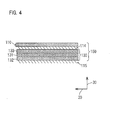
- the specific sectional structure of the covering sheet 130 is shown in FIG. 4 .
- the covering sheet 130 has a three-layer structure having spun-bond nonwoven fabric sheets 132, 133 overlaid on the opposite sides of the meltblow nonwoven fabric sheet 131.
- This three-layer nonwoven fabric sheet is also referred to as an "SMS nonwoven fabric sheet".
- the spun-bond nonwoven fabric layer is formed by a known spun-bond method on each side of the meltblow nonwoven fabric sheet prepared in advance by a known meltblow method.
- the surface roughness of the covering sheet 130 can be reduced so that the nice and soft covering sheet 130 can be obtained.
- the covering sheet 130 is bonded to the top sheet 110 via a bonding layer 114 formed by a hot-melt adhesive. Further, the covering sheet 130 is bonded to the absorber 140 via a bonding layer 115 formed by treating a hot-melt adhesive with water spray. The bonding strength between the covering sheet 130 and the top sheet 110 or the absorber 140 can be increased by using the hot-melt adhesive.
- the top sheet 110 and the covering sheet 130 are integrally formed into a bonded sheet 150 via the bonding layer 114. In this case, in order to secure a liquid penetrant passage from the top sheet 110 to the absorber 140, preferably, the hot-melt adhesive is applied in a discontinuous pattern such as a spiral, lattice-like, striped or dotted pattern.
- the bonding layer 114 and the bonded sheet 150 are features that correspond to the "bonding layer" and the "bonded sheet", respectively, according to this invention.
- the covering sheet 130 and the bonded sheet 150 having the top sheet 110 and the covering sheet 130 preferably have their respective tear strengths.
- the tear strengths are explained with reference to FIGS. 5 and 6 .
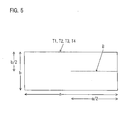
- the tear strengths of the covering sheet 130 and the bonded sheet 150 are set based on a tear test conducted by using following specimens (see FIG. 5 ) and test method.
- each of the specimens has a rectangular shape having a long side of a length a of 150 mm and a short side of a length b of 40 mm and has a cut B (shown by a broken line in FIG. 5 ) formed with scissors or the like.
- the cut B extends parallel to the long side from the middle of the short side.
- the specimens T1, T2, T3, T4 are distinguished as described below.
- the "mm" represents a millimeter which measures length.
- Each of the specimens T1, T2 is formed by cutting the covering sheet 130 into apiece of 150 by 40 mm and making the cut B in it.
- the long side extends in the MD (machine direction) and the short side extends in the CD (cross direction).
- the long side extends in the CD and the short side extends in the MD.
- nonwoven fabric has a lengthwise direction and a transverse direction in relation to the manufacturing process.
- the MD machine direction
- the CD cross direction
- the above described MD and CD correspond to the first direction 10 and the second direction 20 in FIG. 1 , respectively.
- Each of the specimens T3, T4 is formed by the top sheet 110 and the covering sheet 130.
- a hot-melt adhesive of 3 g/m 2 is disposed between a cut piece formed by appropriately cutting the top sheet 110 and a cut piece formed by appropriately cutting the covering sheet 130.
- a predetermined cylinder e.g. a cylinder having a diameter of 60 mm, a height of 85 mm and a weight of 1.9 kg
- the "kg” here represents kilogram which measures weight.
- the bonded sheet of cut pieces is allowed to stand for 24 hours and cured.
- the specimens T3, T4 simulating the bonded sheet 150 are obtained.
- the long side extends in the MD and the short side extends in the CD.
- the long side extends in the CD and the short side extends in the MD.
- each specimen opened by the cut B is held on the both sides of the cut with a spacing of 100 mm and pulled at a speed of 200 mm/min along the long side (in the horizontal direction in FIG. 5 ) until the specimen is completely separated into two pieces.
- the "mm/min” here is a measure of distance (millimeter) per minute. This pulling is performed five times for each specimen, and an average load required for this pulling is defined as tear strength for each specimen.
- the tear strength of the covering sheet 130 is set based on the tear strengths of the specimens T1, T2, and the tear strength of the bonded sheet 150 is set based on the tear strengths of the specimens T3, T4.
- the specimen T1 has a tear strength D1 of 4 to 6 N
- the specimen T2 has a tear strength D2 of 2 to 4 N
- the specimen T3 has a tear strength D3 of 5 to 8 N
- the specimen T4 has a tear strength D4 of 4 to 7 N.
- tear strength D5 of the covering sheet 130 designated by T5 in FIG. 6 is set in the range of 2 to 10 N.
- tear strength D6 of the bonded sheet 150 designated by T6 in FIG. 6 is set in the range of 5 to 20 N.
- the lowest standard of the tear strength T5 is preferably set to either one of the minimum value of the tear strength D1 and the minimum value of the tear strength D2, or the average of these minimum values.
- the lowest standard of the tear strength T6 is preferably set to either one of the minimum value of the tear strength D3 and the minimum value of the tear strength D4, or the average of these minimum values.
- the highest standard of the tear strength T5 is preferably set to the tear strength of the covering sheet which can be manufactured with an increased basis weight within a desired range of the manufacturing cost, with reference to the maximum values of the tear strengths D1, D2.
- the highest standard of the tear strength T6 is preferably set to the tear strength of the bonded sheet which can be manufactured with an increased basis weight within a desired range of the manufacturing cost, with reference to the maximum values of the tear strengths D3, D4.
- the covering sheet 130 is designed to include a tear preventing structure (corresponding to the "tear preventing structure" according to this invention) for preventing the covering sheet 130 from being torn by pets.
- a tear preventing structure corresponding to the "tear preventing structure" according to this invention
- the covering sheet 130 itself has a tear preventing structure, so that an additional member for preventing the covering sheet 130 from being torn is not needed in addition to the covering sheet 130 and the covering sheet 130 can be used as is.
- the upper limit of the tear strength of the covering sheet 130 is set to 10 N.
- the top sheet 110 When the top sheet 110 has the tear strength of 2 to 10 N as described above, the top sheet 110 includes a different tear preventing structure from the covering sheet 130. In this case, the top sheet 110 serves to prevent tear of the top sheet 110 and to protect the covering sheet 130.
- the tear strength of the covering sheet 130 is preferably set by appropriately selecting the material or basis weight of the nonwoven fabric.
- the covering sheet 130 can be formed to have the basis weight, for example, of 10 to 20 g/m 2 . In this manner, the manufacturing cost of the covering sheet 130 having a desired tear strength can be reduced.
- the top sheet 110 is integrally formed with the covering sheet 130 having at least the above-described tear preventing structure, and the whole bonded sheet 150 can counteract tearing actions of pets. Particularly with the tear strength of the bonded sheet 150 exceeding 5 N, the tear resistance of the bonded sheet 150 can be further increased.
- the pet sheet 100 having the above-described construction can provide further effects as described below by using a three-layer SMS nonwoven fabric sheet as the covering sheet 130. It can prevent urine from spreading out along the extending surface of the covering sheet 130 before absorbed into the absorber 140 through the top sheet 110. Pets like dogs usually avoid urinating on an area which has been used once. Therefore, particularly by preventing the above-described spread of urine, the largest possible urination area can be secured on the sheet. This spread preventing part for preventing spread of urine can be formed by one of the top sheet 110 and the covering sheet 130.
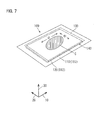
- a spread region C in the dropping test, can be defined by a spread length d1 (mm) in the MD, a spread length d2 (mm) in the CD and a spread area S (cm 2 ).
- the spread area S is calculated by (d1/20) ⁇ (d2/20) ⁇ 3.14.
- the "cm 2 " represents a square centimeter which measures area.
- the change of the extent of the spread region C over time is shown in FIGS. 8 to 10 .
- the covering sheet 130 is formed by the above-described SMS nonwoven fabric sheet in an embodiment E1, while it is formed by a tissue material having the basis weight of 15 g/cm 2 in a comparative example E2.
- values in columns d1 correspond to the spread length d1 (mm) in FIG. 7
- values in columns d2 correspond to the spread length d2 (mm) in FIG. 7
- values in columns S correspond to the spread area S (cm 2 ) in FIG. 7 .
- the spread region C stops spreading in the embodiment E1 while it continues spreading over time in the comparative example E2. From the test results, the above-described covering sheet 130 formed by the SMS nonwoven fabric sheet is considered as having a function of preventing spread of urine.
- the pet sheet 110 is described as having the bonded sheet 150 formed by bonding the top sheet 110 and the covering sheet 130, but in this invention, it may be constructed such that the top sheet 110 and the covering sheet 130 are not bonded. In the former case, the whole bonded sheet 150 can counteract tearing actions of pets, and in the latter case, when the top sheet is damaged, the covering sheet 130 counteracts tearing actions of pets.
- the covering sheet 130 has a three-layer structure having the spun-bond nonwoven fabric sheets 132,133 overlaid on the both sides of the meltblow nonwoven fabric sheet 131.
- a one-layer structure having only a meltblow nonwoven fabric sheet, or a multi-layer structure having one or more meltblow nonwoven fabric sheets and one or more other nonwoven fabric sheets in combination may be appropriately used as the covering sheet.
- the covering sheet may have a three-layer structure having meltblow nonwoven fabric sheets 131 on the both sides of the spun-bond nonwoven fabric sheet 132.
- the covering sheet 130 may be formed, for example, by a spun-bond nonwoven fabric sheet, without using a meltblow nonwoven fabric sheet.
- a point-bond nonwoven fabric may also be used as the covering sheet 130.
- the point-bond nonwoven fabric is formed as a thermoplastic nonwoven fabric (thermoplastic resin nonwoven fabric) manufactured by a well-known point-bonding method in which thermoplastic polymer is melted and then formed into a sheet by thermocompression bonding with an embossing roller while being spun into continuous filaments.
- thermoplastic nonwoven fabric thermoplastic resin nonwoven fabric
- the covering sheet 130 can be formed only by the point-bond nonwoven fabric sheet (having the basis weight of 10 to 30 g/m 2 and) having the tear strength of 1 to 10 N.
- the covering sheet 130 When the covering sheet 130 is bonded to the top sheet 110, the covering sheet 130 can be formed only by the point-bond nonwoven fabric sheet (having the basis weight of 10 to 30 g/m 2 and) having the tear strength of 1 to 10 N, and the top sheet 110 can be formed only by the point-bond nonwoven fabric sheet (having the basis weight of 10 to 30 g/m 2 and) having the tear strength of 2 to 10 N.
- the bonded sheet 150 may preferably have the tear strength of 4 to 20 N.
Landscapes
- Life Sciences & Earth Sciences (AREA)
- Environmental Sciences (AREA)
- Zoology (AREA)
- Animal Husbandry (AREA)
- Biodiversity & Conservation Biology (AREA)
- Housing For Livestock And Birds (AREA)
- Nonwoven Fabrics (AREA)
Abstract
Description
- The invention relates to a pet sheet for receiving excrement of pets such as dogs and cats.
- An example of a pet sheet is disclosed in Japanese laid-open Patent Publication No.
2009-118791 - In a pet sheet of this type, however, a sheet surface may be torn by claws or teeth of a pet and the covering sheet may also be torn. In such a case, the absorber may be partially uncovered and scattered.
-
JP 2009-118791 A - Accordingly, it is an object of the invention to provide an effective technique for preventing a covering sheet for covering an absorber in a pet sheet from being torn by a pet.
- In order to solve the above-described problem, the invention as defined in claims is provided.
- A pet sheet according to this invention is provided and constructed to receive excrement of a pet and includes a top sheet, a back sheet, an absorber, a covering sheet and a tear preventing structure.
- The top sheet has a nonwoven fabric forming region. In this case, the whole or part of the top sheet can be formed of nonwoven fabric. The back sheet is overlaid on the top sheet. The absorber is provided between the top sheet and the back sheet. The covering sheet has a thermoplastic nonwoven fabric (thermoplastic resin nonwoven fabric) forming region and is provided between the top sheet and the absorber to cover the absorber. In this case, the whole or part of the covering sheet can be formed of thermoplastic nonwoven fabric. The tear preventing structure is provided in the covering sheet to prevent the covering sheet from being torn by the pet. With such a construction, even if a pet scratches the top sheet with the claws or bites it with the teeth so that the top sheet is torn, the tear preventing structure can prevent the covering sheet from being torn. Therefore, covering of the absorber by the covering sheet is secured, so that scattering of the absorber can be prevented. Further, the covering sheet itself has a tear preventing structure, so that an additional member for preventing the covering sheet from being torn is not needed in addition to the covering sheet.
- In a further embodiment of this invention, preferably, the tear preventing structure prevents the covering sheet from being torn by a sharp part of the pet when the sharp part moves relative to the covering sheet in contact with the top sheet. With this construction, the covering sheet can be prevented from being torn particularly by a sharp part of the pet. In this case, tearing of the covering sheet may be caused by relative movement of the sharp part of the pet with respect to the covering sheet in contact with the top sheet and not through the top sheet, or it may be caused by relative movement of the sharp part of the pet with respect to the covering sheet in contact with the top sheet and through the top sheet. The "sharp part" here refers to a sharp part with which a pet can tear the pet sheet, and typically corresponds to a claw or tooth of the pet. The "relative movement" here includes movement of the sharp part of the pet with respect to the covering sheet, and movement of the covering sheet with respect to the sharp part of the pet. Specifically, the covering sheet may be torn by various tearing actions of pets, such as scratching with the claws along an extending surface of the covering sheet, and digging of the claws or biting with the teeth in a direction transverse to the extending surface of the covering sheet.
- Particularly unlike a "diaper" which is designed to be worn on an excreting part of the wearer and to receive excrement of the wearer, the pet sheet according to this embodiment is designed to receive excrement in non-contact with the excreting part. Therefore, this pet sheet is suitably applied to a sheet for receiving excrement in which the covering sheet has a risk of being torn by sharp parts of the pet.
- In a further embodiment of this invention, preferably, the pet sheet has a pet use mode in which the pet sheet is unfolded flat and used. In the pet use mode, an outer surface of the top sheet has a planar structure serving both as an excrement receiving surface for receiving excrement of the pet in non-contact with the excreting part and as a pet walking surface on which the pet can walk.
- Generally, when a pet like a dog excretes, the excreting part (from which urine is excreted) of the pet is held in non-contact with the top sheet. Further, in urinary excretion, the pet selects a desired spot on the top sheet, or avoids urinating on a spot which has been used once. At this time, in an area of the top sheet on which the pet frequently behaves actively, the top sheet may be torn particularly by contact of the pet's sharp part and the outer surface of the top sheet and thus the covering sheet may be torn. Therefore, in the pet use mode, even if the pet actively behaves on the top sheet during, before or after urination, the covering sheet can be prevented from being torn following the top sheet.
- In a further embodiment of this invention, preferably, the tear preventing structure is constructed such that the covering sheet has a tear strength of 2 to 10 N. In this case, the "tear strength" is defined as resistance (also referred to as "tearing load") to tearing of the nonwoven fabric sheet and expressed in newton (N).
- With this construction, particularly by provision of the covering sheet having a tear strength of 2 N or higher, even if the top sheet is torn, the covering sheet having a predetermined tear strength can protect the absorber. Further, in order to reduce the manufacturing cost, preferably, the upper limit of the tear strength of the covering sheet is set to 10 N.
- In a further embodiment of this invention, preferably, the covering sheet includes meltblow nonwoven fabric. This covering sheet includes a covering sheet of a one-layer structure having only a meltblow nonwoven fabric sheet, and a multi-layer structure having one or more meltblow nonwoven fabric sheets and one or more other nonwoven fabric sheets in combination. By using relatively finely-woven meltblow nonwoven fabric for the covering sheet, absorbent polymers or other similar materials forming the absorber can be prevented from passing through the
covering sheet 130. - In a further embodiment of this invention, preferably, the covering sheet has a three-layer structure having spun-bond nonwoven fabric sheets overlaid on both sides of the meltblow nonwoven fabric sheet. By providing the spun-bond nonwoven fabric sheet having a relatively long fiber length on the sheet surface, the surface roughness of the covering sheet can be reduced so that the nice and soft covering sheet can be obtained.
- In a further embodiment of this invention, preferably, the covering sheet has a basis weight of 8 to 20 g/m2. In this manner, the manufacturing cost of the covering sheet having a desired tear strength can be reduced. The "g/m2" here represents a gram per square meter which measures basis weight.
- In a further embodiment of this invention, preferably, the top sheet is formed as a thermoplastic nonwoven fabric sheet having a basis weight of 10 to 30 g/m2 and a tear strength of 2 to 10 N. In this manner, by providing the top sheet with a predetermine tear strength, the top sheet itself can be prevented from being torn before the covering sheet. Further, by providing the top sheet having a basis weight within the predetermined range, the manufacturing cost of the top sheet can be reduced.
- In a further embodiment of this invention, preferably, the top sheet and the covering sheet are bonded together via a bonding layer and form a bonded sheet such that the bonded sheet includes the tear preventing structure. The whole bonded sheet which is integrally formed by the top sheet and the covering sheet can counteract tearing actions of pets.
- In a further embodiment of this invention, preferably, the top sheet comprises a thermoplastic nonwoven fabric sheet having a basis weight of 10 to 30 g/m2 and a tear strength of 2 to 10 N, the covering sheet comprises a nonwoven fabric sheet which has a three-layer structure having spun-bond nonwoven fabric sheets overlaid on both sides of the meltblow nonwoven fabric sheet and has a basis weight of 8 to 20 g/m2, and the bonded sheet has a tear strength of 4 to 20 N. With this construction, the whole bonded sheet having a predetermined tear strength can counteract tearing actions of pets.
- As described above, according to this invention, a pet sheet is provided in which a covering sheet for covering an absorber can be prevented from being torn by a pet.
-
-
FIG. 1 is a perspective view showing an upper surface of apet sheet 100 according to an embodiment of the invention. -
FIG. 2 is an exploded perspective view of thepet sheet 100 shown inFIG. 1 . -
FIG. 3 is a sectional view taken along line A-A inFIG. 1 and showing a sectional structure of thepet sheet 100. -
FIG. 4 shows a sectional structure of acovering sheet 130 shown inFIG. 3 . -
FIG. 5 is a plan view showing specimens T1, T2, T3, T4 to be used for measurement of tear strength. -
FIG. 6 shows tear strength of the specimens T1, T2, T3, T4 shown inFIG. 5 , the covering sheet 130 (T5) and the bonded sheet 150 (T6). -
FIG. 7 is a perspective view showing thepet sheet 100 ofFIG. 1 for illustrating a dropping test of artificial urine. -
FIG. 8 shows spread lengths d1, d2 and spread area S of the artificial urine inFIG. 7 after a lapse of 13 seconds from start of urine dropping. -
FIG. 9 shows the spread lengths d1, d2 and the spread area S of the artificial urine inFIG. 7 after a lapse of one minute from start of urine dropping. -
FIG. 10 shows the spread lengths d1, d2 and the spread area S of the artificial urine inFIG. 7 after a lapse of 10 minutes from start of urine dropping. - A
pet sheet 100 as one embodiment of a "pet sheet" according to the invention is now explained with reference to the drawings. The "pet" here widely includes vertebrates (mammals, reptiles, birds and amphibians) and invertebrates, and thepet sheet 100 is suitably used for kinds of mammal having sharp claws and teeth, such as cats, dogs, rabbits and hamsters. - The
pet sheet 100 shown inFIG. 1 is a flat sheet having a predetermined thickness and includes atop sheet 110, aback sheet 120, acovering sheet 130 and anabsorber 140. Thepet sheet 100 preferably has a rectangular or square shape, but it may have a circular, elliptical or polygonal shape. - In
FIG. 1 and other drawings, the width direction, the length direction and the normal direction of thepet sheet 10 correspond to afirst direction 10, asecond direction 20 perpendicular to thefirst direction 10 and athird direction 30 perpendicular to the first andsecond directions - The
pet sheet 100 has a pet use mode in which the pet sheet is unfolded flat and used. In this use mode, an outer surface of thetop sheet 110 has a planar structure serving both as an excrement receiving surface for receiving excrement of pets in non-contact with an excreting part of the pet from which urine is excreted, and as a pet walking surface on which the pet can walk. This use mode includes a mode in which the pet sheet is directly put, for example, on floor and a mode in which the pet sheet is attached to a holder and put, for example, on floor. - Preferably, the
pet sheet 100 further has a storage mode. In this mode, a plurality of flat pet sheets are each folded or rolled in predetermined shape and can be stored in one container for sale, display, transportation, etc. - As shown in
FIG. 2 , thetop sheet 110 and theback sheet 120 are rectangular sheets having about the same dimensions, and have substantially the same shape as the external shape of thepet sheet 100. Thetop sheet 110 forms a receiving surface for receiving excrement excreted from pets and formed as a liquid-permeable sheet for penetration of liquid such as urine. Preferably, thetop sheet 110 is formed by thermoplastic nonwoven fabric. In this case, the whole or part of thetop sheet 110 can be formed of thermoplastic nonwoven fabric. Theback sheet 120 is arranged on the side of thecovering sheet 130 and theabsorber 140 opposite from thetop sheet 110 and formed as a liquid-impermeable or water-repellent sheet for blocking or preventing penetration of liquid such as urine. Preferably, theback sheet 120 is formed by a resin film sheet. It is essential for theback sheet 120 to be liquid-impermeable or water-repellent, and theback sheet 120 can be formed by using a film of polyethylene, polypropylene, polyethylene terephthalate. For example, it can be formed of a polyethylene film having a basis weight of 17 g/m2. Further, in consideration of the flexibility, theback sheet 120 can be formed by a nonwoven fabric to which a water repellent is applied. The "g/m2" here represents a gram per square meter which measures basis weight. - The
top sheet 110 and theback sheet 120 are slightly larger than thecovering sheet 130 and theabsorber 140, and arim 111 of thetop sheet 110 and arim 112 of theback sheet 120 are aligned one on the other and bonded together via abonding layer 113. Thus, thetop sheet 110 and theback sheet 120 cover over the coveringsheet 130 and theabsorber 140. This bonding can be typically made by using a hot-melt adhesive, a heat sealer or an ultrasonic sealer. Thetop sheet 110 and theback sheet 120 here are features that correspond to the "top sheet" and the "back sheet", respectively, according to this invention. - The
covering sheet 130 covers an upper surface 141 (facing the top sheet 110) of theabsorber 140. Specifically, thecovering sheet 130 is disposed between thetop sheet 110 and theabsorber 140 in order to cover theabsorber 140. Preferably, thecovering sheet 130 is formed of thermoplastic nonwoven fabric. In this case, the whole or part of thecovering sheet 130 can be formed of thermoplastic nonwoven fabric. Thecovering sheet 130 here is a feature that corresponds to the "covering sheet" according to this invention. - As shown in
FIG. 3 , theabsorber 140 has a predetermined thickness and includes anabsorber core layer 142,carrier tissue 143 surrounding theabsorber core layer 142, and a dispersedlayer 146. Theabsorber core layer 142 is typically formed of blended polymer which is a blend of high-absorbent polymers (also referred to as "SAP"), and a pulp (e.g. flat pulp layered to have a basis weight of 60 g/m2). Thecarrier tissue 143 is typically formed of tissue (e.g. tissue of 14 g/m2) of softwood pulp. The dispersedlayer 146 is a layered part dispersed in a surface of thecarrier tissue 143 facing thecovering sheet 130, and in this layer, typically,polymer particles 144 having high-absorbent polymers andfragrance particles 145 encapsulating fragrance are dispersed. Further, theabsorber 140 and theback sheet 120 may be bonded as necessary, for example, by a hot-melt adhesive. Theabsorber core layer 142 may be formed by using water-absorbing porous material such as sponge in place of high-absorbent polymer. Theabsorber 140 here is a feature that corresponds to the "absorber" according to this invention. - In designing a pet sheet suitable for dogs, cats or other pets having sharp claws and teeth (sharp parts), it is highly desired to prevent the
top sheet 110 and thus thecovering sheet 130 for theabsorber 140 from being torn by the pets and thus prevent theabsorber 140 from being scattered. For example, thecovering sheet 130 may be torn by various tearing actions of a pet, such as scratching with the claws along an extending surface of thecovering sheet 130, and digging of the claws or biting with the teeth in a direction transverse to the extending surface of thecovering sheet 130. Further, in the pet use mode as described above, a pet frequently moves actively on thetop sheet 110, so that thetop sheet 110 may be torn particularly by contact of the pet's sharp part and the outer surface of thetop sheet 110 and thus thecovering sheet 130 may be torn. Therefore, after thorough study of the construction of pet sheets of this type, inventors provide thepet sheet 100 of this embodiment. Features of thepet sheet 100 are now specifically explained. - The above-described
top sheet 110 is formed of thermoplastic nonwoven fabric having a plurality of regularly arranged pores (also referred to as effective air-through nonwoven fabric formed of hydrophilic olefin polyethylene fibers). Preferably, thetop sheet 110 has a basis weight of 10 to 30 g/m2 and a tear strength of 2 to 10 N. This tear strength (also referred to as "tearing load") is defined as tensile load required to tear a specimen having a cut and expressed in newton (N). The tear strength is described below in more detail along with a tear test. By providing thetop sheet 110 with a predetermine tear strength, thetop sheet 110 itself can be prevented from being torn before thecovering sheet 130. Further, the manufacturing cost of thetop sheet 110 can be reduced by providing thetop sheet 110 having a basis weight within a predetermined range. - The above-described
covering sheet 130 is preferably formed of thermoplastic nonwoven fabric, particularly including meltblow nonwoven fabric. By using relatively fmely-woven meltblow nonwoven fabric for thecovering sheet 130, absorbent polymers or other similar materials having a low particle size and forming theabsorber 140 can be prevented from passing through thecovering sheet 130. For this purpose, more preferably, the meltblow nonwoven fabric has an air permeability exceeding 200 cc/cm2 · sec. The "cc/cm2 · sec" here represents volume or cubic centimeter of air passing through the specimen per one square centimeter in one second and measures air permeability. - The
covering sheet 130 having the meltblow nonwoven fabric may typically have a three-layer structure in which spun-bond nonwoven fabric is overlaid on the both sides of the meltblow nonwoven fabric sheet. The spun-bond nonwoven fabric is formed as a thermoplastic nonwoven fabric (thermoplastic resin nonwoven fabric) manufactured by a well-known spun-bonding method in which thermoplastic polymer is melted and then formed into a sheet while being spun into continuous filaments. The meltblow nonwoven fabric is formed as a thermoplastic nonwoven fabric (thermoplastic resin nonwoven fabric) manufactured by a well-known meltblow method in which high-temperature air is further blown onto the filaments manufactured by the spun-bonding method and the filaments are dispersed and layered so as to form a sheet of finer fabric. A hot-melt adhesive is formed as a thermoplastic adhesive which is melted into liquid by heating and solidified by cooling so that bonding is achieved. - The specific sectional structure of the
covering sheet 130 is shown inFIG. 4 . Thecovering sheet 130 has a three-layer structure having spun-bondnonwoven fabric sheets nonwoven fabric sheet 131. This three-layer nonwoven fabric sheet is also referred to as an "SMS nonwoven fabric sheet". Thus, in order to manufacture thecovering sheet 130, the spun-bond nonwoven fabric layer is formed by a known spun-bond method on each side of the meltblow nonwoven fabric sheet prepared in advance by a known meltblow method. In this case, by providing the spun-bond nonwoven fabric sheet having a relatively long fiber length on the sheet surface, the surface roughness of thecovering sheet 130 can be reduced so that the nice andsoft covering sheet 130 can be obtained. - The
covering sheet 130 is bonded to thetop sheet 110 via abonding layer 114 formed by a hot-melt adhesive. Further, thecovering sheet 130 is bonded to theabsorber 140 via abonding layer 115 formed by treating a hot-melt adhesive with water spray. The bonding strength between the coveringsheet 130 and thetop sheet 110 or theabsorber 140 can be increased by using the hot-melt adhesive. Thetop sheet 110 and thecovering sheet 130 are integrally formed into a bondedsheet 150 via thebonding layer 114. In this case, in order to secure a liquid penetrant passage from thetop sheet 110 to theabsorber 140, preferably, the hot-melt adhesive is applied in a discontinuous pattern such as a spiral, lattice-like, striped or dotted pattern. Thebonding layer 114 and the bondedsheet 150 are features that correspond to the "bonding layer" and the "bonded sheet", respectively, according to this invention. - The
covering sheet 130 and the bondedsheet 150 having thetop sheet 110 and thecovering sheet 130 preferably have their respective tear strengths. The tear strengths are explained with reference toFIGS. 5 and6 . - The tear strengths of the
covering sheet 130 and the bondedsheet 150 are set based on a tear test conducted by using following specimens (seeFIG. 5 ) and test method. - As shown in
FIG. 5 , four kinds of specimens T1, T2, T3, T4 are prepared. Each of the specimens has a rectangular shape having a long side of a length a of 150 mm and a short side of a length b of 40 mm and has a cut B (shown by a broken line inFIG. 5 ) formed with scissors or the like. The cut B extends parallel to the long side from the middle of the short side. In this embodiment, the cut B is made into a length of 75 mm (= a/2) at a distance of 40 mm (= b/2) from the long side. The specimens T1, T2, T3, T4 are distinguished as described below. The "mm" represents a millimeter which measures length. - Each of the specimens T1, T2 is formed by cutting the
covering sheet 130 into apiece of 150 by 40 mm and making the cut B in it. In the specimen T1, the long side extends in the MD (machine direction) and the short side extends in the CD (cross direction). In the specimen T2, the long side extends in the CD and the short side extends in the MD. - Generally, nonwoven fabric has a lengthwise direction and a transverse direction in relation to the manufacturing process. The MD (machine direction) corresponds to the lengthwise direction of the nonwoven fabric and is defined as a direction of flow of the nonwoven fabric in the process of manufacturing the nonwoven fabric. The CD (cross direction) corresponds to the transverse direction of the nonwoven fabric and is defined as a direction transverse to the direction of flow of the nonwoven fabric in the process of manufacturing the nonwoven fabric. The above described MD and CD correspond to the
first direction 10 and thesecond direction 20 inFIG. 1 , respectively. - Each of the specimens T3, T4 is formed by the
top sheet 110 and thecovering sheet 130. In this case, a hot-melt adhesive of 3 g/m2 is disposed between a cut piece formed by appropriately cutting thetop sheet 110 and a cut piece formed by appropriately cutting thecovering sheet 130. In this state, a predetermined cylinder (e.g. a cylinder having a diameter of 60 mm, a height of 85 mm and a weight of 1.9 kg) is rolled and pressed against the cut pieces. The "kg" here represents kilogram which measures weight. The bonded sheet of cut pieces is allowed to stand for 24 hours and cured. Thereafter, it is cut into 150 by 40 mm and the cut B is made in it, so that the specimens T3, T4 simulating the bondedsheet 150 are obtained. In the specimen T3, the long side extends in the MD and the short side extends in the CD. In the specimen T4, the long side extends in the CD and the short side extends in the MD. - An end of each specimen opened by the cut B is held on the both sides of the cut with a spacing of 100 mm and pulled at a speed of 200 mm/min along the long side (in the horizontal direction in
FIG. 5 ) until the specimen is completely separated into two pieces. The "mm/min" here is a measure of distance (millimeter) per minute. This pulling is performed five times for each specimen, and an average load required for this pulling is defined as tear strength for each specimen. Further, the tear strength of thecovering sheet 130 is set based on the tear strengths of the specimens T1, T2, and the tear strength of the bondedsheet 150 is set based on the tear strengths of the specimens T3, T4. - As shown in
FIG. 6 , the specimen T1 has a tear strength D1 of 4 to 6 N, the specimen T2 has a tear strength D2 of 2 to 4 N, the specimen T3 has a tear strength D3 of 5 to 8 N, and the specimen T4 has a tear strength D4 of 4 to 7 N. Based on the tear strengths D1, D2, D3, D4, tear strength D5 of thecovering sheet 130 designated by T5 inFIG. 6 is set in the range of 2 to 10 N. Further, tear strength D6 of the bondedsheet 150 designated by T6 inFIG. 6 is set in the range of 5 to 20 N. - The lowest standard of the tear strength T5 is preferably set to either one of the minimum value of the tear strength D1 and the minimum value of the tear strength D2, or the average of these minimum values. Similarly, the lowest standard of the tear strength T6 is preferably set to either one of the minimum value of the tear strength D3 and the minimum value of the tear strength D4, or the average of these minimum values.
- Further, the highest standard of the tear strength T5 is preferably set to the tear strength of the covering sheet which can be manufactured with an increased basis weight within a desired range of the manufacturing cost, with reference to the maximum values of the tear strengths D1, D2. Similarly, the highest standard of the tear strength T6 is preferably set to the tear strength of the bonded sheet which can be manufactured with an increased basis weight within a desired range of the manufacturing cost, with reference to the maximum values of the tear strengths D3, D4.
- With the above-described construction, by provision of the
covering sheet 130 having a tear strength exceeding 2 N, theabsorber 140 can be protected by thecovering sheet 130 having the predetermined tear strength even if thetop sheet 110 is torn. Therefore, thecovering sheet 130 is designed to include a tear preventing structure (corresponding to the "tear preventing structure" according to this invention) for preventing thecovering sheet 130 from being torn by pets. Thus, thecovering sheet 130 is prevented from being torn by sharp parts of pets. Therefore, covering of theabsorber 140 by thecovering sheet 130 is further secured, so that scattering of theabsorber 140 can be prevented. Further, thecovering sheet 130 itself has a tear preventing structure, so that an additional member for preventing thecovering sheet 130 from being torn is not needed in addition to thecovering sheet 130 and thecovering sheet 130 can be used as is. For reduction of the manufacturing cost, preferably, the upper limit of the tear strength of thecovering sheet 130 is set to 10 N. - When the
top sheet 110 has the tear strength of 2 to 10 N as described above, thetop sheet 110 includes a different tear preventing structure from thecovering sheet 130. In this case, thetop sheet 110 serves to prevent tear of thetop sheet 110 and to protect thecovering sheet 130. - The tear strength of the
covering sheet 130 is preferably set by appropriately selecting the material or basis weight of the nonwoven fabric. Thecovering sheet 130 can be formed to have the basis weight, for example, of 10 to 20 g/m2. In this manner, the manufacturing cost of thecovering sheet 130 having a desired tear strength can be reduced. - Further, in the bonded
sheet 150, thetop sheet 110 is integrally formed with thecovering sheet 130 having at least the above-described tear preventing structure, and the whole bondedsheet 150 can counteract tearing actions of pets. Particularly with the tear strength of the bondedsheet 150 exceeding 5 N, the tear resistance of the bondedsheet 150 can be further increased. - The
pet sheet 100 having the above-described construction can provide further effects as described below by using a three-layer SMS nonwoven fabric sheet as thecovering sheet 130. It can prevent urine from spreading out along the extending surface of thecovering sheet 130 before absorbed into theabsorber 140 through thetop sheet 110. Pets like dogs usually avoid urinating on an area which has been used once. Therefore, particularly by preventing the above-described spread of urine, the largest possible urination area can be secured on the sheet. This spread preventing part for preventing spread of urine can be formed by one of thetop sheet 110 and thecovering sheet 130. - In order to confirm the efficacy of preventing spread of urine, inventors conducted dropping tests of artificial urine. In this test, about 80 cc of artificial urine which is prepared in advance is dropped from 10 mm above the pet sheet for 13 seconds, and change of the area of spread of the urine is measured over time. The "cc" here represents a cubic centimeter which measures volume. The extent of the spread region is determined by the balance between the spreading speed of urine spreading along the extending surfaces of the
top sheet 110 and thecovering sheet 130 and the speed of absorbing urine into theabsorber 140. As shown inFIG. 7 , in the dropping test, a spread region C can be defined by a spread length d1 (mm) in the MD, a spread length d2 (mm) in the CD and a spread area S (cm2). The spread area S is calculated by (d1/20) × (d2/20) × 3.14. The "cm2" represents a square centimeter which measures area. The change of the extent of the spread region C over time is shown inFIGS. 8 to 10 . - In
FIGS. 8 to 10 , thecovering sheet 130 is formed by the above-described SMS nonwoven fabric sheet in an embodiment E1, while it is formed by a tissue material having the basis weight of 15 g/cm2 in a comparative example E2. In these drawings, in the embodiment E1 and the comparative example E2, values in columns d1 correspond to the spread length d1 (mm) inFIG. 7 , values in columns d2 correspond to the spread length d2 (mm) inFIG. 7 , and values in columns S correspond to the spread area S (cm2) inFIG. 7 . - From the results of the above-described test, it is found that after a lapse of 13 seconds from start of the urine dropping, the spread region C stops spreading in the embodiment E1 while it continues spreading over time in the comparative example E2. From the test results, the above-described
covering sheet 130 formed by the SMS nonwoven fabric sheet is considered as having a function of preventing spread of urine. - The invention is not limited to the above-described embodiment, but rather, may be added to, changed, replaced with alternatives or otherwise modified. For example, the following provisions can be made in application of this embodiment.
- In the above-described embodiment, the
pet sheet 110 is described as having the bondedsheet 150 formed by bonding thetop sheet 110 and thecovering sheet 130, but in this invention, it may be constructed such that thetop sheet 110 and thecovering sheet 130 are not bonded. In the former case, the whole bondedsheet 150 can counteract tearing actions of pets, and in the latter case, when the top sheet is damaged, thecovering sheet 130 counteracts tearing actions of pets. - In the above-described embodiment, the
covering sheet 130 has a three-layer structure having the spun-bond nonwoven fabric sheets 132,133 overlaid on the both sides of the meltblownonwoven fabric sheet 131. In this invention, however, a one-layer structure having only a meltblow nonwoven fabric sheet, or a multi-layer structure having one or more meltblow nonwoven fabric sheets and one or more other nonwoven fabric sheets in combination, may be appropriately used as the covering sheet. For example, the covering sheet may have a three-layer structure having meltblownonwoven fabric sheets 131 on the both sides of the spun-bondnonwoven fabric sheet 132. Further, thecovering sheet 130 may be formed, for example, by a spun-bond nonwoven fabric sheet, without using a meltblow nonwoven fabric sheet. - In relation to the above-described embodiment, a point-bond nonwoven fabric may also be used as the
covering sheet 130. The point-bond nonwoven fabric is formed as a thermoplastic nonwoven fabric (thermoplastic resin nonwoven fabric) manufactured by a well-known point-bonding method in which thermoplastic polymer is melted and then formed into a sheet by thermocompression bonding with an embossing roller while being spun into continuous filaments. When thecovering sheet 130 is not bonded to thetop sheet 110, thecovering sheet 130 can be formed only by the point-bond nonwoven fabric sheet (having the basis weight of 10 to 30 g/m2 and) having the tear strength of 1 to 10 N. When thecovering sheet 130 is bonded to thetop sheet 110, thecovering sheet 130 can be formed only by the point-bond nonwoven fabric sheet (having the basis weight of 10 to 30 g/m2 and) having the tear strength of 1 to 10 N, and thetop sheet 110 can be formed only by the point-bond nonwoven fabric sheet (having the basis weight of 10 to 30 g/m2 and) having the tear strength of 2 to 10 N. In this case, the bondedsheet 150 may preferably have the tear strength of 4 to 20 N. - In the invention, based on the above-described various embodiments and modifications or changes thereof, the following provisions can be made.
-
- (1) "A pet sheet for receiving excrement of a pet, comprising:
- a top sheet having a nonwoven fabric forming region,
- a back sheet overlaid on the top sheet,
- an absorber provided between the top sheet and the back sheet, and
- a covering sheet having a thermoplastic nonwoven fabric forming region, the covering sheet being provided between the top sheet and the absorber to cover the absorber and having a tear strength of 2 to 10N."
- (2) "A pet sheet for receiving excrement of a pet, comprising:
- a top sheet having a thermoplastic nonwoven fabric forming region and having a basis weight of 8 to 40 g/m2 and a tear strength of 2 to 10 N,
- a back sheet overlaid on the top sheet,
- an absorber provided between the top sheet and the back sheet, and
- a covering sheet having a thermoplastic nonwoven fabric forming region and provided between the top sheet and the absorber to cover the absorber."
- (3) "A pet sheet for receiving excrement of a pet, comprising:
- a top sheet having a nonwoven fabric forming region,
- a back sheet overlaid on the top sheet,
- an absorber provided between the top sheet and the back sheet, and
- a covering sheet having a thermoplastic nonwoven fabric forming region and provided between the top sheet and the absorber to cover the absorber, and
- a bonded sheet formed by bonding the top sheet and the covering sheet via a bonding layer and having a tear strength of 2 to 10 N."
- (4) "The pet sheet as defined in (3), comprising a pet use mode in which the pet sheet is unfolded flat and used, wherein, in the pet use mode, an outer surface of the top sheet forming the bonded sheet has a planar structure serving both as an excrement receiving surface for receiving excrement of the pet in non-contact with the pet and as a pet walking surface on which the pet can walk."
- (5) "The pet sheet as defined in (3), wherein the covering sheet forming the bonded sheet includes meltblow nonwoven fabric."
- (6) "The pet sheet as defined in (5), wherein the covering sheet has a three-layer structure having spun-bond nonwoven fabric sheets overlaid on both sides of the meltblow nonwoven fabric sheet."
- (7) "The pet sheet as defined in (6), wherein the covering sheet has a basis weight of 8 to 20 g/m2."
- (8) "The pet sheet as defined in (3), wherein the top sheet forming the bonded sheet comprises a thermoplastic nonwoven fabric sheet having a basis weight of 8 to 40 g/m2 and a tear strength of 2 to 10N."
- (9) "A pet sheet for receiving excrement of a pet, comprising:
- a top sheet having a nonwoven fabric forming region,
- a back sheet overlaid on the top sheet,
- an absorber provided between the top sheet and the back sheet, and
- a covering sheet having a thermoplastic nonwoven fabric forming region, the covering sheet being provided between the top sheet and the absorber to cover the absorber and having a three-layer structure having spun-bond nonwoven fabric sheets overlaid on both sides of a meltblow nonwoven fabric sheet."
- (10) "A pet sheet for receiving excrement of a pet, comprising:
- a top sheet having a nonwoven fabric forming region,
- a back sheet overlaid on the top sheet,
- an absorber provided between the top sheet and the back sheet, and
- a covering sheet having a meltblow nonwoven fabric forming region and provided between the top sheet and the absorber to cover the absorber, and
- a spread preventing part for preventing urine from spreading out along an extending surface of the covering sheet before absorbed into the absorber through the top sheet."
- (11) "The pet sheet as defined in (10), wherein the spread preventing part comprises at least one of the top sheet and the covering sheet".
- (12) "The pet sheet as defined in (10), wherein the spread preventing part comprises the covering sheet, and the covering sheet has a three-layer structure having spun-bond nonwoven fabric sheets overlaid on both sides of a meltblow nonwoven fabric sheet."
-
- 100
- pet sheet
- 110
- top sheet
- 111, 112
- rim
- 113, 114,115
- bonding layer
- 120
- back sheet
- 130
- covering sheet
- 131
- meltblow nonwoven fabric sheet
- 132, 133
- spun-bond nonwoven fabric sheet
- 140
- absorber
- 141
- upper surface
- 142
- absorber core layer
- 143
- carrier tissue
- 144
- polymer particle
- 145
- fragrance particle
- 146
- dispersed layer
- 150
- bonded sheet
Claims (10)
- A pet sheet for receiving excrement of a pet comprising:a top sheet having a nonwoven fabric forming region,a back sheet overlaid on the top sheet,an absorber provided between the top sheet and the back sheet,a covering sheet having a thermoplastic nonwoven fabric forming region and provided between the top sheet and the absorber to cover the absorber anda tear preventing structure provided in the covering sheet to prevent the covering sheet from being torn by the pet.
- The pet sheet as defined in claim 1, wherein the tear preventing structure prevents the covering sheet from being torn by a sharp part of the pet when the sharp part moves relative to the covering sheet in contact with the top sheet.
- The pet sheet as defined in claim 1 comprising a pet use mode in which the pet sheet is unfolded flat and used, wherein, in the pet use mode, an outer surface of the top sheet has a planar structure serving both as an excrement receiving surface for receiving excrement excreted from an excreting part of the pet in non-contact with the excreting part and as a pet walking surface on which the pet can walk.
- The pet sheet as defined in claim 1, wherein the tear preventing structure is constructed such that the covering sheet has a tear strength of 2 to 10 N.
- The pet sheet as defined in claim 4, wherein the covering sheet includes meltblow nonwoven fabric.
- The pet sheet as defined in claim 5, wherein the covering sheet has a three-layer structure having spun-bond nonwoven fabric sheets overlaid on both sides of the meltblow nonwoven fabric sheet.
- The pet sheet as defined in claim 6, wherein the covering sheet has a basis weight of 8 to 20 g/m2.
- The pet sheet as defined in claim 1, wherein the top sheet comprises a thermoplastic nonwoven fabric sheet having a basis weight of 8 to 40 g/m2 and a tear strength of 2 to 10 N.
- The pet sheet as defined in claim 1, wherein the top sheet and the covering sheet are bonded together via a bonding layer and form a bonded sheet such that the bonded sheet includes the tear preventing structure.
- The pet sheet as defined in claim 9, wherein the top sheet comprises a thermoplastic nonwoven fabric sheet having a basis weight of 8 to 40 g/m2 and a tear strength of 2 to 10N, the covering sheet comprises a nonwoven fabric sheet which has a three-layer structure having spun-bond nonwoven fabric sheets overlaid on both sides of the meltblow nonwoven fabric sheet and has a basis weight of 8 to 20 g/m2, and the bonded sheet has a tear strength of 5 to 20 N.
Applications Claiming Priority (2)
| Application Number | Priority Date | Filing Date | Title |
|---|---|---|---|
| JP2011280502A JP6095265B2 (en) | 2011-12-21 | 2011-12-21 | Pet seat |
| PCT/JP2012/082799 WO2013094607A1 (en) | 2011-12-21 | 2012-12-18 | Sheet for pets |
Publications (3)
| Publication Number | Publication Date |
|---|---|
| EP2796036A1 true EP2796036A1 (en) | 2014-10-29 |
| EP2796036A4 EP2796036A4 (en) | 2015-08-26 |
| EP2796036B1 EP2796036B1 (en) | 2020-02-05 |
Family
ID=48668494
Family Applications (1)
| Application Number | Title | Priority Date | Filing Date |
|---|---|---|---|
| EP12859757.2A Active EP2796036B1 (en) | 2011-12-21 | 2012-12-18 | Sheet for pets |
Country Status (7)
| Country | Link |
|---|---|
| US (1) | US20150027380A1 (en) |
| EP (1) | EP2796036B1 (en) |
| JP (1) | JP6095265B2 (en) |
| CN (1) | CN104010490B (en) |
| AU (1) | AU2012354825B2 (en) |
| BR (1) | BR112014015626A8 (en) |
| WO (1) | WO2013094607A1 (en) |
Cited By (1)
| Publication number | Priority date | Publication date | Assignee | Title |
|---|---|---|---|---|
| EP3456183A4 (en) * | 2016-05-13 | 2019-05-08 | Unicharm Corporation | NURSING EQUIPMENT FOR DOMESTIC ANIMALS |
Families Citing this family (14)
| Publication number | Priority date | Publication date | Assignee | Title |
|---|---|---|---|---|
| JP6008622B2 (en) * | 2012-07-06 | 2016-10-19 | ユニ・チャーム株式会社 | Absorbent sheet for pet |
| JP6008625B2 (en) * | 2012-07-06 | 2016-10-19 | ユニ・チャーム株式会社 | Pet seat |
| JP6008623B2 (en) * | 2012-07-06 | 2016-10-19 | ユニ・チャーム株式会社 | Absorbent sheet for pet |
| NL2009780C2 (en) * | 2012-11-09 | 2014-05-12 | Uniq Ag | LAYING NEST WITH EXTRACTION SYSTEM. |
| JP5956322B2 (en) * | 2012-12-13 | 2016-07-27 | ユニ・チャーム株式会社 | Absorbent sheet for pet |
| JP6344680B2 (en) * | 2014-02-03 | 2018-06-20 | 株式会社サノテック | Paper sheets and pet toilet sheets |
| JP5728123B1 (en) * | 2014-11-19 | 2015-06-03 | ユニ・チャーム株式会社 | Absorbent sheet for pet |
| JP6359427B2 (en) * | 2014-11-19 | 2018-07-18 | ユニ・チャーム株式会社 | Absorbent sheet for pet |
| USD783907S1 (en) | 2015-08-06 | 2017-04-11 | WKOL Design Research and Development, LLC | Disposable litter liner |
| US12453332B2 (en) * | 2015-11-04 | 2025-10-28 | Brilliant Pet 2 LLC | Pet waste cartridge |
| US12356954B2 (en) | 2015-11-04 | 2025-07-15 | Brilliant Pet 2 LLC | Pet waste roll assembly |
| WO2018140838A1 (en) | 2017-01-27 | 2018-08-02 | Ctb, Inc. | Laying nest with rack drive floor expulsion system |
| JP7079752B2 (en) | 2019-05-20 | 2022-06-02 | ユニ・チャーム株式会社 | Absorbent sheet for pets |
| US20250169461A1 (en) * | 2023-11-29 | 2025-05-29 | Cornelia Egondu Ojimba | Pretty Kitty Litter Mat |
Family Cites Families (16)
| Publication number | Priority date | Publication date | Assignee | Title |
|---|---|---|---|---|
| US4852518A (en) * | 1978-05-24 | 1989-08-01 | Patrick Yananton | Odorless animal litter unit |
| US4774907A (en) * | 1984-01-26 | 1988-10-04 | Patrick Yananton | Nonwoven screen for odorless animal litter unit |
| US4622259A (en) * | 1985-08-08 | 1986-11-11 | Surgikos, Inc. | Nonwoven medical fabric |
| US4961930A (en) * | 1988-04-29 | 1990-10-09 | Weyerhaeuser Company | Pet pad of thermoplastic containing materials with insecticide |
| JPH0421249U (en) * | 1990-06-15 | 1992-02-21 | ||
| JP3554979B2 (en) * | 2001-09-25 | 2004-08-18 | 明子 野尻 | Pet urine absorption sheet |
| JP4227031B2 (en) * | 2004-01-16 | 2009-02-18 | ユニ・チャームペットケア株式会社 | Absorbent sheet for pet |
| JP4227032B2 (en) * | 2004-01-16 | 2009-02-18 | ユニ・チャームペットケア株式会社 | Absorbent sheet for pet |
| US8512607B2 (en) * | 2005-03-03 | 2013-08-20 | Ahlstrom Corporation | Process for producing nonwoven fabrics particularly soft, resistant and with a valuable appearance |
| JP4445422B2 (en) * | 2005-03-28 | 2010-04-07 | ユニ・チャームペットケア株式会社 | Absorbent articles for animals |
| JP4869044B2 (en) * | 2006-11-30 | 2012-02-01 | 花王株式会社 | Pet seat |
| CN101273711A (en) * | 2007-03-28 | 2008-10-01 | 王妙玲 | Pet pads and manufacturing method thereof |
| JP4829204B2 (en) | 2007-11-15 | 2011-12-07 | 花王株式会社 | Pet excrement disposal tool |
| US20110232578A1 (en) * | 2010-03-24 | 2011-09-29 | Duke Robert T | Absorbent Pad Containing Corrugate |
| JP5484986B2 (en) * | 2010-03-30 | 2014-05-07 | 大王製紙株式会社 | Absorbent sheet for pet |
| JP5557894B2 (en) * | 2012-12-13 | 2014-07-23 | ユニ・チャーム株式会社 | Absorbent sheet for pet |
-
2011
- 2011-12-21 JP JP2011280502A patent/JP6095265B2/en active Active
-
2012
- 2012-12-18 AU AU2012354825A patent/AU2012354825B2/en active Active
- 2012-12-18 BR BR112014015626A patent/BR112014015626A8/en not_active Application Discontinuation
- 2012-12-18 CN CN201280063608.8A patent/CN104010490B/en active Active
- 2012-12-18 WO PCT/JP2012/082799 patent/WO2013094607A1/en not_active Ceased
- 2012-12-18 US US14/367,621 patent/US20150027380A1/en not_active Abandoned
- 2012-12-18 EP EP12859757.2A patent/EP2796036B1/en active Active
Cited By (2)
| Publication number | Priority date | Publication date | Assignee | Title |
|---|---|---|---|---|
| EP3456183A4 (en) * | 2016-05-13 | 2019-05-08 | Unicharm Corporation | NURSING EQUIPMENT FOR DOMESTIC ANIMALS |
| US11570966B2 (en) | 2016-05-13 | 2023-02-07 | Unicharm Corporation | Pet care article |
Also Published As
| Publication number | Publication date |
|---|---|
| AU2012354825B2 (en) | 2017-08-31 |
| JP2013128453A (en) | 2013-07-04 |
| CN104010490A (en) | 2014-08-27 |
| JP6095265B2 (en) | 2017-03-15 |
| AU2012354825A1 (en) | 2014-07-24 |
| EP2796036B1 (en) | 2020-02-05 |
| BR112014015626A8 (en) | 2017-07-04 |
| EP2796036A4 (en) | 2015-08-26 |
| CN104010490B (en) | 2016-08-24 |
| BR112014015626A2 (en) | 2017-06-13 |
| US20150027380A1 (en) | 2015-01-29 |
| WO2013094607A1 (en) | 2013-06-27 |
Similar Documents
| Publication | Publication Date | Title |
|---|---|---|
| EP2796036B1 (en) | Sheet for pets | |
| KR101178637B1 (en) | Absorptive sheet for a pet | |
| JP6001335B2 (en) | Folding animal excrement disposal sheet | |
| KR101375739B1 (en) | Feces Treatment Sheet | |
| KR102289618B1 (en) | Absorbent article and wearable article including absorbent article | |
| JP6025725B2 (en) | Urine treatment tool for pet animals | |
| JP5593434B1 (en) | PET SHEET AND METHOD FOR PRODUCING PET SHEET | |
| EP2870865A1 (en) | Sheet for pets | |
| JP2009011180A (en) | Animal excrement disposal sheet | |
| EP2870869A1 (en) | Absorbent sheet for pets and production method for absorbent sheet for pets | |
| JP5074734B2 (en) | Absorbent articles | |
| EP2870868B1 (en) | Sheet for pets | |
| JP5185901B2 (en) | Urination absorber for pets | |
| JP6305691B2 (en) | Absorbent articles | |
| US10194634B2 (en) | Animal excreta disposal sheet | |
| EP2870866A1 (en) | Absorbent sheet for pets | |
| WO2021193002A1 (en) | Absorbent article | |
| JP7169818B2 (en) | absorbent article | |
| JP2021049079A (en) | Absorbent article | |
| JP7431695B2 (en) | Animal excrement disposal sheet | |
| JP4869044B2 (en) | Pet seat | |
| JP2006150107A (en) | Disposable excretion treating article | |
| JP2013111047A (en) | Toilet sheet for pet |
Legal Events
| Date | Code | Title | Description |
|---|---|---|---|
| PUAI | Public reference made under article 153(3) epc to a published international application that has entered the european phase |
Free format text: ORIGINAL CODE: 0009012 |
|
| 17P | Request for examination filed |
Effective date: 20140613 |
|
| AK | Designated contracting states |
Kind code of ref document: A1 Designated state(s): AL AT BE BG CH CY CZ DE DK EE ES FI FR GB GR HR HU IE IS IT LI LT LU LV MC MK MT NL NO PL PT RO RS SE SI SK SM TR |
|
| DAX | Request for extension of the european patent (deleted) | ||
| RA4 | Supplementary search report drawn up and despatched (corrected) |
Effective date: 20150724 |
|
| RIC1 | Information provided on ipc code assigned before grant |
Ipc: A01K 1/01 20060101ALI20150720BHEP Ipc: A01K 1/015 20060101AFI20150720BHEP |
|
| STAA | Information on the status of an ep patent application or granted ep patent |
Free format text: STATUS: EXAMINATION IS IN PROGRESS |
|
| 17Q | First examination report despatched |
Effective date: 20180413 |
|
| RIN1 | Information on inventor provided before grant (corrected) |
Inventor name: SASANO, YASUHIRO Inventor name: KOMURO, YUMEI Inventor name: IKEGAMI, TAKESHI |
|
| GRAP | Despatch of communication of intention to grant a patent |
Free format text: ORIGINAL CODE: EPIDOSNIGR1 |
|
| STAA | Information on the status of an ep patent application or granted ep patent |
Free format text: STATUS: GRANT OF PATENT IS INTENDED |
|
| INTG | Intention to grant announced |
Effective date: 20190805 |
|
| GRAS | Grant fee paid |
Free format text: ORIGINAL CODE: EPIDOSNIGR3 |
|
| GRAA | (expected) grant |
Free format text: ORIGINAL CODE: 0009210 |
|
| STAA | Information on the status of an ep patent application or granted ep patent |
Free format text: STATUS: THE PATENT HAS BEEN GRANTED |
|
| AK | Designated contracting states |
Kind code of ref document: B1 Designated state(s): AL AT BE BG CH CY CZ DE DK EE ES FI FR GB GR HR HU IE IS IT LI LT LU LV MC MK MT NL NO PL PT RO RS SE SI SK SM TR |
|
| REG | Reference to a national code |
Ref country code: GB Ref legal event code: FG4D |
|
| REG | Reference to a national code |
Ref country code: AT Ref legal event code: REF Ref document number: 1229299 Country of ref document: AT Kind code of ref document: T Effective date: 20200215 |
|
| REG | Reference to a national code |
Ref country code: DE Ref legal event code: R096 Ref document number: 602012067612 Country of ref document: DE |
|
| REG | Reference to a national code |
Ref country code: IE Ref legal event code: FG4D |
|
| REG | Reference to a national code |
Ref country code: CH Ref legal event code: EP |
|
| REG | Reference to a national code |
Ref country code: NL Ref legal event code: MP Effective date: 20200205 |
|
| PG25 | Lapsed in a contracting state [announced via postgrant information from national office to epo] |
Ref country code: NO Free format text: LAPSE BECAUSE OF FAILURE TO SUBMIT A TRANSLATION OF THE DESCRIPTION OR TO PAY THE FEE WITHIN THE PRESCRIBED TIME-LIMIT Effective date: 20200505 Ref country code: FI Free format text: LAPSE BECAUSE OF FAILURE TO SUBMIT A TRANSLATION OF THE DESCRIPTION OR TO PAY THE FEE WITHIN THE PRESCRIBED TIME-LIMIT Effective date: 20200205 Ref country code: RS Free format text: LAPSE BECAUSE OF FAILURE TO SUBMIT A TRANSLATION OF THE DESCRIPTION OR TO PAY THE FEE WITHIN THE PRESCRIBED TIME-LIMIT Effective date: 20200205 Ref country code: PT Free format text: LAPSE BECAUSE OF FAILURE TO SUBMIT A TRANSLATION OF THE DESCRIPTION OR TO PAY THE FEE WITHIN THE PRESCRIBED TIME-LIMIT Effective date: 20200628 |
|
| REG | Reference to a national code |
Ref country code: LT Ref legal event code: MG4D |
|
| PG25 | Lapsed in a contracting state [announced via postgrant information from national office to epo] |
Ref country code: LV Free format text: LAPSE BECAUSE OF FAILURE TO SUBMIT A TRANSLATION OF THE DESCRIPTION OR TO PAY THE FEE WITHIN THE PRESCRIBED TIME-LIMIT Effective date: 20200205 Ref country code: SE Free format text: LAPSE BECAUSE OF FAILURE TO SUBMIT A TRANSLATION OF THE DESCRIPTION OR TO PAY THE FEE WITHIN THE PRESCRIBED TIME-LIMIT Effective date: 20200205 Ref country code: IS Free format text: LAPSE BECAUSE OF FAILURE TO SUBMIT A TRANSLATION OF THE DESCRIPTION OR TO PAY THE FEE WITHIN THE PRESCRIBED TIME-LIMIT Effective date: 20200605 Ref country code: HR Free format text: LAPSE BECAUSE OF FAILURE TO SUBMIT A TRANSLATION OF THE DESCRIPTION OR TO PAY THE FEE WITHIN THE PRESCRIBED TIME-LIMIT Effective date: 20200205 Ref country code: GR Free format text: LAPSE BECAUSE OF FAILURE TO SUBMIT A TRANSLATION OF THE DESCRIPTION OR TO PAY THE FEE WITHIN THE PRESCRIBED TIME-LIMIT Effective date: 20200506 Ref country code: BG Free format text: LAPSE BECAUSE OF FAILURE TO SUBMIT A TRANSLATION OF THE DESCRIPTION OR TO PAY THE FEE WITHIN THE PRESCRIBED TIME-LIMIT Effective date: 20200505 |
|
| PG25 | Lapsed in a contracting state [announced via postgrant information from national office to epo] |
Ref country code: NL Free format text: LAPSE BECAUSE OF FAILURE TO SUBMIT A TRANSLATION OF THE DESCRIPTION OR TO PAY THE FEE WITHIN THE PRESCRIBED TIME-LIMIT Effective date: 20200205 |
|
| PG25 | Lapsed in a contracting state [announced via postgrant information from national office to epo] |
Ref country code: LT Free format text: LAPSE BECAUSE OF FAILURE TO SUBMIT A TRANSLATION OF THE DESCRIPTION OR TO PAY THE FEE WITHIN THE PRESCRIBED TIME-LIMIT Effective date: 20200205 Ref country code: CZ Free format text: LAPSE BECAUSE OF FAILURE TO SUBMIT A TRANSLATION OF THE DESCRIPTION OR TO PAY THE FEE WITHIN THE PRESCRIBED TIME-LIMIT Effective date: 20200205 Ref country code: RO Free format text: LAPSE BECAUSE OF FAILURE TO SUBMIT A TRANSLATION OF THE DESCRIPTION OR TO PAY THE FEE WITHIN THE PRESCRIBED TIME-LIMIT Effective date: 20200205 Ref country code: SK Free format text: LAPSE BECAUSE OF FAILURE TO SUBMIT A TRANSLATION OF THE DESCRIPTION OR TO PAY THE FEE WITHIN THE PRESCRIBED TIME-LIMIT Effective date: 20200205 Ref country code: EE Free format text: LAPSE BECAUSE OF FAILURE TO SUBMIT A TRANSLATION OF THE DESCRIPTION OR TO PAY THE FEE WITHIN THE PRESCRIBED TIME-LIMIT Effective date: 20200205 Ref country code: SM Free format text: LAPSE BECAUSE OF FAILURE TO SUBMIT A TRANSLATION OF THE DESCRIPTION OR TO PAY THE FEE WITHIN THE PRESCRIBED TIME-LIMIT Effective date: 20200205 Ref country code: DK Free format text: LAPSE BECAUSE OF FAILURE TO SUBMIT A TRANSLATION OF THE DESCRIPTION OR TO PAY THE FEE WITHIN THE PRESCRIBED TIME-LIMIT Effective date: 20200205 Ref country code: ES Free format text: LAPSE BECAUSE OF FAILURE TO SUBMIT A TRANSLATION OF THE DESCRIPTION OR TO PAY THE FEE WITHIN THE PRESCRIBED TIME-LIMIT Effective date: 20200205 |
|
| REG | Reference to a national code |
Ref country code: DE Ref legal event code: R097 Ref document number: 602012067612 Country of ref document: DE |
|
| REG | Reference to a national code |
Ref country code: AT Ref legal event code: MK05 Ref document number: 1229299 Country of ref document: AT Kind code of ref document: T Effective date: 20200205 |
|
| PLBE | No opposition filed within time limit |
Free format text: ORIGINAL CODE: 0009261 |
|
| STAA | Information on the status of an ep patent application or granted ep patent |
Free format text: STATUS: NO OPPOSITION FILED WITHIN TIME LIMIT |
|
| 26N | No opposition filed |
Effective date: 20201106 |
|
| PG25 | Lapsed in a contracting state [announced via postgrant information from national office to epo] |
Ref country code: AT Free format text: LAPSE BECAUSE OF FAILURE TO SUBMIT A TRANSLATION OF THE DESCRIPTION OR TO PAY THE FEE WITHIN THE PRESCRIBED TIME-LIMIT Effective date: 20200205 Ref country code: IT Free format text: LAPSE BECAUSE OF FAILURE TO SUBMIT A TRANSLATION OF THE DESCRIPTION OR TO PAY THE FEE WITHIN THE PRESCRIBED TIME-LIMIT Effective date: 20200205 |
|
| PG25 | Lapsed in a contracting state [announced via postgrant information from national office to epo] |
Ref country code: SI Free format text: LAPSE BECAUSE OF FAILURE TO SUBMIT A TRANSLATION OF THE DESCRIPTION OR TO PAY THE FEE WITHIN THE PRESCRIBED TIME-LIMIT Effective date: 20200205 Ref country code: PL Free format text: LAPSE BECAUSE OF FAILURE TO SUBMIT A TRANSLATION OF THE DESCRIPTION OR TO PAY THE FEE WITHIN THE PRESCRIBED TIME-LIMIT Effective date: 20200205 |
|
| REG | Reference to a national code |
Ref country code: CH Ref legal event code: PL |
|
| PG25 | Lapsed in a contracting state [announced via postgrant information from national office to epo] |
Ref country code: MC Free format text: LAPSE BECAUSE OF FAILURE TO SUBMIT A TRANSLATION OF THE DESCRIPTION OR TO PAY THE FEE WITHIN THE PRESCRIBED TIME-LIMIT Effective date: 20200205 |
|
| REG | Reference to a national code |
Ref country code: BE Ref legal event code: MM Effective date: 20201231 |
|
| PG25 | Lapsed in a contracting state [announced via postgrant information from national office to epo] |
Ref country code: LU Free format text: LAPSE BECAUSE OF NON-PAYMENT OF DUE FEES Effective date: 20201218 Ref country code: IE Free format text: LAPSE BECAUSE OF NON-PAYMENT OF DUE FEES Effective date: 20201218 |
|
| PG25 | Lapsed in a contracting state [announced via postgrant information from national office to epo] |
Ref country code: LI Free format text: LAPSE BECAUSE OF NON-PAYMENT OF DUE FEES Effective date: 20201231 Ref country code: CH Free format text: LAPSE BECAUSE OF NON-PAYMENT OF DUE FEES Effective date: 20201231 |
|
| PG25 | Lapsed in a contracting state [announced via postgrant information from national office to epo] |
Ref country code: TR Free format text: LAPSE BECAUSE OF FAILURE TO SUBMIT A TRANSLATION OF THE DESCRIPTION OR TO PAY THE FEE WITHIN THE PRESCRIBED TIME-LIMIT Effective date: 20200205 Ref country code: MT Free format text: LAPSE BECAUSE OF FAILURE TO SUBMIT A TRANSLATION OF THE DESCRIPTION OR TO PAY THE FEE WITHIN THE PRESCRIBED TIME-LIMIT Effective date: 20200205 Ref country code: CY Free format text: LAPSE BECAUSE OF FAILURE TO SUBMIT A TRANSLATION OF THE DESCRIPTION OR TO PAY THE FEE WITHIN THE PRESCRIBED TIME-LIMIT Effective date: 20200205 |
|
| PG25 | Lapsed in a contracting state [announced via postgrant information from national office to epo] |
Ref country code: MK Free format text: LAPSE BECAUSE OF FAILURE TO SUBMIT A TRANSLATION OF THE DESCRIPTION OR TO PAY THE FEE WITHIN THE PRESCRIBED TIME-LIMIT Effective date: 20200205 Ref country code: AL Free format text: LAPSE BECAUSE OF FAILURE TO SUBMIT A TRANSLATION OF THE DESCRIPTION OR TO PAY THE FEE WITHIN THE PRESCRIBED TIME-LIMIT Effective date: 20200205 |
|
| PG25 | Lapsed in a contracting state [announced via postgrant information from national office to epo] |
Ref country code: BE Free format text: LAPSE BECAUSE OF NON-PAYMENT OF DUE FEES Effective date: 20201231 |
|
| PGFP | Annual fee paid to national office [announced via postgrant information from national office to epo] |
Ref country code: DE Payment date: 20241029 Year of fee payment: 13 |
|
| PGFP | Annual fee paid to national office [announced via postgrant information from national office to epo] |
Ref country code: GB Payment date: 20241104 Year of fee payment: 13 |
|
| PGFP | Annual fee paid to national office [announced via postgrant information from national office to epo] |
Ref country code: FR Payment date: 20241111 Year of fee payment: 13 |