EP2793168A2 - Gesture recognition device, gesture recognition method, electronic apparatus, control program, and recording medium - Google Patents
Gesture recognition device, gesture recognition method, electronic apparatus, control program, and recording medium Download PDFInfo
- Publication number
- EP2793168A2 EP2793168A2 EP14158100.9A EP14158100A EP2793168A2 EP 2793168 A2 EP2793168 A2 EP 2793168A2 EP 14158100 A EP14158100 A EP 14158100A EP 2793168 A2 EP2793168 A2 EP 2793168A2
- Authority
- EP
- European Patent Office
- Prior art keywords
- finger
- detector
- candidate
- fingertip
- skin area
- Prior art date
- Legal status (The legal status is an assumption and is not a legal conclusion. Google has not performed a legal analysis and makes no representation as to the accuracy of the status listed.)
- Withdrawn
Links
Images




Classifications
-
- G—PHYSICS
- G06—COMPUTING OR CALCULATING; COUNTING
- G06T—IMAGE DATA PROCESSING OR GENERATION, IN GENERAL
- G06T7/00—Image analysis
- G06T7/20—Analysis of motion
-
- G—PHYSICS
- G06—COMPUTING OR CALCULATING; COUNTING
- G06V—IMAGE OR VIDEO RECOGNITION OR UNDERSTANDING
- G06V40/00—Recognition of biometric, human-related or animal-related patterns in image or video data
- G06V40/10—Human or animal bodies, e.g. vehicle occupants or pedestrians; Body parts, e.g. hands
- G06V40/107—Static hand or arm
- G06V40/113—Recognition of static hand signs
-
- G—PHYSICS
- G06—COMPUTING OR CALCULATING; COUNTING
- G06F—ELECTRIC DIGITAL DATA PROCESSING
- G06F3/00—Input arrangements for transferring data to be processed into a form capable of being handled by the computer; Output arrangements for transferring data from processing unit to output unit, e.g. interface arrangements
- G06F3/01—Input arrangements or combined input and output arrangements for interaction between user and computer
- G06F3/017—Gesture based interaction, e.g. based on a set of recognized hand gestures
-
- G—PHYSICS
- G06—COMPUTING OR CALCULATING; COUNTING
- G06V—IMAGE OR VIDEO RECOGNITION OR UNDERSTANDING
- G06V10/00—Arrangements for image or video recognition or understanding
- G06V10/20—Image preprocessing
- G06V10/255—Detecting or recognising potential candidate objects based on visual cues, e.g. shapes
-
- G—PHYSICS
- G06—COMPUTING OR CALCULATING; COUNTING
- G06V—IMAGE OR VIDEO RECOGNITION OR UNDERSTANDING
- G06V40/00—Recognition of biometric, human-related or animal-related patterns in image or video data
- G06V40/20—Movements or behaviour, e.g. gesture recognition
- G06V40/28—Recognition of hand or arm movements, e.g. recognition of deaf sign language
Definitions
- the present invention relates to a gesture recognition device that recognizes a gesture from a motion of a user, a gesture recognition method, an electronic apparatus, a control program, and a recording medium.
- the electronic apparatus such as a television receiver, a personal computer, and a tablet computer, in which a gesture recognition device that recognizes the gesture of a user's hand finger is incorporated.
- the electronic apparatus has an advantage that the user moves the hand finger to enable an intuitive operation, and various technologies for gesture recognition have been developed.
- an apex of a convex hull of an outer shape, a hand area, and an arm area are detected to accurately specify an indication point of the user's finger.
- the gesture of the user is recognized by template matching.
- the conventional technologies are not enough to accurately recognize various gesture in real time.
- the technology of Japanese Unexamined Patent Publication No. 2012-59271 specializes in recognizing a predetermined shape of the user's hand, and the technology lacks versatility because the technology is hardly applied to the gesture recognition for another shape.
- the technology of Japanese Unexamined Patent Publication No. 8-279044 the number of patterns used in the matching increases in order to enhance the accuracy. In this case, a resource increases, and actually there is a restriction to the enhancement of the accuracy.
- the present invention has been devised to solve the problems described above, and an object thereof is to provide a gesture recognition device that accurately recognizes various gestures through simple processing, a gesture recognition method, an electronic apparatus, a control program, and a recording medium.
- a gesture recognition device configured to recognize a gesture of a hand from a captured image of a user
- the gesture recognition device includes: a fingertip candidate detector configured to detect a fingertip candidate from the image; a finger detector configured to detect a skin area as a finger, the skin area extending by a predetermined length in a certain direction from the fingertip candidate detected by the fingertip candidate detector; and a gesture type specifying unit configured to specify a type of the gesture based on the number of fingers detected by the finger detector.
- a gesture recognition device configured to recognize a gesture of a hand from a captured image of a user
- the gesture recognition device includes: a fingertip candidate detector configured to detect a fingertip candidate from the image; a finger detector configured to detect a skin area as a finger, the skin area extending by a predetermined length in a certain direction from the fingertip candidate detected by the fingertip candidate detector; and a finger position specifying unit configured to specify a fingertip position of the finger detected by the finger detector as a position indicated by the user.
- a gesture recognition method for recognizing a gesture of a hand from a captured image of a user, the gesture recognition method includes the steps of: detecting a fingertip candidate from the image; detecting a skin area as a finger, the skin area extending by a predetermined length in a certain direction from the fingertip candidate detected in the fingertip candidate detecting step; and specifying a type of the gesture based on the number of fingers detected in the finger detecting step.
- a gesture recognition method for recognizing a gesture of a hand from a captured image of a user includes the steps of: detecting a fingertip candidate from the image; detecting a skin area as a finger, the skin area extending by a predetermined length in a certain direction from the fingertip candidate detected in the fingertip candidate detecting step; and specifying a fingertip position of the finger detected in the finger detecting step as a position indicated by the user.
- a gesture recognition device recognizes a gesture of a hand from a captured image of a user.
- the gesture recognition device is incorporated in electronic apparatuses such as a television receiver, a personal computer, a mobile phone, a smart phone, a tablet computer, a game machine, a digital camera, and a digital video camera.
- the gesture recognition device acts as an operation unit that is of an operation input interface for the user in the electronic apparatus.
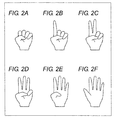
- Fig. 2 is a view illustrating various gestures recognized by the gesture recognition device.
- the gesture recognition device recognizes six types of gestures of the hand.
- a shape of a hand in Fig. 2A is referred to as a "zero-finger shape”
- a shape of a hand in Fig. 2B is referred to as a "one-finger shape”
- a shape of a hand in Fig. 2C is referred to as a "two-finger shape”
- a shape of a hand in Fig. 2D is referred to as a "three-finger shape”
- a shape of a hand in Fig. 2E is referred to as a "four-finger shape”
- a shape of a hand in Fig. 2F is referred to as a "five-finger shape”.
- the gesture recognition device of the embodiment does not distinguish the shape in Fig. 2C in which an index finger and a middle finger are raised and the shape in which the index finger and a little finger are raised, but recognizes as the "two-finger" shape. That is, the gesture recognition device according to the embodiment recognizes shape of the hand based on the number of raised fingers. Alternatively, the gesture recognition device may recognize the shape of the hand based on the number of raised fingers and the type of the raised finger.
- Fig. 1 is a block diagram illustrating an example of a main part configuration of a gesture recognition device 1.
- gesture recognition device 1 includes a controller 11, a storage unit 12, an image input unit 13, and a communication unit 14.
- the image input unit 13 is an interface between the gesture recognition device 1 and an external device (in an example of Fig. 1 , a camera 2), and the image input unit 13 is used when the gesture recognition device 1 acquires an image from an outside.
- the communication unit 14 conducts communication with another device in a wireless or wired manner, and exchanges data according to an instruction of the controller 11.
- the gesture recognition device 1 is incorporated in the electronic apparatus, and the communication unit 14 outputs a signal to an apparatus controller 3, which controls integrally the electronic apparatus, according to the instruction of the controller 11.
- the controller 11 executes a program read from the storage unit 12 to a temporary storage unit (not illustrated), whereby the controller 11 controls integrally each unit included in the gesture recognition device 1 while performing various calculations.
- the controller 11 includes an image acquisition unit 21, a hand area detector 22, a binary image generator 23, a fingertip candidate detector 24, a finger detector 25, a palm detector 26, a shape specifying unit (gesture type specifying unit) 27, a finger position specifying unit 28, and a control signal output unit 29 as functional blocks.
- a CPU Central Processing Unit
- the image acquisition unit 21 acquires the user's image captured by the camera 2 through the image input unit 13.
- the image acquired from the camera 2 by the image acquisition unit 21 is referred to as an input image.
- the image acquisition unit 21 outputs the acquired input image to the hand area detector 22.
- the image acquisition unit 21 may read the image from the storage unit 12.
- the input image acquired by the image acquisition unit 21 may be a two-dimensional image or a three-dimensional image. That is, the input image may have depth information on each pixel in addition to each pixel value (picture element value).
- the hand area detector 22 acquires the input image from the image acquisition unit 21, detects the user's hand from the acquired input image, and extracts a hand area including the detected hand from the input image.
- the hand area detector 22 outputs the extracted hand area image to the binary image generator 23.
- the hand area detector 22 can detect the user's hand using any well-known technology.
- the hand area detector 22 may specify a moving area based on a difference between a previously-stored background image and the input image, and extract the specified moving area as the hand area.
- the hand area detector 22 may acquire plural continuous input images and extract an area having a large accumulation of an inter-frame difference as the hand area.
- the hand area detector 22 may detect the hand using techniques, such as Boosting and SVM (Support Vector Machine), which are used in general face detection.
- the hand area detector 22 may detect the user's face, and extract the area at the predetermined position as the hand area based on the detected face.
- the hand area detector 22 may specify the hand area using the depth information.
- the binary image generator 23 acquires the hand area image from the hand area detector 22, performs binarization processing to the acquired hand area image, and generates a binary image in which a skin area is distinguished from other areas in the hand area image.
- the binary image generator 23 outputs the generated binary image to the fingertip candidate detector 24, the finger detector 25, and the palm detector 26.
- the binary image generator 23 can generates the binary image from the hand area image using any well-known technology.
- the binary image generator 23 may set the area obtained by a background difference to the skin area.
- the binary image generator 23 may extract the skin area using a previously-defined skin color model.
- the binary image generator 23 may extract the skin area with a color at a predetermined position (for example, neighborhood of center) of the hand area image as the skin color model.
- edge detection such as Sobel and Canny
- the binary image generator 23 may specify a closed contour by a contour extraction technique such as Snake, and extract the area formed by the closed contour as the skin area.
- the binary image generator 23 may specify the skin area using the depth information.
- the fingertip candidate detector 24 acquires the binary image from the binary image generator 23, and detects one or plural fingertip candidates from the binary image.
- the fingertip candidate means the skin area considered to be a fingertip in the binary image.
- the fingertip candidate detector 24 scans a rectangular area having a predetermined size on the binary image, and specifies the skin area as the fingertip candidate in the case that a ratio of the skin area included in the rectangular area falls within a predetermined range and in the case that a center of gravity of the skin area included in the rectangular area is located in a lower half of the rectangular area. For example, in the case that the ratio of the skin area to the rectangular area ranges from 60% to 80%, and that the position where the skin area is received is located in the lower half of the rectangular area, the fingertip candidate detector 24 specifies the skin area concerned as the fingertip candidate.
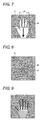
- the fingertip candidate detector 24 scans the rectangular area having the predetermined size on a binary image 51, and specifies the skin area included in a rectangular area 52 satisfying the condition as the fingertip candidate.
- the fingertip candidate detector 24 also specifies a center of gravity 53 of the fingertip candidate.
- An upper limit may be set to the number of fingertip candidates detected by the fingertip candidate detector 24.
- the fingertip candidate detector 24 may detect the fingertip candidate up to ten pieces.
- the fingertip candidate detector 24 outputs the center of gravity of the detected fingertip candidate to the finger detector 25. In the case that the fingertip candidate cannot be detected from the binary image, the fingertip candidate detector 24 notifies the palm detector 26 that the fingertip candidate cannot be detected.
- the finger detector 25 acquires the center of gravity of the fingertip candidate from the fingertip candidate detector 24, and detects the skin area that extends continuously by a predetermined length in a certain direction from the acquired center of gravity of the fingertip candidate as the finger.
- the finger detector 25 specifies an extending direction in which the skin area extends maximally from the center of gravity of the fingertip candidate.
- the finger detector 25 searches eight directions, namely, vertical, horizontal, and diagonal directions from the center of gravity of the fingertip candidate.
- the finger detector 25 sets the extending direction as the "downward direction”.
- the finger detector 25 determines whether the skin area extends at constant intervals toward the extending direction from the center of gravity 53.
- the finger detector 25 specifies the skin area as the finger candidate when the skin area extends by the predetermined length toward the extending direction from the center of gravity.
- the finger detector 25 specifies a reference width w1 of the skin area in the direction orthogonal to the specified extending direction in the center of gravity of the fingertip candidate.
- a difference value between a width of the skin area in the direction orthogonal to the extending direction and the reference width w1 at the position that separates from the center of gravity by the predetermined length in the extending direction is less than or equal to a predetermined value (for example, 15% of reference width w1)
- the finger detector 25 determines that the skin area extends by the predetermined length in the extending direction. Then the finger detector 25 makes the determination with respect to the position that separates by the predetermined length in the extending direction from the position where the skin area is determined to extend.
- the finger detector 25 makes the determination until the difference value between the width of the skin area and the reference width w1 is greater than the predetermined value, or until the skin area is out of the area of the binary image.
- the finger detector 25 specifies the position where the skin area is determined to extend, the position being located at an end in the extending direction from the center of gravity 53. When a length from the center of gravity of the fingertip candidate to the specified finger end position falls within a predetermined range, the finger detector 25 specifies the skin area that extends from the fingertip candidate to the finger end position in the extending direction as the finger candidate.
- the finger detector 25 can determine that the skin area specified as the finger candidate as the "finger". In the embodiment, whether a palm area exists in the extending direction of the specified finger candidate is further determined. When the palm area exists in the extending direction of the specified finger candidate, the finger detector 25 determined the skin area of the finger candidate to be the "finger".
- the finger detector 25 In the case that any "finger" is not detected yet, the finger detector 25 outputs the finger end position and extending direction of the specified finger candidate to the palm detector 26.
- the finger detector 25 acquires a palm area detection result from the palm detector 26, and determines whether the palm area exists in the extending direction of the specified finger candidate.
- the finger detector 25 determines whether the palm area exists in the extending direction of the specified finger candidate based on the palm area detection result already acquired from the palm detector 26.
- the finger detector 25 detects the finger candidate indicated by a line segment 58 and the finger candidate indicated by a line segment 59 as the fingers from the second finger. In this case, the finger detector 25 determines that the finger candidate indicated by the line segment 58 is the finger because the palm area exists in the extending direction. On the other hand, the finger detector 25 determines that the finger candidate indicated by the line segment 59 is not the finger because the palm area does not exist in the extending direction.
- the finger detector 25 may enhance accuracy of the finger detection by further performing edge detection or referring to the depth information.
- the finger detector 25 notifies the shape specifying unit 27 of the number of detected fingers.
- the finger detector 25 may further notify the shape specifying unit 27 of at least one of the center of gravity of the fingertip, the extending direction, and the finger end position of the detected finger.
- the finger detector 25 notifies the finger position specifying unit 28 of the center of gravity of the fingertip of at least one of the detected fingers.
- the palm detector 26 acquires the binary image from the binary image generator 23, and detects the palm area from the acquired binary image.
- the palm detector 26 acquires a finger end position 56 and the extending direction of the finger candidate from the finger detector 25, and specifies a reference width w2 of the skin area in the direction orthogonal to the extending direction in the finger end position 56.
- the palm detector 26 determines whether a difference value between the width of the skin area in the direction orthogonal to the extending direction and the reference width w2 at the position that separates from the finger end position by the predetermined length in the extending direction is less than or equal to a predetermined value (for example, 30% of reference width w2).
- the palm detector 26 When determining that the difference value between the width of the skin area and the reference width w2 is less than or equal to the predetermined value, the palm detector 26 performs the same determination with respect to the position that separates from the position by the predetermined length. The palm detector 26 makes the determination until the difference value between the width of the skin area and the reference width w2 is greater than the predetermined value, or until the skin area is out of the area of the binary image. The palm detector 26 specifies the palm end position where the difference value between the width of the skin area and the reference width w2 is determined to be less than or equal to the predetermined value, the palm end position being located at the end in the extending direction. The palm detector 26 specifies the skin area that extends continuously to the specified palm end position from the finger end position as the palm area. In an example of Fig. 8 , the palm detector 26 specifies a skin area 57 as the palm area.
- the palm detector 26 may enhance the accuracy of the palm area detection by determining whether the skin area from the finger end position to the palm end position falls within a predetermined range based on initial information, edge information, and the depth information, which will be described below.
- the palm detector 26 detects the palm area from the binary image when being notified by the fingertip candidate detector 24 that the fingertip candidate cannot be detected. At this point, the palm detector 26 previously sets the initial information indicating a size of the user's palm. The palm detector 26 detects the palm area from the binary image based on the initial information. For example, the palm detector 26 may issue an instruction to the user to perform a predetermined hand gesture at a beginning of the gesture operation, set the initial information by acquiring the size of the user's palm from the image captured at that time.
- the initial information may include information indicating the position of the user's hand or the background image.
- the palm detector 26 may detect the palm using any well-known technology.
- the palm detector 26 notifies the finger detector 25 and the shape specifying unit 27 of the palm area detection result.
- the palm detector 26 notifies the finger detector 25 of the existence or nonexistence of the palm area as the detection result.
- the palm detector 26 notifies the finger detector 25 of the position of the detected palm area in the case that the palm area is detected.
- the palm detector 26 notifies the shape specifying unit 27 of at least the existence or nonexistence of the palm area.
- the palm detector 26 may also notify the shape specifying unit 27 of the position of the palm area.
- the shape specifying unit 27 specifies the type of the hand gesture based on the number of fingers detected by the finger detector 25. Specifically, the shape specifying unit 27 specifies one of the gestures of the "zero-finger shape", the "one-finger shape”, the “two-finger shape”, the “three-finger shape”, the “four-finger shape”, and the "five-finger shape” based on the number of fingers detected by the finger detector 25.
- the shape specifying unit 27 determines that the type of the hand gesture is the gesture of the "five-finger shape".
- the shape specifying unit 27 acquires the palm area detection result from the palm detector 26, and the shape specifying unit 27 may determine that the type of the hand gesture is the gesture of the "zero-finger shape" in the case that the number of fingers detected by the finger detector 25 is zero and in the case that the palm detector 26 detects the palm area. In this case, the shape specifying unit 27 determines that there is no type of the hand gesture in the case that the number of fingers detected by the finger detector 25 is zero and in the case that the palm detector 26 does not detect the palm area.
- the shape specifying unit 27 may determine the type of gesture based on a statistical discrimination technique (SVM or neural network) using the position and length (from the fingertip (for example, center of gravity) to the finger end position) of the finger detected by the finger detector 25, the position and size (area) of the palm area detected by the palm detector 26, the edge information, and the depth information.
- SVM statistical discrimination technique
- the finger position specifying unit 28 specifies the center of gravity of the fingertip of one of the fingers detected by the finger detector 25 as an indication position.
- the finger position specifying unit 28 may specify the center of gravity of the fingertip of the predetermined finger (for example, index finger) as the indication position using the type of the gesture specified by the shape specifying unit 27, the position and length of the finger detected by the finger detector 25, the position and size (area) of the palm area detected by the palm detector 26, the edge information, and the depth information.
- the control signal output unit 29 generates a control signal indicating at least one of the type of the gesture specified by the shape specifying unit 27 and the indication position specified by the finger position specifying unit 28, and outputs the generated control signal to the apparatus controller 3 through the communication unit 14.
- the storage unit 12 stores the program and data, which are referred to by the controller 11, therein.
- the initial information is stored in the storage unit 12.
- Fig. 10 is a flowchart illustrating the flow of the gesture recognition processing performed by the gesture recognition device 1.
- the image acquisition unit 21 acquires the input image captured by the user through the image input unit 13 (S1).
- the hand area detector 22 detects the user's hand from the input image, and extracts the hand area including the detected hand from the input image (S2).
- the binary image generator 23 performs the binarization processing to the hand area image to generate the binary image (S3).
- the fingertip candidate detector 24 detects one or plural fingertip candidates from the binary image (S4). At this point, in the case that the fingertip candidate detector 24 detects at least one fingertip candidate (YES in S5), the fingertip candidate detector 24 stores the detected fingertip candidate (S6).
- the finger detector 25 selects one of the fingertip candidate detected by the fingertip candidate detector 24 (S7).
- the finger detector 25 detects the finger candidate based on whether the skin area that extends by the predetermined length in a certain direction from the center of gravity of the selected fingertip candidate exists (S8).
- the flow goes to S18.
- whether the "finger" is already detected is determined (S10).
- the palm detector 26 detects the palm area based on the finger candidate detected by the finger detector 25 (S11). In the case that the palm detector 26 detects the palm area (YES in S12), the finger detector 25 determines that the detected finger candidate is the finger (S13). On the other hand, in the case that the palm detector 26 does not detect the palm area (NO in S12), the finger detector 25 determines that the detected finger candidate is not the finger (S14).
- the finger detector 25 determines whether the palm area detected by the palm detector 26 exists in the extending direction of the detected finger candidate (S15). In the case that the palm area exists in the extending direction of the detected finger candidate (YES in S15), the finger detector 25 determines that the detected finger candidate is the finger (S16). On the other hand, in the case that the palm area does not exist in the extending direction of the detected finger candidate (NO in S15), the finger detector 25 determines that the detected finger candidate is not the finger (S17).
- the finger detector 25 determines whether all the fingertip candidates detected by the fingertip candidate detector 24 are subjected to the processing (S18). In the case that all the fingertip candidates are not subjected to the processing (NO in S18), the finger detector 25 returns to S7 to select another fingertip candidate detected by the fingertip candidate detector 24. On the other hand, in the case that all the fingertip candidates are subjected to the processing by the finger detector 25 (YES in S18), whether the finger detector 25 detects at least one finger is determined (S19).
- the palm detector 26 detects the palm from the binary image based on the initial information (S20). In the case that the palm detector 26 cannot detect the palm (NO in S21), the gesture recognition processing is ended. On the other hand, in the case that the palm detector 26 detects the palm (YES in S21), the palm detector 26 notifies the shape specifying unit 27 of the detection result.
- the finger detector 25 detects at least one finger (YES in S19)
- the finger detector 25 notifies the shape specifying unit 27 and the finger position specifying unit 28 of the detection result.
- the shape specifying unit 27 specifies the type of the hand gesture based on the detection results of the finger detector 25 and palm detector 26 (S22).
- the finger position specifying unit 28 specifies the indication position based on the detection result of the finger detector 25 (S23).
- the control signal output unit 29 generates the control signal corresponding to the gesture , and outputs the generated control signal to the apparatus controller 3 (S24).
- the control block (particular, controller 11) of the gesture recognition device 1 may be constructed with a logic circuit (hardware) formed in an integrated circuit (IC chip) or software using the CPU.
- the gesture recognition device 1 includes the CPU that issues a command of the program that is of the software implementing various functions, the ROM or a storage device (hereinafter referred to as a "recording medium") in which the program and various pieces of data are recorded while being readable with a computer (or CPU), and the RAM in which the program is expanded.
- the computer (or CPU) reads the program from the recording medium to execute the program, thereby achieving the object of the present invention.
- “Non-temporary material mediums” such as a tape, a disk, a card, a semiconductor memory, and a programmable logic circuit can be used as the recording medium.
- the program may be supplied to the computer through any transmission carrier (such as a communication network and broadcasting wave) through which the program can be transmitted.
- the present invention can also be implemented in the form of a data signal embedded in a carrier wave in which the program is materialized by electronic transmission.
- a gesture recognition device in accordance with a first aspect of the present invention configured to recognize a gesture of a hand from a captured image of a user, the gesture recognition device includes: a fingertip candidate detector configured to detect a fingertip candidate from the image; a finger detector configured to detect a skin area as a finger, the skin area extending by a predetermined length in a certain direction from the fingertip candidate detected by the fingertip candidate detector; and a gesture type specifying unit configured to specify a type of the gesture based on the number of fingers detected by the finger detector.
- the fingertip candidate detector detects the fingertip candidate considered to be the fingertip from the captured image of the user, and the finger detector detects the skin area extending by the predetermined length in the certain direction from the fingertip candidate as the finger. That is, the gesture recognition device can detect the finger from the image through the simple processing.
- the gesture type specifying unit specifies the type of the gesture based on the number of detected fingers.
- the gesture recognition device of the present invention recognizes the hand gesture, and the gesture is classified by the number of raised fingers. Therefore, the gesture recognition device can accurately discriminate the type of the gesture based on the number of fingers.
- a gesture recognition device in accordance with a second aspect of the present invention configured to recognize a gesture of a hand from a captured image of a user, the gesture recognition device includes: a fingertip candidate detector configured to detect a fingertip candidate from the image; a finger detector configured to detect a skin area as a finger, the skin area extending by a predetermined length in a certain direction from the fingertip candidate detected by the fingertip candidate detector; and a finger position specifying unit configured to specify a fingertip position of the finger detected by the finger detector as a position indicated by the user.
- the fingertip candidate detector detects the fingertip candidate considered to be the fingertip from the captured image of the user, and the finger detector detects the skin area extending by the predetermined length in the certain direction from the fingertip candidate as the finger. That is, the gesture recognition device can detect the finger from the image through the simple processing.
- the finger position specifying unit specifies the fingertip position as the indication position of the user, which allows the gesture recognition device to recognize the indication position of the user by the gesture.
- the finger detector may set the certain direction to a direction in which the skin area extends maximally from a center of gravity of the fingertip candidate detected by the fingertip candidate detector.
- the finger detector can correctly specify the extending direction of the finger.
- the finger detector may specify a reference width w1 of the skin area in the direction orthogonal to the certain direction in the center of gravity of the fingertip candidate detected by the fingertip candidate detector, and determine that the skin area extends in the certain direction when a difference value between a width of the skin area in the orthogonal direction and the reference width w1 is less than or equal to a predetermined value.
- the finger is the skin area extending by the predetermined length in the certain direction, and is the skin area having the substantially same width as the fingertip. Therefore, according to the configuration, whether the skin area extending from the fingertip candidate is the finger can correctly be determined.
- the fingertip candidate detector may scan a rectangular area having a predetermined size on the image, and specify the skin area as the fingertip candidate when a ratio of the skin area included in the rectangular area falls within a predetermined range and when a center of gravity of the skin area is located in a lower half of the rectangular area.
- the user performs the gesture such that the fingertip is oriented toward the upward direction of the camera (image). Therefore, in the case that the area including the fingertip on the image is extracted, it is considered that the fingertip is located in a lower portion of the extracted area. Therefore, according to the configuration, the fingertip candidate having a high probability of the fingertip can be detected.
- the gesture recognition device of any one of the first to fifth aspects further includes a palm detector configured to detect a palm from the image.
- the finger detector may specify the skin area extending by a predetermined length in a certain direction from the fingertip candidate as a finger candidate, and detect the finger candidate as the finger when the palm detected by the palm detector is located in the certain direction from the finger candidate.
- the finger detector detects the finger candidate as the finger. Therefore, the finger detector can more accurately detect the finger.
- the gesture recognition device of the fourth aspect further includes a palm detector configured to detect a palm from the image.
- the finger detector may specify the skin area extending by a predetermined length in a certain direction from the fingertip candidate as a finger candidate, detect the finger candidate as the finger when the palm detected by the palm detector is located in the certain direction from the finger candidate, and may detect fingers from a second finger using the reference width w1 of a first finger when at least one finger is already detected.
- the finger candidate is the finger.
- the five fingers had the substantially same thickness. Therefore, the accuracy of the detection of the fingers from the second fingers can be improved by referring to the width of the finger having a high degree of certainty.
- the palm detector may specify a reference width w2 of the skin area in a direction orthogonal to the certain direction of the finger candidate at an end position of the finger candidate detected by the finger detector, and detect skin area extending continuously in the certain direction from the end position as the palm when a difference value between a width of the skin area in the orthogonal direction and the reference width w2 is less than or equal to a predetermined value.
- the palm is the skin area that extends continuously in the extending direction of the finger, and is the skin area having the substantially same width as the width at the end position (a base of the finger) of the finger. Therefore, according to the configuration, whether the skin area extending from the end position of the finger candidate is the palm can accurately be determined.
- the present invention also includes an electronic apparatus provided with the gesture recognition device.
- a gesture recognition method in accordance with a tenth aspect of the present invention for recognizing a gesture of a hand from a captured image of a user includes the steps of: detecting a fingertip candidate from the image; detecting a skin area as a finger, the skin area extending by a predetermined length in a certain direction from the fingertip candidate detected in the fingertip candidate detecting step; and specifying a type of the gesture based on the number of fingers detected in the finger detecting step.
- a gesture recognition method in accordance with an eleventh aspect of the present invention for recognizing a gesture of a hand from a captured image of a user includes the steps of: detecting a fingertip candidate from the image; detecting a skin area as a finger, the skin area extending by a predetermined length in a certain direction from the fingertip candidate detected in the fingertip candidate detecting step; and specifying a fingertip position of the finger detected in the finger detecting step as a position indicated by the user.
- the gesture recognition device of one of the above aspects may be constructed with a computer.
- the present invention also includes a control program causing the computer to act as each unit of the gesture recognition device and a computer-readable recording medium in which the control program is recorded.
- the present invention can be applied to the electronic apparatus that can be operated by the gesture.
Landscapes
- Engineering & Computer Science (AREA)
- Theoretical Computer Science (AREA)
- Physics & Mathematics (AREA)
- General Physics & Mathematics (AREA)
- Multimedia (AREA)
- Human Computer Interaction (AREA)
- General Engineering & Computer Science (AREA)
- Computer Vision & Pattern Recognition (AREA)
- Health & Medical Sciences (AREA)
- Psychiatry (AREA)
- Social Psychology (AREA)
- General Health & Medical Sciences (AREA)
- User Interface Of Digital Computer (AREA)
- Image Analysis (AREA)
Abstract
Description
- The present invention relates to a gesture recognition device that recognizes a gesture from a motion of a user, a gesture recognition method, an electronic apparatus, a control program, and a recording medium.
- Nowadays there is an electronic apparatus, such as a television receiver, a personal computer, and a tablet computer, in which a gesture recognition device that recognizes the gesture of a user's hand finger is incorporated. The electronic apparatus has an advantage that the user moves the hand finger to enable an intuitive operation, and various technologies for gesture recognition have been developed.
- For example, in the technology disclosed in Japanese Unexamined Patent Publication No.
2012-59271 8-279044 - In the gesture recognition device, it is necessary to accurately recognize various gesture in real time (through simple processing). However, the conventional technologies are not enough to accurately recognize various gesture in real time. Specifically, the technology of Japanese Unexamined Patent Publication No.
2012-59271 8-279044 - The present invention has been devised to solve the problems described above, and an object thereof is to provide a gesture recognition device that accurately recognizes various gestures through simple processing, a gesture recognition method, an electronic apparatus, a control program, and a recording medium.
- In accordance with one aspect of the present invention, a gesture recognition device configured to recognize a gesture of a hand from a captured image of a user, the gesture recognition device includes: a fingertip candidate detector configured to detect a fingertip candidate from the image; a finger detector configured to detect a skin area as a finger, the skin area extending by a predetermined length in a certain direction from the fingertip candidate detected by the fingertip candidate detector; and a gesture type specifying unit configured to specify a type of the gesture based on the number of fingers detected by the finger detector.
- In accordance with another aspect of the present invention, a gesture recognition device configured to recognize a gesture of a hand from a captured image of a user, the gesture recognition device includes: a fingertip candidate detector configured to detect a fingertip candidate from the image; a finger detector configured to detect a skin area as a finger, the skin area extending by a predetermined length in a certain direction from the fingertip candidate detected by the fingertip candidate detector; and a finger position specifying unit configured to specify a fingertip position of the finger detected by the finger detector as a position indicated by the user.
- In accordance with still another aspect of the present invention, a gesture recognition method for recognizing a gesture of a hand from a captured image of a user, the gesture recognition method includes the steps of: detecting a fingertip candidate from the image; detecting a skin area as a finger, the skin area extending by a predetermined length in a certain direction from the fingertip candidate detected in the fingertip candidate detecting step; and specifying a type of the gesture based on the number of fingers detected in the finger detecting step.
- In accordance with yet another aspect of the present invention, a gesture recognition method for recognizing a gesture of a hand from a captured image of a user, the gesture recognition method includes the steps of: detecting a fingertip candidate from the image; detecting a skin area as a finger, the skin area extending by a predetermined length in a certain direction from the fingertip candidate detected in the fingertip candidate detecting step; and specifying a fingertip position of the finger detected in the finger detecting step as a position indicated by the user.
- Accordingly, various gestures can accurately be recognized through the simple processing.
-
-
Fig. 1 is a block diagram illustrating a main part configuration of a gesture recognition device according to an embodiment of the present invention; -
Fig. 2 is a view illustrating a type of a gesture of a hand recognized by the gesture recognition device; -
Fig. 3 is a view illustrating an example of a fingertip candidate detected from a binary image; -
Fig. 4 is a view illustrating an extending direction of a skin area from a center of gravity of the fingertip candidate; -
Fig. 5 is a view illustrating a method for detecting a finger from the binary image based on the fingertip candidate; -
Fig. 6 is a view illustrating a positional relationship between a finger candidate and a palm; -
Fig. 7 is a view illustrating a method for detecting the palm from the binary image based on the finger candidate; -
Fig. 8 is a view illustrating a detected palm area; -
Fig. 9 is a view illustrating results of finger detection and palm detection; and -
Fig. 10 is a flowchart illustrating an example of gesture recognition processing performed by the gesture recognition device. - Hereinafter, an embodiment of the present invention will be described with reference to
Figs. 1 to 10 . - A gesture recognition device according to an embodiment of the present invention recognizes a gesture of a hand from a captured image of a user. The gesture recognition device is incorporated in electronic apparatuses such as a television receiver, a personal computer, a mobile phone, a smart phone, a tablet computer, a game machine, a digital camera, and a digital video camera. The gesture recognition device acts as an operation unit that is of an operation input interface for the user in the electronic apparatus.
- The gesture recognized by the gesture recognition device of the embodiment will be described with reference to
Fig. 2. Fig. 2 is a view illustrating various gestures recognized by the gesture recognition device. - As illustrated in
Fig. 2 , the gesture recognition device recognizes six types of gestures of the hand. Hereinafter, a shape of a hand inFig. 2A is referred to as a "zero-finger shape", a shape of a hand inFig. 2B is referred to as a "one-finger shape", a shape of a hand inFig. 2C is referred to as a "two-finger shape", a shape of a hand inFig. 2D is referred to as a "three-finger shape", a shape of a hand inFig. 2E is referred to as a "four-finger shape", and a shape of a hand inFig. 2F is referred to as a "five-finger shape". - For example, the gesture recognition device of the embodiment does not distinguish the shape in
Fig. 2C in which an index finger and a middle finger are raised and the shape in which the index finger and a little finger are raised, but recognizes as the "two-finger" shape. That is, the gesture recognition device according to the embodiment recognizes shape of the hand based on the number of raised fingers. Alternatively, the gesture recognition device may recognize the shape of the hand based on the number of raised fingers and the type of the raised finger. -
Fig. 1 is a block diagram illustrating an example of a main part configuration of agesture recognition device 1. As illustrated inFig. 1 ,gesture recognition device 1 includes acontroller 11, astorage unit 12, animage input unit 13, and acommunication unit 14. - The
image input unit 13 is an interface between thegesture recognition device 1 and an external device (in an example ofFig. 1 , a camera 2), and theimage input unit 13 is used when thegesture recognition device 1 acquires an image from an outside. - The
communication unit 14 conducts communication with another device in a wireless or wired manner, and exchanges data according to an instruction of thecontroller 11. In the embodiment, as described above, thegesture recognition device 1 is incorporated in the electronic apparatus, and thecommunication unit 14 outputs a signal to anapparatus controller 3, which controls integrally the electronic apparatus, according to the instruction of thecontroller 11. - The
controller 11 executes a program read from thestorage unit 12 to a temporary storage unit (not illustrated), whereby thecontroller 11 controls integrally each unit included in thegesture recognition device 1 while performing various calculations. - The
controller 11 includes animage acquisition unit 21, a hand area detector 22, abinary image generator 23, afingertip candidate detector 24, afinger detector 25, apalm detector 26, a shape specifying unit (gesture type specifying unit) 27, a fingerposition specifying unit 28, and a controlsignal output unit 29 as functional blocks. A CPU (Central Processing Unit) reads the program stored in a storage device constructed with a ROM (Read Only Memory) to the temporary storage unit constructed with a RAM (Random Access Memory), thereby implementing each of the functional blocks (21 to 29) of thecontroller 11. - The
image acquisition unit 21 acquires the user's image captured by thecamera 2 through theimage input unit 13. Hereinafter, the image acquired from thecamera 2 by theimage acquisition unit 21 is referred to as an input image. Theimage acquisition unit 21 outputs the acquired input image to the hand area detector 22. In the case that the image is stored in thestorage unit 12, theimage acquisition unit 21 may read the image from thestorage unit 12. - The input image acquired by the
image acquisition unit 21 may be a two-dimensional image or a three-dimensional image. That is, the input image may have depth information on each pixel in addition to each pixel value (picture element value). - The hand area detector 22 acquires the input image from the
image acquisition unit 21, detects the user's hand from the acquired input image, and extracts a hand area including the detected hand from the input image. The hand area detector 22 outputs the extracted hand area image to thebinary image generator 23. - The hand area detector 22 can detect the user's hand using any well-known technology. For example, the hand area detector 22 may specify a moving area based on a difference between a previously-stored background image and the input image, and extract the specified moving area as the hand area. The hand area detector 22 may acquire plural continuous input images and extract an area having a large accumulation of an inter-frame difference as the hand area. The hand area detector 22 may detect the hand using techniques, such as Boosting and SVM (Support Vector Machine), which are used in general face detection. In the case that the electronic apparatus issues the instruction to the user to perform the hand gesture at a predetermined lateral position of a user's face, the hand area detector 22 may detect the user's face, and extract the area at the predetermined position as the hand area based on the detected face. The hand area detector 22 may specify the hand area using the depth information.
- The
binary image generator 23 acquires the hand area image from the hand area detector 22, performs binarization processing to the acquired hand area image, and generates a binary image in which a skin area is distinguished from other areas in the hand area image. Thebinary image generator 23 outputs the generated binary image to thefingertip candidate detector 24, thefinger detector 25, and thepalm detector 26. - The
binary image generator 23 can generates the binary image from the hand area image using any well-known technology. For example, thebinary image generator 23 may set the area obtained by a background difference to the skin area. Thebinary image generator 23 may extract the skin area using a previously-defined skin color model. Thebinary image generator 23 may extract the skin area with a color at a predetermined position (for example, neighborhood of center) of the hand area image as the skin color model. Using edge detection (such as Sobel and Canny), thebinary image generator 23 may specify a closed contour by a contour extraction technique such as Snake, and extract the area formed by the closed contour as the skin area. Thebinary image generator 23 may specify the skin area using the depth information. - The
fingertip candidate detector 24 acquires the binary image from thebinary image generator 23, and detects one or plural fingertip candidates from the binary image. As used herein, the fingertip candidate means the skin area considered to be a fingertip in the binary image. - Specifically, the
fingertip candidate detector 24 scans a rectangular area having a predetermined size on the binary image, and specifies the skin area as the fingertip candidate in the case that a ratio of the skin area included in the rectangular area falls within a predetermined range and in the case that a center of gravity of the skin area included in the rectangular area is located in a lower half of the rectangular area. For example, in the case that the ratio of the skin area to the rectangular area ranges from 60% to 80%, and that the position where the skin area is received is located in the lower half of the rectangular area, thefingertip candidate detector 24 specifies the skin area concerned as the fingertip candidate. - In the embodiment, it is assumed that the user performs the hand gesture to the camera such that the fingertip is oriented upward as illustrated in
Fig. 2 . Therefore, whether the skin area is the fingertip candidate is determined using a condition that the center of gravity of the skin area is located in the lower half of the rectangular area. - In an example of
Fig. 3 , thefingertip candidate detector 24 scans the rectangular area having the predetermined size on abinary image 51, and specifies the skin area included in arectangular area 52 satisfying the condition as the fingertip candidate. Thefingertip candidate detector 24 also specifies a center ofgravity 53 of the fingertip candidate. - An upper limit may be set to the number of fingertip candidates detected by the
fingertip candidate detector 24. For example, thefingertip candidate detector 24 may detect the fingertip candidate up to ten pieces. - The
fingertip candidate detector 24 outputs the center of gravity of the detected fingertip candidate to thefinger detector 25. In the case that the fingertip candidate cannot be detected from the binary image, thefingertip candidate detector 24 notifies thepalm detector 26 that the fingertip candidate cannot be detected. - The
finger detector 25 acquires the center of gravity of the fingertip candidate from thefingertip candidate detector 24, and detects the skin area that extends continuously by a predetermined length in a certain direction from the acquired center of gravity of the fingertip candidate as the finger. - Specifically, the
finger detector 25 specifies an extending direction in which the skin area extends maximally from the center of gravity of the fingertip candidate. In the embodiment, as illustrated inFig. 4 , thefinger detector 25 searches eight directions, namely, vertical, horizontal, and diagonal directions from the center of gravity of the fingertip candidate. In an example ofFig. 4 , because the skin area extends maximally in the downward direction, thefinger detector 25 sets the extending direction as the "downward direction". - Then, as illustrated in
Fig. 5 , thefinger detector 25 determines whether the skin area extends at constant intervals toward the extending direction from the center ofgravity 53. Thefinger detector 25 specifies the skin area as the finger candidate when the skin area extends by the predetermined length toward the extending direction from the center of gravity. - More specifically, the
finger detector 25 specifies a reference width w1 of the skin area in the direction orthogonal to the specified extending direction in the center of gravity of the fingertip candidate. When a difference value between a width of the skin area in the direction orthogonal to the extending direction and the reference width w1 at the position that separates from the center of gravity by the predetermined length in the extending direction is less than or equal to a predetermined value (for example, 15% of reference width w1), thefinger detector 25 determines that the skin area extends by the predetermined length in the extending direction. Then thefinger detector 25 makes the determination with respect to the position that separates by the predetermined length in the extending direction from the position where the skin area is determined to extend. Thefinger detector 25 makes the determination until the difference value between the width of the skin area and the reference width w1 is greater than the predetermined value, or until the skin area is out of the area of the binary image. Thefinger detector 25 specifies the position where the skin area is determined to extend, the position being located at an end in the extending direction from the center ofgravity 53. When a length from the center of gravity of the fingertip candidate to the specified finger end position falls within a predetermined range, thefinger detector 25 specifies the skin area that extends from the fingertip candidate to the finger end position in the extending direction as the finger candidate. - At this point, the
finger detector 25 can determine that the skin area specified as the finger candidate as the "finger". In the embodiment, whether a palm area exists in the extending direction of the specified finger candidate is further determined. When the palm area exists in the extending direction of the specified finger candidate, thefinger detector 25 determined the skin area of the finger candidate to be the "finger". - In the case that any "finger" is not detected yet, the
finger detector 25 outputs the finger end position and extending direction of the specified finger candidate to thepalm detector 26. Thefinger detector 25 acquires a palm area detection result from thepalm detector 26, and determines whether the palm area exists in the extending direction of the specified finger candidate. On the other hand, in the case that at least one "finger" is already detected, thefinger detector 25 determines whether the palm area exists in the extending direction of the specified finger candidate based on the palm area detection result already acquired from thepalm detector 26. - For example, as illustrated in
Fig. 6 , it is assumed that thefinger detector 25 detects the finger candidate indicated by aline segment 58 and the finger candidate indicated by aline segment 59 as the fingers from the second finger. In this case, thefinger detector 25 determines that the finger candidate indicated by theline segment 58 is the finger because the palm area exists in the extending direction. On the other hand, thefinger detector 25 determines that the finger candidate indicated by theline segment 59 is not the finger because the palm area does not exist in the extending direction. - The
finger detector 25 may enhance accuracy of the finger detection by further performing edge detection or referring to the depth information. - The
finger detector 25 notifies theshape specifying unit 27 of the number of detected fingers. Thefinger detector 25 may further notify theshape specifying unit 27 of at least one of the center of gravity of the fingertip, the extending direction, and the finger end position of the detected finger. - The
finger detector 25 notifies the fingerposition specifying unit 28 of the center of gravity of the fingertip of at least one of the detected fingers. - The
palm detector 26 acquires the binary image from thebinary image generator 23, and detects the palm area from the acquired binary image. - Specifically, as illustrated in
Fig. 7 , thepalm detector 26 acquires afinger end position 56 and the extending direction of the finger candidate from thefinger detector 25, and specifies a reference width w2 of the skin area in the direction orthogonal to the extending direction in thefinger end position 56. Thepalm detector 26 determines whether a difference value between the width of the skin area in the direction orthogonal to the extending direction and the reference width w2 at the position that separates from the finger end position by the predetermined length in the extending direction is less than or equal to a predetermined value (for example, 30% of reference width w2). When determining that the difference value between the width of the skin area and the reference width w2 is less than or equal to the predetermined value, thepalm detector 26 performs the same determination with respect to the position that separates from the position by the predetermined length. Thepalm detector 26 makes the determination until the difference value between the width of the skin area and the reference width w2 is greater than the predetermined value, or until the skin area is out of the area of the binary image. Thepalm detector 26 specifies the palm end position where the difference value between the width of the skin area and the reference width w2 is determined to be less than or equal to the predetermined value, the palm end position being located at the end in the extending direction. Thepalm detector 26 specifies the skin area that extends continuously to the specified palm end position from the finger end position as the palm area. In an example ofFig. 8 , thepalm detector 26 specifies askin area 57 as the palm area. - The
palm detector 26 may enhance the accuracy of the palm area detection by determining whether the skin area from the finger end position to the palm end position falls within a predetermined range based on initial information, edge information, and the depth information, which will be described below. - The
palm detector 26 detects the palm area from the binary image when being notified by thefingertip candidate detector 24 that the fingertip candidate cannot be detected. At this point, thepalm detector 26 previously sets the initial information indicating a size of the user's palm. Thepalm detector 26 detects the palm area from the binary image based on the initial information. For example, thepalm detector 26 may issue an instruction to the user to perform a predetermined hand gesture at a beginning of the gesture operation, set the initial information by acquiring the size of the user's palm from the image captured at that time. The initial information may include information indicating the position of the user's hand or the background image. - The
palm detector 26 may detect the palm using any well-known technology. - The
palm detector 26 notifies thefinger detector 25 and theshape specifying unit 27 of the palm area detection result. Thepalm detector 26 notifies thefinger detector 25 of the existence or nonexistence of the palm area as the detection result. Thepalm detector 26 notifies thefinger detector 25 of the position of the detected palm area in the case that the palm area is detected. Thepalm detector 26 notifies theshape specifying unit 27 of at least the existence or nonexistence of the palm area. Thepalm detector 26 may also notify theshape specifying unit 27 of the position of the palm area. - The
shape specifying unit 27 specifies the type of the hand gesture based on the number of fingers detected by thefinger detector 25. Specifically, theshape specifying unit 27 specifies one of the gestures of the "zero-finger shape", the "one-finger shape", the "two-finger shape", the "three-finger shape", the "four-finger shape", and the "five-finger shape" based on the number of fingers detected by thefinger detector 25. - For example, as illustrated in
Fig. 9 , in the case that thefinger detector 25 detects the five fingers, theshape specifying unit 27 determines that the type of the hand gesture is the gesture of the "five-finger shape". - At this point, in the case that the
finger detector 25 detects no finger, namely, in the case that thefinger detector 25 cannot detect the finger, it is conceivable that the user currently performs the gesture of the "zero-finger shape", or that the user does not currently perform the effective gesture. Therefore, theshape specifying unit 27 acquires the palm area detection result from thepalm detector 26, and theshape specifying unit 27 may determine that the type of the hand gesture is the gesture of the "zero-finger shape" in the case that the number of fingers detected by thefinger detector 25 is zero and in the case that thepalm detector 26 detects the palm area. In this case, theshape specifying unit 27 determines that there is no type of the hand gesture in the case that the number of fingers detected by thefinger detector 25 is zero and in the case that thepalm detector 26 does not detect the palm area. - The
shape specifying unit 27 may determine the type of gesture based on a statistical discrimination technique (SVM or neural network) using the position and length (from the fingertip (for example, center of gravity) to the finger end position) of the finger detected by thefinger detector 25, the position and size (area) of the palm area detected by thepalm detector 26, the edge information, and the depth information. - The finger
position specifying unit 28 specifies the center of gravity of the fingertip of one of the fingers detected by thefinger detector 25 as an indication position. The fingerposition specifying unit 28 may specify the center of gravity of the fingertip of the predetermined finger (for example, index finger) as the indication position using the type of the gesture specified by theshape specifying unit 27, the position and length of the finger detected by thefinger detector 25, the position and size (area) of the palm area detected by thepalm detector 26, the edge information, and the depth information. - The control
signal output unit 29 generates a control signal indicating at least one of the type of the gesture specified by theshape specifying unit 27 and the indication position specified by the fingerposition specifying unit 28, and outputs the generated control signal to theapparatus controller 3 through thecommunication unit 14. - The
storage unit 12 stores the program and data, which are referred to by thecontroller 11, therein. For example, the initial information is stored in thestorage unit 12. - Gesture recognition processing performed by
gesture recognition device 1 will be described below with reference toFig. 10. Fig. 10 is a flowchart illustrating the flow of the gesture recognition processing performed by thegesture recognition device 1. - As illustrated in
Fig. 5 , theimage acquisition unit 21 acquires the input image captured by the user through the image input unit 13 (S1). The hand area detector 22 detects the user's hand from the input image, and extracts the hand area including the detected hand from the input image (S2). Thebinary image generator 23 performs the binarization processing to the hand area image to generate the binary image (S3). - The
fingertip candidate detector 24 detects one or plural fingertip candidates from the binary image (S4). At this point, in the case that thefingertip candidate detector 24 detects at least one fingertip candidate (YES in S5), thefingertip candidate detector 24 stores the detected fingertip candidate (S6). - The
finger detector 25 selects one of the fingertip candidate detected by the fingertip candidate detector 24 (S7). Thefinger detector 25 detects the finger candidate based on whether the skin area that extends by the predetermined length in a certain direction from the center of gravity of the selected fingertip candidate exists (S8). In the case that the finger candidate cannot be detected based on the fingertip candidate detected by the finger detector 25 (NO in S9), the flow goes to S18. On the other hand, in the case that the finger candidate is detected based on the fingertip candidate detected by the finger detector 25 (YES in S9), whether the "finger" is already detected is determined (S10). - In the case that the
finger detector 25 does not detect any finger yet (NO in S10), thepalm detector 26 detects the palm area based on the finger candidate detected by the finger detector 25 (S11). In the case that thepalm detector 26 detects the palm area (YES in S12), thefinger detector 25 determines that the detected finger candidate is the finger (S13). On the other hand, in the case that thepalm detector 26 does not detect the palm area (NO in S12), thefinger detector 25 determines that the detected finger candidate is not the finger (S14). - In the case that the
finger detector 25 already detects at least one finger (YES in S10), thefinger detector 25 determines whether the palm area detected by thepalm detector 26 exists in the extending direction of the detected finger candidate (S15). In the case that the palm area exists in the extending direction of the detected finger candidate (YES in S15), thefinger detector 25 determines that the detected finger candidate is the finger (S16). On the other hand, in the case that the palm area does not exist in the extending direction of the detected finger candidate (NO in S15), thefinger detector 25 determines that the detected finger candidate is not the finger (S17). - The
finger detector 25 determines whether all the fingertip candidates detected by thefingertip candidate detector 24 are subjected to the processing (S18). In the case that all the fingertip candidates are not subjected to the processing (NO in S18), thefinger detector 25 returns to S7 to select another fingertip candidate detected by thefingertip candidate detector 24. On the other hand, in the case that all the fingertip candidates are subjected to the processing by the finger detector 25 (YES in S18), whether thefinger detector 25 detects at least one finger is determined (S19). - In the case that the
finger detector 25 cannot detect any finger (NO in S19), and in the case thatfingertip candidate detector 24 cannot detect any fingertip candidate (NO in S5), thepalm detector 26 detects the palm from the binary image based on the initial information (S20). In the case that thepalm detector 26 cannot detect the palm (NO in S21), the gesture recognition processing is ended. On the other hand, in the case that thepalm detector 26 detects the palm (YES in S21), thepalm detector 26 notifies theshape specifying unit 27 of the detection result. - In the case that the
finger detector 25 detects at least one finger (YES in S19), thefinger detector 25 notifies theshape specifying unit 27 and the fingerposition specifying unit 28 of the detection result. - The
shape specifying unit 27 specifies the type of the hand gesture based on the detection results of thefinger detector 25 and palm detector 26 (S22). The fingerposition specifying unit 28 specifies the indication position based on the detection result of the finger detector 25 (S23). The controlsignal output unit 29 generates the control signal corresponding to the gesture , and outputs the generated control signal to the apparatus controller 3 (S24). - The control block (particular, controller 11) of the
gesture recognition device 1 may be constructed with a logic circuit (hardware) formed in an integrated circuit (IC chip) or software using the CPU. - In the latter, the
gesture recognition device 1 includes the CPU that issues a command of the program that is of the software implementing various functions, the ROM or a storage device (hereinafter referred to as a "recording medium") in which the program and various pieces of data are recorded while being readable with a computer (or CPU), and the RAM in which the program is expanded. The computer (or CPU) reads the program from the recording medium to execute the program, thereby achieving the object of the present invention. "Non-temporary material mediums" such as a tape, a disk, a card, a semiconductor memory, and a programmable logic circuit can be used as the recording medium. The program may be supplied to the computer through any transmission carrier (such as a communication network and broadcasting wave) through which the program can be transmitted. The present invention can also be implemented in the form of a data signal embedded in a carrier wave in which the program is materialized by electronic transmission. - A gesture recognition device in accordance with a first aspect of the present invention configured to recognize a gesture of a hand from a captured image of a user, the gesture recognition device includes: a fingertip candidate detector configured to detect a fingertip candidate from the image; a finger detector configured to detect a skin area as a finger, the skin area extending by a predetermined length in a certain direction from the fingertip candidate detected by the fingertip candidate detector; and a gesture type specifying unit configured to specify a type of the gesture based on the number of fingers detected by the finger detector.
- According to the configuration, the fingertip candidate detector detects the fingertip candidate considered to be the fingertip from the captured image of the user, and the finger detector detects the skin area extending by the predetermined length in the certain direction from the fingertip candidate as the finger. That is, the gesture recognition device can detect the finger from the image through the simple processing.
- The gesture type specifying unit specifies the type of the gesture based on the number of detected fingers. At this point, the gesture recognition device of the present invention recognizes the hand gesture, and the gesture is classified by the number of raised fingers. Therefore, the gesture recognition device can accurately discriminate the type of the gesture based on the number of fingers.
- Accordingly, advantageously various gestures can accurately be recognized through the simple processing.
- A gesture recognition device in accordance with a second aspect of the present invention configured to recognize a gesture of a hand from a captured image of a user, the gesture recognition device includes: a fingertip candidate detector configured to detect a fingertip candidate from the image; a finger detector configured to detect a skin area as a finger, the skin area extending by a predetermined length in a certain direction from the fingertip candidate detected by the fingertip candidate detector; and a finger position specifying unit configured to specify a fingertip position of the finger detected by the finger detector as a position indicated by the user.
- According to the configuration, the fingertip candidate detector detects the fingertip candidate considered to be the fingertip from the captured image of the user, and the finger detector detects the skin area extending by the predetermined length in the certain direction from the fingertip candidate as the finger. That is, the gesture recognition device can detect the finger from the image through the simple processing.
- At this point, in the case that the user indicates the position by the hand, it is considered that the position is indicated by one of the fingertips. Therefore, the finger position specifying unit specifies the fingertip position as the indication position of the user, which allows the gesture recognition device to recognize the indication position of the user by the gesture.
- Accordingly, advantageously various gestures can accurately be recognized through the simple processing.
- In accordance with a third aspect of the present invention, in the gesture recognition device of the first or second aspect, the finger detector may set the certain direction to a direction in which the skin area extends maximally from a center of gravity of the fingertip candidate detected by the fingertip candidate detector.
- At this point, the direction in which the skin area extends maximally from the center of gravity of the fingertip is the extending direction of the finger. Therefore, according to the configuration, the finger detector can correctly specify the extending direction of the finger.
- In accordance with a fourth aspect of the present invention, in the gesture recognition device of any one of the first to third aspects, the finger detector may specify a reference width w1 of the skin area in the direction orthogonal to the certain direction in the center of gravity of the fingertip candidate detected by the fingertip candidate detector, and determine that the skin area extends in the certain direction when a difference value between a width of the skin area in the orthogonal direction and the reference width w1 is less than or equal to a predetermined value.
- At this point, the finger is the skin area extending by the predetermined length in the certain direction, and is the skin area having the substantially same width as the fingertip. Therefore, according to the configuration, whether the skin area extending from the fingertip candidate is the finger can correctly be determined.
- In accordance with a fifth aspect of the present invention, in the gesture recognition device of any one of the first to fourth aspects, the fingertip candidate detector may scan a rectangular area having a predetermined size on the image, and specify the skin area as the fingertip candidate when a ratio of the skin area included in the rectangular area falls within a predetermined range and when a center of gravity of the skin area is located in a lower half of the rectangular area.
- In the gesture recognition device of the present invention, it is assumed that the user performs the gesture such that the fingertip is oriented toward the upward direction of the camera (image). Therefore, in the case that the area including the fingertip on the image is extracted, it is considered that the fingertip is located in a lower portion of the extracted area. Therefore, according to the configuration, the fingertip candidate having a high probability of the fingertip can be detected.
- In accordance with a sixth aspect of the present invention, the gesture recognition device of any one of the first to fifth aspects further includes a palm detector configured to detect a palm from the image. In the gesture recognition device, the finger detector may specify the skin area extending by a predetermined length in a certain direction from the fingertip candidate as a finger candidate, and detect the finger candidate as the finger when the palm detected by the palm detector is located in the certain direction from the finger candidate.
- According to the configuration, in the case that the palm is located in the extending direction of the finger candidate, the finger detector detects the finger candidate as the finger. Therefore, the finger detector can more accurately detect the finger.
- In accordance with a seventh aspect of the present invention, the gesture recognition device of the fourth aspect further includes a palm detector configured to detect a palm from the image. In the gesture recognition device, the finger detector may specify the skin area extending by a predetermined length in a certain direction from the fingertip candidate as a finger candidate, detect the finger candidate as the finger when the palm detected by the palm detector is located in the certain direction from the finger candidate, and may detect fingers from a second finger using the reference width w1 of a first finger when at least one finger is already detected.
- As described above, in the case that the palm is located in the extending direction of the finger candidate, there is a high probability that the finger candidate is the finger. The five fingers had the substantially same thickness. Therefore, the accuracy of the detection of the fingers from the second fingers can be improved by referring to the width of the finger having a high degree of certainty.
- In accordance with an eighth aspect of the present invention, in the gesture recognition device of the sixth or seventh aspect, the palm detector may specify a reference width w2 of the skin area in a direction orthogonal to the certain direction of the finger candidate at an end position of the finger candidate detected by the finger detector, and detect skin area extending continuously in the certain direction from the end position as the palm when a difference value between a width of the skin area in the orthogonal direction and the reference width w2 is less than or equal to a predetermined value.
- At this point, the palm is the skin area that extends continuously in the extending direction of the finger, and is the skin area having the substantially same width as the width at the end position (a base of the finger) of the finger. Therefore, according to the configuration, whether the skin area extending from the end position of the finger candidate is the palm can accurately be determined.
- The present invention also includes an electronic apparatus provided with the gesture recognition device.
- A gesture recognition method in accordance with a tenth aspect of the present invention for recognizing a gesture of a hand from a captured image of a user, the gesture recognition method includes the steps of: detecting a fingertip candidate from the image; detecting a skin area as a finger, the skin area extending by a predetermined length in a certain direction from the fingertip candidate detected in the fingertip candidate detecting step; and specifying a type of the gesture based on the number of fingers detected in the finger detecting step.
- A gesture recognition method in accordance with an eleventh aspect of the present invention for recognizing a gesture of a hand from a captured image of a user, the gesture recognition method includes the steps of: detecting a fingertip candidate from the image; detecting a skin area as a finger, the skin area extending by a predetermined length in a certain direction from the fingertip candidate detected in the fingertip candidate detecting step; and specifying a fingertip position of the finger detected in the finger detecting step as a position indicated by the user.
- The gesture recognition device of one of the above aspects may be constructed with a computer. In this case, the present invention also includes a control program causing the computer to act as each unit of the gesture recognition device and a computer-readable recording medium in which the control program is recorded.
- The present invention is not limited to the above embodiment, but various changes can be made within the scope of the claims. That is, an embodiment obtained by a combination of technical means changed properly in the scope of the claims is also included in the technical scope of the present invention.
- The present invention can be applied to the electronic apparatus that can be operated by the gesture.
Claims (13)
- A gesture recognition device configured to recognize a gesture of a hand from a captured image of a user, the gesture recognition device comprising:a fingertip candidate detector configured to detect a fingertip candidate from the image;a finger detector configured to detect a skin area as a finger, the skin area extending by a predetermined length in a certain direction from the fingertip candidate detected by the fingertip candidate detector; anda gesture type specifying unit configured to specify a type of the gesture based on the number of fingers detected by the finger detector.
- A gesture recognition device configured to recognize a gesture of a hand from a captured image of a user, the gesture recognition device comprising:a fingertip candidate detector configured to detect a fingertip candidate from the image;a finger detector configured to detect a skin area as a finger, the skin area extending by a predetermined length in a certain direction from the fingertip candidate detected by the fingertip candidate detector; anda finger position specifying unit configured to specify a fingertip position of the finger detected by the finger detector as a position indicated by the user.
- The gesture recognition device according to claim 1 or 2, wherein the finger detector sets the certain direction to a direction in which the skin area extends maximally from a center of gravity of the fingertip candidate detected by the fingertip candidate detector.
- The gesture recognition device according to any one of claims 1 to 3, wherein the finger detector specifies a reference width w1 of the skin area in the direction orthogonal to the certain direction in the center of gravity of the fingertip candidate detected by the fingertip candidate detector, and determines that the skin area extends in the certain direction when a difference value between a width of the skin area in the orthogonal direction and the reference width w1 is less than or equal to a predetermined value.
- The gesture recognition device according to any one of claims 1 to 4, wherein the fingertip candidate detector scans a rectangular area having a predetermined size on the image, and specifies the skin area as the fingertip candidate when a ratio of the skin area included in the rectangular area falls within a predetermined range and when a center of gravity of the skin area is located in a lower half of the rectangular area.
- The gesture recognition device according to any one of claims 1 to 5, further comprising a palm detector configured to detect a palm from the image,
wherein the finger detector specifies the skin area extending by a predetermined length in a certain direction from the fingertip candidate as a finger candidate, and detects the finger candidate as the finger when the palm detected by the palm detector is located in the certain direction from the finger candidate. - The gesture recognition device according to claim 4, further comprising a palm detector configured to detect a palm from the image,
wherein the finger detector specifies the skin area extending by a predetermined length in a certain direction from the fingertip candidate as a finger candidate, detects the finger candidate as the finger when the palm detected by the palm detector is located in the certain direction from the finger candidate, and detects fingers from a second finger using the reference width w1 of a first finger when at least one finger is already detected. - The gesture recognition device according to claim 6 or 7, wherein the palm detector specifies a reference width w2 of the skin area in a direction orthogonal to the certain direction of the finger candidate at an end position of the finger candidate detected by the finger detector, and detects skin area extending continuously in the certain direction from the end position as the palm when a difference value between a width of the skin area in the orthogonal direction and the reference width w2 is less than or equal to a predetermined value.
- An electronic apparatus provided with the gesture recognition device according to any one of claims 1 to 8.
- A gesture recognition method for recognizing a gesture of a hand from a captured image of a user, the gesture recognition method comprising the steps of:detecting a fingertip candidate from the image;detecting a skin area as a finger, the skin area extending by a predetermined length in a certain direction from the fingertip candidate detected in the fingertip candidate detecting step; andspecifying a type of the gesture based on the number of fingers detected in the finger detecting step.
- A gesture recognition method for recognizing a gesture of a hand from a captured image of a user, the gesture recognition method comprising the steps of:detecting a fingertip candidate from the image;detecting a skin area as a finger, the skin area extending by a predetermined length in a certain direction from the fingertip candidate detected in the fingertip candidate detecting step; andspecifying a fingertip position of the finger detected in the finger detecting step as a position indicated by the user.
- A control program configured to operate the gesture recognition device according to claims 1 to 8, the control program causing a computer to act as each of the units.
- A computer-readable recording medium in which the control program according to claim 12 is recorded.
Applications Claiming Priority (1)
| Application Number | Priority Date | Filing Date | Title |
|---|---|---|---|
| JP2013085265A JP6155786B2 (en) | 2013-04-15 | 2013-04-15 | Gesture recognition device, gesture recognition method, electronic device, control program, and recording medium |
Publications (2)
| Publication Number | Publication Date |
|---|---|
| EP2793168A2 true EP2793168A2 (en) | 2014-10-22 |
| EP2793168A3 EP2793168A3 (en) | 2015-01-21 |
Family
ID=50238208
Family Applications (1)
| Application Number | Title | Priority Date | Filing Date |
|---|---|---|---|
| EP14158100.9A Withdrawn EP2793168A3 (en) | 2013-04-15 | 2014-03-06 | Gesture recognition device, gesture recognition method, electronic apparatus, control program, and recording medium |
Country Status (5)
| Country | Link |
|---|---|
| US (1) | US9524425B2 (en) |
| EP (1) | EP2793168A3 (en) |
| JP (1) | JP6155786B2 (en) |
| KR (1) | KR20140123900A (en) |
| CN (1) | CN104102340A (en) |
Cited By (1)
| Publication number | Priority date | Publication date | Assignee | Title |
|---|---|---|---|---|
| CN106203236A (en) * | 2015-05-05 | 2016-12-07 | 深圳柔石科技有限公司 | The gesture identification method of a kind of view-based access control model and system |
Families Citing this family (30)
| Publication number | Priority date | Publication date | Assignee | Title |
|---|---|---|---|---|
| JP6326847B2 (en) * | 2014-02-14 | 2018-05-23 | 富士通株式会社 | Image processing apparatus, image processing method, and image processing program |
| CN104299004B (en) * | 2014-10-23 | 2018-05-01 | 浙江大学 | A kind of gesture identification method based on multiple features fusion and finger tip detection |
| JP6739896B2 (en) * | 2014-12-16 | 2020-08-12 | 日本電気株式会社 | Information processing device, information processing method, and program |
| JP6585355B2 (en) * | 2015-03-04 | 2019-10-02 | 株式会社メガチップス | Image recognition device |
| US9558389B2 (en) | 2015-03-24 | 2017-01-31 | Intel Corporation | Reliable fingertip and palm detection |
| KR101662022B1 (en) * | 2015-08-12 | 2016-10-10 | 연세대학교 산학협력단 | Apparatus and Method for Device Control using Gesture |
| US20170277944A1 (en) * | 2016-03-25 | 2017-09-28 | Le Holdings (Beijing) Co., Ltd. | Method and electronic device for positioning the center of palm |
| DE102016206142A1 (en) * | 2016-04-13 | 2017-10-19 | Volkswagen Aktiengesellschaft | User interface, means of locomotion and method of detecting a hand of a user |
| KR101748579B1 (en) * | 2016-05-03 | 2017-06-19 | 가천대학교 산학협력단 | Method, Device, and Computer-Readable Medium for Recognizing Gesture |
| WO2018068484A1 (en) * | 2016-10-14 | 2018-04-19 | 华为技术有限公司 | Three-dimensional gesture unlocking method, method for acquiring gesture image, and terminal device |
| US10942575B2 (en) | 2017-06-07 | 2021-03-09 | Cisco Technology, Inc. | 2D pointing indicator analysis |
| CN108288276B (en) * | 2017-12-29 | 2021-10-19 | 安徽慧视金瞳科技有限公司 | Interference filtering method in touch mode in projection interaction system |
| CN110333772B (en) * | 2018-03-31 | 2023-05-05 | 广州卓腾科技有限公司 | A gesture control method for controlling object movement |
| TWI820194B (en) | 2018-08-31 | 2023-11-01 | 日商索尼半導體解決方案公司 | Electronic equipment and solid-state imaging devices |
| JP6638852B1 (en) | 2018-08-31 | 2020-01-29 | ソニー株式会社 | Imaging device, imaging system, imaging method, and imaging program |
| CN109271931A (en) * | 2018-09-14 | 2019-01-25 | 辽宁奇辉电子系统工程有限公司 | It is a kind of that gesture real-time identifying system is pointed sword at based on edge analysis |
| CN110276292B (en) * | 2019-06-19 | 2021-09-10 | 上海商汤智能科技有限公司 | Intelligent vehicle motion control method and device, equipment and storage medium |
| JP7292133B2 (en) * | 2019-07-02 | 2023-06-16 | 三菱電機株式会社 | Machining inspection device, Machining inspection system, Machining inspection method and program |
| CN110309806B (en) * | 2019-07-08 | 2020-12-11 | 哈尔滨理工大学 | A gesture recognition system and method based on video image processing |
| CN112904998A (en) * | 2019-12-04 | 2021-06-04 | 佛山市云米电器科技有限公司 | Fan control method, fan and computer readable storage medium |
| CN111142663B (en) * | 2019-12-27 | 2024-02-02 | 恒信东方文化股份有限公司 | Gesture recognition method and gesture recognition system |
| WO2021180883A1 (en) * | 2020-03-13 | 2021-09-16 | Interdigital Ce Patent Holdings | Display user interface method and system |
| CN111523435A (en) * | 2020-04-20 | 2020-08-11 | 安徽中科首脑智能医疗研究院有限公司 | Finger detection method, system and storage medium based on target detection SSD |
| JP7420240B2 (en) * | 2020-05-22 | 2024-01-23 | 富士通株式会社 | Hand washing recognition system and hand washing recognition method |
| CN112149574A (en) * | 2020-09-24 | 2020-12-29 | 济南大学 | Accompanying robot-oriented intention flexible mapping method and device |
| CN114322009B (en) * | 2020-09-29 | 2025-10-17 | 云米互联科技(广东)有限公司 | Control method of smoke machine, smoke machine and computer readable storage medium |
| JPWO2023063263A1 (en) * | 2021-10-14 | 2023-04-20 | ||
| CN117173734B (en) * | 2022-05-27 | 2025-02-18 | 腾讯科技(深圳)有限公司 | Palm contour extraction and control instruction generation method and device and computer equipment |
| CN115294659A (en) * | 2022-08-24 | 2022-11-04 | 中国科学院自动化研究所 | Real-time desktop gesture understanding method, system and equipment based on time sequence spatial features |
| CN115100747B (en) * | 2022-08-26 | 2022-11-08 | 山东宝德龙健身器材有限公司 | Treadmill intelligent auxiliary system based on visual detection |
Citations (2)
| Publication number | Priority date | Publication date | Assignee | Title |
|---|---|---|---|---|
| JPH08279044A (en) | 1995-03-14 | 1996-10-22 | Imeeji Joho Kagaku Kenkyusho | Pattern recognition device and gesture recognition device |
| JP2012059271A (en) | 2010-09-13 | 2012-03-22 | Ricoh Co Ltd | Human-computer interaction system, hand and hand instruction point positioning method, and finger gesture determination method |
Family Cites Families (10)
| Publication number | Priority date | Publication date | Assignee | Title |
|---|---|---|---|---|
| JP3863809B2 (en) * | 2002-05-28 | 2006-12-27 | 独立行政法人科学技術振興機構 | Input system by hand image recognition |
| US8872899B2 (en) * | 2004-07-30 | 2014-10-28 | Extreme Reality Ltd. | Method circuit and system for human to machine interfacing by hand gestures |
| JP2009042796A (en) * | 2005-11-25 | 2009-02-26 | Panasonic Corp | Gesture input device and method |
| KR100858358B1 (en) | 2006-09-29 | 2008-09-11 | 김철우 | Method and apparatus for user-interface using the hand trace |
| WO2007097548A1 (en) | 2006-02-20 | 2007-08-30 | Cheol Woo Kim | Method and apparatus for user-interface using the hand trace |
| FR2911983B1 (en) * | 2007-01-25 | 2009-05-29 | St Microelectronics Sa | METHOD FOR AUTOMATICALLY MONITORING MOVEMENTS OF THE HANDS IN A SEQUENCE OF IMAGES |
| JP4605170B2 (en) * | 2007-03-23 | 2011-01-05 | 株式会社デンソー | Operation input device |
| JP5364845B2 (en) * | 2010-05-31 | 2013-12-11 | 株式会社Pfu | Overhead scanner device, image processing method, and program |
| JP5845002B2 (en) * | 2011-06-07 | 2016-01-20 | ソニー株式会社 | Image processing apparatus and method, and program |
| US8693726B2 (en) * | 2011-06-29 | 2014-04-08 | Amazon Technologies, Inc. | User identification by gesture recognition |
-
2013
- 2013-04-15 JP JP2013085265A patent/JP6155786B2/en not_active Expired - Fee Related
-
2014
- 2014-03-06 EP EP14158100.9A patent/EP2793168A3/en not_active Withdrawn
- 2014-03-20 KR KR1020140032622A patent/KR20140123900A/en not_active Ceased
- 2014-03-27 US US14/228,134 patent/US9524425B2/en active Active
- 2014-03-28 CN CN201410121113.7A patent/CN104102340A/en active Pending
Patent Citations (2)
| Publication number | Priority date | Publication date | Assignee | Title |
|---|---|---|---|---|
| JPH08279044A (en) | 1995-03-14 | 1996-10-22 | Imeeji Joho Kagaku Kenkyusho | Pattern recognition device and gesture recognition device |
| JP2012059271A (en) | 2010-09-13 | 2012-03-22 | Ricoh Co Ltd | Human-computer interaction system, hand and hand instruction point positioning method, and finger gesture determination method |
Cited By (1)
| Publication number | Priority date | Publication date | Assignee | Title |
|---|---|---|---|---|
| CN106203236A (en) * | 2015-05-05 | 2016-12-07 | 深圳柔石科技有限公司 | The gesture identification method of a kind of view-based access control model and system |
Also Published As
| Publication number | Publication date |
|---|---|
| JP2014206930A (en) | 2014-10-30 |
| KR20140123900A (en) | 2014-10-23 |
| US20140307919A1 (en) | 2014-10-16 |
| JP6155786B2 (en) | 2017-07-05 |
| US9524425B2 (en) | 2016-12-20 |
| EP2793168A3 (en) | 2015-01-21 |
| CN104102340A (en) | 2014-10-15 |
Similar Documents
| Publication | Publication Date | Title |
|---|---|---|
| US9524425B2 (en) | Gesture recognition device, gesture recognition method, electronic apparatus, control program, and recording medium | |
| US10423848B2 (en) | Method, system, and computer-readable recording medium for long-distance person identification | |
| US8570383B2 (en) | Apparatus, method and computer program for recognizing a gesture in a picture, and apparatus, method and computer program for controlling a device | |
| CN104809387B (en) | Contactless unlocking method and device based on video image gesture identification | |
| KR101472455B1 (en) | User interface apparatus based on hand gesture and method thereof | |
| US9082000B2 (en) | Image processing device and image processing method | |
| CN111626163B (en) | Human face living body detection method and device and computer equipment | |
| US9430039B2 (en) | Apparatus for controlling virtual mouse based on hand motion and method thereof | |
| WO2018072483A1 (en) | Image segmentation method, image segmentation system and storage medium, and device comprising same | |
| US20180158203A1 (en) | Object detection device and object detection method | |
| KR101962872B1 (en) | Smart recognition system and method using hand motion tracking | |
| KR101758693B1 (en) | Apparatus and Method of Behavior Recognition based on Object-Behavior Relation Model | |
| CN109711287B (en) | Face acquisition method and related product | |
| KR20100118317A (en) | Gesture recognition method using portable terminal with camera by camera movement tracking and thereof system | |
| CN113574532B (en) | Registration of fingerprint templates | |
| JP6517652B2 (en) | Object saliency map calculation device, method and program | |
| JP5360631B1 (en) | Fingertip detection method and fingertip detection user interface module | |
| KR20160025823A (en) | System and method for detecting hand region based on depth image | |
| US10832415B2 (en) | Window image detection method and device | |
| JP2015049702A (en) | Object recognition device, object recognition method, and program | |
| Yasukochi et al. | A recognition method of restricted hand shapes in still image and moving image as a man-machine interface | |
| US20210110558A1 (en) | Specifying method, determination method, non-transitory computer readable recording medium, and information processing apparatus | |
| KR101751417B1 (en) | Apparatus and Method of User Posture Recognition | |
| WO2017179728A1 (en) | Image recognition device, image recognition method, and image recognition program | |
| JP6191286B2 (en) | Character recognition apparatus, character recognition method, and computer program for character recognition |
Legal Events
| Date | Code | Title | Description |
|---|---|---|---|
| PUAI | Public reference made under article 153(3) epc to a published international application that has entered the european phase |
Free format text: ORIGINAL CODE: 0009012 |
|
| 17P | Request for examination filed |
Effective date: 20140306 |
|
| AK | Designated contracting states |
Kind code of ref document: A2 Designated state(s): AL AT BE BG CH CY CZ DE DK EE ES FI FR GB GR HR HU IE IS IT LI LT LU LV MC MK MT NL NO PL PT RO RS SE SI SK SM TR |
|
| AX | Request for extension of the european patent |
Extension state: BA ME |
|
| PUAL | Search report despatched |
Free format text: ORIGINAL CODE: 0009013 |
|
| AK | Designated contracting states |
Kind code of ref document: A3 Designated state(s): AL AT BE BG CH CY CZ DE DK EE ES FI FR GB GR HR HU IE IS IT LI LT LU LV MC MK MT NL NO PL PT RO RS SE SI SK SM TR |
|
| AX | Request for extension of the european patent |
Extension state: BA ME |
|
| RIC1 | Information provided on ipc code assigned before grant |
Ipc: G06K 9/00 20060101AFI20141217BHEP Ipc: G06K 9/32 20060101ALI20141217BHEP |
|
| R17P | Request for examination filed (corrected) |
Effective date: 20150721 |
|
| RBV | Designated contracting states (corrected) |
Designated state(s): AL AT BE BG CH CY CZ DE DK EE ES FI FR GB GR HR HU IE IS IT LI LT LU LV MC MK MT NL NO PL PT RO RS SE SI SK SM TR |
|
| STAA | Information on the status of an ep patent application or granted ep patent |
Free format text: STATUS: EXAMINATION IS IN PROGRESS |
|
| 17Q | First examination report despatched |
Effective date: 20170823 |
|
| STAA | Information on the status of an ep patent application or granted ep patent |
Free format text: STATUS: THE APPLICATION IS DEEMED TO BE WITHDRAWN |
|
| 18D | Application deemed to be withdrawn |
Effective date: 20180103 |