EP2792717A1 - Nanoparticle-containing polymer nanowire and method for producing same - Google Patents
Nanoparticle-containing polymer nanowire and method for producing same Download PDFInfo
- Publication number
- EP2792717A1 EP2792717A1 EP12856666.8A EP12856666A EP2792717A1 EP 2792717 A1 EP2792717 A1 EP 2792717A1 EP 12856666 A EP12856666 A EP 12856666A EP 2792717 A1 EP2792717 A1 EP 2792717A1
- Authority
- EP
- European Patent Office
- Prior art keywords
- polymer
- nanowire
- thin film
- nanoparticles
- nanoparticle
- Prior art date
- Legal status (The legal status is an assumption and is not a legal conclusion. Google has not performed a legal analysis and makes no representation as to the accuracy of the status listed.)
- Granted
Links
Images


Classifications
-
- C—CHEMISTRY; METALLURGY
- C08—ORGANIC MACROMOLECULAR COMPOUNDS; THEIR PREPARATION OR CHEMICAL WORKING-UP; COMPOSITIONS BASED THEREON
- C08K—Use of inorganic or non-macromolecular organic substances as compounding ingredients
- C08K3/00—Use of inorganic substances as compounding ingredients
- C08K3/18—Oxygen-containing compounds, e.g. metal carbonyls
- C08K3/20—Oxides; Hydroxides
- C08K3/22—Oxides; Hydroxides of metals
-
- B—PERFORMING OPERATIONS; TRANSPORTING
- B82—NANOTECHNOLOGY
- B82Y—SPECIFIC USES OR APPLICATIONS OF NANOSTRUCTURES; MEASUREMENT OR ANALYSIS OF NANOSTRUCTURES; MANUFACTURE OR TREATMENT OF NANOSTRUCTURES
- B82Y30/00—Nanotechnology for materials or surface science, e.g. nanocomposites
-
- C—CHEMISTRY; METALLURGY
- C08—ORGANIC MACROMOLECULAR COMPOUNDS; THEIR PREPARATION OR CHEMICAL WORKING-UP; COMPOSITIONS BASED THEREON
- C08K—Use of inorganic or non-macromolecular organic substances as compounding ingredients
- C08K5/00—Use of organic ingredients
- C08K5/01—Hydrocarbons
-
- B—PERFORMING OPERATIONS; TRANSPORTING
- B82—NANOTECHNOLOGY
- B82Y—SPECIFIC USES OR APPLICATIONS OF NANOSTRUCTURES; MEASUREMENT OR ANALYSIS OF NANOSTRUCTURES; MANUFACTURE OR TREATMENT OF NANOSTRUCTURES
- B82Y40/00—Manufacture or treatment of nanostructures
-
- C—CHEMISTRY; METALLURGY
- C08—ORGANIC MACROMOLECULAR COMPOUNDS; THEIR PREPARATION OR CHEMICAL WORKING-UP; COMPOSITIONS BASED THEREON
- C08K—Use of inorganic or non-macromolecular organic substances as compounding ingredients
- C08K3/00—Use of inorganic substances as compounding ingredients
- C08K3/18—Oxygen-containing compounds, e.g. metal carbonyls
- C08K3/20—Oxides; Hydroxides
- C08K3/22—Oxides; Hydroxides of metals
- C08K2003/2265—Oxides; Hydroxides of metals of iron
-
- C—CHEMISTRY; METALLURGY
- C08—ORGANIC MACROMOLECULAR COMPOUNDS; THEIR PREPARATION OR CHEMICAL WORKING-UP; COMPOSITIONS BASED THEREON
- C08K—Use of inorganic or non-macromolecular organic substances as compounding ingredients
- C08K3/00—Use of inorganic substances as compounding ingredients
- C08K3/18—Oxygen-containing compounds, e.g. metal carbonyls
- C08K3/20—Oxides; Hydroxides
- C08K3/22—Oxides; Hydroxides of metals
- C08K2003/2265—Oxides; Hydroxides of metals of iron
- C08K2003/2268—Ferrous oxide (FeO)
-
- C—CHEMISTRY; METALLURGY
- C08—ORGANIC MACROMOLECULAR COMPOUNDS; THEIR PREPARATION OR CHEMICAL WORKING-UP; COMPOSITIONS BASED THEREON
- C08K—Use of inorganic or non-macromolecular organic substances as compounding ingredients
- C08K2201/00—Specific properties of additives
- C08K2201/01—Magnetic additives
-
- C—CHEMISTRY; METALLURGY
- C08—ORGANIC MACROMOLECULAR COMPOUNDS; THEIR PREPARATION OR CHEMICAL WORKING-UP; COMPOSITIONS BASED THEREON
- C08K—Use of inorganic or non-macromolecular organic substances as compounding ingredients
- C08K3/00—Use of inorganic substances as compounding ingredients
- C08K3/01—Use of inorganic substances as compounding ingredients characterized by their specific function
- C08K3/013—Fillers, pigments or reinforcing additives
-
- C—CHEMISTRY; METALLURGY
- C08—ORGANIC MACROMOLECULAR COMPOUNDS; THEIR PREPARATION OR CHEMICAL WORKING-UP; COMPOSITIONS BASED THEREON
- C08K—Use of inorganic or non-macromolecular organic substances as compounding ingredients
- C08K5/00—Use of organic ingredients
- C08K5/0008—Organic ingredients according to more than one of the "one dot" groups of C08K5/01 - C08K5/59
- C08K5/0025—Crosslinking or vulcanising agents; including accelerators
-
- C—CHEMISTRY; METALLURGY
- C08—ORGANIC MACROMOLECULAR COMPOUNDS; THEIR PREPARATION OR CHEMICAL WORKING-UP; COMPOSITIONS BASED THEREON
- C08L—COMPOSITIONS OF MACROMOLECULAR COMPOUNDS
- C08L2205/00—Polymer mixtures characterised by other features
- C08L2205/14—Polymer mixtures characterised by other features containing polymeric additives characterised by shape
- C08L2205/16—Fibres; Fibrils
-
- Y—GENERAL TAGGING OF NEW TECHNOLOGICAL DEVELOPMENTS; GENERAL TAGGING OF CROSS-SECTIONAL TECHNOLOGIES SPANNING OVER SEVERAL SECTIONS OF THE IPC; TECHNICAL SUBJECTS COVERED BY FORMER USPC CROSS-REFERENCE ART COLLECTIONS [XRACs] AND DIGESTS
- Y10—TECHNICAL SUBJECTS COVERED BY FORMER USPC
- Y10T—TECHNICAL SUBJECTS COVERED BY FORMER US CLASSIFICATION
- Y10T428/00—Stock material or miscellaneous articles
- Y10T428/29—Coated or structually defined flake, particle, cell, strand, strand portion, rod, filament, macroscopic fiber or mass thereof
- Y10T428/2913—Rod, strand, filament or fiber
- Y10T428/298—Physical dimension
-
- Y—GENERAL TAGGING OF NEW TECHNOLOGICAL DEVELOPMENTS; GENERAL TAGGING OF CROSS-SECTIONAL TECHNOLOGIES SPANNING OVER SEVERAL SECTIONS OF THE IPC; TECHNICAL SUBJECTS COVERED BY FORMER USPC CROSS-REFERENCE ART COLLECTIONS [XRACs] AND DIGESTS
- Y10—TECHNICAL SUBJECTS COVERED BY FORMER USPC
- Y10T—TECHNICAL SUBJECTS COVERED BY FORMER US CLASSIFICATION
- Y10T428/00—Stock material or miscellaneous articles
- Y10T428/31504—Composite [nonstructural laminate]
- Y10T428/31855—Of addition polymer from unsaturated monomers
- Y10T428/31938—Polymer of monoethylenically unsaturated hydrocarbon
Definitions
- the present invention relates to a polymer nanowire containing nanoparticles such as functional nanoparticles, and a method for producing the same.
- polymer nanowires Unlike nanowires including inorganic materials, polymer nanowires have high flexibility and are optically transparent. Due to those properties, the polymer nanowires are expected to be used as nanodevices such as a sensor, a light-emitting element, an optical switching element, an electronic device, a memory, a thermoelectric conversion device, a micromachine, a friction device, and a drive mechanism. However, there are few studies and developed applications thereof, because the polymer nanowires themselves are not easily produced.
- One of the most typical methods for producing the polymer nanowires includes using, as a template, a porous alumina substrate having a plurality of pores in submicron-level, pouring melted polymer materials into those pores, and after solidifying the polymer materials, melting an alumina material to precipitate a polymer nanowire.
- a large amount of polymer nanowires can be produced.
- a diameter of the produced nanowires is limited to about 300 nm at thinnest. Accordingly, it is difficult to apply the nanowires to nanodevices which require a thin nanowire having a diameter of several tens of nanometers or less, and have been expected to have a quantum effect.
- Non-Patent Literature 1 a phenomenon of forming an additive-free polymer nanowire by pulsed laser irradiation (Non-Patent Literature 1), and have devised a polymer nanowire based thereon and a method for producing the same (Patent Literature 1).
- Patent Literature 1 JP 2010-076044 A
- Non-Patent Literature 1 Masahiro Goto, Akira Kasahara, Masahiro Tosa, "Synthesis of Polymer Nanowires by Pulsed Laser Irradiation," Appl Phys. Express. 2 (2009) 065503
- Patent Literature 1 stops short of doping required functional nanomaterials and adding novel functionalities thereto.
- An object of the present invention is to provide a polymer nanowire containing nanoparticles such as functional nanoparticles.
- a polymer nanowire containing nanoparticles there is provided a polymer nanowire containing nanoparticles.
- a diameter of the nanowire may be less than 500 nm.
- a diameter of the nanowire may be 0.2 nm or more.
- a length of the nanowire may be 100 nm or more.
- a diameter of the nanoparticles may be 0.1 nm or more and less than 300 nm.
- Polymers of the polymer nanowire may include at least one type of polymers selected from the group consisting of a methacrylate polymer, a polyvinyl polymer, a polythiophene polymer, a polyacetylene polymer, a polyaniline polymer, and a polypyrrole polymer.
- the nanoparticles may be magnetic bodies and may be driven by applying a magnetic field thereto.
- a thin film/polymer nanowire complex which includes a thin film including polymers containing nanoparticles, and the polymer nanowire containing the nanoparticles and extended from the thin film.
- a method for producing a nanoparticle-containing polymer nanowire includes irradiating, with a laser, a thin film including at least polymers and nanoparticles, and growing a polymer nanowire containing the nanoparticles from a position in the thin film which has been irradiated with the laser.
- the thin film may further include a light-absorbing material.
- the light-absorbing material may be a photosensitive pigment.
- the laser may be a pulsed laser.
- the polymer nanowire may grow from a surface in the thin film opposite to a surface irradiated with the laser.
- the thin film may include a single layer including both the polymers and the nanoparticles.
- the thin film may include at least one layer including the polymers and at least one layer including the nanoparticles.
- the polymer nanowire obtains novel characteristics based on properties not only of the polymers in a base material but also of the contained nanoparticles. Therefore, the present invention can provide a micromachine such as a minute actuator, and a core component such as a sensor, but is not restricted thereto.
- the present invention provides a polymer nanowire containing nanoparticles such as functional nanoparticles by improving the method for producing a polymer nanowire described in Patent Literature 1.
- a thin film which includes polymers, nanoparticles, and a photosensitive pigment is prepared.
- the thin film can be formed by employing various methods such as spin coating.
- nanoparticles may be dispersed uniformly into the polymers (single-layer structure). This case is illustrated in Fig. 1(a) .
- an underneath layer with plenty of fine dots is a substrate made of glass and the like, and a layer placed thereon is the thin film. Circles in the thin film represent the polymers, while squares represent the nanoparticles.
- the notations in Fig. 1(b) to 1(d) are the same as in Fig. 1 (a) .
- a thin film including all required components may be produced by, instead of dispersion, forming a multi-layer structure in which a polymer layer is formed, and then the nanoparticles are supported thereon to place a nanoparticle layer thereon.
- positions of the nanoparticle layer and the polymer layer may be inverted upside down.
- a thin film with such a multi-layer structure may have three or more layers by repeating the above-described composition (bilayer structure of the polymer and nanoparticle layers). An example thereof is described in Fig. 1(d) .
- liquid in which the nanoparticles have been dispersed may be sprayed on the formed polymer layer, or other various methods such as spin coating may be employed.
- a light-absorbing material is included in the polymer layer. This is because there are many cases where the nanoparticles do not dissolve in a solvent. However, it is expected that a doping amount of the nanoparticles is increased as long as the nanoparticle layer includes a light-absorbing material. Accordingly, depending on various conditions, the light-absorbing material may be put into any one of those layers or may be put into both layers.
- a thickness of the thin film differs depending on a length and fineness of a required nanoparticle-containing polymer nanowire. For example, as long as a short nanoparticle-containing polymer nanowire is sufficient, a thin film is adequate.
- a required thickness of the thin film greatly differs depending on a specific polymer, nanoparticle, and light-absorbing material to be used, or depending on emittance and irradiation time of a pulsed laser. Therefore, a thickness range applicable to all these conditions cannot be generally determined.
- the thin film provided as described above is irradiated with a pulsed laser.
- Irradiation conditions such as intensity of the laser with which the film is irradiated, differ depending on a polymer, nanoparticle, and/or photosensitive pigment to be used as a raw material.
- a polymer nanowire grows with nanoparticles of a thin film from a laser-irradiated position on the surface of the thin film.
- a wavelength of the laser to be used is preferably selected according to its absorption wavelength, so that the laser is efficiently absorbed into the light-absorbing material included in the thin film.
- Irradiation conditions which should be optimized include an irradiation region in addition to intensity of the laser.
- the irradiation region herein specifically represents a region to be irradiated, which is in a thickness direction of the film.
- the irradiation region represents a region which becomes a focus to be irradiated with the laser, for example, a region near an interface between a substrate and the thin film, a region near a center in the thickness direction of the film, or a region near the surface where the nanowire grows.
- the irradiation region represents whether a polymer layer or a nanoparticle layer becomes a focus of irradiation.
- the irradiation region represents which layer from the top becomes a focus of irradiation. Further, the irradiation conditions are also influenced by the above-mentioned structure of the thin film (single-layer film/multi-layer film).
- a nanowire preferably having a diameter of 0.2 nm or more and less than 500 nm, more preferably 2 nm or more and less than 300 nm, and preferably having a length of 100 nm or more, more preferably 100 nm or more and less than 800 ⁇ m.
- a cross-sectional shape in a radial direction may be a round shape or other various shapes depending on the raw material to be used and on various producing conditions.
- a diameter of the nanowire can be measured from an observation image obtained by an electron microscope.
- the diameter of the nanowire is a diameter of a circle.
- the diameter of the nanowire is the longest distance between cross-sectional rims. A length of the nanowire can be measured from an observation image obtained by an electron microscope.
- a usable material examples include a methacrylate polymer such as PMMA, PBMA, or PEMA, a polyvinyl polymer such as polystyrene, a polythiophene polymer, a polyacetylene polymer, a polyaniline polymer, and a polypyrrole polymer.
- Example 2 exemplifies an iron oxide nanoparticle, but it is clear that a polymer nanowire including other nanoparticle materials can be produced as well.
- a nanowire contains iron oxide nanoparticles so as to be granted magnetic functionality.
- functionality granted to a nanowire containing nanoparticles is not restricted to magnetic one.
- doping nanomaterials such as CdTe changes an optical characteristic (fluorescence) and the like.
- Types of functional materials for a nanoparticle include the following.
- Functional materials for granting magnetic characteristics include magnetic metals such as Fe, Ni, Co, and Mn, various magnetic bodies such as oxides thereof, and metallic complex ferromagnetic bodies.
- Functional materials for granting optical characteristics include quantum dots such as CdTe, ZnTe, CdS, ZnS, CdSe, and ZnSe, and all organic molecules, for example, phthalocyanine (Pc), a phthalocyanine compound such as PcZn, PcNi, and PcH 2 , porphyrin, tetraphenylporphyrin, a porphyrin compound, a tetraphenylporphyrin compound, anthracene, an anthracene compound, pyrene, a pyrene compound, rubrene, coumarin, a coumarin compound, fluorescein, rhodamine, and a rhodamine compound.
- Pc phthalocyanine
- Functional materials for granting electric characteristics include all materials having conductivity such as metals.
- Functional materials for granting radiative characteristics include uranium, potassium, radium, radon, plutonium, cesium, cobalt, iodine, thorium, and carbon.
- nanoparticles having a small aspect ratio are used as a nanoparticle, but the present invention is not restricted thereto. It goes without saying that nanoparticles in various shapes such as linear and plate-like shape may be used as well.
- a size of nanoparticles, though depending on a diameter of a nanowire, is preferably within the range of 0.1 nm or more and less than 300 nm, and more preferably within the range of 1 nm or more and less than 300 nm.
- a photosensitive pigment is used.
- any material other than a pigment can be used as long as the material absorbs light (light-absorbing material).
- Many polymer materials are transparent and, therefore, absorb only a little amount of laser beam as they are. Accordingly, instead of a polymer material, a light-absorbing material such as a pigment is photoexcited and the energy caused thereby is transmitted to the polymers so that the polymers are thermally hardened. Further, in cases where nanoparticles also function as a light-absorbing material, a light-absorbing material such as a photosensitive pigment may not be used.
- preferred pigments include one having a stable property (resistant to photolysis) by irradiation with light, for example, coumarin, pyrene, perylene, anthracene, porphyrin, and phthalocyanine.
- the above-mentioned production process can be carried out in the atmosphere unless any raw material to be used is adversely affected by atmospheric components.
- the production method of the present invention is a simple production process using a laser, instead of irradiating one point and growing a nanowire only at that point, it is possible to simultaneously irradiate a broad area with light by using a large-area scanning method with a laser or a fly-eye lens.
- mass production thereof can be easily put into practice.
- an integrated device exerting complicated functions can also be provided.
- a thin film from which the nanowires remain grown or a complex including a substrate on which the thin film is placed can be used as a component of a desired device.
- a pulsed laser is used.
- a CW laser can also be used, for example, in cases where nanowires grow across a wide area by scanning with the laser.
- irradiation time becomes long at that point so that polymers at that point become resistant to hardening.
- scanning with a galvano scanner at high speed extremely shortens the time of irradiating each position to be irradiated with the laser, in a similar manner to the case where a pulsed laser is used.
- the polymer nanowires of the present invention are produced at those positions. In this case, it is clear that a laser with high intensity is required.
- the production method of the present invention and the nanowire produced thereby involve the polymer materials and contained nanoparticles which are selected from an extremely wide range. Therefore, by appropriately selecting the polymer materials and nanoparticles, a polymer nanowire exerting functionality required in various application fields can be designed and produced.
- Fig. 2 illustrates a conceptual configuration of a device used in producing a nanoparticle-containing polymer nanowire in an Example of the present invention.
- polysilicate glass having a thickness of 170 ⁇ m was used as a substrate 101.
- polystyrene (PS) was used as a polymer.
- PS polystyrene
- nanoparticle an iron oxide nanoparticle having a particle size of about 20 nm was used (the nanoparticle used herein is mixed with an iron oxide having several valences, but, hereinafter described as FeO).
- FeO iron oxide having several valences
- PS and C6 were put into chlorobenzene or xylene and stirred for 8 hours or more. After dissolving the mixture, FeO was added thereto and a polystyrene (nanoFeO-PS) solution, in which iron oxide nanoparticles were dispersed, was prepared.
- nanoFeO-PS polystyrene
- the substrate 101 was covered with the nanoFeO-PS solution which had been prepared as above. After coating, the substrate was dried for 8 hours or more in the atmosphere to produce a nanoFeO-PS thin film 103.
- One pulse of a pulsed laser which had a wavelength of 440 nm and a pulse width of 900 ps, and which was generated from a laser generator 105 was introduced to a 20-power objective lens 107 through a pigment 111 and an optical system, and by focusing light with this objective lens 107 on the nanoFeO-PS thin film 103, the thin film 103 was irradiated with the laser from the rear side, that is, from the side of the substrate 101.
- a nanoparticle-containing polymer nanowire 109 added with FeO nanoparticles in PS grew in the vertical direction from the surface of the nanoFeO-PS thin film 103, that is, from the opposite side of the substrate 101.
- FIG. 3 An electron microscope image of the whole nanoparticle-containing polymer nanowire produced as described above is shown in Fig. 3 . From Fig. 3 , it is clear that a polystyrene nanowire is produced, with iron oxide nanoparticles dispersed therein, and having a diameter of 25 nm and a length of about 20 ⁇ m.
- FIG. 4 An enlarged electron microscope image showing details of the nanowire is shown in Fig. 4 . From Fig. 4 , it is noted that there are iron oxide nanoparticles having a diameter of about 20 nm (indicated by arrows) throughout the polystyrene polymer nanowire. In the present Example, a thickness of the thin film 103 is changed within the range of 1 to 100 ⁇ m, and it is found that any thin film having a thickness within this range provides a nanoparticle-containing polymer nanowire.
- the polymer nanowire could be newly granted magnetic functionality. Since the nanowire is granted motional functionality by applying a magnetic field thereto, the nanowire can induce, for example, a movement like a biotic flagellum. Accordingly, it is expected that this nanowire is used, for example, as an extremely minute actuator of a drive source for a bio-micromachine which moves inside a blood vessel of a human body.
- the polymer nanowire can be granted some other arbitrary functionality depending on selection of nanoparticles to be contained.
- the polymer materials and nanoparticles used in the nanoparticle-containing polymer nanowire of the present invention are selected from an extremely wide range, by appropriately selecting polymer materials and nanoparticles, a polymer nanowire applicable to various application fields can be provided. Accordingly, the present invention is expected to be applied to a molecular device and a micromachine, which are used in many application fields.
Landscapes
- Chemical & Material Sciences (AREA)
- Engineering & Computer Science (AREA)
- Nanotechnology (AREA)
- Health & Medical Sciences (AREA)
- Chemical Kinetics & Catalysis (AREA)
- Medicinal Chemistry (AREA)
- Polymers & Plastics (AREA)
- Organic Chemistry (AREA)
- Composite Materials (AREA)
- Condensed Matter Physics & Semiconductors (AREA)
- General Physics & Mathematics (AREA)
- Materials Engineering (AREA)
- Crystallography & Structural Chemistry (AREA)
- Physics & Mathematics (AREA)
- Compositions Of Macromolecular Compounds (AREA)
- Processes Of Treating Macromolecular Substances (AREA)
- Treatments Of Macromolecular Shaped Articles (AREA)
- Physical Or Chemical Processes And Apparatus (AREA)
Abstract
Description
- The present invention relates to a polymer nanowire containing nanoparticles such as functional nanoparticles, and a method for producing the same.
- Unlike nanowires including inorganic materials, polymer nanowires have high flexibility and are optically transparent. Due to those properties, the polymer nanowires are expected to be used as nanodevices such as a sensor, a light-emitting element, an optical switching element, an electronic device, a memory, a thermoelectric conversion device, a micromachine, a friction device, and a drive mechanism. However, there are few studies and developed applications thereof, because the polymer nanowires themselves are not easily produced.
- One of the most typical methods for producing the polymer nanowires includes using, as a template, a porous alumina substrate having a plurality of pores in submicron-level, pouring melted polymer materials into those pores, and after solidifying the polymer materials, melting an alumina material to precipitate a polymer nanowire.
- With this method, a large amount of polymer nanowires can be produced. However, a diameter of the produced nanowires is limited to about 300 nm at thinnest. Accordingly, it is difficult to apply the nanowires to nanodevices which require a thin nanowire having a diameter of several tens of nanometers or less, and have been expected to have a quantum effect.
- Moreover, since this method requires processing to etch the template by an etching process and to extract the polymer nanowire, there have been problems such as a restriction of the polymer materials to be used and the fact that the nanowire can be easily damaged.
- To solve these problems, the present inventors have discovered a phenomenon of forming an additive-free polymer nanowire by pulsed laser irradiation (Non-Patent Literature 1), and have devised a polymer nanowire based thereon and a method for producing the same (Patent Literature 1).
- Patent Literature 1:
JP 2010-076044 A - Non-Patent Literature 1: Masahiro Goto, Akira Kasahara, Masahiro Tosa, "Synthesis of Polymer Nanowires by Pulsed Laser Irradiation," Appl Phys. Express. 2 (2009) 065503
- However, in application of the polymer nanowire to various nanodevices, in many cases, such an additive-free nanowire is inadequate and doping other nanomaterials is required in order to express required function and characteristics. However, Patent Literature 1 stops short of doping required functional nanomaterials and adding novel functionalities thereto.
- An object of the present invention is to provide a polymer nanowire containing nanoparticles such as functional nanoparticles.
- According to an aspect of the present invention, there is provided a polymer nanowire containing nanoparticles.
- Herein, a diameter of the nanowire may be less than 500 nm.
- A diameter of the nanowire may be 0.2 nm or more.
- A length of the nanowire may be 100 nm or more.
- A diameter of the nanoparticles may be 0.1 nm or more and less than 300 nm.
- Polymers of the polymer nanowire may include at least one type of polymers selected from the group consisting of a methacrylate polymer, a polyvinyl polymer, a polythiophene polymer, a polyacetylene polymer, a polyaniline polymer, and a polypyrrole polymer.
- The nanoparticles may be magnetic bodies and may be driven by applying a magnetic field thereto.
- According to another aspect of the present invention, there is provided a thin film/polymer nanowire complex which includes a thin film including polymers containing nanoparticles, and the polymer nanowire containing the nanoparticles and extended from the thin film.
- According to still another aspect of the present invention, there is provided a method for producing a nanoparticle-containing polymer nanowire. The method includes irradiating, with a laser, a thin film including at least polymers and nanoparticles, and growing a polymer nanowire containing the nanoparticles from a position in the thin film which has been irradiated with the laser.
- Herein, the thin film may further include a light-absorbing material.
- The light-absorbing material may be a photosensitive pigment.
- The laser may be a pulsed laser.
- The polymer nanowire may grow from a surface in the thin film opposite to a surface irradiated with the laser.
- The thin film may include a single layer including both the polymers and the nanoparticles.
- The thin film may include at least one layer including the polymers and at least one layer including the nanoparticles.
- According to the present invention, the polymer nanowire obtains novel characteristics based on properties not only of the polymers in a base material but also of the contained nanoparticles. Therefore, the present invention can provide a micromachine such as a minute actuator, and a core component such as a sensor, but is not restricted thereto.
-
-
Figs. 1(a) to 1(d) are views illustrating various examples of a layer composition of a thin film which causes a nanoparticle-containing polymer nanowire of the present invention to grow. -
Fig. 2 is a view illustrating a configuration of a device employed for a production method in an Example of the present invention. -
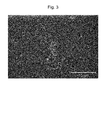
Fig. 3 is an electron microscope image of the whole nanoparticle-containing polymer nanowire of an Example of the present invention. -
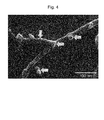
Fig. 4 is an enlarged electron microscope image showing details of the nanoparticle-containing polymer nanowire shown inFig. 3 . - The present invention provides a polymer nanowire containing nanoparticles such as functional nanoparticles by improving the method for producing a polymer nanowire described in Patent Literature 1.
- More specifically, according to the method for producing a nanoparticle-containing polymer nanowire of the present invention, first, a thin film which includes polymers, nanoparticles, and a photosensitive pigment is prepared. The thin film can be formed by employing various methods such as spin coating.
- In the thin film, nanoparticles may be dispersed uniformly into the polymers (single-layer structure). This case is illustrated in
Fig. 1(a) . In the same drawing, an underneath layer with plenty of fine dots is a substrate made of glass and the like, and a layer placed thereon is the thin film. Circles in the thin film represent the polymers, while squares represent the nanoparticles. The notations inFig. 1(b) to 1(d) are the same as inFig. 1 (a) . - In cases where the nanoparticles are not easily dispersed into the polymers, as shown in
Fig. 1(c) , a thin film including all required components may be produced by, instead of dispersion, forming a multi-layer structure in which a polymer layer is formed, and then the nanoparticles are supported thereon to place a nanoparticle layer thereon. - As shown in
Fig. 1(b) , positions of the nanoparticle layer and the polymer layer may be inverted upside down. - A thin film with such a multi-layer structure may have three or more layers by repeating the above-described composition (bilayer structure of the polymer and nanoparticle layers). An example thereof is described in
Fig. 1(d) . - As for a method for supporting the nanoparticles, liquid in which the nanoparticles have been dispersed may be sprayed on the formed polymer layer, or other various methods such as spin coating may be employed.
- In cases where such a multi-layer film structure is used, usually, a light-absorbing material is included in the polymer layer. This is because there are many cases where the nanoparticles do not dissolve in a solvent. However, it is expected that a doping amount of the nanoparticles is increased as long as the nanoparticle layer includes a light-absorbing material. Accordingly, depending on various conditions, the light-absorbing material may be put into any one of those layers or may be put into both layers.
- A thickness of the thin film differs depending on a length and fineness of a required nanoparticle-containing polymer nanowire. For example, as long as a short nanoparticle-containing polymer nanowire is sufficient, a thin film is adequate. A required thickness of the thin film greatly differs depending on a specific polymer, nanoparticle, and light-absorbing material to be used, or depending on emittance and irradiation time of a pulsed laser. Therefore, a thickness range applicable to all these conditions cannot be generally determined.
- Next, the thin film provided as described above is irradiated with a pulsed laser. Irradiation conditions, such as intensity of the laser with which the film is irradiated, differ depending on a polymer, nanoparticle, and/or photosensitive pigment to be used as a raw material. By optimizing the irradiation conditions corresponding to a subject to be irradiated, a polymer nanowire grows with nanoparticles of a thin film from a laser-irradiated position on the surface of the thin film. A wavelength of the laser to be used is preferably selected according to its absorption wavelength, so that the laser is efficiently absorbed into the light-absorbing material included in the thin film.
- Irradiation conditions which should be optimized include an irradiation region in addition to intensity of the laser. The irradiation region herein specifically represents a region to be irradiated, which is in a thickness direction of the film. The irradiation region represents a region which becomes a focus to be irradiated with the laser, for example, a region near an interface between a substrate and the thin film, a region near a center in the thickness direction of the film, or a region near the surface where the nanowire grows. When a thin film has a multi-layer structure, the irradiation region represents whether a polymer layer or a nanoparticle layer becomes a focus of irradiation. When a thin film has a structure obtained by repeating the same layer, the irradiation region represents which layer from the top becomes a focus of irradiation. Further, the irradiation conditions are also influenced by the above-mentioned structure of the thin film (single-layer film/multi-layer film).
- According to the method for producing a nanoparticle-containing polymer nanowire of the present invention, it is possible to produce a nanowire preferably having a diameter of 0.2 nm or more and less than 500 nm, more preferably 2 nm or more and less than 300 nm, and preferably having a length of 100 nm or more, more preferably 100 nm or more and less than 800 µm. A cross-sectional shape in a radial direction may be a round shape or other various shapes depending on the raw material to be used and on various producing conditions. Herein, a diameter of the nanowire can be measured from an observation image obtained by an electron microscope. When a cross-sectional shape of the nanowire is a round shape, the diameter of the nanowire is a diameter of a circle. When the cross-sectional shape of the nanowire is some other shape, the diameter of the nanowire is the longest distance between cross-sectional rims. A length of the nanowire can be measured from an observation image obtained by an electron microscope.
- In the above production method, various materials can be used as a polymer. Preferred examples of a usable material include a methacrylate polymer such as PMMA, PBMA, or PEMA, a polyvinyl polymer such as polystyrene, a polythiophene polymer, a polyacetylene polymer, a polyaniline polymer, and a polypyrrole polymer.
- As for a nanoparticle, the following Example exemplifies an iron oxide nanoparticle, but it is clear that a polymer nanowire including other nanoparticle materials can be produced as well. In Example, a nanowire contains iron oxide nanoparticles so as to be granted magnetic functionality. Of course, however, functionality granted to a nanowire containing nanoparticles is not restricted to magnetic one. For example, without any limitation, doping nanomaterials such as CdTe changes an optical characteristic (fluorescence) and the like.
- Types of functional materials for a nanoparticle include the following.
- Functional materials for granting magnetic characteristics include magnetic metals such as Fe, Ni, Co, and Mn, various magnetic bodies such as oxides thereof, and metallic complex ferromagnetic bodies.
- Functional materials for granting optical characteristics include quantum dots such as CdTe, ZnTe, CdS, ZnS, CdSe, and ZnSe, and all organic molecules, for example, phthalocyanine (Pc), a phthalocyanine compound such as PcZn, PcNi, and PcH2, porphyrin, tetraphenylporphyrin, a porphyrin compound, a tetraphenylporphyrin compound, anthracene, an anthracene compound, pyrene, a pyrene compound, rubrene, coumarin, a coumarin compound, fluorescein, rhodamine, and a rhodamine compound.
- Functional materials for granting electric characteristics include all materials having conductivity such as metals.
- Functional materials for granting radiative characteristics include uranium, potassium, radium, radon, plutonium, cesium, cobalt, iodine, thorium, and carbon.
- Further, in Example, substantially spherical nanoparticles having a small aspect ratio are used as a nanoparticle, but the present invention is not restricted thereto. It goes without saying that nanoparticles in various shapes such as linear and plate-like shape may be used as well. A size of nanoparticles, though depending on a diameter of a nanowire, is preferably within the range of 0.1 nm or more and less than 300 nm, and more preferably within the range of 1 nm or more and less than 300 nm.
- In preparing the above-mentioned thin film, a photosensitive pigment is used. In practical use, however, any material other than a pigment can be used as long as the material absorbs light (light-absorbing material). Many polymer materials are transparent and, therefore, absorb only a little amount of laser beam as they are. Accordingly, instead of a polymer material, a light-absorbing material such as a pigment is photoexcited and the energy caused thereby is transmitted to the polymers so that the polymers are thermally hardened. Further, in cases where nanoparticles also function as a light-absorbing material, a light-absorbing material such as a photosensitive pigment may not be used. In cases where a photosensitive pigment is used, preferred pigments include one having a stable property (resistant to photolysis) by irradiation with light, for example, coumarin, pyrene, perylene, anthracene, porphyrin, and phthalocyanine.
- The above-mentioned production process can be carried out in the atmosphere unless any raw material to be used is adversely affected by atmospheric components.
- Since the production method of the present invention is a simple production process using a laser, instead of irradiating one point and growing a nanowire only at that point, it is possible to simultaneously irradiate a broad area with light by using a large-area scanning method with a laser or a fly-eye lens. By simultaneously growing a plurality of the nanoparticle-containing polymer nanowires of the present invention over a broad area on the thin film, mass production thereof can be easily put into practice. By selecting a plurality of desired positions on the thin film, and by selectively growing the nanoparticle-containing polymer nanowires of the present invention at the desired positions, an integrated device exerting complicated functions can also be provided. For example, although it should not be restricted to the following, in cases where such an integrated device is used, instead of cutting only the grown nanowires and using the same, a thin film from which the nanowires remain grown or a complex including a substrate on which the thin film is placed can be used as a component of a desired device.
- In the above description, a pulsed laser is used. However, a CW laser can also be used, for example, in cases where nanowires grow across a wide area by scanning with the laser. When a specific point is irradiated with the CW laser, irradiation time becomes long at that point so that polymers at that point become resistant to hardening. However, scanning with a galvano scanner at high speed extremely shortens the time of irradiating each position to be irradiated with the laser, in a similar manner to the case where a pulsed laser is used. As a result, the polymer nanowires of the present invention are produced at those positions. In this case, it is clear that a laser with high intensity is required.
- The production method of the present invention and the nanowire produced thereby involve the polymer materials and contained nanoparticles which are selected from an extremely wide range. Therefore, by appropriately selecting the polymer materials and nanoparticles, a polymer nanowire exerting functionality required in various application fields can be designed and produced.
- Hereinafter, the present invention will be described in more detail with reference to Example, but the present invention is not restricted to the following Example.
-
Fig. 2 illustrates a conceptual configuration of a device used in producing a nanoparticle-containing polymer nanowire in an Example of the present invention. - As a
substrate 101, polysilicate glass having a thickness of 170 µm was used. As a polymer, polystyrene (PS) was used. As a nanoparticle, an iron oxide nanoparticle having a particle size of about 20 nm was used (the nanoparticle used herein is mixed with an iron oxide having several valences, but, hereinafter described as FeO). As a light-absorbing material, Coumarin 6 (C6) is used. - First, PS and C6 were put into chlorobenzene or xylene and stirred for 8 hours or more. After dissolving the mixture, FeO was added thereto and a polystyrene (nanoFeO-PS) solution, in which iron oxide nanoparticles were dispersed, was prepared.
- By spin coating, the
substrate 101 was covered with the nanoFeO-PS solution which had been prepared as above. After coating, the substrate was dried for 8 hours or more in the atmosphere to produce a nanoFeO-PSthin film 103. - One pulse of a pulsed laser which had a wavelength of 440 nm and a pulse width of 900 ps, and which was generated from a
laser generator 105 was introduced to a 20-power objective lens 107 through apigment 111 and an optical system, and by focusing light with thisobjective lens 107 on the nanoFeO-PSthin film 103, thethin film 103 was irradiated with the laser from the rear side, that is, from the side of thesubstrate 101. By irradiating with the laser under required conditions determined depending on a raw material to be used, a nanoparticle-containingpolymer nanowire 109 added with FeO nanoparticles in PS grew in the vertical direction from the surface of the nanoFeO-PSthin film 103, that is, from the opposite side of thesubstrate 101. - An electron microscope image of the whole nanoparticle-containing polymer nanowire produced as described above is shown in
Fig. 3 . FromFig. 3 , it is clear that a polystyrene nanowire is produced, with iron oxide nanoparticles dispersed therein, and having a diameter of 25 nm and a length of about 20 µm. - An enlarged electron microscope image showing details of the nanowire is shown in
Fig. 4 . FromFig. 4 , it is noted that there are iron oxide nanoparticles having a diameter of about 20 nm (indicated by arrows) throughout the polystyrene polymer nanowire. In the present Example, a thickness of thethin film 103 is changed within the range of 1 to 100 µm, and it is found that any thin film having a thickness within this range provides a nanoparticle-containing polymer nanowire. - In the present Example, by including iron oxide, which is a typical magnetic material, in the polymer nanowire, the polymer nanowire could be newly granted magnetic functionality. Since the nanowire is granted motional functionality by applying a magnetic field thereto, the nanowire can induce, for example, a movement like a biotic flagellum. Accordingly, it is expected that this nanowire is used, for example, as an extremely minute actuator of a drive source for a bio-micromachine which moves inside a blood vessel of a human body. Of course, it goes without saying that the polymer nanowire can be granted some other arbitrary functionality depending on selection of nanoparticles to be contained.
- Since the polymer materials and nanoparticles used in the nanoparticle-containing polymer nanowire of the present invention are selected from an extremely wide range, by appropriately selecting polymer materials and nanoparticles, a polymer nanowire applicable to various application fields can be provided. Accordingly, the present invention is expected to be applied to a molecular device and a micromachine, which are used in many application fields.
-
- 101: substrate
- 103: thin film
- 105: laser generator
- 107: objective lens
- 109: nanoparticle-containing polymer nanowire
- 111: pigment
Claims (15)
- A polymer nanowire containing nanoparticles.
- The polymer nanowire according to claim 1, wherein the nanowire has a diameter of less than 500 nm.
- The polymer nanowire according to claim 2, wherein the nanowire has a diameter of 0.2 nm or more.
- The polymer nanowire according to any one of claims 1 to 3, wherein the nanowire has a length of 100 nm or more.
- The polymer nanowire according to any one of claims 1 to 4, wherein the nanoparticles have a diameter of 0.1 nm or more and less than 300 nm.
- The polymer nanowire according to any one of claims 1 to 5, wherein polymers of the nanowire include at least one type of polymers selected from the group consisting of a methacrylate polymer, a polyvinyl polymer, a polythiophene polymer, a polyacetylene polymer, a polyaniline polymer, and a polypyrrole polymer.
- The polymer nanowire according to any one of claims 1 to 6, wherein the nanoparticles are magnetic bodies and are driven by applying a magnetic field thereto.
- A thin film/polymer nanowire complex comprising:a thin film including polymers containing nanoparticles; andthe polymer nanowire according to any one of claims 1 to 7, containing the nanoparticles and extended from the thin film.
- A method for producing a nanoparticle-containing polymer nanowire, the method comprising:irradiating, with a laser, a thin film including at least polymers and nanoparticles; andgrowing a polymer nanowire containing the nanoparticles from a position in the thin film which has been irradiated with the laser.
- The method for producing a nanoparticle-containing polymer nanowire according to claim 9, wherein the thin film further includes a light-absorbing material.
- The method for producing a nanoparticle-containing polymer nanowire according to claim 10, wherein the light-absorbing material is a photosensitive pigment.
- The method for producing a nanoparticle-containing polymer nanowire according to any one of claims 9 to 11, wherein the laser beam is a pulsed laser.
- The method for producing a nanoparticle-containing polymer nanowire according to any one of claims 9 to 12, wherein the polymer nanowire grows from a surface in the thin film opposite to a surface irradiated with the laser.
- The method for producing a nanoparticle-containing polymer nanowire according to any one of claims 9 to 13, wherein the thin film includes a single layer including both the polymers and the nanoparticles.
- The method for producing a nanoparticle-containing polymer nanowire according to any one of claims 9 to 13, wherein the thin film includes at least one layer including the polymers and at least one layer including the nanoparticles.
Applications Claiming Priority (2)
| Application Number | Priority Date | Filing Date | Title |
|---|---|---|---|
| JP2011273538 | 2011-12-14 | ||
| PCT/JP2012/082421 WO2013089201A1 (en) | 2011-12-14 | 2012-12-13 | Nanoparticle-containing polymer nanowire and method for producing same |
Publications (3)
| Publication Number | Publication Date |
|---|---|
| EP2792717A1 true EP2792717A1 (en) | 2014-10-22 |
| EP2792717A4 EP2792717A4 (en) | 2014-10-22 |
| EP2792717B1 EP2792717B1 (en) | 2016-06-29 |
Family
ID=48612642
Family Applications (1)
| Application Number | Title | Priority Date | Filing Date |
|---|---|---|---|
| EP12856666.8A Not-in-force EP2792717B1 (en) | 2011-12-14 | 2012-12-13 | Nanoparticle-containing polymer nanowire and method for producing same |
Country Status (4)
| Country | Link |
|---|---|
| US (1) | US9957371B2 (en) |
| EP (1) | EP2792717B1 (en) |
| JP (1) | JP5920846B2 (en) |
| WO (1) | WO2013089201A1 (en) |
Cited By (1)
| Publication number | Priority date | Publication date | Assignee | Title |
|---|---|---|---|---|
| CN111175353A (en) * | 2020-01-16 | 2020-05-19 | 吉林大学 | Method for preparing micro-nano-wire by using laser technology and application thereof |
Families Citing this family (1)
| Publication number | Priority date | Publication date | Assignee | Title |
|---|---|---|---|---|
| KR101837607B1 (en) | 2016-11-11 | 2018-03-14 | 한국과학기술원 | Method for fabricating surface-enhanced raman spectroscopy substrate and the substrate |
Family Cites Families (3)
| Publication number | Priority date | Publication date | Assignee | Title |
|---|---|---|---|---|
| US7122106B2 (en) * | 2002-05-23 | 2006-10-17 | Battelle Memorial Institute | Electrosynthesis of nanofibers and nano-composite films |
| JP5422128B2 (en) * | 2008-02-01 | 2014-02-19 | 公益財団法人神奈川科学技術アカデミー | Manufacturing method of fibrous structure |
| JP5598805B2 (en) * | 2008-09-26 | 2014-10-01 | 独立行政法人物質・材料研究機構 | Organic polymer nanowire and manufacturing method thereof |
-
2012
- 2012-12-13 WO PCT/JP2012/082421 patent/WO2013089201A1/en not_active Ceased
- 2012-12-13 US US14/364,808 patent/US9957371B2/en not_active Expired - Fee Related
- 2012-12-13 EP EP12856666.8A patent/EP2792717B1/en not_active Not-in-force
- 2012-12-13 JP JP2013549319A patent/JP5920846B2/en not_active Expired - Fee Related
Cited By (1)
| Publication number | Priority date | Publication date | Assignee | Title |
|---|---|---|---|---|
| CN111175353A (en) * | 2020-01-16 | 2020-05-19 | 吉林大学 | Method for preparing micro-nano-wire by using laser technology and application thereof |
Also Published As
| Publication number | Publication date |
|---|---|
| EP2792717B1 (en) | 2016-06-29 |
| US9957371B2 (en) | 2018-05-01 |
| WO2013089201A1 (en) | 2013-06-20 |
| EP2792717A4 (en) | 2014-10-22 |
| US20150104662A1 (en) | 2015-04-16 |
| JPWO2013089201A1 (en) | 2015-04-27 |
| JP5920846B2 (en) | 2016-05-18 |
Similar Documents
| Publication | Publication Date | Title |
|---|---|---|
| Park et al. | Laser‐based selective material processing for next‐generation additive manufacturing | |
| Yang et al. | The fabrication of micro/nano structures by laser machining | |
| Tonkaev et al. | Multifunctional and transformative metaphotonics with emerging materials | |
| Zhang et al. | Designable 3D nanofabrication by femtosecond laser direct writing | |
| Ai et al. | Advanced colloidal lithography beyond surface patterning | |
| Koziej et al. | 25th anniversary article: metal oxide particles in materials science: addressing all length scales | |
| Lopez | Materials aspects of photonic crystals | |
| Guo et al. | Carbon dots embedded in cellulose film: programmable, performance-tunable, and large-scale subtle fluorescent patterning by in situ laser writing | |
| Jonušauskas et al. | Plasmon assisted 3D microstructuring of gold nanoparticle-doped polymers | |
| Chen et al. | Light‐directed assembly of colloidal matter | |
| Mohammadparast et al. | Cuprous oxide cubic particles with strong and tunable Mie resonances for use as nanoantennas | |
| Liu et al. | Novel optical technologies for nanofabrication | |
| Svrcek et al. | Environmentally friendly processing technology for engineering silicon nanocrystals in water with laser pulses | |
| Hu et al. | Recent progress in the patterning of perovskite films for photodetector applications | |
| Alshehri et al. | Localized nanoclusters formation in PDMS upon irradiation with femtosecond laser | |
| Liu et al. | Recent advances in liquid metal photonics: technologies and applications | |
| Kim et al. | Deterministic assembly of metamolecules by atomic force microscope-enabled manipulation of ultra-smooth, super-spherical gold nanoparticles | |
| Wang et al. | Fabrication of quantum dot and ring arrays by direct laser interference patterning for nanophotonics | |
| Barbero et al. | Manufacturing functional polymer surfaces by direct laser interference patterning (DLIP): a polymer science view | |
| US9957371B2 (en) | Nanoparticle-containing polymer nanowire and method for producing the same | |
| Jun et al. | Full-color laser displays based on optical second-harmonic generation from the thin film arrays of selenium nanowires | |
| Liu et al. | Optical colloidal assembly | |
| Liang et al. | Laser micro-nano processing of optoelectronic materials | |
| Bora et al. | Top-down approaches of nanomaterial synthesis | |
| Xu et al. | The interaction of femtosecond laser with perovskites for advanced photonics |
Legal Events
| Date | Code | Title | Description |
|---|---|---|---|
| PUAI | Public reference made under article 153(3) epc to a published international application that has entered the european phase |
Free format text: ORIGINAL CODE: 0009012 |
|
| 17P | Request for examination filed |
Effective date: 20140619 |
|
| A4 | Supplementary search report drawn up and despatched |
Effective date: 20140905 |
|
| AK | Designated contracting states |
Kind code of ref document: A1 Designated state(s): AL AT BE BG CH CY CZ DE DK EE ES FI FR GB GR HR HU IE IS IT LI LT LU LV MC MK MT NL NO PL PT RO RS SE SI SK SM TR |
|
| DAX | Request for extension of the european patent (deleted) | ||
| 17Q | First examination report despatched |
Effective date: 20150820 |
|
| GRAP | Despatch of communication of intention to grant a patent |
Free format text: ORIGINAL CODE: EPIDOSNIGR1 |
|
| INTG | Intention to grant announced |
Effective date: 20160125 |
|
| GRAS | Grant fee paid |
Free format text: ORIGINAL CODE: EPIDOSNIGR3 |
|
| GRAA | (expected) grant |
Free format text: ORIGINAL CODE: 0009210 |
|
| GRAT | Correction requested after decision to grant or after decision to maintain patent in amended form |
Free format text: ORIGINAL CODE: EPIDOSNCDEC |
|
| AK | Designated contracting states |
Kind code of ref document: B1 Designated state(s): AL AT BE BG CH CY CZ DE DK EE ES FI FR GB GR HR HU IE IS IT LI LT LU LV MC MK MT NL NO PL PT RO RS SE SI SK SM TR |
|
| REG | Reference to a national code |
Ref country code: GB Ref legal event code: FG4D |
|
| REG | Reference to a national code |
Ref country code: CH Ref legal event code: EP |
|
| REG | Reference to a national code |
Ref country code: AT Ref legal event code: REF Ref document number: 809085 Country of ref document: AT Kind code of ref document: T Effective date: 20160715 |
|
| REG | Reference to a national code |
Ref country code: IE Ref legal event code: FG4D |
|
| REG | Reference to a national code |
Ref country code: DE Ref legal event code: R096 Ref document number: 602012020108 Country of ref document: DE |
|
| REG | Reference to a national code |
Ref country code: LT Ref legal event code: MG4D |
|
| PG25 | Lapsed in a contracting state [announced via postgrant information from national office to epo] |
Ref country code: LT Free format text: LAPSE BECAUSE OF FAILURE TO SUBMIT A TRANSLATION OF THE DESCRIPTION OR TO PAY THE FEE WITHIN THE PRESCRIBED TIME-LIMIT Effective date: 20160629 Ref country code: FI Free format text: LAPSE BECAUSE OF FAILURE TO SUBMIT A TRANSLATION OF THE DESCRIPTION OR TO PAY THE FEE WITHIN THE PRESCRIBED TIME-LIMIT Effective date: 20160629 Ref country code: NO Free format text: LAPSE BECAUSE OF FAILURE TO SUBMIT A TRANSLATION OF THE DESCRIPTION OR TO PAY THE FEE WITHIN THE PRESCRIBED TIME-LIMIT Effective date: 20160929 |
|
| REG | Reference to a national code |
Ref country code: NL Ref legal event code: MP Effective date: 20160629 |
|
| PG25 | Lapsed in a contracting state [announced via postgrant information from national office to epo] |
Ref country code: RS Free format text: LAPSE BECAUSE OF FAILURE TO SUBMIT A TRANSLATION OF THE DESCRIPTION OR TO PAY THE FEE WITHIN THE PRESCRIBED TIME-LIMIT Effective date: 20160629 Ref country code: HR Free format text: LAPSE BECAUSE OF FAILURE TO SUBMIT A TRANSLATION OF THE DESCRIPTION OR TO PAY THE FEE WITHIN THE PRESCRIBED TIME-LIMIT Effective date: 20160629 Ref country code: SE Free format text: LAPSE BECAUSE OF FAILURE TO SUBMIT A TRANSLATION OF THE DESCRIPTION OR TO PAY THE FEE WITHIN THE PRESCRIBED TIME-LIMIT Effective date: 20160629 Ref country code: NL Free format text: LAPSE BECAUSE OF FAILURE TO SUBMIT A TRANSLATION OF THE DESCRIPTION OR TO PAY THE FEE WITHIN THE PRESCRIBED TIME-LIMIT Effective date: 20160629 Ref country code: GR Free format text: LAPSE BECAUSE OF FAILURE TO SUBMIT A TRANSLATION OF THE DESCRIPTION OR TO PAY THE FEE WITHIN THE PRESCRIBED TIME-LIMIT Effective date: 20160930 Ref country code: LV Free format text: LAPSE BECAUSE OF FAILURE TO SUBMIT A TRANSLATION OF THE DESCRIPTION OR TO PAY THE FEE WITHIN THE PRESCRIBED TIME-LIMIT Effective date: 20160629 |
|
| REG | Reference to a national code |
Ref country code: AT Ref legal event code: MK05 Ref document number: 809085 Country of ref document: AT Kind code of ref document: T Effective date: 20160629 |
|
| REG | Reference to a national code |
Ref country code: FR Ref legal event code: PLFP Year of fee payment: 5 |
|
| PG25 | Lapsed in a contracting state [announced via postgrant information from national office to epo] |
Ref country code: IT Free format text: LAPSE BECAUSE OF FAILURE TO SUBMIT A TRANSLATION OF THE DESCRIPTION OR TO PAY THE FEE WITHIN THE PRESCRIBED TIME-LIMIT Effective date: 20160629 Ref country code: EE Free format text: LAPSE BECAUSE OF FAILURE TO SUBMIT A TRANSLATION OF THE DESCRIPTION OR TO PAY THE FEE WITHIN THE PRESCRIBED TIME-LIMIT Effective date: 20160629 Ref country code: SK Free format text: LAPSE BECAUSE OF FAILURE TO SUBMIT A TRANSLATION OF THE DESCRIPTION OR TO PAY THE FEE WITHIN THE PRESCRIBED TIME-LIMIT Effective date: 20160629 Ref country code: RO Free format text: LAPSE BECAUSE OF FAILURE TO SUBMIT A TRANSLATION OF THE DESCRIPTION OR TO PAY THE FEE WITHIN THE PRESCRIBED TIME-LIMIT Effective date: 20160629 Ref country code: CZ Free format text: LAPSE BECAUSE OF FAILURE TO SUBMIT A TRANSLATION OF THE DESCRIPTION OR TO PAY THE FEE WITHIN THE PRESCRIBED TIME-LIMIT Effective date: 20160629 Ref country code: IS Free format text: LAPSE BECAUSE OF FAILURE TO SUBMIT A TRANSLATION OF THE DESCRIPTION OR TO PAY THE FEE WITHIN THE PRESCRIBED TIME-LIMIT Effective date: 20161029 |
|
| PG25 | Lapsed in a contracting state [announced via postgrant information from national office to epo] |
Ref country code: BE Free format text: LAPSE BECAUSE OF FAILURE TO SUBMIT A TRANSLATION OF THE DESCRIPTION OR TO PAY THE FEE WITHIN THE PRESCRIBED TIME-LIMIT Effective date: 20160629 Ref country code: PT Free format text: LAPSE BECAUSE OF FAILURE TO SUBMIT A TRANSLATION OF THE DESCRIPTION OR TO PAY THE FEE WITHIN THE PRESCRIBED TIME-LIMIT Effective date: 20161031 Ref country code: ES Free format text: LAPSE BECAUSE OF FAILURE TO SUBMIT A TRANSLATION OF THE DESCRIPTION OR TO PAY THE FEE WITHIN THE PRESCRIBED TIME-LIMIT Effective date: 20160629 Ref country code: PL Free format text: LAPSE BECAUSE OF FAILURE TO SUBMIT A TRANSLATION OF THE DESCRIPTION OR TO PAY THE FEE WITHIN THE PRESCRIBED TIME-LIMIT Effective date: 20160629 Ref country code: AT Free format text: LAPSE BECAUSE OF FAILURE TO SUBMIT A TRANSLATION OF THE DESCRIPTION OR TO PAY THE FEE WITHIN THE PRESCRIBED TIME-LIMIT Effective date: 20160629 Ref country code: SM Free format text: LAPSE BECAUSE OF FAILURE TO SUBMIT A TRANSLATION OF THE DESCRIPTION OR TO PAY THE FEE WITHIN THE PRESCRIBED TIME-LIMIT Effective date: 20160629 |
|
| REG | Reference to a national code |
Ref country code: DE Ref legal event code: R097 Ref document number: 602012020108 Country of ref document: DE |
|
| PG25 | Lapsed in a contracting state [announced via postgrant information from national office to epo] |
Ref country code: DK Free format text: LAPSE BECAUSE OF FAILURE TO SUBMIT A TRANSLATION OF THE DESCRIPTION OR TO PAY THE FEE WITHIN THE PRESCRIBED TIME-LIMIT Effective date: 20160629 |
|
| 26N | No opposition filed |
Effective date: 20170330 |
|
| PLBE | No opposition filed within time limit |
Free format text: ORIGINAL CODE: 0009261 |
|
| STAA | Information on the status of an ep patent application or granted ep patent |
Free format text: STATUS: NO OPPOSITION FILED WITHIN TIME LIMIT |
|
| REG | Reference to a national code |
Ref country code: CH Ref legal event code: PL |
|
| GBPC | Gb: european patent ceased through non-payment of renewal fee |
Effective date: 20161213 |
|
| PG25 | Lapsed in a contracting state [announced via postgrant information from national office to epo] |
Ref country code: SI Free format text: LAPSE BECAUSE OF FAILURE TO SUBMIT A TRANSLATION OF THE DESCRIPTION OR TO PAY THE FEE WITHIN THE PRESCRIBED TIME-LIMIT Effective date: 20160629 Ref country code: BG Free format text: LAPSE BECAUSE OF FAILURE TO SUBMIT A TRANSLATION OF THE DESCRIPTION OR TO PAY THE FEE WITHIN THE PRESCRIBED TIME-LIMIT Effective date: 20160929 |
|
| PG25 | Lapsed in a contracting state [announced via postgrant information from national office to epo] |
Ref country code: MC Free format text: LAPSE BECAUSE OF FAILURE TO SUBMIT A TRANSLATION OF THE DESCRIPTION OR TO PAY THE FEE WITHIN THE PRESCRIBED TIME-LIMIT Effective date: 20160629 |
|
| REG | Reference to a national code |
Ref country code: IE Ref legal event code: MM4A |
|
| PG25 | Lapsed in a contracting state [announced via postgrant information from national office to epo] |
Ref country code: LI Free format text: LAPSE BECAUSE OF NON-PAYMENT OF DUE FEES Effective date: 20161231 Ref country code: LU Free format text: LAPSE BECAUSE OF NON-PAYMENT OF DUE FEES Effective date: 20161213 Ref country code: CH Free format text: LAPSE BECAUSE OF NON-PAYMENT OF DUE FEES Effective date: 20161231 |
|
| PG25 | Lapsed in a contracting state [announced via postgrant information from national office to epo] |
Ref country code: GB Free format text: LAPSE BECAUSE OF NON-PAYMENT OF DUE FEES Effective date: 20161213 Ref country code: IE Free format text: LAPSE BECAUSE OF NON-PAYMENT OF DUE FEES Effective date: 20161213 |
|
| REG | Reference to a national code |
Ref country code: FR Ref legal event code: PLFP Year of fee payment: 6 |
|
| PG25 | Lapsed in a contracting state [announced via postgrant information from national office to epo] |
Ref country code: HU Free format text: LAPSE BECAUSE OF FAILURE TO SUBMIT A TRANSLATION OF THE DESCRIPTION OR TO PAY THE FEE WITHIN THE PRESCRIBED TIME-LIMIT; INVALID AB INITIO Effective date: 20121213 |
|
| PG25 | Lapsed in a contracting state [announced via postgrant information from national office to epo] |
Ref country code: MK Free format text: LAPSE BECAUSE OF FAILURE TO SUBMIT A TRANSLATION OF THE DESCRIPTION OR TO PAY THE FEE WITHIN THE PRESCRIBED TIME-LIMIT Effective date: 20160629 Ref country code: CY Free format text: LAPSE BECAUSE OF FAILURE TO SUBMIT A TRANSLATION OF THE DESCRIPTION OR TO PAY THE FEE WITHIN THE PRESCRIBED TIME-LIMIT Effective date: 20160629 |
|
| PG25 | Lapsed in a contracting state [announced via postgrant information from national office to epo] |
Ref country code: MT Free format text: LAPSE BECAUSE OF NON-PAYMENT OF DUE FEES Effective date: 20161213 |
|
| PG25 | Lapsed in a contracting state [announced via postgrant information from national office to epo] |
Ref country code: TR Free format text: LAPSE BECAUSE OF FAILURE TO SUBMIT A TRANSLATION OF THE DESCRIPTION OR TO PAY THE FEE WITHIN THE PRESCRIBED TIME-LIMIT Effective date: 20160629 Ref country code: AL Free format text: LAPSE BECAUSE OF FAILURE TO SUBMIT A TRANSLATION OF THE DESCRIPTION OR TO PAY THE FEE WITHIN THE PRESCRIBED TIME-LIMIT Effective date: 20160629 |
|
| PGFP | Annual fee paid to national office [announced via postgrant information from national office to epo] |
Ref country code: DE Payment date: 20201211 Year of fee payment: 9 Ref country code: FR Payment date: 20201223 Year of fee payment: 9 |
|
| REG | Reference to a national code |
Ref country code: DE Ref legal event code: R082 Ref document number: 602012020108 Country of ref document: DE |
|
| REG | Reference to a national code |
Ref country code: DE Ref legal event code: R119 Ref document number: 602012020108 Country of ref document: DE |
|
| PG25 | Lapsed in a contracting state [announced via postgrant information from national office to epo] |
Ref country code: DE Free format text: LAPSE BECAUSE OF NON-PAYMENT OF DUE FEES Effective date: 20220701 |
|
| PG25 | Lapsed in a contracting state [announced via postgrant information from national office to epo] |
Ref country code: FR Free format text: LAPSE BECAUSE OF NON-PAYMENT OF DUE FEES Effective date: 20211231 |