EP2791123B1 - Process for preparation of 3-((2s,5s)-4-methylene-5-(3-oxopropyl)tetrahydrofuran-2-yl) propanol derivatives and intermediates useful thereof - Google Patents
Process for preparation of 3-((2s,5s)-4-methylene-5-(3-oxopropyl)tetrahydrofuran-2-yl) propanol derivatives and intermediates useful thereof Download PDFInfo
- Publication number
- EP2791123B1 EP2791123B1 EP12858656.7A EP12858656A EP2791123B1 EP 2791123 B1 EP2791123 B1 EP 2791123B1 EP 12858656 A EP12858656 A EP 12858656A EP 2791123 B1 EP2791123 B1 EP 2791123B1
- Authority
- EP
- European Patent Office
- Prior art keywords
- formula
- compound
- group
- alkyl
- aryl
- Prior art date
- Legal status (The legal status is an assumption and is not a legal conclusion. Google has not performed a legal analysis and makes no representation as to the accuracy of the status listed.)
- Not-in-force
Links
- 238000000034 method Methods 0.000 title claims description 97
- 238000002360 preparation method Methods 0.000 title claims description 34
- HFENCIGUKIAHLV-QWRGUYRKSA-N 3-[(2s,5s)-5-(3-hydroxypropyl)-3-methylideneoxolan-2-yl]propanal Chemical class OCCC[C@H]1CC(=C)[C@H](CCC=O)O1 HFENCIGUKIAHLV-QWRGUYRKSA-N 0.000 title description 7
- 239000000543 intermediate Substances 0.000 title description 3
- 150000001875 compounds Chemical class 0.000 claims description 180
- 125000006241 alcohol protecting group Chemical group 0.000 claims description 35
- 125000003118 aryl group Chemical group 0.000 claims description 28
- 125000000217 alkyl group Chemical group 0.000 claims description 26
- 125000001072 heteroaryl group Chemical group 0.000 claims description 26
- 125000000753 cycloalkyl group Chemical group 0.000 claims description 21
- LFQSCWFLJHTTHZ-UHFFFAOYSA-N Ethanol Chemical compound CCO LFQSCWFLJHTTHZ-UHFFFAOYSA-N 0.000 claims description 20
- 125000005842 heteroatom Chemical group 0.000 claims description 20
- 150000002576 ketones Chemical class 0.000 claims description 18
- 125000001570 methylene group Chemical group [H]C([H])([*:1])[*:2] 0.000 claims description 18
- DNAJDTIOMGISDS-UHFFFAOYSA-N prop-2-enylsilane Chemical class [SiH3]CC=C DNAJDTIOMGISDS-UHFFFAOYSA-N 0.000 claims description 18
- 125000006239 protecting group Chemical group 0.000 claims description 18
- 150000002148 esters Chemical class 0.000 claims description 17
- QVGXLLKOCUKJST-UHFFFAOYSA-N atomic oxygen Chemical compound [O] QVGXLLKOCUKJST-UHFFFAOYSA-N 0.000 claims description 16
- 238000007254 oxidation reaction Methods 0.000 claims description 16
- 229910052760 oxygen Inorganic materials 0.000 claims description 16
- 239000001301 oxygen Substances 0.000 claims description 16
- 125000002887 hydroxy group Chemical group [H]O* 0.000 claims description 15
- 230000003647 oxidation Effects 0.000 claims description 13
- 239000012190 activator Substances 0.000 claims description 12
- 238000010511 deprotection reaction Methods 0.000 claims description 12
- 238000007259 addition reaction Methods 0.000 claims description 10
- BWHMMNNQKKPAPP-UHFFFAOYSA-L potassium carbonate Chemical compound [K+].[K+].[O-]C([O-])=O BWHMMNNQKKPAPP-UHFFFAOYSA-L 0.000 claims description 10
- WTEOIRVLGSZEPR-UHFFFAOYSA-N boron trifluoride Chemical compound FB(F)F WTEOIRVLGSZEPR-UHFFFAOYSA-N 0.000 claims description 9
- JJNHBFYGCSOONU-UHFFFAOYSA-M carbanide;cyclopenta-1,3-diene;dimethylaluminum;titanium(4+);chloride Chemical compound [CH3-].[Ti+3]Cl.C[Al]C.C=1C=C[CH-]C=1.C=1C=C[CH-]C=1 JJNHBFYGCSOONU-UHFFFAOYSA-M 0.000 claims description 8
- 230000007062 hydrolysis Effects 0.000 claims description 8
- 238000006460 hydrolysis reaction Methods 0.000 claims description 8
- 125000002496 methyl group Chemical group [H]C([H])([H])* 0.000 claims description 8
- 230000001590 oxidative effect Effects 0.000 claims description 8
- ZDYVRSLAEXCVBX-UHFFFAOYSA-N pyridinium p-toluenesulfonate Chemical compound C1=CC=[NH+]C=C1.CC1=CC=C(S([O-])(=O)=O)C=C1 ZDYVRSLAEXCVBX-UHFFFAOYSA-N 0.000 claims description 8
- 125000004169 (C1-C6) alkyl group Chemical group 0.000 claims description 7
- 125000002777 acetyl group Chemical group [H]C([H])([H])C(*)=O 0.000 claims description 7
- 239000002253 acid Substances 0.000 claims description 7
- YQTCQNIPQMJNTI-UHFFFAOYSA-N 2,2-dimethylpropan-1-one Chemical group CC(C)(C)[C]=O YQTCQNIPQMJNTI-UHFFFAOYSA-N 0.000 claims description 5
- 229910015900 BF3 Inorganic materials 0.000 claims description 5
- 125000005915 C6-C14 aryl group Chemical group 0.000 claims description 5
- 229910000027 potassium carbonate Inorganic materials 0.000 claims description 5
- BDERNNFJNOPAEC-UHFFFAOYSA-N propan-1-ol Chemical class CCCO BDERNNFJNOPAEC-UHFFFAOYSA-N 0.000 claims description 4
- 125000002485 formyl group Chemical class [H]C(*)=O 0.000 claims 5
- XEKOWRVHYACXOJ-UHFFFAOYSA-N Ethyl acetate Chemical compound CCOC(C)=O XEKOWRVHYACXOJ-UHFFFAOYSA-N 0.000 description 33
- 150000001299 aldehydes Chemical class 0.000 description 23
- VYPSYNLAJGMNEJ-UHFFFAOYSA-N Silicium dioxide Chemical compound O=[Si]=O VYPSYNLAJGMNEJ-UHFFFAOYSA-N 0.000 description 19
- -1 2,5-disubstituted (2S,5S)-3-methylene-tetrahydrofurans Chemical class 0.000 description 18
- OKKJLVBELUTLKV-UHFFFAOYSA-N Methanol Chemical compound OC OKKJLVBELUTLKV-UHFFFAOYSA-N 0.000 description 18
- 238000006243 chemical reaction Methods 0.000 description 18
- UIIMBOGNXHQVGW-UHFFFAOYSA-M Sodium bicarbonate Chemical compound [Na+].OC([O-])=O UIIMBOGNXHQVGW-UHFFFAOYSA-M 0.000 description 16
- 235000019439 ethyl acetate Nutrition 0.000 description 15
- IMNFDUFMRHMDMM-UHFFFAOYSA-N N-Heptane Chemical class CCCCCCC IMNFDUFMRHMDMM-UHFFFAOYSA-N 0.000 description 14
- 0 *OC(CC[C@@]1O[C@@](CCCO)C[C@]1O)O* Chemical compound *OC(CC[C@@]1O[C@@](CCCO)C[C@]1O)O* 0.000 description 12
- 150000001336 alkenes Chemical class 0.000 description 12
- RTZKZFJDLAIYFH-UHFFFAOYSA-N Diethyl ether Chemical compound CCOCC RTZKZFJDLAIYFH-UHFFFAOYSA-N 0.000 description 11
- 239000011541 reaction mixture Substances 0.000 description 11
- 239000000243 solution Substances 0.000 description 11
- IAZDPXIOMUYVGZ-UHFFFAOYSA-N Dimethylsulphoxide Chemical compound CS(C)=O IAZDPXIOMUYVGZ-UHFFFAOYSA-N 0.000 description 10
- KDLHZDBZIXYQEI-UHFFFAOYSA-N Palladium Chemical compound [Pd] KDLHZDBZIXYQEI-UHFFFAOYSA-N 0.000 description 10
- WYURNTSHIVDZCO-UHFFFAOYSA-N Tetrahydrofuran Chemical compound C1CCOC1 WYURNTSHIVDZCO-UHFFFAOYSA-N 0.000 description 10
- 239000000203 mixture Substances 0.000 description 10
- 238000003756 stirring Methods 0.000 description 10
- IJGRMHOSHXDMSA-UHFFFAOYSA-N Atomic nitrogen Chemical compound N#N IJGRMHOSHXDMSA-UHFFFAOYSA-N 0.000 description 9
- 239000007832 Na2SO4 Substances 0.000 description 9
- PMZURENOXWZQFD-UHFFFAOYSA-L Sodium Sulfate Chemical compound [Na+].[Na+].[O-]S([O-])(=O)=O PMZURENOXWZQFD-UHFFFAOYSA-L 0.000 description 9
- HEMHJVSKTPXQMS-UHFFFAOYSA-M Sodium hydroxide Chemical compound [OH-].[Na+] HEMHJVSKTPXQMS-UHFFFAOYSA-M 0.000 description 9
- YXFVVABEGXRONW-UHFFFAOYSA-N Toluene Chemical compound CC1=CC=CC=C1 YXFVVABEGXRONW-UHFFFAOYSA-N 0.000 description 9
- 229910052938 sodium sulfate Inorganic materials 0.000 description 9
- XLYOFNOQVPJJNP-UHFFFAOYSA-N water Substances O XLYOFNOQVPJJNP-UHFFFAOYSA-N 0.000 description 9
- YMWUJEATGCHHMB-UHFFFAOYSA-N Dichloromethane Chemical compound ClCCl YMWUJEATGCHHMB-UHFFFAOYSA-N 0.000 description 8
- 150000002009 diols Chemical class 0.000 description 8
- 238000005984 hydrogenation reaction Methods 0.000 description 8
- 239000000377 silicon dioxide Substances 0.000 description 8
- 229910000030 sodium bicarbonate Inorganic materials 0.000 description 8
- BZLVMXJERCGZMT-UHFFFAOYSA-N Methyl tert-butyl ether Chemical compound COC(C)(C)C BZLVMXJERCGZMT-UHFFFAOYSA-N 0.000 description 7
- 239000003921 oil Substances 0.000 description 6
- 239000012267 brine Substances 0.000 description 5
- 238000001914 filtration Methods 0.000 description 5
- 150000004678 hydrides Chemical class 0.000 description 5
- HPALAKNZSZLMCH-UHFFFAOYSA-M sodium;chloride;hydrate Chemical compound O.[Na+].[Cl-] HPALAKNZSZLMCH-UHFFFAOYSA-M 0.000 description 5
- YLQBMQCUIZJEEH-UHFFFAOYSA-N tetrahydrofuran Natural products C=1C=COC=1 YLQBMQCUIZJEEH-UHFFFAOYSA-N 0.000 description 5
- SCYULBFZEHDVBN-UHFFFAOYSA-N 1,1-Dichloroethane Chemical compound CC(Cl)Cl SCYULBFZEHDVBN-UHFFFAOYSA-N 0.000 description 4
- 230000005526 G1 to G0 transition Effects 0.000 description 4
- ZMANZCXQSJIPKH-UHFFFAOYSA-N Triethylamine Chemical compound CCN(CC)CC ZMANZCXQSJIPKH-UHFFFAOYSA-N 0.000 description 4
- 230000015572 biosynthetic process Effects 0.000 description 4
- 229910052681 coesite Inorganic materials 0.000 description 4
- 238000004440 column chromatography Methods 0.000 description 4
- 229910052906 cristobalite Inorganic materials 0.000 description 4
- NKLCNNUWBJBICK-UHFFFAOYSA-N dess–martin periodinane Chemical compound C1=CC=C2I(OC(=O)C)(OC(C)=O)(OC(C)=O)OC(=O)C2=C1 NKLCNNUWBJBICK-UHFFFAOYSA-N 0.000 description 4
- 239000003480 eluent Substances 0.000 description 4
- UFNVPOGXISZXJD-XJPMSQCNSA-N eribulin Chemical compound C([C@H]1CC[C@@H]2O[C@@H]3[C@H]4O[C@H]5C[C@](O[C@H]4[C@H]2O1)(O[C@@H]53)CC[C@@H]1O[C@H](C(C1)=C)CC1)C(=O)C[C@@H]2[C@@H](OC)[C@@H](C[C@H](O)CN)O[C@H]2C[C@@H]2C(=C)[C@H](C)C[C@H]1O2 UFNVPOGXISZXJD-XJPMSQCNSA-N 0.000 description 4
- 239000000284 extract Substances 0.000 description 4
- 239000000706 filtrate Substances 0.000 description 4
- 230000003301 hydrolyzing effect Effects 0.000 description 4
- 239000012280 lithium aluminium hydride Substances 0.000 description 4
- 229910052757 nitrogen Inorganic materials 0.000 description 4
- 238000007248 oxidative elimination reaction Methods 0.000 description 4
- 239000000047 product Substances 0.000 description 4
- 238000000746 purification Methods 0.000 description 4
- LEHBURLTIWGHEM-UHFFFAOYSA-N pyridinium chlorochromate Chemical compound [O-][Cr](Cl)(=O)=O.C1=CC=[NH+]C=C1 LEHBURLTIWGHEM-UHFFFAOYSA-N 0.000 description 4
- 229910052682 stishovite Inorganic materials 0.000 description 4
- 238000003786 synthesis reaction Methods 0.000 description 4
- 238000004809 thin layer chromatography Methods 0.000 description 4
- 229910052905 tridymite Inorganic materials 0.000 description 4
- VIMMECPCYZXUCI-MIMFYIINSA-N (4s,6r)-6-[(1e)-4,4-bis(4-fluorophenyl)-3-(1-methyltetrazol-5-yl)buta-1,3-dienyl]-4-hydroxyoxan-2-one Chemical compound CN1N=NN=C1C(\C=C\[C@@H]1OC(=O)C[C@@H](O)C1)=C(C=1C=CC(F)=CC=1)C1=CC=C(F)C=C1 VIMMECPCYZXUCI-MIMFYIINSA-N 0.000 description 3
- JVSFQJZRHXAUGT-UHFFFAOYSA-N 2,2-dimethylpropanoyl chloride Chemical compound CC(C)(C)C(Cl)=O JVSFQJZRHXAUGT-UHFFFAOYSA-N 0.000 description 3
- BRARPUHNVPNIOB-KBPBESRZSA-N 3-[(2s,5s)-4-methylidene-5-(3-oxopropyl)oxolan-2-yl]propyl 2,2-dimethylpropanoate Chemical compound CC(C)(C)C(=O)OCCC[C@H]1CC(=C)[C@H](CCC=O)O1 BRARPUHNVPNIOB-KBPBESRZSA-N 0.000 description 3
- LYCAIKOWRPUZTN-UHFFFAOYSA-N Ethylene glycol Chemical compound OCCO LYCAIKOWRPUZTN-UHFFFAOYSA-N 0.000 description 3
- 229930195695 Halichondrin Natural products 0.000 description 3
- ZBLLGPUWGCOJNG-UHFFFAOYSA-N Halichondrin B Natural products CC1CC2(CC(C)C3OC4(CC5OC6C(CC5O4)OC7CC8OC9CCC%10OC(CC(C(C9)C8=C)C%11%12CC%13OC%14C(OC%15CCC(CC(=O)OC7C6C)OC%15C%14O%11)C%13O%12)CC%10=C)CC3O2)OC%16OC(CC1%16)C(O)CC(O)CO ZBLLGPUWGCOJNG-UHFFFAOYSA-N 0.000 description 3
- AFVFQIVMOAPDHO-UHFFFAOYSA-N Methanesulfonic acid Chemical compound CS(O)(=O)=O AFVFQIVMOAPDHO-UHFFFAOYSA-N 0.000 description 3
- 239000003153 chemical reaction reagent Substances 0.000 description 3
- 239000012230 colorless oil Substances 0.000 description 3
- 238000003379 elimination reaction Methods 0.000 description 3
- 229960003649 eribulin Drugs 0.000 description 3
- FXNFULJVOQMBCW-VZBLNRDYSA-N halichondrin b Chemical compound O([C@@H]1[C@@H](C)[C@@H]2O[C@@H]3C[C@@]4(O[C@H]5[C@@H](C)C[C@@]6(C[C@@H]([C@@H]7O[C@@H](C[C@@H]7O6)[C@@H](O)C[C@@H](O)CO)C)O[C@H]5C4)O[C@@H]3C[C@@H]2O[C@H]1C[C@@H]1C(=C)[C@H](C)C[C@@H](O1)CC[C@H]1C(=C)C[C@@H](O1)CC1)C(=O)C[C@H](O2)CC[C@H]3[C@H]2[C@H](O2)[C@@H]4O[C@@H]5C[C@@]21O[C@@H]5[C@@H]4O3 FXNFULJVOQMBCW-VZBLNRDYSA-N 0.000 description 3
- 238000004519 manufacturing process Methods 0.000 description 3
- 229930190448 norhalichondrin Natural products 0.000 description 3
- KHIWWQKSHDUIBK-UHFFFAOYSA-N periodic acid Chemical compound OI(=O)(=O)=O KHIWWQKSHDUIBK-UHFFFAOYSA-N 0.000 description 3
- 238000010992 reflux Methods 0.000 description 3
- 229920006395 saturated elastomer Polymers 0.000 description 3
- 239000002002 slurry Substances 0.000 description 3
- JQWHASGSAFIOCM-UHFFFAOYSA-M sodium periodate Chemical compound [Na+].[O-]I(=O)(=O)=O JQWHASGSAFIOCM-UHFFFAOYSA-M 0.000 description 3
- 239000007787 solid Substances 0.000 description 3
- RIOQSEWOXXDEQQ-UHFFFAOYSA-N triphenylphosphine Chemical compound C1=CC=CC=C1P(C=1C=CC=CC=1)C1=CC=CC=C1 RIOQSEWOXXDEQQ-UHFFFAOYSA-N 0.000 description 3
- FANCTJAFZSYTIS-IQUVVAJASA-N (1r,3s,5z)-5-[(2e)-2-[(1r,3as,7ar)-7a-methyl-1-[(2r)-4-(phenylsulfonimidoyl)butan-2-yl]-2,3,3a,5,6,7-hexahydro-1h-inden-4-ylidene]ethylidene]-4-methylidenecyclohexane-1,3-diol Chemical compound C([C@@H](C)[C@@H]1[C@]2(CCCC(/[C@@H]2CC1)=C\C=C\1C([C@@H](O)C[C@H](O)C/1)=C)C)CS(=N)(=O)C1=CC=CC=C1 FANCTJAFZSYTIS-IQUVVAJASA-N 0.000 description 2
- KAFZOLYKKCWUBI-HPMAGDRPSA-N (2s)-2-[[(2s)-2-[[(2s)-1-[(2s)-3-amino-2-[[(2s)-2-[[(2s)-2-(3-cyclohexylpropanoylamino)-4-methylpentanoyl]amino]-5-methylhexanoyl]amino]propanoyl]pyrrolidine-2-carbonyl]amino]-5-(diaminomethylideneamino)pentanoyl]amino]butanediamide Chemical compound N([C@@H](CC(C)C)C(=O)N[C@@H](CCC(C)C)C(=O)N[C@@H](CN)C(=O)N1[C@@H](CCC1)C(=O)N[C@@H](CCCN=C(N)N)C(=O)N[C@@H](CC(N)=O)C(N)=O)C(=O)CCC1CCCCC1 KAFZOLYKKCWUBI-HPMAGDRPSA-N 0.000 description 2
- QFLWZFQWSBQYPS-AWRAUJHKSA-N (3S)-3-[[(2S)-2-[[(2S)-2-[5-[(3aS,6aR)-2-oxo-1,3,3a,4,6,6a-hexahydrothieno[3,4-d]imidazol-4-yl]pentanoylamino]-3-methylbutanoyl]amino]-3-(4-hydroxyphenyl)propanoyl]amino]-4-[1-bis(4-chlorophenoxy)phosphorylbutylamino]-4-oxobutanoic acid Chemical compound CCCC(NC(=O)[C@H](CC(O)=O)NC(=O)[C@H](Cc1ccc(O)cc1)NC(=O)[C@@H](NC(=O)CCCCC1SC[C@@H]2NC(=O)N[C@H]12)C(C)C)P(=O)(Oc1ccc(Cl)cc1)Oc1ccc(Cl)cc1 QFLWZFQWSBQYPS-AWRAUJHKSA-N 0.000 description 2
- VUDZSIYXZUYWSC-DBRKOABJSA-N (4r)-1-[(2r,4r,5r)-3,3-difluoro-4-hydroxy-5-(hydroxymethyl)oxolan-2-yl]-4-hydroxy-1,3-diazinan-2-one Chemical compound FC1(F)[C@H](O)[C@@H](CO)O[C@H]1N1C(=O)N[C@H](O)CC1 VUDZSIYXZUYWSC-DBRKOABJSA-N 0.000 description 2
- 150000000180 1,2-diols Chemical class 0.000 description 2
- IAMQLXWPWSUFPI-UHFFFAOYSA-N 1-trimethylsilylprop-2-enyl acetate Chemical compound CC(=O)OC(C=C)[Si](C)(C)C IAMQLXWPWSUFPI-UHFFFAOYSA-N 0.000 description 2
- CSCPPACGZOOCGX-UHFFFAOYSA-N Acetone Chemical compound CC(C)=O CSCPPACGZOOCGX-UHFFFAOYSA-N 0.000 description 2
- KZMGYPLQYOPHEL-UHFFFAOYSA-N Boron trifluoride etherate Chemical compound FB(F)F.CCOCC KZMGYPLQYOPHEL-UHFFFAOYSA-N 0.000 description 2
- UFHFLCQGNIYNRP-UHFFFAOYSA-N Hydrogen Chemical compound [H][H] UFHFLCQGNIYNRP-UHFFFAOYSA-N 0.000 description 2
- OFBQJSOFQDEBGM-UHFFFAOYSA-N Pentane Chemical compound CCCCC OFBQJSOFQDEBGM-UHFFFAOYSA-N 0.000 description 2
- JUJWROOIHBZHMG-UHFFFAOYSA-N Pyridine Chemical compound C1=CC=NC=C1 JUJWROOIHBZHMG-UHFFFAOYSA-N 0.000 description 2
- CDBYLPFSWZWCQE-UHFFFAOYSA-L Sodium Carbonate Chemical group [Na+].[Na+].[O-]C([O-])=O CDBYLPFSWZWCQE-UHFFFAOYSA-L 0.000 description 2
- DHKHKXVYLBGOIT-UHFFFAOYSA-N acetaldehyde Diethyl Acetal Natural products CCOC(C)OCC DHKHKXVYLBGOIT-UHFFFAOYSA-N 0.000 description 2
- 150000001241 acetals Chemical class 0.000 description 2
- 125000004429 atom Chemical group 0.000 description 2
- SIPUZPBQZHNSDW-UHFFFAOYSA-N bis(2-methylpropyl)aluminum Chemical compound CC(C)C[Al]CC(C)C SIPUZPBQZHNSDW-UHFFFAOYSA-N 0.000 description 2
- 239000003054 catalyst Substances 0.000 description 2
- 239000010779 crude oil Substances 0.000 description 2
- 239000012043 crude product Substances 0.000 description 2
- 229960004132 diethyl ether Drugs 0.000 description 2
- 125000001495 ethyl group Chemical group [H]C([H])([H])C([H])([H])* 0.000 description 2
- 150000004820 halides Chemical class 0.000 description 2
- RCBVKBFIWMOMHF-UHFFFAOYSA-L hydroxy-(hydroxy(dioxo)chromio)oxy-dioxochromium;pyridine Chemical compound C1=CC=NC=C1.C1=CC=NC=C1.O[Cr](=O)(=O)O[Cr](O)(=O)=O RCBVKBFIWMOMHF-UHFFFAOYSA-L 0.000 description 2
- 239000003446 ligand Substances 0.000 description 2
- NSPJNIDYTSSIIY-UHFFFAOYSA-N methoxy(methoxymethoxy)methane Chemical compound COCOCOC NSPJNIDYTSSIIY-UHFFFAOYSA-N 0.000 description 2
- 229930014626 natural product Natural products 0.000 description 2
- 235000012239 silicon dioxide Nutrition 0.000 description 2
- 239000012279 sodium borohydride Substances 0.000 description 2
- 229910000033 sodium borohydride Inorganic materials 0.000 description 2
- 238000006467 substitution reaction Methods 0.000 description 2
- BDHFUVZGWQCTTF-UHFFFAOYSA-M sulfonate Chemical compound [O-]S(=O)=O BDHFUVZGWQCTTF-UHFFFAOYSA-M 0.000 description 2
- 238000006257 total synthesis reaction Methods 0.000 description 2
- 125000000025 triisopropylsilyl group Chemical group C(C)(C)[Si](C(C)C)(C(C)C)* 0.000 description 2
- FTVLMFQEYACZNP-UHFFFAOYSA-N trimethylsilyl trifluoromethanesulfonate Chemical compound C[Si](C)(C)OS(=O)(=O)C(F)(F)F FTVLMFQEYACZNP-UHFFFAOYSA-N 0.000 description 2
- 238000005406 washing Methods 0.000 description 2
- IGVKWAAPMVVTFX-BUHFOSPRSA-N (e)-octadec-5-en-7,9-diynoic acid Chemical compound CCCCCCCCC#CC#C\C=C\CCCC(O)=O IGVKWAAPMVVTFX-BUHFOSPRSA-N 0.000 description 1
- 125000005918 1,2-dimethylbutyl group Chemical group 0.000 description 1
- 150000000185 1,3-diols Chemical class 0.000 description 1
- WXYYACUWOMKZQC-UHFFFAOYSA-N 1-benzyl-4-(4-propan-2-ylphenyl)-6-prop-2-ynoxyquinazolin-2-one Chemical compound C1=CC(C(C)C)=CC=C1C(C1=CC(OCC#C)=CC=C11)=NC(=O)N1CC1=CC=CC=C1 WXYYACUWOMKZQC-UHFFFAOYSA-N 0.000 description 1
- GPAAEZIXSQCCES-UHFFFAOYSA-N 1-methoxy-2-(2-methoxyethoxymethoxymethoxy)ethane Chemical compound COCCOCOCOCCOC GPAAEZIXSQCCES-UHFFFAOYSA-N 0.000 description 1
- ZBIAKUMOEKILTF-UHFFFAOYSA-N 2-[4-[4,4-bis(4-fluorophenyl)butyl]-1-piperazinyl]-N-(2,6-dimethylphenyl)acetamide Chemical compound CC1=CC=CC(C)=C1NC(=O)CN1CCN(CCCC(C=2C=CC(F)=CC=2)C=2C=CC(F)=CC=2)CC1 ZBIAKUMOEKILTF-UHFFFAOYSA-N 0.000 description 1
- 125000006176 2-ethylbutyl group Chemical group [H]C([H])([H])C([H])([H])C([H])(C([H])([H])*)C([H])([H])C([H])([H])[H] 0.000 description 1
- 125000005916 2-methylpentyl group Chemical group 0.000 description 1
- 125000003542 3-methylbutan-2-yl group Chemical group [H]C([H])([H])C([H])(*)C([H])(C([H])([H])[H])C([H])([H])[H] 0.000 description 1
- 125000005917 3-methylpentyl group Chemical group 0.000 description 1
- XUKUURHRXDUEBC-KAYWLYCHSA-N Atorvastatin Chemical compound C=1C=CC=CC=1C1=C(C=2C=CC(F)=CC=2)N(CC[C@@H](O)C[C@@H](O)CC(O)=O)C(C(C)C)=C1C(=O)NC1=CC=CC=C1 XUKUURHRXDUEBC-KAYWLYCHSA-N 0.000 description 1
- XUKUURHRXDUEBC-UHFFFAOYSA-N Atorvastatin Natural products C=1C=CC=CC=1C1=C(C=2C=CC(F)=CC=2)N(CCC(O)CC(O)CC(O)=O)C(C(C)C)=C1C(=O)NC1=CC=CC=C1 XUKUURHRXDUEBC-UHFFFAOYSA-N 0.000 description 1
- SRJRYQMKSSRWIH-XQULCHSSSA-N CC1(C)O[C@H]2OC(/C=C/C(OC)=O)=C[C@H]2O1 Chemical compound CC1(C)O[C@H]2OC(/C=C/C(OC)=O)=C[C@H]2O1 SRJRYQMKSSRWIH-XQULCHSSSA-N 0.000 description 1
- OZTXUWVDWSQYDW-DJLDLDEBSA-N CC1(C)O[C@H]2O[C@@H](CCCO)C[C@H]2O1 Chemical compound CC1(C)O[C@H]2O[C@@H](CCCO)C[C@H]2O1 OZTXUWVDWSQYDW-DJLDLDEBSA-N 0.000 description 1
- OKTJSMMVPCPJKN-UHFFFAOYSA-N Carbon Chemical compound [C] OKTJSMMVPCPJKN-UHFFFAOYSA-N 0.000 description 1
- BVKZGUZCCUSVTD-UHFFFAOYSA-L Carbonate Chemical compound [O-]C([O-])=O BVKZGUZCCUSVTD-UHFFFAOYSA-L 0.000 description 1
- VYZAMTAEIAYCRO-UHFFFAOYSA-N Chromium Chemical compound [Cr] VYZAMTAEIAYCRO-UHFFFAOYSA-N 0.000 description 1
- 239000012027 Collins reagent Substances 0.000 description 1
- WQZGKKKJIJFFOK-GASJEMHNSA-N Glucose Natural products OC[C@H]1OC(O)[C@H](O)[C@@H](O)[C@@H]1O WQZGKKKJIJFFOK-GASJEMHNSA-N 0.000 description 1
- 241000353756 Halichondria okadai Species 0.000 description 1
- 238000006546 Horner-Wadsworth-Emmons reaction Methods 0.000 description 1
- KFZMGEQAYNKOFK-UHFFFAOYSA-N Isopropanol Chemical compound CC(C)O KFZMGEQAYNKOFK-UHFFFAOYSA-N 0.000 description 1
- 239000002841 Lewis acid Substances 0.000 description 1
- 229910010084 LiAlH4 Inorganic materials 0.000 description 1
- 238000003527 Peterson olefination reaction Methods 0.000 description 1
- 238000006859 Swern oxidation reaction Methods 0.000 description 1
- 238000007239 Wittig reaction Methods 0.000 description 1
- ATWGHWZRHOJITC-UHFFFAOYSA-N [S].C1=CC=NC=C1 Chemical compound [S].C1=CC=NC=C1 ATWGHWZRHOJITC-UHFFFAOYSA-N 0.000 description 1
- YLEIFZAVNWDOBM-ZTNXSLBXSA-N ac1l9hc7 Chemical compound C([C@H]12)C[C@@H](C([C@@H](O)CC3)(C)C)[C@@]43C[C@@]14CC[C@@]1(C)[C@@]2(C)C[C@@H]2O[C@]3(O)[C@H](O)C(C)(C)O[C@@H]3[C@@H](C)[C@H]12 YLEIFZAVNWDOBM-ZTNXSLBXSA-N 0.000 description 1
- 230000002378 acidificating effect Effects 0.000 description 1
- 239000008186 active pharmaceutical agent Substances 0.000 description 1
- 150000001266 acyl halides Chemical class 0.000 description 1
- 230000006978 adaptation Effects 0.000 description 1
- 125000003158 alcohol group Chemical group 0.000 description 1
- 150000001408 amides Chemical class 0.000 description 1
- 238000004458 analytical method Methods 0.000 description 1
- 230000001093 anti-cancer Effects 0.000 description 1
- 230000002927 anti-mitotic effect Effects 0.000 description 1
- 239000002246 antineoplastic agent Substances 0.000 description 1
- 239000008346 aqueous phase Substances 0.000 description 1
- 239000007864 aqueous solution Substances 0.000 description 1
- 229960005370 atorvastatin Drugs 0.000 description 1
- SRSXLGNVWSONIS-UHFFFAOYSA-M benzenesulfonate Chemical compound [O-]S(=O)(=O)C1=CC=CC=C1 SRSXLGNVWSONIS-UHFFFAOYSA-M 0.000 description 1
- 125000003236 benzoyl group Chemical group [H]C1=C([H])C([H])=C(C([H])=C1[H])C(*)=O 0.000 description 1
- 125000001797 benzyl group Chemical group [H]C1=C([H])C([H])=C(C([H])=C1[H])C([H])([H])* 0.000 description 1
- 125000005841 biaryl group Chemical group 0.000 description 1
- 230000002051 biphasic effect Effects 0.000 description 1
- 125000000484 butyl group Chemical group [H]C([*])([H])C([H])([H])C([H])([H])C([H])([H])[H] 0.000 description 1
- 229910052799 carbon Inorganic materials 0.000 description 1
- 125000002915 carbonyl group Chemical group [*:2]C([*:1])=O 0.000 description 1
- 229910052804 chromium Inorganic materials 0.000 description 1
- 239000011651 chromium Substances 0.000 description 1
- 238000012777 commercial manufacturing Methods 0.000 description 1
- 229940125773 compound 10 Drugs 0.000 description 1
- 238000001816 cooling Methods 0.000 description 1
- 230000002596 correlated effect Effects 0.000 description 1
- 238000010790 dilution Methods 0.000 description 1
- 239000012895 dilution Substances 0.000 description 1
- 230000008034 disappearance Effects 0.000 description 1
- 125000001033 ether group Chemical group 0.000 description 1
- 230000001815 facial effect Effects 0.000 description 1
- UQSQSQZYBQSBJZ-UHFFFAOYSA-M fluorosulfonate Chemical compound [O-]S(F)(=O)=O UQSQSQZYBQSBJZ-UHFFFAOYSA-M 0.000 description 1
- 239000012634 fragment Substances 0.000 description 1
- 238000007306 functionalization reaction Methods 0.000 description 1
- 150000002242 furanose derivatives Chemical class 0.000 description 1
- 150000002243 furanoses Chemical class 0.000 description 1
- 239000007789 gas Substances 0.000 description 1
- 239000008103 glucose Substances 0.000 description 1
- 239000001257 hydrogen Substances 0.000 description 1
- 229910052739 hydrogen Inorganic materials 0.000 description 1
- 239000005457 ice water Substances 0.000 description 1
- 229910052740 iodine Inorganic materials 0.000 description 1
- 150000002497 iodine compounds Chemical class 0.000 description 1
- 125000000959 isobutyl group Chemical group [H]C([H])([H])C([H])(C([H])([H])[H])C([H])([H])* 0.000 description 1
- 125000001449 isopropyl group Chemical group [H]C([H])([H])C([H])(*)C([H])([H])[H] 0.000 description 1
- 125000000654 isopropylidene group Chemical group C(C)(C)=* 0.000 description 1
- ZLVXBBHTMQJRSX-VMGNSXQWSA-N jdtic Chemical compound C1([C@]2(C)CCN(C[C@@H]2C)C[C@H](C(C)C)NC(=O)[C@@H]2NCC3=CC(O)=CC=C3C2)=CC=CC(O)=C1 ZLVXBBHTMQJRSX-VMGNSXQWSA-N 0.000 description 1
- 238000011031 large-scale manufacturing process Methods 0.000 description 1
- 150000007517 lewis acids Chemical group 0.000 description 1
- 239000000463 material Substances 0.000 description 1
- NTNUDYROPUKXNA-UHFFFAOYSA-N methyl 2-(triphenyl-$l^{5}-phosphanylidene)acetate Chemical compound C=1C=CC=CC=1P(C=1C=CC=CC=1)(=CC(=O)OC)C1=CC=CC=C1 NTNUDYROPUKXNA-UHFFFAOYSA-N 0.000 description 1
- 125000000325 methylidene group Chemical group [H]C([H])=* 0.000 description 1
- 238000012986 modification Methods 0.000 description 1
- 230000004048 modification Effects 0.000 description 1
- 125000004108 n-butyl group Chemical group [H]C([H])([H])C([H])([H])C([H])([H])C([H])([H])* 0.000 description 1
- 125000001280 n-hexyl group Chemical group C(CCCCC)* 0.000 description 1
- 125000000740 n-pentyl group Chemical group [H]C([H])([H])C([H])([H])C([H])([H])C([H])([H])C([H])([H])* 0.000 description 1
- 125000004123 n-propyl group Chemical group [H]C([H])([H])C([H])([H])C([H])([H])* 0.000 description 1
- 125000001624 naphthyl group Chemical group 0.000 description 1
- 230000007935 neutral effect Effects 0.000 description 1
- 239000012074 organic phase Substances 0.000 description 1
- 125000001181 organosilyl group Chemical group [SiH3]* 0.000 description 1
- FIYYMXYOBLWYQO-UHFFFAOYSA-N ortho-iodylbenzoic acid Chemical compound OC(=O)C1=CC=CC=C1I(=O)=O FIYYMXYOBLWYQO-UHFFFAOYSA-N 0.000 description 1
- 125000004430 oxygen atom Chemical group O* 0.000 description 1
- 125000001997 phenyl group Chemical group [H]C1=C([H])C([H])=C(*)C([H])=C1[H] 0.000 description 1
- UEZVMMHDMIWARA-UHFFFAOYSA-M phosphonate Chemical compound [O-]P(=O)=O UEZVMMHDMIWARA-UHFFFAOYSA-M 0.000 description 1
- 230000003389 potentiating effect Effects 0.000 description 1
- 125000001436 propyl group Chemical group [H]C([*])([H])C([H])([H])C([H])([H])[H] 0.000 description 1
- UMJSCPRVCHMLSP-UHFFFAOYSA-N pyridine Natural products COC1=CC=CN=C1 UMJSCPRVCHMLSP-UHFFFAOYSA-N 0.000 description 1
- NPRDHMWYZHSAHR-UHFFFAOYSA-N pyridine;trioxochromium Chemical compound O=[Cr](=O)=O.C1=CC=NC=C1.C1=CC=NC=C1 NPRDHMWYZHSAHR-UHFFFAOYSA-N 0.000 description 1
- 125000004076 pyridyl group Chemical group 0.000 description 1
- 125000002914 sec-butyl group Chemical group [H]C([H])([H])C([H])([H])C([H])(*)C([H])([H])[H] 0.000 description 1
- 125000003548 sec-pentyl group Chemical group [H]C([H])([H])C([H])([H])C([H])([H])C([H])(*)C([H])([H])[H] 0.000 description 1
- 239000000741 silica gel Substances 0.000 description 1
- 229910002027 silica gel Inorganic materials 0.000 description 1
- 235000017557 sodium bicarbonate Nutrition 0.000 description 1
- 229910000029 sodium carbonate Inorganic materials 0.000 description 1
- 241000894007 species Species 0.000 description 1
- 239000007858 starting material Substances 0.000 description 1
- 150000003871 sulfonates Chemical class 0.000 description 1
- UDYFLDICVHJSOY-UHFFFAOYSA-N sulfur trioxide-pyridine complex Substances O=S(=O)=O.C1=CC=NC=C1 UDYFLDICVHJSOY-UHFFFAOYSA-N 0.000 description 1
- 239000000725 suspension Substances 0.000 description 1
- 125000000999 tert-butyl group Chemical group [H]C([H])([H])C(*)(C([H])([H])[H])C([H])([H])[H] 0.000 description 1
- ILMRJRBKQSSXGY-UHFFFAOYSA-N tert-butyl(dimethyl)silicon Chemical compound C[Si](C)C(C)(C)C ILMRJRBKQSSXGY-UHFFFAOYSA-N 0.000 description 1
- 125000001981 tert-butyldimethylsilyl group Chemical group [H]C([H])([H])[Si]([H])(C([H])([H])[H])[*]C(C([H])([H])[H])(C([H])([H])[H])C([H])([H])[H] 0.000 description 1
- 125000001973 tert-pentyl group Chemical group [H]C([H])([H])C([H])([H])C(*)(C([H])([H])[H])C([H])([H])[H] 0.000 description 1
- JOXIMZWYDAKGHI-UHFFFAOYSA-M toluene-4-sulfonate Chemical compound CC1=CC=C(S([O-])(=O)=O)C=C1 JOXIMZWYDAKGHI-UHFFFAOYSA-M 0.000 description 1
- ITMCEJHCFYSIIV-UHFFFAOYSA-M triflate Chemical compound [O-]S(=O)(=O)C(F)(F)F ITMCEJHCFYSIIV-UHFFFAOYSA-M 0.000 description 1
- 125000002221 trityl group Chemical group [H]C1=C([H])C([H])=C([H])C([H])=C1C([*])(C1=C(C(=C(C(=C1[H])[H])[H])[H])[H])C1=C([H])C([H])=C([H])C([H])=C1[H] 0.000 description 1
- 238000010792 warming Methods 0.000 description 1
Classifications
-
- C—CHEMISTRY; METALLURGY
- C07—ORGANIC CHEMISTRY
- C07D—HETEROCYCLIC COMPOUNDS
- C07D307/00—Heterocyclic compounds containing five-membered rings having one oxygen atom as the only ring hetero atom
- C07D307/02—Heterocyclic compounds containing five-membered rings having one oxygen atom as the only ring hetero atom not condensed with other rings
- C07D307/04—Heterocyclic compounds containing five-membered rings having one oxygen atom as the only ring hetero atom not condensed with other rings having no double bonds between ring members or between ring members and non-ring members
- C07D307/18—Heterocyclic compounds containing five-membered rings having one oxygen atom as the only ring hetero atom not condensed with other rings having no double bonds between ring members or between ring members and non-ring members with hetero atoms or with carbon atoms having three bonds to hetero atoms with at the most one bond to halogen, e.g. ester or nitrile radicals, directly attached to ring carbon atoms
- C07D307/20—Oxygen atoms
-
- C—CHEMISTRY; METALLURGY
- C07—ORGANIC CHEMISTRY
- C07D—HETEROCYCLIC COMPOUNDS
- C07D493/00—Heterocyclic compounds containing oxygen atoms as the only ring hetero atoms in the condensed system
- C07D493/22—Heterocyclic compounds containing oxygen atoms as the only ring hetero atoms in the condensed system in which the condensed system contains four or more hetero rings
-
- A—HUMAN NECESSITIES
- A61—MEDICAL OR VETERINARY SCIENCE; HYGIENE
- A61P—SPECIFIC THERAPEUTIC ACTIVITY OF CHEMICAL COMPOUNDS OR MEDICINAL PREPARATIONS
- A61P35/00—Antineoplastic agents
-
- C—CHEMISTRY; METALLURGY
- C07—ORGANIC CHEMISTRY
- C07D—HETEROCYCLIC COMPOUNDS
- C07D307/00—Heterocyclic compounds containing five-membered rings having one oxygen atom as the only ring hetero atom
- C07D307/02—Heterocyclic compounds containing five-membered rings having one oxygen atom as the only ring hetero atom not condensed with other rings
- C07D307/04—Heterocyclic compounds containing five-membered rings having one oxygen atom as the only ring hetero atom not condensed with other rings having no double bonds between ring members or between ring members and non-ring members
- C07D307/10—Heterocyclic compounds containing five-membered rings having one oxygen atom as the only ring hetero atom not condensed with other rings having no double bonds between ring members or between ring members and non-ring members with substituted hydrocarbon radicals attached to ring carbon atoms
- C07D307/12—Radicals substituted by oxygen atoms
-
- C—CHEMISTRY; METALLURGY
- C07—ORGANIC CHEMISTRY
- C07D—HETEROCYCLIC COMPOUNDS
- C07D307/00—Heterocyclic compounds containing five-membered rings having one oxygen atom as the only ring hetero atom
- C07D307/02—Heterocyclic compounds containing five-membered rings having one oxygen atom as the only ring hetero atom not condensed with other rings
- C07D307/26—Heterocyclic compounds containing five-membered rings having one oxygen atom as the only ring hetero atom not condensed with other rings having one double bond between ring members or between a ring member and a non-ring member
- C07D307/28—Heterocyclic compounds containing five-membered rings having one oxygen atom as the only ring hetero atom not condensed with other rings having one double bond between ring members or between a ring member and a non-ring member with only hydrogen atoms, hydrocarbon or substituted hydrocarbon radicals, directly attached to ring carbon atoms
-
- C—CHEMISTRY; METALLURGY
- C07—ORGANIC CHEMISTRY
- C07D—HETEROCYCLIC COMPOUNDS
- C07D307/00—Heterocyclic compounds containing five-membered rings having one oxygen atom as the only ring hetero atom
- C07D307/02—Heterocyclic compounds containing five-membered rings having one oxygen atom as the only ring hetero atom not condensed with other rings
- C07D307/26—Heterocyclic compounds containing five-membered rings having one oxygen atom as the only ring hetero atom not condensed with other rings having one double bond between ring members or between a ring member and a non-ring member
- C07D307/30—Heterocyclic compounds containing five-membered rings having one oxygen atom as the only ring hetero atom not condensed with other rings having one double bond between ring members or between a ring member and a non-ring member with hetero atoms or with carbon atoms having three bonds to hetero atoms with at the most one bond to halogen, e.g. ester or nitrile radicals, directly attached to ring carbon atoms
- C07D307/32—Oxygen atoms
-
- C—CHEMISTRY; METALLURGY
- C07—ORGANIC CHEMISTRY
- C07D—HETEROCYCLIC COMPOUNDS
- C07D493/00—Heterocyclic compounds containing oxygen atoms as the only ring hetero atoms in the condensed system
- C07D493/02—Heterocyclic compounds containing oxygen atoms as the only ring hetero atoms in the condensed system in which the condensed system contains two hetero rings
- C07D493/04—Ortho-condensed systems
-
- C—CHEMISTRY; METALLURGY
- C07—ORGANIC CHEMISTRY
- C07D—HETEROCYCLIC COMPOUNDS
- C07D493/00—Heterocyclic compounds containing oxygen atoms as the only ring hetero atoms in the condensed system
- C07D493/02—Heterocyclic compounds containing oxygen atoms as the only ring hetero atoms in the condensed system in which the condensed system contains two hetero rings
- C07D493/08—Bridged systems
-
- C—CHEMISTRY; METALLURGY
- C07—ORGANIC CHEMISTRY
- C07D—HETEROCYCLIC COMPOUNDS
- C07D493/00—Heterocyclic compounds containing oxygen atoms as the only ring hetero atoms in the condensed system
- C07D493/02—Heterocyclic compounds containing oxygen atoms as the only ring hetero atoms in the condensed system in which the condensed system contains two hetero rings
- C07D493/10—Spiro-condensed systems
-
- Y—GENERAL TAGGING OF NEW TECHNOLOGICAL DEVELOPMENTS; GENERAL TAGGING OF CROSS-SECTIONAL TECHNOLOGIES SPANNING OVER SEVERAL SECTIONS OF THE IPC; TECHNICAL SUBJECTS COVERED BY FORMER USPC CROSS-REFERENCE ART COLLECTIONS [XRACs] AND DIGESTS
- Y02—TECHNOLOGIES OR APPLICATIONS FOR MITIGATION OR ADAPTATION AGAINST CLIMATE CHANGE
- Y02P—CLIMATE CHANGE MITIGATION TECHNOLOGIES IN THE PRODUCTION OR PROCESSING OF GOODS
- Y02P20/00—Technologies relating to chemical industry
- Y02P20/50—Improvements relating to the production of bulk chemicals
- Y02P20/55—Design of synthesis routes, e.g. reducing the use of auxiliary or protecting groups
Definitions
- This specification relates to a process for preparation of 3-((2S, 5S)-4-methylene-5-(3-oxopropyl)tetrahydrofuran-2-yl)propanol derivatives and intermediates useful thereof.
- Halinchondrin analogs have been disclosed as having anti-cancer and antimitotic activity ( US 6,214,865 ).
- Halichondrin B has been reported as a potent anticancer agent that was first isolated from the marine sponge Halichondria okadai ( US 6,214,865 ; WO 2005/118565 A1 and WO 2009/124237 A1 ).
- 2,5-disubstituted (2 S ,5 S )-3-methylene-tetrahydrofurans can be an important building block for the synthesis of the halichondrin natural products and derivatives, as described in US Patents 6,214,865 and 5,436,238 .
- WO 2008/152386 A1 is related to a process for preparing furanose derivatives, to furanose intermediates used in said process and to the use of said derivatives in the manufacture of atorvastatin. Jackson et al.: "A Total Synthesis of Norhalichondrin B", Angex. Chemie, int. Ed., vol. 48, no. 13, pp.
- US 5 436 238 A is related to chemical compounds that can be used to synthesize halichondrin B and norhalichondrin B, and related derivatives. Further said document describes the total synthesis of halichondrin B and norhalichondrin B.
- the specification discloses a process for preparation of a compound of formula 7, or a derivative thereof, wherein PG 1 is an alcohol protecting group, the process comprising:
- the specification discloses a process for preparation of a compound of formula 7, or a derivative thereof, wherein PG 1 is an alcohol protecting group, the process comprising:
- PG 1 is an alcohol protecting group and R 5 and R 6 independently is an alkyl, cyclo-alkyl, aryl or hetero-aryl group, optionally having one or more heteroatoms, or R 5 and R 6 together form an alkanediyl group, optionally having one or more heteroatoms.
- PG 1 and R 1 each independently is an alcohol protecting group
- R 5 and R 6 independently is an alkyl, cyclo-alkyl, aryl or hetero-aryl group, optionally having one or more heteroatoms
- R 5 and R 6 together form an alkanediyl group, optionally having one or more heteroatoms.
- the specification discloses a process for preparation of a compound of formula 7 , or a derivative thereof, wherein PG 1 is an alcohol protecting group, the process comprising:
- the specification discloses a process for preparation of a compound of formula 7, or a derivative thereof, wherein PG 1 is an alcohol protecting group, the process comprising:
- the derivatives of the compound of formula 7 relate to the functionalization of the aldehyde functional group and is not particularly limited.
- the aldehyde functional group can be replaced by other groups, for example and without limitation, an ester, an amide or an acyl halide.
- nucleophillic addition of the allyl-silane derivative of formula 8 utilizes the stereochemical features of the compound of formula 4.
- position of the isopropylidene protecting group on the 1,2-diol facilitates nucleophillic addition from the ⁇ -face, i.e. from behind the plane of the page, to form the compound of formula 5 having a trans configuration.
- the resulting product obtained can have high stereochemical purity (diastereomeric excess).
- the conditions for nucleophillic addition reaction of the compound of formula 4 with the compound of formula 8 are not particularly limited, and can be determined.
- the nucleophillic addition reaction of the compound of formula 4 with the compound of formula 8 is performed in the presence of an activator.
- the activator used for such a nucleophillic addition reaction is also not particularly limited, and can be determined.
- the activator can bind with the oxygen atoms on the compound of formula 4, which can increase the electrophilicity of the anomeric carbon centre on the compound of formula 4 and/or can assist in improving the facial selectivity of nucleophillic attack.
- the activator is a lewis acid, for instance BF 3 or trimethylsilyl triflate (TMSOTf).
- the allyl-silane derivative of formula 8 used in the nucleophillic addition reaction is not particularly limited, and should be known to a skilled person, or can be determined.
- R 1 is a alcohol protecting group, and each R 2 , R 3 and R 4 independently is an alkyl, cyclo-alkyl, aryl or hetero-aryl group.
- R 1 is acetyl, and each R 2 , R 3 and R 4 independently is methyl.
- the length of the alkyl or alkanediyl group or the number of atoms in the alkyl group, alkanediyl group or the aryl group are not particularly limited, and should be known to a person of skill in the art or can be determined.
- the alkyl group is a C 1-6 alkyl. Similar length of alkanediyl groups can also be used, where appropriate.
- the aryl group is a C 6-14 aryl.
- C 1-6 alkyl in accordance with the specification is not particularly limited and should be known to a person of skill in the art.
- the C 1-6 alkyl may be, for example, and without limitation, any straight or branched alkyl, for example, methyl, ethyl, n-propyl, i-propyl, sec-propyl, n-butyl, i-butyl, sec-butyl, t-butyl, n-pentyl, i-pentyl, sec-pentyl, t-pentyl, n-hexyl, i-hexyl, 1,2-dimethylpropyl, 2-ethylpropyl, 1,2-dimethylbutyl, 1-ethyl-2-methylpropyl, 1,1,2-trimethylpropyl, 1,1-diethyl-2-methylbutyl, 1,1-dimethylbutyl, 2,2-dimethylbutyl, 2-ethylbutyl
- aryl in accordance with the specification is not particularly limited and should be known to a person of skill in the art.
- aryl refers to aromatic groups which have at least one ring having a conjugated ⁇ -electron system and includes carbocyclic aryl, heterocyclic aryl (also known as heteroaryl groups) and biaryl groups, all of which may be optionally substituted.
- the aryl groups can include, for example and without limitation, six to fourteen atoms. Examples of aryl group can include, without limitation, phenyl, pyridinyl or naphthyl.
- the conditions for the deprotection of the compound of formula 5 or 11 to remove the R 1 protecting group is not particularly limited and would depend upon the particular R 1 protecting group.
- the R 1 protecting group is an acetyl
- the deprotection is performed, for example and without limitation, in the presence of a base.
- the type of base used for the deprotection reaction is not particularly limited, and should be known to a skilled worker or can be determined.
- the base used is a carbonate.
- the base is Na 2 CO 3 , NaHCO 3 or K 2 CO 3 .
- an aldehyde is formed, which can be protected to form the compound of formula 6.
- the protection of the aldehyde is not particularly limited and should be known to a skilled worker or can be determined.
- an acetal is formed to protect the aldehyde, as shown in the compound of formula 6.
- the acetal can be formed by reacting with an alcohol.
- the alcohol used is not particularly limited and can be determined by a skilled worker.
- the alcohol has one hydroxyl group, is a 1,2-diol or a 1,3-diol.
- each R 5 and R 6 independently is an alkyl, cyclo-alkyl, aryl or hetero-aryl group, optionally having one or more heteroatoms, or R 5 and R 6 together form an alkanediyl group, optionally having one or more heteroatoms.
- the R 5 and R 6 together form -CH 2 CH 2 -.
- the compound of formula 6 can be converted into the compound of formula 7 by replacing the hydroxyl group in the compound of formula 6 with a methylene group (similar conversation of compound of formula 5 leads to compound 11, an embodiment of which is shown below in Scheme 2), followed by deprotection of the aldehyde to form the compound of formula 7.
- the step of replacing the hydroxyl group in the compound of formula 6 with a methylene group is not particularly limited, and should be known to a skilled worker or can be determined.
- the hydroxyl group is oxidized to form a ketone (similar conversation of compound of formula 5 leads to compound 10, an embodiment of which is shown below in Scheme 2), followed by conversion of the ketone into an alkene.
- the oxidation of the alcohol in the compound of formula 5 or 6 is not particularly limited, and should be known to a skilled worker or can be determined.
- the oxidation is performed using a chromium-based reagent, such as Collins reagent, pyridinium dichromate (PDC) or pyridinium chlorochromate (PCC); activated dimethyl sulfoxide (DMSO), such as, Swern oxidation, Moffatt oxidation or Doering oxidation; or hypervalent iodine compounds, such as, Dess-Martin periodinane or 2-iodoxybenzoic acid.
- the oxidation is performed by Doering oxidation, which uses DMSO and sulfur trioxide-pyridine complex.
- the ketone functional group can be, in one embodiment, for example and without limitation, converted into an alkene (similar conversation of compound of formula 10 leads to compound 11, an embodiment of which is shown below in Scheme 2).
- the reaction to convert a ketone to an alkene is not particularly limited, and should be known to a skilled worker or can be determined.
- the ketone is converted to an alkene using Tebbe's reagent, that has the formula (C 5 H 5 ) 2 TiCH 2 ClAl(CH 3 ) 2 .
- a ketone can be converted into an alkene using the Peterson olefination, the Wittig reaction or the like.
- the protecting group PG 1 used in the process for the preparation of compound 7 is not particularly limited, and should be known to a skilled worker or can be determined.
- the protecting group PG 1 forms an ester, ether or is a silyl-protecting group.
- the ester formed is acetyl (Ac), benzoyl (Bz) or pivaloyl (Piv).
- the ether protecting group formed is benzyl (Bn), ⁇ -methoxyethoxymethyl ether (MEM), trityl (Tr), dimethoxy trityl (DMT), methoxymethyl ether (MOM), or the like.
- the silyl protecting group formed is tert butyldimethylsilyl (TBDMS), tri- iso -propylsilyloxymethyl (TOM), or triisopropylsilyl (TIPS).
- TDMS tert butyldimethylsilyl
- TOM tri- iso -propylsilyloxymethyl
- TIPS triisopropylsilyl
- the protecting group PG 1 is Piv.
- the compound of formula 4 can be obtained from 1,2:5,6-diisopropylidene glucose (compound of formula 1 ).
- the compound of formula 1 is derived from a natural sugar and therefore, can be readily available or can be prepared. Further, the compound of formula 1 can be present as a single stereoisomer.
- the reactions performed, as disclosed in the specification can utilize the stereochemical features of the compound of formula 1 to form a single stereoisomer, resulting in products having high stereochemical purity.
- the hydroxyl group of the compound of formula 1 is converted into a leaving group (LG), followed by hydrolysis of the 5,6-isopropylidene protecting group and oxidatively cleaving the diol to form the aldehyde of formula 2.
- LG leaving group
- a leaving group as disclosed herein is a molecular fragment or stable species that can be detached from a molecule in a bond-breaking step.
- the leaving group in accordance with the specification, is not particularly limited and should be known to a person of skill in the art or can be determined.
- the ability of a leaving group to depart is correlated with the p K a of the conjugate acid, with lower p K a being associated with better leaving group ability.
- Examples of leaving group include, without limitation, halide or a sulfonate.
- Halides can include, for example, CI, Br or I.
- Examples of sulfonates can include, without limitation, nonaflate, triflate, fluorosulfonate, tosylate, mesylate or besylate.
- the leaving group is mesylate.
- the conditions for hydrolysis of the 5,6-isopropylidene protecting group is not particularly limited, and should be known to skilled worker or can be determined.
- the 5,6-isopropylidene protecting group is removed using an acid, to yield a diol.
- the diol can then be oxidatively cleaved to form the aldehyde.
- the process for oxidative cleavage of the diol is not particularly limited, and should also be known to a skilled worker or can be determined.
- the oxidative cleavage is performed using periodate oxidation.
- the periodate used is NaIO 4 .
- the process for conversion of the compound of formula 1 into the compound of formula 2 can also be performed as described in Synthesis, 1982, 28-29 , incorporated herein by reference.
- the compound of formula 2 can undergo an elimination reaction in the presence of a base to remove the leaving group and form an alkene.
- the base used for the elimination reaction is not particularly limited and has been described herein above.
- the analog of the compound of formula 9 is not particularly limited.
- the methyl group in the ester functionality has been replaced by an alternate alkyl group, such as, for example and without limitation, ethyl, propyl or butyl.
- the compound of formula 3 can then undergo hydrogenation of the alkene, followed by reduction of the ester functional group to an alcohol, and then protecting the resulting alcohol to form the compound of formula 4.
- the conditions for the hydrogenation reaction are not particularly limited and should be known to a skilled worker or can be determined.
- the hydrogenation reaction is performed using a hydrogenation catalyst, such as for example and without limitation, palladium on carbon (Pd/C).
- a hydrogenation catalyst such as for example and without limitation, palladium on carbon (Pd/C).
- Pd/C palladium on carbon
- the reaction for reduction of an ester to an alcohol is not particularly limited and should be known to a skilled worker or can be determined.
- reduction is performed using a hydride source.
- the hydride source used is not particularly limited and should be known to a skilled worker or can be determined.
- the hydride source is lithium aluminum hydride (LAH), lithium triethylborohydride (LiEt 3 BH), diisobutylaluminum hydride (DIBALH) or sodium borohydride (NaBH 4 ).
- the chiral purity of any one of the compounds of formula 2 to 7 is about 99.0%, 99.1%, 99.2%, 99.3% 99.4%, 99.5%, 99.6%, 99.7%, 99.8%, 99.9% d.e. or any values in between.
- the compound of formula 4a can be obtained from the compound of formula 1, according to the Scheme 1, shown below.
- the compound of formula 7a can be obtained from the compound of formula 4a, according to Scheme 2, shown below.
- the compound of formula 7a can be obtained from the compound of formula 4a, according to Scheme 3, shown below.
- the compound of formula 2a can be prepared as described in Synthesis 1982, 28-29 , incorporated herein by reference.
- pyridine-sulfur trioxode complex (3.1 eq., 1.5 wt. parts) was dissolved in anhydrous dimethylsulfoxide (DMSO) (5.9 vol. parts) under nitrogen (N 2 ). After stirring for 10 minutes, triethylamine (NEt 3 ) (3.9 eq., 1.2 wt. parts) was added followed by a solution of 6a (1 wt. parts) dissolved in anhydrous DMSO (8.7 vol. parts) which was added dropwise over the course of 30 minutes. The reaction mixture was left to stir for 1 hour, and then diluted with dietylehter (Et 2 O) (440 vol.
- DMSO dimethylsulfoxide
- N 2 nitrogen
Landscapes
- Chemical & Material Sciences (AREA)
- Organic Chemistry (AREA)
- Health & Medical Sciences (AREA)
- Chemical Kinetics & Catalysis (AREA)
- General Chemical & Material Sciences (AREA)
- Medicinal Chemistry (AREA)
- Nuclear Medicine, Radiotherapy & Molecular Imaging (AREA)
- Pharmacology & Pharmacy (AREA)
- Life Sciences & Earth Sciences (AREA)
- Animal Behavior & Ethology (AREA)
- General Health & Medical Sciences (AREA)
- Public Health (AREA)
- Veterinary Medicine (AREA)
- Organic Low-Molecular-Weight Compounds And Preparation Thereof (AREA)
- Steroid Compounds (AREA)
- Heterocyclic Carbon Compounds Containing A Hetero Ring Having Oxygen Or Sulfur (AREA)
- Pharmaceuticals Containing Other Organic And Inorganic Compounds (AREA)
- Low-Molecular Organic Synthesis Reactions Using Catalysts (AREA)
Description
- This application claims the benefit of and priority to
US Provisional patent application No. 61/576,649, filed December 16, 2011 - This specification relates to a process for preparation of 3-((2S, 5S)-4-methylene-5-(3-oxopropyl)tetrahydrofuran-2-yl)propanol derivatives and intermediates useful thereof.
- Halinchondrin analogs have been disclosed as having anti-cancer and antimitotic activity (
US 6,214,865 ). In particular, Halichondrin B has been reported as a potent anticancer agent that was first isolated from the marine sponge Halichondria okadai (US 6,214,865 ;WO 2005/118565 A1 andWO 2009/124237 A1 ).
- 2,5-disubstituted (2S,5S)-3-methylene-tetrahydrofurans, such as the compound of formula 7a, can be an important building block for the synthesis of the halichondrin natural products and derivatives, as described in
US Patents 6,214,865 and5,436,238 .
- The synthesis of compounds, similar to the compound of formula 7a, has been described by Kishi (Pure Appl. Chem. 2003, 75, 1-17; J. Am. Chem. Soc. 2009, 131, 15642-15646; J. Am. Chem. Soc. 2009, 131, 15636-15641), Phillips (Angew. Chem., Int. Ed. 2009, 48, 2346) and Burke (Org. Lett. 2002, 4, 3411-3414, J. Org. Chem. 2003, 68, 1150-1153). However, these methods can be undesirable for commercial manufacturing. For example, all these routes rely on asymmetric reactions that, despite their high degree of selectivity, can give rise to epimers, which are of particular concern in cases where the intended use of the molecule is in the manufacture of an active pharmaceutical ingredient. Furthermore, many of these asymmetric reactions employ chiral ligands that are not necessarily easily commercially available, and which can be a hindrance for large scale production.
WO 2008/152386 A1 is related to a process for preparing furanose derivatives, to furanose intermediates used in said process and to the use of said derivatives in the manufacture of atorvastatin. Jackson et al.: "A Total Synthesis of Norhalichondrin B", Angex. Chemie, int. Ed., vol. 48, no. 13, pp. 2346-2350 is related to the process step necessary for the preparation of Norhalichondorn B.US 5 436 238 A is related to chemical compounds that can be used to synthesize halichondrin B and norhalichondrin B, and related derivatives. Further said document describes the total synthesis of halichondrin B and norhalichondrin B. - There is a need in the art for a process for preparation of 3-((2S,5S)-4-methylene-5-(3-oxopropyl)tetrahydrofuran-2-yl)propanol (7a), and its analogs (7), that can be used in the preparation of halichondrin natural products, its derivatives and analogs, such as, for example and without limitation, eribulin, the compounds described in recent publication of S. Narayan and others (Bioorganic and Medicinal Chemistry letters, 2011, 1630-1633; Bioorganic and Medicinal Chemistry letters, 2011, 1634-1638, Bioorganic and Medicinal Chemistry letters, 2011, 1639-1643), and other eribulin analogs with modified side chains on position C32 of eribulin. In addition, there is a need in the art for a process for preparation of 3-((2S,5S)-4-methylene-5-(3-oxopropyl)tetrahydrofuran-2-yl)prop-1-yl pivaloate (7a), and its analogs (7), that can be prepared from commercially available starting material. Moreover, there is a need in the art for a process for the preparation of 3-((2S,5S)-4-methylene-5-(3-oxopropyl)tetrahydrofuran-2-yl)prop-1-yl pivaloate (7a), and its analogs (7), that can avoid the use of asymmetric reactions, including chiral ligands. In addition, there is a need in the art for a process for preparation of 3-((2S,5S)-4-methylene-5-(3-oxopropyl)tetrahydrofuran-2-yl)prop-1-yl pivaloate (7a), and its analogs (7), where the process is scalable and can lead to a product having high stereochemical purity.

- In one aspect, the specification discloses a process for preparation of a compound of formula 7, or a derivative thereof, wherein PG1 is an alcohol protecting group,

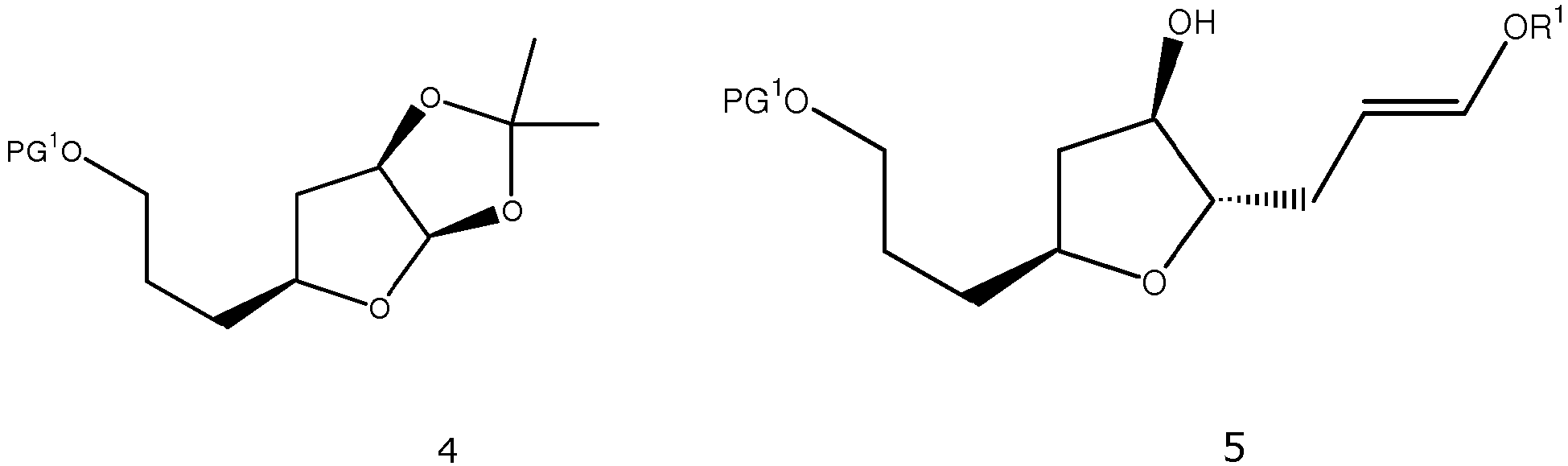
- nucleophillic addition of an allyl-silane derivative of formula 8 to a compound of formula 4 to form the compound of formula 5;

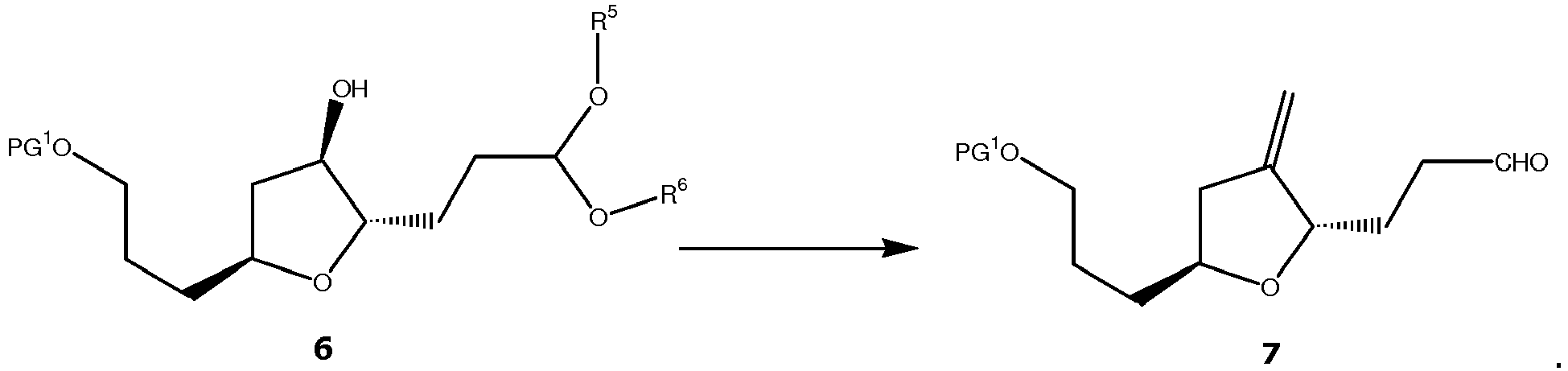
- deprotecting the compound of formula 5 under conditions to remove the R1 alcohol protecting group , and protecting the resulting aldehyde to form a compound of formula 6, wherein each R5 and R6 independently is an alkyl, cyclo-alkyl, aryl or hetero-aryl group, optionally having one or more heteroatoms, or R5 and R6 together form an alkanediyl group, optionally having one or more heteroatoms;

- replacing the hydroxyl group with a methylene in the compound of formula 6, followed by deprotection of the protected aldehyde to form the compound of formula 7;

- In another aspect, the specification discloses a process for preparation of a compound of formula 7, or a derivative thereof, wherein PG1 is an alcohol protecting group,

- nucleophillic addition of an allyl-silane derivative of formula 8 to a compound of formula 4 to form the compound of formula 5;

- replacing the hydroxyl group with a methylene group in the compound of formula 5 to form the compound of formula 11; and

- deprotecting the protected aldehyde to remove R1 and form the compound of formula 7

- Further compound of formula 4 is described herein, where PG1 is an alcohol protecting group.

- Further compound of formula 5 is described herein , where PG1 and R1 each independently is an alcohol protecting group.

- Further, a compound of formula 6 is described herein,

- Further compounds of formula 10 and 11 are described herein, where PG1 and R1 each independently is an alcohol protecting group.

- Further, a process for the preparation of compounds of formula 4, 5, 6, 10 and 11 is described herein.


- As described above, in one aspect, the specification discloses a process for preparation of a compound of formula 7, or a derivative thereof, wherein PG1 is an alcohol protecting group,

- nucleophillic addition of an allyl-silane derivative of formula 8 to a compound of formula 4 to form the compound of formula 5;

- deprotecting the compound of formula 5 under conditions to remove the R1 protecting group , and protecting the resulting aldehyde to form a compound of formula 6, wherein each R5 and R6 independently is an alkyl, cyclo-alkyl, aryl or hetero-aryl group, optionally having one or more heteroatoms, or R5 and R6 together form an alkanediyl group, optionally having one or more heteroatoms;

- replacing the hydroxyl group with a methylene group in the compound of formula 6, followed by deprotection of the protected aldehyde to form the compound of formula 7;
- In addition, in another aspect, the specification discloses a process for preparation of a compound of formula 7, or a derivative thereof, wherein PG1 is an alcohol protecting group,

- nucleophillic addition of an allyl-silane derivative of formula 8 to a compound of formula 4 to form the compound of formula 5;

- replacing the hydroxyl group with a methylene group in the compound of formula 5 to form the compound of formula 11; and

- deprotecting the protected aldehyde to remove R1 and form the compound of formula 7

- The derivatives of the compound of formula 7 relate to the functionalization of the aldehyde functional group and is not particularly limited. The aldehyde functional group can be replaced by other groups, for example and without limitation, an ester, an amide or an acyl halide.
- Without being bound to a particular theory, it is believed that the nucleophillic addition of the allyl-silane derivative of formula 8 utilizes the stereochemical features of the compound of formula 4. In particular, the position of the isopropylidene protecting group on the 1,2-diol facilitates nucleophillic addition from the β-face, i.e. from behind the plane of the page, to form the compound of formula 5 having a trans configuration. Hence, the resulting product obtained can have high stereochemical purity (diastereomeric excess).
- The conditions for nucleophillic addition reaction of the compound of formula 4 with the compound of formula 8 are not particularly limited, and can be determined. In one embodiment, for example and without limitation, the nucleophillic addition reaction of the compound of formula 4 with the compound of formula 8 is performed in the presence of an activator. The activator used for such a nucleophillic addition reaction is also not particularly limited, and can be determined. Without being bound by a particular theory, in one embodiment, for example and without limitation, the activator can bind with the oxygen atoms on the compound of formula 4, which can increase the electrophilicity of the anomeric carbon centre on the compound of formula 4 and/or can assist in improving the facial selectivity of nucleophillic attack. In one embodiment, for example and without limitation, the activator is a lewis acid, for instance BF3 or trimethylsilyl triflate (TMSOTf).
- The allyl-silane derivative of formula 8 used in the nucleophillic addition reaction is not particularly limited, and should be known to a skilled person, or can be determined. In one embodiment, for example and without limitation, in the allyl-silane derivative of formula 8, R1 is a alcohol protecting group, and each R2, R3 and R4 independently is an alkyl, cyclo-alkyl, aryl or hetero-aryl group. In a further embodiment, for example and without limitation, in the allyl-silane derivative of formula 8, R1 is acetyl, and each R2, R3 and R4 independently is methyl.
- The length of the alkyl or alkanediyl group or the number of atoms in the alkyl group, alkanediyl group or the aryl group are not particularly limited, and should be known to a person of skill in the art or can be determined. In one embodiment, for example and without limitation, the alkyl group is a C1-6 alkyl. Similar length of alkanediyl groups can also be used, where appropriate. In another embodiment, for example and without limitation, the aryl group is a C6-14 aryl.
- The term C1-6alkyl in accordance with the specification is not particularly limited and should be known to a person of skill in the art. The C1-6 alkyl may be, for example, and without limitation, any straight or branched alkyl, for example, methyl, ethyl, n-propyl, i-propyl, sec-propyl, n-butyl, i-butyl, sec-butyl, t-butyl, n-pentyl, i-pentyl, sec-pentyl, t-pentyl, n-hexyl, i-hexyl, 1,2-dimethylpropyl, 2-ethylpropyl, 1,2-dimethylbutyl, 1-ethyl-2-methylpropyl, 1,1,2-trimethylpropyl, 1,1-diethyl-2-methylbutyl, 1,1-dimethylbutyl, 2,2-dimethylbutyl, 2-ethylbutyl, 1,3-dimethylbutyl, 2-methylpentyl or 3-methylpentyl.
- The term aryl in accordance with the specification is not particularly limited and should be known to a person of skill in the art. The term "aryl" refers to aromatic groups which have at least one ring having a conjugated π-electron system and includes carbocyclic aryl, heterocyclic aryl (also known as heteroaryl groups) and biaryl groups, all of which may be optionally substituted. The aryl groups can include, for example and without limitation, six to fourteen atoms. Examples of aryl group can include, without limitation, phenyl, pyridinyl or naphthyl.
- The conditions for the deprotection of the compound of formula 5 or 11 to remove the R1 protecting group is not particularly limited and would depend upon the particular R1 protecting group. In one embodiment, for example and without limitation, the R1 protecting group is an acetyl, and the deprotection is performed, for example and without limitation, in the presence of a base. The type of base used for the deprotection reaction is not particularly limited, and should be known to a skilled worker or can be determined. In one embodiment, for example and without limitation, the base used is a carbonate. In a further embodiment, for example and without limitation, the base is Na2CO3, NaHCO3 or K2CO3.
- Upon deprotection of the compound of formula 5, an aldehyde is formed, which can be protected to form the compound of formula 6. The protection of the aldehyde is not particularly limited and should be known to a skilled worker or can be determined. In one embodiment, for example and without limitation, an acetal is formed to protect the aldehyde, as shown in the compound of formula 6. The acetal can be formed by reacting with an alcohol. The alcohol used is not particularly limited and can be determined by a skilled worker. In one embodiment, for example and without limitation, the alcohol has one hydroxyl group, is a 1,2-diol or a 1,3-diol. In the compound of formula 6, each R5 and R6 independently is an alkyl, cyclo-alkyl, aryl or hetero-aryl group, optionally having one or more heteroatoms, or R5 and R6 together form an alkanediyl group, optionally having one or more heteroatoms. In a further embodiment, for example and without limitation, the R5 and R6 together form -CH2CH2-.
- As shown above, the compound of formula 6 can be converted into the compound of formula 7 by replacing the hydroxyl group in the compound of formula 6 with a methylene group (similar conversation of compound of formula 5 leads to compound 11, an embodiment of which is shown below in Scheme 2), followed by deprotection of the aldehyde to form the compound of formula 7.
- The step of replacing the hydroxyl group in the compound of formula 6 with a methylene group is not particularly limited, and should be known to a skilled worker or can be determined. In one embodiment, for example and without limitation, the hydroxyl group is oxidized to form a ketone (similar conversation of compound of formula 5 leads to compound 10, an embodiment of which is shown below in Scheme 2), followed by conversion of the ketone into an alkene.
- The oxidation of the alcohol in the compound of formula 5 or 6 is not particularly limited, and should be known to a skilled worker or can be determined. In one embodiment, for example and without limitation, the oxidation is performed using a chromium-based reagent, such as Collins reagent, pyridinium dichromate (PDC) or pyridinium chlorochromate (PCC); activated dimethyl sulfoxide (DMSO), such as, Swern oxidation, Moffatt oxidation or Doering oxidation; or hypervalent iodine compounds, such as, Dess-Martin periodinane or 2-iodoxybenzoic acid. In a further embodiment, for example and without limitation, the oxidation is performed by Doering oxidation, which uses DMSO and sulfur trioxide-pyridine complex.
- Following oxidation of the alcohol in the compound of formula 6 to a ketone, the ketone functional group can be, in one embodiment, for example and without limitation, converted into an alkene (similar conversation of compound of formula 10 leads to compound 11, an embodiment of which is shown below in Scheme 2). The reaction to convert a ketone to an alkene is not particularly limited, and should be known to a skilled worker or can be determined. In one embodiment, for example and without limitation, the ketone is converted to an alkene using Tebbe's reagent, that has the formula (C5H5)2TiCH2ClAl(CH3)2. In another embodiment, for example and without limitation, a ketone can be converted into an alkene using the Peterson olefination, the Wittig reaction or the like.
- The protecting group PG1 used in the process for the preparation of compound 7 is not particularly limited, and should be known to a skilled worker or can be determined. In one embodiment, for example and without limitation, the protecting group PG1 forms an ester, ether or is a silyl-protecting group. In a further, embodiment for example and without limitation, the ester formed is acetyl (Ac), benzoyl (Bz) or pivaloyl (Piv). In another embodiment, for example and without limitation, the ether protecting group formed is benzyl (Bn), β-methoxyethoxymethyl ether (MEM), trityl (Tr), dimethoxy trityl (DMT), methoxymethyl ether (MOM), or the like. In a still further embodiment, for example and without limitation, the silyl protecting group formed is tertbutyldimethylsilyl (TBDMS), tri-iso-propylsilyloxymethyl (TOM), or triisopropylsilyl (TIPS). In a particular embodiment, for example and without limitation, the protecting group PG1 is Piv.
- In one embodiment in accordance with the description, the compound of formula 4 can be obtained from 1,2:5,6-diisopropylidene glucose (compound of formula 1). The compound of formula 1 is derived from a natural sugar and therefore, can be readily available or can be prepared. Further, the compound of formula 1 can be present as a single stereoisomer. In addition, the reactions performed, as disclosed in the specification, can utilize the stereochemical features of the compound of formula 1 to form a single stereoisomer, resulting in products having high stereochemical purity.

- In one embodiment, for example and without limitation, the hydroxyl group of the compound of formula 1 is converted into a leaving group (LG), followed by hydrolysis of the 5,6-isopropylidene protecting group and oxidatively cleaving the diol to form the aldehyde of formula 2.

- A leaving group as disclosed herein is a molecular fragment or stable species that can be detached from a molecule in a bond-breaking step. The leaving group, in accordance with the specification, is not particularly limited and should be known to a person of skill in the art or can be determined. The ability of a leaving group to depart is correlated with the pKa of the conjugate acid, with lower pKa being associated with better leaving group ability. Examples of leaving group include, without limitation, halide or a sulfonate. Halides can include, for example, CI, Br or I. Examples of sulfonates can include, without limitation, nonaflate, triflate, fluorosulfonate, tosylate, mesylate or besylate. In one embodiment, for example and without limitation, the leaving group is mesylate.
- The conditions for hydrolysis of the 5,6-isopropylidene protecting group is not particularly limited, and should be known to skilled worker or can be determined. In one embodiment, for example and without limitation, the 5,6-isopropylidene protecting group is removed using an acid, to yield a diol. The diol can then be oxidatively cleaved to form the aldehyde. The process for oxidative cleavage of the diol is not particularly limited, and should also be known to a skilled worker or can be determined. In one embodiment, for example and without limitation, the oxidative cleavage is performed using periodate oxidation. In a further embodiment, for example and without limitation, the periodate used is NaIO4. The process for conversion of the compound of formula 1 into the compound of formula 2 can also be performed as described in Synthesis, 1982, 28-29, incorporated herein by reference.
- The compound of formula 2 can undergo an elimination reaction in the presence of a base to remove the leaving group and form an alkene. The alkene obtained can then undergo a Wittig or a Horner-Wadsworth Emmons reaction, by reacting with a Ph3P=CHCO2Me (9), or analogs thereof, to form the compound of formula 3. The base used for the elimination reaction is not particularly limited and has been described herein above. The analog of the compound of formula 9 is not particularly limited. In one embodiment, for example and without limitation, the phosphonate reagent (EtO)2P(=O)-CH2CO2Me is used. In another embodiment, for example and without limitation, the methyl group in the ester functionality has been replaced by an alternate alkyl group, such as, for example and without limitation, ethyl, propyl or butyl.

- The compound of formula 3 can then undergo hydrogenation of the alkene, followed by reduction of the ester functional group to an alcohol, and then protecting the resulting alcohol to form the compound of formula 4.
- The conditions for the hydrogenation reaction are not particularly limited and should be known to a skilled worker or can be determined. In one embodiment, for example and without limitation, the hydrogenation reaction is performed using a hydrogenation catalyst, such as for example and without limitation, palladium on carbon (Pd/C). Again in the hydrogenation reaction, and without being bound to a particular theory, it is believed that the presence of the 1,2-isopropylidene group can direct hydrogenation from the β-face, i.e. below the plane of the paper, which can lead to a stereoisomer having the desired stereochemistry, in high diastereomeric excess (d.e.).
- The reaction for reduction of an ester to an alcohol is not particularly limited and should be known to a skilled worker or can be determined. In one embodiment, for example and without limitation, reduction is performed using a hydride source. The hydride source used is not particularly limited and should be known to a skilled worker or can be determined. In one embodiment, for example and without limitation, the hydride source is lithium aluminum hydride (LAH), lithium triethylborohydride (LiEt3BH), diisobutylaluminum hydride (DIBALH) or sodium borohydride (NaBH4).
- As noted above, using the process disclosed in the specification, compounds having high diastereomeric purity can be obtained. In one embodiment, for example and without limitation, the chiral purity of any one of the compounds of formula 2 to 7 is about 99.0%, 99.1%, 99.2%, 99.3% 99.4%, 99.5%, 99.6%, 99.7%, 99.8%, 99.9% d.e. or any values in between.
- In one embodiment, for example and without limitation, the compound of formula 4a can be obtained from the compound of formula 1, according to the Scheme 1, shown below.

- In another embodiment, for example and without limitation, the compound of formula 7a can be obtained from the compound of formula 4a, according to Scheme 2, shown below.

- In a further particular embodiment, for example and without limitation, the compound of formula 7a can be obtained from the compound of formula 4a, according to Scheme 3, shown below.

-
- 1. A process for preparation of a compound of formula 7, or a derivative thereof, wherein PG1 is an alcohol protecting group,

- nucleophillic addition of an allyl-silane derivative of formula 8 to a compound of formula 4 to form the compound of formula 5;

- deprotecting the compound of formula 5 under conditions to remove the R1 protecting group , and protecting the resulting aldehyde to form a compound of formula 6, wherein each R5 and R6 independently is an alkyl, cyclo-alkyl, aryl or hetero-aryl group, optionally having one or more heteroatoms, or R5 and R6 together form an alkanediyl group, optionally having one or more heteroatoms;

- replacing the hydroxyl group with a methylene group in the compound of formula 6, followed by deprotection of the protected aldehyde to form the compound of formula 7;

- nucleophillic addition of an allyl-silane derivative of formula 8 to a compound of formula 4 to form the compound of formula 5;
- 2. The process according to embodiment 1, wherein PG1, the oxygen to which it is attached and the propanol derivative together form an ester.
- 3. The process according to embodiment 1, wherein PG1 is a pivaloyl group.
- 4. The process according to any one of embodiments 1 to 3, wherein R1, the oxygen to which it is attached and the allyl-silane derivative together form an ester.
- 5. The process according to any one of embodiments 1 to 3, wherein R1 is an acetyl group.
- 6. The process according to any one of embodiments 1 to 5, wherein each R2, R3 and R4 independently is a C1-6 alkyl, C6-14 aryl or C5-14 hetero-aryl group.
- 7. The process according to any one of embodiments 1 to 5, wherein each R2, R3 and R4 independently is a methyl group.
- 8. The process according to any one of embodiments 1 to 7, wherein the nucleophillic addition reaction is performed in the presence of an activator.
- 9. The process according to embodiment 8, wherein the activator is boron trifluoride.
- 10. The process according to any one of embodiments 1 to 9, wherein hydrolysis of the compound of formula 5 is performed using a base.
- 11. The process according to embodiment 10, wherein the base is K2CO3.
- 12. The process according to any one of embodiments 1 to 11, wherein each R5 and R6 together form an alkanediyl group.
- 13. The process according to any one of embodiments 1 to 11, wherein each R5 and R6 together form -CH2CH2-.
- 14. The process according to any one of embodiments 1 to 13, wherein the compound of formula 6 is converted to the compound of formula 7 by oxidizing the alcohol to a ketone, followed by substituting the oxygen by a methylene group.
- 15. The process according to embodiment 14, wherein the oxidation is performed by the Doering oxidation reaction.
- 16. The process according to embodiment 14 or 15, wherein the substitution reaction is performed by use of Tebbe's reagent.
- 17. The process according to any one of embodiments 1 to 16, wherein the deprotection of the protected aldehyde to form the compound of formula 7, is performed using an acid.
- 18. The process according to embodiment 14, wherein the mild acid is pyridinium para-toluene sulfonate (PPTS).
- 19. The process according to any one of embodiments 1 to 18, wherein the compound of formula 4 is formed from the compound of formula 1

- 20. The process according to embodiment 19, wherein the compound of formula 4 is obtained by:
- converting the hydroxyl group of compound of formula 1 into a leaving group (LG), hydrolyzing the 5,6-isopropylidene protecting group and oxidatively cleaving the diol to form the aldehyde of formula 2;

- reacting the compound of formula 2 with a base to eliminate the leaving group (LG), followed by reacting the resulting alkene with Ph3P=CHCO2Me (9), or an analog thereof, to form the compound of formula 3;

- hydrogenating the alkene, reducing the ester functional group to an alcohol and protecting the resulting alcohol to form the compound of formula 4.
- converting the hydroxyl group of compound of formula 1 into a leaving group (LG), hydrolyzing the 5,6-isopropylidene protecting group and oxidatively cleaving the diol to form the aldehyde of formula 2;
- 21. The process according to embodiment 20, wherein the leaving group formed is a sulfonate based leaving group.
- 22. The process according to embodiment 20, wherein the leaving group formed is a mesylate.
- 23. The process according to any one of embodiments 20 to 22, wherein hydrolysis of the 5,6-isopropylidene protecting group of the compound of formula 1 is performed using an acid.
- 24. The process according to any one of embodiments 20 to 23, wherein the oxidative cleavage of the diol obtained from the compound of formula 1 is performed by periodate oxidation.
- 25. The process according to any one of embodiments 20 to 23, wherein the oxidative cleavage of the diol obtained from the compound of formula 1 is performed by sodium periodate.
- 26. The process according to any one of embodiments 20 to 25, wherein the base for the elimination reaction is NaHCO3.
- 27. The process according to any one of embodiments 20 to 26, wherein the hydrogenation of the compound of formula 3 is performed using Palladium on carbon catalyst and hydrogen gas..
- 28. The process according to any one of embodiments 20 to 26, wherein the reduction of the ester functional group is performed using a hydride source.
- 29. The process according to embodiment 28, wherein the hydride source is lithium aluminum hydride.
- 30. The process according to any one of embodiments 20 to 29, wherein the protection of the alcohol group to form the compound of formula 4 is performed using pivaloyl chloride.
- 31. The compound of formula 4

- 32. The compound of formula 5

- 33. The compound of formula 6

- 34. A process for the preparation of compound of formula 4 is described herein, where PG1 is an alcohol protecting group,

- converting the hydroxyl group of compound of formula 1 into a leaving group, hydrolyzing the 5,6-isopropylidene protecting group and oxidatively cleaving the diol to form the aldehyde of formula 2;

- reacting the compound of formula 2 with a base to eliminate the leaving group (LG), followed by reacting the resulting alkene with Ph3P=CHCO2Me (9), or an analog thereof, to form the compound of formula 3; and

- hydrogenating the alkene, reducing the ester functional group to an alcohol and protecting the resulting alcohol to form the compound of formula 4.
- converting the hydroxyl group of compound of formula 1 into a leaving group, hydrolyzing the 5,6-isopropylidene protecting group and oxidatively cleaving the diol to form the aldehyde of formula 2;
- 35. A process for the preparation of compound of formula 5 is described herein, wherein PG1 and R1 are alcohol protecting groups

- the process as defined in embodiment 34; and
- nucleophillic addition of an allyl-silane derivative of formula 8 to a compound of formula 4 to form the compound of formula 5;

- 36. A process for preparation of compound of formula 6 is described herein,

- the process as defined in embodiment 35; and
- hydrolyzing the compound of formula 5 under conditions to remove the R1 protecting group, and protecting the resulting aldehyde to form a compound of formula 6, wherein each R5 and R6 independently is an alkyl, cyclo-alkyl, aryl or hetero-aryl group, optionally having one or more heteroatoms, or R5 and R6 together form an alkanediyl group, optionally having one or more heteroatoms.
- 37. A process for the preparation of compound of formula 5 is described herein, wherein PG1 and R1 are alcohol protecting groups

- nucleophillic addition of an allyl-silane derivative of formula 8 to a compound of formula 4 to form the compound of formula 5;

- nucleophillic addition of an allyl-silane derivative of formula 8 to a compound of formula 4 to form the compound of formula 5;
- 38. A process for preparation of compound of formula 6 is described herein,

- hydrolyzing the compound of formula 5 under conditions to remove the R1 protecting group, and protecting the resulting aldehyde to form a compound of formula 6, wherein each R5 and R6 independently is an alkyl, cyclo-alkyl, aryl or hetero-aryl group, optionally having one or more heteroatoms, or R5 and R6 together form an alkanediyl group, optionally having one or more heteroatoms.
- 39. A process for preparation of a compound of formula 7, or a derivative thereof, wherein PG1 is an alcohol protecting group,

- nucleophillic addition of an allyl-silane derivative of formula 8 to a compound of formula 4 to form the compound of formula 5;

- replacing the hydroxyl group with a methylene group in the compound of formula 5 to form the compound of formula 11; and

- deprotecting the protected aldehyde to remove R1 and form the compound of formula 7

- nucleophillic addition of an allyl-silane derivative of formula 8 to a compound of formula 4 to form the compound of formula 5;
- 40. The process according to embodiment 39, wherein PG1, the oxygen to which it is attached and the propanol derivative together form an ester.
- 41. The process according to embodiment 39, wherein PG1 is a pivaloyl group.
- 42. The process according to any one of embodiments 39 to 41, wherein R1, the oxygen to which it is attached and the allyl-silane derivative together form an ester.
- 43. The process according to any one of embodiments 39 to 41, wherein R1 is an acetyl group.
- 44. The process according to any one of embodiments 39 to 43, wherein each R2, R3 and R4 independently is a C1-6 alkyl, C6-14 aryl or C5-14 hetero-aryl group.
- 45. The process according to any one of embodiments 39 to 43, wherein each R2, R3 and R4 independently is a methyl group.
- 46. The process according to any one of embodiments 39 to 45, wherein the nucleophillic addition reaction is performed in the presence of an activator.
- 47. The process according to embodiment 46, wherein the activator is boron trifluoride.
- 48. The process according to any one of embodiments 39 to 47, wherein the compound of formula 5 is converted to the compound of formula 11 by oxidizing the alcohol to a ketone, followed by substituting the oxygen by a methylene group.
- 49. The process according to embodiment 48, wherein the oxidation is performed by the Doering oxidation reaction.
- 50. The process according to embodiment 48 or 49, wherein the substitution reaction is performed by use of Tebbe's reagent.
- 51. The compound of formula 10

- 52. The compound of formula 11

- 53. A process for the preparation of compound of formula 10 is described herein, wherein PG1 and R1 each independently is an alcohol protecting group, the process comprising oxidation of the compound of formula 5 to form the compound of formula 10

- 54. The process according to embodiment 53, wherein the compound of formula 5 is obtained according to the process as defined in embodiment 35 or 37.
- 55. A process for preparation of a compound of formula 11 is described herein, wherein PG1 and R1 each independently is an alcohol protecting group, the process comprising replacing the ketone with a methylene group in the compound of formula 10 to form the compound of formula 11

- 56. The process according to embodiment 55, wherein the compound of formula 10 is obtained according to the process as defined in embodiment 53 or 54.
- 57. A process for preparation of a halichondrin analog is described herein, comprising the process as defined in any one of embodiments 1-30 and 34-56.
- 58. A process for preparation of Eribulin is described herein, comprising the process as defined in any one of embodiments 1-30 and 34-56.
- The following examples are illustrative and non-limiting, and represent specific embodiments of the present invention.
- The compound of formula 2a can be prepared as described in Synthesis 1982, 28-29, incorporated herein by reference.
-

- Compound 2a (1 wt. parts) was dissolved in a mixture of methanol (4.6 vol. parts) and water (1.8 vol. parts). NaHCO3 (0.6 wt. parts) was added and the mixture heated to reflux until reaction was complete by Thin Layer Chromatography (TLC). The mixture was cooled to ambient and methyl triphenylphosphoranylidene acetate (1.14 wt. parts) was added. After stirring for 0.5hr, the reaction mixture was quenched with water and extracted 2 times with methyl t-butyl ether (MTBE). The combined organic extract was dried over Na2SO4, filtered and concentrated under vacuum to give a residue. The residue was triturated with methyl t-butyl ether (3.6 vol. parts), filtered and rinsed with methyl t-butyl ether. The filtrate was concentrated to give compound 3a (1.2 wt. parts) as a mixture of cis/trans-isomers.
-

- A solution of compound 3a (1 wt. parts), dissolved in i-PrOH (20 vol. parts) was added to 10 wt/wt% palladium on carbon (Pd/C) (0.4 wt. parts) in a Parr hydrogenation flask. The reaction vessel was pressurized to 40psi with hydrogen and maintained at this pressure, while being agitated for 20 hours. Following this, the reaction mixture was filtered through a plug of celite, which was then rinsed with methanol (MeOH) (25 vol. parts). The combined filtrate and MeOH rinse was concentrated under reduced pressure to yield a viscous oil. This crude product was then dissolved in diethylether (Et2O) (40 vol. parts), set stirring, and cooled in an ice bath. LiAlH4 (2 eq., 0.34 wt. parts) was then added portion-wise. After complete addition, the ice bath was removed and the reaction mixture was allowed to warm to room temperature over the course of 3 hours. The slurry was then quenched by the slow addition of water (0.34 vol. parts), aqueous 1N NaOH (0.34 vol. parts), and then more water (1.02 vol. parts), followed by a period of stirring (20 minutes). Na2SO4 was then added to remove excess water. After filtering off the solids, and concentrating the filtrate under reduces pressure, the resultant crude oil was dissolved in pyridine (18 vol. parts), set stirring, and cooled in an ice bath under a nitrogen (N2 (g)) atmosphere. To the mixture was added pivaloyl chloride (PivCl) (1.7 eq., 0.9 wt. parts), and the reaction was left to warm to ambient temperature over a period of 20 hours. Following this, the contents of the reaction flask were poured onto water (40 vol. parts) and stirred for 1 hour. This mixture was then extracted with CH2Cl2 (3 times 20 vol. parts). The combined extracts were washed with NaHCO3, followed by brine, and dried over Na2SO4. After filtering and concentration under reduced pressure, the crude oil was subjected to column chromatography (stationary phase: SiO2, eluent: 1:1 Heptanes: EtOAc) to yield compound 4a (0.4 eq.) as a colorless oil.
-

- Compound 4a (1 wt. parts) and 1-(acetyloxy)-1-(trimethylsilyl)-2-propene (3.0 eq., 1.8 wt. parts) were dissolved in anhydrous dichloroethane (DCE) (4 vol. parts) under nitrogen (N2(g)). While cooling the reaction vessel in an ice water bath, BF3OEt2 (4.6 eq., 2.3 wt. parts) was added in a dropwise fashion. The reaction mixture was then left to warm to room temperature over 20 hours. Following this, the reaction mixture was diluted with ethyl acetate (EtOAc) (120 vol. parts), washed with saturated aqueous NaHCO3, and then concentrated under reduced pressure. The residue was then dissolved in MeOH (4 vol. parts). A solution of K2CO3 (0.6 eq., 0.3 wt. parts) dissolved in water (4 vol. parts) was then added, and the resulting mixture was stirred vigorously for 30 minutes. After dilution with EtOAc (120 vol. parts) and washing with brine until the washings are neutral (pH 7 by pH paper), the organic phase was dried over Na2SO4, filtered, and concentrated under reduced pressure. The crude residue was then treated with 0.3 wt. parts of ethylene glycol (1.5 eq.), and with 0.06 wt. parts of pyridinium para-toluene sulfonate (PPTS) (0.07 eq.),) in toluene (10 vol. parts) at reflux for 1 hour. Following this, the crude residue obtained by concentrating the reaction mixture under reduced pressure, was directly applied to the top of a silica gel column, and eluted with ethyl acetate (EtOAc). Fractions containing the product were collected and concentrated to dryness to yield compound 6a (0.24 eq.) as a yellow oil.
-

- Compound 4a (1 eq.) and 1-(acetyloxy)-1-(trimethylsilyl)-2-propene (3.0 eq.) were dissolved in anhydrous dichloroethane (DCE) (12 vol. parts) under nitrogen (N2 (g)). The internal temperature of this solution was maintained at 0°C and BF3OEt2 (4.6 eq.) was added in a dropwise fashion. Stirring was continued at 0°C for 6h. Following this, the reaction was quenched by the slow addition of aqueous sodium bicarbonate solution (40 vol. parts) at 0°C and then warming to room temperature. Once the evolution of gas had ceased, the layers were separated, and the aqueous phase was extracted with ethyl acetate (3 times 40 vol. parts). The combined organic extracts were dried over Na2SO4, filtered, and then concentrated under reduced pressure. Purification of the crude residue via column chromatography, (stationary phase: SiO2, eluent: 1:1 heptanes: EtOAc), afforded (0.5 wt. parts, 44% yield) of compound 6b as a light yellow oil.
-

- Compound 6b (1 eq.) was dissolved in dichloromethane (DCM) (15 vol.). To this solution was then added Dess-Martin periodinane reagent (1.5 eq.). After stirring at ambient temperature for 20 hours, the reaction mixture was concentrated. The resulting residue was triturated with methyl t-butyl ether (MTBE), the solids were removed by filtration, and the filtrate concentrated under reduced pressure. Further purification was achieved by passing the crude product through a silica plug and eluting with 1:1 heptane: EtOAc. This produced (0.87 wt. parts, 87% yield) of ketone 10a.
-

- In an appropriately sized reaction vessel, pyridine-sulfur trioxode complex (3.1 eq., 1.5 wt. parts) was dissolved in anhydrous dimethylsulfoxide (DMSO) (5.9 vol. parts) under nitrogen (N2). After stirring for 10 minutes, triethylamine (NEt3) (3.9 eq., 1.2 wt. parts) was added followed by a solution of 6a (1 wt. parts) dissolved in anhydrous DMSO (8.7 vol. parts) which was added dropwise over the course of 30 minutes. The reaction mixture was left to stir for 1 hour, and then diluted with dietylehter (Et2O) (440 vol. parts), washed with water, brine, and dried over Na2SO4. Filtration and concentration provided a yellow oil which was passed through a silica plug, eluting with 1:1 heptanes: EtOAc. The resulting colorless oil was then dissolved and set stirring in anhydrous tetrahydrofuran (THF) (5.9 vol. parts) in an appropriately sized nitrogen (N2(g)) purged flask. To this solution was added a 0.5M solution of Tebbe's reagent in toluene (0.85 eq., 5.0 vol. parts). The dark red reaction mixture was left to stir for 30 minutes. The reaction mixture was diluted with diethylether (Et2O) (60 vol. parts), 10 drops of 0.1N NaOH were added, followed by Na2SO4 and the slurry was stirred for a further 20 minutes. Filtration through celite to remove the solids, followed by passage through a plug of silica eluting with 1:1 Heptanes: EtOAc and concentration under reduced pressure yielded an oil which was used directly for the next step. A solution of pyridinium para-toluene sulfonate (PPTS) (0.4 eq., 0.3 wt. parts) dissolved in acetone (26 vol. parts) and water (2.9 vol. parts) was added to the crude residue, and then heated to reflux for 20 hours. The reaction mixture was diluted with EtOAc (440 vol. parts), washed with saturated aqueous NaHCO3 followed by brine, dried over Na2SO4, filtered and concentrated under reduced pressure. Purification by column chromatography (stationary phase: SiO2, eluent: 1:1 heptanes: EtOAc) provided compound 7a (0.034 eq.) as a colorless oil.
-

- A solution of compound 10a (1 eq.), dissolved in anhydrous THF (8 vol. parts), was cooled to 0°C. To this mixture was slowly added Tebbe's reagent (1.3 eq., 0.5M in toluene) using a cannula. The resulting dark red solution was stirred at 0°C for 45 minutes. Once complete disappearance of the staring material had been observed by TLC, the reaction was diluted with MTBE (20 vol. parts), quenched by slow addition of aqueous 0.1N NaOH (2.5 vol. parts) at 0°C, and then allowed to warm to room temperature within approximately 1 hour. The brown/orange suspension was filtered through a plug of silica, concentrated under reduced pressure, triturated with pentane, filtered through a disposable frit, and then concentrated again. MeOH (6.5 vol. parts) was added followed by saturated aqueous K2CO3 (6.5 vol. parts), and the resulting biphasic slurry was stirred rapidly for 20 minutes. TLC analysis indicated complete hydrolysis of the acetate-enolether at this point. In order to hydrolyze the vinyl-enolether (formed by reaction of the Tebbe reagent with the carbonyl group of the enol-acetate) the reaction flask was cooled in an ice bath while concentrated HCI (4 vol. parts) was slowly added. After complete hydrolysis of both the enol-acetate and the vinyl-enolether, the mixture of free aldehyde and methoxy-hemiacetal was concentrated to approximately half the initial volume on the rotary evaporator. Tetrahydrofuran (THF) (13 vol. parts) was added, and the mixture was again concentrated. This was repeated two more times. The resulting acidic aqueous solution was neutralized with aqueous NaHCO3 , and extracted with EtOAc (3 times 8 vol. parts). The organic extracts were combined, rinsed with brine, dried over Na2SO4, filtered, and concentrated under reduced pressure. Purification by column chromatography (stationary phase: SiO2, eluent: 7:3 heptane:EtOAc) afforded compound 7a (0.23 wt. parts, 25% yield) as a light yellow oil.
- Certain adaptations and modifications of the described embodiments can be made. Therefore, the above discussed embodiments are considered to be illustrative and not restrictive.
Claims (4)
- A process for preparation of a compound of formula 7 wherein PG1 is an alcohol protecting group,
 - nucleophillic addition of an allyl-silane derivative of formula 8 to a compound of formula 4 to form the compound of formula 5;
 - deprotecting the compound of formula 5 under conditions to remove the R1 protecting group, and protecting the resulting aldehyde to form a compound of formula 6, wherein each R5 and R6 independently is an alkyl, cyclo-alkyl, aryl or hetero-aryl group, optionally having one or more heteroatoms, or R5 and R6 together form an alkanediyl group, optionally having one or more heteroatoms;
 - replacing the hydroxyl group with a methylene group in the compound of formula 6, followed by deprotection of the protected aldehyde to form the compound of formula 7;
- The process according to claim 1,(1) wherein PG1, the oxygen to which it is attached and the propanol derivative together form an ester or wherein PG1 is a pivaloyl group; and /or(2) wherein R1, the oxygen to which it is attached and the allyl-silane derivative together form an ester or wherein R1 is an acetyl group; and/or(3) wherein each R2, R3 and R4 independently is a C1-6 alkyl, C6-14 aryl or C5-14 hetero-aryl group or wherein each R2, R3 and R4 independently is a methyl group; and/or(4) wherein the nucleophillic addition reaction is performed in the presence of an activator or wherein the nucleophillic addition reaction is performed in the presence of the activator boron trifluoride; and/or(5) wherein hydrolysis of the compound of formula 5 is performed using a base or wherein hydrolysis of the compound of formula 5 is performed using the base K2CO3; and/or(6) wherein each R5 and R6 together form an alkanediyl group or wherein each R5 and R6 together form -CH2CH2-; and/or(7) wherein the compound of formula 6 is converted to the compound of formula 7 by oxidizing the alcohol to a ketone, followed by substituting the oxygen by a methylene group, wherein the compound of formula 6 is converted to the compound of formula 7 by oxidizing the alcohol to a ketone performed by the Doering oxidation reaction, followed by substituting the oxygen by a methylene group, or
wherein the compound of formula 6 is converted to the compound of formula 7 by oxidizing the alcohol to a ketone, followed by substituting the oxygen by a methylene group performed by use of Tebbe's reagent; and/or(8) wherein the deprotection of the protected aldehyde to form the compound of formula 7, is performed using an acid or wherein the deprotection of the protected aldehyde to form the compound of formula 7, is performed using the acid pyridinium para-toluene sulfonate (PPTS). - A process for preparation of a compound of formula 7, or a derivative thereof, wherein PG1 is an alcohol protecting group,
 - nucleophillic addition of an allyl-silane derivative of formula 8 to a compound of formula 4 to form the compound of formula 5;
 - replacing the hydroxyl group with a methylene group in the compound of formula 5 to form the compound of formula 10; and
 - deprotecting the protected aldehyde to remove R1 and form the compound of formula 7
- The process according to claim 3,(1) wherein PG1, the oxygen to which it is attached and the propanol derivative together form an ester or wherein PG1 is a pivaloyl group; and/or(2) wherein R1, the oxygen to which it is attached and the allyl-silane derivative together form an ester or wherein R1 is an acetyl group; and/or(3) wherein each R2, R3 and R4 independently is a C1-6 alkyl, C6-14 aryl or C5-14 hetero-aryl group or wherein each R2, R3 and R4 independently is a methyl group; and/or(4) wherein the nucleophillic addition reaction is performed in the presence of an activator or wherein the nucleophillic addition reaction is performed in the presence of the activator boron trifluoride; and/or(5) wherein the compound of formula 5 is converted to the compound of formula 11 by oxidizing the alcohol to a ketone, followed by substituting the oxygen by a methylene group,
wherein the compound of formula 5 is converted to the compound of formula 11 by oxidizing the alcohol to a ketone performed by the Doering oxidation, followed by substituting the oxygen by a methylene group, or
wherein the compound of formula 5 is converted to the compound of formula 11 by oxidizing the alcohol to a ketone, followed by substituting the oxygen by a methylene group performed by the use of Tebbe's reagent.
Applications Claiming Priority (2)
| Application Number | Priority Date | Filing Date | Title |
|---|---|---|---|
| US201161576649P | 2011-12-16 | 2011-12-16 | |
| PCT/CA2012/050897 WO2013086634A1 (en) | 2011-12-16 | 2012-12-14 | Process for preparation of 3-((2s,5s)-4-methylene-5-(3-oxopropyl)tetrahydrofuran-2-yl) propanol derivatives and intermediates useful thereof |
Publications (3)
| Publication Number | Publication Date |
|---|---|
| EP2791123A1 EP2791123A1 (en) | 2014-10-22 |
| EP2791123A4 EP2791123A4 (en) | 2016-01-06 |
| EP2791123B1 true EP2791123B1 (en) | 2018-07-18 |
Family
ID=48611765
Family Applications (1)
| Application Number | Title | Priority Date | Filing Date |
|---|---|---|---|
| EP12858656.7A Not-in-force EP2791123B1 (en) | 2011-12-16 | 2012-12-14 | Process for preparation of 3-((2s,5s)-4-methylene-5-(3-oxopropyl)tetrahydrofuran-2-yl) propanol derivatives and intermediates useful thereof |
Country Status (7)
| Country | Link |
|---|---|
| US (2) | US9174956B2 (en) |
| EP (1) | EP2791123B1 (en) |
| JP (1) | JP2015501818A (en) |
| CN (1) | CN104024237B (en) |
| AU (1) | AU2012350420A1 (en) |
| CA (1) | CA2857395A1 (en) |
| WO (1) | WO2013086634A1 (en) |
Families Citing this family (22)
| Publication number | Priority date | Publication date | Assignee | Title |
|---|---|---|---|---|
| CA2857385A1 (en) | 2011-11-30 | 2013-06-06 | Alphora Research Inc. | Process for preparation of (3r)-2,4-di-leaving group-3-methylbut-1-ene |
| JP6300030B2 (en) | 2011-12-29 | 2018-03-28 | サンド アクツィエンゲゼルシャフト | 2-((2S, 3S, 4R, 5R) -5-((S) -3-Amino-2-hydroxyprop-1-yl) -4-methoxy-3- (phenylsulfonylmethyl) tetrahydrofuran-2-yl ) Acetaldehyde derivatives and processes for preparing them |
| US9278979B2 (en) | 2012-03-30 | 2016-03-08 | Alphora Research Inc. | Synthetic process for preparation of macrocyclic C1-keto analogs of halichondrin B and intermediates useful therein |
| AU2014268086A1 (en) | 2013-05-15 | 2015-11-05 | Alphora Research Inc. | 3-((2S,5S)-4-methylene-5-(3-oxopropyl)tetrahydrofuran-2-yl)propanol derivatives, their preparation and intermediates useful thereof |
| EP3160970A4 (en) | 2014-06-30 | 2017-12-27 | President and Fellows of Harvard College | Synthesis of halichondrin analogs and uses thereof |
| CN105330686A (en) * | 2014-07-10 | 2016-02-17 | 上海源力生物技术有限公司 | Preparation method of eribulin intermediate |
| WO2016176560A1 (en) | 2015-04-30 | 2016-11-03 | President And Fellows Of Harvard College | Chromium-mediated coupling and application to the synthesis of halichondrins |
| KR101777634B1 (en) * | 2016-01-18 | 2017-09-12 | 연성정밀화학(주) | Process for preparing 3-((2S,5S)-4-methylene-5-(3-oxopropyl)tetrahydrofuran-2-yl)propanol derivative and intermediate therefor |
| MA45280B1 (en) | 2016-03-02 | 2021-08-31 | Eisai R&D Man Co Ltd | Eribulin-based antibody-drug conjugates and methods of use thereof |
| JP6978758B2 (en) | 2016-11-11 | 2021-12-08 | プレジデント アンド フェローズ オブ ハーバード カレッジ | Palladium-mediated ketolization |
| CN108341828B (en) * | 2017-01-24 | 2021-04-06 | 江苏恒瑞医药股份有限公司 | Process for the preparation of eribulin and intermediates thereof |
| KR102836514B1 (en) | 2017-04-05 | 2025-07-22 | 프레지던트 앤드 펠로우즈 오브 하바드 칼리지 | Macrocyclic compound and uses thereof |
| US9938288B1 (en) | 2017-04-05 | 2018-04-10 | President And Fellows Of Harvard College | Macrocyclic compound and uses thereof |
| HUE061306T2 (en) | 2017-07-06 | 2023-06-28 | Harvard College | Synthesis of halichondrins |
| US11498892B2 (en) | 2017-07-06 | 2022-11-15 | President And Fellows Of Harvard College | Fe/Cu-mediated ketone synthesis |
| ES2974243T3 (en) | 2017-11-15 | 2024-06-26 | Harvard College | Macrocyclic compounds and their uses |
| CN111793047B (en) * | 2019-06-13 | 2023-08-22 | 南通诺泰生物医药技术有限公司 | Preparation method of eribulin intermediate |
| US12595324B2 (en) * | 2019-08-27 | 2026-04-07 | Chevron Oronite Company Llc | Ethylene copolymers and use as viscosity modifiers |
| CN110981903A (en) * | 2019-11-28 | 2020-04-10 | 南京正济医药研究有限公司 | Refining method for improving optical purity of eribulin intermediate compound |
| CN113372305B (en) * | 2020-03-09 | 2022-10-18 | 南京圣鼎医药科技有限公司 | Preparation method of eribulin intermediate |
| CN114671905B (en) * | 2020-12-24 | 2023-10-20 | 苏州正济药业有限公司 | Derivative of eribulin intermediate and salt thereof, and preparation, purification method and application thereof |
| CN116063257B (en) * | 2021-11-02 | 2025-03-25 | 中国药科大学 | An anticancer drug intermediate and its preparation method |
Family Cites Families (12)
| Publication number | Priority date | Publication date | Assignee | Title |
|---|---|---|---|---|
| US5338865A (en) | 1992-03-12 | 1994-08-16 | President And Fellows Of Harvard College | Synthesis of halichondrin B and norhalichondrin B |
| US5436238A (en) | 1992-03-12 | 1995-07-25 | President And Fellows Of Harvard College | Halichondrins and related compounds |
| ATE191712T1 (en) | 1993-07-09 | 2000-04-15 | Theramex | NEW STRUCTURAL VITAMIN D DERIVATIVES |
| HU227912B1 (en) | 1998-06-17 | 2012-05-29 | Eisai R & D Man Co | Halichondrin analogs and methods of their use and preparation |
| US7001982B2 (en) * | 2003-03-31 | 2006-02-21 | Council Of Scientific And Industrial Research | Non-natural C-linked carbo-β-peptides with robust secondary structures |
| PL2522663T3 (en) | 2004-06-03 | 2015-08-31 | Eisai R&D Man Co Ltd | Intermediates for the preparation of halichondrin B |
| GB0711250D0 (en) * | 2007-06-12 | 2007-07-18 | Cbz Chemicals Ltd | Furanose derivatives |
| CN105801599A (en) | 2008-04-04 | 2016-07-27 | 卫材R&D管理有限公司 | Halichondrin b analogs |
| CA2857385A1 (en) | 2011-11-30 | 2013-06-06 | Alphora Research Inc. | Process for preparation of (3r)-2,4-di-leaving group-3-methylbut-1-ene |
| JP6300030B2 (en) | 2011-12-29 | 2018-03-28 | サンド アクツィエンゲゼルシャフト | 2-((2S, 3S, 4R, 5R) -5-((S) -3-Amino-2-hydroxyprop-1-yl) -4-methoxy-3- (phenylsulfonylmethyl) tetrahydrofuran-2-yl ) Acetaldehyde derivatives and processes for preparing them |
| US9278979B2 (en) | 2012-03-30 | 2016-03-08 | Alphora Research Inc. | Synthetic process for preparation of macrocyclic C1-keto analogs of halichondrin B and intermediates useful therein |
| AU2014268086A1 (en) | 2013-05-15 | 2015-11-05 | Alphora Research Inc. | 3-((2S,5S)-4-methylene-5-(3-oxopropyl)tetrahydrofuran-2-yl)propanol derivatives, their preparation and intermediates useful thereof |
-
2012
- 2012-12-14 US US14/365,168 patent/US9174956B2/en not_active Expired - Fee Related
- 2012-12-14 EP EP12858656.7A patent/EP2791123B1/en not_active Not-in-force
- 2012-12-14 AU AU2012350420A patent/AU2012350420A1/en not_active Abandoned
- 2012-12-14 JP JP2014546253A patent/JP2015501818A/en active Pending
- 2012-12-14 CA CA2857395A patent/CA2857395A1/en not_active Abandoned
- 2012-12-14 WO PCT/CA2012/050897 patent/WO2013086634A1/en not_active Ceased
- 2012-12-14 CN CN201280061633.2A patent/CN104024237B/en not_active Expired - Fee Related
-
2015
- 2015-10-14 US US14/882,845 patent/US9416140B2/en not_active Expired - Fee Related
Non-Patent Citations (1)
| Title |
|---|
| None * |
Also Published As
| Publication number | Publication date |
|---|---|
| AU2012350420A1 (en) | 2014-07-10 |
| JP2015501818A (en) | 2015-01-19 |
| WO2013086634A1 (en) | 2013-06-20 |
| US20150073157A1 (en) | 2015-03-12 |
| US9416140B2 (en) | 2016-08-16 |
| CN104024237B (en) | 2016-02-24 |
| EP2791123A1 (en) | 2014-10-22 |
| CN104024237A (en) | 2014-09-03 |
| EP2791123A4 (en) | 2016-01-06 |
| US9174956B2 (en) | 2015-11-03 |
| CA2857395A1 (en) | 2013-06-20 |
| US20160031900A1 (en) | 2016-02-04 |
Similar Documents
| Publication | Publication Date | Title |
|---|---|---|
| US9416140B2 (en) | Process for preparation of 3-((2s,5s)-4-methylene-5-(3-oxopropyl)tetrahydrofuran-2-yl)propanol derivatives and intermediates useful thereof | |
| EP2997017B1 (en) | 3-((2s,5s)-4-methylene-5-(3-oxopropyl)tetrahydrofuran-2-yl)propanol derivatives, their preparation and intermediates useful thereof | |
| EP2785687B1 (en) | Process for preparation of (3r)-2,4-di-leaving group-3-methylbut-1-ene | |
| EP3016957A1 (en) | Synthetic process for preparation of macrocyclic c1-keto analogs of halichondrin b and intermediates useful therein including intermediates containing -so2-(p-tolyl) groups | |
| EP2539310B1 (en) | Synthesis of magnolol and its analogue compounds | |
| WO2013142999A1 (en) | Synthetic process for preparation of macrocyclic c1-keto analogs of halichondrin b and intermediates useful therein | |
| US3822254A (en) | Synthesis of 25-hydroxycholesterol | |
| HUT70956A (en) | Halichondrin intermediates | |
| CN108341828B (en) | Process for the preparation of eribulin and intermediates thereof | |
| Akai et al. | Total synthesis of (−)-Tetrodotoxin from D-glucose: a new route to multi-functionalized cyclitol employing the ferrier (II) reaction toward (−)-Tetrodotoxin | |
| Fujiwara et al. | Practical synthesis of pachastrissamine (Jaspine B), 2-epi-pachastrissamine, and the 2-epi-pyrrolidine analogue | |
| Walkup et al. | Furanosides and furanones bearing acrylate sidechains via palladium-mediated cyclizations of γ-Oxoallenes | |
| EP3406604B1 (en) | Method for preparing 3-((2s,5s)-4-methylene-5-(3-oxopropyl)tetrahydrofurane-2-yl) propanol derivative, and intermediate therefor | |
| Das et al. | A common and versatile synthetic route to (−) and (+) pentenomycin I,(+) halopentenomycin I and dehydropentenomycin | |
| Indu et al. | Construction of key building blocks towards the synthesis of cortistatins | |
| Hu et al. | Stereoselective synthesis of (+)-boronolide and its 8-epimer | |
| Jagdhane et al. | A formal synthesis of valiolamine from myo-inositol | |
| Ramana et al. | A modular total synthesis of aculeatins A, B, E, F and 6-epi-aculeatins E, F | |
| Ogata et al. | Studies on the oxidative cyclization of 3-hydroxyalkyl-1, 2, 4-trialkoxynaphthalenes and synthetic application for the biologically active natural compound rhinacanthone | |
| Ferreiro-Mederos et al. | Stereoselective synthesis of the C15–C26 fragment of the antitumor agent (−)-dictyostatin | |
| Ivanova et al. | Reaction of methyl-4-methylene-2, 3-O-isopropylidene-β-D-ribofuranoside with N-bromosuccinimide in aqueous tetrahydrofurane | |
| US20050165257A1 (en) | Process for preparation of voglibose | |
| Takeuchi et al. | Ring-closing metathesis protocol for a diastereocontrolled preparation of the C28–C34 segment of FK-506 | |
| Maier et al. | A second generation synthesis of the cruentaren A core structure based on oxetane and oxirane opening reactions | |
| JP2015007054A (en) | Synthesis of magnolol and its analog compounds. |
Legal Events
| Date | Code | Title | Description |
|---|---|---|---|
| PUAI | Public reference made under article 153(3) epc to a published international application that has entered the european phase |
Free format text: ORIGINAL CODE: 0009012 |
|
| 17P | Request for examination filed |
Effective date: 20140711 |
|
| AK | Designated contracting states |
Kind code of ref document: A1 Designated state(s): AL AT BE BG CH CY CZ DE DK EE ES FI FR GB GR HR HU IE IS IT LI LT LU LV MC MK MT NL NO PL PT RO RS SE SI SK SM TR |
|
| DAX | Request for extension of the european patent (deleted) | ||
| RIC1 | Information provided on ipc code assigned before grant |
Ipc: C07D 307/28 20060101ALI20150717BHEP Ipc: C07D 493/10 20060101ALI20150717BHEP Ipc: C07D 307/12 20060101ALI20150717BHEP Ipc: C07D 493/08 20060101ALI20150717BHEP Ipc: C07D 493/04 20060101ALI20150717BHEP Ipc: C07D 307/20 20060101AFI20150717BHEP |
|
| RA4 | Supplementary search report drawn up and despatched (corrected) |
Effective date: 20151207 |
|
| RIC1 | Information provided on ipc code assigned before grant |
Ipc: C07D 493/08 20060101ALI20151201BHEP Ipc: C07D 493/10 20060101ALI20151201BHEP Ipc: C07D 307/28 20060101ALI20151201BHEP Ipc: C07D 307/12 20060101ALI20151201BHEP Ipc: C07D 493/04 20060101ALI20151201BHEP Ipc: C07D 307/20 20060101AFI20151201BHEP |
|
| 17Q | First examination report despatched |
Effective date: 20170313 |
|
| GRAP | Despatch of communication of intention to grant a patent |
Free format text: ORIGINAL CODE: EPIDOSNIGR1 |
|
| INTG | Intention to grant announced |
Effective date: 20180209 |
|
| GRAS | Grant fee paid |
Free format text: ORIGINAL CODE: EPIDOSNIGR3 |
|
| GRAA | (expected) grant |
Free format text: ORIGINAL CODE: 0009210 |
|
| RAP1 | Party data changed (applicant data changed or rights of an application transferred) |
Owner name: SANDOZ AG |
|
| AK | Designated contracting states |
Kind code of ref document: B1 Designated state(s): AL AT BE BG CH CY CZ DE DK EE ES FI FR GB GR HR HU IE IS IT LI LT LU LV MC MK MT NL NO PL PT RO RS SE SI SK SM TR |
|
| REG | Reference to a national code |
Ref country code: GB Ref legal event code: FG4D |
|
| REG | Reference to a national code |
Ref country code: CH Ref legal event code: EP |
|
| REG | Reference to a national code |
Ref country code: IE Ref legal event code: FG4D |
|
| REG | Reference to a national code |
Ref country code: AT Ref legal event code: REF Ref document number: 1019203 Country of ref document: AT Kind code of ref document: T Effective date: 20180815 |
|
| REG | Reference to a national code |
Ref country code: DE Ref legal event code: R096 Ref document number: 602012048732 Country of ref document: DE |
|
| REG | Reference to a national code |
Ref country code: NL Ref legal event code: MP Effective date: 20180718 |
|
| REG | Reference to a national code |
Ref country code: LT Ref legal event code: MG4D |
|
| REG | Reference to a national code |
Ref country code: AT Ref legal event code: MK05 Ref document number: 1019203 Country of ref document: AT Kind code of ref document: T Effective date: 20180718 |
|
| PG25 | Lapsed in a contracting state [announced via postgrant information from national office to epo] |
Ref country code: NL Free format text: LAPSE BECAUSE OF FAILURE TO SUBMIT A TRANSLATION OF THE DESCRIPTION OR TO PAY THE FEE WITHIN THE PRESCRIBED TIME-LIMIT Effective date: 20180718 |
|
| PG25 | Lapsed in a contracting state [announced via postgrant information from national office to epo] |
Ref country code: NO Free format text: LAPSE BECAUSE OF FAILURE TO SUBMIT A TRANSLATION OF THE DESCRIPTION OR TO PAY THE FEE WITHIN THE PRESCRIBED TIME-LIMIT Effective date: 20181018 Ref country code: GR Free format text: LAPSE BECAUSE OF FAILURE TO SUBMIT A TRANSLATION OF THE DESCRIPTION OR TO PAY THE FEE WITHIN THE PRESCRIBED TIME-LIMIT Effective date: 20181019 Ref country code: RS Free format text: LAPSE BECAUSE OF FAILURE TO SUBMIT A TRANSLATION OF THE DESCRIPTION OR TO PAY THE FEE WITHIN THE PRESCRIBED TIME-LIMIT Effective date: 20180718 Ref country code: IS Free format text: LAPSE BECAUSE OF FAILURE TO SUBMIT A TRANSLATION OF THE DESCRIPTION OR TO PAY THE FEE WITHIN THE PRESCRIBED TIME-LIMIT Effective date: 20181118 Ref country code: BG Free format text: LAPSE BECAUSE OF FAILURE TO SUBMIT A TRANSLATION OF THE DESCRIPTION OR TO PAY THE FEE WITHIN THE PRESCRIBED TIME-LIMIT Effective date: 20181018 Ref country code: AT Free format text: LAPSE BECAUSE OF FAILURE TO SUBMIT A TRANSLATION OF THE DESCRIPTION OR TO PAY THE FEE WITHIN THE PRESCRIBED TIME-LIMIT Effective date: 20180718 Ref country code: FI Free format text: LAPSE BECAUSE OF FAILURE TO SUBMIT A TRANSLATION OF THE DESCRIPTION OR TO PAY THE FEE WITHIN THE PRESCRIBED TIME-LIMIT Effective date: 20180718 Ref country code: LT Free format text: LAPSE BECAUSE OF FAILURE TO SUBMIT A TRANSLATION OF THE DESCRIPTION OR TO PAY THE FEE WITHIN THE PRESCRIBED TIME-LIMIT Effective date: 20180718 Ref country code: PL Free format text: LAPSE BECAUSE OF FAILURE TO SUBMIT A TRANSLATION OF THE DESCRIPTION OR TO PAY THE FEE WITHIN THE PRESCRIBED TIME-LIMIT Effective date: 20180718 Ref country code: SE Free format text: LAPSE BECAUSE OF FAILURE TO SUBMIT A TRANSLATION OF THE DESCRIPTION OR TO PAY THE FEE WITHIN THE PRESCRIBED TIME-LIMIT Effective date: 20180718 |
|
| PG25 | Lapsed in a contracting state [announced via postgrant information from national office to epo] |
Ref country code: LV Free format text: LAPSE BECAUSE OF FAILURE TO SUBMIT A TRANSLATION OF THE DESCRIPTION OR TO PAY THE FEE WITHIN THE PRESCRIBED TIME-LIMIT Effective date: 20180718 Ref country code: AL Free format text: LAPSE BECAUSE OF FAILURE TO SUBMIT A TRANSLATION OF THE DESCRIPTION OR TO PAY THE FEE WITHIN THE PRESCRIBED TIME-LIMIT Effective date: 20180718 Ref country code: HR Free format text: LAPSE BECAUSE OF FAILURE TO SUBMIT A TRANSLATION OF THE DESCRIPTION OR TO PAY THE FEE WITHIN THE PRESCRIBED TIME-LIMIT Effective date: 20180718 |
|
| REG | Reference to a national code |
Ref country code: DE Ref legal event code: R097 Ref document number: 602012048732 Country of ref document: DE |
|
| PG25 | Lapsed in a contracting state [announced via postgrant information from national office to epo] |
Ref country code: EE Free format text: LAPSE BECAUSE OF FAILURE TO SUBMIT A TRANSLATION OF THE DESCRIPTION OR TO PAY THE FEE WITHIN THE PRESCRIBED TIME-LIMIT Effective date: 20180718 Ref country code: ES Free format text: LAPSE BECAUSE OF FAILURE TO SUBMIT A TRANSLATION OF THE DESCRIPTION OR TO PAY THE FEE WITHIN THE PRESCRIBED TIME-LIMIT Effective date: 20180718 Ref country code: RO Free format text: LAPSE BECAUSE OF FAILURE TO SUBMIT A TRANSLATION OF THE DESCRIPTION OR TO PAY THE FEE WITHIN THE PRESCRIBED TIME-LIMIT Effective date: 20180718 Ref country code: CZ Free format text: LAPSE BECAUSE OF FAILURE TO SUBMIT A TRANSLATION OF THE DESCRIPTION OR TO PAY THE FEE WITHIN THE PRESCRIBED TIME-LIMIT Effective date: 20180718 |
|
| PLBE | No opposition filed within time limit |
Free format text: ORIGINAL CODE: 0009261 |
|
| STAA | Information on the status of an ep patent application or granted ep patent |
Free format text: STATUS: NO OPPOSITION FILED WITHIN TIME LIMIT |
|
| PG25 | Lapsed in a contracting state [announced via postgrant information from national office to epo] |
Ref country code: SM Free format text: LAPSE BECAUSE OF FAILURE TO SUBMIT A TRANSLATION OF THE DESCRIPTION OR TO PAY THE FEE WITHIN THE PRESCRIBED TIME-LIMIT Effective date: 20180718 Ref country code: DK Free format text: LAPSE BECAUSE OF FAILURE TO SUBMIT A TRANSLATION OF THE DESCRIPTION OR TO PAY THE FEE WITHIN THE PRESCRIBED TIME-LIMIT Effective date: 20180718 Ref country code: SK Free format text: LAPSE BECAUSE OF FAILURE TO SUBMIT A TRANSLATION OF THE DESCRIPTION OR TO PAY THE FEE WITHIN THE PRESCRIBED TIME-LIMIT Effective date: 20180718 |
|
| 26N | No opposition filed |
Effective date: 20190423 |
|
| REG | Reference to a national code |
Ref country code: CH Ref legal event code: PL |
|
| PG25 | Lapsed in a contracting state [announced via postgrant information from national office to epo] |
Ref country code: MC Free format text: LAPSE BECAUSE OF FAILURE TO SUBMIT A TRANSLATION OF THE DESCRIPTION OR TO PAY THE FEE WITHIN THE PRESCRIBED TIME-LIMIT Effective date: 20180718 Ref country code: LU Free format text: LAPSE BECAUSE OF NON-PAYMENT OF DUE FEES Effective date: 20181214 Ref country code: SI Free format text: LAPSE BECAUSE OF FAILURE TO SUBMIT A TRANSLATION OF THE DESCRIPTION OR TO PAY THE FEE WITHIN THE PRESCRIBED TIME-LIMIT Effective date: 20180718 |
|
| REG | Reference to a national code |
Ref country code: IE Ref legal event code: MM4A |
|
| REG | Reference to a national code |
Ref country code: BE Ref legal event code: MM Effective date: 20181231 |
|
| PG25 | Lapsed in a contracting state [announced via postgrant information from national office to epo] |
Ref country code: IT Free format text: LAPSE BECAUSE OF NON-PAYMENT OF DUE FEES Effective date: 20181214 Ref country code: IE Free format text: LAPSE BECAUSE OF NON-PAYMENT OF DUE FEES Effective date: 20181214 |
|
| PG25 | Lapsed in a contracting state [announced via postgrant information from national office to epo] |
Ref country code: BE Free format text: LAPSE BECAUSE OF NON-PAYMENT OF DUE FEES Effective date: 20181231 |
|
| PG25 | Lapsed in a contracting state [announced via postgrant information from national office to epo] |
Ref country code: LI Free format text: LAPSE BECAUSE OF NON-PAYMENT OF DUE FEES Effective date: 20181231 Ref country code: CH Free format text: LAPSE BECAUSE OF NON-PAYMENT OF DUE FEES Effective date: 20181231 |
|
| PG25 | Lapsed in a contracting state [announced via postgrant information from national office to epo] |
Ref country code: MT Free format text: LAPSE BECAUSE OF NON-PAYMENT OF DUE FEES Effective date: 20181214 |
|
| PG25 | Lapsed in a contracting state [announced via postgrant information from national office to epo] |
Ref country code: TR Free format text: LAPSE BECAUSE OF FAILURE TO SUBMIT A TRANSLATION OF THE DESCRIPTION OR TO PAY THE FEE WITHIN THE PRESCRIBED TIME-LIMIT Effective date: 20180718 |
|
| PG25 | Lapsed in a contracting state [announced via postgrant information from national office to epo] |
Ref country code: PT Free format text: LAPSE BECAUSE OF FAILURE TO SUBMIT A TRANSLATION OF THE DESCRIPTION OR TO PAY THE FEE WITHIN THE PRESCRIBED TIME-LIMIT Effective date: 20180718 |
|
| PG25 | Lapsed in a contracting state [announced via postgrant information from national office to epo] |
Ref country code: CY Free format text: LAPSE BECAUSE OF FAILURE TO SUBMIT A TRANSLATION OF THE DESCRIPTION OR TO PAY THE FEE WITHIN THE PRESCRIBED TIME-LIMIT Effective date: 20180718 Ref country code: MK Free format text: LAPSE BECAUSE OF NON-PAYMENT OF DUE FEES Effective date: 20180718 Ref country code: HU Free format text: LAPSE BECAUSE OF FAILURE TO SUBMIT A TRANSLATION OF THE DESCRIPTION OR TO PAY THE FEE WITHIN THE PRESCRIBED TIME-LIMIT; INVALID AB INITIO Effective date: 20121214 |
|
| PGFP | Annual fee paid to national office [announced via postgrant information from national office to epo] |
Ref country code: GB Payment date: 20211118 Year of fee payment: 10 Ref country code: FR Payment date: 20211125 Year of fee payment: 10 Ref country code: DE Payment date: 20211116 Year of fee payment: 10 |
|
| REG | Reference to a national code |
Ref country code: DE Ref legal event code: R119 Ref document number: 602012048732 Country of ref document: DE |
|
| GBPC | Gb: european patent ceased through non-payment of renewal fee |
Effective date: 20221214 |
|
| PG25 | Lapsed in a contracting state [announced via postgrant information from national office to epo] |
Ref country code: GB Free format text: LAPSE BECAUSE OF NON-PAYMENT OF DUE FEES Effective date: 20221214 Ref country code: DE Free format text: LAPSE BECAUSE OF NON-PAYMENT OF DUE FEES Effective date: 20230701 |
|
| PG25 | Lapsed in a contracting state [announced via postgrant information from national office to epo] |
Ref country code: FR Free format text: LAPSE BECAUSE OF NON-PAYMENT OF DUE FEES Effective date: 20221231 |