EP2789623A1 - Process for the diastereoselective preparation of ruthenium complexes - Google Patents
Process for the diastereoselective preparation of ruthenium complexes Download PDFInfo
- Publication number
- EP2789623A1 EP2789623A1 EP13162679.8A EP13162679A EP2789623A1 EP 2789623 A1 EP2789623 A1 EP 2789623A1 EP 13162679 A EP13162679 A EP 13162679A EP 2789623 A1 EP2789623 A1 EP 2789623A1
- Authority
- EP
- European Patent Office
- Prior art keywords
- formula
- compound
- rucl
- hydrogen
- metal
- Prior art date
- Legal status (The legal status is an assumption and is not a legal conclusion. Google has not performed a legal analysis and makes no representation as to the accuracy of the status listed.)
- Ceased
Links
Classifications
-
- C—CHEMISTRY; METALLURGY
- C07—ORGANIC CHEMISTRY
- C07F—ACYCLIC, CARBOCYCLIC OR HETEROCYCLIC COMPOUNDS CONTAINING ELEMENTS OTHER THAN CARBON, HYDROGEN, HALOGEN, OXYGEN, NITROGEN, SULFUR, SELENIUM OR TELLURIUM
- C07F15/00—Compounds containing elements of Groups 8, 9, 10 or 18 of the Periodic Table
- C07F15/0006—Compounds containing elements of Groups 8, 9, 10 or 18 of the Periodic Table compounds of the platinum group
- C07F15/0046—Ruthenium compounds
- C07F15/0053—Ruthenium compounds without a metal-carbon linkage
-
- B—PERFORMING OPERATIONS; TRANSPORTING
- B01—PHYSICAL OR CHEMICAL PROCESSES OR APPARATUS IN GENERAL
- B01J—CHEMICAL OR PHYSICAL PROCESSES, e.g. CATALYSIS OR COLLOID CHEMISTRY; THEIR RELEVANT APPARATUS
- B01J31/00—Catalysts comprising hydrides, coordination complexes or organic compounds
- B01J31/16—Catalysts comprising hydrides, coordination complexes or organic compounds containing coordination complexes
- B01J31/24—Phosphines, i.e. phosphorus bonded to only carbon atoms, or to both carbon and hydrogen atoms, including e.g. sp2-hybridised phosphorus compounds such as phosphabenzene, phosphole or anionic phospholide ligands
- B01J31/2404—Cyclic ligands, including e.g. non-condensed polycyclic ligands, the phosphine-P atom being a ring member or a substituent on the ring
- B01J31/2409—Cyclic ligands, including e.g. non-condensed polycyclic ligands, the phosphine-P atom being a ring member or a substituent on the ring with more than one complexing phosphine-P atom
-
- B—PERFORMING OPERATIONS; TRANSPORTING
- B01—PHYSICAL OR CHEMICAL PROCESSES OR APPARATUS IN GENERAL
- B01J—CHEMICAL OR PHYSICAL PROCESSES, e.g. CATALYSIS OR COLLOID CHEMISTRY; THEIR RELEVANT APPARATUS
- B01J2231/00—Catalytic reactions performed with catalysts classified in B01J31/00
- B01J2231/60—Reduction reactions, e.g. hydrogenation
- B01J2231/64—Reductions in general of organic substrates, e.g. hydride reductions or hydrogenations
- B01J2231/641—Hydrogenation of organic substrates, i.e. H2 or H-transfer hydrogenations, e.g. Fischer-Tropsch processes
- B01J2231/643—Hydrogenation of organic substrates, i.e. H2 or H-transfer hydrogenations, e.g. Fischer-Tropsch processes of R2C=O or R2C=NR (R= C, H)
-
- B—PERFORMING OPERATIONS; TRANSPORTING
- B01—PHYSICAL OR CHEMICAL PROCESSES OR APPARATUS IN GENERAL
- B01J—CHEMICAL OR PHYSICAL PROCESSES, e.g. CATALYSIS OR COLLOID CHEMISTRY; THEIR RELEVANT APPARATUS
- B01J2531/00—Additional information regarding catalytic systems classified in B01J31/00
- B01J2531/80—Complexes comprising metals of Group VIII as the central metal
- B01J2531/82—Metals of the platinum group
- B01J2531/821—Ruthenium
Definitions
- the catalyst can either adopt a cis or a trans configuration with respect to the chloro ligands.
- the cis-form of this complex is especially preferred since it shows much higher reactivity in the above mentioned hydrogenation reactions ( Baratta et al., Organometallics 2005, 24, 1660-1669 ). It is therefore highly desired to selectively prepare the cis-form of said complex.
- the aim of the present invention is therefore to provide a novel, robust process for the diastereoselective production of the cis-form of RuCl 2 complexes of formula I in high yields and good quality in an economically advantageous way.
- Cyclooctadiene is preferably used in form of the 1,5-cyclooctadiene.
- ⁇ signifies the coordination atom (in ⁇ S or ⁇ O).
- dmso is dimethylsulfoxide.
- R 1 , R 2 , R 3 and R 4 are preferably phenyl.
- R 5 and R 6 are preferably hydrogen.
- Y 1 is preferably -CH 2 -.
- Y 2 is preferably NH 2 ;
- X is preferably -CH 2 -CH 2 -CH 2 -CH 2 -CH 2 -.
- R 8 as a cyclic or non-cyclic molecule containing at least one alkene or alkyne moiety coordinating to the metal in a ⁇ -2 (hapto-2) coordination mode is preferably cyclooctadiene, or bicyclo[2.2.1]hepta-2,5-diene (norbornadiene).
- R 8 as a nitrogen, oxygen or sulfur containing molecule in which the beforementioned atoms coordinate to the metal is preferably dimethylsulfoxide resulting in RuCl 2 (dmso- ⁇ ORuCl 2 (dmso- ⁇ S) 3 (dmso- ⁇ O) or RuCl 2 (dMSO- ⁇ S) 4 as precursors.
- the process according to the present invention is especially useful for the preparation of a catalyst of the formula la
- the reaction is preferably performed as an one pot procedure. To achieve economically favourable reaction times, the reaction is executed at temperatures above 112°C ( temperature at a pressure of 1023.25 hPa) in an inert solvent.
- Suitable inert solvents are ketones, preferably methyl isobutylketone, esters, preferably ethyl butyrate and aromatic solvents or mixtures of aromatic solvents with a suitable boiling point range, preferably xylene and halogenated aromatic compounds preferably chlorobenzene.
- the catalyst precursors RuCl 2 (CyClooctanediene) and RuCl 2 (bicyclo[2.2.1]hepta-2,5-diene) show polymeric structures. In these cases the molecular formulae are more exactly represented by [RuCl 2 (cyclooctanediene)] n and [RuCl 2 (bicyclo[2.2.1]hepta-2,5-diene)] n . this fact is also described in the above mentioned literature citations. Preferably precursors with highest metal content and purities are used
- the efficiency of the catalysts of formula la made from [RuCl 2 (COD)] n as the precursor is equivalent to that of the catalyst of formula la made from [RuCl 2 (PPh 3 ) n ] as the precursor for both reduction under hydrogen atmosphere and transfer hydrogenation.
- Table 1 Catalytic reduction of acetophenone to 1-phenylethanol under hydrogen atmosphere in the presence of ruthenium complexes Pre-catalyst Molar ratio Pressure Conversion Reaction Time Acetophenone/Ru/Base bar % min [RuCl 2 (PPh 3 ) n ] 4000/1/85 9 99 225 [RUCl 2 (COD)] n 4000/1/85 9 99 225
- Table 2 Catalytic reduction of acetophenone to 1-phenylethanol in the presence of ruthenium complexes Pre-catalyst Molar ratio Conversion Reaction Time Acetophenone/Ru/Base % min [RuCl 2 (PPh 3 ) n ] 4000/1/85 98 30 [RUCl 2 (COD)] n 4000/1/85 94 60
- the catalyst precursor preferably [RuCl 2 (COD)]n (1 eq.), 4-bis(diphenylphosphino)butane (1.0-1.2 eq., preferably 1.0 eq.) and 2-picolylamine (1.0-1.4 eq., preferably 1.225 eq.) were dissolved in one of the above mentioned solvents, preferably methyl isobutylketone (10-20 ml/g Ru-precursor, preferably 20 ml/g). The mixture was heated to reflux for 3 - 5 hours and then cooled to ambient temperature. The solid precipitate was filtered off and washed with the same solvent that was used for the reaction.
- solvents preferably methyl isobutylketone (10-20 ml/g Ru-precursor, preferably 20 ml/g).
Landscapes
- Chemical & Material Sciences (AREA)
- Organic Chemistry (AREA)
- Inorganic Chemistry (AREA)
- Engineering & Computer Science (AREA)
- Materials Engineering (AREA)
- Chemical Kinetics & Catalysis (AREA)
- Catalysts (AREA)
- Organic Low-Molecular-Weight Compounds And Preparation Thereof (AREA)
- Quinoline Compounds (AREA)
- Pyridine Compounds (AREA)
Abstract
The present invention relates to a process for the preparation of a compound of formula I
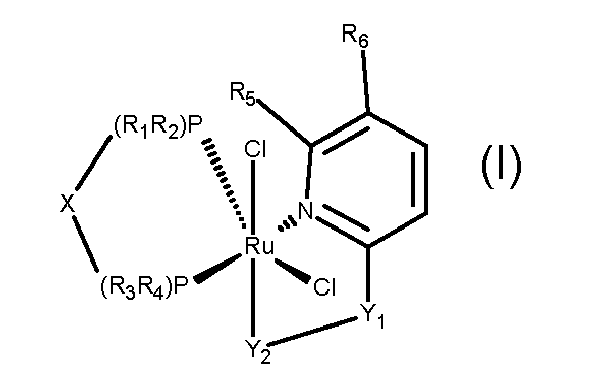
wherein X is -CH2-, -CH2-CH2-, -CH2-CH2-CH2- or -CH2-CH2-CH2-CH2-;
Y1 is -CH2- or -CH2-CH2-; Y2 is NHR7 or SH; wherein R7 is hydrogen, C1-C4alkyl or phenyl;
R1 and R2, independently from each other, represent aliphatic or aromatic groups;
R3 and R4, independently from each other, represent aliphatic or aromatic groups; R5 and R6 are each hydrogen or represent together with the carbon atoms to which they are bonded, a phenyl ring; which process comprises reacting a compound of formula II
RuCl2R1 (II)
wherein R1 is defined as at least one cyclic or non-cyclic molecule containing at least one alkene or alkyne moiety coordinating to the metal in a η-2 (hapto-2) coordination mode; or R1 is defined as at least one nitrogen, oxygen or sulfur containing molecule in which the beforementioned atoms coordinate to the metal; in the presence of an inert solvent with a compound of formula III 
wherein R5, R6, Y1 and Y2 are as defined under formula I, and a phosphane of formula IV
R3R4P-X-PR1R2 (IV)
wherein R1, R2, R3, R4 and X are as defined under formula I.
Y1 is -CH2- or -CH2-CH2-; Y2 is NHR7 or SH; wherein R7 is hydrogen, C1-C4alkyl or phenyl;
R1 and R2, independently from each other, represent aliphatic or aromatic groups;
R3 and R4, independently from each other, represent aliphatic or aromatic groups; R5 and R6 are each hydrogen or represent together with the carbon atoms to which they are bonded, a phenyl ring; which process comprises reacting a compound of formula II
RuCl2R1 (II)
wherein R1 is defined as at least one cyclic or non-cyclic molecule containing at least one alkene or alkyne moiety coordinating to the metal in a η-2 (hapto-2) coordination mode; or R1 is defined as at least one nitrogen, oxygen or sulfur containing molecule in which the beforementioned atoms coordinate to the metal; in the presence of an inert solvent with a compound of formula III
R3R4P-X-PR1R2 (IV)
wherein R1, R2, R3, R4 and X are as defined under formula I.
Description
- The present invention relates to a process for the diastereoselective preparation of ruthenium complexes and their use as catalysts in the hydrogenation of C=N and C=O double bonds and in the oxidative synthesis of amides or esters.
- It is known that the cis-form of certain ruthenium(II) complexes, for example RuCl2[PPh2(CH2)4PPh2][2-(H2NCH2)C5H4N] of formula la

WO 2005/105819 and in Crabtree et al. Organometallics 2011, 30, 4174-4179. The catalyst can either adopt a cis or a trans configuration with respect to the chloro ligands.The cis-form of this complex is especially preferred since it shows much higher reactivity in the above mentioned hydrogenation reactions (Baratta et al., Organometallics 2005, 24, 1660-1669). It is therefore highly desired to selectively prepare the cis-form of said complex. - The synthesis of the compound of formula la according to
WO 2005/105819 , Crabtree et al. Organometallics 2011, 30, 4174-4179 and Baratta et al., Organometallics 2005, 24, 1660-1669 is based on a two step procedure. Further, long reaction times (20 hours) are described in preparatory examples 5 and 6 ofWO 2005/105819 . Moreover, all these procedures start from a catalyst precursor containing triphenlyphosphine as ligand. Said catalyst precursor has the formula RuCl2(PPh3)n (with n= 3.0, 3.1, 3.2, 3.3, 3.4, 3.5, 3.6, 3.7, 3.8, 3.9 and 4.0) (Caulton et al., J. Am. Chem. Soc. 1975, 4221-4228). It can be derived from the formula of said catalyst precursor that it contains a large amount of triphenlyphosphine ligand that has to be exchanged in the next step. From an economical and environmental point of view this exchange is highly problematic as at least three equivalents of phosphorous waste are generated per equivalent of catalyst. - The aim of the present invention is therefore to provide a novel, robust process for the diastereoselective production of the cis-form of RuCl2 complexes of formula I in high yields and good quality in an economically advantageous way.
- Thus, according to the present invention, there is provided a process for the preparation of a compound of formula I

X is -CH2-, -CH2-CH2-, -CH2-CH2-CH2- or -CH2-CH2-CH2-CH2-;
Y1 is -CH2- or -CH2-CH2-;
Y2 is NHR7 or SH; wherein R7 is hydrogen, C1-C4alkyl or phenyl;
R1 and R2, independently from each other, represent aliphatic or aromatic groups;
R3 and R4, independently from each other, represent aliphatic or aromatic groups; R5 and R6 are each hydrogen or represent together with the carbon atoms to which they are bonded, a phenyl ring; which process comprises reacting a compound of formula II
RuCl2R8 (II)
wherein R8 is defined as
at least one cyclic or non-cyclic molecule containing at least one alkene or alkyne moiety coordinating to the metal in a η-2 (hapto-2) coordination mode;
or R8 is defined as
at least one nitrogen, oxygen or sulfur containing molecule in which the beforementioned atoms coordinate to the metal;
in the presence of an inert solvent with a compound of formula III
R3R4P-X-PR1R2 (IV)
wherein R1, R2, R3, R4 and X are as defined under formula I. - Cyclooctadiene is preferably used in form of the 1,5-cyclooctadiene. κ signifies the coordination atom (in κS or κO). dmso is dimethylsulfoxide.
R1, R2, R3 and R4 are preferably phenyl.
R5 and R6 are preferably hydrogen.
Y1 is preferably -CH2-.
Y2 is preferably NH2;
X is preferably -CH2-CH2-CH2-CH2-. - R8 as a cyclic or non-cyclic molecule containing at least one alkene or alkyne moiety coordinating to the metal in a η-2 (hapto-2) coordination mode is preferably cyclooctadiene, or bicyclo[2.2.1]hepta-2,5-diene (norbornadiene).
- R8 as a nitrogen, oxygen or sulfur containing molecule in which the beforementioned atoms coordinate to the metal is preferably dimethylsulfoxide resulting in RuCl2(dmso-κORuCl2(dmso-κS)3(dmso-κO) or RuCl2(dMSO-κS)4 as precursors.
- The process according to the present invention is especially useful for the preparation of a catalyst of the formula la

- The reaction is preferably performed as an one pot procedure. To achieve economically favourable reaction times, the reaction is executed at temperatures above 112°C ( temperature at a pressure of 1023.25 hPa) in an inert solvent. Suitable inert solvents are ketones, preferably methyl isobutylketone, esters, preferably ethyl butyrate and aromatic solvents or mixtures of aromatic solvents with a suitable boiling point range, preferably xylene and halogenated aromatic compounds preferably chlorobenzene.
- An advantage of the one pot procedure in particular for large-scale manufacturing are significantly reduced reaction times. In addition, phosphane containing waste is remarkably reduced compared to the prior art process described in
WO 2005/105819 . - The synthesis of the precursors can be accomplished by a person skilled in the art following the procedures described in Albers et. al. Inorg. Synth. 1989, 26, 68-77 for RuCl2(cyclooctanediene) and Albers et. al. Inorg. Synth 1989, 26, 249-258 for RuCl2(bicyclo[2.2.1]hepta-2,5-diene) or Castellano et. al. Inorg. Chim. Acta. 2009, 363, 283-287 for [RuCl2(dmso-κS)3(dmso-κO)] as well as Riant et. al. Chem. Eur. J. 2009, 15, 6267-6268) for RuCl2(dmso-κS)4.
- The catalyst precursors RuCl2(CyClooctanediene) and RuCl2(bicyclo[2.2.1]hepta-2,5-diene) show polymeric structures. In these cases the molecular formulae are more exactly represented by [RuCl2(cyclooctanediene)]n and [RuCl2(bicyclo[2.2.1]hepta-2,5-diene)]n. this fact is also described in the above mentioned literature citations.
Preferably precursors with highest metal content and purities are used - typically 29-37 weight-% ruthenium for [RuCl2(cyclooctanediene)]n,
- 31-39 weight-% ruthenium for [RuCl2(bicyclo[2.2.1]hepta-2,5-diene]n and
- 16-21 weight-% ruthenium for [RuCl2(dmso-κS)3(dmso-κO)] and for RuCl2(dmso-κS)4.
- The efficiency of the catalysts of formula la made from [RuCl2(COD)]n as the precursor is equivalent to that of the catalyst of formula la made from [RuCl2(PPh3)n] as the precursor for both reduction under hydrogen atmosphere and transfer hydrogenation.
Table 1 Catalytic reduction of acetophenone to 1-phenylethanol under hydrogen atmosphere in the presence of ruthenium complexes Pre-catalyst Molar ratio Pressure Conversion Reaction Time Acetophenone/Ru/Base bar % min [RuCl2(PPh3)n] 4000/1/85 9 99 225 [RUCl2(COD)]n 4000/1/85 9 99 225 Table 2 Catalytic reduction of acetophenone to 1-phenylethanol in the presence of ruthenium complexes Pre-catalyst Molar ratio Conversion Reaction Time Acetophenone/Ru/Base % min [RuCl2(PPh3)n] 4000/1/85 98 30 [RUCl2(COD)]n 4000/1/85 94 60 -

- The catalyst precursor, preferably [RuCl2(COD)]n (1 eq.), 4-bis(diphenylphosphino)butane (1.0-1.2 eq., preferably 1.0 eq.) and 2-picolylamine (1.0-1.4 eq., preferably 1.225 eq.) were dissolved in one of the above mentioned solvents, preferably methyl isobutylketone (10-20 ml/g Ru-precursor, preferably 20 ml/g). The mixture was heated to reflux for 3 - 5 hours and then cooled to ambient temperature. The solid precipitate was filtered off and washed with the same solvent that was used for the reaction. A person skilled in the art can determine the cis-/trans- isomeric ratio by NMR. The diastereomeric ratios generated by this method are usually in the range of d.r. (diastereomeric ratio) >98% towards the cis isomer. The same results can be achieved starting with [RuCl2(dmso-κS)3(dmso-κO)], [RuCl2(dmso-κS)4]or [RuCl2(bicyclo[2.2.1]hepta-2,5-diene)]n as precursor.
Claims (3)
- A process for the preparation of a compound of formula I

X is -CH2-, -CH2-CH2-, -CH2-CH2-CH2- or -CH2-CH2-CH2-CH2-;
Y1 is -CH2- or -CH2-CH2-;
Y2 is NHR7 or SH; wherein R7 is hydrogen, C1-C4alkyl or phenyl;
R1 and R2, independently from each other, represent aliphatic or aromatic groups;
R3 and R4, independently from each other, represent aliphatic or aromatic groups; R5 and R6 are each hydrogen or represent together with the carbon atoms to which they are bonded, a phenyl ring; which process comprises reacting a compound of formula II
RuCl2R8 (II)
wherein R8 is defined as
at least one cyclic or non-cyclic molecule containing at least one alkene or alkyne moiety coordinating to the metal in a η-2 (hapto-2) coordination mode;
or R8 is defined as
at least one nitrogen, oxygen or sulfur containing molecule in which the beforementioned atoms coordinate to the metal;
in the presence of an inert solvent with a compound of formula III
R3R4P-X-PR1R2 (IV)
wherein R1, R2, R3, R4 and X are as defined under formula I. - A process according to claim 1 for the preparation of the compound of formula la

- The compound of formula I
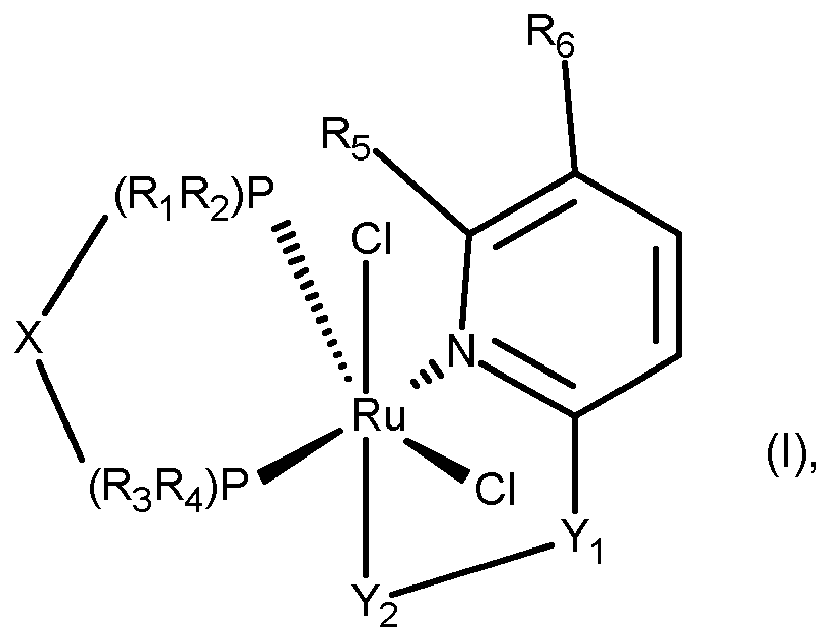
X is -CH2-, -CH2-CH2-, -CH2-CH2-CH2- or -CH2-CH2-CH2-CH2-;
Y1 is -CH2- or -CH2-CH2-;
Y2 is NHR7 or SH; wherein R7 is hydrogen, C1-C4alkyl or phenyl;
R1 and R2, independently from each other, represent aliphatic or aromatic groups;
R3 and R4, independently from each other, represent aliphatic or aromatic groups; R5 and R6 are each hydrogen or represent together with the carbon atoms to which they are bonded, a phenyl ring; which process comprises reacting a compound of formula II
RuCl2R8 (II)
wherein R8 is defined as
at least one cyclic or non-cyclic molecule containing at least one alkene or alkyne moiety coordinating to the metal in a η-2 (hapto-2) coordination mode;
or R8 is defined as
at least one nitrogen, oxygen or sulfur containing molecule in which the beforementioned atoms coordinate to the metal;
in the presence of an inert solvent with a compound of formula III
R3R4P-X-PR1R2 (IV)
wherein R1, R2, R3, R4 and X are as defined under formula I;
prepared by the process according to claim 1.
Priority Applications (9)
| Application Number | Priority Date | Filing Date | Title |
|---|---|---|---|
| EP13162679.8A EP2789623A1 (en) | 2013-04-08 | 2013-04-08 | Process for the diastereoselective preparation of ruthenium complexes |
| US14/781,980 US9303054B2 (en) | 2013-04-08 | 2014-04-01 | Process for the diastereoselective preparation of ruthenium complexes |
| EP14714273.1A EP2984094B1 (en) | 2013-04-08 | 2014-04-01 | Process for the diastereoselective preparation of ruthenium complexes |
| ES14714273T ES2807579T3 (en) | 2013-04-08 | 2014-04-01 | Procedure for the diastereoselective preparation of ruthenium complexes |
| CN201480020118.9A CN105143239B (en) | 2013-04-08 | 2014-04-01 | Method for the diastereoselective preparation of ruthenium complexes |
| PCT/EP2014/056495 WO2014166777A1 (en) | 2013-04-08 | 2014-04-01 | Process for the diastereoselective preparation of ruthenium complexes |
| HUE14714273A HUE050085T2 (en) | 2013-04-08 | 2014-04-01 | Process for the diastereoselective preparation of ruthenium complexes |
| JP2016506849A JP6470256B2 (en) | 2013-04-08 | 2014-04-01 | Diastereoselective preparation of ruthenium complexes |
| BR112015025599-0A BR112015025599B1 (en) | 2013-04-08 | 2014-04-01 | process for diastereoselective preparation of ruthenium complexes |
Applications Claiming Priority (1)
| Application Number | Priority Date | Filing Date | Title |
|---|---|---|---|
| EP13162679.8A EP2789623A1 (en) | 2013-04-08 | 2013-04-08 | Process for the diastereoselective preparation of ruthenium complexes |
Publications (1)
| Publication Number | Publication Date |
|---|---|
| EP2789623A1 true EP2789623A1 (en) | 2014-10-15 |
Family
ID=48045333
Family Applications (2)
| Application Number | Title | Priority Date | Filing Date |
|---|---|---|---|
| EP13162679.8A Ceased EP2789623A1 (en) | 2013-04-08 | 2013-04-08 | Process for the diastereoselective preparation of ruthenium complexes |
| EP14714273.1A Active EP2984094B1 (en) | 2013-04-08 | 2014-04-01 | Process for the diastereoselective preparation of ruthenium complexes |
Family Applications After (1)
| Application Number | Title | Priority Date | Filing Date |
|---|---|---|---|
| EP14714273.1A Active EP2984094B1 (en) | 2013-04-08 | 2014-04-01 | Process for the diastereoselective preparation of ruthenium complexes |
Country Status (8)
| Country | Link |
|---|---|
| US (1) | US9303054B2 (en) |
| EP (2) | EP2789623A1 (en) |
| JP (1) | JP6470256B2 (en) |
| CN (1) | CN105143239B (en) |
| BR (1) | BR112015025599B1 (en) |
| ES (1) | ES2807579T3 (en) |
| HU (1) | HUE050085T2 (en) |
| WO (1) | WO2014166777A1 (en) |
Cited By (1)
| Publication number | Priority date | Publication date | Assignee | Title |
|---|---|---|---|---|
| WO2015079207A3 (en) * | 2013-11-26 | 2015-07-23 | Johnson Matthey Public Limited Company | Processes for the preparation of ruthenium or osmium complexes comprising p and n donor ligands |
Citations (1)
| Publication number | Priority date | Publication date | Assignee | Title |
|---|---|---|---|---|
| WO2005105819A1 (en) | 2004-05-04 | 2005-11-10 | Universita' Degli Studi Di Udine | Complexes of ruthenium with 2-(aminomethyl)pyridines and phosphines, their preparation and use as catalysts |
Family Cites Families (6)
| Publication number | Priority date | Publication date | Assignee | Title |
|---|---|---|---|---|
| JP5283931B2 (en) * | 2007-03-16 | 2013-09-04 | 高砂香料工業株式会社 | Method for producing alcohols |
| ITPD20070237A1 (en) * | 2007-07-11 | 2009-01-12 | Univ Degli Studi Udine | NEW BINDERS OF THE BENZO CLASS [CH] |
| US20100311975A1 (en) * | 2007-10-30 | 2010-12-09 | Kamaluddin Abdur-Rashid | Cationic transition metal catalysts |
| CN102164673A (en) * | 2008-10-02 | 2011-08-24 | 弗门尼舍有限公司 | Hydrogenation of esters or carbonyl groups with phosphino-oxide based ruthenium complexes |
| WO2010061350A1 (en) * | 2008-11-28 | 2010-06-03 | Firmenich Sa | Hydrogenation of ester, ketone or aldehyde groups with ruthenium complexes having a di-amine and a phosphorous-nitrogen bidentate ligand |
| GB201116057D0 (en) * | 2011-09-16 | 2011-11-02 | Univ York | Synthesis and anticancer activity of ruthenium (II) cis-cis-1,3,5-triaminocyclohexane complexes |
-
2013
- 2013-04-08 EP EP13162679.8A patent/EP2789623A1/en not_active Ceased
-
2014
- 2014-04-01 BR BR112015025599-0A patent/BR112015025599B1/en active IP Right Grant
- 2014-04-01 JP JP2016506849A patent/JP6470256B2/en active Active
- 2014-04-01 WO PCT/EP2014/056495 patent/WO2014166777A1/en not_active Ceased
- 2014-04-01 CN CN201480020118.9A patent/CN105143239B/en active Active
- 2014-04-01 US US14/781,980 patent/US9303054B2/en active Active
- 2014-04-01 EP EP14714273.1A patent/EP2984094B1/en active Active
- 2014-04-01 HU HUE14714273A patent/HUE050085T2/en unknown
- 2014-04-01 ES ES14714273T patent/ES2807579T3/en active Active
Patent Citations (1)
| Publication number | Priority date | Publication date | Assignee | Title |
|---|---|---|---|---|
| WO2005105819A1 (en) | 2004-05-04 | 2005-11-10 | Universita' Degli Studi Di Udine | Complexes of ruthenium with 2-(aminomethyl)pyridines and phosphines, their preparation and use as catalysts |
Non-Patent Citations (9)
| Title |
|---|
| ALBERS, INORG. SYNTH, vol. 26, 1989, pages 249 - 258 |
| ALBERS, INORG. SYNTH., vol. 26, 1989, pages 68 - 77 |
| BARATTA ET AL., ORGANOMETALLICS, vol. 24, 2005, pages 1660 - 1669 |
| BARATTA W ET AL: "2-(AMINOMETHYL)PYRIDINE-PHOSPHINE RUTHENIUM(II) COMPLEXES: NOVEL HIGHLY ACTIVE TRANSFER HYDROGENATION CATALYSTS", ORGANOMETALLICS, ACS, WASHINGTON, DC, US, vol. 24, no. 7, 26 February 2005 (2005-02-26), pages 1660 - 1669, XP001236745, ISSN: 0276-7333, DOI: 10.1021/OM0491701 * |
| CASTELLANO, INORG. CHIM. ACTA., vol. 363, 2009, pages 283 - 287 |
| CAULTON ET AL., J. AM. CHEM. SOC., 1975, pages 4221 - 4228 |
| CRABTREE ET AL., ORGANOMETALLICS, vol. 30, 2011, pages 4174 - 4179 |
| IAN CARPENTER ET AL: "Convenient and improved protocols for the hydrogenation of esters using Ru catalysts derived from (P,P), (P,N,N) and (P,N,O) ligands", DALTON TRANSACTIONS, vol. 41, no. 34, 20 June 2012 (2012-06-20), pages 10136, XP055077763, ISSN: 1477-9226, DOI: 10.1039/c2dt30973d * |
| RIANT, CHEM. EUR. J., vol. 15, 2009, pages 6267 - 6268 |
Cited By (5)
| Publication number | Priority date | Publication date | Assignee | Title |
|---|---|---|---|---|
| WO2015079207A3 (en) * | 2013-11-26 | 2015-07-23 | Johnson Matthey Public Limited Company | Processes for the preparation of ruthenium or osmium complexes comprising p and n donor ligands |
| GB2536380A (en) * | 2013-11-26 | 2016-09-14 | Johnson Matthey Plc | Processes for the preparation of Ruthenium or Osmium complexes comprising P and N donor ligands |
| US9932362B2 (en) | 2013-11-26 | 2018-04-03 | Johnson Matthey Public Limited Company | Processes for the preparation of ruthenium or osmium complexes comprising P and N donor ligands |
| US10301337B2 (en) | 2013-11-26 | 2019-05-28 | Johnson Matthey Public Limited Company | Process |
| US10676494B2 (en) | 2013-11-26 | 2020-06-09 | Johnson Matthey Public Limited Company | Processes for preparing phosphine diamine complexes of ruthenium and osmium |
Also Published As
| Publication number | Publication date |
|---|---|
| CN105143239B (en) | 2018-07-10 |
| CN105143239A (en) | 2015-12-09 |
| EP2984094A1 (en) | 2016-02-17 |
| BR112015025599A2 (en) | 2017-07-18 |
| EP2984094B1 (en) | 2020-05-13 |
| JP2016517847A (en) | 2016-06-20 |
| US9303054B2 (en) | 2016-04-05 |
| JP6470256B2 (en) | 2019-02-13 |
| HUE050085T2 (en) | 2020-11-30 |
| BR112015025599B1 (en) | 2020-10-13 |
| ES2807579T3 (en) | 2021-02-23 |
| US20160046658A1 (en) | 2016-02-18 |
| WO2014166777A1 (en) | 2014-10-16 |
Similar Documents
| Publication | Publication Date | Title |
|---|---|---|
| EP2294075B1 (en) | Novel ruthenium complexes having hybrid amine ligands, their preparation and use | |
| EP1747224B1 (en) | Complexes of ruthenium with 2-(aminomethyl)pyridines and phosphines, their preparation and use as catalysts | |
| JP2007045742A (en) | Process for producing transition metal complex and transition metal complex | |
| JP7164647B2 (en) | metal complex | |
| de Bruin et al. | 2‐Rhodaoxetanes: Their Formation of Oxidation of [RhI (ethene)]+ and Their Reactivity upon Protonation | |
| Duan et al. | Synthesis of novel planar chiral Ag and Rh N-heterocyclic carbene complexes derived from [2.2] paracyclophane and their application in ultrasound assisted asymmetric addition reactions of organoboronic acids to aldehydes | |
| WO2015191505A1 (en) | Polydentate ligands and their complexes for molecular catalysis | |
| EP2653457A1 (en) | Reduction method for the reduction of carbon dioxide and carbon dioxide derivatives | |
| RU2352577C2 (en) | Substituted ferrocenyl diphosphines as ligands for homogeneous catalysts of hydration | |
| WO2012137460A1 (en) | Novel ruthenium complex and process for producing optically active alcohol compound using same as catalyst | |
| CN101723985B (en) | Method for producing ruthenium complex | |
| EP2984094B1 (en) | Process for the diastereoselective preparation of ruthenium complexes | |
| JP2015024976A (en) | Method for producing optically active secondary alcohol | |
| CN111417627B (en) | Hydrogenation of Imines Using RU Complexes | |
| EP2821397A1 (en) | Method for the methylation of nitrogen-containing Organic Compounds | |
| KR101311122B1 (en) | Diphosphine ligand and transition metal complex using the same | |
| EP3016961B1 (en) | Novel ruthenium catalysts and their use for asymmetric reduction of ketones | |
| JP2015124153A (en) | Method for producing alcohol by hydrogenation of carboxylic acid compound, and ruthenium complex used in the production method | |
| CN110092725B (en) | Method for synthesizing chiral amine compound | |
| JP5507931B2 (en) | Method for producing optically active alcohol having aromatic heterocycle | |
| EP3239126A1 (en) | Method for producing olefin containing chlorine and fluorine | |
| EP3931176B1 (en) | Hydrogenation of imines with ru complexes | |
| CN114426564B (en) | A type of chiral ferrocenephosphine-1,2-diphenylethylenediamine ligand and its preparation method and application | |
| EP4168420B1 (en) | Improved process to produce specific alfa, beta-unsaturated carboxylates | |
| CN116063347B (en) | Phosphine-1, 2-diphenyl ethylenediamine ligand with chiral benzene ring framework, and preparation method and application thereof |
Legal Events
| Date | Code | Title | Description |
|---|---|---|---|
| PUAI | Public reference made under article 153(3) epc to a published international application that has entered the european phase |
Free format text: ORIGINAL CODE: 0009012 |
|
| 17P | Request for examination filed |
Effective date: 20130408 |
|
| AK | Designated contracting states |
Kind code of ref document: A1 Designated state(s): AL AT BE BG CH CY CZ DE DK EE ES FI FR GB GR HR HU IE IS IT LI LT LU LV MC MK MT NL NO PL PT RO RS SE SI SK SM TR |
|
| AX | Request for extension of the european patent |
Extension state: BA ME |
|
| STAA | Information on the status of an ep patent application or granted ep patent |
Free format text: STATUS: THE APPLICATION HAS BEEN REFUSED |
|
| 18R | Application refused |
Effective date: 20141107 |