EP2789609A1 - Highly efficient polarizing agents for dynamic nuclear polarization - Google Patents
Highly efficient polarizing agents for dynamic nuclear polarization Download PDFInfo
- Publication number
- EP2789609A1 EP2789609A1 EP13290082.0A EP13290082A EP2789609A1 EP 2789609 A1 EP2789609 A1 EP 2789609A1 EP 13290082 A EP13290082 A EP 13290082A EP 2789609 A1 EP2789609 A1 EP 2789609A1
- Authority
- EP
- European Patent Office
- Prior art keywords
- substituted
- group
- tetramethylpiperidin
- oxidanyl
- unsubstituted
- Prior art date
- Legal status (The legal status is an assumption and is not a legal conclusion. Google has not performed a legal analysis and makes no representation as to the accuracy of the status listed.)
- Withdrawn
Links
- 230000010287 polarization Effects 0.000 title claims abstract description 19
- 150000001875 compounds Chemical class 0.000 claims abstract description 58
- 239000012491 analyte Substances 0.000 claims abstract description 19
- 238000005481 NMR spectroscopy Methods 0.000 claims abstract description 18
- -1 acyclic nitroxide Chemical class 0.000 claims description 115
- 125000004432 carbon atom Chemical group C* 0.000 claims description 43
- 229910052757 nitrogen Inorganic materials 0.000 claims description 40
- 125000001424 substituent group Chemical group 0.000 claims description 39
- 239000003795 chemical substances by application Substances 0.000 claims description 31
- 125000002887 hydroxy group Chemical group [H]O* 0.000 claims description 31
- 125000004122 cyclic group Chemical group 0.000 claims description 30
- 229910052739 hydrogen Inorganic materials 0.000 claims description 28
- 125000004435 hydrogen atom Chemical group [H]* 0.000 claims description 26
- 125000003118 aryl group Chemical group 0.000 claims description 24
- 125000004169 (C1-C6) alkyl group Chemical group 0.000 claims description 23
- 125000005842 heteroatom Chemical group 0.000 claims description 23
- 125000000217 alkyl group Chemical group 0.000 claims description 21
- 229910052760 oxygen Inorganic materials 0.000 claims description 21
- 229910052717 sulfur Inorganic materials 0.000 claims description 21
- 239000001257 hydrogen Substances 0.000 claims description 20
- 239000007787 solid Substances 0.000 claims description 19
- 239000002904 solvent Substances 0.000 claims description 19
- 125000004433 nitrogen atom Chemical group N* 0.000 claims description 16
- 125000001072 heteroaryl group Chemical group 0.000 claims description 14
- 125000000449 nitro group Chemical group [O-][N+](*)=O 0.000 claims description 14
- 125000000852 azido group Chemical group *N=[N+]=[N-] 0.000 claims description 13
- 125000004093 cyano group Chemical group *C#N 0.000 claims description 13
- 125000005843 halogen group Chemical group 0.000 claims description 13
- 125000000623 heterocyclic group Chemical group 0.000 claims description 13
- 125000003396 thiol group Chemical class [H]S* 0.000 claims description 13
- 125000003917 carbamoyl group Chemical group [H]N([H])C(*)=O 0.000 claims description 10
- 125000002496 methyl group Chemical group [H]C([H])([H])* 0.000 claims description 9
- 125000004738 (C1-C6) alkyl sulfinyl group Chemical group 0.000 claims description 8
- 125000004739 (C1-C6) alkylsulfonyl group Chemical group 0.000 claims description 8
- 125000001931 aliphatic group Chemical group 0.000 claims description 8
- 125000005135 aryl sulfinyl group Chemical group 0.000 claims description 8
- 125000004391 aryl sulfonyl group Chemical group 0.000 claims description 8
- RGSFGYAAUTVSQA-UHFFFAOYSA-N pentamethylene Natural products C1CCCC1 RGSFGYAAUTVSQA-UHFFFAOYSA-N 0.000 claims description 8
- 239000000126 substance Substances 0.000 claims description 8
- UFHFLCQGNIYNRP-UHFFFAOYSA-N Hydrogen Chemical compound [H][H] UFHFLCQGNIYNRP-UHFFFAOYSA-N 0.000 claims description 7
- 125000000113 cyclohexyl group Chemical group [H]C1([H])C([H])([H])C([H])([H])C([H])(*)C([H])([H])C1([H])[H] 0.000 claims description 7
- 125000005330 8 membered heterocyclic group Chemical group 0.000 claims description 6
- WYURNTSHIVDZCO-UHFFFAOYSA-N Tetrahydrofuran Chemical compound C1CCOC1 WYURNTSHIVDZCO-UHFFFAOYSA-N 0.000 claims description 6
- 125000003545 alkoxy group Chemical group 0.000 claims description 6
- 125000004429 atom Chemical group 0.000 claims description 6
- 239000003791 organic solvent mixture Substances 0.000 claims description 6
- 125000002924 primary amino group Chemical group [H]N([H])* 0.000 claims description 6
- FJOAEUSKEPRIBH-UHFFFAOYSA-N 1,3-bis(1-hydroxy-2,2,6,6-tetramethylpiperidin-4-yl)-1,3-diazinan-2-one Chemical compound CC1(C)CC(CC(C)(C)N1O)N1CCCN(C2CC(C)(C)N(O)C(C)(C)C2)C1=O FJOAEUSKEPRIBH-UHFFFAOYSA-N 0.000 claims description 5
- DLOQCCXJZGRXLE-UHFFFAOYSA-N 1,3-bis(1-hydroxy-2,2,6,6-tetramethylpiperidin-4-yl)imidazolidin-2-one Chemical compound CC1(C)CC(CC(C)(C)N1O)N1CCN(C2CC(C)(C)N(O)C(C)(C)C2)C1=O DLOQCCXJZGRXLE-UHFFFAOYSA-N 0.000 claims description 5
- 125000002373 5 membered heterocyclic group Chemical group 0.000 claims description 5
- 125000004070 6 membered heterocyclic group Chemical group 0.000 claims description 5
- DMEGYFMYUHOHGS-UHFFFAOYSA-N heptamethylene Natural products C1CCCCCC1 DMEGYFMYUHOHGS-UHFFFAOYSA-N 0.000 claims description 5
- 239000007788 liquid Substances 0.000 claims description 5
- 238000000371 solid-state nuclear magnetic resonance spectroscopy Methods 0.000 claims description 5
- 125000006700 (C1-C6) alkylthio group Chemical group 0.000 claims description 4
- 125000001436 propyl group Chemical group [H]C([*])([H])C([H])([H])C([H])([H])[H] 0.000 claims description 4
- 125000004191 (C1-C6) alkoxy group Chemical group 0.000 claims description 3
- 125000004916 (C1-C6) alkylcarbonyl group Chemical group 0.000 claims description 3
- 229920000642 polymer Polymers 0.000 claims description 3
- 239000012736 aqueous medium Substances 0.000 claims description 2
- 239000003125 aqueous solvent Substances 0.000 claims description 2
- 239000013078 crystal Substances 0.000 claims description 2
- 150000001940 cyclopentanes Chemical class 0.000 claims description 2
- 238000005304 joining Methods 0.000 claims description 2
- 229920002521 macromolecule Polymers 0.000 claims description 2
- 238000002595 magnetic resonance imaging Methods 0.000 claims description 2
- 239000011368 organic material Substances 0.000 claims description 2
- 125000001476 phosphono group Chemical group [H]OP(*)(=O)O[H] 0.000 claims description 2
- 239000011877 solvent mixture Substances 0.000 claims description 2
- 238000004611 spectroscopical analysis Methods 0.000 claims description 2
- 238000009987 spinning Methods 0.000 claims description 2
- 230000003068 static effect Effects 0.000 claims description 2
- 150000002431 hydrogen Chemical group 0.000 claims 3
- 125000000896 monocarboxylic acid group Chemical group 0.000 claims 3
- 229910005960 SO2 a Inorganic materials 0.000 claims 1
- AVXURJPOCDRRFD-UHFFFAOYSA-N Hydroxylamine Chemical class ON AVXURJPOCDRRFD-UHFFFAOYSA-N 0.000 abstract description 11
- 238000003786 synthesis reaction Methods 0.000 description 49
- 230000015572 biosynthetic process Effects 0.000 description 39
- 238000000034 method Methods 0.000 description 36
- 239000000243 solution Substances 0.000 description 33
- YMWUJEATGCHHMB-UHFFFAOYSA-N Dichloromethane Chemical compound ClCCl YMWUJEATGCHHMB-UHFFFAOYSA-N 0.000 description 19
- 125000002853 C1-C4 hydroxyalkyl group Chemical group 0.000 description 17
- OKKJLVBELUTLKV-UHFFFAOYSA-N Methanol Chemical compound OC OKKJLVBELUTLKV-UHFFFAOYSA-N 0.000 description 15
- XLYOFNOQVPJJNP-UHFFFAOYSA-N water Substances O XLYOFNOQVPJJNP-UHFFFAOYSA-N 0.000 description 13
- 125000004178 (C1-C4) alkyl group Chemical group 0.000 description 12
- HEDRZPFGACZZDS-UHFFFAOYSA-N Chloroform Chemical compound ClC(Cl)Cl HEDRZPFGACZZDS-UHFFFAOYSA-N 0.000 description 12
- UIIMBOGNXHQVGW-UHFFFAOYSA-M Sodium bicarbonate Chemical compound [Na+].OC([O-])=O UIIMBOGNXHQVGW-UHFFFAOYSA-M 0.000 description 12
- 125000003178 carboxy group Chemical group [H]OC(*)=O 0.000 description 12
- LFQSCWFLJHTTHZ-UHFFFAOYSA-N Ethanol Chemical compound CCO LFQSCWFLJHTTHZ-UHFFFAOYSA-N 0.000 description 10
- HEDRZPFGACZZDS-MICDWDOJSA-N Trichloro(2H)methane Chemical compound [2H]C(Cl)(Cl)Cl HEDRZPFGACZZDS-MICDWDOJSA-N 0.000 description 10
- 239000000203 mixture Substances 0.000 description 10
- 125000004768 (C1-C4) alkylsulfinyl group Chemical group 0.000 description 9
- 125000004769 (C1-C4) alkylsulfonyl group Chemical group 0.000 description 9
- 125000000229 (C1-C4)alkoxy group Chemical group 0.000 description 9
- LYCAIKOWRPUZTN-UHFFFAOYSA-N Ethylene glycol Chemical compound OCCO LYCAIKOWRPUZTN-UHFFFAOYSA-N 0.000 description 9
- 239000007832 Na2SO4 Substances 0.000 description 9
- PMZURENOXWZQFD-UHFFFAOYSA-L Sodium Sulfate Chemical compound [Na+].[Na+].[O-]S([O-])(=O)=O PMZURENOXWZQFD-UHFFFAOYSA-L 0.000 description 9
- 238000002330 electrospray ionisation mass spectrometry Methods 0.000 description 9
- 229910052736 halogen Inorganic materials 0.000 description 9
- 150000002367 halogens Chemical class 0.000 description 9
- IJGRMHOSHXDMSA-UHFFFAOYSA-N nitrogen Substances N#N IJGRMHOSHXDMSA-UHFFFAOYSA-N 0.000 description 9
- 125000004043 oxo group Chemical group O=* 0.000 description 9
- 125000006413 ring segment Chemical group 0.000 description 9
- 229910052938 sodium sulfate Inorganic materials 0.000 description 9
- 125000000464 thioxo group Chemical group S=* 0.000 description 9
- VYPSYNLAJGMNEJ-UHFFFAOYSA-N Silicium dioxide Chemical compound O=[Si]=O VYPSYNLAJGMNEJ-UHFFFAOYSA-N 0.000 description 8
- 125000004448 alkyl carbonyl group Chemical group 0.000 description 8
- 125000004414 alkyl thio group Chemical group 0.000 description 8
- 229910052698 phosphorus Inorganic materials 0.000 description 8
- 238000002474 experimental method Methods 0.000 description 7
- 150000002430 hydrocarbons Chemical class 0.000 description 7
- 239000011734 sodium Substances 0.000 description 7
- 125000003601 C2-C6 alkynyl group Chemical group 0.000 description 6
- RTZKZFJDLAIYFH-UHFFFAOYSA-N Diethyl ether Chemical compound CCOCC RTZKZFJDLAIYFH-UHFFFAOYSA-N 0.000 description 6
- OAICVXFJPJFONN-UHFFFAOYSA-N Phosphorus Chemical compound [P] OAICVXFJPJFONN-UHFFFAOYSA-N 0.000 description 6
- 238000006243 chemical reaction Methods 0.000 description 6
- BWHMMNNQKKPAPP-UHFFFAOYSA-L potassium carbonate Chemical compound [K+].[K+].[O-]C([O-])=O BWHMMNNQKKPAPP-UHFFFAOYSA-L 0.000 description 6
- 150000003254 radicals Chemical class 0.000 description 6
- 229920006395 saturated elastomer Polymers 0.000 description 6
- 229910000030 sodium bicarbonate Inorganic materials 0.000 description 6
- 125000000882 C2-C6 alkenyl group Chemical group 0.000 description 5
- NINIDFKCEFEMDL-UHFFFAOYSA-N Sulfur Chemical compound [S] NINIDFKCEFEMDL-UHFFFAOYSA-N 0.000 description 5
- 239000007864 aqueous solution Substances 0.000 description 5
- 238000004440 column chromatography Methods 0.000 description 5
- 238000000921 elemental analysis Methods 0.000 description 5
- 238000003818 flash chromatography Methods 0.000 description 5
- 125000000524 functional group Chemical group 0.000 description 5
- 239000011574 phosphorus Substances 0.000 description 5
- 239000000523 sample Substances 0.000 description 5
- 238000006467 substitution reaction Methods 0.000 description 5
- 125000006272 (C3-C7) cycloalkyl group Chemical group 0.000 description 4
- 125000001494 2-propynyl group Chemical group [H]C#CC([H])([H])* 0.000 description 4
- XFJBGINZIMNZBW-CRAIPNDOSA-N 5-chloro-2-[4-[(1r,2s)-2-[2-(5-methylsulfonylpyridin-2-yl)oxyethyl]cyclopropyl]piperidin-1-yl]pyrimidine Chemical compound N1=CC(S(=O)(=O)C)=CC=C1OCC[C@H]1[C@@H](C2CCN(CC2)C=2N=CC(Cl)=CN=2)C1 XFJBGINZIMNZBW-CRAIPNDOSA-N 0.000 description 4
- WEVYAHXRMPXWCK-UHFFFAOYSA-N Acetonitrile Chemical compound CC#N WEVYAHXRMPXWCK-UHFFFAOYSA-N 0.000 description 4
- 0 CC(*)(C(*)(*)C1(*)*)C(*)(*)C(*)(*)N1[O+] Chemical compound CC(*)(C(*)(*)C1(*)*)C(*)(*)C(*)(*)N1[O+] 0.000 description 4
- OKTJSMMVPCPJKN-UHFFFAOYSA-N Carbon Chemical compound [C] OKTJSMMVPCPJKN-UHFFFAOYSA-N 0.000 description 4
- XEKOWRVHYACXOJ-UHFFFAOYSA-N Ethyl acetate Chemical compound CCOC(C)=O XEKOWRVHYACXOJ-UHFFFAOYSA-N 0.000 description 4
- VEXZGXHMUGYJMC-UHFFFAOYSA-N Hydrochloric acid Chemical compound Cl VEXZGXHMUGYJMC-UHFFFAOYSA-N 0.000 description 4
- PNEYBMLMFCGWSK-UHFFFAOYSA-N aluminium oxide Inorganic materials [O-2].[O-2].[O-2].[Al+3].[Al+3] PNEYBMLMFCGWSK-UHFFFAOYSA-N 0.000 description 4
- 239000012300 argon atmosphere Substances 0.000 description 4
- 229910052799 carbon Inorganic materials 0.000 description 4
- 239000011203 carbon fibre reinforced carbon Substances 0.000 description 4
- 125000001495 ethyl group Chemical group [H]C([H])([H])C([H])([H])* 0.000 description 4
- 229930195733 hydrocarbon Natural products 0.000 description 4
- 239000012074 organic phase Substances 0.000 description 4
- CTSLXHKWHWQRSH-UHFFFAOYSA-N oxalyl chloride Chemical compound ClC(=O)C(Cl)=O CTSLXHKWHWQRSH-UHFFFAOYSA-N 0.000 description 4
- 125000001997 phenyl group Chemical group [H]C1=C([H])C([H])=C(*)C([H])=C1[H] 0.000 description 4
- 125000006656 (C2-C4) alkenyl group Chemical group 0.000 description 3
- 125000006650 (C2-C4) alkynyl group Chemical group 0.000 description 3
- 238000001644 13C nuclear magnetic resonance spectroscopy Methods 0.000 description 3
- 238000005160 1H NMR spectroscopy Methods 0.000 description 3
- DZDUSTOHJZBNIU-UHFFFAOYSA-N C1C(C)(C)N([O])C(C)(C)CC1NCC(O)COC1CC(C)(C)N([O])C(C)(C)C1 Chemical compound C1C(C)(C)N([O])C(C)(C)CC1NCC(O)COC1CC(C)(C)N([O])C(C)(C)C1 DZDUSTOHJZBNIU-UHFFFAOYSA-N 0.000 description 3
- 238000005004 MAS NMR spectroscopy Methods 0.000 description 3
- HEMHJVSKTPXQMS-UHFFFAOYSA-M Sodium hydroxide Chemical compound [OH-].[Na+] HEMHJVSKTPXQMS-UHFFFAOYSA-M 0.000 description 3
- DKGAVHZHDRPRBM-UHFFFAOYSA-N Tert-Butanol Chemical compound CC(C)(C)O DKGAVHZHDRPRBM-UHFFFAOYSA-N 0.000 description 3
- ZMANZCXQSJIPKH-UHFFFAOYSA-N Triethylamine Chemical compound CCN(CC)CC ZMANZCXQSJIPKH-UHFFFAOYSA-N 0.000 description 3
- 125000002015 acyclic group Chemical group 0.000 description 3
- 239000008346 aqueous phase Substances 0.000 description 3
- 239000012267 brine Substances 0.000 description 3
- 239000000460 chlorine Substances 0.000 description 3
- 229910052681 coesite Inorganic materials 0.000 description 3
- 229910052906 cristobalite Inorganic materials 0.000 description 3
- 125000000753 cycloalkyl group Chemical group 0.000 description 3
- 125000000963 oxybis(methylene) group Chemical group [H]C([H])(*)OC([H])([H])* 0.000 description 3
- 239000001301 oxygen Substances 0.000 description 3
- 230000005414 paramagnetic center Effects 0.000 description 3
- 230000005298 paramagnetic effect Effects 0.000 description 3
- 229910000027 potassium carbonate Inorganic materials 0.000 description 3
- 238000000746 purification Methods 0.000 description 3
- 239000000377 silicon dioxide Substances 0.000 description 3
- HPALAKNZSZLMCH-UHFFFAOYSA-M sodium;chloride;hydrate Chemical compound O.[Na+].[Cl-] HPALAKNZSZLMCH-UHFFFAOYSA-M 0.000 description 3
- 229910052682 stishovite Inorganic materials 0.000 description 3
- 239000011593 sulfur Substances 0.000 description 3
- 229910052905 tridymite Inorganic materials 0.000 description 3
- VIJSPAIQWVPKQZ-BLECARSGSA-N (2s)-2-[[(2s)-2-[[(2s)-2-[[(2s)-2-[[(2s)-2-[[(2s)-2-acetamido-5-(diaminomethylideneamino)pentanoyl]amino]-4-methylpentanoyl]amino]-4,4-dimethylpentanoyl]amino]-4-methylpentanoyl]amino]propanoyl]amino]-5-(diaminomethylideneamino)pentanoic acid Chemical compound NC(=N)NCCC[C@@H](C(O)=O)NC(=O)[C@H](C)NC(=O)[C@H](CC(C)C)NC(=O)[C@H](CC(C)(C)C)NC(=O)[C@H](CC(C)C)NC(=O)[C@H](CCCNC(N)=N)NC(C)=O VIJSPAIQWVPKQZ-BLECARSGSA-N 0.000 description 2
- IWZSHWBGHQBIML-ZGGLMWTQSA-N (3S,8S,10R,13S,14S,17S)-17-isoquinolin-7-yl-N,N,10,13-tetramethyl-2,3,4,7,8,9,11,12,14,15,16,17-dodecahydro-1H-cyclopenta[a]phenanthren-3-amine Chemical compound CN(C)[C@H]1CC[C@]2(C)C3CC[C@@]4(C)[C@@H](CC[C@@H]4c4ccc5ccncc5c4)[C@@H]3CC=C2C1 IWZSHWBGHQBIML-ZGGLMWTQSA-N 0.000 description 2
- PEDCQBHIVMGVHV-YHPVEMKJSA-N 1,1,2,3,3-pentadeuterio-1,2,3-trideuteriooxypropane Chemical compound [2H]OC([2H])([2H])C([2H])(O[2H])C([2H])([2H])O[2H] PEDCQBHIVMGVHV-YHPVEMKJSA-N 0.000 description 2
- KKHFRAFPESRGGD-UHFFFAOYSA-N 1,3-dimethyl-7-[3-(n-methylanilino)propyl]purine-2,6-dione Chemical compound C1=NC=2N(C)C(=O)N(C)C(=O)C=2N1CCCN(C)C1=CC=CC=C1 KKHFRAFPESRGGD-UHFFFAOYSA-N 0.000 description 2
- MHSLDASSAFCCDO-UHFFFAOYSA-N 1-(5-tert-butyl-2-methylpyrazol-3-yl)-3-(4-pyridin-4-yloxyphenyl)urea Chemical compound CN1N=C(C(C)(C)C)C=C1NC(=O)NC(C=C1)=CC=C1OC1=CC=NC=C1 MHSLDASSAFCCDO-UHFFFAOYSA-N 0.000 description 2
- WZZBNLYBHUDSHF-DHLKQENFSA-N 1-[(3s,4s)-4-[8-(2-chloro-4-pyrimidin-2-yloxyphenyl)-7-fluoro-2-methylimidazo[4,5-c]quinolin-1-yl]-3-fluoropiperidin-1-yl]-2-hydroxyethanone Chemical compound CC1=NC2=CN=C3C=C(F)C(C=4C(=CC(OC=5N=CC=CN=5)=CC=4)Cl)=CC3=C2N1[C@H]1CCN(C(=O)CO)C[C@@H]1F WZZBNLYBHUDSHF-DHLKQENFSA-N 0.000 description 2
- UNILWMWFPHPYOR-KXEYIPSPSA-M 1-[6-[2-[3-[3-[3-[2-[2-[3-[[2-[2-[[(2r)-1-[[2-[[(2r)-1-[3-[2-[2-[3-[[2-(2-amino-2-oxoethoxy)acetyl]amino]propoxy]ethoxy]ethoxy]propylamino]-3-hydroxy-1-oxopropan-2-yl]amino]-2-oxoethyl]amino]-3-[(2r)-2,3-di(hexadecanoyloxy)propyl]sulfanyl-1-oxopropan-2-yl Chemical compound O=C1C(SCCC(=O)NCCCOCCOCCOCCCNC(=O)COCC(=O)N[C@@H](CSC[C@@H](COC(=O)CCCCCCCCCCCCCCC)OC(=O)CCCCCCCCCCCCCCC)C(=O)NCC(=O)N[C@H](CO)C(=O)NCCCOCCOCCOCCCNC(=O)COCC(N)=O)CC(=O)N1CCNC(=O)CCCCCN\1C2=CC=C(S([O-])(=O)=O)C=C2CC/1=C/C=C/C=C/C1=[N+](CC)C2=CC=C(S([O-])(=O)=O)C=C2C1 UNILWMWFPHPYOR-KXEYIPSPSA-M 0.000 description 2
- 125000004973 1-butenyl group Chemical group C(=CCC)* 0.000 description 2
- GVQKWFQBWZOJHV-UHFFFAOYSA-N 1-hydroxy-2,2,6,6-tetramethylpiperidin-1-ium-4-carboxylate Chemical group CC1(C)CC(C(O)=O)CC(C)(C)N1O GVQKWFQBWZOJHV-UHFFFAOYSA-N 0.000 description 2
- 125000000530 1-propynyl group Chemical group [H]C([H])([H])C#C* 0.000 description 2
- VVCMGAUPZIKYTH-VGHSCWAPSA-N 2-acetyloxybenzoic acid;[(2s,3r)-4-(dimethylamino)-3-methyl-1,2-diphenylbutan-2-yl] propanoate;1,3,7-trimethylpurine-2,6-dione Chemical compound CC(=O)OC1=CC=CC=C1C(O)=O.CN1C(=O)N(C)C(=O)C2=C1N=CN2C.C([C@](OC(=O)CC)([C@H](C)CN(C)C)C=1C=CC=CC=1)C1=CC=CC=C1 VVCMGAUPZIKYTH-VGHSCWAPSA-N 0.000 description 2
- 125000004974 2-butenyl group Chemical group C(C=CC)* 0.000 description 2
- LFOIDLOIBZFWDO-UHFFFAOYSA-N 2-methoxy-6-[6-methoxy-4-[(3-phenylmethoxyphenyl)methoxy]-1-benzofuran-2-yl]imidazo[2,1-b][1,3,4]thiadiazole Chemical compound N1=C2SC(OC)=NN2C=C1C(OC1=CC(OC)=C2)=CC1=C2OCC(C=1)=CC=CC=1OCC1=CC=CC=C1 LFOIDLOIBZFWDO-UHFFFAOYSA-N 0.000 description 2
- WYFCZWSWFGJODV-MIANJLSGSA-N 4-[[(1s)-2-[(e)-3-[3-chloro-2-fluoro-6-(tetrazol-1-yl)phenyl]prop-2-enoyl]-5-(4-methyl-2-oxopiperazin-1-yl)-3,4-dihydro-1h-isoquinoline-1-carbonyl]amino]benzoic acid Chemical compound O=C1CN(C)CCN1C1=CC=CC2=C1CCN(C(=O)\C=C\C=1C(=CC=C(Cl)C=1F)N1N=NN=C1)[C@@H]2C(=O)NC1=CC=C(C(O)=O)C=C1 WYFCZWSWFGJODV-MIANJLSGSA-N 0.000 description 2
- DQAZPZIYEOGZAF-UHFFFAOYSA-N 4-ethyl-n-[4-(3-ethynylanilino)-7-methoxyquinazolin-6-yl]piperazine-1-carboxamide Chemical compound C1CN(CC)CCN1C(=O)NC(C(=CC1=NC=N2)OC)=CC1=C2NC1=CC=CC(C#C)=C1 DQAZPZIYEOGZAF-UHFFFAOYSA-N 0.000 description 2
- HCCNBKFJYUWLEX-UHFFFAOYSA-N 7-(6-methoxypyridin-3-yl)-1-(2-propoxyethyl)-3-(pyrazin-2-ylmethylamino)pyrido[3,4-b]pyrazin-2-one Chemical compound O=C1N(CCOCCC)C2=CC(C=3C=NC(OC)=CC=3)=NC=C2N=C1NCC1=CN=CC=N1 HCCNBKFJYUWLEX-UHFFFAOYSA-N 0.000 description 2
- ZANGXCTXGLPCCD-UHFFFAOYSA-N 7-azadispiro[5.1.5^{8}.3^{6}]hexadecan-15-one Chemical compound N1C2(CCCCC2)CC(=O)CC21CCCCC2 ZANGXCTXGLPCCD-UHFFFAOYSA-N 0.000 description 2
- QTBSBXVTEAMEQO-UHFFFAOYSA-N Acetic acid Chemical compound CC(O)=O QTBSBXVTEAMEQO-UHFFFAOYSA-N 0.000 description 2
- 239000004215 Carbon black (E152) Substances 0.000 description 2
- XTHFKEDIFFGKHM-UHFFFAOYSA-N Dimethoxyethane Chemical compound COCCOC XTHFKEDIFFGKHM-UHFFFAOYSA-N 0.000 description 2
- IAZDPXIOMUYVGZ-UHFFFAOYSA-N Dimethylsulphoxide Chemical compound CS(C)=O IAZDPXIOMUYVGZ-UHFFFAOYSA-N 0.000 description 2
- 238000004435 EPR spectroscopy Methods 0.000 description 2
- LVDRREOUMKACNJ-BKMJKUGQSA-N N-[(2R,3S)-2-(4-chlorophenyl)-1-(1,4-dimethyl-2-oxoquinolin-7-yl)-6-oxopiperidin-3-yl]-2-methylpropane-1-sulfonamide Chemical compound CC(C)CS(=O)(=O)N[C@H]1CCC(=O)N([C@@H]1c1ccc(Cl)cc1)c1ccc2c(C)cc(=O)n(C)c2c1 LVDRREOUMKACNJ-BKMJKUGQSA-N 0.000 description 2
- QOVYHDHLFPKQQG-NDEPHWFRSA-N N[C@@H](CCC(=O)N1CCC(CC1)NC1=C2C=CC=CC2=NC(NCC2=CN(CCCNCCCNC3CCCCC3)N=N2)=N1)C(O)=O Chemical compound N[C@@H](CCC(=O)N1CCC(CC1)NC1=C2C=CC=CC2=NC(NCC2=CN(CCCNCCCNC3CCCCC3)N=N2)=N1)C(O)=O QOVYHDHLFPKQQG-NDEPHWFRSA-N 0.000 description 2
- OFBQJSOFQDEBGM-UHFFFAOYSA-N Pentane Chemical compound CCCCC OFBQJSOFQDEBGM-UHFFFAOYSA-N 0.000 description 2
- ONIBWKKTOPOVIA-UHFFFAOYSA-N Proline Natural products OC(=O)C1CCCN1 ONIBWKKTOPOVIA-UHFFFAOYSA-N 0.000 description 2
- FAPWRFPIFSIZLT-UHFFFAOYSA-M Sodium chloride Chemical compound [Na+].[Cl-] FAPWRFPIFSIZLT-UHFFFAOYSA-M 0.000 description 2
- LNUFLCYMSVYYNW-ZPJMAFJPSA-N [(2r,3r,4s,5r,6r)-2-[(2r,3r,4s,5r,6r)-6-[(2r,3r,4s,5r,6r)-6-[(2r,3r,4s,5r,6r)-6-[[(3s,5s,8r,9s,10s,13r,14s,17r)-10,13-dimethyl-17-[(2r)-6-methylheptan-2-yl]-2,3,4,5,6,7,8,9,11,12,14,15,16,17-tetradecahydro-1h-cyclopenta[a]phenanthren-3-yl]oxy]-4,5-disulfo Chemical compound O([C@@H]1[C@@H](COS(O)(=O)=O)O[C@@H]([C@@H]([C@H]1OS(O)(=O)=O)OS(O)(=O)=O)O[C@@H]1[C@@H](COS(O)(=O)=O)O[C@@H]([C@@H]([C@H]1OS(O)(=O)=O)OS(O)(=O)=O)O[C@@H]1[C@@H](COS(O)(=O)=O)O[C@H]([C@@H]([C@H]1OS(O)(=O)=O)OS(O)(=O)=O)O[C@@H]1C[C@@H]2CC[C@H]3[C@@H]4CC[C@@H]([C@]4(CC[C@@H]3[C@@]2(C)CC1)C)[C@H](C)CCCC(C)C)[C@H]1O[C@H](COS(O)(=O)=O)[C@@H](OS(O)(=O)=O)[C@H](OS(O)(=O)=O)[C@H]1OS(O)(=O)=O LNUFLCYMSVYYNW-ZPJMAFJPSA-N 0.000 description 2
- 125000003342 alkenyl group Chemical group 0.000 description 2
- HSFWRNGVRCDJHI-UHFFFAOYSA-N alpha-acetylene Natural products C#C HSFWRNGVRCDJHI-UHFFFAOYSA-N 0.000 description 2
- XRWSZZJLZRKHHD-WVWIJVSJSA-N asunaprevir Chemical compound O=C([C@@H]1C[C@H](CN1C(=O)[C@@H](NC(=O)OC(C)(C)C)C(C)(C)C)OC1=NC=C(C2=CC=C(Cl)C=C21)OC)N[C@]1(C(=O)NS(=O)(=O)C2CC2)C[C@H]1C=C XRWSZZJLZRKHHD-WVWIJVSJSA-N 0.000 description 2
- QVGXLLKOCUKJST-UHFFFAOYSA-N atomic oxygen Chemical compound [O] QVGXLLKOCUKJST-UHFFFAOYSA-N 0.000 description 2
- KGNDCEVUMONOKF-UGPLYTSKSA-N benzyl n-[(2r)-1-[(2s,4r)-2-[[(2s)-6-amino-1-(1,3-benzoxazol-2-yl)-1,1-dihydroxyhexan-2-yl]carbamoyl]-4-[(4-methylphenyl)methoxy]pyrrolidin-1-yl]-1-oxo-4-phenylbutan-2-yl]carbamate Chemical compound C1=CC(C)=CC=C1CO[C@H]1CN(C(=O)[C@@H](CCC=2C=CC=CC=2)NC(=O)OCC=2C=CC=CC=2)[C@H](C(=O)N[C@@H](CCCCN)C(O)(O)C=2OC3=CC=CC=C3N=2)C1 KGNDCEVUMONOKF-UGPLYTSKSA-N 0.000 description 2
- 125000001246 bromo group Chemical group Br* 0.000 description 2
- 125000001309 chloro group Chemical group Cl* 0.000 description 2
- 229940125833 compound 23 Drugs 0.000 description 2
- 229940125961 compound 24 Drugs 0.000 description 2
- 229940126545 compound 53 Drugs 0.000 description 2
- 239000012043 crude product Substances 0.000 description 2
- JHIVVAPYMSGYDF-UHFFFAOYSA-N cyclohexanone Chemical compound O=C1CCCCC1 JHIVVAPYMSGYDF-UHFFFAOYSA-N 0.000 description 2
- 125000001511 cyclopentyl group Chemical group [H]C1([H])C([H])([H])C([H])([H])C([H])(*)C1([H])[H] 0.000 description 2
- 125000001559 cyclopropyl group Chemical group [H]C1([H])C([H])([H])C1([H])* 0.000 description 2
- 125000004186 cyclopropylmethyl group Chemical group [H]C([H])(*)C1([H])C([H])([H])C1([H])[H] 0.000 description 2
- 229960004132 diethyl ether Drugs 0.000 description 2
- ZUOUZKKEUPVFJK-UHFFFAOYSA-N diphenyl Chemical compound C1=CC=CC=C1C1=CC=CC=C1 ZUOUZKKEUPVFJK-UHFFFAOYSA-N 0.000 description 2
- 125000002534 ethynyl group Chemical group [H]C#C* 0.000 description 2
- 125000002541 furyl group Chemical group 0.000 description 2
- 125000004404 heteroalkyl group Chemical group 0.000 description 2
- 238000004128 high performance liquid chromatography Methods 0.000 description 2
- 125000002883 imidazolyl group Chemical group 0.000 description 2
- 125000000959 isobutyl group Chemical group [H]C([H])([H])C([H])(C([H])([H])[H])C([H])([H])* 0.000 description 2
- 125000000555 isopropenyl group Chemical group [H]\C([H])=C(\*)C([H])([H])[H] 0.000 description 2
- 125000001449 isopropyl group Chemical group [H]C([H])([H])C([H])(*)C([H])([H])[H] 0.000 description 2
- 125000002183 isoquinolinyl group Chemical group C1(=NC=CC2=CC=CC=C12)* 0.000 description 2
- 239000000463 material Substances 0.000 description 2
- 238000005259 measurement Methods 0.000 description 2
- 239000012621 metal-organic framework Substances 0.000 description 2
- 125000004108 n-butyl group Chemical group [H]C([H])([H])C([H])([H])C([H])([H])C([H])([H])* 0.000 description 2
- 125000004123 n-propyl group Chemical group [H]C([H])([H])C([H])([H])C([H])([H])* 0.000 description 2
- 230000007935 neutral effect Effects 0.000 description 2
- 239000012044 organic layer Substances 0.000 description 2
- 239000012071 phase Substances 0.000 description 2
- 239000000843 powder Substances 0.000 description 2
- 239000000047 product Substances 0.000 description 2
- 125000004368 propenyl group Chemical group C(=CC)* 0.000 description 2
- 125000003373 pyrazinyl group Chemical group 0.000 description 2
- 125000003226 pyrazolyl group Chemical group 0.000 description 2
- 125000002098 pyridazinyl group Chemical group 0.000 description 2
- 125000004076 pyridyl group Chemical group 0.000 description 2
- 125000000714 pyrimidinyl group Chemical group 0.000 description 2
- 125000000168 pyrrolyl group Chemical group 0.000 description 2
- 125000002943 quinolinyl group Chemical group N1=C(C=CC2=CC=CC=C12)* 0.000 description 2
- 239000011541 reaction mixture Substances 0.000 description 2
- 125000002914 sec-butyl group Chemical group [H]C([H])([H])C([H])([H])C([H])(*)C([H])([H])[H] 0.000 description 2
- 125000001544 thienyl group Chemical group 0.000 description 2
- UCPYLLCMEDAXFR-UHFFFAOYSA-N triphosgene Chemical compound ClC(Cl)(Cl)OC(=O)OC(Cl)(Cl)Cl UCPYLLCMEDAXFR-UHFFFAOYSA-N 0.000 description 2
- 125000000391 vinyl group Chemical group [H]C([*])=C([H])[H] 0.000 description 2
- QYYZXEPEVBXNNA-QGZVFWFLSA-N (1R)-2-acetyl-N-[4-(1,1,1,3,3,3-hexafluoro-2-hydroxypropan-2-yl)phenyl]-5-methylsulfonyl-1,3-dihydroisoindole-1-carboxamide Chemical compound C(C)(=O)N1[C@H](C2=CC=C(C=C2C1)S(=O)(=O)C)C(=O)NC1=CC=C(C=C1)C(C(F)(F)F)(C(F)(F)F)O QYYZXEPEVBXNNA-QGZVFWFLSA-N 0.000 description 1
- AOSZTAHDEDLTLQ-AZKQZHLXSA-N (1S,2S,4R,8S,9S,11S,12R,13S,19S)-6-[(3-chlorophenyl)methyl]-12,19-difluoro-11-hydroxy-8-(2-hydroxyacetyl)-9,13-dimethyl-6-azapentacyclo[10.8.0.02,9.04,8.013,18]icosa-14,17-dien-16-one Chemical compound C([C@@H]1C[C@H]2[C@H]3[C@]([C@]4(C=CC(=O)C=C4[C@@H](F)C3)C)(F)[C@@H](O)C[C@@]2([C@@]1(C1)C(=O)CO)C)N1CC1=CC=CC(Cl)=C1 AOSZTAHDEDLTLQ-AZKQZHLXSA-N 0.000 description 1
- GLGNXYJARSMNGJ-VKTIVEEGSA-N (1s,2s,3r,4r)-3-[[5-chloro-2-[(1-ethyl-6-methoxy-2-oxo-4,5-dihydro-3h-1-benzazepin-7-yl)amino]pyrimidin-4-yl]amino]bicyclo[2.2.1]hept-5-ene-2-carboxamide Chemical compound CCN1C(=O)CCCC2=C(OC)C(NC=3N=C(C(=CN=3)Cl)N[C@H]3[C@H]([C@@]4([H])C[C@@]3(C=C4)[H])C(N)=O)=CC=C21 GLGNXYJARSMNGJ-VKTIVEEGSA-N 0.000 description 1
- SZUVGFMDDVSKSI-WIFOCOSTSA-N (1s,2s,3s,5r)-1-(carboxymethyl)-3,5-bis[(4-phenoxyphenyl)methyl-propylcarbamoyl]cyclopentane-1,2-dicarboxylic acid Chemical compound O=C([C@@H]1[C@@H]([C@](CC(O)=O)([C@H](C(=O)N(CCC)CC=2C=CC(OC=3C=CC=CC=3)=CC=2)C1)C(O)=O)C(O)=O)N(CCC)CC(C=C1)=CC=C1OC1=CC=CC=C1 SZUVGFMDDVSKSI-WIFOCOSTSA-N 0.000 description 1
- GCTFTMWXZFLTRR-GFCCVEGCSA-N (2r)-2-amino-n-[3-(difluoromethoxy)-4-(1,3-oxazol-5-yl)phenyl]-4-methylpentanamide Chemical compound FC(F)OC1=CC(NC(=O)[C@H](N)CC(C)C)=CC=C1C1=CN=CO1 GCTFTMWXZFLTRR-GFCCVEGCSA-N 0.000 description 1
- 125000006727 (C1-C6) alkenyl group Chemical group 0.000 description 1
- 125000006728 (C1-C6) alkynyl group Chemical group 0.000 description 1
- 125000005913 (C3-C6) cycloalkyl group Chemical group 0.000 description 1
- OCIQOBBYJWEKSA-UHFFFAOYSA-N 1-$l^{1}-oxidanyl-2,2,6,6-tetramethylpiperidine-4-carbonitrile Chemical group CC1(C)CC(C#N)CC(C)(C)N1[O] OCIQOBBYJWEKSA-UHFFFAOYSA-N 0.000 description 1
- 238000004482 13C cross polarization magic angle spinning Methods 0.000 description 1
- WGFNXGPBPIJYLI-UHFFFAOYSA-N 2,6-difluoro-3-[(3-fluorophenyl)sulfonylamino]-n-(3-methoxy-1h-pyrazolo[3,4-b]pyridin-5-yl)benzamide Chemical compound C1=C2C(OC)=NNC2=NC=C1NC(=O)C(C=1F)=C(F)C=CC=1NS(=O)(=O)C1=CC=CC(F)=C1 WGFNXGPBPIJYLI-UHFFFAOYSA-N 0.000 description 1
- NGNBDVOYPDDBFK-UHFFFAOYSA-N 2-[2,4-di(pentan-2-yl)phenoxy]acetyl chloride Chemical compound CCCC(C)C1=CC=C(OCC(Cl)=O)C(C(C)CCC)=C1 NGNBDVOYPDDBFK-UHFFFAOYSA-N 0.000 description 1
- FMKGJQHNYMWDFJ-CVEARBPZSA-N 2-[[4-(2,2-difluoropropoxy)pyrimidin-5-yl]methylamino]-4-[[(1R,4S)-4-hydroxy-3,3-dimethylcyclohexyl]amino]pyrimidine-5-carbonitrile Chemical compound FC(COC1=NC=NC=C1CNC1=NC=C(C(=N1)N[C@H]1CC([C@H](CC1)O)(C)C)C#N)(C)F FMKGJQHNYMWDFJ-CVEARBPZSA-N 0.000 description 1
- YSUIQYOGTINQIN-UZFYAQMZSA-N 2-amino-9-[(1S,6R,8R,9S,10R,15R,17R,18R)-8-(6-aminopurin-9-yl)-9,18-difluoro-3,12-dihydroxy-3,12-bis(sulfanylidene)-2,4,7,11,13,16-hexaoxa-3lambda5,12lambda5-diphosphatricyclo[13.2.1.06,10]octadecan-17-yl]-1H-purin-6-one Chemical compound NC1=NC2=C(N=CN2[C@@H]2O[C@@H]3COP(S)(=O)O[C@@H]4[C@@H](COP(S)(=O)O[C@@H]2[C@@H]3F)O[C@H]([C@H]4F)N2C=NC3=C2N=CN=C3N)C(=O)N1 YSUIQYOGTINQIN-UZFYAQMZSA-N 0.000 description 1
- QYRVELWEHDQMAN-UHFFFAOYSA-N 3,11-dioxa-7-azadispiro[5.1.5^{8}.3^{6}]hexadecan-15-one Chemical compound N1C2(CCOCC2)CC(=O)CC21CCOCC2 QYRVELWEHDQMAN-UHFFFAOYSA-N 0.000 description 1
- QBWKPGNFQQJGFY-QLFBSQMISA-N 3-[(1r)-1-[(2r,6s)-2,6-dimethylmorpholin-4-yl]ethyl]-n-[6-methyl-3-(1h-pyrazol-4-yl)imidazo[1,2-a]pyrazin-8-yl]-1,2-thiazol-5-amine Chemical compound N1([C@H](C)C2=NSC(NC=3C4=NC=C(N4C=C(C)N=3)C3=CNN=C3)=C2)C[C@H](C)O[C@H](C)C1 QBWKPGNFQQJGFY-QLFBSQMISA-N 0.000 description 1
- WDBQJSCPCGTAFG-QHCPKHFHSA-N 4,4-difluoro-N-[(1S)-3-[4-(3-methyl-5-propan-2-yl-1,2,4-triazol-4-yl)piperidin-1-yl]-1-pyridin-3-ylpropyl]cyclohexane-1-carboxamide Chemical compound FC1(CCC(CC1)C(=O)N[C@@H](CCN1CCC(CC1)N1C(=NN=C1C)C(C)C)C=1C=NC=CC=1)F WDBQJSCPCGTAFG-QHCPKHFHSA-N 0.000 description 1
- BWGRDBSNKQABCB-UHFFFAOYSA-N 4,4-difluoro-N-[3-[3-(3-methyl-5-propan-2-yl-1,2,4-triazol-4-yl)-8-azabicyclo[3.2.1]octan-8-yl]-1-thiophen-2-ylpropyl]cyclohexane-1-carboxamide Chemical compound CC(C)C1=NN=C(C)N1C1CC2CCC(C1)N2CCC(NC(=O)C1CCC(F)(F)CC1)C1=CC=CS1 BWGRDBSNKQABCB-UHFFFAOYSA-N 0.000 description 1
- WSGDRFHJFJRSFY-UHFFFAOYSA-N 4-oxo-TEMPO Chemical group CC1(C)CC(=O)CC(C)(C)N1[O] WSGDRFHJFJRSFY-UHFFFAOYSA-N 0.000 description 1
- RSIWALKZYXPAGW-NSHDSACASA-N 6-(3-fluorophenyl)-3-methyl-7-[(1s)-1-(7h-purin-6-ylamino)ethyl]-[1,3]thiazolo[3,2-a]pyrimidin-5-one Chemical compound C=1([C@@H](NC=2C=3N=CNC=3N=CN=2)C)N=C2SC=C(C)N2C(=O)C=1C1=CC=CC(F)=C1 RSIWALKZYXPAGW-NSHDSACASA-N 0.000 description 1
- ZCYVEMRRCGMTRW-UHFFFAOYSA-N 7553-56-2 Chemical compound [I] ZCYVEMRRCGMTRW-UHFFFAOYSA-N 0.000 description 1
- NLXLAEXVIDQMFP-UHFFFAOYSA-N Ammonia chloride Chemical compound [NH4+].[Cl-] NLXLAEXVIDQMFP-UHFFFAOYSA-N 0.000 description 1
- USFZMSVCRYTOJT-UHFFFAOYSA-N Ammonium acetate Chemical compound N.CC(O)=O USFZMSVCRYTOJT-UHFFFAOYSA-N 0.000 description 1
- 239000005695 Ammonium acetate Substances 0.000 description 1
- 238000012935 Averaging Methods 0.000 description 1
- WKBOTKDWSSQWDR-UHFFFAOYSA-N Bromine atom Chemical compound [Br] WKBOTKDWSSQWDR-UHFFFAOYSA-N 0.000 description 1
- JQUCWIWWWKZNCS-LESHARBVSA-N C(C1=CC=CC=C1)(=O)NC=1SC[C@H]2[C@@](N1)(CO[C@H](C2)C)C=2SC=C(N2)NC(=O)C2=NC=C(C=C2)OC(F)F Chemical compound C(C1=CC=CC=C1)(=O)NC=1SC[C@H]2[C@@](N1)(CO[C@H](C2)C)C=2SC=C(N2)NC(=O)C2=NC=C(C=C2)OC(F)F JQUCWIWWWKZNCS-LESHARBVSA-N 0.000 description 1
- FTVFPPFZRRKJIH-UHFFFAOYSA-N CC(C)(C1)NC(C)(C)CC1N Chemical compound CC(C)(C1)NC(C)(C)CC1N FTVFPPFZRRKJIH-UHFFFAOYSA-N 0.000 description 1
- SFORNSZHZIJWJA-UHFFFAOYSA-N CC(C)(C1)NC(C)(C)CC1NS(NC1CC(C)(C)NC(C)(C)C1)(=O)=O Chemical compound CC(C)(C1)NC(C)(C)CC1NS(NC1CC(C)(C)NC(C)(C)C1)(=O)=O SFORNSZHZIJWJA-UHFFFAOYSA-N 0.000 description 1
- KMEUSKGEUADGET-UHFFFAOYSA-O CC(C)(CC(CC1(C)C)=O)N1[OH2+] Chemical compound CC(C)(CC(CC1(C)C)=O)N1[OH2+] KMEUSKGEUADGET-UHFFFAOYSA-O 0.000 description 1
- YZMTVWXSBSFTLB-UHFFFAOYSA-N CC(C)(CC(CC1(C)C)C(NC(CC2(C)C)CC(C)(C)N2O)=O)N1O Chemical compound CC(C)(CC(CC1(C)C)C(NC(CC2(C)C)CC(C)(C)N2O)=O)N1O YZMTVWXSBSFTLB-UHFFFAOYSA-N 0.000 description 1
- AYSOUYKQIUYGFR-UHFFFAOYSA-N CC(C)(CC(CC1(C)C)N)N1O Chemical compound CC(C)(CC(CC1(C)C)N)N1O AYSOUYKQIUYGFR-UHFFFAOYSA-N 0.000 description 1
- FGJOBUNIOCLXPM-UHFFFAOYSA-N CC(C)(CC(CC1(C)C)NC(N(CCCC#C)C(CC2(C)C)CC(C)(C)N2OC)=O)N1O Chemical compound CC(C)(CC(CC1(C)C)NC(N(CCCC#C)C(CC2(C)C)CC(C)(C)N2OC)=O)N1O FGJOBUNIOCLXPM-UHFFFAOYSA-N 0.000 description 1
- KEKIXRSYWFFUAD-UHFFFAOYSA-N CC(C)(CC(CC1(C)C)NS(NC(CC2(C)C)CC(C)(C)N2O)(=O)=O)N1O Chemical compound CC(C)(CC(CC1(C)C)NS(NC(CC2(C)C)CC(C)(C)N2O)(=O)=O)N1O KEKIXRSYWFFUAD-UHFFFAOYSA-N 0.000 description 1
- SUSBGLYDTYPYBE-UHFFFAOYSA-N CC(C1CCCON)[O]1C(C)=O Chemical compound CC(C1CCCON)[O]1C(C)=O SUSBGLYDTYPYBE-UHFFFAOYSA-N 0.000 description 1
- PHUATFMWYNEOHG-UHFFFAOYSA-N CC(CCO)[n]1nnc(CCCN(C(CC2(C)C)CC(C)(C)N2O)C(NC(CC2(C)C)CC(C)(C)N2O)=O)c1 Chemical compound CC(CCO)[n]1nnc(CCCN(C(CC2(C)C)CC(C)(C)N2O)C(NC(CC2(C)C)CC(C)(C)N2O)=O)c1 PHUATFMWYNEOHG-UHFFFAOYSA-N 0.000 description 1
- FVGNVILSKSNHDZ-UHFFFAOYSA-N CCOC(CCCCCNC(CC1(C)C)CC(C)(C)N1O)=O Chemical compound CCOC(CCCCCNC(CC1(C)C)CC(C)(C)N1O)=O FVGNVILSKSNHDZ-UHFFFAOYSA-N 0.000 description 1
- ZAMOUSCENKQFHK-UHFFFAOYSA-N Chlorine atom Chemical compound [Cl] ZAMOUSCENKQFHK-UHFFFAOYSA-N 0.000 description 1
- 229940126657 Compound 17 Drugs 0.000 description 1
- 108020004414 DNA Proteins 0.000 description 1
- MYMOFIZGZYHOMD-UHFFFAOYSA-N Dioxygen Chemical compound O=O MYMOFIZGZYHOMD-UHFFFAOYSA-N 0.000 description 1
- 102000004190 Enzymes Human genes 0.000 description 1
- 108090000790 Enzymes Proteins 0.000 description 1
- PXGOKWXKJXAPGV-UHFFFAOYSA-N Fluorine Chemical compound FF PXGOKWXKJXAPGV-UHFFFAOYSA-N 0.000 description 1
- LFZAGIJXANFPFN-UHFFFAOYSA-N N-[3-[4-(3-methyl-5-propan-2-yl-1,2,4-triazol-4-yl)piperidin-1-yl]-1-thiophen-2-ylpropyl]acetamide Chemical compound C(C)(C)C1=NN=C(N1C1CCN(CC1)CCC(C=1SC=CC=1)NC(C)=O)C LFZAGIJXANFPFN-UHFFFAOYSA-N 0.000 description 1
- OPFJDXRVMFKJJO-ZHHKINOHSA-N N-{[3-(2-benzamido-4-methyl-1,3-thiazol-5-yl)-pyrazol-5-yl]carbonyl}-G-dR-G-dD-dD-dD-NH2 Chemical compound S1C(C=2NN=C(C=2)C(=O)NCC(=O)N[C@H](CCCN=C(N)N)C(=O)NCC(=O)N[C@H](CC(O)=O)C(=O)N[C@H](CC(O)=O)C(=O)N[C@H](CC(O)=O)C(N)=O)=C(C)N=C1NC(=O)C1=CC=CC=C1 OPFJDXRVMFKJJO-ZHHKINOHSA-N 0.000 description 1
- 238000012565 NMR experiment Methods 0.000 description 1
- 229910020341 Na2WO4.2H2O Inorganic materials 0.000 description 1
- 241000700605 Viruses Species 0.000 description 1
- 238000010521 absorption reaction Methods 0.000 description 1
- 125000000304 alkynyl group Chemical group 0.000 description 1
- 235000019257 ammonium acetate Nutrition 0.000 description 1
- 229940043376 ammonium acetate Drugs 0.000 description 1
- 238000004458 analytical method Methods 0.000 description 1
- 125000000499 benzofuranyl group Chemical group O1C(=CC2=C1C=CC=C2)* 0.000 description 1
- 125000001164 benzothiazolyl group Chemical group S1C(=NC2=C1C=CC=C2)* 0.000 description 1
- 239000012472 biological sample Substances 0.000 description 1
- 235000010290 biphenyl Nutrition 0.000 description 1
- 239000004305 biphenyl Substances 0.000 description 1
- 210000000988 bone and bone Anatomy 0.000 description 1
- GDTBXPJZTBHREO-UHFFFAOYSA-N bromine Substances BrBr GDTBXPJZTBHREO-UHFFFAOYSA-N 0.000 description 1
- 229910052794 bromium Inorganic materials 0.000 description 1
- 239000004202 carbamide Substances 0.000 description 1
- 125000002837 carbocyclic group Chemical group 0.000 description 1
- 150000001721 carbon Chemical group 0.000 description 1
- 229910052729 chemical element Inorganic materials 0.000 description 1
- 229910052801 chlorine Inorganic materials 0.000 description 1
- 239000002026 chloroform extract Substances 0.000 description 1
- 125000000259 cinnolinyl group Chemical group N1=NC(=CC2=CC=CC=C12)* 0.000 description 1
- 229940125904 compound 1 Drugs 0.000 description 1
- 229940126543 compound 14 Drugs 0.000 description 1
- 229940125758 compound 15 Drugs 0.000 description 1
- 229940125782 compound 2 Drugs 0.000 description 1
- 229940125810 compound 20 Drugs 0.000 description 1
- 229940126086 compound 21 Drugs 0.000 description 1
- 229940125846 compound 25 Drugs 0.000 description 1
- 229940126214 compound 3 Drugs 0.000 description 1
- 229940127113 compound 57 Drugs 0.000 description 1
- 229940125900 compound 59 Drugs 0.000 description 1
- JZCCFEFSEZPSOG-UHFFFAOYSA-L copper(II) sulfate pentahydrate Chemical compound O.O.O.O.O.[Cu+2].[O-]S([O-])(=O)=O JZCCFEFSEZPSOG-UHFFFAOYSA-L 0.000 description 1
- 238000005388 cross polarization Methods 0.000 description 1
- 125000006165 cyclic alkyl group Chemical group 0.000 description 1
- 125000000392 cycloalkenyl group Chemical group 0.000 description 1
- 125000001995 cyclobutyl group Chemical group [H]C1([H])C([H])([H])C([H])(*)C1([H])[H] 0.000 description 1
- 125000004850 cyclobutylmethyl group Chemical group C1(CCC1)C* 0.000 description 1
- 125000004210 cyclohexylmethyl group Chemical group [H]C([H])(*)C1([H])C([H])([H])C([H])([H])C([H])([H])C([H])([H])C1([H])[H] 0.000 description 1
- 125000002433 cyclopentenyl group Chemical group C1(=CCCC1)* 0.000 description 1
- 125000004851 cyclopentylmethyl group Chemical group C1(CCCC1)C* 0.000 description 1
- 238000004090 dissolution Methods 0.000 description 1
- 238000010828 elution Methods 0.000 description 1
- MMSVBKQTXSDWQN-UHFFFAOYSA-N ethyl 6-aminohexanoate;hydron;chloride Chemical compound Cl.CCOC(=O)CCCCCN MMSVBKQTXSDWQN-UHFFFAOYSA-N 0.000 description 1
- 229940093499 ethyl acetate Drugs 0.000 description 1
- 235000019439 ethyl acetate Nutrition 0.000 description 1
- 238000001704 evaporation Methods 0.000 description 1
- 229910052731 fluorine Inorganic materials 0.000 description 1
- 239000011737 fluorine Substances 0.000 description 1
- 125000001153 fluoro group Chemical group F* 0.000 description 1
- 239000011521 glass Substances 0.000 description 1
- JAXFJECJQZDFJS-XHEPKHHKSA-N gtpl8555 Chemical compound OC(=O)C[C@H](N)C(=O)N[C@@H](CCC(O)=O)C(=O)N[C@@H](C(C)C)C(=O)N[C@@H](C(C)C)C(=O)N1CCC[C@@H]1C(=O)N[C@H](B1O[C@@]2(C)[C@H]3C[C@H](C3(C)C)C[C@H]2O1)CCC1=CC=C(F)C=C1 JAXFJECJQZDFJS-XHEPKHHKSA-N 0.000 description 1
- NPZTUJOABDZTLV-UHFFFAOYSA-N hydroxybenzotriazole Substances O=C1C=CC=C2NNN=C12 NPZTUJOABDZTLV-UHFFFAOYSA-N 0.000 description 1
- 238000003384 imaging method Methods 0.000 description 1
- 238000005470 impregnation Methods 0.000 description 1
- 125000003453 indazolyl group Chemical group N1N=C(C2=C1C=CC=C2)* 0.000 description 1
- 125000001041 indolyl group Chemical group 0.000 description 1
- 238000011835 investigation Methods 0.000 description 1
- 229910052740 iodine Inorganic materials 0.000 description 1
- 239000011630 iodine Substances 0.000 description 1
- 125000002346 iodo group Chemical group I* 0.000 description 1
- 125000001972 isopentyl group Chemical group [H]C([H])([H])C([H])(C([H])([H])[H])C([H])([H])C([H])([H])* 0.000 description 1
- 125000001786 isothiazolyl group Chemical group 0.000 description 1
- 125000000842 isoxazolyl group Chemical group 0.000 description 1
- 239000010410 layer Substances 0.000 description 1
- 239000006193 liquid solution Substances 0.000 description 1
- 238000001819 mass spectrum Methods 0.000 description 1
- 238000002844 melting Methods 0.000 description 1
- 230000008018 melting Effects 0.000 description 1
- 239000013335 mesoporous material Substances 0.000 description 1
- 238000012544 monitoring process Methods 0.000 description 1
- 125000001280 n-hexyl group Chemical group C(CCCCC)* 0.000 description 1
- 125000000740 n-pentyl group Chemical group [H]C([H])([H])C([H])([H])C([H])([H])C([H])([H])C([H])([H])* 0.000 description 1
- 239000002105 nanoparticle Substances 0.000 description 1
- 125000001624 naphthyl group Chemical group 0.000 description 1
- 125000001971 neopentyl group Chemical group [H]C([*])([H])C(C([H])([H])[H])(C([H])([H])[H])C([H])([H])[H] 0.000 description 1
- 150000002829 nitrogen Chemical class 0.000 description 1
- QJGQUHMNIGDVPM-UHFFFAOYSA-N nitrogen group Chemical group [N] QJGQUHMNIGDVPM-UHFFFAOYSA-N 0.000 description 1
- JMJRYTGVHCAYCT-UHFFFAOYSA-N oxan-4-one Chemical compound O=C1CCOCC1 JMJRYTGVHCAYCT-UHFFFAOYSA-N 0.000 description 1
- 125000002971 oxazolyl group Chemical group 0.000 description 1
- 239000002245 particle Substances 0.000 description 1
- LMDDPGHBJXJGAC-UHFFFAOYSA-N pent-4-yn-1-amine Chemical compound NCCCC#C LMDDPGHBJXJGAC-UHFFFAOYSA-N 0.000 description 1
- 230000000737 periodic effect Effects 0.000 description 1
- 125000004437 phosphorous atom Chemical group 0.000 description 1
- 150000003017 phosphorus Chemical group 0.000 description 1
- 125000004592 phthalazinyl group Chemical group C1(=NN=CC2=CC=CC=C12)* 0.000 description 1
- 239000011148 porous material Substances 0.000 description 1
- LPNYRYFBWFDTMA-UHFFFAOYSA-N potassium tert-butoxide Chemical compound [K+].CC(C)(C)[O-] LPNYRYFBWFDTMA-UHFFFAOYSA-N 0.000 description 1
- 239000002244 precipitate Substances 0.000 description 1
- 238000002360 preparation method Methods 0.000 description 1
- 238000002953 preparative HPLC Methods 0.000 description 1
- 102000004169 proteins and genes Human genes 0.000 description 1
- 108090000623 proteins and genes Proteins 0.000 description 1
- 125000001567 quinoxalinyl group Chemical group N1=C(C=NC2=CC=CC=C12)* 0.000 description 1
- 230000009257 reactivity Effects 0.000 description 1
- 238000011084 recovery Methods 0.000 description 1
- 238000011160 research Methods 0.000 description 1
- 238000012552 review Methods 0.000 description 1
- 239000012047 saturated solution Substances 0.000 description 1
- 125000003548 sec-pentyl group Chemical group [H]C([H])([H])C([H])([H])C([H])([H])C([H])(*)C([H])([H])[H] 0.000 description 1
- 230000035945 sensitivity Effects 0.000 description 1
- 239000000741 silica gel Substances 0.000 description 1
- 229910002027 silica gel Inorganic materials 0.000 description 1
- 235000010378 sodium ascorbate Nutrition 0.000 description 1
- PPASLZSBLFJQEF-RKJRWTFHSA-M sodium ascorbate Substances [Na+].OC[C@@H](O)[C@H]1OC(=O)C(O)=C1[O-] PPASLZSBLFJQEF-RKJRWTFHSA-M 0.000 description 1
- 229960005055 sodium ascorbate Drugs 0.000 description 1
- 239000011780 sodium chloride Substances 0.000 description 1
- WPZFLQRLSGVIAA-UHFFFAOYSA-N sodium tungstate dihydrate Chemical compound O.O.[Na+].[Na+].[O-][W]([O-])(=O)=O WPZFLQRLSGVIAA-UHFFFAOYSA-N 0.000 description 1
- PPASLZSBLFJQEF-RXSVEWSESA-M sodium-L-ascorbate Chemical compound [Na+].OC[C@H](O)[C@H]1OC(=O)C(O)=C1[O-] PPASLZSBLFJQEF-RXSVEWSESA-M 0.000 description 1
- 230000003595 spectral effect Effects 0.000 description 1
- 239000007858 starting material Substances 0.000 description 1
- 239000012258 stirred mixture Substances 0.000 description 1
- 125000000446 sulfanediyl group Chemical group *S* 0.000 description 1
- YBBRCQOCSYXUOC-UHFFFAOYSA-N sulfuryl dichloride Chemical compound ClS(Cl)(=O)=O YBBRCQOCSYXUOC-UHFFFAOYSA-N 0.000 description 1
- 125000000999 tert-butyl group Chemical group [H]C([H])([H])C(*)(C([H])([H])[H])C([H])([H])[H] 0.000 description 1
- 125000005247 tetrazinyl group Chemical group N1=NN=NC(=C1)* 0.000 description 1
- 125000005306 thianaphthenyl group Chemical group 0.000 description 1
- 210000001519 tissue Anatomy 0.000 description 1
- CFOAUYCPAUGDFF-UHFFFAOYSA-N tosmic Chemical compound CC1=CC=C(S(=O)(=O)C[N+]#[C-])C=C1 CFOAUYCPAUGDFF-UHFFFAOYSA-N 0.000 description 1
- 238000012546 transfer Methods 0.000 description 1
- 230000009466 transformation Effects 0.000 description 1
- 238000000844 transformation Methods 0.000 description 1
- 125000004306 triazinyl group Chemical group 0.000 description 1
Images
Classifications
-
- C—CHEMISTRY; METALLURGY
- C07—ORGANIC CHEMISTRY
- C07D—HETEROCYCLIC COMPOUNDS
- C07D491/00—Heterocyclic compounds containing in the condensed ring system both one or more rings having oxygen atoms as the only ring hetero atoms and one or more rings having nitrogen atoms as the only ring hetero atoms, not provided for by groups C07D451/00 - C07D459/00, C07D463/00, C07D477/00 or C07D489/00
- C07D491/12—Heterocyclic compounds containing in the condensed ring system both one or more rings having oxygen atoms as the only ring hetero atoms and one or more rings having nitrogen atoms as the only ring hetero atoms, not provided for by groups C07D451/00 - C07D459/00, C07D463/00, C07D477/00 or C07D489/00 in which the condensed system contains three hetero rings
- C07D491/20—Spiro-condensed systems
-
- C—CHEMISTRY; METALLURGY
- C07—ORGANIC CHEMISTRY
- C07D—HETEROCYCLIC COMPOUNDS
- C07D211/00—Heterocyclic compounds containing hydrogenated pyridine rings, not condensed with other rings
- C07D211/92—Heterocyclic compounds containing hydrogenated pyridine rings, not condensed with other rings with a hetero atom directly attached to the ring nitrogen atom
- C07D211/94—Oxygen atom, e.g. piperidine N-oxide
-
- C—CHEMISTRY; METALLURGY
- C07—ORGANIC CHEMISTRY
- C07D—HETEROCYCLIC COMPOUNDS
- C07D221/00—Heterocyclic compounds containing six-membered rings having one nitrogen atom as the only ring hetero atom, not provided for by groups C07D211/00 - C07D219/00
- C07D221/02—Heterocyclic compounds containing six-membered rings having one nitrogen atom as the only ring hetero atom, not provided for by groups C07D211/00 - C07D219/00 condensed with carbocyclic rings or ring systems
- C07D221/20—Spiro-condensed ring systems
-
- C—CHEMISTRY; METALLURGY
- C07—ORGANIC CHEMISTRY
- C07D—HETEROCYCLIC COMPOUNDS
- C07D401/00—Heterocyclic compounds containing two or more hetero rings, having nitrogen atoms as the only ring hetero atoms, at least one ring being a six-membered ring with only one nitrogen atom
- C07D401/02—Heterocyclic compounds containing two or more hetero rings, having nitrogen atoms as the only ring hetero atoms, at least one ring being a six-membered ring with only one nitrogen atom containing two hetero rings
- C07D401/12—Heterocyclic compounds containing two or more hetero rings, having nitrogen atoms as the only ring hetero atoms, at least one ring being a six-membered ring with only one nitrogen atom containing two hetero rings linked by a chain containing hetero atoms as chain links
-
- C—CHEMISTRY; METALLURGY
- C07—ORGANIC CHEMISTRY
- C07D—HETEROCYCLIC COMPOUNDS
- C07D401/00—Heterocyclic compounds containing two or more hetero rings, having nitrogen atoms as the only ring hetero atoms, at least one ring being a six-membered ring with only one nitrogen atom
- C07D401/14—Heterocyclic compounds containing two or more hetero rings, having nitrogen atoms as the only ring hetero atoms, at least one ring being a six-membered ring with only one nitrogen atom containing three or more hetero rings
-
- C—CHEMISTRY; METALLURGY
- C07—ORGANIC CHEMISTRY
- C07D—HETEROCYCLIC COMPOUNDS
- C07D403/00—Heterocyclic compounds containing two or more hetero rings, having nitrogen atoms as the only ring hetero atoms, not provided for by group C07D401/00
- C07D403/02—Heterocyclic compounds containing two or more hetero rings, having nitrogen atoms as the only ring hetero atoms, not provided for by group C07D401/00 containing two hetero rings
- C07D403/12—Heterocyclic compounds containing two or more hetero rings, having nitrogen atoms as the only ring hetero atoms, not provided for by group C07D401/00 containing two hetero rings linked by a chain containing hetero atoms as chain links
-
- G—PHYSICS
- G01—MEASURING; TESTING
- G01N—INVESTIGATING OR ANALYSING MATERIALS BY DETERMINING THEIR CHEMICAL OR PHYSICAL PROPERTIES
- G01N24/00—Investigating or analyzing materials by the use of nuclear magnetic resonance, electron paramagnetic resonance or other spin effects
- G01N24/08—Investigating or analyzing materials by the use of nuclear magnetic resonance, electron paramagnetic resonance or other spin effects by using nuclear magnetic resonance
- G01N24/088—Assessment or manipulation of a chemical or biochemical reaction, e.g. verification whether a chemical reaction occurred or whether a ligand binds to a receptor in drug screening or assessing reaction kinetics
Definitions
- the present invention relates to novel bis-nitroxide compounds and their use as Dynamic Nuclear Polarization (DNP) agents in Nuclear Magnetic Resonance (NMR) spectroscopy.
- DNP Dynamic Nuclear Polarization
- NMR Nuclear Magnetic Resonance
- DNP Dynamic Nuclear Polarization
- EPR electron paramagnetic resonance
- the electron spin system in DNP may be provided by an endogenous or exogenous paramagnetic polarizing agent. Most often in this technique a paramagnetic agent is added to the sample of interest.
- the present invention seeks to provide further dinitroxide compounds with improved DNP efficiency and/or solubility properties since the efficiency of polarizing agents for specific applications depend on a number of factors including the polarizing agent, analyte, solvent, and experimental conditions.
- the present invention relates to a compound of general formula (I) wherein:
- the invention relates to the use of a compound according to the invention as a Dynamic Nuclear Polarization (DNP) agent for polarizing NMR-active nuclear spins of an analyte in Nuclear Magnetic Resonance (NMR) spectroscopy.
- DNP Dynamic Nuclear Polarization
- NMR Nuclear Magnetic Resonance
- substituents or functional moieties may be substituted with any number of substituents or functional moieties.
- substituted refers to the replacement of hydrogen radicals in a given structure with the radical of a specified substituent.
- the substituent may be either the same or different at every position. If a specific substituent meaning is indicated e.g. by a term "R 1 , R 2 ", this specific substituent may also be a hydrogen atom.
- C 1 -C 6 aliphatic group includes both saturated and unsaturated, nonaromatic, straight chain (i.e., unbranched), branched, acyclic adn cyclic (i.e., carbocyclic) hydrocarbons having 1-6 C atoms, which are optionally substituted with one or more functional groups.
- aliphatic is herein includes C 1-6 alkyl, C 3-6 alkenyl, C 2-6 alkynyl, C 3-6 cycloalkyl, C 3-6 cycloalkenyl, and C 5-6 cycloalkynyl moieties.
- C 1-6 alkyl includes straight, branched and cyclic C 1-6 alkyl groups. In an analogous manner, this is valid for the terms “C 2-6 alkenyl” and “C 2-6 alkynyl”,
- the number of substituents present in a substituted C 1 -C 6 aliphatic group may be up to the number of the hydrogen
- C 1-6 alkyl refers to saturated, straight- or branched-chain or cyclic hydrocarbon radicals derived from a hydrocarbon moiety containing from one to six carbon atoms by removal of a single hydrogen atom.
- C 1-6 alkyl radicals include methyl, ethyl, n-propyl, isopropyl, n-butyl, iso-butyl, sec-butyl, sec-pentyl, isopentyl, tert-butyl, n-pentyl, neopentyl, n-hexyl, sec-hexyl, cyclopropyl, cyclopropylmethyl, cyclopentyl and cyclohexyl.
- C 1-4 alkyl refers to saturated, straight- or branched-chain hydrocarbon radicals derived from a hydrocarbon moiety containing from one to four carbon atoms by removal of a single hydrogen atom.
- Examples of C 1-4 alkyl radicals include methyl, ethyl, n-propyl, isopropyl, n-butyl, iso-butyl and sec-butyl.
- C 3-7 cycloalkyl refers to cyclic hydrocarbon radicals derived from a hydrocarbon moiety containing from one to seven carbon atoms by removal of a single hydrogen atom.
- C 3-7 cycloalkyl examples include cyclopropyl, cyclopropylmethyl, cyclobutyl, cyclobutylmethyl, cyclopentyl, cyclopentylmethyl, cyclohexyl and cyclohexylmethyl.
- C 1-18 alkyl refers to straight- or branched-chain hydrocarbon radicals derived from a hydrocarbon moiety containing from one to eighteen carbon atoms by removal of a single hydrogen atom
- alkyl or cycloalkyl groups which may bear one or more sustitutents.
- the number of substituents present in a substituted C 1-6 alkyl group, C 1-4 alkyl group or C 3-7 cycloalkyl group may be up to the number of the hydrogen atoms available for a substitution, but is preferably 1-2, more preferably 1.
- C 2-6 alkenyl denotes a monovalent group derived from a straight- or branched-chain or cyclic hydrocarbon moiety having at least one carbon-carbon double bond by the removal of a single hydrogen atom.
- the C 2-6 alkenyl group contains 2-6 carbon atoms.
- C 2-6 alkenyl groups include, for example, ethenyl, propenyl, isopropenyl, 1-or 2-butenyl, 1-methyl-2-buten-1-yl and cyclopentenyl.
- C 2-4 alkenyl denotes a monovalent group derived from a straight- or branched-chain hydrocarbon moiety having at least one carbon-carbon double bond by the removal of a single hydrogen atom.
- the C 2-4 alkenyl group contains 2-4 carbon atoms. Examples are ethenyl, propenyl, isopropenyl and 1-or 2-butenyl.
- alkenyl groups may bear one or more sustitutents.
- C 2-6 alkynyl refers to a monovalent group derived from a straight- or branched-chain or cyclic hydrocarbon having at least one carbon-carbon triple bond by the removal of a single hydrogen atom.
- the C 2-6 alkynyl group employed in the invention contains 2-6 carbon atoms.
- Representative C 2-6 alkynyl groups include ethynyl, 2-propynyl (propargyl), 1-propynyl, and cyclohexynyl
- C 2-4 alkynyl refers to a monovalent group derived from a straight- or branched-chain having at least one carbon-carbon triple bond by the removal of a single hydrogen atom.
- Representative C 2-4 alkynyl groups include ethynyl, 2-propynyl (propargyl), and 1-propynyl.
- alkynyl groups may bear one or more substituents.
- the number of substituents present include C
- primary C atom denotes a C atom being bonded to one further C atom by a single bond and otherwise having hydrogen substituents only.
- secondary non-olefinic C atom denotes a C atom being bonded to two further C atoms each by a single bond.
- C 1-6 heteroaliphatic group includes both saturated and unsaturated, nonaromatic, straight chain (i.e., unbranched), branched, acyclic, cyclic (i.e., heterocyclic) hydrocarbons, which are optionally substituted with one or more functional groups, and that contain one oxygen, sulfur, substituted nitrogen or substituted phosphorus atom in place of one carbon atom.
- a heteroaliphatic group according to the invention has 1-5 carbon atoms.
- C 1-6 heteroaliphatic group is includes heteroalkyl, heteroalkenyl, heteroalkynyl, and heterocyclyl moieties.
- heteroalkyl includes straight, branched and cyclic alkyl groups, as defined herein, which are optionally substituted with one or more functional groups, and that contain one oxygen, sulfur, nitrogen or phosphorus atom in place of one carbon atoms.
- An analogous convention applies to other generic terms such as “heteroalkenyl” and “heteroalkynyl”.
- the substitutent of the nitrogen atom is the substituent R 12 , as defined below.
- Phosphorus is present as P(O)(C 1-18 alkoxy) or P(O)(C 1-18 alkyl).
- substituted C 1-6 heteroaliphatic group denotes that one or more carbon atoms may also bear a substituent.
- the number of substituents present in a substituted C 1 -C 6 heteroaliphatic group may be up to the number
- R 12 which may be hydrogen, hydroxyl; substituted or unsubstituted linear, branched or cyclic C 1-6 alkyl; C 1-6 alkylcarbonyl; substituted or unsubstituted C 1-6 alkyl sulfonyl; substituted or unsubstituted C 1-6 alkyl sulfinyl; substituted or unsubstituted aryl sulfinyl; or substituted or unsubstituted aryl sulfonyl; peferably R 12 is hydrogen, linear, branched or cyclic C 1-6 alkyl, which is unsustituted or substituted with one hydroxyl.
- aryl refers to stable aromatic mono- or bicyclic ring system having 5-10 ring atoms, of which all the ring atoms are carbon, and which may be substituted or unsubstituted.
- Aryl includes phenyl, biphenyl and naphthyl, which may bear one or more substituents.
- 2,2,7,7-Tetramethyl isoindolinoxyl substituents on the benzene ring are the same as the aryl substituents.
- aryl is unsubstituted phenyl or phenyl substituted with one of the above substitutents.
- heteroaryl refers to stable aromatic mono- or bicyclic ring system having 5-12 ring atoms, of which one ring atom is selected from S, O, and N; zero, one, or two ring atoms are additional heteroatoms independently selected from S, O, and N; and the remaining ring atoms are carbon, the radical being joined to the rest of the molecule via any of the ring atoms.
- heteroaryls include pyrrolyl, pyrazolyl, imidazolyl, pyridinyl, pyrimidinyl, pyrazinyl, pyridazinyl, triazinyl, tetrazinyl, pyyrolizinyl, indolyl, quinolinyl, isoquinolinyl, benzoimidazolyl, indazolyl, quinolinyl, isoquinolinyl, quinolizinyl, cinnolinyl, quinazolynyl, phthalazinyl, naphthridinyl, quinoxalinyl, thiophenyl, thianaphthenyl, furanyl, benzofuranyl, benzothiazolyl, thiazolynyl, isothiazolyl, thiadiazolynyl, oxazolyl, isoxazolyl, oxadiaziolyl and o
- heteroaryl is pyrrolyl, pyrazolyl, imidazolyl, pyridinyl, pyrimidinyl, pyrazinyl, pyridazinyl, furanyl and thiophenyl, each unsubstituted or substituted with one of the above substituents.
- heterocyclic ring refers to a non-aromatic, partially unsaturated or fully saturated, 5- to 8-membered ring.
- heterocyclic rings include those having from one to three heteroatoms independently selected from oxygen, sulfur, phosphorus and nitrogen, in which the nitrogen, phosphorus and sulfur heteroatoms may optionally be oxidized and the nitrogen heteroatom may optionally be quaternized.
- heterocylic ring refers to a non-aromatic 5-, 6-, 7- or 8-membered ring wherein at least one ring atom is a heteroatom selected from O, S, P and N (wherein the nitrogen, phosphorus and sulfur heteroatoms may be optionally oxidized and the substitutent of the nitrogen atom is the substituent R 12 , as defined above, and phosphorus is present as P(O)OR 13 , P(O)(OR 13 ) or P(O)R 13 , wherein R 13 is as defined above.), and the remaining ring atoms are carbon, the radical being joined to the rest of the molecule via any of the carbon ring atoms.
- any two geminal substituents of heterocyclic rings may be joined to form together with the secondary C atom to which they are bound a cyclopentane or cyclohexane ring which may be further substituted with one or more substituents as defined above in the context of the definition of alkyl groups, or a 5- or 6-membered heterocyclic ring comprising one atom or group selected from -O-, -S-, -N(R 12 )-, -P(O)OH -, -P(O)(C 1-6 alkyl) and -P(O)(C 1-6 alkoxy) which may be further substituted on one or more carbon atoms with a substituent as defined above on this paragraph.
- hydroxy refers to a group of the formula (- OH).
- C 1-4 alkoxy refers to a group of the formula -OR, wherein R is C 1-4 alkyl.
- C 1-18 alkoxy refers to a group of the formula -OR, wherein R is linear or branched C 1-18 alkyl.
- C 1-4 hydroxyalkyl refers to a C 1-4 alky group bearing one hydroxyl substituent in the place of any hydrogen atom.
- cyano refers to a group of the formula (-CN).
- direct bond refers to a single, double or triple bond between two groups. In certain embodiments, a “direct bond” refers to a single bond between two groups.
- halo and "halogen” as used herein refer to an atom selected from fluorine (fluoro, -F), chlorine (chloro, -Cl), bromine (bromo, -Br), and iodine (iodo, -I).
- nitro refers to a group of the formula (-NO 2 ).
- nitroxide refers to a stable nitroxide group which may be cyclic or acyclic.
- a stable nitroxide refers to a chemically stable nitroxide which may be obtained in pure form, stored, and handled in the laboratory.
- a stable nitroxide refers to a cyclic or acyclic nitroxide which contains two groups which do not contain alpha hydrogens. Exemplary cyclic or acyclic nitroxides are provided in Keana, Chemical Reviews (1978) 78:37-64 , the entirety of which is incorporated herein by reference.
- thiol refers to a group of the formula (-SH).
- nitroxide-containing groups Q 1 and Q 2 of the present invention are selected from the following groups, where the definitions are those given in the summary of the invention in conjunction with the above definitions:
- Preferred groups Q 1 and Q 2 consisting of a nitroxide-containing 5- to 8-membered heterocyclic ring, which may contain an additional heteroatom or heteroatomic group selected from O, S, N + -O - , NH, N(C 1-6 alkyl) wherein the alkyl is straight, branched or cyclic, and may contain one double bond and is substituted at least at all positions alpha to the (N-O ⁇ ) group, are selected from the following groups without restriction to any specific embodiments of the invention.
- R 5 in each instance is independently a substituted or unsubstituted linear, branched or cyclic C 1 -C 6 alky group; a substituted or unsubstituted linear, branched or cyclic group heteroaliphatic group comprising 5 C atoms and one heteroatom selected from O, S, or N(R 12 ); substituted or unsubstituted aryl; or substituted or unsubstituted heteroraryl; or wherein two geminal R 5 'S are joined to form together with the secondary C atom to which they are bound a further substituted or otherwise unsubstituted cyclopentane or cyclohexane ring or a further substituted or otherwise unsubstituted saturated 5- or 6-membered heterocyclic ring comprising one atom or group selected from -O-, -S-, -N(R 12 )-, -P(O)OH -, -
- R 9 is as defined for R 5 above, R 12 is as defined above;
- R 10 is a substituted or unsubstituted linear, branched or cyclic C 1 -C 6 alky group; a substituted or unsubstituted linear, branched or cyclic group heteroaliphatic group comprising 5 C atoms and one heteroatom selected from O, S, or N(R 12 ); substituted or unsubstituted aryl; or substituted or unsubstituted heteroraryl;
- R 11 is in each instance independently independently selected from hydrogen, hydroxyl; C 1-6 alkyloxy; thiol; C 1-6 alkylthio; N(R')R"), wherein R' and R" are independently R 12 ; nitro; halo; cyano; azido; substituted or unsubstituted linear, branched or cyclic C 1 -C 6 alkyl; a substituted or unsubstitute
- Q 1 and Q 2 are identical.
- Presently preferred compounds of claim 1 are: (15- ⁇ [(7oxyl-3,11-dioxa-7-azadispiro[5.1.5.3]hexadec-15-yl)carbamoyl]amino ⁇ -[3,11-dioxa-7-azadispiro[5.1.5.3]hexadec-7-yl])oxidanyl), designated as "bPyTurea” or "PyPol”; 57 : (15- ⁇ [(7-oxyl-3,11-dioxa-7-azadispiro[5.1.5.3]hexadec-15-yl)carbamoyl][2-(2-methoxyethoxy)ethyl]amino ⁇ -[3,11-dioxa-7-azadispiro[5.1.5.3]hexadec-7-yl])oxidanyl, designated as "bPyTureaPEG2"; 58 : (15- ⁇ [(7-oxyl-3,11-di
- TProxamide 4- ⁇ [(1-oxyl-2,2,6,6-tetramethylpiperidin-4-yl)sulfamoyl]amino ⁇ -2,2,6,6-tetramethylpiperidin-1-yl)oxidanyl.
- the compounds of the invention generally are very stable and have a good to very good water solubility.
- the biradical compounds of the invention can be used as a Dynamic Nuclear Polarization (DNP) agents for polarizing an NMR-active spin of a nucleus of an analyte in Nuclear Magnetic Resonance (NMR) spectroscopy.
- An NMR-active spin is spin half or uneven multiples thereof.
- NMR spectroscopy encompasses Solid State NMR (SS-NMR) spectroscopy, liquid state NMR spectroscopy and Magnetic Resonance Imaging (MRI), in all of which the biradical compounds of the invention may be used as DNP agents.
- analyte denotes a chemical or biological entity, such as a solid inorganic, organic or metallo-organic material having an crystal lattice or an amorphous solid structure, e.g. zeolithes, nanoparticles, mesoporous and porous materials, glasses, Metal Organic Frameworks (MOF's), a molecular chemical or biochemical compound including polymeric compounds and macromolecular compounds, e.g., proteins, enzymes, DNA/RNA, and a biological entity, e.g. a whole cell, a leaf, a virus particle, tissue or bone components or a whole body, having one or more NMR-active spins to be investigated by NMR spectroscopy.
- a chemical or biological entity such as a solid inorganic, organic or metallo-organic material having an crystal lattice or an amorphous solid structure, e.g. zeolithes, nanoparticles, mesoporous and porous materials, glasses, Metal Organic Framework
- the molecular chemical or biochemical compound may be an isolated inorganic, organic, metallo-organic or biochemical compound or an inorganic, organic or biochemical compound in its natural biological environment.
- the analyte may be dissolved in an aqueous medium, an organic solvent or solvent mixture or an aqueous/organic solvent mixture, or it may be present without a solvent.
- the investigation by NMR spectroscopy could e.g. be structure determination, monitoring of reaction kinetics, or flow imaging.
- the nucleus having an NMR-active spin may be any known such nucleus, e.g. 1 H, 2 H, 6 Li, 7 Li, 10 B, 11 B, 13 C, 14 N, 15 N, 17 O, 19 F, 23 Na, 25 Mg, 27 Al, 29 Si, 31 P, 33 S, 35 Cl, 37 Cl, 39 K, 41 K, 43 Ca, 47 Ti, 49 Ti, 50 V, 51 V, 53 Cr, 77 Se, 89 Y, 117 Sn, 119 Sn, and 199 Hg.
- the DNP agent may be dissolved in the solvent of the analyte or can be introduced without a solvent chemically bound to the analyte, such as in doped polymers, materials functionalized with polarizing agents, or paramagnetic spin labels on biological samples.
- the polarizing agent could also be dispersed in the analyte, for example by initially introducing the polarizing agent with a solvent and evaporating the solvent in a following step leaving the polarizing agent and analyte, or be introduced by wet impregnation.
- the polarizing agent could also be added during a synthetic preparation step.
- the polarizing agent may be present in a solid state during the polarization time, such as in a frozen solution comprising a frozen solvent or solvent mixture containing the analyte or in a solid state without solvent.
- the DNP agent may be present in a liquid state or in a liquid solution during the polarization time.
- Use concentration of the DNP agent concentration may be in the range of from about 1 to about 200 mM.
- the temperature of a sample containing the analyte and the DNP agent is usually in the range of from about 1 to about 200 K.
- the polarization time during which microwave irradiation is applied to the electron spins and the nuclear spins are polarized via transfer of the polarization can be continuous (microwaves are on all the time) and simultaneous with the NMR spectroscopic measurement time.
- the microwave irradiation can be pulsed, or a combination of short and long pulses.
- Microwave irradiation can also occur as a step before the NMR spectroscopy, for example in dissolution DNP or temperature jump DNP, where a solid DNP sample is polarized in the solid state and then melted for solution state applications.
- Tpol exponential time constant
- the frequency range of the microwave irradiation by which the polarization is transferred to an NMR-active nucleus is usually from about 5 to about 800 GHz.
- the experimental setup may be either static or spinning samples.
- the compounds of the invention show high DNP efficiencies.
- Table 1 shows the 1 H DNP signal enhancement and polarization build-up time at two DNP frequencies of selected compounds of the invention.
- Table 1 Biradical Compound No. 263 GHz T pol 263 GHz DNP ⁇ 395 GHz T pol 395 GHz DNP ⁇ 58 3.4 s 235 4.9 s 128 57 4.9 s 217 6.4 s 123 56 5.7 s 207 8.7 s 128 61 3.0 s 116 3.7 s 61 51 5.6 s 120 7.7 s 81 TOTAPOL 5.6 s 75 7.7 s 30
- the 1 H DNP signal enhancement was measured at 9.4 T 263 GHz and 14.1 T 395 GHz at 97 K sample temperature and 8 kHz magic angle spinning (MAS) frequency for Compounds 58, 57, 56, 61 and 51 according to the invention compared to TOTAPOL. All samples were prepared with 10 mM biradical polarizing agent, 0.25 M 13C-15N Proline, in glycerol-d8/D20/H2O (60/30/10 % volume ratio). The 1 H DNP signal enhancement was measured via 1 H-13C cross polarization experiment with and without microwave irradiation. Polarization build-up time, Tpol, was measured with saturation recovery experiment with microwave irradiation on continuously.
- Tpol Polarization build-up time
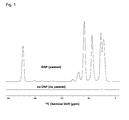
- Figure 1 shows a DNP experiment with Compound 58 ((15- ⁇ [(7-oxyl-3,11-dioxa-7-azadispiro[5.1.5.3]hexadec-15-yl)carbamoyl][2-(2,5,8,11-tetraoxatridecan-13-ylamino) ⁇ -[3,11-dioxa-7-azadispiro[5.1.5.3]hexadec-7-yl])oxidanyl,designated as "bPyTureaPEG4" or "AMUPOL”) as a polarizing agent at 14.1 T, 600 MHz 1 H frequency, 395 GHz microwave frequency.
- Compound 58 ((15- ⁇ [(7-oxyl-3,11-dioxa-7-azadispiro[5.1.5.3]hexadec-15-yl)carbamoyl][2-(2,5,8,11-tetraoxatridecan-13-ylamino) ⁇ -[3,11-
- a fused core C18 column (Phenomenex, Kinetex C18, 100 mm x 4.6 mm, 2.6 ⁇ m) was used. Typically, a gradient elution using aqueous mobile phase with increasing fraction of acetonitrile (from 10% to 40% over 5 min and from 40 to 100% over 5 min) in the presence of 0.1 % TFA was used. The compounds were eluted using a flow rate of 1.5 ml/min.
- the aqueous layer was adjusted to pH 11 by adding 50 mL of 10% K 2 CO 3 aqueous solution and then extracted with chloroform (2 x 100 mL).
- the organic phase was concentrated under reduced pressure, diluted in ethylacetate (100 mL), washed with brine (100 mL), dried over Na 2 SO 4 , and the solvent was distilled under reduced pressure.
- the crude product was purified by SiO 2 column chromatography with AcOEt/pentane (1/1) and recrystallized to afford 7-aza-3,11-dioxadispiro[5.1.5.3]hexadecane-15-one 3 (2.00 g, 23%) as a white solid.
- Example 12 Synthesis of (4- ⁇ 3-[1-(PEG)-1 H -1,2,3-Triazol-4-yl]propyl ⁇ [(1-oxyl-2,2,6,6-tetramethylpiperidin-4-yl)carbamoyl]amino ⁇ -2,2,6,6-tetramethylpiperidin-1-yl)oxidanyl (Compound 61)
Landscapes
- Chemical & Material Sciences (AREA)
- Organic Chemistry (AREA)
- Physics & Mathematics (AREA)
- Health & Medical Sciences (AREA)
- High Energy & Nuclear Physics (AREA)
- Analytical Chemistry (AREA)
- General Health & Medical Sciences (AREA)
- Chemical Kinetics & Catalysis (AREA)
- Bioinformatics & Cheminformatics (AREA)
- Life Sciences & Earth Sciences (AREA)
- Engineering & Computer Science (AREA)
- Biochemistry (AREA)
- Medicinal Chemistry (AREA)
- General Physics & Mathematics (AREA)
- Immunology (AREA)
- Pathology (AREA)
- Plural Heterocyclic Compounds (AREA)
- Hydrogenated Pyridines (AREA)
- Nitrogen And Oxygen Or Sulfur-Condensed Heterocyclic Ring Systems (AREA)
- Pharmaceuticals Containing Other Organic And Inorganic Compounds (AREA)
Abstract
The invention relates to compounds of general formula (I)

wherein X is C=O or SO2, M is NR2 or O, and Q1 and Q2 are nitroxide-containing radicals, and their use as a Dynamic Nuclear Polarization (DNP) agent for polarizing an NMR-active spin of a nucleus of an analyte in Nuclear Magnetic Resonance (NMR) spectroscopy.
Description
- The present invention relates to novel bis-nitroxide compounds and their use as Dynamic Nuclear Polarization (DNP) agents in Nuclear Magnetic Resonance (NMR) spectroscopy.
- In the method of Dynamic Nuclear Polarization (DNP) the polarization of unpaired electron spins which in thermal equilibrium is much larger than that of nuclei having spin half or uneven multiples thereof is transferred by high frequency microwave irradiation to nuclear spins so as to enhance their NMR sensitivity. Only electron paramagnetic resonance (EPR)-active spins (unpaired electrons, also referred to as paramagnetic centers or radicals) are eligible for this polarization process. The electron spin system in DNP may be provided by an endogenous or exogenous paramagnetic polarizing agent. Most often in this technique a paramagnetic agent is added to the sample of interest.
- Initially, compounds comprising one nitroxide radical or other g = 2 paramagnetic center were utilized as DNP agents for NMR applications. To improve DNP efficiency, the research groups of Robert Griffin and Timothy Swager from MIT introduced biradical polarizing agents consisting of two paramagnetic centers tethered together. For the last 7 years, the TOTAPOL biradical (
US 7,351,402 B2 ,WO 2008/048714 , C. Song et al., J. Am. Chem. Soc., 2006, 128(35), 11385) has been the most widely used polarizing agent for biological applications due to its high solubility in aqueous solutions, high stability, and good DNP efficiency. - In 2008, the group of Robert Griffin and Timothy Swager disclosed 4,4-ureylene-di-(2,2,6,6-tetramethylpiperidinyloxyl) ("bis-TEMPO-urea" or "bTurea") for use as a DNP agent (K.H. HU, C. Song, H. Yu, T. Swager, and R. Griffin J. Chem. Phys. 128, 052302 (2008)).
- The present invention seeks to provide further dinitroxide compounds with improved DNP efficiency and/or solubility properties since the efficiency of polarizing agents for specific applications depend on a number of factors including the polarizing agent, analyte, solvent, and experimental conditions.
- In a first aspect, the present invention relates to a compound of general formula (I)

- M is NR2 or O
- X is CO or SO2
- a is 1 or O;
- R1 is H; (CH2)o-E, wherein o is an integer of from 1 to 10 and E is COOH, OH, NH2, N3, C≡CH, P(O)(OH)2, P(O)(OR13)2, P(O)(OR13)(R13), P(O)R13 2 or SSO2Me; (CH2-CH2-O)m-CH3, wherein m is an integer of from 1 to 500; or

- R2 is independently as defined for R1;
or - if X is CO, a is 1 and M is NR2, R1 and R2 form together with the group X and the atoms to which they are bound a 5- or 6-membered heterocyclic ring which may be substituted;
and - Q1 and Q2 are independently of each other a cyclic or acyclic nitroxide of formula:

- R3 and R4 are, independently, a substituted or unsubstituted linear, branched or cyclic C1-6 aliphatic group; a substituted or unsubstituted linear, branched or cyclic group heteroaliphatic group comprising 5 C atoms and one heteroatom or heteroatomic group, respectively, selected from O, S, -NR12-, P(O)(OR13) and P(O)(R13); substituted or unsubstituted aryl; substituted or unsubstituted heteroaryl, or substituted or unsubstituted 2,2,7,7-tetramethyl isoindolinoxyl; or
- R3 and R4 are joined, as indicated by

- and with the proviso that the two groups R3 or R4 together do not contain more than one hydrogen alpha to the (N-O·) group;
- R12 is hydrogen, hydroxyl; substituted or unsubstituted linear, branched or cyclic C1-6 alkyl; C1-6 alkylcarbonyl; substituted or unsubstituted C1-6 alkyl sulfonyl; substituted or unsubstituted C1-6 alkyl sulfinyl; substituted or unsubstituted aryl sulfinyl; or substituted or unsubstituted aryl sulfonyl;
- R13 is linear or branched C1-18 alkyl;
- wherein the point of attachment of the nitrogen atom, the group X or the group M by a single bond, as indicated by

- except the compound 4,4-ureylene-di-(2,2,6,6-tetramethylpiperidinyloxyl

- In a second aspect, the invention relates to the use of a compound according to the invention as a Dynamic Nuclear Polarization (DNP) agent for polarizing NMR-active nuclear spins of an analyte in Nuclear Magnetic Resonance (NMR) spectroscopy.
-
-
Figure 1 shows an DNP experiment with Compound 58 ("AMUPOL") as a polarizing agent at 14.1 T, 600 MHz 1H frequency, 395 GHz microwave frequency. - At first definitions of specific functional groups, substituents and chemical terms relevant in the context of the present invention are described in more detail below.
- For purposes of this invention, the chemical elements are identified in accordance with the Periodic Table of the Elements, CAS version, Handbook of Chemistry and Physics, 75th Ed., inside cover, and specific functional groups are generally defined as described therein. Additionally, general principles of organic chemistry, as well as specific functional moieties and reactivity, are described in Organic Chemistry, Thomas Sorrell, University Science Books, Sausalito, 1999; Smith and March March's Advanced Organic Chemistry, 5th Edition, John Wiley & Sons, Inc., New York, 2001; Larock, Comprehensive Organic Transformations, VCH Publishers, Inc., New York, 1989; Carruthers, Some Modern Methods of Organic Synthesis, 4th Edition, Cambridge University Press, Cambridge, 2004 ; the entire contents of each of which are incorporated herein by reference.
- Certain parts or groups of the inventive compound as described herein may be substituted with any number of substituents or functional moieties. In general, the term "substituted" refers to the replacement of hydrogen radicals in a given structure with the radical of a specified substituent. When more than one position in any given structure may be substituted with more than one substituent selected from a specified group, the substituent may be either the same or different at every position. If a specific substituent meaning is indicated e.g. by a term "R1, R2...", this specific substituent may also be a hydrogen atom.
- The term "C1-C6 aliphatic group", as used herein, includes both saturated and unsaturated, nonaromatic, straight chain (i.e., unbranched), branched, acyclic adn cyclic (i.e., carbocyclic) hydrocarbons having 1-6 C atoms, which are optionally substituted with one or more functional groups. The term "aliphatic" is herein includes C1-6alkyl, C3-6 alkenyl, C2-6 alkynyl, C3-6 cycloalkyl, C3-6 cycloalkenyl, and C5-6 cycloalkynyl moieties. Thus, as used herein, the term "C1-6 alkyl" includes straight, branched and cyclic C1-6 alkyl groups. In an analogous manner, this is valid for the terms "C2-6 alkenyl" and "C2-6 alkynyl",
- Substituents in a substituted C1-6 aliphatic group include C1-4 hydroxyalkyl, C1-4 alkoxy, C1-4 alkylthio; C1-4 alkylcarbonyl; C1-4 alkylsulfonyl; C1-4 alkylsulfinyl, whose alkyl moieties may be partially or completely halogenated with independent halogen atoms; halogen, hydroxyl, thiol, nitro, cyano; -NRc 2, =NRc, -COOH, COORc, -CONRC 2, and SO2NRc 2, wherein Rc is independently selected from the group consisting of H, C1-4 hydroxyalkyl and C1-4 alkyl; oxo, thiooxo, and azido groups. The number of substituents present in a substituted C1-C6 aliphatic group may be up to the number of the hydrogen atoms available for a substitution, but is preferably 1-2, more preferably 1.
- The term "C1-6 alkyl," as used herein, refers to saturated, straight- or branched-chain or cyclic hydrocarbon radicals derived from a hydrocarbon moiety containing from one to six carbon atoms by removal of a single hydrogen atom. Examples of C1-6 alkyl radicals include methyl, ethyl, n-propyl, isopropyl, n-butyl, iso-butyl, sec-butyl, sec-pentyl, isopentyl, tert-butyl, n-pentyl, neopentyl, n-hexyl, sec-hexyl, cyclopropyl, cyclopropylmethyl, cyclopentyl and cyclohexyl. The term "C1-4 alkyl" as used herein, refers to saturated, straight- or branched-chain hydrocarbon radicals derived from a hydrocarbon moiety containing from one to four carbon atoms by removal of a single hydrogen atom. Examples of C1-4 alkyl radicals include methyl, ethyl, n-propyl, isopropyl, n-butyl, iso-butyl and sec-butyl. The term "C3-7 cycloalkyl" refers to cyclic hydrocarbon radicals derived from a hydrocarbon moiety containing from one to seven carbon atoms by removal of a single hydrogen atom. Examples of C3-7 cycloalkyl include cyclopropyl, cyclopropylmethyl, cyclobutyl, cyclobutylmethyl, cyclopentyl, cyclopentylmethyl, cyclohexyl and cyclohexylmethyl. The term "C1-18 alkyl" refers to straight- or branched-chain hydrocarbon radicals derived from a hydrocarbon moiety containing from one to eighteen carbon atoms by removal of a single hydrogen atom
- The above-mentioned alkyl or cycloalkyl groups which may bear one or more sustitutents. Substituents in a substituted C1-6 alkyl group, C1-4 alkyl group or C3-7 cycloalkyl group include C1-4 hydroxyalkyl, C1-4 alkoxy, C1-4 alkylthio; C1-4 alkylcarbonyl; C1-4 alkylsulfonyl; C1-4 alkylsulfinyl, whose alkyl moieties may be partially or completely halogenated with independent halogen atoms; halogen, hydroxyl, thiol, nitro, cyano; -NRc 2, =NRc, -COOH, COORc, -CONRc 2, and SO2NRc 2, wherein Rc is independently selected from the group consisting of H, C1-4 hydroxyalkyl and C1-4 alkyl; oxo, thiooxo, and azido groups. The number of substituents present in a substituted C1-6 alkyl group, C1-4 alkyl group or C3-7 cycloalkyl group may be up to the number of the hydrogen atoms available for a substitution, but is preferably 1-2, more preferably 1.
- The term "C2-6 alkenyl," as used herein, denotes a monovalent group derived from a straight- or branched-chain or cyclic hydrocarbon moiety having at least one carbon-carbon double bond by the removal of a single hydrogen atom. The C2-6 alkenyl group contains 2-6 carbon atoms. C2-6 alkenyl groups include, for example, ethenyl, propenyl, isopropenyl, 1-or 2-butenyl, 1-methyl-2-buten-1-yl and cyclopentenyl. C2-4 alkenyl, as used herein, denotes a monovalent group derived from a straight- or branched-chain hydrocarbon moiety having at least one carbon-carbon double bond by the removal of a single hydrogen atom. The C2-4 alkenyl group contains 2-4 carbon atoms. Examples are ethenyl, propenyl, isopropenyl and 1-or 2-butenyl.
- The above-mentioned alkenyl groups may bear one or more sustitutents. Substituents in a substituted C2-6 or C2-4 alkenyl group include C1-4 hydroxyalkyl, C1-4 alkoxy, C1-4 alkylthio; C1-4 alkylcarbonyl; C1-4 alkylsulfonyl; C1-4 alkylsulfinyl, whose alkyl moieties may be partially or completely halogenated with independent halogen atoms; halogen, hydroxyl, thiol, nitro, cyano; -NRc 2, =NRc, -COOH, COORc, -CONRc 2, and SO2NRc 2, wherein Rc is independently selected from the group consisting of H, C1-4 hydroxyalkyl and C1-4 alkyl; oxo, thiooxo, and azido groups. The number of substituents present in a substituted C1-6 alkenyl group may be up to the number of the hydrogen atoms available for a substitution, but is preferably 1-2, more preferably 1.
- The term "C2-6 alkynyl", as used herein, refers to a monovalent group derived from a straight- or branched-chain or cyclic hydrocarbon having at least one carbon-carbon triple bond by the removal of a single hydrogen atom. The C2-6 alkynyl group employed in the invention contains 2-6 carbon atoms. Representative C2-6 alkynyl groups include ethynyl, 2-propynyl (propargyl), 1-propynyl, and cyclohexynyl, "C2-4 alkynyl" refers to a monovalent group derived from a straight- or branched-chain having at least one carbon-carbon triple bond by the removal of a single hydrogen atom. Representative C2-4 alkynyl groups include ethynyl, 2-propynyl (propargyl), and 1-propynyl.
- The above-mentioned alkynyl groups may bear one or more substituents. Substituents in a substituted C2-6 or C2-4 alkynyl group include C1-4 hydroxyalkyl, C1-4 alkoxy, C1-4 alkylthio; C1-4 alkylcarbonyl; C1-4 alkylsulfonyl; C1-4 alkylsulfinyl, whose alkyl moieties may be partially or completely halogenated with independent halogen atoms; halogen, hydroxyl, thiol, nitro, cyano; -NRc 2, =NRc, -COOH, COORc, -CONRc 2, and SO2NRc 2, wherein Rc is independently selected from the group consisting of H, C1-4 hydroxyalkyl and C1-4 alkyl; oxo, thiooxo, and azido groups. The number of substituents present in a substituted C1-C6 alkynyl group may be up to the number of the hydrogen atoms available for a substitution, but is preferably 1-2, more preferably 1.
- The term primary C atom denotes a C atom being bonded to one further C atom by a single bond and otherwise having hydrogen substituents only.
- The term secondary non-olefinic C atom denotes a C atom being bonded to two further C atoms each by a single bond.
- The term "C1-6 heteroaliphatic group" as used herein, includes both saturated and unsaturated, nonaromatic, straight chain (i.e., unbranched), branched, acyclic, cyclic (i.e., heterocyclic) hydrocarbons, which are optionally substituted with one or more functional groups, and that contain one oxygen, sulfur, substituted nitrogen or substituted phosphorus atom in place of one carbon atom. A heteroaliphatic group according to the invention has 1-5 carbon atoms. The term "C1-6 heteroaliphatic group" is includes heteroalkyl, heteroalkenyl, heteroalkynyl, and heterocyclyl moieties. Thus, as used herein, the term "heteroalkyl" includes straight, branched and cyclic alkyl groups, as defined herein, which are optionally substituted with one or more functional groups, and that contain one oxygen, sulfur, nitrogen or phosphorus atom in place of one carbon atoms. An analogous convention applies to other generic terms such as "heteroalkenyl" and "heteroalkynyl". The substitutent of the nitrogen atom is the substituent R12, as defined below. Phosphorus is present as P(O)(C1-18 alkoxy) or P(O)(C1-18 alkyl). The term "substituted C1-6 heteroaliphatic group" denotes that one or more carbon atoms may also bear a substituent.
- Substituents on carbon atoms of the C1-6 heteroaliphatic group include C1-4 hydroxyalkyl, C1-4 alkoxy, C1-4 alkylthio; C1-4 alkylcarbonyl; C1-4 alkylsulfonyl; C1-4 alkylsulfinyl, whose alkyl moieties may be partially or completely halogenated with independent halogen atoms; halogen, hydroxyl, thiol, nitro, cyano; -NRc 2, =NRc, -COOH, COORc, -CONRc 2, and SO2NRc 2, wherein Rc is independently selected from the group consisting of H, C1-4 hydroxyalkyl and C1-4 alkyl; oxo, thiooxo, and azido groups. The number of substituents present in a substituted C1-C6 heteroaliphatic group may be up to the number of the hydrogen atoms available for a substitution, but is preferably 1-2, more preferably 1.
- One specific substituent of nitrogen atoms in the compounds of the invention is the substitutent R12 which may be hydrogen, hydroxyl; substituted or unsubstituted linear, branched or cyclic C1-6 alkyl; C1-6 alkylcarbonyl; substituted or unsubstituted C1-6 alkyl sulfonyl; substituted or unsubstituted C1-6 alkyl sulfinyl; substituted or unsubstituted aryl sulfinyl; or substituted or unsubstituted aryl sulfonyl; peferably R12 is hydrogen, linear, branched or cyclic C1-6 alkyl, which is unsustituted or substituted with one hydroxyl.
- The term "aryl," as used herein, refer to stable aromatic mono- or bicyclic ring system having 5-10 ring atoms, of which all the ring atoms are carbon, and which may be substituted or unsubstituted. Aryl includes phenyl, biphenyl and naphthyl, which may bear one or more substituents.
- Aryl substituents include C1-6 alkyl, C1-4 hydroxyalkyl, C1-4 alkoxy, C1-4 alkylthio; C1-4 alkylcarbonyl; C1-4 alkylsulfonyl; C1-4 alkylsulfinyl, whose alkyl moieties may be partially or completely halogenated with independent halogen atoms; halogen, hydroxyl, thiol, nitro, cyano; -NRc 2, =NRc, -COOH, COORc, -CONRc 2, and SO2NRc 2, wherein Rc is independently selected from the group consisting of H, C1-4 hydroxyalkyl and C1-4 alkyl; oxo, thiooxo, and azido groups.
- 2,2,7,7-Tetramethyl isoindolinoxyl substituents on the benzene ring are the same as the aryl substituents.
- Preferably aryl is unsubstituted phenyl or phenyl substituted with one of the above substitutents.
- The term "heteroaryl," as used herein, refer to stable aromatic mono- or bicyclic ring system having 5-12 ring atoms, of which one ring atom is selected from S, O, and N; zero, one, or two ring atoms are additional heteroatoms independently selected from S, O, and N; and the remaining ring atoms are carbon, the radical being joined to the rest of the molecule via any of the ring atoms. Exemplary heteroaryls include pyrrolyl, pyrazolyl, imidazolyl, pyridinyl, pyrimidinyl, pyrazinyl, pyridazinyl, triazinyl, tetrazinyl, pyyrolizinyl, indolyl, quinolinyl, isoquinolinyl, benzoimidazolyl, indazolyl, quinolinyl, isoquinolinyl, quinolizinyl, cinnolinyl, quinazolynyl, phthalazinyl, naphthridinyl, quinoxalinyl, thiophenyl, thianaphthenyl, furanyl, benzofuranyl, benzothiazolyl, thiazolynyl, isothiazolyl, thiadiazolynyl, oxazolyl, isoxazolyl, oxadiaziolyl and oxadiaziolylwhich may bear one or more substituents.
- Heteroaryl substituents include C1-6 alkyl, C1-4 hydroxyalkyl, C1-4 alkoxy, C1-4 alkylthio; C1-4 alkylcarbonyl; C1-4 alkylsulfonyl; C1-4 alkylsulfinyl, whose alkyl moieties may be partially or completely halogenated with independent halogen atoms; halogen, hydroxyl, thiol, nitro, cyano; -NRc 2, =NRc, -COOH, COORc, -CONRc 2, and SO2NRc 2, wherein Rc is independently selected from the group consisting of H, C1-4 hydroxyalkyl and C1-4 alkyl; oxo, thiooxo, and azido groups.
- Preferably heteroaryl is pyrrolyl, pyrazolyl, imidazolyl, pyridinyl, pyrimidinyl, pyrazinyl, pyridazinyl, furanyl and thiophenyl, each unsubstituted or substituted with one of the above substituents.
- The term "heterocyclic ring", as used herein, refers to a non-aromatic, partially unsaturated or fully saturated, 5- to 8-membered ring. These heterocyclic rings include those having from one to three heteroatoms independently selected from oxygen, sulfur, phosphorus and nitrogen, in which the nitrogen, phosphorus and sulfur heteroatoms may optionally be oxidized and the nitrogen heteroatom may optionally be quaternized. In certain embodiments, the term heterocylic ring refers to a non-aromatic 5-, 6-, 7- or 8-membered ring wherein at least one ring atom is a heteroatom selected from O, S, P and N (wherein the nitrogen, phosphorus and sulfur heteroatoms may be optionally oxidized and the substitutent of the nitrogen atom is the substituent R12, as defined above, and phosphorus is present as P(O)OR13, P(O)(OR13) or P(O)R13, wherein R13 is as defined above.), and the remaining ring atoms are carbon, the radical being joined to the rest of the molecule via any of the carbon ring atoms.
- Substituents on carbon atoms of heterocyclic rings include C1-6 alkyl, C1-4 hydroxyalkyl, C1-4 alkoxy, C1-4 alkylthio; C1-4 alkylcarbonyl; C1-4 alkylsulfonyl; C1-4 alkylsulfinyl, whose alkyl moieties may be partially or completely halogenated with independent halogen atoms; halogen, hydroxyl, thiol, nitro, cyano; -NRc 2, =NRc, -COOH, COORc, -CONRc 2, and SO2NRc 2, wherein Rc is independently selected from the group consisting of H, C1-4 hydroxyalkyl and C1-4 alkyl; oxo, thiooxo, and azido groups. Furthermore, any two geminal substituents of heterocyclic rings may be joined to form together with the secondary C atom to which they are bound a cyclopentane or cyclohexane ring which may be further substituted with one or more substituents as defined above in the context of the definition of alkyl groups, or a 5- or 6-membered heterocyclic ring comprising one atom or group selected from -O-, -S-, -N(R12)-, -P(O)OH -, -P(O)(C1-6 alkyl) and -P(O)(C1-6 alkoxy) which may be further substituted on one or more carbon atoms with a substituent as defined above on this paragraph.
- The term "hydroxy," or "hydroxyl," as used herein, refers to a group of the formula (- OH).
- The term "C1-4 alkoxy" refers to a group of the formula -OR, wherein R is C1-4 alkyl. The term "C1-18 alkoxy" refers to a group of the formula -OR, wherein R is linear or branched C1-18 alkyl.
- The term "C1-4 hydroxyalkyl" refers to a C1-4 alky group bearing one hydroxyl substituent in the place of any hydrogen atom.
- The term "azido," as used herein, refers to a group of the formula (-N3).
- The term "cyano," as used herein, refers to a group of the formula (-CN).
- The term "direct bond" or "bond" refers to a single, double or triple bond between two groups. In certain embodiments, a "direct bond" refers to a single bond between two groups.
- The terms "halo" and "halogen" as used herein refer to an atom selected from fluorine (fluoro, -F), chlorine (chloro, -Cl), bromine (bromo, -Br), and iodine (iodo, -I).
- The term "nitro," as used herein, refers to a group of the formula (-NO2).
- The term "nitroxide," as used herein, refers to a stable nitroxide group which may be cyclic or acyclic. In certain embodiments, a stable nitroxide refers to a chemically stable nitroxide which may be obtained in pure form, stored, and handled in the laboratory. In certain embodiments, a stable nitroxide refers to a cyclic or acyclic nitroxide which contains two groups which do not contain alpha hydrogens. Exemplary cyclic or acyclic nitroxides are provided in Keana, Chemical Reviews (1978) 78:37-64, the entirety of which is incorporated herein by reference.
- The term "oxo," as used herein, refers to a group of the formula (=O).
- The term "thiol," as used herein, refers to a group of the formula (-SH).
- The term "thio," as used herein, refers to a group of the formula (-S-)
- The term "thiooxo," as used herein, refers to a group of the formula (=S).
- The term "C1-4 alkyl sulfinyl" and "C1-6 alkyl sulfinyl", as used herein, refers to a group of the formula C1-4 alkyl-S(=O)- and C1-6 alkyl-S(=O)-, respectively.
- The term "aryl sulfinyl" as used herein, refers to a group of the formula aryl-S(=O)-
- The term "C1-4 alkyl sulfonyl" and "C1-6 alkyl sulfonyl", as used herein, refers the group of the formula C1-4 alkyl-S(=O)2- and C1-6 alkyl-S(=O)2-, respectively.
- The term "aryl sulfonyl" as used herein, refers to a group of the formula aryl-S(=O)2-.
- The nitroxide-containing groups Q1 and Q2 of the present invention are selected from the following groups, where the definitions are those given in the summary of the invention in conjunction with the above definitions:
- aliphatic-NO-aliphatic;
- aliphatic-NO-heteroaliphatic;
- aliphatic-NO-aromatic;
- aliphatic-NO-heteroaromatic;
- heteroaliphatic-NO-heteroaliphatic;
- heteroaliphatic-NO-aromatic;
- heteroaliphatic-NO-heteroaromatic;
- aromatic-NO-aromatic;
- aromatic-NO-heteroaroatic; and
- heteroaromatic-NO-heteroaromatic;
- wherein "aliphatic" is a substituted or unsubstituted linear, branched or cyclic C1-C6 aliphatic group; and "heteroaliphatic" is a substituted or unsubstituted linear, branched or cyclic group heteroaliphatic group comprising 5 C atoms and one heteroatom or hetero group, respectively, selected from O, S, N(R12), P(R12), P(=O)OH and P(=O)O(C1-6 alkyl);"aromatic" and "heteroaromatic" are substituted or unsubstituted "aryl" and "heteroaryl" repectively, as defined above; with the proviso that the two groups, which are selected from heteroaliphatic, aromatic or heteroaromatic group and are attached to the nitrogen atom of the (N-O·) group, together do not contain more than one hydrogen alpha to the (N-O·) group;;
- and
- a nitroxide-containing 5- to 8-membered heterocyclic ring, which may contain an additional heteroatom or heteroatomic group selected from O, S, N+-O-, NH, N(C1-6 alkyl) wherein the alkyl is straight, branched or cyclic, and may contain one double bond and is substituted at least at all positions alpha to the (N-O·) group, the substituents being selected from those mentioned above in the context of the definition of "heterocyclic group";
- The synthesis of those groups is known to the person skilled in the art; see, for example (a) E. G. Rozantsev and V. D. Sholle, Synthesis, 190-202 (1971). (b) E. G. Rozantsev and V. D. Sholle, Synthesis, 410-414 (1971). (c) E. G. Rozantsev and V. D. Sholle, Synthesis, 895-916 (1984). (d) J. F. W. Keana, Chem. Rev. 1978, 78, 37-64 (e) A. R. Forrester, J. M. Hay and R. H. Thomson, Organic Chemistry of Stable Free Radicals, Academic Press, New York, N. Y. (1968). (f) E. G. Rozantsev, Free Nitroxyl Radicals, Plenum Press, New York, N. Y. (1970). (g) L. B. Volodarsky, Imidazoline Nitroxides, CRC Press Inc., Boca Raton (1988). (h) E. Breuer, H. G. Aurich and A. Nielsen, Nitrones, Nitronates, and Nitroxides, John Wiley and Sons, Chichester UK (1989). (i) L. B. Volodarsky, V. A. Reznikov and V. I. Ovcharenko, Synthetic Chemistry of Stable Nitroxides, CRC Press Inc., Boca Raton (1994). (j) N. Kocherginsky and H. M. Swartz, Nitroxide Spin Labels: Reactions in Biology and Chemistry CRC Press Inc., Boca Raton (1995). (k) A. Alberti (editor), Nitroxide Radicals and Nitroxide Based High-Spin Systems, Series: Landolt-Boernstein, Group 2, Subvolume D, Springer Verlag, New York N. Y. (2005). (I) G. I. Likhtenshtein, J. Yamauchi, S. Nakatsuji, A. I. Smirnov and R. Tamura, Nitroxides: Applications in Chemistry, Biomedicine, and Materials Science, Wiley-VCH Verlag GmbH Weinheim, (2008). (m) N. Naik, R. Braslau, Tetrahedron, 54, 667-696, (1998). (n) L. B. Volodarsky, A. Ya. Tikhonov, Synthesis, 704-715 (1986). (o) H. Karoui, F. Le Moigne, O. Ouari, P.Tordo, In "Stable radicals: fundamentals and applied aspects of odd-electron compounds" Nitroxides Radicals : Properties, Synthesis, and Applications; Wiley VCH, R. Hicks Ed., 174-229 (2010).
- Preferred groups Q1 and Q2 consisting of a nitroxide-containing 5- to 8-membered heterocyclic ring, which may contain an additional heteroatom or heteroatomic group selected from O, S, N+-O-, NH, N(C1-6 alkyl) wherein the alkyl is straight, branched or cyclic, and may contain one double bond and is substituted at least at all positions alpha to the (N-O·) group, are selected from the following groups without restriction to any specific embodiments of the invention.
Qa:


R5 in each instance is independently a substituted or unsubstituted linear, branched or cyclic C1-C6 alky group; a substituted or unsubstituted linear, branched or cyclic group heteroaliphatic group comprising 5 C atoms and one heteroatom selected from O, S, or N(R12); substituted or unsubstituted aryl; or substituted or unsubstituted heteroraryl; or wherein two geminal R5'S are joined to form together with the secondary C atom to which they are bound a further substituted or otherwise unsubstituted cyclopentane or cyclohexane ring or a further substituted or otherwise unsubstituted saturated 5- or 6-membered heterocyclic ring comprising one atom or group selected from -O-, -S-, -N(R12)-, -P(O)OH -, -P(O)(C1-6 alkyl) and -P(O)(C1-6 alkoxy); and
Y is selected from -O-, -S-, -N(R12)- or -C(R6)2-;
and, preferably, all R5's are identical and are selected from unsubstituted linear or branched C1-C6 alkyl, or both germinal groups R5 are joined to form together with the secondary C atom to which they are bound two identical rings selected from a cyclopentane or cyclohexane ring or a tetrahydrofurane or tetrahydroprane ring which rings may bear further on or more substituents selected from the substituents mentioned above in the context of the definition of alkyl groups and heterocycic rings, respectively without restriction to any specific embodiments of the invention;
R12 is as defined above;
R6 and R7 are each independently selected from hydrogen, hydroxyl; C1-6 alkyloxy; thiol; C1-6 alkylthio; N(R')R"), wherein R' and R" are independently R12; nitro; halo; cyano; azido; substituted or unsubstituted linear, branched or cyclic C1-C6 alkyl; a substituted or unsubstituted linear, branched or cyclic group heteroaliphatic group comprising 5 C atoms and one heteroatom or hetero group, respectively, selected from O, S, N(R11), P(R12), P(=O)OH and P(=O)O(C1-6 alkyl); substituted or unsubstituted aryl, substituted or unsubstituted heteroaryl, C1,6 alklycarbonyl; C1-6 alkyl sulfonyl; C1-6 alkyl sulfinyl; substituted or unsubstituted aryl sulfinyl; or substituted or unsubstituted aryl sulfonyl; with R6 preferably being hydrogen in all embodiments of the invention;
z is 1 or 2; and
Qd:


R9 is as defined for R5 above,
R12 is as defined above;
R10 is a substituted or unsubstituted linear, branched or cyclic C1-C6 alky group; a substituted or unsubstituted linear, branched or cyclic group heteroaliphatic group comprising 5 C atoms and one heteroatom selected from O, S, or N(R12); substituted or unsubstituted aryl; or substituted or unsubstituted heteroraryl;
R11 is in each instance independently independently selected from hydrogen, hydroxyl; C1-6 alkyloxy; thiol; C1-6 alkylthio; N(R')R"), wherein R' and R" are independently R12; nitro; halo; cyano; azido; substituted or unsubstituted linear, branched or cyclic C1-C6 alkyl; a substituted or unsubstituted linear, branched or cyclic group heteroaliphatic group comprising 5 C atoms and one heteroatom or hetero group, respectively, selected from O, S, N(R11), P(R12), P(=O)OH and P(=O)O(C1-6 alkyl); substituted or unsubstituted aryl, substituted or unsubstituted heteroaryl, C1,6 alklycarbonyl; C1-6 alkyl sulfonyl; C1-6 alkyl sulfinyl; substituted or unsubstituted aryl sulfinyl; or substituted or unsubstituted aryl sulfonyl; and is preferably hydrogen when attached to the C atom which also forms the single bond by which the group Qe is attached to the nitrogen atom, the group X or the group M of formula (I);
W is N or N+-O-; and
Qg:


Qj:
Ar is independently in each instance substituted or unsubstituted aryl, and Het is independently in each instance substituted or unsubstituted heteroaryl; and
- The nitroxide-containing groups Q1 and Q2 are attached to NR1, X (= C=O or SO2) or M (= O or NR2) via one of their C atoms. Exemplary synthetic procedures for this are shown in the Examples.
- In embodiments of the invention, in the compound of formula (I)
M is NR2; and
R2 is hydrogen; or,
if X is CO, a is 1 and M is NR2, R1 and R2 together form a bridging -CH2CHG- or -CH2CH2CHG- or -CH2CH(G)CH2- group with G = (CH2)o-E, wherein o is an integer of from 0 to 10 and E is: COOH, OH, NH2, N3, C≡CH or SSO2Me; or (CH2-CH2-O)m-CH3, wherein m is an integer of from 1 to 500; and
Q1 and Q2 are independently selected from Qa to Qc as defined above, or Q1 and Q2 are be independently selected from
- In other embodiments of the invention, in the compound of formula (I)
a is 1, when X is SO2, and 0 or 1, when X is CO;
M is NR2; and
R2 is hydrogen;
R1 is H; (CH2)o-E, wherein o is an integer of from 1 to 10 and E is COOH or (CH2-CH2-O)m-CH3, wherein m is an integer of from 1 to 500; or
if X is CO, a is 1 and M is NR2, R1 and R2 together form a bridging -CH2CHG- or -CH2CH2CHG- or -CH2CH(G)CH2- group with G = (CH2)o-E, wherein o is an integer of from 0 to 10 and E is: COOH, OH, NH2, N3, C≡CH or SSO2Me; or (CH2-CH2-O)m-CH3, wherein m is an integer of from 1 to 500; or, alternatively,
if X is CO, a is 1 and M is NR2, R1 and R2 form together a bridging -CH2CH- or -CH2CH2CH- group;
and Q1 and Q2 are independently selected from Qa to Qc as defined above, or Q1 and Q2 are independently selected from
- In embodiments of the invention, Q1 and Q2 are identical.
- Presently preferred compounds of claim 1 are:
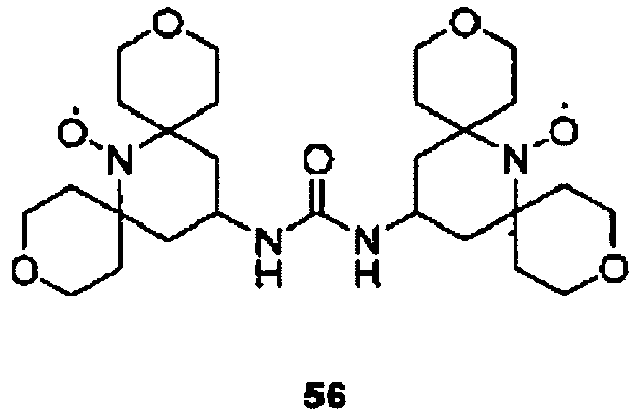
designated as "bPyTurea" or "PyPol";
58: (15-{[(7-oxyl-3,11-dioxa-7-azadispiro[5.1.5.3]hexadec-15-yl)carbamoyl][2-(2,5,8,11-tetraoxatridecan-13-ylamino)}-[3,11-dioxa-7-azadispiro[5.1.5.3]hexadec-7-yl])oxidanyl, designated as "bPyTureaPEG4" or "AMUPOL";

designated as "bCTureaPEG4";
designated as "bTureaPEG2";
52: (4-{(2,5,8,11-tetraoxatridecan-13-yl)[(1-oxyl-2,2,6,6-tetramethylpiperidin-4-yl)carbamoyl] amino}-2,2,6,6-tetramethylpiperidin-1-yl)oxidanyl,
designated as "bTureaPEG4";


designated as "bTureaPEG500" , when n=500;
63: 1,3-bis(1-oxyl-2,2,6,6-tetramethylpiperidin-4-yl)tetrahydropyrimidin-2(1H)-one, designated as "bTureaC6";
designated as "bProxurea";
designated as "bTamide";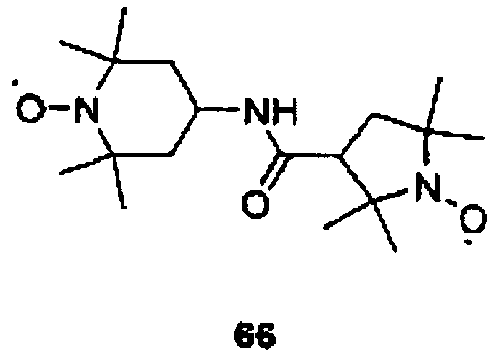
designated as "ProxTamide";
designated as "TProxamide"
and
- The syntheses of these compounds are described in the Examples.
- The compounds of the invention generally are very stable and have a good to very good water solubility.
- The biradical compounds of the invention can be used as a Dynamic Nuclear Polarization (DNP) agents for polarizing an NMR-active spin of a nucleus of an analyte in Nuclear Magnetic Resonance (NMR) spectroscopy. An NMR-active spin is spin half or uneven multiples thereof. The term NMR spectroscopy, as used herein, encompasses Solid State NMR (SS-NMR) spectroscopy, liquid state NMR spectroscopy and Magnetic Resonance Imaging (MRI), in all of which the biradical compounds of the invention may be used as DNP agents.
- The term analyte, as used herein, denotes a chemical or biological entity, such as a solid inorganic, organic or metallo-organic material having an crystal lattice or an amorphous solid structure, e.g. zeolithes, nanoparticles, mesoporous and porous materials, glasses, Metal Organic Frameworks (MOF's), a molecular chemical or biochemical compound including polymeric compounds and macromolecular compounds, e.g., proteins, enzymes, DNA/RNA, and a biological entity, e.g. a whole cell, a leaf, a virus particle, tissue or bone components or a whole body, having one or more NMR-active spins to be investigated by NMR spectroscopy. The molecular chemical or biochemical compound may be an isolated inorganic, organic, metallo-organic or biochemical compound or an inorganic, organic or biochemical compound in its natural biological environment. The analyte may be dissolved in an aqueous medium, an organic solvent or solvent mixture or an aqueous/organic solvent mixture, or it may be present without a solvent.
- The investigation by NMR spectroscopy could e.g. be structure determination, monitoring of reaction kinetics, or flow imaging.
- The nucleus having an NMR-active spin may be any known such nucleus, e.g. 1H, 2H, 6Li, 7Li, 10B, 11B, 13C, 14N, 15N, 17O, 19F, 23Na, 25Mg, 27Al, 29Si, 31P, 33S, 35Cl, 37Cl, 39K, 41K, 43Ca, 47Ti, 49Ti, 50V, 51V, 53Cr, 77Se, 89Y, 117Sn, 119Sn, and 199Hg.
- The DNP agent may be dissolved in the solvent of the analyte or can be introduced without a solvent chemically bound to the analyte, such as in doped polymers, materials functionalized with polarizing agents, or paramagnetic spin labels on biological samples. The polarizing agent could also be dispersed in the analyte, for example by initially introducing the polarizing agent with a solvent and evaporating the solvent in a following step leaving the polarizing agent and analyte, or be introduced by wet impregnation. The polarizing agent could also be added during a synthetic preparation step.
- The polarizing agent may be present in a solid state during the polarization time, such as in a frozen solution comprising a frozen solvent or solvent mixture containing the analyte or in a solid state without solvent.
- In other embodiments, the DNP agent may be present in a liquid state or in a liquid solution during the polarization time.
- Use concentration of the DNP agent concentration may be in the range of from about 1 to about 200 mM.
- In solid state NMR experiments, the temperature of a sample containing the analyte and the DNP agent is usually in the range of from about 1 to about 200 K.
- The polarization time during which microwave irradiation is applied to the electron spins and the nuclear spins are polarized via transfer of the polarization can be continuous (microwaves are on all the time) and simultaneous with the NMR spectroscopic measurement time. Alternatively, the microwave irradiation can be pulsed, or a combination of short and long pulses. Microwave irradiation can also occur as a step before the NMR spectroscopy, for example in dissolution DNP or temperature jump DNP, where a solid DNP sample is polarized in the solid state and then melted for solution state applications. In the case of continuous microwave irradiation the polarization builds up with an exponential time constant (Tpol) which can be measured similarly to T1 measurements in NMR experiments.
- The frequency range of the microwave irradiation by which the polarization is transferred to an NMR-active nucleus is usually from about 5 to about 800 GHz.
- The experimental setup may be either static or spinning samples.
- The compounds of the invention show high DNP efficiencies.
- Table 1 shows the 1 H DNP signal enhancement and polarization build-up time at two DNP frequencies of selected compounds of the invention.
Table 1 Biradical Compound No. 263 GHz Tpol 263 GHz DNP ε 395 GHz Tpol 395 GHz DNP ε 58 3.4 s 235 4.9 s 128 57 4.9 s 217 6.4 s 123 56 5.7 s 207 8.7 s 128 61 3.0 s 116 3.7 s 61 51 5.6 s 120 7.7 s 81 TOTAPOL 5.6 s 75 7.7 s 30 - The 1 H DNP signal enhancement (DNP ε) was measured at 9.4 T 263 GHz and 14.1 T 395 GHz at 97 K sample temperature and 8 kHz magic angle spinning (MAS) frequency for Compounds 58, 57, 56, 61 and 51 according to the invention compared to TOTAPOL. All samples were prepared with 10 mM biradical polarizing agent, 0.25
M 13C-15N Proline, in glycerol-d8/D20/H2O (60/30/10 % volume ratio). The 1 H DNP signal enhancement was measured via 1 H-13C cross polarization experiment with and without microwave irradiation. Polarization build-up time, Tpol, was measured with saturation recovery experiment with microwave irradiation on continuously. -
Figure 1 shows a DNP experiment with Compound 58 ((15-{[(7-oxyl-3,11-dioxa-7-azadispiro[5.1.5.3]hexadec-15-yl)carbamoyl][2-(2,5,8,11-tetraoxatridecan-13-ylamino)}-[3,11-dioxa-7-azadispiro[5.1.5.3]hexadec-7-yl])oxidanyl,designated as "bPyTureaPEG4" or "AMUPOL") as a polarizing agent at 14.1 T, 600 MHz 1 H frequency, 395 GHz microwave frequency. 1H-13C CPMAS experiment at 14 kHz MAS, 100 K sample temperature, 8 scans signal averaging, 1 dummy scan, 6.4 s recycle delay. Top trace (DNP) with microwave irradiation and bottom trace (no DNP) without microwave. Concentration: 10 mM of Compound 58, 0.25M 13C-15N Proline in glycerol-d8/D20/H2O (60/30/10 % volume ratio). - All chemicals used in synthesis were purchased from Aldrich Chemical Co. Commercially available starting materials were used without further purification. Purification of products was accomplished by flash column chromatography on silica gel (Merck silica gel 60, 230-400 mesh) and neutral alumina (Merck Aluminium oxide 90 active neutral, 70-230 mesh). NMR measurements were recorded on a Bruker AVL 300 spectrometer (1H-NMR 300.1 MHz and 13C-NMR 75.5 MHz) using CDCl3 as the solvent (internal reference). Splitting patterns are indicated as follows: br, broad; s, singlet; d, doublet; t, triplet; q, quartet; m, multiplet; dd, doublet of doublets; dt, doublet of triplets. Mass spectral analyses were carried out using a Q-STAR Elite at the Aix Marseille Université Mass Spectrum Facility, Spectropole Saint Jérôme Marseille. Melting points were determined using a Büchi B-540 apparatus and were uncorrected. The final products were purified to ≥ 95% and were confirmed by HPLC and/or elemental analysis. HPLC experiments were performed using Agilent 1200 system equipped with UV-Vis absorption and fluorescence detectors. A fused core C18 column (Phenomenex, Kinetex C18, 100 mm x 4.6 mm, 2.6 µm) was used. Typically, a gradient elution using aqueous mobile phase with increasing fraction of acetonitrile (from 10% to 40% over 5 min and from 40 to 100% over 5 min) in the presence of 0.1 % TFA was used. The compounds were eluted using a flow rate of 1.5 ml/min.
-

- To a stirred mixture of 1,2,2,6,6-pentamethypiperidin-4-one 1 (6.08 g, 0.036 mol) and tetrahydro-4H-pyran-4-one (10.8 g, 0.108 mol) in dimethylsulfoxide (70 mL), NH4Cl (11.55 g, 0.216 mol) was added at room temperature. The mixture was heated at 80°C during 24 h, then it was diluted with water (200 mL), acidified with 1 N HCl aqueous solution (40 mL) and the mixture was extracted with diethylether (3 x 100 mL). The aqueous layer was adjusted to pH 11 by adding 50 mL of 10% K2CO3 aqueous solution and then extracted with chloroform (2 x 100 mL). The organic phase was concentrated under reduced pressure, diluted in ethylacetate (100 mL), washed with brine (100 mL), dried over Na2SO4, and the solvent was distilled under reduced pressure. The crude product was purified by SiO2 column chromatography with AcOEt/pentane (1/1) and recrystallized to afford 7-aza-3,11-dioxadispiro[5.1.5.3]hexadecane-15-one 3 (2.00 g, 23%) as a white solid. mp: 170°C (lit. mp: 167°C). 1H NMR (CDCl3) δ 1.64 (t, 8H, J = 5.6 Hz), 2.41 (s, 4H), 3.54-3.60 (m, 4H), 3.82-3.88 (m, 4H). 13C NMR (CDCl3) δ 40.24, 51.86, 54.59, 63.46, 208.95. HRMS-ESI: calcd for C13H21NO3 [M+H]+ 240.1594, found 240.1594.
-

- Compound 3 (2.9 g, 12.1 mmol) and Na2WO4.2H2O (400 mg, 1.21 mmol) were stirred in ethanol (100 mL). H2O2 (35%, 48.4 mmol, 5 mL) was added and the mixture was stirred for 24 h at room temperature. At the end of reaction, K2CO3 was added and the solution was extracted twice with chloroform (100 mL). The organic layer was dried over Na2SO4 and distilled under reduced pressure. The crude product was purified by column chromatography (SiO2, DCM:EtOH) to provide (15-oxo-3,11-dioxa-7-azadispiro[5.1.5.3]hexadec-7-yl)oxidanyl 5 as a yellow solid (2.5 g, 81%). mp: 148.5 °C (lit. mp :149.5 °C) ESI-MS m/z = 255 [M+H]+; 277 [M+Na]+.
-

- Under Argon atmosphere, a solution of ammonium acetate (2.55 g, 33 mmol) in MeOH (25 ml) was stirred for 5 min at rt. K2CO3 was added to adjust the pH at 8. Then a solution of 5 (840 mg, 3.3 mmol) in MeOH was added and the reaction mixture was stirred at rt. NaBH(CN)3 (540 mg, 8.6 mmol) was added in one portion. The reaction was stirred 16h at rt and 5 ml of sat. NaHCO3 were added. MeOH was removed under reduced pressure and the remaining aqueous phase was extracted twice with chloroform. The organic layer was dried on Na2SO4, solvent removed under vacuum and the residue was column chromatographied to give (15-amino-3,11-dioxa-7-azadispiro[5.1.5.3]hexadec-7-yl)oxidanyl 7 (700 mg, 2.743 mmol, 83 %) as a red solid. mp: 140.5 °C HRMS-ESI: m/z calcd for C13H23N2O3˙[M+H]+ 256.1781, found 256.1781
-

- To a solution of 7 (200 mg, 0.78 mmol) and NEt3 (220 µl, 1.56 mmol) in DCM (5 ml) was added a solution of triphosgene (38 mg, 0.13 mmol) in DCM and the solution was stirred at rt for 6h. A solution of sat. NaHCO3 is added and the mixture is extracted with DCM twice. The organic phase was dried on Na2SO4, solvent removed under vacuum and the residue was column chromatographied to afford (15-{[(7oxyl-3,11-dioxa-7-azadispiro[5.1.5.3]hexadec-15-yl)carbamoyl]amino}-[3,11-dioxa-7-azadispiro[5.1.5.3]-hexadec-7-yl])oxidanyl 56 as a red solid (100 mg, 0.18 mmol, 52 %. HRMS-ESI: m/z calcd for C27H44N4O7˙˙[M+H]+ 537.3283, found 537.3283. Elemental analysis: found C, 53.82; H, 7.63; N, 8.89 calcd for C27H44N4O7 + 1.05 CH2Cl2: C, 53.81; H, 7.42; N, 8.95.
-

- A solution of 5 (500 mg, 1.97 mmol), tetra(ethylene glycol) methyl ether amine (370 mg, 1.79 mmol) and AcOH (0.6 ml) in THF (30 ml) was stirred at rt for 2h. Na(OAc)3BH (1.40 g, 5.4 mmol) was added and the reaction was stirred at rt for 12h. THF was removed under reduced pressure and the residue was solubilized in DCM. The organic phase was washed with a saturated solution of NaHCO3. The aqueous phase is saturated with NaCl and extracted with chloroform twice. The organic phases are dried (Na2SO4) and solvents are removed under reduced pressure. The residue is purified by column chromatography to give [15-{(2,5,8,11-tetraoxatridecan-13-yl)amino}-3,11-dioxa-7-azadispiro[5.1.5.3]-hexadec-7-yl]oxidanyl 11 (540 mg, 1.22 mmol, 68 %) as a red oil. HRMS-ESI: m/z calcd C22H41N2O7˙[M+H]+ 446.2987, found 446.2986
- The same procedure was used to synthesize (15-{[2-(2-methoxyethoxy)ethyl]amino}-3,11-dioxa-7-azadispiro[5.1.5.3]hexadec-7-yl)oxidanyl 10, starting from di(ethylene glycol) methyl ether amine. ESI-HRMS: m/z calcd C18H33N2O5˙ [M+H]+ 358.2462, found 358.2462
-

- A solution of 11 (600 mg, 0.88 mmol), 7 (130 mg, 0.51 mmol) and NEt3 (125 µl, 0.83 mmol) was stirred at rt in DCM (5 ml) for 6 h. The solution was washed with brine, dried over Na2SO4 and the solvent was removed under vacuum. The residue was purified using flash chromatography to give (15-{[(7-oxyl-3,11-dioxa-7-azadispiro[5.1.5.3]hexadec-15-yl)carbamoyl][2-(2,5,8,11-tetraoxatridecan-13-ylamino)}-[3,11-dioxa-7-azadispiro-[5.1.5.3]hexadec-7-yl])oxidanyl 58 as a red oil (120 mg, 0.16 mmol, 33 %). ESI-HRMS: m/z calcd C36H62N4O11˙˙ [M+H]+ 727.4488, found 727.4487. Elemental analysis: found C, 58.70; H, 8.70; N, 8.75 calcd for C36H62N4O11, 0.4 H2O, 0.7 CH3CN: C, 58.75; H, 8.58; N, 8.61.
- The same procedure was used to synthesize (15-{[(7-oxyl-3,11-dioxa-7-azadispiro[5.1.5.3]hexadec-15-yl)carbamoyl][2-(2-methoxyethoxy)ethyl]amino}-[3,11-dioxa-7-azadispiro[5.1.5.3]hexadec-7-yl])oxidanyl 57 . ESI-HRMS: m/z calcd C32H54N4O9 .. [M+H]+ 639.3964, found 639.3963
-

- Starting from cyclohexanone and compound 1, General Procedure A of Example 1A was followed to obtain 7-azadispiro[5.1.5.3]hexadecan-15-one 2, mp: 102°C (lit. 103°C). 1H NMR (300 MHz, CDCl3): 1.35-1.44 (m, 8H), 1.47-1.53 (m, 8H), 1.58-1.68 (m, 4H), 2.29 (s, 4H). 13C NMR (75 MHz, CDCl3): 22.34, 25.68, 40.78, 52.29, 56.80, 211.47. ESI-MS m/z = 236 [M+H]+, 242 [M+Li]+.
-

- Starting from Compound 2, General procedure B of Example 1.B was followed to obtain (15-oxo-7-azadispiro[5.1.5.3]hexadec-7-yl)oxidanyl 4. ESI-MS m/z = 255 [M+H]+, 277 [M+Na]+.
-

- Starting from Compound 4, General procedure C of Example 1.C was followed to obtain (15-amino-7-azadispiro[5.1.5.3]hexadec-7-yl)oxidanyl 6. ESI-MS m/z = 252 [M+H)+.
-

- Starting from Compound 6, General Procedure D of Example 1.D was followed to obtain (15-{[(7-oxyl-7-azadispiro[5.1.5.3]hexadec-15-yl)carbamoyl]amino}-7-azadispiro[5.1.5.3]hexadec-7-yl)oxidanyl 53. HRMS-ESI: m/z calcd for C31H52N4O3 [M+H]+ 529.4112, found 529.4112.
-

- Compound 8 (15-{[2-(2-methoxyethoxy)ethyl]amino}-7-azadispiro[5.1.5.3]hexadec-7-yl)oxidanyl was synthesized following General Procedure E of Example 2.A/3.A starting from di(ethylene glycol) methyl ether amine. ESI-MS m/z = 354 [M+H]+; 376 [M+Na]+; 392 [M+K]+.
- Compound 9 [15-{(2,5,8,11-tetraoxatridecan-13-yl)amino}-7-azadispiro[5.1.5.3]hexadec-7-yl]oxidanyl was synthesized following General Procedure E of Examples 2.A/3.A starting from tetra(ethylene glycol) methyl ether amine. HRMS-ESI: m/z calcd for C24H45N2O5 [M+H]+ 442.3401, found 442.3394.
-

- Starting from Compounds 8 and 6, General Procedure F of Examples 2.B/3.B. was followed to obtain (15-{[(7-hydroxy-7-azadispiro[5.1.5.3]hexadec-15-yl)carbamoyl][2-(2-methoxyethoxy) ethyl]amino}-7-azadispiro[5.1.5.3]hexadec-7-yl)oxidanyl 54 .HRMS-ESI: m/z calcd for C36H62N4O5 [M+H]+ 631.4793, found 631.4794. Elemental analysis: found C, 68.19; H, 10.11; N, 8.67calcd C36H62N4O : C, 68.53; H, 9.91; N, 8.88.
- Starting from Compounds 9 and 6, General Procedure F of Examples 2.B/3.B. was followed to obtain (15-{[(7-oxyl-7-azadispiro[5.1.5.3]hexadec-15-yl)carbamoyl][2-(2-methoxyethoxy) ethyl]amino}-7-azadispiro[5.1.5.3]hexadec-7-yl)oxidanyl 55. HRMS-ESI: m/z calcd for C40H70N4O7[M+H]+ 719.5317, found 719.5316. Anal. Calcd for C40H70N4O7: C, 66.82; H, 9.81; N, 7.79 found C, 67.01; H, 10.07; N, 8.04.
-

- 14 (4-{[2-(2-methoxyethoxy)ethyl]amino}-2,2,6,6-tetramethylpiperidin-1-yl)oxidanyl was synthesized following General Procedure E of Examples 2.A/3.A starting from di(ethylene glycol) methyl ether amine. ESI-MS m/z = 274 [M+H]+; 296 [M+Na]+.
- 15 (4-{(2,5,8,11-tetraoxatridecan-13-yl)amino}-2,2,6,6-tetramethylpiperidin-1-yl)oxidanyl was synthesized following General Procedure E of Examples 2.A/3.A starting from tetra(ethylene glycol) methyl ether amine. HRMS-ESI: m/z calcd for C18H37N2O5 [M+H]+ 362.2775, found 362.2778
-

- (4-{[2-(2-Methoxyethoxy)ethyl][(1-oxyl-2,2,6,6-tetramethylpiperidin-4-yl)carbamoyl]amino}-2,2,6,6-tetramethylpiperidin-1-yl)oxidanyl 51 was synthesized following General Procedure F of Examples 2.B/3.B starting from Compounds 14 and 12. HRMS-ESI: m/z calcd for C24H46N4O5 [M+H]+ 471.3540, found 471.3538. Anal. Calcd for C24H46N4O5: C, 61.25; H, 9.85; N, 11.90. Found C, 61.17; H, 10.06; N, 11.65.
- (4-{(2,5,8,11-Tetraoxatridecan-13-yl)[(1-oxyl-2,2,6,6-tetramethylpiperidin-4-yl)carbamoyl] amino}-2,2,6,6-tetramethylpiperidin-1-yl)oxidanyl 52 was synthesized following General Procedure F of Examples 2.B/3.B starting from Compounds 15 and 12.. HRMS-ESI: m/z calcd for C28H54N4O7 [M+H]+ 559.4065, found 559.4063.
-

- (4-{(6-Ethoxy-6-oxohexyl)amino}-2,2,6,6-tetramethylpiperidin-1-yl)oxidanyl 17 was synthesized following General Procedure E of Examples 2.A/3.A starting from ethyl 6-aminohexanoate hydrochloride and Compound 13. ESI-MS m/z = 314 [M+H]+, 320 [M+Li]+.
-
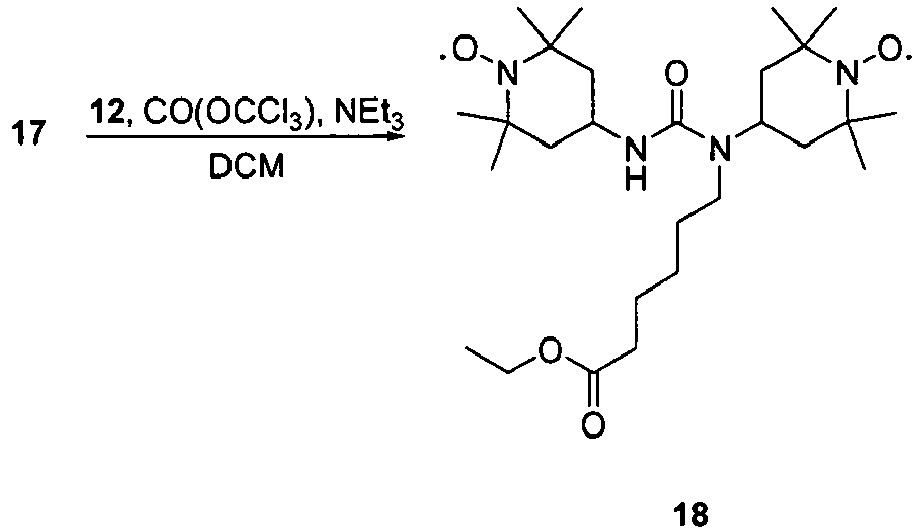
- (4-{(6-Ethoxy-6-oxohexyl)[(1-oxyl-2,2,6,6-tetramethylpiperidin-4-yl)carbamoyl]am ino}-2,2,6,6-tetramethylpiperidin-1-yl)oxidanyl 18 was synthesized following General Procedure F of Examples 2.B/3.B starting from Compounds 17 and 12. ESI-MS mlz = 511 [M+H]+, 517 [M+Li]+
-

- A solution of 18 (820 mg, 1.6 mmol) and NaOH (320 mg, 8.0 mmol) in a 8:2 mixture EtOH:H2O (10 ml) was stirred at 70 °C for 12 h. EtOH was removed under vacuum. Using 1 M HCl aqueous solution, pH of the remaining water phase was adjusted at 3. The aqueous phase was then extracted with DCM. The residue was purified using flash chromatography to give (4-{(5-carboxypentyl)[(1-oxyl-2,2,6,6-tetramethylpiperidin-4-yl)carbamoyl]amino}-2,2,6,6-tetramethylpiperidin-1-yl)oxidanyl 59 as a red solid (505 mg, 1.05 mmol, 65 %). HRMS-ESI: m/z calcd for C25H46N4O5 [M+H]+ 483.3541, found 483.3541. Elemental analysis: found C, 61.24; H, 9.70; N, 11.31 calcd for C25H46N4O5, 0.4 H2O: C, 61.30; H, 9.63; N, 11.44.
-

- [2,2,6,6-Tetramethyl-4-(pent-4-yn-1-ylamino)piperidin-1-yl]oxidanyl 19 was synthesized following General Procedure E of Examples 2.A/3.A starting from pent-4-yn-1-amine and Compound 13. HRMS-ESI: m/z calcd for C14H25N2O˙[M+H]+ 238.2039, found 238.2041
-

- (4-{(Pent-4-yn-1-yl)[(1-oxyl-2,2,6,6-tetramethylpiperidin-4-yl)carbamoyl]amino}-2,2,6,6-tetramethylpiperidin-1-yl)oxidanyl 60 was synthesized following General procedure F of Example 2.B/3.B starting form Compound 19. HRMS-ESI: m/z calcd for C24H42N4O3˙˙ [M+H]+ 435.3330, found 435.3333
-

- A solution of 60 (50 mg, 0.12 mmol) and PEG-N3 Mn=500 (62 mg, 0.12 mmol) in EtOH (3 mL) was diluted with water (2 mL). Sodium ascorbate (1 M solution in water, 24 µL, 0.024 mmol, 20 mol %) and copper(II) sulfate pentahydrate (1 M solution in water, 12 µL, 0.012 mmol, 10 mol %) were added. After being stirred at room temperature for 6 h, the solution was concentrated in vacuo. The resulting residue was purified by column chromatography to afford crude compound 61 as a red oil (15 mg) which was further purified on prep-HPLC to afford 11 mg of pure (4-{3-[1-(PEG)-1H-1,2,3-triazol-4-yl]propyl}[(1-oxyl-2,2,6,6-tetramethylpiperidin-4-yl)carbamoyl]amino}-2,2,6,6-tetramethylpiperidin-1-yl)oxidanyl 61 as an oil (0.01 mmol, 10 %). HRMS-ESI: m/z calcd for C25H45N4O3˙˙(C2H40)7[M+H]+ 800.5492, found 800.5495; m/z calcd for C25H45N4O3˙˙(C2H4O)8 [M+H]+ 844.5754, found 544.5758; m/z calcd for C25H45N4O3˙˙(C2H4O)9 [M+H]+ 888.6016, found 888.6024; m/z calcd for C25H45N4O3˙˙(C2H4O)10 [M+H]+ 932.6278, found 932.6280
-

- Following General Procedure E of Examples 2.A/3.A starting from Compound 20, 4,4'-(ethane-1,2-diyldiimino)bis(2,2,6,6-tetramethylpiperidin-1-oxidanyl) 22 was obtained. HRMS-ESI: m/z calcd for C20H40N4O2˙˙[M+H]+ 369.3224, found 369.3223
- Following General Procedure E of Examples 2.A/3.A starting from Compound 21, 4,4'-(propane-1,3-diyldiimino)bis(2,2,6,6-tetramethylpiperidin-1-oxidanyl) 23 was obtained. HRMS-ESI: m/z calcd for C21H42N4O2˙˙ [M+H]+ 383.3381, found 383.3386
-

- To a 0.01 M solution of 22 (100 mg, 0.27 mmol) in DCM was added a solution of triphosgene (28 mg, 0.09 mmol) in DCM (1 ml) and the solution was stirred at rt overnight. The reaction mixture was washed with sat. aq. NaHCO3, dried over Na2SO4 and the solvent removed under reduce pressure. The residue was purified by column chromatography (SiO2, DCM:MeOH, 97:3) to give 1,3-bis(1-oxyl-2,2,6,6-tetramethylpiperidin-4-yl)imidazolidin-2-one 62 as a red solid (50 mg, 0.13 mmol, 47 %). HRMS-ESI: m/z calcd for C21H38N4O3˙˙[M+H]+ 395.3017, found 395.3013.
- 1,3-Bis(1-oxyl-2,2,6,6-tetramethylpiperidin-4-yl)tetrahydropyrimidin-2(1H)-one 63 was synthesized in an analogous manner starting from Compound 23. HRMS-ESI: m/z calcd for C22H40N4O3˙˙[M+H]+409.3173, found 409.3178
-

- (3-{[(1-Oxyl-2,2,5,5-tetramethylpyrrolidin-3-yl) carbamoyl]amino}-[2,2,5,5-tetramethylpyrrolidin-3-yl])oxidanyl 64 was synthesized following General Procedure D of Example 1.D. starting from Compound 24.. HRMS-ESI: m/z calcd for C17H32N4O3˙˙[M+H]+ 341.2547, found 341.2547
-

- To a stirred solution of (2,2,6,6-tetramethyl-4-oxopiperidin-1-yl)oxidanyl (1.00 g, 5.88 mmol) and tosylmethyl isocyanide (1.30 g, 6.66 mmol) in dimethoxyethane (20 mL) was added slowly a solution of potassium tert-butoxide (1.30 g, 11.60 mmol) dissolved in a mixture of dimethoxyethane (10 mL) and tert-butyl alcohol (10 mL). The mixture was stirred for 3 h at room temperature. At the end of reaction, 100 ml of water was added and the mixture was extracted with diethylether (80 ml), dried over Na2SO4 and concentrated under reduced pressure to give (4-cyano-2,2,6,6-tetramethylpiperidin-1-yl)oxidanyl 25 (0.95 g, 89 %) as a red powder. ESI-MS: [M+H]+ = 182; [M+Na]+ = 204.
-

- To a solution of 25 (0.90 g, 4.97 mmol) in methanol (20 mL) was added a solution of Ba(OH)2.8H2O (3.00 g, 9.52 mmol) in 100 mL of water. The mixture was refluxed during 6 h. At the end of time, the mixture was cooled, and extracted with chloroform (2 x 200 mL). Then, the aqueous solution was acidified with 5% hydrochloric acid, and extracted with chloroform (3 x 200 mL). The chloroform extracts were recombined, dried over Na2SO4 and concentrated under reduced pressure to give (4-carboxy-2,2,6,6-tetramethylpiperidin-1-yl)oxidanyl 26 (0.82g, 82%) as a red powder. mp: 171°C; HRMS-ESI: calcd for C10H18NO3˙([M+H]+) 201.1359, found 201.1359.
-

- To a solution of 26 (50 mg, 0.25 mmol) under Argon atmosphere in DCM was added oxalyl chloride (26 µl, 0.3 mmol). The solution was stirred at rt for 3h. Then the excess of oxalyl chloride and DCM were removed in vacuo. To a solution of 12 (43 mg, 0.25 mmol) in DCM was added the solution of the acid chloride in DCM dropwise and the resulting solution was stirred at rt for 2h. It was then washed with sat. aq. NaHCO3 and the solvent was removed under reduced pressure. The residue was purified using flash chromatography to give 40 mg of red solid (4-{[(1-oxyl-2,2,6,6-tetramethylpiperidin-4-yl)carbonyl]amino}-2,2,6,6-tetramethylpiperidin-1-yl)oxidanyl 65 (0.11 mmol, 45 %). HRMS-ESI: calcd for C19H35N3O3[M+H]+ 354.2754, found 354.2748.
-

- A solution of 12 (50 mg, 0.29 mmol), 27 (55 mg, 0.29 mmol), DCC (66 mg, 0.32 mmol), HOBt (78 mg, 0.58 mmol) and NEt3 in DCM (5 ml) was stirred under Argon atmosphere for 6h. It was then washed with sat. aq. NaHCO3, brine and the solvent was removed under reduced pressure. The residue was purified using flash chromatography to give 35 mg of red solid {3-[(1-oxyl-2,2,6,6-tetramethylpiperidin-4-yl)carbamoyl]-2,2,5,5-tetramethylpyrrolidin-1-yl}oxidanyl 66 (0.10 mmol, 36 %). HRMS-ESI: calcd for C18H33N3O3 [M +H]+ 340.2595, found 340.2596.
-

- (3-{[(1-Oxyl-2,2,6,6-tetramethylpiperidin-4-yl)carbonyl]amino}-2,2,5,5-tetramethylpyrrolidin-1-yl)oxidanyl 67 was synthesized following General Procedure G. of Example 17 starting from Compounds 28 and 26. HRMS-ESI: calcd for C18H33N3O3 [M +H]+ 340.2595, found 340.2594.
-

- Under an argon atmosphere, to a solution of 29 (312 mg, 2 mmol) in DCM was added a solution of sulfuryl chloride (81 µl, 1 mmol) in DCM (1 ml) and the solution was stirred for 2h. The precipitate of 30 was filtrated and used without further purification.
-

- Following General procedure B of Example 1.B starting from Compound 30, (4-{[(1-oxyl-2,2,6,6-tetramethylpiperidin-4-yl)sulfamoyl]amino}-2,2,6,6-tetramethylpiperidin-1-yl)oxidanyl 68 was synthesized.HRMS-ESI: calcd for C18H36N4O4S [M +H]+ 405.2530, found 405.2530.
- The entire disclosure of all documents referred to in the present application, such as journal articles, books, patents, and patent applications, is hereby included in this specification by way of reference.
Claims (21)
- A compound of general formula (I)
 M is NR2 or OX is CO or SO2a is 1 or 0;R1 is H; (CH2)o-E, wherein o is an integer of from 1 to 10 and E is COOH, OH, NH2, N3, C≡CH, P(O)(OH)2, P(O)(OR13)2, P(O)(OR13)(R13), P(O)R13 2 or SSO2Me; (CH2-CH2-O)m-CH3, wherein m is an integer of from 1 to 500; or
 R2 is independently as defined for R1;orif X is CO, a is 1 and M is NR2, R1 and R2 form together with the group X and the atoms to which they are bound a 5- or 6-membered heterocyclic ring which may be substituted;andQ1 and Q2 are independently of each other a cyclic or acyclic nitroxide of formula:
 R3 and R4 are, independently, a substituted or unsubstituted linear, branched or cyclic C1-6 aliphatic group; a substituted or unsubstituted linear, branched or cyclic group heteroaliphatic group comprising 5 C atoms and one heteroatom or heteroatomic group, respectively, selected from O, S, -NR12-, P(O)(OR13) and P(O)(R13); substituted or unsubstituted aryl; substituted or unsubstituted heteroaryl, or substituted or unsubstituted 2,2,7,7-tetramethyl isoindolinoxyl; orR3 and R4 are joined, as indicated by
 and with the proviso that the two groups R3 or R4 together do not contain more than one hydrogen alpha to the (N-O·) group;R12 is hydrogen, hydroxyl; substituted or unsubstituted linear, branched or cyclic C1-6 alkyl; C1-6 alkylcarbonyl; substituted or unsubstituted C1-6 alkyl sulfonyl; substituted or unsubstituted C1-6 alkyl sulfinyl; substituted or unsubstituted aryl sulfinyl; or substituted or unsubstituted aryl sulfonyl;R13 is linear or branched C1-18 alkyl;wherein the point of attachment of the nitrogen atom, the group X or the group M by a single bond, as indicated by
 except the compound 4,4-ureylene-di-(2,2,6,6-tetramethylpiperidinyloxyl
- The compound of claim1, wherein Q1 and Q2 are independently selected from wherein
R5 in each instance is independently a substituted or unsubstituted linear, branched or cyclic C1-C6 alky group; a substituted or unsubstituted linear, branched or cyclic group heteroaliphatic group comprising 5 C atoms and one heteroatom selected from O, S, or N(R12); substituted or unsubstituted aryl; or substituted or unsubstituted heteroraryl;
or wherein two geminal R5's are joined to form together with the secondary C atom to which they are bound a further substituted or otherwise unsubstituted cyclopentane or cyclohexane ring or a further substituted or otherwise unsubstituted saturated 5- or 6-membered heterocyclic ring comprising one atom or group selected from -O-, -S-, -N(R12)-, -P(O)OH -, -P(O)(C1-6 alkyl) and -P(O)(C1-6 alkoxy); and
Y is selected from -O-, -S-, -N(R12)- or -C(R6)2-;
and, preferably, all R5's are identical and are selected from unsubstituted linear or branched C1-C6 alkyl, or both germinal groups R5 are joined to form together with the secondary C atom to which they are bound two identical rings selected from a cyclopentane or cyclohexane ring or a tetrahydrofurane or tetrahydroprane ring which rings may bear further on or more substituents selected from the substituents mentioned above in the context of the definition of alkyl groups and heterocycic rings, respectively without restriction to any specific embodiments of the invention;
R12 is as defined above;
R6 and R7 are each independently selected from hydrogen, hydroxyl; C1-6 alkyloxy; thiol; C1-6 alkylthio; N(R')R"), wherein R' and R" are independently R12; nitro; halo; cyano; azido; substituted or unsubstituted linear, branched or cyclic C1-C6 alkyl; a substituted or unsubstituted linear, branched or cyclic group heteroaliphatic group comprising 5 C atoms and one heteroatom or hetero group, respectively, selected from O, S, N(R11), P(R12), P(=O)OH and P(=O)O(C1-6 alkyl); substituted or unsubstituted aryl, substituted or unsubstituted heteroaryl, C1,6 alklycarbonyl; C1-6 alkyl sulfonyl; C1-6 alkyl sulfinyl; substituted or unsubstituted aryl sulfinyl; or substituted or unsubstituted aryl sulfonyl; with R6 preferably being hydrogen in all embodiments of the invention;
z is 1 or 2; and
Qd:


R9 is as defined for R5 above,
R12 is as defined above;
R10 is a substituted or unsubstituted linear, branched or cyclic C1-C6 alky group; a substituted or unsubstituted linear, branched or cyclic group heteroaliphatic group comprising 5 C atoms and one heteroatom selected from O, S, or N(R12); substituted or unsubstituted aryl; or substituted or unsubstituted heteroraryl;
R11 is in each instance independently independently selected from hydrogen, hydroxyl; C1-6 alkyloxy; thiol; C1-6 alkylthio; N(R')R"), wherein R' and R" are independently R12 ; nitro; halo; cyano; azido; substituted or unsubstituted linear, branched or cyclic C1-C6 alkyl; a substituted or unsubstituted linear, branched or cyclic group heteroaliphatic group comprising 5 C atoms and one heteroatom or hetero group, respectively, selected from O, S, N(R11), P(R12), P(=O)OH and P(=O)O(C1-6 alkyl); substituted or unsubstituted aryl, substituted or unsubstituted heteroaryl, C1,6 alklycarbonyl; C1-6 alkyl sulfonyl; C1-6 alkyl sulfinyl; substituted or unsubstituted aryl sulfinyl; or substituted or unsubstituted aryl sulfonyl; and is preferably hydrogen when attached to the C atom which also forms the single bond by which the group Qe is attached to the nitrogen atom, the group X or the group M of formula (I);
W is N or N+-O-; and
Qg:

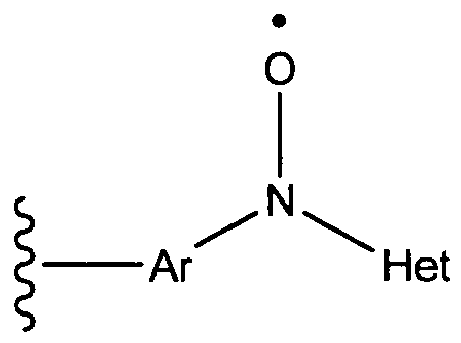
Qj:
Ar is independently in each instance substituted or unsubstituted aryl, and Het is independently in each instance substituted or unsubstituted heteroaryl; and
- The compound of claim 1 or 2, wherein
M is NR2; and
R2 is hydrogen;
or
if X is CO, a is 1 and M is NR2, R1 and R2 together form a bridging -CH2CHG- or -CH2CH2CHG- or -CH2CH(G)CH2- group with G = (CH2)o-E, wherein o is an integer of from 0 to 10 and E is: COOH, OH, NH2, N3, C≡CH or SSO2Me; or (CH2-CH2-O)m-CH3, wherein m is an integer of from 1 to 500;
and
Q1 and Q2 are independently selected from Qa to Qc as defined in claim 2. - The compound of any of claims 1 to 3, wherein
a is 1, when X is SO2, and 0 or 1, when X is CO;
M is NR2; and
R2 is hydrogen;
R1 is H; (CH2)o-E, wherein o is an integer of from 1 to 10 and E is COOH or (CH2-CH2-O)m-CH3, wherein m is an integer of from 1 to 500; or
or
if X is CO, a is 1 and M is NR2, R1 and R2 form together a bridging -CH2CH- or -CH2CH2CH- group;
and
Q1 and Q2 are independently selected from


- The compound of any of claims 2 to 5, wherein Q1 and Q2 are identical.
- The compound of claim 1, which is selected from

designated as "bPyTurea" or "PyPOL";
58: (15-{[(7-oxyl-3,11-dioxa-7-azadispiro[5.1.5.3]hexadec-15-yl)carbamoyl][2-(2,5,8,11-tetraoxatridecan-13-ylamino)}-[3,11-dioxa-7-azadispiro[5.1.5.3]hexadec-7-yl])oxidanyl, designated as "bPyTureaPEG4" or "AMUPOL";
designated as "bCTurea";
designated as "bCTureaPEG2";
55. (15-{[(7-oxyl-7-azadispiro[5.1.5.3]hexadec-15-yl)carbamoyl][2-(2-methoxyethoxy) ethyl]amino}-7-azadispiro[5.1.5.3]hexadec-7-yl)oxidanyl,
designated as "bCTureaPEG4";
designated as "bTureaPEG2";
52: (4-{(2,5,8,11-tetraoxatridecan-13-yl)[(1-oxyl-2,2,6,6-tetramethylpiperidin-4-yl)carbamoyl] amino}-2,2,6,6-tetramethylpiperidin-1-yl)oxidanyl,
designated as "bTureaPEG4";


designated as "bTureaPEG500", when n=500;
63: 1,3-bis(1-oxyl-2,2,6,6-tetramethylpiperidin-4-yl)tetrahydropyrimidin-2(1H)-one, designated as "bTureaC6";
designated as "bProxurea";
designated as "bTamide";
designated as "ProxTamide";
designated as "TProxamide"
and
- Use of a compound according to any of claims 1 to 6 as a Dynamic Nuclear Polarization (DNP) agent for polarizing NMR-active nuclear spins of an analyte in Nuclear Magnetic Resonance (NMR) spectroscopy.
- The use of claim 7, wherein the NMR spectroscopy is Solid State NMR (SS-NMR) spectroscopy.
- The use of claim 7, wherein the NMR spectroscopy is liquid state NMR spectroscopy.
- The use of claim 7, wherein the NMR spectroscopy is Magnetic Resonance Imaging (MRI).
- The use of claim 7, wherein the analyte is a solid inorganic, organic or metallo-organic material having an crystal lattice or an amorphous solid structure, a molecular chemical or biochemical compound including polymeric and macromolecular compounds, or a biological entity.
- The use of claim 11, wherein the molecular chemical or biochemical compound is an isolated inorganic, organic, metallo-organic or biochemical compound or an inorganic, organic or biochemical compound in its natural biological environment.
- The use of any of claims 7 to 12, wherein nuclei having an NMR-active spin are selected from 1H, 2H, 6Li, 7Li, 10B, 11B, 13C, 14N, 15N, 17O, 19F, 23Na, 25Mg, 27Al, 29Si, 31P, 33S 35Cl, 37Cl, 39K, 41K, 43Ca, 47Ti, 49Ti, 50V, 51V, 53Cr, 77Se, 89Y, 117Sn, 119Sn, and 199Hg.
- The use of claim 1, wherein the analyte is dissolved in an aqueous medium, an organic solvent or solvent mixture or an aqueous/organic solvent mixture.
- The use of any of claims 1 to 14, where the DNP agent is in a solid state, a liquid state or a dissolved liquid state during the polarization time.
- The use of claim 15, wherein the solid state is a frozen solution comprising a frozen solvent or solvent mixture containing the analyte and the DNP agent,
- The use of claim 15, wherein the DNP agent in the solid state is chemically bound to analyte or dispersed in the analyte without a solvent present.
- The use of any of claims 7 to 17, wherein the DNP agent concentration is from about 1 to about 200 mM.
- The use of any of claims 7, 8 and 11 to 18, wherein the temperature of a sample containing the analyte and the DNP agent is from about 1 to about 200 K during the polarization time.
- The use of any of claims 1 to 29, wherein a frequency of microwave irradiation is in the range of from about 5 to about 800 GHz.
- The use of any of claims 1 to 20, wherein either a static or a spinning sample experimental setup is used.
Priority Applications (5)
| Application Number | Priority Date | Filing Date | Title |
|---|---|---|---|
| EP13290082.0A EP2789609A1 (en) | 2013-04-11 | 2013-04-11 | Highly efficient polarizing agents for dynamic nuclear polarization |
| US14/783,134 US9738657B2 (en) | 2013-04-11 | 2014-04-11 | Highly efficient polarizing agents for dynamic nuclear polarization |
| PCT/EP2014/057439 WO2014167121A1 (en) | 2013-04-11 | 2014-04-11 | Highly efficient polarizing agents for dynamic nuclear polarization |
| EP14716608.6A EP2984084B1 (en) | 2013-04-11 | 2014-04-11 | Highly efficient polarizing agents for dynamic nuclear polarization |
| JP2016506998A JP6490052B2 (en) | 2013-04-11 | 2014-04-11 | Highly efficient polariser for dynamic nuclear polarization |
Applications Claiming Priority (1)
| Application Number | Priority Date | Filing Date | Title |
|---|---|---|---|
| EP13290082.0A EP2789609A1 (en) | 2013-04-11 | 2013-04-11 | Highly efficient polarizing agents for dynamic nuclear polarization |
Publications (1)
| Publication Number | Publication Date |
|---|---|
| EP2789609A1 true EP2789609A1 (en) | 2014-10-15 |
Family
ID=48366293
Family Applications (2)
| Application Number | Title | Priority Date | Filing Date |
|---|---|---|---|
| EP13290082.0A Withdrawn EP2789609A1 (en) | 2013-04-11 | 2013-04-11 | Highly efficient polarizing agents for dynamic nuclear polarization |
| EP14716608.6A Active EP2984084B1 (en) | 2013-04-11 | 2014-04-11 | Highly efficient polarizing agents for dynamic nuclear polarization |
Family Applications After (1)
| Application Number | Title | Priority Date | Filing Date |
|---|---|---|---|
| EP14716608.6A Active EP2984084B1 (en) | 2013-04-11 | 2014-04-11 | Highly efficient polarizing agents for dynamic nuclear polarization |
Country Status (4)
| Country | Link |
|---|---|
| US (1) | US9738657B2 (en) |
| EP (2) | EP2789609A1 (en) |
| JP (1) | JP6490052B2 (en) |
| WO (1) | WO2014167121A1 (en) |
Cited By (1)
| Publication number | Priority date | Publication date | Assignee | Title |
|---|---|---|---|---|
| EP3424921A1 (en) * | 2017-07-05 | 2019-01-09 | Commissariat à l'Energie Atomique et aux Energies Alternatives | Dinitroxide biradical compounds as polarizing agents |
Families Citing this family (3)
| Publication number | Priority date | Publication date | Assignee | Title |
|---|---|---|---|---|
| JP6757946B2 (en) * | 2016-12-12 | 2020-09-23 | 国立研究開発法人理化学研究所 | NMR measurement method and equipment |
| WO2019028473A1 (en) * | 2017-08-04 | 2019-02-07 | Ohio State Innovation Foundation | Radical compounds and methods of using thereof |
| WO2019082951A1 (en) * | 2017-10-26 | 2019-05-02 | 国立大学法人九州大学 | Composition, composition for dynamic nuclear polarization, high polarization method, highly polarized substance, and nmr measuring method |
Citations (2)
| Publication number | Priority date | Publication date | Assignee | Title |
|---|---|---|---|---|
| US7351402B2 (en) | 2003-08-21 | 2008-04-01 | Massachusetts Institute Of Technology | Polarizing agents for dynamic nuclear polarization |
| WO2008048714A2 (en) | 2006-05-12 | 2008-04-24 | Massachusetts Institute Of Technology | Biradical polarizing agents for dynamic nuclear polarization |
Family Cites Families (12)
| Publication number | Priority date | Publication date | Assignee | Title |
|---|---|---|---|---|
| JPS52100543A (en) * | 1976-02-18 | 1977-08-23 | Adeka Argus Chem Co Ltd | Stabilized synthetic resin compositions |
| US4123273A (en) * | 1977-07-11 | 1978-10-31 | Eastman Kodak Company | Stable free radical nitroxyl bleaching agents for photographic processes |
| DE2830032A1 (en) * | 1977-07-11 | 1979-02-01 | Eastman Kodak Co | USE OF NITROXYL RADICALS AS PHOTOGRAPHIC BLEACHING AGENTS |
| IT1277329B1 (en) | 1995-03-01 | 1997-11-10 | Ciba Geigy Spa | PROCEDURE FOR THE METHYLATION OF 2,2,6,6-TETRAMETHYL-4-PIPERIDONE (TRIACETONAMINE) |
| DE69727550T2 (en) * | 1996-10-25 | 2004-12-23 | The Yokohama Rubber Co., Ltd. | RUBBER COMPOSITION |
| DE19648811A1 (en) * | 1996-11-27 | 1998-05-28 | Basf Ag | Process for the polymerization of vinyl monomers |
| DE69710163T2 (en) * | 1996-12-02 | 2002-10-02 | Ondeo Nalco Energy Services, L.P. | Inhibition of the polymerization of vinyl aromatic monomers |
| JP4101242B2 (en) * | 2004-04-01 | 2008-06-18 | 横浜ゴム株式会社 | Polymer modification method |
| DE602007011607D1 (en) * | 2006-07-05 | 2011-02-10 | Basf Se | METHOD FOR THE PRODUCTION OF STERRICALLY PREVENTED NITROXYL ETHER |
| WO2009054455A1 (en) * | 2007-10-26 | 2009-04-30 | Kyusyu University | Hyperbranched polymer having nitroxyl group |
| FR2943676B1 (en) * | 2009-03-26 | 2017-03-24 | Univ De Provence | OPTIMIZED DINTIROXIDE BIRDICAL COMPOUNDS FOR NUCLEAR DYNAMIC POLARIZATION (PDN) |
| FR3004450B1 (en) * | 2013-04-15 | 2015-12-18 | Univ Aix Marseille | RIGID DINITROXIDE-LIKE BIRDICAL COMPOUNDS AS PERFECTED POLARIZATION AGENTS FOR NUCLEAR DYNAMIC POLARIZATION (PDN) TECHNIQUES |
-
2013
- 2013-04-11 EP EP13290082.0A patent/EP2789609A1/en not_active Withdrawn
-
2014
- 2014-04-11 US US14/783,134 patent/US9738657B2/en active Active
- 2014-04-11 JP JP2016506998A patent/JP6490052B2/en active Active
- 2014-04-11 WO PCT/EP2014/057439 patent/WO2014167121A1/en not_active Ceased
- 2014-04-11 EP EP14716608.6A patent/EP2984084B1/en active Active
Patent Citations (2)
| Publication number | Priority date | Publication date | Assignee | Title |
|---|---|---|---|---|
| US7351402B2 (en) | 2003-08-21 | 2008-04-01 | Massachusetts Institute Of Technology | Polarizing agents for dynamic nuclear polarization |
| WO2008048714A2 (en) | 2006-05-12 | 2008-04-24 | Massachusetts Institute Of Technology | Biradical polarizing agents for dynamic nuclear polarization |
Non-Patent Citations (25)
| Title |
|---|
| "Nitroxide Radicals and Nitroxide Based High-Spin Systems", 2005, SPRINGER VERLAG, article "Series: Landolt-Boernstein, Group 2, Subvolume D" |
| A. R. FORRESTER; J. M. HAY; R. H. THOMSON: "Organic Chemistry of Stable Free Radicals", 1968, ACADEMIC PRESS |
| C. SONG ET AL., J. AM. CHEM. SOC., vol. 128, no. 35, 2006, pages 11385 |
| CARRUTHERS: "Some Modern Methods of Organic Synthesis", 2004, CAMBRIDGE UNIVERSITY PRESS |
| DULOG, L. ET AL.: "Magnetic interaction in an amide containing two separate nitroxyl radicals", ADVANCED MATERIALS, vol. 4, no. 5, 1992, VCH, Weinheim; DE, pages 349 - 351, XP002711483, ISSN: 0935-9648, DOI: 10.1002/adma.19920040506 * |
| E. BREUER; H. G. AURICH; A. NIELSEN: "Nitrones, Nitronates, and Nitroxides", 1989, JOHN WILEY AND SONS |
| E. G. ROZANTSEV: "Free Nitroxyl Radicals", 1970, PLENUM PRES |
| E. G. ROZANTSEV; V. D. SHOLLE, SYNTHESIS, 1971, pages 190 - 202 |
| E. G. ROZANTSEV; V. D. SHOLLE, SYNTHESIS, 1971, pages 410 - 414 |
| E. G. ROZANTSEV; V. D. SHOLLE, SYNTHESIS, 1984, pages 895 - 916 |
| G. I. LIKHTENSHTEIN; J. YAMAUCHI; S. NAKATSUJI; A. I. SMIRNOV; R. TAMURA: "Nitroxides: Applications in Chemistry, Biomedicine, and Materials Science", 2008, WILEY-VCH VERLAG GMBH |
| H. KAROUI; F. LE MOIGNE; O. OUARI; P.TORDO: "Nitroxides Radicals : Properties, Synthesis, and Applications", 2010, WILEY VCH, article "Stable radicals: fundamentals and applied aspects of odd-electron compounds", pages: 174 - 229 |
| J. F. W. KEANA, CHEM. REV., vol. 78, 1978, pages 37 - 64 |
| K.H. HU; C. SONG; H. YU; T. SWAGER; R. GRIFFIN, J. CHEM. PHYS., vol. 128, 2008, pages 052302 |
| KEANA, CHEMICAL REVIEWS, vol. 78, 1978, pages 37 - 64 |
| L. B. VOLODARSKY: "Imidazoline Nitroxides", 1988, CRC PRESS INC. |
| L. B. VOLODARSKY; A. YA. TIKHONOV, SYNTHESIS, 1986, pages 704 - 715 |
| L. B. VOLODARSKY; V. A. REZNIKOV; V. I. OVCHARENKO: "Synthetic Chemistry of Stable Nitroxides", 1994, CRC PRESS INC. |
| LAROCK: "Comprehensive Organic Transformations", 1989, VCH PUBLISHERS, INC. |
| N. KOCHERGINSKY; H. M. SWARTZ: "Nitroxide Spin Labels: Reactions in Biology and Chemistry", 1995, CRC PRESS INC. |
| N. NAIK; R. BRASLAU, TETRAHEDRON, vol. 54, 1998, pages 667 - 696 |
| SMITH; MARCH: "March's Advanced Organic Chemistry", 2001, JOHN WILEY & SONS, INC. |
| THOMAS SORRELL: "Organic Chemistry", 1999, UNIVERSITY SCIENCE BOOKS |
| YOH MATSUKI ET AL: "Dynamic nuclear polarization with a rigid biradical", ANGEWANDTE CHEMIE. INTERNATIONAL EDITION, vol. 48, no. 27, 22 June 2009 (2009-06-22), WILEY VCH VERLAG, WEINHEIM; DE, pages 4996 - 5000, XP002665058, ISSN: 1433-7851, [retrieved on 20090602], DOI: 10.1002/ANIE.200805940 * |
| YSACCO, C. ET AL.: "Properties of dinitroxides for use in dynamic nuclear polarization (DNP)", PHYSICAL CHEMISTRY CHEMICAL PHYSICS, vol. 12, no. 22, 10 May 2010 (2010-05-10), RSC Publishing, London; GB, pages 5841 - 5845, XP002711482, ISSN: 1463-9076, DOI: 10.1039/c002591g * |
Cited By (3)
| Publication number | Priority date | Publication date | Assignee | Title |
|---|---|---|---|---|
| EP3424921A1 (en) * | 2017-07-05 | 2019-01-09 | Commissariat à l'Energie Atomique et aux Energies Alternatives | Dinitroxide biradical compounds as polarizing agents |
| WO2019007989A1 (en) * | 2017-07-05 | 2019-01-10 | Commissariat A L'energie Atomique Et Aux Energies Alternatives | Dinitroxide biradical compounds as polarizing agents |
| US11472790B2 (en) | 2017-07-05 | 2022-10-18 | Commissariat A L'energie Atomique Et Aux Energies Alternatives | Dinitroxide biradical compounds as polarizing agents |
Also Published As
| Publication number | Publication date |
|---|---|
| EP2984084B1 (en) | 2022-05-04 |
| JP6490052B2 (en) | 2019-03-27 |
| JP2016516094A (en) | 2016-06-02 |
| US20160046643A1 (en) | 2016-02-18 |
| EP2984084A1 (en) | 2016-02-17 |
| US9738657B2 (en) | 2017-08-22 |
| WO2014167121A1 (en) | 2014-10-16 |
Similar Documents
| Publication | Publication Date | Title |
|---|---|---|
| AU2020266956B2 (en) | Crystal form of Wee1 inhibitor compound and use thereof | |
| CN113121438B (en) | Preparation method of isoquinolinones compound | |
| JPWO2014017515A1 (en) | Crystalline polymorph of 4- [5- (pyridin-4-yl) -1H-1,2,4-triazol-3-yl] pyridine-2-carbonitrile and process for producing the same | |
| US9738657B2 (en) | Highly efficient polarizing agents for dynamic nuclear polarization | |
| EP4624474A1 (en) | Pharmaceutically acceptable salt of nitrogen-containing heterocyclic compound, crystal form thereof, and preparation method therefor | |
| BRPI0617654A2 (en) | compound or a pharmaceutically acceptable salt thereof, pharmaceutical composition, use of a compound or a pharmaceutically acceptable salt thereof, methods for producing an inhibitory effect of hdac and cell cycle (anti-cell proliferation) and for treating cancer in an animal and a process for preparing a compound or a pharmaceutically acceptable salt thereof | |
| Ali et al. | Synthesis of some new pyridine-2, 6-bis-heterocycles | |
| Hussain et al. | Ferrocene-based thiosemicarbazones: Solvent effect on thiol-thione tautomerism and conformational polymorphism | |
| Ziarati et al. | Pseudo five-component process for the synthesis of functionalized tricarboxamides using CuI nanoparticles as reusable catalyst | |
| Clarke et al. | Selective synthesis of asymmetrically substituted 5, 15-diphenylporphyrins | |
| US20230040736A1 (en) | Dinitroxide biradical compounds as polarizing agents | |
| Sengupta et al. | Pseudo five component reaction towards densely functionalized spiro [indole-3, 2′-pyrrole] by picric acid, an efficient syn-diastereoselective catalyst: insight into the diastereoselection on C (sp 3)–C (sp 3) axial conformation | |
| Huang et al. | Metal-free synthesis of fulleropyrrolidin-2-ols: a novel reaction of [60] fullerene with amines and 2, 2-disubstituted acetaldehydes | |
| Leung et al. | The stability of imine-containing dynamic [2] rotaxanes to hydrolysis | |
| CN109180583B (en) | Synthesis and application of naphthalimide derivative containing heterocyclic sulfone group and N-oxide | |
| EP2957559A1 (en) | Iminosydnone derivatives for conjugation and release of compounds of interest | |
| CN107698648B (en) | Cholesterol-containing naphthalimide derivatives and their synthesis and application | |
| Yuan et al. | Synthesis, Structure Analysis, and Antitumor Activity of (R)‐2, 4‐Dioxo‐5‐fluoro‐1‐[1‐(methoxycarbonyl) Ethylaminocarbonylmethyl]‐1, 2, 3, 4‐tetrahydropyrimidine | |
| Úr et al. | Palladium-and/or copper-catalyzed cross-coupling reactions of paramagnetic vinyl bromides and iodides | |
| CN106518865B (en) | A kind of preparation method of 1-alkenyl indolizine derivative | |
| US20170266648A1 (en) | Iron and cobalt catalyzed hydrogen isotope labeling of organic compounds | |
| CN104800227B (en) | A kind of application of O- benzoyl-(4- trifluoromethyl) salicylamide compound in preparation treatment lung-cancer medicament | |
| JP6392322B2 (en) | Rigid dinitroxide biradical compounds used as improved polarisers for dynamic nuclear polarization methods | |
| ES2719503B2 (en) | Perylene-3,4: 9,10-substituted tetracarboxyidiimides, preparation process and its use as modular fluorophores | |
| Peng et al. | Microwave‐assisted Synthesis of Pyrazolo [4, 3‐f] quinolin‐7‐one Derivatives via Multi‐component Reactions |
Legal Events
| Date | Code | Title | Description |
|---|---|---|---|
| PUAI | Public reference made under article 153(3) epc to a published international application that has entered the european phase |
Free format text: ORIGINAL CODE: 0009012 |
|
| 17P | Request for examination filed |
Effective date: 20130411 |
|
| AK | Designated contracting states |
Kind code of ref document: A1 Designated state(s): AL AT BE BG CH CY CZ DE DK EE ES FI FR GB GR HR HU IE IS IT LI LT LU LV MC MK MT NL NO PL PT RO RS SE SI SK SM TR |
|
| AX | Request for extension of the european patent |
Extension state: BA ME |
|
| STAA | Information on the status of an ep patent application or granted ep patent |
Free format text: STATUS: THE APPLICATION IS DEEMED TO BE WITHDRAWN |
|
| 18D | Application deemed to be withdrawn |
Effective date: 20150416 |