EP2789576A1 - Girth for saddles - Google Patents
Girth for saddles Download PDFInfo
- Publication number
- EP2789576A1 EP2789576A1 EP20130382129 EP13382129A EP2789576A1 EP 2789576 A1 EP2789576 A1 EP 2789576A1 EP 20130382129 EP20130382129 EP 20130382129 EP 13382129 A EP13382129 A EP 13382129A EP 2789576 A1 EP2789576 A1 EP 2789576A1
- Authority
- EP
- European Patent Office
- Prior art keywords
- piece
- saddle
- rings
- girth
- horse
- Prior art date
- Legal status (The legal status is an assumption and is not a legal conclusion. Google has not performed a legal analysis and makes no representation as to the accuracy of the status listed.)
- Granted
Links
Images


Classifications
-
- B—PERFORMING OPERATIONS; TRANSPORTING
- B68—SADDLERY; UPHOLSTERY
- B68C—SADDLES; STIRRUPS
- B68C1/00—Saddling equipment for riding- or pack-animals
- B68C1/14—Belts or straps for saddles; Tighteners therefor
Definitions
- This invention refers to a girth for saddles, which is based on two independent pieces, which can be fitted together, one that comes into contact with the horse and another with the elements necessary for buckling the girth to the corresponding saddle.
- the purpose of the invention is to achieve a girth that responds to the locomotion and breathing movements of the horse, safe in its function and multi-purpose in order to be able to adapt it to different measurements and different disciplines.
- the recommended girth has been conceived to solve the problem expressed above, based on some improvements that provide considerable advantages over the girths existing on the market.
- the invented girth is composed of two pieces, one in contact with the horse and the other for buckling to the corresponding saddle, and presents the particularity of both pieces being practically identical, although the piece to be buckled to the saddle is shorter, since it is supported on the piece in contact with the horse, with both being symmetrical, with respect to their longitudinal axis as well as their transverse axis, with the particularity that the piece in contact with the horse presenting a central leather keeper and two pairs of lateral leather keepers, the first for the passing of a fastening strip to the piece that buckles to the saddle, and the second ones for the passing of the adjustment belts and buckle holders.
- Another novel characteristic is that the two pieces present two pairs of cuts, one straight and another arched, in order to aid the expansion and adaptation to the horse's ribcage, since the girth does not expand equally in the front and in the back, taking into account that the ribcage of the horses (as with the majority of the vertebrates) is closed in the front (or upper part in the bipeds) and open in the back (or lower part in bipeds).
- Both front and back cuts have been rounded on the ends in order to enhance the design without substantially breaking the symmetry described above.
- the piece used for buckling to the saddle being, as mentioned above, of the same configuration although of lesser length, presents as a difference the fact that all the pieces, except the adjustable belts and buckles, are fixed inseparably and strategically with respect to such piece, which allows better breathing, adaptation, safety and comfort of the horse, as well as directing this force towards the buckles that fasten the girth to the saddle.
- This buckling piece in addition to some ventilation holes and the cuts to favour the adaptation to the horse's ribcage, presents a small notch in the front part and logically in the centre, which serves for placing a D-ring for the corresponding martingale, so that this notch fulfils two functions; on the one hand it allows identifying which is the front position of the girth, and on the other hand, the place to set the D-ring, through a strip sewn to the piece.
- the strip that buckles the D-ring mentioned above is a belt that extends towards the opposite edge, and through a screw establishes the fastening of this piece to the piece in contact with the horse, so that this fastening together of both pieces is done coinciding the cuts, as well as the ventilation holes, with the particularity that this strip is the one that passes through the central leather keeper on the piece in contact with the horse.
- the aforementioned fastening screw allows the separation of both pieces for their independent cleaning, since because of the material in which they are made, they will require different maintenance.
- This fastening is reinforced by Velcro® which avoids the waving or arching of the upper leather piece, which through its use and the passing of time can have this tendency, with the possibility of placing a rigid element in the lower part of the leather and between the trapezoidal rings that will be described later.
- buckles to the saddle four pairs of rings have been provided with a right trapezoid shape, two interior pairs and two exterior, so that the two interior pairs are fixed and are sewn, using the corresponding strips, to the piece itself, while the two exterior pairs are related to the previous ones and provided on the ends of elastic straps, to which in turn are attached the corresponding adjustment belts to which the buckles are linked, with the special particularity being that the double-pass buckles have a safety screw, all of this in such a way so as to adapt the strap to different measurements, so that it is easy to tighten the screw in order to set the measurement securely.
- the rings shall have a right trapezoidal shape and are placed inversely, the interior ones with respect to the exterior ones, with the special particularity that the elastic straps that join the interior right trapezoidal rings with the exterior right trapezoidal rings are complemented by some nylon strips that, on the one hand, establish a means to limit the maximum extension of these elastic straps, and, on the other hand, comprise a safety element in case of breakage.
- the invented girth consists of two pieces (1) and (2), of equal configuration, although piece (2) is shorter than piece (1), with the latter being the one that is used to come into contact with the horse, while piece (2) is the one used to carry the elements used for buckling and adjustment of the girth with respect to the saddle.
- Piece (1) presents a central and main leather keeper (3) for the passing of a strip, which will be explained later, which constitutes a means of connection between this piece (1) in contact with the horse and piece (2) for fastening to the saddle.
- Both pieces (1) and (2) are reinforced with strips of Velcro® to provide greater rigidity to the area that rest on the horse's sternum.
- this piece (1) includes some end or lateral leather keepers (4) for the passing of the adjusting belts of the girth, as will be explained later.
- Both piece (1) and piece (2) are symmetrical with respect to their longitudinal axis and with respect to their transverse axis, and in both cases there are holes (5) that make the perspiration possible and therefore the ventilation through the piece that will be placed in contact with the horse.
- Both pieces (1, 2) have a pair of straight cuts (6) and a pair of arched cuts (7), being oblique in both cases and made in such a way as to coincide in both pieces when they are fastened together.
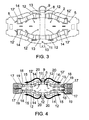
- Piece (2) presents a notch (8) for a D-ring (9) that is held by a strip (10) which is the one that passes through the leather keepers (3) of the piece (1), in order to fasten both pieces (1, 2), fastening that is done by means of a screw (11) that is clearly seen in Figure 3 .
- the corresponding adjustment straps (15) pass through the exterior rings (12'), in turn passing through the leather keepers (4) of the piece (1) in contact with the horse.
- the elastic straps (14) Through the interior of the elastic straps (14) are some nylon strips (16) that carry out two functions; on the one hand they constitute a means to limit the maximum extension of the elastic straps (14) and on the other hand they constitute a means of safety that keeps the rings (12, 12') joined together in case of breakage of the elastic straps (14).
- the right trapezoidal rings (12, 12') are placed in a specific and determined way, keeping the rings (12) is a straight position, while the exterior rings (12') are rotated 180°, that is, placed inversely to the rings (12), all of this for the purpose of the adjustment straps (15) are oriented appropriately, that is, longitudinally, in relation to the buckles (17) by means of some elements (18) made up of double-pass buckles with security screw (19), through which pass the aforementioned adjustment straps (15).
- Figure 4 shows thick arrows (20) that indicate how the horse is capable of pushing the girth according to its pulmonary needs
Landscapes
- Engineering & Computer Science (AREA)
- Mechanical Engineering (AREA)
- Buckles (AREA)
- Air Bags (AREA)
- Orthopedics, Nursing, And Contraception (AREA)
- Treatment And Processing Of Natural Fur Or Leather (AREA)
Abstract
Description
- This invention refers to a girth for saddles, which is based on two independent pieces, which can be fitted together, one that comes into contact with the horse and another with the elements necessary for buckling the girth to the corresponding saddle.
- The purpose of the invention is to achieve a girth that responds to the locomotion and breathing movements of the horse, safe in its function and multi-purpose in order to be able to adapt it to different measurements and different disciplines.
- As it is known, the conventional girths used to set a saddle used in riding and in all its disciplines, are formed by a single body, making the disassembly impossible and therefore allowing the independent cleaning of each of the parts.
- Another drawback that conventional girths present is that they are usually rigid, and therefore do not adapt to the horse's breathing and movements.
- However, one girth is known with several innovations comparing the conventional girths, with the following particularities:
- It is a girth in which the complete disassembly of the pieces is intended to be established and it is not symmetrical in its overall configuration.
- In addition, the union between the part that buckles to the saddle and the part in contact with the horse is done with Velcro®-type elements.
- It also presents the drawback that in case of the breaking of the elastic elements that participate in the girth, although this is be improbable, it would lead to a risk of falling for the rider, with the additional particularity of the elastic elements being a cord wound two or three times and connected to the centre with a clamp.
- The change of measurement for this girth is complicated for the inexpert user.
- The expansion of the horse's ribcage during inhalation is not directed since it does not have trapezoidal rings.
- The recommended girth has been conceived to solve the problem expressed above, based on some improvements that provide considerable advantages over the girths existing on the market.
- More specifically, the invented girth is composed of two pieces, one in contact with the horse and the other for buckling to the corresponding saddle, and presents the particularity of both pieces being practically identical, although the piece to be buckled to the saddle is shorter, since it is supported on the piece in contact with the horse, with both being symmetrical, with respect to their longitudinal axis as well as their transverse axis, with the particularity that the piece in contact with the horse presenting a central leather keeper and two pairs of lateral leather keepers, the first for the passing of a fastening strip to the piece that buckles to the saddle, and the second ones for the passing of the adjustment belts and buckle holders.
- Another novel characteristic is that the two pieces present two pairs of cuts, one straight and another arched, in order to aid the expansion and adaptation to the horse's ribcage, since the girth does not expand equally in the front and in the back, taking into account that the ribcage of the horses (as with the majority of the vertebrates) is closed in the front (or upper part in the bipeds) and open in the back (or lower part in bipeds). Both front and back cuts have been rounded on the ends in order to enhance the design without substantially breaking the symmetry described above.
- In turn, the piece used for buckling to the saddle, being, as mentioned above, of the same configuration although of lesser length, presents as a difference the fact that all the pieces, except the adjustable belts and buckles, are fixed inseparably and strategically with respect to such piece, which allows better breathing, adaptation, safety and comfort of the horse, as well as directing this force towards the buckles that fasten the girth to the saddle.
- This buckling piece, in addition to some ventilation holes and the cuts to favour the adaptation to the horse's ribcage, presents a small notch in the front part and logically in the centre, which serves for placing a D-ring for the corresponding martingale, so that this notch fulfils two functions; on the one hand it allows identifying which is the front position of the girth, and on the other hand, the place to set the D-ring, through a strip sewn to the piece.
- Another novel characteristic is that the strip that buckles the D-ring mentioned above, is a belt that extends towards the opposite edge, and through a screw establishes the fastening of this piece to the piece in contact with the horse, so that this fastening together of both pieces is done coinciding the cuts, as well as the ventilation holes, with the particularity that this strip is the one that passes through the central leather keeper on the piece in contact with the horse. The aforementioned fastening screw allows the separation of both pieces for their independent cleaning, since because of the material in which they are made, they will require different maintenance. This fastening is reinforced by Velcro® which avoids the waving or arching of the upper leather piece, which through its use and the passing of time can have this tendency, with the possibility of placing a rigid element in the lower part of the leather and between the trapezoidal rings that will be described later.
- Another novel characteristic is that on the commented piece that buckles to the saddle four pairs of rings have been provided with a right trapezoid shape, two interior pairs and two exterior, so that the two interior pairs are fixed and are sewn, using the corresponding strips, to the piece itself, while the two exterior pairs are related to the previous ones and provided on the ends of elastic straps, to which in turn are attached the corresponding adjustment belts to which the buckles are linked, with the special particularity being that the double-pass buckles have a safety screw, all of this in such a way so as to adapt the strap to different measurements, so that it is easy to tighten the screw in order to set the measurement securely.
- Furthermore, and returning to the rings, they shall have a right trapezoidal shape and are placed inversely, the interior ones with respect to the exterior ones, with the special particularity that the elastic straps that join the interior right trapezoidal rings with the exterior right trapezoidal rings are complemented by some nylon strips that, on the one hand, establish a means to limit the maximum extension of these elastic straps, and, on the other hand, comprise a safety element in case of breakage.
- In this way, a girth is achieved that presents the following advantages with respect to those referred to in the "Background of the Invention" section:
- Minimum number of separable pieces, since in this girth there are only the two principal pieces, one in contact with the horse and the other for buckling, with only the adjusting straps with the buckles being separable, while the rest of the elements are fixed to the piece considered as the buckling element.
- By means of the invented girth, the expansion that the horse makes in breathing and locomotion is redirected longitudinally towards the buckles that fasten the saddle.
- The pieces are symmetrical, that is, the one that is in contact with the horse and the one that is the carrier of the fastening elements, which favours their manufacturing and adaptation.
- The fact should be highlighted that the union of the piece that comes in contact with the horse with the piece provided with the buckling elements is done safely by means of leather keepers and they are also reinforced with Velcro®.
- Similarly and due to the fact that the nylon strips are located inside of the elastic straps that join the interior trapezoidal rings to the exterior rings, it is achieved that in case of breakage of any elastic strap, something that is quite improbable, there is no risk of the rider falling, since the girth will remain joined by means of these nylon strips that are found located inside of the elastic straps.
- The fact should also be stressed that the separation between the trapezoidal rings and the elastic straps are a result of tracing a perpendicular line with the trapezoids (with 70° orientation), until reaching the same longitudinal plane as the buckles that fasten to the saddle, and therefore, the elastic straps from the start of their expansion, redirecting outwards the force or stress of the horse's inhaling, allowing the ribcage to expand freely according to the horse's needs.
- Furthermore, the fact should be underscored that the elastic straps that participate in the invented girth are flat, allowing a better redirection of the force exercised by the horse through the right trapezoidal rings, contrary to what occurs in any other girth.
- The fact should also be highlighted that the materials used in the protector that is in contact with the horse are breathable, allowing better evaporation of the horse's perspiration towards the exterior through it, considering that by being able to separate this piece as many times as you want, it provides a level of cleaning and hygiene difficult to achieve with any other girths. In addition, the wool parts of the girth can be disassembled and remain separate from the leather and other materials, for their independent washing, either by hand or by machine.
- Finally, it should be stated that due to the strategic placement of the fixed parts of the buckling piece to the saddle, the breathing, adaptation, safety and comfort of the horse is favoured, obtaining its better performance and improving its inhalation capacity as well as the freedom of movement in any of the equestrian gaits, since the girth adapts completely to the changing contour of the horse, without offering reslstance, thanks to the strategic cuts made in the pieces, and in the elastic straps that join the trapezoid rings.
- In order to complement the description that follows and for the purpose of helping to understand better the characteristics of the invention, in accordance with the preferred example of its practical realization, a set of drawings is attached as an integral part of this description, where it shows as an example but not limited to the following:
-
Figure 1 . Shows a plan view of the piece that participates in the invented girth, and that corresponds to the piece in contact with the horse. -
Figure 2 . Shows the other pieces that also participates in the girth, and which corresponds to the carrier of the elements or parts through which the girth set is adjusted and buckled to the saddle. -
Figure 3 . Shows a plan view of the piece represented in the above figure, with the right trapezoidal rings and the unmoveable fastening straps of the pairs of interior rings and the elastic support straps on the free ends of the pairs of right trapezoidal rings. -
Figure 4 . Shows a plan view of the set represented in the above figure, incorporating the adjusting straps and fastening buckles, also showing some thick arrows illustrating the thrust that the horse exercises on the girth, according to its breathing needs. -
Figure 5 . Shows a plan view of a ring in the shape of a right trapezoid. -
Figure 6 . Shows an elevation view and a plan view of the elements for the adjustable fastening of the buckles of the invented girth. -
Figure 7 . Shows the schematic details of the elastic straps that participate together in the union of the interior right trapezoidal rings with the exterior ones, and the interior nylon strip, in resting position and in extending position, respectively. - As can be seen in the abovementioned figures, the invented girth consists of two pieces (1) and (2), of equal configuration, although piece (2) is shorter than piece (1), with the latter being the one that is used to come into contact with the horse, while piece (2) is the one used to carry the elements used for buckling and adjustment of the girth with respect to the saddle.
- Piece (1) presents a central and main leather keeper (3) for the passing of a strip, which will be explained later, which constitutes a means of connection between this piece (1) in contact with the horse and piece (2) for fastening to the saddle. Both pieces (1) and (2) are reinforced with strips of Velcro® to provide greater rigidity to the area that rest on the horse's sternum.
- Furthermore, this piece (1) includes some end or lateral leather keepers (4) for the passing of the adjusting belts of the girth, as will be explained later.
- Both piece (1) and piece (2) are symmetrical with respect to their longitudinal axis and with respect to their transverse axis, and in both cases there are holes (5) that make the perspiration possible and therefore the ventilation through the piece that will be placed in contact with the horse.
- Both pieces (1, 2) have a pair of straight cuts (6) and a pair of arched cuts (7), being oblique in both cases and made in such a way as to coincide in both pieces when they are fastened together.
- Piece (2) presents a notch (8) for a D-ring (9) that is held by a strip (10) which is the one that passes through the leather keepers (3) of the piece (1), in order to fasten both pieces (1, 2), fastening that is done by means of a screw (11) that is clearly seen in
Figure 3 . - On this piece (2), in addition to the D-ring (9) with the strip (10) commented previously, are fastened several elements through which the bucking of the girth to the saddle is carried out, among which elements can be highlighted two pairs of rings (12, 12'), in the shape of right trapezoids, so that the pairs (12) are fixed to the piece (2) by strips (13), with these rings (12) remaining fixed, while the pairs of rings (12') in the shape of right trapezoids are left free to be mounted on the free ends of the respective elastic straps (14) that join the interior rings (12) and the exterior rings (12'), as is seen clearly in
Figure 3 . - The corresponding adjustment straps (15) pass through the exterior rings (12'), in turn passing through the leather keepers (4) of the piece (1) in contact with the horse.
- Through the interior of the elastic straps (14) are some nylon strips (16) that carry out two functions; on the one hand they constitute a means to limit the maximum extension of the elastic straps (14) and on the other hand they constitute a means of safety that keeps the rings (12, 12') joined together in case of breakage of the elastic straps (14).
- As can be seen in
Figures 3 and 4 , the right trapezoidal rings (12, 12') are placed in a specific and determined way, keeping the rings (12) is a straight position, while the exterior rings (12') are rotated 180°, that is, placed inversely to the rings (12), all of this for the purpose of the adjustment straps (15) are oriented appropriately, that is, longitudinally, in relation to the buckles (17) by means of some elements (18) made up of double-pass buckles with security screw (19), through which pass the aforementioned adjustment straps (15). -
Figure 4 shows thick arrows (20) that indicate how the horse is capable of pushing the girth according to its pulmonary needs - Returning to the right trapezoidal rings (12, 12'), they are the ones in charge, due to their orientation and position, of collecting and directing the inhaling force of the horse towards the buckles and thus achieving a balance between the horse's inhalation and the fastening of the saddle.
Claims (9)
- Girth to set a saddle, which consists of two superimposed pieces (1) and (2) that can be fastened together by means of leather keepers sewn to the piece (2), with one of them planned to be in contact with the horse, while the other plece is provided with strips, straps and buckles, in order to be buckled to the corresponding saddle, characterized by both piece (1) in contact with the horse and piece (2) to buckle to the saddle are symmetrical with regard to their longitudinal and transverse axes, with both pieces (1, 2) provided with two pairs of oblique cuts (6, 7) to favour the expansion of the horse's ribcage; having planned that piece (2) to buckle to the saddle has four pairs of rings (12, 12') in right trapezoidal shape, with the two pairs of rings (12) placed towards the centre and fastened by means of strips (13) sewn to the piece (2), while the other two pairs of rings (12') are positioned towards the exterior and placed on the free ends of the respective elastic straps (14) that relate the pairs of rings (12) towards the centre with the pairs of exterior rings (12'), and have in their interior nylon strips (16) constituting the maximum extension limits of the elastic straps (14) and safety elements in case of breakage of these elastic straps (14).
- Girth to set a saddle, according to claim 1, characterised by the different parts or components assembled on piece (2) which buckles to the saddle, except for those corresponding to the adjustment straps (15) and fastening buckles (17), being inseparably attached to this piece (2) which buckles to the saddle.
- Girth to set a saddle, according to the previous claims, characterised by the external rings (12') in right trapezoidal shape, being placed inversely to that presented by the rights towards the centre (12) in right trapezoidal shape, and with a separation between rings (12, 12') and measurement of the elastic straps (14) that join them, which result from tracing the perpendicularity of the respective right trapezoidal rings, until reaching the same longitudinal plane of the buckles (17) that fasten the saddle, and, therefore, the elastic straps (14) from the start of their expansion, redirecting the force or stress of the horse's breathing outwards and allowing its ribcage to expand according to its needs.
- Girth to set a saddle, according to the previous claims, characterised by piece (1) in contact with the horse including a central leather keeper (3) open crosswise for passing the nylon strip (10) envisaged in piece (2), with this nylon strip (10) connecting these pieces (1, 2), with the participation of a tightening screw (11); with the particularity of the fastening strip (10) being attached at its ends and by means of a fixed strip (13) to piece (2), being the carrier in this end of said strip (10) of a D-ring (9) for buckling the corresponding martingale, with this D-ring (9) located in a notch (8) provided on the edge corresponding to the piece (2) which buckles to the saddle, having provided in both pieces (1) and (2), corresponding to the central leather keeper (3) and the fastening strip (10), some Velcro®-type reinforcement strips, allowing the holding of a rigid piece to keep the material or leather from becoming wavy with use and over time.
- Girth to set a saddle, according to the previous claims, characterised by the piece (1) in contact with the horse includes some lateral leather keepers (4) for the passing of the adjustment straps (15) carriers of the fastening buckles (17).
- Girth to set a saddle, according to the previous claims, characterised by the nylon strips (16) provided in the interior of the elastic straps (14) that join the central rings (12) with the exterior rings (12') in trapezoid shape, being fixed on their ends between these central rings (12) with the exterior rings (12') in trapezoid shape, being fixed on their ends between the central rings (12) and the exterior rings (12').
- Girth to set a saddle, according to the previous claims, characterised by the elastic straps (14) that join the rings (12, 12') being flat.
- Girth to set a saddle, according to the previous claims, characterised by piece (1) in contact with the horse as well as piece (2) carrier of the buckling elements to the corresponding saddle, having holes or perforations (5) to favour the perspiration of the horse.
- Girth to set a saddle, according to the previous claims, characterised by the adjustment straps (15) being joined to the corresponding fastening buckles (17) by means of double-pass elements (18) through which these adjustment straps (15) pass, being able to be fixed in the final position by means of screws (19).
Priority Applications (3)
| Application Number | Priority Date | Filing Date | Title |
|---|---|---|---|
| EP13382129.8A EP2789576B1 (en) | 2013-04-10 | 2013-04-10 | Girth for saddles |
| DK13382129.8T DK2789576T3 (en) | 2013-04-10 | 2013-04-10 | webbing |
| ES13382129.8T ES2528227T3 (en) | 2013-04-10 | 2013-04-10 | Saddle fixing strap |
Applications Claiming Priority (1)
| Application Number | Priority Date | Filing Date | Title |
|---|---|---|---|
| EP13382129.8A EP2789576B1 (en) | 2013-04-10 | 2013-04-10 | Girth for saddles |
Publications (2)
| Publication Number | Publication Date |
|---|---|
| EP2789576A1 true EP2789576A1 (en) | 2014-10-15 |
| EP2789576B1 EP2789576B1 (en) | 2018-01-10 |
Family
ID=48236830
Family Applications (1)
| Application Number | Title | Priority Date | Filing Date |
|---|---|---|---|
| EP13382129.8A Active EP2789576B1 (en) | 2013-04-10 | 2013-04-10 | Girth for saddles |
Country Status (3)
| Country | Link |
|---|---|
| EP (1) | EP2789576B1 (en) |
| DK (1) | DK2789576T3 (en) |
| ES (1) | ES2528227T3 (en) |
Cited By (2)
| Publication number | Priority date | Publication date | Assignee | Title |
|---|---|---|---|---|
| WO2016185058A1 (en) * | 2015-05-21 | 2016-11-24 | Gustavo Sugliano Olivera | Integral system for combined girthing for riding saddles |
| US20210188618A1 (en) * | 2019-12-23 | 2021-06-24 | Tina SCHAEFER | Saddle girth for equestrian sport |
Citations (2)
| Publication number | Priority date | Publication date | Assignee | Title |
|---|---|---|---|---|
| US20040168414A1 (en) * | 2003-02-27 | 2004-09-02 | Siddoway Brett L. | Cinch |
| EP2361876A1 (en) | 2008-11-25 | 2011-08-31 | Constantino Sanchez Martinez | Girth for horse saddles |
-
2013
- 2013-04-10 ES ES13382129.8T patent/ES2528227T3/en active Active
- 2013-04-10 DK DK13382129.8T patent/DK2789576T3/en active
- 2013-04-10 EP EP13382129.8A patent/EP2789576B1/en active Active
Patent Citations (2)
| Publication number | Priority date | Publication date | Assignee | Title |
|---|---|---|---|---|
| US20040168414A1 (en) * | 2003-02-27 | 2004-09-02 | Siddoway Brett L. | Cinch |
| EP2361876A1 (en) | 2008-11-25 | 2011-08-31 | Constantino Sanchez Martinez | Girth for horse saddles |
Cited By (3)
| Publication number | Priority date | Publication date | Assignee | Title |
|---|---|---|---|---|
| WO2016185058A1 (en) * | 2015-05-21 | 2016-11-24 | Gustavo Sugliano Olivera | Integral system for combined girthing for riding saddles |
| US20210188618A1 (en) * | 2019-12-23 | 2021-06-24 | Tina SCHAEFER | Saddle girth for equestrian sport |
| US11873211B2 (en) * | 2019-12-23 | 2024-01-16 | Tina SCHAEFER | Saddle girth for equestrian sport |
Also Published As
| Publication number | Publication date |
|---|---|
| EP2789576B1 (en) | 2018-01-10 |
| ES2528227T3 (en) | 2018-04-24 |
| DK2789576T3 (en) | 2018-04-23 |
| ES2528227T1 (en) | 2015-02-05 |
Similar Documents
| Publication | Publication Date | Title |
|---|---|---|
| US3312040A (en) | Lightweight versatile saddle | |
| US11583752B2 (en) | Harness with single-pull adjustment | |
| US20100269764A1 (en) | Collar and leash assembly | |
| US20130205725A1 (en) | Saddle girth | |
| CN101652088A (en) | Carrying harness for children | |
| US10932894B2 (en) | Animal back brace | |
| EP2789576B1 (en) | Girth for saddles | |
| US8226588B2 (en) | Stabilizing belt | |
| US7340874B2 (en) | Horse halter | |
| US9216896B1 (en) | Animal halter | |
| US20140190423A1 (en) | Horse muzzle and methods of use | |
| US7228678B2 (en) | Equestarian tattletale rider hand training device | |
| US4164834A (en) | Junior stirrups attachment for adult-size saddle | |
| US20130199136A1 (en) | Stabilizing system for a saddle | |
| US9502015B1 (en) | Guitar waist belt | |
| KR200492559Y1 (en) | Leash for pets | |
| US8261519B2 (en) | Stabilizing system for a saddle | |
| US20160115012A1 (en) | Mounting assist device and method | |
| US20220192154A1 (en) | Animal fitness garment | |
| US20110203232A1 (en) | Girth for horse saddles | |
| EP2982642B1 (en) | Girth for horses | |
| US20240390759A1 (en) | Equestrian rider training harness | |
| US9474314B2 (en) | Stabilizing belt | |
| DE202012009870U1 (en) | Harness with combined neck / chest strap / waist belt | |
| US20230121622A1 (en) | Saddle carrying and holding apparatus |
Legal Events
| Date | Code | Title | Description |
|---|---|---|---|
| PUAI | Public reference made under article 153(3) epc to a published international application that has entered the european phase |
Free format text: ORIGINAL CODE: 0009012 |
|
| 17P | Request for examination filed |
Effective date: 20130410 |
|
| AK | Designated contracting states |
Kind code of ref document: A1 Designated state(s): AL AT BE BG CH CY CZ DE DK EE ES FI FR GB GR HR HU IE IS IT LI LT LU LV MC MK MT NL NO PL PT RO RS SE SI SK SM TR |
|
| AX | Request for extension of the european patent |
Extension state: BA ME |
|
| TPAC | Observations filed by third parties |
Free format text: ORIGINAL CODE: EPIDOSNTIPA |
|
| R17P | Request for examination filed (corrected) |
Effective date: 20150116 |
|
| RBV | Designated contracting states (corrected) |
Designated state(s): AL AT BE BG CH CY CZ DE DK EE ES FI FR GB GR HR HU IE IS IT LI LT LU LV MC MK MT NL NO PL PT RO RS SE SI SK SM TR |
|
| GRAP | Despatch of communication of intention to grant a patent |
Free format text: ORIGINAL CODE: EPIDOSNIGR1 |
|
| STAA | Information on the status of an ep patent application or granted ep patent |
Free format text: STATUS: GRANT OF PATENT IS INTENDED |
|
| INTG | Intention to grant announced |
Effective date: 20170802 |
|
| GRAS | Grant fee paid |
Free format text: ORIGINAL CODE: EPIDOSNIGR3 |
|
| GRAA | (expected) grant |
Free format text: ORIGINAL CODE: 0009210 |
|
| STAA | Information on the status of an ep patent application or granted ep patent |
Free format text: STATUS: THE PATENT HAS BEEN GRANTED |
|
| AK | Designated contracting states |
Kind code of ref document: B1 Designated state(s): AL AT BE BG CH CY CZ DE DK EE ES FI FR GB GR HR HU IE IS IT LI LT LU LV MC MK MT NL NO PL PT RO RS SE SI SK SM TR |
|
| REG | Reference to a national code |
Ref country code: CH Ref legal event code: EP Ref country code: AT Ref legal event code: REF Ref document number: 962163 Country of ref document: AT Kind code of ref document: T Effective date: 20180115 |
|
| REG | Reference to a national code |
Ref country code: IE Ref legal event code: FG4D |
|
| REG | Reference to a national code |
Ref country code: DE Ref legal event code: R096 Ref document number: 602013031896 Country of ref document: DE |
|
| REG | Reference to a national code |
Ref country code: DE Ref legal event code: R026 Ref document number: 602013031896 Country of ref document: DE |
|
| PLBI | Opposition filed |
Free format text: ORIGINAL CODE: 0009260 |
|
| REG | Reference to a national code |
Ref country code: DK Ref legal event code: T3 Effective date: 20180418 |
|
| REG | Reference to a national code |
Ref country code: ES Ref legal event code: FG2A Ref document number: 2528227 Country of ref document: ES Kind code of ref document: T3 Effective date: 20180424 |
|
| 26 | Opposition filed |
Opponent name: SANCHEZ MARTINEZ, CONSTANTINO SUGLIANO OLIVERA, GU Effective date: 20180316 |
|
| REG | Reference to a national code |
Ref country code: NL Ref legal event code: MP Effective date: 20180110 |
|
| REG | Reference to a national code |
Ref country code: AT Ref legal event code: MK05 Ref document number: 962163 Country of ref document: AT Kind code of ref document: T Effective date: 20180110 |
|
| PG25 | Lapsed in a contracting state [announced via postgrant information from national office to epo] |
Ref country code: NL Free format text: LAPSE BECAUSE OF FAILURE TO SUBMIT A TRANSLATION OF THE DESCRIPTION OR TO PAY THE FEE WITHIN THE PRESCRIBED TIME-LIMIT Effective date: 20180110 |
|
| PG25 | Lapsed in a contracting state [announced via postgrant information from national office to epo] |
Ref country code: NO Free format text: LAPSE BECAUSE OF FAILURE TO SUBMIT A TRANSLATION OF THE DESCRIPTION OR TO PAY THE FEE WITHIN THE PRESCRIBED TIME-LIMIT Effective date: 20180410 Ref country code: HR Free format text: LAPSE BECAUSE OF FAILURE TO SUBMIT A TRANSLATION OF THE DESCRIPTION OR TO PAY THE FEE WITHIN THE PRESCRIBED TIME-LIMIT Effective date: 20180110 Ref country code: CY Free format text: LAPSE BECAUSE OF FAILURE TO SUBMIT A TRANSLATION OF THE DESCRIPTION OR TO PAY THE FEE WITHIN THE PRESCRIBED TIME-LIMIT Effective date: 20180110 Ref country code: FI Free format text: LAPSE BECAUSE OF FAILURE TO SUBMIT A TRANSLATION OF THE DESCRIPTION OR TO PAY THE FEE WITHIN THE PRESCRIBED TIME-LIMIT Effective date: 20180110 Ref country code: LT Free format text: LAPSE BECAUSE OF FAILURE TO SUBMIT A TRANSLATION OF THE DESCRIPTION OR TO PAY THE FEE WITHIN THE PRESCRIBED TIME-LIMIT Effective date: 20180110 |
|
| PG25 | Lapsed in a contracting state [announced via postgrant information from national office to epo] |
Ref country code: IS Free format text: LAPSE BECAUSE OF FAILURE TO SUBMIT A TRANSLATION OF THE DESCRIPTION OR TO PAY THE FEE WITHIN THE PRESCRIBED TIME-LIMIT Effective date: 20180510 Ref country code: BG Free format text: LAPSE BECAUSE OF FAILURE TO SUBMIT A TRANSLATION OF THE DESCRIPTION OR TO PAY THE FEE WITHIN THE PRESCRIBED TIME-LIMIT Effective date: 20180410 Ref country code: GR Free format text: LAPSE BECAUSE OF FAILURE TO SUBMIT A TRANSLATION OF THE DESCRIPTION OR TO PAY THE FEE WITHIN THE PRESCRIBED TIME-LIMIT Effective date: 20180411 Ref country code: LV Free format text: LAPSE BECAUSE OF FAILURE TO SUBMIT A TRANSLATION OF THE DESCRIPTION OR TO PAY THE FEE WITHIN THE PRESCRIBED TIME-LIMIT Effective date: 20180110 Ref country code: RS Free format text: LAPSE BECAUSE OF FAILURE TO SUBMIT A TRANSLATION OF THE DESCRIPTION OR TO PAY THE FEE WITHIN THE PRESCRIBED TIME-LIMIT Effective date: 20180110 Ref country code: AT Free format text: LAPSE BECAUSE OF FAILURE TO SUBMIT A TRANSLATION OF THE DESCRIPTION OR TO PAY THE FEE WITHIN THE PRESCRIBED TIME-LIMIT Effective date: 20180110 Ref country code: PL Free format text: LAPSE BECAUSE OF FAILURE TO SUBMIT A TRANSLATION OF THE DESCRIPTION OR TO PAY THE FEE WITHIN THE PRESCRIBED TIME-LIMIT Effective date: 20180110 Ref country code: SE Free format text: LAPSE BECAUSE OF FAILURE TO SUBMIT A TRANSLATION OF THE DESCRIPTION OR TO PAY THE FEE WITHIN THE PRESCRIBED TIME-LIMIT Effective date: 20180110 |
|
| PLAX | Notice of opposition and request to file observation + time limit sent |
Free format text: ORIGINAL CODE: EPIDOSNOBS2 |
|
| PG25 | Lapsed in a contracting state [announced via postgrant information from national office to epo] |
Ref country code: EE Free format text: LAPSE BECAUSE OF FAILURE TO SUBMIT A TRANSLATION OF THE DESCRIPTION OR TO PAY THE FEE WITHIN THE PRESCRIBED TIME-LIMIT Effective date: 20180110 Ref country code: IT Free format text: LAPSE BECAUSE OF FAILURE TO SUBMIT A TRANSLATION OF THE DESCRIPTION OR TO PAY THE FEE WITHIN THE PRESCRIBED TIME-LIMIT Effective date: 20180110 Ref country code: AL Free format text: LAPSE BECAUSE OF FAILURE TO SUBMIT A TRANSLATION OF THE DESCRIPTION OR TO PAY THE FEE WITHIN THE PRESCRIBED TIME-LIMIT Effective date: 20180110 Ref country code: RO Free format text: LAPSE BECAUSE OF FAILURE TO SUBMIT A TRANSLATION OF THE DESCRIPTION OR TO PAY THE FEE WITHIN THE PRESCRIBED TIME-LIMIT Effective date: 20180110 |
|
| REG | Reference to a national code |
Ref country code: DE Ref legal event code: R119 Ref document number: 602013031896 Country of ref document: DE |
|
| PG25 | Lapsed in a contracting state [announced via postgrant information from national office to epo] |
Ref country code: MC Free format text: LAPSE BECAUSE OF FAILURE TO SUBMIT A TRANSLATION OF THE DESCRIPTION OR TO PAY THE FEE WITHIN THE PRESCRIBED TIME-LIMIT Effective date: 20180110 Ref country code: CZ Free format text: LAPSE BECAUSE OF FAILURE TO SUBMIT A TRANSLATION OF THE DESCRIPTION OR TO PAY THE FEE WITHIN THE PRESCRIBED TIME-LIMIT Effective date: 20180110 Ref country code: SK Free format text: LAPSE BECAUSE OF FAILURE TO SUBMIT A TRANSLATION OF THE DESCRIPTION OR TO PAY THE FEE WITHIN THE PRESCRIBED TIME-LIMIT Effective date: 20180110 Ref country code: SM Free format text: LAPSE BECAUSE OF FAILURE TO SUBMIT A TRANSLATION OF THE DESCRIPTION OR TO PAY THE FEE WITHIN THE PRESCRIBED TIME-LIMIT Effective date: 20180110 |
|
| REG | Reference to a national code |
Ref country code: CH Ref legal event code: PL |
|
| REG | Reference to a national code |
Ref country code: BE Ref legal event code: MM Effective date: 20180430 |
|
| GBPC | Gb: european patent ceased through non-payment of renewal fee |
Effective date: 20180410 |
|
| REG | Reference to a national code |
Ref country code: IE Ref legal event code: MM4A |
|
| PG25 | Lapsed in a contracting state [announced via postgrant information from national office to epo] |
Ref country code: DE Free format text: LAPSE BECAUSE OF NON-PAYMENT OF DUE FEES Effective date: 20181101 Ref country code: LU Free format text: LAPSE BECAUSE OF NON-PAYMENT OF DUE FEES Effective date: 20180410 |
|
| PLAF | Information modified related to communication of a notice of opposition and request to file observations + time limit |
Free format text: ORIGINAL CODE: EPIDOSCOBS2 |
|
| PG25 | Lapsed in a contracting state [announced via postgrant information from national office to epo] |
Ref country code: GB Free format text: LAPSE BECAUSE OF NON-PAYMENT OF DUE FEES Effective date: 20180410 Ref country code: LI Free format text: LAPSE BECAUSE OF NON-PAYMENT OF DUE FEES Effective date: 20180430 Ref country code: BE Free format text: LAPSE BECAUSE OF NON-PAYMENT OF DUE FEES Effective date: 20180430 Ref country code: SI Free format text: LAPSE BECAUSE OF FAILURE TO SUBMIT A TRANSLATION OF THE DESCRIPTION OR TO PAY THE FEE WITHIN THE PRESCRIBED TIME-LIMIT Effective date: 20180110 Ref country code: CH Free format text: LAPSE BECAUSE OF NON-PAYMENT OF DUE FEES Effective date: 20180430 |
|
| PLBB | Reply of patent proprietor to notice(s) of opposition received |
Free format text: ORIGINAL CODE: EPIDOSNOBS3 |
|
| PG25 | Lapsed in a contracting state [announced via postgrant information from national office to epo] |
Ref country code: IE Free format text: LAPSE BECAUSE OF NON-PAYMENT OF DUE FEES Effective date: 20180410 Ref country code: FR Free format text: LAPSE BECAUSE OF NON-PAYMENT OF DUE FEES Effective date: 20180430 |
|
| PLAY | Examination report in opposition despatched + time limit |
Free format text: ORIGINAL CODE: EPIDOSNORE2 |
|
| PLBC | Reply to examination report in opposition received |
Free format text: ORIGINAL CODE: EPIDOSNORE3 |
|
| PG25 | Lapsed in a contracting state [announced via postgrant information from national office to epo] |
Ref country code: MT Free format text: LAPSE BECAUSE OF NON-PAYMENT OF DUE FEES Effective date: 20180410 |
|
| PG25 | Lapsed in a contracting state [announced via postgrant information from national office to epo] |
Ref country code: TR Free format text: LAPSE BECAUSE OF FAILURE TO SUBMIT A TRANSLATION OF THE DESCRIPTION OR TO PAY THE FEE WITHIN THE PRESCRIBED TIME-LIMIT Effective date: 20180110 |
|
| PG25 | Lapsed in a contracting state [announced via postgrant information from national office to epo] |
Ref country code: PT Free format text: LAPSE BECAUSE OF FAILURE TO SUBMIT A TRANSLATION OF THE DESCRIPTION OR TO PAY THE FEE WITHIN THE PRESCRIBED TIME-LIMIT Effective date: 20180110 Ref country code: HU Free format text: LAPSE BECAUSE OF FAILURE TO SUBMIT A TRANSLATION OF THE DESCRIPTION OR TO PAY THE FEE WITHIN THE PRESCRIBED TIME-LIMIT; INVALID AB INITIO Effective date: 20130410 |
|
| PLCK | Communication despatched that opposition was rejected |
Free format text: ORIGINAL CODE: EPIDOSNREJ1 |
|
| PG25 | Lapsed in a contracting state [announced via postgrant information from national office to epo] |
Ref country code: MK Free format text: LAPSE BECAUSE OF NON-PAYMENT OF DUE FEES Effective date: 20180110 |
|
| APAH | Appeal reference modified |
Free format text: ORIGINAL CODE: EPIDOSCREFNO |
|
| APBM | Appeal reference recorded |
Free format text: ORIGINAL CODE: EPIDOSNREFNO |
|
| APBP | Date of receipt of notice of appeal recorded |
Free format text: ORIGINAL CODE: EPIDOSNNOA2O |
|
| APBQ | Date of receipt of statement of grounds of appeal recorded |
Free format text: ORIGINAL CODE: EPIDOSNNOA3O |
|
| REG | Reference to a national code |
Ref country code: DE Ref legal event code: R100 Ref document number: 602013031896 Country of ref document: DE |
|
| APBU | Appeal procedure closed |
Free format text: ORIGINAL CODE: EPIDOSNNOA9O |
|
| PLBN | Opposition rejected |
Free format text: ORIGINAL CODE: 0009273 |
|
| STAA | Information on the status of an ep patent application or granted ep patent |
Free format text: STATUS: OPPOSITION REJECTED |
|
| REG | Reference to a national code |
Ref country code: CH Ref legal event code: PK Free format text: DIE PUBLIKATION VOM 17.04.2024 WURDE AM 24.04.2024 IRRTUEMLICHERWEISE ERNEUT PUBLIZIERT. LA PUBLICATION DU 17.04.2024 A ETE REPUBLIEE PAR ERREUR LE 24.04.2024. LA PUBBLICAZIONE DEL 17.04.2024 E STATA ERRONEAMENTE RIPUBBLICATA IL 24.04.2024. |
|
| 27O | Opposition rejected |
Effective date: 20240229 |
|
| PGFP | Annual fee paid to national office [announced via postgrant information from national office to epo] |
Ref country code: DK Payment date: 20240418 Year of fee payment: 12 |
|
| PGFP | Annual fee paid to national office [announced via postgrant information from national office to epo] |
Ref country code: ES Payment date: 20250506 Year of fee payment: 13 |
|
| REG | Reference to a national code |
Ref country code: DK Ref legal event code: EBP Effective date: 20250430 |
|
| PG25 | Lapsed in a contracting state [announced via postgrant information from national office to epo] |
Ref country code: DK Free format text: LAPSE BECAUSE OF NON-PAYMENT OF DUE FEES Effective date: 20250430 |