EP2787415A1 - Method and system for triggering and controlling human-computer interaction operating instruction - Google Patents
Method and system for triggering and controlling human-computer interaction operating instruction Download PDFInfo
- Publication number
- EP2787415A1 EP2787415A1 EP12854371.7A EP12854371A EP2787415A1 EP 2787415 A1 EP2787415 A1 EP 2787415A1 EP 12854371 A EP12854371 A EP 12854371A EP 2787415 A1 EP2787415 A1 EP 2787415A1
- Authority
- EP
- European Patent Office
- Prior art keywords
- light source
- photograph image
- image frame
- display mode
- human
- Prior art date
- Legal status (The legal status is an assumption and is not a legal conclusion. Google has not performed a legal analysis and makes no representation as to the accuracy of the status listed.)
- Withdrawn
Links
Images




Classifications
-
- G—PHYSICS
- G06—COMPUTING OR CALCULATING; COUNTING
- G06F—ELECTRIC DIGITAL DATA PROCESSING
- G06F3/00—Input arrangements for transferring data to be processed into a form capable of being handled by the computer; Output arrangements for transferring data from processing unit to output unit, e.g. interface arrangements
- G06F3/01—Input arrangements or combined input and output arrangements for interaction between user and computer
- G06F3/03—Arrangements for converting the position or the displacement of a member into a coded form
- G06F3/0304—Detection arrangements using opto-electronic means
-
- G—PHYSICS
- G06—COMPUTING OR CALCULATING; COUNTING
- G06F—ELECTRIC DIGITAL DATA PROCESSING
- G06F3/00—Input arrangements for transferring data to be processed into a form capable of being handled by the computer; Output arrangements for transferring data from processing unit to output unit, e.g. interface arrangements
- G06F3/002—Specific input/output arrangements not covered by G06F3/01 - G06F3/16
- G06F3/005—Input arrangements through a video camera
-
- G—PHYSICS
- G06—COMPUTING OR CALCULATING; COUNTING
- G06F—ELECTRIC DIGITAL DATA PROCESSING
- G06F3/00—Input arrangements for transferring data to be processed into a form capable of being handled by the computer; Output arrangements for transferring data from processing unit to output unit, e.g. interface arrangements
- G06F3/01—Input arrangements or combined input and output arrangements for interaction between user and computer
- G06F3/017—Gesture based interaction, e.g. based on a set of recognized hand gestures
Definitions
- the present invention relates to a human-computer interaction technique, and more particularly to a method and system for triggering and controlling a human-computer interaction operating instruction.
- the computing apparatus utilizes input/output devices to implement the human-computer interaction operation. While employing the human-computer interaction, the computing device provides a large amount of messages and prompts for the user by way of output device or display unit, and thus, the user may input the related information and operation instructions corresponding to the messages and prompts into the computing device.
- the input/output devices used in the human-computer interaction operation for the computing device include keyboard, mouse, touch panel or multi-touch panel.
- the input/output devices for the human-computer interaction operation are widely used, the usability of these input/output devices is not user-friendly enough and thus cannot implement the non-contact type of human-computer interactions.
- the user while operating the touch panel, the user fingers the screen of the display unit, which results in sanitation issues, and many fingerprints are formed on the screen.
- the mid-range or long-range distance between the user and display unit such as a large screen or the projecting apparatus, it is usually a long distance from the narrator to the computing device.
- the narrator When the narrator operates the computing device, the narrator frequently has to approach the computing device to use the mouse and keyboard so that the operation of mid-range or long-range distance is quite inconvenient for the narrator.
- One objective of the present invention is to provide a method and system for triggering and controlling human-computer interaction operating instructions to implement the non-contact type of human-computer interactions with the high precision.
- the present invention sets forth a method and system for triggering and controlling human-computer interaction operating instructions.
- the method for triggering and controlling a human-computer interaction operating instruction comprises the steps of:
- the at least one photograph image frame comprises a plurality of photograph image frames and during the step of detecting the light source, the light source in each of the photograph image frames is continuously detected for determining the light source with a invariant position in the photograph image frames to remove the light source with the invariant position from the photograph image frames.
- the step of pre-storing the mapping relationship between a display mode of a light source in at least one photograph image frame and the human-machine interaction instruction is a step of pre-storing a mapping relation to an encoding transformation, comprising the steps of:
- step of determining the human-computer interaction instruction corresponding to the display mode of the detected light source in the photograph image frame further comprising the steps of: determining the encoding corresponding to the display mode of the detected light source in the photograph image frame; and determining the human-computer interaction instruction corresponding to the encoding.
- the system for triggering and controlling a human-computer interaction operating instruction comprises:
- the present invention provides a method and system for triggering and controlling human-computer interaction operating instructions employs a light source to perform a human-computer interaction by detecting and identifying the display mode of the light source in the photograph image frame for determining the human-computer interaction instruction corresponding to the display mode.
- the present invention accomplishes the non-contact type of human-computer interactions.
- the light source in the photograph image frame is detectable and acquirable advantageously to be preferably immune from the interference, therefore, the present invention allows the user to implement the non-contact type of human-computer interactions with the high precision.
- the method pre-stores a mapping relationship between a display mode of light source in photograph image frame and a human-machine interaction instruction. While triggering and controlling the system, the method includes the steps of: acquiring the photograph image frame generated by a photographing device; detecting light source in photograph image frame for analyzing display mode of the detected light source in photograph image frame; determining human-computer interaction instruction corresponding to display mode of the detected light source in photograph image frame for triggering human-computer interaction instruction based on the pre-stored mapping relationship.
- FIG. 1 is a schematic view of an application scheme employing the method and system for triggering and controlling a human-computer interaction operating instruction according to one embodiment of the present invention.
- the application scheme includes a photographing device 101, a data processing apparatus 102 coupled to the photographing device 101 via the photographing port 104 wherein the data processing apparatus 102 is coupled to the photographing device 101 by way of wire connection, e.g. Universal Serial Bus (USB) protocol, and/or wireless connection, e.g. Wireless Fidelity (Wi-Fi) protocol.
- the photographing device 101 is an internal photographing component to be integrated into the data processing apparatus 102.
- a visible region 103 of the photographing device 101 is a photograph image frame generated by the photographing device 101.
- the photographing device 101 is capable of completely acquiring the visible region 103 by automatic and/or manual operation and clearly focusing the visible region 103.
- the user holds a light-emitting device, termed as the light source, to perform the interaction operating procedure.
- the light source may be a flashlight, a light of cellular phone, and/or the light-emitting device with the functions of a switch mechanism and/or a color selection mode.
- the image 105 of light source image in the photograph image frame of the photographing device 101 is photographed wherein the body 107 of user and the background image are removed during the subsequent process.
- the triggering/controlling system 106 of the data processing apparatus 102 is activated.
- the data processing apparatus 102 may be a computing system with the functions of processing and calculation to form a procedure operation scheme.
- the computing system is selected from one group consisting of personal computer, notebook computer, tablet computer, hand-held devices, e.g. smart phone, with calculation capability, robot with calculation capability, television set with data processing capability, set-top box and the combinations.
- the triggering/controlling system 106 operated in the data processing apparatus 102 is a software program for acquiring the photograph image frame in the visible region 103 by way of the photographing device 101 for analyzing and calculating the photograph image frame so as to detect the display mode of the light source in the photograph image frame.
- the present invention determines the human-computer interaction instruction corresponding to the display mode of the detected light source in the photograph image frame for triggering the human-computer interaction instruction.
- the method and system for triggering and controlling human-computer interaction operating instructions maps the display mode of light source to a plurality of human-computer interaction operating instructions for generating either an operation instruction with single touch by way of one light source or an operation instruction with multi-touch by way of a plurality of light sources.
- the operating instructions may be computer operation instructions and remote control instructions of television set.
- the present invention pre-stores a mapping relationship between a display mode of a light source in at least one photograph image frame and the human-machine interaction instruction.
- the display mode of the light source in the photograph image frames is a predetermined region on which the light source is disposed, a movement trace of the light source, a color of the light source, and/or a flashing pulse of the light source within the photograph image frame.
- a mapping database represents the display mode of a light source in at least one photograph image frame. After detecting and identifying the display mode of the light source during the triggering-controlling step, the display mode is compared with that stored in the mapping database for acquiring the human-machine interaction instruction.
- the present invention employs two mapping database including an encoding database and an encoding instruction mapping database.
- the encoding database pre-stores the mapping relation between the display mode of the light source in the photograph image frame and an encoding.
- the encoding instruction mapping database pre-stores the mapping relation between the encoding and the human-machine interaction instruction. After detecting and identifying the display mode of the light source during the triggering-controlling step, the display mode is compared with that stored in the encoding database for acquiring the encoding. Then, the acquired encoding is compared with that stored in the encoding instruction mapping database for acquiring the human-machine interaction instruction.
- the encoding database is fixed and disposed in the triggering/controlling system and the human-machine interaction instruction corresponding to the encoding in the encoding instruction mapping database can be modified.
- the photographing device 101 Before triggering and controlling the video player, e.g. computer with video player, television set, and set-top box by detecting and identifying the light source, the photographing device 101 is aligned to and focused on the light source held by the user to clearly photograph the photograph image frame.
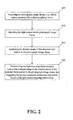
- the method for triggering and controlling a human-computer interaction operating instruction includes the following steps.
- step S01 the photograph image frame, e.g. visible region 103, generated by a photographing device 101 is acquired via the photographing port 104.
- step S02 the light source in the photograph image frame photographed by photographing device 101 is detected and identified.
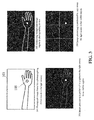
- FIG. 3 is the schematic procedure views of detecting and identifying the light source in the photograph image frame generated by a photographing device according to one embodiment of the present invention.
- the step of detecting the light source in the photograph image frame further comprises the step of attenuating a background image region of the photograph image frame for eliminating the image information irrelative to the light source and for emphasizing the light source to acquire the emphasized light source in the photograph image frame.
- the visible region 103 of frame 301 shows a fame photographed by photographing device wherein the circle is the light source.
- a background image region in the visible region 103 of frame 302 is attenuated.
- An image processing is performed to emphasize the light source in the visible region 103 of frame 303.
- An image processing is performed to only retain the light source in the visible region 103 of frame 304.
- the human-computer interaction instruction corresponding to the display mode of the detected light source in the photograph image frame is determined for triggering the human-computer interaction instruction based on the pre-stored mapping relationship.
- the display mode of the light source in the photograph image frames is a predetermined region on which the light source is disposed, a movement trace of the light source, a color of the light source, and/or a flashing pulse of the light source within the photograph image frame.
- the display mode of the light source in the photograph image frames is a predetermined region on which the light source is disposed within the photograph image frames.
- a mapping relationship between the predetermined region of a light source in at least one photograph image frame and the human-machine interaction instruction is pre-stored.
- the system for triggering and controlling a human-computer interaction operating instruction having an encoding transformation for pre-storing the mapping relationship utilizes an encoding database and an encoding instruction mapping database.
- the display mode of the light source in the photograph image frames is a predetermined region on which the light source is disposed within the photograph image frames
- Table 1 is encoding database
- Table 2 is an encoding instruction mapping database.
- Left boundary frame width * (2/3)
- the display mode of the light source in the photograph image frame is a predetermined region on which the light source is disposed within the photograph image frames.
- the method further includes the steps of: dividing the photograph image frame into a plurality of image regions; computing a coordinate of the detected light source in the photograph image frame 103; and determining where the detected light source in the photograph image frame in disposed in one of the image regions.
- the coordinate of the average center of the light source in the visible region 103 can be calculated by application programming interface (API) associated with coordinate computation.
- API application programming interface
- step S04 the predetermined region, e.g. left center, of the light source is compared with the encoding, e.g. "D", in the encoding database. Then, the encoding, e.g. "D” is compared with the human-computer interaction operating instruction in the encoding instruction mapping database, e.g. "Volume decrement" to decrease the volume.
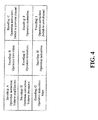
- FIG. 4 is a schematic view of the region encoding of light source corresponding to the human-computer interaction operating instruction in the photograph image frame shown in Tables 1 and 2 according to one embodiment of the present invention.
- the photograph image frame 103 is divided into nine image regions wherein each image region is corresponding to each encoding respectively and each encoding maps to one operating instruction. Alternatively, if the amount of the operating instructions is less than the encoding, some image regions remain in blank status.
- the software program executed in the television set and set-top box easily makes a triggering/controlling decision based on the position of the light source in the photograph image frame detected by the photographing device 101.
- the cellular phone serves as the light source for conveniently replacing the remote controller of the television set and set-top box.
- the display mode of the light source in the photograph image frames is a movement trace of the light source within the photograph image frames.
- a mapping relationship between a movement trace of a light source in at least one photograph image frame and the human-machine interaction instruction is pre-stored, which is similar to Tables 1 and 2.
- FIG. 5 is a schematic view of the trace of light source corresponding to the human-computer interaction operating instruction in the photograph image frame according to one embodiment of the present invention.
- the display mode of the light source in the photograph image frames is a movement trace of the light source within the photograph image frames. While analyzing the display mode of the detected light source in the photograph image frame, further comprises the steps of: constructing a grid coordinate system in the photograph image frame for continuously identifying the light source in each of the photograph image frames, and computing a plurality of grid coordinates of the grid coordinate system of the light source in the photograph image frames for generating the grid coordinates of the movement trace of the light source; and determining the movement trace of the light source within the photograph image frames by calculating a plurality of grids associated with the grid coordinates along a direction formed by the grids.
- step S04 the human-computer interaction instruction corresponding to the movement trace of the light source in the photograph image frame is determined based on the pre-stored mapping relationship between the movement trace and the operating instructions.
- the trace encoding indicates that the movement trace of the light source passes through three grids downward and the mapping instruction corresponding to the trace encoding indicates the scroll of the content.
- the upper left of the photograph image frame formed by the photographing device 101 is defined as the origin.
- two movement traces indicates a first grid coordinate sequence (M1) and a second grid coordinate sequence (M2).
- the first grid coordinate sequence (M1) is composed of coordinates (1, 1), (1, 2), (1, 3) and (1, 4) representing four continuous grids from top to bottom, which is a standard movement trace.
- the second grid coordinate sequence (M2) is composed of coordinates (1, 1), (1, 2), (1, 3) and (2, 3) representing an "L" type.
- the detecting window is defined as four coordinates.
- the software program stores four coordinates of the movement trace of the light source to form a grid coordinate sequence. For example, a grid coordinate sequence including coordinates (5, 5), (5, 6), (5, 7) and (5, 6) wherein coordinate (5, 5) is transformed into coordinate (1, 1) and the rest of coordinates are transformed into coordinates (1, 2), (1, 3) and (1, 2).
- the coordinates (1, 1), (1, 2), (1, 3) and (1, 2) is compared with the first grid coordinate sequence (M1) and a second grid coordinate sequence (M2). If it identical to M1 or M2, the grid coordinate sequence is regarded as M1 or M2.
- the display mode of the light source in the photograph image frame is a color of the light source within the photograph image frame.
- a mapping relationship between a color of a light source in at least one photograph image frame and the human-machine interaction instruction is pre-stored, which is similar to Tables 1 and 2.
- step S03 while analyzing the display mode of the detected light source in the photograph image frame, further comprises the steps of: computing a coordinate of the detected light source in the photograph image frame; and acquiring a color parameter, e.g. three primary colors red (R), green (G) and blue (B), in the coordinate of the light source from the photograph image frame by using application programming interface (API).
- a color parameter e.g. three primary colors red (R), green (G) and blue (B)
- the human-computer interaction operating instruction corresponding to the determined color parameter.
- the display mode of the light source in the photograph image frame is a flashing pulse of the light source within the photograph image frame.
- a mapping relationship between a flashing pulse of a light source in at least one photograph image frame and the human-machine interaction instruction is pre-stored, which is similar to Tables 1 and 2.
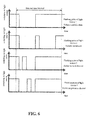
- FIG. 6 is a schematic view of the flashing pulse of the light source corresponding to the human-computer interaction operating instruction in the photograph image frame according to one embodiment of the present invention.
- the vertical coordinate axis represents the "switching on” status of the light source and the horizontal axis represents the “switching off” of the light source.
- the top level of the square wave represents the “switching on” of the light source and the bottom level of the light source represents the “switching off” of the light source.
- the different flashing pulse of the light represents the varied human-computer interaction operating instruction
- the display mode of the light source in the photograph image frame is a flashing pulse of the light source within the photograph image frame. While analyzing the display mode of the detected light source in the photograph image frame, further comprises the steps of: continuously detecting the light source in each of the photograph image frames for determining the flashing pulse in the continuous photograph image frames during a predetermined detected time interval.
- the flashing pulse is compared with mapping relationship between a flashing pulse of a light source in at least one photograph image frame and the human-machine interaction instruction. If the flashing pulse is matched, the human-machine interaction instruction is triggered.
- FIG. 7 is a schematic view of the system 106 for triggering and controlling a human-computer interaction operating instruction according to one embodiment of the present invention.
- the system 106 is implemented by the method for triggering and controlling a human-computer interaction operating instruction.
- the system 106 includes a mapping relationship database 601, a photograph-acquiring module 602, a light source detecting module 603, an analyzing module 604 and an instruction-identifying module 605.
- the mapping relationship database 601 pre-stores a mapping relationship between a display mode of a light source in at least one photograph image frame and the human-machine interaction instruction.
- the photograph-acquiring module 602 acquires the photograph image frame generated by a photographing device.
- the light source detecting module 603 detects the light source in the photograph image frame.
- the analyzing module 604 analyzes the display mode of the detected light source in the photograph image frame.
- the instruction-identifying module 605 determines the human-computer interaction instruction corresponding to the display mode of the detected light source in the photograph image frame for triggering the human-computer interaction instruction based on the pre-stored mapping relationship.
- FIG. 8 is a schematic view of the light source detecting module according to one embodiment of the present invention.
- the light source detecting module 603 further includes an image processing module 631, an acquiring module 632 and an interference source elimination module 633.
- the image processing module 631 attenuates a background image region of the photograph image frame for eliminating the image information irrelative to the light source and for emphasizing the light source.
- the acquiring module 632 acquires the emphasized light source in the photograph image frame from the image processing module 641.
- the interference source elimination module 633 continuously detecting the light source in each of the photograph image frames from the image processing module 631 and the acquiring module 632 for determining the light source with an invariant position in the photograph image frames to remove the light source with the invariant position from the photograph image frames.
- FIG. 9 is a schematic view of the system for triggering and controlling a human-computer interaction operating instruction having an encoding transformation for pre-storing the mapping relationship according to one embodiment of the present invention.
- the mapping relationship database 601 further includes an encoding database 611 and an encoding instruction mapping database 612.
- the encoding database 611 pre-stores the mapping relation between the display mode of the light source in the photograph image frame and an encoding.
- the encoding instruction mapping database 612 pre-stores the mapping relation between the encoding and the human-machine interaction instruction.
- the instruction-identifying module 605 further includes an encoding identification module 651 and an encoding instruction mapping module 652.
- the encoding identification module 651 inquires the encoding database 611 for determining the encoding corresponding to the display mode of the detected light source in the photograph image frame.
- the encoding instruction mapping module 652 inquires the encoding instruction mapping database 612 based on the encoding outputted from the encoding identification module 651 for determining the human-computer interaction instruction corresponding to the encoding.
- the display mode of the light source in the photograph image frames is a predetermined region on which the light source is disposed, a movement trace of the light source, a color of the light source, and/or a flashing pulse of the light source within the photograph image frame.
- the analyzing module 604 includes a region-analyzing module, a trace-analyzing module, a color-analyzing module and a flashing pulse analyzing module
- the region-analyzing module divides the photograph image frame into a plurality of image regions, computes a coordinate of the detected light source in the photograph image frame, and determines where the detected light source in the photograph image frame is disposed in one of the image regions.
- the instruction-identifying module 605 inquire the region encoding database and the encoding instruction mapping database for acquiring corresponding instructions to perform triggering/controlling steps based on the determination where the detected light source in the photograph image frame is disposed in one of the image regions.
- the light source detecting module constructs a grid coordinate system in the photograph image frame for continuously identifying the light source in each of the photograph image frames, and computes a plurality of grid coordinates of the grid coordinate system of the light source in the photograph image frames for generating the grid coordinates of the movement trace of the light source.
- the trace-analyzing module determines the movement trace of the light source within the photograph image frames by calculating a plurality of grids associated with the grid coordinates along a direction formed by the grids.
- the instruction-identifying module 605 inquire the region encoding database and the encoding instruction mapping database for acquiring corresponding instructions to perform triggering/controlling steps based on the movement trace of the light source within the photograph image frames.
- the color-analyzing module computes a coordinate of the detected light source in the photograph image frame, and for acquiring a color parameter in the coordinate of the light source from the photograph image frame by using application programming interface (API).
- API application programming interface
- the instruction-identifying module 605 inquire the region encoding database and the encoding instruction mapping database for acquiring corresponding instructions to perform triggering/controlling steps based on the color of the light source within the photograph image frames.
- the light source detecting module further continuously detects the light source in each of the photograph image frames.
- the flashing pulse analyzes module determines the flashing pulse of the light source in the photograph image frames during a predetermined time interval.
- the instruction-identifying module 605 inquire the region encoding database and the encoding instruction mapping database for acquiring corresponding instructions to perform triggering/controlling steps based on the flashing pulse within the photograph image frames.
- the present invention provides a method and system for triggering and controlling human-computer interaction operating instructions employs a light source to perform a human-computer interaction by detecting and identifying the display mode of the light source in the photograph image frame for determining the human-computer interaction instruction corresponding to the display mode.
- the present invention accomplishes the non-contact type of human-computer interactions.
- the light source in the photograph image frame is detectable and acquirable advantageously to be preferably immune from the interference, therefore, the present invention allows the user to implement the non-contact type of human-computer interactions with the high precision.
Landscapes
- Engineering & Computer Science (AREA)
- Theoretical Computer Science (AREA)
- General Engineering & Computer Science (AREA)
- Human Computer Interaction (AREA)
- Physics & Mathematics (AREA)
- General Physics & Mathematics (AREA)
- Multimedia (AREA)
- Studio Devices (AREA)
- User Interface Of Digital Computer (AREA)
- Image Analysis (AREA)
Abstract
Disclosed are a method and system for triggering and controlling a human-computer interaction operating instruction. The method prestores a mapping relation between a display mode of a light source in a photograph image and a human-machine interaction instruction, and, when triggering and controlling, comprises: acquiring the photograph image photographed by a photographing device; detecting for the light source in the photograph image, analyzing the display mode of the detected light source in the photograph image; determining, on the basis of the prestored mapping relation, the human-computer interaction instruction corresponding to the display mode of the current detected light source in the photograph image, and triggering the human-computer interaction instruction. The device correspondingly comprises: a mapping relation library, a photograph-acquiring module, a light source-detecting module, an analysis module, and an instruction-identifying module. Utilization of the present invention allows for the implementation of contactless human-computer interactions of increase precision.
Description
- The present invention relates to a human-computer interaction technique, and more particularly to a method and system for triggering and controlling a human-computer interaction operating instruction.
- In the application field of human-computer interaction techniques, the computing apparatus utilizes input/output devices to implement the human-computer interaction operation. While employing the human-computer interaction, the computing device provides a large amount of messages and prompts for the user by way of output device or display unit, and thus, the user may input the related information and operation instructions corresponding to the messages and prompts into the computing device.
- Basically, the input/output devices used in the human-computer interaction operation for the computing device include keyboard, mouse, touch panel or multi-touch panel. Although the input/output devices for the human-computer interaction operation are widely used, the usability of these input/output devices is not user-friendly enough and thus cannot implement the non-contact type of human-computer interactions. For example, while operating the touch panel, the user fingers the screen of the display unit, which results in sanitation issues, and many fingerprints are formed on the screen. Regarding to the application of the mid-range or long-range distance between the user and display unit, such as a large screen or the projecting apparatus, it is usually a long distance from the narrator to the computing device. When the narrator operates the computing device, the narrator frequently has to approach the computing device to use the mouse and keyboard so that the operation of mid-range or long-range distance is quite inconvenient for the narrator.
- Even if a gesture with a non-contact type is used in human-computer interaction operation, however, the interference immunity of the gesture is weakened and the identification precision of human-computer interaction operation cannot be effectively increased. Consequently, there is a need to develop a novel human-computer interaction technique.
- One objective of the present invention is to provide a method and system for triggering and controlling human-computer interaction operating instructions to implement the non-contact type of human-computer interactions with the high precision.
- According to the above objective, the present invention sets forth a method and system for triggering and controlling human-computer interaction operating instructions.
- In one preferred embodiment of the present invention, the method for triggering and controlling a human-computer interaction operating instruction comprises the steps of:
- pre-storing a mapping relationship between a display mode of a light source in at least one photograph image frame and the human-machine interaction instruction;
- acquiring the photograph image frame generated by a photographing device;
- detecting the light source in the photograph image frame for analyzing the display mode of the detected light source in the photograph image frame; and
- determining the human-computer interaction instruction corresponding to the display mode of the detected light source in the photograph image frame for triggering the human-computer interaction instruction based on the pre-stored mapping relationship.
- In one preferred embodiment, further comprises the step of attenuating a background image region of the photograph image frame for eliminating an image information irrelative to the light source and for emphasizing the light source to acquire the emphasized light source in the photograph image frame.
- In one preferred embodiment, the at least one photograph image frame comprises a plurality of photograph image frames and during the step of detecting the light source, the light source in each of the photograph image frames is continuously detected for determining the light source with a invariant position in the photograph image frames to remove the light source with the invariant position from the photograph image frames.
- In one preferred embodiment, the step of pre-storing the mapping relationship between a display mode of a light source in at least one photograph image frame and the human-machine interaction instruction is a step of pre-storing a mapping relation to an encoding transformation, comprising the steps of:
- pre-storing the mapping relation between the display mode of the light source in the photograph image frame and an encoding; and
- pre-storing the mapping relation between the encoding and the human-machine interaction instruction.
- In one preferred embodiment, during the step of determining the human-computer interaction instruction corresponding to the display mode of the detected light source in the photograph image frame, further comprising the steps of: determining the encoding corresponding to the display mode of the detected light source in the photograph image frame; and determining the human-computer interaction instruction corresponding to the encoding.
- In another preferred embodiment of the present invention, the system for triggering and controlling a human-computer interaction operating instruction comprises:
- a mapping relationship database, pre-storing a mapping relationship between a display mode of a light source in at least one photograph image frame and the human-machine interaction instruction;
- a photograph-acquiring module, acquiring the photograph image frame generated by a photographing device;
- a light source detecting module, detecting the light source in the photograph image frame;
- an analyzing module, analyzing the display mode of the detected light source in the photograph image frame; and
- an instruction-identifying module, determining the human-computer interaction instruction corresponding to the display mode of the detected light source in the photograph image frame for triggering the human-computer interaction instruction based on the pre-stored mapping relationship.
- The present invention provides a method and system for triggering and controlling human-computer interaction operating instructions employs a light source to perform a human-computer interaction by detecting and identifying the display mode of the light source in the photograph image frame for determining the human-computer interaction instruction corresponding to the display mode. Thus, on one hand, the present invention accomplishes the non-contact type of human-computer interactions. On the other hand, since the light source in the photograph image frame is detectable and acquirable advantageously to be preferably immune from the interference, therefore, the present invention allows the user to implement the non-contact type of human-computer interactions with the high precision.
- The foregoing aspects and many of the attendant advantages of this invention will become more readily appreciated as the same becomes better understood by reference to the following detailed description, when taken in conjunction with the accompanying drawings, wherein:
-
FIG. 1 is a schematic view of an application scheme employing the method and system for triggering and controlling a human-computer interaction operating instruction according to one embodiment of the present invention; -
FIG. 2 is a flow chart of the method for triggering and controlling a human-computer interaction operating instruction according to one embodiment of the present invention; -
FIG. 3 is the schematic procedure views of detecting and identifying the light source in the photograph image frame generated by a photographing device according to one embodiment of the present invention; -
FIG. 4 is a schematic view of the region encoding of light source corresponding to the human-computer interaction operating instruction in the photograph image frame shown in tables 1 and 2 according to one embodiment of the present invention; -
FIG. 5 is a schematic view of the trace of light source corresponding to the human-computer interaction operating instruction in the photograph image frame according to one embodiment of the present invention; -
FIG. 6 is a schematic view of the flashing pulse of the light source corresponding to the human-computer interaction operating instruction in the photograph image frame according to one embodiment of the present invention; -
FIG. 7 is a schematic view of the system for triggering and controlling a human-computer interaction operating instruction according to one embodiment of the present invention; -
FIG. 8 is a schematic view of the light source detecting module according to one embodiment of the present invention; and -
FIG. 9 is a schematic view of the system for triggering and controlling a human-computer interaction operating instruction having an encoding transformation for pre-storing the mapping relationship according to one embodiment of the present invention. - In one embodiment of the present invention, the method pre-stores a mapping relationship between a display mode of light source in photograph image frame and a human-machine interaction instruction. While triggering and controlling the system, the method includes the steps of: acquiring the photograph image frame generated by a photographing device; detecting light source in photograph image frame for analyzing display mode of the detected light source in photograph image frame; determining human-computer interaction instruction corresponding to display mode of the detected light source in photograph image frame for triggering human-computer interaction instruction based on the pre-stored mapping relationship.
-
FIG. 1 is a schematic view of an application scheme employing the method and system for triggering and controlling a human-computer interaction operating instruction according to one embodiment of the present invention. In one case, the application scheme includes aphotographing device 101, adata processing apparatus 102 coupled to the photographingdevice 101 via thephotographing port 104 wherein thedata processing apparatus 102 is coupled to the photographingdevice 101 by way of wire connection, e.g. Universal Serial Bus (USB) protocol, and/or wireless connection, e.g. Wireless Fidelity (Wi-Fi) protocol. In another case, thephotographing device 101 is an internal photographing component to be integrated into thedata processing apparatus 102. - In
FIG. 1 , avisible region 103 of thephotographing device 101 is a photograph image frame generated by the photographingdevice 101. The photographingdevice 101 is capable of completely acquiring thevisible region 103 by automatic and/or manual operation and clearly focusing thevisible region 103. Within thevisible region 103, the user holds a light-emitting device, termed as the light source, to perform the interaction operating procedure. In one embodiment, the light source may be a flashlight, a light of cellular phone, and/or the light-emitting device with the functions of a switch mechanism and/or a color selection mode. Theimage 105 of light source image in the photograph image frame of the photographingdevice 101 is photographed wherein thebody 107 of user and the background image are removed during the subsequent process. - When the photographing
device 101 completely acquires thevisible region 103 and clearly focuses thevisible region 103, the triggering/controllingsystem 106 of thedata processing apparatus 102 is activated. - In one embodiment, the
data processing apparatus 102 may be a computing system with the functions of processing and calculation to form a procedure operation scheme. For example, the computing system is selected from one group consisting of personal computer, notebook computer, tablet computer, hand-held devices, e.g. smart phone, with calculation capability, robot with calculation capability, television set with data processing capability, set-top box and the combinations. - In one embodiment, the triggering/controlling
system 106 operated in thedata processing apparatus 102 is a software program for acquiring the photograph image frame in thevisible region 103 by way of the photographingdevice 101 for analyzing and calculating the photograph image frame so as to detect the display mode of the light source in the photograph image frame. Based on the pre-stored mapping relationship between a display mode of a light source in at least one photograph image frame and the human-machine interaction instruction, the present invention determines the human-computer interaction instruction corresponding to the display mode of the detected light source in the photograph image frame for triggering the human-computer interaction instruction. - The method and system for triggering and controlling human-computer interaction operating instructions maps the display mode of light source to a plurality of human-computer interaction operating instructions for generating either an operation instruction with single touch by way of one light source or an operation instruction with multi-touch by way of a plurality of light sources. In one case, the operating instructions may be computer operation instructions and remote control instructions of television set.
- The present invention pre-stores a mapping relationship between a display mode of a light source in at least one photograph image frame and the human-machine interaction instruction. In one embodiment, the display mode of the light source in the photograph image frames is a predetermined region on which the light source is disposed, a movement trace of the light source, a color of the light source, and/or a flashing pulse of the light source within the photograph image frame.
- In one case, while the system stores a mapping relationship between a display mode of a light source in a photograph image frame and the human-machine interaction instruction, a direct mapping relationship between a display mode of a light source in a photograph image frame and the human-machine interaction instruction is directly pre-stored. In this case, a mapping database represents the display mode of a light source in at least one photograph image frame. After detecting and identifying the display mode of the light source during the triggering-controlling step, the display mode is compared with that stored in the mapping database for acquiring the human-machine interaction instruction.
- In another case, the present invention employs two mapping database including an encoding database and an encoding instruction mapping database. The encoding database pre-stores the mapping relation between the display mode of the light source in the photograph image frame and an encoding. The encoding instruction mapping database pre-stores the mapping relation between the encoding and the human-machine interaction instruction. After detecting and identifying the display mode of the light source during the triggering-controlling step, the display mode is compared with that stored in the encoding database for acquiring the encoding. Then, the acquired encoding is compared with that stored in the encoding instruction mapping database for acquiring the human-machine interaction instruction. In this case, the encoding database is fixed and disposed in the triggering/controlling system and the human-machine interaction instruction corresponding to the encoding in the encoding instruction mapping database can be modified.
- Before triggering and controlling the video player, e.g. computer with video player, television set, and set-top box by detecting and identifying the light source, the photographing
device 101 is aligned to and focused on the light source held by the user to clearly photograph the photograph image frame. The method for triggering and controlling a human-computer interaction operating instruction includes the following steps. - In step S01, the photograph image frame, e.g.
visible region 103, generated by a photographingdevice 101 is acquired via the photographingport 104. - In step S02, the light source in the photograph image frame photographed by photographing
device 101 is detected and identified. -
FIG. 3 is the schematic procedure views of detecting and identifying the light source in the photograph image frame generated by a photographing device according to one embodiment of the present invention. During the step of detecting the light source in the photograph image frame, further comprises the step of attenuating a background image region of the photograph image frame for eliminating the image information irrelative to the light source and for emphasizing the light source to acquire the emphasized light source in the photograph image frame. Thevisible region 103 offrame 301 shows a fame photographed by photographing device wherein the circle is the light source. A background image region in thevisible region 103 offrame 302 is attenuated. An image processing is performed to emphasize the light source in thevisible region 103 offrame 303. An image processing is performed to only retain the light source in thevisible region 103 offrame 304. - In S03, the display mode of the detected light source in the photograph image frame is analyzed.
- In S04, the human-computer interaction instruction corresponding to the display mode of the detected light source in the photograph image frame is determined for triggering the human-computer interaction instruction based on the pre-stored mapping relationship.
- In one embodiment of the present invention, the display mode of the light source in the photograph image frames is a predetermined region on which the light source is disposed, a movement trace of the light source, a color of the light source, and/or a flashing pulse of the light source within the photograph image frame. The analyzing and determining methods for a mapping relationship between display mode of light source and the human-machine interaction instruction with respect to each of the display modes are described in the following.
- First, the display mode of the light source in the photograph image frames is a predetermined region on which the light source is disposed within the photograph image frames. In this case, a mapping relationship between the predetermined region of a light source in at least one photograph image frame and the human-machine interaction instruction is pre-stored. The system for triggering and controlling a human-computer interaction operating instruction having an encoding transformation for pre-storing the mapping relationship utilizes an encoding database and an encoding instruction mapping database.
- For an example of remote control operation, it shows that the display mode of the light source in the photograph image frames is a predetermined region on which the light source is disposed within the photograph image frames wherein Table 1 is encoding database and Table 2 is an encoding instruction mapping database.
Table 1: Encoding Region parameters (the upper left of the photograph image frame formed by the photographing device 101 is defined as origin) A Left boundary = 0, right boundary = frame width /3, top boundary = 0, bottom boundary = frame height /3 B Left boundary = frame width /3, right boundary = frame width * (2/3), top boundary = 0, bottom boundary = frame height /3 C Left boundary = frame width * (2/3), right boundary = frame width, top boundary = 0, bottom boundary = frame height /3 D Left boundary = 0, right boundary = frame width /3, top boundary = frame height /3, bottom boundary = frame height *(2/3) E Left boundary = frame width /3, right boundary = frame width * (2/3), top boundary = frame height /3, bottom boundary = frame height *(2/3) F Left boundary = frame width * (2/3), right boundary = frame width, top boundary = frame height /3, bottom boundary = frame height *(2/3) G Left boundary = 0, right boundary = frame width /3, top boundary = frame height *(2/3), bottom boundary = frame height H Left boundary = frame width /3, right boundary = frame width * (2/3), top boundary = frame height *(2/3), bottom boundary = frame height I Left boundary = frame width * (2/3), right boundary = frame width, top boundary = frame height *(2/3), bottom boundary = frame height Table 2: Encoding human-computer interaction operating instruction Descriptions A Volume amplification Turn up the volume when light source is disposed on the upper left of the photograph image frame photographing device C Switch to previous channel Switch to previous channel when light source is disposed on the upper right of the photograph image frame photographing device D Volume decrement Decrease volume when light source is disposed on the left center of the photograph image frame photographing device G Mute Mute when light source is disposed on the lower right of the photograph image frame photographing device I Switch to next channel Switch to next channel when light source is disposed on the lower right of the photograph image frame photographing device - In step S03, the display mode of the light source in the photograph image frame is a predetermined region on which the light source is disposed within the photograph image frames. While analyzing the display mode of the detected light source in the photograph image frame, the method further includes the steps of: dividing the photograph image frame into a plurality of image regions; computing a coordinate of the detected light source in the
photograph image frame 103; and determining where the detected light source in the photograph image frame in disposed in one of the image regions. In one embodiment, the coordinate of the average center of the light source in thevisible region 103 can be calculated by application programming interface (API) associated with coordinate computation. Afterward, the predetermined region, e.g. left center, of the light source in thephotograph image frame 103 is determined based on the region parameter in the encoding database. In step S04, the predetermined region, e.g.
left center, of the light source is compared with the encoding, e.g. "D", in the encoding database. Then, the encoding, e.g. "D" is compared with the human-computer interaction operating instruction in the encoding instruction mapping database, e.g. "Volume decrement" to decrease the volume. -
FIG. 4 is a schematic view of the region encoding of light source corresponding to the human-computer interaction operating instruction in the photograph image frame shown in Tables 1 and 2 according to one embodiment of the present invention. InFIG. 4 , thephotograph image frame 103 is divided into nine image regions wherein each image region is corresponding to each encoding respectively and each encoding maps to one operating instruction. Alternatively, if the amount of the operating instructions is less than the encoding, some image regions remain in blank status. - According to the above-mentioned processing steps, the software program executed in the television set and set-top box easily makes a triggering/controlling decision based on the position of the light source in the photograph image frame detected by the photographing
device 101. For example, the cellular phone serves as the light source for conveniently replacing the remote controller of the television set and set-top box. - Second, the display mode of the light source in the photograph image frames is a movement trace of the light source within the photograph image frames. A mapping relationship between a movement trace of a light source in at least one photograph image frame and the human-machine interaction instruction is pre-stored, which is similar to Tables 1 and 2.
FIG. 5 is a schematic view of the trace of light source corresponding to the human-computer interaction operating instruction in the photograph image frame according to one embodiment of the present invention. - In step S02 and S03, the display mode of the light source in the photograph image frames is a movement trace of the light source within the photograph image frames. While analyzing the display mode of the detected light source in the photograph image frame, further comprises the steps of: constructing a grid coordinate system in the photograph image frame for continuously identifying the light source in each of the photograph image frames, and computing a plurality of grid coordinates of the grid coordinate system of the light source in the photograph image frames for generating the grid coordinates of the movement trace of the light source; and determining the movement trace of the light source within the photograph image frames by calculating a plurality of grids associated with the grid coordinates along a direction formed by the grids.
- In step S04, the human-computer interaction instruction corresponding to the movement trace of the light source in the photograph image frame is determined based on the pre-stored mapping relationship between the movement trace and the operating instructions. As shown in
FIG. 5 , the trace encoding indicates that the movement trace of the light source passes through three grids downward and the mapping instruction corresponding to the trace encoding indicates the scroll of the content. - The method of detecting the movement trace of the light source is described as follow.
- Given conditions:
- (1) The grid coordinate is given by transforming the coordinate of light source;
- (2) The movement trace description represents a grid coordinate sequence including a plurality of grid coordinates and these grid coordinates can be depicted in the grids for form a standard movement trace.
- The upper left of the photograph image frame formed by the photographing
device 101 is defined as the origin. For example, two movement traces indicates a first grid coordinate sequence (M1) and a second grid coordinate sequence (M2). The first grid coordinate sequence (M1) is composed of coordinates (1, 1), (1, 2), (1, 3) and (1, 4) representing four continuous grids from top to bottom, which is a standard movement trace. The second grid coordinate sequence (M2) is composed of coordinates (1, 1), (1, 2), (1, 3) and (2, 3) representing an "L" type. - The detecting window is defined as four coordinates. The software program stores four coordinates of the movement trace of the light source to form a grid coordinate sequence. For example, a grid coordinate sequence including coordinates (5, 5), (5, 6), (5, 7) and (5, 6) wherein coordinate (5, 5) is transformed into coordinate (1, 1) and the rest of coordinates are transformed into coordinates (1, 2), (1, 3) and (1, 2). The coordinates (1, 1), (1, 2), (1, 3) and (1, 2) is compared with the first grid coordinate sequence (M1) and a second grid coordinate sequence (M2). If it identical to M1 or M2, the grid coordinate sequence is regarded as M1 or M2.
- Third, the display mode of the light source in the photograph image frame is a color of the light source within the photograph image frame. A mapping relationship between a color of a light source in at least one photograph image frame and the human-machine interaction instruction is pre-stored, which is similar to Tables 1 and 2.
- In step S03, while analyzing the display mode of the detected light source in the photograph image frame, further comprises the steps of: computing a coordinate of the detected light source in the photograph image frame; and acquiring a color parameter, e.g. three primary colors red (R), green (G) and blue (B), in the coordinate of the light source from the photograph image frame by using application programming interface (API). In step S04, if the color parameter of the three primary colors red (R), green (G) and blue (B) of the light source is the range of the color encoding of primary colors red (R), green (G) and blue (B) to be determined, the human-computer interaction operating instruction corresponding to the determined color parameter.
- Fourthly, the display mode of the light source in the photograph image frame is a flashing pulse of the light source within the photograph image frame. A mapping relationship between a flashing pulse of a light source in at least one photograph image frame and the human-machine interaction instruction is pre-stored, which is similar to Tables 1 and 2.
-
FIG. 6 is a schematic view of the flashing pulse of the light source corresponding to the human-computer interaction operating instruction in the photograph image frame according to one embodiment of the present invention. InFIG. 6 , the vertical coordinate axis represents the "switching on" status of the light source and the horizontal axis represents the "switching off" of the light source. The top level of the square wave represents the "switching on" of the light source and the bottom level of the light source represents the "switching off" of the light source. The different flashing pulse of the light represents the varied human-computer interaction operating instruction - In step S03, the display mode of the light source in the photograph image frame is a flashing pulse of the light source within the photograph image frame. While analyzing the display mode of the detected light source in the photograph image frame, further comprises the steps of: continuously detecting the light source in each of the photograph image frames for determining the flashing pulse in the continuous photograph image frames during a predetermined detected time interval. In step S04, the flashing pulse is compared with mapping relationship between a flashing pulse of a light source in at least one photograph image frame and the human-machine interaction instruction. If the flashing pulse is matched, the human-machine interaction instruction is triggered.
-
FIG. 7 is a schematic view of thesystem 106 for triggering and controlling a human-computer interaction operating instruction according to one embodiment of the present invention. Thesystem 106 is implemented by the method for triggering and controlling a human-computer interaction operating instruction. Thesystem 106 includes amapping relationship database 601, a photograph-acquiringmodule 602, a lightsource detecting module 603, ananalyzing module 604 and an instruction-identifyingmodule 605. - The
mapping relationship database 601 pre-stores a mapping relationship between a display mode of a light source in at least one photograph image frame and the human-machine interaction instruction. The photograph-acquiringmodule 602 acquires the photograph image frame generated by a photographing device. The lightsource detecting module 603 detects the light source in the photograph image frame. The analyzingmodule 604 analyzes the display mode of the detected light source in the photograph image frame. The instruction-identifyingmodule 605 determines the human-computer interaction instruction corresponding to the display mode of the detected light source in the photograph image frame for triggering the human-computer interaction instruction based on the pre-stored mapping relationship. - Further,
FIG. 8 is a schematic view of the light source detecting module according to one embodiment of the present invention. The lightsource detecting module 603 further includes animage processing module 631, an acquiringmodule 632 and an interferencesource elimination module 633. - The
image processing module 631 attenuates a background image region of the photograph image frame for eliminating the image information irrelative to the light source and for emphasizing the light source. The acquiringmodule 632 acquires the emphasized light source in the photograph image frame from the image processing module 641. The interferencesource elimination module 633 continuously detecting the light source in each of the photograph image frames from theimage processing module 631 and the acquiringmodule 632 for determining the light source with an invariant position in the photograph image frames to remove the light source with the invariant position from the photograph image frames. -
FIG. 9 is a schematic view of the system for triggering and controlling a human-computer interaction operating instruction having an encoding transformation for pre-storing the mapping relationship according to one embodiment of the present invention. Themapping relationship database 601 further includes anencoding database 611 and an encodinginstruction mapping database 612. Theencoding database 611 pre-stores the mapping relation between the display mode of the light source in the photograph image frame and an encoding. The encodinginstruction mapping database 612 pre-stores the mapping relation between the encoding and the human-machine interaction instruction. The instruction-identifyingmodule 605 further includes anencoding identification module 651 and an encodinginstruction mapping module 652. Theencoding identification module 651 inquires theencoding database 611 for determining the encoding corresponding to the display mode of the detected light source in the photograph image frame. The encodinginstruction mapping module 652 inquires the encodinginstruction mapping database 612 based on the encoding outputted from theencoding identification module 651 for determining the human-computer interaction instruction corresponding to the encoding. - In one embodiment of the present invention, the display mode of the light source in the photograph image frames is a predetermined region on which the light source is disposed, a movement trace of the light source, a color of the light source, and/or a flashing pulse of the light source within the photograph image frame. The analyzing
module 604 includes a region-analyzing module, a trace-analyzing module, a color-analyzing module and a flashing pulse analyzing module - The region-analyzing module divides the photograph image frame into a plurality of image regions, computes a coordinate of the detected light source in the photograph image frame, and determines where the detected light source in the photograph image frame is disposed in one of the image regions. The instruction-identifying
module 605 inquire the region encoding database and the encoding instruction mapping database for acquiring corresponding instructions to perform triggering/controlling steps based on the determination where the detected light source in the photograph image frame is disposed in one of the image regions. - The light source detecting module constructs a grid coordinate system in the photograph image frame for continuously identifying the light source in each of the photograph image frames, and computes a plurality of grid coordinates of the grid coordinate system of the light source in the photograph image frames for generating the grid coordinates of the movement trace of the light source. The trace-analyzing module determines the movement trace of the light source within the photograph image frames by calculating a plurality of grids associated with the grid coordinates along a direction formed by the grids. The instruction-identifying
module 605 inquire the region encoding database and the encoding instruction mapping database for acquiring corresponding instructions to perform triggering/controlling steps based on the movement trace of the light source within the photograph image frames. - The color-analyzing module computes a coordinate of the detected light source in the photograph image frame, and for acquiring a color parameter in the coordinate of the light source from the photograph image frame by using application programming interface (API). The instruction-identifying
module 605 inquire the region encoding database and the encoding instruction mapping database for acquiring corresponding instructions to perform triggering/controlling steps based on the color of the light source within the photograph image frames. - The light source detecting module further continuously detects the light source in each of the photograph image frames. The flashing pulse analyzes module determines the flashing pulse of the light source in the photograph image frames during a predetermined time interval. The instruction-identifying
module 605 inquire the region encoding database and the encoding instruction mapping database for acquiring corresponding instructions to perform triggering/controlling steps based on the flashing pulse within the photograph image frames. - According to the above-mentioned descriptions, the present invention provides a method and system for triggering and controlling human-computer interaction operating instructions employs a light source to perform a human-computer interaction by detecting and identifying the display mode of the light source in the photograph image frame for determining the human-computer interaction instruction corresponding to the display mode. Thus, on one hand, the present invention accomplishes the non-contact type of human-computer interactions. On the other hand, since the light source in the photograph image frame is detectable and acquirable advantageously to be preferably immune from the interference, therefore, the present invention allows the user to implement the non-contact type of human-computer interactions with the high precision.
- As is understood by a person skilled in the art, the foregoing preferred embodiments of the present invention are illustrative rather than limiting of the present invention. It is intended that they cover various modifications and similar arrangements be included within the spirit and scope of the appended claims, the scope of which should be accorded the broadest interpretation so as to encompass all such modifications and similar structure.
Claims (16)
- A method for triggering and controlling a human-computer interaction operating instruction, the method comprising the steps of:pre-storing a mapping relationship between a display mode of a light source in at least one photograph image frame and the human-machine interaction instruction;acquiring the photograph image frame generated by a photographing device;detecting the light source in the photograph image frame for analyzing the display mode of the detected light source in the photograph image frame; anddetermining the human-computer interaction instruction corresponding to the display mode of the detected light source in the photograph image frame for triggering the human-computer interaction instruction based on the pre-stored mapping relationship.
- The method of claim 1, during the step of detecting the light source in the photograph image frame, further comprising the step of attenuating a background image region of the photograph image frame for eliminating an image information irrelative to the light source and for emphasizing the light source to acquire the emphasized light source in the photograph image frame.
- The method of claim 2, wherein the at least one photograph image frame comprises a plurality of photograph image frames and wherein the detecting the light source in the photograph image frames comprises: the light source in each of the photograph image frames is continuously detected for determining the light source with a invariant position in the photograph image frames to remove the light source with the invariant position from the photograph image frames.
- The method of claim 1, wherein the step of pre-storing the mapping relationship between a display mode of a light source in at least one photograph image frame and the human-machine interaction instruction is a step of pre-storing a mapping relation to an encoding transformation, comprising the steps of:pre-storing the mapping relation between the display mode of the light source in the photograph image frame and an encoding; andpre-storing the mapping relation between the encoding and the human-machine interaction instruction;wherein the determining the human-computer interaction instruction corresponding to the display mode of the detected light source in the photograph image frame further comprises the steps of:determining the encoding corresponding to the display mode of the detected light source in the photograph image frame; anddetermining the human-computer interaction instruction corresponding to the encoding.
- The method of any one of claims 1 through 4, wherein the display mode of the light source in a plurality of photograph image frames is a predetermined region on which the light source is disposed within the photograph image frames, and while analyzing the display mode of the detected light source in the photograph image frame, further comprising the steps of:dividing the photograph image frame into a plurality of image regions;computing a coordinate of the detected light source in the photograph image frame; anddetermining where the detected light source in the photograph image frame is disposed in one of the image regions.
- The method of any one of claims 1 through 4, wherein the display mode of the light source in a plurality of photograph image frames is a movement trace of the light source within the photograph image frame, and while analyzing the display mode of the detected light source in the photograph image frame, further comprising the steps of:constructing a grid coordinate system in the photograph image frame for continuously identifying the light source in each of the photograph image frames, and computing a plurality of grid coordinates of the grid coordinate system of the light source in the photograph image frames for generating the grid coordinates of the movement trace of the light source; anddetermining the movement trace of the light source within the photograph image frames by calculating a plurality of grids associated with the grid coordinates along a direction formed by the grids.
- The method of any one of claims 1 through 4, wherein the display mode of the light source in the photograph image frame is a color of the light source within the photograph image frame, and wherein the analyzing the display mode of the detected light source in the photograph image frame further comprises the steps of:computing a coordinate of the detected light source in the photograph image frame; andacquiring a color parameter in the coordinate of the light source from the photograph image frame by using application programming interface (API).
- The method of any one of claims 1 through 4, wherein the display mode of the light source in a plurality of photograph image frames is a flashing pulse of the light source within the photograph image frames, and wherein the analyzing the display mode of the detected light source in the photograph image frame further comprises the step of:continuously detecting the light source in each of the photograph image frames for determining the flashing pulse in the continuous photograph image frames during a predetermined detected time interval.
- A system for triggering and controlling a human-computer interaction operating instruction, the system comprising:a mapping relationship database, configured to pre-store a mapping relationship between a display mode of a light source in at least one photograph image frame and the human-machine interaction instruction;a photograph-acquiring module, configured to acquire the photograph image frame generated by a photographing device;a light source detecting module, configured to detect the light source in the photograph image frame;an analyzing module, configured to analyze the display mode of the detected light source in the photograph image frame; andan instruction-identifying module, configured to determine the human-computer interaction instruction corresponding to the display mode of the detected light source in the photograph image frame for triggering the human-computer interaction instruction based on the pre-stored mapping relationship.
- The system of claim 9, wherein the light source detecting module further comprises:an image processing module, configured to attenuate a background image region of the photograph image frame for eliminating an image information irrelative to the light source and for emphasizing the light source; andan acquiring module, configured to acquire the emphasized light source in the photograph image frame from the image processing module.
- The system of claim 10, wherein the light source detecting module further comprises an interference source elimination module, configured to continuously detect the light source in each of a plurality of photograph image frames from the image processing module and the acquiring module for determining the light source with a invariant position in the photograph image frames to remove the light source with the invariant position from the photograph image frames.
- The system of claim 9, wherein the mapping relationship database further comprises:an encoding database, configured to pre-store the mapping relation between the display mode of the light source in the photograph image frame and an encoding; andan encoding instruction mapping database, configured to pre-store the mapping relation between the encoding and the human-machine interaction instruction;wherein the instruction-identifying module further comprises:an encoding identification module, configured to inquire the encoding database for determining the encoding corresponding to the display mode of the detected light source in the photograph image frame; andan encoding instruction mapping module, configured to inquire the encoding instruction mapping database based on the encoding outputted from the encoding identification module for determining the human-computer interaction instruction corresponding to the encoding.
- The system of any one of claims 9 through 12, wherein the display mode of the light source in the photograph image frames is a predetermined region on which the light source is disposed within the photograph image frames, and wherein the analyzing module further comprises a region-analyzing module, configured to divide the photograph image frame into a plurality of image regions, for computing a coordinate of the detected light source in the photograph image frame, and for determining where the detected light source in the photograph image frame is disposed in one of the image regions.
- The system of any one of claims 9 through 12, wherein the display mode of the light source in the photograph image frames is a movement trace of the light source within the photograph image frames, the light source detecting module constructs a grid coordinate system in the photograph image frames for continuously identifying the light source in each of the photograph image frames and computes a plurality of grid coordinates of the grid coordinate system of the light source in the photograph image frames for generating the grid coordinates of the movement trace of the light source, and the analyzing module further comprises a trace-analyzing module, configured to determine the movement trace of the light source within the photograph image frames by calculating a plurality of grids associated with the grid coordinates along a direction formed by the grids.
- The system of any one of claims 9 through 12, wherein the display mode of the light source in the photograph image frames is a color of the light source within the photograph image frame, and wherein the analyzing module further comprises a color-analyzing module, configured to compute a coordinate of the detected light source in the photograph image frame, and configured to acquire a color parameter in the coordinate of the light source from the photograph image frame by using application programming interface (API).
- The system of any one of claims 9 through 12, wherein the display mode of the light source in the photograph image frames is a flashing pulse of the light source within the photograph image frame, the light source detecting module further continuously detects the light source in each of a plurality of photograph image frames, and the analyzing module further comprises a flashing pulse analyzing module, configured to determine the flashing pulse of the light source in the photograph image frames during a predetermined time interval.
Applications Claiming Priority (2)
| Application Number | Priority Date | Filing Date | Title |
|---|---|---|---|
| CN201110383741.9A CN103135748B (en) | 2011-11-28 | 2011-11-28 | The trigger control method of man-machine interactive operation instruction and system |
| PCT/CN2012/085422 WO2013078989A1 (en) | 2011-11-28 | 2012-11-28 | Method and system for triggering and controlling human-computer interaction operating instruction |
Publications (2)
| Publication Number | Publication Date |
|---|---|
| EP2787415A1 true EP2787415A1 (en) | 2014-10-08 |
| EP2787415A4 EP2787415A4 (en) | 2015-09-02 |
Family
ID=48495690
Family Applications (1)
| Application Number | Title | Priority Date | Filing Date |
|---|---|---|---|
| EP12854371.7A Withdrawn EP2787415A4 (en) | 2011-11-28 | 2012-11-28 | Method and system for triggering and controlling human-computer interaction operating instruction |
Country Status (4)
| Country | Link |
|---|---|
| US (1) | US9317135B2 (en) |
| EP (1) | EP2787415A4 (en) |
| CN (1) | CN103135748B (en) |
| WO (1) | WO2013078989A1 (en) |
Families Citing this family (12)
| Publication number | Priority date | Publication date | Assignee | Title |
|---|---|---|---|---|
| CN103135748B (en) | 2011-11-28 | 2016-06-22 | 深圳市腾讯计算机系统有限公司 | The trigger control method of man-machine interactive operation instruction and system |
| CN104580289B (en) * | 2013-10-15 | 2018-03-23 | 中国移动通信集团公司 | A kind of methods, devices and systems being controlled to user equipment |
| US9218667B2 (en) | 2013-11-25 | 2015-12-22 | International Business Machines Corporation | Spherical lighting device with backlighting coronal ring |
| CN104731372B (en) * | 2013-12-20 | 2018-02-23 | 深圳市巨烽显示科技有限公司 | Cursor of mouse points to control method, apparatus and system |
| CN105786300B (en) * | 2014-12-22 | 2019-01-15 | 联想(北京)有限公司 | A kind of information processing method and electronic equipment |
| CN108572720A (en) * | 2017-04-10 | 2018-09-25 | 佘均连 | Man-machine interactive system, control device and man-machine interaction method |
| CN107329470B (en) * | 2017-06-07 | 2021-06-29 | 北京臻迪科技股份有限公司 | Control method and device of wading robot and wading robot |
| CN107886020B (en) * | 2017-10-17 | 2019-03-08 | 北京三快在线科技有限公司 | A kind of method and apparatus of barcode scanning |
| CN111797249A (en) | 2019-04-09 | 2020-10-20 | 华为技术有限公司 | A content push method, device and device |
| CN113400296B (en) * | 2020-03-16 | 2024-06-25 | 阿里巴巴集团控股有限公司 | Installation control method, device, article and terminal equipment |
| CN113792208B (en) * | 2021-09-29 | 2023-06-20 | 腾讯科技(深圳)有限公司 | Picture interaction method, device, equipment, medium and program product based on webpage |
| JP2024107599A (en) * | 2023-01-30 | 2024-08-09 | 株式会社Pfu | Information processing system, method and program |
Family Cites Families (8)
| Publication number | Priority date | Publication date | Assignee | Title |
|---|---|---|---|---|
| US7623115B2 (en) * | 2002-07-27 | 2009-11-24 | Sony Computer Entertainment Inc. | Method and apparatus for light input device |
| CN101753872B (en) * | 2008-12-02 | 2013-03-27 | 康佳集团股份有限公司 | Gloves capable of controlling television, control method and television controlled |
| CN201369027Y (en) * | 2008-12-09 | 2009-12-23 | 安徽大学 | Remote finger virtual touch system with infrared laser pen |
| US8310504B2 (en) * | 2009-08-31 | 2012-11-13 | Fuji Xerox Co., Ltd. | System and method for panning and selecting on large displays using mobile devices without client software |
| US8522308B2 (en) * | 2010-02-11 | 2013-08-27 | Verizon Patent And Licensing Inc. | Systems and methods for providing a spatial-input-based multi-user shared display experience |
| CN102012740B (en) * | 2010-11-15 | 2015-10-21 | 中国科学院深圳先进技术研究院 | Man-machine interaction method and system |
| TWI469910B (en) * | 2011-03-15 | 2015-01-21 | Via Tech Inc | Control method and device of a simple node transportation system |
| CN103135748B (en) | 2011-11-28 | 2016-06-22 | 深圳市腾讯计算机系统有限公司 | The trigger control method of man-machine interactive operation instruction and system |
-
2011
- 2011-11-28 CN CN201110383741.9A patent/CN103135748B/en active Active
-
2012
- 2012-11-28 EP EP12854371.7A patent/EP2787415A4/en not_active Withdrawn
- 2012-11-28 WO PCT/CN2012/085422 patent/WO2013078989A1/en not_active Ceased
-
2013
- 2013-10-22 US US14/060,164 patent/US9317135B2/en active Active
Also Published As
| Publication number | Publication date |
|---|---|
| WO2013078989A1 (en) | 2013-06-06 |
| US20140078050A1 (en) | 2014-03-20 |
| CN103135748A (en) | 2013-06-05 |
| US9317135B2 (en) | 2016-04-19 |
| EP2787415A4 (en) | 2015-09-02 |
| CN103135748B (en) | 2016-06-22 |
Similar Documents
| Publication | Publication Date | Title |
|---|---|---|
| US9317135B2 (en) | Method and system for triggering and controlling human-computer interaction operating instructions | |
| CN103092432B (en) | The trigger control method of man-machine interactive operation instruction and system and laser beam emitting device | |
| US9400560B2 (en) | Image display device and display control method thereof | |
| CN104898822B (en) | A kind of control method and electronic equipment | |
| US10409446B2 (en) | Information processing apparatus and method for manipulating display position of a three-dimensional image | |
| JP2012027515A (en) | Input method and input device | |
| US8416189B2 (en) | Manual human machine interface operation system and method thereof | |
| CN104317398B (en) | A kind of gestural control method, Wearable and electronic equipment | |
| CN113010018B (en) | Interaction control method, terminal device and storage medium | |
| WO2017080258A1 (en) | Method and system for controlling touch menu | |
| TW201525849A (en) | Method, apparatus and computer program product for polygon gesture detection and interaction | |
| CN105302404A (en) | Method and system for quickly moving mouse pointer | |
| US10802594B2 (en) | Remote control system and method of generating a control command according to at least one static gesture | |
| CN105807989A (en) | Gesture touch method and system | |
| CN103870146A (en) | Information processing method and electronic equipment | |
| CN108924614B (en) | Control method, control system and electronic equipment | |
| CN102063182B (en) | Movement identification module, electronic device applying same and identification method | |
| US10175825B2 (en) | Information processing apparatus, information processing method, and program for determining contact on the basis of a change in color of an image | |
| JP2013109538A (en) | Input method and device | |
| CN105302310B (en) | A kind of gesture identifying device, system and method | |
| CN106445305A (en) | Screen control method and device | |
| US12315103B2 (en) | Display method for and display apparatus | |
| US20240070889A1 (en) | Detecting method, detecting device, and recording medium | |
| US20240069647A1 (en) | Detecting method, detecting device, and recording medium | |
| KR20110064337A (en) | Touch location display method and device in electronic devices |
Legal Events
| Date | Code | Title | Description |
|---|---|---|---|
| PUAI | Public reference made under article 153(3) epc to a published international application that has entered the european phase |
Free format text: ORIGINAL CODE: 0009012 |
|
| 17P | Request for examination filed |
Effective date: 20131023 |
|
| AK | Designated contracting states |
Kind code of ref document: A1 Designated state(s): AL AT BE BG CH CY CZ DE DK EE ES FI FR GB GR HR HU IE IS IT LI LT LU LV MC MK MT NL NO PL PT RO RS SE SI SK SM TR |
|
| DAX | Request for extension of the european patent (deleted) | ||
| RA4 | Supplementary search report drawn up and despatched (corrected) |
Effective date: 20150730 |
|
| RIC1 | Information provided on ipc code assigned before grant |
Ipc: G06F 3/01 20060101AFI20150724BHEP |
|
| STAA | Information on the status of an ep patent application or granted ep patent |
Free format text: STATUS: THE APPLICATION IS DEEMED TO BE WITHDRAWN |
|
| 18D | Application deemed to be withdrawn |
Effective date: 20160301 |