EP2786260B1 - Method for storing content data of a content receiver in a portable storage device, and associated control device - Google Patents
Method for storing content data of a content receiver in a portable storage device, and associated control device Download PDFInfo
- Publication number
- EP2786260B1 EP2786260B1 EP12791508.0A EP12791508A EP2786260B1 EP 2786260 B1 EP2786260 B1 EP 2786260B1 EP 12791508 A EP12791508 A EP 12791508A EP 2786260 B1 EP2786260 B1 EP 2786260B1
- Authority
- EP
- European Patent Office
- Prior art keywords
- file system
- storage device
- content receiver
- content
- control
- Prior art date
- Legal status (The legal status is an assumption and is not a legal conclusion. Google has not performed a legal analysis and makes no representation as to the accuracy of the status listed.)
- Active
Links
Images
Classifications
-
- G—PHYSICS
- G06—COMPUTING OR CALCULATING; COUNTING
- G06F—ELECTRIC DIGITAL DATA PROCESSING
- G06F16/00—Information retrieval; Database structures therefor; File system structures therefor
- G06F16/10—File systems; File servers
- G06F16/18—File system types
- G06F16/182—Distributed file systems
-
- G—PHYSICS
- G06—COMPUTING OR CALCULATING; COUNTING
- G06F—ELECTRIC DIGITAL DATA PROCESSING
- G06F13/00—Interconnection of, or transfer of information or other signals between, memories, input/output devices or central processing units
- G06F13/38—Information transfer, e.g. on bus
- G06F13/382—Information transfer, e.g. on bus using universal interface adapter
- G06F13/385—Information transfer, e.g. on bus using universal interface adapter for adaptation of a particular data processing system to different peripheral devices
-
- G—PHYSICS
- G06—COMPUTING OR CALCULATING; COUNTING
- G06F—ELECTRIC DIGITAL DATA PROCESSING
- G06F16/00—Information retrieval; Database structures therefor; File system structures therefor
- G06F16/90—Details of database functions independent of the retrieved data types
- G06F16/95—Retrieval from the web
-
- G—PHYSICS
- G06—COMPUTING OR CALCULATING; COUNTING
- G06F—ELECTRIC DIGITAL DATA PROCESSING
- G06F3/00—Input arrangements for transferring data to be processed into a form capable of being handled by the computer; Output arrangements for transferring data from processing unit to output unit, e.g. interface arrangements
- G06F3/06—Digital input from, or digital output to, record carriers, e.g. RAID, emulated record carriers or networked record carriers
- G06F3/0601—Interfaces specially adapted for storage systems
- G06F3/0602—Interfaces specially adapted for storage systems specifically adapted to achieve a particular effect
- G06F3/0604—Improving or facilitating administration, e.g. storage management
- G06F3/0607—Improving or facilitating administration, e.g. storage management by facilitating the process of upgrading existing storage systems, e.g. for improving compatibility between host and storage device
-
- G—PHYSICS
- G06—COMPUTING OR CALCULATING; COUNTING
- G06F—ELECTRIC DIGITAL DATA PROCESSING
- G06F3/00—Input arrangements for transferring data to be processed into a form capable of being handled by the computer; Output arrangements for transferring data from processing unit to output unit, e.g. interface arrangements
- G06F3/06—Digital input from, or digital output to, record carriers, e.g. RAID, emulated record carriers or networked record carriers
- G06F3/0601—Interfaces specially adapted for storage systems
- G06F3/0628—Interfaces specially adapted for storage systems making use of a particular technique
- G06F3/0638—Organizing or formatting or addressing of data
- G06F3/0643—Management of files
-
- G—PHYSICS
- G06—COMPUTING OR CALCULATING; COUNTING
- G06F—ELECTRIC DIGITAL DATA PROCESSING
- G06F3/00—Input arrangements for transferring data to be processed into a form capable of being handled by the computer; Output arrangements for transferring data from processing unit to output unit, e.g. interface arrangements
- G06F3/06—Digital input from, or digital output to, record carriers, e.g. RAID, emulated record carriers or networked record carriers
- G06F3/0601—Interfaces specially adapted for storage systems
- G06F3/0628—Interfaces specially adapted for storage systems making use of a particular technique
- G06F3/0655—Vertical data movement, i.e. input-output transfer; data movement between one or more hosts and one or more storage devices
- G06F3/0661—Format or protocol conversion arrangements
-
- G—PHYSICS
- G06—COMPUTING OR CALCULATING; COUNTING
- G06F—ELECTRIC DIGITAL DATA PROCESSING
- G06F3/00—Input arrangements for transferring data to be processed into a form capable of being handled by the computer; Output arrangements for transferring data from processing unit to output unit, e.g. interface arrangements
- G06F3/06—Digital input from, or digital output to, record carriers, e.g. RAID, emulated record carriers or networked record carriers
- G06F3/0601—Interfaces specially adapted for storage systems
- G06F3/0668—Interfaces specially adapted for storage systems adopting a particular infrastructure
- G06F3/0671—In-line storage system
- G06F3/0673—Single storage device
-
- H—ELECTRICITY
- H04—ELECTRIC COMMUNICATION TECHNIQUE
- H04L—TRANSMISSION OF DIGITAL INFORMATION, e.g. TELEGRAPHIC COMMUNICATION
- H04L67/00—Network arrangements or protocols for supporting network services or applications
- H04L67/01—Protocols
- H04L67/06—Protocols specially adapted for file transfer, e.g. file transfer protocol [FTP]
Definitions
- the invention relates to content receivers and more precisely the storing of content data that such receivers receive.
- content receiver an item of communication equipment capable of connecting to at least one communication network in order to receive content, eventually broadcast. Consequently it might involve, for example, a type of Set-Top Box (STB), a decoder or a residential gateway.
- STB Set-Top Box
- content implies a data set which defines a programme of television, video or audio (radiophonic or musical), or games or multimedia, possibly on demand, or even a computer file (or "data").
- a The disclosure US 2010/318714 discloses a method for storing content data received by a content receiver having a first file system having the steps of:
- a content receiver When a content receiver holds a full memory and the user wants to store new content without erasing previously stored content, or where a content receiver does not contain a storage memory and the user wants to store a received content, this content receiver must be coupled to a mobile storage device, for example a USB key or a hard disk, which also contains a file system tasked notably with controlling storage operations.
- a mobile storage device for example a USB key or a hard disk
- the content receiver proceeds to format the storage device before transmitting to it the content data to be stored, which leads to a complete loss of data stored up until then.
- the invention aims to overcome the aforesaid inconvenience while avoiding the loss of data stored on the storage device, where the latter has a file system which is incompatible with the file system of the content receiver to which it is coupled.
- the invention notably proposes a method dedicated to the storage of content data received by a content receiver having a first file system and comprising, consecutively to a first coupling of a storage device, having a second file system incompatible with the first file system, to the content receiver:
- the first method according to the invention can comprise other characteristics that can be taken individually or in combination, and notably:
- the invention also proposes a control device adapted to equip a content receiver having a first file system, and arranged, consecutively to a first coupling of a storage device, having a second file system incompatible with the first file system, to its content receiver:
- the first control device according to the invention can comprise other characteristics that can be taken individually or in combination, and notably:
- the invention also proposes a content receiver comprising a first file system and a control device of the same type as the one presented earlier.
- the invention is particularity well suited, but not limited to, the content receivers which constitute a Set-Top Box (STB), a decoder or a residential gateway.
- STB Set-Top Box
- decoder or a residential gateway.
- the invention aims to allow the storing, using a mobile storage device SD, of content data from a content receiver CR, when the latter (CR) has a file system S1 that is incompatible with the file system S2 of the storage device SD.
- the content receiver CR is a Set-Top Box (STB).
- STB Set-Top Box
- the invention is not limited to this type of content receiver. Indeed, it relates to all types of content receivers capable of being connected to at least one communication network to receive content, and having a file system and at least one connection interface allowing its coupling to a device or peripheral device. Consequently, it could also involve, for example, a decoder, a residential gateway or home gateway.
- the set-top box CR does not have a memory designed to allow the storage of received content. But, the invention also relates to content receivers comprising such a memory.
- the portable storage device SD is a USB key having a connection interface (for example of the male type).
- the invention is not limited to this type of portable storage device. It relates to all types of portable storage devices having a file system controlling, notably, its data storage operations. Consequently, it can also be a hard disk, perhaps of the eSATA type, a network disk of the NDS type, or even a server of the Samba type.
- a content receiver CR in this case a set-top box without a memory for content storage
- a storage device SD in this case a USB key
- the communication network N is a satellite network.
- the invention is not limited to this type of communication network.
- the communication network N can be cabled or wireless.
- it can also be a wired network of the xDSL type (for example ADSL), a mobile, cellular or WLAN (Wireless Local Area Network - perhaps type 802.11, WiFi or WiMAX), or any other type of digital broadcast (cable or terrestrial) and type of modulation (for example DVB, DSS, ATSC).
- This content receiver CR usually comprises a first S1 file system, which is notably responsible for controlling data storage operations of content that are received from the communication network N, and a communication module CM which allows it to connect to the communication network N, notably with the aim of receiving content, possibly broadcast.
- the first file system S1 is a proprietary system different to those of the FAT (File Allocation Table) or NTFS (New Technology File System) type.
- the content receiver CR also comprises at least one first connection interface C1 intended to allow its coupling to a device or peripheral device, and notably to a storage device SD, for example a USB key.
- the first connection interface C1 is a female type USB connector.
- the storage device SD typically comprises a memory MS responsible for storing the content data received, a second file system S2 incompatible with the first file system S1 of the content receiver CR and notably responsible for controlling the storage of content data received, and at least a second connection interface C2, intended to allow its coupling to an electronic device, and notably to a desktop computer, laptop or content receiver CR.
- the second connection interface C2 is a male type USB connector.
- the second file system S2 is of the FAT or NTFS type.
- the invention proposes to implement a storage method designed to enable the storage onto a USB key SD of content data from the communication network N, despite the incompatibility between the first S1 and second S2 file systems, without this erasing or rendering unreadable any data previously stored on the USB key SD under the control of its second file system S2.
- This storage method comprises two steps (i) and (ii) which are implemented successively and consecutively to the first coupling of the USB key SD to the content receiver CR, and consecutively to the activation of an external storage service by the user of the content receiver CR as well as to the selection by this user of at least one received content which he wants to store in the USB key SD, for example by means of a man-machine interface of the content receiver CR.
- a first step (i) of the storage method comprises two sub-parts.
- a first sub-part consists in transmitting, from the content receiver CR to the storage device SD (in this case a USB key), a set of control data DS, which constitutes a third file system S3, of the virtual type and compatible with the first file system S1.
- a second sub-part consists in storing the set DS transmitted in at least one file in the second file system S2 of the USB key.
- this first step (i) can be implemented by means of a control device D which, according to the invention, is associated with the content receiver CR.
- a control device D can be realised in the form of software (or computer) modules, or else of a combination of electronic circuits and software modules. Note that when the device D consists only of software modules, it constitutes what a person skilled in the art may call an adaptation layer comprising a driver combined with an Application Programming Interface (API), as well as a possible graphic interface dedicated to its setting by a user.
- API Application Programming Interface
- This control device D is notably arranged, consecutively to the first coupling of the USB key SD to the content receiver CR, to generate a set of control data DS of the aforementioned type and instruct its content receiver CR to transmit this set DS to the USB key SD so that it stores it in at least one file of its second file system S2.
- the content receiver CR may also transmit to the second file system S2, for example by order of the control device D, the auxiliary data that are representative of a storage capacity that it must reserve in the USB key SD for storing the content data received by the content receiver CR to be transmitted. If the remaining storage capacity of the USB key SD is less than the storage capacity required and represented by the auxiliary data transmitted, the USB key SD signals it to the control device D by a dedicated message, and the D device interrupts its operations and preferably sends a message of storage impossibility to the user of the content receiver CR.
- the content receiver CR and for example its control device D, can, before transmitting the set of control data DS, start by determining from the USB key SD the maximum authorised size and initial size of files in the second file system S2 to estimate the size that is not used by each file in the second file system S2.
- control device D determines whether the size of the set DS, which it wants to transmit to the USB key SD, is greater than the largest size not used among the ones it has just estimated.
- the content receiver CR (more precisely its control device D) breaks down this set DS into at least two subsets that are intended to be stored respectively in at least two files selected in the second file system S2. It will be understood that this breakdown is intended to ensure that the size of at least one of the files of the second file system S2 does not ultimately exceed the maximum authorised size once a subset of the set DS has been added to it. Note that the subsets are not necessarily of the same size.
- the breakdown does not take place and the set DS is fully stored in a second file system S2 that can contain it without its new size exceeding the maximum size.
- a second step (ii) of the storage method comprises two sub-parts.
- a first sub-part consists in transmitting content data, which has been received by the content receiver CR (and coming from the communication network N), from said content receiver CR to the USB key SD, under the control of the first file system S1.
- a second sub-part consists in storing in the USB key SD the content data that has been transmitted by the content receiver CR under the control of the third file system S3.
- the first sub-part of this second step (ii) may be implemented by means of the control device D. More specifically, the control device D is arranged, following the storage of the set DS in the second file system S2, to control the transmission of content data received by the content receiver CR, from the latter (CR) to the USB key under control of the first file system S1, so that the content data is stored in the USB key SD under the control of the third file system S3.
- a content receiver may have an external content recording function whether or not it contains an internal storage memory.
- the content data which was stored in the storage device under the control of the third file system, can be extracted by another device, having a file system compatible with the second but incompatible with the first, only on the condition that it includes suitable software for this purpose (that is to say which can dialogue with the third file system).
Landscapes
- Engineering & Computer Science (AREA)
- Theoretical Computer Science (AREA)
- Physics & Mathematics (AREA)
- General Engineering & Computer Science (AREA)
- General Physics & Mathematics (AREA)
- Human Computer Interaction (AREA)
- Databases & Information Systems (AREA)
- Data Mining & Analysis (AREA)
- Signal Processing (AREA)
- Computer Networks & Wireless Communication (AREA)
- Storage Device Security (AREA)
- Information Retrieval, Db Structures And Fs Structures Therefor (AREA)
- Two-Way Televisions, Distribution Of Moving Picture Or The Like (AREA)
- Signal Processing For Digital Recording And Reproducing (AREA)
- Management Or Editing Of Information On Record Carriers (AREA)
Description
- The invention relates to content receivers and more precisely the storing of content data that such receivers receive.
- It is understood by "content receiver" an item of communication equipment capable of connecting to at least one communication network in order to receive content, eventually broadcast. Consequently it might involve, for example, a type of Set-Top Box (STB), a decoder or a residential gateway.
- Moreover, "content" implies a data set which defines a programme of television, video or audio (radiophonic or musical), or games or multimedia, possibly on demand, or even a computer file (or "data").
- A The disclosure
US 2010/318714 discloses a method for storing content data received by a content receiver having a first file system having the steps of: - coupling of a storage device having a second file system incompatible with said first file system, to said content receiver,
- transmitting, from said content receiver to said storage device, a set of control data;
- storing said set of control data in at least one file of said second file system,
- transmitting the content data received from said content receiver to said storage device, under the control of said first file system.
- Persons skilled in the art know that certain content receivers have a memory which allows them to store content data received from a communication network to which they are connected. This storage, like certain other features, is controlled on the content receiver by a file system, for example type FAT (File Allocation Table) or NTFS (New Technology File System).
- When a content receiver holds a full memory and the user wants to store new content without erasing previously stored content, or where a content receiver does not contain a storage memory and the user wants to store a received content, this content receiver must be coupled to a mobile storage device, for example a USB key or a hard disk, which also contains a file system tasked notably with controlling storage operations. However, for a content receiver to control content data storage on a mobile storage device to which it is coupled without damaging the content on the latter, it is essential that their respective file systems are compatible with one another. This results from the operating mode of the middleware of the content receiver. In the event of incompatibility between the file systems, which is very common, the content receiver proceeds to format the storage device before transmitting to it the content data to be stored, which leads to a complete loss of data stored up until then.
- The invention aims to overcome the aforesaid inconvenience while avoiding the loss of data stored on the storage device, where the latter has a file system which is incompatible with the file system of the content receiver to which it is coupled.
- To this effect, the invention notably proposes a method dedicated to the storage of content data received by a content receiver having a first file system and comprising, consecutively to a first coupling of a storage device, having a second file system incompatible with the first file system, to the content receiver:
- a step (i) consisting in transmitting, from the content receiver to the storage device, a set of control data which constitutes a third system of virtual type files compatible with the first file system, and to store this set in at least one file of the second file system, and
- a step (ii) consisting in transmitting the content data received from the content receiver to the storage device, under the control of the first file system, and to store this content data transmitted on the storage device under the control of the third file system.
- The first method according to the invention can comprise other characteristics that can be taken individually or in combination, and notably:
- in step (i) the content receiver can also transmit to the second file system auxiliary data representative of a storage capacity that must be reserved in the storage device to store the content data that must be transmitted,
- in step (i) before transmitting the control data, the content receiver can determine from the storage device the maximum authorised size and the initial size of files in the second file system, then, if the size of the set (of control data) is greater than the largest size not used among these estimates, the content receiver can break down this set (of control data) into at least two sub-sets destined to be stored respectively in at least two files chosen from the second file system.
- The invention also proposes a control device adapted to equip a content receiver having a first file system, and arranged, consecutively to a first coupling of a storage device, having a second file system incompatible with the first file system, to its content receiver:
- to instruct its content receiver to transmit to the storage device a set of control data that constitutes a third system of virtual files and compatible with the first file system, so that it stores this set in at least one file of its second file system, and
- to control the transmission of content data received by its content receiver, from the latter to the storage device, under the control of the first file system, so that this content data is stored in the storage device under the control of the third file system.
- The first control device according to the invention can comprise other characteristics that can be taken individually or in combination, and notably:
- it can be arranged to instruct its content receiver to transmit to the second file system, in addition to the set (of control data), auxiliary data representative of a storage capacity to be reserved in the storage device to store the content data that must be transmitted;
- it can be arranged, before instructing the transmission of this control data, on the one hand to determine from the storage device the maximum authorised size and the initial size of files in the second file system in order to estimate the size not used by each of these files in the second file system, and on the other hand, if the size of the set (of control data) is greater than the largest size not used among these estimates, to break down this set (of control data) into at least two sub-sets destined to be stored respectively in at least two files chosen from the second file system.
- The invention also proposes a content receiver comprising a first file system and a control device of the same type as the one presented earlier.
- The invention is particularity well suited, but not limited to, the content receivers which constitute a Set-Top Box (STB), a decoder or a residential gateway.
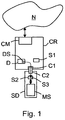
- Other characteristics and advantages of the invention will emerge on examination of the following detailed description, and of the annexed drawing, in which the single figure illustrates, in a diagrammatic and functional manner a content receiver, in the first instance, connected to a communication network, in the second instance, comprising a control device according to the invention, and in the third instance coupled to a storage device.
- The figure in the appendix not only serves to complement the invention but also to contribute to its definition, if required.
- The invention aims to allow the storing, using a mobile storage device SD, of content data from a content receiver CR, when the latter (CR) has a file system S1 that is incompatible with the file system S2 of the storage device SD.
- Hereafter, it is considered as a non-restrictive example that the content receiver CR is a Set-Top Box (STB). But, the invention is not limited to this type of content receiver. Indeed, it relates to all types of content receivers capable of being connected to at least one communication network to receive content, and having a file system and at least one connection interface allowing its coupling to a device or peripheral device. Consequently, it could also involve, for example, a decoder, a residential gateway or home gateway.
- In addition, hereafter it is considered as a non-restrictive example that the set-top box CR does not have a memory designed to allow the storage of received content. But, the invention also relates to content receivers comprising such a memory.
- In addition, hereafter it is considered as a non-restrictive example that the portable storage device SD is a USB key having a connection interface (for example of the male type). But the invention is not limited to this type of portable storage device. It relates to all types of portable storage devices having a file system controlling, notably, its data storage operations. Consequently, it can also be a hard disk, perhaps of the eSATA type, a network disk of the NDS type, or even a server of the Samba type.
- The single figure diagrammatically shows a content receiver CR (in this case a set-top box without a memory for content storage) which is connected to a communication network R and to a storage device SD (in this case a USB key).
- It is considered in what follows, as a non-restrictive example, that the communication network N is a satellite network. But the invention is not limited to this type of communication network. Indeed, the communication network N can be cabled or wireless. Thus it can also be a wired network of the xDSL type (for example ADSL), a mobile, cellular or WLAN (Wireless Local Area Network - perhaps type 802.11, WiFi or WiMAX), or any other type of digital broadcast (cable or terrestrial) and type of modulation (for example DVB, DSS, ATSC).
- This content receiver CR usually comprises a first S1 file system, which is notably responsible for controlling data storage operations of content that are received from the communication network N, and a communication module CM which allows it to connect to the communication network N, notably with the aim of receiving content, possibly broadcast.
- For example, the first file system S1 is a proprietary system different to those of the FAT (File Allocation Table) or NTFS (New Technology File System) type.
- The content receiver CR also comprises at least one first connection interface C1 intended to allow its coupling to a device or peripheral device, and notably to a storage device SD, for example a USB key. For example, the first connection interface C1 is a female type USB connector.
- The storage device SD (here a USB key) typically comprises a memory MS responsible for storing the content data received, a second file system S2 incompatible with the first file system S1 of the content receiver CR and notably responsible for controlling the storage of content data received, and at least a second connection interface C2, intended to allow its coupling to an electronic device, and notably to a desktop computer, laptop or content receiver CR. For example, the second connection interface C2 is a male type USB connector.
- For example, the second file system S2 is of the FAT or NTFS type.
- The invention proposes to implement a storage method designed to enable the storage onto a USB key SD of content data from the communication network N, despite the incompatibility between the first S1 and second S2 file systems, without this erasing or rendering unreadable any data previously stored on the USB key SD under the control of its second file system S2.
- This storage method comprises two steps (i) and (ii) which are implemented successively and consecutively to the first coupling of the USB key SD to the content receiver CR, and consecutively to the activation of an external storage service by the user of the content receiver CR as well as to the selection by this user of at least one received content which he wants to store in the USB key SD, for example by means of a man-machine interface of the content receiver CR.
- A first step (i) of the storage method comprises two sub-parts.
- A first sub-part consists in transmitting, from the content receiver CR to the storage device SD (in this case a USB key), a set of control data DS, which constitutes a third file system S3, of the virtual type and compatible with the first file system S1. A second sub-part consists in storing the set DS transmitted in at least one file in the second file system S2 of the USB key.
- Note that the first sub-part of this first step (i) can be implemented by means of a control device D which, according to the invention, is associated with the content receiver CR.
- It is understood here by "associated" both the fact of being an integral part of the content receiver CR (as illustrated), as well as the fact of being coupled directly to the content receiver CR. Consequently, a control device D can be realised in the form of software (or computer) modules, or else of a combination of electronic circuits and software modules. Note that when the device D consists only of software modules, it constitutes what a person skilled in the art may call an adaptation layer comprising a driver combined with an Application Programming Interface (API), as well as a possible graphic interface dedicated to its setting by a user.
- This control device D is notably arranged, consecutively to the first coupling of the USB key SD to the content receiver CR, to generate a set of control data DS of the aforementioned type and instruct its content receiver CR to transmit this set DS to the USB key SD so that it stores it in at least one file of its second file system S2.
- Note that in the first step (i), the content receiver CR may also transmit to the second file system S2, for example by order of the control device D, the auxiliary data that are representative of a storage capacity that it must reserve in the USB key SD for storing the content data received by the content receiver CR to be transmitted. If the remaining storage capacity of the USB key SD is less than the storage capacity required and represented by the auxiliary data transmitted, the USB key SD signals it to the control device D by a dedicated message, and the D device interrupts its operations and preferably sends a message of storage impossibility to the user of the content receiver CR.
- Note also that in the first step (i), the content receiver CR, and for example its control device D, can, before transmitting the set of control data DS, start by determining from the USB key SD the maximum authorised size and initial size of files in the second file system S2 to estimate the size that is not used by each file in the second file system S2.
- It is recalled that most file systems include files whose respective sizes must not exceed a predefined maximum size. For example, in the case of a FAT 32 type system, the maximum size of each file is 4GB
- Once the estimates for size not used are performed, the control device D determines whether the size of the set DS, which it wants to transmit to the USB key SD, is greater than the largest size not used among the ones it has just estimated.
- If so, the content receiver CR (more precisely its control device D) breaks down this set DS into at least two subsets that are intended to be stored respectively in at least two files selected in the second file system S2. It will be understood that this breakdown is intended to ensure that the size of at least one of the files of the second file system S2 does not ultimately exceed the maximum authorised size once a subset of the set DS has been added to it. Note that the subsets are not necessarily of the same size.
- If not, the breakdown does not take place and the set DS is fully stored in a second file system S2 that can contain it without its new size exceeding the maximum size.
- A second step (ii) of the storage method comprises two sub-parts.
- A first sub-part consists in transmitting content data, which has been received by the content receiver CR (and coming from the communication network N), from said content receiver CR to the USB key SD, under the control of the first file system S1. A second sub-part consists in storing in the USB key SD the content data that has been transmitted by the content receiver CR under the control of the third file system S3.
- Note that the first sub-part of this second step (ii) may be implemented by means of the control device D. More specifically, the control device D is arranged, following the storage of the set DS in the second file system S2, to control the transmission of content data received by the content receiver CR, from the latter (CR) to the USB key under control of the first file system S1, so that the content data is stored in the USB key SD under the control of the third file system S3.
- Thanks to the setting up of a third virtual file system in the second file system of a storage device, it is now possible to store in the memory of the latter content data that comes from a content receiver which has a first file system incompatible with the second file system, without this erasing or prohibiting access to the data previously stored in this memory with the second file system. Hence, thanks to the invention, a content receiver may have an external content recording function whether or not it contains an internal storage memory.
- Note that the content data, which was stored in the storage device under the control of the third file system, can be extracted by another device, having a file system compatible with the second but incompatible with the first, only on the condition that it includes suitable software for this purpose (that is to say which can dialogue with the third file system).
Claims (10)
- Method for storing content data received by a content receiver (CR) having a first file system (S1), comprising the following steps:- coupling of a storage device (SD), having a second file system (S2) incompatible with said first file system (S1), to said content receiver (CR), the method being characterized by the steps of- transmitting (i), from said content receiver (CR) to said storage device (SD), a set of control data (DS) which constitutes a third file system (S3) of virtual type compatible with said first file system (S1),- storing said set of control data (DS) in at least one file of said second file system (S2),- transmitting (ii) the content data received from said content receiver (CR) to said storage device (SD), under the control of said first file system (S1), and- storing said transmitted content data on said storage device (SD) under the control of said third file system (S3).
- Method according to claim 1, characterized in that transmitting (i) said set of control data further comprises transmitting from said content receiver (CR) auxiliary data representative of a storage capacity that must be reserved in said storage device (SD) to store said content data that must be transmitted.
- Method according to one of claims 1 and 2, characterized in that transmitting (i) said set of control data, comprises a preliminary step of determining by said content receiver (CR) from said storage device (SD) the maximum authorised size and the initial size of the files of said second file system (S2) and of estimating the size not used by each one of said files of the second file system (S2), then, when the size of said set of control data (DS) is greater than the largest size not used among those estimated, a step of breaking down by said content receiver (CR) said set of control data (DS) into at least two sub-sets to be stored respectively in at least two selected files from said second file system (S2).
- Method according to one of claims 1 to 3, characterized in that it is suited to a storage device (SD) selected from a group comprising at least one USB key and a portable hard drive.
- Method according to one of claims 1 to 4, characterized in that it is suited to a content receiver (CR) selected from a group comprising at least one of a Set-Top Box type, a decoder and a residential gateway.
- Control device (D) for a content receiver (CR) having a first file system (S1), wherein said content receiver (CR) comprises means for coupling a storage device (SD) having a second file system (S2) incompatible with said first file system (S1) to said content receiver (CR), said control device being characterized in that it comprises- means for instructing said content receiver (CR) to transmit to said storage device (SD) a set of control data (DS) constituting a third file system (S3) of virtual type and compatible with said first file system (S1), and for instructing said storage device to store said set of control data (DS) in at least one file of said second file system (S2),- means for controlling the transmission of content data received by said content receiver (CR), from the latter (CR) to said storage device (SD), under the control of said first file system (S1), and for instructing said storage device (SD) to store content data under the control of said third file system (S3).
- Control device according to claim 6, characterized in that it comprises means for instructing said content receiver (CR) to transmit to said second file system (S2), in addition to said set of control data (DS), auxiliary data representative of a storage capacity to be reserved in said storage device (SD) for storing said content data that must be transmitted.
- Control device according to one of claims 6 and 7, characterized in that it comprises means for i) determining from said storage device (SD) the maximum authorised size and the initial size of said second file system (S2) and means for estimating the size not used by each of said files of the second file system (S2), and ii), when the size of said set (DS) is greater than the largest size not used among the ones estimated, for breaking down said set (DS) into at least two subsets to be stored respectively in at least two selected files of said second file system (S2).
- Content receiver (CR), comprising a first file system (S1), characterized in that it further comprises a control device (D) according to one of claims 6 to 8.
- Content receiver according to claim 9, characterized in that it is selected from a group comprising at least one type of Set-Top Box, a decoder and a residential gateway.
Applications Claiming Priority (2)
| Application Number | Priority Date | Filing Date | Title |
|---|---|---|---|
| FR1161055A FR2983599A1 (en) | 2011-12-01 | 2011-12-01 | METHOD FOR STORING CONTENT DATA RECEIVER CONTENT DATA IN PORTABLE STORAGE EQUIPMENT, AND CONTROL DEVICE THEREFOR |
| PCT/EP2012/073995 WO2013079612A1 (en) | 2011-12-01 | 2012-11-29 | Method for storing content data of a content receiver in a portable storage device, and associated control device |
Publications (2)
| Publication Number | Publication Date |
|---|---|
| EP2786260A1 EP2786260A1 (en) | 2014-10-08 |
| EP2786260B1 true EP2786260B1 (en) | 2016-04-20 |
Family
ID=47227829
Family Applications (1)
| Application Number | Title | Priority Date | Filing Date |
|---|---|---|---|
| EP12791508.0A Active EP2786260B1 (en) | 2011-12-01 | 2012-11-29 | Method for storing content data of a content receiver in a portable storage device, and associated control device |
Country Status (11)
| Country | Link |
|---|---|
| US (1) | US10055425B2 (en) |
| EP (1) | EP2786260B1 (en) |
| JP (1) | JP6106687B2 (en) |
| KR (1) | KR102032582B1 (en) |
| CN (1) | CN103959269B (en) |
| BR (1) | BR112014012929B1 (en) |
| FR (1) | FR2983599A1 (en) |
| MX (1) | MX2014006458A (en) |
| MY (1) | MY175378A (en) |
| TW (1) | TWI561075B (en) |
| WO (1) | WO2013079612A1 (en) |
Family Cites Families (33)
| Publication number | Priority date | Publication date | Assignee | Title |
|---|---|---|---|---|
| CA2272708A1 (en) | 1996-11-27 | 1998-06-04 | Kurt E. Godwin | File directory and file navigation system |
| US6609187B1 (en) * | 1999-07-06 | 2003-08-19 | Dell Products L.P. | Method and apparatus for supporting resizing of file system partitions |
| US6910115B2 (en) | 2001-10-31 | 2005-06-21 | Hewlett-Packard Development Company, L.P. | System and method for configuring a removable storage medium |
| US7117505B2 (en) * | 2001-11-29 | 2006-10-03 | Veritas Operating Corporation | Methods, systems, and apparatus to interface with storage objects |
| US8781290B2 (en) | 2003-03-17 | 2014-07-15 | Samsung Electronics Co., Ltd. | Display apparatus for recording/reproducing video signal and/or audio signal and method thereof |
| JP2005099968A (en) | 2003-09-24 | 2005-04-14 | Hitachi Ltd | Computer system having a virtual file system |
| US7683942B2 (en) | 2004-05-18 | 2010-03-23 | Canon Kabushiki Kaisha | Information recording apparatus and control method thereof |
| JP2006146466A (en) | 2004-11-18 | 2006-06-08 | Matsushita Electric Ind Co Ltd | Recording medium and file system management method |
| US9063941B2 (en) | 2005-06-03 | 2015-06-23 | Hewlett-Packard Development Company, L.P. | System having an apparatus that uses a resource on an external device |
| CN1952890B (en) | 2005-10-21 | 2010-05-05 | 神基科技股份有限公司 | Computer starting method and computer device using same |
| US7426606B2 (en) | 2006-03-31 | 2008-09-16 | Intel Corporation | Method, apparatus and system for reverting FAT cluster number to file ID and offset of non-FAT flash file system |
| JP4653035B2 (en) * | 2006-07-26 | 2011-03-16 | キヤノン株式会社 | Video recording apparatus, control method therefor, and program |
| WO2008034285A1 (en) * | 2006-09-18 | 2008-03-27 | Fengwen Sun | A family of ldpc codes for video broadcasting applications |
| US9501492B2 (en) * | 2006-10-24 | 2016-11-22 | Marvell World Trade Ltd. | Combination journaling/non-journaling file system |
| TWI335171B (en) * | 2006-12-29 | 2010-12-21 | Giga Byte Tech Co Ltd | Short message transmission system comprising an electronic device capable of receiving an electronic program guide |
| JP4757206B2 (en) | 2007-01-23 | 2011-08-24 | キヤノン株式会社 | Image processing apparatus, image processing apparatus control method, and computer program |
| TWI330018B (en) * | 2007-01-24 | 2010-09-01 | Realtek Semiconductor Corp | Wireless transmission apparatus and method |
| US20080250164A1 (en) | 2007-04-04 | 2008-10-09 | Jaan-Huei Chen | Recording multimedia data on removable storage device |
| US7966288B2 (en) * | 2008-01-02 | 2011-06-21 | Sandisk Il Ltd. | Device and method for integrating file systems |
| KR101478619B1 (en) | 2008-02-27 | 2015-01-06 | 삼성전자주식회사 | Method and Apparatus of Inputting/Outputting Data Using Virtualization Technique |
| US8745685B2 (en) * | 2008-04-04 | 2014-06-03 | Time Warner Cable Enterprises Llc | Methods and apparatus for upgrading set top box devices without the loss of stored content |
| JP4561872B2 (en) | 2008-05-15 | 2010-10-13 | ソニー株式会社 | Recording / reproducing apparatus and information processing method |
| TWI421700B (en) | 2008-06-02 | 2014-01-01 | Wireless virtual storage apparatus and remote accessing method | |
| US8473941B2 (en) * | 2008-07-08 | 2013-06-25 | Sandisk Il Ltd. | Dynamic file system restriction for portable storage devices |
| KR100993935B1 (en) * | 2008-09-09 | 2010-11-12 | (주)씨엔에스 | Memory device recognizable as optical disk drive and driving method thereof |
| US20100070544A1 (en) | 2008-09-12 | 2010-03-18 | Microsoft Corporation | Virtual block-level storage over a file system |
| US20100146534A1 (en) * | 2008-12-09 | 2010-06-10 | At&T Intellectual Property I, L.P. | System and Method to Authenticate a Set-Top Box Device |
| JP5321113B2 (en) | 2009-02-13 | 2013-10-23 | ソニー株式会社 | Information processing apparatus, information processing method, and program |
| US8516217B2 (en) * | 2009-03-27 | 2013-08-20 | International Business Machines Corporation | Managing a logically partitioned computing system through a virtual file system |
| KR101573791B1 (en) * | 2009-06-10 | 2015-12-02 | 삼성전자주식회사 | Method and apparatus for data transmission using universal serial bus |
| SE534142C2 (en) | 2009-06-16 | 2011-05-10 | Ikonoskop Ab | Procedures and systems for storing data |
| WO2011003464A1 (en) | 2009-07-10 | 2011-01-13 | Tomtom International B.V. | Data storage system and method |
| CA2676735C (en) * | 2009-09-03 | 2010-10-19 | Ibm Canada Limited - Ibm Canada Limitee | Mechanism for making changes to server file system |
-
2011
- 2011-12-01 FR FR1161055A patent/FR2983599A1/en not_active Withdrawn
-
2012
- 2012-11-29 US US14/360,927 patent/US10055425B2/en active Active
- 2012-11-29 MX MX2014006458A patent/MX2014006458A/en active IP Right Grant
- 2012-11-29 EP EP12791508.0A patent/EP2786260B1/en active Active
- 2012-11-29 WO PCT/EP2012/073995 patent/WO2013079612A1/en not_active Ceased
- 2012-11-29 CN CN201280058397.9A patent/CN103959269B/en active Active
- 2012-11-29 MY MYPI2014001245A patent/MY175378A/en unknown
- 2012-11-29 BR BR112014012929-0A patent/BR112014012929B1/en active IP Right Grant
- 2012-11-29 JP JP2014543896A patent/JP6106687B2/en active Active
- 2012-11-29 KR KR1020147014831A patent/KR102032582B1/en active Active
- 2012-11-30 TW TW101144868A patent/TWI561075B/en active
Non-Patent Citations (1)
| Title |
|---|
| None * |
Also Published As
| Publication number | Publication date |
|---|---|
| MY175378A (en) | 2020-06-23 |
| FR2983599A1 (en) | 2013-06-07 |
| JP2015506015A (en) | 2015-02-26 |
| WO2013079612A1 (en) | 2013-06-06 |
| MX2014006458A (en) | 2014-09-01 |
| US20140330876A1 (en) | 2014-11-06 |
| CN103959269A (en) | 2014-07-30 |
| CN103959269B (en) | 2017-08-15 |
| TW201332346A (en) | 2013-08-01 |
| TWI561075B (en) | 2016-12-01 |
| HK1202671A1 (en) | 2015-10-02 |
| KR20140102662A (en) | 2014-08-22 |
| BR112014012929B1 (en) | 2021-01-26 |
| KR102032582B1 (en) | 2019-10-15 |
| JP6106687B2 (en) | 2017-04-05 |
| EP2786260A1 (en) | 2014-10-08 |
| BR112014012929A2 (en) | 2017-06-13 |
| US10055425B2 (en) | 2018-08-21 |
Similar Documents
| Publication | Publication Date | Title |
|---|---|---|
| US8769595B2 (en) | System and method for content transmission network selection | |
| EP2214380B1 (en) | Networked-enabled mass storage dongle with networked media content aggregation | |
| EP2975531B1 (en) | Media processing apparatus and controlling method thereof | |
| US20040128371A1 (en) | Personal hand held terminal capable of interfacing information with host and method thereof | |
| US20080228963A1 (en) | Method and apparatus for transferring settings and other configuration information from one consumer electronics device to another | |
| US7533165B2 (en) | Communication apparatus | |
| CN110611718A (en) | File transmission method, device, server and storage medium | |
| US20150121434A1 (en) | Electronic Device, Electronic Device System, and Electronic Device Control Method | |
| JP2004334832A (en) | Control method, controlled apparatus, and control system | |
| US20160127768A1 (en) | Usb sharing method for combo tv set, combo tv set and computer readable storage medium | |
| CN104219544A (en) | Method and system for dynamically scheduling IPTV service resources | |
| US10055425B2 (en) | Method for storing content data of a content receiver in a portable storage device, and associated control device | |
| EP1633133A2 (en) | Portable apparatus for enabling reproduction of television | |
| US20100082711A1 (en) | Systems and methods for sideband communication between device and host to minimize file corruption | |
| HK1202671B (en) | Method for storing content data of a content receiver in a portable storage device, and associated control device | |
| US8558954B2 (en) | Video display device, video display system, and video display method | |
| BRPI0718822A2 (en) | METHOD AND SYSTEM FOR PROVISION OF RETURN CALLS FROM A MOBILE RECEPTION DEVICE | |
| US20130262729A1 (en) | System and method for file sharing | |
| US20110191789A1 (en) | Application executing apparatus and method | |
| US20110107384A1 (en) | Data broadcasting system, data broadcasting server and data broadcasting program storage medium | |
| US9426540B2 (en) | Method for selecting and broadcasting a message, and system and message broadcasting server for implementing the method | |
| JP2007158540A (en) | Content transfer device | |
| CN109408009A (en) | Mobile terminal and its display methods | |
| KR101358352B1 (en) | Apparatus for usb interface and method for usb data transmission | |
| CN107171689A (en) | It is a kind of applied to the method for vehicle entertainment, device, vehicle entertainment device and system |
Legal Events
| Date | Code | Title | Description |
|---|---|---|---|
| PUAI | Public reference made under article 153(3) epc to a published international application that has entered the european phase |
Free format text: ORIGINAL CODE: 0009012 |
|
| 17P | Request for examination filed |
Effective date: 20140604 |
|
| AK | Designated contracting states |
Kind code of ref document: A1 Designated state(s): AL AT BE BG CH CY CZ DE DK EE ES FI FR GB GR HR HU IE IS IT LI LT LU LV MC MK MT NL NO PL PT RO RS SE SI SK SM TR |
|
| DAX | Request for extension of the european patent (deleted) | ||
| REG | Reference to a national code |
Ref country code: HK Ref legal event code: DE Ref document number: 1202671 Country of ref document: HK |
|
| GRAP | Despatch of communication of intention to grant a patent |
Free format text: ORIGINAL CODE: EPIDOSNIGR1 |
|
| INTG | Intention to grant announced |
Effective date: 20151014 |
|
| GRAS | Grant fee paid |
Free format text: ORIGINAL CODE: EPIDOSNIGR3 |
|
| GRAJ | Information related to disapproval of communication of intention to grant by the applicant or resumption of examination proceedings by the epo deleted |
Free format text: ORIGINAL CODE: EPIDOSDIGR1 |
|
| GRAR | Information related to intention to grant a patent recorded |
Free format text: ORIGINAL CODE: EPIDOSNIGR71 |
|
| GRAA | (expected) grant |
Free format text: ORIGINAL CODE: 0009210 |
|
| INTG | Intention to grant announced |
Effective date: 20160223 |
|
| AK | Designated contracting states |
Kind code of ref document: B1 Designated state(s): AL AT BE BG CH CY CZ DE DK EE ES FI FR GB GR HR HU IE IS IT LI LT LU LV MC MK MT NL NO PL PT RO RS SE SI SK SM TR |
|
| REG | Reference to a national code |
Ref country code: GB Ref legal event code: FG4D |
|
| REG | Reference to a national code |
Ref country code: CH Ref legal event code: EP |
|
| REG | Reference to a national code |
Ref country code: AT Ref legal event code: REF Ref document number: 793136 Country of ref document: AT Kind code of ref document: T Effective date: 20160515 |
|
| REG | Reference to a national code |
Ref country code: IE Ref legal event code: FG4D |
|
| REG | Reference to a national code |
Ref country code: PT Ref legal event code: SC4A Free format text: AVAILABILITY OF NATIONAL TRANSLATION Effective date: 20160517 |
|
| REG | Reference to a national code |
Ref country code: NL Ref legal event code: FP |
|
| REG | Reference to a national code |
Ref country code: DE Ref legal event code: R096 Ref document number: 602012017414 Country of ref document: DE |
|
| REG | Reference to a national code |
Ref country code: SE Ref legal event code: TRGR |
|
| REG | Reference to a national code |
Ref country code: LT Ref legal event code: MG4D |
|
| REG | Reference to a national code |
Ref country code: AT Ref legal event code: MK05 Ref document number: 793136 Country of ref document: AT Kind code of ref document: T Effective date: 20160420 |
|
| PG25 | Lapsed in a contracting state [announced via postgrant information from national office to epo] |
Ref country code: LT Free format text: LAPSE BECAUSE OF FAILURE TO SUBMIT A TRANSLATION OF THE DESCRIPTION OR TO PAY THE FEE WITHIN THE PRESCRIBED TIME-LIMIT Effective date: 20160420 Ref country code: NO Free format text: LAPSE BECAUSE OF FAILURE TO SUBMIT A TRANSLATION OF THE DESCRIPTION OR TO PAY THE FEE WITHIN THE PRESCRIBED TIME-LIMIT Effective date: 20160720 Ref country code: FI Free format text: LAPSE BECAUSE OF FAILURE TO SUBMIT A TRANSLATION OF THE DESCRIPTION OR TO PAY THE FEE WITHIN THE PRESCRIBED TIME-LIMIT Effective date: 20160420 Ref country code: PL Free format text: LAPSE BECAUSE OF FAILURE TO SUBMIT A TRANSLATION OF THE DESCRIPTION OR TO PAY THE FEE WITHIN THE PRESCRIBED TIME-LIMIT Effective date: 20160420 |
|
| REG | Reference to a national code |
Ref country code: FR Ref legal event code: PLFP Year of fee payment: 5 |
|
| PG25 | Lapsed in a contracting state [announced via postgrant information from national office to epo] |
Ref country code: GR Free format text: LAPSE BECAUSE OF FAILURE TO SUBMIT A TRANSLATION OF THE DESCRIPTION OR TO PAY THE FEE WITHIN THE PRESCRIBED TIME-LIMIT Effective date: 20160721 Ref country code: ES Free format text: LAPSE BECAUSE OF FAILURE TO SUBMIT A TRANSLATION OF THE DESCRIPTION OR TO PAY THE FEE WITHIN THE PRESCRIBED TIME-LIMIT Effective date: 20160420 Ref country code: LV Free format text: LAPSE BECAUSE OF FAILURE TO SUBMIT A TRANSLATION OF THE DESCRIPTION OR TO PAY THE FEE WITHIN THE PRESCRIBED TIME-LIMIT Effective date: 20160420 Ref country code: RS Free format text: LAPSE BECAUSE OF FAILURE TO SUBMIT A TRANSLATION OF THE DESCRIPTION OR TO PAY THE FEE WITHIN THE PRESCRIBED TIME-LIMIT Effective date: 20160420 Ref country code: HR Free format text: LAPSE BECAUSE OF FAILURE TO SUBMIT A TRANSLATION OF THE DESCRIPTION OR TO PAY THE FEE WITHIN THE PRESCRIBED TIME-LIMIT Effective date: 20160420 Ref country code: AT Free format text: LAPSE BECAUSE OF FAILURE TO SUBMIT A TRANSLATION OF THE DESCRIPTION OR TO PAY THE FEE WITHIN THE PRESCRIBED TIME-LIMIT Effective date: 20160420 |
|
| PG25 | Lapsed in a contracting state [announced via postgrant information from national office to epo] |
Ref country code: IT Free format text: LAPSE BECAUSE OF FAILURE TO SUBMIT A TRANSLATION OF THE DESCRIPTION OR TO PAY THE FEE WITHIN THE PRESCRIBED TIME-LIMIT Effective date: 20160420 |
|
| REG | Reference to a national code |
Ref country code: DE Ref legal event code: R097 Ref document number: 602012017414 Country of ref document: DE |
|
| PG25 | Lapsed in a contracting state [announced via postgrant information from national office to epo] |
Ref country code: CZ Free format text: LAPSE BECAUSE OF FAILURE TO SUBMIT A TRANSLATION OF THE DESCRIPTION OR TO PAY THE FEE WITHIN THE PRESCRIBED TIME-LIMIT Effective date: 20160420 Ref country code: DK Free format text: LAPSE BECAUSE OF FAILURE TO SUBMIT A TRANSLATION OF THE DESCRIPTION OR TO PAY THE FEE WITHIN THE PRESCRIBED TIME-LIMIT Effective date: 20160420 Ref country code: RO Free format text: LAPSE BECAUSE OF FAILURE TO SUBMIT A TRANSLATION OF THE DESCRIPTION OR TO PAY THE FEE WITHIN THE PRESCRIBED TIME-LIMIT Effective date: 20160420 Ref country code: EE Free format text: LAPSE BECAUSE OF FAILURE TO SUBMIT A TRANSLATION OF THE DESCRIPTION OR TO PAY THE FEE WITHIN THE PRESCRIBED TIME-LIMIT Effective date: 20160420 Ref country code: SK Free format text: LAPSE BECAUSE OF FAILURE TO SUBMIT A TRANSLATION OF THE DESCRIPTION OR TO PAY THE FEE WITHIN THE PRESCRIBED TIME-LIMIT Effective date: 20160420 |
|
| PLBE | No opposition filed within time limit |
Free format text: ORIGINAL CODE: 0009261 |
|
| STAA | Information on the status of an ep patent application or granted ep patent |
Free format text: STATUS: NO OPPOSITION FILED WITHIN TIME LIMIT |
|
| PG25 | Lapsed in a contracting state [announced via postgrant information from national office to epo] |
Ref country code: SM Free format text: LAPSE BECAUSE OF FAILURE TO SUBMIT A TRANSLATION OF THE DESCRIPTION OR TO PAY THE FEE WITHIN THE PRESCRIBED TIME-LIMIT Effective date: 20160420 |
|
| 26N | No opposition filed |
Effective date: 20170123 |
|
| PG25 | Lapsed in a contracting state [announced via postgrant information from national office to epo] |
Ref country code: SI Free format text: LAPSE BECAUSE OF FAILURE TO SUBMIT A TRANSLATION OF THE DESCRIPTION OR TO PAY THE FEE WITHIN THE PRESCRIBED TIME-LIMIT Effective date: 20160420 |
|
| REG | Reference to a national code |
Ref country code: CH Ref legal event code: PL |
|
| REG | Reference to a national code |
Ref country code: HK Ref legal event code: GR Ref document number: 1202671 Country of ref document: HK |
|
| PG25 | Lapsed in a contracting state [announced via postgrant information from national office to epo] |
Ref country code: LI Free format text: LAPSE BECAUSE OF NON-PAYMENT OF DUE FEES Effective date: 20161130 Ref country code: CH Free format text: LAPSE BECAUSE OF NON-PAYMENT OF DUE FEES Effective date: 20161130 |
|
| PG25 | Lapsed in a contracting state [announced via postgrant information from national office to epo] |
Ref country code: LU Free format text: LAPSE BECAUSE OF NON-PAYMENT OF DUE FEES Effective date: 20161130 |
|
| REG | Reference to a national code |
Ref country code: FR Ref legal event code: PLFP Year of fee payment: 6 |
|
| PG25 | Lapsed in a contracting state [announced via postgrant information from national office to epo] |
Ref country code: HU Free format text: LAPSE BECAUSE OF FAILURE TO SUBMIT A TRANSLATION OF THE DESCRIPTION OR TO PAY THE FEE WITHIN THE PRESCRIBED TIME-LIMIT; INVALID AB INITIO Effective date: 20121129 |
|
| PG25 | Lapsed in a contracting state [announced via postgrant information from national office to epo] |
Ref country code: CY Free format text: LAPSE BECAUSE OF FAILURE TO SUBMIT A TRANSLATION OF THE DESCRIPTION OR TO PAY THE FEE WITHIN THE PRESCRIBED TIME-LIMIT Effective date: 20160420 Ref country code: MK Free format text: LAPSE BECAUSE OF FAILURE TO SUBMIT A TRANSLATION OF THE DESCRIPTION OR TO PAY THE FEE WITHIN THE PRESCRIBED TIME-LIMIT Effective date: 20160420 Ref country code: IS Free format text: LAPSE BECAUSE OF FAILURE TO SUBMIT A TRANSLATION OF THE DESCRIPTION OR TO PAY THE FEE WITHIN THE PRESCRIBED TIME-LIMIT Effective date: 20160420 Ref country code: MC Free format text: LAPSE BECAUSE OF FAILURE TO SUBMIT A TRANSLATION OF THE DESCRIPTION OR TO PAY THE FEE WITHIN THE PRESCRIBED TIME-LIMIT Effective date: 20160420 |
|
| PG25 | Lapsed in a contracting state [announced via postgrant information from national office to epo] |
Ref country code: BG Free format text: LAPSE BECAUSE OF FAILURE TO SUBMIT A TRANSLATION OF THE DESCRIPTION OR TO PAY THE FEE WITHIN THE PRESCRIBED TIME-LIMIT Effective date: 20160420 |
|
| PG25 | Lapsed in a contracting state [announced via postgrant information from national office to epo] |
Ref country code: MT Free format text: LAPSE BECAUSE OF NON-PAYMENT OF DUE FEES Effective date: 20161129 |
|
| REG | Reference to a national code |
Ref country code: FR Ref legal event code: PLFP Year of fee payment: 7 |
|
| PG25 | Lapsed in a contracting state [announced via postgrant information from national office to epo] |
Ref country code: AL Free format text: LAPSE BECAUSE OF FAILURE TO SUBMIT A TRANSLATION OF THE DESCRIPTION OR TO PAY THE FEE WITHIN THE PRESCRIBED TIME-LIMIT Effective date: 20160420 Ref country code: TR Free format text: LAPSE BECAUSE OF FAILURE TO SUBMIT A TRANSLATION OF THE DESCRIPTION OR TO PAY THE FEE WITHIN THE PRESCRIBED TIME-LIMIT Effective date: 20160420 |
|
| REG | Reference to a national code |
Ref country code: DE Ref legal event code: R082 Ref document number: 602012017414 Country of ref document: DE Representative=s name: DEHNS, DE Ref country code: DE Ref legal event code: R081 Ref document number: 602012017414 Country of ref document: DE Owner name: INTERDIGITAL CE PATENT HOLDINGS SAS, FR Free format text: FORMER OWNER: THOMSON LICENSING, ISSY-LES-MOULINEAUX, FR Ref country code: DE Ref legal event code: R082 Ref document number: 602012017414 Country of ref document: DE Representative=s name: DEHNS PATENT AND TRADEMARK ATTORNEYS, DE |
|
| REG | Reference to a national code |
Ref country code: NL Ref legal event code: PD Owner name: INTERDIGITAL CE PATENT HOLDINGS; FR Free format text: DETAILS ASSIGNMENT: CHANGE OF OWNER(S), ASSIGNMENT; FORMER OWNER NAME: THOMSON LICENSING Effective date: 20190903 |
|
| REG | Reference to a national code |
Ref country code: GB Ref legal event code: 732E Free format text: REGISTERED BETWEEN 20190926 AND 20191002 |
|
| REG | Reference to a national code |
Ref country code: BE Ref legal event code: PD Owner name: INTERDIGITAL CE PATENT HOLDINGS; FR Free format text: DETAILS ASSIGNMENT: CHANGE OF OWNER(S), CESSION; FORMER OWNER NAME: THOMSON LICENSING Effective date: 20190930 |
|
| PGFP | Annual fee paid to national office [announced via postgrant information from national office to epo] |
Ref country code: PT Payment date: 20251117 Year of fee payment: 14 |
|
| PGFP | Annual fee paid to national office [announced via postgrant information from national office to epo] |
Ref country code: NL Payment date: 20251124 Year of fee payment: 14 |
|
| PGFP | Annual fee paid to national office [announced via postgrant information from national office to epo] |
Ref country code: DE Payment date: 20251126 Year of fee payment: 14 |
|
| PGFP | Annual fee paid to national office [announced via postgrant information from national office to epo] |
Ref country code: GB Payment date: 20251125 Year of fee payment: 14 |
|
| PGFP | Annual fee paid to national office [announced via postgrant information from national office to epo] |
Ref country code: FR Payment date: 20251125 Year of fee payment: 14 |
|
| PGFP | Annual fee paid to national office [announced via postgrant information from national office to epo] |
Ref country code: BE Payment date: 20251124 Year of fee payment: 14 |
|
| PGFP | Annual fee paid to national office [announced via postgrant information from national office to epo] |
Ref country code: SE Payment date: 20251124 Year of fee payment: 14 |
|
| PGFP | Annual fee paid to national office [announced via postgrant information from national office to epo] |
Ref country code: IE Payment date: 20251118 Year of fee payment: 14 |