EP2785028A1 - Method and system for providing in real-time voice quality feedback during a communication session - Google Patents
Method and system for providing in real-time voice quality feedback during a communication session Download PDFInfo
- Publication number
- EP2785028A1 EP2785028A1 EP20130305421 EP13305421A EP2785028A1 EP 2785028 A1 EP2785028 A1 EP 2785028A1 EP 20130305421 EP20130305421 EP 20130305421 EP 13305421 A EP13305421 A EP 13305421A EP 2785028 A1 EP2785028 A1 EP 2785028A1
- Authority
- EP
- European Patent Office
- Prior art keywords
- communication session
- quality
- real
- module
- time
- Prior art date
- Legal status (The legal status is an assumption and is not a legal conclusion. Google has not performed a legal analysis and makes no representation as to the accuracy of the status listed.)
- Ceased
Links
- 238000004891 communication Methods 0.000 title claims abstract description 58
- 238000000034 method Methods 0.000 title claims abstract description 17
- 238000011156 evaluation Methods 0.000 claims description 7
- 230000008447 perception Effects 0.000 claims description 4
- 238000013519 translation Methods 0.000 claims description 2
- 230000011664 signaling Effects 0.000 description 7
- 238000004458 analytical method Methods 0.000 description 4
- 230000008901 benefit Effects 0.000 description 3
- 238000012544 monitoring process Methods 0.000 description 3
- 230000003247 decreasing effect Effects 0.000 description 2
- 238000011161 development Methods 0.000 description 2
- 238000010586 diagram Methods 0.000 description 2
- 230000003993 interaction Effects 0.000 description 2
- 230000033764 rhythmic process Effects 0.000 description 2
- 230000001960 triggered effect Effects 0.000 description 2
- 230000001143 conditioned effect Effects 0.000 description 1
- 230000000694 effects Effects 0.000 description 1
- 230000006870 function Effects 0.000 description 1
- 238000012986 modification Methods 0.000 description 1
- 230000004048 modification Effects 0.000 description 1
- 238000012360 testing method Methods 0.000 description 1
- 230000009466 transformation Effects 0.000 description 1
- 238000000844 transformation Methods 0.000 description 1
- 230000000007 visual effect Effects 0.000 description 1
- 230000002747 voluntary effect Effects 0.000 description 1
Images

Classifications
-
- H—ELECTRICITY
- H04—ELECTRIC COMMUNICATION TECHNIQUE
- H04M—TELEPHONIC COMMUNICATION
- H04M3/00—Automatic or semi-automatic exchanges
- H04M3/22—Arrangements for supervision, monitoring or testing
- H04M3/2236—Quality of speech transmission monitoring
-
- H—ELECTRICITY
- H04—ELECTRIC COMMUNICATION TECHNIQUE
- H04M—TELEPHONIC COMMUNICATION
- H04M2201/00—Electronic components, circuits, software, systems or apparatus used in telephone systems
- H04M2201/40—Electronic components, circuits, software, systems or apparatus used in telephone systems using speech recognition
Definitions
- the present invention relates to a voice quality feedback method and system provided to users involved in a communication session to inform them in real-time about the quality perceived by the other user-sides.
- the technical problem is to inform either one or both sides (the caller or/and the caller) that the line quality is poor, at a low cost for the bandwidth, to increase the overall conversation benefits with a better understanding.
- one known solution by the user-sides is to try to physically move and make iterative tests until both the caller and the callee hear well each other.
- Another solution generally performed by the end-users when experiencing this issue occurs is to stop the current conversation call and move to a solution consuming less bandwidth and which is not real-time channel such as SMS or email.
- An object of the present invention is to allow a better understanding between two people involved in a live communication session even though the channel quality is not evenly good on both sides.
- Another object of the present invention is to monitor the communication session quality, particularly the voice conversation quality (whatever analog or digital), compare it to a configurable level of quality and provide some feedback to the both end-users.
- Another object of the present invention is to add value in the live communication session through indicators instead of having a manual handling of the issue.
- Another object of the present invention is to leverage the indicator at the deployment scale to improve lacks in the radio coverage.
- Various embodiments relate to a method for informing in real-time a first part participating to an ongoing communication session about the quality perceived by a second part participating to the said communication session, said method comprising the steps of:
- Various embodiments further relate to a system for informing in real-time a first part participating to an ongoing communication session about the quality perceived by a second part participating to the said communication session, said system comprising the following modules:
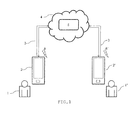
- the system 5 performs a monitoring function of the said ongoing conversation: it analyses and evaluates the level of the ongoing communication session quality and provides in real-time a feedback to terminals 2 and 2 ' about the quality of the communication session perceived by the other part with the help of perceptible warnings 6 and 6 '. For instance if the communication session quality perceived by the terminal 2 ' (respectively 2 ) is judged to be below a threshold of quality configured in 5 , the terminal 2 (respectively 2 ') is notified about this issue by receiving a perceptible warning 6 (respectively 6 ').
- the perceptible warnings 6 and 6' inform the user 1 and 1 ' of the poor conversation quality 3 perceived by the other part. For instance, if considering the user 1 as the caller and user 1 ' as the callee, if the caller 1 ' does not hear well the speaker 1 caused by a lake of bandwidth, the speaker 1 is notified by perceptible warning such as vibrations or lighting on his terminal 2 at the rhythm of his own speech.
- two parts are participating to the same ongoing communication session with their respective communication terminals. It is also assumed that the conversation is asymmetric for one of the part: one side gets less bandwidth than the other side and has accordingly a worse communication session quality than the other part.
- the module 7 performs a real-time acquisition of at least one quality indicator related to the communication session perceived by one user side and transmits the said quality indicator(s) to module 8.
- Module 8 is in charge of analyzing in real-time the said quality indicator(s) by comparing it/them to preconfigured threshold and of returning an evaluation of the communication session quality. Then the evaluation result is communicated to module 9, depending of the quality result this module transforms the indicator(s) acquired by 7 into quality information to be sent in real-time through a network 10 to the other user side 11 .
- module 9 sends the said quality information with using network 10 with the least bandwidth consumption.
- the said information quality messages are received at the other user side 11 and triggers via the sub-module 22 perceptible warning indicators to inform 11 of the perceived communication session quality an the other side.
- voice quality indicators are acquired in real-time by the module 7 at one part side and then transmitted to the analyzing and evaluating module 8 .
- Module 8 performs during the conversation an analysis of the indicators linked to the conversation quality on each part, each direction, and each channel. For instance indicators such as quality of sentences, voice loudness or radio coverage are considered.
- Module 15 evaluates in real-time voice loudness of the corresponding quality indicator acquired. This enables to detect the caller and/or callee speaking louder which is a good indicator, meaning the remote part does not hear well.
- Another module 16 evaluates the radio coverage related to the acquired indicator.
- Module 17 regroups and aggregates all the analyzed indicators of modules 8 (the information returned by 13, 15 , and 16 ) and evaluates the quality of the voice conversation perceived by the corresponding part.
- modules 12 to 17 may be integrated either on the user-side either in a remote platform with no radio constraints.
- module 17 The evaluation result of the module 17 is then transmitted to module 9 . If module 17 judges the conversation quality as being "bad" compared to a pre-configured threshold, module 9 transforms in real-time the voice of the current speaker into information related to the evaluated quality, for example through signaling and/or data messages.
- the said signaling/data messages are then sent by module 9 through the networks 10 with lowest bandwidth consumption, to the other part 11, more specifically to the triggering module 22 .
- the module 22 uses the said signaling/data messages received (related to the evaluated quality) to trigger perceptible warning indicators to part 11 .
- sub-modules 18 , 19, 20, 21 are optionally used by module 9 to perform the following operations:
- the module 19 computes the said signaling/data messages to send by modulating the output of module 18 .
- the modulation to be used is chosen among predefined patterns stored in the database 20 . For instance traffic congestion of the channels and available bandwidth are taken into account to choose the appropriate modulation.
- the said signaling/data messages are computed per time window, to provide an almost real-time feedback.
- the sending module 21 selects the available network 10 (voice only/data only) with the lowest bandwidth consumption and send the said signaling/data messages to the sub-module 22 of the other part 11 .
- Module 22 uses the said signaling/data messages to trigger at least one perceptible warning.
- the form and number of the perceptible warning indicators triggered by module 22 are conditioned by the available bandwidth of each part. For instance the user who has the most available bandwidth is warned by several perceptible warning such as vibration at the rhythm of his voice, or visual notifications such as lighting at the same rate. The user who has the lowest available bandwidth receives "basic" notifications which are the same as described above but with a more limited number due to the lack of bandwidth.
- this part 11 can send spontaneously via the module 23 a voice perception indicator.
- This indicator is used as a first level of module 24 to trigger the analysis of the module 8 .
- the sending of an indicator is based on a voluntary action of the part: for instance when a user judges the received voice quality as being "bad", he sends an indicator via the module 23 with the help of a SMS or an embedded application to mobile 24 which triggers the analysis. It is to be note that an end-user can send via module 23 other indicators than the quality perceived.
- a user can send an indicator that mentions "listen to me”: if the module 15 detects loudness on the same side, it means that the receiver is trying to speak but the speaker speaks too loudly and does not hear the receiver. So the speaker may be informed or warned by 22 .
- the perceptible warnings may still be triggered by module 22 , but in addition to that the speaker that is not well heard receives a notification and initializes local speech-to-text translation at module 12 and sends the text to the other part.
- the above-described system allows a better understanding between two parts involved in the same ongoing communication session even if the channel quality is not good on both sides.
Landscapes
- Health & Medical Sciences (AREA)
- Audiology, Speech & Language Pathology (AREA)
- Engineering & Computer Science (AREA)
- Signal Processing (AREA)
- Telephonic Communication Services (AREA)
Abstract
- Acquiring in real-time at least one quality indicator related to the said communication session at the said second part side;
- Analyzing and evaluating in real-time the quality of the said communication session perceived at the said second part side with utilizing the said quality indicator(s);
- Sending in real-time information related to the evaluated quality of the said communication session perceived at the said second part to the said first part.
Description
- The present invention relates to a voice quality feedback method and system provided to users involved in a communication session to inform them in real-time about the quality perceived by the other user-sides.
- Communication sessions either analog or digital play an important part in our daily lives. But in mobility, when performing a communication session with other users we often experience some communication issues. For instance, during a conversation call the end-users can indifferently experience voice communication issues such as blanks, partial words or partial sentences heard. Many reasons may cause these issues like limited bandwidth or/and a poor coverage in time space at one or both user-sides. This type of situation creates frequently misunderstandings between the caller and the callee because most of time the conversation is asymmetric: one of the two sides hears very well, while the other one doesn't.
- Yet a solution can not be easily designed around while being efficient and not causing more congestion therefore decreasing the overall quality.
- Accordingly the technical problem is to inform either one or both sides (the caller or/and the caller) that the line quality is poor, at a low cost for the bandwidth, to increase the overall conversation benefits with a better understanding.
- To address such problems, one known solution by the user-sides is to try to physically move and make iterative tests until both the caller and the callee hear well each other.
- Another solution generally performed by the end-users when experiencing this issue occurs is to stop the current conversation call and move to a solution consuming less bandwidth and which is not real-time channel such as SMS or email.
- However in both cases this does not enable to detect as early as possible the issues and inform the remote sides, while trying to maintain and improve the conversation session overtime.
- Moreover, these are standalone solutions that are not efficient at a larger scale for instance at operator side, to diagnose overtime radio coverage lacks and fix them.
- An object of the present invention is to allow a better understanding between two people involved in a live communication session even though the channel quality is not evenly good on both sides.
- Another object of the present invention is to monitor the communication session quality, particularly the voice conversation quality (whatever analog or digital), compare it to a configurable level of quality and provide some feedback to the both end-users.
- Another object of the present invention is to add value in the live communication session through indicators instead of having a manual handling of the issue.
- Another object of the present invention is to leverage the indicator at the deployment scale to improve lacks in the radio coverage.
- Various embodiments are directed to addressing the effects of one or more of the problems set forth above. The following presents a simplified summary of embodiments in order to provide a basic understanding of some aspects of the various embodiments. This summary is not an exhaustive overview of these various embodiments. It is not intended to identify key of critical elements or to delineate the scope of these various embodiments. Its sole purpose is to present some concepts in a simplified form as a prelude to the more detailed description that is discussed later.
- Various embodiments relate to a method for informing in real-time a first part participating to an ongoing communication session about the quality perceived by a second part participating to the said communication session, said method comprising the steps of:
- Acquiring in real-time at least one quality indicator related to the said communication session at the said second part side;
- Analyzing and evaluating in real-time the quality of the said communication session perceived at the said second part side with utilizing the said quality indicator(s);
- Sending in real-time information related to the evaluated quality of the said communication session perceived at the said second part to the said first part.
- Various embodiments further relate to a system for informing in real-time a first part participating to an ongoing communication session about the quality perceived by a second part participating to the said communication session, said system comprising the following modules:
- An acquisition module to acquire in real-time at least one quality indicator related to the said communication session at the said second part side;
- An analyzing module to analyze and evaluate in real-time the quality of the said communication session perceived at the said second part side with utilizing the said quality indicator(s);
- A sending module to send in real-time information related to the evaluated quality of the said communication session perceived at the said second part to the said first part.
- While the various embodiments are susceptible to various modification and alternative forms, specific embodiments thereof have been shown by way of example in the drawings. It should be understood, however, that the description herein of specific embodiments is not intended to limit the various embodiments to the particular forms disclosed.
- It may of course be appreciated that in the development of any such actual embodiments, implementation-specific decisions should be made to achieve the developer's specific goal, such as compliance with system-related and business-related constraints. It will be appreciated that such a development effort might be time consuming but may nevertheless be a routine understanding for those or ordinary skill in the art having the benefit of this disclosure.
- The objects, advantages and other features of the present invention will become more apparent from the following disclosure and claims. The following non-restrictive description of preferred embodiments is given for the purpose of exemplification only with reference to the accompanying drawing in which
-
FIG.1 is a schematic diagram illustrating an embodiment of the present invention; -
FIG.2 is a schematic diagram illustrating the modules of a monitoring system and their interactions with one part during a communication session for deploying various embodiments. - The following description applies to an ongoing communication session between two parts.
- With reference to
Figure 1 , twousers 1 and 1' equipped withdifferent terminals 2 and 2' are performing a sameongoing communication session 3 through acommunication network 4. Thesystem 5 performs a monitoring function of the said ongoing conversation: it analyses and evaluates the level of the ongoing communication session quality and provides in real-time a feedback toterminals 2 and 2' about the quality of the communication session perceived by the other part with the help of perceptible warnings 6 and 6'. For instance if the communication session quality perceived by the terminal 2' (respectively 2) is judged to be below a threshold of quality configured in 5, the terminal 2 (respectively 2') is notified about this issue by receiving a perceptible warning 6 (respectively 6'). During a conversation call the perceptible warnings 6 and 6' inform theuser 1 and 1' of thepoor conversation quality 3 perceived by the other part. For instance, if considering theuser 1 as the caller and user 1' as the callee, if the caller 1' does not hear well thespeaker 1 caused by a lake of bandwidth, thespeaker 1 is notified by perceptible warning such as vibrations or lighting on histerminal 2 at the rhythm of his own speech. - Next considering
Figure 2 , there is shown the different modules of the saidmonitoring system 5 and their interactions with the modules of one user part during an ongoing communication session. - In a one embodiment, two parts (e.g. two users) are participating to the same ongoing communication session with their respective communication terminals. It is also assumed that the conversation is asymmetric for one of the part: one side gets less bandwidth than the other side and has accordingly a worse communication session quality than the other part.
- The
module 7 performs a real-time acquisition of at least one quality indicator related to the communication session perceived by one user side and transmits the said quality indicator(s) to module 8. Module 8 is in charge of analyzing in real-time the said quality indicator(s) by comparing it/them to preconfigured threshold and of returning an evaluation of the communication session quality. Then the evaluation result is communicated tomodule 9, depending of the quality result this module transforms the indicator(s) acquired by 7 into quality information to be sent in real-time through anetwork 10 to theother user side 11. In order to avoid a decreasing of the overall quality of the communication session,module 9 sends the said quality information with usingnetwork 10 with the least bandwidth consumption. The said information quality messages are received at theother user side 11 and triggers via thesub-module 22 perceptible warning indicators to inform 11 of the perceived communication session quality an the other side. - To illustrate various embodiments of the present invention, an example wherein said communication is a conversation call (whatever analog or digital) between two users is now considered. It is assumed that at least one or the both parts is in a situation in which the bandwidth is limited. One part may be indifferently the caller, the callee, the speaker or the receiver. Accordingly the fallavuing description applies indifferently to both parts.
- As a first step voice quality indicators are acquired in real-time by the
module 7 at one part side and then transmitted to the analyzing and evaluating module 8. Module 8 performs during the conversation an analysis of the indicators linked to the conversation quality on each part, each direction, and each channel. For instance indicators such as quality of sentences, voice loudness or radio coverage are considered. - In an embodiment several sub-modules in 8 can be used to perform this step:
-
Module 12 translates in real-time voice of the speaker into text using state of the art speech-to-text techniques. The said text output of 12 is transmitted tomodule 13 which evaluates the quality of sentences by comparing them to thresholds and rules stored in thedatabase 14. - A non-exhaustive list of rules stored in 14 concerns the evaluation of:
- The number of consecutive words that are self-understandable;
- Trunk words;
- Repetition of a given word/sequence of letters;
- Grammatical correctness: for instance presence of subject followed by verbs articles and names.
-
Module 15 evaluates in real-time voice loudness of the corresponding quality indicator acquired. This enables to detect the caller and/or callee speaking louder which is a good indicator, meaning the remote part does not hear well. Anothermodule 16 evaluates the radio coverage related to the acquired indicator. -
Module 17 regroups and aggregates all the analyzed indicators of modules 8 (the information returned by 13, 15, and 16) and evaluates the quality of the voice conversation perceived by the corresponding part. - It is to be noted that
modules 12 to 17 may be integrated either on the user-side either in a remote platform with no radio constraints. - The evaluation result of the
module 17 is then transmitted tomodule 9. Ifmodule 17 judges the conversation quality as being "bad" compared to a pre-configured threshold,module 9 transforms in real-time the voice of the current speaker into information related to the evaluated quality, for example through signaling and/or data messages. The said signaling/data messages are then sent bymodule 9 through thenetworks 10 with lowest bandwidth consumption, to theother part 11, more specifically to the triggeringmodule 22. Themodule 22 uses the said signaling/data messages received (related to the evaluated quality) to trigger perceptible warning indicators topart 11. - In one
embodiment sub-modules module 9 to perform the following operations: - To have a rich feedback about the way his voice is perceived on the
remote side module 18 transforms spectrally the speaker voice, this step permits to get a frequential transcript of the speaker voice. For instance, Fourier or wavelet transformations may be performed. - Then the
module 19 computes the said signaling/data messages to send by modulating the output ofmodule 18. The modulation to be used is chosen among predefined patterns stored in thedatabase 20. For instance traffic congestion of the channels and available bandwidth are taken into account to choose the appropriate modulation. The said signaling/data messages are computed per time window, to provide an almost real-time feedback. Then the sendingmodule 21 selects the available network 10 (voice only/data only) with the lowest bandwidth consumption and send the said signaling/data messages to the sub-module 22 of theother part 11.Module 22 uses the said signaling/data messages to trigger at least one perceptible warning. - The form and number of the perceptible warning indicators triggered by
module 22 are conditioned by the available bandwidth of each part. For instance the user who has the most available bandwidth is warned by several perceptible warning such as vibration at the rhythm of his voice, or visual notifications such as lighting at the same rate. The user who has the lowest available bandwidth receives "basic" notifications which are the same as described above but with a more limited number due to the lack of bandwidth. - In another embodiment with considering a system identical to the one previously described, if one
part 11 experiences a low quality voice conversation, thispart 11 can send spontaneously via the module 23 a voice perception indicator. This indicator is used as a first level ofmodule 24 to trigger the analysis of the module 8. The sending of an indicator is based on a voluntary action of the part: for instance when a user judges the received voice quality as being "bad", he sends an indicator via themodule 23 with the help of a SMS or an embedded application to mobile 24 which triggers the analysis. It is to be note that an end-user can send viamodule 23 other indicators than the quality perceived. For example a user can send an indicator that mentions "listen to me": if themodule 15 detects loudness on the same side, it means that the receiver is trying to speak but the speaker speaks too loudly and does not hear the receiver. So the speaker may be informed or warned by 22. - In another embodiment, when the quality of conversation is judged to be "poor" by
module 17, the perceptible warnings may still be triggered bymodule 22, but in addition to that the speaker that is not well heard receives a notification and initializes local speech-to-text translation atmodule 12 and sends the text to the other part. - Advantageously, the above-described system allows a better understanding between two parts involved in the same ongoing communication session even if the channel quality is not good on both sides.
Claims (14)
- Method for informing in real-time a first part participating to an ongoing communication session about the quality perceived by a second part participating to the said ongoing communication session, said method comprising the steps of:- acquiring in real-time at least one quality indicator related to the said communication session at the said second part side;- analyzing and evaluating in real-time the quality of the said communication session perceived at the said second part side on the basis of the said quality indicator;- sending in real-time information related to the evaluated quality of the said communication session perceived at the said second part to the said first part.
- Method according to claim 1 wherein the analyzing step comprises the comparison of at least one quality indicator related to the said communication session to a predetermined threshold.
- Method according to any of the preceding claims wherein the said information related to the evaluated quality of the said communication session perceived at the said second part triggers in real-time at least one perceptible warning at the said first part.
- Method according to claim 3 wherein the said perceptible warning is a vibration or lighting at a frequency related to the evaluation result of the said quality indicator.
- Method according to any of the preceding claims further comprising a triggering step of the said acquiring and analyzing steps of the said quality indicators, via sending a perception indicator of the said ongoing communication session.
- Method according to any of the preceding claims wherein the said communication session is a conversation call.
- Method according to any of the preceding claims, wherein the said quality indicators to acquire and analyze include voice, voice loudness and radio coverage.
- Method according to claim 7 wherein the said evaluating step applied to the said voice quality indicator is performed by translating in real-time voice into text and analyzing the quality of sentences by comparing it to rules stored in a database, the said rules concerning the evaluation of:- The number of consecutive words that are self-understandable;- Trunk words;- Repetition of a given word/sequence of letters;- Grammatical correctness: for instance presence of subject followed by verbs articles and names.
- Method according to claim 8 comprising a further step including initialization of a local speech-to-text translation and sending the text to the other part.
- System for informing in real-time a first part participating to an ongoing communication session about the quality perceived by a second part participating to the said ongoing communication session, said system comprising the following modules:- an acquisition module (7) to acquire in real-time at least one quality indicator related to the said communication session at the said second part side;- an analyzing module (8) to analyze and evaluate in real-time the quality of the said communication session perceived at the said second part side with utilizing the said quality indicator;- a sending module (9) to send in real-time information related to the evaluated quality of the said communication session perceived at the said second part to the said first part.
- System according to the preceding claim wherein the analyzing module (8) comprises a comparison sub-module linked to a database to compare at least one said quality indicator related to the said communication session to a predetermined threshold and an evaluation module to aggregate and evaluate the result.
- System according to claims 10 and 11 comprising a warning module to trigger in real-time at least one perceptible warning at the said first part, related to the evaluated quality of the said communication session perceived at the said second part.
- System according to any of the claims 10 to 12 further comprising a sending modules to send a perception indicator of the said ongoing communication session, a triggering module to receive the said perception indicator and trigger the said acquisition and analyzing modules.
- System according to any of the claims 10-13 wherein the analyzing module includes:- a voice loudness evaluating sub-module to evaluate in real-time the voice loudness;- a radio coverage evaluating sub-module to evaluate in real-time radio coverage;- a translating sub-module to translate in real-time voice into text;- a sentence evaluating sub-module linked to a storing rules database to evaluate the quality of sentences of the said translated text and comparing it to the said database rules;- an evaluating voice quality module to aggregate and evaluate the results of the said sub-modules.
Priority Applications (1)
| Application Number | Priority Date | Filing Date | Title |
|---|---|---|---|
| EP20130305421 EP2785028A1 (en) | 2013-03-29 | 2013-03-29 | Method and system for providing in real-time voice quality feedback during a communication session |
Applications Claiming Priority (1)
| Application Number | Priority Date | Filing Date | Title |
|---|---|---|---|
| EP20130305421 EP2785028A1 (en) | 2013-03-29 | 2013-03-29 | Method and system for providing in real-time voice quality feedback during a communication session |
Publications (1)
| Publication Number | Publication Date |
|---|---|
| EP2785028A1 true EP2785028A1 (en) | 2014-10-01 |
Family
ID=48142710
Family Applications (1)
| Application Number | Title | Priority Date | Filing Date |
|---|---|---|---|
| EP20130305421 Ceased EP2785028A1 (en) | 2013-03-29 | 2013-03-29 | Method and system for providing in real-time voice quality feedback during a communication session |
Country Status (1)
| Country | Link |
|---|---|
| EP (1) | EP2785028A1 (en) |
Cited By (2)
| Publication number | Priority date | Publication date | Assignee | Title |
|---|---|---|---|---|
| CN104660804A (en) * | 2015-01-15 | 2015-05-27 | 深圳市金立通信设备有限公司 | Voice communication device |
| CN104660831A (en) * | 2015-01-15 | 2015-05-27 | 深圳市金立通信设备有限公司 | Voice communication method |
Citations (1)
| Publication number | Priority date | Publication date | Assignee | Title |
|---|---|---|---|---|
| US20080147388A1 (en) * | 2006-12-19 | 2008-06-19 | Mona Singh | Methods And Systems For Changing A Communication Quality Of A Communication Session Based On A Meaning Of Speech Data |
-
2013
- 2013-03-29 EP EP20130305421 patent/EP2785028A1/en not_active Ceased
Patent Citations (1)
| Publication number | Priority date | Publication date | Assignee | Title |
|---|---|---|---|---|
| US20080147388A1 (en) * | 2006-12-19 | 2008-06-19 | Mona Singh | Methods And Systems For Changing A Communication Quality Of A Communication Session Based On A Meaning Of Speech Data |
Cited By (2)
| Publication number | Priority date | Publication date | Assignee | Title |
|---|---|---|---|---|
| CN104660804A (en) * | 2015-01-15 | 2015-05-27 | 深圳市金立通信设备有限公司 | Voice communication device |
| CN104660831A (en) * | 2015-01-15 | 2015-05-27 | 深圳市金立通信设备有限公司 | Voice communication method |
Similar Documents
| Publication | Publication Date | Title |
|---|---|---|
| US8036375B2 (en) | Automated near-end distortion detection for voice communication systems | |
| DE102021204829A1 (en) | AUTOMATIC CORRECTION OF INCORRECT AUDIO SETTINGS | |
| US8284922B2 (en) | Methods and systems for changing a communication quality of a communication session based on a meaning of speech data | |
| CN105979197B (en) | Teleconference control method and device based on sound automatic identification of uttering long and high-pitched sounds | |
| US8817952B2 (en) | Method, apparatus, and system for providing real-time PSAP call analysis | |
| US20140314212A1 (en) | Providing advisory information associated with detected auditory and visual signs in a psap environment | |
| US10957340B2 (en) | Method and apparatus for improving call quality in noise environment | |
| US9299359B2 (en) | Method and an apparatus for voice quality enhancement (VQE) for detection of VQE in a receiving signal using a guassian mixture model | |
| US10693937B2 (en) | Method for VoLTE voice quality fault localization | |
| EP2031918A3 (en) | Systems and methods for mobile phone validation | |
| WO2014152272A1 (en) | Audio transmission channel quality assessment | |
| EP2785028A1 (en) | Method and system for providing in real-time voice quality feedback during a communication session | |
| US7680056B2 (en) | Apparatus and method for extracting a test signal section from an audio signal | |
| US8223928B2 (en) | Method of and a device for quantifying a tone signal received in a telecommunications network | |
| WO2005071932A1 (en) | Mobile telephone | |
| US10015310B2 (en) | Detection of privacy breach during a communication session | |
| JP2013197906A (en) | Administrator automatic notification system of call support status | |
| US11070666B2 (en) | Methods and devices for improvements relating to voice quality estimation | |
| DE102019202662B4 (en) | Method for checking the functionality of an emergency call device of a motor vehicle and motor vehicle for carrying out the method | |
| CN113035226A (en) | Voice call method, communication terminal, and computer-readable medium | |
| CN118471255A (en) | Audio processing method and related equipment | |
| CN104270529B (en) | A reminder method, device and mobile device for non-real-time messages | |
| KR100772199B1 (en) | Apparatus and method for removing noise on call for quality assurance of VoIP service, and VoIP terminal | |
| AU2014220330A1 (en) | Limiting processing of calls as text telephony calls | |
| AU2020260515B2 (en) | System and method for brokering mission critical communication between parties having non-uniform communication resource |
Legal Events
| Date | Code | Title | Description |
|---|---|---|---|
| 17P | Request for examination filed |
Effective date: 20130329 |
|
| AK | Designated contracting states |
Kind code of ref document: A1 Designated state(s): AL AT BE BG CH CY CZ DE DK EE ES FI FR GB GR HR HU IE IS IT LI LT LU LV MC MK MT NL NO PL PT RO RS SE SI SK SM TR |
|
| AX | Request for extension of the european patent |
Extension state: BA ME |
|
| PUAI | Public reference made under article 153(3) epc to a published international application that has entered the european phase |
Free format text: ORIGINAL CODE: 0009012 |
|
| R17P | Request for examination filed (corrected) |
Effective date: 20150401 |
|
| RBV | Designated contracting states (corrected) |
Designated state(s): AL AT BE BG CH CY CZ DE DK EE ES FI FR GB GR HR HU IE IS IT LI LT LU LV MC MK MT NL NO PL PT RO RS SE SI SK SM TR |
|
| STAA | Information on the status of an ep patent application or granted ep patent |
Free format text: STATUS: EXAMINATION IS IN PROGRESS |
|
| 17Q | First examination report despatched |
Effective date: 20170707 |
|
| RAP1 | Party data changed (applicant data changed or rights of an application transferred) |
Owner name: ALCATEL LUCENT |
|
| STAA | Information on the status of an ep patent application or granted ep patent |
Free format text: STATUS: THE APPLICATION HAS BEEN REFUSED |
|
| 18R | Application refused |
Effective date: 20191105 |