EP2784719A2 - Moving picture data comparing method and apparatus - Google Patents
Moving picture data comparing method and apparatus Download PDFInfo
- Publication number
- EP2784719A2 EP2784719A2 EP14151905.8A EP14151905A EP2784719A2 EP 2784719 A2 EP2784719 A2 EP 2784719A2 EP 14151905 A EP14151905 A EP 14151905A EP 2784719 A2 EP2784719 A2 EP 2784719A2
- Authority
- EP
- European Patent Office
- Prior art keywords
- moving picture
- picture
- picture data
- characteristic quantity
- moving
- Prior art date
- Legal status (The legal status is an assumption and is not a legal conclusion. Google has not performed a legal analysis and makes no representation as to the accuracy of the status listed.)
- Granted
Links
Images


Classifications
-
- H—ELECTRICITY
- H04—ELECTRIC COMMUNICATION TECHNIQUE
- H04N—PICTORIAL COMMUNICATION, e.g. TELEVISION
- H04N19/00—Methods or arrangements for coding, decoding, compressing or decompressing digital video signals
- H04N19/85—Methods or arrangements for coding, decoding, compressing or decompressing digital video signals using pre-processing or post-processing specially adapted for video compression
- H04N19/87—Methods or arrangements for coding, decoding, compressing or decompressing digital video signals using pre-processing or post-processing specially adapted for video compression involving scene cut or scene change detection in combination with video compression
-
- G—PHYSICS
- G06—COMPUTING OR CALCULATING; COUNTING
- G06V—IMAGE OR VIDEO RECOGNITION OR UNDERSTANDING
- G06V20/00—Scenes; Scene-specific elements
- G06V20/40—Scenes; Scene-specific elements in video content
- G06V20/48—Matching video sequences
-
- H—ELECTRICITY
- H04—ELECTRIC COMMUNICATION TECHNIQUE
- H04N—PICTORIAL COMMUNICATION, e.g. TELEVISION
- H04N19/00—Methods or arrangements for coding, decoding, compressing or decompressing digital video signals
- H04N19/48—Methods or arrangements for coding, decoding, compressing or decompressing digital video signals using compressed domain processing techniques other than decoding, e.g. modification of transform coefficients, variable length coding [VLC] data or run-length data
Definitions
- the present invention relates to a moving picture data comparing method and a moving picture data comparing apparatus.
- a majority of moving picture data (moving picture files) streaming on the network undergo an encoding process in order to compress data sizes. Further, the moving picture data provided through a majority of recording mediums are also encode-processed.
- Characteristic quantities of the moving pictures are extracted from the decode-processed moving picture data (the moving picture data not encoded) and compared with each other, thereby determining whether similar or not.
- the decoding process is, however, large in arithmetic load, and hence it is difficult to perform a process of comparing a mass amount of encode-processed moving picture files.
- a computer executes: extracting a picture type per picture frame and a picture size per picture frame from first moving picture data given by encoding a moving picture including a plurality of picture frames; calculating a first characteristic quantity per picture frame of the first moving picture data and a first variation point indicating a variation point of the first characteristic quantity on the basis of the extracted picture type per picture frame of the first moving picture data and the extracted picture size per picture frame of the first moving picture data; extracting a picture type per picture frame and a picture size per picture frame from second moving picture data given by encoding a moving picture having a plurality of picture frames; calculating a second characteristic quantity per picture frame of the second moving picture data and a second variation point indicating a variation point of the second characteristic quantity on the basis of the extracted picture type per picture frame of the second moving picture data and the extracted picture size per picture frame of the second moving picture data; and comparing the first characteristic quantity and the first variation point with the second characteristic quantity and the second variation point, and thus determining whether or not the
- a configuration of the embodiment is an exemplification, and a configuration of the disclosure is not limited to a specific configuration of the embodiment of the disclosure. On the occasion of carrying out the configuration of the disclosure, the specific configuration corresponding to the embodiment may be properly adopted.
- Properties of moving pictures are exemplified such as a "magnitude of motion", a “complexity of pattern” and a “complexity of motion”.
- Each of the "magnitude of motion”, the “complexity of pattern” and the “complexity of motion” is defined as a scalar quantity.
- These properties of the moving pictures do not substantially depend on the coding standards for moving pictures. Namely, the properties of the moving pictures are hard to change even when encoded by whatever coding standards. If two moving pictures are similar to each other in terms of the "magnitude of motion” , the “complexity of pattern” and the “complexity of motion”, these two moving pictures are determined to be similar.
- Respective pictures of moving picture data (moving picture file) generated by applying an encoding process to a moving picture are classified into I-pictures, P-pictures and B-pictures.
- the moving picture file undergoing the encoding process has I-pictures, P-pictures and B-pictures.
- An I-picture is defined as an intra-coded picture.
- the intra-coded picture is encoded independently without referring to other pictures.
- a P-picture is defined as a predictive-coded picture.
- the predictive-coded picture is encoded by exploiting a motion compensating prediction from the previous intra-coded picture or the previous predictive-coded picture.
- the predictive-coded picture is generally used for a reference to a further prediction.
- a B-picture is defined as a bidirectionally predictive-coded picture.
- the bidirectionally predictive-coded picture is encoded by exploiting a motion compensating prediction from the previous and forward intra-coded pictures or the previous and forward predictive-coded pictures.
- a moving picture file which has undergone the encoding process, is encoded on a picture-by-picture basis. Accordingly, in an information processing apparatus, even when not applying any decoding process to the encode-processed moving picture file, sizes (capacities of the respective pictures) of the individual pictures of the encode-processed moving picture file can be acquired.
- the size ratios of the I-picture, the P-picture and the B-picture depend on the coding standards of the moving pictures.
- the size ratios of the I-picture, the P-picture and the B-picture depend on the "magnitude of motion", the "complexity of pattern” and the “complexity of motion” defined as the properties of the moving pictures and also on the coding standards thereof. It is herein assumed that vectors having three components such as an I-picture size (I size ), a P-picture size (P size ) and a B-picture size (B size ) of a certain encoded moving picture are expressed as follows by use of three functions with a, b and c being variables. It is here also assumed that a standard p is used as the encoding standard.
- the three functions are f I (a, b, c), f P (a, b, c) and f B (a, b, c).
- the vector having the three components of I size , P size and B size is called a size vector.
- the symbols a, b and c represent the "magnitude of motion", the “complexity of pattern” and the “complexity of motion", respectively.
- X P be a matrix depending on the encoding standard p.
- the functions f I (a, b, c), f P (a, b, c) and f B (a, b, c) may be defined so that the matrix X P becomes a unit matrix with respect to the encoding standard p.
- a magnitude of the size vector depends on a compression rate on the occasion of encoding.
- a direction of the size vector depends on the properties of the moving picture because of the size vector being expressed by the functions of the "magnitude of motion", the "complexity of pattern" and the "complexity of motion". Namely, the two sets of moving picture data with the directions of the size vectors being similar to each other are determined to have a high possibility of their being encoded from the same moving picture.
- I qsize , P qsize and B qsize be an I-picture size, a P-picture size and a B-picture size of the moving picture encoded based on the encoding standard p
- the expression (3) does not depend on a, b and c . Namely, the expression (3) does not depend on the properties of the moving picture. Further, a relationship between the encoding standard p and the encoding standard q can be expressed by a matrix X p X q -1 .
- the known moving picture is encoded by the encoding standard p and the encoding standard q , and the relationship between the encoding standard p and the encoding standard q is known from the expression (3) by using the respective sizes of the I-picture, the P-picture and the B-picture of the moving picture data. That is, the matrix X p X q -1 is obtained beforehand.
- the matrix "X p X q -1 " is called a conversion matrix from the encoding standard q into the encoding standard p. Even when neither the matrix X p nor the matrix X q is obtained, the matrix X p X q -1 is obtained by employing the moving picture acquired by encoding the known moving picture on the basis of the encoding standard p and the encoding standard q. That is, the conversion matrix can be calculated between the arbitrary standards.
- the conversion matrix may be given beforehand by a user.
- the conversion matrix of each standard may also be prepared as a matrix converting the standard into a predetermined one standard on a standard-by-standard basis. With this contrivance, it follows that it may be sufficient for one conversion matrix to be prepared for one standard.
- the conversion matrix X p X q -1 may also be a matrix in which component values other than a diagonal component are "0".
- a conversion matrix X q X p -1 from the standard p into the standard q is expressed as follows.
- [Mathematical Expression 6] X p ⁇ X q - 1 1 1.14 0 0 0 1 1.10 0 0 0 1 0.63
- the standard p and the standard q are different from each other in terms of their encoding standards.
- the standard p and the standard q may be the same in terms of their encoding standards but different in terms of their compression rates, resolutions, etc.
- the standard p and the standard q may be the same standards.
- the conversion matrix between the same standards becomes the unit matrix.
- FIG. 1 is a diagram illustrating an example (1) of a stream structure of the moving picture data.
- the stream structure of the moving picture data is built up by fields such as a sequence header, a picture header, a payload, a picture header and a payload that are arranged in this sequence.
- the sequence header contains items of information such as an encoding method, a picture size, an aspect ratio, a frame rate and a bit rate.
- the picture header contains picture type information specifying which picture, the I-picture or the P-picture or the B-picture, the picture (image) data contained in the subsequent payload corresponds to.
- the payload contains the picture data.
- a size of the payload is known from a difference between a head position of the payload and a head position of the next picture header. Namely, a size of one picture data is known therefrom.
- the payload size has a variable length.
- FIG. 2 is a diagram illustrating an example (2) of a stream structure of the moving picture data.
- the stream structure of the moving picture data is built up by the fields such as the sequence header, the picture header, the payload, the picture header and the payload arranged in this sequence.
- a different point from the example of FIG. 1 is that the payload contains the picture data and a stuff bit distinguishable from the data.
- the stuff bit is a part of the payload.
- the stuff bit (stuff code) has none of the picture information.
- the stuff bit is exemplified by, e.g., consecutive "0xff". In this case, the stuff bit can be easily specified from the payload.
- a stuff bit pattern can be presumed from the encoding method. In the case of the stuff bit being specified, a size given by subtracting a size of the stuff bit from the payload size is to be set as a picture data size.
- FIGS. 1 and 2 illustrate the examples of the stream structures of the moving picture data, however, with respect to even a moving picture file not for streaming, the encoding method, the picture types (I, P, B), the picture data size, etc are similarly acquired.
- FIG. 3 is a diagram illustrating an example of a configuration of a moving picture data comparing apparatus.
- a moving picture data comparing apparatus 100 in FIG. 3 includes a first extraction unit 112, a first characteristic quantity arithmetic unit 114, a second extraction unit 122, a second characteristic quantity arithmetic unit 124, a comparing unit 130 and a storage unit 140.
- the moving picture data comparing apparatus 100 extracts a predetermined item of information from the moving picture data defined as a referenced picture data, and calculates a characteristic quantity etc on the basis of the extracted information. Further, the moving picture data comparing apparatus 100 extracts a predetermined item of information from the moving picture data defined as testing target picture data, and calculates a characteristic quantity etc on the basis of the extracted information. Still further, the moving picture data comparing apparatus 100 makes a comparison between the characteristic quantity etc of the referenced moving picture data and the characteristic quantity etc of the testing target moving picture data, and thus determines whether or not the moving picture of the testing target moving picture data is similar to the moving picture of the referenced moving picture data.
- the moving picture data dealt with herein have already undergone the encoding process and contain the I-pictures, the P-pictures and the B-pictures.
- the first extraction unit 112 acquires first moving picture data defined as the referenced moving picture data.
- the first moving picture data may be streaming data that stream on a network and may also be a moving picture file recorded on a recording medium.
- the first extraction unit 112 extracts the sequence header from the first moving picture data.
- the first extraction unit 112 presumes the encoding method (standard) of the first moving picture data from the information contained in the sequence header.
- the first extraction unit 112 acquires a bit position (or time) of the picture header of the first moving picture data.
- the first extraction unit 112 extracts the picture type (the I-picture, the P-picture and the B-picture) from each picture header within the first moving picture data.
- the first extraction unit 112 acquires a size of the payload corresponding to each picture.
- Each payload size corresponds to a size of each picture.
- the first extraction unit 112 sets a size given by subtracting a size of the stuff bit from the payload size as a picture size.
- the picture type and the picture size are associated with a picture number or time.
- the picture numbers are serial numbers of the pictures, which are allocated in the time sequence.
- the first extraction unit 112 transmits the encoding method of the first moving picture data, the picture numbers, the picture types, the picture sizes, etc to the first characteristic quantity arithmetic unit 114.
- One picture number corresponds to one frame.
- FIG. 4 is a diagram illustrating an example of items of information transmitted to the first characteristic quantity arithmetic unit from the first extraction unit.
- the first extraction unit 112 transmits the picture number, the picture type and the picture size to the first characteristic quantity arithmetic unit 114 in the way of their being associated with each other as depicted in FIG. 4 .
- the time may be used as a substitute for the picture number. For example, a value of the time is obtained by multiplying the picture number by time per frame (an inverse number of the bit rate).
- the first characteristic quantity arithmetic unit 114 calculates a characteristic quantity, a variation point, etc of the first moving picture data on the basis of the items of information received from the first extraction unit 112.
- the first characteristic quantity arithmetic unit 114 stores the calculated characteristic quantity, variation point, etc in the storage unit 140.
- the second extraction unit 122 acquires second moving picture data defined as the testing target moving picture data.
- the second moving picture data may be the streaming data that stream on the network and may also be the moving picture file recorded on the recording medium.
- the second extraction unit 122 similarly to the first extraction unit 112, acquires the encoding method, the picture number, the picture type and the picture size from the second moving picture data, and transmits these items of information to the second characteristic quantity arithmetic unit 124.
- the second characteristic quantity arithmetic unit 124 calculates a characteristic quantity, a variation point, etc of the second moving picture data on the basis of the items of information received from the second extraction unit 122.
- the second characteristic quantity arithmetic unit 124 transmits the calculated characteristic quantity, variation point, etc to the comparing unit 130.
- the second characteristic quantity arithmetic unit 124 may store the calculated characteristic quantity, variation point, etc in the storage unit 140.
- the comparing unit 130 makes comparisons between the characteristic quantity, the variation point, etc of the first moving picture data and the characteristic quantity, the variation point, etc of the second moving picture data, and thus determines whether or not the moving picture of the second moving picture data is similar to the moving picture of the first moving picture data.
- the comparing unit 130 acquires the characteristic quantity, the variation point, etc of the first moving picture data from the storage unit 140.
- the comparing unit 130 acquires the characteristic quantity, the variation point, etc of the second moving picture data from the second characteristic quantity arithmetic unit 124.
- the comparing unit 130 may acquire the characteristic quantity, the variation point, etc of the second moving picture data from the storage unit 140.
- the storage unit 140 stores the characteristic quantity, the variation point, etc of the first moving picture data and with the characteristic quantity, the variation point, etc of the second moving picture data.
- the moving picture data comparing apparatus 100 can be realized by using a general-purpose computer such as a personal computer (PC) or a dedicated computer such as a server machine. Moreover, the moving picture data comparing apparatus 100 can be realized by using a dedicated or general purpose computer such as a smartphone, a mobile phone and a car navigation system, or by using electronic equipment with the computer.
- a general-purpose computer such as a personal computer (PC) or a dedicated computer such as a server machine.
- a dedicated or general purpose computer such as a smartphone, a mobile phone and a car navigation system, or by using electronic equipment with the computer.
- FIG. 5 is a diagram illustrating an example of an information processing apparatus to actualize the moving picture data comparing apparatus.
- the computer i.e., an information processing apparatus 1000, includes a processor 1002, a main storage device 1004, a secondary storage device 1006 and an interface device with peripheral devices such as a communication interface device 1012.
- the main storage device and the secondary storage device are computer-readable recording mediums.
- the information processing apparatus 1000 includes an input device 1008 and an output device 1010. The respective components of the information processing apparatus 1000 are connected via a bus 1020.
- the processor loads a program stored on the recording medium onto an operation area of the main storage device and executes the program, while the information processing apparatus and the peripheral devices are controlled through the execution of the program, whereby the computer can realize functions matching with predetermined purposes.
- the processor 1002 is exemplified by, e.g., a CPU (Central Processing Unit) or a DSP (Digital Signal Processor).
- the main storage device 1004 includes, e.g., a RAM (Random Access Memory) and a ROM (Read Only Memory).
- the secondary storage device 1006 is exemplified by, e.g., an EPROM (Erasable Programmable ROM) or a hard disk drive (HDD). Moreover, the secondary storage device 1006 can include a removable medium, i.e., a portable recording medium.
- the removable medium is a disk recording medium such as a USB (Universal Serial Bus) memory, a CD (Compact Disc) and a DVD (Digital Versatile Disc).
- the communication interface device 1012 is exemplified such as a LAN (Local Area Network) interface board and a wireless communication circuit for wireless communications.
- the communication interface device is connected to the network.
- the communication interface device transmits and receives the data to and from other computers and other communication devices via the network.
- the peripheral devices include, in addition to the secondary storage device and the communication interface device, input devices such as a keyboard and a pointing device, and also output devices such as a display device and a printer.
- the pointing device includes a mouse, a touch panel, a touch pad and a trackball, etc.
- the input device can include an input device like a camera for inputting videos and images and an input device like a microphone for inputting sounds.
- the output device can include an output device like a speaker for outputting the sounds.
- the processor loads the program stored in the secondary storage device into the main storage device and executes the program, whereby the information processing apparatus 1000, which realizes the moving picture data comparing apparatus 100, implements functions as the first extraction unit 112, the first characteristic quantity arithmetic unit 114, the second extraction unit 122, the second characteristic quantity arithmetic unit 124 and the comparing unit 130.
- the storage unit 140 is provided in the storage area of the main storage device or the secondary storage device.
- a series of processes can be, though executable by hardware, also executed by software.
- Steps of describing the program include, as a matter of course, processes executed in time-series along the written sequence and also processes that are, though not necessarily processed in time-series, executed in parallel or individually.
- the hardware components are hardware circuits, which are exemplified such as FPGA (Field Programmable Gate Array), an ASIC (Application Specific Integrated Circuit), a gate array, a combination of logic gates, an analog circuit, and so on.
- FPGA Field Programmable Gate Array
- ASIC Application Specific Integrated Circuit
- the software components are components for realizing the predetermined processes by software.
- the software component is not a concept that limits a language for actualizing the software, a development environment, etc.
- FIG. 6 is a flowchart illustrating an example of an operation flow of the first extraction unit.
- a start of the operation flow in FIG. 6 is triggered by inputting the referenced moving picture data (first moving picture data) to the first extraction unit 112.
- the first moving picture data contain, as in FIG. 2 or FIG. 1 , the sequence header, the picture header, the payload, etc.
- the first moving picture data are the moving picture data that are encode-processed by some type of encoding method.
- the first extraction unit 112 detects the sequence header from the first moving picture data to be inputted (S101).
- the sequence header contains the items of information such as the encoding method, the picture size, the aspect ratio, the frame rate and the bit rate.
- the first extraction unit 112 ascertains the encoding method (standard type) of the first moving picture data from the items of information contained in the sequence header (S102).
- the sequence header contains a unique standard number, and hence the first extraction unit 112 can ascertain the encoding method (standard type).
- the first extraction unit 112 detects the picture header subsequent to the sequence header (S103).
- the first extraction unit 112 detects a bit position of each picture header, thus acquiring each picture header.
- the first extraction unit 112 ascertains the picture type of the picture, which is contained in the payload subsequent to the picture header from the items of information contained in the picture header (S104).
- the picture type is information that specifies any one of the I-picture, the P-picture and the B-picture.
- Each picture type is identified by the picture number unique to each picture.
- Each picture type may be identified by the time information of the picture.
- the first extraction unit 112 acquires the size of the payload corresponding to each picture.
- the payload size is obtained from, e.g., a bit count between the present picture header and the next picture header.
- the first extraction unit 112 acquires the payload size as the picture size (S105). Further, the first extraction unit 112, if capable of acquiring the stuff bit of the payload, sets a size given by subtracting a size of the stuff bit from the payload size as the picture size.
- the picture size is associated with the picture number and the picture type.
- the first extraction unit 112 transmits the encoding method, the picture number, the picture type, the picture size, etc to the first characteristic quantity arithmetic unit 114.
- An operation of the second extraction unit 122 is substantially the same as the operation of the first extraction unit 112.
- FIG. 7 is a flowchart illustrating an example of an operation flow of the first characteristic quantity arithmetic unit 114.
- a start of the operation flow in FIG. 7 is triggered by inputting the encoding method, the picture number, the picture type, the picture size, etc from the first extraction unit 112 to the first characteristic quantity arithmetic unit 114.
- the first characteristic quantity arithmetic unit 114 acquires the encoding method, the picture number, the picture type, the picture size, etc. Further, the first characteristic quantity arithmetic unit 114 acquires conditions for calculating the characteristic quantity etc such as an observation range of the referenced moving picture data (S201).
- the observation range is a comparison target range with another moving picture data.
- the observation range is given as, e.g., a range of the picture number. A characteristic portion of the moving picture data, an important portion of the moving picture data, etc are selected as the observation ranges.
- the conditions for calculating the characteristic quantity etc such as the observation range are given by, e.g., the user.
- the conditions for calculating the characteristic quantity etc such as the observation range may be stored in the storage unit 140.
- the observation range extends for, e.g., several minutes.
- the first characteristic quantity arithmetic unit 114 calculates, with respect to each picture number within the observation range, an average of the sizes of the I-pictures, an average of the sizes of the P-pictures and an average of the sizes of the B-pictures.
- a picture number n a vector having three components of the average of the sizes of the I-pictures, the average of the sizes of the P-pictures and the average of the sizes of the B-pictures is assumed to be a characteristic quantity Fon.
- the average of the sizes of the I-pictures specified by the picture number n is to be an average of the sizes of k-frames of I-pictures counted from the side closer to the picture number n in the I-pictures classified by the picture type.
- the average of the sizes of the P-pictures specified by the picture number n is to be an average of the sizes of k-frames of P-pictures counted from the side closer to the picture number n in the P-pictures classified by the picture type.
- the average of the sizes of the B-pictures specified by the picture number n is to be an average of the sizes of k-frames of B-pictures counted from the side closer to the picture number n in the B-pictures classified by the picture type.
- a value "k" is one of the conditions for calculating the characteristic quantity etc.
- the first characteristic quantity arithmetic unit 114 calculates the characteristic quantities Fo with respect to all the picture numbers within the observation range (S202).
- the characteristic quantity Fo may be normalized to a magnitude "1".
- the first characteristic quantity arithmetic unit 114 may set the average of the sizes of the I-pictures specified by the picture number n as an average of the sizes of all the I-pictures embraced by a range m peripheral to the picture number n. The same is applied to also the P-pictures and the B-pictures.
- One conversion matrix is prepared for one standard, in which case a vector given by multiplying the characteristic quantity Fo obtained herein by the conversion matrix corresponding to the encoding method of the first moving picture data, becomes a characteristic quantity Fo.
- the conversion matrix is one of the conditions for calculating the characteristic quantity etc.
- the first characteristic quantity arithmetic unit 114 calculates a conversion pint Co of the characteristic quantity Fo (S203).
- the first characteristic quantity arithmetic unit 114 makes a comparison of an angular difference between the characteristic quantity Fon of the picture number n that is calculated in step S202 and a characteristic quantity Fon+1 of a picture number n +1.
- Both of the characteristic quantity Fon and the characteristic quantity Fon+1 are vectors, and hence an angular difference ⁇ on is obtained as follows.
- ⁇ on cos - 1 ⁇ F on ⁇ ⁇ F on + 1 ⁇ F on ⁇ ⁇ F on + 1 ⁇
- the first characteristic quantity arithmetic unit 114 determines that the picture number n is the variation point.
- An implication of "the picture number n is the variation point" is that the variation point exists between the picture number n and the picture number n +1.
- a direction of the characteristic quantity Fo corresponds to the property of the picture, and a change in direction of the characteristic quantity Fo represents a change in property of the picture.
- the first characteristic quantity arithmetic unit 114 calculates the variation points as Co1, Co2,... from the smallest of the picture numbers.
- a cosine may be used in place of the angular difference. The use of the cosine leads to a decrease in calculation load.
- the first characteristic quantity arithmetic unit 114 stores the characteristic quantities Fo and the variation points Co in the storage unit 140.
- FIG. 8 is a flowchart illustrating an example of an operation flow of the second characteristic quantity arithmetic unit 124.
- a start of the operation flow in FIG. 8 is triggered by inputting the encoding method, the picture number, the picture type, the picture size, etc from the second extraction unit 122 to the second characteristic quantity arithmetic unit 124.
- the second characteristic quantity arithmetic unit 124 acquires the encoding method, the picture number, the picture type, the picture size, etc. Further, the second characteristic quantity arithmetic unit 124 acquires conditions for calculating the characteristic quantity etc of the testing target moving picture data (S301). The conditions for calculating the characteristic quantity etc are given by, e.g., the user. The conditions for calculating the characteristic quantity etc may be stored in the storage unit 140.
- the second characteristic quantity arithmetic unit 124 calculates, with respect to each picture number within the observation range, the average of the sizes of the I-pictures, the average of the sizes of the P-pictures and the average of the sizes of the B-pictures.
- the second characteristic quantity arithmetic unit 124 calculates, with respect to the picture number n, the vector having three components of the average of the sizes of the I-pictures, the average of the sizes of the P-pictures and the average of the sizes of the B-pictures.
- the second characteristic quantity arithmetic unit 124 multiplies the calculated vector by the conversion matrix.
- the conversion matrix is a conversion matrix for the conversion from the encoding method of the second moving picture data into the encoding method of the first moving picture data.
- the conversion matrix is stored in the storage unit 140.
- the conversion matrix is selected based on the encoding method of the second moving picture data and the encoding method of the first moving picture data.
- the conversion matrix is one of the conditions for calculating the characteristic quantity etc.
- the second characteristic quantity arithmetic unit 124 sets a vector given by multiplying the calculated vector by the conversion matrix as a characteristic quantity Frn (vector).
- the average of the sizes of the I-pictures specified by the picture number n is to be an average of the sizes of k-frames of I-pictures counted from the side closer to the picture number n in the I-pictures classified by the picture type.
- the average of the sizes of the P-pictures specified by the picture number n is to be an average of the sizes of k-frames of P-pictures counted from the side closer to the picture number n in the P-pictures classified by the picture type.
- the average of the sizes of the B-pictures specified by the picture number n is to be an average of the sizes of k-frames of B-pictures counted from the side closer to the picture number n in the B-pictures classified by the picture type.
- the value "k" is one of the conditions for calculating the characteristic quantity etc.
- the second characteristic quantity arithmetic unit 124 calculates the characteristic quantities Fr with respect to all the picture numbers within the observation range (S302).
- the characteristic quantity Fr may be normalized to the magnitude "1". Furthermore, the second characteristic quantity arithmetic unit 124 may set the average of the sizes of the I-pictures specified by the picture number n as an average of the sizes of all the I-pictures embraced by the range m peripheral to the picture number n. The same is applied to also the P-pictures and the B-pictures. About the second moving picture data, the characteristic points Fr are calculated with respect to all the picture numbers in the second moving picture data. The characteristic points Fr may also be calculated with respect to all the picture numbers with a predetermined range in the second moving picture data. One conversion matrix is prepared for one standard, in which case the conversion matrix corresponding to the encoding method of the second moving picture data becomes the conversion matrix herein.
- the second characteristic quantity arithmetic unit 124 calculates a conversion point Cr of the characteristic quantity Fr (S303).
- the second characteristic quantity arithmetic unit 124 makes a comparison of an angular difference between the characteristic quantity Frn of the picture number n that is calculated in step S302 and a characteristic quantity Frn+1 of a picture number n +1.
- Both of the characteristic quantity Frn and the characteristic quantity Frn+1 are vectors, and hence an angular difference ⁇ rn is obtained as follows.
- ⁇ rn cos - 1 ⁇ F rn ⁇ ⁇ F rn + 1 ⁇ F rn ⁇ ⁇ F rn + 1 ⁇
- the second characteristic quantity arithmetic unit 124 if the angular difference ⁇ rn is equal to or larger than a predetermined value, determines that the picture number n is the variation point.
- the implication of "the picture number n is the variation point" is that the variation point exists between the picture number n and the picture number n +1.
- a direction of the characteristic quantity Fr corresponds to the property of the picture, and a change in direction of the characteristic quantity Fr represents a change in property of the picture.
- the second characteristic quantity arithmetic unit 124 calculates the variation points as Cr1 Cr2,... from the smallest of the picture numbers.
- the cosine may be used in place of the angular difference. The use of the cosine leads to the decrease in calculation load.
- the second characteristic quantity arithmetic unit 124 outputs the characteristic point Fr and the variation point Cr to the comparing unit 130.
- the second characteristic quantity arithmetic unit 124 may store the characteristic point Fr and the variation point Cr in the storage unit 140.
- FIG. 9 is a flowchart illustrating an example of the operational flow of the comparing unit.
- a start of the operational flow in FIG. 9 is triggered by inputting items of information such as the characteristic quantity and the variation point of the first moving picture data, and the characteristic quantity and the variation point of the second moving picture data to the comparing unit 130.
- step S401 the comparing unit 130 acquires, from the storage unit 140, the characteristic quantity and the variation point of the first moving picture data defined as the referenced moving picture data.
- the comparing unit 130 acquires the characteristic quantity and the variation point of the second moving picture data defined as the testing target moving picture data from the second characteristic quantity arithmetic unit 124 or the storage unit 140.
- step S402 the comparing unit 130 searches for a position of a variation point within the second moving picture data, which is coincident with a position of a variation point within the first moving picture data (the position of the variation point within the observation range), in a way that sets a variation point Co1 of the first moving picture data and a variation point Cr1 of the second moving picture data as reference variation points.
- the comparing unit 130 when looping back from step S405, searches for a position of a variation point by shifting the reference variation point of the second moving picture data sequentially such as Cr2, Cr3.
- the comparing unit 130 may shift the reference point of the second moving picture data sequentially on a per picture-number basis of the second moving picture data. At this time, in step S405, it is determined whether or not variation points are searched with respect to all the picture numbers of the second moving picture data.
- step S403 the comparing unit 130 determines whether a ratio of the number of positions of the variation points within the second moving picture data, which are coincident with the positions of the variation points within the first moving picture data, to the number of variation points within the first moving picture data, is equal to or larger than a predetermined value or not. If the ratio of the number of positions of the variation points within the second moving picture data, which are coincident with the positions of the variation points within the first moving picture data, to the number of variation points within the first moving picture data, is equal to or larger than the predetermined value (S403; YES), the processing advances to step S404.
- step S404 the comparing unit 130 compares the characteristic quantity Fo within the first moving picture data with the characteristic quantity Fr within the second moving picture data on the per picture-number basis by use of the variation points set as the reference variation points in step S403.
- the comparing unit 130 calculates the angular difference between the characteristic quantity Fo within the first moving picture data and the characteristic quantity Fr within the second moving picture data on the per picture-number basis, and determines whether the smallest of the angular differences is less than a predetermined threshold value or not.
- the comparing unit 130 determines that the moving picture in the observation range of the first moving picture data is similar to the moving picture in the range of the second moving picture data similar thereto in terms of their variation points. Whereas if the smallest of the angular differences equal to or larger than the predetermined threshold value, the comparing unit 130 determines that the moving picture in the observation range of the first moving picture data is not similar to the moving picture in the range of the second moving picture data similar thereto in terms of their variation points.
- step S405 the comparing unit 130 determines whether or not all the variation points within the second moving picture data are used as the reference variation points in the search of step S402. If all the variation points within the second moving picture data are not used as the reference variation points (S405; NO), the processing loops back to step S402. Whereas if all the variation points within the second moving picture data are used as the reference variation points (S405; YES), the processing advances to step S406.
- step S406 the comparing unit 130 outputs the range of the second moving picture data determined to be similar in step S404 and the smallest of the angular differences between the characteristic quantities Fo and the characteristic quantities Fr. If determined to be similar a plural number of times in step S404, the comparing unit 130 outputs the range of the second moving picture data and the smallest of the angular differences between the characteristic quantities Fo and the characteristic quantities Fr with respect to the whole.
- the comparing unit 130 can extract the range within the second moving picture data, which is similar to the observation range of the first moving picture data.
- the user may also determine whether or not the extracted range of the second moving picture data is similar to the observation range of the first moving picture data by visually checking again the moving picture with respect to the extracted range of the second moving picture data.
- the moving picture data comparing apparatus 100 is installed in, e.g., a gateway apparatus on the network, thereby enabling the extraction of the moving picture similar to the observation range of the first moving picture data from the streaming data that stream on the network.
- FIG. 10 is an explanatory diagram of a case where a frame rate of the first moving picture data is different from a frame rate of the second moving picture data.
- the example discussed above is based on the premise that the frame rate (the picture count per sec) of the first moving picture data is coincident with the frame rate of the second moving picture data. Such a case is, however, considered that the frame rates of the moving picture data and another moving picture data are not necessarily coincident with but different from each other. As seen in moving picture data Ma and moving picture data Na in FIG. 10 , the case that the frame rate is different between the first moving picture data and the second moving picture data, will be described.
- the frame rate of the moving picture data Ma is 30 frames/sec
- the frame rate of the moving picture data Na is 24 frames/sec.
- the calculation result is 120.
- the moving picture data Ma and the moving picture data Na are then converted into the moving picture data of which the frame rate is 120 frames/sec.
- the moving picture data Ma are converted, with each picture being repeated four times, into the moving picture data (moving picture data Mb) of which the frame rate is 120 frames/sec.
- the moving picture data Na are converted, with each picture being repeated five times, into the moving picture data (moving picture data Nb) of which the frame rate is 120 frames/sec.
- the moving picture data comparing apparatus 100 treats the moving picture data having the frame rate of 120 frames/sec as the first moving picture data or the second moving picture data. With this contrivance, the moving picture data comparing apparatus 100 can extract the range with the moving picture data being similar to another moving picture data by obtaining the characteristic quantities F and the variation points C in the same way as described above.
- the moving picture data comparing apparatus 100 extracts the picture type and the size of each picture from the referenced moving picture data and calculates, based on the extracted items of information, the characteristic quantity and the variation point. Further, the moving picture data comparing apparatus 100 extracts the picture type and the size of each picture from the testing target moving picture data and calculates, based on the extracted items of information, the characteristic quantity and the variation point. Still further, the moving picture data comparing apparatus 100 compares the variation point of the referenced moving picture data with the variation point of the testing target moving picture data, and extracts the range of the testing target moving picture data with the variation point being similar to the variation point of the referenced moving picture data.
- the moving picture data comparing apparatus 100 compares, in the range with the variation point being similar thereto, the characteristic quantities thereof, and determines whether or not the moving picture of the testing target moving picture data is similar to the moving picture of the referenced moving picture data.
- the moving picture data comparing apparatus 100 can compare the moving picture data with each other, which are encoded by the different encoding methods, by calculating the characteristic quantities in a way that uses the conversion matrix.
- the moving picture data comparing apparatus 100 can determine whether the contents (moving pictures) of the two sets of moving picture data are similar to each other or not without executing the decoding process of the moving picture data.
- the moving picture data comparing apparatus 100 compares the moving picture data with another moving picture data without carrying out the decoding process of the moving picture data, and can therefore determine whether or not the moving picture of the moving picture data is similar to the moving picture of another moving picture data with a small arithmetic load in a short period of time.
Landscapes
- Engineering & Computer Science (AREA)
- Multimedia (AREA)
- Signal Processing (AREA)
- Physics & Mathematics (AREA)
- General Physics & Mathematics (AREA)
- Theoretical Computer Science (AREA)
- Compression Or Coding Systems Of Tv Signals (AREA)
- Information Retrieval, Db Structures And Fs Structures Therefor (AREA)
- Image Analysis (AREA)
Abstract
Description
- The present invention relates to a moving picture data comparing method and a moving picture data comparing apparatus.
- It is desired in terms of preventing a leakage of information etc to check whether or not a content (moving picture) of moving picture data etc streaming on a network is similar to a content of predetermined moving picture data. A terminology of "similar or similarity" embraces "coincident or coincidence".
- A majority of moving picture data (moving picture files) streaming on the network undergo an encoding process in order to compress data sizes. Further, the moving picture data provided through a majority of recording mediums are also encode-processed.
- Even in the case of the same moving pictures, if encoding methods, compression rates, etc thereof are different, the encode-processed moving picture data are different from each other. It is therefore difficult to determine whether or not the content (moving picture) of one set of moving picture data is similar to the content (moving picture) of another set of moving picture data by comparing the encode-processed moving picture data with each other.
-
- [Patent document 1] Japanese Laid-Open Patent Publication No.
2005-141758 - [Patent document 2] International Publication Pamphlet No.
WO2008/132774 - It is desired for determining whether or not the contents (moving pictures contained in moving picture files) of the two sets of encode-processed moving picture data are similar to each other to apply a decoding process to these two sets of moving picture data and to compare the decode-processed data with each other.
- Characteristic quantities of the moving pictures are extracted from the decode-processed moving picture data (the moving picture data not encoded) and compared with each other, thereby determining whether similar or not.
- The decoding process is, however, large in arithmetic load, and hence it is difficult to perform a process of comparing a mass amount of encode-processed moving picture files.
- Accordingly, it is an object in one aspect of the present invention to provide a moving picture data comparing method of comparing moving picture data without executing any decoding process.
- According to an aspect of embodiments, a computer executes: extracting a picture type per picture frame and a picture size per picture frame from first moving picture data given by encoding a moving picture including a plurality of picture frames; calculating a first characteristic quantity per picture frame of the first moving picture data and a first variation point indicating a variation point of the first characteristic quantity on the basis of the extracted picture type per picture frame of the first moving picture data and the extracted picture size per picture frame of the first moving picture data; extracting a picture type per picture frame and a picture size per picture frame from second moving picture data given by encoding a moving picture having a plurality of picture frames; calculating a second characteristic quantity per picture frame of the second moving picture data and a second variation point indicating a variation point of the second characteristic quantity on the basis of the extracted picture type per picture frame of the second moving picture data and the extracted picture size per picture frame of the second moving picture data; and comparing the first characteristic quantity and the first variation point with the second characteristic quantity and the second variation point, and thus determining whether or not the moving picture of the first moving picture data is similar to the moving picture of the second moving picture data.
-
-
FIG. 1 is a diagram illustrating an example (1) of a stream structure of moving picture data. -
FIG. 2 is a diagram illustrating an example (2) of a stream structure of moving picture data. -
FIG. 3 is a diagram illustrating an example of a configuration of a moving picture data comparing apparatus. -
FIG. 4 is a diagram illustrating an example of items of information transmitted to a first characteristic quantity arithmetic unit from a first extraction unit. -
FIG. 5 is a diagram illustrating an example of an information processing apparatus to actualize the moving picture data comparing apparatus. -
FIG. 6 is a flowchart illustrating an example of an operation flow of the first extraction unit. -
FIG. 7 is a flowchart illustrating an example of an operation flow of a first characteristic quantity arithmetic unit. -
FIG. 8 is a flowchart illustrating an example of an operation flow of a second characteristic quantity arithmetic unit. -
FIG. 9 is a flowchart illustrating an example of an operation flow of a comparing unit. -
FIG. 10 is an explanatory diagram of a case where a frame rate of first moving picture data is different from a frame rate of second moving picture data. - An embodiment will hereinafter be described with reference to the drawings. A configuration of the embodiment is an exemplification, and a configuration of the disclosure is not limited to a specific configuration of the embodiment of the disclosure. On the occasion of carrying out the configuration of the disclosure, the specific configuration corresponding to the embodiment may be properly adopted.
- Properties of moving pictures are exemplified such as a "magnitude of motion", a "complexity of pattern" and a "complexity of motion". Each of the "magnitude of motion", the "complexity of pattern" and the "complexity of motion" is defined as a scalar quantity. These properties of the moving pictures do not substantially depend on the coding standards for moving pictures. Namely, the properties of the moving pictures are hard to change even when encoded by whatever coding standards. If two moving pictures are similar to each other in terms of the "magnitude of motion" , the "complexity of pattern" and the "complexity of motion", these two moving pictures are determined to be similar.
- Respective pictures of moving picture data (moving picture file) generated by applying an encoding process to a moving picture are classified into I-pictures, P-pictures and B-pictures. The moving picture file undergoing the encoding process has I-pictures, P-pictures and B-pictures. An I-picture is defined as an intra-coded picture. The intra-coded picture is encoded independently without referring to other pictures. A P-picture is defined as a predictive-coded picture. The predictive-coded picture is encoded by exploiting a motion compensating prediction from the previous intra-coded picture or the previous predictive-coded picture. The predictive-coded picture is generally used for a reference to a further prediction. A B-picture is defined as a bidirectionally predictive-coded picture. The bidirectionally predictive-coded picture is encoded by exploiting a motion compensating prediction from the previous and forward intra-coded pictures or the previous and forward predictive-coded pictures. The bidirectionally predictive-coded picture is not used as a reference picture for the prediction.
- A moving picture file, which has undergone the encoding process, is encoded on a picture-by-picture basis. Accordingly, in an information processing apparatus, even when not applying any decoding process to the encode-processed moving picture file, sizes (capacities of the respective pictures) of the individual pictures of the encode-processed moving picture file can be acquired.
- When the magnitude of motion increases, there is a tendency that a size ratio of the B-picture becomes larger. When the complicity of pattern rises, there is a tendency that a size ratio of the I-picture becomes larger. When the complicity of motion rises, there is a tendency that a size ratio of the P-picture becomes larger. Further, the size ratios of the I-picture, the P-picture and the B-picture depend on the coding standards of the moving pictures.
- Hence, the size ratios of the I-picture, the P-picture and the B-picture depend on the "magnitude of motion", the "complexity of pattern" and the "complexity of motion" defined as the properties of the moving pictures and also on the coding standards thereof. It is herein assumed that vectors having three components such as an I-picture size (Isize), a P-picture size (Psize) and a B-picture size (Bsize) of a certain encoded moving picture are expressed as follows by use of three functions with a, b and c being variables. It is here also assumed that a standard p is used as the encoding standard. The three functions are fI(a, b, c), fP(a, b, c) and fB (a, b, c). The vector having the three components of Isize, Psize and Bsize is called a size vector. Herein, the symbols a, b and c represent the "magnitude of motion", the "complexity of pattern" and the "complexity of motion", respectively.
- [Mathematical Expression 1]

- Let XP be a matrix depending on the encoding standard p. The functions fI(a, b, c), fP(a, b, c) and fB(a, b, c) may be defined so that the matrix XP becomes a unit matrix with respect to the encoding standard p. A magnitude of the size vector depends on a compression rate on the occasion of encoding. A direction of the size vector depends on the properties of the moving picture because of the size vector being expressed by the functions of the "magnitude of motion", the "complexity of pattern" and the "complexity of motion". Namely, the two sets of moving picture data with the directions of the size vectors being similar to each other are determined to have a high possibility of their being encoded from the same moving picture.
- On the other hand, let Iqsize, Pqsize and Bqsize be an I-picture size, a P-picture size and a B-picture size of the moving picture encoded based on the encoding standard p, the expression thereof is given as follows:
[Mathematical Expression 2]
- Let Xq be a matrix depending on an encoding standard q. Supposing herein that a, b and c take the same values both in the expression (1) and in the expression (2), the following relational expression can be drawn out. [Mathematical Expression 3]

- The expression (3) does not depend on a, b and c. Namely, the expression (3) does not depend on the properties of the moving picture. Further, a relationship between the encoding standard p and the encoding standard q can be expressed by a matrix XpXq -1. The known moving picture is encoded by the encoding standard p and the encoding standard q, and the relationship between the encoding standard p and the encoding standard q is known from the expression (3) by using the respective sizes of the I-picture, the P-picture and the B-picture of the moving picture data. That is, the matrix XpXq -1 is obtained beforehand. Herein, the matrix "XpXq -1" is called a conversion matrix from the encoding standard q into the encoding standard p. Even when neither the matrix Xp nor the matrix Xq is obtained, the matrix XpXq -1 is obtained by employing the moving picture acquired by encoding the known moving picture on the basis of the encoding standard p and the encoding standard q. That is, the conversion matrix can be calculated between the arbitrary standards. The conversion matrix may be given beforehand by a user. Moreover, the conversion matrix of each standard may also be prepared as a matrix converting the standard into a predetermined one standard on a standard-by-standard basis. With this contrivance, it follows that it may be sufficient for one conversion matrix to be prepared for one standard.
- The following relationship is derived from the expression (3).
[Mathematical Expression 4]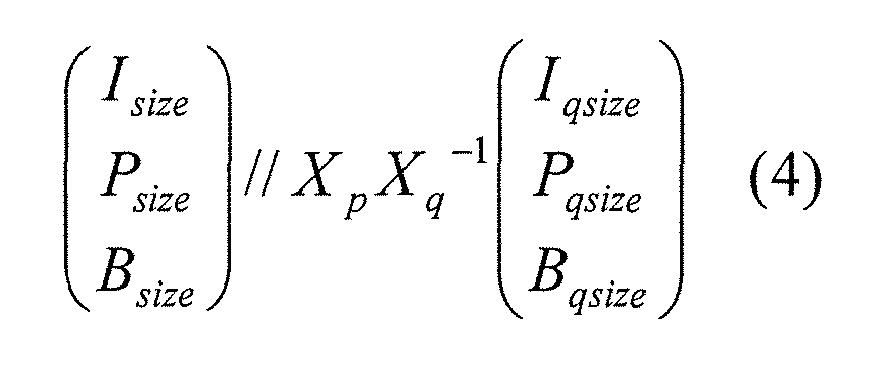
If the direction of the size vector of the moving picture data based on the encoding standard p is similar to such a direction given by multiplying the size vector of the moving picture data based on the encoding standard q by the conversion matrix from the standard q into the standard p, the moving pictures of the two sets of moving picture data are determined to be similar to each other. - The conversion matrix XpXq -1 may also be a matrix in which component values other than a diagonal component are "0". For example, when the standard p is MPEG-2 (Moving Picture Experts Group-2), while the standard q is H. 264, the conversion matrix XpXq -1 is expressed as follows.
[Mathematical Expression 5]
- Further, at this time, a conversion matrix XqXp -1 from the standard p into the standard q is expressed as follows.
[Mathematical Expression 6]
The standard p and the standard q are different from each other in terms of their encoding standards. The standard p and the standard q may be the same in terms of their encoding standards but different in terms of their compression rates, resolutions, etc. The standard p and the standard q may be the same standards. The conversion matrix between the same standards becomes the unit matrix. -
FIG. 1 is a diagram illustrating an example (1) of a stream structure of the moving picture data. In the example ofFIG. 1 , the stream structure of the moving picture data is built up by fields such as a sequence header, a picture header, a payload, a picture header and a payload that are arranged in this sequence. The sequence header contains items of information such as an encoding method, a picture size, an aspect ratio, a frame rate and a bit rate. The picture header contains picture type information specifying which picture, the I-picture or the P-picture or the B-picture, the picture (image) data contained in the subsequent payload corresponds to. The payload contains the picture data. A size of the payload is known from a difference between a head position of the payload and a head position of the next picture header. Namely, a size of one picture data is known therefrom. The payload size has a variable length. -
FIG. 2 is a diagram illustrating an example (2) of a stream structure of the moving picture data. In the example ofFIG. 2 , the stream structure of the moving picture data is built up by the fields such as the sequence header, the picture header, the payload, the picture header and the payload arranged in this sequence. A different point from the example ofFIG. 1 is that the payload contains the picture data and a stuff bit distinguishable from the data. The stuff bit is a part of the payload. The stuff bit (stuff code) has none of the picture information. The stuff bit is exemplified by, e.g., consecutive "0xff". In this case, the stuff bit can be easily specified from the payload. A stuff bit pattern can be presumed from the encoding method. In the case of the stuff bit being specified, a size given by subtracting a size of the stuff bit from the payload size is to be set as a picture data size. -
FIGS. 1 and2 illustrate the examples of the stream structures of the moving picture data, however, with respect to even a moving picture file not for streaming, the encoding method, the picture types (I, P, B), the picture data size, etc are similarly acquired. -
FIG. 3 is a diagram illustrating an example of a configuration of a moving picture data comparing apparatus. A moving picturedata comparing apparatus 100 inFIG. 3 includes afirst extraction unit 112, a first characteristic quantityarithmetic unit 114, asecond extraction unit 122, a second characteristic quantityarithmetic unit 124, a comparingunit 130 and astorage unit 140. - The moving picture
data comparing apparatus 100 extracts a predetermined item of information from the moving picture data defined as a referenced picture data, and calculates a characteristic quantity etc on the basis of the extracted information. Further, the moving picturedata comparing apparatus 100 extracts a predetermined item of information from the moving picture data defined as testing target picture data, and calculates a characteristic quantity etc on the basis of the extracted information. Still further, the moving picturedata comparing apparatus 100 makes a comparison between the characteristic quantity etc of the referenced moving picture data and the characteristic quantity etc of the testing target moving picture data, and thus determines whether or not the moving picture of the testing target moving picture data is similar to the moving picture of the referenced moving picture data. The moving picture data dealt with herein have already undergone the encoding process and contain the I-pictures, the P-pictures and the B-pictures. - The
first extraction unit 112 acquires first moving picture data defined as the referenced moving picture data. The first moving picture data may be streaming data that stream on a network and may also be a moving picture file recorded on a recording medium. Thefirst extraction unit 112 extracts the sequence header from the first moving picture data. Thefirst extraction unit 112 presumes the encoding method (standard) of the first moving picture data from the information contained in the sequence header. Thefirst extraction unit 112 acquires a bit position (or time) of the picture header of the first moving picture data. Thefirst extraction unit 112 extracts the picture type (the I-picture, the P-picture and the B-picture) from each picture header within the first moving picture data. Thefirst extraction unit 112 acquires a size of the payload corresponding to each picture. Each payload size corresponds to a size of each picture. Moreover, if the stuff bit is specified from the payload, thefirst extraction unit 112 sets a size given by subtracting a size of the stuff bit from the payload size as a picture size. The picture type and the picture size are associated with a picture number or time. The picture numbers are serial numbers of the pictures, which are allocated in the time sequence. Thefirst extraction unit 112 transmits the encoding method of the first moving picture data, the picture numbers, the picture types, the picture sizes, etc to the first characteristic quantityarithmetic unit 114. One picture number corresponds to one frame. -
FIG. 4 is a diagram illustrating an example of items of information transmitted to the first characteristic quantity arithmetic unit from the first extraction unit. Thefirst extraction unit 112 transmits the picture number, the picture type and the picture size to the first characteristic quantityarithmetic unit 114 in the way of their being associated with each other as depicted inFIG. 4 . The time may be used as a substitute for the picture number. For example, a value of the time is obtained by multiplying the picture number by time per frame (an inverse number of the bit rate). - The first characteristic quantity
arithmetic unit 114 calculates a characteristic quantity, a variation point, etc of the first moving picture data on the basis of the items of information received from thefirst extraction unit 112. The first characteristic quantityarithmetic unit 114 stores the calculated characteristic quantity, variation point, etc in thestorage unit 140. - The
second extraction unit 122 acquires second moving picture data defined as the testing target moving picture data. The second moving picture data may be the streaming data that stream on the network and may also be the moving picture file recorded on the recording medium. Thesecond extraction unit 122, similarly to thefirst extraction unit 112, acquires the encoding method, the picture number, the picture type and the picture size from the second moving picture data, and transmits these items of information to the second characteristic quantityarithmetic unit 124. - The second characteristic quantity
arithmetic unit 124 calculates a characteristic quantity, a variation point, etc of the second moving picture data on the basis of the items of information received from thesecond extraction unit 122. The second characteristic quantityarithmetic unit 124 transmits the calculated characteristic quantity, variation point, etc to the comparingunit 130. The second characteristic quantityarithmetic unit 124 may store the calculated characteristic quantity, variation point, etc in thestorage unit 140. - The comparing
unit 130 makes comparisons between the characteristic quantity, the variation point, etc of the first moving picture data and the characteristic quantity, the variation point, etc of the second moving picture data, and thus determines whether or not the moving picture of the second moving picture data is similar to the moving picture of the first moving picture data. The comparingunit 130 acquires the characteristic quantity, the variation point, etc of the first moving picture data from thestorage unit 140. The comparingunit 130 acquires the characteristic quantity, the variation point, etc of the second moving picture data from the second characteristic quantityarithmetic unit 124. The comparingunit 130 may acquire the characteristic quantity, the variation point, etc of the second moving picture data from thestorage unit 140. - The
storage unit 140 stores the characteristic quantity, the variation point, etc of the first moving picture data and with the characteristic quantity, the variation point, etc of the second moving picture data. - The moving picture
data comparing apparatus 100 can be realized by using a general-purpose computer such as a personal computer (PC) or a dedicated computer such as a server machine. Moreover, the moving picturedata comparing apparatus 100 can be realized by using a dedicated or general purpose computer such as a smartphone, a mobile phone and a car navigation system, or by using electronic equipment with the computer. -
FIG. 5 is a diagram illustrating an example of an information processing apparatus to actualize the moving picture data comparing apparatus. The computer, i.e., aninformation processing apparatus 1000, includes aprocessor 1002, amain storage device 1004, asecondary storage device 1006 and an interface device with peripheral devices such as acommunication interface device 1012. The main storage device and the secondary storage device are computer-readable recording mediums. Theinformation processing apparatus 1000 includes aninput device 1008 and anoutput device 1010. The respective components of theinformation processing apparatus 1000 are connected via abus 1020. - The processor loads a program stored on the recording medium onto an operation area of the main storage device and executes the program, while the information processing apparatus and the peripheral devices are controlled through the execution of the program, whereby the computer can realize functions matching with predetermined purposes.
- The
processor 1002 is exemplified by, e.g., a CPU (Central Processing Unit) or a DSP (Digital Signal Processor). Themain storage device 1004 includes, e.g., a RAM (Random Access Memory) and a ROM (Read Only Memory). - The
secondary storage device 1006 is exemplified by, e.g., an EPROM (Erasable Programmable ROM) or a hard disk drive (HDD). Moreover, thesecondary storage device 1006 can include a removable medium, i.e., a portable recording medium. The removable medium is a disk recording medium such as a USB (Universal Serial Bus) memory, a CD (Compact Disc) and a DVD (Digital Versatile Disc). - The
communication interface device 1012 is exemplified such as a LAN (Local Area Network) interface board and a wireless communication circuit for wireless communications. The communication interface device is connected to the network. The communication interface device transmits and receives the data to and from other computers and other communication devices via the network. - The peripheral devices include, in addition to the secondary storage device and the communication interface device, input devices such as a keyboard and a pointing device, and also output devices such as a display device and a printer. The pointing device includes a mouse, a touch panel, a touch pad and a trackball, etc. Further, the input device can include an input device like a camera for inputting videos and images and an input device like a microphone for inputting sounds. Moreover, the output device can include an output device like a speaker for outputting the sounds.
- The processor loads the program stored in the secondary storage device into the main storage device and executes the program, whereby the
information processing apparatus 1000, which realizes the moving picturedata comparing apparatus 100, implements functions as thefirst extraction unit 112, the first characteristic quantityarithmetic unit 114, thesecond extraction unit 122, the second characteristic quantityarithmetic unit 124 and the comparingunit 130. On the other hand, thestorage unit 140 is provided in the storage area of the main storage device or the secondary storage device. - A series of processes can be, though executable by hardware, also executed by software.
- Steps of describing the program include, as a matter of course, processes executed in time-series along the written sequence and also processes that are, though not necessarily processed in time-series, executed in parallel or individually.
- The hardware components are hardware circuits, which are exemplified such as FPGA (Field Programmable Gate Array), an ASIC (Application Specific Integrated Circuit), a gate array, a combination of logic gates, an analog circuit, and so on.
- The software components are components for realizing the predetermined processes by software. The software component is not a concept that limits a language for actualizing the software, a development environment, etc.
- An operational example of the
first extraction unit 112 will be described. -
FIG. 6 is a flowchart illustrating an example of an operation flow of the first extraction unit. A start of the operation flow inFIG. 6 is triggered by inputting the referenced moving picture data (first moving picture data) to thefirst extraction unit 112. The first moving picture data contain, as inFIG. 2 orFIG. 1 , the sequence header, the picture header, the payload, etc. The first moving picture data are the moving picture data that are encode-processed by some type of encoding method. - The
first extraction unit 112 detects the sequence header from the first moving picture data to be inputted (S101). The sequence header contains the items of information such as the encoding method, the picture size, the aspect ratio, the frame rate and the bit rate. - The
first extraction unit 112 ascertains the encoding method (standard type) of the first moving picture data from the items of information contained in the sequence header (S102). The sequence header contains a unique standard number, and hence thefirst extraction unit 112 can ascertain the encoding method (standard type). - The
first extraction unit 112 detects the picture header subsequent to the sequence header (S103). Thefirst extraction unit 112 detects a bit position of each picture header, thus acquiring each picture header. - The
first extraction unit 112 ascertains the picture type of the picture, which is contained in the payload subsequent to the picture header from the items of information contained in the picture header (S104). The picture type is information that specifies any one of the I-picture, the P-picture and the B-picture. Each picture type is identified by the picture number unique to each picture. Each picture type may be identified by the time information of the picture. - The
first extraction unit 112 acquires the size of the payload corresponding to each picture. The payload size is obtained from, e.g., a bit count between the present picture header and the next picture header. Thefirst extraction unit 112 acquires the payload size as the picture size (S105). Further, thefirst extraction unit 112, if capable of acquiring the stuff bit of the payload, sets a size given by subtracting a size of the stuff bit from the payload size as the picture size. The picture size is associated with the picture number and the picture type. - The
first extraction unit 112 transmits the encoding method, the picture number, the picture type, the picture size, etc to the first characteristic quantityarithmetic unit 114. - An operation of the
second extraction unit 122 is substantially the same as the operation of thefirst extraction unit 112. - An operational example of the first characteristic quantity
arithmetic unit 114 will be described. -
FIG. 7 is a flowchart illustrating an example of an operation flow of the first characteristic quantityarithmetic unit 114. A start of the operation flow inFIG. 7 is triggered by inputting the encoding method, the picture number, the picture type, the picture size, etc from thefirst extraction unit 112 to the first characteristic quantityarithmetic unit 114. - The first characteristic quantity
arithmetic unit 114 acquires the encoding method, the picture number, the picture type, the picture size, etc. Further, the first characteristic quantityarithmetic unit 114 acquires conditions for calculating the characteristic quantity etc such as an observation range of the referenced moving picture data (S201). The observation range is a comparison target range with another moving picture data. The observation range is given as, e.g., a range of the picture number. A characteristic portion of the moving picture data, an important portion of the moving picture data, etc are selected as the observation ranges. The conditions for calculating the characteristic quantity etc such as the observation range are given by, e.g., the user. The conditions for calculating the characteristic quantity etc such as the observation range may be stored in thestorage unit 140. The observation range extends for, e.g., several minutes. - The first characteristic quantity
arithmetic unit 114 calculates, with respect to each picture number within the observation range, an average of the sizes of the I-pictures, an average of the sizes of the P-pictures and an average of the sizes of the B-pictures. With respect to a picture number n, a vector having three components of the average of the sizes of the I-pictures, the average of the sizes of the P-pictures and the average of the sizes of the B-pictures is assumed to be a characteristic quantity Fon. The average of the sizes of the I-pictures specified by the picture number n is to be an average of the sizes of k-frames of I-pictures counted from the side closer to the picture number n in the I-pictures classified by the picture type. The average of the sizes of the P-pictures specified by the picture number n is to be an average of the sizes of k-frames of P-pictures counted from the side closer to the picture number n in the P-pictures classified by the picture type. The average of the sizes of the B-pictures specified by the picture number n is to be an average of the sizes of k-frames of B-pictures counted from the side closer to the picture number n in the B-pictures classified by the picture type. Herein, a value "k" is one of the conditions for calculating the characteristic quantity etc. The first characteristic quantityarithmetic unit 114 calculates the characteristic quantities Fo with respect to all the picture numbers within the observation range (S202). The characteristic quantity Fo (vector) may be normalized to a magnitude "1". Moreover, the first characteristic quantityarithmetic unit 114 may set the average of the sizes of the I-pictures specified by the picture number n as an average of the sizes of all the I-pictures embraced by a range m peripheral to the picture number n. The same is applied to also the P-pictures and the B-pictures. One conversion matrix is prepared for one standard, in which case a vector given by multiplying the characteristic quantity Fo obtained herein by the conversion matrix corresponding to the encoding method of the first moving picture data, becomes a characteristic quantity Fo. The conversion matrix is one of the conditions for calculating the characteristic quantity etc. - The first characteristic quantity
arithmetic unit 114 calculates a conversion pint Co of the characteristic quantity Fo (S203). The first characteristic quantityarithmetic unit 114 makes a comparison of an angular difference between the characteristic quantity Fon of the picture number n that is calculated in step S202 and a characteristic quantity Fon+1 of a picturenumber n+ 1. Both of the characteristic quantity Fon and the characteristic quantity Fon+1 are vectors, and hence an angular difference θon is obtained as follows. - [Mathematical Expression 7]

The first characteristic quantityarithmetic unit 114, if the angular difference θon is equal to or larger than a predetermined value, determines that the picture number n is the variation point. An implication of "the picture number n is the variation point" is that the variation point exists between the picture number n and the picturenumber n+ 1. A direction of the characteristic quantity Fo corresponds to the property of the picture, and a change in direction of the characteristic quantity Fo represents a change in property of the picture. The first characteristic quantityarithmetic unit 114 calculates the variation points as Co1, Co2,... from the smallest of the picture numbers. A cosine may be used in place of the angular difference. The use of the cosine leads to a decrease in calculation load. - The first characteristic quantity
arithmetic unit 114 stores the characteristic quantities Fo and the variation points Co in thestorage unit 140. - An operational example of a second characteristic quantity
arithmetic unit 124 will be described. -
FIG. 8 is a flowchart illustrating an example of an operation flow of the second characteristic quantityarithmetic unit 124. A start of the operation flow inFIG. 8 is triggered by inputting the encoding method, the picture number, the picture type, the picture size, etc from thesecond extraction unit 122 to the second characteristic quantityarithmetic unit 124. - The second characteristic quantity
arithmetic unit 124 acquires the encoding method, the picture number, the picture type, the picture size, etc. Further, the second characteristic quantityarithmetic unit 124 acquires conditions for calculating the characteristic quantity etc of the testing target moving picture data (S301). The conditions for calculating the characteristic quantity etc are given by, e.g., the user. The conditions for calculating the characteristic quantity etc may be stored in thestorage unit 140. - The second characteristic quantity
arithmetic unit 124 calculates, with respect to each picture number within the observation range, the average of the sizes of the I-pictures, the average of the sizes of the P-pictures and the average of the sizes of the B-pictures. The second characteristic quantityarithmetic unit 124 calculates, with respect to the picture number n, the vector having three components of the average of the sizes of the I-pictures, the average of the sizes of the P-pictures and the average of the sizes of the B-pictures. The second characteristic quantityarithmetic unit 124 multiplies the calculated vector by the conversion matrix. The conversion matrix is a conversion matrix for the conversion from the encoding method of the second moving picture data into the encoding method of the first moving picture data. The conversion matrix is stored in thestorage unit 140. The conversion matrix is selected based on the encoding method of the second moving picture data and the encoding method of the first moving picture data. The conversion matrix is one of the conditions for calculating the characteristic quantity etc. The second characteristic quantityarithmetic unit 124 sets a vector given by multiplying the calculated vector by the conversion matrix as a characteristic quantity Frn (vector). The average of the sizes of the I-pictures specified by the picture number n is to be an average of the sizes of k-frames of I-pictures counted from the side closer to the picture number n in the I-pictures classified by the picture type. The average of the sizes of the P-pictures specified by the picture number n is to be an average of the sizes of k-frames of P-pictures counted from the side closer to the picture number n in the P-pictures classified by the picture type. The average of the sizes of the B-pictures specified by the picture number n is to be an average of the sizes of k-frames of B-pictures counted from the side closer to the picture number n in the B-pictures classified by the picture type. Herein, the value "k" is one of the conditions for calculating the characteristic quantity etc. The second characteristic quantityarithmetic unit 124 calculates the characteristic quantities Fr with respect to all the picture numbers within the observation range (S302). The characteristic quantity Fr (vector) may be normalized to the magnitude "1". Furthermore, the second characteristic quantityarithmetic unit 124 may set the average of the sizes of the I-pictures specified by the picture number n as an average of the sizes of all the I-pictures embraced by the range m peripheral to the picture number n. The same is applied to also the P-pictures and the B-pictures. About the second moving picture data, the characteristic points Fr are calculated with respect to all the picture numbers in the second moving picture data. The characteristic points Fr may also be calculated with respect to all the picture numbers with a predetermined range in the second moving picture data. One conversion matrix is prepared for one standard, in which case the conversion matrix corresponding to the encoding method of the second moving picture data becomes the conversion matrix herein. - The second characteristic quantity
arithmetic unit 124 calculates a conversion point Cr of the characteristic quantity Fr (S303). The second characteristic quantityarithmetic unit 124 makes a comparison of an angular difference between the characteristic quantity Frn of the picture number n that is calculated in step S302 and a characteristicquantity Frn+ 1 of a picturenumber n+ 1. Both of the characteristic quantity Frn and the characteristic quantity Frn+1 are vectors, and hence an angular difference θrn is obtained as follows. - [Mathematical Expression 8]

The second characteristic quantityarithmetic unit 124, if the angular difference θrn is equal to or larger than a predetermined value, determines that the picture number n is the variation point. The implication of "the picture number n is the variation point" is that the variation point exists between the picture number n and the picturenumber n+ 1. A direction of the characteristic quantity Fr corresponds to the property of the picture, and a change in direction of the characteristic quantity Fr represents a change in property of the picture. The second characteristic quantityarithmetic unit 124 calculates the variation points as Cr1 Cr2,... from the smallest of the picture numbers. The cosine may be used in place of the angular difference. The use of the cosine leads to the decrease in calculation load. - The second characteristic quantity
arithmetic unit 124 outputs the characteristic point Fr and the variation point Cr to the comparingunit 130. The second characteristic quantityarithmetic unit 124 may store the characteristic point Fr and the variation point Cr in thestorage unit 140. - An operational example of the comparing
unit 130 will be described. -
FIG. 9 is a flowchart illustrating an example of the operational flow of the comparing unit. A start of the operational flow inFIG. 9 is triggered by inputting items of information such as the characteristic quantity and the variation point of the first moving picture data, and the characteristic quantity and the variation point of the second moving picture data to the comparingunit 130. - In step S401, the comparing
unit 130 acquires, from thestorage unit 140, the characteristic quantity and the variation point of the first moving picture data defined as the referenced moving picture data. The comparingunit 130 acquires the characteristic quantity and the variation point of the second moving picture data defined as the testing target moving picture data from the second characteristic quantityarithmetic unit 124 or thestorage unit 140. - In step S402, the comparing
unit 130 searches for a position of a variation point within the second moving picture data, which is coincident with a position of a variation point within the first moving picture data (the position of the variation point within the observation range), in a way that sets a variation point Co1 of the first moving picture data and a variation point Cr1 of the second moving picture data as reference variation points. The comparingunit 130, when looping back from step S405, searches for a position of a variation point by shifting the reference variation point of the second moving picture data sequentially such as Cr2, Cr3. The comparingunit 130 may shift the reference point of the second moving picture data sequentially on a per picture-number basis of the second moving picture data. At this time, in step S405, it is determined whether or not variation points are searched with respect to all the picture numbers of the second moving picture data. - In step S403, the comparing
unit 130 determines whether a ratio of the number of positions of the variation points within the second moving picture data, which are coincident with the positions of the variation points within the first moving picture data, to the number of variation points within the first moving picture data, is equal to or larger than a predetermined value or not. If the ratio of the number of positions of the variation points within the second moving picture data, which are coincident with the positions of the variation points within the first moving picture data, to the number of variation points within the first moving picture data, is equal to or larger than the predetermined value (S403; YES), the processing advances to step S404. Whereas if the ratio of the number of positions of the variation points within the second moving picture data, which are coincident with the positions of the variation points within the first moving picture data, to the number of variation points within the first moving picture data, is smaller than the predetermined value (S403; NO), the processing diverts to step S405. - In step S404, the comparing
unit 130 compares the characteristic quantity Fo within the first moving picture data with the characteristic quantity Fr within the second moving picture data on the per picture-number basis by use of the variation points set as the reference variation points in step S403. To be specific, the comparingunit 130 calculates the angular difference between the characteristic quantity Fo within the first moving picture data and the characteristic quantity Fr within the second moving picture data on the per picture-number basis, and determines whether the smallest of the angular differences is less than a predetermined threshold value or not. If the smallest of the angular differences is less than the predetermined threshold value, the comparingunit 130 determines that the moving picture in the observation range of the first moving picture data is similar to the moving picture in the range of the second moving picture data similar thereto in terms of their variation points. Whereas if the smallest of the angular differences equal to or larger than the predetermined threshold value, the comparingunit 130 determines that the moving picture in the observation range of the first moving picture data is not similar to the moving picture in the range of the second moving picture data similar thereto in terms of their variation points. - In step S405, the comparing
unit 130 determines whether or not all the variation points within the second moving picture data are used as the reference variation points in the search of step S402. If all the variation points within the second moving picture data are not used as the reference variation points (S405; NO), the processing loops back to step S402. Whereas if all the variation points within the second moving picture data are used as the reference variation points (S405; YES), the processing advances to step S406. - In step S406, the comparing
unit 130 outputs the range of the second moving picture data determined to be similar in step S404 and the smallest of the angular differences between the characteristic quantities Fo and the characteristic quantities Fr. If determined to be similar a plural number of times in step S404, the comparingunit 130 outputs the range of the second moving picture data and the smallest of the angular differences between the characteristic quantities Fo and the characteristic quantities Fr with respect to the whole. - Through the operations described above, the comparing
unit 130 can extract the range within the second moving picture data, which is similar to the observation range of the first moving picture data. - The user may also determine whether or not the extracted range of the second moving picture data is similar to the observation range of the first moving picture data by visually checking again the moving picture with respect to the extracted range of the second moving picture data.
- The moving picture
data comparing apparatus 100 is installed in, e.g., a gateway apparatus on the network, thereby enabling the extraction of the moving picture similar to the observation range of the first moving picture data from the streaming data that stream on the network. -
FIG. 10 is an explanatory diagram of a case where a frame rate of the first moving picture data is different from a frame rate of the second moving picture data. - The example discussed above is based on the premise that the frame rate (the picture count per sec) of the first moving picture data is coincident with the frame rate of the second moving picture data. Such a case is, however, considered that the frame rates of the moving picture data and another moving picture data are not necessarily coincident with but different from each other. As seen in moving picture data Ma and moving picture data Na in
FIG. 10 , the case that the frame rate is different between the first moving picture data and the second moving picture data, will be described. - As in
FIG. 10 , it is assumed that the frame rate of the moving picture data Ma is 30 frames/sec, and the frame rate of the moving picture data Na is 24 frames/sec. When calculating a least common multiple (LCM) of 30 and 24, the calculation result is 120. Hence, the moving picture data Ma and the moving picture data Na are then converted into the moving picture data of which the frame rate is 120 frames/sec. The moving picture data Ma are converted, with each picture being repeated four times, into the moving picture data (moving picture data Mb) of which the frame rate is 120 frames/sec. The moving picture data Na are converted, with each picture being repeated five times, into the moving picture data (moving picture data Nb) of which the frame rate is 120 frames/sec. The moving picturedata comparing apparatus 100 treats the moving picture data having the frame rate of 120 frames/sec as the first moving picture data or the second moving picture data. With this contrivance, the moving picturedata comparing apparatus 100 can extract the range with the moving picture data being similar to another moving picture data by obtaining the characteristic quantities F and the variation points C in the same way as described above. - The moving picture
data comparing apparatus 100 extracts the picture type and the size of each picture from the referenced moving picture data and calculates, based on the extracted items of information, the characteristic quantity and the variation point. Further, the moving picturedata comparing apparatus 100 extracts the picture type and the size of each picture from the testing target moving picture data and calculates, based on the extracted items of information, the characteristic quantity and the variation point. Still further, the moving picturedata comparing apparatus 100 compares the variation point of the referenced moving picture data with the variation point of the testing target moving picture data, and extracts the range of the testing target moving picture data with the variation point being similar to the variation point of the referenced moving picture data. The moving picturedata comparing apparatus 100 compares, in the range with the variation point being similar thereto, the characteristic quantities thereof, and determines whether or not the moving picture of the testing target moving picture data is similar to the moving picture of the referenced moving picture data. The moving picturedata comparing apparatus 100 can compare the moving picture data with each other, which are encoded by the different encoding methods, by calculating the characteristic quantities in a way that uses the conversion matrix. - The moving picture
data comparing apparatus 100 can determine whether the contents (moving pictures) of the two sets of moving picture data are similar to each other or not without executing the decoding process of the moving picture data. The moving picturedata comparing apparatus 100 compares the moving picture data with another moving picture data without carrying out the decoding process of the moving picture data, and can therefore determine whether or not the moving picture of the moving picture data is similar to the moving picture of another moving picture data with a small arithmetic load in a short period of time. - The configurations described above can be implemented by combining these configurations to the greatest possible degree.
- It is feasible to provide the moving picture data comparing method of comparing the moving picture data without executing any decoding process.
-
- 100
- moving picture data comparing apparatus
- 112
- first extraction unit
- 114
- first characteristic quantity arithmetic unit
- 122
- second extraction unit
- 124
- second characteristic quantity arithmetic unit
- 130
- comparing unit
- 140
- storage unit
- 1000
- information processing apparatus
- 1002
- processor
- 1004
- main storage device
- 1006
- secondary storage device
- 1008
- input device
- 1010
- output device
- 1012
- communication interface device
- 1020
- bus
Claims (6)
- A moving picture data comparing method, comprising:extracting a picture type per picture frame and a picture size per picture frame from first moving picture data given by encoding a moving picture including a plurality of picture frames;calculating a first characteristic quantity per picture frame of the first moving picture data and a first variation point indicating a variation point of the first characteristic quantity on the basis of the extracted picture type per picture frame of the first moving picture data and the extracted picture size per picture frame of the first moving picture data;extracting a picture type per picture frame and a picture size per picture frame from second moving picture data given by encoding a moving picture having a plurality of picture frames;calculating a second characteristic quantity per picture frame of the second moving picture data and a second variation point indicating a variation point of the second characteristic quantity on the basis of the extracted picture type per picture frame of the second moving picture data and the extracted picture size per picture frame of the second moving picture data; andcomparing the first characteristic quantity and the first variation point with the second characteristic quantity and the second variation point, and thus determining whether or not the moving picture of the first moving picture data is similar to the moving picture of the second moving picture data.
- The moving picture data comparing method according to claim 1, wherein the first characteristic quantity is calculated by use of a first conversion matrix based on an encoding method of the first moving picture data, and
the second characteristic quantity is calculated by use of a second conversion matrix based on an encoding method of the second moving picture data. - A moving picture data comparing program to make a computer execute:extracting a picture type per picture frame and a picture size per picture frame from first moving picture data given by encoding a moving picture including a plurality of picture frames;calculating a first characteristic quantity per picture frame of the first moving picture data and a first variation point indicating a variation point of the first characteristic quantity on the basis of the extracted picture type per picture frame of the first moving picture data and the extracted picture size per picture frame of the first moving picture data;extracting a picture type per picture frame and a picture size per picture frame from second moving picture data given by encoding a moving picture having a plurality of picture frames;calculating a second characteristic quantity per picture frame of the second moving picture data and a second variation point indicating a variation point of the second characteristic quantity on the basis of the extracted picture type per picture frame of the second moving picture data and the extracted picture size per picture frame of the second moving picture data; andcomparing the first characteristic quantity and the first variation point with the second characteristic quantity and the second variation point, and thus determining whether or not the moving picture of the first moving picture data is similar to the moving picture of the second moving picture data.
- The moving picture data comparing program according to claim 3, wherein the first characteristic quantity is calculated by use of a first conversion matrix based on an encoding method of the first moving picture data, and
the second characteristic quantity is calculated by use of a second conversion matrix based on an encoding method of the second moving picture data. - A moving picture data comparing apparatus comprising:a first extraction unit to extract a picture type per picture frame and a picture size per picture frame from first moving picture data given by encoding a moving picture including a plurality of picture frames;a first characteristic quantity arithmetic unit to calculate a first characteristic quantity per picture frame of the first moving picture data and a first variation point indicating a variation point of the first characteristic quantity on the basis of the picture type per picture frame of the first moving picture data and the picture size per picture frame of the first moving picture data, the picture type and the picture size being extracted by the first extraction unit;a second extraction unit to extract a picture type per picture frame and a picture size per picture frame from second moving picture data given by encoding a moving picture having a plurality of picture frames;a second characteristic quantity arithmetic unit to calculate a second characteristic quantity per picture frame of the second moving picture data and a second variation point indicating a variation point of the second characteristic quantity on the basis of the picture type per picture frame of the second moving picture data and the picture size per picture frame of the second moving picture data, the picture type and the picture size being extracted by a second extraction unit; anda comparing unit to compare the first characteristic quantity and the first variation point with the second characteristic quantity and the second variation point, and thus determine whether or not the moving picture of the first moving picture data is similar to the moving picture of the second moving picture data.
- The moving picture data comparing apparatus according to claim 5, wherein the first characteristic quantity is calculated by use of a first conversion matrix based on an encoding method of the first moving picture data, and
the second characteristic quantity is calculated by use of a second conversion matrix based on an encoding method of the second moving picture data.
Applications Claiming Priority (1)
| Application Number | Priority Date | Filing Date | Title |
|---|---|---|---|
| JP2013065049A JP6032093B2 (en) | 2013-03-26 | 2013-03-26 | Moving image data comparison method, moving image data comparison program, moving image data comparison device |
Publications (3)
| Publication Number | Publication Date |
|---|---|
| EP2784719A2 true EP2784719A2 (en) | 2014-10-01 |
| EP2784719A3 EP2784719A3 (en) | 2017-05-03 |
| EP2784719B1 EP2784719B1 (en) | 2019-11-27 |
Family
ID=50070298
Family Applications (1)
| Application Number | Title | Priority Date | Filing Date |
|---|---|---|---|
| EP14151905.8A Active EP2784719B1 (en) | 2013-03-26 | 2014-01-21 | Moving picture data comparing method and apparatus |
Country Status (3)
| Country | Link |
|---|---|
| US (1) | US9300983B2 (en) |
| EP (1) | EP2784719B1 (en) |
| JP (1) | JP6032093B2 (en) |
Families Citing this family (1)
| Publication number | Priority date | Publication date | Assignee | Title |
|---|---|---|---|---|
| CN110768864B (en) * | 2019-10-16 | 2021-02-02 | 北京科技大学 | Method and device for generating images in batches through network traffic |
Family Cites Families (10)
| Publication number | Priority date | Publication date | Assignee | Title |
|---|---|---|---|---|
| JP3377678B2 (en) * | 1996-05-30 | 2003-02-17 | 日本電信電話株式会社 | Encoded video cut detection method |
| JPH09322174A (en) * | 1996-05-30 | 1997-12-12 | Hitachi Ltd | How to play video data |
| US6618507B1 (en) * | 1999-01-25 | 2003-09-09 | Mitsubishi Electric Research Laboratories, Inc | Methods of feature extraction of video sequences |
| US7912291B2 (en) | 2003-11-10 | 2011-03-22 | Ricoh Co., Ltd | Features for retrieval and similarity matching of documents from the JPEG 2000-compressed domain |
| JP4668767B2 (en) * | 2005-10-31 | 2011-04-13 | 富士通セミコンダクター株式会社 | Moving picture coding apparatus and moving picture coding program |
| JPWO2008132774A1 (en) | 2007-04-13 | 2010-07-22 | パナソニック株式会社 | Moving picture decoding method, moving picture decoding apparatus, and electronic device |
| US8345742B2 (en) * | 2007-06-04 | 2013-01-01 | Enswers Co., Ltd. | Method of processing moving picture and apparatus thereof |
| KR100908890B1 (en) * | 2007-07-18 | 2009-07-23 | (주)엔써즈 | Method and apparatus for providing video data retrieval service using video data cluster |
| JP4428424B2 (en) * | 2007-08-20 | 2010-03-10 | ソニー株式会社 | Information processing apparatus, information processing method, program, and recording medium |
| KR101776809B1 (en) * | 2010-03-09 | 2017-09-08 | 스프레드트럼 커뮤니케이션즈 (상하이) 컴퍼니 리미티드 | Adaptive video decoding circuitry and techniques |
-
2013
- 2013-03-26 JP JP2013065049A patent/JP6032093B2/en not_active Expired - Fee Related
-
2014
- 2014-01-17 US US14/157,634 patent/US9300983B2/en not_active Expired - Fee Related
- 2014-01-21 EP EP14151905.8A patent/EP2784719B1/en active Active
Also Published As
| Publication number | Publication date |
|---|---|
| JP6032093B2 (en) | 2016-11-24 |
| JP2014191495A (en) | 2014-10-06 |
| US9300983B2 (en) | 2016-03-29 |
| US20140294095A1 (en) | 2014-10-02 |
| EP2784719A3 (en) | 2017-05-03 |
| EP2784719B1 (en) | 2019-11-27 |
Similar Documents
| Publication | Publication Date | Title |
|---|---|---|
| Yang et al. | Harnessing data structure for recovery of randomly missing structural vibration responses time history: Sparse representation versus low-rank structure | |
| CN113132723B (en) | An image compression method and device | |
| Larsen et al. | The Johnson-Lindenstrauss lemma is optimal for linear dimensionality reduction | |
| Karimi et al. | IMRO: A proximal quasi-Newton method for solving \ell_1-regularized least squares problems | |
| Beaton et al. | Compressed self-avoiding walks, bridges and polygons | |
| US20130013659A1 (en) | Method for streaming svd computation field of invention | |
| CN118445734A (en) | Tokamak experimental data intelligent processing method and system | |
| US9569856B2 (en) | Variable blocking artifact size and offset detection | |
| Liu et al. | QPET: A Versatile and Portable Quantity-of-Interest-Preservation Framework for Error-Bounded Lossy Compression | |
| EP2784719B1 (en) | Moving picture data comparing method and apparatus | |
| CN115248879B (en) | Video data matching method and device and electronic equipment | |
| Aybat et al. | Fast first-order methods for stable principal component pursuit | |
| CN107977980B (en) | Target tracking method, device and readable medium | |
| Belt | Word length reduction for the integral image | |
| US20160321213A1 (en) | Computer and graph data generation method | |
| Rosli et al. | A systematic derivation of stochastic Taylor methods for stochastic delay differential equations | |
| Chu et al. | Information theoretical limit of media forensics: The forensicability | |
| Varricchio et al. | Visualizing Text for Token Efficiency: Exploring Multimodal LLMs' Performance in Text-as-Image Input Compression | |
| EP2903288A1 (en) | Method and apparatus for constructing an epitome from an image | |
| Zhang et al. | Robust primary quantization step estimation on resized and double JPEG compressed images | |
| do Carmo et al. | A different and simple approach for comparing sampling methods in quality control | |
| US11430488B2 (en) | System and method for generating a compression invariant motion timeline | |
| CN109655072B (en) | Map generation method and device | |
| Calvo et al. | Exponentially fitted fifth-order two-step peer explicit methods | |
| Zhao et al. | Solder joint imagery compressing and recovery based on compressive sensing |
Legal Events
| Date | Code | Title | Description |
|---|---|---|---|
| 17P | Request for examination filed |
Effective date: 20140121 |
|
| AK | Designated contracting states |
Kind code of ref document: A2 Designated state(s): AL AT BE BG CH CY CZ DE DK EE ES FI FR GB GR HR HU IE IS IT LI LT LU LV MC MK MT NL NO PL PT RO RS SE SI SK SM TR |
|
| AX | Request for extension of the european patent |
Extension state: BA ME |
|
| PUAI | Public reference made under article 153(3) epc to a published international application that has entered the european phase |
Free format text: ORIGINAL CODE: 0009012 |
|
| PUAL | Search report despatched |
Free format text: ORIGINAL CODE: 0009013 |
|
| AK | Designated contracting states |
Kind code of ref document: A3 Designated state(s): AL AT BE BG CH CY CZ DE DK EE ES FI FR GB GR HR HU IE IS IT LI LT LU LV MC MK MT NL NO PL PT RO RS SE SI SK SM TR |
|
| AX | Request for extension of the european patent |
Extension state: BA ME |
|
| RIC1 | Information provided on ipc code assigned before grant |
Ipc: H04N 19/48 20140101ALI20170328BHEP Ipc: H04N 19/87 20140101ALI20170328BHEP Ipc: G06K 9/00 20060101AFI20170328BHEP |
|
| STAA | Information on the status of an ep patent application or granted ep patent |
Free format text: STATUS: REQUEST FOR EXAMINATION WAS MADE |
|
| R17P | Request for examination filed (corrected) |
Effective date: 20170623 |
|
| RBV | Designated contracting states (corrected) |
Designated state(s): AL AT BE BG CH CY CZ DE DK EE ES FI FR GB GR HR HU IE IS IT LI LT LU LV MC MK MT NL NO PL PT RO RS SE SI SK SM TR |
|
| STAA | Information on the status of an ep patent application or granted ep patent |
Free format text: STATUS: EXAMINATION IS IN PROGRESS |
|
| 17Q | First examination report despatched |
Effective date: 20181012 |
|
| GRAP | Despatch of communication of intention to grant a patent |
Free format text: ORIGINAL CODE: EPIDOSNIGR1 |
|
| STAA | Information on the status of an ep patent application or granted ep patent |
Free format text: STATUS: GRANT OF PATENT IS INTENDED |
|
| INTG | Intention to grant announced |
Effective date: 20190716 |
|
| GRAS | Grant fee paid |
Free format text: ORIGINAL CODE: EPIDOSNIGR3 |
|
| GRAA | (expected) grant |
Free format text: ORIGINAL CODE: 0009210 |
|
| STAA | Information on the status of an ep patent application or granted ep patent |
Free format text: STATUS: THE PATENT HAS BEEN GRANTED |
|
| AK | Designated contracting states |
Kind code of ref document: B1 Designated state(s): AL AT BE BG CH CY CZ DE DK EE ES FI FR GB GR HR HU IE IS IT LI LT LU LV MC MK MT NL NO PL PT RO RS SE SI SK SM TR |
|
| REG | Reference to a national code |
Ref country code: GB Ref legal event code: FG4D |
|
| REG | Reference to a national code |
Ref country code: CH Ref legal event code: EP |
|
| REG | Reference to a national code |
Ref country code: AT Ref legal event code: REF Ref document number: 1207520 Country of ref document: AT Kind code of ref document: T Effective date: 20191215 |
|
| REG | Reference to a national code |
Ref country code: DE Ref legal event code: R096 Ref document number: 602014057367 Country of ref document: DE |
|
| REG | Reference to a national code |
Ref country code: IE Ref legal event code: FG4D |
|
| REG | Reference to a national code |
Ref country code: NL Ref legal event code: MP Effective date: 20191127 |
|
| REG | Reference to a national code |
Ref country code: LT Ref legal event code: MG4D |
|
| PG25 | Lapsed in a contracting state [announced via postgrant information from national office to epo] |
Ref country code: NL Free format text: LAPSE BECAUSE OF FAILURE TO SUBMIT A TRANSLATION OF THE DESCRIPTION OR TO PAY THE FEE WITHIN THE PRESCRIBED TIME-LIMIT Effective date: 20191127 Ref country code: LT Free format text: LAPSE BECAUSE OF FAILURE TO SUBMIT A TRANSLATION OF THE DESCRIPTION OR TO PAY THE FEE WITHIN THE PRESCRIBED TIME-LIMIT Effective date: 20191127 Ref country code: GR Free format text: LAPSE BECAUSE OF FAILURE TO SUBMIT A TRANSLATION OF THE DESCRIPTION OR TO PAY THE FEE WITHIN THE PRESCRIBED TIME-LIMIT Effective date: 20200228 Ref country code: NO Free format text: LAPSE BECAUSE OF FAILURE TO SUBMIT A TRANSLATION OF THE DESCRIPTION OR TO PAY THE FEE WITHIN THE PRESCRIBED TIME-LIMIT Effective date: 20200227 Ref country code: FI Free format text: LAPSE BECAUSE OF FAILURE TO SUBMIT A TRANSLATION OF THE DESCRIPTION OR TO PAY THE FEE WITHIN THE PRESCRIBED TIME-LIMIT Effective date: 20191127 Ref country code: BG Free format text: LAPSE BECAUSE OF FAILURE TO SUBMIT A TRANSLATION OF THE DESCRIPTION OR TO PAY THE FEE WITHIN THE PRESCRIBED TIME-LIMIT Effective date: 20200227 Ref country code: LV Free format text: LAPSE BECAUSE OF FAILURE TO SUBMIT A TRANSLATION OF THE DESCRIPTION OR TO PAY THE FEE WITHIN THE PRESCRIBED TIME-LIMIT Effective date: 20191127 Ref country code: SE Free format text: LAPSE BECAUSE OF FAILURE TO SUBMIT A TRANSLATION OF THE DESCRIPTION OR TO PAY THE FEE WITHIN THE PRESCRIBED TIME-LIMIT Effective date: 20191127 Ref country code: ES Free format text: LAPSE BECAUSE OF FAILURE TO SUBMIT A TRANSLATION OF THE DESCRIPTION OR TO PAY THE FEE WITHIN THE PRESCRIBED TIME-LIMIT Effective date: 20191127 |
|
| PG25 | Lapsed in a contracting state [announced via postgrant information from national office to epo] |
Ref country code: HR Free format text: LAPSE BECAUSE OF FAILURE TO SUBMIT A TRANSLATION OF THE DESCRIPTION OR TO PAY THE FEE WITHIN THE PRESCRIBED TIME-LIMIT Effective date: 20191127 Ref country code: IS Free format text: LAPSE BECAUSE OF FAILURE TO SUBMIT A TRANSLATION OF THE DESCRIPTION OR TO PAY THE FEE WITHIN THE PRESCRIBED TIME-LIMIT Effective date: 20200327 Ref country code: RS Free format text: LAPSE BECAUSE OF FAILURE TO SUBMIT A TRANSLATION OF THE DESCRIPTION OR TO PAY THE FEE WITHIN THE PRESCRIBED TIME-LIMIT Effective date: 20191127 |
|
| PG25 | Lapsed in a contracting state [announced via postgrant information from national office to epo] |
Ref country code: AL Free format text: LAPSE BECAUSE OF FAILURE TO SUBMIT A TRANSLATION OF THE DESCRIPTION OR TO PAY THE FEE WITHIN THE PRESCRIBED TIME-LIMIT Effective date: 20191127 |
|
| PG25 | Lapsed in a contracting state [announced via postgrant information from national office to epo] |
Ref country code: CZ Free format text: LAPSE BECAUSE OF FAILURE TO SUBMIT A TRANSLATION OF THE DESCRIPTION OR TO PAY THE FEE WITHIN THE PRESCRIBED TIME-LIMIT Effective date: 20191127 Ref country code: RO Free format text: LAPSE BECAUSE OF FAILURE TO SUBMIT A TRANSLATION OF THE DESCRIPTION OR TO PAY THE FEE WITHIN THE PRESCRIBED TIME-LIMIT Effective date: 20191127 Ref country code: PT Free format text: LAPSE BECAUSE OF FAILURE TO SUBMIT A TRANSLATION OF THE DESCRIPTION OR TO PAY THE FEE WITHIN THE PRESCRIBED TIME-LIMIT Effective date: 20200419 Ref country code: EE Free format text: LAPSE BECAUSE OF FAILURE TO SUBMIT A TRANSLATION OF THE DESCRIPTION OR TO PAY THE FEE WITHIN THE PRESCRIBED TIME-LIMIT Effective date: 20191127 Ref country code: DK Free format text: LAPSE BECAUSE OF FAILURE TO SUBMIT A TRANSLATION OF THE DESCRIPTION OR TO PAY THE FEE WITHIN THE PRESCRIBED TIME-LIMIT Effective date: 20191127 |
|
| REG | Reference to a national code |
Ref country code: DE Ref legal event code: R097 Ref document number: 602014057367 Country of ref document: DE |
|
| PG25 | Lapsed in a contracting state [announced via postgrant information from national office to epo] |
Ref country code: SM Free format text: LAPSE BECAUSE OF FAILURE TO SUBMIT A TRANSLATION OF THE DESCRIPTION OR TO PAY THE FEE WITHIN THE PRESCRIBED TIME-LIMIT Effective date: 20191127 Ref country code: MC Free format text: LAPSE BECAUSE OF FAILURE TO SUBMIT A TRANSLATION OF THE DESCRIPTION OR TO PAY THE FEE WITHIN THE PRESCRIBED TIME-LIMIT Effective date: 20191127 Ref country code: SK Free format text: LAPSE BECAUSE OF FAILURE TO SUBMIT A TRANSLATION OF THE DESCRIPTION OR TO PAY THE FEE WITHIN THE PRESCRIBED TIME-LIMIT Effective date: 20191127 |
|
| REG | Reference to a national code |
Ref country code: CH Ref legal event code: PL |
|
| REG | Reference to a national code |
Ref country code: AT Ref legal event code: MK05 Ref document number: 1207520 Country of ref document: AT Kind code of ref document: T Effective date: 20191127 |
|
| PLBE | No opposition filed within time limit |
Free format text: ORIGINAL CODE: 0009261 |
|
| STAA | Information on the status of an ep patent application or granted ep patent |
Free format text: STATUS: NO OPPOSITION FILED WITHIN TIME LIMIT |
|
| REG | Reference to a national code |
Ref country code: BE Ref legal event code: MM Effective date: 20200131 |
|
| PG25 | Lapsed in a contracting state [announced via postgrant information from national office to epo] |
Ref country code: LU Free format text: LAPSE BECAUSE OF NON-PAYMENT OF DUE FEES Effective date: 20200121 |
|
| 26N | No opposition filed |
Effective date: 20200828 |
|
| PG25 | Lapsed in a contracting state [announced via postgrant information from national office to epo] |
Ref country code: CH Free format text: LAPSE BECAUSE OF NON-PAYMENT OF DUE FEES Effective date: 20200131 Ref country code: AT Free format text: LAPSE BECAUSE OF FAILURE TO SUBMIT A TRANSLATION OF THE DESCRIPTION OR TO PAY THE FEE WITHIN THE PRESCRIBED TIME-LIMIT Effective date: 20191127 Ref country code: BE Free format text: LAPSE BECAUSE OF NON-PAYMENT OF DUE FEES Effective date: 20200131 Ref country code: PL Free format text: LAPSE BECAUSE OF FAILURE TO SUBMIT A TRANSLATION OF THE DESCRIPTION OR TO PAY THE FEE WITHIN THE PRESCRIBED TIME-LIMIT Effective date: 20191127 Ref country code: LI Free format text: LAPSE BECAUSE OF NON-PAYMENT OF DUE FEES Effective date: 20200131 Ref country code: SI Free format text: LAPSE BECAUSE OF FAILURE TO SUBMIT A TRANSLATION OF THE DESCRIPTION OR TO PAY THE FEE WITHIN THE PRESCRIBED TIME-LIMIT Effective date: 20191127 |
|
| PG25 | Lapsed in a contracting state [announced via postgrant information from national office to epo] |
Ref country code: IT Free format text: LAPSE BECAUSE OF FAILURE TO SUBMIT A TRANSLATION OF THE DESCRIPTION OR TO PAY THE FEE WITHIN THE PRESCRIBED TIME-LIMIT Effective date: 20191127 Ref country code: IE Free format text: LAPSE BECAUSE OF NON-PAYMENT OF DUE FEES Effective date: 20200121 |
|
| REG | Reference to a national code |
Ref country code: DE Ref legal event code: R079 Ref document number: 602014057367 Country of ref document: DE Free format text: PREVIOUS MAIN CLASS: G06K0009000000 Ipc: G06V0010000000 |
|
| PG25 | Lapsed in a contracting state [announced via postgrant information from national office to epo] |
Ref country code: TR Free format text: LAPSE BECAUSE OF FAILURE TO SUBMIT A TRANSLATION OF THE DESCRIPTION OR TO PAY THE FEE WITHIN THE PRESCRIBED TIME-LIMIT Effective date: 20191127 Ref country code: MT Free format text: LAPSE BECAUSE OF FAILURE TO SUBMIT A TRANSLATION OF THE DESCRIPTION OR TO PAY THE FEE WITHIN THE PRESCRIBED TIME-LIMIT Effective date: 20191127 Ref country code: CY Free format text: LAPSE BECAUSE OF FAILURE TO SUBMIT A TRANSLATION OF THE DESCRIPTION OR TO PAY THE FEE WITHIN THE PRESCRIBED TIME-LIMIT Effective date: 20191127 |
|
| PG25 | Lapsed in a contracting state [announced via postgrant information from national office to epo] |
Ref country code: MK Free format text: LAPSE BECAUSE OF FAILURE TO SUBMIT A TRANSLATION OF THE DESCRIPTION OR TO PAY THE FEE WITHIN THE PRESCRIBED TIME-LIMIT Effective date: 20191127 |
|
| PGFP | Annual fee paid to national office [announced via postgrant information from national office to epo] |
Ref country code: GB Payment date: 20221201 Year of fee payment: 10 Ref country code: FR Payment date: 20221208 Year of fee payment: 10 |
|
| PGFP | Annual fee paid to national office [announced via postgrant information from national office to epo] |
Ref country code: DE Payment date: 20221130 Year of fee payment: 10 |
|
| REG | Reference to a national code |
Ref country code: DE Ref legal event code: R119 Ref document number: 602014057367 Country of ref document: DE |
|
| GBPC | Gb: european patent ceased through non-payment of renewal fee |
Effective date: 20240121 |
|
| PG25 | Lapsed in a contracting state [announced via postgrant information from national office to epo] |
Ref country code: DE Free format text: LAPSE BECAUSE OF NON-PAYMENT OF DUE FEES Effective date: 20240801 |
|
| PG25 | Lapsed in a contracting state [announced via postgrant information from national office to epo] |
Ref country code: GB Free format text: LAPSE BECAUSE OF NON-PAYMENT OF DUE FEES Effective date: 20240121 |
|
| PG25 | Lapsed in a contracting state [announced via postgrant information from national office to epo] |
Ref country code: FR Free format text: LAPSE BECAUSE OF NON-PAYMENT OF DUE FEES Effective date: 20240131 |
|
| PG25 | Lapsed in a contracting state [announced via postgrant information from national office to epo] |
Ref country code: GB Free format text: LAPSE BECAUSE OF NON-PAYMENT OF DUE FEES Effective date: 20240121 Ref country code: FR Free format text: LAPSE BECAUSE OF NON-PAYMENT OF DUE FEES Effective date: 20240131 Ref country code: DE Free format text: LAPSE BECAUSE OF NON-PAYMENT OF DUE FEES Effective date: 20240801 |