EP2782011A2 - Computing device and method for expanding hardware functions of the computing device - Google Patents
Computing device and method for expanding hardware functions of the computing device Download PDFInfo
- Publication number
- EP2782011A2 EP2782011A2 EP13188999.0A EP13188999A EP2782011A2 EP 2782011 A2 EP2782011 A2 EP 2782011A2 EP 13188999 A EP13188999 A EP 13188999A EP 2782011 A2 EP2782011 A2 EP 2782011A2
- Authority
- EP
- European Patent Office
- Prior art keywords
- computing device
- electronic device
- virtual component
- data
- component
- Prior art date
- Legal status (The legal status is an assumption and is not a legal conclusion. Google has not performed a legal analysis and makes no representation as to the accuracy of the status listed.)
- Withdrawn
Links
Images

Classifications
-
- G—PHYSICS
- G06—COMPUTING OR CALCULATING; COUNTING
- G06F—ELECTRIC DIGITAL DATA PROCESSING
- G06F9/00—Arrangements for program control, e.g. control units
- G06F9/06—Arrangements for program control, e.g. control units using stored programs, i.e. using an internal store of processing equipment to receive or retain programs
- G06F9/44—Arrangements for executing specific programs
- G06F9/455—Emulation; Interpretation; Software simulation, e.g. virtualisation or emulation of application or operating system execution engines
-
- G—PHYSICS
- G06—COMPUTING OR CALCULATING; COUNTING
- G06F—ELECTRIC DIGITAL DATA PROCESSING
- G06F9/00—Arrangements for program control, e.g. control units
- G06F9/06—Arrangements for program control, e.g. control units using stored programs, i.e. using an internal store of processing equipment to receive or retain programs
- G06F9/46—Multiprogramming arrangements
- G06F9/54—Interprogram communication
- G06F9/547—Remote procedure calls [RPC]; Web services
Definitions
- Embodiments of the present disclosure relate to virtualization technology, and particularly to a computing device and a method for expanding hardware functions of the computing device.
- a computing device e.g., a mobile phone
- some physical components e.g., three-dimensional accelerated graphics cards
- the computing device cannot provide some functions to users.
- a method for expanding hardware functions of a computing device includes: creating a virtual component in the computing device, where the virtual component corresponds to a physical component desired by the computing device; detecting an electronic device equipped with the physical component; establishing a communication channel between the virtual component and the electronic device; transferring a data processing request and data requested to be processed by the computing device to the electronic device via the communication channel; and receiving a processing result of the data from the electronic device, and storing the processing result in a storage system.
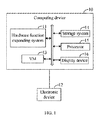
- FIG. 1 is one embodiment of an application of a computing device including a hardware function expanding system.
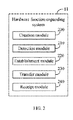
- FIG. 2 is a block diagram of one embodiment of function modules of the hardware function expanding system in FIG. 1 .
- FIG. 3 is a flowchart of one embodiment of a method for expanding hardware functions of the computing device of FIG. 1 .
- FIG. 1 is one embodiment of an application of a computing device 10 including a hardware function expanding system 11.
- the computing device 10 is connected to one or more electronic devices 12 (e.g., servers, only one shown).
- One or more virtual machines (VMs) 13 (only one shown) are installed in the computing device 10.
- the hardware function expanding system 11 expands hardware functions of the computing device 10 by making use of physical components installed in the electronic device 12 to process data.
- the computing device 10 may be a mobile device, such as a mobile phone.
- the computing device 10 further includes a storage system 14, at least one processor 15, and a display device 16.
- the storage system 14 can be a dedicated memory, such as an erasable programmable read-only memory (EPROM), a hard disk drive (HDD), or flash memory.
- EPROM erasable programmable read-only memory
- HDD hard disk drive
- flash memory flash memory
- the storage system 14 can be an external storage device, such as an external hard drive, a storage card, or a data storage medium.
- FIG. 2 is a block diagram of one embodiment of function modules of the hardware function expanding system 11 in FIG. 1 .
- the hardware function expanding system 11 includes a creation module 200, a detection module 210, an establishment module 220, a transfer module 230, and a receipt module 240.
- the modules 200-240 may comprise computerized code in the form of one or more programs that are stored in the storage system 14.
- the computerized code includes instructions that are executed by the at least one processor 15, to provide the aforementioned functions of the hardware function expanding system 11. A detailed description of the functions of the modules 200-240 is given in reference to FIG. 3 .
- FIG. 3 is a flowchart of one embodiment of a method for expanding hardware functions of the computing device 10 of FIG. 1 .
- additional steps may be added, others removed, and the ordering of the steps may be changed.
- the creation module 200 creates a virtual component in the computing device 10.
- the virtual component corresponds to a physical component desired by the computing device 10.
- the computing device 10 is desired to provide a function of accelerated rendering of three-dimensional (3D) images while the computing device 10 is not equipped with any physical 3D accelerated graphics card.
- the creation module 200 creates a virtual 3D accelerated graphics card in the computing device 10.
- the virtual component is created in a VM 13.
- the detection module 210 detects an electronic device 12 equipped with the physical component desired by the computing device 10. For example, the detection 210 detects an electronic device 12 equipped with the 3D accelerated graphics card.
- step S303 the establishment module 220 establishes a communication channel between the virtual component and the electronic device 12.
- the establishment module 220 creates a first remote procedure call (RPC) interface in the virtual component.
- the electronic device 12 creates a second RPC interface in the electronic device 12. Therefore, the communication channel between the virtual component and the electronic device 12 is established.
- RPC remote procedure call
- step S304 the transfer module 230 transfers a data processing request and data requested to be processed by the computing device 10 to the electronic device 12 via the communication channel.
- the request module 230 transfers the data processing request and the data to the electronic device 12 via the first RPC interface created in the virtual component and the second RPC interface created in the electronic device 12.
- step S305 the electronic device 12 receives the data processing request and the data from the computing device 10.
- the electronic device 12 processes the data using the physical component of the electronic device 12.
- the electronic device 12 uses the 3D accelerated graphics card installed in the electronic device 12 to process the data and obtains 3D images.
- step S306 the receipt module 240 receives a processing result of the data from the electronic device 12, stores the processing result in the storage system 14, and displays the processing result on the display device 16.
- the receipt module 240 receives the 3D images from the electronic device 12, stores the 3D images in the storage system 14, and displays the 3D images on the display device 16.
- the embodiments described herein can be implemented in hardware, software, firmware, middleware, microcode, or any combination thereof.
- the invention may take the form of a computer program containing one or more sequences of machine-readable instructions which, when executed by a computer, causes the computer to perform one or more method described above.
- machine-readable medium can include, without being limited to, wireless channels and various other media capable of storing, containing, and/or carrying instruction(s) and/or data.
- a code segment can represent a procedure, a function, a subprogram, a program, a routine, a subroutine, a module, a software package, a class, or any combination of instructions, data structures, or program statements.
- a code segment can be coupled to another code segment or a hardware circuit by passing and/or receiving information, data, arguments, parameters, or memory contents. Information, arguments, parameters, data, etc.
- the techniques described herein can be implemented with modules (e.g., procedures, functions, and so on) that perform the functions described herein.
- the software codes can be stored in memory units and executed by processors.
- the memory unit can be implemented within the processor or external to the processor, in which case it can be communicatively coupled to the processor via various means as is known in the art.
- the processing units can be implemented within one or more application specific integrated circuits (ASICs), digital signal processors (DSPs), digital signal processing devices (DSPDs), programmable logic devices (PLDs), field programmable gate arrays (FPGAs), processors, controllers, micro-controllers, microprocessors, other electronic units designed to perform the functions described herein, or a combination thereof.
- ASICs application specific integrated circuits
- DSPs digital signal processors
- DSPDs digital signal processing devices
- PLDs programmable logic devices
- FPGAs field programmable gate arrays
- processors controllers, micro-controllers, microprocessors, other electronic units designed to perform the functions described herein, or a combination thereof.
- All of the processes described above may be embodied in, and fully automated via, functional code modules executed by one or more general purpose electronic devices or processors.
- the code modules may be stored in any type of non-transitory machine-readable medium or other storage device. Some or all of the methods may alternatively be
Landscapes
- Engineering & Computer Science (AREA)
- Software Systems (AREA)
- Theoretical Computer Science (AREA)
- Physics & Mathematics (AREA)
- General Engineering & Computer Science (AREA)
- General Physics & Mathematics (AREA)
- Telephone Function (AREA)
- User Interface Of Digital Computer (AREA)
- Computer And Data Communications (AREA)
Abstract
Description
- Embodiments of the present disclosure relate to virtualization technology, and particularly to a computing device and a method for expanding hardware functions of the computing device.
- Limited by a size and/or a cost of a computing device (e.g., a mobile phone), some physical components (e.g., three-dimensional accelerated graphics cards) might not be installed in the computing device. Therefore, the computing device cannot provide some functions to users.
- According to one aspect of the disclosure, a method for expanding hardware functions of a computing device is provided. The method includes: creating a virtual component in the computing device, where the virtual component corresponds to a physical component desired by the computing device; detecting an electronic device equipped with the physical component; establishing a communication channel between the virtual component and the electronic device; transferring a data processing request and data requested to be processed by the computing device to the electronic device via the communication channel; and receiving a processing result of the data from the electronic device, and storing the processing result in a storage system.
- Embodiments of the invention are described, by way of example only, with reference to the accompanying drawings, in which:
-
FIG. 1 is one embodiment of an application of a computing device including a hardware function expanding system. -
FIG. 2 is a block diagram of one embodiment of function modules of the hardware function expanding system inFIG. 1 . -
FIG. 3 is a flowchart of one embodiment of a method for expanding hardware functions of the computing device ofFIG. 1 . -
FIG. 1 is one embodiment of an application of acomputing device 10 including a hardwarefunction expanding system 11. Thecomputing device 10 is connected to one or more electronic devices 12 (e.g., servers, only one shown). One or more virtual machines (VMs) 13 (only one shown) are installed in thecomputing device 10. The hardwarefunction expanding system 11 expands hardware functions of thecomputing device 10 by making use of physical components installed in theelectronic device 12 to process data. Thecomputing device 10 may be a mobile device, such as a mobile phone. - In this embodiment, the
computing device 10 further includes astorage system 14, at least oneprocessor 15, and adisplay device 16. Thestorage system 14 can be a dedicated memory, such as an erasable programmable read-only memory (EPROM), a hard disk drive (HDD), or flash memory. In some embodiments, thestorage system 14 can be an external storage device, such as an external hard drive, a storage card, or a data storage medium. -
FIG. 2 is a block diagram of one embodiment of function modules of the hardwarefunction expanding system 11 inFIG. 1 . The hardwarefunction expanding system 11 includes acreation module 200, adetection module 210, anestablishment module 220, atransfer module 230, and areceipt module 240. The modules 200-240 may comprise computerized code in the form of one or more programs that are stored in thestorage system 14. The computerized code includes instructions that are executed by the at least oneprocessor 15, to provide the aforementioned functions of the hardwarefunction expanding system 11. A detailed description of the functions of the modules 200-240 is given in reference toFIG. 3 . -
FIG. 3 is a flowchart of one embodiment of a method for expanding hardware functions of thecomputing device 10 ofFIG. 1 . Depending on the embodiment, additional steps may be added, others removed, and the ordering of the steps may be changed. - In step S301, the
creation module 200 creates a virtual component in thecomputing device 10. The virtual component corresponds to a physical component desired by thecomputing device 10. For example, thecomputing device 10 is desired to provide a function of accelerated rendering of three-dimensional (3D) images while thecomputing device 10 is not equipped with any physical 3D accelerated graphics card. In this case, thecreation module 200 creates a virtual 3D accelerated graphics card in thecomputing device 10. In one embodiment, the virtual component is created in aVM 13. - In step S302, the
detection module 210 detects anelectronic device 12 equipped with the physical component desired by thecomputing device 10. For example, thedetection 210 detects anelectronic device 12 equipped with the 3D accelerated graphics card. - In step S303, the
establishment module 220 establishes a communication channel between the virtual component and theelectronic device 12. In this embodiment, theestablishment module 220 creates a first remote procedure call (RPC) interface in the virtual component. Theelectronic device 12 creates a second RPC interface in theelectronic device 12. Therefore, the communication channel between the virtual component and theelectronic device 12 is established. - In step S304, the
transfer module 230 transfers a data processing request and data requested to be processed by thecomputing device 10 to theelectronic device 12 via the communication channel. In this embodiment, therequest module 230 transfers the data processing request and the data to theelectronic device 12 via the first RPC interface created in the virtual component and the second RPC interface created in theelectronic device 12. - In step S305, the
electronic device 12 receives the data processing request and the data from thecomputing device 10. In response to the data processing request, theelectronic device 12 processes the data using the physical component of theelectronic device 12. For example, theelectronic device 12 uses the 3D accelerated graphics card installed in theelectronic device 12 to process the data and obtains 3D images. - In step S306, the
receipt module 240 receives a processing result of the data from theelectronic device 12, stores the processing result in thestorage system 14, and displays the processing result on thedisplay device 16. For example, thereceipt module 240 receives the 3D images from theelectronic device 12, stores the 3D images in thestorage system 14, and displays the 3D images on thedisplay device 16. - While specific embodiments of the invention have been described above, it is to be understood that the embodiments described herein can be implemented in hardware, software, firmware, middleware, microcode, or any combination thereof. For example, the invention may take the form of a computer program containing one or more sequences of machine-readable instructions which, when executed by a computer, causes the computer to perform one or more method described above.
- When the embodiments are implemented in software, firmware, middleware or microcode, program code or code segments, they can be stored in a machine-readable medium, such as a storage component. The term "machine-readable medium" can include, without being limited to, wireless channels and various other media capable of storing, containing, and/or carrying instruction(s) and/or data. A code segment can represent a procedure, a function, a subprogram, a program, a routine, a subroutine, a module, a software package, a class, or any combination of instructions, data structures, or program statements. A code segment can be coupled to another code segment or a hardware circuit by passing and/or receiving information, data, arguments, parameters, or memory contents. Information, arguments, parameters, data, etc. can be passed, forwarded, or transmitted using any suitable means including memory sharing, message passing, token passing, network transmission, etc. For a software implementation, the techniques described herein can be implemented with modules (e.g., procedures, functions, and so on) that perform the functions described herein. The software codes can be stored in memory units and executed by processors. The memory unit can be implemented within the processor or external to the processor, in which case it can be communicatively coupled to the processor via various means as is known in the art.
- For a hardware implementation, the processing units can be implemented within one or more application specific integrated circuits (ASICs), digital signal processors (DSPs), digital signal processing devices (DSPDs), programmable logic devices (PLDs), field programmable gate arrays (FPGAs), processors, controllers, micro-controllers, microprocessors, other electronic units designed to perform the functions described herein, or a combination thereof. All of the processes described above may be embodied in, and fully automated via, functional code modules executed by one or more general purpose electronic devices or processors. The code modules may be stored in any type of non-transitory machine-readable medium or other storage device. Some or all of the methods may alternatively be embodied in specialized hardware. Depending on the embodiment, the non-transitory machine-readable medium may be a hard disk drive, a compact disc, a digital video disc, a tape drive or other suitable storage medium.
- It should be emphasized that the above-described embodiments of the present disclosure, particularly, any embodiments, are merely possible examples of implementations, merely set forth for a clear understanding of the principles of the disclosure. Many variations and modifications may be made to the above-described embodiment(s) of the disclosure without departing substantially from the spirit and principles of the disclosure. All such modifications and variations are intended to be included herein within the scope of this disclosure and the present disclosure and protected by the following claims.
Claims (12)
- A method for expanding hardware functions of a computing device being executed by a processor of the computing device, the method comprising:creating a virtual component in the computing device, wherein the virtual component corresponds to a physical component desired by the computing device;detecting an electronic device equipped with the physical component;establishing a communication channel between the virtual component and the electronic device;transferring a data processing request and data requested to be processed by the computing device to the electronic device via the communication channel;andreceiving a processing result of the data from the electronic device, and storing the processing result in a storage system.
- The method as claimed in claim 1, wherein the virtual component is created in a virtual machine installed in the computing device.
- The method as claimed in claim 1 or 2, wherein the communication channel between the virtual component and the electronic device is established by creating a first remote procedure call (RPC) interface in the virtual component and creating a second RPC interface in the electronic device.
- The method as claimed in any of claims 1 to 3, further comprising:displaying the processing result of the data on a display device.
- A computing device, comprising:at least one processor; anda storage system storing a plurality of instructions, when executed by the at least one processor, causing the at least one processor to perform operations comprising:creating a virtual component in the computing device, wherein the virtual component corresponds to a physical component desired by the computing device;detecting an electronic device equipped with the physical component;establishing a communication channel between the virtual component and the electronic device;transferring a data processing request and data requested to be processed by the computing device to the electronic device via the communication channel;andreceiving a processing result of the data from the electronic device, and storing the processing result in a storage system.
- The computing device as claimed in claim 5, wherein the virtual component is created in a virtual machine installed in the computing device.
- The computing device as claimed in claim 5 or 6, wherein the communication channel between the virtual component and the electronic device is established by creating a first remote procedure call (RPC) interface in the virtual component and creating a second RPC interface in the electronic device.
- The computing device as claimed in any of claims 5 to 7, wherein the instructions further cause the at least one processor to perform operations comprising:displaying the processing result of the data on a display device.
- A storage medium having stored thereon instructions that, when executed by a processor of a computing device, causes the processor to perform a method for expanding hardware functions of the computing device, the method comprising:creating a virtual component in the computing device, wherein the virtual component corresponds to a physical component desired by the computing device;detecting an electronic device equipped with the physical component;establishing a communication channel between the virtual component and the electronic device;transferring a data processing request and data requested to be processed by the computing device to the electronic device via the communication channel;andreceiving a processing result of the data from the electronic device, and storing the processing result in a storage system.
- The storage medium as claimed in claim 9, wherein the virtual component is created in a virtual machine installed in the computing device.
- The storage medium as claimed in claim 9 or 10, wherein the communication channel between the virtual component and the electronic device is established by creating a first remote procedure call (RPC) interface in the virtual component and creating a second RPC interface in the electronic device.
- The storage medium as claimed in any of claims 9 to 11, wherein the method further comprising:displaying the processing result of the data on a display device.
Applications Claiming Priority (1)
| Application Number | Priority Date | Filing Date | Title |
|---|---|---|---|
| TW102109957A TW201437803A (en) | 2013-03-21 | 2013-03-21 | Hardware function expanding system and method of computing device |
Publications (2)
| Publication Number | Publication Date |
|---|---|
| EP2782011A2 true EP2782011A2 (en) | 2014-09-24 |
| EP2782011A3 EP2782011A3 (en) | 2015-04-29 |
Family
ID=49474227
Family Applications (1)
| Application Number | Title | Priority Date | Filing Date |
|---|---|---|---|
| EP20130188999 Withdrawn EP2782011A3 (en) | 2013-03-21 | 2013-10-16 | Computing device and method for expanding hardware functions of the computing device |
Country Status (4)
| Country | Link |
|---|---|
| US (1) | US20140289727A1 (en) |
| EP (1) | EP2782011A3 (en) |
| JP (1) | JP2014186730A (en) |
| TW (1) | TW201437803A (en) |
Family Cites Families (6)
| Publication number | Priority date | Publication date | Assignee | Title |
|---|---|---|---|---|
| US6446070B1 (en) * | 1998-02-26 | 2002-09-03 | Sun Microsystems, Inc. | Method and apparatus for dynamic distributed computing over a network |
| US7523469B2 (en) * | 2004-12-03 | 2009-04-21 | Microsoft Corporation | Enabling inter-subsystem resource sharing |
| JP4720959B2 (en) * | 2006-05-24 | 2011-07-13 | 株式会社日立製作所 | Device management system |
| US7975017B1 (en) * | 2008-02-27 | 2011-07-05 | Parallels Holdings, Ltd. | Method and system for remote device access in virtual environment |
| JP5341852B2 (en) * | 2010-09-29 | 2013-11-13 | 株式会社東芝 | Communication device management apparatus and communication device management method |
| CN103748552A (en) * | 2011-08-30 | 2014-04-23 | 惠普发展公司,有限责任合伙企业 | Virtual high privilege mode for a system management request |
-
2013
- 2013-03-21 TW TW102109957A patent/TW201437803A/en unknown
- 2013-09-27 US US14/038,809 patent/US20140289727A1/en not_active Abandoned
- 2013-10-16 EP EP20130188999 patent/EP2782011A3/en not_active Withdrawn
-
2014
- 2014-03-18 JP JP2014054529A patent/JP2014186730A/en active Pending
Non-Patent Citations (1)
| Title |
|---|
| None |
Also Published As
| Publication number | Publication date |
|---|---|
| TW201437803A (en) | 2014-10-01 |
| EP2782011A3 (en) | 2015-04-29 |
| JP2014186730A (en) | 2014-10-02 |
| US20140289727A1 (en) | 2014-09-25 |
Similar Documents
| Publication | Publication Date | Title |
|---|---|---|
| EP3772009B1 (en) | Device interface security management for computer buses | |
| US9904634B2 (en) | Input signal emulation | |
| US10387182B2 (en) | Direct memory access (DMA) based synchronized access to remote device | |
| US20130055254A1 (en) | Methods and apparatuses for providing a virtual machine with dynamic assignment of a physical hardware resource | |
| CN108647051A (en) | Optimisation strategy acquisition methods, providing method, device and equipment | |
| KR102125923B1 (en) | Method and apparatus for upgrading operating system of a electronic device | |
| US9081709B2 (en) | Virtualizable and forward-compatible hardware-software interface | |
| US9729815B2 (en) | Method and electronic device for controlling content integrity using numerical data | |
| EP2500818A1 (en) | Method and device for displaying application image | |
| CN110007936B (en) | Data processing method and device | |
| EP3516509A1 (en) | Selective simulation of virtualized hardware inputs | |
| CN105809028B (en) | Apparatus and method for running multiple instances of the same application in a mobile device | |
| CN106662969A (en) | Method of processing content and electronic device thereof | |
| US20180150458A1 (en) | User terminal device for providing translation service, and method for controlling same | |
| CN107959845B (en) | Image data transmission method and device, client device and head-mounted display equipment | |
| CN117119149A (en) | Camera data transmission method and device, electronic equipment and medium | |
| CN110968383B (en) | Display method and device, terminal and storage medium of a message box | |
| CN115543535A (en) | Android container system, Android container construction method and device, electronic device | |
| CN105786434A (en) | Remote display control method and device | |
| EP3974976B1 (en) | Facilitation of guest application display from host operating system | |
| CN116996645A (en) | Camera data transmission method and device, electronic equipment and medium | |
| CN107450792B (en) | Information processing method and mobile terminal | |
| CN110968393A (en) | Virtual machine migration processing method, storage medium, and computing device | |
| US20140289727A1 (en) | Computing device and method for expanding hardware functions of the computing device | |
| EP2750038A2 (en) | Computing device and computing method |
Legal Events
| Date | Code | Title | Description |
|---|---|---|---|
| PUAI | Public reference made under article 153(3) epc to a published international application that has entered the european phase |
Free format text: ORIGINAL CODE: 0009012 |
|
| 17P | Request for examination filed |
Effective date: 20131016 |
|
| AK | Designated contracting states |
Kind code of ref document: A2 Designated state(s): AL AT BE BG CH CY CZ DE DK EE ES FI FR GB GR HR HU IE IS IT LI LT LU LV MC MK MT NL NO PL PT RO RS SE SI SK SM TR |
|
| AX | Request for extension of the european patent |
Extension state: BA ME |
|
| PUAL | Search report despatched |
Free format text: ORIGINAL CODE: 0009013 |
|
| AK | Designated contracting states |
Kind code of ref document: A3 Designated state(s): AL AT BE BG CH CY CZ DE DK EE ES FI FR GB GR HR HU IE IS IT LI LT LU LV MC MK MT NL NO PL PT RO RS SE SI SK SM TR |
|
| AX | Request for extension of the european patent |
Extension state: BA ME |
|
| RIC1 | Information provided on ipc code assigned before grant |
Ipc: G06F 9/54 20060101AFI20150325BHEP |
|
| STAA | Information on the status of an ep patent application or granted ep patent |
Free format text: STATUS: THE APPLICATION IS DEEMED TO BE WITHDRAWN |
|
| 18D | Application deemed to be withdrawn |
Effective date: 20151030 |