EP2781522A1 - Optically active bisoxazoline compound, asymmetric catalyst, and method for producing optically active cyclopropane compound using said catalyst - Google Patents
Optically active bisoxazoline compound, asymmetric catalyst, and method for producing optically active cyclopropane compound using said catalyst Download PDFInfo
- Publication number
- EP2781522A1 EP2781522A1 EP12849626.2A EP12849626A EP2781522A1 EP 2781522 A1 EP2781522 A1 EP 2781522A1 EP 12849626 A EP12849626 A EP 12849626A EP 2781522 A1 EP2781522 A1 EP 2781522A1
- Authority
- EP
- European Patent Office
- Prior art keywords
- group
- bis
- formula
- compound
- optically active
- Prior art date
- Legal status (The legal status is an assumption and is not a legal conclusion. Google has not performed a legal analysis and makes no representation as to the accuracy of the status listed.)
- Withdrawn
Links
- 0 CC(C(C)(C)*(*)(*)*)N=C(C)[C@@](C*)(C[Mn])C(OC1)=NC1C(C)(C)** Chemical compound CC(C(C)(C)*(*)(*)*)N=C(C)[C@@](C*)(C[Mn])C(OC1)=NC1C(C)(C)** 0.000 description 6
Classifications
-
- C—CHEMISTRY; METALLURGY
- C07—ORGANIC CHEMISTRY
- C07B—GENERAL METHODS OF ORGANIC CHEMISTRY; APPARATUS THEREFOR
- C07B53/00—Asymmetric syntheses
-
- C—CHEMISTRY; METALLURGY
- C07—ORGANIC CHEMISTRY
- C07C—ACYCLIC OR CARBOCYCLIC COMPOUNDS
- C07C237/00—Carboxylic acid amides, the carbon skeleton of the acid part being further substituted by amino groups
- C07C237/24—Carboxylic acid amides, the carbon skeleton of the acid part being further substituted by amino groups having the carbon atom of at least one of the carboxamide groups bound to a carbon atom of a ring other than a six-membered aromatic ring of the carbon skeleton
-
- C—CHEMISTRY; METALLURGY
- C07—ORGANIC CHEMISTRY
- C07C—ACYCLIC OR CARBOCYCLIC COMPOUNDS
- C07C67/00—Preparation of carboxylic acid esters
- C07C67/30—Preparation of carboxylic acid esters by modifying the acid moiety of the ester, such modification not being an introduction of an ester group
- C07C67/333—Preparation of carboxylic acid esters by modifying the acid moiety of the ester, such modification not being an introduction of an ester group by isomerisation; by change of size of the carbon skeleton
- C07C67/343—Preparation of carboxylic acid esters by modifying the acid moiety of the ester, such modification not being an introduction of an ester group by isomerisation; by change of size of the carbon skeleton by increase in the number of carbon atoms
- C07C67/347—Preparation of carboxylic acid esters by modifying the acid moiety of the ester, such modification not being an introduction of an ester group by isomerisation; by change of size of the carbon skeleton by increase in the number of carbon atoms by addition to unsaturated carbon-to-carbon bonds
-
- C—CHEMISTRY; METALLURGY
- C07—ORGANIC CHEMISTRY
- C07D—HETEROCYCLIC COMPOUNDS
- C07D263/00—Heterocyclic compounds containing 1,3-oxazole or hydrogenated 1,3-oxazole rings
- C07D263/02—Heterocyclic compounds containing 1,3-oxazole or hydrogenated 1,3-oxazole rings not condensed with other rings
- C07D263/08—Heterocyclic compounds containing 1,3-oxazole or hydrogenated 1,3-oxazole rings not condensed with other rings having one double bond between ring members or between a ring member and a non-ring member
- C07D263/10—Heterocyclic compounds containing 1,3-oxazole or hydrogenated 1,3-oxazole rings not condensed with other rings having one double bond between ring members or between a ring member and a non-ring member with only hydrogen atoms, hydrocarbon or substituted hydrocarbon radicals, directly attached to ring carbon atoms
- C07D263/14—Heterocyclic compounds containing 1,3-oxazole or hydrogenated 1,3-oxazole rings not condensed with other rings having one double bond between ring members or between a ring member and a non-ring member with only hydrogen atoms, hydrocarbon or substituted hydrocarbon radicals, directly attached to ring carbon atoms with radicals substituted by oxygen atoms
-
- C—CHEMISTRY; METALLURGY
- C07—ORGANIC CHEMISTRY
- C07D—HETEROCYCLIC COMPOUNDS
- C07D263/00—Heterocyclic compounds containing 1,3-oxazole or hydrogenated 1,3-oxazole rings
- C07D263/02—Heterocyclic compounds containing 1,3-oxazole or hydrogenated 1,3-oxazole rings not condensed with other rings
- C07D263/08—Heterocyclic compounds containing 1,3-oxazole or hydrogenated 1,3-oxazole rings not condensed with other rings having one double bond between ring members or between a ring member and a non-ring member
- C07D263/16—Heterocyclic compounds containing 1,3-oxazole or hydrogenated 1,3-oxazole rings not condensed with other rings having one double bond between ring members or between a ring member and a non-ring member with hetero atoms or with carbon atoms having three bonds to hetero atoms with at the most one bond to halogen, e.g. ester or nitrile radicals, directly attached to ring carbon atoms
-
- C—CHEMISTRY; METALLURGY
- C07—ORGANIC CHEMISTRY
- C07F—ACYCLIC, CARBOCYCLIC OR HETEROCYCLIC COMPOUNDS CONTAINING ELEMENTS OTHER THAN CARBON, HYDROGEN, HALOGEN, OXYGEN, NITROGEN, SULFUR, SELENIUM OR TELLURIUM
- C07F7/00—Compounds containing elements of Groups 4 or 14 of the Periodic Table
- C07F7/02—Silicon compounds
- C07F7/08—Compounds having one or more C—Si linkages
- C07F7/18—Compounds having one or more C—Si linkages as well as one or more C—O—Si linkages
- C07F7/1804—Compounds having Si-O-C linkages
-
- C—CHEMISTRY; METALLURGY
- C07—ORGANIC CHEMISTRY
- C07B—GENERAL METHODS OF ORGANIC CHEMISTRY; APPARATUS THEREFOR
- C07B2200/00—Indexing scheme relating to specific properties of organic compounds
- C07B2200/07—Optical isomers
-
- C—CHEMISTRY; METALLURGY
- C07—ORGANIC CHEMISTRY
- C07C—ACYCLIC OR CARBOCYCLIC COMPOUNDS
- C07C2601/00—Systems containing only non-condensed rings
- C07C2601/02—Systems containing only non-condensed rings with a three-membered ring
Definitions
- the present invention relates to an optically active bisoxazoline compound, an asymmetric catalyst, and a process for producing an optically active cyclopropane compound using the same.
- the present invention includes the following inventions.
- Examples of the alkyl group having 1 to 8 carbon atoms represented by R 1 , R 2 and R 3 include linear or branched alkyl groups such as a methyl group, an ethyl group, a n-propyl group, an isopropyl group, a n-butyl group, an isobutyl group, a t-butyl group, a n-pentyl group, a n-hexyl group, a cyclohexyl group, a thexyl group, a n-heptyl group and a n-octyl group.
- linear or branched alkyl groups such as a methyl group, an ethyl group, a n-propyl group, an isopropyl group, a n-butyl group, an isobutyl group, a t-butyl group, a n-pentyl group, a n-hexy
- R 1 , R 2 and R 3 are each independently an alkyl group having 1 to 8 carbon atoms, and it is more preferable that R 1 , R 2 and R 3 are an ethyl group or an isopropyl group; are identical to each other; or R 1 is a thexyl group and R 2 and R 3 are methyl groups.
- n is an integer of 0 to 3.
- a carbon atom to which two bisoxazoline rings are bonded links to -CH 2 -(CH 2 ) n -CH 2 - to form an aliphatic ring having 3 to 6 carbon atoms.
- optically active bisoxazoline compound (1) examples include
- the process for producing a compound (1) includes the following first step, second step, third step and fourth step.
- the first step, the second step, the third step and the fourth step are preferably carried out in this order.
- the process for producing a compound (1) may include a step of isolating or purifying the product obtained in each of the steps.
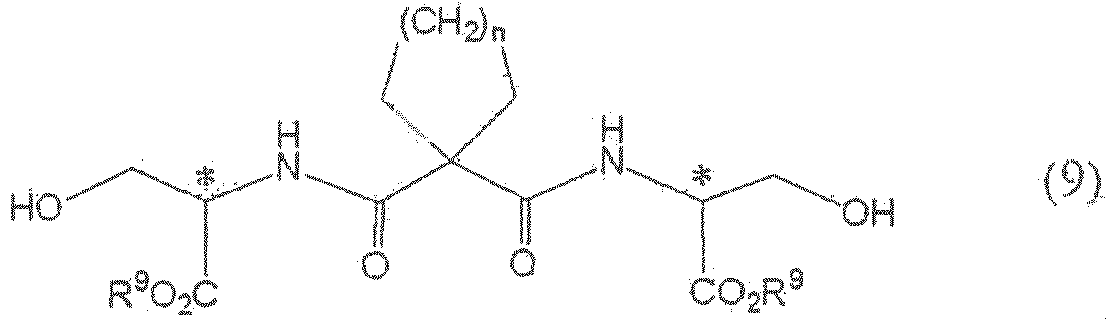
- the first step is a step of reacting an optically active serine ester represented by formula (7): wherein R 9 represents an alkyl group having 1 to 6 carbon atoms, a phenyl group or a benzyl group and * represents an asymmetric center, or a salt thereof (hereinafter, referred to as compound (7) in some cases) with a cycloalkanedicarboxylic acid derivative represented by formula (8): wherein Z represents a halogen atom or an alkoxy group having 1 to 6 carbon atoms and n represents an integer of 0 to 3, (hereinafter, referred to as compound (8) in some cases) to give an optically active diamide compound represented by formula (9): wherein R 9 , n and * are as defined above, (hereinafter, referred to as compound (9) in some cases).
- Examples of the alkyl group having 1 to 6 carbon atoms represented by R 9 include linear or branched alkyl groups such as a methyl group, an ethyl group, an-propyl group, an isopropyl group, a n-butyl group, an isobutyl group, a tert-butyl group, a n-pentyl group, a n-hexyl group, a cyclohexyl group and a thexyl group.
- Examples of the compound (7) include D-serine methyl ester, D-serine ethyl ester, D-serine n-propyl ester, D-serine isopropyl ester, D-serine n-butyl ester, D-serine isobutyl ester, D-serine tert-butyl ester, D-serine n-pentyl ester, D-serine n-hexyl ester, D-serine cyclohexyl ester, D-serine thexyl ester, D-serine phenyl ester, D-serine benzyl ester, salts of these compounds such as a hydrochloride, a hydrobromide, a hydroiodide, a methanesulfonate, a benzenesulfonate and a p-toluenesulfonate thereof, and compounds obtained by replacing
- Examples of the halogen atom represented by Z include a chlorine atom and a bromine atom, and examples of the alkoxy group having 1 to 6 carbon atoms include linear or branched alkoxy groups such as a methoxy group, an ethoxy group, a n-propoxy group, an isopropoxy group, a n-butoxy group, an isobutoxy group, a t-butoxy group, a n-pentyloxy group, a n-hexyloxy group, a cyclohexyloxy group and a thexyloxy group.
- Examples of the compound (8) include 1,1-cyclopropanedicarboxylic acid dichloride, 1,1-cyclopropanedicarboxylic acid dibromide, 1,1-cyclobutanedicarboxylic acid dichloride, 1,1-cyclobutanedicarboxylic acid dibromide, 1,1-cyclopentanedicarboxylic acid dichloride, 1,1-cyclopentanedicarboxylic acid dibromide, 1,1-cyclohexanedicarboxylic acid dichloride, 1,1-cyclohexanedicarboxylic acid dibromide, 1,1-cyclopropanedicarboxylic acid dimethyl ester, 1,1-cyclopropanedicarboxylic acid diethyl ester, 1,1-cyclopropanedicarboxylic acid di-n-propyl ester, 1,1-cyclopropanedicarboxylic acid diisopropyl ester, 1,1-cyclopropanedicar
- the reaction of a compound (7) with a compound (8) is preferably conducted by mixing a compound (7) and a compound (8) in the presence of a solvent.
- a compound (8) in which Z is a halogen atom is used, a compound (8) is preferably added to a compound (7).
- the use amount of a compound (8) is preferably 0.3 to 2 mol, more preferably 0.5 to 1 mol per 1 mol of a compound (7).
- the solvent examples include solvents inactive against the reaction, and include aromatic hydrocarbon solvents such as toluene and xylene; aliphatic hydrocarbon solvents such as heptane and octane; halogenated hydrocarbon solvents such as chlorobenzene, dichloromethane, dichloroethane and chloroform, used singly or in combination.
- aromatic hydrocarbon solvents such as toluene and xylene
- aliphatic hydrocarbon solvents such as heptane and octane
- halogenated hydrocarbon solvents such as chlorobenzene, dichloromethane, dichloroethane and chloroform, used singly or in combination.
- the use amount of the solvent is preferably 2 to 200 parts by weight per 1 part by weight of a compound (7).
- the reaction temperature is preferably -30 to 100°C, more preferably -10 to 50°C.
- the reaction is preferably carried out in the presence of a base such as triethylamine, for capturing a generated hydrogen halide.
- the reaction time is preferably 0.1 to 24 hours, more preferably 2 to 16 hours.
- the reaction temperature is preferably 50 to 250°C, more preferably 60 to 180°C.
- the reaction is preferably carried out in the presence of a catalyst such as a lithium compound.
- a catalyst such as a lithium compound.
- the lithium compound include lithium alkoxides such as lithium methoxide and lithium ethoxide; lithium halides such as lithium chloride; lithium hydroxide; etc.
- the use amount of the catalyst is preferably 0.0005 to 0.5 mol per 1 mol of a compound (8).
- the reaction time is preferably 0.5 to 24 hours, more preferably 2 to 16 hours.
- the compound (9) is obtained by reacting a compound (7) with a compound (8).
- the compound (9) can be isolated by mixing the reaction mixture and water and performing extraction, and concentrating the resulting organic layer.
- the compound (9) can be isolated also by subjecting the reaction mixture itself to column chromatography.
- the isolated compound (9) can be usually used in the subsequent step without modification.
- the isolated compound (9) can be purified by subjecting to recrystallization, column chromatography and the like before being used in the reaction of the subsequent step.
- Examples of the compound (9) include
- the second step is a step of reacting the compound (9) with a (methoxycarbonylsulfamoyl)triethylammonium hydroxide intramolecular salt to give an optically active bisoxazoline ester compound represented by formula (11): wherein R 9 , n and * are as defined above, (hereinafter, referred to as compound (11) in some cases.).
- the (methoxycarbonylsulfamoyl)triethylammonium hydroxide intramolecular salt is a compound represented by formula (10) : (hereinafter, referred to as compound (10) in some cases), and commercially available as a Burgess reagent.
- the reaction of a compound (9) with a compound (10) is preferably conducted by mixing a compound (9) and a compound (10) in the presence of a solvent.
- the use amount of the compound (10) is preferably 1 to 10 mol, more preferably 2 to 5 mol per 1 mol of the compound (9).
- solvents inactive against the reaction include solvents inactive against the reaction, and include ether solvents such as tetrahydrofuran and dioxane; aromatic hydrocarbon solvents such as toluene and xylene; aliphatic hydrocarbon solvents such as heptane and octane; halogenated hydrocarbon solvents such as chlorobenzene, dichloromethane, dichloroethane and chloroform; used singly or in combination.
- ether solvents such as tetrahydrofuran and dioxane
- aromatic hydrocarbon solvents such as toluene and xylene
- aliphatic hydrocarbon solvents such as heptane and octane
- halogenated hydrocarbon solvents such as chlorobenzene, dichloromethane, dichloroethane and chloroform
- the use amount of the solvent is preferably 2 to 200 parts by weight per 1 part by weight of the compound (9).
- the reaction temperature is preferably -30 to 120°C, more preferably -20 to 80°C.
- the reaction time is preferably 0.1 to 24 hours, more preferably 1 to 10 hours.
- the compound (11) is obtained by reacting the compound (9) and the compound (10).
- the resultant compound (11) can be isolated by mixing the reaction mixture and water and performing extraction, and concentrating the resultant organic layer.
- the solvent is water-soluble, it may be permissible that the reaction mixture is concentrated, then, a water-insoluble solvent among the above-described solvents or an ester solvent such as ethyl acetate or the like is added and extraction thereof is performed.
- the compound (11) can also be isolated by subj ecting the reaction mixture itself to column chromatography.
- the isolated compound (11) can be used in the reaction of the subsequent reaction without modification.
- the isolated compound (11) can be purified by subjecting to recrystallization, column chromatography and the like before being used in the reaction of the subsequent step.
- Examples of the compound (11) include
- the third step is a step of reacting the compound (11) with a Grignard reagent represented by formula (12): CH 3 MgQ (12) wherein Q represents a halogen atom, (hereinafter, referred to as compound (12) in some cases.) to give an optically active bisoxazoline alcohol compound represented by formula (13): wherein n and * are as defined above, (hereinafter, referred to as compound (13) in some cases.).
- a Grignard reagent represented by formula (12): CH 3 MgQ (12) wherein Q represents a halogen atom, (hereinafter, referred to as compound (12) in some cases.) to give an optically active bisoxazoline alcohol compound represented by formula (13): wherein n and * are as defined above, (hereinafter, referred to as compound (13) in some cases.).
- Examples of the halogen atom represented by Q include a chlorine atom and a bromine atom.
- Examples of the compound (12) include methylmagnesium bromide.
- the reaction of the compound (11) with the compound (12) is preferably conducted by mixing the compound (11) and the compound (12) in the presence of a solvent.
- the use amount of the compound (12) is preferably 2 to 15 mol, more preferably 4 to 8 mol per 1 mol of the compound (11).
- ether solvents such as diethyl ether, tetrahydrofuran and dioxane are preferably used, and a mixed solvent with an aromatic hydrocarbon solvent inactive against the reaction such as toluene and xylene may also be used.
- the use amount of the solvent is preferably 2 to 200 parts by weight per 1 part by weight of the compound (11).
- the reaction temperature is preferably -80 to 120°C, more preferably -70 to 20°C.
- the reaction time is preferably 0.5 to 24 hours, more preferably 1 to 10 hours.
- the compound (13) is obtained by reacting the compound (11) with the compound (12).
- the resultant compound (13) can be isolated by mixing the reaction mixture and an aqueous solution of a weak acid such as ammonium chloride and performing extraction, and concentrating the resulting organic layer.
- the isolated compound (13) can be used in the reaction of the subsequent step without modification.
- the isolated compound (13) can be purified by subjecting to recrystallization, column chromatography and the like before being used in the reaction of the subsequent step.
- Examples of the compound (13) include
- the fourth step is a step of reacting the compound (13) with a silicon compound represented by formula (14): wherein R 1 , R 2 and R 3 are as defined above and X represents a halogen atom, (hereinafter, referred to as compound (14) in some cases.) to give a compound (1).
- Examples of the halogen atom represented by X include a chlorine atom and a bromine atom.
- Examples of the compound (14) include triisopropylsilyl chloride, thexyldimethylsilyl chloride, triethylsilyl chloride, triphenylsilyl chloride, tert-butyldiphenylsilyl chloride and methyldiphenylsilyl chloride.
- the reaction of the compound (13) with the compound (14) is preferably conducted by mixing the compound (13) and the compound (14) in the presence of a base and a solvent.
- the reaction of the compound (13) with the compound (14) is preferably conducted by mixing the compound (13) and a base, then, mixing the compound (14).
- the use amount of the compound (14) is preferably 1 to 10 mol, more preferably 2 to 6 mol per 1 mol of the compound (13).
- solvents inactive against the reaction include ether solvents such as tetrahydrofuran and dioxane; aromatic hydrocarbon solvents such as toluene and xylene; aliphatic hydrocarbon solvents such as heptane and octane; used singly or in combination.
- ether solvents such as tetrahydrofuran and dioxane
- aromatic hydrocarbon solvents such as toluene and xylene
- aliphatic hydrocarbon solvents such as heptane and octane
- the use amount of the solvent is preferably 2 to 200 parts by weight per 1 part by weight of the compound (13).
- Examples ot the base include organometal compounds such as n-butyllithium and lithium diisopropylamide; metal hydrides such as lithium hydride, sodium hydride, potassium hydride and calcium hydride; metal alkoxides such as lithium methoxide, lithium ethoxide, sodium methoxide, sodium ethoxide, sodium t-butoxide, potassium methoxide and potassium t-butoxide; metal hydroxides such as lithium hydroxide, sodium hydroxide, potassium hydroxide and calcium hydroxide; metal carbonates such as lithium carbonate, sodium carbonate, potassium carbonate and calcium carbonate; etc.
- organometal compounds such as n-butyllithium and lithium diisopropylamide
- metal hydrides such as lithium hydride, sodium hydride, potassium hydride and calcium hydride
- metal alkoxides such as lithium methoxide, lithium ethoxide, sodium methoxide, sodium ethoxide, sodium t-
- the use amount of the base is preferably 1 to 10 mol, more preferably 2 to 6 mol per 1 mol of the compound (13).
- the reaction temperature is preferably -80 to 120°C, more preferably -20 to 80°C.
- the reaction time is preferably 0.5 to 24 hours, more preferably 1 to 16 hours.
- the compound (1) is obtained by reacting the compound (13) with the compound (14).
- the resultant compound (1) can be isolated by mixing the reaction mixture and an aqueous solution of a weak acid such as ammonium chloride and performing extraction, and concentrating the resulting organic layer.
- the resultant compound (1) can be isolated by treating the reaction mixture with alcohols such as methanol and ethanol, then, treating by column chromatography.
- the resultant compound (1) can be isolated by treating the reaction mixture itself by column chromatography.
- the isolated compound (1) can be used as itself for preparation of an asymmetric catalyst, or, if necessary, can be purified by subjecting to recrystallization, column chromatography and the like before being used for preparation of an asymmetric catalyst.
- the asymmetric catalyst of the present invention is obtained by mixing the following (A) and (B).
- Examples of the component (A) include monovalent or divalent copper compounds such as copper(I) trifluoromethanesulfonate, copper(I) acetate, copper(I) bromide, copper(I) chloride, copper(I) iodide, copper(I) hydroxide, copper(II) trifluoromethanesulfonate, copper(II) acetate, copper(II) bromide, copper(II) chloride, copper(II) iodide and copper(II) hydroxide, and copper(I) trifluoromethanesulfonate, copper(I) chloride, copper(I) bromide, copper(I) iodide, copper(II) chloride, copper(II) bromide or copper(II) iodide is preferred.
- the copper compounds may each be used singly or two or more of them may be used in admixture.
- component (A) commercially available compounds can be used.
- component (A) monovalent copper compounds and monovalent copper compounds generated by allowing a reducing agent such as phenylhydrazine to act on divalent copper compounds are preferably used, from the standpoint of reaction efficiency.
- the use amount of the component (B) is preferably 0.8 to 5 mol, more preferably 0.9 to 2 mol per 1 mol of the component (A).
- ком ⁇ онент (A) and the component (B) are preferably carried out in the presence of a solvent.
- a solvent include halogenated hydrocarbon solvents such as dichloromethane, dichloroethane, chloroform and carbon tetrachloride; aromatic hydrocarbon solvents such as benzene, toluene and xylene; ester solvents such as methyl acetate and ethyl acetate; etc.
- the olefin (4) when the prochiral olefin represented by formula (4) (hereinafter, abbreviated as olefin (4)) as a raw material of an asymmetric cyclopropanation reaction described later is liquid, the olefin (4) maybe used as a solvent.
- the use amount of the solvent is preferably 10 to 10000 parts by weight per 1 part by weight of the component (A).
- Mixing of the component (A) and the component (B) is preferably carried out under an atmosphere of an inert gas such as an argon gas and a nitrogen gas, and the mixing temperature is preferably -20 to 100°C.
- an inert gas such as an argon gas and a nitrogen gas
- the asymmetric catalyst of the present invention is preferably obtained by further mixing the following (C) or (D), from the standpoint of activity of the asymmetric catalyst.
- a + represents a lithium ion, a sodium ion, a potassium ion, a silver (I) ion or a trityl cation
- Y represents a fluorine atom or a fluorinated alkyl group having 1 to 8 carbon atoms
- m represents an integer of 1 to 5, and when m is 2 or more, the plurality of Y are the same or different, (hereinafter, referred to as component (C) in some cases.)
- a + represents a lithium ion, a sodium ion, a potassium ion, a silver(I) ion or a trityl cation, preferably a trityl cation.
- Y represents a fluorine atom or a fluorinated alkyl group having 1 to 8 carbon atoms.
- m is an integer of 1 to 5 representing the number of the substituent Y.
- the substituent Y may be substituted on any position on a phenyl group. When m is 2 or more, the plurality of Y are the same or different.
- Examples of the fluorinated alkyl group having 1 to 8 carbon atoms include alkyl groups obtained by substituting at least one hydrogen atom on an alkyl group having 1 to 8 carbon atoms by a fluorine atom such as a fluoromethyl group, a difluoromethyl group, a trifluoromethyl group, a perfluoroethyl group, a perfluoro-n-propyl group, a perfluoro-n-butyl group, a perfluoro-n-pentyl group, a perfluoro-n-hexyl group, a perfluoro-n-heptyl group and a perfluoro-n-octyl group.
- a fluorine atom such as a fluoromethyl group, a difluoromethyl group, a trifluoromethyl group, a perfluoroethyl group, a perfluoro-n-propyl group, a perfluoro
- Examples of the boron compound (2) include
- boron compound (2) commercially available compounds may be used, and those produced by known methods described in JP-A No. 9-295984 and the like may also be used.
- a + represents a lithium ion, a sodium ion, a potassium ion, a silver(I) ion or a trityl cation.
- M represents a phosphorus atom, an arsenic atom or an antimony atom, preferably a phosphorus atom or an antimony atom.
- Examples of the fluorine compound (3) include lithium hexafluorophosphate, sodium hexafluorophosphate, potassium hexafluorophosphate, silver hexafluorophosphate, trityl hexafluorophosphate, lithium hexafluoroarsenate, sodium hexafluoroarsenate, potassium hexafluoroarsenate, silver hexafluoroarsenate, trityl hexafluoroarsenate, lithium hexafluoroantimonate, sodium hexafluoroantimonate, potassium hexafluoroantimonate, silver hexafluoroantimonate and trityl hexafluoroantimonate.
- the use amount of the component (C) or the component (D) is preferably 0.8 to 5 mol, more preferably 0.9 to 2 mol per 1 mol of the component (A).
- component (C) or the component (D) When the component (C) or the component (D) is mixed, it is preferable that the component (A) and the component (B) are mixed in the above-described solvent, and further, the component (C) or the component (D) is added.
- the asymmetric catalyst of the present invention may be isolated from the mixture obtained by the above-described mixing and used in the reaction of the olefin (4) with a diazoacetate ester represented by the (5) (hereinafter, referred to as diazoacetate ester (5) in some cases.), or the mixture itself may be used in the reaction of the olefin (4) with the diazoacetate ester (5).
- R 4 , R 5 , R 6 and R 7 each independently represent a hydrogen atom, a halogen atom, an alkyl group having 1 to 6 carbon atoms and optionally having a substituent, an alkenyl group having 2 to 6 carbon atoms and optionally having a substituent, an aryl group having 6 to 10 carbon atoms and optionally having a substituent, an aralkyl group having 7 to 16 carbon atoms and optionally having a substituent or an alkoxycarbonyl group having 2 to 7 carbon atoms and optionally having a substituent, and when R 4 and R 6 represent the same group, R 5 and R 7 represent groups different from each other, with a diazoacetate ester represented by formula (5): N 2 CHCO 2 R 8 (5) wherein R 8 represents an alkyl group having 1 to 6 carbon atoms, in the presence of the asymmetric catalyst of the present invention will be explained.
- Examples of the halogen atom represented by R 4 , R 5 , R 6 and R 7 include a fluorine atom, a chlorine atom, a bromine atom and an iodine atom.
- alkyl group having 1 to 6 carbon atoms and optionally having a substituent examples include alkyl groups having 1 to 6 carbon atoms such as a methyl group, an ethyl group, a n-propyl group, an isopropyl group, a n-butyl group, an isobutyl group, a n-pentyl group, and those obtained by substituting one or two or more hydrogen atoms of these alkyl groups by various substituents, and include alkyl groups substituted with a halogen atom such as a chloromethyl group, a fluoromethyl group, a trifluoromethyl group and a chloroethyl group; alkyl groups substituted with an alkoxy group such as a methoxymethyl group, an ethoxymethyl group, a n-propoxymethyl group, an isopropoxymethyl group, a n-butoxymethyl group and a tert-butoxymethyl group ; alkyl groups substituted with
- alkenyl group having 2 to 6 carbon atoms and optionally having a substituent examples include alkenyl groups having 2 to 6 carbon atoms such as a vinyl group, a 1-propenyl group, a 2-propenyl group, a 2-methyl-1-propenyl group, a 1-butenyl group, a 2-butenyl group and a 3-butenyl group, and compounds obtained by substituting one or two or more hydrogen atoms on these alkenyl groups by a halogen atom or an alkoxycarbonyl group, that is, a 1-chloro-2-propenyl group, a 2-methoxycarbonyl-1-propenyl group and the like.
- Examples of the aryl group having 6 to 10 carbon atoms and optionally having a substituent include a phenyl group, a 1-naphthyl group, a 2-naphthyl group, a 2-methylphenyl group, a 4-methylphenyl group, a 3-methoxymethylphenyl group and a 2,3-dihydro-4-benzofuranyl group.
- Examples of the aralkyl group having 7 to 16 carbon atoms and optionally having a substituent include those constituted of the above-described aryl group having 6 to 10 carbon atoms and optionally having a substituent and an alkyl group having 1 to 6 carbon atoms and optionally having a substituent, and include a benzyl group, a 2-methylbenzyl group, a 3-methylbenzyl group, a 4-methylbenzyl group, a 2-methoxybenzyl group, a 3-methoxybenzyl group, a 4-methoxybenzyl group, a 1-naphthylmethyl group and a 2-naphthylmethyl group.
- alkoxycarbonyl group having 2 to 7 carbon atoms and optionally having a substituent examples include those constituted of the above-described alkyl group having 1 to 6 carbon atoms and optionally having a substituent, an oxygen atom and a carbonyl group, and include a methoxycarbonyl group, an ethoxycarbonyl group, a n-propyloxycarbonyl group, an isopropyloxycarbonyl group, a n-butyloxycarbonyl group, an isobutyloxycarbonyl group and a n-pentyloxycarbonyl group.
- R 4 and R 6 represent the same group
- R 5 and R 7 represent groups different from each other.
- R 4 is preferably a hydrogen atom or a fluorine atom
- R 5 is preferably a methyl group
- R 6 is preferably an acyloxymethyl group, an alkoxycarbonyloxymethyl group or an aralkyloxymethyl group
- an R 7 is preferably a methyl group.
- R 6 is more preferably an acetoxymethyl group or a benzyloxymethyl group.
- Examples of the olefin (4) include propene, fluoroethylene, 1-fluoro-1-chloroethylene, 1-butene, isobutene, 1-pentene, 1-hexene, 1-octene, 4-chloro-1-butene, 2-pentene, 2-heptene, 2-methyl-2-butene, 2,5-dimethyl-2,4-hexadiene, 2-chloro-5-methyl-2,4-hexadiene, 2-fluoro-5-methyl-2,4-hexadiene, 1,1,1-trifluoro-5-methyl-2,4-hexadiene, 2-methoxycarbonyl-5-methyl-2,4-hexadiene, 1,1-difluoro-4-methyl-1,3-pentadiene, 1,1-dichloro-4-methyl-1,3-pentadiene, 1,1-dibromo-4-methyl-1,3-pentadiene, 1-chloro-1-fluoro-4-methyl-1
- R 8 in formula (5) represents an alkyl group having 1 to 6 carbon atoms, and examples of the alkyl group include a methyl group, an ethyl group, a n-propyl group, an isopropyl group, a n-butyl group, an isobutyl group and a n-pentyl group.
- diazoacetate ester (5) examples include ethyl diazoacetate, n-propyl diazoacetate, isopropyl diazoacetate, n-butyl diazoacetate, isobutyl diazoacetate and tert-butyl diazoacetate.
- diazoacetate ester (5) those produced by known methods described in Organic Synthesis Collective Volume 3, p. 392 and the like can be used.
- the use amount of the asymmetric catalyst is preferably 0.00001 to 0.5 mol, more preferably 0.0001 to 0.05 mol in terms of copper metal per 1 mol of the diazoacetate ester (5).
- the use amount of the olefin (4) is preferably 1 mol or more, more preferably 1.2-fold mol or more per 1 mol of the diazoacetate ester (5). Its upper limit is not particularly restricted, and when the olefin (4) is liquid, it may be used in large excess amount also as a solvent.
- the reaction of the olefin (4) with the diazoacetate ester (5) is preferably carried out in the presence of a solvent.
- a solvent include halogenated hydrocarbon solvents such as dichloromethane, dichloromethane, chloroform and carbon tetrachloride; aliphatic hydrocarbon solvents such as hexane, heptane and cyclohexane; aromatic hydrocarbon solvents such as benzene, toluene and xylen; ester solvents such as ethyl acetate, used singly or in combination.
- the use amount of the solvent is preferably 1 to 30 parts by weight, more preferably 2 to 20 parts by weight per 1 part by weight of the diazoacetate ester (5), from the standpoint of volumetric efficiency, the property and condition of the reaction mixture and the like.
- the reaction of the olefin (4) with the diazoacetate ester (5) is preferably carried out under an atmosphere of an inert gas such as an argon gas and a nitrogen gas. Since water exerts a reverse influence on the reaction, it is preferable to suppress the water content present in the reaction system low by having out the reaction in the co-existence of a dehydrating agent in the reaction system or by using the olefin (4) and a solvent previously dehydrated and the like.
- the reaction temperature is preferably -50 to 150°C, more preferably -20 to 80°C.
- the reaction of the olefin (4) with the diazoacetate ester (5) is usually carried out by mixing the asymmetric catalyst, the olefin (4) and the diazoacetate ester (5), if necessary in the presence of a solvent, and it is preferable that the reaction is carried out by mixing the asymmetric catalyst and the olefin (4) in a solvent, and adding the diazoacetate ester (5).
- optically active cyclopropane compound (6) represented by formula (6): wherein each of R 4 , R 5 , R 6 , R 7 and R 8 are as defined above and * represents an asymmetric center, (hereinafter, referred to as optically active cyclopropane compound (6) in some cases.) is obtained.
- optically active cyclopropane compound (6) can be isolated by concentrating the reaction mixture after completion of the reaction.
- the resultant optically active cyclopropane compound (6) may be further purified by usual purification means such as distillation and column chromatography.
- the process for producing an optically active cyclopropane compound (6) of the present invention may include these isolation steps and purification steps.
- optically active cyclopropane compound (6) examples include
- optically active cyclopropane compound (6) can also be converted into an optically active cyclopropanecarboxylic acid compound represented by formula (6) in which R 8 is a hydrogen atom by hydrolyzing it according to a known hydrolysis method.
- the gas chromatography area percentage is a value determined by using the following conditions.
- the yield was determined by a gas chromatography internal standard method and the trans isomer/cis isomer ratio was determined by the gas chromatography area ratio.
- the optical purity was determined by the liquid chromatography area ratio.
- Example 1-1 Production example of compound (9) (n is 0 and R 9 is a methyl group)
- a 100 mL round-bottomed four-necked flask equipped with a Dimroth condenser having a nitrogen introduction tube, a thermometer, a magnetic rotor and a dropping funnel was purged with nitrogen, then, into the flask were charged 4.04 g (25.5 mmol) of D-serine methyl ester hydrochloride and 40 mL of dehydrated chloroform, and the mixture was cooled to 0°C.
- Example 1-2 Production example of compound (11) (n is 0 and R 9 is a methyl group)
- Example 1-3 Production example of compound (13) (n is 0)
- a 200 mL round-bottomed four-necked flask equipped with a Dimroth condenser having a nitrogen introduction tube, a thermometer, a magnetic rotor and a dropping funnel was purged with nitrogen, then, into the flask were charged 2.00 g (6.53 mmol) of 1,1-bis[2-[(4R)-4-(methoxycarbonyl)oxazoline]]cyclopropane and 100 mL of dehydrated tetrahydrofuran and these were mixed, then, the mixture was cooled down to -66°C.
- Example 1-4 Production example of compound (1) (n is 0 and R 1 to R 3 are all an isopropyl group)
- Example 1-5 Production example of compound (1) (n is 0, R 1 is a thexyl group and R 2 and R 3 are methyl groups)
- Example 1-6 Production example of compound (1) (n is 0 and R 1 to R 3 are all an ethyl group)
- Example 1-7 Production example of compound (1) (n is 0 and R 1 to R 3 are all a phenyl group)
- Example 1-8 Production example of compound (1) (n is 0, R 1 is a tert-butyl group and R 2 and R 3 are phenyl groups)
- Example 1-9 Production example of compound (1) (n is 0, R 1 is a methyl group and R 2 and R 3 are phenyl groups)
- Trans isomer/cis isomer ratio 93/7
- the trans isomer of the compound denotes a compound in which an ethoxycarbonyl group at 1-position and an acetoxymethyl group at 2-position based on a cyclopropane ring plane exist on the opposite sides
- the cis isomer thereof denotes a compound in which an ester group at 1-position and an acetoxymethyl group at 2-position based on a cyclopropane ring plane exist on the same side.
- Optical purity trans isomer 95% e.e. (+ form), cis isomer 44% e.e. (+ form)
- Example 9 Comparison of Example 9 and Comparative Example 2 described above teaches that selectivity of a trans isomer in an asymmetric cyclopropanation reaction is improved more in use of an asymmetric catalyst obtained from an optically active bisoxazoline compound of the present invention than in use of an asymmetric catalyst obtained from a conventionally known optically active bisoxazoline compound.
- Example 12 Comparison of Example 12 and Comparative Example 3 described above teaches that selectivity of a trans isomer in an asymmetric cyclopropanation reaction is improved more in use of an asymmetric catalyst obtained from an optically active bisoxazoline compound of the present invention than in use of an asymmetric catalyst obtained from a conventionally known optically active bisoxazoline compound.
- Trans isomer/cis isomer ratio 95/5 (The trans isomer of the compound denotes a compound in which an ester group at 1-position and a benzyloxymethyl group at 2-position based on a cyclopropane ring plane exist on the opposite sides, and the cis isomer thereof denotes a compound in which an ester group at 1-position and a benzyloxymethyl group at 2-position based on a cyclopropane ring plane exist on the same side.)
- Optical purity trans isomer 94% e.e. (+ form), cis isomer 33% e.e. (+ form) (The optical purity of the compound was determined by hydrolyzing an ester portion to generate a carboxylate, then, calculating the liquid chromatography area ratio.)
- Example 14 and Comparative Example 4 described above teaches that selectivity of a trans isomer in an asymmetric cyclopropanation reaction is improved more in use of an asymmetric catalyst obtained from an optically active bisoxazoline compound of the present invention than in use of an asymmetric catalyst obtained from a conventionally known optically active bisoxazoline compound.
- a 100 mL round-bottomed four-necked flask equipped with a Dimroth condenser having a nitrogen introduction tube, a thermometer, a magnetic rotor and a dropping funnel was purged with nitrogen, then, into the flask were charged 4.01 g (25.3 mmol) of D-serine methyl ester hydrochloride and 40 mL of dehydrated chloroform, and the mixture was cooled to 0°C.
- a 200 mL round-bottomed four-necked flask equipped with a Dimroth condenser having a nitrogen introduction tube, a thermometer, a magnetic rotor and a dropping funnel was purged with nitrogen, then, into the flask were charged 2.13 g (6.90 mmol) of 2,2-bis[2-[(4R)-4-(methoxycarbonyl)oxazoline]]propane and 107 mL of dehydrated tetrahydrofuran and these were mixed, then, cooled down to -68°C.
Landscapes
- Chemical & Material Sciences (AREA)
- Organic Chemistry (AREA)
- Organic Low-Molecular-Weight Compounds And Preparation Thereof (AREA)
- Heterocyclic Carbon Compounds Containing A Hetero Ring Having Nitrogen And Oxygen As The Only Ring Hetero Atoms (AREA)
- Catalysts (AREA)
- Low-Molecular Organic Synthesis Reactions Using Catalysts (AREA)
- Plural Heterocyclic Compounds (AREA)
Abstract

Description
- The present invention relates to an optically active bisoxazoline compound, an asymmetric catalyst, and a process for producing an optically active cyclopropane compound using the same.
- As a process for producing an optically active cyclopropane compound, there is known a process of reacting a prochiral olefin with a diazoacetate ester in the presence of an asymmetric catalyst obtained by mixing a monovalent or divalent copper compound and a compcund represented by the following formula (Patent documents 1, 2 and 3).

-
- Patent document 1:
US-Patent No. 7709651 - Patent document 2:
US-Patent No. 7705165 - Patent document 3:
US-Patent No. 7671210 - In the conventional process, selectivity of a trans isomer in the resulting optically active cyclopropane compound is not necessarily sufficiently satisfactory in some cases.
- The present invention includes the following inventions.
- [1] An optically active bisoxazoline compound represented by formula (1):

- [2] The compound according to [1], wherein n is 0.
- [3] The compound according to [1] or [2], wherein R1, R2 and R3 each independently represent an ethyl group or an isopropyl group.
- [4] The compound according to any one of [1] to [3], wherein R1, R2 and R3 are identical to each other.
- [5] The compound according to [1] or [2], wherein R1 is a thexyl group and R2 and R3 are methyl groups.
- [6] An asymmetric catalyst obtained by mixing the following (A) and (B):
- (A) a monovalent or divalent copper compound
- (B) the compound according to any one of [1] to [5].
- [7] The asymmetric catalyst according to [6], obtained by mixing the (A) and the (B) and the following (C) or (D):
- (C) a boron compound represented by formula (2):

- (D) a fluorine compound represented by formula (3):
D+ (MF6)- (3)
wherein D+ represents a lithium ion, a sodium ion, a potassium ion, a silver(I) ion or a trityl cation and M represents a phosphorus atom, an arsenic atom or an antimony atom.
- (C) a boron compound represented by formula (2):
- [8] The asymmetric catalyst according to [6], obtained by mixing the (A), the (B) and the following (C):
- (C) a boron compound represented by formula (2):

- (C) a boron compound represented by formula (2):
- [9] A process for producing an optically active cyclopropane compound represented by formula (6):

the process comprising a step of reacting a prochiral olefin represented by formula (4):
with a diazoacetate ester represented by formula (5):
N2CHCO2R8 (5)
wherein R8 represents an alkyl group having 1 to 6 carbon atoms, in the presence or the asymmetric catalyst according to any one of [6] to [8]. - [10] The process according to [9], wherein R4 is a hydrogen atom or a fluorine atom, R5 is a methyl group, R6 is an acyloxymethyl group, an alkoxycarbonyloxymethyl group or an aralkyloxymethyl group and R7 is a methyl group.
- [11] The process according to [10], wherein R6 is an acetoxymethyl group or a benzyloxymethyl group.
- [12] A process for producing an optically active bisoxazoline compound represented by formula (1):

comprising the following first step, second step, third step and fourth step:- <First step>
a step of reacting an optically active serine ester represented by formula (7):
or a salt thereof with a cycloalkanedicarboxylic acid derivative represented by formula (8):
- <Second step>
a step of reacting the optically active diamide compound represented by formula (9) with a (methoxycarbonylsulfamoyl)triethylammonium hydroxide intramolecular salt to give an optically active bisoxazoline ester compound represented by formula (11):
- <Third step>
a step of reacting the optically active bisoxazoline ester compound represented by formula (11) with a Grignard reagent represented by formula (12):
CH3MgQ (12)
wherein Q represents a halogen atom,
to give an optically active bisoxazoline alcohol compound represented by formula (13):
- <Fourth step>
a step of reacting the optically active bisoxazoline alcchol compound represented by formula (13) with a silicon compound represented by formula (14):
to give the optically active bisoxazoline compound represented by formula (1).
- <First step>
- [13] An optically active diamide compound represented by formula (9):

- [14] An optically active bisoxazoline ester compound represented by formula (11):

- [15] An optically active bisoxazoline alcohol compound represented by formula (13):

- According to the process of the present invention, selectivity of a trans isomer in the resulting optically active cyclopropane compound is improved.
- An optically active bisoxazoline compound represented by formula (1):

(hereinafter, referred to as compound (1) in some cases) will be explained. - Examples of the alkyl group having 1 to 8 carbon atoms represented by R1, R2 and R3 include linear or branched alkyl groups such as a methyl group, an ethyl group, a n-propyl group, an isopropyl group, a n-butyl group, an isobutyl group, a t-butyl group, a n-pentyl group, a n-hexyl group, a cyclohexyl group, a thexyl group, a n-heptyl group and a n-octyl group.
- It is preferable that R1, R2 and R3 are each independently an alkyl group having 1 to 8 carbon atoms, and it is more preferable that R1, R2 and R3 are an ethyl group or an isopropyl group; are identical to each other; or R1 is a thexyl group and R2 and R3 are methyl groups.
- n is an integer of 0 to 3. A carbon atom to which two bisoxazoline rings are bonded links to -CH2-(CH2)n-CH2- to form an aliphatic ring having 3 to 6 carbon atoms. Examples of the aliphatic ring having 3 to 6 carbon atoms include a cyclopropane ring (n=0), a cyclobutane ring (n=1), a cyclopentane ring (n=2) and a cyclohexane ring (n=3), preferably a cyclopropane ring (n=0).
- Examples of the optically active bisoxazoline compound (1) include
- 1,1-bis[2-[(4R)-4-[2-(trimethylsilyl)oxy-2-propyl]oxazoline ]]cyclopropane,
- 1,1-bis[2-[(4R)-4-[2-(isopropyldimethylsilyl)oxy-2-propyl]o xazoline]]cyclopropane,
- 1,1-bis[2-[(4R)-4-[2-(n-butyldimethylsilyl)oxy-2-propyl]oxa zolinel]cyclopropane,
- 1,1-bis[2-[(4R)-4-[2-(tert-butyldimethylsilyl)oxy-2-propyl] oxazoline]]cyclopropane,
- 1,1-bis[2-[(4R)-4-[2-(thexyldimethylsilyl)oxy-2-propyl]oxaz oline]]cyclopropane,
- 1,1-bis[2-[(4R)-4-[2-(cyclohexyldimethylsilyl)oxy-2-propyl] oxazoline]]cyclopropane,
- 1,1-bis[2-[(4R)-4-[2-(n-octyldimethylsilyl)oxy-2-propyl]oxa zoline]]cyclopropane,
- 1,1-bis[2-[(4R)-4-[2-(triethylsilyl)oxy-2-propyl]oxazoline] ]cyclopropane,
- 1,1-bis[2-[(4R)-4-[2-(isopropyldiethylsilyl)oxy-2-propyl]ox azoline]]cyclopropane,
- 1,1-bis[2-[(4R)-[2-(tri-n-propylsilyl)oxy-2-propyl]oxazolin e]]cyclopropane,
- 1,1-bis[2-[(4R)-4-[2-(triisopropylsilyl)oxy-2-propyl]oxazol ine]]cyclopropane,
- 1,1-bis[2-[(4R)-1-[2-(n-octyldiisopropylsilyl)oxy-2-propyl] oxazoline]]cyclopropane,
- 1,1-bis[2-[(4R)-4-[2-(tri-n-butylsilyl)oxy-2-propyl]oxazoli ne]]cyclopropane,
- 1,1-bis[2-[(4R)-4-[2-(triisobutylsilyl)oxy-2-propyl]oxazoli ne]]cyclopropane,
- 1,1-bis[2-[(4R)-4-[2-(phenyldimethylsilyl)oxy-2-propyl]oxaz oline]]cyclopropane,
- 1,1-bis[2-[(4R)-4-[2-(pentafluorophenyldimethylsilyl)oxy-2-propyl]oxazoline]]cyclopropane,
- 1,1-bis[2-[(4R)-4-[2-(methyldiphenylsilyl)oxy-2-propyl]oxaz oline]]cyclopropane,
- 1,1-bis[2-[(4R)-4-[2-(tert-butyldiphenylsilyl)oxy-2-propyl] oxazoline]]cyclopropane,
- 1,1-bis[2-[(4R)-4-[2-(triphenylsilyl)oxy-2-propyl]oxazoline ]]cyclopropane,
- 1,1-bis[2-[(4R)-4-[2-(benzyldimethylsilyl)oxy-2-propyl]oxaz oline]]cyclopropane,
- 1,1-bis[2-[(4R)-4-[2-(tribenzylsilyl)oxy-2-propyl]oxazoline ]]cyclopropane,
- 1,1-bis[2-[(4R)-4-[2-(trimethylsilyl)oxy-2-propyl]oxazoline ]]cyclobutane,
- 1,1-bis[2-[(4R)-4-[2-(isopropyldimethylsilyl)oxy-2-propyl]o xazoline]]cyclobutane,
- 1,1-bis[2-[(4R)-4-[2-(n-butyldimethylsilyl)oxy-2-propyl]oxa zoline]]cyclobutane,
- 1,1-bis[2-[(4R)-4-[2-(tert-butyldimethylsilyl)oxy-2-propyl] oxazoline]]cyclobutane,
- 1,1-bis[2-[(4R)-4-[2-(thexyldimethylsilyl)oxy-2-propyl]oxaz oline]]cyclobutane,
- 1,1-bis[2-[(4R)-4-[2-(cyclohexyldimethylsilyl)oxy-2-propyl] oxazoline]]cyclobutane,
- 1,1-bis[2-[(4R)-4-[2-(n-octyldimethylsilyl)oxy-2-propyl]oxa zoline]]cyclobutane,
- 1,1-bis[2-[(4R)-4-[2-(triethylsilyl)oxy-2-propyl]oxazoline] ]cyclobutane,
- 1,1-bis[2-[(4R)-4-[2-(isopropyldiethylsilyl)oxy-2-propyl]ox azoline]]cyclobutane,
- 1,1-bis[2-[(4R)-4-[2-(tri-n-propylsilyl)oxy-2-propyl]oxazol ine]]cyclobutane,
- 1,1-bis[2-[(4R)-4-[2-(triisopropylsilyl)oxy-2-propyl]oxazol ine]]cyclobutane,
- 1,1-bis[2-[(4R)-4-[2-(n-octyldiisopropylsilyl)oxy-2-propyl] oxazoline]]cyclobutane,
- 1,1-bis[2-[(4R)-4-[2-(tri-n-butylsilyl)oxy-2-propyl]oxazoli ne]]cyclobutane,
- 1,1-bis[2-[(4R)-4-[2-(triisobutylsilyl)oxy-2-propyl]oxazoli ne]]cyclobutane,
- 1,1-bis[2-[(4R)-4-[2-(phenyldimethylsilyl)oxy-2-propyl]oxaz oline]]cyclobutane,
- 1,1-bis[2-[(4R)-4-[2-(pentafluorophenyldimethylsilyl)oxy-2-propyl]oxazoline]]cyclobutane,
- 1,1-bis[2-[(4R)-4-[2-(methyldiphenylsilyl)oxy-2-propyl]oxaz oline]]cyclobutane,
- 1,1-bis[2-[(4R)-4-[2-(tert-butyldiphenylsilyl)oxy-2-propyl] oxazoline]]cyclobutane,
- 1,1-bis[2-[(4R)-4-[2-(triphenylsilyl)oxy-2-propyl]oxazoline ]]cyclobutane,
- 1,1-bis[2-[(4R)-4-[2-(benzyldimethylsilyl)oxy-2-propyl]oxaz oline]]cyclobutane,
- 1,1-bis[2-[(4R)-4-[2-(tribenzylsilyl)oxy-2-propyl]oxazoline ]]cyclobutane,
- 1,1-bis[2-[(4R)-4-[2-(trimethylsilyl)oxy-2-propyl]oxazoline ]]cyclopentane,
- 1,1-bis[2-[(4R)-4-[2-(isopropyldimethylsilyl)oxy-2-propyl]o xazoline]]cyclopentane,
- 1,1-bis[2-[(4R)-4-[2-(n-butyldimethylsilyl)oxy-2-propyl]oxa zoline]]cyclopentane,
- 1,1-bis[2-[(4R)-4-[2-(tert-butyldimethylsilyl)oxy-2-propyl] oxazoline]]cyclopentane,
- 1,1-bis[2-[(4R)-4-[2-(thexyldimethylsilyl)oxy-2-propyl]oxaz oline]]cyclopentane,
- 1,1-bis[2-[(4R)-4-[2-(cyclohexyldimethylsilyl)oxy-2-propyl] oxazoline]]cyclopentane,
- 1,1-bis[2-[(4R)-4-[2-(n-octyldimethylsilyl)oxy-2-propyl]oxa zoline]]cyclopentane,
- 1,1-bis[2-[(4R)-4-[2-(triethylsilyl)oxy-2-propyl]oxazoline] ]cyclopentane,
- 1,1-bis[2-[(4R)-4-[2-(isopropyldiethylsilyl)oxy-2-propyl]ox azoline]]cyclcpentane,
- 1,1-bis[2-[(4R)-4-[2-(tri-n-propylsilyl)oxy-2-propyl]oxazol ine]]cyclopentane,
- 1,1-bis[2-[(4R)-4-[2-(triisopropylsilyl)oxy-2-propyl]oxazol ine]]cyclopentane,
- 1,1-bis[2-[(4R)-4-[2-(n-octyldiisopropylsilyl)oxy-2-propyl] oxazoline]]cyclopentane,
- 1,1-bis[2-[(4R)-4-[2-(tri-n-butylsilyl)oxy-2-propyl]oxazoli ne]]cyclopentane,
- 1,1-bis[2-[(4R)-4-[2-(triisobutylsilyl)oxy-2-propyl]oxazoli ne]]cyclopentane,
- 1,1-bis[2-[(4R)-4-[2-(phenyldimethylsilyl)oxy-2-propyl]oxaz oline]]cyclopentane,
- 1,1-bis[2-[(4R)-4-[2-(pentafluorophenyldimethylsilyl)oxy-2-propyl]oxazoline]]cyclopentane,
- 1,1-bis[2-[(4R)-4-[2-(methyldiphenylsilyl)oxy-2-propyl]oxaz oline]]cyclopentane,
- 1,1-bis[2-[(4R)-4-[2-(tert-butyldiphenylsilyl)oxy-2-propyl] oxazoline]]cyclopentane,
- 1,1-bis[2-[(4R)-4-[2-(triphenylsilyl)oxy-2-propyl]oxazoline ]]cyclopentane,
- 1,1-bis[2-[(4R)-4-[2-(benzyldimethylsilyl)oxy-2-propyl]oxaz oline]]cyclopentane,
- 1,1-bis[2-[(4R)-4-[2-(tribenzylsilyl)oxy-2-propyl]oxazoline ]]cyclopentane
- 1,1-bis[2-[(4R)-4-[2-(trimethylsilyl)oxy-2-propyl]oxazoline ]]cyclohexane,
- 1,1-bis[2-[(4R)-4-[2-(isopropyldimethylsilyl)oxy-2-propyl]o xazoline]]cyclohexane,
- 1,1-bis[2-[(4R)-4-[2-(n-butyldimethylsilyl)oxy-2-propyl]oxa zoline]]cyclohexane,
- 1,1-bis[2-[(4R)-4-[2-(tert-butyldimethylsilyl)oxy-2-propyl] oxazoline]]cyclohexane,
- 1,1-bis[2-[(4R)-4-[2-(thexyldimethylsilyl)oxy-2-propyl]oxaz oline]]cyclohexane,
- 1,1-bis[2-[(4R)-4-[2-(cyclohexyldimethylsilyl)oxy-2-propyl] oxazoline]]cyclohexane,
- 1,1-bis[2-[(4R)-4-[2-(n-octyldimethylsilyl)oxy-2-propyl]oxa zoline]]cyclohexane,
- 1,1-bis[2-[(4R)-4-[2-(triethylsilyl)oxy-2-propyl]oxazoline] ]cyclohexane,
- 1,1-bis[2-[(4R)-4-[2-(isopropyldiethylsilyl)oxy-2-propyl]ox azoline]]cyclohexane,
- 1,1-bis[2-[(4R)-4-[2-(tri-n-propylsilyl)oxy-2-propyl]oxazol ine]]cyclohexane,
- 1,1-bis[2-[(4R)-4-[2-(triisopropylsilyl)oxy-2-propyl]oxazol ine]]cyclohexane,
- 1,1-bis[2-[(4R)-4-[2-(n-octyldiisopropylsilyl)oxy-2-propyl] oxazoline]]cyclohexane,
- 1,1-bis[2-[(4R)-4-[2-(tri-n-butylsilyl)oxy-2-propyl]oxazoli ne]]cyclohexane,
- 1,1-bis[2-[(4R)-4-[2-(triisobutylsilyl)oxy-2-propyl]oxazoli ne]]cyclohexane,
- 1,1-bis[2-[(4R)-4-[2-(phenyldimethylsilyl)oxy-2-propyl]oxaz oline]]cyclohexane,
- 1,1-bis[2-[(4R)-4-[2-(pentafluorophenyldimethylsilyl)oxy-2-propyl]oxazoline]]cyclohexane,
- 1,1-bis[2-[(4R)-4-[2-(methyldiphenylsilyl)oxy-2-propyl]oxaz oline]]cyclohexane,
- 1,1-bis[2-[(4R)-4-[2-(tert-butyldiphenylsilyl)oxy-2-propyl] oxazoline]]cyclohexane,
- 1,1-bis[2-[(4R)-4-[2-(triphenylsilyl)oxy-2-propyl]oxazoline ]]cyclohexane,
- 1,1-bis[2-[(4R)-4-[2-(benzyldimethylsilyl)oxy-2-propyl]oxaz oline]]cyclohexane, and
- 1,1-bis[2-[(4R)-4-[2-(tribenzylsilyl)oxy-2-propyl]oxazoline ]]cyclohexane;
- The process for producing a compound (1) includes the following first step, second step, third step and fourth step. In the process for producing a compound (1), the first step, the second step, the third step and the fourth step are preferably carried out in this order. The process for producing a compound (1) may include a step of isolating or purifying the product obtained in each of the steps.
- The first step is a step of reacting an optically active serine ester represented by formula (7):

or a salt thereof (hereinafter, referred to as compound (7) in some cases) with a cycloalkanedicarboxylic acid derivative represented by formula (8):
(hereinafter, referred to as compound (8) in some cases) to give an optically active diamide compound represented by formula (9):
(hereinafter, referred to as compound (9) in some cases). - Examples of the alkyl group having 1 to 6 carbon atoms represented by R9 include linear or branched alkyl groups such as a methyl group, an ethyl group, an-propyl group, an isopropyl group, a n-butyl group, an isobutyl group, a tert-butyl group, a n-pentyl group, a n-hexyl group, a cyclohexyl group and a thexyl group.
- Examples of the compound (7) include D-serine methyl ester, D-serine ethyl ester, D-serine n-propyl ester, D-serine isopropyl ester, D-serine n-butyl ester, D-serine isobutyl ester, D-serine tert-butyl ester, D-serine n-pentyl ester, D-serine n-hexyl ester, D-serine cyclohexyl ester, D-serine thexyl ester, D-serine phenyl ester, D-serine benzyl ester, salts of these compounds such as a hydrochloride, a hydrobromide, a hydroiodide, a methanesulfonate, a benzenesulfonate and a p-toluenesulfonate thereof, and compounds obtained by replacing the steric configuration D of the above-described compound with L.
- As the compound (7), commercially available compounds, and those produced from optically active serine by processes described in Tetrahedron Letters, vol. 45, pp. 9649-9652 (2004), Tetrahedron: Asymmetry, vol. 22, pp. 580-586 (2011), European Journal of Organic Chemistry, pp. 5386-5394 (2007) and the like can be used.
- Examples of the halogen atom represented by Z include a chlorine atom and a bromine atom, and examples of the alkoxy group having 1 to 6 carbon atoms include linear or branched alkoxy groups such as a methoxy group, an ethoxy group, a n-propoxy group, an isopropoxy group, a n-butoxy group, an isobutoxy group, a t-butoxy group, a n-pentyloxy group, a n-hexyloxy group, a cyclohexyloxy group and a thexyloxy group.
- Examples of the compound (8) include 1,1-cyclopropanedicarboxylic acid dichloride, 1,1-cyclopropanedicarboxylic acid dibromide, 1,1-cyclobutanedicarboxylic acid dichloride, 1,1-cyclobutanedicarboxylic acid dibromide, 1,1-cyclopentanedicarboxylic acid dichloride, 1,1-cyclopentanedicarboxylic acid dibromide, 1,1-cyclohexanedicarboxylic acid dichloride, 1,1-cyclohexanedicarboxylic acid dibromide, 1,1-cyclopropanedicarboxylic acid dimethyl ester, 1,1-cyclopropanedicarboxylic acid diethyl ester, 1,1-cyclopropanedicarboxylic acid di-n-propyl ester, 1,1-cyclopropanedicarboxylic acid diisopropyl ester, 1,1-cyclopropanedicarboxylic acid di-n-butyl ester, 1,1-cyclopropanedicarboxylic acid diisobutyl ester, 1,1-cyclopropanedicarboxylic acid di-n-pentyl ester, 1,1-cyclopropanedicarboxylic acid di-n-hexyl ester, 1,1-cyclopropanedicarboxylic acid dicyclohexyl ester, 1,1-cyclobutanedicarboxylic acid dimethyl ester, 1,1-cyclobutanedicarboxylic acid diethyl ester, 1,1-cyclobutanedicarboxylic acid di-n-propyl ester, 1,1-cyclobutanedicarboxylic acid diisopropyl ester, 1,1-cyclobutanedicarboxylic acid di-n-butyl ester, 1,1-cyclobutanedicarboxylic acid diisobutyl ester, 1,1-cyclobutanedicarboxylic acid di-n-pentyl ester, 1,1-cyclobutanedicarboxylic acid di-n-hexyl ester, 1,1-cyclobutanedicarboxylic acid dicyclohexyl ester, 1,1-cyclopentanedicarboxylic acid dimethyl ester, 1,1-cyclopentanedicarboxylic acid diethyl ester, 1,1-cyclopentanedicarboxylic acid di-n-propyl ester, 1,1-cyclopentanedicarboxylic acid diisopropyl ester, 1,1-cyclopentanedicarboxylic acid di-n-butyl ester, 1,1-cyclopentanedicarboxylic acid diisobutyl ester, 1,1-cyclopentanedicarboxylic acid di-n-pentyl ester, 1,1-cyclopentanedicarboxylic acid di-n-hexyl ester, 1,1-cyclopentanedicarboxylic acid dicyclohexyl ester, 1,1-cyclohexanedicarboxylic acid dimethyl ester, 1,1-cyclohexanedicarboxylic acid diethyl ester, 1,1-cyclohexanedicarboxylic acid di-n-propyl ester, 1,1-cyclohexanedicarboxylic acid diisopropyl ester, 1,1-cyclohexanedicarboxylic acid di-n-butyl ester, 1,1-cyclohexanedicarboxylic acid diisobutyl ester, 1,1-cyclohexanedicarboxylic acid di-n-pentyl ester, 1,1-cyclohexanedicarboxylic acid di-n-hexyl ester, and 1,1-cyclohexanedicarboxylic acid dicyclohexyl ester.
- As the compound (8) in which Z is a halogen atom, those produced from commercially available 1,1-cycloalkanedicarboxylic acids by processes described in Australian Journal of Chemistry, vol. 36, pp. 1133-1140 (1983), Organic and Biomolecular Chemistry, vol. 5, pp. 3932-3937 (2007), and the like can be used.
- As the compound (8) in which Z is an alkoxy group having 1 to 6 carbon atoms, commercially available compounds and those produced from commercially available malonic acid diesters by methods described in Tetrahedron Letters, vol. 46, pp. 635-638 (2005), and the like can be used.
- The reaction of a compound (7) with a compound (8) is preferably conducted by mixing a compound (7) and a compound (8) in the presence of a solvent. When a compound (8) in which Z is a halogen atom is used, a compound (8) is preferably added to a compound (7).
- The use amount of a compound (8) is preferably 0.3 to 2 mol, more preferably 0.5 to 1 mol per 1 mol of a compound (7).
- Examples of the solvent include solvents inactive against the reaction, and include aromatic hydrocarbon solvents such as toluene and xylene; aliphatic hydrocarbon solvents such as heptane and octane; halogenated hydrocarbon solvents such as chlorobenzene, dichloromethane, dichloroethane and chloroform, used singly or in combination.
- The use amount of the solvent is preferably 2 to 200 parts by weight per 1 part by weight of a compound (7).
- When a compound (8) in which Z is a halogen atom is used, the reaction temperature is preferably -30 to 100°C, more preferably -10 to 50°C. The reaction is preferably carried out in the presence of a base such as triethylamine, for capturing a generated hydrogen halide. The reaction time is preferably 0.1 to 24 hours, more preferably 2 to 16 hours.
- When a compound (8) in which Z is an alkoxy group having 1 to 6 carbon atoms is used, the reaction temperature is preferably 50 to 250°C, more preferably 60 to 180°C. The reaction is preferably carried out in the presence of a catalyst such as a lithium compound. Examples of the lithium compound include lithium alkoxides such as lithium methoxide and lithium ethoxide; lithium halides such as lithium chloride; lithium hydroxide; etc.
- The use amount of the catalyst is preferably 0.0005 to 0.5 mol per 1 mol of a compound (8).
- The reaction time is preferably 0.5 to 24 hours, more preferably 2 to 16 hours.
- The compound (9) is obtained by reacting a compound (7) with a compound (8). The compound (9) can be isolated by mixing the reaction mixture and water and performing extraction, and concentrating the resulting organic layer. The compound (9) can be isolated also by subjecting the reaction mixture itself to column chromatography. The isolated compound (9) can be usually used in the subsequent step without modification. The isolated compound (9) can be purified by subjecting to recrystallization, column chromatography and the like before being used in the reaction of the subsequent step.
- Examples of the compound (9) include
- N,N'-bis[(1R)-1-(methoxycarbonyl)-2-hydroxyethyl]cyclopropa ne-1,1-dicarboxamide,
- N,N'-bis[(1R)-1-(ethoxycarbonyl)-2-hydroxyethyl]cyclopropan e-1,1-dicarboxamide,
- N,N'-bis[(1R)-1-(n-propoxycarbonyl)-2-hydroxyethyl]cyclopro pane-1,1-dicarboxamide,
- N,N'-bis[(1R)-1-(isopropoxycarbonyl)-2-hydroxyethyl]cyclopr opane-1,1-dicarboxamide,
- N,N'-bis[(1R)-1-(n-butoxycarbonyl)-2-hydroxyethyl]cycloprop ane-1,1-dicarboxamide,
- N,N'-bis[(1R)-1-(isobutoxycarbonyl)-2-hydroxyethyl]cyclopro pane-1,1-dicarboxamide,
- N,N'-bis[(1R)-1-(tert-butoxycarbonyl)-2-hydroxyethyl]cyclop ropane-1,1-dicarboxamide,
- N,N'-bis[(1R)-1-(n-pentyloxycarbonyl)-2-hydroxyethyl]cyclop ropane-1,1-dicarboxamide,
- N,N'-bis[(1R)-1-(n-hexyloxycarbonyl)-2-hydroxyethyl]cyclopr opane-1,1-dicarboxamide,
- N,N'-bis[(1R)-1-(cyclohexyloxycarbonyl)-2-hydroxyethyl]cycl opropane-1,1-dicarboxamide,
- N,N'-bis[(1R)-1-(thexyloxycarbonyl)-2-hydroxyethyl]cyclopro pane-1,1-dicarboxamide,
- N,N'-bis[(1R)-1-(phenoxycarbonyl)-2-hydroxyethyl]cyclopropa ne-1,1-dicarboxamide,
- N,N'-bis[(1R)-1-(benzyloxycarbonyl)-2-hydroxyethyl]cyclopro pane-1,1-dicarboxamide,
- N,N'-bis[(1R)-1-(methoxycarbonyl)-2-hydroxyethyl]cyclobutan e-1,1-dicarboxamide,
- N,N'-bis[(1R)-1-(ethoxycarbonyl)-2-hydroxyethyl]cyclobutane -1,1-dicarboxamide,
- N,N'-bis[(1R)-1-(n-propoxycarbonyl)-2-hydroxyethyl]cyclobut ane-1,1-dicarboxamide,
- N,N'-bis[(1R)-1-(isopropoxycarbonyl)-2-hydroxyethyl]cyclobu tane-1,1-dicarboxamide,
- N,1,1'-bis[(1R)-1-(n-butoxycarbonyl)-2-hydroxyethyl]cyclobuta ne-1,1-dicarboxamide,
- N,N'-bis[(1R)-1-(isobutoxycarbonyl)-2-hydroxyethyl]cyclobut ane-1,1-dicarboxamide,
- N,N'-bis[(1R)-1-(tert-butoxycarbonyl)-2-hydroxyethyl]cyclob utane-1,1-dicarboxamide,
- N,N'-bis[(1R)-1-(n-pentyloxycarbonyl)-2-hydroxyethyl]cyclob utane-1,1-dicarboxamide,
- N,N'-bis[(1R)-1-(n-hexyloxycarbonyl)-2-hydroxyethyl]cyclobu tane-1,1-dicarboxamide,
- N,N'-bis[(1R)-1-(cyclohexyloxycarbonyl)-2-hydroxyethyl]cycl obutane-1,1-dicarboxamide,
- N,N'-bis[(1R)-1-(thexyloxycarbonyl)-2-hydroxyethyl]cyclobut ane-1,1-dicarboxamide,
- N,N'-bis[(1R)-1-(phenoxycarbonyl)-2-hydroxyethyl]cyclobutan e-1,1-dicarboxamide,
- N,N'-bis[(1R)-1-(benzyloxycarbonyl)-2-hydroxyethyl]cyclobut ane-1,1-dicarboxamide,
- N,N'-bis[(1R)-1-(methoxycarbonyl)-2-hydroxyethyl]cyclopenta ne-1,1-dicarboxamide,
- N,N'-bis[(1R)-1-(ethoxycarbonyl)-2-hydroxyethyl]cyclopentan e-1,1-dicarboxamide,
- N,N'-bis[(1R)-1-(n-propoxycarbonyl)-2-hydroxyethyl]cyclopen tane-1,1-dicarboxamide,
- N,N'-bis[(1R)-1-(isopropoxycarbonyl)-2-hydroxyethyl]cyclope ntane-1,1-dicarboxamide,
- N,N'-bis[(1R)-1-(n-butoxycarbonyl)-2-hydroxyethyl]cyclopent ane-1,1-dicarboxamide,
- N,N'-bis[(1R)-1-(isobutoxycarbonyl)-2-hydroxyethyl]cyclopen tane-1,1-dicarboxamide,
- N,N'-bis[(1R)-1-(tert-butoxycarbonyl)-2-hydroxyethyl]cyclop entane-1,1-dicarboxamide,
- N,N'-bis[(1R)-1-(n-pentyloxycarbonyl)-2-hydroxyethyl]cyclop entane-1,1-dicarboxamide,
- N,N'-bis[(1R)-1-(n-hexyloxycarbonyl)-2-hydroxyethyl]cyclope ntane-1,1-dicarboxamide,
- N,N'-bis[(1R)-1-]cyclohexyloxycarbonyl)-2-hydroxyethyl]cycl opentane-1,1-dicarboxamide,
- N,N'-bis[(1R)-1-(thexyloxycarbonyl)-2-hydroxyethyl]cyclopen tane-1,1-dicarboxamide,
- N,N'-bis[(1R)-1-(phenoxycarbonyl)-2-hydroxyethyl]cyclopenta ne-1,1-dicarboxamide,
- N,N'-bis[(1R)-1-(benzyloxycarbonyl)-2-hydroxyethyl]cyclopen tane-1,1-dicarboxamide,
- N,N'-bis[(1R)-1-(methoxycarbonyl)-2-hydroxyethyl]cyclohexan e-1,1-dicarboxamide,
- N,N'-bis[(1R)-1-(ethoxycarbonyl)-2-hydroxyethyl]cyclohexane -1,1-dicarboxamide,
- N,N'-bis[(1R)-1-(n-propoxycarbonyl)-2-hydroxyethyl]cyclohex ane-1,1-dicarboxamide,
- N,N'-bis[(1R)-1-(isopropoxycarbonyl)-2-hydroxyethyl]cyclohe xane-1,1-dicarboxamide,
- N,N'-bis[(1R)-1-(n-butoxycarbonyl)-2-hydroxyethyl]cyclohexa ne-1,1-dicarboxamide,
- N,N'-bis[(1R)-1-(isobutoxycarbonyl)-2-hydroxyethyl]cyclohex ane-1,1-dicarboxamide,
- N,N'-bis[(1R)-1-(tert-butoxycarbonyl)-2-hydroxyethyl]cycloh exane-1,1-dicarboxamide,
- N,N'-bis[(1R)-1-(n-pentyloxycarbonyl)-2-hydroxyethyl]cycloh exane-1,1-dicarboxamide,
- N,N'-bis[(1R)-1-(n-hexyloxycarbonyl)-2-hydroxyethyl]cyclohe xane-1,1-dicarboxamide,
- N,N'-bis[(1R)-1-(cyclohexyloxycarbonyl)-2-hydroxyethyl]cycl ohexane-1,1-dicarboxamide,
- N,N'-bis[(1R)-1-(thexyloxycarbonyl)-2-hydroxyethyl]cyclohex ane-1,1-dicarboxamide,
- N,N'-bis[(1R)-1-(phenoxycarbonyl)-2-hydroxyethyl]cyclohexan e-1,1-dicarboxamide and
- N,N'-bis[(1R)-1-(benzyloxycarbonyl)-2-hydroxyethyl]cyclohex ane-1,1-dicarboxamide;
- The second step is a step of reacting the compound (9) with a (methoxycarbonylsulfamoyl)triethylammonium hydroxide intramolecular salt to give an optically active bisoxazoline ester compound represented by formula (11):

(hereinafter, referred to as compound (11) in some cases.). - The (methoxycarbonylsulfamoyl)triethylammonium hydroxide intramolecular salt is a compound represented by formula (10) :

- The reaction of a compound (9) with a compound (10) is preferably conducted by mixing a compound (9) and a compound (10) in the presence of a solvent.
- The use amount of the compound (10) is preferably 1 to 10 mol, more preferably 2 to 5 mol per 1 mol of the compound (9).
- Examples of the solvent include solvents inactive against the reaction, and include ether solvents such as tetrahydrofuran and dioxane; aromatic hydrocarbon solvents such as toluene and xylene; aliphatic hydrocarbon solvents such as heptane and octane; halogenated hydrocarbon solvents such as chlorobenzene, dichloromethane, dichloroethane and chloroform; used singly or in combination.
- The use amount of the solvent is preferably 2 to 200 parts by weight per 1 part by weight of the compound (9).
- The reaction temperature is preferably -30 to 120°C, more preferably -20 to 80°C. The reaction time is preferably 0.1 to 24 hours, more preferably 1 to 10 hours.
- The compound (11) is obtained by reacting the compound (9) and the compound (10). The resultant compound (11) can be isolated by mixing the reaction mixture and water and performing extraction, and concentrating the resultant organic layer. When the solvent is water-soluble, it may be permissible that the reaction mixture is concentrated, then, a water-insoluble solvent among the above-described solvents or an ester solvent such as ethyl acetate or the like is added and extraction thereof is performed. The compound (11) can also be isolated by subj ecting the reaction mixture itself to column chromatography. The isolated compound (11) can be used in the reaction of the subsequent reaction without modification. The isolated compound (11) can be purified by subjecting to recrystallization, column chromatography and the like before being used in the reaction of the subsequent step.
- Examples of the compound (11) include
- 1,1-bis[2-[(4R)-4-(methoxycarbonyl)oxazoline]]cyclopropane,
- 1,1-bis[2-[(4R)-4-(ethoxycarbonyl)oxazoline]]cyclopropane,
- 1,1-bis[2-[(4R)-4-(n-propoxycarbonyl)oxazoline]]cyclopropan e,
- 1,1-bis[2-[(4R)-4-(isopropoxycarbonyl)oxazoline]]cyclopropa ne,
- 1,1-bis[2-[(4R)-4-(n-butoxycarbonyl)oxazoline]]cyclopropane ,
- 1,1-bis[2-[(4R)-4-(isobutoxycarbonyl)oxazoline]]cyclopropan e,
- 1,1-bis[2-[(4R)-4-(tert-butoxycarbonyl)oxazoline]]cycloprop ane,
- 1,1-bis[2-[(4R)-4-(n-pentyloxycarbonyl)oxazoline]]cycloprop ane,
- 1,1-bis[2-[(4R)-4-(n-hexyloxycarbonyl)oxazoline]]cyclopropa ne,
- 1,1-bis[2-[(4R)-4-(cyclohexyloxycarbonyl)oxazoline]]cyclopr opane,
- 1,1-bis[2-[(4R)-4-(thexyloxycarbonyl)oxazoline]]cyclopropan e,
- 1,1-bis[2-[(4R)-4-(phenoxycarbonyl)oxazoline]]cyclopropane,
- 1,1-bis[2-[(4R)-4-(benzyloxycarbonyl)oxazoline]]cyclopropan e,
- 1,1-bis[2-[(4R)-4-(methoxycarbonyl)oxazoline]]cyclobutane,
- 1,1-bis[2-[(4R)-4-(ethoxycarbonyl)oxazoline]]cyclobutane,
- 1,1-bis[2-[(4R)-4-(n-propoxycarbonyl)oxazoline]]cyclobutane ,
- 1,1-bis[2-[(4R)-4-(isopropoxycarbonyl)oxazoline]]cyclobutan e,
- 1,1-bis[2-[(4R)-4-(n-butoxycarbonyl)oxazoline]]cyclobutane,
- 1,1-bis[2-[(4R)-4-(isobutoxycarbonyl)oxazoline]]cyclobutane ,
- 1,1-bis[2-[(4R)-4-(tert-butoxycarbonyl)oxazoline]]cyclobuta ne,
- 1,1-bis[2-[(4R)-4-(n-pentyloxycarbonyl)oxazoline]]cyclobuta ne,
- 1,1-bis[2-[(4R)-4-(n-hexyloxycarbonyl)oxazoline]]cyclobutan e,
- 1,1-bis[2-[(4R)-4-(cyclohexyloxycarbonyl)oxazoline]]cyclobu tane,
- 1,1-bis[2-[(4R)-4-(thexyloxycarbonyl)oxazolinel]cyclobutane ,
- 1,1-bis[2-[(4R)-4-(phenoxycarbonyl)oxazoline]]cyclobutane,
- 1,1-bis[2-[(4R)-4-(benzyloxycarbonyl)oxazoline]]cyclobutane ,
- 1,1-bis[2-[(4R)-4-(methoxycarbonyl)oxazoline]]cyclopentane,
- 1,1-bis[2-[(4R)-4-(ethoxycarbonyl)oxazoline]]cyclopentane,
- 1,1-bis[2-[(4R)-4-(n-propoxycarbonyl)oxazoline]]cyclopentan e,
- 1,1-bis[2-[(4R)-4-(isopropoxycarbonyl)oxazoline]]cyclopenta ne,
- 1,1-bis[2-[(4R)-4-(n-butoxycarbonyl)oxazoline]]cyclopentane,
- 1,1-bis[2-[(4R)-4-(isobutoxycarbonyl)oxazoline]]cyclopentan e,
- 1,1-bis[2-[(4R)-4-(tert-butoxycarbonyl)oxazoline]]cyclopent ane,
- 1,1-bis[2-[(4R)-4-(n-pentyloxycarbonyl)oxazoline]]cyclopent ane,
- 1,1-bis[2-[(4R)-4-(n-hexyloxycarbonyl)oxazoline]]cyclopenta ne,
- 1,1-bis[2-[(4R)-4-(cyclohexyloxycarbonyl)oxazoline]]cyclope ntane,
- 1,1-bis[2-[(4R)-4-(thexyloxycarbonyl)oxazoline]]cyclopentan e,
- 1,1-bis[2-[(4R)-4-(phenoxycarbonyl)oxazoline]]cyclopentane,
- 1,1-bis[2-[(4R)-4-(benzyloxycarbonyl)oxazoline]]cyclopentan e,
- 1,1-bis[2-[(4R)-4-(methoxycarbonyl)oxazoline]]cyclohexane,
- 1,1-bis[2-[(4R)-4-(ethoxycarbonyl)oxazoline]]cyclohexane,
- 1,1-bis[2-[(4R)-4-(n-propoxycarbonyl)oxazoline]]cyclohexane,
- 1,1-bis[2-[(4R)-4-(isopropoxycarbonyl)oxazoline]]cyclohexan e,
- 1,1-bis[2-[(4R)-4-(n-butoxycarbonyl)oxazoline]]cyclohexane,
- 1,1-bis[2-[(4R)-4-(isobutoxycarbonyl)oxazoline]]cyclohexane ,
- 1,1-bis[2-[(4R)-4-(tert-butoxycarbonyl)oxazoline]]cyclohexa ne,
- 1,1-bis[2-[(4R)-4-(n-pentyloxycarbonyl)oxazoline]]cyclohexa ne,
- 1,1-bis[2-[(4R)-4-(n-hexyloxycarbonyl)oxazoline]]cyclohexan e,
- 1,1-bis[2-[(4R)-4-(cyclohexyloxycarbonyl)oxazoline]]cyclohe xane,
- 1,1-bis[2-[(4R)-4-(thexyloxycarbonyl)oxazoline]]cyclohexane and
- 1,1-bis[2-[(4R)-4-(phenoxycarbonyl)oxazoline]]cyclopentane, 1,1-bis[2-[(4R)-4-(benzyloxycarbonyl)oxazoline]]cyclohexane;
- The third step is a step of reacting the compound (11) with a Grignard reagent represented by formula (12):
CH3MgQ (12)
wherein Q represents a halogen atom,
(hereinafter, referred to as compound (12) in some cases.) to give an optically active bisoxazoline alcohol compound represented by formula (13):
(hereinafter, referred to as compound (13) in some cases.). - Examples of the halogen atom represented by Q include a chlorine atom and a bromine atom. As the compound (12), commercially available compounds can be used.
- Examples of the compound (12) include methylmagnesium bromide.
- The reaction of the compound (11) with the compound (12) is preferably conducted by mixing the compound (11) and the compound (12) in the presence of a solvent.
- The use amount of the compound (12) is preferably 2 to 15 mol, more preferably 4 to 8 mol per 1 mol of the compound (11).
- As the solvent, ether solvents such as diethyl ether, tetrahydrofuran and dioxane are preferably used, and a mixed solvent with an aromatic hydrocarbon solvent inactive against the reaction such as toluene and xylene may also be used.
- The use amount of the solvent is preferably 2 to 200 parts by weight per 1 part by weight of the compound (11).
- The reaction temperature is preferably -80 to 120°C, more preferably -70 to 20°C. The reaction time is preferably 0.5 to 24 hours, more preferably 1 to 10 hours.
- The compound (13) is obtained by reacting the compound (11) with the compound (12). The resultant compound (13) can be isolated by mixing the reaction mixture and an aqueous solution of a weak acid such as ammonium chloride and performing extraction, and concentrating the resulting organic layer. The isolated compound (13) can be used in the reaction of the subsequent step without modification. The isolated compound (13) can be purified by subjecting to recrystallization, column chromatography and the like before being used in the reaction of the subsequent step.
- Examples of the compound (13) include
- 1,1-bis[2-[(4R)-4-(2-hydroxy-2-propyl)oxazoline]]cyclopropa ne,
- 1,1-bis[2-[(4R)-4-(2-hydroxy-2-propyl)oxazoline]]cyclobutan e,
- 1,1-bis[2-[(4R)-4-(2-hydroxy-2-propyl)oxazoline]]cyclopenta ne and
- 1,1-bis[2-[(4R)-4-(2-hydroxy-2-propyl)oxazoline]]cyclohexan e;
- The fourth step is a step of reacting the compound (13) with a silicon compound represented by formula (14):

(hereinafter, referred to as compound (14) in some cases.) to give a compound (1). - Examples of the halogen atom represented by X include a chlorine atom and a bromine atom.
- As the compound (14), commercially available compounds and those obtained by purifying commercially available compounds by distillation and the like are used.
- Examples of the compound (14) include triisopropylsilyl chloride, thexyldimethylsilyl chloride, triethylsilyl chloride, triphenylsilyl chloride, tert-butyldiphenylsilyl chloride and methyldiphenylsilyl chloride.
- The reaction of the compound (13) with the compound (14) is preferably conducted by mixing the compound (13) and the compound (14) in the presence of a base and a solvent.
- The reaction of the compound (13) with the compound (14) is preferably conducted by mixing the compound (13) and a base, then, mixing the compound (14).
- The use amount of the compound (14) is preferably 1 to 10 mol, more preferably 2 to 6 mol per 1 mol of the compound (13).
- Examples of the solvent include solvents inactive against the reaction, and include ether solvents such as tetrahydrofuran and dioxane; aromatic hydrocarbon solvents such as toluene and xylene; aliphatic hydrocarbon solvents such as heptane and octane; used singly or in combination.
- The use amount of the solvent is preferably 2 to 200 parts by weight per 1 part by weight of the compound (13).
- Examples ot the base include organometal compounds such as n-butyllithium and lithium diisopropylamide; metal hydrides such as lithium hydride, sodium hydride, potassium hydride and calcium hydride; metal alkoxides such as lithium methoxide, lithium ethoxide, sodium methoxide, sodium ethoxide, sodium t-butoxide, potassium methoxide and potassium t-butoxide; metal hydroxides such as lithium hydroxide, sodium hydroxide, potassium hydroxide and calcium hydroxide; metal carbonates such as lithium carbonate, sodium carbonate, potassium carbonate and calcium carbonate; etc.
- The use amount of the base is preferably 1 to 10 mol, more preferably 2 to 6 mol per 1 mol of the compound (13).
- The reaction temperature is preferably -80 to 120°C, more preferably -20 to 80°C. The reaction time is preferably 0.5 to 24 hours, more preferably 1 to 16 hours.
- The compound (1) is obtained by reacting the compound (13) with the compound (14). The resultant compound (1) can be isolated by mixing the reaction mixture and an aqueous solution of a weak acid such as ammonium chloride and performing extraction, and concentrating the resulting organic layer. The resultant compound (1) can be isolated by treating the reaction mixture with alcohols such as methanol and ethanol, then, treating by column chromatography. The resultant compound (1) can be isolated by treating the reaction mixture itself by column chromatography. The isolated compound (1) can be used as itself for preparation of an asymmetric catalyst, or, if necessary, can be purified by subjecting to recrystallization, column chromatography and the like before being used for preparation of an asymmetric catalyst.
- The asymmetric catalyst of the present invention is obtained by mixing the following (A) and (B).
- (A) a monovalent or divalent copper compound (hereinafter, referred to as component (A) in some cases.)
- (B) a compound (1) (hereinafter, referred to as component
- Examples of the component (A) include monovalent or divalent copper compounds such as copper(I) trifluoromethanesulfonate, copper(I) acetate, copper(I) bromide, copper(I) chloride, copper(I) iodide, copper(I) hydroxide, copper(II) trifluoromethanesulfonate, copper(II) acetate, copper(II) bromide, copper(II) chloride, copper(II) iodide and copper(II) hydroxide, and copper(I) trifluoromethanesulfonate, copper(I) chloride, copper(I) bromide, copper(I) iodide, copper(II) chloride, copper(II) bromide or copper(II) iodide is preferred. The copper compounds may each be used singly or two or more of them may be used in admixture.
- As the component (A), commercially available compounds can be used. As the component (A), monovalent copper compounds and monovalent copper compounds generated by allowing a reducing agent such as phenylhydrazine to act on divalent copper compounds are preferably used, from the standpoint of reaction efficiency.
- The use amount of the component (B) is preferably 0.8 to 5 mol, more preferably 0.9 to 2 mol per 1 mol of the component (A).
- Mixing of the component (A) and the component (B) is preferably carried out in the presence of a solvent. Examples of the solvent include halogenated hydrocarbon solvents such as dichloromethane, dichloroethane, chloroform and carbon tetrachloride; aromatic hydrocarbon solvents such as benzene, toluene and xylene; ester solvents such as methyl acetate and ethyl acetate; etc.
- When the prochiral olefin represented by formula (4) (hereinafter, abbreviated as olefin (4)) as a raw material of an asymmetric cyclopropanation reaction described later is liquid, the olefin (4) maybe used as a solvent. The use amount of the solvent is preferably 10 to 10000 parts by weight per 1 part by weight of the component (A).
- Mixing of the component (A) and the component (B) is preferably carried out under an atmosphere of an inert gas such as an argon gas and a nitrogen gas, and the mixing temperature is preferably -20 to 100°C.
- The asymmetric catalyst of the present invention is preferably obtained by further mixing the following (C) or (D), from the standpoint of activity of the asymmetric catalyst.
-

(hereinafter, referred to as component (C) in some cases.) -
D+ (MF6)- (3)
wherein D+ represents a lithium ion, a sodium ion, a potassium ion, a silver(I) ion or a trityl cation and M represents a phosphorus atom, an arsenic atom or an antimony atom.
(hereinafter, referred to as component (D) in some cases.) - In the fomula of the boron compound represented by formula (2) (hereinafter, referred to as boron compound (2) in some cases.), A+ represents a lithium ion, a sodium ion, a potassium ion, a silver(I) ion or a trityl cation, preferably a trityl cation.
- Y represents a fluorine atom or a fluorinated alkyl group having 1 to 8 carbon atoms. m is an integer of 1 to 5 representing the number of the substituent Y. The substituent Y may be substituted on any position on a phenyl group. When m is 2 or more, the plurality of Y are the same or different.
- Examples of the fluorinated alkyl group having 1 to 8 carbon atoms include alkyl groups obtained by substituting at least one hydrogen atom on an alkyl group having 1 to 8 carbon atoms by a fluorine atom such as a fluoromethyl group, a difluoromethyl group, a trifluoromethyl group, a perfluoroethyl group, a perfluoro-n-propyl group, a perfluoro-n-butyl group, a perfluoro-n-pentyl group, a perfluoro-n-hexyl group, a perfluoro-n-heptyl group and a perfluoro-n-octyl group.
- Examples of the boron compound (2) include
- lithium tetrakis(4-fluorophenyl) borate,
- sodium tetrakis(4-fluorophenyl) borate,
- potassium tetrakis(4-fluorophenyl) borate,
- silver tetrakis(4-fluorophenyl) borate,
- trityl tetrakis(4-fluorophenyl) borate,
- lithium tetrakis(3,5-difluorophenyl) borate,
- sodium tetrakis(3,5-difluorophenyl) borate,
- potassium tetrakis(3,5-difluorophenyl) borate,
- silver tetrakis(3,5-difluorophenyl) borate,
- trityl tetrakis(3,5-difluorophenyl) borate,
- lithium tetrakis(3,4,5-trifluorophenyl) borate,
- sodium tetrakis(3,4,5-trifluorophenyl) borate,
- potassium tetrakis(3,4,5-trifluorophenyl),
- silver tetrakis(3,4,5-trifluorophenyl) borate,
- trityl tetrakis(3,4,5-trifluorophenyl) borate,
- lithium tetrakis(pentafluorophenyl) borate,
- sodium tetrakis(pentafluorophenyl) borate,
- potassium tetrakis(pentafluorophenyl) borate,
- silver tetrakis(pentafluorophenyl) borate,
- trityl tetrakis(pentafluorophenyl) borate,
- lithium tetrakis[3,5-bis(trifluoromethyl)phenyl] borate,
- sodium tetrakis[3,5-bis(trifluoromethyl)phenyl] borate,
- potassium tetrakis[3,5-bis(trifluoromethyl)phenyl] borate,
- silver tetrakis[3,5-bis(trifluoromethyl)phenyl] borate,
- trityl tetrakis[3,5-bis(trifluoromethyl)phenyl] borate,
- lithium tetrakis[2,4,6-tris(trifluoromethyl)phenyl] borate,
- sodium tetrakis[2,4,6-tris(trifluoromethyl)phenyl] borate,
- potassium tetrakis[2,4,6-tris(trifluoromethyl)phenyl] borate,
- silver tetrakis[2,4,6-tris(trifluoromethyl)phenyl] borate,
- trityl tetrakis[2,4,6-tris(trifluoromethyl)phenyl] borate,
- lithium tetrakis[pentakis(trifluoromethyl)phenyl] borate,
- sodium tetrakis[pentakis(trifluoromethyl)phenyl] borate,
- potassium tetrakis[pentakis(trifluoromethyl)phenyl] borate,
- silver tetrakis[pentakis(trifluoromethyl)phenyl] borate and
- trityl tetrakis[pentakis(trifluoromethyl)phenyl] borate.
- As the boron compound (2), commercially available compounds may be used, and those produced by known methods described in
JP-A No. 9-295984 - In the fluorine compound represented by formula (3) (hereinafter, referred to as fluorine compound (3) in some cases.) as the component (D), A+ represents a lithium ion, a sodium ion, a potassium ion, a silver(I) ion or a trityl cation. M represents a phosphorus atom, an arsenic atom or an antimony atom, preferably a phosphorus atom or an antimony atom.
- Examples of the fluorine compound (3) include lithium hexafluorophosphate, sodium hexafluorophosphate, potassium hexafluorophosphate, silver hexafluorophosphate, trityl hexafluorophosphate, lithium hexafluoroarsenate, sodium hexafluoroarsenate, potassium hexafluoroarsenate, silver hexafluoroarsenate, trityl hexafluoroarsenate, lithium hexafluoroantimonate, sodium hexafluoroantimonate, potassium hexafluoroantimonate, silver hexafluoroantimonate and trityl hexafluoroantimonate.
- The use amount of the component (C) or the component (D) is preferably 0.8 to 5 mol, more preferably 0.9 to 2 mol per 1 mol of the component (A).
- When the component (C) or the component (D) is mixed, it is preferable that the component (A) and the component (B) are mixed in the above-described solvent, and further, the component (C) or the component (D) is added.
- The asymmetric catalyst of the present invention may be isolated from the mixture obtained by the above-described mixing and used in the reaction of the olefin (4) with a diazoacetate ester represented by the (5) (hereinafter, referred to as diazoacetate ester (5) in some cases.), or the mixture itself may be used in the reaction of the olefin (4) with the diazoacetate ester (5).
- The step of reacting a prochiral olefin represented by formula (4):

with a diazoacetate ester represented by formula (5):
N2CHCO2R8 (5)
wherein R8 represents an alkyl group having 1 to 6 carbon atoms, in the presence of the asymmetric catalyst of the present invention will be explained. - Examples of the halogen atom represented by R4, R5, R6 and R7 include a fluorine atom, a chlorine atom, a bromine atom and an iodine atom.
- Examples of the alkyl group having 1 to 6 carbon atoms and optionally having a substituent include alkyl groups having 1 to 6 carbon atoms such as a methyl group, an ethyl group, a n-propyl group, an isopropyl group, a n-butyl group, an isobutyl group, a n-pentyl group, and those obtained by substituting one or two or more hydrogen atoms of these alkyl groups by various substituents, and include alkyl groups substituted with a halogen atom such as a chloromethyl group, a fluoromethyl group, a trifluoromethyl group and a chloroethyl group; alkyl groups substituted with an alkoxy group such as a methoxymethyl group, an ethoxymethyl group, a n-propoxymethyl group, an isopropoxymethyl group, a n-butoxymethyl group and a tert-butoxymethyl group ; alkyl groups substituted with an aralkyloxy group such as a benzyloxymethyl; alkyl groups substituted with an acyloxy group such as an acetoxymethyl group and a benzoyloxymethyl group; alkyl groups substituted with an alkoxycarbonyloxy group such as a methoxycarbonyloxymethyl group, an ethoxycarbonyloxymethyl group and a tert-butoxycarbonyloxymethyl group; alkyl groups substituted with an aryloxycarbonyloxy group such as a phenyloxycarbonyloxymethyl group; etc.
- Examples of the alkenyl group having 2 to 6 carbon atoms and optionally having a substituent include alkenyl groups having 2 to 6 carbon atoms such as a vinyl group, a 1-propenyl group, a 2-propenyl group, a 2-methyl-1-propenyl group, a 1-butenyl group, a 2-butenyl group and a 3-butenyl group, and compounds obtained by substituting one or two or more hydrogen atoms on these alkenyl groups by a halogen atom or an alkoxycarbonyl group, that is, a 1-chloro-2-propenyl group, a 2-methoxycarbonyl-1-propenyl group and the like.
- Examples of the aryl group having 6 to 10 carbon atoms and optionally having a substituent include a phenyl group, a 1-naphthyl group, a 2-naphthyl group, a 2-methylphenyl group, a 4-methylphenyl group, a 3-methoxymethylphenyl group and a 2,3-dihydro-4-benzofuranyl group.
- Examples of the aralkyl group having 7 to 16 carbon atoms and optionally having a substituent include those constituted of the above-described aryl group having 6 to 10 carbon atoms and optionally having a substituent and an alkyl group having 1 to 6 carbon atoms and optionally having a substituent, and include a benzyl group, a 2-methylbenzyl group, a 3-methylbenzyl group, a 4-methylbenzyl group, a 2-methoxybenzyl group, a 3-methoxybenzyl group, a 4-methoxybenzyl group, a 1-naphthylmethyl group and a 2-naphthylmethyl group.
- Examples of the alkoxycarbonyl group having 2 to 7 carbon atoms and optionally having a substituent include those constituted of the above-described alkyl group having 1 to 6 carbon atoms and optionally having a substituent, an oxygen atom and a carbonyl group, and include a methoxycarbonyl group, an ethoxycarbonyl group, a n-propyloxycarbonyl group, an isopropyloxycarbonyl group, a n-butyloxycarbonyl group, an isobutyloxycarbonyl group and a n-pentyloxycarbonyl group.
- In formula (4), when R4 and R6 represent the same group, R5 and R7 represent groups different from each other.
- R4 is preferably a hydrogen atom or a fluorine atom, R5 is preferably a methyl group, R6 is preferably an acyloxymethyl group, an alkoxycarbonyloxymethyl group or an aralkyloxymethyl group, an R7 is preferably a methyl group. R6 is more preferably an acetoxymethyl group or a benzyloxymethyl group.
- Examples of the olefin (4) include propene, fluoroethylene, 1-fluoro-1-chloroethylene, 1-butene, isobutene, 1-pentene, 1-hexene, 1-octene, 4-chloro-1-butene, 2-pentene, 2-heptene, 2-methyl-2-butene, 2,5-dimethyl-2,4-hexadiene, 2-chloro-5-methyl-2,4-hexadiene, 2-fluoro-5-methyl-2,4-hexadiene, 1,1,1-trifluoro-5-methyl-2,4-hexadiene, 2-methoxycarbonyl-5-methyl-2,4-hexadiene, 1,1-difluoro-4-methyl-1,3-pentadiene, 1,1-dichloro-4-methyl-1,3-pentadiene, 1,1-dibromo-4-methyl-1,3-pentadiene, 1-chloro-1-fluoro-4-methyl-1,3-pentadiene, 1-fluorn-1-bromo-4-methyl-1,3-pentadiene, 2-methyl-2,4-hexadiene, 1-fluoro-1,1-dichloro-4-methyl-2-pentene, 1,1,1-trichloro-4-methyl-3-pentene, 1,1,1-tribromo-4-methyl-3-pentene, 2,3-dimethyl-2-pentene, 2-methyl-3-phenyl-2-butene, 2-bromo-2,5-dimethyl-4-hexene, 2-chloro-2,5-dimethyl-4-hexene, 1-chloro-2,5-dimethyl-2,4-hexadiene, (3-methyl-2-butenyl)methyl ether, (3-methyl-2-butenyl)tert-butyl ether, (3-methyl-2-butenyl)benzyl ether, 3-methyl-2-butenyl acetate, 3-methyl-2-butenyl benzoate, (3-methyl-2-butenyl)methyl carbonate, (3-methyl-2-butenyl)tert-butyl carbonate, (3-methyl-2-butenyl)phenyl carbonate, styrene and 4-vinyl-2,3-dihydrobenzofuran and the like.
- R8 in formula (5) represents an alkyl group having 1 to 6 carbon atoms, and examples of the alkyl group include a methyl group, an ethyl group, a n-propyl group, an isopropyl group, a n-butyl group, an isobutyl group and a n-pentyl group.
- Examples of the diazoacetate ester (5) include ethyl diazoacetate, n-propyl diazoacetate, isopropyl diazoacetate, n-butyl diazoacetate, isobutyl diazoacetate and tert-butyl diazoacetate.
- As the diazoacetate ester (5), those produced by known methods described in Organic Synthesis Collective Volume 3, p. 392 and the like can be used.
- The use amount of the asymmetric catalyst is preferably 0.00001 to 0.5 mol, more preferably 0.0001 to 0.05 mol in terms of copper metal per 1 mol of the diazoacetate ester (5).
- The use amount of the olefin (4) is preferably 1 mol or more, more preferably 1.2-fold mol or more per 1 mol of the diazoacetate ester (5). Its upper limit is not particularly restricted, and when the olefin (4) is liquid, it may be used in large excess amount also as a solvent.
- The reaction of the olefin (4) with the diazoacetate ester (5) is preferably carried out in the presence of a solvent. Examples of the solvent include halogenated hydrocarbon solvents such as dichloromethane, dichloromethane, chloroform and carbon tetrachloride; aliphatic hydrocarbon solvents such as hexane, heptane and cyclohexane; aromatic hydrocarbon solvents such as benzene, toluene and xylen; ester solvents such as ethyl acetate, used singly or in combination.
- The use amount of the solvent is preferably 1 to 30 parts by weight, more preferably 2 to 20 parts by weight per 1 part by weight of the diazoacetate ester (5), from the standpoint of volumetric efficiency, the property and condition of the reaction mixture and the like.
- The reaction of the olefin (4) with the diazoacetate ester (5) is preferably carried out under an atmosphere of an inert gas such as an argon gas and a nitrogen gas. Since water exerts a reverse influence on the reaction, it is preferable to suppress the water content present in the reaction system low by having out the reaction in the co-existence of a dehydrating agent in the reaction system or by using the olefin (4) and a solvent previously dehydrated and the like.
- The reaction temperature is preferably -50 to 150°C, more preferably -20 to 80°C.
- The reaction of the olefin (4) with the diazoacetate ester (5) is usually carried out by mixing the asymmetric catalyst, the olefin (4) and the diazoacetate ester (5), if necessary in the presence of a solvent, and it is preferable that the reaction is carried out by mixing the asymmetric catalyst and the olefin (4) in a solvent, and adding the diazoacetate ester (5).
- By such a reaction, an optically active cyclopropane compound represented by formula (6):

* represents an asymmetric center,
(hereinafter, referred to as optically active cyclopropane compound (6) in some cases.)
is obtained. - The optically active cyclopropane compound (6) can be isolated by concentrating the reaction mixture after completion of the reaction. The resultant optically active cyclopropane compound (6) may be further purified by usual purification means such as distillation and column chromatography. The process for producing an optically active cyclopropane compound (6) of the present invention may include these isolation steps and purification steps.
- Examples of the optically active cyclopropane compound (6) include
- optically active methyl 2-fluorocyclopropanecarboxylate,
- optically active methyl 2-fluoro2-chlorocyclopropanecarboxylate,
- optically active methyl 2-methylcyclopropanecarboxylate,
- optically active methyl 2,2-dimethylcyclopropanecarboxylate,
- optically active methyl 2,2-dimethyl-3-(2-methyl-1-propenyl)cyclopropanecarboxylate,
- optically active methyl 2,2-dimethyl-3-(2,2-dichloro-1-ethenyl)cyclopropanecarboxyl ate,
- optically active methyl 2,2-dimethyl-3-(2,2,2-trichloroethyl)cyclopropanecarboxylat e,
- optically active methyl 2,2-dimethyl-3-(2,2,2-tribromoethyl)cyclopropanecarboxylate ,
- optically active methyl 2,2-dimethyl-3-(2,2-dibromo-1-ethenyl)cyclopropanecarboxyla te,
- optically active methyl 2,2-dimethyl-3-(2,2-difluoro-1-ethenyl)cyclopropanecarboxyl ate,
- optically active methyl 2,2-dimethyl-3-(2-fluoro-2-chloro-1-ethenyl)cyclopropanecar boxylate,
- optically active methyl 2,2-dimethyl-3-(2-fluoro-2-bromo-1-ethenyl)cyclopropanecarb oxylate,
- optically active methyl 2,2-dimethyl-3-(2-fluoro-1-propenyl)cyclopropanecarboxylate,
- optically active methyl 2,2-dimethyl-3-(2-chloro-1-propenyl)cyclopropanecarboxylate ,
- optically active methyl 2,2-dimethyl-3-(2-chloro-2-trifluoromethylethenyl)cycloprop anecarboxylate,
- optically active methyl 2,2-dimethyl-3-(2-methoxycarbonyl-1-propenyl)cyclopropaneca rboxylate,
- optically active methyl 2,2-dimethyl-3-(2-chloro-2-methylpropyl)cyclopropanecarboxy late,
- optically active methyl 2,2-dimethyl-3-(2-bromo-2-methylpropyl)cyclopropanecarboxyl ate,
- optically active methyl 2,2-dimethyl-3-(1-propenyl)cyclopropanecarboxylate,
- optically active methyl 3,3-dimethyl-2-(methoxymethyl)cyclopropanecarboxylate,
- optically active methyl 3,3-dimethyl-2-(tert-butoxymethyl)cyclopropanecarboxylate,
- optically active methyl 3,3-dimethyl-2-(benzyloxymethyl)cyclopropanecarboxylate,
- optically active methyl 3,3-dimethyl-2-(acetoxymethyl)cyclopropanecarboxylate,
- optically active methyl 3,3-dimethyl-2-(benzoyloxymethyl)cyclopropanecarboxylate,
- optically active methyl 3,3-dimethyl-2-(methoxycarbonyloxymethyl)cyclopropanecarbox ylate,
- optically active methyl 3,3-dimethyl-2-(tert-butoxycarbonyloxymethyl)cyclopropaneca rboxylate,
- optically active methyl 3,3-dimethyl-2-(phenoxycarbonyloxymethyl)cyclopropanecarbox ylate,
- optically active methyl 2-phenylcyclopropanecarboxylate and
- optically active methyl 2-(2,3-dihydro-4-benzofuranyl)cyclopropanecarboxylate; and
- compounds obtained by converting the above-described methyl ester into an ethyl ester, a n-propyl ester, an isopropyl ester, an isobutyl ester, a tert-butyl ester and the like.
- The optically active cyclopropane compound (6) can also be converted into an optically active cyclopropanecarboxylic acid compound represented by formula (6) in which R8 is a hydrogen atom by hydrolyzing it according to a known hydrolysis method.
- The present invention will be illustrated further in detail by examples below.
- In each example of production of an optically active bisoxazoline compound, the gas chromatography area percentage is a value determined by using the following conditions.
- Column: DB-1 (0.25 µm, 0.25 mmϕ × 30 m) manufactured by J&W
- Carrier gas: He 1.0 mL/min, split ratio 1/50
- Injection port: 250°C
- Detector: FID, 300°C
- Column oven: 50°C (0 min) to 300°C at a temperature rising rate of 10°C/min (kept for 10 to 200 minutes)
- In each example of the asymmetric cyclopropanation reaction, the yield was determined by a gas chromatography internal standard method and the trans isomer/cis isomer ratio was determined by the gas chromatography area ratio. The optical purity was determined by the liquid chromatography area ratio.
- A 100 mL round-bottomed four-necked flask equipped with a Dimroth condenser having a nitrogen introduction tube, a thermometer, a magnetic rotor and a dropping funnel was purged with nitrogen, then, into the flask were charged 4.04 g (25.5 mmol) of D-serine methyl ester hydrochloride and 40 mL of dehydrated chloroform, and the mixture was cooled to 0°C. Into the resultant mixture, 5.58 g (55.1 mmol) of triethylamine was dropped at 2 to 4°C over a period of 15 minutes, then, a mixed solution of 2.13 g (12.7 mmol) of 1,1-cyclopropanedicarboxylic acid dichloride and 8 mL of dehydrated chloroform was dropped at 2 to 4°C over a period of 1 hour. The resultant reaction mixture was stirred at 2 to 4°C for 1 hour, then, the resultant mixture was heated up to room temperature, and stirred overnight at room temperature. The resultant reaction mixture was purified by silica gel column chromatography (silica gel 120 g, hexane/ethyl acetate/tetrahydrofuran = 90/10/0 to 0/0/100), to give 3.10 g of N,N'-bis[(1R)-1-(methoxycarbonyl)-2-hydroxyethyl]-1,1-cyclo propanedicarboxamide as a white crystal. Yield: 73%.
1H-NMR (300 MHz, DMSO-d6, tetramethylsilane (TMS) reference) δ (ppm): 8.56 (2H,d), 5.08 (2H,t), 4.40 to 4.34 (2H, m), 3.77 to 3.61 (4H, m), 3.64 (6H, s), 1.39 (4H, s)
13C-NMR (75 MHz, CDCl3, TMS reference)
δ (ppm): 170.80, 170.49, 60.87, 55.08, 51.97, 27.31, 16.58 - A 200 mL round-bottomed four-necked flask equipped with a Dimroth condenser having a nitrogen introduction tube, a thermometer and a magnetic rotor was purged with nitrogen, then, into the flask were charged 3.06 g (9.21 mmol) of N,N'-bis[(1R)-1-(methoxycarbonyl)-2-hydroxyethyl]-1,1-cyclo propanedicarboxamide and 92 mL of dehydrated tetrahydrofuran, and the mixture was cooled to 0°C. To the resultant mixture was added 4.71 g (19.2 mmol) of a (methoxycarbonylsulfamoyl)triethylammonium hydroxide intramolecular salt at 0°C, then, the mixture was stirred at 0°C for 10 minutes. The resultant mixture was heated until starting reflux thereof, and refluxed for 2.5 hours at the same temperature, then, cooled down to room temperature. The resultant reaction mixture was concentrated, and to the resultant residue were added 153 mL of chloroform and 15 mL of a 5 wt% sodium hydrogen carbonate aqueous solution, and these were mixed, then, the liquid was separated. The resultant organic layer was washed with 15 mL of saturated saline, then, the liquid was separated, and the resultant organic layer was dried over anhydrous sodium sulfate. Sodium sulfate was removed by filtration, then, the mixture was concentrated, and the resultant residue was purified by silica gel column chromatography (silica gel 250 g, hexane/ethyl acetate/tetrahydrofuran = 20/20/1 to 5/5/1), to give 1.14 g of colorless oily 1,1-bis[2-[(4R)-4-(methoxycarbonyl)oxazoline]]cyclopropane. Yield: 42%. Gas chromatography area percentage: 97.6%.
1H-NMR (300 MHz, CDCl3, tetramethylsilane (TMS) reference) δ (ppm): 4.79 to 4.73 (2H, m), 4.55 to 4.43 (4H, m), 3.77 (6H, s), 1.55 (4H,d)
13C-NMR (75 MHz, CDCl3, TMS reference)
δ (ppm): 171.31, 168.13, 69.93, 67.85, 52.55, 18.13, 16.68 - A 200 mL round-bottomed four-necked flask equipped with a Dimroth condenser having a nitrogen introduction tube, a thermometer, a magnetic rotor and a dropping funnel was purged with nitrogen, then, into the flask were charged 2.00 g (6.53 mmol) of 1,1-bis[2-[(4R)-4-(methoxycarbonyl)oxazoline]]cyclopropane and 100 mL of dehydrated tetrahydrofuran and these were mixed, then, the mixture was cooled down to -66°C. Into the resultant mixture, 39.2 mL (39.2 mmol) of a methylmagnesium bromide/tetrahydrofuran solution having a concentration of 1.0 mol/L was dropped at -66°C over a period of 33 minutes. The resultant reaction mixture was gradually heated up to 0°C over a period of 3 hours, then, stirred at 0°C for 1 hour. The resultant reaction mixture was cooled down to -60°C, then, 40 mL of a saturated ammonium chloride aqueous solution was dropped, and further, 40 mL of water was dropped. The resultant mixture was heated up to room temperature, then, extracted with 200 mL of ethyl acetate five times. The resultant organic layers were mixed, washed with 100 mL of saturated saline, then, the resultant organic layer was dried over anhydrous sodium sulfate. Sodium sulfate was removed by filtration, then, the resultant filtrate was concentrated, and the resultant residue was purified by recrystallization from ethyl acetate/hexane = 6/4 twice, to give 889 mg of 1,1-bis[2-[(4R)-4-(2-hydroxy-2-propyl)oxazoline]]cyclopropa ne as a colorless crystal. Yield: 46%. Gas chromatography area percentage: 98.7%.
1H-NMR (300 MHz, CDCl3, tetramethylsilane (TMS) reference)
δ (ppm): 4.41 to 4.36 (2H, m), 4.21 to 4.15 (2H, m), 4.03 to 3.98 (2H, m), 3.42 (2H, s), 1.52 to 1.24 (4H, m), 1.30 (6H, s), 1.15 (6H, s)
13C-NMR (75 MHz, CDCl3, TMS reference)
5 (ppm): 167.38, 74.92, 71.44, 69.07, 26.78, 25.44, 18.80, 13.66 - A 30 mL two-necked flask equipped with a nitrogen introduction tube and a magnetic rotor was purged with nitrogen, then, into the flask were charged 70.2 mg (1.76 mmol) of 60% sodium hydride and 5 mL of dehydrated tetrahydrofuran, and the mixture was cooled to 0°C. To the resultant mixture was added 100 mg (0.337 mmol) of 1,1-bis[2-[(4R)-4-(2-hydroxy-2-propyl)oxazoline]]cyclopropa ne, and the mixture was stirred at 0°C for 70 minutes. To the resultant mixture was added 342 mg (1.69 mmol) of triisopropylsilyl chloride at 0°C, then, the resultant mixture was heated up to room temperature, then, stirred at room temperature overnight, and further refluxed for 1 hour. The resultant reaction mixture was concentrated, and the resultant residue was purified by silica gel column chromatography (silica gel 12.5 g, hexane/ethyl acetate = 95/5 to 65/35), to give 149 mg of pale yellow oily 1,1-bis[2-[(4R)-4-[2-(triisopropylsilyl)oxy-2-propyl]oxazol ine]]cyclopropane. Yield: 73%. Gas chromatography area percentage: 99.2%.
1H-NMR (300 MHz, CDCl3, tetramethylsilane (TMS) reference)
δ (ppm): 4.45 to 4.40 (2H, m), 4.25 to 4.18 (2H, m), 4.06 to 4.00 (2H, m), 1.45 to 1.41 (2H, m), 1.34 (6H, s), 1.32 to 1.27 (2H, m), 1.12 (6H, s), 1.09 to 1.03 (42H, m)
13C-NMR (75 MHz, CDCl3, TMS reference)
δ (ppm) : 166.42, 76. 01, 74.59, 69.50, 28.75, 24.17, 18.38, 18.28, 14.84, 13.24 - A 30 mL two-necked flask equipped with a nitrogen introduction tube and a magnetic rotor was purged with nitrogen, then, into the flask were charged 70.2 mg (1.76 mmol) of 60% sodium hydride and 5 mL of dehydrated tetrahydrofuran, and the mixture was cooled to 0°C. To the resultant mixture was added 100 mg (0.337 mmol) of 1,1-bis[2-[(4R)-4-(2-hydroxy-2-propyl)oxazoline]]cyclopropa ne, and the mixture was stirred at 0°C for 1 hour. To the resultant mixture was added 318 mg (1.69 mmol) of thexyldimethylsilyl chloride at 0°C, then, the resultant mixture was heated up to room temperature, then, stirred at room temperature overnight, and further, refluxed for 2.5 hours. The resultant reaction mixture was concentrated, and the resultant residue was purified by silica gel column chromatography (silica gel 12.5 g, hexane/ethyl acetate = 95/5 to 70/30), to give 78 mg of colorless oily 1,1-bis[2-[(4R)-4-[2-(thexyldimethylsilyl)oxy-2-propyl]oxaz oline]]cyclopropane.
Yield: 40%. Gas chromatography area percentage: 97.7%.
1H-MMR (300 MHz, CDCl3, tetramethylsilane (TMS) reference)
δ (ppm): 4.38 to 4.33 (2H, m), 4.22 to 4.16 (2H, m), 4.00 to 3.94 (2H, m), 1.64 to 1.55 (2H, m), 1.47 to 1.38 (2H, m), 1.35 to 1.26 (2H, m), 1.29 (6H, s), 1.12 (6H, s), 0.87 (6H, s), 0.85 (6H, s), 0.78 (12H, s), 0.13 (12H, s)
13C-NMR (75 MHz, CDCl3, TMS reference)
δ (ppm): 166.35, 75.87, 75.13, 69.48, 34.06, 28.62, 24.78, 24.05, 20.24, 20.16, 18.60, 18.56, 18.38, 14.93, 0.14, 0.12 - A 30 mL two-necked flask equipped with a nitrogen introduction tube and a magnetic rotor was purged with nitrogen, then, into the flask were charged 70.2 mg (1.76 mmol) of 60% sodium hydride and 5 mL of dehydrated tetrahydrofuran, and the mixture was cooled to 0°C. To the resultant mixture was added 100 mg (0.337 mmol) of 1,1-bis[2-[(4R)-4-(2-hydroxy-2-propyl)oxazoline]]cyclopropa ne, and the mixture was stirred at 0°C for 1.5 hours. To the resultant mixture was added 262 mg (1.69 mmol) of triethylsilyl chloride at 0°C, then, the resultant mixture was heated up to room temperature, then, stirred at room temperature overnight, and further, refluxed for 3 hours. The resultant reaction mixture was concentrated, and the resultant residue was purified by silica gel column chromatography (silica gel 12.5 g, hexane/ethyl acetate = 95/5 to 60/40), to give 63 mg of colorless oily 1,1-bis[2-[(4R)-4-[2-(triethylsilyl)oxy-2-propyl]oxazoline] ]cyclopropane. Yield: 36%. Gas chromatography area percentage: 98.2%.
1H-NMR (300 MHz, CDCl3, tetramethylsilane (TMS) reference)
δ (ppm): 4.39 to 4.34 (2H, m), 4.23 to 4.17 (2H, m), 3.98 to 3.93 (2H, m), 1.33 to 1.25 (2H, m), 1.27 (6H, s), 1.14 to 1.06 (2H, m), 1.10(6H, s), 0.97 to 0.90 (18H, m), 0.62 to 0.52 (12H, m)
13C-NMR (75 MHz, CDCl3, TMS reference)
δ (ppm): 166.43, 75.66, 74.53, 69.42, 28.57, 24.32, 18.31, 14. 95, 6.98, 6.63 - A 30 mL two-necked flask equipped with a nitrogen introduction tube and a magnetic rotor was purged with nitrogen, then, into the flask were charged 70.2 mg (1.76 mmol) of 60% sodium hydride and 5 mL of dehydrated tetrahydrofuran, and the mixture was cooled to 0°C. To the resultant mixture was added 100 mg (0.337 mmol) of 1,1-bis[2-[(4R)-4-(2-hydroxy-2-propyl)oxazoline]]cyclopropa ne, and the mixture was stirred at 0°C for 65 minutes. To the resultant mixture was added 524 mg (1.69 mmol) of triphenylsilyl chloride at 0°C, then, the resultant mixture was heated, and refluxed for 2 hours. The resultant reaction mixture was concentrated, and to the resultant residue was added 2 mL of methanol at room temperature. The resultant mixture was concentrated, and the resultant residue was purified by silica gel column chromatography (silica gel 12.5 g, hexane/ethyl acetate = 90/10 to 25/75), to give 243 mg of colorless oily 1,1-bis[2-[(4R)-4-[2-(triphenylsilyl)oxy-2-propyl]oxazoline ]]cyclopropane. Yield: 89%.
1H-NMR (300 MHz, CDCl3, tetramethylsilane (TMS) reference)
δ (ppm): 7.65 to 7.62 (12H, m), 7.42 to 7.31 (18H, m), 4.59 to 4.54 (2H, m), 4.23 to 4.17 (2H, m), 4.05 to 3.99 (2H, m), 1.46 to 1.39 (2H, m), 1.27 to 1.21 (2H, m), 1.17 (6H, s), 1.15(6H, s)
13C-NMR (75 MHz, CDCl3, TMS reference)
δ (ppm): 166.62, 135.97, 135.41, 129.73, 127.71, 76.95, 75.64, 69.47, 28.37, 24.92, 18.39, 15.04 - A 30 mL two-necked flask equipped with a nitrogen introduction tube and a magnetic rotor was purged with nitrogen, then, into the flask were charged 70.2 mg (1.76 mmol) of 60% sodium hydride and 5 mL of dehydrated tetrahydrofuran, and the mixture was cooled to 0°C. To the resultant mixture was added 100 mg (0.337 mmol) of 1,1-bis[2-[(4R)-4-(2-hydroxy-2-propyl)oxazoline]]cyclopropa ne, and the mixture was stirred at 0°C for 70 minutes. To the resultant mixture was added 488 mg (1.69 mmol) of tert-butyldiphenylsilyl chloride at 0°C, then, the resultant mixture was heated and refluxed for 2.5 hours. The resultant reaction mixture was concentrated, and the resultant residue was purified by silica gel column chromatography (silica gel 12.5 g, hexane/ethyl acetate = 95/5 to 50/50), to give 34 mg of pale yellow oily 1,1-bis[2-[(4R)-4-[2-(tert-butyldiphenylsilyl)oxy-2-propyl] oxazoline]]cyclopropane. Yield: 13%.
1H-NMR (300 MHz, CDCl3, tetramethylsilane (TMS) reference)
δ (ppm): 7.76 to 7.72 (8H, m), 7.47 to 7.35 (12H, m), 4.62 to 4.57 (2H, m), 4.33 to 4.27 (2H, m), 4.08 to 4.02 (2H, m), 1.52 to 1.48 (2H, m), 1.38 to 1.33 (2H, m), 1.09 (6H, s), 1.08 (6H, s), 1.01 (18H, s)
13C-NMR (75 MHz, CDCl3, TMS reference)
δ (ppm): 167.22, 136. 85, 136.15, 136.06, 130. 30, 130.13, 128.22, 128.03, 76.99, 76.66, 70.20, 28.87, 27.81, 25.36, 20.11, 19.18, 15.64 - A 30 mL two-necked flask equipped with a nitrogen introduction tube and a magnetic rotor was purged with nitrogen, then, into the flask were charged 70.2 mg (1.76 mmol) of 60% sodium hydride and 5 mL of dehydrated tetrahydrofuran, and the mixture was cooled to 0°C. To the resultant mixture was added 100 mg (0.337 mmol) of 1,1-bis[2-[(4R)-4-(2-hydroxy-2-propyl)oxazoline]]cyclopropa ne, and the mixture was stirred at 0°C for 1 hour. To the resultant mixture was added 413 mg (1.69 mmol) of methyldiphenylsilyl chloride at 0°C, then, the resultant mixture was heated, and refluxed for 2 hours. To the resultant reaction mixture was added 1 mL of methanol at room temperature, and the mixture was stirred at room temperature for 10 minutes. The resultant mixture was concentrated, and the resultant residue was purified by silica gel column chromatography (silica gel 12.5 g, hexane/ethyl acetate = 95/5 to 50/50), to give 179 mg of pale yellow oily 1,1-bis[2-[(4R)-4-[2-(methyldiphenylsilyl)oxy-2-propyl]oxaz oline]]cyclopropane. Yield: 77%. Gas chromatography area percentage: 99.4%.
1H-NMR (300 MHz, CDCl3, tetramethylsilane (TMS) reference) 5 (ppm): 7.56 to 7.53 (8H, m), 7.40 to 7.30 (12H, m), 4.47 to 4.41 (2H, m), 4.21 to 4.14 (2H, m), 4.03 to 3.97 (2H, m), 1.44 to 1.35 (2H, m), 1.30 to 1.21 (2H, m), 1.23 (6H, s), 1.14 (6H, s), 0.68 (6H, s)
13C-NMR (75 MHz, CDCl3, TMS reference)
δ (ppm) :166.54, 138.08, 138.05, 134.16, 134.13, 129.50, 129.43, 127.70, 127.66, 76.25, 75.56, 69.41, 28.47, 24.73, 18.35, 15.03, -0.03 - Into a nitrogen-purged 50 mL Schlenk flask were charged 2.1 mg (0.0202 mmol) of copper(I) chloride, 14.0 mg (0.0222 mmol) of 1,1-bis[2-[(4R)-4-[2-(triisopropylsilyl)oxy-2-propyl]oxazol ine]]cyclopropane, 20.4 mg (0.0222mmol) of trityl tetrakis(pentafluorophenyl) borate and 6.92 g (54.0 mmol) of 3-methyl-2-butenyl acetate at room temperature, the internal temperature was adjusted to 21°C and the mixture was stirred for 30 minutes, to give a colorless uniform solution containing an asymmetric catalyst. Thereafter, into the solution was dropped a mixed solution of 2.33 g (20.2 mmol) of ethyl diazoacetate and 3.42 g (26.7 mmol) of 3-methyl-2-butenyl acetate at 21°C over a period of 4.6 hours, and further, the mixture was reacted by stirring at 21°C for 30 minutes, to give a solution containing ethyl 3,3-dimethyl-2-(acetoxymethyl)cyclopropanecarboxylate.
Yield: 84% (ethyl diazoacetate reference)
Trans isomer/cis isomer ratio: 93/7
(The trans isomer of the compound denotes a compound in which an ethoxycarbonyl group at 1-position and an acetoxymethyl group at 2-position based on a cyclopropane ring plane exist on the opposite sides, and the cis isomer thereof denotes a compound in which an ester group at 1-position and an acetoxymethyl group at 2-position based on a cyclopropane ring plane exist on the same side.)
Optical purity: trans isomer 95% e.e. (+ form), cis isomer 44% e.e. (+ form) - Into a nitrogen-purged 50 mL Schlenk flask were charged 2.4 mg (0.0228 mmol) of copper (I) chloride, 7.68 mg (0.0253 mmol) of 1,1-bis[2-[(4S)-4-tert-butyloxazoline]]cyclopropane, 23.4 mg (0.0253 mmol) of trityl tetrakis(pentafluorophenyl) borate and 7.91 g (61.7 mmol) of 3-methyl-2-butenyl acetate at room temperature, the internal temperature was adjusted to 21°C and the mixture was stirred for 30 minutes, to give a colorless uniform solution containing an asymmetric catalyst. Thereafter, into the solution was dropped a mixed solution of 2.66 g (23.0 mmol) of ethyl diazoacetate and 3. 92 g (30.5 mmol) of 3-methyl-2-butenyl acetate at 21°C over a period of 4. 6 hours, and further, the mixture was reacted by stirring at 21°C for 30 minutes, to give a solution containing ethyl 3,3-dimethyl-2-(acetoxymethyl)cyclopropanecarboxylate.
Yield: 78% (ethyl diazoacetate reference)
Trans isomer/cis isomer ratio: 87/12
Optical purity: trans isomer 95% e.e. (+ form), cis isomer 25% e.e. (+ form). - Into a nitrogen-purged 50 mL Schlenk flask were charged 2.1 mg (0.0202 mmol) of copper(I) chloride, 13.3 mg (0.0222 mmol) of 1,1-bis[2-[(4R)-4-[2-(thexyldimethylsilyl)oxy-2-propyl]oxaz oline]]cyclopropane, 20.4 mg (0.0222 mmol) of trityl tetrakis(pentafluorophenyl) borate and 6.94 g (54.2 mmol) of 3-methyl-2-butenyl acetate at room temperature, the internal temperature was adjusted to 21°C and the mixture was stirred for 30 minutes, to give a colorless uniform solution containing an asymmetric catalyst. Thereafter, into the solution was dropped a mixed solution of 2.33 g (20.2 mmol) of ethyl diazoacetate and 3.42 g (26.7 mmol) of 3-methyl-2-butenyl acetate at 21°C over a period of 4.6 hours, and further, the mixture was reacted by stirring at 21°C for 30 minutes, to give a solution containing ethyl 3,3-dimethyl-2-(acetoxymethyl)cyclopropanecarboxylate.
Yield: 78% (ethyl diazoacetate reference)
Trans isomer/cis isomer ratio: 90/10
Optical purity: trans isomer 95% e.e. (+ form), cis isomer 38% e.e. (+ form) - Into a nitrogen-purged 50 mL Schlenk flask were charged 2.2 mg (0.0211 mmol) of copper(I) chloride, 12.6 mg (0.0232 mmol) of 1,1-bis[2-[(4R)-4-[2-(triethylsilyl)oxy-2-propyl]oxazoline] ]cyclopropane, 21.4 mg (0.0232 mmol) of trityl tetrakis(pentafluorophenyl) borate and 7.25 g (56.6 mmol) of 3-methyl-2-butenyl acetate at room temperature, the internal temperature was adjusted to 21°C and the mixture was stirred for 30 minutes, to give a colorless uniform solution containing an asymmetric catalyst. Thereafter, into the solution was dropped a mixed solution of 2.43 g (21.1mmol) of ethyl diazoacetate and 3.58 g (27.9 mmol) of 3-methyl-2-butenyl acetate at 21°C over a period of 4.6 hours, and further, the mixture was reacted by stirring at 21°C for 30 minutes, to give a solution containing ethyl 3,3-dimethyl-2-(acetoxymethyl)cyclopropanecarboxylate.
Yield: 82% (ethyl diazoacetate reference)
Trans isomer/cis isomer ratio: 91/9
Optical purity: trans isomer 94% e. e. (+ form), cis isomer 42% e.e. (+ form) - Into a nitrogen-purged 50 mL Schlenk flask were charged 2.6 mg (0.0250 mmol) of copper(I) chloride, 23.1 mg (0.0274 mmol) of 1,1-bis[2-[(4R)-4-[2-(triphenylsilyl)oxy-2-propyl]oxazoline ]]cyclopropane, 25.3 mg (0.0274 mmol) of trityl tetrakis(pentafluorophenyl) borate and 8.59 g (67.0 mmol) of 3-methyl-2-butenyl acetate at room temperature, the internal temperature was adjusted to 21°C and the mixture was stirred for 30 minutes, to give a colorless uniform solution containing an asymmetric catalyst. Thereafter, into the solution was dropped a mixed solution of 2.88 g (25.0 mmol) of ethyl diazoacetate and 4.24 g (33.1 mmol) of 3-methyl-2-butenyl acetate at 21°C over a period of 4.6 hours, and further, the mixture was reacted by stirring at 21°C for 30 minutes, to give a solution containing ethyl 3,3-dimethyl-2-(acetoxymethyl)cyclopropanecarboxylate.
Yield: 53% (ethyl diazoacetate reference)
Trans isomer/cis isomer ratio: 91/9
Optical purity: trans isomer 95% e.e. (+ form), cis isomer 47% e.e. (+ form) - Into a nitrogen-purged 50 mL Schlenk flask were charged 2.1 mg (0.0202 mmol) of copper(I) chloride, 17.8 mg (0.0222 mmol) of 1,1-bis[2-[(4R)-4-[2-(tert-butyldiphenylsilyl)oxy-2-propyl] oxazoline]]cyclopropane, 20.5 mg (0.0222 mmol) of trityl tetrakis(pentafluorophenyl) borate and 6.95 g (54.2 mmol) of 3-methyl-2-butenyl acetate at room temperature, the internal temperature was adjusted to 21°C and the mixture was stirred for 30 minutes, to give a colorless uniform solution containing an asymmetric catalyst. Thereafter, into the solution was dropped a mixed solution of 2.33 g (20.2 mmol) of ethyl diazoacetate and 3.43 g (26.8 mmol) of 3-methyl-2-butenyl acetate at 21°C over a period of 4.6 hours, and further, the mixture was reacted by stirring at 21°C for 30 minutes, to give a solution containing ethyl 3,3-dimethyl-2-(acetoxymethyl)cyclopropanecarboxylate.
Yield: 43% (ethyl diazoacetate reference)
Trans isomer/cis isomer ratio: 92/8
Optical purity: trans isomer 94% e.e. (+ form), cis isomer 35% e.e. (+ form) - Into a nitrogen-purged 50 mL Schlenk flask were charged 2.6 mg (0.0250 mmol) of copper(I) chloride, 19.6 mg (0.0274 mmol) of 1,1-bis[2-[(4R)-4-[2-(methyldiphenylsilyl)oxy-2-propyl]oxaz oline]]cyclopropane, 25.3 mg (0.0274 mmol) of trityl tetrakis(pentafluorophenyl) borate and 8.60 g (67.1 mmol) of 3-methyl-2-butenyl acetate at room temperature, the internal temperature was adjusted to 21°C and the mixture was stirred for 30 minutes, to give a colorless uniform solution containing an asymmetric catalyst. Thereafter, into the solution was dropped a mixed solution of 2.88 g (25.0 mmol) of ethyl diazoacetate and 4.24 g (33.1 mmol) of 3-methyl-2-butenyl acetate at 21°C over a period of 4.6 hours, and further, the mixture was reacted by stirring at 21°C for 30 minutes, to give a solution containing ethyl 3,3-dimethyl-2-(acetoxymethyl)cyclopropanecarboxylate.
Yield: 47% (ethyl diazoacetate reference)
Trans isomer/cis isomer ratio: 89/11
Optical purity: trans isomer 97% e.e. (+ form), cis isomer 38% e.e. (+ form) - Comparison of Examples 2 to 7 and Comparative Example 1 described above teaches that selectivity of a trans isomer in an asymmetric cyclopropanation reaction is improved more in use of an asymmetric catalyst obtained from an optically active bisoxazoline compound of the present invention than in use of an asymmetric catalyst obtained from a conventionally known optically active bisoxazoline compound.
- Into a nitrogen-purged 50 mL Schlenk flask were charged 2.4 mg (0.0231 mmol) of copper(I) chloride, 16.0 mg (0.0254 mmol) of 1,1-bis[2-[(4R)-4-[2-(triisopropylsilyl)oxy-2-propyl]oxazol ine]]cyclopropane, 28.1 mg (0.0254 mmol) of trityl tetrakis[3,5-bis(trifluoromethyl)phenyl] borate and 7.92 g (61.7 mmol) of 3-methyl-2-butenyl acetate at room temperature, the internal temperature was adjusted to 21°C and the mixture was stirred for 30 minutes, to give a colorless uniform solution containing an asymmetric catalyst. Thereafter, into the solution was dropped a mixed solution of 2.66 g (23.1 mmol) of ethyl diazoacetate and 3. 92 g (30.5 mmol) of 3-methyl-2-butenyl acetate at 21°C over a period of 4.6 hours, and further, the mixture was reacted by stirring at 21°C for 30 minutes, to give a solution containing ethyl 3,3-dimethyl-2-(acetoxymethyl)cyclopropanecarboxylate.
Yield: 78% (ethyl diazoacetate reference)
Trans isomer/cis isomer ratio: 93/7
Optical purity: trans isomer 95% e.e. (+ form), cis isomer 44% e.e. (+ form) - Into a nitrogen-purged 50 mL Schlenk flask were charged 2.7 mg (0.0259 mmol) of copper(I) chloride, 18.0 mg (0.0285 mmol) of 1,1-bis[2-[(4R)-4-[2-(triisopropylsilyl)oxy-2-propyl]oxazol ine]]cyclopropane, 7.2 mg (0.0285 mmol) of silver hexafluorophosphate and 8.91 g (69.5 mmol) of 3-methyl-2-butenyl acetate at room temperature, the internal temperature was adjusted to 21°C and the mixture was stirred for 30 minutes, to give a colorless uniform solution containing an asymmetric catalyst. Thereafter, into the solution was dropped a mixed solution of 2.99 g (25.9 mmol) of ethyl diazoacetate and 4.40 g (34.3 mmol) of 3-methyl-2-butenyl acetate at 21°C over a period of 4.6 hours, and further, the mixture was reacted by stirring at 21°C for 30 minutes, to give a solution containing ethyl 3,3-dimethyl-2-(acetoxymethyl)cyclopropanecarboxylate.
Yield: 82% (ethyl diazoacetate reference)
Trans isomer/cis isomer ratio: 87/13
Optical purity: trans isomer 91% e.e. (+ form), cis isomer 77% e.e. (+ form) - Into a nitrogen-purged 50 mL Schlenk flask were charged 2.2 mg (0.0212 mmol) of copper(I) chloride, 7.1 mg (0.0233 mmol) of 1,1-bis[2-[(4S)-4-tert-butyloxazoline]]cyclopropane, 5.9 mg (0.0233 mmol) of silver hexafluorophosphate and 7.27 g (56.7 mmol) of 3-methyl-2-butenyl acetate at room temperature, the internal temperature was adjusted to 21°C and the mixture was stirred for 30 minutes, to give a colorless uniform solution containing an asymmetric catalyst. Thereafter, into the solution was dropped a mixed solution of 2.44 g (21.2 mmol) of ethyl diazoacetate and 3.59 g (28.0 mmol) of 3-methyl-2-butenyl acetate at 21°C over a period of 4.6 hours, and further, the mixture was reacted by stirring at 21°C for 30 minutes, to give a solution containing ethyl 3,3-dimethyl-2-(acetoxymethyl)cyclopropanecarboxylate.
Yield: 63% (ethyl diazoacetate reference)
Trans isomer/cis isomer ratio: 81/19
Optical purity: trans isomer 91% e.e. (+ form), cis isomer 68% e.e. (+ form). - Comparison of Example 9 and Comparative Example 2 described above teaches that selectivity of a trans isomer in an asymmetric cyclopropanation reaction is improved more in use of an asymmetric catalyst obtained from an optically active bisoxazoline compound of the present invention than in use of an asymmetric catalyst obtained from a conventionally known optically active bisoxazoline compound.
- Into a nitrogen-purged 50 mL Schlenk flask were charged 2.2 mg (0.0212 mmol) of copper(I) chloride, 14.5 mg (0.0230 mmol) of 1,1-bis[2-[(4R)-4-[2-(triisopropylsilyl)oxy-2-propyl]oxazol ine]]cyclopropane, 3.5 mg (0.0230 mmol) of lithium hexafluorophosphate and 7.20 g (56.2 mmol) of 3-methyl-2-butenyl acetate at room temperature, the internal temperature was adjusted to 21°C and the mixture was stirred for 30 minutes, to give a colorless uniform solution containing an asymmetric catalyst. Thereafter, into the solution was dropped a mixed solution of 2.42 g (21.0 mmol) of ethyl diazoacetate and 3.56 g (27.8 mmol) of 3-methyl-2-butenyl acetate at 21°C over a period of 4.6 hours, and further, the mixture was reacted by stirring at 21°C for 30 minutes, to give a solution containing ethyl 3,3-dimethyl-2-(acetoxymethyl)cyclopropanecarboxylate.
Yield: 58% (ethyl diazoacetate reference)
Trans isomer/cis isomer ratio: 86/14
Optical purity: trans isomer 91% e.e. (+ form), cis isomer 79% e.e. (+ form) - Into a nitrogen-purged 50 mL Schlenk flask were charged 2.3 mg (0.0219 mmol) of copper(I) chloride, 15.2 mg (0.0241 mmol) of 1,1-bis[2-[(4R)-4-[2-(triisopropylsilyl)oxy-2-propyl]oxazol ine]]cyclopropane, 8.3 mg (0.0241 mmol) of silver hexafluoroantimonate and 7.53 g (58.7 mmol) of 3-methyl-2-butenyl acetate at room temperature, the internal temperature was adjusted to 21°C and the mixture was stirred for 30 minutes, to give a colorless uniform solution containing an asymmetric catalyst. Thereafter, into the solution was dropped a mixed solution of 2.53 g (21.9 mmol) of ethyl diazoacetate and 3.72 g (29.0 mmol) of 3-methyl-2-butenyl acetate at 21°C over a period of 4.6 hours, and further, the mixture was reacted by stirring at 21°C for 30 minutes, to give a solution containing ethyl 3,3-dimethyl-2-(acetoxymethyl)cyclopropanecarboxylate.
Yield: 78% (ethyl diazoacetate reference)
Trans isomer/cis isomer ratio: 88/12
Optical purity: trans isomer 92% e.e. (+ form), cis isomer 75% e.e. (+ form) - Into a nitrogen-purged 50 mL Schlenk flask were charged 5.8 mg (0.0109 mmol) of copper(I) trifluoromethanesulfonate-toluene complex, 15.1 mg (0.0239 mmol) of 1,1-bis[2-[(4R)-4-[2-(triisopropylsilyl)oxy-2-propyl]oxazol ine]]cyclopropane and 7.47 g (58.3 mmol) of 3-methyl-2-butenyl acetate at room temperature, the internal temperature was adjusted to 21°C and the mixture was stirred for 30 minutes, to give a colorless uniform solution containing an asymmetric catalyst. Thereafter, into the solution was dropped a mixed solution of 2.51 g (21.8 mmol) of ethyl diazoacetate and 3.70 g (28.8 mmol) of 3-methyl-2-butenyl acetate at 21°C over a period of 4.6 hours, and further, the mixture was reacted by stirring at 21°C for 30 minutes, to give a solution containing ethyl 3,3-dimethyl-2-(acetoxymethyl)cyclopropanecarboxylate.
Yield: 76% (ethyl diazoacetate reference)
Trans isomer/cis isomer ratio: 86/14
Optical purity: trans isomer 92% e.e. (+ form), cis isomer 83% e.e. (+ form) - Into a nitrogen-purged 50 mL Schlenk flask were charged 5.1 mg (0.00935 mmol) of copper(I) trifluoromethanesulfonate-toluene complex, 6.2 mg (0.0206 mmol) of 1,1-bis[2-[(4S)-4-tert-butyloxazoline]]cyclopropane and 6.43 g (50.2 mmol) of 3-methyl-2-butenyl acetate at room temperature, the internal temperature was adjusted to 21°C and the mixture was stirred for 30 minutes, to give a colorless uniform solution containing an asymmetric catalyst. Thereafter, into the solution was dropped a mixed solution of 2.16 g (18.7 mmol) of ethyl diazoacetate and 3.17 g (24.8 mmol) 3-methyl-2-butenyl acetate at 21°C over a period of 4.6 hours, and further, the mixture was reacted by stirring at 21°C for 30 minutes, to give a solution containing ethyl 3,3-dimethyl-2-(acetoxymethyl)cyclopropanecarboxylate.
Yield: 72% (ethyl diazoacetate reference)
Trans isomer/cis isomer ratio: 80/20
Optical purity: trans isomer 93% e.e. (+ form), cis isomer 80% e.e. (+ form) - Comparison of Example 12 and Comparative Example 3 described above teaches that selectivity of a trans isomer in an asymmetric cyclopropanation reaction is improved more in use of an asymmetric catalyst obtained from an optically active bisoxazoline compound of the present invention than in use of an asymmetric catalyst obtained from a conventionally known optically active bisoxazoline compound.
- Into a nitrogen-purged 50 mL Schlenk flask were charged 2. 9 mg (0.0207 mmol) of copper(II) chloride, 14.4 mg (0.0228 mmol) of 1,1-bis[2-[(4R)-4-[2-(triisopropylsilyl)oxy-2-propyl]oxazol ine]]cyclopropane, 21.0 mg (0.0228 mmol) of trityl tetrakis(pentafluorophenyl) borate and 7.12 g (55.5 mmol) of 3-methyl-2-butenyl acetate at rcom temperature, the internal temperature was adjusted to 21°C and the mixture was stirred for 30 minutes, to give a colorless uniform solution containing an asymmetric catalyst. Thereafter, into the solution was dropped a mixed solution of 2.39 g (20.7 mmol) of ethyl diazoacetate and 3.52 g (27.5 mmol) of 3-methyl-2-butenyl acetate at 21°C over a period of 4.6 hours, and further, the mixture was reacted by stirring at 21°C for 30 minutes, to give a solution containing ethyl 3,3-dimethyl-2-(acetoxymethyl)cyclopropanecarboxylate.
Yield: 75% (ethyl diazoacetate reference)
Trans isomer/cis isomer ratio: 92/8
Optical purity: trans isomer 94% e.e. (+ form), cis isomer 5% e.e. (+ form) - Into a nitrogen-purged 50 mL Schlenk flask were charged 2.1 mg (0.0202 mmol) of copper(I) chloride, 14.0 mg (0.0222 mmol) of 1,1-bis[2-[(4R)-4-[2-(triisopropylsilyl)oxy-2-propyl]oxazol ine]]cyclopropane, 20.4 mg (0.0222 mmol) of trityl tetrakis(pentafluorophenyl) borate and 10.82 g (61.4 mmol) of 3-methyl-2-butenyl benzyl ether at room temperature, the internal temperature was adjusted to 21°C and the mixture was stirred for 30 minutes, to give a colorless uniform solution containing an asymmetric catalyst. Thereafter, into the solution was dropped a mixed solution of 2.33 g (20.2 mmol) of ethyl diazoacetate and 3.42 g (19.4 mmol) of 3-methyl-2-butenyl benzyl ether at 21°C over a period of 4.6 hours, and further, the mixture was reacted by stirring at 21°C for 30 minutes, to give a solution containing ethyl 3,3-dimethyl-2-(benzyloxymethyl)cyclopropanecarboxylate.
Yield: 86% (ethyl diazoacetate reference)
Trans isomer/cis isomer ratio: 95/5
(The trans isomer of the compound denotes a compound in which an ester group at 1-position and a benzyloxymethyl group at 2-position based on a cyclopropane ring plane exist on the opposite sides, and the cis isomer thereof denotes a compound in which an ester group at 1-position and a benzyloxymethyl group at 2-position based on a cyclopropane ring plane exist on the same side.)
Optical purity: trans isomer 94% e.e. (+ form), cis isomer 33% e.e. (+ form)
(The optical purity of the compound was determined by hydrolyzing an ester portion to generate a carboxylate, then, calculating the liquid chromatography area ratio.) - Into a nitrogen-purged 50 mL Schlenk flask were charged 2.3 mg (0.0221 mmol) of copper(I) chloride, 7.4 mg (0.0243 mmol) of 2,2-bis[2-[(4S)-4-tert-butyloxazoline]]cyclopropane, 22.4 mg (0.0243 mmol) of trityl tetrakis(pentafluorophenyl) borate and 11.86 g (67.3 mmol) of 3-methyl-2-butenyl benzyl ether at room temperature, the internal temperature was adjusted to 21°C and the mixture was stirred for 30 minutes, to give a colorless uniform solution containing an asymmetric catalyst. Thereafter, into the solution was dropped a mixed solution of 2.56 g (22.1 mmol) of ethyl diazoacetate and 3. 74 g (21.2 mmol) of 3-methyl-2-butenyl benzyl ether at 21°C over a period of 4.6 hours, and further, the mixture was reacted by stirring at 21°C for 30 minutes, to give a solution containing ethyl 3,3-dimethyl-2-(benzyloxymethyl)cyclopropanecarboxylate.
Yield: 89% (ethyl diazoacetate reference)
Trans isomer/cis isomer ratio: 93/7
Optical purity: trans isomer 96% e.e. (+ form), cis isomer 3% e.e. (- form) - Comparison of Example 14 and Comparative Example 4 described above teaches that selectivity of a trans isomer in an asymmetric cyclopropanation reaction is improved more in use of an asymmetric catalyst obtained from an optically active bisoxazoline compound of the present invention than in use of an asymmetric catalyst obtained from a conventionally known optically active bisoxazoline compound.
- A 100 mL round-bottomed four-necked flask equipped with a Dimroth condenser having a nitrogen introduction tube, a thermometer, a magnetic rotor and a dropping funnel was purged with nitrogen, then, into the flask were charged 4.01 g (25.3 mmol) of D-serine methyl ester hydrochloride and 40 mL of dehydrated chloroform, and the mixture was cooled to 0°C. Into the resultant mixture, 5.40 g (53.4 mmol) of triethylamine was dropped at 0°C over a period of 30 minutes, then, a solution obtained by mixing 2.13 g (12.3 mmol) of dimethylmalonic acid dichloride and 8 mL of dehydrated chloroform was dropped at 0°C over a period of 1 hour. The resultant mixture was heated up to room temperature, and stirred overnight at room temperature. The resultant reaction mixture was purified by silica gel column chromatography (silica gel 125 g, hexane/ethyl acetate/tetrahydrofuran = 90/10/0 to 0/0/100), to give 4.07 g of colorless oily N,N'-bis[(1R)-(1-methoxycarbonyl)-2-hydroxyethyl]-1,3-propa nedicarboxamide. Yield: 99%.
1H-NMR (300 MHz, DMSO-d6, tetramethylsilane (TMS) reference) δ (ppm): 7.75 (2H,d), 5.05 (2H,t), 4.37 to 4.31 (2H, m), 3.77 to 3.65 (4H, m), 3.63 (6H, s), 1.35 (6H, s)
13C-NMR (75 MHz, CDCl3, TMS reference)
δ (ppm): 173.09, 170.81, 60.92, 55.13, 51.93, 49.03, 23.61 - A 200 mL round-bottomed four-necked flask equipped with a Dimroth condenser having a nitrogen introduction tube, a thermometer and a magnetic rotor was purged with nitrogen, then, into the flask were charged 4.02 g (12.0 mmol) of N,N'-bis[(1R)-1-(methoxycarbonyl)-2-hydroxyethyl]-1,3-propa nedicarboxamide and 121 mL of dehydrated tetrahydrofuran, and the mixture was cooled to -10°C. To the resultant mixture was added 6.15 g (25.0 mmol) of a (methoxycarbonylsulfamoyl)triethylammonium hydroxide intramolecular salt at 0°C, then, heated up to room temperature, and stirred at room temperature for 10 minutes. The resultant mixture was heated and refluxed for 2.5 hours, then, cooled down to room temperature. The resultant reaction mixture was concentrated, and to the resultant residue were added 201 mL of chloroform and 20 mL of a 5 wt% sodium hydrogen carbonate aqueous solution, and these were mixed, then, the liquid was separated. The resultant organic layer was washed with 20 mL of saturated saline, then, the liquid was separated, and the resultant organic layer was dried over anhydrous sodium sulfate. Sodium sulfate was removed by filtration, then, the mixture was concentrated, and the resultant residue was purified by silica gel column chromatography (silica gel 228 g, hexane/ethyl acetate/tetrahydrofuran = 20/20/1 to 6/6/1), to give 2.18 g of pale yellow oily 2,2-bis[2-[(4R)-4-(methoxycarbonyl)oxazoline]]propane.
Yield: 61%. Gas chromatography area percentage: 96.8%.
1H-NMR (300 MHz, CDCl3, tetramethylsilane (TMS) reference)
δ (ppm) : 4.78 to 4.72 (2H, m), 4.53 to 4.39 (4H, m), 3.76 (6H, s), 1.53 (6H,d)
13C-NMR (75MHz, CDCl3, TMS reference)
δ (ppm): 171.52, 171.28, 69.98, 67.87, 52.53, 38.76, 24.18 - A 200 mL round-bottomed four-necked flask equipped with a Dimroth condenser having a nitrogen introduction tube, a thermometer, a magnetic rotor and a dropping funnel was purged with nitrogen, then, into the flask were charged 2.13 g (6.90 mmol) of 2,2-bis[2-[(4R)-4-(methoxycarbonyl)oxazoline]]propane and 107 mL of dehydrated tetrahydrofuran and these were mixed, then, cooled down to -68°C. Into this mixture, 41.4 mL (41.4 mmol) of a methylmagnesium bromide/tetrahydrofuran solution having a concentration of 1.0 mol/L was dropped at -68°C over a period of 30 minutes. The resultant reaction mixture was gradually heated up to 0°C over a period of 2 hours and 50 minutes, then, cooled down to -60°C. Into this reaction mixture, 42.6 mL of a saturated ammonium chloride aqueous solution was dropped, and further, 40 mL of water was dropped. The resultant mixture was heated up to room temperature, then, extracted with 200 mL of ethyl acetate five times. The resultant organic layers were mixed, washed with 100 mL of saturated saline, then, the resultant organic layer was dried over anhydrous sodium sulfate. Sodium sulfate was removed by filtration, then, the resultant filtrate was concentrated, and the resultant residue was purified by recrystallization from ethyl acetate/hexane = 2/1 three times, to give 415 mg of 2,2-bis[2-[(4R)-4-(2-hydroxy-2-propyl)oxazoline]]propane as a colorless crystal. Yield: 20%. Gas chromatography area percentage: 98.0%.
1H-NMR (300 MHz, CDCl3, tetramethylsilane (TMS) reference)
δ (ppm): 4.41 to 4.36 (2H, m), 4.26 to 4.20 (2H, m), 4.05 to 4.00 (2H, m), 3.09 (2H, s), 1.53 (6H, s), 1.27 (6H, s), 1.14 (6H, s)
13C-NMR (75 MHz, CDCl3, TMS reference)
δ (ppm): 171.03, 74.45, 71.78, 69.40, 39.25, 26.41, 25.35, 23.46 - A 30 mL two-necked eggplant-shaped flask equipped with a nitrogen introduction tube and a magnetic rotor was purged with nitrogen, then, into the flask were charged 68. 3 mg (1.71 mmol) of 60% sodium hydride and 5 mL of dehydrated tetrahydrofuran, and the mixture was cooled to 0°C. To the resultant mixture was added 100 mg (0.328 mmol) of 2,2-bis[2-[(4R)-4-(2-hydroxy-2-propyl)oxazoline]]propane, and the mixture was stirred at 0°C for 1 hour. To the resultant mixture was added 333 mg (1.64 mmol) of triisopropylsilyl chloride at 0°C, then, the resultant mixture was heated up to room temperature, and further, refluxed for 2 hours. To the resultant reaction mixture was added 1 mL of methanol at room temperature, and the mixture was stirred for 10 minutes at room temperature. The resultant reaction mixture was concentrated, and the resultant residue was purified by silica gel column chromatography (silica gel 12.5 g, hexane/ethyl acetate = 98/2 to 90/10), to give 137 mg of colorless oily 2,2-bis[2-[(4R)-4-[2-(triisopropylsilyl)oxy-2-propyl]oxazol ine]]propane. Yield: 68%. Gas chromatography area percentage: 99.32%.
1H-NMR (300 MHz, CDCl3, tetramethylsilane (TMS) reference) δ (ppm): 4.43 to 4.38 (2H, m), 4.22 to 4.16 (2H, m), 4.09 to 4.03 (2H, m), 1.48 (6H, s), 1.37 (6H, s), 1.13 (6H, s), 1.10 to 0.97 (42H, m)
13C-NMR (75 MHz, CDCl3, TMS reference)
δ (ppm): 169.77, 76.08, 74.62, 69.41, 38.66, 28.79, 24.18, 24.10, 18.30, 13.25 - Into a nitrogen-purged 50 mL Schlenk flask were charged 2.8 mg (0.0269 mmol) of copper(I) chloride, 18.7 mg (0.0295 mmol) of 2,2-bis[2-[(4R)-4-[2-(triisopropylsilyl)oxy-2-propyl]oxazol ine]]propane, 27.2 mg (0.0295 mmol) of trityl tetrakis(pentafluorophenyl) borate and 9.24 g (72.1 mmol) of 3-methyl-2-butenyl acetate at room temperature, the internal temperature was adjusted to 21°C and the mixture was stirred for 30 minutes, to give a colorless uniform solution containing an asymmetric catalyst. Thereafter, into the solution was dropped a mixed solution of 3.10 g (26.9 mmol) of ethyl diazoacetate and 4.56 g (35.6 mmol) of 3-methyl-2-butenyl acetate at 21°C over a period of 4.6 hours, and further, the mixture was reacted by stirring at 21 °C for 30 minutes, to give a solution containing ethyl 3,3-dimethyl-2-(acetoxymethyl)cyclopropanecarboxylate.
Yield: 66% (ethyl diazoacetate reference)
Trans isomer/cis isomer ratio: 67/33
Optical purity: trans isomer 65% e.e. (+ form), cis isomer 6% e.e. (- form) - According to the process of the present invention, selectivity of a trans isomer in the resulting optically active cyclopropane compound is improved.
compounds in which the steric configuration of one of two oxazoline skeletons of each of the above-described compounds is (4R) and the steric configuration of the other is (4S), that is, 1-[2-[(4R)-4-[2-(triisopropylsilyl)oxy-2-propyl]oxazoline]] -1-[2-[(4S)-4-[2-(triisopropylsilyl)oxy-2-propyl]oxazoline] ]cyclopropane.
compounds in which the steric configuration of one of two amide skeletons of each of the above-described compounds is (1R) and the steric configuration of the other is (1S), that is, N-[(1R)-1-(methoxycarbonyl)-2-hydroxyethyl]-N'-[(1S)-1-(met hoxycarbonyl)-2-hydroxyethyl]cyclopropane-1,1-dicarboxamide and the like.
compounds in which the steric configuration of one of two oxazoline skeletons of each of the above-described compounds is (4R) and the steric configuration of the other is (4S), that is, 1-[2-[(4R)-4-(methoxycarbonyl)oxazoline]]-1-[2-[(4S)-4-(met hoxycarbonyl)oxazoline]]cyclopropane and the like.
compounds in which the steric configuration of one of two oxazoline skeletons of each of the above-described compounds is (4R) and the steric configuration of the other is (4S), that is, 1-[2-[(4R)-4-(2-hydroxy2-propyl)oxazoline]]-1-[2-[(4S)-4-(2 -hydroxy2-propyl)oxazoline]]cyclopropane and the like.
Claims (15)
- An optically active bisoxazoline compound represented by formula (1):

- The compound according to Claim 1, wherein n is 0.
- The compound according to Claim 1 or 2, wherein R1, R2 and R3 each independently represent an ethyl group or an isopropyl group.
- The compound according to anyone of Claims 1 to 3, wherein R1, R2 and R3 are identical to each other.
- The compound according to Claim 1 or 2, wherein R1 is a thexyl group and R2 and R3 are methyl groups.
- An asymmetric catalyst obtained by mixing the following (A) and (B):(A) a monovalent or divalent copper compound(B) the compound according to any one of Claims 1 to 5.
- The asymmetric catalyst according to Claim 6, obtained by mixing the (A) and the (B) and the following (C) or (D):(C) a boron compound represented by formula (2):
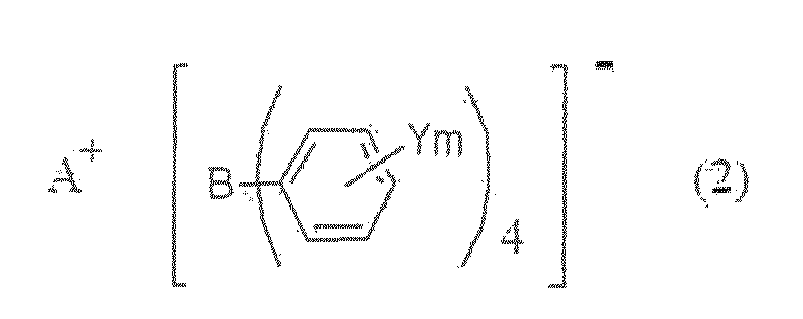 (D) a fluorine compound represented by formula (3):
D+ (MF6)- (3)
wherein D+ represents a lithium ion, a sodium ion, a potassium ion, a silver(I) ion or a trityl cation and M represents a phosphorus atom, an arsenic atom or an antimony atom. - The asymmetric catalyst according to Claim 6, obtained by mixing the (A), the (B) and the following (C):(C) a boron compound represented by formula (2):

- A process for producing an optically active cyclopropane compound represented by formula (6):

the process comprising a step of reacting a prochiral olefin represented by formula (4):
with a diazoacetate ester represented by formula (5):
N2CHCO2R8 (5)
wherein R8 represents an alkyl group having 1 to 6 carbon atoms, in the presence of the asymmetric catalyst according to any one of Claims 6 to 8. - The process according to Claim 9, wherein R4 is a hydrogen atom or a fluorine atom, R5 is a methyl group, R6 is an acyloxymethyl group, an alkoxycarbonyloxymethyl group or an aralkyloxymethyl group and R7 is a methyl group.
- The process according to Claim 10, wherein R6 is an acetoxymethyl group or a benzyloxymethyl group.
- A process for producing an optically active bisoxazoline compound represented by formula (1):

comprising the following first step, second step, third step and fourth step:<First step>
a step of reacting an optically active serine ester represented by formula (7):
or a salt thereof with a cycloalkanedicarboxylic acid derivative represented by formula (8):
 <Second step>
a step of reacting the optically active diamide compound represented by formula a (9) with a (methoxycarbonylsulfamoyl)triethylammonium hydroxide intramolecular salt to give an optically active bisoxazoline ester compound represented by formula (11): <Third step>
a step of reacting the optically active bisoxazoline ester compound represented by formula (11) with a Grignard reagent represented by formula (12):
CH3MgQ (12)
wherein Q represents a halogen atom,
to give an optically active bisoxazoline alcohol compound represented by formula (13): <Fourth step>
a step of reacting the optimally active bisoxazoline alcohol compound represented by formula (13) with a silicon compound represented by formula (14):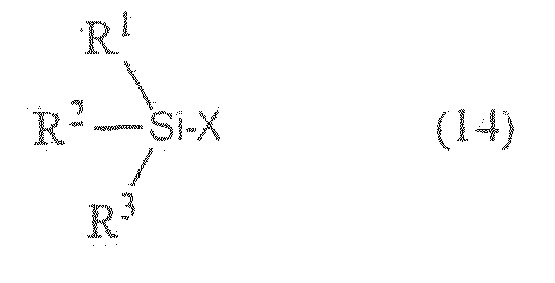
to give the optically active bisoxazoline compound represented by formula (1). - An optically active diamide compound represented by formula (9):

- An optically active bisoxazoline ester compound represented by formula (11):

- An optically active bisoxazoline alcohol compound represented by formula (13):

Applications Claiming Priority (2)
| Application Number | Priority Date | Filing Date | Title |
|---|---|---|---|
| JP2011248357A JP5803590B2 (en) | 2011-11-14 | 2011-11-14 | Optically active bisoxazoline compound, asymmetric catalyst and method for producing optically active cyclopropane compound using the same |
| PCT/JP2012/079592 WO2013073596A1 (en) | 2011-11-14 | 2012-11-08 | Optically active bisoxazoline compound, asymmetric catalyst, and method for producing optically active cyclopropane compound using said catalyst |
Publications (2)
| Publication Number | Publication Date |
|---|---|
| EP2781522A1 true EP2781522A1 (en) | 2014-09-24 |
| EP2781522A4 EP2781522A4 (en) | 2015-07-15 |
Family
ID=48429650
Family Applications (1)
| Application Number | Title | Priority Date | Filing Date |
|---|---|---|---|
| EP12849626.2A Withdrawn EP2781522A4 (en) | 2011-11-14 | 2012-11-08 | OPTICALLY ACTIVE BISOXAZOLINE COMPOUND, ASYMMETRICAL CATALYST AND PROCESS FOR PREPARING AN OPTICALLY ACTIVE CYCLOPROPANE COMPOUND USING THE SAID CATALYST |
Country Status (6)
| Country | Link |
|---|---|
| EP (1) | EP2781522A4 (en) |
| JP (1) | JP5803590B2 (en) |
| CN (1) | CN103958533B (en) |
| IL (1) | IL232312A0 (en) |
| IN (1) | IN2014CN04279A (en) |
| WO (1) | WO2013073596A1 (en) |
Families Citing this family (3)
| Publication number | Priority date | Publication date | Assignee | Title |
|---|---|---|---|---|
| CN103787855B (en) * | 2014-01-17 | 2015-08-19 | 中国农业大学 | The novel method of asymmetry catalysis synthesis (S)-aryl turmerone |
| US10207976B2 (en) * | 2015-09-30 | 2019-02-19 | Taisho Pharmaceutical Co., Ltd | Method for producing optically active 2-(2-fluorobiphenyl-4-yl) propanoic acid |
| CN111646948B (en) * | 2020-07-03 | 2021-08-27 | 河南师范大学 | Method for synthesizing chiral pyrimidine substituted diester cyclopropane by asymmetric cyclopropanation |
Family Cites Families (8)
| Publication number | Priority date | Publication date | Assignee | Title |
|---|---|---|---|---|
| JPH09295984A (en) | 1996-05-01 | 1997-11-18 | Tosoh Akzo Corp | Production of tetrakis(pentafluorophenyl) borate derivative using pentafluorophenylmagnesiium derivative |
| CN1852887B (en) | 2003-09-19 | 2012-08-15 | 住友化学株式会社 | Process for producing optically active cyclopropane compound and asymmetric copper complex for use in the same |
| JP4631369B2 (en) * | 2003-09-19 | 2011-02-16 | 住友化学株式会社 | Process for producing optically active cyclopropane compound and asymmetric copper complex used therefor |
| JP4779343B2 (en) * | 2003-12-22 | 2011-09-28 | 住友化学株式会社 | Process for producing optically active cycloalkylidenebisoxazoline compound and intermediate thereof |
| KR101127255B1 (en) * | 2003-12-22 | 2012-04-12 | 스미또모 가가꾸 가부시키가이샤 | Method for producing optically active cycloalkylidene bisoxazoline compound and intermediate thereof |
| JP5002916B2 (en) * | 2004-07-01 | 2012-08-15 | 住友化学株式会社 | Asymmetric copper complex and process for producing optically active cyclopropanecarboxylic acid ester compound using the same |
| JP5002915B2 (en) * | 2004-07-01 | 2012-08-15 | 住友化学株式会社 | Process for producing optically active cyclopropanecarboxylic acid ester compound and asymmetric copper complex used therefor |
| EP1783111B1 (en) | 2004-07-01 | 2015-04-08 | Sumitomo Chemical Company, Limited | Method for producing optically active cyclopropanecarboxylate compound |
-
2011
- 2011-11-14 JP JP2011248357A patent/JP5803590B2/en active Active
-
2012
- 2012-11-08 IN IN4279CHN2014 patent/IN2014CN04279A/en unknown
- 2012-11-08 WO PCT/JP2012/079592 patent/WO2013073596A1/en not_active Ceased
- 2012-11-08 CN CN201280054818.0A patent/CN103958533B/en active Active
- 2012-11-08 EP EP12849626.2A patent/EP2781522A4/en not_active Withdrawn
-
2014
- 2014-04-28 IL IL232312A patent/IL232312A0/en unknown
Also Published As
| Publication number | Publication date |
|---|---|
| WO2013073596A1 (en) | 2013-05-23 |
| JP2013103904A (en) | 2013-05-30 |
| CN103958533B (en) | 2016-02-10 |
| IL232312A0 (en) | 2014-06-30 |
| JP5803590B2 (en) | 2015-11-04 |
| EP2781522A4 (en) | 2015-07-15 |
| IN2014CN04279A (en) | 2015-07-31 |
| CN103958533A (en) | 2014-07-30 |
Similar Documents
| Publication | Publication Date | Title |
|---|---|---|
| Li et al. | Selective reduction of esters to aldehydes under the catalysis of well-defined NHC-iron complexes. | |
| CN102731539A (en) | Preparation and synthesizing method of chiral compound | |
| Yada et al. | Nickel/Lewis acid-catalyzed carbocyanation of alkynes using acetonitrile and substituted acetonitriles | |
| EP2781522A1 (en) | Optically active bisoxazoline compound, asymmetric catalyst, and method for producing optically active cyclopropane compound using said catalyst | |
| Kull et al. | Practical Enantioselective Synthesis of β‐Lactones Catalyzed by Aluminum Bissulfonamide Complexes | |
| EP0895992B1 (en) | Copper complexes of optically active bisoxazolines as enantioselective catalysts in cyclopropanation reactions | |
| US10363551B2 (en) | Mononuclear iron complex and organic synthesis reaction using same | |
| EP2341042B1 (en) | Method for producing optically active cyclopropane carboxylic acid ester compound, asymmetric copper complex, and optically active salicylideneaminoalcohol compound | |
| US7671210B2 (en) | Process for production of optically active cyclopropanecarboxylate compound | |
| JP4635343B2 (en) | Optically active copper complex, optically active salicylideneaminoalcohol compound and method for producing optically active cyclopropanecarboxylic acid derivative using the same | |
| CN105665025B (en) | A kind of PNN parts cobalt complex catalyst and its preparation method and application | |
| US7253301B2 (en) | Optically active copper catalyst composition | |
| KR101176236B1 (en) | Method for producing optically active cyclopropanecarboxylate compound | |
| CN1852887B (en) | Process for producing optically active cyclopropane compound and asymmetric copper complex for use in the same | |
| WO2006051595A1 (en) | Process for producing large cyclic ketone and intermediate therefor | |
| JP5002915B2 (en) | Process for producing optically active cyclopropanecarboxylic acid ester compound and asymmetric copper complex used therefor | |
| KR101127255B1 (en) | Method for producing optically active cycloalkylidene bisoxazoline compound and intermediate thereof | |
| Kleijn et al. | Efficient recycling of fluorous versions of highly enantioselective S, N-chelated zinc aminoarene thiolate catalysts for the 1, 2-addition of diethylzinc to benzaldehydes | |
| Hiltunen | N-heterocyclic Carbene Copper-Catalyzed Carboxylation of Alkynes with Carbon Dioxide | |
| Semba | Highly Efficient Catalytic Transformations of Unsaturated | |
| JPWO2011062280A1 (en) | Method for producing optically active alcohol | |
| Mohamed et al. | α-(Disilylallenyl) α-amino acid derivatives from the Claisen rearrangement of propargyl glycinates | |
| Ollevier et al. | Recent Progress in the catalytic carbene insertion reactions into the silicon-hydrogen bond | |
| KR20060136404A (en) | Method for producing optically active cycloalkylidene bisoxazoline compound and intermediate thereof | |
| JP2005112851A (en) | Process for producing optically active cyclopropane compound and asymmetric copper complex used therefor |
Legal Events
| Date | Code | Title | Description |
|---|---|---|---|
| PUAI | Public reference made under article 153(3) epc to a published international application that has entered the european phase |
Free format text: ORIGINAL CODE: 0009012 |
|
| 17P | Request for examination filed |
Effective date: 20140522 |
|
| AK | Designated contracting states |
Kind code of ref document: A1 Designated state(s): AL AT BE BG CH CY CZ DE DK EE ES FI FR GB GR HR HU IE IS IT LI LT LU LV MC MK MT NL NO PL PT RO RS SE SI SK SM TR |
|
| DAX | Request for extension of the european patent (deleted) | ||
| RIC1 | Information provided on ipc code assigned before grant |
Ipc: C07F 7/18 20060101AFI20150602BHEP Ipc: C07C 69/757 20060101ALI20150602BHEP Ipc: C07B 61/00 20060101ALI20150602BHEP Ipc: C07C 67/333 20060101ALI20150602BHEP Ipc: C07D 263/16 20060101ALI20150602BHEP Ipc: B01J 31/22 20060101ALI20150602BHEP Ipc: C07C 237/24 20060101ALI20150602BHEP Ipc: C07B 53/00 20060101ALI20150602BHEP Ipc: C07D 263/14 20060101ALI20150602BHEP |
|
| RA4 | Supplementary search report drawn up and despatched (corrected) |
Effective date: 20150617 |
|
| RIC1 | Information provided on ipc code assigned before grant |
Ipc: C07D 263/16 20060101ALI20150610BHEP Ipc: B01J 31/22 20060101ALI20150610BHEP Ipc: C07B 61/00 20060101ALI20150610BHEP Ipc: C07F 7/18 20060101AFI20150610BHEP Ipc: C07B 53/00 20060101ALI20150610BHEP Ipc: C07D 263/14 20060101ALI20150610BHEP Ipc: C07C 67/333 20060101ALI20150610BHEP Ipc: C07C 69/757 20060101ALI20150610BHEP Ipc: C07C 237/24 20060101ALI20150610BHEP |
|
| STAA | Information on the status of an ep patent application or granted ep patent |
Free format text: STATUS: THE APPLICATION IS DEEMED TO BE WITHDRAWN |
|
| 18D | Application deemed to be withdrawn |
Effective date: 20160114 |