EP2779525A1 - Cryptographic devices and methods for encoding-free encryption on elliptic curves - Google Patents
Cryptographic devices and methods for encoding-free encryption on elliptic curves Download PDFInfo
- Publication number
- EP2779525A1 EP2779525A1 EP13305298.5A EP13305298A EP2779525A1 EP 2779525 A1 EP2779525 A1 EP 2779525A1 EP 13305298 A EP13305298 A EP 13305298A EP 2779525 A1 EP2779525 A1 EP 2779525A1
- Authority
- EP
- European Patent Office
- Prior art keywords
- point
- message
- ciphertext
- value
- mod
- Prior art date
- Legal status (The legal status is an assumption and is not a legal conclusion. Google has not performed a legal analysis and makes no representation as to the accuracy of the status listed.)
- Withdrawn
Links
- 238000000034 method Methods 0.000 title claims description 16
- 238000013507 mapping Methods 0.000 claims description 25
- 230000006870 function Effects 0.000 description 9
- 238000007792 addition Methods 0.000 description 4
- 239000000654 additive Substances 0.000 description 2
- 230000000996 additive effect Effects 0.000 description 2
- 238000004422 calculation algorithm Methods 0.000 description 2
- 230000009977 dual effect Effects 0.000 description 2
- 230000000670 limiting effect Effects 0.000 description 2
- 230000002547 anomalous effect Effects 0.000 description 1
- 238000004364 calculation method Methods 0.000 description 1
- 238000004891 communication Methods 0.000 description 1
- 238000004590 computer program Methods 0.000 description 1
- 230000008094 contradictory effect Effects 0.000 description 1
- 125000004122 cyclic group Chemical group 0.000 description 1
- 238000012986 modification Methods 0.000 description 1
- 230000004048 modification Effects 0.000 description 1
- 230000007935 neutral effect Effects 0.000 description 1
- 238000011160 research Methods 0.000 description 1
- 230000005477 standard model Effects 0.000 description 1
Images

Classifications
-
- H—ELECTRICITY
- H04—ELECTRIC COMMUNICATION TECHNIQUE
- H04L—TRANSMISSION OF DIGITAL INFORMATION, e.g. TELEGRAPHIC COMMUNICATION
- H04L9/00—Cryptographic mechanisms or cryptographic arrangements for secret or secure communications; Network security protocols
- H04L9/30—Public key, i.e. encryption algorithm being computationally infeasible to invert or user's encryption keys not requiring secrecy
-
- H—ELECTRICITY
- H04—ELECTRIC COMMUNICATION TECHNIQUE
- H04L—TRANSMISSION OF DIGITAL INFORMATION, e.g. TELEGRAPHIC COMMUNICATION
- H04L9/00—Cryptographic mechanisms or cryptographic arrangements for secret or secure communications; Network security protocols
- H04L9/30—Public key, i.e. encryption algorithm being computationally infeasible to invert or user's encryption keys not requiring secrecy
- H04L9/3006—Public key, i.e. encryption algorithm being computationally infeasible to invert or user's encryption keys not requiring secrecy underlying computational problems or public-key parameters
- H04L9/3013—Public key, i.e. encryption algorithm being computationally infeasible to invert or user's encryption keys not requiring secrecy underlying computational problems or public-key parameters involving the discrete logarithm problem, e.g. ElGamal or Diffie-Hellman systems
-
- H—ELECTRICITY
- H04—ELECTRIC COMMUNICATION TECHNIQUE
- H04L—TRANSMISSION OF DIGITAL INFORMATION, e.g. TELEGRAPHIC COMMUNICATION
- H04L9/00—Cryptographic mechanisms or cryptographic arrangements for secret or secure communications; Network security protocols
- H04L9/30—Public key, i.e. encryption algorithm being computationally infeasible to invert or user's encryption keys not requiring secrecy
- H04L9/3066—Public key, i.e. encryption algorithm being computationally infeasible to invert or user's encryption keys not requiring secrecy involving algebraic varieties, e.g. elliptic or hyper-elliptic curves
Definitions
- the present invention relates generally to cryptography, and in particular to point-encoding-free encryption.
- EIGamal encryption may be applied to elliptic curves over a finite field.
- y 2 x 3 + ax + b with a , b ⁇ K ⁇ and 4 a 3 + 27 b 2 ⁇ 0.
- the message space is F p and the encryption of a message m ⁇ F p is given by:
- Virat's cryptosystem has a number of disadvantages.
- First it requires the generation of a random point ( x 0 , y 0 ) ⁇ E F p , which either requires computation of Legendre symbols or a point multiplication in E F p .
- Second its ciphertext expansion ratio is at least 5 ⁇ 1 (while EIGamal's ciphertext expansion ratio over E F p is 4 ⁇ 1), which is particularly damaging for elliptic curve cryptosystems as they are primarily designed to reduce the bandwidth.
- the security of the scheme is rather weak: it is only shown to be one-way and in particular it lacks indistinguishable encryptions.
- the invention is directed to a device for encryption of a message m ⁇ Z / p ⁇ Z to obtain a ciphertext.
- q is prime.
- r 1 r 2 .
- the invention is directed to a device for decryption of a ciphertext ( C 1 , c 2 ) comprising a first point C 1 and a first value c 2 to obtain a message m ⁇ Z / p ⁇ Z .
- q is prime.
- the invention is directed to a method of encryption of a message m ⁇ Z / p ⁇ Z to obtain a ciphertext.
- q is prime.
- r 1 r 2 .
- the invention is directed to a method of decryption of a ciphertext ( C 1 , c 2 ) comprising a first point C 1 and a first value c 2 to obtain a message m ⁇ Z / p ⁇ Z .
- a main idea of the present invention is to consider elliptic curves defined over the ring Z / p 2 ⁇ Z rather than elliptic curves defined over the ring F p ⁇ .
- This allows the definition of a class function whereupon EIGamal-type cryptosystems are derived using the terminology of Benoit Chevallier-Mames, Pascal Paillier, and David Pointcheval. Encoding-free EIGamal encryption without random oracles.
- EIGamal-type cryptosystems are derived using the terminology of Benoit Chevallier-Mames, Pascal Paillier, and David Pointcheval.
- E 1 Z / p 2 ⁇ Z is a group isomorphic to the additive group Z / p ⁇ Z + : ⁇ : E 1 Z / p 2 ⁇ Z ⁇ ⁇ ⁇ ⁇ Z / p ⁇ Z + , ⁇ ⁇ p : 1 : 0 ⁇ ⁇ .
- E 1 Z / p 2 ⁇ Z is a cyclic group of order p .
- U ( p : 1 : 0)
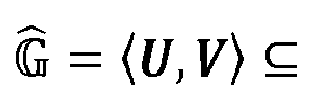
- E 1 Z / p 2 ⁇ Z ⁇ U ⁇ .
- E is not an anomalous curve (i.e. # ⁇ E F p ⁇ p ).
- the crucial observation is that ⁇ G ⁇ G ⁇ .
- the class of any element Q ⁇ G is defined as [[ ⁇ ( Q )]].
- E an elliptic curve defined over F p and let P ⁇ E F p be a point of large, i.e. exponential in the security parameter, finite order q .
- the message space is Z / p ⁇ Z .
- the encryption of a message m ⁇ Z / p ⁇ Z is given by the following method:
- the cryptosystem of the first preferred embodiment is additive.
- Z / p ⁇ Z is equipped with both addition and multiplication, it is possible to define a multiplicative cryptosystem by replacing Step 4 (i.e. S4) accordingly.
- Step 4 i.e. S4
- the encryption of a message m ⁇ Z / p ⁇ Z is given by the following method:
- Figure 2 illustrates an encryption device 100 and a decryption device 200 according to an embodiment of the invention.
- the devices 100, 200 each comprise at least one interface unit 110, 210 configured for communication, at least one processor (“processor") 120, 220 and at least one memory 130, 230 configured for storing data, such as accumulators and intermediary calculation results.
- Figure 2 also shows a first and a second computer program product (non-transitory storage medium) 140, 240 such as a CD-ROM or a DVD comprises stored instructions that, when executed by the processor 120, 220, respectively encrypt a message and decrypt a ciphertext according to the present invention.
- the cryptoschemes of the present invention can enjoy the advantages of Virat's cryptosystem (i.e., no message encoding as points on elliptic curves) but without its disadvantages. Further, it can even improve the ciphertext expansion ratio compared to EIGamal's cryptosystem to only 3 ⁇ 1 which can be further reduced to 2 ⁇ 1 using a compressed representation for C 1 .
- they meet the standard IND-CPA (Indistinguishability under chosen-plaintext attack) security level in the standard model while Virat's cryptosystem only meets the OW-CPA (One-wayness under chosen-plaintext attack) security level.
- the proposed cryptosystems are to some extent malleable.
- encryption is very fast. In an on-line/off-line mode, the encryption of a message m only requires an addition modulo p .
Landscapes
- Engineering & Computer Science (AREA)
- Theoretical Computer Science (AREA)
- Computing Systems (AREA)
- Computer Security & Cryptography (AREA)
- Computer Networks & Wireless Communication (AREA)
- Signal Processing (AREA)
- Physics & Mathematics (AREA)
- Algebra (AREA)
- General Physics & Mathematics (AREA)
- Mathematical Analysis (AREA)
- Mathematical Optimization (AREA)
- Mathematical Physics (AREA)
- Pure & Applied Mathematics (AREA)
- Storage Device Security (AREA)
Abstract
Encoding-free encryption on elliptic curves is obtained by a device (100) having a processor (120) choosing (S1) an integer r Z / q ¢ Z ; computing (S2) in E F p the a first point C 1 = [ r ] P and a second point C 2 = [ r ] Y , wherein E is an elliptic curve defined over F p , P E F p is a point of prime order q, Y = s ¢ P E F p is an encryption key for an integer s Z / q ¢ Z ; computing (S3) the class ² of ¨( C 2 ); computing (S4) a first value c 2 by performing an elementary arithmetic operation modulo p between the message m Z / p ¢ Z and the class ²; combining the first point C 1 and the first value c 2 to obtain the ciphertext ( C 1 , c 2 ); and outputting (S5) the ciphertext ( C 1 , c 2 ). Decryption of a ciphertext ( C 1 , c 2 ) comprising a first point C 1 and a first value c 2 to obtain a message m Z / p ¢ Z , is performed by multiplying a decryption key s and the first point C 1 to obtain a second point P = ( x, y ) E F p ; calculating ¨ P E Z / p 2 ¢ Z to obtain a third point; performing (S6) an elementary arithmetic operation modulo p between the first value c 2 and the class of the third point to obtain the message m; and outputting the message m .
Description
- The present invention relates generally to cryptography, and in particular to point-encoding-free encryption.
- This section is intended to introduce the reader to various aspects of art, which may be related to various aspects of the present invention that are described and/or claimed below. This discussion is believed to be helpful in providing the reader with background information to facilitate a better understanding of the various aspects of the present invention. Accordingly, it should be understood that these statements are to be read in this light, and not as admissions of prior art.
- The classical EIGamal encryption scheme is described in Taher EIGamal. A public key cryptosystem and a signature scheme based on discrete logarithms. IEEE Transactions on Information Theory, 31(4):469-472, 1985. It works in any finite groupin which computation of discrete logarithms is assumed to be intractable. In order to avoid sub-group attacks using the Pohlig-Hellman algorithm [see Stephen C. Pohlig and Martin E. Hellman. An improved algorithm for computing logarithms over GF(p) and its cryptographic significance. IEEE Transactions on Information Theory, 24(1):106-110, 1978.], the underlying group is usually restricted to a prime-order group


- The public ('encryption') key is given by

 The encryption of a message



- EIGamal encryption may be applied to elliptic curves over a finite field. Letbe a finite field of characteristic p ≠ 2,3. The ring of dual numbers
 is
is


 (cf. Definition 3.3 of Marie Virat. A cryptosystem "à la" EIGamal on an elliptic curve over


- However, when applying EIGamal encryption to such an elliptic curve, it is required to express the plaintext message m as a point on the elliptic curve [see section 6.4 of Lawrence C. Washington. Elliptic Curves, Number Theory and Cryptography. Discrete Mathematics and its Applications. Chapman & Hall/CRC, 2nd edition, 2008.]. To get around this requirement, Virat proposed in the mentioned paper a new elliptic curve cryptosystem. The idea consists in working with an elliptic curve over the ring


- Let E be an elliptic curve over


- 1. Choose a random integer

- 2. Choose a random finite point

- 3. Define M̂ = (x 0 + mε ,y 0 + y 1ε) where y 1 is the unique solution in


- 4. Compute the points C 1 = [rp] P̂ and Ĉ 2 = [r] Y + M̂ ; and
- 5. Output the ciphertext ( C 1 , Ĉ 2 ).
- The decryption of ( C 1 , Ĉ 2 ) is obtained as M̂ = Ĉ 2 - [s] C 1 using secret key s which in turn yields the value of m.
- The description appears to indicate that the cryptosystem has a ciphertext expansion ratio of 8 ÷ 1, which is not completely true. As shown in the next proposition, when the curve parameters


-
Proposition 1. Using the previous notations, let


with
- Note that in
Proposition 1, if y 0 = 0 then it is not possible that 3y 0 2 + a = 0 as otherwise the point (x 0,y 0) would be singular, contradicting that
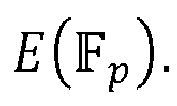
- It will be appreciated that Virat's cryptosystem has a number of disadvantages. First it requires the generation of a random point (x 0,y 0) ∈


- It will thus be appreciated that it is desired to have a cryptosystem that overcomes at least some of the disadvantages of Virat's cryptosystem. The present invention provides such a cryptosystem.
- In a first aspect, the invention is directed to a device for encryption of a message


- In a first embodiment, the mapping function Ψ maps points of


- In a second embodiment, q is prime.
- In a third embodiment, r 1 = r 2.
- In a second aspect, the invention is directed to a device for decryption of a ciphertext ( C 1, c 2) comprising a first point C 1 and a first value c 2 to obtain a message


- In a first embodiment, the mapping function Ψ maps points of


- In a second embodiment, q is prime.
- In a third aspect, the invention is directed to a method of encryption of a message


- computes the class β of Ψ( C 2 ), where Ψ is a mapping function; computes a first value c 2 by performing an elementary arithmetic operation modulo p between the message m and the class β; combines the first point C 1 and the first value c 2 to obtain the ciphertext ( C 1 , c 2); and outputs the ciphertext (C 1 , c 2).
- In a first embodiment, the mapping function ψ maps points of


- In a second embodiment, q is prime.
- In a third embodiment, r 1 = r 2.
- In a fourth aspect, the invention is directed to a method of decryption of a ciphertext ( C 1 , c 2) comprising a first point C 1 and a first value c 2 to obtain a message


- In a first embodiment, the mapping function Ψ maps points


- Preferred features of the present invention will now be described, by way of non-limiting example, with reference to the accompanying drawings, in which:
-
Figure 1 illustrates a method for encoding-free encryption on elliptic curves and subsequent decryption; and -
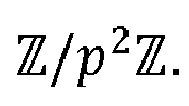
Figure 2 illustrates a system for encoding-free encryption on elliptic curves according to a preferred embodiment of the invention. - A main idea of the present invention is to consider elliptic curves defined over the ring


- Since




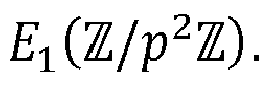
- Proposition 2. Using these notations,

- The theory of formal groups (see e.g. Proposition IV.3.2 in Joseph H. Silverman. The Theory of Elliptic Curves. Volume 106 of Graduate Texts in Mathematics, Springer-Verlag, 1986.) teaches that


- Hence, the sum of two elements (α1 p: 1 : 0) and (α2p : 1 : 0) in


- Given a finite point


- This gives rise to the map:

- It is assumed that E is not an anomalous curve (i.e.


- Subgroup



- Integer β is called the class of Q and written β = [[ Q ]]. The crucial observation is that


- For the cryptosystem having a defined security parameter of the present invention, let E be an elliptic curve defined over


- In a first preferred embodiment, the encryption of a message

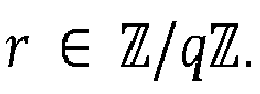
- 1. Choose, S1, a random integer

- 2. Compute S2 in

- 3. Compute S3 β = [[Ψ( C 2 )]]
- 4. Define S4 c 2 = m + β (mod p);
- 5. Output S5 the ciphertext ( C 1 , c 2).
- The decryption of ( C 1 , c 2) is obtained S6 as m = c 2 - [[Ψ([s] C 1 )]] (mod p) using the secret key s.
- The cryptosystem of the first preferred embodiment is additive. As


- 1. Choose a random integer

- 2. Compute in

- 3. Compute β = [[Ψ( C 2 )]]
- 4. Define c 2 = m · β (mod p);
- 5. Output the ciphertext ( C 1 , c 2).
- The decryption of ( C 1 , c 2) is obtained as m = c 2/[[Ψ([s] C 1 )]] (mod p) using the secret key s.
- It will be appreciated that various modifications are possible, such as using multiples of one or more variables that are compensated for further in the method. It is for example also possible to compute, in step 2, the two points C 1 = [r 1] P and C 2 = [r 2] Y , where r 1 and r 2 are derived in a predetermined manner from r (e.g. using additions or the aforementioned multiples and possibly rounding to integers, if necessary performed modulus a given value) so that there is a relation between them.
-
Figure 2 illustrates anencryption device 100 and adecryption device 200 according to an embodiment of the invention. Thedevices interface unit memory Figure 2 also shows a first and a second computer program product (non-transitory storage medium) 140, 240 such as a CD-ROM or a DVD comprises stored instructions that, when executed by theprocessor - It will thus be appreciated that the cryptoschemes of the present invention can enjoy the advantages of Virat's cryptosystem (i.e., no message encoding as points on elliptic curves) but without its disadvantages. Further, it can even improve the ciphertext expansion ratio compared to EIGamal's cryptosystem to only 3 ÷ 1 which can be further reduced to 2 ÷ 1 using a compressed representation for C 1. Second, they meet the standard IND-CPA (Indistinguishability under chosen-plaintext attack) security level in the standard model while Virat's cryptosystem only meets the OW-CPA (One-wayness under chosen-plaintext attack) security level. Third, the proposed cryptosystems are to some extent malleable. Fourth, encryption is very fast. In an on-line/off-line mode, the encryption of a message m only requires an addition modulo p.
- Each feature disclosed in the description and (where appropriate) the claims and drawings may be provided independently or in any appropriate combination. Features described as being implemented in hardware may also be implemented in software, and vice versa. Reference numerals appearing in the claims are by way of illustration only and shall have no limiting effect on the scope of the claims.
Claims (15)
- A device (100) for encryption of a message
 - choose an integer
 - compute in


 - compute the class β of Ψ( C 2 ), where Ψ is a mapping function;- compute a first value c 2 by performing an elementary arithmetic operation modulo p between the message m and the class β;- combine the first point C 1 and the first value c 2 to obtain the ciphertext ( C 1 , c 2); and- output the ciphertext ( C 1, c 2).
 - The device of claim 1, wherein the mapping function Ψ maps points of


- The device of claim 2, wherein Ψ( C 2 ) is obtained by:- calculating
 - calculating
 - mapping (x,y) ↦ (x,y + ψ( C 2 )p).
 - The device of claim 1, wherein q is prime.
- The device of claim 1, wherein r 1 = r 2.
- A device (200) for decryption of a ciphertext (C 1, c 2) comprising a first point C 1 and a first value c 2 to obtain a message
 - multiply a decryption key s and the first point C 1 to obtain a second point
 - map P onto a third point in
 - perform an elementary arithmetic operation modulo p between the first value c 2 and the class of the third point to obtain the message m; and- output the message m.
 - The device of claim 6, wherein the mapping function Ψ maps points of

 - calculating
 - calculating
 - mapping (x,y) ↦ (x,y + ψ( P )p).
 - The device of claim 6, wherein q is prime.
- A method of encryption of a message
 - choosing (S1) an integer
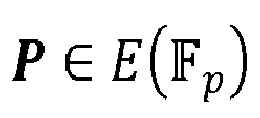
 - computing (S2) in


 - computing (S3) the class β of Ψ( C 2 ), where Ψ is a mapping function;- computing (S4) a first value c 2 by performing an elementary arithmetic operation modulo p between the message m and the class β;- combining the first point C 1 and the first value c 2 to obtain the ciphertext ( C 1 , c 2); and- outputting (S5) the ciphertext ( C 1, c 2).
 - The method of claim 9, wherein the mapping function Ψ maps points of
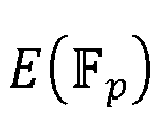

- The method of claim 10, wherein Ψ( C 2 ) is obtained by:- calculating
 - calculating
 - mapping (x,y) ↦ (x,y + ψ( C 2 ) p ).
 - The method of claim 9, wherein q is prime.
- The method of claim 9, wherein r 1 = r 2.
- A method of decryption of a ciphertext ( C 1 , c 2) comprising a first point C 1 and a first value c 2 to obtain a message
 - multiplying a decryption key s and the first point C 1 to obtain a second point
 - mapping P onto a third point in
 - performing (S6) an elementary arithmetic operation modulo p between the first value c 2 and the class of third point to obtain the message m; and- outputting the message m.
 - The method of claim 14, wherein the mapping function Ψ maps points of
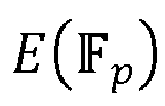
 - calculating
 - calculating
 - mapping (x,y) ↦ (x,y + ψ( P )p).
Priority Applications (3)
| Application Number | Priority Date | Filing Date | Title |
|---|---|---|---|
| EP13305298.5A EP2779525A1 (en) | 2013-03-15 | 2013-03-15 | Cryptographic devices and methods for encoding-free encryption on elliptic curves |
| EP14159400.2A EP2793426B1 (en) | 2013-03-15 | 2014-03-13 | Cryptographic devices and methods for encoding-free encryption on elliptic curves |
| US14/210,356 US20140270156A1 (en) | 2013-03-15 | 2014-03-13 | Cryptographic devices and methods for encoding-free encryption on elliptic curves |
Applications Claiming Priority (1)
| Application Number | Priority Date | Filing Date | Title |
|---|---|---|---|
| EP13305298.5A EP2779525A1 (en) | 2013-03-15 | 2013-03-15 | Cryptographic devices and methods for encoding-free encryption on elliptic curves |
Publications (1)
| Publication Number | Publication Date |
|---|---|
| EP2779525A1 true EP2779525A1 (en) | 2014-09-17 |
Family
ID=48095760
Family Applications (2)
| Application Number | Title | Priority Date | Filing Date |
|---|---|---|---|
| EP13305298.5A Withdrawn EP2779525A1 (en) | 2013-03-15 | 2013-03-15 | Cryptographic devices and methods for encoding-free encryption on elliptic curves |
| EP14159400.2A Not-in-force EP2793426B1 (en) | 2013-03-15 | 2014-03-13 | Cryptographic devices and methods for encoding-free encryption on elliptic curves |
Family Applications After (1)
| Application Number | Title | Priority Date | Filing Date |
|---|---|---|---|
| EP14159400.2A Not-in-force EP2793426B1 (en) | 2013-03-15 | 2014-03-13 | Cryptographic devices and methods for encoding-free encryption on elliptic curves |
Country Status (2)
| Country | Link |
|---|---|
| US (1) | US20140270156A1 (en) |
| EP (2) | EP2779525A1 (en) |
Families Citing this family (3)
| Publication number | Priority date | Publication date | Assignee | Title |
|---|---|---|---|---|
| CN106471766B (en) * | 2014-03-31 | 2019-08-06 | 爱迪德技术有限公司 | Crypto chip and correlation technique |
| CN113347176B (en) * | 2021-05-31 | 2023-04-18 | 湖北微特传感物联研究院有限公司 | Encryption method and device for data communication, computer equipment and readable storage medium |
| CN120165870B (en) * | 2025-05-20 | 2025-08-08 | 北京隐算科技有限公司 | Method, system, equipment and medium for unintentional transmission based on elliptic curve |
Family Cites Families (1)
| Publication number | Priority date | Publication date | Assignee | Title |
|---|---|---|---|---|
| US7587605B1 (en) * | 2004-03-19 | 2009-09-08 | Microsoft Corporation | Cryptographic pairing-based short signature generation and verification |
-
2013
- 2013-03-15 EP EP13305298.5A patent/EP2779525A1/en not_active Withdrawn
-
2014
- 2014-03-13 EP EP14159400.2A patent/EP2793426B1/en not_active Not-in-force
- 2014-03-13 US US14/210,356 patent/US20140270156A1/en not_active Abandoned
Non-Patent Citations (9)
| Title |
|---|
| "Lecture Notes in Computer Science", vol. 3958, 2006, SPRINGER, article "Public Key Cryptography - PKC 2006", pages: 91 - 104 |
| "Western European Workshop on Research in Cryptology", vol. 74, 2005, pages: 32 - 44 |
| BENOÎT CHEVALLIER-MAMES ET AL: "Encoding-Free ElGamal Encryption Without Random Oracles", 24 April 2006, PUBLIC KEY CRYPTOGRAPHY - PKC 2006 LECTURE NOTES IN COMPUTER SCIENCE;;LNCS, SPRINGER, BERLIN, DE, PAGE(S) 91 - 104, ISBN: 978-3-540-33851-2, XP047030202 * |
| LAWRENCE C. WASHINGTON: "Discrete Mathematics and its Applications", 2008, CHAPMAN & HALL/CRC, article "Elliptic Curves, Number Theory and Cryptography" |
| PAILLIER P: "TRAPDOORING DISCRETE LOGARITHMS ON ELLIPTIC CURVES OVER RINGS", ASIACRYPT. INTERNATIONAL CONFERENCE ON THE THEORY AND APPLICATIONOF CRYPTOLOGY AND INFORMATION SECURITY, X, XX, 3 December 2000 (2000-12-03), pages 573 - 584, XP001029955 * |
| SILVERMAN: "Graduate Texts in acideMathematics", vol. 106, 1986, SPRINGER-VERLAG, article "The Theory of Elliptic Curves" |
| STEPHEN C. POHLIG; MARTIN E. HELLMAN: "An improved algorithm for computing logarithms over GF(p) and its cryptographic significance", IEEE TRANSACTIONS ON INFORMATION THEORY, vol. 24, no. 1, 1978, pages 106 - 110 |
| STEVEN GALBRAITH: "Elliptic curve Paillier schemes", JOURNAL OF CRYPTOLOGY, vol. 15, no. 2, 2002, pages 129 - 138 |
| TAHER EIGAMAL: "A public key cryptosystem and a signature scheme based on discrete logarithms", IEEE TRANSACTIONS ON INFORMATION THEORY, vol. 31, no. 4, 1985, pages 469 - 472 |
Also Published As
| Publication number | Publication date |
|---|---|
| US20140270156A1 (en) | 2014-09-18 |
| EP2793426B1 (en) | 2016-01-20 |
| EP2793426A1 (en) | 2014-10-22 |
Similar Documents
| Publication | Publication Date | Title |
|---|---|---|
| US11288985B2 (en) | Encryption device, decryption device, encryption method, decryption method, encryption program product, and decryption program product | |
| US7110538B2 (en) | Method for accelerating cryptographic operations on elliptic curves | |
| US7995752B2 (en) | Method for accelerating cryptographic operations on elliptic curves | |
| US8385541B2 (en) | Method of performing elliptic polynomial cryptography with elliptic polynomial hopping | |
| Obaidand et al. | Image encryption based on elliptic curve cryptosystem | |
| US8666066B2 (en) | Encoding points of an elliptic curve | |
| Nitaj | Diophantine and lattice cryptanalysis of the RSA cryptosystem | |
| EP2045716A2 (en) | Exponentiation calculation apparatus and exponentiation calculation method | |
| Nitaj et al. | A new attack on RSA and Demytko’s elliptic curve cryptosystem | |
| Lim et al. | A generalized Takagi-cryptosystem with a modulus of the form prqs | |
| EP4554139A1 (en) | Improved fully homomorphic encryption | |
| Takagi | Fast RSA-type cryptosystems using n-adic expansion | |
| EP2793426B1 (en) | Cryptographic devices and methods for encoding-free encryption on elliptic curves | |
| Mohamed et al. | Algebraic attack on the MQQ public key cryptosystem | |
| US20210390443A1 (en) | Circuit, apparatus and method for calculating multiplicative inverse | |
| Khadir | New variant of ElGamal signature scheme | |
| Ciet et al. | Short private exponent attacks on fast variants of RSA | |
| US20240195607A1 (en) | Encryption device, key generation device, and computer program product for encryption | |
| US8924448B2 (en) | Arithmetic device, method, and program product | |
| Nitaj et al. | A new attack on RSA with a composed decryption exponent | |
| US20020015491A1 (en) | Public key encryption method and communication system using public key cryptosystem | |
| Sahmoudi et al. | Key exchange over particular algebraic closure ring | |
| Khadir et al. | Sufficient conditions for factoring a class of large integers | |
| Somsuk | A new modified integer factorization algorithm using integer modulo 20's technique | |
| Long et al. | A Bergman ring based cryptosystem analogue of RSA |
Legal Events
| Date | Code | Title | Description |
|---|---|---|---|
| PUAI | Public reference made under article 153(3) epc to a published international application that has entered the european phase |
Free format text: ORIGINAL CODE: 0009012 |
|
| 17P | Request for examination filed |
Effective date: 20130315 |
|
| AK | Designated contracting states |
Kind code of ref document: A1 Designated state(s): AL AT BE BG CH CY CZ DE DK EE ES FI FR GB GR HR HU IE IS IT LI LT LU LV MC MK MT NL NO PL PT RO RS SE SI SK SM TR |
|
| AX | Request for extension of the european patent |
Extension state: BA ME |
|
| STAA | Information on the status of an ep patent application or granted ep patent |
Free format text: STATUS: THE APPLICATION IS DEEMED TO BE WITHDRAWN |
|
| 18D | Application deemed to be withdrawn |
Effective date: 20150318 |