EP2779360A2 - Mother/Daughterboard Power Supply - Google Patents
Mother/Daughterboard Power Supply Download PDFInfo
- Publication number
- EP2779360A2 EP2779360A2 EP14159666.8A EP14159666A EP2779360A2 EP 2779360 A2 EP2779360 A2 EP 2779360A2 EP 14159666 A EP14159666 A EP 14159666A EP 2779360 A2 EP2779360 A2 EP 2779360A2
- Authority
- EP
- European Patent Office
- Prior art keywords
- power supply
- capacitor
- power
- potential
- switch
- Prior art date
- Legal status (The legal status is an assumption and is not a legal conclusion. Google has not performed a legal analysis and makes no representation as to the accuracy of the status listed.)
- Withdrawn
Links
Images




Classifications
-
- H—ELECTRICITY
- H02—GENERATION; CONVERSION OR DISTRIBUTION OF ELECTRIC POWER
- H02J—ELECTRIC POWER NETWORKS; CIRCUIT ARRANGEMENTS OR SYSTEMS FOR SUPPLYING OR DISTRIBUTING ELECTRIC POWER; SYSTEMS FOR STORING ELECTRIC ENERGY
- H02J7/00—Circuit arrangements for charging or discharging batteries or for supplying loads from batteries
- H02J7/34—Parallel operation in networks using both storage and other DC sources, e.g. providing buffering
- H02J7/345—Parallel operation in networks using both storage and other DC sources, e.g. providing buffering using capacitors as storage or buffering devices
-
- H—ELECTRICITY
- H02—GENERATION; CONVERSION OR DISTRIBUTION OF ELECTRIC POWER
- H02M—APPARATUS FOR CONVERSION BETWEEN AC AND AC, BETWEEN AC AND DC, OR BETWEEN DC AND DC, AND FOR USE WITH MAINS OR SIMILAR POWER SUPPLY SYSTEMS; CONVERSION OF DC OR AC INPUT POWER INTO SURGE OUTPUT POWER; CONTROL OR REGULATION THEREOF
- H02M3/00—Conversion of DC power input into DC power output
- H02M3/22—Conversion of DC power input into DC power output with intermediate conversion into AC
- H02M3/24—Conversion of DC power input into DC power output with intermediate conversion into AC by static converters
-
- H—ELECTRICITY
- H02—GENERATION; CONVERSION OR DISTRIBUTION OF ELECTRIC POWER
- H02M—APPARATUS FOR CONVERSION BETWEEN AC AND AC, BETWEEN AC AND DC, OR BETWEEN DC AND DC, AND FOR USE WITH MAINS OR SIMILAR POWER SUPPLY SYSTEMS; CONVERSION OF DC OR AC INPUT POWER INTO SURGE OUTPUT POWER; CONTROL OR REGULATION THEREOF
- H02M3/00—Conversion of DC power input into DC power output
- H02M3/22—Conversion of DC power input into DC power output with intermediate conversion into AC
- H02M3/24—Conversion of DC power input into DC power output with intermediate conversion into AC by static converters
- H02M3/28—Conversion of DC power input into DC power output with intermediate conversion into AC by static converters using discharge tubes with control electrode or semiconductor devices with control electrode to produce the intermediate AC
- H02M3/325—Conversion of DC power input into DC power output with intermediate conversion into AC by static converters using discharge tubes with control electrode or semiconductor devices with control electrode to produce the intermediate AC using devices of a triode or a transistor type requiring continuous application of a control signal
- H02M3/335—Conversion of DC power input into DC power output with intermediate conversion into AC by static converters using discharge tubes with control electrode or semiconductor devices with control electrode to produce the intermediate AC using devices of a triode or a transistor type requiring continuous application of a control signal using semiconductor devices only
-
- H—ELECTRICITY
- H02—GENERATION; CONVERSION OR DISTRIBUTION OF ELECTRIC POWER
- H02M—APPARATUS FOR CONVERSION BETWEEN AC AND AC, BETWEEN AC AND DC, OR BETWEEN DC AND DC, AND FOR USE WITH MAINS OR SIMILAR POWER SUPPLY SYSTEMS; CONVERSION OF DC OR AC INPUT POWER INTO SURGE OUTPUT POWER; CONTROL OR REGULATION THEREOF
- H02M1/00—Details of apparatus for conversion
- H02M1/0096—Means for increasing hold-up time, i.e. the duration of time that a converter's output will remain within regulated limits following a loss of input power
Definitions
- the invention relates to power supplies and more particularly the supplying of power from one printed circuit board (or backplane) to another printed circuit board, such as from a motherboard (MB) to a daughterboard (DB).
- MB motherboard
- DB daughterboard
- a circuit board receives power from a backplane or another circuit board.
- a backplane or another circuit board.
- Common among these arrangements is the mounting of a daughterboard (DB) to a motherboard (MB) where power from the DB is supplied from the MB.
- DB daughterboard
- MB motherboard
- a DC power supply has a maximum efficiency, inherent in its design, at a predetermined percentage of its maximum power output. For instance, a switched DC power supply may have a maximum efficiency at 70% when operating at 80% of its maximum output. When operating at other than 80% of its maximum power output the supply's efficiency may be less than 70%.
- a switched mode power supply having a primary side circuit and a secondary side circuit interconnected by a transformer.
- a capacitor is used to store power and at least one diode couples a primary winding of the transformer to the capacitor such that when a first switch of the switched power supply opens, the capacitor receives the back emf from the primary winding.
- a second switch turns on and off the pumping of the capacitor with the back emf.
- a third switch connects the capacitor to the primary side circuit when a detector detects the loss of AC power.
- circuits that provide improved DC power from a backplane as on a motherboard (MB) to a circuit board engaging the backplane such as a daughterboard (DB).
- MB motherboard
- DB daughterboard
- numerous specific details are set forth such as specific circuit components and associated potentials, in order to provide a thorough understanding of the present invention. It will be apparent to one skilled in the art, that the present invention may be practiced without these specific details. In other instances, well-known electrical circuit designs and implementations are not described in detail to avoid unnecessarily obscuring the disclosed matter.
- the improvements described below are used on a MB with its compatible DBs where the MB collects or concentrates data relating to power, such as meter readings, and provides other control, for example for street lighting.
- the DBs provide communication links such as RF links, power line communication links, links to other networks, etc. This particular application is not critical to the present invention.
- a MB 10 which includes a backplane 14 is illustrated in Figure 1 , including a male connector 14 and the female DB connector 13.
- a male connector 14 In a typical application there are several male connectors 14 each for receiving DBs.
- the detailed view of the connector 14 reveals that it includes a plurality of pins 15, as shown in Figure 2 .
- the female connector 16 on the DB includes spring contacts, one for receiving each of the male prongs on the DB connector. In this way objects touching or dropped onto the MB will not short pins of a male connector.
- the problem with this arrangement is that if one of the springs in one of the female connectors fails, it is a much larger job to change the connector on the MB or backplane as opposed to reworking a single DB because the spring is more likely to break or is more fragile than the connector pin.
- some of the DBs require different voltages for operation than others.
- the male and female connector used on MB/DB requiring different voltages is the same thus there must be some mechanism to alert the MB as to what voltage is required by the DB.
- a signal representing the voltage required by that particular DB is sensed in a feedback path by the MB so that the proper potential is applied for operation of the DB.
- a power failure at the MB may in some circumstances cause problems with the equipment or signal gathering facilities associated with DBs.
- Figure 3A illustrates an electrical schematic of a power supply circuit which provides a "last gasp" of energy if the AC power is lost, for instance to allow for the transmission of an alert signal according to one embodiment.
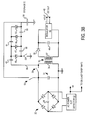
- Figure 3B illustrates an alternative electrical schematic of the power supply circuit of Figure 3A according to one embodiment.
- FIGS 3A and 3B illustrate a switched power supply which receives AC power 30 coupled to a full wave rectifying diodes 32.
- the output of the diodes provide power to the primary winding 36 of the transformer 35.
- a switch 33 opens and closes to chop the DC power from the rectifier in order that power may be passed through the transformer to the secondary winding 37.
- a capacitor 31 is used in association with the switch 33 to smooth the operation on the primary side of the power supply.
- Switched power supplies are very well-known and commonly used in a host of electronic circuits.
- the AC signal from winding 37 is rectified through the diode 38, filtered by the capacitor 40, and then applied to a regulator 42 to provide a DC output 45.
- the regulator 42 may be an ordinary buck regulator commonly used in conjunction with switched power supplies.
- the circuits of Figure 3A-B include a detector 52 to detect when AC power is lost.
- the detector 52 upon detecting the loss of the AC power, provides a signal causing a last gasp transmission to be sent and also, as shown by line 54, closes a switch 53.
- the circuits of Figures 3A-B store the last gasp energy primarily on a capacitor 50.
- the capacitor 50 is connected to the primary winding 36 through a diode 47 and accompanying capacitor 46.
- the capacitor 50 is part of a voltage multiplier circuit that can be used to improve the system's dynamic range and also includes the capacitors 51, 55, 58, and diodes 56 and 57 when compared to Figure 3A .
- the switch 53 is open, the switch 55 is closed, and the switch 33 continually opens and closes.
- a back electromotive force (emf) (sometimes also referred to a counter emf) occurs on line 39 which is coupled to the capacitor 50.
- the potential on line 39 is equal to the inductance associated with the winding 36, times the rate of decay of the current, once switch 33 opens.
- the AC potential 30 is for instance 220 volts (rms)
- the potential on line 39 can exceed 220 volts ⁇ 2 .
- capacitor 46 and diode 47 act as a charge pumping circuit (in Figure 3B , the capacitors 51, 55, and 58, and the diodes 56 and 57 are also part of the charge pumping circuit), allowing the back emf to pump up the capacitor 50.
- capacitor 50 may be a standard 440 volt capacitor.
- the switch 55 may be used to stop the pump charging effect and over time regulate the voltage of the storage capacitor 50.
- the potential from the capacitor 50 is fed into the primary side of the switched power supply.
- the energy from the capacitor 50 provides the last gasp power, permitting a transmission or other activity such as non-volatile storage or the shutting down of a critical function. While there is a penalty associated with increasing the voltage of a capacitor, it typically is less onerous than increasing the capacitance of the capacitor.
- a power supply such as the power supply of Figure 3 operates at its maximum efficiency.
- This efficiency can be fixed as a percent of the power supply's maximum output by design. In some cases once a power supply reaches its maximum efficiency it remains at that efficiency to its maximum output.
- Numerous techniques are known in the design of power supplies, such as buck power supplies, for fixing the maximum efficiency based on a percentage of a power supply's output. As described above, numerous techniques are also known for maintaining the proper load at the output of the power supply so that it operates at its maximum efficiency.
- a typical power output vs. efficiency curve 60 for a power supply is shown.
- the supply's maximum efficiency of 70% is reached at about 75% of its maximum output. Beyond 75% of the maximum output the efficiency of the power supply declines.
- the power supply should have its maximum efficiency at its maximum output. This is shown by curve 65 of Figure 4B .
- the power supply provides a maximum efficiency of 70% at its maximum output of 100%. As mentioned above, this is done using known circuit design techniques.
- the minimum voltage needed for operating the circuit is determined. This is shown in Figure 4A as Vmin. Also, a maximum voltage is selected, for instance one that will not damage the circuit. This is shown as Vmax of Figure 4A .
- Vmin a maximum voltage
- Vmax a maximum voltage
- the supply is turned on and off so as to maintain its output between Vmax and Vmin. Thus the power supply is either fully on or fully off, and if its design meets the criteria of curve 65 of Figure 4B , the power supply will always operate at its maximum efficiency no matter what the load.
- the cycling of the on and off states of the power supply occurs at a rate of, for instance 10 Hz.
- a capacitor such as the capacitor 100 shown at the output of the regulator 80 of Figure 6 is selected to control the on/ off rate of the power supply so that the rate, such as shown in Figure 4A , is relatively low.
- the power supply may be turned on and off, for the power supply of Figure 3 , simply by having switch 33 remain open. Note that in typical operation the "chopping" of the DC power which is in effect what switch 33 does, occurs at a much higher frequency than the on/off cycling shown in Figure 4A .
- a circuit for providing the on/off operation is shown in Figure 5 .
- Two operational amplifiers (OPs) 70 and 71 are used.
- OP 70 has its positive terminal connected to a reference potential equal to Vmin, whereas the OP 71 has its negative terminal connected to a reference potential equal to Vmax.
- the output of the power supply Vout is connected to the positive input of the OP 71 and the negative input of the OP 70.
- the output of the OP 70 is connected to the s (set) terminal of a bistable (flip-flop) circuit 72.
- the output of the OP 71 is connected to the r (reset) terminal of the flip-flop.
- the Q output from the flip-flop 72 provides the on/off signal, which as mentioned above can disable the switch 33 of Figure 3 in its open position.
- the MB of Figure 1 receives different DBs 13, each of which requires a different power supply potential for operation. This potential is developed on the MB.
- the circuit of Figure 6 informs the MB of what the proper potential is for that particular DB.
- the line 81 illustrates the interface (connector) between the MB and DB.
- a regulator 80 (which may be the regulator 42 of Figure 3 ) receives a DC input and provides an output power supply potential on line 90 of the DB.
- the regulator 80 provides a potential proportional to or equal to the potential on line 90 to the series coupled resistors 87 and 88 located on the DB. Feedback is provided back to the MB on line 84 through the interface 81. This feedback is obtained at the junction between the resistors 87 and 88.
- the feedback on line 84 is coupled to the positive terminal of an operational amplifier 82, the negative terminal of which receives a reference potential.
- the feedback on line 84 is determined by the ratio of the resistances of resistors 87 and 88. These values are selected as a function of the power supply potential needed by a DB.
- the regulator receives a zero signal to indicate that the proper DB supply potential has been reached. When this occurs, the regulator 80 can continue to provide that potential without increasing the potential.
- the regulator 80 begins to provide a potential which starts, for example, at zero volts and increases until the feedback on line 84 indicates that the proper potential has been reached. When this occurs the regulator 80 then maintains that potential on line 90, this being the proper potential for the DB.
Landscapes
- Engineering & Computer Science (AREA)
- Power Engineering (AREA)
- Dc-Dc Converters (AREA)
- Power Sources (AREA)
Abstract
Description
- The invention relates to power supplies and more particularly the supplying of power from one printed circuit board (or backplane) to another printed circuit board, such as from a motherboard (MB) to a daughterboard (DB).
- Often a circuit board receives power from a backplane or another circuit board. Common among these arrangements is the mounting of a daughterboard (DB) to a motherboard (MB) where power from the DB is supplied from the MB.
- Operating a power supply at its maximum efficiency has become more important in recent years to conserve battery power, among other reasons. Generally a DC power supply has a maximum efficiency, inherent in its design, at a predetermined percentage of its maximum power output. For instance, a switched DC power supply may have a maximum efficiency at 70% when operating at 80% of its maximum output. When operating at other than 80% of its maximum power output the supply's efficiency may be less than 70%.
- Several techniques are known to keep a power supply at its maximum efficiency even under changing operating conditions (e.g. where a computer goes from active to standby state). Clock frequencies, fan speeds, processor core shedding or the adding of cores, may occur to maintain maximum efficiency. See,
U.S. Patent 7,904,740 andU.S. Patent 8,041,963 . -
-
Figure 1 is a perspective view of a motherboard (MB) and a single daughterboard (DB) engaging the MB. -
Figure 2 is a close-up view of a connector for providing electrical connections between the MB and DB ofFigure 1 . -
Figure 3A is an electrical schematic of a power supply circuit which provides a "last gasp" of energy if the AC power is lost, for instance to allow for the transmission of an alert signal according to one embodiment. -
Figure 3B is an alternative electrical schematic of a power supply circuit that provides a "last gasp" of energy if the AC power is lost, for instance to allow for the transmission of an alert signal according to one embodiment. -
Figure 4A is a graph illustrating the on/off cycling of a power supply operating between Vmax and Vmin. -
Figure 4B is a graph illustrating power supply efficiency vs. power supply output. -
Figure 5 is an electrical schematic of a circuit for switching a power supply, on and off, between Vmax and Vmin. -
Figure 6 is an electrical schematic of a circuit with feedback from a DB to an MB used to provide a predetermined power supply potential from the MB to the DB. - In one embodiment, a switched mode power supply having a primary side circuit and a secondary side circuit interconnected by a transformer is disclosed. A capacitor is used to store power and at least one diode couples a primary winding of the transformer to the capacitor such that when a first switch of the switched power supply opens, the capacitor receives the back emf from the primary winding. A second switch turns on and off the pumping of the capacitor with the back emf. A third switch connects the capacitor to the primary side circuit when a detector detects the loss of AC power.
- Several circuits are disclosed that provide improved DC power from a backplane as on a motherboard (MB) to a circuit board engaging the backplane such as a daughterboard (DB). In the following description, numerous specific details are set forth such as specific circuit components and associated potentials, in order to provide a thorough understanding of the present invention. It will be apparent to one skilled in the art, that the present invention may be practiced without these specific details. In other instances, well-known electrical circuit designs and implementations are not described in detail to avoid unnecessarily obscuring the disclosed matter.
- The improvements described below are used on a MB with its compatible DBs where the MB collects or concentrates data relating to power, such as meter readings, and provides other control, for example for street lighting. The DBs provide communication links such as RF links, power line communication links, links to other networks, etc. This particular application is not critical to the present invention.
- A
MB 10 which includes abackplane 14 is illustrated inFigure 1 , including amale connector 14 and thefemale DB connector 13. In a typical application there are severalmale connectors 14 each for receiving DBs. The detailed view of theconnector 14 reveals that it includes a plurality ofpins 15, as shown inFigure 2 . - In the prior art, the
female connector 16 on the DB includes spring contacts, one for receiving each of the male prongs on the DB connector. In this way objects touching or dropped onto the MB will not short pins of a male connector. The problem with this arrangement, however, is that if one of the springs in one of the female connectors fails, it is a much larger job to change the connector on the MB or backplane as opposed to reworking a single DB because the spring is more likely to break or is more fragile than the connector pin. - The prior art arrangement is reversed in
Figure 2 ; the male connector is in the backplane of the MB and the female connector is on the DB. The advantage to this is that if a spring of a female connector fails, only a single DB needs to be reworked, a fair less onerous task than reworking the MB. - In the embodiment described below, some of the DBs require different voltages for operation than others. The male and female connector used on MB/DB requiring different voltages is the same thus there must be some mechanism to alert the MB as to what voltage is required by the DB. As will be seen, as a DB is inserted into the MB, a signal representing the voltage required by that particular DB is sensed in a feedback path by the MB so that the proper potential is applied for operation of the DB. Additionally, since all the power for the DBs originates at the MB, a power failure at the MB may in some circumstances cause problems with the equipment or signal gathering facilities associated with DBs. As will be seen, if power fails on the MB the MB has sufficient power storage to allow the DB to send a message indicating that power has been lost. This "last gasp" of power is stored on the MB in a more efficient manner when compared to prior art arrangements, which provide for last gasp power.
-
Figure 3A illustrates an electrical schematic of a power supply circuit which provides a "last gasp" of energy if the AC power is lost, for instance to allow for the transmission of an alert signal according to one embodiment.Figure 3B illustrates an alternative electrical schematic of the power supply circuit ofFigure 3A according to one embodiment. -
Figures 3A and3B illustrate a switched power supply which receivesAC power 30 coupled to a fullwave rectifying diodes 32. The output of the diodes provide power to theprimary winding 36 of thetransformer 35. In this switched power arrangement, aswitch 33 opens and closes to chop the DC power from the rectifier in order that power may be passed through the transformer to the secondary winding 37. Acapacitor 31 is used in association with theswitch 33 to smooth the operation on the primary side of the power supply. Switched power supplies are very well-known and commonly used in a host of electronic circuits. - On the secondary side of the power supply circuit of
Figure 3 , the AC signal from winding 37 is rectified through thediode 38, filtered by thecapacitor 40, and then applied to aregulator 42 to provide aDC output 45. Theregulator 42 may be an ordinary buck regulator commonly used in conjunction with switched power supplies. - The circuits of
Figure 3A-B include adetector 52 to detect when AC power is lost. Thedetector 52, upon detecting the loss of the AC power, provides a signal causing a last gasp transmission to be sent and also, as shown byline 54, closes aswitch 53. - Ordinarily, energy is stored on the
capacitor 40 and it will supply sufficient power for a last gasp transmission. However, often the capacitance required of thecapacitor 40 is relatively high since the secondary side of the power supply operates at a low voltage. It is well known that the energy stored on a capacitor is equal to:
- The circuits of
Figures 3A-B store the last gasp energy primarily on acapacitor 50. InFigure 3A , thecapacitor 50 is connected to the primary winding 36 through adiode 47 and accompanyingcapacitor 46. InFigure 3B , thecapacitor 50 is part of a voltage multiplier circuit that can be used to improve the system's dynamic range and also includes thecapacitors diodes 56 and 57 when compared toFigure 3A . - During normal operation the
switch 53 is open, theswitch 55 is closed, and theswitch 33 continually opens and closes. When theswitch 33 opens a back electromotive force (emf) (sometimes also referred to a counter emf) occurs online 39 which is coupled to thecapacitor 50. The potential online 39 is equal to the inductance associated with the winding 36, times the rate of decay of the current, once switch 33 opens. In a typical application where theAC potential 30 is for instance 220 volts (rms), the potential online 39 can exceed
capacitor 46 anddiode 47 act as a charge pumping circuit (inFigure 3B , thecapacitors diodes 56 and 57 are also part of the charge pumping circuit), allowing the back emf to pump up thecapacitor 50. In a typical circuit,capacitor 50 may be a standard 440 volt capacitor. Theswitch 55 may be used to stop the pump charging effect and over time regulate the voltage of thestorage capacitor 50. - When the AC power fails and switch 53 closes, the potential from the
capacitor 50 is fed into the primary side of the switched power supply. The energy from thecapacitor 50 provides the last gasp power, permitting a transmission or other activity such as non-volatile storage or the shutting down of a critical function. While there is a penalty associated with increasing the voltage of a capacitor, it typically is less onerous than increasing the capacitance of the capacitor. - As discussed above, ideally a power supply such as the power supply of
Figure 3 operates at its maximum efficiency. This efficiency can be fixed as a percent of the power supply's maximum output by design. In some cases once a power supply reaches its maximum efficiency it remains at that efficiency to its maximum output. Numerous techniques are known in the design of power supplies, such as buck power supplies, for fixing the maximum efficiency based on a percentage of a power supply's output. As described above, numerous techniques are also known for maintaining the proper load at the output of the power supply so that it operates at its maximum efficiency. - Referring to
Figure 4B , a typical power output vs.efficiency curve 60 for a power supply is shown. The supply's maximum efficiency of 70% is reached at about 75% of its maximum output. Beyond 75% of the maximum output the efficiency of the power supply declines. For power supply operation as described in this application, ideally the power supply should have its maximum efficiency at its maximum output. This is shown bycurve 65 ofFigure 4B . The power supply provides a maximum efficiency of 70% at its maximum output of 100%. As mentioned above, this is done using known circuit design techniques. - For operating a power supply at its maximum efficiency at all times no matter what the load as taught by the present application, the minimum voltage needed for operating the circuit is determined. This is shown in
Figure 4A as Vmin. Also, a maximum voltage is selected, for instance one that will not damage the circuit. This is shown as Vmax ofFigure 4A . To operate a power supply as described in this application, the supply is turned on and off so as to maintain its output between Vmax and Vmin. Thus the power supply is either fully on or fully off, and if its design meets the criteria ofcurve 65 ofFigure 4B , the power supply will always operate at its maximum efficiency no matter what the load. - In a typical application the cycling of the on and off states of the power supply, as shown in
Figure 4A , occurs at a rate of, forinstance 10 Hz. A capacitor such as thecapacitor 100 shown at the output of theregulator 80 ofFigure 6 is selected to control the on/ off rate of the power supply so that the rate, such as shown inFigure 4A , is relatively low. The power supply may be turned on and off, for the power supply ofFigure 3 , simply by havingswitch 33 remain open. Note that in typical operation the "chopping" of the DC power which is in effect whatswitch 33 does, occurs at a much higher frequency than the on/off cycling shown inFigure 4A . - A circuit for providing the on/off operation is shown in
Figure 5 . Two operational amplifiers (OPs) 70 and 71 are used.OP 70 has its positive terminal connected to a reference potential equal to Vmin, whereas theOP 71 has its negative terminal connected to a reference potential equal to Vmax. The output of the power supply Vout is connected to the positive input of theOP 71 and the negative input of theOP 70. The output of theOP 70 is connected to the s (set) terminal of a bistable (flip-flop)circuit 72. The output of theOP 71 is connected to the r (reset) terminal of the flip-flop. The Q output from the flip-flop 72 provides the on/off signal, which as mentioned above can disable theswitch 33 ofFigure 3 in its open position. - As mentioned earlier, the MB of
Figure 1 receivesdifferent DBs 13, each of which requires a different power supply potential for operation. This potential is developed on the MB. The circuit ofFigure 6 informs the MB of what the proper potential is for that particular DB. - In
Figure 6 theline 81 illustrates the interface (connector) between the MB and DB. A regulator 80 (which may be theregulator 42 ofFigure 3 ) receives a DC input and provides an output power supply potential online 90 of the DB. Theregulator 80 provides a potential proportional to or equal to the potential online 90 to the series coupledresistors line 84 through theinterface 81. This feedback is obtained at the junction between theresistors line 84 is coupled to the positive terminal of anoperational amplifier 82, the negative terminal of which receives a reference potential. - The feedback on
line 84 is determined by the ratio of the resistances ofresistors line 84 matches the reference potential coupled to theoperational amplifier 82, the regulator receives a zero signal to indicate that the proper DB supply potential has been reached. When this occurs, theregulator 80 can continue to provide that potential without increasing the potential. - In operation, once the MB determines that a DB has been plugged in, the
regulator 80 begins to provide a potential which starts, for example, at zero volts and increases until the feedback online 84 indicates that the proper potential has been reached. When this occurs theregulator 80 then maintains that potential online 90, this being the proper potential for the DB. - Thus, power supply circuitry has been described which enables efficient supply of power from an MB to a DB even where different potentials are required by different DBs.
Claims (6)
- A switched mode power supply comprising:a primary side circuit having a first switch and a primary winding of a transformer;a secondary side circuit having the secondary winding of the transformer;a capacitor;at least one diode coupling the primary winding of the transformer to the capacitor such that when the first switch opens, the capacitor receives the back electromotive force (emf) from the primary winding to the extent that the back emf exceeds the potential on the capacitor and a drop across the diode;a second switch that turns on and off pumping of the capacitor with the back emf;a third switch coupling the capacitor and the primary side circuit; anda detector that detects the loss of power to the primary side circuit and closes the third switch when such loss of power occurs.
- The power supply of claim 1, wherein the capacitor stores charge at a potential greater than the voltage applied to the primary winding.
- A method for providing stored alternate power in a switched power supply when the primary power to the power supply is removed comprising the steps of:charging a storage capacitor from a primary winding when the switched power supply opens the primary winding such that the back electromotive force (emf) of the primary winding charges the storage capacitor; andclosing a switch such that the storage capacitor is coupled to a primary winding when the primary power is removed from the switched power supply.
- A method for operating a power supply comprising:providing a power supply having an output which has its peak efficiency at approximately its peak output;determining a maximum and minimum potential to be supplied by the power supply;switching the power supply from full OFF to full ON at the minimum potential and switching the power supply from full ON to full OFF at the maximum potential.
- The method of claim 4 wherein the switching step comprises applying the output to first terminals of a first and a second operational amplifier.
- The method of claim 5 including applying a potential representing the minimum potential to the other terminal of the first operational amplifier and applying a potential representing the maximum potential to the other terminal of the second operational amplifier.
Applications Claiming Priority (1)
| Application Number | Priority Date | Filing Date | Title |
|---|---|---|---|
| US13/844,268 US20140265594A1 (en) | 2013-03-15 | 2013-03-15 | Mother/Daughterboard Power Supply |
Publications (2)
| Publication Number | Publication Date |
|---|---|
| EP2779360A2 true EP2779360A2 (en) | 2014-09-17 |
| EP2779360A3 EP2779360A3 (en) | 2015-11-04 |
Family
ID=50272472
Family Applications (1)
| Application Number | Title | Priority Date | Filing Date |
|---|---|---|---|
| EP14159666.8A Withdrawn EP2779360A3 (en) | 2013-03-15 | 2014-03-13 | Mother/Daughterboard Power Supply |
Country Status (2)
| Country | Link |
|---|---|
| US (1) | US20140265594A1 (en) |
| EP (1) | EP2779360A3 (en) |
Cited By (1)
| Publication number | Priority date | Publication date | Assignee | Title |
|---|---|---|---|---|
| EP3393032A1 (en) * | 2017-04-17 | 2018-10-24 | Simmonds Precision Products, Inc. | High-efficiency holdup circuit for switch-mode power supply |
Families Citing this family (2)
| Publication number | Priority date | Publication date | Assignee | Title |
|---|---|---|---|---|
| TWI498485B (en) * | 2013-03-18 | 2015-09-01 | Hon Hai Prec Ind Co Ltd | Fan driving circuit |
| EP3772806A1 (en) * | 2019-08-05 | 2021-02-10 | Hamilton Sundstrand Corporation | Power converter |
Family Cites Families (5)
| Publication number | Priority date | Publication date | Assignee | Title |
|---|---|---|---|---|
| US6788557B2 (en) * | 2003-02-10 | 2004-09-07 | Astec International Limited | Single conversion power converter with hold-up time |
| CN102265492A (en) * | 2008-12-31 | 2011-11-30 | Nxp股份有限公司 | Switched power converter with extended hold-up time |
| DE102009023560A1 (en) * | 2009-06-02 | 2010-12-09 | Siemens Aktiengesellschaft | Power supply circuit, method for their operation and use of such a power supply circuit |
| CA2785715A1 (en) * | 2009-12-28 | 2011-07-28 | Paul M. Babcock | Controllable universal supply with reactive power management |
| CN102904437B (en) * | 2011-07-25 | 2014-08-20 | 台达电子企业管理(上海)有限公司 | Hold time prolonging circuit used for power convertor |
-
2013
- 2013-03-15 US US13/844,268 patent/US20140265594A1/en not_active Abandoned
-
2014
- 2014-03-13 EP EP14159666.8A patent/EP2779360A3/en not_active Withdrawn
Cited By (2)
| Publication number | Priority date | Publication date | Assignee | Title |
|---|---|---|---|---|
| EP3393032A1 (en) * | 2017-04-17 | 2018-10-24 | Simmonds Precision Products, Inc. | High-efficiency holdup circuit for switch-mode power supply |
| US10256731B2 (en) | 2017-04-17 | 2019-04-09 | Simmonds Precision Products, Inc. | High-efficiency holdup circuit for switch-mode power supply |
Also Published As
| Publication number | Publication date |
|---|---|
| US20140265594A1 (en) | 2014-09-18 |
| EP2779360A3 (en) | 2015-11-04 |
Similar Documents
| Publication | Publication Date | Title |
|---|---|---|
| US8575917B2 (en) | Multirange load detection circuitry | |
| US9466974B2 (en) | Systems and methods for inductive overvoltage protection of PFC bulk capacitors in power supplies | |
| KR100256609B1 (en) | Overvoltage and surge protection circuit in a hard disk drive | |
| US9559596B2 (en) | Ultra-low power converter | |
| US12249859B2 (en) | Adaptive power systems and techniques | |
| US6445086B1 (en) | Electronic power supply for personal computer and method | |
| US20080247203A1 (en) | Energy Efficient Power Converter | |
| US20100091524A1 (en) | Electronic Power Protection Circuit And Applications Thereof | |
| CN103107684A (en) | Power Converter Controller IC Having Pins with Multiple Functions | |
| CN103915863B (en) | Terminal unit and method of supplying power to thereof | |
| EP2166654A2 (en) | Flyback converter with forward converter reset clampinitialization period | |
| EP2779360A2 (en) | Mother/Daughterboard Power Supply | |
| US8972210B2 (en) | Power management module and power supply apparatus | |
| US20200117257A1 (en) | Method and device for power control | |
| US9983649B2 (en) | Battery-driven electronic device | |
| DE102009008806A1 (en) | Portable electronic device and adapter for it | |
| KR20080110376A (en) | Multi-output adapter | |
| EP3691082A1 (en) | Uninterruptible power supply with dc output | |
| CN115912948A (en) | Adaptive boosting of rectified voltage in wireless charging systems | |
| CN103269118A (en) | Back-up source power supply control circuit | |
| US20200007192A1 (en) | Combined rfid and power management architecture | |
| CN116048232A (en) | A hot standby control circuit, storage system and server of a BBU module | |
| CN116324666B (en) | Current limiter, operation method thereof, and hot-swap module | |
| CN109888871A (en) | A kind of how battery balanced power supply unit, method of supplying power to, electric locking and vehicle | |
| CN208923896U (en) | A kind of power management circuit and display equipment |
Legal Events
| Date | Code | Title | Description |
|---|---|---|---|
| 17P | Request for examination filed |
Effective date: 20140313 |
|
| AK | Designated contracting states |
Kind code of ref document: A2 Designated state(s): AL AT BE BG CH CY CZ DE DK EE ES FI FR GB GR HR HU IE IS IT LI LT LU LV MC MK MT NL NO PL PT RO RS SE SI SK SM TR |
|
| AX | Request for extension of the european patent |
Extension state: BA ME |
|
| PUAI | Public reference made under article 153(3) epc to a published international application that has entered the european phase |
Free format text: ORIGINAL CODE: 0009012 |
|
| RIC1 | Information provided on ipc code assigned before grant |
Ipc: H02M 3/335 20060101ALI20150528BHEP Ipc: H02J 7/34 20060101AFI20150528BHEP Ipc: H02J 9/06 20060101ALI20150528BHEP |
|
| PUAL | Search report despatched |
Free format text: ORIGINAL CODE: 0009013 |
|
| AK | Designated contracting states |
Kind code of ref document: A3 Designated state(s): AL AT BE BG CH CY CZ DE DK EE ES FI FR GB GR HR HU IE IS IT LI LT LU LV MC MK MT NL NO PL PT RO RS SE SI SK SM TR |
|
| AX | Request for extension of the european patent |
Extension state: BA ME |
|
| RIC1 | Information provided on ipc code assigned before grant |
Ipc: H02J 9/06 20060101ALI20150930BHEP Ipc: H02M 3/335 20060101ALI20150930BHEP Ipc: H02J 7/34 20060101AFI20150930BHEP |
|
| STAA | Information on the status of an ep patent application or granted ep patent |
Free format text: STATUS: THE APPLICATION IS DEEMED TO BE WITHDRAWN |
|
| 18D | Application deemed to be withdrawn |
Effective date: 20160505 |