EP2778164A1 - Method for producing 4-benzyl-1-methyl-6-oxabicyclo[3,2,0]heptane derivative and method for producing azole derivative - Google Patents
Method for producing 4-benzyl-1-methyl-6-oxabicyclo[3,2,0]heptane derivative and method for producing azole derivative Download PDFInfo
- Publication number
- EP2778164A1 EP2778164A1 EP12847713.0A EP12847713A EP2778164A1 EP 2778164 A1 EP2778164 A1 EP 2778164A1 EP 12847713 A EP12847713 A EP 12847713A EP 2778164 A1 EP2778164 A1 EP 2778164A1
- Authority
- EP
- European Patent Office
- Prior art keywords
- general formula
- group
- compound
- carbon atoms
- manufacturing
- Prior art date
- Legal status (The legal status is an assumption and is not a legal conclusion. Google has not performed a legal analysis and makes no representation as to the accuracy of the status listed.)
- Withdrawn
Links
- 238000004519 manufacturing process Methods 0.000 title claims abstract description 50
- 150000007980 azole derivatives Chemical class 0.000 title claims description 8
- IQFFQRCDOZWJML-UHFFFAOYSA-N 2-benzyl-5-methyl-7-oxabicyclo[3.2.0]heptane Chemical class C1CC2(C)COC2C1CC1=CC=CC=C1 IQFFQRCDOZWJML-UHFFFAOYSA-N 0.000 title abstract description 12
- 150000001875 compounds Chemical class 0.000 claims abstract description 171
- 238000000034 method Methods 0.000 claims abstract description 23
- 239000003638 chemical reducing agent Substances 0.000 claims abstract description 18
- 239000000010 aprotic solvent Substances 0.000 claims abstract description 17
- -1 aluminum hydride compound Chemical class 0.000 claims description 59
- 239000000243 solution Substances 0.000 claims description 57
- 125000004432 carbon atom Chemical group C* 0.000 claims description 56
- 238000006243 chemical reaction Methods 0.000 claims description 52
- 125000005843 halogen group Chemical group 0.000 claims description 29
- XLYOFNOQVPJJNP-UHFFFAOYSA-N water Substances O XLYOFNOQVPJJNP-UHFFFAOYSA-N 0.000 claims description 29
- SECXISVLQFMRJM-UHFFFAOYSA-N N-Methylpyrrolidone Chemical group CN1CCCC1=O SECXISVLQFMRJM-UHFFFAOYSA-N 0.000 claims description 27
- LFQSCWFLJHTTHZ-UHFFFAOYSA-N Ethanol Chemical compound CCO LFQSCWFLJHTTHZ-UHFFFAOYSA-N 0.000 claims description 21
- 125000000217 alkyl group Chemical group 0.000 claims description 20
- 125000001188 haloalkyl group Chemical group 0.000 claims description 19
- ZMXDDKWLCZADIW-UHFFFAOYSA-N N,N-Dimethylformamide Chemical compound CN(C)C=O ZMXDDKWLCZADIW-UHFFFAOYSA-N 0.000 claims description 14
- 125000001997 phenyl group Chemical group [H]C1=C([H])C([H])=C(*)C([H])=C1[H] 0.000 claims description 13
- 239000012279 sodium borohydride Substances 0.000 claims description 13
- 229910000033 sodium borohydride Inorganic materials 0.000 claims description 13
- FXHOOIRPVKKKFG-UHFFFAOYSA-N N,N-Dimethylacetamide Chemical compound CN(C)C(C)=O FXHOOIRPVKKKFG-UHFFFAOYSA-N 0.000 claims description 10
- 125000003545 alkoxy group Chemical group 0.000 claims description 10
- 125000004438 haloalkoxy group Chemical group 0.000 claims description 9
- 125000002496 methyl group Chemical group [H]C([H])([H])* 0.000 claims description 9
- 239000012046 mixed solvent Substances 0.000 claims description 9
- 229910052757 nitrogen Inorganic materials 0.000 claims description 9
- 125000004433 nitrogen atom Chemical group N* 0.000 claims description 9
- 239000000203 mixture Substances 0.000 claims description 8
- 238000005694 sulfonylation reaction Methods 0.000 claims description 8
- 125000001624 naphthyl group Chemical group 0.000 claims description 7
- 150000007522 mineralic acids Chemical class 0.000 claims description 6
- YBBRCQOCSYXUOC-UHFFFAOYSA-N sulfuryl dichloride Chemical class ClS(Cl)(=O)=O YBBRCQOCSYXUOC-UHFFFAOYSA-N 0.000 claims description 6
- 239000012280 lithium aluminium hydride Substances 0.000 claims description 5
- 230000006103 sulfonylation Effects 0.000 claims description 5
- 229910005948 SO2Cl Inorganic materials 0.000 claims description 4
- 125000001434 methanylylidene group Chemical group [H]C#[*] 0.000 claims description 4
- 239000012448 Lithium borohydride Substances 0.000 claims description 3
- JEDZLBFUGJTJGQ-UHFFFAOYSA-N [Na].COCCO[AlH]OCCOC Chemical compound [Na].COCCO[AlH]OCCOC JEDZLBFUGJTJGQ-UHFFFAOYSA-N 0.000 claims description 3
- 239000011259 mixed solution Substances 0.000 claims description 3
- 239000012419 sodium bis(2-methoxyethoxy)aluminum hydride Substances 0.000 claims description 3
- 239000007864 aqueous solution Substances 0.000 description 28
- XEKOWRVHYACXOJ-UHFFFAOYSA-N Ethyl acetate Chemical compound CCOC(C)=O XEKOWRVHYACXOJ-UHFFFAOYSA-N 0.000 description 27
- YXFVVABEGXRONW-UHFFFAOYSA-N Toluene Chemical compound CC1=CC=CC=C1 YXFVVABEGXRONW-UHFFFAOYSA-N 0.000 description 27
- 239000002904 solvent Substances 0.000 description 23
- 239000012044 organic layer Substances 0.000 description 22
- FAPWRFPIFSIZLT-UHFFFAOYSA-M Sodium chloride Chemical compound [Na+].[Cl-] FAPWRFPIFSIZLT-UHFFFAOYSA-M 0.000 description 18
- HEMHJVSKTPXQMS-UHFFFAOYSA-M Sodium hydroxide Chemical compound [OH-].[Na+] HEMHJVSKTPXQMS-UHFFFAOYSA-M 0.000 description 18
- QAOWNCQODCNURD-UHFFFAOYSA-N Sulfuric acid Chemical compound OS(O)(=O)=O QAOWNCQODCNURD-UHFFFAOYSA-N 0.000 description 18
- RTZKZFJDLAIYFH-UHFFFAOYSA-N Diethyl ether Chemical compound CCOCC RTZKZFJDLAIYFH-UHFFFAOYSA-N 0.000 description 17
- 238000006722 reduction reaction Methods 0.000 description 16
- OKKJLVBELUTLKV-UHFFFAOYSA-N Methanol Chemical compound OC OKKJLVBELUTLKV-UHFFFAOYSA-N 0.000 description 15
- ZMANZCXQSJIPKH-UHFFFAOYSA-N Triethylamine Chemical compound CCN(CC)CC ZMANZCXQSJIPKH-UHFFFAOYSA-N 0.000 description 15
- 239000002253 acid Substances 0.000 description 15
- 229920006395 saturated elastomer Polymers 0.000 description 15
- 229910052736 halogen Inorganic materials 0.000 description 14
- 150000002367 halogens Chemical class 0.000 description 14
- VEXZGXHMUGYJMC-UHFFFAOYSA-N Hydrochloric acid Chemical compound Cl VEXZGXHMUGYJMC-UHFFFAOYSA-N 0.000 description 13
- KFZMGEQAYNKOFK-UHFFFAOYSA-N Isopropanol Chemical compound CC(C)O KFZMGEQAYNKOFK-UHFFFAOYSA-N 0.000 description 13
- WEVYAHXRMPXWCK-UHFFFAOYSA-N Acetonitrile Chemical compound CC#N WEVYAHXRMPXWCK-UHFFFAOYSA-N 0.000 description 12
- UHOVQNZJYSORNB-UHFFFAOYSA-N Benzene Chemical compound C1=CC=CC=C1 UHOVQNZJYSORNB-UHFFFAOYSA-N 0.000 description 12
- YMWUJEATGCHHMB-UHFFFAOYSA-N Dichloromethane Chemical compound ClCCl YMWUJEATGCHHMB-UHFFFAOYSA-N 0.000 description 12
- UIIMBOGNXHQVGW-UHFFFAOYSA-M Sodium bicarbonate Chemical compound [Na+].OC([O-])=O UIIMBOGNXHQVGW-UHFFFAOYSA-M 0.000 description 12
- WYURNTSHIVDZCO-UHFFFAOYSA-N Tetrahydrofuran Chemical compound C1CCOC1 WYURNTSHIVDZCO-UHFFFAOYSA-N 0.000 description 12
- 239000002585 base Substances 0.000 description 12
- 230000015572 biosynthetic process Effects 0.000 description 12
- VLKZOEOYAKHREP-UHFFFAOYSA-N n-Hexane Chemical compound CCCCCC VLKZOEOYAKHREP-UHFFFAOYSA-N 0.000 description 12
- 238000003786 synthesis reaction Methods 0.000 description 12
- VYPSYNLAJGMNEJ-UHFFFAOYSA-N Silicium dioxide Chemical compound O=[Si]=O VYPSYNLAJGMNEJ-UHFFFAOYSA-N 0.000 description 10
- PMZURENOXWZQFD-UHFFFAOYSA-L Sodium Sulfate Chemical compound [Na+].[Na+].[O-]S([O-])(=O)=O PMZURENOXWZQFD-UHFFFAOYSA-L 0.000 description 10
- 239000012141 concentrate Substances 0.000 description 10
- 239000000741 silica gel Substances 0.000 description 10
- 229910002027 silica gel Inorganic materials 0.000 description 10
- 238000005406 washing Methods 0.000 description 10
- KWYUFKZDYYNOTN-UHFFFAOYSA-M Potassium hydroxide Chemical compound [OH-].[K+] KWYUFKZDYYNOTN-UHFFFAOYSA-M 0.000 description 9
- 239000011780 sodium chloride Substances 0.000 description 9
- MFRIHAYPQRLWNB-UHFFFAOYSA-N sodium tert-butoxide Chemical compound [Na+].CC(C)(C)[O-] MFRIHAYPQRLWNB-UHFFFAOYSA-N 0.000 description 9
- HEDRZPFGACZZDS-UHFFFAOYSA-N Chloroform Chemical compound ClC(Cl)Cl HEDRZPFGACZZDS-UHFFFAOYSA-N 0.000 description 8
- IAZDPXIOMUYVGZ-UHFFFAOYSA-N Dimethylsulphoxide Chemical compound CS(C)=O IAZDPXIOMUYVGZ-UHFFFAOYSA-N 0.000 description 8
- DKGAVHZHDRPRBM-UHFFFAOYSA-N Tert-Butanol Chemical compound CC(C)(C)O DKGAVHZHDRPRBM-UHFFFAOYSA-N 0.000 description 8
- UAEPNZWRGJTJPN-UHFFFAOYSA-N methylcyclohexane Chemical compound CC1CCCCC1 UAEPNZWRGJTJPN-UHFFFAOYSA-N 0.000 description 8
- 238000007142 ring opening reaction Methods 0.000 description 8
- 239000007787 solid Substances 0.000 description 8
- 125000001309 chloro group Chemical group Cl* 0.000 description 7
- 229910000104 sodium hydride Inorganic materials 0.000 description 7
- QTBSBXVTEAMEQO-UHFFFAOYSA-N Acetic acid Chemical compound CC(O)=O QTBSBXVTEAMEQO-UHFFFAOYSA-N 0.000 description 6
- CDBYLPFSWZWCQE-UHFFFAOYSA-L Sodium Carbonate Chemical compound [Na+].[Na+].[O-]C([O-])=O CDBYLPFSWZWCQE-UHFFFAOYSA-L 0.000 description 6
- 239000003795 chemical substances by application Substances 0.000 description 6
- 150000007524 organic acids Chemical class 0.000 description 6
- BWHMMNNQKKPAPP-UHFFFAOYSA-L potassium carbonate Chemical compound [K+].[K+].[O-]C([O-])=O BWHMMNNQKKPAPP-UHFFFAOYSA-L 0.000 description 6
- 230000035484 reaction time Effects 0.000 description 6
- 229910000030 sodium bicarbonate Inorganic materials 0.000 description 6
- 235000017557 sodium bicarbonate Nutrition 0.000 description 6
- FVAUCKIRQBBSSJ-UHFFFAOYSA-M sodium iodide Chemical compound [Na+].[I-] FVAUCKIRQBBSSJ-UHFFFAOYSA-M 0.000 description 6
- YLQBMQCUIZJEEH-UHFFFAOYSA-N tetrahydrofuran Natural products C=1C=COC=1 YLQBMQCUIZJEEH-UHFFFAOYSA-N 0.000 description 6
- RYHBNJHYFVUHQT-UHFFFAOYSA-N 1,4-Dioxane Chemical compound C1COCCO1 RYHBNJHYFVUHQT-UHFFFAOYSA-N 0.000 description 5
- XTHFKEDIFFGKHM-UHFFFAOYSA-N Dimethoxyethane Chemical compound COCCOC XTHFKEDIFFGKHM-UHFFFAOYSA-N 0.000 description 5
- 229910052783 alkali metal Inorganic materials 0.000 description 5
- XCIXKGXIYUWCLL-UHFFFAOYSA-N cyclopentanol Chemical compound OC1CCCC1 XCIXKGXIYUWCLL-UHFFFAOYSA-N 0.000 description 5
- 150000002170 ethers Chemical class 0.000 description 5
- 125000001153 fluoro group Chemical group F* 0.000 description 5
- IXCSERBJSXMMFS-UHFFFAOYSA-N hydrogen chloride Substances Cl.Cl IXCSERBJSXMMFS-UHFFFAOYSA-N 0.000 description 5
- 229910000041 hydrogen chloride Inorganic materials 0.000 description 5
- 239000002480 mineral oil Substances 0.000 description 5
- 235000010446 mineral oil Nutrition 0.000 description 5
- 229940086542 triethylamine Drugs 0.000 description 5
- SCYULBFZEHDVBN-UHFFFAOYSA-N 1,1-Dichloroethane Chemical compound CC(Cl)Cl SCYULBFZEHDVBN-UHFFFAOYSA-N 0.000 description 4
- VHYFNPMBLIVWCW-UHFFFAOYSA-N 4-Dimethylaminopyridine Chemical compound CN(C)C1=CC=NC=C1 VHYFNPMBLIVWCW-UHFFFAOYSA-N 0.000 description 4
- ZCYVEMRRCGMTRW-UHFFFAOYSA-N 7553-56-2 Chemical group [I] ZCYVEMRRCGMTRW-UHFFFAOYSA-N 0.000 description 4
- JLTDJTHDQAWBAV-UHFFFAOYSA-N N,N-dimethylaniline Chemical compound CN(C)C1=CC=CC=C1 JLTDJTHDQAWBAV-UHFFFAOYSA-N 0.000 description 4
- CTQNGGLPUBDAKN-UHFFFAOYSA-N O-Xylene Chemical compound CC1=CC=CC=C1C CTQNGGLPUBDAKN-UHFFFAOYSA-N 0.000 description 4
- JUJWROOIHBZHMG-UHFFFAOYSA-N Pyridine Chemical compound C1=CC=NC=C1 JUJWROOIHBZHMG-UHFFFAOYSA-N 0.000 description 4
- 150000001338 aliphatic hydrocarbons Chemical class 0.000 description 4
- 150000004945 aromatic hydrocarbons Chemical class 0.000 description 4
- 125000001246 bromo group Chemical group Br* 0.000 description 4
- 150000008282 halocarbons Chemical class 0.000 description 4
- GYNNXHKOJHMOHS-UHFFFAOYSA-N methyl-cycloheptane Natural products CC1CCCCCC1 GYNNXHKOJHMOHS-UHFFFAOYSA-N 0.000 description 4
- 239000003208 petroleum Substances 0.000 description 4
- 238000000425 proton nuclear magnetic resonance spectrum Methods 0.000 description 4
- 238000003756 stirring Methods 0.000 description 4
- 125000002023 trifluoromethyl group Chemical group FC(F)(F)* 0.000 description 4
- 239000008096 xylene Substances 0.000 description 4
- WMFOQBRAJBCJND-UHFFFAOYSA-M Lithium hydroxide Chemical compound [Li+].[OH-] WMFOQBRAJBCJND-UHFFFAOYSA-M 0.000 description 3
- AFVFQIVMOAPDHO-UHFFFAOYSA-N Methanesulfonic acid Chemical compound CS(O)(=O)=O AFVFQIVMOAPDHO-UHFFFAOYSA-N 0.000 description 3
- 239000012359 Methanesulfonyl chloride Substances 0.000 description 3
- 150000001298 alcohols Chemical class 0.000 description 3
- 229910000288 alkali metal carbonate Inorganic materials 0.000 description 3
- 150000008041 alkali metal carbonates Chemical class 0.000 description 3
- 150000008044 alkali metal hydroxides Chemical class 0.000 description 3
- 239000006227 byproduct Substances 0.000 description 3
- 238000001816 cooling Methods 0.000 description 3
- 230000002140 halogenating effect Effects 0.000 description 3
- 125000004435 hydrogen atom Chemical group [H]* 0.000 description 3
- XMBWDFGMSWQBCA-UHFFFAOYSA-N hydrogen iodide Chemical compound I XMBWDFGMSWQBCA-UHFFFAOYSA-N 0.000 description 3
- QARBMVPHQWIHKH-UHFFFAOYSA-N methanesulfonyl chloride Chemical compound CS(Cl)(=O)=O QARBMVPHQWIHKH-UHFFFAOYSA-N 0.000 description 3
- 229910000027 potassium carbonate Inorganic materials 0.000 description 3
- 238000007363 ring formation reaction Methods 0.000 description 3
- 229910000029 sodium carbonate Inorganic materials 0.000 description 3
- 125000001424 substituent group Chemical group 0.000 description 3
- MCTWTZJPVLRJOU-UHFFFAOYSA-N 1-methyl-1H-imidazole Chemical compound CN1C=CN=C1 MCTWTZJPVLRJOU-UHFFFAOYSA-N 0.000 description 2
- FUMZCEMNEPDSSM-UHFFFAOYSA-N 5-[(4-chlorophenyl)methyl]-2,2-bis(hydroxymethyl)-1-(1,2,4-triazol-1-ylmethyl)cyclopentan-1-ol Chemical compound C1=NC=NN1CC1(O)C(CO)(CO)CCC1CC1=CC=C(Cl)C=C1 FUMZCEMNEPDSSM-UHFFFAOYSA-N 0.000 description 2
- VTYYLEPIZMXCLO-UHFFFAOYSA-L Calcium carbonate Chemical compound [Ca+2].[O-]C([O-])=O VTYYLEPIZMXCLO-UHFFFAOYSA-L 0.000 description 2
- CPELXLSAUQHCOX-UHFFFAOYSA-N Hydrogen bromide Chemical compound Br CPELXLSAUQHCOX-UHFFFAOYSA-N 0.000 description 2
- 229910010084 LiAlH4 Inorganic materials 0.000 description 2
- NBIIXXVUZAFLBC-UHFFFAOYSA-N Phosphoric acid Chemical compound OP(O)(O)=O NBIIXXVUZAFLBC-UHFFFAOYSA-N 0.000 description 2
- KEAYESYHFKHZAL-UHFFFAOYSA-N Sodium Chemical compound [Na] KEAYESYHFKHZAL-UHFFFAOYSA-N 0.000 description 2
- UIIMBOGNXHQVGW-DEQYMQKBSA-M Sodium bicarbonate-14C Chemical compound [Na+].O[14C]([O-])=O UIIMBOGNXHQVGW-DEQYMQKBSA-M 0.000 description 2
- WQDUMFSSJAZKTM-UHFFFAOYSA-N Sodium methoxide Chemical compound [Na+].[O-]C WQDUMFSSJAZKTM-UHFFFAOYSA-N 0.000 description 2
- DTQVDTLACAAQTR-UHFFFAOYSA-N Trifluoroacetic acid Chemical compound OC(=O)C(F)(F)F DTQVDTLACAAQTR-UHFFFAOYSA-N 0.000 description 2
- HCHKCACWOHOZIP-UHFFFAOYSA-N Zinc Chemical compound [Zn] HCHKCACWOHOZIP-UHFFFAOYSA-N 0.000 description 2
- 239000004480 active ingredient Substances 0.000 description 2
- 239000003905 agrochemical Substances 0.000 description 2
- 150000001408 amides Chemical class 0.000 description 2
- 150000001412 amines Chemical class 0.000 description 2
- AYJRCSIUFZENHW-UHFFFAOYSA-L barium carbonate Chemical compound [Ba+2].[O-]C([O-])=O AYJRCSIUFZENHW-UHFFFAOYSA-L 0.000 description 2
- 229910052799 carbon Inorganic materials 0.000 description 2
- 230000015556 catabolic process Effects 0.000 description 2
- 125000004786 difluoromethoxy group Chemical group [H]C(F)(F)O* 0.000 description 2
- XBDQKXXYIPTUBI-UHFFFAOYSA-N dimethylselenoniopropionate Natural products CCC(O)=O XBDQKXXYIPTUBI-UHFFFAOYSA-N 0.000 description 2
- 230000000694 effects Effects 0.000 description 2
- 125000001495 ethyl group Chemical group [H]C([H])([H])C([H])([H])* 0.000 description 2
- 239000012770 industrial material Substances 0.000 description 2
- 125000001449 isopropyl group Chemical group [H]C([H])([H])C([H])(*)C([H])([H])[H] 0.000 description 2
- AMXOYNBUYSYVKV-UHFFFAOYSA-M lithium bromide Chemical compound [Li+].[Br-] AMXOYNBUYSYVKV-UHFFFAOYSA-M 0.000 description 2
- HSZCZNFXUDYRKD-UHFFFAOYSA-M lithium iodide Chemical compound [Li+].[I-] HSZCZNFXUDYRKD-UHFFFAOYSA-M 0.000 description 2
- 125000005948 methanesulfonyloxy group Chemical group 0.000 description 2
- 125000000956 methoxy group Chemical group [H]C([H])([H])O* 0.000 description 2
- 125000004123 n-propyl group Chemical group [H]C([H])([H])C([H])([H])C([H])([H])* 0.000 description 2
- 150000002921 oxetanes Chemical class 0.000 description 2
- VLTRZXGMWDSKGL-UHFFFAOYSA-N perchloric acid Chemical compound OCl(=O)(=O)=O VLTRZXGMWDSKGL-UHFFFAOYSA-N 0.000 description 2
- LPNYRYFBWFDTMA-UHFFFAOYSA-N potassium tert-butoxide Chemical compound [K+].CC(C)(C)[O-] LPNYRYFBWFDTMA-UHFFFAOYSA-N 0.000 description 2
- 239000000047 product Substances 0.000 description 2
- 239000003223 protective agent Substances 0.000 description 2
- UMJSCPRVCHMLSP-UHFFFAOYSA-N pyridine Natural products COC1=CC=CN=C1 UMJSCPRVCHMLSP-UHFFFAOYSA-N 0.000 description 2
- JHJLBTNAGRQEKS-UHFFFAOYSA-M sodium bromide Chemical compound [Na+].[Br-] JHJLBTNAGRQEKS-UHFFFAOYSA-M 0.000 description 2
- 239000012312 sodium hydride Substances 0.000 description 2
- 235000009518 sodium iodide Nutrition 0.000 description 2
- 150000003459 sulfonic acid esters Chemical group 0.000 description 2
- JOXIMZWYDAKGHI-UHFFFAOYSA-N toluene-4-sulfonic acid Chemical compound CC1=CC=C(S(O)(=O)=O)C=C1 JOXIMZWYDAKGHI-UHFFFAOYSA-N 0.000 description 2
- 125000000876 trifluoromethoxy group Chemical group FC(F)(F)O* 0.000 description 2
- 229910052725 zinc Inorganic materials 0.000 description 2
- 239000011701 zinc Substances 0.000 description 2
- BRVMKDMSLGEXCT-UHFFFAOYSA-N 1-[[4-[(4-chlorophenyl)methyl]-1-methyl-6-oxabicyclo[3.2.0]heptan-5-yl]methyl]-1,2,4-triazole Chemical compound C=1C=C(Cl)C=CC=1CC1CCC2(C)COC21CN1C=NC=N1 BRVMKDMSLGEXCT-UHFFFAOYSA-N 0.000 description 1
- 125000001478 1-chloroethyl group Chemical group [H]C([H])([H])C([H])(Cl)* 0.000 description 1
- 125000004776 1-fluoroethyl group Chemical group [H]C([H])([H])C([H])(F)* 0.000 description 1
- HNEGJTWNOOWEMH-UHFFFAOYSA-N 1-fluoropropane Chemical group [CH2]CCF HNEGJTWNOOWEMH-UHFFFAOYSA-N 0.000 description 1
- 125000000453 2,2,2-trichloroethyl group Chemical group [H]C([H])(*)C(Cl)(Cl)Cl 0.000 description 1
- 125000004793 2,2,2-trifluoroethoxy group Chemical group FC(CO*)(F)F 0.000 description 1
- 125000004206 2,2,2-trifluoroethyl group Chemical group [H]C([H])(*)C(F)(F)F 0.000 description 1
- BYLQETDKZZDHND-UHFFFAOYSA-N 2,2-bis(hydroxymethyl)cyclopentan-1-ol Chemical class OCC1(CO)CCCC1O BYLQETDKZZDHND-UHFFFAOYSA-N 0.000 description 1
- 125000004778 2,2-difluoroethyl group Chemical group [H]C([H])(*)C([H])(F)F 0.000 description 1
- LBLYYCQCTBFVLH-UHFFFAOYSA-N 2-Methylbenzenesulfonic acid Chemical compound CC1=CC=CC=C1S(O)(=O)=O LBLYYCQCTBFVLH-UHFFFAOYSA-N 0.000 description 1
- 125000005999 2-bromoethyl group Chemical group 0.000 description 1
- 125000001340 2-chloroethyl group Chemical group [H]C([H])(Cl)C([H])([H])* 0.000 description 1
- 125000004777 2-fluoroethyl group Chemical group [H]C([H])(F)C([H])([H])* 0.000 description 1
- BMYNFMYTOJXKLE-UHFFFAOYSA-N 3-azaniumyl-2-hydroxypropanoate Chemical compound NCC(O)C(O)=O BMYNFMYTOJXKLE-UHFFFAOYSA-N 0.000 description 1
- 125000000590 4-methylphenyl group Chemical group [H]C1=C([H])C(=C([H])C([H])=C1*)C([H])([H])[H] 0.000 description 1
- LSNNMFCWUKXFEE-UHFFFAOYSA-M Bisulfite Chemical compound OS([O-])=O LSNNMFCWUKXFEE-UHFFFAOYSA-M 0.000 description 1
- ZOXJGFHDIHLPTG-UHFFFAOYSA-N Boron Chemical compound [B] ZOXJGFHDIHLPTG-UHFFFAOYSA-N 0.000 description 1
- CPELXLSAUQHCOX-UHFFFAOYSA-M Bromide Chemical compound [Br-] CPELXLSAUQHCOX-UHFFFAOYSA-M 0.000 description 1
- WHXSMMKQMYFTQS-UHFFFAOYSA-N Lithium Chemical compound [Li] WHXSMMKQMYFTQS-UHFFFAOYSA-N 0.000 description 1
- GRYLNZFGIOXLOG-UHFFFAOYSA-N Nitric acid Chemical compound O[N+]([O-])=O GRYLNZFGIOXLOG-UHFFFAOYSA-N 0.000 description 1
- ABLZXFCXXLZCGV-UHFFFAOYSA-N Phosphorous acid Chemical compound OP(O)=O ABLZXFCXXLZCGV-UHFFFAOYSA-N 0.000 description 1
- ZLMJMSJWJFRBEC-UHFFFAOYSA-N Potassium Chemical compound [K] ZLMJMSJWJFRBEC-UHFFFAOYSA-N 0.000 description 1
- CDRQKUWYXYLEIY-UHFFFAOYSA-N [3-[(4-chlorophenyl)methyl]-2-hydroxy-1-(methylsulfonyloxymethyl)-2-(1,2,4-triazol-1-ylmethyl)cyclopentyl]methyl methanesulfonate Chemical compound C1=NC=NN1CC1(O)C(COS(=O)(=O)C)(COS(C)(=O)=O)CCC1CC1=CC=C(Cl)C=C1 CDRQKUWYXYLEIY-UHFFFAOYSA-N 0.000 description 1
- 150000001340 alkali metals Chemical class 0.000 description 1
- 229910052784 alkaline earth metal Inorganic materials 0.000 description 1
- 229910001860 alkaline earth metal hydroxide Inorganic materials 0.000 description 1
- 150000004703 alkoxides Chemical class 0.000 description 1
- AZDRQVAHHNSJOQ-UHFFFAOYSA-N alumane Chemical class [AlH3] AZDRQVAHHNSJOQ-UHFFFAOYSA-N 0.000 description 1
- 229910000147 aluminium phosphate Inorganic materials 0.000 description 1
- 125000003277 amino group Chemical group 0.000 description 1
- 239000012300 argon atmosphere Substances 0.000 description 1
- RQPZNWPYLFFXCP-UHFFFAOYSA-L barium dihydroxide Chemical compound [OH-].[OH-].[Ba+2] RQPZNWPYLFFXCP-UHFFFAOYSA-L 0.000 description 1
- 229910001863 barium hydroxide Inorganic materials 0.000 description 1
- SIPUZPBQZHNSDW-UHFFFAOYSA-N bis(2-methylpropyl)aluminum Chemical compound CC(C)C[Al]CC(C)C SIPUZPBQZHNSDW-UHFFFAOYSA-N 0.000 description 1
- 229910052796 boron Inorganic materials 0.000 description 1
- UWTDFICHZKXYAC-UHFFFAOYSA-N boron;oxolane Chemical class [B].C1CCOC1 UWTDFICHZKXYAC-UHFFFAOYSA-N 0.000 description 1
- 229910000019 calcium carbonate Inorganic materials 0.000 description 1
- AXCZMVOFGPJBDE-UHFFFAOYSA-L calcium dihydroxide Chemical compound [OH-].[OH-].[Ca+2] AXCZMVOFGPJBDE-UHFFFAOYSA-L 0.000 description 1
- 239000000920 calcium hydroxide Substances 0.000 description 1
- 229910001861 calcium hydroxide Inorganic materials 0.000 description 1
- 150000001732 carboxylic acid derivatives Chemical class 0.000 description 1
- 239000003153 chemical reaction reagent Substances 0.000 description 1
- 229910052801 chlorine Inorganic materials 0.000 description 1
- 125000001511 cyclopentyl group Chemical group [H]C1([H])C([H])([H])C([H])([H])C([H])(*)C1([H])[H] 0.000 description 1
- 230000007423 decrease Effects 0.000 description 1
- 125000004772 dichloromethyl group Chemical group [H]C(Cl)(Cl)* 0.000 description 1
- 125000001028 difluoromethyl group Chemical group [H]C(F)(F)* 0.000 description 1
- 125000005949 ethanesulfonyloxy group Chemical group 0.000 description 1
- 239000004210 ether based solvent Substances 0.000 description 1
- 125000001301 ethoxy group Chemical group [H]C([H])([H])C([H])([H])O* 0.000 description 1
- 125000004216 fluoromethyl group Chemical group [H]C([H])(F)* 0.000 description 1
- 239000007789 gas Substances 0.000 description 1
- 238000004128 high performance liquid chromatography Methods 0.000 description 1
- 229910000042 hydrogen bromide Inorganic materials 0.000 description 1
- 229910000039 hydrogen halide Inorganic materials 0.000 description 1
- 239000012433 hydrogen halide Substances 0.000 description 1
- 229910000043 hydrogen iodide Inorganic materials 0.000 description 1
- 229940071870 hydroiodic acid Drugs 0.000 description 1
- 125000002887 hydroxy group Chemical group [H]O* 0.000 description 1
- 229910052740 iodine Inorganic materials 0.000 description 1
- 125000000959 isobutyl group Chemical group [H]C([H])([H])C([H])(C([H])([H])[H])C([H])([H])* 0.000 description 1
- 229910000103 lithium hydride Inorganic materials 0.000 description 1
- 239000000463 material Substances 0.000 description 1
- 229940098779 methanesulfonic acid Drugs 0.000 description 1
- 230000004048 modification Effects 0.000 description 1
- 238000012986 modification Methods 0.000 description 1
- 125000004108 n-butyl group Chemical group [H]C([H])([H])C([H])([H])C([H])([H])C([H])([H])* 0.000 description 1
- 125000003506 n-propoxy group Chemical group [H]C([H])([H])C([H])([H])C([H])([H])O* 0.000 description 1
- 229910017604 nitric acid Inorganic materials 0.000 description 1
- 125000000449 nitro group Chemical group [O-][N+](*)=O 0.000 description 1
- 125000003261 o-tolyl group Chemical group [H]C1=C([H])C(*)=C(C([H])=C1[H])C([H])([H])[H] 0.000 description 1
- 239000003960 organic solvent Substances 0.000 description 1
- 125000003566 oxetanyl group Chemical group 0.000 description 1
- 125000003854 p-chlorophenyl group Chemical group [H]C1=C([H])C(*)=C([H])C([H])=C1Cl 0.000 description 1
- ACVYVLVWPXVTIT-UHFFFAOYSA-N phosphinic acid Chemical compound O[PH2]=O ACVYVLVWPXVTIT-UHFFFAOYSA-N 0.000 description 1
- 229910052700 potassium Inorganic materials 0.000 description 1
- 239000011591 potassium Substances 0.000 description 1
- NTTOTNSKUYCDAV-UHFFFAOYSA-N potassium hydride Chemical compound [KH] NTTOTNSKUYCDAV-UHFFFAOYSA-N 0.000 description 1
- 229910000105 potassium hydride Inorganic materials 0.000 description 1
- 235000019260 propionic acid Nutrition 0.000 description 1
- IUVKMZGDUIUOCP-BTNSXGMBSA-N quinbolone Chemical compound O([C@H]1CC[C@H]2[C@H]3[C@@H]([C@]4(C=CC(=O)C=C4CC3)C)CC[C@@]21C)C1=CCCC1 IUVKMZGDUIUOCP-BTNSXGMBSA-N 0.000 description 1
- 239000002994 raw material Substances 0.000 description 1
- 125000002914 sec-butyl group Chemical group [H]C([H])([H])C([H])([H])C([H])(*)C([H])([H])[H] 0.000 description 1
- BEOOHQFXGBMRKU-UHFFFAOYSA-N sodium cyanoborohydride Chemical compound [Na+].[B-]C#N BEOOHQFXGBMRKU-UHFFFAOYSA-N 0.000 description 1
- QDRKDTQENPPHOJ-UHFFFAOYSA-N sodium ethoxide Chemical compound [Na+].CC[O-] QDRKDTQENPPHOJ-UHFFFAOYSA-N 0.000 description 1
- 239000007858 starting material Substances 0.000 description 1
- 239000000126 substance Substances 0.000 description 1
- 238000006467 substitution reaction Methods 0.000 description 1
- 230000002194 synthesizing effect Effects 0.000 description 1
- 125000000999 tert-butyl group Chemical group [H]C([H])([H])C(*)(C([H])([H])[H])C([H])([H])[H] 0.000 description 1
- YNJBWRMUSHSURL-UHFFFAOYSA-N trichloroacetic acid Chemical compound OC(=O)C(Cl)(Cl)Cl YNJBWRMUSHSURL-UHFFFAOYSA-N 0.000 description 1
- 125000003866 trichloromethyl group Chemical group ClC(Cl)(Cl)* 0.000 description 1
- 125000005951 trifluoromethanesulfonyloxy group Chemical group 0.000 description 1
- 125000004385 trihaloalkyl group Chemical group 0.000 description 1
- 125000004951 trihalomethoxy group Chemical group 0.000 description 1
Classifications
-
- C—CHEMISTRY; METALLURGY
- C07—ORGANIC CHEMISTRY
- C07D—HETEROCYCLIC COMPOUNDS
- C07D405/00—Heterocyclic compounds containing both one or more hetero rings having oxygen atoms as the only ring hetero atoms, and one or more rings having nitrogen as the only ring hetero atom
- C07D405/02—Heterocyclic compounds containing both one or more hetero rings having oxygen atoms as the only ring hetero atoms, and one or more rings having nitrogen as the only ring hetero atom containing two hetero rings
- C07D405/06—Heterocyclic compounds containing both one or more hetero rings having oxygen atoms as the only ring hetero atoms, and one or more rings having nitrogen as the only ring hetero atom containing two hetero rings linked by a carbon chain containing only aliphatic carbon atoms
-
- C—CHEMISTRY; METALLURGY
- C07—ORGANIC CHEMISTRY
- C07D—HETEROCYCLIC COMPOUNDS
- C07D249/00—Heterocyclic compounds containing five-membered rings having three nitrogen atoms as the only ring hetero atoms
- C07D249/02—Heterocyclic compounds containing five-membered rings having three nitrogen atoms as the only ring hetero atoms not condensed with other rings
- C07D249/08—1,2,4-Triazoles; Hydrogenated 1,2,4-triazoles
Definitions
- the present invention relates to a novel method for manufacturing 4-benzyl-1-methyl-6-oxabicyclo[3,2,0]heptane derivatives used as an intermediate in agrochemicals and to a method for manufacturing an azole derivative which encompasses this novel manufacturing method.
- Patent Document 1 describes a 2-(halogenated hydrocarbon-substituted)-5-benzyl-1-azolylmethylcyclopentanol derivative which is a compound that can be used as an active ingredient in agricultural and horticultural agents and in industrial material protecting agents.
- a method is described in the same document, as a step in the method for manufacturing this derivative, in which a 4-benzyl-1-methyl-6-oxabicyclo[3,2,0]heptane derivative (intermediate compound) is obtained by oxetane-cyclizing and sulfonic acid-esterifying a 2,2-bis (hydroxymethyl) cyclopentanol derivative, and then reducing the resulting sulfonic acid-esterified oxetane derivative.
- Patent Document 1
- the present inventor conducted extensive research in order to solve these problems. As a result, he discovered that the intermediate compounds of 4-benzyl-1-methyl-6-oxabicyclo[3,2,0]heptane derivatives were unstable, that there were conditions under which the intermediate compounds could be reduced at relatively low temperatures, and that 4-benzyl-1-methyl-6-oxabicyclo[3,2,0]heptane derivatives could be manufactured at a higher yield using these conditions.
- the present invention is a product of these discoveries.
- the present invention is based on these novel findings and includes the following.
- the present invention is a method for manufacturing a compound represented by General Formula (I) below.
- Y represents a halogen atom, an alkyl group having 1 to 4 carbon atoms, a haloalkyl group having 1 to 4 carbon atoms, an alkoxy group having 1 to 4 carbon atoms, a haloalkoxy group having 1 to 4 carbon atoms, or a phenyl group
- m represents an integer from 0 to 5
- Y being the same or different when m is an integer equal to or greater than 2
- A represents a nitrogen atom or a methine group.
- This method includes a step for reducing a compound represented by General Formula (II) below using a hydride-type reducing agent in an aprotic solvent having an amide bond or a mixed solvent including the aprotic solvent.
- Y, m and A are the same as Y, m and A in General Formula (I), respectively, R 3 represents an alkyl group having 1 to 3 carbon atoms, a haloalkyl group having 1 to 3 carbon atoms, a substitutable phenyl group, or a substitutable naphthyl group.
- the present invention is also a method for manufacturing an azole derivative represented by General Formula (V) below.
- This method includes the manufacturing method described above, and the azole derivative is obtained by reacting a compound represented by General Formula (I) above with a halogen atom
- the present invention has the effect of being able to manufacture a higher yield of 4-benzyl-1-methyl-6-oxabicyclo[3,2,0]heptane derivatives.
- the manufacturing method in the present embodiment is a method for manufacturing a 4-benzyl-1-methyl-6-oxabicyclo[3,2,0]heptane derivative represented by General Formula (I) below (referred to below as Compound (I)).
- This method includes a step for reducing a compound represented by General Formula (II) below (referred to below as Compound (II)) using a hydride-type reducing agent in an aprotic solvent having an amide bond or a mixed solvent including the aprotic solvent.
- Y represents a halogen atom, an alkyl group having 1 to 4 carbon atoms, a haloalkyl group having 1 to 4 carbon atoms, an alkoxy group having 1 to 4 carbon atoms, a haloalkoxy group having 1 to 4 carbon atoms, or a phenyl group
- m represents an integer from 0 to 5
- Y being the same or different when m is an integer equal to or greater than 2
- A represents a nitrogen atom or a methine group.
- R 3 represents an alkyl group having 1 to 3 carbon atoms, a haloalkyl group having 1 to 3 carbon atoms, a substitutable phenyl group, or a substitutable naphthyl group.
- the aprotic solvent having an amide bond can be N-methyl-2-pyrrolidinone (NMP), N,N-dimethylacetamide (DMA), and N,N-dimethylformamide. Among these, N-methyl-2-pyrrolidinone and N,N-dimethylacetamide are preferred.
- the mixed solvent including an aprotic solvent having an amide bond can be a mixture in which the aprotic solvent is mixed with another solvent.
- solvents include halogenated hydrocarbons such as dichloromethane, chloroform and dichloroethane, aromatic hydrocarbons such as benzene, toluene and xylene, aliphatic hydrocarbons such as petroleum ether, hexane and methyl cyclohexane, ethers such as diethyl ether, tetrahydrofuran and dioxane, and alcohols such as isopropyl alcohol, tert-butanol, methanol and ethanol.
- Others include water, acetonitrile, and dimethyl sulfoxide.
- Hydride-type reducing agents used in the manufacturing method of the present embodiment include borohydride compounds such as diborane, sodium borohydride, lithium borohydride, sodium trimethoxyborohydride, sodium cyanoborohydride, lithium triethylborohydride, potassium borohydride, zinc borohydride, sodium acetoxyborohydride and borane-tetrahydrofuran complexes, as well as aluminum hydride compounds such as lithium aluminum hydride, sodium bis(2-methoxyethoxy) aluminum hydride, sodium aluminum hydride, and diisobutylaluminum hydride.
- sodium borohydride, lithium borohydride, sodium trimethoxyborohydride, lithium aluminum hydride, and sodium bis(2-methoxyethoxy) aluminum hydride are preferred.
- Sodium borohydride is especially preferred.
- the amount of hydride-type reducing agent used is usually from 0.2 to 20 times, and preferably from 0.3 to 10 times, the amount of Compound (II) in terms of the mole ratio.
- the reducing agent is sodium borohydride
- the amount is usually from 0.2 to 10 times, and preferably 0.3 to 5 times in terms of the mole ratio.
- a reduction reaction can be performed on Compound (II) at a relatively low temperature by using an aprotic solvent having an amide bond as the solvent and by using a hydride-type reducing agent as the reducing agent.
- the reaction temperature in the reduction step is usually from -100°C to 150°C, preferably from -50°C to 100°C, and more preferably from -50°C to 70°C.
- Compound (II) is an unstable compound. When Compound (II) is subjected to heat, the breakdown of Compound (II) is accelerated. As a result, the yield of Compound (I) is reduced.
- the manufacturing method in the present embodiment inhibits the breakdown of Compound (II). As a result, the yield of Compound (I) can be increased. After the reduction reaction has been performed at a relatively low temperature, the reduction reaction of the remaining materials can be expedited by applying heat.
- the reaction time in the reduction step can be set freely. It usually ranges from 0.1 hours to 3 days, and preferably ranges from 0.5 hours to 2 days.
- a 4-benzyl-1-methyl-6-oxabicyclo[3,2,0]heptane derivative obtained using the manufacturing method of the present embodiment is Compound (I) represented by General Formula (I). The following is a description of Compound (I).
- Y represents a halogen atom, an alkyl group having 1 to 4 carbon atoms, a haloalkyl group having 1 to 4 carbon atoms, an alkoxy group having 1 to 4 carbon atoms, a haloalkoxy group having 1 to 4 carbon atoms, or a phenyl group.
- halogen atoms represented by Y include fluorine atoms, chlorine atoms, bromine atoms, and iodine atoms. Among these, fluorine atoms, chlorine atoms and bromine atoms are preferred, and chlorine atoms are more preferred.
- alkyl groups having 1 to 4 carbon atoms that are represented by Y include a methyl group, ethyl group, n-propyl group, isopropyl group, n-butyl group, isobutyl group, sec-butyl group and tert-butyl group.
- an alkyl group having 1 to 3 carbon atoms is preferred, an alkyl group having 1 to 2 carbon atoms is more preferred, and a methyl group is even more preferred.
- a haloalkyl group having 1 to 4 carbon atoms represented by Y is an alkyl group in which one or more hydrogen atoms have been substituted by a halogen atom.
- Examples include a dichloromethyl group, trichloromethyl group, 2-chloroethyl group, 1-chloroethyl group, 2,2-dichloroethyl group, 1,2-dichloroethyl group, 2,2,2-trichloroethyl group, 3-chloropropyl group, 2,3-dichloropropyl group, 1-chloro-1-methylethyl group, 2-chloro-1-methylethyl group, 2-chloropropyl group, 4-chlorobutyl group, fluoromethyl group, difluoromethyl group, trifluoromethyl group, 2-fluoroethyl group, 1-fluoroethyl group, 2,2-difluoroethyl group, 1,2-difluoroethyl
- a haloalkyl group having 1 to 3 carbon atoms is preferred, a haloalkyl group having 1 to 2 carbon atoms is more preferred, and a trihaloalkyl group having 1 carbon atom is even more preferred.
- alkoxy groups having 1 to 4 carbon atoms that are represented by Y include a methoxy group, ethoxy group, and n-propoxy group. Among these, an alkoxy group having 1 to 3 carbon atoms is preferred, an alkoxy group having 1 to 2 carbon atoms is more preferred, and a methoxy group is even more preferred.
- a haloalkoxy group having 1 to 4 carbon atoms represented by Y is an alkoxy group substituted by one or more halogen atoms that are the same or different. Examples include a trifluoromethoxy group, difluoromethoxy group, 1,1,2,2,2-pentafluoroethoxy group and 2,2,2-trifluoroethoxy group. Among these, a haloalkoxy group having 1 to 3 carbon atoms is preferred, a haloalkoxy group having 1 to 2 carbon atoms is more preferred, and a dihalomethoxy group or trihalomethoxy group having 1 carbon atom is even more preferred.
- Y is preferably a halogen atom, methyl group, trifluoromethyl group, trifluoromethoxy group, or difluoromethoxy group.
- a halogen atom is more preferred, and a chlorine atom is especially preferred.
- m represents an integer from 0 to 5.
- m is preferably an integer from 0 to 3, more preferably an integer from 0 to 2, and even more preferably 0 or 1.
- Y may be the same or different.
- m is an integer that is equal to or greater than 1
- Y may be located anywhere from the 2- to the 6-position of the benzene ring.
- Y may be located in the 4-position of the benzene ring.
- A is a nitrogen atom or methine group, and preferably a nitrogen atom.
- m is preferably an integer from 0 to 3.
- Y preferably represents a halogen atom, an alkyl group having 1 to 3 carbon atoms, a haloalkyl group having 1 to 3 carbon atoms, an alkoxy group having 1 to 3 carbon atoms, or a haloalkoxy group having 1 to 3 carbon atoms, and A preferably represents a nitrogen atom.
- m is more preferably an integer from 0 to 2.
- Y preferably represents a halogen atom, and A preferably represents a nitrogen atom.
- the compound used as the starting material in the manufacturing method of the present embodiment is Compound (II) represented by General Formula (II) below. The following is a description of Compound (II).
- R 3 represents an alkyl group having 1 to 3 carbon atoms, a haloalkyl group having 1 to 3 carbon atoms, a substitutable phenyl group, or a substitutable naphthyl group. Among these, an alkyl group having 1 to 3 carbon atoms or a haloalkyl group having 1 to 3 carbon atoms is preferred.
- alkyl groups having 1 to 3 carbon atoms that are represented by R 3 include a methyl group, ethyl group, n-propyl group and isopropyl group. Among these, a methyl group is preferred.
- Haloalkyl groups having 1 to 3 carbon atoms that are represented by R 3 are alkyl groups in which one or more hydrogen atoms have been substituted by halogen atoms. When two or more hydrogen atoms have been substituted by halogen atoms, the halogen atoms can be the same or different.
- Halogen atoms include fluorine atoms, chlorine atoms, bromine atoms and iodine atoms. Among these, fluorine atoms and chlorine atoms are preferred.
- An example of a haloalkyl group is a trifluoromethyl group.
- Substituents for the substitutable phenyl groups and substitutable naphthyl groups include halogen atoms, methyl groups, trifluoromethyl groups, nitro groups, and amino groups.
- Halogen atoms include fluorine atoms, chlorine atoms, bromine atoms and iodine atoms.
- substituents for the substitutable phenyl groups and substitutable naphthyl groups include 4-methylphenyl groups, 2-methylphenyl groups and 4-chlorophenyl groups.
- sulfonyloxy group (-OSO 2 R 3 ) bonded to the cyclopentane ring of Compound (II) as long as R 3 satisfies the definition.
- examples include a methanesulfonyloxy group, ethanesulfonyloxy group, propanesulfonyloxy group, trifluoromethanesulfonyloxy group, benzenesulfonyloxy group, 4-chlorobenzenesulfonyloxy group, p-toluenesulfonyloxy group, naphthalene-sulfonyloxy group, and dimethylaminonaphthylsulfonyloxy group.
- a methanesulfonyloxy group is preferred.
- Compound (II) is preferably obtained (in the ring-closing step) by reacting a compound represented by General Formula (III)
- bases used in the reaction in the ring-closing step include alkali metal hydrogen compounds such as sodium hydroxide and lithium hydroxide, and alkali metal alkoxides such as sodium methoxide, sodium ethoxide, sodium t-butoxide and potassium t-butoxide.
- alkali metal hydroxides such as sodium hydroxide and potassium hydroxide
- alkali metal carbonates such as sodium carbonate and potassium carbonate
- alkaline-earth metal hydroxides such as barium hydroxide and calcium hydroxide
- alkaline-earth metal carbonates such as barium carbonate and calcium carbonate.
- alkali metal hydroxides such as sodium hydroxide and potassium hydroxide
- alkali metal carbonates such as sodium carbonate and potassium carbonate
- alkali metal hydrogen compounds such as sodium carbonate and potassium carbonate
- alkali metal hydrogen compounds such as sodium carbonate and potassium carbonate
- alkali metal hydrogen compounds such as sodium carbonate and potassium carbonate
- alkali metal hydrogen compounds such as sodium carbonate and potassium carbonate
- alkali metal hydrogen compounds such as sodium hydroxide and potassium carbonate
- alkali metal hydrogen compounds such as sodium carbonate and potassium carbonate
- alkoxides of alkali metals alkali metals
- Sodium hydroxide, sodium hydride, sodium t-butoxide, and potassium t-butoxide are especially preferred.
- alkali metal hydroxides such as sodium hydroxide and potassium hydroxide
- alkali metal carbonates such as sodium carbonate and potassium carbonate
- they may also be used as the aqueous solution.
- the amount of base used is usually from 0.5 to 5 times, and preferably from 0.8 to 2 times, the amount of Compound (III) in terms of the mole ratio.
- solvents used in the reaction in the ring-closing step include aprotic solvents having an amide bond, ether-based solvents such as tetrahydrofuran and dimethoxyethane, and mixed solvents including other solvents in addition to these.
- solvents in the mixture include halogenated hydrocarbons such as dichloromethane, chloroform and dichloroethane, aromatic hydrocarbons such as benzene, toluene and xylene, aliphatic hydrocarbons such as petroleum ether, hexane and methyl cyclohexane, ethers such as diethyl ether, tetrahydrofuran and dioxane, and alcohols such as isopropyl alcohol, tert-butanol, methanol and ethanol.
- halogenated hydrocarbons such as dichloromethane, chloroform and dichloroethane
- aromatic hydrocarbons such as benzene, toluene and xylene
- aliphatic hydrocarbons such as petroleum ether, hexane and methyl cyclohexane
- ethers such as diethyl ether, tetrahydrofuran and dioxane
- alcohols such as iso
- aprotic solvents having an amide bond and mixed solvents including an aprotic solvent having an amide bond and other solvents are preferred.
- Aprotic solvents having an amide bond that can be used here include N-methyl-2-pyrrolidinone, N,N-dimethylacetamide, and N,N-dimethylformamide.
- the reduction step can be realized seamlessly with the ring-closing step by using an aprotic solvent having an amide bond, and then adding a reducing agent to the reaction solution (reaction system) without isolating Compound (II) from the reaction solution. Because Compound (II) is unstable, the Compound (II) isolating step can be eliminated, and the yield of Compound (I) can be further improved.
- the reaction temperature in the ring-closing step can be set according to the types of Compound (III), base and solvent that are used. However, it is usually from - 100°C to 200°C, and preferably from -50°C to 100°C.
- the reaction time can be set according to the types of Compound (III), base and solvent that are used. However, it is usually from 0.1 hours to 3 days, and preferably from 0.5 hours to 12 hours.
- Compound (III) is preferably obtained (in the sulfonylation step) by reacting a compound represented by General Formula (IV) (referred to as Compound (IV) below) with a sulfonyl chloride derivative represented by the following general formula: R 3 SO 2 Cl.
- the sulfonyl chloride derivative is a compound represented by R 3 SO 2 Cl.
- R 3 is the same as R 3 in Compound (III).
- an alkyl group having 1 to 3 carbon atoms or a haloalkyl group having 1 to 3 carbon atoms is preferred.
- a sulfonyl chloride derivative such as an alkyl group having 1 to 3 carbon atoms or a haloalkyl group having 1 to 3 carbon atoms, a simultaneous sulfonylation reaction and cyclization reaction can be prevented, and the generation of compounds represented by General Formula (IIa) described in detail below can be inhibited.
- R 3 being a methyl group is especially preferred.
- the amount of sulfonyl chloride derivative used is usually from 0.5 to 10 times, and preferably from 1 to 5 times, the amount of Compound (IV) in terms of the mole ratio.
- the reaction may be performed without adding a base, but the addition of a base is preferred because it prevents the generation of hydrogen chloride.
- the amount of base used is usually from 0 to 15 times (excluding 0 itself), and preferably from 1 to 10 times, the amount of Compound (IV) in terms of the mole ratio.
- the base there are no particular restrictions on the base that can be used. Examples include alkali metal hydrogen compounds such as sodium hydride, potassium hydride and lithium hydride, and organic amines such as triethylamine, pyridine, N-methylimidazole, 4-dimethylaminopyridine and N,N-dimethyl aniline. From the standpoint of minimizing the generation of Compound (IIa), the use of organic amines such as triethylamine, pyridine, N-methylimidazole, 4-dimethylaminopyridine and N,N-dimethyl aniline is preferred.
- alkali metal hydrogen compounds such as sodium hydride, potassium hydride and lithium hydride
- organic amines such as triethylamine, pyridine, N-methylimidazole, 4-dimethylaminopyridine and N,N-dimethyl aniline.
- solvents used in the reaction of the sulfonylation step include ethers such as 1,2-dimethoxyethane (DME), tetrahydrofuran and 1,4-dioxane, and amides such as N-methyl-2-pyrrolidinone as well as N,N-dimethylacetamide. These solvents can be used in a mixed solvent containing another solvent.
- ethers such as 1,2-dimethoxyethane (DME), tetrahydrofuran and 1,4-dioxane
- amides such as N-methyl-2-pyrrolidinone as well as N,N-dimethylacetamide.
- solvents examples include halogenated hydrocarbons such as dichloromethane, chloroform and dichloroethane, aromatic hydrocarbons such as benzene, toluene and xylene, and aliphatic hydrocarbons such as petroleum ether, hexane and methyl cyclohexane. Others include acetonitrile and dimethyl sulfoxide.
- the reaction temperature depends on the type of solvent and the type of base that are used. However, the reaction temperature is usually from -100°C to 150°C, and preferably from -50°C to 100°C.
- the reaction time also depends on the type of solvent and the type of base that are used. However, the reaction time is usually from 0.1 hours to several days, and preferably from 0.5 hours to 2 days.
- Compound (IIa) When a sulfonylation reaction and ring-closing reaction occur simultaneously a compound represented by General Formula (IIa) (referred to as Compound (IIa) below) may be generated as a byproduct.
- Compound (IIa) When a sulfonylation reaction and ring-closing reaction occur simultaneously a compound represented by General Formula (IIa) (referred to as Compound (IIa) below) may be generated as a byproduct.
- a reagent has to be added to derive Compound (II) from Compound (IIa). Because Compound (II) is an unstable compound, it is difficult to sulfonylate Compound (IIa) quantitatively. Therefore, Compound (II) is not obtained by performing the sulfonylation reaction and the ring-closing reaction in the same step. Instead, Compound (III) is manufactured first in the sulfonylation step, and Compound (II) is obtained by ring-closing Compound (III). In this way, generation of Compound (IIa) can be inhibited, and the amount of Compound (II) generated can be increased.
- the method used to manufacture Compound (I) in the present embodiment can include a ring-closing step in which a compound represented by General Formula (II) is obtained by reacting a compound represented by General Formula (III) with a base.
- the reduction step can be performed by adding a hydride-type reducing agent to the reaction system after the ring-closing step.
- the method used to manufacture Compound (I) in the present embodiment can also include a sulfonylation step in which a compound represented by General Formula (III) is obtained by reacting a compound represented by General Formula (IV) with a sulfonyl chloride derivative represented by the General Formula: R 3 SO 2 Cl.
- Compound (I) in the present embodiment can be advantageously employed in the manufacture of azole derivatives represented by General Formula (V) (referred to as Compound (V) below).
- V General Formula
- These azole derivatives are used as an active ingredient in agricultural and horticultural agents and in industrial material protecting agents.
- Y, m and A are the same as Y, m and A in General Formula (I), respectively, and L represents a halogen atom.
- a compound represented by General Formula (V) can be obtained by reacting a compound represented by General Formula (I) using the method described above with a halogen acid and opening the ring. More specifically, Compound (I) can be mixed in a solvent with Compound H-L, and the oxetane ring in Compound (I) can be opened (ring-opening step) to generate a halogenated methyl group and a tertiary hydroxyl group and to obtain Compound (V).
- H-L represents a halogen atom.
- the halogen acid can be hydrogen chloride, hydrogen bromide, or hydrogen iodide.
- the halogen acid may be introduced as a gas, or may be dissolved in an organic solvent solution or aqueous solution and then added.
- Compound (V) may be obtained from Compound (I) by adding a halide salt and another type of acid (such as toluenesulfonic acid and methanesulfonic acid).
- solvent examples include amides such as N-methylpyrrolidone, N,N-dimethylacetamide and N,N-dimethylformamide, and ethers such as tetrahydrofuran and dioxane.
- a mixed solvent can be used which includes other solvents in addition to these.
- solvents include halogenated hydrocarbons such as dichloromethane, chloroform and dichloroethane, aromatic hydrocarbons such as benzene, toluene and xylene, aliphatic hydrocarbons such as petroleum ether, hexane and methyl cyclohexane, ethers such as diethyl ether, tetrahydrofuran and dioxane, and alcohols such as isopropyl alcohol, tert-butanol, methanol and ethanol.
- Others include water, acetonitrile, and dimethyl sulfoxide.
- the amount of Compound H-L used is usually from 0.5 to 100 times, and preferably from 1 to 30 times, the amount of Compound (I) in terms of the mole ratio.
- the reaction temperature depends on the solvent and halogen acid that are used. However, the reaction temperature is usually from -20°C to 250°C, and preferably from -10°C to 150°C.
- the reaction time also depends on the solvent and the halogen acid that are used. However, the reaction time is usually from 0.1 hours to several days, and preferably from 0.5 hours to 2 days.
- the reaction is performed in the presence of a sodium iodide halogenating agent in order to promote the reduction reaction using zinc (substitution of the sulfonic acid ester by an iodine atom).
- a sodium iodide halogenating agent for example, an iodide such as sodium iodide or lithium iodide, or a bromide such as sodium bromide or lithium bromide when synthesizing Compound (V) in which L is a chloride atom
- compounds other than Compound (V) may be generated as byproducts.
- the compound to be generated includes a halogen atom other than the halogen atom in L in the reaction system manufacturing Compound (I)
- Compound (I) has to be purified and removed before the ring-opening reaction is performed.
- the manufacturing method of the present embodiment can manufacture Compound (I) at a high yield without using a halogenating agent that substitutes a sulfonic acid ester with a halogen atom. Therefore, in relation to the synthesis of Compound (V), the ring-opening step can be realized seamlessly with the reduction step by adding a halogen acid to the reaction solution (reaction system) without isolating Compound (I) from the reaction solution in the reduction step.
- the Compound (I) isolating step can be eliminated, the manufacturing process can be simplified, and the yield of Compound (V) can be improved.
- Compound (II) is preferably reacted with a hydride-type reducing agent before adding water, an alcohol, an organic acid such as acetic acid, a mixture thereof, or a mixed solution containing an inorganic acid such as sulfuric acid therewith in the reaction solution (reaction system).
- a reduction reaction performed on Compound (II) with a hydride-type reduction agent a complex is believed to be formed by the reaction between the hydride-type reducing agent and Compound (II).
- a halogen acid is added without water, an alcohol or an organic acid, byproducts are generated and the yield decreases.
- the complex can be dissociated by adding water, an alcohol or an inorganic acid.
- Compound (I) is generated as the reduction product, and then hydrogen halide addition and the ring-opening reaction can proceed efficiently. Therefore, the amount of Compound (I) present can be increased by adding water, an alcohol or an organic acid to the reaction system. This promotes the reaction used to obtain Compound (V) after the ring-opening reaction. As a result, the yield of Compound (V) can be improved.
- the alcohol used here can be ethanol, methanol, isopropanol or t-butanol
- the organic acid can be an organic carboxylic acid such as acetic acid, propionic acid, trifluoroacetic acid or trichloroacetic acid, or an organic sulfonic acid such as mesylic acid or p-toluenesulfonic acid.
- the inorganic acid can be sulfuric acid, perchloric acid, phosphoric acid, phosphonic acid, phosphinic acid or nitric acid.
- a halogen acid such as hydrochloric acid, hydrobromic acid or hydroiodic acid can also be used as the inorganic acid.
- the ring-opening reaction can partially proceed, and halogen acid can mix with the compound converted into Compound (V). Therefore, when a halogen acid is used, the halogen acid preferably has the same halogen atom as L in Compound (V).
- the halogen acid used in the ring-opening step may be added separately after water, an alcohol or an organic acid has been added and Compound (I) has been generated. It may also be dissolved before in water, an alcohol or an organic acid used to generate Compound (I). In this way, the manufacturing process can be simplified.
- the present invention can be applied to the manufacture of 4-benzyl-1-methyl-6-oxabicyclo[3,2,0]heptane derivatives used as a raw material in agrochemicals.
Landscapes
- Chemical & Material Sciences (AREA)
- Organic Chemistry (AREA)
- Organic Low-Molecular-Weight Compounds And Preparation Thereof (AREA)
- Low-Molecular Organic Synthesis Reactions Using Catalysts (AREA)
- Pharmaceuticals Containing Other Organic And Inorganic Compounds (AREA)
- Plural Heterocyclic Compounds (AREA)
Abstract
Description
- The present invention relates to a novel method for manufacturing 4-benzyl-1-methyl-6-oxabicyclo[3,2,0]heptane derivatives used as an intermediate in agrochemicals and to a method for manufacturing an azole derivative which encompasses this novel manufacturing method.
- Patent Document 1 describes a 2-(halogenated hydrocarbon-substituted)-5-benzyl-1-azolylmethylcyclopentanol derivative which is a compound that can be used as an active ingredient in agricultural and horticultural agents and in industrial material protecting agents. A method is described in the same document, as a step in the method for manufacturing this derivative, in which a 4-benzyl-1-methyl-6-oxabicyclo[3,2,0]heptane derivative (intermediate compound) is obtained by oxetane-cyclizing and sulfonic acid-esterifying a 2,2-bis (hydroxymethyl) cyclopentanol derivative, and then reducing the resulting sulfonic acid-esterified oxetane derivative.
- International Publication
WO2011/070771 (Published June 16, 2011 ) - However, in order to mass-produce a 2-(halogenated hydrocarbon-substituted)-5-benzyl-1-azolylmethylcyclopentanol derivative inexpensively, the yield of the step in which the sulfonic acid-esterified oxetane derivative is reduced to obtain the 4-benzyl-1-methyl-6-oxabicyclo[3,2,0]heptane derivative has to be improved.
- In view of these problems, it is an object of the present invention to provide a method for manufacturing a higher yield of the 4-benzyl-1-methyl-6-oxabicyclo[3,2,0]heptane derivative serving as an intermediate compound.
- The present inventor conducted extensive research in order to solve these problems. As a result, he discovered that the intermediate compounds of 4-benzyl-1-methyl-6-oxabicyclo[3,2,0]heptane derivatives were unstable, that there were conditions under which the intermediate compounds could be reduced at relatively low temperatures, and that 4-benzyl-1-methyl-6-oxabicyclo[3,2,0]heptane derivatives could be manufactured at a higher yield using these conditions. The present invention is a product of these discoveries. The present invention is based on these novel findings and includes the following.
- The present invention is a method for manufacturing a compound represented by General Formula (I) below.

- (In General Formula (I), Y represents a halogen atom, an alkyl group having 1 to 4 carbon atoms, a haloalkyl group having 1 to 4 carbon atoms, an alkoxy group having 1 to 4 carbon atoms, a haloalkoxy group having 1 to 4 carbon atoms, or a phenyl group, m represents an integer from 0 to 5, Y being the same or different when m is an integer equal to or greater than 2, and A represents a nitrogen atom or a methine group.)
- This method includes a step for reducing a compound represented by General Formula (II) below using a hydride-type reducing agent in an aprotic solvent having an amide bond or a mixed solvent including the aprotic solvent.


- The present invention is also a method for manufacturing an azole derivative represented by General Formula (V) below.

- (In General Formula (V), Y, m and A are the same as Y, m and A in General Formula (I), respectively, and L represents a halogen atom.)
- This method includes the manufacturing method described above, and the azole derivative is obtained by reacting a compound represented by General Formula (I) above with a halogen atom
- The present invention has the effect of being able to manufacture a higher yield of 4-benzyl-1-methyl-6-oxabicyclo[3,2,0]heptane derivatives.
- The following is an explanation of the manufacturing method in an embodiment of the present invention.
- The manufacturing method in the present embodiment is a method for manufacturing a 4-benzyl-1-methyl-6-oxabicyclo[3,2,0]heptane derivative represented by General Formula (I) below (referred to below as Compound (I)). This method includes a step for reducing a compound represented by General Formula (II) below (referred to below as Compound (II)) using a hydride-type reducing agent in an aprotic solvent having an amide bond or a mixed solvent including the aprotic solvent.

- In General Formula (I), Y represents a halogen atom, an alkyl group having 1 to 4 carbon atoms, a haloalkyl group having 1 to 4 carbon atoms, an alkoxy group having 1 to 4 carbon atoms, a haloalkoxy group having 1 to 4 carbon atoms, or a phenyl group, m represents an integer from 0 to 5, Y being the same or different when m is an integer equal to or greater than 2, and A represents a nitrogen atom or a methine group.

- In General Formula (II), Y, m and A are the same as Y, m and A in General Formula (I), respectively, R3 represents an alkyl group having 1 to 3 carbon atoms, a haloalkyl group having 1 to 3 carbon atoms, a substitutable phenyl group, or a substitutable naphthyl group.
- The following is a more detailed description of Compound (I).
- The aprotic solvent having an amide bond can be N-methyl-2-pyrrolidinone (NMP), N,N-dimethylacetamide (DMA), and N,N-dimethylformamide. Among these, N-methyl-2-pyrrolidinone and N,N-dimethylacetamide are preferred.
- The mixed solvent including an aprotic solvent having an amide bond can be a mixture in which the aprotic solvent is mixed with another solvent. These solvents include halogenated hydrocarbons such as dichloromethane, chloroform and dichloroethane, aromatic hydrocarbons such as benzene, toluene and xylene, aliphatic hydrocarbons such as petroleum ether, hexane and methyl cyclohexane, ethers such as diethyl ether, tetrahydrofuran and dioxane, and alcohols such as isopropyl alcohol, tert-butanol, methanol and ethanol. Others include water, acetonitrile, and dimethyl sulfoxide.
- Hydride-type reducing agents used in the manufacturing method of the present embodiment include borohydride compounds such as diborane, sodium borohydride, lithium borohydride, sodium trimethoxyborohydride, sodium cyanoborohydride, lithium triethylborohydride, potassium borohydride, zinc borohydride, sodium acetoxyborohydride and borane-tetrahydrofuran complexes, as well as aluminum hydride compounds such as lithium aluminum hydride, sodium bis(2-methoxyethoxy) aluminum hydride, sodium aluminum hydride, and diisobutylaluminum hydride. Among these, sodium borohydride, lithium borohydride, sodium trimethoxyborohydride, lithium aluminum hydride, and sodium bis(2-methoxyethoxy) aluminum hydride are preferred. Sodium borohydride is especially preferred.
- The amount of hydride-type reducing agent used is usually from 0.2 to 20 times, and preferably from 0.3 to 10 times, the amount of Compound (II) in terms of the mole ratio. When the reducing agent is sodium borohydride, the amount is usually from 0.2 to 10 times, and preferably 0.3 to 5 times in terms of the mole ratio.
- In the manufacturing method of the present embodiment, a reduction reaction can be performed on Compound (II) at a relatively low temperature by using an aprotic solvent having an amide bond as the solvent and by using a hydride-type reducing agent as the reducing agent. In other words, the reaction temperature in the reduction step is usually from -100°C to 150°C, preferably from -50°C to 100°C, and more preferably from -50°C to 70°C. Compound (II) is an unstable compound. When Compound (II) is subjected to heat, the breakdown of Compound (II) is accelerated. As a result, the yield of Compound (I) is reduced. Because the reduction reaction is performed at a relatively low temperature, the manufacturing method in the present embodiment inhibits the breakdown of Compound (II). As a result, the yield of Compound (I) can be increased. After the reduction reaction has been performed at a relatively low temperature, the reduction reaction of the remaining materials can be expedited by applying heat.
- The reaction time in the reduction step can be set freely. It usually ranges from 0.1 hours to 3 days, and preferably ranges from 0.5 hours to 2 days.
- A 4-benzyl-1-methyl-6-oxabicyclo[3,2,0]heptane derivative obtained using the manufacturing method of the present embodiment is Compound (I) represented by General Formula (I). The following is a description of Compound (I).

- In General Formula (I), Y represents a halogen atom, an alkyl group having 1 to 4 carbon atoms, a haloalkyl group having 1 to 4 carbon atoms, an alkoxy group having 1 to 4 carbon atoms, a haloalkoxy group having 1 to 4 carbon atoms, or a phenyl group.
- Examples of halogen atoms represented by Y include fluorine atoms, chlorine atoms, bromine atoms, and iodine atoms. Among these, fluorine atoms, chlorine atoms and bromine atoms are preferred, and chlorine atoms are more preferred.
- Specific examples of alkyl groups having 1 to 4 carbon atoms that are represented by Y include a methyl group, ethyl group, n-propyl group, isopropyl group, n-butyl group, isobutyl group, sec-butyl group and tert-butyl group. Among these an alkyl group having 1 to 3 carbon atoms is preferred, an alkyl group having 1 to 2 carbon atoms is more preferred, and a methyl group is even more preferred.
- A haloalkyl group having 1 to 4 carbon atoms represented by Y is an alkyl group in which one or more hydrogen atoms have been substituted by a halogen atom. Examples include a dichloromethyl group, trichloromethyl group, 2-chloroethyl group, 1-chloroethyl group, 2,2-dichloroethyl group, 1,2-dichloroethyl group, 2,2,2-trichloroethyl group, 3-chloropropyl group, 2,3-dichloropropyl group, 1-chloro-1-methylethyl group, 2-chloro-1-methylethyl group, 2-chloropropyl group, 4-chlorobutyl group, fluoromethyl group, difluoromethyl group, trifluoromethyl group, 2-fluoroethyl group, 1-fluoroethyl group, 2,2-difluoroethyl group, 1,2-difluoroethyl group, 2,2,2-trifluoroethyl group,3-fluoropropyl group, 2,3-difluoropropyl group, 1-fluoro-1-methylethyl group, 2-fluoro-1-methylethyl group, 2-fluoropropyl group,3,3,3-trifluoropropyl group, 2,2,3,3-tetrafluoropropyl group, 2,2,3,3,3-pentafluoropropyl group, 4-fluorobutyl group, dibromomethyl group, tribromomethyl group, 2-bromoethyl group, 2,2-dibromoethyl group, 1,2-dibromoethyl group, 2,2,2-tribromoethyl group, 3-bromopropyl group, 2,3-dibromopropyl group, 1-bromo-1-methylethyl group, 2-bromo-1-methylethyl group, 2-bromopropyl group, diiodomethyl group, 2,2-diiodoethyl group, 1,2-diiodoethyl group, 2,2,2-triiodoethyl group, 2,3-diiodopropyl group, 1-iodo-1-methylethyl group, and 2-iodo-1-methylethyl group. Among these, a haloalkyl group having 1 to 3 carbon atoms is preferred, a haloalkyl group having 1 to 2 carbon atoms is more preferred, and a trihaloalkyl group having 1 carbon atom is even more preferred.
- Specific examples of alkoxy groups having 1 to 4 carbon atoms that are represented by Y include a methoxy group, ethoxy group, and n-propoxy group. Among these, an alkoxy group having 1 to 3 carbon atoms is preferred, an alkoxy group having 1 to 2 carbon atoms is more preferred, and a methoxy group is even more preferred.
- A haloalkoxy group having 1 to 4 carbon atoms represented by Y is an alkoxy group substituted by one or more halogen atoms that are the same or different. Examples include a trifluoromethoxy group, difluoromethoxy group, 1,1,2,2,2-pentafluoroethoxy group and 2,2,2-trifluoroethoxy group. Among these, a haloalkoxy group having 1 to 3 carbon atoms is preferred, a haloalkoxy group having 1 to 2 carbon atoms is more preferred, and a dihalomethoxy group or trihalomethoxy group having 1 carbon atom is even more preferred.
- As defined above, Y is preferably a halogen atom, methyl group, trifluoromethyl group, trifluoromethoxy group, or difluoromethoxy group. Among these, a halogen atom is more preferred, and a chlorine atom is especially preferred.
- In General Formula (I), m represents an integer from 0 to 5. Here, m is preferably an integer from 0 to 3, more preferably an integer from 0 to 2, and even more preferably 0 or 1. When m is an integer that is equal to or greater than 2, Y may be the same or different. When m is an integer that is equal to or greater than 1, Y may be located anywhere from the 2- to the 6-position of the benzene ring. When m is 1, Y may be located in the 4-position of the benzene ring.
- In General Formula (I), A is a nitrogen atom or methine group, and preferably a nitrogen atom.
- In Compound (I), m is preferably an integer from 0 to 3. When m is an integer that is equal to or greater than 1, Y preferably represents a halogen atom, an alkyl group having 1 to 3 carbon atoms, a haloalkyl group having 1 to 3 carbon atoms, an alkoxy group having 1 to 3 carbon atoms, or a haloalkoxy group having 1 to 3 carbon atoms, and A preferably represents a nitrogen atom. In Compound (I), m is more preferably an integer from 0 to 2. When m is 1 or 2, Y preferably represents a halogen atom, and A preferably represents a nitrogen atom.
- The compound used as the starting material in the manufacturing method of the present embodiment is Compound (II) represented by General Formula (II) below. The following is a description of Compound (II).

- In General Formula (II), Y, m and A are the same as Y, m and A in General Formula (I), respectively.
- R3 represents an alkyl group having 1 to 3 carbon atoms, a haloalkyl group having 1 to 3 carbon atoms, a substitutable phenyl group, or a substitutable naphthyl group. Among these, an alkyl group having 1 to 3 carbon atoms or a haloalkyl group having 1 to 3 carbon atoms is preferred.
- Specific examples of alkyl groups having 1 to 3 carbon atoms that are represented by R3 include a methyl group, ethyl group, n-propyl group and isopropyl group. Among these, a methyl group is preferred.
- Haloalkyl groups having 1 to 3 carbon atoms that are represented by R3 are alkyl groups in which one or more hydrogen atoms have been substituted by halogen atoms. When two or more hydrogen atoms have been substituted by halogen atoms, the halogen atoms can be the same or different. Halogen atoms include fluorine atoms, chlorine atoms, bromine atoms and iodine atoms. Among these, fluorine atoms and chlorine atoms are preferred. An example of a haloalkyl group is a trifluoromethyl group.
- Substituents for the substitutable phenyl groups and substitutable naphthyl groups include halogen atoms, methyl groups, trifluoromethyl groups, nitro groups, and amino groups. Halogen atoms include fluorine atoms, chlorine atoms, bromine atoms and iodine atoms. There are no particular restrictions on the locations and number of substituents for the phenyl groups and naphthyl groups. Specific examples of substituents for the substitutable phenyl groups and substitutable naphthyl groups include 4-methylphenyl groups, 2-methylphenyl groups and 4-chlorophenyl groups.
- There are no particular restrictions on the sulfonyloxy group (-OSO2R3) bonded to the cyclopentane ring of Compound (II) as long as R3 satisfies the definition. Examples include a methanesulfonyloxy group, ethanesulfonyloxy group, propanesulfonyloxy group, trifluoromethanesulfonyloxy group, benzenesulfonyloxy group, 4-chlorobenzenesulfonyloxy group, p-toluenesulfonyloxy group, naphthalene-sulfonyloxy group, and dimethylaminonaphthylsulfonyloxy group. Among these, a methanesulfonyloxy group is preferred.
- There are no particular restrictions on the method used to manufacture Compound (II). However, Compound (II) is preferably obtained (in the ring-closing step) by reacting a compound represented by General Formula (III)
- (referred to as Compound (III) below) with a base in a solvent.

- In General Formula (III), Y, m and A are the same as Y, m and A in General Formula (I), respectively, R3 is the same as R3 in General Formula (II).
- Preferred examples of bases used in the reaction in the ring-closing step include alkali metal hydrogen compounds such as sodium hydroxide and lithium hydroxide, and alkali metal alkoxides such as sodium methoxide, sodium ethoxide, sodium t-butoxide and potassium t-butoxide. Other examples include alkali metal hydroxides such as sodium hydroxide and potassium hydroxide, alkali metal carbonates such as sodium carbonate and potassium carbonate, alkaline-earth metal hydroxides such as barium hydroxide and calcium hydroxide, and alkaline-earth metal carbonates such as barium carbonate and calcium carbonate. Among these, alkali metal hydroxides such as sodium hydroxide and potassium hydroxide, alkali metal carbonates such as sodium carbonate and potassium carbonate, alkali metal hydrogen compounds, and alkoxides of alkali metals are preferred. Sodium hydroxide, sodium hydride, sodium t-butoxide, and potassium t-butoxide are especially preferred.
- Here, when alkali metal hydroxides such as sodium hydroxide and potassium hydroxide, and alkali metal carbonates such as sodium carbonate and potassium carbonate are used as the base, they may also be used as the aqueous solution.
- The amount of base used is usually from 0.5 to 5 times, and preferably from 0.8 to 2 times, the amount of Compound (III) in terms of the mole ratio.
- Examples of solvents used in the reaction in the ring-closing step include aprotic solvents having an amide bond, ether-based solvents such as tetrahydrofuran and dimethoxyethane, and mixed solvents including other solvents in addition to these. Other solvents in the mixture include halogenated hydrocarbons such as dichloromethane, chloroform and dichloroethane, aromatic hydrocarbons such as benzene, toluene and xylene, aliphatic hydrocarbons such as petroleum ether, hexane and methyl cyclohexane, ethers such as diethyl ether, tetrahydrofuran and dioxane, and alcohols such as isopropyl alcohol, tert-butanol, methanol and ethanol. Others include water, acetonitrile, and dimethyl sulfoxide.
- Among these, aprotic solvents having an amide bond, and mixed solvents including an aprotic solvent having an amide bond and other solvents are preferred. Aprotic solvents having an amide bond that can be used here include N-methyl-2-pyrrolidinone, N,N-dimethylacetamide, and N,N-dimethylformamide.
- The reduction step can be realized seamlessly with the ring-closing step by using an aprotic solvent having an amide bond, and then adding a reducing agent to the reaction solution (reaction system) without isolating Compound (II) from the reaction solution. Because Compound (II) is unstable, the Compound (II) isolating step can be eliminated, and the yield of Compound (I) can be further improved.
- The reaction temperature in the ring-closing step can be set according to the types of Compound (III), base and solvent that are used. However, it is usually from - 100°C to 200°C, and preferably from -50°C to 100°C. The reaction time can be set according to the types of Compound (III), base and solvent that are used. However, it is usually from 0.1 hours to 3 days, and preferably from 0.5 hours to 12 hours.
- There are no particular restrictions on the method used to manufacture Compound (III). However, Compound (III) is preferably obtained (in the sulfonylation step) by reacting a compound represented by General Formula (IV) (referred to as Compound (IV) below) with a sulfonyl chloride derivative represented by the following general formula: R3SO2Cl.


- In General Formula (IV), Y, m and A are the same as Y, m and A in General Formula (I), respectively.
- The sulfonyl chloride derivative is a compound represented by R3SO2Cl. Here, R3 is the same as R3 in Compound (III). Among these, an alkyl group having 1 to 3 carbon atoms or a haloalkyl group having 1 to 3 carbon atoms is preferred. By using a sulfonyl chloride derivative such as an alkyl group having 1 to 3 carbon atoms or a haloalkyl group having 1 to 3 carbon atoms, a simultaneous sulfonylation reaction and cyclization reaction can be prevented, and the generation of compounds represented by General Formula (IIa) described in detail below can be inhibited. R3 being a methyl group is especially preferred.
- The amount of sulfonyl chloride derivative used is usually from 0.5 to 10 times, and preferably from 1 to 5 times, the amount of Compound (IV) in terms of the mole ratio. The reaction may be performed without adding a base, but the addition of a base is preferred because it prevents the generation of hydrogen chloride. Here, the amount of base used is usually from 0 to 15 times (excluding 0 itself), and preferably from 1 to 10 times, the amount of Compound (IV) in terms of the mole ratio.
- There are no particular restrictions on the base that can be used. Examples include alkali metal hydrogen compounds such as sodium hydride, potassium hydride and lithium hydride, and organic amines such as triethylamine, pyridine, N-methylimidazole, 4-dimethylaminopyridine and N,N-dimethyl aniline. From the standpoint of minimizing the generation of Compound (IIa), the use of organic amines such as triethylamine, pyridine, N-methylimidazole, 4-dimethylaminopyridine and N,N-dimethyl aniline is preferred.
- Examples of solvents used in the reaction of the sulfonylation step include ethers such as 1,2-dimethoxyethane (DME), tetrahydrofuran and 1,4-dioxane, and amides such as N-methyl-2-pyrrolidinone as well as N,N-dimethylacetamide. These solvents can be used in a mixed solvent containing another solvent. Examples of other solvents that can be used in the mixture include halogenated hydrocarbons such as dichloromethane, chloroform and dichloroethane, aromatic hydrocarbons such as benzene, toluene and xylene, and aliphatic hydrocarbons such as petroleum ether, hexane and methyl cyclohexane. Others include acetonitrile and dimethyl sulfoxide.
- The reaction temperature depends on the type of solvent and the type of base that are used. However, the reaction temperature is usually from -100°C to 150°C, and preferably from -50°C to 100°C. The reaction time also depends on the type of solvent and the type of base that are used. However, the reaction time is usually from 0.1 hours to several days, and preferably from 0.5 hours to 2 days.
- When a sulfonylation reaction and ring-closing reaction occur simultaneously a compound represented by General Formula (IIa) (referred to as Compound (IIa) below) may be generated as a byproduct.

- A reagent has to be added to derive Compound (II) from Compound (IIa). Because Compound (II) is an unstable compound, it is difficult to sulfonylate Compound (IIa) quantitatively. Therefore, Compound (II) is not obtained by performing the sulfonylation reaction and the ring-closing reaction in the same step. Instead, Compound (III) is manufactured first in the sulfonylation step, and Compound (II) is obtained by ring-closing Compound (III). In this way, generation of Compound (IIa) can be inhibited, and the amount of Compound (II) generated can be increased.
- The method used to manufacture Compound (I) in the present embodiment can include a ring-closing step in which a compound represented by General Formula (II) is obtained by reacting a compound represented by General Formula (III) with a base.
- The reduction step can be performed by adding a hydride-type reducing agent to the reaction system after the ring-closing step.
- The method used to manufacture Compound (I) in the present embodiment can also include a sulfonylation step in which a compound represented by General Formula (III) is obtained by reacting a compound represented by General Formula (IV) with a sulfonyl chloride derivative represented by the General Formula: R3SO2Cl.
- The method used to manufacture Compound (I) in the present embodiment can be advantageously employed in the manufacture of azole derivatives represented by General Formula (V) (referred to as Compound (V) below). These azole derivatives are used as an active ingredient in agricultural and horticultural agents and in industrial material protecting agents.
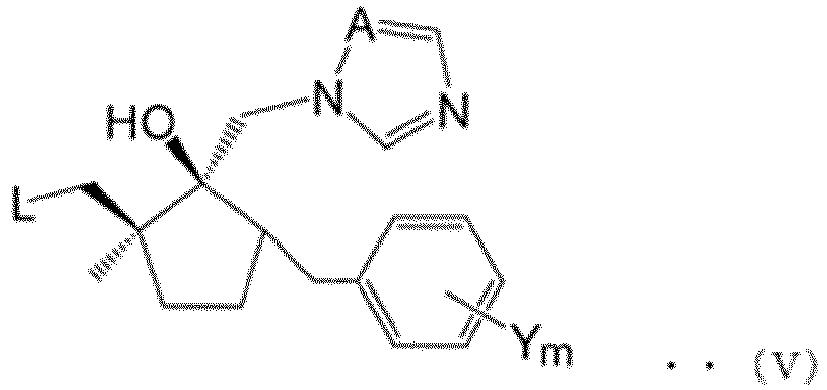
- In General Formula (V), Y, m and A are the same as Y, m and A in General Formula (I), respectively, and L represents a halogen atom.
- More specifically, a compound represented by General Formula (V) can be obtained by reacting a compound represented by General Formula (I) using the method described above with a halogen acid and opening the ring. More specifically, Compound (I) can be mixed in a solvent with Compound H-L, and the oxetane ring in Compound (I) can be opened (ring-opening step) to generate a halogenated methyl group and a tertiary hydroxyl group and to obtain Compound (V).
- Here, H-L represents a halogen atom. The halogen acid can be hydrogen chloride, hydrogen bromide, or hydrogen iodide. The halogen acid may be introduced as a gas, or may be dissolved in an organic solvent solution or aqueous solution and then added. Compound (V) may be obtained from Compound (I) by adding a halide salt and another type of acid (such as toluenesulfonic acid and methanesulfonic acid).
- There are no particular restrictions on the solvent that can be used. Examples include amides such as N-methylpyrrolidone, N,N-dimethylacetamide and N,N-dimethylformamide, and ethers such as tetrahydrofuran and dioxane. A mixed solvent can be used which includes other solvents in addition to these. These solvents include halogenated hydrocarbons such as dichloromethane, chloroform and dichloroethane, aromatic hydrocarbons such as benzene, toluene and xylene, aliphatic hydrocarbons such as petroleum ether, hexane and methyl cyclohexane, ethers such as diethyl ether, tetrahydrofuran and dioxane, and alcohols such as isopropyl alcohol, tert-butanol, methanol and ethanol. Others include water, acetonitrile, and dimethyl sulfoxide.
- The amount of Compound H-L used is usually from 0.5 to 100 times, and preferably from 1 to 30 times, the amount of Compound (I) in terms of the mole ratio.
- The reaction temperature depends on the solvent and halogen acid that are used. However, the reaction temperature is usually from -20°C to 250°C, and preferably from -10°C to 150°C. The reaction time also depends on the solvent and the halogen acid that are used. However, the reaction time is usually from 0.1 hours to several days, and preferably from 0.5 hours to 2 days.
- In the reduction method described in Patent Document 1, the reaction is performed in the presence of a sodium iodide halogenating agent in order to promote the reduction reaction using zinc (substitution of the sulfonic acid ester by an iodine atom). However, when Compound (I) is reacted with a halogen acid to open the ring and mixed with another halogenating agent in the reaction system (for example, an iodide such as sodium iodide or lithium iodide, or a bromide such as sodium bromide or lithium bromide when synthesizing Compound (V) in which L is a chloride atom), compounds other than Compound (V) may be generated as byproducts. When the compound to be generated includes a halogen atom other than the halogen atom in L in the reaction system manufacturing Compound (I), Compound (I) has to be purified and removed before the ring-opening reaction is performed.
- However, the manufacturing method of the present embodiment can manufacture Compound (I) at a high yield without using a halogenating agent that substitutes a sulfonic acid ester with a halogen atom. Therefore, in relation to the synthesis of Compound (V), the ring-opening step can be realized seamlessly with the reduction step by adding a halogen acid to the reaction solution (reaction system) without isolating Compound (I) from the reaction solution in the reduction step. The Compound (I) isolating step can be eliminated, the manufacturing process can be simplified, and the yield of Compound (V) can be improved.
- When realizing the ring-opening step seamlessly from the reduction step, Compound (II) is preferably reacted with a hydride-type reducing agent before adding water, an alcohol, an organic acid such as acetic acid, a mixture thereof, or a mixed solution containing an inorganic acid such as sulfuric acid therewith in the reaction solution (reaction system). In a reduction reaction performed on Compound (II) with a hydride-type reduction agent, a complex is believed to be formed by the reaction between the hydride-type reducing agent and Compound (II). When a halogen acid is added without water, an alcohol or an organic acid, byproducts are generated and the yield decreases. In order to avoid this, the complex can be dissociated by adding water, an alcohol or an inorganic acid. In this way, Compound (I) is generated as the reduction product, and then hydrogen halide addition and the ring-opening reaction can proceed efficiently. Therefore, the amount of Compound (I) present can be increased by adding water, an alcohol or an organic acid to the reaction system. This promotes the reaction used to obtain Compound (V) after the ring-opening reaction. As a result, the yield of Compound (V) can be improved.
- The alcohol used here can be ethanol, methanol, isopropanol or t-butanol, and the organic acid can be an organic carboxylic acid such as acetic acid, propionic acid, trifluoroacetic acid or trichloroacetic acid, or an organic sulfonic acid such as mesylic acid or p-toluenesulfonic acid. The inorganic acid can be sulfuric acid, perchloric acid, phosphoric acid, phosphonic acid, phosphinic acid or nitric acid. A halogen acid such as hydrochloric acid, hydrobromic acid or hydroiodic acid can also be used as the inorganic acid. When a halogen acid is used, the ring-opening reaction can partially proceed, and halogen acid can mix with the compound converted into Compound (V). Therefore, when a halogen acid is used, the halogen acid preferably has the same halogen atom as L in Compound (V).
- The halogen acid used in the ring-opening step may be added separately after water, an alcohol or an organic acid has been added and Compound (I) has been generated. It may also be dissolved before in water, an alcohol or an organic acid used to generate Compound (I). In this way, the manufacturing process can be simplified.
- Examples are shown below in order to explain the embodiment of the present invention in greater detail. Of course, the present invention is not limited to these examples, and other modifications are possible regarding the details. The present invention is also not limited to the embodiment explained above. Other variations are possible within the spirit and scope of the present invention, and embodiments obtained by combining the present invention with previously disclosed technical means are included within the technical scope of the present invention. Furthermore, all documents described herein are incorporated by reference.
- Synthesis (I) of 5-(4-chlorobenzyl)-2-chloromethyl-2-methyl-1-(1H-1,2,4-triazolyl-1-ylmethyl) cyclopentanol (Compound (5))]
- In the following example, Compound (5) was synthesized using Reaction Scheme 1 below.


- 5-(4-chlorobenzyl)-2,2-bis(hydroxymethyl)-1-(1H-1,2,4-triazol-1-ylmethyl) cyclopentanol (0.50 g, 1.42 mmol) (Compound (4)) and triethyl amine (0.70 ml, 1.42 × 3.5 mmol) were dissolved in DME(15 ml). After adding mesyl chloride (0.30 ml, 1.42 × 2.7 mmol) under ice-cooling, the solution was removed from the ice bath and stirred for 5 hours at room temperature. After the stirring was complete, 1N aqueous solution of hydrochloric acid was added and then extracted using ethyl acetate. After washing the organic layer using a saturated aqueous solution of sodium bicarbonate and a saturated aqueous solution of sodium chloride, the organic layer was dried using anhydrous sodium sulfate and then concentrated. The concentrate was refined using a silica gel column to obtain white, viscous Compound (3).
Yield (Amount): 0.688 g
Yield Percentage: 95% - Compound (3) (0.75 g, 1.48 mmol) was dissolved in NMP (5 ml), NaH (0.065g (ca. 60% in mineral oil), 1.48 × 1.1 mmol) was added, and the solution was stirred for 1 hour at room temperature. NaBH4 (0.084 g, 1.48 × 1.5 mmol) was added to the reaction solution, and the solution was stirred for 20 hours at room temperature and then allowed to react for 1 hour at approximately 60°C. The reaction solution was ice-cooled, 20.5% ethanol solution of hydrogen chloride (2.0 g, 0.00148 × 7.6mol) was added, and the solution was stirred for 1 hour. Afterwards, the solution was removed from the ice bath and stirred another 1 hour. Next, 20.5% ethanol solution of hydrogen chloride (4.0 g, 1.48 × 15 mmol) was added and the solution was stirred for 2 hours. It was then stirred for another 1 hour at approximately 80°C. After the stirring was complete, water was added and then extracted using ethyl acetate. After washing the organic layer using water and a saturated aqueous solution of sodium chloride, the organic layer was dried using anhydrous sodium sulfate and then concentrated. The concentrate was refined using a silica gel column to obtain colorless, viscous Compound (5). Compound (5) obtained in this way was a mixture of (1RS,2SR,5SR)-5-(4-chlorobenzyl)-2-chloromethyl-2-methyl-1-(1H-1,2,4-triazolyl-1-ylmethyl) cyclopentanol and (1RS,2SR,5RS)-5-(4-chlorobenzyl)-2-chloromethyl-2-methyl-1-(1H-1,2,4-triazolyl-1-ylmethyl) cyclopentanol.
- The 1H-NMR spectrum of Compound (5) obtained here matched the values of the 1H-NMR spectrum of the corresponding compound disclosed in Patent Document 1. Yield (Amount): 0.373 g (Yield Percentage From Compound (3): 71%)
- Synthesis (I) of 4-(4-chlorobenzyl)-1-methyl-5-(1H-1,2,4-triazol-1-ylmethyl)-6-oxabicyclo [3,2,0] heptane)
- In the following example, Compound (1) was synthesized using Reaction Scheme 2 below.

- Compound (3) (0.75 g, 1.48 mmol) was dissolved in NMP (7 ml), NaH (0.072 g (ca. 60% in mineral oil), 1.48 × 1.2 mmol) was added, and the solution was stirred for 30 minutes at room temperature. NaBH4 (0.168 g, 1.48 × 3.0 mmol) was added to the reaction solution, and the solution was stirred for 20 hours at room temperature and then allowed to react for 0.5 hours at approximately 60°C. Next, 10 wt% aqueous solution of sulfuric acid (10 ml) was added and the solution was stirred for 1 hour. Afterwards, water was added and then extracted using ethyl acetate. After washing the organic layer using an aqueous solution of sodium bicarbonate, water and a saturated aqueous solution of sodium chloride, the organic layer was dried using anhydrous sodium sulfate and then concentrated. The concentrate was refined using a silica gel column to obtain Compound (1).
Yield (Amount): 0.371 g
Yield (Percentage): 79% - In the following example, Compound (1) was synthesized using Reaction Scheme 3 below.

- Compound (3) (0.75 g, 1.48 mmol) was dissolved in NMP (4 ml), NaH (0.066 g (ca. 60% in mineral oil), 1.48 × 1.1 mmol) was added, and the solution was stirred for 1 hour at room temperature. NaBH4 (0.168 g, 1.48 × 3.0 mmol) was added to the reaction solution, and allowed to react for 40 hours at room temperature. Next, 48 wt% aqueous solution of sulfuric acid (2 ml) and water (8 ml) were added, and the solution was stirred for 3 hours. MeOH (5 ml) was then added, and the solution was stirred for another 2.5 hours. Because the presence of a fraction believed to be a boron complex was confirmed by HPLC, 48 wt% aqueous solution of sulfuric acid (2 ml) and water (5 ml) were added, and the solution was stirred for 2 hours. Afterwards, water was added and then extracted using ethyl acetate. After washing the organic layer using an aqueous solution of sodium bicarbonate and a saturated aqueous solution of sodium chloride, the organic layer was dried using anhydrous sodium sulfate and then concentrated. The concentrate was refined using a silica gel column to obtain Compound (1).
Yield (Amount): 0.324 g, Yield (Percentage): 69%, White Solid - In the following example, Compound (1) was synthesized using Reaction Scheme 4 below.

- Compound (3) (0.75 g, 1.48 mmol) was dissolved in DMA (4 ml), NaH (0.066 g (ca. 60% in mineral oil), 1.48 × 1.1 mmol) was added, and the solution was stirred for 1 hour at room temperature. NaBH4 (0.084 g, 1.48 × 1.5 mmol) was added to the reaction solution, allowed to react for 14 hours at room temperature, and then reacted for 1 hour at approximately 60°C. Next, 48 wt% aqueous solution of sulfuric acid (2 ml) and water (8 ml) were added, and the solution was stirred for 7 hours. Afterwards, water was added and then extracted using ethyl acetate. After washing the organic layer using a saturated aqueous solution of sodium bicarbonate and a saturated aqueous solution of sodium chloride, the organic layer was dried using anhydrous sodium sulfate and then concentrated. The concentrate was refined using a silica gel column to obtain Compound (1).
Yield (Amount): 0.335 g
Yield (Percentage): 71% - In the following example, Compound (1) was synthesized using Reaction Scheme 5 below.

- Compound (3) (0.50 g, 0.984 mmol) was dissolved in NMP (4 ml), sodium t-butoxide (tBuONa) (0.11 g, 0.984 × 1.2 mmol), and the solution was stirred for 1 hour at room temperature. NaBH4 (0.112 g, 0.984 × 3.0 mmol) was then added to the reaction solution and it was allowed to react for 21 hours at room temperature. Afterwards, it was reacted for 1 hour at approximately 60°C. Next, 48 wt% aqueous solution of sulfuric acid (2 ml) and water (4 ml) were added, and the solution was stirred for 3.5 hours. Afterwards, water was added and then extracted using ethyl acetate. After washing the organic layer using a saturated aqueous solution of sodium bicarbonate and a saturated aqueous solution of sodium chloride, the organic layer was dried using anhydrous sodium sulfate and then concentrated. The concentrate was refined using a silica gel column to obtain Compound (1).
Yield (Amount): 0.205 g
Yield (Percentage): 65% - In the following example, Compound (1) was synthesized using Reaction Scheme 6 below.
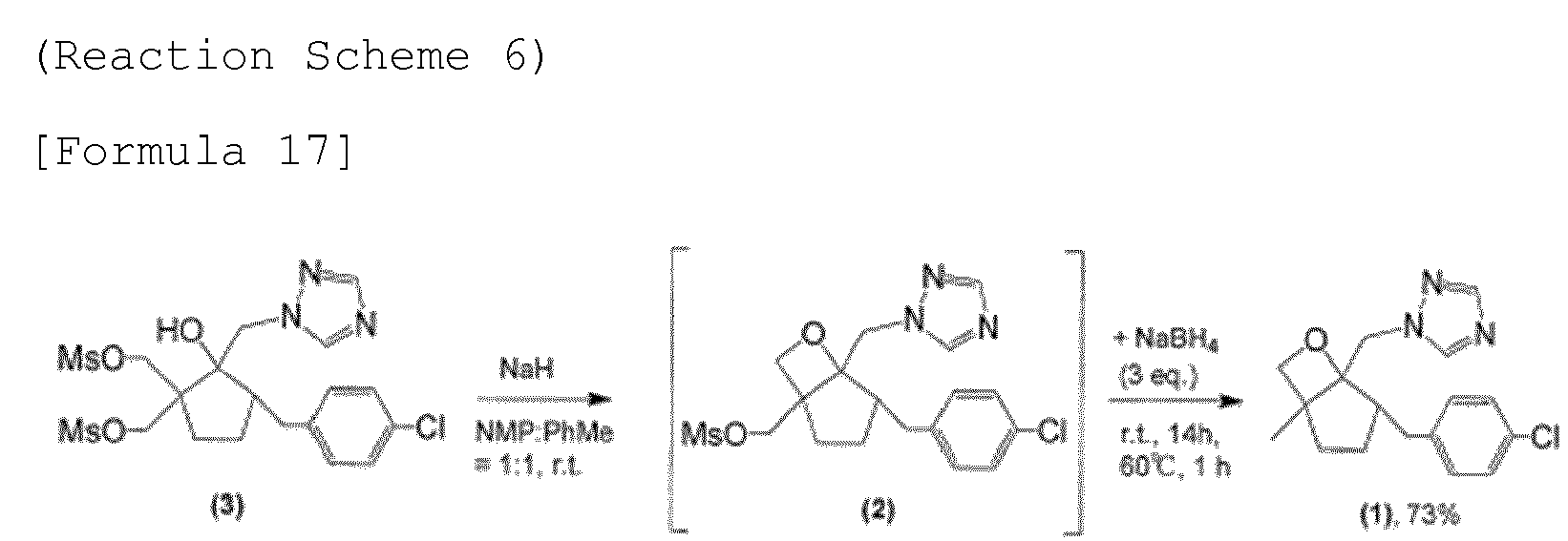
- Compound (3) (0.50 g, 0.984 mmol) was dissolved in a mixed solvent of NMP (2 ml) and toluene (2 ml), NaH (0.044 g (ca. 60% in mineral oil), 0.984 × 1.1 mmol) was added, and the solution was stirred for 1 hour at room temperature. NaBH4 (0.056 g, 0.984 × 1.5 mmol) was then added to the reaction solution and it was allowed to react for 14 hours at room temperature. Afterwards, it was reacted for 1 hour at approximately 60°C. Next, 48 wt% aqueous solution of sulfuric acid (2 ml) and water (4 ml) were added, and the solution was stirred for 3 hours. Afterwards, water was added and then extracted using ethyl acetate. After washing the organic layer using a saturated aqueous solution of sodium bicarbonate and a saturated aqueous solution of sodium chloride, the organic layer was dried using anhydrous sodium sulfate and then concentrated. The concentrate was refined using a silica gel column to obtain Compound (1).
Yield (Amount): 0.227 g
Yield (Percentage): 73% - In the following example, Compound (5) was synthesized using Reaction Scheme 7 below.

- 5-(4-chlorobenzyl)-2,2-bis(hydroxymethyl)-1-(1H-1,2,4-triazol-1-ylmethyl) cyclopentanol (0.70 g, 1.99 mmol) (Compound (4)) was dissolved in a mixed solution of NMP (5 ml) and toluene (5 ml). Triethyl amine (0.70 ml, 1.99 × 2.5 mmol) was added, the temperature was raised to approximately 45°C, mesyl chloride (0.32 ml, 1.99 × 2.1 mmol) was added, and the solution was allowed to react for 30 minutes at approximately 50°C. tBuONa (0.65 g, 1.99 × 3.4 mmol) was added to the reaction solution, and the solution was allowed to react for 30 minutes at approximately 50°C. Next, NaBH4 (0.15 g, 1.99 × 2.0 mmol), and the solution was allowed to react for 3 hours at approximately 50°C. After adding concentrated hydrochloric acid (5 ml) to the reaction solution, the solution was allowed to react for 4 hours at approximately 50°C. Water was added to the reaction solution and then extracted using toluene. After washing the organic layer using a 2N aqueous hydrochloric acid, water and a saturated aqueous solution of sodium bicarbonate, the organic layer was dried using anhydrous sodium sulfate and then concentrated. The concentrate was refined using a silica gel column to obtain Compound (5).
Yield (Amount): 0.297 g
Yield (Percentage): 42% - In the following example, Compound (5) was synthesized using Reaction Scheme 8 below.

- Compound (4) (1.00 g, 2.84 mmol) and DMA (2 ml) were dissolved in toluene (5 ml), and triethyl amine (1.0 ml, 2.84 × 2.5 mmol) was added. Mesyl chloride (0.46 ml, 2.84 × 2.1 mmol) was added at a temperature lower than 40°C, and the solution was stirred for 0.5 hours at room temperature. Next, 25% aqueous solution of sodium hydroxide (1.4 ml, 2.84 × 4.0 mmol) was added, and the solution was stirred for 1 hour at room temperature. Water was added to the reaction solution and then extracted using toluene. The organic layer was washed using water. DMA (3 ml) was added to the organic layer, and the low boiling-point substances were removed. Next, NaBH4 (0.118 g, 2.84 × 1.1 mmol) was added to the reaction solution, and allowed to react for 2 hours at approximately 55°C. Isopropanol (1.1 ml, 2.84 × 5 mmol) was added while water-cooling the reaction solution, and the solution was stirred for 1 hour at approximately 45°C. After stirring the solution, 4N DMF hydrogen chloride solution (3.6 ml, 2.84 × 5 mmol) was added, the solution was stirred for 1 hour at approximately 45°C, and the solution was then allowed to react for 4 hours at approximately 65°C. After the stirring was complete, water was added and then extracted using ethyl acetate. After washing the organic layer using water and a saturated aqueous solution of sodium chloride, the organic layer was dried using anhydrous sodium sulfate and then concentrated. The concentrate was refined using a silica gel column to obtain white, solid Compound (5). Compound (5) obtained in this way was a mixture of (1RS,2SR,5SR)-5-(4-chlorobenzyl)-2-chloromethyl-2-methyl-1-(1H-1,2,4-triazolyl-1-ylmethyl) cyclopentanol and (1RS,2SR,5RS)-5-(4-chlorobenzyl)-2-chloromethyl-2-methyl-1-(1H-1,2,4-triazolyl-1-ylmethyl) cyclopentanol.
- The 1H-NMR spectrum of Compound (5) obtained here matched the values of the 1H-NMR spectrum of the corresponding compound disclosed in Patent Document 1. Yield (Amount): 0.758 g (Yield Percentage From Compound (4): 75%)
- In the following example, Compound (1) was synthesized using Reaction Scheme 9 below.

- Compound (3) (0.80 g, 1.57 mmol) was dissolved in NMP (5 ml), t-BuONa (0.17 g, 1.57 × 1.1 mmol) was added, and the solution was stirred for 0.5 hours at room temperature. LiAlH4 (0.144 g, 1.57 × 2.4 mmol) was added under ice-cooling in an argon atmosphere, and the solution was stirred for 0.5 hours. Next, the solution was removed from the ice bath, allowed to react for 18 hours at room temperature, and then reacted for 1 hour at approximately 50°C. Next, LiAlH4 (0.072 g, 1.57 × 1.2 mmol) was added, the solution was stirred for 6 hours at the same temperature, and then stirred for 1 hour at 60°C. The reaction solution was poured into 25 wt% sulfuric acid aqueous solution (20 ml) to stop the reaction, and extracted using ethyl acetate. After washing the organic layer using a saturated aqueous solution of sodium bicarbonate and a saturated aqueous solution of sodium chloride, the organic layer was dried using anhydrous sodium sulfate and then concentrated. The concentrate was refined using a silica gel column to obtain Compound (1).
Yield (Amount): 0.185 g
Yield (Percentage): 37% - The present invention can be applied to the manufacture of 4-benzyl-1-methyl-6-oxabicyclo[3,2,0]heptane derivatives used as a raw material in agrochemicals.
Claims (13)
- A method for manufacturing a compound represented by General Formula (I) below, the method including a step for reducing a compound represented by General Formula (II) below using a hydride-type reducing agent in an aprotic solvent having an amide bond or a mixed solvent including the aprotic solvent.


- The manufacturing method according to claim 1, wherein the aprotic solvent is N-methyl-2-pyrrolidinone, N,N-dimethylacetamide, or N,N-dimethylformamide.
- The manufacturing method according to claim 1 or claim 2, wherein the hydride-type reducing agent is a borohydride compound or an aluminum hydride compound.
- The manufacturing method according to any one of claims 1 through 3, wherein the hydride-type reducing agent is sodium borohydride, lithium borohydride, sodium trimethoxyborohydride, lithium aluminum hydride, or sodium bis(2-methoxyethoxy) aluminum hydride.
- The manufacturing method according to any one of claims 1 through 4, wherein R3 in General Formula (II) above represents an alkyl group having 1 to 3 carbon atoms or a haloalkyl group having 1 to 3 carbon atoms.
- The manufacturing method according to claim 5 further comprising a ring-closing step for obtaining a compound represented by General Formula (II) above by reacting a compound represented by General Formula (III) below with a base.

- The manufacturing method according to claim 6 further comprising a reduction step for adding the hydride-type reducing agent to the reaction system after the ring-closing step.
- The manufacturing method according to claim 6 or claim 7 further comprising a sulfonylation step for obtaining a compound represented by General Formula (III) above by reacting a compound represented by General Formula (IV) below with a sulfonyl chloride derivative represented by the general formula R3SO2Cl (where R3 is the same as R3 in General Formula (III)).

- The manufacturing method according to any one of claims 1 through 8, wherein m in General Formula (I) above is an integer from 0 to 3, and Y is a halogen atom, an alkyl group having 1 to 3 carbon atoms, a haloalkyl group having 1 to 3 carbon atoms, an alkoxy group having 1 to 3 carbon atoms or a haloalkoxy group having 1 to 3 carbon atoms, and A represents a nitrogen atom when m is equal to or greater than 1.
- The manufacturing method according to any one of claims 1 through 9, wherein m in General Formula (I) above is an integer from 0 to 2, and Y represents a halogen atom and A represents a nitrogen atom when m is 1 or 2.
- The manufacturing method according to any one of claims 1 through 10, wherein R3 in General Formula (II) above represents a methyl group.
- A method for manufacturing an azole derivative represented by General Formula (V) below, the method including the manufacturing method according to any one of claims 1 through 11, the azole derivative being obtained by reacting a compound represented by General Formula (I) above with a halogen atom.

- The manufacturing method according to claim 12, wherein a compound represented by General Formula (I) is obtained by adding, to the reaction system, water, an alcohol, an inorganic acid, a mixture thereof, or a mixed solution including an inorganic acid added to these solutions after the hybrid-type reducing agent has been allowed to react with the compound represented by General Formula (II) in the reduction step.
Applications Claiming Priority (2)
| Application Number | Priority Date | Filing Date | Title |
|---|---|---|---|
| JP2011247990 | 2011-11-11 | ||
| PCT/JP2012/078658 WO2013069614A1 (en) | 2011-11-11 | 2012-11-05 | Method for producing 4-benzyl-1-methyl-6-oxabicyclo[3,2,0]heptane derivative and method for producing azole derivative |
Publications (2)
| Publication Number | Publication Date |
|---|---|
| EP2778164A1 true EP2778164A1 (en) | 2014-09-17 |
| EP2778164A4 EP2778164A4 (en) | 2015-04-08 |
Family
ID=48289988
Family Applications (1)
| Application Number | Title | Priority Date | Filing Date |
|---|---|---|---|
| EP12847713.0A Withdrawn EP2778164A4 (en) | 2011-11-11 | 2012-11-05 | Method for producing 4-benzyl-1-methyl-6-oxabicyclo[3,2,0]heptane derivative and method for producing azole derivative |
Country Status (5)
| Country | Link |
|---|---|
| US (1) | US9051298B2 (en) |
| EP (1) | EP2778164A4 (en) |
| JP (1) | JPWO2013069614A1 (en) |
| CN (1) | CN103917537B (en) |
| WO (1) | WO2013069614A1 (en) |
Families Citing this family (1)
| Publication number | Priority date | Publication date | Assignee | Title |
|---|---|---|---|---|
| WO2015029519A1 (en) * | 2013-09-02 | 2015-03-05 | 株式会社クレハ | Method for producing triazole compound |
Family Cites Families (6)
| Publication number | Priority date | Publication date | Assignee | Title |
|---|---|---|---|---|
| US7354922B2 (en) | 2004-12-14 | 2008-04-08 | Schering Corporation | Bridged ring NK1 antagonists |
| UA108867C2 (en) | 2009-12-08 | 2015-06-25 | APPROACHES OF AZOLS, THE METHOD OF THEIR PRODUCTS (OPTIONS), INTERMEDIATES, AGRICULTURAL AND HORTICULTURAL PRODUCTS | |
| JP5826839B2 (en) * | 2011-06-07 | 2015-12-02 | 株式会社クレハ | Azole derivatives, methods for producing azole derivatives, and intermediate compounds |
| BR112013030438A2 (en) * | 2011-06-07 | 2016-08-16 | Kureha Corp | agricultural or horticultural chemical agent, composition for controlling plant diseases, method for controlling plant diseases, and product for controlling plant diseases |
| UA110647C2 (en) * | 2011-06-07 | 2016-01-25 | Куреха Корпорейшн | Azole derivative, method of its preparation, intermediate compounds and chemical agent designed for use in agriculture and horticulture, and an agent for protecting industrial materials |
| EP2813501A4 (en) * | 2011-11-11 | 2015-04-15 | Kureha Corp | Method for producing 4-benzyl-1-methyl-6-oxabicyclo[3,2,0]heptane derivative |
-
2012
- 2012-11-05 CN CN201280053420.5A patent/CN103917537B/en not_active Expired - Fee Related
- 2012-11-05 US US14/357,058 patent/US9051298B2/en not_active Expired - Fee Related
- 2012-11-05 JP JP2013542977A patent/JPWO2013069614A1/en active Pending
- 2012-11-05 WO PCT/JP2012/078658 patent/WO2013069614A1/en not_active Ceased
- 2012-11-05 EP EP12847713.0A patent/EP2778164A4/en not_active Withdrawn
Non-Patent Citations (2)
| Title |
|---|
| No further relevant documents disclosed * |
| See also references of WO2013069614A1 * |
Also Published As
| Publication number | Publication date |
|---|---|
| CN103917537A (en) | 2014-07-09 |
| EP2778164A4 (en) | 2015-04-08 |
| CN103917537B (en) | 2016-03-16 |
| WO2013069614A1 (en) | 2013-05-16 |
| US20140336389A1 (en) | 2014-11-13 |
| JPWO2013069614A1 (en) | 2015-04-02 |
| US9051298B2 (en) | 2015-06-09 |
Similar Documents
| Publication | Publication Date | Title |
|---|---|---|
| JP7315805B1 (en) | Method for producing intermediate for synthesis of monocyclic pyridine derivative | |
| DK2612859T3 (en) | PROCEDURE FOR PREPARING 1-TRIAZOL-2-BUTANOL DERIVATE. | |
| AU2015282127B2 (en) | Method for producing fused heterocyclic compound | |
| CA3009734A1 (en) | Ointment comprising an oxazole compound | |
| US8962871B2 (en) | Method for producing 4-benzyl-1-methyl-6-oxabicyclo[3,2,0]heptane derivative | |
| US9051298B2 (en) | Method for manufacturing 4-benzyl-1-methyl-6-oxabicyclo[3,2,0]heptane derivative and method for manufacturing azole derivative | |
| JP5858998B2 (en) | Method for producing cyclopentanone compound and intermediate compound | |
| ES2254982T3 (en) | RIZATRIPTAN PREPARATION PROCESS. | |
| EP2805944A1 (en) | Production method for cyclopentanone derivative, intermediate compound, and production method for intermediate compound | |
| ES2270144T3 (en) | PROCEDURE FOR OBTAINING ZOLMITRIPTAN COMPOUNDS. | |
| CA3086552A1 (en) | Process and intermidiates for the preparation of certain mesoionic pesticides | |
| WO2016142918A1 (en) | Pyrazole derivatives and relative use for the preparation of 1,3,4-thiadiazoles | |
| US9738607B2 (en) | Scalable process for the preparation of Sorafenib tosylate ethanol solvate and Sorafenib tosylate form III | |
| KR101435741B1 (en) | Novel voriconazole intermediate and synthesis of voriconazole | |
| KR101686087B1 (en) | Process for Production of Optically Active Indoline Derivatives or Salts Thereof | |
| TWI879818B (en) | Methods for the preparation of 5-bromo-2-(3-chloro-pyridin-2-yl)-2h-pyrazole-3-carboxylic acid | |
| JP2018140944A (en) | Method for producing pyrazole compound and intermediate thereof | |
| JP4973210B2 (en) | New synthesis method | |
| KR101647482B1 (en) | C-substituted 1,3,3-trinitroazetidine and preparation process therefor | |
| EA046889B1 (en) | METHODS FOR OBTAINING 5-BROMO-2-(3-CHLOROPYRIDIN-2-YL)-2H-PYRAZOLE-3-CARBOXYLIC ACID | |
| KR101144776B1 (en) | Process for preparing optically active benzenesulfonamide derivatives | |
| WO2011030537A1 (en) | Process for production of 4-(5-methylpyridin-2-ylamino)piperidine-1-carboxylic acid derivatives | |
| WO2009128408A1 (en) | Process for producing an anthranilamide compound | |
| JP2014037388A (en) | Method for manufacturing ester compound and method for manufacturing azolyl methyl cyclopentanol compound | |
| JP2014037389A (en) | Method for manufacturing ester compound and method for manufacturing azolyl methyl cyclopentanol compound |
Legal Events
| Date | Code | Title | Description |
|---|---|---|---|
| PUAI | Public reference made under article 153(3) epc to a published international application that has entered the european phase |
Free format text: ORIGINAL CODE: 0009012 |
|
| 17P | Request for examination filed |
Effective date: 20140604 |
|
| AK | Designated contracting states |
Kind code of ref document: A1 Designated state(s): AL AT BE BG CH CY CZ DE DK EE ES FI FR GB GR HR HU IE IS IT LI LT LU LV MC MK MT NL NO PL PT RO RS SE SI SK SM TR |
|
| DAX | Request for extension of the european patent (deleted) | ||
| RA4 | Supplementary search report drawn up and despatched (corrected) |
Effective date: 20150310 |
|
| RIC1 | Information provided on ipc code assigned before grant |
Ipc: C07D 405/06 20060101AFI20150304BHEP Ipc: C07D 249/08 20060101ALI20150304BHEP |
|
| 17Q | First examination report despatched |
Effective date: 20151015 |
|
| STAA | Information on the status of an ep patent application or granted ep patent |
Free format text: STATUS: THE APPLICATION IS DEEMED TO BE WITHDRAWN |
|
| 18D | Application deemed to be withdrawn |
Effective date: 20160719 |