EP2778161A1 - Two-photon fluorescent probe using naphthalene as matrix and preparation method and use thereof - Google Patents
Two-photon fluorescent probe using naphthalene as matrix and preparation method and use thereof Download PDFInfo
- Publication number
- EP2778161A1 EP2778161A1 EP12870663.7A EP12870663A EP2778161A1 EP 2778161 A1 EP2778161 A1 EP 2778161A1 EP 12870663 A EP12870663 A EP 12870663A EP 2778161 A1 EP2778161 A1 EP 2778161A1
- Authority
- EP
- European Patent Office
- Prior art keywords
- reaction
- compound
- naphthalene
- hours
- photon
- Prior art date
- Legal status (The legal status is an assumption and is not a legal conclusion. Google has not performed a legal analysis and makes no representation as to the accuracy of the status listed.)
- Granted
Links
- 0 Cc1ccc(*=C(C2N3)c4cccc5c4c2ccc5Br)c3c1 Chemical compound Cc1ccc(*=C(C2N3)c4cccc5c4c2ccc5Br)c3c1 0.000 description 8
- ZSCHAENXWRGBMO-UHFFFAOYSA-N CC(Cc1c(C)[n](C(c(cc2)ccc2Cl)=O)c(cc2)c1cc2OC)=O Chemical compound CC(Cc1c(C)[n](C(c(cc2)ccc2Cl)=O)c(cc2)c1cc2OC)=O ZSCHAENXWRGBMO-UHFFFAOYSA-N 0.000 description 1
- STMOIUJAMUPSRU-UHFFFAOYSA-N CCC(C1=CC=C(C)CC1)=O Chemical compound CCC(C1=CC=C(C)CC1)=O STMOIUJAMUPSRU-UHFFFAOYSA-N 0.000 description 1
Images




Classifications
-
- G—PHYSICS
- G01—MEASURING; TESTING
- G01N—INVESTIGATING OR ANALYSING MATERIALS BY DETERMINING THEIR CHEMICAL OR PHYSICAL PROPERTIES
- G01N21/00—Investigating or analysing materials by the use of optical means, i.e. using sub-millimetre waves, infrared, visible or ultraviolet light
- G01N21/62—Systems in which the material investigated is excited whereby it emits light or causes a change in wavelength of the incident light
- G01N21/63—Systems in which the material investigated is excited whereby it emits light or causes a change in wavelength of the incident light optically excited
- G01N21/64—Fluorescence; Phosphorescence
- G01N21/6486—Measuring fluorescence of biological material, e.g. DNA, RNA, cells
-
- C—CHEMISTRY; METALLURGY
- C07—ORGANIC CHEMISTRY
- C07D—HETEROCYCLIC COMPOUNDS
- C07D403/00—Heterocyclic compounds containing two or more hetero rings, having nitrogen atoms as the only ring hetero atoms, not provided for by group C07D401/00
- C07D403/02—Heterocyclic compounds containing two or more hetero rings, having nitrogen atoms as the only ring hetero atoms, not provided for by group C07D401/00 containing two hetero rings
- C07D403/12—Heterocyclic compounds containing two or more hetero rings, having nitrogen atoms as the only ring hetero atoms, not provided for by group C07D401/00 containing two hetero rings linked by a chain containing hetero atoms as chain links
-
- C—CHEMISTRY; METALLURGY
- C07—ORGANIC CHEMISTRY
- C07D—HETEROCYCLIC COMPOUNDS
- C07D401/00—Heterocyclic compounds containing two or more hetero rings, having nitrogen atoms as the only ring hetero atoms, at least one ring being a six-membered ring with only one nitrogen atom
- C07D401/02—Heterocyclic compounds containing two or more hetero rings, having nitrogen atoms as the only ring hetero atoms, at least one ring being a six-membered ring with only one nitrogen atom containing two hetero rings
- C07D401/12—Heterocyclic compounds containing two or more hetero rings, having nitrogen atoms as the only ring hetero atoms, at least one ring being a six-membered ring with only one nitrogen atom containing two hetero rings linked by a chain containing hetero atoms as chain links
-
- C—CHEMISTRY; METALLURGY
- C07—ORGANIC CHEMISTRY
- C07D—HETEROCYCLIC COMPOUNDS
- C07D471/00—Heterocyclic compounds containing nitrogen atoms as the only ring hetero atoms in the condensed system, at least one ring being a six-membered ring with one nitrogen atom, not provided for by groups C07D451/00 - C07D463/00
- C07D471/02—Heterocyclic compounds containing nitrogen atoms as the only ring hetero atoms in the condensed system, at least one ring being a six-membered ring with one nitrogen atom, not provided for by groups C07D451/00 - C07D463/00 in which the condensed system contains two hetero rings
- C07D471/04—Ortho-condensed systems
-
- C—CHEMISTRY; METALLURGY
- C07—ORGANIC CHEMISTRY
- C07D—HETEROCYCLIC COMPOUNDS
- C07D471/00—Heterocyclic compounds containing nitrogen atoms as the only ring hetero atoms in the condensed system, at least one ring being a six-membered ring with one nitrogen atom, not provided for by groups C07D451/00 - C07D463/00
- C07D471/02—Heterocyclic compounds containing nitrogen atoms as the only ring hetero atoms in the condensed system, at least one ring being a six-membered ring with one nitrogen atom, not provided for by groups C07D451/00 - C07D463/00 in which the condensed system contains two hetero rings
- C07D471/06—Peri-condensed systems
-
- C—CHEMISTRY; METALLURGY
- C09—DYES; PAINTS; POLISHES; NATURAL RESINS; ADHESIVES; COMPOSITIONS NOT OTHERWISE PROVIDED FOR; APPLICATIONS OF MATERIALS NOT OTHERWISE PROVIDED FOR
- C09B—ORGANIC DYES OR CLOSELY-RELATED COMPOUNDS FOR PRODUCING DYES, e.g. PIGMENTS; MORDANTS; LAKES
- C09B57/00—Other synthetic dyes of known constitution
-
- C—CHEMISTRY; METALLURGY
- C09—DYES; PAINTS; POLISHES; NATURAL RESINS; ADHESIVES; COMPOSITIONS NOT OTHERWISE PROVIDED FOR; APPLICATIONS OF MATERIALS NOT OTHERWISE PROVIDED FOR
- C09B—ORGANIC DYES OR CLOSELY-RELATED COMPOUNDS FOR PRODUCING DYES, e.g. PIGMENTS; MORDANTS; LAKES
- C09B57/00—Other synthetic dyes of known constitution
- C09B57/08—Naphthalimide dyes; Phthalimide dyes
-
- C—CHEMISTRY; METALLURGY
- C09—DYES; PAINTS; POLISHES; NATURAL RESINS; ADHESIVES; COMPOSITIONS NOT OTHERWISE PROVIDED FOR; APPLICATIONS OF MATERIALS NOT OTHERWISE PROVIDED FOR
- C09K—MATERIALS FOR MISCELLANEOUS APPLICATIONS, NOT PROVIDED FOR ELSEWHERE
- C09K11/00—Luminescent materials, e.g. electroluminescent or chemiluminescent
- C09K11/02—Use of particular materials as binders, particle coatings or suspension media therefor
-
- C—CHEMISTRY; METALLURGY
- C09—DYES; PAINTS; POLISHES; NATURAL RESINS; ADHESIVES; COMPOSITIONS NOT OTHERWISE PROVIDED FOR; APPLICATIONS OF MATERIALS NOT OTHERWISE PROVIDED FOR
- C09K—MATERIALS FOR MISCELLANEOUS APPLICATIONS, NOT PROVIDED FOR ELSEWHERE
- C09K11/00—Luminescent materials, e.g. electroluminescent or chemiluminescent
- C09K11/06—Luminescent materials, e.g. electroluminescent or chemiluminescent containing organic luminescent materials
-
- G—PHYSICS
- G01—MEASURING; TESTING
- G01N—INVESTIGATING OR ANALYSING MATERIALS BY DETERMINING THEIR CHEMICAL OR PHYSICAL PROPERTIES
- G01N21/00—Investigating or analysing materials by the use of optical means, i.e. using sub-millimetre waves, infrared, visible or ultraviolet light
- G01N21/62—Systems in which the material investigated is excited whereby it emits light or causes a change in wavelength of the incident light
- G01N21/63—Systems in which the material investigated is excited whereby it emits light or causes a change in wavelength of the incident light optically excited
- G01N21/64—Fluorescence; Phosphorescence
- G01N21/645—Specially adapted constructive features of fluorimeters
- G01N21/6456—Spatial resolved fluorescence measurements; Imaging
- G01N21/6458—Fluorescence microscopy
-
- G—PHYSICS
- G01—MEASURING; TESTING
- G01N—INVESTIGATING OR ANALYSING MATERIALS BY DETERMINING THEIR CHEMICAL OR PHYSICAL PROPERTIES
- G01N33/00—Investigating or analysing materials by specific methods not covered by groups G01N1/00 - G01N31/00
- G01N33/48—Biological material, e.g. blood, urine; Haemocytometers
- G01N33/50—Chemical analysis of biological material, e.g. blood, urine; Testing involving biospecific ligand binding methods; Immunological testing
- G01N33/58—Chemical analysis of biological material, e.g. blood, urine; Testing involving biospecific ligand binding methods; Immunological testing involving labelled substances
- G01N33/582—Chemical analysis of biological material, e.g. blood, urine; Testing involving biospecific ligand binding methods; Immunological testing involving labelled substances with fluorescent label
-
- C—CHEMISTRY; METALLURGY
- C09—DYES; PAINTS; POLISHES; NATURAL RESINS; ADHESIVES; COMPOSITIONS NOT OTHERWISE PROVIDED FOR; APPLICATIONS OF MATERIALS NOT OTHERWISE PROVIDED FOR
- C09K—MATERIALS FOR MISCELLANEOUS APPLICATIONS, NOT PROVIDED FOR ELSEWHERE
- C09K2211/00—Chemical nature of organic luminescent or tenebrescent compounds
- C09K2211/10—Non-macromolecular compounds
- C09K2211/1003—Carbocyclic compounds
- C09K2211/1007—Non-condensed systems
-
- C—CHEMISTRY; METALLURGY
- C09—DYES; PAINTS; POLISHES; NATURAL RESINS; ADHESIVES; COMPOSITIONS NOT OTHERWISE PROVIDED FOR; APPLICATIONS OF MATERIALS NOT OTHERWISE PROVIDED FOR
- C09K—MATERIALS FOR MISCELLANEOUS APPLICATIONS, NOT PROVIDED FOR ELSEWHERE
- C09K2211/00—Chemical nature of organic luminescent or tenebrescent compounds
- C09K2211/10—Non-macromolecular compounds
- C09K2211/1018—Heterocyclic compounds
- C09K2211/1025—Heterocyclic compounds characterised by ligands
- C09K2211/1029—Heterocyclic compounds characterised by ligands containing one nitrogen atom as the heteroatom
-
- C—CHEMISTRY; METALLURGY
- C09—DYES; PAINTS; POLISHES; NATURAL RESINS; ADHESIVES; COMPOSITIONS NOT OTHERWISE PROVIDED FOR; APPLICATIONS OF MATERIALS NOT OTHERWISE PROVIDED FOR
- C09K—MATERIALS FOR MISCELLANEOUS APPLICATIONS, NOT PROVIDED FOR ELSEWHERE
- C09K2211/00—Chemical nature of organic luminescent or tenebrescent compounds
- C09K2211/10—Non-macromolecular compounds
- C09K2211/1018—Heterocyclic compounds
- C09K2211/1025—Heterocyclic compounds characterised by ligands
- C09K2211/1044—Heterocyclic compounds characterised by ligands containing two nitrogen atoms as heteroatoms
-
- G—PHYSICS
- G01—MEASURING; TESTING
- G01N—INVESTIGATING OR ANALYSING MATERIALS BY DETERMINING THEIR CHEMICAL OR PHYSICAL PROPERTIES
- G01N2201/00—Features of devices classified in G01N21/00
- G01N2201/06—Illumination; Optics
- G01N2201/061—Sources
- G01N2201/06113—Coherent sources; lasers
-
- G—PHYSICS
- G01—MEASURING; TESTING
- G01N—INVESTIGATING OR ANALYSING MATERIALS BY DETERMINING THEIR CHEMICAL OR PHYSICAL PROPERTIES
- G01N2201/00—Features of devices classified in G01N21/00
- G01N2201/06—Illumination; Optics
- G01N2201/069—Supply of sources
- G01N2201/0696—Pulsed
- G01N2201/0697—Pulsed lasers
Definitions
- the present invention relates to a novel category of naphthalene-based two-photon fluorescent probes, their synthesizing methods and a method of utilizing the naphthalene-based two-photon fluorescent probes to label the tumor cells or tissues.
- the optical molecular imaging fluorescence labeling technique overcomes latter's problems of these methods mentioned above.
- the relevant commercial fluorescent dyes such as phenanthridine derivative (EB, PI), acridine (AO), imidazoles (Hoechst, DAPI), cyanine dyes (Cy, TOTO, SYTO) and so on, play an important role in the areas of the genomics technology, nucleic acid quantitative testing and blood cell analysis.
- the fluorescent dyes/probes for specific cancer labeling are lacking.
- two-photon fluorescence ratiometric and fluorescence lifetimes imaging methods are vital tools in the study of living systems.
- advantages of two-photon fluorescence ratiometric imaging include, near-infrared excitation, dark-field imaging, reduced photodamage and photobleaching, high lateral resolution and vertical resolution, reduced absorption coefficient of biological tissues, so on.
- Ventelon L Charier S, Moreaux L et al.
- the two-photon fluorescence imaging technique provides a new platform for biological imaging. Regrettably, two-photon fluorescence probes for the imaging of tumor in vivo are rarely reported. So, exploring novel two-photon fluorescence probes having a good labeling specificity for cancer is the key to achieve two-photon imaging of tumors.
- the present invention provides a novel category of naphthalene-based two-photon fluorescent probes having a general formula I as follows: wherein:
- the present invention further provides a method for synthesizing the above-mentioned compounds of Formula I which includes the following steps:
- present invention provides a method for labeling biological samples utilizing the naphthalene-based two-photon fluorescent probes mentioned above, especially, for the labeling of tumor cells and tissues.
- the class of two-photon fluorescent dyes have a low fluorescence background in the non-tumor cells and tissues, and have a strong and specific fluorescent signal in the tumor cells and tissues. These probes have a certain level of water-solubility, while having good membrane permeability. In addition, they have a bigger effective two-photon absorption cross section.
- the compounds of the present invention also have a lower biotoxicity, phototoxicity and photobleaching. There is sufficient difference between the spectral range thereof and that of a biological sample.
- R 1 and R 2 are each independently selected from the group consisting of -OCH 3 , -OCOCH 3 and halogen, more preferably R 1 and R 2 are independently selected from the group consisting of -OCH 3 and halogen, even more preferably, R 1 and R 2 are independently selected from the group consisting of -OCH 3 and -Cl, most preferably R 1 is -OCH 3 , R 2 is -Cl.
- R 3 is -(CH 2 ) 3-7 -, more preferably R 3 is selected from -(CH 2 ) 5 - and -(CH 2 ) 6 -.
- R 4 is selected from the group consisting of C 1-6 alkyl, HOCH 2 -, HO(CH 2 ) 2 -, HO(CH 2 ) 3 -, HO(CH 2 ) 4 -, HO(CH 2 ) 5 - and HO(CH 2 ) 6 -, more preferably R 4 is C 1-6 alkyl, most preferably R 4 is C 1-4 alkyl;
- R 5 is selected from the group consisting of -H, -CN, -COOH, -NH 2 , -NO 2 , -OH and -SH, more preferably R 5 is selected from the group consisting of -H, -CN, -COOH, -NH 2 , and -NO 2 , even more preferably R 5 is selected from the group consisting of -H, -CN, -COOH, and -NO 2 , most preferably R 5 is selected from the group consisting of -H and -NO 2 .
- the present invention further provides a method for synthesizing the naphthalene-based two-photon fluorescent probes, which includes the following steps:
- the reaction temperature is 10-80 ⁇
- the reaction time is 12-32 hours
- the reaction solvent is methylene chloride, ethanol, ethyl acetate or their mixture
- the reaction is progressed in the presence of organic base and the 4 - dimethyl amino pyridine was used as catalyzer
- the mole ratio between compound IX, X, XI or XII and compound ii is 1:1-1:3, respectively;
- the reaction temperature is 10-70 ⁇
- the reaction time is 12-24 hours
- the reaction solvent is methylene chloride, ethanol, ethyl acetate or their mixture
- the reaction is progressed in the presence of organic base and the 4 - dimethyl amino pyridine was used as catalyzer
- the mole ratio between compound IX, X, XI or XII and compound ii is 1:1-1:2.5, respectively;
- the reaction temperature is 10-40 ⁇
- the reaction time is 12-24 hours
- the reaction solvent is methylene chloride
- the reaction is progressed in the presence of organic base and the 4 - dimethyl amino pyridine was used as catalyzer; the mole ratio between compound IX, X, XI or XII and compound ii is 1:1-1:1.5, respectively.
- the compounds described above have excellent two-photon properties, when they used for imaging of biological sample, the compounds have lower light bleaching, light damage and biological toxicity, and the produced fluorescence signal can pentrate deeper into biological tissues; Emission wavelength of a part of probes was greater than 600 nm, so they can be used for the living imaging;
- the compounds containing nitro group can be used as a proportion of the probe to image tumor cells and tissues, which can achieve a good quantitative labeling and avoid the disturbance of external environment factors on the fluorescence intensity;
- the compounds described above are low in toxicity and side effects, readily available in raw materials, simple in structure, and suitable for industrialization;
- the two-photon fluorescent probes described in this invention can be used for the labeling of tumor cells and tissues.
- the compounds described in this invention can be used directly for labeling the tumor cells and tissues in the form of described herein.
- the composition containing compounds of this invention can also be used for the labeling tumor cells and tissues.
- the composition should be included in the effective dose of one of the two-photon fluorescent probe compound in this invention.
- it also included other components which need in the biological staining, such as, solvent, buffer, and so on. These components are all known in the industry.
- the above-mentioned composition may exist in the form of aqueous solution, or may exist in other suitable forms of solution by mixing it with water before use.
- the present invention further provides a method for the labeling tumor cells and tissues using the two-photon fluorescent probe compounds described above.
- the method may include the step of contacting the above-mentioned compounds with the biological samples.
- the term "contacting" used herein may included contacting in solution or solid phase.
- Compound A 1 was used, which was synthesized in the example 1. 4 ⁇ L of compound A 1 -DMSO solution (4 ⁇ M) was added into HeLa and HEK 293 cells, respectively. HeLa and HEK 293 cells with probe A 1 were cultured for 60 min in 5% CO 2 at 37 °C. Then, they were washed with phosphate-buffered saline 5 min ⁇ 3. After that, the fresh medium was added into every cell. The fluorescence imaging was obtained with a two-photon spectral confocal multiphoton microscope. The representative areas were selected and imaged three times with oil-immersion objective lens (100 ⁇ ).
- FIG. 2(a) is confocal image of HeLa cell after adding probe A 1
- Figure 2(b) is confocal image of HeLa cell after adding probe A 1 .
- the images were recorded with the emission in the range of 500-550 nm.
- the two-photon cross section ( ⁇ ) was determined by the femtosecond two-photon induced fluorescence method
- the concentration of solutions was denoted as c
- the refractive index was denoted as n which was found in common data table.
- the upconversion fluorescence intensity was denoted as F, which was obtained by experiment.
- ⁇ is the two-photon cross section.
- the reference solution was subscripted r.
- the effective two-photon cross section ( ⁇ ) in different solution and at different wavelength was detected in figure 3 .
- the excitation source of two-photon fluorescence spectra is a mode-locked titanium-sapphire laser, the width of laser pulse is 70 fs, repetition frequency is 80 MHz, the average output power is 1.5 W (780 nm), tunable wavelength range is at 700-980 nm, the wavelength of laser was adjusted to the need wavelength in the experiment.
- the compound A 2 in the mention above example 4 was added into the water, and the absorbance of different concentration compound A 2 at maximum absorption wavelength was detected.
- Figure 5 is the absorbance of different concentration compound A 2 at maximum absorption wavelength.
- the experiment instrument is Agilent 8453 U-V spectrophotometer.
- the compound A 3 which was synthesized in the example 7, was added into the different solvent (methanol, ethanol, acetone, acetonitrile, dioxane, dimethyl sulfoxide, tetrahydrofuran, N,N-dimethyl formamide, water and so on), and the absorption spectra and fluorescence emission spectra were measured.
- the detected results indicated that the maximum absorption wavelength occurs corresponding displacement in absorption spectra with the change of the solvent polarity, at the same time, the maximum emission wavelength have corresponding displacement in fluorescence emission spectra.
- Figure 6(a) is the U-V absorption spectra of compound A 3 in different solvent
- figure 6(b) is the fluorescence emission spectra of compound A 3 in different solvent.
- the experiment instrument is Agilent 8453 U-V spectrophotometer and Agilent Cary Eclipse fluorescence spectrophotometer.
- the two-photon cross section ( ⁇ ) of A 3 was determined by using femto second (fs) fluorescence measurement technique.
- the effective two-photon cross section ( ⁇ ) in different solution and at different wavelength was shown in figure 7 .
- the excitation source of two-photon fluorescence spectra is a mode-locked titanium-sapphire laser, the width of laser pulse is 70 fs, repetition frequency is 80 MHz, the average output power is 1.5 W (780 nm), tunable wavelength range is at 700-980 nm, the wavelength of laser was adjusted to the need wavelength in the experiment.
- Compound A 5 was used, which was synthesized in the example 13. 4 ⁇ L of compound A 5 -DMSO solution (4 ⁇ M) was added into HeLa and HEK 293 cells, respectively. HeLa and HEK 293 cells with probe A 5 were cultured for 60 min in 5% CO 2 at 370. Then, they were washed with phosphate-buffered saline 5 min ⁇ 3. After that, the fresh medium was added into every cell. The fluorescence imaging was obtained with a two-photon spectral confocal multiphoton microscope. The representative areas were selected and imaged three times with oil-immersion objective lens (100 ⁇ ). The imaging results indicated that there were strong fluorescence signals in HeLa cells, but there were no any fluorescence signal in HEK 293 cells.
- Figure 10(a1) and 10(a2) are confocal images of HeLa cell after adding probe A 5
- figure 10(b1) and 10(b2) are confocal images of HEK 293 cell after adding probe A 5 .
- the images of figure 10(a1) and figure 10(b1) were recorded with the emission in the range of 500-550 nm.
- the images of figure 10(a2) and figure 10(b2) were recorded with the emission in the range of 500-550 nm.
- the compound A 6 which was synthesized in the example 16, was added into the different solvent (methanol, ethanol, acetone, acetonitrile, dioxane, dimethyl sulfoxide, tetrahydrofuran, N,N-dimethyl formamide, water and so on), and the absorption spectra and fluorescence emission spectra were measured.
- the detected results indicated that the maximum absorption wavelength occurs corresponding displacement in absorption spectra with the change of the solvent polarity, at the same time, the maximum emission wavelength have corresponding displacement in fluorescence emission spectra.
- Figure 12(a) is the U-V absorption spectra of compound A 6 in different solvent
- figure 12(b) is the fluorescence emission spectra of compound A 6 in different solvent.
- the experiment instrument is Agilent 8453 U-V spectrophotometer and Agilent Cary Eclipse fluorescence spectrophotometer.
- the two-photon cross section ( ⁇ ) of A 6 was determined by using femto second (fs) fluorescence measurement technique.
- the effective two-photon cross section ( ⁇ ) in different solution and at different wavelength was shown in figure 13 .
- the excitation source of two-photon fluorescence spectra is a mode-locked titanium-sapphire laser, the width of laser pulse is 70 fs, repetition frequency is 80 MHz, the average output power is 1.5 W (780 nm), tunable wavelength range is at 700-980 nm, the wavelength of laser was adjusted to the need wavelength in the experiment.
Landscapes
- Chemical & Material Sciences (AREA)
- Organic Chemistry (AREA)
- Health & Medical Sciences (AREA)
- Life Sciences & Earth Sciences (AREA)
- Engineering & Computer Science (AREA)
- Immunology (AREA)
- Physics & Mathematics (AREA)
- Analytical Chemistry (AREA)
- Biochemistry (AREA)
- General Health & Medical Sciences (AREA)
- General Physics & Mathematics (AREA)
- Pathology (AREA)
- Biomedical Technology (AREA)
- Molecular Biology (AREA)
- Nuclear Medicine, Radiotherapy & Molecular Imaging (AREA)
- Hematology (AREA)
- Urology & Nephrology (AREA)
- Materials Engineering (AREA)
- Cell Biology (AREA)
- Microbiology (AREA)
- Biotechnology (AREA)
- Food Science & Technology (AREA)
- Medicinal Chemistry (AREA)
- Medicines Containing Antibodies Or Antigens For Use As Internal Diagnostic Agents (AREA)
- Investigating, Analyzing Materials By Fluorescence Or Luminescence (AREA)
- Plural Heterocyclic Compounds (AREA)
- Nitrogen Condensed Heterocyclic Rings (AREA)
Abstract
Description
- The present invention relates to a novel category of naphthalene-based two-photon fluorescent probes, their synthesizing methods and a method of utilizing the naphthalene-based two-photon fluorescent probes to label the tumor cells or tissues.
- Currently, the cancer rates are greatly increased and are in a "blowout". The WHO international cancer research center has announced a "world cancer report" said, according to the current trend of cancer, in 2020, the world cancer rates will increase 50% than now, global new cancer cases every year there well be up to 15 million people. Thus, to develop a simple, rapid, sensitive and effective method for cancer labeling is becoming more and more urgent. At present, methods for cancer labeling are X-ray detection technology, ultrasonic technology, CT detection technology, magnetic resonance (MRI) testing technology, infrared thermal image detection technology, near infrared scan detection technology, PET-CT detection technology and so on. However, the above-mentioned methods have the following disadvantages in practical imaging applications: lack of specificity for imaging, with large radiation damage, cannot diagnose the cancer by independent labeling, unable to deep imaging for tumors and so on. The optical molecular imaging fluorescence labeling technique overcomes latter's problems of these methods mentioned above. The relevant commercial fluorescent dyes, such as phenanthridine derivative (EB, PI), acridine (AO), imidazoles (Hoechst, DAPI), cyanine dyes (Cy, TOTO, SYTO) and so on, play an important role in the areas of the genomics technology, nucleic acid quantitative testing and blood cell analysis. However, the fluorescent dyes/probes for specific cancer labeling are lacking.
- In recent years, due to advantages of two-photon fluorescence ratiometric and fluorescence lifetimes imaging methods, they become vital tools in the study of living systems. Compared with fluorescence ratiometric imaging methods excitated by one-photon, the advantages of two-photon fluorescence ratiometric imaging include, near-infrared excitation, dark-field imaging, reduced photodamage and photobleaching, high lateral resolution and vertical resolution, reduced absorption coefficient of biological tissues, so on. (Helmchen F, Svoboda K, Denk W et al. Nature, 1999, 2:989-996. Maiti S, Shear J B, Williams R M et al. Science, 1997, 275:530. Ventelon L, Charier S, Moreaux L et al. Angewandte Chemie International Edition, 2001, 40: 2098.). The two-photon fluorescence imaging technique provides a new platform for biological imaging. Regrettably, two-photon fluorescence probes for the imaging of tumor in vivo are rarely reported. So, exploring novel two-photon fluorescence probes having a good labeling specificity for cancer is the key to achieve two-photon imaging of tumors.
- The present invention provides a novel category of naphthalene-based two-photon fluorescent probes having a general formula I as follows:

- X is selected from the X1, X2, X3 and X4; X connected to the general formula (I) by a dotted line;

- R1 and R2 are each independently selected from the group consisting of -OCH3, -OCOCH3 and halogen;
- R3 is selected from the group consisting of -CH2-, -(CH2)2-, -(CH2)3-, -(CH2)4-, -(CH2)5-, -(CH2)6-, -(CH2)7- and -(CH2)8-;
- R4 is selected from the group consisting of C1-6alkyl, HOCH2-, HO(CH2)2-, HO(CH2)3-, HO(CH2)4-, HO(CH2)5- and HO(CH2)6-;
- R5 is selected from the group consisting of -H, -CN, -COOH, -NH2, -NO2, -OH and -SH;
- In another aspect, the present invention further provides a method for synthesizing the above-mentioned compounds of Formula I which includes the following steps:
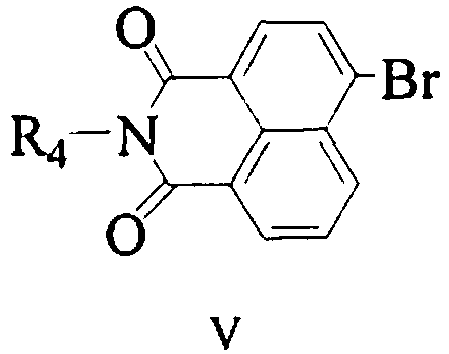
- 1) synthesizing the compound V by reacting the 4-Bromo-1,8-naphthalic anhydride with R4-NH3 in a mole ratio of 1:1-1:5;
- 2) synthesizing the compound VI by reacting the 4-Bromo-1,8-naphthalic anhydride with compound i in a mole ratio of 1:1-1:5;

- 3) synthesizing the compound VII by reacting the 4-bromoacenaphthenequinone with compound i in a mole ratio of 1:1-1:5;

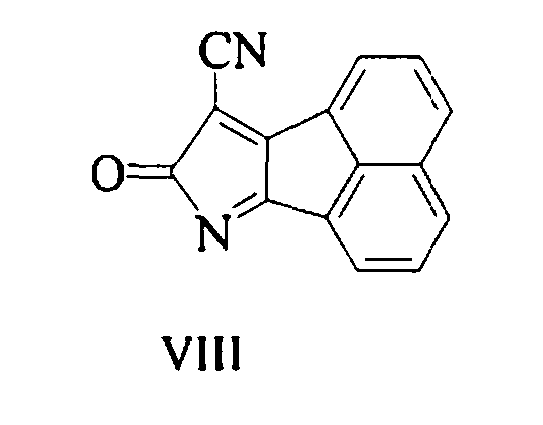
- 4) synthesizing the compound VIII by reacting acenaphthenequinone with malononitrile and dimethyl sulfoxide in a mole ratio of 1:1:5;

- 5) synthesizing the compounds IX, X, XI and XII by reacting the NH2R3NH2 with compound V, VI, VII and VIII respectively in a mole ratio of 1:1-1:2.5;


- 6) synthesizing the compounds of formula I was obtained by reacting the compound ii with compound IX, X, XI and XII respectively in a mole ratio of 1:1-1:3;

- In the description of synthesizing methods for naphthalene-based two-photon fluorescence probes, the definition of each substituent, that is, R1, R2, R3, R4 and R5, are same as the definition mentioned above.
- On the other hand, present invention provides a method for labeling biological samples utilizing the naphthalene-based two-photon fluorescent probes mentioned above, especially, for the labeling of tumor cells and tissues.
- To overcome existing problems, a class of two-photon fluorescent dyes for effective and specific labeling the living tumor cells and tissues were designed and synthesized in this invention. The class of two-photon fluorescent dyes have a low fluorescence background in the non-tumor cells and tissues, and have a strong and specific fluorescent signal in the tumor cells and tissues. These probes have a certain level of water-solubility, while having good membrane permeability. In addition, they have a bigger effective two-photon absorption cross section. The compounds of the present invention also have a lower biotoxicity, phototoxicity and photobleaching. There is sufficient difference between the spectral range thereof and that of a biological sample.
- There are 13 drawings in this invention:
-
Figure 1 is the general formula I of naphthalene-based two-photon fluorescence probes in this invention. -
Figure 2 is the two-photon fluorescent imaging of fluorescent probe compound A1 in the tumor cells and non-tumor cells in example 2. Hela cells and HEK293 cells were incubated with 4µL of A1-DMSO (4.0 µM) for 60 min in 5% CO2 at 37 °C. The representative areas were selected and imaged with oil-immersion objective lens (100 x). The resulting images are representative of replicate experiments (n = 3). The images were recorded with the emission in the range of 500-550 nm.Figure 2 (a) is confocal image of Hela cell,Figure 2 (b) is confocal image of HEK293 cell. -
Figure 3 is the measurement result of two-photon cross section of fluorescent probe compound A1 in different solvents in example 3. The determination solvent is dimethyl sulfoxide (DMSO). The method for determine the two-photon cross section (δ) is femtosecond (fs) fluorescence measurement technique. The reference solution is fluorescein-sodium hydroxide solution (pH=11), the concentration of A1 solutions were 1 × 10⁻⁴ M, the width of laser pulse is 70 fs, repetition frequency is 80 MHz, the average output power is 1.5 W (780 nm), tunable wavelength range is at 700-980 nm, the wavelength of laser was adjusted to the need wavelength in the experiment. -
Figure 4 is the two-photon fluorescent imaging of fluorescent probe compound A2 in the tumor cells and non-tumor cells in example 5. Hela cells and HEK293 cells were incubated with 4µL of A2-DMSO (4.0 µM) for 60 min in 5% CO2 at 37°C. The representative areas were selected and imaged with oil-immersion objective lens (100 x). The resulting images are representative of replicate experiments (n = 3). The images were recorded with the emission in the range of 500-550 nm.Figure 4 (a) is confocal image of Hela cell,Figure 4 (b) is confocal image of HEK293 cell. -
Figure 5 is the characterization result of water solubility of fluorescent probe compound A2 in example 6. The absorbance of different concentrations of compound A2 solution at maximum absorption wavelength was detected. The results are representative value from replicate experiments (n=3). -
Figure 6 is the characterization result of solvents effect of fluorescence compound A3 in example 8. The compound A3 was added to the DMSO or THF and the U-V absorption spectra (a) and fluorescence emission spectra (b) of A3 in different solutions are detected. -
Figure 7 is the measurement result of two-photon cross section of fluorescent probe compound A3 in different solvents in example 9. The determination solvent is dimethyl sulfoxide (DMSO) and tetrahydrofuran. The method for determine the two-photon cross section (δ) is femtosecond (fs) fluorescence measurement technique. The reference solution is fluorescein-sodium hydroxide solution (pH=11), the concentration of A3 solutions were 1 × 10⁻⁴ M, the width of laser pulse is 70 fs, repetition frequency is 80 MHz, the average output power is 1.5 W (780 nm), tunable wavelength range is at 700-980 nm, the wavelength of laser was adjusted to the need wavelength in the experiment. -
Figure 8 is the two-photon fluorescent imaging of fluorescent probe compound A4 for the tumor tissues and non-tumor tissues of mice' lungs in example 11. The sections of tumor tissues and non-tumor tissues of mice' lungs were incubated with 4µL of A4 (10.0 µM). The representative areas were selected and imaged with oil-immersion objective lens (100 x). The resulting images are representative of replicate experiments (n = 3).Figure 8 (a1) and (a2) are the confocal images of tumor tissue sections of mice' lungs after adding probe A4,Figure 8 (b1) and (b2) are the confocal images of non-tumor tissue sections of mice' lungs after adding probe A4. The images offigure 8 (a1) and (b1) were recorded with the emission in the range of 500-550 nm. The images offigure 8 (a2) and (b2) were recorded with the emission in the range of 570-650 nm. -
Figure 9 is the characterization result of water solubility of fluorescent probe compound A4 in example 12. The absorbance of different concentrations of compound A4 solution at maximum absorption wavelength was detected. The results are representative value from replicate experiments (n=3). -
Figure 10 is two-photon fluorescent imaging of fluorescent probe compound A2 in the tumor cells and non-tumor cells in example 14. Hela cells and HEK293 cells were incubated with 4µL of A5-DMSO (4.0 µM) for 60 min in 5% CO2 at 37 °C. The representative areas were selected and imaged with oil-immersion objective lens (100 x). The resulting images are representative of replicate experiments (n = 3).Figure 10 (a1) and (a2) are confocal image of Hela cell,Figure 10 (b1) and 10(b1) are confocal image of HEK293 cell. The images offigure 10 (a1) and (b) were recorded with the emission in the range of 500-550 nm. The images offigure 10 (a2) and (b2) were recorded with the emission in the range of 570-650 nm. -
Figure 11 is two-photon fluorescent imaging of fluorescent probe compound A5 for the tumor tissues and non-tumor tissues of mice' lungs in example 15. The sections of tumor tissues and non-tumor tissues of mice' lungs were incubated with 4µL of A4 (10.0 µM). The representative areas were selected and imaged with oil-immersion objective lens (100 x). The resulting images are representative of replicate experiments (n = 3).Figure 11 (a1) and (a2) are the confocal images of tumor tissue sections of mice' lungs,Figure 11 (b1) and (b2) are the confocal images of non-tumor tissue sections of mice' lungs. The images offigure 11 (a1) and (b1) were recorded with the emission in the range of 500-550 nm. The images offigure 11 (a2) and (b2) were recorded with the emission in the range of 570-650 nm. -
Figure 12 is the characterization result of solvent effect of fluorescent compound A6 in example 17. The determination solvent is DMSO. The U-V absorption spectra (a) and fluorescence emission spectra (b) of A6 in the different solvents were detected. -
Figure 13 is the measurement data of two-photon cross section of fluorescent probe compound A6 in different solvents in example 18. The determination solvent is dimethyl sulfoxide (DMSO) and tetrahydrofuran. The method for determine the two-photon cross section (δ) is femto second (fs) two-photon induced fluorescence measurement technique. The reference solution is fluorescein-sodium hydroxide solution (pH=11), the concentrations of A3 solution were 1 × 10⁻⁴ M, the width of laser pulse is 70 fs, repetition frequency is 80 MHz, the average output power is 1.5 W (780 nm), tunable wavelength range is at 700-980 nm, the wavelength of laser was adjusted to the need wavelength in the experiment. - Unless otherwise specified, the terms used in this invention have the following meanings:
- The term "alkyl" used herein includes straight and branched alkyl groups. In reference to a single alkyl such as "propyl", it specifically means a straight alkyl group, while in reference to a single branched alkyl such as "isopropyl", it specifically means a branched alkyl group. For example, "C1-6 alkyl" includes C1-4 alkyl, C1-3 alkyl, methyl, ethyl, n-propyl, isopropyl and tert-butyl. The similar rule applies to other groups used in this invention.
- The term "halogen" used herein includes fluorine, chlorine, bromine and iodine.
- The compounds of formula I in this invention, preferably R1 and R2 are each independently selected from the group consisting of -OCH3, -OCOCH3 and halogen, more preferably R1 and R2 are independently selected from the group consisting of -OCH3 and halogen, even more preferably, R1 and R2 are independently selected from the group consisting of -OCH3 and -Cl, most preferably R1 is -OCH3, R2 is -Cl.
- Preferably R3 is -(CH2)3-7-, more preferably R3 is selected from -(CH2)5- and -(CH2)6-.
- Preferably R4 is selected from the group consisting of C1-6alkyl, HOCH2-, HO(CH2)2-, HO(CH2)3-, HO(CH2)4-, HO(CH2)5- and HO(CH2)6-, more preferably R4 is C1-6 alkyl, most preferably R4 is C1-4 alkyl;
- Preferably R5 is selected from the group consisting of -H, -CN, -COOH, -NH2, -NO2, -OH and -SH, more preferably R5 is selected from the group consisting of -H, -CN, -COOH, -NH2, and -NO2, even more preferably R5 is selected from the group consisting of -H, -CN, -COOH, and -NO2, most preferably R5 is selected from the group consisting of -H and -NO2.
- On the other hand, the present invention further provides a method for synthesizing the naphthalene-based two-photon fluorescent probes, which includes the following steps:
- 1) synthesizing the compound V by reacting the 4-bromo-1,8-naphthaleneic anhydride reacted with R4-NH3 in a mole ratio of 1:1-1:5;

In the preferred embodiments, the reaction temperature is 80-140 □, the reaction time is 2-10 hours, the reaction solvents is ethanol, ethyl acetate, acetic acid or their mixture, the mole ratio between 4-bromo-1,8-naphthalic anhydride and R4- NH3 is 1:1-1:4;
In the more preferred embodiments, the reaction temperature is 90-120□, reaction time is 3-10 hours, the reaction solvents is ethyl acetate, acetic acid or their mixture, the mole ratio between 4-bromio-1,8-naphthalic anhydride and R4-NH3 is 1:1-1:3;
In the most preferred embodiments, the reaction temperature is 95-110□, reaction time is 4-8 hours, the reaction solvents is ethyl acetate, acetic acid or their mixture, the mole ratio between 4-bromo-1,8-naphthalic anhydride and R4- NH3 is 1:1-1:2; - 2) synthesizing the compound VI by reacting 4-bromo-1,8-naphthalic anhydride with compound i in a mole ratio of 1:1-1:5;

In the preferred embodiments, the reaction temperature is 80-1400, the reaction time is 2-10 hours, the reaction solvents is ethanol, ethyl acetate, acetic acid or their mixture, the mole ratio between 4-bromo-1,8-naphthalic anhydride and R4-NH3 is 1:1-1:4;
In the more preferred embodiments, the reaction temperature is 90-120 □, the reaction time is 3-10 hours, the reaction solvents is ethyl acetate, acetic acid or their mixture, the mole ratio between 4-bromo-1,8-naphthalic anhydride and R4-NH3 is 1:1-1:3;
In the most preferred embodiments, the reaction temperature is 95-110□, the reaction time is 4-8 hours, the reaction solvents is acetic acid, the mole ratio between 4-bromo-1,8-naphthalic anhydride and R4-NH3 is 1:1-1:2; - 3) synthesizing the compound VII by reacting the 4-bromoacenaphthenequinone with compound i in a mole ratio of 1:1-1:5;

In the preferred embodiments, the reaction temperature is 80-140 □, the reaction time is 2-10 hours, the reaction solvents is ethanol, ethyl acetate, acetic acid or their mixture, the mole ratio between 4-bromo-1,8-naphthalic anhydride and R4-NH3 is 1:1-1:4;
In the more preferred embodiments, the reaction temperature is 90-120 □, the reaction time is 3-10 hours, the reaction solvents is ethyl acetate, acetic acid or their mixture, the mole ratio between 4-bromo-1.8-naphthalic anhydride and R4-NH3 is 1:1-1:3;
In the most preferred embodiments, the reaction temperature is 95-110 □, reaction time is 4-8 hours,the reaction solvents is acetic acid, the mole ratio between 4-bromo-1,8-naphthalic anhydride and R4-NH3 is 1:1-1:2; - 4) synthesizing the compound VIII by reacting acenaphthenequinone with malononitrile and dimethyl sulfoxide in a mole ratio of 1:1:5;

In the preferred embodiments after the reaction processed at room temperature for 0.5 hours, the reaction temperature increased to 80-160□, and the reaction continued for 4-10 hours; the reaction solvent is dimethyl sulfoxide, tetrahydrofuran, or their mixture with water;
In the more preferred embodiments, after the reaction processed at room temperature for 0.5 hours, the reaction temperature increased to 90-140 □, and the reaction continued for 4-6 hours; the reaction solvent is dimethyl sulfoxide or its mixture with water.
In the most preferred embodiments, after the reaction processed at room temperature for 0.5 hours, the reaction temperature increased to 100-120 □, and the reaction continued for 4-6 hours; the reaction solvent is dimethyl sulfoxide; - 5) synthesizing the compounds IX, X, XI and XII by reacting NH2R3NH2 with compound V, VI, VII and VIII respectively in a mole ratio 1:1-1:2.5;


In the preferred embodiments, the reaction temperature is 100-165□, reaction time is 1-6 hours, the reaction solvents is ethanol, ethylene glycol monomethyl ether or their mixture, the mole ratio between compounds V, VI, VII, VIII and NH2R3NH2 is 1:1-1:2.5, respectively;
In the more preferred embodiments, the reaction temperature is 100-150 □, the reaction time is 1-5 hours, the reaction solvents is selected from ethanol, ethylene glycol monomethyl ether or their mixture, the mole ratio between compounds V, VI, VII, VIII and NH2R3NH2 is 1:1-1:2, respectively;
In the most preferred embodiments, the reaction temperature is 100-130 0, the reaction time is 1-4 hours, the reaction solvent is ethylene glycol monomethyl ether, the mole ratio between compounds V, VI, VII, VIIf and NH2R3NH2 is 1:1-1:1.5, respectively; - 6) synthesizing the compounds of formula I by reacting compound ii with compound IX, X, XI, XII respectively in a mole ratio of 1:1-1:3;

- In the preferred embodiments, the reaction temperature is 10-80□,the reaction time is 12-32 hours, the reaction solvent is methylene chloride, ethanol, ethyl acetate or their mixture; the reaction is progressed in the presence of organic base and the 4 - dimethyl amino pyridine was used as catalyzer; the mole ratio between compound IX, X, XI or XII and compound ii is 1:1-1:3, respectively;
- In the more preferred embodiments, the reaction temperature is 10-70□, the reaction time is 12-24 hours, the reaction solvent is methylene chloride, ethanol, ethyl acetate or their mixture; the reaction is progressed in the presence of organic base and the 4 - dimethyl amino pyridine was used as catalyzer; the mole ratio between compound IX, X, XI or XII and compound ii is 1:1-1:2.5, respectively;
- In the most preferred embodiments, the reaction temperature is 10-40□, the reaction time is 12-24 hours, the reaction solvent is methylene chloride; the reaction is progressed in the presence of organic base and the 4 - dimethyl amino pyridine was used as catalyzer; the mole ratio between compound IX, X, XI or XII and compound ii is 1:1-1:1.5, respectively.
- The definition and optimization for every substituent group (R1, R2, R3, R4 and R5) in synthesis method for naphthalene-based two-photon fluorescent probes consistent with that for compounds in this invention.
- The structures of two-photon fluorescent probe compounds which were synthesized through the above-mentioned methods in this invention, were characterized by NMR spectrometry and Mass spectrometry, and the structures also confirmed with the 13C-NMR spectrometry and the melting point analysis.
- Naphthalene-based two-photon fluorescent probes described in this invention have the following advantages:
- Introduction of the specific target point into the molecules of the above-mentioned compounds increases the labeling specificity of new compounds for the tumor cells and tissues. The probes were introduced the specificity target point to improve the specific labeling of tumor cells or tissues.
- The compounds described above have excellent two-photon properties, when they used for imaging of biological sample, the compounds have lower light bleaching, light damage and biological toxicity, and the produced fluorescence signal can pentrate deeper into biological tissues;
Emission wavelength of a part of probes was greater than 600 nm, so they can be used for the living imaging;
The compounds containing nitro group can be used as a proportion of the probe to image tumor cells and tissues, which can achieve a good quantitative labeling and avoid the disturbance of external environment factors on the fluorescence intensity;
The compounds described above are low in toxicity and side effects, readily available in raw materials, simple in structure, and suitable for industrialization; - Therefore, the two-photon fluorescent probes described in this invention can be used for the labeling of tumor cells and tissues. The compounds described in this invention can be used directly for labeling the tumor cells and tissues in the form of described herein. Alternatively, the composition containing compounds of this invention can also be used for the labeling tumor cells and tissues. The composition should be included in the effective dose of one of the two-photon fluorescent probe compound in this invention. Furthermore, it also included other components which need in the biological staining, such as, solvent, buffer, and so on. These components are all known in the industry. The above-mentioned composition may exist in the form of aqueous solution, or may exist in other suitable forms of solution by mixing it with water before use.
- The present invention further provides a method for the labeling tumor cells and tissues using the two-photon fluorescent probe compounds described above. The method may include the step of contacting the above-mentioned compounds with the biological samples. The term "contacting" used herein may included contacting in solution or solid phase.
- The following examples can make it clear for common technicists to know the present invention, but no restrict on present invention.
- The synthesis of fluorescent probe A1:

- 20 mmol of 4-bromo-1,8-naphthalic anhydride and 25 mmol of methylamine were added into a round-bottom flask containing 10 mL acetic acid under nitrogen protection, the mixture was heated to reflux for 2h at 100 □. Then the solution was poured into cooled water and filtrated. The white solid powder was collected to obtain the intermediate 1 in a yield of 96%.
- 20 mmol of intermediate 1 and 30 mmol of hexamethylenediamine were added into a round-bottom flask containing 20ml ethylene glycol monomethylether under nitrogen protection, the mixture was heated to reflux for 5h at 125D, then the solution was poured into cooled water and filtrated. The residue was collected and purified by silica gel column chromatography, affording the intermediate 2 as a yellow solid powder in a yield of 55 %.
- 20 mmol intermediate 2, 25 mmol indomethacin, and 25 mmol 1-(3-dimethylaminopropyl)-3-ethylcarbodiimide(EDC) and small amount of 4-methylpyridine were added into in anhydrous methylene chloride and the mixture was stirred at room temperature under nitrogen protection for 24 h. The solvent was removed by vacuum distillation and the residue was purified by silica gel column chromatography to give a pale-yellow product in a yield of 84 %. 1H NMR: (400 MHz, DMSO) δ 8.69 (d, J = 8.3 Hz, 1H), 8.43 (d, J = 7.2 Hz, 1H), 8.25 (d, J = 8.5 Hz, 1H), 8.03 (s, 1H), 7.72 (d, J = 3.5 Hz, 2H), 7.64 (dt, J = 20.8, 6.4 Hz, 5H), 7.12 (d, J = 2.4 Hz, 1H), 6.91 (d, J = 9.0 Hz, 1H), 6.72 (d, J = 8.6 Hz, 1H), 6.68 (dd, J = 9.0, 2.5 Hz, 1H), 4.22 (s, 1H), 3.74 (s, 3H), 3.48 (s, 2H), 3.37 - 3.12 (m, 16H), 3.08 (d, J = 6.1 Hz, 2H), 2.51 (d, J = 1.6 Hz, 6H), 2.22 (s, 3H), 1.71 - 1.57 (m, 3H), 1.37 (ddd, J = 24.7, 14.6, 6.8 Hz, 8H), 1.23 (s, 1H).
- The labeling experiment of probe compound A1 for cancer cells and non-cancer cells
- Compound A1 was used, which was synthesized in the example 1. 4µL of compound A1-DMSO solution (4µM) was added into HeLa and HEK 293 cells, respectively. HeLa and HEK 293 cells with probe A1 were cultured for 60 min in 5% CO2 at 37 °C. Then, they were washed with phosphate-buffered
saline 5 min×3. After that, the fresh medium was added into every cell. The fluorescence imaging was obtained with a two-photon spectral confocal multiphoton microscope. The representative areas were selected and imaged three times with oil-immersion objective lens (100×). The imaging results indicated that there were strong fluorescence signals in HeLa cells, but there were no any fluorescence signal in HEK 293 cells.Figure 2(a) is confocal image of HeLa cell after adding probe A1,Figure 2(b) is confocal image of HeLa cell after adding probe A1. The images were recorded with the emission in the range of 500-550 nm. - The detection experiment of the effective two-photon cross section (δ) of A1
- The two-photon cross section (δ) was determined by the femtosecond two-photon induced fluorescence method The compound A1, which was synthesized in the example 1, was dissolved in methanol, ethanol, acetone, acetonitrile, dioxane, dimethyl sulfoxide, tetrahydrofuran, N,N-dimethyl formamide, water and so on, respectively, at concentration of 1.0 × 10⁻⁴ M and then the two-photon cross section (δ) was measured by using fluorescein-sodium hydroxide solution (pH=11) as reference solution. The calculated equation was as follow:

- In this equation, the concentration of solutions was denoted as c, the refractive index was denoted as n which was found in common data table. The upconversion fluorescence intensity was denoted as F, which was obtained by experiment. δ is the two-photon cross section. The reference solution was subscripted r.
- The effective two-photon cross section (δΦ) in different solution and at different wavelength was detected in
figure 3 . The excitation source of two-photon fluorescence spectra is a mode-locked titanium-sapphire laser, the width of laser pulse is 70 fs, repetition frequency is 80 MHz, the average output power is 1.5 W (780 nm), tunable wavelength range is at 700-980 nm, the wavelength of laser was adjusted to the need wavelength in the experiment. - The synthesis of fluorescent probe A2

- 20 mmol of 4-bromo-1,8-naphthalic anhydride and 25 mmol of o-phenylenediamine were added into a round-bottom flask containing 10 mL acetic acid under nitrogen protection, the mixture was heated to reflux for 4h at 95 □. Then the solution was poured into cooled water and filtrated. The yellow solid powder was collected to obtain the intermediate 2 in a yield of 90%.
- 20 mmol of intermediate 1 and 25 mmol of hexamethylenediamine were added into a round-bottom flask containing 20ml ethylene glycol monomethylether under nitrogen protection, the mixture was heated to reflux for 5 h at 125 □, then the solution was poured into cooled water and filtrated. The residue was collected and purified by silica gel column chromatography, affording intermediate 2 as a yellow solid powder in a yield of 63 %.
- 20 mmol of intermediate 2, 25 mmol of indomethacin and 25 mmol of 1-(3-dimethylaminopropyl)-3-ethylcarbodiimide(EDC), and small amount of 4-methylpyridine were added into in anhydrous methylene chloride and the mixture was stirred at room temperature for 24 h. The solvent was removed by vacuum distillation and the residue was purified by silica gel column chromatography to give a deep-yellow product A2 in a yield of 84 %. 1H NMR (400 MHz, DMSO) δ 8.99 (d, J = 7.2 Hz, 2H), 8.69 (d, J = 8.3 Hz, 1H), 8.43 (d, J = 7.2 Hz, 1H), 8.25 (d, J = 8.5 Hz, 1H), 8.19 (d, J = 6.3 Hz, 2H), 8.03 (s, 1H), 7.85(d, J = 4.6 Hz, 1H), 7.72 (d, J = 3.5 Hz, 2H), 7.64 (dt, J = 20.8, 6.4 Hz, 5H), 7.12 (d, J = 2.4 Hz, 1H), 6.91 (d, J = 9.0 Hz, 1H), 6.72 (d, J = 8.6 Hz, 1H), 6.68 (dd, J = 9.0, 2.5 Hz, 1H), 4.22 (s, 1H), 3.48 (s, 2H), 3.37 - 3.12 (m, 16H), 3.08 (d, J = 6.1 Hz, 2H), 2.51 (d, J = 1.6 Hz, 6H), 2.22 (s, 3H), 1.71 - 1.57 (m, 3H), 1.37 (ddd, J = 24.7, 14.6, 6.8 Hz, 8H), 1.23 (s, 1H).
- The labeling experiment of probe compound A2 for tumor tissues and non- tumor tissues
- Tumor tissue sections and non-tumor tissues sections of mice' lungs were soaked in the compound A2 PBS solution (10 µM), respectively. After 30 min, take out the section, mounting, safekeeping, the fluorescence images were obtained by two-photon spectral confocal multiphoton microscope. The imaging results indicated that there were strong fluorescence signals in the tumor tissue sections of mice' lungs, but there was no any fluorescence signal in the non-tumor tissue sections of mice' lungs.
Figure 4(a) is confocal image of tumor tissue sections after adding probe A2,Figure 4(b) is confocal image of non-tumor tissue sections of mice' lungs after adding probe A2. The images were recorded with the emission in the range of 500-550 nm. - Water solubility experiment of probe compound A2
- The compound A2 in the mention above example 4 was added into the water, and the absorbance of different concentration compound A2 at maximum absorption wavelength was detected. The experiment results indicated that the absorbance still not skewed when the concentration of compound A2 was 5 µM, that is, the water solubility of compound A2 was 5 µM.
Figure 5 is the absorbance of different concentration compound A2 at maximum absorption wavelength. The experiment instrument is Agilent 8453 U-V spectrophotometer. - The synthesis of fluorescent probe A3

- 20 mmol of 4-bromo-1,8-naphthalic anhydride and 25 mmol of 4-nitro-o-phenylenediamine were added into a round-bottom flask containing 10 mL acetic acid under nitrogen protection, the mixture was heated to reflux for 3h at 105 □. Then the solution was poured to cooled water and filtrated. The yellow solid powder was collected to obtain the intermediate 1 in a yield of 87%.
- 20 mmol of intermediate 1 and 25 mmol of hexamethylenediamine were added into a round-bottom flask containing 20ml ethylene glycol monomethylether under nitrogen protection, the mixture was heated to reflux for 4h at 125 □, then the solution was poured into cooled water and filtrated. The residue was purified by silica gel column chromatography, affording intermediate 2 as a red solid powder in a yield of 54 %.
- 20 mmol of intermediate 2, 25 mmol of indomethacin, 25 mmol of 1-(3-dimethylaminopropyl)-3-ethylcarbodiimide(EDC) and small amount of 4-methylpyridine were added into in anhydrous methylene chloride and the solution was stirred at room temperature under nitrogen for 24 h. The solvent was removed by vacuum distillation and residue was purified by silica gel column chromatography, affording A3 as a hyacinth solid in a yield of 84 %. 1H NMR (400 MHz, DMSO) δ 8.99 (d, J = 7.2 Hz, 1H), 8.69 (d, J = 8.3 Hz, 1H), 8.43 (d, J = 7.2 Hz, 1H), 8.25 (d, J = 8.5 Hz, 1H), 8.19 (d, J = 6.3 Hz, 1H), 8.03 (s, 1H), 7.85(d, J = 4.6 Hz, 1H), 7.72 (d, J = 3.5 Hz, 2H), 7.64 (dt, J = 20.8, 6.4 Hz, 5H), 7.12 (d, J = 2.4 Hz, 1H), 6.91 (d, J = 9.0 Hz, 1H), 6.72 (d, J = 8.6 Hz, 1H), 6.68 (dd, J = 9.0, 2.5 Hz, 1H), 4.22 (s, 1 H), 3.48 (s, 2H), 3.37 - 3.12 (m, 16H), 3.08 (d, J = 6.1 Hz, 2H), 2.51 (d, J = 1.6 Hz, 6H), 2.22 (s, 3H), 1.71 - 1.57 (m, 3H), 1.37 (ddd, J = 24.7, 14.6, 6.8 Hz, 8H), 1.23 (s, 1H).
- The compound A3, which was synthesized in the example 7, was added into the different solvent (methanol, ethanol, acetone, acetonitrile, dioxane, dimethyl sulfoxide, tetrahydrofuran, N,N-dimethyl formamide, water and so on), and the absorption spectra and fluorescence emission spectra were measured. The detected results indicated that the maximum absorption wavelength occurs corresponding displacement in absorption spectra with the change of the solvent polarity, at the same time, the maximum emission wavelength have corresponding displacement in fluorescence emission spectra.
Figure 6(a) is the U-V absorption spectra of compound A3 in different solvent,figure 6(b) is the fluorescence emission spectra of compound A3 in different solvent. The experiment instrument is Agilent 8453 U-V spectrophotometer and Agilent Cary Eclipse fluorescence spectrophotometer. - The two-photon cross section (δ) of A3 was determined by using femto second (fs) fluorescence measurement technique. The probe compound A3, which was synthesized in the example 7 was dissolved in methanol, ethanol, acetone, acetonitrile, dioxane, dimethyl sulfoxide, tetrahydrofuran, N,N-dimethyl formamide, water and so on, respectively, at concentrations of 1.0 × 10⁴ M and then the two-photon cross section(δ) was measured by using fluorescein-sodium hydroxide solution (pH=11) as reference solution. The value of two-photon cross section(δ) was obtained by using calculation formula of 2.2.
- The effective two-photon cross section (δΦ) in different solution and at different wavelength was shown in
figure 7 . The excitation source of two-photon fluorescence spectra is a mode-locked titanium-sapphire laser, the width of laser pulse is 70 fs, repetition frequency is 80 MHz, the average output power is 1.5 W (780 nm), tunable wavelength range is at 700-980 nm, the wavelength of laser was adjusted to the need wavelength in the experiment. -

- 33 mmol of acenaphthequinone and 180 mmol of liquid bromine were stirred and slowly heat up to 650 and reacted for 3 h at 650. The reaction solution was poured to 300ml of cooled water containg a little H2SO4, a yellow solid was generated and the solution was showed deep yellow color. The reaction mixture was heated to dislodge liquid bromine and HBr untile the solution changed into colorless from deep yellow color, then the solution was filtrated and the filter cake was washed until the filtrate was neutral and dried to obtain the intermediate 1 in a yield of 90%. M.p.236-238□.
- 20 mmol of
intermdiate bottom flask containng 10 mL acetic acid under nitrogen protection, the mixture was stirred and refluxed for 6h at 100□, then the solution was poured to cooled water and filtrated. The yellow solid powder was collected to obtain the intermediate 2 in a yield of 79%. - 20 mmol of intermediate 2 and 25 mmol of hexamethylenediamine were added into a round- bottom flask containing 20ml ethylene glycol monomethylether under nitrogen protection, the mixture was heated to reflux for 6 h at 125□, then the solution was poured to cooled water and filtrated. The residue was purified by silica gel column chromatography, affording intermediate 3 as a yellow solid in a yield of 66 %.
- 20 mmol of intermediate 3, 30 mmol of indomethacin, 25 mmol of 1-(3-dimethylaminopropyl)-3-ethylcarbodiimide (EDC), and small amount of 4-methylpyridine were added into in anhydrous methylene chloride and the solution was stirred at room temperature under nitrogen for 25 h. The solvent was removed by vacuum distillation and residue was purified by silica gel column chromatography, affording A4 as a yellow solid in a yield of 74 %. 1H NMR (400 MHz, DMSO) δ 8.86 (d, J = 7.9 Hz, 2H) 8.69 (d, J = 8.3 Hz, 1H), 8.43 (d, J = 7.2 Hz, 1H), 8.25 (d, J = 8.5 Hz, 1H), 8.17 (d, J = 6.3 Hz, 2H), 8.03 (s, 1H), 7.72 (d, J = 3.5 Hz, 2H), 7.64 (dt, J = 20.8, 6.4 Hz, 5H), 7.12 (d, J = 2.4 Hz, 1H), 6.91 (d, J = 9.0 Hz, 1H), 6.72 (d, J = 8.6 Hz, 1H), 6.68 (dd, J = 9.0, 2.5 Hz, 1H), 4.22 (s, 1H), 3.48 (s, 2H), 3.37 - 3.12 (m, 16H), 3.08 (d, J = 6.1 Hz, 2H), 2.51 (d, J = 1.6 Hz, 6H), 2.22 (s, 3H), 1.71 - 1.57 (m, 3H), 1.37 (ddd, J = 24.7, 14.6, 6.8 Hz, 8H), 1.23 (s, 1H).
- The labeling experiment of probe compound A4 for tumor tissues and non-tumor tissues
- Tumor tissue sections and non-tumor tissues sections of mice' lungs were soaked in the compound A4 PBS solution (10 µM), respectively. After 30 min, take out the section, mounting, safekeeping, the fluorescence images were obtained by two-photon spectral confocal multiphoton microscope. The imaging results indicated that there were strong fluorescence signals in the tumor tissue sections of mice' lungs, but there was no any fluorescence signal in the non-tumor tissue sections of mice' lungs.
Figure 8(a1) and 8(a2) are confocal image of tumor tissue sections after adding probe A4,Figure 8(b1) and 8(b2) are confocal image of non-tumor tissue sections of mice' lungs after adding probe A4. The images were recorded with the emission in the range of 500-550 nm. - The compound A4 mentioned above was added into the water, and the absorbance of different concentration compound A4 at maximum absorption wavelength was detected. The experiment results indicated that the absorbance still not skewed when the concentration of compound A4 was 24 µM, that is, the water solubility of compound A4 was 24 µM.
Figure 9 is the absorbance of different concentration compound A4 at maximum absorption wavelength. The experiment instrument is Agilent 8453 U-V spectrophotometer. -

- 33 mmol of acenaphthequinone and 180 mmol of liquid bromine were stirred and slowly heat up to 65□ and reacted for 3 h at 65□. The reaction solution was poured to 300ml of cooled water containg a little H2SO4, a yellow solid was generated and the solution was showed deep yellow color. The reaction mixture was heated to dislodge liquid bromine and HBr untile the solution changed into colorless from deep yellow color. Then the reaction solution was filtrated and the filter cake was washed until the filtrate was neutral and dried to obtain the intermediate I in a yield of 90%. M.p.236-238□.
- 20 mmol of
intermdiate bottom flask containng 10 mL acetic acid under nitrogen protection, the mixture was stirred and refluxed for 5h at 100□, then the solution was poured to cooled water and filtrated. The red solid powder was collected to obtain the intermediate 2 in a yield of 83%. - 20 mmol of intermediate 2 and 25 mmol of hexamethylenediamine were added into a round- bottom flask containing 20ml ethylene glycol monomethylether under nitrogen protection, the mixture was heated to reflux for 5.5 h at 125□, then the solution was poured to cooled water and filtrated. The residue was purified by silica gel column chromatography, affording intermediate 3 as orange red solid powder in a yield of 72 %.
- 20 mmol of intermediate 3, 30 mmol of indomethacin, 25 mmol of 1-(3-dimethylaminopropyl)-3-ethylcarbodiimide(EDC), and small amount of 4-methylpyridine were added into in anhydrous methylene chloride and the solution was stirred at room temperature under nitrogen for 25 h. The solvent was removed by vacuum distillation and residue was purified by silica gel column chromatography, affording A5 as a orange red solid in a yield of 69 %. 1H NMR (400 MHz, DMSO) δ 8.86 (d, J = 7.9 Hz, 1H) 8.69 (d, J = 8.3 Hz, 1H), 8.43 (d, J = 7.2 Hz, 1H), 8.25 (d, J = 8.5 Hz, 1H), 8.23 (d, J = 6.9 Hz, 1H),8.18 (d, J = 6.3 Hz, 1H), 8.03 (s, 1H), 7.72 (d, J = 3.5 Hz, 2H), 7.64 (dt, J = 20.8, 6.4 Hz, 5H), 7.12 (d, J = 2.4 Hz, 1H), 6.91 (d, J = 9.0 Hz, 1H), 6.72 (d, J = 8.6 Hz, 1H), 6.68 (dd, J = 9.0, 2.5 Hz, 1H), 4.22 (s, 1H), 3.48 (s, 2H), 3.37-3.12 (m, 16H), 3.08 (d, J = 6.1 Hz, 2H), 2.51 (d, J = 1.6 Hz, 6H), 2.22 (s, 3H), 1.71-1.57 (m, 3H), 1.37 (ddd, J = 24.7, 14.6, 6.8 Hz, 8H), 1.23 (s, 1H).
- The labeling experiment of probe compound A5 for cancer cells and non-cancer cells
- Compound A5 was used, which was synthesized in the example 13. 4µL of compound A5-DMSO solution (4µM) was added into HeLa and HEK 293 cells, respectively. HeLa and HEK 293 cells with probe A5 were cultured for 60 min in 5% CO2 at 370. Then, they were washed with phosphate-buffered
saline 5 min×3. After that, the fresh medium was added into every cell. The fluorescence imaging was obtained with a two-photon spectral confocal multiphoton microscope. The representative areas were selected and imaged three times with oil-immersion objective lens (100×). The imaging results indicated that there were strong fluorescence signals in HeLa cells, but there were no any fluorescence signal in HEK 293 cells.Figure 10(a1) and 10(a2) are confocal images of HeLa cell after adding probe A5,figure 10(b1) and 10(b2) are confocal images of HEK 293 cell after adding probe A5. The images offigure 10(a1) and figure 10(b1) were recorded with the emission in the range of 500-550 nm. The images offigure 10(a2) and figure 10(b2) were recorded with the emission in the range of 500-550 nm. - The labeling experiment of probe compound A5 for tumor tissues and non-tumor tissues
- Tumor tissue sections and non-tumor tissues sections of mice' lungs were soaked in the compound A5 PBS solution (10 µM), respectively. After 30 min, take out the section, mounting, safekeeping, the fluorescence images were obtained by two-photon spectral confocal multiphoton microscope. The imaging results indicated that there were strong fluorescence signals in the tumor tissue sections of mice' lungs, but there were no any fluorescence signals in the non-tumor tissue sections of mice' lungs.
Figure 11(a1) and 11(a2) are confocal image of tumor tissue sections after adding probe A5,Figure 11(b1) and 11(b2) are confocal image of non-tumor tissue sections of mice' lungs after adding probe A5. The images offigure 11(a1) and figure 11(b1) were recorded with the emission in the range of 500-550 nm. The images offigure 11(a2) and figure 11(b2) were recorded with the emission in the range of 570-650 nm. - The synthesis of fluorescent probe A6

- 0.5 g of acenaphthequinone and 0.2 g of malononitrile were dissolved in 50 ml of CH2Cl2, and was directly purified by silica gel column chromatography using a CH2Cl2 as the eluent. The fraction with an Rf value of 0.8 was collected and evaporated to remove the CH2Cl2, affording intermediate 1 as orange red solid in a yield of 97 %.
- 1.0 g of intermediate 1 and 0.2 g of K2CO3 were added into 20 ml, and the reaction mixture was heated to reflux, a large amount of brown precipitate(crystal) was appeared after several minutes. After cooling, the precipitate was filtered and washed with water to remove the K2CO3 and dried to obtain the intermediate 2. The yield was greater then 93%.
- 20 mmol of intermediate 2 and 25 mmol of hexamethylenediamine were added into a round-bottom flask containing 20 ml of acetonitrile under nitrogen protection, the mixture was stirred at room temperature for 1h. After removing the solvent by vacuum distillation, the residue was purified by silica gel column chromatography. The fraction with an Rf value of 0.25 was collected and evaporated to remove the solvent, affording the pure intermediate 3 in a yield of 73 %.
- 20 mmol of intermediate 3, 20 mmol of indomethacin, 25 mmol of 1-(3-dimethylaminopropyl)-3-ethylcarbodiimide(EDC), and small amount of 4-methylpyridine were added into in anhydrous methylene chloride and the solution was stirred at room temperature for 25 h. The solvent was removed by vacuum distillation and the residue was purified by silica gel column chromatography, affording A6 as a red solid in a yield of 69 %. 1H NMR (400 MHz, DMSO) δ 8.95 (d, J = 7.6 Hz, 1H), 8.58 (d, J = 7.2 Hz, 1H), 7.98 (d, J = 8.8 Hz, 1H), 7.88 (t, J = 7.8 Hz, 1H), 7.72 (d, J = 3.5 Hz, 2H), 7.64 (dt, J = 20.8, 6.4 Hz, 5H), 7.12 (d, J = 2.4 Hz, 1H), 7.03 (d, J = 9.2 Hz, 1H), 6.91 (d, J = 9.0 Hz, 1H), 6.72 (d, J = 8.6 Hz, 1H), 6.68 (dd, J = 9.0, 2.5 Hz, 1H), 4.22 (s, 1H), 3.48 (s, 2H), 3.37 - 3.12 (m, 16H), 3.08 (d, J = 6.1 Hz, 2H), 2.51 (d, J = 1.6 Hz, 6H), 2.22 (s, 3H), 1.71 - 1.57 (m, 3H), 1.37 (ddd, J = 24.7, 14.6, 6.8 Hz, 8H), 1.23 (s, 1H).
- The compound A6, which was synthesized in the example 16, was added into the different solvent (methanol, ethanol, acetone, acetonitrile, dioxane, dimethyl sulfoxide, tetrahydrofuran, N,N-dimethyl formamide, water and so on), and the absorption spectra and fluorescence emission spectra were measured. The detected results indicated that the maximum absorption wavelength occurs corresponding displacement in absorption spectra with the change of the solvent polarity, at the same time, the maximum emission wavelength have corresponding displacement in fluorescence emission spectra.
Figure 12(a) is the U-V absorption spectra of compound A6 in different solvent,figure 12(b) is the fluorescence emission spectra of compound A6 in different solvent. The experiment instrument is Agilent 8453 U-V spectrophotometer and Agilent Cary Eclipse fluorescence spectrophotometer. - The two-photon cross section (δ) of A6 was determined by using femto second (fs) fluorescence measurement technique. The probe compound A6, which was synthesized in the example 16 was dissolved in methanol, ethanol, acetone, acetonitrile, dioxane, dimethyl sulfoxide, tetrahydrofuran, N,N-dimethyl formamide, water and so on, respectively, at concentrations of 1.0 × 10⁻⁴ M and then the two-photon cross section(δ) was measured by using fluorescein-sodium hydroxide solution (pH=11) as reference solution. The value of two-photon cross section(δ) was obtained by using calculation formula of 2.2. The effective two-photon cross section (δΦ) in different solution and at different wavelength was shown in
figure 13 . The excitation source of two-photon fluorescence spectra is a mode-locked titanium-sapphire laser, the width of laser pulse is 70 fs, repetition frequency is 80 MHz, the average output power is 1.5 W (780 nm), tunable wavelength range is at 700-980 nm, the wavelength of laser was adjusted to the need wavelength in the experiment. - The above content is further explained about invention combining with optimization of concrete implementation way, but concrete implementation methods were restricted in this explanation. About the technical staffs in this field of technology, some simple deduction or replace which were made according this invention, should be regarded as fall within the scope of the present invention to protect. The compounds which were reported in this invention can be used as fluorescence dyes, but not only be used as fluorescence dyes. About the technical staffs in this field of technology, some simple ratiocinations which were made according the similar mechanism of this invention, should be regarded as fall within the scope of the present invention to protect.
Claims (10)
- A category of naphthalene-based two-photon fluorescent probes having a general formula I as follows:
 X is selected from the X1, X2, X3 and X4; X connected to the general formula I by a dotted line;
 R1 and R2 are each independently selected from the group consisting of -OCH3, -OCOCH3 and halogen;R3 is selected from the group consisting of -CH2-, -(CH2)2-, -(CH2)3-, -(CH2)4-, -(CH2)5-, -(CH2)6-, -(CH2)7- and -(CH2)8-;R4 is selected from the group consisting of C1-6 alkyl, HOCH2-, HO(CH2)2-, HO(CH2)3-, HO(CH2)4-, HO(CH2)5- and HO(CH2)6-;R5 is selected from the group consisting of -H, -CN, -COOH, -NH2, -NO2, -OH and -SH.
 - The naphthalene-based two-photon fluorescent probes according to claim 1, wherein R1 and R2 are each independently selected from the group consisting of -OCH3 and halogen.
- The naphthalene-based two-photon fluorescent probes according to claim 1, wherein R3 is selected from the group consisting of -(CH2)5- and -(CH2)6-.
- The naphthalene-based two-photon fluorescent probes according to claim 1, wherein R4 is selected from C1-4 alkyl.
- The naphthalene-based two-photon fluorescent probes according to claim 1, wherein R5 is selected from the group consisting of -H, -CN, -COOH and -NO2.
- The naphthalene-based two-photon fluorescent probes according to claim 1, selected from the compounds consisting of A1-A6


- A method for synthesizing the naphthalene-based two-photon fluorescent probes according to claim 1, comprising the steps as follows:1) synthesizing the compound V by reacting the 4-Bromo-1,8-naphthalic anhydride with R4-NH3 in a mole ratio of 1:1-1:5;
 2) synthesizing the compound VI by reacting the 4-Bromo-1,8-naphthalic anhydride with compound i in a mole ratio of 1:1-1:5;
 3) synthesizing the compound VII by reacting the 4-bromoacenaphthenequinone with compound i in a mole ratio of 1:1-1:5;
 4) synthesizing the compound VIII by reacting acenaphthenequinone with malononitrile and dimethyl sulfoxide in a mole ratio of 1:1:5;
 5) synthesizing the compounds IX, X, XI and XII by reacting NH2R3NH2 with compound V, VI, VII and VIII respectively in a mole ratio of 1:1-1:2.5;
 6) synthesizing the compounds of formula I by reacting the compound ii with compound IX, X, XI and XII respectively in a mole ratio of 1:1-1:3;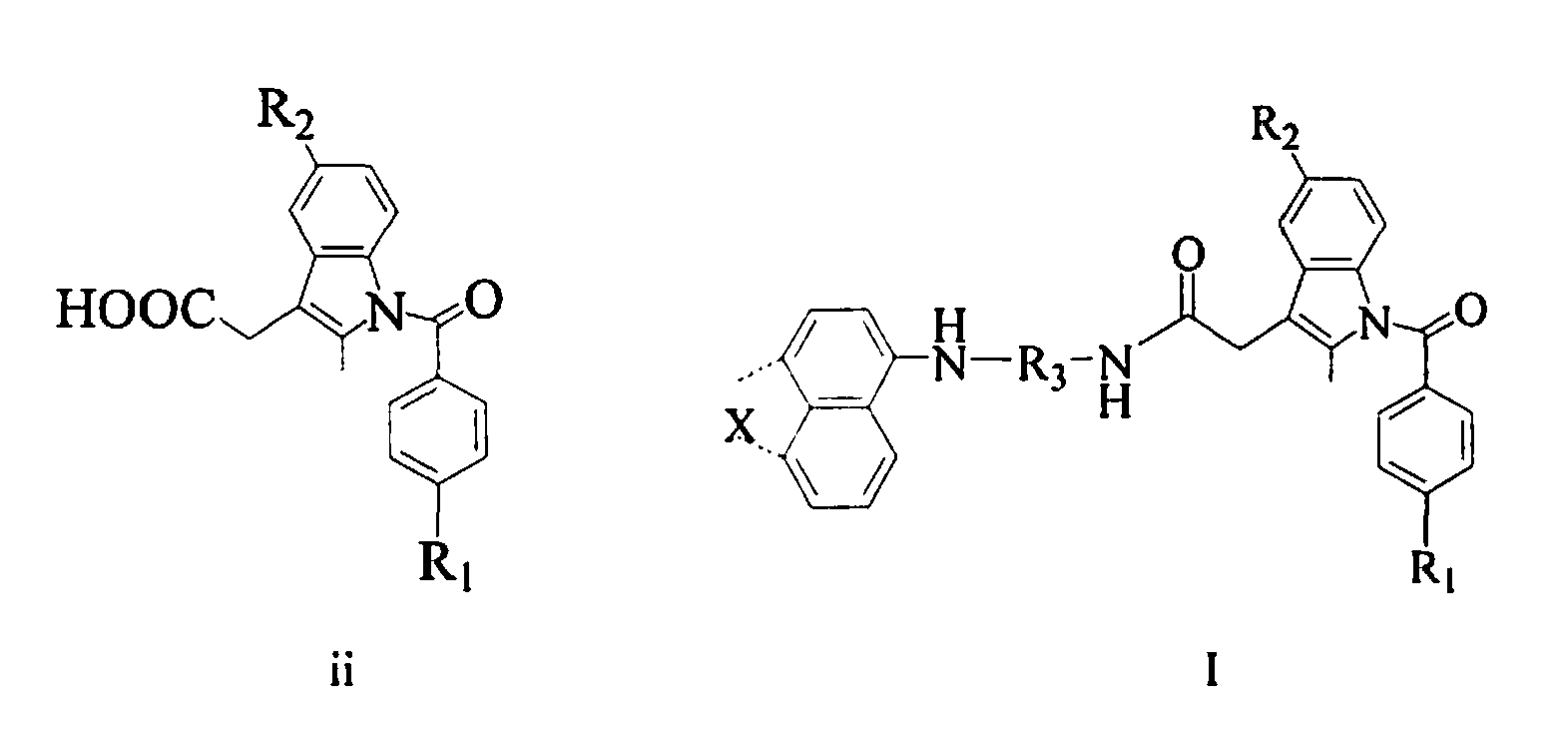
- The method according to the claim 6, wherein the mole ratio of water to dimethyl sulfoxide or tetrahydrofuran in the step 4) is 1:1-1:1.25.
- A use of naphthalene-based two-photon fluorescent probes according to any one of claim 1 to 5 for labeling biological sample.
- The use of naphthalene-based two-photon fluorescent probes according to the claim 9, wherein the biological sample is tumor tissues or tumor cells.
Applications Claiming Priority (1)
| Application Number | Priority Date | Filing Date | Title |
|---|---|---|---|
| PCT/CN2012/071940 WO2013131235A1 (en) | 2012-03-05 | 2012-03-05 | Two-photon fluorescent probe using naphthalene as matrix and preparation method and use thereof |
Publications (3)
| Publication Number | Publication Date |
|---|---|
| EP2778161A1 true EP2778161A1 (en) | 2014-09-17 |
| EP2778161A4 EP2778161A4 (en) | 2014-10-08 |
| EP2778161B1 EP2778161B1 (en) | 2015-05-06 |
Family
ID=49115853
Family Applications (1)
| Application Number | Title | Priority Date | Filing Date |
|---|---|---|---|
| EP20120870663 Active EP2778161B1 (en) | 2012-03-05 | 2012-03-05 | Two-photon fluorescent probe using naphthalene as matrix and preparation method and use thereof |
Country Status (4)
| Country | Link |
|---|---|
| US (1) | US9182350B2 (en) |
| EP (1) | EP2778161B1 (en) |
| JP (1) | JP5997288B2 (en) |
| WO (1) | WO2013131235A1 (en) |
Cited By (4)
| Publication number | Priority date | Publication date | Assignee | Title |
|---|---|---|---|---|
| CN104479396A (en) * | 2014-11-20 | 2015-04-01 | 河南师范大学 | Amino acid two-photon fluorescent dye |
| CN104610228A (en) * | 2015-01-21 | 2015-05-13 | 济南大学 | Trivalent chromic ion fluorescence probe compound as well as preparation and application thereof |
| CN113444094A (en) * | 2016-07-20 | 2021-09-28 | 纳莹(上海)生物科技有限公司 | Fluorescent probe and preparation method and application thereof |
| EP4134396A4 (en) * | 2020-04-07 | 2025-01-29 | Orient Chemical Industries Co., Ltd. | COLORANT, MASTERBATCH CONTAINER, COLORED RESIN COMPOSITION AND MOLDED ARTICLE |
Families Citing this family (10)
| Publication number | Priority date | Publication date | Assignee | Title |
|---|---|---|---|---|
| CN110658172A (en) * | 2019-11-27 | 2020-01-07 | 济南大学 | Application of ratio type two-photon fluorescent probe in rapid and sensitive detection of hydrogen sulfide |
| CN111925316B (en) * | 2020-08-19 | 2023-08-04 | 安徽大学 | Two-photon fluorescence polar probe based on 4-fluorophenylethynyl and preparation method and application thereof |
| KR102427539B1 (en) * | 2021-02-04 | 2022-08-01 | 아주대학교산학협력단 | Two-photon fluorescent probe for detecting COX-2 and its use |
| CN116217481B (en) * | 2021-12-02 | 2024-11-26 | 中国科学院大连化学物理研究所 | A naphthylimide fluorescent dye and its synthesis method and application |
| CN115028562B (en) * | 2022-05-30 | 2023-12-22 | 太原理工大学 | Polysulfide aromatic compound, preparation method and application thereof |
| CN115505031B (en) * | 2022-09-23 | 2025-10-28 | 苏州大学 | RNA-responsive fluorescent probe and its preparation method and application |
| CN116283980B (en) * | 2023-02-15 | 2025-05-02 | 中国科学院化学研究所 | Fluorescent dye and fluorescent probe in near infrared two regions, and preparation method and application thereof |
| CN118405991B (en) * | 2024-04-28 | 2026-03-17 | 南京工业大学 | A two-photon fluorescent probe for detecting hypoxia levels and its application in in situ imaging of tumor tissue. |
| CN118834209B (en) * | 2024-06-21 | 2025-09-12 | 烟台大学 | A hydrogenation-responsive coenzyme NAD(P)H fluorescent probe, preparation method, fluorescent sensor and application |
| CN119192070B (en) * | 2024-07-18 | 2025-10-31 | 蚌埠医科大学 | A two-photon fluorescent dye, its preparation method and application |
Family Cites Families (4)
| Publication number | Priority date | Publication date | Assignee | Title |
|---|---|---|---|---|
| EP0746544B1 (en) * | 1994-02-22 | 1998-09-09 | Merrell Pharmaceuticals Inc. | Novel indole derivatives useful to treat estrogen-related neoplasms and disorders |
| JP2005145819A (en) * | 2003-11-11 | 2005-06-09 | Konica Minolta Medical & Graphic Inc | Fluorescent contrast medium and method for in vitro fluorescence imaging |
| CN100486976C (en) * | 2006-04-12 | 2009-05-13 | 齐齐哈尔大学 | Fluorescent molecular probe and use for inspecting transient metal and heavy metal ion |
| CN101786985B (en) | 2010-02-05 | 2012-10-03 | 苏州大学 | Naphthalimide derivative and use thereof as fluorescent probe |
-
2012
- 2012-03-05 WO PCT/CN2012/071940 patent/WO2013131235A1/en not_active Ceased
- 2012-03-05 JP JP2014541508A patent/JP5997288B2/en not_active Expired - Fee Related
- 2012-03-05 US US14/383,000 patent/US9182350B2/en not_active Expired - Fee Related
- 2012-03-05 EP EP20120870663 patent/EP2778161B1/en active Active
Cited By (5)
| Publication number | Priority date | Publication date | Assignee | Title |
|---|---|---|---|---|
| CN104479396A (en) * | 2014-11-20 | 2015-04-01 | 河南师范大学 | Amino acid two-photon fluorescent dye |
| CN104610228A (en) * | 2015-01-21 | 2015-05-13 | 济南大学 | Trivalent chromic ion fluorescence probe compound as well as preparation and application thereof |
| CN104610228B (en) * | 2015-01-21 | 2016-10-19 | 济南大学 | A kind of trivalent chromium ion fluorescent probe compound and its preparation and application |
| CN113444094A (en) * | 2016-07-20 | 2021-09-28 | 纳莹(上海)生物科技有限公司 | Fluorescent probe and preparation method and application thereof |
| EP4134396A4 (en) * | 2020-04-07 | 2025-01-29 | Orient Chemical Industries Co., Ltd. | COLORANT, MASTERBATCH CONTAINER, COLORED RESIN COMPOSITION AND MOLDED ARTICLE |
Also Published As
| Publication number | Publication date |
|---|---|
| EP2778161B1 (en) | 2015-05-06 |
| JP5997288B2 (en) | 2016-09-28 |
| JP2014534241A (en) | 2014-12-18 |
| US9182350B2 (en) | 2015-11-10 |
| US20150079625A1 (en) | 2015-03-19 |
| WO2013131235A1 (en) | 2013-09-12 |
| EP2778161A4 (en) | 2014-10-08 |
Similar Documents
| Publication | Publication Date | Title |
|---|---|---|
| EP2778161B1 (en) | Two-photon fluorescent probe using naphthalene as matrix and preparation method and use thereof | |
| Xu et al. | A novel highly selective chemosensor based on curcumin for detection of Cu2+ and its application for bioimaging | |
| CN102382641A (en) | Fluorescent probe for detecting hypochlorous acid and preparation method thereof | |
| CN112779001A (en) | Preparation and application of near-infrared viscosity fluorescent probe | |
| CN103820104B (en) | A class of near-infrared fluorescent probes based on Nile blue, its preparation method and application | |
| CN110423487B (en) | Rhodol derivative dye and application thereof | |
| CN108329302A (en) | A kind of half flower cyanines class near infrared fluorescent probe compound of sulfide specificly-response and its preparation method and application | |
| WO2020155743A1 (en) | Purine skeleton-based no-wash aggregation-induced plasma membrane targeted staining reagent, preparation method and application thereof | |
| KR101233679B1 (en) | Dual-color imaging method of sodium/calcium activities using two-photon fluorescent probes and preparation method of two-photon fluorescent probes | |
| CN107383067A (en) | A kind of near infrared emission xanthene fluorescent dye preparation method with big Stokes shift | |
| CN110981842A (en) | Fluorescent probe for distinguishing normal cells and cancer cells and specifically detecting lipid droplets and application | |
| CN108840818A (en) | It is a kind of for detecting the synthesis and application of the ratio colour pattern carbazoles fluorescence probe of hydrogen sulfide | |
| Shao et al. | Identification of fatty liver disease at diverse stages using two-photon absorption of triphenylamine-based BODIPY analogues | |
| Tang et al. | A new metal-free near-infrared fluorescent probe based on nitrofuran for the detection and bioimaging of carbon monoxide releasing molecule-2 in vivo | |
| CN103382189B (en) | A class of cyanine compound, its preparation method and application | |
| Li et al. | A novel dual-capability naphthalimide-based fluorescent probe for Fe 3+ ion detection and lysosomal tracking in living cells | |
| CN116375692B (en) | Near infrared fluorescent molecular probe for detecting cysteine, preparation method and kit thereof | |
| Ren et al. | Red-shift (2-hydroxyphenyl)-benzothiazole emission by mimicking the excited-state intramolecular proton transfer effect | |
| EP3865544A1 (en) | Fluorescent rhodamine dyes with enhanced cell permeability | |
| CN114163463A (en) | Near-infrared fluorescent two-photon fluorescent probe design aiming at real-time change of hydrogen peroxide in tumor process and synthetic method thereof | |
| CN109694372B (en) | A kind of two-photon fluorescent probe and its preparation method and application | |
| CN108484479B (en) | A kind of carbazole-based two-photon fluorescent probe and its preparation method and use | |
| CN102617554A (en) | A class of two-photon fluorescent probes based on naphthalene, its preparation method and application | |
| Zhu et al. | Near-infrared pH probes based on phenoxazinium connecting with nitrophenyl and pyridinyl groups | |
| CN111334080B (en) | Carbonic anhydrase fluorescent probe with high brightness and high light stability |
Legal Events
| Date | Code | Title | Description |
|---|---|---|---|
| PUAI | Public reference made under article 153(3) epc to a published international application that has entered the european phase |
Free format text: ORIGINAL CODE: 0009012 |
|
| 17P | Request for examination filed |
Effective date: 20140613 |
|
| AK | Designated contracting states |
Kind code of ref document: A1 Designated state(s): AL AT BE BG CH CY CZ DE DK EE ES FI FR GB GR HR HU IE IS IT LI LT LU LV MC MK MT NL NO PL PT RO RS SE SI SK SM TR |
|
| A4 | Supplementary search report drawn up and despatched |
Effective date: 20140904 |
|
| RIC1 | Information provided on ipc code assigned before grant |
Ipc: C07D 401/12 20060101AFI20140829BHEP Ipc: C12Q 1/02 20060101ALI20140829BHEP Ipc: C09K 11/06 20060101ALI20140829BHEP Ipc: C07D 403/12 20060101ALI20140829BHEP Ipc: C07D 471/04 20060101ALI20140829BHEP |
|
| RAP1 | Party data changed (applicant data changed or rights of an application transferred) |
Owner name: DALIAN CHROMAS BIOSCIENCE CO., LTD. Owner name: DALIAN UNIVERSITY OF TECHNOLOGY |
|
| GRAP | Despatch of communication of intention to grant a patent |
Free format text: ORIGINAL CODE: EPIDOSNIGR1 |
|
| DAX | Request for extension of the european patent (deleted) | ||
| INTG | Intention to grant announced |
Effective date: 20141205 |
|
| GRAS | Grant fee paid |
Free format text: ORIGINAL CODE: EPIDOSNIGR3 |
|
| GRAA | (expected) grant |
Free format text: ORIGINAL CODE: 0009210 |
|
| AK | Designated contracting states |
Kind code of ref document: B1 Designated state(s): AL AT BE BG CH CY CZ DE DK EE ES FI FR GB GR HR HU IE IS IT LI LT LU LV MC MK MT NL NO PL PT RO RS SE SI SK SM TR |
|
| REG | Reference to a national code |
Ref country code: GB Ref legal event code: FG4D |
|
| REG | Reference to a national code |
Ref country code: CH Ref legal event code: EP |
|
| REG | Reference to a national code |
Ref country code: CH Ref legal event code: NV Representative=s name: LEMAN CONSULTING S.A., CH |
|
| REG | Reference to a national code |
Ref country code: IE Ref legal event code: FG4D |
|
| REG | Reference to a national code |
Ref country code: AT Ref legal event code: REF Ref document number: 725615 Country of ref document: AT Kind code of ref document: T Effective date: 20150615 |
|
| REG | Reference to a national code |
Ref country code: DE Ref legal event code: R096 Ref document number: 602012007249 Country of ref document: DE Effective date: 20150618 |
|
| REG | Reference to a national code |
Ref country code: AT Ref legal event code: MK05 Ref document number: 725615 Country of ref document: AT Kind code of ref document: T Effective date: 20150506 |
|
| REG | Reference to a national code |
Ref country code: NL Ref legal event code: MP Effective date: 20150506 |
|
| REG | Reference to a national code |
Ref country code: LT Ref legal event code: MG4D |
|
| PG25 | Lapsed in a contracting state [announced via postgrant information from national office to epo] |
Ref country code: NO Free format text: LAPSE BECAUSE OF FAILURE TO SUBMIT A TRANSLATION OF THE DESCRIPTION OR TO PAY THE FEE WITHIN THE PRESCRIBED TIME-LIMIT Effective date: 20150806 Ref country code: LT Free format text: LAPSE BECAUSE OF FAILURE TO SUBMIT A TRANSLATION OF THE DESCRIPTION OR TO PAY THE FEE WITHIN THE PRESCRIBED TIME-LIMIT Effective date: 20150506 Ref country code: FI Free format text: LAPSE BECAUSE OF FAILURE TO SUBMIT A TRANSLATION OF THE DESCRIPTION OR TO PAY THE FEE WITHIN THE PRESCRIBED TIME-LIMIT Effective date: 20150506 Ref country code: HR Free format text: LAPSE BECAUSE OF FAILURE TO SUBMIT A TRANSLATION OF THE DESCRIPTION OR TO PAY THE FEE WITHIN THE PRESCRIBED TIME-LIMIT Effective date: 20150506 Ref country code: ES Free format text: LAPSE BECAUSE OF FAILURE TO SUBMIT A TRANSLATION OF THE DESCRIPTION OR TO PAY THE FEE WITHIN THE PRESCRIBED TIME-LIMIT Effective date: 20150506 Ref country code: PT Free format text: LAPSE BECAUSE OF FAILURE TO SUBMIT A TRANSLATION OF THE DESCRIPTION OR TO PAY THE FEE WITHIN THE PRESCRIBED TIME-LIMIT Effective date: 20150907 |
|
| PG25 | Lapsed in a contracting state [announced via postgrant information from national office to epo] |
Ref country code: AT Free format text: LAPSE BECAUSE OF FAILURE TO SUBMIT A TRANSLATION OF THE DESCRIPTION OR TO PAY THE FEE WITHIN THE PRESCRIBED TIME-LIMIT Effective date: 20150506 Ref country code: RS Free format text: LAPSE BECAUSE OF FAILURE TO SUBMIT A TRANSLATION OF THE DESCRIPTION OR TO PAY THE FEE WITHIN THE PRESCRIBED TIME-LIMIT Effective date: 20150506 Ref country code: BG Free format text: LAPSE BECAUSE OF FAILURE TO SUBMIT A TRANSLATION OF THE DESCRIPTION OR TO PAY THE FEE WITHIN THE PRESCRIBED TIME-LIMIT Effective date: 20150806 Ref country code: IS Free format text: LAPSE BECAUSE OF FAILURE TO SUBMIT A TRANSLATION OF THE DESCRIPTION OR TO PAY THE FEE WITHIN THE PRESCRIBED TIME-LIMIT Effective date: 20150906 Ref country code: LV Free format text: LAPSE BECAUSE OF FAILURE TO SUBMIT A TRANSLATION OF THE DESCRIPTION OR TO PAY THE FEE WITHIN THE PRESCRIBED TIME-LIMIT Effective date: 20150506 Ref country code: GR Free format text: LAPSE BECAUSE OF FAILURE TO SUBMIT A TRANSLATION OF THE DESCRIPTION OR TO PAY THE FEE WITHIN THE PRESCRIBED TIME-LIMIT Effective date: 20150807 |
|
| PG25 | Lapsed in a contracting state [announced via postgrant information from national office to epo] |
Ref country code: DK Free format text: LAPSE BECAUSE OF FAILURE TO SUBMIT A TRANSLATION OF THE DESCRIPTION OR TO PAY THE FEE WITHIN THE PRESCRIBED TIME-LIMIT Effective date: 20150506 Ref country code: EE Free format text: LAPSE BECAUSE OF FAILURE TO SUBMIT A TRANSLATION OF THE DESCRIPTION OR TO PAY THE FEE WITHIN THE PRESCRIBED TIME-LIMIT Effective date: 20150506 |
|
| REG | Reference to a national code |
Ref country code: DE Ref legal event code: R097 Ref document number: 602012007249 Country of ref document: DE |
|
| PG25 | Lapsed in a contracting state [announced via postgrant information from national office to epo] |
Ref country code: CZ Free format text: LAPSE BECAUSE OF FAILURE TO SUBMIT A TRANSLATION OF THE DESCRIPTION OR TO PAY THE FEE WITHIN THE PRESCRIBED TIME-LIMIT Effective date: 20150506 Ref country code: SK Free format text: LAPSE BECAUSE OF FAILURE TO SUBMIT A TRANSLATION OF THE DESCRIPTION OR TO PAY THE FEE WITHIN THE PRESCRIBED TIME-LIMIT Effective date: 20150506 Ref country code: RO Free format text: LAPSE BECAUSE OF NON-PAYMENT OF DUE FEES Effective date: 20150506 Ref country code: PL Free format text: LAPSE BECAUSE OF FAILURE TO SUBMIT A TRANSLATION OF THE DESCRIPTION OR TO PAY THE FEE WITHIN THE PRESCRIBED TIME-LIMIT Effective date: 20150506 |
|
| PLBE | No opposition filed within time limit |
Free format text: ORIGINAL CODE: 0009261 |
|
| STAA | Information on the status of an ep patent application or granted ep patent |
Free format text: STATUS: NO OPPOSITION FILED WITHIN TIME LIMIT |
|
| REG | Reference to a national code |
Ref country code: FR Ref legal event code: PLFP Year of fee payment: 5 |
|
| 26N | No opposition filed |
Effective date: 20160209 |
|
| PG25 | Lapsed in a contracting state [announced via postgrant information from national office to epo] |
Ref country code: IT Free format text: LAPSE BECAUSE OF FAILURE TO SUBMIT A TRANSLATION OF THE DESCRIPTION OR TO PAY THE FEE WITHIN THE PRESCRIBED TIME-LIMIT Effective date: 20150506 |
|
| PG25 | Lapsed in a contracting state [announced via postgrant information from national office to epo] |
Ref country code: SI Free format text: LAPSE BECAUSE OF FAILURE TO SUBMIT A TRANSLATION OF THE DESCRIPTION OR TO PAY THE FEE WITHIN THE PRESCRIBED TIME-LIMIT Effective date: 20150506 |
|
| PG25 | Lapsed in a contracting state [announced via postgrant information from national office to epo] |
Ref country code: BE Free format text: LAPSE BECAUSE OF FAILURE TO SUBMIT A TRANSLATION OF THE DESCRIPTION OR TO PAY THE FEE WITHIN THE PRESCRIBED TIME-LIMIT Effective date: 20150506 |
|
| PG25 | Lapsed in a contracting state [announced via postgrant information from national office to epo] |
Ref country code: LU Free format text: LAPSE BECAUSE OF FAILURE TO SUBMIT A TRANSLATION OF THE DESCRIPTION OR TO PAY THE FEE WITHIN THE PRESCRIBED TIME-LIMIT Effective date: 20160305 Ref country code: MC Free format text: LAPSE BECAUSE OF FAILURE TO SUBMIT A TRANSLATION OF THE DESCRIPTION OR TO PAY THE FEE WITHIN THE PRESCRIBED TIME-LIMIT Effective date: 20150506 |
|
| REG | Reference to a national code |
Ref country code: IE Ref legal event code: MM4A |
|
| PG25 | Lapsed in a contracting state [announced via postgrant information from national office to epo] |
Ref country code: IE Free format text: LAPSE BECAUSE OF NON-PAYMENT OF DUE FEES Effective date: 20160305 |
|
| REG | Reference to a national code |
Ref country code: FR Ref legal event code: PLFP Year of fee payment: 6 |
|
| PG25 | Lapsed in a contracting state [announced via postgrant information from national office to epo] |
Ref country code: SE Free format text: LAPSE BECAUSE OF FAILURE TO SUBMIT A TRANSLATION OF THE DESCRIPTION OR TO PAY THE FEE WITHIN THE PRESCRIBED TIME-LIMIT Effective date: 20150506 Ref country code: NL Free format text: LAPSE BECAUSE OF FAILURE TO SUBMIT A TRANSLATION OF THE DESCRIPTION OR TO PAY THE FEE WITHIN THE PRESCRIBED TIME-LIMIT Effective date: 20150506 |
|
| PG25 | Lapsed in a contracting state [announced via postgrant information from national office to epo] |
Ref country code: MT Free format text: LAPSE BECAUSE OF FAILURE TO SUBMIT A TRANSLATION OF THE DESCRIPTION OR TO PAY THE FEE WITHIN THE PRESCRIBED TIME-LIMIT Effective date: 20150506 |
|
| REG | Reference to a national code |
Ref country code: FR Ref legal event code: PLFP Year of fee payment: 7 |
|
| REG | Reference to a national code |
Ref country code: CH Ref legal event code: NV Representative=s name: IP PARTNERS J. WENGER, CH |
|
| PG25 | Lapsed in a contracting state [announced via postgrant information from national office to epo] |
Ref country code: HU Free format text: LAPSE BECAUSE OF FAILURE TO SUBMIT A TRANSLATION OF THE DESCRIPTION OR TO PAY THE FEE WITHIN THE PRESCRIBED TIME-LIMIT; INVALID AB INITIO Effective date: 20120305 Ref country code: SM Free format text: LAPSE BECAUSE OF FAILURE TO SUBMIT A TRANSLATION OF THE DESCRIPTION OR TO PAY THE FEE WITHIN THE PRESCRIBED TIME-LIMIT Effective date: 20150506 |
|
| PG25 | Lapsed in a contracting state [announced via postgrant information from national office to epo] |
Ref country code: MK Free format text: LAPSE BECAUSE OF FAILURE TO SUBMIT A TRANSLATION OF THE DESCRIPTION OR TO PAY THE FEE WITHIN THE PRESCRIBED TIME-LIMIT Effective date: 20150506 Ref country code: CY Free format text: LAPSE BECAUSE OF FAILURE TO SUBMIT A TRANSLATION OF THE DESCRIPTION OR TO PAY THE FEE WITHIN THE PRESCRIBED TIME-LIMIT Effective date: 20150506 Ref country code: TR Free format text: LAPSE BECAUSE OF FAILURE TO SUBMIT A TRANSLATION OF THE DESCRIPTION OR TO PAY THE FEE WITHIN THE PRESCRIBED TIME-LIMIT Effective date: 20150506 Ref country code: MT Free format text: LAPSE BECAUSE OF FAILURE TO SUBMIT A TRANSLATION OF THE DESCRIPTION OR TO PAY THE FEE WITHIN THE PRESCRIBED TIME-LIMIT Effective date: 20160331 |
|
| PG25 | Lapsed in a contracting state [announced via postgrant information from national office to epo] |
Ref country code: AL Free format text: LAPSE BECAUSE OF FAILURE TO SUBMIT A TRANSLATION OF THE DESCRIPTION OR TO PAY THE FEE WITHIN THE PRESCRIBED TIME-LIMIT Effective date: 20150506 |
|
| PGFP | Annual fee paid to national office [announced via postgrant information from national office to epo] |
Ref country code: FR Payment date: 20230321 Year of fee payment: 12 |
|
| PGFP | Annual fee paid to national office [announced via postgrant information from national office to epo] |
Ref country code: GB Payment date: 20230327 Year of fee payment: 12 Ref country code: DE Payment date: 20230327 Year of fee payment: 12 |
|
| PGFP | Annual fee paid to national office [announced via postgrant information from national office to epo] |
Ref country code: CH Payment date: 20230402 Year of fee payment: 12 |
|
| REG | Reference to a national code |
Ref country code: DE Ref legal event code: R119 Ref document number: 602012007249 Country of ref document: DE |
|
| REG | Reference to a national code |
Ref country code: CH Ref legal event code: PL |
|
| GBPC | Gb: european patent ceased through non-payment of renewal fee |
Effective date: 20240305 |
|
| PG25 | Lapsed in a contracting state [announced via postgrant information from national office to epo] |
Ref country code: DE Free format text: LAPSE BECAUSE OF NON-PAYMENT OF DUE FEES Effective date: 20241001 |
|
| PG25 | Lapsed in a contracting state [announced via postgrant information from national office to epo] |
Ref country code: GB Free format text: LAPSE BECAUSE OF NON-PAYMENT OF DUE FEES Effective date: 20240305 |
|
| PG25 | Lapsed in a contracting state [announced via postgrant information from national office to epo] |
Ref country code: FR Free format text: LAPSE BECAUSE OF NON-PAYMENT OF DUE FEES Effective date: 20240331 |
|
| PG25 | Lapsed in a contracting state [announced via postgrant information from national office to epo] |
Ref country code: GB Free format text: LAPSE BECAUSE OF NON-PAYMENT OF DUE FEES Effective date: 20240305 Ref country code: FR Free format text: LAPSE BECAUSE OF NON-PAYMENT OF DUE FEES Effective date: 20240331 Ref country code: DE Free format text: LAPSE BECAUSE OF NON-PAYMENT OF DUE FEES Effective date: 20241001 Ref country code: CH Free format text: LAPSE BECAUSE OF NON-PAYMENT OF DUE FEES Effective date: 20240331 |