EP2777929A1 - Method for manufacturing transparent, heat-resistant gas-barrier film - Google Patents
Method for manufacturing transparent, heat-resistant gas-barrier film Download PDFInfo
- Publication number
- EP2777929A1 EP2777929A1 EP12847483.0A EP12847483A EP2777929A1 EP 2777929 A1 EP2777929 A1 EP 2777929A1 EP 12847483 A EP12847483 A EP 12847483A EP 2777929 A1 EP2777929 A1 EP 2777929A1
- Authority
- EP
- European Patent Office
- Prior art keywords
- film
- barrier film
- transparent
- resistant gas
- polyimide
- Prior art date
- Legal status (The legal status is an assumption and is not a legal conclusion. Google has not performed a legal analysis and makes no representation as to the accuracy of the status listed.)
- Granted
Links
- 238000000034 method Methods 0.000 title claims abstract description 43
- 238000004519 manufacturing process Methods 0.000 title description 11
- 229920001721 polyimide Polymers 0.000 claims abstract description 79
- 239000004642 Polyimide Substances 0.000 claims abstract description 51
- VYPSYNLAJGMNEJ-UHFFFAOYSA-N Silicium dioxide Chemical compound O=[Si]=O VYPSYNLAJGMNEJ-UHFFFAOYSA-N 0.000 claims abstract description 30
- 229910052814 silicon oxide Inorganic materials 0.000 claims abstract description 28
- 229920001709 polysilazane Polymers 0.000 claims abstract description 22
- 238000001354 calcination Methods 0.000 claims abstract description 19
- 238000000576 coating method Methods 0.000 claims abstract description 11
- 239000011248 coating agent Substances 0.000 claims abstract description 7
- 238000002834 transmittance Methods 0.000 claims description 44
- 239000000203 mixture Substances 0.000 claims description 20
- 230000009477 glass transition Effects 0.000 claims description 17
- KDLHZDBZIXYQEI-UHFFFAOYSA-N Palladium Chemical compound [Pd] KDLHZDBZIXYQEI-UHFFFAOYSA-N 0.000 claims description 10
- 238000010030 laminating Methods 0.000 claims description 7
- 125000002015 acyclic group Chemical group 0.000 claims description 6
- 125000002723 alicyclic group Chemical group 0.000 claims description 6
- 125000004122 cyclic group Chemical group 0.000 claims description 6
- 125000001931 aliphatic group Chemical group 0.000 claims description 5
- 125000003118 aryl group Chemical group 0.000 claims description 5
- 239000003054 catalyst Substances 0.000 claims description 5
- 238000005229 chemical vapour deposition Methods 0.000 claims description 5
- 229910052763 palladium Inorganic materials 0.000 claims description 5
- XDTMQSROBMDMFD-UHFFFAOYSA-N Cyclohexane Chemical compound C1CCCCC1 XDTMQSROBMDMFD-UHFFFAOYSA-N 0.000 claims description 4
- XLOMVQKBTHCTTD-UHFFFAOYSA-N Zinc monoxide Chemical compound [Zn]=O XLOMVQKBTHCTTD-UHFFFAOYSA-N 0.000 claims description 4
- 125000004435 hydrogen atom Chemical group [H]* 0.000 claims description 4
- 125000005647 linker group Chemical group 0.000 claims description 4
- 125000005375 organosiloxane group Chemical group 0.000 claims description 3
- XUIMIQQOPSSXEZ-UHFFFAOYSA-N Silicon Chemical compound [Si] XUIMIQQOPSSXEZ-UHFFFAOYSA-N 0.000 claims description 2
- 238000000113 differential scanning calorimetry Methods 0.000 claims description 2
- 229910003437 indium oxide Inorganic materials 0.000 claims description 2
- PJXISJQVUVHSOJ-UHFFFAOYSA-N indium(iii) oxide Chemical compound [O-2].[O-2].[O-2].[In+3].[In+3] PJXISJQVUVHSOJ-UHFFFAOYSA-N 0.000 claims description 2
- 238000005240 physical vapour deposition Methods 0.000 claims description 2
- 229910052710 silicon Inorganic materials 0.000 claims description 2
- 239000010703 silicon Substances 0.000 claims description 2
- XOLBLPGZBRYERU-UHFFFAOYSA-N tin dioxide Chemical compound O=[Sn]=O XOLBLPGZBRYERU-UHFFFAOYSA-N 0.000 claims description 2
- 229910001887 tin oxide Inorganic materials 0.000 claims description 2
- 239000011787 zinc oxide Substances 0.000 claims description 2
- 230000001747 exhibiting effect Effects 0.000 abstract description 3
- 239000002904 solvent Substances 0.000 description 35
- IJGRMHOSHXDMSA-UHFFFAOYSA-N Atomic nitrogen Chemical group N#N IJGRMHOSHXDMSA-UHFFFAOYSA-N 0.000 description 32
- XLYOFNOQVPJJNP-UHFFFAOYSA-N water Chemical compound O XLYOFNOQVPJJNP-UHFFFAOYSA-N 0.000 description 27
- 238000011282 treatment Methods 0.000 description 25
- CTQNGGLPUBDAKN-UHFFFAOYSA-N O-Xylene Chemical compound CC1=CC=CC=C1C CTQNGGLPUBDAKN-UHFFFAOYSA-N 0.000 description 24
- 238000006243 chemical reaction Methods 0.000 description 24
- 239000010410 layer Substances 0.000 description 24
- 239000008096 xylene Substances 0.000 description 24
- GTDPSWPPOUPBNX-UHFFFAOYSA-N ac1mqpva Chemical compound CC12C(=O)OC(=O)C1(C)C1(C)C2(C)C(=O)OC1=O GTDPSWPPOUPBNX-UHFFFAOYSA-N 0.000 description 23
- 239000003960 organic solvent Substances 0.000 description 19
- 239000011521 glass Substances 0.000 description 17
- SECXISVLQFMRJM-UHFFFAOYSA-N N-Methylpyrrolidone Chemical compound CN1CCCC1=O SECXISVLQFMRJM-UHFFFAOYSA-N 0.000 description 14
- 230000000052 comparative effect Effects 0.000 description 14
- 229910052757 nitrogen Inorganic materials 0.000 description 14
- ZPAKUZKMGJJMAA-UHFFFAOYSA-N Cyclohexane-1,2,4,5-tetracarboxylic acid Chemical compound OC(=O)C1CC(C(O)=O)C(C(O)=O)CC1C(O)=O ZPAKUZKMGJJMAA-UHFFFAOYSA-N 0.000 description 13
- 239000013078 crystal Substances 0.000 description 13
- 150000004985 diamines Chemical class 0.000 description 10
- 238000011156 evaluation Methods 0.000 description 10
- 150000000000 tetracarboxylic acids Chemical group 0.000 description 10
- 239000011247 coating layer Substances 0.000 description 9
- 150000001875 compounds Chemical class 0.000 description 9
- 230000001678 irradiating effect Effects 0.000 description 9
- 239000000758 substrate Substances 0.000 description 9
- 230000015572 biosynthetic process Effects 0.000 description 8
- RZIPTXDCNDIINL-UHFFFAOYSA-N cyclohexane-1,1,2,2-tetracarboxylic acid Chemical compound OC(=O)C1(C(O)=O)CCCCC1(C(O)=O)C(O)=O RZIPTXDCNDIINL-UHFFFAOYSA-N 0.000 description 8
- 238000010438 heat treatment Methods 0.000 description 8
- 238000003786 synthesis reaction Methods 0.000 description 8
- 238000010521 absorption reaction Methods 0.000 description 7
- -1 aliphatic diamine Chemical class 0.000 description 7
- 230000018044 dehydration Effects 0.000 description 7
- 238000006297 dehydration reaction Methods 0.000 description 7
- 125000005462 imide group Chemical group 0.000 description 7
- 238000002329 infrared spectrum Methods 0.000 description 7
- QSHDDOUJBYECFT-UHFFFAOYSA-N mercury Chemical compound [Hg] QSHDDOUJBYECFT-UHFFFAOYSA-N 0.000 description 7
- 229910052753 mercury Inorganic materials 0.000 description 7
- 239000007787 solid Substances 0.000 description 7
- 229910001220 stainless steel Inorganic materials 0.000 description 7
- 239000010935 stainless steel Substances 0.000 description 7
- UHOVQNZJYSORNB-UHFFFAOYSA-N Benzene Chemical compound C1=CC=CC=C1 UHOVQNZJYSORNB-UHFFFAOYSA-N 0.000 description 6
- 239000002253 acid Substances 0.000 description 6
- 230000005540 biological transmission Effects 0.000 description 6
- CURBACXRQKTCKZ-UHFFFAOYSA-N cyclobutane-1,2,3,4-tetracarboxylic acid Chemical compound OC(=O)C1C(C(O)=O)C(C(O)=O)C1C(O)=O CURBACXRQKTCKZ-UHFFFAOYSA-N 0.000 description 6
- 239000000047 product Substances 0.000 description 6
- RTZKZFJDLAIYFH-UHFFFAOYSA-N Diethyl ether Chemical compound CCOCC RTZKZFJDLAIYFH-UHFFFAOYSA-N 0.000 description 5
- UFHFLCQGNIYNRP-UHFFFAOYSA-N Hydrogen Chemical group [H][H] UFHFLCQGNIYNRP-UHFFFAOYSA-N 0.000 description 4
- STZIXLPVKZUAMV-UHFFFAOYSA-N cyclopentane-1,1,2,2-tetracarboxylic acid Chemical compound OC(=O)C1(C(O)=O)CCCC1(C(O)=O)C(O)=O STZIXLPVKZUAMV-UHFFFAOYSA-N 0.000 description 4
- 229910001873 dinitrogen Inorganic materials 0.000 description 4
- 239000007788 liquid Substances 0.000 description 4
- 239000000463 material Substances 0.000 description 4
- VNWKTOKETHGBQD-UHFFFAOYSA-N methane Chemical compound C VNWKTOKETHGBQD-UHFFFAOYSA-N 0.000 description 4
- CYIDZMCFTVVTJO-UHFFFAOYSA-N pyromellitic acid Chemical compound OC(=O)C1=CC(C(O)=O)=C(C(O)=O)C=C1C(O)=O CYIDZMCFTVVTJO-UHFFFAOYSA-N 0.000 description 4
- HYDATEKARGDBKU-UHFFFAOYSA-N 4-[4-[4-(4-aminophenoxy)phenyl]phenoxy]aniline Chemical compound C1=CC(N)=CC=C1OC1=CC=C(C=2C=CC(OC=3C=CC(N)=CC=3)=CC=2)C=C1 HYDATEKARGDBKU-UHFFFAOYSA-N 0.000 description 3
- WFDIJRYMOXRFFG-UHFFFAOYSA-N Acetic anhydride Chemical compound CC(=O)OC(C)=O WFDIJRYMOXRFFG-UHFFFAOYSA-N 0.000 description 3
- YMWUJEATGCHHMB-UHFFFAOYSA-N Dichloromethane Chemical compound ClCCl YMWUJEATGCHHMB-UHFFFAOYSA-N 0.000 description 3
- YXFVVABEGXRONW-UHFFFAOYSA-N Toluene Chemical compound CC1=CC=CC=C1 YXFVVABEGXRONW-UHFFFAOYSA-N 0.000 description 3
- 150000004984 aromatic diamines Chemical class 0.000 description 3
- 238000003618 dip coating Methods 0.000 description 3
- 238000009832 plasma treatment Methods 0.000 description 3
- 229920006255 plastic film Polymers 0.000 description 3
- 239000002985 plastic film Substances 0.000 description 3
- 229920000642 polymer Polymers 0.000 description 3
- 238000000926 separation method Methods 0.000 description 3
- 238000004544 sputter deposition Methods 0.000 description 3
- 238000003756 stirring Methods 0.000 description 3
- QEGNUYASOUJEHD-UHFFFAOYSA-N 1,1-dimethylcyclohexane Chemical compound CC1(C)CCCCC1 QEGNUYASOUJEHD-UHFFFAOYSA-N 0.000 description 2
- RLHGFJMGWQXPBW-UHFFFAOYSA-N 2-hydroxy-3-(1h-imidazol-5-ylmethyl)benzamide Chemical compound NC(=O)C1=CC=CC(CC=2NC=NC=2)=C1O RLHGFJMGWQXPBW-UHFFFAOYSA-N 0.000 description 2
- HESXPOICBNWMPI-UHFFFAOYSA-N 4-[2-[4-[2-(4-aminophenyl)propan-2-yl]phenyl]propan-2-yl]aniline Chemical compound C=1C=C(C(C)(C)C=2C=CC(N)=CC=2)C=CC=1C(C)(C)C1=CC=C(N)C=C1 HESXPOICBNWMPI-UHFFFAOYSA-N 0.000 description 2
- OKTJSMMVPCPJKN-UHFFFAOYSA-N Carbon Chemical compound [C] OKTJSMMVPCPJKN-UHFFFAOYSA-N 0.000 description 2
- RGSFGYAAUTVSQA-UHFFFAOYSA-N Cyclopentane Chemical compound C1CCCC1 RGSFGYAAUTVSQA-UHFFFAOYSA-N 0.000 description 2
- UFWIBTONFRDIAS-UHFFFAOYSA-N Naphthalene Chemical compound C1=CC=CC2=CC=CC=C21 UFWIBTONFRDIAS-UHFFFAOYSA-N 0.000 description 2
- WYURNTSHIVDZCO-UHFFFAOYSA-N Tetrahydrofuran Chemical compound C1CCOC1 WYURNTSHIVDZCO-UHFFFAOYSA-N 0.000 description 2
- 230000002411 adverse Effects 0.000 description 2
- 125000003277 amino group Chemical group 0.000 description 2
- 238000007611 bar coating method Methods 0.000 description 2
- 230000004888 barrier function Effects 0.000 description 2
- BKDVBBSUAGJUBA-UHFFFAOYSA-N bicyclo[2.2.2]oct-7-ene-2,3,5,6-tetracarboxylic acid Chemical compound C1=CC2C(C(O)=O)C(C(=O)O)C1C(C(O)=O)C2C(O)=O BKDVBBSUAGJUBA-UHFFFAOYSA-N 0.000 description 2
- WOSVXXBNNCUXMT-UHFFFAOYSA-N cyclopentane-1,2,3,4-tetracarboxylic acid Chemical compound OC(=O)C1CC(C(O)=O)C(C(O)=O)C1C(O)=O WOSVXXBNNCUXMT-UHFFFAOYSA-N 0.000 description 2
- ZUOUZKKEUPVFJK-UHFFFAOYSA-N diphenyl Chemical compound C1=CC=CC=C1C1=CC=CC=C1 ZUOUZKKEUPVFJK-UHFFFAOYSA-N 0.000 description 2
- USIUVYZYUHIAEV-UHFFFAOYSA-N diphenyl ether Chemical compound C=1C=CC=CC=1OC1=CC=CC=C1 USIUVYZYUHIAEV-UHFFFAOYSA-N 0.000 description 2
- KZTYYGOKRVBIMI-UHFFFAOYSA-N diphenyl sulfone Chemical compound C=1C=CC=CC=1S(=O)(=O)C1=CC=CC=C1 KZTYYGOKRVBIMI-UHFFFAOYSA-N 0.000 description 2
- 239000012776 electronic material Substances 0.000 description 2
- 238000007756 gravure coating Methods 0.000 description 2
- 239000001257 hydrogen Substances 0.000 description 2
- 229910052739 hydrogen Inorganic materials 0.000 description 2
- HJOVHMDZYOCNQW-UHFFFAOYSA-N isophorone Chemical compound CC1=CC(=O)CC(C)(C)C1 HJOVHMDZYOCNQW-UHFFFAOYSA-N 0.000 description 2
- 238000005259 measurement Methods 0.000 description 2
- 125000000962 organic group Chemical group 0.000 description 2
- 229920005575 poly(amic acid) Polymers 0.000 description 2
- 229920006254 polymer film Polymers 0.000 description 2
- 239000012066 reaction slurry Substances 0.000 description 2
- 239000011347 resin Substances 0.000 description 2
- 229920005989 resin Polymers 0.000 description 2
- 125000001424 substituent group Chemical group 0.000 description 2
- VZGDMQKNWNREIO-UHFFFAOYSA-N tetrachloromethane Chemical compound ClC(Cl)(Cl)Cl VZGDMQKNWNREIO-UHFFFAOYSA-N 0.000 description 2
- FHBXQJDYHHJCIF-UHFFFAOYSA-N (2,3-diaminophenyl)-phenylmethanone Chemical compound NC1=CC=CC(C(=O)C=2C=CC=CC=2)=C1N FHBXQJDYHHJCIF-UHFFFAOYSA-N 0.000 description 1
- WZCQRUWWHSTZEM-UHFFFAOYSA-N 1,3-phenylenediamine Chemical compound NC1=CC=CC(N)=C1 WZCQRUWWHSTZEM-UHFFFAOYSA-N 0.000 description 1
- CBCKQZAAMUWICA-UHFFFAOYSA-N 1,4-phenylenediamine Chemical compound NC1=CC=C(N)C=C1 CBCKQZAAMUWICA-UHFFFAOYSA-N 0.000 description 1
- CGSKOGYKWHUSLC-UHFFFAOYSA-N 1-(4-aminophenyl)-1,3,3-trimethyl-2h-inden-5-amine Chemical compound C12=CC=C(N)C=C2C(C)(C)CC1(C)C1=CC=C(N)C=C1 CGSKOGYKWHUSLC-UHFFFAOYSA-N 0.000 description 1
- QTWJRLJHJPIABL-UHFFFAOYSA-N 2-methylphenol;3-methylphenol;4-methylphenol Chemical compound CC1=CC=C(O)C=C1.CC1=CC=CC(O)=C1.CC1=CC=CC=C1O QTWJRLJHJPIABL-UHFFFAOYSA-N 0.000 description 1
- SMDGQEQWSSYZKX-UHFFFAOYSA-N 3-(2,3-dicarboxyphenoxy)phthalic acid Chemical compound OC(=O)C1=CC=CC(OC=2C(=C(C(O)=O)C=CC=2)C(O)=O)=C1C(O)=O SMDGQEQWSSYZKX-UHFFFAOYSA-N 0.000 description 1
- NBAUUNCGSMAPFM-UHFFFAOYSA-N 3-(3,4-dicarboxyphenyl)phthalic acid Chemical compound C1=C(C(O)=O)C(C(=O)O)=CC=C1C1=CC=CC(C(O)=O)=C1C(O)=O NBAUUNCGSMAPFM-UHFFFAOYSA-N 0.000 description 1
- RNLHGQLZWXBQNY-UHFFFAOYSA-N 3-(aminomethyl)-3,5,5-trimethylcyclohexan-1-amine Chemical compound CC1(C)CC(N)CC(C)(CN)C1 RNLHGQLZWXBQNY-UHFFFAOYSA-N 0.000 description 1
- RHRNYXVSZLSRRP-UHFFFAOYSA-N 3-(carboxymethyl)cyclopentane-1,2,4-tricarboxylic acid Chemical compound OC(=O)CC1C(C(O)=O)CC(C(O)=O)C1C(O)=O RHRNYXVSZLSRRP-UHFFFAOYSA-N 0.000 description 1
- TYKLCAKICHXQNE-UHFFFAOYSA-N 3-[(2,3-dicarboxyphenyl)methyl]phthalic acid Chemical compound OC(=O)C1=CC=CC(CC=2C(=C(C(O)=O)C=CC=2)C(O)=O)=C1C(O)=O TYKLCAKICHXQNE-UHFFFAOYSA-N 0.000 description 1
- UCFMKTNJZCYBBJ-UHFFFAOYSA-N 3-[1-(2,3-dicarboxyphenyl)ethyl]phthalic acid Chemical compound C=1C=CC(C(O)=O)=C(C(O)=O)C=1C(C)C1=CC=CC(C(O)=O)=C1C(O)=O UCFMKTNJZCYBBJ-UHFFFAOYSA-N 0.000 description 1
- DFSUKONUQMHUKQ-UHFFFAOYSA-N 3-[2-(2,3-dicarboxyphenyl)-1,1,1,3,3,3-hexafluoropropan-2-yl]phthalic acid Chemical compound OC(=O)C1=CC=CC(C(C=2C(=C(C(O)=O)C=CC=2)C(O)=O)(C(F)(F)F)C(F)(F)F)=C1C(O)=O DFSUKONUQMHUKQ-UHFFFAOYSA-N 0.000 description 1
- PAHZZOIHRHCHTH-UHFFFAOYSA-N 3-[2-(2,3-dicarboxyphenyl)propan-2-yl]phthalic acid Chemical compound C=1C=CC(C(O)=O)=C(C(O)=O)C=1C(C)(C)C1=CC=CC(C(O)=O)=C1C(O)=O PAHZZOIHRHCHTH-UHFFFAOYSA-N 0.000 description 1
- PBXQRBDNLCEEAR-UHFFFAOYSA-N 3-methoxycarbonylbicyclo[2.2.2]oct-7-ene-2,5,6-tricarboxylic acid Chemical compound C1=CC2C(C(O)=O)C(C(O)=O)C1C(C(=O)OC)C2C(O)=O PBXQRBDNLCEEAR-UHFFFAOYSA-N 0.000 description 1
- LUTRJLBPCOJZIR-UHFFFAOYSA-N 3-methoxycarbonylcyclopentane-1,2,4-tricarboxylic acid Chemical compound COC(=O)C1C(C(O)=O)CC(C(O)=O)C1C(O)=O LUTRJLBPCOJZIR-UHFFFAOYSA-N 0.000 description 1
- UITKHKNFVCYWNG-UHFFFAOYSA-N 4-(3,4-dicarboxybenzoyl)phthalic acid Chemical compound C1=C(C(O)=O)C(C(=O)O)=CC=C1C(=O)C1=CC=C(C(O)=O)C(C(O)=O)=C1 UITKHKNFVCYWNG-UHFFFAOYSA-N 0.000 description 1
- AIVVXPSKEVWKMY-UHFFFAOYSA-N 4-(3,4-dicarboxyphenoxy)phthalic acid Chemical compound C1=C(C(O)=O)C(C(=O)O)=CC=C1OC1=CC=C(C(O)=O)C(C(O)=O)=C1 AIVVXPSKEVWKMY-UHFFFAOYSA-N 0.000 description 1
- LFBALUPVVFCEPA-UHFFFAOYSA-N 4-(3,4-dicarboxyphenyl)phthalic acid Chemical compound C1=C(C(O)=O)C(C(=O)O)=CC=C1C1=CC=C(C(O)=O)C(C(O)=O)=C1 LFBALUPVVFCEPA-UHFFFAOYSA-N 0.000 description 1
- AVCOFPOLGHKJQB-UHFFFAOYSA-N 4-(3,4-dicarboxyphenyl)sulfonylphthalic acid Chemical compound C1=C(C(O)=O)C(C(=O)O)=CC=C1S(=O)(=O)C1=CC=C(C(O)=O)C(C(O)=O)=C1 AVCOFPOLGHKJQB-UHFFFAOYSA-N 0.000 description 1
- HLBLWEWZXPIGSM-UHFFFAOYSA-N 4-Aminophenyl ether Chemical compound C1=CC(N)=CC=C1OC1=CC=C(N)C=C1 HLBLWEWZXPIGSM-UHFFFAOYSA-N 0.000 description 1
- IWXCYYWDGDDPAC-UHFFFAOYSA-N 4-[(3,4-dicarboxyphenyl)methyl]phthalic acid Chemical compound C1=C(C(O)=O)C(C(=O)O)=CC=C1CC1=CC=C(C(O)=O)C(C(O)=O)=C1 IWXCYYWDGDDPAC-UHFFFAOYSA-N 0.000 description 1
- APXJLYIVOFARRM-UHFFFAOYSA-N 4-[2-(3,4-dicarboxyphenyl)-1,1,1,3,3,3-hexafluoropropan-2-yl]phthalic acid Chemical compound C1=C(C(O)=O)C(C(=O)O)=CC=C1C(C(F)(F)F)(C(F)(F)F)C1=CC=C(C(O)=O)C(C(O)=O)=C1 APXJLYIVOFARRM-UHFFFAOYSA-N 0.000 description 1
- GEYAGBVEAJGCFB-UHFFFAOYSA-N 4-[2-(3,4-dicarboxyphenyl)propan-2-yl]phthalic acid Chemical compound C=1C=C(C(O)=O)C(C(O)=O)=CC=1C(C)(C)C1=CC=C(C(O)=O)C(C(O)=O)=C1 GEYAGBVEAJGCFB-UHFFFAOYSA-N 0.000 description 1
- HHLMWQDRYZAENA-UHFFFAOYSA-N 4-[4-[2-[4-(4-aminophenoxy)phenyl]-1,1,1,3,3,3-hexafluoropropan-2-yl]phenoxy]aniline Chemical compound C1=CC(N)=CC=C1OC1=CC=C(C(C=2C=CC(OC=3C=CC(N)=CC=3)=CC=2)(C(F)(F)F)C(F)(F)F)C=C1 HHLMWQDRYZAENA-UHFFFAOYSA-N 0.000 description 1
- KMKWGXGSGPYISJ-UHFFFAOYSA-N 4-[4-[2-[4-(4-aminophenoxy)phenyl]propan-2-yl]phenoxy]aniline Chemical compound C=1C=C(OC=2C=CC(N)=CC=2)C=CC=1C(C)(C)C(C=C1)=CC=C1OC1=CC=C(N)C=C1 KMKWGXGSGPYISJ-UHFFFAOYSA-N 0.000 description 1
- KIFDSGGWDIVQGN-UHFFFAOYSA-N 4-[9-(4-aminophenyl)fluoren-9-yl]aniline Chemical compound C1=CC(N)=CC=C1C1(C=2C=CC(N)=CC=2)C2=CC=CC=C2C2=CC=CC=C21 KIFDSGGWDIVQGN-UHFFFAOYSA-N 0.000 description 1
- WLZKDDQDRZSHGX-UHFFFAOYSA-N 4-methoxycarbonylcyclobutane-1,2,3-tricarboxylic acid Chemical compound COC(=O)C1C(C(O)=O)C(C(O)=O)C1C(O)=O WLZKDDQDRZSHGX-UHFFFAOYSA-N 0.000 description 1
- VBBDHKXGNHTBBB-UHFFFAOYSA-N 5-methoxy-5-oxopentane-1,2,3-tricarboxylic acid Chemical compound COC(=O)CC(C(O)=O)C(C(O)=O)CC(O)=O VBBDHKXGNHTBBB-UHFFFAOYSA-N 0.000 description 1
- UCOJMQGVYMIIEM-UHFFFAOYSA-N 5-methoxycarbonylcyclohexane-1,2,4-tricarboxylic acid Chemical compound COC(=O)C1CC(C(O)=O)C(C(O)=O)CC1C(O)=O UCOJMQGVYMIIEM-UHFFFAOYSA-N 0.000 description 1
- 102100031503 Barrier-to-autointegration factor-like protein Human genes 0.000 description 1
- QYBKYWRYDGANLH-UHFFFAOYSA-N CC(C)(C1)c2cc(C)ccc2C1(C)c1ccc(C)cc1 Chemical compound CC(C)(C1)c2cc(C)ccc2C1(C)c1ccc(C)cc1 QYBKYWRYDGANLH-UHFFFAOYSA-N 0.000 description 1
- 0 CC(C)(c1ccc(*(*)*)cc1)c1ccc(C(C)(C)c(cc2)ccc2N(C(C(CC2C(N3C(*)*)=O)C4CC2C3=O)=O)C4=O)cc1 Chemical compound CC(C)(c1ccc(*(*)*)cc1)c1ccc(C(C)(C)c(cc2)ccc2N(C(C(CC2C(N3C(*)*)=O)C4CC2C3=O)=O)C4=O)cc1 0.000 description 1
- PMPVIKIVABFJJI-UHFFFAOYSA-N Cyclobutane Chemical compound C1CCC1 PMPVIKIVABFJJI-UHFFFAOYSA-N 0.000 description 1
- MQJKPEGWNLWLTK-UHFFFAOYSA-N Dapsone Chemical compound C1=CC(N)=CC=C1S(=O)(=O)C1=CC=C(N)C=C1 MQJKPEGWNLWLTK-UHFFFAOYSA-N 0.000 description 1
- 229910003946 H3Si Inorganic materials 0.000 description 1
- 101000729827 Homo sapiens Barrier-to-autointegration factor-like protein Proteins 0.000 description 1
- USWMCMSAHICGFU-UHFFFAOYSA-N O-aminosilylhydroxylamine Chemical class NO[SiH2]N USWMCMSAHICGFU-UHFFFAOYSA-N 0.000 description 1
- QLBRROYTTDFLDX-UHFFFAOYSA-N [3-(aminomethyl)cyclohexyl]methanamine Chemical compound NCC1CCCC(CN)C1 QLBRROYTTDFLDX-UHFFFAOYSA-N 0.000 description 1
- FDLQZKYLHJJBHD-UHFFFAOYSA-N [3-(aminomethyl)phenyl]methanamine Chemical compound NCC1=CC=CC(CN)=C1 FDLQZKYLHJJBHD-UHFFFAOYSA-N 0.000 description 1
- OXIKYYJDTWKERT-UHFFFAOYSA-N [4-(aminomethyl)cyclohexyl]methanamine Chemical compound NCC1CCC(CN)CC1 OXIKYYJDTWKERT-UHFFFAOYSA-N 0.000 description 1
- ISKQADXMHQSTHK-UHFFFAOYSA-N [4-(aminomethyl)phenyl]methanamine Chemical compound NCC1=CC=C(CN)C=C1 ISKQADXMHQSTHK-UHFFFAOYSA-N 0.000 description 1
- 125000000217 alkyl group Chemical group 0.000 description 1
- 150000001412 amines Chemical class 0.000 description 1
- 150000008064 anhydrides Chemical class 0.000 description 1
- RWCCWEUUXYIKHB-UHFFFAOYSA-N benzophenone Chemical compound C=1C=CC=CC=1C(=O)C1=CC=CC=C1 RWCCWEUUXYIKHB-UHFFFAOYSA-N 0.000 description 1
- 239000012965 benzophenone Substances 0.000 description 1
- XMSVKICKONKVNM-UHFFFAOYSA-N bicyclo[2.2.1]heptane-3,4-diamine Chemical compound C1CC2(N)C(N)CC1C2 XMSVKICKONKVNM-UHFFFAOYSA-N 0.000 description 1
- 235000010290 biphenyl Nutrition 0.000 description 1
- 239000004305 biphenyl Substances 0.000 description 1
- 238000005266 casting Methods 0.000 description 1
- 229910052681 coesite Inorganic materials 0.000 description 1
- 239000000470 constituent Substances 0.000 description 1
- 229930003836 cresol Natural products 0.000 description 1
- 229910052906 cristobalite Inorganic materials 0.000 description 1
- PQRHREUWMOAJOW-UHFFFAOYSA-N ctk1a6096 Chemical class N[SiH](N)[SiH3] PQRHREUWMOAJOW-UHFFFAOYSA-N 0.000 description 1
- XXKOQQBKBHUATC-UHFFFAOYSA-N cyclohexylmethylcyclohexane Chemical compound C1CCCCC1CC1CCCCC1 XXKOQQBKBHUATC-UHFFFAOYSA-N 0.000 description 1
- MAWOHFOSAIXURX-UHFFFAOYSA-N cyclopentylcyclopentane Chemical compound C1CCCC1C1CCCC1 MAWOHFOSAIXURX-UHFFFAOYSA-N 0.000 description 1
- 238000007607 die coating method Methods 0.000 description 1
- 125000005442 diisocyanate group Chemical group 0.000 description 1
- CZZYITDELCSZES-UHFFFAOYSA-N diphenylmethane Chemical compound C=1C=CC=CC=1CC1=CC=CC=C1 CZZYITDELCSZES-UHFFFAOYSA-N 0.000 description 1
- 230000000694 effects Effects 0.000 description 1
- 238000005516 engineering process Methods 0.000 description 1
- AIJZIRPGCQPZSL-UHFFFAOYSA-N ethylenetetracarboxylic acid Chemical compound OC(=O)C(C(O)=O)=C(C(O)=O)C(O)=O AIJZIRPGCQPZSL-UHFFFAOYSA-N 0.000 description 1
- 238000001704 evaporation Methods 0.000 description 1
- 239000000706 filtrate Substances 0.000 description 1
- 238000001914 filtration Methods 0.000 description 1
- 239000007789 gas Substances 0.000 description 1
- 229910000856 hastalloy Inorganic materials 0.000 description 1
- DMEGYFMYUHOHGS-UHFFFAOYSA-N heptamethylene Natural products C1CCCCCC1 DMEGYFMYUHOHGS-UHFFFAOYSA-N 0.000 description 1
- 238000007641 inkjet printing Methods 0.000 description 1
- 150000002484 inorganic compounds Chemical class 0.000 description 1
- 229910010272 inorganic material Inorganic materials 0.000 description 1
- 239000013067 intermediate product Substances 0.000 description 1
- 229940018564 m-phenylenediamine Drugs 0.000 description 1
- 229910052751 metal Inorganic materials 0.000 description 1
- 239000002184 metal Substances 0.000 description 1
- 150000004702 methyl esters Chemical class 0.000 description 1
- KQSABULTKYLFEV-UHFFFAOYSA-N naphthalene-1,5-diamine Chemical compound C1=CC=C2C(N)=CC=CC2=C1N KQSABULTKYLFEV-UHFFFAOYSA-N 0.000 description 1
- GOGZBMRXLADNEV-UHFFFAOYSA-N naphthalene-2,6-diamine Chemical compound C1=C(N)C=CC2=CC(N)=CC=C21 GOGZBMRXLADNEV-UHFFFAOYSA-N 0.000 description 1
- UMRZSTCPUPJPOJ-KNVOCYPGSA-N norbornane Chemical compound C1C[C@H]2CC[C@@H]1C2 UMRZSTCPUPJPOJ-KNVOCYPGSA-N 0.000 description 1
- JFNLZVQOOSMTJK-KNVOCYPGSA-N norbornene Chemical compound C1[C@@H]2CC[C@H]1C=C2 JFNLZVQOOSMTJK-KNVOCYPGSA-N 0.000 description 1
- 230000003287 optical effect Effects 0.000 description 1
- 230000035515 penetration Effects 0.000 description 1
- 238000007639 printing Methods 0.000 description 1
- 238000010992 reflux Methods 0.000 description 1
- 238000011160 research Methods 0.000 description 1
- 229910052703 rhodium Inorganic materials 0.000 description 1
- 239000010948 rhodium Substances 0.000 description 1
- MHOVAHRLVXNVSD-UHFFFAOYSA-N rhodium atom Chemical compound [Rh] MHOVAHRLVXNVSD-UHFFFAOYSA-N 0.000 description 1
- 239000000523 sample Substances 0.000 description 1
- 238000007650 screen-printing Methods 0.000 description 1
- 239000000377 silicon dioxide Substances 0.000 description 1
- LIVNPJMFVYWSIS-UHFFFAOYSA-N silicon monoxide Chemical group [Si-]#[O+] LIVNPJMFVYWSIS-UHFFFAOYSA-N 0.000 description 1
- 125000003808 silyl group Chemical group [H][Si]([H])([H])[*] 0.000 description 1
- 239000002002 slurry Substances 0.000 description 1
- 238000004528 spin coating Methods 0.000 description 1
- 238000005507 spraying Methods 0.000 description 1
- 229910052682 stishovite Inorganic materials 0.000 description 1
- 239000000126 substance Substances 0.000 description 1
- 230000003746 surface roughness Effects 0.000 description 1
- YLQBMQCUIZJEEH-UHFFFAOYSA-N tetrahydrofuran Natural products C=1C=COC=1 YLQBMQCUIZJEEH-UHFFFAOYSA-N 0.000 description 1
- MHRLWUPLSHYLOK-UHFFFAOYSA-N thiomorpholine-3,5-dicarboxylic acid Chemical compound OC(=O)C1CSCC(C(O)=O)N1 MHRLWUPLSHYLOK-UHFFFAOYSA-N 0.000 description 1
- 229910052723 transition metal Inorganic materials 0.000 description 1
- 150000003624 transition metals Chemical class 0.000 description 1
- 229910052905 tridymite Inorganic materials 0.000 description 1
- 238000007740 vapor deposition Methods 0.000 description 1
Classifications
-
- B—PERFORMING OPERATIONS; TRANSPORTING
- B32—LAYERED PRODUCTS
- B32B—LAYERED PRODUCTS, i.e. PRODUCTS BUILT-UP OF STRATA OF FLAT OR NON-FLAT, e.g. CELLULAR OR HONEYCOMB, FORM
- B32B33/00—Layered products characterised by particular properties or particular surface features, e.g. particular surface coatings; Layered products designed for particular purposes not covered by another single class
-
- B—PERFORMING OPERATIONS; TRANSPORTING
- B05—SPRAYING OR ATOMISING IN GENERAL; APPLYING FLUENT MATERIALS TO SURFACES, IN GENERAL
- B05D—PROCESSES FOR APPLYING FLUENT MATERIALS TO SURFACES, IN GENERAL
- B05D3/00—Pretreatment of surfaces to which liquids or other fluent materials are to be applied; After-treatment of applied coatings, e.g. intermediate treating of an applied coating preparatory to subsequent applications of liquids or other fluent materials
- B05D3/02—Pretreatment of surfaces to which liquids or other fluent materials are to be applied; After-treatment of applied coatings, e.g. intermediate treating of an applied coating preparatory to subsequent applications of liquids or other fluent materials by baking
- B05D3/0254—After-treatment
-
- B—PERFORMING OPERATIONS; TRANSPORTING
- B32—LAYERED PRODUCTS
- B32B—LAYERED PRODUCTS, i.e. PRODUCTS BUILT-UP OF STRATA OF FLAT OR NON-FLAT, e.g. CELLULAR OR HONEYCOMB, FORM
- B32B27/00—Layered products comprising a layer of synthetic resin
-
- C—CHEMISTRY; METALLURGY
- C08—ORGANIC MACROMOLECULAR COMPOUNDS; THEIR PREPARATION OR CHEMICAL WORKING-UP; COMPOSITIONS BASED THEREON
- C08J—WORKING-UP; GENERAL PROCESSES OF COMPOUNDING; AFTER-TREATMENT NOT COVERED BY SUBCLASSES C08B, C08C, C08F, C08G or C08H
- C08J7/00—Chemical treatment or coating of shaped articles made of macromolecular substances
- C08J7/04—Coating
- C08J7/042—Coating with two or more layers, where at least one layer of a composition contains a polymer binder
- C08J7/0423—Coating with two or more layers, where at least one layer of a composition contains a polymer binder with at least one layer of inorganic material and at least one layer of a composition containing a polymer binder
-
- C—CHEMISTRY; METALLURGY
- C08—ORGANIC MACROMOLECULAR COMPOUNDS; THEIR PREPARATION OR CHEMICAL WORKING-UP; COMPOSITIONS BASED THEREON
- C08J—WORKING-UP; GENERAL PROCESSES OF COMPOUNDING; AFTER-TREATMENT NOT COVERED BY SUBCLASSES C08B, C08C, C08F, C08G or C08H
- C08J7/00—Chemical treatment or coating of shaped articles made of macromolecular substances
- C08J7/04—Coating
- C08J7/0427—Coating with only one layer of a composition containing a polymer binder
-
- C—CHEMISTRY; METALLURGY
- C08—ORGANIC MACROMOLECULAR COMPOUNDS; THEIR PREPARATION OR CHEMICAL WORKING-UP; COMPOSITIONS BASED THEREON
- C08J—WORKING-UP; GENERAL PROCESSES OF COMPOUNDING; AFTER-TREATMENT NOT COVERED BY SUBCLASSES C08B, C08C, C08F, C08G or C08H
- C08J7/00—Chemical treatment or coating of shaped articles made of macromolecular substances
- C08J7/04—Coating
- C08J7/044—Forming conductive coatings; Forming coatings having anti-static properties
-
- C—CHEMISTRY; METALLURGY
- C08—ORGANIC MACROMOLECULAR COMPOUNDS; THEIR PREPARATION OR CHEMICAL WORKING-UP; COMPOSITIONS BASED THEREON
- C08J—WORKING-UP; GENERAL PROCESSES OF COMPOUNDING; AFTER-TREATMENT NOT COVERED BY SUBCLASSES C08B, C08C, C08F, C08G or C08H
- C08J7/00—Chemical treatment or coating of shaped articles made of macromolecular substances
- C08J7/04—Coating
- C08J7/048—Forming gas barrier coatings
-
- C—CHEMISTRY; METALLURGY
- C23—COATING METALLIC MATERIAL; COATING MATERIAL WITH METALLIC MATERIAL; CHEMICAL SURFACE TREATMENT; DIFFUSION TREATMENT OF METALLIC MATERIAL; COATING BY VACUUM EVAPORATION, BY SPUTTERING, BY ION IMPLANTATION OR BY CHEMICAL VAPOUR DEPOSITION, IN GENERAL; INHIBITING CORROSION OF METALLIC MATERIAL OR INCRUSTATION IN GENERAL
- C23C—COATING METALLIC MATERIAL; COATING MATERIAL WITH METALLIC MATERIAL; SURFACE TREATMENT OF METALLIC MATERIAL BY DIFFUSION INTO THE SURFACE, BY CHEMICAL CONVERSION OR SUBSTITUTION; COATING BY VACUUM EVAPORATION, BY SPUTTERING, BY ION IMPLANTATION OR BY CHEMICAL VAPOUR DEPOSITION, IN GENERAL
- C23C18/00—Chemical coating by decomposition of either liquid compounds or solutions of the coating forming compounds, without leaving reaction products of surface material in the coating; Contact plating
- C23C18/02—Chemical coating by decomposition of either liquid compounds or solutions of the coating forming compounds, without leaving reaction products of surface material in the coating; Contact plating by thermal decomposition
- C23C18/12—Chemical coating by decomposition of either liquid compounds or solutions of the coating forming compounds, without leaving reaction products of surface material in the coating; Contact plating by thermal decomposition characterised by the deposition of inorganic material other than metallic material
- C23C18/1204—Chemical coating by decomposition of either liquid compounds or solutions of the coating forming compounds, without leaving reaction products of surface material in the coating; Contact plating by thermal decomposition characterised by the deposition of inorganic material other than metallic material inorganic material, e.g. non-oxide and non-metallic such as sulfides, nitrides based compounds
- C23C18/1208—Oxides, e.g. ceramics
-
- C—CHEMISTRY; METALLURGY
- C23—COATING METALLIC MATERIAL; COATING MATERIAL WITH METALLIC MATERIAL; CHEMICAL SURFACE TREATMENT; DIFFUSION TREATMENT OF METALLIC MATERIAL; COATING BY VACUUM EVAPORATION, BY SPUTTERING, BY ION IMPLANTATION OR BY CHEMICAL VAPOUR DEPOSITION, IN GENERAL; INHIBITING CORROSION OF METALLIC MATERIAL OR INCRUSTATION IN GENERAL
- C23C—COATING METALLIC MATERIAL; COATING MATERIAL WITH METALLIC MATERIAL; SURFACE TREATMENT OF METALLIC MATERIAL BY DIFFUSION INTO THE SURFACE, BY CHEMICAL CONVERSION OR SUBSTITUTION; COATING BY VACUUM EVAPORATION, BY SPUTTERING, BY ION IMPLANTATION OR BY CHEMICAL VAPOUR DEPOSITION, IN GENERAL
- C23C18/00—Chemical coating by decomposition of either liquid compounds or solutions of the coating forming compounds, without leaving reaction products of surface material in the coating; Contact plating
- C23C18/02—Chemical coating by decomposition of either liquid compounds or solutions of the coating forming compounds, without leaving reaction products of surface material in the coating; Contact plating by thermal decomposition
- C23C18/12—Chemical coating by decomposition of either liquid compounds or solutions of the coating forming compounds, without leaving reaction products of surface material in the coating; Contact plating by thermal decomposition characterised by the deposition of inorganic material other than metallic material
- C23C18/1204—Chemical coating by decomposition of either liquid compounds or solutions of the coating forming compounds, without leaving reaction products of surface material in the coating; Contact plating by thermal decomposition characterised by the deposition of inorganic material other than metallic material inorganic material, e.g. non-oxide and non-metallic such as sulfides, nitrides based compounds
- C23C18/1208—Oxides, e.g. ceramics
- C23C18/1212—Zeolites, glasses
-
- B—PERFORMING OPERATIONS; TRANSPORTING
- B05—SPRAYING OR ATOMISING IN GENERAL; APPLYING FLUENT MATERIALS TO SURFACES, IN GENERAL
- B05D—PROCESSES FOR APPLYING FLUENT MATERIALS TO SURFACES, IN GENERAL
- B05D2505/00—Polyamides
- B05D2505/50—Polyimides
-
- B—PERFORMING OPERATIONS; TRANSPORTING
- B32—LAYERED PRODUCTS
- B32B—LAYERED PRODUCTS, i.e. PRODUCTS BUILT-UP OF STRATA OF FLAT OR NON-FLAT, e.g. CELLULAR OR HONEYCOMB, FORM
- B32B37/00—Methods or apparatus for laminating, e.g. by curing or by ultrasonic bonding
- B32B37/14—Methods or apparatus for laminating, e.g. by curing or by ultrasonic bonding characterised by the properties of the layers
- B32B37/24—Methods or apparatus for laminating, e.g. by curing or by ultrasonic bonding characterised by the properties of the layers with at least one layer not being coherent before laminating, e.g. made up from granular material sprinkled onto a substrate
- B32B2037/243—Coating
-
- B—PERFORMING OPERATIONS; TRANSPORTING
- B32—LAYERED PRODUCTS
- B32B—LAYERED PRODUCTS, i.e. PRODUCTS BUILT-UP OF STRATA OF FLAT OR NON-FLAT, e.g. CELLULAR OR HONEYCOMB, FORM
- B32B2307/00—Properties of the layers or laminate
- B32B2307/30—Properties of the layers or laminate having particular thermal properties
- B32B2307/306—Resistant to heat
-
- B—PERFORMING OPERATIONS; TRANSPORTING
- B32—LAYERED PRODUCTS
- B32B—LAYERED PRODUCTS, i.e. PRODUCTS BUILT-UP OF STRATA OF FLAT OR NON-FLAT, e.g. CELLULAR OR HONEYCOMB, FORM
- B32B2307/00—Properties of the layers or laminate
- B32B2307/40—Properties of the layers or laminate having particular optical properties
- B32B2307/412—Transparent
-
- B—PERFORMING OPERATIONS; TRANSPORTING
- B32—LAYERED PRODUCTS
- B32B—LAYERED PRODUCTS, i.e. PRODUCTS BUILT-UP OF STRATA OF FLAT OR NON-FLAT, e.g. CELLULAR OR HONEYCOMB, FORM
- B32B2307/00—Properties of the layers or laminate
- B32B2307/70—Other properties
- B32B2307/724—Permeability to gases, adsorption
- B32B2307/7242—Non-permeable
-
- B—PERFORMING OPERATIONS; TRANSPORTING
- B32—LAYERED PRODUCTS
- B32B—LAYERED PRODUCTS, i.e. PRODUCTS BUILT-UP OF STRATA OF FLAT OR NON-FLAT, e.g. CELLULAR OR HONEYCOMB, FORM
- B32B2379/00—Other polymers having nitrogen, with or without oxygen or carbon only, in the main chain
- B32B2379/08—Polyimides
-
- C—CHEMISTRY; METALLURGY
- C08—ORGANIC MACROMOLECULAR COMPOUNDS; THEIR PREPARATION OR CHEMICAL WORKING-UP; COMPOSITIONS BASED THEREON
- C08J—WORKING-UP; GENERAL PROCESSES OF COMPOUNDING; AFTER-TREATMENT NOT COVERED BY SUBCLASSES C08B, C08C, C08F, C08G or C08H
- C08J2379/00—Characterised by the use of macromolecular compounds obtained by reactions forming in the main chain of the macromolecule a linkage containing nitrogen with or without oxygen, or carbon only, not provided for in groups C08J2361/00 - C08J2377/00
- C08J2379/04—Polycondensates having nitrogen-containing heterocyclic rings in the main chain; Polyhydrazides; Polyamide acids or similar polyimide precursors
- C08J2379/08—Polyimides; Polyester-imides; Polyamide-imides; Polyamide acids or similar polyimide precursors
-
- C—CHEMISTRY; METALLURGY
- C08—ORGANIC MACROMOLECULAR COMPOUNDS; THEIR PREPARATION OR CHEMICAL WORKING-UP; COMPOSITIONS BASED THEREON
- C08J—WORKING-UP; GENERAL PROCESSES OF COMPOUNDING; AFTER-TREATMENT NOT COVERED BY SUBCLASSES C08B, C08C, C08F, C08G or C08H
- C08J2483/00—Characterised by the use of macromolecular compounds obtained by reactions forming in the main chain of the macromolecule a linkage containing silicon with or without sulfur, nitrogen, oxygen, or carbon only; Derivatives of such polymers
- C08J2483/16—Characterised by the use of macromolecular compounds obtained by reactions forming in the main chain of the macromolecule a linkage containing silicon with or without sulfur, nitrogen, oxygen, or carbon only; Derivatives of such polymers in which all the silicon atoms are connected by linkages other than oxygen atoms
Definitions
- the present invention relates to a process for producing a transparent heat-resistant gas-barrier film, and more particularly, to a process for producing a transparent heat-resistant gas-barrier film having a good gas-barrier property in a simple manner at low costs without need of a large size facility and a number of steps.
- the substrate for electronic devices such as a substrate for displays has been conventionally formed of glass because of good gas-barrier property and heat resistance thereof.
- earnest studies on flexible displays produced from a plastic film have been made since the plastic film has excellent properties such as light weight, unbreakableness and excellent processability.
- the plastic film is readily susceptible to penetration of gases such as water vapor and suffers from drawbacks such as insufficient heat resistance, etc., as compared to glass, and therefore has many problems upon practical use.
- Patent Document 1 discloses a gas-barrier film with a laminated structure including a silicon oxide layer formed on a transparent polymer film by a plasma chemical vapor deposition method, and another silicon oxide layer obtained by coating a polysilazane-containing solution thereon and then heat-treating the coated solution.
- a plasma chemical vapor deposition method in order to form a film of an inorganic compound by the plasma chemical vapor deposition method, the use of a large size vacuum apparatus is needed, and there also tends to arise such a problem that the costs for production of the film are hardly reduced owing to a low production rate thereof.
- Patent Document 2 discloses a gas-barrier film including a base material, and a barrier layer formed on at least one surface of the base material by subjecting a polysilazane film to plasma treatment.
- the use of an apparatus for the plasma treatment is inevitably needed, and the method further has such as a problem that the resulting film is considerably deteriorated in barrier property after the heat-treatment step depending upon a kind of base material used.
- Patent Document 3 discloses a process for producing a flexible gas-barrier film which includes the steps of coating a polymer having a silazane skeleton as a base unit on a resin substrate and irradiating vacuum ultraviolet rays to the coated polymer to laminate a film of the polymer on the resin substrate.
- the process of Patent Document 3 needs a facility for irradiating vacuum ultraviolet rays and further has such a problem that a large number of laminating steps are required for laminating the polymer film.
- An object of the present invention is to provide a process for producing a transparent heat-resistant gas-barrier film having a good gas-barrier property in a simple manner at low costs without need of a large size facility and a number of steps which is capable of maintaining good properties even after heat-treated at a temperature of 250°C or higher.
- the present inventors have found that when using a transparent polyimide film containing a repeating unit having a specific tetracarboxylic acid structure and exhibiting an excellent heat resistance as a substrate and laminating a silicon oxide layer obtained by calcining a polysilazane solution coated thereon at a temperature of 180°C or higher on the substrate, it is possible to produce a film having a dense silicon oxide structure which can exhibit an excellent gas-barrier property, without need of specific facilities or treatments.
- the present invention has been accomplished on the basis of the above finding.
- the present invention relates to a process for producing a transparent heat-resistant gas-barrier film, including the steps of:
- a transparent heat-resistant gas-barrier film having such a structure that a dense silicon oxide layer is laminated on a transparent polyimide substrate having a glass transition temperature of 250°C or higher and an excellent heat resistance which is capable of exhibiting a good gas-barrier property, in particular, a water vapor-barrier property, and maintaining good properties and configuration even after heat-treated at a temperature of 250°C or higher.
- the process for producing a transparent heat-resistant gas-barrier film according to the present invention includes the steps of
- the polyimide containing a repeated unit represented by the formula (I) is explained below.
- R is a C 4 to C 10 tetravalent group having a cyclic structure, an acyclic structure or both a cyclic structure and an acyclic structure, and preferably a C 4 to C 10 tetravalent group having an alicyclic structure.
- R in the formula (I) is a tetravalent group formed by removing four hydrogen atoms from a compound having any of the above structures.
- the compound include cyclohexane, cyclopentane, cyclobutane, bicyclopentane, norbornene, and alkyl-substituted products or halogen-substituted products of these compounds.
- cyclohexane is especially preferred.
- ⁇ is a C 2 to C 39 divalent linking group containing an aliphatic structural unit, an alicyclic structural unit, an aromatic structural unit, an organosiloxane structural unit or a combination or a repeating structure of these structural units, and may contain at least one group selected from the group consisting of -O-, -SO 2 -, -CO-,-CH 2 -, -C(CHg) 2 -, -C 2 H 4 O- and -Sin a main chain thereof.
- linking group ⁇ examples include cyclohexane, dicyclohexyl methane, dimethyl cyclohexane, isophorone, norbornane, and alkyl-substituted products or halogen-substituted products of these compounds; benzene, naphthalene, biphenyl, diphenyl methane, diphenyl ether, diphenyl sulfone, benzophenone, and alkyl-substituted products or halogen-substituted products of these compounds; and divalent groups formed by removing two hydrogen atoms from compounds such as organo(poly)siloxanes. More specifically, ⁇ is preferably a C 6 to C 27 divalent group represented by the following structural formulae.
- the content of the repeating unit represented by the formula (I) in the polyimide is preferably from 10 to 100 mol%, more preferably from 50 to 100 mol% and most preferably 100 mol% on the basis of whole repeating units in the polyimide.
- the number of the repeating units represented by the formula (I) in the polyimide is preferably from 10 to 2000 and more preferably from 20 to 200.
- the polyimide used in the present invention may be produced by reacting a tetracarboxylic acid component and a diamine-based component (such as a diamine and derivatives thereof).
- a tetracarboxylic acid component include cyclohexanetetracarboxylic acid, cyclohexanetetracarboxylic acid esters, cyclohexanetetracarboxylic acid dianhydride, cyclobutanetetracarboxylic acid, cyclobutanetetracarboxylic acid esters, cyclobutanetetracarboxylic acid dianhydride, cyclopentanetetracarboxylic acid, cyclopentanetetracarboxylic acid esters, cyclopentanetetracarboxylic acid dianhydride and bicyclopentanetetracarboxylic acid dianhydride.
- tetracarboxylic acid component preferred are cyclohexanetetracarboxylic acid dianhydride, cyclobutanetetracarboxylic acid dianhydride and cyclopentanetetracarboxylic acid dianhydride, and more preferred is cyclohexanetetracarboxylic acid dianhydride.
- the tetracarboxylic acid component may contain a regioisomer thereof.
- tetracarboxylic acid component examples include 1,2,4,5-cyclohexanetetracarboxylic acid, 1,2,4,5-cyclohexanetetracarboxylic acid dianhydride, 1,2,4,5-cyclohexanetetracarboxylic acid methyl ester, 1,2,3,4-butanetetracarboxylic acid, 1,2,3,4-butanetetracarboxylic acid dianhydride, 1,2,3,4-butanetetracarboxylic acid methyl ester, 1,2,3,4-cyclobutanetetracarboxylic acid, 1,2,3,4-cyclobutanetetracarboxylic acid dianhydride, 1,2,3,4-cyclobutanetetracarboxylic acid methyl ester, 1,2,4,5-cyclopentanetetracarboxylic acid, 1,2,4,5-cyclopentanetetracarboxylic acid dianhydride, 1,2,4,5-cyclopentanetetracarboxylic acid methyl ester, 3-
- Polyimides having a cyclohexanetetracarboxylic acid skeleton among those produced using the above tetracarboxylic acid components can be readily increased in molecular weight thereof and can be readily formed into a flexible film.
- the polyimides having a cyclohexanetetracarboxylic acid skeleton can exhibit a sufficiently high solubility in solvents and therefore is advantageous in view of a good moldability or processability of the resulting film.
- the aforementioned tetracarboxylic acid component used in the present invention may also contain the other tetracarboxylic acids or derivatives thereof unless a solubility of the obtained polyimide in solvents as well as a flexibility and a thermocompression property of the film are adversely affected by inclusion of these compounds.
- the tetracarboxylic acid component may contain at least one compound selected from the group consisting of pyromellitic acid, 3,3',4,4'-biphenyl tetracarboxylic acid, 2,3,3',4'-biphenyl tetracarboxylic acid, 2,2-bis(3,4-dicarboxyphenyl) propane, 2,2-bis(2,3-dicarboxyphenyl) propane, 2,2-bis(3,4-dicarboxyphenyl)-1,1,1,3,3,3-hexafluoropropane, 2,2-bis(2,3-dicarboxyphenyl)-1,1,1,3,3,3-hexafluoropropane, bis(3,4-dicarboxyphenyl) sulfone, bis(3,4-dicarboxyphenyl) ether, bis(2,3-dicarboxyphenyl) ether, 3,3',4,4'-benzophenone tetracarboxylic acid, 2, 2,2-
- diamine-based component examples include diamines, diisocyanates and diaminodisilanes. Among these diamine-based components, preferred are diamines.
- the content of the diamine-based component in the polyimide is preferably 50 mol% or more (inclusive of 100 mol%).
- the diamines may be an aliphatic diamine, an aromatic diamine or a mixture thereof.
- aromatic diamine as used herein means a diamine containing an amino group directly bonded to an aromatic ring, which may also contain an aliphatic group, an alicyclic group or the other substituent group as a part of a structure thereof.
- aliphatic diamine as used herein means a diamine containing an amino group directly bonded to an aliphatic group or an alicyclic group, which may also contain an aromatic group or the other substituent group as a part of a structure thereof.
- aliphatic diamine examples include 4,4'-diaminodicylcohexyl methane, 1,3-bis(aminomethyl)cyclohexane, 1,4-bis(aminomethyl)cyclohexane, m-xylylenediamine, p-xylylenediamine, isophoronediamine, norbornanediamine and siloxanediamines.
- aromatic diamine examples include 4,4'-diaminodiphneyl ether, 4,4'-diaminodiphneyl methane, 4,4'-diaminodiphenyl sulfone, m-phenylene diamine, p-phenylene diamine, diaminobenzophenone, 2,6-diaminonaphthalene and 1,5-diaminonaphthalene.
- the transparent polyimide film formed of the above polyimide preferably has a glass transition temperature of 250°C or higher as measured by a differential scanning calorimetry and a total light transmittance of 80% or more, and more preferably has a glass transition temperature of 280°C or higher and a total light transmittance of 85% or more.
- the polysilazane used in the present invention is preferably a perhydropolysilazane represented by the formula of H 3 Si(NHSiH 2 ) x NHSiH 3 wherein x is an integer of 1 to 1000, and may also be an organopolysilazane obtained by replacing a part or whole of hydrogen atoms of the perhydropolysilazane with an organic group such as an alkyl group.
- the polysilazane may be used singly or two or more polysilazanes may be used in the form of a mixture of any two or more thereof.
- organic solvent used for dissolving and dispersing the polysilazane therein examples include benzene, toluene, xylene, diethyl ether, tetrahydrofuran, methylene chloride and carbon tetrachloride. These organic solvents may be used singly or in the form of a mixture of any two or more thereof.
- the polysilazane is dissolved in the above solvent, and the resulting solution is coated onto a transparent polyimide film as a substrate, and after the solvent is evaporated therefrom, the obtained coating layer is subjected to calcination treatment to thereby obtain a silicon oxide layer formed on the substrate.
- silicon oxide as an inorganic substance, it is generally required to heat the coating layer at a temperature of 450°C or higher.
- a catalyst such as an amine and a transition metal in the above treatment, it is possible to obtain a material extremely close to the inorganic silicon oxide even when treated at a relatively low temperature.
- the polysilazane-containing solution contains a palladium catalyst.
- the thickness of the silicon oxide layer formed from the polysilazane-containing solution is preferably from 0.1 to 2.0 ⁇ m, more preferably from 0.3 to 1.8 ⁇ m and still more preferably from 0.3 to 1.0 ⁇ m.
- the thickness of the silicon oxide layer is 0.1 ⁇ m or more, it is possible to obtain a uniform silicon oxide layer having a good gas-barrier property.
- the thickness of the silicon oxide layer is 2.0 ⁇ m or less, it is possible to prevent the resulting film from being adversely influenced by an internal stress generated therein owing to the conversion to the silicon oxide and suffering from occurrence of cracks.
- the coating method for coating the polysilazane-containing solution is not particularly limited, and any conventional coating methods can be used therefor.
- the coating method include an ink-jetting method, a spin-coating method, a casting method, a micro-gravure coating method, a gravure coating method, a bar coating method, a roll coating method, a wire bar coating method, a dip coating method, a spray coating method, a screen printing method, a flexographic printing method and a die coating method.
- the calcination temperature after being coated is 180°C or higher and preferably from 200 to 250°C.
- the transparent heat-resistant gas-barrier film obtained according to the production process of the present invention is enhanced in surface smoothness as compared to those films having a silicon oxide layer laminated by the other methods such as a sputtering method.
- the reason therefor is considered to be that the silicon oxide layer formed by the production process of the present invention is denser than those formed by the other methods.
- the production process of the present invention may further include the step of laminating a layer formed of silicon oxide and/or silicon oxynitride on the above silicon oxide layer formed by the production process of the present invention, by a physical vapor deposition method or a chemical vapor deposition method in order to further enhance a gas-barrier property of the resulting film.
- the production process of the present invention may further include the step of laminating a transparent conductive film layer formed of a mixture of indium oxide and tin oxide or a transparent conductive film layer formed of zinc oxide on the silicon oxide layer.
- the obtained transparent heat-resistant gas-barrier film may be used as a member for electronic devices.
- the DSC measurement of the film was carried out at a temperature rise rate of 10°C/min using a differential scanning calorimeter ("DSC-6220") available from S.I.I. Nano Technology Inc., to measure a glass transition temperature thereof.
- DSC-6220 differential scanning calorimeter
- the total light transmittance and haze of the film were measured using a color difference/turbidity simultaneous measurement apparatus ("COH-400") available from Nippon Denshoku Kogyo Co., Ltd.
- the water vapor transmission rate was measured under the conditions of 40°C and 90% RH using "PERMATRAN-W 1/50" available from MOCON Inc.
- Ra average surface roughness
- P-V maximum height difference
- Rz ten point average roughness
- a 5 L-capacity Hastelloy (HC22) autoclave was charged with 552 g of pyromellitic acid, 200 g of a catalyst prepared by supporting rhodium on activated carbon (available from N.E. Chemcat Corp.) and 1656 g of water, and while stirring the contents of the autoclave, an interior of the reaction vessel was replaced with a nitrogen gas. Then, the interior of the reaction vessel was replaced with a hydrogen gas until a hydrogen pressure in the reaction vessel reached 5.0 MPa and an inside temperature of the reaction vessel was raised up to 60°C. The contents of the autoclave were reacted for 2 hours while maintaining a hydrogen pressure in the autoclave at 5.0 MPa.
- the hydrogen gas in the reaction vessel was replaced with a nitrogen gas, and the obtained reaction solution was withdrawn from the autoclave.
- the thus obtained reaction solution was subjected to hot filtration to separate the catalyst therefrom.
- the resulting filtrate was concentrated by evaporating water therefrom under reduced pressure using a rotary evaporator to precipitate crystals, and the resulting slurry was subjected to solid-liquid separation at room temperature to separate the precipitated crystals therefrom.
- the thus obtained crystals were dried to obtain 481 g of 1,2,4,5-cyclohexane tetracarboxylic acid (yield: 85.0%).
- the resulting reaction slurry was subjected to solid-liquid separation to separate the precipitated crystals therefrom, and the crystals thus separated were dried to obtain primary crystals. Further, the mother liquid separated from the crystals was concentrated under reduced pressure using a rotary evaporator to precipitate crystals. The resulting reaction slurry was subjected to solid-liquid separation to separate the precipitated crystals therefrom, and the crystals thus separated were dried to obtain secondary crystals. As a sum of the primary and secondary crystals, 1,2,4,5-cyclohexane tetracarboxylic acid dianhydride was obtained in an amount of 375 g in total (yield of the anhydride: 96.6%).
- the resulting self-supporting film was fixed to stainless steel fixtures and heated in a hot air dryer at 220°C for 2 hours to further evaporate the solvent therefrom, thereby obtaining a 110 ⁇ m-thick light-brown flexible film.
- the obtained film had a glass transition temperature of 300°C. In addition, it was confirmed that the film had a total light transmittance as high as 91% as measured according to JIS K7105.
- the polyimide film was heat-treated in air at 220°C for 4 hours to measure a total light transmittance thereof before and after the heat treatment. As a result, it was confirmed that the total light transmittance of the heat-treated film was 91% and therefore kept unchanged, and the film was free from undesired coloration even when observed by naked eyes.
- the polyimide film was subjected to high-energy light treatment in air (temperature: 60°C) by irradiating the film with light from a 200 W high-pressure mercury lamp as a light source for 1000 hours to measure a total light transmittance thereof before and after the high-energy light treatment. As a result, it was also confirmed that the total light transmittance of the thus treated film was 91% and therefore kept unchanged, and the film was free from undesired coloration even when observed by naked eyes.
- a 500 mL five-necked flask equipped with a thermometer, a stirrer, a nitrogen inlet tube, a dropping funnel with a bypass tube, a Dean-Stark device and a condenser was charged with 10.0 g (0.05 mol) of 4,4'-diaminodiphenyl ether and 85 g of N-methyl-2-pyrrolidone as a solvent under a nitrogen flow, and the contents of the flask were dissolved.
- the resulting self-supporting film was fixed to stainless steel fixtures and heated in a hot air dryer at 220°C for 2 hours to further evaporate the solvent therefrom, thereby obtaining a 100 ⁇ m-thick light-brown flexible film.
- the obtained film had a glass transition temperature of 315°C. In addition, it was confirmed that the film had a total light transmittance as high as 90% as measured according to JIS K7105.
- the polyimide film was heat-treated in air at 220°C for 4 hours to measure a total light transmittance thereof before and after the heat treatment. As a result, it was confirmed that the total light transmittance of the heat-treated film was 90% and therefore kept unchanged, and the film was free from undesired coloration even when observed by naked eyes.
- the polyimide film was subjected to high-energy light treatment in air (temperature: 60°C) by irradiating the film with light from a 200 W high-pressure mercury lamp as a light source for 1000 hours to measure a total light transmittance thereof before and after the high-energy light treatment. As a result, it was also confirmed that the total light transmittance of the thus treated film was 90% and therefore kept unchanged, and the film was free from undesired coloration even when observed by naked eyes.
- a 500 mL five-necked flask equipped with a thermometer, a stirrer, a nitrogen inlet tube, a dropping funnel with a bypass tube, a Dean-Stark apparatus and a condenser was charged with 20.5 g (0.05 mol) of 2,2-bis[4-(4-aminophenoxy)phenyl]propane and 85 g of N-methyl-2-pyrrolidone as a solvent under a nitrogen flow, and the contents of the flask were dissolved.
- the resulting self-supporting film was fixed to stainless steel fixtures and heated in a hot air dryer at 220°C for 2 hours to further evaporate the solvent therefrom, thereby obtaining a 100 ⁇ m-thick light-brown flexible film.
- the obtained film had a glass transition temperature of 260°C. In addition, it was confirmed that the film had a total light transmittance as high as 90% as measured according to JIS K7105.
- the polyimide film was heat-treated in air at 220°C for 4 hours to measure a total light transmittance thereof before and after the heat treatment. As a result, it was confirmed that the total light transmittance of the heat-treated film was 90% and therefore kept unchanged, and the film was free from undesired coloration even when observed by naked eyes.
- the polyimide film was subjected to high-energy light treatment in air (temperature: 60°C) by irradiating the film with light from a 200 W high-pressure mercury lamp as a light source for 1000 hours to measure a total light transmittance thereof before and after the high-energy light treatment. As a result, it was also confirmed that the total light transmittance of the thus treated film was 90% and therefore kept unchanged, and the film was free from undesired coloration even when observed by naked eyes.
- a 500 mL five-necked flask equipped with a thermometer, a stirrer, a nitrogen inlet tube, a dropping funnel with a bypass tube, a Dean-Stark apparatus and a condenser was charged with 18.4 g (0.05 mol) of 4,4'-bis(4-aminophenoxy)biphenyl (BAPB) and 85 g of N-methyl-2-pyrrolidone as a solvent under a nitrogen flow, and the contents of the flask were dissolved.
- BAPB 4,4'-bis(4-aminophenoxy)biphenyl
- the resulting self-supporting film was fixed to stainless steel fixtures and heated in a hot air dryer at 220°C for 2 hours to further evaporate the solvent therefrom, thereby obtaining a 100 ⁇ m-thick light-brown flexible film.
- the obtained film had a glass transition temperature of 260°C. In addition, it was confirmed that the film had a total light transmittance as high as 90% as measured according to JIS K7105.
- the polyimide film was heat-treated in air at 220°C for 4 hours to measure a total light transmittance thereof before and after the heat treatment. As a result, it was confirmed that the total light transmittance of the heat-treated film was 90% and therefore kept unchanged, and the film was free from undesired coloration even when observed by naked eyes.
- the polyimide film was subjected to high-energy light treatment in air (temperature: 60°C) by irradiating the film with light from a 200 W high-pressure mercury lamp as a light source for 1000 hours to measure a total light transmittance thereof before and after the high-energy light treatment. As a result, it was also confirmed that the total light transmittance of the thus treated film was 90% and therefore kept unchanged, and the film was free from undesired coloration even when observed by naked eyes.
- the resulting self supporting film was fixed to stainless steel fixtures and heated in a hot air dryer at 220°C for 2 hours to further evaporate the solvent therefrom, thereby obtaining a 100 ⁇ m-thick light-brown flexible film.
- the obtained film had a glass transition temperature of 320°C. In addition, it was confirmed that the film had a total light transmittance as high as 91% as measured according to JIS K7105.
- the polyimide film was heat-treated in air at 220°C for 4 hours to measure a total light transmittance thereof before and after the heat treatment. As a result, it was confirmed that the total light transmittance of the heat-treated film was 91% and therefore kept unchanged, and the film was free from undesired coloration even when observed by naked eyes.
- the polyimide film was subjected to high-energy light treatment in air (temperature: 60°C) by irradiating the film with light from a 200 W high-pressure mercury lamp as a light source for 1000 hours to measure a total light transmittance thereof before and after the high-energy light treatment. As a result, it was also confirmed that the total light transmittance of the thus treated film was 91% and therefore kept unchanged, and the film was free from undesired coloration even when observed by naked eyes.
- a 500 mL five-necked flask equipped with a thermometer, a stirrer, a nitrogen inlet tube, a dropping funnel with a bypass tube, a Dean-Stark apparatus and a condenser was charged with 13.9 g (0.04 mol) of 9,9-bis(4-aminophenyl)fluorene (BAFL), 3.7 g (0.01 mol) of 4,4'-bis(4-aminophenoxy)biphenyl (BAPB) and 85 g of N-methyl-2-pyrrolidone as a solvent under a nitrogen flow, and the contents of the flask were dissolved.
- BAFL 9,9-bis(4-aminophenyl)fluorene
- BAPB 4,4'-bis(4-aminophenoxy)biphenyl
- N-methyl-2-pyrrolidone 85 g
- the resulting self-supporting film was fixed to stainless steel fixtures and heated in a hot air dryer at 220°C for 2 hours to further evaporate the solvent therefrom, thereby obtaining a 100 ⁇ m-thick light-brown flexible film.
- the obtained film had a glass transition temperature of 410°C. In addition, it was confirmed that the film had a total light transmittance as high as 90% as measured according to JIS K7105.
- the polyimide film was heat-treated in air at 220°C for 4 hours to measure a total light transmittance thereof before and after the heat treatment. As a result, it was confirmed that the total light transmittance of the heat-treated film was 90% and therefore kept unchanged, and the film was free from undesired coloration even when observed by naked eyes.
- the polyimide film was subjected to high-energy light treatment in air (temperature: 60°C) by irradiating the film with light from a 200 W high-pressure mercury lamp as a light source for 1000 hours to measure a total light transmittance thereof before and after the high-energy light treatment. As a result, it was also confirmed that the total light transmittance of the thus treated film was 90% and therefore kept unchanged, and the film was free from undesired coloration even when observed by naked eyes.
- a 500 mL five-necked flask equipped with a thermometer, a stirrer, a nitrogen inlet tube, a dropping funnel with a bypass tube, a Dean-Stark apparatus and a condenser was charged with 25.9 g (0.05 mol) of 2,2-bis[4-(4-aminophenoxy)phenyl]hexafluoropropane and 85 g of N-methyl-2-pyrrolidone as a solvent under a nitrogen flow, and the contents of the flask were dissolved.
- the resulting self-supporting film was fixed to stainless steel fixtures and heated in a hot air dryer at 220°C for 2 hours to further evaporate the solvent therefrom, thereby obtaining a 100 ⁇ m-thick light-brown flexible film.
- the obtained film had a glass transition temperature of 260°C. In addition, it was confirmed that the film had a total light transmittance as high as 91% as measured according to JIS K7105.
- the polyimide film was heat-treated in air at 220°C for 4 hours to measure a total light transmittance thereof before and after the heat treatment. As a result, it was confirmed that the total light transmittance of the heat-treated film was 91% and therefore kept unchanged, and the film was free from undesired coloration even when observed by naked eyes.
- the polyimide film was subjected to high-energy light treatment in air (temperature: 60°C) by irradiating the film with light from a 200 W high-pressure mercury lamp as a light source for 1000 hours to measure a total light transmittance thereof before and after the high-energy light treatment. As a result, it was also confirmed that the total light transmittance of the thus treated film was 91% and therefore kept unchanged, and the film was free from undesired coloration even when observed by naked eyes.
- a palladium catalyst-added polysilazane-containing xylene solution (available from AZ Electronic Materials) was coated by a dip-coating method on a 200 ⁇ m-thick film obtained from the polyimide organic solvent solution synthesized in Reference Example 4, and dried at 120°C for 10 minutes, thereby forming a 1.5 ⁇ m-thick polysilazane film layer on both surfaces of the polyimide film. Further, the thus coated film was subjected to calcination treatment at 180°C for 30 minutes to form a 1.5 ⁇ m-thick silicon oxide layer, thereby producing a transparent heat-resistant gas-barrier film. The thus produced film was measured and evaluated for a water vapor transmission rate, a total light transmittance, a haze, a glass transition temperature and surface smoothness thereof. The evaluation results are shown in Table 1.
- Example 2 The same procedure as in Example 1 was repeated except that the calcination treatment was carried out at 200°C for 30 minutes, thereby obtaining a film of Example 2.
- the evaluation results are shown in Table 1.
- Example 1 The same procedure as in Example 1 was repeated except that the calcination treatment was carried out at 250°C for 30 minutes, thereby obtaining a film of Example 3.
- the evaluation results are shown in Table 1.
- a palladium catalyst-added polysilazane-containing xylene solution (available from AZ Electronic Materials) was coated by a dip-coating method on a 200 ⁇ m-thick film obtained from the polyimide organic solvent solution synthesized in Reference Example 2, and dried at 120°C for 10 minutes, thereby forming a 1.5 ⁇ m-thick polysilazane film layer on both surfaces of the polyimide film. Further, the thus coated film was subjected to calcination treatment at 180°C for 30 minutes to form a 1.5 ⁇ m-thick silicon oxide layer, thereby producing a transparent heat-resistant gas-barrier film. The thus produced film was measured and evaluated for a water vapor transmission rate, a total light transmittance, a haze, a glass transition temperature and surface smoothness thereof. The evaluation results are shown in Table 1.
- Example 4 The same procedure as in Example 4 was repeated except that the calcination treatment was carried out at 200°C for 30 minutes, thereby obtaining a film of Example 5.
- the evaluation results are shown in Table 1.
- Example 6 The same procedure as in Example 4 was repeated except that the calcination treatment was carried out at 250°C for 30 minutes, thereby obtaining a film of Example 6.
- the evaluation results are shown in Table 1.
- Example 4 The same procedure as in Example 4 was repeated except that the palladium catalyst-added polysilazane solution was replaced with an alkoxysilicate-metal alcoholate solution, thereby obtaining a film of Comparative Example 1.
- the evaluation results are shown in Table 1.
- Example 4 The same procedure as in Example 4 was repeated except that no calcination treatment was carried out, thereby obtaining a film of Comparative Example 2.
- the evaluation results are shown in Table 1.
- Example 4 The same procedure as in Example 4 was repeated except that the calcination treatment was carried out at 150°C for 30 minutes, thereby obtaining a film of Comparative Example 3.
- the evaluation results are shown in Table 1.
- a 0.4 ⁇ m-thick SiO 2 film layer was formed at 200°C by a sputtering method on both surfaces of a 200 ⁇ m-thick film obtained from the polyimide organic solvent solution synthesized in Reference Example 2.
- the thus obtained film was measured and evaluated for a water vapor transmission rate, a total light transmittance, a haze, a glass transition temperature and surface smoothness thereof. The evaluation results are shown in Table 1.
- the production process of the present invention is highly practical and useful as a method for producing an optical member or an electronic device member which are required to have a good gas-barrier property, at low costs.
Landscapes
- Chemical & Material Sciences (AREA)
- Chemical Kinetics & Catalysis (AREA)
- Organic Chemistry (AREA)
- Health & Medical Sciences (AREA)
- Medicinal Chemistry (AREA)
- Polymers & Plastics (AREA)
- Engineering & Computer Science (AREA)
- Inorganic Chemistry (AREA)
- Ceramic Engineering (AREA)
- Physics & Mathematics (AREA)
- Thermal Sciences (AREA)
- General Chemical & Material Sciences (AREA)
- Materials Engineering (AREA)
- Mechanical Engineering (AREA)
- Metallurgy (AREA)
- Laminated Bodies (AREA)
- Macromolecular Compounds Obtained By Forming Nitrogen-Containing Linkages In General (AREA)
Abstract
Description
- The present invention relates to a process for producing a transparent heat-resistant gas-barrier film, and more particularly, to a process for producing a transparent heat-resistant gas-barrier film having a good gas-barrier property in a simple manner at low costs without need of a large size facility and a number of steps.
- The substrate for electronic devices such as a substrate for displays has been conventionally formed of glass because of good gas-barrier property and heat resistance thereof. In recent years, earnest studies on flexible displays produced from a plastic film have been made since the plastic film has excellent properties such as light weight, unbreakableness and excellent processability. However, the plastic film is readily susceptible to penetration of gases such as water vapor and suffers from drawbacks such as insufficient heat resistance, etc., as compared to glass, and therefore has many problems upon practical use.
- To solve these problems, Patent Document 1 discloses a gas-barrier film with a laminated structure including a silicon oxide layer formed on a transparent polymer film by a plasma chemical vapor deposition method, and another silicon oxide layer obtained by coating a polysilazane-containing solution thereon and then heat-treating the coated solution. However, in order to form a film of an inorganic compound by the plasma chemical vapor deposition method, the use of a large size vacuum apparatus is needed, and there also tends to arise such a problem that the costs for production of the film are hardly reduced owing to a low production rate thereof.
- Patent Document 2 discloses a gas-barrier film including a base material, and a barrier layer formed on at least one surface of the base material by subjecting a polysilazane film to plasma treatment. However, in the method, the use of an apparatus for the plasma treatment is inevitably needed, and the method further has such as a problem that the resulting film is considerably deteriorated in barrier property after the heat-treatment step depending upon a kind of base material used.
- Patent Document 3 discloses a process for producing a flexible gas-barrier film which includes the steps of coating a polymer having a silazane skeleton as a base unit on a resin substrate and irradiating vacuum ultraviolet rays to the coated polymer to laminate a film of the polymer on the resin substrate. However, the process of Patent Document 3 needs a facility for irradiating vacuum ultraviolet rays and further has such a problem that a large number of laminating steps are required for laminating the polymer film.
-
- Patent Document 1:
JP 8-281861A - Patent Document 2:
JP 2007-237588A - Patent Document 3:
JP 2009-255040A - An object of the present invention is to provide a process for producing a transparent heat-resistant gas-barrier film having a good gas-barrier property in a simple manner at low costs without need of a large size facility and a number of steps which is capable of maintaining good properties even after heat-treated at a temperature of 250°C or higher.
- As a result of extensive and intensive researches for solving the above conventional problems, the present inventors have found that when using a transparent polyimide film containing a repeating unit having a specific tetracarboxylic acid structure and exhibiting an excellent heat resistance as a substrate and laminating a silicon oxide layer obtained by calcining a polysilazane solution coated thereon at a temperature of 180°C or higher on the substrate, it is possible to produce a film having a dense silicon oxide structure which can exhibit an excellent gas-barrier property, without need of specific facilities or treatments. The present invention has been accomplished on the basis of the above finding.
- That is, the present invention relates to a process for producing a transparent heat-resistant gas-barrier film, including the steps of:
- coating a polysilazane-containing solution onto at least one surface of a transparent polyimide film formed of a polyimide containing a repeated unit represented by the following formula (I); and
- calcining the coated solution at a temperature of 180°C or higher to laminate a silicon oxide layer obtained by the calcination on the transparent polyimide film.

- In the process for producing a transparent heat-resistant gas-barrier film according to the present invention, there is no need of a large size vacuum apparatus such as those used for vacuum vapor deposition or chemical vapor deposition or a facility for plasma treatment or irradiation with ultraviolet rays, and it is possible to obtain a transparent heat-resistant gas-barrier film having such a structure that a dense silicon oxide layer is laminated on a transparent polyimide substrate having a glass transition temperature of 250°C or higher and an excellent heat resistance which is capable of exhibiting a good gas-barrier property, in particular, a water vapor-barrier property, and maintaining good properties and configuration even after heat-treated at a temperature of 250°C or higher.
- The process for producing a transparent heat-resistant gas-barrier film according to the present invention includes the steps of
- coating a polysilazane-containing solution onto at least one surface of a transparent polyimide film formed of a polyimide containing a repeated unit represented by the following formula (I); and
- calcining the coated solution at a temperature of 180°C or higher to laminate a silicon oxide layer obtained by the calcination on the transparent polyimide film.
- The polyimide containing a repeated unit represented by the formula (I) is explained below.

- In the formula (I), R is a C4 to C10 tetravalent group having a cyclic structure, an acyclic structure or both a cyclic structure and an acyclic structure, and preferably a C4 to C10 tetravalent group having an alicyclic structure.
- R in the formula (I) is a tetravalent group formed by removing four hydrogen atoms from a compound having any of the above structures. Examples of the compound include cyclohexane, cyclopentane, cyclobutane, bicyclopentane, norbornene, and alkyl-substituted products or halogen-substituted products of these compounds. Among these compounds, cyclohexane is especially preferred.
- In the formula (I), φ is a C2 to C39 divalent linking group containing an aliphatic structural unit, an alicyclic structural unit, an aromatic structural unit, an organosiloxane structural unit or a combination or a repeating structure of these structural units, and may contain at least one group selected from the group consisting of -O-, -SO2-, -CO-,-CH2-, -C(CHg)2-, -C2H4O- and -Sin a main chain thereof.
- Examples of the linking group φ include cyclohexane, dicyclohexyl methane, dimethyl cyclohexane, isophorone, norbornane, and alkyl-substituted products or halogen-substituted products of these compounds; benzene, naphthalene, biphenyl, diphenyl methane, diphenyl ether, diphenyl sulfone, benzophenone, and alkyl-substituted products or halogen-substituted products of these compounds; and divalent groups formed by removing two hydrogen atoms from compounds such as organo(poly)siloxanes. More specifically, φ is preferably a C6 to C27 divalent group represented by the following structural formulae.





- The content of the repeating unit represented by the formula (I) in the polyimide is preferably from 10 to 100 mol%, more preferably from 50 to 100 mol% and most preferably 100 mol% on the basis of whole repeating units in the polyimide. The number of the repeating units represented by the formula (I) in the polyimide is preferably from 10 to 2000 and more preferably from 20 to 200.
- The polyimide used in the present invention may be produced by reacting a tetracarboxylic acid component and a diamine-based component (such as a diamine and derivatives thereof). Examples of the tetracarboxylic acid component include cyclohexanetetracarboxylic acid, cyclohexanetetracarboxylic acid esters, cyclohexanetetracarboxylic acid dianhydride, cyclobutanetetracarboxylic acid, cyclobutanetetracarboxylic acid esters, cyclobutanetetracarboxylic acid dianhydride, cyclopentanetetracarboxylic acid, cyclopentanetetracarboxylic acid esters, cyclopentanetetracarboxylic acid dianhydride and bicyclopentanetetracarboxylic acid dianhydride. Of these tetracarboxylic acid components, preferred are cyclohexanetetracarboxylic acid dianhydride, cyclobutanetetracarboxylic acid dianhydride and cyclopentanetetracarboxylic acid dianhydride, and more preferred is cyclohexanetetracarboxylic acid dianhydride. Meanwhile, the tetracarboxylic acid component may contain a regioisomer thereof.
- Specific examples of the tetracarboxylic acid component include 1,2,4,5-cyclohexanetetracarboxylic acid, 1,2,4,5-cyclohexanetetracarboxylic acid dianhydride, 1,2,4,5-cyclohexanetetracarboxylic acid methyl ester, 1,2,3,4-butanetetracarboxylic acid, 1,2,3,4-butanetetracarboxylic acid dianhydride, 1,2,3,4-butanetetracarboxylic acid methyl ester, 1,2,3,4-cyclobutanetetracarboxylic acid, 1,2,3,4-cyclobutanetetracarboxylic acid dianhydride, 1,2,3,4-cyclobutanetetracarboxylic acid methyl ester, 1,2,4,5-cyclopentanetetracarboxylic acid, 1,2,4,5-cyclopentanetetracarboxylic acid dianhydride, 1,2,4,5-cyclopentanetetracarboxylic acid methyl ester, 3-carboxymethyl-1,2,4-cyclopentanetricarboxylic acid, bicyclo[2.2.2]oct-7-ene-2,3,5,6-tetracarboxylic acid, bicyclo[2.2.2]oct-7-ene-2,3,5,6-tetracarboxylic acid dianhydride, bicyclo[2.2.2]oct-7-ene-2,3,5,6-tetracarboxylic acid methyl ester, dicyclohexyltetracarboxylic acid, dicyclohexyltetracarboxylic acid dianhydride and dicyclohexyltetracarboxylic acid methyl ester.
- Polyimides having a cyclohexanetetracarboxylic acid skeleton among those produced using the above tetracarboxylic acid components can be readily increased in molecular weight thereof and can be readily formed into a flexible film. In addition, the polyimides having a cyclohexanetetracarboxylic acid skeleton can exhibit a sufficiently high solubility in solvents and therefore is advantageous in view of a good moldability or processability of the resulting film.
- The aforementioned tetracarboxylic acid component used in the present invention may also contain the other tetracarboxylic acids or derivatives thereof unless a solubility of the obtained polyimide in solvents as well as a flexibility and a thermocompression property of the film are adversely affected by inclusion of these compounds. For example, the tetracarboxylic acid component may contain at least one compound selected from the group consisting of pyromellitic acid, 3,3',4,4'-biphenyl tetracarboxylic acid, 2,3,3',4'-biphenyl tetracarboxylic acid, 2,2-bis(3,4-dicarboxyphenyl) propane, 2,2-bis(2,3-dicarboxyphenyl) propane, 2,2-bis(3,4-dicarboxyphenyl)-1,1,1,3,3,3-hexafluoropropane, 2,2-bis(2,3-dicarboxyphenyl)-1,1,1,3,3,3-hexafluoropropane, bis(3,4-dicarboxyphenyl) sulfone, bis(3,4-dicarboxyphenyl) ether, bis(2,3-dicarboxyphenyl) ether, 3,3',4,4'-benzophenone tetracarboxylic acid, 2,2',3,3'-benzophenone tetracarboxylic acid, 4,4-(p-phenylenedioxy)diphthalic acid, 4,4-(m-phenylenedioxy)diphthalic acid, ethylene tetracarboxylic acid, 1,1-bis(2,3-dicarboxyphenyl) ethane, bis(2,3-dicarboxyphenyl) methane, bis(3,4-dicarboxyphenyl) methane and derivatives thereof.
- Examples of the diamine-based component include diamines, diisocyanates and diaminodisilanes. Among these diamine-based components, preferred are diamines. The content of the diamine-based component in the polyimide is preferably 50 mol% or more (inclusive of 100 mol%).
- The diamines may be an aliphatic diamine, an aromatic diamine or a mixture thereof. Meanwhile, the "aromatic diamine" as used herein means a diamine containing an amino group directly bonded to an aromatic ring, which may also contain an aliphatic group, an alicyclic group or the other substituent group as a part of a structure thereof. The "aliphatic diamine" as used herein means a diamine containing an amino group directly bonded to an aliphatic group or an alicyclic group, which may also contain an aromatic group or the other substituent group as a part of a structure thereof.
- In general, when using an aliphatic diamine as a constituent of the polyimide, a polyamic acid as an intermediate product of the polyimide and the aliphatic diamine are reacted to form a strong complex thereof, so that a high-molecular weight polyimide tends to be hardly produced. For this reason, it is required to take a measure of using a specific solvent in which the complex has a relatively high solubility, for example, such as cresol. However, when cyclohexanetetracarboxylic acid or derivatives thereof and the aliphatic diamine are used as the constitutional components of the polyimide, a complex having a relatively weak bonding force between the polyamic acid and the aliphatic diamine is produced, so that the polyimide can be readily increased in molecular weight thereof.
- Examples of the aliphatic diamine include 4,4'-diaminodicylcohexyl methane, 1,3-bis(aminomethyl)cyclohexane, 1,4-bis(aminomethyl)cyclohexane, m-xylylenediamine, p-xylylenediamine, isophoronediamine, norbornanediamine and siloxanediamines.
- Examples of the aromatic diamine include 4,4'-diaminodiphneyl ether, 4,4'-diaminodiphneyl methane, 4,4'-diaminodiphenyl sulfone, m-phenylene diamine, p-phenylene diamine, diaminobenzophenone, 2,6-diaminonaphthalene and 1,5-diaminonaphthalene.
- In the present invention, the transparent polyimide film formed of the above polyimide preferably has a glass transition temperature of 250°C or higher as measured by a differential scanning calorimetry and a total light transmittance of 80% or more, and more preferably has a glass transition temperature of 280°C or higher and a total light transmittance of 85% or more.
- The polysilazane used in the present invention is preferably a perhydropolysilazane represented by the formula of H3Si(NHSiH2)xNHSiH3 wherein x is an integer of 1 to 1000, and may also be an organopolysilazane obtained by replacing a part or whole of hydrogen atoms of the perhydropolysilazane with an organic group such as an alkyl group. With respect to the composition of the polysilazane, the polysilazane may be used singly or two or more polysilazanes may be used in the form of a mixture of any two or more thereof.
- Examples of the organic solvent used for dissolving and dispersing the polysilazane therein include benzene, toluene, xylene, diethyl ether, tetrahydrofuran, methylene chloride and carbon tetrachloride. These organic solvents may be used singly or in the form of a mixture of any two or more thereof.
- In the present invention, the polysilazane is dissolved in the above solvent, and the resulting solution is coated onto a transparent polyimide film as a substrate, and after the solvent is evaporated therefrom, the obtained coating layer is subjected to calcination treatment to thereby obtain a silicon oxide layer formed on the substrate. In this case, in order to obtain silicon oxide as an inorganic substance, it is generally required to heat the coating layer at a temperature of 450°C or higher. However, when using a catalyst such as an amine and a transition metal in the above treatment, it is possible to obtain a material extremely close to the inorganic silicon oxide even when treated at a relatively low temperature. In order to reduce the temperature of conversion to the silicon oxide, form a dense structure and attain a good gas-barrier property, it is preferred that the polysilazane-containing solution contains a palladium catalyst.
- The thickness of the silicon oxide layer formed from the polysilazane-containing solution is preferably from 0.1 to 2.0 µm, more preferably from 0.3 to 1.8 µm and still more preferably from 0.3 to 1.0 µm. When the thickness of the silicon oxide layer is 0.1 µm or more, it is possible to obtain a uniform silicon oxide layer having a good gas-barrier property. On the other hand, when the thickness of the silicon oxide layer is 2.0 µm or less, it is possible to prevent the resulting film from being adversely influenced by an internal stress generated therein owing to the conversion to the silicon oxide and suffering from occurrence of cracks.
- The coating method for coating the polysilazane-containing solution is not particularly limited, and any conventional coating methods can be used therefor. Examples of the coating method include an ink-jetting method, a spin-coating method, a casting method, a micro-gravure coating method, a gravure coating method, a bar coating method, a roll coating method, a wire bar coating method, a dip coating method, a spray coating method, a screen printing method, a flexographic printing method and a die coating method.
- The calcination temperature after being coated is 180°C or higher and preferably from 200 to 250°C.
- In addition, the transparent heat-resistant gas-barrier film obtained according to the production process of the present invention is enhanced in surface smoothness as compared to those films having a silicon oxide layer laminated by the other methods such as a sputtering method. The reason therefor is considered to be that the silicon oxide layer formed by the production process of the present invention is denser than those formed by the other methods.
- The production process of the present invention may further include the step of laminating a layer formed of silicon oxide and/or silicon oxynitride on the above silicon oxide layer formed by the production process of the present invention, by a physical vapor deposition method or a chemical vapor deposition method in order to further enhance a gas-barrier property of the resulting film.
- In addition, the production process of the present invention may further include the step of laminating a transparent conductive film layer formed of a mixture of indium oxide and tin oxide or a transparent conductive film layer formed of zinc oxide on the silicon oxide layer.
- Further, the obtained transparent heat-resistant gas-barrier film may be used as a member for electronic devices.
- The present invention will be described in more detail below by referring to the following examples. It should be noted, however, that the following examples are only illustrative and not intended to limit the invention thereto.
- The films obtained in the respective Examples and Comparative Examples were evaluated by the following methods.
- The DSC measurement of the film was carried out at a temperature rise rate of 10°C/min using a differential scanning calorimeter ("DSC-6220") available from S.I.I. Nano Technology Inc., to measure a glass transition temperature thereof.
- The total light transmittance and haze of the film were measured using a color difference/turbidity simultaneous measurement apparatus ("COH-400") available from Nippon Denshoku Kogyo Co., Ltd.
- The water vapor transmission rate was measured under the conditions of 40°C and 90% RH using "PERMATRAN-W 1/50" available from MOCON Inc.
- Using a scanning probe microscope (measuring range: 5 µm x 5 µm), Ra (average surface roughness), P-V (maximum height difference) and Rz (ten point average roughness) were measured.
- A 5 L-capacity Hastelloy (HC22) autoclave was charged with 552 g of pyromellitic acid, 200 g of a catalyst prepared by supporting rhodium on activated carbon (available from N.E. Chemcat Corp.) and 1656 g of water, and while stirring the contents of the autoclave, an interior of the reaction vessel was replaced with a nitrogen gas. Then, the interior of the reaction vessel was replaced with a hydrogen gas until a hydrogen pressure in the reaction vessel reached 5.0 MPa and an inside temperature of the reaction vessel was raised up to 60°C. The contents of the autoclave were reacted for 2 hours while maintaining a hydrogen pressure in the autoclave at 5.0 MPa. The hydrogen gas in the reaction vessel was replaced with a nitrogen gas, and the obtained reaction solution was withdrawn from the autoclave. The thus obtained reaction solution was subjected to hot filtration to separate the catalyst therefrom. The resulting filtrate was concentrated by evaporating water therefrom under reduced pressure using a rotary evaporator to precipitate crystals, and the resulting slurry was subjected to solid-liquid separation at room temperature to separate the precipitated crystals therefrom. The thus obtained crystals were dried to obtain 481 g of 1,2,4,5-cyclohexane tetracarboxylic acid (yield: 85.0%).
- Successively, 450 g of 1,2,4,5-cyclohexane tetracarboxylic acid thus obtained and 4000 g of acetic anhydride were charged into a 5 L glass separable flask (equipped with a Dimroth condenser), and while stirring the contents of the flask, an inside atmosphere of the reaction vessel was replaced with a nitrogen gas. The contents of the flask were heated to a refluxing temperature of the solvent in a nitrogen gas atmosphere, and the solvent was refluxed for 10 minutes. Then, the contents of the flask were cooled to room temperature while stirring to precipitate crystals. The resulting reaction slurry was subjected to solid-liquid separation to separate the precipitated crystals therefrom, and the crystals thus separated were dried to obtain primary crystals. Further, the mother liquid separated from the crystals was concentrated under reduced pressure using a rotary evaporator to precipitate crystals. The resulting reaction slurry was subjected to solid-liquid separation to separate the precipitated crystals therefrom, and the crystals thus separated were dried to obtain secondary crystals. As a sum of the primary and secondary crystals, 1,2,4,5-cyclohexane tetracarboxylic acid dianhydride was obtained in an amount of 375 g in total (yield of the anhydride: 96.6%).
- A 500 mL five-necked flask equipped with a thermometer, a stirrer, a nitrogen inlet tube, a dropping funnel with a bypass tube, a Dean-Stark device and a condenser was charged with 12.1 g (0.035 mol) of 1,4-bis(4-amino-α,α-dimethylbenzyl)benzene (BisA-P), 5.5 g (0.015 mol) of 4,4'-bis(4-aminophenoxy)biphenyl (BAPB) and 85 g of N-methyl-2-pyrrolidone as a solvent under a nitrogen flow, and the contents of the flask were dissolved. Then, 11.2 g (0.05 mol) of 1,2,4,5-cyclohexane tetracarboxylic acid dianhydride synthesized in Reference Example 1 were added in split parts in a solid state as such to the resulting solution at room temperature over 1 hour, and the resulting mixture was stirred at room temperature for 2 hours. Next, 30.0 g of xylene as an azeotropic dehydration solvent were added to the mixture, and the obtained solution was heated to 180°C and reacted at that temperature for 3 hours, and further xylene was refluxed with the Dean-Stark apparatus to separate water produced by azeotropy from the reaction solution. After 3 hours, it was confirmed that water was completely distilled off, and then the obtained reaction solution was heated to 190°C over 1 hour to distil off and recover 29.0 g of xylene therefrom. Then, the contents of the flask were air-cooled until an inside temperature of the flask reached 60°C, and the resulting polyimide organic solvent solution was withdrawn therefrom. The thus obtained polyimide organic solvent solution was coated onto a glass plate, and heated on a hot plate at 90°C for 1 hour to evaporate the solvent therefrom. The resulting coating layer was released from the glass plate to thereby obtain a self-supporting film. The resulting self-supporting film was fixed to stainless steel fixtures and heated in a hot air dryer at 220°C for 2 hours to further evaporate the solvent therefrom, thereby obtaining a 110 µm-thick light-brown flexible film. As a result of measuring an IR spectrum of the resulting film, the characteristic absorption of an imide ring was observed at ν (C=O) 1770, 1704 (cm-1). Therefore, it was determined that the film was formed of a polyimide containing repeating units represented by the following formulae (A) and (A').
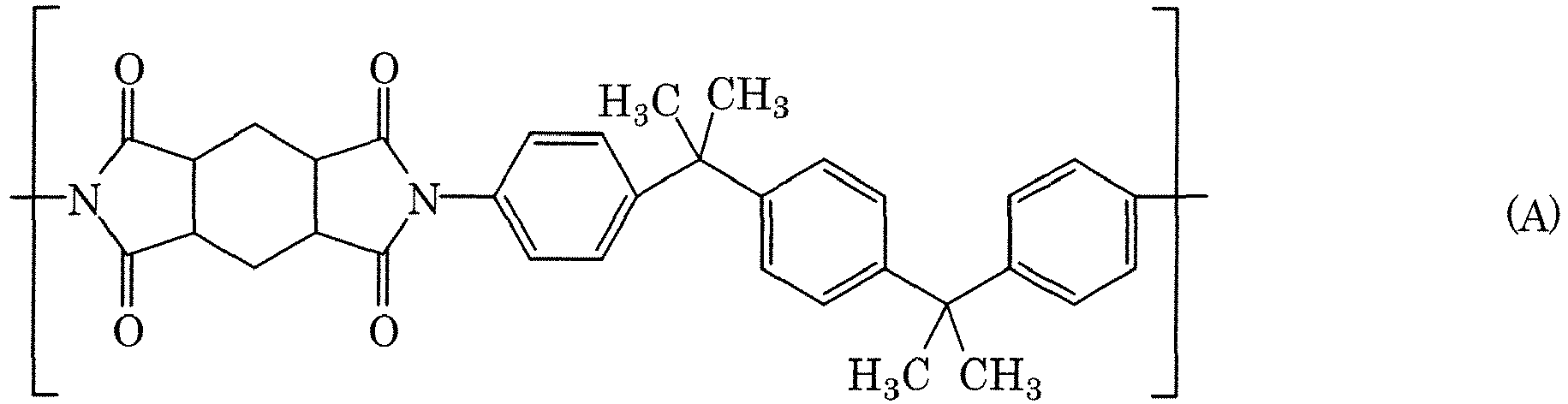

- The obtained film had a glass transition temperature of 300°C. In addition, it was confirmed that the film had a total light transmittance as high as 91% as measured according to JIS K7105.
- The polyimide film was heat-treated in air at 220°C for 4 hours to measure a total light transmittance thereof before and after the heat treatment. As a result, it was confirmed that the total light transmittance of the heat-treated film was 91% and therefore kept unchanged, and the film was free from undesired coloration even when observed by naked eyes. In addition, the polyimide film was subjected to high-energy light treatment in air (temperature: 60°C) by irradiating the film with light from a 200 W high-pressure mercury lamp as a light source for 1000 hours to measure a total light transmittance thereof before and after the high-energy light treatment. As a result, it was also confirmed that the total light transmittance of the thus treated film was 91% and therefore kept unchanged, and the film was free from undesired coloration even when observed by naked eyes.
- A 500 mL five-necked flask equipped with a thermometer, a stirrer, a nitrogen inlet tube, a dropping funnel with a bypass tube, a Dean-Stark device and a condenser was charged with 10.0 g (0.05 mol) of 4,4'-diaminodiphenyl ether and 85 g of N-methyl-2-pyrrolidone as a solvent under a nitrogen flow, and the contents of the flask were dissolved. Then, 11.2 g (0.05 mol) of 1,2,4,5-cyclohexane tetracarboxylic acid dianhydride synthesized in Reference Example 1 were added in split parts in a solid state as such to the resulting solution at room temperature over 1 hour, and the resulting mixture was stirred at room temperature for 2 hours. Next, 30.0 g of xylene as an azeotropic dehydration solvent were added to the mixture, and the obtained solution was heated to 180°C and reacted at that temperature for 3 hours, and further xylene was refluxed with the Dean-Stark apparatus to separate water produced by azeotropy from the reaction solution. After 3 hours, it was confirmed that water was completely distilled off, and then the obtained reaction solution was heated to 190°C over 1 hour to distil off and recover 29.0 g of xylene therefrom. Then, the contents of the flask were air-cooled until an inside temperature of the flask reached 60°C, and the resulting polyimide organic solvent solution was withdrawn therefrom. The thus obtained polyimide organic solvent solution was coated onto a glass plate, and heated on a hot plate at 90°C for 1 hour to evaporate the solvent therefrom. The resulting coating layer was released from the glass plate to thereby obtain a self-supporting film. The resulting self-supporting film was fixed to stainless steel fixtures and heated in a hot air dryer at 220°C for 2 hours to further evaporate the solvent therefrom, thereby obtaining a 100 µm-thick light-brown flexible film. As a result of measuring an IR spectrum of the resulting film, the characteristic absorption of an imide ring was observed at ν (C=O) 1772, 1700 (cm-1). Therefore, it was determined that the film was formed of a polyimide containing a repeating unit represented by the following formula (B).

- The obtained film had a glass transition temperature of 315°C. In addition, it was confirmed that the film had a total light transmittance as high as 90% as measured according to JIS K7105.
- The polyimide film was heat-treated in air at 220°C for 4 hours to measure a total light transmittance thereof before and after the heat treatment. As a result, it was confirmed that the total light transmittance of the heat-treated film was 90% and therefore kept unchanged, and the film was free from undesired coloration even when observed by naked eyes. In addition, the polyimide film was subjected to high-energy light treatment in air (temperature: 60°C) by irradiating the film with light from a 200 W high-pressure mercury lamp as a light source for 1000 hours to measure a total light transmittance thereof before and after the high-energy light treatment. As a result, it was also confirmed that the total light transmittance of the thus treated film was 90% and therefore kept unchanged, and the film was free from undesired coloration even when observed by naked eyes.
- A 500 mL five-necked flask equipped with a thermometer, a stirrer, a nitrogen inlet tube, a dropping funnel with a bypass tube, a Dean-Stark apparatus and a condenser was charged with 20.5 g (0.05 mol) of 2,2-bis[4-(4-aminophenoxy)phenyl]propane and 85 g of N-methyl-2-pyrrolidone as a solvent under a nitrogen flow, and the contents of the flask were dissolved. Then, 11.2 g (0.05 mol) of 1,2,4,5-cyclohexane tetracarboxylic acid dianhydride synthesized in Reference Example 1 were added in split parts in a solid state as such to the resulting solution at room temperature over 1 hour, and the resulting mixture was stirred at room temperature for 2 hours. Next, 30.0 g of xylene as an azeotropic dehydration solvent were added to the mixture, and the obtained solution was heated to 180°C and reacted at that temperature for 3 hours, and further xylene was refluxed with the Dean-Stark apparatus to separate water produced by azeotropy from the reaction solution. After 3 hours, it was confirmed that water was completely distilled off, and then the obtained reaction solution was heated to 190°C over 1 hour to distil off and recover 29.0 g of xylene therefrom. Then, the contents of the flask were air-cooled until an inside temperature of the flask reached 60°C, and the resulting polyimide organic solvent solution was withdrawn therefrom. The thus obtained polyimide organic solvent solution was coated onto a glass plate, and heated on a hot plate at 90°C for 1 hour to evaporate the solvent therefrom. The resulting coating layer was released from the glass plate to thereby obtain a self-supporting film. The resulting self-supporting film was fixed to stainless steel fixtures and heated in a hot air dryer at 220°C for 2 hours to further evaporate the solvent therefrom, thereby obtaining a 100 µm-thick light-brown flexible film. As a result of measuring an IR spectrum of the resulting film, the characteristic absorption of an imide ring was observed at ν (C=O) 1773, 1702 (cm-1). Therefore, it was determined that the film was formed of a polyimide containing a repeating unit represented by the following formula (C).

- The obtained film had a glass transition temperature of 260°C. In addition, it was confirmed that the film had a total light transmittance as high as 90% as measured according to JIS K7105.
- The polyimide film was heat-treated in air at 220°C for 4 hours to measure a total light transmittance thereof before and after the heat treatment. As a result, it was confirmed that the total light transmittance of the heat-treated film was 90% and therefore kept unchanged, and the film was free from undesired coloration even when observed by naked eyes. In addition, the polyimide film was subjected to high-energy light treatment in air (temperature: 60°C) by irradiating the film with light from a 200 W high-pressure mercury lamp as a light source for 1000 hours to measure a total light transmittance thereof before and after the high-energy light treatment. As a result, it was also confirmed that the total light transmittance of the thus treated film was 90% and therefore kept unchanged, and the film was free from undesired coloration even when observed by naked eyes.
- A 500 mL five-necked flask equipped with a thermometer, a stirrer, a nitrogen inlet tube, a dropping funnel with a bypass tube, a Dean-Stark apparatus and a condenser was charged with 18.4 g (0.05 mol) of 4,4'-bis(4-aminophenoxy)biphenyl (BAPB) and 85 g of N-methyl-2-pyrrolidone as a solvent under a nitrogen flow, and the contents of the flask were dissolved. Then, 11.2 g (0.05 mol) of 1,2,4,5-cyclohexane tetracarboxylic acid dianhydride synthesized in Reference Example 1 were added in split parts in a solid state as such to the resulting solution at room temperature over 1 hour, and the resulting mixture was stirred at room temperature for 2 hours. Next, 30.0 g of xylene as an azeotropic dehydration solvent were added to the mixture, and the obtained solution was heated to 180°C and reacted at that temperature for 3 hours, and further xylene was refluxed with the Dean-Stark apparatus to separate water produced by azeotropy from the reaction solution. After 3 hours, it was confirmed that water was completely distilled off, and then the obtained reaction solution was heated to 190°C over 1 hour to distil off and recover 29.0 g of xylene therefrom. Then, the contents of the flask were air-cooled until an inside temperature of the flask reached 60°C, and the resulting polyimide organic solvent solution was withdrawn therefrom. The thus obtained polyimide organic solvent solution was coated onto a glass plate, and heated on a hot plate at 90°C for 1 hour to evaporate the solvent therefrom. The resulting coating layer was released from the glass plate to thereby obtain a self-supporting film. The resulting self-supporting film was fixed to stainless steel fixtures and heated in a hot air dryer at 220°C for 2 hours to further evaporate the solvent therefrom, thereby obtaining a 100 µm-thick light-brown flexible film. As a result of measuring an IR spectrum of the resulting film, the characteristic absorption of an imide ring was observed at ν (C=O) 1773, 1702 (cm-1). Therefore, it was determined that the film was formed of a polyimide containing a repeating unit represented by the following formula (D).

- The obtained film had a glass transition temperature of 260°C. In addition, it was confirmed that the film had a total light transmittance as high as 90% as measured according to JIS K7105.
- The polyimide film was heat-treated in air at 220°C for 4 hours to measure a total light transmittance thereof before and after the heat treatment. As a result, it was confirmed that the total light transmittance of the heat-treated film was 90% and therefore kept unchanged, and the film was free from undesired coloration even when observed by naked eyes. In addition, the polyimide film was subjected to high-energy light treatment in air (temperature: 60°C) by irradiating the film with light from a 200 W high-pressure mercury lamp as a light source for 1000 hours to measure a total light transmittance thereof before and after the high-energy light treatment. As a result, it was also confirmed that the total light transmittance of the thus treated film was 90% and therefore kept unchanged, and the film was free from undesired coloration even when observed by naked eyes.
- A 500 mL five-necked flask equipped with a thermometer, a stirrer, a nitrogen inlet tube, a dropping funnel with a bypass tube, a Dean-Stark apparatus and a condenser was charged with 12.1 g (0.035 mol) of 1,4-bis(4-amino-α,α-dimethylbenzyl)benzene (BisA-P), 4.0 g (0.015 mol) of 1-(4-aminophenyl)-1,3,3-trimethyl-1H-indene-5-amine (TMDA) and 85 g of N-methyl-2-pyrrolidone as a solvent under a nitrogen flow, and the contents of the flask were dissolved. Then, 11.2 g (0.05 mol) of 1,2,4,5-cyclohexane tetracarboxylic acid dianhydride synthesized in Reference Example 1 were added in split parts in a solid state as such to the resulting solution at room temperature over 1 hour, and the resulting mixture was stirred at room temperature for 2 hours. Next, 30.0 g of xylene as an azeotropic dehydration solvent were added to the mixture, and the obtained solution was heated to 180°C and reacted at that temperature for 3 h, and further xylene was refluxed with the Dean-Stark apparatus to separate water produced by azeotropy from the reaction solution. After 3 hours, it was confirmed that water was completely distilled off, and then the obtained reaction solution was heated to 190°C over 1 hour to distil off and recover 29.0 g of xylene therefrom. Then, the contents of the flask were air-cooled until an inside temperature of the flask reached 60°C, and the resulting polyimide organic solvent solution was withdrawn therefrom. The thus obtained polyimide organic solvent solution was coated onto a glass plate, and heated on a hot plate at 90°C for 1 hour to evaporate the solvent therefrom. The resulting coating layer was released from the glass plate to thereby obtain a self-supporting film. The resulting self supporting film was fixed to stainless steel fixtures and heated in a hot air dryer at 220°C for 2 hours to further evaporate the solvent therefrom, thereby obtaining a 100 µm-thick light-brown flexible film. As a result of measuring an IR spectrum of the resulting film, the characteristic absorption of an imide ring was observed at ν (C=O) 1784, 1703 (cm-1). Therefore, it was determined that the film was formed of a polyimide containing repeating units represented by the following formulae (E) and (E').


- The obtained film had a glass transition temperature of 320°C. In addition, it was confirmed that the film had a total light transmittance as high as 91% as measured according to JIS K7105.
- The polyimide film was heat-treated in air at 220°C for 4 hours to measure a total light transmittance thereof before and after the heat treatment. As a result, it was confirmed that the total light transmittance of the heat-treated film was 91% and therefore kept unchanged, and the film was free from undesired coloration even when observed by naked eyes. In addition, the polyimide film was subjected to high-energy light treatment in air (temperature: 60°C) by irradiating the film with light from a 200 W high-pressure mercury lamp as a light source for 1000 hours to measure a total light transmittance thereof before and after the high-energy light treatment. As a result, it was also confirmed that the total light transmittance of the thus treated film was 91% and therefore kept unchanged, and the film was free from undesired coloration even when observed by naked eyes.
- A 500 mL five-necked flask equipped with a thermometer, a stirrer, a nitrogen inlet tube, a dropping funnel with a bypass tube, a Dean-Stark apparatus and a condenser was charged with 13.9 g (0.04 mol) of 9,9-bis(4-aminophenyl)fluorene (BAFL), 3.7 g (0.01 mol) of 4,4'-bis(4-aminophenoxy)biphenyl (BAPB) and 85 g of N-methyl-2-pyrrolidone as a solvent under a nitrogen flow, and the contents of the flask were dissolved. Then, 11.2 g (0.05 mol) of 1,2,4,5-cyclohexane tetracarboxylic acid dianhydride synthesized in Reference Example 1 were added in split parts in a solid state as such to the resulting solution at room temperature over 1 hour, and the resulting mixture was stirred at room temperature for 2 hours. Next, 30.0 g of xylene as an azeotropic dehydration solvent were added to the mixture, and the obtained solution was heated to 180°C and reacted at that temperature for 3 hours, and further xylene was refluxed with the Dean-Stark apparatus to separate water produced by azeotropy from the reaction solution. After 3 hours, it was confirmed that water was completely distilled off, and then the obtained reaction solution was heated to 190°C over 1 hour to distil off and recover 29.0 g of xylene therefrom. Then, the contents of the flask were air-cooled until an inside temperature of the flask reached 60°C, and the resulting polyimide organic solvent solution was withdrawn therefrom. The thus obtained polyimide organic solvent solution was coated onto a glass plate, and heated on a hot plate at 90°C for 1 hour to evaporate the solvent therefrom. The resulting coating layer was released from the glass plate to thereby obtain a self-supporting film. The resulting self-supporting film was fixed to stainless steel fixtures and heated in a hot air dryer at 220°C for 2 hours to further evaporate the solvent therefrom, thereby obtaining a 100 µm-thick light-brown flexible film. As a result of measuring an IR spectrum of the resulting film, the characteristic absorption of an imide ring was observed at ν (C=O) 1775, 1703 (cm-1). Therefore, it was determined that the film was formed of a polyimide containing repeating units represented by the following formulae (F) and (F').


- The obtained film had a glass transition temperature of 410°C. In addition, it was confirmed that the film had a total light transmittance as high as 90% as measured according to JIS K7105.
- The polyimide film was heat-treated in air at 220°C for 4 hours to measure a total light transmittance thereof before and after the heat treatment. As a result, it was confirmed that the total light transmittance of the heat-treated film was 90% and therefore kept unchanged, and the film was free from undesired coloration even when observed by naked eyes. In addition, the polyimide film was subjected to high-energy light treatment in air (temperature: 60°C) by irradiating the film with light from a 200 W high-pressure mercury lamp as a light source for 1000 hours to measure a total light transmittance thereof before and after the high-energy light treatment. As a result, it was also confirmed that the total light transmittance of the thus treated film was 90% and therefore kept unchanged, and the film was free from undesired coloration even when observed by naked eyes.
- A 500 mL five-necked flask equipped with a thermometer, a stirrer, a nitrogen inlet tube, a dropping funnel with a bypass tube, a Dean-Stark apparatus and a condenser was charged with 25.9 g (0.05 mol) of 2,2-bis[4-(4-aminophenoxy)phenyl]hexafluoropropane and 85 g of N-methyl-2-pyrrolidone as a solvent under a nitrogen flow, and the contents of the flask were dissolved. Then, 11.2 g (0.05 mol) of 1,2,4,5-cyclohexane tetracarboxylic acid dianhydride synthesized in Reference Example 1 were added in split parts in a solid state as such to the resulting solution at room temperature over 1 hour, and the resulting mixture was stirred at room temperature for 2 hours. Next, 30.0 g of xylene as an azeotropic dehydration solvent were added to the mixture, and the obtained solution was heated to 180°C and reacted at that temperature for 3 hours, and further xylene was refluxed with the Dean-Stark apparatus to separate water produced by azeotropy from the reaction solution. After 3 hours, it was confirmed that water was completely distilled off, and then the obtained reaction solution was heated to 190°C over 1 hour to distil off and recover 29.0 g of xylene therefrom. Then, the contents of the flask were air-cooled until an inside temperature of the flask reached 60°C, and the resulting polyimide organic solvent solution was withdrawn therefrom. The thus obtained polyimide organic solvent solution was coated onto a glass plate, and heated on a hot plate at 90°C for 1 hour to evaporate the solvent therefrom. The resulting coating layer was released from the glass plate to thereby obtain a self-supporting film. The resulting self-supporting film was fixed to stainless steel fixtures and heated in a hot air dryer at 220°C for 2 hours to further evaporate the solvent therefrom, thereby obtaining a 100 µm-thick light-brown flexible film. As a result of measuring an IR spectrum of the resulting film, the characteristic absorption of an imide ring was observed at ν (C=O) 1773, 1702 (cm-1). Therefore, it was determined that the film was formed of a polyimide containing a repeating unit represented by the following formula (G).

- The obtained film had a glass transition temperature of 260°C. In addition, it was confirmed that the film had a total light transmittance as high as 91% as measured according to JIS K7105.
- The polyimide film was heat-treated in air at 220°C for 4 hours to measure a total light transmittance thereof before and after the heat treatment. As a result, it was confirmed that the total light transmittance of the heat-treated film was 91% and therefore kept unchanged, and the film was free from undesired coloration even when observed by naked eyes. In addition, the polyimide film was subjected to high-energy light treatment in air (temperature: 60°C) by irradiating the film with light from a 200 W high-pressure mercury lamp as a light source for 1000 hours to measure a total light transmittance thereof before and after the high-energy light treatment. As a result, it was also confirmed that the total light transmittance of the thus treated film was 91% and therefore kept unchanged, and the film was free from undesired coloration even when observed by naked eyes.
- A palladium catalyst-added polysilazane-containing xylene solution (available from AZ Electronic Materials) was coated by a dip-coating method on a 200 µm-thick film obtained from the polyimide organic solvent solution synthesized in Reference Example 4, and dried at 120°C for 10 minutes, thereby forming a 1.5 µm-thick polysilazane film layer on both surfaces of the polyimide film. Further, the thus coated film was subjected to calcination treatment at 180°C for 30 minutes to form a 1.5 µm-thick silicon oxide layer, thereby producing a transparent heat-resistant gas-barrier film. The thus produced film was measured and evaluated for a water vapor transmission rate, a total light transmittance, a haze, a glass transition temperature and surface smoothness thereof. The evaluation results are shown in Table 1.
- The same procedure as in Example 1 was repeated except that the calcination treatment was carried out at 200°C for 30 minutes, thereby obtaining a film of Example 2. The evaluation results are shown in Table 1.
- The same procedure as in Example 1 was repeated except that the calcination treatment was carried out at 250°C for 30 minutes, thereby obtaining a film of Example 3. The evaluation results are shown in Table 1.
- A palladium catalyst-added polysilazane-containing xylene solution (available from AZ Electronic Materials) was coated by a dip-coating method on a 200 µm-thick film obtained from the polyimide organic solvent solution synthesized in Reference Example 2, and dried at 120°C for 10 minutes, thereby forming a 1.5 µm-thick polysilazane film layer on both surfaces of the polyimide film. Further, the thus coated film was subjected to calcination treatment at 180°C for 30 minutes to form a 1.5 µm-thick silicon oxide layer, thereby producing a transparent heat-resistant gas-barrier film. The thus produced film was measured and evaluated for a water vapor transmission rate, a total light transmittance, a haze, a glass transition temperature and surface smoothness thereof. The evaluation results are shown in Table 1.
- The same procedure as in Example 4 was repeated except that the calcination treatment was carried out at 200°C for 30 minutes, thereby obtaining a film of Example 5. The evaluation results are shown in Table 1.
- The same procedure as in Example 4 was repeated except that the calcination treatment was carried out at 250°C for 30 minutes, thereby obtaining a film of Example 6. The evaluation results are shown in Table 1.
- The same procedure as in Example 4 was repeated except that the palladium catalyst-added polysilazane solution was replaced with an alkoxysilicate-metal alcoholate solution, thereby obtaining a film of Comparative Example 1. The evaluation results are shown in Table 1.
- The same procedure as in Example 4 was repeated except that no calcination treatment was carried out, thereby obtaining a film of Comparative Example 2. The evaluation results are shown in Table 1.
- The same procedure as in Example 4 was repeated except that the calcination treatment was carried out at 150°C for 30 minutes, thereby obtaining a film of Comparative Example 3. The evaluation results are shown in Table 1.
- A 0.4 µm-thick SiO2 film layer was formed at 200°C by a sputtering method on both surfaces of a 200 µm-thick film obtained from the polyimide organic solvent solution synthesized in Reference Example 2. The thus obtained film was measured and evaluated for a water vapor transmission rate, a total light transmittance, a haze, a glass transition temperature and surface smoothness thereof. The evaluation results are shown in Table 1.
TABLE 1 Water vapor transmission rate Total light transmittance Haze Glass transition temperature Surface smoothness g/m2/day % % °C Ra (nm) P-V (nm) Rz (nm) Example 1 8.71 91.77 0.46 261 3.2 39.2 25.3 Example 2 6.62 91.71 0.45 260 2.9 40.3 28.2 Example 3 4.75 91.02 0.45 261 3.6 46.2 30.2 Example 4 4.98 91.93 0.14 301 3.5 40.2 26.2 Example 5 4.57 91.93 0.13 300 3.3 39.9 25.2 Example 6 2.23 91.75 0.15 301 3.7 43.6 27.4 Comparative Example 1 186.92 93.50 0.24 301 - - - Comparative Example 2 60.98 91.17 0.19 298 - - - Comparative Example 3 34.11 91.80 0.20 300 - - - Comparative Example 4 1.37 90.89 0.32 300 5.8 68.5 52.2 - From the results shown in Table 1, it was confirmed that the films obtained Examples 1 to 6 had good properties, in particular, an excellent water vapor-barrier property, whereas the films obtained Comparative Examples 1 to 3 which failed to satisfy the production conditions as defined by the present invention were deteriorated in properties, in particular, a water vapor-barrier property. In addition, it was confirmed that the film produced in Comparative Example 4 by a sputtering method exhibited an excellent water vapor-barrier property, but was considerably deteriorated in surface smoothness.
- In the process for producing a transparent heat-resistant gas-barrier film according to the present invention, it is possible to produce a film having a high heat resistance and a good gas-barrier property without need of a large size facility. Therefore, the production process of the present invention is highly practical and useful as a method for producing an optical member or an electronic device member which are required to have a good gas-barrier property, at low costs.
Claims (8)
- A process for producing a transparent heat-resistant gas-barrier film, comprising the steps of:coating a polysilazane-containing solution onto at least one surface of a transparent polyimide film formed of a polyimide containing a repeated unit represented by the formula (I):
 calcining the coated solution at a temperature of 180°C or higher to laminate a silicon oxide layer obtained by the calcination on the transparent polyimide film.
 - The process for producing a transparent heat-resistant gas-barrier film according to claim 1, wherein the transparent polyimide film has a glass transition temperature of 250°C or higher as measured by a differential scanning calorimetry and a total light transmittance of 80% or more.
- The process for producing a transparent heat-resistant gas-barrier film according to claim 1 or 2, wherein R in the formula (I) is a tetravalent group formed by removing four hydrogen atoms from cyclohexane.
- The process for producing a transparent heat-resistant gas-barrier film according to any one of claims 1 to 3, wherein the silicon oxide layer has a thickness of from 0.1 to 2.0 µm.
- The process for producing a transparent heat-resistant gas-barrier film according to any one of claims 1 to 4, wherein the polysilazane-containing solution comprises a palladium catalyst.
- The process for producing a transparent heat-resistant gas-barrier film according to any one of claims 1 to 5, further comprising the step of laminating a layer formed of silicon oxide and/or silicon oxynitride on the silicon oxide layer by a physical vapor deposition method or a chemical vapor deposition method.
- The process for producing a transparent heat-resistant gas-barrier film according to any one of claims 1 to 6, further comprising the step of laminating a transparent conductive film layer formed of a mixture of indium oxide and tin oxide or a transparent conductive film layer formed of zinc oxide on the silicon oxide layer.
- The process for producing a transparent heat-resistant gas-barrier film according to any one of claims 1 to 7, wherein the transparent heat-resistant gas-barrier film is used as a member for electronic devices.
Applications Claiming Priority (2)
| Application Number | Priority Date | Filing Date | Title |
|---|---|---|---|
| JP2011248064 | 2011-11-11 | ||
| PCT/JP2012/078959 WO2013069725A1 (en) | 2011-11-11 | 2012-11-08 | Method for manufacturing transparent, heat-resistant gas-barrier film |
Publications (3)
| Publication Number | Publication Date |
|---|---|
| EP2777929A1 true EP2777929A1 (en) | 2014-09-17 |
| EP2777929A4 EP2777929A4 (en) | 2015-05-27 |
| EP2777929B1 EP2777929B1 (en) | 2016-10-19 |
Family
ID=48290095
Family Applications (1)
| Application Number | Title | Priority Date | Filing Date |
|---|---|---|---|
| EP12847483.0A Not-in-force EP2777929B1 (en) | 2011-11-11 | 2012-11-08 | Method for manufacturing transparent, heat-resistant gas-barrier film |
Country Status (7)
| Country | Link |
|---|---|
| US (1) | US9073297B2 (en) |
| EP (1) | EP2777929B1 (en) |
| JP (1) | JP6020462B2 (en) |
| KR (1) | KR102057070B1 (en) |
| CN (1) | CN103917364A (en) |
| TW (1) | TWI593557B (en) |
| WO (1) | WO2013069725A1 (en) |
Cited By (3)
| Publication number | Priority date | Publication date | Assignee | Title |
|---|---|---|---|---|
| EP2864402A4 (en) * | 2012-06-25 | 2016-02-24 | Kolon Inc | Transparent polyimide substrate and method of manufacturing the same |
| KR20190129960A (en) * | 2017-04-04 | 2019-11-20 | 메르크 파텐트 게엠베하 | Film forming composition and film forming method using same |
| EP3604389A4 (en) * | 2017-03-29 | 2020-04-08 | Mitsubishi Gas Chemical Company, Inc. | POLYIMIDE, POLYIMIDE SOLUTION, AND POLYIMIDE FILM |
Families Citing this family (13)
| Publication number | Priority date | Publication date | Assignee | Title |
|---|---|---|---|---|
| US10066058B2 (en) * | 2013-07-05 | 2018-09-04 | Mitsubishi Gas Chemical Company, Inc. | Polyimide resin |
| KR101880210B1 (en) * | 2015-04-10 | 2018-07-20 | 주식회사 엘지화학 | Barrier film |
| GB201515985D0 (en) * | 2015-09-09 | 2015-10-21 | Pilkington Group Ltd | Deposition process |
| WO2017191822A1 (en) | 2016-05-06 | 2017-11-09 | 三菱瓦斯化学株式会社 | Polyimide resin |
| JP7036012B2 (en) * | 2016-07-21 | 2022-03-15 | 三菱瓦斯化学株式会社 | Method for manufacturing polyimide resin film and polyimide resin film |
| JP2018103392A (en) * | 2016-12-22 | 2018-07-05 | コニカミノルタ株式会社 | Transparent polyimide film laminate |
| KR102524863B1 (en) * | 2017-03-29 | 2023-04-24 | 도레이 카부시키가이샤 | Film with conductive layer, touch panel, manufacturing method of film with conductive layer, and manufacturing method of touch panel |
| KR102143307B1 (en) | 2017-05-31 | 2020-08-10 | 우베 고산 가부시키가이샤 | Polyimide film |
| WO2019163830A1 (en) * | 2018-02-23 | 2019-08-29 | 三菱瓦斯化学株式会社 | Polyimide resin, polyimide varnish and polyimide film |
| CN108587163B (en) * | 2018-05-07 | 2020-05-01 | 中国科学院化学研究所 | High-transparency low-expansion polyimide film and preparation method and application thereof |
| CN109651813B (en) | 2018-12-20 | 2020-12-04 | 武汉华星光电半导体显示技术有限公司 | Composite film and preparation method thereof |
| CN113861418B (en) * | 2021-10-20 | 2023-09-08 | 波米科技有限公司 | Polyimide compound, liquid crystal aligning agent, and preparation method and application thereof |
| KR102912970B1 (en) | 2023-05-31 | 2026-01-16 | 연세대학교 미래산학협력단 | Preparation method of reusable porous polyimide comprising palladium catalyst, and the porous polyimide thereby |
Family Cites Families (32)
| Publication number | Priority date | Publication date | Assignee | Title |
|---|---|---|---|---|
| US5747623A (en) | 1994-10-14 | 1998-05-05 | Tonen Corporation | Method and composition for forming ceramics and article coated with the ceramics |
| JP3449798B2 (en) | 1994-10-14 | 2003-09-22 | 東燃ゼネラル石油株式会社 | Method for producing SiO2-coated plastic film |
| JP3511325B2 (en) | 1995-04-19 | 2004-03-29 | 三井化学株式会社 | Gas barrier film |
| JPH09199740A (en) * | 1996-01-19 | 1997-07-31 | Canon Inc | Solar cell module |
| JPH1016150A (en) * | 1996-07-02 | 1998-01-20 | Teijin Ltd | Gas barrier laminated film |
| WO2000040404A1 (en) * | 1998-12-30 | 2000-07-13 | Mobil Oil Corporation | Coated films with improved barrier properties |
| US7666490B1 (en) * | 1999-02-10 | 2010-02-23 | Toyo Boseki Kabushiki Kaisha | Functional roll film and vacuum evaporation apparatus capable of producing the functional roll film |
| JP2001111076A (en) * | 1999-10-08 | 2001-04-20 | Tdk Corp | Coated body and solar cell module |
| WO2002009478A1 (en) * | 2000-07-24 | 2002-01-31 | Tdk Corporation | Luminescent device |
| US6962756B2 (en) | 2001-11-02 | 2005-11-08 | Mitsubishi Gas Chemical Company, Inc. | Transparent electrically-conductive film and its use |
| JP2003141936A (en) | 2001-11-02 | 2003-05-16 | Mitsubishi Gas Chem Co Inc | Transparent conductive film |
| JP2004155834A (en) | 2002-11-01 | 2004-06-03 | Clariant Internatl Ltd | Polysilazane-containing coating liquid |
| WO2004039904A1 (en) | 2002-11-01 | 2004-05-13 | Clariant International Ltd | Polysilazane-containing coating solution |
| TW200420630A (en) * | 2003-03-06 | 2004-10-16 | Nippon Catalytic Chem Ind | Method and apparatus for production of fluorine-containing polyimide film |
| US20080020217A1 (en) | 2004-06-21 | 2008-01-24 | Takashi Makinoshima | Colorless Transparent Polyimide Composite Film and Method for Producing Same |
| JP4997717B2 (en) * | 2004-06-21 | 2012-08-08 | 三菱瓦斯化学株式会社 | Colorless and transparent polyimide composite film and method for producing the same |
| JP4490217B2 (en) * | 2004-09-14 | 2010-06-23 | 富士フイルム株式会社 | Optical film and image display device |
| JP2006082309A (en) | 2004-09-15 | 2006-03-30 | Ricoh Co Ltd | Transparent thermal recording medium |
| JP2006164373A (en) * | 2004-12-06 | 2006-06-22 | Asahi Glass Co Ltd | A method for coating a donut glass substrate. |
| WO2006112286A1 (en) * | 2005-04-14 | 2006-10-26 | Mitsubishi Gas Chemical Company, Inc. | Process for producing polyimide film |
| JP4766936B2 (en) * | 2005-07-06 | 2011-09-07 | 富士フイルム株式会社 | Optical film and manufacturing method thereof, optical compensation film, polarizing plate, and liquid crystal display device |
| DE102005034817A1 (en) * | 2005-07-26 | 2007-02-01 | Clariant International Limited | Process for producing a thin vitreous coating on substrates to reduce gas permeation |
| JP2007237588A (en) | 2006-03-09 | 2007-09-20 | Kyodo Printing Co Ltd | Gas barrier film and method for producing the same |
| JP2009255040A (en) | 2008-03-25 | 2009-11-05 | Kyodo Printing Co Ltd | Flexible gas barrier film and method for manufacturing the same |
| JP5298760B2 (en) * | 2008-10-21 | 2013-09-25 | 日立化成株式会社 | Insulator film, resin composition, and display device |
| WO2010113412A1 (en) * | 2009-03-31 | 2010-10-07 | 三井化学株式会社 | Low-thermal-expansion block polyimide, precursor thereof, and use thereof |
| IN2012DN00642A (en) * | 2009-07-17 | 2015-08-21 | Mitsui Chemicals Inc | |
| JP2011074278A (en) * | 2009-09-30 | 2011-04-14 | Sekisui Chem Co Ltd | Polyamic acid solution, polyimide using the same, and method for producing them |
| WO2011074363A1 (en) * | 2009-12-14 | 2011-06-23 | コニカミノルタホールディングス株式会社 | Barrier film, process for production thereof, and organic photoelectric conversion element |
| KR101461346B1 (en) * | 2010-07-27 | 2014-11-14 | 코니카 미놀타 가부시키가이샤 | Gas barrier film, process for production of gas barrier film, and electronic device |
| KR101530792B1 (en) * | 2010-11-19 | 2015-06-22 | 코니카 미놀타 가부시키가이샤 | Gas barrier film, method of producing a gas barrier film, and electronic device |
| EP2783846A4 (en) * | 2011-11-24 | 2015-09-02 | Konica Minolta Inc | GAS BARRIER FILM AND ELECTRONIC DEVICE |
-
2012
- 2012-11-08 US US14/355,692 patent/US9073297B2/en active Active
- 2012-11-08 KR KR1020147012470A patent/KR102057070B1/en active Active
- 2012-11-08 EP EP12847483.0A patent/EP2777929B1/en not_active Not-in-force
- 2012-11-08 JP JP2013543021A patent/JP6020462B2/en active Active
- 2012-11-08 CN CN201280054747.4A patent/CN103917364A/en active Pending
- 2012-11-08 WO PCT/JP2012/078959 patent/WO2013069725A1/en not_active Ceased
- 2012-11-09 TW TW101141875A patent/TWI593557B/en active
Cited By (3)
| Publication number | Priority date | Publication date | Assignee | Title |
|---|---|---|---|---|
| EP2864402A4 (en) * | 2012-06-25 | 2016-02-24 | Kolon Inc | Transparent polyimide substrate and method of manufacturing the same |
| EP3604389A4 (en) * | 2017-03-29 | 2020-04-08 | Mitsubishi Gas Chemical Company, Inc. | POLYIMIDE, POLYIMIDE SOLUTION, AND POLYIMIDE FILM |
| KR20190129960A (en) * | 2017-04-04 | 2019-11-20 | 메르크 파텐트 게엠베하 | Film forming composition and film forming method using same |
Also Published As
| Publication number | Publication date |
|---|---|
| US20140322444A1 (en) | 2014-10-30 |
| JPWO2013069725A1 (en) | 2015-04-02 |
| US9073297B2 (en) | 2015-07-07 |
| EP2777929B1 (en) | 2016-10-19 |
| KR20140091547A (en) | 2014-07-21 |
| CN103917364A (en) | 2014-07-09 |
| JP6020462B2 (en) | 2016-11-02 |
| EP2777929A4 (en) | 2015-05-27 |
| TW201328883A (en) | 2013-07-16 |
| WO2013069725A1 (en) | 2013-05-16 |
| KR102057070B1 (en) | 2019-12-18 |
| TWI593557B (en) | 2017-08-01 |
Similar Documents
| Publication | Publication Date | Title |
|---|---|---|
| EP2777929B1 (en) | Method for manufacturing transparent, heat-resistant gas-barrier film | |
| JP6265902B2 (en) | Transparent polyimide laminate and method for producing the same | |
| KR101891374B1 (en) | Transparent film, transparent conductive laminate, and touch panel, solar cell and display device, using same | |
| CN1285080C (en) | Transparent conductive film and its application | |
| KR101773651B1 (en) | Laminate structure for manufacturing substrate and device comprising substrate manufactured by using same | |
| US9902810B2 (en) | Polyamic acid, varnish comprising same and polyimide film | |
| CN107949597B (en) | Polyamic acid solution composition and polyimide film | |
| CN101160202B (en) | Preparation method of polyimide film | |
| CN116134077B (en) | Polyamide-imide copolymer and film using the same | |
| US20180093461A1 (en) | Resin composition, polyimide resin film, and method for producing same | |
| CN106560320A (en) | Method For Producing Polyimide Film With Functional Layer | |
| JP7254469B2 (en) | Polyimide and polyimide precursor | |
| TW201811871A (en) | Polyimide precursor and polyimines formed from the polyimine precursor excellent in low thermal expansivity and film forming property, can be easily peeled from a supporting substrate, and has excellent heat resistance or high transparency | |
| JP4247448B2 (en) | Transparent conductive film | |
| CN111770949A (en) | Polyimide, polyimide solution composition, polyimide film and substrate | |
| CN108026272B (en) | Polyimide resin and polyimide film | |
| KR20240117105A (en) | Polyimide film, high-frequency circuit board, flexible electronic device board | |
| TWI775294B (en) | Polyimide precursor composition and polyimide film/substrate laminate | |
| CN113549217A (en) | Polyimide precursor, resin composition containing same, polyimide resin film, and method for producing same | |
| JP7722459B2 (en) | Polyimide precursor composition and polyimide film | |
| CN115551949B (en) | Polyimide precursor composition and polyimide film/substrate laminate | |
| JP7823734B2 (en) | Polyimide precursor composition, polyimide film, and polyimide film/substrate laminate | |
| TWI868408B (en) | Polyimide precursor composition, polyimide film, and polyimide film/substrate laminate | |
| CN120345363A (en) | Laminated body | |
| WO2025225424A1 (en) | Polyimide precursor composition and polyimide film |
Legal Events
| Date | Code | Title | Description |
|---|---|---|---|
| PUAI | Public reference made under article 153(3) epc to a published international application that has entered the european phase |
Free format text: ORIGINAL CODE: 0009012 |
|
| 17P | Request for examination filed |
Effective date: 20140506 |
|
| AK | Designated contracting states |
Kind code of ref document: A1 Designated state(s): AL AT BE BG CH CY CZ DE DK EE ES FI FR GB GR HR HU IE IS IT LI LT LU LV MC MK MT NL NO PL PT RO RS SE SI SK SM TR |
|
| DAX | Request for extension of the european patent (deleted) | ||
| RA4 | Supplementary search report drawn up and despatched (corrected) |
Effective date: 20150428 |
|
| RIC1 | Information provided on ipc code assigned before grant |
Ipc: B32B 18/00 20060101ALI20150421BHEP Ipc: B32B 37/00 20060101ALI20150421BHEP Ipc: B32B 27/34 20060101ALI20150421BHEP Ipc: B32B 38/00 20060101ALI20150421BHEP Ipc: B32B 9/00 20060101AFI20150421BHEP |
|
| 17Q | First examination report despatched |
Effective date: 20151218 |
|
| REG | Reference to a national code |
Ref country code: DE Ref legal event code: R079 Ref document number: 602012024457 Country of ref document: DE Free format text: PREVIOUS MAIN CLASS: B32B0009000000 Ipc: B32B0033000000 |
|
| GRAP | Despatch of communication of intention to grant a patent |
Free format text: ORIGINAL CODE: EPIDOSNIGR1 |
|
| RIC1 | Information provided on ipc code assigned before grant |
Ipc: B32B 38/00 20060101ALI20160427BHEP Ipc: B32B 37/00 20060101ALN20160427BHEP Ipc: B32B 18/00 20060101ALI20160427BHEP Ipc: B32B 9/00 20060101ALI20160427BHEP Ipc: B32B 27/34 20060101ALI20160427BHEP Ipc: B05D 3/02 20060101ALI20160427BHEP Ipc: B32B 37/24 20060101ALI20160427BHEP Ipc: B32B 33/00 20060101AFI20160427BHEP |
|
| INTG | Intention to grant announced |
Effective date: 20160510 |
|
| GRAS | Grant fee paid |
Free format text: ORIGINAL CODE: EPIDOSNIGR3 |
|
| GRAA | (expected) grant |
Free format text: ORIGINAL CODE: 0009210 |
|
| AK | Designated contracting states |
Kind code of ref document: B1 Designated state(s): AL AT BE BG CH CY CZ DE DK EE ES FI FR GB GR HR HU IE IS IT LI LT LU LV MC MK MT NL NO PL PT RO RS SE SI SK SM TR |
|
| REG | Reference to a national code |
Ref country code: GB Ref legal event code: FG4D |
|
| REG | Reference to a national code |
Ref country code: CH Ref legal event code: EP |
|
| REG | Reference to a national code |
Ref country code: AT Ref legal event code: REF Ref document number: 837980 Country of ref document: AT Kind code of ref document: T Effective date: 20161115 |
|
| REG | Reference to a national code |
Ref country code: IE Ref legal event code: FG4D |
|
| REG | Reference to a national code |
Ref country code: FR Ref legal event code: PLFP Year of fee payment: 5 |
|
| REG | Reference to a national code |
Ref country code: NL Ref legal event code: FP |
|
| REG | Reference to a national code |
Ref country code: DE Ref legal event code: R096 Ref document number: 602012024457 Country of ref document: DE |
|
| REG | Reference to a national code |
Ref country code: LT Ref legal event code: MG4D |
|
| PG25 | Lapsed in a contracting state [announced via postgrant information from national office to epo] |
Ref country code: BE Free format text: LAPSE BECAUSE OF NON-PAYMENT OF DUE FEES Effective date: 20161130 Ref country code: LV Free format text: LAPSE BECAUSE OF FAILURE TO SUBMIT A TRANSLATION OF THE DESCRIPTION OR TO PAY THE FEE WITHIN THE PRESCRIBED TIME-LIMIT Effective date: 20161019 |
|
| REG | Reference to a national code |
Ref country code: AT Ref legal event code: MK05 Ref document number: 837980 Country of ref document: AT Kind code of ref document: T Effective date: 20161019 |
|
| PG25 | Lapsed in a contracting state [announced via postgrant information from national office to epo] |
Ref country code: GR Free format text: LAPSE BECAUSE OF FAILURE TO SUBMIT A TRANSLATION OF THE DESCRIPTION OR TO PAY THE FEE WITHIN THE PRESCRIBED TIME-LIMIT Effective date: 20170120 Ref country code: LT Free format text: LAPSE BECAUSE OF FAILURE TO SUBMIT A TRANSLATION OF THE DESCRIPTION OR TO PAY THE FEE WITHIN THE PRESCRIBED TIME-LIMIT Effective date: 20161019 Ref country code: NO Free format text: LAPSE BECAUSE OF FAILURE TO SUBMIT A TRANSLATION OF THE DESCRIPTION OR TO PAY THE FEE WITHIN THE PRESCRIBED TIME-LIMIT Effective date: 20170119 Ref country code: SE Free format text: LAPSE BECAUSE OF FAILURE TO SUBMIT A TRANSLATION OF THE DESCRIPTION OR TO PAY THE FEE WITHIN THE PRESCRIBED TIME-LIMIT Effective date: 20161019 |
|
| PG25 | Lapsed in a contracting state [announced via postgrant information from national office to epo] |
Ref country code: IS Free format text: LAPSE BECAUSE OF FAILURE TO SUBMIT A TRANSLATION OF THE DESCRIPTION OR TO PAY THE FEE WITHIN THE PRESCRIBED TIME-LIMIT Effective date: 20170219 Ref country code: HR Free format text: LAPSE BECAUSE OF FAILURE TO SUBMIT A TRANSLATION OF THE DESCRIPTION OR TO PAY THE FEE WITHIN THE PRESCRIBED TIME-LIMIT Effective date: 20161019 Ref country code: AT Free format text: LAPSE BECAUSE OF FAILURE TO SUBMIT A TRANSLATION OF THE DESCRIPTION OR TO PAY THE FEE WITHIN THE PRESCRIBED TIME-LIMIT Effective date: 20161019 Ref country code: RS Free format text: LAPSE BECAUSE OF FAILURE TO SUBMIT A TRANSLATION OF THE DESCRIPTION OR TO PAY THE FEE WITHIN THE PRESCRIBED TIME-LIMIT Effective date: 20161019 Ref country code: ES Free format text: LAPSE BECAUSE OF FAILURE TO SUBMIT A TRANSLATION OF THE DESCRIPTION OR TO PAY THE FEE WITHIN THE PRESCRIBED TIME-LIMIT Effective date: 20161019 Ref country code: FI Free format text: LAPSE BECAUSE OF FAILURE TO SUBMIT A TRANSLATION OF THE DESCRIPTION OR TO PAY THE FEE WITHIN THE PRESCRIBED TIME-LIMIT Effective date: 20161019 Ref country code: PT Free format text: LAPSE BECAUSE OF FAILURE TO SUBMIT A TRANSLATION OF THE DESCRIPTION OR TO PAY THE FEE WITHIN THE PRESCRIBED TIME-LIMIT Effective date: 20170220 Ref country code: PL Free format text: LAPSE BECAUSE OF FAILURE TO SUBMIT A TRANSLATION OF THE DESCRIPTION OR TO PAY THE FEE WITHIN THE PRESCRIBED TIME-LIMIT Effective date: 20161019 Ref country code: BE Free format text: LAPSE BECAUSE OF FAILURE TO SUBMIT A TRANSLATION OF THE DESCRIPTION OR TO PAY THE FEE WITHIN THE PRESCRIBED TIME-LIMIT Effective date: 20161019 |
|
| REG | Reference to a national code |
Ref country code: CH Ref legal event code: PL |
|
| REG | Reference to a national code |
Ref country code: DE Ref legal event code: R097 Ref document number: 602012024457 Country of ref document: DE |
|
| PG25 | Lapsed in a contracting state [announced via postgrant information from national office to epo] |
Ref country code: CZ Free format text: LAPSE BECAUSE OF FAILURE TO SUBMIT A TRANSLATION OF THE DESCRIPTION OR TO PAY THE FEE WITHIN THE PRESCRIBED TIME-LIMIT Effective date: 20161019 Ref country code: EE Free format text: LAPSE BECAUSE OF FAILURE TO SUBMIT A TRANSLATION OF THE DESCRIPTION OR TO PAY THE FEE WITHIN THE PRESCRIBED TIME-LIMIT Effective date: 20161019 Ref country code: SK Free format text: LAPSE BECAUSE OF FAILURE TO SUBMIT A TRANSLATION OF THE DESCRIPTION OR TO PAY THE FEE WITHIN THE PRESCRIBED TIME-LIMIT Effective date: 20161019 Ref country code: CH Free format text: LAPSE BECAUSE OF NON-PAYMENT OF DUE FEES Effective date: 20161130 Ref country code: MC Free format text: LAPSE BECAUSE OF FAILURE TO SUBMIT A TRANSLATION OF THE DESCRIPTION OR TO PAY THE FEE WITHIN THE PRESCRIBED TIME-LIMIT Effective date: 20161019 Ref country code: RO Free format text: LAPSE BECAUSE OF FAILURE TO SUBMIT A TRANSLATION OF THE DESCRIPTION OR TO PAY THE FEE WITHIN THE PRESCRIBED TIME-LIMIT Effective date: 20161019 Ref country code: LI Free format text: LAPSE BECAUSE OF NON-PAYMENT OF DUE FEES Effective date: 20161130 Ref country code: DK Free format text: LAPSE BECAUSE OF FAILURE TO SUBMIT A TRANSLATION OF THE DESCRIPTION OR TO PAY THE FEE WITHIN THE PRESCRIBED TIME-LIMIT Effective date: 20161019 |
|
| REG | Reference to a national code |
Ref country code: IE Ref legal event code: MM4A |
|
| PLBE | No opposition filed within time limit |
Free format text: ORIGINAL CODE: 0009261 |
|
| STAA | Information on the status of an ep patent application or granted ep patent |
Free format text: STATUS: NO OPPOSITION FILED WITHIN TIME LIMIT |
|
| PG25 | Lapsed in a contracting state [announced via postgrant information from national office to epo] |
Ref country code: IT Free format text: LAPSE BECAUSE OF FAILURE TO SUBMIT A TRANSLATION OF THE DESCRIPTION OR TO PAY THE FEE WITHIN THE PRESCRIBED TIME-LIMIT Effective date: 20161019 Ref country code: SM Free format text: LAPSE BECAUSE OF FAILURE TO SUBMIT A TRANSLATION OF THE DESCRIPTION OR TO PAY THE FEE WITHIN THE PRESCRIBED TIME-LIMIT Effective date: 20161019 Ref country code: BG Free format text: LAPSE BECAUSE OF FAILURE TO SUBMIT A TRANSLATION OF THE DESCRIPTION OR TO PAY THE FEE WITHIN THE PRESCRIBED TIME-LIMIT Effective date: 20170119 |
|
| 26N | No opposition filed |
Effective date: 20170720 |
|
| PG25 | Lapsed in a contracting state [announced via postgrant information from national office to epo] |
Ref country code: LU Free format text: LAPSE BECAUSE OF NON-PAYMENT OF DUE FEES Effective date: 20161130 |
|
| REG | Reference to a national code |
Ref country code: FR Ref legal event code: PLFP Year of fee payment: 6 |
|
| PG25 | Lapsed in a contracting state [announced via postgrant information from national office to epo] |
Ref country code: SI Free format text: LAPSE BECAUSE OF FAILURE TO SUBMIT A TRANSLATION OF THE DESCRIPTION OR TO PAY THE FEE WITHIN THE PRESCRIBED TIME-LIMIT Effective date: 20161019 Ref country code: IE Free format text: LAPSE BECAUSE OF NON-PAYMENT OF DUE FEES Effective date: 20161108 |
|
| PG25 | Lapsed in a contracting state [announced via postgrant information from national office to epo] |
Ref country code: HU Free format text: LAPSE BECAUSE OF FAILURE TO SUBMIT A TRANSLATION OF THE DESCRIPTION OR TO PAY THE FEE WITHIN THE PRESCRIBED TIME-LIMIT; INVALID AB INITIO Effective date: 20121108 |
|
| PG25 | Lapsed in a contracting state [announced via postgrant information from national office to epo] |
Ref country code: MK Free format text: LAPSE BECAUSE OF FAILURE TO SUBMIT A TRANSLATION OF THE DESCRIPTION OR TO PAY THE FEE WITHIN THE PRESCRIBED TIME-LIMIT Effective date: 20161019 Ref country code: CY Free format text: LAPSE BECAUSE OF FAILURE TO SUBMIT A TRANSLATION OF THE DESCRIPTION OR TO PAY THE FEE WITHIN THE PRESCRIBED TIME-LIMIT Effective date: 20161019 |
|
| PG25 | Lapsed in a contracting state [announced via postgrant information from national office to epo] |
Ref country code: MT Free format text: LAPSE BECAUSE OF NON-PAYMENT OF DUE FEES Effective date: 20161108 |
|
| REG | Reference to a national code |
Ref country code: FR Ref legal event code: PLFP Year of fee payment: 7 |
|
| PG25 | Lapsed in a contracting state [announced via postgrant information from national office to epo] |
Ref country code: TR Free format text: LAPSE BECAUSE OF FAILURE TO SUBMIT A TRANSLATION OF THE DESCRIPTION OR TO PAY THE FEE WITHIN THE PRESCRIBED TIME-LIMIT Effective date: 20161019 |
|
| PG25 | Lapsed in a contracting state [announced via postgrant information from national office to epo] |
Ref country code: AL Free format text: LAPSE BECAUSE OF FAILURE TO SUBMIT A TRANSLATION OF THE DESCRIPTION OR TO PAY THE FEE WITHIN THE PRESCRIBED TIME-LIMIT Effective date: 20161019 |
|
| PGFP | Annual fee paid to national office [announced via postgrant information from national office to epo] |
Ref country code: NL Payment date: 20201015 Year of fee payment: 9 |
|
| PGFP | Annual fee paid to national office [announced via postgrant information from national office to epo] |
Ref country code: GB Payment date: 20201028 Year of fee payment: 9 Ref country code: FR Payment date: 20201013 Year of fee payment: 9 Ref country code: DE Payment date: 20201028 Year of fee payment: 9 |
|
| REG | Reference to a national code |
Ref country code: DE Ref legal event code: R119 Ref document number: 602012024457 Country of ref document: DE |
|
| REG | Reference to a national code |
Ref country code: NL Ref legal event code: MM Effective date: 20211201 |
|
| GBPC | Gb: european patent ceased through non-payment of renewal fee |
Effective date: 20211108 |
|
| PG25 | Lapsed in a contracting state [announced via postgrant information from national office to epo] |
Ref country code: NL Free format text: LAPSE BECAUSE OF NON-PAYMENT OF DUE FEES Effective date: 20211201 |
|
| PG25 | Lapsed in a contracting state [announced via postgrant information from national office to epo] |
Ref country code: GB Free format text: LAPSE BECAUSE OF NON-PAYMENT OF DUE FEES Effective date: 20211108 Ref country code: DE Free format text: LAPSE BECAUSE OF NON-PAYMENT OF DUE FEES Effective date: 20220601 |
|
| PG25 | Lapsed in a contracting state [announced via postgrant information from national office to epo] |
Ref country code: FR Free format text: LAPSE BECAUSE OF NON-PAYMENT OF DUE FEES Effective date: 20211130 |