EP2775646A1 - Receiver - Google Patents
Receiver Download PDFInfo
- Publication number
- EP2775646A1 EP2775646A1 EP12845420.4A EP12845420A EP2775646A1 EP 2775646 A1 EP2775646 A1 EP 2775646A1 EP 12845420 A EP12845420 A EP 12845420A EP 2775646 A1 EP2775646 A1 EP 2775646A1
- Authority
- EP
- European Patent Office
- Prior art keywords
- matrix
- irc
- basis
- transmission weight
- channel
- Prior art date
- Legal status (The legal status is an assumption and is not a legal conclusion. Google has not performed a legal analysis and makes no representation as to the accuracy of the status listed.)
- Withdrawn
Links
Images




Classifications
-
- H—ELECTRICITY
- H04—ELECTRIC COMMUNICATION TECHNIQUE
- H04L—TRANSMISSION OF DIGITAL INFORMATION, e.g. TELEGRAPHIC COMMUNICATION
- H04L1/00—Arrangements for detecting or preventing errors in the information received
- H04L1/20—Arrangements for detecting or preventing errors in the information received using signal quality detector
- H04L1/206—Arrangements for detecting or preventing errors in the information received using signal quality detector for modulated signals
-
- H—ELECTRICITY
- H04—ELECTRIC COMMUNICATION TECHNIQUE
- H04B—TRANSMISSION
- H04B7/00—Radio transmission systems, i.e. using radiation field
- H04B7/02—Diversity systems; Multi-antenna system, i.e. transmission or reception using multiple antennas
- H04B7/04—Diversity systems; Multi-antenna system, i.e. transmission or reception using multiple antennas using two or more spaced independent antennas
- H04B7/0413—MIMO systems
- H04B7/0417—Feedback systems
-
- H—ELECTRICITY
- H04—ELECTRIC COMMUNICATION TECHNIQUE
- H04B—TRANSMISSION
- H04B7/00—Radio transmission systems, i.e. using radiation field
- H04B7/02—Diversity systems; Multi-antenna system, i.e. transmission or reception using multiple antennas
- H04B7/04—Diversity systems; Multi-antenna system, i.e. transmission or reception using multiple antennas using two or more spaced independent antennas
- H04B7/08—Diversity systems; Multi-antenna system, i.e. transmission or reception using multiple antennas using two or more spaced independent antennas at the receiving station
- H04B7/0837—Diversity systems; Multi-antenna system, i.e. transmission or reception using multiple antennas using two or more spaced independent antennas at the receiving station using pre-detection combining
- H04B7/0842—Weighted combining
- H04B7/0848—Joint weighting
- H04B7/0854—Joint weighting using error minimizing algorithms, e.g. minimum mean squared error [MMSE], "cross-correlation" or matrix inversion
-
- H—ELECTRICITY
- H04—ELECTRIC COMMUNICATION TECHNIQUE
- H04L—TRANSMISSION OF DIGITAL INFORMATION, e.g. TELEGRAPHIC COMMUNICATION
- H04L25/00—Baseband systems
- H04L25/02—Details ; arrangements for supplying electrical power along data transmission lines
- H04L25/0202—Channel estimation
- H04L25/021—Estimation of channel covariance
-
- H—ELECTRICITY
- H04—ELECTRIC COMMUNICATION TECHNIQUE
- H04L—TRANSMISSION OF DIGITAL INFORMATION, e.g. TELEGRAPHIC COMMUNICATION
- H04L25/00—Baseband systems
- H04L25/02—Details ; arrangements for supplying electrical power along data transmission lines
- H04L25/0202—Channel estimation
- H04L25/024—Channel estimation channel estimation algorithms
- H04L25/0242—Channel estimation channel estimation algorithms using matrix methods
- H04L25/0248—Eigen-space methods
-
- H—ELECTRICITY
- H04—ELECTRIC COMMUNICATION TECHNIQUE
- H04B—TRANSMISSION
- H04B7/00—Radio transmission systems, i.e. using radiation field
- H04B7/02—Diversity systems; Multi-antenna system, i.e. transmission or reception using multiple antennas
- H04B7/04—Diversity systems; Multi-antenna system, i.e. transmission or reception using multiple antennas using two or more spaced independent antennas
- H04B7/06—Diversity systems; Multi-antenna system, i.e. transmission or reception using multiple antennas using two or more spaced independent antennas at the transmitting station
- H04B7/0613—Diversity systems; Multi-antenna system, i.e. transmission or reception using multiple antennas using two or more spaced independent antennas at the transmitting station using simultaneous transmission
- H04B7/0615—Diversity systems; Multi-antenna system, i.e. transmission or reception using multiple antennas using two or more spaced independent antennas at the transmitting station using simultaneous transmission of weighted versions of same signal
- H04B7/0619—Diversity systems; Multi-antenna system, i.e. transmission or reception using multiple antennas using two or more spaced independent antennas at the transmitting station using simultaneous transmission of weighted versions of same signal using feedback from receiving side
- H04B7/0621—Feedback content
- H04B7/063—Parameters other than those covered in groups H04B7/0623 - H04B7/0634, e.g. channel matrix rank or transmit mode selection
-
- H—ELECTRICITY
- H04—ELECTRIC COMMUNICATION TECHNIQUE
- H04B—TRANSMISSION
- H04B7/00—Radio transmission systems, i.e. using radiation field
- H04B7/02—Diversity systems; Multi-antenna system, i.e. transmission or reception using multiple antennas
- H04B7/04—Diversity systems; Multi-antenna system, i.e. transmission or reception using multiple antennas using two or more spaced independent antennas
- H04B7/06—Diversity systems; Multi-antenna system, i.e. transmission or reception using multiple antennas using two or more spaced independent antennas at the transmitting station
- H04B7/0613—Diversity systems; Multi-antenna system, i.e. transmission or reception using multiple antennas using two or more spaced independent antennas at the transmitting station using simultaneous transmission
- H04B7/0615—Diversity systems; Multi-antenna system, i.e. transmission or reception using multiple antennas using two or more spaced independent antennas at the transmitting station using simultaneous transmission of weighted versions of same signal
- H04B7/0619—Diversity systems; Multi-antenna system, i.e. transmission or reception using multiple antennas using two or more spaced independent antennas at the transmitting station using simultaneous transmission of weighted versions of same signal using feedback from receiving side
- H04B7/0621—Feedback content
- H04B7/0632—Channel quality parameters, e.g. channel quality indicator [CQI]
-
- H—ELECTRICITY
- H04—ELECTRIC COMMUNICATION TECHNIQUE
- H04B—TRANSMISSION
- H04B7/00—Radio transmission systems, i.e. using radiation field
- H04B7/02—Diversity systems; Multi-antenna system, i.e. transmission or reception using multiple antennas
- H04B7/04—Diversity systems; Multi-antenna system, i.e. transmission or reception using multiple antennas using two or more spaced independent antennas
- H04B7/06—Diversity systems; Multi-antenna system, i.e. transmission or reception using multiple antennas using two or more spaced independent antennas at the transmitting station
- H04B7/0613—Diversity systems; Multi-antenna system, i.e. transmission or reception using multiple antennas using two or more spaced independent antennas at the transmitting station using simultaneous transmission
- H04B7/0615—Diversity systems; Multi-antenna system, i.e. transmission or reception using multiple antennas using two or more spaced independent antennas at the transmitting station using simultaneous transmission of weighted versions of same signal
- H04B7/0619—Diversity systems; Multi-antenna system, i.e. transmission or reception using multiple antennas using two or more spaced independent antennas at the transmitting station using simultaneous transmission of weighted versions of same signal using feedback from receiving side
- H04B7/0636—Feedback format
- H04B7/0639—Using selective indices, e.g. of a codebook, e.g. pre-distortion matrix index [PMI] or for beam selection
Definitions
- the present invention relates to a receiver.
- an IRC Interference Rejection Combining
- an object of an IRC receiver 10 is to improve the reception quality of a desired signal while suppressing an interference signal.
- CRS Cell-Specific Reference Signal
- the CRS is configured to be transmitted together with a data signal and a control signal by a configuration illustrated in Fig. 6 . It is noted that it is possible to set the CRS to a maximum of four antennas.
- CSI-RS Channel State Information-Reference Signal
- DM-RS Demodulation-Reference Signal/UE Specific-Reference Signal
- the CSI-RS is considered to be used only for the estimation of the CSI, the CSI-RS is configured to be transmitted at low density as compared with the CRS. It noted that it is possible to define the CSI-RS to a maximum of eight antennas.
- the DM-RS is transmitted similarly to the data signal (that is, when channel estimation after precoding is enabled), it becomes possible to demodulate the data signal without using the precoding information. It is noted that it is possible to set the DM-RS to a maximum of eight stream transmissions.
- the LTE (release-10) scheme is configured so that the CRS, the CSI-RS, the DM-RS, the data signal, and the control signal are transmitted by the configuration illustrated in Fig. 6 .
- Such a technology is configured to generate an IRC reception weight W IRC (k, 1) as illustrated in Fig. 7(a) . Furthermore, when generating the IRC reception weight W IRC (k, 1), a method of estimating a covariance matrix R I+N based on the CRS illustrated in Fig. 7(b) is used (see Non Patent Literature 1).
- step S301 the receiver estimates an (N RX x N Tx ) dimensional channel matrix H by using the CRS or the CSI-RS.
- step S302 on the basis of the estimated channel matrix H, the receiver selects an (N Tx x Stream) dimensional transmission weight matrix W Tx from the codebook.
- step S303 the receiver estimates interference noise power ⁇ 2 by using the aforementioned CRS or CSI-RS.
- step S304 on the basis of the channel matrix H, the interference noise power ⁇ 2 , and the transmission weight matrix W Tx , the receiver estimates an (N Stream x N Rx ) dimensional MMSE reception weight W MMSE by using Equation (1) below.
- step S305 on the basis of the channel matrix H, the MMSE reception weight W MMSE , and the transmission weight matrix W Tx , the receiver estimates received SINR (Signal-to-Interference plus Noise Ratio) by using Equation (2). Furthermore, the estimated received SINR corresponds to the CSI.
- SINR Signal-to-Interference plus Noise Ratio
- the receiver converts the estimated received SINR to CQI (Channel Quality Indicator) through quantization, estimates "PMI (Precoding Matrix Indicator)” that is information indicating a transmission weight on the basis of the estimated received SINR and channel matrix H, and estimates "RI (Rank Indicator)” that is information indicating the number of transmission streams on the basis of the estimated received SINR and the CQI.
- CQI Channel Quality Indicator
- step S401 the receiver estimates an (N Rx x N Tx ) dimensional channel matrix H by using the CRS or the CSI-RS.
- step S402 the receiver estimates an (N Tx x N Stream ) dimensional transmission weight matrix W Tx by using Equation (3) on the basis of the estimated channel matrix H.
- steps S403 to S405 are the same as the operations in the aforementioned steps S303 to S305.
- step S406 the receiver converts the estimated received SINR to CQI through quantization, and estimates "RI (Rank Indicator)" that is information indicating the number of transmission streams on the basis of the estimated received SINR and the CQI.
- RI Rank Indicator
- the receiver converts the estimated received SINR to the CQI through the quantization, and estimates the "RI (Rank Indicator)" that is information indicating the number of transmission streams on the basis of the estimated received SINR and the CQI.
- RI Rank Indicator
- the aforementioned CSI calculation method considers the receiver that suppresses no inter-cell interference, and assumes the inter-cell interference as white noise to calculate the CSI.
- the IRC receiver 10 is able to effectively suppress the inter-cell interference, received SINR in the IRC receiver 10 is improved as compared with received SINR in the receiver that suppresses no inter-cell interference.
- the received SINR in the IRC receiver 10 is estimated by the aforementioned CSI calculation method, the received SINR is estimated to be lower than actual received SINR, resulting in a problem that it is not possible to select appropriate MCS (Modulation and Coding Scheme) with respect to the IRC receiver 10, it is not possible to select the appropriate number of transmission streams, and it is not possible to perform appropriate user scheduling.
- MCS Modulation and Coding Scheme
- the present invention has been achieved in view of the above-described problems, and an object thereof is to provide a receiver capable of suppressing inter-cell interference and measuring accurate CSI.
- a first characteristic of the present invention is summarized in that a receiver comprising: a channel estimation unit that performs a channel estimation process so as to estimate a channel matrix; a transmission weight matrix generation unit that generates a transmission weight matrix; a covariance matrix estimation unit that estimates an interference signal covariance matrix including a covariance matrix and an interference signal component on the basis of a cell-specific reference signal; a reception weight generation unit that generates a reception weight on the basis of the channel matrix, the transmission weight matrix, and the covariance matrix; and a received quality estimation unit that estimates reception quality on the basis of the channel matrix, the interference signal covariance matrix, the transmission weight matrix, and the reception weight.
- the IRC receiver 10 includes a channel estimation unit 11, a covariance matrix estimation unit 12, a transmission weight matrix generation unit 13, an IRC reception weight generation unit 14, a received SINR estimation unit 15, a CQI generation unit 16, an RI estimation unit 18, and a PMI estimation unit 19.
- the channel estimation unit 11 is configured to perform a channel estimation process on the basis of CRS received from a serving cell (cell 1) so as to estimate (calculate) a channel matrix H.
- the covariance matrix estimation unit 12 is configured to estimate (calculate) an interference signal covariance matrix R ⁇ I + N including a covariance matrix RI+N and an interference signal component (a noise component) on the basis of the CRS and the channel matrix H received from the channel estimation unit 11. Furthermore, the interference signal covariance matrix R ⁇ I + N is to be estimated in Fig. 7(c) .
- the transmission weight matrix generation unit 13 is configured to generate a transmission weight matrix W Tx on the basis of the channel matrix H received from the channel estimation unit 11.
- the transmission weight matrix generation unit 13 may be configured to select the transmission weight matrix W Tx from the codebook on the basis of the channel matrix H.
- the transmission weight matrix generation unit 13 may also be configured to generate the transmission weight matrix W Tx on the basis of singular value decomposition precoding assumption.
- the IRC reception weight generation unit 14 is configured to generate an IRC reception weight W IRC on the basis of the channel matrix H received from the channel estimation unit 11, the transmission weight matrix W Tx received from the transmission weight matrix generation unit 13, and the covariance matrix R I+N received from the covariance matrix estimation unit 12.
- the received SINR estimation unit 15 is configured to estimate (calculate) received SINR on the basis of the channel matrix H received from the channel estimation unit 11, the interference signal covariance matrix R ⁇ I + N received from the covariance matrix estimation unit 12, the transmission weight matrix W Tx received from the transmission weight matrix generation unit 13, and the IRC reception weight W IRC received from the IRC reception weight generation unit 14.
- the CQI generation unit 16 is configured to generate CQI on the basis of the received SINR received from the received SINR estimation unit 15.
- the RI estimation unit 18 is configured to estimate "RI" that is information indicating the number of transmission streams on the basis of the received SINR received from the received SINR estimation unit 15 and the CQI received from the CQI generation unit 16.
- the PMI estimation unit 19 is configured to estimate "PMI" that is information indicating a transmission weight on the basis of the channel matrix H received from the channel estimation unit 11 and the received SINR received from the received SINR estimation unit 15.
- the IRC receiver 10 estimates an (N Rx x N Tx ) dimensional channel matrix H by using CRS or CSI-RS.
- step S102 on the basis of the estimated channel matrix H, the IRC receiver 10 selects an (N Tx x N Stream ) dimensional transmission weight matrix W Tx from the codebook.
- step S103 the IRC receiver 10 estimates a covariance matrix R I+N on the basis of the CRS, the channel matrix H, and the transmission weight matrix W Tx by using Equation (4) (refer to Fig. 7(b) ). Furthermore, the IRC receiver 10 estimates an interference signal covariance matrix including an interference signal component R ⁇ I + N (refer to Fig. 7(c) ).
- step S104 the IRC receiver 10 estimates an (N Stream x N Rx ) dimensional IRC reception weight W IRC by using Equation (5) on the basis of the channel matrix H, the covariance matrix R I+N , and the transmission weight matrix W Tx .
- step S105 the IRC receiver 10 estimates received SINR by using Equation (6) on the basis of the channel matrix H, the IRC reception weight W IRC , and the transmission weight matrix W Tx .
- step S106 the IRC receiver 10 converts the estimated received SINR to CQI through quantization, estimates "PMI” that is information indicating a transmission weight on the basis of the estimated received SINR and channel matrix H, and estimates "RI” that is information indicating the number of transmission streams on the basis of the estimated received SINR and the CQI.
- step S201 the receiver estimates an (N Rx x N Tx ) dimensional channel matrix H by using CRS or CSI-RS.
- step S202 the receiver estimates an (N Tx x N Stream ) dimensional transmission weight matrix W Tx by using Equation (3) on the basis of the estimated channel matrix H.
- steps S203 to S205 are the same as the operations in the aforementioned steps S103 to S105.
- step S206 the IRC receiver 10 converts the estimated received SINR to CQI through quantization, and estimates "RI" that is information indicating the number of transmission streams on the basis of the estimated received SINR and the CQI.
- the IRC receiver 10 converts the estimated received SINR to the CQI through the quantization, and estimates the "RI" that is information indicating the number of transmission streams on the basis of the estimated received SINR and the CQI.
- the covariance matrix R I+N based on the CRS is configured to be used. Furthermore, according to the IRC receiver 10 according to the present embodiment, when estimating the received SINR, the interference signal covariance matrix R ⁇ I + N including an interference signal component based on the estimated IRC reception weight W IRC and the CRS is configured to be used.
- the IRC receiver 10 according to a first modification of the present invention will be described.
- the IRC receiver 10 according to the present first modification will be described while focusing on differences from the IRC receiver 10 according to the aforementioned first embodiment.
- the IRC receiver 10 includes a channel estimation unit 17 in addition to the configuration illustrated in Fig. 1 .
- the channel estimation unit 17 is configured to perform a channel estimation process on the basis of received CST-RS so as to estimate (calculate) the channel matrix H.
- the transmission weight matrix generation unit 13, the IRC reception weight estimation unit 14, and the received SINR estimation unit 15 are configured to use the channel matrix H estimated by the channel estimation unit 17, instead of the channel matrix H estimated by the channel estimation unit 11.
- an IRC receiver 10 includes: a channel estimation unit 11 configured to perform a channel estimation process so as to estimate a channel matrix H; a transmission weight matrix generation unit 13 configured to generate a transmission weight matrix W Tx ; a covariance matrix estimation unit 12 configured to estimate an interference signal covariance matrix R ⁇ I + N including a covariance matrix R I+N and an interference signal component on the basis of CRS (Cell-Specific Reference Signal); an IRC reception weight generation unit 14 configured to generate an IRC reception weight W IRC on the basis of the channel matrix H, the transmission weight matrix W Tx , and the covariance matrix R I+N ; and a received SINR estimation unit 15 configured to estimate received SINR (reception quality) on the basis of the channel matrix H, the interference signal covariance matrix R ⁇ I + N , the transmission weight matrix W Tx , and the IRC reception weight W IRC .
- a channel estimation unit 11 configured to perform a channel estimation process so as to estimate a channel matrix H
- the transmission weight matrix generation unit 13 may be configured to select the transmission weight matrix W Tx from a codebook on the basis of the channel matrix H.
- the transmission weight matrix generation unit 13 may also be configured to generate the transmission weight matrix W Tx on the basis of singular value decomposition precoding assumption.
- the transmission weight matrix generation unit 13 may also be configured to generate the transmission weight matrix W Tx on the basis of other arbitrary precoding methods.
- IRC receiver 10 may be implemented by hardware, may also be implemented by a software module executed by a processor, or may further be implemented by the combination of the both.
- the software module may be arranged in a storage medium of an arbitrary format such as a RAM (Random Access Memory), a flash memory, a ROM (Read Only Memory), an EPROM (Erasable Programmable ROM), an EEPROM (Electronically Erasable and Programmable ROM), a register, a hard disk, a removable disk, or a CD-ROM.
- a RAM Random Access Memory
- flash memory a ROM (Read Only Memory)
- EPROM Erasable Programmable ROM
- EEPROM Electrically Erasable and Programmable ROM
- the storage medium is connected to the processor so that the processor can write and read information into and from the storage medium.
- a storage medium may also be accumulated in the processor.
- Such a storage medium and processor may be arranged in an ASIC.
- the ASIC may be arranged in the IRC receiver 10.
- such a storage medium and processor may be arranged in the IRC receiver 10 as discrete components.
Landscapes
- Engineering & Computer Science (AREA)
- Computer Networks & Wireless Communication (AREA)
- Signal Processing (AREA)
- Power Engineering (AREA)
- Physics & Mathematics (AREA)
- Mathematical Physics (AREA)
- Quality & Reliability (AREA)
- Mobile Radio Communication Systems (AREA)
- Radio Transmission System (AREA)
Abstract
The IRC receiver 10 according to the present invention includes a channel estimation unit 11 that performs a channel estimation process so as to estimate a channel matrix H, a transmission weight matrix generation unit 13 that generates a transmission weight matrix WTx, a covariance matrix estimation unit 12 that estimates an interference signal covariance matrix (I) including a covariance matrix RI+N and an interference signal component on the basis of CRS, an IRC reception weight generation unit 14 that generates an IRC reception weight WIRC on the basis of the channel matrix H, the transmission weight matrix WTx, and the covariance matrix RI+N, and a received SINR estimation unit 15 that estimates received SINR on the basis of the channel matrix H, the interference signal covariance matrix (I), the transmission weight matrix WTx, and the IRC reception weight WIRC.
Description
- The present invention relates to a receiver.
- In an LTE (Long Term Evolution) scheme, in a downlink, as one of methods of improving cell-edge throughput, an IRC (Interference Rejection Combining) receiver is discussed which suppresses a beam of another mobile station UE causing interference.
- As illustrated in
Fig. 5 , an object of anIRC receiver 10 is to improve the reception quality of a desired signal while suppressing an interference signal. - Furthermore, in an LTE (Release-8) scheme, in order to estimate a channel state (CSI: Channel State Information), to demodulate a data signal and a control signal, and to measure reception quality in a cell, CRS (Cell-Specific Reference Signal) is configured to be transmitted.
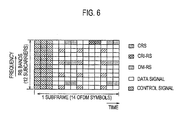
- Specifically, in the LTE (Release-8) scheme, the CRS is configured to be transmitted together with a data signal and a control signal by a configuration illustrated in
Fig. 6 . It is noted that it is possible to set the CRS to a maximum of four antennas. - Furthermore, in an LTE (Release-10) scheme, in addition to the CRS, CSI-RS (Channel State Information-Reference Signal) and DM-RS (Demodulation-Reference Signal/UE Specific-Reference Signal) are configured to be transmitted.
- Since the CSI-RS is considered to be used only for the estimation of the CSI, the CSI-RS is configured to be transmitted at low density as compared with the CRS. It noted that it is possible to define the CSI-RS to a maximum of eight antennas.
- Furthermore, when the DM-RS is transmitted similarly to the data signal (that is, when channel estimation after precoding is enabled), it becomes possible to demodulate the data signal without using the precoding information. It is noted that it is possible to set the DM-RS to a maximum of eight stream transmissions.
- Specifically, the LTE (release-10) scheme is configured so that the CRS, the CSI-RS, the DM-RS, the data signal, and the control signal are transmitted by the configuration illustrated in
Fig. 6 . - Furthermore, conventionally, in order to suppress interference, a technology for performing a reception process by using an MMSE (Minimum Mean Square Error) spatial filtering scheme has been known.
- Such a technology is configured to generate an IRC reception weight WIRC (k, 1) as illustrated in
Fig. 7(a) . Furthermore, when generating the IRC reception weight WIRC (k, 1), a method of estimating a covariance matrix RI+N based on the CRS illustrated inFig. 7(b) is used (see Non Patent Literature 1). - Hereinafter, with reference to
Fig. 8 andFig. 9 , a method for calculating the CSI by using such a technology in a conventional receiver that suppresses no inter-cell interference will be described. - Firstly, with reference to
Fig. 8 , the case in which a transmitter side performs transmission using a codebook will be described. - As illustrated in
Fig. 8 , in step S301, the receiver estimates an (NRX x NTx) dimensional channel matrix H by using the CRS or the CSI-RS. - In step S302, on the basis of the estimated channel matrix H, the receiver selects an (NTx x Stream) dimensional transmission weight matrix WTx from the codebook.
- In step S303, the receiver estimates interference noise power σ2 by using the aforementioned CRS or CSI-RS.
- In step S304, on the basis of the channel matrix H, the interference noise power σ2, and the transmission weight matrix WTx, the receiver estimates an (NStream x NRx) dimensional MMSE reception weight WMMSE by using Equation (1) below.
- In step S305, on the basis of the channel matrix H, the MMSE reception weight WMMSE, and the transmission weight matrix WTx, the receiver estimates received SINR (Signal-to-Interference plus Noise Ratio) by using Equation (2). Furthermore, the estimated received SINR corresponds to the CSI.
- In step S306, the receiver converts the estimated received SINR to CQI (Channel Quality Indicator) through quantization, estimates "PMI (Precoding Matrix Indicator)" that is information indicating a transmission weight on the basis of the estimated received SINR and channel matrix H, and estimates "RI (Rank Indicator)" that is information indicating the number of transmission streams on the basis of the estimated received SINR and the CQI.
- Secondly, with reference to
Fig. 9 , the case in which a transmitter side performs transmission using an arbitrary transmission weight matrix will be described. - As illustrated in
Fig. 9 , in step S401, the receiver estimates an (NRx x NTx) dimensional channel matrix H by using the CRS or the CSI-RS. - In step S402, the receiver estimates an (NTx x NStream) dimensional transmission weight matrix WTx by using Equation (3) on the basis of the estimated channel matrix H.
- Hereinafter, operations in steps S403 to S405 are the same as the operations in the aforementioned steps S303 to S305.
- In step S406, the receiver converts the estimated received SINR to CQI through quantization, and estimates "RI (Rank Indicator)" that is information indicating the number of transmission streams on the basis of the estimated received SINR and the CQI.
- Moreover, in the case in which no precoding transmission is performed, it is the same as the aforementioned operation illustrated in
Fig. 8 , except that the (NTx x NStream) dimensional transmission weight matrix WTx is not selected, and the transmission weight matrix WTx is not used in steps S303 to S305. - In addition, in step S306, the receiver converts the estimated received SINR to the CQI through the quantization, and estimates the "RI (Rank Indicator)" that is information indicating the number of transmission streams on the basis of the estimated received SINR and the CQI.
- [NPL 1] 3GPP contribution R4-115213
- However, in the aforementioned CSI calculation method, there is a problem that a gain by the
IRC receiver 10 is not reflected. - That is, the aforementioned CSI calculation method considers the receiver that suppresses no inter-cell interference, and assumes the inter-cell interference as white noise to calculate the CSI.
- On the other hand, since the
IRC receiver 10 is able to effectively suppress the inter-cell interference, received SINR in theIRC receiver 10 is improved as compared with received SINR in the receiver that suppresses no inter-cell interference. - Therefore, when the received SINR in the
IRC receiver 10 is estimated by the aforementioned CSI calculation method, the received SINR is estimated to be lower than actual received SINR, resulting in a problem that it is not possible to select appropriate MCS (Modulation and Coding Scheme) with respect to theIRC receiver 10, it is not possible to select the appropriate number of transmission streams, and it is not possible to perform appropriate user scheduling. - Therefore, the present invention has been achieved in view of the above-described problems, and an object thereof is to provide a receiver capable of suppressing inter-cell interference and measuring accurate CSI.
- A first characteristic of the present invention is summarized in that a receiver comprising: a channel estimation unit that performs a channel estimation process so as to estimate a channel matrix; a transmission weight matrix generation unit that generates a transmission weight matrix; a covariance matrix estimation unit that estimates an interference signal covariance matrix including a covariance matrix and an interference signal component on the basis of a cell-specific reference signal; a reception weight generation unit that generates a reception weight on the basis of the channel matrix, the transmission weight matrix, and the covariance matrix; and a received quality estimation unit that estimates reception quality on the basis of the channel matrix, the interference signal covariance matrix, the transmission weight matrix, and the reception weight.
-
- [
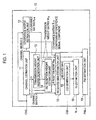
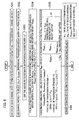
Fig. 1] Fig. 1 is a functional block diagram of an IRC receiver according to a first embodiment of the present invention. - [
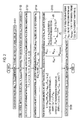
Fig. 2] Fig. 2 is a flowchart illustrating an operation of the IRC receiver according to the first embodiment of the present invention. - [
Fig. 3] Fig. 3 is a flowchart illustrating the operation of the IRC receiver according to the first embodiment of the present invention. - [
Fig. 4] Fig. 4 is a functional block diagram of the IRC receiver according to a first modification of the present invention. - [
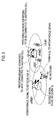
Fig. 5] Fig. 5 is a diagram for explaining a conventional technology. - [
Fig. 6] Fig. 6 is a diagram for explaining a conventional technology. - [
Fig. 7] Fig. 7 is a diagram for explaining a conventional technology. - [
Fig. 8] Fig. 8 is a diagram for explaining a conventional technology. - [
Fig. 9] Fig. 9 is a diagram for explaining a conventional technology. - With reference to
Fig. 1 to Fig. 3 , anIRC receiver 10 according to a first embodiment of the present invention will be described. - As illustrated in
Fig. 1 , theIRC receiver 10 according to the present embodiment includes achannel estimation unit 11, a covariancematrix estimation unit 12, a transmission weightmatrix generation unit 13, an IRC receptionweight generation unit 14, a receivedSINR estimation unit 15, aCQI generation unit 16, anRI estimation unit 18, and aPMI estimation unit 19. - The
channel estimation unit 11 is configured to perform a channel estimation process on the basis of CRS received from a serving cell (cell 1) so as to estimate (calculate) a channel matrix H. - The covariance
matrix estimation unit 12 is configured to estimate (calculate) an interference signal covariance matrix
including a covariance matrix RI+N and an interference signal component (a noise component) on the basis of the CRS and the channel matrix H received from thechannel estimation unit 11. Furthermore, the interference signal covariance matrix
is to be estimated inFig. 7(c) . - The transmission weight
matrix generation unit 13 is configured to generate a transmission weight matrix WTx on the basis of the channel matrix H received from thechannel estimation unit 11. - For example, in the case in which a transmitter side performs transmission using a codebook, the transmission weight
matrix generation unit 13 may be configured to select the transmission weight matrix WTx from the codebook on the basis of the channel matrix H. - Alternatively, in the case in which a transmitter side performs transmission using an arbitrary transmission weight matrix, the transmission weight
matrix generation unit 13 may also be configured to generate the transmission weight matrix WTx on the basis of singular value decomposition precoding assumption. - The IRC reception
weight generation unit 14 is configured to generate an IRC reception weight WIRC on the basis of the channel matrix H received from thechannel estimation unit 11, the transmission weight matrix WTx received from the transmission weightmatrix generation unit 13, and the covariance matrix RI+N received from the covariancematrix estimation unit 12. - The received
SINR estimation unit 15 is configured to estimate (calculate) received SINR on the basis of the channel matrix H received from thechannel estimation unit 11, the interference signal covariance matrix
received from the covariancematrix estimation unit 12, the transmission weight matrix WTx received from the transmission weightmatrix generation unit 13, and the IRC reception weight WIRC received from the IRC receptionweight generation unit 14. - The
CQI generation unit 16 is configured to generate CQI on the basis of the received SINR received from the receivedSINR estimation unit 15. - The
RI estimation unit 18 is configured to estimate "RI" that is information indicating the number of transmission streams on the basis of the received SINR received from the receivedSINR estimation unit 15 and the CQI received from theCQI generation unit 16. - The
PMI estimation unit 19 is configured to estimate "PMI" that is information indicating a transmission weight on the basis of the channel matrix H received from thechannel estimation unit 11 and the received SINR received from the receivedSINR estimation unit 15. - Hereinafter, with reference to
Fig. 2 andFig. 3 , a method for calculating the CSI in theIRC receiver 10 according to the present embodiment will be described. - Firstly, with reference to
Fig. 2 , the case in which a transmitter side performs transmission using a codebook will be described. - As illustrated in
Fig. 2 , in step S101, theIRC receiver 10 estimates an (NRx x NTx) dimensional channel matrix H by using CRS or CSI-RS. - In step S102, on the basis of the estimated channel matrix H, the
IRC receiver 10 selects an (NTx x NStream) dimensional transmission weight matrix WTx from the codebook. - In step S103, the
IRC receiver 10 estimates a covariance matrix RI+N on the basis of the CRS, the channel matrix H, and the transmission weight matrix WTx by using Equation (4) (refer toFig. 7(b) ). Furthermore, theIRC receiver 10 estimates an interference signal covariance matrix including an interference signal component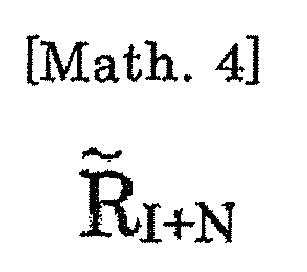
(refer toFig. 7(c) ). - In step S104, the
IRC receiver 10 estimates an (NStream x NRx) dimensional IRC reception weight WIRC by using Equation (5) on the basis of the channel matrix H, the covariance matrix RI+N, and the transmission weight matrix WTx. - In step S105, the
IRC receiver 10 estimates received SINR by using Equation (6) on the basis of the channel matrix H, the IRC reception weight WIRC, and the transmission weight matrix WTx. - In step S106, the
IRC receiver 10 converts the estimated received SINR to CQI through quantization, estimates "PMI" that is information indicating a transmission weight on the basis of the estimated received SINR and channel matrix H, and estimates "RI" that is information indicating the number of transmission streams on the basis of the estimated received SINR and the CQI. - Secondly, with reference to
Fig. 3 , the case in which a transmitter side performs transmission using an arbitrary transmission weight matrix will be described. - As illustrated in
Fig. 3 , in step S201, the receiver estimates an (NRx x NTx) dimensional channel matrix H by using CRS or CSI-RS. - In step S202, the receiver estimates an (NTx x NStream) dimensional transmission weight matrix WTx by using Equation (3) on the basis of the estimated channel matrix H.
- Hereinafter, operations in steps S203 to S205 are the same as the operations in the aforementioned steps S103 to S105.
- In step S206, the
IRC receiver 10 converts the estimated received SINR to CQI through quantization, and estimates "RI" that is information indicating the number of transmission streams on the basis of the estimated received SINR and the CQI. - Moreover, in the case in which no precoding transmission is performed, it is the same as the aforementioned operation illustrated in
Fig. 2 , except that the (NTx x NStream) dimensional transmission weight matrix WTx is not selected, and the transmission weight matrix WTx is not used in steps S103 to S105. - In addition, in step S306, the
IRC receiver 10 converts the estimated received SINR to the CQI through the quantization, and estimates the "RI" that is information indicating the number of transmission streams on the basis of the estimated received SINR and the CQI. - According to the
IRC receiver 10 according to the present embodiment, when estimating the IRC reception weight WIRC, the covariance matrix RI+N based on the CRS is configured to be used. Furthermore, according to theIRC receiver 10 according to the present embodiment, when estimating the received SINR, the interference signal covariance matrix
including an interference signal component based on the estimated IRC reception weight WIRC and the CRS is configured to be used. - Consequently, by using the both, so that it is possible to estimate received SINR which reflects an interference suppression effect by the IRC reception weight WIRC, and thus it is possible to estimate accurate received SINR in the
IRC receiver 10, as compared with the received SINR estimation method in the conventional receiver that suppresses no interference. - With reference to
Fig. 4 , theIRC receiver 10 according to a first modification of the present invention will be described. Hereinafter, theIRC receiver 10 according to the present first modification will be described while focusing on differences from theIRC receiver 10 according to the aforementioned first embodiment. - As illustrated in
Fig. 4 , theIRC receiver 10 according to the present first modification includes achannel estimation unit 17 in addition to the configuration illustrated inFig. 1 . - The
channel estimation unit 17 is configured to perform a channel estimation process on the basis of received CST-RS so as to estimate (calculate) the channel matrix H. - In the
IRC receiver 10 according to the present first modification, the transmission weightmatrix generation unit 13, the IRC receptionweight estimation unit 14, and the receivedSINR estimation unit 15 are configured to use the channel matrix H estimated by thechannel estimation unit 17, instead of the channel matrix H estimated by thechannel estimation unit 11. - The characteristics of the present embodiment as described above may be expressed as follows.
- A first characteristic of the present embodiment is summarized that an
IRC receiver 10 includes: achannel estimation unit 11 configured to perform a channel estimation process so as to estimate a channel matrix H; a transmission weightmatrix generation unit 13 configured to generate a transmission weight matrix WTx; a covariancematrix estimation unit 12 configured to estimate an interference signal covariance matrix
including a covariance matrix RI+N and an interference signal component on the basis of CRS (Cell-Specific Reference Signal); an IRC receptionweight generation unit 14 configured to generate an IRC reception weight WIRC on the basis of the channel matrix H, the transmission weight matrix WTx, and the covariance matrix RI+N; and a receivedSINR estimation unit 15 configured to estimate received SINR (reception quality) on the basis of the channel matrix H, the interference signal covariance matrix
the transmission weight matrix WTx, and the IRC reception weight WIRC. - In the first characteristic of the present embodiment, the transmission weight
matrix generation unit 13 may be configured to select the transmission weight matrix WTx from a codebook on the basis of the channel matrix H. - In the first characteristic of the present embodiment, the transmission weight
matrix generation unit 13 may also be configured to generate the transmission weight matrix WTx on the basis of singular value decomposition precoding assumption. - In the first characteristic of the present embodiment, the transmission weight
matrix generation unit 13 may also be configured to generate the transmission weight matrix WTx on the basis of other arbitrary precoding methods. - In addition, the operation of the above-mentioned
IRC receiver 10 may be implemented by hardware, may also be implemented by a software module executed by a processor, or may further be implemented by the combination of the both. - The software module may be arranged in a storage medium of an arbitrary format such as a RAM (Random Access Memory), a flash memory, a ROM (Read Only Memory), an EPROM (Erasable Programmable ROM), an EEPROM (Electronically Erasable and Programmable ROM), a register, a hard disk, a removable disk, or a CD-ROM.
- The storage medium is connected to the processor so that the processor can write and read information into and from the storage medium. Such a storage medium may also be accumulated in the processor. Such a storage medium and processor may be arranged in an ASIC. The ASIC may be arranged in the
IRC receiver 10. Furthermore, such a storage medium and processor may be arranged in theIRC receiver 10 as discrete components. - Thus, the present invention has been explained in detail by using the above-described embodiments; however, it is obvious that for persons skilled in the art, the present invention is not limited to the embodiments explained herein. The present invention can be implemented as a corrected and modified mode without departing the gist and the scope of the present invention defined by the claims. Therefore, the description of the specification is intended for explaining the example only and does not impose any limited meaning to the present invention.
- In addition, the entire content of Japanese Patent Application No.
2011-242910 (filed on November 4, 2011 - As described above, according to the present invention, it is possible to provide a receiver capable of suppressing inter-cell interference and measuring accurate CSI.
-
- 10
- IRC receiver
- 11, 17
- Channel estimation unit
- 12
- Covariance matrix estimation unit
- 13
- Transmission weight matrix generation unit
- 14
- IRC reception weight estimation unit
- 15
- Received SINR estimation unit
- 16
- CQI generation unit
- 18
- RI estimation unit
- 19
- PMI estimation unit
Claims (3)
- A receiver comprising:a channel estimation unit that performs a channel estimation process so as to estimate a channel matrix;a transmission weight matrix generation unit that generates a transmission weight matrix;a covariance matrix estimation unit that estimates an interference signal covariance matrix including a covariance matrix and an interference signal component on the basis of a cell-specific reference signal;a reception weight generation unit that generates a reception weight on the basis of the channel matrix, the transmission weight matrix, and the covariance matrix; anda received quality estimation unit that estimates reception quality on the basis of the channel matrix, the interference signal covariance matrix, the transmission weight matrix, and the reception weight.
- The receiver according to claim 1, wherein the transmission weight matrix generation unit is configured to select the transmission weight matrix from a codebook on the basis of the channel matrix.
- The receiver according to claim 1, wherein the transmission weight matrix generation unit is configured to generate the transmission weight matrix on the basis of singular value decomposition precoding assumption.
Applications Claiming Priority (2)
| Application Number | Priority Date | Filing Date | Title |
|---|---|---|---|
| JP2011242910A JP5184690B1 (en) | 2011-11-04 | 2011-11-04 | Receiver |
| PCT/JP2012/078468 WO2013065820A1 (en) | 2011-11-04 | 2012-11-02 | Receiver |
Publications (1)
| Publication Number | Publication Date |
|---|---|
| EP2775646A1 true EP2775646A1 (en) | 2014-09-10 |
Family
ID=48192157
Family Applications (1)
| Application Number | Title | Priority Date | Filing Date |
|---|---|---|---|
| EP12845420.4A Withdrawn EP2775646A1 (en) | 2011-11-04 | 2012-11-02 | Receiver |
Country Status (5)
| Country | Link |
|---|---|
| US (1) | US20140307838A1 (en) |
| EP (1) | EP2775646A1 (en) |
| JP (1) | JP5184690B1 (en) |
| CN (1) | CN103907304A (en) |
| WO (1) | WO2013065820A1 (en) |
Families Citing this family (2)
| Publication number | Priority date | Publication date | Assignee | Title |
|---|---|---|---|---|
| JP6213137B2 (en) * | 2013-10-17 | 2017-10-18 | 富士通株式会社 | Mobile station and reception quality measuring method |
| JP2015207816A (en) | 2014-04-17 | 2015-11-19 | 富士通株式会社 | Reception device, reception method, and wireless communication system |
Family Cites Families (12)
| Publication number | Priority date | Publication date | Assignee | Title |
|---|---|---|---|---|
| JP4170789B2 (en) * | 2003-02-14 | 2008-10-22 | 株式会社エヌ・ティ・ティ・ドコモ | Wireless communication system, receiving station, and wireless communication control method |
| JP4663369B2 (en) * | 2004-05-20 | 2011-04-06 | パナソニック株式会社 | Wireless communication system, wireless communication method, base station apparatus, and terminal apparatus |
| WO2006109786A1 (en) * | 2005-04-11 | 2006-10-19 | Matsushita Electric Industrial Co., Ltd. | Wireless base station device, terminal, and wireless communication method |
| US8000413B2 (en) * | 2007-08-20 | 2011-08-16 | Telefonaktiebolaget Lm Ericsson (Publ) | Selective signal demodulation method and apparatus |
| US7957485B2 (en) * | 2008-02-25 | 2011-06-07 | Telefonaktiebolaget Lm Ericsson (Publ) | Reduced complexity parametric covariance estimation for precoded MIMO transmissions |
| US7986919B2 (en) * | 2008-03-19 | 2011-07-26 | Telefonaktiebolaget Lm Ericsson (Publ) | Simplified impairments matrix calculation for SINR estimation |
| US7929593B2 (en) * | 2008-04-15 | 2011-04-19 | Telefonaktiebolaget Lm Ericsson (Publ) | Method and apparatus for successive interference subtraction with covariance root processing |
| GB0820535D0 (en) * | 2008-11-10 | 2008-12-17 | Icera Inc | Communication system and method |
| KR100996535B1 (en) * | 2009-05-11 | 2010-11-24 | 성균관대학교산학협력단 | Inter-cell interference mitigation method using spatial covariance matrix estimation for multi input and multi output antenna ofdm system, and receiving apparatus using the same |
| CN101958852B (en) * | 2009-07-17 | 2013-08-21 | 中兴通讯股份有限公司 | Method and device for estimating CINR of MLD receiver in MIMO system |
| CN101998440B (en) * | 2009-08-21 | 2014-08-20 | 华为技术有限公司 | Method and device for detecting signals in multi-input and multi-output system |
| CN101753176B (en) * | 2009-12-24 | 2012-12-19 | 北京北方烽火科技有限公司 | Interference rejection combining method and system |
-
2011
- 2011-11-04 JP JP2011242910A patent/JP5184690B1/en not_active Expired - Fee Related
-
2012
- 2012-11-02 EP EP12845420.4A patent/EP2775646A1/en not_active Withdrawn
- 2012-11-02 CN CN201280053623.4A patent/CN103907304A/en active Pending
- 2012-11-02 WO PCT/JP2012/078468 patent/WO2013065820A1/en not_active Ceased
- 2012-11-02 US US14/355,101 patent/US20140307838A1/en not_active Abandoned
Non-Patent Citations (1)
| Title |
|---|
| See references of WO2013065820A1 * |
Also Published As
| Publication number | Publication date |
|---|---|
| WO2013065820A1 (en) | 2013-05-10 |
| US20140307838A1 (en) | 2014-10-16 |
| JP2013098941A (en) | 2013-05-20 |
| CN103907304A (en) | 2014-07-02 |
| JP5184690B1 (en) | 2013-04-17 |
Similar Documents
| Publication | Publication Date | Title |
|---|---|---|
| EP4099603B1 (en) | Interference measurements and channel state information feedback for multi-user multiple-in multiple-out | |
| JP5519027B2 (en) | Method and apparatus for rate prediction in cooperative multi-point transmission | |
| EP2930873B1 (en) | Method for reporting channel state information, user equipment and base station | |
| JP5913627B2 (en) | Method and apparatus for estimating channel quality information, and base station and network central processing device | |
| EP2750435B1 (en) | Wireless communications system, feedback method, user terminal, and wireless base station device | |
| EP2869617B1 (en) | Methods and apparatus for coordinating a cell on a plurality of resource blocks | |
| CN101741508B (en) | Method for obtaining and using CQI in LTE transmission mode 7 | |
| CN106559182B (en) | Method, device and system for configuration and acquisition of channel parameters | |
| EP2410785A1 (en) | Method and device for estimating downlink channel quality | |
| CN106559807A (en) | A kind of data transmission method and relevant device | |
| CN105122671A (en) | Mobile communication terminal | |
| EP2870712B1 (en) | Method and access point for assigning sounding resources | |
| CN103220069A (en) | Method and device for feeding back channel state information | |
| EP2795807B1 (en) | Downlink transmission in a mu-mimo system | |
| CN104639476B (en) | Suppress the method and upcoming base station of TD LTE interference at crossed slot | |
| EP3633883A1 (en) | Interference power measurement method and device | |
| EP2869519A1 (en) | Data demodulation method and system, and user equipment | |
| JP6037058B2 (en) | Method and apparatus for data transmission | |
| CN106559167A (en) | A kind of method and device of link circuit self-adapting | |
| EP2989821B1 (en) | A method and device for enabling downlink coordinated multipoint communication | |
| CN105337683A (en) | Emission weighting method and apparatus for CSI feedback system | |
| US9048970B1 (en) | Feedback for cooperative multipoint transmission systems | |
| EP2775645A1 (en) | Receiver | |
| EP2775646A1 (en) | Receiver | |
| CN104253639B (en) | Obtain the method and device of channel quality instruction |
Legal Events
| Date | Code | Title | Description |
|---|---|---|---|
| PUAI | Public reference made under article 153(3) epc to a published international application that has entered the european phase |
Free format text: ORIGINAL CODE: 0009012 |
|
| 17P | Request for examination filed |
Effective date: 20140521 |
|
| AK | Designated contracting states |
Kind code of ref document: A1 Designated state(s): AL AT BE BG CH CY CZ DE DK EE ES FI FR GB GR HR HU IE IS IT LI LT LU LV MC MK MT NL NO PL PT RO RS SE SI SK SM TR |
|
| DAX | Request for extension of the european patent (deleted) | ||
| STAA | Information on the status of an ep patent application or granted ep patent |
Free format text: STATUS: THE APPLICATION HAS BEEN WITHDRAWN |
|
| 18W | Application withdrawn |
Effective date: 20150226 |