EP2775004A1 - HIGHLY HEAT-RESISTANT AND HIGH-STRENGTH Rh-BASED ALLOY AND METHOD FOR PRODUCING SAME - Google Patents
HIGHLY HEAT-RESISTANT AND HIGH-STRENGTH Rh-BASED ALLOY AND METHOD FOR PRODUCING SAME Download PDFInfo
- Publication number
- EP2775004A1 EP2775004A1 EP12846016.9A EP12846016A EP2775004A1 EP 2775004 A1 EP2775004 A1 EP 2775004A1 EP 12846016 A EP12846016 A EP 12846016A EP 2775004 A1 EP2775004 A1 EP 2775004A1
- Authority
- EP
- European Patent Office
- Prior art keywords
- mass
- phase
- based alloy
- alloy
- resistant
- Prior art date
- Legal status (The legal status is an assumption and is not a legal conclusion. Google has not performed a legal analysis and makes no representation as to the accuracy of the status listed.)
- Granted
Links
- 229910045601 alloy Inorganic materials 0.000 title claims abstract description 91
- 239000000956 alloy Substances 0.000 title claims abstract description 91
- 238000004519 manufacturing process Methods 0.000 title claims description 6
- 229910052721 tungsten Inorganic materials 0.000 claims abstract description 39
- 229910052782 aluminium Inorganic materials 0.000 claims abstract description 33
- 238000005728 strengthening Methods 0.000 claims abstract description 25
- 239000000654 additive Substances 0.000 claims abstract description 20
- 230000000996 additive effect Effects 0.000 claims abstract description 20
- 239000003779 heat-resistant material Substances 0.000 claims abstract description 12
- 239000011159 matrix material Substances 0.000 claims abstract description 11
- 229910052719 titanium Inorganic materials 0.000 claims abstract description 8
- 229910052758 niobium Inorganic materials 0.000 claims abstract description 7
- 229910052763 palladium Inorganic materials 0.000 claims abstract description 7
- 229910052697 platinum Inorganic materials 0.000 claims abstract description 7
- 229910052702 rhenium Inorganic materials 0.000 claims abstract description 7
- 229910052715 tantalum Inorganic materials 0.000 claims abstract description 7
- 229910052720 vanadium Inorganic materials 0.000 claims abstract description 7
- 229910052726 zirconium Inorganic materials 0.000 claims abstract description 7
- 229910052750 molybdenum Inorganic materials 0.000 claims abstract description 6
- 229910052804 chromium Inorganic materials 0.000 claims abstract description 5
- 229910052735 hafnium Inorganic materials 0.000 claims abstract description 5
- 229910052742 iron Inorganic materials 0.000 claims abstract description 5
- 229910052707 ruthenium Inorganic materials 0.000 claims abstract description 5
- 229910052799 carbon Inorganic materials 0.000 claims abstract description 4
- 229910052741 iridium Inorganic materials 0.000 claims abstract description 4
- 229910052746 lanthanum Inorganic materials 0.000 claims abstract description 4
- 229910052727 yttrium Inorganic materials 0.000 claims abstract description 4
- 229910052791 calcium Inorganic materials 0.000 claims abstract description 3
- 229910052749 magnesium Inorganic materials 0.000 claims abstract description 3
- 229910052703 rhodium Inorganic materials 0.000 claims abstract description 3
- 239000000203 mixture Substances 0.000 claims description 8
- 238000000034 method Methods 0.000 claims description 5
- 229910000629 Rh alloy Inorganic materials 0.000 claims description 4
- 229910001122 Mischmetal Inorganic materials 0.000 claims 1
- 230000001376 precipitating effect Effects 0.000 claims 1
- -1 wherein X is Co Substances 0.000 claims 1
- 230000003647 oxidation Effects 0.000 abstract description 17
- 238000007254 oxidation reaction Methods 0.000 abstract description 17
- 229910052759 nickel Inorganic materials 0.000 abstract description 5
- 229910052751 metal Inorganic materials 0.000 abstract description 4
- 239000002184 metal Substances 0.000 abstract description 4
- 150000002739 metals Chemical class 0.000 abstract description 3
- 239000010948 rhodium Substances 0.000 description 50
- 230000000694 effects Effects 0.000 description 23
- 238000001556 precipitation Methods 0.000 description 18
- 230000006872 improvement Effects 0.000 description 14
- 238000012360 testing method Methods 0.000 description 13
- 230000000052 comparative effect Effects 0.000 description 11
- 239000002244 precipitate Substances 0.000 description 11
- 229910000765 intermetallic Inorganic materials 0.000 description 8
- 239000000463 material Substances 0.000 description 7
- 239000006104 solid solution Substances 0.000 description 7
- 230000005484 gravity Effects 0.000 description 6
- 230000015572 biosynthetic process Effects 0.000 description 5
- 239000007789 gas Substances 0.000 description 5
- 230000008018 melting Effects 0.000 description 5
- 238000002844 melting Methods 0.000 description 5
- 238000005260 corrosion Methods 0.000 description 4
- 230000007797 corrosion Effects 0.000 description 4
- 239000013078 crystal Substances 0.000 description 4
- 238000010438 heat treatment Methods 0.000 description 4
- 239000002245 particle Substances 0.000 description 4
- 230000032683 aging Effects 0.000 description 3
- 230000002939 deleterious effect Effects 0.000 description 3
- 230000006641 stabilisation Effects 0.000 description 3
- 238000011105 stabilization Methods 0.000 description 3
- 239000000126 substance Substances 0.000 description 3
- 238000005299 abrasion Methods 0.000 description 2
- 230000008859 change Effects 0.000 description 2
- 239000000470 constituent Substances 0.000 description 2
- 230000007423 decrease Effects 0.000 description 2
- 230000006866 deterioration Effects 0.000 description 2
- 238000009826 distribution Methods 0.000 description 2
- 238000000635 electron micrograph Methods 0.000 description 2
- 239000011261 inert gas Substances 0.000 description 2
- 230000007246 mechanism Effects 0.000 description 2
- 239000010970 precious metal Substances 0.000 description 2
- 229910002058 ternary alloy Inorganic materials 0.000 description 2
- 229910000967 As alloy Inorganic materials 0.000 description 1
- 229910001080 W alloy Inorganic materials 0.000 description 1
- 238000002441 X-ray diffraction Methods 0.000 description 1
- 230000002411 adverse Effects 0.000 description 1
- XAGFODPZIPBFFR-UHFFFAOYSA-N aluminium Chemical compound [Al] XAGFODPZIPBFFR-UHFFFAOYSA-N 0.000 description 1
- 238000005266 casting Methods 0.000 description 1
- 239000011248 coating agent Substances 0.000 description 1
- 238000000576 coating method Methods 0.000 description 1
- 150000001875 compounds Chemical class 0.000 description 1
- 230000001687 destabilization Effects 0.000 description 1
- 238000006477 desulfuration reaction Methods 0.000 description 1
- 230000023556 desulfurization Effects 0.000 description 1
- 238000011161 development Methods 0.000 description 1
- 230000018109 developmental process Effects 0.000 description 1
- 238000010586 diagram Methods 0.000 description 1
- 239000006185 dispersion Substances 0.000 description 1
- 230000007613 environmental effect Effects 0.000 description 1
- 238000005242 forging Methods 0.000 description 1
- 239000000446 fuel Substances 0.000 description 1
- 238000007542 hardness measurement Methods 0.000 description 1
- 150000001247 metal acetylides Chemical class 0.000 description 1
- 238000011160 research Methods 0.000 description 1
- MHOVAHRLVXNVSD-UHFFFAOYSA-N rhodium atom Chemical compound [Rh] MHOVAHRLVXNVSD-UHFFFAOYSA-N 0.000 description 1
- 238000005204 segregation Methods 0.000 description 1
- 238000007711 solidification Methods 0.000 description 1
- 230000008023 solidification Effects 0.000 description 1
- WFKWXMTUELFFGS-UHFFFAOYSA-N tungsten Chemical compound [W] WFKWXMTUELFFGS-UHFFFAOYSA-N 0.000 description 1
- 239000010937 tungsten Substances 0.000 description 1
- 229910001247 waspaloy Inorganic materials 0.000 description 1
- 239000013585 weight reducing agent Substances 0.000 description 1
Images

Classifications
-
- C—CHEMISTRY; METALLURGY
- C22—METALLURGY; FERROUS OR NON-FERROUS ALLOYS; TREATMENT OF ALLOYS OR NON-FERROUS METALS
- C22F—CHANGING THE PHYSICAL STRUCTURE OF NON-FERROUS METALS AND NON-FERROUS ALLOYS
- C22F1/00—Changing the physical structure of non-ferrous metals or alloys by heat treatment or by hot or cold working
- C22F1/14—Changing the physical structure of non-ferrous metals or alloys by heat treatment or by hot or cold working of noble metals or alloys based thereon
-
- C—CHEMISTRY; METALLURGY
- C22—METALLURGY; FERROUS OR NON-FERROUS ALLOYS; TREATMENT OF ALLOYS OR NON-FERROUS METALS
- C22C—ALLOYS
- C22C5/00—Alloys based on noble metals
- C22C5/04—Alloys based on a platinum group metal
Definitions
- the present invention relates to a Rh-based heat-resistant alloy suitable for a member of jet engines, gas turbines and the like, and to a method for manufacturing the same, and particularly relates to an alloy that has heat resistance and oxidation resistance superior to those of conventional Ni-based alloys and can maintain required strength even upon exposure to severe high temperature atmosphere.
- Strengthening mechanism for a Ni-based alloy as a heat-resistant material is basically a precipitation strengthening, which comprising dispersing a ⁇ ' phase (Ni 3 (Al, Ti)) having an L1 2 structure as a strengthening phase in the matrix alloy. Since the ⁇ ' phase exhibits inverse temperature dependence where strength increases with an increase in temperature, the phase imparts excellent high temperature strength and high temperature creep characteristics to create a Ni-based alloy suitable for heat-resistant applications such as a rotor blade of a gas turbine and a turbine disk.
- strengthening mechanism for a Co-based alloy as a heat-resistant material uses solid solution strengthening and precipitation strengthening of carbides. Systems containing a large amount of Cr have excellent corrosion resistance and oxidation resistance and good abrasion resistance, and are therefore used for members such as a stationary blade and a combustor.
- novel heat-resistant alloys have been published.
- the present inventors have also disclosed heat-resistant materials made of the following alloys as new heat-resistant alloys replacing Ni-based alloys: a Co-based alloy in which a ⁇ ' phase intermetallic compound (Co 3 (Al, W)) having an L1 2 structure similar to that of a Ni-based heat-resistant alloy is dispersed; and an Ir-based alloy providing a precipitation strengthening effect based on a ⁇ ' phase intermetallic compound (Ir 3 (Al, W)) having an L1 2 structure (Patent Literatures 1 and 2).
- an object of the present invention is to provide a heat-resistant material having not only excellent high-temperature characteristics but also good balance of factors such as weight.
- the present invention for solving the above problem is a heat-resistant material comprising a Rh-based alloy that is a high heat-resistant and high strength alloy comprising a Rh-based alloy where Al and W as essential additive elements are added to Rh.
- the Rh-based alloy comprises 0.2 to 15.0 mass% of Al and 15.0 to 45.0 mass% of W with the remainder being Rh, and a ⁇ ' phase (Rh 3 (Al, W)) having an L1 2 structure is dispersed as an essential strengthening phase in a matrix.
- the heat-resistant material according to the present invention comprises a Rh (rhodium)-based alloy.
- Rh is one of precious metals and has a high melting point (1966°C) and excellent corrosion resistance (oxidation resistance). Therefore, it is considered that its chemical stability at high temperature is much better than that of conventional Ni-based alloys.
- Rh has a specific gravity of about 12, which is lower than that of Ir (specific gravity: about 22) and relatively close to that of Ni (specific gravity: about 9).
- Rh-based alloy can contribute to a weight reduction of members as compared to the above conventional Ir-based heat-resistant alloys.
- a y' phase (Rh 3 (Al, W), which may be simply referred to as ⁇ ' phase hereinafter) having an L1 2 structure is dispersed as a strengthening factor of a Rh-based alloy.
- Precipitation strengthening with the ⁇ ' phase is the same as the case of the above conventional Ir-based alloy.
- the ⁇ ' phase is excellent in high temperature stability because of inverse temperature dependence for strength, and Rh itself is also excellent in high temperature strength. Therefore, the Rh-based heat-resistant alloy according to the present invention maintains excellent high-temperature characteristics even when exposed to a much higher high temperature atmosphere compared with Ni-based heat-resistant alloys.
- the present invention is a Rh-based alloy with Al (aluminum) and W (tungsten) as alloy elements and comprising 0.2 to 15.0 mass% of Al and 15.0 to 45.0 mass% of W.
- Al and W tungsten
- the amounts of Al and W to be added are set to the above ranges in order to precipitate the ⁇ ' phase that can function as a strengthening phase.
- the numerical ranges are revealed as a result of studies made by the present inventors.
- Al is not only a main constituent element of the ⁇ ' phase but also a component necessary for precipitation and stabilization of the ⁇ ' phase and also contributes to improvement in oxidation resistance.
- Al atless than 0.2 mass% precipitates no ⁇ ' phase or on ⁇ ' phase in an amount insufficient to contribute to improvement in high temperature strength.
- the ratio of the ⁇ ' phase is lowered to produce a B2 type intermetallic compound (RhAl, which may sometimes be referred to as B2 phase hereinafter).
- the upper limit of Al content is set to 15 mass%.
- W is also a main constituent element of the ⁇ ' phase, and also has an effect of solid solution strengthening of an alloy matrix. Also, when W is added at less than 15 mass%, the ⁇ ' phase for improving high temperature strength is not precipitated. Further, excessive addition of W at more than 45 mass% facilitates formation of a phase mainly composed of W having a large specific gravity, and therefore segregation is likely to occur.
- the Rh-based alloy according to the present invention improves high temperature strength with proper dispersion of the ⁇ ' phase, but formation of other phases cannot be completely eliminated.
- a B2 phase or a D019 type intermetallic compound (Rh 3 W, which may be referred to as a D019 phase hereinafter) may be precipitated in addition to the ⁇ ' phase depending on the composition.
- Rh 3 W which may be referred to as a D019 phase hereinafter
- the contents of Al and W are within the above range, high temperature strength is secured even if these precipitates other than the ⁇ ' phase are present.
- These precipitation phases also have the effect of strengthening materials.
- ⁇ ' phase is precipitated in the range of 0.2 to 2.0 mass% of Al and 15.0 to 30.0 mass% of W (0.5 mass% or more is more preferable for effective precipitation of the ⁇ ' phase).
- a B2 phase and/or a D019 phase as well as the ⁇ ' phase are precipitated.
- the ⁇ ' phase as a strengthening phase is present, which contributes to the improvement in high temperature strength.
- the ⁇ ' phase, B2 phase and D019 phase as precipitates have a particle size of 3 nm to 1 ⁇ m and that the amount of their precipitation is 20 to 85 volume% in total (relative to the entire alloy).
- the precipitates with a particle size of 3 nm or more provide the precipitation strengthening effect, but coarse precipitates with a particle size of more than 1 ⁇ m lower the effect.
- the amount of precipitation of 20 volume% or more is necessary for obtaining a sufficient precipitation strengthening effect while it is concerned that an excessive amount of precipitation of more than 85 volume% deteriorates ductility.
- a stepwise aging treatment is performed at a predetermined temperature range in the manufacturing method described later.
- An additive element may be added to the heat resistant Rh-based alloy according to the present invention for further improvement in high-temperature characteristics and additional improvement in characteristics.
- Such additive elements are classified into the two following groups.
- Group I is a group consisting of B, C, Mg, Ca, Y, La and misch metals.
- B is an alloy component that segregates at a crystal grain boundary to strengthen the grain boundary, thereby contributing to improvement of high temperature strength.
- the effect with addition of B becomes significant at 0.001 mass% or more while an excessive addition is not preferable for workability, and therefore the upper limit is set to 1.0 mass% (preferably, 0.5 mass%).
- C is effective for the grain boundary strengthening, and further C is precipitated as a carbide to improve high temperature strength. Such an effect can be seen with the addition of C at 0.001 mass% or more.
- the upper limit of C content is set to 1.0 mass% (preferably 0.8 mass%).
- Mg has an effect of suppressing embrittlement of grain boundaries, and Mg at 0.001 mass% or more makes the addition effect significant.
- the upper limit was set to 0.5 mass% (preferably 0.4 mass%).
- Ca is an alloy component having effects of deoxidation and desulfurization, and contributes to improvement in ductility and workability. The addition effect of Ca becomes significant at 0.001 mass% or more, but the upper limit was set to 1.0 mass% (preferably 0.5 mass%) since excessive addition deteriorates workability.
- Y, La and misch metals are effective components for improving oxidation resistance, and addition effect is exhibited at 0.01 mass% or more, but their upper limits were set to 1.0 mass% (preferably 0.5 mass%) since excessive addition of each adversely affects structural stability.
- One or more of the above additive elements of Group I are added in a total amount of 0.001 to 2.0 mass%.
- the content of Rh is set to 50 mass% or more since a low content of Rh in the alloy makes it impossible to utilize superior high-temperature characteristics of Rh.
- Group II is a group consisting of Co, Ni, Cr, Ti, Fe, V, Nb, Ta, Mo, Zr, Hf, Ir, Re, Pd, Pt and Ru.
- these additive elements one or more of them are added in a total amount of 0.1 to 48.9 mass%.
- the content of Rh is set to 50 mass% or more.
- a ⁇ ' phase ((Rh, X) 3 (Al, W, Z)) having an L1 2 structure is also precipitated and dispersed as a strengthening phase, wherein X is Co, Fe, Cr, Ir, Re, Pd, Pt and/or Ru, and Z is Mo, Ti, Nb, Zr, V, Ta and/or Hf. Ni is included in both X and Z.
- This ⁇ ' phase ((Rh, X) 3 (Al, W, Z)), in which the elements X and Z form a solid solution with Rh 3 (Al, W), has the same crystal structure as the structure of the ⁇ ' phase (Rh 3 (Al, W)) in the Rh-Al-W ternary alloy.
- an intermetallic compound other than ⁇ ' phases may be precipitated depending on the amount of Al and W to be added.
- This intermetallic compound is a B2 type intermetallic compound ((Rh, X)(Al, W, Z)) or D019 type intermetallic compound ((Rh, X) 3 W)), and these compounds have the same crystal structure as the B2 phase (RhAl) or D019 phase (Rh 3 W) in the Rh-Al-W ternary alloy (X and Z are denoted as defined above).
- B2 and D019 phases also act as a strengthening phase when Al and W are within the appropriate range (Al: 0.2 to 15.0 mass%, W: 15.0 to 45.0 mass%).
- Al 0.2 to 15.0 mass%
- W 15.0 to 45.0 mass%
- the ⁇ ' phase is precipitated in the range of 0.2 to 2.0 mass% of Al and 15.0 to 30.0 mass% of W (0.5 mass% or more is more preferable for effective precipitation of the ⁇ ' phase).
- the B2 phase and/or D019 phase as well as the ⁇ ' phase are precipitated. In either range, the ⁇ ' phase as a strengthening phase is present, which most contributes to the improvement in high temperature strength.
- Ni and Co act to strengthen a matrix ( ⁇ phase) and form solid solution in all proportions with the ⁇ phase, so that a two-phase structure of ( ⁇ + ⁇ ') is obtained over a wide composition range. Further, since Ni and Co are replaced with Rh of the ⁇ ' phase, a smaller amount of a precious metal Ir is used to lower the cost. The addition effect is exhibited in the content of 0.1 mass% or more for Ni and 0.1 mass% or more for Co while excessive addition decreases a melting point and a solid solution temperature of the ⁇ ' phase to impair the excellent high-temperature characteristics of the Rh-based alloy. Therefore, the upper limit of the content of Ni and Co was set to 48.9 mass% (preferably 40 mass%) so as not to lower the Rh content to 50 mass% or less.
- Cr is an alloy component creating a dense oxide coating on the surface of the Rh-based alloy to improve oxidation resistance, and contributes to improvement in high temperature strength and corrosion resistance. This effect becomes significant when 0.1 mass% or more of Cr is added. However, since excessive addition causes workability deterioration, the upper limit was set to 15 mass% (preferably 10 mass%).
- Fe is also replaced with Rh, and has an effect of improving workability.
- the addition effect becomes significant at 0.1 mass% or more.
- the upper limit in the case of the addition is set to 20 mass% (preferably 5.0 mass%).
- Mo is an effective alloy component for stabilization of the ⁇ ' phase and solid solution strengthening of the matrix, and Mo at 0.1 mass% or more provides the addition effect.
- the upper limit was set to 15 mass% (preferably 10 mass%).
- Each of Ti, Nb, Zr, V, Ta and Hf is an effective alloy component for stabilization of the ⁇ ' phase and improvement in high temperature strength.
- the addition effect is exhibited at the following contents: Ti: 0.1 mass% or more, Nb: 0.1 mass% or more, Zr: 0.1 mass% or more, V: 0.1 mass% or more, Ta: 0.1 mass% or more, Hf: 0.1 mass% or more.
- the upper limits were set to the following contents: Ti: 10 mass%, Nb: 15 mass%, Zr: 15 mass%, V: 20 mass%, Ta: 25 mass%, Hf: 25 mass%.
- Ir is an effective alloy component for solid solution strengthening of the matrix, and is replaced with Rh of the ⁇ ' phase. While 0.1 mass% or more of Ir exhibits the addition effect, the upper limit in the case of addition is set to 15 mass% (preferably 5.0 mass%) since excessive addition increases the specific gravity of the alloy.
- Re, Pd, Pt and Ru are effective alloy components for improving oxidation resistance, and any of them provides the addition effect that becomes significant at 0.1 mass% or more.
- the upper limit of the amount to be added was set to 25 mass% (preferably 10 mass%) for Re and Pt and 15 mass% (preferably 10 mass%) for Pd and Ru.
- any method of a usual casting process, unidirectional solidification, molten metal forging and a single crystal method can be used.
- heat treatment is performed for ⁇ ' phase precipitation.
- a Rh alloy manufactured with various melting methods is heated to the temperature range of 900 to 1700°C (preferably 1100 to 1600°C). In this treatment, heating time of 30 minutes to 100 hours is preferable.
- Rh alloy according to the present invention is much superior in high-temperature characteristics such as high temperature strength and oxidation resistance as compared with conventionally used Ni-based heat-resistant alloys.
- the alloy according to the present invention is more advantageous than Ir-based alloys in terms of weight and cost, and has potential for practical use as a novel heat-resistant alloy.
- First Embodiment The Rh-based alloys having the composition listed in Table 1 were melted by arc melting in an inert gas atmosphere and casted into an ingot. Test pieces cut out from the ingot were subjected to a heat treatment at 1300°C as an aging treatment for forming precipitates. Then, structural observation and identification of phase constitution were performed for each test piece. Further, hardness was measured for each alloy with a Vickers test (load: 500 kgf, pressurizing time: 10 seconds, room temperature). The results of these tests are shown together in Table 1.
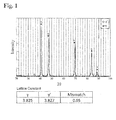
- Fig. 1 shows the XRD results of the Rh-based alloy of Example 1.
- the Figure reveals that the alloy of Example 1 is composed only of the matrix ( ⁇ phase) and the ⁇ ' phase. Further, based on this result, a mismatch between the ⁇ and ⁇ ' phases was examined and then a positive mismatch of 0.05% was confirmed.
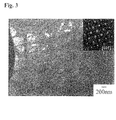
- an electron micrograph of the structure of Example 2 (Rh-0.72 mass% Al-24.5 mass% W) is shown in Fig. 3 .
- Second Embodiment In this embodiment, alloys were manufactured by adding various additive elements to a Rh-Al-W alloy having the basic composition.
- the additive elements are elements belonging to Groups I and II as described above, and the alloys listed in Tables 2 and 3 were manufactured.
- test pieces were cut out from an ingot that had been arc-melted and cast in an inert gas atmosphere, and then the test pieces were subjected to aging treatment. Then, phase constitution was confirmed with structure observation, and hardness measurement was performed. The results are shown together in Tables 2 and 3.
- the additive elements of Group I it is presumed that they are added in a small amount. Thus, as long as an amount of Al and W added is appropriate, the precipitation of ⁇ ' phase can be observed. In addition, there was no significant change in the material structure because of the addition at small amounts. As for the additive element of Group II, the precipitation of the ⁇ ' phase is observed at appropriate amounts of Al and W added. Thereby, appropriate hardness improvement is confirmed.
- the present invention is a Rh alloy having superior high-temperature characteristics such as high temperature strength and oxidation resistance as compared to Ni-based heat-resistant alloys.
- the present invention is suitable for members of gas turbines, aircraft engines, chemical plants, automobile engines such as turbocharger rotors and a high-temperature furnace and the like.
- the alloy according to the present invention since the alloy according to the present invention has high strength and elasticity and excellent corrosion and abrasion resistance, it is also used as materials such as build-up materials, spiral springs, springs, wires, belts and cable guides.
Landscapes
- Chemical & Material Sciences (AREA)
- Engineering & Computer Science (AREA)
- Materials Engineering (AREA)
- Mechanical Engineering (AREA)
- Metallurgy (AREA)
- Organic Chemistry (AREA)
- Physics & Mathematics (AREA)
- Thermal Sciences (AREA)
- Crystallography & Structural Chemistry (AREA)
- Turbine Rotor Nozzle Sealing (AREA)
Abstract
Description
- The present invention relates to a Rh-based heat-resistant alloy suitable for a member of jet engines, gas turbines and the like, and to a method for manufacturing the same, and particularly relates to an alloy that has heat resistance and oxidation resistance superior to those of conventional Ni-based alloys and can maintain required strength even upon exposure to severe high temperature atmosphere.
- As for functional components of gas turbines, aircraft engines, chemical plants, automobile engines, turbocharger rotors and the like and members of a high-temperature furnace and the like, strength under a high-temperature environment and excellent oxidation resistance are required. As this type of high-temperature-resistant materials, Ni-based alloys and Co-based alloys have been conventionally used.
- Strengthening mechanism for a Ni-based alloy as a heat-resistant material is basically a precipitation strengthening, which comprising dispersing a γ' phase (Ni3(Al, Ti)) having an L12 structure as a strengthening phase in the matrix alloy. Since the γ' phase exhibits inverse temperature dependence where strength increases with an increase in temperature, the phase imparts excellent high temperature strength and high temperature creep characteristics to create a Ni-based alloy suitable for heat-resistant applications such as a rotor blade of a gas turbine and a turbine disk. On the other hand, strengthening mechanism for a Co-based alloy as a heat-resistant material uses solid solution strengthening and precipitation strengthening of carbides. Systems containing a large amount of Cr have excellent corrosion resistance and oxidation resistance and good abrasion resistance, and are therefore used for members such as a stationary blade and a combustor.
- More recently, in various heat engines, improvement in thermal efficiency has strongly been required for improving fuel economy and reducing environmental burdens and therefore heat resistance required for heat engine component material has become more severe. Hence, development of a novel heat-resistant material replacing conventional Ni-based and Co-based alloys has been studied.
- So far, many research reports regarding novel heat-resistant alloys have been published. The present inventors have also disclosed heat-resistant materials made of the following alloys as new heat-resistant alloys replacing Ni-based alloys: a Co-based alloy in which a γ' phase intermetallic compound (Co3(Al, W)) having an L12 structure similar to that of a Ni-based heat-resistant alloy is dispersed; and an Ir-based alloy providing a precipitation strengthening effect based on a γ' phase intermetallic compound (Ir3(Al, W)) having an L12 structure (
Patent Literatures 1 and 2). -
- [Patent Literature 1] International Publication No.
WO2007-032293 - [Patent Literature 2] International Publication No.
WO2007-091576 - For the application of heat-resistant materials to functional components of a gas turbine and members of a high-temperature furnace and the like, it is required that high-temperature characteristics such as high temperature strength and oxidation resistance are excellent. However, factors such as weight (specific gravity) and material cost are also emphasized in terms of practical use. Meanwhile, for novel heat-resistant materials of prior art, studies of improvement in high-temperature characteristics have been given a priority and studies of other factors were insufficient. Thus, an object of the present invention is to provide a heat-resistant material having not only excellent high-temperature characteristics but also good balance of factors such as weight.
- The present invention for solving the above problem is a heat-resistant material comprising a Rh-based alloy that is a high heat-resistant and high strength alloy comprising a Rh-based alloy where Al and W as essential additive elements are added to Rh. The Rh-based alloy comprises 0.2 to 15.0 mass% of Al and 15.0 to 45.0 mass% of W with the remainder being Rh, and a γ' phase (Rh3(Al, W)) having an L12 structure is dispersed as an essential strengthening phase in a matrix.
- The heat-resistant material according to the present invention comprises a Rh (rhodium)-based alloy. The reason why Rh is applied is that Rh is one of precious metals and has a high melting point (1966°C) and excellent corrosion resistance (oxidation resistance). Therefore, it is considered that its chemical stability at high temperature is much better than that of conventional Ni-based alloys. Further, Rh has a specific gravity of about 12, which is lower than that of Ir (specific gravity: about 22) and relatively close to that of Ni (specific gravity: about 9). Thus, Rh-based alloy can contribute to a weight reduction of members as compared to the above conventional Ir-based heat-resistant alloys.
- In the present invention, a y' phase (Rh3(Al, W), which may be simply referred to as γ' phase hereinafter) having an L12 structure is dispersed as a strengthening factor of a Rh-based alloy. Precipitation strengthening with the γ' phase is the same as the case of the above conventional Ir-based alloy. The γ' phase is excellent in high temperature stability because of inverse temperature dependence for strength, and Rh itself is also excellent in high temperature strength. Therefore, the Rh-based heat-resistant alloy according to the present invention maintains excellent high-temperature characteristics even when exposed to a much higher high temperature atmosphere compared with Ni-based heat-resistant alloys.
- The present invention will be described in detail below. The present invention is a Rh-based alloy with Al (aluminum) and W (tungsten) as alloy elements and comprising 0.2 to 15.0 mass% of Al and 15.0 to 45.0 mass% of W. Heretofore, it has not been known that a γ' phase is precipitated in an alloy in which Al and W are added to Rh. The amounts of Al and W to be added are set to the above ranges in order to precipitate the γ' phase that can function as a strengthening phase. The numerical ranges are revealed as a result of studies made by the present inventors.
- In other words, Al is not only a main constituent element of the γ' phase but also a component necessary for precipitation and stabilization of the γ' phase and also contributes to improvement in oxidation resistance. Al atless than 0.2 mass% precipitates no γ' phase or on γ' phase in an amount insufficient to contribute to improvement in high temperature strength. On the other hand, with an increase of the Al concentration, the ratio of the γ' phase is lowered to produce a B2 type intermetallic compound (RhAl, which may sometimes be referred to as B2 phase hereinafter). Further, since excessive addition of Al coarsens a B2 phase to become fragile and therefore strength of the alloy reduces, the upper limit of Al content is set to 15 mass%.
- W is also a main constituent element of the γ' phase, and also has an effect of solid solution strengthening of an alloy matrix. Also, when W is added at less than 15 mass%, the γ' phase for improving high temperature strength is not precipitated. Further, excessive addition of W at more than 45 mass% facilitates formation of a phase mainly composed of W having a large specific gravity, and therefore segregation is likely to occur.
- As described above, the Rh-based alloy according to the present invention improves high temperature strength with proper dispersion of the γ' phase, but formation of other phases cannot be completely eliminated. When Al and W are added within the above-described range, a B2 phase or a D019 type intermetallic compound (Rh3W, which may be referred to as a D019 phase hereinafter) may be precipitated in addition to the γ' phase depending on the composition. However, when the contents of Al and W are within the above range, high temperature strength is secured even if these precipitates other than the γ' phase are present. These precipitation phases also have the effect of strengthening materials. As for distribution of these precipitates, only the γ' phase is precipitated in the range of 0.2 to 2.0 mass% of Al and 15.0 to 30.0 mass% of W (0.5 mass% or more is more preferable for effective precipitation of the γ' phase). On the other hand, in the range of more than 2.0 and 15.0 mass% or less of Al and more than 30.0 and 45.0 mass% or less of W, a B2 phase and/or a D019 phase as well as the γ' phase are precipitated. In the either range, the γ' phase as a strengthening phase is present, which contributes to the improvement in high temperature strength.
- It is preferable that the γ' phase, B2 phase and D019 phase as precipitates have a particle size of 3 nm to 1 µm and that the amount of their precipitation is 20 to 85 volume% in total (relative to the entire alloy). The precipitates with a particle size of 3 nm or more provide the precipitation strengthening effect, but coarse precipitates with a particle size of more than 1 µm lower the effect. Further, the amount of precipitation of 20 volume% or more is necessary for obtaining a sufficient precipitation strengthening effect while it is concerned that an excessive amount of precipitation of more than 85 volume% deteriorates ductility. In order to obtain suitable particle size and amount precipitation, it is preferable that a stepwise aging treatment is performed at a predetermined temperature range in the manufacturing method described later.
- An additive element may be added to the heat resistant Rh-based alloy according to the present invention for further improvement in high-temperature characteristics and additional improvement in characteristics. Such additive elements are classified into the two following groups.
- Group I is a group consisting of B, C, Mg, Ca, Y, La and misch metals. B is an alloy component that segregates at a crystal grain boundary to strengthen the grain boundary, thereby contributing to improvement of high temperature strength. The effect with addition of B becomes significant at 0.001 mass% or more while an excessive addition is not preferable for workability, and therefore the upper limit is set to 1.0 mass% (preferably, 0.5 mass%). As with B, C is effective for the grain boundary strengthening, and further C is precipitated as a carbide to improve high temperature strength. Such an effect can be seen with the addition of C at 0.001 mass% or more. However, since excessive addition is not preferable for workability and toughness, the upper limit of C content is set to 1.0 mass% (preferably 0.8 mass%). Mg has an effect of suppressing embrittlement of grain boundaries, and Mg at 0.001 mass% or more makes the addition effect significant. However, since excessive addition causes formation of a deleterious phase, the upper limit was set to 0.5 mass% (preferably 0.4 mass%). Ca is an alloy component having effects of deoxidation and desulfurization, and contributes to improvement in ductility and workability. The addition effect of Ca becomes significant at 0.001 mass% or more, but the upper limit was set to 1.0 mass% (preferably 0.5 mass%) since excessive addition deteriorates workability. All of Y, La and misch metals are effective components for improving oxidation resistance, and addition effect is exhibited at 0.01 mass% or more, but their upper limits were set to 1.0 mass% (preferably 0.5 mass%) since excessive addition of each adversely affects structural stability.
- One or more of the above additive elements of Group I are added in a total amount of 0.001 to 2.0 mass%. However, when these additive elements are added, the content of Rh is set to 50 mass% or more since a low content of Rh in the alloy makes it impossible to utilize superior high-temperature characteristics of Rh.
- Group II is a group consisting of Co, Ni, Cr, Ti, Fe, V, Nb, Ta, Mo, Zr, Hf, Ir, Re, Pd, Pt and Ru. In these additive elements, one or more of them are added in a total amount of 0.1 to 48.9 mass%. As is the case in the additive elements of Group I, the content of Rh is set to 50 mass% or more.
- In a Rh-based alloy where an additive element of Group II is added, a γ' phase ((Rh, X)3(Al, W, Z)) having an L12 structure is also precipitated and dispersed as a strengthening phase, wherein X is Co, Fe, Cr, Ir, Re, Pd, Pt and/or Ru, and Z is Mo, Ti, Nb, Zr, V, Ta and/or Hf. Ni is included in both X and Z. This γ' phase ((Rh, X)3(Al, W, Z)), in which the elements X and Z form a solid solution with Rh3(Al, W), has the same crystal structure as the structure of the γ' phase (Rh3(Al, W)) in the Rh-Al-W ternary alloy.
- Also in a Rh-based alloy where an additive element of Group II is added, an intermetallic compound other than γ' phases may be precipitated depending on the amount of Al and W to be added. This intermetallic compound is a B2 type intermetallic compound ((Rh, X)(Al, W, Z)) or D019 type intermetallic compound ((Rh, X)3W)), and these compounds have the same crystal structure as the B2 phase (RhAl) or D019 phase (Rh3W) in the Rh-Al-W ternary alloy (X and Z are denoted as defined above). These B2 and D019 phases also act as a strengthening phase when Al and W are within the appropriate range (Al: 0.2 to 15.0 mass%, W: 15.0 to 45.0 mass%). As for distribution of these precipitates, only the γ' phase is precipitated in the range of 0.2 to 2.0 mass% of Al and 15.0 to 30.0 mass% of W (0.5 mass% or more is more preferable for effective precipitation of the γ' phase). On the other hand, in the range of more than 2.0 and 15.0 mass% or less of Al and more than 30.0 and 45.0 mass% or less of W, the B2 phase and/or D019 phase as well as the γ' phase are precipitated. In either range, the γ' phase as a strengthening phase is present, which most contributes to the improvement in high temperature strength.
- Ni and Co act to strengthen a matrix (γ phase) and form solid solution in all proportions with the γ phase, so that a two-phase structure of (γ + γ') is obtained over a wide composition range. Further, since Ni and Co are replaced with Rh of the γ' phase, a smaller amount of a precious metal Ir is used to lower the cost. The addition effect is exhibited in the content of 0.1 mass% or more for Ni and 0.1 mass% or more for Co while excessive addition decreases a melting point and a solid solution temperature of the γ' phase to impair the excellent high-temperature characteristics of the Rh-based alloy. Therefore, the upper limit of the content of Ni and Co was set to 48.9 mass% (preferably 40 mass%) so as not to lower the Rh content to 50 mass% or less.
- Cr is an alloy component creating a dense oxide coating on the surface of the Rh-based alloy to improve oxidation resistance, and contributes to improvement in high temperature strength and corrosion resistance. This effect becomes significant when 0.1 mass% or more of Cr is added. However, since excessive addition causes workability deterioration, the upper limit was set to 15 mass% (preferably 10 mass%).
- Fe is also replaced with Rh, and has an effect of improving workability. The addition effect becomes significant at 0.1 mass% or more. However, since excessive addition causes destabilization of the texture in a high temperature range, the upper limit in the case of the addition is set to 20 mass% (preferably 5.0 mass%).
- Mo is an effective alloy component for stabilization of the γ' phase and solid solution strengthening of the matrix, and Mo at 0.1 mass% or more provides the addition effect. However, since excessive addition causes deterioration in workability, the upper limit was set to 15 mass% (preferably 10 mass%).
- Each of Ti, Nb, Zr, V, Ta and Hf is an effective alloy component for stabilization of the γ' phase and improvement in high temperature strength. The addition effect is exhibited at the following contents: Ti: 0.1 mass% or more, Nb: 0.1 mass% or more, Zr: 0.1 mass% or more, V: 0.1 mass% or more, Ta: 0.1 mass% or more, Hf: 0.1 mass% or more. However, since excessive addition causes formation of a deleterious phase and a decrease of the melting point, the upper limits were set to the following contents: Ti: 10 mass%, Nb: 15 mass%, Zr: 15 mass%, V: 20 mass%, Ta: 25 mass%, Hf: 25 mass%.
- Ir is an effective alloy component for solid solution strengthening of the matrix, and is replaced with Rh of the γ' phase. While 0.1 mass% or more of Ir exhibits the addition effect, the upper limit in the case of addition is set to 15 mass% (preferably 5.0 mass%) since excessive addition increases the specific gravity of the alloy.
- Re, Pd, Pt and Ru are effective alloy components for improving oxidation resistance, and any of them provides the addition effect that becomes significant at 0.1 mass% or more. However, since excessive addition induces formation of a deleterious phase, the upper limit of the amount to be added was set to 25 mass% (preferably 10 mass%) for Re and Pt and 15 mass% (preferably 10 mass%) for Pd and Ru.
- In manufacture of the Rh-based alloy according to the present invention, any method of a usual casting process, unidirectional solidification, molten metal forging and a single crystal method can be used. Then, heat treatment is performed for γ' phase precipitation. In this heat treatment, a Rh alloy manufactured with various melting methods is heated to the temperature range of 900 to 1700°C (preferably 1100 to 1600°C). In this treatment, heating time of 30 minutes to 100 hours is preferable.
- The Rh alloy according to the present invention is much superior in high-temperature characteristics such as high temperature strength and oxidation resistance as compared with conventionally used Ni-based heat-resistant alloys. In addition, the alloy according to the present invention is more advantageous than Ir-based alloys in terms of weight and cost, and has potential for practical use as a novel heat-resistant alloy.
-
- [
Fig. 1 ] XRD of the Rh-based alloy of Example 1 (Rh-1.2 mass% Al-26 mass% W). - [
Fig. 2 ] A diagram showing the results of the high-temperature oxidation test of the Rh-based alloy of Example 1 (Rh-1.2 mass% Al-26 mass% W). - [
Fig. 3 ] An electron micrograph of the Rh-based alloy of Example 2 (Rh-0.72 mass% Al-24.5 mass% W). - Hereinafter, a preferred example of the present invention is described. First Embodiment: The Rh-based alloys having the composition listed in Table 1 were melted by arc melting in an inert gas atmosphere and casted into an ingot. Test pieces cut out from the ingot were subjected to a heat treatment at 1300°C as an aging treatment for forming precipitates. Then, structural observation and identification of phase constitution were performed for each test piece. Further, hardness was measured for each alloy with a Vickers test (load: 500 kgf, pressurizing time: 10 seconds, room temperature). The results of these tests are shown together in Table 1.
[Table 1] Alloy Composition (wt%) Hardness (Hv) Phase Constitution Rh Al W Example 1 72.80 1.20 26.00 430 γ, γ' Example 2 74.83 0.72 24.45 440 γ, γ' Example 3 65.99 13.00 21.01 426 γ, γ' B2 Example 4 70.57 0.70 28.73 410 γ, γ', D09 Example 5 68.81 1.68 29.50 452 γ', D019, B2 Comparative Example 1 99.8 0.1 0.1 240 γ Comparative Example 2 89.8 0.2 10 245 γ, B2 Comparative Example 3 30 20.00 50.00 900 D019+B2+W - In Table 1, only a γ' phase was detected as a precipitate in Examples 1 and 2 with relatively small amounts of Al and W added. When the ratio of Al and W is increased, a B2 phase and/or D019 phase as well as the γ' phase are precipitated in the structure of the precipitates (Examples 3 to 5). On the other hand, when the concentrations of Al and W are too low (Comparative Example 1), precipitates (γ' phase, etc.) are not observed, and thus the test piece is composed only of the matrix (γ phase). Also, even when the amounts of Al and W added are increased in some degree, no γ' phase is seen (Comparative Example 2). Further, when the concentrations of Al and W are too high (Comparative Example 3), the B2 phase and D019 phase are precipitated while the γ' phase is not generated.
- As for the effect of the γ' phase precipitation, appropriate hardness improvement is confirmed in Examples 1 to 5 in which the γ' phase is precipitated. In contrast, Comparative Examples 1 and 2 with a low concentration of Al and W showed that the hardness remained low because the γ' phase was not present. Meanwhile, since the concentration of Al and W is too high in Comparative Example 3, the hardness is high or rather too high, which is not preferred in view of brittleness.
- Then, XRD analysis and a high-temperature oxidation test were performed for the Rh-based alloy of Example 1 (Rh-1.2 mass% Al-26 mass% W). First,
Fig. 1 shows the XRD results of the Rh-based alloy of Example 1. The Figure reveals that the alloy of Example 1 is composed only of the matrix (γ phase) and the γ' phase. Further, based on this result, a mismatch between the γ and γ' phases was examined and then a positive mismatch of 0.05% was confirmed. In addition, an electron micrograph of the structure of Example 2 (Rh-0.72 mass% Al-24.5 mass% W) is shown inFig. 3 . - In a high-temperature oxidation test, test pieces were cut out to the dimension of 2 mm x 2 mm x 2 mm, and then heat-treated for 1, 4 and 24 hours in air at 1200°C, and then the change in weight was measured. In this high-temperature oxidation test, the same test was performed for the following alloys as Ni-based heat-resistant alloys for comparison: Ni-6.7 mass% Al-15 mass% W; and Waspaloy (Cr: 19.5 mass%, Mo: 4.3 mass%, Co: 13.5 mass%, Al: 1.4 mass%, Ti: 3 mass%, C: 0.07 mass% (the remainder is Ni)). The results are shown in
Fig. 2 . As a result, it is found that the Rh-based alloys of this embodiment have much better high-temperature oxidation resistance than the Ni-based heat-resistant alloys. - Second Embodiment: In this embodiment, alloys were manufactured by adding various additive elements to a Rh-Al-W alloy having the basic composition. The additive elements are elements belonging to Groups I and II as described above, and the alloys listed in Tables 2 and 3 were manufactured. In the manufacture of these Rh-based alloys, as with First Embodiment, test pieces were cut out from an ingot that had been arc-melted and cast in an inert gas atmosphere, and then the test pieces were subjected to aging treatment. Then, phase constitution was confirmed with structure observation, and hardness measurement was performed. The results are shown together in Tables 2 and 3.
[Table 2] Alloy Composition (wt%) Hardness (Hv) Phase Constitution Rh Al W Additive Element Amount To Be Added Example 6 74.81 0.72 24.45 B 0.02 440 γ, γ' Example 7 76.41 2.57 21.00 450 γ, γ', B2 Example 8 70.56 0.70 28.72 575 γ, γ',D019 Example 9 68.80 1.68 29.50 529 γ', D019, B2 Example 10 74.78 0.72 24.44 C 0.06 554 γ, γ', Example 11 70.53 0.70 28.71 580 γ, γ', D019 Example 12 68.77 1.68 29.48 540 γ', D019, B2 Example 13 76.37 2.57 20.99 0.07 560 γ, γ', B2 Example 14 74.53 0.71 24.36 Y 0.39 438 γ, γ' Example 15 70.30 0.70 28.62 440 γ, γ', D019 Example 16 68.54 1.68 29.39 0.40 465 γ', D019, B2 Example 17 76.10 2.56 20.92 0.42 423 γ, γ', B2 Example 18 74.75 0.72 24.43 Mg 0.11 420 γ, γ' Example 19 70.50 0.70 28.70 410 γ, γ',D019 Example 20 68.74 1.68 29.47 405 γ', D019, B2 Example 21 76.34 2.57 20.98 0.12 414 γ, γ', B2 Comparative Example 6 25.00 20.00 50.00 Mg 5.00 500 D019+B2+W [Table 3-1] Alloy Composition (wt%) Hardness (Hv) Phase Constitution Rh Al W Additive Element Amount To Be Added Example 22 71.18 0.68 23.26 Cr 4.87 587 γ, γ' Example 23 72.44 2.43 19.91 5.21 567 γ, γ', B2 Example 24 67.20 0.67 27.35 4.78 440 γ, γ', D019 Example 25 65.44 1.60 28.06 4.90 529 γ', D019, B2 Example 26 66.21 0.64 21.64 Ni 11.51 425 γ, γ' Example 27 67.06 2.25 18.43 12.26 453 γ, γ', B2 Example 28 62.60 0.62 25.48 11.30 464 γ, γ', D019 Example 29 60.85 1.49 26.09 11.57 479 γ', D019, B2 Example 30 71.46 0.69 23.35 Ti 4.50 614 γ, γ' Example 31 72.74 2.45 19.99 4.82 469 γ, γ', B2 Example 32 67.46 0.67 27.46 4.41 590 γ, γ', D019 Example 33 65.70 1.61 28.17 4.53 526 γ', D019, B2 Example 34 71.25 0.68 23.29 V 4.78 490 γ, γ' Example 35 72.52 2.44 19.93 5.11 438 γ, γ', B2 Example 36 67.27 0.67 27.38 4.68 470 γ, γ', D019 Example 37 65.51 1.60 28.09 4.80 440 γ', D019, B2 Example 38 68.55 0.66 22.40 Nb 8.39 581 γ, γ' Example 39 69.59 2.34 19.13 8.95 559 γ, γ', B2 Example 40 64.77 0.64 26.36 8.22 422 γ, γ', D019 Example 41 63.01 1.54 27.02 8.43 570 γ', D019, B2 Example 42 63.51 0.61 20.75 Ta 15.13 657 γ, γ' Example 43 64.15 2.16 17.63 16.07 556 γ, γ', B2 Example 44 60.08 0.60 24.46 14.86 637 γ, γ', D019 Example 45 58.35 1.43 25.02 15.20 662 γ', D019, B2 Example 46 71.62 0.69 23.41 Mo 4.29 586 γ, γ' Example 47 72.92 2.45 20.04 4.59 528 γ, γ', B2 Example 48 67.61 0.67 27.52 4.20 474 γ, γ',D019 Example 49 65.85 1.61 28.23 4.31 513 γ', D019, B2 Example 50 71.77 0.69 23.46 Zr 4.08 657 γ, γ' Example 51 73.08 2.46 20.09 4.37 643 γ, γ', B2 Example 52 67.75 0.67 27.58 4.00 623 γ, γ', D019 Example 53 65.99 1.61 28.29 4.11 667 γ', D019, B2 Example 54 69.07 0.66 22.57 Hf 7.69 460 γ, γ' Example 55 70.15 2.36 19.28 8.21 472 γ, γ', B2 Example 56 65.25 0.65 26.56 7.54 442 γ, γ', D019 Example 57 63.49 1.55 27.22 7.73 489 γ', D019, B2 Example 58 68.85 0.66 22.50 Re 8.00 378 γ, γ' Example 59 69.90 2.35 19.21 8.54 364 γ, γ', B2 Example 60 65.04 0.65 26.47 7.84 339 γ, γ',D019 Example 61 63.28 1.55 27.13 8.04 373 γ', D019, B2 Example 62 50.91 0.49 16.64 Pd 31.96 563 γ, γ' Example 63 50.80 1.17 13.96 33.53 578 γ, γ', B2 Example 64 48.34 0.48 19.68 31.50 478 γ, γ', D019 Example 65 46.74 1.14 20.04 32.08 637 γ', D019, B2 [Table 3-2] Example 66 68.58 0.66 22.41 Pt 8.35 552 γ, γ' Example 67 69.62 2.34 19.13 8.91 567 γ, γ', B2 Example 68 64.80 0.65 26.38 8.18 573 γ, γ',D019 Example 69 63.04 1.54 27.03 8.39 593 γ', D019, B2 Example 70 71.46 0.69 23.35 Ru 4.50 425 γ, γ', Example 71 72.74 2.45 19.99 4.82 423 γ, γ', B2 Example 72 67.46 0.67 27.46 4.41 412 γ, γ', D019 Example 73 65.70 1.61 28.17 4.53 444 γ', D019, B2 Example 74 66.18 0.63 21.63 Co 11.56 493 γ, γ' Example 75 67.02 2.25 18.42 12.30 450 γ, γ', B2 Example 76 62.57 0.62 25.47 11.34 546 γ, γ', D019 Example 77 60.82 1.49 26.08 11.61 554 γ', D019, B2 Example 78 66.58 0.64 21.76 Fe 11.02 594 γ, γ' Example 79 67.46 2.27 18.54 11.73 537 γ, γ', B2 Example 80 62.94 0.63 25.62 11.81 552 γ, γ', D019 Example 81 61.19 1.50 26.24 11.07 589 γ', D019, B2 Example 82 62.91 0.60 20.56 Ir 15.92 641 γ, γ', Example 83 62.91 0.60 20.56 15.92 630 γ, γ', B2 Example 84 62.91 0.60 20.56 15.92 660 γ, γ', D019 Example 85 62.91 0.60 20.56 15.92 672 γ', D019, B2 Comparative Example 4 49.80 0.2 10 V 40.00 283 γ, B2 Comparative Example 5 69.80 0.1 0.1 Co 30.00 280 γ - As for the additive elements of Group I, it is presumed that they are added in a small amount. Thus, as long as an amount of Al and W added is appropriate, the precipitation of γ' phase can be observed. In addition, there was no significant change in the material structure because of the addition at small amounts. As for the additive element of Group II, the precipitation of the γ' phase is observed at appropriate amounts of Al and W added. Thereby, appropriate hardness improvement is confirmed.
- The present invention is a Rh alloy having superior high-temperature characteristics such as high temperature strength and oxidation resistance as compared to Ni-based heat-resistant alloys. The present invention is suitable for members of gas turbines, aircraft engines, chemical plants, automobile engines such as turbocharger rotors and a high-temperature furnace and the like. In addition, since the alloy according to the present invention has high strength and elasticity and excellent corrosion and abrasion resistance, it is also used as materials such as build-up materials, spiral springs, springs, wires, belts and cable guides.
Claims (4)
- A heat-resistant material comprising a Rh-based alloy,
wherein the Rh-based alloy is a highly heat-resistant and high strength alloy comprising a Rh-based alloy where Al and W as essential additive elements are added to Rh;
the Rh-based alloy comprises 0.2 to 15.0 mass% of Al and 15.0 to 45.0 mass% of W with the remainder being Rh; and
a γ' phase (Rh3(Al, W)) having an L12 structure is dispersed as an essential strengthening phase in a matrix. - The highly heat-resistant and high strength Rh-based alloy according to claim 1, wherein a Rh alloy comprises 0.001 to 2.0 mass% in total of one or more of additive elements selected from the following Group I and 50 mass% or more of Rh as the remainder:Group I:B: 0.001 to 1.0 %,C: 0.001 to 1.0 %,Mg: 0.001 to 0.5 %,Ca: 0.001 to 1.0 %,Y: 0.01 to 1.0 %,La or a misch metal: 0.01 to 1.0 %.
- The high heat-resistant and high strength Rh-based alloy according to claim 1 or 2, wherein:the Rh-based alloy comprises 0.1 to 48.9 mass% in total of one or more of additive elements selected from the following Group I I and 50 mass% or more of Rh as the remainder; anda γ' phase (Rh, X)3(Al, W, Z) having an L12 structure is dispersed as an essential strengthening phase in a matrix, wherein X is Co, Fe, Cr, Rh, Re, Pd, Pt and/or Ru; Z is Mo, Ti, Nb, Zr, V, Ta and/or Hf; and Ni is included in both X and Z:Group II:Ni: 0.1 to 48.9%, Co: 0.1 to 48.9%,Cr: 0.1 to 15%,Fe: 0.1 to 20%,Mo: 0.1 to 15%,Ti: 0.1 to 10%, Nb: 0.1 to 15%, Ta: 0.1 to 25%, V: 0.1 to 20%, Zr: 0.1 to 15%,Hf: 0.1 to 25 %,Ir: 0.1 to 15%,Re: 0.1 to 25%, Pd: 0.1 to 15%, Pt: 0.1 to 25%, Ru: 0.1 to 15%.
- A method for manufacturing the highly heat-resistant and high strength Rh-based alloy defined in claims 1 to 3 comprising:heat-treating a Rh-based alloy having the composition defined in claims 1 to 3 at a temperature of 900 to 1700°C; andprecipitating at least a γ' phase having an L12 structure.
Applications Claiming Priority (2)
| Application Number | Priority Date | Filing Date | Title |
|---|---|---|---|
| JP2011241940A JP5226846B2 (en) | 2011-11-04 | 2011-11-04 | High heat resistance, high strength Rh-based alloy and method for producing the same |
| PCT/JP2012/060254 WO2013065340A1 (en) | 2011-11-04 | 2012-04-16 | HIGHLY HEAT-RESISTANT HIGH-STRENGTH Rh-BASED ALLOY AND METHOD FOR PRODUCING SAME |
Publications (3)
| Publication Number | Publication Date |
|---|---|
| EP2775004A1 true EP2775004A1 (en) | 2014-09-10 |
| EP2775004A4 EP2775004A4 (en) | 2016-01-27 |
| EP2775004B1 EP2775004B1 (en) | 2017-05-31 |
Family
ID=48191709
Family Applications (1)
| Application Number | Title | Priority Date | Filing Date |
|---|---|---|---|
| EP12846016.9A Not-in-force EP2775004B1 (en) | 2011-11-04 | 2012-04-16 | HIGHLY HEAT-RESISTANT AND HIGH-STRENGTH Rh-BASED ALLOY AND METHOD FOR PRODUCING SAME |
Country Status (5)
| Country | Link |
|---|---|
| US (1) | US9605334B2 (en) |
| EP (1) | EP2775004B1 (en) |
| JP (1) | JP5226846B2 (en) |
| TW (1) | TWI452149B (en) |
| WO (1) | WO2013065340A1 (en) |
Cited By (1)
| Publication number | Priority date | Publication date | Assignee | Title |
|---|---|---|---|---|
| CN111020273A (en) * | 2019-11-22 | 2020-04-17 | 重庆材料研究院有限公司 | High-temperature deformation resistant high-strength platinum group metal material and preparation method thereof |
Families Citing this family (6)
| Publication number | Priority date | Publication date | Assignee | Title |
|---|---|---|---|---|
| JP2015189999A (en) | 2014-03-28 | 2015-11-02 | 田中貴金属工業株式会社 | NiIr-BASED HEAT-RESISTANT ALLOY AND PRODUCTION METHOD THEREOF |
| GB201413722D0 (en) * | 2014-08-01 | 2014-09-17 | Johnson Matthey Plc | Rhodium alloys |
| GB201620687D0 (en) * | 2016-12-05 | 2017-01-18 | Johnson Matthey Plc | Rhodium alloys |
| JP6425274B2 (en) * | 2016-12-22 | 2018-11-21 | 株式会社 東北テクノアーチ | Ni-based heat-resistant alloy |
| JP6425275B2 (en) * | 2016-12-22 | 2018-11-21 | 株式会社 東北テクノアーチ | Ni-based heat-resistant alloy |
| JP6462932B1 (en) * | 2018-03-30 | 2019-01-30 | 田中貴金属工業株式会社 | Metal powder |
Family Cites Families (12)
| Publication number | Priority date | Publication date | Assignee | Title |
|---|---|---|---|---|
| US6071470A (en) | 1995-03-15 | 2000-06-06 | National Research Institute For Metals | Refractory superalloys |
| JP3146341B2 (en) * | 1995-03-15 | 2001-03-12 | 科学技術庁金属材料技術研究所長 | High melting point superalloy |
| DE60016292T2 (en) | 1999-02-02 | 2005-12-01 | Japan As Represented By Director General Of National Research Institute For Meta, Tsukuba | High melting temperature superalloy and process for its preparation |
| JP3393378B2 (en) * | 1999-02-02 | 2003-04-07 | 独立行政法人物質・材料研究機構 | High melting point superalloy and its manufacturing method |
| US6582534B2 (en) * | 2001-10-24 | 2003-06-24 | General Electric Company | High-temperature alloy and articles made therefrom |
| JP4996468B2 (en) | 2005-09-15 | 2012-08-08 | 独立行政法人科学技術振興機構 | High heat resistance, high strength Co-based alloy and method for producing the same |
| EP1983067A4 (en) * | 2006-02-09 | 2012-11-07 | Japan Science & Tech Agency | IRIDIUM-BASED ALLOY HAVING HIGH HEAT RESISTANCE AND HIGH STRENGTH, AND PROCESS FOR PRODUCING THE SAME |
| JP2008019487A (en) * | 2006-07-14 | 2008-01-31 | Ishifuku Metal Ind Co Ltd | Rh-based alloy |
| JP5146867B2 (en) * | 2006-08-18 | 2013-02-20 | 独立行政法人物質・材料研究機構 | Heat resistant material with excellent high temperature durability |
| US7527877B2 (en) * | 2006-10-27 | 2009-05-05 | General Electric Company | Platinum group bond coat modified for diffusion control |
| JP4719780B2 (en) | 2008-09-09 | 2011-07-06 | 株式会社日立製作所 | Welded rotor for turbine and method for manufacturing the same |
| EP2172299B1 (en) | 2008-09-09 | 2013-10-16 | Hitachi, Ltd. | Welded rotor for turbine and method for manufacturing the same |
-
2011
- 2011-11-04 JP JP2011241940A patent/JP5226846B2/en not_active Expired - Fee Related
-
2012
- 2012-04-16 WO PCT/JP2012/060254 patent/WO2013065340A1/en not_active Ceased
- 2012-04-16 US US14/345,424 patent/US9605334B2/en not_active Expired - Fee Related
- 2012-04-16 EP EP12846016.9A patent/EP2775004B1/en not_active Not-in-force
- 2012-04-19 TW TW101113899A patent/TWI452149B/en active
Cited By (2)
| Publication number | Priority date | Publication date | Assignee | Title |
|---|---|---|---|---|
| CN111020273A (en) * | 2019-11-22 | 2020-04-17 | 重庆材料研究院有限公司 | High-temperature deformation resistant high-strength platinum group metal material and preparation method thereof |
| CN111020273B (en) * | 2019-11-22 | 2021-11-02 | 重庆材料研究院有限公司 | High-temperature deformation resistant high-strength platinum group metal material and preparation method thereof |
Also Published As
| Publication number | Publication date |
|---|---|
| TWI452149B (en) | 2014-09-11 |
| US9605334B2 (en) | 2017-03-28 |
| JP2013095990A (en) | 2013-05-20 |
| EP2775004A4 (en) | 2016-01-27 |
| JP5226846B2 (en) | 2013-07-03 |
| EP2775004B1 (en) | 2017-05-31 |
| US20140345758A1 (en) | 2014-11-27 |
| WO2013065340A1 (en) | 2013-05-10 |
| TW201319276A (en) | 2013-05-16 |
Similar Documents
| Publication | Publication Date | Title |
|---|---|---|
| JP4833227B2 (en) | High heat resistance, high strength Ir-based alloy and manufacturing method thereof | |
| JP4996468B2 (en) | High heat resistance, high strength Co-based alloy and method for producing the same | |
| EP2775004B1 (en) | HIGHLY HEAT-RESISTANT AND HIGH-STRENGTH Rh-BASED ALLOY AND METHOD FOR PRODUCING SAME | |
| EP2826877B1 (en) | Hot-forgeable Nickel-based superalloy excellent in high temperature strength | |
| EP2062990B1 (en) | Ni-BASE SINGLE CRYSTAL SUPERALLOY | |
| EP2503013B1 (en) | Heat-resistant superalloy | |
| EP2610360A1 (en) | Co-based alloy | |
| EP2975145A1 (en) | HEAT-RESISTANT Ni-BASED ALLOY AND METHOD FOR MANUFACTURING SAME | |
| EP3299481A1 (en) | HIGH-STRENGTH, HEAT-RESISTANT Ni-BASE ALLOY MEMBER, METHOD FOR PRODUCING SAME, AND GAS TURBINE | |
| CN101948969A (en) | Heat-resistant superalloy | |
| EP3561093B1 (en) | Ni-based heat-resistant alloy | |
| EP1795621B1 (en) | High-strength and high-ductility ni-base superalloys, parts using them, and method of producing the same | |
| JPWO2010021314A1 (en) | Oxide dispersion strengthened alloy | |
| EP3249063B1 (en) | High strength ni-based superalloy | |
| EP2889387B1 (en) | Ni-based alloy having excellent hydrogen embrittlement resistance, and method for producing ni-based alloy material | |
| CN115198144A (en) | Heat-resistant alloy member, material used therefor, and method for producing same | |
| EP4163409A1 (en) | Wear-resistant member and mechanical device using same | |
| EP3252180B1 (en) | Ni-based alloy having excellent high-temperature creep characteristics, and gas turbine member using same | |
| EP3561094B1 (en) | Ni-based heat-resistant alloy | |
| EP4616976A1 (en) | Nickel-cobalt-based alloy, nickel-cobalt-based alloy member using same, and method for manufacturing same | |
| EP1681361A1 (en) | Highly ductile chromium alloy containing silver |
Legal Events
| Date | Code | Title | Description |
|---|---|---|---|
| PUAI | Public reference made under article 153(3) epc to a published international application that has entered the european phase |
Free format text: ORIGINAL CODE: 0009012 |
|
| 17P | Request for examination filed |
Effective date: 20140325 |
|
| AK | Designated contracting states |
Kind code of ref document: A1 Designated state(s): AL AT BE BG CH CY CZ DE DK EE ES FI FR GB GR HR HU IE IS IT LI LT LU LV MC MK MT NL NO PL PT RO RS SE SI SK SM TR |
|
| DAX | Request for extension of the european patent (deleted) | ||
| RA4 | Supplementary search report drawn up and despatched (corrected) |
Effective date: 20160107 |
|
| RIC1 | Information provided on ipc code assigned before grant |
Ipc: C22F 1/14 20060101ALI20151218BHEP Ipc: C22C 5/04 20060101AFI20151218BHEP Ipc: C22F 1/00 20060101ALI20151218BHEP |
|
| GRAP | Despatch of communication of intention to grant a patent |
Free format text: ORIGINAL CODE: EPIDOSNIGR1 |
|
| INTG | Intention to grant announced |
Effective date: 20161205 |
|
| GRAS | Grant fee paid |
Free format text: ORIGINAL CODE: EPIDOSNIGR3 |
|
| GRAA | (expected) grant |
Free format text: ORIGINAL CODE: 0009210 |
|
| AK | Designated contracting states |
Kind code of ref document: B1 Designated state(s): AL AT BE BG CH CY CZ DE DK EE ES FI FR GB GR HR HU IE IS IT LI LT LU LV MC MK MT NL NO PL PT RO RS SE SI SK SM TR |
|
| REG | Reference to a national code |
Ref country code: CH Ref legal event code: EP Ref country code: GB Ref legal event code: FG4D |
|
| REG | Reference to a national code |
Ref country code: AT Ref legal event code: REF Ref document number: 897550 Country of ref document: AT Kind code of ref document: T Effective date: 20170615 |
|
| REG | Reference to a national code |
Ref country code: IE Ref legal event code: FG4D |
|
| REG | Reference to a national code |
Ref country code: DE Ref legal event code: R096 Ref document number: 602012033095 Country of ref document: DE |
|
| REG | Reference to a national code |
Ref country code: NL Ref legal event code: MP Effective date: 20170531 |
|
| REG | Reference to a national code |
Ref country code: LT Ref legal event code: MG4D |
|
| REG | Reference to a national code |
Ref country code: AT Ref legal event code: MK05 Ref document number: 897550 Country of ref document: AT Kind code of ref document: T Effective date: 20170531 |
|
| PG25 | Lapsed in a contracting state [announced via postgrant information from national office to epo] |
Ref country code: FI Free format text: LAPSE BECAUSE OF FAILURE TO SUBMIT A TRANSLATION OF THE DESCRIPTION OR TO PAY THE FEE WITHIN THE PRESCRIBED TIME-LIMIT Effective date: 20170531 Ref country code: LT Free format text: LAPSE BECAUSE OF FAILURE TO SUBMIT A TRANSLATION OF THE DESCRIPTION OR TO PAY THE FEE WITHIN THE PRESCRIBED TIME-LIMIT Effective date: 20170531 Ref country code: AT Free format text: LAPSE BECAUSE OF FAILURE TO SUBMIT A TRANSLATION OF THE DESCRIPTION OR TO PAY THE FEE WITHIN THE PRESCRIBED TIME-LIMIT Effective date: 20170531 Ref country code: HR Free format text: LAPSE BECAUSE OF FAILURE TO SUBMIT A TRANSLATION OF THE DESCRIPTION OR TO PAY THE FEE WITHIN THE PRESCRIBED TIME-LIMIT Effective date: 20170531 Ref country code: GR Free format text: LAPSE BECAUSE OF FAILURE TO SUBMIT A TRANSLATION OF THE DESCRIPTION OR TO PAY THE FEE WITHIN THE PRESCRIBED TIME-LIMIT Effective date: 20170901 Ref country code: ES Free format text: LAPSE BECAUSE OF FAILURE TO SUBMIT A TRANSLATION OF THE DESCRIPTION OR TO PAY THE FEE WITHIN THE PRESCRIBED TIME-LIMIT Effective date: 20170531 Ref country code: NO Free format text: LAPSE BECAUSE OF FAILURE TO SUBMIT A TRANSLATION OF THE DESCRIPTION OR TO PAY THE FEE WITHIN THE PRESCRIBED TIME-LIMIT Effective date: 20170831 |
|
| PG25 | Lapsed in a contracting state [announced via postgrant information from national office to epo] |
Ref country code: RS Free format text: LAPSE BECAUSE OF FAILURE TO SUBMIT A TRANSLATION OF THE DESCRIPTION OR TO PAY THE FEE WITHIN THE PRESCRIBED TIME-LIMIT Effective date: 20170531 Ref country code: SE Free format text: LAPSE BECAUSE OF FAILURE TO SUBMIT A TRANSLATION OF THE DESCRIPTION OR TO PAY THE FEE WITHIN THE PRESCRIBED TIME-LIMIT Effective date: 20170531 Ref country code: LV Free format text: LAPSE BECAUSE OF FAILURE TO SUBMIT A TRANSLATION OF THE DESCRIPTION OR TO PAY THE FEE WITHIN THE PRESCRIBED TIME-LIMIT Effective date: 20170531 Ref country code: NL Free format text: LAPSE BECAUSE OF FAILURE TO SUBMIT A TRANSLATION OF THE DESCRIPTION OR TO PAY THE FEE WITHIN THE PRESCRIBED TIME-LIMIT Effective date: 20170531 Ref country code: IS Free format text: LAPSE BECAUSE OF FAILURE TO SUBMIT A TRANSLATION OF THE DESCRIPTION OR TO PAY THE FEE WITHIN THE PRESCRIBED TIME-LIMIT Effective date: 20170930 Ref country code: BG Free format text: LAPSE BECAUSE OF FAILURE TO SUBMIT A TRANSLATION OF THE DESCRIPTION OR TO PAY THE FEE WITHIN THE PRESCRIBED TIME-LIMIT Effective date: 20170831 |
|
| PG25 | Lapsed in a contracting state [announced via postgrant information from national office to epo] |
Ref country code: CZ Free format text: LAPSE BECAUSE OF FAILURE TO SUBMIT A TRANSLATION OF THE DESCRIPTION OR TO PAY THE FEE WITHIN THE PRESCRIBED TIME-LIMIT Effective date: 20170531 Ref country code: DK Free format text: LAPSE BECAUSE OF FAILURE TO SUBMIT A TRANSLATION OF THE DESCRIPTION OR TO PAY THE FEE WITHIN THE PRESCRIBED TIME-LIMIT Effective date: 20170531 Ref country code: EE Free format text: LAPSE BECAUSE OF FAILURE TO SUBMIT A TRANSLATION OF THE DESCRIPTION OR TO PAY THE FEE WITHIN THE PRESCRIBED TIME-LIMIT Effective date: 20170531 Ref country code: SK Free format text: LAPSE BECAUSE OF FAILURE TO SUBMIT A TRANSLATION OF THE DESCRIPTION OR TO PAY THE FEE WITHIN THE PRESCRIBED TIME-LIMIT Effective date: 20170531 Ref country code: RO Free format text: LAPSE BECAUSE OF FAILURE TO SUBMIT A TRANSLATION OF THE DESCRIPTION OR TO PAY THE FEE WITHIN THE PRESCRIBED TIME-LIMIT Effective date: 20170531 |
|
| PG25 | Lapsed in a contracting state [announced via postgrant information from national office to epo] |
Ref country code: PL Free format text: LAPSE BECAUSE OF FAILURE TO SUBMIT A TRANSLATION OF THE DESCRIPTION OR TO PAY THE FEE WITHIN THE PRESCRIBED TIME-LIMIT Effective date: 20170531 Ref country code: SM Free format text: LAPSE BECAUSE OF FAILURE TO SUBMIT A TRANSLATION OF THE DESCRIPTION OR TO PAY THE FEE WITHIN THE PRESCRIBED TIME-LIMIT Effective date: 20170531 Ref country code: IT Free format text: LAPSE BECAUSE OF FAILURE TO SUBMIT A TRANSLATION OF THE DESCRIPTION OR TO PAY THE FEE WITHIN THE PRESCRIBED TIME-LIMIT Effective date: 20170531 |
|
| REG | Reference to a national code |
Ref country code: DE Ref legal event code: R097 Ref document number: 602012033095 Country of ref document: DE |
|
| PLBE | No opposition filed within time limit |
Free format text: ORIGINAL CODE: 0009261 |
|
| STAA | Information on the status of an ep patent application or granted ep patent |
Free format text: STATUS: NO OPPOSITION FILED WITHIN TIME LIMIT |
|
| REG | Reference to a national code |
Ref country code: FR Ref legal event code: PLFP Year of fee payment: 7 |
|
| 26N | No opposition filed |
Effective date: 20180301 |
|
| PG25 | Lapsed in a contracting state [announced via postgrant information from national office to epo] |
Ref country code: SI Free format text: LAPSE BECAUSE OF FAILURE TO SUBMIT A TRANSLATION OF THE DESCRIPTION OR TO PAY THE FEE WITHIN THE PRESCRIBED TIME-LIMIT Effective date: 20170531 |
|
| PGFP | Annual fee paid to national office [announced via postgrant information from national office to epo] |
Ref country code: DE Payment date: 20180420 Year of fee payment: 7 |
|
| PGFP | Annual fee paid to national office [announced via postgrant information from national office to epo] |
Ref country code: FR Payment date: 20180420 Year of fee payment: 7 |
|
| PGFP | Annual fee paid to national office [announced via postgrant information from national office to epo] |
Ref country code: GB Payment date: 20180418 Year of fee payment: 7 |
|
| PG25 | Lapsed in a contracting state [announced via postgrant information from national office to epo] |
Ref country code: MC Free format text: LAPSE BECAUSE OF FAILURE TO SUBMIT A TRANSLATION OF THE DESCRIPTION OR TO PAY THE FEE WITHIN THE PRESCRIBED TIME-LIMIT Effective date: 20170531 |
|
| REG | Reference to a national code |
Ref country code: CH Ref legal event code: PL |
|
| REG | Reference to a national code |
Ref country code: BE Ref legal event code: MM Effective date: 20180430 |
|
| REG | Reference to a national code |
Ref country code: IE Ref legal event code: MM4A |
|
| PG25 | Lapsed in a contracting state [announced via postgrant information from national office to epo] |
Ref country code: LU Free format text: LAPSE BECAUSE OF NON-PAYMENT OF DUE FEES Effective date: 20180416 |
|
| PG25 | Lapsed in a contracting state [announced via postgrant information from national office to epo] |
Ref country code: LI Free format text: LAPSE BECAUSE OF NON-PAYMENT OF DUE FEES Effective date: 20180430 Ref country code: BE Free format text: LAPSE BECAUSE OF NON-PAYMENT OF DUE FEES Effective date: 20180430 Ref country code: CH Free format text: LAPSE BECAUSE OF NON-PAYMENT OF DUE FEES Effective date: 20180430 |
|
| PG25 | Lapsed in a contracting state [announced via postgrant information from national office to epo] |
Ref country code: IE Free format text: LAPSE BECAUSE OF NON-PAYMENT OF DUE FEES Effective date: 20180416 |
|
| REG | Reference to a national code |
Ref country code: DE Ref legal event code: R119 Ref document number: 602012033095 Country of ref document: DE |
|
| GBPC | Gb: european patent ceased through non-payment of renewal fee |
Effective date: 20190416 |
|
| PG25 | Lapsed in a contracting state [announced via postgrant information from national office to epo] |
Ref country code: GB Free format text: LAPSE BECAUSE OF NON-PAYMENT OF DUE FEES Effective date: 20190416 Ref country code: MT Free format text: LAPSE BECAUSE OF NON-PAYMENT OF DUE FEES Effective date: 20180416 Ref country code: DE Free format text: LAPSE BECAUSE OF NON-PAYMENT OF DUE FEES Effective date: 20191101 |
|
| PG25 | Lapsed in a contracting state [announced via postgrant information from national office to epo] |
Ref country code: FR Free format text: LAPSE BECAUSE OF NON-PAYMENT OF DUE FEES Effective date: 20190430 |
|
| PG25 | Lapsed in a contracting state [announced via postgrant information from national office to epo] |
Ref country code: TR Free format text: LAPSE BECAUSE OF FAILURE TO SUBMIT A TRANSLATION OF THE DESCRIPTION OR TO PAY THE FEE WITHIN THE PRESCRIBED TIME-LIMIT Effective date: 20170531 |
|
| PG25 | Lapsed in a contracting state [announced via postgrant information from national office to epo] |
Ref country code: HU Free format text: LAPSE BECAUSE OF FAILURE TO SUBMIT A TRANSLATION OF THE DESCRIPTION OR TO PAY THE FEE WITHIN THE PRESCRIBED TIME-LIMIT; INVALID AB INITIO Effective date: 20120416 Ref country code: PT Free format text: LAPSE BECAUSE OF FAILURE TO SUBMIT A TRANSLATION OF THE DESCRIPTION OR TO PAY THE FEE WITHIN THE PRESCRIBED TIME-LIMIT Effective date: 20170531 |
|
| PG25 | Lapsed in a contracting state [announced via postgrant information from national office to epo] |
Ref country code: CY Free format text: LAPSE BECAUSE OF FAILURE TO SUBMIT A TRANSLATION OF THE DESCRIPTION OR TO PAY THE FEE WITHIN THE PRESCRIBED TIME-LIMIT Effective date: 20170531 Ref country code: MK Free format text: LAPSE BECAUSE OF NON-PAYMENT OF DUE FEES Effective date: 20170531 |
|
| PG25 | Lapsed in a contracting state [announced via postgrant information from national office to epo] |
Ref country code: AL Free format text: LAPSE BECAUSE OF FAILURE TO SUBMIT A TRANSLATION OF THE DESCRIPTION OR TO PAY THE FEE WITHIN THE PRESCRIBED TIME-LIMIT Effective date: 20170531 |