EP2774923A1 - Method for producing phenyl-substituted heterocyclic derivative - Google Patents
Method for producing phenyl-substituted heterocyclic derivative Download PDFInfo
- Publication number
- EP2774923A1 EP2774923A1 EP12845027.7A EP12845027A EP2774923A1 EP 2774923 A1 EP2774923 A1 EP 2774923A1 EP 12845027 A EP12845027 A EP 12845027A EP 2774923 A1 EP2774923 A1 EP 2774923A1
- Authority
- EP
- European Patent Office
- Prior art keywords
- group
- carbon atoms
- atom
- derived therefrom
- hydrogen atom
- Prior art date
- Legal status (The legal status is an assumption and is not a legal conclusion. Google has not performed a legal analysis and makes no representation as to the accuracy of the status listed.)
- Granted
Links
Classifications
-
- C—CHEMISTRY; METALLURGY
- C07—ORGANIC CHEMISTRY
- C07D—HETEROCYCLIC COMPOUNDS
- C07D263/00—Heterocyclic compounds containing 1,3-oxazole or hydrogenated 1,3-oxazole rings
- C07D263/52—Heterocyclic compounds containing 1,3-oxazole or hydrogenated 1,3-oxazole rings condensed with carbocyclic rings or ring systems
- C07D263/54—Benzoxazoles; Hydrogenated benzoxazoles
- C07D263/56—Benzoxazoles; Hydrogenated benzoxazoles with only hydrogen atoms, hydrocarbon or substituted hydrocarbon radicals, directly attached in position 2
- C07D263/57—Aryl or substituted aryl radicals
-
- C—CHEMISTRY; METALLURGY
- C07—ORGANIC CHEMISTRY
- C07D—HETEROCYCLIC COMPOUNDS
- C07D263/00—Heterocyclic compounds containing 1,3-oxazole or hydrogenated 1,3-oxazole rings
- C07D263/02—Heterocyclic compounds containing 1,3-oxazole or hydrogenated 1,3-oxazole rings not condensed with other rings
- C07D263/30—Heterocyclic compounds containing 1,3-oxazole or hydrogenated 1,3-oxazole rings not condensed with other rings having two or three double bonds between ring members or between ring members and non-ring members
- C07D263/32—Heterocyclic compounds containing 1,3-oxazole or hydrogenated 1,3-oxazole rings not condensed with other rings having two or three double bonds between ring members or between ring members and non-ring members with only hydrogen atoms, hydrocarbon or substituted hydrocarbon radicals, directly attached to ring carbon atoms
-
- C—CHEMISTRY; METALLURGY
- C07—ORGANIC CHEMISTRY
- C07D—HETEROCYCLIC COMPOUNDS
- C07D263/00—Heterocyclic compounds containing 1,3-oxazole or hydrogenated 1,3-oxazole rings
- C07D263/02—Heterocyclic compounds containing 1,3-oxazole or hydrogenated 1,3-oxazole rings not condensed with other rings
- C07D263/30—Heterocyclic compounds containing 1,3-oxazole or hydrogenated 1,3-oxazole rings not condensed with other rings having two or three double bonds between ring members or between ring members and non-ring members
- C07D263/34—Heterocyclic compounds containing 1,3-oxazole or hydrogenated 1,3-oxazole rings not condensed with other rings having two or three double bonds between ring members or between ring members and non-ring members with hetero atoms or with carbon atoms having three bonds to hetero atoms with at the most one bond to halogen, e.g. ester or nitrile radicals, directly attached to ring carbon atoms
-
- C—CHEMISTRY; METALLURGY
- C07—ORGANIC CHEMISTRY
- C07D—HETEROCYCLIC COMPOUNDS
- C07D263/00—Heterocyclic compounds containing 1,3-oxazole or hydrogenated 1,3-oxazole rings
- C07D263/52—Heterocyclic compounds containing 1,3-oxazole or hydrogenated 1,3-oxazole rings condensed with carbocyclic rings or ring systems
- C07D263/54—Benzoxazoles; Hydrogenated benzoxazoles
- C07D263/56—Benzoxazoles; Hydrogenated benzoxazoles with only hydrogen atoms, hydrocarbon or substituted hydrocarbon radicals, directly attached in position 2
-
- C—CHEMISTRY; METALLURGY
- C07—ORGANIC CHEMISTRY
- C07D—HETEROCYCLIC COMPOUNDS
- C07D277/00—Heterocyclic compounds containing 1,3-thiazole or hydrogenated 1,3-thiazole rings
- C07D277/02—Heterocyclic compounds containing 1,3-thiazole or hydrogenated 1,3-thiazole rings not condensed with other rings
- C07D277/20—Heterocyclic compounds containing 1,3-thiazole or hydrogenated 1,3-thiazole rings not condensed with other rings having two or three double bonds between ring members or between ring members and non-ring members
- C07D277/22—Heterocyclic compounds containing 1,3-thiazole or hydrogenated 1,3-thiazole rings not condensed with other rings having two or three double bonds between ring members or between ring members and non-ring members with only hydrogen atoms, hydrocarbon or substituted hydrocarbon radicals, directly attached to ring carbon atoms
-
- C—CHEMISTRY; METALLURGY
- C07—ORGANIC CHEMISTRY
- C07D—HETEROCYCLIC COMPOUNDS
- C07D277/00—Heterocyclic compounds containing 1,3-thiazole or hydrogenated 1,3-thiazole rings
- C07D277/60—Heterocyclic compounds containing 1,3-thiazole or hydrogenated 1,3-thiazole rings condensed with carbocyclic rings or ring systems
- C07D277/62—Benzothiazoles
- C07D277/64—Benzothiazoles with only hydrocarbon or substituted hydrocarbon radicals attached in position 2
- C07D277/66—Benzothiazoles with only hydrocarbon or substituted hydrocarbon radicals attached in position 2 with aromatic rings or ring systems directly attached in position 2
-
- C—CHEMISTRY; METALLURGY
- C07—ORGANIC CHEMISTRY
- C07D—HETEROCYCLIC COMPOUNDS
- C07D413/00—Heterocyclic compounds containing two or more hetero rings, at least one ring having nitrogen and oxygen atoms as the only ring hetero atoms
- C07D413/02—Heterocyclic compounds containing two or more hetero rings, at least one ring having nitrogen and oxygen atoms as the only ring hetero atoms containing two hetero rings
- C07D413/04—Heterocyclic compounds containing two or more hetero rings, at least one ring having nitrogen and oxygen atoms as the only ring hetero atoms containing two hetero rings directly linked by a ring-member-to-ring-member bond
-
- C—CHEMISTRY; METALLURGY
- C07—ORGANIC CHEMISTRY
- C07D—HETEROCYCLIC COMPOUNDS
- C07D471/00—Heterocyclic compounds containing nitrogen atoms as the only ring hetero atoms in the condensed system, at least one ring being a six-membered ring with one nitrogen atom, not provided for by groups C07D451/00 - C07D463/00
- C07D471/02—Heterocyclic compounds containing nitrogen atoms as the only ring hetero atoms in the condensed system, at least one ring being a six-membered ring with one nitrogen atom, not provided for by groups C07D451/00 - C07D463/00 in which the condensed system contains two hetero rings
- C07D471/08—Bridged systems
Definitions
- the present invention relates to a method for producing a phenyl-substituted heterocyclic derivative.
- a phenyl-substituted heterocyclic derivative is useful in a wide range of applications (e.g., as an antipodagric or a drug for treating amyloid polyneuropathy).
- An arylation reaction that arylates a C-H bond of an aromatic ring has attracted attention as an ideal biaryl skeleton-forming technique, and extensive studies have been conducted to further improve the reaction system.
- Non-Patent Documents 1 and 2 It has been known that a C-H/C-X coupling reaction between an azole and an aryl halide proceeds in the presence of an Ni(OAc) 2 /bipy catalyst and LiOt-Bu or Mg(Ot-Bu) 2 (additive) (seeNon-Patent Documents 1 and 2).
- An organoboron compound and an organosilicon compound have been known as a raw material that is reacted with an azole.
- An object of the present invention is to provide a method that can produce a phenyl-substituted heterocyclic derivative without using an aryl halide, and can suppress environmental impact.
- a phenyl-substituted heterocyclic derivative can be obtained through a coupling reaction by utilizing a specific phenol derivative, a specific heteroaromatic compound, a nickel-based catalyst, and 1,2-bis(dicyclohexylphosphino)ethane (bidentate ligand) in combination.
- the present invention is a production method of a phenyl-substituted heterocyclic derivative that is represented by the following general formula (1) and is characterized in that the method includes a step of reacting a heteroaromatic compound represented by the following general formula (2) with a phenol derivative represented by the following general formula (3) in the presence of a nickel compound, 1,2-bis(dicyclohexylphosphino)ethane, and a base.
- X 1 is an oxygen atom or a sulfur atom
- X 2 is a carbon atom or a nitrogen atom
- n is 0 when X 2 is a nitrogen atom, and is 1 when X 2 is a carbon atom
- R 1 is a hydrogen atom, a hydrocarbon group having 1 to 20 carbon atoms, a group derived therefrom, or an ester group
- R 2 is a hydrogen atom, a hydrocarbon group having 1 to 20 carbon atoms, a group derived therefrom, or an ester group, provided that R 1 and R 2 optionally bond to each other to form a divalent organic group having 4 to 6 carbon atoms
- R 11 is a hydrogen atom, a hydrocarbon group having 1 to 20 carbon atoms, a group derived therefrom, or an alkoxy group having 1 to 10 carbon atoms
- R 12 is a hydrogen atom, a hydrocarbon group having 1 to 20 carbon atoms, a group derived therefrom, or an alkoxy group
- the method according to the present invention can eliminate a side reaction, or suppress a side reaction to a large extent. Since the raw material that replaces an aryl halide is used, it is possible to suppress environmental impact.
- a metal compound e.g., Li compound or Mg compound
- the production method of the present invention includes a step of reacting the heteroaromatic compound represented by the general formula (2) with the phenol derivative represented by the general formula (3) in the presence of the nickel compound, 1,2-bis(dicyclohexylphosphino)ethane, and the base (hereinafter referred to as "reaction step").
- reaction step The reaction scheme is shown below.
- X 1 is an oxygen atom or a sulfur atom
- R 1 is a hydrogen atom, a hydrocarbon group having 1 to 20 carbon atoms, a group derived therefrom, or an ester group
- R 2 is a hydrogen atom, a hydrocarbon group having 1 to 20 carbon atoms, a group derived therefrom, or an ester group, provided that R 1 and R 2 optionally bond to each other to form a divalent organic group having 4 to 6 carbon atoms
- X 2 is a carbon atom or a nitrogen atom
- n is 0 when X 2 is a nitrogen atom
- R 5 is an acyl group, a dialkylcarbamoyl group, an alkyl carbonate group, an aryl carbonate group, an aralkyl carbonate group, a triflate group, an alkylsulfonyl group, an arylsulfonyl group, an aralkyl
- hydrocarbon group having 1 to 20 carbon atoms refers to a saturated linear or branched aliphatic hydrocarbon group or alicyclic hydrocarbon group having 1 to 20 carbon atoms.
- hydrocarbon group include a methyl group, an ethyl group, an n-propyl group, an isopropyl group, an n-butyl group, an isobutyl group, a tert-butyl group, an n-pentyl group, an isopentyl group, a neopentyl group, a 1-methylpropyl group, an n-hexyl group, an isohexyl group, a 1,1-dimethylbutyl group, a 2,2-dimethylbutyl group, a 3,3-dimethylbutyl group, an n-heptyl group, an n-octyl group, an n-nonyl group, an n-decyl group
- the group derived from the hydrocarbon group having 1 to 20 carbon atoms refers to a group obtained by substituting an arbitrary hydrogen atom bonded to an arbitrary carbon atom included in the hydrocarbon group having 1 to 20 carbon atoms with other atom (e.g., fluorine atom) or a functional group (e.g., ester group, keto group, or cyano group).
- atom e.g., fluorine atom
- a functional group e.g., ester group, keto group, or cyano group.
- the number of functional groups (substituents) is not particularly limited.
- ester group refers to a group represented by -COOR (wherein R is a hydrocarbon group having 1 to 20 carbon atoms).
- alkoxy group having 1 to 10 carbon atoms refers to a group that is consisting of an oxy group and a hydrocarbon group having 1 to 9 carbon atoms.
- alkoxy group include a methoxy group, an ethoxy group, an n-propyloxy group, an isopropyloxy group, an n-butyloxy group, an isobutyloxy group, a tert-butyloxy group, a cyclopropoxy group, a cyclobutyloxy group, a cyclopentyloxy group, a cyclohexyloxy group, and the like.
- acyl group refers to a group (R-CO-) obtained by removing -OH from a carboxylic acid (RCOOH).
- examples of the acyl group include an acetyl group, a propionyl group, an isopropionyl group, a butanoyl group (butyryl group), an isobutanoyl group, a tert-butanoyl group, a pentanoyl group, an isopentanoyl group, a pivaloyl group, and the like.
- dialkylcarbamoyl group refers to a group obtained by substituting the two hydrogen atoms included in a carbamoyl group (-CONH 2 ) with an identical hydrocarbon group or different hydrocarbon groups.
- examples of the dialkylcarbamoyl group include a dimethylcarbamoyl group, a diethylcarbamoyl group, a dipropylcarbamoyl group, a diisopropylcarbamoyl group, a dibutylcarbamoyl group, a diisobutylcarbamoyl group, a di-tert-butylcarbamoyl group, and the like.
- alkyl carbonate group refers to a group represented by RO-CO-O- (wherein R is an alkyl group).
- alkyl carbonate group include a methoxycarbonyloxy group, an ethoxycarbonyloxy group, an n-propoxycarbonyloxy group, an isopropoxycarbonyloxy group, an n-buthoxycarbonyloxy group, a 1-methylpropoxycarbonyloxy group, a 2-methylpropoxycarbonyloxy group, a tert-butoxycarbonyloxy group, and the like.
- aryl carbonate group examples include a phenoxycarbonyloxy group, a naphthoxycarbonyloxy group, and the like.
- aralkyl carbonate group examples include a benzyloxycarbonyloxy group and the like.
- alkylsulfonyl group examples include an alkanesulfonyl group such as a methanesulfonyl group, an ethanesulfonyl group, an n-propanesulfonyl group, an n-butanesulfonyl group, a tert-butanesulfonyl group, an n-pentanesulfonyl group, a neopentanesulfonyl group, an n-hexanesulfonyl group, an n-heptanesulfonyl group, an n-octanesulfonyl group, a 2-ethylhexanesulfonyl group, an n-nonanesulfonyl group, and an n-decanesulfonyl group; a cycloalkanesulfonyl group such as a cyclopentanesulfonyl group,
- arylsulfonyl group examples include a benzenesulfonyl group; an alkylbenzenesulfonyl group such as a tosyl group, a 2,4,6-trimethylbenzenesulfonyl group, a 2,4,6-triethylbenzenesulfonyl group, a 2,4,6-tripropylbenzenesulfonyl group, a 2,4,6-triisopropylbenzenesulfonyl group, and a 2,4,6-tri-tert-butylbenzenesulfonyl group; a naphthalenesulfonyl group; an alkylnaphthalenesulfonyl group; and the like.
- aralkylsulfonyl group examples include a benzylsulfonyl group, a 2-phenylethylsulfonyl group, a 4-phenylbutylsulfonyl group, a 2-methylbenzylsulfonyl group, and the like.
- dialkylsulfamoyl group examples include an N,N-dimethylsulfamoyl group, an N,N-diethylsulfamoyl group, and the like.
- diarylsulfamoyl group examples include a diphenylsulfamoyl group and the like.
- divalent organic group used herein in connection with the compound (heteroaromatic compound) represented by the general formula (2) refers to (i) a hydrocarbon group or a group derived therefrom in which carbon atoms bond to each other to form a chain-like structure, and which may include a carbon-carbon double bond, wherein, when a hydrogen atom is bonded to an arbitrary carbon atom that forms the chain-like structure, the hydrogen atom is optionally substituted with another atom (e.g., fluorine atom), a functional group (e.g., ester group, keto group, or cyano group), or a monovalent hydrocarbon group, the hydrocarbon group or a group derived therefrom forming a ring together with the carbon atom bonded to the nitrogen atom, and the carbon atom bonded to X 1 , or (ii) an organic group in which a chain-like structure is formed in a state in which a nitrogen atom, an oxygen atom, or a sulfur atom is present between
- the heteroaromatic compound represented by the general formula (2) is preferably an oxazole derivative, a benzoxazole derivative, or a benzothiazole derivative, and particularly preferably an oxazole derivative, from the viewpoint of the yield of the resulting product.
- one of R 1 and R 2 be a hydrocarbon group having 1 to 20 carbon atoms or a group derived therefrom from the viewpoint of the yield of the resulting product.
- the phenol derivative represented by the general formula (3) (note: a compound represented by the general formula (3) wherein X 2 is a nitrogen atom is also referred herein as "phenol derivative”) is a compound obtained by substituting a hydroxyl group included in a compound having a phenol skeleton, a compound having a naphthol skeleton, a compound having a hydroxypyridine skeleton, a compound having a quinolinol skeleton, or the like with -OR 5 (wherein R 5 is an acyl group, a dialkylcarbamoyl group, an alkyl carbonate group, an aryl carbonate group, an aralkyl carbonate group, a triflate group, an alkylsulfonyl group, an arylsulfonyl group, an aralkylsulfonyl group, a dialkylsulfamoyl group, or a diarylsulfamoyl group).
- R 5 is preferably an acyl group, a dialkylcarbamoyl group, an alkyl carbonate group, a triflate group, an alkylsulfonyl group, an arylsulfonyl group, or a dialkylsulfamoyl group from the viewpoint of the yield of the resulting product in the present invention.
- R 5 is an acyl group, a pivaloyl group is preferable.
- R 5 is a dialkylcarbamoyl group, an N,N-dimethylcarbamoyl group is preferable.
- R 5 is an alkyl carbonate group, a tert-butoxycarbonyloxy group is preferable.
- R 5 is an alkylsulfonyl group, a methanesulfonyl group is preferable.
- R 5 is an arylsulfonyl group, a tosyl group is preferable.
- R 5 is a dialkylsulfamoyl group, an N,N-dimethylsulfamoyl group is preferable.
- phenol derivative examples include compounds respectively represented by the following general formulae (3-1) to (3-16).
- the phenol derivative is preferably a compound among the compounds respectively represented by the general formulae (3-1) to (3-8) and (3-13) to (3-16) since the target phenyl-substituted heterocyclic derivative can be obtained in high yield.
- R 5 is an acyl group, a dialkylcarbamoyl group, an alkyl carbonate group, an aryl carbonate group, an aralkyl carbonate group, a triflate group, an alkylsulfonyl group, an arylsulfonyl group, an aralkylsulfonyl group, a dialkylsulfamoyl group, or a diarylsulfamoyl group.
- the phenol derivative may be a compound in which a cyano group, a fluorine atom, or the like is bonded to an arbitrary ring-forming carbon atom included in the compounds respectively represented by the general formulae (3-1) to (3-16).
- the heteroaromatic compound and the phenol derivative are used in the ratio described below from the viewpoint of ensuring that the reaction proceeds smoothly.
- a usage amount of the phenol derivative is preferably in a range from 1 to 2 mol, and more preferably from 1 to 1.5 mol based on 1 mol of the heteroaromatic compound.
- the nickel compound used in the reaction step is not particularly limited.
- a nickel compound may be used that is conventionally known as a catalyst used for organic synthesis.
- An Ni(0) salt or an Ni(II) salt are preferable as the nickel compound. These compounds may be used singly or in combination of two or more types thereof.
- Ni(0) salt examples include bis(1,5-cyclooctadiene)nickel (0), bis(triphenylphosphine)nickeldicarbonyl, nickelcarbonyl, and the like.
- Ni(II) salt examples include nickel acetate (II), nickel trifluoroacetate (II), nickel nitrate (II), nickel chloride (II), nickel bromide (II), nickel acetylacetonate (II), nickel perchlorate (II), nickel citrate (II), nickel oxalate (II), nickel cyclohexanebutyrate (II), nickel benzoate (II), nickel stearate (II), nickel stearate (II), nickel sulfamate (II), nickel carbonate (II), nickel thiocyanate (II), nickel trifluoromethanesulfonate (II), bis(1,5-cyclooctadiene)nickel (II), bis(4-diethylaminodithiobenzyl)nickel (II), nickel cyanide (II), nickel fluoride (II), nickel boride (II), nickel borate (II), nickel hypophosphat
- the nickel compound is more preferably an Ni(0) salt and bis(1,5-cyclooctadiene)nickel (0) is particularly preferred from the viewpoint of ensuring that the reaction proceeds smoothly.
- Ni(0) salt or an Ni(II) salt to which a ligand is coordinated in advance may also be used.
- a usage amount of the nickel compound is preferably in a range from 0.05 to 0.1 mol, more preferably from 0.08 to 0.1 mol, and further preferably from 0.09 to 0.1 mol based on 1 mol of the heteroaromatic compound from the viewpoint of ensuring that the reaction proceeds smoothly.
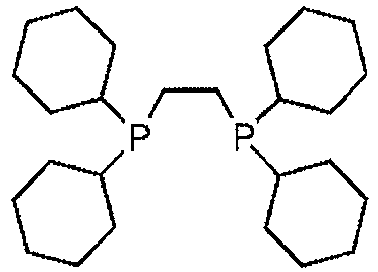
- 1,2-Bis(dicyclohexylphosphino)ethane represented by the following formula is also used in the reaction step.
- 1,2-Bis(dicyclohexylphosphino)ethane is a ligand that can be coordinated to the nickel atom included in the nickel compound.
- the reaction between the compound represented by the general formula (2) and the compound represented by the general formula (3) proceeds smoothly in the presence of 1,2-bis(dicyclohexylphosphino)ethane and the nickel compound.
- a usage amount of the 1,2-bis(dicyclohexylphosphino)ethane is preferably in a range from 0.1 to 0.2 mol, more preferably from 0.15 to 0.2 mol, and further preferably from 0.18 to 0.2 mol based on 1 mol of the heteroaromatic compound from the viewpoint of ensuring that the reaction proceeds smoothly.
- the molar ratio of the Ni atoms included in the nickel compound to 1,2-bis(dicyclohexylphosphino)ethane is preferably 1:1.2 to 1:3, more preferably 1:1.5 to 1:2.5, and particularly 1:2 from the viewpoint of ensuring that the reaction proceeds smoothly.
- a base is also used in the reaction step.
- the base is not particularly limited.
- a compound may be used that is conventionally known as a base used for organic synthesis.
- Preferable examples of the base include lithium hydride, sodium hydride, potassium hydride, sodium hydroxide, potassium hydroxide, sodium carbonate, potassium carbonate, cesium carbonate, potassium fluoride, cesium fluoride, tripotassium phosphate, sodium acetate, potassium acetate, metal salts (lithium salt, sodium salt, or potassium salt) of an alkoxide having 1 to 6 carbon atoms, metal salts (lithium salt, sodium salt, or potassium salt) of an alkyl anion having 1 to 6 carbon atoms, diisopropylethylamine, tributylamine, N-methylmorpholine, diazabicycloundecene, diazabicyclooctane, imidazole, and the like. These compounds may be used singly or in combination of two or more types thereof.
- cesium carbonate and tripotassium phosphate are particularly as the base from the viewpoint of ensuring that the reaction proceeds smoothly.
- Examples of the alkoxide in case of using the metal salt of the alkoxide having 1 to 6 carbon atoms include a methoxide, an ethoxide, an n-propoxide, an isopropoxide, an n-butoxide, an isobutoxide, a tert-butoxide, an n-pentoxide, an isopentoxide, a neopentoxide, a 1-methylpropoxide, an n-hexoxide, an isohexoxide, a 1,1-dimethylbutoxide, a 2,2-dimethylbutoxide, a 3,3-dimethylbutoxide, and the like.
- alkyl anion in case of using the metal salt of the alkyl anion having 1 to 6 carbon atoms include a methyl anion, an ethyl anion, an n-propyl anion, an isopropyl anion, an n-butyl anion, an isobutyl anion, a tert-butyl anion, an n-pentyl anion, an isopentyl anion, a neopentyl anion, a 1-methylpropyl anion, an n-hexyl anion, an isohexyl anion, a 1,1-dimethylbutyl anion, a 2,2-dimethylbutyl anion, a 3,3-dimethylbutyl anion, and the like.
- a usage amount of the base is preferably in a range from 1 to 2 mol, and more preferably from 1.5 to 2 mol based on 1 mol of the heteroaromatic compound from the viewpoint of ensuring that the reaction proceeds smoothly.
- a solvent is normally used in the reaction step.
- the solvent include an aliphatic hydrocarbon such as a hexane, a cyclohexane, and a heptane; an aliphatic halogenated hydrocarbon such as a dichloromethane, a chloroform, a carbon tetrachloride, and a dichloroethane; an aromatic hydrocarbon such as a benzene, a toluene, a xylene, and a chlorobenzene; an ether such as a diethyl ether, a dibutyl ether, a dimethoxyethane (DME), a cyclopentyl methyl ether (CPME), a tert-butyl methyl ether, a tetrahydrofuran, and a dioxane; an ester such as ethyl acetate and ethyl propionate; an acid amide such as di
- dioxane and DMF are particularly as the solvent from the viewpoint of ensuring that the reaction proceeds smoothly.
- the reaction temperature employed in the reaction step is normally in a range from 80°C to 140°C, preferably from 80°C to 120°C, and particularly from 100°C to 120°C. It is desirable to effect the reaction under normal pressure. The reaction may be effected under increased pressure or reduced pressure.
- the reaction atmosphere is not particularly limited.
- the reaction atmosphere is preferably an inert gas atmosphere (e.g., argon gas atmosphere or nitrogen gas atmosphere).
- the heteroaromatic compound When the heteroaromatic compound is reacted with the phenol derivative (i.e., biaryl coupling reaction) (see the above reaction scheme), the hydrogen atom bonded to the carbon atom indicated by * in the general formula (2) (heteroaromatic compound), and R 5 -O- bonded to the carbon atom indicated by * in the general formula (3) (phenol derivative) are eliminated, and the carbon atom indicated by * in the general formula (2) and the carbon atom indicated by * in the general formula (3) are bonded to each other.
- the compound represented by the general formula (1) can be produced by allowing the nickel compound, 1,2-bis(dicyclohexylphosphino)ethane, and the base to be present in combination in the reaction system.
- the method may optionally include a purification step after the reaction step.
- the product may be subjected to a normal post-process such as a solvent removal process, a washing process, and a chromatographic process.
- the yield of the compound represented by the general formula (1) is preferably 55% or higher, more preferably 70% or higher, and further preferably 80% or higher in the present production method.
- Yield refers to a value calculated based on the molar quantity of the heteroaromatic compound used as the reaction raw material.
- a glass vessel (internal volume: 20 mL) was charged with magnetic stir bars and 195.5 mg (0.60 mmol) of cesium carbonate, and dried under reduced pressure using a heat gun. The glass vessel was cooled to room temperature, and filled with argon gas.
- the glass vessel was removed from the glovebox, and 47.6 mg (0.40 mmol) of benzoxazole and 1.6 mL of 1,4-dioxane were added to the glass vessel under an argon gas stream.
- Example 2 2-(Naphthalen-2-yl)benzoxazole obtained in Example 1 was subjected to NMR analysis ( 1 H-NMR and 13 C-NMR) and mass spectrometry using a nuclear magnetic resonance spectrometer ("JNM-ECA-400" manufactured by JEOL Ltd.) and a TLC/MS system equipped with a DART ion source (“JMS-T100TD” manufactured by JEOL Ltd.), respectively. The results are shown below.
- Methyl-5-methyl-2-(naphthalen-2-yl)oxazole-4-carboxylate was obtained in the same manner as in Example 1, except using methyl 5-methyl-1,3-oxazole-4-carboxylate instead of benzoxazole. The yield thereof was 72%.
- Ethyl-2-(naphthalen-2-yl)oxazole-5-carboxylate (see below) was obtained in the same manner as in Example 1, except using ethyl 5-oxazolecarboxylate instead of benzoxazole. The yield thereof was 34%.
- 2-(Naphthalen-2-yl)thiazole (see below) was obtained in the same manner as in Example 1, except that thiazole was used instead of benzoxazole, cesium carbonate was used in an amount of 0.80 mmol, and the reaction temperature was changed to 140°C. The yield thereof was 47%.
- 2-(Naphthalen-2-yl)benzothiazole (see below) was obtained in the same manner as in Example 1, except that benzothiazole was used instead of benzoxazole, cesium carbonate was used in an amount of 0.80 mmol, and the reaction temperature was changed to 140°C. The yield thereof was 65%.
- Methyl-6-(benzo[d]oxazol-2-yl)-2-naphthoate was obtained in the same manner as in Example 1, except using methyl-6-(pivaloyloxy)-2-naphthoate instead of naphthalen-2-yl pivalate. The yield thereof was 28%.
- 2-Phenylbenzoxazole was obtained in the same manner as in Example 1, except using phenyl triflate instead of naphthalen-2-yl pivalate. The yield thereof was 75%.
- 2-(4-Methoxyphenyl)benzoxazole was obtained in the same manner as in Example 1, except using 4-methoxyphenyl triflate instead of naphthalen-2-yl pivalate. The yield thereof was 55%.
- 2-(4-Trifluoromethylphenyl)benzoxazole was obtained in the same manner as in Example 1, except using 4-trifluoromethylphenyl triflate instead of naphthalen-2-yl pivalate. The yield thereof was 52%.
- 2-(6-Cyanonaphthalen-2-yl)benzoxazole was obtained in the same manner as in Example 1, except using 6-cyanonaphthalen-2-yl pivalate instead of naphthalen-2-yl pivalate. The yield thereof was 79%.
- 6-Methyl-2-(naphthalen-2-yl)benzoxazole was obtained in the same manner as in Example 1, except using 6-methylbenzoxazole instead of benzoxazole. The yield thereof was 96%.
- Texamine was obtained in the same manner as in Example 1, except that 5-(1,3-benzoxazol-5-yl)oxazole was used instead of benzoxazole, and phenyl triflate was used instead of naphthalen-2-yl pivalate. The yield thereof was 62%.
- Ethyl 5-(4-methoxyphenyl)-2-phenyloxazole-4-carboxylate was obtained in the same manner as in Example 1, except that ethyl 5-(4-methoxyphenyl)-1,3-oxazole-4-carboxylate was used instead of benzoxazole, and phenyl triflate was used instead of naphthalen-2-yl pivalate. The yield thereof was 73%.
- triethylamine (1.0 mL, 7.2 mmol, 1.2 equiv.) was added to a solution prepared by dissolving estrone (1.62 g, 6.0 mmol) in 10 mL of dichloromethane.
- the mixture was cooled to 0°C, and then trifluoromethanesulfonyl chloride (760 ⁇ L, 7.2 mmol, 1.2 equiv.) was added to the mixture over 3 minutes or more with stirring to effect a reaction.
- the reaction was quenched by adding a saturated sodium hydrogen carbonate aqueous solution (10 mL) to the reaction mixture, and the reaction mixture was separated into two layers.
- a two-necked flask (internal volume: 100 mL) charged with magnetic stir bars was dried under reduced pressure using a heat gun, cooled to room temperature, and filled with argon gas. After the addition of quinine (1.33 g, 4.1 mmol) and sodium ethanethiolate (1.38 g, 16.4 mmol, 4.0 equiv.) to the flask, 30 mL of dimethylformamide was added to the mixture. The mixture was heated at 120°C for 12 hours using an oil bath. After cooling the reaction mixture to room temperature, the reaction was quenched by adding a saturated ammonium chloride aqueous solution (30 mL), and the reaction mixture was separated into two layers.
- the organic layer (dimethylformamide solution) was isolated preparatively, and 25 mL of ethyl acetate was added to the aqueous layer to extract the product. The above operation was repeated four times. An excess amount of anhydrous magnesium sulfate was added to the collected organic layer (mixture of dimethylformamide solution and ethyl acetate solution), and the mixture was filtered. The solvent was evaporated under reduced pressure to obtain a concentrate including a crude product. The concentrate was washed with hexane including dichloromethane (10%) to obtain demethylated quinine (quinine-OH) (white solid, 1.27 g) (see below). The yield thereof was 99%.
- the organic layer (dichloromethane solution) was isolated preparatively, and 15 mL of dichloromethane was added to the aqueous layer to extract the product. The above operation was repeated four times. An excess amount of anhydrous magnesium sulfate was added to the collected organic layer (dichloromethane solution), and the mixture was filtered. The solvent was evaporated under reduced pressure to obtain a concentrate including a crude product.
- the yield thereof was 40%.
- a glass reaction vessel (20 mL, equipped with a J. Young (registered trademark) O-ring tap) charged with magnetic stir bars and cesium carbonate (122.2 mg, 0.375 mmol, 1.5 equiv.) was dried under reduced pressure using a heat gun, cooled to room temperature, and filled with argon gas.
- quinine triflate 165.9 mg, 0.375 mmol, 1.5 equiv.
- the reaction vessel was placed in a glovebox filled with argon gas.
- Ni(cod) 2 (7.0 mg, 0.025 mmol, 10 mol%) and 1,2-bis(dicyclohexylphosphino)ethane (20.8 mg, 0.05 mmol, 20 mol%) were added to the reaction vessel.
- the reaction vessel was removed from the glovebox, and benzoxazole (29.8 mg, 0.25 mmol, 1.0 equiv.) and 1,4-dioxane (1.0 mL) were added to the reaction vessel under an argon gas stream. After sealing the reaction vessel with the O-ring tap, the mixture was reacted at 120°C for 24 hours with stirring.
- reaction mixture was then cooled to room temperature, and subjected to column chromatography (eluant: ethyl acetate) using a short pad of silica gel.
- the yield thereof was 43%.
- the method according to the present invention can produce a compound in which the carbon atom indicated by * in the general formula (2) and the carbon atom indicated by * in the general formula (3) are bonded to each other (see the above reaction scheme), a wide range of heteroaromatic compounds and phenol derivatives can be selectively used, and a compound having the target structure can be inexpensively and efficiently obtained. Therefore, a compound having the target structure (e.g., a biologically active compound, drug (e.g., compound having a steroid skeleton or an alkaloid skeleton), an organic electronic material, or an intermediate thereof) can be easily produced by utilizing the desired atom or functional group as a substituent that substitutes the heteroaromatic compound or the phenol derivative.
- a target structure e.g., a biologically active compound, drug (e.g., compound having a steroid skeleton or an alkaloid skeleton), an organic electronic material, or an intermediate thereof
- a compound having the target structure e.g., a biologically
Landscapes
- Chemical & Material Sciences (AREA)
- Organic Chemistry (AREA)
- Heterocyclic Carbon Compounds Containing A Hetero Ring Having Nitrogen And Oxygen As The Only Ring Hetero Atoms (AREA)
- Steroid Compounds (AREA)
- Low-Molecular Organic Synthesis Reactions Using Catalysts (AREA)
- Thiazole And Isothizaole Compounds (AREA)
- Plural Heterocyclic Compounds (AREA)
- Nitrogen Condensed Heterocyclic Rings (AREA)
Abstract
Description
- The present invention relates to a method for producing a phenyl-substituted heterocyclic derivative.
- A phenyl-substituted heterocyclic derivative is useful in a wide range of applications (e.g., as an antipodagric or a drug for treating amyloid polyneuropathy). An arylation reaction that arylates a C-H bond of an aromatic ring has attracted attention as an ideal biaryl skeleton-forming technique, and extensive studies have been conducted to further improve the reaction system.
- It has been known that a C-H/C-X coupling reaction between an azole and an aryl halide proceeds in the presence of an Ni(OAc)2/bipy catalyst and LiOt-Bu or Mg(Ot-Bu)2 (additive) (seeNon-Patent Documents 1 and 2).
- An organoboron compound and an organosilicon compound have been known as a raw material that is reacted with an azole.
-
- Non-Patent Document 1: Org. Lett. 11, 2009, 1733
- Non-Patent Document 2: Chem. Eur. J. 17, 2011, 10113
- However, the above technique has the following problems.
- (a) An aryl halide may not be easily available, and an organoboron compound and an organosilicon compound are normally synthesized from an aryl halide.
- (b) The atom efficiency of the entire synthesis process is poor (i.e., it is necessary to dispose of a salt produced as a by-product, and the weight ratio thereof is high).
- (c) An aryl halide, an organoboron compound, and an organosilicon compound may undergo a side reaction due to high chemical reactivity.
- (d) It has been desired not to use a halogen from the viewpoint of reducing environmental impact.
- An object of the present invention is to provide a method that can produce a phenyl-substituted heterocyclic derivative without using an aryl halide, and can suppress environmental impact.
- The inventors conducted extensive studies, and found that a phenyl-substituted heterocyclic derivative can be obtained through a coupling reaction by utilizing a specific phenol derivative, a specific heteroaromatic compound, a nickel-based catalyst, and 1,2-bis(dicyclohexylphosphino)ethane (bidentate ligand) in combination.
- The present invention is a production method of a phenyl-substituted heterocyclic derivative that is represented by the following general formula (1) and is characterized in that the method includes a step of reacting a heteroaromatic compound represented by the following general formula (2) with a phenol derivative represented by the following general formula (3) in the presence of a nickel compound, 1,2-bis(dicyclohexylphosphino)ethane, and a base.


- According to the present invention, it is possible to produce the heterocyclic compound represented by the general formula (1) using the phenol derivative represented by the general formula (3) as the reaction raw material without using an aryl halide. While a side reaction may occur when using an aryl halide (i.e., arylating agent) due to high chemical reactivity, the method according to the present invention can eliminate a side reaction, or suppress a side reaction to a large extent. Since the raw material that replaces an aryl halide is used, it is possible to suppress environmental impact. When using an aryl halide, a metal compound (e.g., Li compound or Mg compound) is used as an additive. In this case, it is necessary to dispose of a large amount of metal salts (Li salts or Mg salts) (by-products) (i.e., the atom efficiency decreases). Since a carboxylic acid or carbamic acid is disposed of when using the method according to the present invention, the weight of waste can be reduced, and a high atom efficiency can be achieved.
- The production method of the present invention includes a step of reacting the heteroaromatic compound represented by the general formula (2) with the phenol derivative represented by the general formula (3) in the presence of the nickel compound, 1,2-bis(dicyclohexylphosphino)ethane, and the base (hereinafter referred to as "reaction step"). The reaction scheme is shown below.

- The meanings of the terms used herein either alone or in combination are described below. The description of each substituent is commonly applied unless otherwise specified. A combination of substituents and the number of substituents is allowed only when a chemically stable compound is produced by such a combination. When a hydrogen atom bonded to a carbon atom is substituted with another atom or a functional group (i.e., substituent), and the substituent is substituted with two or more groups, these groups may be bonded to an identical carbon atom or different carbon atoms as long as a stable structure is obtained.
- The term "hydrocarbon group having 1 to 20 carbon atoms" used herein refers to a saturated linear or branched aliphatic hydrocarbon group or alicyclic hydrocarbon group having 1 to 20 carbon atoms. Examples of the hydrocarbon group include a methyl group, an ethyl group, an n-propyl group, an isopropyl group, an n-butyl group, an isobutyl group, a tert-butyl group, an n-pentyl group, an isopentyl group, a neopentyl group, a 1-methylpropyl group, an n-hexyl group, an isohexyl group, a 1,1-dimethylbutyl group, a 2,2-dimethylbutyl group, a 3,3-dimethylbutyl group, an n-heptyl group, an n-octyl group, an n-nonyl group, an n-decyl group, a cyclopropyl group, a cyclobutyl group, a cyclpentyl group, a cyclohexyl group, and the like.
- The group derived from the hydrocarbon group having 1 to 20 carbon atoms refers to a group obtained by substituting an arbitrary hydrogen atom bonded to an arbitrary carbon atom included in the hydrocarbon group having 1 to 20 carbon atoms with other atom (e.g., fluorine atom) or a functional group (e.g., ester group, keto group, or cyano group). The number of functional groups (substituents) is not particularly limited.
- The term "ester group" used herein refers to a group represented by -COOR (wherein R is a hydrocarbon group having 1 to 20 carbon atoms).
- The term "alkoxy group having 1 to 10 carbon atoms" used herein refers to a group that is consisting of an oxy group and a hydrocarbon group having 1 to 9 carbon atoms. Examples of the alkoxy group include a methoxy group, an ethoxy group, an n-propyloxy group, an isopropyloxy group, an n-butyloxy group, an isobutyloxy group, a tert-butyloxy group, a cyclopropoxy group, a cyclobutyloxy group, a cyclopentyloxy group, a cyclohexyloxy group, and the like.
- The term "acyl group" used herein refers to a group (R-CO-) obtained by removing -OH from a carboxylic acid (RCOOH). Examples of the acyl group include an acetyl group, a propionyl group, an isopropionyl group, a butanoyl group (butyryl group), an isobutanoyl group, a tert-butanoyl group, a pentanoyl group, an isopentanoyl group, a pivaloyl group, and the like.
- The term "dialkylcarbamoyl group" used herein refers to a group obtained by substituting the two hydrogen atoms included in a carbamoyl group (-CONH2) with an identical hydrocarbon group or different hydrocarbon groups. Examples of the dialkylcarbamoyl group include a dimethylcarbamoyl group, a diethylcarbamoyl group, a dipropylcarbamoyl group, a diisopropylcarbamoyl group, a dibutylcarbamoyl group, a diisobutylcarbamoyl group, a di-tert-butylcarbamoyl group, and the like.
- The term "alkyl carbonate group" used herein refers to a group represented by RO-CO-O- (wherein R is an alkyl group). Examples of the alkyl carbonate group include a methoxycarbonyloxy group, an ethoxycarbonyloxy group, an n-propoxycarbonyloxy group, an isopropoxycarbonyloxy group, an n-buthoxycarbonyloxy group, a 1-methylpropoxycarbonyloxy group, a 2-methylpropoxycarbonyloxy group, a tert-butoxycarbonyloxy group, and the like.
- Examples of the aryl carbonate group include a phenoxycarbonyloxy group, a naphthoxycarbonyloxy group, and the like.
- Examples of the aralkyl carbonate group include a benzyloxycarbonyloxy group and the like.
- Examples of the alkylsulfonyl group include an alkanesulfonyl group such as a methanesulfonyl group, an ethanesulfonyl group, an n-propanesulfonyl group, an n-butanesulfonyl group, a tert-butanesulfonyl group, an n-pentanesulfonyl group, a neopentanesulfonyl group, an n-hexanesulfonyl group, an n-heptanesulfonyl group, an n-octanesulfonyl group, a 2-ethylhexanesulfonyl group, an n-nonanesulfonyl group, and an n-decanesulfonyl group; a cycloalkanesulfonyl group such as a cyclopentanesulfonyl group, and a cyclohexanesulfonyl group; and the like.
- Examples of the arylsulfonyl group include a benzenesulfonyl group; an alkylbenzenesulfonyl group such as a tosyl group, a 2,4,6-trimethylbenzenesulfonyl group, a 2,4,6-triethylbenzenesulfonyl group, a 2,4,6-tripropylbenzenesulfonyl group, a 2,4,6-triisopropylbenzenesulfonyl group, and a 2,4,6-tri-tert-butylbenzenesulfonyl group; a naphthalenesulfonyl group; an alkylnaphthalenesulfonyl group; and the like.
- Examples of the aralkylsulfonyl group include a benzylsulfonyl group, a 2-phenylethylsulfonyl group, a 4-phenylbutylsulfonyl group, a 2-methylbenzylsulfonyl group, and the like.
- Examples of the dialkylsulfamoyl group include an N,N-dimethylsulfamoyl group, an N,N-diethylsulfamoyl group, and the like.
- Examples of the diarylsulfamoyl group include a diphenylsulfamoyl group and the like.
- A case where adjacent substituents (e.g., R1 and R2 in the general formula (2), or R11 and R12 in the general formula (3)) bond to each other to form a divalent organic group having 4 to 6 carbon atoms is described below using the compound (heteroaromatic compound) represented by the general formula (2) as an example.
- The term "divalent organic group" used herein in connection with the compound (heteroaromatic compound) represented by the general formula (2) refers to (i) a hydrocarbon group or a group derived therefrom in which carbon atoms bond to each other to form a chain-like structure, and which may include a carbon-carbon double bond, wherein, when a hydrogen atom is bonded to an arbitrary carbon atom that forms the chain-like structure, the hydrogen atom is optionally substituted with another atom (e.g., fluorine atom), a functional group (e.g., ester group, keto group, or cyano group), or a monovalent hydrocarbon group, the hydrocarbon group or a group derived therefrom forming a ring together with the carbon atom bonded to the nitrogen atom, and the carbon atom bonded to X1, or (ii) an organic group in which a chain-like structure is formed in a state in which a nitrogen atom, an oxygen atom, or a sulfur atom is present between two carbon atoms, and which may include a carbon-carbon double bond, a carbon-nitrogen double bond, or the like, wherein, when a hydrogen atom is bonded to an arbitrary carbon atom that forms the chain-like structure, the hydrogen atom is optionally substituted with another atom (e.g., fluorine atom), a functional group (e.g., ester group, keto group, or cyano group), or a monovalent hydrocarbon group, the organic group forming a ring together with the carbon atom bonded to the nitrogen atom, and the carbon atom bonded to X1.
- The heteroaromatic compound represented by the general formula (2) is preferably an oxazole derivative, a benzoxazole derivative, or a benzothiazole derivative, and particularly preferably an oxazole derivative, from the viewpoint of the yield of the resulting product.
- When the heteroaromatic compound is an oxazole derivative, it is preferable that one of R1 and R2 be a hydrocarbon group having 1 to 20 carbon atoms or a group derived therefrom from the viewpoint of the yield of the resulting product.
- The phenol derivative represented by the general formula (3) (note: a compound represented by the general formula (3) wherein X2 is a nitrogen atom is also referred herein as "phenol derivative") is a compound obtained by substituting a hydroxyl group included in a compound having a phenol skeleton, a compound having a naphthol skeleton, a compound having a hydroxypyridine skeleton, a compound having a quinolinol skeleton, or the like with -OR5 (wherein R5 is an acyl group, a dialkylcarbamoyl group, an alkyl carbonate group, an aryl carbonate group, an aralkyl carbonate group, a triflate group, an alkylsulfonyl group, an arylsulfonyl group, an aralkylsulfonyl group, a dialkylsulfamoyl group, or a diarylsulfamoyl group). R5 is preferably an acyl group, a dialkylcarbamoyl group, an alkyl carbonate group, a triflate group, an alkylsulfonyl group, an arylsulfonyl group, or a dialkylsulfamoyl group from the viewpoint of the yield of the resulting product in the present invention. When R5 is an acyl group, a pivaloyl group is preferable. When R5 is a dialkylcarbamoyl group, an N,N-dimethylcarbamoyl group is preferable. When R5 is an alkyl carbonate group, a tert-butoxycarbonyloxy group is preferable. When R5 is an alkylsulfonyl group, a methanesulfonyl group is preferable. When R5 is an arylsulfonyl group, a tosyl group is preferable. When R5 is a dialkylsulfamoyl group, an N,N-dimethylsulfamoyl group is preferable.
- Specific examples of the phenol derivative include compounds respectively represented by the following general formulae (3-1) to (3-16). The phenol derivative is preferably a compound among the compounds respectively represented by the general formulae (3-1) to (3-8) and (3-13) to (3-16) since the target phenyl-substituted heterocyclic derivative can be obtained in high yield.


- The phenol derivative may be a compound in which a cyano group, a fluorine atom, or the like is bonded to an arbitrary ring-forming carbon atom included in the compounds respectively represented by the general formulae (3-1) to (3-16).
- The heteroaromatic compound and the phenol derivative are used in the ratio described below from the viewpoint of ensuring that the reaction proceeds smoothly.
- A usage amount of the phenol derivative is preferably in a range from 1 to 2 mol, and more preferably from 1 to 1.5 mol based on 1 mol of the heteroaromatic compound.
- The nickel compound used in the reaction step is not particularly limited. A nickel compound may be used that is conventionally known as a catalyst used for organic synthesis. An Ni(0) salt or an Ni(II) salt are preferable as the nickel compound. These compounds may be used singly or in combination of two or more types thereof.
- Examples of the Ni(0) salt include bis(1,5-cyclooctadiene)nickel (0), bis(triphenylphosphine)nickeldicarbonyl, nickelcarbonyl, and the like.
- Examples of the Ni(II) salt include nickel acetate (II), nickel trifluoroacetate (II), nickel nitrate (II), nickel chloride (II), nickel bromide (II), nickel acetylacetonate (II), nickel perchlorate (II), nickel citrate (II), nickel oxalate (II), nickel cyclohexanebutyrate (II), nickel benzoate (II), nickel stearate (II), nickel stearate (II), nickel sulfamate (II), nickel carbonate (II), nickel thiocyanate (II), nickel trifluoromethanesulfonate (II), bis(1,5-cyclooctadiene)nickel (II), bis(4-diethylaminodithiobenzyl)nickel (II), nickel cyanide (II), nickel fluoride (II), nickel boride (II), nickel borate (II), nickel hypophosphate (II), ammonium nickel sulfate (II), nickel hydroxide (II), cyclopentadienylnickel (II), hydrates thereof, and the like.
- In the present invention, the nickel compound is more preferably an Ni(0) salt and bis(1,5-cyclooctadiene)nickel (0) is particularly preferred from the viewpoint of ensuring that the reaction proceeds smoothly.
- An Ni(0) salt or an Ni(II) salt to which a ligand is coordinated in advance may also be used.
- A usage amount of the nickel compound is preferably in a range from 0.05 to 0.1 mol, more preferably from 0.08 to 0.1 mol, and further preferably from 0.09 to 0.1 mol based on 1 mol of the heteroaromatic compound from the viewpoint of ensuring that the reaction proceeds smoothly.
- 1,2-Bis(dicyclohexylphosphino)ethane represented by the following formula is also used in the reaction step. 1,2-Bis(dicyclohexylphosphino)ethane is a ligand that can be coordinated to the nickel atom included in the nickel compound. The reaction between the compound represented by the general formula (2) and the compound represented by the general formula (3) proceeds smoothly in the presence of 1,2-bis(dicyclohexylphosphino)ethane and the nickel compound.
- A usage amount of the 1,2-bis(dicyclohexylphosphino)ethane is preferably in a range from 0.1 to 0.2 mol, more preferably from 0.15 to 0.2 mol, and further preferably from 0.18 to 0.2 mol based on 1 mol of the heteroaromatic compound from the viewpoint of ensuring that the reaction proceeds smoothly.
- The molar ratio of the Ni atoms included in the nickel compound to 1,2-bis(dicyclohexylphosphino)ethane is preferably 1:1.2 to 1:3, more preferably 1:1.5 to 1:2.5, and particularly 1:2 from the viewpoint of ensuring that the reaction proceeds smoothly.
- A base is also used in the reaction step. The base is not particularly limited. A compound may be used that is conventionally known as a base used for organic synthesis. Preferable examples of the base include lithium hydride, sodium hydride, potassium hydride, sodium hydroxide, potassium hydroxide, sodium carbonate, potassium carbonate, cesium carbonate, potassium fluoride, cesium fluoride, tripotassium phosphate, sodium acetate, potassium acetate, metal salts (lithium salt, sodium salt, or potassium salt) of an alkoxide having 1 to 6 carbon atoms, metal salts (lithium salt, sodium salt, or potassium salt) of an alkyl anion having 1 to 6 carbon atoms, diisopropylethylamine, tributylamine, N-methylmorpholine, diazabicycloundecene, diazabicyclooctane, imidazole, and the like. These compounds may be used singly or in combination of two or more types thereof.
- In the present invention, cesium carbonate and tripotassium phosphate are particularly as the base from the viewpoint of ensuring that the reaction proceeds smoothly.
- Examples of the alkoxide in case of using the metal salt of the alkoxide having 1 to 6 carbon atoms include a methoxide, an ethoxide, an n-propoxide, an isopropoxide, an n-butoxide, an isobutoxide, a tert-butoxide, an n-pentoxide, an isopentoxide, a neopentoxide, a 1-methylpropoxide, an n-hexoxide, an isohexoxide, a 1,1-dimethylbutoxide, a 2,2-dimethylbutoxide, a 3,3-dimethylbutoxide, and the like.
- Examples of the alkyl anion in case of using the metal salt of the alkyl anion having 1 to 6 carbon atoms include a methyl anion, an ethyl anion, an n-propyl anion, an isopropyl anion, an n-butyl anion, an isobutyl anion, a tert-butyl anion, an n-pentyl anion, an isopentyl anion, a neopentyl anion, a 1-methylpropyl anion, an n-hexyl anion, an isohexyl anion, a 1,1-dimethylbutyl anion, a 2,2-dimethylbutyl anion, a 3,3-dimethylbutyl anion, and the like.
- A usage amount of the base is preferably in a range from 1 to 2 mol, and more preferably from 1.5 to 2 mol based on 1 mol of the heteroaromatic compound from the viewpoint of ensuring that the reaction proceeds smoothly.
- A solvent is normally used in the reaction step. Preferable examples of the solvent include an aliphatic hydrocarbon such as a hexane, a cyclohexane, and a heptane; an aliphatic halogenated hydrocarbon such as a dichloromethane, a chloroform, a carbon tetrachloride, and a dichloroethane; an aromatic hydrocarbon such as a benzene, a toluene, a xylene, and a chlorobenzene; an ether such as a diethyl ether, a dibutyl ether, a dimethoxyethane (DME), a cyclopentyl methyl ether (CPME), a tert-butyl methyl ether, a tetrahydrofuran, and a dioxane; an ester such as ethyl acetate and ethyl propionate; an acid amide such as dimethylformamide (DMF), dimethylacetamide (DMA), and N-methylpyrrolidone (NMP); a nitrile such as acetonitrile and propionitrile; a dimethyl sulfoxide (DMSO), and the like. These compounds may be used singly or in combination of two or more types thereof.
- In the present invention, dioxane and DMF are particularly as the solvent from the viewpoint of ensuring that the reaction proceeds smoothly.
- The reaction temperature employed in the reaction step is normally in a range from 80°C to 140°C, preferably from 80°C to 120°C, and particularly from 100°C to 120°C. It is desirable to effect the reaction under normal pressure. The reaction may be effected under increased pressure or reduced pressure.
- The reaction atmosphere is not particularly limited. The reaction atmosphere is preferably an inert gas atmosphere (e.g., argon gas atmosphere or nitrogen gas atmosphere).
- When the heteroaromatic compound is reacted with the phenol derivative (i.e., biaryl coupling reaction) (see the above reaction scheme), the hydrogen atom bonded to the carbon atom indicated by * in the general formula (2) (heteroaromatic compound), and R5-O- bonded to the carbon atom indicated by * in the general formula (3) (phenol derivative) are eliminated, and the carbon atom indicated by * in the general formula (2) and the carbon atom indicated by * in the general formula (3) are bonded to each other. The compound represented by the general formula (1) can be produced by allowing the nickel compound, 1,2-bis(dicyclohexylphosphino)ethane, and the base to be present in combination in the reaction system.
- The method may optionally include a purification step after the reaction step. Specifically, the product may be subjected to a normal post-process such as a solvent removal process, a washing process, and a chromatographic process.
- The yield of the compound represented by the general formula (1) is preferably 55% or higher, more preferably 70% or higher, and further preferably 80% or higher in the present production method. The term "yield" used herein refers to a value calculated based on the molar quantity of the heteroaromatic compound used as the reaction raw material.
- Hereinafter, the present invention is specifically described using Examples. The present invention is not limited to these Examples.
- A glass vessel (internal volume: 20 mL) was charged with magnetic stir bars and 195.5 mg (0.60 mmol) of cesium carbonate, and dried under reduced pressure using a heat gun. The glass vessel was cooled to room temperature, and filled with argon gas.
- In a glovebox filled with argon gas, 137.0 mg (0.60 mmol) of naphthalen-2-yl pivalate was added to the glass vessel. Next, 11.2 mg (0.04 mmol) of bis(1,5-cyclooctadiene)nickel (hereinafter referred to as "Ni(cod)2") and 33.8 mg (0.08 mmol) of 1,2-bis(dicyclohexylphosphino)ethane were added to the glass vessel.
- After that, the glass vessel was removed from the glovebox, and 47.6 mg (0.40 mmol) of benzoxazole and 1.6 mL of 1,4-dioxane were added to the glass vessel under an argon gas stream.
- Subsequently, the glass vessel charged with the raw materials was sealed, and heated at 120°C with stirring to react the raw materials. After 12 hours, the reaction system was cooled to room temperature, and the reaction mixture was filtered through a short pad of silica gel. A precipitate was washed with ethyl acetate, and the filtrate was concentrated. The concentrate was subjected to TLC (eluant: hexane/ethyl acetate=10/1) using Silica Gel 60 (manufactured by Merck) to obtain 2-(naphthalen-2-yl)benzoxazole (Rf=0.48, white solid) (see below). The amount of 2-(naphthalen-2-yl)benzoxazole obtained was 93.2 mg, and the yield was 95%.

- 2-(Naphthalen-2-yl)benzoxazole obtained in Example 1 was subjected to NMR analysis (1H-NMR and 13C-NMR) and mass spectrometry using a nuclear magnetic resonance spectrometer ("JNM-ECA-400" manufactured by JEOL Ltd.) and a TLC/MS system equipped with a DART ion source ("JMS-T100TD" manufactured by JEOL Ltd.), respectively. The results are shown below.
1H-NMR (400 MHz, CDCl3): δ 8.79 (s, 1H), 8.33 (dd, 1H, J=8.7, 1.4 Hz), 8.03-7.96 (m, 2H), 7.93-7.87 (m, 1H), 7.82 (dd, 1H, J=6.0, 3.7 Hz), 7.63 (dd, 1 H, J=6.4, 2.7 Hz), 7.60-7.52 (m, 2H), 7.41-7.31 (m, 2H)
13C-NMR (100 MHz, CDCl3): δ 163.2, 150.9, 142.2, 134.7, 133.0, 128.9, 128.8, 128.1, 127.9, 127.8, 126.9, 125.2, 124.6, 124.4, 124.0, 120.0, 110.6
HRMS (DART) m/z calcd for C17H12NO [MH]+: 246.0919 found 246.0919 - 2-(Naphthalen-2-yl)benzoxazole was obtained in the same manner as in Example 1, except using tripotassium phosphate instead of cesium carbonate. The yield thereof was 79%.
- 2-(Naphthalen-2-yl)benzoxazole was obtained in the same manner as in Example 1, except using lithium tert-butoxide instead of cesium carbonate. The yield thereof was 56%.
- 2-(Naphthalen-2-yl)benzoxazole was obtained in the same manner as in Example 1, except using toluene instead of 1,4-dioxane. The yield thereof was 92%.
- 2-(Naphthalen-2-yl)benzoxazole was obtained in the same manner as in Example 1, except using dimethylformamide instead of 1,4-dioxane. The yield thereof was 92%.
- 2-(Naphthalen-2-yl)benzoxazole was obtained in the same manner as in Example 1, except using potassium carbonate instead of cesium carbonate. The yield thereof was 9%.
- An operation was performed in the same manner as in Example 1, except using tri(cyclohexyl)phosphine (see below) instead of 1,2-bis(dicyclohexylphosphino)ethane. However, 2-(naphthalen-2-yl)benzoxazole could not be obtained.

- An operation was performed in the same manner as in Example 1, except using 1,2-bis(diphenylphosphino)ethane (see below) instead of 1,2-bis(dicyclohexylphosphino)ethane. However, 2-(naphthalen-2-yl)benzoxazole could not be obtained.

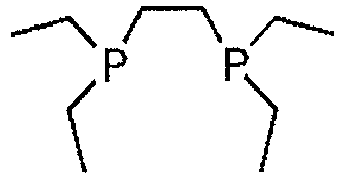
- 2-(Naphthalen-2-yl)benzoxazole was obtained in the same manner as in Example 1, except using 1,2-bis(diethylphosphino)ethane (see below) instead of 1,2-bis(dicyclohexylphosphino)ethane. The yield thereof was 2%.
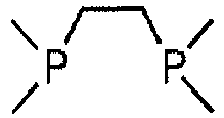
- An operation was performed in the same manner as in Example 1, except using 1,2-bis(dimethylphosphino)ethane (see below) instead of 1,2-bis(dicyclohexylphosphino)ethane. However, 2-(naphthalen-2-yl)benzoxazole could not be obtained.
- An operation was performed in the same manner as in Example 1, except using 1,3-bis(2,6-diisopropylphenyl)imidazolium chloride (see below) instead of 1,2-bis(dicyclohexylphosphino)ethane. However, 2-(naphthalen-2-yl)benzoxazole could not be obtained.

- An operation was performed in the same manner as in Example 1, except using 2,2'-bipyridyl instead of 1,2-bis(dicyclohexylphosphino)ethane. However, 2-(naphthalen-2-yl)benzoxazole could not be obtained.
- 2-(Naphthalen-2-yl)oxazole (see below) was obtained in the same manner as in Example 1, except using oxazole instead of benzoxazole. The yield thereof was 38%.

- The following is an analytical result of 2-(naphthalen-2-yl)oxazole.
1H-NMR(400 MHz, CDCl3): δ 8.55(s, 1H), 8.14 (dd, 1H, J=9.2, 1.8 Hz), 7.97-7.83 (m, 1H), 7.77 (s, 1H), 7.56-7.51 (m, 2H), 7.29 (s, 1H)
13C-NMR (100 MHz, CDCl3): δ 162.2, 138.7, 134.1, 133.0, 128.72, 128.65, 128.6, 127.8, 127.3, 126.7, 126.3, 124.8, 123.3
HRMS (DART) m/z calcd for C13H10NO [MH]+: 196.0762 found 196.0763 - Methyl-5-methyl-2-(naphthalen-2-yl)oxazole-4-carboxylate (see below) was obtained in the same manner as in Example 1, except using methyl 5-methyl-1,3-oxazole-4-carboxylate instead of benzoxazole. The yield thereof was 72%.

- The following is an analytical result of methyl-5-methyl-2-(naphthalen-2-yl)oxazole-4-carboxylate.
1H-NMR (400 MHz, CDCl3): δ 8.54 (s,1H), 8.11 (dd, 1H, J=8.7, 1.8 Hz), 7.93-7.78 (m, 3H), 7.53-7.47 (m, 2H), 3.95 (s, 3H), 2.71 (s, 3H)
13C-NMR (100 MHz, CDCl3): δ 162.7, 159.7, 156.4, 134.1, 132.8, 128.6, 128.53, 128.48, 127.7, 127.3, 126.7, 126.5, 123.7, 123.1, 51.9, 12.1
HRMS (DART) m/z calcd for C16H14NO3 [MH]+: 268.0974 found 268.0974 - Ethyl-2-(naphthalen-2-yl)oxazole-5-carboxylate (see below) was obtained in the same manner as in Example 1, except using ethyl 5-oxazolecarboxylate instead of benzoxazole. The yield thereof was 34%.

- The following is an analytical result of ethyl-2-(naphthalen-2-yl)oxazole-5-carboxylate.
1H-NMR (400 MHz, CDCl3): δ 8.67(s, 1H), 8.18 (dd, 1H, J=8.7, 1.8 Hz), 7.99-7.80 (m, 4H), 7.60-7.49 (m, 2H), 4.44 (q, 2H, J=7.3 Hz), 1.43 (t, 3H, J=7.3 Hz)
13C-NMR (100 MHz, CDCl3): δ 164.3, 157.9, 142.4, 135.4, 134.6, 132.8, 128.9, 128.8, 127.84, 127.76, 126.9, 123.6, 123.4, 61.5, 14.3
HRMS (DART) m/z calcd for C16H14NO3 [MH]+: 268.0974 found 268.0973 - 2-(Naphthalen-2-yl)-5-phenyloxazole (see below) was obtained in the same manner as in Example 1, except using 5-phenyloxazole instead of benzoxazole. The yield thereof was 82%.

- The following is an analytical result of 2-(naphthalen-2-yl)-5-phenyloxazole.
1H-NMR (400 MHz, CDCl3): δ 8.55 (s, 1H), 8.16 (dd, 1H, J= 8.2, 1.8 Hz), 7.95-7.86 (m, 2H), 7.86-7.77 (m, 1H), 7.72 (d, 2H, J=7.8 Hz), 7.53-7.34 (m, 2H), 7.47-7.38 (m, 3H), 7.32 (t, 1H, J=7.8 Hz)
13C-NMR (100 MHz, CDCl3): δ 162.2, 151.3, 134.1, 133.0, 128.9, 128.62, 128.58, 128.4, 127.9, 127.8, 127.1, 126.7, 126.0, 124.6, 124.2, 123.6, 123.2
HRMS (DART) m/z calcd for C19H14NO [MH]+: 272.1075 found 272.1075 - 5-(Benzo[1,3,]dioxol-5-yl)-2-(naphthalen-2-yl)oxazole (see below) was obtained in the same manner as in Example 1, except using 5-(1,3-benzodioxol-5-yl)oxazole instead of benzoxazole. The yield thereof was 72%.

- The following is an analytical result of 5-(benzo[1,3,]dioxol-5-yl)-2-(naphthalen-2-yl)oxazole.
1H-NMR (400 MHz, CDCl3): δ 8.49 (s, 1H), 8.11 (dd, 1H, J=8.6, 1.8 Hz), 7.93-7.78 (m, 3H), 7.52-7.45 (m, 2H), 7.30 (s, 1H), 7.22 (dd, 1H, J=8.2, 1.8 Hz), 7.14 (s, 1H), 6.84 (d, 1H, J=8.2 Hz), 5.94 (s, 2H)
13C-NMR (100 MHz, CDCl3): δ 160.6, 151.2, 148.1, 147.8, 133.9, 133.0, 128.6, 128.5, 127.8, 127.0, 126.6, 125.8, 124.6, 123.1, 122.4, 122.1, 118.3, 108.7, 104.7, 101.3
HRMS (DART) m/z calcd for C20H14NO3 [MH]+: 316.0974 found 316.0973 - 2-(Naphthalen-2-yl)thiazole (see below) was obtained in the same manner as in Example 1, except that thiazole was used instead of benzoxazole, cesium carbonate was used in an amount of 0.80 mmol, and the reaction temperature was changed to 140°C. The yield thereof was 47%.

- The following is an analytical result of 2-(naphthalen-2-yl)thiazole.
1H-NMR (400 MHz, CDCl3): δ 8.43 (d, 1H, J=1.4 Hz), 8.07 (dd, 1H, J=8.7, 1.8 Hz), 7.92-7.86 (m, 3H), 7.83 (dd, 1H, J=6.0, 3.2 Hz), 7.53-7.47 (m, 2H), 7.33 (d, 1H, J=3.2 Hz)
13C-NMR (100 MHz, CDCl3): δ 168.4, 143.8, 134.0, 133.2, 130.9, 128.7, 128.6, 127.8, 126.9, 126.7, 125.9, 124.0, 118.9
HRMS (DART) m/z calcd for C13H10NS [MH]+: 212.0534 found 212.0534 - 2-(Naphthalen-2-yl)benzothiazole (see below) was obtained in the same manner as in Example 1, except that benzothiazole was used instead of benzoxazole, cesium carbonate was used in an amount of 0.80 mmol, and the reaction temperature was changed to 140°C. The yield thereof was 65%.

- The following is an analytical result of 2-(naphthalen-2-yl)benzothiazole.
1H-NMR (400 MHz, CDCl3): δ 8.57 (d, 1H, J=1.2 Hz), 8.21 (dd, 1H, J=8.8, 2.0 Hz), 8.12 (dt, 1H, J=8.4, 0.4 Hz), 8.01-7.92 (m, 3H), 7.91-7.84 (m, 1H), 7.60-7.49 (m, 3H), 7.41 (td, 1H, J=8.0, 1.2 Hz)
13C-NMR (100 MHz, CDCl3): δ 168.0, 154.2, 135.1, 134.5, 133.1, 130.9, 128.7, 127.8, 127.5, 127.4, 126.8, 126.3, 125.1, 124.3, 123.2, 121.6
HRMS (DART) m/z calcd for C17H12NS [MH]+: 262.0690 found 262.0690 - 2-(Naphthalen-2-yl)benzoxazole (see below) was obtained in the same manner as in Example 1, except using (naphthalen-2-yl)dimethyl carbamate instead of naphthalen-2-yl pivalate. The yield thereof was 93%.

- Methyl-6-(benzo[d]oxazol-2-yl)-2-naphthoate (see below) was obtained in the same manner as in Example 1, except using methyl-6-(pivaloyloxy)-2-naphthoate instead of naphthalen-2-yl pivalate. The yield thereof was 28%.

- The following is an analytical result of methyl-6-(benzo[d]oxazol-2-yl)-2-naphthoate.
1H-NMR (400 MHz, CDCl3): δ 8.76(s, 1H), 8.62 (s, 1H), 8.35 (d, 1H, J=8.4 Hz), 8.12 (dd, 1H, J=8.0, 1.2 Hz), 8.05 (d, 1H, J=8.8 Hz), 8.00 (d, 1H, J=8.8 Hz), 7.85-7.72 (m, 1H), 7.65-7.54 (m, 1H), 7.43-7.30 (m, 2H), 3.99 (s, 3H)
13C-NMR (100 MHz, CDCl3): δ 166.8, 162.6, 150.9, 142.1, 135.0, 133.7, 130.8, 130.1, 129.1, 129.0, 127.6, 126.5, 126.3, 125.5, 124.8, 124.7, 120.2, 110.7, 52.4
HRMS (DART) m/z calcd for C19H14NO3 [MH]+: 304.0974 found 304.0973 - 2-(Naphthalen-1-yl)benzoxazole (see below) was obtained in the same manner as in Example 1, except using naphthalen-1-yl pivalate instead of naphthalen-2-yl pivalate. The yield thereof was 90%.

- The following is an analytical result of 2-(naphthalen-1-yl)benzoxazole.
1H-NMR (400 MHz, CDCl3): δ 9.47 (d, 1H, J=8.4 Hz), 8.38 (d, 1H, J=7.2 Hz), 7.97 (d, 1H, J=8.0 Hz), 7.91-7.82 (m, 2H), 7.68 (t, 1H, J=8.0 Hz), 7.62-7.57 (m, 1H), 7.54 (t, 2H, J=8.4 Hz), 7.40-7.31 (m, 2H)
13C-NMR(100 MHz, CDCl3): δ 162.7, 150.1, 142.3, 133.9, 132.2, 130.6, 129.3, 128.6, 127.8, 126.4, 126.2, 125.2, 124.8, 124.4, 123.5, 120.1, 110.4
HRMS (DART) m/z calcd for C17H12NO [MH]+: 246.0919 found 246.0918 - 2-(Phenanthren-9-yl)benzoxazole (see below) was obtained in the same manner as in Example 1, except using 9-phenanthryl pivalate ((phenanthren-9-yl) pivalate) instead of naphthalen-2-yl pivalate. The yield thereof was 55%.

- The following is an analytical result of 2-(phenanthren-9-yl)benzoxazole.
1H-NMR (400 MHz, CDCl3): δ 9.54 (dd, 1H, J=8.2, 2.0 Hz), 8.80 (dd, 1H, J=2.1, 7.5 Hz) 8.78-8.72 (m, 2H), 8.04, (d, 1H, J=8.0 Hz), 7.95-7.88 (m, 1H), 7.84-7.74 (m, 3H), 7.73-7.63 (m, 2H), 7.46-7.39 (m, 2H)
13C-NMR (100 MHz, CDCl3): δ 162.6, 150.1, 142.2, 131.7, 131.5, 130.7, 130.4, 129.7, 128.61, 128.58, 127.6, 127.0, 125.3, 124.5, 122.9, 122.6, 122.4, 120.3, 110.5
HRMS (DART) m/z calcd for C21H14NO [MH]+: 296.1075 found 296.1075 - 2-(4-Methoxynaphthalen-1-yl)benzo[d]oxazole (see below) was obtained in the same manner as in Example 1, except using (4-methoxynaphthalen-1-yl) pivalate instead of naphthalen-2-yl pivalate. The yield thereof was 55%.

- The following is an analytical result of 2-(4-methoxynaphthalen-1-yl)benzo[d]oxazole.
1H-NMR (400 MHz, CDCl3): δ 9.45 (d, 1H, J=8.8 Hz), 8.42-8.36 (m, 2H), 7.84 (td, 1H, J=4.4, 1.8 Hz), 7.72 (td, 1H, J=7.7, 1.8 Hz), 7.63-7.54 (m, 2H), 7.39-7.33 (m, 2H), 6.93 (d, 1H, J=8.4 Hz), 4.08 (s, 3H)
13C-NMR (100 MHz, CDCl3): δ 163.1, 158.4, 150.0, 142.5, 131.8, 130.5, 128.4, 126.1, 125.8, 124.7, 124.3, 122.4, 1.19.9, 116.0, 110.2, 103.2, 55.8
HRMS (DART) m/z calcd for C18H14NO2 [MH]+: 276.1025 found 276.1024 - 2-(Pyridin-3-yl)benzoxazole (see below) was obtained in the same manner as in Example 1, except using (pyridin-3-yl) pivalate instead of naphthalen-2-yl pivalate. The yield thereof was 81 %.

- The following is an analytical result of 2-(pyridin-3-yl)benzoxazole.
1H-NMR (400 MHz, CDCl3): δ 9.48 (s, 1H), 8.76 (dd, 1H, J=3.4, 1.8 Hz), 8.51 (d, 1H, J=8.2 Hz), 7.84-7.76 (m, 1H), 7.65-7.58 (m, 1H), 7.50-7.43 (m, 1H), 7.43-7.35 (m, 2H)
13C-NMR (100 MHz, CDCl3): δ 160.5, 151.9, 150.6, 148.6, 141.6, 134.5, 125.6, 124.8, 123.5, 123.4, 120.1, 110.6
HRMS (DART) m/z calcd for C12H9N2O [MH]+: 197.0715 found 197.0715 - 2-(Quinolin-6-yl)benzoxazole (see below) was obtained in the same manner as in Example 1, except using (quinolin-6-yl) pivalate instead of naphthalen-2-yl pivalate. The yield thereof was 99%.

- The following is an analytical result of 2-(quinolin-6-yl)benzoxazole.
1H-NMR (400 MHz, CDCl3): δ 9.04-8.97 (m, 1H), 8.76 (s, 1H), 8.56 (dt, 1H, J=7.3, 1.8 Hz), 8.29 (d, 1H, J=8.2 Hz), 8.24 (d, 1H, J=8.7 Hz), 7.86-7.79 (m, 1H), 7.68-7.59 (m, 1H), 7.53-7.46 (m, 1H), 7.44-7.36 (m, 1H)
13C-NMR (100 MHz, CDCl3): δ 162.4, 152.0, 150.9, 149.5, 142.1, 136.8, 130.4, 128.0, 127.9, 127.7, 125.5, 125.2, 124.8, 122.1, 120.2, 110.7
HRMS (DART) m/z calcd for C16H11N2O [MH]+: 247.0871 found 247.0871 - 2-(Quinolin-5-yl)benzoxazole (see below) was obtained in the same manner as in Example 1, except using (quinolin-5-yl) pivalate instead of naphthalen-2-yl pivalate. The yield thereof was 86%.

- The following is an analytical result of 2-(quinolin-5-yl)benzoxazole.
1H-NMR (400 MHz, CDCl3): δ 9.93 (d, 1H, J=8.2 Hz), 9.00 (dd, 1H, J=4.1, 1.4 Hz), 8.49 (dd, 1H, J=7.3, 0.9 Hz), 8.29 (d, 1H, J=8.2 Hz), 7.90-7.78 (m, 2H), 7.67-7.56 (m, 2H), 7.45-7.36 (m, 2H)
13C-NMR (100 MHz, CDCl3): δ 161.6, 150.8, 150.0, 148.4, 142.1, 135.0, 133.6, 129.3, 128.5, 126.3, 125.6, 124.7, 123.7, 122.5, 120.3, 110.6
HRMS (DART) m/z calcd for C16H11N2O [MH]+: 247.0871 found 247.0872 - 2-Phenylbenzoxazole (see below) was obtained in the same manner as in Example 1, except using phenyl pivalate instead of naphthalen-2-yl pivalate. The yield thereof was 11%.

- The following is an analytical result of 2-phenylbenzoxazole.
1H-NMR (400 MHz, CDCl3): δ 8.27 (dd, 2H, J=8.9, 1.8 Hz), 7.78 (dd, 1H, J=5.7, 3.7 Hz), 7.59 (dd, 1H, J=6.4, 3.2 Hz), 7.56-7.49 (m, 3H), 7.38-7.34 (m, 2H)
13C-NMR (100 MHz, CDCl3): δ 163.0, 150.7, 142.1, 131.4, 128.8, 127.6, 127.1, 125.0, 124.5, 120.0, 110.5
HRMS (DART) m/z calcd for C13H10NO [MH]+: 196.0762 found 196.0762 - 2-[(1,1'-Biphenyl-4-yl)benzo[d]oxazole] (see below) was obtained in the same manner as in Example 1, except using (1,1'-biphenyl)-4-yl pivalate instead of naphthalen-2-yl pivalate. The yield thereof was 18%.

- The following is an analytical result of 2-[(1,1'-biphenyl-4-yl)benzo[d]oxazole].
1H-NMR (400 MHz, CDCl3): δ 8.33 (d, 2H, J=8.2 Hz), 7.83-7.72 (m, 3H), 7.67 (d, 2H, J=7.3 Hz), 7.63-7.57 (m, 1H), 7.49 (t, 2H, J=8.2, 7.3 Hz), 7.43-7.31 (m, 3H)
13C-NMR (100 MHz, CDCl3): δ 162.9, 150.8, 144.2, 142.2, 140.0, 129.0, 128.1, 127.6, 127.2, 126.0, 125.1, 124.6, 120.0, 110.6
HRMS (DART) m/z calcd for C19H14NO [MH]+: 272.1075 found 272.1076 - 2-[(1,1'-Biphenyl-3-yl)benzo[d]oxazole] (see below) was obtained in the same manner as in Example 1, except using (1,1'-biphenyl)-3-yl pivalate instead of naphthalen-2-yl pivalate. The yield thereof was 14%.
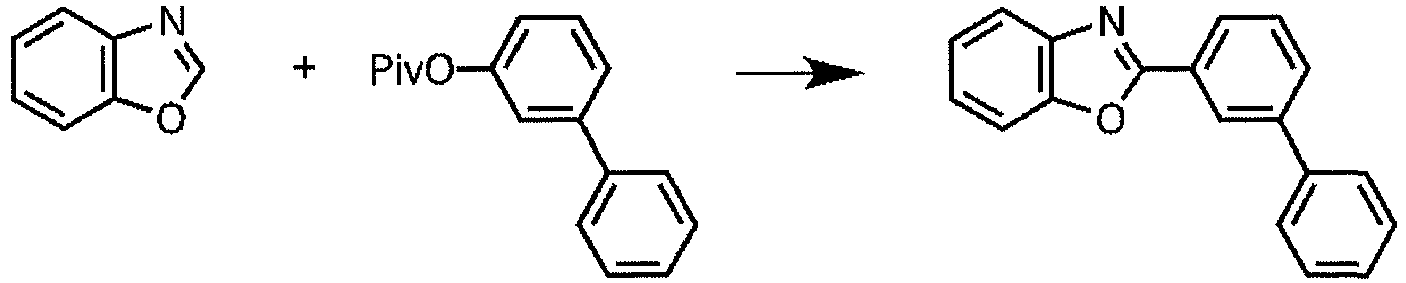
- The following is an analytical result of 2-[(1,1'-biphenyl-3-yl)benzo[d]oxazole].
1H-NMR (400 MHz, CDCl3): δ 8.51 (t, 1H, J=1.6 Hz), 8.23 (dt, 1H, J=8.0, 1.6, 1.2 Hz), 7.83-7.78 (m, 1H), 7.76 (dt, 1H, J=8.0, 1.6 Hz), 7.70 (d, 2H, J=7.2 Hz), 7.63-7.57 (m, 2H), 7.51-7.45 (m, 2H), 7.43-7.33 (m, 3H)
13C-NMR (100 MHz, CDCl3): δ 163.0, 150.8, 142.1, 142.0, 140.1, 130.2, 129.4, 128.9, 127.8, 127.7, 127.2, 126.4, 126.3, 125.2, 124.6, 120.0, 110.6
HRMS (DART) m/z calcd for C19H14NO [MH]+: 272.1075 found 272.1076 - 2-(5-Methylpyridin-3-yl)benzo[d]oxazole (see below) was obtained in the same manner as in Example 1, except using 5-methylpyridin-3-yl pivalate instead of naphthalen-2-yl pivalate. The yield thereof was 26%.

- The following is an analytical result of 2-(5-methylpyridin-3-yl)benzo[d]oxazole.
1H-NMR (400 MHz, CDCl3): δ 8.64 (d, 1H, J=5.0 Hz), 8.45 (dd, 1H, J=8.2 Hz), 7.82 (t, 1H, J=6.0, 3.2 Hz), 7.61 (t, 1H, J=5.5, 4.6 Hz), 7.43-7.35 (m, 2H), 7.34-7.28 (m, 1H), 3.07 (s, 3H)
13C-NMR (100 MHz, CDCl3): δ 161.6, 158.4, 150.8, 150.5, 141.9, 137.3, 125.5, 124.7, 122.4, 121.1, 120.4, 110.6, 25.3
HRMS (DART) m/z calcd for C19H14NO [MH]+: 211.0871 found 211.0871 - 2-(6-Methylpyridin-3-yl)benzo[d]oxazole (see below) was obtained in the same manner as in Example 1, except using 6-methylpyridin-3-yl pivalate instead of naphthalen-2-yl pivalate. The yield thereof was 32%.

- The following is an analytical result of 2-(6-methylpyridin-3-yl)benzo[d]oxazole.
1H-NMR (400 MHz, CDCl3): δ 9.35 (d, 1H, J=1.6 Hz), 8.39 (dd, 1H, J=8.4, 2.4 Hz), 7.81-7.75 (m, 1H), 7.63-7.57 (m, 1H), 7.41-7.35 (m, 2H), 7.32 (d, 1H, J=8.0 Hz), 2.66 (s, 3H)
13C-NMR (100 MHz, CDCl3): δ 161.6, 161.1, 150.6, 148.2, 141.8, 135.0, 125.4, 124.8, 123.4, 120.8, 120.1, 110.7, 24.6
HRMS (DART) m/z calcd for C13H11N2O [MH]+: 211.0871 found 211.0872 - 2-(Naphthalen-2-yl)benzoxazole was obtained in the same manner as in Example 1, except using naphthalen-2-yl-tert-butyl carbonate instead of naphthalen-2-yl pivalate. The yield thereof was 80%.

- 2-(Naphthalen-2-yl)benzoxazole was obtained in the same manner as in Example 1, except using naphthalen-2-yl-N,N-dimethyl sulfamate instead of naphthalen-2-yl pivalate. The yield thereof was 82%.

- 2-(Naphthalen-2-yl)benzoxazole was obtained in the same manner as in Example 1, except using naphthalen-2-yl triflate instead of naphthalen-2-yl pivalate. The yield thereof was about 100%.

- 2-(Naphthalen-2-yl)benzoxazole was obtained in the same manner as in Example 1, except using naphthalen-2-yl tosylate instead of naphthalen-2-yl pivalate. The yield thereof was 79%.
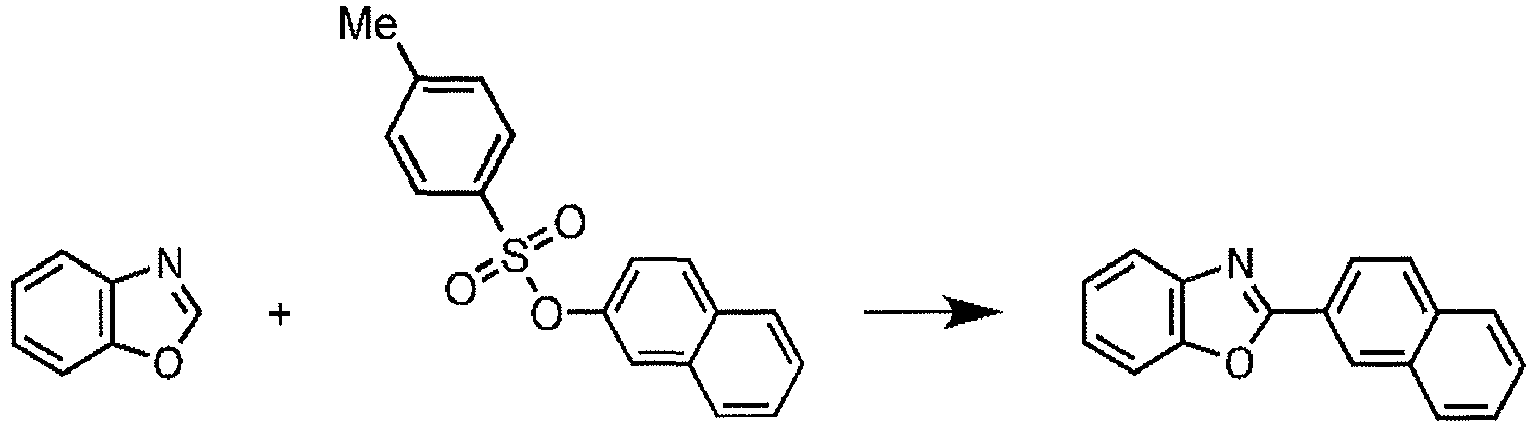
- 2-(Naphthalen-2-yl)benzoxazole was obtained in the same manner as in Example 1, except using naphthalen-2-yl mesilate instead of naphthalen-2-yl pivalate. The yield thereof was 89%.

- 2-Phenylbenzoxazole was obtained in the same manner as in Example 1, except using phenyl triflate instead of naphthalen-2-yl pivalate. The yield thereof was 75%.

- The following is an analytical result of 2-phenylbenzoxazole.
1H NMR (400 MHz, CDCl3): δ 8.30-8.24 (m, 2H), 7.78 (dd, 1H, J=5.6, 3.2 Hz), 7.59 (dd, 1H, J=6.4, 3.2 Hz), 7.56-7.49 (m, 3H) 7.38-7.34 (m, 2H)
13C NMR (100 MHz, CDCl3): δ 163.0, 150.7, 142.1, 131.4, 128.8, 127.6, 127.1, 125.0, 124.5, 120.0, 110.5
HRMS (DART) m/z calcd for C13H10NO [MH]+: 196.0762 found 196.0762 - 2-(3-Methylphenyl)benzoxazole was obtained in the same manner as in Example 1, except using 3-methylphenyl triflate instead of naphthalen-2-yl pivalate. The yield thereof was 85%.

- The following is an analytical result of 2-(3-methylphenyl)benzoxazole.
1H NMR (400 MHz, CDCl3): δ 8.07 (s, 1H), 8.02 (d, 1H, J=7.6 Hz), 7.79-7.71 (m, 1H), 7.58-7.49 (m, 1H), 7.41-7.27 (m, 4H), 2.41 (s, 3H)
13C NMR (100 MHz, CDCl3): δ 163.1, 150.6, 142.1, 138.6, 132.2, 128.7, 128.1, 126.9, 124.9, 124.6, 124.4, 119.8, 110.4, 21.2
HRMS (DART) m/z calcd for C14H12NO [MH]+: 210.0919 found 210.0919 - 2-(4-Methoxyphenyl)benzoxazole was obtained in the same manner as in Example 1, except using 4-methoxyphenyl triflate instead of naphthalen-2-yl pivalate. The yield thereof was 55%.

- The following is an analytical result of 2-(4-methoxyphenyl)benzoxazole.
1H NMR (400 MHz, CDCl3): δ 8.18 (dd, 2H, J=9.2, 1.4 Hz), 7.72 (dd, 1H, J=6.9, 2.3 Hz), 7.53 (dd, 1H, J=6.0, 2.3 Hz), 7.37-7.27 (m, 2H) 7.00 (dd, 2H, J=8.9, 1.4 Hz) 3.85 (s, 3H)
13C NMR (100 MHz, CDCl3): δ 163.1, 162.2, 150.6, 142.2, 129.3, 124.5, 124.3, 119.6, 119.5, 114.3, 110.3, 55.4
HRMS (DART) m/z calcd for C14H12NO2 [MH]+: 226.0868 found 226.0868 - 2-(4-Trifluoromethylphenyl)benzoxazole was obtained in the same manner as in Example 1, except using 4-trifluoromethylphenyl triflate instead of naphthalen-2-yl pivalate. The yield thereof was 52%.

- The following is an analytical result of 2-(4-trifluoromethylphenyl)benzoxazole.
1H NMR (400 MHz, CDCl3): δ 8.34 (d, 2H, J=7.8 Hz), 7.82-7.73 (m, 3H), 7.62-7.55 (m, 1H), 7.41-7.34 (m, 2H)
13C NMR (100 MHz, CDCl3): δ 161.4, 150.8, 141.9, 132.9 (JC-F=33.5 Hz), 130.4, 127.8, 125.9 (JC-F=3.8 Hz), 125.8, 124.9, 123.7 (JC-F=274.0 Hz), 120.4, 110.8
HRMS (DART) m/z calcd for C14H9F3NO [MH]+: 264.0636 found 264.0635 - 2-(6-Cyanonaphthalen-2-yl)benzoxazole was obtained in the same manner as in Example 1, except using 6-cyanonaphthalen-2-yl pivalate instead of naphthalen-2-yl pivalate. The yield thereof was 79%.

- The following is an analytical result of 2-(6-cyanonaphthalen-2-yl)benzoxazole.
1H NMR (400 MHz, CDCl3): δ 8.73 (s, 1H), 8.38 (dd, 1H, J=8.7, 1.4 Hz), 8.22 (s, 1H), 8.00 (t, 2H, J=9.9 Hz), 7.84-7.76 (m, 1H), 7.64 (dd, 1H, J=8.7, 0.9 Hz), 7.63-7.57 (m,1H), 7.45-7.35 (m, 2H)
13C NMR (100 MHz, CDCl3): δ 161.9, 150.8, 142.0, 134.2, 133.8, 133.3, 130.0, 129.2, 127.6, 127.34, 127.28, 125.8, 125.6, 124.9, 120.3, 118.7, 111.0, 110.7
HRMS (DART) m/z calcd for C18H11N2O [MH]+: 271.0871 found 271.0872 - 6-Methyl-2-(naphthalen-2-yl)benzoxazole was obtained in the same manner as in Example 1, except using 6-methylbenzoxazole instead of benzoxazole. The yield thereof was 96%.

- The following is an analytical result of 6-methyl-2-(naphthalen-2-yl)benzoxazole.
1H NMR (400 MHz, CDCl3): δ 8.67 (s, 1H), 8.24 (dd, 1H, J=8.7, 1.4 Hz), 7.95-7.86 (m, 2H), 7.85-7.77 (m, 1H), 7.63 (d, 1H, J=8.2 Hz), 7.54-7.46 (m, 2H), 7.33 (s, 1H), 7.12 (d, 1H, J=8.2 Hz), 2.46 (s, 3H)
13C NMR (100 MHz, CDCl3): δ 162.6, 151.0, 139.9, 135.5, 134.5, 132.9, 128.8, 128.6, 127.8, 127.7, 127.5, 126.7, 125.7, 124.5, 123.8, 119.2, 110.7, 21.7
HRMS (DART) m/z calcd for C18H14NO [MH]+: 260.1075 found 260.1075 - Texamine was obtained in the same manner as in Example 1, except that 5-(1,3-benzoxazol-5-yl)oxazole was used instead of benzoxazole, and phenyl triflate was used instead of naphthalen-2-yl pivalate. The yield thereof was 62%.

- The following is an analytical result of texamine.
1H NMR (400 MHz, CDCl3): δ 8.06 (dd, 2H, J=8.4, 1.6 Hz), 7.50-7.39 (m, 3H), 7.28 (s, 1H), 7.20 (dd, 1H, J=8.0, 1.6 Hz), 7.14 (s, 1H), 6.84 (d, 1H, J=8.0 Hz), 5.97 (s, 2H)
13C NMR (100 MHz, CDCl3): δ 160.5, 151.0, 148.1, 147.8, 130.1, 128.7, 127.4, 126.1, 122.3, 122.1, 118.2, 108.7, 104.7, 101.3
HRMS (DART) m/z calcd for C16H12NO3 [MH]+: 266.0817 found 266.0817 - Unguenenazole was obtained in the same manner as in Example 1, except that 5-(4-methoxyphenyl)oxazole was used instead of benzoxazole, and phenyl triflate was used instead of naphthalen-2-yl pivalate. The yield thereof was 73%.

- The following is an analytical result of unguenenazole.
1H NMR (400 MHz, CDCl3): δ 8.08 (dd, 2H, J=8.0, 1.8 Hz), 7.62 (dd, 2H, J=9.2, 2.3 Hz), 7.50-7.39 (m, 3H), 7.31 (s, 1H), 6.95 (dd, 2H, J=9.2, 2.3 Hz), 3.83 (s, 3H)
13C NMR (100 MHz, CDCl3): δ 160.5, 159.7, 151.2, 130.0, 128.7, 127.5, 126.1, 125.7, 121.9, 120.8, 114.3,55.3
HRMS (DART) m/z calcd for C16H14NO2 [MH]+: 252.1025 found 252.1025 - Ethyl 5-(4-methoxyphenyl)-2-phenyloxazole-4-carboxylate was obtained in the same manner as in Example 1, except that ethyl 5-(4-methoxyphenyl)-1,3-oxazole-4-carboxylate was used instead of benzoxazole, and phenyl triflate was used instead of naphthalen-2-yl pivalate. The yield thereof was 73%.

- The following is an analytical result of ethyl 5-(4-methoxyphenyl)-2-phenyloxazole-4-carboxylate.
1H NMR (400 MHz, CDCl3): δ 8.17-8.06 (m, 4H), 7.49-7.43 (m, 3H), 7.00 (dd, 2H, J=9.2, 2.4 Hz), 4.45 (q, 2H, J=7.2 Hz), 3.86 (s, 3H), 1.43 (t, 3H, J=7.2 Hz)
13C NMR (100 MHz, CDCl3): δ 162.4, 161.0, 159.0, 155.3, 130.7, 130.1, 128.6, 126.9, 126.6, 126.4, 119.5, 113.7, 61.2, 55.3, 14.2
HRMS (DART) m/z calcd for C19H18NO4 [MH]+: 324.1236 found 324.1236 - 2-(Naphthalen-2-yl)-5-phenylthiazole was obtained in the same manner as in Example 1, except using 5-phenylthiazole triflate instead of benzoxazole. The yield thereof was 64%.

- The following is an analytical result of 2-(naphthalen-2-yl)-5-phenylthiazole.
1H NMR (400 MHz, CDCl3): δ 8.42 (s, 1H), 8.09-8.00 (m, 2H), 7.93-7.78 (m, 3H), 7.60 (d,2H, J=7.8 Hz), 7.52-7.48 (m, 2H), 7.40 (t, 2H, J=7.8 Hz), 7.32 (t, 1H, J=7.3 Hz)
13C NMR (100MHz, CDCl3): δ 167.1, 139.4, 139.3, 134.1, 133.2, 131.4, 131.0, 129.1, 128.7, 128.6, 128.3, 127.8, 127.0, 126.8, 126.6, 125.7, 123.7
HRMS (DART) m/z calcd for C19H14NS [MH]+: 288.0847 found 288.0846 - At room temperature, triethylamine (1.0 mL, 7.2 mmol, 1.2 equiv.) was added to a solution prepared by dissolving estrone (1.62 g, 6.0 mmol) in 10 mL of dichloromethane. The mixture was cooled to 0°C, and then trifluoromethanesulfonyl chloride (760 µL, 7.2 mmol, 1.2 equiv.) was added to the mixture over 3 minutes or more with stirring to effect a reaction. After 6 hours, the reaction was quenched by adding a saturated sodium hydrogen carbonate aqueous solution (10 mL) to the reaction mixture, and the reaction mixture was separated into two layers. The organic layer (dichloromethane solution) was isolated preparatively, and 20 mL of dichloromethane was added to the aqueous layer to extract the product. The above operation was repeated twice. An excess amount of anhydrous magnesium sulfate was added to the collected organic layer (dichloromethane solution), and the mixture was filtered. The solvent was evaporated under reduced pressure to obtain a concentrate including a crude product. The concentrate was subjected to silica gel flash column chromatography (eluant: hexane/ethyl acetate=5/1) to obtain estrone triflate (Rf=0.36, white solid, 1.98 g) (see below). The yield thereof was 82%.

- The following is an analytical result of estrone triflate.
1H-NMR (400 MHz, CDCl3): δ 7.34 (d, 1H, J=9.2 Hz), 7.03 (d, 1H, J=8.7 Hz), 6.99 (s, 1H), 3.00-2.90 (m, 2H), 2.52 (ddd, 1H, J=18.8, 9.2, 2.8 Hz), 2.50-2.36 (m, 1H), 2.36-2.25 (m, 1H), 2.24-2.01 (m, 3H), 1.98 (dd, 1H, J=9.6, 2.3 Hz), 1.69-1.44 (m, 6H), 0.92 (s, 3H) - A glass reaction vessel (20 mL, equipped with a J. Young (registered trademark) O-ring tap) charged with magnetic stir bars and cesium carbonate (195.5 mg, 0.60 mmol, 1.5 equiv.) was dried under reduced pressure using a heat gun, cooled to room temperature, and filled with argon gas. After the addition of 5-phenyloxazole (58.0 mg, 0.40 mmol) and estrone triflate (241.5 mg, 0.60 mmol, 1.5 equiv.), the reaction vessel was placed in a glovebox filled with argon gas.
- Ni(cod)2 (11.2 mg, 0.04 mmol, 10 mol%) and 1,2-bis(dicyclohexylphosphino)ethane (33.8 mg, 0.08 mmol, 20 mol%) were added to the reaction vessel. After removing the reaction vessel from the glovebox, 1.6 mL of 1,4-dioxane was added to the reaction vessel under an argon gas stream. After sealing the reaction vessel with the O-ring tap, the mixture was reacted at 120°C for 24 hours with stirring. The reaction mixture was then cooled to room temperature, and subjected to column chromatography (eluant: ethyl acetate) using a short pad of silica gel. The filtrate was concentrated, and the concentrate was subjected to thin-layer chromatography (eluant: chloroform) to obtain 5-phenyloxazol-2-yl estrone (Rf=0.5, white solid, 83.3 mg) (see below). The yield thereof was 52%.

- The following is an analytical result of 5-phenyloxazol-2-yl estrone.
1H-NMR (400 MHz, CDCl3): δ 7.87-7.79 (m, 2H), 7.70 (d, 2H, J=7.6 Hz), 7.46-7.39 (m, 3H), 7.38-7.29 (m, 2H), 3.01-2.92 (m, 2H), 2.50 (d, 1H, J=18.8, 8.8 Hz), 2.44-2.38 (m, 1H), 2.33-2.25 (m, 1H), 2.18-1.94 (m, 4H), 1.68-1.39 (m, 6H), 0.91 (s, 3H)
13C NMR (100 MHz, CDCl3): δ 220.5, 161.2, 150.8, 142.3, 137.0, 128.8, 128.2, 127.9, 126.6, 125.7, 124.8, 124.0, 123.5, 123.2, 50.3, 47.8, 44.4, 37.7, 35.7, 31.4, 29.2, 26.2, 25.5, 21.4, 13.7
HRMS (DART) m/z calcd for C27H28NO2 [MH]+: 398.2120 found 398.2119 - A two-necked flask (internal volume: 100 mL) charged with magnetic stir bars was dried under reduced pressure using a heat gun, cooled to room temperature, and filled with argon gas. After the addition of quinine (1.33 g, 4.1 mmol) and sodium ethanethiolate (1.38 g, 16.4 mmol, 4.0 equiv.) to the flask, 30 mL of dimethylformamide was added to the mixture. The mixture was heated at 120°C for 12 hours using an oil bath. After cooling the reaction mixture to room temperature, the reaction was quenched by adding a saturated ammonium chloride aqueous solution (30 mL), and the reaction mixture was separated into two layers. The organic layer (dimethylformamide solution) was isolated preparatively, and 25 mL of ethyl acetate was added to the aqueous layer to extract the product. The above operation was repeated four times. An excess amount of anhydrous magnesium sulfate was added to the collected organic layer (mixture of dimethylformamide solution and ethyl acetate solution), and the mixture was filtered. The solvent was evaporated under reduced pressure to obtain a concentrate including a crude product. The concentrate was washed with hexane including dichloromethane (10%) to obtain demethylated quinine (quinine-OH) (white solid, 1.27 g) (see below). The yield thereof was 99%.
- A two-necked flask (internal volume: 30 mL) charged with magnetic stir bars was charged with demethylated quinine (quinine-OH) (465.6 mg, 1.5 mmol). The flask was cooled to 0°C, triethylamine (238 µL, 1.1 equiv.), dichloromethane (3.0 mL), and trifluoromethanesulfonyl chloride (166 µL, 1.05 equiv.) were added to the flask, and the mixture was reacted at room temperature with stirring. After 8 hours, the reaction was quenched by adding a saturated sodium hydrogen carbonate aqueous solution (5 mL) to the reaction mixture, and the reaction mixture was separated into two layers. The organic layer (dichloromethane solution) was isolated preparatively, and 15 mL of dichloromethane was added to the aqueous layer to extract the product. The above operation was repeated four times. An excess amount of anhydrous magnesium sulfate was added to the collected organic layer (dichloromethane solution), and the mixture was filtered. The solvent was evaporated under reduced pressure to obtain a concentrate including a crude product. The concentrate was sequentially subjected to silica gel flash column chromatography (eluant: chloroform/methanol=9/1, Rf=0.26)) and reversed-phase high-performance liquid chromatography (eluant: water and acetonitrile (gradient)) to obtain quinine triflate (white solid, 265.9 mg) (see below). The yield thereof was 40%.

- The following is an analytical result of demethylated quinine (quinine-OH).
1H-NMR (400 MHz, CD3OD): δ 8.60 (d, 1H, J=4.8 Hz), 7.91 (d, 1H, J=9.2 Hz), 7.63 (d, 1H, J=4.4 Hz), 7,34 (dd, 1H, J=9.2, 2.8 Hz), 7.29 (d, 1H, J=2.4 Hz), 5.81-5.69 (m, 1H), 5.57 (d, 1H, J=2.8 Hz), 5.03-4.89 (m, 1H), 4.88-4.83 (m, 1H), 3.78 (br, 1H), 3.24-3.12 (m, 2H), 2.86-2.72 (m, 2H), 2.43 (br, 1H), 1.97-1.86 (m, 2H), 1.84 (br, 1H), 1.65 (br, 1H), 1.51-1.41 (m, 1H) - The following is an analytical result of quinine triflate.
1H-NMR (400 MHz, CD3OD): δ 8.91 (d, 1H, J=4.4 Hz), 8.36 (d, 1H, J=2.4 Hz), 8.20 (d, 1H, J=9.6 Hz), 7.77-7.71 (m, 2H), 5.82-5.71 (m, 1H), 5.45 (d, 1H, J=4.8 Hz), 5.01-4.85 (m, 2H), 3.58-3.46 (br, 1H), 3.20-3.12 (br, 1H), 3.05 (dd, 1H, J=14.0, 10.8 Hz), 2.71-2.60 (m, 2H), 2.39-2.29 (br, 1H), 1.89-1.78 (m, 3H), 1.68-1.52 (m, 2H)
13C NMR (100 MHz, CD3OD): δ 153.9, 149.9, 149.3, 144.0, 134.5, 128.8, 125.5, 123.0, 121.6 (q, JC-F=322.0 Hz), 119.2, 116.3, 74.6, 63.2, 58.6, 45.0, 42.1, 30.4, 29.5, 24.5 - Subsequently, a glass reaction vessel (20 mL, equipped with a J. Young (registered trademark) O-ring tap) charged with magnetic stir bars and cesium carbonate (122.2 mg, 0.375 mmol, 1.5 equiv.) was dried under reduced pressure using a heat gun, cooled to room temperature, and filled with argon gas. After the addition of quinine triflate (165.9 mg, 0.375 mmol, 1.5 equiv.), the reaction vessel was placed in a glovebox filled with argon gas.
- After that, Ni(cod)2 (7.0 mg, 0.025 mmol, 10 mol%) and 1,2-bis(dicyclohexylphosphino)ethane (20.8 mg, 0.05 mmol, 20 mol%) were added to the reaction vessel. The reaction vessel was removed from the glovebox, and benzoxazole (29.8 mg, 0.25 mmol, 1.0 equiv.) and 1,4-dioxane (1.0 mL) were added to the reaction vessel under an argon gas stream. After sealing the reaction vessel with the O-ring tap, the mixture was reacted at 120°C for 24 hours with stirring. The reaction mixture was then cooled to room temperature, and subjected to column chromatography (eluant: ethyl acetate) using a short pad of silica gel. The filtrate was concentrated, and the concentrate was sequentially subjected to thin-layer chromatography (eluant: chloroform/methanol=10/1, Rf=0.17)) and reversed-phase high-performance liquid chromatography (eluant: water and acetonitrile (gradient)) to obtain benzoxazol-2-yl quinine (white solid, 43.9 mg) (see below). The yield thereof was 43%.
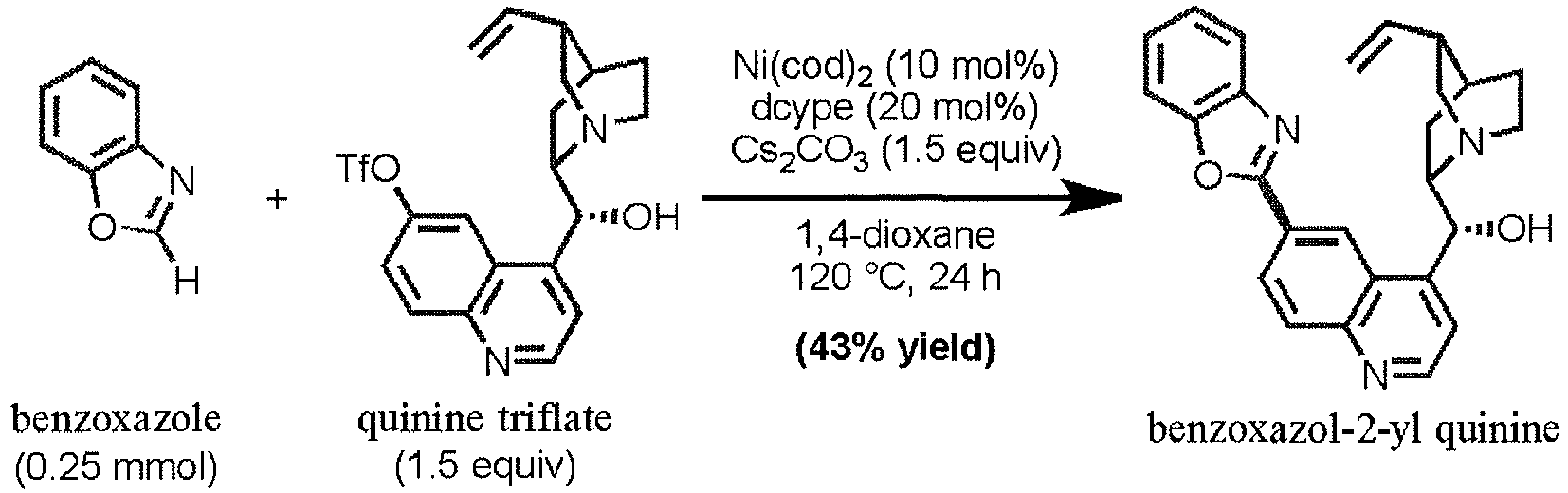
- The following is an analytical result of benzoxazol-2-yl quinine.
1H-NMR (400 MHz, CDCl3): δ 8.55 (s, 1H), 8.28 (d, 1H, J=4.4 Hz), 8.08 (dd, 1H, J=8.8, 1.2 Hz), 7.93 (d, 1H, J=8.8 Hz), 7.72-7.65 (m, 1H), 7.64-7.57 (m, 1H), 7.44 (d, 1H, J=4.4 Hz), 7.42-7.35 (m, 2H), 5.82 (d, 1H, J=2.8 Hz), 5.72-5.61 (m, 1H), 4.96-4.82 (m, 2H), 3.73-3.58 (m, 1H), 3.13 (dd, 1H, J=14.0, 10.4 Hz), 3.04-2.94 (m, 1H), 2.82-2.68 (m, 1H), 2.60 (dd, 1H, J=14.0, 3.2 Hz), 2.30 (br, 1H), 2.00-1.85 (m, 2H), 1.85-1.79 (m, 1H), 1.62-1.49 (m, 1H), 1.48-1.38 (m, 1H)
13C NMR (100 MHz, CDCl3): δ 161.9, 151.3, 150.7, 150.6, 148.7, 141.4, 141.3, 130.7, 126.4, 125.5, 124.9, 124.8, 123.9, 122.8, 119.8, 118.8, 114.4, 110.9, 70.5, 60.7, 56.4, 42.9, 39.6, 27.9, 27.1,20.4
HRMS (DART) m/z calcd for C26H26N3O2 [MH]+: 412.2025 found 412.2025 - Since the method according to the present invention can produce a compound in which the carbon atom indicated by * in the general formula (2) and the carbon atom indicated by * in the general formula (3) are bonded to each other (see the above reaction scheme), a wide range of heteroaromatic compounds and phenol derivatives can be selectively used, and a compound having the target structure can be inexpensively and efficiently obtained. Therefore, a compound having the target structure (e.g., a biologically active compound, drug (e.g., compound having a steroid skeleton or an alkaloid skeleton), an organic electronic material, or an intermediate thereof) can be easily produced by utilizing the desired atom or functional group as a substituent that substitutes the heteroaromatic compound or the phenol derivative.
Claims (5)
- A method for producing a heterocyclic compound represented by a general formula (1), characterized by comprising reacting a heteroaromatic compound represented by a general formula (2) with a phenol derivative represented by a general formula (3) in the presence of a nickel compound, 1,2-bis(dicyclohexylphosphino)ethane, and a base,


- The method according to claim 1, wherein the heteroaromatic compound represented by the general formula (2) is an oxazole derivative, a benzoxazole derivative, or a benzothiazole derivative.
- The method according to claim 1 or 2, wherein the phenol derivative represented by the general formula (3) is a compound among compounds respectively represented by general formulae (3-1) to (3-16),


- The method according to any one of claims 1 to 3, wherein R5 is a pivaloyl group, a dimethylcarbamoyl group, a triflate group, or a methanesulfonyl group.
- The method according to any one of claims 1 to 4, wherein a molar ratio of Ni atoms included in the nickel compound to 1,2-bis(dicyclohexylphosphino)ethane is 1:1.2 to 1:3.
Applications Claiming Priority (2)
| Application Number | Priority Date | Filing Date | Title |
|---|---|---|---|
| JP2011239604 | 2011-10-31 | ||
| PCT/JP2012/076242 WO2013065463A1 (en) | 2011-10-31 | 2012-10-10 | Method for producing phenyl-substituted heterocyclic derivative |
Publications (3)
| Publication Number | Publication Date |
|---|---|
| EP2774923A1 true EP2774923A1 (en) | 2014-09-10 |
| EP2774923A4 EP2774923A4 (en) | 2014-12-31 |
| EP2774923B1 EP2774923B1 (en) | 2016-05-18 |
Family
ID=48191821
Family Applications (1)
| Application Number | Title | Priority Date | Filing Date |
|---|---|---|---|
| EP12845027.7A Not-in-force EP2774923B1 (en) | 2011-10-31 | 2012-10-10 | Method for producing phenyl-substituted heterocyclic derivative |
Country Status (4)
| Country | Link |
|---|---|
| US (1) | US8993777B2 (en) |
| EP (1) | EP2774923B1 (en) |
| JP (1) | JP5671726B2 (en) |
| WO (1) | WO2013065463A1 (en) |
Cited By (2)
| Publication number | Priority date | Publication date | Assignee | Title |
|---|---|---|---|---|
| CN108658886A (en) * | 2018-05-11 | 2018-10-16 | 温州大学苍南研究院 | A kind of arylation method of benzoxazole |
| EP4405345A4 (en) * | 2021-09-21 | 2025-11-19 | Univ Nanyang Tech | MYCOBACTERIUM ABSCESSUS GROWTH INHIBITOR AND MODEL |
Families Citing this family (2)
| Publication number | Priority date | Publication date | Assignee | Title |
|---|---|---|---|---|
| JP6367121B2 (en) * | 2013-02-07 | 2018-08-01 | 国立大学法人名古屋大学 | Coupling method and method for producing aromatic group-substituted heterocyclic compound using the coupling method |
| KR102612519B1 (en) * | 2021-01-22 | 2023-12-12 | 주식회사 랩토 | Organic compounds and organic electroluminescent device including the same |
-
2012
- 2012-10-10 EP EP12845027.7A patent/EP2774923B1/en not_active Not-in-force
- 2012-10-10 WO PCT/JP2012/076242 patent/WO2013065463A1/en not_active Ceased
- 2012-10-10 JP JP2013541690A patent/JP5671726B2/en not_active Expired - Fee Related
- 2012-10-10 US US14/355,035 patent/US8993777B2/en not_active Expired - Fee Related
Non-Patent Citations (2)
| Title |
|---|
| No further relevant documents disclosed * |
| See also references of WO2013065463A1 * |
Cited By (2)
| Publication number | Priority date | Publication date | Assignee | Title |
|---|---|---|---|---|
| CN108658886A (en) * | 2018-05-11 | 2018-10-16 | 温州大学苍南研究院 | A kind of arylation method of benzoxazole |
| EP4405345A4 (en) * | 2021-09-21 | 2025-11-19 | Univ Nanyang Tech | MYCOBACTERIUM ABSCESSUS GROWTH INHIBITOR AND MODEL |
Also Published As
| Publication number | Publication date |
|---|---|
| JPWO2013065463A1 (en) | 2015-04-02 |
| EP2774923B1 (en) | 2016-05-18 |
| JP5671726B2 (en) | 2015-02-18 |
| EP2774923A4 (en) | 2014-12-31 |
| WO2013065463A1 (en) | 2013-05-10 |
| US8993777B2 (en) | 2015-03-31 |
| US20140275549A1 (en) | 2014-09-18 |
Similar Documents
| Publication | Publication Date | Title |
|---|---|---|
| Fershtat et al. | Efficient assembly of mono-and bis (1, 2, 4-oxadiazol-3-yl) furoxan scaffolds via tandem reactions of furoxanylamidoximes | |
| US8993777B2 (en) | Method for producing phenyl-substituted heterocyclic derivative | |
| RU2413720C2 (en) | Chemical compositions, formulations and methods of their application | |
| CN103958487B (en) | Benzoic acid derivative as EIF4E inhibitor | |
| CA2621949A1 (en) | Conformationally constrained 3- (4-hydroxy-phenyl) - substituted-propanoic acids useful for treating metabolic disorders | |
| CA2563818A1 (en) | Compounds and compositions as ppar modulators | |
| KR101392538B1 (en) | Fluorination process of anilide derivatives and benzothiazole fluorinate derivatives as in vivo imaging agents | |
| US12344586B2 (en) | Process for the preparation of biphenylamines | |
| Shi et al. | Synthesis and bioevaluation of 2-phenyl-5-methyl-2 H-1, 2, 3-triazole-4-carboxylic acid/carbohydrazide derivatives as potent xanthine oxidase inhibitors | |
| Kalogirou et al. | Ring transformation of (4-chloro-5 H-1, 2, 3-dithiazol-5-ylidene) acetonitriles to 3-haloisothiazole-5-carbonitriles | |
| Chai et al. | One-pot synthesis of 3, 5-disubstituted 1, 2, 4-thiadiazoles from nitriles and thioamides via I 2-mediated oxidative formation of an N–S bond | |
| Xie et al. | Cu-catalyzed direct C–H bond functionalization: a regioselective protocol to 5-aryl thiazolo [3, 2-b]-1, 2, 4-triazoles | |
| JP5654601B2 (en) | Method for producing phenyl-substituted heterocyclic derivatives by a coupling method using a palladium compound | |
| Jadhao et al. | Copper-mediated [3+ 2] oxidative cyclization of oxime acetate and its utility in the formal synthesis of fentiazac | |
| CA2112731A1 (en) | Preparation of alkyl 2-alkyl-4-fluoromethylthiazolecarboxylates | |
| CN104592144B (en) | New method for preparing oxazole derivative | |
| US10189800B2 (en) | Method for preparing N-(1,3,4-oxadiazol-2-yl)arylcarboxamides | |
| JP5643121B2 (en) | Method for producing aryl (diolato) boranes | |
| BR112019009793A2 (en) | 4 - ((6- (2- (2,4-difluorophenyl) -1,1-difluoro-2-hydroxy-3- (5-mercapto-1h-1,2,4-triazol-1-yl) propyl) pyridin-3-yl) oxy) benzonitrile and preparation processes | |
| CN109265409B (en) | Synthesis method of 2-substituted benzoxazole, 2-substituted benzothiazole and derivatives thereof | |
| JP6367121B2 (en) | Coupling method and method for producing aromatic group-substituted heterocyclic compound using the coupling method | |
| WO2016004899A1 (en) | Process for making tetracyclic heterocycle compounds | |
| CA2626443A1 (en) | Oxazole and thiazole ppar modulators | |
| Chupp et al. | Reaction of isocyanides with divalent sulfur-containing heterocycles | |
| HUP0300816A2 (en) | Continuous process for the preparation of pesticidal chlorothiazole-derivatives |
Legal Events
| Date | Code | Title | Description |
|---|---|---|---|
| PUAI | Public reference made under article 153(3) epc to a published international application that has entered the european phase |
Free format text: ORIGINAL CODE: 0009012 |
|
| 17P | Request for examination filed |
Effective date: 20140522 |
|
| AK | Designated contracting states |
Kind code of ref document: A1 Designated state(s): AL AT BE BG CH CY CZ DE DK EE ES FI FR GB GR HR HU IE IS IT LI LT LU LV MC MK MT NL NO PL PT RO RS SE SI SK SM TR |
|
| A4 | Supplementary search report drawn up and despatched |
Effective date: 20141127 |
|
| RIC1 | Information provided on ipc code assigned before grant |
Ipc: C07D 471/08 20060101ALI20141121BHEP Ipc: C07B 61/00 20060101ALI20141121BHEP Ipc: C07D 263/57 20060101ALI20141121BHEP Ipc: C07D 277/22 20060101ALI20141121BHEP Ipc: C07D 413/04 20060101ALI20141121BHEP Ipc: C07D 263/56 20060101ALI20141121BHEP Ipc: C07D 263/34 20060101ALI20141121BHEP Ipc: C07D 263/32 20060101AFI20141121BHEP Ipc: C07D 277/66 20060101ALI20141121BHEP |
|
| DAX | Request for extension of the european patent (deleted) | ||
| 17Q | First examination report despatched |
Effective date: 20150706 |
|
| GRAP | Despatch of communication of intention to grant a patent |
Free format text: ORIGINAL CODE: EPIDOSNIGR1 |
|
| INTG | Intention to grant announced |
Effective date: 20160105 |
|
| GRAS | Grant fee paid |
Free format text: ORIGINAL CODE: EPIDOSNIGR3 |
|
| GRAA | (expected) grant |
Free format text: ORIGINAL CODE: 0009210 |
|
| AK | Designated contracting states |
Kind code of ref document: B1 Designated state(s): AL AT BE BG CH CY CZ DE DK EE ES FI FR GB GR HR HU IE IS IT LI LT LU LV MC MK MT NL NO PL PT RO RS SE SI SK SM TR |
|
| REG | Reference to a national code |
Ref country code: GB Ref legal event code: FG4D |
|
| REG | Reference to a national code |
Ref country code: CH Ref legal event code: EP |
|
| REG | Reference to a national code |
Ref country code: IE Ref legal event code: FG4D Ref country code: AT Ref legal event code: REF Ref document number: 800335 Country of ref document: AT Kind code of ref document: T Effective date: 20160615 |
|
| REG | Reference to a national code |
Ref country code: DE Ref legal event code: R096 Ref document number: 602012018823 Country of ref document: DE |
|
| REG | Reference to a national code |
Ref country code: NL Ref legal event code: MP Effective date: 20160518 |
|
| REG | Reference to a national code |
Ref country code: LT Ref legal event code: MG4D |
|
| PG25 | Lapsed in a contracting state [announced via postgrant information from national office to epo] |
Ref country code: LT Free format text: LAPSE BECAUSE OF FAILURE TO SUBMIT A TRANSLATION OF THE DESCRIPTION OR TO PAY THE FEE WITHIN THE PRESCRIBED TIME-LIMIT Effective date: 20160518 Ref country code: FI Free format text: LAPSE BECAUSE OF FAILURE TO SUBMIT A TRANSLATION OF THE DESCRIPTION OR TO PAY THE FEE WITHIN THE PRESCRIBED TIME-LIMIT Effective date: 20160518 Ref country code: NL Free format text: LAPSE BECAUSE OF FAILURE TO SUBMIT A TRANSLATION OF THE DESCRIPTION OR TO PAY THE FEE WITHIN THE PRESCRIBED TIME-LIMIT Effective date: 20160518 Ref country code: NO Free format text: LAPSE BECAUSE OF FAILURE TO SUBMIT A TRANSLATION OF THE DESCRIPTION OR TO PAY THE FEE WITHIN THE PRESCRIBED TIME-LIMIT Effective date: 20160818 |
|
| REG | Reference to a national code |
Ref country code: AT Ref legal event code: MK05 Ref document number: 800335 Country of ref document: AT Kind code of ref document: T Effective date: 20160518 |
|
| PG25 | Lapsed in a contracting state [announced via postgrant information from national office to epo] |
Ref country code: PT Free format text: LAPSE BECAUSE OF FAILURE TO SUBMIT A TRANSLATION OF THE DESCRIPTION OR TO PAY THE FEE WITHIN THE PRESCRIBED TIME-LIMIT Effective date: 20160919 Ref country code: ES Free format text: LAPSE BECAUSE OF FAILURE TO SUBMIT A TRANSLATION OF THE DESCRIPTION OR TO PAY THE FEE WITHIN THE PRESCRIBED TIME-LIMIT Effective date: 20160518 Ref country code: GR Free format text: LAPSE BECAUSE OF FAILURE TO SUBMIT A TRANSLATION OF THE DESCRIPTION OR TO PAY THE FEE WITHIN THE PRESCRIBED TIME-LIMIT Effective date: 20160819 Ref country code: LV Free format text: LAPSE BECAUSE OF FAILURE TO SUBMIT A TRANSLATION OF THE DESCRIPTION OR TO PAY THE FEE WITHIN THE PRESCRIBED TIME-LIMIT Effective date: 20160518 Ref country code: SE Free format text: LAPSE BECAUSE OF FAILURE TO SUBMIT A TRANSLATION OF THE DESCRIPTION OR TO PAY THE FEE WITHIN THE PRESCRIBED TIME-LIMIT Effective date: 20160518 Ref country code: RS Free format text: LAPSE BECAUSE OF FAILURE TO SUBMIT A TRANSLATION OF THE DESCRIPTION OR TO PAY THE FEE WITHIN THE PRESCRIBED TIME-LIMIT Effective date: 20160518 Ref country code: HR Free format text: LAPSE BECAUSE OF FAILURE TO SUBMIT A TRANSLATION OF THE DESCRIPTION OR TO PAY THE FEE WITHIN THE PRESCRIBED TIME-LIMIT Effective date: 20160518 |
|
| PG25 | Lapsed in a contracting state [announced via postgrant information from national office to epo] |
Ref country code: IT Free format text: LAPSE BECAUSE OF FAILURE TO SUBMIT A TRANSLATION OF THE DESCRIPTION OR TO PAY THE FEE WITHIN THE PRESCRIBED TIME-LIMIT Effective date: 20160518 |
|
| PG25 | Lapsed in a contracting state [announced via postgrant information from national office to epo] |
Ref country code: CZ Free format text: LAPSE BECAUSE OF FAILURE TO SUBMIT A TRANSLATION OF THE DESCRIPTION OR TO PAY THE FEE WITHIN THE PRESCRIBED TIME-LIMIT Effective date: 20160518 Ref country code: EE Free format text: LAPSE BECAUSE OF FAILURE TO SUBMIT A TRANSLATION OF THE DESCRIPTION OR TO PAY THE FEE WITHIN THE PRESCRIBED TIME-LIMIT Effective date: 20160518 Ref country code: RO Free format text: LAPSE BECAUSE OF FAILURE TO SUBMIT A TRANSLATION OF THE DESCRIPTION OR TO PAY THE FEE WITHIN THE PRESCRIBED TIME-LIMIT Effective date: 20160518 Ref country code: DK Free format text: LAPSE BECAUSE OF FAILURE TO SUBMIT A TRANSLATION OF THE DESCRIPTION OR TO PAY THE FEE WITHIN THE PRESCRIBED TIME-LIMIT Effective date: 20160518 Ref country code: SK Free format text: LAPSE BECAUSE OF FAILURE TO SUBMIT A TRANSLATION OF THE DESCRIPTION OR TO PAY THE FEE WITHIN THE PRESCRIBED TIME-LIMIT Effective date: 20160518 |
|
| PGFP | Annual fee paid to national office [announced via postgrant information from national office to epo] |
Ref country code: DE Payment date: 20161028 Year of fee payment: 5 |
|
| REG | Reference to a national code |
Ref country code: DE Ref legal event code: R097 Ref document number: 602012018823 Country of ref document: DE |
|
| PG25 | Lapsed in a contracting state [announced via postgrant information from national office to epo] |
Ref country code: AT Free format text: LAPSE BECAUSE OF FAILURE TO SUBMIT A TRANSLATION OF THE DESCRIPTION OR TO PAY THE FEE WITHIN THE PRESCRIBED TIME-LIMIT Effective date: 20160518 Ref country code: SM Free format text: LAPSE BECAUSE OF FAILURE TO SUBMIT A TRANSLATION OF THE DESCRIPTION OR TO PAY THE FEE WITHIN THE PRESCRIBED TIME-LIMIT Effective date: 20160518 Ref country code: BE Free format text: LAPSE BECAUSE OF FAILURE TO SUBMIT A TRANSLATION OF THE DESCRIPTION OR TO PAY THE FEE WITHIN THE PRESCRIBED TIME-LIMIT Effective date: 20160518 Ref country code: PL Free format text: LAPSE BECAUSE OF FAILURE TO SUBMIT A TRANSLATION OF THE DESCRIPTION OR TO PAY THE FEE WITHIN THE PRESCRIBED TIME-LIMIT Effective date: 20160518 |
|
| PLBE | No opposition filed within time limit |
Free format text: ORIGINAL CODE: 0009261 |
|
| STAA | Information on the status of an ep patent application or granted ep patent |
Free format text: STATUS: NO OPPOSITION FILED WITHIN TIME LIMIT |
|
| 26N | No opposition filed |
Effective date: 20170221 |
|
| PG25 | Lapsed in a contracting state [announced via postgrant information from national office to epo] |
Ref country code: SI Free format text: LAPSE BECAUSE OF FAILURE TO SUBMIT A TRANSLATION OF THE DESCRIPTION OR TO PAY THE FEE WITHIN THE PRESCRIBED TIME-LIMIT Effective date: 20160518 |
|
| REG | Reference to a national code |
Ref country code: CH Ref legal event code: PL |
|
| GBPC | Gb: european patent ceased through non-payment of renewal fee |
Effective date: 20161010 |
|
| PG25 | Lapsed in a contracting state [announced via postgrant information from national office to epo] |
Ref country code: MC Free format text: LAPSE BECAUSE OF FAILURE TO SUBMIT A TRANSLATION OF THE DESCRIPTION OR TO PAY THE FEE WITHIN THE PRESCRIBED TIME-LIMIT Effective date: 20160518 |
|
| REG | Reference to a national code |
Ref country code: IE Ref legal event code: MM4A |
|
| REG | Reference to a national code |
Ref country code: FR Ref legal event code: ST Effective date: 20170630 |
|
| PG25 | Lapsed in a contracting state [announced via postgrant information from national office to epo] |
Ref country code: GB Free format text: LAPSE BECAUSE OF NON-PAYMENT OF DUE FEES Effective date: 20161010 Ref country code: FR Free format text: LAPSE BECAUSE OF NON-PAYMENT OF DUE FEES Effective date: 20161102 Ref country code: CH Free format text: LAPSE BECAUSE OF NON-PAYMENT OF DUE FEES Effective date: 20161031 Ref country code: LI Free format text: LAPSE BECAUSE OF NON-PAYMENT OF DUE FEES Effective date: 20161031 |
|
| PG25 | Lapsed in a contracting state [announced via postgrant information from national office to epo] |
Ref country code: LU Free format text: LAPSE BECAUSE OF NON-PAYMENT OF DUE FEES Effective date: 20161010 |
|
| PG25 | Lapsed in a contracting state [announced via postgrant information from national office to epo] |
Ref country code: IE Free format text: LAPSE BECAUSE OF NON-PAYMENT OF DUE FEES Effective date: 20161010 |
|
| REG | Reference to a national code |
Ref country code: DE Ref legal event code: R119 Ref document number: 602012018823 Country of ref document: DE |
|
| PG25 | Lapsed in a contracting state [announced via postgrant information from national office to epo] |
Ref country code: HU Free format text: LAPSE BECAUSE OF FAILURE TO SUBMIT A TRANSLATION OF THE DESCRIPTION OR TO PAY THE FEE WITHIN THE PRESCRIBED TIME-LIMIT; INVALID AB INITIO Effective date: 20121010 |
|
| PG25 | Lapsed in a contracting state [announced via postgrant information from national office to epo] |
Ref country code: CY Free format text: LAPSE BECAUSE OF FAILURE TO SUBMIT A TRANSLATION OF THE DESCRIPTION OR TO PAY THE FEE WITHIN THE PRESCRIBED TIME-LIMIT Effective date: 20160518 Ref country code: MK Free format text: LAPSE BECAUSE OF FAILURE TO SUBMIT A TRANSLATION OF THE DESCRIPTION OR TO PAY THE FEE WITHIN THE PRESCRIBED TIME-LIMIT Effective date: 20160518 Ref country code: MT Free format text: LAPSE BECAUSE OF NON-PAYMENT OF DUE FEES Effective date: 20161031 Ref country code: IS Free format text: LAPSE BECAUSE OF FAILURE TO SUBMIT A TRANSLATION OF THE DESCRIPTION OR TO PAY THE FEE WITHIN THE PRESCRIBED TIME-LIMIT Effective date: 20160518 |
|
| PG25 | Lapsed in a contracting state [announced via postgrant information from national office to epo] |
Ref country code: BG Free format text: LAPSE BECAUSE OF FAILURE TO SUBMIT A TRANSLATION OF THE DESCRIPTION OR TO PAY THE FEE WITHIN THE PRESCRIBED TIME-LIMIT Effective date: 20160518 Ref country code: DE Free format text: LAPSE BECAUSE OF NON-PAYMENT OF DUE FEES Effective date: 20180501 |
|
| PG25 | Lapsed in a contracting state [announced via postgrant information from national office to epo] |
Ref country code: TR Free format text: LAPSE BECAUSE OF FAILURE TO SUBMIT A TRANSLATION OF THE DESCRIPTION OR TO PAY THE FEE WITHIN THE PRESCRIBED TIME-LIMIT Effective date: 20160518 Ref country code: AL Free format text: LAPSE BECAUSE OF FAILURE TO SUBMIT A TRANSLATION OF THE DESCRIPTION OR TO PAY THE FEE WITHIN THE PRESCRIBED TIME-LIMIT Effective date: 20160518 |